Tribeca Soundbar Installer · Canal Street to Chambers · Lofts, Warehouse Conversions, Townhouses & New Towers
Soundbar Installation in Tribeca
Exposed-Brick Mounts · Column & Partition Walls · Full-Motion Arms · Bass Kept Off the Timber Floor
Tribeca lives inside old warehouses. The TV wall is often bare 19th-century brick with no cavity behind it, the ceiling is ten to fourteen feet of beams and joists, the floor is wide plank over someone else's loft, and the street below carries Holland Tunnel traffic. We fit soundbars to that: anchors set in the brick rather than the crumbling joint, full-motion arms with the bar riding on the TV, cables dressed so they suit a loft instead of fighting it, and sound tuned for a room the size of a floor — on a Manhattan price you can read before anyone presses the elevator key.
Reviewed and updated October 17, 2026 · Author: Anwar Timothy, owner · NYS license #12000287431 · Manhattan line for Tribeca (929) 560-0737
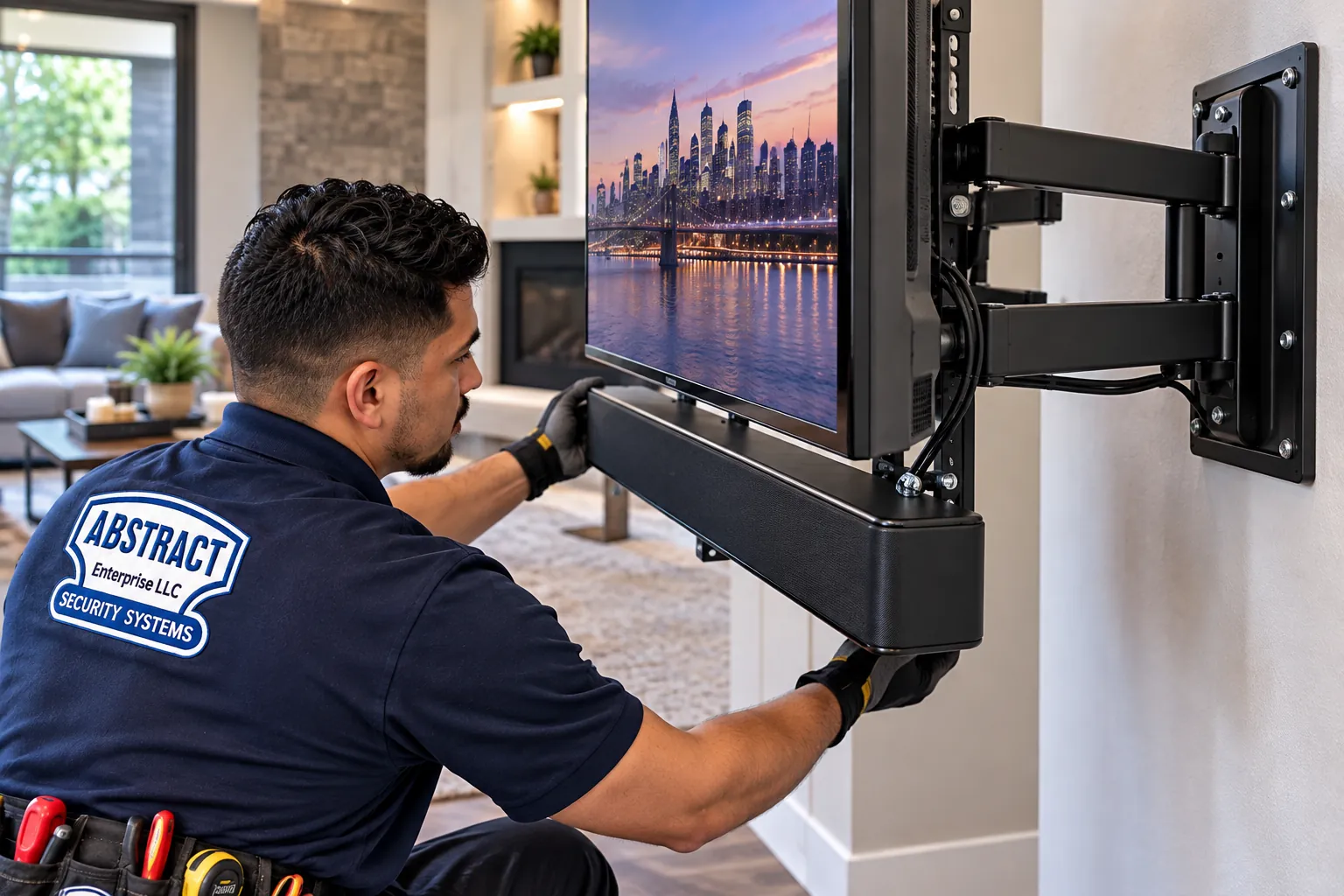
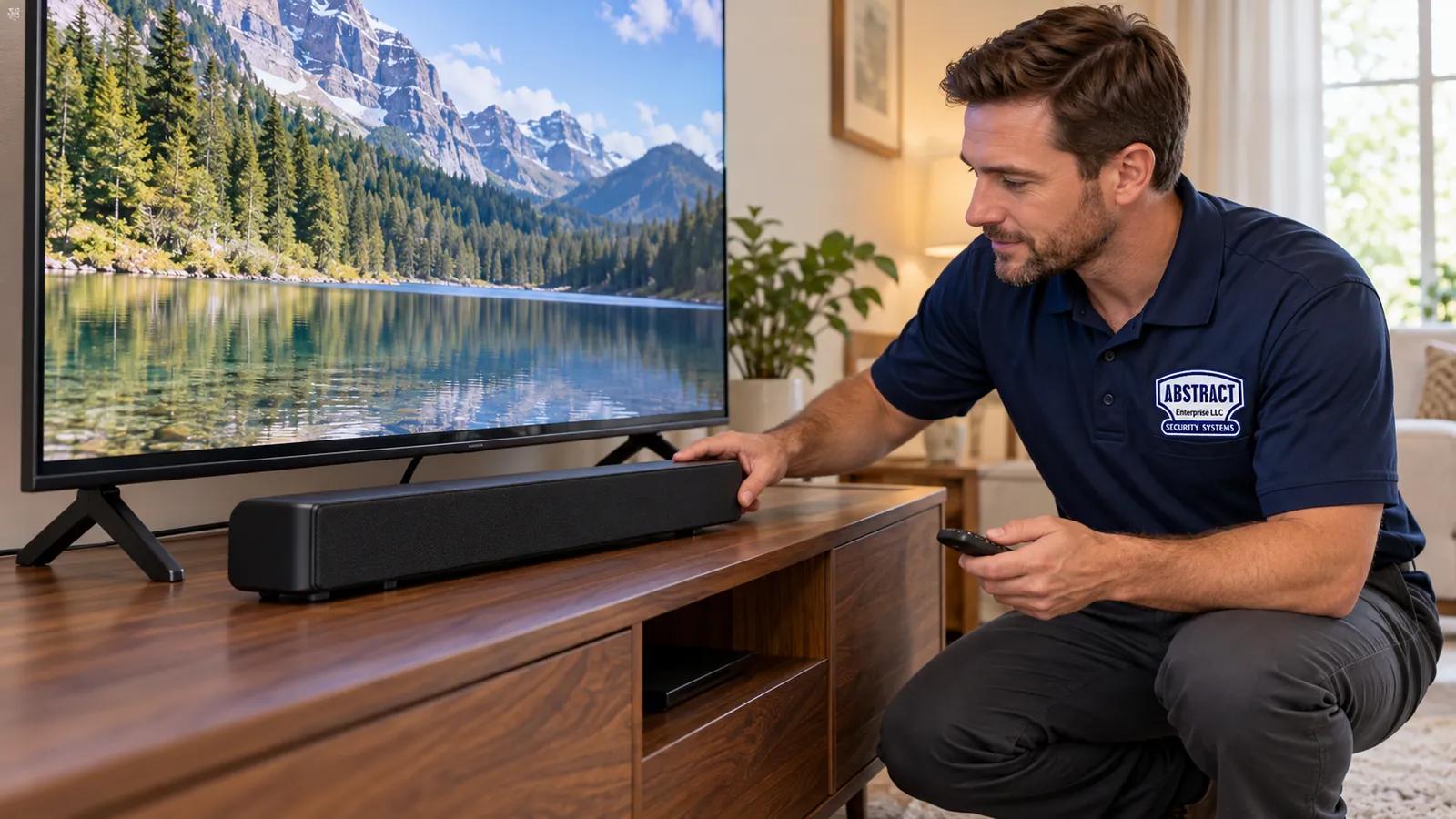
A soundbar being fixed beneath a TV on an articulating arm, so the bar swings with the screen — the arrangement open-plan lofts ask for most.
Tribeca Soundbar Quote
Wall photo, bar model and block — a written Manhattan price back the same business day
✅
Request Sent!
Someone from our Manhattan team will ring you back about your Tribeca job the same business day.
25+
Years Experience
✓
Same-Day Estimates
100%
Licensed & Insured
4.7★
201 Google Reviews
Got a loft wall and a bar still in its box? Call the line that answers for Tribeca, (929) 560-0737, or use the short form. A photo of the wall is usually enough for us to send a written, itemized number — parking already in it — before you book anything with the building.
Brick, column, timber or partition: the wall is identified first, and the fixing follows from it
A single flat $150 parking line on each Manhattan visit, Tribeca included — tunnel traffic is our problem, not a surcharge
New York State licence #12000287431 · two-hour arrival windows offered from 8 AM to 8 PM, seven days
Most homes in Tribeca were built to store butter, dry goods and machinery, not to hang a television, and that single fact shapes almost every soundbar job we quote below Canal Street. The Historic Districts Council's account of the neighborhood describes how the early Federal and Greek Revival houses north of the old Washington Market were turned into food warehouses, and how, over roughly fifty years from 1860 to 1910, most of them were replaced outright by store-and-loft buildings and warehouses. Those buildings, the Council notes, still dominate the neighborhood's character. Living rooms now occupy their upper floors.
The name itself came late. According to the same history, a realtor coined "Tribeca" — the Triangle Below Canal — in the 1970s, after the city adopted a Special Lower Manhattan Mixed Use District for the area south of Canal between Broadway and West Street, hoping it would follow SoHo from industrial floors to artists' lofts and apartments. It did. The Landmarks Preservation Commission then designated four historic districts: Tribeca West in May 1991, and Tribeca East, North and South in December 1992, with an extension to Tribeca South in 2002. Tribeca East alone covers 197 buildings.
What that means inside an apartment is a short list of surfaces you rarely meet elsewhere in the borough. Real-estate guides to Tribeca lofts describe the same features again and again: exposed brick, heavy timber or steel beams, tall industrial windows, wide-plank or hardwood floors, and ceilings that commonly run from about 10 to 14 feet, with some conversions reaching 15 feet or more. One guide puts the trade-off plainly: "Open volume is inspiring, yet it can also amplify sound." Another warns that original single-glazed windows and thin partitions "may transmit street or neighbor noise," and that the fixes can be shaped by building rules and landmark status. A soundbar lives with every item on that list.
The street matters too. Tribeca North sits right against the Holland Tunnel approaches. The Tribeca Trib reported on residents of 135 Hudson Street who stood on the corners with "No Honking" placards; one of them, a retired film professor, said that "all summer, if your windows are open, you get no peace, just constant, constant noise," and a neighbor pointed to the Beach and Hudson intersection, where cars leaving the tunnel rotary cross tunnel-bound traffic. In 2022 Tribeca Citizen covered a new Tribeca North Neighborhood Association formed around tunnel traffic, sketching boundaries from Canal to North Moore and from West Street to the west side of Varick. In a loft facing those streets, the bar has to make dialogue intelligible against the city, not just fill a quiet room.
And residents ask the questions you would expect. A poster in r/AskNYC who had been viewing apartments with exposed brick in the living room wanted to know whether landlords even let tenants drill into it to mount a TV. That is the right first question in Tribeca, and it comes before the bracket, the bar or the anchor: who owns the wall, who has to agree to holes in it, and what the building itself will allow — a co-op board, a condo's house rules, a landlord, or, in a building still being legalized, the process that governs it.
Tribeca numbers that shape a soundbar visit
1860 to 1910: the half-century in which most of the neighborhood's store-and-loft buildings and warehouses went up, according to the Historic Districts Council — the brick, iron and timber you are mounting on.
Four historic districts, 197 buildings in one: Tribeca West (designated May 7, 1991), Tribeca East, North and South (December 1992), with the Tribeca South extension added on November 19, 2002; Tribeca East encompasses 197 buildings.
10 to 14 feet: the typical loft ceiling range quoted in a Tribeca loft-living guide, with some conversions at 15 feet or more — height that changes both where the TV goes and how a bar's up-firing drivers behave.
160,189 residents and 95,624 housing units in Manhattan Community District 1 in 2024 (NYU Furman Center; the district covers Tribeca, the Financial District and Battery Park City), with a homeownership rate of 34.0 percent — above the citywide 32.7 percent, so more owners deciding on their own walls than in most of Manhattan.
15.5 percent of households in the district had children under 18, and 47.3 percent were single-person households (Furman Center, 2024) — a mix of family lofts with playrooms and one-person apartments with a TV in every zone.
87.0 percent of the district's commuters travel car-free (Furman Center, 2024), and neighbors have organized around tunnel traffic on the streets nearby — which is why a technician's van, tools and parking are priced as one flat line rather than left to chance.
Put together, the numbers describe a neighborhood of large, hard-surfaced rooms in old industrial shells, owned or rented by people who expect a clean result and who often live directly above or below another loft. A soundbar install here is a carpentry, masonry and acoustics problem as much as an audio one. Get the wall, the room and the neighbor right, and the bar — whichever brand came in the box — does the rest.
A good share of Tribeca bookings hang the screen at the same visit, which is quoted through our Manhattan TV installation page so the TV and bar share one trip and one parking line. Owners renovating a loft who want ceiling speakers or a proper surround system rather than a single bar can talk to AESS audio and video installers for Manhattan, and buildings re-doing their street door often add an intercom installation in Manhattan while they are at it.
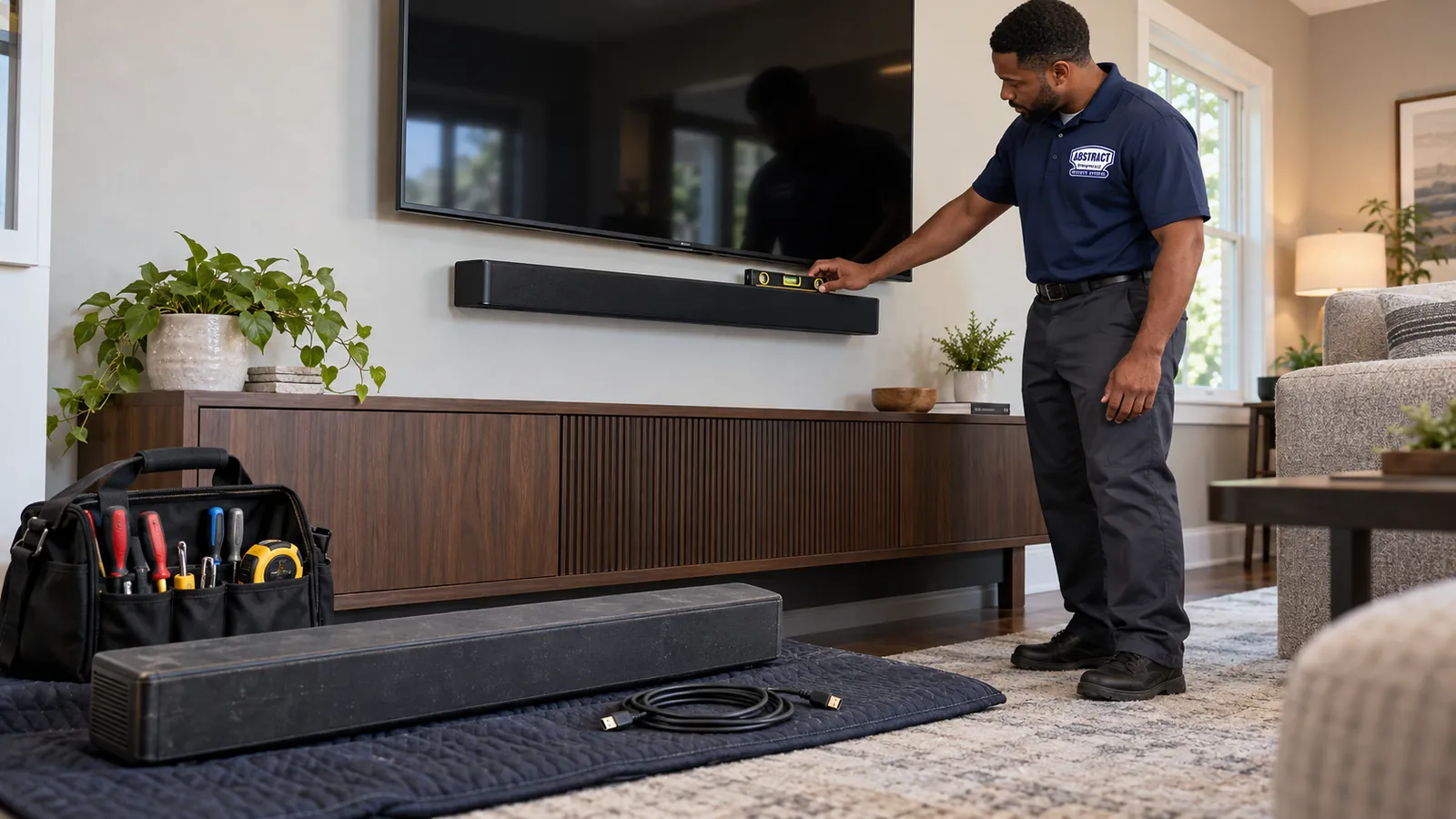
The bar is already on the wall under the screen; a short level along its top confirms it before the cables are dressed. A tool bag, an HDMI lead and a second bar wait on the blanket.
Repair Capture
Soundbar Repair Calls in Tribeca
If the bar went quiet after a TV firmware update, the subwoofer keeps losing its pairing, the remote across the loft no longer reaches it, or anchors have started to pull out of a soft mortar joint, treat it as a repair rather than a new install. Ring (929) 560-0737 and say so; we hold the next free 2-hour window for you, and most settings, pairing and connection faults are put right within one to two hours of the technician getting through the door. How setup-only time is charged is spelled out in our TV and soundbar service policies.
What We Install
Soundbar Installation Services in Tribeca
Every Tribeca quote is assembled from the services below, each with its own line on our published Manhattan menu. The finish is always the same: the bar level and centred on the picture, the cables either hidden or deliberately dressed, one remote running the volume, the connection checked, and a listening test from the seat you actually use — which in a loft can be a long way from the wall.
Exposed-Brick Wall Mounts
The bar fixed under the screen on sleeve or screw anchors set into sound brick, positioned after we have looked at the face, the joints and any old repointing. Cables travel in a slim channel or behind furniture, because brick has no cavity to hide them in.
Full-Motion Arms With the Bar Attached
In an open plan the TV often has to turn toward the kitchen, the sofa or a mezzanine. A TV-attached bracket keeps the bar locked under the screen so the sound turns with the picture instead of facing a wall nobody is sitting at.
Partition and Media-Wall Mounts
Many Tribeca TVs hang on drywall partitions built inside the warehouse shell. We scan for wood or steel studs and blocking, use a plywood backer where the bracket misses the framing, and confirm the partition is properly tied in before trusting it.
TV and Bar on One Visit
One elevator booking, one set of drop cloths, one parking line. Height is planned for the screen and the bar together, which matters when a 12-foot ceiling tempts people to hang the TV far too high.
Console Placement, No Holes
For renters, for walls the board would rather not see drilled, and for TVs on floor stands in the middle of the room: the bar on the media unit, clear of the TV's sensor, connected, tuned and tied off.
Cable Dressing for Loft Walls
A paintable surface channel where the wall is solid; an in-wall power and cable kit to code where a hollow partition and the owner allow it; or a route down the edge of a column or post so the run reads as part of the architecture.
eARC, CEC and Control-System Hand-Off
The bar on the TV's eARC or ARC port, HDMI-CEC switched on, lip-sync checked — and left in a state your home-automation integrator can pick up if the loft runs on a whole-home control system.
Bass Placement Over Timber Floors
Plank floors on joists carry low frequencies to the loft below. The subwoofer is placed off the boards, out of corners and away from mid-span, and its level is set for a building where your floor is someone else's ceiling.
Restaurants, Galleries and Studios
Bar-room screens on Hudson Street, gallery video on White and Franklin, client presentations in creative offices: bars mounted, volume capped and remotes kept behind the counter.
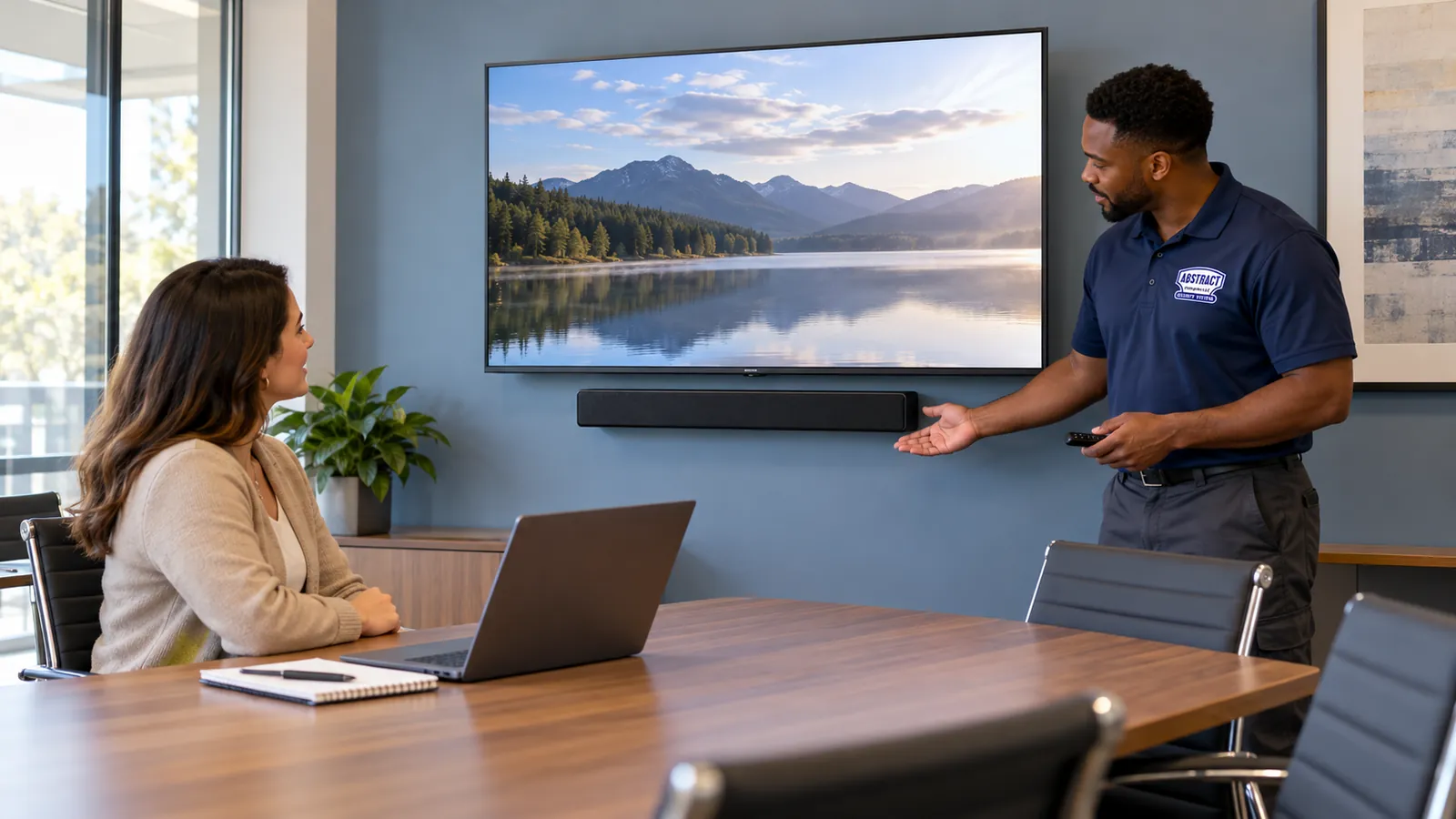
In a meeting room with a blue feature wall, a technician holding a remote points out the bar mounted beneath the display to a woman seated with her laptop.
Building Specialists
Soundbar Installation for Tribeca's Architecture
Tribeca is small, but its buildings come from at least four different centuries of construction, sometimes on a single block. These are the types we plan around, and what each one does to the bracket, the bar and the cable route.
Cast-Iron Store-and-Loft Buildings
Five-story Italianate fronts from the 1850s are the signature of the Tribeca South district, and the "mercantile palaces" of Tribeca East carry cast-iron storefronts from the 1850s to the 1880s. Inside: brick side walls, iron or timber columns down the middle, and floors converted one by one.
Late-19th-Century Brick Warehouses
Tribeca North holds some of the city's earliest surviving industrial buildings and its largest late-1800s brick warehouses. Expect thick bearing walls, heavy beams, big window bays and loft floors where the TV wall is original masonry.
Converted Factory Condominiums
Developers keep the facade and rebuild the interior: 443 Greenwich, an 1880s book bindery, became 53 condominiums. New partitions and services sit inside an old shell, so the TV wall may be fresh drywall a few inches in front of 140-year-old brick.
Federal Row Houses
The Harrison Street row of individually designated Federal houses, built between 1791 and 1828, six of which the Historic Districts Council calls a group unique in the city: small rooms, timber framing, old plaster and the gentlest drilling we do.
New Condo Towers
56 Leonard, the Herzog & de Meuron tower of 57 stories and 145 residences, is the best known of the newer buildings. New towers generally mean concrete slabs, steel-stud partitions, big glass and a handbook telling contractors when and how to arrive.
1970s Rental Towers
Independence Plaza's towers and its nine-story blocks along Greenwich Street, which left the Mitchell-Lama program in 2004. Managed buildings with their own contractor rules, conventional apartment layouts and living rooms that look nothing like a loft.
Façade-Preserving Rebuilds
Older street walls with entirely new floors and frames behind them. These behave like new construction inside — steel studs, backer plates, predictable acoustics — but the building's landmark status still governs anything that shows from the street.
Mixed Buildings Over Shops
Lofts above restaurants, galleries and stores on Hudson, Church, Greenwich and West Broadway, where the ground-floor tenant's hours and the residents' quiet hours both shape when drilling can happen.
How we fix a soundbar to each Tribeca surface
Old face brick: anchors go into whole, sound bricks, not into mortar that may be original lime mortar or recent repointing. We look at the wall in raking light first, avoid spalled or cracked units, and keep the holes inside the bracket's footprint so they can be filled later with little trace. Brick and stone carry a $65 line.
Painted or sealed brick: the coating hides the joints, so we measure the coursing and mark the bricks before drilling rather than guessing where the mortar lies.
Cast-iron and timber columns: treated as the building's structure, not a mounting surface. We do not drill structural cast iron. The answer is usually a nearby wall, a floor-standing TV mount or a console, with cables run tidily down the column face where the owner wants them there.
Heavy timber beams and posts: sound old-growth timber holds screws well, but splits, checks and old bolt holes are common, and many owners would rather keep the wood untouched. We only fix to exposed timber with the owner's say-so, using small fixings sized for the bar, never the TV.
Drywall partitions inside the shell: wood or steel studs located with a scanner, a plywood backer board ($85) across two or more studs when the bracket misses them, and a check that the partition is fixed at the top and not a free-standing screen wall. Metal studs add $30.
Concrete in new and 1970s towers: a hammer drill and carbide bit, dust caught at the hole, and drilling booked inside the building's quiet-work window. Concrete or block adds $75.
Plaster in Federal houses and older walk-ups: a light, non-hammering start through the plaster, anchors chosen for whatever sits behind it, and a tap test for plaster that has let go of its backing. Plaster adds $45.
One more rule covers all of it: the building's age. Many Tribeca loft buildings predate 1960, and under the city's Local Law 1 of 2004, paint in multiple dwellings built before that year is presumed to contain lead, according to the Department of Housing Preservation and Development. We drill those walls with a vacuum at the bit, catch the dust on a drop cloth and take it away with us.
Owners who are already opening a loft partition for a renovation often add a data run at the same time, through a structured cabling installation in Manhattan, so the TV wall ends up with a wired network point instead of depending on Wi-Fi across a hundred feet of open floor.
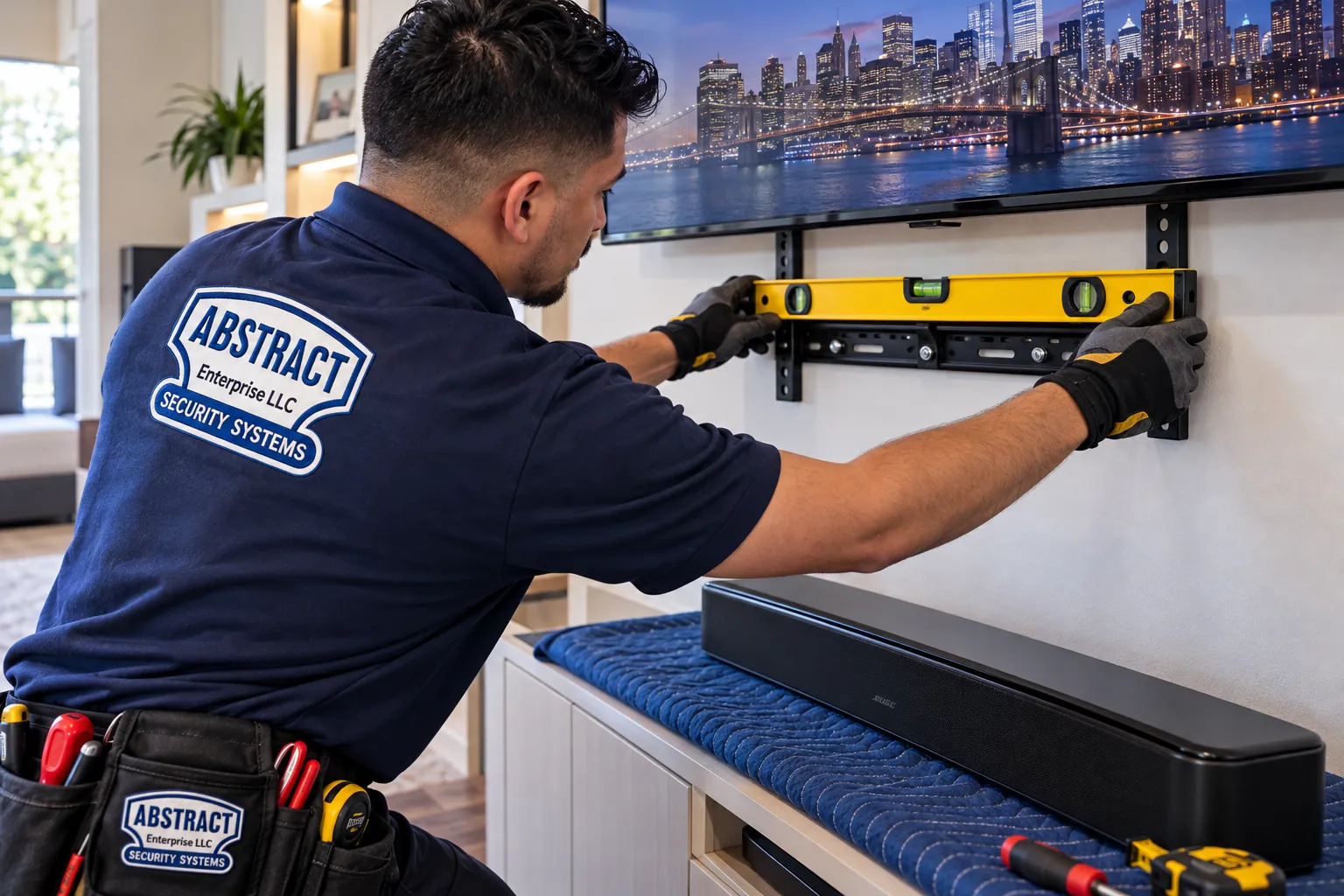
The bracket goes up first and is levelled against the wall under the TV; the bar itself sits on a padded blanket on the cabinet until the fixings are proven.
Commercial Soundbar Installation
Business Soundbar Installation in Tribeca
Commercial soundbar requests in Tribeca come from a fairly specific mix of tenants: neighborhood bars that show games, restaurants with a screen at the bar, galleries and showrooms running video, and creative and media offices that present work to clients. Most of them sit on the ground floor or lower floors of loft buildings with apartments above, which shapes every decision about volume and bass.
Hudson Street and North Moore
Neighborhood bars by the tunnel approaches. Walker's at 16 North Moore Street, on the same stretch as the Hook & Ladder 8 firehouse at No. 14, keeps its bar open until 3 AM on weekdays; The Infatuation's sports-bar guide points game-watchers to Mudville 9 in Tribeca. Late hours under apartments mean bass and late-night levels come first.
Church Street and West Broadway
Restaurant and bar rows where Tribeca Citizen's restaurant guide lists everything from an "all-American sports bar" to dive bars and cocktail rooms. A single screen over the bar needs speech that carries to the stools without reaching the dining tables.
Franklin, White and Walker Streets
Galleries, showrooms and design studios in the old mercantile blocks of Tribeca East. Video loops that run all day, exposed brick that reflects everything, and a request we hear often: sound present, speaker invisible.
Varick Street and the Film Business
The Tribeca Festival was founded in 2002 by Robert De Niro, Jane Rosenthal and Craig Hatkoff to revive Lower Manhattan after September 11, and De Niro bought the former Screening Room at 54 Varick Street at the end of 2003. Screens in offices and screening spaces here are often judged by people who work with picture and sound for a living, and we set them up with that in mind.
Greenwich Street Offices and Lobbies
Office floors, building lobbies and amenity rooms, where a display needs clear voices for calls and presentations and a bar that staff, not visitors, control.
Civic Center Edge: Chambers to Worth
The blocks toward the courts and city offices around Thomas and Worth Streets mix office buildings with lofts. Waiting areas and conference rooms need a bar that stays within accessible-route rules and speaks clearly at low volume.
Compliance notes for Tribeca businesses
Music after 10 PM. The Department of Environmental Protection's summary of the Noise Code limits sound from a commercial establishment between 10 PM and 7 AM to 42 dB measured inside a nearby residence, and to 7 dB over ambient on the street 15 feet away, with a separate 6 dB(C) bass limit once ambient exceeds 62 dB(C). With lofts over almost every Tribeca storefront, the residence is usually one timber floor away.
Bars that project into a walkway. Under section 307.2 of the 2010 ADA Standards, an object whose leading edge is between 27 and 80 inches above the floor in a circulation path may protrude no more than 4 inches. Bar plus bracket in a gallery corridor or office lobby is measured before the height is fixed.
Landmark rules inside the shop. The Landmarks Preservation Commission says interior work needs its permit only when the work needs a Buildings Department permit, affects the exterior, or sits in a designated interior landmark. A bar inside a storefront usually triggers none of those — a speaker fixed to the cast-iron front or visible signage on the facade is a different matter.
Low-voltage versus electrical work. Administrative Code § 28-105.4.7 (effective December 21, 2025) exempts sub-50-volt communication and data wiring from an electrical permit when it is done by the people the electrical code allows. A new or moved outlet behind the screen is line-voltage work for a Licensed Master Electrician under a permit, per the Department of Buildings, and is not something we do.
When the drill can run. City rules allow construction work on weekdays from 7 AM to 6 PM; many commercial landlords in loft buildings shrink that or push noisy work outside trading hours for the tenants above and below. We schedule into whatever window the landlord sets.
Insurance paperwork. Commercial landlords typically want a certificate of insurance naming them and their managing agent before a contractor goes in. We issue it without charge and send it ahead of the visit with the technician's name.
This is general information, not legal advice; your lease, your landlord's rules and the city's codes as they apply to your premises are what count.
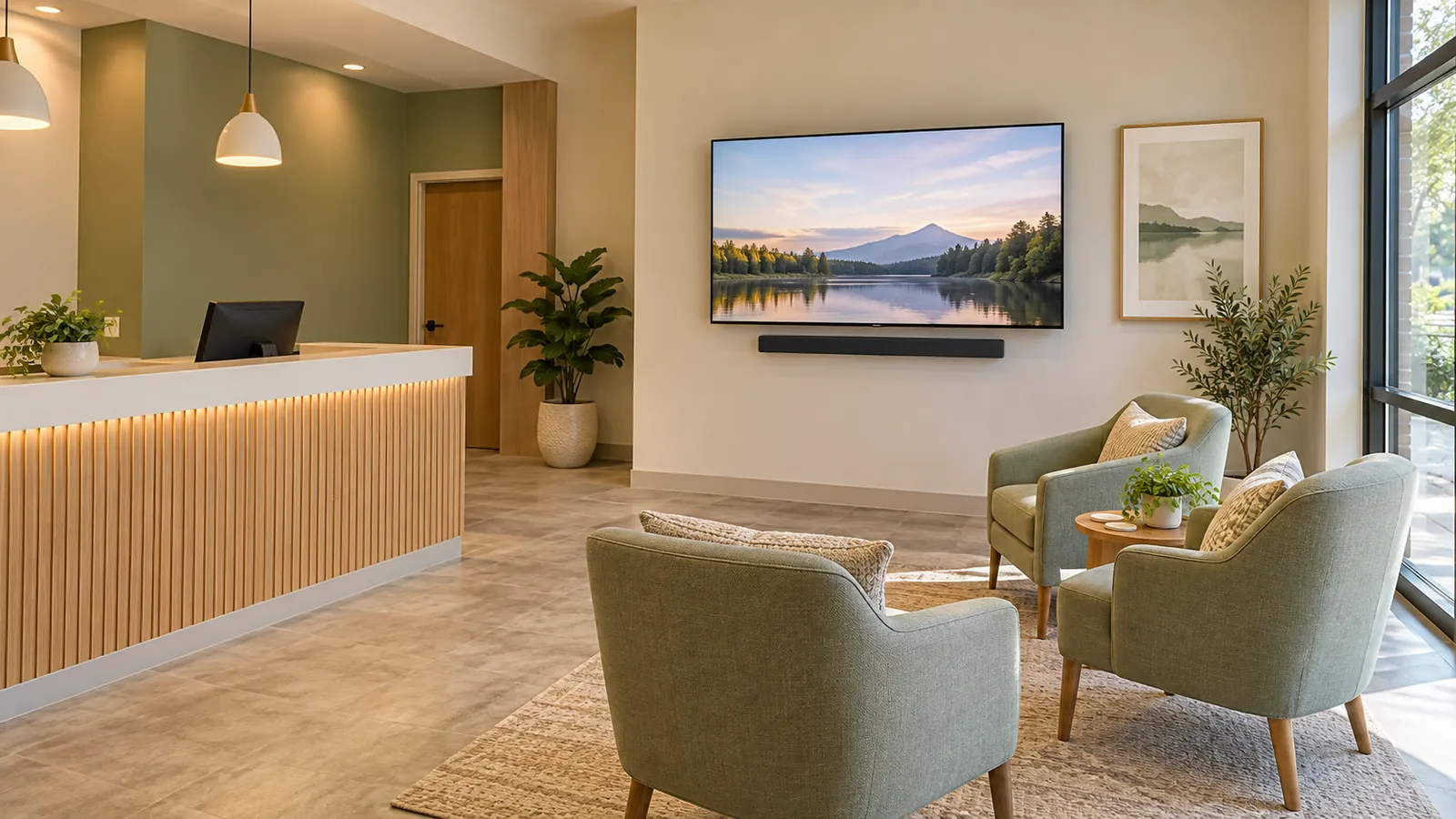
A reception space: wood-slat front desk on the left, three green armchairs on a rug, and a wall TV with a slim bar fixed directly beneath it facing the seats.
Your Questions Answered
Soundbar Installation in Tribeca: Questions Answered
These are the questions Tribeca loft owners, renters and businesses put to us before they book, grouped by what they are really trying to settle: what the old walls will hold, how a bar behaves in a room the size of a floor, what the building and its legal status allow, how the bar fits a control system, and how short-term and business setups work.
Walls the warehouse left behind
Is it better to anchor into the old brick itself or into the mortar between the bricks?
Into the brick, nearly always. In a building put up between the 1850s and the early 1900s, the joints may still be original lime mortar, which is softer than the brick and can crumble around an anchor, or they may have been repointed at some point with a harder mix. Either way the joint is the weaker, less predictable part of the wall. A whole, uncracked face brick gives a sleeve or masonry screw something consistent to bite into, and a soundbar — a few pounds for a compact model, low teens for a flagship — needs only a few good fixings.
So before drilling we look at the wall closely, ideally in raking light from a window, and mark sound bricks inside the bracket's footprint. We skip bricks that are spalled, cracked or soft at the face, and we avoid the very edge of a brick where it meets the joint. On painted or sealed brick, where the joints are hidden, we measure the coursing from a known line and mark it out first. If the wall is crumbling across the whole area, the honest answer is a different wall, the TV arm or the console.
Holes in a brick face are less forgiving than holes in drywall, so the reversibility question is worth asking up front. Keeping the holes small, few and tucked behind the bracket means a future owner, or your painter, can fill them with a matching mortar or patch with little trace. If you rent, read the lease clause on alterations first; the r/AskNYC poster who asked whether landlords even allow drilling into exposed brick was asking exactly the right question.
A cast-iron column stands where the TV ought to go — can anything be fixed to it?
Not by us, and not by drilling. Cast-iron columns in Tribeca's store-and-loft buildings are part of the structure that carries the floors above you, and cast iron is brittle rather than forgiving; a hole in the wrong place is not something anyone can take back. We treat columns, and the heavy timber posts in many warehouses, as the building's skeleton rather than as a place to hang electronics, and in a co-op or condo the column almost certainly belongs to the building rather than to you.
There are usually better places anyway. If the column sits roughly where the screen should be, a floor-standing TV mount or a low media unit placed just in front of it puts the picture where you want it, and the bar either rides on the TV mount or sits on the unit. If a wall is nearby, a full-motion arm on that wall can reach the viewing position, with the bar clamped beneath the screen so the sound follows the picture as it swings.
Columns are still useful for cable. A neat surface channel running down the face of a column, painted to match, can carry power and HDMI from a ceiling-level route or to a floor box without touching the iron itself, as long as the channel is fixed with adhesive or clamps the owner is happy with. We will show you the options on the day and leave the column exactly as we found it.
The wall our TV hangs on stops short of the ceiling — is a partition like that solid enough for a bracket?
Sometimes, and it is worth checking rather than assuming. Loft layouts often create bedrooms and media walls with partitions that stop a foot or two below a 12-foot ceiling, to keep the light and the view of the beams. A partition like that can be perfectly solid if it is framed properly, fixed to the floor and tied back to a perpendicular wall or braced at the top. It can also be a long run of studs held only at the bottom, which flexes when you push it.
So we push it. A firm hand at the top of the wall tells us a lot, and a scanner shows whether the framing is wood or light-gauge steel and where the studs fall. A soundbar on its own is a light load; the concern is a TV and bar together on an arm, which levers against the top of the wall when it is pulled out. On a well-tied partition we fix into studs or a plywood backer spread across several of them. On a wall that moves, we keep the TV and bar on a fixed, low-profile bracket or move them to the console.
Free-standing glass partitions and sliding panels are never mounting surfaces. If the partition was built during a renovation, ask your contractor or architect what is inside it and whether blocking was left at TV height; it often was, and it saves a backer board.
Sound in a room the size of a floor
Our ceiling is exposed joists, beams and pipes — do the bar's up-firing speakers have anything to bounce off?
Not much, in most Tribeca lofts. Dolby Atmos soundbars create their sense of height by firing sound up at the ceiling and letting it reflect down to the listener. That works best with a flat, fairly low, hard ceiling a predictable distance above the bar. A ceiling ten to fourteen feet up, broken by joists, beams, sprinkler pipes and ducts, scatters that reflection in every direction and adds a long delay, so the overhead effect becomes vague or disappears.
That does not make an Atmos bar a bad buy; the front, centre and side channels still do most of the work, and many flagship bars sound excellent in a loft for dialogue and music. It does mean the extra cost of up-firing drivers buys less here than in a flat-ceilinged condo. Some bars let you switch the up-firing channels off or adjust their level in the app, and their room-correction routines will at least account for the space; we run those and check the result from the sofa.
If real height effects matter to you, the answer in a loft is dedicated speakers rather than reflections — small surround or height speakers mounted on beams or walls near the seating, which is a bigger audio job. For most households a well-placed bar, set for clear speech with the up-firing channels tamed, is the better outcome.
Our 85-inch screen dwarfs a standard soundbar — does the bar need to match the TV's width?
No, but it helps if it is not tiny. Big lofts invite big screens, and an 85-inch TV is a little over six feet wide. Even the longest consumer bars are well short of that — Sonos lists its Arc Ultra at 46.38 inches. The bar does not have to fill the width, because its job is to place voices at the centre of the picture and spread effects to the sides, and a good bar's processing widens the sound beyond its own cabinet.
Where it goes wrong is a compact bar, built for a bedroom TV, centred under a very large screen in a very large room. Dialogue still sits in the middle, but the sound feels small and the stereo spread collapses, especially from a sofa a long way back. Under a screen of 75 inches or more, a full-length bar, centred exactly on the screen and as close beneath it as the TV's stand or bracket allows, looks proportionate and sounds it.
If you want width to match the picture, add rear or side speakers from the same maker rather than chasing a longer bar. We set the bar's centre line to the screen's, not to the wall or the brick coursing, and we check that the TV's own feet or bottom bezel are not shading the bar's front drivers.
We sit more than twenty feet from the TV in a long loft — will a soundbar still sound clear that far back?
It can, but distance changes the set-up. Sound level drops as you move away from the bar, and in a hard-surfaced loft the room's reflections grow louder relative to the direct sound, so voices lose their edges. The usual result is that people turn the volume up to understand dialogue, the effects become too loud, and the neighbor below hears more than you do.
The fixes are mostly placement and settings. Bring the seating closer if the room allows — many lofts have the TV on the end wall simply because it is the only wall. Otherwise, choose a full-size bar rather than a compact one, aim it straight at the main seat, and switch on its speech or dialogue enhancement so voices are lifted without the whole mix being raised. A rug in front of the seating and soft furnishings along a brick wall reduce the reflections that blur speech.
If the distance is extreme, a small pair of surround speakers near the seating, paired to the bar, brings the sound to where you sit. Before booking, tell us roughly how far the sofa is from the TV wall and what is on the floor; it changes which bar class and settings we suggest.
Loft buildings, boards and the Loft Law
Our loft is in a building still going through Loft Law legalization — does that limit putting a soundbar up?
It can affect who has to agree, though it rarely stops a soundbar outright. Article 7-C of the Multiple Dwelling Law, the Loft Law, created a category called interim multiple dwellings for former commercial and manufacturing lofts that people live in, and the New York City Loft Board oversees bringing those buildings up to the Building Code's minimum standards for residential use. During that process the owner has legalization work to do, and tenants and owners often have rights and obligations under the Loft Board's rules that go beyond an ordinary lease.
A bracket and a few anchors are a minor alteration, but in a building where walls, fire separation or electrical systems are being brought up to code, it makes sense to ask the owner or managing agent before drilling, and to keep the bar off any wall that is scheduled to be opened, rebuilt or fire-rated. Console placement or a TV-attached bracket on a TV stand avoids the question entirely, and is easy to move if legalization work reaches your unit.
We cannot advise on your rights under the Loft Law; that is a question for the Loft Board or a lawyer. What we can do is plan an install that leaves the least possible trace and does not touch the building's systems, and give you photos and a description of exactly what was fixed where.
The elevator in our building is a small keyed car that opens into the apartment — how do the installer and a long soundbar box get up?
With a little planning. Some downtown loft buildings have elevators that open directly into each unit and run only with a key or fob for that floor; Brick Underground's guide to direct-entry elevators notes, for example, a Hudson Square loft building where a key-locked car opens straight into the apartments. That means nobody can send the technician up without your key, and in some older buildings the car is small, slow or shared with a freight function.
Tell us how it works when you book: whether someone will be home to call the car down, whether the super or a neighbor can operate it, and whether there is a separate freight or service car contractors must use. Measure the car's inside depth if the bar is a flagship model; long bars ship in cartons well over four feet long, and an 85-inch TV box is larger still. If the TV box will not fit, the screen may have come up the stairs or been delivered by the retailer already — check before the day.
If the technician cannot get up because nobody is there to operate the car, the visit counts as a wasted trip and the $150 return-trip fee applies. A text the evening before with the access plan prevents that every time.
Control systems and remotes
Our loft runs on a Control4, Crestron or Savant system — can a new soundbar be added to it?
Usually, but the job splits between two people. We install the bar, mount it, connect it to the TV's eARC or ARC port, switch on HDMI-CEC, confirm lip-sync and get it on the network. Adding it to a whole-home control system, so the wall keypad or the system's app turns it on, sets the volume and selects the source, is programming work in that system, which belongs to whoever installed and maintains it.
To make the hand-off clean, tell us before the visit that a control system is in place and, if you can, who the integrator is. Some systems control the bar through the TV over HDMI-CEC, some through an infrared emitter on the bar's sensor, and some through a network driver for the specific model. We leave the bar on a wired or stable wireless connection, record its model and network details, and avoid changing TV settings the system depends on.
If the system is old or unsupported and you would rather not keep it, a universal remote programmed for the TV, bar and sources is a simpler alternative; it is a $99 line on our menu.
Short-term setups in Tribeca lofts
We're renting our loft out as a shoot location or for a screening — can a soundbar go up for a few days and come down again?
Yes, with two visits. A soundbar can be placed on a console or a floor-standing TV mount for the duration without any holes, which suits a short booking best. If it has to go on the wall, a single bracket on brick or a partition comes down cleanly afterwards, leaving small holes to fill. Each visit is priced from the same Manhattan menu as any other job and carries its own parking line; removing a bracket on the second visit is a $45 line.
Book both dates at once and send us the production or event schedule; loft buildings that allow location shoots often have their own rules about load-in times and elevator use, and we fit inside them. If the production is bringing its own sound crew, find out first whether they want a soundbar at all — they may only need the TV's audio sent to their mixer.
For a screening with a large audience in a big loft, be realistic about what one bar can do. A soundbar is designed for a living room; for dozens of people at the far end of a long floor, a pair of powered speakers or a rented PA does the job better, and we will say so when you describe the event.
The no-holes option: a bar set on the console in front of a TV standing on its own feet, lined up so it clears the screen and the remote sensor.
Before You Book
A Tribeca Loft Walk-Through Before the Visit
Fifteen minutes walking your own loft with a phone camera answers most of what we would otherwise discover on the day. Send us the results with the quote request and the price you get back will match the job.
Photograph the TV wall square-on, with the floor, the nearest outlet and any column or beam in the frame. If it is brick, add a close-up of a few bricks and joints.
Measure the ceiling height and the distance from the TV wall to the main seat. In a loft both numbers change the advice.
Push the top of the TV wall. If it is a partition that stops short of the ceiling and it moves, tell us.
Note what is under your floor. Another apartment, a shop or a restaurant? That decides where the subwoofer can go and how loud it can be.
Work out the elevator. Keyed car into the unit, shared freight car, or stairs only? Who will operate it during the 2-hour window?
Ask the building about hours. Co-op and condo loft buildings commonly limit contractor work to weekday business hours; mixed buildings may also have a commercial tenant whose hours matter.
Check permission for holes. Lease, house rules, alteration agreement, or a building still under the Loft Board — whoever has to agree, get it in writing.
Find the equipment. Where are the router, the cable or fiber box and any control-system rack? A loft can put them fifty feet from the TV.
Look at the windows. Facing Hudson, Varick or Canal with single glazing? Mention it; we set dialogue enhancement differently for a noisy street.
Have the logins ready: Wi-Fi password, the bar's app account and, if you have one, the integrator's contact.
If something is unknown — the partition's framing, the board's answer, the elevator arrangement — book anyway and say so. We quote both likely wall conditions so the number on the day is one you have already seen.
Loft Vocabulary
Tribeca Building Terms, Explained for a Soundbar Job
Tribeca brokers, boards and architects use a vocabulary of their own. These are the terms that come up when a soundbar is being planned, and what each one means for the visit.
Store-and-loft building. A 19th-century commercial building with a shop on the ground floor and open loft floors above, usually with a cast-iron or masonry front. The defining building of Tribeca South and East.
Bearing wall. A masonry wall that carries the floors. In a warehouse loft, the long exposed-brick wall is usually one, and it is solid all the way through — no cavity for cables.
Repointing. Raking out old mortar and replacing it. Recently repointed joints may be harder than the original; old lime mortar may be soft. Either way, anchors go in the brick.
Heavy timber. Large wooden beams, girders and posts that carry the floors of many warehouses. Beautiful, structural and not ours to drill without the owner's agreement.
Partition. A non-structural wall built inside the loft to create rooms. Usually wood or steel studs and drywall, sometimes stopping short of the ceiling.
Mezzanine. A raised platform within a high loft used as a sleeping area, office or media space. It changes sight lines to the TV and where sound travels.
Direct-entry or keyed elevator. An elevator that opens straight into a unit and runs to it only with a key or fob. It decides how the technician gets in.
Interim multiple dwelling (IMD). The Loft Law's category for former commercial lofts being legalized for residential use, overseen by the Loft Board.
Historic district. An area designated by the Landmarks Preservation Commission; Tribeca has four. The Commission regulates exterior changes, and interior work only in the cases it lists.
eARC. The enhanced Audio Return Channel on an HDMI port, which carries the TV's sound, including lossless formats, back to the bar and lets one remote run the volume.
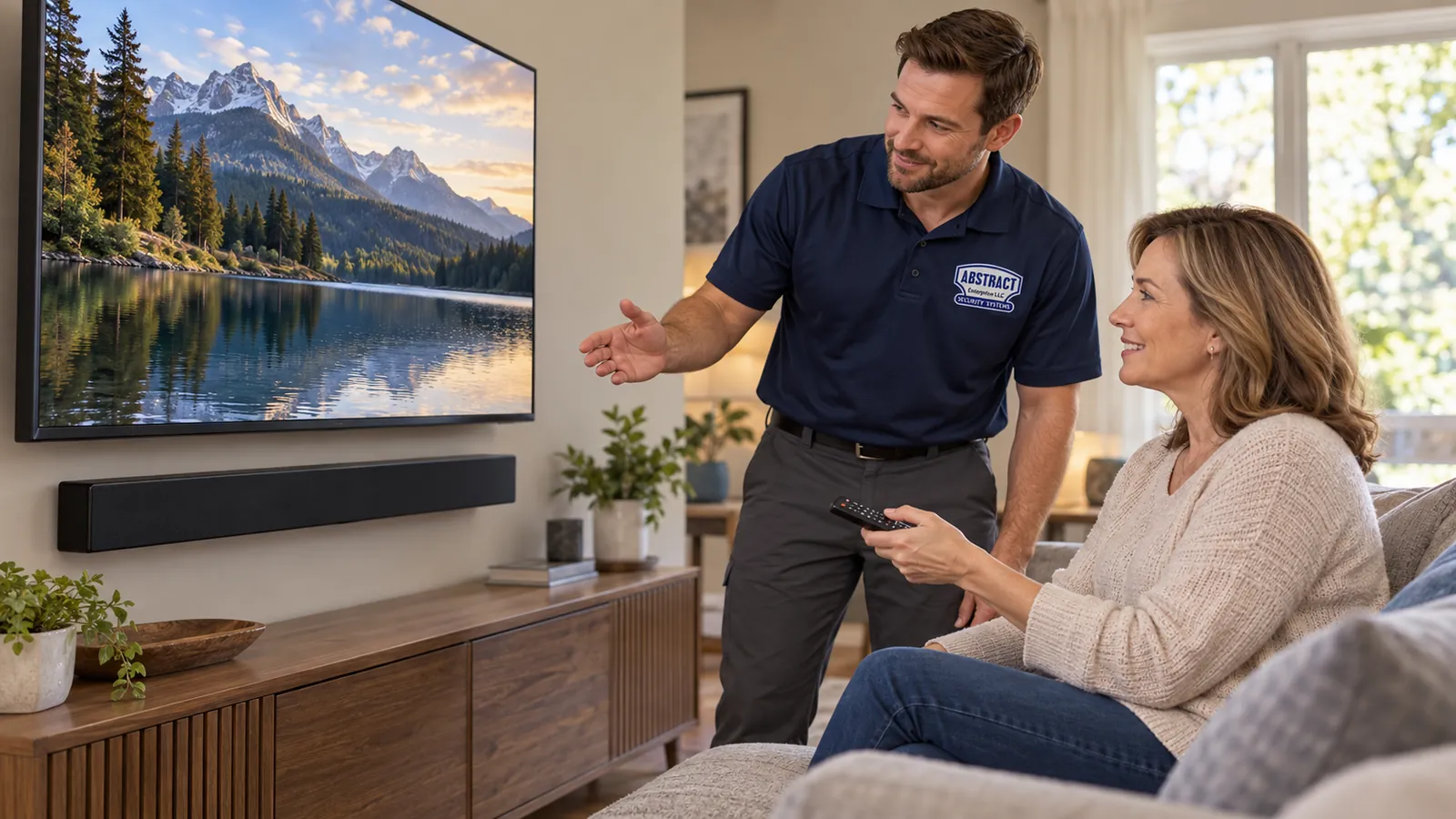
The hand-over: a technician points to the TV and the bar mounted beneath it while the woman on the sofa tries the remote herself.
Equipment
Types of Soundbars and Mounts We Install in Tribeca
We mount the bar you have chosen, from any mainstream maker. These are the categories that come up most in Tribeca lofts, towers and storefronts, and what each one asks of the wall, the room and the people below.
Full-Length Flagship Bars
The long end of the range: Sonos lists its Arc Ultra at 46.38 inches and 13.01 lb. Proportionate under a 75- to 85-inch screen on a long loft wall; its up-firing channels matter less under a high, beamed ceiling than under a flat one.
Mid-Size Smart Bars
Around the width of a 50- to 55-inch TV — the Sonos Beam (Gen 2) is 25.63 inches and 6.35 lb per Sonos — with eARC and app control. Right for bedrooms, mezzanine dens and the smaller rooms carved out of a loft.
Compact Bars
Short, light bars such as the Sonos Ray, about 56 cm and 1.95 kg according to WhatHiFi, which connects by optical cable. For a TV in a guest room, an office corner or a kitchen counter.
Bars With Separate Subwoofers
Full, weighty sound and the biggest single cause of complaints through a timber floor. We place the sub off the boards and away from mid-span, on a pad, at a level that suits the loft below as well as yours.
Masonry-Rated Wall Brackets
The maker's own bracket where it suits, with anchors chosen for brick or concrete rather than the plastic plugs in the box; or a Sanus soundbar bracket we supply when the boxed one is wrong for the wall.
TV-Attached and Arm Brackets
Brackets that clamp the bar to the TV or its mount. Sanus lists its universal soundbar mount for most bars up to 20 lbs, and its WSSATM1 as an extendable TV-mount bracket for the Sonos Arc. Essential on full-motion arms and floor stands.
Floor-Standing TV Mounts
For a TV that has to stand in the room — in front of a column, between two window bays, or along a partition that cannot take a load. The bar rides on the stand, cables run down its spine.
Cable Channels and In-Wall Kits
Paintable surface channel for brick, concrete and column faces; code-compliant in-wall power and cable kits for hollow partitions, feeding an existing outlet, where the owner or board has agreed.
Network Links for Long Floors
Ethernet where the bar has a port, a mesh node near the TV wall where it does not. In a loft the router may be at the far end of a hundred-foot floor behind a brick wall, which a Wi-Fi bar notices.
Which connection fits a Tribeca setup
Connection
Best for
What to watch in a loft
HDMI eARC
Current TVs and bars; full-quality sound and single-remote volume
Use the port labelled eARC; long runs need a certified high-speed cable
HDMI ARC
Older TVs without eARC
Dolby Atmos only arrives inside Dolby Digital Plus; CEC may need switching on
Optical
Compact bars, older or very basic TVs
Volume control may need the bar's remote or remote programming
Ethernet
Smart bars with a port, routers far across the floor
Needs a jack at the TV wall or a cable route along the brick
Wi-Fi
Bars without a port
Brick walls and long distances weaken the signal; a mesh node near the TV helps
Control-system driver or IR
Lofts with Control4, Crestron or Savant
Programming belongs to the integrator; we leave the bar ready for it
Big-box services and gig apps versus a Tribeca installer. National installation services and handyman marketplaces publish soundbar menus that suit a house with wood studs and a driveway. They are not built around a 150-year-old brick bearing wall, a cast-iron column in the middle of the room, a keyed elevator, a board's alteration rules or tunnel traffic outside the door. A licensed local installer with a published Manhattan price, a direct Manhattan line and a New York State low-voltage licence quotes the wall you actually have — and answers the phone if the bar stops working a month later.
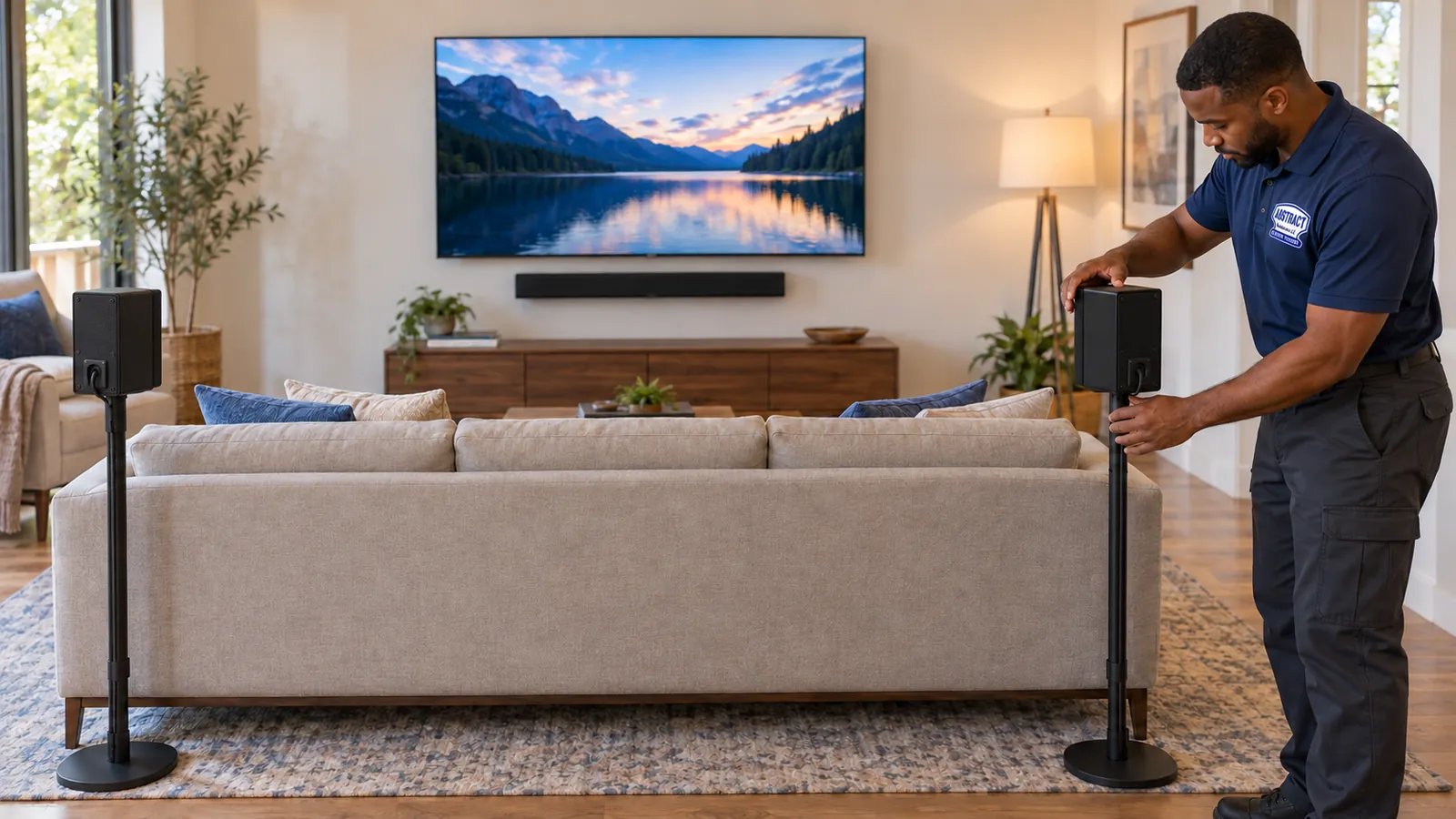
Two rear speakers on slim floor stands flank the back of the sofa; the technician sets the right-hand one while the TV and bar face the seating from the far wall.
AI Overview Reality Check
What AI Gets Wrong About Soundbar Installation in Tribeca
We could not capture Google's AI Overview from our build environment, so this section tests the published claims AI summaries draw on — national cost guides from Angi and Thumbtack among them — and the general mounting advice that gets repeated everywhere. Each needs adjusting for a Tribeca loft.
"Exposed brick is the easiest wall to mount on — it's solid"
Solid, yes. Easy, not always. Generic advice treats brick as the ideal mounting surface because it does not flex and anchors hold well in it. In a modern brick veneer or a newer masonry wall, that is largely true, and a soundbar's modest weight is no challenge for a good masonry fixing.
A Tribeca warehouse wall is different. It may be more than a century old, with soft lime mortar, repointed patches, spalled faces, layers of paint or sealant, and old fixings from its commercial life. The joints are where many people instinctively drill, and they are the weakest part. Some bricks crumble under a hammer drill; others are glazed hard enough to skate the bit.
So the work is in the reading: choosing whole bricks inside the bracket's footprint, starting holes gently, and using anchors suited to old masonry. And because brick has no cavity, the cables need a plan before the first hole — a channel, a column-face route or the console. Our menu prices that reality as a $65 brick-and-stone line on top of the $129 mount.
"Hide the wires inside the wall for a clean look — it costs $75 to $300"
Angi's range for concealing TV wiring assumes a hollow wall that a cable can be fished through. In a house with drywall on wood studs, that is usually the case, and the price reflects the length of the run and whether an in-wall power kit is used.
Many Tribeca TV walls cannot be fished at all. A brick bearing wall is solid; a cast-iron column is structural; a concrete partition in a newer tower has no cavity. Cutting a chase into a historic brick wall to bury a cable is a masonry alteration few boards, landlords or owners would accept for a soundbar, and in some buildings it may raise landmark questions if it reaches an exterior wall.
Where the TV is on a hollow partition and the owner or board agrees, our in-wall concealment with a code-compliant power and cable kit is $169. On brick, the clean look comes from a painted $59 channel run on a deliberate line — along a column edge, down a corner, or straight to a console — so it reads as part of the loft rather than an afterthought.
"Get a Dolby Atmos bar for the most immersive sound"
Buying advice often steers people toward up-firing Atmos bars, and in a typical living room with an eight- or nine-foot flat ceiling, the height effect they create can be convincing. The advice is reasonable as far as it goes.
The catch is the ceiling. Up-firing drivers rely on a reflection from a flat surface above the bar. Tribeca lofts commonly have ceilings of 10 to 14 feet, often exposed joists or beams with pipes and ducts between them. The reflection arrives late and scattered, and the overhead effect weakens or vanishes, while the price premium for the extra drivers remains.
That is not a reason to avoid a flagship bar, which may still be the best-sounding choice for dialogue and music in a big room. It is a reason to buy for the room: if the ceiling is high and broken up, put the money into a full-length bar with good speech processing, or into surround speakers near the seats, rather than paying for height effects the loft cannot deliver.
"Landmark buildings need city approval before you change anything"
This one is repeated with good intentions and is often wrong in detail. People hear "historic district" and assume every hole needs the Landmarks Preservation Commission's sign-off, and some will put off a simple install for months because of it.
The Commission's own guidance says otherwise. You do not need its permit for ordinary repairs or maintenance, and interior work needs a permit only when it requires a Department of Buildings permit, when it affects the exterior, or when the interior has itself been designated an interior landmark. A soundbar bracket on an inside wall of a Tribeca loft normally falls under none of those.
The approvals that actually matter are the building's: a co-op's alteration rules, a condo's house rules, your lease, or, in a building being legalized, the owner's obligations under the Loft Law. Those can restrict drilling, hours and contractors whatever the Commission thinks, so they are what we ask about first.
"Expect to pay $121 to $234 to have a TV wall-mounted"
That is Thumbtack's national average for TV wall mounting, built from jobs all over the country. It describes a television on drywall over wood studs in a house where the installer parks at the curb. As a national figure it is fair.
It is not a Tribeca number. Our published Manhattan base for mounting a 32- to 55-inch TV is $244.99, and every Manhattan visit carries a flat $150 parking line — the streets around the tunnel approaches are rarely an easy place to stop a van full of tools. A soundbar mounted beneath it on the same visit adds $129, plus $84.99 if you need our Sanus bracket.
The wall then adds its own line: $65 for brick, $45 for plaster, $75 for concrete, $30 for metal studs, and $75 for a high mount above about eight feet, which some lofts need. A published, itemized number that includes all of that is more use than a national average that includes none of it.
"A soundbar bracket add-on runs $30 to $100"
Angi's TV cost guide lists a soundbar mount add-on at $30 to $100. As a price for bracket hardware alone, that is roughly in line with the market, and many bars include a basic wall bracket in the box.
What the figure leaves out is labor and the wall. In a Tribeca loft the bracket is the easy part; the time goes into reading old brick, finding the studs in a partition, checking a wall that stops short of the ceiling, or setting up a TV-attached bracket on a full-motion arm so the bar swings with the screen.
Our menu separates the parts so you can see them: $129 to mount the bar, $84.99 for a Sanus bracket only if you need one, and the wall line where it applies. If your bar came with a suitable bracket, or you already own a better one, that $84.99 line simply drops out.
"Put the subwoofer in a corner for the deepest bass"
Corner placement is classic speaker advice: room boundaries reinforce low frequencies, so a sub in a corner sounds bigger. In a detached house with a slab floor, that can be a reasonable way to get more bass from a small subwoofer.
In a Tribeca loft, more bass is usually the problem rather than the goal. Wide-plank floors on timber joists transmit low frequencies to the apartment or business below, and a sub in a corner, on bare boards, drives exactly the frequencies that travel. The neighbor hears the explosion before you do, and corner boom in a hard room also muddies dialogue.
We place subs away from corners and away from the middle of a joist span, on a dense pad or rug, and turn their level down to suit the building. Many bars also have a night mode that compresses peaks for late viewing. In a building where your floor is someone's ceiling, controlled bass is the better-sounding result for everyone.
Old Brick, Tall Rooms, Quiet Floors
Send the bar's model, a photo of the wall and how the elevator works. Back comes a Tribeca price with the Manhattan parking line already in it.
Describe the bar, the TV, the wall and the building. Every Tribeca request is read by an installer, and the price that comes back is built line by line from the menu on this page with parking included. Prefer to talk? Call (929) 560-0737.
✅
Request Received
Thank you — your Tribeca details have reached our Manhattan team, and an installer will get back to you before the business day ends. Something urgent? Call (929) 560-0737.
How It Works
Our Installation Process
Seven steps for every Tribeca soundbar, from a compact bar on a guest-room dresser to a flagship under an 85-inch screen on a warehouse wall. The first three happen before we arrive, because in a loft building the wall, the elevator and the board come before the drill.
1. Show us the wall and the room
Send a square-on photo of the TV wall with the outlet and any column in view, a close-up if it is brick, the bar and TV models, the ceiling height and the distance to the sofa. We reply with an itemized Manhattan price, parking included, and any brick, partition or high-mount line shown.
2. Settle permission and paperwork
We confirm who has to agree to holes — owner, board, landlord or the building's managing agent — and send the insurance certificate they ask for at no charge. If the building is under the Loft Board or mid-renovation, we agree which walls to avoid.
3. Plan access and timing
We agree how the technician reaches your floor — keyed car, freight car or stairs — and pick a two-hour arrival window between 8 AM and 8 PM that fits the building's contractor hours. Changing it is free with 24 hours' notice.
4. Protect the floor and unpack
Drop cloths go down on the planks under the TV wall, the bar and bracket come out of the box and are checked for shipping damage, and the hardware is laid out before anything touches the wall.
5. Read the brick, the studs or the column
We pick sound bricks inside the bracket footprint, or scan a partition for framing and push-test its top, and mark the centre line on the screen rather than the wall. You approve the height and position before the first hole, and dust is caught at the bit.
6. Fix, hang and dress the cables
The bracket goes on with fixings suited to the surface, the bar is hung and levelled, and the cables follow the route agreed: a painted channel, an in-wall kit in a hollow partition, the spine of an arm or stand, or down behind the console. HDMI goes into eARC or ARC and CEC is switched on.
7. Tune for the loft and the floor below
We run the bar's room calibration, set speech enhancement for your seating distance and street noise, place the sub off the joists and set its level for the neighbors, confirm the network and the remote's reach, check lip-sync, clean up and walk you through the settings.
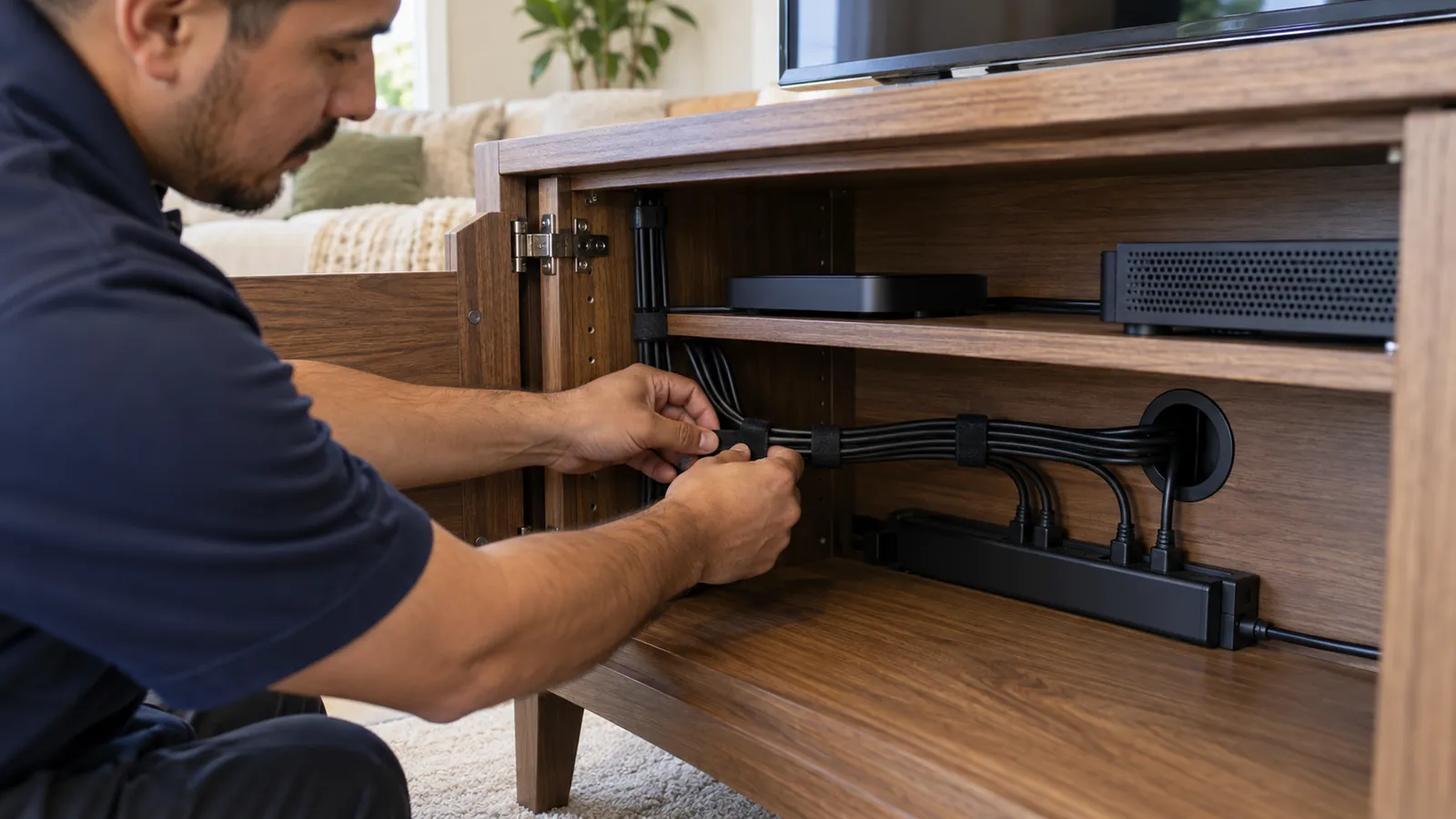
Inside the media unit: cables gathered with hook-and-loop straps and fed through a rear grommet to one power strip, with two devices on the shelf above.
Coverage Area
Soundbar Installation Near Tribeca's Landmarks
Six Tribeca reference points, chosen because each sits among a kind of building we are asked to work in. We are not claiming jobs at these addresses; they are landmarks you can place yourself by.
Duane Park, Hudson and Duane Streets
A small triangle the City bought from Trinity Church in 1797 for five dollars, according to NYC Parks. It is the heart of the Tribeca West district, ringed by 19th-century warehouses whose upper floors are now lofts with brick walls and timber ceilings.
Harrison Street Federal Houses
A row of individually designated Federal houses, built between 1791 and 1828; the Historic Districts Council describes six of them as a group unique in the city. Small rooms, old plaster and timber framing — a very different job from the lofts across the street.
Hook & Ladder 8, 14 North Moore Street
The firehouse built in 1903 when Ladder 8 moved from 153 Franklin Street, known worldwide as a filming location. It stands among the brick blocks of Tribeca North, a short walk from the Holland Tunnel traffic on Hudson and Varick.
Washington Market Park, Greenwich Street
The park between Duane and Chambers, designed by Lee Weintraub in 1978 and named after the produce market that moved to Hunts Point in 1967. Independence Plaza and other residential buildings stand nearby along Greenwich Street.
Pier 25, Hudson River Park
Home to Manhattan's only 18-hole miniature golf course, sand volleyball courts, a playground with water features and a turf field, per Hudson River Park. The riverfront edge of the neighborhood, across West Street from Tribeca's blocks.
56 Leonard Street
The Herzog & de Meuron tower of 57 stories and 145 residences, each with its own floor plan. The neighborhood's most recognizable new tower, and a reminder that not every Tribeca home is a loft.
The rest of the neighborhood is just as familiar: the cast-iron blocks of Franklin, White and Leonard Streets, the warehouses of Laight, Vestry and Hubert, the 550-foot windowless AT&T Long Lines tower at 33 Thomas Street completed in 1974, the Western Union Building at 60 Hudson with its designated exterior and interior, and the restaurant rows on Church Street and West Broadway. We also cover the neighborhoods that share Tribeca's edges — SoHo and Hudson Square across Canal, the Civic Center and Chinatown to the east, and Battery Park City and the Financial District to the south — on the same Manhattan menu.
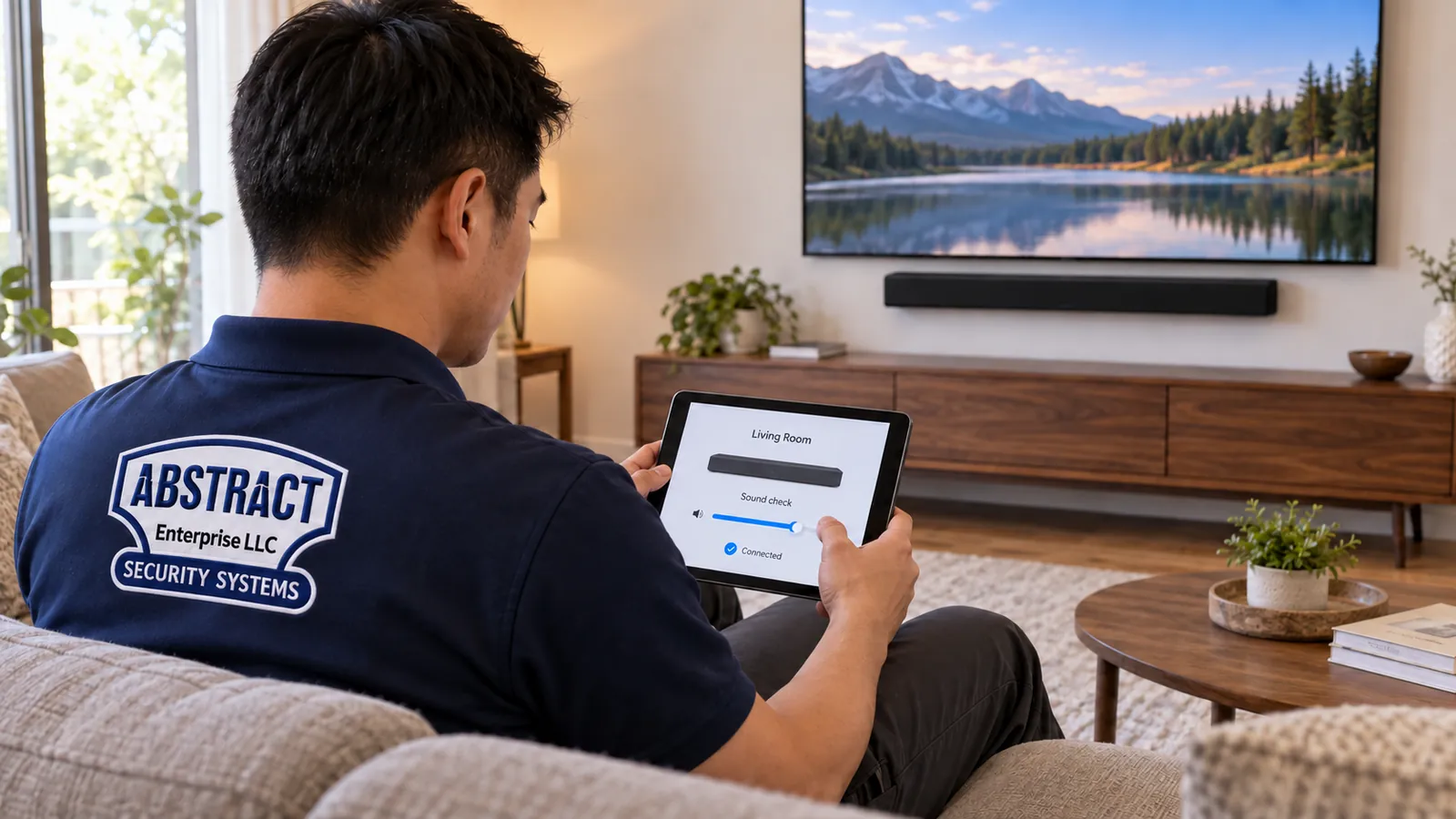
From the listening position: a tablet showing a Living Room sound-check screen with a volume slider and a Connected tick, aimed at the TV and bar on the wall.
Pricing
Soundbar Installation Cost in Tribeca
Tribeca is priced on our published Manhattan menu: the same lines as the rest of the borough, itemized, and agreed before the visit. Choose the lines that describe the job, add the single parking line, and that is the total. If the wall turns out to be something other than what the photo suggested — brick under the plaster, a partition with no studs where we expected them — you hear the revised figure before any extra work begins.
Soundbar line
Manhattan price
What you get in a Tribeca loft
Soundbar wall-mounted under the TV
$129
Wall identified, fixings chosen for brick, partition, concrete or plaster, bar hung level and checked from the seat
Soundbar placed on a console or stand
$79
Bar set on the media unit or floor stand, clear of the TV's sensor, connected, tuned and tied off
Sanus soundbar bracket
$84.99
Supplied by us when the bar has no bracket, or when the boxed one suits neither the wall nor the arm
In-wall concealment
$169
Hollow partitions only: in-wall power and cable kit to code, feeding an existing outlet
Paintable cord cover
$59
Surface channel on brick, concrete or a column face, run on a deliberate line
Cable run up to 25 ft
$99
A longer HDMI or network run to a cabinet, rack or router elsewhere in the loft
Sonos setup
$125
Sonos bar, sub, surrounds, app and room tuning
A/V receiver
$129
Receiver connected and configured
Universal remote
$99
One remote programmed for TV, bar and sources
Streaming device setup
$49
Apple TV, Roku, Fire TV or similar
Full home theater
$350
Setup of a multi-component system
Manhattan parking, per visit
$150
One flat line per Manhattan visit, Tribeca included, however many lines are on the job
Wall, height and access lines
Condition
Price
Where it shows up in Tribeca
Drywall on wood studs
$0
Many renovated partitions
Drywall on metal studs
+$30
New towers, façade-preserving rebuilds, some partitions
Plaster
+$45
Federal houses, older walk-ups
Brick or stone
+$65
Exposed warehouse and store-and-loft walls
Concrete or cinder block
+$75
Newer condo towers and 1970s rental buildings
Tile or marble
+$95
Stone-clad media walls and fireplace surrounds
Plywood backer board
$85
Partitions where the bracket misses the studs
High mount, above about 8 ft
$75
Lofts where the TV goes high for a mezzanine or a long room
No elevator, 3rd floor or higher
$40
Walk-up lofts and townhouse upper floors
Remove an old bracket
$45
A previous owner's mount on the brick
Box removal
$25
Flagship-bar and big-TV cartons taken away
Certificate of insurance
Free
Board, managing agent or commercial landlord
Worked Tribeca examples
Typical Tribeca job
Lines
Total with parking
Bar on the media unit under a TV on its stand
$79 + $150
$229
Bar on a wood-stud partition, our bracket
$129 + $84.99 + $150
$363.99
Bar on exposed brick, own bracket, painted channel
$129 + $65 + $59 + $150
$403
Bar on exposed brick, our bracket, painted channel
$129 + $84.99 + $65 + $59 + $150
$487.99
Bar on a metal-stud partition with backer, our bracket
$129 + $84.99 + $30 + $85 + $150
$478.99
Bar on brick mounted high for a long room, our bracket, channel
$129 + $84.99 + $65 + $75 + $59 + $150
$562.99
Bar on a hollow partition, our bracket, in-wall kit
$129 + $84.99 + $169 + $150
$532.99
TV mounting and setup-only visits
If the screen goes up at the same visit, our Manhattan TV base of $244.99 covers a 32- to 55-inch TV on wood-stud drywall, the soundbar lines are added on top, and there is still only one parking line — for example $244.99 + $129 + $150 = $523.99 before any wall or bracket lines. A TV that stays on its stand is $162.99 in Manhattan. When nothing goes on a wall — reconnecting a bar to a new TV, sorting out eARC or lip-sync, pairing a sub, moving the bar onto a wired link — the visit is setup-only: $265 for the first hour in Manhattan, then 30-minute blocks, plus the $150 parking line.
What the price covers, and what it does not
Covered: identifying the wall, the mount, a level bar, HDMI and CEC set-up, a network check, tidy cables at the TV and a clean floor when we leave.
Not covered: new or moved outlets, which are a Licensed Master Electrician's work under city rules; patching, repointing or painting; moving heavy furniture or art.
Wasted trips: if the technician cannot get up because nobody can run the keyed elevator, the building has not cleared the visit, or the bar or bracket has not arrived, the $150 return-trip fee applies. With 24 hours' notice, changing the date costs nothing.
Fragile surfaces: spalled brick, old plaster, marble and tile can crack at the drill however gently it is used. We tell you before the first hole and the decision is yours.
Parts: brackets and parts carry their maker's warranty; the full terms are in the service agreement described at the foot of this page.
Shop Our Systems
Soundbar Installation Packages & Pricing
Most Tribeca quotes end up as one of three shapes. Each card shows its arithmetic, flat Manhattan parking included, so you can check it line by line. Extra wall, height or stair lines are added where the loft calls for them.
Starter — Console Bar, No Drilling
$229
Bar placed on the media unit or floor stand ($79) + Manhattan parking ($150) = $229. Connected to eARC or ARC, CEC on, remote reach checked across the room, cables tied off. Nothing to explain to a board or landlord.
Standard — Exposed-Brick Mount
$487.99
$129 to hang the bar + $84.99 Sanus bracket + $65 brick line + $59 painted channel + $150 parking = $487.99. Anchors in sound brick, cables on a deliberate line. Bring your own rated bracket and it is $403.
Premium — Partition Mount With In-Wall Wiring
$532.99
$129 to hang the bar + $84.99 bracket + $169 in-wall power and cable kit to code + $150 parking = $532.99 on a wood-stud partition. Steel studs add $30 and a backer $85 where needed. Only where the owner or board agrees to opening the wall.
Bring Your Own Equipment — Labor Only
Plenty of bars ship with a wall bracket, and many loft owners already have a better one or a TV arm with a soundbar attachment. Supply it and you pay labor only: $129 to hang the bar, the wall line if there is one, and the $150 parking line — $279 on wood-stud drywall, or $344 on brick. Your bracket has to be rated for the bar and is covered by its own maker's warranty, not ours. If it is wrong for the wall or the arm, you hear that before any drilling, with our Sanus bracket offered as the alternative.
Your Tribeca Price, in Writing
A photo of the wall and the bar's model are enough to start. The parking line is already in the figure we send back.
From Canal Street down to Chambers, and from the river across to Broadway, the building stock changes every few blocks. This is what we plan for in each part of the neighborhood.
Tribeca North: Laight, Vestry, Hubert and North Moore
The big late-19th-century brick warehouses the Historic Districts Council singles out, many now lofts with deep floors, massive beams and heavy masonry walls. The Holland Tunnel approaches run along Hudson, Varick and the rotary near Beach Street, so street noise through old windows is part of the brief: dialogue enhancement on, bar aimed squarely at the seats, and a word about heavier curtains on the street side.
Tribeca West: Duane Park, Greenwich and Hudson
Warehouses and store-and-loft buildings around Duane Park, converted at different times, so a single loft can have original brick on one wall, a 1980s partition on another and a brand-new media wall on a third. We expect to identify the wall on the day even when the photo looked clear.
Tribeca East: Broadway to Church, Franklin, White and Leonard
The "mercantile palaces" with cast-iron storefronts, with galleries and showrooms on the ground floors and lofts above. Iron columns down the middle of long, narrow floors make TV placement a real decision; full-motion arms on the side walls and floor-standing mounts are common answers.
Tribeca South: Chambers, Reade and Duane East of Greenwich
Five-story Italianate cast-iron store-and-loft buildings, primarily from the 1850s. Older plaster and brick, floors that are often narrower than the northern warehouses, and the $40 stair line on any upper floor without a lift.
Greenwich Street Towers and Washington Market Park
Independence Plaza's buildings, newer condominiums and rental buildings facing the park. These are conventional apartments rather than lofts: concrete or steel-stud walls, managed buildings with contractor rules, certificates of insurance and set hours.
The River Edge: West Street and Pier 25
Newer and converted buildings facing Hudson River Park, often with large windows on the river side. The TV usually goes on the one solid interior wall, and the bar has to cope with a lot of glass facing it.
The Civic Center Edge: Thomas, Worth and Leonard
Office buildings near the courts, telecom landmarks such as 33 Thomas Street, and loft conversions mixed among them, with 56 Leonard rising above. Commercial requests here are often conference rooms and waiting areas; residential ones are as likely to be in a new tower as an old loft.
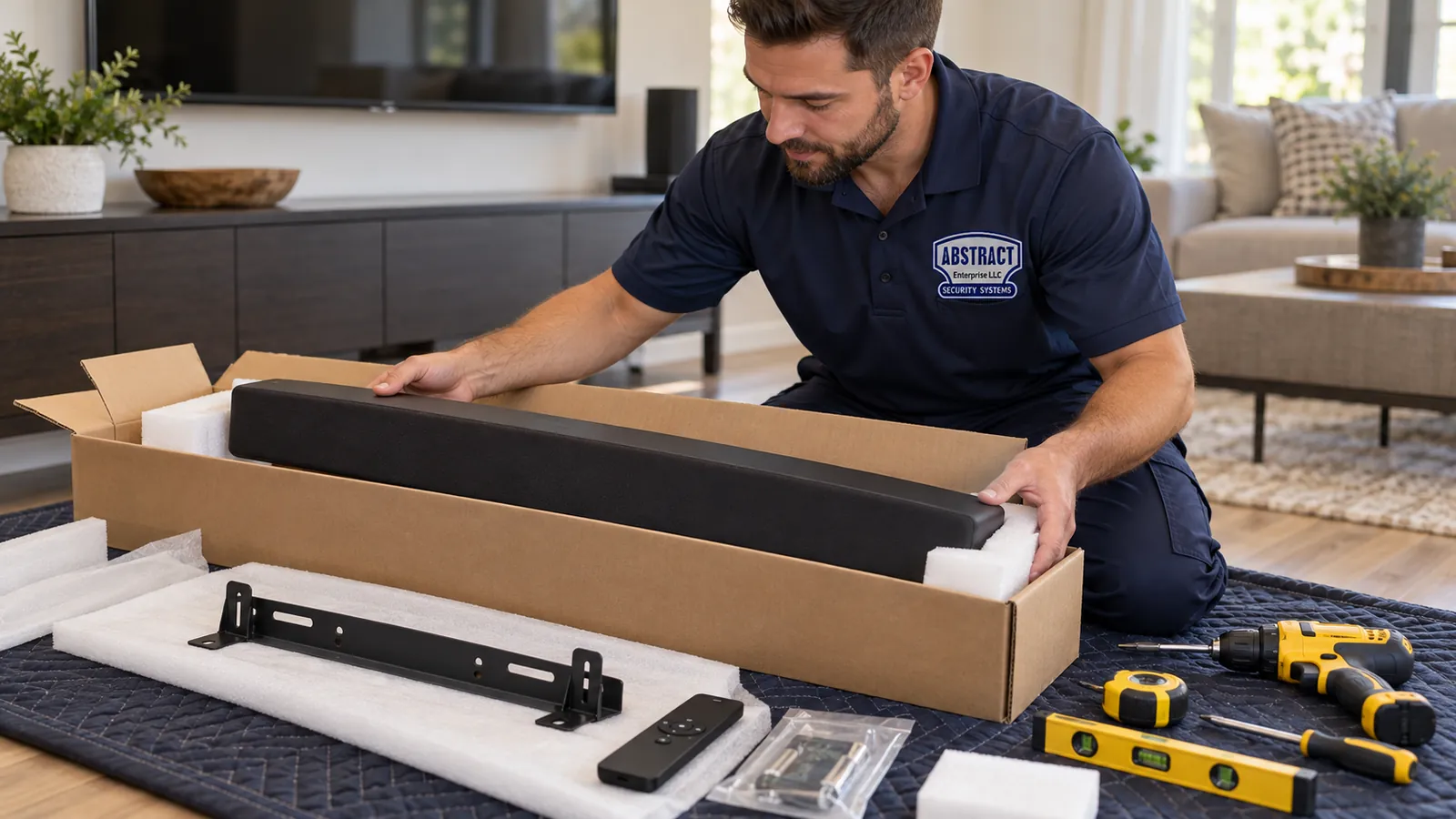
A long bar comes out of its foam-lined carton on a moving blanket, with the wall bracket, remote and bag of screws laid out next to the drill, tape measure and level.
Matching Bar to Room
Choosing a Soundbar for a Tribeca Loft
A loft rewards a bar chosen for the room's size, ceiling and floor more than one chosen from a spec sheet. If you have not bought yet, this is how we would match bar and mount to the spaces we see most in Tribeca. It is installer guidance, not a product endorsement; any mainstream brand in the right class will do.
Space
Bar class
Separate sub?
Usual mount
Open loft, sofa 15–25 ft from a brick end wall
Full-length, strong speech processing
Optional, on a pad, off the joist span
Masonry bracket, painted channel
Open loft, TV on a column-side arm
Mid-size or full-length
Optional
TV-attached bracket on the arm
TV in front of a column or between window bays
Mid-size or full-length
Usually not
Floor-standing mount with bar attached
Partition media wall in a renovated loft
Full-length
Optional
Wall bracket, in-wall kit where allowed
Mezzanine den or bedroom
Compact or mid-size
No
Console or small wall bracket
New-tower living room with a glass wall
Mid-size or full-length with room calibration
Optional
Wall bracket on steel studs or backer
Federal house parlor
Mid-size
Rarely
Wall bracket on plaster, or console
Bar, restaurant or gallery screen
Mid-size, one per screen
No
Wall bracket, volume capped
Three rules hold across the table. In a big room, buy for distance and speech before height effects: a full-length bar with good dialogue processing beats a compact one with up-firing drivers that have nothing to bounce off. In a building with timber floors, a sub is an option to be placed carefully, not a default. And whatever you buy, line its centre up with the screen's centre, not the wall's, because a loft's TV is often off-centre on a long wall by design.
Complete Services
Every Soundbar Installation Service in Tribeca
A soundbar visit to a Tribeca loft is often one item on a longer list: the TV itself, a network run across a long floor, a door entry system for the building. These Manhattan services come from the same office, the same licence and the same insurance certificate.
Arrival windows, the $150 return-trip fee, free rescheduling and hourly setup work.
Field Notes
Field Notes From Tribeca Loft Walls
How our installers approach a Tribeca loft before the drill comes out — standing practice, not the story of one job
The first look is up, not at the wall. Ceiling height, beams, sprinkler pipes and any mezzanine tell us where people will actually watch from and how the bar's sound will travel. Then down: bare planks, rugs, and the question of who lives or works underneath. Only then does the technician walk to the TV wall.
On brick, the light from the windows is used to read the face. Spalled bricks, old patches, fresh repointing and earlier fixings show up in raking light, and the bracket's holes are marked on whole bricks inside its footprint. On a partition, the top of the wall gets a firm push before the scanner comes out; a partition that moves changes the plan more than any stud reading.
Before anything is fixed, the remote is tried from the farthest seat and the network from the TV wall. In a long loft, the most common complaint a week later is not the mount; it is a remote that will not reach, or a bar that drops off Wi-Fi because the router is behind a hundred feet of brick and air. Those get settled while the technician is still there.
FAQ
Tribeca Soundbar Installation FAQ
What does a soundbar on an exposed-brick loft wall come to in Tribeca, with a painted channel and parking?
+
Mounting the bar is $129, brick adds $65 and a paintable cord channel is $59, so $253 before parking. The flat $150 Manhattan parking line makes it $403. If you need our Sanus bracket rather than the one in the box, add $84.99 for $487.99, and if the TV sits high on the wall so the bar goes above about eight feet, the high-mount line adds $75.
Our open loft has a TV at each end — will one remote end up controlling both soundbars?
+
It can happen, because two bars of the same brand often answer the same infrared codes, and a remote aimed down a long open floor can reach both. We pair each bar to its own TV over HDMI-CEC so each TV remote drives only its own bar, name them separately in the app, and where the maker allows it, switch the far bar's infrared response off. Then we test both remotes from every seat.
Will the remotes still reach the soundbar from a sofa far across the loft?
+
Usually, but we check rather than assume. Infrared remotes have a limited range and need a clear line to the bar's sensor, which a coffee table, a column or the TV's own stand can block. If reach is a problem, HDMI-CEC lets the TV remote run the bar's volume, the bar's app works from a phone over Wi-Fi, and a programmed universal remote at $99 is another option.
Can a TV and soundbar be mounted on a sliding barn door or a movable wall panel?
+
We advise against it and generally will not. A sliding door or pivoting panel moves, its track carries the load in ways it was not designed for, and every cable to a moving surface is a cable that eventually gets pinched or pulled. Put the TV on a fixed wall, a full-motion arm or a floor-standing mount near the panel instead, and let the door stay a door.
Can the cord cover on our brick wall be painted to blend in?
+
Yes, the channel we fit is paintable, but brick is hard to imitate with a flat strip. It usually looks best run straight along a mortar line, tight into a corner or down the edge of a column, and painted a single colour picked from the mortar or the wall's paint. Painting is not part of our price, so ask your painter, or use a sample pot yourself once it is up.
We rearranged the loft furniture — can you come back to re-aim and re-tune the soundbar?
+
Yes. Moving the sofa or the seating zone changes how the bar should be set: room calibration, dialogue level, sub placement and the remote's line of sight. If nothing is re-mounted, it is a setup-only visit, billed at $265 for the first hour in Manhattan and then in 30-minute blocks, plus the $150 parking line. If the bar has to move on the wall, the mounting lines apply instead.
Our art-style TV hangs flush on the wall like a painting — what are the low-profile soundbar options?
+
A slim bar on a tight wall bracket just below the frame, with its cable taken straight down in a painted channel or, on a hollow partition, inside the wall. Some owners prefer the bar on a low console so the wall shows only the picture. Either way we centre the bar on the frame, keep it clear of the TV's sensor, and connect it to the TV's eARC port, which on some art-style TVs is on a separate connection box.
Can a soundbar be fixed to the railing of our loft's mezzanine so people up there can hear?
+
No. A mezzanine railing is a safety barrier, and hanging electronics and cables on it is not something we do. If the mezzanine is a den with its own screen, a compact bar on a console or a small wall bracket up there is the answer. If people upstairs watch the main TV below, raise the bar's dialogue level a little and let the open volume carry the sound; it usually does.
North of Franklin or south of Duane, if the bar has lost its sync with the picture, its subwoofer, its network or its grip on an old brick wall, call the Manhattan line on (929) 560-0737. Tell us the building and what the bar is doing; the next free 2-hour window is yours, and faults of that kind usually take one to two hours to sort out on site.
Abstract Enterprises Security Systems · 460 E Fordham Rd, Bronx, NY 10458 · Manhattan line for Tribeca (929) 560-0737 · WhatsApp (718) 679-0359 via wa.me
NYS Low-Voltage License #12000287431 · 100% Licensed & Insured · Same-Day Estimates · Rated 4.7★ from 201 Google Reviews
Brackets and parts carry their manufacturer's warranty. Full terms — including 50% deposit, one-year parts-only warranty on AESS-supplied products, and the late-fee schedule — are set out in the service agreement. See our warranty page.
Page reviewed and updated October 17, 2026. Changelog: page launched October 2026 — Tribeca-specific wall types, loft acoustics, building and Loft Law notes, and published Manhattan prices with the parking line.