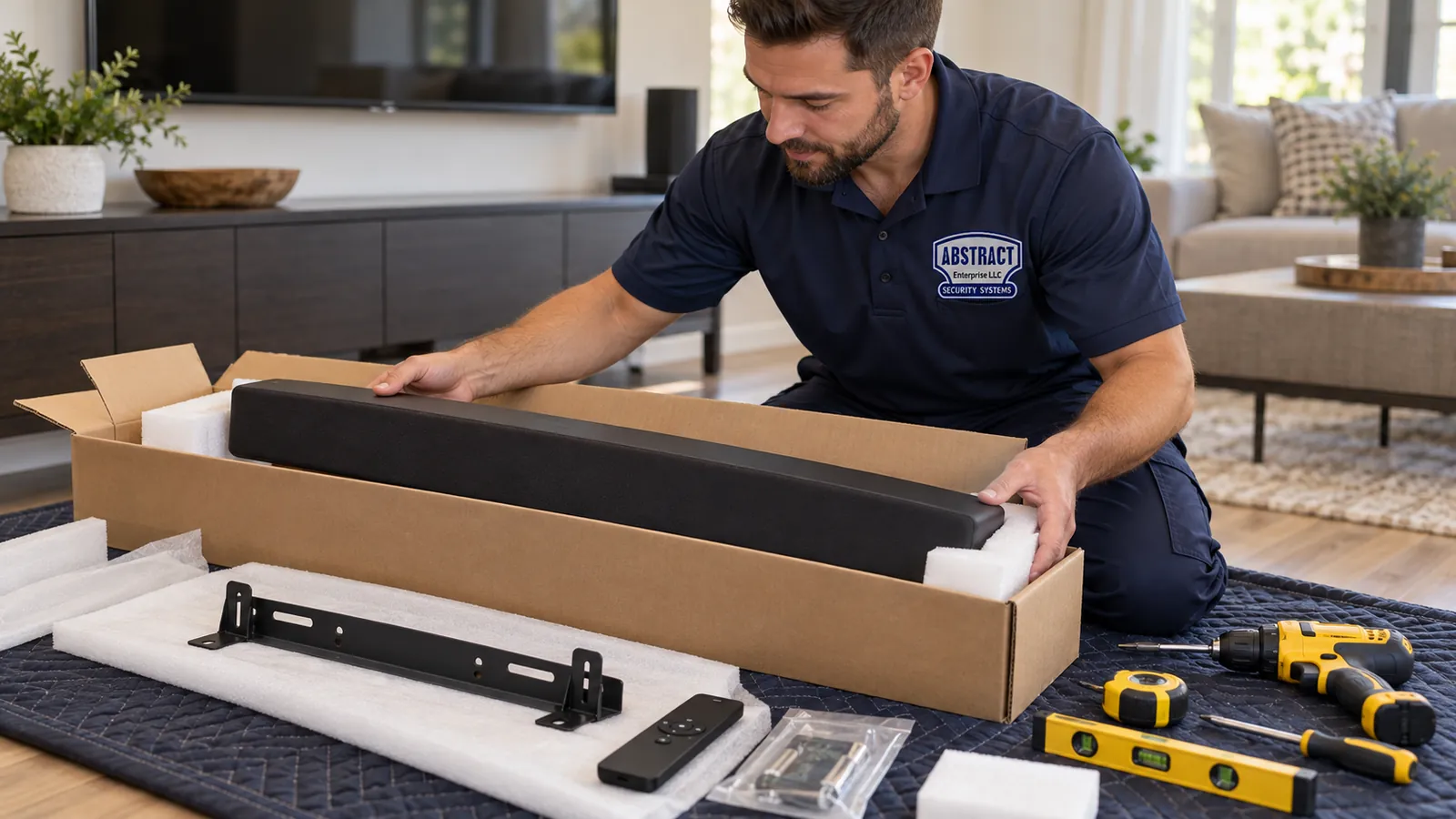
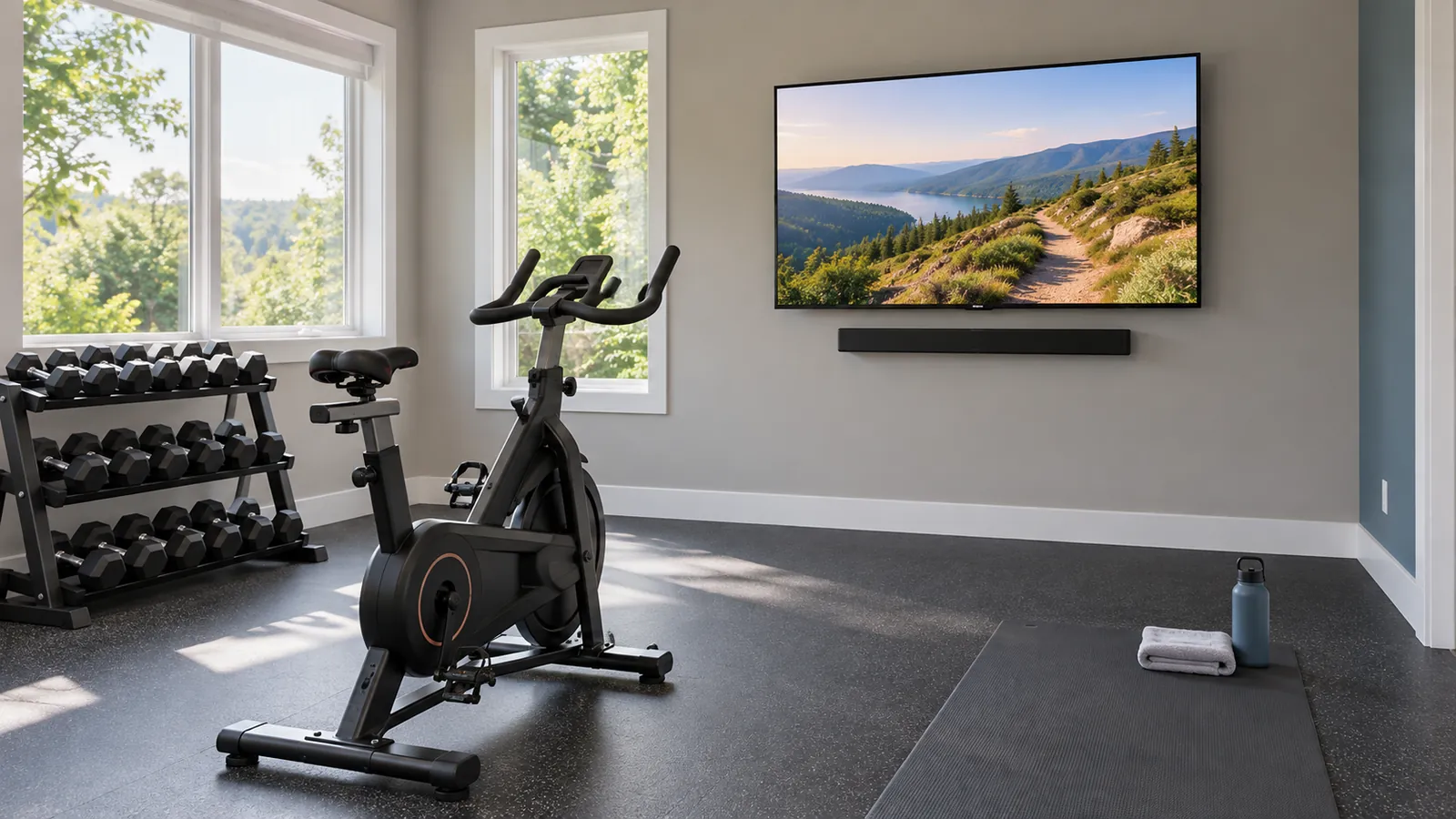
Classic-Six Living Rooms · Plaster on Block · Co-op House Rules · Row-House Floor-Throughs · Lincoln Square Towers
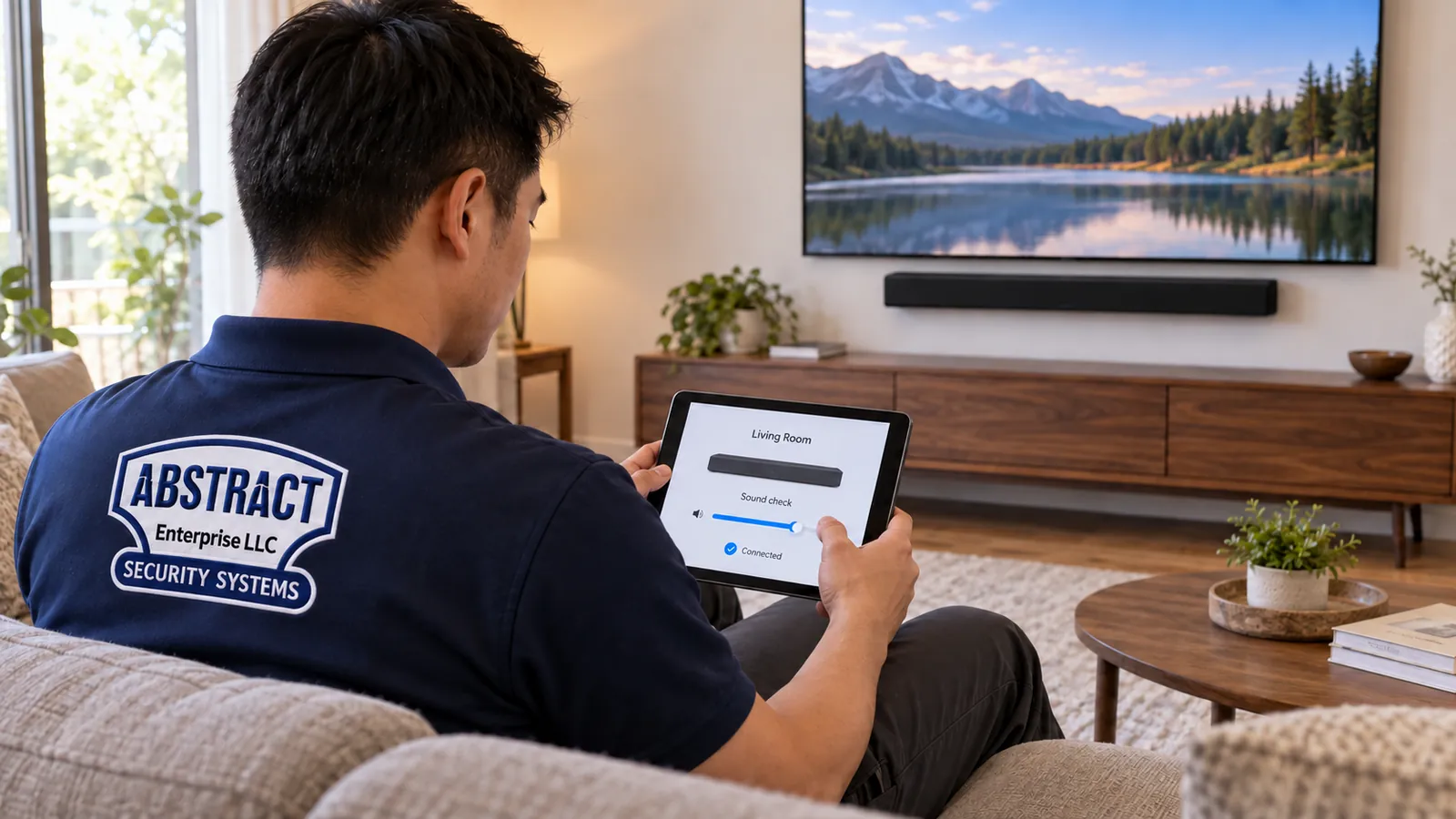
Many Upper West Side living rooms were laid out decades before anyone owned a television. The walls are plaster over hollow block, the windows run down one side, a radiator sits under each of them, doors open onto the foyer, the dining room and the gallery, and the board has opinions about which walls may carry a speaker at all. We fit a soundbar into that room as it is: the wall chosen with you and the house rules, fixings matched to what is behind the paint, cables kept off the mouldings, and the sound tuned for a building where neighbours live on every side.
Reviewed and updated October 17, 2026. The building notes on this page were gathered for the blocks between Central Park West and the Hudson by Anwar Timothy, owner of AESS, license #12000287431.

Between Central Park West and Riverside Drive, a soundbar job is usually decided by the house rules before it is decided by the bar. Call (929) 560-0737 or use the quick form; we price the visit from the published menu on this page and tell you which lines your building and wall add before anything is booked.
The Upper West Side was built for pianos, bookcases and dinner parties, not for a 65-inch screen with a bar underneath it. The neighborhood's great apartment houses went up along Broadway, West End Avenue, Riverside Drive and Central Park West between the 1880s and the Second World War, and the rooms inside them were planned around a formal living room, a separate dining room, a long gallery and a maid's room by the kitchen. CityRealty's guide to the classic six describes exactly that arrangement, and notes that many of these apartments keep their plaster mouldings, substantial doors and, in some cases, fireplaces. Every one of those features competes with a television for the same stretch of wall.
Much of that stock arrived in one rush. The city's first subway line opened in 1904 with a station at Broadway and 72nd Street, and, as the history of the Ansonia records, the subway spurred a wave of tall apartment buildings along Broadway, many of them on land that had never been built on. That is why so many of the neighborhood's big buildings share a construction era, a wall type and a set of habits — and why a fix that works in one West End Avenue living room usually works in the next.
The side streets add a second housing type. Between the avenues, rows of late-nineteenth-century houses have been divided into floor-through apartments and duplexes, and many sit inside the neighborhood's landmark districts. The Landmarks Preservation Commission notes that the Upper West Side has nine historic districts; the Historic Districts Council describes the West End–Collegiate district as one of the most elaborate collections of row houses in the city, and the West 71st Street district as a cul-de-sac of Renaissance Revival houses built between 1893 and 1896. In those buildings the TV wall is often a masonry party wall, the floor is wood joists over another household, and the living room may be a parlor with windows down both ends.
Then there is the newer layer. Lincoln Square and the blocks west of Amsterdam Avenue below 72nd Street carry tall postwar and twenty-first-century towers, such as 200 Amsterdam, a 52-story condominium with 112 apartments completed in 2021. The NYU Furman Center counts 6,297 new homes added to the district between 2010 and 2025. Those apartments bring metal-stud partitions, window walls and building handbooks of their own, so a single Upper West Side week can take us from century-old plaster on 86th Street to a steel-stud wall forty floors above Amsterdam Avenue.
Who lives here shapes the job as much as the walls. Furman's figures for the district show 230,436 residents in 2024, 35.6 percent of households owning their homes — above the citywide 32.7 percent — and 22.9 percent of residents aged 65 or older. That mix means co-op boards with long-standing rules, owners who intend to keep a renovated living room for decades, and plenty of viewers who want clear dialogue and one simple remote rather than a cinema in a prewar room. On r/Upperwestside, neighbors regularly ask for someone "skilled in mounting" to hang a TV alongside light fixtures and curtain tracks; the request is common enough here that it deserves a specialist answer.
And it is a quiet neighborhood by Manhattan standards, built on thick walls that people trust. One New Yorker on r/movingtoNYC put it plainly: "good" prewar buildings have pretty solid walls, and the only neighbor they ever heard was one who mounted speakers on the ceiling underneath them. That is the whole lesson in a sentence. Prewar masonry is forgiving to airborne sound, but anything fixed to the structure — a speaker, a subwoofer on bare boards, a bracket on a shared wall — can carry sound into the apartment next door. Brick Underground's list of common co-op renovation restrictions says most buildings do not allow speakers, or even TVs, on demising walls, the walls between apartments or between an apartment and a common space. On the Upper West Side, that rule alone often decides where the bar goes.
Put together, the numbers describe a neighborhood where the soundbar is the easy part. The real work is choosing a wall that the room, the board and the neighbor next door can all live with, fixing to a surface that was never meant to hold anything heavier than a mirror, and setting the sound for people who mostly want to hear the words.
Upper West Side owners re-planning a living room often hang the TV with the bar on one visit, booked through our Manhattan TV installation team. Households with speakers already in other rooms usually want everything on one app, which is where our Sonos installers in Manhattan come in, and a few go further with a home automation setup for a Manhattan apartment so lights, shades and the TV answer to one button.

No sound since the TV updated overnight, a subwoofer that has stopped pairing, voices drifting out of step with lips, or a bracket that has started to lean in old plaster — we treat those as repairs, not new installs. Ring (929) 560-0737, tell us the cross streets and what the bar is doing, and we offer the next free two-hour window; most settings and connection faults are fixed within one to two hours on site. How setup-only time is charged is explained in our soundbar and TV service policies.
Every visit is assembled from published lines, so you can see what each part of the job costs. These are the services Upper West Side apartments ask for most, with the local reason each one exists.
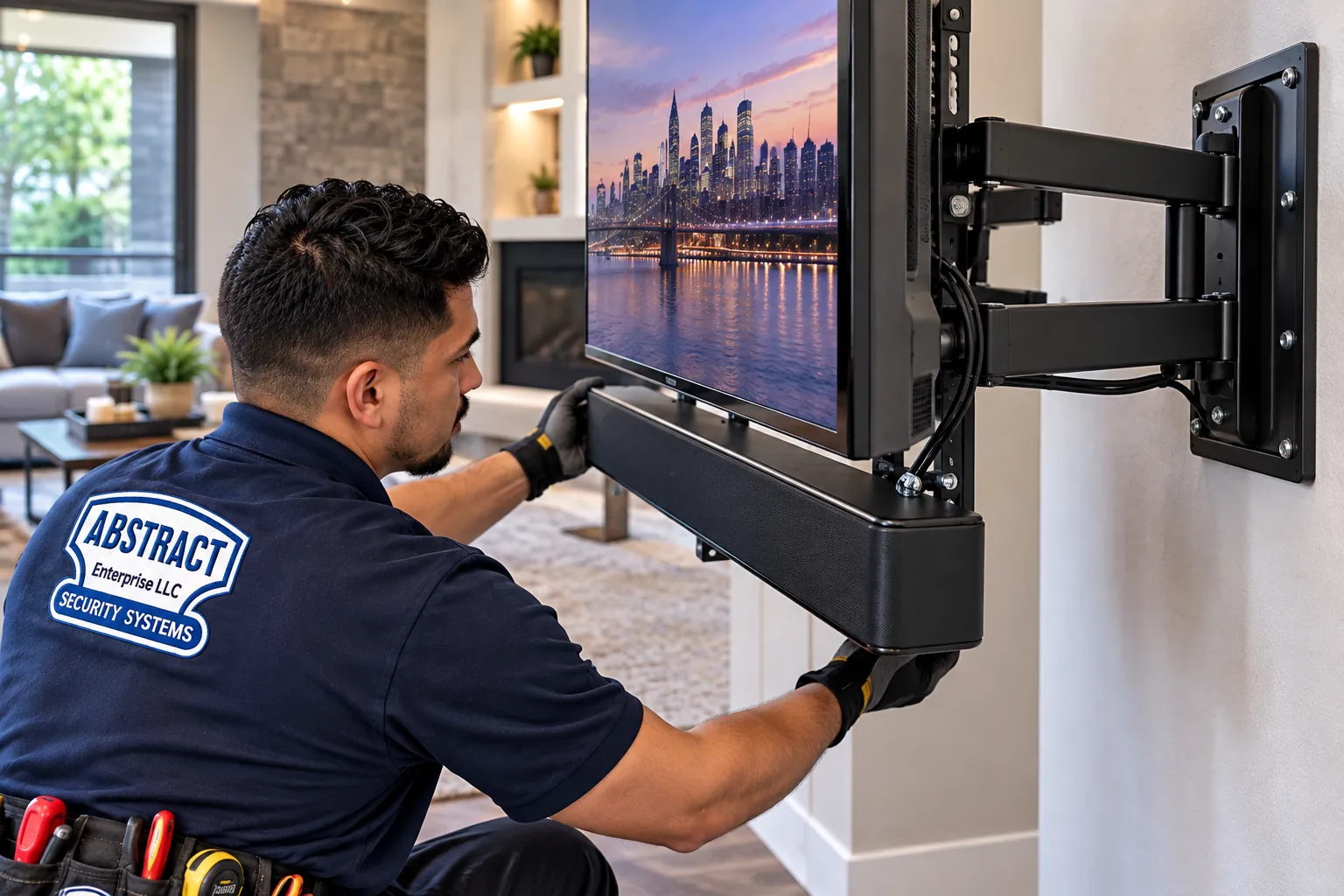
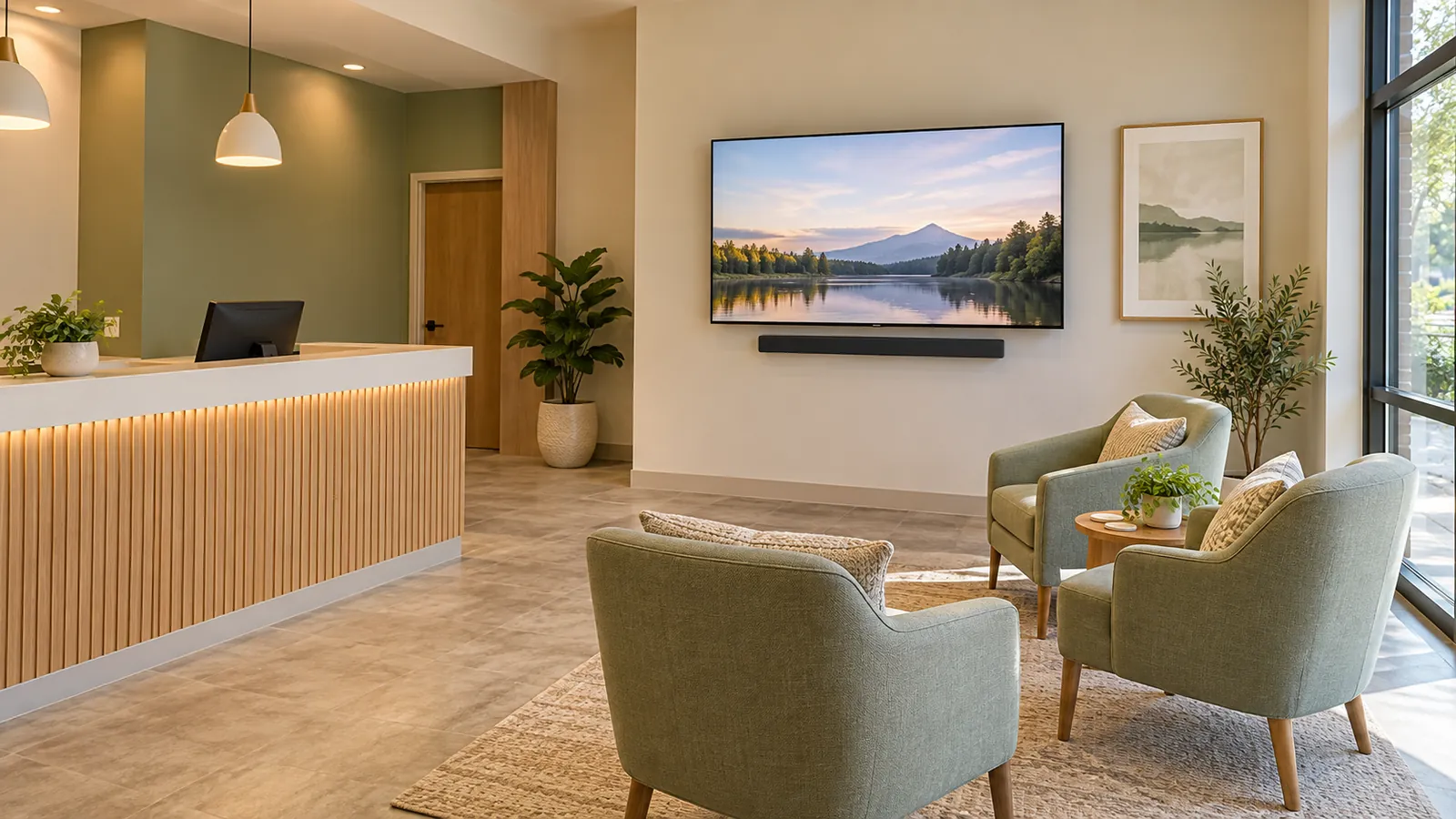
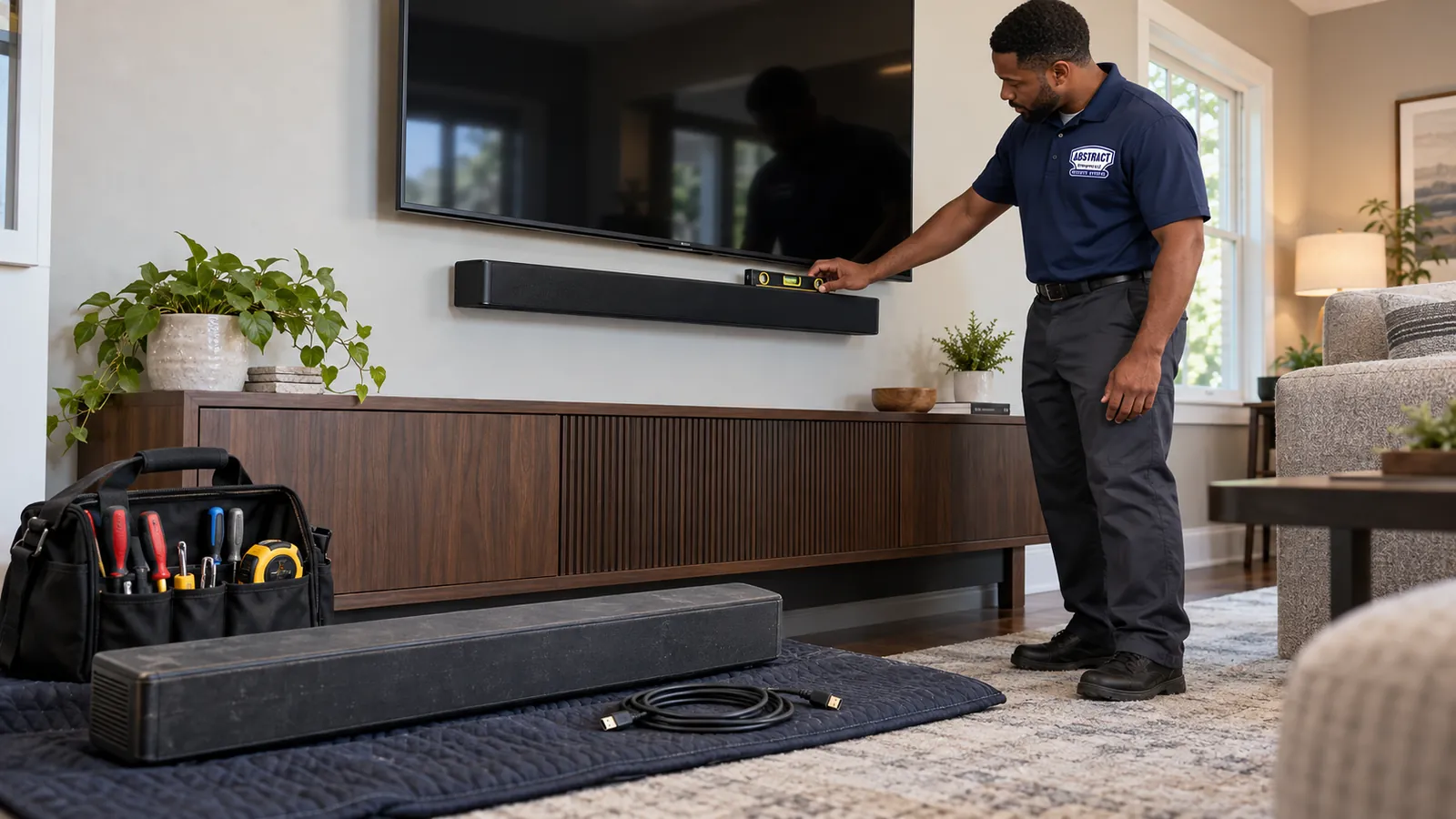
The everyday job: a bracket fixed below the TV on the plaster of a prewar wall, with fixings chosen once we know whether block, brick or a lath cavity sits behind it. Bar levelled, centred on the picture and tested from the seat.
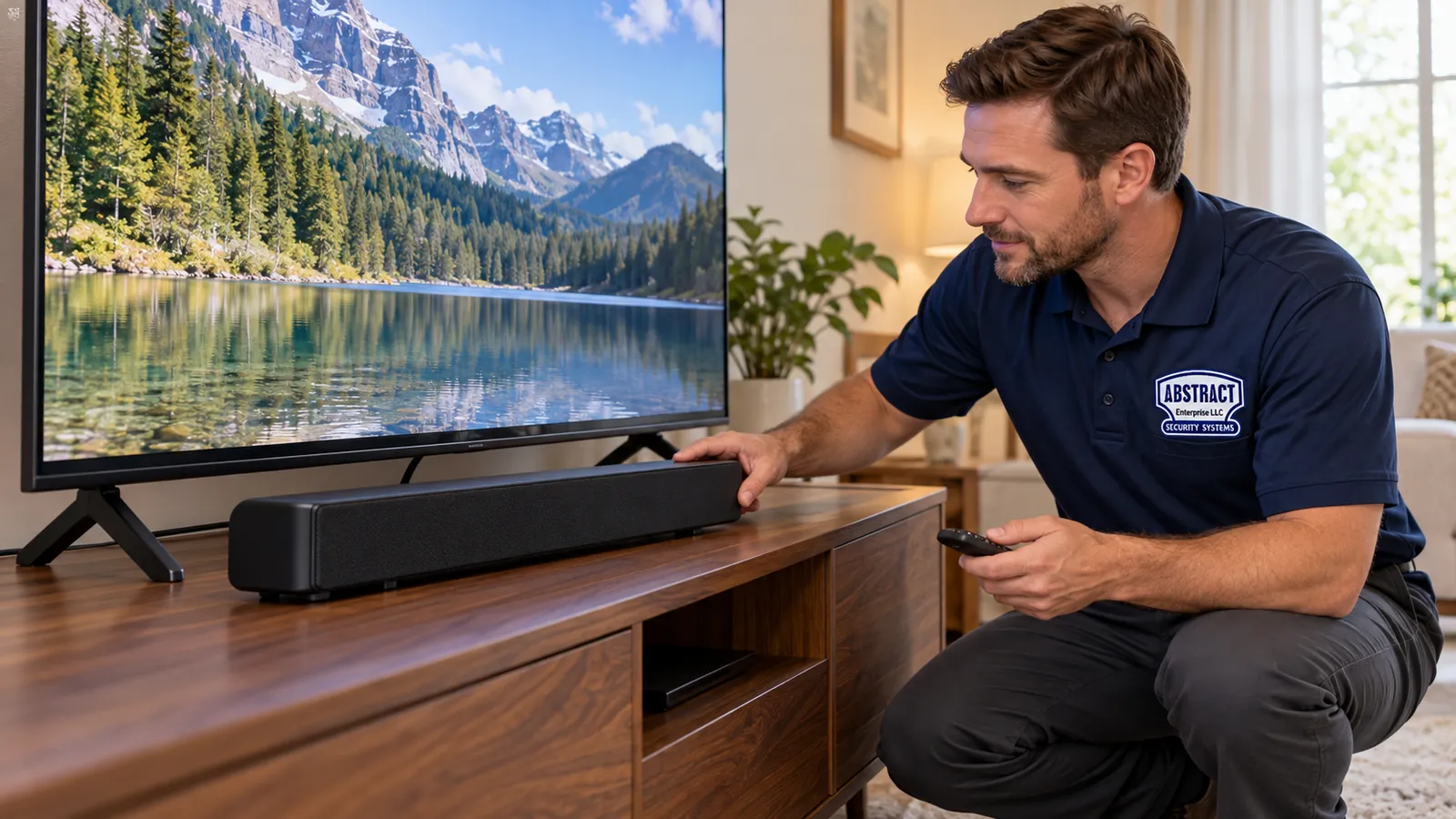
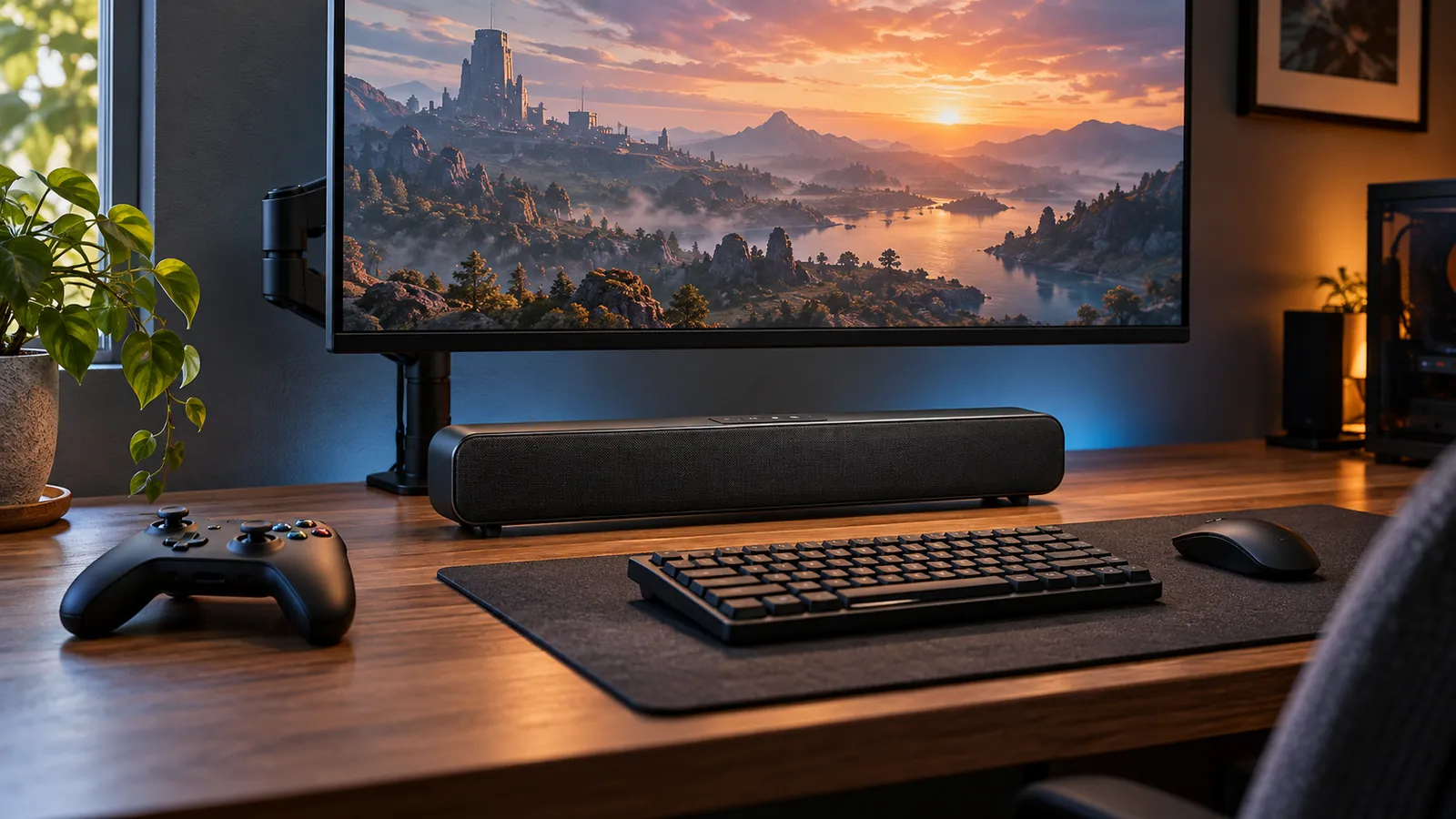
When the wall is a demising wall, the lease forbids holes or the board's summer-only rule is in force, the bar goes on the console or credenza instead, clear of the TV's sensor, wired and tuned the same way.
A bracket that clamps the bar to the TV mount, so a screen on a swing arm can turn from the sofa to the dining table and the bar turns with it. Useful in long classic-six living rooms with seating at both ends.
One visit, one building check-in and one parking line for both. In rooms with tall windows and radiators, planning the screen height and the bar position together saves a second set of holes later.
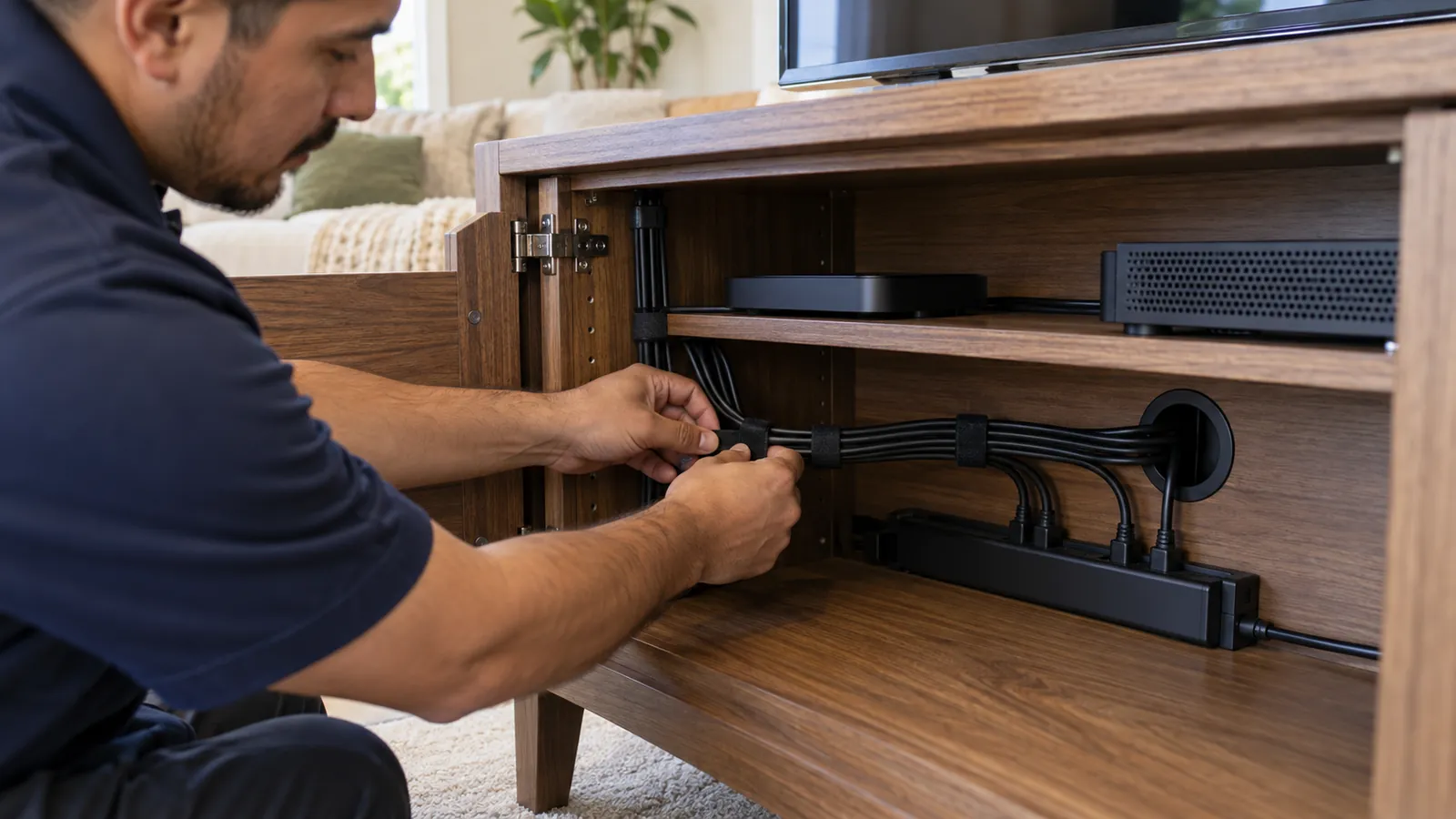
Cords run below the chair rail or along the baseboard in a slim paintable channel rather than across original plaster detail, or inside a hollow wall with an approved in-wall kit where the board permits it.
We find the TV input labelled for audio return, turn on the TV's device-control setting, line up picture and voice, and load the newest firmware, aiming for a living room where one remote is all anyone has to learn.
Dialogue and night modes switched on and explained, bass trimmed for the building, and the bar's own volume ceiling set where the model allows it, so the news is clear without the neighbors hearing it.
In a seven-room prewar flat the router is often a gallery and two masonry walls away from the TV. We check the bar's Wi-Fi from the living room, wire it where it has a port, and say plainly when a network point is the better fix.
Screens in Columbus and Amsterdam Avenue storefronts, Broadway offices and studios near Lincoln Center, with the bar aimed at the room, the volume locked down and the remote kept by staff.

The neighborhood's buildings fall into a handful of families. Each one changes where a bar can go, what holds it, and how far its sound travels.
Tall apartment houses from the decades before the war, many of them co-ops, with classic five, six and seven layouts. Partitions are commonly plaster over hollow block; living rooms have windows on one side and doors on two others.
The park- and river-facing apartment houses, often with the best room on the corner, windows on two walls and the TV pushed onto the wall shared with the foyer. Views decide the seating, and the seating decides the bar.
Turn-of-the-century giants like the Ansonia, the Apthorp and the Belnord, now largely condominiums, with irregular rooms, courtyard light and walls that have been altered by several generations of renovation.
Brownstone and limestone houses from the 1880s and 1890s, divided into floor-throughs and duplexes. Masonry party walls, wood-joist floors over another tenant, tall parlor windows and ceilings high enough to swallow a small bar.
White- and red-brick towers from the 1950s to the 1970s in Lincoln Square and on the avenues, plus Mitchell-Lama and other affordable co-ops. Concrete or block partitions that hold well but can't hide a cable.
Lincoln Square and the riverfront south of 72nd Street: towers such as 200 Amsterdam with metal-stud partitions, glass on one or two sides, concrete columns in odd places and a building handbook that fixes contractor hours to the minute.
Former residential hotels such as the Ansonia, long since turned into apartments, where room shapes follow the old floor plan and a TV wall may be a later partition laid against a much older one.
North of 96th Street, older walk-up buildings alongside larger apartment houses. Narrow living rooms, brick walls behind patched plaster, and every tool carried up the stairs.
Owners who open a wall for an approved in-wall kit often run a network cable at the same time, through our Manhattan network installation service, so the TV wall gets a wired connection while the plaster is already open.

Commercial work here is small-scale and close to home. Almost every shop, café and office on the avenues has apartments stacked above it, so a screen with a bar is judged by two audiences: the customer in the room and the resident on the second floor. These are the corridors the requests come from.
The neighborhood's main street, wide and busy, anchored at 72nd by Verdi Square and the subway entrance beside the Ansonia, with the Beacon Theatre just to the northeast. Banks, gyms, restaurants and chain stores run screens for promotions, classes and waiting customers.
The Columbus Avenue Business Improvement District describes its stretch as a short walk from the American Museum of Natural History and Central Park. Boutiques, cafés and service businesses with narrow fronts and long, deep floors where one screen has to carry to the back.
Restaurants and bars with residential floors directly above, where a game-day TV needs voices clear at the bar without bass reaching the bedrooms upstairs. Bars here are usually best without a separate subwoofer.
Home to Lincoln Center and served by the Lincoln Square BID, founded in 1996 according to NYC Tourism. Studios, schools and offices around the performing-arts campus use screens for rehearsal playback, lessons and lobbies.
The Columbus-Amsterdam BID covers both avenues from West 96th to West 110th Street. Neighborhood restaurants, laundromats and family businesses where a wall TV often plays all day at low volume.
Doorman desks with a monitor, management offices with a waiting area, and residents' rooms in larger co-ops and rental buildings. The bar has to be audible at the desk and invisible to everyone else.
This section is general information, not legal advice. Your lease, your landlord's rules and the city's codes as they apply to your premises are what govern.

These are the questions we hear from the neighborhood specifically: about rooms planned before television, about boards and the people who run the buildings, about sound in old masonry, about the new towers, and about the shops on the avenues. Prices, coverage and booking details are in the FAQ near the end.
It depends on how you actually live, and on which room has a usable wall. The formal living room is usually the largest room and faces the street or the park, but its long walls are often broken by windows on one side and two or three doorways on the others. The dining room tends to be squarer, closer to the kitchen and quieter, and some households that rarely give formal dinners use it as the room where the TV lives. A bar works best facing the main seat from a short distance, so a square room with one clear wall often sounds better than a grand one where the sofa is fourteen feet away.
Look at the shared walls too. If the living room's only solid wall backs onto the neighbor's bedroom and the dining room's backs onto your own kitchen, the dining room wins before the sound is even considered. Send us a floor plan or a phone photo of each candidate wall; we'll tell you which one gives the bar a clean centre line under the screen, where its cable would run, and whether either wall is one the house rules keep speakers off.
A compact bar, a modest screen and careful placement. The sixth room of a classic six was planned for live-in staff, and CityRealty notes it typically sits next to the kitchen and may have its own bathroom. That usually means one window onto a courtyard or light court, a door on the kitchen side and sometimes a second into the bath, leaving one short wall for the TV. A short bar suited to a bedroom-sized space sits comfortably on a low unit or on a small bracket under a screen of around 40 to 50 inches.
Two things matter more than the bar. Kitchen noise comes straight through that door, so dialogue mode does more good here than extra bass. And the wall opposite the window is frequently the building's original masonry, so it holds well but won't hide a cable; a short cord cover to the nearest outlet is the usual finish. If the den will double as a guest room, we'll set the bar so it switches off with the TV and doesn't light up a dark room at night.
Usually by going beside it rather than above or below it. A through-wall sleeve takes up a block of the wall that can't take fixings, its frame is often set in masonry that was cut and patched when it was installed, and the unit inside it vibrates and drips condensation when it runs. A soundbar directly over it would sit in the warm exhaust and pick up the unit's hum; directly under it, the bar would be in the drip path. We look for a stretch of wall on either side wide enough for the screen and bar, and centre the seating on that instead.
If the sleeve sits dead centre on the only usable wall, the honest options are a TV on a stand or a swing-arm mount fixed to one side of the sleeve with the bar clamped to it, which keeps every hole clear of the sleeve's frame. We don't remove, move or seal air-conditioner sleeves; that is building or HVAC work. We'll also make sure the bar's cable doesn't cross the sleeve's grille, where it would block airflow.
Assume it does unless the managing agent tells you otherwise in writing. Brick Underground's list of the restrictions boards most often impose says most buildings don't allow speakers, or even TVs, on demising walls — the walls between apartments, or between an apartment and a common space such as a corridor or stair hall. A bar is a speaker by any reasonable reading, and a bracket bolted to that wall passes vibration straight into the structure. Arguing the point with the board is rarely worth it.
In practice the rule moves the TV rather than cancelling it. Interior walls between your own rooms, walls onto your own kitchen or bath, and exterior walls are normally allowed. Where the only good viewing wall is a demising wall, the bar can sit on a console a few inches in front of it rather than on it, which keeps it within most rules. Tell us which walls are shared before the visit; we mark them on the plan and won't drill them.
Often yes, but ask the managing agent before booking. Brick Underground notes that some buildings only allow renovations in the summer months, and these rules are aimed at noisy, disruptive work such as gutting a kitchen. Hanging a bar on a bracket is a short, minor job, and many buildings that restrict renovation season still allow small repairs and fixtures year-round. The building decides, though, not us, and a doorman who has been told "no contractors until June" will turn the technician away whatever the job.
If the answer is no until summer, the bar can still go on the console now: no drilling, nothing for the board to approve, full sound and setup. We come back to wall-mount it when the season opens, and that second visit is priced from the same menu. If the answer is yes, get it in an email from the agent and forward it to us; we'll book a weekday window inside the building's hours.
That it is allowed, insured and suited to the wall. Supers know their buildings better than anyone and many are very capable, but work in your apartment done privately is usually outside their building duties, so ask whether the managing agent permits it and whose insurance covers it if a pipe or wire behind the plaster is hit. Ask what fixing he plans to use: the plastic anchors in a soundbar box are made for drywall, not for plaster over hollow block.
Then think about what comes after the bracket. Connecting to the eARC port, switching on CEC so one remote works, setting dialogue mode and checking the Wi-Fi are the parts of the job that make a bar pleasant to live with, and they are rarely part of a favor. There's no harm in using the super for the hanging and calling us for setup-only time afterwards; we'll check the bracket while we're there.
Start with the development's management office. The Furman Center counts 12 Mitchell-Lama properties with 2,075 units in the district, and these developments are supervised by HPD or the state housing agency, each with its own management office and house rules on alterations. Whether a bracket on a wall needs a written request varies from development to development, so ask the office directly rather than relying on a neighbor's experience in another building.
Bring them specifics: which wall, how many holes, what kind of anchor, and that nothing electrical is being added. We can send that description, along with our certificate of insurance, straight to the office. If the answer is that only console placement is allowed, we'll set the bar up that way, and it will sound just as good from the sofa.
The planning, yes; the drilling, no. While you wait on the board package, send us the floor plan from the listing, photos from your inspection or second showing, and the TV and bar you intend to use. We'll suggest a wall, a mount height, a cable route and a price, and point out anything that needs the building's view, such as an in-wall kit that would open plaster. That lets you add a short note about it to your alteration questions instead of discovering the rule after you move in.
Nothing is booked until you have the keys and the building's contractor rules. Ask the managing agent for the alteration agreement and house rules as part of the closing documents; they set the hours, the insurance wording and sometimes which walls are off limits. Once you close, the plan is already done and the install is a single visit.
It can, and it surprises people who have never had a complaint through the walls. Many of the neighborhood's large buildings are arranged around courtyards and light courts — the Belnord on 86th Street is built around a central courtyard reached through arches, and the Ansonia has light courts along each side — and a hard-walled court acts like a small amphitheatre. With windows open, a bar facing the window wall throws sound straight across it, and voices in a film can reach bedrooms that never hear a thing in winter.
Placement does most of the work. A bar on the wall opposite the windows fires into the room and away from the court; a bar beside a window sends its sound out of it. Night mode compresses the loud moments that carry furthest, and switching off any up-firing or side-firing effects in summer keeps the sound in the room. If your courtyard neighbors have already mentioned it, tell us when you book and we'll tune for it.
It can, so check the paperwork before the first hole. New buildings often have open punch-list items and a period during which the sponsor is responsible for certain defects, and the terms are in your purchase documents and the building's handbook. If the TV wall has a crack, a soft spot or a finish problem on the punch list, get it fixed and signed off first; a bracket over a disputed patch makes the conversation harder.
New condos also tend to have strict contractor rules from day one: certificates naming the condominium and the managing agent, booked service-elevator slots and set hours. And many new partitions are metal studs with acoustic insulation, so we scan for the studs and any conduit before choosing the bracket position. Send the handbook page on alterations with your quote request and we'll book around it.
Yes, if the bar faces into the shop. A screen meant for passers-by faces the window, which points any bar under it at the glass and the street; the sound bounces off the glass and is lost on the sidewalk. The usual fix is a second, smaller screen inside facing the counter or the seating, with the bar under that one, while the window display runs silent with captions. Where there is only one screen, a bar placed on a shelf inside the shop and aimed at the room carries the sound where your customers are.
Narrow, deep storefronts are common on Columbus, so the bar is set for clear speech at a moderate level rather than volume, and its maximum is capped where the model allows. Anything that would put a speaker or screen on the outside of the building is a different matter in a historic district, where the Landmarks Preservation Commission's exterior rules apply. We keep everything inside.
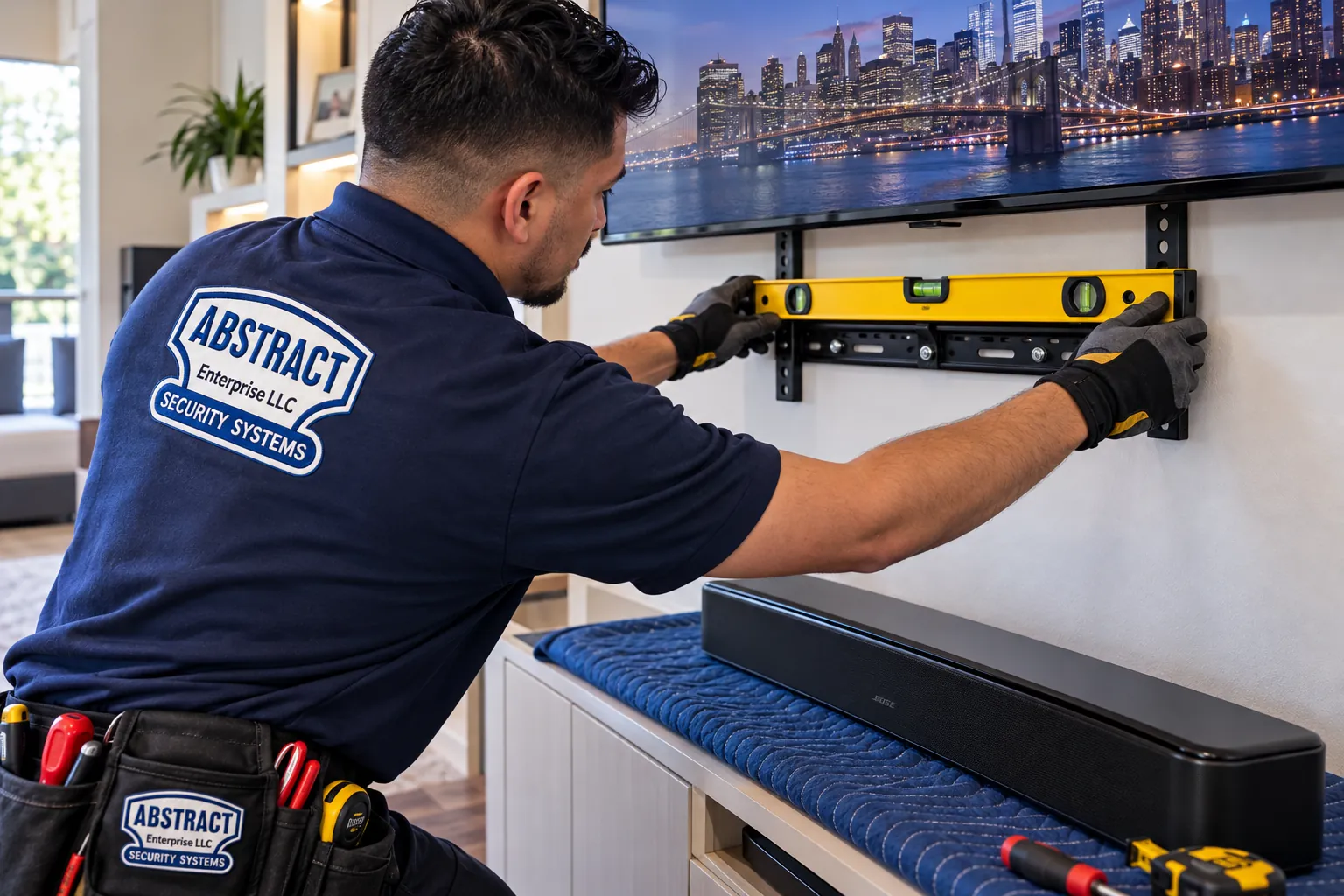
A prewar apartment on West End Avenue or Riverside Drive gives you several candidate rooms and no obvious TV wall. CityRealty's description of the classic six — living room, formal dining room, kitchen, two bedrooms and a staff room, entered through a foyer or gallery with hallways separating the private rooms from the entertaining ones — is a good map of the choices. This is how each room tends to work for a bar, based on what we look for at the walkthrough.
Usually the biggest room and the one with the view, which is exactly the problem. Windows take one long wall, a radiator sits under each window, a fireplace or a wide doorway often takes another wall, and the remaining walls are broken by doors to the foyer and the dining room. The TV ends up on whatever stretch is left, which is sometimes off-centre to the room. We centre the bar on the screen, not the wall, and arrange for the main seat to face that centre line. Where the seating is far away, a mid-size bar placed well beats a long one placed badly.
Tempting, because the sofa often faces it, and almost always wrong. Prewar windows are tall and closely spaced, a radiator sits under each, and the piers of wall between them are rarely wide enough for a screen, let alone a screen with a bar beneath. A bar placed low between two radiators spends the heating season in rising warm air, and a TV against the light is hard to watch on a sunny afternoon. We usually turn the seating instead, so the window wall is at your side rather than in front of you.
Squarer, more enclosed and often quieter, with one wall that backs onto the kitchen or pantry rather than another apartment. If the household eats in the kitchen, the dining room can make the better TV room: a short throw from sofa to screen, fewer windows, and a wall that is yours on both sides. Pocket doors or a wide opening to the living room let sound spill through, so dialogue mode matters more than bass here.
Where an apartment has one, it is often lined with built-in shelves on two or three walls. A bar can live on a shelf of the right depth if the shelf is solid and the bar's front is flush with the shelf edge, so the sound isn't trapped in the cavity. If the TV is on the one open wall, the bar goes under it on a bracket and the cable drops down the side of the bookcase rather than across the plaster.
Small, with one window onto a light court and a door to the kitchen. A compact bar is the right size, and console placement is often enough. Because these rooms back onto the building's service side, the wall opposite the window may be the building's original masonry; it holds a bracket well but leaves cables on the surface.
Bedrooms in these layouts are set apart down the gallery, and the bedroom wall is the one most likely to adjoin the neighbor's bedroom. A compact bar on the dresser, with night mode and a low volume ceiling, suits most of them. If the only TV wall is shared, the bar stays off it.
Not TV rooms, but they decide where cables can't go. Galleries are walkways, so nothing crosses them at floor level, and their walls often hold the apartment's original mouldings and doors. They are also where the router tends to sit, next to the entry, which is why a bar three rooms away sometimes needs a wired connection or a mesh node rather than a stronger Wi-Fi setting.
The common thread is that the TV's location is a household decision first and an installation decision second. Once you know which room will be the TV room, the wall, the fixing and the cable route follow quickly, and the price follows from them.

Most co-ops, condos and managed rental buildings in the neighborhood ask for the same handful of things, and a soundbar visit goes smoothly when they are settled a few days ahead. Brick Underground's summary of alteration agreements notes that most limit work to 9-to-5 weekdays, that service-elevator use may be restricted at the start and end of the day, and that some buildings only allow renovations in summer. A bar on a bracket is not a renovation, but the people at the front desk apply the same rules to every contractor.
One approval you almost certainly won't need is from the Landmarks Preservation Commission. The Commission's permit page lists the interior work it reviews as work that needs a Department of Buildings permit, work that affects the exterior, and work in designated interior landmarks; a bar fixed to an apartment wall is none of those. Landmark status matters for what you can do to the facade, not for a bracket in the living room.
We install whatever mainstream bar you have chosen. These are the categories that come up most in Upper West Side apartments, with what each means in a prewar room.
Short bars for bedrooms, staff rooms turned dens and small TVs. Sonos's Ray, for example, connects by optical rather than HDMI and is listed by WhatHiFi at about 56 cm wide and under 2 kg. On a dresser or shelf they need no bracket at all.
The middle of the range: bars a little over two feet long that take an HDMI eARC cable and run from a phone app. Sonos gives the Beam (Gen 2) as 25.63 inches and 6.35 lb. They suit a converted dining room, or any living room where the sofa sits close to the screen.
Flagship bars with up-firing drivers that reflect sound off the ceiling, such as the Arc Ultra, which Sonos lists at 46.38 inches and 13.01 lb. Prewar ceilings are high and usually flat plaster, which suits the effect when the bar is under a large screen.
The category to think hardest about in a building with neighbors below. A sub on a pad, away from the corners and off bare parquet, set low, is fine; a sub on the floorboards of a row house can carry into the apartment underneath.
The bracket packed with your bar is usually fine; a Sanus bracket from us is the alternative when the boxed one is flimsy or missing. What we never reuse from the box are its plastic plugs, which were made for drywall, not for plaster laid on block.
Brackets that attach the bar to the TV or its mount instead of the wall. Sanus lists its universal soundbar mount for most bars up to 20 lbs. The answer when a wall can't take extra holes or the TV swings.
A slim paintable channel for masonry walls and for rental apartments; a code-compliant in-wall power and cable kit for hollow walls where the board or landlord agrees.
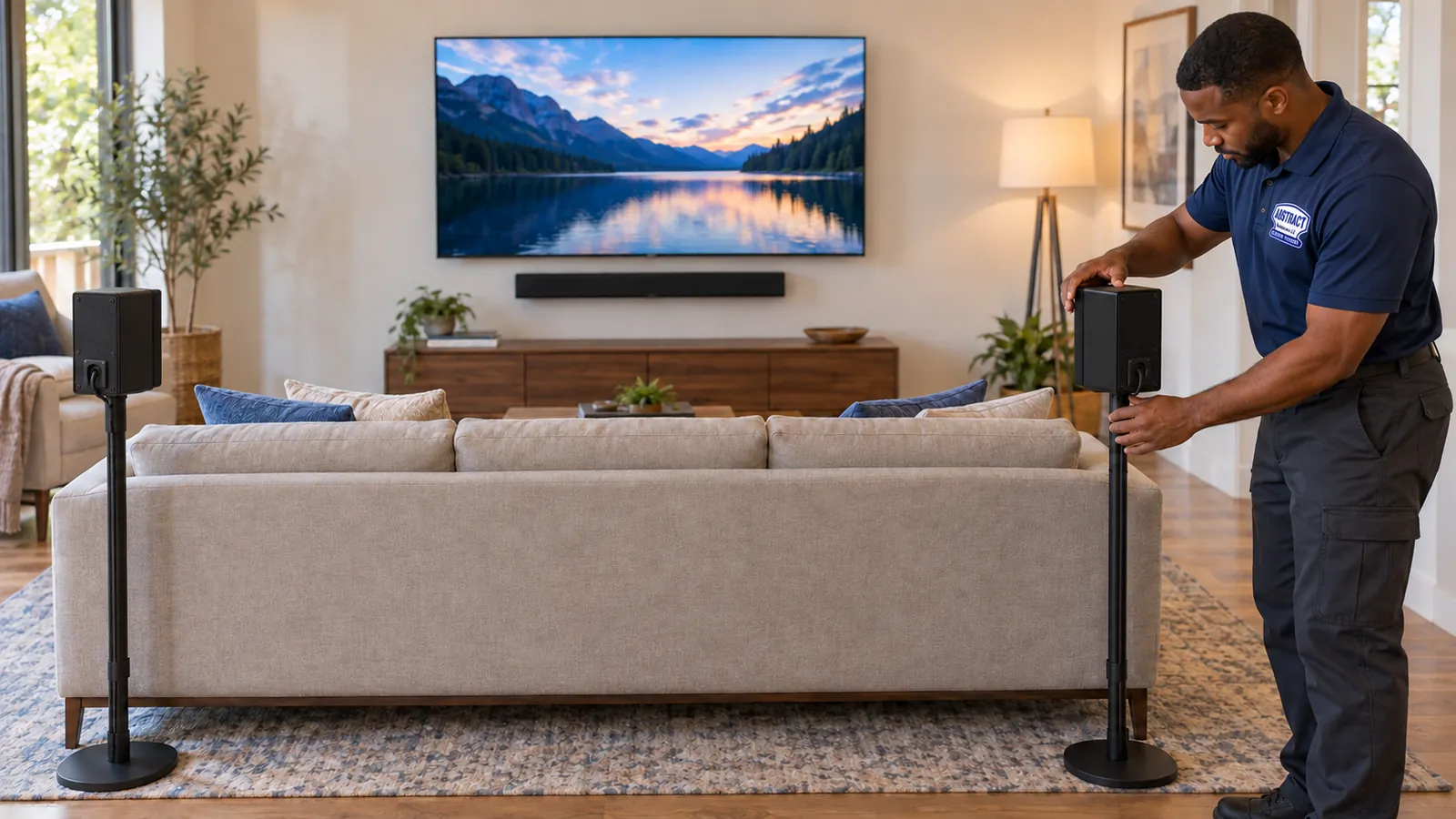
Wireless surrounds that pair with a bar. In long living rooms with the sofa floated in the middle, floor stands behind the sofa avoid fixing anything to the walls at all — but each one still needs an outlet nearby.
| Connection | Where it fits | Prewar-apartment caveat |
|---|---|---|
| HDMI eARC | Current TVs and bars; lossless audio and TV-remote volume control | Use the port marked eARC; a long run to a cabinet may need our $99 cable line |
| HDMI ARC | Older TVs still in use in second rooms | CEC may need switching on in the TV's menu |
| Optical | Compact bars and TVs with no ARC | Volume control may need a programmed remote |
| Ethernet | Smart bars with a port, where the router is far away | Masonry partitions make cable routes visible; plan the run |
| Wi-Fi | Bars with no network port | Thick walls between router and TV weaken the signal more than in new buildings |
National marketplaces versus a local installer. App-based handyman services and big-box tech teams price soundbar mounting for a generic wall in a generic room. They aren't built around a co-op's demising-wall rule, a summer alteration season, plaster over gypsum block, a courtyard that carries sound, or a managing agent who wants a certificate naming three entities. A licensed installer who works these buildings, quotes a published Manhattan price and answers on a Manhattan line is easier to hold to the result.

We could not capture Google's AI Overview for this neighborhood in our build environment, so the claims below are the generic statements that AI summaries and national how-to guides commonly make about mounting a soundbar. None is absurd. Each needs correcting for a prewar building between Central Park and the Hudson.
That is the standard advice for a house framed in wood studs and finished in drywall, and in that house it is correct. A stud finder locates the framing, two screws go into it, and the bracket will hold far more than any soundbar weighs.
Many Upper West Side apartment walls have no studs to find. Prewar partitions are commonly plaster laid directly over hollow block, and party walls in row houses are solid brick. A stud finder either reads nothing or reads random patches of dense plaster, and a wood screw has nothing to bite. In an r/AskNYC thread about very hard prewar walls, the useful reply was simply how to tell gypsum block from concrete.
So the wall is identified first, by a small test hole and the colour of the dust, then fixed with anchors made for that material. That is also why our price list carries separate lines for plaster, brick and concrete: the fixing changes, and so does the time.
It is a common belief, and an understandable one in a neighborhood with nine historic districts and individually designated buildings such as the Dakota and the Ansonia. The Landmarks Preservation Commission does regulate a great deal.
But its permit page is specific. For interiors, the Commission reviews work that needs a Department of Buildings permit, work that affects the exterior, and work inside designated interior landmarks. A soundbar bracket on an apartment wall falls into none of those categories.
The approval that does matter is the building's. The co-op or condo board, the house rules and the alteration agreement govern hours, walls and contractors, and the front desk enforces them on the day. That is where to spend your time before booking.
Thick masonry does block a lot of airborne sound, and the reputation is deserved. A New Yorker on r/movingtoNYC said "good" prewar buildings have pretty solid walls.
The same poster's exception is the point: the one neighbor they could hear had mounted speakers on the ceiling below them. Sound fixed to the structure travels through it. A bar bolted to a shared wall, or a subwoofer standing on joists above someone's bedroom, sends vibration into the building in a way that talking or a TV on a stand doesn't.
That is why many boards ban speakers on demising walls, according to Brick Underground, and why we keep bars on your own walls, put subwoofers on isolation pads away from corners, and set night mode for late viewing. The walls are thick; they aren't a licence to ignore the bass.
Bigger bars do produce more sound and wider effects, and in a large open room that can help. Buying guides lean on room size because it is easy to measure.
What matters more is the distance from the bar to the main seat and whether the bar faces it. A classic-six living room may be large, but the TV is often pushed onto a short wall with the sofa angled towards it. A long Atmos bar in that position spends much of its effort on the wrong part of the room.
We would rather see a well-sized bar centred on the screen and aimed at the seat, with dialogue mode tuned, than a flagship bar fighting a window wall. If you haven't bought yet, send us a photo of the room first.
Wireless surrounds do away with long speaker cables from the front of the room to the back, which is a real improvement over old five-speaker systems. Product pages say so, and AI summaries repeat it.
Each rear speaker still needs mains power. In a prewar living room, outlets are often few and placed for lamps, and the sofa is frequently floated in the middle of the room in front of a window wall with a radiator under it. There may be no outlet where the speaker should stand.
The fix is planning, not wiring: floor stands near the outlets that exist, a short cord along the baseboard, or a decision to skip rears in a room where they can't sit symmetrically. New outlets are a licensed electrician's job, not ours.
In a single-family house, nobody asks permission to hang a soundbar, and online advice is written for that world. Even in apartments, it is easy to assume a bracket is too small to matter.
Upper West Side buildings rarely see it that way at the door. Brick Underground notes that most alteration agreements limit work to 9-to-5 weekdays and that some buildings only allow renovations in summer. The doorman doesn't measure the job; he checks the contractor list.
So we ask about the building when you book: contractor hours, drilling hours, the insurance wording, which walls are restricted. A console setup is the fallback whenever the wall mount has to wait.
Nationally, soundbar mounting is often advertised as a short add-on at a low flat price, and for a wood-stud wall in a house with a driveway, that can be fair.
On the Upper West Side the job includes building check-in, a service elevator or a walk-up, a wall that has to be identified before it is drilled, and a technician's vehicle that has to be parked legally in Manhattan. Our published Manhattan menu reflects that: $129 to mount the bar, the wall line where it applies ($45 for plaster), and one flat $150 parking charge per visit.
The total for a bar on prewar plaster with your own bracket comes to $324, set out line by line before you book. That is more than a national teaser price and less than a second visit to fix a bracket that pulled out of hollow block.
Send the room, the bar and the house rules. We send back an Upper West Side price with the parking line already in it.
Describe the room you have chosen, what the TV wall is made of if you know, and what kind of building it is. A person who works in these buildings, not a bot, answers with a written figure built from the published lines below, parking already counted. Rather speak to someone? The number is (929) 560-0737.
Got it. A member of our Manhattan crew will look over the room and the building details and reply today if you wrote during business hours. Need someone sooner? Call (929) 560-0737.
Seven steps, the same for a compact bar in a Manhattan Valley walk-up and an Atmos bar in a Central Park West living room. The first three are about the room and the building, because on the Upper West Side that is where a job is won or lost.
Send photos of the walls you are considering, the outlet near each, the bar and TV models and your cross streets. We suggest the wall that suits the seating, the house rules and the sound, and send an itemized quote with the parking line in it.
We confirm with you, or directly with the managing agent, which walls are restricted, whether the building has an alteration season, and the contractor and drilling hours. The free insurance certificate goes to the agent in the wording they ask for.
Two-hour arrival windows run from 8 AM to 8 PM every day. We offer only those that leave time to finish the drilling inside the building's noisy-work hours, and rescheduling with a day's notice is free.
The technician signs in with the doorman or super, uses the elevator the building assigns, and puts a drop cloth down under the wall before anything is unpacked. Original parquet and rugs are covered.
A scan for pipes, risers and old wiring, then a small test hole where the material is uncertain, tell us whether the plaster sits on block, brick, lath or concrete. You approve the height and centre mark before the bracket goes up.
Anchors suited to the wall, the bracket fixed and levelled, the bar hung and checked again. HDMI to eARC or ARC with CEC on, and cables run in a cord cover, an approved in-wall kit or down behind the furniture, never across mouldings.
Dialogue and night modes set, the sub placed and levelled for the floor below, the network connection confirmed from the TV wall, a lip-sync check with a dialogue scene, and a walkthrough of the few settings you'll actually use.

Six Upper West Side landmarks, each standing for a kind of building whose walls and rules we plan around. They are reference points for the neighborhood, not a claim that we have worked inside them.
Built between 1880 and 1884 to Henry Janeway Hardenbergh's design, with apartments of four to twenty rooms, each laid out differently; a cooperative since its residents bought it in 1961. The neighborhood's oldest great apartment house.
A 17-story Beaux-Arts former residential hotel between 73rd and 74th Streets, opened in 1904 and a condominium since 1992, with light courts along each side and some 425 apartments carved from its original suites.
A 12-story building filling the block between West 78th and 79th Streets on West End Avenue, completed in 1908 for William Waldorf Astor and now a condominium of about 154 units.
Built in 1908–09 around a central courtyard reached through arches on 86th Street; StreetEasy lists 213 units. Typical of the big courtyard houses where sound can carry across the court.
A secluded cul-de-sac of Renaissance Revival row houses built between 1893 and 1896 in six harmonious groups, designated in 1989. Side-street row-house living at its most intact.
A 52-story condominium with 112 apartments, completed in 2021 on the former Lincoln Square Synagogue site at West 69th Street. The neighborhood's new-tower end: glass, metal studs and a strict handbook.
We cover the whole of Community District 7, which the Manhattan Borough President's housing report describes as the Upper West Side, Lincoln Square and Manhattan Valley: Central Park West, Columbus, Amsterdam, Broadway, West End Avenue and Riverside Drive from the West 60s up to 110th Street, including the Riverside South towers along the Hudson. Neighbors to the north in Morningside Heights and to the south in Hell's Kitchen are booked through the same Manhattan soundbar installation page and the same price menu.

The Upper West Side is priced from our published Manhattan menu. Choose the lines that describe your job, add the wall line if your wall needs one, and add a single $150 Manhattan parking charge for the visit. If the wall turns out to be different from what the photos suggested, you get the revised price before we continue.
| Soundbar line | Price | Upper West Side notes |
|---|---|---|
| Soundbar wall-mounted under the TV | $129 | Wall identified, anchors matched, bar levelled and centred on the screen |
| Soundbar placed on a console or stand | $79 | The no-drill option for demising walls, summer-only rules and rentals |
| Sanus soundbar bracket | $84.99 | When the bar came without one, or its own bracket doesn't suit the wall |
| In-wall concealment | $169 | Hollow walls only, with the board's or landlord's agreement; code-compliant power and cable kit to an existing outlet |
| Paintable cord cover | $59 | The usual finish on plaster over block and on brick |
| Cable run up to 25 ft | $99 | Reaching a cabinet, a bookcase or a router across the room |
| Sonos setup | $125 | Sonos bar, sub, surrounds and app grouping |
| A/V receiver setup | $129 | For households keeping an older system |
| Universal remote programming | $99 | One remote for TV, bar and cable box |
| Streaming device setup | $49 | Apple TV, Roku, Fire TV and similar |
| Full home theater setup | $350 | Multi-component systems |
| Manhattan parking, per visit | $150 | One flat charge however many lines the visit has |
| Condition | Price |
|---|---|
| Drywall on wood studs | $0 |
| Drywall on metal studs (new condos) | +$30 |
| Plaster (most prewar walls) | +$45 |
| Brick or stone (row-house party walls) | +$65 |
| Concrete or cinder block (postwar towers) | +$75 |
| Tile or marble | +$95 |
| Plywood backer board | $85 |
| High mount, above about 8 ft | $75 |
| Walk-up, 3rd floor or higher | $40 |
| Remove an old bracket | $45 |
| Box removal | $25 |
| Certificate of insurance for the managing agent | Free |
| Job | Lines | Total |
|---|---|---|
| Bar on a credenza in front of a demising wall | $79 + $150 parking | $229 |
| Bar on prewar plaster, your own bracket | $129 + $45 + $150 | $324 |
| Bar on prewar plaster, our bracket, cord cover | $129 + $84.99 + $45 + $59 + $150 | $467.99 |
| Old bracket removed, bar rehung on plaster with your bracket | $45 + $129 + $45 + $150 | $369 |
| Row-house floor-through on the 4th floor, brick wall, own bracket, cord cover | $129 + $65 + $40 + $59 + $150 | $443 |
| Postwar tower, concrete partition, our bracket, cord cover | $129 + $84.99 + $75 + $59 + $150 | $497.99 |
| New condo, metal studs, own bracket, approved in-wall kit | $129 + $30 + $169 + $150 | $478 |
Some visits involve no bracket at all: a new TV that has lost its link to the bar, voices running ahead of the picture, a subwoofer that won't pair, a bar moving from Wi-Fi to a cable. Those are charged on the clock — $265 covers the first hour in Manhattan, later time goes in half-hour steps, and the $150 parking line is added. If a TV is mounted on the same trip, the Manhattan TV base of $244.99 (32 to 55 inches, wood-stud drywall) is the starting point, soundbar lines stack on top, and parking is still charged once. Leaving the TV on its stand is $162.99 in Manhattan.
Three shapes cover most Upper West Side requests. Each card shows its sum, including the $150 parking line; other wall lines or the walk-up charge are added where they apply.
$229
Console placement at $79 plus the $150 Manhattan parking line makes $229. Audio-return link made, device control on, speech and late-night modes chosen, cords bundled out of sight. The wall is never touched, so there is nothing for a board or landlord to sign.
$408.99
$129 to mount the bar + $84.99 Sanus bracket + $45 plaster + $150 parking = $408.99. The commonest Upper West Side job: a bar under the screen on plaster over block, anchors chosen for the wall.
$566.99
$129 mount + $84.99 bracket + $45 plaster + $59 cord cover + $99 universal remote + $150 parking = $566.99. For households that want the cables out of sight and a single remote for everyone.
Already holding a bracket, either from the bar's box or one you chose yourself? Then the bill is labor: $129 to hang the bar, any wall line, and $150 parking, which is $324 on the plaster most prewar apartments have. It needs to carry the bar's weight, and its guarantee stays with whoever made it. If we judge it unsuitable for your particular wall, we say so at the walkthrough and offer the Sanus bracket in its place.
Text us one picture of the candidate wall and the name of the bar. The figure you get back already counts the Manhattan parking line.
Walk from Lincoln Center to 110th Street and the buildings change every few blocks. This is what each part of the neighborhood usually means for a soundbar.
Tall postwar towers and new condominiums around Lincoln Center and along Amsterdam and West End Avenues, including 200 Amsterdam. Concrete and metal-stud partitions, window walls, building handbooks and booked elevators. Bars here are usually mounted on the one solid interior wall, with cord covers on concrete and in-wall kits only where the building allows it.
The park-facing apartment houses from the Dakota northward, many of them inside the Upper West Side/Central Park West Historic District, which the Historic Districts Council says developed largely between the 1880s and the 1930s. Large prewar rooms, park views that dictate the seating, and boards with well-established rules.
Row houses split into floor-throughs and duplexes, often within the West End–Collegiate, West 71st Street or Riverside Drive–West 80th–81st Street districts. The last of those, according to the Historic Districts Council, holds 32 row and town houses built between 1892 and 1899. Brick party walls, wood floors over another household and tall parlor windows: subwoofers need the most thought here.
The great early-1900s buildings — the Ansonia, the Apthorp, the Belnord — and many later apartment houses above shops. Courtyards and light courts, irregular rooms from decades of renovation, and condominium and co-op rules. The avenue itself supplies most of the commercial screens on this page.
A long run of prewar apartment houses, much of it now within the Riverside–West End historic districts. Classic five, six and seven layouts, plaster over block, radiators under every window and a demising-wall rule in many house rules. The typical job is the Standard package with a careful choice of wall.
Curving apartment houses facing Riverside Park and the Hudson, with corner living rooms and windows on two sides. The TV usually goes on the wall shared with the foyer, and the bar's cable has to find a way past the mouldings to the nearest outlet.
Larger apartment houses on the avenues, older walk-ups on the side streets, row houses in the Manhattan Avenue Historic District between 104th and 106th Streets, and a number of affordable and Mitchell-Lama co-ops. Walk-ups add the $40 stair line; console placement is common where management rules limit drilling.
The newer towers along the Hudson between the West 60s and 72nd Street. Window walls facing the river, metal-stud partitions and building rules written for new construction. The bar goes on the solid interior wall and is tuned for a bright, hard room.

A soundbar is often one piece of a larger plan for the apartment. These Manhattan services are run by the same office, under the same insurance certificate, and can be booked onto the same visit where the building allows.
Hanging the screen so it sits high enough above the radiators and low enough for the bar to tuck in underneath.
Screen-size and wall-type rates for TVs in the borough, set out before you book.
Sonos bars, subs and room speakers grouped into one system across a long apartment.
When a book-lined den on Riverside Drive calls for a receiver and speakers set into the ceiling instead.
A wired point or mesh coverage at the TV wall when masonry partitions stop the Wi-Fi.
Lights, shades and the TV on one control, planned around the same walls.
Keyless entry for apartment doors, where the building's rules allow it.
The small print: how a two-hour slot works, what a day's notice buys you, when the $150 fee applies and how hourly setup is counted.
What our crew looks at in a prewar Upper West Side room before any wall is chosen. This describes routine practice; it is not an account of one particular apartment.
The first question in the apartment isn't about the bar. It's "which of these walls do you share with someone?" The answer, together with the house rules the resident has forwarded, rules out half the room before the tape measure comes out. Then the windows, the radiators and the doorways rule out most of the rest, and what remains is usually one or two honest candidates.
On the remaining wall, the technician looks for evidence of what earlier owners did: filled holes from an old bracket, a patched rectangle where a sconce once was, a hairline crack running from a corner. Those patches often mean the plaster is no longer tight to the block behind it, so the test hole goes a few inches away from them.
The last check happens at the sofa. With the bar playing a dialogue scene, the technician listens from the main seat, then from the doorway to the bedrooms, and, when the windows are open, from beside them. On the Upper West Side, a bar that sounds right from the sofa and quiet from everywhere else is the result people remember.

Usually, if the building's rules treat noisy work and quiet work separately. We book the window early enough to finish every hole before the cut-off, then connect, tune and test afterwards, which makes no more noise than watching TV. Check the house rules or ask the managing agent first; if contractors must leave by a fixed time, we plan the whole visit inside it.
Rarely, but tell us. The Department of Buildings requires owners of buildings taller than six stories to have their facades inspected every five years, so sheds and scaffolding are common on the avenues. Work inside the apartment carries on as normal; what changes is the entrance, the elevator schedule and sometimes the windows. Ask the desk which door contractors use while the shed is up.
You or your painter. Our $59 cord cover is a paintable channel, fitted neatly along the route we agree, but painting isn't part of our price. Many owners have the building's painter or their own touch it in with leftover wall paint after the visit. If the apartment is about to be painted anyway, book the soundbar first and let the painter finish the channel with the walls.
The day before the visit. Once the appointment is confirmed we send you the technician's name and the two-hour window, and, if you ask, we send the same details to the managing agent along with the insurance certificate. Pass them to the front desk that evening so the name is on the list when the technician arrives with ID.
Yes. On request, the technician photographs the wall before drilling, the bracket once fixed, and the finished bar with its cable route, and we email them to you the same day to forward to the managing agent. It is useful where the board asked for confirmation that no demising wall was touched or that an in-wall kit was fitted as approved.
Yes, if you can. West Side Rag reported that the 2025 parade balloon inflation took place outside the American Museum of Natural History from West 77th to 81st Streets, between Columbus Avenue and Central Park West, and NBC New York listed it for the Wednesday afternoon before Thanksgiving. Crowds and closures make arriving with tools slow, so we suggest another day for those blocks; the price is the same either way.
This page covers the Upper West Side. It sits under our Manhattan soundbar installation page, which covers the whole borough, and our New York City soundbar hub. Neighborhood pages in other boroughs and our area pages across the region are listed below; any whose page isn't finished yet are booked through the quote form.
Park Slope, Brooklyn · Astoria, Queens · Riverdale, Bronx · St. George, Staten Island · Tribeca, Manhattan · Long Island City, Queens · Mott Haven, Bronx · Great Kills, Staten Island
Hudson Valley hub · Westchester · Rockland · Orange · Putnam · Dutchess · Ulster
Looking for cameras, intercoms or cabling instead? Browse all Abstract Enterprises services, or learn who runs Abstract Enterprises Security Systems.
Picture out of step with the voices, a sub that has gone silent, a bar that keeps falling off the Wi-Fi, or a bracket easing away from old plaster: wherever you are between Lincoln Square and 110th Street, call (929) 560-0737 with the cross streets and what you are seeing. We hold the next free two-hour slot for you, and faults of this kind are normally sorted within an hour or two of arrival.
Abstract Enterprises Security Systems · 460 E Fordham Rd, Bronx, NY 10458 · Manhattan line (929) 560-0737 · WhatsApp (718) 679-0359 via wa.me
NYS Low-Voltage License #12000287431 · 100% Licensed & Insured · Same-Day Estimates · Rated 4.7★ from 201 Google Reviews
Brackets and parts carry their maker's warranty. Full terms — including 50% deposit, one-year parts-only warranty on AESS-supplied products, and the late-fee schedule — are set out in the service agreement. See our warranty page.
Last reviewed October 17, 2026. Change history: first published in October 2026, covering prewar and new-tower wall types, demising-wall and seasonal house rules, landmark-district notes, and Upper West Side worked prices from the Manhattan menu.