Rockland County Soundbar Installer · Clarkstown, Orangetown, Ramapo, Haverstraw & Stony Point · Split-Levels, Raised Ranches & Village Houses
Soundbar Installation in Rockland County
Lower-Level Family Rooms · Block, Paneling & Plaster Walls · Sound That Stays Downstairs · Wi-Fi That Reaches Every Level
Most of Rockland was built in a hurry after the Tappan Zee Bridge opened in 1955, and much of it was built half a level at a time: split-levels and raised ranches where the TV lives in a family room down a short flight of stairs, the bedrooms sit a half-flight above, and the wall behind the screen is often foundation block, wood paneling or a duct chase. We hang soundbars for those houses — anchors chosen for what is actually behind the paint, cables that stay out of sight, a network connection that reaches the lower level, and sound set up for a full house of people who don't all go to bed at the same time.
Reviewed and updated October 17, 2026 · Author: Anwar Timothy, owner · NYS license #12000287431 · Rockland line (845) 640-3835
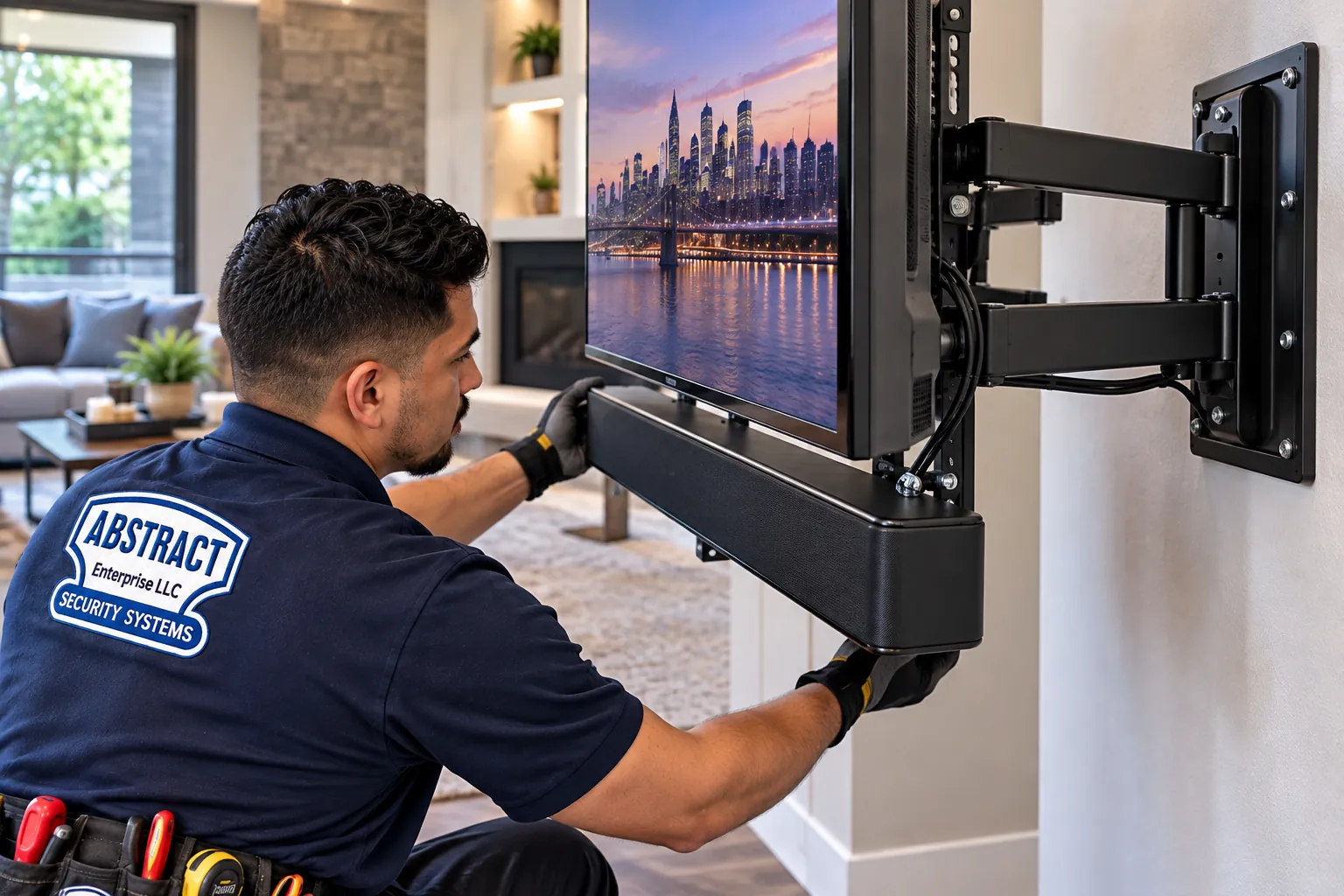
On a swing-arm mount the bar is attached to the TV rather than the wall, here being secured under the screen so both turn together.
Rockland Soundbar Quote
Bar model, wall type and town — a written price back the same business day
✅
Request Sent!
A Rockland installer will call you back the same business day.
25+
Years Experience
✓
Same-Day Estimates
100%
Licensed & Insured
4.7★
201 Google Reviews
Movie night on Friday and the bar is still in its box? Call the Rockland line, (845) 640-3835, or use the short form. You get a written price, built line by line from the menu lower down this page, before anyone drives over the bridge or down the Palisades Parkway.
One county price list — no travel or parking charge from Tappan up to Tomkins Cove
Block, paneling, plaster and duct walls priced up front, not discovered at the drill
NYS low-voltage licence #12000287431 · book any day, with your technician arriving inside a two-hour slot between 8 in the morning and 8 at night
Why Rockland County Properties Need Soundbar Installation
Rockland's houses were mostly built in one long rush, and that rush decides where a soundbar goes. The Historical Society of Rockland County's short history of the county notes that fewer than 150 farms were left by 1950, and that through the 1950s new homes went up at a rate of more than a thousand a year — growth it ties to the opening of the Tappan Zee Bridge in 1955 and the completion of the Palisades Interstate Parkway and the Thruway in the same decade. Census data summarised by Stacker put the median Rockland home's year of construction at 1970, with only about one home in nine built before 1940. Outside the river villages, this is a county of post-war and late-twentieth-century houses, and a good share of them were designed around a lower-level family room.
The style that came with that boom was the split-level and its cousin, the raised ranch. A handyman firm serving New City describes the hamlet's housing as predominantly split-level and raised-ranch homes from the 1960s and 1970s, now reaching the age when decks, basements and dated layouts all need work. Walk into one and the layout explains itself: a front door that opens onto a landing, a half-flight up to the kitchen, living room and bedrooms, a half-flight down to the den, laundry and garage. In most of these houses the big TV — and the soundbar — ends up in that lower room, where one wall may be poured concrete or block to window height, the ceiling carries the heating ducts, and the stairwell is an open path for sound straight up to the bedrooms.
The bridge that set all this off has itself been replaced. The Governor Mario M. Cuomo Bridge, which crosses the Tappan Zee between South Nyack and Tarrytown, opened its westbound span on August 26, 2017 and its eastbound span in September 2018, a few hundred feet north of the 1955 crossing. It remains the main road link between Rockland and Westchester. However our technicians reach you, the drive is our cost rather than yours: no Rockland address pays a travel or mileage charge on top of the published price.
The households in those rooms are big. The Census Bureau's QuickFacts table puts Rockland's average household at 3.22 people for 2020–2024 — higher than the 2.99 QuickFacts gives for Nassau or the 2.93 for Suffolk — and 44.2 percent of residents over five speak a language other than English at home. A soundbar here usually serves a family room used by several generations at once: a child doing homework at one end, a grandparent who wants every word of the news at the other, and a parent who would like the late film to stay downstairs. Clear speech at a modest volume matters more than window-rattling bass.
Rockland is also mostly owner-occupied but not entirely single-family. QuickFacts records an owner-occupied rate of 67.9 percent, and Census Reporter's profile of the county shows 64 percent of homes in single-unit structures, which leaves a substantial share of two-family and multi-family houses, concentrated in Spring Valley, Monsey and the Haverstraw villages. The county's Office of Buildings and Codes pointed out in January 2026, after citing a Spring Valley two-family house for 51 violations including unpermitted alterations and electrical hazards, that one- and two-family homes are not routinely inspected. That is a good reason for any installer to stay strictly on the low-voltage side of the wall and to leave outlets to a licensed electrician — which is exactly how we work.
Finally, the rules about who may work in your house changed this year. Rockland has licensed home improvement contractors since 1986, according to News 12's report on the April 2026 Legislature meeting, where lawmakers voted 14–1 (Lohud's count) to rewrite the licensing law. The county's licensing board now advises rather than decides, and approval rests with the director of the Office of Consumer Protection. Residents on r/Rockland have been asking what that means; one thread titled "No more licensed Rockland contractors" asks whether a person can now register "without any training." For a soundbar the practical answer is the same as before: ask any installer for their licence and insurance, and check the county's online list. We cover that in more detail in the compliance notes further down.
What census and county records say about Rockland soundbar jobs
More than 1,000 homes a year were built in Rockland during the 1950s, after the Tappan Zee Bridge, the Palisades Interstate Parkway and the Thruway opened the county to commuters (Historical Society of Rockland County).
1970 is the median year built for Rockland's homes, and about 11.5 percent date from 1939 or earlier (Stacker, from U.S. Census Bureau data) — mid-century framing and block, with older plaster mainly in the river villages.
3.22 people per household and 109,999 housing units (U.S. Census Bureau QuickFacts; household size for 2020–2024, units as of July 1, 2025) — big households sharing one family-room TV.
67.9 percent owner-occupied (QuickFacts, 2020–2024) and 64 percent of homes in single-unit structures (Census Reporter) — mostly owners, with many two-family houses where a tenant needs the owner's OK to drill.
87.8 percent of households have a broadband subscription (QuickFacts, 2020–2024) — most smart bars will have a connection to use; the question is whether Wi-Fi reaches the lower level.
Chapter 286 of the Laws of Rockland County requires a Home Improvement License for home improvement work on residential property; the rewritten law took effect on May 14, 2026 (Rockland County Office of Consumer Protection).
Taken together: a Rockland soundbar job is less about the bar than about the house. Which level is the TV on, what is the wall made of, where do the ducts and the router live, and who else is trying to sleep? Answer those and any mainstream bar will sound the way its maker intended.
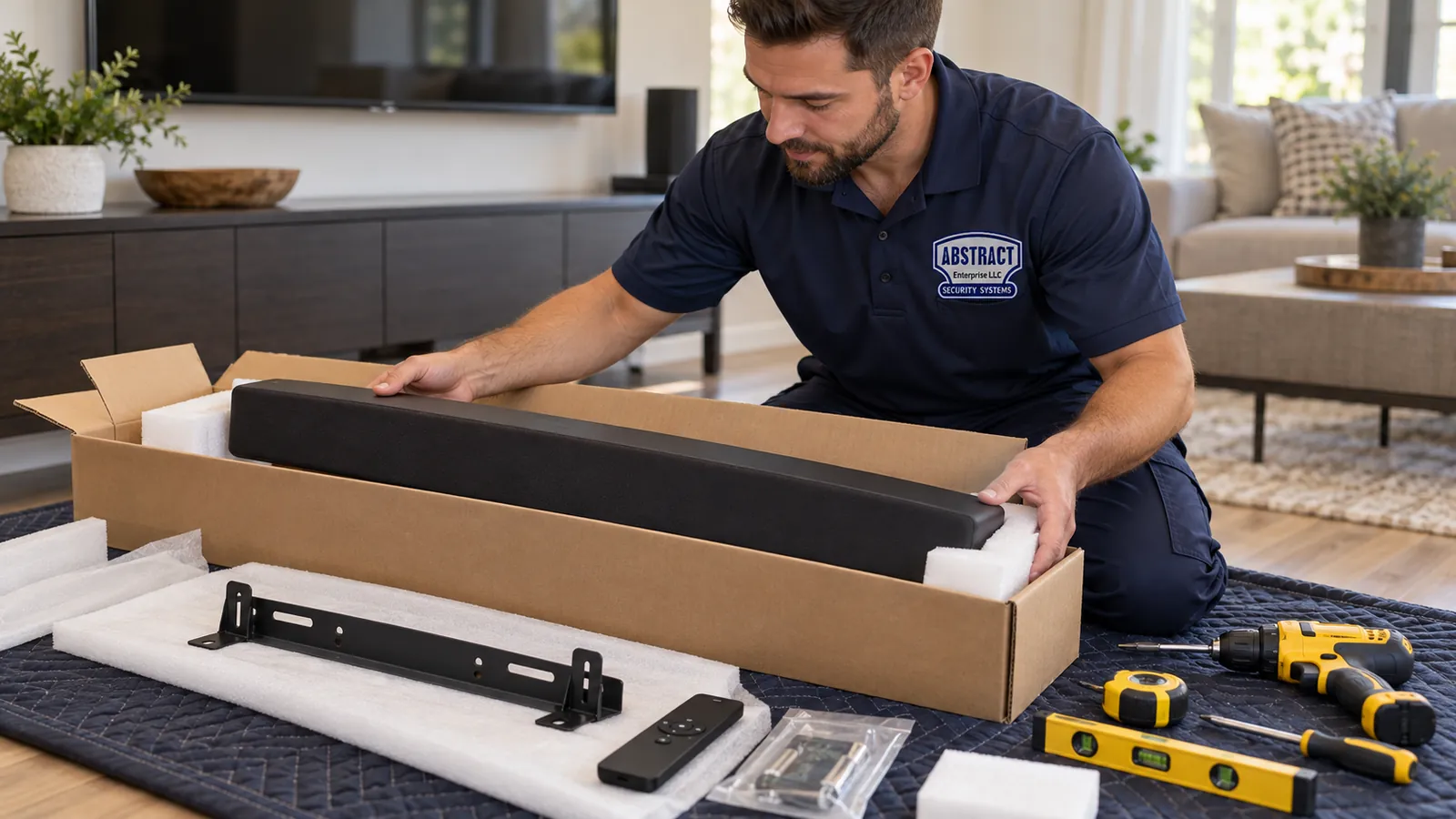
A technician kneels on a moving blanket and lifts a soundbar out of its carton; the wall bracket, remote, hardware bag, drill, tape and level are laid out beside it.
Repair Capture
Soundbar Cutting Out in Rockland County?
A bar that goes silent after a TV firmware update, a wireless subwoofer that drops out in the basement every evening, voices that lag behind the picture, or a bracket pulling out of old paneling — those are repair calls, and we book them as such. Call (845) 640-3835, say it's a repair, and you get the next open 2-hour window; most connection and settings faults are put right in one to two hours once the technician is in the room. How setup-only time is billed is set out in our soundbar and TV service policies.
What We Install
Soundbar Installation Services in Rockland County
Every Rockland job is assembled from the services below, each with its own line on the price list. Whatever the mix, we leave the same result: the bar level and centred under the screen, cables hidden or neatly dressed, the TV remote controlling the volume, the network connection proven from the room the bar is in, and a listening check from your usual seat — and from the bedroom above.
Under-TV Wall Mount
The bar on its bracket a few inches below the screen, fixed with anchors chosen after we know the wall: sleeve or wedge anchors in poured concrete, hollow-block anchors in the webs of a block wall, lag screws into framing behind paneling, toggles where there is only a cavity.
Console Placement
No drilling: the bar sits on the media unit clear of the TV's remote sensor, wired to eARC or ARC and tuned for the room. The usual choice for tenants in two-family houses and for TVs that live on a stand.
Lower-Level Media Rooms
Soundbars for finished basements and split-level dens, planned around low ceilings, soffits that hide ducts, block walls and the stairwell that carries sound to the rest of the house.
TV and Soundbar Together
Hanging the screen and the bar on one visit, so the height, gap and centre line are set for both at once and the cables are routed only once.
Hiding the Wires
On foundation block, poured concrete or a brick hearth there is no cavity to use, so a slim channel painted to the wall colour carries the leads down. On hollow drywall or lath, a listed in-wall kit takes power and HDMI inside the wall from the existing receptacle.
Old System Swap-Outs
Taking down the five-speaker system and receiver from an earlier upgrade, tidying or pulling back the old speaker wire, and putting one well-placed bar in their place.
eARC, CEC and Remote Setup
The bar on the right HDMI port, CEC switched on so the TV remote runs the volume, sources routed through the TV, lip-sync checked, and the bar's firmware brought up to date.
Wi-Fi and Wired Links Between Levels
Getting a smart bar a reliable connection when the router is upstairs and the TV is down: a better band, a mesh node, or an Ethernet run where the bar has a port.
Offices, Shops and Waiting Rooms
Soundbars for conference rooms on Route 303, waiting rooms in New City, shops on village main streets and pubs on Central Avenue, set up for staff control and the ADA projection limit.
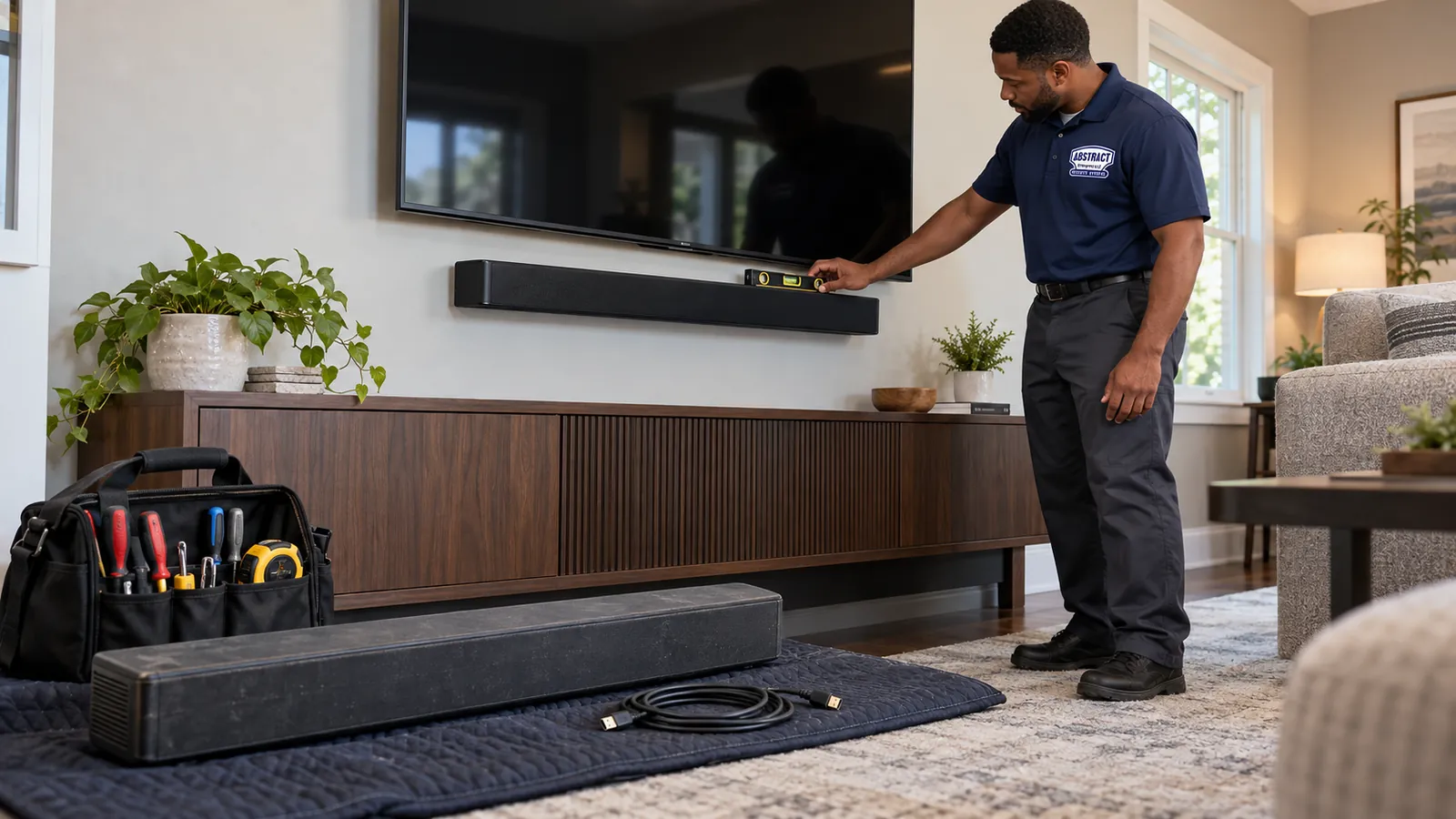
Level on the bar, tools on a blanket: the soundbar sits a few inches under the TV and is checked for level before the room is handed back.
Building Specialists
Soundbar Installation for Rockland County's Architecture
Rockland's housing is younger than the river counties to the north and older than the newest Orange County subdivisions, and it changes character town by town. These are the building types we plan for most, and what each one means for the bar, the bracket and the cable route.
Split-Levels
Three or four levels offset by half a storey. The family room is usually the lowest finished level, partly below grade, with an open railing or half-wall to the stairs. Sound travels up the stairwell freely, so bar and sub placement is planned for the whole house.
Raised Ranches
The front door opens to a landing between two full floors. The lower floor holds the den, often beside the garage and furnace room, with block or poured foundation wall to window height and framing above. The upstairs living room tends to be long, with the picture window on the street side.
Mid-Century Capes and Colonials
Pearl River, Orangeburg and Tappan have many Cape Cods and colonials from before and after the war: plaster or early drywall, brick fireplaces, and family rooms added on the back. Usually stud-backed walls, with plaster in the older ones.
Late-Century Colonials and Contemporaries
The newer subdivisions in New City, Pomona, Wesley Hills and Montebello: two-storey family rooms, gas fireplaces and drywall over wood studs. Straightforward walls; the work is in hiding the cables and taming a tall room.
River Village Houses
Nyack, Piermont, Grand View, Haverstraw and the older parts of Suffern: nineteenth- and early twentieth-century houses with plaster on wood lath, uneven walls and big windows facing the Hudson. Plaster needs its own technique and its own line on the price list.
Two-Family and Multi-Family Houses
Common in Spring Valley, Monsey and the Haverstraw villages: an owner and a tenant, or several families, under one roof. Floors and walls are shared, so the tenant needs the owner's written OK, and bass is kept for the unit it belongs to.
Townhouse and Condo Communities
Associations in Congers, Valley Cottage, Nanuet and Pomona often have rules about drilling party walls and contractors on site. Party walls can be block or a double layer of drywall; we check before choosing which wall the TV and bar go on.
Finished Basements Under Older Houses
Lower levels finished decades after the house was built: paneling over furring strips on block, low soffits around ducts and beams, and a mix of materials on one wall. The most variable walls we meet anywhere in the county.
Fixings for each Rockland wall type
Hollow concrete block: common on split-level and raised-ranch lower floors. We drill with a hammer drill and carbide bit, aim anchors into the solid webs rather than the hollow cores, and use anchors rated for hollow masonry. Block adds $75.
Poured concrete foundation wall: solid and very strong, but impossible to fish a cable through. Sleeve or wedge anchors hold the bracket; a paintable cord cover ($59) carries the cables to the outlet. Concrete is the same $75 line.
Wood paneling over furring strips: the strips are often too thin and too far apart to carry a bracket on their own. We find the masonry or studs behind and fix through, or spread the load on a plywood backer board ($85).
Drywall on wood studs: most of Rockland's upper floors and newer houses. Lag screws into two studs, and an in-wall power and cable kit ($169) where the owner wants the wires inside the wall. No wall surcharge.
Plaster on wood lath: the river villages and the older capes. We score and pre-drill so the plaster doesn't blow out, find framing by the lath nails, then fix into the timber behind. Plaster adds $45.
Brick and fieldstone hearths: Haverstraw-era brick and later stone veneer both take sleeve anchors well, provided they go into the solid unit and not the softer joint between. Wires travel in a surface channel. The brick-or-stone line is $65.
Walls with ducts or a chase behind them: common where the furnace room backs onto the den. We scan and use a short test hole before choosing a route, and fall back to a cord cover when a duct blocks the cavity.
Owners finishing a lower level often have us run network cable at the same time as the soundbar, through our structured cabling installation in Rockland County, so the TV wall gets a wired connection before the drywall closes it in.
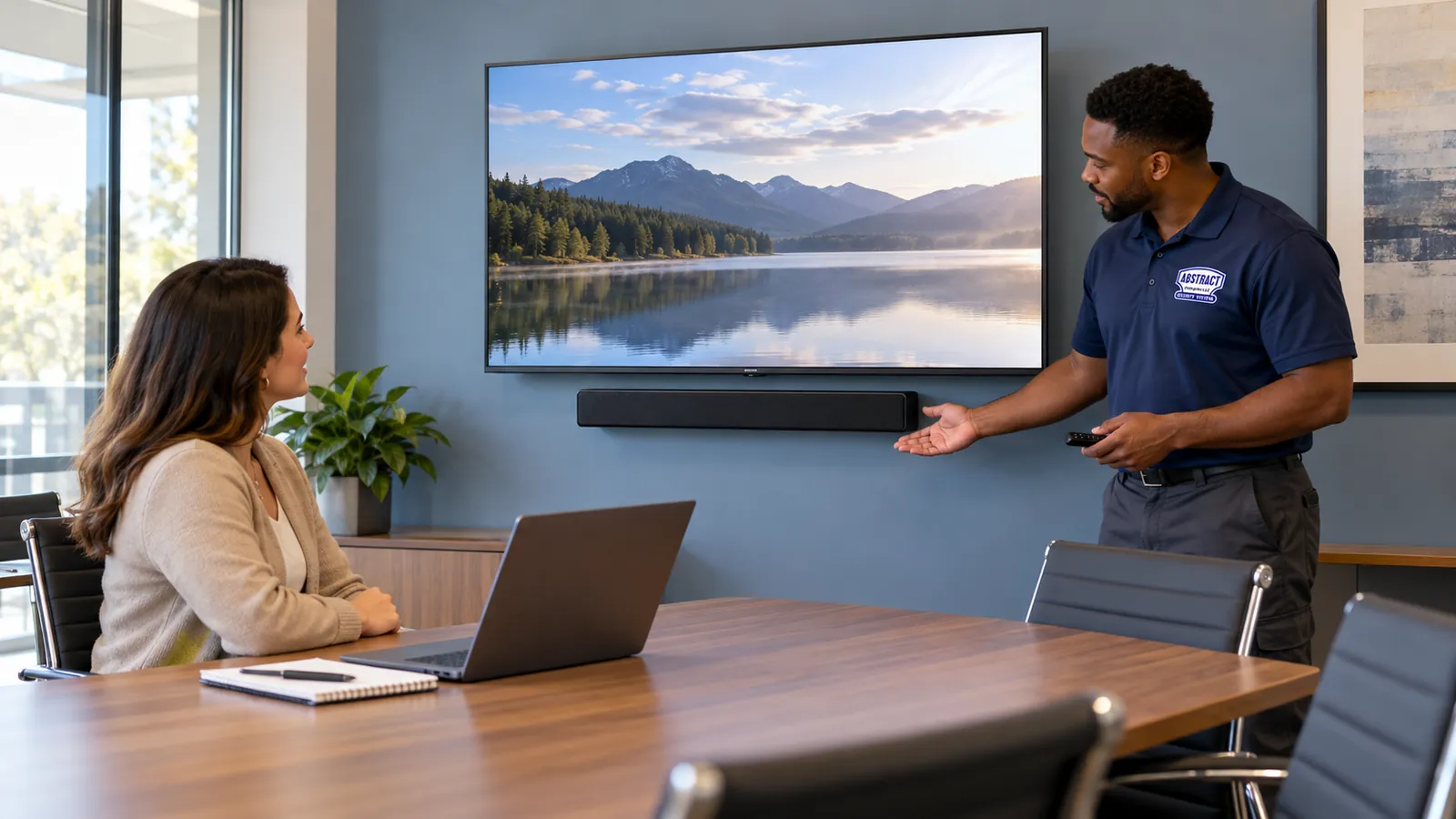
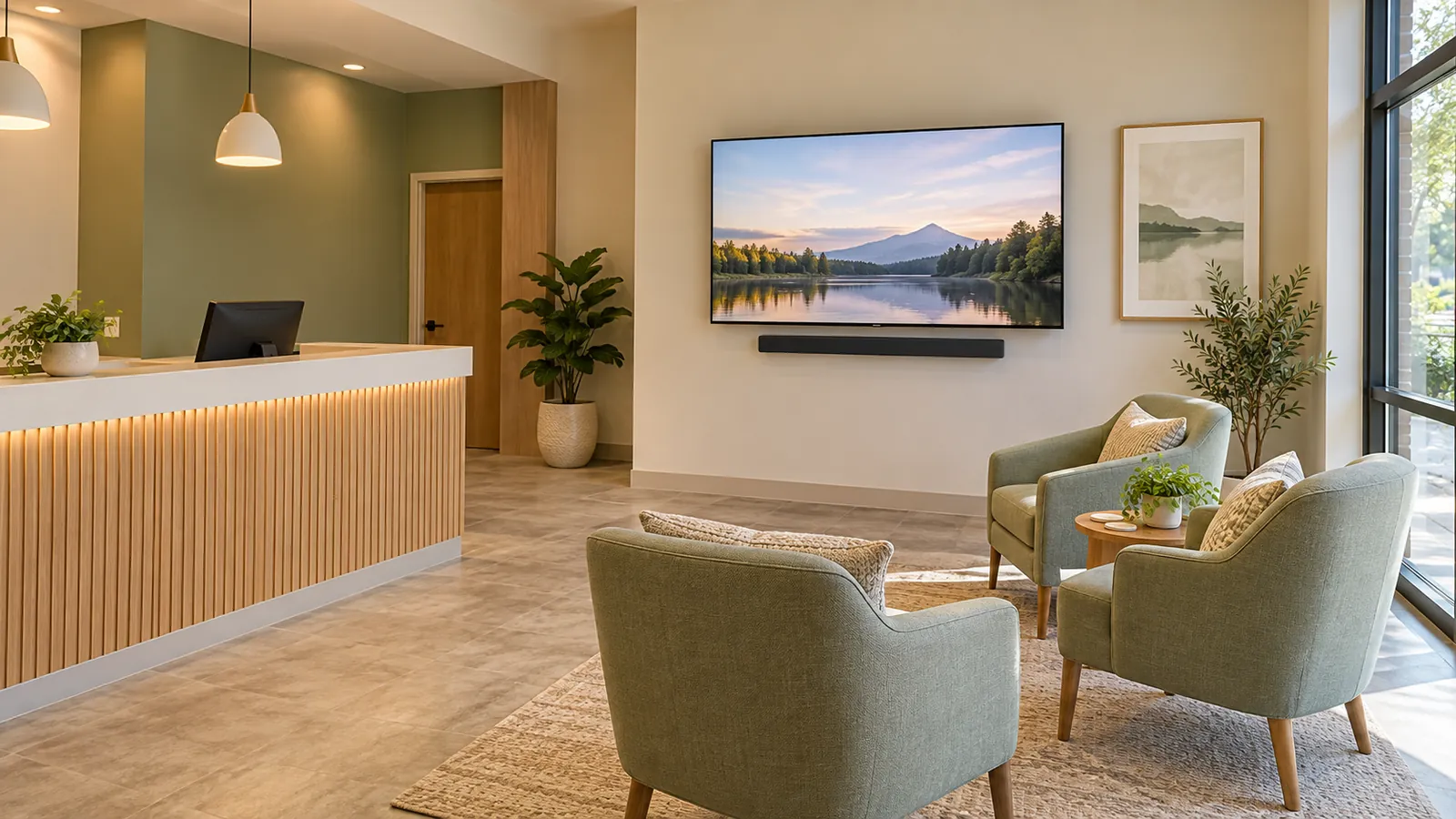
In a conference room, a technician gestures to the soundbar mounted under the wall display while a woman at the table, laptop open, follows along.Lobby setup: one wall TV, one slim bar tight beneath it, and seating arranged so the sound reaches the chairs rather than the desk.
Commercial Soundbar Installation
Business Soundbar Installation in Rockland County
Commercial soundbar requests in Rockland come mostly from small businesses with one or two screens that need to be understood, not blasted: a conference-room display, a waiting-room TV, a pub's game-day screens, a showroom loop. These are the corridors they come from.
Route 59, Nanuet to Spring Valley
The county's main retail strip, anchored by the Nanuet Town Centre — built on the site of the old Nanuet Mall and opened as the Shops at Nanuet in 2013. Strip-centre tenants and offices mean metal-stud partitions and landlord paperwork.
Central Avenue, Pearl River
Pubs, restaurants and shops on the route of the Rockland County St. Patrick's Day Parade, which the county calls the second largest in New York State; the 62nd parade stepped off on March 22, 2026. Bar screens here need to be heard at the stool without filling the street.
Main Street and Broadway, Nyack
Restaurants, wine bars and cafés in older buildings — The Hudson House at 134 Main Street among them — where walls are often brick or plaster and every TV install starts with the masonry question.
Route 303, Orangeburg and Blauvelt
Office buildings, medical suites and corporate parks where conference-room displays and waiting-room screens go on metal-stud partitions, often with a cable run back to a credenza or a comms closet.
South Main Street, New City
The county seat, with the Rockland County Courthouse at 1 South Main Street and a cluster of law, accounting and medical offices around it. Lobby and waiting-room screens have to respect the walking path.
Lafayette Avenue, Suffern
A walkable village downtown at the foot of the Ramapos, with restaurants and the single-screen Lafayette Theatre at number 97. Storefront walls are frequently plaster or brick, priced up front.
Compliance callouts for Rockland businesses and homeowners
County home improvement licensing. Chapter 286 of the Laws of Rockland County requires anyone doing home improvement work on residential property in the county to hold a Home Improvement License from the Office of Consumer Protection; the current version took effect on May 14, 2026. The office's own FAQ warns that unlicensed contractors may not carry liability, disability or workers' compensation insurance, and offers an online database to check a contractor. Whether a particular soundbar job counts as home improvement is a question for that office; checking any installer's licence and insurance before work starts costs nothing.
Electrical work is separate. The same office licenses electricians and electrical inspection agencies. A new or moved outlet behind a TV is line-voltage electrical work for a licensed electrician; we do not add or move outlets. Our in-wall kits use a listed power kit fed from the receptacle you already have.
Lead-safe practices in older buildings. The county's licensing page reminds contractors that they must be lead-safe certified. In the river villages' pre-1978 houses and storefronts, we keep drilling dust at the bit and take the drop cloth away with us.
Protrusion into walkways. In a New City reception area or a Route 59 clinic corridor, the 2010 ADA Standards (section 307.2) limit wall-mounted objects whose leading edge is 27 to 80 inches off the floor to a 4-inch projection into a circulation path. Bar depth plus bracket depth is what counts, so we measure both and either raise the bar above that band or keep it out of the path.
Landlord and association paperwork. Office landlords along Route 303 and Route 59, and townhouse associations across the county, usually want a certificate of insurance naming them before a contractor works on site. We issue it free and send it ahead of the visit.
Volume in mixed-use buildings. Many Nyack, Suffern and Haverstraw storefronts have apartments above. Noise rules are set locally, so we set a sensible maximum volume on business bars and keep subwoofers off shared floors.
This is general information, not legal advice. For licensing questions, the Rockland County Office of Consumer Protection is the authority; for building questions, your town or village building department, or the county Office of Buildings and Codes, which handles code enforcement in the Village of Spring Valley.
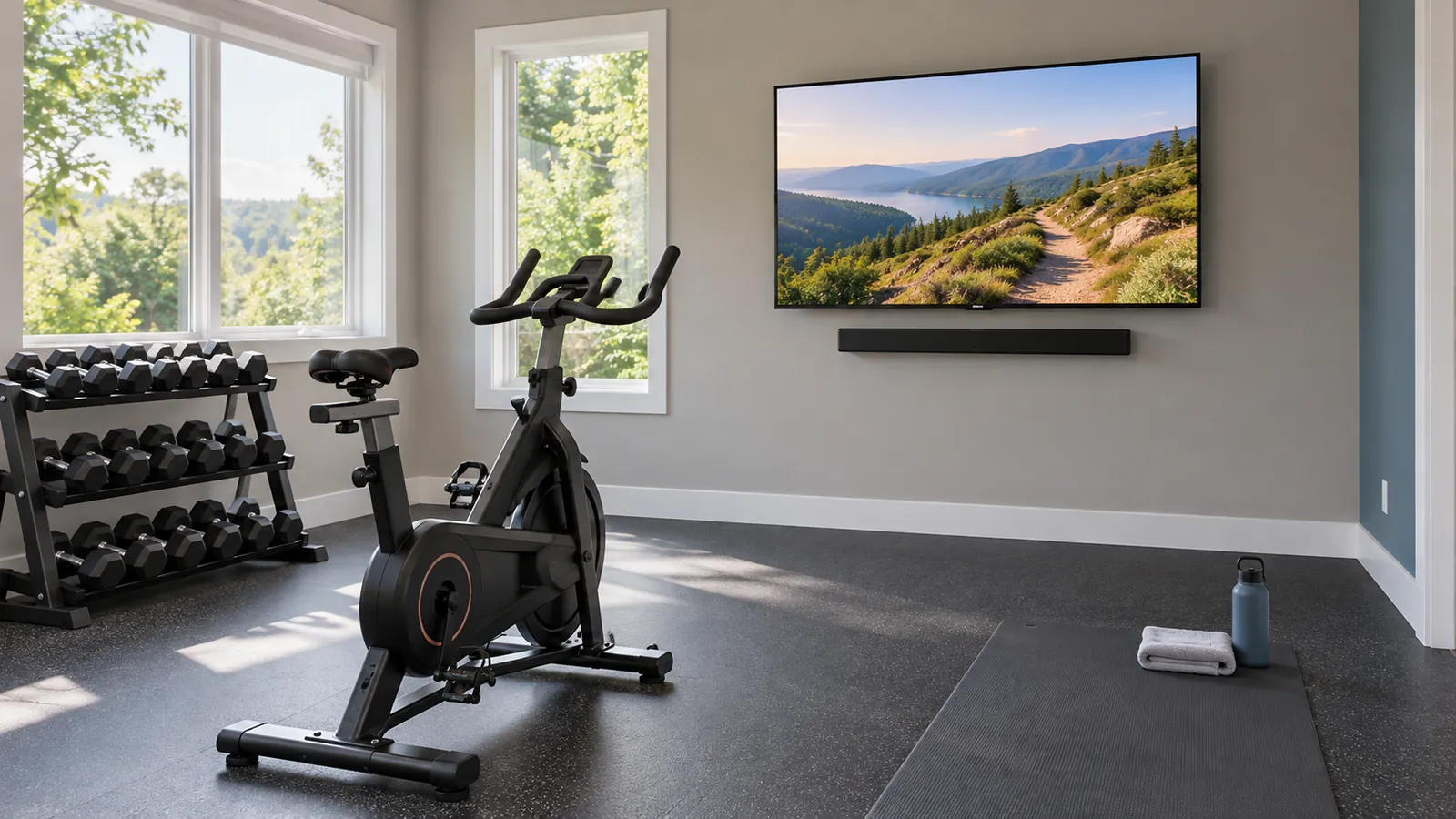
A home gym with a spin bike, a dumbbell rack and a mat, facing a wall-mounted TV with a soundbar fixed to the wall beneath it.
Your Questions Answered
Soundbar Installation in Rockland County: Questions Answered
These are the questions Rockland homeowners, tenants and small businesses ask before they book, grouped by what they are really trying to settle: how sound behaves in a house built on half-levels, what the walls of a lower-level room will hold, what to do when a basement is being finished or a house is changing hands, how one TV serves a big household, and what tenants and offices need to sort out first. Prices and practical booking questions are in the FAQ near the end of the page.
Split-levels, raised ranches and sound on half-levels
In our split-level the TV faces a half-wall that drops to the stairs — where does the sound go, and can we aim it better?
Much of it goes exactly where you'd expect: over the railing and up or down the stairwell. A soundbar fires most of its sound forward, and some bars also throw sound sideways off nearby walls to create width. When one of those side walls is replaced by an open railing, that part of the effect simply escapes into the stairwell, and the room can sound lopsided, with voices pulling toward the solid side.
Three things help. First, keep the bar centred on the screen and as close below it as the maker allows, so speech comes from the picture and not from one side. Second, if the bar's app has a room-calibration or room-size setting, run it with the furniture in place; it will usually narrow the effect to suit. Third, a rug on the landing and a full-height bookcase or curtain on the open side will do more than any setting. If the layout allows, swapping the TV to the wall that faces away from the stairs is the biggest single improvement, and we will say so at the walkthrough before anything is drilled.
The bedrooms are a half-flight above the family room — how do we keep a late movie from waking the house?
In a split-level, the family room and the bedrooms are often separated by one short run of stairs and a single floor of wood joists. Low frequencies pass through both easily, which is why the explosions reach the kids' rooms while the dialogue doesn't. Most of the fix is in how the bass is set up, not in the bar itself.
We place the subwoofer away from the wall shared with the stairwell and out of corners, where bass builds up, then set its level by ear from the seats rather than at the factory default, which is often generous. Most bars have a night or late-evening mode that compresses the loud peaks and lifts speech; we switch it on, show you where it lives in the remote or app, and, if the bar supports it, set a speech-enhancement mode so dialogue stays clear at lower volume. Before we leave we go upstairs with you and listen with the bedroom door closed. If the sub is still too present, a smaller bar without a separate subwoofer is often the more comfortable choice for a split-level household.
The lower-level TV wall is foundation block at the bottom and wood framing on top — which part carries the bracket?
This is the classic raised-ranch lower floor: concrete block or poured concrete up to about window height, then a wood-framed wall on top of the foundation. A soundbar sits low enough that it usually lands on the masonry, while a TV above it may land on the framing, so the two brackets can end up in different materials.
That's fine, as long as each is fixed into the right thing. On block we drill into the solid webs and use anchors rated for hollow masonry; on poured concrete, sleeve or wedge anchors; on the framing above, lag screws into the studs, with a plywood backer if the studs don't line up with the TV's bracket. The joint between the two materials is where cracks and moisture show up, so we keep the bracket a few inches clear of it. Because block has no cavity, the cables for both usually run down a paintable cord cover rather than inside the wall, and the masonry line on the price list ($75) applies to the bar.
Our 1960s family room still has wood paneling over furring strips — what holds a soundbar on that?
Not the paneling itself. Quarter-inch paneling is decorative, and the furring strips behind it are typically thin strips of wood nailed to block or to old studs at wide spacing. A bracket screwed only into paneling will pull out, and even a furring strip is a weak anchor for a bar that someone will lean on while dusting.
So we find out what is behind the strips. On masonry, we drill through the paneling into the block or concrete and anchor there, using spacers so the bracket doesn't crush the paneling against the wall. Over wood studs, we fix into the studs. Where neither lines up with where the bar needs to be, a painted or stained plywood backer board ($85) screwed across several solid points spreads the load and looks deliberate. If you plan to remove the paneling soon, tell us; it is far better to hang the bar after the new wall goes up than before.
There's a heating duct inside the wall behind our TV — can the cables still be hidden?
Sometimes. In many raised ranches and split-levels the furnace room backs onto the family room, and supply ducts or a return chase run up through the wall cavities on that side. A sheet-metal duct fills most of a stud bay, so an in-wall kit that needs a clear path from the TV down to the outlet may be blocked, or may only fit in the next bay over.
We scan the wall and, where the reading is unclear, make a small inspection hole where the in-wall kit's plate would go anyway. If the bay is clear, the $169 in-wall power and cable kit goes in as normal. If a duct is in the way, we shift the TV and bar a stud bay sideways where the room allows, or use a paintable cord cover instead. We never cut into or fasten through ductwork, and we don't run cables inside a duct.
Finishing, buying and selling Rockland houses
Can drilling anchor holes into a block foundation wall let water into the basement?
Not when the holes are placed sensibly. A soundbar bracket needs a few short anchors set into the inside face of the wall, a couple of inches deep, well above the floor. They do not pass through the wall to the soil side, and the exterior waterproofing or parging is untouched. Water that reaches a basement through block usually comes through cracks, the joint where the wall meets the floor slab, or the hollow cores themselves after heavy rain — not through a sealed anchor hole at TV height.
We still treat a foundation wall with respect. Before drilling we look for efflorescence, stains or cracks near the mark, and if there are signs of water we move the bracket or stop and tell you, because a wall that is already wet needs its own repair first. Anchors go into the solid webs of the block, not the hollow cores, and every hole is filled by its anchor. On a lower-level wall that has been sealed or painted with a waterproofing coating, we keep the hole count to the minimum the bracket needs.
We just bought a raised ranch with old speaker wire and a mystery wall plate behind the TV — can any of it be used?
Often some of it can. Rockland houses that were upgraded in the 1990s and 2000s frequently have speaker wire in the walls for a surround system that has since been removed, a coaxial plate from an old cable layout, and occasionally a network jack. None of that is needed by a soundbar itself, which connects to the TV with one HDMI cable, but the routes it took through the wall can be very useful.
We trace what's there with a tester, label anything that is live, and tell you what each run is good for. An existing network jack behind the TV is worth testing and reusing for a smart bar. Old speaker wire can serve as a pull line to bring a new HDMI or network cable through the same path. Coax can sometimes be used by the cable or internet provider. What we won't reuse is anything that turns out to be line-voltage; if a plate turns out to hide an outlet or an abandoned electrical box, that goes on the list for an electrician.
We're selling — should the soundbar and its bracket stay with the house?
That's a question for your contract and your agent rather than for us, but it helps to know how buyers and sellers usually see it. A TV and a soundbar are personal property; a bracket screwed into the wall is often treated as a fixture unless the contract says otherwise. Many sellers take the bar and leave the bracket, or take everything and leave the holes, which can surprise a buyer who expected a ready-to-use wall.
If you are taking the bar with you, we can take the bar and bracket down so the holes are clean and easy for a painter to fill; removing an old bracket is $45 on our list. If you are leaving it, we can make sure it is level, firmly fixed and connected to nothing that leaves with you, and write down the bar model and how it is wired for the buyer. Either way, decide before the final walkthrough.
Is a damp lower level a bad place for a soundbar and subwoofer?
A finished lower level with normal household humidity is fine. A room that smells musty, shows water marks on the block or needs a dehumidifier running all summer is less kind to electronics, wooden furniture and anything stored on the floor, and a subwoofer standing directly on a cold slab is the first thing to suffer if water ever comes in.
Check the operating conditions in your bar's manual, keep the dehumidifier running in the damp months, and get the subwoofer off the floor: a solid stand or isolation pad lifts it clear of the slab and helps the bass at the same time. We keep power bricks and connections off the floor and away from exterior block walls where condensation forms, and we won't mount anything over visible water staining until the source has been dealt with.
Low ceilings, shared walls and the network
With a seven-foot lower-level ceiling and a soffit over the TV wall, how do the TV and the bar both fit?
It takes a little planning, because height is the scarce resource in many Rockland lower levels. The comfortable viewing height for a screen is set by the seats, the bar wants to sit a few inches below the screen, and a soffit boxing in a duct or beam may take the top foot of the wall. On a short wall that can leave the TV pushed down and the bar almost on the console.
We start from the seated eye height and work outwards: TV centred close to eye level, bar just below with the gap its maker recommends (Sonos, for example, asks for at least 4 inches between an Arc Ultra and the screen), and both kept clear of the soffit's lower edge. If the numbers don't work on the wall, the bar goes on the console in front of the TV, which often sounds just as good in a low room. A flagship bar's up-firing drivers lose most of their effect under a soffit or beam, so a mid-size bar is often the better buy for these rooms.
Our townhouse association won't allow drilling into the party wall — where can the TV and bar go instead?
Plenty of associations in Congers, Valley Cottage, Nanuet and Pomona restrict fixings in walls shared with a neighbour, partly for sound and partly because party walls can be fire-rated assemblies. The rule usually applies only to the shared wall, so the first option is the wall at right angles to it, or the one opposite, if the room's layout can turn around to face it.
If the TV has to stay on the party wall, the bar can sit on a console in front of it with no drilling at all, or hang from a bracket attached to the TV itself, which puts no new holes in the wall beyond the TV's own mount — if the association allows that one. A free-standing TV stand with a soundbar shelf is another route. Ask the management company for the rule in writing, send it to us with the quote request, and we will plan to it; we can issue the association a certificate of insurance at no charge.
Our router is a floor away from the TV — will a Wi-Fi soundbar hold its connection?
It depends on what is in between. In a split-level, the router is often in a home office on the upper level and the TV is two half-floors down, with a slab, joists and sometimes ductwork in the path. Basic TV sound over HDMI doesn't need Wi-Fi at all, but music streaming, voice assistants, app control and wireless surrounds do, and a weak signal shows up as dropouts or a bar the app can't find.
Rockland households are split between cable and fiber service; on r/Rockland one Nanuet resident described Optimum as asymmetric cable, while others point to Fios's symmetrical fiber. Either is plenty for a soundbar, which needs far less than a 4K picture, for which Netflix recommends 15 Mbps or more. What matters is the last few metres. We test the signal at the TV, move the bar to a better band where it supports one, suggest a mesh node on the lower level, or wire the bar by Ethernet where it has a port. A wired connection is the most reliable fix in a multi-level house.
Two-family homes and Rockland offices
We rent the lower unit of a two-family house — what do we need from the owner before a bracket goes up?
Written permission, ideally an email or text that names the wall and says drilling is fine. Many two-family houses in Spring Valley, Monsey and Haverstraw have the owner living upstairs, and both the lease and good relations depend on not surprising them. We ask to see the permission when we arrive, and if it isn't there, the bar goes on the console instead.
It also helps to ask the owner two practical questions: which wall is shared with the other unit, and whether there is anything inside the TV wall they know about, such as plumbing to the upstairs bathroom. We keep bass modest in a shared house and never touch the electrical system; if the outlet isn't where you need it, that's for the owner and their electrician. When you move out, a bracket can come down cleanly, with the holes left ready for filling.
Can a soundbar in an office waiting room switch on and off with the TV by itself?
Usually, yes. When the bar is connected to the TV's ARC or eARC port with HDMI-CEC switched on, the TV tells the bar when to wake and when to sleep, so staff only ever touch one remote, or none if the TV runs on a schedule. That suits a New City law office lobby or a Route 59 medical waiting room where the screen runs all day.
CEC is a standard, but makers implement it differently, so we test the power-on, power-off and volume behaviour with your exact TV and bar before we leave. Where a display uses a commercial signage mode that ignores CEC, we set the bar to wake on a detected signal if it offers that option. We also set a sensible maximum volume and hand the remote to whoever manages the room.
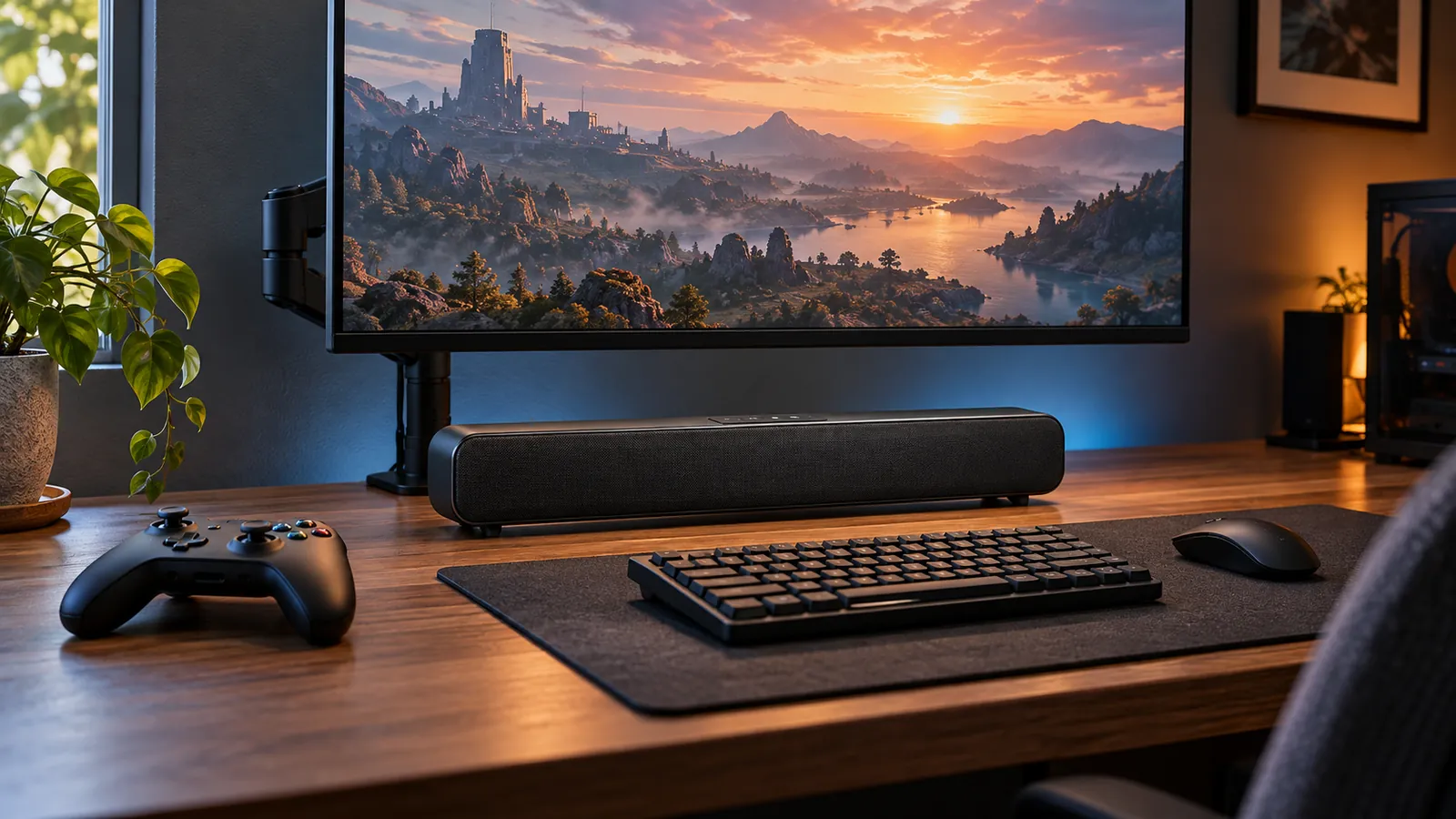
Desk-scale audio: a short bar under an arm-mounted monitor, a smaller job than a living-room wall but planned the same way around cables and power.
Before You Book
A Rockland House Checklist for Your Soundbar
Ten minutes walking your own house with this list saves most of the surprises we see on Rockland soundbar days. The answers go straight into the price and the plan, and they often change which wall the TV should be on in the first place.
Which level. Note whether the TV is on the main floor, a half-level down, or in a full basement, and what rooms sit directly above it.
The wall behind the TV. Knock on it. A dull, solid sound low down and a hollow one higher up usually means a block or concrete foundation with framing above. Paneling sounds hollow but flexes. Send a photo with the outlet in view.
What's on the other side. Furnace room, laundry, garage, stairwell or outside? Ducts and pipes behind the TV change the cable plan.
Outlets. Is there an outlet near where the TV and bar will go? If not, book an electrician before us; we don't add or move outlets.
Router. Note the floor it sits on and the room, and look for any network jack on the TV level. Keep the network name, its password and the login for the bar's app to hand.
Old systems. Are there old speakers, a receiver or wall plates you want removed or reused?
Who else listens. Bedrooms above, a tenant below, a grandparent with hearing aids, a baby who naps in the afternoon — tell us, because it changes where the sub goes and which modes we set.
Permission. Tenants need the owner's written OK to drill; townhouse owners may need the association's. Ask about insurance-certificate wording at the same time.
Furniture. Is the sofa where it will stay? Bar height is set from the seats.
Delivery. Has the bar arrived, and the TV if it's new? A missing box is the most common reason a visit can't start.
If you can't answer some of these — you don't know what is behind the paneling, say — book anyway and tell us. We will quote both likely walls so the price on the day matches what we find.
House Vocabulary
Rockland House Terms You'll Hear on a Soundbar Visit
Installers, inspectors and estate agents describe Rockland houses in their own shorthand. These are the terms that come up when a soundbar is being planned, in plain English.
Split-level. A house with three or more floors offset by half a storey, so each flight of stairs is short. The family room is usually on the lowest finished level.
Raised ranch (also high ranch or split entry). Two full floors with the front door on a landing between them; the upper floor holds the main living space and the lower floor, partly below grade, the den and garage.
Furring strips. Thin strips of wood fixed to a masonry or old stud wall to give paneling or drywall something to be nailed to. Not strong enough to hang a bracket from on their own.
Webs and cores. The solid walls and hollow centres of a concrete block. Anchors belong in the webs.
Soffit. A boxed-in section of ceiling, usually hiding a duct, pipe or beam. Common along one side of a lower-level family room, and a factor for up-firing Atmos bars.
Chase. A vertical space inside a wall that carries ducts, pipes or flues from floor to floor.
Blocking. A horizontal piece of lumber fixed between studs during construction or renovation, to give a TV or bar bracket a solid fixing point.
Home Improvement License. Rockland County's licence for contractors doing home improvement work on residential property, issued by the Office of Consumer Protection under Chapter 286.
Certificate of insurance (COI). A one-page proof of a contractor's liability and workers' compensation cover, often requested by townhouse associations and commercial landlords. Ours is free.
If a term on a listing sheet or an inspection report isn't here, send it to us with a photo. We will tell you whether it matters for the soundbar.
Equipment
Types of Soundbars and Mounts We Install in Rockland County
Bring whatever bar you prefer; brand doesn't change how we work. What does change the job is the size and type of bar, so here is how each family of equipment behaves on a Rockland wall, on a multi-level home network and in a house full of light sleepers.
Compact Bars
Small, light bars for bedrooms and small dens. The Sonos Ray is an example: WhatHiFi gives about 56 cm and 1.95 kg, and it takes its sound from the TV over optical, not HDMI. With no big driver, it is the least likely bar to reach the bedrooms above.
Mid-Size Smart Bars
What most Rockland family rooms end up with. For scale, Sonos gives the Beam (Gen 2) as 25.63 inches across and 6.35 lb, connected by eARC and run from an app; rival bars of similar size sit neatly under 50- to 65-inch screens.
Flagship Atmos Bars
Long bars with up-firing drivers that bounce sound off the ceiling. Sonos lists the Arc Ultra at 46.38 inches and 13.01 lb. Dolby's own setup guide calls for a flat ceiling between 7.5 and 14 feet, which a lower-level room with soffits and ducts may not offer.
Bars With Subwoofers and Rears
The full-house option, and the one that needs the most thought in a split-level. Wireless subs and rear speakers still need their own outlets; Crutchfield's listing for Samsung's HW-Q990D notes that each rear speaker must plug into AC power.
Wall Brackets
The maker's own bracket where it suits the wall, or a Sanus soundbar bracket we supply when it doesn't. Anchors are chosen for block, concrete, framing or plaster, never taken blindly from the box.
TV-Attached Brackets
Brackets that hang the bar from the TV or its mount, such as Sanus's universal soundbar mount, listed for most bars up to 20 lb. Useful on a full-motion arm or where the wall below the TV is the weak point.
In-Wall Power and Cable Kits
Listed kits that carry power and signal inside a hollow wall from the existing outlet to the back of the TV, with no new electrical circuit. For drywall and lath walls, not block or concrete.
Network Hardware
Ethernet cable, small switches and mesh nodes that bring a reliable connection down to the lower level. In a multi-level house, the network often decides whether a smart bar is a pleasure or a daily irritation.
Picking the right link between a Rockland TV and its bar
Connection
When it fits
Watch for
HDMI eARC
A current TV with a current bar: lossless formats pass from every app and input
Only one HDMI port on the TV is marked for it, and eARC may be off in the sound menu
HDMI ARC
Sets made before eARC; Atmos still arrives, carried in lossy Dolby Digital Plus
Expect to fine-tune audio delay and the CEC switch
Optical
Bars such as the Ray, and TVs that predate ARC altogether
Volume from the TV remote is not automatic; it may need teaching
Ethernet
A smart bar with a network socket, two half-floors from the router
Wants a wall jack behind the TV, or a cable we route to it
Wi-Fi only
Bars built without a socket
What counts is signal strength at the TV wall, not the speed on your internet bill
National services versus a Rockland installer. Big-box technology services and app-based marketplaces sell flat soundbar menus that suit drywall over wood studs with an outlet in the right place. They aren't designed around a raised ranch's foundation wall, paneling on furring strips, a duct in the stud bay or a two-family house where the owner lives upstairs. A licensed local installer with a published Rockland price, a direct Rockland line and a New York State low-voltage licence quotes the house you actually have, and is the one you call if the bar misbehaves next month.
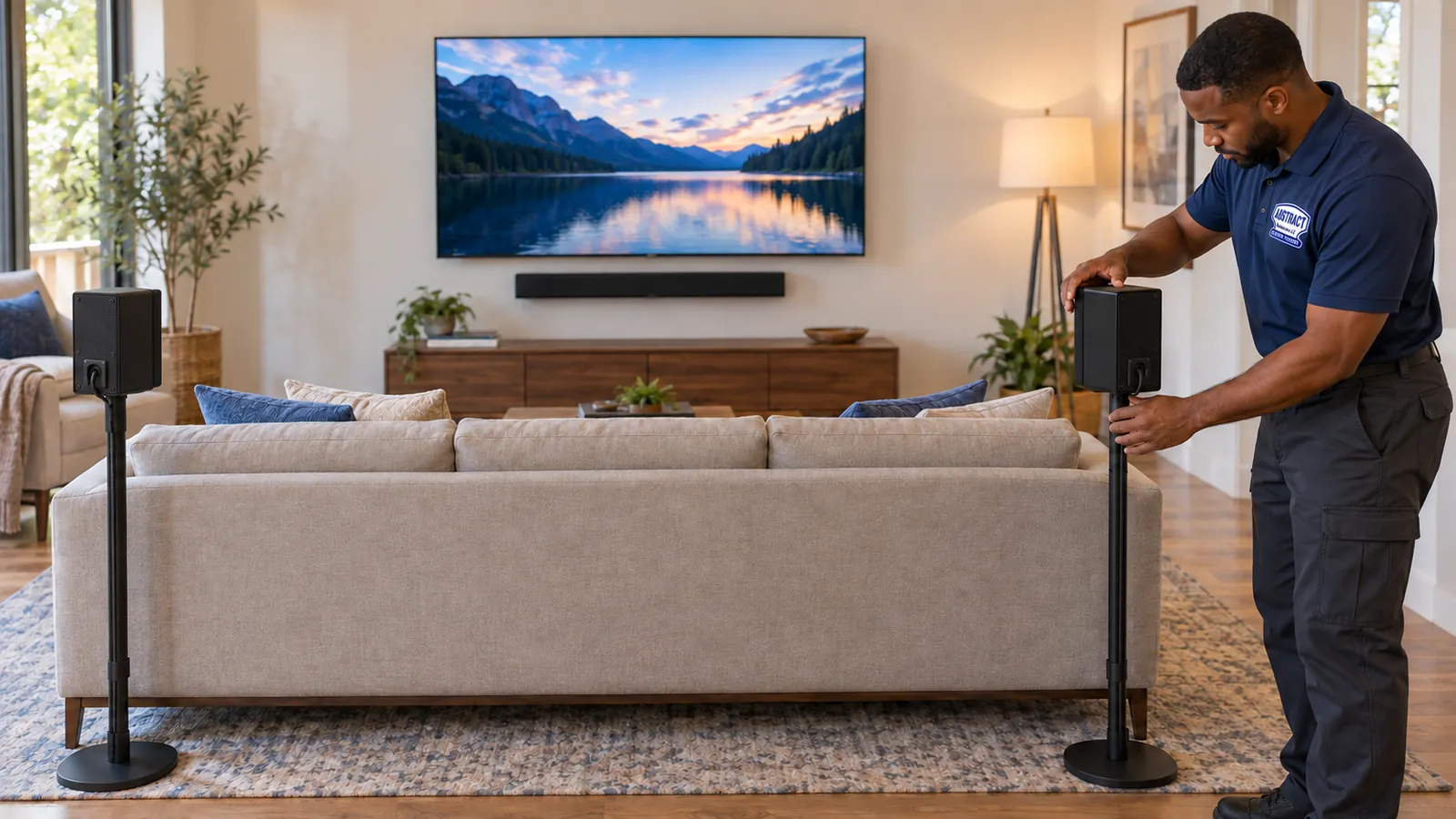
A technician adjusts one of two rear speakers on floor stands behind the sofa, with the wall-mounted TV and soundbar across the room.
AI Overview Reality Check
What AI Gets Wrong About Soundbar Installation in Rockland County
Google's AI Overview could not be captured in our build environment, so this section tests the claims that cost guides and local listing pages actually publish — Angi, Thumbtack and two pages that rank for Rockland searches among them — plus the setup advice AI summaries tend to repeat. Each is reasonable somewhere. Each needs adjusting for a Rockland house.
"TV mounting in Nyack costs somewhere between $207 and $970"
A cost page for Nyack published by Homeyou gives a typical range of $207 to $970 for TV mounting, with a narrower "fair price" in the middle. A range that wide is what you get when the figure blends very different jobs: a small screen on drywall at one end, a large screen over a stone hearth with hidden wires at the other.
It tells a homeowner very little about their own job. In Rockland, the walls are what move the price: a lower-level block wall, paneling that needs a backer, plaster in a village house, or plain drywall upstairs. A soundbar under a TV on that same wall then adds its own lines.
Our menu prices each of those things separately and publishes the result. The Rockland TV base for a 32- to 55-inch screen on stud-backed drywall is $219.99; a soundbar hung beneath it is $129, $84.99 more if you need our bracket, and the block, plaster or backer line is added only if your wall needs it. You can work out your own number before calling.
"A permit is typically required to mount a TV in Nyack"
The same Homeyou page tells Nyack residents that TV mounting typically requires a permit. AI summaries pick up claims like this and repeat them for soundbars too, which sends people to their village hall for nothing.
Hanging a soundbar on a bracket and plugging it into an existing outlet is not the kind of work building permits are generally written for. What does need a licensed professional, and often an electrical inspection, is new electrical work: adding or moving an outlet, or running a new circuit. The county Office of Consumer Protection licenses electricians and the electrical inspection agencies that check their work.
Our approach is simple. We don't do line-voltage electrical work, so if your TV wall needs an outlet, an electrician installs it first. Our in-wall kits use a listed power kit fed from the outlet already there. If you are unsure whether anything else on your project needs a permit, your village or town building department is the place to ask.
"Handymen in Rockland charge about $150 an hour"
One Rockland handyman service publishes an hourly rate of $150 with a one-hour minimum and billing in 15-minute steps. Hourly billing is honest, but it leaves the customer guessing how many hours a soundbar on a block wall will take.
For a mount, we don't bill by the hour at all. The soundbar wall mount is a fixed $129; the bracket, wall type and cable concealment are fixed lines. Only setup-only visits, where nothing is mounted — reconnecting a bar to a new TV, fixing lip-sync, wiring a bar to the network — are billed by time: $235 for the first hour in Rockland, then 30-minute blocks.
Either way, ask for the price in writing before the visit. A fixed price for the mount and a clear hourly rate for anything else is the combination that avoids arguments.
"Budget $30 to $100 extra for the soundbar bracket"
Angi's TV cost guide puts a soundbar bracket or mount add-on at $30 to $100. As a price for the bracket hardware, that is in the right range, and many bars come with a basic bracket in the box.
It leaves out the wall. On a Rockland lower level the bracket may be going into hollow block, poured concrete, paneling over strips or a duct-filled bay, and the anchors and technique for each are different. The fixing, not the bracket, is the work.
So our menu separates them: $129 to mount the bar, $84.99 for our Sanus bracket only if you need one, and the wall line on top — $75 for block or concrete, $45 for plaster, $85 for a backer board where paneling or missed studs call for it.
"Up-firing Atmos speakers work in any room"
Product pages and AI summaries often present Atmos height effects as automatic. Dolby's own speaker-setup guidance is more specific: for up-firing speakers, the ceiling should be flat and between 7.5 and 14 feet high.
Many Rockland family rooms fail that test in one direction or another. Lower-level dens often have soffits around ducts or a beam running across the room right above where the bar sits, and some basement ceilings are acoustic drop tiles that absorb rather than reflect. Upstairs, newer colonials may have a two-storey family room well above 14 feet.
None of that makes a flagship bar a bad buy — it will still produce clear dialogue and wide sound — but it's worth knowing before you pay for height channels. If the ceiling above the TV wall is interrupted, we position the bar so its up-firing drivers have the clearest path available, and we tell you honestly what to expect.
"Go wireless and the cords disappear"
Wireless rear speakers and subwoofers are marketed as cable-free, and AI answers often take that literally. The signal is wireless; the power is not. Crutchfield's listing for Samsung's HW-Q990D, for example, notes that each rear speaker must be plugged into an AC outlet, and the subwoofer needs one too.
In a raised-ranch den, the sofa often backs onto a block wall or floats in the middle of the room with no outlet behind it. That turns "wireless" into an extension cord across the floor unless it is planned for.
Before you buy rears, look at where the outlets are. If there isn't one behind the seating, an electrician can add one; we then place the speakers, run any low-voltage cable neatly, and pair everything. Angi's guide to surround-sound installation puts the national range at $241 to $1,350 — a reminder that a full surround system is a different job from a soundbar.
"A soundbar is plug-and-play"
For a bar on a console under a TV with an eARC port and a router in the same room, it often is. That is the scenario setup guides are written for, and it's why many people do it themselves.
Rockland houses add complications the box doesn't mention: a router two half-floors away, a cable box that should feed the TV rather than the bar, a grandparent who needs speech mode, a bedroom over the subwoofer, and CEC that behaves differently between TV and bar makers.
That's the part of the job we're actually paid for. The bracket takes minutes; getting the bar to behave in your house — one remote, steady Wi-Fi, clear speech, bass that stays downstairs — is what makes it worth having.
Half-Levels, Solid Walls, Quiet Bedrooms
Send the bar's model, a photo of the wall and which level the TV is on. We send back a Rockland price with no travel charge added.
Which bar, which TV, which wall, which floor of the house: that's all we need to work out a written Rockland figure from the published list. A person, not an auto-reply, answers each request. Rather speak to someone? The Rockland line is (845) 640-3835.
✅
Request Received
Got it. Someone who installs in Rockland will look at your wall and reply today during business hours. If it can't wait, ring (845) 640-3835.
How It Works
Our Installation Process
Seven steps for every Rockland soundbar, from a compact bar on a dresser in a Haverstraw apartment to a flagship bar and sub in a Pomona split-level den. The third step — walking the house before unpacking — is the one that makes Rockland jobs different.
1. Send the room, not just the wall
Text or email a photo of the TV wall with the outlet in view, the bar and TV models, which level of the house the room is on, and what is behind the wall if you know: furnace room, garage, stairs or outside. Back comes a written Rockland price with any block, plaster or backer line already in it.
2. Settle approvals and timing
If you rent part of a two-family house or live in a townhouse community, we confirm the owner's or association's written OK and send any certificate of insurance they need, free. You pick a 2-hour arrival window between 8 AM and 8 PM, any day.
3. Walk the levels first
On arrival the technician looks at the room, the stairs and the rooms above and below it, and where the router sits, before unpacking anything. That decides bar position, subwoofer spot and whether a wired connection is worth it.
4. Read the wall
A knock test and a scan show block, poured concrete, paneling over furring, plaster on lath or drywall on studs, and where ducts, pipes and cables run. You approve the height and centre mark before the first hole.
5. Fix the bracket, then hide the cables
The bracket goes on fixings chosen for what the wall turned out to be, with a backer board where paneling or a missed stud calls for one. Cables go in a cord cover, an in-wall kit on a hollow wall, or down behind the console.
6. Connect and set one remote
HDMI into the TV's eARC or ARC port, CEC switched on, sources routed through the TV, firmware updated, and the bar joined to Wi-Fi or a network cable.
7. Tune it for the whole house
We place the sub, run the bar's room-calibration if it has one, set speech and night modes, check how much sound reaches the rooms upstairs, and show you the handful of settings you will actually use.
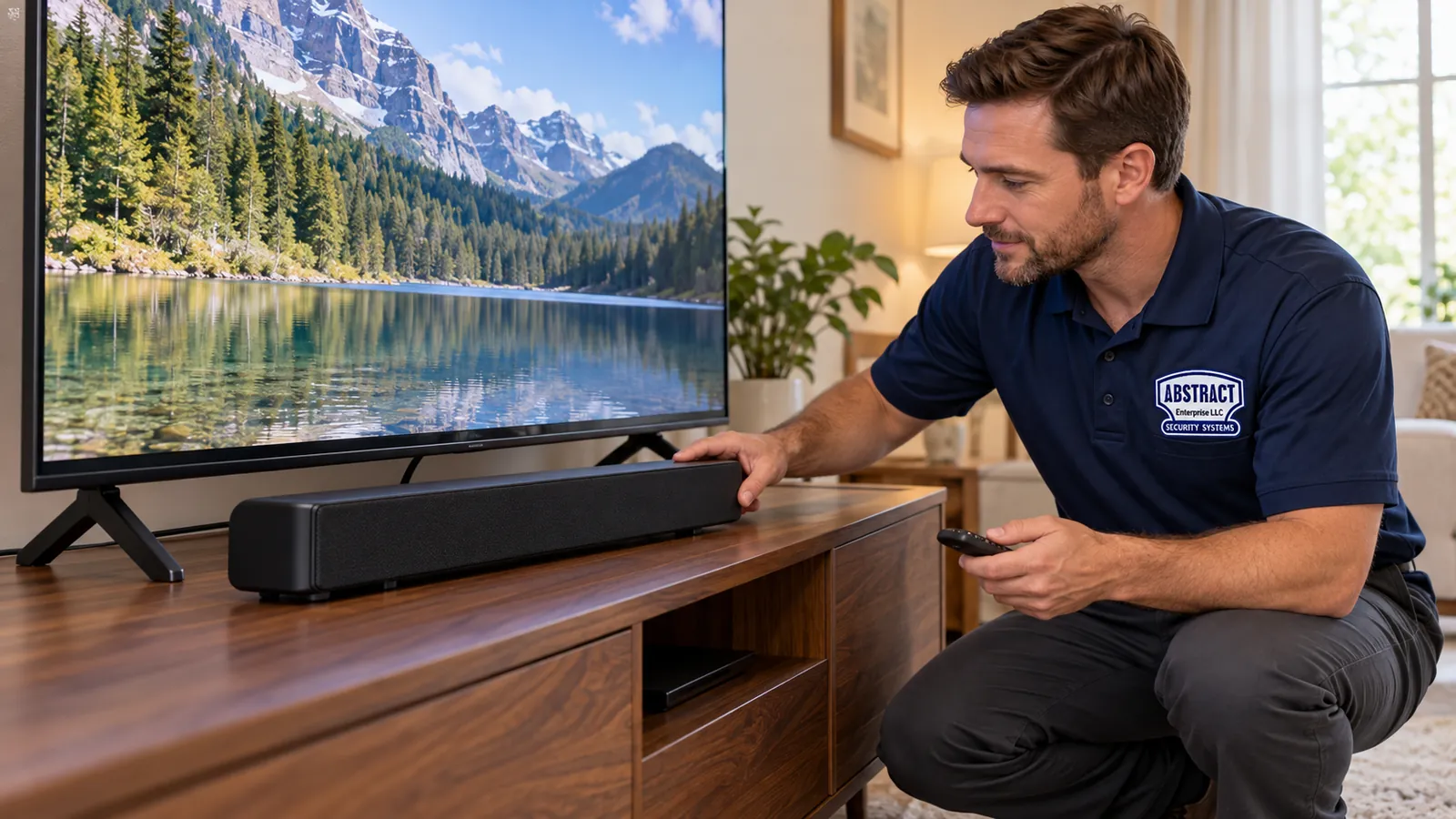
No wall mount needed here: the bar goes on the console in front of the TV's feet and is lined up so it doesn't block the screen or the IR sensor.
Coverage Area
Soundbar Installation Near Rockland County's Landmarks
Six Rockland landmarks, from the oldest building in the county to its oldest lighthouse, chosen because each sits among a kind of house we hang soundbars in. We are not claiming work at these sites; they are reference points for the neighbourhoods around them.
DeWint House, Tappan
Built in 1700 of brick and local stone and described by the Hudson River Valley National Heritage Area as the oldest surviving building in Rockland County; George Washington used it as a headquarters during the Revolution. Around it, Tappan's capes and colonials mix plaster with early drywall.
Piermont Pier, Piermont
The mile-long pier the Piermont Historical Society calls "Last Stop USA," the last American ground more than a million service members touched on their way to World War II. The village around it is older houses with plaster walls and windows on the river.
Rockland Lake State Park, Valley Cottage and Congers
Where the Knickerbocker Ice Company was founded in 1831 on the lake's eastern bank. Today the hamlets around the park are mostly post-war suburbs, including townhouse communities where association rules cover party walls.
Haverstraw Brick Museum, Haverstraw
The museum tells how, by 1883, 41 brickyards employing about 2,400 men made Haverstraw the world's largest producer of bricks. Brick still shows up on village storefronts and fireplaces, and in two-family houses on the streets behind.
Stony Point Lighthouse, Stony Point
Built in 1826 on the Stony Point Battlefield State Historic Site, it is the oldest lighthouse on the Hudson and operated for 99 years. The houses around it in Stony Point and Tomkins Cove are mostly post-war, many with finished lower levels.
Lafayette Theatre, Suffern
A single-screen movie palace built in 1923 at 97 Lafayette Avenue, still showing first-run films. Suffern's village streets mix older plaster houses with mid-century homes toward Airmont and Montebello.
We also cover every hamlet and village between them — New City, Bardonia, Nanuet, West Nyack, Valley Cottage, Congers, Upper and South Nyack, Grand View-on-Hudson, Sparkill, Blauvelt, Orangeburg, Pearl River, Spring Valley, Monsey, Airmont, Chestnut Ridge, Montebello, Wesley Hills, New Hempstead, Pomona, Mount Ivy, Thiells, Garnerville, West Haverstraw, Haverstraw, Sloatsburg and Hillburn — at the same county prices. Across the Hudson and to the north, soundbar work in Westchester County and Orange County is booked through our quote form until those counties have pages of their own.
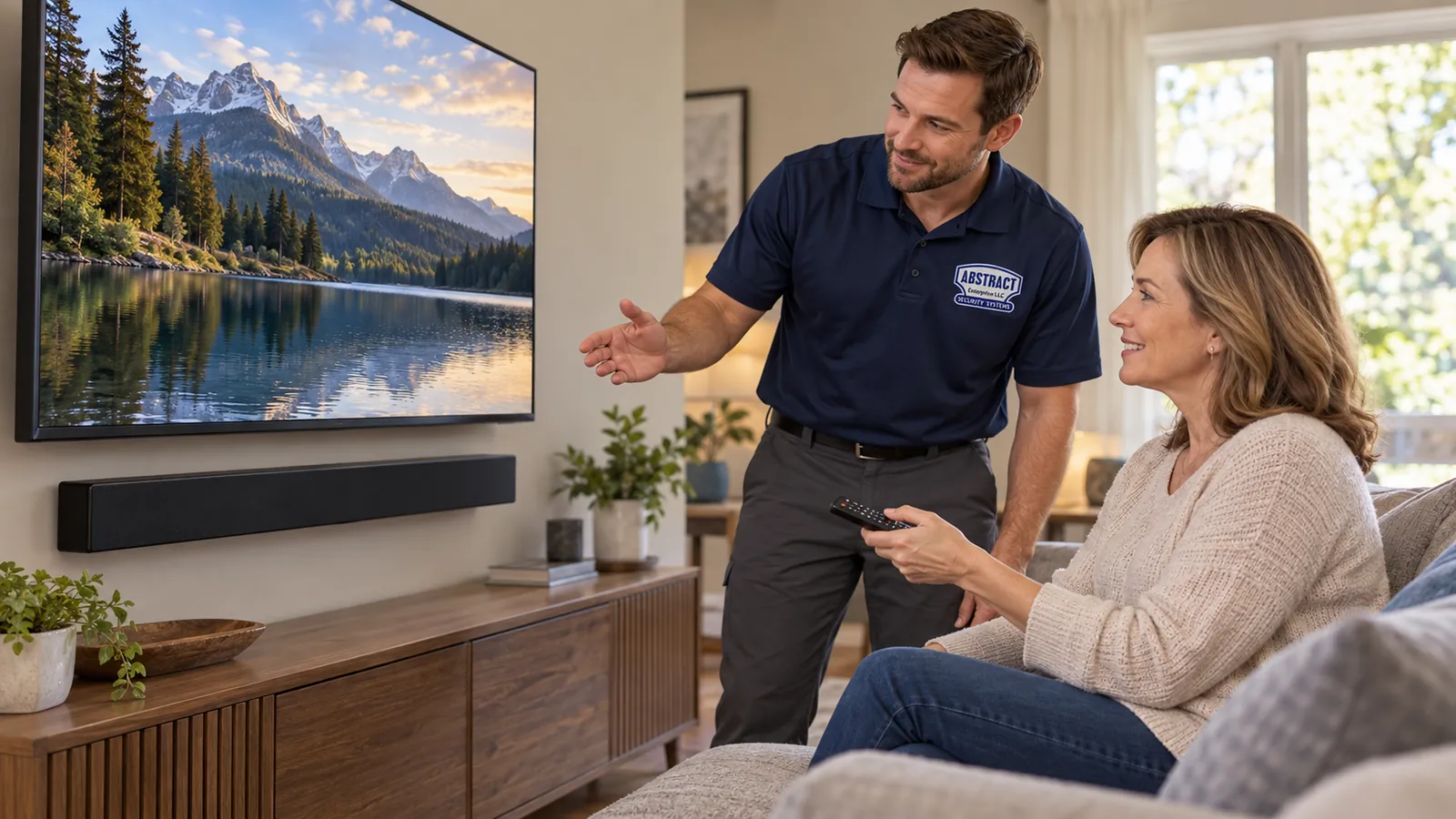
A technician points toward the wall-mounted TV and soundbar while a woman on the sofa holds the remote and tries the controls.
Pricing
Soundbar Installation Cost in Rockland County
One published price list covers the whole county, with no travel, mileage or parking charge from Tappan to Tomkins Cove. Pick the lines that match your job and add them up; that is the bill. If the wall turns out to be something you didn't book — block behind the paneling, say — you hear the new price before any extra work begins.
Soundbar line
Rockland price
What it covers
Bar hung on the wall below the TV
$129
We test what the wall is, pick anchors for it, level the bar under the picture and listen from where you sit
Bar set on the media unit
$79
No holes: kept below the TV's infrared window, hooked up, adjusted and proven working
Sanus soundbar bracket
$84.99
Supplied by us when the bar arrived bracketless or its own bracket is wrong for a block or paneled wall
Wires inside the wall
$169
Listed in-wall power and cable kit, taking power from the receptacle already below; needs a hollow, duct-free stud bay
Paintable cord cover
$59
Slim raceway on the wall face for foundation block, poured concrete and brick, where nothing can go inside
Extra cable length, 25 ft maximum
$99
For a box or router that sits across the den or inside a closed cabinet
Sonos setup
$125
App, sub and rear pairing, room grouping, Trueplay tuning where offered
A/V receiver
$129
Hook-up and settings for a receiver-based system
Universal remote
$99
One handset taught every device in the cabinet
Streaming device setup
$49
A streaming stick or box signed in and on the network
Full home theater
$350
Several components configured to work as one system
Wall and access lines
Condition
Price
Drywall on wood studs
$0
Drywall on metal studs
+$30
Plaster
+$45
Brick or stone
+$65
Concrete or cinder block
+$75
Tile or marble
+$95
Plywood backer board (paneling, missed studs)
$85
Mounting higher than roughly 8 ft (two-storey rooms)
$75
Apartment three or more flights up with no lift
$40
Remove an old bracket
$45
Box removal
$25
Certificate of insurance for an association or landlord
Free
Travel or parking anywhere in Rockland County
$0
Worked Rockland examples
Typical Rockland job
Lines
Total
Bar on the console, tenant in a two-family house
$79
$79
Bar on upstairs drywall, our bracket
$129 + $84.99
$213.99
Bar on a paneled den wall with a backer board, our bracket
$129 + $84.99 + $85
$298.99
Bar on lower-level block, our bracket, cord cover
$129 + $84.99 + $75 + $59
$347.99
Bar on a brick hearth face, our bracket
$129 + $84.99 + $65
$278.99
Bar on plaster in a Nyack village house, our bracket, in-wall kit
$129 + $84.99 + $45 + $169
$427.99
Two bars on drywall, living room and den, our brackets
2 × ($129 + $84.99)
$427.98
When the clock runs instead of the menu — and adding the TV
When nothing goes on a wall — reconnecting the bar to a new TV, fixing eARC or lip-sync, putting it on a wired connection, pairing a new subwoofer — the visit is billed by time: $235 for the first hour in Rockland, then 30-minute blocks. If the TV is being mounted on the same visit, the Rockland TV base of $219.99 for a 32- to 55-inch screen on stud-backed drywall applies and the soundbar lines go on top; a TV and bar on drywall with our soundbar bracket comes to $433.98. A TV kept on its stand is $144.99 in Rockland. The full TV list, with size, mount and wall adds, is on our Rockland County TV mounting price list.
What the Rockland price covers and what it leaves out
Covered: finding out what the wall is made of, hanging the bar true, the HDMI hook-up with CEC working, proof that Wi-Fi or Ethernet holds on that level, cables dressed behind the TV and the dust vacuumed up.
Left out: any new receptacle (book an electrician), filling and painting holes, shifting heavy furniture, and taking paneling off the wall.
Visits that can't start: if the bar, TV or bracket hasn't arrived, nobody is home to let us in, or an owner's or association's approval is missing, the $150 return-trip fee applies. With 24 hours' notice, moving the appointment is free.
Brittle surfaces: century-old plaster in the river villages and tile around a basement bar may chip at the bit even with a slow drill. We say so at the mark, and you decide whether to go ahead.
Hardware cover: each bracket and part is backed by whoever made it; our own terms sit in the service agreement, summarised in the last section of this page.
Shop Our Systems
Soundbar Installation Packages & Pricing
Most Rockland quotes settle into one of three shapes. Each card shows its arithmetic so you can check it, and there is no travel line to add. Block, plaster, brick or backer lines are added on top where your wall needs them.
Starter — Console Bar, No Holes
$79
One line, $79: the bar sits on your media unit, wired to the TV's audio-return port, with the TV remote driving its volume and its dialogue and late-night settings dialled in. Nothing is drilled, which suits tenants and TVs that stand on furniture.
Standard — Bracketed Bar on Drywall
$213.99
$129 to hang the bar + $84.99 for our Sanus bracket = $213.99 on stud-backed drywall. On a lower-level block wall add $75 and usually a $59 cord cover; on paneling, an $85 backer where the strips won't hold.
Premium — Bracket Plus Wires Inside the Wall
$382.99
$129 to hang the bar + $84.99 bracket + $169 in-wall power and cable kit = $382.99. Hollow walls only, with a clear stud bay; we check for ducts before promising it.
BYOE — Your Bracket, Our Labor
Most bars ship with a wall bracket, and plenty of people already own a better one. Supply it and you pay labor only: $129 to hang the bar, plus the wall line if there is one — $129 on stud-backed drywall, $204 on block. Your bracket must be rated for the bar's weight and is covered by its own maker's warranty, not ours. If it's wrong for the wall, you hear that before drilling, with our Sanus bracket as the alternative.
Want Your Rockland Soundbar Price on Paper?
Send one phone picture of the TV wall, tell us the bar and which floor it's for, and the written figure comes back with nothing added for the drive.
How Soundbar Jobs Change Across Rockland's Five Towns
Rockland is divided into five towns — Clarkstown, Orangetown, Ramapo, Haverstraw and Stony Point — with villages and hamlets inside each. The bracket is the same everywhere; the houses around it are not. This is what we plan for in each.
Clarkstown: New City, Nanuet, Bardonia, Congers, Valley Cottage and West Nyack
The county's split-level and raised-ranch heartland. New City's subdivisions from the 1960s and 1970s put the family TV in a lower-level den with block to window height, a soffit along one side and the bedrooms a half-flight up, so most Clarkstown visits are about masonry anchors, cord covers and keeping bass downstairs. Townhouse communities around Congers and Valley Cottage add association paperwork and party-wall questions, and offices around New City's South Main Street and the Route 59 strip in Nanuet bring commercial requests.
Orangetown: Pearl River, Orangeburg, Tappan, Blauvelt, Sparkill, Piermont and the Nyacks
Orangetown runs from the New Jersey line to the river villages. Pearl River, Orangeburg and Tappan have many capes and colonials from before and after the war, often with plaster or early drywall, brick fireplaces and family rooms added on the back. Piermont, Grand View and the Nyacks are older again: plaster on lath, high ceilings and walls given over to river windows, where finding a wall for the TV is half the job. Route 303's offices in Orangeburg and Blauvelt are metal-stud work with landlord certificates.
Ramapo: Spring Valley, Monsey, Suffern, Airmont, Wesley Hills, Pomona and Hillburn
The county's most varied town. Spring Valley and Monsey have many two-family and multi-family houses, where tenants need the owner's written OK and floors are shared; Pomona, Wesley Hills, New Hempstead and Montebello have larger houses on wooded lots, from raised ranches to late-century colonials with two-storey family rooms. Suffern's village streets add older plaster houses and storefronts on Lafayette Avenue. Expect anything from a console bar in a small apartment to a flagship bar and sub in a big family room.
Haverstraw: Haverstraw village, West Haverstraw, Garnerville, Thiells and Mount Ivy
The old brickmaking villages by the river have older houses and storefronts with brick and plaster, two-family homes and apartments; inland, Garnerville, Thiells and Mount Ivy are mostly post-war suburbs. Brick walls mean cord covers, shared houses mean modest bass, and older paint means careful dust control.
Stony Point: Stony Point and Tomkins Cove
The northern end of the county, between the Hudson and Harriman State Park, where most houses are post-war and many have long drives and finished lower levels. Routers are often a long way from the lower-level TV, so the network check matters, and finished basements with paneling are common. There is no extra charge for the drive.
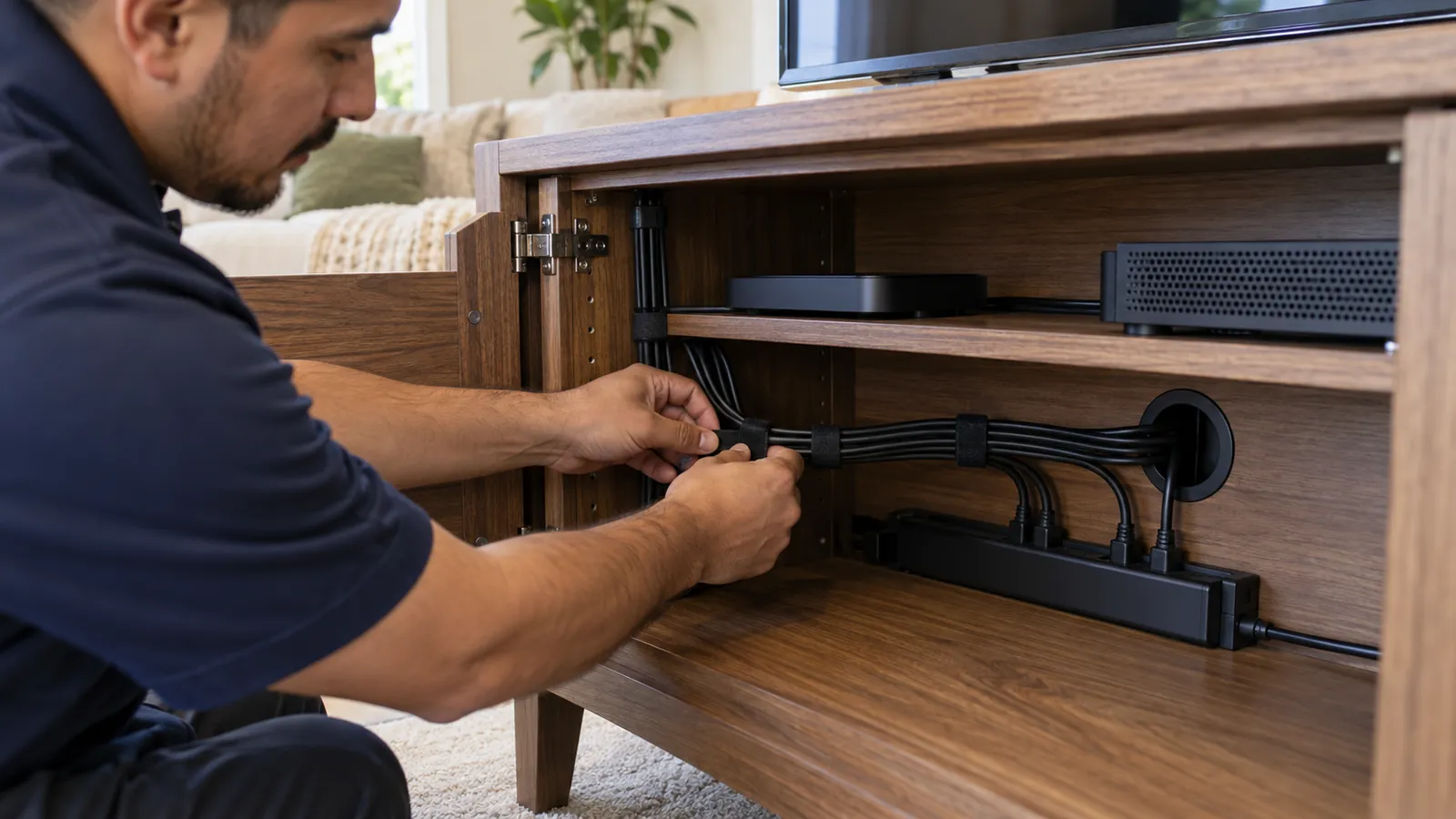
Cables strapped and run through the cabinet's back grommet to one power strip, with the streaming box and receiver on the shelf above.
Matching Bar to Room
Choosing a Soundbar for a Rockland Room
In a house built on half-levels, the right-sized bar beats the biggest one. If you haven't bought yet, this is how we would match bar and mount to the rooms we see most in Rockland. It is guidance from installing, not a product endorsement; any mainstream maker's bar in the right class will do.
Room
Bar class
Subwoofer?
Usual mount
Split-level family room, bedrooms a half-flight up
Mid-size smart bar with a night mode
Optional, small, set low and away from the stairwell
Anchored into masonry or studs, leads in a raceway
Raised-ranch lower-level den
Mid-size or flagship
Yes if the floor above is a living area rather than bedrooms
Masonry anchors in the foundation wall, painted channel
Upstairs living room in a raised ranch
Mid-size
Usually not needed
Wall bracket on stud-backed drywall, in-wall kit
Two-storey family room in a newer colonial
Flagship with room calibration
Yes
Wall bracket on drywall; height effects limited by a very tall ceiling
Nyack or Piermont village living room
Mid-size or compact
Optional
Lath-and-plaster fixing into framing, or hung from the TV
Tenant's living room in a two-family house
Compact or mid-size
No
Console, or a bracket with the owner's written OK
Bedroom
Compact
No
Dresser or console
Office conference room or waiting room
Mid-size bar tuned for voices
No
Under the display, inside the 4-inch walkway limit
Three rules of thumb hold across the table. A bar close to the width of the screen, or slightly narrower, keeps voices anchored to faces. Height effects need a flat, ordinary-height ceiling above the bar, which many Rockland lower levels don't have. And in a house where bedrooms sit a half-flight above the TV, a good bar without a separate subwoofer, well set up, is often more pleasant for everyone than a bigger system turned down.
Hold on to the carton and the proof of purchase until we have finished. A bar with shipping damage, or one whose connections don't suit your TV, goes back to the shop far more easily before any holes are drilled for it.
Complete Services
Every Soundbar Installation Service in Rockland County
A soundbar is often the first job in a Rockland room that is being redone: a basement being finished, a den getting a bigger screen, a home office that needs a wired connection. These Rockland services come from the same team and the same insurance certificate.
Booking windows, rescheduling, the return-trip fee and how hourly time is counted, in full.
Field Notes
Field Notes From Rockland Family Rooms
The routine our technicians follow in Rockland houses — a description of method, not an account of any particular customer's job
The first thing we do in a split-level is climb the stairs. Before looking at the TV wall, the technician notes which rooms sit above and beside the family room, whether the stairwell is open, and where the router is. Those three facts decide where the subwoofer goes, which modes get switched on and whether the bar needs a cable instead of Wi-Fi.
Then the wall. On a lower level, a knock low down and a knock high up usually tell two different stories: block or concrete below, framing or paneling above. A scan finds the ducts that so often run up from a furnace room next door. If there is paneling, we find out what the strips are fixed to before deciding whether a backer is needed, and we mark the bracket a few inches clear of the joint where masonry meets wood.
Last, the household. We ask who watches, at what time, and who is trying to sleep while they do. Then we set the bar for that house — speech mode for the person who needs it, night mode for late films, a sub level that the bedroom upstairs can live with — and listen from the sofa and from the landing before we leave.
FAQ
Rockland County Soundbar Installation FAQ
What would a soundbar on a painted block basement wall cost in Rockland, with the wires covered?
+
Hanging the bar is $129, our Sanus soundbar bracket is $84.99, the concrete or cinder block line is $75 and a paintable cord cover down to the outlet is $59, so the total is $347.99. If your bar came with a bracket rated for it, drop the $84.99 and the figure is $263. There is no travel or parking charge on top anywhere in the county.
Our basement wet bar has a tiled wall where the TV goes — can the soundbar be mounted on tile?
+
Yes, with care. Tile adds $95 to the mount, so a bar with our Sanus bracket on a tiled wall is $129 + $84.99 + $95 = $308.99. We drill with a tile bit at low speed, place anchors through grout joints where the bracket allows, and fix into the wall behind the tile. Ceramic, glass and stone tile can still crack at the drill, so you hear that risk before the first hole.
Can you fix a soundbar another installer put up that has since stopped working?
+
Yes. If the problem is sound, sync, Wi-Fi or the remote, it is a setup-only visit: $235 for the first hour in Rockland, then 30-minute blocks. If the bracket has worked loose or was fixed into paneling or drywall alone, re-hanging it properly is priced as a mount, $129 plus whatever the wall needs, such as $75 for block or $85 for a backer board.
Can you move the TV and soundbar from the upstairs living room down to the lower-level den?
+
Yes, on one visit. We take both down upstairs, removing each old bracket at $45, then hang them in the den at the normal prices for the new wall: the Rockland TV base of $219.99 for a screen up to 55 inches on drywall, $129 for the bar, and the block line of $75 if the den wall is masonry. The old holes upstairs are left clean for filling.
We are moving within Rockland — can you take the soundbar down at the old house and put it up at the new one?
+
Yes, as two visits. At the old house we take the bar and bracket down and pack the hardware with the bar; old-bracket removal is $45. At the new house the install is priced like any other, from $129 for the wall mount plus whatever the new wall needs. Book the second visit after the furniture is in place, so the height suits where you will actually sit.
Will you run the soundbar's room-calibration routine before you leave?
+
Yes, where the bar has one. Several makers include a tuning routine in their app that listens to a test sound and adjusts the bar for the room; Sonos calls theirs Trueplay. It usually needs the app on a phone and a few quiet minutes, so we do it last, once the bar is in its final position and any subwoofer has been placed.
Does the soundbar have to be the same brand as the TV?
+
No. HDMI ARC, eARC and CEC are industry standards, so a Sonos, Bose, Sony, Samsung, LG or Vizio bar will normally work with any recent TV that has an ARC or eARC port. Matching brands can unlock a few extras, such as using the TV and bar speakers together on some models, but they are not needed for clear sound or one-remote control.
Does the price change if the soundbar goes on the lower level instead of upstairs?
+
Not because of the level. The price follows the wall: stud-backed drywall carries no extra line, block or poured concrete adds $75, plaster $45 and a backer board $85. Lower-level dens are simply more likely to have a block wall or paneling, which is why their totals often come out higher. The third-floor walk-up line does not apply to a private house.
All Areas Served
Soundbar Installation Across the Hudson Valley and Beyond
You are on the Rockland page of our soundbar service. It reports up to the Hudson Valley hub, which covers all six counties north of the city; the five boroughs and Nassau–Suffolk each have a hub as well. Where a county or borough page hasn't been published yet, its link below takes you to the quote form instead.
Soundbar Trouble Anywhere From Tappan to Stony Point?
Picture and voices out of step, a sub that won't pair, a bar the app can't see, a bracket working loose from paneling — ring (845) 640-3835 with your town and what's happening. We hold the next open two-hour slot for you, and a fault like that is usually fixed within an hour or two of arrival.
Soundbar Installation Rockland County — Licensed, Insured, Ready for Every Level
Abstract Enterprises Security Systems · 460 E Fordham Rd, Bronx, NY 10458 · Rockland line (845) 640-3835 · WhatsApp (718) 679-0359 via wa.me
NYS Low-Voltage License #12000287431 · 100% Licensed & Insured · Same-Day Estimates · Rated 4.7★ from 201 Google Reviews
Brackets and parts carry their manufacturer's warranty. Full terms — including 50% deposit, one-year parts-only warranty on AESS-supplied products, and the late-fee schedule — are set out in the service agreement. See our warranty page.
Page reviewed and updated October 17, 2026. Changelog: page launched October 2026 — Rockland split-level and raised-ranch guidance, county licensing notes after the 2026 Chapter 286 rewrite, and published Rockland prices with no travel charge.