What are you looking for?
About Us Contact Us Careers Get a Free Quote (800) 486-0943
Pick a service
✅ Got Your Own System?
🎬 Home TheatreQuote 🎶 AV SoundQuote 🔑 Access ControlQuote
Now pick your area
Pick your area
Long Island
Hudson Valley
Services available
Pricing & Tools
Pick a service for pricing
🚪 Intercom Pricing 🔔 Buzzer Repair Pricing
Calculators
📹 Camera System Calculator 🚨 Alarm Calculator ⚡ Cabling Quote Builder ✅ Got Your Own System?
Select your area
Home › Soundbar Installation NYC › Soundbar Installation Manhattan
Manhattan Soundbar Installer · Inwood to the Battery · Doorman, Co-op, Condo & Walk-Up Buildings

Soundbar
Installation in
Manhattan

Under-TV Wall Mounts · Flex-Wall & Glass-Tower Layouts · eARC & One Connect Setup · Wi-Fi That Holds in a Crowded Building

A Manhattan apartment is one box in a stack, with neighbors above, below and beside you, a front desk that decides who goes upstairs, and walls that change from plaster to concrete to glass between one block and the next. We mount soundbars for that reality: a certificate of insurance written the way your managing agent wants it, a 2-hour window that fits the building's contractor hours, anchors chosen after we read the wall, a network connection that survives fifty neighboring routers, and bass set for the ceiling of the apartment below.

Reviewed and updated October 17, 2026 · Author: Anwar Timothy, owner · NYS license #12000287431 · Manhattan line (929) 560-0737

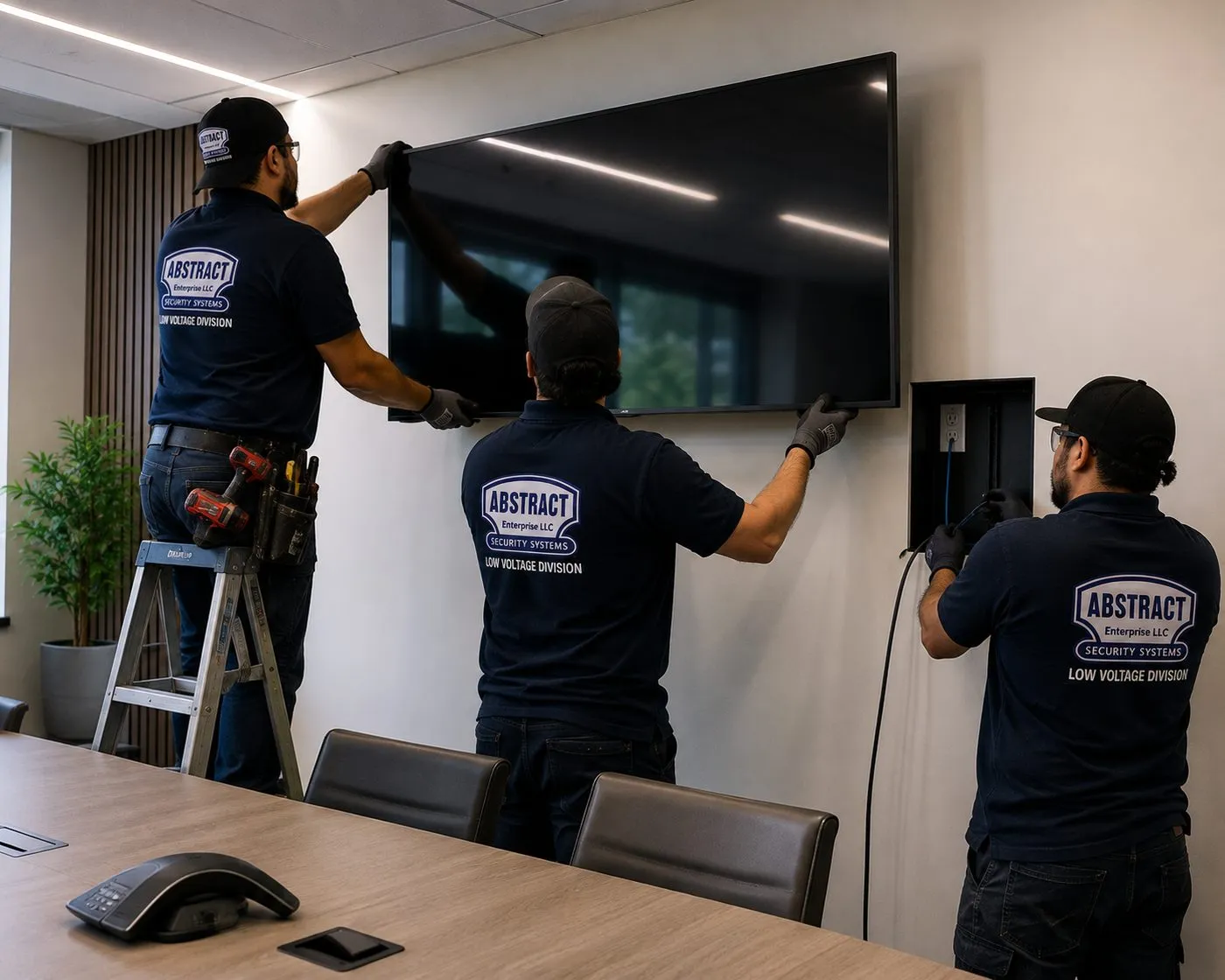
Three technicians fitting a large flat screen to a white wall above a recessed wall box, the screen-and-bar alignment step of a soundbar installation in Manhattan
Three technicians in Abstract Enterprises shirts lift a large flat screen onto a white wall: one on a stepladder, one steadying the middle, one working at a recessed box below the screen, with a conference table and phone in the foreground.
Manhattan Soundbar Quote
Bar model, wall type and cross streets — a written price back the same business day

✅
Request Sent!
A Manhattan installer will call you back the same business day.
25+
Years Experience
✓
Same-Day Estimates
100%
Licensed & Insured
4.7★
201 Google Reviews

Need the bar up before the weekend? Ring our Manhattan line, (929) 560-0737, or send the quick form. You get a price in writing, worked out line by line from the menu further down this page, before anyone books a service elevator.

  • Insurance certificate drafted to your managing agent's sample, no fee
  • One flat $150 parking line per Manhattan visit — no meter surprises
  • Licensed by New York State, #12000287431 · arrivals booked in two-hour slots from 8 AM until 8 PM, every day of the week
The Neighborhood

Why Manhattan Properties Need Soundbar Installation

Manhattan is the most vertical place in the country to put up a soundbar, and almost every complication on the job follows from that. The Citizens Housing & Planning Council's housing-stock analysis finds that nearly all of the borough's homes — 97 percent — sit in buildings of six or more units. The bar you are mounting will share a floor slab with the apartment beneath it, a ceiling with the one above, and often a wall with the one next door. It will be carried past a doorman, up a service elevator or a tenement stair, and fixed to a wall that may be a century old or may have gone up last spring. A suburban installer's checklist does not cover much of that.

Most people here also rent. The Census Bureau's QuickFacts table for New York County puts the owner-occupied rate at 25.1 percent for 2020–2024, which leaves roughly three households in four answering to a landlord, a lease and sometimes a management company with strong views about holes in walls. Households are small — 2.00 people on average — and so are living rooms. The typical Manhattan soundbar question is not "how big a system can the room take" but "how do I make dialogue clear in a room I can cross in five steps, without the person downstairs hearing the explosions."

The buildings add their own rules. Brick Underground's guide to co-op and condo alteration agreements notes that most limit contractor work to 9-to-5 weekdays and that many restrict service-elevator use at the start and end of the day; some go further and require environmental testing for lead and asbestos before certain work begins. Separately, the city's Housing Preservation and Development agency reminds owners that, under Local Law 1 of 2004, paint in multiple dwellings built before 1960 must be presumed to contain lead. None of that stops a soundbar from going up, but it does mean the visit has to be planned around the building, and the drilling done with dust kept at the bit.

Then there are the walls you rarely meet outside this borough. Two-bedroom shares carved out of one-bedrooms with temporary pressurized walls, which Brick Underground describes as about five inches thick and rated to hold roughly 25 to 30 pounds. Living rooms in new towers where two of the four sides are floor-to-ceiling glass. Office buildings in the Financial District and Midtown East turned into apartments, with new partitions built inside an old concrete frame — the City Comptroller counts 16,400 apartments in the Manhattan office-conversion pipeline. Loft floors in SoHo and Tribeca where the TV stands in the middle of the room because no wall is in the right place.

On Reddit, the problems people describe are recognisably local. A poster in r/Soundbars setting up a 65-inch TV in a small NYC apartment explained that the neighbors were behind the couch wall and settled on an LG soundbar under the TV with the sub beside it. A thread in r/techsupport from a New Yorker with unreliable Wi-Fi asked whether it could simply be "too many wifi signals in my building" — and the replies pointed to interference from other networks on the same channel, which is exactly what makes some wireless subwoofers and Wi-Fi soundbars drop out in dense buildings. And in r/AskNYC's thread on neighbor-friendly soundbars, the practical advice was to insulate speakers from the floor and wall "to minimize acoustic energy transfer through hard surfaces."

Manhattan facts that shape a soundbar visit

  • 97 percent of Manhattan housing units are in buildings of six or more units (Citizens Housing & Planning Council, Taking Stock) — neighbors on several sides are the norm, not the exception.
  • 25.1 percent owner-occupied rate and 938,554 housing units (U.S. Census Bureau QuickFacts, New York County, rate for 2020–2024, units as of July 1, 2025) — most installs are for tenants whose lease sets the limits.
  • 2.00 persons per household and a median gross rent of $2,197 (QuickFacts, 2020–2024) — small households in small rooms, where a compact bar placed well beats a large one placed badly.
  • Before 1960: paint in multiple dwellings built before that year is presumed to be lead-based under Local Law 1 of 2004 (NYC HPD), so dust control at the drill matters on prewar and early postwar walls.
  • 7 AM to 6 PM on weekdays: the hours NYC311 and the Department of Environmental Protection give for residential construction work; many co-op and condo agreements narrow that further to 9 to 5 (Brick Underground).
  • 16,400 apartments in the Manhattan office-to-residential conversion pipeline (NYC Comptroller, 2025), including 1,320 at 25 Water Street — a growing share of living rooms with brand-new partitions in old commercial shells.

Read together, the numbers say that a Manhattan soundbar job is mostly about three things the bar's box never mentions: the building's rules, the wall you actually have, and the people on the other side of the floor. Get those right and the bar itself, whichever brand you bought, does what it was designed to do.

Many Manhattan households booking a soundbar are re-hanging the TV above it at the same time, so both are often priced together through our TV installation service in Manhattan. When a bar is not enough — ceiling speakers in a renovated co-op, surround sound in a townhouse den — AESS audio-visual installers in Manhattan plan the larger system, and buildings upgrading their front door at the same time often add an intercom installation in Manhattan.

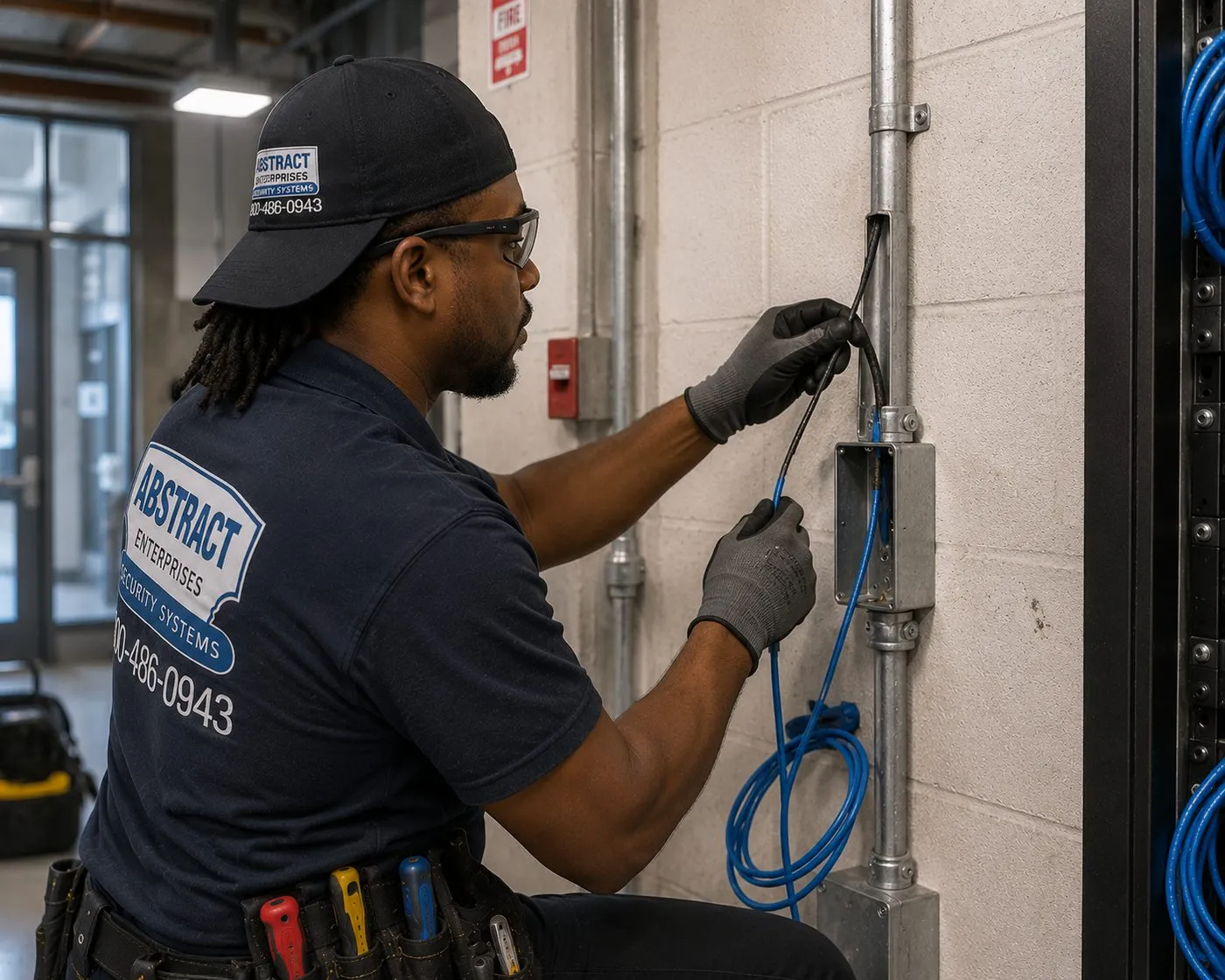
Technician pulling blue cable from a junction box fed by vertical conduit on a block wall, building pathway work relevant to Manhattan soundbar wiring
A kneeling technician in gloves draws blue cable out of a grey junction box fed by a vertical run of metal conduit on a painted block wall, with a coil of cable at his knee.
Repair Capture

Manhattan Soundbar Gone Silent?

A bar that loses sound after the TV updates, a subwoofer that cuts out every evening when the building's Wi-Fi gets busy, voices that run a beat behind the lips, or a bracket working loose from old plaster — those are service calls, and we treat them that way. We offer the next open 2-hour window, and most connection and settings faults are sorted within one to two hours once the technician is in the apartment. Call the Manhattan line on (929) 560-0737 and say it is a repair; our TV and soundbar service policies explain how setup-only time is billed.

What We Install

Soundbar Installation Services in Manhattan

Each Manhattan job is built from the services below, each one with its own published line. Whatever the combination, the visit ends the same way: bar level and centred on the screen, cables hidden or dressed, the TV remote running the volume, the network connection checked, and a short listening test from where you actually sit.

Under-TV Wall Mount

The bar fixed on its bracket just below the screen, on anchors picked after we have tested the wall — toggles behind prewar plaster, sleeve anchors in brick, carbide-drilled anchors in a postwar concrete partition, steel-stud fixings or a plywood backer in a new condo.

Console Placement for Renters

No holes at all: the bar on the media unit, clear of the TV's infrared sensor, connected and tuned, with cables tied off behind the furniture. Often the right answer when the lease or the managing agent says no drilling.

TV-Arm Soundbar Brackets

A bracket that clamps the bar to the TV mount rather than the wall, so a bar under a swinging arm in an L-shaped studio turns with the screen and the wall gains no new holes.

TV Plus Soundbar, One Visit

Hanging the screen and the bar together means one building check-in, one service-elevator booking and one parking line, with height and spacing planned for both at once.

Cord Covers and In-Wall Kits

A paintable surface channel on brick and concrete, where nothing can be fished; a code-compliant in-wall power and cable kit where the wall is hollow and the owner or board allows it.

eARC, CEC and One Connect Setup

Connecting to the right HDMI port — including the eARC port on a Samsung One Connect box tucked in a cabinet — switching on HDMI-CEC, fixing lip-sync, and updating the bar's firmware.

Wi-Fi and Wired Network Fixes

Moving a Wi-Fi bar onto a cleaner band, wiring it to the router by Ethernet where the model has a port, and checking the wireless link to the subwoofer in a building full of competing networks.

Subwoofer Placement Over Neighbors

Finding a spot that gives even bass at the sofa at a lower level, off bare boards and out of corners, with the sub level set for an apartment over someone else's bedroom.

Offices, Bars and Amenity Rooms

Soundbars for conference rooms, waiting rooms, showrooms, game-day TVs and building lounges, with volume limits and remote control arranged for staff rather than guests.

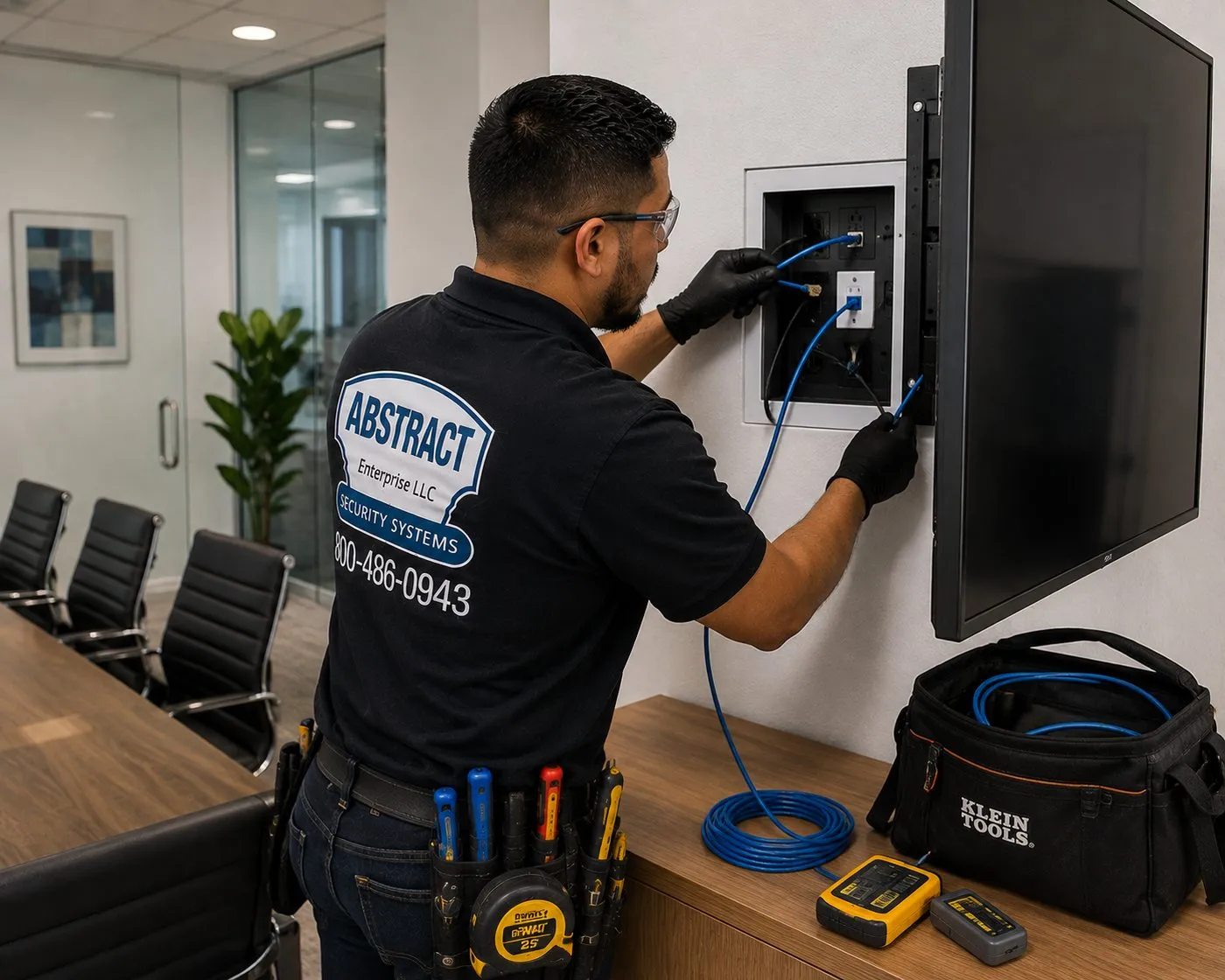
Technician connecting cables inside a recessed wall box beside a wall-mounted screen, the behind-the-TV wiring a Manhattan soundbar installation relies on
A technician plugs cables into a recessed box set into the wall next to a mounted screen, with a tool bag, a coil of blue cable and a handheld tester on the counter below.
Building Specialists

Soundbar Installation for Manhattan's Architecture

Manhattan packs nearly every New York building type into one narrow island, sometimes on the same block. These are the ones we plan for most often, and what each means for the bar, the bracket and the cable route.

Prewar Co-ops on the Avenues and the Drives

Riverside Drive, West End Avenue, Central Park West, Park and Fifth: plaster over block, brick or terra-cotta, high ceilings, radiators under the windows, and a board with house rules. Expect a COI, set hours and careful drilling.

Postwar White-Brick Doorman Towers

The East Side and the West Side avenues are lined with them. Interior walls are often concrete or block under a skim coat, which holds a bar superbly but rules out fishing a cable through, so cord covers or a console route are the norm.

Glass Condo Towers

Hudson Yards, Midtown and downtown: window walls on one or two sides, the TV on the one solid interior partition, metal studs behind drywall, and hard glass that can make a bright bar sound harsh until it is tuned.

Office-to-Residential Conversions

Water Street, Wall Street, Broad Street and Third Avenue: fresh partitions inside an old commercial concrete frame, columns where a living room wall would be, and deep floor plates where the living room may be some way from the windows.

Tenement Walk-Ups

The East Village, Lower East Side, Hell's Kitchen, East Harlem and Washington Heights: narrow rooms, brick party walls, plaster that has been patched many times, and every tool carried up the stairs.

Lofts

SoHo, Tribeca, NoHo and the Flatiron: tall ceilings, exposed brick or columns, open plans where the TV may stand away from any wall, and floors that carry bass a long way unless the sub is isolated.

Brownstones and Townhouses

Harlem, the Upper West Side side streets and the Village: masonry party walls, wood-joist floors, and often a tenant on the floor below. More like a house to mount in, but still a building to share sound with.

Flex Rooms and Pressurized Walls

Shares and young families divide a one-bedroom with a temporary wall. It is not built to carry a TV, so the bar and screen stay on a permanent wall, a console or a TV-attached bracket.

How we treat each Manhattan wall

  • Prewar plaster over masonry: a sharp bit with no hammer action through the plaster, then masonry anchors into the brick or block behind it, or toggles where there is a cavity. A gentle tap test first tells us whether the plaster is still keyed to the wall. Plaster carries a $45 line.
  • Plaster over terra-cotta or gypsum block: common in older apartment houses; hollow block crumbles under a heavy hammer drill, so we drill gently and use anchors made for hollow masonry.
  • Concrete and cinder block: hammer drill, carbide bit and a vacuum held at the hole, booked inside the building's quiet-work hours because the drill is loud. Concrete adds $75.
  • Brick: anchors set into the brick itself rather than the mortar joint, with cables in a painted cord cover because brick has no cavity. Brick and stone add $65.
  • Metal studs and drywall: steel-stud fixings on the stud or a plywood backer board ($85) spread across two or more studs when the bar's bracket does not land on one. Metal studs add $30.
  • Glass, mirror and millwork: we do not drill glass or mirror, and we only fix into custom millwork when its maker or owner has said where it can take a load.
  • Pressurized walls: no anchors unless the wall was built reinforced for a screen and the landlord or wall company confirms it in writing. Otherwise the bar goes on the console.

Owners in prewar co-ops often pair a soundbar visit with wiring work elsewhere in the apartment, such as a structured cabling installation in Manhattan so the TV wall gets a wired network point instead of relying on Wi-Fi.

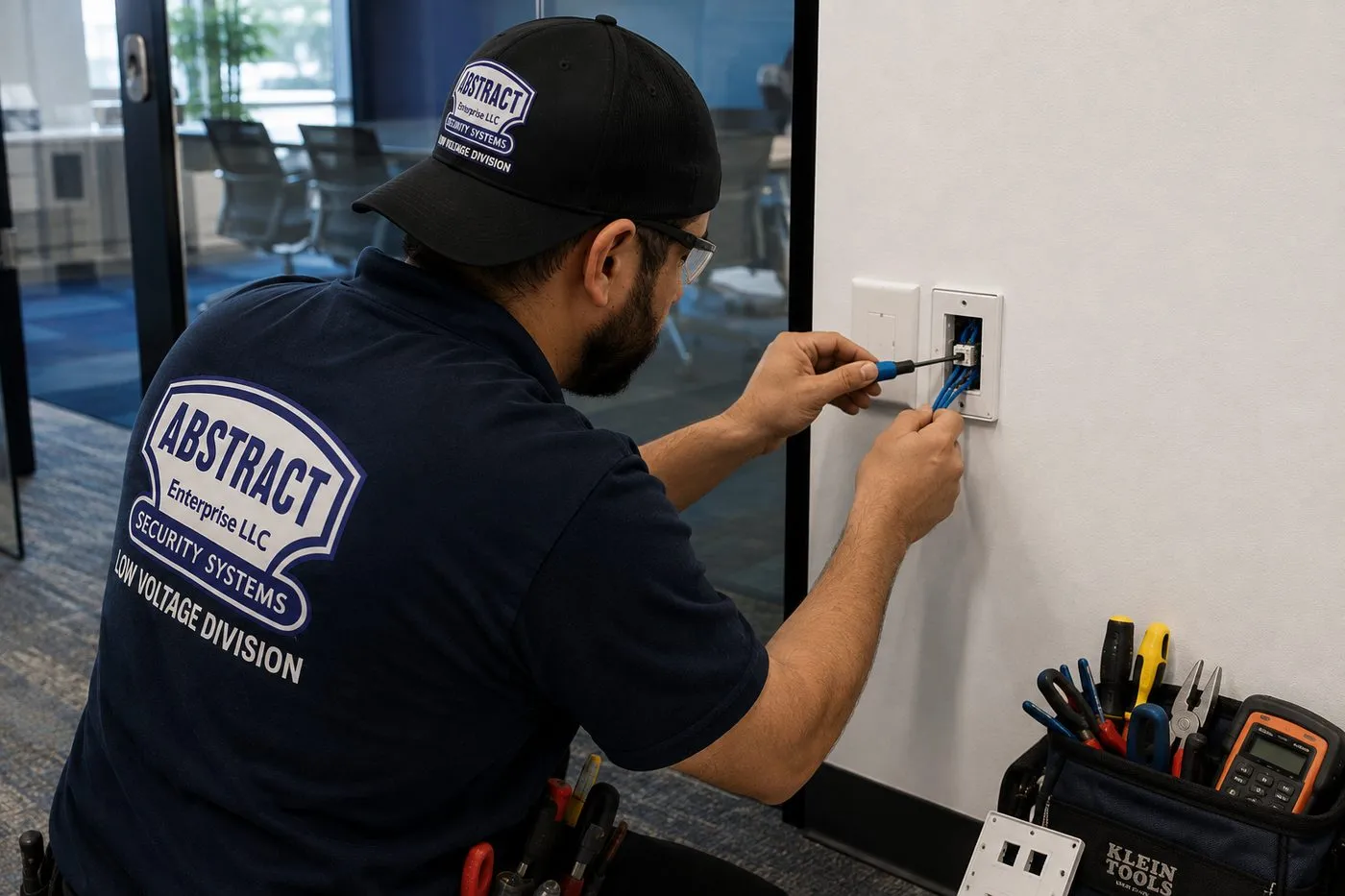
Technician terminating a jack in a white wall plate with hand tools and a tool bag on the floor, outlet work for wired soundbar setups in Manhattan
A technician in a cap works a small tool into a jack in a white wall plate, with screwdrivers, pliers and a meter standing in an open tool bag at the foot of the wall.
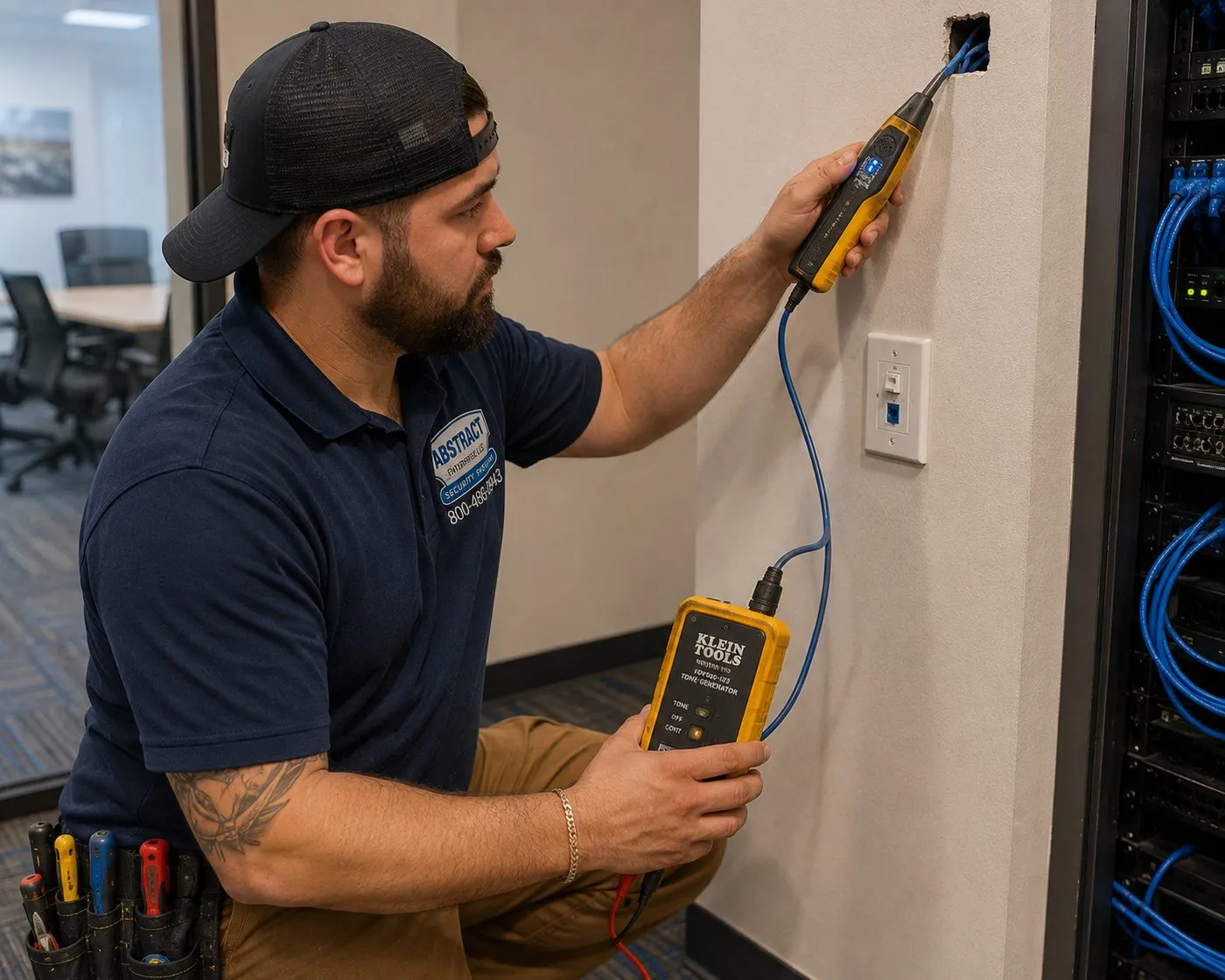
Technician crouched at a wall plate tracing a cable with a tone probe and a handheld tester, locating wiring before a Manhattan soundbar installation
A crouching technician holds a yellow tone probe up to a wall plate while a yellow tester hangs from its lead in his other hand, with a network rack visible at the right of the frame.
Commercial Soundbar Installation

Business Soundbar Installation in Manhattan

Commercial soundbar work in Manhattan is mostly about one screen that has to be understood at a sensible level: a conference-room display, a waiting-room TV, a showroom loop, a bar's game-day screens. These are the corridors where those requests usually come from.

Hell's Kitchen and Ninth Avenue

Pubs and sports bars run game days on several screens at once; NYC Tourism's football-bar guide lists Hibernia at 401 W. 50th St. among them. Dialogue clarity on a soundbar matters less than keeping each screen's sound local and the street outside within the noise rules.

Midtown East and Grand Central

Office floors around East 42nd to East 50th, where a meeting-room TV needs clear voices for video calls and a bracket that suits the tenant's fit-out partitions; NYC Tourism also lists Midtown East bars such as Overlook on East 44th.

Financial District and Water Street

Offices that remain offices, offices becoming apartments, and the bars that show big matches — the Downtown Alliance publishes a list of Lower Manhattan bars screening World Cup games. New partitions, concrete columns and strict building hours are typical.

Upper East Side Medical Offices

Waiting rooms on the side streets off Park, Lexington and Madison, where a TV plays at low volume all day and a mounted bar has to stay inside the protruding-object limit for people walking past.

SoHo and Flatiron Showrooms

Retail floors and studios with open ceilings and long looping video, where the bar must be loud enough for the shop floor but locked to a level staff are happy to leave alone.

Building Lounges and Screening Rooms

Amenity floors in rental towers and condos, and community rooms in co-ops, where a shared TV needs a bar that residents can't crank up after hours and a remote that lives with the staff.

Compliance callouts for Manhattan businesses

  • Late-night music from a business. Between 10 PM and 7 AM, DEP's published guide to the Noise Code caps what a commercial venue may put into a neighboring home at 42 dB, and what reaches the sidewalk 15 feet out at 7 dB over the background; bass gets its own 6 dB(C) ceiling once the background passes 62 dB(C). With apartments stacked over most Manhattan storefronts, a bar's game-day screens meet those numbers sooner than you might expect.
  • Bars that stick out. A soundbar on a deep bracket in a lobby, corridor or waiting room is a protruding object in ADA terms. Section 307.2 of the 2010 Standards allows at most 4 inches of projection for anything whose leading edge sits 27 to 80 inches off the floor in a circulation path, so we measure bar plus bracket before choosing the height.
  • Low-voltage wiring permits. The city's Administrative Code, § 28-105.4.7 (effective December 21, 2025), exempts wiring that operates below 50 volts for communication and data circuits from an electrical permit when the work is done by the people the electrical code allows. Anything that adds or moves an outlet is line-voltage work, which the Department of Buildings says needs a permit and a Licensed Master Electrician — we don't do it.
  • Construction hours. Drilling in a commercial space is construction noise under city rules, allowed on weekdays from 7 AM to 6 PM; landlords of office towers often set narrower windows or require after-hours work, which we book around.
  • Building paperwork. Office and retail landlords usually ask for a certificate of insurance naming them and their managing agent before a contractor is let onto the floor. We issue it free and send it ahead of the visit, along with the technician's name for the security desk.

This is general information, not legal advice; your lease, your landlord's rules and the city's codes as they apply to your space are what count.

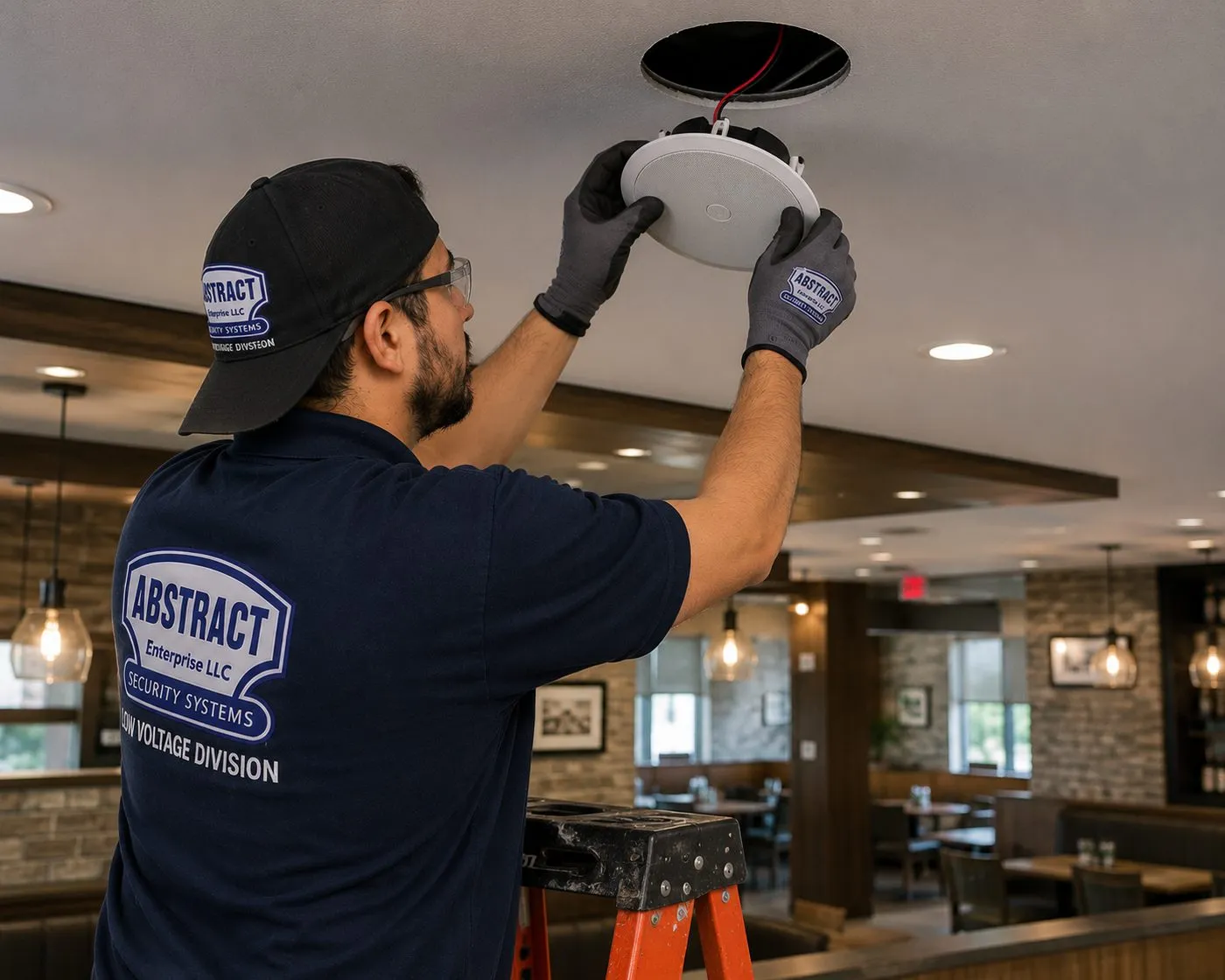
Technician on a stepladder seating a round ceiling speaker in a restaurant dining room, commercial audio work alongside soundbar installation in Manhattan
A technician on a stepladder presses a white round speaker up into a ceiling cut-out above a dining room with booths, pendant lights and a stone accent wall.
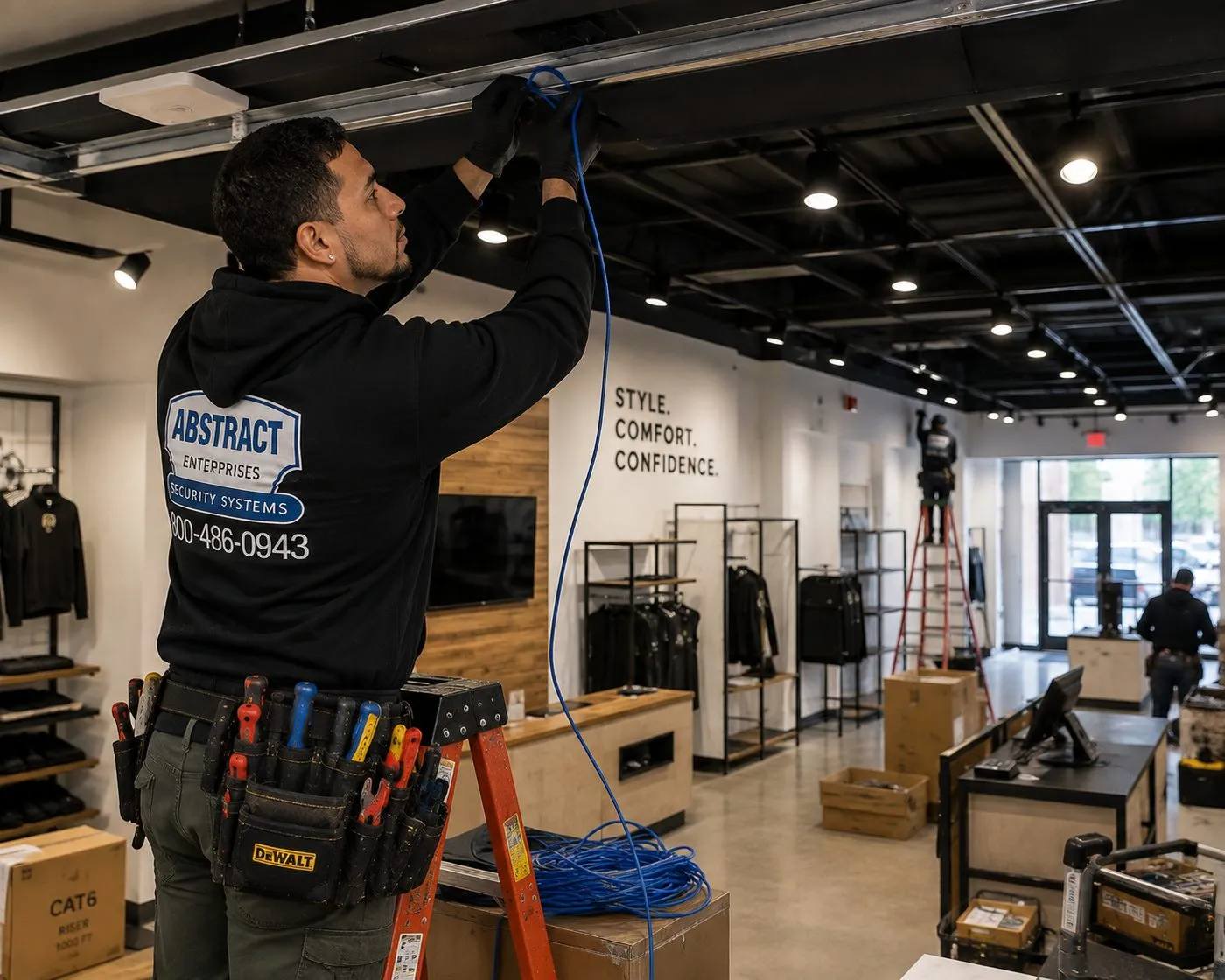
Technician on a ladder pulling cable through an open ceiling in a clothing showroom with a wall-mounted screen in the background, Manhattan retail AV and soundbar wiring
In an open-ceiling clothing showroom, a technician on a stepladder feeds blue cable through the overhead structure; clothing rails, boxes of cable and a wall-mounted screen fill the room behind him.
Your Questions Answered

Soundbar Installation in Manhattan: Questions Answered

These are the questions Manhattan residents and businesses ask before they book, grouped by what they are trying to settle: how the installer gets in, which wall can take the bar, how it will sound in a hard-surfaced room, why the network keeps dropping it, and how a business keeps it under control. Prices and coverage are in the FAQ near the end of the page.

Doormen, package rooms and getting upstairs

Can the doorman let your installer in while I'm at work?

In many buildings, yes, if you arrange it with the front desk and the building's rules allow it. Plenty of Manhattan doorman buildings hold residents' keys or will escort a contractor to an apartment when the resident has left written permission. Others refuse outright and insist the resident or an authorized adult is home. Ask the desk or the managing agent which applies before you book, and get the permission in writing — a short email to the desk naming Abstract Enterprises, the date and the 2-hour window is usually enough.

If you won't be home, we need three things settled in advance: where the bar goes and at what height, which concealment method you want, and a phone number that answers during the window. We send photos of the wall before drilling and again when the bar is up and connected. If the desk turns the technician away on the day because the permission isn't on file, the $150 return-trip fee applies, so a quick call to the desk the evening before is worth it.

The soundbar is waiting in the package room — will you bring it up and unbox it?

Yes, provided the desk will release it to us. Most buildings only hand packages to the resident, or to someone the resident has named in advance, so tell the package room or the concierge that our technician will collect the box. A long flagship bar comes in a carton well over four feet wide, which is awkward in a small elevator and easier for us to carry than for you.

We open the box in the apartment, check the bar and its accessories for shipping damage before mounting anything, and keep the paperwork and the remote with you. If you would rather the carton and foam didn't stay in a studio closet, box removal is $25. If the package hasn't arrived or the desk won't release it, we can't start, which is the situation the return-trip fee covers — so check the tracking the night before.

We're moving into a new Manhattan apartment next month — should the soundbar go up before or after the movers?

After the movers, and ideally after the sofa and the TV unit are in their final places. The height and centre line of a wall-mounted bar depend on where you sit and where the furniture ends up, and buildings usually allow only one move-in elevator reservation, so trying to fit an install around the move rarely saves time. Book the soundbar for a few days after move-in, once the cable or fiber service is live so we can set up the network at the same visit.

The exception is in-wall concealment in a newly renovated apartment that hasn't been painted yet. If the owner or board has approved an in-wall kit, it is easier to fit before the final coat. Either way, send us the building's contractor rules when you get the move-in packet from the management company; they are usually in the same document.

Walls you mostly find in Manhattan

Can a soundbar go on a temporary pressurized wall in a flex apartment?

Usually not. Pressurized walls are held in place by pressure against the floor and ceiling rather than fixed to the building, and Brick Underground's guide to them describes a wall around five inches thick that supports roughly 25 to 30 pounds, with reinforcement for a flat-screen available as an extra. A light bar alone may be within that, but drilling into the wall's panels, and adding the twisting load of a bracket, is not something the wall's maker or your landlord is likely to have allowed.

If the wall was ordered reinforced for a TV and you have that in writing from the landlord or the wall company, we can discuss it. Otherwise the bar goes on a console or on the permanent wall on the other side of the room. Flex rooms are often bedrooms, and a compact bar on a dresser, connected to a small TV, is usually all the space needs.

Our condo's living room is mostly glass — which wall can take the TV and soundbar?

Almost always the one solid interior partition, often the wall shared with the kitchen, the entry or a bedroom. In glass towers that partition is normally drywall on metal studs, sometimes with a concrete column or a shaft wall behind part of it, so we scan it before choosing the bracket position and use steel-stud fixings or a plywood backer where the studs don't line up with the bar. We don't drill glass, mirror or window mullions.

Glass changes the sound as well as the mounting. A bar facing a window wall reflects much of its treble back into the room, so we check the result from the sofa, turn on the bar's room-correction feature if it has one, and suggest where a rug or curtains would make the biggest difference. Keep in mind that the TV on the solid wall will face the windows, so ask about the screen's glare before settling the height.

Is drilling bracket holes in a pre-1960 apartment a lead-paint risk?

It is a reason to drill carefully rather than a reason not to drill. Under Local Law 1 of 2004, the city presumes paint in multiple dwellings built before 1960 contains lead, and HPD's guidance to tenants is to keep children away from any work area where dust is being created and to make sure the work is kept separate from the rest of the home. A soundbar bracket needs only a handful of small holes, but every one of them goes through old paint.

So on prewar and early postwar walls we hold a vacuum at the bit while drilling, catch the dust on a drop cloth, wipe the wall and floor afterwards, and take the cloth away with us. If young children live in the apartment, let us know and keep them out of the room during the drilling. If your building's alteration rules call for lead testing before any wall is opened, that is the building's requirement to arrange, and we'll fit our visit around it.

What changes when the apartment is in a converted office building?

The walls are new but the building is not. Conversions in the Financial District and Midtown East put apartment partitions, usually metal studs and drywall, inside an office building's concrete frame. That means a mounting wall may have a concrete column or a beam encasement hidden in it, and some partitions are acoustic assemblies the developer would rather not have opened. We scan before drilling and stay off any wall the building's handbook says not to touch.

Conversions also have deep floor plates, so a living room may sit well back from the windows with the router at the other end of the apartment. That makes a wired network point at the TV wall, or a well-placed mesh node, more useful than usual. And because the buildings are new to residential use, their contractor rules are sometimes still being written; ask the leasing or management office for them in writing.

The TV in our loft stands away from any wall — how do power and audio reach the soundbar?

On a floor-standing TV mount or a media unit placed in the room, the bar travels with the screen: it clamps to the TV mount or sits on the unit, and its power and HDMI run down the stand's cable channel to a floor box or the nearest wall outlet. Where the cable has to cross a walkway, a low, flat floor cord cover is the safe answer; a bare cable across a loft floor is a trip hazard.

We don't cut floors or add floor boxes — a new outlet is an electrician's job — but if a floor box already exists, we use it. Loft ceilings are often high and reflective, so we spend more time on the bar's settings than usual and set the sub where its bass reaches the seating without running through the whole floor to the unit downstairs.

Is it safe to put the soundbar on a radiator cover beneath the TV?

We would rather not. Steam radiators under prewar windows run hot through the heating season, and a bar sitting on a cover directly above one spends the winter in rising heat it was not designed for. Check the safety section of your bar's manual; heat-source warnings are standard in consumer electronics manuals. A radiator cover is also rarely level or fixed, which matters for a long bar.

If the only TV wall has a radiator beneath it, the usual answer is to wall-mount the TV higher than the radiator and the bar just under the screen, well above the heat, with cables in a cord cover down the side. Or move the TV to another wall entirely. We'll look at both on the day before drilling.

How a soundbar sounds in a Manhattan room

Why does my soundbar sound harsh in an apartment with big windows and bare floors?

Because hard, flat surfaces reflect sound back into the room instead of absorbing it. In a renovated apartment with wide-plank floors, plaster or drywall, a glass wall and minimal furniture, the treble from the bar bounces between surfaces, and voices can sound thin and edgy even at low volume. Many Manhattan leases and co-op house rules already require most floors to be covered with rugs to cut noise for the neighbors below; StreetEasy describes this as the "80 percent rule". It helps the sound in your own room too.

During setup we turn on any room-calibration feature the bar has, lower the treble a step if needed, and check whether the bar is firing at a glass surface at close range. A rug in front of the TV, curtains on part of the window wall and a few soft furnishings do more than any setting. We'll tell you plainly if the room is the issue rather than the bar.

Can one soundbar fill an L-shaped studio where the bed and sofa face different ways?

It can cover both if the TV turns to face each. A soundbar is directional: it sounds best to someone sitting in front of it and close to its centre line. In an L-shaped studio, the usual layout is a full-motion TV arm on the wall at the corner of the L, with the bar fixed to the arm by a TV-attached bracket so that both swing together toward the sofa or the bed.

If the TV is fixed and faces only the sofa, the bed side will hear a narrower, less clear sound, and no setting fixes that completely. In that case a small wireless speaker added near the bed and grouped with the bar, where the bar's system supports it, is a better use of money than a bigger bar.

Wi-Fi, TVs and boxes in dense buildings

Our building has dozens of Wi-Fi networks — will a wireless soundbar and subwoofer keep dropping out?

It can, and it is one of the most common Manhattan service calls we get. In a tall building, every apartment's router competes for the same few channels, and a New Yorker in r/techsupport asking about unreliable Wi-Fi was told that interference from other networks on the same channel can hamper performance. Some soundbars depend on the home Wi-Fi more than others; Sonos community posts note, for example, that the Beam Gen 2 connects to the router only over 2.4 GHz, the most crowded band, or through Sonos's own wireless network.

Where the bar has an Ethernet port, wiring it to the router is the most reliable fix, and Sonos's support pages describe switching between a wireless and a wired setup. Where it doesn't, we move the router or a mesh node closer, switch the bar to the less crowded band if the model supports it, and check that the bar-to-sub link is stable. If the router is three rooms away behind concrete, a network cable run to the TV wall may be the long-term answer.

Our Samsung Frame's One Connect box lives in a cabinet — where does the soundbar plug in?

Into the HDMI port marked eARC on the One Connect box, not on the TV itself. On Samsung models that use a One Connect box, the screen on the wall has only one thin cable to the box, and all the inputs, including the eARC port, are on the box. A Sonos community answer about the Arc Ultra and a Samsung One Connect box puts it simply: the port marked eARC is the one to connect to the soundbar, and the other HDMI ports are for sources.

That means the bar's HDMI cable runs to wherever the box is hidden, which may be a cabinet some distance from the wall. If the box sits within the bar's own cable reach, it is a straightforward connection; if not, we run a longer high-speed HDMI cable through the cabinet or a cord cover, priced as a cable run of up to 25 feet for $99. Then we switch on HDMI-CEC so the Frame's remote runs the bar's volume.

Manhattan businesses

Will soundbars on a bar's game-day TVs keep us under the city's commercial music limits?

They can help, because a soundbar puts sound where the screen is rather than across the whole room, but the limits depend on how loud you run it, not on the equipment. The DEP's Noise Code guide limits commercial music between 10 PM and 7 AM to 42 dB inside a nearby residence and 7 dB above ambient on the street, and adds a bass-specific limit. In a Hell's Kitchen or East Village bar with apartments upstairs, those numbers are reached quickly by a subwoofer on a wooden floor.

For commercial screens we normally install the bars without subwoofers, aim them at the seating rather than the door, and set a maximum volume level where the bar or its app allows it. Several screens with their own bars at moderate volume usually sound clearer to customers than one loud system. What you set the master volume to on a Saturday night is still your responsibility.

Can a soundbar in a waiting room or showroom stay at a fixed volume staff can't turn up?

Often, depending on the model. Many app-controlled bars let you set a maximum volume, and with HDMI-CEC switched off or limited, the TV's remote can be kept with the manager rather than left on a side table. Where a bar has no volume cap, a business-grade display's own volume lock is the next option, and we'll check what your TV supports.

In medical waiting rooms on the Upper East Side or showrooms in SoHo, the aim is usually clear speech at a low, constant level for eight or more hours a day. We set the bar's speech or dialogue mode, turn the bass down, and test it from the seating and the reception desk. Mounting stays within the protruding-object limits for anyone walking past.
Before You Book

A Manhattan Building Checklist for Your Soundbar

Ten minutes with the front desk and your lease saves most of the problems we see on Manhattan soundbar days. Work through this list before you send the quote request; the answers go straight into the price and the booking.

  • Contractor hours. Ask the managing agent or super what days and hours contractors may work, and whether drilling has its own narrower window. Many co-ops follow 9 to 5 on weekdays.
  • Service elevator. Does a contractor have to use it, does it need booking, and what are its hours? Is there a weight or size limit that matters for a large TV box?
  • Insurance wording. Get the certificate requirements in writing — the exact legal names to show as certificate holder and additional insured. We issue the certificate free.
  • Work order or notice. Some buildings want a resident's notice or a work order filed with the desk before any contractor visit, even a short one.
  • Access when you're out. If you won't be home, confirm the desk will admit or escort the technician, and leave permission in writing.
  • Packages. Tell the package room our technician will collect the soundbar, or bring it up yourself before the window starts.
  • Lease or house rules on holes. Read the clause on alterations and wall fixings. If drilling is off the table, choose console placement or a TV-attached bracket.
  • Floor-covering rule. If the lease or house rules require rugs over most of the floor, plan for one in the TV area; it helps the bass stay in your apartment.
  • Wall type. Knock on the TV wall and look at it closely. Plaster, concrete, brick or drywall? A phone photo of the wall, with the outlet in view, is the single most useful thing you can send.
  • Network. Where is the router, and does the TV wall have a network jack? Have the Wi-Fi password and the soundbar's app login ready.

If something on the list is unclear — a building that hasn't answered about hours, or a wall you can't identify — book anyway and tell us. We'll call the managing agent if you'd like, and we'll quote both wall options so the price on the day matches what is actually behind the paint.

Building Vocabulary

Manhattan Building Terms You'll Meet When Booking

Booking a soundbar in a Manhattan building means talking to people who use their own vocabulary. These are the words that come up, in plain English, and what each one means for your visit.

  • Managing agent. The property-management company that runs the building day to day for the co-op board, condo board or landlord. It usually sets the contractor rules and receives the certificate of insurance.
  • Superintendent (super). The building's resident manager, who knows where the pipes and risers run, which walls are which, and who often has a view on where drilling is wise. Worth asking before the visit.
  • Certificate of insurance (COI). A one-page proof that a contractor carries liability and workers' compensation insurance, issued by the contractor's insurer. Brick Underground describes it simply as proof that the contractor has a policy covering liability and loss.
  • Certificate holder and additional insured. The names the building asks to appear on the COI — typically the co-op or condo corporation, the owner entity and the managing agent. The exact legal names matter; send us the building's sample wording.
  • Alteration agreement. A contract between a co-op or condo owner and the board covering renovation work, its hours, insurance and penalties. A soundbar on a bracket rarely needs one; opening a wall for in-wall wiring sometimes does.
  • House rules and proprietary lease. The co-op's standing rules, often including quiet hours, floor-covering requirements and limits on contractor access. Renters have the equivalent in their lease and any building rider.
  • Service elevator. The elevator contractors and deliveries must use in many doorman buildings, often with its own hours and sometimes a booking system run by the super or the desk.
  • Work order or resident notice. A short note to the desk, or a form in the building's resident portal, listing a contractor visit. Some buildings won't send anyone up without it.
  • Local Law 1. The city's 2004 lead-paint law. Paint in multiple dwellings built before 1960 is presumed to contain lead, which is why we control drilling dust in older buildings.
  • Pressurized wall. A temporary, removable partition held by pressure between floor and ceiling, used to create an extra bedroom. Not a mounting surface unless it was built reinforced.
  • Walk-up. A building with no elevator. On our price list, carrying tools and equipment to the third floor or higher adds $40.
  • One Connect box. Samsung's external input box for some TVs, including the Frame; every HDMI port, eARC included, is on the box rather than the screen.

If your building uses a term that isn't here, send us the email or the rules page. We read building handbooks every week and will tell you what, if anything, it means for a soundbar.

Equipment

Types of Soundbars and Mounts We Install in Manhattan

We install the bar you bought, from any mainstream brand. These are the categories we handle most often in Manhattan apartments and offices, and what each one means for the wall, the network and the neighbors.

Compact Bars for Studios and Bedrooms

Short bars such as the Sonos Ray, which WhatHiFi lists at about 56 cm wide and 1.95 kg and which connects by optical rather than HDMI. Ideal for a flex room or a bedroom TV on a dresser.

Mid-Size Smart Bars

Bars around the width of a 50-inch screen, like the Sonos Beam (Gen 2) at 25.63 inches wide and 6.35 lb per Sonos, with HDMI eARC and app control. The default choice for a one-bedroom living room.

Flagship Atmos Bars

The long end of the market, with drivers that bounce sound off the ceiling: Sonos lists the Arc Ultra at 46.38 inches and 13.01 lb. Worth it under a big screen in a prewar room with a flat, plain ceiling; wasted under exposed loft beams.

Bars With Wireless Subwoofers

Popular, and the biggest risk to downstairs neighbors. We place the sub for the room and the floor beneath it, and the bar's own wireless link to the sub is checked in the building's radio conditions.

Wall Brackets

The manufacturer's own bracket where it suits the wall, or a Sanus soundbar bracket we supply when it doesn't. Anchors are chosen for the wall, not taken from the box.

TV-Attached Brackets

Clamp the bar to the TV or its mount. Sanus's universal soundbar mount is listed for most soundbars up to 20 lbs; its WSSATM1 is an extendable TV-mount bracket for the Sonos Arc. The answer for swinging arms and no-drill leases.

In-Wall Power and Cable Kits

Code-compliant kits that carry the TV and bar's power inside a hollow wall to an existing outlet below, without new electrical wiring. For drywall or plaster-on-lath walls where the owner or board allows it.

Network Hardware

Ethernet cables, small switches and mesh nodes that give a Wi-Fi bar a stable connection. In crowded buildings the network decides whether a smart bar is pleasant or a daily annoyance.

Which connection suits your Manhattan setup

ConnectionWhen it fitsWatch for
HDMI eARCModern TVs and bars; carries lossless formats and lets one remote run the volumeUse the port labelled eARC, on the One Connect box if your Samsung has one
HDMI ARCOlder TVs; carries Dolby Atmos only inside Dolby Digital Plus, which is lossyCEC settings sometimes need switching on in the TV menu
OpticalCompact bars like the Sonos Ray, or TVs with no ARCThe TV remote may need programming to control volume
EthernetSmart bars with a network port in buildings with crowded Wi-FiNeeds a jack or a cable route from the router
Wi-Fi onlyBars with no Ethernet portBand choice and router position matter far more in a tower

National brands versus a Manhattan installer. Big-box technology services and app-based handyman marketplaces sell flat soundbar menus that work well on wood-stud drywall in a house with a driveway. What they are not designed around is a co-op's insurance wording, a service elevator that closes at four, a concrete partition, a lead-paint presumption or a parking ticket below 96th Street. A licensed local installer with a published Manhattan price, a direct Manhattan phone line and a low-voltage license quotes the job you have, and is the one you call if the bar stops working.

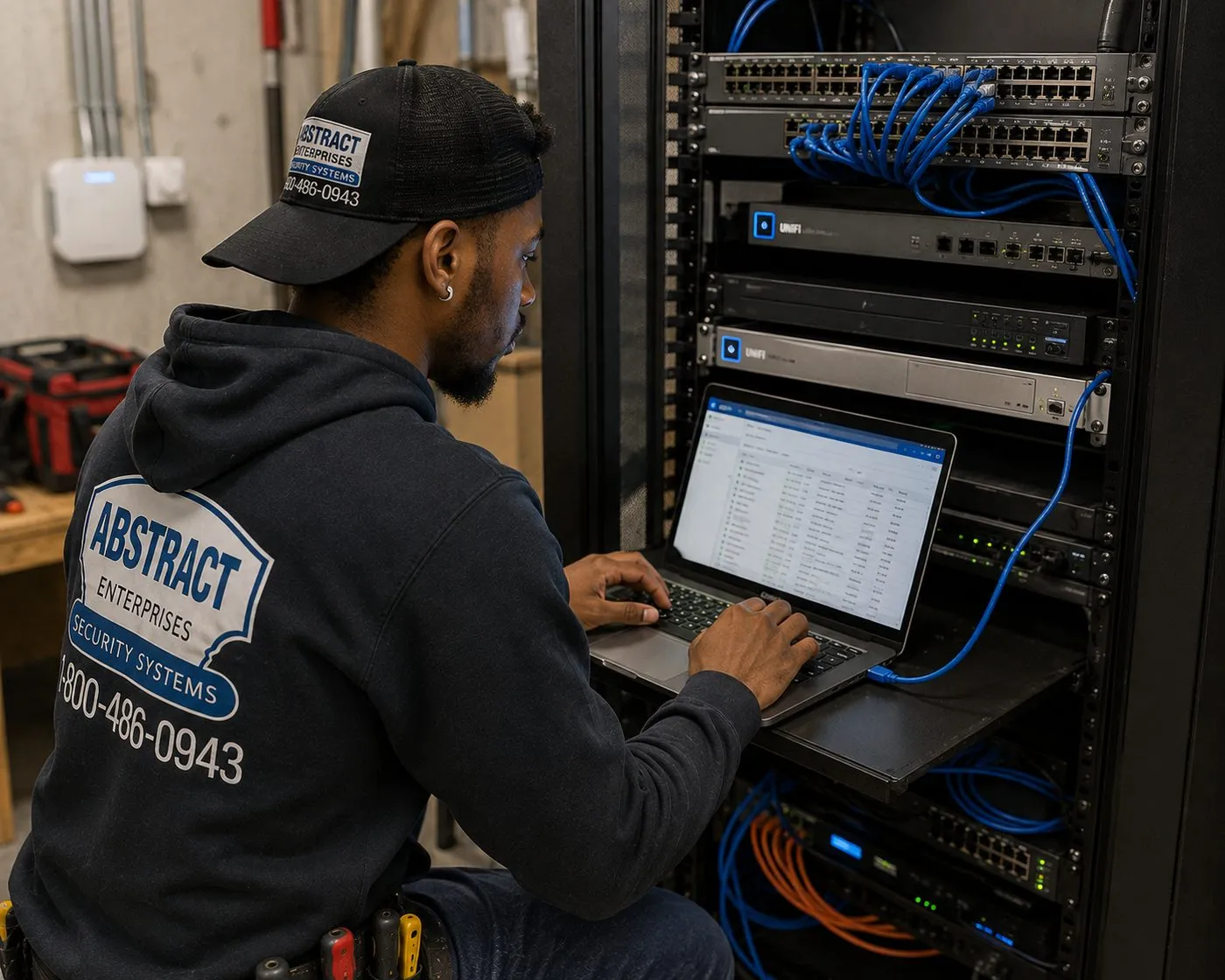
Technician configuring a network switch from a laptop in front of an equipment rack, network setup that keeps Wi-Fi soundbars stable in Manhattan buildings
A technician in a hooded top types on a laptop resting on a rack shelf, with patched network switches above it and blue cables running down the rack.
AI Overview Reality Check

What AI Gets Wrong About Soundbar Installation in Manhattan

Google's AI Overview could not be captured in our build environment, so this section tests the claims that national cost guides publish — Angi and Thumbtack among them — and the generic setup advice that AI summaries tend to repeat. Each one is reasonable for a house in the suburbs. Each one needs correcting for a Manhattan apartment.

"Expect to pay $121 to $234 to have a TV wall-mounted"

That range is Thumbtack's national average for TV wall mounting, built from jobs across the country. It describes a television on drywall over wood studs, in a house where the installer parks outside and walks in. It is a fair starting point for most of the United States.

Manhattan is a different market. Our published Manhattan base for mounting a 32-inch to 55-inch screen is $244.99 before anything else, and every Manhattan visit carries a flat $150 parking charge, so the floor for a TV is $394.99. A soundbar mounted under it on the same visit adds $129 for the mount and $84.99 if you need our Sanus bracket.

The difference isn't padding. A technician with a drill case and a bracket can't use the subway, legal commercial parking near most Manhattan addresses is scarce, and the parking-fine schedule is higher below 96th Street than elsewhere in the city. Doorman check-in, the service elevator and building paperwork add real time. A published, itemized price that includes all of that is more useful than a national average that includes none of it.

"A soundbar mount add-on runs $30 to $100"

Angi's TV cost guide lists a soundbar bracket or mount add-on at $30 to $100. As a price for the bracket hardware alone, that is roughly right; plenty of bars include a simple wall bracket in the box, and aftermarket brackets cover a range of prices.

What the figure leaves out is the labor and the wall. A bar mounted under a TV in Manhattan has to be fixed to whatever is behind the paint: prewar plaster, hollow terra-cotta block, concrete, brick or steel studs. Each of those needs a different anchor and a different drilling technique, and some need a dust plan because of the building's age. That work, not the bracket, is most of the job.

Our Manhattan menu shows both parts separately. Wall-mounting the bar is $129, a Sanus soundbar bracket is $84.99 if you need it, and the wall line is added on top: $45 for plaster, $65 for brick, $75 for concrete. If you already have a rated bracket, you skip that line entirely.

"Concealed wiring costs $75 to $300"

Angi's range for hiding TV wiring assumes a hollow wall a cable can be fished through. In a house with drywall on wood studs that is usually true, and the price range reflects how long the run is and whether an in-wall power kit is involved.

In Manhattan, the wall often decides for you. Concrete partitions in postwar towers and brick walls in tenements and brownstones have no cavity, so nothing can be hidden inside them without cutting into masonry, which no co-op board or landlord is likely to allow for a soundbar. On those walls the honest answer is a paintable cord cover at $59, or a cable route down behind the console.

Where the wall is hollow, the building may still have a view. Many alteration agreements treat opening a wall differently from hanging something on it. Our in-wall concealment, at $169 with a code-compliant in-wall power and cable kit, is for owners or tenants who have the board's or landlord's agreement, preferably in writing.

"Permits are only needed for electrical work"

Angi's guide says permits are required only for electrical work or structural changes, with fees from $30 to $100. As a description of city permits for a soundbar, that is close: the Administrative Code's § 28-105.4.7 exempts wiring below 50 volts for communication and data circuits from an electrical permit when the work is done by the people the electrical code allows, and the Department of Buildings says any change to line-voltage electrical systems needs a permit and a Licensed Master Electrician.

The trouble is that a city permit is not the approval that matters most in Manhattan. The building's own rules are. A co-op's alteration agreement, a condo's house rules or a rental lease can restrict drilling, wall openings, work hours and contractor access, and a doorman will enforce them on the day whether or not the city has an opinion.

So the practical checklist for a Manhattan soundbar is: no new outlet without a licensed electrician, which we don't provide; no wall opening without the board or landlord's agreement; and a certificate of insurance, the right hours and the service elevator booked for every visit. The city rarely gets involved; the building always does.

"Connect the soundbar to Wi-Fi and it just works"

Generic setup guides treat the network step as a formality: open the app, choose your Wi-Fi, done. In a detached house with one router and few neighbors, that is often how it goes.

In a Manhattan apartment tower, the bar may be competing with dozens of nearby networks on the same channels. Some bars are limited to the crowded 2.4 GHz band, as Sonos community posts note for the Beam Gen 2, and wireless subwoofers and surrounds rely on their own radio links. The result can be audio that drops for a second during a film, a sub that loses its pairing in the evening, or an app that can't find the bar.

Where the bar has an Ethernet port, a wired connection is the most reliable fix, and Sonos's own support pages explain how to switch between wireless and wired setups. Where it doesn't, router placement and band choice matter more than the bar's settings. We check the network as part of every Manhattan install rather than treating it as your problem afterwards.

"Book the installer whenever it suits you"

Gig marketplaces and generic advice assume your time is the only one that matters: pick an evening or a Saturday morning and someone turns up. That works when the installer can walk straight to your front door.

In Manhattan the building also has a calendar. The city's construction-noise rules allow residential construction on weekdays from 7 AM to 6 PM, and Brick Underground notes that most co-op and condo alteration agreements narrow contractor work to 9 to 5 on weekdays, with service-elevator hours often restricted at the start and end of the day. A Saturday soundbar install in a strict co-op may simply not be allowed.

Our 2-hour windows run from 8 AM to 8 PM every day, which covers both. For a strict building we choose a weekday window with time to finish before the elevator closes; for a rental building with looser rules or a townhouse, evenings and weekends are fine. We ask about this when you book, not when the doorman stops us.

"Any wall can hold a soundbar — it only weighs a few pounds"

The weight part is true. A compact bar weighs a few pounds and even a large Atmos bar is in the low teens, so the load on a wall is small compared with a television. That is why AI summaries tend to treat the wall as a non-issue.

Manhattan has walls that can't take even that. A temporary pressurized wall in a flex apartment is described by Brick Underground as supporting roughly 25 to 30 pounds and is not designed to be drilled; prewar plaster can be loose from its lath; hollow terra-cotta block crumbles under the wrong drill; glass and mirror can't be drilled at all. A light bar on the wrong fixing still ends up on the floor.

So we read the wall first: a tap test, a scan for pipes, risers and wiring, and a small test hole where the material is uncertain. Then we choose the fixing, or tell you the bar belongs on the console. The bar's weight is the easy part of the calculation.

Building Rules, Real Walls, Quiet Bass

Send the bar's model, a photo of the wall and your building's contractor rules. We send back a Manhattan price that already includes parking.

Get In Touch

Request a Free Quote

Tell us the bar, the TV, the wall and the building. A Manhattan installer reads every request and sends a written price built from the menu on this page, with the parking line already included. Rather talk it through? Ring (929) 560-0737.

✅

Request Received

Thanks — your details are with our Manhattan team, and an installer will be in touch before the end of the business day. Urgent? Ring (929) 560-0737.

How It Works

Our Installation Process

Seven steps for every Manhattan soundbar, from a compact bar on a dresser in an Inwood walk-up to an Atmos bar under a new screen in a Hudson Yards condo. Three of the seven happen before anyone reaches your door, because in this borough the building comes first.

1. Share the wall and the building

Text or email a phone photo of the TV wall with the outlet in view, the soundbar and TV models, your cross streets and what kind of building it is. Back comes an itemized Manhattan quote, parking line included, with plaster, concrete or stair charges shown if they apply.

2. Clear it with the building

Your managing agent gets an insurance certificate from us at no cost, matched to the names and limits on their sample. We also pin down contractor days, service-elevator rules and whether the desk needs a work order or a resident notice.

3. Pick a window the building accepts

Our arrival windows are two hours long and run 8 AM to 8 PM every day; we offer only the ones that fall inside your building's permitted hours with time to finish. Moving it costs nothing with a day's notice.

4. Check in and protect the space

The technician checks in at the desk with ID, takes the service elevator if the building requires it, and lays a drop cloth under the TV wall before unpacking.

5. Read the wall before drilling

A knock test and a scanner tell us whether it is plaster, block, concrete, brick or studs, and where pipes, risers and old wiring run. You approve the height and centre mark first, and the vacuum is at the bit for every hole.

6. Fix the bracket and connect

The bracket goes up on fixings suited to what the wall turned out to be, the bar is hung and checked with a level, and the cables disappear into a cord cover, an in-wall kit or behind the console. HDMI goes into eARC or ARC, and CEC is switched on so one remote does the work.

7. Settle the sound and the network

We find the sub a spot that suits the room and the ceiling below, confirm the bar holds its Wi-Fi or wired link, switch on speech and night modes, test lip-sync with a dialogue scene, wipe up, and show you the settings you will actually use.

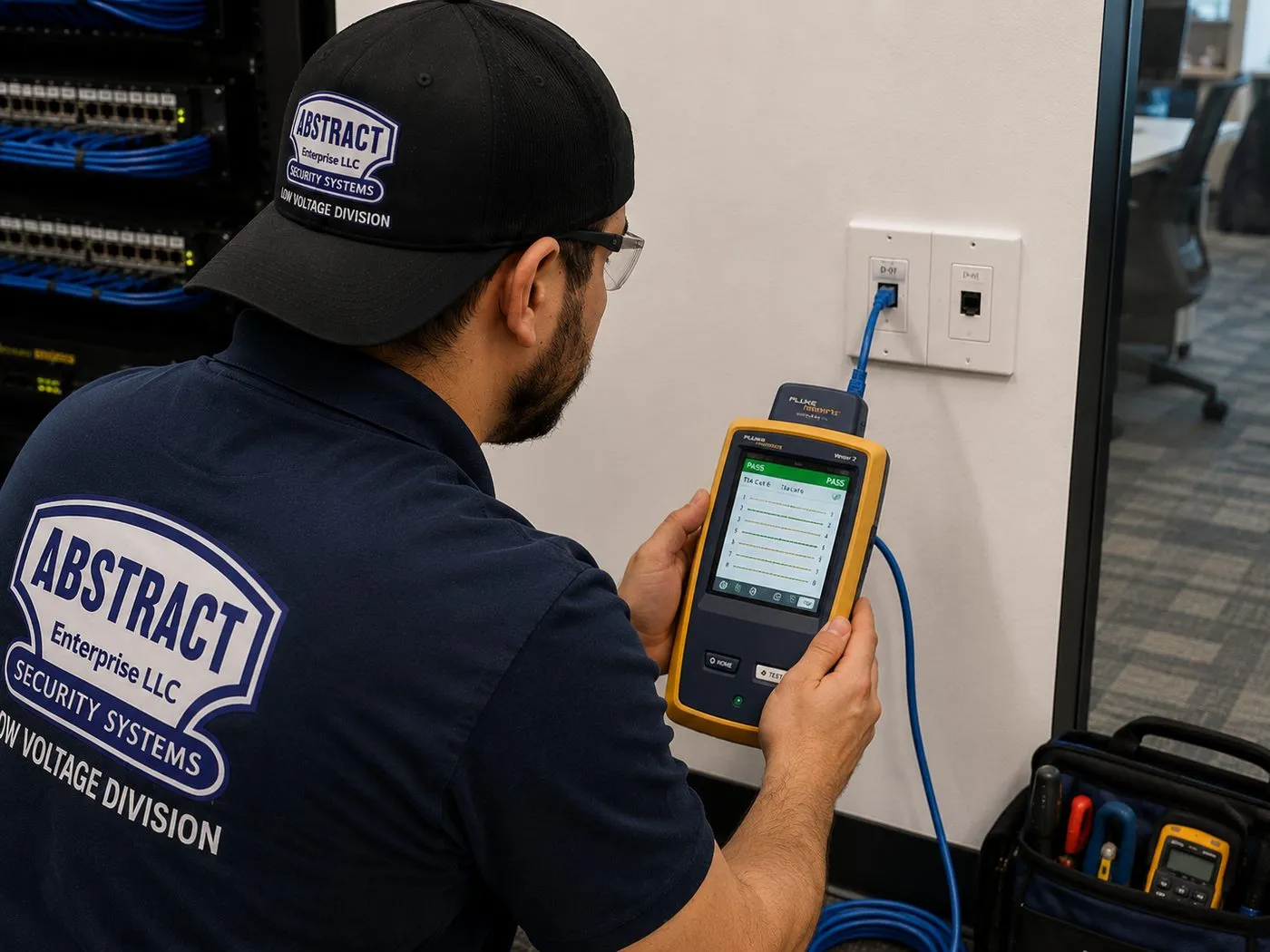
Technician reading a handheld cable certifier connected to a wall jack in an office, checking a wired link before a Manhattan soundbar goes online
A technician holds a yellow handheld certifier with a green result on its screen, its blue lead plugged into a white wall jack, with a network rack at the left and a tool bag at the right.
Coverage Area

Soundbar Installation Near Manhattan's Landmarks

Six Manhattan residential landmarks, chosen because each stands for a kind of building we mount soundbars in every week. We are not claiming work in these particular buildings; they are reference points for the walls and rules nearby.

Tudor City, Turtle Bay

A 13-building complex in Turtle Bay on the East Side, begun in 1926, with its first 12 structures completed between 1927 and 1930. Typical of 1920s apartment houses: plaster over masonry and modest living rooms.

London Terrace, Chelsea

About 1,700 apartments in 14 connected buildings of 17 to 19 stories on West 23rd Street, opened in 1930. A whole block of prewar walls under one set of building rules.

Penn South, Chelsea

A cooperative of 2,820 apartments in ten 22-story buildings south-west of Penn Station. Large postwar co-ops like it bring board rules, set work hours and concrete-era partitions.

Audubon Park Historic District, Washington Heights

Designated on May 12, 2009: 19 large apartment houses and one free-standing duplex, built between 1905 and 1931, including Emery Roth's Sutherland at 611 West 158th Street. Upper Manhattan's prewar stock at its most intact.

Riverside–West End Historic District, Upper West Side

The first extension alone covers roughly 194 buildings between West 79th and West 87th Streets, from Broadway to Riverside Drive: residential, institutional and commercial buildings, mostly older masonry, under landmark rules for exterior work.

35 Hudson Yards, West Side

A 92-story limestone-and-glass tower completed in 2019, with 143 residences that start on the 53rd floor. New-tower living at its most extreme: window walls, metal-stud partitions and a building handbook for contractors.

We also cover every neighborhood in between — Inwood, Hamilton Heights, Morningside Heights, Harlem, East Harlem, Yorkville, Lenox Hill, Lincoln Square, Hell's Kitchen, Murray Hill, Kips Bay, Gramercy, Stuyvesant Town, the Flatiron, NoMad, Greenwich Village, the West Village, the East Village, the Lower East Side, Chinatown, SoHo, NoHo, Tribeca, the Financial District and Battery Park City. Across the rivers, soundbar work in Brooklyn, Queens and the Bronx is booked through our quote form until those boroughs get pages of their own.

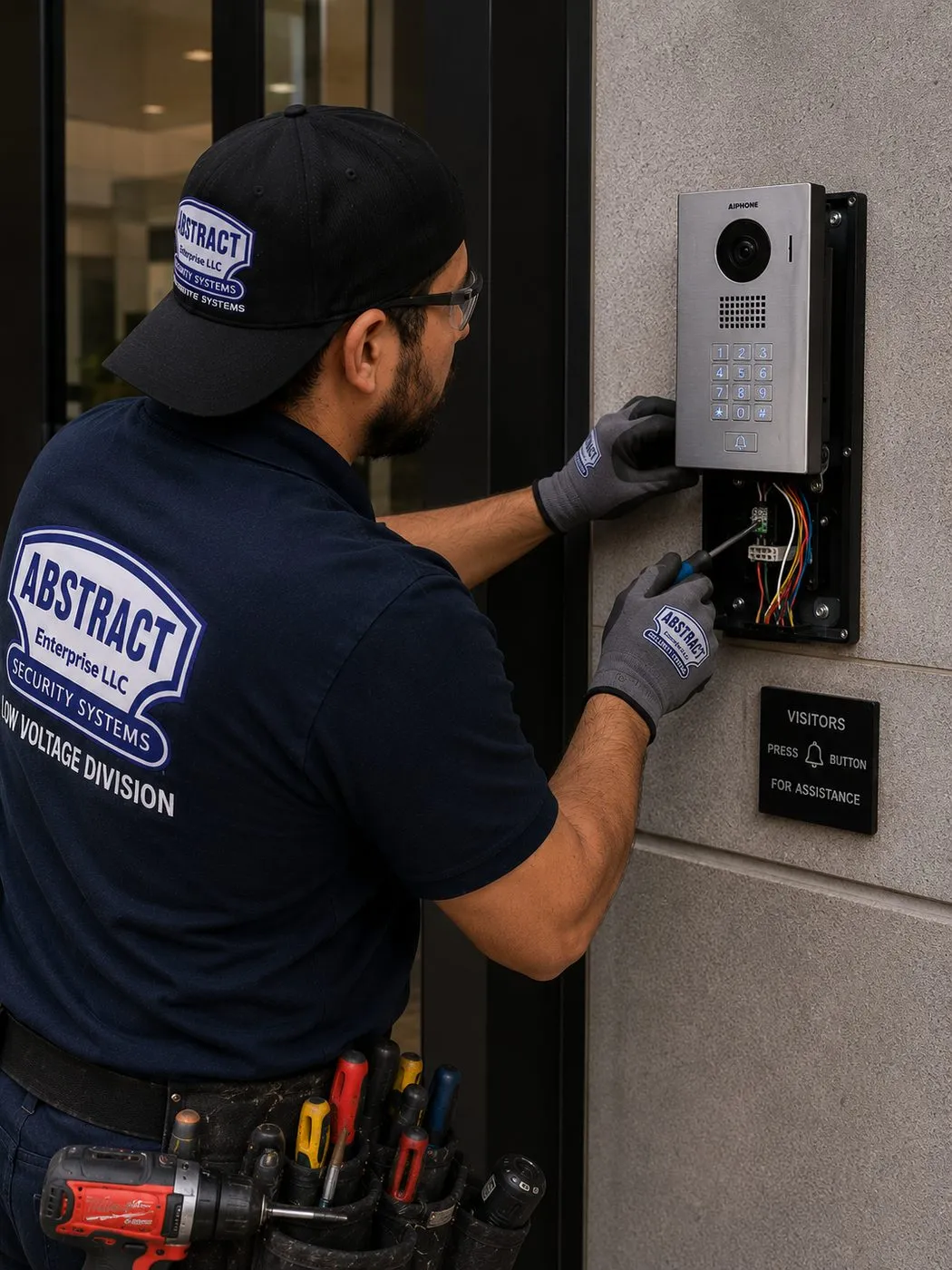
Technician wiring an open video intercom entry panel beside a glass door, building-entry low-voltage work related to Manhattan apartment access
A technician in gloves works on the wiring of an open video intercom panel mounted on a stone wall beside a glass door, with a small visitor sign below the panel.
Pricing

Soundbar Installation Cost in Manhattan

Manhattan prices are published, itemized and fixed before you book. Pick the lines that match your job, add the one parking line, and that is the bill. If something we didn't price turns up on the day — a wall that is concrete rather than plaster, say — you get the new price before any extra work starts.

Soundbar lineManhattan priceWhat it covers
Soundbar wall-mounted under the TV$129Wall read, fixings matched to it, bar hung level under the screen and tested from the sofa
Soundbar placed on a console or stand$79Sits on the media unit without blocking the TV's IR window; wired, tuned and checked
Sanus soundbar bracket$84.99Our bracket, for bars sold without one or when the boxed bracket is wrong for your wall
In-wall concealment$169Hollow walls only: an in-wall power and cable kit to code, feeding an outlet that is already there
Paintable cord cover$59Surface channel down to the outlet or console; the answer on brick and concrete
Longer cable run, up to 25 ft$99Reaching a One Connect box, cable box or router that lives elsewhere in the room
Sonos setup$125Sonos bar, sub, surrounds, app and grouping
A/V receiver$129Receiver connected and configured
Universal remote$99Programmed for the TV, bar and sources
Streaming device setup$49Apple TV, Roku, Fire TV or similar
Full home theater$350Multi-component system setup
Manhattan parking$150One flat charge per Manhattan visit, however many lines are on it

Wall, access and building lines

ConditionPrice
Drywall on wood studs$0
Drywall on metal studs+$30
Plaster+$45
Brick or stone+$65
Concrete or cinder block+$75
Tile or marble+$95
Plywood backer board$85
High mount, above about 8 ft$75
No elevator, apartment on the 3rd floor or above$40
Remove an old bracket$45
Box removal$25
Insurance certificate for the managing agentFree

Worked Manhattan examples

Typical Manhattan jobLinesTotal with parking
Bar on the console, rental studio$79 + $150 parking$229
Bar wall-mounted on drywall, our bracket$129 + $84.99 + $150$363.99
Bar on prewar plaster, our bracket$129 + $84.99 + $45 + $150$408.99
Bar on a postwar concrete partition, own bracket, cord cover$129 + $75 + $59 + $150$413
Bar on brick in a fourth-floor walk-up, our bracket, cord cover$129 + $84.99 + $65 + $40 + $59 + $150$527.99
Bar on metal studs with backer, our bracket, in-wall kit$129 + $84.99 + $30 + $85 + $169 + $150$647.99

Setup-only visits and TV mounting in Manhattan

When nothing goes on a wall — reconnecting the bar to a new TV, fixing eARC or lip-sync, putting it on a wired connection, pairing a new sub — we bill by time: $265 for the first hour in Manhattan, then 30-minute blocks, with the $150 parking line. If the TV is being mounted on the same visit, our Manhattan TV base of $244.99 for a 32-inch to 55-inch screen on wood-stud drywall applies, the soundbar lines go on top, and the visit still carries a single parking charge. A TV kept on its stand is $162.99 in Manhattan.

Inside the price, and outside it

  • In the price: identifying the wall, the mount itself, a level bar, the HDMI connection and CEC set-up, a check that the network holds, tidy cables behind the screen and a clean floor when we leave.
  • Not included: new or moved outlets, which are a Licensed Master Electrician's work under city rules; patching and painting holes; moving heavy furniture.
  • Wasted visits: when the technician is turned away at the desk, the building's sign-off isn't in place, or the bar or bracket hasn't arrived, the $150 return-trip fee applies. Give us 24 hours and moving the date costs nothing.
  • Walls that can crack: marble, tile and century-old plaster sometimes fracture at the drill however gently it is done. You hear that from us before the first hole, and the call is yours.
  • Parts: brackets and parts carry their manufacturer's warranty; the full terms are in the service agreement described below.
Shop Our Systems

Soundbar Installation Packages & Pricing

Most Manhattan quotes settle on one of three shapes. Every card shows its arithmetic, including the flat $150 parking line, so you can check it. Wall lines for plaster, brick or concrete and the walk-up charge are added on top where they apply.

Starter — Console Bar for a Rental

$229

Soundbar placed on the console ($79) + Manhattan parking ($150) = $229. Connected to eARC or ARC, CEC switched on, network checked, cables tied off. No holes, nothing to explain to the landlord.

Standard — Wall Mount With Bracket

$363.99

$129 to hang the bar + $84.99 for our Sanus bracket + $150 parking = $363.99, on drywall. The commonest Manhattan walls add their own line: $45 for prewar plaster, $65 for brick, $75 for a concrete partition.

Premium — Wall Mount, Bracket and In-Wall Wiring

$532.99

$129 to hang the bar + $84.99 bracket + $169 for in-wall power and cable to code + $150 parking = $532.99. Only for a hollow wall, and only where the owner, board or landlord has said yes to opening it.

Bring Your Own Equipment — Labor Only

Most bars ship with a wall bracket, and many people already own a better one. Supply it and you pay labor only: $129 to hang the bar, the wall line if there is one, and the $150 parking charge — $279 on wood-stud drywall. Your bracket has to be rated for the bar's weight and is covered by its own maker's warranty, not ours. If it turns out wrong for the wall, you hear it before any drilling, with our Sanus bracket as the alternative.

Ready for a Manhattan Price in Writing?

A wall photo and the bar's model are enough to start. Parking is already in the number we send.

Uptown to Downtown

How Soundbar Jobs Change Across Manhattan

The same bracket goes up in Inwood and in Tribeca, but the buildings around it change every few dozen blocks. This is what we plan for in each part of the island.

Inwood and Washington Heights

Upper Manhattan is prewar apartment-house country: six-story walk-ups and larger elevator buildings from the first decades of the twentieth century, many in or near the Audubon Park and other historic districts. Plaster over brick or block is the usual TV wall, and steam radiators sit under most windows. Walk-ups mean the $40 stair line, and families in larger apartments make the lead-dust routine particularly important.

Harlem, Hamilton Heights and East Harlem

Brownstone and rowhouse blocks, often split into a duplex and rental floors, sit alongside large apartment buildings and newer developments on the avenues. In a brownstone the TV wall may be a masonry party wall and the floor wood joists over a tenant's ceiling, so the subwoofer gets as much thought as the bracket.

Upper West Side

Prewar co-ops on Riverside Drive, West End Avenue and Central Park West, brownstone side streets, and postwar towers on Broadway and the avenues. Co-op rules and work hours shape most visits; the walls are plaster on block or brick in the older buildings and concrete in the newer ones.

Upper East Side and Yorkville

Prewar co-ops on Park, Fifth and Madison, white-brick postwar doorman towers along First, Second and Third Avenues, and tenement walk-ups on the Yorkville side streets. Doorman check-in and certificates of insurance are near-universal, concrete partitions are common in the towers, and medical waiting rooms on the side streets account for many commercial requests.

Midtown, Hell's Kitchen and Murray Hill

Hell's Kitchen mixes tenement walk-ups with new rental towers and the bars along Ninth Avenue; Midtown East adds office floors and office-to-residential conversions on Third Avenue; Murray Hill is postwar doorman buildings. Expect strict building hours for the towers and offices, and noise limits that matter for bars with apartments above.

Chelsea, the Flatiron and Gramercy

Large complexes such as London Terrace and Penn South, loft buildings in the Flatiron and along lower Fifth, and townhouses on the side streets. Loft conversions bring high ceilings and exposed brick; the big co-ops bring board rules and set hours.

Greenwich Village, the East Village and the Lower East Side

Townhouses and small prewar buildings in the Village, five- and six-story tenements in the East Village and on the Lower East Side, and a scattering of newer glass buildings. Narrow living rooms, brick party walls and walk-up stairs are the norm; compact bars and cord covers are the usual answer.

SoHo, NoHo and Tribeca

Loft floors in former commercial buildings: tall ceilings, columns, exposed brick and open plans where the TV may stand on its own mount in the middle of the room. Bass carries through these floors, so subwoofer isolation and placement are part of every visit, and showrooms add commercial requests.

The Financial District and Battery Park City

Office towers still in commercial use, a fast-growing number of converted office buildings on Water, Wall and Broad Streets, and postwar and newer residential towers in Battery Park City. New metal-stud partitions in old concrete frames, crowded Wi-Fi and building handbooks that set exactly when contractors may work.

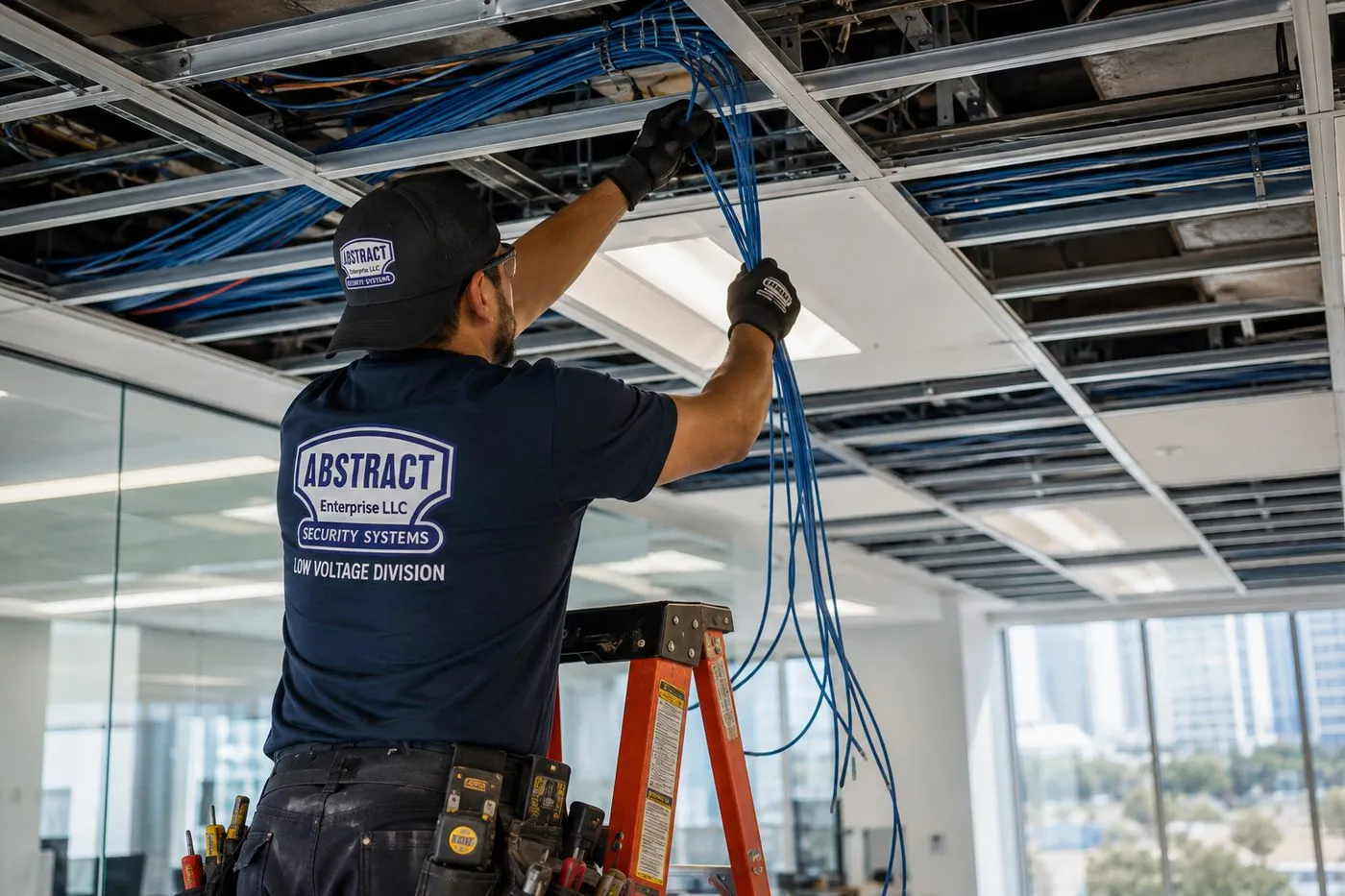
Technician on an orange ladder pulling a bundle of blue cable through an open ceiling grid in an office with tall windows, AV and soundbar cabling pathway in Manhattan
A technician on an orange stepladder reaches into an open ceiling grid, guiding a loose bundle of blue cable down towards the floor of an office with glass partitions and tall windows.
Matching Bar to Room

Choosing a Soundbar for a Manhattan Room

Manhattan rooms reward the right-sized bar more than the biggest one. If you haven't bought yet, this is how we would match a bar and mount to the rooms we see most. It is guidance from installing, not a product endorsement; any mainstream brand in the right class will do.

RoomBar classSubwoofer?Usual mount
Studio or alcove studio, sofa 6–8 ft from the screenCompact or mid-sizeUsually not; the bar's own bass is enoughTV-attached bracket on a swinging arm, or console
One-bedroom living room in a postwar towerMid-size smart barOptional, on a pad and set lowWall bracket on concrete, cord cover
Prewar living room with high ceilingsMid-size or flagshipOptional; mind the joists and the neighbor belowWall bracket on plaster over masonry
Glass-tower living roomMid-size or flagship with room calibrationOptionalWall bracket on metal studs or a backer
Loft with a free-standing TVFlagship or mid-sizeOnly with isolation, away from the floor's spanClamped to the TV stand or mount
Bedroom or flex roomCompactNoDresser or console
Small office conference roomMid-size bar with clear speech modeNoWall bracket under the display
Bar or restaurant screenMid-size, one per screenNoWall bracket, volume capped

Three rules of thumb hold across the table. A bar roughly as wide as the screen, or slightly narrower, keeps the sound anchored to the picture. Up-firing height effects need a flat ceiling above the bar and some clear space over it, so they suit a prewar living room better than a loft with exposed beams. And in a building with neighbors on every side, a bar without a separate subwoofer, set up well, is often the more comfortable choice for everyone — including you, when the neighbor upstairs is the one with the subwoofer.

Whatever you choose, keep the box and the receipt until the install is done. If the bar arrives damaged or doesn't suit the TV's ports, it is far easier to return before it is on the wall.

Complete Services

Every Soundbar Installation Service in Manhattan

A soundbar visit in Manhattan is often the first job of several: a new apartment needs its TV hung, its network wired and sometimes its front-door intercom sorted out. These Manhattan services work from the same office and the same insurance certificate.

TV Installation Manhattan

Hanging the screen itself, on fixings for prewar plaster, postwar concrete or condo steel studs, at a height that leaves the bar room beneath.

Abstract Enterprises TV Mounting Prices in Manhattan

The full Manhattan TV price list by screen size and wall, with the parking line explained.

AV & Sound Installation Manhattan

For townhouse dens and renovated co-ops that want in-ceiling speakers, a receiver and proper surround rather than one bar.

Structured Cabling Installation in Manhattan

A wired network point at the TV wall, for bars that drop off crowded building Wi-Fi.

AESS Low-Voltage Installation, Manhattan

The wider trade behind this page: data, door-entry, camera and audio wiring across the borough.

Network Cable Repair Manhattan

When the jack behind the TV is dead or the cable to the router has failed.

Intercom Installation in Manhattan

Video and audio entry systems for townhouses, walk-ups and lobbies.

Soundbar and TV Service Policies

The fine print on arrival windows, the $150 return-trip fee, free rescheduling and hourly setup.

Field Notes

Field Notes From Manhattan Soundbar Walls

How our installers work through a Manhattan apartment before the drill comes out — standing practice, not the story of one job

The visit starts in the lobby. The technician confirms with the desk that the certificate of insurance is on file and the apartment is expecting us, asks which elevator to use, and checks whether there is anything the super wants to say about the wall. In a strict co-op that conversation decides more than anything we do upstairs.

In the apartment, the first look is at the radiator, the windows and the floor. A radiator under the TV wall changes where the bar can sit; a window wall changes how it will sound; bare boards with an apartment below change where the sub can go. Only then does the wall get its knock test and a scan for pipes, risers and old wiring.

If the building is older than 1960, the drop cloth goes down and the vacuum goes on before the first hole. Afterwards, before the bar is even on its bracket, the network gets checked from the TV wall, because in a tall building the most common complaint a week later isn't the mount — it's the sound cutting out when the neighbors get home and switch everything on.

FAQ

Manhattan Soundbar Installation FAQ

What would a wall-mounted soundbar on prewar plaster total in Manhattan, parking included?
+

Wall-mounting the bar is $129, a Sanus soundbar bracket is $84.99 and plaster adds $45, which makes $258.99. The flat $150 Manhattan parking charge brings it to $408.99. If you already own a rated bracket, drop the $84.99 and the total is $324. A walk-up above the second floor adds $40 to either figure.

When is a Manhattan soundbar visit billed by the hour instead of by the item?
+

When nothing gets mounted. Reconnecting a bar after a new TV arrives, sorting out eARC or lip-sync, pairing a subwoofer or moving the bar onto a new network is a setup-only visit: $265 for the first hour in Manhattan, then 30-minute blocks, plus the $150 parking charge. As soon as a bracket goes on a wall, the itemized install prices apply instead.

Do you cover upper Manhattan as well as Midtown and downtown?
+

Yes. Our Manhattan work runs from the Battery and the Financial District up through Harlem, Washington Heights and Inwood. The prices are the same at either end of the island, including the one flat $150 parking charge per visit, so an Inwood walk-up and a Tribeca loft are quoted from the same menu.

My landlord is repainting the apartment — can you take the soundbar down and put it back afterwards?
+

Yes, and it is worth planning, because city rules require landlords to repaint occupied apartments in buildings of three or more units every three years. Book one visit to take the bar and bracket down before the painters arrive and a second to rehang it once the paint has cured. Each visit is priced from our menu and carries its own Manhattan parking line.

Will you remove the old bracket a previous tenant left on the wall?
+

Yes. Taking down an old bracket is $45 on our price list. We back the screws or anchors out cleanly and leave the holes ready for filling. Patching and painting are not part of our price, so if the old holes will show beneath the new bar, tell your painter or super before the appointment.

Can you install soundbars in a building's lounge, gym or screening room?
+

Yes. Amenity rooms in co-ops, condos and rental towers are billed like any other job from the same menu, and we take instructions from whoever the managing agent names. Shared rooms usually need the bar's volume capped and its remote kept by staff, and we set both up before handing over.

Can you add a subwoofer or rear speakers to a soundbar that is already up?
+

Usually, if the bar's maker sells a matching sub or surrounds for it. Pairing and placing them is setup work, so a visit for that alone is billed at the Manhattan setup-only rate. Before booking, check that the add-on is listed as compatible with your exact bar model, and that there are outlets where the rear speakers would sit.

My TV stays on its stand — can the soundbar still go on the wall?
+

It can, but it rarely looks or sounds right unless the wall position lines up closely with the screen. With a TV on a stand, the bar usually works best on the console just in front of it, which is our $79 placement. If you plan to mount the TV later, we can mark a bar height that will suit both.

All Areas Served

Soundbar Installation Across New York City and Beyond

This is our Manhattan page. The five-borough overview sits on our New York City soundbar hub, and the two suburban regions have hubs of their own. Pages for the other boroughs are still being written; until they go live, those links open our quote form.

New York City

Soundbar installation across NYC — the five-borough hub. Other boroughs: Brooklyn · Queens · the Bronx · Staten Island

Long Island

Long Island soundbar installation — Nassau and Suffolk counties.

Hudson Valley

Soundbar installation in the Hudson Valley — Westchester, Rockland, Orange, Putnam, Dutchess and Ulster.

For everything else we install, see all Abstract Enterprises services or read about Abstract Enterprises Security Systems.

Soundbar Acting Up Somewhere in Manhattan?

Uptown or downtown, if the bar has lost its picture-to-sound sync, its subwoofer, its Wi-Fi or its grip on the wall, the Manhattan line is (929) 560-0737. Tell us the building and the symptom; the next free 2-hour window is yours, and most faults of that kind take one to two hours to put right on site.

Soundbar Installation Manhattan — Licensed, Insured, Building-Ready

Abstract Enterprises Security Systems · 460 E Fordham Rd, Bronx, NY 10458 · Manhattan line (929) 560-0737 · WhatsApp (718) 679-0359 via wa.me

NYS Low-Voltage License #12000287431 · 100% Licensed & Insured · Same-Day Estimates · Rated 4.7★ from 201 Google Reviews

Brackets and parts carry their manufacturer's warranty. Full terms — including 50% deposit, one-year parts-only warranty on AESS-supplied products, and the late-fee schedule — are set out in the service agreement. See our warranty page.

Page reviewed and updated October 17, 2026. Changelog: page launched October 2026 — Manhattan-specific building types, approvals, Wi-Fi guidance and published prices with the parking line.