Queens living rooms come in every shape the city builds: attached brick houses in Ridgewood and Middle Village, two-families in Woodhaven and Ozone Park, garden co-ops in Glen Oaks and Fresh Meadows, Mitchell-Lama towers in Jamaica and glass high-rises over Court Square. We put soundbars up in all of them — anchored for the wall we actually find, wired so nothing hangs, connected so the TV remote runs the volume, and tuned so voices stay clear even when a LaGuardia departure or the 7 train goes past the window.
Reviewed and updated October 17, 2026 · Written by Anwar Timothy, NYS low-voltage license #12000287431
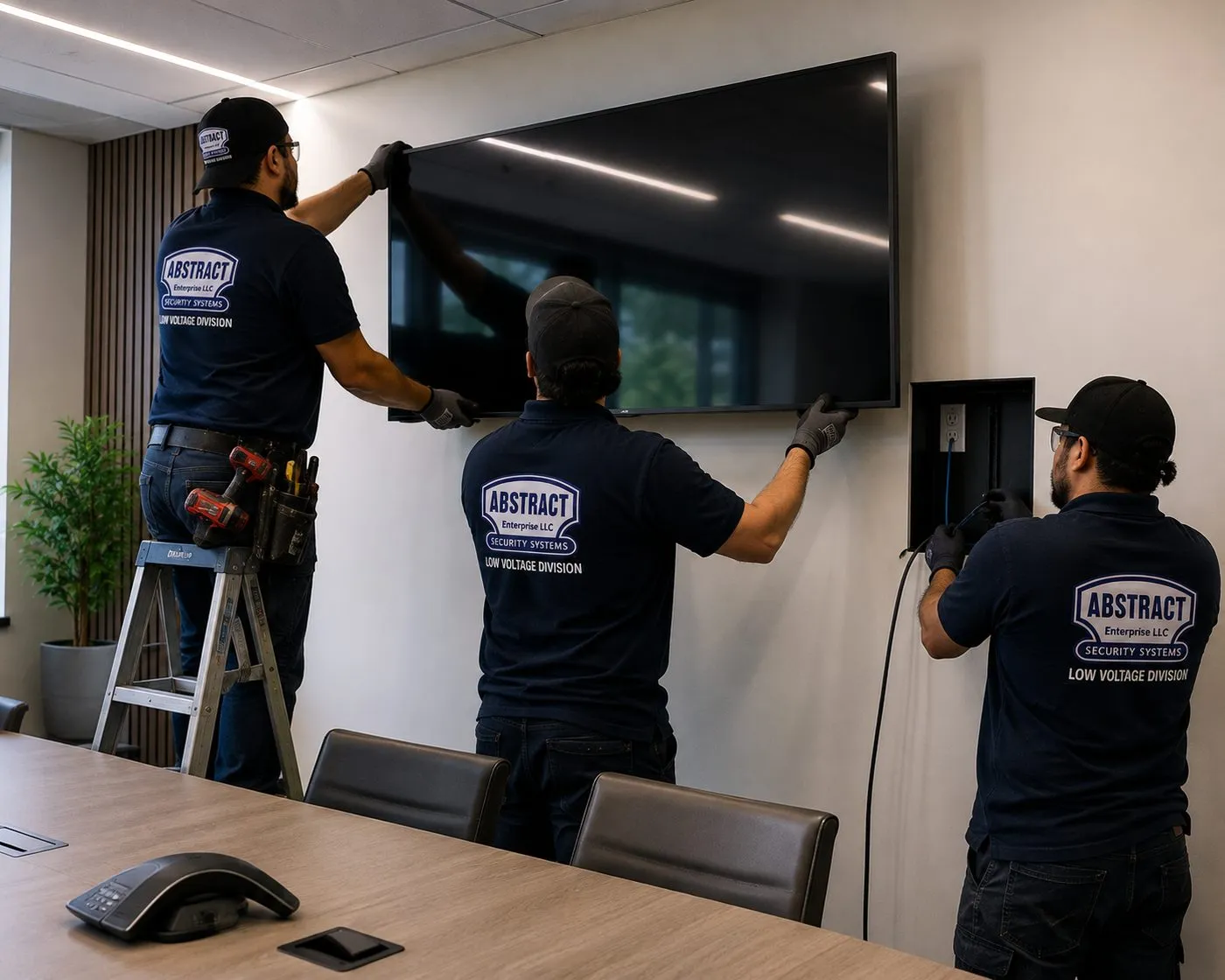
Two technicians guide a flat display onto its wall plate while a third feeds a cable out of a recessed box below it — the same spot where a soundbar's HDMI and power are planned before anything is drilled.
Free Queens Soundbar Quote
Bar model, wall type and neighborhood — a written price comes back the same business day
✅
Request Sent!
A Queens installer will call you back the same business day.
25+
Years Experience
✓
Same-Day Estimates
100%
Licensed & Insured
4.7★
201 Google Reviews
Planning the TV corner this week? Phone (347) 434-6392 or send the 60-second form with the bar's model and a picture of the wall. Nobody guesses: a licensed installer reads it and answers with a written Queens total, itemised from the price tables lower down.
Wall-mounted under the TV from $135.45 on the Queens price list
Certificate of insurance for a co-op or managing agent at no charge
State low-voltage license 12000287431 · we turn up inside the 2-hour slot you pick, mornings to evenings
Queens is the borough where the noise problem often runs the other way. Elsewhere in the city the usual worry is a subwoofer bothering the people downstairs. Here a family in East Elmhurst or Flushing may be fighting to hear a news anchor over a jet climbing out of LaGuardia, and a renter on Roosevelt Avenue hears the 7 train pass every few minutes from a steel elevated structure outside the window. A soundbar that is badly placed or set up with its factory defaults does very little against that. One that sits close under the screen, aimed at the couch, with its speech setting switched on and the volume behavior adjusted for a loud street, makes the difference between following the story and reaching for the remote every time a plane comes over.
The housing is the second reason the job changes here. Close to half of Queens homes are owner-occupied, and the borough has enormous variety in how its homes were built. The attached brick houses of Ridgewood were put up after the 1905 fire-code changes with load-bearing masonry walls, so the side walls of a front room are often solid brick under a coat of plaster. Two-family houses in Woodhaven, Ozone Park, Corona and Maspeth have one household above another, and in the older ones the number of outlets in a room is something we check before promising any cable route. Garden-apartment co-ops in Glen Oaks, Bayside and Jackson Heights pair older plaster with a board that has its own contractor procedures. And the towers that have gone up in Long Island City over the last fifteen years swap all of that for concrete, metal studs and floor-to-ceiling glass, which leaves surprisingly little solid wall for a television and a bar beneath it.
Then there are the people in the room. Close to half of Queens residents were born outside the United States, and more than half of residents five and older speak a language other than English at home, according to the Census Bureau. That means many living rooms where a grandparent watches news in one language and the grandchildren stream in another, where someone wears hearing aids, and where the TV is on from breakfast to bedtime. For those households the soundbar setup is about clarity more than volume: a dedicated center channel, dialogue enhancement, the right audio track coming through from the cable box or the app, and controls simple enough that everyone in the house can use them.
Residents' own words point the same way. In an r/Queens thread from someone weighing an apartment in Jackson Heights, a reply warned that "the train will be loud" if the place is right on Roosevelt, and another thread about the same strip noted that living along Roosevelt Avenue "is going to be super loud because of all the bars and the train". Long Island City renters near the 7 describe it more kindly — one wrote that it "was always like feint white noise with the window shut" — but nobody describes it as silent. A Queens soundbar install starts by asking where the noise comes from, which wall faces it, and what the household is trying to hear.
None of this means a big, expensive system. Most of the soundbars we install in Queens are mid-size bars on a bracket under a 55- to 75-inch TV, with or without a wireless subwoofer. What makes them work is the half-hour of judgment before the drill comes out: which wall, what is behind it, where the outlet is, what the neighbors share, and how the household watches.
Queens figures that shape a soundbar job
2,358,182 residents in 934,750 housing units, with an average of 2.72 people per household and 18.4 percent of residents aged 65 or older (U.S. Census Bureau QuickFacts, 2025 estimates and 2020–2024 survey). More people per room, more of them older, and more hours of TV a day.
55.4 percent of Queens residents aged five and up speak a language other than English at home, and 47.6 percent are foreign-born (Census QuickFacts, 2020–2024). The Endangered Language Alliance has estimated that as many as 800 languages are spoken in New York City and that nowhere has more than Queens.
44.9 percent of Queens homes are owner-occupied (Census QuickFacts) — which is why questions about in-wall wiring, brick anchoring and the rest of the house come up so often on Queens calls.
9,787 people in 3,655 households lived inside the 65–70 decibel aircraft-noise band around LaGuardia in the Port Authority estimate reported by Gotham Gazette, with the contours spreading over East Elmhurst, Jackson Heights and Flushing. Residents under the “Tennis Climb” departure route over Bayside and Flushing told the New York Post in 2024 that they hear jets for as much as 18 hours a day.
About 42 percent growth in housing units in Long Island City, Sunnyside and Woodside between 2010 and 2023, the largest of any neighborhood in the city, to about 66,700 units (New York State Comptroller, 2025). Thousands of those living rooms are in concrete-and-glass towers.
11 of 12 people confirmed dead in New York City after the remnants of Hurricane Ida in September 2021 were from Queens, and 10 of them lived in basement apartments (Queens Daily Eagle). Basement dens and media rooms in flood-prone parts of the borough need their electronics planned with that in mind.
Read together, those numbers describe a borough of crowded, multilingual, often multigenerational households, living in a mix of houses and towers, with a lot of outside noise and a real flood risk at the lowest level. That is the brief a Queens soundbar installation has to meet.
Most Queens households that call about a soundbar are putting up or moving the TV at the same visit. Our Queens TV installation crew mounts the screen and the bar together so heights and cable routes are planned once, and when a bar is not enough — rear channels, a receiver, a basement theater — AESS audio and sound installation in Queens picks up the bigger system.
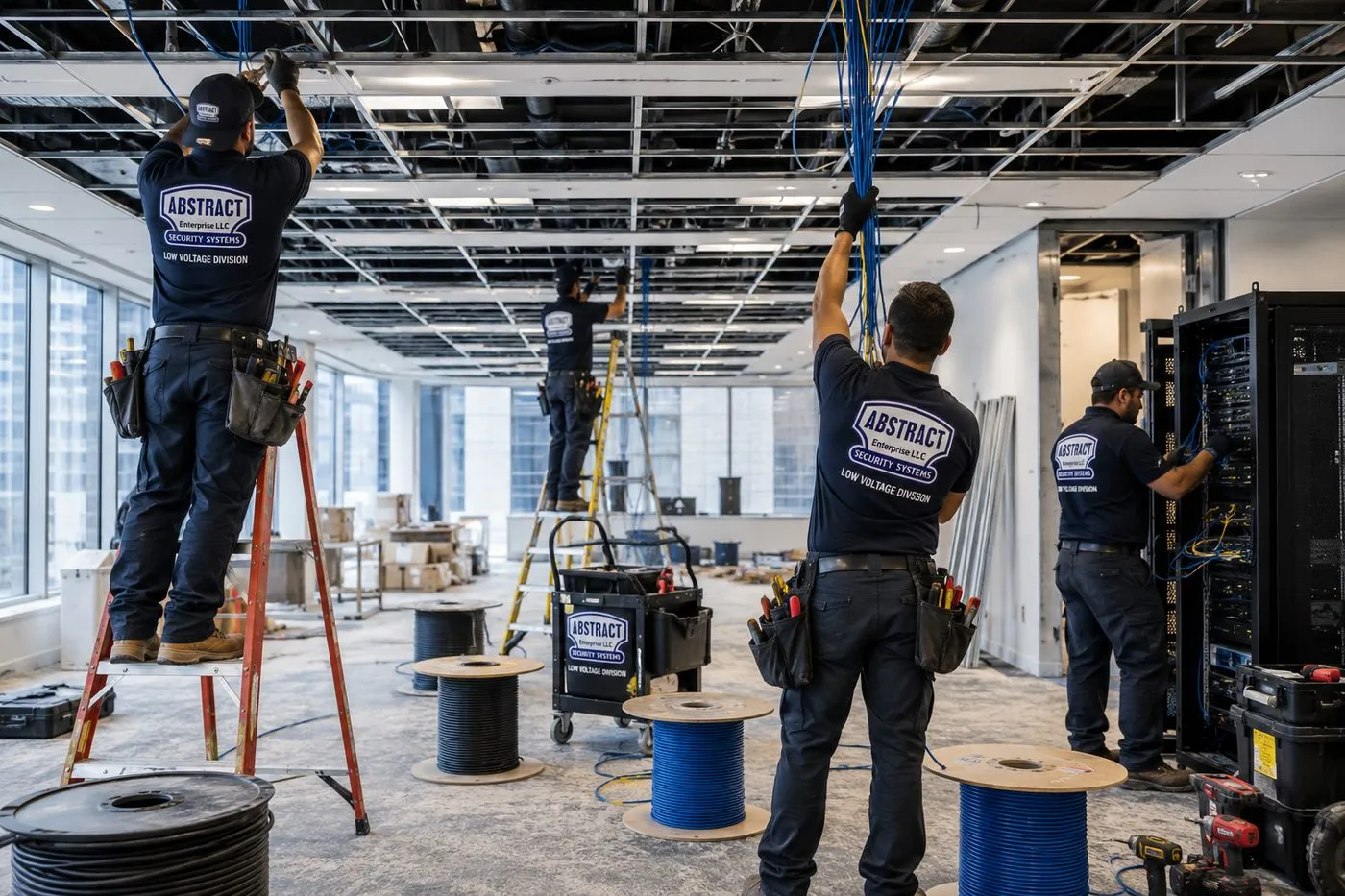
A wide shot of a stripped-out floor: a pair of ladders with a technician on each pushing blue cable overhead, a third man between cable reels, and a fourth working at a black rack near the doorway.
Repair Capture
Need a Soundbar Fixed in Queens?
A bar that lost its sound after the TV updated itself, a remote that no longer turns the volume up, voices that arrive a beat after the lips move, a subwoofer that stopped pairing, or a bracket starting to lean out of old plaster — those are repair visits, and we treat them as such. We book them into the next open 2-hour window, often the same day, and most connection, pairing and control faults are put right in one to two hours once a technician is in the room. Call (347) 434-6392, say it is a soundbar problem, and tell us the TV and bar models so the right cables come with us. How setup-only visits are billed is set out in our TV and soundbar service policies.
What We Install
Soundbar Installation Services in Queens
Pick from these nine jobs, alone or combined. Each is priced on the Queens list, and none is finished until the bar sits level and centered, no lead is left dangling, the TV remote moves the volume, and the person who watches most has heard a scene from their own seat.
Under-TV Wall Mounting
The bar on a bracket a few inches beneath the screen, fixed with anchors chosen after we know the wall: masonry sleeves in Ridgewood brick, toggles in co-op plaster, steel-stud fasteners in a Long Island City partition.
Console Placement and Hookup
No drilling at all. The bar sits on the media unit, connected and set so it clears the TV's infrared sensor, with cables tied off behind the furniture — the usual answer in rentals and in rooms where the TV is on a stand.
Bars Hung From the TV Mount
A bracket that clips the soundbar to the television or its arm, so the pair move together and the wall gets no new holes. Useful in co-ops with drilling limits and on full-motion arms in corner layouts.
TV and Soundbar Together
Screen and bar planned as one job, so the viewing height, the gap between them and the single cable route down to the outlet are decided once. Common when families move into a new Queens apartment or replace an older TV.
Concealed Cabling
Where the TV wall is hollow — studs in a frame house, steel framing in a newer building — an approved in-wall kit carries the television's and bar's power plus the HDMI out of sight. Solid brick and block rule it out.
Surface Raceway
A slim paintable channel from the bar down to the outlet or console, painted to match. The finish we use on brick, block and concrete, and for renters who cannot open a wall.
eARC, CEC and Audio-Track Setup
The bar connected to the TV's eARC or ARC socket, HDMI-CEC turned on so one remote works, lip-sync corrected, and the TV and cable box set to pass the audio track — including a second-language track — the household actually uses.
Dialogue and Hearing-Friendly Tuning
Speech enhancement, night mode and volume leveling set and demonstrated, with the bar placed to throw voices straight at the seats. We also check how the TV can feed a hearing-aid streamer alongside the bar.
Subwoofer, Surrounds and Relocation
Pairing wireless subs and rears, choosing positions that give even bass without flooding the floor below, and moving an existing bar and bracket to a new room or a new Queens address on the right anchors for the new wall.
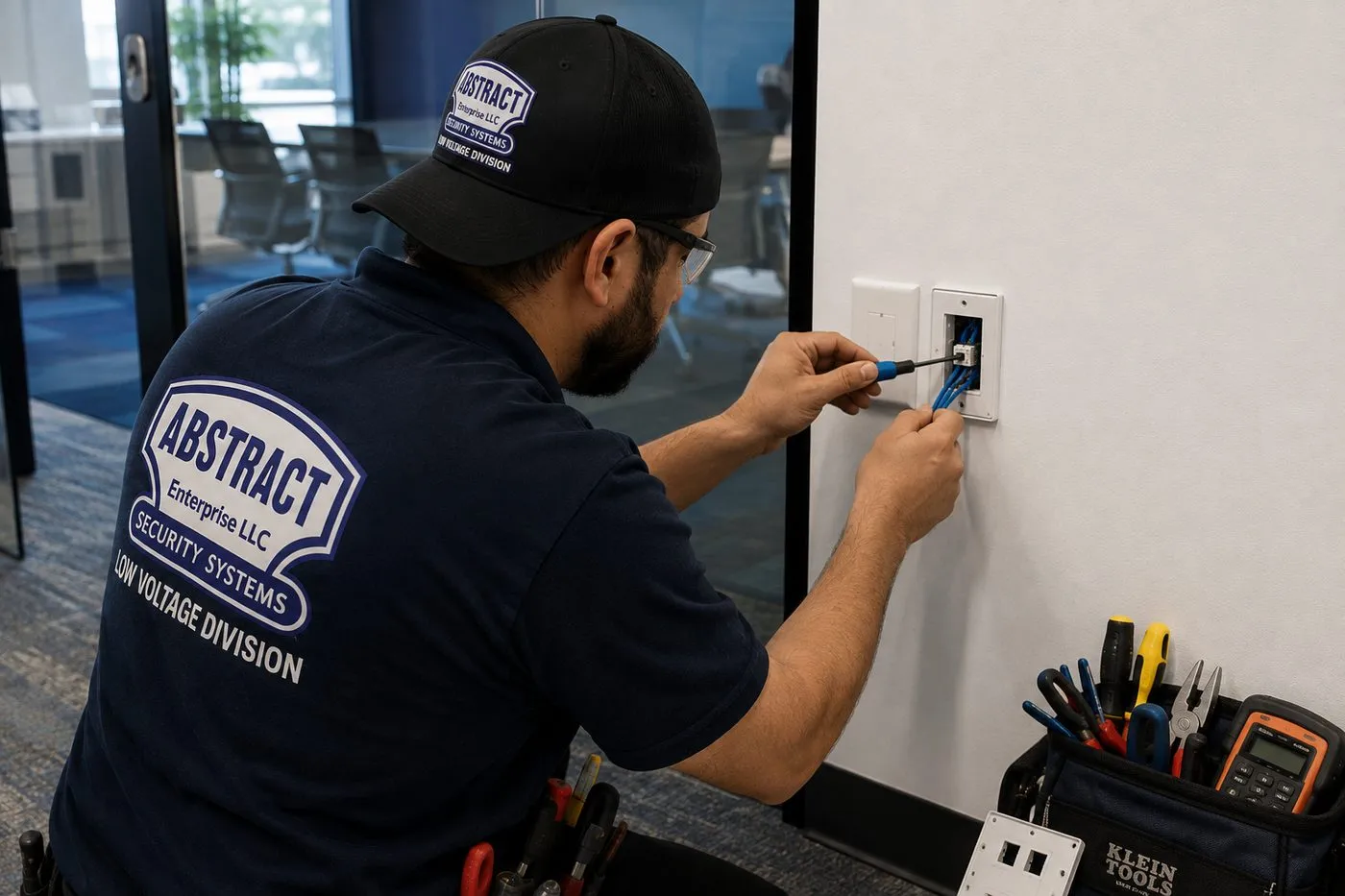
A technician kneels at a white wall plate, seating a blue cable into the jack with a tool, with a tool pouch and spare plates on the floor beside him — the kind of low-voltage connection point we plan behind a TV and soundbar.
Building Specialists
Soundbar Installation for Queens' Architecture
A soundbar weighs a few pounds; the building around it decides how the job goes. These six kinds of Queens homes cover most of the calls we get, and each asks something different of the mounting, the cabling and the sound setup.
Attached Brick Row Houses
Ridgewood's brick blocks — 990 buildings in the Central Ridgewood Historic District alone, with load-bearing masonry walls — and the attached houses of neighboring Glendale, Middle Village and Maspeth. Where the wall is brick under plaster there is no cavity to hide wire in, and the house next door is on the other side.
Two-Family and Three-Family Houses
Frame or brick houses across Woodhaven, Ozone Park, Corona, Elmhurst and Astoria with the owner on one floor and a tenant on another. The TV wall may be wood studs, the floor is shared with another household, and outlets in older rooms can be few and far apart.
Detached Houses in Eastern Queens
Bayside, Douglaston, Little Neck, Whitestone and Hollis homes with drywall or plaster on wood framing, basements and space for a subwoofer that is not above anyone's bedroom. The closest thing to suburban work in the borough — and the most likely place for a full in-wall job.
Garden-Apartment Co-ops
Low-rise brick complexes around lawns and courts, such as Glen Oaks Village with 2,904 apartments in 134 buildings, and the older courts of Sunnyside Gardens and Jackson Heights. Plaster walls, steam radiators, a board or management office, and neighbors through the wall.
Mid-Century Tower Complexes
Large post-war developments such as Rochdale Village's twenty 13-storey buildings in Jamaica and LeFrak City's twenty towers in Corona. Block and concrete walls, management rules about contractors, and plenty of televisions on walls that need a hammer drill.
Long Island City and Astoria High-Rises
Concrete frames with metal-stud partitions, window walls on one or two sides, and condo or rental rules set by managing agents. The solid wall that will take a TV and bar is often the demising wall shared with the next apartment, or a narrow stretch between windows.
Matching the fixing to the Queens wall
Brick under plaster in a row house. The plaster is a thin skin; the strength is in the brick behind it. We find the brick face by drilling a small pilot through the plaster, then set masonry sleeve anchors into the solid brick rather than the softer mortar joint wherever the bracket spacing allows. Older Queens brick varies a lot in hardness from course to course, so we drill each hole slowly and check that the anchor bites before loading it. The cable run goes on the surface in a painted raceway, because there is no hollow space to fish a wire through.
Wood studs in a two-family or detached house. The easiest wall in the borough to mount on and the one most suited to hidden cabling. We locate the studs with a scanner, confirm with a small test hole if the scanner is unsure, and fix into wood. Where the bar's bracket holes don't line up with a stud, hollow-wall toggles rated for the load go into the board. Before cutting any opening for in-wall cabling we check for plumbing and wiring in the bay, because two-family houses often have pipes running up to the floor above.
Plaster in garden co-ops and pre-war apartments. Plaster on metal or wood lath, sometimes over block. It holds well if it is still keyed to the lath and drilled without hammer action; it cracks if it is struck or if a screw is driven into nothing. We tap and press around the area first, then use toggles behind the plaster or fix through to the framing, and we keep the bar off the wall above a radiator wherever the room allows.
Block and concrete in tower complexes. Hammer drill, carbide bit, concrete or sleeve anchors and a vacuum at the hole. It is the strongest fixing we make and the noisiest, so we plan it inside the building's permitted work hours. Cables stay on the surface or route behind the TV down to the furniture.
Metal studs in Long Island City and Astoria towers. Light-gauge steel needs fasteners made for it, not the wood screws packed with most brackets. We locate the stud flanges, use self-drilling screws or toggles designed for steel framing, and avoid the demising wall if the building asks contractors to keep drilling off shared walls. In-wall cabling is often possible in these partitions, subject to building rules.
Ceramic and stone. Kitchen backsplashes, basement wet bars, the odd marble lobby. A diamond or carbide bit at slow speed with the hammer function off, and a frank word beforehand that a glazed tile can still crack.
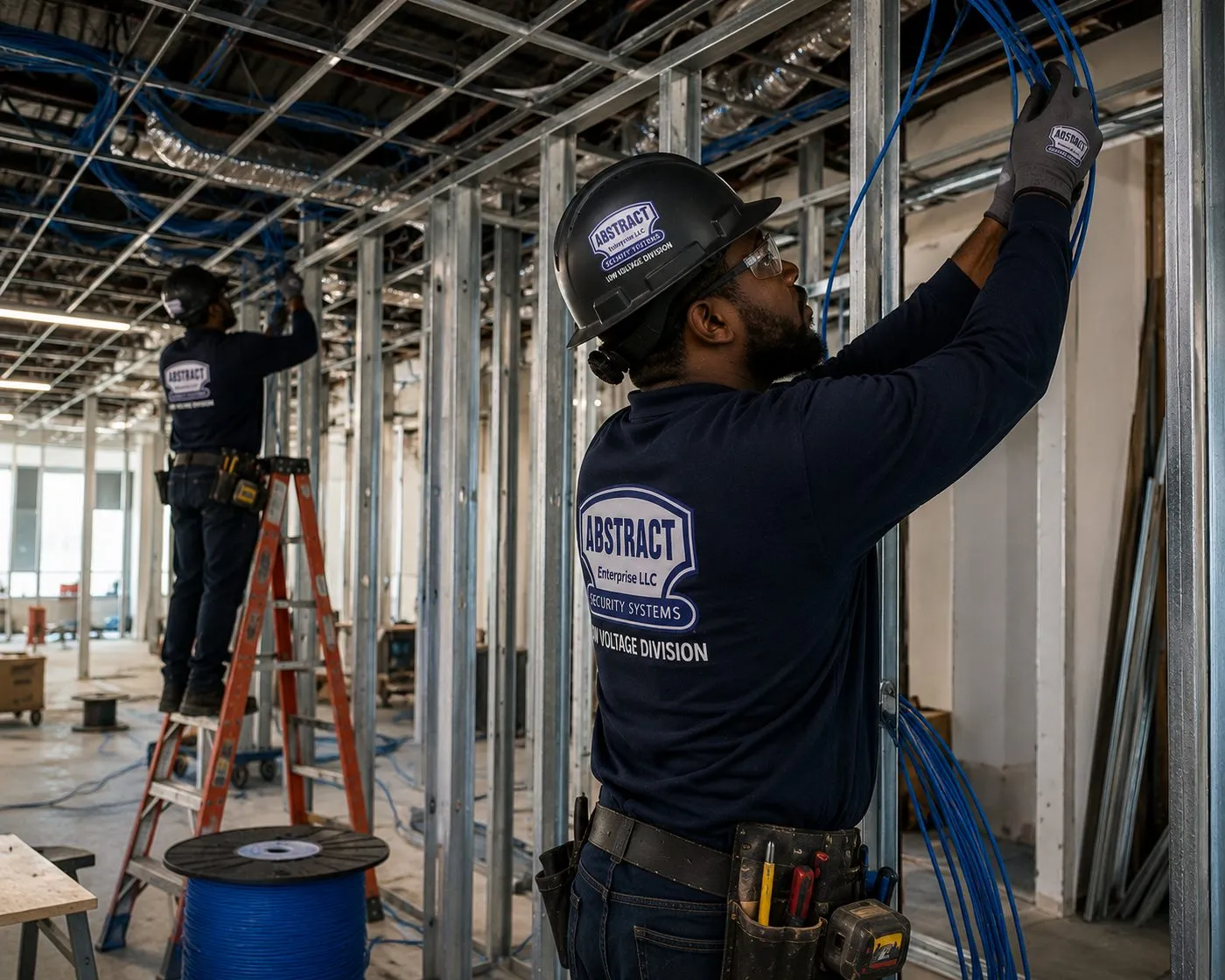
A technician in a hard hat reaches up to guide blue cable through open steel-stud framing while a second worker on an orange ladder works further back, a spool of blue cable on the floor between them.
Queens families who add a soundbar often want the streaming box and the bar wired back to the router rather than leaning on Wi-Fi, especially in high-rise apartments full of neighboring networks. Our structured cabling team in Queens can run network cable to the TV wall on the same visit.
Commercial Soundbar Installation
Business Soundbar Installation in Queens
Queens runs on small businesses, and a lot of them have a TV on the wall. A soundbar is the simplest way to make that screen intelligible to a customer at the counter without wiring a whole sound system. These are the business streets we work along and what each kind of room tends to need.
Downtown Flushing — Main Street and Roosevelt Avenue
The Downtown Flushing Transit Hub BID lists about 1,500 ground-floor retail businesses across 30 block faces. Restaurants, bakeries and travel agencies with a screen over the counter need speech that carries a few yards, not across the street.
Jamaica Avenue
The Jamaica Center BID, the largest business improvement district in Queens, counts more than 400 businesses along the avenue. Barbershops, salons and phone shops run a TV all day, so durable brackets and controls that customers can't reach matter.
Bell Boulevard, Bayside
A restaurant and bar strip the city turned into an outdoor-dining corridor on weekend nights in 2020. Indoors, screens over bars and dining rooms need clear game audio at table level while the room stays conversational.
Roosevelt Avenue Under the 7
Jackson Heights, Elmhurst and Corona storefronts and bars beneath a steel elevated line. Background noise is constant, so bars are aimed and leveled for the seating, and volume is set against the trains rather than at a fixed number.
Steinway Street, Astoria
A long commercial street of cafés, restaurants and shops. Narrow, deep storefronts with a TV at one end are typical, and one well-placed bar usually serves the front half of the room.
Court Square and Long Island City Offices
Offices, studios and amenity floors in the towers around Court Square, where Skyline Tower now rises higher than One Court Square. Meeting-room displays on steel-stud walls get a bar on eARC for clearer video calls.
Compliance notes for business soundbars in Queens
Music and sound reaching residences. Many Queens storefronts have apartments directly above them. The city's Noise Code guide from the Department of Environmental Protection limits sound from commercial music to 42 decibels inside a nearby home, and between 10 PM and 7 AM to 7 decibels above the background level on the street 15 feet away, with a separate low-frequency limit for bass. We set levels and subwoofers with the upstairs neighbors in mind and show staff where the ceiling is.
Bars that stick out into a passage. In a clinic hallway or a waiting-room route, anything fixed to the wall with its edge 27 to 80 inches off the floor may protrude no more than 4 inches under the 2010 ADA Standards — and a long bar on its bracket can exceed that. We lift them above the band, set them into a recess, or move them off the walking route.
Electrical stays with electricians. Low-voltage hookup of a soundbar doesn't need its own Department of Buildings permit, but a new or relocated outlet is electrical work for a licensed electrician. We work from existing outlets and say so plainly when a room needs one.
Paperwork for the landlord. Shopping-strip owners and their agents generally want proof of a contractor's liability cover on file first; our certificate costs you nothing and lists whichever parties your lease names.
Ground-floor and below-grade spaces. In basements and street-level units in flood-prone areas we keep the bar, the sub and the power strip off the floor and away from the lowest outlets wherever the layout permits.
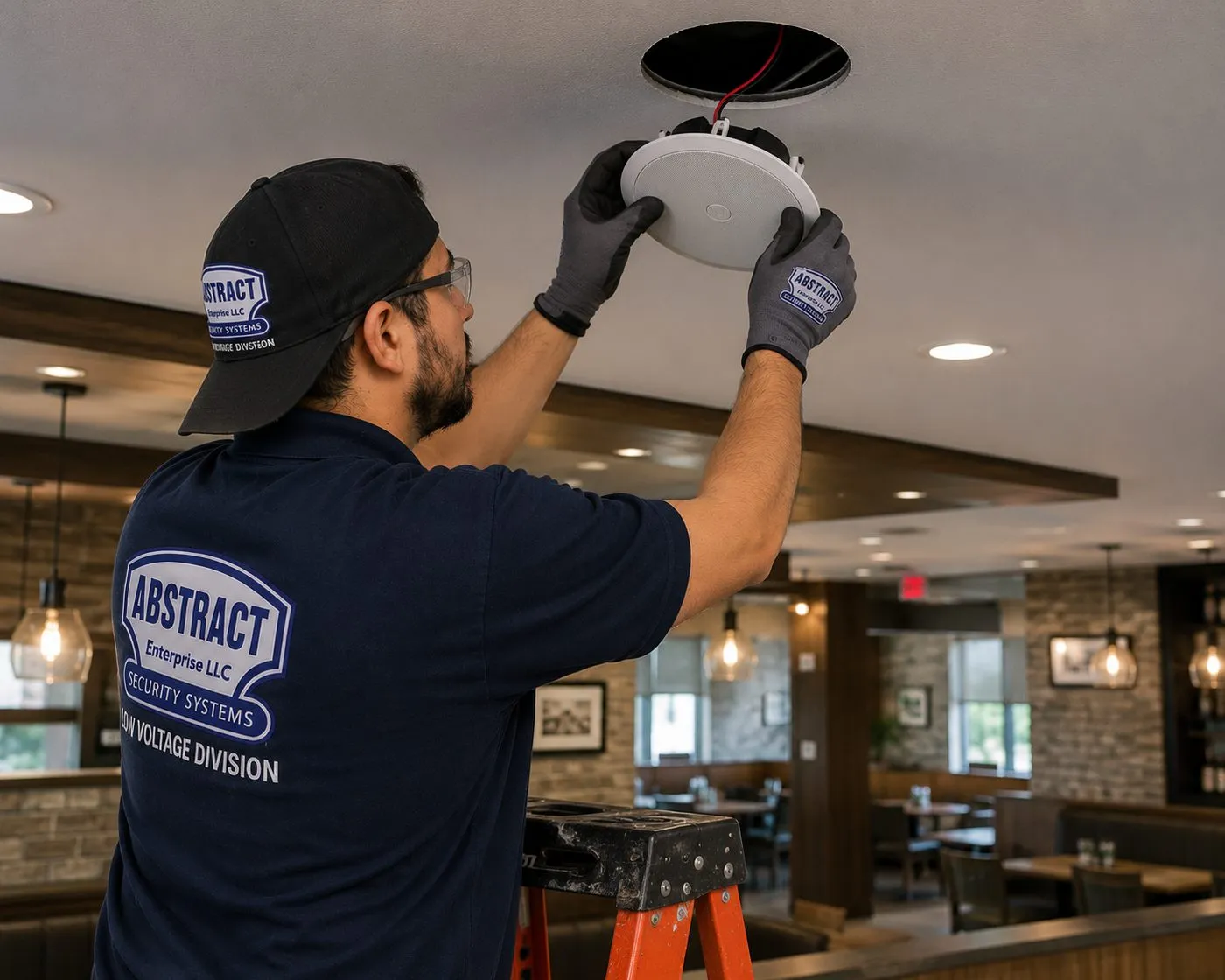
Booths, pendant lamps and an exposed-brick wall fill the frame as a technician on a short ladder lifts a white round speaker toward a hole in the ceiling — the route we suggest when one bar can't reach every table.
Shop owners who call us about a screen's sound usually end up asking about the cameras over the register and the Wi-Fi in the back as well.Abstract Enterprises' low-voltage installation in Queens covers audio, data and security under one license and one visit.
Your Questions Answered
Soundbar Installation in Queens: Questions Answered
These are the questions Queens households bring to us before a soundbar goes up, grouped by the situation behind them: outside noise, the wiring in older houses, high-rise living, homes shared by several generations, basements, and businesses. Questions about booking, extras and other rooms are in the FAQ near the bottom of the page.
Planes, the 7 train and the boulevard outside
Jets on the LaGuardia approach drown out the dialogue every few minutes in our East Elmhurst living room — what can the soundbar setup do about it?
Quite a lot, though not by turning everything up. Aircraft noise is loud, low and comes in bursts; Port Authority monitors have recorded LaGuardia events as high as 81 decibels, and residents under the departure routes describe the noise lasting much of the day. What gets lost when a jet passes is speech, because a loud, broad roar masks the quieter parts of words that make them intelligible. A soundbar with a dedicated center channel, mounted close under the screen and aimed at the seats, gives speech a much better chance than TV speakers that fire downward or backward into the wall.
During setup we switch on the bar's speech or dialogue enhancement, and where the bar or TV has an automatic volume or loudness-leveling mode we try it with you, because it lifts quiet speech without making explosions louder. We also put the TV wall on the side of the room away from the windows that face the flight path when the layout allows. And we show you where the captions toggle is on your TV and streaming apps, because during the loudest passes nothing beats a line of text. Window inserts and sealing are the real cure for outside noise; the soundbar's job is to keep the story intelligible in between.
We live right beside the elevated 7 on Roosevelt Avenue — can the rumble shake a soundbar bracket loose over time?
It can work a poor fixing loose, which is why we treat trackside apartments differently. The 7 runs on a steel elevated structure above Roosevelt Avenue through Woodside, Jackson Heights, Elmhurst and Corona, and on a concrete viaduct along Queens Boulevard in Sunnyside, so buildings along both stretches feel a regular low vibration as trains pass. Engineers who study fasteners have found that repeated small sideways movement is the main thing that makes threaded fixings self-loosen; a screw that is only just gripping weak plaster or a plastic plug will gradually back out under that kind of cycle.
The remedy is a fixing with real holding power and enough preload that the joint doesn't slip in the first place: anchors set into brick or block rather than plaster alone, bracket screws tightened properly and not left snug, and a bar seated fully into its bracket's locking tabs. On walls that share structure with the street side of the building we also check that the bar isn't touching the TV or the wall, since a rattle at a contact point is usually what residents notice first. If you live trackside and your current bar has started to lean or buzz, that is worth a look before it comes down.
In a Queens Boulevard corner apartment, which wall should the TV and soundbar go on when one side faces the traffic?
Usually the wall that doesn't face the boulevard, or the one that puts the street at your back rather than in front of you. When the noise comes through the windows behind the TV, it arrives from the same direction as the dialogue and competes with it head-on. When the street is behind or beside the couch, the bar's sound reaches you first and the traffic is easier to tune out. A soundbar also needs open space around its ends; Sonos, for example, advises keeping its Arc Ultra at least a foot from walls and obstructions, which rules out some corners squeezed between two windows.
We look at three things on site: where the windows and radiators are, where the outlet and the cable box can reach, and where people actually sit. Sometimes the right answer is the shorter wall, with the TV on a slim tilt mount and the bar beneath it, rather than the longest wall that faces the traffic. If the only workable wall faces the street, we lean harder on speech settings and placement height to keep voices on top.
Older house wiring
The only outlet in our Glendale living room is on the wall opposite the TV — what are the honest options?
There are three, and only two of them are ours. The first is a surface route: a paintable raceway that carries the bar's power and the TV's cord along the baseboard and up the TV wall, painted to match so it disappears into the trim. It is tidy, it doesn't open any walls, and it is on our Queens price list as a cord cover. The second is to move the media furniture so the cable box, the bar's power and the TV's power all land on a wall that does have an outlet, which sometimes means rethinking the layout rather than fighting it.
The third option is a new outlet behind the TV, and that is electrical work for a licensed electrician, not a low-voltage installer. Our in-wall power and cable kit can carry power inside the wall from behind the TV down to an outlet on the same wall, but it can't create an outlet where none exists. If you want the cleanest finish, have the electrician add a receptacle low on the TV wall first; we then hide everything above it in the same visit or the next one. We never run extension cords inside walls or under rugs.
Our 1940s garden co-op still has two-prong outlets — can a soundbar and subwoofer plug in safely?
Usually yes, because many soundbars and wireless subwoofers ship with two-prong power cords that fit an ungrounded outlet directly. Check the plugs before we come: if the bar or sub has a two-blade plug, it is designed to work without an equipment ground. Where a three-prong plug meets a two-prong outlet, the fix is not a cheater adapter. Electricians commonly replace an ungrounded receptacle with a GFCI outlet labeled “No Equipment Ground” as a code-recognized middle path, or run a proper ground, and either is a job for a licensed electrician hired through your co-op's usual process.
Older apartments also tend to have fewer outlets, so a TV, cable box, bar, sub and streaming stick can end up sharing one duplex receptacle. We use a single good-quality surge-protected strip, keep it off the floor where it can be kicked or wetted, and avoid daisy-chaining strips. If what we find looks worn, warm or scorched, we stop and tell you, because that is a building electrical issue to raise with management before any audio goes in.
Long Island City and Astoria towers
Our Long Island City apartment is mostly window wall — where does a TV with a soundbar go when there's barely any solid wall?
There are more answers than it first appears. The most common is the interior partition opposite or beside the windows, which in newer towers is usually metal studs and gypsum board — easy to mount on with the right fasteners and often suitable for hidden cabling. If the only solid wall is the one shared with the next apartment, we check the building's alteration rules before drilling, and keep the subwoofer well away from it. A short column or the stretch of wall beside a kitchen pass-through can also hold a TV and bar if the viewing angle works from the sofa.
Where no wall works, a media console with the bar sitting on it, or a floor-standing TV stand with an integrated soundbar shelf, keeps the windows clear and avoids any drilling. Glass also reflects sound, so in a room with two window walls the bar's height and aim matter more than usual. We bring the bar to ear height, keep it close beneath the screen, and switch off any wide or virtual-surround mode that throws sound sideways into the glass if it smears voices.
Will the soundbar's streaming and app control be reliable on a high floor of a Long Island City tower with dozens of neighboring Wi-Fi networks?
It can be, if it isn't left to chance. A soundbar connected by HDMI to the TV plays the TV's sound regardless of Wi-Fi; Wi-Fi only matters for the bar's own app, music streaming, voice assistants, grouping with other speakers and firmware updates. In a dense tower the airwaves are crowded, and smart bars that rely on Wi-Fi for those features can drop out of their apps, miss updates or stutter when streaming music.
The fixes are straightforward. Many networked soundbars have an Ethernet port; where yours does and there is a network jack or router near the TV, a wired connection removes the problem. Otherwise we join the bar to the less crowded band your router offers, keep it near the router where possible, and update its firmware before we leave so it isn't trying to do that over a weak link later. If the TV wall has no network connection at all and you want one, a single cable run from the router is a small job our cabling team can add.
Several generations and several languages in one living room
My mother wears hearing aids — can the soundbar work alongside them, or does she need something separate?
Usually both, working together. A well-placed soundbar with speech enhancement helps everyone in the room, including a hearing-aid wearer, because it raises the clarity of voices rather than just the volume. But for many people with hearing loss the biggest improvement comes from sending TV sound straight into the hearing aids. Hearing-aid makers sell TV streamers for this, and newer hearing aids support Bluetooth LE Audio and Auracast, which the Hearing Loss Association of America describes as a way for one device to transmit sound to multiple listeners' hearing devices.
The practical question is whether your TV can feed a streamer and a soundbar at the same time. Some streamers connect to the TV's optical output while the bar uses HDMI eARC, and whether both outputs stay active together depends on the TV model and its settings. We check that on the day with your TV's menus, set it up so your mother hears through her aids at her own volume while the rest of the family hears the bar, and write down the settings so her audiologist or the family can restore them after a TV update.
Grandparents watch in Spanish and the kids watch in English — will the soundbar play whichever language track we choose?
Yes, as long as the language is chosen at the source, because the soundbar plays whatever audio the TV sends it. On live TV, broadcasters carry alternate languages on the Secondary Audio Program, or SAP, which Sony and others describe as an audio track in a language other than the program's original. You switch it on in the TV's or cable box's audio settings. On streaming apps, the language and audio-description tracks are chosen inside the app, usually from the subtitles-and-audio menu during playback.
Two setup details make this smoother. First, the cable box should feed the TV and the TV should pass the selected track through to the bar over ARC or eARC, which is how we wire it; boxes connected straight to the bar with a separate audio lead sometimes ignore the TV's language setting. Second, if the household switches back and forth every day, we show everyone exactly where the language and SAP options are on each remote, and leave a written note in the languages the household reads, if you give us the wording.
A parent sleeps in the room off the living room — can whoever stays up late listen privately while the soundbar stays quiet?
Often yes, though how depends on the TV and streaming device rather than the bar. Many smart TVs can send audio to Bluetooth headphones, and some streaming players and their phone apps offer a private-listening feature that plays the sound through earphones while the TV speakers or bar fall silent. Whether the bar mutes automatically or has to be switched off varies by TV, streamer and bar, so we test it rather than assume.
During the visit we test the option your equipment supports, pair a set of headphones if you have them, and show the late-night viewer how to switch between bar and headphones without unplugging anything. For nights when the bar stays on, night mode compresses the loud peaks that wake people, and we set the subwoofer lower so the bass doesn't carry through a shared wall into the bedroom.
Basements and the lowest floor
Our den is in the basement of a house in a part of Queens that flooded during Ida — how should the soundbar, subwoofer and power be set up?
With everything that plugs in kept as high and as dry as the room allows. After Ida, the city's Health Department reported that most of the storm's deaths in the city were drownings in basement apartments, and the Queens Daily Eagle found that 10 of the first 11 Queens victims lived in basements. For a home theater that means the soundbar on the wall rather than on a low console, the power strip mounted off the floor on the wall or the back of the furniture instead of lying on the carpet, and the cable box and streamer on a shelf rather than the bottom of a cabinet.
The subwoofer has to sit on the floor to work, so we put it on a solid riser or platform, which also tightens the bass on concrete, and we plug it in at a raised strip. Cable routes go along the wall at a height rather than under rugs. If the basement is a separate apartment, its legality and safety are matters for the owner and the city, not the audio installer; our part is to keep the electronics out of the way of water and the cords out of the way of feet.
Businesses
Our restaurant on Main Street in Flushing has screens at both ends of the dining room — one soundbar each, or something else?
For two screens in one room, the answer depends on whether both show the same thing. If they always carry the same channel, two bars playing the same feed can work, but each needs its own source or a splitter, and voices from opposite ends of the room arrive at slightly different times, which some guests notice. If the screens show different games or channels, two bars will compete, and diners in the middle hear both at once.
In a long dining room the more even solution is often a small set of ceiling speakers on an amplifier fed from one chosen screen, with the other screen captioned. Where the budget or the ceiling doesn't allow that, a single bar under the main screen, set for clarity at a modest level, with captions on the second, keeps the room conversational. We look at the room, the ceiling and the apartments above before recommending either.
Our Jamaica Avenue storefront runs the TV all day — what keeps a soundbar from walking off or being fiddled with?
Height, hardware and control. We mount the bar on its bracket high enough that it is out of casual reach and secure it so it can't be lifted off the bracket without tools, using the locking screws or straps the bracket supports. Cables are run in a raceway so nothing hangs to be pulled, and the bar's own buttons face the wall or sit out of reach where the design allows.
The remote is the bigger weakness in a shop. We set the TV remote to control the bar over HDMI-CEC so there is one remote for staff to keep behind the counter, set a sensible maximum volume where the bar or TV offers one, and turn off features such as Bluetooth pairing that would let a customer's phone take over the speaker. It is the low-tech version of a commercial audio system, and in a narrow storefront it is usually enough.
Co-ops in Forest Hills and Kew Gardens
Our Forest Hills co-op's only usable TV wall has a steam radiator under it — is that a problem for the soundbar?
It is a problem worth working around. A soundbar sitting directly above a steam radiator gets a column of hot, dusty air through its grilles all winter, which is hard on its electronics and coats the drivers. Steam radiators also hiss and knock, which a sensitive bar microphone may hear when you use voice control. And the TV above it gets the same heat.
The best arrangement is to shift the TV and bar sideways along the wall so they are offset from the radiator's rising air, or to mount the TV higher on a tilt bracket and place the bar on a short shelf or bracket clear of the radiator's top. A radiator cover with a solid top deflects the heat away from the wall and can double as a low shelf, though the bar should not sit directly on it while the heat is on. If the radiator is the only option, we mount the bar a few inches further from the wall to let air pass behind it and show you how to check it for heat on a cold morning.
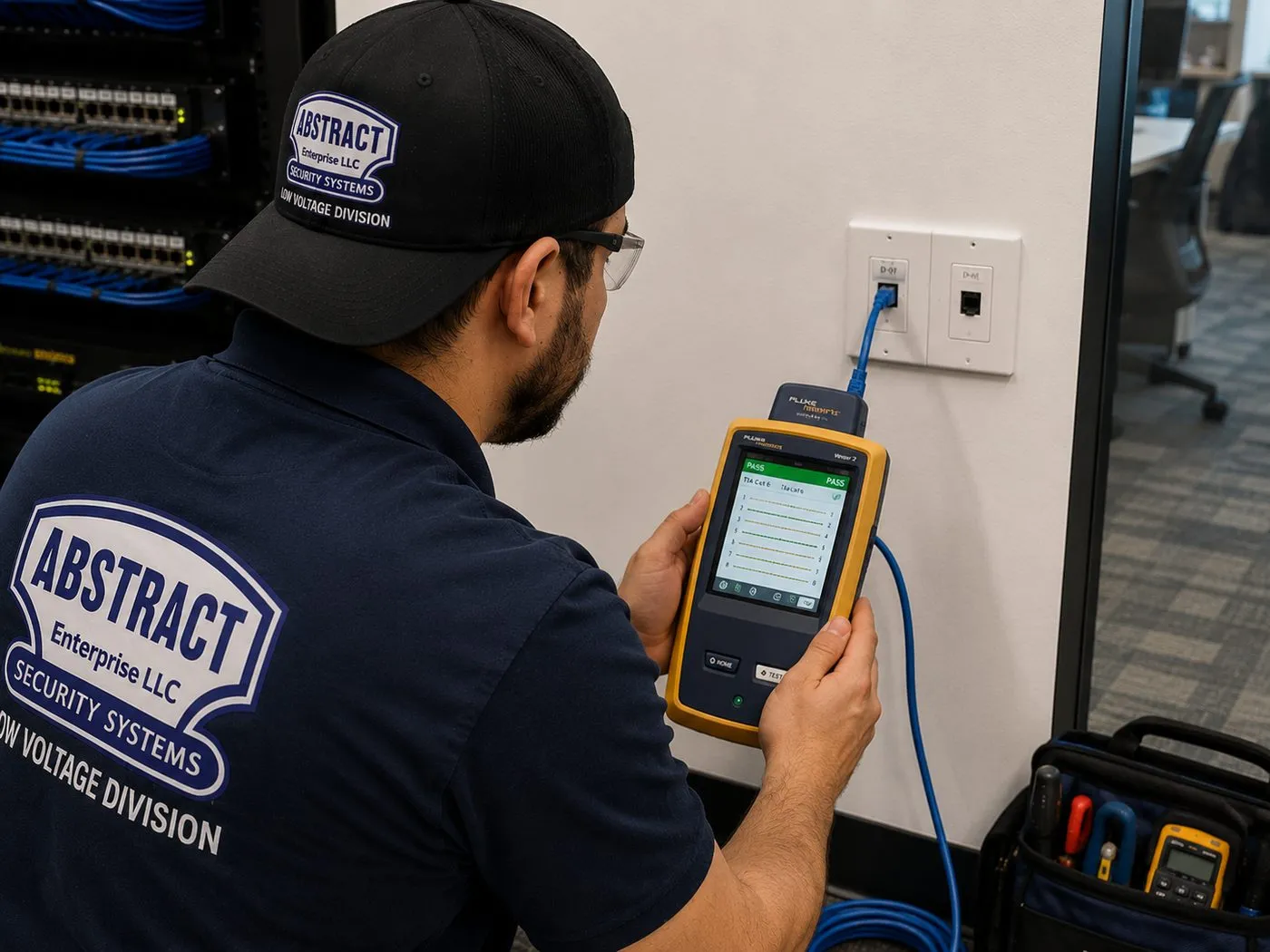
A technician holds a yellow handheld tester with a blue cable plugged into a white wall jack, a tool pouch with a meter at his feet — how a wired connection for a networked soundbar is confirmed before we rely on it.
Queens Home Planner
Which Soundbar Setup Suits Which Queens Home
When you call, these are the first things we ask: what kind of building, what the TV wall is made of, who shares the walls and floor, and what you are trying to hear better. The table below is the shortcut we use on the phone to land on a mounting method and a cable finish before anyone visits.
Home
Typical TV wall
Usual mount
Usual cable finish
Sound note
Ridgewood or Glendale brick row house
Brick under plaster, or a framed interior wall
Masonry anchors in brick
Painted raceway
Keep the sub off the shared side wall
Two-family, owner downstairs
Wood studs with drywall or plaster
Into studs or rated toggles
In-wall kit where the bay is clear
Tenant above — sub on a pad, level set low
Detached house, eastern Queens
Wood framing
Into studs
In-wall kit or basement route
Most freedom for sub and rears
Garden-apartment co-op
Plaster, sometimes over block
Toggles or fixings into framing; or TV-attached bracket
Raceway, unless the board approves more
Radiators and shared walls drive placement
Post-war tower complex
Concrete or block
Concrete anchors, hammer drill
Raceway or behind the furniture
Concrete floors help; bass still travels
Long Island City or Astoria high-rise
Metal studs; glass on other sides
Steel-stud fasteners or toggles
In-wall where building rules allow
Glass reflects; aim and height matter
Basement den
Framed wall over foundation
Into studs, everything raised
Along the wall, off the floor
Sub on a riser; plug in high
Rental apartment
Whatever the lease allows you to touch
Console, or bar on the TV mount
Behind furniture or along the TV's cables
Night mode and a modest sub level
Two habits help in almost every Queens home. Check the soundbar's box for a wall bracket and its back panel for an HDMI eARC or ARC socket before the visit, and send us a phone photo of the TV wall with the outlet in the frame. With those three facts we can tell you the method and the total before we arrive, and bring exactly the anchors your wall needs.
Equipment
Types of Soundbars and Mounting Hardware We Install
Bring us the bar you bought, or ask us what to buy. These are the categories that come up most in Queens homes and shops, with published specifications where they matter for mounting and connection.
Dialogue-First 3.0 and 3.1 Bars
Bars with a real center channel for speech, with or without a sub. For households where the main complaint is not hearing voices — including many with older viewers — these do more good than a bigger, louder 2.1 bar.
Compact Bars for Bedrooms and Kitchens
Short bars for 32- to 50-inch screens. Light enough for plaster and drywall toggles, and some, such as the Sonos Ray, connect by optical rather than HDMI, which suits older TVs.
Mid-Size Smart Bars
The everyday choice under a 55- to 65-inch TV. The Sonos Beam (Gen 2) measures about 25.6 inches wide and 6.35 lb and connects over HDMI eARC; similar Samsung, LG, Sony, Bose and Vizio models fill the same role.
Large Atmos Bars
Long bars with up-firing drivers. The Sonos Arc Ultra is about 46.4 inches wide and 13 lb, and Sonos advises keeping it at least 4 inches below the TV. They need a flat ceiling of normal height for the height effects to work, which rules out some basements.
Bars With Wireless Sub and Rears
Systems such as Samsung's HW-Q990D ship with a subwoofer and two rear speakers, each needing its own power outlet. In Queens apartments the outlet count, not the box, decides whether rears are practical.
Wall and TV-Attached Brackets
Universal wall brackets that grip the back of most bars, and brackets that fix the bar to the TV or its arm. A Sanus soundbar bracket supplied by us is $89.24 on the Queens price list.
Subwoofer Isolation
Dense pads and platforms that decouple a sub from wood floors. In two-family houses and co-ops with neighbors below, these often matter more than the sub's size.
Hearing-Assist Add-Ons
TV streamers supplied by hearing-aid makers, plus newer Auracast-capable TVs and hearing aids. We connect what you have bought and confirm it works alongside the bar.
Concealment and Cables
Code-compliant in-wall power and cable kits for hollow walls, paintable raceway for masonry, certified HDMI cables for eARC, and surge-protected strips mounted off the floor.
Picking the connection for a Queens household
Household need
Best connection
Why
One remote for everyone, including grandparents
HDMI ARC or eARC with CEC on
The TV remote powers the bar and sets its volume
Second-language or SAP tracks from the cable box
Cable box to TV, TV to bar over ARC/eARC
The bar plays whatever track the TV selects
Hearing-aid streamer plus soundbar
Bar on eARC, streamer on optical if the TV keeps both live
Depends on the TV model; checked on site
Older TV with no ARC
Optical
Works for stereo and compressed surround; remote may need learning
Lossless Atmos from a disc player or console
HDMI eARC
Only eARC carries Dolby TrueHD and DTS-HD MA
Music from phones
Wi-Fi casting or Bluetooth
Fine for music; Bluetooth adds delay for TV
Dimensions and weights above come from Sonos, Samsung and retailer spec sheets checked for this October 2026 revision; newer models will differ, so your exact model number is what we plan the bracket and anchors around.
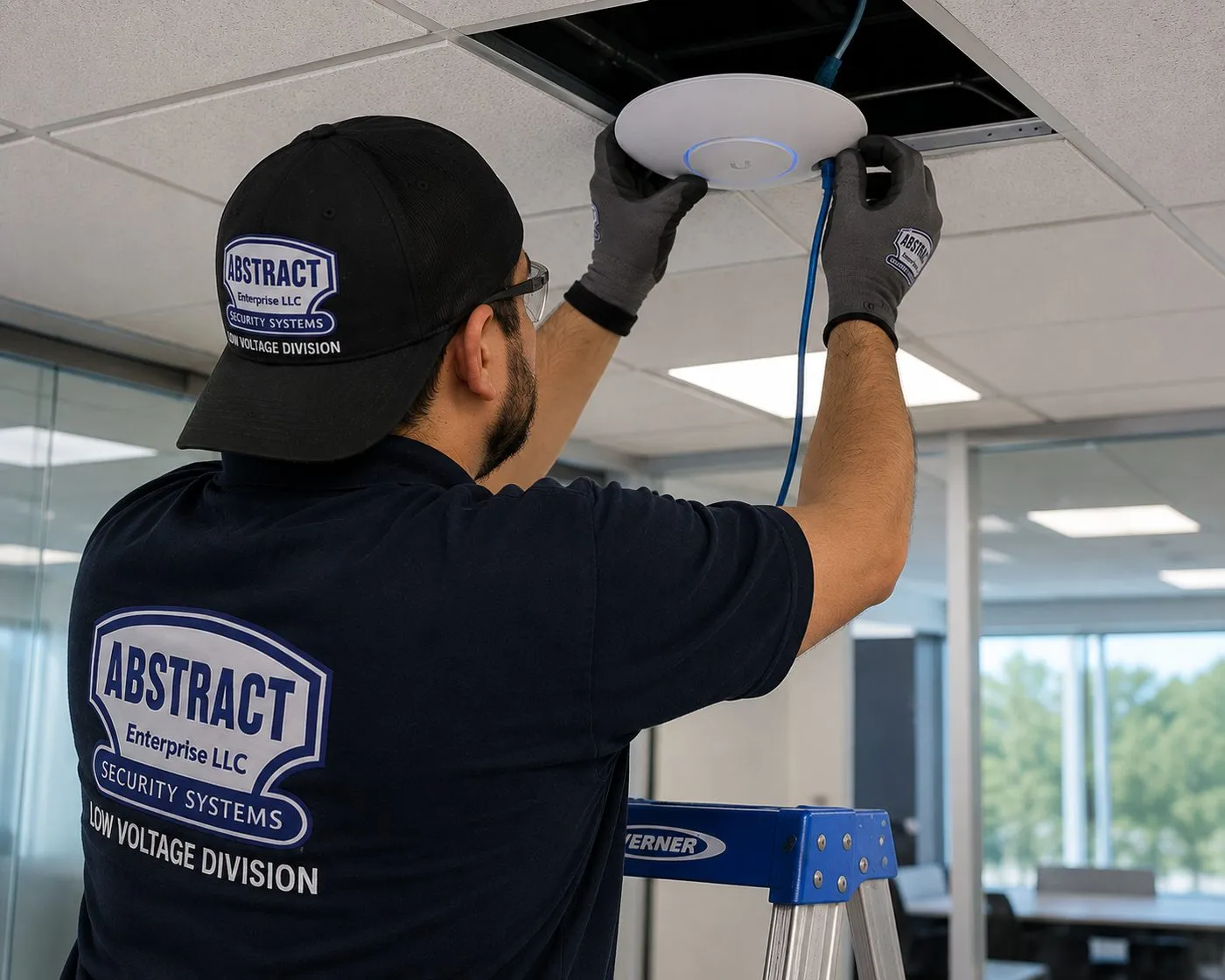
Standing two steps up a blue ladder, a gloved technician fits a white disc-shaped Wi-Fi unit to a drop-ceiling panel, its blue lead disappearing into the plenum — coverage that app-controlled bars depend on.
AI Overview Reality Check
What AI Gets Wrong About Soundbar Installation in Queens
A word on sourcing first. The research tools behind this page could not display Google's AI Overview, so no line here is presented as something it said. Every heading is a claim printed by a manufacturer, retailer or pricing marketplace — the kind of sentence that answer engines condense and repeat. Beneath each is what that claim leaves out once the bar is headed for a Queens living room, shop or basement.
“Turn on Speech Enhancement and dialogue becomes easier to hear”
Sonos's support pages describe Speech Enhancement as boosting the frequencies associated with the human voice so that dialogue is easier to hear, and most other brands describe their voice modes the same way. It is true, and we switch it on in most Queens installs.
What the one-line version misses is everything around the setting. A voice mode can't do much for a bar hidden in a console cubby, aimed at the floor, or competing with a departure out of LaGuardia that is louder than the TV. In East Elmhurst, Flushing and along the 7 line, placement, the wall chosen and the household's caption habits matter as much as the button.
So we treat the voice mode as the last step, not the fix: bar at ear height and close under the screen first, the TV wall chosen with the noisiest windows in mind, then speech settings compared with you on a real scene.
“With Auracast, hearing-aid wearers can tune into silent TVs in sports bars and waiting rooms”
Hearing-aid maker ReSound promotes Auracast broadcast audio as a way to tune into silent or quiet TVs in waiting rooms, airports, sports bars and gyms, and the Hearing Loss Association of America describes it as one device transmitting sound to many listeners.
The catch for a Queens business is that a TV only broadcasts if something is set up to broadcast it. Most screens over a counter on Main Street or in a Jamaica Avenue barbershop today play through their own speakers or a soundbar and send nothing to hearing aids at all, and the listener's hearing aids must support Auracast too.
If a shop, clinic or restaurant wants to offer it, the transmitter is a separate piece of equipment to plan alongside the soundbar. We can talk through where it fits; for most homes, a hearing-aid maker's TV streamer remains the practical route.
“Mount the soundbar below the TV, or above it if that works better”
Sonos's Arc Ultra guide says its wall mount can put the bar below the TV, which it recommends, or above it. Summaries tend to flatten that into “either is fine”.
Above the screen sends voices down from over the picture and is usually the second-best option. It does solve real Queens problems, though: a steam radiator or a low window directly under the TV, a basement den where the screen has to sit low over a sectional, or a TV whose bezel leaves no room beneath for the bar without blocking the remote sensor.
We default to below, and suggest above only when the room forces it — and then we tilt the bar's output toward the seats where the bracket allows and check dialogue from the couch before we leave.
“Just leave a little space under the TV”
The same Sonos guide is specific about spacing: keep at least 4 inches between the bar and the screen, and keep both ends at least a foot away from a wall or other obstruction.
That second number is the one that bites in Queens. Front rooms in attached houses often have a TV wall that is a short run between two windows, and co-op living rooms put a radiator or a doorway close to one side. A long bar squeezed between them, or slid into a shelf with sides, loses the open space it was voiced for.
We measure the clearances for your bar's model on the day. Where the room can't give it the space it wants, a shorter bar or another wall usually beats forcing the long one in.
“A soundbar sounds the same on the wall as on the console”
Most listings show one set of audio specifications whatever the placement. Sonos's own description of the Arc Ultra says otherwise: the bar detects when it is wall-mounted and automatically adjusts its EQ to temper bass resonance from the wall.
Not every bar does that by itself. Many have a manual wall or table setting buried in an app, and a bar mounted flat against plaster over brick in a Ridgewood front room can sound boomier than the same bar on a wooden console, while one on a hollow metal-stud wall in a Long Island City tower can buzz if the bracket touches the board.
After mounting we check for a wall setting in your bar's app, listen for buzz at the bracket, and adjust the bass trim so the bar suits its new position rather than the showroom shelf.
“We'll mount your soundbar on a wall and connect it to your TV and Wi-Fi”
That is how one national retailer describes its advanced soundbar installation, and it is a fair summary of the core job. It is also the version of the job quick answers assume everywhere.
The Queens version has more moving parts: Kreischer brick or block walls instead of studs, a co-op board or managing agent who wants a certificate of insurance, two-prong outlets, a cable box that has to pass a second-language track, a hearing-aid streamer that has to coexist with the bar, and a Wi-Fi band crowded by dozens of neighbors in a tower.
A useful test for anyone you hire, ourselves included: ask, before the date is set, what changes if the drill hits Kreischer brick or the co-op office asks for an insurance certificate. If the answer comes with a price and a method, you are dealing with someone who knows Queens walls.
“Most people pay about $162 to mount a TV”
Thumbtack's cost page for TV wall mounting gives a national average of roughly $117 to $227, with most customers paying about $162, and that single figure is easy for a summary to repeat as the going rate.
A national middle figure says little about a Queens job that combines a TV, a soundbar and a masonry wall. Our Queens TV mounting base is $179.99 for a 32- to 55-inch screen on drywall over studs; the bar is its own line at $135.45 on the wall, and a brick wall adds $68.25 — numbers you can check before booking rather than averages you discover afterwards.
The point isn't that national figures are wrong. It is that a written total built from fixed Queens lines is the only number that tells you what your own living room will cost.
Hear the Dialogue, Not the Flight Path
Model numbers plus a snapshot of the living-room wall are enough. You get a plan, a Queens figure and a heads-up on any forms your building needs from us.
Whether it's a Ridgewood front room, a Woodhaven two-family, a Glen Oaks co-op or a Hunters Point one-bedroom, this form gets you a written Queens total by the end of the business day. Prefer a conversation? Dial (347) 434-6392.
✅
Thanks — It's With Us
Expect a call from our Queens team before the business day ends. For anything that won't keep, phone (347) 434-6392.
How It Works
Our Installation Process
Seven steps, the same for a compact bar in a Sunnyside rental as for a bar, sub and rears under a new TV in a Douglaston den.
1. Photo and models
You send the soundbar and TV models and a photo of the TV wall with the outlet in view. We identify the wall, the bracket and the connection from those.
2. Written Queens price
You get a written total built from the Queens price list — mount, bracket, wall surcharge, cable finish and any extras — before you book.
3. Building paperwork
For co-ops, Mitchell-Lama complexes and managed towers we send the certificate of insurance free and check contractor hours and drilling rules.
4. A 2-hour window
Seven days a week, 8 AM to 8 PM, you choose a 2-hour slot for our arrival. Today is possible if a slot is free, and moving it costs nothing with a day's notice.
5. Wall check and layout
On arrival we confirm what the wall is made of, scan for pipes and wiring, look at windows, radiators and outlets, and agree the height and center line with you.
6. Mount and connect
Anchors suited to the brick, plaster, block or studs go in, the bracket and bar follow, the leads are hidden or neatly run, and the HDMI link to the TV's eARC or ARC socket is made with CEC enabled.
7. Tune for the household
Speech, night and leveling modes set, language and SAP settings checked, the sub placed and leveled, the remote tested by whoever uses it most, and the dust cleaned up.
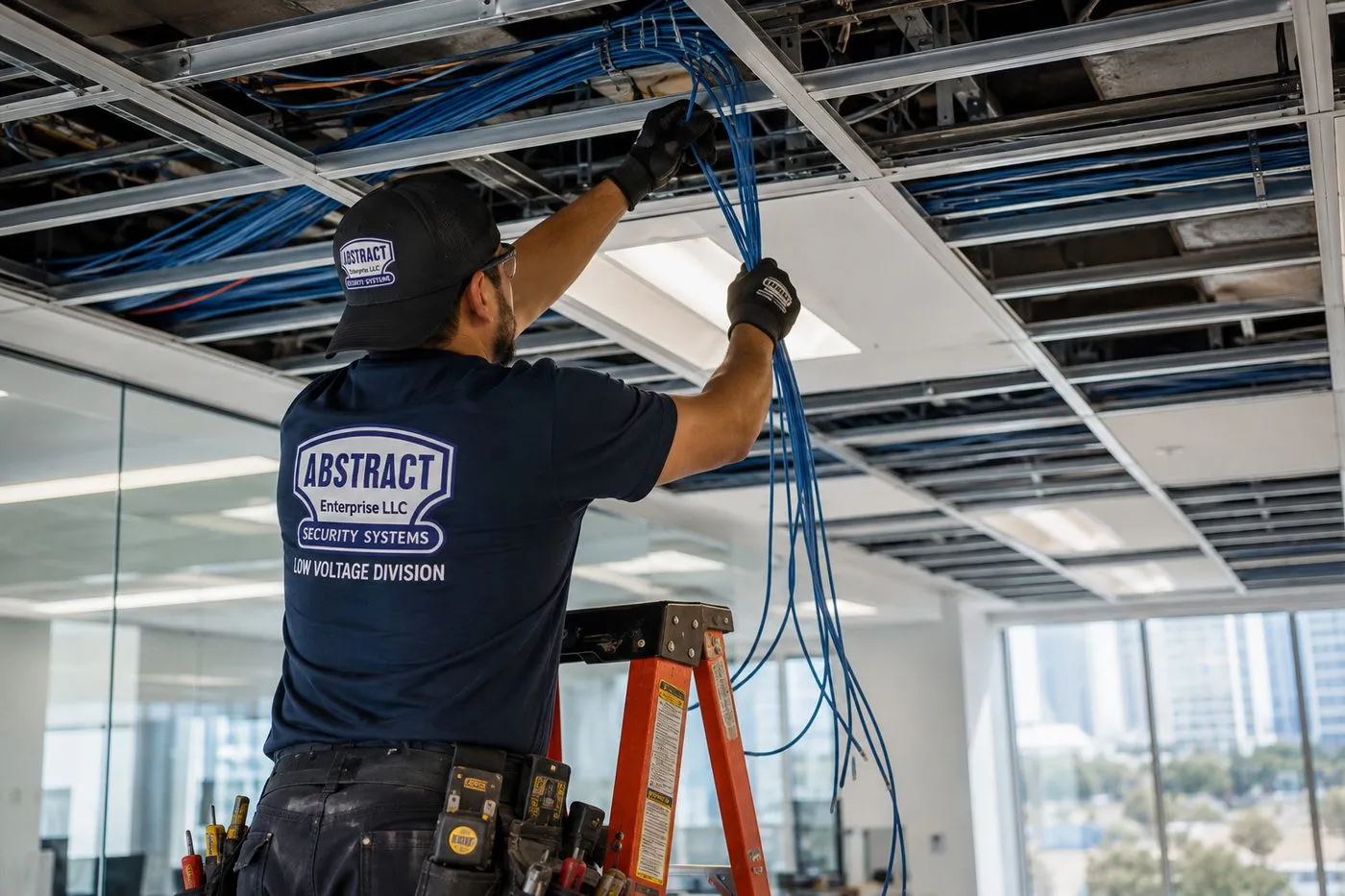
Back to the camera and halfway up an orange ladder, a technician threads loops of blue cable between the rails of a lifted ceiling grid; glass-walled rooms and a wall of windows fill the background.
Coverage Area
Soundbar Installation Near Queens' Landmarks
Queens is a borough of very different building types, often a few blocks apart. These six places show the range of homes our installers work in, and what each tends to mean for a soundbar on the wall.
Skyline Tower, Court Square
Topped out in 2019 at about 762 feet, overtaking One Court Square as the tallest building in Queens. A marker for the concrete-and-glass towers of Long Island City, where metal-stud partitions, window walls and managing-agent rules shape every install.
Sunnyside Gardens Historic District
Built between 1924 and 1928 as twelve courts of row houses and small apartment buildings, often called the first “Garden City” development in the country, and landmarked in 2007. Brick, plaster and close neighbors on both sides.
Central Ridgewood Historic District
Approved by the Landmarks Preservation Commission in December 2014 with 990 buildings, many faced in Kreischer brick with load-bearing masonry walls. The heart of Queens' row-house soundbar work.
Forest Hills Gardens
A 142-acre planned community laid out from 1909 by Frederick Law Olmsted Jr. and architect Grosvenor Atterbury for the Russell Sage Foundation. A private enclave of Tudor Revival and Arts and Crafts houses and apartment buildings, where older walls and community rules both deserve a look before drilling.
LeFrak City, Corona and Elmhurst
Twenty 17-storey towers on 40 acres beside the Long Island Expressway, built 1962–1971, with 4,605 apartments. Block walls, management rules and a hammer drill on most TV walls.
Rochdale Village, Jamaica
When it opened in 1963 it was the largest housing cooperative in the world, with 5,860 apartments in twenty 13-storey buildings grouped in circles of four. A cooperative with its own procedures for contractors.
We also install in Astoria, Ditmars, Woodside, Jackson Heights, East Elmhurst, Corona, Elmhurst, Rego Park, Kew Gardens, Richmond Hill, Woodhaven, Ozone Park, Howard Beach, Maspeth, Middle Village, Glendale, College Point, Whitestone, Flushing, Murray Hill, Auburndale, Bayside, Douglaston, Little Neck, Fresh Meadows, Glen Oaks, Bellerose, Queens Village, Hollis, St. Albans, Cambria Heights, Laurelton, Springfield Gardens, South Jamaica and the Rockaways, and across the river in the rest of New York City, on Long Island and in the Hudson Valley.
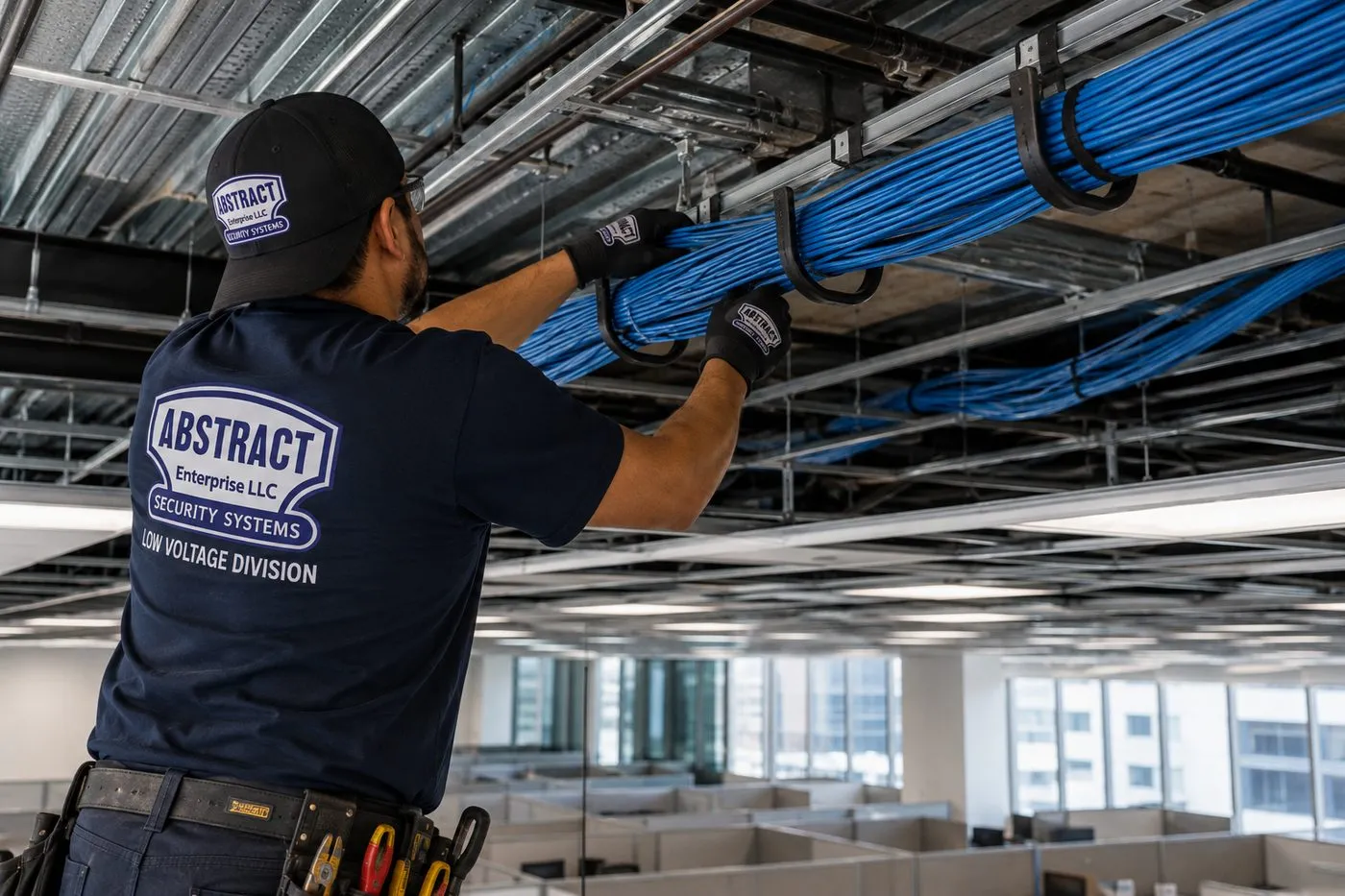
Arms raised above an open-plan office, a capped and gloved technician guides dozens of bundled blue runs along a line of black hangers fixed under the exposed deck.
Pricing
Soundbar Installation Cost in Queens
Queens soundbar prices are published line by line. Pick the lines that match your job and add them up; that total is what the written quote shows and what you pay. If something we couldn't see in your photo turns up on the day, you hear the price before any extra work starts. The figures below are our Queens prices, which carry the borough's 1.05 area factor on the soundbar and accessory menu.
Soundbar service
Queens price
Covers
Soundbar placed on a console or stand
$82.95
Positioned, connected to the TV, set up and tested
Soundbar wall-mounted under the TV
$135.45
Bracket fixed, bar mounted and leveled, connected and tested
Sanus soundbar bracket
$89.24
Supplied when your bar shipped bracketless or its own hardware is wrong for a Queens wall
In-wall concealment
$177.45
Code-compliant in-wall power and cable kit in a hollow wall
Paintable cord cover
$61.95
Surface raceway from the bar to the outlet or console
Cable run to a cabinet or other spot
$103.95
Up to 25 ft
Sonos setup
$131.25
Sonos bar, sub, rears, app and grouping
A/V receiver hookup
$135.45
Receiver connected and configured
Universal remote
$103.95
Programmed for TV, bar and sources
Streaming device setup
$51.45
Roku, Apple TV, Fire TV, Chromecast or similar
Full home theater connection
$367.50
Multi-component system set up together
Wall types and access in Queens
Condition
Queens price
Drywall on wood studs
$0
Metal studs
+$31.50
Plaster
+$47.25
Brick or stone
+$68.25
Concrete or cinder block
+$78.75
Tile or marble
+$99.75
Plywood backer board
$89.25
High mount (above about 8 ft)
$78.75
Walk-up, 3rd floor and above, no elevator
$42
Box removal
$26.25
Certificate of insurance for a co-op, condo or landlord
Free
Setup-only visits and TV mounting in Queens
When nothing needs mounting — reconnecting a bar to a replacement TV, sorting out eARC, CEC or lip-sync, re-pairing a sub, setting up a hearing-aid streamer or language tracks — we bill the visit by time: the first hour flat at the Queens rate of $195, then 30-minute blocks. If a TV is being mounted at the same visit, the Queens TV mounting base price is $179.99 for a 32- to 55-inch screen on a flat or tilt mount on drywall over wood studs, with size, mount and wall adds from our Queens TV mounting price list.
Included and not included
Included: locating studs or masonry, fixing and leveling the bracket, mounting and connecting the bar, tidying cables, switching on HDMI-CEC so the TV remote runs the bar, setting speech and night modes, and cleaning up drilling dust.
Not ours to do: receptacle work of any kind goes to a licensed electrician, and spackle and paint go to whoever decorates for you; our Queens prices leave both out.
Wasted trips: when a technician arrives and the work is impossible — no bar on site, nobody to open the door, or the co-op or landlord sign-off still outstanding — the visit is charged as a $150 return trip.
Risky surfaces: we will tell you up front if a glazed backsplash, a stone face or very old plaster could chip or split when drilled, and nothing goes ahead until you agree.
Big-box install menus and app-based handymen versus a local licensed installer. National menus and marketplace listings quote flat prices that suit wood-stud walls in suburban houses, and for those rooms they work. What they don't price is the Queens specifics — Kreischer brick, block walls in tower complexes, co-op paperwork, two-prong outlets and basements that need everything lifted off the floor. A local installer with a wall-by-wall Queens price list and a state low-voltage license can quote the real job and is answerable to you afterwards.
Shop Our Systems
Queens Soundbar Packages & Pricing
Most Queens jobs fit one of these bundles. Each card shows its own addition; anything from the wall-and-access table — brick, block, stairs — is added to it.
Starter — On the Console
$82.95
Soundbar placed on the media unit ($82.95), connected on eARC or ARC, HDMI-CEC enabled so the TV remote controls it, speech mode set, cables tied off out of sight. No drilling, which suits rentals and co-ops with strict rules.
Standard — On the Wall With Bracket
$224.69
$135.45 for the mount plus $89.24 for our Sanus bracket makes $224.69. The anchors suit whatever the wall is; plaster adds $47.25, brick $68.25, block or poured concrete $78.75.
Premium — On the Wall, Cables Inside
$402.14
Three lines: the wall mount ($135.45), our Sanus bracket ($89.24) and a code-compliant in-wall power and cable kit that takes power and HDMI out of sight ($177.45), totalling $402.14. Needs a hollow TV wall — frame houses, newer partitions — and a building that permits it.
Bring Your Own Equipment — Labor Only
Using hardware you already own — the mount packed with the bar, or one you ordered for it — leaves just the Queens wall-mount labor of $135.45 plus whatever the wall type adds. Your bracket has to be rated for your bar's weight and is covered by its own maker, not by us. Should it look wrong for the job, you hear that before any drilling, along with the option of our Sanus bracket.
Ready for a Queens Soundbar Price?
Snap the TV wall, note the bar's model, and we will add up the Queens lines for you.
Queens is a big, varied borough, and a soundbar visit in Little Neck has little in common with one in Hunters Point. This is how the work tends to differ from one end of the borough to the other.
Long Island City, Hunters Point and Astoria
The newest housing in the borough and the most rule-bound. Towers around Court Square and along the waterfront have concrete frames, steel-stud partitions and managing agents who want insurance certificates and set working hours. Living rooms often have one or two glass walls, so the TV wall is chosen by elimination. Older Astoria streets add two-families and walk-up apartment buildings with plaster and brick, and the shops and cafés of Steinway Street and Ditmars bring commercial screens.
Sunnyside, Woodside, Jackson Heights, Elmhurst and Corona
The 7 train corridor. Garden apartments and co-ops in Sunnyside Gardens and Jackson Heights, walk-ups and two-families on the side streets, and towers such as LeFrak City near the expressway. Outside noise from the elevated line and, closer to LaGuardia, aircraft is the defining issue, so speech clarity and bracket security get extra attention. Households here are among the most linguistically varied anywhere, which brings language-track and caption setup into many visits.
Flushing, College Point, Whitestone and Bayside
Dense apartment buildings and a busy retail core around Main Street, giving way to detached and semi-detached houses toward Whitestone and Bayside. Homes in Flushing and Bayside sit under the LaGuardia departure route residents call the Tennis Climb, and the restaurants and shops along Main Street and Bell Boulevard bring screens that need clear sound at counter height.
Forest Hills, Rego Park and Kew Gardens
Pre-war and mid-century apartment buildings and co-ops along Queens Boulevard, with the houses of Forest Hills Gardens to the south. Plaster walls, steam radiators and co-op procedures are the usual conditions, and TV walls are often shared with the next apartment.
Ridgewood, Glendale, Middle Village and Maspeth
Row-house country. Brick party walls, front rooms with a window at each end and floors shared with a tenant upstairs or downstairs. Masonry anchoring and painted raceway are the standard, and subwoofer placement is planned around the neighbors on both sides.
Richmond Hill, Woodhaven and Ozone Park
The two-family belt along Jamaica Avenue and Liberty Avenue. Frame and brick houses with an owner on one floor and a tenant on the other, front porches, finished basements and living rooms where the TV wall is often wood studs — the best chance in the borough for fully hidden cabling. The planning question is usually the other household: where the subwoofer sits relative to their bedroom, and whether any wall we open carries their pipes or wiring.
Jamaica, Hollis, St. Albans and Southeast Queens
Detached and semi-detached houses with basements, large cooperatives such as Rochdale Village, and the commercial spine of Jamaica Avenue. Basement media rooms are common, and in low-lying areas we plan for water by keeping power and electronics up.
Howard Beach, Broad Channel and the Rockaways
Waterfront houses and apartment buildings on Jamaica Bay and the ocean. Salt air is hard on exposed metal, so brackets on porches or near open windows are better kept indoors, and the flood planning that applies to basements applies here at ground level too.
Clarity Setup
Setting a Soundbar Up for a Loud Queens Street
In much of Queens the hard part isn't keeping sound in; it's hearing the TV over what comes in. These are the settings and placement choices we work through on every install where planes, trains or traffic are part of the room.
Center channel first. If you are still choosing a bar, one with a dedicated center channel carries speech better than a two-channel bar of the same price. For noisy rooms that matters more than wattage.
Ear height, close to the screen. A bar mounted just under the TV and roughly at seated ear height sends voices straight at the listener instead of into the floor or the console, so they stay audible at a lower setting.
Speech enhancement on. Most current bars have a voice, clear-dialogue or speech mode that lifts the vocal range. We turn it on and compare with you on a dialogue-heavy scene.
Leveling or auto-volume tried, not assumed. Some bars and TVs offer a mode that keeps quiet and loud passages closer together. In a room where a jet passes every few minutes, it can keep speech from vanishing; in others it flattens music, so we leave it to your ear.
Subwoofer kept modest. Turning the sub up to compete with traffic mostly adds boom that masks speech further and travels into shared floors. We set it to fill out the bottom end and no more.
TV wall away from the noisy windows. Where the layout allows, the screen goes on a wall that puts the street or the flight path behind or beside the seats rather than behind the TV.
Captions within one press. We show everyone in the household where captions live on the TV, the cable box and each streaming app, because during the loudest moments text is the most reliable fix.
None of these settings makes outside noise go away; sealing windows and adding inserts are the cure for that. What they do is give the soundbar the best chance of carrying speech between and through the noise, which is what most Queens households are actually asking for when they say the TV is hard to hear.
Getting ready for the visit
Have the bar, its bracket, any sub or rear speakers and the TV remote in the room. Clear a few feet in front of the TV wall. Know whether you own or rent, and if a co-op board, management office or landlord needs a certificate of insurance, send us their contact when you book. Tell us who watches most and whether anyone uses hearing aids, captions or a second-language track, so we can set those up with the right person in the room. And if the household has a preference for where the subwoofer lives, say so — we advise, you decide.
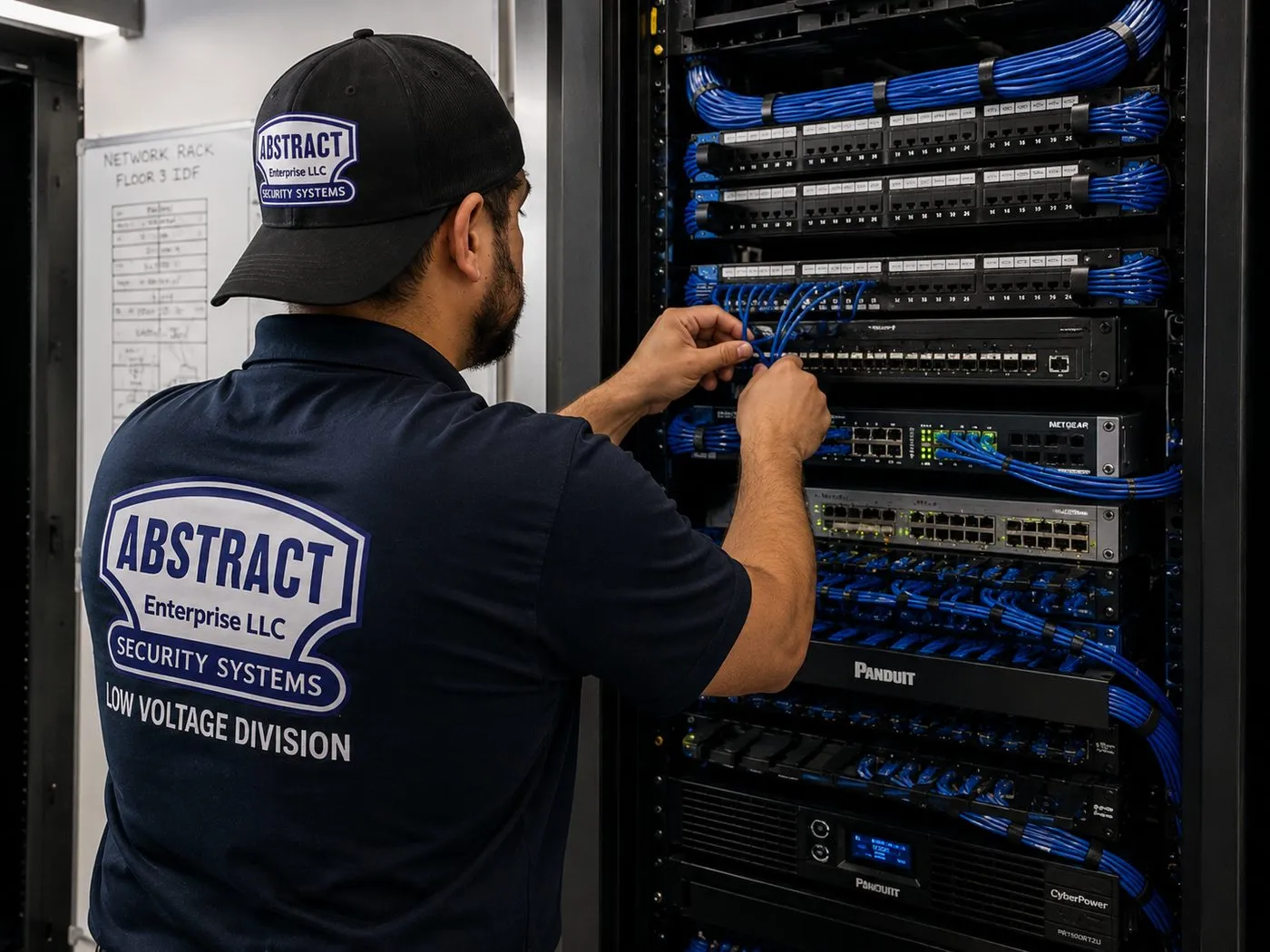
A technician with his back to the camera connects blue patch cords between panels and switches in a black equipment rack, a rack label sheet on the wall beside him.
Complete Services
Every Soundbar Installation Service in Queens
Queens households seldom stop at the bar. Moving apartments, finishing a basement or replacing the television tends to pull one or two of these neighboring services onto the same appointment.
Describe the room once and get a single written price for whichever of these you need.
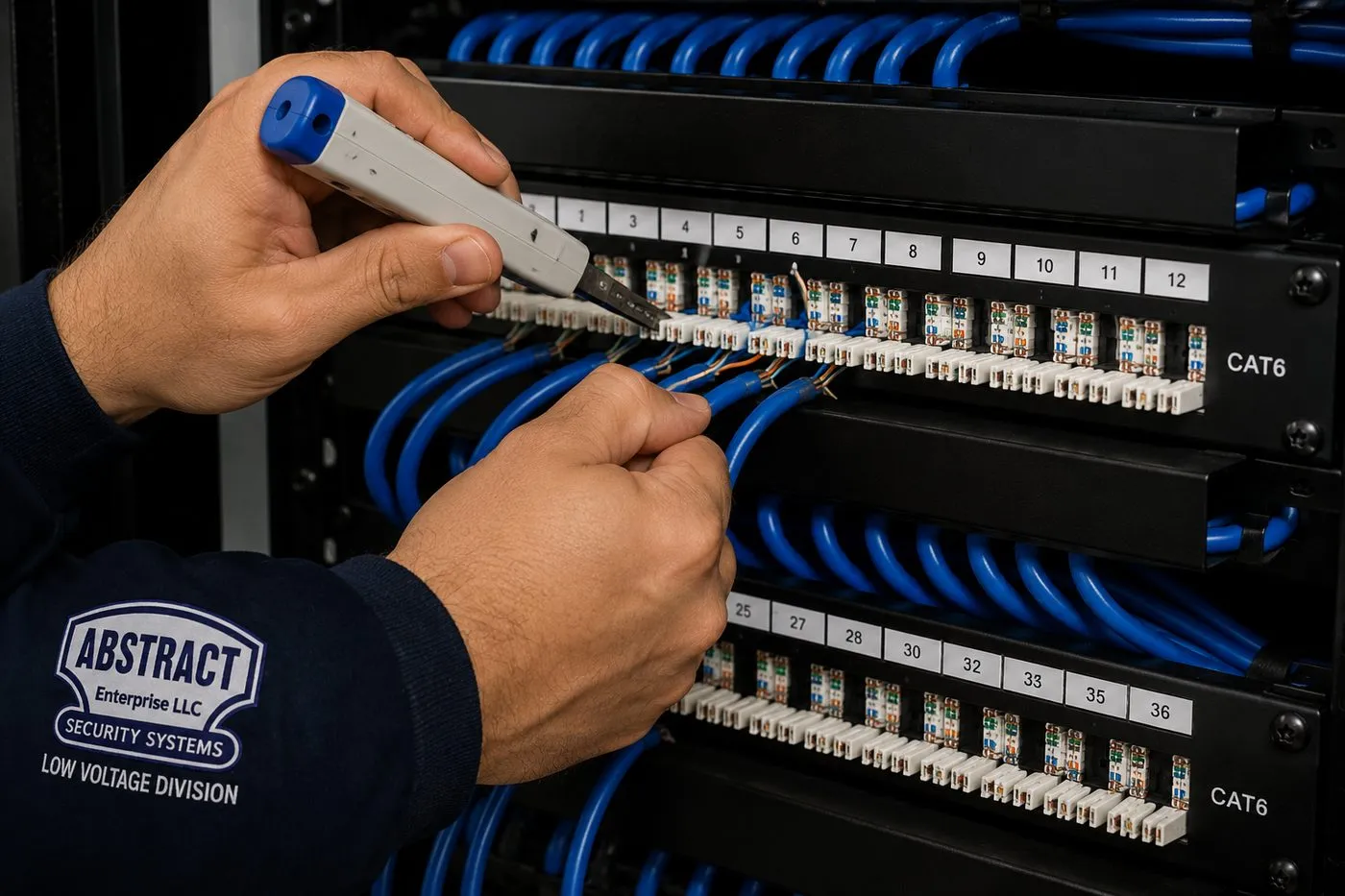
Close-up of two hands, one holding a punch-down tool, seating cable conductors into a numbered Cat6 patch panel with neatly looped blue cables above and below.
Field Notes
Field Notes on Queens Soundbar Walls
Working habits our crews use on Queens walls — general practice rather than a story about a particular home
In a Queens row house, the first question is which of the room's walls are masonry. The side walls shared with neighbors are usually the brick ones; partitions toward the back of the house may be framed. A small pilot hole tells you more than a stud scanner here, because plaster over brick confuses most scanners. If the dust comes out red or buff, you are in brick; if it comes out white and then stops, you are in plaster over a void.
In two-families, look up and down before drilling. Pipes serving the apartment above can run inside a living-room wall, especially one backing onto a kitchen or bathroom, and wiring for the upstairs unit may share the bay. Scan the full height of the bay, not just the spot where the bracket goes.
In towers, find out which wall is the demising wall before choosing one, and ask management whether it is off-limits. In garden co-ops, locate the radiator riser; it often runs up a corner and gets hot enough to matter. And in any basement, check the floor for old water lines on the walls before deciding where the power strip lives.
FAQ
Queens Soundbar Installation FAQ
Will the soundbar work with my Spectrum or Fios cable box?
+
Yes. Charter Spectrum and Verizon both hold cable franchises covering Queens, and both boxes connect to the TV by HDMI. We connect the box to the TV and the TV to the bar over ARC or eARC, so the bar plays whatever the box sends, including second-language and SAP tracks, and the TV remote controls the volume.
Can a soundbar go on a wallpapered wall without ruining the paper?
+
Yes. We mark the holes on painter's tape rather than the paper, drill cleanly through it, and fix the bracket with screws, not adhesive. Stick-on raceway can lift wallpaper when removed, so on papered walls we prefer a screwed raceway or routing cables behind the TV.
Does somebody need to be home for the whole appointment?
+
An adult needs to let us in, agree the height and position before drilling, and see the system working at the end. In between, you don't have to watch. If nobody is there to let us in, the $150 return-trip fee applies, so tell us early if plans change.
How do you keep the soundbar from blocking the TV's remote sensor?
+
We find the sensor on your TV before choosing the bar's height, and set the gap so the bar sits below it. If the TV's feet or a low bezel make that impossible, we use HDMI-CEC so the TV can be controlled through the bar, or move the bar onto the wall beneath the stand.
Can you put a smaller soundbar in a kitchen or bedroom too?
+
Yes. Compact bars suit 32- to 50-inch kitchen and bedroom TVs and mount on the same price lines as a living-room bar. Kitchen backsplashes are often tile, which carries the tile surcharge, and bedrooms usually want night mode set so the bar can be used quietly.
Will a soundbar work with a projector in a basement or den?
+
Usually, with planning. Many projectors have no ARC, so the sound is taken from the streaming box or receiver instead, using a source with an audio output or an HDMI audio extractor. We check the projector's ports before the visit and mount the bar under the screen, not under the projector.
Can I play music from my phone or a record player through the soundbar?
+
From a phone, yes: most bars accept Bluetooth or Wi-Fi casting, and we set it up. A turntable needs a phono preamp and a bar with an analog or Bluetooth input; we connect what you have and tell you if the bar lacks the input.
Is a soundbar or a pair of bookshelf speakers the better buy for a Queens living room?
+
For TV dialogue in a small room, a bar with a center channel usually wins, because it is built to place voices on the screen and connects to the TV over HDMI. Bookshelf speakers with an amplifier often sound better for music but need shelf space, wiring and a second remote unless they support HDMI ARC.
Can the subwoofer or rear speakers be hidden inside furniture?
+
Partly. A subwoofer inside a closed cabinet tends to boom and rattle the doors, so we prefer it beside or in front of furniture with its driver and port clear. Small rear speakers can sit on shelves or in open cubbies, but each wireless rear still needs a power outlet nearby.
Can you connect a game console without adding lag?
+
Yes. The console plugs into the TV so the picture goes straight to the screen with the TV's game mode on, and the sound returns to the bar over eARC. We check lip-sync in a game and leave the bar on a setting that keeps audio in time.
All Areas Served
Soundbar Installation Across New York
This is the Queens page of our soundbar installation service. It sits under the five-borough AESS soundbar installation hub for New York City. Every other borough, plus Nassau and Suffolk, has its own soundbar page; any county page still on the way opens our quote form for now.
Silence after a firmware update, a TV remote that has lost control of the volume, a subwoofer blinking unpaired or a bracket easing out of the wall — ring (347) 434-6392. The next free 2-hour slot is yours, often today, and a typical control or pairing fault takes a technician an hour or two to clear.
Soundbar Installation Queens — Licensed, Insured, Built for Real Living Rooms
Abstract Enterprises Security Systems · 460 E Fordham Rd, Bronx, NY 10458 · Queens line (347) 434-6392 · WhatsApp (718) 679-0359 via wa.me
NYS Low-Voltage License #12000287431 · 100% Licensed & Insured · Same-Day Estimates · Rated 4.7★ from 201 Google Reviews
Brackets and parts carry their manufacturer's warranty. Full terms — including 50% deposit, one-year parts-only warranty on AESS-supplied products, and the late-fee schedule — are set out in the service agreement. See our warranty page.
Last reviewed October 17, 2026. Revision history: Queens page launched with borough pricing, aircraft- and train-noise guidance and multilingual setup notes.