What are you looking for?
About Us Contact Us Careers Get a Free Quote (800) 486-0943
Pick a service
✅ Got Your Own System?
🎬 Home TheatreQuote 🎶 AV SoundQuote 🔑 Access ControlQuote
Now pick your area
Pick your area
Long Island
Hudson Valley
Services available
Pricing & Tools
Pick a service for pricing
🚪 Intercom Pricing 🔔 Buzzer Repair Pricing
Calculators
📹 Camera System Calculator 🚨 Alarm Calculator ⚡ Cabling Quote Builder ✅ Got Your Own System?
Select your area
Home › Soundbar Installation NYC › Soundbar Installation Brooklyn
Brownstones · Frame Rowhouses · Downtown & Waterfront Towers · Licensed Low-Voltage

Soundbar
Installation in
Brooklyn

Party-Wall Mounting · Chimney-Breast Fixings · Concrete & Steel-Stud Towers · eARC Setup · Bass Kept on Your Floor

Brooklyn living rooms come in three very different shells: masonry rowhouses whose TV wall is shared with the house next door, nineteenth-century frame houses with brick packed between the studs, and the glass-and-concrete towers that have gone up around Downtown Brooklyn and the Williamsburg waterfront. We mount soundbars into all three with fixings matched to what the drill actually finds, hide or dress the wiring the way your lease or your house allows, connect the bar on the port that lets the TV remote run it, and set the bass for a building where somebody lives on the other side of the brick.

Reviewed and updated October 17, 2026 · Written by Anwar Timothy, NYS licence #12000287431 · Brooklyn office: 1282 Troy Ave

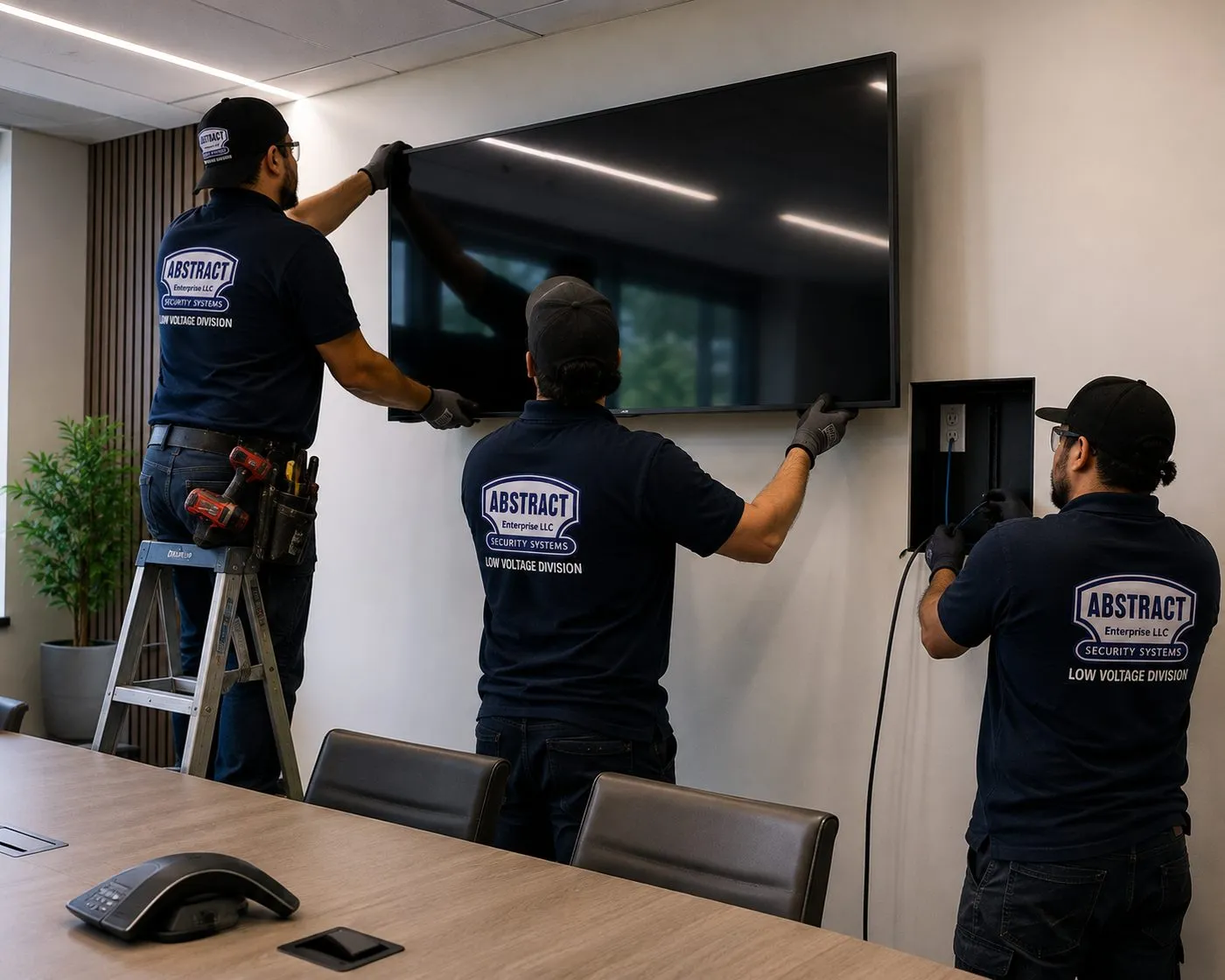
Three technicians hanging a large display on a conference-room wall beside a recessed media box, wiring for a Brooklyn soundbar installation
Three technicians set a large display on its wall mount while one feeds cable into a recessed box below it, a speakerphone on the table in front — the box-behind-the-screen layout a tidy soundbar connection depends on.
Free Brooklyn Soundbar Quote
The bar, the TV, the wall — a written price back the same business day

✅
Request Sent!
A Brooklyn installer will call you back the same business day.
25+
Years Experience
✓
Same-Day Estimates
100%
Licensed & Insured
4.7★
201 Google Reviews

Party wall, plaster or tower partition — name it and get a number. Our Brooklyn desk is on (347) 934-8335, and the short form takes about a minute. A licensed installer matches your wall and bar to the price list below and writes back with the total.

  • Wall-mounted under the TV from $129, the same price from Greenpoint to Gerritsen Beach
  • Your managing agent's COI paperwork prepared and sent ahead, at no cost
  • State low-voltage licence #12000287431; technicians arrive inside a 2-hour slot, any day between 8 AM and 8 PM
The Neighborhood

Why Brooklyn Homes Need Soundbar Installation

In Brooklyn the hard part of a soundbar job is almost never the soundbar. It is the wall the bar has to hang on and the floor the subwoofer has to sit on. A borough of roughly 2.65 million people and more than 1.14 million housing units, according to the Census Bureau's 2025 estimates, has built its homes in waves: brick and brownstone rowhouses through the late nineteenth century, wood-frame houses in Bedford-Stuyvesant, Bushwick and Flatbush, pre-war elevator buildings along the parkways, post-war towers on the edges of the borough, and, since the rezonings of the 2000s, a new skyline of concrete residential towers. Each wave left a different wall behind the TV.

Walk into a parlor floor in Fort Greene or Park Slope and the obvious TV wall is often the party wall, a masonry wall shared with the house next door, or the chimney breast that juts out between the front and back parlors. Neither has studs. Both take masonry anchors well, but both have a catch: the party wall is thinner than most people assume, and a chimney breast hides a flue. On Brownstoner's forum, one owner described the belief that rowhouse party walls are very thick as a myth after a neighbour's plumber broke straight through theirs; even an eight-inch wall, they wrote, is "frighteningly easy to break through." That is the reason we treat drill depth on a Brooklyn party wall as a measurement, not a guess.

Head a few blocks east into a Bed-Stuy or Bushwick frame house and the wall can be stranger still. A Brownstoner renovation diary from Bed-Stuy describes opening the walls of a wood-frame house and finding the party and exterior walls built with brick and mortar packed between wood timber posts, a method called brick nogging that the writer notes had fallen out of common use by 1882. A stud finder goes quiet over that kind of wall; a drill alternates between wood, soft old brick and voids. Mounting there is about reading the wall as you go, not trusting a single reading at the start.

Then there is the Brooklyn that did not exist twenty years ago. Since Downtown Brooklyn was rezoned in 2004, the neighbourhood has added close to 27,000 new housing units, Planetizen reported in August 2025, citing the New York Post. Across the borough on the East River, the 2005 Greenpoint–Williamsburg rezoning opened the waterfront to high-rise housing; Greenpointers reported in 2025 that 2,306 units were added in that community board in 2023 alone, the most of any Brooklyn board that year. In those buildings the TV wall is a steel-stud partition, a poured concrete column, or a floor-to-ceiling window, and the management office has an insurance and scheduling procedure of its own.

What ties all of this together is that almost nobody in Brooklyn lives alone in a building. The Census Bureau puts the borough's owner-occupied rate at 29.5 percent, so most households rent, and even the owners of a two- or three-family brownstone usually have a tenant on another floor. Noise is personal here. On Reddit's r/Brooklyn, a resident asking for help with a neighbour's loud music was told to submit 311 complaints after 10 PM and to consider a noise level meter, which is exactly the hour the city's Noise Code starts measuring sound inside a neighbour's home. A soundbar install that ignores where the bass goes is only half finished.

Brooklyn figures that shape a soundbar job

  • 2,653,963 people and 1,141,824 housing units: Kings County's July 1, 2025 estimates from the U.S. Census Bureau QuickFacts — a very dense borough where most TVs share a wall, a floor or both with a neighbour.
  • 29.5 percent: Brooklyn's owner-occupied housing rate for 2020–2024 (Census QuickFacts). Seven in ten households rent, which is why console placement, TV-attached brackets and cord covers come up on so many of our Brooklyn calls.
  • About 27,000: new housing units added in Downtown Brooklyn since the 2004 rezoning (Planetizen, August 2025, citing the New York Post) — concrete and steel-stud walls, management offices and alteration rules.
  • 2,306: units added in 2023 in the Greenpoint–Williamsburg community board covered by the 2005 waterfront rezoning, the most of any Brooklyn board that year (Greenpointers, May 2025).
  • 1965: the year Brooklyn Heights became New York City's first historic district (Brooklyn Heights Association). Park Slope and Bedford-Stuyvesant/Stuyvesant Heights followed with districts of their own, which matters for anything fixed to the outside of a house, though not for a soundbar inside it.
  • 5,881 apartments in 46 buildings: the scale of Spring Creek Towers, the former Starrett City, by Jamaica Bay (Twin Pines Management) — a reminder that Brooklyn's concrete-block living rooms are as common as its brownstone parlors.

Read those numbers as a job description. A Brooklyn soundbar usually goes into a multi-family building, onto masonry or a tower partition, for a renter or an owner-landlord who will hear about it if the bass carries. Getting it right means choosing the fixing for the wall, keeping drill depth under control on shared masonry, routing cable in a way the lease or the house permits, and tuning the low end for the people on the other side.

A soundbar booking in Brooklyn very often comes with a screen to hang above it, and doing both together means one set of holes planned as a pair. Our Brooklyn TV installation crew prices from the same list, and if the project grows toward surrounds, a receiver or speakers in the ceiling, AESS AV and sound installation in Brooklyn takes it from there.

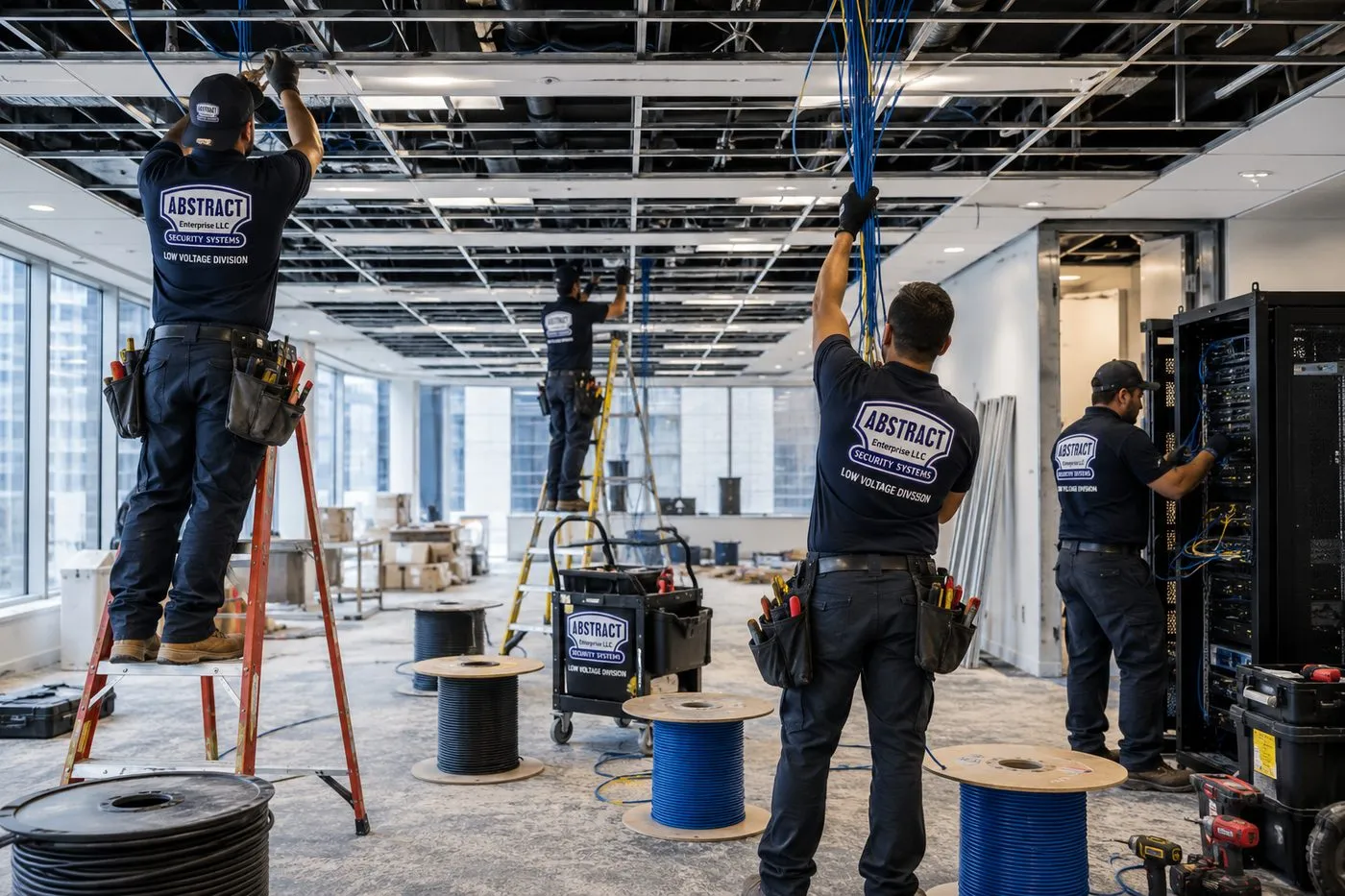
Four-person low-voltage crew pulling cable into an open ceiling with cable spools on the floor, the Brooklyn crew behind our soundbar wiring
Two technicians on ladders feed cable up into an open ceiling while a third pulls from a spool and a fourth works at an equipment rack, with blue and black cable reels across the floor.
Repair Capture

Brooklyn Soundbar Dropping Out or Pulling Off the Wall?

An existing soundbar that misbehaves usually needs settings and patience rather than a drill. If yours went quiet after the TV updated itself, ignores the TV remote, lets the voices lag the picture, has lost its sub, or hangs from a bracket that is easing out of soft Brooklyn plaster, book it as a repair. Openings in the next 2-hour slot go to these calls first, and once we are standing in front of the bar most of them take an hour or two. Phone (347) 934-8335 and mention the soundbar, or check the TV and soundbar service policies to see how hourly setup time is charged.

What We Install

Soundbar Installation Services in Brooklyn

These are the jobs we book across Brooklyn, alone or in combination. Every one is priced from the published list on this page and ends the same way: bar level and centred on the screen, cables hidden or neatly dressed, the TV remote driving the volume, and a short listening check from your seat before we leave.

Masonry Mount on a Party Wall

The classic brownstone parlor job. Sleeve or screw anchors set in solid brick behind the plaster, holes kept to a measured depth so nothing reaches the house next door, and the bar levelled to the TV rather than to a ceiling that may not be level itself.

Chimney-Breast Installs

When the TV sits on the projecting breast between the parlors, we fix into the brick faces either side of the flue line and stay out of the flue itself. Cables usually come down a painted cord cover, because a working or capped chimney is no place for in-wall wiring.

Frame-House and Nogging Walls

Wood-frame rowhouses in Bed-Stuy, Bushwick and Flatbush can hide brick between the studs. We probe before committing, fix into timber where it lines up and into sound brick where it doesn't, and bridge irregular framing with a plywood backer when the wall calls for one.

Tower Partitions and Concrete Columns

Steel-stud and gypsum walls in Downtown Brooklyn, DUMBO and the Williamsburg waterfront take fasteners made for light-gauge steel; concrete columns and shear walls take a hammer drill and concrete anchors, with dust captured at the bit.

Renter-Friendly Setups

For leases that limit holes: console placement, a bracket that clips the bar to the existing TV mount, and cable dressed along the furniture. We tell you exactly what, if anything, will need filling when you move out.

Hidden and Dressed Wiring

In-wall concealment with a code-compliant power and cable kit where there is a cavity and the building allows it; paintable surface raceway on brick, block and concrete where there is no cavity to use.

eARC, CEC and Remote Setup

The bar on the TV's eARC or ARC socket, HDMI-CEC switched on so one remote handles power and volume, lip-sync checked, and firmware and the maker's app brought up to date on your Wi-Fi.

Subwoofer and Surround Pairing

Wireless subs and rear speakers paired, placed and levelled for a home with neighbours: off the bare boards, away from the party wall where the room allows, and set lower than the showroom default.

Bar Moves Between Brooklyn Apartments

Bracket and bar taken down at the old apartment and re-hung at the new one on anchors for whatever wall is waiting there — often brick on one end of the move and steel stud on the other.

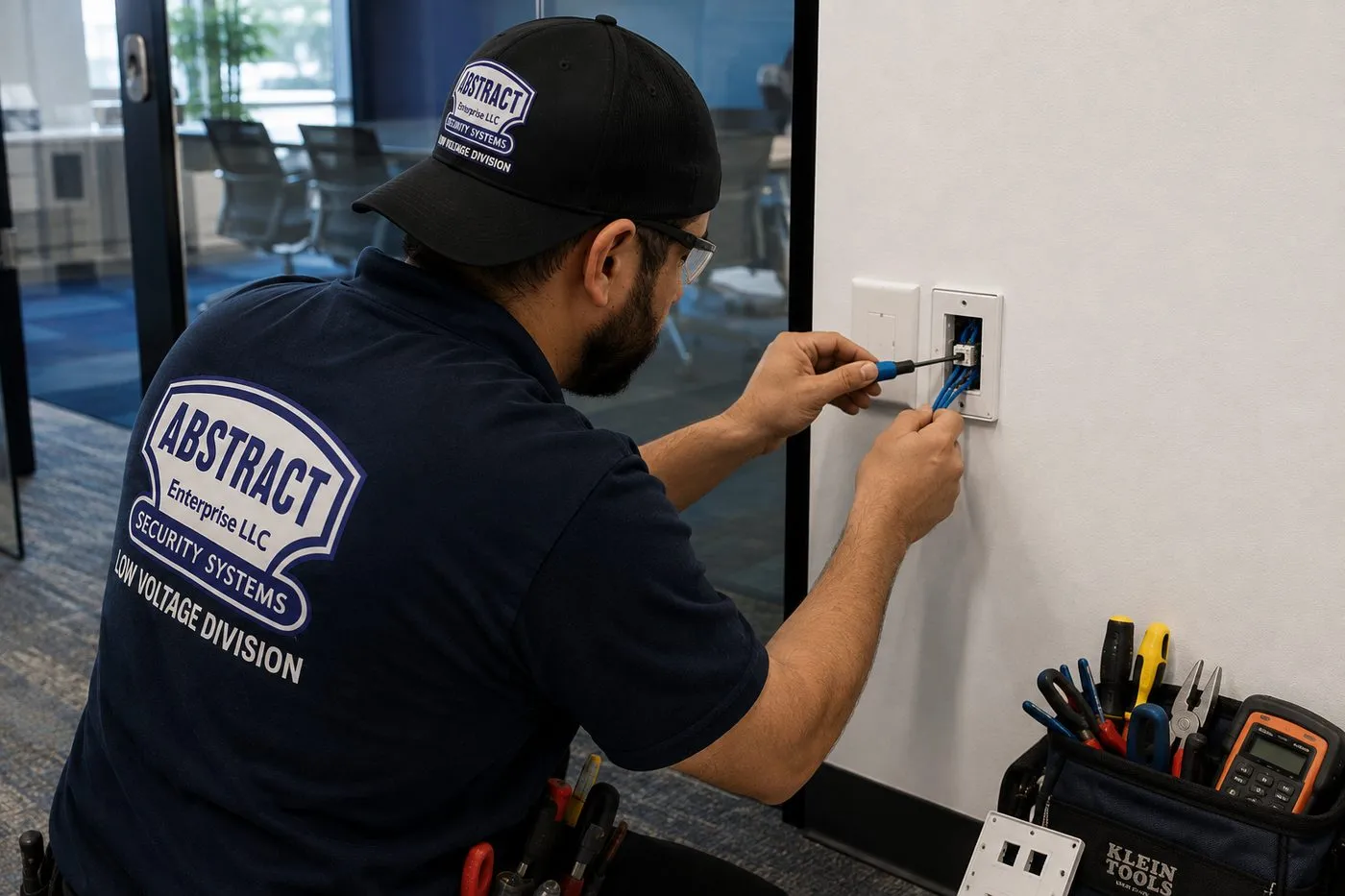
Technician terminating a cable into a wall-plate jack in an office, low-voltage termination like the HDMI and network plates behind a Brooklyn soundbar
A technician works a blue cable into a recessed wall-plate jack, a tool bag with a multimeter and spare plate on the floor beside him — the same kind of plate that finishes an in-wall soundbar run.
Building Specialists

Soundbar Installation for Brooklyn's Architecture

Brooklyn's building types differ more from one another than the soundbars people buy. These are the homes we work in most across the borough, and what each one means for where the bar goes, what it hangs on and how its cables get from the TV to the outlet.

Brownstone and Brick Rowhouses

Brooklyn Heights, Park Slope, Fort Greene, Clinton Hill, Cobble Hill, Carroll Gardens, Prospect Heights and most of Bed-Stuy. Masonry party walls, plaster on the inside face, a chimney breast in each main room, timber floors and often a tenant on the garden or top floor. The TV wall is usually masonry, and the bass question is usually about the house next door as much as the floor below.

Wood-Frame Rowhouses

Older frame houses in Bed-Stuy, Bushwick and other nineteenth-century neighbourhoods, many re-clad over the years. Walls may be lath and plaster over timber studs, sometimes with brick nogging between them. Framing is irregular, plaster may be loose, and a plywood backer is sometimes the cleanest way to give a bracket something consistent to bite.

Victorian Detached Houses

Prospect Park South, Ditmas Park and the other Victorian Flatbush blocks: freestanding houses with lath-and-plaster walls, large rooms, bay windows and wide openings between rooms. No party wall to worry about, but long cable runs and plaster that needs gentle drilling.

Pre-War Elevator Apartments

The pre-war apartment buildings along Ocean Parkway, Eastern Parkway and through Flatbush, Kensington and Midwood. Plaster over block or brick, steam radiators on outside walls, a super and a managing agent, and neighbours on four sides.

Post-War Towers and Large Complexes

From Spring Creek Towers by Jamaica Bay to the post-war apartment towers of southern Brooklyn. Concrete floors, block or concrete walls, a management office with contractor rules, and lower ceilings. Very strong fixings once drilled, and no cavity for in-wall cable.

New Residential Towers

Downtown Brooklyn, DUMBO, Greenpoint and the Williamsburg waterfront. Steel-stud partitions with gypsum board, concrete columns and shear walls, floor-to-ceiling glass and building Wi-Fi in every unit. The building usually wants a certificate of insurance and a booked service-elevator slot before anyone drills.

How each Brooklyn wall is drilled, fixed and wired

Party walls behind plaster. We drill through the plaster with a sharp masonry bit and no hammer action until we reach brick, then switch to the method the brick needs. Depth stops are set on every bit so a hole for a sleeve anchor goes as deep as the anchor and no deeper. Anchors go into the body of a brick rather than the mortar joint, because lime mortar in an old Brooklyn wall can be soft enough to crumble under a fingernail. Soundbars are light, so two good fixings are usually plenty; what matters is that they are in sound masonry and not in a patched or hollow area.

Chimney breasts. The projecting breast in a brownstone parlor holds a flue, live or capped, and the brick around a flue can be a single course. We find the flue line first — it usually runs up the middle of the breast — and keep fixings to the solid brick either side. A Brownstoner building-code thread points out that it is illegal to pocket a floor joist into a masonry chimney breast partly because of that one-brick thickness, which is a good reminder of how little material can sit between a drill and a flue. Cable comes down the face of the breast in a raceway painted to match.

Nogging and irregular frame walls. A stud finder confused by brick and timber gives readings that mean nothing, so we drill a small pilot where the bracket will sit and read what comes out on the bit: wood shavings, red brick dust or nothing at all. Where the bracket can catch two timbers, it goes into timber. Where it lands on sound brick, masonry anchors. Where it lands on a void or loose plaster, we either move the bar a little along the wall or fit a plywood backer across the framing and mount to that.

Lath and plaster in Victorian houses and pre-war flats. Gentle drilling, toggles that spread the load behind the plaster when the framing doesn't line up, and a check for plaster that has let go of its lath — press lightly around the area and listen for a hollow, papery response. Loose plaster is fixed through to framing or bridged, never trusted on its own.

Concrete and block in towers and complexes. A hammer drill, concrete anchors or hollow-block anchors set in the solid web, and a vacuum held under the bit. Block walls in older complexes sometimes carry conduit or piping we cannot see, so we scan first and keep clear of the vertical line above outlets and switches.

Steel studs in new towers. Fasteners rated for light-gauge steel or toggles through the board, never wood screws, which strip in thin steel. Partitions between apartments in new buildings are often built as sound-rated assemblies, so we avoid cutting large openings in them and favour surface or local routing for cables rather than through-wall boxes on a demising wall.

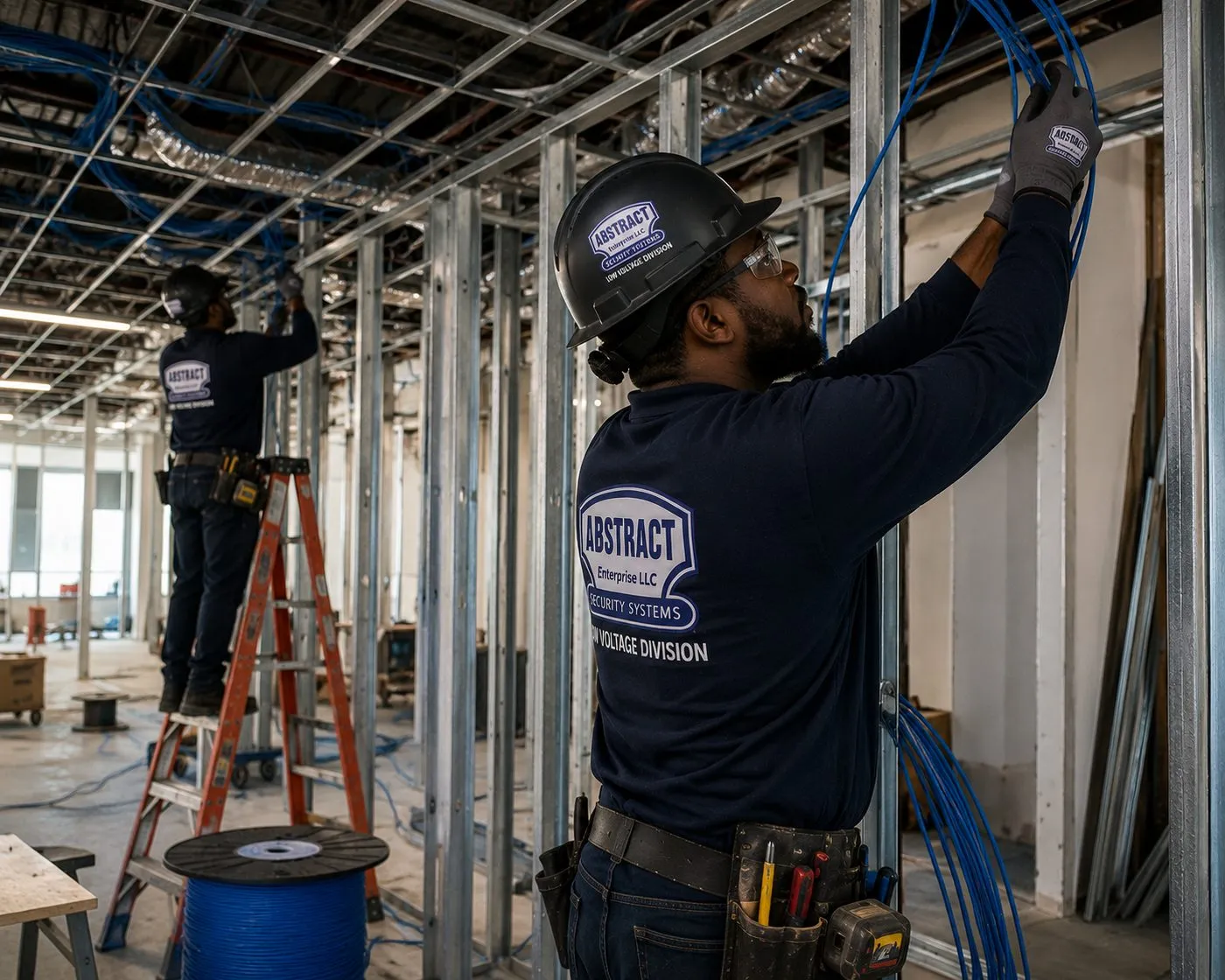
Two technicians in hard hats running blue cable through steel-stud framing before drywall, the stage where in-wall soundbar wiring is easiest in a Brooklyn tower
Two technicians in hard hats, one on a ladder, pull blue cable through steel studs in an open framed space with a cable spool on the floor — how a tower partition looks before it closes.
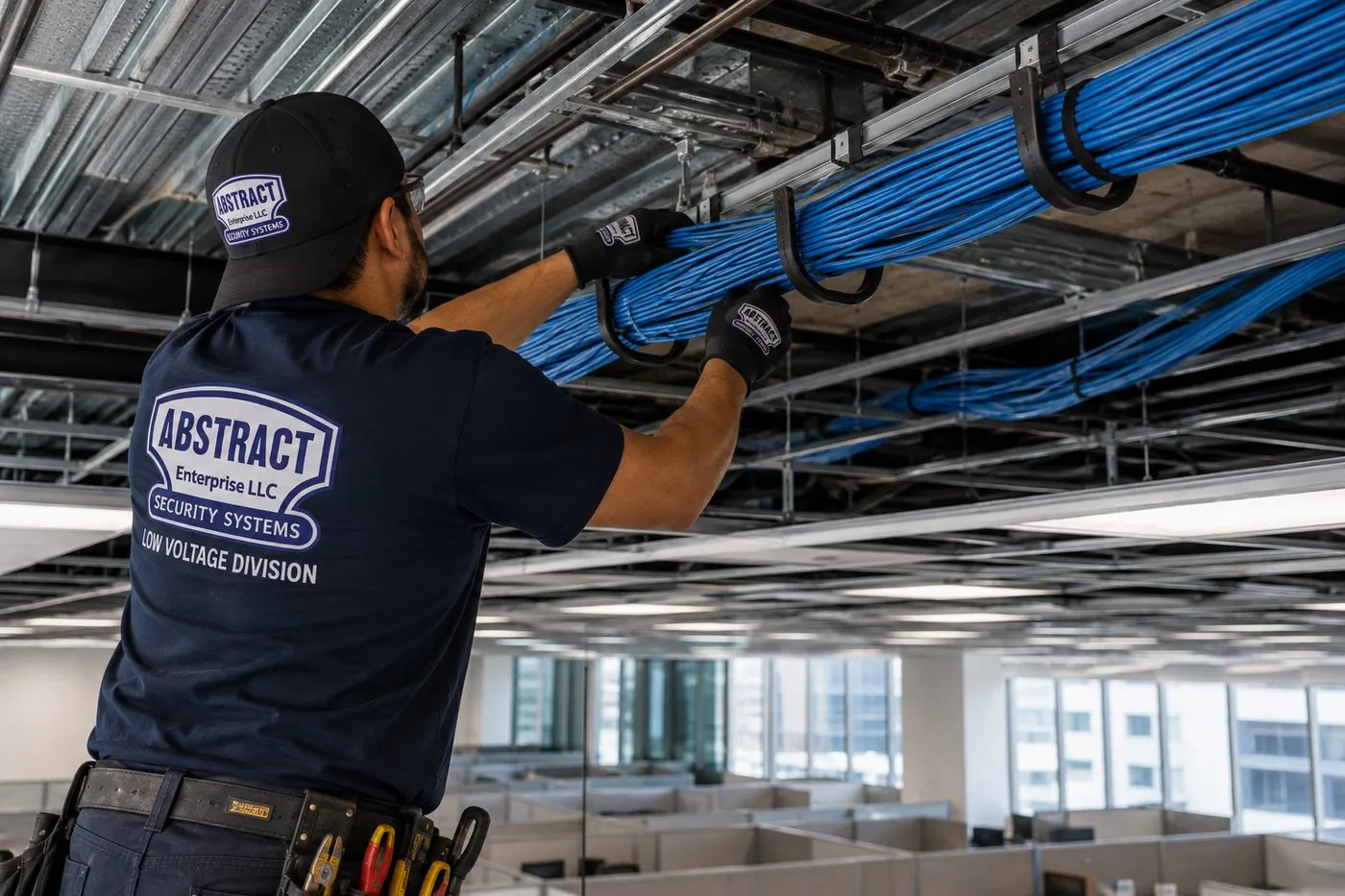
Technician seating a bundle of blue cable into J-hooks under an open ceiling above an office floor in Brooklyn
A technician in gloves lays a thick bundle of blue cable into black J-hooks beneath an exposed ceiling deck, with cubicles and windows below.

While a brownstone or frame-house wall is open, the cheapest upgrade is a data cable behind the TV, sparing the bar and streamer from competing with a dozen neighbouring networks. That pull is handled by our structured cabling installation in Brooklyn, usually scoped on the same walkthrough.

Commercial Soundbar Installation

Business Soundbar Installation in Brooklyn

A soundbar is often the cheapest way to make a business screen understandable. A display on a wall with only its built-in speakers is fine for captions and poor for anything else; a bar underneath it fixes speech for a fraction of what a ceiling system costs. These are the Brooklyn settings where we fit them most, and what changes from one to the next.

Downtown Brooklyn and Fulton Mall

Fulton Mall runs as a pedestrian and transit mall on Fulton Street between Flatbush Avenue and Adams Street, surrounded by the offices, campuses and new towers of Downtown Brooklyn. Conference rooms and training rooms here want a bar under a meeting-room display on eARC, mounted on steel stud or concrete.

Williamsburg and Greenpoint

Bars, restaurants, studios and co-working floors in converted industrial buildings and new waterfront blocks. Exposed brick, timber posts and concrete in the same room, screens over counters, and neighbours upstairs who expect the music to stop at the door.

Bay Ridge: Third Avenue, Fifth Avenue and 86th Street

Three commercial spines, each with its own business improvement district or merchants' group, lined with pubs, restaurants and shops that put the game on. One bar per screen, mounted clear of servers' heads, with a volume ceiling staff can find in a hurry.

Industry City, Sunset Park

About six million square feet of workspace, retail and food, according to Industry City, spread across sixteen buildings on 35 waterfront acres. Showrooms, offices and event spaces in heavy concrete-framed industrial buildings, where fixing is about concrete and cable is about surface raceway.

Neighbourhood Strips Across the Borough

Salons, barbershops, gyms, laundromats and medical offices on Flatbush Avenue, Church Avenue, Kings Highway, Nostrand Avenue and every other Brooklyn shopping street. Screens run all day, so brackets need to be tamper-resistant and remotes need a home.

Lobbies, Lounges and Amenity Floors

Residents' lounges, gyms and screening rooms in the new rental towers. Management sets the hours, the audio has to stay inside the room, and cable has to be invisible because the room is on the leasing tour.

Compliance callouts for business soundbars in Brooklyn

  • Music limits under the city Noise Code. For businesses playing music, the Department of Environmental Protection's summary of the code sets a ceiling of 42 dB inside a nearby residence, a 7 dB margin over ambient on the street at 15 feet or more from 10 PM to 7 AM, and a separate bass limit of 6 dB(C) over ambient where the street is already above 62 dB(C). In a ground-floor space under apartments — most Brooklyn storefronts — we set bars and subs with the bass limit in mind first.
  • Storefronts in historic districts. The city's business portal says the owner of a building in a designated historic district needs a Landmarks Preservation Commission permit before doing any work that needs a Department of Buildings permit, and changes to protected exterior features need LPC review. A soundbar inside the shop is neither; an outdoor speaker or cable run on the facade of a landmarked building is a question for the landlord and LPC before it is a question for us.
  • Walkways and the 4-inch rule. Anything fixed to a wall in a public route at a height from 27 to 80 inches may stick out no more than 4 inches under the 2010 ADA Standards, and most soundbars on brackets exceed that. In a clinic hallway or a shop aisle the bar therefore goes higher, into a recess, or off the route altogether.
  • What counts as electrical. HDMI, network and speaker wiring for a bar stays on the low-voltage side and has no DOB permit of its own. A new receptacle behind a display is a different trade — a licensed electrician's — and either way the landlord's rules for contractors govern the visit.
  • Landlord insurance requests. Commercial leases in Brooklyn nearly always require a contractor's COI listing the owner and agent; ours costs nothing and normally goes out the day you forward the request.
  • Cable rating. Anything run inside a wall or above a ceiling uses cable rated for that space rather than the patch lead from the box.
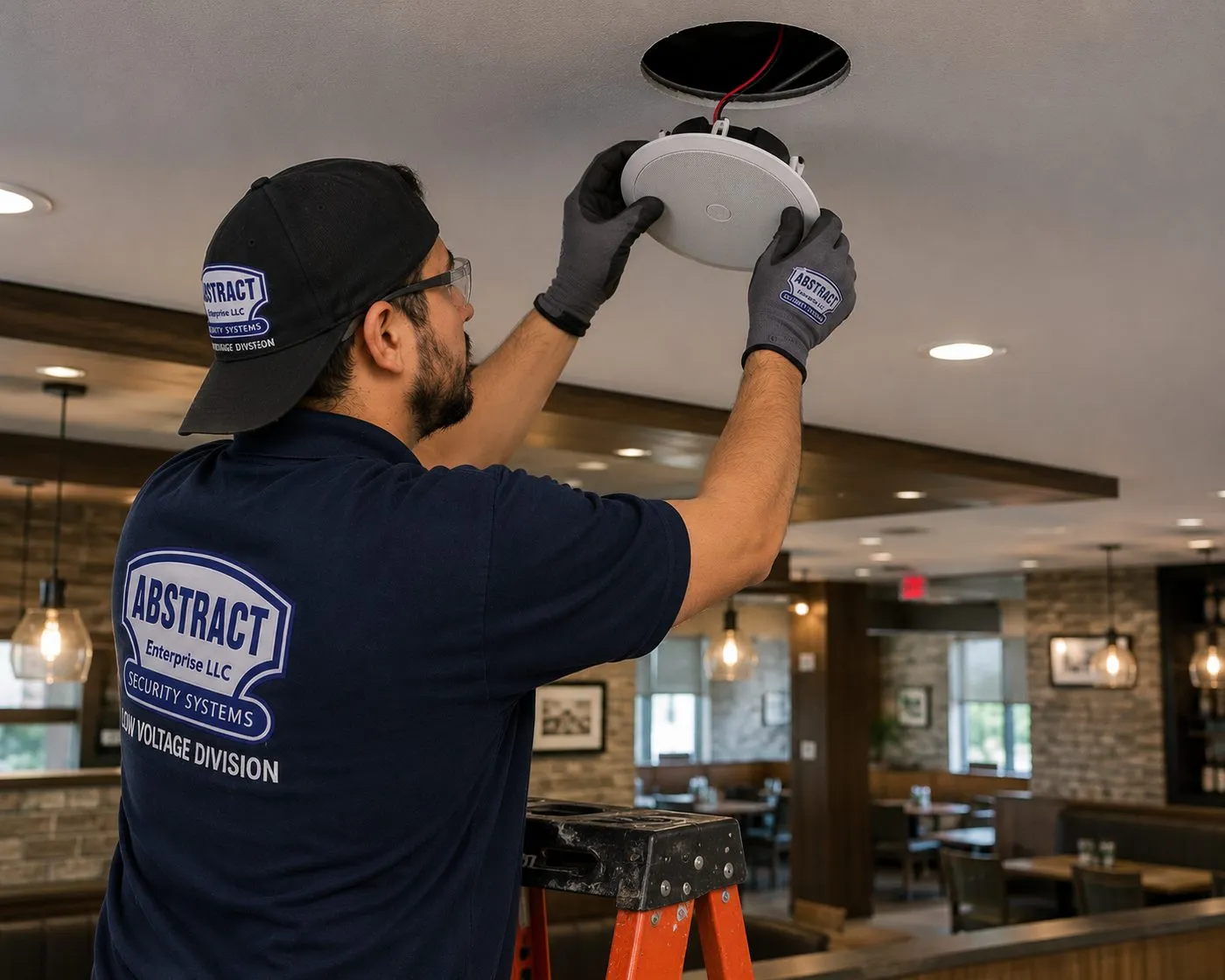
Technician fitting a round ceiling speaker into a cut-out above a restaurant dining room with brick walls, commercial audio work alongside Brooklyn soundbar installation
A technician on a stepladder lifts a round ceiling speaker into its opening above a dining room with brick walls and pendant lights — the next step up when one soundbar can't cover a whole room.

A shop or office adding soundbars is often due for new cabling, cameras or a door reader as well. Those jobs sit with our low-voltage installation team in Brooklyn, licensed for all of it.

Game-Day Screens

Soundbars for Brooklyn Bars, Restaurants and Storefronts

Most Brooklyn hospitality spaces sit on the ground floor of a mixed-use building, with apartments directly overhead. That single fact shapes every commercial soundbar we fit, from a pub on Third Avenue in Bay Ridge to a cafe on Bedford Avenue. The goal is speech and commentary that customers at the nearest tables can follow, without low end that reaches the bedrooms upstairs or the sidewalk at midnight.

One bar per screen, aimed at the seats

A long room with three or four screens usually works better with a modest soundbar under each one than with a single loud system. Each bar only has to reach the tables in front of it, so every screen can run at a lower level and the room stays conversational.

Subwoofers stay off or stay low

In a storefront under apartments, a separate sub is the component most likely to break the city's bass limit for commercial music. We generally leave it out, or set it well down and on an isolation platform away from the party wall and the structural columns. Bars with good built-in bass usually give enough weight for crowd noise and commentary.

Mounting heights that clear trays and heads

Screens over a bar back or a dining room are often high, and the soundbar goes with them, which usually means the $75 high-mount line. We keep the bar clear of shelving, coolers and server routes, and on exposed brick we fix into the face of sound bricks rather than mortar joints, with cable in a painted raceway or behind the bar back.

Controls that staff can use

The most common commercial complaint we hear is that nobody can find the right remote at 9 PM on a Saturday. We label remotes by screen, set each bar's maximum volume where the model allows it, and turn on HDMI-CEC so the TV remote can handle most of the work. For a venue with several screens, a programmed universal remote per screen is often worth the $99.

Your Questions Answered

Soundbar Installation in Brooklyn: Questions Answered

These are the questions that come up when a Brooklyn soundbar job meets a Brooklyn building: what is behind the plaster, how far sound travels through a shared house, what a new tower allows, and what an old house's paperwork really requires. Booking, brands and moving questions are in the FAQ near the bottom.

Masonry, flues and old brick

Can the soundbar go on the chimney breast in a brownstone parlor, and does the old flue get in the way?

Yes, and the chimney breast is often the best-looking spot for a TV and bar in a parlor because it is centred on the room. The flue is the one thing to plan around. It usually runs up the middle of the breast, and the brick wrapping it can be a single course thick, so we locate the flue line before marking anything and put fixings into the solid brick on either side of it. A soundbar bracket rarely needs more than two fixings, and they can almost always sit outside the flue zone. If the fireplace below is still used, we also check how warm the breast gets at bar height, because electronics and rising heat do not mix well.

What the chimney breast will not take is in-wall wiring. Running cable down a flue or through the brick around it is not something we do, whether the fireplace works or has been capped. The finish there is a slim raceway down the face of the breast, painted to match, or a short run to the side and down the wall beside the breast where it meets the party wall.

How do you stop the drill from coming out the other side of a party wall into next door?

By deciding the depth before the drill starts. A soundbar anchor needs a hole a little longer than the anchor itself, usually a couple of inches into the brick. Every masonry bit we use on a party wall has a depth stop set to that length, so the hole ends where the anchor ends. We also drill without hammer action until we are through the plaster and can see what the brick is like, because hammering old soft brick can spall the far face even when the bit never gets there.

The other precaution is placement. Party walls are rarely uniform; some sections are two bricks thick, some have been patched, and some have old openings bricked in. A hole that suddenly breaks into a void or dust that changes colour tells us we are in a patch, and we move the fixing rather than push on. If the wall sounds or drills unusually thin at the planned height, the alternative is a TV-attached bracket that needs no new holes at all.

The wall in our Bed-Stuy frame house has brick between the studs — how does a bracket get a solid grip?

That brick-and-timber wall, known as nogging, is one of the more awkward surfaces in Brooklyn because no two fixings land on the same material. A stud finder reads it as noise. We drill a small pilot hole at each proposed fixing and look at what comes out: pale wood shavings mean timber, red dust means brick, and a sudden drop means a void or a mortar pocket. Fixings then go into timber with screws long enough to bite, or into the middle of a sound brick with a masonry anchor.

When the pilots tell us the wall is too irregular to trust in the place you want the bar, the clean answer is a plywood backer screwed across two or three timbers, with the soundbar bracket mounted to the plywood. It costs a line on the price list and gives the bar a flat, consistent base, which also helps on frame walls that bow or lean after a century of settling.

Can the new soundbar bracket reuse holes the last owner left in the brick?

Sometimes, but only after we look inside them. Old holes in brick are often oversized, filled with crumbled plastic plugs, or drilled into mortar joints rather than brick, and an anchor set into a widened hole will not hold the way the packaging promises. If an existing hole is clean, sits in solid brick and happens to match the bracket's spacing, we can clean it out and use a larger anchor in it. More often we put the new fixings a short distance away in fresh brick and leave the old holes for a mason or painter to fill. Either way, we tell you which holes we used before we leave.

Sound in a shared house

Our floor-through shares a party wall with the next house — does bass really travel sideways through brick?

It does, though usually less than it travels down through floors. Low bass passes into whatever the subwoofer is touching and whatever the room's air pressure pushes on, and in a rowhouse that includes a masonry wall shared with the neighbours and floor joists that run between the two party walls. A subwoofer pushed into the corner where the party wall meets the floor is in the worst possible place, because it excites the wall and the joists at once. Mid-range and dialogue from the bar itself are far less of a problem; brick is good at stopping them.

The practical answer is to keep the sub off the party wall and off the bare boards. We place it along the front or back wall of the room, a little out from any corner, on an isolation pad or a dense rug, and set its level against the bar so it fills in rather than leads. For many brownstone floor-throughs that alone turns a complaint into something the neighbours never notice.

What do night mode and dialogue enhancement actually change for late viewing?

Night mode, which makers also call dynamic range control or something similar, narrows the gap between the quietest and loudest sounds in the soundtrack. Explosions and music swells are pulled down and quiet speech is pushed up, so you can keep the overall volume low without missing lines. Dialogue enhancement is different: it lifts the frequencies where speech sits, and on bars with a centre channel it gives the centre more weight. Used together, they let you watch at a level that stays inside your own walls after 10 PM.

Neither switch turns off the subwoofer, and on some bars the sub level is a separate control. We show you where night mode, dialogue enhancement and sub level live on your remote or in the app, and if you watch late most nights we can set a lower sub level as the everyday default.

We own the brownstone and rent out the garden apartment — where should our living-room soundbar go?

On the floor above a tenant, the floor itself matters more than the wall. The soundbar can go wherever the TV looks best, because the bar's own sound is mostly mid-range and is stopped well by plaster and brick. The decision that protects your tenant is the subwoofer: which part of the room it sits in, what it stands on, and whether you need it at all. Rooms over a tenant's bedroom are worth mapping before you choose; a sub over their kitchen is far less intrusive than one over the bed.

If the parlor floor is the obvious TV room and the tenant's bedroom is directly below, a bar with good built-in bass and no separate sub can be the right purchase. We are happy to say so before you buy, and if you already own a sub, we set it up for that floor rather than for a showroom.

New towers in Downtown Brooklyn and on the waterfront

In a new Downtown Brooklyn rental, can you drill the concrete column or only the drywall?

Technically we can drill either, but in a rental tower the lease and the management office decide which, and many buildings treat structural concrete differently from partitions. Columns and shear walls in new towers can carry post-tensioning tendons or embedded conduit, and some management offices prohibit drilling into them outright. Partitions are steel stud with gypsum board and take toggles or steel-stud fasteners without trouble.

So before the visit we ask you to check the building's resident handbook or ask the management office, and we plan the mount for the wall they allow. Where only the partition is permitted and the TV is on the column, the answer is usually a TV-attached bracket for the bar or a console placement. We never drill a tower's structural concrete without the building's say-so.

The TV wall is the sound-rated partition between our apartment and the neighbour's — can a bracket go on it without spoiling the soundproofing?

Yes, if the fixings are small and nothing passes through the wall. Demising partitions in new Brooklyn towers are usually built as layered assemblies — steel studs, insulation and one or more layers of gypsum board, sometimes on resilient channel — designed to keep sound between units at a rated level. A couple of toggle or steel-stud fasteners for a light soundbar bracket barely affect that. What does affect it is a large hole: a recessed box cut into the board, a through-wall cable pass, or a box placed back-to-back with one on the neighbour's side.

So on a demising wall we keep to surface fixings, avoid recessed boxes, and bring cable down in a slim raceway or route it along the wall to the console instead of inside the partition. If you want in-wall wiring, we look for a non-demising wall to carry it, or ask the building which walls are rated before cutting anything. And because a bar on a shared wall sends some vibration into it, we set the subwoofer away from that wall and lower than the default.

Our router is in the garden apartment we rent out — how does the soundbar on our parlor floor get a reliable connection?

This comes up often in owner-occupied brownstones, where the internet service was installed on the lowest floor years ago and now serves a tenant. Sharing the tenant's network is rarely a good idea for either side, and Wi-Fi from two floors down through brick and plaster is often weak by the time it reaches the TV. The cleanest fix is your own internet service or your own router on your floors, placed close to the TV room.

Where the service has to stay downstairs, the options are a network cable run up through a closet or an existing chase to your floor, which our structured cabling team can do, or a separate access point on your level. Once your floor has its own connection, we wire the soundbar to it if the bar has an Ethernet port, or put it on the strongest band your new router offers, and pair the sub and rear speakers after the network is stable rather than before.

Landmark blocks and renovations

Does the Landmarks Preservation Commission have to approve a soundbar in a historic-district house?

No. LPC's jurisdiction is the protected exterior of the building and work that needs a Department of Buildings permit. The city's business portal explains that owners in a designated district need an LPC permit for work that needs a DOB permit, with a Certificate of No Effect issued for interior work that needs a DOB permit but leaves protected features alone. Mounting a soundbar and running its low-voltage cable inside the house needs no DOB permit, so it needs nothing from LPC either.

Where landmarks can come into it is anything on the outside: speakers on a front stoop, cable clipped up a facade, or a dish or antenna visible from the street. If a project grows in that direction, the owner checks with LPC before anything is fixed, and we keep everything we install inside the walls.

We are gutting the parlor floor — what should be roughed in for the soundbar before the walls close?

This is the best moment to get the soundbar right, because everything awkward about wiring a finished brownstone disappears when the wall is open. Decide where the TV and bar will go, then run an in-wall-rated HDMI cable and a network cable from that spot to wherever the cable box, console and router will live, with a recessed low-voltage box behind the TV and a matching one at the equipment end. Ask your electrician for an outlet behind the TV at the height the plan calls for, because adding one later is electrical work.

Add blocking between the framing at bar height if the wall is a stud partition, so the bracket has wood to bite later regardless of the bar's width. On a masonry party wall that is plastered or boarded during the renovation, mark the brick-face position of the TV and bar on the drawings before the finish goes on. We can come out during the rough-in, walk the plan with your contractor and run the low-voltage side ourselves.

The old walls bow and lean — how do you keep the bar looking straight under the TV?

A century-old Brooklyn wall is rarely flat or plumb, and floors and ceilings in old rowhouses can slope noticeably. If we levelled the bar perfectly to the horizon on a room where everything else tilts, it would look crooked to everyone who sits there. So we level the bar to the TV, check it against the mantel, window heads or ceiling line you see from the couch, and make a judgement with you before tightening.

Bowed plaster is a separate problem: a bracket pressed onto a hump rocks, and one bridging a hollow can pull the plaster in. On uneven sections we shim behind the bracket or use a small backer so the bar sits flat without stressing the plaster, and we keep the bar's gap to the TV even along its length.
Equipment

Types of Soundbars and Mounts We Install

You choose the soundbar; we make it fit the room and the wall. Most Brooklyn jobs involve one of the bar types below and one of four ways of holding it. Sizes and weights are the manufacturers' published figures, and they matter more than people think when the wall is old plaster or the mount is a TV arm.

Compact Bars for Small Rooms

Bars around two feet wide suit the narrow back bedrooms and studio apartments common in Brooklyn. Sonos lists the Beam (Gen 2) at 25.63 inches wide and 6.35 lb with HDMI eARC. The smaller Sonos Ray connects by optical rather than HDMI, which changes how the TV remote is set up.

Full-Width Atmos Bars

Flagship bars approach the width of a 55-inch TV. Sonos lists the Arc Ultra at 46.38 inches wide and 13.01 lb, and recommends keeping at least 4 inches between bar and TV and a foot of clearance at each end. Width like that decides which parlor wall can take it.

Bar, Subwoofer and Rear Speakers

Bundled systems such as Samsung's HW-Q990D: Crutchfield lists the bar at 48.56 inches wide and 17 lb and the subwoofer at 25.8 lb, and notes that each rear speaker must be plugged into an AC outlet. "Wireless" rears still need power behind the sofa.

Wall Brackets

Low-profile brackets that hold the bar a few inches below the screen. Many bars ship with one; when a bar has none or the supplied one won't suit the wall, we fit a Sanus soundbar bracket from our price list.

TV-Attached Brackets

Clamp the bar to the TV or its mount so the pair moves together on a full-motion arm and the wall gets no extra holes. Sanus describes its WSSATM1 as attaching to most 50–90 inch TVs and its universal SASB1 as carrying most soundbars up to 20 lbs.

Console and Stand Placement

The no-drill option for renters and for TVs on furniture: bar on the console, set clear of the TV's infrared sensor, connected on the right port and with cable dressed behind the unit.

Connections we set up on every Brooklyn job

  • HDMI eARC or ARC: the preferred link, carrying sound from the TV and its apps to the bar and letting the TV remote run volume and power through HDMI-CEC. eARC carries lossless formats; ARC still carries Dolby Atmos inside Dolby Digital Plus.
  • Optical: the fallback on older TVs and on bars like the Ray. It works well for stereo and 5.1, but volume control relies on the bar learning the TV remote's codes.
  • Ethernet: where the bar has a port and a cable can reach the router, a wired connection for streaming and app control, which matters in Wi-Fi-congested towers.
  • Power: the bar, any sub and any rear speakers each need a socket. We plan where every lead goes before mounting, because a beautifully hung bar with a cord across the floor isn't finished.
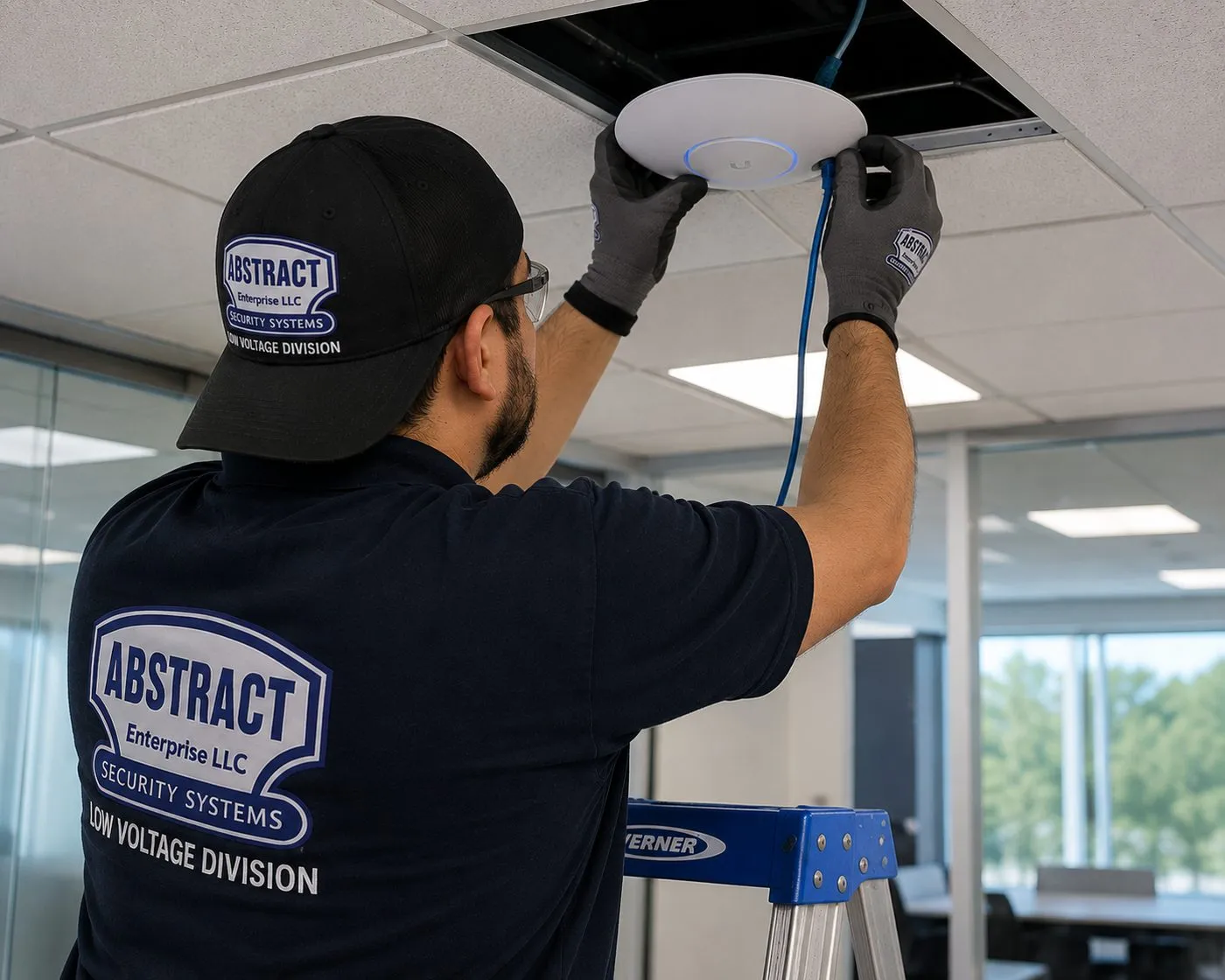
Technician fitting a ceiling-mounted wireless access point with its network cable into a drop ceiling in a Brooklyn office
A technician on a ladder presses a white wireless access point into a ceiling tile opening, its blue network cable trailing down, with a glass-walled meeting room behind — solid Wi-Fi is what keeps a streaming soundbar connected.
AI Overview Reality Check

What AI Gets Wrong About Soundbar Installation in Brooklyn

Search for soundbar installation and an AI summary will give you a national price range, a list of steps and some reassuring generalities. Those answers are built from cost guides and product pages written for a house in the suburbs. Here is how seven common claims hold up in a Brooklyn rowhouse or tower.

Claim one: a soundbar install costs about the same everywhere

Cost-guide sites publish national averages, and AI summaries repeat them. HomeWyse's soundbar page put the estimated national average at $58.43 to $231 per soundbar in September 2026, and Thumbtack's TV-mounting cost page gives a national average range of $121 to $234. Those numbers are real, and for a bar on drywall over wood studs in a house with a driveway they are a fair guide.

They say nothing about the material that makes Brooklyn jobs take longer: masonry party walls, nogging, chimney breasts, concrete columns, and sometimes four flights of stairs with the gear. A national average blends all of that away, which is why one quote is right on the day and another grows once the drill hits brick.

Our answer is a published wall-by-wall list. A wall-mounted bar is $129 on drywall over wood studs, and the surcharges for metal studs, plaster, brick, concrete and tile are printed alongside it, so a brownstone party wall is priced before anyone arrives.

Claim two: the bracket in the box is all you need

Many bars ship with a wall bracket and a bag of screws and plugs, and AI answers often treat that as the end of the hardware question. The bracket itself is usually fine. The fixings in the bag are generally intended for a wood stud or solid backing, and Angi's TV mounting cost guide lists a separate soundbar bracket at $30 to $100 for cases where the supplied one won't do.

In Brooklyn the plastic plugs are the weak link. They spin in soft lime-mortar brick, crush old plaster and strip in steel studs. The hardware that holds is matched to the wall: sleeve anchors in brick, toggles behind plaster, steel-stud fasteners in towers, concrete anchors in block.

We use the supplied bracket whenever it is rated for the bar and suits the mount, and swap only the fixings. If the bar came without a bracket, the Sanus bracket on our list is the alternative.

Claim three: you need an eARC TV to get Dolby Atmos

This one appears constantly and is only half right. eARC is needed for lossless formats such as Dolby TrueHD and DTS-HD Master Audio. Ordinary ARC can still carry Dolby Atmos packaged inside Dolby Digital Plus, which is how most streaming services deliver it.

In practice that means a Brooklyn household with a perfectly good ARC television does not need a new TV to enjoy an Atmos bar from Netflix or a similar app. It does mean the bar has to be on the right HDMI socket — the one labelled ARC or eARC — with HDMI-CEC and the TV's audio output set correctly.

Getting those settings right is part of every install we do, and it is the most common fix on service visits after a TV software update quietly resets them.

Claim four: up-firing speakers work in any room

AI summaries often present Atmos height effects as automatic. Dolby's own setup guide says reflected height sound wants a flat ceiling between 7.5 and 14 feet. Up-firing drivers bounce sound off the ceiling, so the shape and height of the ceiling decide how convincing the effect is.

Brooklyn rooms test this both ways. Some brownstone parlors have tall ceilings with deep plaster cornices and medallions that scatter reflections; some tower apartments have low concrete ceilings with soffits and ductwork right above the bar's position.

We cannot change the ceiling, but we can measure it, place the bar so its up-firing drivers have a clear path, and run the bar's room calibration where it has one. We will also tell you honestly when a height effect is likely to be subtle in your room.

Claim five: a bigger subwoofer is always better

Product listings and review roundups reward bass, and AI answers echo them. In a detached house that is harmless. In a building where the floor joists sit in the same party walls as the neighbours', the subwoofer is the part of the system most likely to reach someone else's home.

Bass carries through structure in a way speech does not. That is why the city's Noise Code singles out bass with a separate C-weighted limit for commercial music, and why a Brooklyn resident on Reddit was advised to file 311 complaints after 10 PM when a neighbour's music would not stop.

The better question for a Brooklyn apartment is how well the sub is placed and set. A modest sub, isolated from the floor and set below the factory level, sounds fuller at the couch and quieter downstairs than a large one in a corner.

Claim six: permits only come into it for electrical work

Angi's guide, for example, says permits are required only for electrical work or structural changes. That is broadly right for the soundbar itself, which needs no Department of Buildings permit. It leaves out the paperwork Brooklyn buildings actually ask for.

Co-ops, condos and rental towers usually want a certificate of insurance and a scheduled time before any contractor visit, however small. Historic-district owners need LPC sign-off for exterior changes and for work that needs a DOB permit. Commercial landlords want their own names on the COI.

None of this is difficult, but it decides whether the installer gets past the lobby. We issue certificates at no charge and send them ahead, and we keep everything we install inside your walls.

Claim seven: any handyman can do it in half an hour

Gig platforms and AI answers alike describe soundbar mounting as a quick job, and on drywall it often is. A Brooklyn party wall with a depth limit, a nogging wall that needs reading hole by hole, or a tower partition beside a structural column is a different task, and the cost of getting it wrong is a hole in your neighbour's plaster or a bar on the floor.

The other half of the job is settings: the right HDMI socket, CEC, lip-sync, the sub's level, and Wi-Fi in a crowded building. Those are where most of the complaints we see on second-opinion visits begin.

So before booking anyone, ourselves included, ask for the price of each surprise: brick behind the plaster, nogging inside a frame wall, a concrete column where the drywall should be. An installer who can answer all three in writing has drilled Brooklyn walls before.

A Brooklyn Soundbar That Stays Put and Stays Polite

One photo of the wall and the bar's model number are usually all we need to say how it will hang and what it will cost.

Get In Touch

Request a Free Quote

Fill in what you know about the room — party wall, steel stud or frame — and the written Brooklyn total lands before close of business. A conversation suits you better? Ring (347) 934-8335.

✅

We Got Your Request!

Thanks — your Brooklyn request is in the queue for today. Something pressing? Phone (347) 934-8335.

How It Works

Our Installation Process

The order of work is fixed even though Brooklyn walls are not: a compact bar on a Crown Heights dresser and an Atmos system on a Park Slope chimney breast go through the same six stages.

1. Quote from your photos

Start with two model numbers and a phone picture of the TV wall, plus a word on the building: brownstone, frame house, tower or complex. The written total that comes back already counts the wall type, stairs and any backer board.

2. Building and landlord paperwork

If your co-op, condo, rental tower or landlord needs a certificate of insurance or a booked service-elevator slot, we issue the certificate free and confirm the slot so the visit fits the building's rules.

3. Pick an arrival slot

Pick any 2-hour slot from 8 AM to 8 PM, seven days a week. If a slot is still free today we can come today, and moving the booking costs nothing when you give us a day's notice.

4. Read the wall before drilling

On arrival we identify the wall: party wall, chimney breast, nogging, plaster, steel stud or concrete. We find the flue line or framing, set depth stops for masonry, and agree the bar's height and centre with you before the first hole.

5. Hang and hook up

Anchors suited to that exact surface take the bracket; the bar goes up parallel to the screen; leads disappear into the wall or a painted channel as agreed; HDMI lands in the ARC or eARC input with CEC enabled.

6. Neighbour-proof the low end, then walk you through it

The subwoofer is placed off the party wall and isolated from the floor, levels and night mode are set, lip-sync is checked, dust is cleaned up, and we show you the controls before we leave.

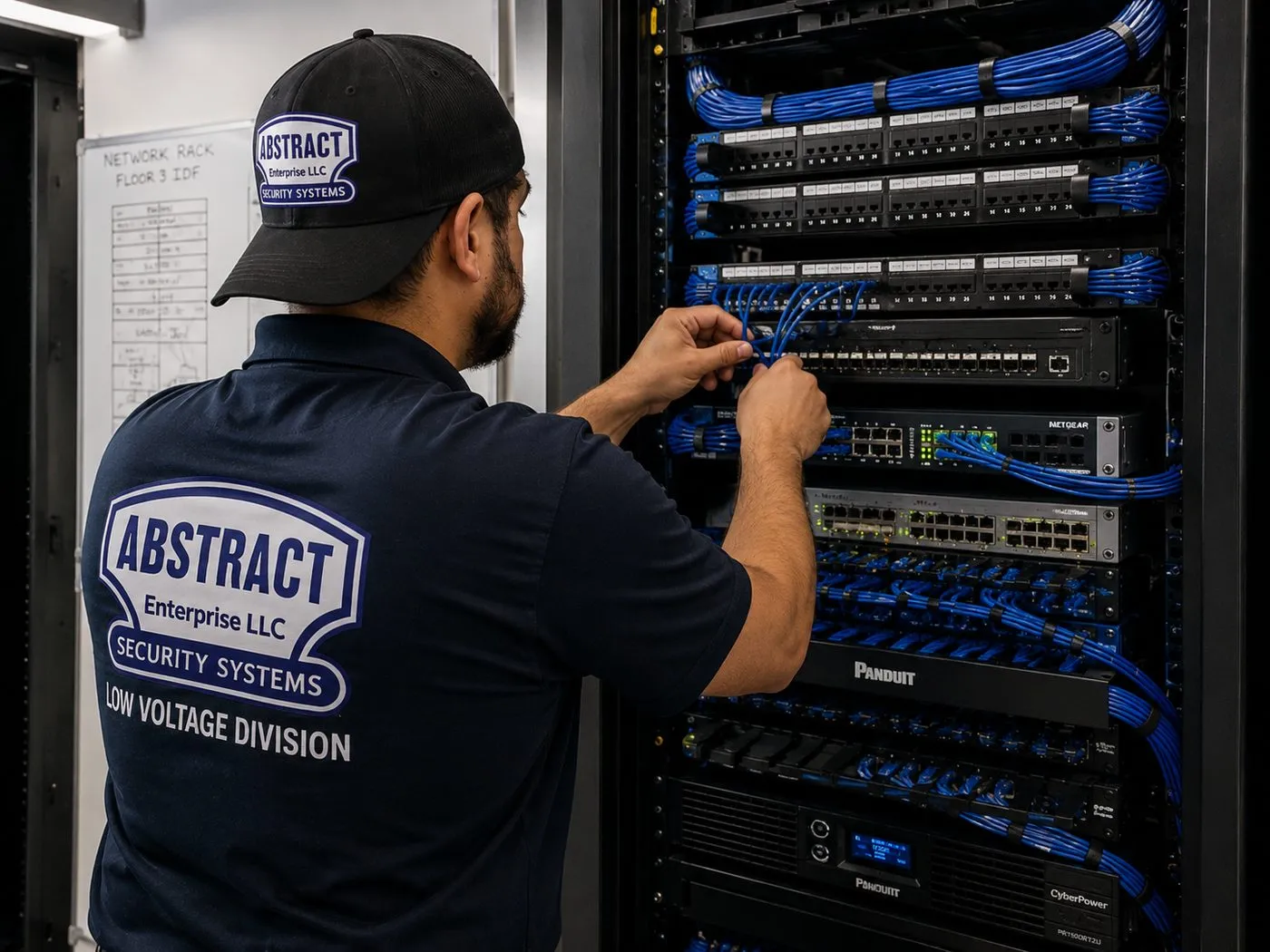
Technician patching blue network cables into switches in an equipment rack, the network side of a Brooklyn soundbar and TV setup
A technician threads a blue patch lead into a switch in a full equipment rack, with patch panels above and a whiteboard on the wall to his left.
Coverage Area

Soundbar Installation Near Brooklyn's Landmarks

Brooklyn's landmarks are a fair guide to the walls we will meet. These six places span the borough's building types, from the city's first historic district to its first supertall tower.

Brooklyn Heights Historic District

Designated in 1965 as New York City's first historic district, running south from Old Fulton Street to Atlantic Avenue and west from Cadman Plaza and Court Street to the Promenade. Brick and brownstone rowhouses, party walls and parlor chimney breasts.

Stuyvesant Heights, Bedford-Stuyvesant

The Stuyvesant Heights Historic District was designated in 1971, and in 2013 the Commission designated the surrounding Bedford-Stuyvesant/Expanded Stuyvesant Heights district of roughly 825 buildings. Rowhouses in brownstone and brick, with frame houses on nearby blocks.

Prospect Park South, Flatbush

Victorian Flatbush at its most suburban: freestanding houses on lawns, laid out by Dean Alvord just before 1900 and designated a historic district in 1979. Lath-and-plaster walls, big rooms and long cable runs.

The Brooklyn Tower, Downtown Brooklyn

At 9 DeKalb Avenue, rising about 1,066 feet, the borough's first supertall and the tallest building in New York City outside Manhattan, with condominiums and rentals above the old Dime Savings Bank. The new-tower Brooklyn of concrete and steel stud.

Spring Creek Towers, East New York

The former Starrett City: 5,881 apartments in 46 buildings of 11 to 20 storeys on about 150 acres beside Jamaica Bay. Concrete and block walls, a management office, and neighbours on every side of every living room.

Domino Park and the Williamsburg Waterfront

The park on the old Domino Sugar Refinery site opened in June 2018, framed by new residential towers that followed the 2005 waterfront rezoning. Glass-walled living rooms, building Wi-Fi and management-office rules.

We also install across Greenpoint, Williamsburg, Bushwick, DUMBO, Fort Greene, Clinton Hill, Crown Heights, Prospect Lefferts Gardens, Windsor Terrace, Kensington, Ditmas Park, Midwood, Sunset Park, Bay Ridge, Dyker Heights, Bensonhurst, Gravesend, Sheepshead Bay, Brighton Beach, Coney Island, Marine Park, Canarsie, Flatlands and East Flatbush. Neighbouring Queens soundbar installation is a separate page; Manhattan and Staten Island jobs start from our quote form.

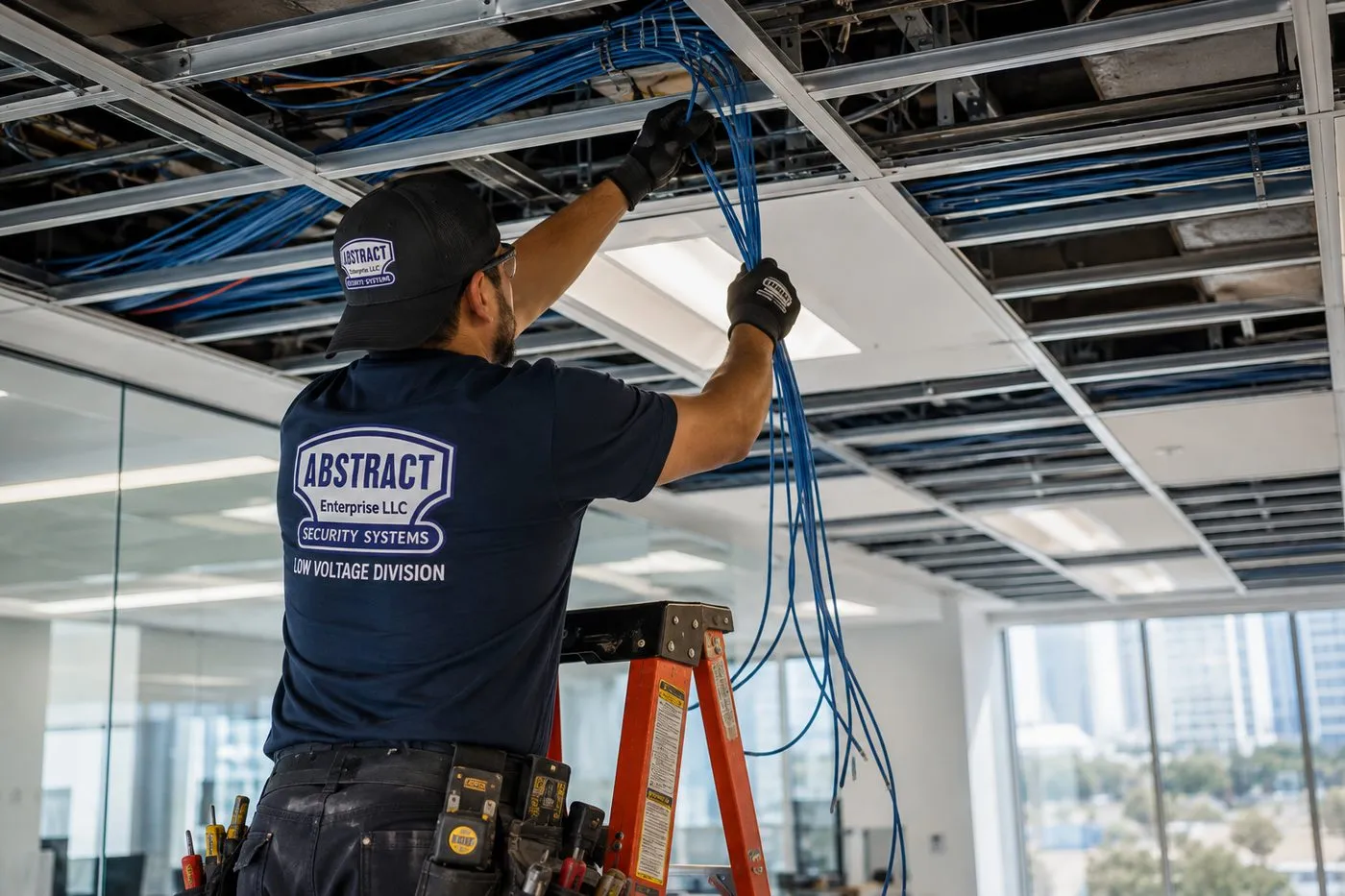
Technician on an orange ladder feeding blue cables down through an open ceiling grid beside a glass wall in Brooklyn
Standing on an orange ladder, a technician draws a handful of blue cables down through an open ceiling grid next to a glass partition.
Pricing

Soundbar Installation Cost in Brooklyn

Brooklyn is the base area on our price list, so the numbers below are the starting prices with no area multiplier added. You add the lines that apply to your job; if something you did not book turns up on site, you hear the price before any extra work starts.

ItemBrooklyn priceWhat you get
Soundbar placed on a console or stand$79Set on your furniture below the screen, wired to the TV, tuned and checked
Soundbar wall-mounted under the TV$129Fixings picked for your Brooklyn wall, bar hung square to the screen and sound checked
Sanus soundbar bracket$84.99Supplied by AESS when the bar shipped bare, or when its own bracket suits studs but not brick
In-wall concealment$169Power and HDMI carried inside a stud cavity with a code-compliant kit
Paintable cord cover$59Painted channel on the wall face — standard on brick and chimney breasts
Cable run to a cabinet or other spot$99Up to 25 ft
Sonos setup$125Sonos bar, sub or surrounds set up in the app and grouped
A/V receiver$129Hooked up between the TV, the sources and the speakers, inputs named
Universal remote$99Learns the codes for the TV, the bar and the cable box
Streaming device setup$49Roku, Apple TV, Fire TV or similar
Full home theater$350Multi-component system set up together

Brooklyn wall and access add-ons

ConditionPriceWhere we meet it in Brooklyn
Drywall on wood studs$0Renovated frame houses, finished basements
Metal studs+$30New towers in Downtown Brooklyn, DUMBO and on the waterfront
Plaster+$45Victorian Flatbush, pre-war apartment buildings, frame rowhouses
Brick or stone+$65Brownstone and brick party walls, chimney breasts, loft walls
Concrete or cinder block+$75Post-war complexes, tower columns, basement walls
Tile or marble+$95Marble mantel surrounds, tiled media walls, bars and restaurants
Plywood backer board$85Nogging walls and irregular old framing
High mount (above about 8 ft)$75Tall parlor ceilings, bar and restaurant screens
Walk-up, 3rd floor and above, no elevator$40Top-floor brownstone rentals, walk-up buildings
Box removal$25Anywhere you'd rather not carry the carton down
Certificate of insurance for your buildingFreeCo-ops, condos, rental towers, commercial landlords

Four Brooklyn jobs added up

These sums use only the lines above, so you can see how a quote is built. They are examples of the arithmetic, not packages, and your own total depends on the wall we actually find.

ExampleLinesTotal
Bar on a brownstone party wall with our bracket, cable in a painted raceway$129 + $84.99 + $65 brick + $59 cord cover$337.99
Bar on a tower steel-stud partition with its own bracket, leads inside the wall$129 + $30 metal studs + $169 in-wall concealment$328
Bar on plaster in a fourth-floor walk-up, bracket from the box$129 + $45 plaster + $40 walk-up$214
Console placement plus a streaming stick in a Crown Heights rental$79 + $49 streaming setup$128
Bar on a nogging wall needing a backer, our bracket$129 + $84.99 + $85 backer board$298.99

Setup-only visits, callbacks and TV mounting in Brooklyn

When nothing needs drilling — reconnecting a bar to a new TV, sorting eARC or the remote, re-pairing a sub — a Brooklyn setup-only visit is $195 for the first hour, then billed in 30-minute blocks. If a TV is being mounted on the same visit, the Brooklyn TV mounting base of $179.99 applies to the TV, with its own size and wall lines. Service callbacks outside a scheduled install are billed at $195 an hour with a 3-hour minimum ($585). A $150 return-trip fee applies if we cannot start because the bar or bracket isn't there, there is no access, or the building's approvals are missing; rescheduling with 24 hours' notice is free.

Inside the price, and outside it

  • Covered: the mount itself, the HDMI or optical hookup, CEC so one remote works, tidy leads, and a vacuum over the red brick dust a party wall throws off.
  • Other trades: a new socket means an electrician, and an old hole filled or a wall repainted means a painter, a mason or the super. We quote neither.
  • Fragile surfaces: old Brooklyn finishes do not always forgive a drill. Marble mantel surrounds, glazed tile and lime plaster can chip even at low speed, so we point to the risk on the wall itself and wait for your yes.
  • Customer brackets: welcome if they are rated for the bar. They carry their maker's warranty rather than ours.

Chain menus compared with a Brooklyn licence holder. A flat price from a big-box service or an app-based handyman is built around drywall in a suburban house. Missing from it is everything Brooklyn adds: party walls with a depth limit, nogging, chimney breasts, concrete columns, management-office paperwork and walk-up stairs. A local installer with a wall-by-wall price list and a low-voltage licence can quote the job you actually have and answers to you directly afterwards.

Shop Our Systems

Soundbar Installation Packages & Pricing

Three bundles cover most Brooklyn bookings. Each card shows its own sum, and the wall and access lines from the table above are added only where they apply to your room.

Starter — Console Placement

$79

Just the bar on your furniture for $79: positioned clear of the TV's sensor, hooked to its ARC or eARC input, CEC switched on and the leads hidden behind the cabinet. Nothing gets drilled, which suits most Brooklyn leases.

Standard — Wall Mount With Bracket

$213.99

$129 to hang the bar plus $84.99 for the Sanus bracket comes to $213.99. Brownstone brick lifts it by $65, old plaster by $45 and a tower's steel studs by $30.

Premium — Wall Mount, Bracket and In-Wall Wiring

$382.99

The $213.99 mount-and-bracket bundle with $169 of in-wall concealment added makes $382.99. It needs a hollow stud wall and a building that permits opening it, so it suits frame houses and renovations, not chimney breasts or solid brick.

Bring Your Own Equipment — Labour Only

Supplying the bracket yourself — from the soundbar box or bought separately — leaves only our labour: $129 for the wall mount, plus whatever wall line your Brooklyn wall needs. The bracket has to carry a rating for your bar, and its maker, not AESS, warrants it. Should it turn out wrong for the bar or the wall, you hear that before any hole is drilled, along with the option of our Sanus bracket.

Want the Brooklyn Price in Writing?

A model number and one phone photo of the TV wall are enough for us to add up the Brooklyn lines and email the total.

Three Brooklyn Rooms

Parlor, Tower and Frame House: How the Job Changes

The same soundbar can take three quite different visits depending on which Brooklyn it is going into. These are composites of the room types, not accounts of particular jobs, written to show what we plan for in each.

The brownstone parlor

A long room, often with a front and back parlor joined by a wide opening, tall ceilings, plaster cornices and two chimney breasts. The TV goes on a chimney breast or on the party wall between them. We find the flue line, set masonry anchors in solid brick either side with depth stops on the bits, and bring the cable down a painted raceway because neither the breast nor solid brick has a cavity. The sub stays off the party wall and off the bare boards, and if a tenant lives on the garden floor below, we look at what room sits under the sofa before choosing its spot.

The details that catch people out in parlors are outlets and radiators. Original rooms often have few outlets, and the one nearest the TV may be on a different wall; we route to it in surface raceway or recommend an electrician first. Steam or hot-water radiators sometimes sit under the front windows on the same wall as the TV, and a bar directly above one spends the winter in a draft of hot, dusty air, so we offset it where we can.

The one-bedroom in a new tower

A compact living room with one solid partition, a concrete column, a window wall and a building management office with a certificate-of-insurance checklist. Before the visit we confirm which wall the building allows us to drill, issue the certificate and book the service elevator. On the day, the bar goes on steel-stud fasteners or toggles in the partition, or on a TV-attached bracket if the TV is on the column. Cables usually run inside the partition if the lease allows it, or in a short raceway to the console.

Wi-Fi is the second half of the tower job. We wire the bar to the router where the layout allows, and otherwise put it on the quieter band and make sure the sub and rears re-pair cleanly. Because the walls are hard and the room is small, we set the bass lower and the bar's EQ a touch warmer than the defaults.

The frame house in Bed-Stuy or Bushwick

Walls that might be lath and plaster over timber studs, brick nogging, newer drywall from a renovation, or all three in one room. We pilot-drill and read each fixing point, decide between timber screws, masonry anchors and a plywood backer, and keep the bar parallel to the TV even when the wall leans. Floors in old frame houses can be springy, so subwoofer isolation matters as much here as anywhere.

Frame houses are also where in-wall wiring is most often possible, because the walls have cavities and owners are often mid-renovation. If the wall is open, we run in-wall-rated HDMI and network cable before it closes, which turns a cord-cover job into a clean one for the same visit.

Choosing the Bar

Picking a Soundbar That Suits a Brooklyn Room

If you have not bought the bar yet, five minutes of measuring saves a return trip to the store. We are glad to advise before you order; we do not sell soundbars, so the advice is about the room, not a sale.

Your roomWhat tends to workWhat to check before buying
Narrow back bedroom or studio, TV under 50 inCompact bar, no separate subBar width against the TV's width; whether the TV has ARC/eARC or only optical
Brownstone parlor, TV on a chimney breastFull-width bar sized to the breast; sub optionalBreast width, including a foot of clearance at each end; mantel depth
Floor-through over a tenant or neighbourBar with strong built-in bass, or a modest sub you can turn downSeparate sub-level control in the app; night mode
Tower living room with a window wallBar with room calibration; Ethernet portWhere the router lives and whether a cable can reach the bar
Frame-house living room, open to the dining roomWider bar with a centre channel for dialogueSeating distance; whether the bar blocks the TV's sensor on its stand
Shop, bar or waiting roomDurable bar with a simple input and a lockable volumeMounting height above walkways; who controls the remote

Two more checks matter in Brooklyn specifically. First, the bracket: if the box includes one, we will usually use it with fixings matched to your wall; if it doesn't, the Sanus bracket goes on the quote. Second, the sub's footprint: subwoofers that came with bundled systems can be large, and in a narrow rowhouse room there may be only one place it fits that is not against the party wall. Measure that spot before you buy.

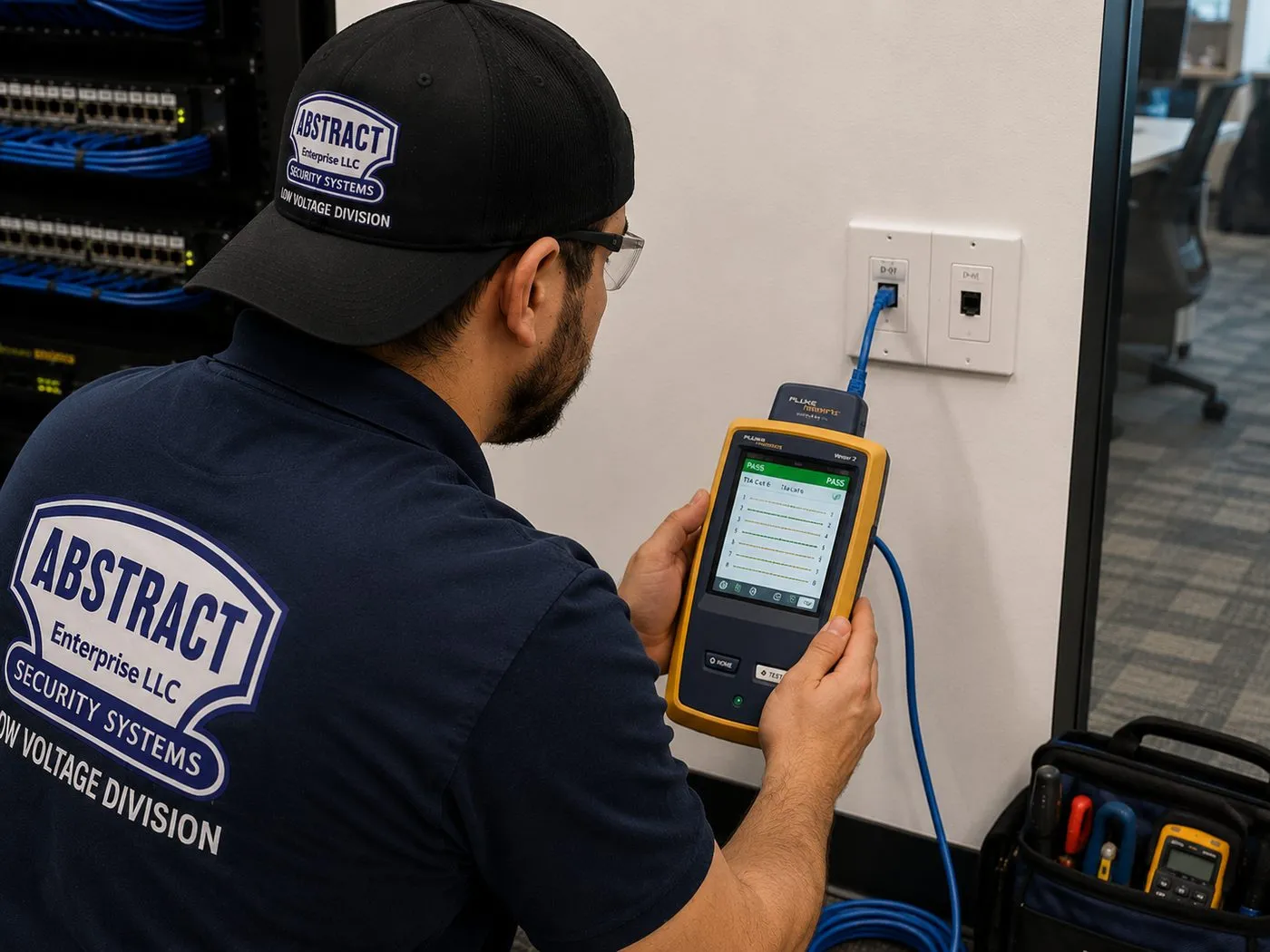
Technician holding a handheld cable tester connected to a wall-plate jack, verifying a Brooklyn cable run before a soundbar is connected
A technician holds a handheld tester whose screen shows pass results, its lead plugged into a wall plate, with a tool bag at his feet and a rack behind — a run is tested before anything is plugged into it.
Floor by Floor

Where the Subwoofer Goes in a Brooklyn Rowhouse

A rowhouse is a stack of apartments sharing two long walls with the houses either side, so the right spot for a sub depends on which floor you live on. This is how we think about each level when a Brooklyn household asks where the low end should live. It is guidance, not a rule; your floor plan and your neighbours decide the final answer.

Garden floor

The garden or ground floor usually sits over a cellar rather than another home, so the floor below is rarely the worry. The concern is sideways and upwards: the party walls carry bass to the next house, and the parlor floor above is often a separate apartment. A sub here works best along the front or rear wall, away from both party walls, on a pad that keeps it from drumming the floor above the cellar. If the cellar ceiling is open joists, expect the bass to sound louder down there than you might guess.

Parlor floor

Usually the grandest room and the obvious place for the TV, and usually above someone else's bedroom or living room. On this floor we map what sits below before choosing the sub's position, keep it out of the corners where party wall meets floor, and favour a dense rug or isolation platform under it. If the parlor is open front to back, placing the sub near the opening between the parlors, rather than against either end wall, often gives even bass at a lower setting.

Upper floors

Bedrooms and smaller living rooms on the second and third floors have neighbours below and often a ceiling of lath and plaster that rings with bass more than you would expect. For many top-floor rentals a bar with no separate sub, or a sub run noticeably below the bar's default, is the considerate setup. If a sub is a must, it goes on the most solid part of the floor, close to an outside wall rather than mid-span between the party walls, where floors tend to flex more.

Frame houses and converted spaces

Wood-frame houses and older conversions can have springy floors and thin partitions between units. Here, isolation under the sub matters most, and it is worth listening from the apartment below or next door with the owner's permission before we finish. Converted industrial lofts in Williamsburg, Greenpoint and Gowanus behave differently again: heavy concrete or timber floors stop more bass, but open plans and hard surfaces make the room itself boomy, so the sub level usually comes down for the room's sake rather than the neighbours'.

What we leave you with

Whatever the floor, we finish by showing you the sub-level control, the night mode switch and the quickest way to turn the sub down without touching the bar's volume. A sub that can be dialled down in five seconds is one that stays installed rather than unplugged after the first knock on the door.

Complete Services

Every Soundbar Installation Service in Brooklyn

Soundbar calls in Brooklyn tend to arrive with company: a TV that needs re-hanging, a network that needs a cable, a renovation that needs planning. These pages cover the rest.

TV Installation Brooklyn

Hanging the TV itself on a party wall, chimney breast, frame wall or tower partition, so screen and bar line up from the first hole.

AESS TV Mounting Prices in Brooklyn

Every Brooklyn TV line in one place, from the $179.99 base to screen-size and wall add-ons.

AV & Sound Installation Brooklyn

The step beyond a single bar: discrete surrounds, a receiver, speakers flush in the ceiling or music in every room.

Home Automation in Brooklyn

Lighting, shades and scenes that dim the room when the movie starts and bring the bar up with them.

Structured Cabling Installation Brooklyn

Network cable to the TV wall, run while the plaster is open or along a clean surface path.

Abstract Enterprises Low-Voltage in Brooklyn

The parent service for all of it — sound, network, cameras, buzzers and door access in Brooklyn buildings.

Park Slope TV Installation

Neighbourhood detail for brownstone TV walls on the Slope; Bed-Stuy, Williamsburg and Downtown Brooklyn pages are linked below.

TV and Soundbar Service Policies

How we schedule visits, what a missed-access return trip costs, rescheduling, and how setup-only time is billed.

Request a Quote

Bundle a soundbar with anything listed here on a single request.

Neighbourhood TV pages: Bedford-Stuyvesant · Williamsburg · Downtown Brooklyn · Brooklyn Heights · Bay Ridge · Ditmas Park

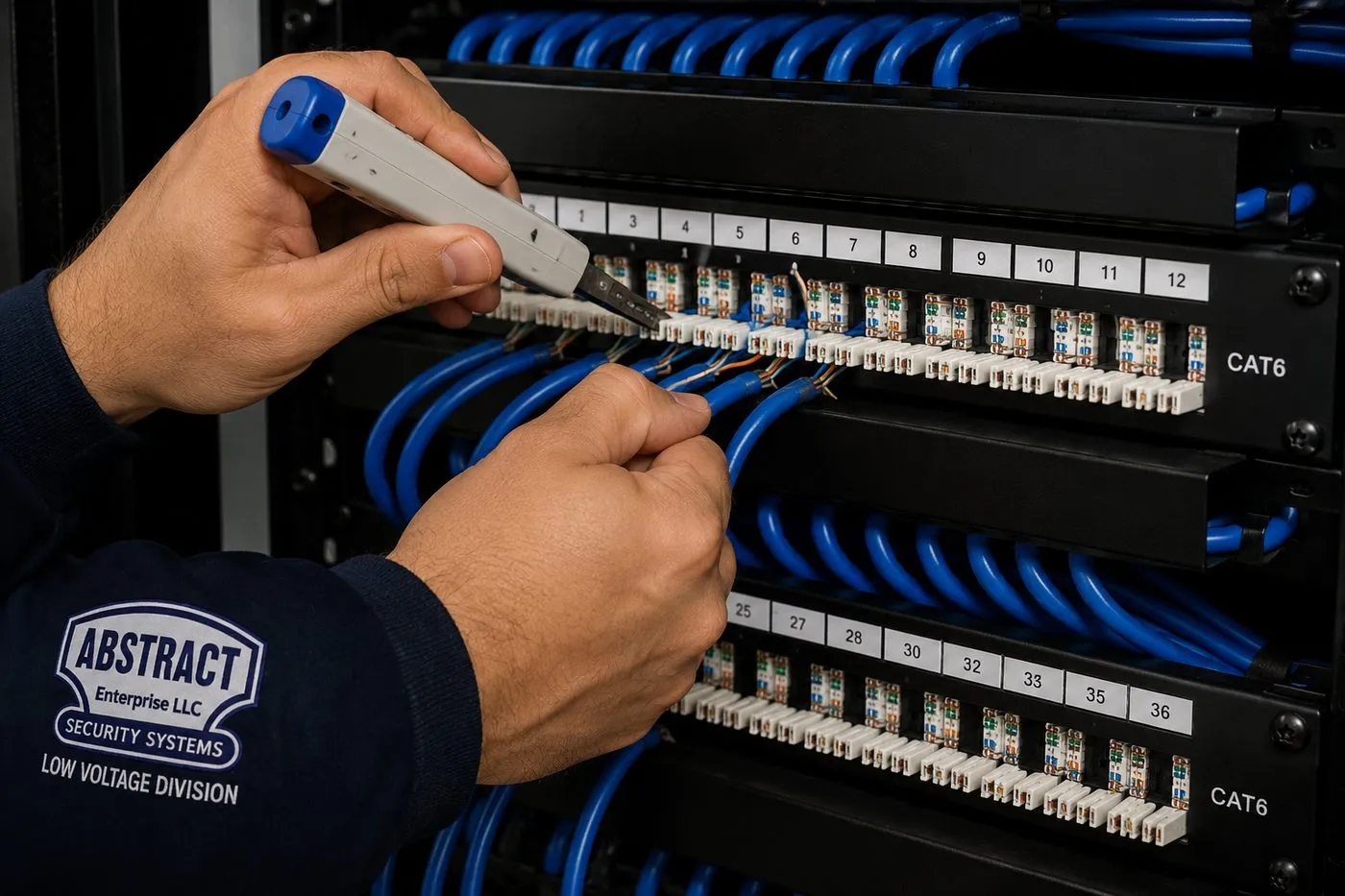
Hands punching blue cable into a numbered Cat6 patch panel with a punch-down tool, structured cabling that pairs with Brooklyn soundbar installation
Punch-down work on a numbered Cat6 patch panel: blue conductors pressed into the terminal block by hand, with further panels and bundled runs stacked in the frame.
Field Notes

Field Notes on Brooklyn Party Walls and Frame Walls

How our crews handle Brooklyn rowhouse masonry and frame walls in general, rather than a write-up of a single visit

On a rowhouse, our installers start by working out which wall is shared. From the street, count the houses and note where the chimney stacks sit; inside, the party walls are the long side walls, usually without windows. Any fixing on a party wall gets a depth stop, and the first hole is drilled slowly with no hammer action so we can feel whether the brick is hard, soft or patched.

On a chimney breast, we locate the flue before marking the bracket. Tapping usually finds it, because the brick over a flue sounds slightly different from solid masonry, and the fireplace opening below shows where it rises. Fixings stay on solid brick either side.

On a frame house, we expect surprises. A small pilot at each fixing point tells us more than any scanner: wood, brick or air. When two pilots disagree, we either move the bar a little or put a plywood backer on and mount to that. And before the subwoofer goes anywhere, we look at the floor and ask who lives below or next door.

FAQ

Brooklyn Soundbar Installation FAQ

Do you charge extra to come out to Coney Island, Canarsie or Bergen Beach?
+

No. The Brooklyn prices on this page are the same in every Brooklyn neighbourhood, from Greenpoint and Williamsburg in the north to Coney Island, Canarsie and Bergen Beach in the south. There is no separate travel or parking line for Brooklyn jobs; you pay only the install lines and any wall or walk-up add-on that applies.

We're moving between two Brooklyn apartments. Can you take the bar down at one and put it up at the other?
+

Yes. We take the bar and its bracket down at the old apartment, then re-hang them at the new one on fixings chosen for the new wall, which is often a different material. The take-down holes are left clean for your painter or super to fill. Book both addresses in one request so we can plan the two stops together.

What if my landlord says no holes after I've already booked a wall mount?
+

Tell us before the visit and we switch the job rather than cancel it. A console placement is $79 and a bracket that clips the bar to your existing TV mount needs no new holes. Changes made at least 24 hours ahead cost nothing; inside 24 hours the $150 return-trip fee can apply.

Can the soundbar share the TV's outlet, or does it need its own?
+

The bar needs its own socket, but that can be on the same outlet or surge protector as the TV. A two-gang outlet behind the TV, or a good surge strip, usually covers both. A separate subwoofer and any rear speakers each need a socket near where they sit. We don't add outlets; if there is no socket where one is needed, that is a job for an electrician.

Which soundbar brands do you install?
+

Any make you choose, including Sonos, Samsung, LG, Sony, Bose, Vizio, JBL, Yamaha, Denon and Polk. The method depends on the bar's weight, width and connections rather than the logo. Send us the model and we confirm the bracket and connection before the visit.

Do you need the power or water turned off while you work?
+

No. Soundbar installation is low-voltage work: we fix a bracket, run HDMI, network and speaker leads, and plug the equipment into existing outlets. We do not open electrical boxes or touch plumbing, so nothing in the apartment or the building needs to be shut off. We do scan the wall for pipes and wiring before drilling.

How quickly will someone get back to me after I send the form?
+

The same business day. A licensed installer reads every Brooklyn request and replies with a written price built from the lines on this page, or with a question if a photo of the wall would settle it. If you would rather talk now, call (347) 934-8335.

Will someone show me how to work the soundbar before you leave?
+

Yes. Before packing up we walk you through power, volume, input switching, night mode, dialogue enhancement and the subwoofer level on your remote and in the maker's app, and we check that the TV remote controls the bar. It takes a few minutes and saves most of the calls we would otherwise get the next evening.

Can you work from my architect's or designer's drawings for a renovation?
+

Yes. Send the drawings with the TV and bar positions marked and we will review the low-voltage side: box locations, cable paths, blocking and where the outlet should go for your electrician. We can then come out at rough-in, before the walls are closed, and again to hang the bar when the room is finished.

All Areas Served

Soundbar Installation Across New York

This is the Brooklyn page. The five-borough overview lives on our New York City soundbar installation hub, and each region and borough is listed below. Areas whose own page is still being written open the quote form for now; the same installers already cover them.

Beyond soundbars, AESS also fits security cameras, door entry and networks; the Abstract Enterprises Security Systems home page lists them all. Curious who will be drilling your brick? See about our company.

Brooklyn Soundbar Misbehaving Tonight? We Can Help

A new TV, a software update or a moved cable box is the usual reason a working soundbar goes quiet or stops answering the remote. Call (347) 934-8335; we book the next open 2-hour window, and most of these faults are put right within one to two hours of arrival.

Soundbar Installation Brooklyn — Licensed, Insured, Party-Wall Careful

Abstract Enterprises Security Systems · 1282 Troy Ave, Brooklyn, NY 11203 · (347) 934-8335 · WhatsApp (718) 679-0359 via wa.me

NYS Low-Voltage Licence #12000287431 · 100% Licensed & Insured · Same-Day Estimates · Rated 4.7★ from 201 Google Reviews

Brackets and parts carry their manufacturer's warranty. Full terms — including 50% deposit, one-year parts-only warranty on AESS-supplied products, and the late-fee schedule — are set out in the service agreement. See our warranty page.

Page reviewed and updated October 17, 2026. Changelog: Brooklyn page launched as a child of the New York City soundbar hub, with party-wall, frame-house and tower guidance.