A TV leaning off a bracket in parlor plaster, a new screen still boxed in a Remsen Street co-op, or a conference-room display near Borough Hall that has to be up by Monday? Brooklyn Heights TV mounting line, same-day estimates: (347) 934-8335
Pre-Civil War Brownstones · Divided Mansions · Former Hotels · Postwar Co-ops · Offices Near Borough Hall
TV Installation in Brooklyn Heights
Plaster on Lath, Plaster on Brick or Hollow Tile: We Find Out First · No Power Cords Inside Walls · Brooklyn Rate
TV installation in Brooklyn Heights starts at $179.99 on our Brooklyn list for a TV up to 55 inches on drywall over wood studs, and most Heights walls add one listed charge: $45 for old plaster, $65 for brick or stone, $130 when the screen goes above a fireplace. Hidden wiring is $169 with a code-compliant in-wall power kit, or $59 for a paintable cord cover where the wall is solid masonry. The neighborhood is mostly the city's first historic district, with more than 600 houses built before the Civil War, and that age shows up the moment a drill touches the wall. This page explains what those walls are made of, what holds a TV in each one, what Landmarks, co-op boards and leases actually say about interior work, and exactly what each job costs.
Every price on this page comes from our published Brooklyn TV list, and the total is agreed before anyone drills
Rated 4.7★ across 201 Google Reviews
Reviewed and updated November 13, 2026, against the Landmarks Preservation Commission's "Permits and Making Alterations" page and Permit Guidebook chapters 11 and 12; the NYC Department of Buildings page "Does my project require a permit?"; NYC HPD's Safe Work Practices page on lead paint; Mike Holt's EC&M explainer on National Electrical Code section 400.12; the Consumer Product Safety Commission's 2023 tip-over data; Brick Underground on alteration agreements (2018) and on tenants, wall hanging and deposits (2022); Brownstoner's forum thread on mounting a TV above a brownstone fireplace; StreetEasy Talk on hiding TV wires in a prewar building; FCC broadband data for Brooklyn Heights as summarized by BestNeighborhood (October 2026); and the Brooklyn Heights Historic District record. Abstract Enterprises Security Systems, NYS license #12000287431 · crews dispatched from our Troy Avenue office in Brooklyn
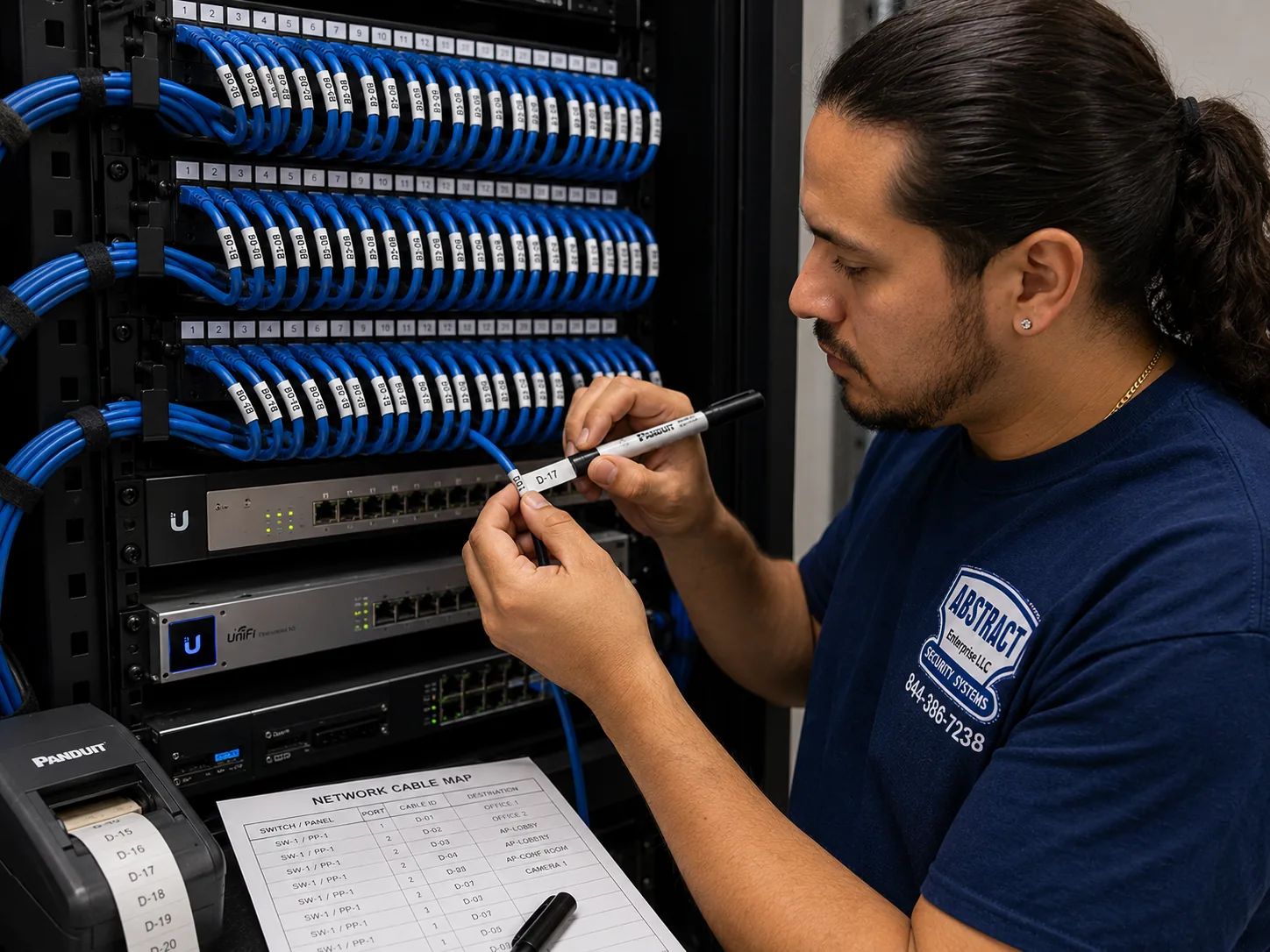
A photo from our job library, not taken in Brooklyn Heights: a technician printing labels at a patch panel with the printed port map beside him. TV work in a Heights brownstone often ends in the cellar, where the cable or fiber line comes in, and labeling each line there tells the next person which one feeds the parlor TV and which one feeds the bedroom.
Brooklyn Heights TV Mounting Request
Brownstone, divided house, co-op, former hotel or office: tell us the street, the floor and the TV size, and a technician calls back with the total
✅
Request Sent!
Thank you. A technician will call you about the Brooklyn Heights address on the same working day.
25+
Years Experience
✓
Same-Day Estimates
100%
Licensed & Insured
4.7★
201 Google Reviews
Owner-operated since 2002 · Thousands of jobs completed · Booked within 2 hours
Quick answer. A 55-inch TV on a flat or tilting bracket on the plaster wall of a Heights brownstone comes to $224.99 in labor on our Brooklyn list ($179.99 plus $45 for plaster). On a brick party wall or fireplace breast it is $244.99 ($179.99 plus $65), and directly above the mantel add $130 more. The bracket is sold separately, or we hang your own if it is rated for the TV. We book within two hours of your request, and the job goes on the schedule once it is paid.
Three photos settle most Brooklyn Heights quotes before anyone climbs your stoop. Take the wall straight on, from far enough back that the mantel, the windows, the radiator and any outlet are all in the frame. Then photograph the sticker on the back of the TV, because the model number tells us the weight and the bolt pattern the bracket must match. Then photograph the spot where the cable box, router or streaming device will live, so we can see how far the wires travel. If you know it, tell us whether the wall is shared with the house next door, whether it holds a fireplace, and whether you own, rent or live in a co-op. Send it all with your street to (347) 934-8335 or on WhatsApp, and you will usually hear back the same day with the wall we expect, the add-ons that apply and the total.
Looking at your photos and answering questions costs nothing. If the wall turns out to be a different material once we open the first pilot hole, you hear the new total before any more drilling happens.
All work falls under New York State license #12000287431, and we send the certificate of insurance your managing agent or board asks for before the visit.
We do not patch or paint walls. If old holes need filling, your painter or your landlord's handles that, and we tell you exactly what we leave behind.
The Neighborhood
Why Brooklyn Heights Properties Need TV Installation
Hanging a TV is an ordinary job almost everywhere, and in Brooklyn Heights it is still ordinary, as long as you know what the wall is. Most of the neighborhood sits inside the Brooklyn Heights Historic District, which the city designated in November 1965 as its first. The district runs from Cadman Plaza West and Old Fulton Street down to Atlantic Avenue, and from the Brooklyn-Queens Expressway east to a line that partly follows Clinton and Henry Streets. Inside it are more than 600 houses built before the Civil War, one of the largest groups of such houses in the country, in Greek Revival, Italianate, Second Empire, Gothic and Romanesque styles, with a few late Federal houses in the north near Middagh and Cranberry Streets. Those houses were built long before anyone imagined a 65-inch screen, and every one of them has walls that behave differently from the drywall a stud finder was designed for.
The typical Heights rowhouse is three or four stories of brick behind a brownstone or brick face. Inside, the walls that divide one house from the next are usually solid brick covered in plaster, while the walls between rooms in the same house are often wood framing with plaster on wood lath. That split matters more than anything else on a TV visit. A Brownstoner forum thread about mounting a TV over a brownstone fireplace put it plainly: one longtime poster asked whether there are "ever" studs in brownstone party walls and answered that fireplaces on party walls have "no studs, just plaster over brick." The same poster said it is "much easier to mount things on a non-party wall, with plaster over wood lath." Both statements match what our technicians find. The wall you want for the TV is very often the fireplace wall, and the fireplace wall is very often brick.
The neighborhood is not only brownstones. Pierrepont Street and Pierrepont Place still have the larger mansions, and many of those, like many big houses across the Heights, were divided long ago into apartments and boarding houses. The former hotels near Clark Street, including the St. George, the Bossert, Leverich Towers and the Pierrepont, became apartments, co-ops and student housing. Postwar co-ops such as the 1950 building at 100 Remsen Street and the 1956 building at 60 Remsen Street brought elevator buildings, each with 78 apartments, and walls of a later generation. And a handful of high-rises, such as Cadman Towers and Cadman Plaza North on the eastern side, add yet another kind of wall. Each needs a different bit and a different anchor.
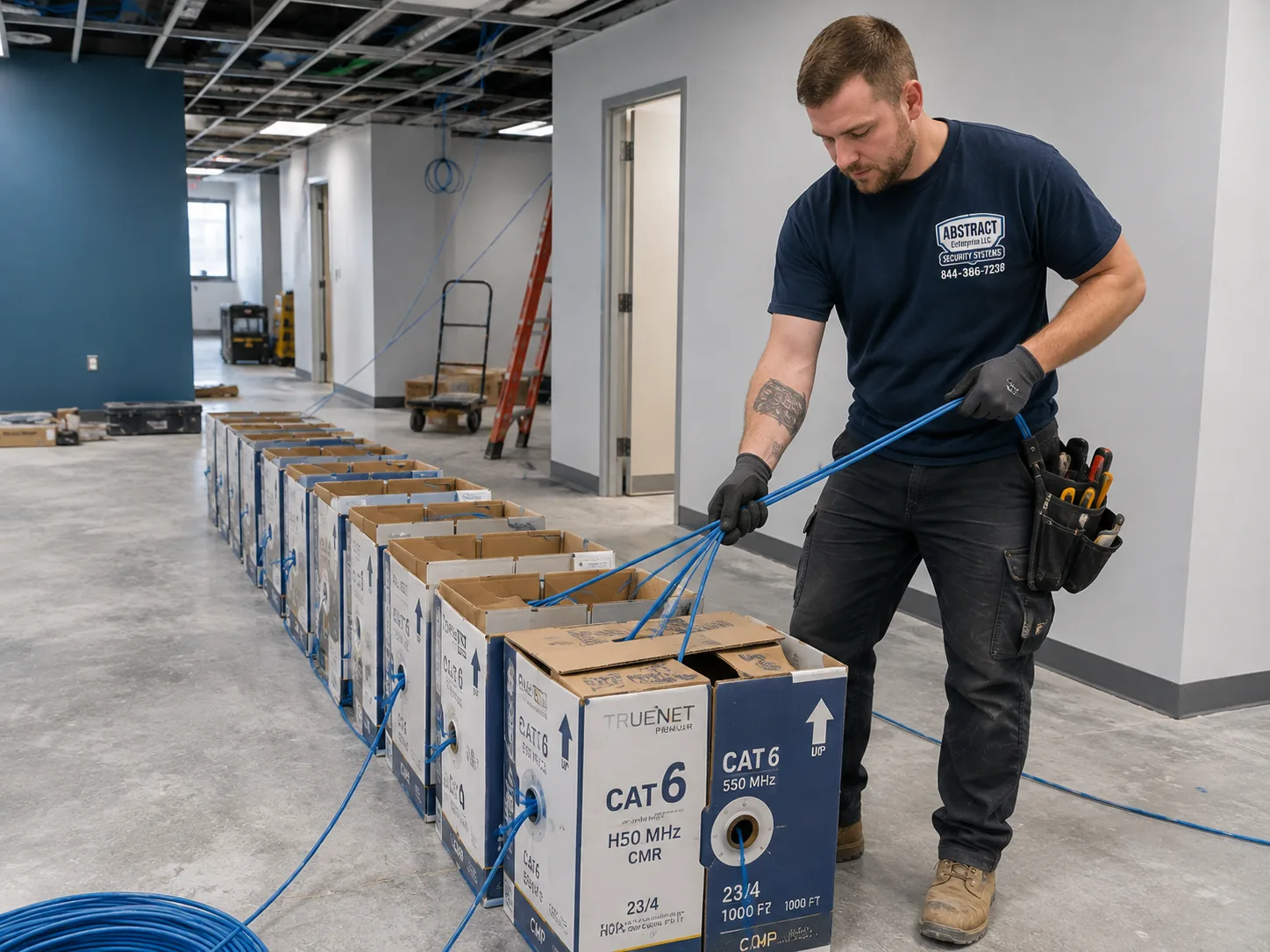
A photo from our job library, not taken in Brooklyn Heights: boxes of cable staged on the floor of a working commercial space before a multi-drop pull. Offices in the older buildings around Court Street and Borough Hall often want several screens and their cables done in one visit, and staging everything in one corner keeps the work out of the way of people who are still at their desks.
Then there are the people who own or govern the walls. A large share of Heights apartments are co-ops, where an alteration agreement or house rules decide which contractors may come in, what insurance they carry and which hours they can work. Brick Underground's guide to alteration agreements describes one that requires a contractor's general liability policy "of at least $1 million" and notes that agreements "may also dictate the days and hours in which contractors can work in your apartment." Renters in divided brownstones answer to a landlord who often lives upstairs. And because most of the housing was built long before 1978, the city's lead paint rules are part of the background for any drilling in a rental.
Finally, the rooms themselves are unlike most of Brooklyn. Parlor floors with ceilings well above nine feet, tall windows with interior shutters folded into deep reveals, plaster cornices, ceiling medallions, marble mantels and original moldings are common. A TV placed by habit, centered over the mantel at the height of the mantel shelf, ends up far higher than anyone can watch comfortably. The Brownstoner poster who warned that "mounting a TV over a mantel is awfully high and invites a sore neck" was describing exactly the problem we solve most often in these rooms. We tape the screen on the wall first, ask you to sit where you watch, and only then decide on height, bracket and cable route.
Six Brooklyn Heights facts that shape a TV job before we choose a bracket
Most houses predate the Civil War. More than 600 pre-Civil War houses stand inside the historic district. Their walls are plaster on lath or plaster on brick, so the $45 plaster add-on or the $65 brick add-on applies to most parlor and bedroom TVs.
The fireplace wall is usually a brick party wall. Brownstone fireplaces sit on the walls shared with the next house, where there are no studs at all. A TV above one is the $130 fireplace add-on plus the $65 brick add-on, and an in-wall power kit cannot go into solid brick.
Interior TV work usually needs no Landmarks permit. The Landmarks Preservation Commission requires an interior permit only when the work needs a Buildings permit, affects the exterior, or is in a designated interior landmark. Hanging a TV inside your parlor usually meets none of those tests.
Co-ops set the rules for their buildings. Alteration agreements commonly set contractor insurance, hours and what may be opened. A bracket rarely raises questions; opening a wall for an in-wall kit sometimes does.
Old paint is assumed to be lead paint until tested. HPD's lead-safe work practices apply to housing built before 1978 and are triggered when work disturbs two square feet or more of paint in a room. Bracket holes and an in-wall kit's two openings are far smaller, but we still drill with dust collection.
Signals are mostly cable and fiber. FCC data summarized in October 2026 shows Spectrum cable available at about 99.9 percent of Heights addresses and Verizon fiber at about 91.5 percent, so the TV usually connects to a coax jack, a fiber router or Wi-Fi rather than an antenna.
Where this page applies. It covers the Heights from Old Fulton Street and Cadman Plaza West down to Atlantic Avenue, between the waterfront and Court Street and Cadman Plaza: Columbia Heights, Willow, Hicks, Henry, Clinton and Montague Streets, Pierrepont, Remsen, Joralemon, Clark, Orange, Pineapple, Cranberry and Middagh Streets, and the short blocks between them. The streets north of Atlantic on the far side of Court Street are covered on our Downtown Brooklyn TV installation page, the blocks south of Atlantic on our Cobble Hill page, the waterfront below Old Fulton Street on our DUMBO page, the area around the plaza on our Cadman Plaza page, and the whole borough on our Brooklyn TV installation page. The price is the same Brooklyn rate on every side of those lines.
Same-Day Repair in Brooklyn Heights
Need Repair in Brooklyn Heights? A TV Pulling Away From Old Plaster, a Bracket Loose in Mortar, or Cords Hanging Where the Last Screen Was
The urgent TV calls we get from houses this old come in three kinds. The first is a screen that has started to lean forward or sit lower on one side. On plaster over wood lath, that almost always means the bracket was held by plastic plugs or light toggles that grip only the plaster, with nothing behind them. Old lime plaster is hard on the face and soft and crumbly an inch in, so a plug that felt tight on the day slowly crushes its hole, especially under a full-motion arm that someone pulls out every evening. The second is a bracket on a brick party wall that was fixed into the mortar joints instead of the brick, or with anchors meant for concrete, and is working loose as the soft old mortar gives way. The third is what a previous owner or tenant left behind: an empty bracket, a TV power cord pushed into a hole above the mantel and pulled out near the floor, or a run of cable stapled along a cornice.
If a screen is leaning, do not push it back into place. If two people can lift it off safely, take the weight off the bracket and unplug it; if not, keep people and pets away from the area under it and call (347) 934-8335. Taking down an old TV is $85 on our Brooklyn list. If the same TV goes back up on a properly anchored bracket in the same visit, it is priced as a new mount on that wall, with the plaster or brick add-on, plus the take-down. We do not patch plaster, so if the old holes sit exactly where the new fixings need to go, we shift the bracket a little to sound material and tell you what was left. A power cord found inside a wall comes out, because the electrical code does not allow it there, and is replaced by an in-wall power kit ($169) on a framed wall or a paintable cord cover ($59) on masonry. If the problem is the wall itself, a bulge in the plaster or a loose brick, we say so plainly.
What We Install
TV Installation Services in Brooklyn Heights
Each service below is priced from the same Brooklyn TV list. The wall decides one add-on, the fireplace decides another, and the rest depends on how invisible you want the cables to be and what sits under the screen.
Mounting on parlor and bedroom plaster
Fixed, tilting and full-motion brackets on plaster over wood lath, with fixings that reach the framing behind the plaster instead of trusting the plaster itself, and pilot holes drilled slowly so original finishes do not crack.
Mounting on brick party walls
Brackets anchored into the solid brick of the walls shared with the next house, with each anchor set in a brick rather than a soft mortar joint and sized for the age and hardness of the brick.
TVs above marble and brownstone mantels
Screens over decorative and working fireplaces, placed with the viewing height, the mantel's depth and the chimney's heat in mind, on the brick of the chimney breast rather than on the mantel.
Wires hidden the legal way
An in-wall power and cable kit with its own rated cable and a recessed outlet behind the screen on framed walls, or a slim paintable cord cover where the wall is brick and cannot be opened.
Soundbars, stands and setup
Soundbars placed on the console or bracketed under the screen, TVs set on their own stands for renters who would rather not drill, and setup-only visits for apps, inputs and remotes.
Screens for offices, schools and shops
Conference-room and reception displays in the older office buildings around Court Street and Borough Hall, and screens for shops, restaurants and institutions, with insurance paperwork sent ahead.
Building Specialists
TV Installation for Brooklyn Heights's Architecture
Six kinds of building account for nearly every TV call we get from the Heights. They differ in what the walls are made of, how a big box gets up to the room, and who besides you has a say. Those three things decide the plan long before anyone talks about brands or screen sizes.
The single-family brownstone
Three or four stories on a narrow lot, brick party walls on both sides, plaster on lath between rooms, a parlor floor with tall ceilings, a fireplace on the party wall and one owner who decides everything.
The divided house
Brownstones and the bigger Pierrepont Street houses split into apartments, often a duplex on the lower floors and rentals above, with a landlord upstairs and a lease that may speak to alterations.
The former hotel
Apartments, co-ops and student rooms in the converted hotels near Clark Street, with long corridors, interior partitions of hollow tile or block, and a management office with its own rules.
The postwar co-op
Elevator buildings from the 1950s, like the two 78-unit co-ops on Remsen Street, where the board's alteration agreement sets insurance, hours and what may be opened.
The Federal and frame houses
The oldest, smallest houses in the north of the Heights, where walls are thinner, rooms are lower and an old timber frame may sit behind the plaster.
The renovated or new interior
Gut-renovated floors and the few newer buildings, where drywall replaced plaster, sometimes on metal framing, and the contractor's drawings may show what is inside the walls.
The single-family brownstone: the fireplace wall, the parlor height and a stair that turns
In a single-family house the owner makes every decision, which makes these the simplest jobs on paper. The difficulty is physical. The parlor is usually the TV room, the fireplace is usually centered on a party wall, and the party wall is brick under plaster. That means the obvious spot for the TV, over the mantel, is the spot with no studs, an add-on for brick and another for the fireplace, and a height problem that has to be solved with the bracket. We often suggest two other places as well: the wall between the front and back parlors if the pocket doors stay open, which may be framed and able to hide wires, or the back wall of the rear parlor, away from the street windows and their glare. The second difficulty is the carry. A 75-inch box going up a stoop and around the turn of a narrow brownstone stair is heavier and less forgiving than people expect, and we ask about the stair before we book.
The garden floor, half a level below the sidewalk, is often the den or the family room. Its front wall may be the foundation, its walls may be brick or stone with a thick coat of plaster, and its ceiling is lower. A TV there is closer to the cable or fiber line coming in from the street, which makes the wiring simpler, but the wall itself is usually masonry, so the cables go into a cord cover or drop straight behind a console. On the top floors, where the rooms were once bedrooms for children or staff, walls are often lighter framing and the ceilings lower, which suits a TV on a simple tilting bracket and an in-wall kit.
The divided house: two households, one set of walls and a landlord who often lives upstairs
When a brownstone or a mansion has been split into apartments, the walls a tenant wants to drill belong to someone else. The party walls still separate this house from the next one; the floors and some walls now separate your apartment from your landlord's or a neighbor's. Before booking, we ask what the lease says about alterations. Brick Underground's Realty Bites column put that question to a real estate attorney in 2022, who said the first place to look is the lease's "alteration provision" and that a ban not written into the lease "wouldn't be enforceable." The same column quoted a property manager saying a nail-sized hole is "fine" but anything larger "is considered damage," and that if a mounted TV leaves significant damage, "you must fix it before you move out." A bracket leaves four to six holes larger than a nail. That is easy to restore, but it is exactly the kind of thing worth agreeing in writing before we arrive.
The former hotel: long halls, hollow partitions and a management office
The hotels built in the Heights in the late nineteenth and early twentieth centuries were later converted into apartments, co-ops and student housing. Their interior partitions are often not wood at all. Many prewar buildings in the city used hollow clay tile or gypsum block for interior walls, then plastered over them. A StreetEasy discussion about hiding TV wires in a prewar building made the same point: one poster said prewar walls are usually plaster over gypsum block, so cutting channels and box holes is messy and costly. Hollow tile and block both have thin faces with voids behind them. An anchor placed into a void holds very little, and a standard drywall toggle may not open properly inside a narrow cell. We use anchors made for hollow masonry, position fixings to hit the solid webs where possible, and, when a heavy screen needs it, spread the load across more fixings.
The postwar co-op: block, plaster and a board's alteration agreement
The elevator co-ops built after the war, including 100 Remsen Street from 1950 and 60 Remsen Street from 1956, each with 78 apartments, are a different construction from the houses around them. Walls between apartments and around the core are commonly masonry, and interior walls may be block or framing with plaster. The elevator makes the carry easy, but the board's rules decide the schedule. Many co-op alteration agreements treat hanging a TV as minor work, and many treat opening a wall differently, so we ask for the building's rules early and plan the cable route around them.
The Federal and frame houses: the oldest walls in the neighborhood
A few late Federal houses survive in the north of the Heights, on and around Middagh, Cranberry and Willow Streets. They are smaller and lower than the brownstones that came later, and some are wood-framed behind their brick or clapboard fronts. Their walls can be thin, their plaster can be fragile, and their framing is not on any modern spacing. We find framing one member at a time rather than measuring from a corner, we keep screens lighter where the wall is thin, and we are especially careful with original trim.
The renovated or new interior: drywall, sometimes on steel, and a set of drawings
Many Heights houses have had at least one floor gut-renovated, and a few newer buildings stand on the edges of the neighborhood. In those rooms the TV wall is likely to be drywall. On wood studs, that is the simplest wall on our list and the base price applies. On metal framing, which renovators sometimes use, lag screws strip out and we use fasteners made for steel spread across the studs; we confirm the price from your photos before the visit. If you have the renovation drawings, send them; they can show where cables and blocking already are.
Field Notes
Field Notes: Reading a Brooklyn Heights Parlor Before the Drill Comes Out
These notes describe how our technicians approach rooms like the Heights' parlors and co-op living rooms. They are our working practice, not a story about any one address.
Find the party walls first. In a rowhouse, the walls running front to back on each side are almost always shared with the neighbors and almost always brick. The fireplace sits on one of them. Knowing which walls are party walls tells the technician, before any scanner comes out, which walls will take brick anchors and which may be framed and able to hide wires.
Look up, then look at the windows. A plaster cornice, a picture molding or a medallion tells us where not to run a cable along the top of the wall. Interior shutters folded into the window reveals tell us how far a full-motion arm can swing before it hits them. Tall front windows tell us when the afternoon glare will hit the screen.
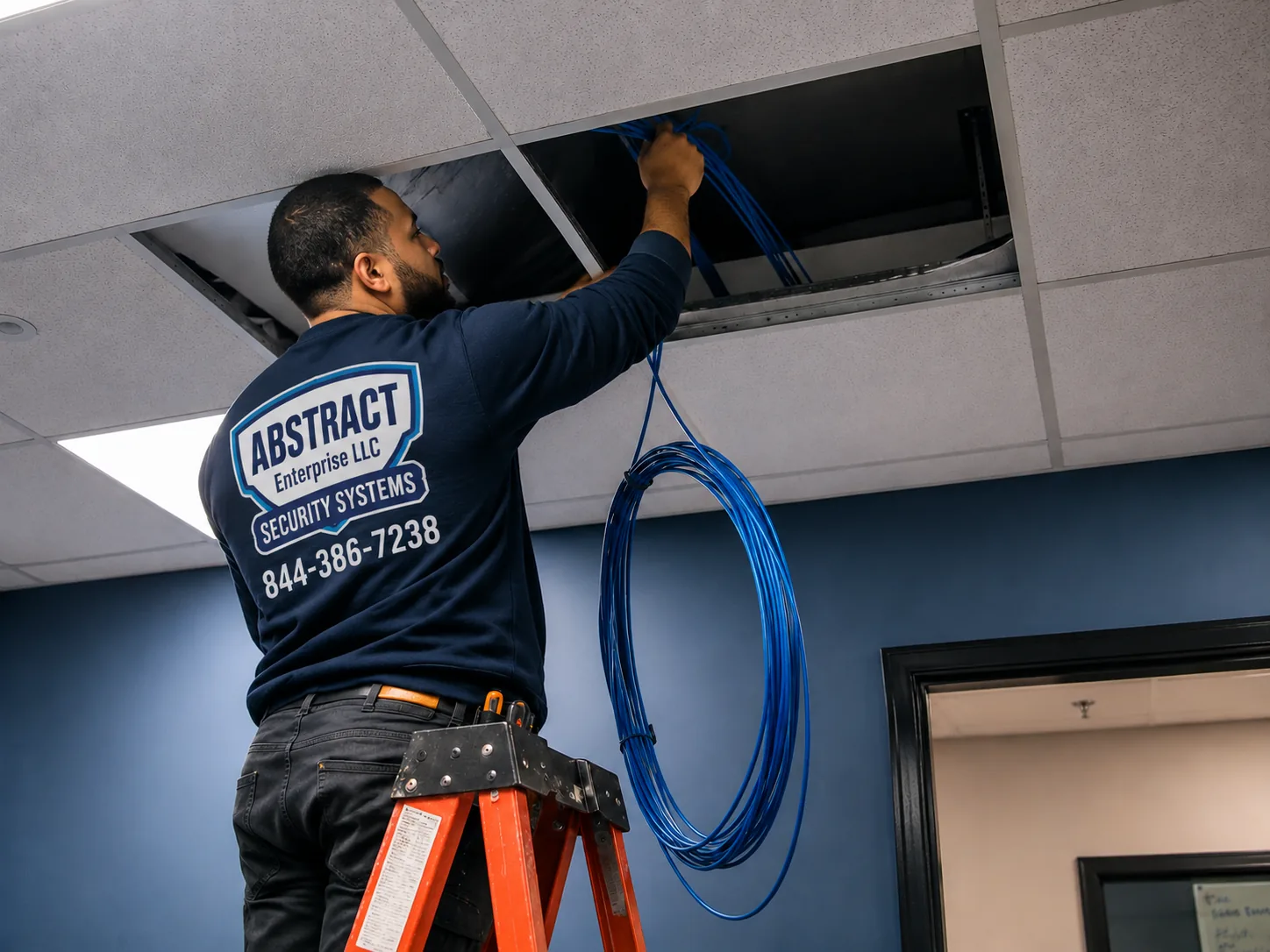
A photo from our job library, not taken in Brooklyn Heights: a technician feeding cable through the ceiling of a commercial space while it stays open. In the office buildings near Borough Hall, the ceiling is often the only route for a conference-room screen's cables, while in a Heights parlor the plaster ceiling and its medallion stay untouched and cables go down, not up.
Knock, scan, then one pilot hole. A knock at screen height separates the dull, hard sound of plaster on brick from the drum of plaster on lath. A scanner in deep mode helps on framed walls and can be confused by old plaster and metal lath. The decision comes from a single small pilot hole, drilled where the bracket plate will hide it: white plaster dust and then wood means lath and framing, red or grey grit means brick, a sudden drop into nothing means hollow tile or a void. That one hole sets the anchor and, if needed, the add-on, and you hear about any change before the second hole.
Tape the screen and sit down. Painter's tape marks the outline of the TV. You sit where you watch, and we check the height of the center of the screen against your eyes, the glare from the windows and whether the mantel, a radiator or a door gets in the way. Moving tape costs nothing. Moving a bracket on old plaster costs you a finish that cannot be replaced exactly.
Wall by Wall
Plaster on Lath, Plaster on Brick or Hollow Tile: What Holds a TV in a Brooklyn Heights Wall and What It Costs
The base price on our Brooklyn list, $179.99, covers a TV up to 55 inches on a flat or tilting bracket on drywall over wood studs, labor only, bracket sold separately. Very little in a Heights house built before the Civil War is drywall over wood studs, which is why the wall comes first in every conversation. Each add-on reflects different tools, fixings and time.
Plaster on wood lath (+$45). This is the wall between rooms in most Heights houses: thin wooden strips nailed across studs and covered in two or three coats of lime plaster that can add up to an inch thick. It is strong in compression and weak in pull. A screw into the lath alone, or a plastic plug in the plaster alone, can feel solid and still fail over months. The fixing that lasts passes through the plaster and lath into the stud behind, with the pilot hole drilled slowly so the plaster does not crack outward around it, or uses a toggle rated for the load where the bracket cannot reach a stud. Studs in houses this old are rough-sawn, irregular and not on a modern sixteen-inch spacing, so we locate them one at a time.
Plaster on brick (priced at the brick rate, +$65). On party walls, fireplace breasts and many outside walls, the plaster is applied straight onto brick, with no studs anywhere. Brick holds a TV very well if each anchor is set in a brick and not in a mortar joint, because old lime mortar is much softer than the brick around it and can crumble around a fixing. We use a hammer drill, choose sleeve or wedge anchors sized for the bracket and the brick, keep holes away from the edges of each brick, and on soft old brick use more fixings at a lower load each. The Brownstoner poster who mounted heavy bookshelves this way described using long lead shields through the plaster into the brick and said the approach "would also work for a TV." He was right, provided the shields go into brick.
Hollow clay tile or gypsum block (quoted from your photos). Common inside converted hotels and some prewar apartment buildings. The faces are thin and the cells behind them are empty, so ordinary masonry anchors can spin and drywall toggles may not open. We use anchors designed for hollow masonry, place them to catch the solid webs of the tile, and spread a heavy screen across more fixings. Because the tile is brittle, we drill without hammer action until the bit is through the face. Our list does not have a separate line for hollow tile, so we price it from your photos and confirm it before booking.
Above a fireplace (+$130, plus the wall). A TV over a mantel adds $130 on our list, and since the wall above a Heights fireplace is almost always plaster on brick, the $65 brick add-on usually applies too. The fireplace charge covers the extra work of a high, centered mount over a projecting mantel, protecting the mantel and hearth, and setting the bracket so the screen tilts toward the seating. A working fireplace adds a real heat question, and we discuss it before booking; many Heights fireplaces have not been used in decades. The Brownstoner poster whose fireplaces were "just decorative" was in the same position as many of our customers.
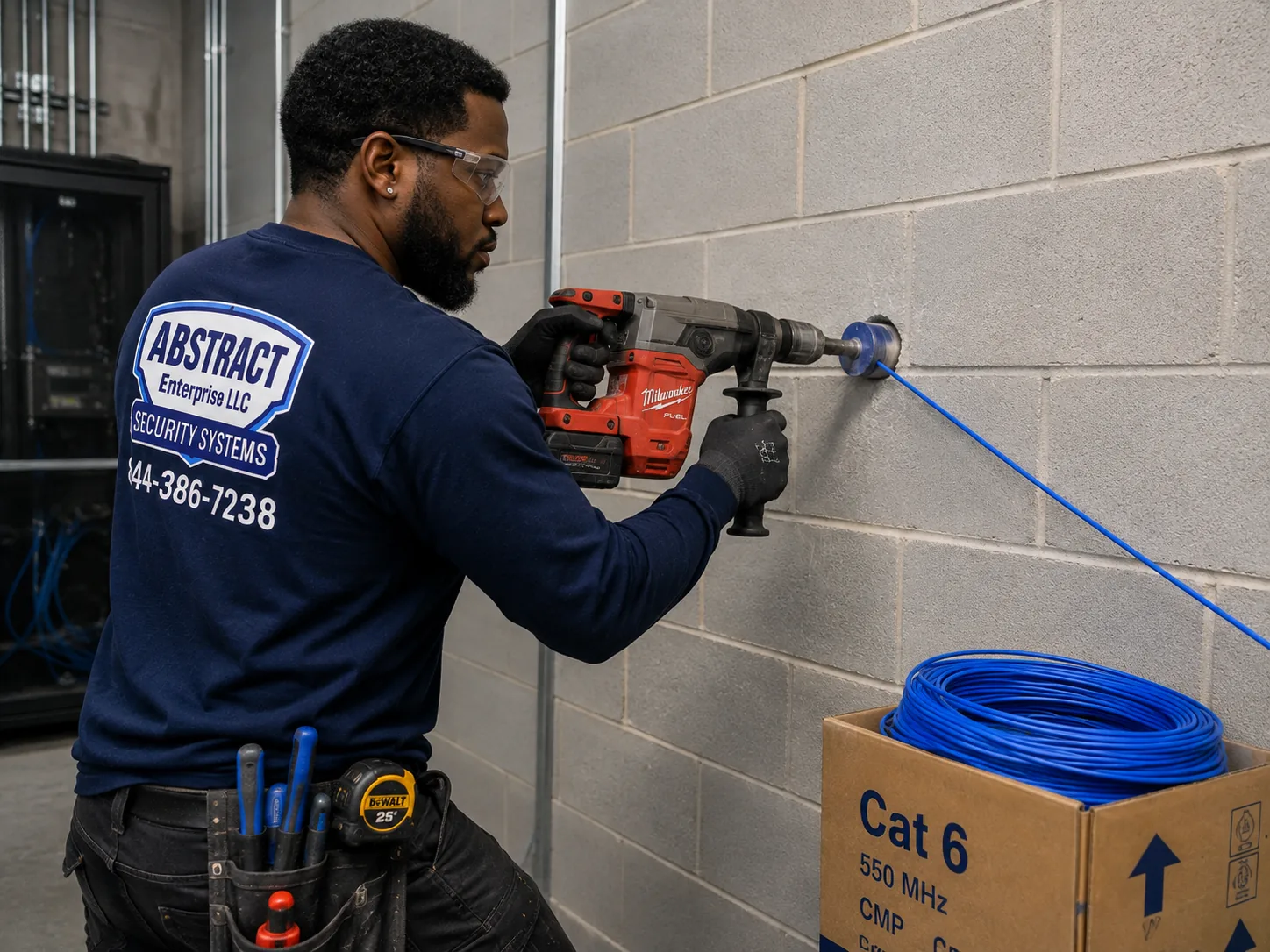
A photo from our job library, not taken in Brooklyn Heights: a technician core drilling through a block wall to carry cable to a network room. A core through masonry like this belongs in a commercial back room or a cellar. In a Heights house we never core through a party wall or a fireplace breast for a TV; brick there takes a handful of small anchor holes and the cables travel on the surface or drop behind the furniture.
Hiding the wires without breaking the electrical code
After "mount it," the most common request is "make the wires disappear," and there is a right and a wrong way to do it. The wrong way is to push the TV's own power cord into a hole behind the screen and pull it out of a hole near the floor. National Electrical Code section 400.12, as Mike Holt summarized it in EC&M in 2022, says flexible cords "are not permitted to be concealed by walls, floors, or ceilings," "are not permitted to be run through holes in walls," and "are not permitted to be a substitute for the fixed wiring." A cord inside a wall can be pierced by a fixing, overheat where it is bundled and cannot be inspected. We find this mistake behind old brackets in Heights houses regularly, and we take it out.
The right way on a framed wall is an in-wall power and cable kit. It puts a recessed power inlet low on the wall that plugs into your existing outlet, carries power inside the wall in the kit's own rated cable, and gives you a recessed outlet behind the TV, with a separate pass-through for HDMI and other low-voltage cables. On our list it is $169 with the kit. It needs a hollow, framed cavity between the two openings, so it suits plaster on lath and drywall and does not suit brick, stone, tile or block. On a Heights fireplace wall, that rules it out.
For masonry walls, there are three honest options. A paintable cord cover ($59) runs neatly on the surface from the screen to the outlet and can be painted to match the wall or the trim. A console directly under the screen lets the cables drop straight down behind it, out of sight, at no extra charge. And on some walls the cables can travel down beside a door casing or a chimney breast, where a cover all but disappears into the corner. A StreetEasy commenter suggested running wires behind baseboards or moldings, and on a few walls that is possible for low-voltage cables if the baseboard is already loose or being replaced, but we will not pry off original trim to do it, and we will not put a power cord there. A second commenter in the same thread called a cord cover "not ideal but it isn't bad" once it is painted, which is about how most Heights owners feel once they see one finished.
Rules Inside the Historic District
Landmarks, Boards, Leases and Old Paint: Who Has a Say in a Brooklyn Heights TV Wall
Living in the city's first historic district leads many people to assume that everything needs permission. For a TV inside your home, that is mostly not true, but four different sets of rules can still touch the job. We are installers, not lawyers, and nothing here is legal advice. What follows is what the public sources say and how it plays out on real visits, so you can ask the right question before booking.
The Landmarks Preservation Commission. The Commission's own page on permits says that "most exterior changes to the front and rear facades of buildings in historic districts require review by LPC." Inside, it is narrower. An LPC permit for interior work is required "when the work requires a permit from the Buildings Department," "when work on the interior affects the exterior," or "when the interior has been designated by the Landmarks Commission as an interior landmark." The same page says "you do not need a permit from the Landmarks Commission to perform ordinary repairs or maintenance chores." A TV on a bracket inside a parlor does not change a facade, does not usually need a Buildings permit and is not inside a designated interior landmark in an ordinary home, so in practice it does not go to Landmarks. What does go to Landmarks is anything that shows on the outside: a satellite dish on a roof or a facade, a cable run up the front of the house, a new hole through a front wall. The Commission's guidebook chapter on rooftop equipment says installations should be non-visible and that staff "may approve a minimally visible installation if it is not possible to make the installation non-visible." If your TV plan involves anything outside, we stop and work out the Landmarks question first.
The Department of Buildings. The DOB's page on whether a project needs a permit says the code "defines minor alterations and ordinary repairs where a permit is not required," and lists painting and plastering among its examples; it notes that even installing new kitchen cabinets does not require a permit. A TV bracket on anchors is in the same family as a cabinet on the wall. An in-wall power and cable kit plugs into your existing outlet and carries power in its own rated cable; it does not connect to the building's wiring. Adding a new hard-wired outlet behind the TV is different. That is electrical work, it belongs to a licensed electrician with whatever filing the job requires, and we do not do it. If you want a true outlet behind the screen, have your electrician install it, and we will mount around it.
Co-op boards and managing agents. A board's alteration agreement exists, in Brick Underground's words, "to make sure that the building-wide services and structures that serve all residents are not affected" by work in one apartment. Agreements "typically prohibit tampering with structures like load-bearing walls," set contractor insurance, and "may also dictate the days and hours in which contractors can work in your apartment." Some buildings are stricter still. A TV bracket rarely raises questions with a board, but a few things do: opening a wall that is shared with a corridor or another apartment, drilling a column, or any work outside allowed hours. If your building has no written agreement, the same guide suggests asking the board president for the rules in writing by email, which is good advice for a TV too. Send us whatever the managing agent asks for, and we send the certificate of insurance, naming the co-op corporation and the agent as they require, before the visit.
Landlords and leases. In divided houses and rental buildings, the lease decides. Brick Underground's 2022 column quoted a real estate attorney telling tenants to check the "alteration provision," and a broker saying "a landlord is within their rights to ban you from hanging items on walls." The same column told the story of a landlord who had banned artwork because of sealed lead paint, then later allowed a tenant to install TV brackets. Landlords can say yes when they know what is planned. Our suggestion is to send yours four facts: which wall, the size of the TV, the kind of bracket and where the wires will go, and to mention that the installer is licensed and insured. The column also noted that landlords must give tenants "an itemized list of repair charges" for deposit deductions and return the rest "within two weeks of you vacating." Since we do not patch or paint, plan how the holes will be filled when you leave, and photograph the wall afterward.
Old paint and the lead rules. HPD's Safe Work Practices page says lead-safe work practices apply to "housing built before January 1, 1978," and are triggered by work that will "disturb 2 square feet or more of paint in a single room." Since August 9, 2025, owners of units built before 1960 must also have the paint tested by an EPA-certified inspector using an XRF device. A bracket's pilot holes, a few anchor holes and the two small openings of an in-wall kit disturb a tiny fraction of that threshold, so a TV mount is not treated as a lead renovation. That does not mean the dust is harmless. In a Heights rental or a house with small children, we drill with dust collection at the bit, keep drop cloths under the work, and clean up with a vacuum rather than a broom. If your landlord has a lead test report for the apartment, it is useful to know what it says before we come.
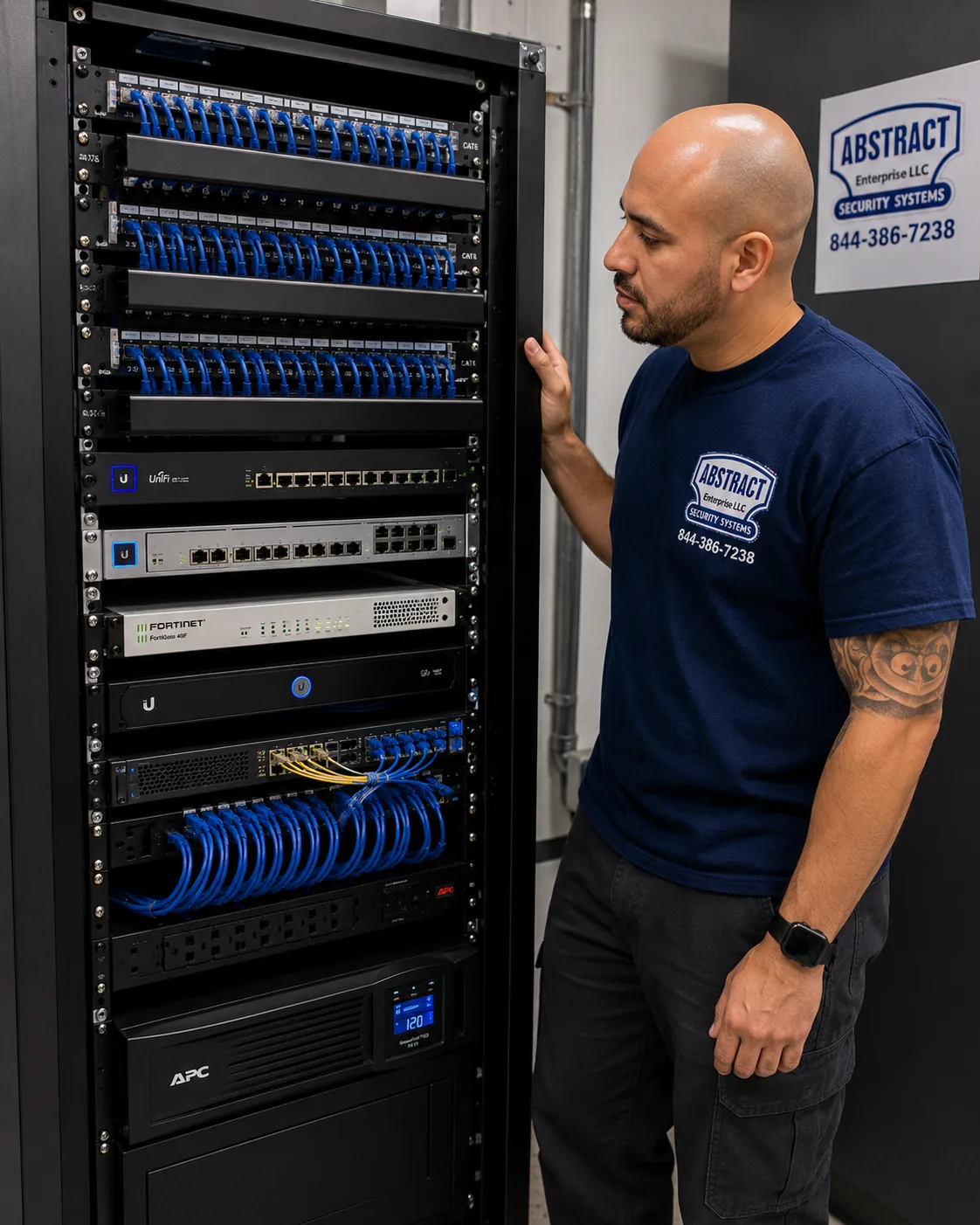
A photo from our job library, not taken in Brooklyn Heights: a finished rack with patch panels, switching, a firewall and a battery backup, every cable dressed and labeled. Most Heights homes need nothing like this for a TV, but the offices around Court Street that want a conference screen often have a closet like it, and the screen's network cable has to land in the right port of it.
Signal and Devices
Cable, Fiber, Wi-Fi or a Dish: Getting a Picture to a Brooklyn Heights TV
Where the signal comes into the house often decides where the cables have to travel, so it is worth knowing before the TV goes up. FCC broadband data summarized by BestNeighborhood in October 2026 lists Spectrum cable as available at about 99.9 percent of Brooklyn Heights addresses and Verizon fiber at about 91.5 percent, with Optimum cable at about 22 percent and Astound cable at about 17.5 percent. Satellite services are listed as available everywhere, but in a historic district a dish is a Landmarks question as soon as it is visible from the street.
In practice, that means most Heights TVs connect to one of three things. The first is a coax jack fed by the cable company, often on the parlor floor near where the previous owner's TV sat, with the line entering in the cellar or the garden floor. The second is a fiber router, usually wherever the installer brought the fiber in, which may be the cellar, the garden floor or a front room. The third is Wi-Fi from that router to a smart TV or a streaming device. If the router is in the cellar and the TV two floors up, a cabled connection may beat Wi-Fi through brick.
We do not run new lines up the outside of a house or through a facade; anything outside is the provider's work and, in the district, a Landmarks matter. Inside, we can run low-voltage cable from a cable box or router to a TV in the same room or along a sensible route, in a cord cover where the walls are masonry. If you would rather stream than keep a cable box, the TV needs only power and a connection, and a setup-only visit ($195 for the first hour, then 30-minute blocks) covers apps, inputs, remotes and a soundbar on a TV someone else mounted.
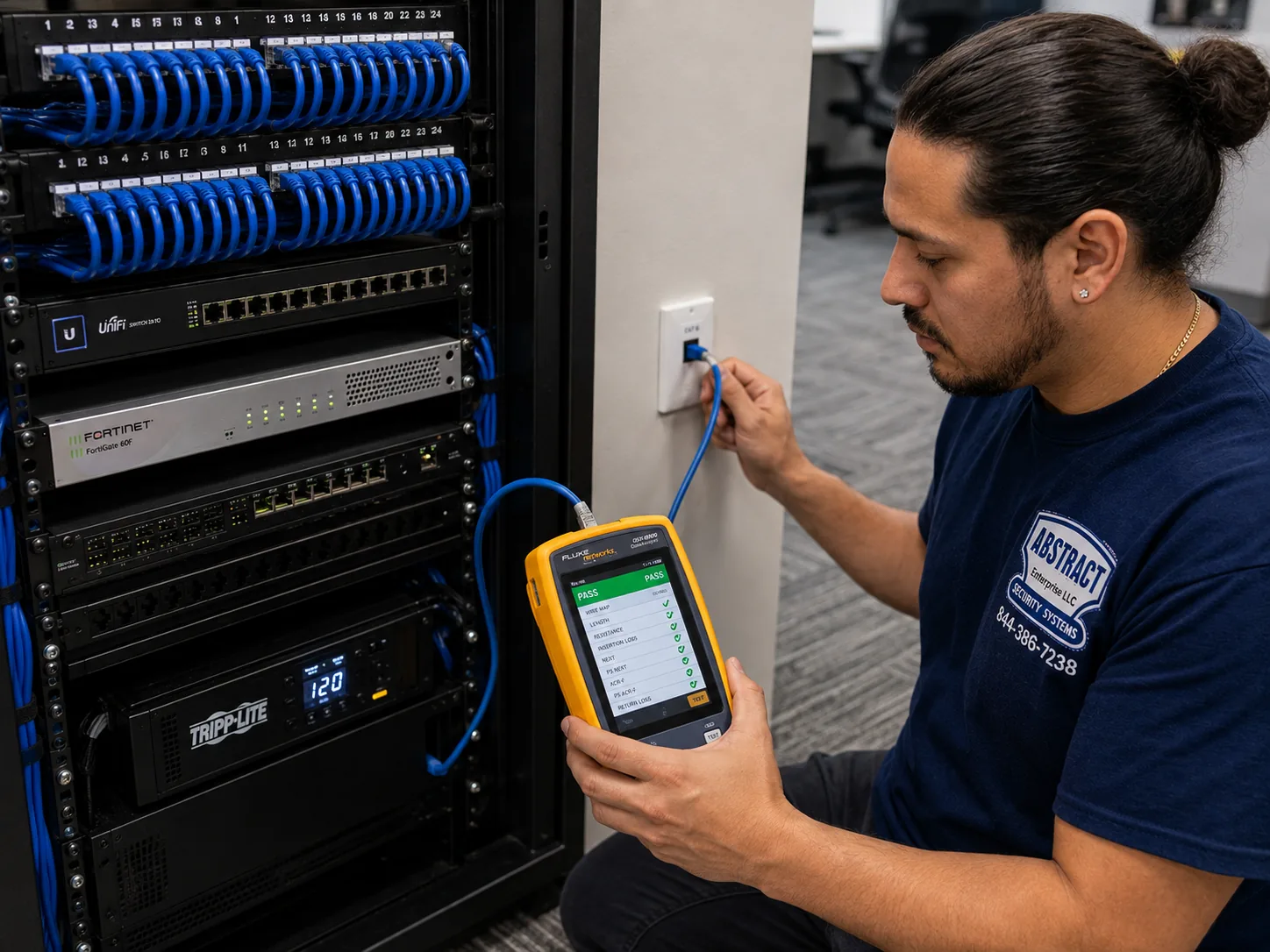
A photo from our job library, not taken in Brooklyn Heights: a technician certifying a data drop with a handheld analyzer that shows a PASS result. When a parlor TV is wired to a network point instead of relying on Wi-Fi through brick party walls, testing that cable before the TV goes up saves a second visit.
Commercial TV Installation
Business TV Installation in Brooklyn Heights
Brooklyn Heights is mostly homes, but its edges are busy. Montague Street runs from Court Street toward the waterfront with shops, restaurants and banks. Court Street and the blocks around Borough Hall hold law offices, courts and older office buildings. Atlantic Avenue on the southern edge has restaurants and shops. Henry and Clark Streets carry neighborhood businesses near the subway, and the Heights is home to schools, churches and institutions such as Brooklyn Law School on Joralemon and State Streets. The cards below describe the kinds of space where a business needs a screen. We do not name any business as a customer.
Conference rooms near Borough Hall
Displays for video calls and presentations in law and professional offices, mounted at seated eye level, with the camera bracket and cables planned so the table stays clear.
Restaurants and bars
Sports and menu screens on the old brick walls of storefronts on Montague Street and Atlantic Avenue, anchored in brick, clear of the service path and installed before opening hours.
Reception and waiting areas
Screens for medical, dental and professional suites in converted townhouses, with cables fully covered so nothing hangs where patients walk.
Shops and showrooms
Displays inside small storefronts where a screen sells better than a sign, placed inside the shop so the facade, which Landmarks controls, stays untouched.
Schools, churches and clubs
Screens for classrooms, parish halls and meeting rooms, sized for the back row, with work scheduled outside services, classes and events.
Lobbies and residence offices
Notice-board screens and staff displays for co-ops, rental buildings and student residences, mounted out of reach and wired to the building office.
Commercial spaces in the Heights share the same walls as the houses: brick, plaster and, in the office buildings, block and drywall. A storefront's side walls are usually brick party walls, so the brick add-on applies and in-wall kits do not. We plan screens so that nothing touches the storefront facade, which in the historic district is the part Landmarks regulates, and we keep screens out of exit paths.
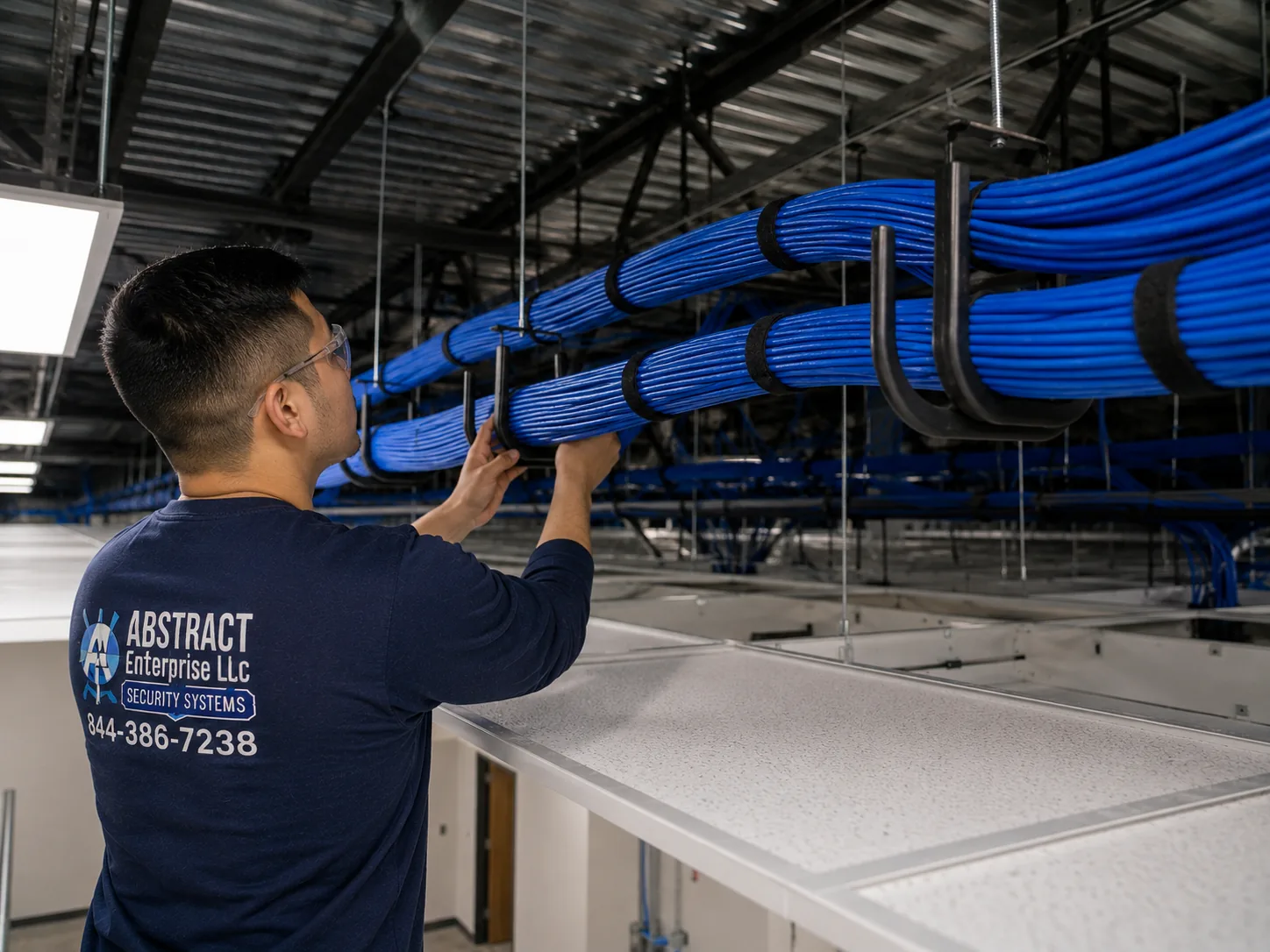
A photo from our job library, not taken in Brooklyn Heights: J-hooks carrying dressed bundles of cable across a commercial ceiling. In an office building near Court Street, a conference-room screen's cables may follow a route like this above the ceiling tiles to the network closet; in a Montague Street storefront with a plaster ceiling, they drop down the wall in a cover instead.
Compliance notes for Brooklyn Heights businesses and buildings
Facades and Landmarks. Screens mounted inside a shop are interior work. Anything fixed to or through a storefront, an awning or a facade in the historic district is an LPC question, and we do not do it without the owner's approval in hand.
Power belongs to an electrician. We use the existing outlets, in-wall power kits with their own rated cable, or cord covers. New circuits and hard-wired outlets are a licensed electrician's job, never a power cord fished through a wall.
Exits and paths. Screens go where they do not narrow a corridor, block an exit sign or project into a walking path, and wall-mounted screens in public areas sit high enough that no one walks into an edge.
Insurance and hours. Building managers usually ask for a certificate of insurance and set the hours. We send the certificate before the visit and schedule around them.
Your Questions Answered
TV Installation in Brooklyn Heights: Questions Answered
These are the situations Heights owners, tenants, boards and offices describe when they call: walls that turn out to be hollow, fireplaces that may or may not be used, shutters and moldings that get in the way, boards with long agreements, rentals with old paint and offices with strict hours. Each is answered here in full and not repeated in the FAQ further down.
Walls that are not what they seem
My apartment is in one of the former hotels near Clark Street, and when I hung a picture the nail went through into nothing. What will hold a 65-inch TV on a wall like that?
A nail that suddenly drops through usually means the wall is hollow clay tile or gypsum block under plaster, which was common inside prewar hotels and apartment buildings. The face of each tile is thin and the cell behind it is empty, so the nail found the void. The wall can still hold a TV, but not with drywall anchors. Our technician drills a pilot hole without hammer action, confirms the material, then uses anchors made for hollow masonry and places them to catch the solid webs between cells, with more fixings than a framed wall would need so each carries less. For a 65-inch screen, a low-profile fixed or tilting bracket puts less leverage on those anchors than a full-motion arm. Because our list has no separate line for hollow tile, we price it from your photos before booking, and if the building's management limits what can be opened, we plan the cables in a cord cover from the start.
Our contractor warned that the brick on the parlor fireplace breast might be only one brick thick in front of the flue. Can it still carry a TV?
Often yes, with care. A Brownstoner poster heard almost the same warning from his own contractor, that the brick "might be shallow," and it is a fair concern: the face of a chimney breast can be a single course of brick in front of the flue, while the party wall beside it is much thicker. What matters is that the anchors stay in sound brick and do not reach into the flue. We drill to a controlled depth, use anchors sized to that depth, spread the load across more fixings and keep them in the brick faces, not the mortar. If the breast is narrow or the brick is soft, a lighter screen on a low-profile bracket is the safer choice, or the TV can go on the solid party wall beside the breast. On our list this is the base price, plus $65 for brick and $130 for the fireplace position. If the pilot hole tells us the breast is not sound enough, we say so and show you the alternatives before drilling again.
Our parlor windows still have their original folding shutters in deep reveals right beside the TV wall. Will a full-motion arm hit them?
It can, and it is one of the reasons we measure before choosing a bracket. Interior shutters that fold back into the window reveal swing out into the room when they open, and a full-motion arm that pulls the TV forward and turns it toward a sofa can easily meet a shutter leaf or the casing around it. We measure the arm's reach and the shutters' swing, then pick either a tilting bracket that keeps the screen close to the wall, a shorter arm that cannot reach the reveal, or a position farther from the window. The shutters also help in a practical way: closed halfway on a sunny afternoon, they cut more glare off a parlor TV than any bracket angle can. We never fix anything to the shutters, their hinges or the casing.
Parlors, mantels and moldings
Our parlor ceiling is close to twelve feet and the mantel shelf sits at about chest height. Is there any way to have the TV on the fireplace wall and still watch it comfortably?
There are two ways, and sometimes the honest answer is a third. The first is to keep the TV as low over the mantel as its depth and the screen size allow, rather than centering it in the tall wall above, and to tilt it down toward the seating; in a twelve-foot room the temptation is to hang it halfway up, which is where the sore necks come from. The second is to move the seating back, because a screen that is high but farther away is easier on the neck than one that is high and close. The third is to put the TV on another wall and leave the mantel for what it was built for. We mark all three with painter's tape, you sit where you watch, and you decide with the screen outline in front of you. The above-fireplace add-on, $130, plus $65 for brick, applies only if the TV actually goes over the mantel.
We light the parlor fireplace a few times every winter. What does a real fire do to a TV above it?
Heat and soot rise, and a TV directly over a working fireplace sits in both. Cost guides such as TaskRabbit's note that mounting over a fireplace "must take heat, height, wall material" into account, and a Brownstoner poster put it more simply: "The heat won't be good for the tv." The amount of heat depends on the fire, the depth of the mantel and how well the chimney draws, so we do not promise that any particular screen will be fine. We check the TV maker's guidance for your model and the mantel's depth, which deflects some heat. If you light fires often, we usually recommend a different wall. If you light one a few times a winter and still want the TV there, we place it as high above the mantel as is comfortable to watch, and we suggest you avoid running the TV during and right after a fire.
A plaster cornice and a picture molding run around our whole parlor. Could the TV cables travel along the molding instead of straight down the wall?
Low-voltage cables sometimes can, and power never should. A picture molding sits a little proud of the wall, and a thin HDMI or network cable can be tucked along its top edge without fixings into the molding itself, then dropped down at a corner or a door casing. That can be neater than a cover running down the middle of a party wall. But we will not staple or nail into original plaster cornices or moldings, we will not pry them off to hide cables behind them, and we will not run the TV's power cord along them, because the electrical code does not allow cords to be attached to building surfaces as permanent wiring. The usual Heights answer is a short paintable cord cover ($59) from the screen down to an outlet near the floor, or a console under the screen that hides everything behind it.
Boards, landlords and old paint
Our co-op sent us a twenty-page alteration agreement for what we think is a small job. Which parts are likely to matter for a TV bracket and an in-wall kit?
Four parts usually matter, and most of the rest is about kitchens, bathrooms and floors. The first is whether the agreement defines minor work, such as hanging pictures, shelves or fixtures, that does not need board approval; a TV bracket often falls there. The second is insurance: many agreements, like the one Brick Underground described, require contractors to carry general liability "of at least $1 million" and to name the corporation and managing agent on the certificate, which we send before the visit. The third is hours and notice, since agreements "may also dictate the days and hours in which contractors can work." The fourth is what may not be opened, which is where an in-wall kit can be caught if the wall is shared with a corridor, a neighbor or a shaft. Send us the pages on those four points and the wall you want, and we tell you whether the plan fits the agreement or needs the managing agent's yes first.
We are renting the parlor floor of a divided house for one school year. Is it worth mounting the TV at all?
It depends on your lease and on how much you mind a TV on a stand. If the lease's alteration clause requires the landlord's consent, ask in writing; landlords who know the bracket will go into a party wall with four small anchors, and that the cables will run in a cover rather than inside the wall, often agree. Then plan how the holes will be filled when you leave, because we do not patch or paint, and a landlord may treat holes larger than a nail as damage under the lease. If you would rather not deal with any of it for one year, putting the TV on its own stand on a sturdy console is a perfectly good setup: $119.99 on our list, including connecting the devices, with a soundbar placed for $79. Strap the TV to the wall or the furniture if there are small children around; the Consumer Product Safety Commission reports that 70 percent of child tip-over deaths from 2000 to 2021 involved a falling television.
Our landlord's lead test report shows lead paint on the living room walls of our 1840s apartment. Can the TV still be mounted?
Yes, with care. The test result does not make a bracket illegal; it tells everyone where extra care is needed. HPD's lead-safe work practice rules are triggered when work disturbs two square feet or more of paint in a room, and the holes for a bracket and its anchors are a small fraction of a square foot. Even so, on a wall with known lead paint we drill only the holes the bracket needs, catch the dust at the bit with a shroud or vacuum, lay plastic and drop cloths under the work, wipe and vacuum the area afterward rather than sweeping, and do not sand or scrape anything. We would not open that wall for an in-wall kit; a cord cover or a console drop is the better choice there. If a child under six lives in the apartment, tell us when you book, and tell your landlord too, because the city's rules for those homes are stricter and the landlord has obligations of their own.
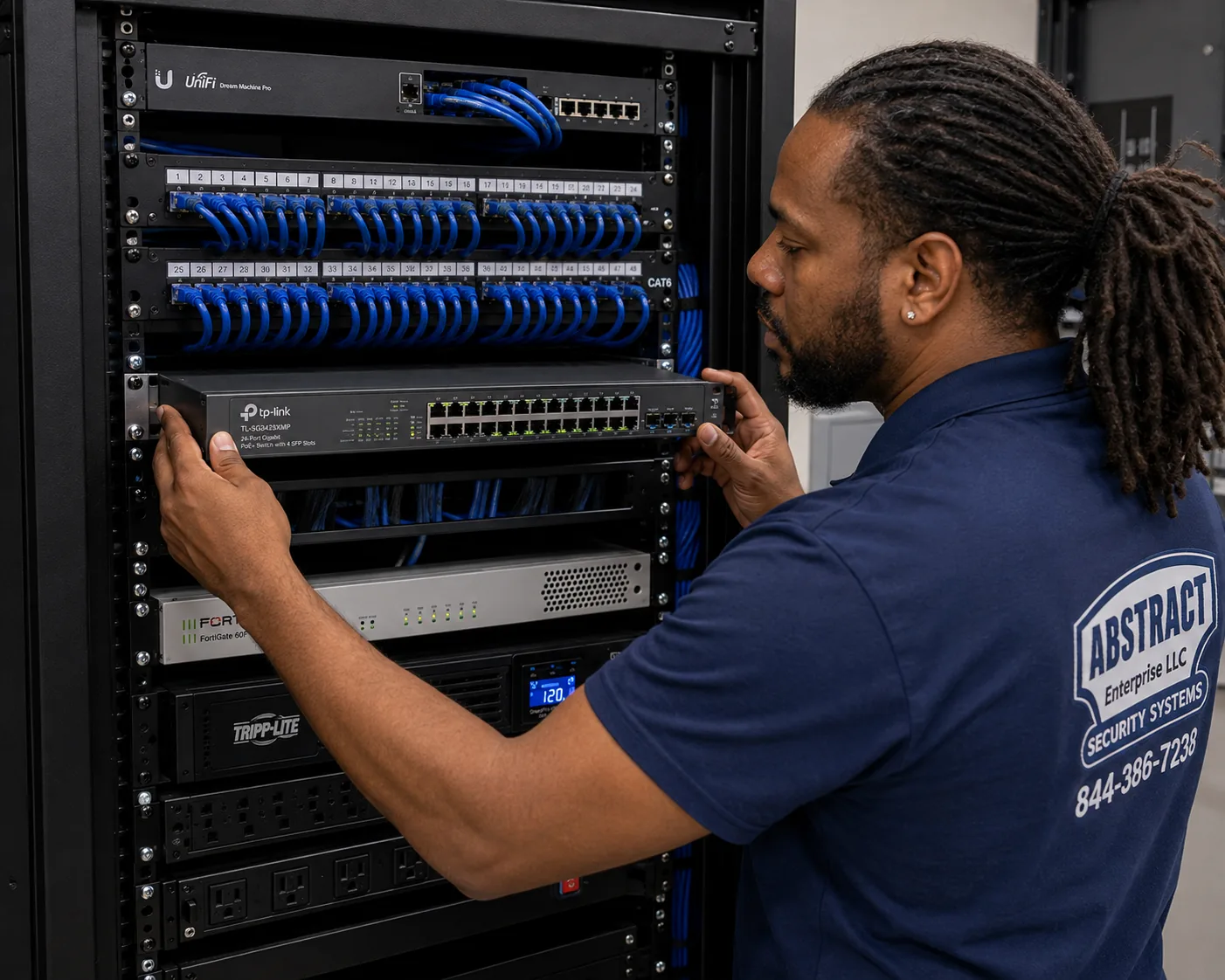
A photo from our job library, not taken in Brooklyn Heights: a technician mounting a managed PoE switch below the patch panels in a commercial rack. Conference-room screens in the offices near Borough Hall often connect to a rack like this, and the screen, its camera and its sound are easier to support when each has its own labeled port.
Neighbors, sound, dishes and offices
The party wall behind our TV is shared with the house next door, and their bedroom is on the other side. Will the drilling or the soundbar bother them?
The drilling will be heard, briefly, and the soundbar can be set up so it bothers them far less. A hammer drill into brick is loud for each hole, and a bracket needs four to six, so think of a few short bursts within ten minutes or so, which we do together rather than spread through the visit. If you tell us your neighbor works nights, we suggest a later arrival window and you can give them a heads-up. For sound, bass travels through structure, so a soundbar bracketed to the party wall can pass more low end into the next house than one sitting on a console with a little space behind it. On a shared wall we usually suggest placing the soundbar on the console ($79) rather than mounting it ($129), keeping any subwoofer off the floor against the party wall, and using the night or dialogue mode during setup. You hear the result at your normal volume before we leave.
A satellite company offered to put a dish on the rear fire escape of our brownstone. Is the back of the house treated differently by Landmarks?
Not as differently as people hope. The Landmarks Preservation Commission says that "most exterior changes to the front and rear facades of buildings in historic districts require review by LPC," so a dish or bracket on a rear wall or fire escape is still a Landmarks question, even though the Commission may look more kindly on a rear location that cannot be seen from the street. Fire escapes add a second problem: they are an exit, and nothing should be fixed to them that narrows the way out or gets in the way of a ladder. We do not install dishes or anything else on facades or fire escapes. Inside the house, once the provider brings a line in, we connect the receiver to the TV and route the cables neatly, in a cover on masonry walls. With cable available to nearly every Heights address and fiber to most, many owners decide they do not need a dish at all.
Our firm's office near Borough Hall is in an older building whose manager allows contractor work only after business hours. Can the conference-room screen be done then?
Tell us the building's rules when you request the quote, and we will offer a two-hour arrival window that fits them, or another day if it does not. Office buildings around Court Street often have drywall partitions, so a conference-room screen can usually have its power and cables hidden with an in-wall kit ($169), unless the screen goes on a demising or corridor wall that the building does not allow to be opened. The things that save time on the night are simple: the certificate of insurance approved before we arrive, a freight elevator or loading entrance booked if the building requires it, someone who can unlock the room, and the screen's model number so the bracket is right. Conference screens are usually mounted lower than living-room TVs, with the center near seated eye level, and the camera bracket and cables planned so the table stays clear.
Equipment
Types of TV Mounts and Hardware We Install
Brackets are sold separately, or we hang your own if it is rated for the TV's weight and bolt pattern. These are the kinds of hardware we fit in Heights homes and offices, chosen for the wall first and the room second.
Fixed low-profile brackets
The TV sits close to the wall with the least leverage on the anchors. The safest choice on hollow tile, thin Federal-era walls and shallow fireplace brick.
Tilting brackets
Angle the screen down when it hangs above a mantel or at a height dictated by a tall parlor, and cut window glare without pulling the TV off the wall.
Full-motion arms
Pull out and swing toward a kitchen or a second seating area in a floor-through, best on brick or into framing, and measured against shutters and door swings first.
Soundbars, placed or mounted
On the console below the screen ($79) or on a bracket under it ($129), set up with you so the dialogue is clear and the bass stays out of the party wall.
Stand setups
The TV on its own feet on a console, with devices connected and cables tidied ($119.99), for renters, short stays and anyone who would rather not drill.
Cable concealment
In-wall power and cable kits on framed walls ($169) and slim paintable cord covers on brick and plaster-on-brick walls ($59).
A big-box install service, an app-booked handyman or a local licensed installer for a Heights wall
All three can hang a TV, and on a new drywall wall the difference is small. In a pre-Civil War house it is larger. Services priced for typical walls may not arrive with the hammer drill, the hollow-masonry anchors or the co-op paperwork a Heights job needs. A local licensed installer should be able to tell you before booking what your wall probably is, what each add-on costs and what the board or landlord will ask for. Whoever you hire, ask three questions: what will the anchors go into, where will the power cord go, and what will be left on the wall if the TV comes down. If the answer to the second question is "inside the wall," look elsewhere.
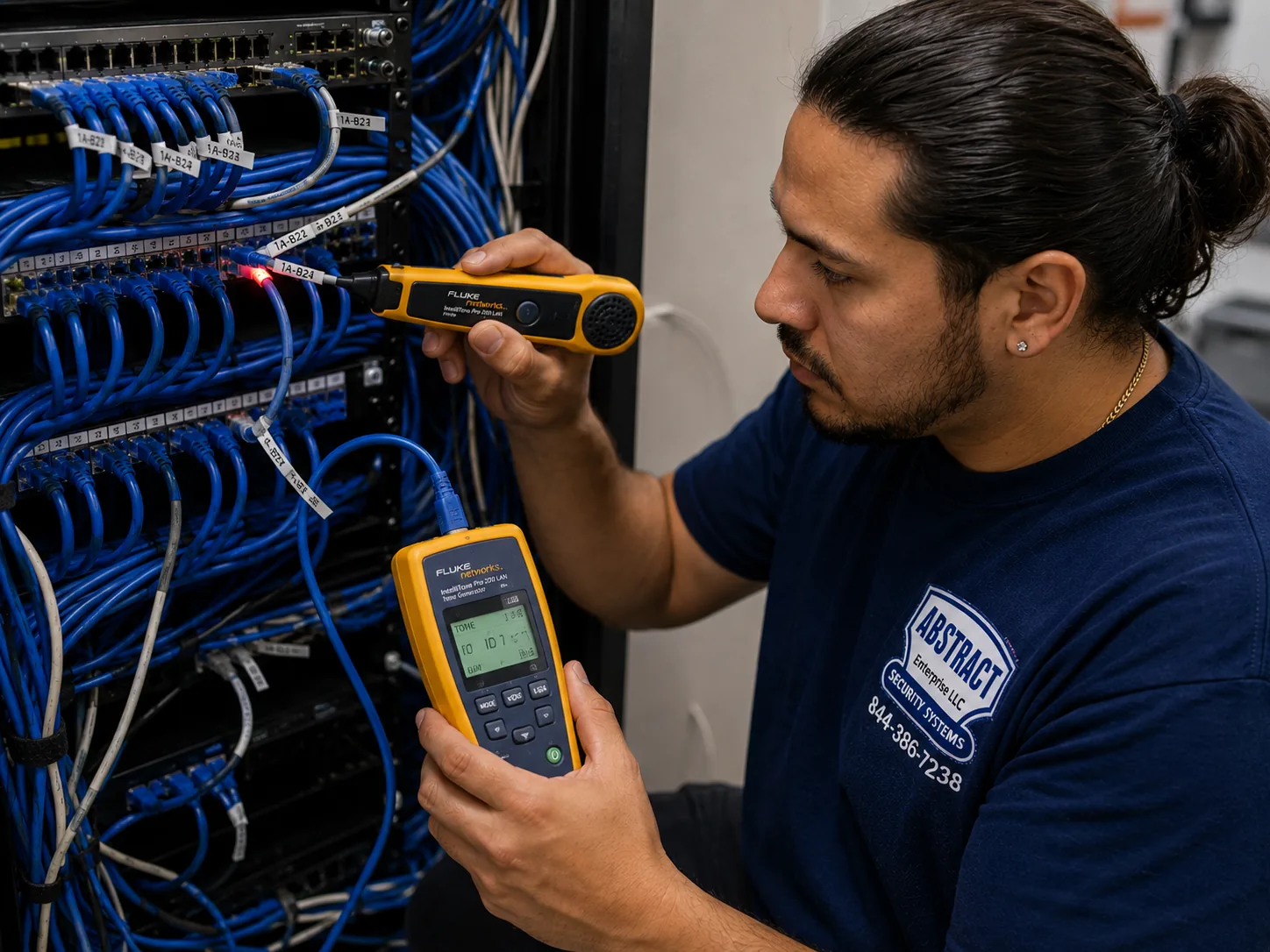
A photo from our job library, not taken in Brooklyn Heights: a technician tracing an unidentified cable at a patch panel with a tone generator and probe. Old Heights houses often have several dead coax jacks left by past providers; tracing which one is actually live before mounting the TV keeps the screen from going on the wrong wall.
AI Overview Reality Check
What AI Gets Wrong About TV Installation in Brooklyn Heights
These are claims that turn up in generic online answers and national cost guides such as Angi, HomeAdvisor and Fixr, paraphrased, each followed by what Brooklyn Heights houses actually show.
"Use a stud finder, mark two studs and screw the bracket in"
Generic guides assume every wall is drywall on wood studs spaced sixteen inches apart.
In a Heights rowhouse the wall most people want, the fireplace wall, is a brick party wall with no studs at all, and the framed walls between rooms are plaster on lath with irregular studs a scanner struggles to read. Converted hotels add hollow tile, which has no studs either.
We confirm the wall with one pilot hole the bracket will hide, then choose anchors for what is really there: through-lath screws into framing, anchors set in brick, or hollow-masonry anchors in tile.
"Historic district homes need Landmarks approval to mount a TV"
Some answers treat anything inside a landmarked house as regulated.
The Landmarks Preservation Commission's own page says interior work needs its permit only when it requires a Buildings permit, affects the exterior, or sits inside a designated interior landmark. A bracket inside your parlor usually meets none of those.
What does need Landmarks attention is anything on the outside, such as a dish or a cable up the facade. Your co-op board or landlord is far more likely than the Commission to have a say in a TV.
"Hide the cables by running the cord through the wall"
Many answers suggest two holes and the TV's own power cord fed between them.
National Electrical Code section 400.12 does not allow flexible cords to be concealed by walls or run through holes in walls. Hidden power needs an in-wall kit with its own rated cable and a recessed outlet, and that only works in a framed cavity.
On brick party walls and fireplace breasts, which are most Heights TV walls, nothing can be fished inside, so the honest options are a paintable cord cover or a console below the screen.
"The TV goes over the fireplace"
Design answers often present the mantel as the natural focal point for a screen.
Heights parlors have high ceilings and mantels at chest height, so a TV over the mantel can end up far above eye level. A Brownstoner poster warned that it "invites a sore neck," and a working fireplace adds heat and soot.
We tape the screen on the wall and check it from your seat. Sometimes the mantel works with a low, tilted mount; sometimes the back parlor wall is better.
"Strong plastic anchors will hold a medium TV on any wall"
Some guides say heavy-duty plastic plugs are enough for a screen of average size.
In old lime plaster a plug grips only the soft layer under the surface, in hollow tile it spins in an empty cell, and in brick it belongs in the brick, never in the soft mortar joint. The failures we are called to fix in the Heights usually start with a plug.
We use fixings rated for the load and the material, and on weaker walls we spread the screen across more of them.
"Mounting a TV costs the national average"
Cost guides publish averages drawn from many cities, usually assuming ordinary drywall.
An average does not know your wall is plaster on brick, your TV is going over a mantel, or your board wants a certificate of insurance and a weekday slot. Those are the things that change a Heights total.
Our Brooklyn list starts at $179.99 and shows each add-on, $45 for plaster, $65 for brick, $130 above a fireplace, so you can add up the total yourself before you book.
"A TV on a stand is the safe option"
Answers aimed at renters often present the stand as the risk-free choice.
A stand avoids holes, but the Consumer Product Safety Commission counts about 19,400 emergency-room injuries a year from furniture, TV and appliance tip-overs, and its chair, Alex Hoehn-Saric, said in 2023 that "furniture and TV tip-overs remain a major safety hazard in American households."
A stand setup is a good choice in a rental, provided the TV is strapped to the console or the wall where children are around. A wall mount done properly removes the tip-over risk entirely.
Not Sure What Your Wall Is? Ask a Technician First
Give us the street, the kind of building, the floor, the TV size and what you know about the wall. A technician will call back with the total for your Brooklyn Heights address, or call (347) 934-8335 now.
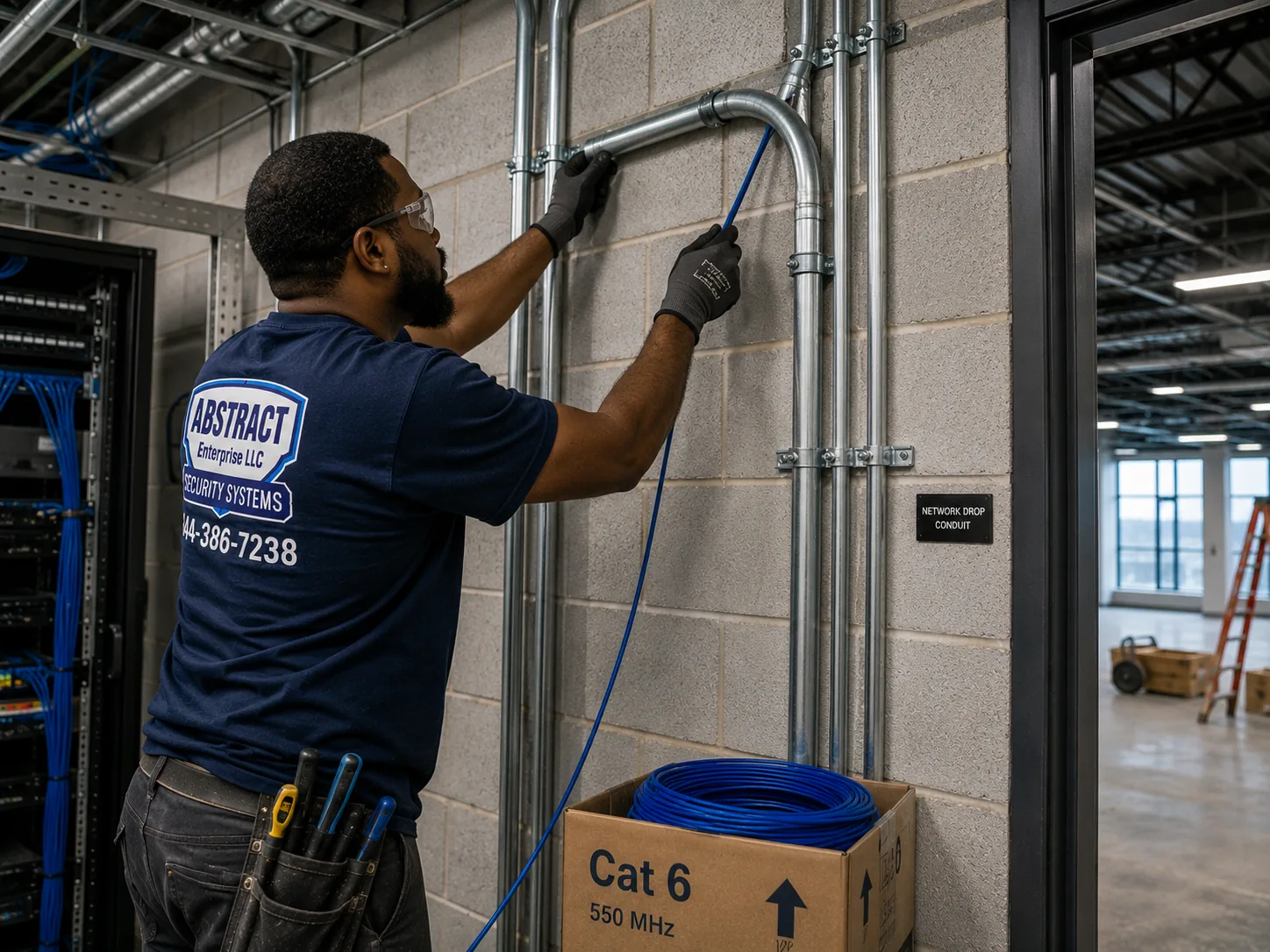
A photo from our job library, not taken in Brooklyn Heights: a technician running cable into EMT conduit beside a telecom room in an industrial building. Conduit like this suits a commercial back room; in a Heights house the cables between a cellar router and a parlor TV take a quieter route, and the form below is where you tell us which floors they have to cross.
✅
Request Sent!
Thank you. A technician will call you about the Brooklyn Heights address on the same working day.
How It Works
Our Installation Process
1. Photos, address and building rules
The wall, the TV's model sticker and the device spot, with your street and any co-op or lease rules. You get the expected wall, the add-ons and the total.
2. Paperwork before the visit
Certificate of insurance to the managing agent or board, working hours, elevator or stair access and a two-hour arrival window, all settled ahead.
3. Read the wall
Party walls located, a knock and a scan, then one pilot hole hidden behind the bracket plate to confirm lath, brick, hollow tile or drywall.
4. Mark the screen and the cable route
Painter's tape outlines the TV; you sit where you watch; glare, shutters and the mantel are checked and the cable route agreed.
5. Fix the bracket
Dust collection at the bit, anchors rated for the load and the material, masonry anchors in brick and never in mortar.
6. Hang the TV and manage cables
The TV goes up and is leveled; cables go into an in-wall kit on framed walls, a cord cover on masonry, or straight down to the console.
7. Test and hand over
Every input, the soundbar and the remote tested with you, the dust cleaned up and the bracket and model details left with you.
Coverage Area
TV Installation Near Brooklyn Heights's Landmarks
Brooklyn Borough Hall
The Greek Revival civic building at 209 Joralemon Street, completed in 1848, at the Heights' southeastern corner by Court Street.
St. Ann and the Holy Trinity
The Gothic Revival church at Montague and Clinton Streets, designed by Minard Lafever and finished in 1847.
Our Lady of Lebanon Cathedral
Richard Upjohn's 1840s church at Remsen and Henry Streets, built as the Church of the Pilgrims.
Cadman Plaza Park
The long park on the Heights' eastern side along Cadman Plaza West, home of the Brooklyn War Memorial.
Brooklyn Bridge Park
The waterfront park below the Heights, reached from Old Fulton Street and Joralemon Street.
Willow Street
One of the district's best-preserved blocks of early houses, running north from Pierrepont Street toward Middagh.
Brooklyn Heights is billed at our Brooklyn rate. The base covers a TV up to 55 inches on a flat or tilting bracket on drywall over wood studs, labor only, with the bracket sold separately. Everything else is a listed add-on. Screens larger than 55 inches and walls our list does not name, such as hollow tile, are priced on your written quote from photos before you book.
Item
Brooklyn price
TV wall mounting, drywall on wood studs, up to 55" (bracket sold separately)
from $179.99
TV placed on its stand, no wall mount
$119.99
Setup-only visit
$195 first hour, then 30-minute blocks
Plaster wall add
+$45
Brick or stone wall add
+$65
Above-fireplace mounting add
+$130
In-wall concealment with code-compliant in-wall power and cable kit
$169
Paintable cord cover
$59
Soundbar wall-mounted / soundbar placed
$129 / $79
Take down old TV
$85
Two Heights examples show how it adds up. A 50-inch TV on the plaster wall between the front and back parlors with an in-wall kit is $179.99 + $45 + $169 = $393.99. A 55-inch TV over a decorative fireplace on a brick party wall with a cord cover is $179.99 + $130 + $65 + $59 = $433.99.
Full terms — including 50% deposit, one-year parts-only warranty on Abstract Enterprises Security Systems-supplied products, and the late-fee schedule — are set out in the service agreement.
Shop Our Systems
TV Installation Packages & Pricing
Three typical Heights jobs, added up from the list above. Brackets are extra unless you supply a rated one.
Rental starter: $198.99
A TV on its stand on your console with the devices connected ($119.99) and a soundbar placed in front ($79). No holes, nothing to restore when the lease ends.
Parlor standard: $412.99
A TV up to 55 inches on a plaster wall ($179.99 + $45), a paintable cord cover ($59) and a soundbar mounted under the screen ($129).
Fireplace premium: $588.99
The old TV taken down ($85) and a new one up to 55 inches above a brick fireplace ($179.99 + $130 + $65), with a soundbar mounted under it ($129).
Bring your own equipment. If you already own a bracket, a soundbar bracket or a cord cover, we install it at the labor prices above as long as it is rated for your TV's weight and size. We check the rating from the model numbers before the visit.
What does a 50-inch TV above a brick fireplace in a Heights brownstone come to on your list?
+
The base is $179.99, the above-fireplace add-on is $130 and brick is $65, so the labor is $374.99. A cord cover adds $59 and a soundbar mounted under the screen adds $129. The bracket is extra unless you already own a rated one.
Why can't the in-wall kit go into my fireplace wall?
+
The kit needs a hollow framed cavity between its two openings so its rated cable can run inside the wall. A Heights fireplace wall is plaster on solid brick with a flue behind it, so there is no cavity. A paintable cord cover or a console under the screen is the answer there.
How much is a soundbar under the TV compared with one on the console?
+
A wall-mounted soundbar is $129 and a soundbar placed on the console is $79 on our Brooklyn list. On a party wall shared with a neighbor's bedroom, the placed option often keeps more bass out of the wall.
How is a setup-only visit billed once the first hour is over?
+
The first hour is $195, and after that time is billed in 30-minute blocks. Most setups of a TV, a streaming device, a soundbar and a remote finish within the first hour if your app passwords are ready.
What should I ask my managing agent for before booking?
+
Ask for the exact names and address they want on the certificate of insurance, the hours contractors may work, whether the elevator or a service entrance must be booked, and whether any wall may not be opened. Send us their answers and we plan around them.
My lease says no drilling. What does a TV on its stand cost instead?
+
A TV placed on its stand is $119.99 on our Brooklyn list, including connecting your devices and tidying the cables. A soundbar placed on the console adds $79. Ask about a strap if there are small children in the home.
If two TVs go on plaster walls in one visit, is the plaster add-on charged once or twice?
+
It is charged per TV, because each mount needs its own fixings and its own care. Two TVs on plaster are two base prices plus two $45 add-ons, and each TV's other add-ons are counted separately too.
Is a full-motion arm a sensible choice on old plaster?
+
Only if the arm's plate can be fixed into framing or into brick behind the plaster. A full-motion arm puts much more leverage on its fixings than a fixed or tilting bracket, and plaster alone will not hold it for long. If neither is available, we recommend a tilting bracket instead.
How do you protect a marble mantel and hearth while mounting above them?
+
We pad the mantel shelf and lay drop cloths over the hearth before any drilling, never stand or lean ladders on the mantel, and catch the dust at the bit. Nothing is fixed to the mantel itself; the bracket goes into the brick above it.
Do you book TV visits in Brooklyn Heights on weekends?
+
We book seven days a week, with arrival in a two-hour window. Many co-ops allow contractor work only on weekdays, so check your building's rules first; if a weekend slot is not allowed, we offer the nearest weekday.
Is Brooklyn Heights priced higher than the rest of Brooklyn?
+
No. The Heights is billed at the same Brooklyn rate as every other Brooklyn neighborhood. What changes a total is the wall, the fireplace and the extras you choose, all of which are listed on this page.
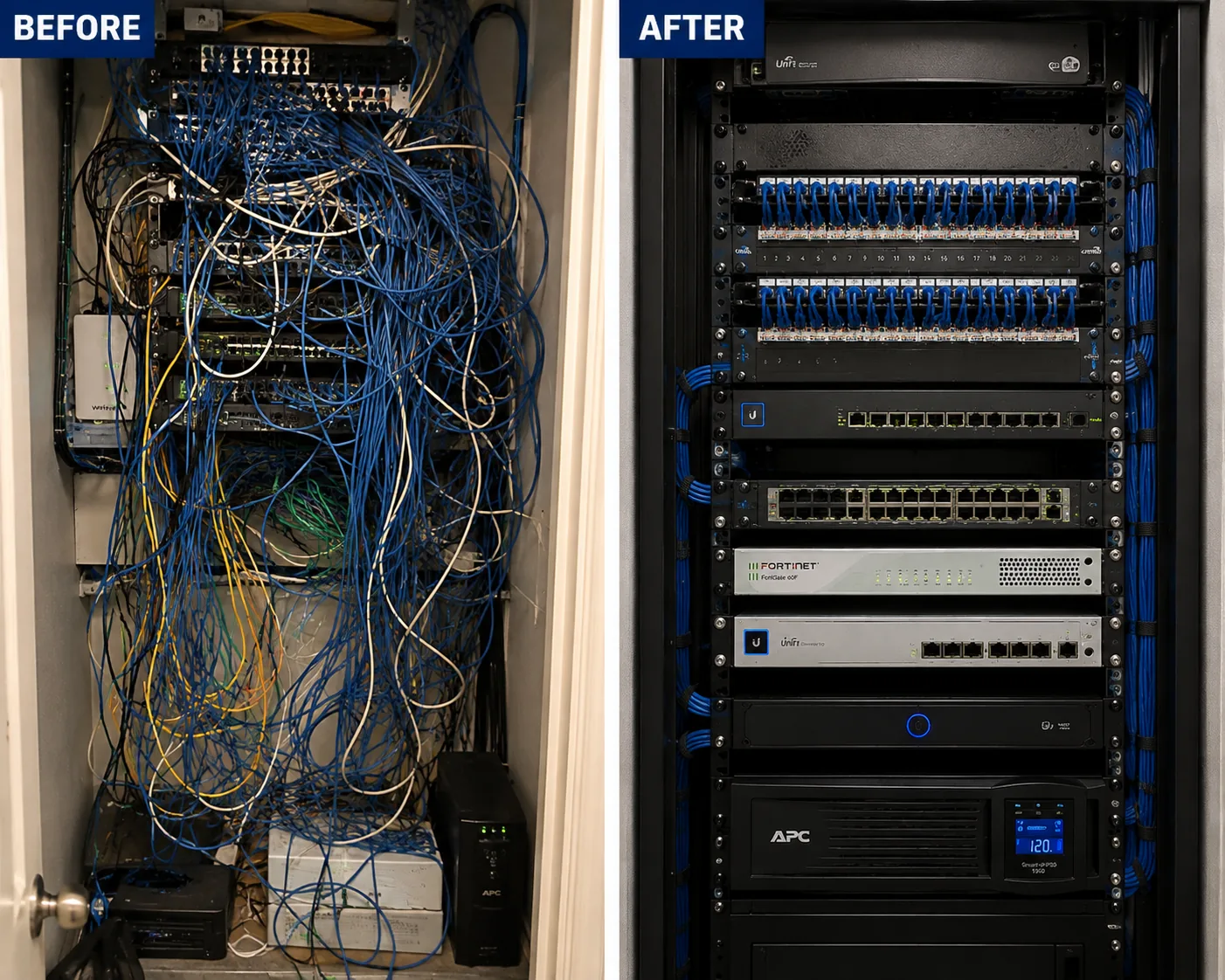
A photo from our job library, not taken in Brooklyn Heights: before and after views of a network rack, tangled and unlabeled on one side and dressed and labeled on the other. The same idea applies behind a TV console in a Heights parlor: when the cables are strapped and labeled at handover, the next provider visit or TV upgrade takes minutes instead of an afternoon.
Where This Page's Brooklyn Heights Facts Come From
Every rule, figure and quotation here comes from a public source: the Brooklyn Heights Historic District record; the Landmarks Preservation Commission's permits page and Permit Guidebook; the Department of Buildings permit page; HPD's Safe Work Practices page; Mike Holt's 2022 EC&M explainer on NEC section 400.12; the Consumer Product Safety Commission's 2023 release; Brick Underground (2018 and 2022); a Brownstoner forum thread and a StreetEasy Talk discussion; FCC data summarized by BestNeighborhood in October 2026; and building listings for the Remsen Street co-ops. Prices come only from our published Brooklyn TV list.
Ready to Put the TV on the Right Brooklyn Heights Wall?
Send a photo of the wall and the TV's model sticker with your street, and we will tell you what the wall is likely to be and what the job costs on the Brooklyn list. Call or text (347) 934-8335, message us on WhatsApp, or use the request form. Licensed under NYS license #12000287431, rated 4.7★ across 201 Google Reviews, with same-day estimates on most days.