Any Brand, Any Installer · Historic-District Mounting Rules Followed · Cause and Written Price First · Brooklyn Rate
Security camera repair in Brooklyn Heights starts with our $150 Brooklyn service call, which covers the on-site diagnosis and is credited to the repair when you go ahead. On our published Brooklyn list most single faults cost $150 to $700, a recorder replacement or a partial brownstone rewire costs $700 to $1,500, and awkward brownstone access, such as cable that has to pass through plaster or between a garden floor and a parlor duplex, can add $100 to $200. We repair systems other companies put in, from two cameras on a late Federal row house in the north end to a few dozen cameras wired through a prewar co-op. Requests are booked within 2 hours, technicians arrive in a two-hour window, and you hear the cause and get a written price before anything is replaced.
Reviewed and updated November 12, 2026, against the Landmarks Preservation Commission Permit Guidebook chapter on health and safety equipment; DNAinfo and Brooklyn Paper reporting from March 2017 on the Brooklyn Heights Association's plan for street-facing cameras on Joralemon Street homes; local reporting on Council Member Lincoln Restler's funding of cameras at two Promenade entrances; the Brooklyn Eagle on the July 2022 break-in at 160 Montague Street and on the Montague Street Business Improvement District; News 12 Brooklyn on the March 2024 Atlantic Avenue convenience store burglary and the February 2024 Henry Street store theft; DNAinfo, Patch and Brooklyn Paper on the 2016 and 2017 Brooklyn Heights burglary pattern; Brick Underground on co-op camera and video doorbell rules and on tenant access to footage; HomeAdvisor's Brooklyn surveillance camera cost page; the Historic Districts Council and The Cultural Landscape Foundation on the historic district; and the New York Department of State on security system installer licensing. · Abstract Enterprises Security Systems, NYS license #12000287431 · crews dispatched from our Troy Avenue office in Brooklyn

Owner-operated since 2002 · Thousands of jobs completed · Booked within 2 hours
Quick answer for Brooklyn Heights: most dead cameras here are not dead cameras. In the brownstones, carriage houses and prewar co-ops between Old Fulton Street and Atlantic Avenue, the usual culprits are a tired power supply, a hard drive that quietly stopped writing, a connector that worked loose, or a cable that a renovation crew cut somewhere between the cellar and the cornice. The camera itself is the failed part less often than people expect, and finding out which link broke is what the $150 service call pays for. If the house is inside the historic district, as most of the neighborhood is, a camera replaced in the same spot with similar equipment counts as ordinary maintenance under the Landmarks Preservation Commission's guidebook, so a typical repair needs no permit. Send a photo of the recorder screen, the street and the floor the recorder is on to (347) 934-8335 or on WhatsApp, and we will tell you what most likely failed and what that repair costs on our Brooklyn list.
Brooklyn Heights is small, about a third of a square mile bounded by Old Fulton Street, Cadman Plaza West, Atlantic Avenue and the East River, and almost all of it was built before anyone imagined a camera on a front door. Houses went up block by block through the nineteenth century, and Wikipedia's history of the neighborhood describes it as almost fully developed by 1890. After the Brooklyn Bridge opened in 1883 and the subway arrived in 1908, many of the large single-family houses were divided into apartments and rooming houses. That is the building stock every camera system here has to live in: masonry walls, plaster ceilings, floors that have been reframed more than once, and wiring paths that nobody planned. Cameras were added to these buildings later, usually in a hurry after something happened, and the repair work today is often about undoing a quick installation as much as replacing a part.
Residents have been asking for cameras for a long time, and that history explains much of what we find on the walls. In March 2017, DNAinfo reported that the Brooklyn Heights Association planned street-facing cameras on homes along Joralemon Street, roughly two per block, between Furman and Clinton streets, with more on commercial buildings toward Court Street. The money came from a $2,500 grant from the Borough President's office plus contributions from homeowners. Peter Bray, then the association's executive director, put the case simply: "Having some cameras on the street could one, be a deterrent, and two, help police apprehend perpetrators." The Brooklyn Paper added that the homeowners hosting those cameras would own the footage and give police access when officers needed it. Cameras put up under plans like that are now close to a decade old, and on private houses the owner, not the city, is the one who has to keep them running.
The case for working cameras has not gone away. The same 2017 DNAinfo report said the 84th Precinct, which covers Brooklyn Heights, had recorded 32 burglaries so far that year against 12 in the same stretch of 2016. Patch and Brooklyn Paper coverage of that winter described daytime break-ins on Willow, Joralemon and Montague streets, many through open or unlocked windows, some possibly reached from a fire escape. More recently, News 12 reported that on the morning of March 2, 2024, four people burglarized a convenience store on Atlantic Avenue, two smashing through the glass while two kept watch, before running toward Hicks Street. A few days later it reported two men ordering an employee away from a register at a Henry Street store and leaving with about $670 in merchandise. Council Member Lincoln Restler has also funded cameras at two entrances to the Brooklyn Heights Promenade at the 84th Precinct's request, describing them as "more eyes to ensure the safety of both locals and tourists."

What the news rarely says is whether the cameras nearby actually worked. When thieves smashed the glass door of the AT&T store at 160 Montague Street early one morning in July 2022 and took display phones and watches, the Brooklyn Eagle quoted the store manager saying he had no video of the break-in, though he believed police could get footage from elsewhere. That is the most common story we hear from owners after an incident: the camera was there, the recorder was there, and nothing usable was saved, because a drive filled with errors weeks earlier, a camera lost power after a renovation, or the clock was so far off that the clip could not be matched to the report. A repair is how you find that out before the night it matters.
The historic district changes how the work is done. The Brooklyn Heights Historic District was designated on November 23, 1965, the first in New York City, and the Historic Districts Council describes it as a district of brownstone and brick houses, churches and carriage houses. The Landmarks Preservation Commission's permit guidebook sets the rules for cameras on buildings like these: equipment should be well spaced so the facade does not look cluttered, small buildings should carry no more than two cameras for every 25 feet of frontage, mounts go into mortar joints, plain masonry, wood or metalwork and never through cast iron or decorative surfaces, and visible conduit is limited to about ten inches. The same chapter says ordinary maintenance and repair of safety equipment needs no permit. For a repair, that means a like-for-like swap is usually straightforward, while moving a camera to a new spot on the front of the house is the moment to check the rules first.
Finally, ownership. A Brooklyn Heights camera system may belong to a single family, to a landlord with five tenants, to a co-op board, to a condominium's management office, or to the shop on the ground floor, and sometimes to two of those at once. Brick Underground's reporting on New York co-ops notes that boards can pass house rules on cameras in common areas, and its advice for tenants is that landlords are not obliged to show footage outside a legal process and that city buildings are not required to have working cameras at all. Before we change anything, we confirm whose equipment it is, who holds the password, and who approves the price.
Where this page applies. It covers Brooklyn Heights in ZIP code 11201, from Old Fulton Street south to Atlantic Avenue and from Cadman Plaza West and Court Street west to the Promenade and Furman Street, including Columbia Heights, Willow, Hicks, Henry and Clinton streets, the fruit streets of the north end, Montague, Remsen and Joralemon streets, and the mews off Hicks Street. DUMBO, Downtown Brooklyn, Cobble Hill and Boerum Hill are served at the same Brooklyn rate, and the whole borough is covered on our Brooklyn security camera repair page. The price follows the fault, not the address.
The calls that cannot wait in Brooklyn Heights usually start in one of three ways. The first is an incident: a package gone from a vestibule on Hicks Street, a window forced at the back of a garden apartment, a smashed storefront on Montague or Atlantic, and the owner opens the app to find the one camera that mattered showing nothing, or the recorder holding nothing for that night. The second is a renovation: a kitchen redone, a facade repointed, a floor opened for plumbing, and afterwards a camera or two simply never came back. The third is a lost key, not a metal one: the person who set up the system has moved, sold the house, left the co-op board or stopped managing the building, and nobody left knows the recorder password.
If you need footage from an incident, leave the recorder as it is. Do not unplug it, restart it or let anyone reset it to factory settings to "get it working," because each of those can lose the hours you are trying to keep. Call (347) 934-8335 with the date and time window, and we book the visit with saving that clip as the first task. It goes to a USB drive in the recorder's own format and in an ordinary video file, with the recorder's clock noted against real time, so it can go to the 84th Precinct or an insurer. Only then do we start testing. If the footage was never recorded, because the drive had stopped writing or the camera had no power, we tell you straight away, and we check the recorder's own logs to see how long it had been down.
For everything else the process is the same: the $150 service call, booked within 2 hours of your request, a two-hour arrival window, and a written price before any part changes. Many single faults, a power supply, a connector, a drive or one camera, are finished on the first visit when the part is on the truck.
Each repair below is priced from our Brooklyn camera repair list. The service call pays for finding the fault; the repair is priced by what failed and by how hard the building makes it to reach.
The cameras most Heights houses rely on, over the front door, in the vestibule and at the areaway gate. A same-spec camera swap runs $250 to $500 on our Brooklyn list, and a single camera replaced on a working system with labor runs $250 to $600.
Runs severed inside a wall during kitchen, bath or floor work, or crushed along a cellar beam. Brownstone access that needs a pull through plaster or between duplex floors can add $100 to $200 to the repair.
DVRs and NVRs that beep, restart or have empty playback. A drive swap runs $200 to $450 by capacity; a DVR that will not work averages $300 to $700 with the drive, and an NVR that is not recording $400 to $900.
Recorders locked to a former owner, super, board member or shop tenant. Password resets on common brands and new accounts for the people who use the system now are often covered within the $150 call.
Central power boxes in closets and cellars, plug-in adapters behind furniture, and PoE switch ports that died. Power supply repair typically runs $150 to $400; a reterminate or PoE port swap runs $150 to $350.
Tree-lined streets and deep vestibules make for dark entrances. Night vision camera repair on our Brooklyn list typically runs $250 to $650, and a blurry picture that only needs a clean and check is $80.
Apps that lost the recorder after a new router or a new internet provider, and family, tenants or board members who need their own logins. Settings work with no parts is usually covered by the service call.
Clips saved to USB with the original timestamp, in the recorder's format and a common video file, before any setting is touched, for the precinct, an insurer, a landlord or a board.
Analog and early HD-over-coax systems kept alive, or moved to a hybrid recorder so the old cameras stay. A hybrid recorder swap runs $700 to $1,200 installed with the channels set up again; annual maintenance starts at $250 for a residence and $400 for a commercial system.

Six kinds of building account for nearly every camera call we take in Brooklyn Heights. What separates them for a repair is where the recorder ended up, how many floors and owners the cable crosses, and who has the right to approve the work.
Greek Revival, Italianate and later houses on the side streets, with cameras on the stoop, in the vestibule and over the rear garden, and a recorder in the cellar or a parlor-floor closet.
Large houses split into floor-through units long ago, often owned by a landlord who lives elsewhere, with cameras on the shared entry and cable running past several tenants' doors.
Apartment houses and converted hotels with lobby, elevator, package room and courtyard cameras, a monitor at the front desk, and a board and managing agent who approve the work.
Former stables, like those on Grace Court Alley, turned into homes, with garage-style openings, short frontages and cable that has nowhere obvious to go.
Shops and restaurants on Montague, Henry, Clark and Atlantic, with apartments above, cameras inside and over the door, and the recorder in a back room or cellar.
Postwar and recent apartment buildings and large conversions near the north end, with network cameras, server closets and an office that runs them.
A one-family house in Brooklyn Heights usually has a small system: a camera over the door at the top of the stoop, one in or above the vestibule, one at the garden-level entrance under the stoop, and one or two at the back looking over the yard. The recorder is wherever the person who bought it found an outlet and a network jack, most often in the cellar near the boiler and the internet box, or in a closet on the parlor floor. The faults we see most in these houses are not exotic. A plug-in power adapter behind a bookcase gets kicked loose. A drive in a warm cellar closet wears out. A camera on the rear wall loses its connection because the cable was stapled along the outside of the brick and has cracked in the sun. We test each of those in turn, and in a house this size the cause is usually clear within the first half hour.
The part that takes care in these houses is the route. Cable from the front of a brownstone to the cellar either drops down inside the stoop, runs through the parlor floor and down a wall cavity, or comes down the facade. When it has to be replaced, the path decides the price, which is why our Brooklyn list includes the $100 to $200 brownstone access charge for pulls through plaster or between floors. We look for the path that is already there, an old bell wire chase, a gas pipe sleeve that is no longer used, a closet stacked above a closet, before suggesting any new opening, and we tell you before we start what will be disturbed and what will not.
Many of the bigger houses in the neighborhood became multiple apartments after the subway arrived in 1908. Their camera systems typically cover the street door, the vestibule and mailboxes, the hall, and sometimes the yard or the roof door, with a recorder in the cellar or a utility closet that only the landlord or super opens. The difficulty is that the cable from the hall camera on the third floor may run through the closet of the second-floor apartment and down past the garden unit's kitchen, and nobody wrote that down. A repair that needs to follow that cable means coordinating access to apartments the owner does not occupy.
We plan that with you before the visit. If the fault can be found at the recorder and the cellar end, nobody upstairs is disturbed. If we need to reach a junction or a camera inside someone's unit, we tell you which apartment and roughly how long, so you can give the tenant the notice the lease requires. And because tenants often ask, it is worth saying that a landlord's camera system is the landlord's: we take instructions on the repair from the owner or the managing agent, and we do not hand out footage or logins to anyone the owner has not named.

Brooklyn Heights has a long list of prewar apartment buildings and converted hotels, the best known being the Hotel St. George complex on the block bounded by Pineapple, Henry, Clark and Hicks streets, which Wikipedia notes has held co-op apartments since 1984 and student housing since the late 1990s. Buildings like these have the largest camera systems in the neighborhood: lobby and entrance cameras, elevator cameras, package and bike room cameras, service entrance and courtyard cameras, all wired back to a recorder in a basement office or a closet behind the front desk, with a monitor that the doorman or concierge watches.
Repairs in co-ops follow the building's process. The managing agent will normally want a certificate of insurance and set the hours, the super will hold the keys to the basement and the roof, and the board may need to approve anything beyond a like-for-like repair. We work inside that process. Practically, it also means writing things down: the board and the managing agent usually want to know what failed, what was replaced, what is likely to fail next, and whether the recorder location still makes sense. We provide that in plain language, so it can go straight into the board packet.
The mews of Brooklyn Heights are some of its most distinctive streets. City Lore describes Grace Court Alley as a one-block dead end off Hicks Street lined with mid-nineteenth-century carriage houses that served the mansions on Joralemon and Remsen streets, two or three stories high, most still keeping their hay cranes, later turned into garages and then homes. As camera sites they are awkward: the frontage is short, the wide opening that was once for carriages takes up most of the ground floor, and the walls are thick masonry with little room inside for cable. Cameras on these houses tend to be mounted high near the old loft door and wired straight through the wall, which is exactly where water finds its way in. On a repair we reseal that entry, check the camera for moisture, and look for a better path when the cable has to be replaced.
These notes describe how our technicians work through a camera system in an old, much-altered house of the kind that fills Brooklyn Heights. They set out standard practice, not the story of any particular address.
Start at the recorder and write down the clock. Before touching anything, the technician photographs the screen: which channels show live video, which are black or frozen, what the drive status says, and what time the recorder thinks it is. If the clock is wrong, any clip already saved will be off by the same amount, and that goes in the notes for whoever needs the footage.

Follow the renovation history. The technician asks what work has been done and when: a new kitchen, a bathroom moved, a facade repointed, a roof replaced. In a house altered several times, the dead camera usually sits just past the most recent job, and the cable is usually cut or crushed where that work met the old route.
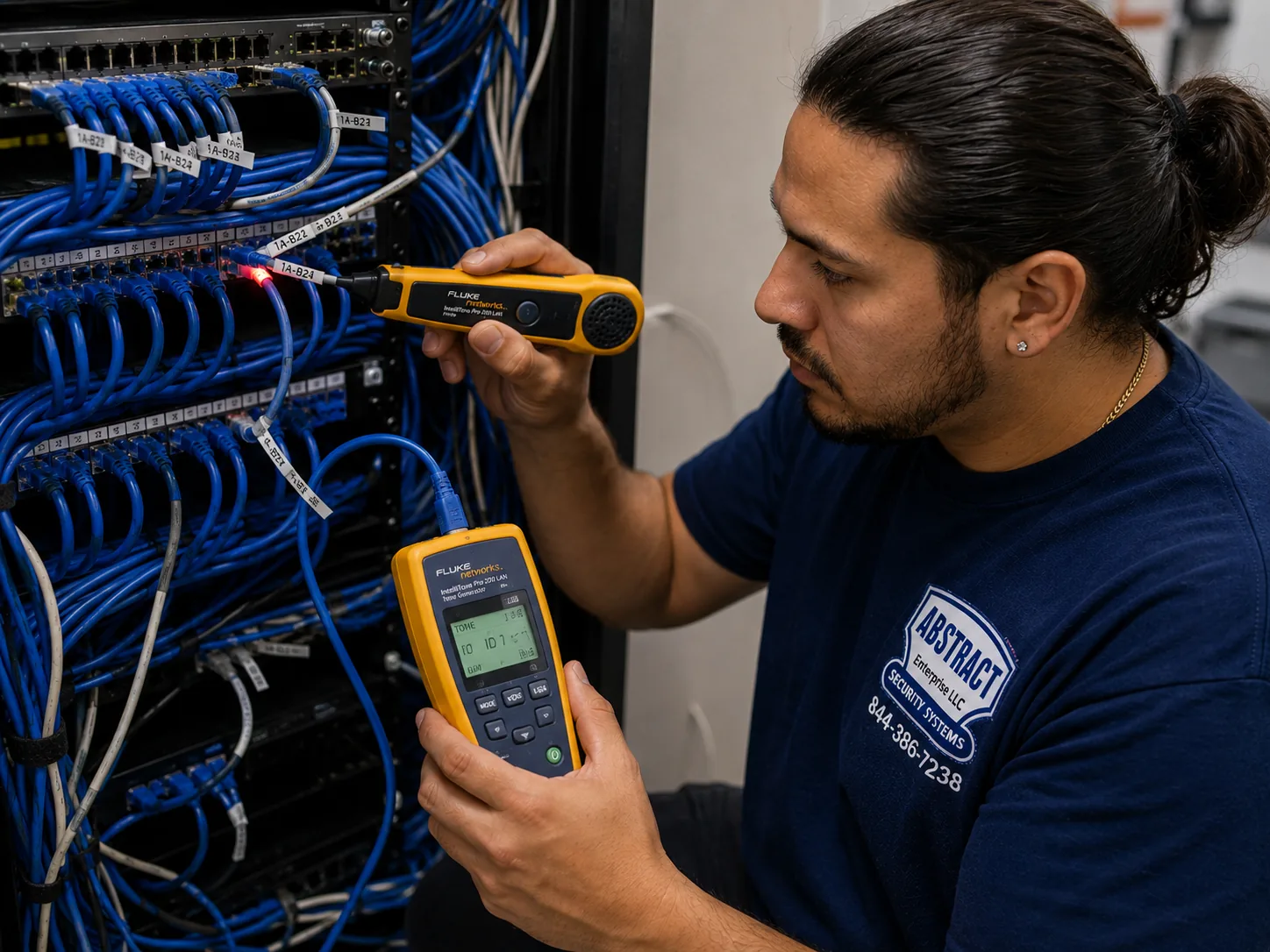
Measure at both ends. Voltage at the camera, PoE power at the switch port, and a continuity or analyzer test on the cable show in minutes whether the camera, the cable or the power has failed. Nothing is unplugged or reset until any footage you asked for has been saved.
Respect the facade. If a camera on the front of a landmarked house has to be remounted, it goes back into a mortar joint or plain masonry, never into carved stone or cast iron, and exposed cable is kept as short as the Commission's guidance allows. Old holes that the new mount does not cover are noted for your mason or painter, since we do not patch or paint.
Price first, label last. You hear the cause and get a written price before anything is replaced. When the work is done, every cable we traced is labeled at the recorder, the login is handed to the person you name, and the notes stay on your job record for next time.
Four patterns cover most of the camera failures we find in Brooklyn Heights. Each leaves its own evidence, and reading that evidence correctly is what keeps the bill to the part that actually broke.
Old houses here are renovated constantly, and camera cable is the least visible thing in the wall. A plumber opens a chase and cuts what looks like abandoned wire. An electrician moves a junction box and leaves a camera's power adapter without an outlet. A painter tapes over a camera, or a mason pointing the front of the house pulls the cable out of a joint and pushes it back loose. Afterwards one or two cameras are dark and everyone involved is sure it was not their work. We test from the recorder end out, find where the signal or power stops, and then decide whether the run can be spliced in a junction box at that point or has to be replaced. A connector reterminate runs $150 to $350 on our Brooklyn list, a single camera replaced on a working system $250 to $600, and a pull through plaster or between floors can add the $100 to $200 brownstone access charge.
The most expensive camera fault in the neighborhood is the one nobody notices. The recorder shows live pictures on the monitor and the phone, so everyone assumes it is working, while the drive has stopped saving because it failed, filled up with errors, or was never set to overwrite. Owners discover it the morning after a burglary or a package theft, which is the situation the manager of the Montague Street phone store described in 2022 when he told the Brooklyn Eagle he had no video. On a repair we read the drive's health, check the recording schedule for every camera, confirm that overwrite is on, and look at the recorder's log for the first day it stopped writing. A drive swap runs $200 to $450 depending on capacity; if the recorder itself has failed, a DVR repair averages $300 to $700 and an NVR $400 to $900, and a full replacement with a drive runs $700 to $1,500.
Brooklyn Heights homes change hands, co-op boards turn over and storefront tenants come and go, and the person who set up the recorder takes the password with them. Sometimes the system keeps recording for years without anyone able to view or export a clip, which is only discovered when a clip is needed. Recovering access depends on the brand and model. Many common recorders can be reset with the manufacturer's procedure and proof of the device's serial number, and some can be reset only by restoring factory settings, which keeps the recordings but loses the camera setup. We tell you which case you are in before we do anything, save any footage that can be reached first, and then set up new administrator and viewer accounts for the people you name. With no parts needed, that is usually covered within the $150 service call.

Cameras on the fronts of Brooklyn Heights houses are attached to materials that were never meant to hold them: brownstone that flakes when drilled, soft old brick, painted wood trim, and cast iron railings and areaway gates. A camera screwed straight into brownstone often works loose as the stone around the anchor crumbles, and its cable entry becomes a path for water into both the camera and the wall. The Landmarks Preservation Commission's guidebook points to the right places, mortar joints, plain masonry, wood or metalwork, and away from cast iron and decorative surfaces. When we remount a camera on a landmarked front, we follow that, use the smallest suitable bracket, seal the cable entry and keep visible conduit short.
The same guidebook is the reason a straight repair is usually simple. It treats ordinary maintenance, repair and retrofitting of safety equipment as work that does not need a Commission permit, and its in-kind replacement path asks for manufacturer cut sheets rather than drawings. A new camera in the old spot, of similar size and finish, is a repair. A new camera in a new spot on the front of the house, or a third camera on a narrow facade, is a change that deserves a check with the Commission first, and we will tell you which side of that line your job falls on.
Plenty of Heights systems date from the 2000s and early 2010s: analog or early HD cameras on coax cable, a DVR in the cellar, and a central power box feeding every camera. They often still work, which is a good reason not to tear them out. Their weak points are the power box, which loses capacity with age until the cameras flicker or drop at night when the infrared comes on, the drive, and the cameras whose models are no longer made. Power supply repair runs $150 to $400. Where an old camera dies and its exact model is gone, a current camera that speaks the same coax format usually works with the old recorder, and where the recorder is the problem, a hybrid recorder lets the old coax cameras and new network cameras run together, at $700 to $1,200 installed.
The neighborhood's businesses are concentrated on a few streets, and each one asks something different of a camera system. Writing about the Montague Street Business Improvement District's annual meeting in 2024, the Brooklyn Eagle quoted its executive director, Martha Foley, saying that Montague Street "remains the commercial heart of Brooklyn Heights." The district counts more than 100 businesses, and in late 2020 the Eagle reported about a fifth of its storefronts empty during the pandemic, which is part of why so many shops here now run on cameras inherited from a previous tenant.
The old main commercial street of the City of Brooklyn, with banks, restaurants, shops and services in nineteenth-century buildings, and the BID office at 129 Montague. Recorders often sit in cellars reached by a back stair.
The southern edge of the neighborhood, with convenience stores, restaurants and specialty shops. The March 2024 burglary at a store here was reported by News 12 Brooklyn.
Small stores, cafes and services running north to south through the neighborhood, including the store where two men took about $670 in merchandise in February 2024.
Shops around the Clark Street station, whose entrance sits in the Hotel St. George building, with heavy foot traffic in and out of the station.
The eastern edge, where the neighborhood meets the courthouses and office towers of Downtown Brooklyn, and where offices and practices share buildings with managed networks.
Law firms, doctors, dentists and other practices in converted houses and office floors, whose cameras share a network with phones, computers and card terminals.

Business owners in Brooklyn Heights usually call for one of two reasons. Something happened, a smashed door, a grab at the register, a delivery that never reached the stockroom, and they need to know whether the system caught it. Or the landlord, the insurer or the precinct asked whether the cameras work, and nobody is sure. In both cases we start with recording and time: is the recorder saving, for how many days, and is its clock right. Any clip you need is exported before anything else, and only then do we start on the fault. The 2024 Atlantic Avenue burglary, where two people broke the glass while two kept lookout, is the kind of event where the camera aimed at the door and the one aimed at the sidewalk both matter, and the one aimed at the ceiling or the empty corner does not.
The second job is aiming. A camera set to show the whole sales floor turns the person at the door into a dark shape against the bright street, especially on narrow, tree-shaded blocks where the light outside changes all day. Re-aiming the entrance camera so it sees faces at the door, adjusting its exposure, or adding one camera dedicated to the entrance usually fixes it without replacing the system.
Many small businesses here have their network cameras, card terminals, phones and office computers on one router and one switch, set up years ago by whoever was around. A camera repair in that setup has to be careful not to knock the payment system offline in the middle of a lunch rush. We map what is plugged into what before we change anything, schedule anything that needs a restart for a quiet hour, and where it makes sense, suggest moving the cameras to their own switch so a camera fault can never take the register down with it. That suggestion is priced separately, and only if you want it.
State licensing. The New York Department of State licenses companies that install, service or maintain security and fire alarm systems, and the state's rules apply that to closed-circuit television used to detect intrusion, theft or movement. An owner working on their own property is exempt, but a company you hire to repair a shop's cameras should hold the license. Ours is NYS license #12000287431.
Landmarked storefronts. Most of Montague Street and the side streets sit inside the historic district, and the Commission has its own guidance for storefronts. A camera replaced where the old one was is a repair. A new camera or new conduit on a storefront facade is a change worth checking first.
Staff and privacy. New York has rules on monitoring employees and on recording in places such as restrooms and changing areas. If a repair moves a camera toward a staff area, it is a good moment to check your notices and make sure no camera looks where it should not. We are not lawyers, and this is not legal advice; ask your own adviser how the rules apply to your business.

These are the situations Brooklyn Heights homeowners, landlords, co-op boards, tenants and shopkeepers describe when they call about cameras on landmarked fronts, in divided houses and in storefronts. Each is answered in full here and not repeated in the FAQ further down.
Not for a repair on its own. The Commission's guidebook treats ordinary maintenance and repair of safety equipment as work that does not need a permit, so fixing or replacing a camera in the spot where it already hangs, with something of similar size and finish, does not trigger an application. What a repair should not do is quietly add to the front of the house: a new spot, extra cameras beyond the guidebook's two per 25 feet on a small building, or a long run of visible conduit. If the existing setup already goes past that, we repair what you have without making it worse and point out what a future change would need. Questions about a specific building's history are for the Commission, not for us, and we will say so.
Often yes, as long as nothing has to be drilled into the iron. The guidebook says equipment must not be attached through cast iron or decorative surfaces, so the old clamp position can be reused if the new camera fits the same bracket or a clamp that grips without new holes. If the old installer drilled the railing, we do not add to that; we look for a nearby mortar joint or a plain masonry surface instead, or a spot inside the areaway that sees the gate just as well. Rust on the clamp is worth dealing with at the same time, since iron that is left to corrode around a fastener is harder to fix later than a camera.
Usually. Many replacement cameras can sit on a mounting base or a small junction box wider than the camera itself, and choosing one that covers the old holes is part of how we pick the replacement. Where the old holes are spread too far apart, we place the new base over the worst of them and note the rest. We do not patch or paint walls, so any holes left uncovered are for your plasterer or painter, and in a vestibule with original moldings that is the right person anyway. We tell you before the work which holes will be covered and which will not, so nobody is surprised when the old camera comes down.
We start where we can reach without anyone's door: the recorder, the cellar, the hallway and the outside of the house. A tone generator and probe at the recorder end, plus a test at the camera, often show where a run has failed without opening anything inside an apartment. If the fault really is inside a unit, behind a closet wall or at a junction box in a ceiling, we tell you which apartment, what we need to reach and roughly how long it will take, so you can give the tenant notice and arrange a time. Where a run keeps causing trouble, the long-term fix is often a new route through the common hall or a stacked closet, priced separately, so future repairs never need to go through anyone's home.
Usually not. Rules like that are about what individual shareholders mount at their own doors, and Brick Underground's lawyer column notes that a board can adopt such a ban as a house rule, especially for cameras in common areas the board controls. The building's own lobby, entrance and elevator cameras are a separate matter: they are the board's equipment, and leaving them broken while a rule is debated only leaves the building without coverage. The one thing worth waiting for is any change in where the building's cameras point, for example away from apartment doors, so we re-aim once instead of twice. Tell us what the draft says and we will repair around it.
Not necessarily. Brick Underground's reporting, quoting a tenant lawyer, is that city buildings are not legally required to have working security cameras, and that landlords are not obliged to show tenants footage outside a legal process. That does not make a dead camera system harmless, and many landlords will fix one once they know it is down, especially after a package theft or a break-in. The practical step is to tell the landlord or managing agent in writing which cameras are dark and since when. We take repair instructions from the building's owner or agent, so the booking has to come from them, and we are glad to give them a price.
Under the arrangement the Brooklyn Paper described in 2017, the homeowners hosting those cameras owned the footage and agreed to give police access when needed, which in practice makes the camera part of your system and its upkeep yours. Check any paperwork you signed with the association for anything it says about maintenance, but in most cases the repair is booked like any other. It is usually a power or connection fault on a camera that has been outside for years, and the fix is the same as for your own stoop camera. While we are there we check that the recorder keeps the street camera's footage for as long as you expected and that its clock is correct, since a clip for the precinct is only useful if the time on it is right.
The recorder usually tells us. Most recorders keep a system log that records drive errors, recording stops, power losses and restarts, and the playback calendar shows the last day each camera has saved video. Between the two we can normally put a date on when recording stopped and why, whether the drive failed, filled without overwriting, lost power, or had its recording schedule switched off. That date matters for an insurance claim, a lease dispute or a conversation with a former installer. We write it into the repair notes, fix the cause, and turn on the warning that should have told you, so a silent failure becomes a phone alert next time.
Usually the fog is on the outside of the window, not inside the camera. A vestibule between two doors sits at a different temperature from both the street and the hall, and when cold, damp air rushes in, the cool face of the camera collects condensation for a few minutes. If it clears within the hour, the camera is fine, and the fix is positioning: moving it slightly away from the outer door, adding a small hood, or using a camera with a heated or treated window. If the fog sits behind the glass and lingers, or there are drops or spots inside, the seal has failed and the camera needs replacing, at $250 to $600 on our Brooklyn list.
Almost certainly water at the cable entry. On many carriage houses the camera was mounted near the top of the facade and its cable pushed straight through the masonry beside it, and rain running down the wall follows the cable into the joint, into the connector or into the camera itself. When it dries out, the camera returns. We open the connection, look for corrosion and water marks, cut back and remake the joint if needed, reseal the wall entry with a drip loop so water falls off the cable instead of following it in, and check the camera for moisture inside. If the camera has been wet many times, replacing it is often cheaper than repeated visits.
Mostly where the cameras look and who can see the recordings. A waiting room camera that also shows the screens at the front desk, or a corridor camera that looks into a treatment room when a door opens, is worth re-aiming while we are there. We keep cameras out of private spaces, check that the recorder and app logins belong only to the people you name, and remove accounts for former staff. Any rules specific to your practice, from your professional body or your own compliance adviser, are theirs to set, and we will follow what they tell you. Repairs in an open office are scheduled for before or after patient hours where possible.
Yes, with some planning. Before touching the network, we map which ports and devices belong to the cameras and which to the terminals, phones and computers, and anything that needs a restart of the switch or router is scheduled for an hour when you can spare it, or before you open. Most camera repairs, a camera, a cable, a drive or a recorder, never touch the payment side at all. Where cameras and terminals share one small switch, we may suggest giving the cameras their own, which keeps a camera fault from ever reaching the register. That is optional and priced on its own line.
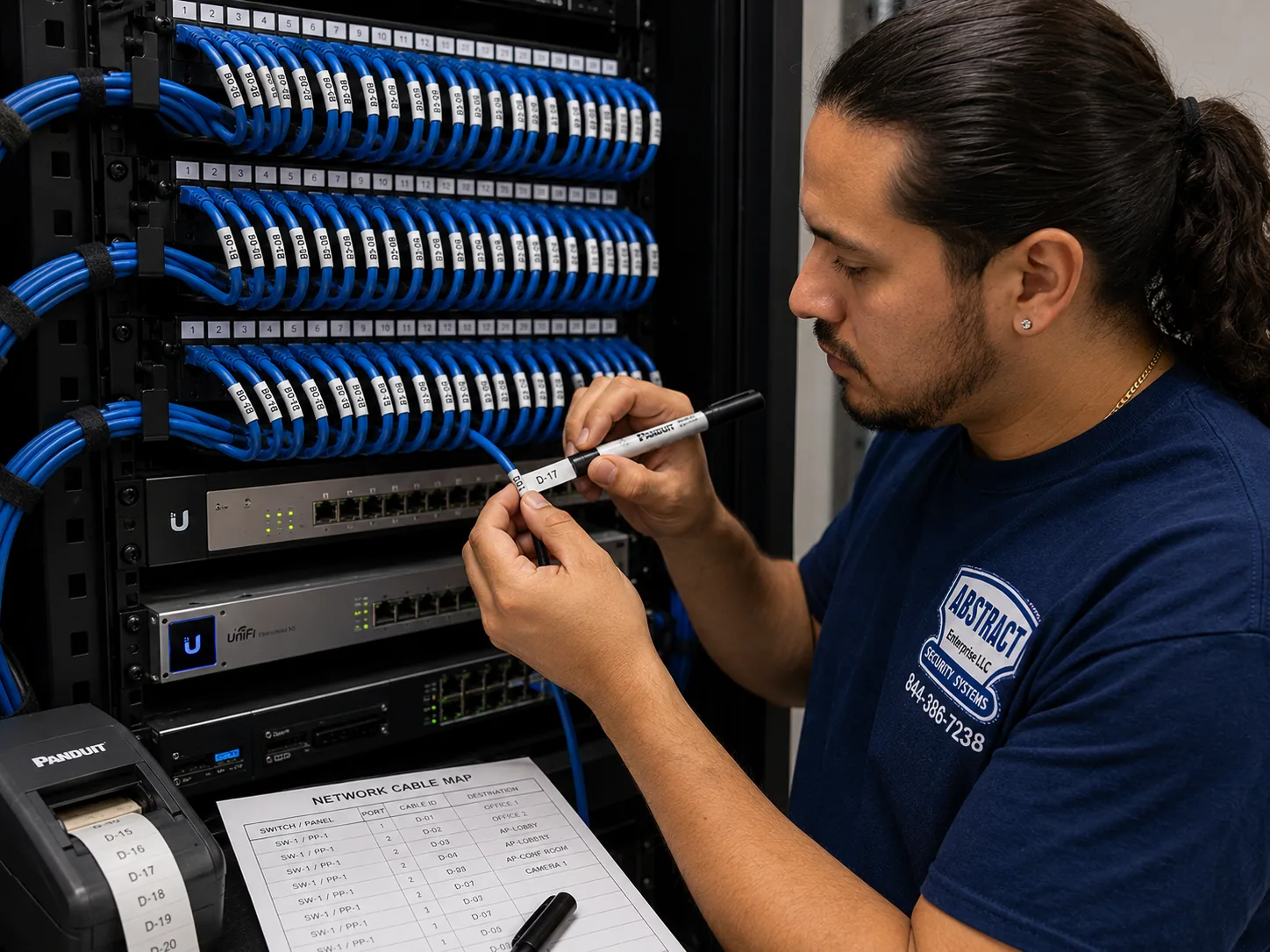
We repair whatever is on the building, whoever installed it. These are the kinds of equipment we work on in Brooklyn Heights houses, co-ops and shops, and how each one usually gives out here.
Cameras with round BNC connectors, from older analog to HD-TVI, HD-CVI and AHD. In old houses their weak points are the central power box in the cellar and connectors pulled loose during renovations.
Cameras powered and connected through one data cable. Common faults: a dead PoE port, an RJ45 plug crushed in a wall, or a camera that lost its address after a router change.
The box that holds the footage. Common faults: worn drives, recording schedules switched off, overwrite never enabled, clocks drifting and passwords that left with a former owner.
Small domes and turrets in tight vestibules and over parlor-floor doors, mounted on plaster, wood or masonry, often fogging or knocked out of line by the door.
Consumer cameras on rear walls and garden fences. Thick masonry and long distances to the router cause most dropouts, and we tell you honestly when a wired camera is the lasting fix.
Cameras in co-op elevators, lobbies and package rooms, with traveling cable in the hoistway coordinated with the elevator company and monitors at the front desk.
Switches in closets, cellars and telecom rooms, shared with internet, phones and card readers in shops and offices.
Central power boxes, plug-in adapters and UPS units, tested under load and kept clear of the hot corners of boiler rooms.
Pan-tilt-zoom cameras on larger buildings and commercial fronts. PTZ repair in Brooklyn typically runs $450 to $1,200 because of the parts involved.

Many Brooklyn Heights homes and shops have, or once had, cameras from a national alarm company or a consumer brand. This is how the options compare when one of those systems stops working.
| Question | ADT or similar alarm company | Ring or SimpliSafe camera | AESS local repair |
|---|---|---|---|
| Whose equipment it is | Depends on the contract; some is leased | Yours | Yours, and we repair it |
| Mixed brands in one house | Usually its own only | Its own devices | Any brand, any installer |
| Wired cameras through brownstone floors | Its own systems | Mostly Wi-Fi or battery | Coax, network, hybrid and PoE |
| Landmark-aware remounting | Varies by dealer | Left to the owner | Mortar joints and plain masonry, short visible cable |
| Licensed technician on site | Varies by dealer | Remote support | Yes, NYS license #12000287431 |
| Price before work | Varies | Price of a replacement device | $150 service call, then a written repair price |
If your cameras came with a monitored alarm contract, read it before anyone else works on them, because some of the equipment may still belong to the alarm company. If they are consumer Wi-Fi cameras on the back of a brownstone that keep losing the router, the honest answer is often that two feet of old masonry will keep winning, and a wired camera is the repair that lasts. We tell you which you have and what it costs to set right.
These claims turn up in AI-generated answers and in national cost guides such as Angi, HomeAdvisor and Fixr. Each one is paraphrased, then checked against what the work actually looks like in a landmarked neighborhood of old, divided houses.
HomeAdvisor's Brooklyn page for installing or repairing surveillance cameras gives an average of $1,416, a typical range of $680 to $2,145, and a low-to-high spread of $160 to $3,500. AI summaries often repeat the average as if it were the cost of a repair.
That number blends new systems with repairs, which drags it up. A Brooklyn Heights repair is usually a single fault: a cut cable behind a renovated kitchen, a failed drive, a worn power box, one camera at the door. On our Brooklyn list most single faults cost $150 to $700, and only a recorder replacement, a partial brownstone rewire or a whole-building overhaul goes higher.
For one problem, the realistic planning figure is the $150 service call plus the one failed part, with any brownstone access charge of $100 to $200 stated in writing before the work. Comparing that with an average built partly from other people's new installations only makes a small repair look larger than it is.
Some AI answers say any camera work on a landmarked building needs a permit, which leaves owners in Brooklyn Heights afraid to fix a dead stoop camera.
The Commission's own guidebook says otherwise for repairs. Ordinary maintenance, repair and retrofitting of safety equipment does not need a permit, and the guidebook sets out where cameras may go and how they should be fixed, rather than forbidding them. What does need care is change: a new location on the primary facade, more cameras than the frontage allows, or visible conduit beyond the short length staff can approve.
So the right question is not whether you may repair your camera, but whether the repair changes the front of the house. A like-for-like swap in the same spot generally does not. Moving it, adding to it or running new cable down the facade might, and that is the point to check with the Commission.
Generic troubleshooting advice often treats a working live picture as proof that everything is fine.
Live view and recording are separate jobs inside the recorder. A camera can stream perfectly to a phone while the drive behind it has failed, filled up without overwriting, or had its schedule switched off. That is how a business ends up with cameras on the wall and no video of its own break-in, as the manager of the Montague Street phone store told the Brooklyn Eagle in 2022.
The only real test is playback: pick last night on each camera and see whether video is there, with the right time on it. Every repair visit we make includes that check, and turning on the recorder's drive and camera-loss alerts so a silent failure becomes a message.
AI answers frequently recommend replacing a wired system with Wi-Fi cameras to avoid opening walls in a brownstone.
In Brooklyn Heights, the walls that make cabling hard also make Wi-Fi hard. Thick brick and brownstone party walls, plaster on wire lath and a router in the cellar or the top-floor office leave the front and back of a deep row house with weak signal. Wireless cameras still need power, so many end up on extension cords or battery packs that someone has to remember to charge.
Wireless has its place, on a garden fence near a strong access point, for example. But for the door camera that matters most, the better repair is usually to fix the cable that is already in the wall, or to find a short new path for it, rather than to trade one problem for another.

Some answers suggest a locked recorder is a lost cause and should simply be replaced.
Most recorders from common brands have a recovery route, through the manufacturer's reset procedure, a security question or email set up at installation, or a reset that keeps the recordings even if it clears the settings. In a neighborhood where houses change hands and co-op boards turn over, we see locked recorders often, and most of them go back into service with new accounts and no new hardware.
The catch is footage. Some resets clear settings and keep video, others wipe everything, and which applies depends on the model. Before anything is reset, we save whatever footage can be reached and tell you exactly what the reset will do.
Many answers treat camera repair as a quick job for anyone with a ladder and a drill.
On your own house you are free to try. But New York's Department of State licenses companies that install, service or maintain security systems, and state rules cover closed-circuit television used to detect intrusion or theft. In a co-op, a condominium or a store, the board, the managing agent and the insurer usually want to know who did the work and whether they were licensed and insured. On a landmarked front, a drill in the wrong place, into carved brownstone or cast iron, is damage that no camera is worth.
If you hire someone, ask for the license number and a certificate of insurance. Ours is NYS license #12000287431, printed on this page, and a certificate for your board, landlord or managing agent can be arranged ahead of the visit.
AI answers sometimes tell tenants that building cameras are a legal requirement and that a landlord has to repair them on demand.
Brick Underground's reporting, quoting a tenant attorney, is that city buildings are not required to have working security cameras, and that landlords need not show footage outside a legal process. Intercoms and entrance doors have their own rules, but cameras, in most residential buildings, are something an owner chooses to provide and maintain.
That makes the repair a decision for the owner, the co-op board or the managing agent, and it is why we take instructions from them. Tenants who want the cameras fixed get the furthest by putting the request in writing, naming which cameras are down and since when.
Not sure whether it is the camera, the cable, the power, the recorder or a password? Ask before you spend anything. Call now at (347) 934-8335, send a fast quote request, or send a photo of the recorder screen to a tech on WhatsApp. Same-day estimates are available on most days, and requests are booked within 2 hours.
Give us the street and cross street, the kind of building, how many cameras there are, which are out, which floor the recorder is on, and whether a co-op board, managing agent or landlord approves the work. A technician will come back to you with the likely cause and the next step for the Brooklyn Heights address, or you can call (347) 934-8335 now.

A photo of the recorder screen, the recorder label and the dead camera, the street, and what happened first: a renovation, a break-in, a new router or a change of owner.
Owner, co-op board, managing agent, landlord or store tenant: we confirm who approves the repair and who holds the password, and arrange a certificate of insurance if needed.
The $150 Brooklyn service call puts the visit on the schedule in a two-hour arrival window, with cellar, roof or apartment access arranged in advance.
Any clip you asked for is exported to USB with its original timestamp before anything is unplugged, reset or changed.
Power, cable and connectors, switch, recorder and drive, then the camera, tested in order through every floor the cable crosses.
You hear what failed and get a written repair price before any part is replaced, with the service call credited against it.
Only the failed part is fixed or replaced, landmarked fronts are remounted on plain masonry or wood, and every camera is checked live, in playback and after dark.
Traced cables are labeled, logins and alerts are confirmed with the people who use them, and the notes stay on your job record for next time.
The cantilevered walkway over the BQE along the western edge, where Council Member Restler funded cameras at two entrances.
The neighborhood's commercial heart, with more than 100 businesses in its Business Improvement District and the BID office at 129 Montague.
The 1849–50 church at 57 Orange Street in the north end, a National Historic Landmark tied to Henry Ward Beecher and the Underground Railroad.
George B. Post's 1878–81 building at 128 Pierrepont Street, once the Long Island Historical Society, now part of Brooklyn Public Library.
The block-filling former hotel at Clark and Henry streets, home to co-op apartments, student housing and the Clark Street station entrance.
The dead-end mews off Hicks Street lined with nineteenth-century carriage houses that once served the mansions on Joralemon and Remsen.
We also serve the neighborhoods around Brooklyn Heights, including DUMBO, Downtown Brooklyn, Cobble Hill and Carroll Gardens, at the same Brooklyn rate. Just to the southeast, our Boerum Hill security camera repair page covers the rowhouse blocks below Atlantic Avenue, owners with buildings across the river can use our Manhattan camera repair page, and the whole borough is on our Brooklyn security camera repair page.
Brooklyn Heights is billed at our Brooklyn rate. Every repair begins with the $150 service call, which pays for the on-site diagnosis and the written repair price and is credited to the repair when you go ahead. The ranges below are from our published Brooklyn security camera repair prices; your exact price is written down at the visit, once we know what failed. The visit goes on the schedule when the service call is paid.
| Repair | Brooklyn price |
|---|---|
| Service call: on-site diagnosis and written repair price | $150, credited to the repair |
| Password reset, app, alert or motion settings with no parts | Usually within the $150 service call |
| Clean and check for a blurry picture | $80 |
| Connector reterminate or PoE port swap | $150–$350 |
| Power supply repair | $150–$400 |
| Brownstone access: pull through plaster or between garden, parlor and duplex floors | Adds $100–$200 |
| Painted dome or front cover replaced | $30–$80 part plus labor |
| Indoor camera repair | $200–$450 |
| Hard drive swap, by capacity | $200–$450 |
| Same-spec camera swap | $250–$500 |
| Single camera replaced on a working system, with labor | $250–$600 |
| Night vision camera repair | $250–$650 |
| DVR not working, including drive and labor | $300–$700 |
| NVR not recording, by model | $400–$900 |
| Vandalized camera, per camera plus cable repair | $400–$900 |
| PTZ camera repair | $450–$1,200 |
| Hybrid recorder swap, channels set up again | $700–$1,200 |
| DVR/NVR replacement with drive, or brownstone partial rewire | $700–$1,500 |
| Full rewire or brownstone system overhaul | From $1,500 |
| Annual maintenance: residence / commercial / multi-property | From $250 / from $400 / $500–$800 |
Three things move a Brooklyn Heights repair within those ranges. The first is the route: a camera whose cable runs straight to a cellar recorder takes less time than one whose cable crosses three apartments and a parlor-floor ceiling, which is where the brownstone access charge applies. The second is approval and access: a co-op that needs a certificate of insurance and a super on hand, a tenant who needs notice, or a roof reached through a top-floor apartment takes coordination before the visit. The third is the facade: remounting a camera on a landmarked front so it sits in a mortar joint and keeps visible cable short can take longer than screwing it back into the old holes, and it is the right way to do it. If the price changes on site, you hear the new number before the work goes on. Bundling a camera repair with intercom, alarm or cabling work on the same visit saves $200 to $400 in labor on our Brooklyn list.
Full terms — including 50% deposit, one-year parts-only warranty on AESS-supplied products, and the late-fee schedule — are set out in the service agreement.Three ways Brooklyn Heights repairs usually come together, priced from the Brooklyn list above. Each starts with the $150 service call, credited to the repair, and the written price follows what the diagnosis finds.
One fault, one visit: a stoop or vestibule camera replaced, a cable cut by a renovation spliced or re-run, a power box replaced, a drive swapped, or a recorder unlocked with new accounts for the people who use it now.
The recorder or the wiring: a DVR or NVR replaced with a new drive and every camera set up again, a hybrid recorder so older coax cameras stay in service, or a partial brownstone rewire after the old routes were lost to renovations.
A yearly visit: cameras cleaned, mounts and cable entries on the facade checked, drive health read, power and battery backup tested, recording and overwrite confirmed, accounts reviewed after any change of owner or board, from $250 for a residence and $400 for a commercial system.
Bring your own equipment. If you have already bought a replacement camera or recorder, we can fit it at labor-only rates. Tell us the exact model and we quote the labor by phone or text, and the visit is booked once it is paid. Your own equipment is installed as supplied, and we cannot vouch for parts we did not supply; if the model you bought will not work with your recorder, or is too large for the spot on a landmarked front, we tell you before the visit.
Door, vestibule and rear cameras, runs cut by renovations, and loose connectors. Request a repair
DVRs, NVRs and hybrids, empty playback and locked recorders. Brooklyn security camera repair
The full list behind every figure on this page. Security camera repair prices in Brooklyn
Owners and managing agents with buildings in more than one borough. NYC security camera repair
Because of the route the cable takes. In a newer building, camera cable usually runs through a ceiling or a riser that is easy to reach. In a brownstone it may pass through plaster walls, between a garden floor and a parlor duplex, or through closets in other apartments. Our Brooklyn list adds $100 to $200 when a repair needs that kind of work, and we tell you before the visit if it applies.
Usually yes. Most current recorders can be viewed through the manufacturer's desktop program or a web portal as well as the phone app. We set up a separate viewer account for the computer, so the administrator login stays at home, and check that live view and playback both work. Some office networks block camera apps, which your IT department can confirm.
Yes. When cameras sit on a network someone else manages, we contact them before the visit to agree which ports, addresses and settings belong to the cameras, and any change that could affect computers, phones or the firewall is made with them, not around them. That keeps the repair from causing problems elsewhere in the office.
Yes. Institutional buildings in Brooklyn Heights are often old, landmarked and busy at set hours, so we schedule around services, classes and events, work through the facilities manager or the board, and give them a written record of what was found and fixed. The same Brooklyn prices apply.
On many systems, yes. A recorder schedule can stop recording or turn off particular indoor cameras during set hours, and some apps can disable them when the family is home. Outdoor and entrance cameras usually stay on all the time. We set the schedule you want during the repair and show you how to change it yourself.
No. We view footage only as far as the repair needs, to confirm a camera is recording or to export a clip you asked for, and the clip is handed to you on your own USB drive or one we provide. Nothing is copied to our devices or kept after the visit.
It depends on where the camera is and whose conversations it picks up. New York allows recording a conversation when one person taking part knows about it, but a lawyer quoted by Brick Underground warns that recording others in places where they expect privacy, when you are not part of the conversation, can be unlawful. If you are unsure, we can switch the microphone off during the repair. This is not legal advice.
Only in planning. Like most Brooklyn Heights row houses, yours has no side passage, so the technician and any ladder go through the house. Tell us which floor opens to the garden and whether a tenant lives there, and we arrange the time with whoever needs to let us through. A long ladder for a high rear camera is brought in only when it is needed.
We tell you, show you what we measured, and stop there, because we do low-voltage work and do not do electrical work. A dead outlet, a tripped circuit or old wiring feeding the recorder is a job for a licensed electrician. Once power is restored, we finish the camera repair, and the service call still covers the diagnosis.
They help but are not required. Most co-ops have no drawing of the camera system at all, so we trace and label as we go. If the managing agent has any record from a previous installer, a list of cameras or an old invoice, send it before the visit, since it can save time. At the end we leave a simple list of what each camera covers and where its cable ends.
Yes, if both owners agree. Your own cameras are booked and paid by you, and the building's cameras by the board, landlord or managing agent, so we write two separate prices and keep two separate records. Doing both on one trip saves a second visit, and nothing on the building's system is changed without its owner's approval.
Usually. Power, cable, connectors, drives and recorders can be repaired regardless of the camera's age. When the camera itself has failed and the model is gone, a current camera that uses the same signal format generally works with the existing recorder. We confirm compatibility before ordering, so you are not left with a part that does not fit your system.
Security Camera Repair Brooklyn | Same-Day | Brownstone Pros · Security Camera Repair NYC | Same-Day | Abstract Enterprises · Security Camera Repair Manhattan | Same-Day | Co-op COI · Security Camera Repair Queens | Same-Day | Driveway Pros · Security Camera Repair Bronx | Same-Day | Home Base · Security Camera Repair Staten Island | Same-Day | Sandy Zone · Security Camera Repair Long Island | Nassau & Suffolk · Security Camera Repair Hudson Valley | Westchester to Ulster · Security Camera Repair Nassau County | Same-Day · Security Camera Repair Suffolk County | Hamptons + East End · Security Camera Repair Westchester County | Same-Day · Security Camera Repair Rockland County NY | Nyack, Suffern · Security Camera Repair Orange County | Newburgh, Goshen · Security Camera Repair Putnam County NY | Carmel, Mahopac · Security Camera Repair Dutchess County | Poughkeepsie · Security Camera Repair Ulster County | Kingston Woodstock
Security Camera Repair Bath Beach Brooklyn NY · Security Camera Repair Bay Ridge Brooklyn NY | AESS · Security Camera Repair Bedford-Stuyvesant Brooklyn NY · Security Camera Repair Bensonhurst Brooklyn NY | AESS · Security Camera Repair Bergen Beach Brooklyn NY · Security Camera Repair Beverley Square Brooklyn NY · Security Camera Repair Boerum Hill Brooklyn NY · Security Camera Repair Borough Park Brooklyn NY · Security Camera Repair Brighton Beach Brooklyn NY · Security Camera Repair Brooklyn Navy Yard, Brooklyn NY
Access Control Installation Brooklyn Heights Brooklyn NY · TV Installation Brooklyn Heights · Fire Alarm Installation Brooklyn Heights Brooklyn NY · Intercom Installation Brooklyn Heights Brooklyn NY · Alarm Installation Brooklyn Heights Brooklyn NY · Soundbar Installation Brooklyn Heights, Brooklyn NY · Door Buzzer Repair Brooklyn Heights NY | Co-ops & Rows · Smart Lock Installation Brooklyn Heights NY | Landmarks · Sonos Installation Brooklyn Heights NY | Converted Homes · Structured Cabling Brooklyn Heights Brooklyn NY · Security Camera Installation Brooklyn Heights, Brooklyn NY
Send a photo of the recorder screen, the camera that went dark and your street, and we will tell you what most likely failed and what that repair costs on our Brooklyn list. The $150 service call is credited to the repair, the price is written down before any part changes, and requests are booked within 2 hours. Abstract Enterprises Security Systems has been owner-operated since 2002, holds NYS license #12000287431, is rated 4.7★ across 201 Google Reviews, and dispatches Brooklyn crews from our Troy Avenue office.
Prefer to send photos? Message a technician on WhatsApp.