Cameras dark since the last Con Ed outage, a recorder that keeps rebooting in a brownstone basement, or a Fulton Street storefront camera knocked off its mount? Bedford-Stuyvesant camera repair line: (347) 934-8335
Row Houses · Brownstones · Two- and Three-Families · French Flats · Storefronts With Apartments Above · Between Flushing Avenue and Atlantic Avenue
Security Camera Repair in Bedford-Stuyvesant
Footage Saved Before Anything Is Unplugged · Power, Cable and Recorder Tested Link by Link · Landmark-Safe Camera Swaps · Brooklyn Rate
Security camera repair in Bedford-Stuyvesant, Brooklyn, starts with a $150 service call that is applied to the repair if you go ahead, and most Brooklyn camera repairs land between $150 and $1,500. We work on any brand and any installer's system: analog and HD-over-coax DVRs, PoE network recorders, Wi-Fi cameras, doorbell cameras and the power supplies, switches and drives behind them. Bed-Stuy has its own reasons systems fail. Its blocks hold one of the country's largest collections of nineteenth-century row houses, several of them inside city historic districts where a replacement camera has to follow Landmarks rules, and its power has been knocked out more than once in 2026, by snow and salt in the winter and by manhole fires on Fulton Street in June. This page explains what usually breaks in a Bed-Stuy system, how we find it, what the fix costs on our Brooklyn list, and how to keep the footage you need while it gets fixed.
Requests are booked within 2 hours, with a 2-hour arrival window for the visit
4.7★ from customers across 201 Google Reviews
Reviewed and updated November 11, 2026, against the NYC Landmarks Preservation Commission's Permit Guidebook chapter on health, safety and utility equipment; LPC designation report LP-2496 for the Bedford-Stuyvesant/Expanded Stuyvesant Heights Historic District; CityLand on the Bedford Historic District; Wikipedia's article on Bedford-Stuyvesant; Brooklyn Eagle on the post-Winter Storm Fern outages; News 12 Brooklyn on the June 2026 manhole fires at 1242 Fulton Street, the Fulton Pawnbroker break-in, the Marcus Garvey Boulevard deli robbery, the Bainbridge Street package theft and Ring's end of police footage requests; Patch on the Macon Street package thief; Brick Underground on tenants and building footage; NYS Focus on NYPD access to NYCHA cameras; Brooklyn Community Board 3's precinct list; HomeAdvisor's Brooklyn camera cost guide; and the New York State Department of State on alarm and CCTV licensing.· Abstract Enterprises Security Systems, NYS license #12000287431 · technicians dispatched from our Troy Avenue office in Brooklyn
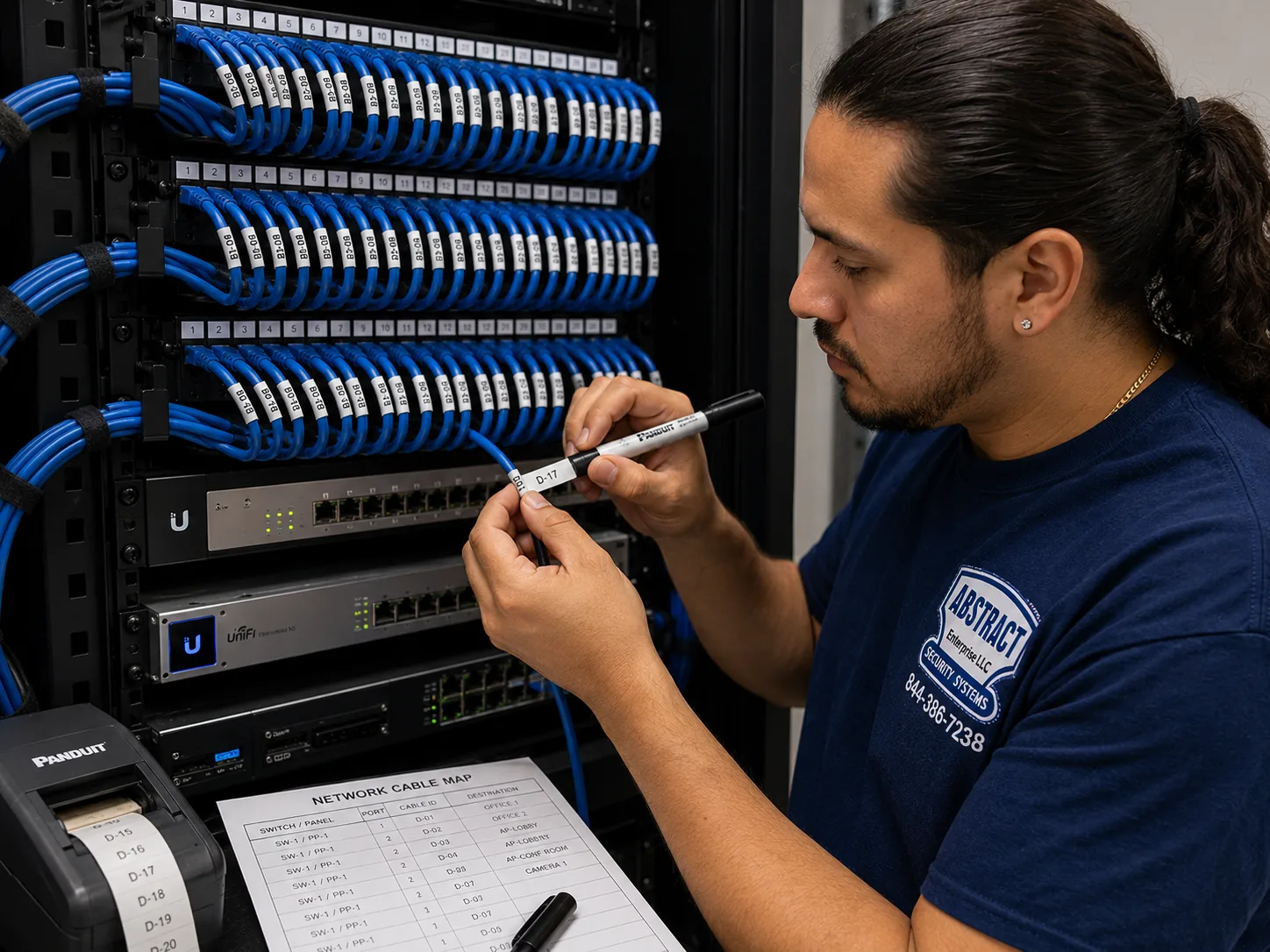
A photo from the AESS job library, not taken in Bedford-Stuyvesant: a technician printing labels at a patch panel with the printed port map taped beside it. On a camera repair this is the step that saves the next visit. In a Bed-Stuy brownstone the recorder often sits in the cellar with eight unmarked cables coming down through the floor joists, and once we have traced which cable goes to the stoop, the yard and the areaway door, every one of them gets a label that matches a written map left with the owner.
Bed-Stuy Camera Repair Request
Row house, walk-up, mixed-use building or store: tell us what went dark and when, and a technician calls back with the next step
✅
Request Sent!
Thank you. A technician will call you about the Bedford-Stuyvesant address shortly.
25+
Years Experience
✓
Same-Day Estimates
100%
Licensed & Insured
4.7★
201 Google Reviews
Owner-operated since 2002 · Thousands of jobs completed · Booked within 2 hours
Quick answer: a Bed-Stuy camera repair usually costs between $150 and $1,500, and most single fixes cost far less than a new system. The $150 service call covers the on-site diagnosis and a written price for the actual repair, and it is applied to that repair if you go ahead. A loose or corroded connector or a dead PoE port is typically $150 to $350, a single camera replaced on a working system is $250 to $600, a new hard drive swapped on site is $200 to $450, and a whole recorder replacement is $700 to $1,500. We book requests within 2 hours and give a 2-hour arrival window. To get a useful answer on the first call, send three things to (347) 934-8335 or on WhatsApp: a photo of the recorder's screen showing which camera tiles are black, a photo of the label on the recorder itself, and one sentence about what happened around the day it stopped. That last part matters more than people expect. "It went dark the night the power went out on our block" points somewhere very different from "it went dark after the painters were here" or "someone climbed the gate."
Looking at your photos and answering questions costs nothing. The written price for the repair comes before any work, and you decide whether to go ahead.
All work falls under New York State license #12000287431. Camera systems used to watch for break-ins and theft fall under the state's alarm-installer licensing rules, so the license is not a formality.
If the system is in a building you rent, tell us who owns the recorder. If it belongs to the landlord, we need the owner's go-ahead before we touch it, and we will say so before the visit, not at the door.
The Neighborhood
Why Bedford-Stuyvesant Properties Need Security Camera Repair
Bedford-Stuyvesant runs from Flushing Avenue down to Atlantic Avenue and from Classon Avenue east to Broadway, and Wikipedia counts roughly 8,800 buildings in it that were put up before 1900. Most of the cameras we repair here are bolted to those buildings: to the brick beside a parlor-floor door, to the iron of an areaway gate, under a cornice, over a garden-level entrance tucked beneath a stoop. The houses were designed for gas light and coal furnaces, not for low-voltage cable. So almost every camera system in a Bed-Stuy row house was added later, usually by threading cable up an old chimney chase, along a cellar ceiling, through a window frame or across the back of the house to the yard. Those improvised paths are where most of the faults we find begin. A cable pinched by a window sash for five years, a connector left exposed to rain at the cornice, a power supply plugged into the same cellar outlet as a dehumidifier: each of those works fine for a while and then stops.
The second reason is how people live in these buildings. A great many Bed-Stuy houses are two- and three-family homes with an owner on one floor and tenants on the others, or brownstones divided into a duplex and a garden apartment. One recorder in the cellar often serves everyone, and the phone app is logged into by whoever happened to be there when it was set up, sometimes a former tenant, sometimes a contractor, sometimes the previous owner. When a camera goes dark in that kind of house, the question is never only technical. Someone needs to know who owns the system, who should be able to see which camera, and who still has access that they should not. A repair visit is the natural time to sort that out, and we treat it as part of the job.
The third reason is the street. Fulton Street is the neighborhood's main shopping street, crossed by Bedford, Nostrand and Stuyvesant Avenues, and the commercial stretches along Nostrand, Tompkins, Lewis, Marcus Garvey Boulevard, Malcolm X Boulevard and Broadway are lined with delis, pharmacies, restaurants, salons and cash businesses that depend on their cameras. In the past year, News 12 published surveillance video of a man scaling a wall and breaking through the ceiling of Fulton Pawnbroker on Fulton Street, where police say about $20,000 in merchandise was taken, and of four men dressed as police officers robbing a deli on Marcus Garvey Boulevard at gunpoint. Both stories were told through store camera footage. A camera that has been pointing at the wrong spot for months, or a recorder that stopped saving days ago, is only discovered on the day someone needs the video, and that is the worst day to find out.
The fourth reason is power. Bed-Stuy's underground electrical network has had a hard 2026. After Winter Storm Fern, the Brooklyn Eagle reported 786 customers in the neighborhood without power on the Monday, more than 990 by that night and about 300 still waiting on Wednesday morning, with Con Edison blaming snow and road salt for damaged manholes. In June, News 12 covered manhole fires at 1242 Fulton Street that left about 50 customers dark that evening and kept some Fulton Street stores without power into the next morning. Recorders, PoE switches and cheap plug-in power supplies do not like losing power suddenly and getting it back in surges. A lot of our Bed-Stuy calls start with the words "ever since the outage."
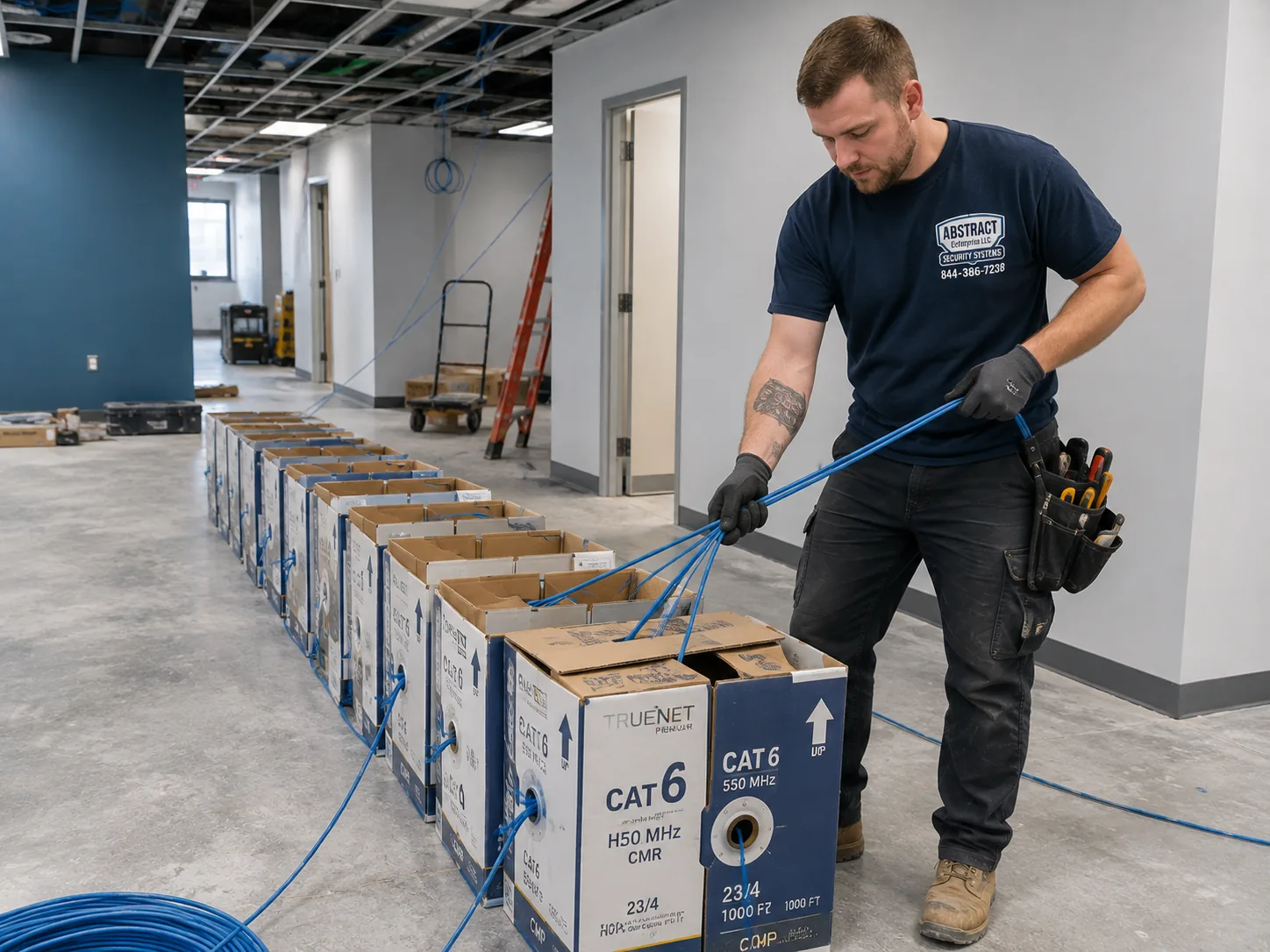
A photo from the AESS job library, not taken in Bedford-Stuyvesant: several boxes of cable staged side by side so a crew can pull more than one run at once. Most Bed-Stuy repairs never need new cable. When they do, it is usually because the original runs were stapled along a cellar ceiling or squeezed through a window frame, and pulling every replacement run together in one visit costs far less than chasing them one at a time.
Six Bed-Stuy facts that shape a camera repair before we open the recorder
The housing is old, and the cable was added later. With roughly 8,800 pre-1900 buildings, the cable paths in most Bed-Stuy systems are improvised. We expect to find runs through cellars, chimney chases and window frames, and we test those runs before blaming the camera.
Many fronts are landmarked. The Stuyvesant Heights, Bedford-Stuyvesant/Expanded Stuyvesant Heights and Bedford historic districts, plus Alice and Agate Courts, cover a large share of the neighborhood. The Landmarks Preservation Commission says ordinary repair and retrofitting of safety equipment needs no permit, but a new or moved camera must follow its rules on spacing, attachment and visible conduit.
Power has been unreliable this year. Hundreds of customers lost power after Winter Storm Fern and dozens more during the June manhole fires on Fulton Street. Power events explain a large share of recorders that reboot, drives that fail and cameras that come back on the wrong settings.
One system often serves several households. Two- and three-family houses and divided brownstones put a single recorder in charge of everyone's cameras, so who can see what is part of every repair.
The commercial corridors run on camera evidence. Store footage has carried recent news stories about the Fulton Street pawn shop break-in and the Marcus Garvey Boulevard deli robbery, so a store's system needs to be recording, not just showing live view.
Two precincts cover the neighborhood. Brooklyn Community Board 3 lists the 79th and 81st Precincts. When a detective asks for footage, a clean export on a USB drive is what they need, and it is much easier to make before a repair than after.
The boundaries are not neat, and the neighborhood contains smaller ones with their own names, Bedford, Stuyvesant Heights, Ocean Hill and Weeksville, so a listing may use any of them. We cover all of it at the same Brooklyn rate, so the name on your deed or lease does not change the price. If you are on the far side of Broadway, Atlantic Avenue or Classon Avenue, the same service and prices apply, and our main Brooklyn security camera repair page covers every neighborhood in the borough.
Urgent Repair in Bedford-Stuyvesant
Need Repair in Bed-Stuy? A Recorder That Won't Boot, a Camera Pulled Off the Wall, or Footage You Need Tonight
Urgent camera calls from Bedford-Stuyvesant come in three kinds, and each one has a right first move. The first is the whole system going dark at once: every tile on the monitor black, the app showing everything offline, the recorder silent or clicking. When everything fails together, the cause is almost never the cameras. It is power, the recorder, the switch that feeds the cameras, or the internet connection the app depends on. After an outage, it is very often a power supply or a PoE switch that did not survive the surge when power came back. The second kind is a single camera that is suddenly gone or pointing at the sky, usually the one nearest the street, the stoop or the store door. That points to physical damage, water in a connector, or someone who reached up and moved it. The third kind is the most stressful: something has happened, a package is gone, a car was broken into, a store was hit, and you need the video now, but you are not sure the recorder is even working.
For all three, the most important rule is the same: do not start pulling plugs and pressing reset buttons before someone has checked what footage is on the recorder. Most recorders keep recording in a loop and overwrite the oldest video when the drive fills. A factory reset can wipe settings and, on some models, the recording schedule, so the system comes back showing live pictures but saving nothing. A reboot of a recorder with a failing drive can be the reboot that it does not come back from. If you need footage from a specific night, tell us that first. Our technician's first job on arrival is to find and export that clip, and only then does the diagnosis begin.
There are safe things you can do while you wait. Check whether the recorder has power at all: a light on the front, a fan you can hear. Check whether the outlet it is plugged into works by plugging in a phone charger. If the cameras run from a separate power box, see whether its light is on. Look at the camera that failed from the ground and take a photo of it. Write down roughly when it stopped and what was happening on the block at the time. That is all. Do not climb a ladder to a cornice or reach over an areaway railing to a camera; the height and the iron spikes on many Bed-Stuy fences make that a bad idea, and a technician can tell more from a photo than you might expect. Then call (347) 934-8335 or send the repair request.
We book every request within 2 hours and give you a 2-hour window for the visit. If the property is a store that cannot open without its cameras, or a building where a tenant needs footage for a police report, tell us on the first call so the booking reflects it. We do not promise a fix on the first visit, because some repairs need a part, but the first visit always ends with the footage you need saved, the cause found and a written price for the fix.
What We Install
Security Camera Repair Services in Bedford-Stuyvesant
Every service below starts with the same $150 diagnostic visit and ends with a written price before the repair. We repair what is there whenever repair makes sense, and we tell you plainly when it does not.
Recorder and drive repair
DVRs and NVRs that will not boot, reboot on their own, beep, or show live video but record nothing. Most of these come down to a failing hard drive or a bad power adapter, and the drive swap is done on site.
Power and outage recovery
Systems that came back wrong after a Con Ed outage: dead power supplies, PoE switches with failed ports, cameras stuck on factory settings, and recorders whose clock and schedule were lost.
Single-camera replacement
A stoop, yard or storefront camera that died, fogged, was hit or was stolen, replaced on the existing cable and set back up on the existing recorder so the rest of the system is untouched.
Cable and connector faults
Runs pinched in window frames, stapled across cellar ceilings, chewed in crawl spaces or corroded at a cornice, traced with a tone generator, tested with a cable analyzer and reterminated or replaced.
App and remote access
Phone apps that stopped connecting after a new router, a new internet provider or a firmware update, plus cleaning out logins that belong to former tenants, contractors or previous owners.
Footage export for incidents
Finding and saving the clip you need after a package theft, a break-in or a car incident, on a USB drive in a format a precinct detective, an insurer or a lawyer can play.
Landmark-safe camera swaps
Replacing or moving cameras on facades in Bed-Stuy's historic districts in line with the Landmarks Preservation Commission's guidance on mortar-joint fixing, spacing and visible conduit.
Storefront system repair
Register, door, aisle and back-room cameras for delis, pharmacies, salons and restaurants on Fulton Street, Nostrand Avenue and the other shopping streets, repaired with the store open where possible.
Shared-house system cleanup
Two- and three-family houses where one recorder serves everyone: separate viewing for each household where the equipment allows it, new passwords and a written map of which camera is which.
Building Specialists
Security Camera Repair for Bedford-Stuyvesant's Architecture
The same fault looks different depending on the building. A camera that drops out on a brownstone cornice, on a three-family's back wall and over a Fulton Street shop door usually has three different causes. These are the building types we meet most in Bed-Stuy and what each one tends to break.
The single-family brownstone
A recorder in the cellar, cameras at the stoop, the garden-level door and the yard, and cable that climbs through four floors of plaster and brick to reach the front.
The two- or three-family house
An owner on one floor and tenants on the others, one shared recorder, and a phone app that too many people have logged into over the years.
The French flat or small walk-up
Four or five stories of 1890s apartments with a shared vestibule and hallway, where hallway and entrance cameras serve a whole building.
The storefront with apartments above
A shop camera system and sometimes a separate building system in the same structure, with cables that pass through the commercial ceiling.
The landmarked facade
Any house inside a historic district, where the camera's position, size and fixing on the front of the building follow Landmarks guidance.
The newer building
Mid-rise rentals and condos with network cameras on a managed switch, often in a locked telecom room run by a management company.
The single-family brownstone: long cable runs and a cellar full of hazards
In a brownstone kept as one home, the recorder almost always ends up in the cellar or a closet under the stairs, because that is where the internet comes in and where nobody minds a box with blinking lights. The cameras are three or four floors away. A run to a camera under the cornice can easily be one of the longest cables in the house, and it usually got there by the path of least resistance: up a chimney chase, along a dumbwaiter shaft, or out a back window and up the rear wall. Long analog runs lose signal, and long PoE runs that push past the limit for network cable give cameras that boot and then drop. When the front camera fails and the yard camera does not, the length and route of that one cable are where we look first.
The cellar itself causes trouble. Bed-Stuy cellars are often damp, and some take water in a heavy storm. A recorder sitting on the floor, or a power strip on the slab, is one leak away from a dead system. Dehumidifiers, boilers and sump pumps share outlets with camera power supplies, and a motor starting up on the same circuit can make a cheap supply flicker every time. One of the most common fixes we make in a brownstone has nothing to do with the cameras: we move the recorder and its power supply off the floor onto a shelf, give them their own protected outlet, and put a small battery backup between them and the wall.
The front of the house brings its own failures. Cameras mounted under a cornice catch water running off the roof; cameras beside a stoop get knocked by delivery carts and bicycles; cameras over the garden-level door under the stoop sit in a damp, sheltered corner where spiders build webs across the lens and the infrared light bounces back, turning night footage into a fog. That last one is not a fault in the camera at all. A cleaning and a slight change of angle fix it, and the parent Brooklyn list prices a clean and check at $80.
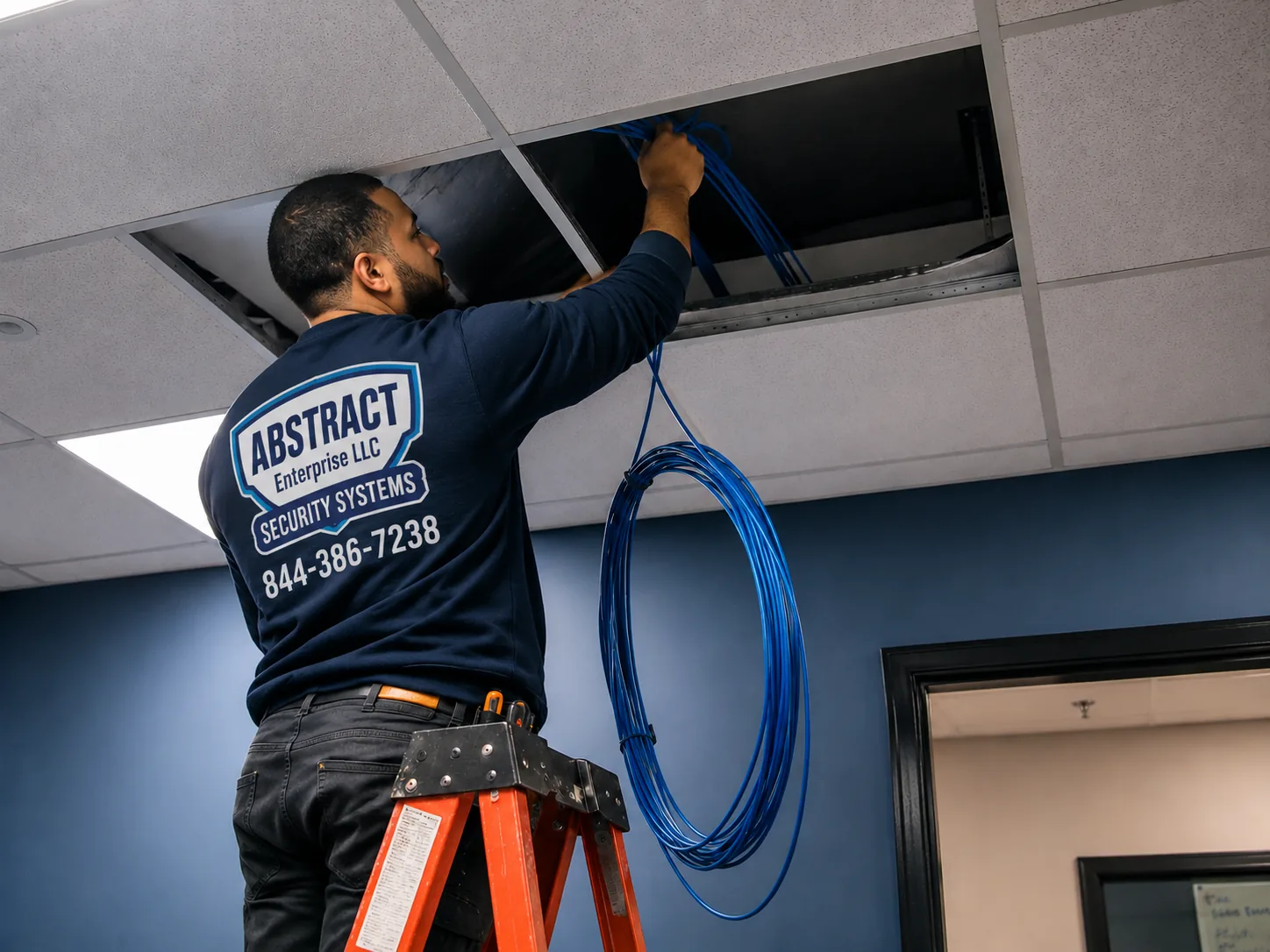
A photo from the AESS job library, not taken in Bedford-Stuyvesant: a technician feeding cable through the ceiling of a commercial space that stayed open during the work. Most shops on Fulton Street and Nostrand Avenue have exactly this kind of drop ceiling under the apartments above, and replacing a failed camera run through it can be done tile by tile while customers are still coming in.
The two- or three-family house: whose system is it, and who can see it?
Two- and three-family houses are where the human side of a repair takes the most time. The owner may live on the parlor floor and rent the garden apartment and the top floor, or may live elsewhere and rent all of it. The cameras watch the shared front door, the yard everyone uses and sometimes the hallway, and the recorder is often in a part of the house only the owner can reach. When something fails, the tenant usually notices first, because the tenant is the one who gets the package that disappears. But the tenant cannot authorize work on equipment they do not own, and we will not open a landlord's recorder on a tenant's say-so alone. If you rent and the cameras in your building are down, the first step is a message to the owner, and we are glad to give you the words to put in it.
The access question goes the other way too. Over years, the phone app on a shared system collects logins: a tenant who moved out, the contractor who installed it, a relative who set it up, the previous owner who sold the house. Every one of those people may still be able to watch the front door. A repair visit is the right time to fix that. We change the administrator password, remove accounts that should not be there, and, where the recorder supports it, set up separate users so each household sees the cameras that are relevant to them and nothing else. That last part depends on the recorder. Many older units only have one or two accounts, and if separate viewing matters to you, we will tell you whether your recorder can do it before you pay for anything.
Footage in a shared house raises one more question. Brick Underground, writing about a tenant who wanted to see building footage to identify a package thief, quoted attorney Jennifer Rozen saying landlords are not obligated to show tenants footage outside a legal process, and that city buildings are not required to have working cameras at all. Attorney Catherine Grad said a tenant could argue the landlord should review footage when theft keeps happening: "I don't think that it's such an arduous duty to impose on the landlord." None of that is legal advice, and owners and tenants should get their own. What we can do is make sure the system actually records, so that when someone asks the question, there is an answer to look at.
The French flat or small walk-up: a building system, not a house system
LPC's designation report for the Expanded Stuyvesant Heights district describes four- and five-story French flats from the 1890s mixed in among the row houses, and there are many more small walk-ups scattered through the rest of Bed-Stuy. In these buildings, cameras cover a shared vestibule, the hallway, the mailboxes, the stairs, the back door and sometimes the roof door. The recorder usually lives in the cellar or a utility closet, and the person responsible for it is a managing agent or a super rather than someone who lives in the building. That changes the repair in practical ways. Access needs to be arranged, the managing agent may need a certificate of insurance, and the cameras on each floor often hang on cable runs that go up through the stair hall, where tenants have painted, hung decorations or knocked into them with furniture on moving day.
Hallway cameras in walk-ups tend to fail at the connector or the power. Many older systems power every camera from one central box with a fuse or a small circuit for each output, and when a single camera shorts, from water or damage, it can take its neighbors down with it. We test each output, find the camera or cable that is pulling the others down, and isolate it so the rest of the building comes back while the bad one is repaired. In a building of this size we also check the lighting. A camera in a dark stairwell records nothing useful even when it works perfectly, and a burnt-out bulb on the landing can look like a camera fault on the monitor.
The storefront with apartments above: two systems sharing one building
Much of Fulton Street, Nostrand Avenue and Broadway is made of buildings with a shop on the ground floor and apartments above. The shop usually has its own system, installed by the business, with cameras on the register, the door, the aisles and the stockroom. The building owner may have a separate system for the residential entrance. The two often share a cellar, and their cables cross through the same ceiling. When a shop's camera fails, the first job is making sure we are looking at the right system. We have traced plenty of "broken shop cameras" to a cable that the building's contractor cut while working on the apartments upstairs.
Storefront systems in Bed-Stuy take more abuse than residential ones. Ceiling cameras get hit by stock being moved, door cameras get knocked by hand trucks, outside cameras get turned, covered or ripped down. The parent Brooklyn list prices vandalized camera repair at $400 to $900 per camera plus cable repair, because a camera that has been pulled down usually takes its connector and some cable with it. After a break-in like the one at Fulton Pawnbroker, where News 12 reported the man came in through the ceiling, a store often wants more than a repair. We look at where the cameras were pointing during the incident and tell you honestly whether moving one or adding one would have shown more, and the repair and the change can happen on the same visit.
The landmarked facade: repairs are easy, moves take care
If your house is inside one of Bed-Stuy's historic districts, the Landmarks Preservation Commission's Permit Guidebook is the document that governs cameras on the outside of the building. It says no permit is needed for "Ordinary maintenance, repair, and retrofitting of health, safety, and utility equipment." Swapping a dead camera for a similar one in the same spot is ordinary repair. For an in-kind replacement the guidebook says the application does not need elevation drawings, though manufacturer cut sheets are still required. What does need care is moving a camera, adding one or changing how it is fixed.
The guidebook's standards are specific. It says equipment "must be attached at mortar joints, plain masonry, wood, or metalwork," and "must not be attached through cast iron or on any decorative surfaces." It says security cameras "must be well spaced to avoid a cluttered, haphazard appearance," and that small residential or commercial buildings may have no more than two security cameras for every 25 feet of street frontage. It wants equipment as small as possible and painted to blend in, conduit concealed through plain masonry where possible, and no more than about ten inches of visible conduit if it cannot be. On a narrow row-house front, that usually means two front cameras is the practical limit. We plan every facade repair around those rules, so a repair does not turn into a violation.
The newer building: managed networks and locked rooms
Bed-Stuy also has newer rental and condo buildings mixed in among the older stock. Their cameras are usually network cameras on a PoE switch in a telecom room, sometimes on a cloud platform the management company pays for. The faults are different: a switch port that died, a firmware update that broke the connection to the recorder, a cloud subscription that lapsed, an IT contractor who changed the network and did not tell anyone. The access is different too. We will need the management office to open the telecom room and, often, someone who knows the network passwords. If you are a board member or a manager of one of these buildings, the most useful thing to have ready is the name of whoever installed the system and any login information they left.
Field Notes
Field Notes: The First Twenty Minutes in a Bed-Stuy Cellar With a Dead Recorder
These notes describe how our technicians work on systems in buildings like Bed-Stuy's. They are our standard practice, not a story about any one address.
Ask before touching. The technician starts with questions, not tools: when did it stop, did anything happen on the block that day, has anyone reset or unplugged anything, and is there footage from a particular day that must be kept. If there is, finding and exporting it comes before anything else.
Look at the power path. In a cellar, the technician follows the recorder's power cord and the camera power cable back to the wall. Shared outlets, daisy-chained power strips, adapters lying in damp corners and supplies whose light is flickering are all noted. After an outage, a blown supply or a switch that will not power its ports explains more failures than anything else.
Read the recorder. The recorder's screen shows which channels have video, whether the drive is detected, how much is recorded and whether the clock is right. A clock reset to a date years ago is a sign the recorder lost power and its settings with it. A drive that reports errors or is missing tells us the next step on its own.
Test, do not guess. For a single dark camera, the technician tests the cable at the recorder end, then at the camera, with a cable analyzer or a PoE tester, and traces any unlabeled run with a tone generator. The result is written down for each run, and every cable gets a label.
Price, then fix. Only when the failed part is known does the technician write a price. You see it before the repair starts.
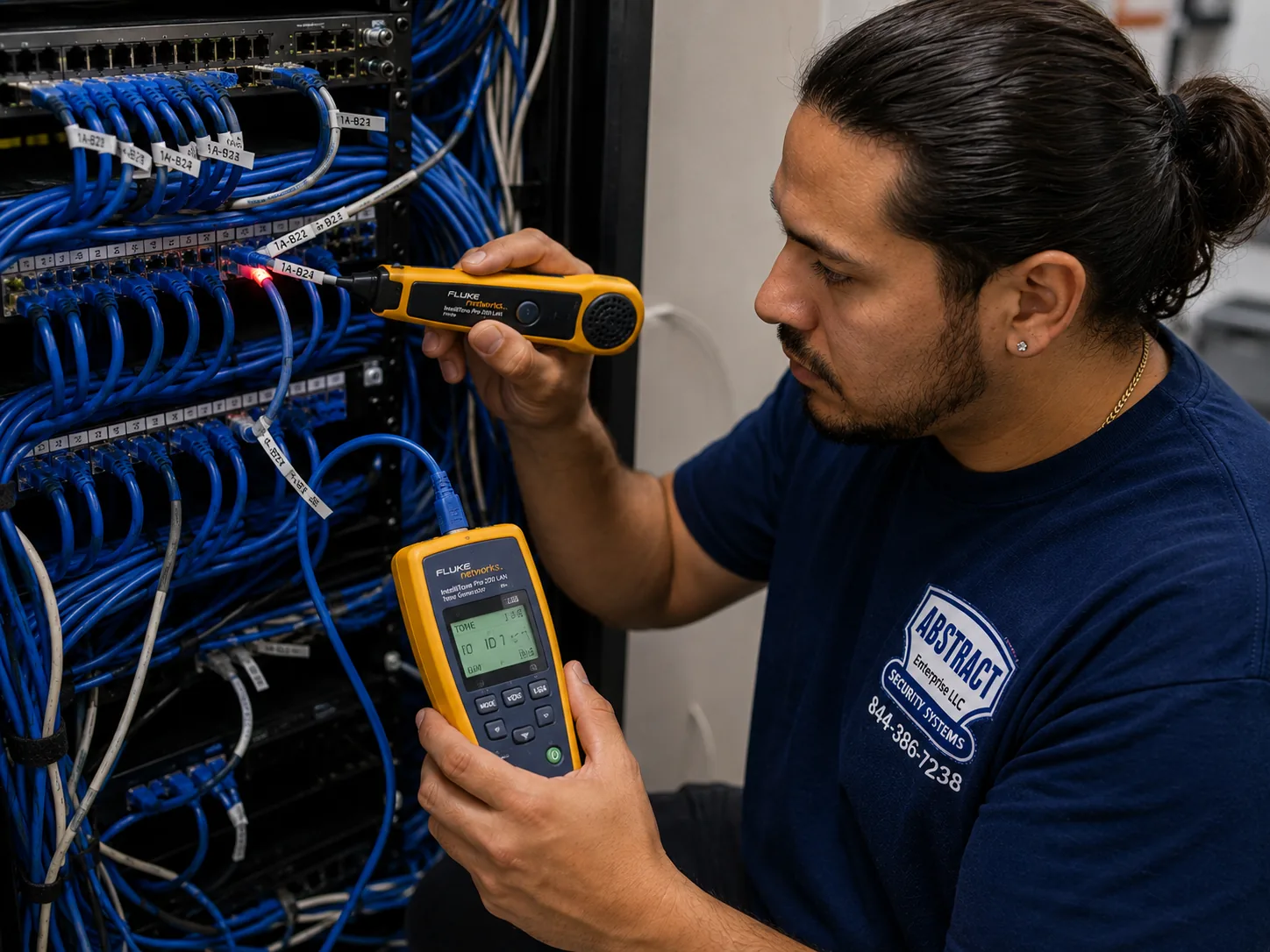
A photo from the AESS job library, not taken in Bedford-Stuyvesant: a technician tracing an unidentified cable at a patch panel with a tone generator and probe. This is how we find which of the unmarked cables coming down through a brownstone's cellar ceiling belongs to the dark camera on the front, without opening a single wall.
Power and Outages
After the Outage: Why Bed-Stuy Camera Systems Come Back Wrong, and How to Stop It Happening Again
Power failures do more damage to camera systems than most owners realize, and Bed-Stuy has had a run of them. The Brooklyn Eagle's account of the outages after Winter Storm Fern put the count at 786 customers out on the Monday, more than 990 that night and about 300 still without power Wednesday morning, with Con Edison saying snow and road salt had damaged several manholes and parked cars had slowed the repairs. In June, News 12 reported manhole fires around 1242 Fulton Street that left about 50 customers dark that evening, and a separate News 12 report said rows of businesses on Fulton Street lost power, with some stores still without it the next morning. Con Ed said heat was "almost certainly the cause." For anyone with cameras in those blocks, each of those events was a test their system may not have passed.
Here is what a sudden loss of power does. A recorder that is writing to its hard drive when the power cuts can damage the file system on the drive, and the next time it boots it may refuse to record, or record and then lose everything. A recorder's internal clock battery, if it has run down, lets the time and date reset, and footage recorded after that is stamped with a date from years ago, which makes it hard to find and harder to use as evidence. When power comes back, it often comes back with a surge, or flickers on and off several times while crews work. Cheap plug-in power adapters and the power supply boxes that feed analog cameras are the first things to fail. PoE switches can lose individual ports, so some cameras come back and others never do. Cameras themselves sometimes come back on default settings and lose their connection to the recorder.
The pattern we see afterward is easy to misread. An owner sees most cameras working on the monitor and assumes the system came through. Weeks later, after a package disappears from the stoop, they discover the recorder has not saved anything since the night of the outage, or that the drive is full of footage stamped with the wrong year. That is why we tell every Bed-Stuy customer: after any outage, check two things, not one. Is every camera showing live video, and does playback show recordings from today with today's date? If the second answer is no, the system is not working, whatever the live view looks like.
What actually protects a system from the next outage
The single most useful upgrade for a Bed-Stuy system is a battery backup, an uninterruptible power supply, between the wall outlet and the recorder. It does two jobs. It keeps the recorder running through short flickers so the drive is never cut off in the middle of a write. And for longer outages, a good unit gives the recorder time to keep recording on battery, and the power coming out of it is cleaner than what comes from the wall when service is restored. If the cameras are PoE, the switch that powers them should be on the same backup. If the cameras run from a separate power box, that box should be too, or the recorder will stay up while every camera goes dark, which is not much help.
The second protection is boring but matters: a dedicated outlet. Recorders in Bed-Stuy cellars are regularly plugged into the same strip as a boiler control, a sump pump or a dehumidifier. Motors starting and stopping on that circuit make power dip, and over months that wears out cheap supplies. Moving the recorder to its own outlet, on a shelf off the floor and away from water, is often part of a repair. The third is a quick check of the recorder's clock settings. Where the recorder supports it, we set it to update its time automatically from the internet, so a reset clock corrects itself instead of stamping weeks of footage with the wrong date.
There are limits. A battery backup is not a generator, and a long blackout across several blocks will eventually take down any small system. We do not do electrical work, so if your cellar needs a new circuit or the outlet itself is faulty, that is a job for a licensed electrician, and we will say so. What we can promise is that the parts of the camera system we touch will be set up to survive the next flicker on your block better than they survived the last one.
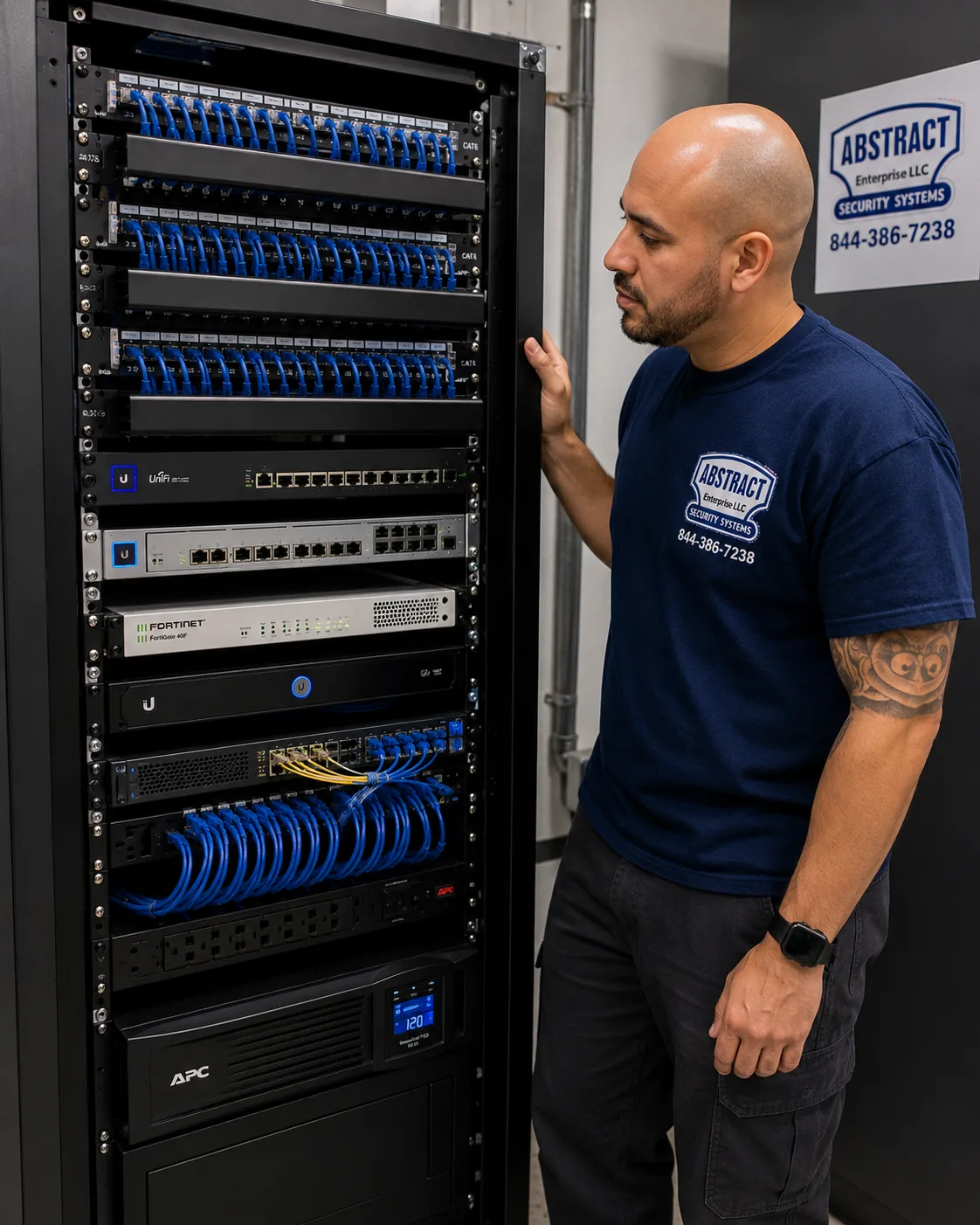
A photo from the AESS job library, not taken in Bedford-Stuyvesant: a finished rack with patch panels, network switches, a firewall and a battery backup unit at the bottom, every cable dressed and labeled. A Bed-Stuy brownstone does not need a rack like this, but the principle is the same on a cellar shelf: the recorder and the switch that powers the cameras both sit on a battery backup, so the next outage on Fulton Street or after a winter storm does not cut the drive off mid-write.
Footage After an Incident
Getting the Video Out: Footage, Police and Privacy in Bedford-Stuyvesant
A large share of Bed-Stuy repair calls are not really repair calls at first. They are "something happened and I need the video" calls, and they reveal that the camera system has been broken for a while. Patch reported a case on Macon Street, between Throop Avenue and Marcus Garvey Boulevard, where a package thief came back twice, checked that the house was empty and used a mop handle to pull a package from behind a locked gate. The owner found the footage that evening, when her tenant asked where the package had gone. That is the best case: the camera worked, the recorder saved it, and someone looked in time. News 12 reported another case on Bainbridge Street, where a resident said a delivery driver took a package worth about $1,500 from outside his door. Whether video exists in a case like that depends entirely on whether the system was recording that day.
If you need footage, time matters for one reason: the recorder will eventually record over it. How long it keeps video depends on the drive size, the number of cameras, the resolution and whether it records all the time or only on motion. Some systems in Bed-Stuy houses keep a month; some keep a few days. A recorder that is half-working may keep far less than its owner thinks. So the first step is to stop the clock on the clip you need. On most recorders that means finding the clip in playback and exporting it to a USB drive. If you cannot do that, or the recorder is acting up, tell us the date and the rough time and our technician will export it first thing, before any diagnosis or repair starts.
Police requests in the 79th and 81st Precincts
Bed-Stuy is covered by the 79th and 81st Precincts. When a detective asks for footage, what they want is a clean copy in a file they can play, with the date and time visible and correct. They do not usually want your recorder, and you should not have to give it up to help an investigation. We make that copy for you, and we check that the timestamp on the recorder matches real time, because a recorder whose clock reset after an outage can show a date months away from the real one, and that is something you want to know and explain before you hand the file over.
Some owners worry about the opposite: who can get their video without asking. Doorbell and cloud cameras work differently from a recorder in your cellar. News 12 reported in January 2024 that Ring ended its "Request for Assistance" tool, which had let police request doorbell video through the Neighbors app, and noted that "Law enforcement agencies can still access videos using a search warrant." Video kept on your own recorder stays in your building unless you export it or someone obtains it through legal process. Different public systems work on different rules: NYS Focus reported in October 2025 that the NYPD was linking NYCHA developments' CCTV cameras to its software, with plans for 1,900 cameras across 19 more properties. That concerns city housing cameras, not private systems in your home or store.
Tenants, landlords and the footage in between
In two- and three-family houses and small walk-ups, the person who needs the footage and the person who controls the recorder are often different people. The Brick Underground piece on a tenant trying to see building footage is the clearest public guidance we know of: outside a legal process, the landlord does not have to show it, but if police request it or a court orders it, the landlord must provide it. As a repair company, we take instructions from whoever owns the system. If you are a tenant and need footage from your landlord's recorder, the useful step is to ask the owner in writing, with the date and time, as soon as possible, so the clip is saved before it is overwritten. If you are an owner, setting up the export before the request becomes a dispute saves everyone trouble.
One more privacy point for owners. Cameras that look into a neighbor's windows, or a camera that a household no longer welcome in the building can still watch on their phone, cause more arguments than almost anything else we see. A repair is a good time to check where every camera points and who can see it, and we raise both questions on every visit.
Commercial Camera Repair
Business Security Camera Repair in Bedford-Stuyvesant
Store and restaurant systems in Bed-Stuy work harder than home systems. They record long hours, they are moved and bumped by staff and stock, and they are the first thing anyone asks about after a robbery. These are the kinds of businesses we repair systems for along the neighborhood's shopping streets.
Cash businesses on Fulton Street
Pawn shops and other cash businesses on the main shopping street, where the register, the display case and the roof or ceiling all need coverage. The Fulton Pawnbroker break-in came through the ceiling.
Delis and bodegas on the avenues
Corner stores on Nostrand Avenue, Marcus Garvey Boulevard, Tompkins Avenue and Malcolm X Boulevard, open long hours, with door and register cameras that get knocked and turned. News 12's Marcus Garvey Boulevard robbery footage came from a deli system.
Restaurants and cafes
Dining rooms, kitchens and back doors on Lewis Avenue, Tompkins Avenue and Bedford Avenue, where heat and grease cloud lenses and kitchen cameras fail early.
Salons, barbers and small shops
Single-room businesses with two to six cameras and a recorder under the counter, often installed years ago with no one left who knows the password.
Pharmacies and medical offices
Counters, stockrooms and waiting areas where the system needs to record every day without anyone checking it.
Shops under the Broadway elevated line
Stores along Broadway on the eastern edge, beneath the J, M and Z tracks, where vibration, dust and pigeons take a toll on outdoor cameras and connectors.
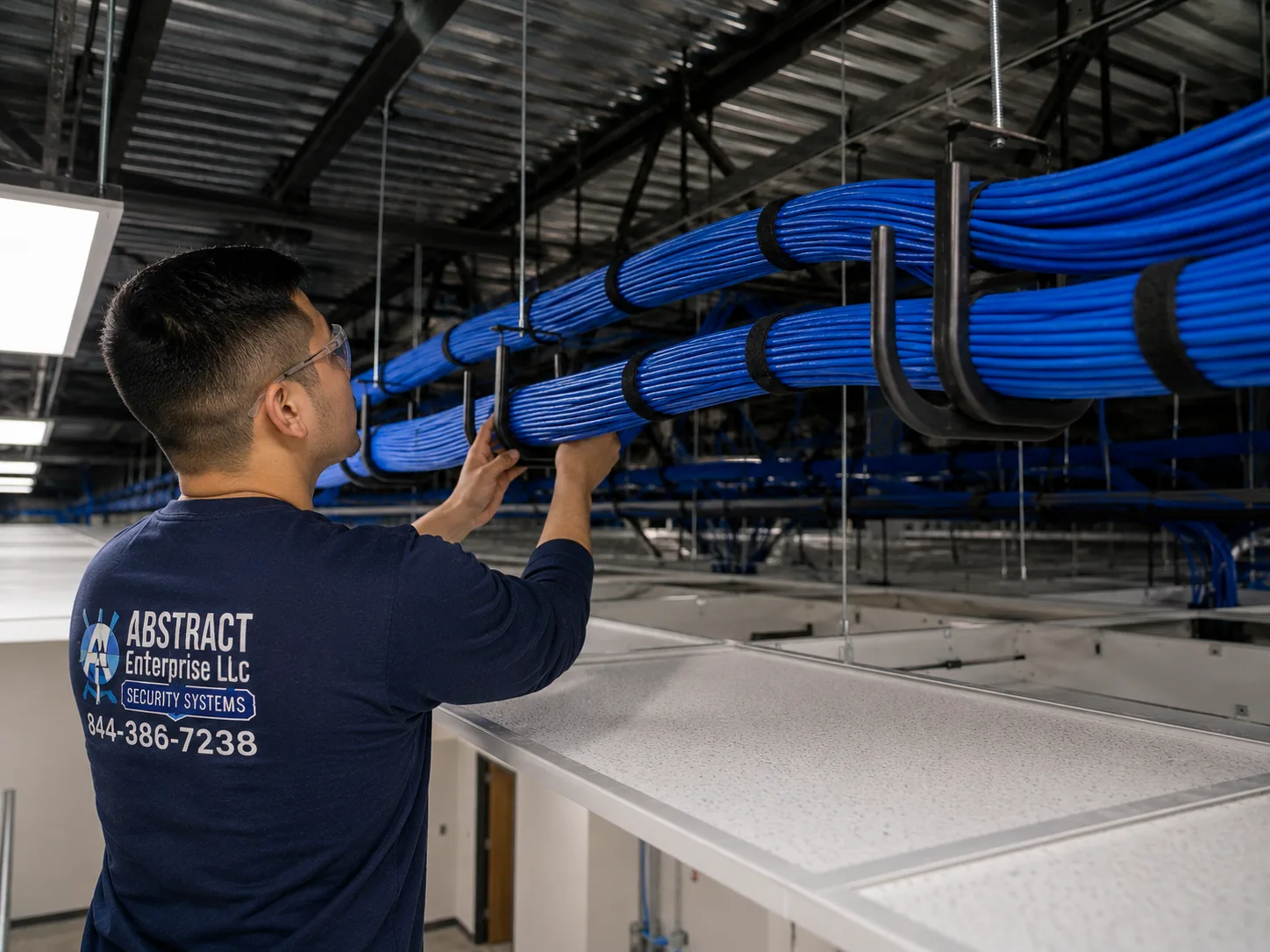
A photo from the AESS job library, not taken in Bedford-Stuyvesant: J-hooks carrying neat bundles of cable across a commercial ceiling. Shops on Bed-Stuy's avenues often have camera cable lying loose on top of ceiling tiles or tied to pipes, and when a store's cameras keep dropping out, getting the cable off the tiles and onto proper supports is part of making the repair last.
Repairs in a business follow the business's hours. We can usually work while a store is open, a ceiling tile or a camera at a time, and we schedule work in a restaurant around service. The first thing we do in any store, before touching the system, is ask whether there is footage that needs saving, because a store that has just had an incident is often the store whose system just failed. After that, the questions are about coverage. Where was the camera pointing when it mattered, and would it have shown a face, a hand or only the top of a hat? Was the door camera looking into bright sunlight from the street and showing only a silhouette? Was the register camera mounted so high that it showed the top of the cashier's head? A repair visit is the cheapest moment to fix those angles, because the ladder is already up.
Rules that apply to business camera systems in Bed-Stuy
State licensing. New York's Department of State licenses companies to install, service or maintain security and fire alarm systems, and the state's rules (19 NYCRR 195.2) bring a CCTV system under that license when it is used to detect or monitor intrusion, break-in, theft or movement. An owner who repairs a system on their own property, or has an employee do it, is exempt. A company you hire is not. Our license is #12000287431.
Landmarks. Storefronts inside a historic district follow the same LPC guidance on camera spacing and fixing as row houses, and the guidebook allows three cameras per 25 feet of frontage only on large residential, commercial and institutional buildings.
Insurance and access. If a landlord or managing agent needs a certificate of insurance before we work in a building, tell us when you book so it is ready before the visit.
Electrical work. We work on low-voltage camera wiring and equipment only. If a repair turns up a need for a new outlet or circuit, that goes to a licensed electrician.
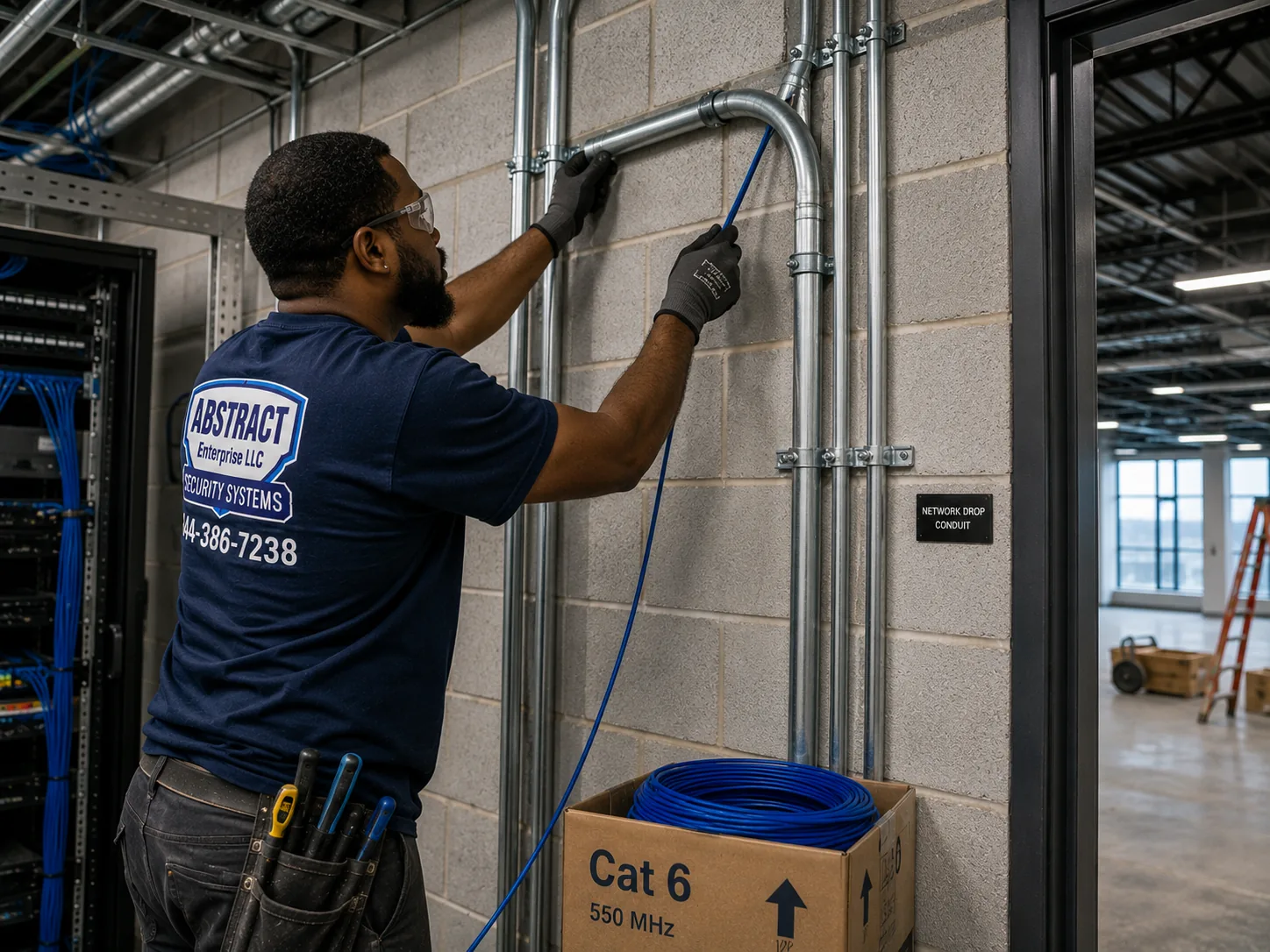
A photo from the AESS job library, not taken in Bedford-Stuyvesant: a technician running cable into metal EMT conduit beside a telecom room in an industrial building. Conduit like this is what we use where a camera cable has to pass through a busy stockroom or a shared cellar in a Bed-Stuy mixed-use building, so the next contractor working on the apartments upstairs does not cut the shop's cameras by accident.
Your Questions Answered
Security Camera Repair in Bedford-Stuyvesant: Questions Answered
These are the questions Bed-Stuy owners, tenants and shopkeepers bring to us most, grouped by the situation they come from. Each answer is short; the sections above have more detail.
Landmarked houses and facades
Our house is in the Stuyvesant Heights historic district. Do we need Landmarks approval just to replace a dead camera with a new one?
Usually not. The LPC Permit Guidebook says ordinary maintenance, repair and retrofitting of health, safety and utility equipment needs no permit, and a similar camera in the same spot falls under that. If you want to move the camera, add one or change the conduit on the front, the guidebook's standards apply, and staff can issue permits for cameras that meet them. We tell you which case you are in before the visit.
The old camera on our brownstone was screwed straight into the carved stone beside the door. Can the new one go in the same holes?
If the house is landmarked, we would rather not. The guidebook says equipment must be attached at mortar joints, plain masonry, wood or metalwork, and not on decorative surfaces. A replacement is a chance to move the fixing into a mortar joint nearby and leave the old holes to be patched by a mason. On a house that is not landmarked, it is your choice, but the same practice protects the stone.
We want a third camera on the front of our row house. Is that allowed?
On a landmarked house, the guidebook limits small residential and commercial buildings to two security cameras for every 25 feet of street frontage, so on a typical narrow front a third camera is unlikely to be approved. Often the better answer is a wider-angle replacement for one of the two you have, or a camera inside the vestibule looking out.
Outages and power
Since the winter outages, the recorder in our cellar restarts itself every few days. Is it the drive or the power?
It can be either, and sometimes both. A recorder that restarts on its own is often getting unstable power from a tired adapter, or is struggling with a drive damaged when the power cut out mid-recording. We test the adapter and the outlet, read the drive's health and check the recorder's logs, and the answer decides whether the fix is a power supply, a drive or both.
Should a battery backup go on the recorder, the switch or both?
Both, plus the camera power box if there is one. A backup on the recorder alone keeps it running while every camera goes dark. For PoE cameras, the switch is what powers them, so it needs to stay up too. A modest unit on a small home system is enough to ride through the flickers that do the most damage.
Our store on Fulton Street got its power back after the June manhole fires, but four cameras never came back. Where do you start?
With whatever powers those four. If they share one PoE switch or one power box, that part is the prime suspect, since one failed component can take several cameras with it. If they run from different sources, we test each run and camera separately. Either way, we export any footage you need from before the outage first.
Footage after something happens
A package was taken from our stoop last night. How do we keep the clip from being recorded over?
Export it now if you can: find it in playback on the recorder or in the app and save it to a USB drive or your phone. If the system is acting up or you cannot find it, call us with the date and rough time and do not reset anything. Our technician exports that clip before touching anything else on the visit.
Our tenant asked to see the footage from the hallway after a theft. Do we have to show it?
That is a legal question for your own lawyer. Brick Underground quoted an attorney saying landlords are not obligated to show tenants footage outside a legal process, but must provide it if police request it or a court orders it. Practically, saving the clip right away keeps every option open, and we can export it for you.
A detective from the precinct wants a copy of our video. Do we have to hand over the recorder?
Usually a copy is what is needed, not the box. We export the clip to a USB drive in a format that plays on an ordinary computer, and we check that the recorder's clock matches real time first, because a clock reset after an outage can stamp footage with the wrong date.
Shared houses and stores
We bought a two-family and the previous owner's phone still gets alerts from our cameras. How do we cut them off?
The fix is on the recorder and the account behind the app, not the phone. We set a new administrator password, remove accounts and linked devices that should not be there, and, where the system uses a cloud account, move it to an account you own. You leave the visit with a list of every login that remains.
The garden-floor tenant and the family upstairs share one recorder. Can each household see only its own cameras?
On many recorders, yes: separate user accounts can be limited to chosen cameras. Some older models only allow one or two accounts with no camera limits. We check your model before you pay anything and tell you whether it can be done on the equipment you have.
Someone climbed in through the ceiling at a shop near us. Can our cameras be changed to cover the roof hatch and ceiling?
Yes, and a repair visit is a good time to do it. News 12 reported the Fulton Pawnbroker break-in came through the ceiling. We look at where your cameras point now, where a person would actually come in, and whether moving one existing camera covers it or a new one is needed, and price both before any work.
The camera over our register keeps getting knocked crooked by stock on the shelves. Replace it, or move it?
Usually move it, and sometimes swap the type. A dome or turret mounted to the ceiling away from the shelf edge is harder to knock than a bullet camera on an arm. If the camera itself is damaged, replacing it on the same cable is a single-camera repair on our list.
Equipment
Types of Security Camera Systems We Repair
Bed-Stuy has every generation of camera system in use, sometimes in the same building. Here is what we work on and what usually goes wrong with each.
Analog and HD-over-coax DVRs
Older systems on coaxial cable with BNC connectors and a separate power box, still common in row houses and corner stores. Most faults are connectors, power and the DVR's drive.
PoE network systems
Network cameras on one cable each, powered by an NVR or a PoE switch. Faults are usually a dead port, a bad termination, a long run, or a firmware or network change.
Hybrid recorders
Recorders that take both coax and network cameras, useful when a house has some of each. The parent Brooklyn list prices a hybrid recorder swap at $700 to $1,200 installed.
Wi-Fi and battery cameras
Consumer cameras on a home network. In brick row houses, the yard and roof cameras are often too far from the router through solid walls, so drop-outs are a signal problem, not a camera problem.
Doorbell and entry cameras
Video doorbells at the parlor door or the areaway gate, where wiring, transformers and Wi-Fi reach are the usual faults. Customer-supplied doorbells are labor only.
PTZ and long-view cameras
Pan-tilt-zoom and long-lens cameras on larger buildings and lots. The parent Brooklyn list prices PTZ repair at $450 to $1,200 because the parts are complex.
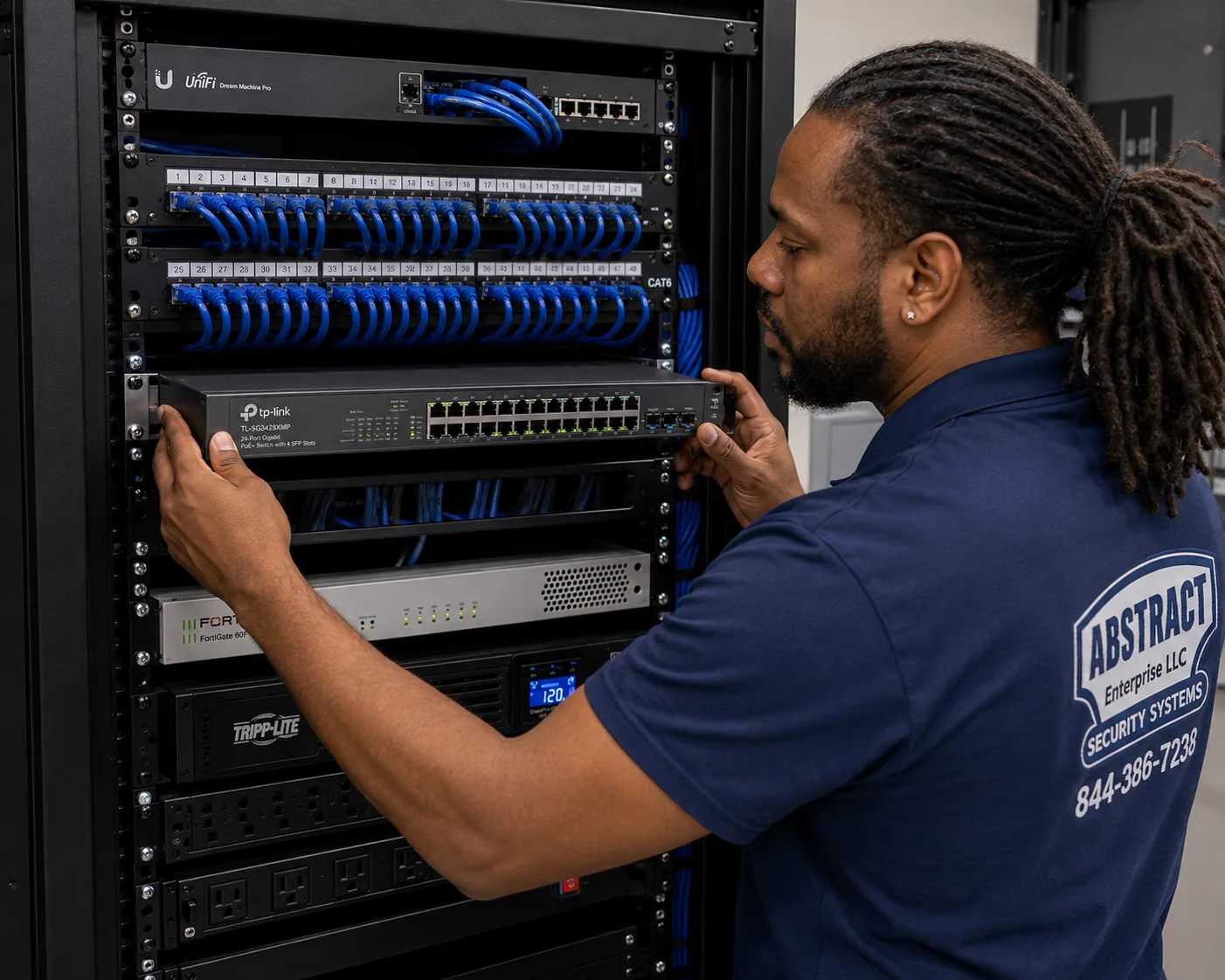
A photo from the AESS job library, not taken in Bedford-Stuyvesant: a technician mounting a managed PoE switch beneath patch panels in a commercial rack. When several network cameras in a Bed-Stuy store or walk-up go dark together after an outage, a switch like this, or a cheaper unmanaged one on a cellar shelf, is often the part that failed, and replacing it brings every camera back at once.
A national camera brand's support line, an app-booked handyman or a local licensed repair company
When a camera fails, people in Bed-Stuy usually try three things in order. They call the brand's support line or work through the app, which is free and sometimes enough for a software or account problem. They book a handyman through an app, which can work for a doorbell swap. Or they call a licensed camera company. The table below is about what each one can actually do on a Bed-Stuy system, not about the quality of any particular company.
What the repair needs
Brand support (Ring, ADT, SimpliSafe)
App-booked handyman
AESS in Bed-Stuy
Someone at the property
Phone or chat; on-site visits vary by plan
Yes
Yes, in a 2-hour arrival window
Mixed brands and older DVRs
Their own products only
Depends on who is sent
Any brand, any installer
Cable testing and tracing
Not offered
Varies
Analyzer, PoE tester and toner on every visit
Footage export for police or insurance
From the cloud, if you subscribed
Varies
Exported before the repair begins
Landmark facade rules
Not addressed
Varies
Mortar-joint fixing, spacing and conduit per LPC guidance
State alarm-installer license
Varies by company
Varies
NYS license #12000287431
Written price before the work
Plan or warranty terms
Hourly or flat app rate
Yes, with the $150 service call applied
If your cameras are Ring, Nest or another cloud brand and the problem is an account, a subscription or a forgotten login, start with the brand's own support; it is free and they control the account. Call us when the problem is physical: power, wiring, mounting, a dead device, or a system that mixes brands and nobody's support line will take responsibility for the whole thing.
AI Overview Reality Check
What AI Gets Wrong About Security Camera Repair in Bedford-Stuyvesant
These are claims that turn up in generic online answers and national cost guides such as Angi, HomeAdvisor and Fixr, paraphrased, each followed by what we see in Bed-Stuy's buildings.
"The cost guide's average is what your repair will cost"
Cost guides publish one number and readers take it as a price. HomeAdvisor's Brooklyn page for surveillance camera installation or repair gives an average of $1,416, a typical range of $680 to $2,145 and a full range of $160 to $3,500.
That figure blends new installations with repairs, so it says little about fixing what you already own. A Bed-Stuy repair that turns out to be a corroded connector or a dead PoE port is typically $150 to $350 on our list. A single camera swap is $250 to $600. Only full recorder replacements and rewires reach the guide's average.
The honest way to price a repair is to find the failed part first. That is what the $150 service call is for, and it is applied to the repair if you go ahead.
"If the cameras are back on after an outage, the system is fine"
Generic troubleshooting advice treats live video as proof the system works: if you can see the cameras, you are done.
After the outages that followed Winter Storm Fern and the Fulton Street manhole fires, the failures we see most are not dark cameras. They are recorders that show live video and save nothing, drives damaged when the power cut out mid-write, and clocks reset to a date years ago that mislabel everything recorded since.
The real test is playback. After any outage, open playback and check that today's recordings are there with today's date. If they are not, the system needs attention even though the monitor looks normal.
"Switch to wireless cameras and the wiring problems go away"
Online answers often suggest replacing a troublesome wired camera with a Wi-Fi one, since there is no cable to fail.
Bed-Stuy row houses are brick, often with thick party walls and plaster on masonry inside. A router in the cellar or on the parlor floor frequently cannot reach a camera on the back wall of the yard or under the cornice. The wireless camera then drops out at random, which looks like the same fault the owner was trying to escape. Wireless cameras still need power, too, so the cable is replaced by a battery or a plug-in adapter in an awkward place.
Where wired runs exist, repairing them is usually the steadier fix. Where wireless makes sense, we test the signal at the camera's spot before recommending it.
"You can put a camera anywhere on your own house"
General advice says homeowners can mount cameras wherever they like on their own property.
A large part of Bed-Stuy is inside city historic districts: Stuyvesant Heights, the Bedford-Stuyvesant/Expanded Stuyvesant Heights district, the Bedford district and Alice and Agate Courts. There, the LPC Permit Guidebook limits small buildings to two security cameras per 25 feet of frontage, requires fixing into mortar joints, plain masonry, wood or metalwork, rules out decorative surfaces and cast iron, and caps visible conduit at about ten inches.
Repairing a camera in place needs no permit, but moving or adding one on a landmarked front means following those standards. We plan facade work around them.
"Police can always get your video from the camera company"
Some answers suggest that footage is automatically available to police through the camera maker, so there is no need to save it yourself.
News 12 reported that Ring ended its tool for police to request doorbell video through the Neighbors app in January 2024, while noting that law enforcement can still obtain video with a search warrant. Footage on a recorder in your cellar or stockroom is not with any company at all; it stays on your drive and is recorded over on schedule.
If an incident matters to you, export the clip yourself or have us do it, quickly. When a detective from the 79th or 81st Precinct asks, a clean copy with the correct time is what helps.
"A tenant has the right to see the building's cameras"
It is common to read that anyone recorded by a building's cameras can demand the footage.
Brick Underground's reporting on a tenant who wanted building video to identify a package thief quoted attorney Jennifer Rozen saying landlords do not have to show it outside a legal process, and that city buildings are not required to have working cameras. Police requests and court orders change that.
In a Bed-Stuy two-family or walk-up, the practical step is to ask the owner in writing, fast, before the recorder writes over the clip. We work for the system's owner and can export the clip when the owner asks.
"Any handyman can fix a security camera"
Cost guides and app marketplaces list camera repair alongside shelf hanging and furniture assembly.
New York's alarm-installer rules bring a CCTV system under state licensing when it is used to watch for intrusion, break-in, theft or movement, which describes nearly every camera on a Bed-Stuy stoop or store. The owner and the owner's employees are exempt; a company you hire is not.
Ask any company you call for its New York State license number. Ours is #12000287431.
Give us the cross streets, the kind of building, where the recorder is, which cameras are dark and what happened around the time they stopped. A technician will call back about the Bedford-Stuyvesant address, or you can call (347) 934-8335 right now.
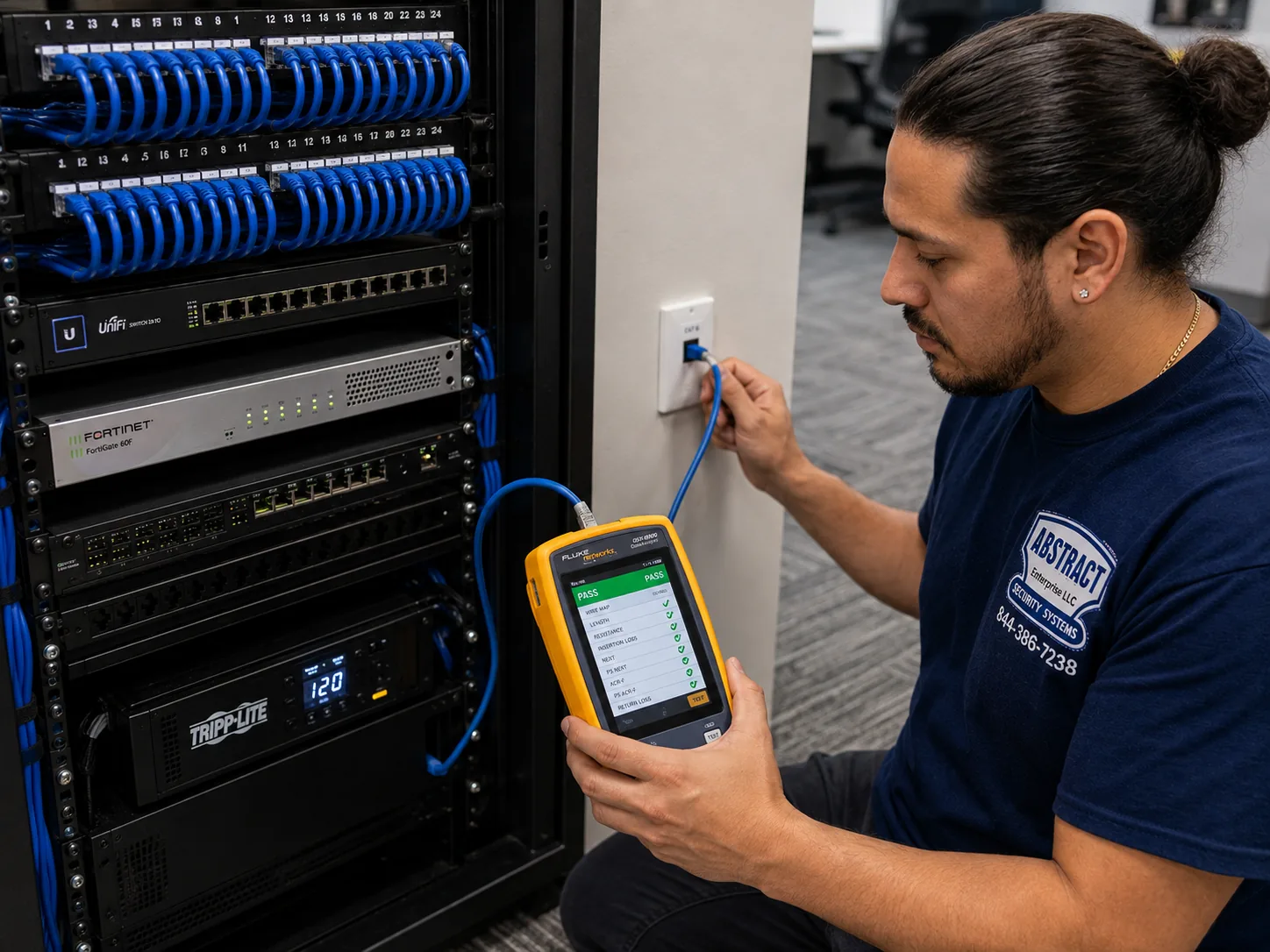
A photo from the AESS job library, not taken in Bedford-Stuyvesant: a technician certifying a cable run with an analyzer that shows a PASS result. Every camera run we touch on a Bed-Stuy repair gets tested this way before and after the fix, so you know the cable to the stoop or the yard is good and the problem was the camera, the connector or the port.
✅
Request Sent!
Thank you. A technician will call you about the Bedford-Stuyvesant address shortly.
How It Works
Our Repair Process
1. Describe the fault and send photos
Which cameras are dark, when it started and what happened around then, with photos of the recorder screen, its label and the failed camera, plus your cross streets.
2. Book the service call
A 2-hour arrival window, who will let the technician in, and any landmark, landlord or management rules for the building, all settled before the visit.
3. Save the footage first
If the recorder holds video you need, it is found and exported to a USB drive before anything is unplugged or reset.
4. Test power, cable and recorder
Supplies, PoE ports, connectors, runs and the recorder's drive and channels are tested one at a time until the failed link is found.
5. Write the price before the work
A written price for the actual repair, with the $150 service call applied to it if you go ahead.
6. Make the repair
The connector, camera, power supply, drive, recorder or run is fixed or replaced, with facade work kept to mortar joints on landmarked fronts.
7. Test, set up the app and hand over
Live view and playback checked on every camera, recording and retention confirmed, the app set up for the right people and old logins removed.
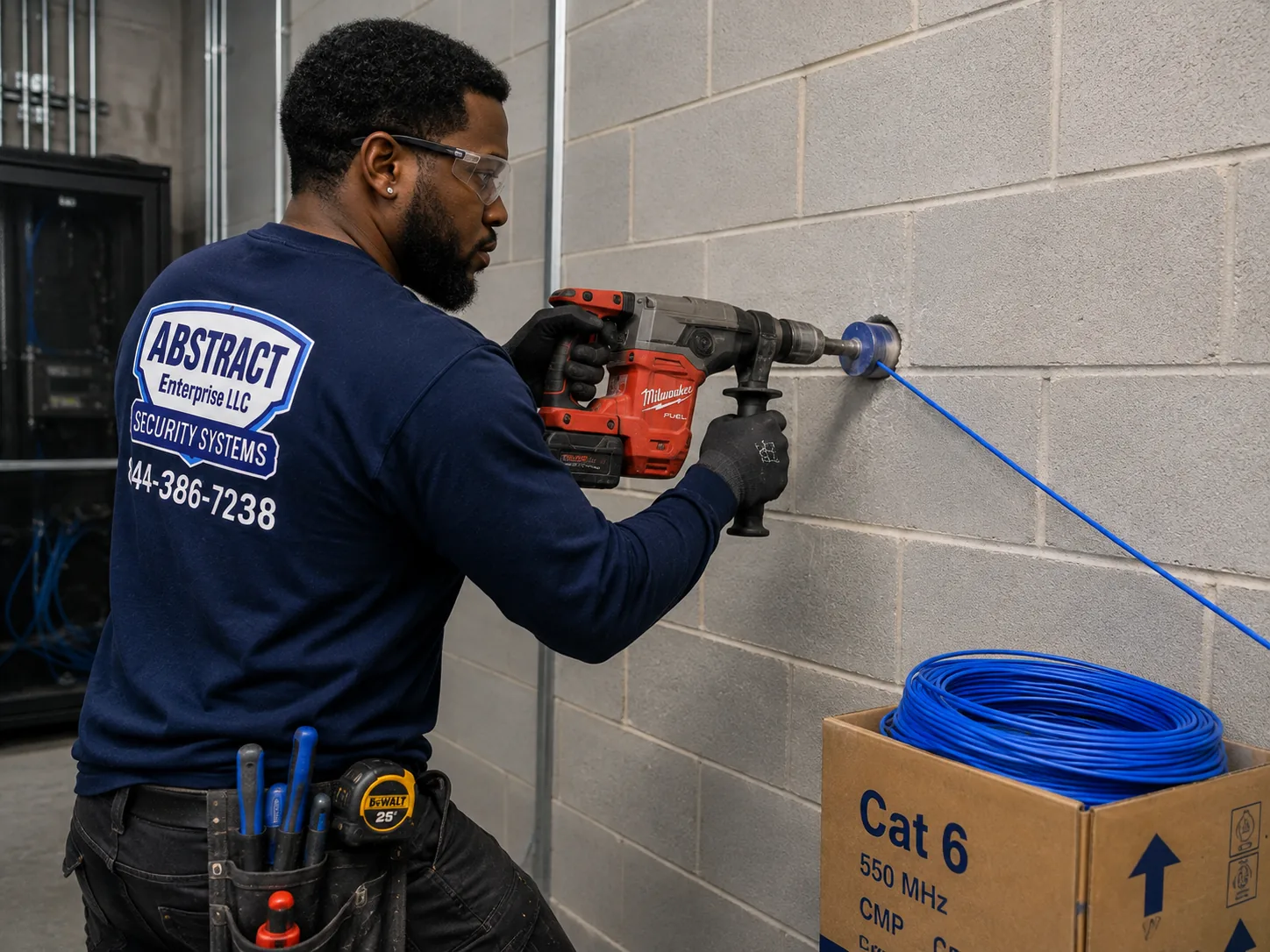
A photo from the AESS job library, not taken in Bedford-Stuyvesant: a technician core drilling a block wall so cable can pass through to a network room. In a Bed-Stuy building this kind of work is the exception on a repair, usually needed only when a cellar has been rebuilt and the old camera path is gone; when it is needed, it is in the written price before any drilling starts.
Coverage Area
Security Camera Repair Near Bedford-Stuyvesant's Landmarks
Herbert Von King Park
Opened in 1871 as Tompkins Park, and still ringed by the row houses that make up so much of the neighborhood.
Restoration Plaza
Home of the Bedford Stuyvesant Restoration Corporation, founded in 1967, in the former Sheffield Farms plant on Fulton Street.
Weeksville Heritage Center
The historic site of Weeksville, one of the four smaller neighborhoods inside Bed-Stuy, alongside Bedford, Stuyvesant Heights and Ocean Hill.
Macon Library
The Brooklyn Public Library branch on Lewis Avenue, on the same street grid as the Macon Street house where a camera caught a package thief at work.
Alice and Agate Courts
A historic district of 36 Queen Anne row houses designated in 2009, where front-of-house camera work follows Landmarks guidance.
Marcy Houses
The NYCHA development of 27 six-story buildings and 1,705 apartments, opened in 1949. NYCHA's own cameras are the Housing Authority's; we work on private systems around it.
We also serve the neighborhoods around Bed-Stuy at the same Brooklyn rate, including Clinton Hill, Crown Heights, Bushwick and Williamsburg. The borough-wide service, prices and every Brooklyn neighborhood are on our Brooklyn security camera repair page, and the full Brooklyn repair price list is on the Brooklyn camera repair prices page.
Pricing
Security Camera Repair Cost in Bedford-Stuyvesant
Bedford-Stuyvesant is billed at our Brooklyn rate. Every repair starts with the $150 service call, which covers the on-site diagnosis and a written price, and is applied to the repair if you go ahead. The ranges below come from our published Brooklyn repair list; where a range is wide, the diagnosis decides where in it your job falls, and you see the number before any work begins.
Repair
Brooklyn price
Service call: on-site diagnosis and written repair price (applied to the repair)
$150
Connector reterminate or PoE port swap
$150–$350
Power supply repair
$150–$400
Hard drive swapped on site, depending on capacity
$200–$450
Single camera replaced on a working system, camera and labor
$250–$600
Night vision not working
$250–$650
DVR not working, including the hard drive and labor
$300–$700
NVR not recording, depending on model and brand
$400–$900
Vandalized camera, per camera, plus any cable repair
$400–$900
Hybrid recorder swap, installed, with channels reconfigured
$700–$1,200
DVR or NVR replacement
$700–$1,500
Brownstone access (cable through plaster, garden-level, parlor or duplex routing)
adds $100–$200
Full rewire or brownstone system overhaul
from $1,500
Two things change a Bed-Stuy price more than anything else. The first is access. A brownstone where the cable to the front camera runs through plaster on four floors, or a camera that can only be reached over an areaway railing, takes longer than a camera on a shop's drop ceiling, and the list's brownstone-access line covers that. The second is what the diagnosis finds. A camera that looks dead and turns out to have a corroded connector is a reterminate, not a new camera, and you pay the lower price. We would rather tell you a $150 fix is enough than sell you a recorder you do not need.
Full terms — including 50% deposit, one-year parts-only warranty on AESS-supplied products, and the late-fee schedule — are set out in the service agreement.
Shop Our Systems
Security Camera Repair Packages & Pricing
Three repairs we see often in Bed-Stuy, priced from the Brooklyn list above. The service call is applied to each.
Stoop camera back online: $150–$350
A front camera that went dark because its connector corroded at the cornice or its PoE port died, reterminated or moved to a working port, tested and labeled.
Yard or storefront camera replaced: $250–$600
One damaged, fogged or stolen camera swapped on the existing cable and set back up on the existing recorder, with the angle checked against what you need to see.
Recorder rebuilt after an outage: $700–$1,500
A DVR or NVR that will not boot or record after a power event, replaced, with the cameras reconnected, the clock and recording schedule set and the app reconnected.
Bring your own equipment. If you have already bought a replacement camera, doorbell or recorder, we install and set it up for labor only, quoted by phone or text from the model number and photos of where it goes. Equipment you supply is covered by its own manufacturer, not by us, and on wireless cameras you supply, the Wi-Fi signal at the camera's location is part of what you are providing. If you are not sure the part you bought matches your system, send us the model number before the visit.
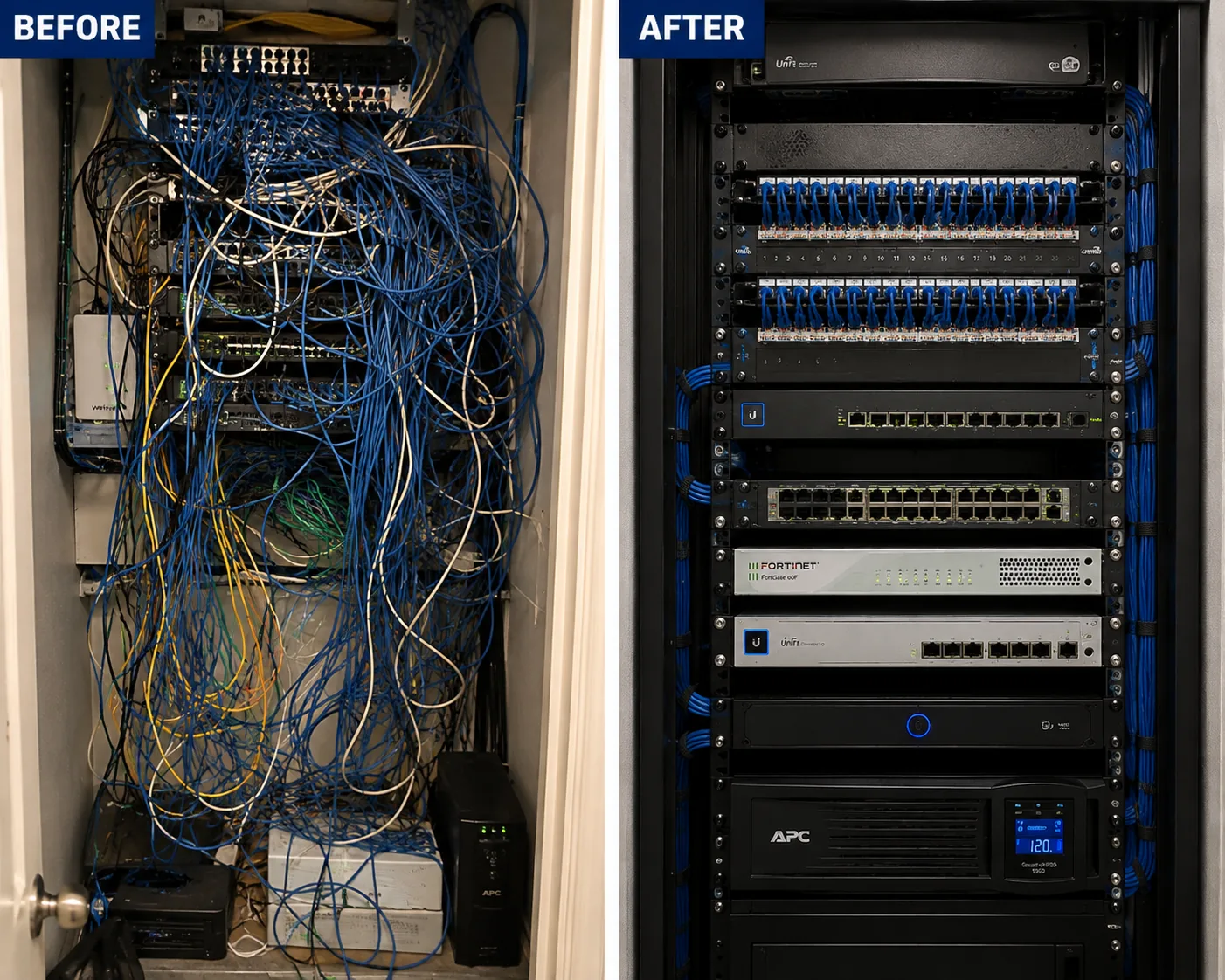
A photo from the AESS job library, not taken in Bedford-Stuyvesant: the same network rack before and after, an unlabeled tangle on one side and a dressed, labeled rack on the other. A Bed-Stuy shop or walk-up's camera equipment is usually smaller than this, a recorder, a switch and a power box on a shelf, but it often looks like the "before" side, and tidying it during a repair is what makes the next fault quick to find.
Complete Services
Every Security Camera Repair Service in Bedford-Stuyvesant
Recorders and drives
DVRs and NVRs that will not boot, record or play back. Request a repair
Is Bed-Stuy charged a different rate from the rest of Brooklyn?
+
No. Bedford-Stuyvesant is billed at the same Brooklyn rate as every other neighborhood in the borough, whether your listing says Bed-Stuy, Stuyvesant Heights, Ocean Hill or Weeksville. What changes a price is access and what the diagnosis finds, not the name of the neighborhood.
Will I get an exact appointment time for the technician?
+
You get a 2-hour arrival window rather than an exact time, because repairs before yours can run long. Requests are booked within 2 hours. If the window does not suit you, we find another day that does.
Can the super or a neighbor let the technician into the cellar if I am at work?
+
Yes, as long as you tell us who it will be when you book and they can reach the recorder and the failed cameras. If the work turns up a choice, such as repair versus replacement, we call you before going ahead.
Does New York require a licensed company to work on a camera system?
+
The state's alarm-installer rules bring a CCTV system under Department of State licensing when it is used to watch for intrusion, break-in, theft or movement. Owners working on their own property, or through their own employees, are exempt. A company you hire should give you its license number; ours is NYS license 12000287431.
I rent an apartment in a Bed-Stuy brownstone and the building cameras are down. Can I book the repair?
+
If the cameras and recorder belong to the landlord, we need the owner's go-ahead before working on them. Send the owner a written note with what is down and since when. If the camera is your own, such as a doorbell you installed on your door, you can book it yourself.
Why does the Wi-Fi camera in our back yard keep dropping off when the front one is fine?
+
In brick row houses, the yard camera is usually the farthest from the router, with solid masonry walls in between. The signal is weak at that spot, so the camera drops whenever it dips. The fix is better signal at the camera, a wired run, or moving the router or adding an access point, and we test the signal before recommending any of them.
What should I write down before I call about a broken camera system?
+
Which cameras are dark, the day it started, anything that happened around then such as an outage, a storm, painting or a break-in, the brand on the recorder, where the recorder sits, and whether you need footage from a specific date. Photos of the recorder screen and label help the most.
How do I stop a burglar from walking off with the recorder and all the footage?
+
Put the recorder somewhere out of sight and hard to reach, such as a locked cabinet or a closet away from the door, rather than on the shop counter or the cellar steps. Where the system supports it, sending alerts or clips to a phone keeps a copy outside the building. We can move the recorder during a repair.
If you replace the hard drive, what happens to the video already on it?
+
A new drive starts empty. If the old drive still reads, we export any clips you want to keep before the swap. If it has failed completely, the video on it may be gone, which is one more reason to export important clips as soon as something happens.
Can a camera be moved to a better spot during the repair visit?
+
Usually, yes. If a camera was pointing at the wrong place or kept getting knocked, moving it while the ladder is already up costs less than a separate visit. On a landmarked front, the new spot has to follow Landmarks guidance on spacing and fixing, and we plan around that.
Do I pay for the service call before the technician comes?
+
Yes. Repair visits are scheduled first come, first served, and a visit goes on the schedule once the service call is paid. The service call is then applied to the repair if you go ahead with the written price.
Can you quote a repair by phone if I already bought the replacement part?
+
Yes. If you are supplying the camera, doorbell or recorder, send the model number and photos of where it goes and we quote the labor by phone or text, then book the visit. The part you supply is covered by its own manufacturer.
More Security Camera Repair near Bedford-Stuyvesant
Ready to Get Your Bed-Stuy Cameras Recording Again?
Send a photo of the recorder screen and the camera that failed with your cross streets, and we will tell you what is likely wrong and what the repair costs on the Brooklyn list. Call or text (347) 934-8335, message us on WhatsApp, or use the repair request form. Licensed under NYS license #12000287431, rated 4.7★ across 201 Google Reviews, owner-operated since 2002, with requests booked within 2 hours.