Recorder dark since the power blinked on your Bay street, a store camera knocked toward the ceiling on 86th Street, or a detective asking for video your co-op cannot pull? Bath Beach camera repair line: (347) 934-8335
Semi-Attached Two-Families · Walk-Up Co-ops · Postwar Rentals on Cropsey · New Condo Towers · Stores Under the D Between 14th Avenue and Stillwell
Security Camera Repair in Bath Beach
Any Brand, Any Installer · Power, Cable, Network and Recorder Tested in That Order · Written Price Before Parts · Brooklyn Rate
Security camera repair in Bath Beach starts with a $150 service call on our Brooklyn list, and the $150 is applied to the repair if you go ahead. Most fixes we see in the neighborhood land between $150 and $1,500: a bad connector or a dead switch port at the low end, one camera replaced in the middle, a recorder and drive replaced or a building rewired at the top. We book within two hours of your call or message, into a two-hour arrival window. This page explains what actually breaks in Bath Beach systems, from the semi-attached brick two-families on the Bay streets to the six-story postwar rentals on Cropsey Avenue and the new condo towers by the bay, why so many failures here start with the power or the internet rather than the camera, and what a repair costs before anyone touches your system.
We repair systems we did not install, including ones whose installer has closed or stopped answering
4.7★ from 201 Google Reviews, and the price is written down before parts go in
Reviewed and updated November 11, 2026, against the Brooklyn Eagle's reports on the July 21 and August 10, 2019 Con Edison outages in Bath Beach; the NYPD's CompStat report for the 62nd Precinct for the week ending October 11, 2026; the Brooklyn Eagle on the 2020 NYPD Argus camera funding for the 43rd Council District; CBS New York on the 2018–2019 southern Brooklyn commercial burglary spree and the Gravesend laundry-room burglary; Brooklyn Paper's 63rd Precinct report of a burglar removing a surveillance disc; News12 on the 2025 Avenue Z burglaries; amNY on the NYPD's dash-camera appeal after the Shore Parkway Greenway attack; the Mayor's Office release on the NYPD camera registration and integration pilot; FirstService Residential on footage access in New York co-ops and condos; HomeAdvisor's security system repair cost guide; Wikipedia's articles on Bath Beach, the BMT West End Line and Lafayette High School; StreetEasy and CityRealty building records for Cropsey Avenue; and BrickUnderground's Bath Beach housing profile. · Abstract Enterprises Security Systems, NYS license #12000287431 · crews dispatched from our office at 1282 Troy Avenue, Brooklyn
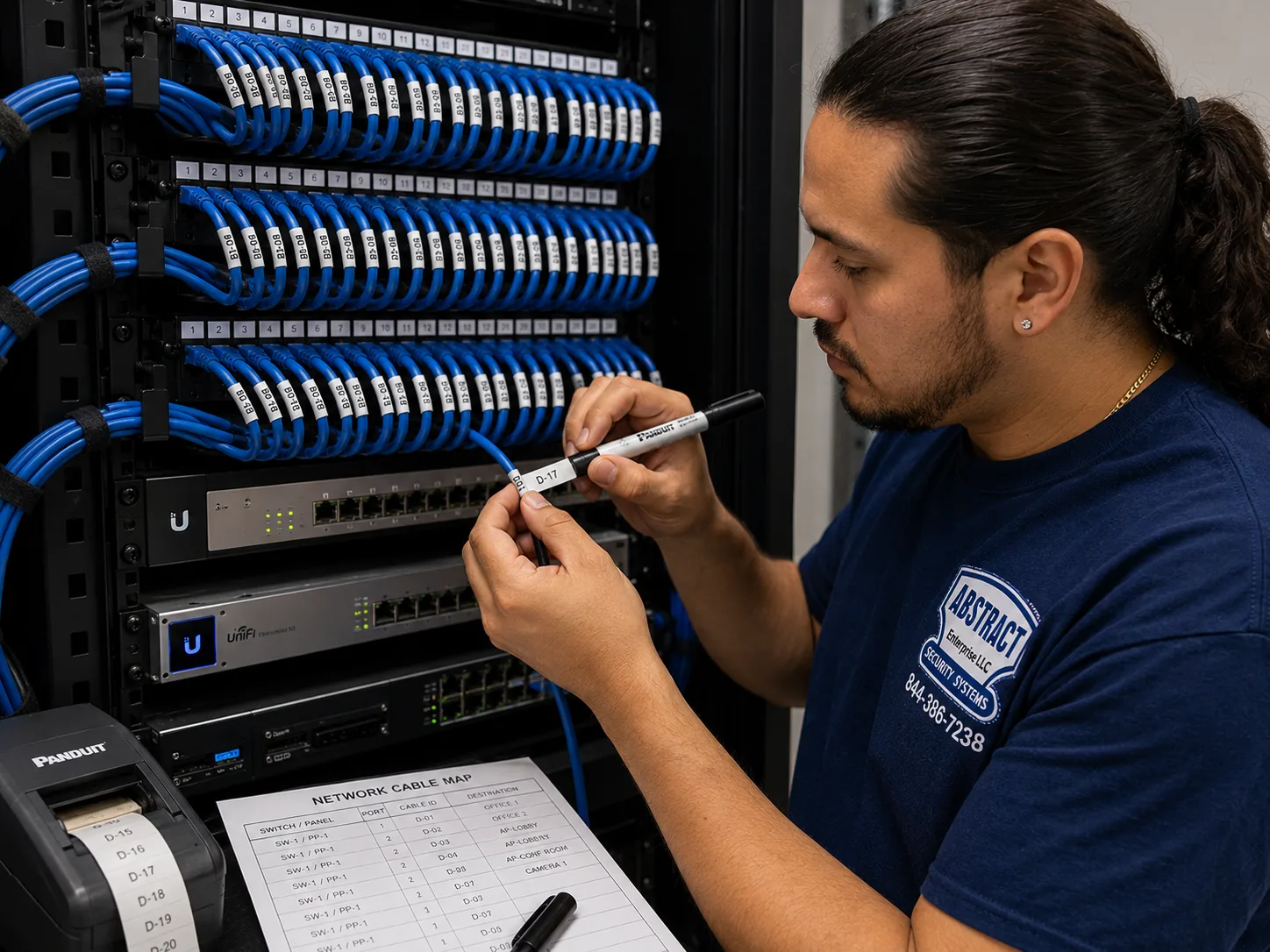
A photo from the AESS job library, not taken in Bath Beach: a technician printing cable labels at a patch panel with a printed port map taped beside it. On a Bath Beach repair, the map comes first. In a two-family on a Bay street it may be four cables in the cellar; in a postwar building on Cropsey Avenue it can be forty, and nobody can fix the right one until each cable is matched to the camera at its far end.
Bath Beach Camera Repair Request
House, walk-up, co-op, condo tower or store: tell us the block and what stopped working, and a technician calls back with the next step
✅
Request Sent!
Thank you. A technician will contact you about the Bath Beach address, usually within two hours.
25+
Years Experience
✓
Same-Day Estimates
100%
Licensed & Insured
4.7★
201 Google Reviews
Owner-operated since 2002 · Thousands of jobs completed · Booked within 2 hours
Quick answer for Bath Beach. A camera repair here is priced from our Brooklyn repair list: a $150 service call that covers the on-site diagnosis and is applied to the repair, $150 to $350 for a connector rebuild or a switch port, $250 to $600 to replace one camera on a working system, $200 to $450 to swap a recorder's hard drive, and $700 to $1,500 for a new recorder with its drive and setup. You get the diagnosis and the written price before any part goes in, and the visit is booked within two hours of your request. Three photos usually tell us most of the story before we arrive: the recorder's screen showing which channels are black, the camera that failed from the ground, and the shelf or closet where the recorder and its power strip sit. Send them with your cross streets to (347) 934-8335 or on WhatsApp.
We tell you plainly when a $150 fix is enough and when the honest answer is a new recorder or a partial rewire, and we say which before we start.
All work is done under New York State license #12000287431. A certificate of insurance for a managing agent, co-op board or condo office costs nothing and goes out before the visit.
If someone else controls the system, such as a landlord, a board or a sponsor's management company, we ask who approves the repair and who holds the recorder password before we book, because that question decides more visits than any part does.
The Neighborhood
Why Bath Beach Properties Need Security Camera Repair
Bath Beach sits in the southwest corner of Brooklyn, between 86th Street and Gravesend Bay, from 14th Avenue and Dyker Beach Park on one side to Stillwell Avenue on the other, inside Community Board 11. Wikipedia counts 33,070 residents at the 2020 census, spread across ZIP codes 11214 and 11228, and describes the housing as working-class: semi-attached houses and small apartment buildings, with shopping at Ceasar's Bay, along 86th Street and on Bath Avenue. That is the short version. The longer version, the one that matters when a camera system stops working, is that Bath Beach has an unusual number of systems that were put in by somebody who is no longer around. A camera system in a two-family house is often bought by one owner, wired by a friend or a small installer, and then inherited by a buyer, a tenant or an adult child who never saw the setup screen. A camera system in a walk-up co-op or a postwar rental may have been added by a superintendent fifteen years ago and extended by three different people since. A camera system in a new condo tower was put in by the sponsor's contractor, whose obligation ends when the building is turned over. When those systems fail, the first job is not fixing a camera. It is finding out what is there.
The second reason Bath Beach keeps camera technicians busy is the power. The neighborhood's electric service has a recent history that every recorder in it has lived through. On Sunday night, July 21, 2019, with temperatures above 90 degrees, the Brooklyn Eagle reported that more than 31,000 Brooklyn households lost power, about 3,600 of them in Bath Beach, and that Con Edison restored most of the neighborhood by 11 p.m. A Con Ed spokesperson told the paper, "The wires were really cooking." Three weeks later, on August 10, about 3,800 customers in Bath Beach and Gravesend lost power again for roughly 90 minutes from around 5:30 in the evening. Neither outage was unusual by city standards, and both were restored the same day. But a recorder does not care how long an outage lasts. It cares whether it was shut down properly, and a sudden loss of power is the one thing most home and small-business recorders handle worst. Many of the "it just stopped" calls we get from older Brooklyn systems trace back to a night like those: a drive that started throwing errors, a clock that reset to the factory date, a switch that came back but did not restart power to every camera.
The third reason is the commercial streets. The stores under the elevated D on 86th Street, the shops on Bath Avenue and Bay Parkway and the businesses near Shore Parkway all rely on street-facing cameras, and those are the ones people try to defeat. CBS New York's report on a 2018–2019 burglary spree across southern Brooklyn, including Bensonhurst, described a suspect using a broom to try to cover a camera, an owner finding cameras broken, and surveillance equipment among the items stolen. That was not Bath Beach, and the 62nd Precinct's CompStat shows burglary down, but it is exactly what a store camera here has to survive, and why many repair calls are about a camera that was moved, covered or broken rather than one that wore out.
There is also a fourth, quieter reason: footage requests. After the attack on a runner on the Shore Parkway Greenway in late October 2026, amNY reported that detectives, citing a lack of cameras and eyewitnesses, asked drivers on the Belt Parkway to check their dash cameras. A suspect was later charged and the case is in the courts, so we say nothing more about it. The lesson for owners on the waterfront blocks is simple: a camera that was offline, recording the wrong date or overwriting itself every three days would have been no help either. A working system records continuously, keeps the right time, holds enough days and exports a clip someone else can play, and most systems we are called to fix here fail at least one of those tests.
Bath Beach facts that change how a camera repair goes
Two outages in three weeks in 2019. About 3,600 Bath Beach customers lost power on July 21, 2019, and about 3,800 in Bath Beach and Gravesend on August 10, according to the Brooklyn Eagle. We ask every caller whether the problem started after an outage, because the answer usually points straight at the recorder, the drive or the switch.
The 62nd Precinct's numbers. CompStat for the week ending October 11, 2026 shows 99 burglaries year to date against 130 a year earlier, down 23.8 percent, while robbery was up 8.9 percent (110 against 101) and grand larceny was nearly flat at 456 against 452. Theft that is not a break-in is what most cameras here are asked to document.
Public cameras do not cover private property. The Brooklyn Eagle reported in 2020 that Councilmember Justin Brannan funded $275,000 for ten NYPD Argus cameras at five locations in a district that takes in parts of Bath Beach and Bensonhurst. Those cameras watch chosen public spots; they do not replace a working camera on your door, your driveway or your register.
Many buildings with many owners. BrickUnderground's profile describes co-ops converted from four-story rental walk-ups, one- to three-family houses, Victorians more than a century old, and three-story condos of six to twelve units built on the lots of demolished houses. Each has a different person who owns the camera system and a different person who has to approve its repair.
Newer towers with sponsor-installed systems. CityRealty lists 2230 Cropsey Avenue as a 31-story, 248-unit building finished in 2024 and Bayview Courtyard at 2286 Cropsey as a 24-story, 151-residence condo finished in 2023. Their camera systems are young, but the first warranty years end, and boards then need someone who can service what the sponsor left.
Low blocks near the water. StreetEasy lists the 1951 garden-apartment complex at 1758 Cropsey Avenue in hurricane evacuation zone 4. Recorders, switches and power supplies kept in cellars on the blocks toward the bay need to sit up off the floor, and we check where they are on every repair.
Where this page applies. It covers the blocks from 86th Street down to the Belt Parkway and Gravesend Bay, from 14th Avenue across to Stillwell Avenue: the Bay streets from Bay 7th to Bay 54th, Cropsey, Bath and Benson Avenues, Harway Avenue, Bay Parkway and 18th through 26th Avenues. The whole borough is covered on our Brooklyn security camera repair page, and every Brooklyn repair is billed at the same Brooklyn rate, so whether your listing says Bath Beach, Bensonhurst or Gravesend does not change the price.
Same-Day Estimates in Bath Beach
Need Repair in Bath Beach? Black Channels on the Recorder, a Phone App That Shows Nothing, or a Camera Staring at the Ceiling
Urgent camera calls from Bath Beach come in three shapes. The first is a recorder screen with some or all channels black, often noticed a day or a week after it happened, because nobody looks at the recorder until they need it. The second is a phone app that suddenly shows nothing, while the recorder itself, if anyone checks it, is still recording; that one almost always follows a change to the internet service, a new router, a new phone or a new password. The third is a camera that has been physically moved, covered, painted, cracked or pulled off its mount, which on a store under the D or a house with a camera over the stoop usually means someone tried to defeat it. Each one has a different first step, and getting that step right is the difference between a $150 visit and a much bigger bill.
If channels are black, do not unplug and replug everything at random. Photograph the recorder screen, note which channels are dark and whether the recorder's lights and fan are on, and tell us if it started after an outage. If the app shows nothing, tell us what changed on the internet side. If a camera was moved or damaged, photograph it first and save the clip from the minute before, which usually shows who did it. Then call (347) 934-8335. We book within two hours into a two-hour arrival window, and the $150 service call covers the diagnosis and a written price for the fix, which the $150 goes toward if you proceed.
What We Install
Security Camera Repair Services in Bath Beach
Every service below starts the same way, with the $150 diagnosis, and is priced from our Brooklyn repair list once we know what failed. We work on systems from any installer and most common brands, analog and IP, wired and Wi-Fi.
Recovery after a power outage
Recorders that will not boot, drives that stopped recording, clocks reset to a factory date and PoE switches that came back without powering every camera, sorted in the order the outage broke them.
Dead channel and cable repair
A black channel traced to the connector, the cable, the switch port or the camera, using a meter, a PoE tester and a cable analyzer, so only the failed part gets replaced.
Recorder and drive replacement
DVR and NVR swaps with the drive sized to how many days of video the property needs, cameras re-added channel by channel and old footage saved first where the old drive allows it.
Remote viewing repair
Phone apps that went blank after a new router, a new internet provider or a new phone, fixed on the recorder's network settings rather than by opening ports to the whole internet.
Tampered and damaged cameras
Cameras pushed off their aim, covered, cracked or pulled from the wall on stores and stoops, re-aimed or replaced, with tamper and video-loss alerts set so the next attempt reaches your phone.
Inherited and orphaned systems
Systems left by a seller, a former super or an installer who closed: every cable traced and labeled, the recorder taken into the current owner's control and a written camera map left behind.
Footage export and evidence copies
Clips pulled to a USB stick in a format others can play, with the camera name, the date and any clock difference written down, before or without any repair.
Building and tower systems
Camera systems in walk-up co-ops, postwar rentals and condo towers serviced for boards and managing agents, with a certificate of insurance and a condition note for the file.
Store, restaurant and yard systems
Cameras over registers, doors and lots on 86th Street, Bath Avenue, Bay Parkway and near Shore Parkway, repaired before opening or after closing so the business keeps running.
Building Specialists
Security Camera Repair for Bath Beach's Architecture
A camera repair is shaped by three things that depend on the building: where the recorder lives, how the cables reach the cameras, and who has the right to say yes. Bath Beach mixes building types more than most neighborhoods, so the same symptom, one black channel, means a ten-minute fix in one house and a cable hunt through four floors in the building next door.
The semi-attached two-family
The most common house on the Bay streets. The recorder usually lives in the cellar or a front-room closet, and an owner on one floor and a tenant on the other may both use the cameras.
The surviving frame house
Older wood houses such as the Victorian at 122 Bay 26th Street, with porches, deep eaves and wiring that was added room by room over a century.
The walk-up and walk-up co-op
Four-story buildings like the two 1915 walk-ups at 2100–2106 Cropsey Avenue, many later converted to co-ops, where cameras watch a vestibule, a stair and a back door.
The postwar rental and garden apartments
Buildings like the six-story, 42-unit 2036 Cropsey Avenue from 1948 and the 84-unit garden complex at 1758 Cropsey from 1951, with long runs to courtyards, laundry rooms and lots.
The co-op and condo tower
Elevator buildings from postwar co-ops on Shore Parkway to the 2023 and 2024 towers on Cropsey Avenue, where a board or managing agent controls the system and staff use it daily.
The small infill condo and the store with apartments above
Three-story condos of six to twelve units on old house lots, and 86th Street buildings where the store's cameras and the residents' cameras often share a cellar and a power strip.
The semi-attached two-family: one recorder, two households and a cellar that floods from time to time
City sales records show how central the two-family house is to Bath Beach: the Department of Finance's 2022 neighborhood sales list counts 74 two-family sales in Bath Beach against 19 one-family sales, and its 2024 list shows 44 against 12. In a semi-attached brick two-family, the camera system is usually small, four to eight cameras, with one at the front door or stoop, one down the side path or shared driveway, one or two at the back door and yard, and sometimes one in the cellar or the shared hall. The recorder lives wherever the person who installed it found an outlet and a shelf, which in practice means the cellar, the boiler room, a closet under the stairs or a shelf beside the router in the front room. Each of those spots has its own way of killing a recorder. A cellar can be damp, and on the lower blocks toward the bay it can take water. A boiler room is warm and dusty, and recorders depend on their fans. A shelf next to the router is fine until someone needs the outlet for a space heater and unplugs the recorder to use it.
The other feature of a two-family is that two households often share the system: the owner set it up, the tenant has the app because the login was shared years ago, and nobody remembers which email the recorder account was made with. We sort out access with the owner before touching anything, and on the repaired system we set up a separate login for each household where the recorder allows it, so a future tenant can be removed without changing the owner's password. If cables run through the tenant's apartment, arrange their access before the visit.
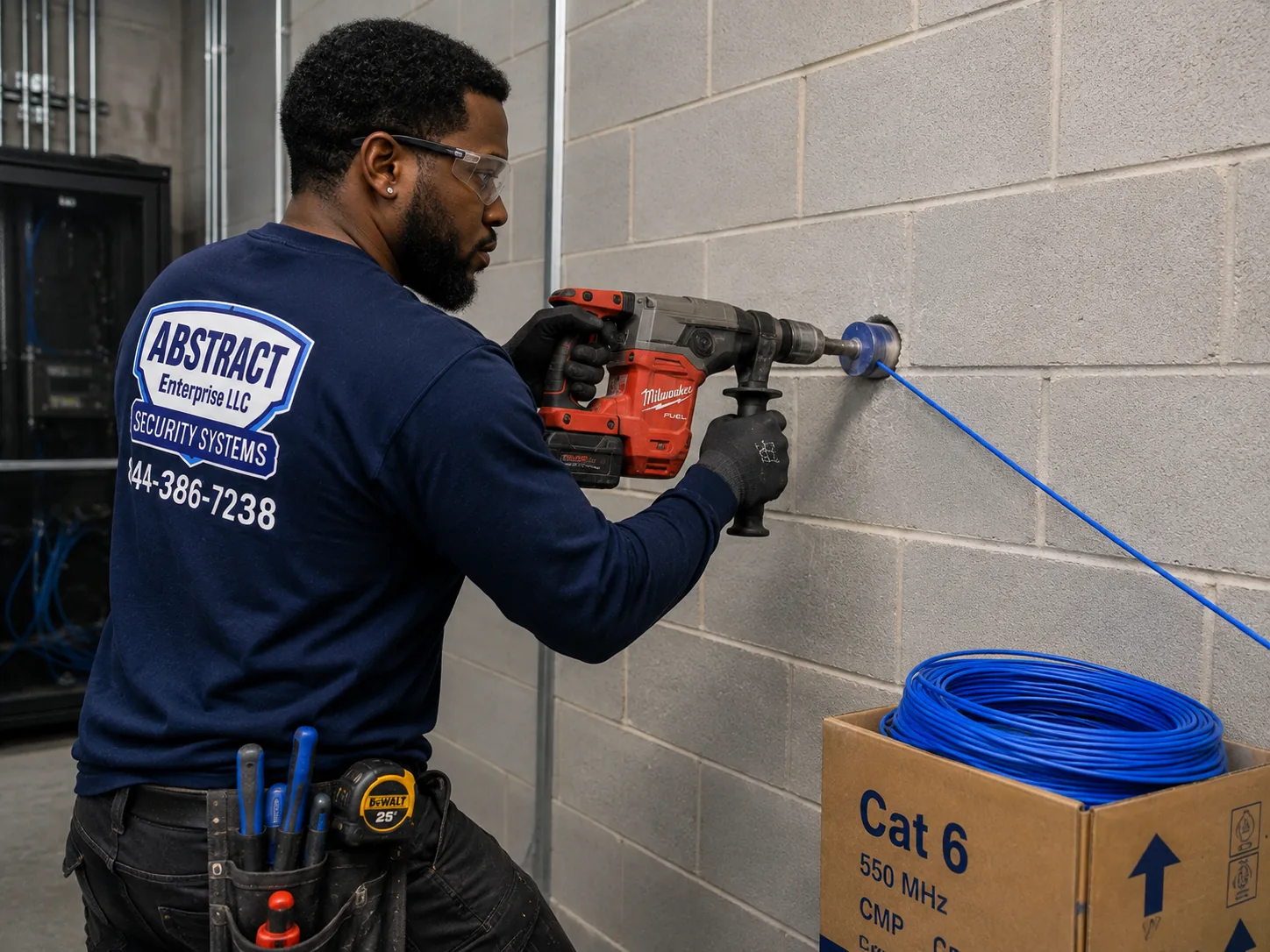
A photo from the AESS job library, not taken in Bath Beach: a technician core drilling through a block wall so a cable can reach a network room. In a Bath Beach two-family, the cellar wall between the front of the house and the yard side is often the obstacle when a camera cable has to be replaced, and a clean drilled pass with a sleeve is how we stop a new cable from being crushed or chewed where it goes through.
The surviving frame house: porch posts, deep eaves and wiring nobody drew
Bath Beach still has some of the wood-frame houses from the decades when it was a resort and then an early commuter suburb, though most have been replaced or covered over. Bklyner described the Victorian at 122 Bay 26th Street, between Benson and Bath Avenues, as one of the neighborhood's notable survivors, and Brownstoner has listed a detached three-family Victorian on Bay 23rd Street built around 1910. Camera systems on houses like these are usually mounted on porch ceilings, under eaves and on the corner boards, and the cables run through attics and down inside walls that were opened and closed several times over a century. That makes repairs on frame houses less predictable than on brick. A camera under a deep eave can sit in a pocket of damp air that never dries, which shows up as corroded connectors at the camera end rather than a failed camera. A cable stapled along an attic rafter can have been pierced by a roofer's nail years after it was run.
We work on frame houses from the camera end inward: the junction box behind the camera first, because a crusted connector there is a $150 to $350 fix on our list rather than a new camera, then an end-to-end cable test before anyone climbs into an attic. Frame houses also tend to have the most mixed systems, an old analog camera on the porch, an IP camera at the back and a Wi-Fi doorbell at the door, and part of the repair is often deciding whether to bring them under one recorder.
The walk-up and walk-up co-op: vestibule, stairs and a recorder in the cellar or the super's closet
The four-story walk-ups on Cropsey Avenue, Bath Avenue and the Bay streets were built mostly as rentals, and BrickUnderground notes that many Bath Beach co-ops were converted from rental walk-ups. StreetEasy's record for 2100–2106 Cropsey Avenue describes two four-story prewar walk-ups with 44 apartments between them, built in 1915, which is typical of the type. Cameras in these buildings watch the outer vestibule and mailboxes, the inner lobby door, the stair at each landing, the cellar door and the back yard or alley, and the recorder sits in the cellar, in the super's closet or in a locked box in the lobby. Cable runs go up the stair hall in surface raceway or through the old dumbwaiter or riser chase, and that is where most failures happen: raceway knocked loose by deliveries, a cable crushed when a door frame was replaced, a junction behind a ceiling panel that a plumber disturbed.
In a co-op walk-up, the common-area cameras belong to the corporation, the board decides on repairs and the managing agent usually holds the contract; a shareholder cannot authorize a repair alone. In a rental walk-up, the landlord or agent decides. Either way, passwords tend to live on a sticky note inside the recorder cabinet. We arrange access with whoever approves the work, send the certificate of insurance first, and leave a condition note listing every camera, what was fixed and what we would replace next.
The postwar rental and garden apartments: long runs, laundry rooms and courtyards
Bath Beach's postwar buildings are some of the largest camera systems in the neighborhood outside the towers. StreetEasy lists 1758 Cropsey Avenue as a three-story garden apartment complex with 84 units, built in 1951, in hurricane evacuation zone 4, and Openigloo lists 2036 Cropsey Avenue as a six-story, 42-unit building from 1948 with rent-stabilized apartments. Buildings like these have more than one entrance, a laundry room, a boiler room, a courtyard or a parking area and often a separate trash or storage area, and the camera system grew to match. The cables are long, sometimes longer than an ordinary network cable is meant to run between a camera and the switch, which is about 100 meters. When a camera at the far corner of a garden complex goes dark, the cause is often a run that was always marginal and finally failed when a connector aged, rather than the camera itself.
The flood question matters most in these buildings. A recorder, switch and battery backup on the floor of a cellar on a low block are one storm or burst pipe from a full system loss, so on repairs toward the bay we move head-end equipment onto a wall shelf or into a rack, usually in the same visit. Many postwar buildings also still have coax from 1990s and 2000s analog systems. Modern analog-HD cameras can often reuse it and save a rewire, but we test every coax run first, because kinked, spliced or soaked coax will not carry the newer signal reliably.
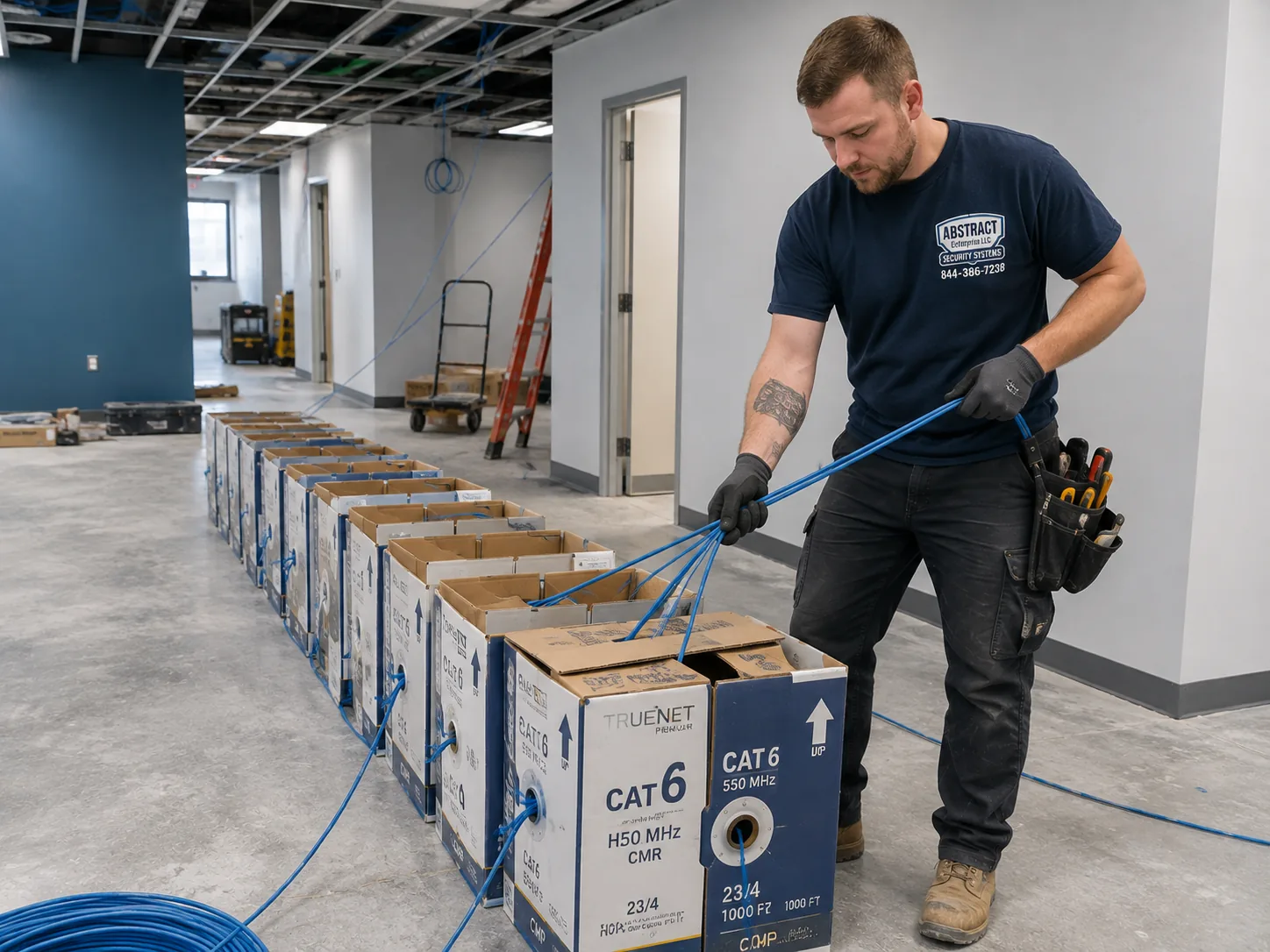
A photo from the AESS job library, not taken in Bath Beach: several boxes of cable staged side by side for a multi-drop pull on a working premises. When a postwar building on Cropsey Avenue needs several dead camera runs replaced at once, staging the boxes like this lets the technician pull several cables through a stair hall or a cellar in one pass instead of opening the same raceway four times.
The co-op and condo tower: staff, schedules and a sponsor's system
Bath Beach's tall buildings range from postwar co-ops along Shore Parkway and Cropsey Avenue, where Homes.com describes the Waterview Towers co-op at 1935 Shore Parkway as an elevator high-rise with night-time security and a video intercom, to the newest condos. CityRealty describes 2230 Cropsey Avenue as a 31-story, 248-unit building finished in 2024 with a full-time doorman, and Bayview Courtyard at 2286 Cropsey as a 24-story, 151-residence mixed-use condo finished in 2023. In buildings like these, the camera system is a working tool: the doorman watches it, the super uses it to answer complaints, and the board or managing agent is asked for footage after every package theft, parking dispute and fender-bender in the garage. A dead camera in a tower is noticed quickly, and the repair has to fit around staff schedules, elevator reservations and building rules on contractor hours.
Newer towers bring a specific problem: the sponsor's system. The developer's contractor often holds the only complete record of how it was set up, and once the building is turned over, the board can inherit a system it lacks the administrator password for. Older co-ops have the opposite problem, twenty years of add-ons from several vendors. Either way we start with an inventory of every camera, switch, recorder and account, with both ends of every cable labeled, so the board is never tied to one vendor.
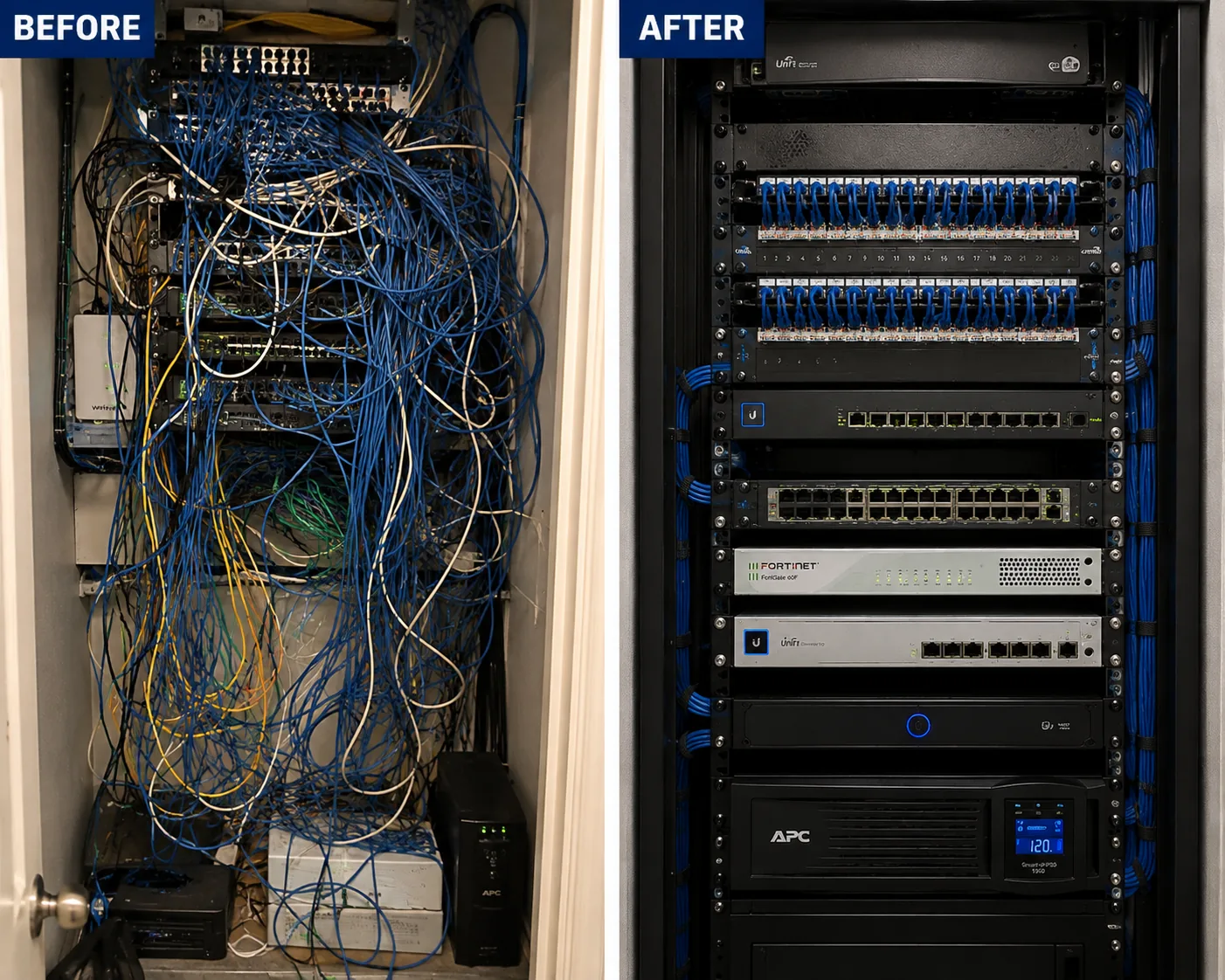
A photo from the AESS job library, not taken in Bath Beach: the same network rack before and after, an unlabelled tangle rebuilt into a dressed, identified rack. This is what a co-op or condo board in a Bath Beach tower is really paying for on the first service visit after years of add-ons: a head end where any technician can find camera 23's cable in under a minute.
The small infill condo and the store with apartments above
BrickUnderground's 2022 profile of Bath Beach noted that newer three-story condos of six to twelve units have gone up on lots where older houses were demolished, and broker Dan Gallogly told the site, "There's no vacant land." These buildings usually have a small camera system put in by the builder: a camera at the front door, one at the back, one in the hall, and a recorder in a utility closet with the building's internet box. They are often the systems with the least documentation of all, because a small condo may have no managing agent and a board of two or three unit owners who never received the login. Repairs here are usually quick once someone can prove they speak for the association, and the most useful thing we do is leave the association with the recorder's administrator account in its own name, not the builder's.
The store-and-apartments buildings on 86th Street and Bath Avenue raise a different question: whose camera is it? The store may own the shop cameras and the landlord the residents' door and hall cameras, sometimes on one shared recorder. We settle who owns and pays for what before the visit, and where both run on one recorder we separate the logins so neither side sees or changes the other's cameras.
Field Notes
Field Notes: The Order a Technician Checks a Dead Bath Beach System
These notes describe how our technicians work through a failed camera system in buildings like Bath Beach's. They describe our practice, not a story about any one address.
Ask about the last week first. Before any tool comes out, the technician asks what changed: an outage, a storm, a new router or internet provider, a renovation, a new tenant, a break-in, a cleaner who moved the recorder to dust behind it. On Bath Beach jobs, the answer to that question often names the fault before the meter does.
Start at the power. The technician checks the outlet, the power strip, any battery backup, the recorder's power supply and, on IP systems, whether the PoE switch is supplying power on the ports for the dead cameras. A switch that lost one port's power in a surge looks, from the recorder, exactly like a dead camera.
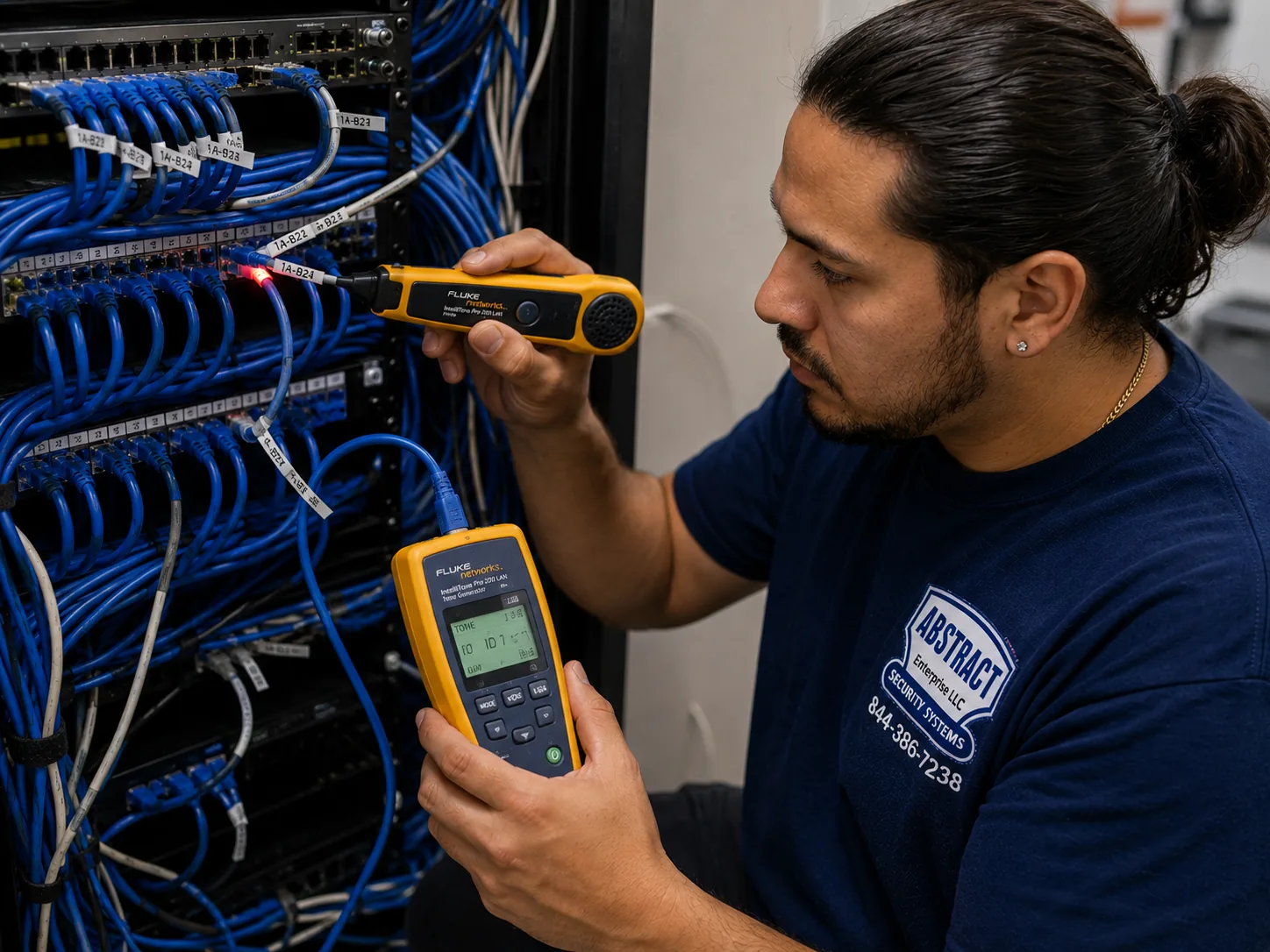
A photo from the AESS job library, not taken in Bath Beach: a technician tracing an unidentified cable run at a patch panel with a tone generator and probe. On an inherited Bath Beach system with no labels, this is how we find which of a dozen identical gray cables in the cellar goes to the camera over the back door, before cutting or re-terminating anything.
Then the cable, both ends. The technician looks at the connector at the camera end, then tests the run with an analyzer. A cable that tests clean moves the search to the camera; a cable that fails gets traced to find where.
Then the recorder's own story. The recorder's log shows when each channel dropped, whether the drive reported errors, and whether the clock jumped. That log is often the only record of when an outage or a tampering happened.
Price before parts. Only after those four checks does the technician name the fault and write the price. If the fault is bigger than the visit, you hear that before anything is opened up.
After the Lights Come Back
When Con Ed Restores the Power but the Cameras Don't Come Back: Outage Damage in Bath Beach Systems
The 2019 outages are the best-documented recent ones in Bath Beach, but a block-wide outage, a tripped cellar breaker and a tenant pulling the wrong plug all do the same things to a camera system. Councilmember Justin Brannan told the Brooklyn Eagle in 2019 that Con Ed restores power but "reasons rarely given and nothing changes." For a camera technician, what matters is what the outage left behind, in roughly the order we look for it.
A recorder that will not finish starting. Recorders are small computers. Cut their power while they are writing video and the operating system or the recording database can be left half-written. Some recorders recover on their own after a slow restart; others hang on the logo screen, restart in a loop or come up with no cameras configured. The first test is a clean, patient restart with a known-good power supply, and if that fails, the recorder's own recovery tools. A recorder that cannot be recovered is a replacement, and on our Brooklyn list a DVR or NVR replacement with its drive and setup runs $700 to $1,500 depending on the channel count and the cameras it has to work with.
A drive that went bad. The hard drive takes the worst of a sudden power loss, because it is usually writing when the power goes. The symptoms are recordings that stop on the date of the outage, a recorder that says the drive is "abnormal," "unformatted" or "error," or playback that shows gaps and then nothing. A drive swap is $200 to $450 on our list depending on capacity. Before we replace a failing drive we try to copy any footage the owner needs, but we never promise recovery from a drive that has failed mechanically; that is a lab job, and we say so.
A clock that reset. Many recorders keep time with a small battery on the board and, if they are online, with an internet time server. After an outage, a recorder whose board battery is weak and whose internet connection is down can wake up in the year it was made. It keeps recording, so nobody notices, but every clip it saves is stamped with the wrong date. That is the fault that turns a useful recording into an argument when it is handed to an insurer or a detective. We set the time, point the recorder at a time server, replace the board battery where the model allows, and note the offset if older footage was recorded with the wrong time.
A switch that came back halfway. On IP systems, the cameras get their power from a PoE switch or from the recorder's built-in ports. A surge can kill one port, a group of ports or the switch's power budget, so that some cameras return and others stay dark. From the recorder screen this looks exactly like four dead cameras. A PoE tester on the switch port settles it in a minute, and a failed port is usually a $150 to $350 fix on our list, by moving the camera to a working port or replacing the switch.
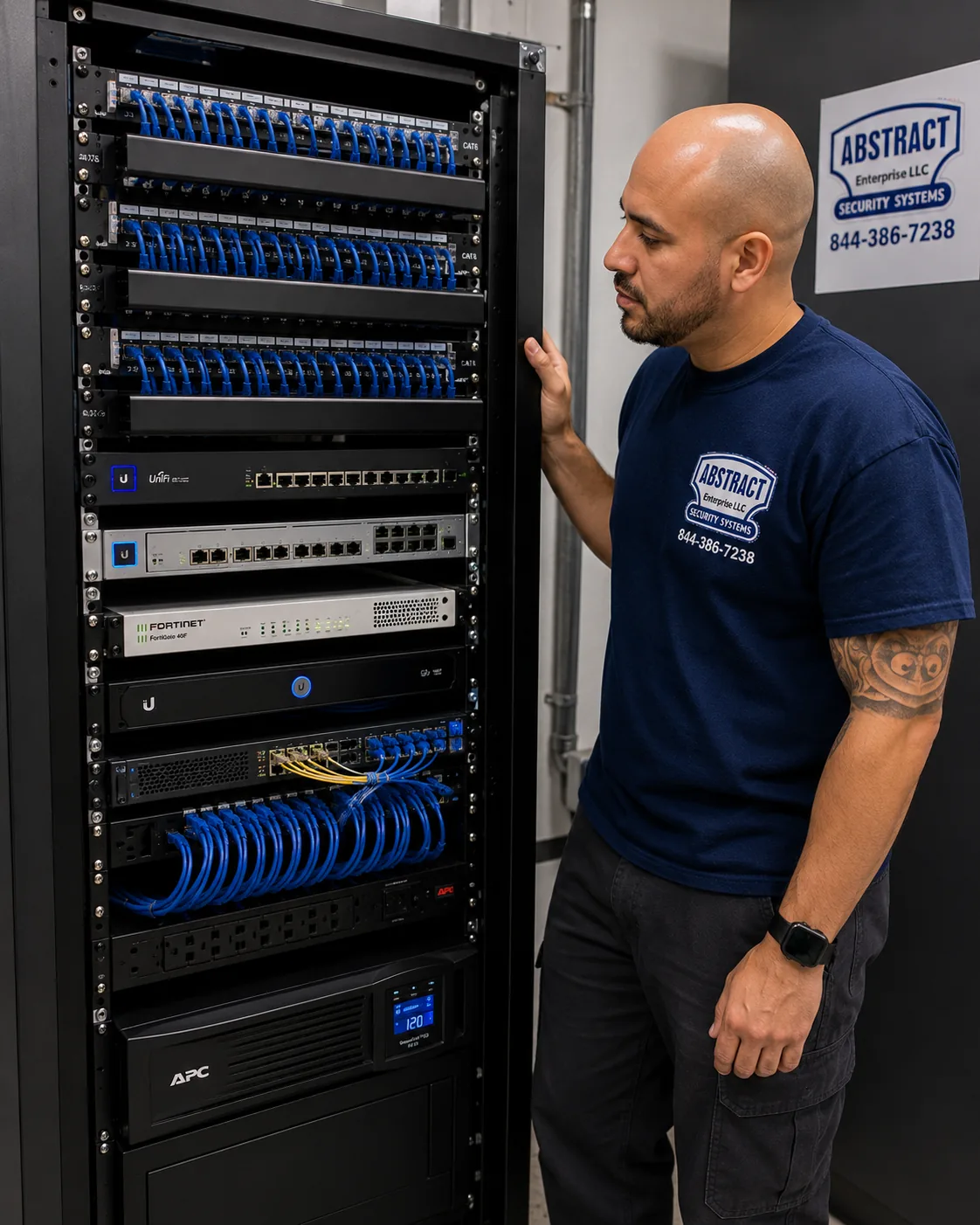
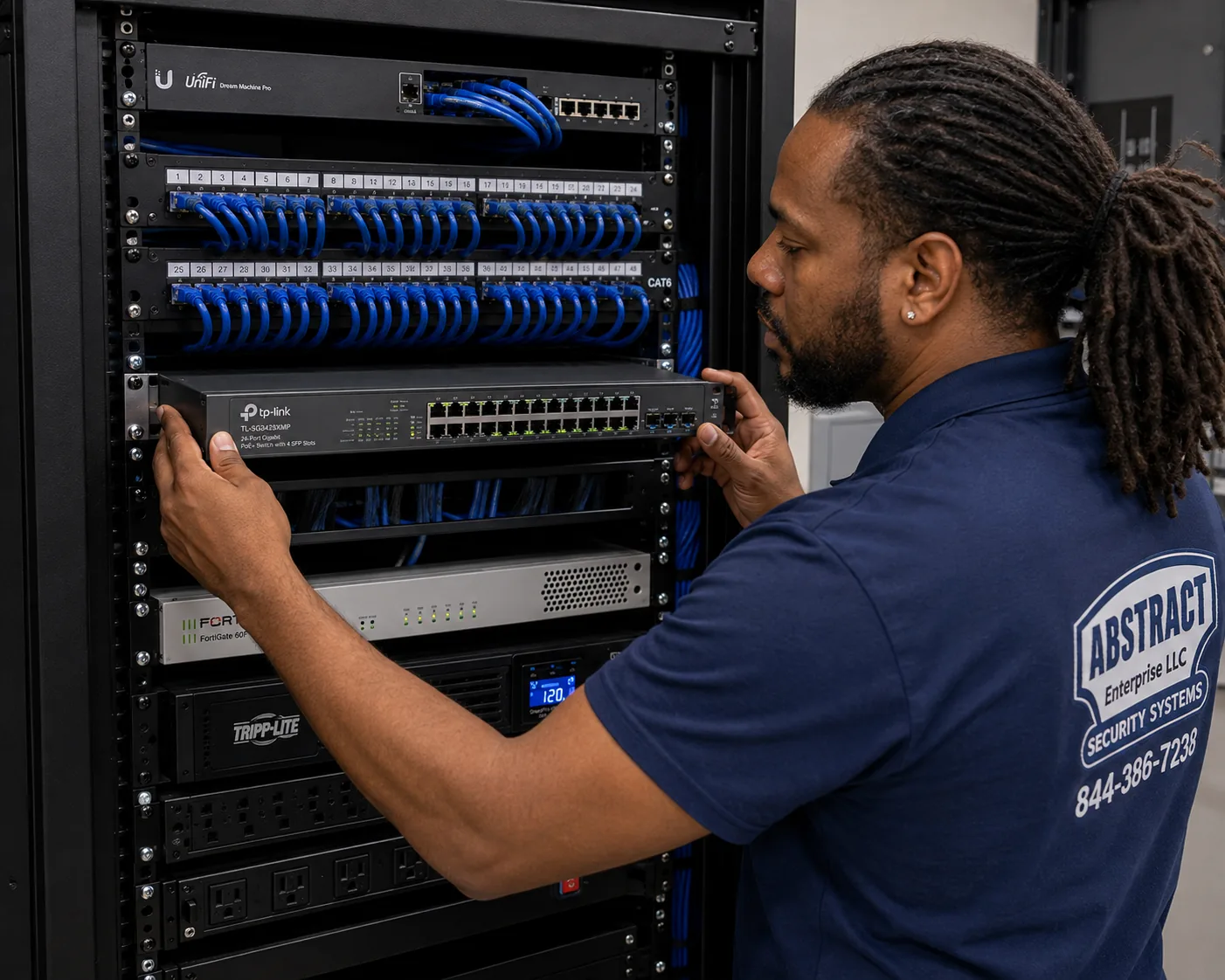
A photo from the AESS job library, not taken in Bath Beach: a finished network rack with patch panels, switching, a firewall and a battery backup at the bottom, every cable dressed and identified. The battery backup is the part that matters most after an outage on the Bath Beach blocks; with one sized for the recorder and the switch, the cameras ride through a short outage and the recorder shuts down cleanly in a long one instead of crashing.
What prevents most of it. A battery backup, also called a UPS, on the recorder, the switch and the internet router turns an outage from a crash into either nothing at all or a clean shutdown. Sized correctly, a small UPS carries a home system through the kind of short flicker that happens a few times a year and gives the recorder time to close its files in a longer outage. We size it to the actual load we measure, not the label, and we set it up so the recorder knows when the battery is running low where the recorder supports that. One honest limit: we are low-voltage technicians, not electricians. If the recorder shares a circuit with a space heater or a freezer, or the outlet is loose or ungrounded, we will tell you, but the new outlet or circuit is a job for a licensed electrician.
Tampering and Break-Ins
Covered, Cracked or Carried Off: Repairing a Bath Beach System Someone Tried to Beat
The southern Brooklyn cases on the record show the three ways people go after a camera system. They block the view, as in the CBS report of a suspect using a broom to try to cover a camera and the Gravesend laundry-room burglar who covered the camera before drilling. They break the camera, as the Lucky 7 owner found. Or they take the recording, as in the 63rd Precinct case Brooklyn Paper reported, where a store burglar "removed a disc from a surveillance system," and the Sneaker Corner burglary, where surveillance equipment was among the things stolen. Repairing a system after any of those is partly about replacing what was damaged and partly about making the next attempt fail.
A camera that was pushed or covered. Many camera mounts on stores and stoops in Bath Beach are within reach of a broom handle or a person standing on a milk crate. The repair is to re-aim and lock the mount, and often to move the camera a foot or two higher or further back under the soffit, where it still sees faces but cannot be reached without a ladder. Then we turn on the recorder's tamper detection, which watches for the picture suddenly going dark, blurred or shifted, and its video-loss alarm, which watches for a camera disappearing from the network. Both send a phone alert when they are set up correctly. On systems we inherit we often find both switched off, because they produce false alerts until they are tuned and somebody got tired of the notifications.
A camera that was cracked or broken. Where cameras get hit, we replace them with impact-rated vandal-resistant domes on security screws, and run the last foot of cable inside a back box or conduit so it cannot be cut from below.
A recorder that was taken or opened. This is the failure that loses everything, and it is the one most easily prevented. A recorder on an open shelf behind the counter is the first thing a burglar who knows what he is looking for will pull. When we replace a stolen or damaged recorder, we put the new one somewhere that takes time to reach: a locked metal cabinet, a locked closet, a ceiling space or a back room, with its cables protected. And we set up a second copy of the most important footage away from the recorder, using the recorder's own cloud or remote backup where the brand offers it, or a second small recorder somewhere else in the building. The second copy does not need to be every camera; the door, the register and the back exit are usually enough.
Footage That Holds Up
The Day Someone Asks for Video: Getting Bath Beach Footage Out of the Recorder and Into the Right Hands
Most people find out whether their camera system works on the day they need a clip from it. A detective from the 62nd Precinct canvassing the block, an insurer asking for proof of a break-in, a co-op board settling a dispute about a damaged car in the lot, a store owner who needs the minute before the window broke: all of them need the same four things, and a system that has been running untouched for years often fails one.
The recording has to exist. Many systems we inspect are set to record only on motion, and their motion zones were drawn years ago for a different view. Others are recording, but their drive holds only a few days because it is small or because every camera records at its highest setting all the time. The fix is a recording plan that matches the property: continuous recording on the cameras that cover doors and registers, motion recording on the rest, and a drive sized for the number of days you want kept. FirstService Residential, which manages condo and co-op buildings in New York, says footage is generally kept for 30 to 90 days depending on building size, storage and legal requirements. A two-family rarely needs 90 days, but a week is too short for anyone who travels.
The clock has to be right. A clip stamped with the wrong date or an hour off because the recorder never changed for daylight saving time is still evidence, but it needs explaining, and every explanation weakens it. On every repair we sync the clock and write down any offset older footage carries.
The footage has to leave the building in a playable form. Every brand has its own player and its own file format. Detectives and insurers can usually handle that, but a clip that only plays in software they do not have is a delay. We test an export on every repair: a short clip to a USB stick, in the recorder's own format with its player and in a common video format where the recorder offers one, and we show the owner how to do it again. If you have been asked for footage and do not know how to get it out, we can do the export as a visit on its own.
The right person has to release it. In a house, that is the owner. In a co-op or condo, it is not any one shareholder or board member. FirstService's guidance is that requests should go to the property manager with the reason, the time frame and the cameras to check, that access should be logged, and that residents should not receive copies without the board's approval and legal advice. Christina Forbes, president of FirstService Residential's Manhattan condo and co-op division, put it plainly: "Limiting access protects the privacy of residents and helps prevent potential misuse." When we repair a building system, we set up the recorder so the people who release footage have their own logins and the export history is kept.
For businesses, the NYPD has a voluntary program. The Mayor's Office describes a free pilot in which "camera registration informs the NYPD where cameras are located in case a crime or incident occurs, and camera integration provides the NYPD with real-time access to camera feeds." It started in Flushing's 109th Precinct and expanded to nine precincts the release did not name. Both choices are the owner's, and either is only worth something on a system that records and keeps time correctly.
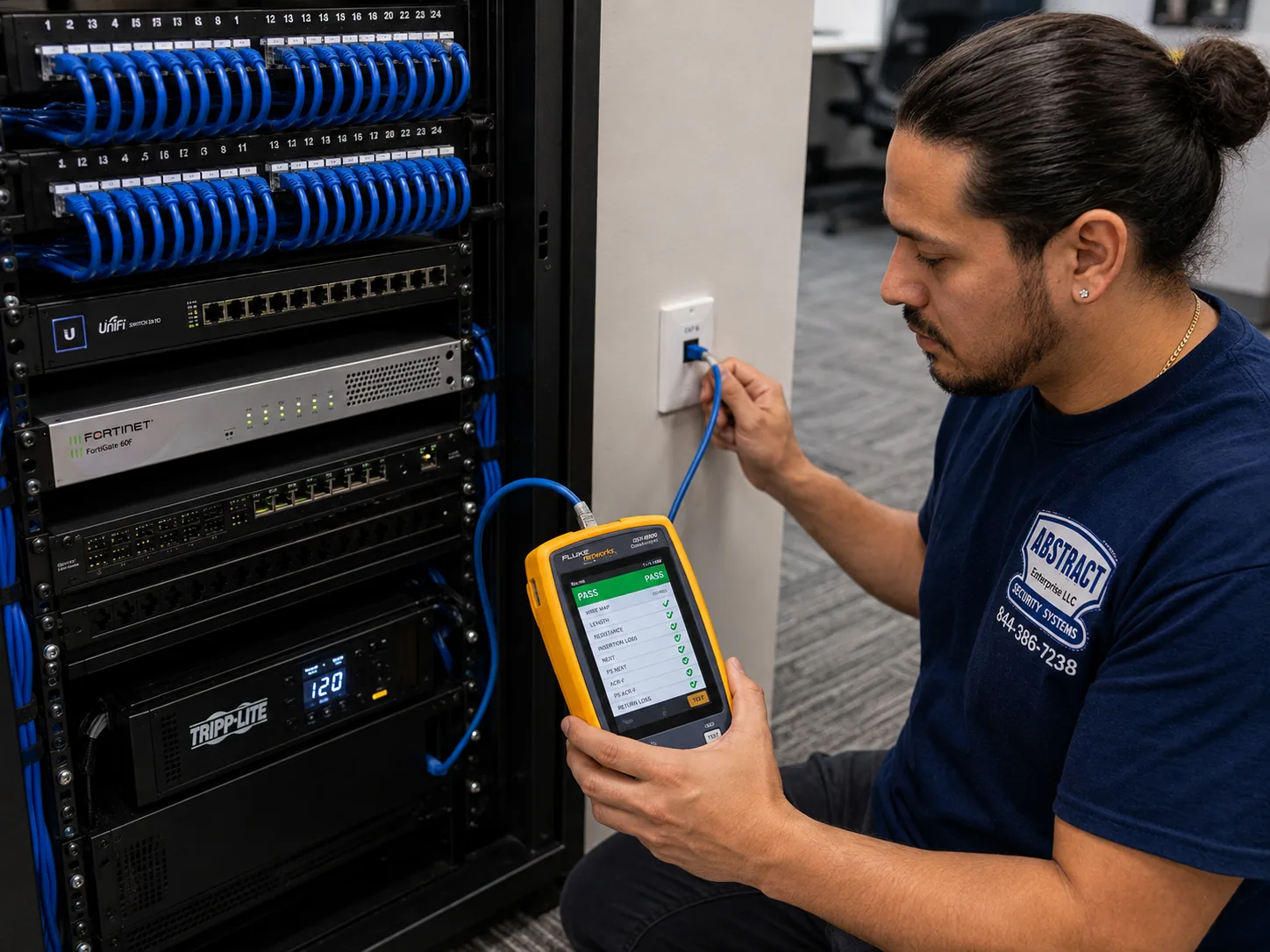
A photo from the AESS job library, not taken in Bath Beach: a technician certifying a data drop with a cable analyzer that reads PASS. Before we tell a Bath Beach owner that a camera is dead, we prove the cable to it is good, because replacing a camera on a bad cable fixes nothing and the same black channel is back within a week.
Commercial Security Camera Repair
Business Security Camera Repair in Bath Beach
Bath Beach's businesses sit on a handful of streets: 86th Street under the elevated West End Line, which Wikipedia notes opened in stages in 1916 and 1917; Bath Avenue, with its run of small shops and restaurants; Bay Parkway down toward Bensonhurst Park and the Belt Parkway; Cropsey Avenue; Harway Avenue toward Stillwell; and the Ceasar's Bay shopping center on Shore Parkway, which Hey Ridge records opened on June 4, 1982 on the old Korvette site. The cards below describe the kinds of business camera systems we repair on those streets; we do not name any business as a customer.
86th Street storefronts under the D
Shops whose door and window cameras face a busy sidewalk and a steel el, where grime, pigeons and passing hands knock views off and connectors corrode under the tracks.
Bath Avenue shops and restaurants
Small businesses with four to eight cameras on a recorder behind the counter, often in buildings with apartments above and a shared cellar where the recorder ended up.
Bay Parkway offices and services
Medical, professional and service offices with cameras at the door, the waiting room and the back entrance, where staff need playback more than live view.
Cropsey Avenue and Harway Avenue businesses
Auto, contractor and service businesses with lots, gates and roll-downs, where outdoor cameras on poles and fences take weather and impact.
Yards and lots near Shore Parkway
Storage, delivery and container yards where cameras sit far from the building on long cable or wireless links, and one failed link blinds the whole far corner.
Shopping center tenants by the bay
Tenants whose own in-store systems sit alongside the landlord's, with lease rules on contractors, insurance and working hours before opening.
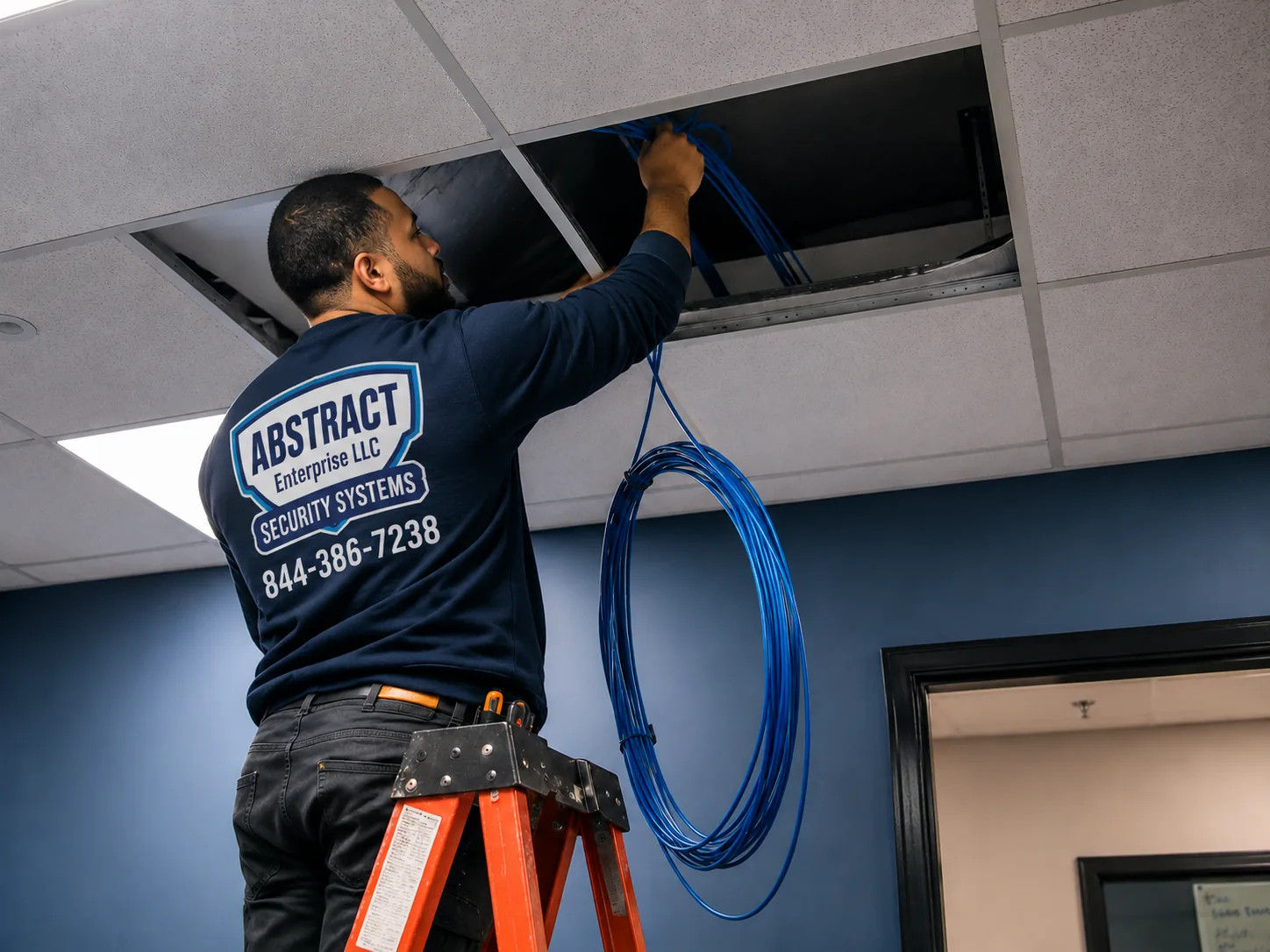
A photo from the AESS job library, not taken in Bath Beach: a technician feeding cable through the ceiling of an occupied commercial space. On a Bath Avenue or 86th Street store, a dead camera over the register usually means working above customers' heads, so we plan the ladder work for the quiet hour or before opening and keep the floor clear the whole time.
Business camera repairs in Bath Beach usually happen in buildings the business does not own, with a landlord who wants to approve anything fixed to the facade and sometimes apartments above. A store on 86th Street may be told by its landlord which contractor can work on the building's exterior. A tenant in a shopping center may have a lease that requires insurance paperwork naming the landlord before any contractor arrives. So before a business repair we confirm three things: who approves exterior work, when the space can be worked in without customers in the way, and who should receive the certificate of insurance, which we send free before the visit. We price a business repair the same way as a home one, from the Brooklyn list, and the diagnosis is the same $150 service call.
Business systems here fail in recognizable ways. Cameras under the elevated tracks on 86th Street collect grime fast, so a clean and a connector rebuild solves more problems there than a new camera does. Restaurant systems suffer from grease, heat and recorders stuffed into hot offices. Lot and yard systems near Shore Parkway lose their far cameras when a long cable or wireless link fails, and Brooklyn Paper's report of $50,000 in tools taken from a container near Shore Parkway and Eugene R. Romano Lane in December 2023 is a reminder that the far corner is where the camera has to work. Every business repair ends with an export test.
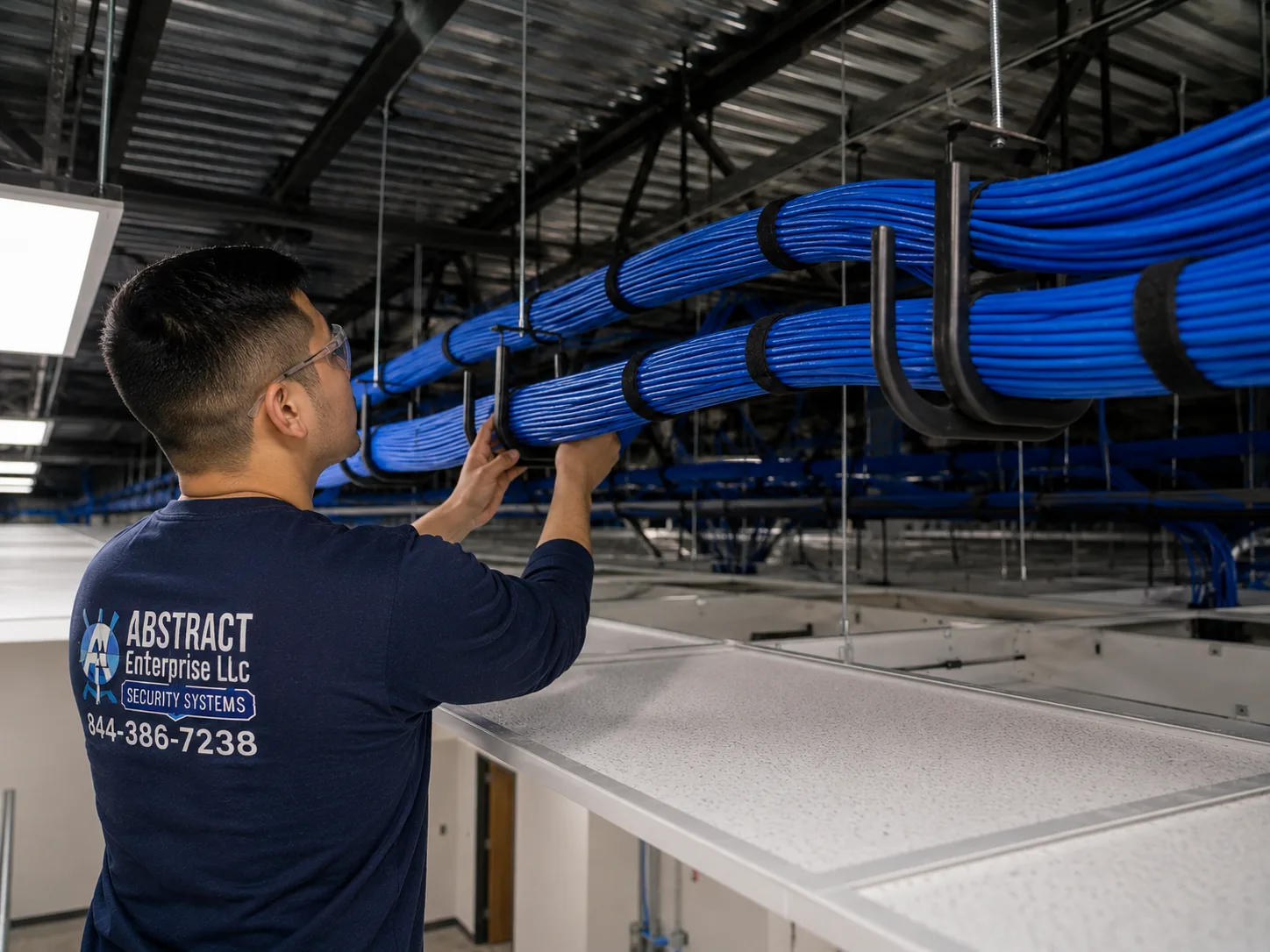
A photo from the AESS job library, not taken in Bath Beach: J-hooks carrying dressed bundles of cable across a commercial ceiling. In a Bath Beach shopping-center unit or a deep store on Bay Parkway, camera cables that were simply laid on top of ceiling tiles are the ones that get crushed when another trade works up there, and supporting them on hooks is part of the repair.
Rules that apply to business camera repairs in Bath Beach
Licensed work. New York State requires a Department of State license to install or service security systems, and the state's rules (19 NYCRR 195.2) cover closed-circuit TV when it is used to detect or monitor intrusion, theft or movement. An owner installing on their own property, or using their own employee, is exempt. Our work is done under NYS license #12000287431.
Notice to employees. Under New York Labor Law section 203-c, employers who monitor employees electronically must give written notice and get acknowledgment. If a repair adds or moves cameras that cover work areas, the business should update its notice. We tell you when a change affects it; the notice itself is your paperwork.
No cameras in private spaces. We do not place or repair cameras that view restrooms, changing areas or other places where people expect privacy, at a business or anywhere else.
Exits and fire equipment stay clear. Repaired cameras, cables and cabinets do not block exit signs, sprinkler heads, fire alarm devices or the swing of an exit door, and cables stay off the floor in any route people use to leave.
Power work goes to an electrician. We supply and wire low-voltage equipment. If a repair needs a new outlet, a dedicated circuit or work inside an electrical panel, a licensed electrician does that part, and we tell you exactly what to ask for.
Your Questions Answered
Security Camera Repair in Bath Beach: Questions Answered
These are the situations Bath Beach owners, boards, tenants and store owners describe when they call. Each is answered here in full and not repeated in the FAQ further down.
After an outage or a power problem
When the power came back on our block, the recorder restarted but two of our six cameras never came back. Why would some return and others not?
Because the cameras that came back and the ones that did not are usually powered differently. On an IP system, each camera draws power through its cable from a PoE switch or from the recorder's own ports, and a surge when the power returns can kill individual ports while the rest keep working. On an older analog system, cameras are often powered from a box of separate outputs, and a blown fuse or a failed output takes out only the cameras on it. Sometimes the two cameras are fine and simply came back on a different network address, so the recorder cannot find them. The technician checks power at the port or the output first, then the network address, and only then the camera. A failed port or output is typically a $150 to $350 repair on our Brooklyn list, well below the cost of two new cameras.
Our recorder now stamps everything with a date from years ago. Does a wrong time on the recording matter if we ever need the footage?
It matters, and it is worth fixing quickly. A recorder that loses power and has a weak battery on its board, with no internet time server to correct it, can restart in its factory year and keep recording as if nothing happened. The video is still real, but every clip has to be explained before anyone can rely on it, and an hour's difference can matter when a detective or an insurer is matching your footage to a timeline. The fix is to set the clock, point the recorder to a time server, replace the board battery where the model allows it, and check that daylight saving changes are on. If you have footage from the wrong-clock period that you may need, we note the exact offset in writing so the clips can still be lined up.
Our tenant upstairs keeps unplugging the recorder in the hall closet to use the outlet. Can the recorder go somewhere nobody can switch it off?
Yes, and it is one of the most useful changes in a two-family. The recorder can move to a locked closet, a cellar shelf or a small locked cabinet, with its power on a battery backup that is not shared with anything else, and its cables protected along the way. If the only outlet nearby is in the tenant's space, a licensed electrician can add one in a better spot; we do not do electrical work, but we tell you exactly where it should go. The cost depends mostly on how far the recorder moves and how many cables have to be extended, and we price it after seeing the route. It also solves a privacy problem, because a recorder in a shared closet is one anyone in the house can open and look through.
Systems nobody documented
The contractor who wired our house on a Bay street has closed. Three cameras are dark and there is no diagram. How do you find which cable goes where?
With a tone generator, a probe and patience. The technician connects a tone generator to a cable at the recorder end and listens for it with a probe at each camera, or the other way around, then labels both ends. A cable analyzer then tests each run, which tells us whether it is the cable or the camera that failed. On a typical Bath Beach two-family with four to eight cameras, mapping and labeling the whole system takes part of one visit, and it is worth doing even for the cameras that work, because it makes every future repair faster. We leave you a written camera map with the label on each cable, the camera it serves, the recorder channel and the switch port.
Our condo board on Cropsey Avenue is taking over the building from the sponsor. What should we ask the sponsor's installer to hand over for the camera system before they leave?
Ask for five things in writing: the administrator username and password for every recorder and video management server, transferred to an account in the condo's name rather than the installer's; a list of every camera with its location, model, network address and recorder channel; the network layout, including the switches and where each is powered from; the model numbers and purchase dates for warranty claims; and any cloud or remote-viewing accounts tied to the system, moved to the board's email. If the sponsor's contractor cannot or will not supply them, the board can still take control of the system, but it costs a survey visit to rebuild that record. We do those surveys, and we leave the inventory with the board so any company can service the system later.
Break-ins, tampering and the recorder itself
If a burglar takes the recorder, is the footage of the break-in gone with it?
If the recorder is the only copy, yes. That is why the cases on record in southern Brooklyn, a burglar removing a surveillance disc in a store on Flatbush Avenue near Quentin Road and surveillance equipment stolen in the 2018 spree, matter to anyone with a recorder on an open shelf. There are three ways around it. Put the recorder somewhere that takes time to reach, such as a locked metal cabinet or a locked room. Keep a second copy of the key cameras away from the recorder, through the brand's cloud backup or a second small recorder elsewhere in the building. And make sure alerts reach your phone when a camera goes offline, so you know something is happening while it happens. We set up whichever of those fits the property and the budget when we replace a stolen or damaged recorder.
The dome over our back door has a crack from what looks like a thrown object. Is a cracked dome a camera replacement?
Not always. If only the clear bubble is cracked and the camera behind it still shows a clean picture, some models take a replacement bubble, which is a small part plus labor. If the crack let water in, the picture shows a haze or a bright smear at night, or the camera's housing is broken, replacement is the better repair, and on a working system a single camera replacement runs $250 to $600 on our Brooklyn list. If the back door is somewhere objects get thrown, we replace it with an impact-rated vandal-resistant dome, which costs a little more than an ordinary dome and lasts far longer in that spot.
Footage, police and buildings
A detective from the 62nd Precinct asked our building for video from last Tuesday night. How do we hand it over without damaging the original?
Export a copy and leave the original on the recorder. Most recorders can export a time range from one or more cameras to a USB stick, in the brand's own format with its player and often in a common video format too. Write down the camera names, the time range and, if the recorder's clock is off, the difference from real time, and give that note with the stick. Do not delete anything, and if the recorder is close to overwriting that night, protect the clip first; many recorders let you lock a time range so it is not overwritten. If you cannot get the export to work, we can do it as a visit on its own. In a co-op or condo, the managing agent or whoever the board has authorized should handle the request.
A shareholder in our Bath Beach co-op wants a copy of hallway footage after a dispute with a neighbor. Who should decide whether it is released?
The board, through its managing agent, and ideally under a written policy. FirstService Residential's guidance for New York co-ops and condos is that requests go to the property manager with the reason, the time frame and the cameras involved, that a log is kept of every request and every person who viewed footage, and that residents should not receive copies without the board's approval and legal counsel. It also warns that a board member reviewing footage to settle a neighbor's dispute can face claims of bias. When we repair a building system, we can set up separate logins for whoever the board authorizes and leave the recorder's export history turned on, which makes that policy possible to follow. We do not decide who gets footage; the board does, with its lawyer.
Equipment
Types of Security Camera Equipment We Repair and Replace
When a part has to be replaced, we match it to what the system already has wherever that makes sense, so a repair does not turn into an accidental upgrade. These are the parts we service most in Bath Beach, and what each one usually fails from here.
Network video recorders (NVRs)
The heart of an IP system. Fail from sudden power loss, heat in closets and old firmware; replaced with the channel count and drive bays the property actually needs.
Digital video recorders (DVRs)
The analog-system equivalent, still common in postwar buildings and older two-families. Many accept analog-HD cameras, which lets old coax keep working.
Hard drives
Surveillance-rated drives sized in days of retention, not just terabytes. The part most often killed by an outage on the Bath Beach blocks.
PoE switches
Power and data for IP cameras on one cable. Single ports fail after surges; we check the power budget so a replacement can run every camera at night with its infrared on.
Battery backups
A UPS sized to the measured load of the recorder, the switch and the router, so short outages pass unnoticed and long ones end in a clean shutdown.
Bullet and turret cameras
The everyday outdoor cameras on stoops, side paths and yards. Usually replaced like for like, with the mount resealed and the connector rebuilt.
Vandal-resistant domes
Impact-rated domes with security screws for storefronts, back doors and lobbies where cameras get pushed, covered or hit.
Connectors, baluns and power supplies
BNC and RJ45 ends, video baluns on older systems and multi-output power boxes, the small parts behind many dead channels.
Wireless links and Wi-Fi cameras
Point-to-point links to yards and far buildings and Wi-Fi cameras on houses, fixed by aim, signal and power before anything is replaced.
A photo from the AESS job library, not taken in Bath Beach: a technician mounting a managed PoE switch below the patch panels in a network rack. When a postwar building or a tower in Bath Beach loses a group of cameras after a surge, the switch that powers them is often the failed part, and a managed switch also lets us see each camera's power draw and restart a single camera remotely.
Alarm-company plan, app-only camera or wired recorder: who services what when a Bath Beach camera fails
Many Bath Beach homes and stores have more than one kind of camera, and who can repair each one depends on what it is. The table is about how each kind is serviced, not about the quality of any company.
Question
Cameras on an ADT-style monitoring plan
App cameras (Ring, SimpliSafe and similar)
Wired recorder system, repaired by AESS
Who you call when it fails
The alarm company, under the terms of your contract
The maker's support, then usually a replacement unit
A licensed local technician, any brand, any installer
Where the video is kept
Depends on the plan
Mostly in the maker's cloud, with a subscription
On your recorder, with an optional backup copy
What an outage does
Depends on the panel and its battery
Cameras without battery or internet stop uploading
Rides through on a UPS sized to the system
Monthly fees
Usually part of the plan
Often needed for recorded video
$0 for local recording
Price of a visit
Set by the contract
Not usually a visit
$150 service call, applied to the repair
AI Overview Reality Check
What AI Gets Wrong About Security Camera Repair in Bath Beach
These are claims that show up in generic online answers, AI summaries and national cost guides such as Angi, HomeAdvisor and Fixr, paraphrased, each followed by what Bath Beach systems actually show.
"Camera repair costs about $100 to $400"
HomeAdvisor's security system repair guide says repairs average $182 and typically run $97 to $269, and lists camera replacement or repair at $100 to $400. Generic answers repeat numbers like these as if they were a quote.
Those figures are national and mostly reflect one or two consumer cameras on a house. They do not account for a recorder that died after an outage, a drive that has to be replaced, a cable hunt through a four-story walk-up or a store system that can only be worked on before opening.
Our Brooklyn list puts the diagnosis at $150, applied to the repair, and most Bath Beach repairs between $150 and $1,500, with the price written down before parts go in.
"If a camera is offline, replace the camera"
Many answers jump straight to buying a new camera when a channel goes black.
On the systems we see, the camera is often not the failed part. A dead switch port after a surge, a corroded connector under an eave, a crushed cable in a stair hall or a camera that came back on a new network address all look identical on the recorder screen.
We test power, cable and network before naming the camera, which is why so many Bath Beach repairs end at a $150 to $350 fix rather than new hardware.
"Just restart the recorder after a power outage"
Troubleshooting guides almost always start with turning it off and on again.
A restart is a fair first step, but after the kind of sudden outage Bath Beach had on July 21 and August 10, 2019, the damage can be in the drive or the clock, and repeated hard restarts on a failing drive can lose footage that could have been saved.
If the recorder does not come back cleanly on the first try, stop, photograph the screen and call; the footage on that drive may be what you need most.
"Open a port on your router to fix remote viewing"
Forum answers often tell people to forward ports or put the recorder in the router's DMZ when the phone app stops working.
That exposes the recorder directly to the internet, and it usually does not fix the real problem. One installer's checklist for router changes warns that "random port forwarding or DMZ settings increase risk and do not correct a wrong gateway, DNS or ownership problem."
When the app goes blank after a new router or a new provider, we fix the recorder's network settings and its connection to the maker's service, and we test on Wi-Fi and on mobile data.
"The police will get footage from city cameras anyway"
Some answers suggest private cameras matter less because public cameras and plate readers cover the streets.
The NYPD cameras funded for the district that takes in parts of Bath Beach cover a handful of chosen public spots, and after the Shore Parkway Greenway attack, detectives publicly asked drivers for dash-camera video because cameras were lacking. Public cameras do not watch your door, your yard or your register.
A private system that records continuously, keeps the right time and exports cleanly is still often the only video of what happened on a Bath Beach property.
"Anyone handy can fix a camera system"
Many answers treat camera repair as an easy job for a handyman or a nephew.
An owner can work on their own system, and New York's rules exempt them. But a business or landlord paying someone else to service a camera system used to detect intrusion or theft needs a licensed company under the Department of State's rules, and a building's insurer or managing agent will usually ask for insurance paperwork.
AESS works under NYS license #12000287431, and our certificate of insurance is free and sent before the visit.
"Old systems are not worth repairing"
AI answers often recommend replacing any system more than a few years old.
In Bath Beach's postwar buildings and two-families, the most expensive part of a camera system is the cable already in the walls. Coax from an older analog system can often carry newer analog-HD video, and good network cable can serve new cameras for years.
We test the cable first and tell you whether keeping it saves money. Sometimes replacement really is the right answer, and when it is, we say so with the numbers.
Not Sure Whether It Is the Camera, the Cable or the Recorder? Ask a Technician
Give us the cross streets, the kind of building, where the recorder is, how many cameras there are and what stopped working. A technician will contact you about the Bath Beach address, or you can call (347) 934-8335 right now.
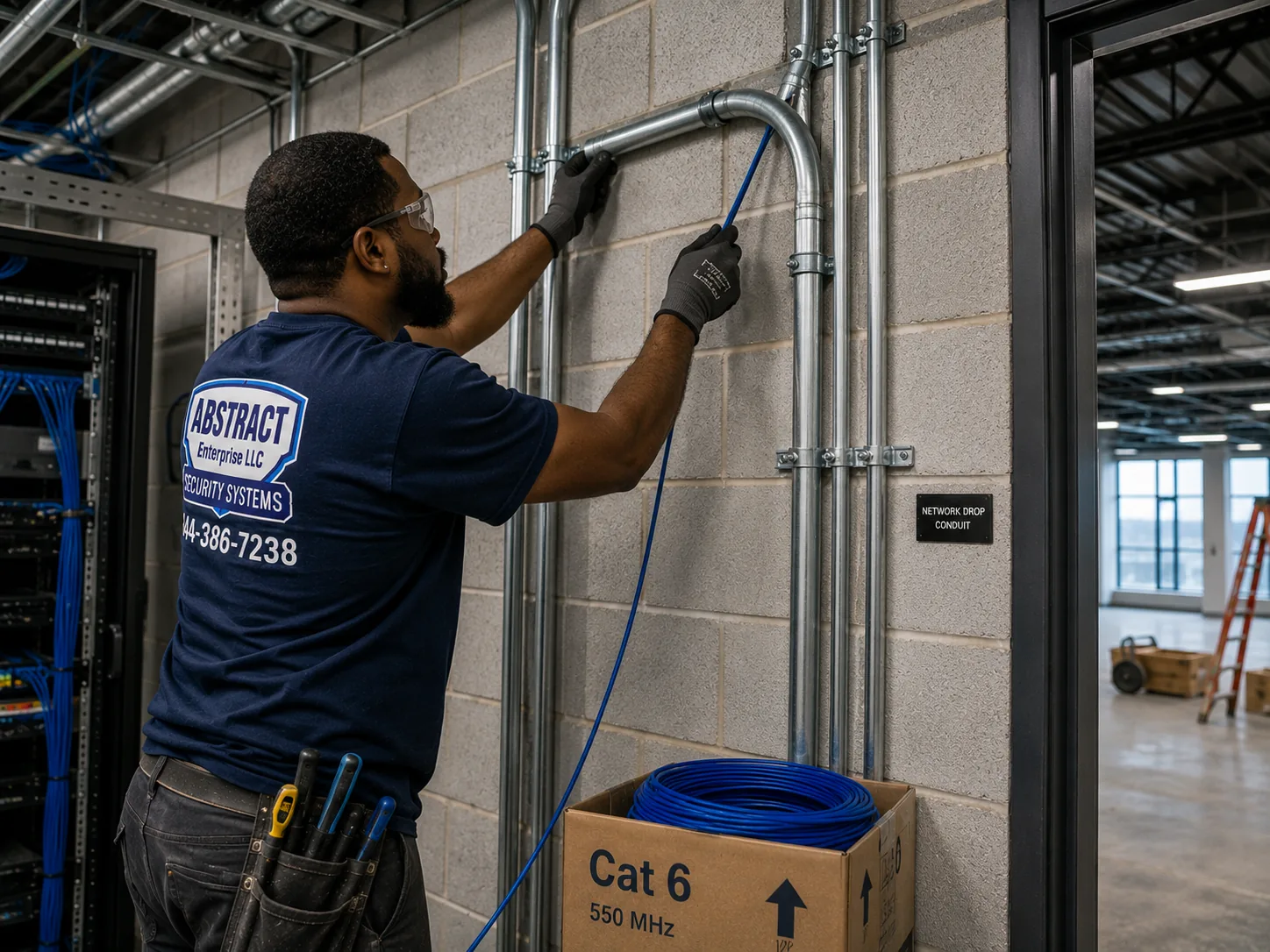
A photo from the AESS job library, not taken in Bath Beach: a technician running cable into EMT conduit beside a telecom room in an industrial building. If you tell us on the form that a yard or lot camera near Shore Parkway keeps losing its cable, we come ready to carry the replacement run in metal conduit where it can be reached or cut.
✅
Request Sent!
Thank you. A technician will contact you about the Bath Beach address, usually within two hours.
How It Works
Our Installation Process
1. Describe the symptom and send photos
The recorder screen, the failed camera and the spot where the recorder sits, with your cross streets and when it started, so the technician brings the likely parts.
2. Confirm who controls the system
Owner, board, managing agent or store tenant: who approves the repair, who holds the password and app account, and who lets us into each space.
3. Book a two-hour arrival window
Booked within two hours of your request, with parking, building access and any certificate of insurance settled before the day.
4. Test power, cable, network and recorder in order
Power at the outlet, backup and switch; each failed cable end to end; the recorder's network settings, drive health and event log.
5. Write the price before parts go in
The fault and the fix are written down with the price from the Brooklyn list, and nothing is replaced until the person who approves the work says yes.
6. Repair and re-test every channel
Connectors, cables, cameras, drives or the recorder repaired or replaced, then every channel checked live and in playback, in light and in dark.
7. Set the clock, retention and alerts
Time synced, recording schedules and days of retention confirmed, tamper and video-loss alerts tuned to reach the right phone.
8. Export test and hand over
A clip exported to a USB stick to prove footage can leave the building, then accounts, the camera map and a dated condition note handed over.
Coverage Area
Security Camera Repair Near Bath Beach's Landmarks
Lafayette Educational Campus
The former Lafayette High School at 2630 Benson Avenue, opened in 1939 and closed in 2010, its building reorganized into smaller schools.
2230 Cropsey Avenue
A 31-story, 248-unit tower finished in 2024 with a full-time doorman, one of the newest buildings by the bay.
Bayview Courtyard
The 24-story, 151-residence mixed-use condo at 2286 Cropsey Avenue, finished in 2023.
18th Avenue and 20th Avenue stations
Two of the elevated D stops over 86th Street on the West End Line, which opened through the neighborhood in 1916 and 1917.
2100–2106 Cropsey Avenue
Two four-story walk-ups from 1915 with 44 apartments between them, typical of the neighborhood's prewar rental stock.
1758 Cropsey Avenue
An 84-unit garden apartment complex from 1951, listed in hurricane evacuation zone 4 on the low blocks toward the bay.
We also serve Bensonhurst and Mapleton to the north, Dyker Heights across 14th Avenue, Gravesend across Stillwell Avenue and New Utrecht along the West End Line, at the same Brooklyn rate. The borough-wide details are on our Brooklyn camera repair page.
Pricing
Security Camera Repair Cost in Bath Beach
Bath Beach is billed at our Brooklyn rate. Every repair starts with the service call, which covers the on-site diagnosis and a written price for the fix, and is applied to the repair if you go ahead. The ranges below are from our published Brooklyn repair list; where your job falls inside a range depends on the brand, the channel count and how hard the failed part is to reach.
Repair
Brooklyn price
Service call: on-site diagnosis, power, cable, network and recorder test, written repair price
$150, applied to the repair
Connector rebuild or PoE port swap
$150–$350
Power supply repair or replacement
$150–$400
Single camera replacement on a working system, camera and labor
$250–$600
Hard drive swap, by capacity
$200–$450
DVR or NVR replacement with hard drive and setup
$700–$1,500
Full rewire or whole-building system overhaul
From $1,500
Annual clean and check, house to commercial scope
$250–$800
Certificate of insurance for a board, agent or landlord
Free
Three things move a repair within those ranges: access (a camera on a second-story eave or above a register that can only be reached before opening takes longer), what sits behind the failure (a dead camera on a cable that also has to be replaced is two repairs), and the recorder (an old one that will not accept current cameras turns a camera job into a recorder question, which we raise before you buy anything). If the price changes on site, you hear the new number before work continues.
Full terms — including 50% deposit, one-year parts-only warranty on AESS-supplied products, and the late-fee schedule — are set out in the service agreement.
Shop Our Systems
Security Camera Repair Packages & Pricing
Three ways Bath Beach repairs usually come together, priced from the list above. Your written price is based on what the diagnosis finds, not on the package name.
Service call: $150
The on-site diagnosis for a house, walk-up or store: power, cable, network and recorder tested in order, camera bodies and infrared checked, and a written price for the fix. The $150 goes toward the repair if you proceed.
Single-issue repair: $150–$700
The most common Bath Beach range: a rebuilt connector, a PoE port or power supply after an outage, one camera replaced on a working system, a hard drive swap, or a tampered camera re-aimed and locked with alerts tuned.
Major system repair: $700–$1,500
A recorder replaced with its drive and every camera re-added, several dead runs repulled in a postwar building, or a mixed system from several installers brought under one recorder with a full camera map.
Already bought the part? If you have already bought a replacement camera, drive or recorder, we can install it at labor-only pricing, quoted after the diagnosis, as long as it is compatible with the rest of the system. Customer-supplied parts are covered only by their maker's warranty, and we check compatibility before you open the box, so a part that will not work can still be returned.
Complete Services
Every Security Camera Repair Service in Bath Beach
House and two-family repairs
Dead channels, outage damage and recorders moved out of reach. Request a repair
Does someone need to be home in Bath Beach for the whole repair visit?
+
Someone needs to let the technician in, show where the recorder is and be reachable to approve the written price. After that you do not have to watch. If the cables run through a tenant's apartment or a neighbor's cellar, arrange that access before the day.
What should I have ready before the technician arrives?
+
The recorder password or the email and phone the app account was made with, a clear path to the recorder and to each failed camera, and a note of when the problem started and what happened around then. If you do not have the password, tell us when you book so we plan for it.
How long does a typical repair visit take?
+
The diagnosis itself is usually around half an hour. A connector, port or single camera repair is often finished in the same visit. A recorder replacement, a cable repull or a full camera map in a larger building takes longer, and we tell you the expected time with the written price.
Can you work on a system that mixes two or three camera brands?
+
Yes. Mixed systems are common in Bath Beach houses and walk-ups that were added to over the years. We check which cameras the recorder actually supports, and if one brand will never work properly with it, we tell you before replacing anything.
Can you add a camera while you are there fixing the others?
+
Usually, if the recorder has a free channel and the switch or power box has capacity. Adding a camera is priced separately from the repair, and we tell you the price before running the cable so you can decide on the spot.
What happens to my old footage when the recorder is replaced?
+
If the old drive still reads, we export the clips you need before the swap, or move the old drive into the new recorder where the models allow it. If the old drive has failed, we say so plainly; footage on a mechanically failed drive needs a data recovery lab.
Will you tell me when a repair is not worth paying for?
+
Yes. If the repair would cost close to replacing the part, or the recorder is too old to support the cameras you need, the written price says so, with the alternative and its cost next to it. The choice is yours.
Can you reach a camera mounted high on the side of a three-story house?
+
In most cases, yes, with our ladders. The narrow side paths between Bath Beach houses sometimes limit where a ladder can stand, so a photo of the camera and the ground below it helps us plan. If a lift would be needed, we tell you before booking.
Do you take away dead cameras and old cable you replace?
+
Yes. Replaced cameras, recorders and loose cable we remove are taken away, and the old mounting holes are sealed so water does not follow them into the wall. If you want to keep an old recorder for its footage, we leave it with you, labeled.
Can my store's repaired cameras be shown on a TV behind the counter?
+
Usually, if the recorder has a video output and there is a way to get a cable or a small player to the screen. A customer-facing monitor near the door is common on 86th Street and Bath Avenue stores, and we can set the layout to show the cameras you choose.
Can my business's cameras be registered with the NYPD after the repair?
+
Registration and live sharing with the NYPD are voluntary choices for the business owner through the city's camera program, and they cost nothing. We make sure the system is working, correctly timed and exporting cleanly; signing up is done by the owner.
Do you need a parking spot outside the building?
+
It helps on blocks where parking is tight, but we do not need one. Tell us about driveways, hydrants or a nearby lot when you book, and if the building has loading rules, such as a tower on Cropsey Avenue, we follow them.
Ready to See Every Bath Beach Camera Recording Again?
Send a photo of the recorder screen with your cross streets, and tell us what changed before it stopped. Call or text (347) 934-8335, message us on WhatsApp, or use the repair request form. Licensed under NYS license #12000287431, rated 4.7★ across 201 Google Reviews, owner-operated since 2002 and booked within two hours.