New York City's First Historic District · Pre-Civil War Houses · Mews and Lanes · Above the Expressway
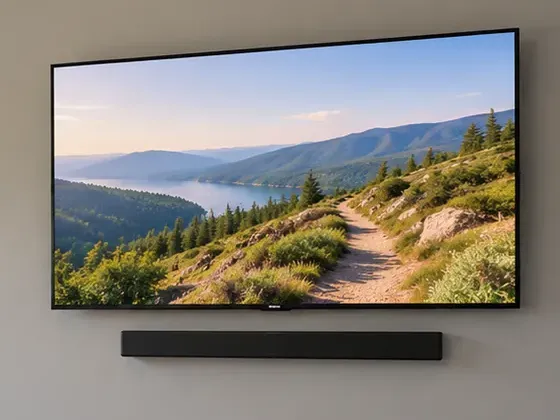
Brooklyn Heights holds the oldest run of houses we work in anywhere in the city. More than six hundred of them went up before the Civil War, and since November 1965 the whole neighbourhood has been a landmarked historic district, the first New York ever named. A soundbar here goes onto a wall that was laid in Flemish-bond brick, framed in hand-cut timber or skimmed in lime plaster long before anyone imagined a television, and it has to look as if it belongs there. We fix the bar into whatever that wall turns out to be, keep every wire inside the room and nothing on the facade, connect it to the TV's eARC or ARC port so one remote runs everything, and set the bass for a house that shares its walls with the neighbours and, on the western streets, sits over the expressway. Two-hour arrival windows, any day from 8 AM to 8 PM.
Reviewed and updated October 17, 2026 · Written by Anwar Timothy, NYS licence #12000287431 · Part of our Brooklyn soundbar installation coverage

New TV in a Willow, Hicks or Remsen Street parlor and the bar still boxed? Ring (347) 934-8335 or fill in the short form with the street, the floor and a word about the wall; the written price that comes back uses nothing but the Brooklyn lines on this page.
Brooklyn Heights is the part of the city where the house itself is usually older than every idea of home entertainment, and that is what a soundbar installer has to plan around here. The neighbourhood sits on the bluff across the East River from Lower Manhattan, bounded by Old Fulton Street near the Brooklyn Bridge to the north, Cadman Plaza West to the east, Atlantic Avenue to the south and the Brooklyn-Queens Expressway and the river to the west. Wikipedia calls it New York's first commuter suburb, and most of the rowhouses that line its streets were built before the Civil War. Wikipedia's neighbourhood article counts more than six hundred pre-Civil War houses, one of the largest groups of that housing anywhere in the United States.
Those houses are why Brooklyn Heights became the first historic district New York City designated. The Landmarks Preservation Commission held its hearing on November 17, 1965 and designated the district six days later, on November 23. The Historic Districts Council describes what it protects: nineteenth-century brownstone and brick homes, churches and carriage houses in the Federal, Greek Revival, Gothic Revival and Anglo-Italianate styles, with the Greek Revival work singled out as particularly notable. The Brooklyn Heights Association, founded in 1910 and described by the New York Preservation Archive Project as the oldest continuing neighbourhood association in the five boroughs, had pushed a "historic zoning" resolution as early as 1959.
For a soundbar, the landmark status matters less than people fear and the age of the walls matters more than they expect. The Commission regulates work that needs a Department of Buildings permit, work on the inside that affects the outside, and designated interior landmarks; mounting a bar on an inside wall and running low-voltage cable within the room falls outside all three, as long as nothing is fixed to the facade, a rear wall that the street can see, or the roof. The walls themselves are another story. Brownstoner's survey of the oldest houses in the Heights lists 84 Willow Street and 43 Willow Street in Flemish-bond brick, and 68 Hicks Street, 30 Middagh Street and 24 Middagh Street as wood-frame houses, all dating to the 1820s. A wall like that has no predictable stud spacing, the plaster may be laid on split lath or straight onto brick, and a stud finder built for 1980s drywall is close to useless.
The rooms are generous and they are full of things you cannot replace. Brownstoner's 2022 write-up of 20 Remsen Street, a Greek Revival house in place by 1857, lists original plasterwork, a curving stair, pierced plasterwork in the entry and dining room and marble mantels throughout. Its 2023 profile of 116 Pierrepont Street, a 25-foot-wide 1840s Greek Revival house, mentions black marble mantels in the parlor and dining room and crown molding in the front parlor. A 2014 6sqft listing of 192 Columbia Heights, built in 1859, describes 14-foot ceilings on the parlor floor and an operable dumbwaiter up to the parlor level. Every one of those details limits where a TV can hang and how its cables can travel.
Then there is the Heights that isn't a single-family house at all. Many rowhouses have been divided into floor-throughs and duplexes. Pre-war apartment buildings and co-ops line Columbia Heights, Montague Street and the blocks near the Promenade. The Hotel St. George complex on Clark Street, eight buildings put up between 1885 and 1930 and once the largest hotel in New York, is now divided into student housing, co-op apartments and commercial space. The 14-storey Hotel Bossert on Montague Street, built in 1909, was bought in May 2025 for conversion to apartments, with work reported to have begun in July 2026 and residential completion planned for 2028. Each of those buildings brings a managing agent, house rules and paperwork that a rowhouse owner never sees.
And on the western edge, the neighbourhood sits on top of a highway. The Promenade that gives the Heights its view of Lower Manhattan is the roof of the triple-cantilever section of the expressway. In 2019 the Brooklyn Eagle reported residents near Middagh and Willow Streets describing shaking, loud bangs and rattling shutters from heavy truck traffic, with vibration running from the early morning until evening. A soundbar doesn't change any of that, but it is one more thing on the wall that can buzz, and in those houses we set the bracket and the bass with that in mind.
Taken together: old houses, mostly rented, often divided, wrapped in a landmark district and, on one edge, perched over a highway that will be under construction for most of the next two decades. A good soundbar job in the Heights is quiet in every sense. It leaves no mark the Commission would notice, no hole a future owner will curse, no cable along a cornice and no bass that comes through the party wall at midnight.
A soundbar call in the Heights often turns into a TV job too. The AESS TV mounting team for Brooklyn Heights prices from the same Brooklyn list, and where a renovation has the walls open, our Brooklyn Heights structured cabling installers can lay a proper route from cellar to parlor in the same works.

Before we quote anything in Brooklyn Heights we ask two questions: roughly when was the building put up, and has the room been renovated? The answers narrow the wall down to a handful of possibilities, and that tells us which fixings to bring, how long the job will take and which price lines will appear on the bill.
The survivors around Willow, Middagh and Hicks Streets. Some are brick in Flemish bond, some are clapboard wood frame two and a half storeys high. Rooms are lower and smaller than later houses, and framing was cut and spaced by hand, so we locate solid timber by pilot-drilling rather than by assuming a sixteen-inch rhythm.
The 1830s and 1840s houses that give the district its character: brick or brownstone fronts, wide parlors, marble mantels, crown moldings. Party walls are solid brick. Inside walls are usually plaster, sometimes on lath and sometimes straight on masonry, and the TV wall is very often the party wall.
The 1850s houses with taller ceilings, the 14-foot parlor at 192 Columbia Heights among them. Height is the issue: a TV hung over a mantel ends up high, and a bar hung above roughly eight feet carries the high-mount line. We usually suggest the bar sits lower, on the TV mount or a bracket just under the screen.
Converted stables on Hunts Lane, Grace Court Alley, Love Lane and College Place, two or three storeys of brick with heavy timber floors. The living room is often upstairs over a garage or workshop. Walls may be bare brick, brick with furring and drywall, or new framing put in during conversion.
Columbia Heights, Montague Street and the blocks near the Promenade. Plaster on block or clay tile partitions, steam heat, a managing agent who wants a certificate of insurance and set working hours, and neighbours above, below and beside. The board's house rules decide more of the job than the wall does.
The Hotel St. George complex on Clark Street, now co-ops, student housing and shops, and the Bossert on Montague Street, under conversion to apartments. Rooms that began as hotel suites can have unusual partition layouts and limited outlets; we ask for a photo of the wall and the outlet before quoting.
There is a seventh type that cuts across all six: the house somebody has already renovated. A gut renovation may have replaced the plaster on one wall with drywall over new studs, left the party wall as exposed brick and closed up an old opening with plywood and board. In those rooms we read each wall separately, because the TV wall and the wall beside it may need completely different fixings.

There's no Heights surcharge: every visit is built from the Brooklyn lines in the pricing section. However you combine them, we finish in the same state: the bar square beneath the picture, cable hidden in a hollow wall or run in a painted channel that blends into the trim, the TV remote controlling volume, and a listening check from your own seat.
The bracket goes a few inches under the screen and lines up with the middle of the picture, not with the chimney breast or a window, and is fixed into timber, brick or block once a test hole has shown which. $129 with the bracket from the bar's box.
Masonry anchors set in sound brick, never in crumbling joints, with a depth stop on the bit so nothing reaches the neighbour's side. The brick line adds $65, and the cable usually comes down a slim painted cord cover ($59).
Old lime plaster is scored before it is drilled so the surface doesn't spall, and the fixing goes through it into timber or masonry behind. The plaster line is $45. Where the plaster sits on a hollow stud bay, in-wall wiring is possible.
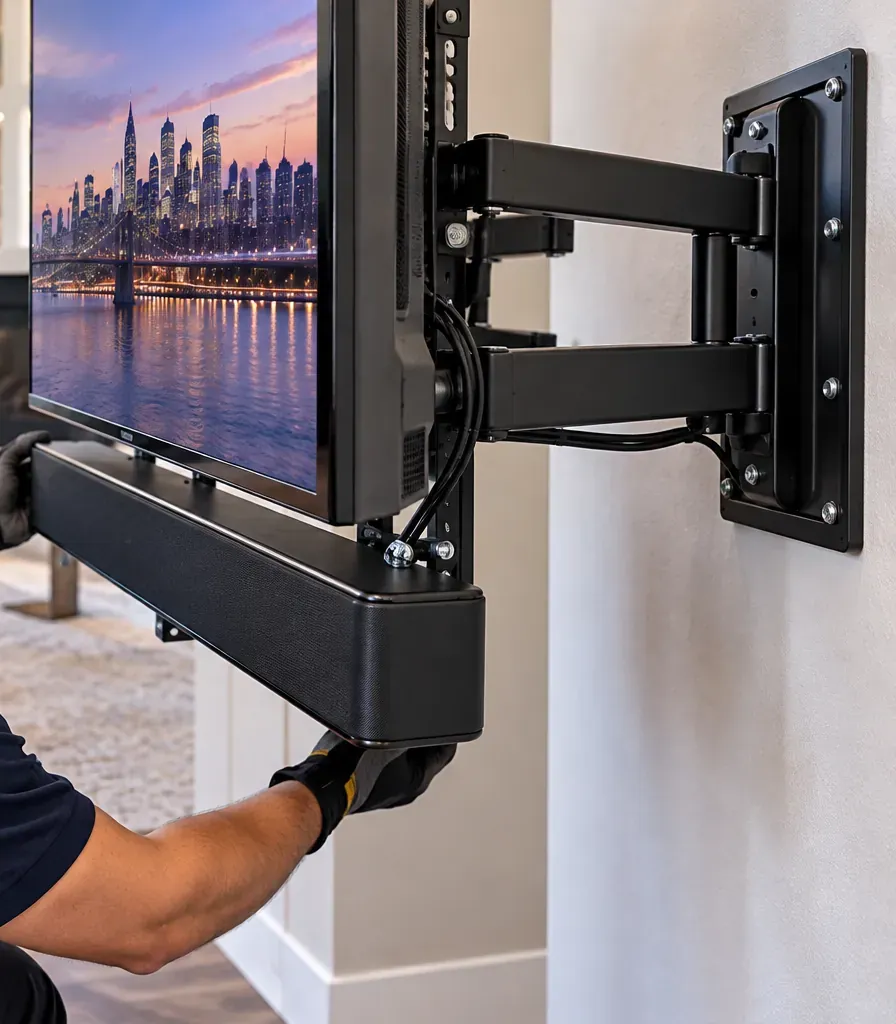
A bracket that clamps the bar to the TV or its mount, so the wall only carries one set of holes. Our first suggestion on a decorated chimney breast, on the old marble of a mantel surround, or wherever a second set of holes would show.
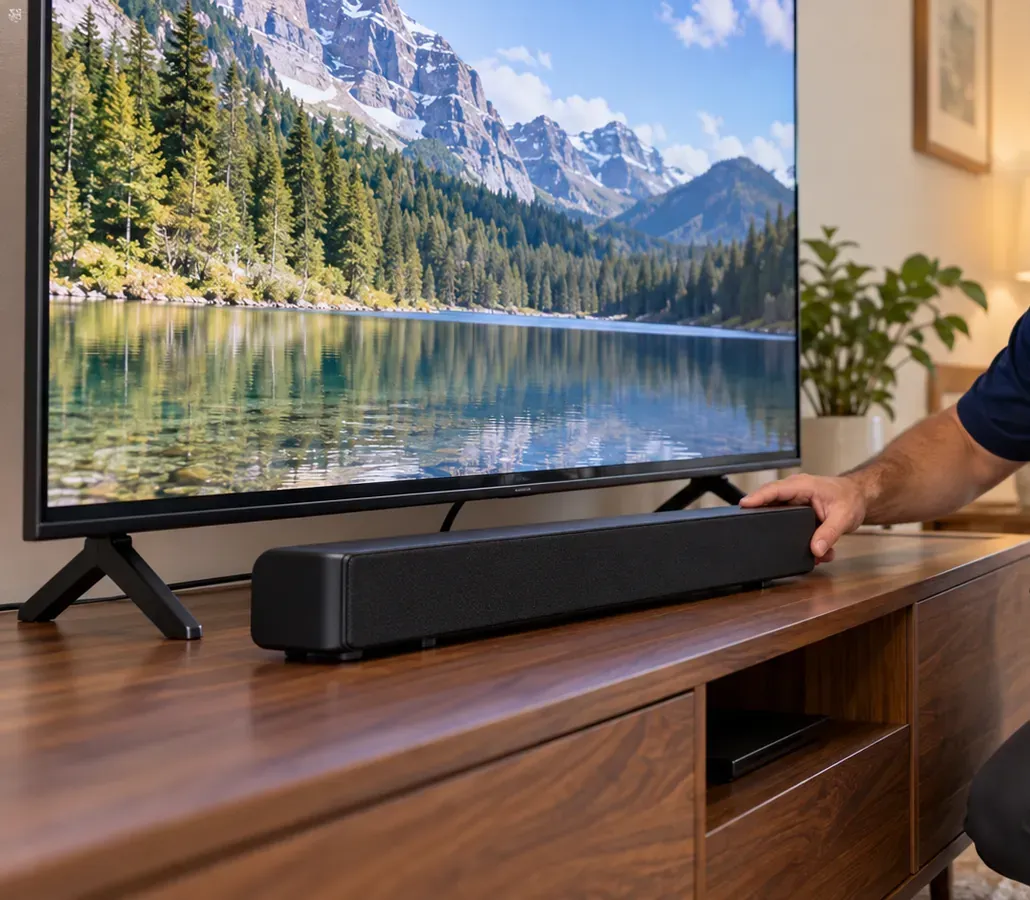
The bar on the furniture, connected and set so it doesn't block the TV's sensor. $79. Often the right answer in a rental floor-through, a co-op that has not yet approved drilling, or a room you plan to redecorate.
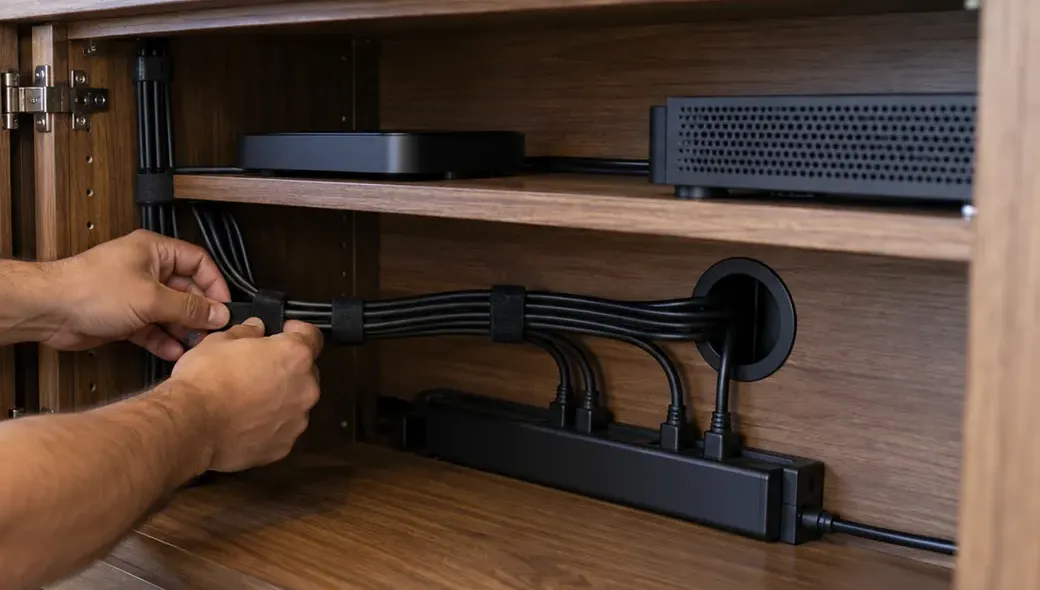
In a hollow stud wall, the $169 in-wall kit carries power and HDMI behind the plaster. In solid brick, a painted cord cover along the baseboard or a short run to the cabinet ($99 up to 25 feet) keeps the room tidy without a chase cut into a party wall.
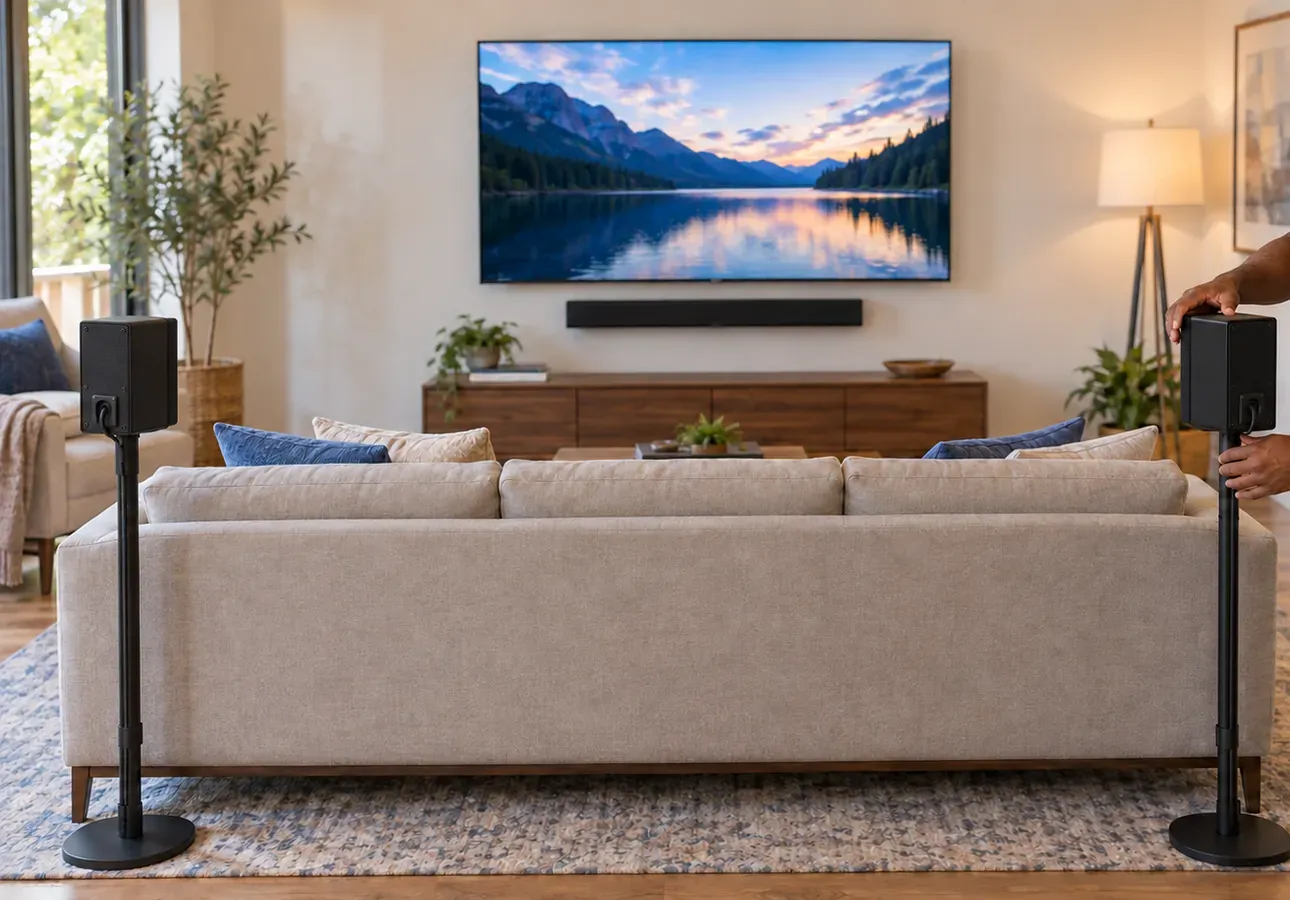
Wireless subs and rears paired and placed away from the party wall and off bare floorboards above a neighbour's ceiling. On Sonos systems the setup line is $125; on other brands it is part of the install.
HDMI to the TV's eARC or ARC port, CEC switched on so the TV remote controls power and volume, lip-sync checked with a test clip. A universal remote is $99 if a cable box or older source refuses to cooperate.
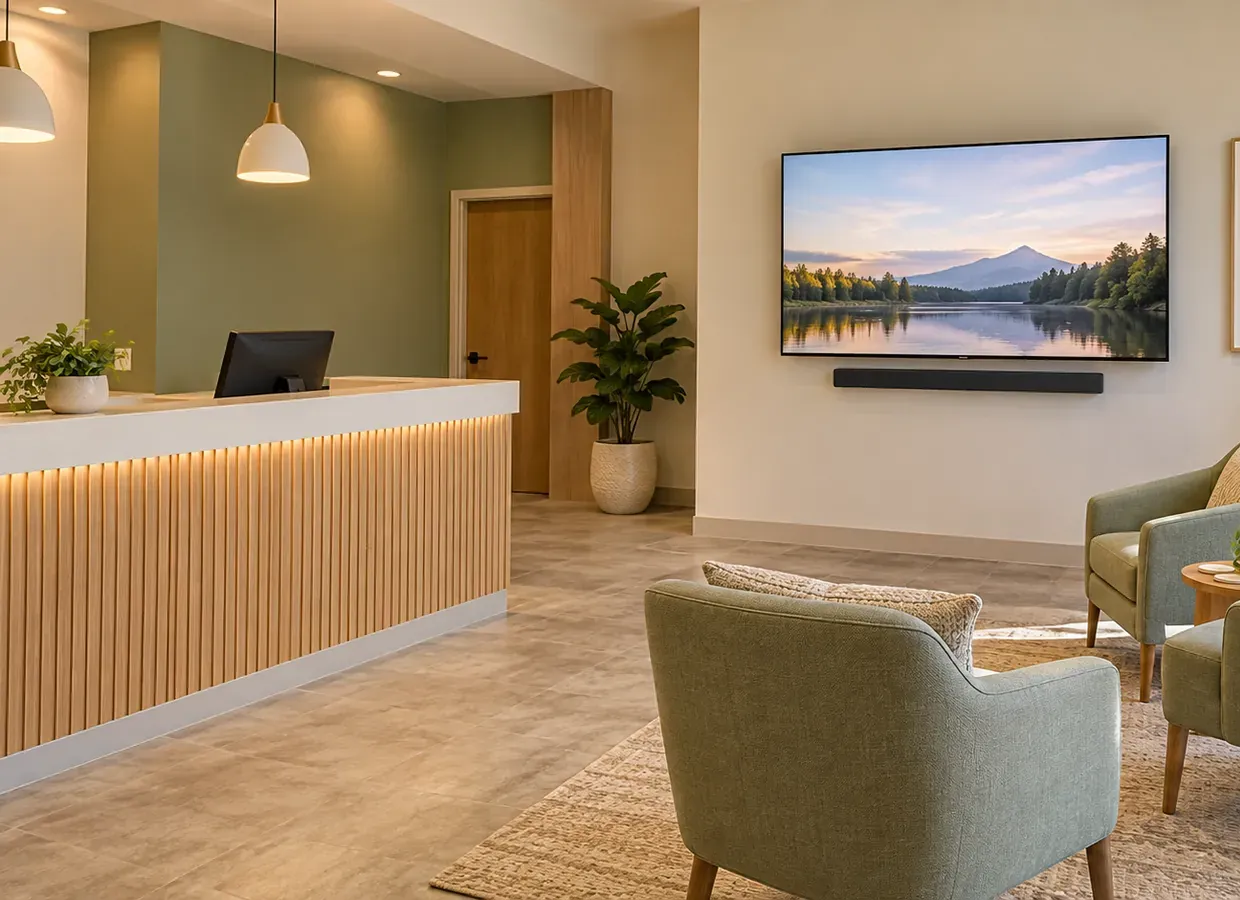
Waiting rooms, parish halls, shops and offices on Montague, Henry, Clark and Court Streets. Same price lines as a home, a free certificate of insurance for the landlord, and volume and night settings chosen for the space.

A bar that suddenly plays nothing, lags the picture, or stopped responding to the TV remote after a software update or a power cut is usually a settings problem, not a broken bar. Call (347) 934-8335. A Brooklyn setup-only visit is $195 for the first hour and then billed in 30-minute blocks, and most connection faults are sorted within one to two hours on site. If the bracket itself has worked loose in old plaster, tell us when you call so the technician brings the right anchors.
The Heights is unusual even by Brooklyn standards because it mixes the city's oldest construction methods within a few blocks. Here is how each wall is handled, what tends to surprise people, and where the extra lines on the price list come from.
The earliest brick houses in the district were laid in Flemish bond, where headers and stretchers alternate in every course; later rowhouses mostly used plainer bonds. For a soundbar the bond pattern matters less than the condition. Nineteenth-century brick is softer than modern brick and the mortar between it is often a lime mix that crumbles under a drill. We drill a test hole at the bracket line, look at the dust that comes out, and set the anchors in the face of solid brick rather than in the joint. A bar weighs far less than a TV, so even soft brick will hold it if the anchor is right and the hole hasn't been over-drilled. The brick or stone line on the Brooklyn list adds $65.
Inside walls in a pre-Civil War house are usually plaster. On a partition it is laid over wood lath nailed to studs; on the party wall it is often applied directly to the brick. You can't always tell which from the room, so the first small hole tells us: a puff of grey grit and then wood means lath on timber, red dust means brick behind. Plaster is scored and drilled slowly with a sharp masonry bit so it doesn't chip, and fixings pass through it into what's behind, never into the plaster alone. The plaster line adds $45.
In the 1820s frame houses, studs, posts and braces were cut to the builder's own measure. Spacing varies, some framing members are much heavier than modern lumber, and the wall may lean. We find the real framing with small pilot holes behind where the bracket will cover them, and when no member lands where the bar needs to sit, we fit a painted backer board across two of them. The backer line is $85. On walls that lean or bow, we level the bar to the TV rather than to the wall, so the two read as one piece.
Parlor ceilings in the later rowhouses run very high, and the instinct is to hang the TV over the mantel. That puts the screen above eye level and the bar higher still. If you want the TV there, we usually fix the bar to the TV or its mount so it stays just under the picture instead of drilling a second set of holes in the chimney breast. Mounting above about eight feet carries the $75 high-mount line. Marble surrounds are never drilled without your explicit yes; marble and glazed tile can chip even at low speed, and that line is $95.
The carriage houses on the lanes were built to hold horses and carriages, not people, and the conversions vary enormously. Citylore's profile of Grace Court Alley describes two- and three-storey carriage houses from the mid-nineteenth century, nearly all still carrying their hay cranes, converted first to garages and chauffeurs' quarters and later to apartments. Inside, we find bare brick, furring strips with drywall over the brick, or entirely new partitions. Floors are often heavy timber, which carries a subwoofer's thump down into a garage or the room below more than a concrete slab would, so the sub usually goes on an isolation pad and away from the beam lines.
Apartment buildings from the early twentieth century usually have plaster partitions on a masonry backing and solid outer walls. The fixing is a masonry anchor; the paperwork is the bigger task. We send the certificate of insurance free, confirm the building's working hours and elevator booking, and keep the drilling short. Hidden in-wall wiring is rarely allowed in these buildings, so a painted cord cover or a cable run along the baseboard to the cabinet is the usual answer.
Original features are irreplaceable, and we treat them that way. If the only sensible position for the bracket is through a decorative plaster band, an original mantel surround or a carved door casing, we stop, explain the options and wait for your decision. Our pick is nearly always a TV-attached bracket or console placement over a hole in something that can't be remade.

Commercial life in the Heights is concentrated on a few streets, and almost all of it happens in old buildings: ground-floor shops under apartments, offices in former banks and townhouses, and churches whose halls are rented to community and arts groups. A soundbar is usually the right tool for a single screen in a room where people are close to it.
The neighbourhood's main shopping street, with a concentration of bank buildings and a business improvement district that has run a weekend Open Street since 2020. DOT's 2024 design concept for the corridor reports that 71% of more than 2,000 respondents to a 2023 survey supported pedestrian improvements. Shops here often have a TV by the counter or in the window; we keep the sound inside the door.
The former Hotel St. George complex now mixes co-op apartments, student housing and commercial space, including a gym in part of the old pool area. Fitness and studio rooms usually want speakers rather than a bar; a single lounge or front-desk TV is a bar job.
Small shops, cafes and offices on the ground floors of rowhouses, with apartments overhead. The bar goes on the inside wall, the bass is kept modest and the sub, if any, stays off the floor that the upstairs tenant lives on.
St. Ann & the Holy Trinity on Montague Street has leased school, office, rehearsal and concert space to community and arts groups, and has run The Forum at St. Ann's arts series since 2012. Parish halls and meeting rooms often want a TV with clear speech for talks and screenings, without anything fixed to historic fabric.
The eastern edge of the Heights runs along Cadman Plaza West toward Court Street, where professional offices occupy older buildings. Conference and waiting rooms usually want a bar for presentations and a fixed volume the staff can't push too high.
Atlantic Avenue marks the southern boundary of the neighbourhood. Shops and restaurants on the Heights side of it occupy the same old row buildings, with the same mix of brick party walls and apartments above.

Most soundbar questions have the same answer in every borough. These are the ones that come up because of what Heights houses are and where they sit: hidden voids inside very old walls, a landmark review that some owners are already in the middle of, and an expressway that shakes part of the neighbourhood.
Often, yes, and it can be the neatest cable path in the house. Some Heights townhouses still have their dumbwaiters; the 1859 house at 192 Columbia Heights was listed in 2014 with one still working up to the parlor. Where the car and ropes are long gone, the shaft is a ready-made vertical chase from the kitchen level to the parlor and sometimes above.
What we check first: whether the shaft is truly empty and dry, whether anything else already runs in it (old gas pipe, plumbing, an abandoned electrical feed), and whether the shaft opens anywhere near the TV wall. HDMI and network cable can be lowered down the shaft on a fish line and fixed to its side with clips, then brought out through a small plate low on the parlor wall. That lets the cable box, streamer or receiver live in a cabinet or on the lower floor, with only the soundbar and its power under the screen. HDMI length is the limit: passive cables are reliable for a modest run, and beyond that we use an active or fibre HDMI lead, which we price before starting.
What we won't do is put mains power down the shaft. A new outlet behind the TV, or power carried between floors, is electrician's work, and in a landmarked house it's also the kind of job that may need a Department of Buildings permit and therefore Landmarks sign-off. Low-voltage signal cable is ours; anything carrying 120 volts belongs to the electrician.
This is a real risk in nineteenth-century Brooklyn houses, and it is one reason we pilot-drill instead of simply driving in a long anchor. Brownstoner's history of row-house lighting explains that when electricity arrived, the gas pipes that fed the fixtures were capped and left in place, and that in many Brooklyn homes they are still active even though they are capped and not used. A typical parlor had a gasolier hanging from the middle of the ceiling medallion, and halls and back rooms had wall sconces, so pipe can run up a wall where a sconce once was or across a ceiling toward the medallion.
On a Heights TV wall we look for the clues first: a capped stub or patched circle where a sconce once hung, a medallion overhead, a run of plaster that sounds different. We use a scanner that detects metal, keep pilot holes short and shallow, and place the bracket so its fixings avoid any line between an old sconce position and the floor or ceiling. If we find or suspect pipe, we move the bracket or switch to a TV-attached bracket rather than drilling near it.
If anyone in the house ever smells gas, leave and call Con Edison or 911 from outside. Whether an old line is live, and capping it properly at the source, is a job for a licensed plumber, not a low-voltage installer. Owners in Brooklyn who found live lines in their walls have described exactly that on Brownstoner's forum, and the advice there was the same: get a plumber to check it.
The Commission's own guidance is the place to start. LPC says a permit for interior work is needed when the work requires a Department of Buildings permit, when interior work affects the exterior, or when the interior is a designated interior landmark. NYC Business's guide for landmarked properties adds that interior renovations needing a DOB permit generally receive a Certificate of No Effect, because they don't change protected architectural features.
Low-voltage cable for a soundbar, by itself, usually falls outside all three triggers. The question becomes practical: if your architect is already opening walls under a DOB permit and a Certificate of No Effect, the cheapest moment to run HDMI, network cable and a recessed box behind the TV is while those walls are open, as part of the contractor's scope. Ask your architect whether to list the low-voltage work in the renovation documents; we can supply a description of what we would run and where. Any new electrical outlet behind the TV is electrical work and goes through the electrician under that permit.
Where it changes is outside. A speaker, cable or dish fixed to a facade, a visible rear wall or a roof is exterior work and comes under Landmarks review. This is general guidance, not legal advice; the Commission's Preservation Department will tell you whether a particular piece of work needs a permit, and your architect or expediter should confirm what belongs in your application.
Do one simple test with the TV off. If the rattle comes when a heavy truck passes and nothing is playing, it's the house: a loose shutter, a window sash, a picture frame or a glass shelf. The Brooklyn Eagle's 2019 report on the triple cantilever quoted residents near Middagh and Willow Streets describing shaking, bangs, rattling shutters, broken glasses and cracked walls, with vibration from early morning into the evening. That isn't something a bracket can fix.
If the buzz only happens with sound playing, and particularly at certain low notes, it's the system. The usual culprits are a bar touching the wall or the TV, a loose bracket screw, a subwoofer sitting on a hollow floor or against a cabinet door, or something on the console resonating. We play a slow low-frequency sweep through the sub with you in the room, find the note that sets things off, and fix the cause: felt pads between bar and wall, a re-tightened bracket, the sub moved or put on an isolation pad, and the bass trimmed a little in the app.
If both happen, we deal with the system and tell you what we noticed in the house. In the streets nearest the expressway we also check the bracket fixings again before we leave and suggest you look at them after a few months; constant vibration is a good reason to choose a bracket with locking screws and to avoid relying on plaster alone.

We install the bar you bought, or advise before you buy. In Heights rooms the choice of mount often matters more than the brand of bar, because the mount decides how many holes go into an old wall and where.
Short bars for small Federal-era rooms, top-floor dens and carriage-house bedrooms, where a full-width bar would overhang a narrow wall between windows. Sonos Beam, for example, weighs about 6.35 lb and connects by HDMI eARC.
Long bars for big parlors and large TVs. Sonos Arc Ultra is about 46 inches wide and about 5.9 kg. Up-firing drivers need a flat, reflective ceiling within about 7.5 to 12 feet, per Polk's Atmos guide, so a 14-foot parlor ceiling or an ornate plaster ceiling weakens the height effect.
Wireless subwoofer and rear speakers for a parlor used as a family room. The sub's placement is the big decision in a house with a neighbour behind the party wall or a tenant below.
The bracket from the bar's box when it suits the wall, or the Sanus bracket we supply for $84.99 when the bar shipped without one or its own bracket wasn't designed for brick.
Clamp-style brackets hang the bar from the TV or from its mount. Sanus rates its SASB1 universal model for most bars up to 20 lb, fixing to the bar's back or underside with adjustable depth. The plaster takes one set of holes, not two.
Paintable surface channel on brick and party walls ($59), in-wall kits for hollow stud walls ($169), cable runs to a cabinet up to 25 feet ($99), and vertical chases where the house has one.
Connection is the same everywhere: HDMI to the port marked eARC or ARC, CEC enabled so the TV remote works the bar, and the TV's audio output set correctly. AWOL Vision's comparison of the two standards explains that eARC is needed for lossless formats such as Dolby TrueHD Atmos, while ARC carries Atmos only inside the compressed Dolby Digital Plus stream. If your TV has eARC, we use it. If it has neither, an optical cable still works for stereo and basic surround.

Search for soundbar installation and an AI summary will give you a confident national answer. Some of it is fine. Some of it doesn't survive contact with a Greek Revival party wall, a co-op board or a capped gas pipe. Here is where the generic answer and a Heights job part ways.
That range comes from Homewyse's national estimate, and it is a fair figure for a bar on drywall in a suburban house. It assumes studs every sixteen inches, a hollow wall to hide the cable and nothing fragile nearby.
In the Heights, the base mount is $129 and the wall decides the rest: $65 for brick, $45 for plaster, $85 if the framing needs a backer board, $95 for marble or tile. A bar on a party wall with a Sanus bracket and a painted cord cover is $337.99, which sits above the national range for honest reasons.
The number you should compare is the written total for your wall, not a national average. We send it before anyone drills, and if the wall turns out different from what was booked, you see the new figure first.
Generic advice treats in-wall wiring as the default. In a rowhouse whose TV wall is the brick party wall, there is no hollow to run cable through, and cutting a chase into a shared masonry wall is a much bigger and dustier job than any soundbar warrants.
Where the wall is hollow, usually a later partition or a renovated wall, the $169 in-wall kit works well. Where it is brick or plaster on brick, a slim cord cover painted to match the wall or the baseboard is the honest answer, and it can be removed later without damage.
The third option, often overlooked, is to use a void the house already has: a closet behind the TV wall, a dumbwaiter shaft, or the space under a built-in. We look for those before suggesting anything cut.
AI summaries describe stud finders as if every wall has studs. In the oldest Heights houses, the framing was cut by hand and the plaster can be thick enough to blind an electronic finder, and on party walls there are no studs at all.
We locate fixing points by pilot-drilling where the bracket will cover the hole, reading the dust and the resistance. Wood, brick and hollow lath each tell you something different, and we only commit the anchors once we know which we have.
The same discipline is what keeps us away from hidden hazards. The Brownstoner history of row-house lighting notes that old gas pipes were capped and left in the walls, and some are still live; a short pilot hole with a metal scan first is the safe way to work.
Some AI answers overstate the Landmarks Commission's reach, telling Heights owners they need approval for anything at all. LPC's own guidance lists three cases for interior work: work that needs a DOB permit, interior work that affects the exterior, and designated interior landmarks.
A soundbar on an inside wall with low-voltage cable inside the room meets none of those. What does need review is anything fixed to the outside: a speaker on a rear terrace wall the public can see, a cable run along the facade, a dish on the roof.
Co-op boards, condo associations and landlords have their own rules, and those apply regardless of landmark status. For the specifics of your building, the Commission's Preservation Department and your managing agent are the people to ask.
Dolby's placement advice is sound: mount the bar below the TV and keep the two close together, aiming for ear level where you can. The trouble in tall Heights parlors is that the TV often goes over the mantel, well above ear level, and the bar follows it up.
We don't pretend a high bar sounds like a low one. If the TV must stay over the mantel, we fix the bar to the TV mount so it hugs the bottom of the screen, angle it slightly toward the seats where the bracket allows, and set dialogue enhancement so voices hold up.
Often the better answer is moving the TV. A screen on the wall opposite the windows, or beside the chimney breast rather than over it, gives you a lower picture, a better seat and a bar at a sensible height, and leaves the mantel alone.
Thumbtack's national figure for TV wall mounting runs $121 to $234, and plenty of handymen will hang a bar for something similar. For a bar on drywall, that might be all you need.
In a house in the first historic district in New York, with lime plaster, soft brick, a neighbour on the other side of the party wall and possibly a live gas line in the wall, the job is about knowing when not to drill. That judgement is what a licensed low-voltage contractor with old-house experience is for.
Ask any installer three questions: what anchor they will use in your wall, how they will stop the drill reaching the neighbour's side, and who carries the insurance certificate your building or landlord will want. The answers tell you most of what you need to know.
Bluetooth is convenient for phones and terrible for TV sound. It adds delay, which makes lips and voices drift apart, and it compresses audio.
For the TV itself we always use HDMI eARC or ARC, or optical as a fallback, so the picture and sound stay in sync and the TV remote controls the volume. Wireless is fine for the link between the bar and its own subwoofer and rear speakers, which are designed to pair with each other.
In a parlor where the cable box can't sit near the TV, the answer is a longer HDMI run, a dumbwaiter or closet chase, or a cable along the baseboard to a cabinet, not Bluetooth between the TV and the bar.
Old walls, old trim and neighbours close by. Send the model numbers and one photo of the wall, and we will tell you what we'd fix it to and what it costs.
Few neighbourhoods we serve have a highway built into the bluff beneath them. When Robert Moses planned the Brooklyn-Queens Expressway along the western edge of the Heights in the 1940s, the Brooklyn Heights Association opposed a wider road, and what was built instead was a stack: two decks of traffic cantilevered off the bluff, with the Promenade on top. The Promenade itself was designed by Clarke & Rapuano in 1946 and runs 1,826 feet from Remsen Street to Orange Street.
For the houses closest to it, that structure is a neighbour. The Brooklyn Eagle reported in 2019 that the expressway carries more than 150,000 vehicles a day, and residents near Middagh and Willow Streets described vibration intense enough to rattle shutters and break glasses. A Brooklyn Eagle notice about overnight repairs described weeks of nighttime jackhammering on the triple cantilever, with concrete and rebar work at the Clark Street fan plant area and the deck at Grace Court.
The future is more of the same, then better. In August 2026 the city announced a roughly $4 billion, ten-year rehabilitation of the city-owned BQE, including the triple cantilever, with construction to begin in 2030 and a temporary two-level bypass on Furman Street below the Promenade that the city says will not block it. Environmental review starts this fall, with the impact statement expected in summer 2028.
None of this is exotic. It is simply the difference between a job done for a quiet suburban living room and one done for a house that has had a highway at the foot of its block since the 1950s.
Nearly every house in the Heights shares at least one wall with the house next door, and many share floors and ceilings with tenants as well. Bass is the part of a film that travels through all of them. High and middle frequencies stay mostly in the room; the low thump of a subwoofer passes into brick, timber joists and plaster and comes out on the other side. That is why we spend more time on where the subwoofer sits than on where the bar goes.
The city takes neighbour noise seriously. In 2025 the 311 system logged about 636,000 noise complaints, 463,349 of them residential, according to a New York Post analysis, and the 311 portal lists loud television among the neighbour-noise complaints it accepts. The noise code itself, in section 24-218, treats sound measured at 7 dB(A) or more above the ambient level inside a receiving property between 10 PM and 7 AM as unreasonable. You don't need a meter to stay well clear of that; you need a sensible setup.
If you're the one hearing the neighbour's television, a soundbar won't fix that. What helps is the same advice in reverse: a polite note suggesting the sub moves off the shared wall usually does more than any complaint.
Heights houses are renovated constantly, and a renovation is the one moment when hiding a soundbar's cables costs almost nothing. Once plaster is back on the wall and the cornice is restored, the same job means surface channels or careful fishing through old cavities. A few decisions made at the drawing stage save a lot later.
If your architect is already working through Landmarks under a Certificate of No Effect, none of this changes the protected exterior. Send us the drawings and we will mark up what we'd run and where, so your contractor can include it in their scope.
Whether it's a Greek Revival parlor on Remsen Street, an upstairs room in a Hunts Lane carriage house or a co-op living room on Columbia Heights, name the building, the floor and the wall and we'll send a written quote within the business day. Rather talk? Ring (347) 934-8335.
The same seven stages apply to a small bar in a carriage-house bedroom and to a full bar, sub and rear set in a double parlor.
Tell us the bar and TV models, the floor and the room, and send a photo of the TV wall. Mention anything original nearby: a mantel, cornice, medallion, old sconce position or dumbwaiter.
Our reply adds up the Brooklyn lines that fit your room: placement or mount, bracket, any wall line, cable concealment and setup. Where a board or landlord asks for a certificate of insurance, it comes with the quote at no charge.
Slots are two hours long and run from 8 AM to 8 PM every day, fitted inside your building's contractor hours. Twenty-four hours' notice is all it takes to move one at no charge.
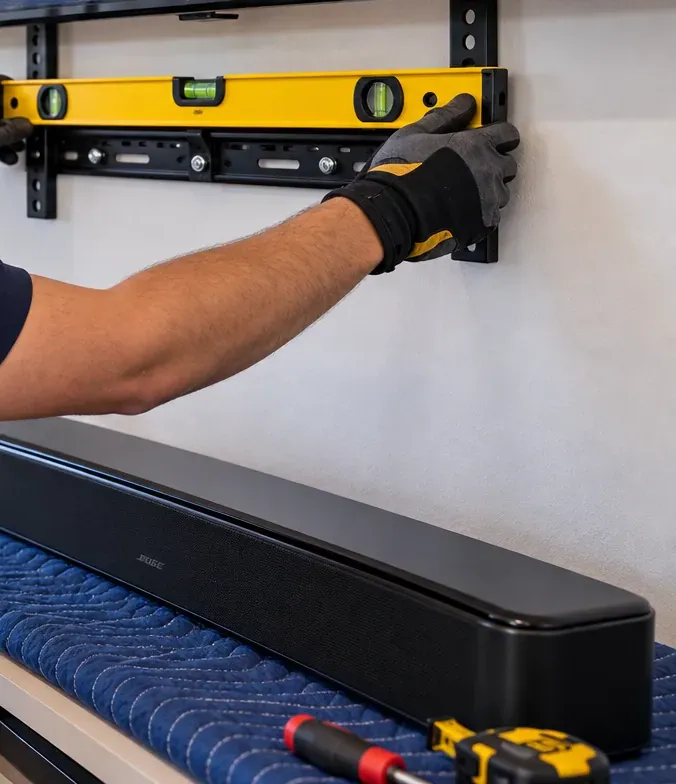
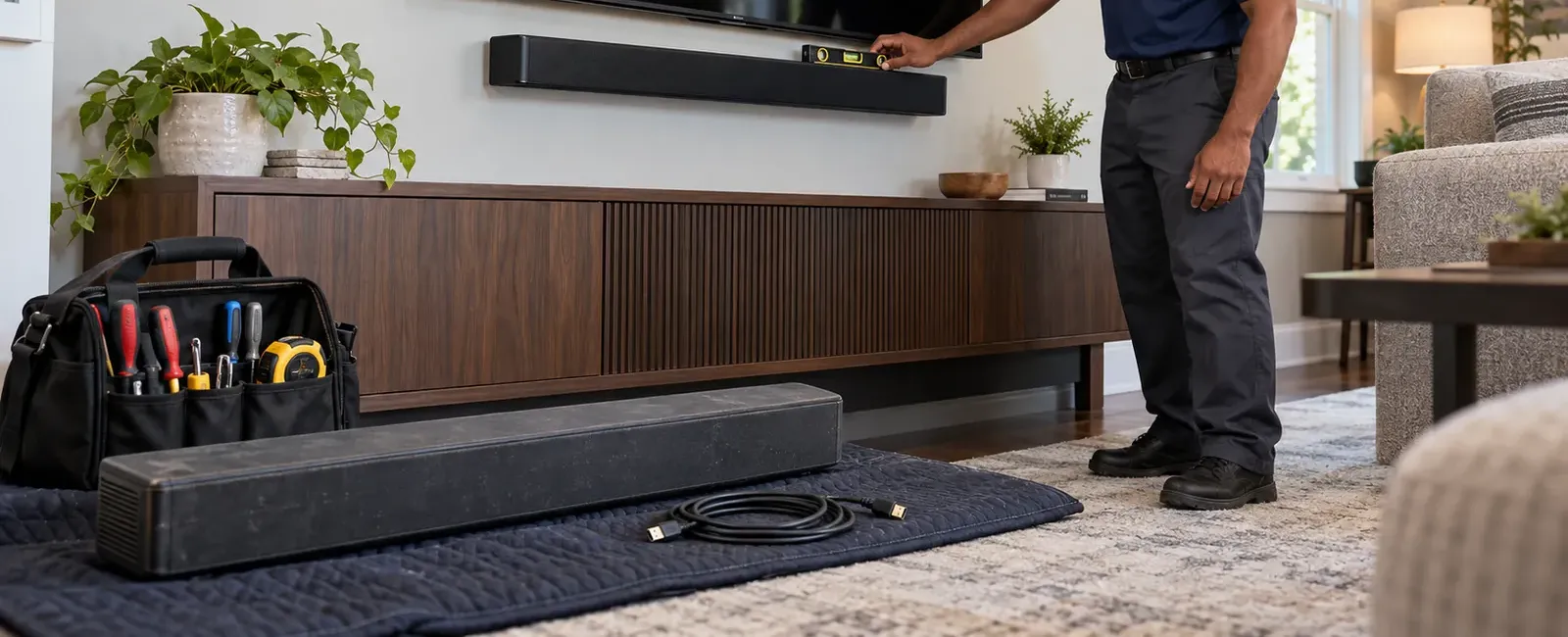
We scan for metal and wiring, drill a short pilot hole behind where the bracket will sit, and read the dust to tell brick from lath and timber. Height and centre are marked with you at your usual seat.
Anchors matched to brick, timber, block or plaster go in with depth stops on party walls. HDMI and power run inside a hollow wall, down a painted cord cover, or along an existing void such as a closet or dumbwaiter shaft.
The HDMI lead goes into the eARC or ARC socket and CEC is turned on; the sub and rears are kept off the party wall and away from floors above a neighbour; every plug shares one surge-protected strip; felt goes where the bar meets the wall.
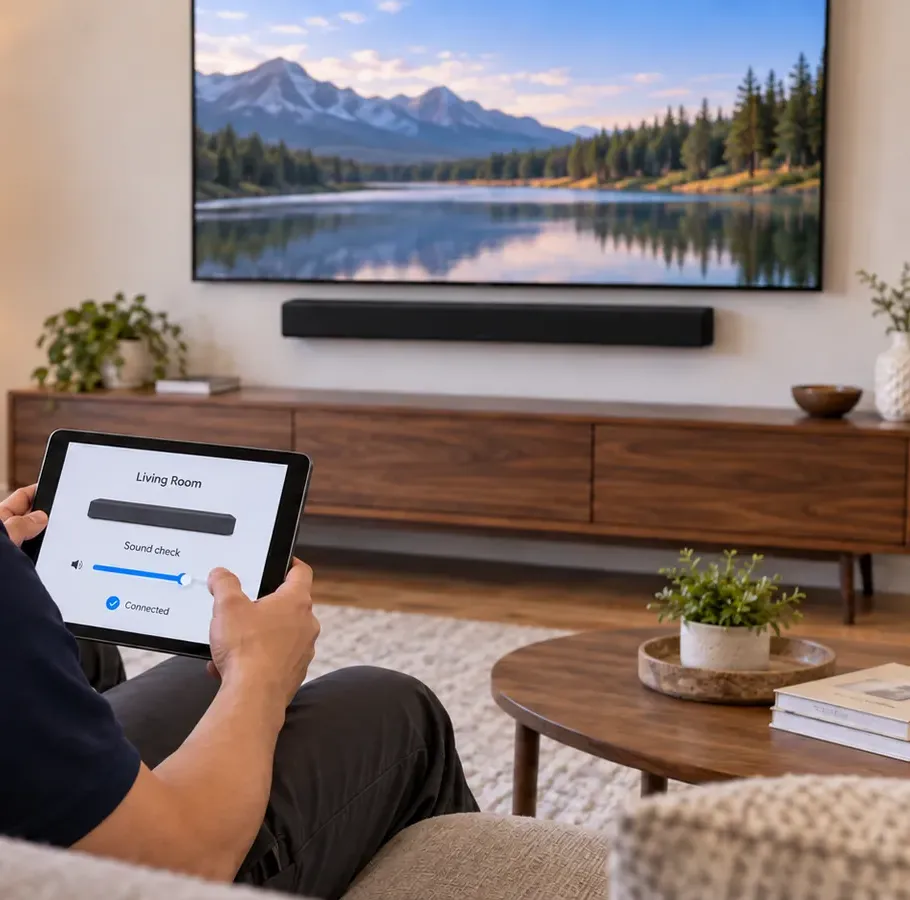
Calibration runs from your seat; you get dialogue and night modes demonstrated, a clip to confirm lips and voices match, and the TV remote proven on power and volume. Dust gone, settings explained, then we leave.

Every street in the neighbourhood is in our area, between Old Fulton Street and Atlantic Avenue and from Cadman Plaza West to the Promenade. The six places below anchor it, and each sits among houses of a similar age and type.
The 1,826-foot walkway from Remsen Street to Orange Street, opened in two halves in 1950 and 1951 on top of the expressway's triple cantilever. The Columbia Heights houses and apartment buildings behind it are where vibration-aware mounting matters most.
Built on Orange Street in 1849, with its parish house and arcade added in 1914. Henry Ward Beecher preached there until his death in 1887 and used the pulpit against slavery. The streets around it in the north Heights hold many of the earliest houses.
Minard Lafever's Gothic Revival church at Montague and Clinton Streets, opened in 1847, with stained glass by William Jay Bolton that is among the first complete sets of figural glass in North America. A National Historic Landmark since 1987.
The former Long Island Historical Society building at 128 Pierrepont Street, designed by George B. Post and completed in 1881, part of Brooklyn Public Library since 2020. Pierrepont Street and Pierrepont Place nearby have some of the neighbourhood's true mansions.
A one-block dead end off Hicks Street, lined with two- and three-storey mid-nineteenth-century carriage houses that served the mansions on Joralemon and Remsen Streets. Named for Grace Church, built across the street in 1847, and now entirely residential.
Eight buildings on Clark Street built between 1885 and 1930, the tower by Emery Roth, once the largest hotel in New York City. Today the complex is divided into student housing, co-op apartments and commercial space, beside the Clark Street subway station.
We also install soundbars in the neighbourhoods around the Heights — DUMBO and Vinegar Hill to the north, Downtown Brooklyn to the east, Cobble Hill and Boerum Hill across Atlantic Avenue — and across the rest of the borough. The Brooklyn soundbar installation page covers the borough as a whole, from Greenpoint to Coney Island.
The Heights uses the Brooklyn list, and Brooklyn is the base our other areas are multiplied from, so nothing is added for the neighbourhood. Pick the lines that fit your room. Should the wall prove different from the booking, the revised total comes to you before the drill does.
| Item | Price | Where it comes up in the Heights |
|---|---|---|
| Soundbar placed on a console or stand | $79 | Rental floor-throughs, co-ops waiting on approval, rooms about to be redecorated |
| Soundbar wall-mounted under the TV | $129 | The core job in parlors, dens and apartment living rooms |
| Sanus soundbar bracket | $84.99 | Bar arrived with no bracket, or its own bracket was designed for drywall, not brick |
| In-wall concealment | $169 | Hollow stud partitions and renovated walls |
| Paintable cord cover | $59 | Party walls and plaster on brick, where nothing can go inside |
| Cable carried to a cabinet or another spot, 25 ft maximum | $99 | Cable box in a built-in or across a double parlor |
| Sonos setup | $125 | Bar, sub and rears paired in the Sonos app and grouped as one room |
| A/V receiver | $129 | Older systems kept alongside or instead of a bar |
| Universal remote | $99 | A cable box or older player that ignores CEC |
| Streaming device setup | $49 | A streaming stick or box signed in and set to the right input |
| Full home theater | $350 | A bar or receiver with sub, rears and every source tuned in one visit |
| Condition | Price | Typical Heights setting |
|---|---|---|
| Drywall on wood studs | $0 | Renovated rooms and carriage-house conversions |
| Metal studs | +$30 | Newer partitions in converted buildings |
| Plaster | +$45 | Original walls in rowhouses and pre-war co-ops |
| Brick or stone | +$65 | Party walls, chimney breasts, carriage-house walls |
| Concrete or cinder block | +$75 | Some apartment-building walls and cellar walls |
| Tile or marble | +$95 | Mantel surrounds, only with your go-ahead |
| Plywood backer board | $85 | Hand-framed walls where no timber lands under the bracket |
| High mount (above about 8 ft) | $75 | Bars that follow a TV over a tall parlor mantel |
| Walk-up, 3rd floor and above, no elevator | $40 | Top-floor rentals, upper floors of rowhouses |
| Box removal | $25 | Cartons taken away so they don't wait for recycling day |
| Certificate of insurance for your building | Free | Co-ops, condos, rental buildings, commercial landlords |
Each total below simply adds the lines from the two tables, so you can follow the arithmetic of a Heights quote. Treat them as worked examples rather than fixed packages; the wall we actually find sets your figure.
| Example | Lines | Total |
|---|---|---|
| Greek Revival parlor: party-wall brick, box bracket, painted channel for the cable | $129 + $65 brick + $59 cord cover | $253 |
| Columbia Heights co-op, bar on a plaster wall with our Sanus bracket, insurance certificate sent free | $129 + $84.99 + $45 plaster | $258.99 |
| Carriage-house living room on new framing, our bracket, leads hidden in the wall | $129 + $84.99 + $169 in-wall | $382.99 |
| Bar following a TV over a tall brick chimney breast, its own bracket, high mount | $129 + $65 brick + $75 high mount | $269 |
| Sonos bar on the console with sub and rears paired in a rental floor-through | $79 + $125 Sonos setup | $204 |
Not every call needs a drill. Re-linking a bar to a replacement TV, getting eARC to pass sound again, taming a remote or re-pairing a sub is billed as a Brooklyn setup-only visit: $195 covers the first hour, then each further half hour is charged as a block. A TV hung on the same trip is priced on its own lines from the Brooklyn TV mounting base of $179.99. Return calls outside a booked job are $195 per hour, three hours minimum ($585). We charge $150 for a wasted trip when work can't start, whether the bar or bracket is missing, the door is locked or the building's approval hasn't come through, and moving your slot with 24 hours' notice is free.
Most Heights jobs land on one of these three. The price on each card is a plain sum; brick, plaster, high-mount or walk-up lines join it only if your room needs them.
Nothing goes into the wall: the bar sits on the console a little forward of the TV's infrared window, plugs into the ARC or eARC port with CEC enabled, and the leads disappear behind the furniture. The natural choice under a lease or while a co-op is still considering an alteration.
The mount ($129) and our Sanus bracket ($84.99) together. Add $65 if the TV wall is the brick party wall or $45 for original plaster, and $59 if the cable needs a painted channel.
Mount and bracket as in the standard card, with $169 of in-wall concealment so no cable shows. Only possible on a hollow framed wall you're allowed to open, which in the Heights means renovated rooms and converted carriage houses, never a masonry party wall.
If you already have a bracket, from the box or bought separately, you pay labour alone: the $129 mount plus your wall's line. Its rating has to cover the bar, and any warranty claim on it goes to its maker. Should it suit drywall but not soft brick, we tell you before drilling and you can switch to our Sanus bracket.

Send the model of the bar and one picture of the wall; the reply lists each line that applies and adds them up.
Move a few blocks in the Heights and the same bar becomes a different job. The six sketches below are composites of building types, describing what we prepare for; none of them is a particular client's home.
Middagh, Willow and Hicks Streets hold the oldest surviving houses, some of them clapboard frame from the 1820s. The rooms are smaller and lower than in later houses, and windows take up much of the street wall. A compact bar often suits better than a full-width one. Framing is irregular, so we pilot-drill for solid timber and fit a backer board if none lands where the bracket must go. These are also the streets the Brooklyn Eagle reported shaking from expressway traffic, so the bracket gets locking hardware and felt where it meets the wall.
The classic Heights room: high ceiling, black or white marble mantel, crown molding, tall front windows. The TV almost always goes on the long party wall or beside the chimney breast. We drill a test hole to confirm whether the plaster sits on brick or on lath, set masonry anchors in sound brick with a depth stop, and bring the cable down a painted cord cover to the console. The subwoofer stays off the party wall and away from the floor over any garden-level tenant.
Hunts Lane, Grace Court Alley, Love Lane and College Place are the best-known of the Heights mews, and Brownstoner's carriage-house roundup also shows examples on Hicks Street and Columbia Heights. Most living rooms are upstairs. Walls vary from exposed brick to new framed partitions, and floors are timber, so we decide the sub position by listening below as well as in the room. A garage or workshop underneath is often the best home for the cable box and router, with a cable run up through the floor where the owner permits it.
Wikipedia singles out Pierrepont Street and Pierrepont Place as the home of the Heights' few true mansions. Rooms here are larger than in a rowhouse, the TV is often in a library or a back sitting room rather than the formal parlor, and the walls carry paneling, plasterwork and built-ins worth protecting. A full-width bar with a sub, and sometimes rear speakers on stands so the walls stay untouched, is the usual plan. The cable path is the real question: these houses are deep, and the router may be two floors and a long hallway from the TV, so we check the network link from the bar before we finish.
Before the visit: the managing agent's insurance requirements, working hours and elevator booking, all confirmed by email, with the certificate of insurance sent at no charge. On the day: masonry fixings into a plaster-on-masonry wall, cable in a painted channel because the building won't allow walls to be opened, and a sub placed with the apartment below in mind. Many of these living rooms face west toward the river and Lower Manhattan, so we place the TV on a side wall where glare from the big windows doesn't wash out the picture.
Rooms in a building that began as a hotel can have odd shapes, few outlets and partitions added long after the original construction. We ask for a photo of the TV wall and the nearest outlet before quoting, because the outlet often decides where the TV can go without an electrician. Student housing in parts of the complex means neighbours keep varied hours, and night mode is worth setting from the start.

A lot of Heights rowhouses are not single-family houses any more. Across Fort Greene and Brooklyn Heights, the NYU Furman Center put the homeownership rate at 31.2% in 2024, so most households are renting, and many are renting a floor or a duplex inside a house whose owner lives upstairs or somewhere else entirely. That changes the first conversation of a soundbar job.
If you rent, drilling is your landlord's decision, and many leases say no. A commenter on r/AskNYC summed up the usual position bluntly: most leases don't allow you to drill even in drywall, so ask first. A bar on the console ($79) needs no permission at all, and a TV-attached bracket means only the TV mount touches the wall. If the landlord agrees to a wall mount, get it in an email; we're happy to send them a description of the fixing and the number of holes.
If you own the house and rent out a floor, the decisions are yours, but the bass isn't only yours. The floor between a parlor and a garden apartment is timber, and a sub placed on it plays straight into the ceiling below. We place it away from the bedroom side of the house below, on a pad if needed, and set the crossover and level so the tenant hears the film as little as possible.
If you own a co-op or condo unit, the board or association's alteration rules come first. Many treat a soundbar bracket as minor work that needs only notice and a certificate of insurance; some want an application. Ask the managing agent before booking, and we'll provide whatever paperwork they ask for that we can supply.
If the building is landmarked, which all of them in the district are, none of that changes the interior rules described above. Landmark review applies to the outside and to work that needs a DOB permit, not to a bar on the inside wall of your living room.
That's all. We bring the anchors, bits, cable, felt, pads, dust sheets and a vacuum, and we take the carton away if you'd like ($25).
In an old house one job tends to lead to the next on the same cable route, the same doorway or the same stretch of wall. These AESS services are the ones Heights households most often add, each with its own Brooklyn Heights page.
Screens fixed to party-wall brick, original plaster or a renovated partition, hung at a height that keeps space for the bar underneath.
Network and HDMI paths from cellar to parlor while a renovation has the walls open.
Door stations for divided houses and co-ops, fitted to landmark rules at the entrance.
Keyless entry for townhouse doors and apartment doors without changing the historic look.
Discreet cameras for stoops, gardens and carriage-house doors.
Entry systems for co-op lobbies, offices and church buildings.
Sonos bars linked with speakers on the garden floor, in the kitchen and up in the top-floor den.
Arrival windows, return trips, rescheduling and setup-only visits.
In Brooklyn, soundbar jobs range from brownstone parlors and loft living rooms to new-construction condos and neighborhood bars and restaurants. Soundbar installation, or sound bar installation as some people write it, is more than hanging a bar under the TV.
Our soundbar installation services in Brooklyn Heights, Brooklyn start with the mount. As a soundbar installer, we handle soundbar mounting, sound bar mounting and soundbar wall mounting with the bracket that came in the box or a better one. Soundbar wall mount installation, soundbar wall bracket installation, soundbar bracket installation and soundbar mounting hardware installation are all part of a standard visit, and soundbar mounting bracket replacement or soundbar mounting hardware replacement fixes a bar that sags or came with the wrong hardware. In Brooklyn brownstones, studs are often uneven or missing, so we locate solid backing before the first hole.
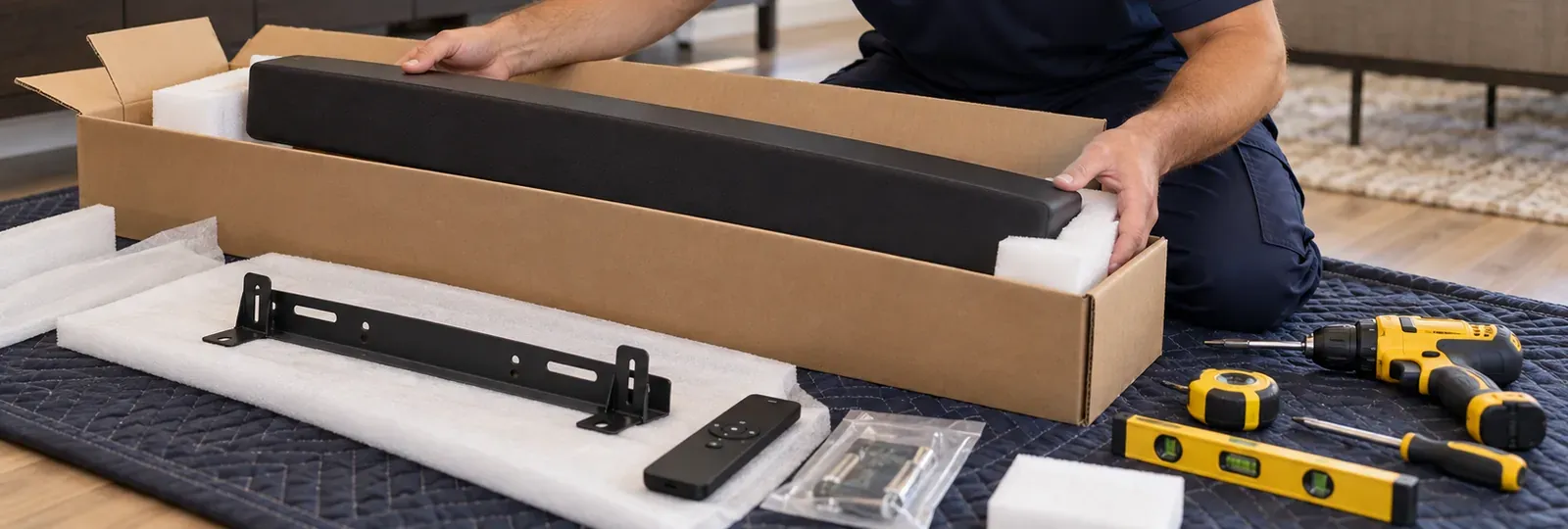
Every professional soundbar installation follows the same steps: soundbar unboxing and installation, soundbar equipment inspection, soundbar bracket measurement and soundbar wall measurement, then soundbar mounting preparation. We do soundbar stud mounting and soundbar mounting to wall studs wherever the studs line up, and soundbar wall anchor installation rated for the bar's weight where they don't. Soundbar bracket leveling, soundbar installation with level, soundbar mounting alignment, soundbar mounting height adjustment and soundbar mounting position adjustment keep it centered and straight.
Most bars go with a TV. We do soundbar mounted below TV, soundbar mounted under TV and soundbar mounted above TV layouts, as well as soundbar mounting to television brackets and soundbar attached to TV mount kits that move with the screen. TV and soundbar installation in one visit, TV mounting with soundbar, soundbar TV mount installation and soundbar installation with TV mounting save a second trip.
Already have a TV up? Soundbar installation on existing TV setups is common, including soundbar installation under wall mounted TV, soundbar installation on articulating TV mount, soundbar installation on swivel TV mount, soundbar installation on full motion TV mount, soundbar installation on fixed TV mount and soundbar installation on tilting TV mount. We also handle soundbar installation with smart TV, soundbar installation with OLED TV, soundbar installation with QLED TV, soundbar installation with LED TV and soundbar installation with projector screens.
Soundbar installation on drywall, soundbar installation on plaster wall, soundbar installation on brick wall, soundbar installation on concrete wall and soundbar installation on stone wall each need different anchors and drill bits, and we bring them all. Soundbar installation on fireplace wall layouts include soundbar installation above fireplace and soundbar installation below fireplace mounted TV, with the bar kept clear of heat. Brooklyn brick party walls and plaster over lath are common, and a fireplace wall in a brownstone often means brick behind the plaster.
Residential soundbar installation covers soundbar installation in living room, soundbar installation in bedroom, soundbar installation in home theater, soundbar installation in apartment and soundbar installation in condominium spaces. We do soundbar installation for luxury homes, soundbar installation for apartments, soundbar installation for home offices, soundbar installation for media rooms and soundbar installation for home cinema alike. Brooklyn renters and condo owners often need a setup that respects the building's rules and the neighbors on the other side of the wall.
Commercial soundbar installation includes soundbar installation in office, soundbar installation in conference room, soundbar installation in restaurant, soundbar installation in retail store and soundbar installation in commercial space. Soundbar installation for businesses and soundbar installation for conference rooms usually means making sure the bar works with the room's TV, video calls and remotes.
Soundbar HDMI installation is the best connection for most TVs. Soundbar HDMI ARC setup and soundbar HDMI eARC setup, or an HDMI ARC soundbar connection or HDMI eARC soundbar connection, let the TV remote control the bar through soundbar CEC configuration. Where HDMI isn't an option, soundbar optical cable installation and soundbar optical audio setup give a solid soundbar digital audio connection.
Wireless soundbar installation, wired soundbar installation, soundbar Bluetooth setup and soundbar WiFi setup are matched to the bar and the room. Soundbar TV audio connection and soundbar audio output configuration make sure sound comes out of the bar, not the TV speakers. Soundbar TV remote programming, soundbar universal remote setup, soundbar volume control setup, soundbar synchronization setup and soundbar lip sync adjustment finish the setup.
Soundbar and subwoofer installation, soundbar surround sound installation, wireless subwoofer setup, wireless surround speaker setup and soundbar rear speaker installation turn a bar into a full system. Soundbar subwoofer pairing and soundbar speaker placement are done in the room, not guessed.
Dolby Atmos soundbar installation and Dolby Atmos soundbar setup, Dolby Digital soundbar setup and DTS soundbar configuration get the right audio format from each source. Soundbar audio calibration, soundbar sound optimization, soundbar dialogue enhancement setup and soundbar bass adjustment make voices clear and keep bass from shaking the neighbors. That's home theater soundbar installation, home entertainment soundbar setup and soundbar home theater integration done properly.
Soundbar cable concealment, soundbar wire concealment and soundbar hidden wire installation are what make the job look finished. Soundbar in wall cable management uses low-voltage in-wall kits where the wall allows, and soundbar cable cover installation, soundbar raceway installation and soundbar wire molding installation work where it doesn't. Soundbar cable routing, soundbar cable organization, soundbar cord hiding, soundbar power connection installation and soundbar power cable management keep the cords out of sight. Brooklyn landlords often don't allow cutting into walls, so raceway and cord covers painted to match are a frequent choice.
The result is soundbar installation with concealed cables, soundbar installation without visible wires, soundbar installation with hidden connections and soundbar installation with clean finish. If a new outlet is needed behind the TV, we handle soundbar power outlet installation coordination with your licensed electrician, since we don't do electrical work ourselves.
Not every bar goes on the wall. Soundbar installation with media console, soundbar installation inside entertainment center, soundbar installation above media cabinet, soundbar installation with TV cabinet, soundbar installation below floating TV and soundbar installation with floating entertainment center are all common. Soundbar connection inside media cabinet and soundbar cable management inside console keep everything tidy.
We connect everything around it: soundbar installation with cable box, soundbar installation with streaming device, soundbar installation with Apple TV, soundbar installation with Roku, soundbar installation with Fire TV and soundbar installation with gaming console.
We install every major brand: Samsung soundbar installation, LG soundbar installation, Sony soundbar installation, Bose soundbar installation, Sonos soundbar installation, JBL soundbar installation, Vizio soundbar installation, Polk soundbar installation, Yamaha soundbar installation, Sennheiser soundbar installation and Klipsch soundbar installation. That includes Samsung Q Symphony soundbar setup, LG WOW Orchestra soundbar setup, Sonos Arc installation, Sonos Beam installation, Bose Smart Soundbar installation and Sony Bravia Theatre soundbar installation.
Soundbar not working repair starts with soundbar connection troubleshooting. Soundbar no sound troubleshooting, soundbar HDMI ARC troubleshooting, soundbar eARC troubleshooting, soundbar optical connection troubleshooting, soundbar Bluetooth troubleshooting, soundbar wireless connection repair, soundbar audio delay troubleshooting and soundbar TV compatibility troubleshooting find whether it's the cable, the settings or the TV.
Soundbar relocation service, soundbar remounting service and soundbar removal and reinstallation handle moves and new TVs. Soundbar installation upgrade and soundbar replacement installation swap an old bar for a new one, and soundbar installation troubleshooting fixes a job someone else started.
Every job ends with soundbar installation and testing: soundbar audio testing, soundbar final system testing and a soundbar installation quality check with you in the room.
Beyond the bar, we handle TV sound system installation, TV audio system installation, home audio installation, home theater audio installation, audio video installation and AV installation services as a low voltage audio installation contractor. If you've been searching for soundbar installation near me in Brooklyn Heights, Brooklyn, we're a soundbar installation company and soundbar installation contractor offering professional TV audio setup and soundbar mounting service across the whole area. Customers find us searching for soundbar installation NYC, soundbar installation Manhattan, soundbar installation Brooklyn, soundbar installation Queens, soundbar installation Bronx, soundbar installation Staten Island, soundbar installation Long Island, soundbar installation Nassau County, soundbar installation Suffolk County, soundbar installation Westchester County, soundbar installation Rockland County and soundbar installation Hudson Valley.
Yes. Audio description is a secondary audio track with extra narration, usually switched on with the SAP button or the TV or streaming app's accessibility menu. Once the TV or app is playing that track, the TV sends it to the bar like any other sound. If a cable box decodes the channel, it is turned on in the box's settings instead. We set it up and show whoever needs it how to switch it on and off.
Sign your streaming services out of the TV and any streamer, and remove the bar from your own app account or invite the subtenant as a guest if the app allows it. Turn off any voice assistant linked to your accounts and note the Wi-Fi network the bar uses. A setup-only visit ($195 first hour) can do this and set it back when you return.
Taking a common pairing: the parlor bar on the brick party wall with its own bracket and a painted cord cover is $129 + $65 + $59 = $253. The den bar on plaster is $129 + $45 = $174, and if the den is on the third floor or higher with no elevator the $40 walk-up line applies, making $214. Both rooms together: $427, or $467 with the walk-up line.
One level up from here is the Brooklyn soundbar installation page; above that is our soundbar hub for New York City, which takes in all five boroughs. Suburban counties have pages of their own too, and neighbourhood pages such as this one dig into the houses of a single area.
Brooklyn · Manhattan soundbar installation · AESS in Queens · the Bronx · Staten Island
Brooklyn Heights (this page) · Park Slope · Bay Ridge · Williamsburg
Across the river in Manhattan: Tribeca, the Upper West Side, the Upper East Side, Chelsea and Harlem. In Queens: Long Island City, Astoria, Forest Hills and Flushing. In the Bronx: Mott Haven, Pelham Bay, Throgs Neck and Riverdale. On Staten Island: St. George, Great Kills, Todt Hill and Tottenville.
Soundbar installation on Long Island, with Nassau County and Suffolk County.
Hudson Valley soundbar installation — Westchester, Rockland, Orange, Putnam, Dutchess and Ulster.
This page covers soundbars only. For security cameras, intercoms, door locks and network cabling, the AESS home page has the full list of services, and the company page introduces the team behind them.
Each local fact above is drawn from a published source; they are grouped here for checking. Figures that cover more than the Heights are marked as such.
Picture but no sound since the cable company swapped the box, a remote that suddenly ignores the bar, or a sub that blinks and won't reconnect: call (347) 934-8335. We take the next free two-hour slot, and on-site fixes for faults like these usually take one to two hours.
Abstract Enterprises Security Systems · 1282 Troy Ave, Brooklyn, NY 11203 · serving Brooklyn Heights and all of Brooklyn · (347) 934-8335 · WhatsApp (718) 679-0359 via wa.me
NYS Low-Voltage Licence #12000287431 · 100% Licensed & Insured · Same-Day Estimates · Rated 4.7★ from 201 Google Reviews
Brackets and parts carry their manufacturer's warranty. Full terms — including 50% deposit, one-year parts-only warranty on AESS-supplied products, and the late-fee schedule — are set out in the service agreement. See our warranty page.
Page reviewed and updated October 17, 2026. Changelog: page launched for Brooklyn Heights homes, co-ops and businesses, built on landmark-district, housing-stock, carriage-house and expressway research.