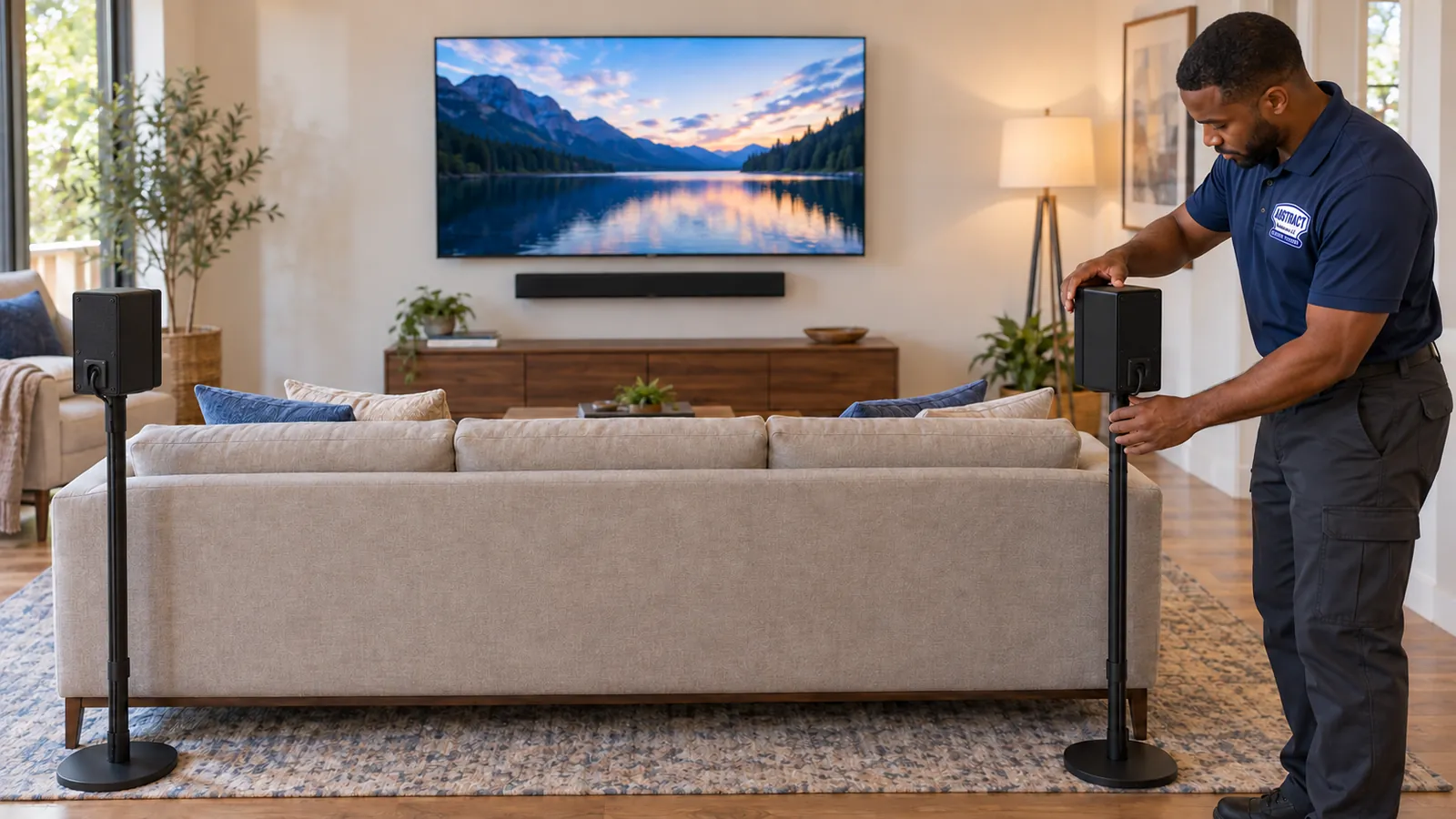
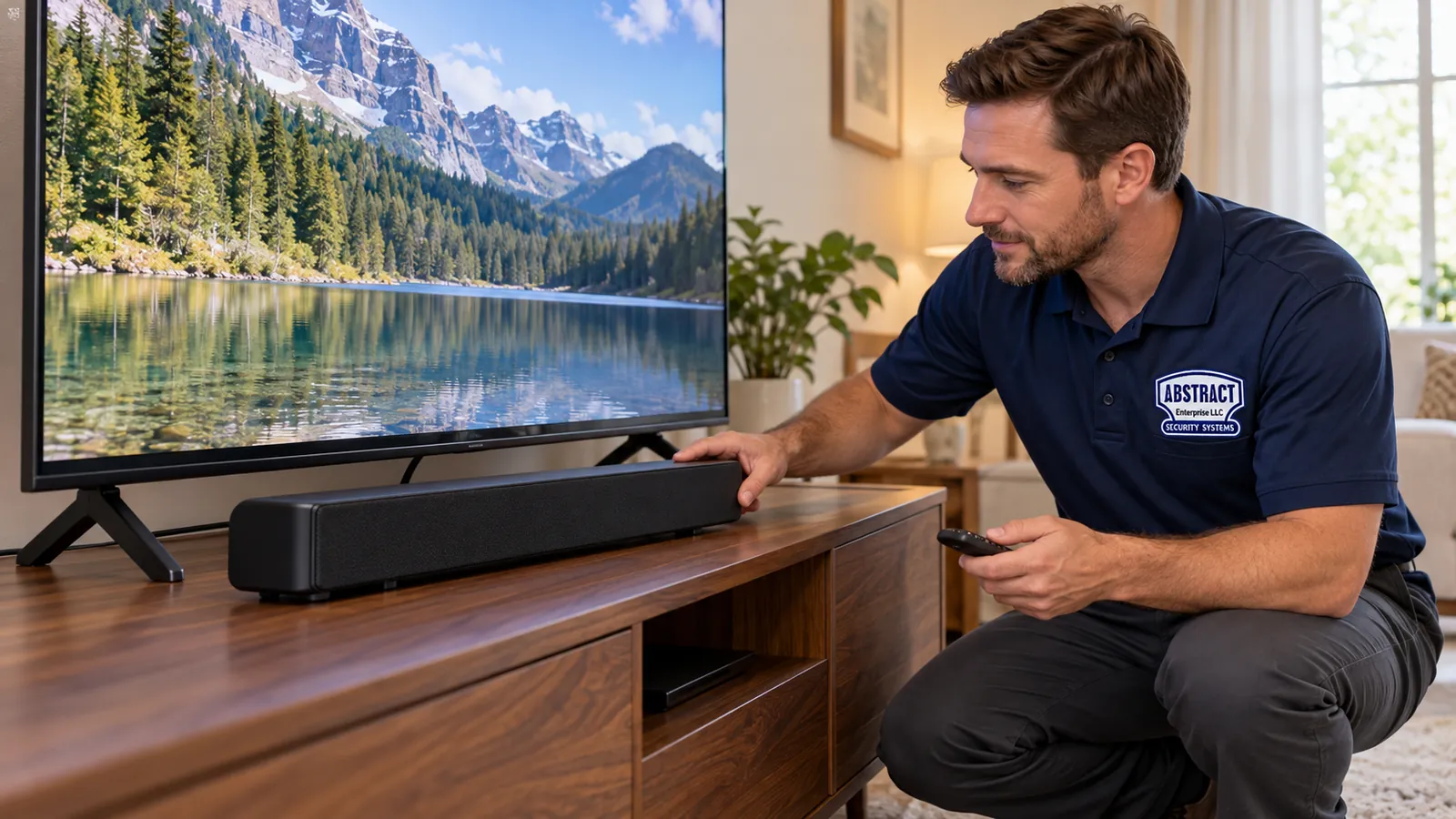
Co-op Paperwork Handled · Plaster & Block Fixings · Bass Tuned for the Floor Below · eARC & One-Remote Setup
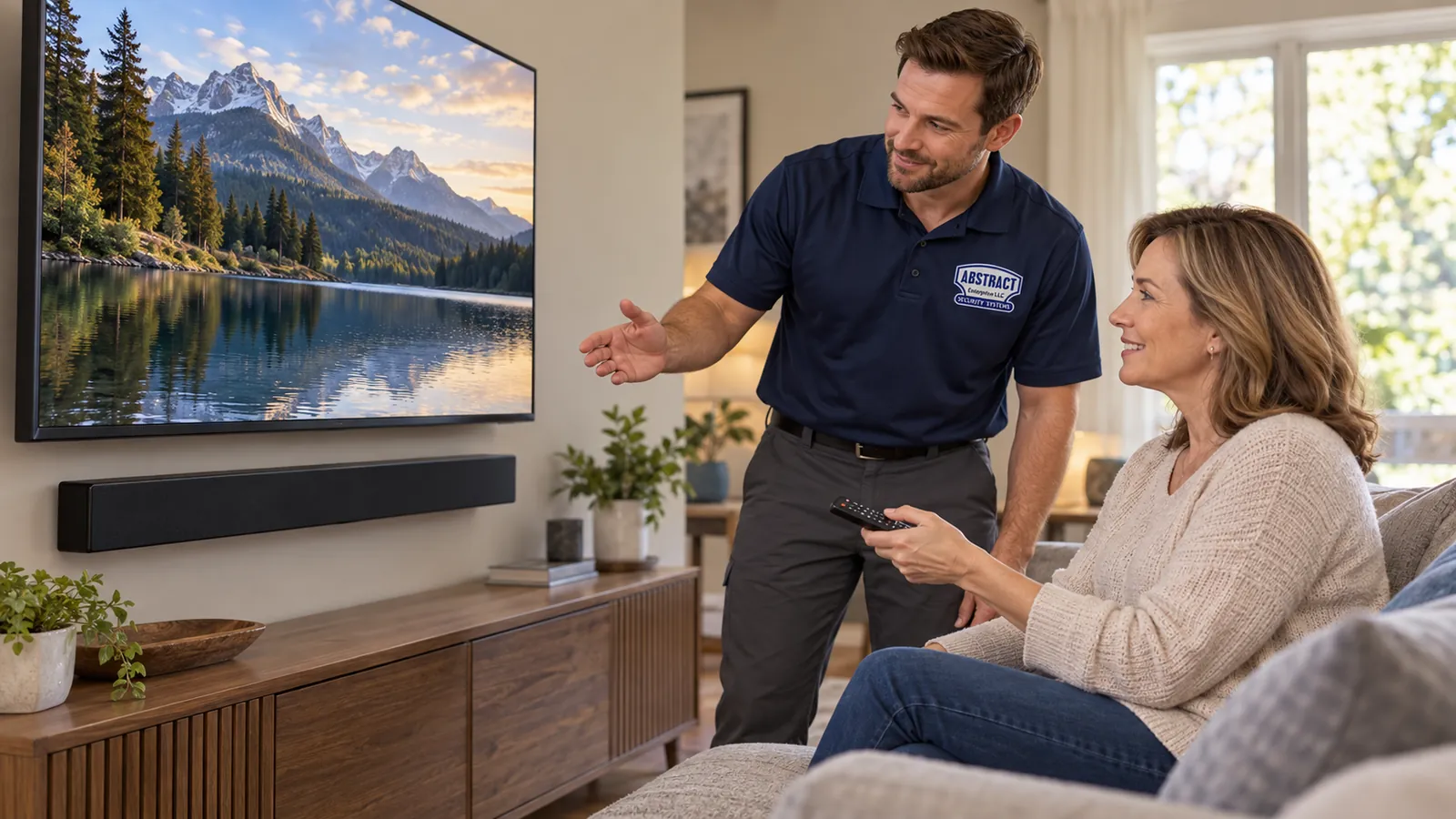
Bay Ridge has spent almost fifty years zoning itself to stay the way it was built, so the rooms we hang soundbars in are old ones: six-story elevator co-ops facing the harbor on Shore Road and Ridge Boulevard, limestone and tapestry-brick row houses split into an apartment per floor, and flats over the shops on Fifth and Third Avenues. That means managing agents with house rules, plaster that has been painted for a century, and almost always a neighbor or a tenant directly underneath. We mount the bar to suit the wall, set it up on the port that lets one remote run everything, and tune the low end so the person downstairs never learns your new soundbar exists.
Reviewed and updated October 17, 2026 · Written by Anwar Timothy, NYS license #12000287431 · Served from our Brooklyn office at 1282 Troy Ave

Co-op on Shore Road, two-family on 72nd Street or a flat over Fifth Avenue — say which, and we price it. The Bay Ridge line is (347) 934-8335, and the short form above takes about a minute. A licensed installer reads it, matches your wall and your bar to the published list further down this page, and sends back one written number.
Bay Ridge decided a long time ago that it did not want to change, and the rooms prove it. In 1978, after residents protested the twin 30-story Bay Ridge Towers and the 13-story Shore Hill Apartments, the city created the Special Bay Ridge District, which held new building to three stories on residential streets and eight on the avenues. In March 2005 the City Council went further and rezoned 249 blocks inside the district; according to CityLand's report on the vote, the number of blocks limited to one- and two-family homes rose from 33 to 101. The point, residents argued, was to stop sound old houses being knocked down for larger apartment buildings. For anyone mounting a soundbar, the practical result is that the walls in Bay Ridge are mostly the walls the builders put up between about 1905 and 1965, still standing, still plastered, and still shared with somebody.
Those buildings come in a handful of recognizable types. Along Shore Road, facing Shore Park and the Narrows, and on Ridge Boulevard a few blocks inland, there is a long run of six-story elevator apartment houses, many of them co-ops. Brownstoner describes 9437 Shore Road, The Normandy, as a six-story, 55-unit Art Moderne co-op that opened as a rental in 1940, with one corner curved like the prow of an ocean liner, parquet with inlaid borders and a faceted bedroom wall. A neighborhood broker's guide lists Lebern Towers at 9701 Shore Road as a six-story prewar co-op from 1935 with an Art Deco front, and The Len at 9201 Shore Road as a six-story postwar co-op of 254 apartments completed in 1960. Three generations, one idea: masonry, plaster, concrete floors and a managing agent who wants paperwork before a contractor gets in the elevator.
Between the avenues are the row houses. Bay Ridge Parkway between Fourth and Fifth Avenues, the stretch locals call Doctors' Row, is a block of 54 limestone-fronted houses built between 1906 and 1913, two stories over a basement under one continuous cornice; in 2019 the Landmarks Preservation Commission made it the first historic district in Bay Ridge. Around it are blocks of early twentieth-century tapestry-brick houses. Brownstoner's write-up of 476 72nd Street describes one of them as it stands today, set up as a two-family with an apartment per floor, a front parlor with a bay window, picture rails, wall moldings, wainscoting with Lincrusta above it, and a coffered dining room ceiling. Another, on Ridge Crest Terrace, came out of a 1920s development of single-family tapestry-brick houses with garages and has since been converted to two apartments. Picture rails, molded plaster and a stacked pair of apartments are what a Bay Ridge row-house soundbar job usually looks like.
Then there are the avenues. Fifth Avenue has its own business improvement district from 65th to 85th Street, Third Avenue is organized by the Merchants of Third Avenue, who run the Third Avenue Festival each fall, and 86th Street has a BID of its own. A lot of those blocks are mixed-use: Brownstoner traced the 72nd Street house to a row of three-story buildings on Fifth Avenue with stores on the ground floor and apartments above. Over a shop, a bar or a restaurant, the neighbor below you is a business with its own hours.
The households in those buildings are more settled than the borough average. Data USA, working from the Census Bureau's survey, puts the owner-occupancy rate for the Bay Ridge and Dyker Heights community district at 40.4 percent in 2024, against 29.5 percent for Brooklyn as a whole in the Census QuickFacts table. That is a lot of co-op shareholders and owner-landlords with a tenant under the living room, and getting a soundbar right for them is less about volume than about not becoming the subject of the next letter from the managing agent.
There is a precedent for how seriously the neighborhood takes sound. In 2009 the Brooklyn Paper reported that Community Board 10 had logged 42 noise complaints in a few months from eight families on Third Avenue living near two bars between 88th and 89th Street. The 68th Precinct's sound-meter readings came back within legal limits, and the board's district manager said it did not matter: if residents could not sleep, the board wanted the noise down. A legal reading is not the Bay Ridge test; the neighbor's night's sleep is, and every subwoofer we set up here is set with that in mind.
Most Bay Ridge soundbar calls come with a TV that is going up, coming down or moving to a better wall, and doing both on one visit means one set of holes planned together. Our TV installation team for Bay Ridge handles the screen itself, and on a combined visit the bracket for the bar is laid out from the same measurements as the TV mount, so the two line up the first time.

A soundbar that has stopped behaving is usually a settings problem, not a hardware one. If yours went quiet after a TV update, answers only its own remote, plays voices a beat behind the lips, has lost its subwoofer, or has started to sag on the wall, call (347) 934-8335. We book the next open 2-hour window, and most of these faults are sorted within one to two hours of arrival. A bracket pulling out of old plaster is the one we treat as urgent: lift the bar down onto the console if you can do it safely, leave the anchors where they are, and send us a photo so we arrive with the right replacement fixings.
These are the soundbar jobs we book between 65th Street and the Verrazzano, on their own or combined. Each one is priced from the list on this page, and each ends with the same checks: the bar parallel to the bottom edge of the screen, the cables hidden or dressed so they read as part of the room, the TV remote controlling the bar, and the low end set for whoever lives below or beside you.
Bars hung on plaster, plaster-on-block and concrete in the Shore Road and Ridge Boulevard elevator buildings, booked inside the building's contractor hours, with our certificate of insurance sent to the managing agent ahead of the visit and the hallway left as we found it.
Upstairs or downstairs in a tapestry-brick or limestone two-family, with the subwoofer placed and set for the other apartment. Owner-landlords often book both units on one visit so each household gets a bar that suits the floor it sits on.
Front parlors with picture rails, molded plaster, wainscoting and old embossed wall coverings. We plan the bracket and the cable route so the trim is not cut, the molding is not notched and the work can be reversed by the next owner.
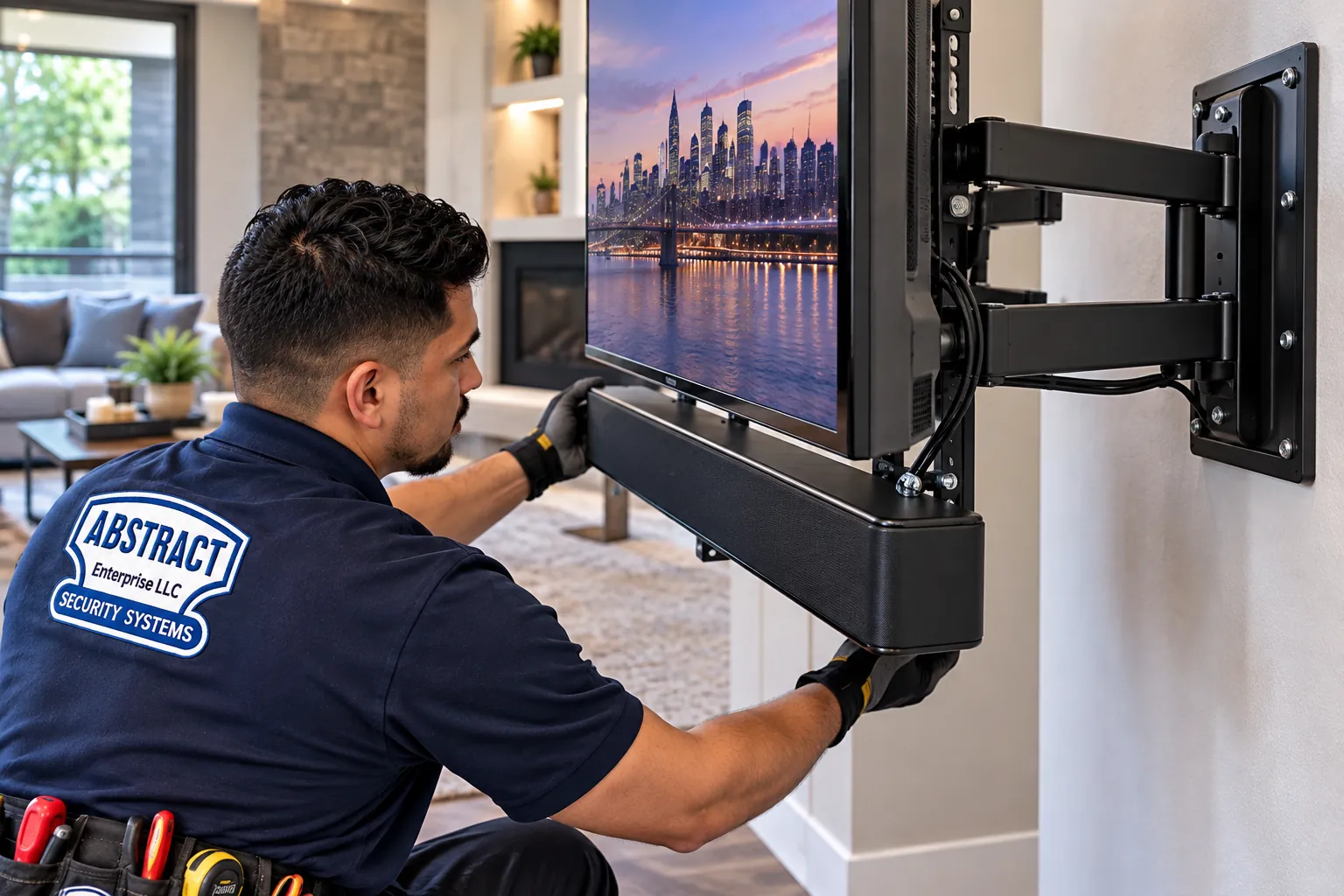
Where the house rules or the lease discourage new holes, a bracket that attaches the bar to the existing TV mount or the back of the set. The pair move together on an articulating arm, and the wall gets nothing new.
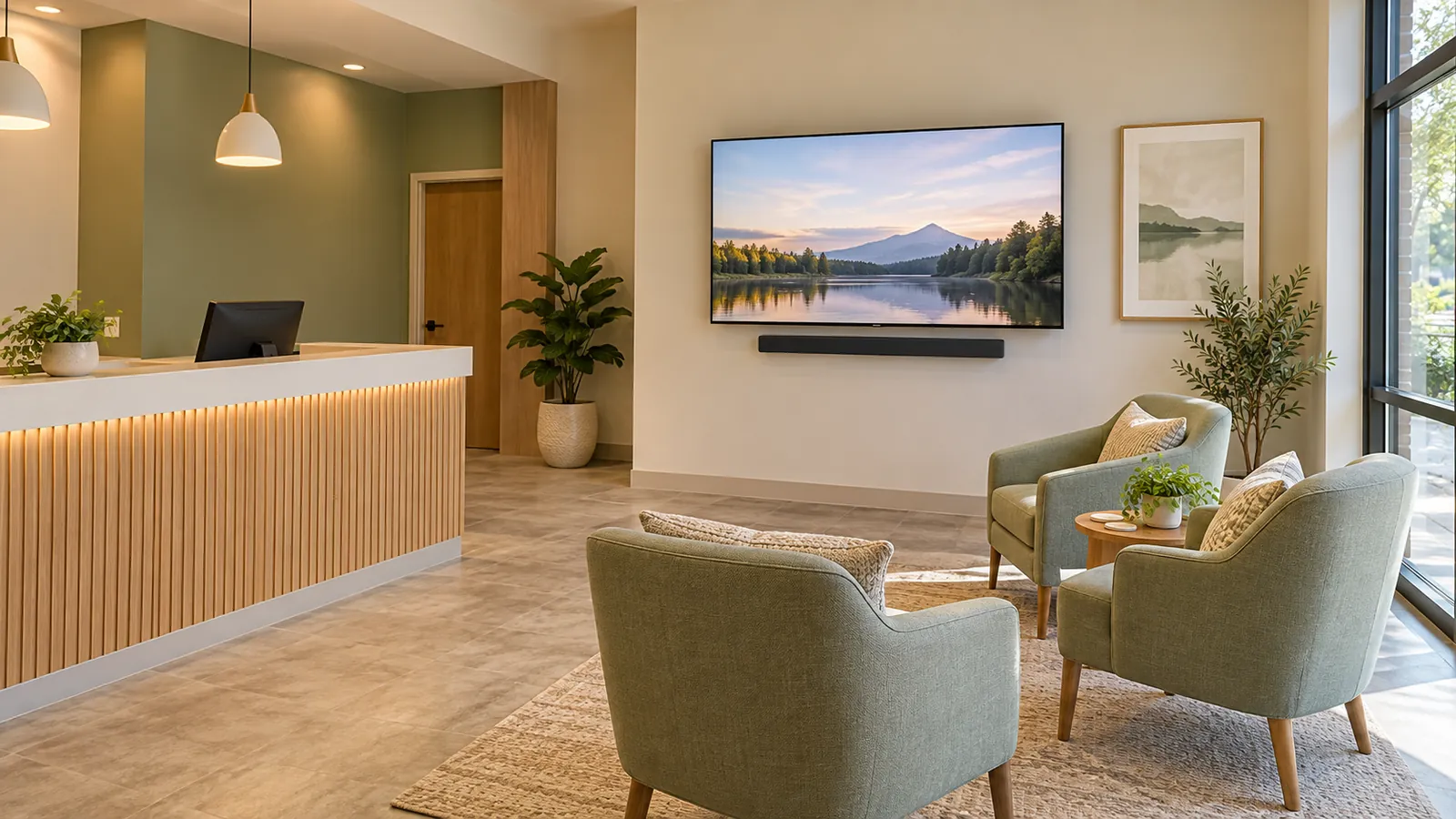
The bar on your furniture, set clear of the TV's infrared sensor, connected on the ARC or eARC port and tuned. Nothing is drilled, which is often the right answer in a rental over a Fifth Avenue store or in a co-op mid-sale.
The part of the job that decides whether the neighbors hear about it. We choose a spot away from the shared wall and the floor joists that carry sound, isolate the sub from the floor, set its level well below the showroom default and show you the night mode.
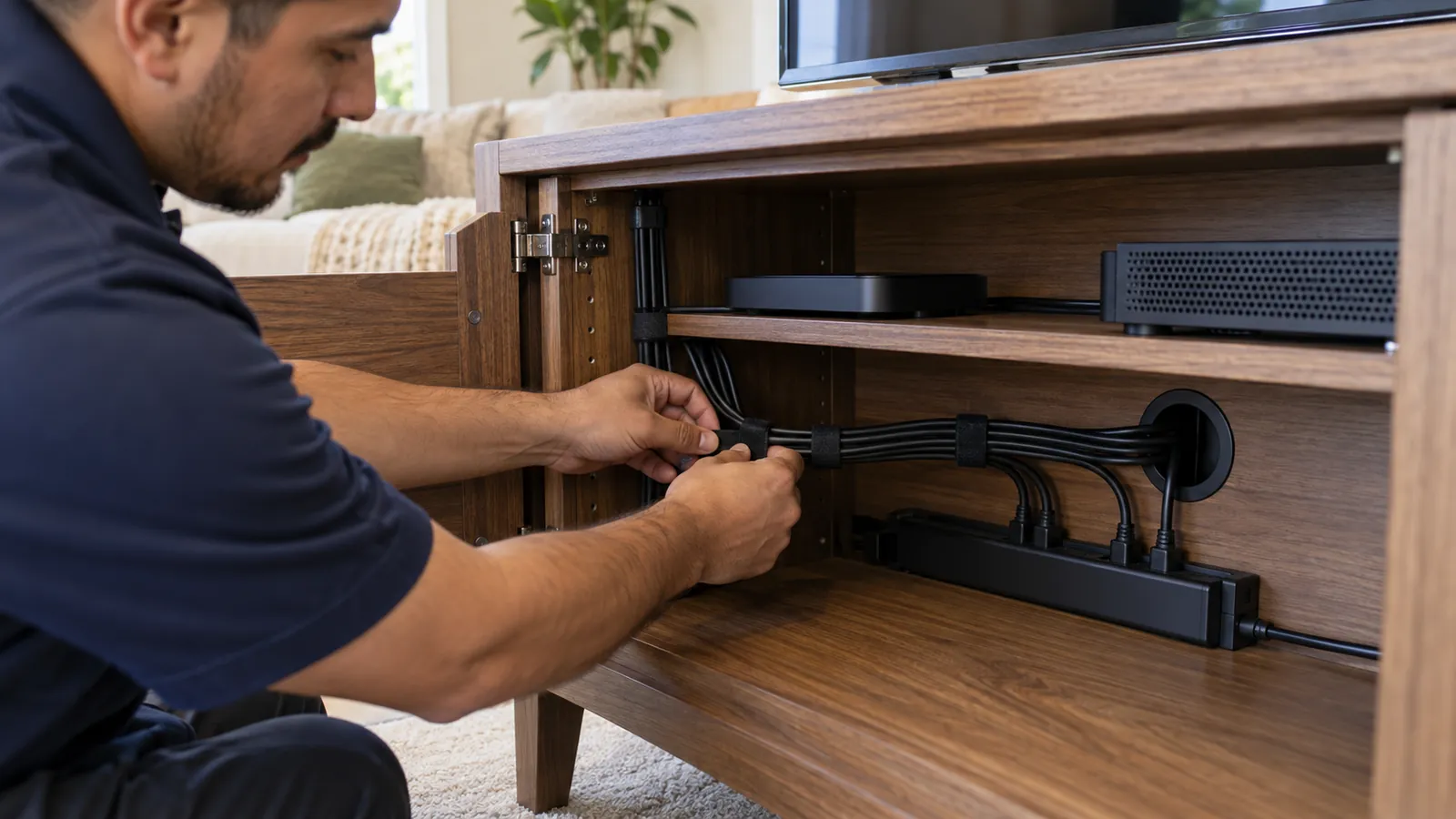
Inside the wall with a proper in-wall power kit when the wall is hollow and the building says yes; otherwise a narrow channel painted to match the plaster, block or brick. Either way, our cables never share the building's electrical raceway.
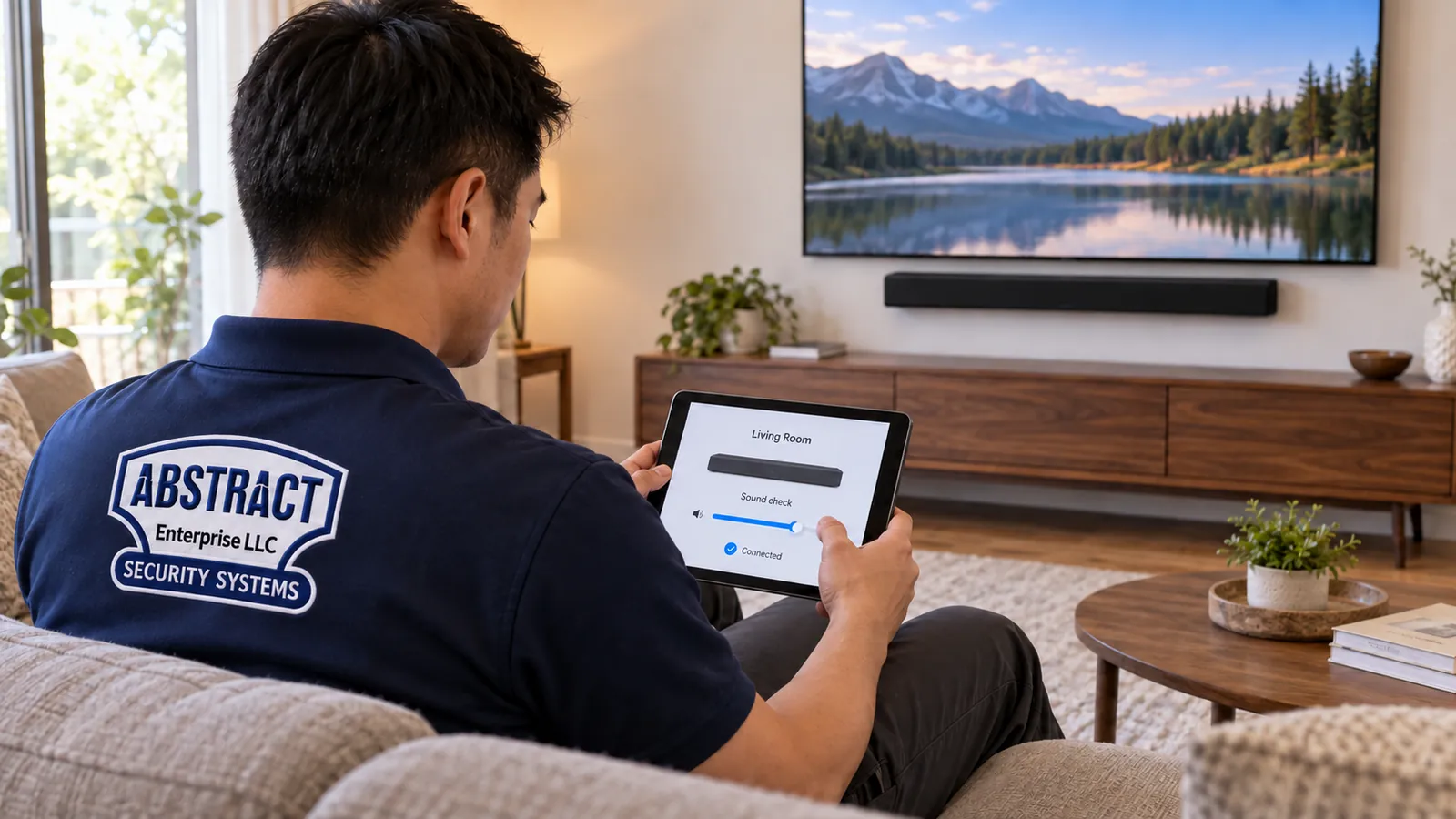
The cable goes into the one HDMI socket on the TV marked ARC or eARC, CEC is turned on in both menus so the TV remote works the bar, voices are checked against lips, and the bar's software and app are brought current on your network.
Bars and restaurants on Third Avenue, offices and waiting rooms on Fifth Avenue and the side streets, and shops along 86th Street: one bar per screen, mounted clear of shelving and doorways, with controls staff can find at closing time.

Six kinds of building account for nearly every soundbar we hang in Bay Ridge. Each has its own wall behind the paint, its own people to answer to and its own idea of where the subwoofer should go.
Shore Road and Ridge Boulevard buildings of the 1930s and around 1940, such as Lebern Towers and The Normandy, with Art Deco and Art Moderne fronts. Thick plaster on masonry or clay block, steam heat, high ceilings, parquet floors and, in buildings like The Normandy, curved corners and faceted walls. The managing agent sets contractor hours and wants a certificate of insurance before the visit.
The six-story postwar buildings along Shore Road, such as The Len from 1960, and the twin 30-story Bay Ridge Towers on 65th Street. Concrete floor slabs, block or concrete partitions, lower ceilings, doormen and package rooms. Drilling is hammer-drill work, and the slab carries bass to the apartment below very efficiently.
Doctors' Row on Bay Ridge Parkway and other limestone-fronted rows: two stories over a basement, masonry party walls, plaster on wood lath on the interior partitions, and a front room that is often the best-preserved room in the house. Inside a historic district the interior is not regulated, but the street front is.
Early twentieth-century and 1920s brick houses, many converted to an apartment per floor. Bay-window front parlors, picture rails, molded plaster, Lincrusta and wainscoting, English basements and, on some blocks, garages under or behind. The tenant's ceiling is the owner's floor, or the other way round.
Low buildings on the avenues with stores on the ground floor and apartments above, like the three-story row Brownstoner traced on Fifth Avenue between 72nd and 73rd Streets. Often old surface wiring, and always a business under the living room that keeps its own hours.
The freestanding houses near Shore Road, on Narrows Avenue and on the streets toward Fort Hamilton: larger rooms, more windows, sometimes stone or stucco outside and lath and plaster within. No neighbor through the wall, but big rooms and long cable runs to wherever the internet comes in.
Plaster on masonry in the prewar co-ops. The inside face of an exterior or corridor wall in a 1930s Shore Road building is usually a thick coat of plaster over brick or hollow clay block. We drill through the plaster with a masonry bit on rotation only, no hammer, until the dust changes color, then decide the anchor by what is behind: solid brick takes a sleeve or screw anchor, clay block takes an anchor designed to grip a hollow web. Holes are vacuumed as they are drilled.
Partitions in the same buildings. Interior walls between rooms are often plaster on metal lath or on gypsum block, which can be thinner and more brittle than it looks. We probe with a small pilot before committing and use toggles that spread the load where there is a cavity.
Concrete and block in postwar buildings. A hammer drill, anchors rated for the material and a bit sized exactly to the anchor, because an oversized hole in concrete block crumbles the web and the anchor spins. We scan before drilling for conduit and pipe, which postwar builders often ran inside block walls, and we never drill into the floor slab or ceiling of a co-op apartment for a soundbar.
Lath and plaster in row houses and two-families. Wood studs behind wood lath behind plaster, often over a century old. We find the studs by probing rather than relying on a stud finder that reads lath as solid wall, fix into timber wherever the bracket width allows, and use toggles behind the lath only where the plaster is sound and tight. Before drilling we press the wall around the bracket position; plaster that has let go of its lath gives a little, and a bracket on it would pull the whole patch.
Period trim. Picture rails, chair rails, plate shelves and the embossed Lincrusta or anaglypta panels in some Bay Ridge parlors are not things we cut. We set the bar's height so the bracket clears the trim, bring cables down in a channel that stops short of the rail and starts again below it, or route them to an adjacent wall where the run is clean.
Basement walls. English basements and finished cellars in the two-families are poured concrete, block or old brick, often painted. They take masonry anchors well, but they are also the walls most exposed to damp, so we keep the subwoofer, power strip and any receiver off the floor and away from the wall, and we route power so that nothing important sits on the slab.
Five Bay Ridge walls behind the paint, and the fixing each one takes.


While a two-family's walls are open for a renovation, a network cable from the basement to the TV wall is the cheapest upgrade you will ever make. It gives the bar and any streaming box a wired connection instead of a weak signal two floors from the router. That pull is done by our structured cabling crew in Bay Ridge, and it can be scheduled on the same visit as the soundbar.
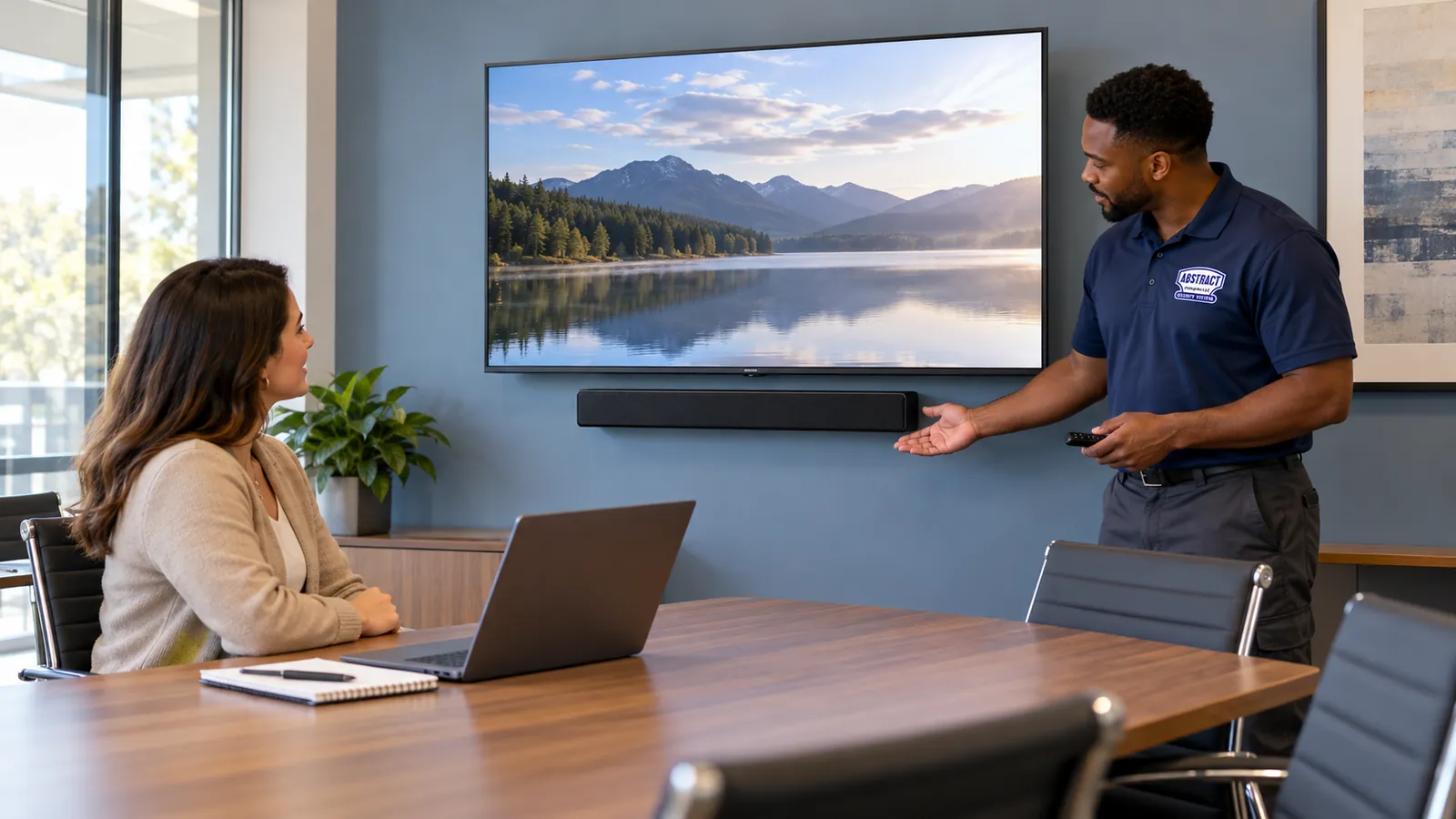
On a Bay Ridge avenue, the business soundbar has two audiences: the customers in front of the screen and the families who live upstairs. Most commercial screens here sit in ground-floor spaces under apartments, so a bar has to make speech clear without turning the ceiling into a speaker.
The neighborhood's dining and drinking strip, organized by the Merchants of Third Avenue, who run the Third Avenue Festival each fall. Screens over back bars, in narrow dining rooms and along exposed brick, almost always with apartments above.
The Bay Ridge Fifth Avenue BID covers 65th to 85th Street: restaurants, cafés, bakeries, salons and professional offices. Screens run all day in waiting areas and dining rooms, so bars need simple inputs and a volume ceiling.
A long shopping street with a business improvement district of its own and the R train underneath at 86th Street station. Larger retail floors, gyms and food businesses with screens near doors and counters where foot traffic is heavy.
Bay Ridge Parkway earned the name Doctors' Row for the medical professionals who have lived and practiced there, and practices still occupy row-house ground floors and avenue offices across the neighborhood. Waiting-room screens want clear captions, a soft bar and nothing that carries into treatment rooms.
Shore Road and Ridge Boulevard buildings with a screen in the lobby, a community room or a gym. The board sets the hours and the volume, and the cable has to disappear because every shareholder walks past it.

A shop adding screens is often ready for cameras or a better door entry too. Our Bay Ridge security camera installers and the intercom team that works in Bay Ridge buildings are the same licensed company, and the visits can be arranged back to back.
A broker quoted by the trade magazine Cooperator described Shore Road as having "a high concentration of co-op apartment buildings," and a Bay Ridge real estate team put the local mix at roughly half co-op and half condo along Shore Road and Ridge Boulevard. If you live in one of those buildings, the soundbar is the easy part of the visit. Getting a contractor in the door is the part with rules, and the rules are set by your building, not by the city. This is how we work through them.
Most Bay Ridge co-ops treat any outside tradesperson the same way, whether they are retiling a bathroom or hanging a soundbar. The managing agent wants to know who is coming, when, and what insurance they carry. A certificate of insurance naming the co-op corporation and the managing agent is the usual requirement; ours is issued at no charge, normally within a day of your forwarding the request. Some buildings ask for it a set number of business days before the visit, so the earlier you send us the agent's wording, the more dates you can choose from.
Work hours are the second rule. A Brooklyn renovation guide published by a contractor this year describes alteration agreements that typically restrict work to 9 AM to 5 PM, Monday to Friday. A soundbar visit is not renovation, but many supers apply the same window to anyone carrying a drill. Our 2-hour arrival slots run from 8 AM to 8 PM every day; in a co-op we book inside whatever window the building allows and keep drilling to the middle of it.
Usually not in the sense that triggers a full alteration agreement, architect's drawings or board review. A bracket held by four anchors, a cable channel and a TV connection change nothing structural, plumbing or electrical. But the decision belongs to your building, and some proprietary leases are worded broadly enough that any wall penetration needs the agent's sign-off. When you book, tell us what your house rules say, or forward the page, and we plan the installation to fit: surface fixings rather than in-wall boxes, or a TV-attached bracket and no new holes at all if the building prefers.
Many New York co-ops carry a house rule requiring rugs or carpet over most of the floor. Habitat Magazine's account of one court case quotes the typical wording, at least 80 percent of the floor area of each room except kitchens, pantries, bathrooms and hallways, and notes the court's reasoning that the purpose was noise abatement because one shareholder's floor is another's ceiling. StreetEasy points out that this is a building rule, not a city law. Either way, it tells you what your board cares about, and a subwoofer is the piece of a soundbar system most likely to test it.
Where the subwoofer goes: a Shore Road co-op living room, and an owner's floor over a tenant.
A lot of our Shore Road bookings come from people who have just bought. New York City's Local Law 58 of 2026 took effect on July 28, 2026, and for co-ops with ten or more apartments it gives the board 15 days to confirm a purchase application is complete and 45 days after that to decide, with fines enforced by the Department of Housing Preservation and Development, according to a Bay Ridge brokerage's summary of the law. Boards may pause the clock in July and August if they have adopted a recess policy. That makes a move-in date easier to predict, and the soundbar visit can reasonably be planned for your first week.
A tidy job is part of the paperwork too: drop cloths in the hallway, a vacuum held under the drill, nothing left in the service elevator, and, if your agent wants it for the apartment's file, a short written note of what was installed and where.
These are the questions Bay Ridge homes raise that a generic installation guide does not: curved Art Moderne walls, elevator shafts, inlaid parquet, a tenant downstairs, a bay window, a shop under the living room and a bar crowded by liquor shelves. Each answer comes first, then the detail.
They can, so we check before the bracket goes up. Many Shore Road and Ridge Boulevard apartments of the 1930s and 1940s open into the living room through glazed French doors, and when the TV wall is the one beside the doorway, an open leaf can sweep across exactly the spot where the bar would sit. A bar on its bracket stands a few inches proud of the plaster, with the TV just above it, and that is enough to catch a lever handle or the edge of a glass panel.
We open each leaf fully, mark its arc on the wall with painter's tape and keep the TV and bar clear of it. Where the arc covers the natural center of the wall, the choices are a narrower bar moved along the wall with the TV, a TV-attached bracket on an arm that folds flat when the doors are open, or a floor-mounted door stop so the leaf halts short of the bar. We mark where a stop should go.
Less than most people expect. On a typical Bay Ridge wall the noisy part is a handful of holes for the bracket and perhaps two or three for a cable channel, each drilled in seconds. On concrete or block in a postwar building the hammer drill is louder, but the total drilling time is still counted in minutes rather than hours.
Hammer-drill noise does travel through a concrete slab and a corridor wall, so in a co-op we keep it inside the contractor hours your building sets and, where we can, gather all the drilling into one short spell in the middle of the visit rather than spreading it out. A note to the neighbors beside you and across the hall the day before, saying roughly when, goes a long way in a building where everyone shares the same elevator — we can suggest wording.
It can, as long as it never touches the wood directly. Most subwoofers ship with either hard plastic feet or small spikes, and both are bad news for old parquet: the feet slide when the sub moves air and scuff the finish, and spikes dent soft oak and the strips of the border inlay. A thirty-pound box that vibrates for a few hours every evening will polish or press a mark into the finish within a few months.
We set the sub on a dense isolation pad or a small platform with a felt or rubber base sized to its footprint, which protects the floor and, more usefully, keeps the sub from driving the parquet and the slab underneath it. Where the building's rug rule applies, a rug under the sub is already part of the picture, but a rug alone is not enough: the sub still needs a firm pad on top so it does not rock on the pile. If the parquet has a loose strip where you want the sub, we move the sub, because a loose strip rattles at certain notes.
Only partly. The house rule that Habitat Magazine describes, rugs over at least 80 percent of each room's floor, was written for footsteps: impact noise from heels, chairs and children landing on the floor. Rugs are good at that. Subwoofer bass is a different problem. Low notes travel as vibration through whatever the sub touches and as pressure through the air of the room, and in a postwar building with concrete slabs that vibration spreads very efficiently. A rug under the sub softens the first part a little and does almost nothing for the second.
What actually keeps the floor below quiet is placement, isolation and level. We move the sub away from the corners where walls meet the floor, because corners reinforce bass; set it on an isolation pad so it does not drive the slab; and set its level well below the factory default, matched to the bar by ear from the sofa rather than by the meter. Then we show you the sub-level control and the night mode so you can turn the low end down on the evenings it matters.
Yes, with your tenant's agreement and someone from the household present. It is one of the most useful ten minutes an owner-landlord can spend. We play a short passage with steady low bass through the system upstairs, at the level you would actually watch at, and listen and measure in the tenant's living room and bedroom below. The difference between the sub off and the sub on, and between the sub in one corner and another, is usually obvious without any equipment at all.
The result decides the purchase or the setup. Sometimes the answer is that a bar with good built-in bass and no separate sub is right for that floor; sometimes the sub is fine in one spot and plainly audible in another; sometimes a lower level and night mode on weekday evenings is enough. A meter reading is a guide, not a verdict; a neighbor who can hear it is the real test.
Almost always on a solid wall, not in the bay. A TV standing in a bay window fights the daylight behind it all afternoon, and a soundbar in a bay has glass on three sides, which reflects its sound back at odd angles and blurs dialogue. The bay also tends to be where the radiator, the deepest window trim and the room's best light are, all of which a TV and its cables spoil.
In the tapestry-brick and limestone houses the usual good choice is the wall that faces the bay or the long side wall toward the dining room, whichever puts the screen at the shortest comfortable distance from the sofa. If the bay must stay the focal point, a TV and bar on a low console beside it, angled toward the seating, works better than anything mounted inside it. Where the best wall is the shared one, we use fixings that stay well short of the brick's far face.
They can, and on modern bars it matters more than people expect. Many soundbars put side-firing or angled drivers at the very ends of the cabinet to widen the sound, and a heavy curtain hanging an inch away from those drivers soaks up exactly the part of the sound that is supposed to bounce off the side walls. The result is a narrower, duller picture of the room's sound and, sometimes, dialogue that seems to come from a point instead of the screen.
The fixes are simple. A bar a little narrower than the pier, centered with at least a few inches of clear air at each end, solves most cases; curtain rods with returns or tie-backs that hold the fabric clear of the bar solve the rest. If the pier is too narrow for the bar you want, clipping the bar to the TV mount and bringing both slightly forward of the wall usually buys the clearance without moving anything else.
It helps in the evening and it changes nothing about the walls beside you. If the business under your living room closes at 8 or 9 PM, there is nobody below to disturb at night, and a sub that would trouble a downstairs bedroom may be perfectly acceptable. But mixed-use buildings on Fifth and Third Avenues are usually narrow and attached on both sides, so bass also travels sideways into the apartments next door and up into any apartment above you. The store downstairs being empty does not make those neighbors any less awake.
There is a daytime side too. A shop with customers, a salon with clients or a restaurant with a lunch service is a neighbor during business hours, and a commercial tenant who hears your movie through the ceiling will complain to the same landlord you do. We place the sub away from the party walls, isolate it from the floor and set a moderate level, then show you how to switch between a daytime and a late-evening setting.
No. That surface channel is an electrical raceway carrying power conductors, and the electrical code requires Class 2 low-voltage wiring such as HDMI, network and speaker cable to be kept separate from power wiring rather than pulled in alongside it. Apart from the code, an HDMI cable sharing a raceway with power conductors picks up interference, and opening an old raceway risks disturbing wiring that may not have been touched in decades.
The answer is a separate route. We run a slim paintable channel of our own beside or below the existing one, painted to the wall, or route the cables along the baseboard to the console. Where the old raceway also means the outlet itself is tired, loose or ungrounded, we will point it out; any change to the outlet or the circuit is for a licensed electrician, and we are glad to come back once that work is done.
Usually above the shelving rather than between it. Back-bar walls are crowded for good reasons: bottles need to be reached, shelves need to be wiped, and anything mounted at shoulder height gets knocked by elbows and bottle necks all night. A bar squeezed into a gap between shelves also loses half its sound to the bottles and wood on either side. The better placement is a TV mounted high over the back bar with the bar tight under it, above the reach line, angled slightly down toward the stools.
Where the back bar runs to the ceiling, the screen and bar usually go on a side wall or a column with a clear sightline from the room, with one modest bar per screen so each can run quietly. Exposed brick behind a bar takes masonry anchors in the brick face rather than the mortar, and cables go up a painted channel or along the top of the shelving. Mounts above about eight feet use the high-mount line on our price list. With apartments above most Third Avenue bars, we leave the subwoofer out, set a volume ceiling where the bar allows it and label each remote by screen.
A little, if it is set up for that job, but it is not a privacy system. Steady background sound at a comfortable level makes a nearby conversation harder to follow, and a bar under the waiting-room TV playing at a constant low level does some of that. Where it helps most is in placement: a bar on the wall between the seating and the reception desk, with the TV facing the chairs, puts its sound where patients sit and away from the desk.
What it cannot do is replace a door, a closed window at reception or a sound-masking system designed for the purpose. We set the bar to a fixed level that staff cannot easily push up, switch on dialogue enhancement so captions and speech are clear at that low level, and keep it off any wall shared with a treatment room. Genuine speech privacy is a separate design job, and we will say so rather than oversell a soundbar.
Not automatically. A freestanding house removes the party-wall problem, but the people who hear a subwoofer most are usually the ones in your own house: someone asleep in the bedroom over the living room, or a parent living in a basement apartment below the living room. Big rooms also do not need as much sub as people expect; bass builds up in any enclosed space, and a large living room with a solid floor often sounds fuller with a well-placed modest sub than with a large one in a corner.
The better question is what the room needs. A long living room with the sofa far from the screen benefits more from a wider bar with a strong center channel, so dialogue reaches the back of the room, and from rear speakers placed behind the seating, than from extra bass. Where a large sub does make sense, we place it using the room rather than the furniture, and then set it so the house can still sleep.
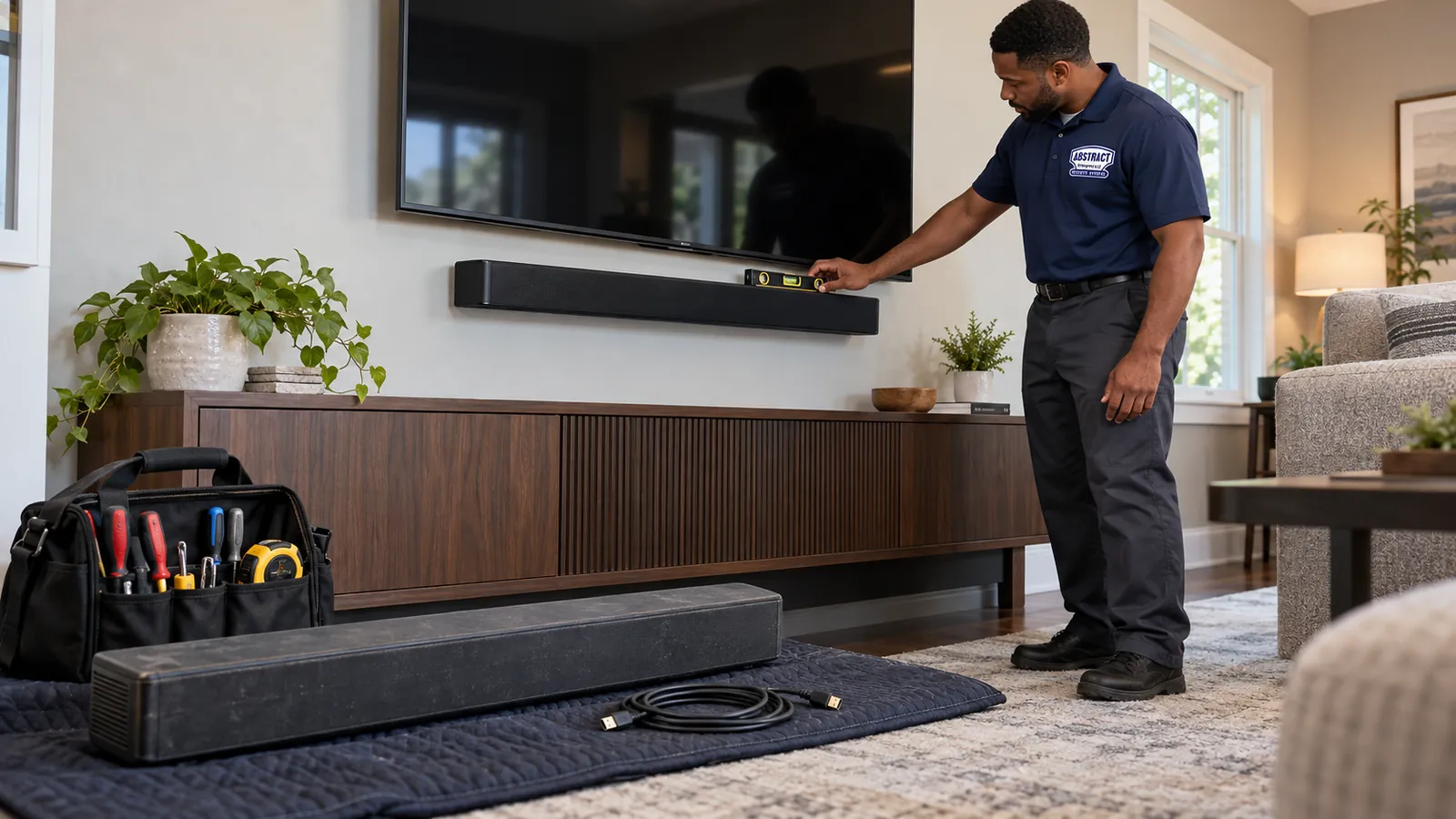
We install the bar you choose; our job is to match the mount and the setup to a Bay Ridge room. The dimensions and weights below are the manufacturers' published figures. They matter here because an old plaster wall, a narrow pier between windows and a co-op's rules each limit how wide and how heavy the bar can be and how it is held.
Around two feet wide, right for bedrooms, the small second rooms of a two-family apartment and TVs under 50 inches. Sonos lists the Beam (Gen 2) at 6.35 lb with HDMI eARC; the smaller Ray connects by optical rather than HDMI and has no built-in microphones, which some owners prefer in a bedroom.
Flagship bars nearly as wide as a 55-inch screen, with up-firing drivers for height effects. Sonos lists the Arc Ultra at about 46 inches wide, and its guidance asks for at least 4 inches between bar and TV and a foot of clear space at each end, which is the measurement that decides whether it fits between a TV and a picture rail.
Bundled systems with a wireless subwoofer and two rear speakers. "Wireless" here means no speaker wire: Crutchfield's listing for Samsung's HW-Q990D notes that each rear speaker plugs into an AC outlet, so the rears need a socket near where they stand.
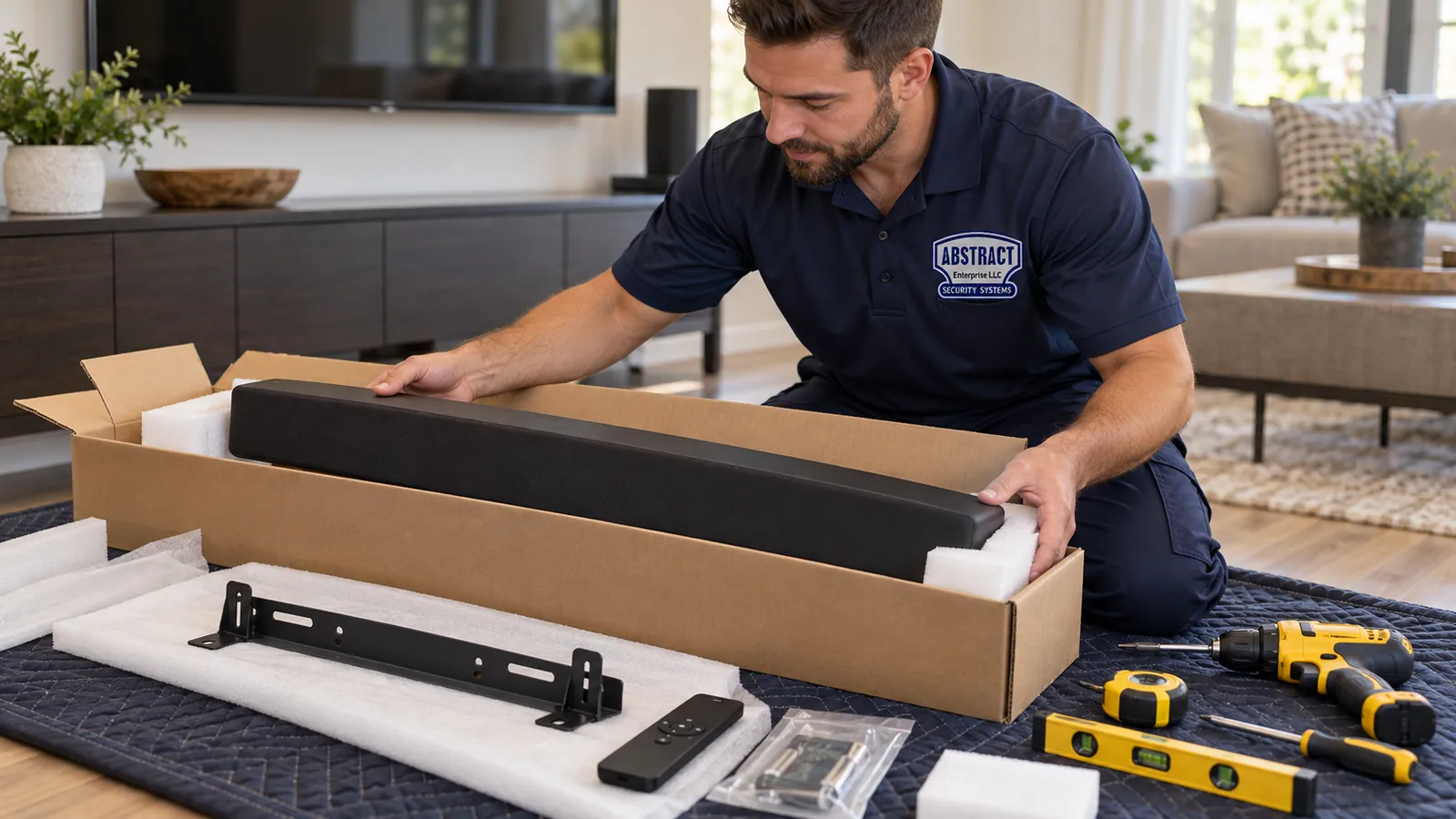
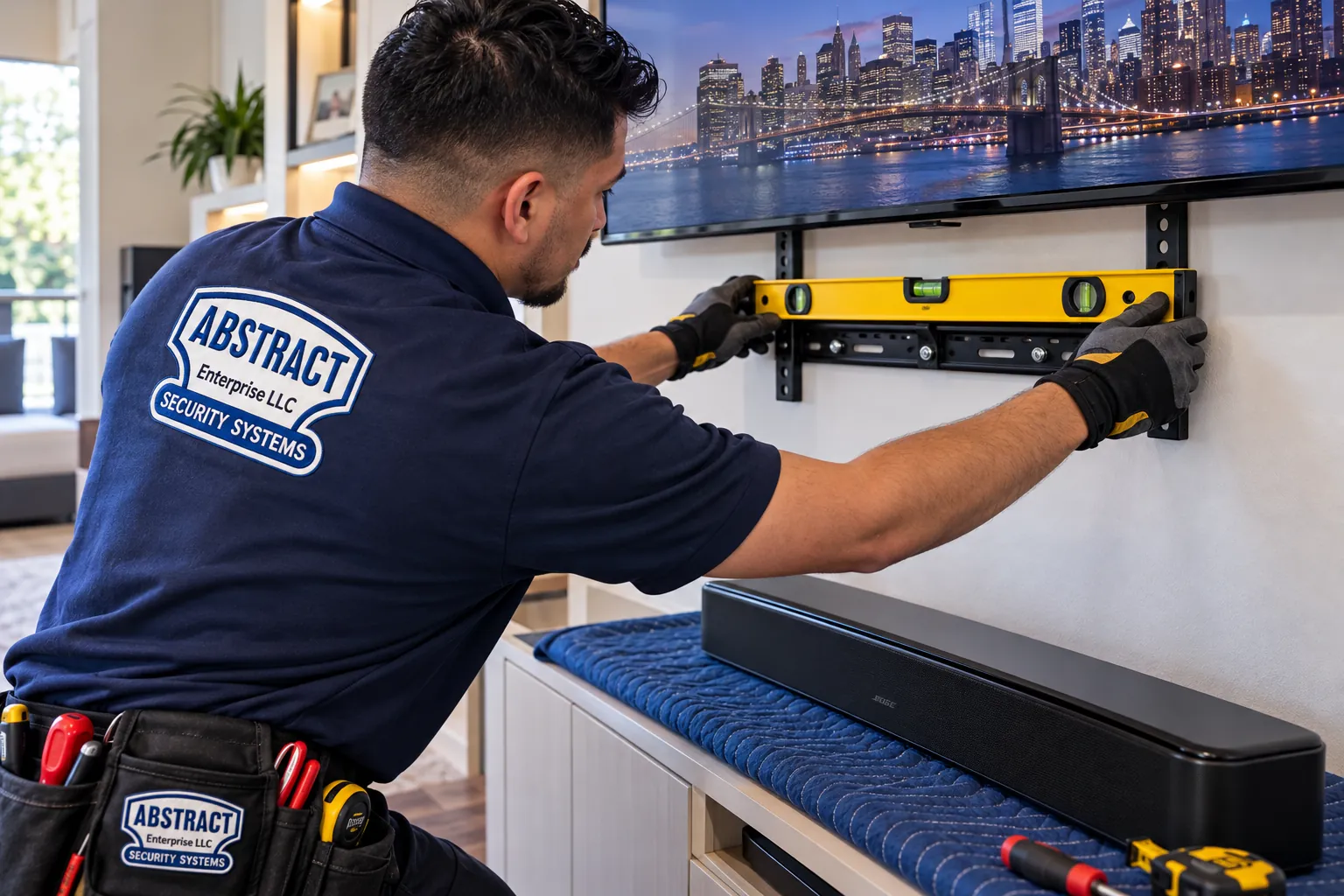
Low-profile brackets that hold the bar a few inches below the screen. Many bars include one; where it does not, or where its fixings are wrong for plaster on block, we supply a Sanus soundbar bracket from our price list and fixings to suit the wall.
The bar hangs from the television, not the wall. According to Sanus, its WSSATM1 fits most sets from 50 to 90 inches and its universal SASB1 carries most bars up to 20 lb. In a co-op that frowns on drilling, or on a curved Shore Road wall, this is often the neatest answer.
No drilling: the bar on the credenza, set clear of the TV's infrared sensor and the stand's feet, with cables dressed behind and power on a surge strip. The usual choice for rentals, short stays and a co-op apartment whose new owner has not yet read the house rules.

Ask a search engine's AI how to get a soundbar installed and you will get a tidy answer assembled from cost guides, product pages and handyman blogs. It is written for a typical American house with drywall and nobody downstairs. Bay Ridge is not that house. Here are seven things those answers say, and what we find on Shore Road, the side streets and the avenues instead.
AI answers tend to treat plaster as one material with one set of instructions: use toggles, drill gently, done. In Bay Ridge, "plaster" covers at least five different walls. There is plaster on wood lath in the row houses, plaster on brick in the outside walls of the prewar co-ops, plaster on hollow clay block in their corridors, plaster on metal lath or gypsum block in some interior partitions, and skim-coated block in the postwar buildings.
Each one wants a different anchor. A toggle that holds well behind wood lath is useless against solid brick; a sleeve anchor that is perfect in brick will crack a clay block web; a plastic plug spins in old gypsum block.
So the first thing we do at a Bay Ridge wall is find out which plaster it is, with a small pilot hole and a look at the dust, and only then choose the fixing.
Nearly every DIY guide starts with "locate the studs." Electronic stud finders work by sensing changes in density behind the surface, and on a century-old lath-and-plaster wall the lath, the plaster keys and the old repairs make the whole wall read as one long stud or as no stud at all.
On masonry walls there are no studs to find, and on plaster over block the tool mostly reports the mortar joints. Owners who trust it end up with a row of test holes for the painter.
We locate framing on lath walls by probing at the bracket position, and we scan for pipe and cable with a tool built for that purpose before drilling into any wall.
AI answers often say a co-op owner should "get board approval" before mounting anything, as though every soundbar went to a board meeting. In practice the person you deal with in most Bay Ridge co-ops is the managing agent or the super, and what they want is practical: a certificate of insurance, a date inside the building's contractor hours and, sometimes, use of the service elevator.
Full board review is usually reserved for alterations that touch structure, plumbing or wiring, and some proprietary leases are broad enough to require sign-off for any wall penetration. The only reliable source is your own building's house rules, not a general answer about New York co-ops.
We ask what your rules say when you book, send the certificate ahead, and plan the mount to fit, including a no-drill option.
Ask about neighbors and AI answers suggest foam panels, a thick rug and perhaps a bass trap in the corner. Foam panels absorb mid and high frequencies inside your room; they do almost nothing for the low frequencies a subwoofer produces, which pass through structure. A rug helps with footsteps, which is why so many co-ops require them, and helps a little under a sub.
The low end that reaches the apartment below or beside you travels mainly through the floor slab, the joists and the party wall, and the amount depends far more on where the sub stands, what it touches and how loud it is set than on anything you hang on your walls.
That is why our setup focuses on placement away from corners and shared walls, isolation from the floor, a modest level and a night mode you know how to use. It costs nothing extra and does more than a wall of foam.
Product listings say "wireless subwoofer" and "wireless surrounds," and AI summaries repeat it. The audio signal is wireless; the power is not. Each sub and each rear speaker needs its own outlet, and in a Bay Ridge row house or prewar co-op living room there may be one outlet per wall, sometimes none behind the sofa.
Owners discover this on the day, with extension cords running across the parquet, and a daisy-chain of strips is not something to leave in place in an older house.
We check where the outlets are from your photos, plan the rear and sub positions around them, and say before the visit if an electrician needs to come first.
Some guidance, including Yamaha's, suggests putting the bar close to seated ear height, around 42 inches off the floor. That is good acoustic advice for a bar on its own. In practice the bar's position is set by the TV: it belongs directly below the screen, close to the bottom edge, so the voices seem to come from the picture.
In Bay Ridge parlors the TV height is often decided by other things: a wainscot or chair rail, a picture rail, a radiator under the window, the mantel. Hanging the bar at a textbook height that leaves a gap of a foot under the screen, or that cuts across the wainscot cap, makes the room look wrong and the dialogue sound disconnected.
We set the TV and bar together, at a height that suits the seating and respects the trim; if the TV is already too high for the bar to work well, we will tell you and price lowering it.
The price an AI summary offers is usually lifted from a cost site. In September 2026 HomeWyse estimated $58.43 to $231 per soundbar nationally, and Thumbtack puts TV wall mounting at $121 to $234. Both are honest averages of a different job: drywall, a driveway, nobody downstairs.
They leave out what makes a Bay Ridge job what it is: plaster on clay block, a curved wall that needs a backer, a co-op's paperwork, a two-family where the sub must be set for the tenant, an apartment over a store with old raceway on the wall. None of those is exotic here; most visits involve at least one.
Our answer is a price list that names each of those things with its own line, so the written number before the visit is the number you pay.
Send the bar's model number and one photo of the TV wall, and tell us the street. That is usually enough to say how it will hang, what the co-op or the tenant needs, and what it will cost.
Tell us the building — co-op, two-family, row house, apartment over a store — and what is below you. The written Bay Ridge total comes back before close of business.
Thank you — your Bay Ridge request is with an installer today. If it can't wait, phone (347) 934-8335.
Whether it is a compact bar on a console over a Fifth Avenue shop or a full Atmos system in a Shore Road co-op with a harbor view, the visit follows the same six steps.
Email or text the model of the bar and the TV, a snapshot of the wall, and what kind of home it is: co-op, two-family, row house or flat over a store. We reply with one itemized number that already includes the wall type, any stairs and any backer.
Forward whatever your managing agent or landlord requires. The insurance certificate is free and goes straight to the agent, and the date is picked inside the contractor hours and elevator bookings the building sets.
Choose a 2-hour arrival window between 8 AM and 8 PM, any day of the week. Moving it costs nothing with 24 hours' notice, and if a slot is open the same day, we can come the same day.
On arrival we confirm what is behind the plaster — lath, brick, clay block or concrete — find framing or solid masonry, check for trim, pipes and shafts, and agree the bar's height and center with you before the first hole.
The bracket is fixed with hardware for that exact wall, the bar is squared to the bottom of the screen, the leads disappear the way we agreed, and the HDMI goes to the ARC or eARC socket with CEC on and voices synced to lips.
The sub goes on a pad away from corners and shared walls at a modest level, night mode is set, dust is vacuumed, cartons go with us, and we show you the controls before we leave.

These six landmarks span Bay Ridge from the old Bliss estate at its north end to the Army post at its south, and the buildings around each say a lot about the walls we meet nearby.
NYC Parks lists Shore Park and Parkway at 58 acres along the water from the 69th Street Pier toward the bridge, with views of the Statue of Liberty, Fort Wadsworth, Fort Hamilton and Coney Island. Across Shore Road from it stand the six-story co-ops: The Len, Lebern Towers, The Normandy and their neighbors, with plaster on masonry, parquet and managing agents.
Opened on November 21, 1964, and at the time the longest suspension bridge in the world, according to NYC Parks, with towers rising 693 feet. Its approaches and the Belt Parkway frame the southern end of Bay Ridge, where postwar apartment buildings and detached houses sit closest to the water.
Henry C. Murphy built an estate on this glacial ridge; Eliphalet W. Bliss bought it in 1866, and his will offered it to the city for parkland. It became a park in 1928 and covers 24.22 acres today (NYC Parks). The twin Bay Ridge Towers co-ops rise nearby on 65th Street, the buildings whose arrival in the early 1970s led to the Special Bay Ridge District.
Fifty-four limestone-fronted row houses on Bay Ridge Parkway between Fourth and Fifth Avenues, built 1906 to 1913 and designated in 2019 as Bay Ridge's first historic district. Two stories over a basement, plaster on lath within, and a street front the Landmarks Preservation Commission now protects.
The Howard E. and Jessie Jones House at 8200 Narrows Avenue, designed by J. Sarsfield Kennedy and built in 1916–17 of rustic boulders under a simulated thatch roof, an individual city landmark the AIA Guide called "Black Forest Art Nouveau." The detached houses around it are the closest Bay Ridge comes to large single-family rooms.
The fort's cornerstone was laid in 1825 and its first garrison flag raised in 1831; the Army calls it its fourth-oldest installation. A few blocks north, Bay Ridge–95th Street, which opened in 1925, is the R train's southern terminal. Nearby stands the Bennet-Farrell-Feldmann House at 119 95th Street, a Greek Revival house of about 1847, moved in 1913 and now an individual landmark.
The same installers work the length of the neighborhood, from 65th Street and the Owl's Head end down to the bridge and Fort Hamilton, and from Shore Road east past Fifth and Seventh Avenues. They also cover the neighboring parts of Brooklyn: Dyker Heights, Sunset Park, Bensonhurst and the rest of the borough on our Brooklyn soundbar installation page. Prices are the same across Brooklyn.

Bay Ridge is priced as Brooklyn, and Brooklyn is the base of our price list, so these are the starting numbers with no area multiplier. Add the lines that apply to your room. If something turns up on site that the photos could not show, such as clay block behind what looked like lath, you hear the price of the change before any hole is drilled.
| Item | Price | What it covers |
|---|---|---|
| Soundbar placed on a console or stand | $79 | Bar positioned under the screen on your furniture, connected, CEC on, sound checked |
| Soundbar wall-mounted under the TV | $129 | Fixings chosen for the wall we find, bar hung parallel to the screen, connected and tuned |
| Sanus soundbar bracket | $84.99 | Supplied when the bar came without a bracket or its own will not suit the wall |
| In-wall concealment | $169 | Power and HDMI inside a hollow wall with a code-compliant in-wall kit |
| Paintable cord cover | $59 | Slim channel on the wall face, the usual finish on plaster over masonry |
| Cable run to a cabinet or other spot | $99 | Up to 25 ft, for a cable box or console across the room |
| Sonos setup | $125 | Sonos bar, sub or surrounds set up in the app and grouped |
| A/V receiver | $129 | Receiver connected between TV, sources and speakers, inputs named |
| Universal remote | $99 | One remote programmed for the TV, the bar and the cable box |
| Streaming device setup | $49 | Roku, Apple TV, Fire TV or similar |
| Full home theater | $350 | Several components set up together as one system |
| Condition | Price | Typical Bay Ridge setting |
|---|---|---|
| Drywall on wood studs | $0 | Renovated row-house rooms, finished basements with stud walls |
| Metal studs | +$30 | The few newer buildings and some renovated co-op partitions |
| Plaster | +$45 | Row houses, two-families and prewar co-ops on Shore Road and Ridge Boulevard |
| Brick or stone | +$65 | Exposed brick in bars and restaurants, party walls, stone in detached houses |
| Concrete or cinder block | +$75 | Postwar co-ops, basement walls, the towers on 65th Street |
| Tile or marble | +$95 | Tiled fireplace surrounds, restaurant walls, marble in older lobbies |
| Plywood backer board | $85 | Curved and faceted co-op walls, weak plaster, irregular old framing |
| High mount (above about 8 ft) | $75 | Back-bar screens, high parlor ceilings, co-op lobbies |
| Walk-up, 3rd floor and above, no elevator | $40 | Top floors of avenue buildings and two-family houses |
| Box removal | $25 | Cartons taken away instead of left for building recycling |
| Certificate of insurance for your building | Free | Co-ops, condos and commercial landlords on the avenues |
Each figure below is simple addition of published lines, no special rates, so you can rebuild your own quote the same way. The wall we actually find decides your real total.
| Example | Lines | Total |
|---|---|---|
| Bar on plaster in a Shore Road prewar co-op, its own bracket, cable in a painted channel | $129 + $45 plaster + $59 cord cover | $233 |
| Bar on block in a postwar co-op, our Sanus bracket | $129 + $84.99 + $75 concrete or block | $288.99 |
| Bar on a curved Art Moderne wall, backer and our bracket | $129 + $45 plaster + $85 backer + $84.99 | $343.99 |
| Upstairs in a two-family, lath-and-plaster partition with a cavity, leads in the wall | $129 + $45 plaster + $169 in-wall concealment | $343 |
| Back-bar screen on Third Avenue, high mount on exposed brick, our bracket | $129 + $75 high mount + $65 brick + $84.99 | $353.99 |
| No drilling: bar on the console plus Sonos setup in a rental over a store | $79 + $125 Sonos setup | $204 |
When nothing needs drilling — a bar reconnected to a new TV, eARC or the remote sorted, a sub re-paired — a Brooklyn setup-only visit is $195 for the first hour, then billed in 30-minute blocks. If a TV is mounted on the same visit, the Brooklyn TV mounting base of $179.99 applies to the TV, with its own size and wall lines. Service callbacks outside a scheduled install are $195 an hour with a 3-hour minimum ($585). A $150 return-trip fee applies if we cannot start because the bar or bracket is not there, there is no access, or the building's paperwork is missing; moving the booking with 24 hours' notice costs nothing.
Three combinations cover the bulk of what Bay Ridge households book. The card price is the sum shown on the card; a plaster, block or walk-up line joins it only if your home calls for one.
$79
The bar on your credenza for $79, set clear of the TV's sensor, connected on ARC or eARC, CEC on and leads dressed behind. No holes, which suits rentals, co-ops between owners and anyone not yet sure where the TV will end up.
$213.99
$129 to hang the bar and $84.99 for the Sanus bracket make $213.99. In Bay Ridge most walls add a line: $45 for plaster in a row house or prewar co-op, $75 for block in a postwar building.
$382.99
The $213.99 mount and bracket with $169 of in-wall concealment come to $382.99. It needs a hollow wall that the building lets us open, so it suits renovated two-families and stud partitions, not masonry or a co-op that forbids it.
Already own a bracket, whether it came in the soundbar's carton or you bought one? Then the bill is labor: $129 to mount, plus whichever wall line applies. It needs a rating that covers your bar, and any warranty on it is the manufacturer's. Should it be unsuitable for the bar or for a Bay Ridge plaster wall, we say so at the wall, before drilling, and offer the Sanus bracket instead.
Tell us co-op, two-family or flat over a shop, send one picture and the bar's model, and the itemized figure arrives by email.
Here is how one soundbar plays out in three typical Bay Ridge homes. Each is a composite drawn from the building type, meant to show our planning, and none describes a specific customer or address.
The work starts days before the visit. You forward the managing agent's insurance wording and we send the certificate; we confirm the building's contractor hours and whether the service elevator needs booking. On the day, the doorman or super sends us up, drop cloths go down in the hall, and we look at the living room: a thick plaster wall on brick facing the harbor, a partition on clay block toward the bedroom, steam heat under the windows, parquet underfoot. The TV usually goes on the partition so the windows stay clear.
We pilot through the plaster, confirm block, set anchors made for hollow block and hang the bar tight under the screen. The cable comes down a painted channel because the building does not want walls opened. The sub goes on a pad on the rug along the window wall, away from the corner and the elevator side, set low.
The owners live upstairs and rent the first floor. The front room has a bay window, a picture rail about a foot below the ceiling and plaster on wood lath. The TV goes on the long wall opposite the fireplace, with the bar under it and its bracket fixed into two studs found by probing below the picture rail. Because the partition is hollow and the owners are happy to have it opened, power and HDMI go inside the wall to an in-wall plate behind the console.
The decision that matters is the subwoofer. With the tenant's agreement we play the system and listen downstairs, try two positions and settle on the one that reaches the sofa upstairs and barely registers below. We write down the level both households agree on.
A long apartment above a shop, reached by a stair beside the storefront. One outlet near the TV wall, fed through old surface raceway; the TV wall is shared with the next building. We leave the raceway alone, run our own slim channel beside it, and mount the bar to the party wall with anchors set to a measured depth so nothing reaches the far face of the brick.
The store closes in the evening, so the sub can live on the floor over the shop, set on a pad and away from both party walls, with a moderate level for weekend daytimes when the shop is busy. Because a lease is involved, we tell the tenant exactly which holes will need filling when they move out.
If the bar is not bought yet, a tape measure and a look at the room will save a return. We do not sell soundbars, so our advice is about the room and the building, not about a margin.
| Your room | What tends to work | What to check before buying |
|---|---|---|
| Co-op living room over another apartment | A bar with strong built-in bass and a sub you can turn well down, or no separate sub | Separate sub-level control in the app; night mode; your building's rug rule |
| Row-house parlor with a picture rail | Bar sized to the TV, mounted tight under it | Space between the TV bottom and the rail or wainscot cap; clearance the maker asks for above the bar |
| Narrow pier between two windows | A bar a little narrower than the pier | Pier width, curtain stack, side-firing drivers at the bar's ends |
| Upstairs in a two-family with a tenant below | Bar first, sub added only after a listening test downstairs | Whether the bar works well without its sub; where outlets are for rears |
| Large detached-house living room | Wider bar with a center channel and rear speakers | Seating distance; whether a cable can reach the router |
| Bar, restaurant or waiting room | One modest bar per screen with a simple input and a volume limit | Mounting height over walkways and shelving; who holds the remote |
Two Bay Ridge-specific checks before you order. First, the bracket: if the bar's own bracket comes with plastic plugs, assume we will swap them for fixings suited to plaster on brick or block. Second, the outlets: older rooms here may have one per wall, so before choosing a system with rear speakers, find out where they would plug in. A photo of each wall of the room tells us both in a minute.

A Bay Ridge soundbar booking often turns up a second job: the TV, a cable from the basement, a better buzzer for the two-family.
Mounting the screen the bar goes under, on plaster, block or brick, with the two laid out together on one visit.
A wired connection from the router to the TV wall, the steadiest way to stream in a two-family or a crowded co-op.
Door entry for two-families, row houses and small apartment buildings, often booked by the same owner-landlords.
The borough page this one sits under, covering brownstones, frame houses and new towers from Greenpoint to Coney Island.
The full Brooklyn list our soundbar lines come from, with TV sizes, wall types and add-ons.
For rooms that outgrow a bar: speakers built into the ceiling, music in every room, and sound for a whole restaurant.
Cameras for avenue storefronts, two-family entrances and driveways, from the same installers.
How appointments, changes, return trips and callbacks work for TV and soundbar visits.
Combine a soundbar with anything above in one request and one written price.

How our installers approach Bay Ridge buildings in general, not a write-up of any single visit
In a Shore Road or Ridge Boulevard apartment, the first thing our installers look at is not the TV wall but the floor plan: which wall faces the corridor, which backs onto the elevator or the compactor room, which is the outside wall to the harbor. The partition between rooms is usually the friendliest wall for a bracket, and the one shared with the corridor or the shaft is the one to treat gently. The first pilot hole tells us whether we are in brick, clay block or gypsum block, and the anchor follows from that, not from the box.
In a two-family, the installer asks who lives below before unpacking the sub. If the owners are upstairs and the tenant is home, a few minutes listening downstairs, with permission, settles the sub's position better than any rule. Picture rails and wainscot set the height of the TV and bar more often than the sofa does.
Over the avenue shops, the questions are the raceway and the party wall. Old surface raceway stays untouched and gets a neighbor of its own for the low-voltage cables. Anchors in a party wall get a depth stop set before the drill starts. And in every Bay Ridge job, before leaving, the installer shows someone in the household where the sub level and night mode live, because the building will judge the installation by its quietest neighbor.
The soundbar has to join your network, so the password has to be entered somewhere, but we never need to know it. The simplest way is for you to type it into the maker's app on your own phone while we take you through the setup screens; nothing is written down or kept. If you run a guest network, the bar can go on either one, though bars that group with phones and other speakers work best on the same network as the phones that control them.
Not in a way that works well day to day. A soundbar takes its sound from one TV over HDMI or optical, and the TV remote controls it through that same link. Sharing it between two TVs means an HDMI switch, two remotes and a bar that only serves one room at a time. For two rooms we recommend a bar for each, or a main bar plus a small wireless speaker from the same maker grouped in its app, and we can set either up on one visit.
Your written quote comes with our service agreement, which sets out the payment terms, including the deposit. The quote itself costs nothing, the certificate of insurance for your building costs nothing, and moving the date with 24 hours' notice costs nothing. If any line on the quote is unclear, ask before you book and we will explain it.
It can if a detector is close to the TV wall, because some detectors react to fine dust as well as smoke. We hold a vacuum at the drill bit so most of the plaster or block dust never reaches the air, and when a detector is within a few feet of the bracket position we ask you or the super before starting; many supers prefer to cover it for the few minutes of drilling and uncover it straight afterward. We never disconnect or remove a detector ourselves.
We advise against painting the bar itself. Paint clogs the fabric or perforated metal over the drivers, dulls the sound and can void the maker's warranty. What can be painted is everything around it: the cord-cover channel on our list is paintable, and the bracket sits behind the bar anyway. If a black bar looks heavy on a pale wall, a lighter finish from the same maker is a better route than paint.
Yes. A bar on a wall bracket lifts off in a minute or two, and the bracket comes away with the same few screws that hold it, leaving only the anchor holes. A surface cable channel peels off too, and in-wall plates simply unscrew. We keep the parts and fixings simple enough for you, the super or us to take down and put back, and re-hanging the bar after the building's work is priced as an ordinary wall mount from the list on this page.
It usually is. A soundbar expects constant power: switched off at the wall, it drops off the network, misses its software updates, and some bars lose their pairing with the subwoofer or rear speakers or come back on the wrong input. Older rooms sometimes have only one half of the outlet on the switch, so the first check is whether the other half stays live. If the whole outlet is switched, the fix is a small job for a licensed electrician; we can plan the visit for after that work, or use another outlet with a tidy cable run in the meantime.
Yes. Whatever we do not use from the box, such as plastic plugs, spare screws, the original bracket if we fitted ours, or an optical cable, is bagged with the manual and left with you. If the bar ever comes down for painting or a move, the original parts are there, and the next installer can see what was used.
This page covers Bay Ridge. It sits under our Brooklyn soundbar installation page, which in turn sits under the New York City soundbar installation hub. Every borough, region and neighborhood page we have published is listed below; places without a page of their own yet are still covered by the same installers.
NYC soundbar installation · Brooklyn · Manhattan · Queens · the Bronx · Staten Island
Long Island soundbar installation · Nassau County · Suffolk County
Hudson Valley soundbar installation · Westchester · Rockland · Orange · Putnam · Dutchess · Ulster
Beyond soundbars, Abstract Enterprises installs security cameras, intercoms, access control and network cabling; the AESS home page lists every service. To see who will be drilling your plaster, read about our company.
The dates, counts and building descriptions on this page were checked against the publications below; hover a link for the detail it supports. Our prices are from the AESS Brooklyn list.
When the picture is fine but the bar has gone mute, the usual cause is that the TV changed something overnight: an update reset its audio output, or the provider swapped the box and the HDMI moved. Phone (347) 934-8335 and we will take the next free 2-hour window from 65th Street to Fort Hamilton; most fixes like this take one to two hours on site.
Abstract Enterprises Security Systems · 1282 Troy Ave, Brooklyn, NY 11203 · (347) 934-8335 · WhatsApp (718) 679-0359 via wa.me
NYS Low-Voltage License #12000287431 · 100% Licensed & Insured · Same-Day Estimates · Rated 4.7★ from 201 Google Reviews
Brackets and parts carry their manufacturer's warranty. Full terms — including 50% deposit, one-year parts-only warranty on AESS-supplied products, and the late-fee schedule — are set out in the service agreement. See our warranty page.
Page reviewed and updated October 17, 2026. Changelog: Bay Ridge page launched under the Brooklyn soundbar page, with guidance for Shore Road and Ridge Boulevard co-ops, two-family houses, apartments over the avenue shops and Third Avenue businesses.