Harlem living rooms come in three shapes: the parlor floor of a nineteenth-century rowhouse with tall windows and pocket doors, the front room of a walk-up on a side street, and the living room of a tower in one of the big complexes between the avenues. Each one hides a different wall behind the paint. We read the wall, pick the fixing that suits it, hang the bar level under the screen, run the cable where it can actually go, and set the bass for whoever lives on the other side of the floor.
Reviewed and updated October 17, 2026 · Author: Anwar Timothy, owner · NYS license #12000287431 · Manhattan line (929) 560-0737
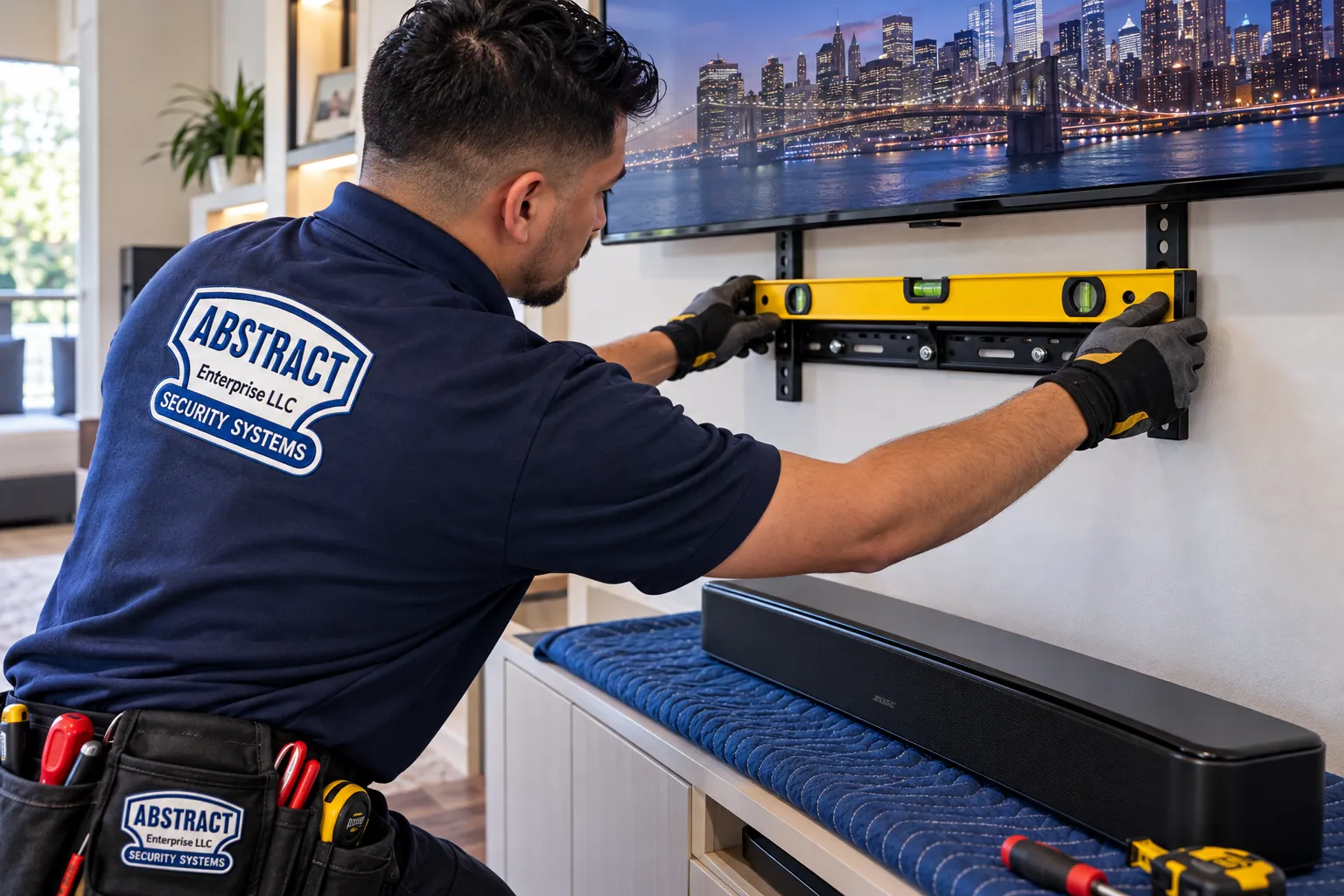
The bracket is levelled on its own first; the bar waits on a padded blanket on the console until the fixings are tight.
Harlem Soundbar Quote
Your block, your wall and your bar — a written price the same business day
✅
Request Sent!
We'll call you back the same business day.
25+
Years Experience
✓
Same-Day Estimates
100%
Licensed & Insured
4.7★
201 Google Reviews
Want it sorted this week? Call (929) 560-0737 or use the quick form. A photo of the TV wall is enough for a written, itemized price — parking included — before anyone comes up the stoop.
One flat $150 Manhattan parking line per visit, above 110th Street the same as below it
Insurance paperwork at no charge whenever a landlord, co-op or development office asks for it
NYS license #12000287431 · two-hour arrival windows, 8 AM to 8 PM, seven days
Harlem's housing was built in layers, and a soundbar visit here starts by working out which layer you live in. The oldest is the rowhouse: blocks of three- to five-story houses from the last decades of the nineteenth century, many of them faced with brownstone or brick and now protected inside historic districts such as Mount Morris Park, designated in 1971 and extended in 2015 to take in more than 250 further rowhouses, and the St. Nicholas Historic District that everyone calls Strivers' Row. The next layer is the walk-up and the early elevator building on the avenues. Then come the mid-century complexes — public housing, Mitchell-Lama co-ops and big private rental groups — and finally the new mid-rise buildings that went up along Frederick Douglass Boulevard and around 125th Street once the city rezoned them.
The Department of City Planning's own description of south-central Harlem captures the pattern neatly: five- to eight-story residential buildings along the avenues and three- to five-story rowhouses on the mid-blocks. That matters more for a soundbar than you might think. A rowhouse parlor has plaster on wood lath on its interior partitions, brick on its party walls and twelve-odd feet of air above the TV. A walk-up on 118th Street has plaster on brick or block and a narrow front room. A tower in a postwar complex has poured concrete or block that takes an anchor beautifully and will not let a cable through at any price. One bracket, three completely different jobs.
The houses have also changed hands and purposes more than once. A Harlem architecture firm describing one recent project explains that the brownstone was built as a single-family house in the late 1800s, turned into a single-room-occupancy rooming house in the mid-twentieth century, and has now been converted back — adding that, like many properties in Harlem, it had been altered many times along the way. In practice that means a parlor where one wall is original plaster, the next is new drywall on fresh studs, and a third hides a patched doorway from the rooming-house years. We find out which is which before the drill comes out, because the right anchor for one is the wrong anchor for the next.
Sound is the other half of the job. A poster in r/movingtoNYC put the brownstone problem bluntly: “You can hear everything in older brownstones.” Wood-joist floors carry bass straight down to whoever rents the garden apartment, and in a house split into floor-throughs there is usually a tenant above or below. In the towers the issue is different — concrete slabs stop most airborne sound but a subwoofer on the floor still sends vibration through them. Either way, the bar and sub get set up for the building as well as the room. And on the commercial avenues, where barbershops, restaurants and shops run TVs all day, the questions are about being heard over clippers and conversation without breaking the city's rules on sound aimed at the sidewalk.
Finally, there is how people live here. According to NYU's Furman Center, only 15.3 percent of Central Harlem households owned their home in 2024, against 32.7 percent citywide, and close to half of households — 46.9 percent — were one person living alone. Most soundbar requests therefore come from renters answering to a landlord, a managing agent or a co-op office, in rooms sized for one or two people. The right answer is often a compact bar and a careful cable route rather than the biggest system in the shop.
Harlem facts that change a soundbar visit
64,458 housing units in Central Harlem in 2024, with a homeownership rate of 15.3 percent (NYU Furman Center) — most installs happen under a lease or a co-op's house rules.
7,766 public-housing apartments in 63 NYCHA properties, 13.6 percent of the area's rental units, plus 2,449 Mitchell-Lama apartments in six developments (Furman Center, 2025) — a large share of living rooms with concrete or block walls.
More than 250 rowhouses added to the Mount Morris Park Historic District in 2015, next to the original 1971 district (NYC Landmarks Preservation Commission) — brick party walls, plaster partitions and wood-joist floors.
4,576 new apartments in buildings of four or more units completed between 2010 and 2025 (Furman Center) — newer drywall partitions, often on metal studs, alongside the old stock.
88.0 percent of Central Harlem commuters travel without a car (Furman Center, 2024) — residents rarely keep parking spaces, which is why every Manhattan visit carries one flat parking line.
Lead presumption: the city's HPD treats paint in any multiple dwelling put up before 1960 as lead-based under Local Law 1 of 2004. Prewar walk-ups and rowhouses carved into three or more apartments fall under it, which is why our vacuum sits at the drill bit.
Add it up and a Harlem soundbar job is mostly about three things the box doesn't mention: what the wall really is, where the cable can honestly go, and who is listening through the floor. Get those right and almost any mainstream bar will sound the way it was designed to.
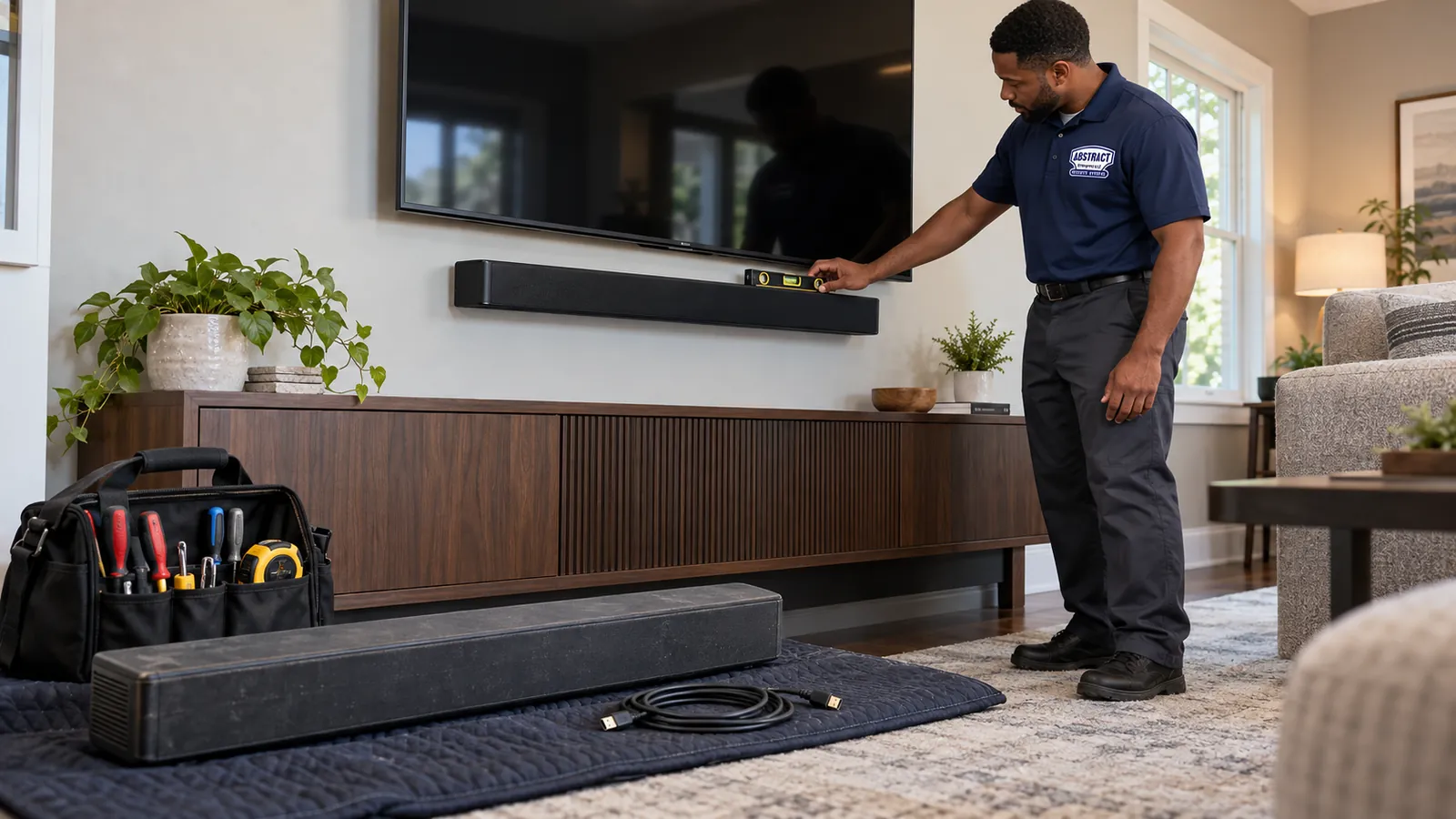
After hanging, a short level goes on top of the bar itself; tools, an HDMI cable and a spare bar sit on the blanket below.
Repair Capture
Harlem Soundbar Gone Quiet?
No sound since the TV updated itself, a sub that drops out every evening, dialogue that arrives a beat after the lips move, or a bracket sagging out of old plaster — those are repair calls, and we book them as such. You get the next free two-hour window, and once the technician is in the room most connection and settings faults take one to two hours to put right. Ring (929) 560-0737 and say it's a repair; our service policies for TVs and soundbars explain how time-based setup visits are billed.
The faults we see most often uptown are predictable. A bar that goes silent after a power cut or a TV update has usually lost its HDMI-CEC handshake or switched to the wrong input; a sub that drops out at night is losing its wireless link in a crowded radio environment or behind thick masonry; voices that lag the picture need the TV's audio delay or the bar's sync setting corrected; and a bracket working loose almost always turns out to be plastic plugs in old plaster. All of those are fixable in a single visit, and none of them need a new bar.
What We Install
Soundbar Installation Services in Harlem
Every Harlem job is assembled from the lines below, and each one has a published price. However they combine, you finish with the bar level and centred, the cables dressed, the TV remote controlling the volume and a listening test done from your own seat.
Most visits combine two or three of these. A typical rowhouse booking is a parlor wall mount with our bracket and a cord cover on the party wall; a typical tower booking is a concrete wall mount with a painted cover; a typical walk-up booking is a compact bar on the console with the cables tied off. The quote lists each line so you can see exactly where the total comes from.
Parlor-Floor Wall Mounts
A bar on its bracket under the screen in a rowhouse parlor — into plaster and lath with toggles, into the brick of a party wall with masonry anchors, or into new studs where a renovation replaced the old partition.
Tower and Complex Walls
Concrete and block in the postwar complexes call for a hammer drill, carbide bits, a vacuum at the hole and a surface cord cover, since nothing can be fished through solid masonry.
Walk-Up Front Rooms
Compact bars and tight cable routes for narrow living rooms in four- and five-story buildings, with the gear carried up and the stair line on the bill when the apartment is on the third floor or higher.
Console Setups, No Holes
For leases and co-ops that say no drilling: the bar on the media unit clear of the TV's sensor, connected over eARC, tuned and with every cable tied off behind the furniture.
TV-Attached and Swing-Arm Brackets
Brackets that clamp the bar to the TV or its arm, so the sound turns with the screen in a railroad flat or a corner, and the wall gains no extra holes.
Cable Concealment
In-wall power and cable kits where a partition is hollow and the owner agrees; paintable cord covers on brick, block and concrete; longer HDMI runs where the boxes live across the room.
Connection and Sync Fixes
eARC and ARC port choice, HDMI-CEC so one remote runs everything, lip-sync correction, firmware updates and moving a bar that keeps dropping off Wi-Fi onto a steadier link.
Subwoofers and Surrounds
Placing a sub where it gives even bass at the sofa without shaking the floor below, and setting rear speakers where the room actually allows them.
Shops, Salons and Restaurants
Screens on 125th Street, Lenox, Frederick Douglass and Adam Clayton Powell Jr. Boulevard set for speech over background noise, with volume limits staff can live with.
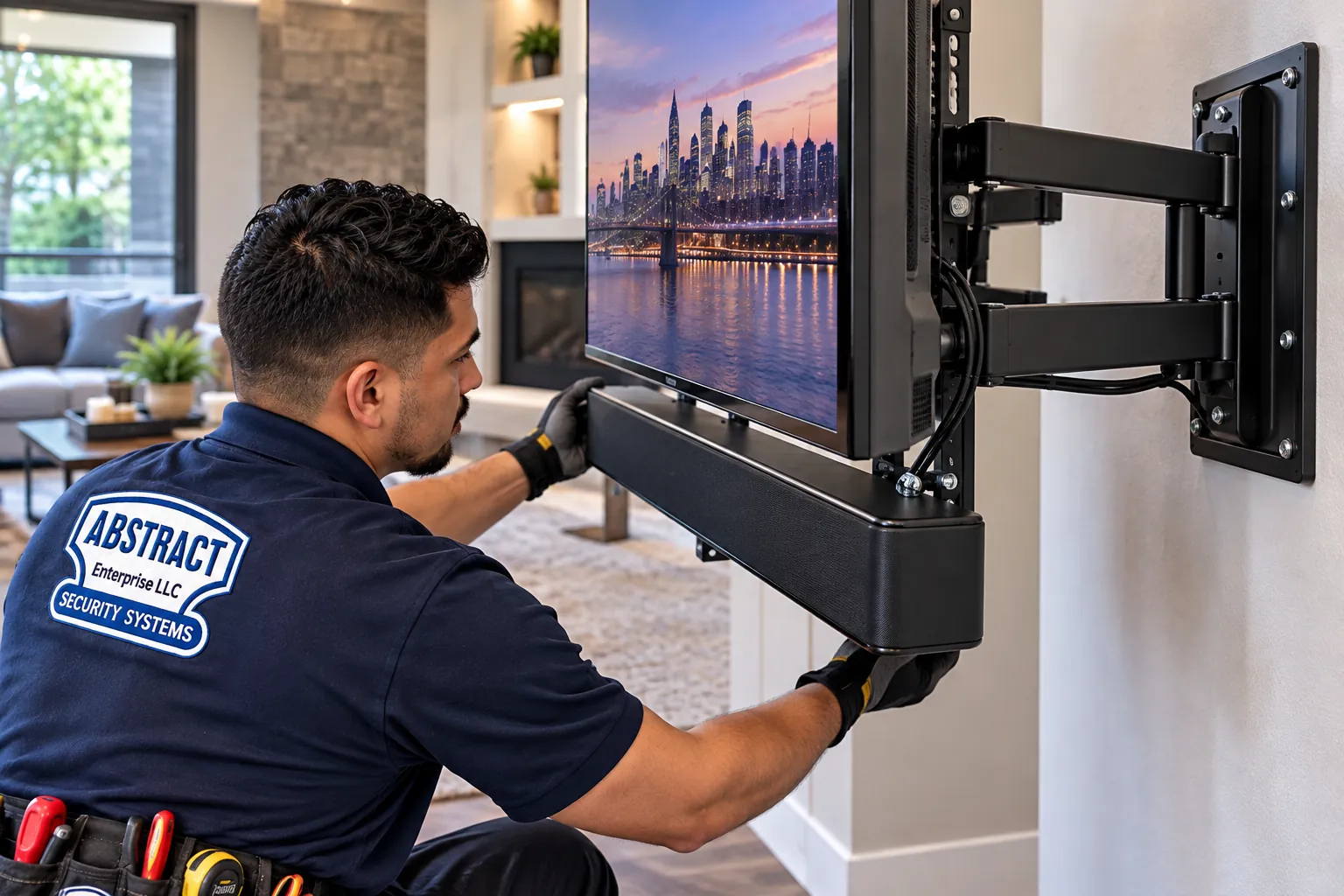
A bar clamped beneath a screen on an articulating arm moves with the TV, so the sound always faces the same way as the picture.
Building Specialists
Soundbar Installation for Harlem's Architecture
Walk ten minutes in any direction from 125th and Lenox and you pass five kinds of building. These are the ones we plan around, and what each does to the bracket, the cable and the sound.
Landmarked Rowhouses
Mount Morris Park, Strivers' Row on West 138th and 139th, the Hamilton Heights/Sugar Hill districts to the northwest: brick and brownstone fronts from the 1880s and 1890s, brick party walls, plaster partitions and parlors with marble mantels. Landmark rules guard the facade; the TV wall inside is yours.
Rowhouses Converted Back From Rooming Houses
Houses that spent decades as single-room-occupancy buildings and have since been gutted or partly restored. Expect a mix of original plaster and new drywall, patched doorways, new wiring in some walls and none in others.
Side-Street Walk-Ups
Four- to six-story tenements and small apartment houses, including the rehabilitated row of 36 tenements that makes up NYCHA's Randolph Houses on West 114th Street. Narrow front rooms, plaster on brick or block, radiators under the windows and stairs for every tool.
Prewar Elevator Buildings
Larger apartment houses on the avenues and on Sugar Hill, such as the 13-story 409 Edgecombe Avenue. High ceilings, thick plaster over masonry, and often a super who knows which walls carry pipes.
Postwar Tower Complexes
NYCHA's St. Nicholas Houses (thirteen 14-story buildings), the six-building Esplanade Gardens Mitchell-Lama co-op and the six buildings of Lenox Terrace. Concrete and block walls that grip an anchor hard and hide nothing, plus a management office with its own contractor rules.
New Mid-Rise Buildings
Rentals and condos along Frederick Douglass Boulevard and near 125th Street. Drywall partitions on steel or wood studs, sound-rated walls between units, and wiring planned for a TV on one particular wall.
How each Harlem wall gets treated
Plaster on wood lath (rowhouse partitions): we find the studs behind the lath, drill the plaster with a sharp bit and no hammer action, and fix to the studs or with toggles rated for the load. If the plaster has let go of its lath, a plywood backer board ($85) spreads the load across several studs. Plaster adds $45.
Brick party walls and front walls: sleeve or wedge anchors bite into sound brick, never into crumbly lime mortar, and since a party wall is solid the cable rides in a cover painted to match. Expect $65 for brick.
Plaster over brick or block (walk-ups): a gentle start through the plaster, then the right anchor for whatever is behind it once the dust tells us. Plaster is billed at $45; if the job turns out to need full masonry fixings you hear the difference before the work continues.
Tower walls of poured concrete or block: this is hammer-drill work, so it's timed to the development's quiet-work rules and the dust is caught as it leaves the hole. These walls carry a bar with ease. The line is $75.
Renovation drywall: on wood studs we screw straight in at no extra cost; on light steel studs we use fixings made for thin metal, or bridge two studs with an $85 backer when the bracket's slots fall between them. Steel adds $30.
Millwork, mantels and pocket-door walls: we don't drill into original woodwork, marble surrounds or the cavity a pocket door slides into, and we say so before we start rather than after.
Rowhouse owners putting a wired network point behind the TV at the same time book it through structured cabling installation for Manhattan homes, which is the steadiest fix for a smart bar on a floor far from the router.
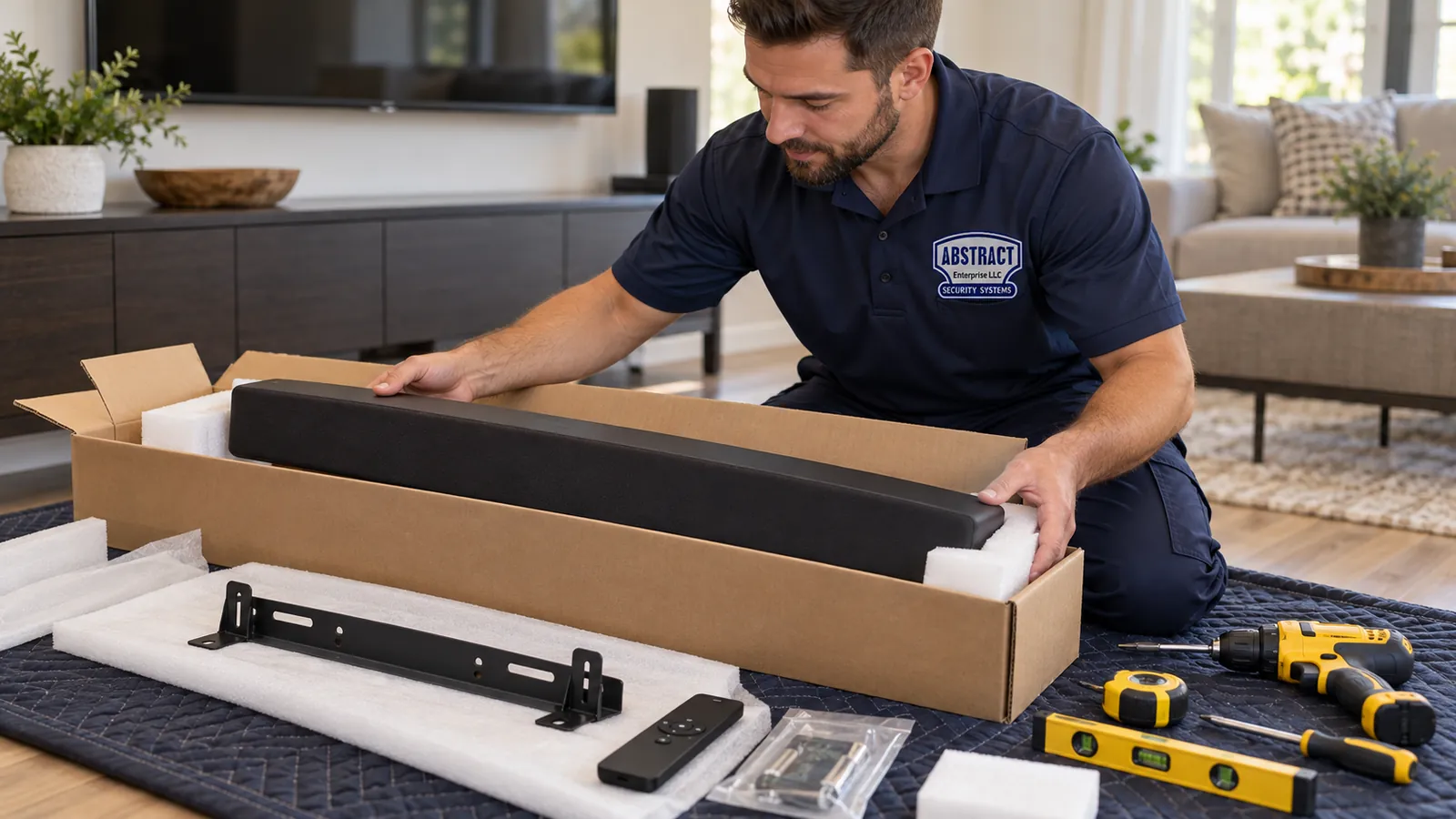
Unpacked and checked before any hole is drilled: the bar, its bracket and remote, the hardware bag, drill, tape measure and level.
Commercial Soundbar Installation
Business Soundbar Installation in Harlem
Harlem's businesses mostly want one thing from a soundbar: a TV that people can follow over the noise of the room, at a level that keeps neighbors upstairs and the city on side. These are the corridors where those screens are.
125th Street
The city's planners call it Harlem's “Main Street”: shops, offices and arts venues from the Apollo at 253 West 125th to the new Studio Museum at 144 West 125th. Retail screens, office lobbies and community rooms all want clear speech rather than volume.
Frederick Douglass Boulevard
The stretch Columbia's neighborhood guide calls restaurant row, with new mid-rise buildings above ground-floor dining. Bar screens on game nights sit under apartments, so placement and bass matter as much as the mount.
Lenox Avenue / Malcolm X Boulevard
Restaurants such as Red Rooster at 310 Lenox, sidewalk cafés in summer, salons and barbershops. Long, narrow rooms where a single front-of-room TV has to reach the back.
Adam Clayton Powell Jr. Boulevard
Offices around the state office building that bears Powell's name at 125th Street, churches, community organizations and storefront services, where a waiting area or a meeting room needs a TV that can be understood at low volume.
West 116th Street
A commercial strip the city added retail zoning to when it rezoned south-central Harlem, with small shops and eateries that often run a TV all day on a side wall.
Community and Arts Spaces
Rehearsal rooms, galleries, tenant-association rooms and the community spaces in NYCHA and Mitchell-Lama developments, where a shared screen needs a volume cap and a remote that stays with whoever runs the room.
Rules Harlem businesses should know
Sound aimed at the street. Section 24-244 of the city's Administrative Code bars using any sound reproduction device to advertise or draw attention to a sale or display of merchandise through an opening onto a public street, or anywhere its sound can be heard on the street or sidewalk. A soundbar in a shop window playing to passers-by falls squarely inside that.
Late-night music. Between 10 PM and 7 AM, NYC311's guidance for bars and restaurants caps music at 42 decibels measured inside nearby homes and 7 decibels over the background on the street 15 feet away. With apartments above most storefronts on Lenox and Frederick Douglass, a game-night screen can hit that sooner than owners expect.
Things that stick out. In a corridor or waiting room, a bar on a deep bracket is a protruding object; the 2010 ADA Standards (section 307.2) allow no more than 4 inches of projection between 27 and 80 inches off the floor in a path of travel, so we measure bar plus bracket before choosing the height.
Landmarked storefronts. The Landmarks Preservation Commission regulates exteriors in historic districts; a soundbar inside the shop needs no LPC permit unless the work needs a Buildings Department permit or the interior itself is designated.
Outlets. Any new or moved outlet is line-voltage electrical work for a Licensed Master Electrician under Department of Buildings rules. We work with the outlets that are there.
We're installers, not lawyers: treat these notes as a starting point and check your own lease and premises.
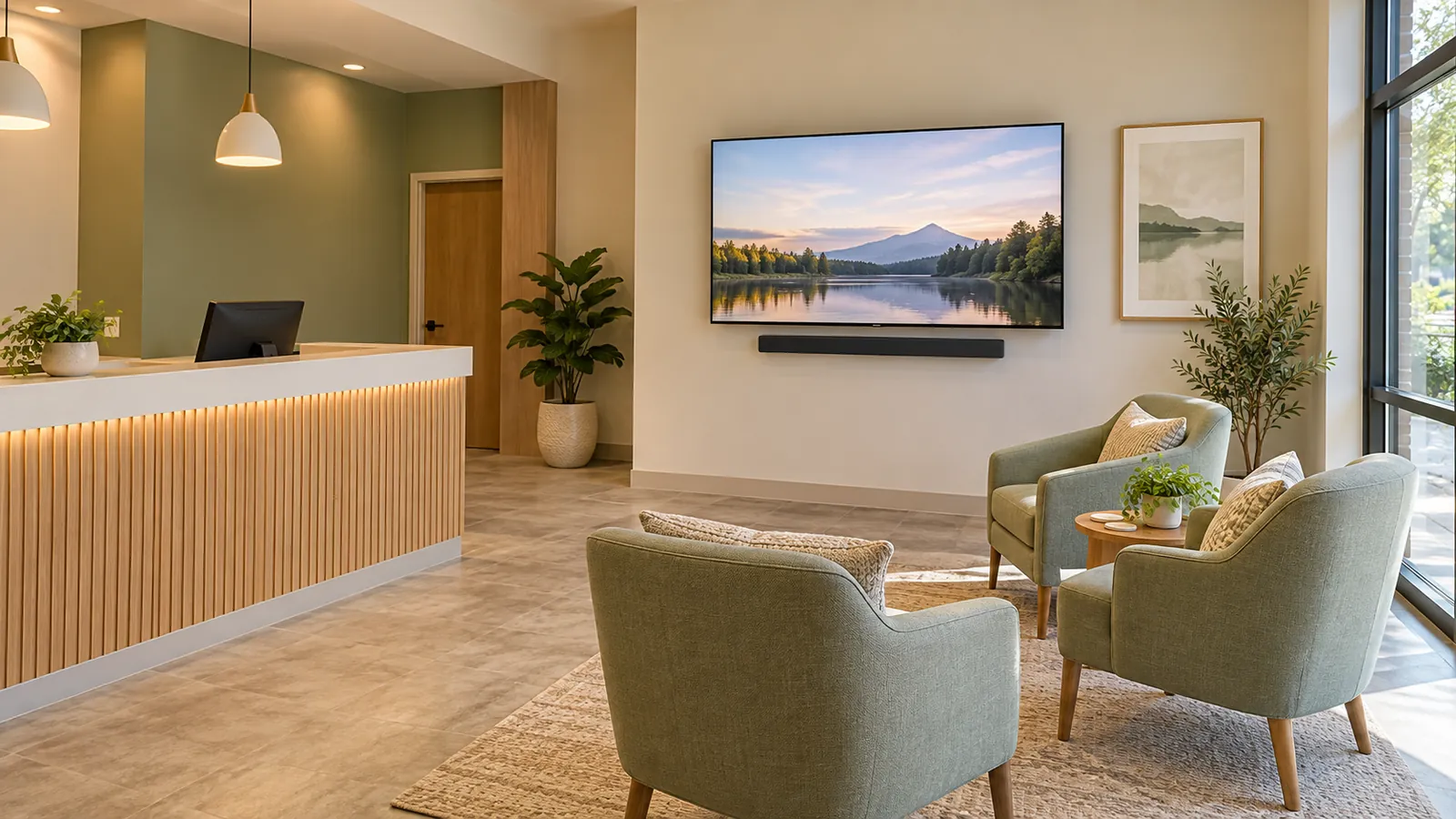
A reception wall: one TV, one slim bar tucked under it, and chairs grouped where the sound is aimed.
Your Questions Answered
Soundbar Installation in Harlem: Questions Answered
These are the questions Harlem residents and business owners ask us before booking, grouped by what they're really trying to decide: where the bar goes in a parlor, how a narrow apartment copes, why a feature isn't working, and how a shop gets heard. Costs and visit logistics are in the FAQ further down.
Rowhouse floors
Our garden apartment's front windows sit at sidewalk level — will people walking past hear the soundbar?
Quite possibly, if the bar faces them or the sash is old. A rowhouse's garden level sits partly below the street, so its front windows are a few feet from the stoop and the people passing it. Original single-glazed sash and window air conditioners leak far more sound than the masonry around them, and a bar aimed toward the front of the room sends most of its energy straight at the glass.
Placement does most of the work. We favor the wall facing the windows, so the bar fires into the room and away from the street, or a side wall set well back from the front. The subwoofer stays at the back of the room on a pad, because bass gets through glass most easily. Night mode and a modest maximum volume, set in the bar's app where it allows, keep evening films from carrying out to the stoop.
Heavy curtains or cellular shades help a little more, and closing the windows while the TV is loud helps most. Late at night the city's noise rules also cover what reaches your neighbors, so a garden apartment under a parlor full of tenants and beside a busy sidewalk is a place to set levels conservatively from the start.
Front parlor or back parlor — which room should get the TV and soundbar?
Most Harlem parlor floors are two rooms on a line: a front parlor behind the tall street windows and a back parlor facing the yard, joined by a wide opening. The front room usually has more light falling on the screen through the day and more street noise from the sidewalk; the back room is calmer and darker, which suits films, but may be where you eat.
For a soundbar the deciding factors are the wall facing the sofa, how far you sit from it, and what's on the other side. A TV on the wall shared with the back parlor sends sound into both rooms; a TV on a party wall sends bass toward the neighbors. We generally favor a solid interior wall in whichever room you actually sit in at night, with the sofa eight to twelve feet away, and the bar set for that distance rather than for both rooms. If the rooms are open to each other, night mode and a lower sub level keep the sound from flooding the whole floor.
One more practical point: the back parlor is often where the original marble mantel survives in the best condition, and owners rightly don't want a TV bracket above it. If the only good wall in that room is the chimney wall, the bar can go on a low cabinet in front of the hearth rather than the plaster above it, and the screen on a stand.
The only blank wall in our parlor is the narrow pier between the tall front windows — will a TV and soundbar fit there?
Sometimes, but measure before you buy. The masonry pier between a rowhouse's front windows can be much narrower than a modern screen, and it is part of the front wall, so it's brick or brownstone behind the plaster. A 55-inch TV is roughly four feet wide and most matching bars are close to that width; if either overhangs the window casing, the trim gets in the way of the bracket and the window can no longer open fully.
Send us the pier width, from casing to casing, and the ceiling height. If the screen fits but the bar is too wide, a shorter compact bar or a TV-attached bracket is the usual answer. The cable runs in a cord cover painted to the wall, since the solid front wall can't hide it, and we check the radiator under each window so neither the bar nor the cables sit in its heat.
Light is the other factor on a front pier. A TV between two tall windows faces into the room, so you won't see the street reflected in it, but the windows on either side throw daylight across the screen and the bar's display. Many owners find the pier works best for a modest screen and a compact bar used mainly in the evening, with the bigger TV in the back parlor.
Half our walls were redone in drywall during the renovation and half are still original plaster — does it matter which one carries the TV?
It matters for the fixing, the cable and the price, but either can work. New drywall on new studs is predictable: we find the studs, fix to them, and a hollow cavity lets an in-wall kit hide the cable, as long as the studs are wood and the owner agrees. Original plaster on lath is stronger than it looks where it's still keyed to the lath, but it can crack if drilled carelessly and needs the $45 plaster line.
Houses converted back from rooming-house use often hide a surprise inside the new drywall, such as an old doorway framed out or a run of new wiring. We scan whichever wall you prefer before quoting it as final. If you have no preference, the new drywall wall is usually quicker and the only one where the cable can disappear completely.
Walk-ups, flats and tower apartments
In our railroad apartment the living room is also the hallway — where can the TV and soundbar go so nobody walks into them?
In a railroad layout the rooms run one behind another, so the living room is often the route from the bedroom to the kitchen. A bar on a deep bracket at hip height is something people catch with a bag or an elbow. The first fix is height: the bar sits just under the TV, and the TV is hung high enough that both clear the line people walk along.
The second is depth. We choose a low-profile bracket or a TV-attached bracket, so the bar projects no further than the screen, and keep cables in a flat cover that can't snag a foot. If the only usable wall is directly beside a doorway, a swing arm that folds flat against the wall when the TV is off keeps the passage clear the rest of the time.
Railroad flats also tend to have their one usable outlet in an awkward spot, often by the window at the far end. We route the cable along the baseboard in a flat paintable cover rather than across a doorway, and if the run is long, the $99 cable line covers up to 25 feet. New outlets are an electrician's job, so if there is truly no power near the only safe wall, we'll tell you before you book rather than on the day.
TVs, formats and how they sound
We mostly watch live concerts and music videos, not films — which soundbar settings suit that?
Most bars ship tuned for films: a surround or movie mode that spreads the sound wide, adds simulated height and leans on the subwoofer for effects. With a concert broadcast or a music video, that processing can smear vocals and make the band seem to play in a different room from the singer. The music or stereo mode most bars offer keeps the mix closer to how it was recorded.
We set that up as an easy switch, usually on the TV remote through HDMI-CEC or as a preset in the bar's app, with the film mode one button away. The bass is set by ear using a track you know well rather than left at the factory level, and automatic dialogue boost is turned off for music, since it pushes vocals forward unnaturally.
If the bar has an equalizer, a small cut in the upper bass often helps in a plaster-walled parlor, where the room already adds warmth. In a rowhouse with tenants below, that same cut keeps a long concert from turning into a long evening for them.
The soundbar says Dolby Atmos, but films sound no different — what is usually missing?
Almost always the signal, not the bar. Atmos needs a source that sends it, a TV that passes it along, and a connection that carries it. A streaming app may only send Atmos on certain plans or certain titles; the TV's audio output may be set to stereo or PCM; and on an older TV with plain ARC, Atmos only travels inside Dolby Digital Plus, while the lossless versions need eARC. A cable box often sends no Atmos at all.
We check each link in that chain: the port label, the TV's audio-output and passthrough settings, the bar's own format indicator and a known Atmos test clip. Up-firing drivers also need a flat, reflective ceiling above the bar to bounce sound back down; a parlor ceiling twelve feet up and covered in plaster ornament gives less of the effect than a plain eight-foot one, so we set expectations honestly once we've seen the room.
If the chain is right and the effect is still faint, the bar's room-calibration routine, run from the listening seat, often helps, and turning the height channel up a step in the app is allowed. What doesn't help is turning up the subwoofer, which adds weight but no height, and in a rowhouse adds it to the floor below.
Harlem businesses
Our barbershop is long and narrow with the TV up front — will the chairs at the back hear it over the clippers?
One bar at the front of a long, hard-surfaced room loses clarity quickly with distance, and clippers, dryers and conversation sit right in the range that speech uses. Turning the bar up only makes the front chairs uncomfortable. Two changes do more: a bar with a strong dialogue or speech mode, set with bass trimmed, and the TV and bar hung high enough to clear the heads of people in the front chairs.
If the room is deep, a second screen with its own bar halfway down, or a matching pair of rear speakers where the bar's maker offers them, spreads the sound instead of forcing it. We test from the last chair while the shop is running, then set a maximum volume where the bar allows it, so the level stays put after we leave.
Mounting height matters in a shop for another reason: people walk past the TV wall all day. A bar fixed tight beneath a high screen projects only a few inches and is well above head height, which keeps it out of reach of elbows, bags and customers who want the volume changed. Cables run in a cover to the outlet so nothing hangs loose at counter level.
Our shop on 125th Street plays video in the front window — can a soundbar be pointed at the sidewalk?
Not legally, if the aim is to attract people. Section 24-244 of the city's Administrative Code bars sound reproduction devices used for advertising or to draw attention to a display of merchandise through any opening of premises abutting a public street, or wherever the sound can be heard on the street or sidewalk. A soundbar facing the glass to pull in passers-by is exactly what that rule describes.
Inside the shop is a different matter. We can place a bar so the video's sound is clear to customers who have come in, aimed away from the door and window, at a level that doesn't carry outside. The window screen can still run captions or a silent loop, which tends to work better on a busy corridor anyway.
The same thinking applies to restaurants and cafés with doors or windows open in summer. Sound inside for diners is fine; sound pushed out to the sidewalk to draw people in is what the rule is aimed at, and between 10 PM and 7 AM the separate limits on music reaching neighbors apply as well.
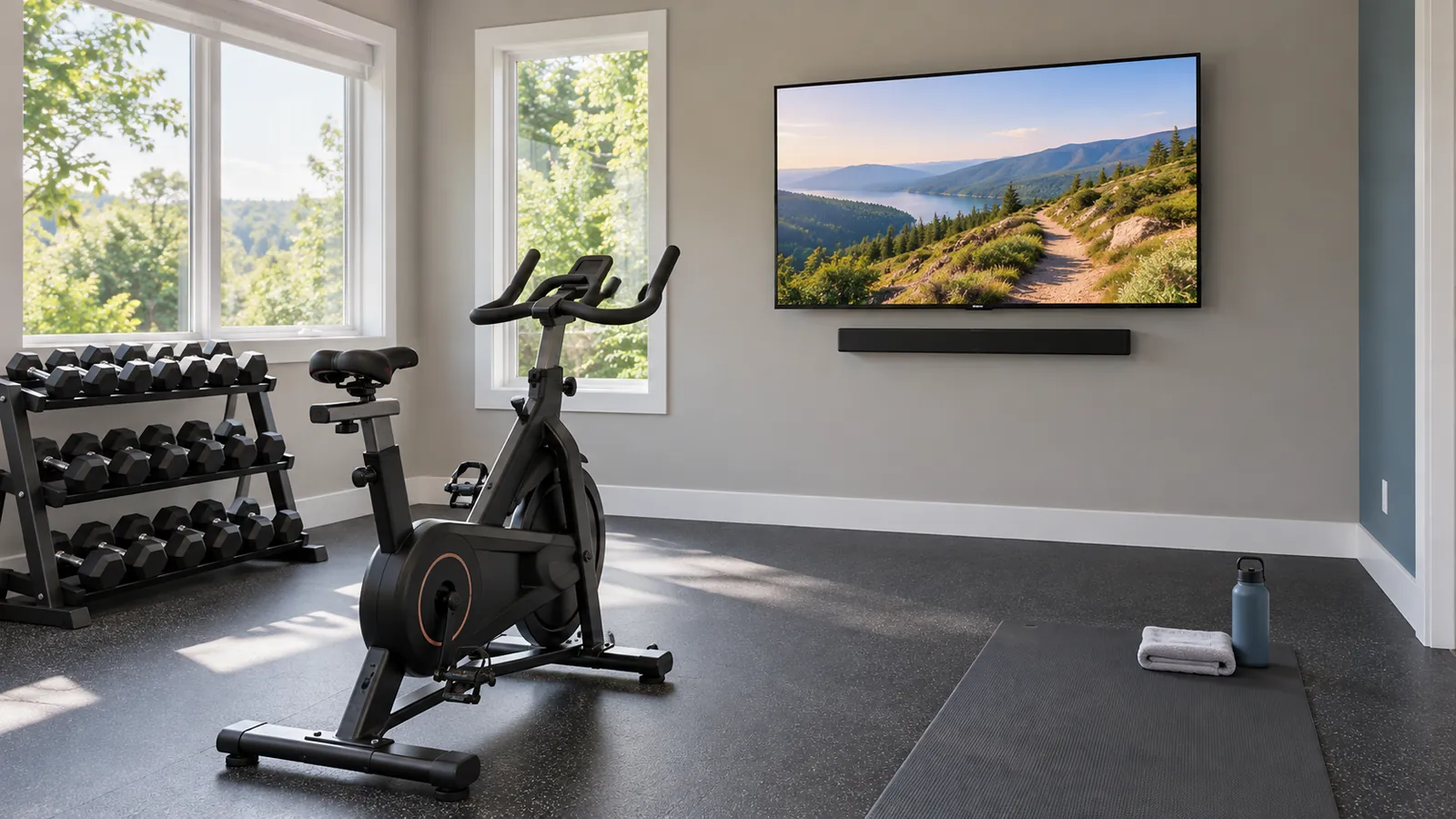
An exercise room set up for classes on screen: spin bike, dumbbell rack and mat facing a wall TV with the bar fixed beneath it.
Shared Houses
Living With a Soundbar in a Shared Harlem House
Many Harlem rowhouses hold two or three households: an owner's duplex over a garden rental, or separate floor-throughs each with its own tenant. A soundbar that sounds perfect on its own floor can be the main thing the people downstairs hear in the evening, and in a house that small the relationship matters more than a few extra decibels.
The settings we leave on are chosen with that in mind. Night mode or dynamic-range compression keeps explosions and music from jumping far above the dialogue, so you don't reach for the volume every few minutes. Speech or dialogue enhancement lets the TV stay quieter overall while voices stay clear. The subwoofer, if there is one, is placed off the bare boards on a pad, kept out of corners where bass builds up, and set below the bar's default level, because low bass passes through wood joists far more easily than speech does.
The city's noise code also sets a line late at night. Between 10 PM and 7 AM, sound from inside a home measured at 7 dB(A) or more above the background in a neighbor's home can count as unreasonable, and loud television is one of the things NYC311 lists under noise from a neighbor. You don't need a meter to stay well clear of that: if the bass can be felt through the floor of the room below, it is too high.
Owners renting out the garden level sometimes ask us to set up the tenant's TV too. That's a separate visit and a separate price, booked by whoever is paying, and we keep each apartment's bar on its own network and remote so nobody ends up controlling the neighbor's sound by mistake.
Before You Book
A Harlem Checklist Before the Soundbar Goes Up
Five minutes with a tape measure and your lease avoids most of the surprises we meet in Harlem. Go through this list before sending the form; the answers feed straight into the price.
Which wall, and what's behind it. Knock on it. A dull, solid sound is brick, block or concrete; a hollow sound is studs; a hard, slightly ringing sound over a hollow one is often plaster on lath. A phone photo of the wall with the outlet in view tells us the rest.
Party wall or partition. In a rowhouse, the long side walls are usually shared brick party walls; the walls between front and back rooms are partitions. That decides the anchor and whether a cable can be hidden.
Width at the spot. Measure between window casings, door openings and pocket-door cavities. A screen and bar need clear wall on both sides.
Who is underneath. A tenant in the garden apartment or a neighbor below the slab changes where the subwoofer can go and how loud it should run.
Lease, house rules or development rules. Check the clause on holes and alterations. NYCHA, Mitchell-Lama and co-op managements may have their own process; if drilling is out, choose a console or TV-attached bracket.
Stairs and floor number. An apartment on the third floor or higher with no elevator adds the $40 stair line. Tell us the floor so the quote is right first time.
Where the router and boxes live. A smart bar two floors above the router in a rowhouse may need a wired link or a mesh point; a cable box across the room needs a longer HDMI run.
Radiators and heat. Note any radiator, pipe riser or decorative fireplace near the TV spot; heat and pipes shape where the bar and cables can sit.
Delivery. If the bar is arriving by courier, make sure it is in the apartment rather than on the stoop or in a lobby before the window starts.
If a point is unclear — a wall you can't identify, or a management office that hasn't answered — book anyway and tell us. We'll quote both wall options so the number on the day matches what's behind the paint.
House Vocabulary
Harlem House and Building Terms, Explained
Booking a soundbar in a Harlem rowhouse or development means hearing words that rarely come up in a suburban install. Here is what they mean for the job.
Parlor floor. The main floor of a rowhouse, up the stoop from the street, with the tallest ceilings and the formal front and back rooms. Most rowhouse TVs end up here.
Garden level. The floor partly below the sidewalk, often its own rental apartment. Its ceiling is the parlor's floor, which is why bass travels down so readily.
Floor-through. An apartment that takes a whole floor of a rowhouse, front to back.
Party wall. The shared masonry wall between two attached houses. Solid brick, so it holds an anchor well but hides no cable.
Pier. The section of solid front wall between two windows.
Pocket door. A sliding door that disappears into a cavity inside the wall. Never a place to drill.
Plaster and lath. The original interior wall finish: plaster pressed onto thin wood strips nailed across the studs.
SRO. Single-room occupancy, the rooming-house use many Harlem rowhouses went through in the twentieth century before being converted back.
Railroad apartment. A flat whose rooms run one behind another, often with the living room doubling as a corridor.
Mitchell-Lama. A state program behind middle-income co-op and rental developments such as Esplanade Gardens. Managements set their own rules for contractors.
NYCHA. The New York City Housing Authority, which runs public housing such as St. Nicholas Houses and Randolph Houses.
Historic district. An area designated by the Landmarks Preservation Commission, such as Mount Morris Park or the St. Nicholas Historic District. It governs exteriors; ordinary interior work without a Buildings permit isn't reviewed.
Certificate of insurance (COI). One-page proof of a contractor's liability insurance, which managing agents and development offices often ask for before letting work start. Ours is free.
Equipment
Types of Soundbars and Mounts We Install in Harlem
Whatever brand you've bought, we'll fit it. Below are the kinds of bar and hardware that turn up most often in Harlem homes, and how each one plays with old walls and close neighbors.
Compact Bars
The narrowest end of the market — WhatHiFi measures the Sonos Ray at roughly 56 cm and under 2 kg, and it plugs in by optical cable instead of HDMI. Fits a pier, a walk-up front room or a bedroom dresser.
Mid-Size Smart Bars
Our most common install in parlors and tower living rooms. Sonos gives the Beam (Gen 2) as 25.63 inches wide and 6.35 lb, connected over HDMI eARC with app control.
Flagship Atmos Bars
Height-channel bars are the big ones: Sonos specifies its Arc Ultra at 46.38 inches across and 13.01 lb. Their overhead effect depends on a smooth ceiling to bounce from, so a plaster-ornamented parlor gets less of it.
Bars With Wireless Subs
Fuller sound for films, and the biggest source of complaints from the floor below. We place the sub off the joists' bounce and set it low for a house shared with tenants.
Wall Brackets
If the bracket from the box is sound, we use it; if it's flimsy or the wrong depth for your wall, a Sanus bracket ($84.99) replaces it. Either way, the anchors come from our kit.
TV-Attached Brackets
Sanus lists its universal soundbar mount for most bars up to 20 lb, clamped to the TV. Ideal where the wall can't be drilled, or where the TV is on a swing arm.
In-Wall Kits and Cord Covers
In-wall power and cable kits for hollow partitions, carrying power to an outlet that's already there; paintable surface covers for brick, block and concrete.
Network Links
Ethernet cables, small switches and mesh points for smart bars on upper floors of a rowhouse, where the router is two or three flights away behind masonry.
Which connection fits your setup
Link
Best for
Check first
HDMI eARC
Newer TVs and bars; lossless formats and one-remote control
Use the port marked eARC, which may be on an external box
HDMI ARC
Older TVs; Atmos only inside lossy Dolby Digital Plus
HDMI-CEC switched on in both menus
Optical
Compact bars and TVs without ARC
Volume control may need the remote programmed
Ethernet
Smart bars far from the router in a rowhouse
A jack or a cable path from the router
Wi-Fi only
Bars with no network port
Router position and band choice
National brands and app marketplaces versus an uptown installer. Big-box tech services and gig apps sell neat flat-rate soundbar menus built around drywall on wood studs and a driveway. A Harlem parlor with a brick party wall, a pocket door and a tenant below isn't what those menus were drawn for. A licensed local installer with a published Manhattan price and a direct Manhattan line quotes the wall you actually have — and answers the phone if the bar acts up later.
If you are buying a bar for a Harlem room, two specifications matter more than any marketing claim. The first is width, checked against the wall space between casings, doors and pockets, not just against the TV. The second is how it connects: a bar with HDMI eARC and, ideally, an Ethernet port copes best with old houses where the router is several floors away, while an optical-only bar is fine for a simple bedroom or walk-up setup with the TV close by.
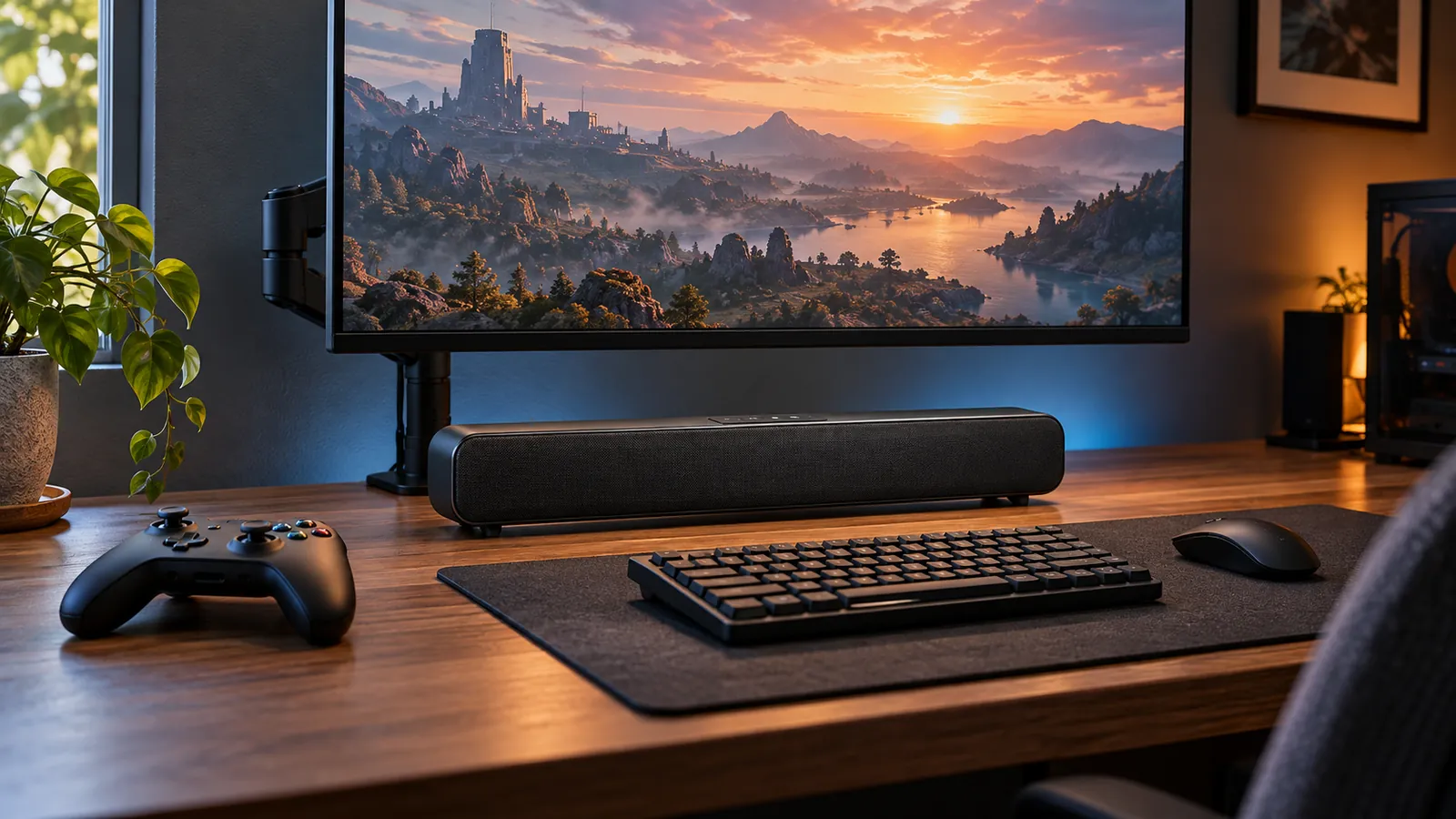
A short bar on a desk under an arm-mounted monitor: the same planning for power and cables, on a smaller scale.
AI Overview Reality Check
What AI Gets Wrong About Soundbar Installation in Harlem
We couldn't capture Google's AI Overview in our build environment, so this section takes the claims that cost guides, manufacturers' articles and forum threads actually publish — the material AI summaries are built from — and checks them against Harlem walls.
"Installing a soundbar costs about $58 to $231"
Homewyse's national estimate for installing a soundbar ran from $58.43 to $231 per bar in September 2026. That is a reasonable range for hanging a bar on drywall in a house where the installer parks in the driveway, and it is useful for knowing whether a quote is in the right universe.
It doesn't describe a Harlem visit. Our published Manhattan menu prices the wall mount at $129, a Sanus bracket at $84.99 if you need one, a wall line on top for plaster ($45), brick ($65) or concrete ($75), and one flat $150 parking charge per visit. A bar on a brownstone's brick party wall with a cord cover comes to $487.99 all in; a bar on a console in a rental is $229.
The gap is the city. Commercial parking near most Harlem blocks is scarce, stoops and walk-up stairs take time, and old walls need the right fixings. An itemized price that includes all of it is more useful than a national average that includes none.
"Mount the soundbar directly below the TV"
Dolby's guidance is that a wall-mounted bar usually works best below the TV, with screen and bar as close together as practical, and that a bar can hang from an adjustable TV mount. We agree, and it is our default.
In Harlem rooms the exceptions come up often. A TV hung high over a decorative mantel leaves the bar either far below the screen or perched on the mantel shelf; a narrow pier between windows may not take a bar's full width; a pocket-door wall may only be solid above the opening.
So “directly below” is the goal, not a rule. We work out the closest arrangement the wall allows — sometimes a TV-attached bracket, sometimes a shorter bar — and test it from the sofa before calling the job done.
"Put the TV at about 42 inches, ear height when seated"
Yamaha's guide suggests aiming for roughly 42.5 inches off the floor, where a seated listener's ears fall. For a family room with a standard sofa and an eight-foot ceiling, that is sensible advice for the bar.
Parlor floors complicate it. Ceilings around twelve feet, tall windows, mantels at chest height and radiators under the windows push the TV upward. If the TV goes up, the bar usually follows it, and the sound arrives from above the listener's head.
The fix is to keep the bar as low as the wall honestly allows, angle it slightly if the bracket permits, and lean on the bar's dialogue mode. We'll show you the heights in tape on the wall before drilling, so you choose with your eyes rather than a number.
"You need eARC to get Dolby Atmos"
It's a widely repeated line, and only half true. As technical explainers and Sonos owners on Reddit point out, plain ARC can carry Atmos inside Dolby Digital Plus; eARC is needed for the lossless versions such as Dolby TrueHD.
The practical consequence for a Harlem living room is that an older TV doesn't automatically rule out Atmos from streaming apps. What usually blocks it is a setting: the TV's audio output, the app's plan or title, or a cable box that sends stereo.
We trace the chain before anyone buys a new TV. Sometimes a menu change is the whole fix; sometimes the answer really is a different port or a newer device, and we tell you which.
"Use the screws and anchors in the box"
Manufacturers include hardware so a bar can go up on a typical stud wall, and some installers' own blogs warn that in-box screws often won't suit New York walls. The second point is the one that matters here.
Plastic plugs meant for drywall have little to bite on in crumbling plaster, and they shatter in brick. Brick, block and concrete need masonry anchors; plaster on lath needs studs or proper toggles; metal studs need fixings made for steel.
We bring fixings for every wall in the neighborhood and choose them after the wall has been identified. The bag in the box usually goes back in the box.
"A historic district means you need landmark approval"
Owners in Mount Morris Park or on Strivers' Row sometimes assume anything they do needs the Landmarks Preservation Commission's sign-off, and summaries of landmark rules can leave that impression.
The commission's own guidance is narrower: interior work needs an LPC permit only when it requires a Department of Buildings permit or when the interior itself is a designated interior landmark. A soundbar on an interior wall needs neither.
The facade is another story. Anything that would run cable outside the house or put equipment on the front would be a matter for the commission, which is one reason we keep all soundbar work inside.
"A bigger subwoofer means better sound"
Shopping guides love bass, and many bars ship with large wireless subs. In a detached house with a slab floor, more bass is mostly a matter of taste.
In a rowhouse with wood-joist floors, bass is what the tenant downstairs hears. One much-cited r/AskNYC thread on neighbor-friendly soundbars put it simply: bass frequencies travel easily, so either skip the sub or get one you can adjust.
We place the sub away from corners, off bare boards, and set it lower than the bar's default. Many people find they barely miss it; if you do, it can come up a notch once you know how it carries.
The same caution runs the other way in the towers. Concrete slabs block more airborne sound than wood joists, but a sub standing directly on the floor still passes vibration into the structure, and it can reach apartments that aren't directly below. A dense pad under the sub and a lower crossover setting do more for the building than any brand choice.
Old Walls, New Bars, Quiet Floors
One photo of the TV wall and the name of your bar get you a line-by-line Harlem quote, parking counted in.
Tell us about the bar, the TV and the wall. Every request is read by someone who installs, and the price that comes back is built from the menu on this page, parking included. Prefer to talk? Call (929) 560-0737.
✅
Request Received
Got it. Someone who does the installs will reply today if you sent it during business hours. Need it faster? Call (929) 560-0737.
How It Works
Our Installation Process
Six steps for every Harlem soundbar, whether it's a compact bar in a fifth-floor walk-up or an Atmos bar on a restored parlor floor. The first two happen before we arrive, because in an old house the wall decides the plan.
1. Show us the wall
Text or email a photo of the TV wall with the outlet in view, the bar and TV models, your cross streets, the floor and whether there are stairs. You get an itemized Harlem price back, parking included, with any plaster, brick, concrete or stair line shown.
2. Settle the building side
If a managing agent, co-op office or development management is involved, we send a free certificate of insurance and confirm the hours contractors may work. In a private rowhouse we simply agree the day.
3. Arrive and protect the room
Up the stoop or the stairs inside the agreed two-hour slot; tools and bar come up in one trip where possible, and a cloth covers the floor below the TV wall before anything is opened.
4. Identify the wall
A knock test and a scanner sort out lath, brick, block, concrete or studs, and find pipes, wiring, pocket-door cavities and old openings. You approve the height and centre mark on tape before drilling, and the vacuum stays at the bit.
5. Fix, hang and connect
The bracket goes up on fixings that suit the wall, the bar is hung and levelled, and cables go into an in-wall kit, a painted cover or behind the console. HDMI goes into eARC or ARC with CEC switched on.
6. Tune it for the house
We place and set the sub for whoever is below, check the bar's Wi-Fi or wired link, switch on speech and night modes, test lip-sync with a dialogue scene, clean up and walk you through the remote.
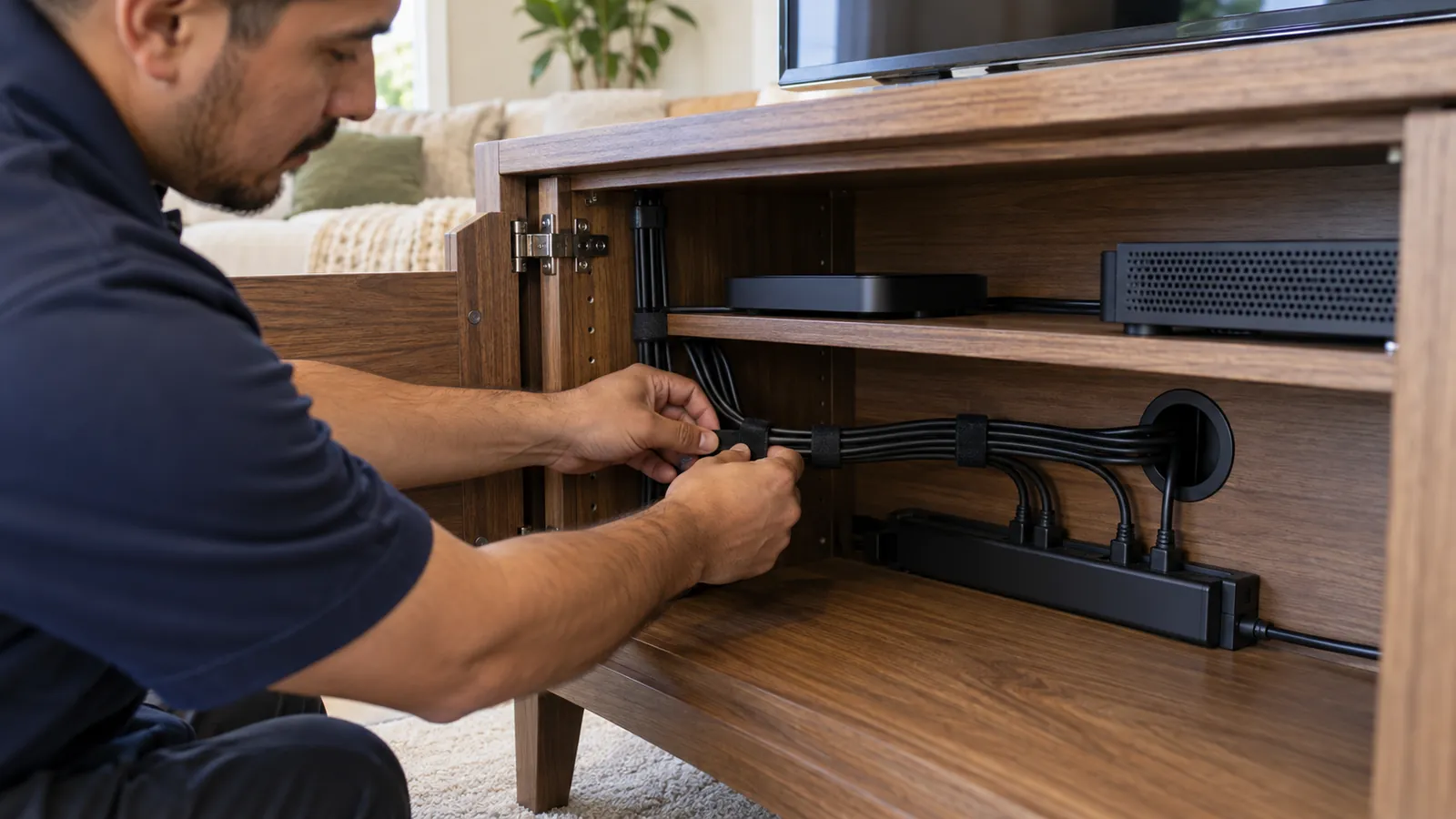
Inside the cabinet: cables strapped into one bundle, fed through the back grommet to a single power strip, devices on the shelf above.
Coverage Area
Soundbar Installation Near Harlem's Landmarks
Six Harlem landmarks, picked because each stands for a kind of building or block we work in. We aren't claiming jobs inside them; they are reference points for the walls and rules around them.
Apollo Theater, West 125th Street
The historic theater at 253 West 125th is closed for renovation and expected to reopen in late 2026; meanwhile the Apollo runs two smaller stages of 199 and 99 seats at The Victoria, 233 West 125th. The heart of the commercial corridor we serve.
Strivers' Row, West 138th–139th Streets
The St. Nicholas Historic District: rowhouses built in 1891–93 by David H. King Jr. to designs by James Brown Lord, Bruce Price with Clarence S. Luce, and Stanford White, landmarked in 1967, with gated rear alleys still signed “Walk Your Horses.”
Mount Morris Park Historic District
Designated in 1971 and extended in 2015 by more than 250 rowhouses, faced in brick and brownstone in neo-Grec, Romanesque Revival and neo-Renaissance styles. Parlor floors, party walls and plaster partitions block after block.
Mount Morris Fire Watchtower, Marcus Garvey Park
A cast-iron watchtower erected in 1856, a city landmark since 1967 and restored in a project the Parks Department celebrated in October 2019, standing on the Acropolis in the middle of the 20-acre park.
Studio Museum in Harlem, 144 West 125th
A seven-floor, 82,000-square-foot building by Adjaye Associates with Cooper Robertson, opened to the public on November 15, 2025, between Lenox Avenue and Adam Clayton Powell Jr. Boulevard.
St. Nicholas Houses
Thirteen 14-story NYCHA buildings with 1,523 apartments on a superblock from West 127th to 131st Street between Adam Clayton Powell Jr. and Frederick Douglass Boulevards. Typical of the concrete-and-block tower walls in the neighborhood's big complexes.
We also work right across Harlem and its edges — South Harlem and the Frederick Douglass corridor, the Mount Morris and Marcus Garvey Park blocks, Central Harlem's 130s and 140s, Strivers' Row, Sugar Hill, Hamilton Heights, the Polo Grounds and Harlem River Drive end, and the East Harlem side of Fifth Avenue. Neighborhood pages for other parts of the city are being added; other neighborhood soundbar pages include St. George on Staten Island and Bay Ridge in Brooklyn.
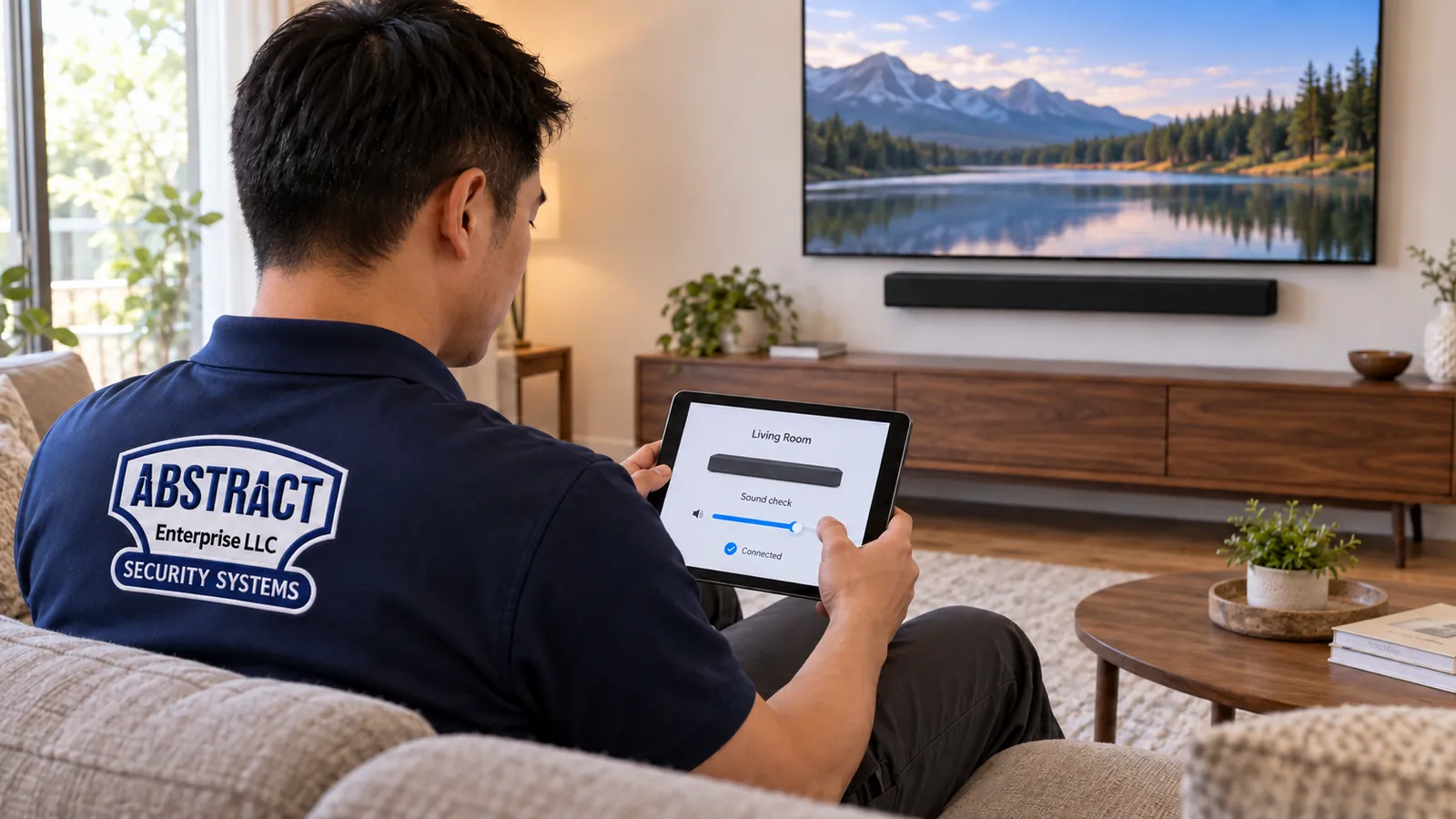
The final check happens from the seat you'll use: a tablet open to a Living Room sound-check screen showing Connected, facing the wall TV and bar.
Pricing
Soundbar Installation Cost in Harlem
Harlem is priced from our published Manhattan menu, line by line, with one parking charge per visit. Choose the lines that fit, add parking, and that is the bill. If the wall turns out to be something other than what we quoted — brick under plaster, say — you get the revised price before any further work.
Line
Price
In Harlem terms
Soundbar wall-mounted under the TV
$129
Wall identified, fixings matched, bar level under the screen
Soundbar placed on a console
$79
No holes; the usual choice under a no-drilling lease
Sanus soundbar bracket
$84.99
Our stocked Sanus bracket, swapped in when the bundled one is missing or too light for a parlor wall
In-wall concealment
$169
Hollow partitions only, with the owner's agreement
Paintable cord cover
$59
Brick party walls, front piers, block and concrete
TV (32–55 in) and bar on new wood-stud drywall, our bracket
$244.99 + $129 + $84.99 + $150
$608.98
When the visit is billed by time
If nothing goes on a wall — reconnecting a bar to a new TV, fixing eARC or lip-sync, re-pairing a sub — the visit is setup-only: $265 for the first hour in Manhattan, then 30-minute blocks, plus the $150 parking line. A TV mounted on the same visit starts from our Manhattan base of $244.99 for a 32- to 55-inch screen on wood-stud drywall, and a TV kept on its stand is $162.99.
Included, and not
What the lines buy: a wall properly identified, the bracket fixed, a bar that sits true, eARC and remote control working, the network tested, cables dressed and the dust gone.
What they don't: anything at line voltage — a new outlet is a Licensed Master Electrician's job — plus plaster patching, painting, and shifting pianos or heavy cabinets.
Return trips: if the bar or bracket hasn't arrived, the building turns us away, or nobody is home, the $150 return-trip fee applies. Rescheduling with 24 hours' notice is free.
Old surfaces: a nineteenth-century plaster wall or a marble surround may split under even a slow bit. If yours is one of them, we point it out first and leave the decision to you.
Brackets: each is guaranteed by the company that made it, and our own terms are summarized in the dark panel near the end of the page.
Shop Our Systems
Soundbar Installation Packages & Pricing
Most Harlem quotes land on one of three shapes. Each shows its sum, parking included. The standard card assumes plaster, the commonest Harlem wall; brick or concrete swap the $45 for $65 or $75.
Starter — Console Bar
$229
Console placement ($79) + parking ($150). Connected over eARC or ARC, CEC on, cables tied off. Add $40 if the apartment is a third-floor-or-higher walk-up.
Standard — Bar on Plaster
$408.99
Wall mount ($129) + Sanus bracket ($84.99) + plaster ($45) + parking ($150). The typical parlor partition or walk-up living room.
Premium — Plaster With In-Wall Wiring
$577.99
Standard plus in-wall power and cable ($169). Only on a hollow partition, and only where the owner has agreed to opening it.
Bring Your Own Equipment — Labor Only
Already have a rated bracket? You pay the $129 mount, the wall line and parking: $324 on plaster, $279 on wood-stud drywall. Your bracket must be rated for the bar and is covered by its own maker. If it's wrong for the wall you'll hear it before drilling, with our Sanus bracket offered instead.
Want a Harlem Price You Can Check?
Two things start it: a picture of the wall and the bar you own. The quote spells out every charge.
Harlem isn't one housing type, and the job changes every few blocks. Here's what we plan for in each part.
South Harlem and Frederick Douglass Boulevard
The city's rezoning of 44 blocks between Central Park North and 124th Street raised the allowed density along Frederick Douglass Boulevard while protecting the rowhouse mid-blocks. The result is new mid-rise buildings on the avenue, with drywall partitions and pre-planned TV walls, beside nineteenth-century houses on the side streets. Expect metal studs on the boulevard and plaster around the corner.
The newer buildings usually come with a TV location already chosen by the architect: a power outlet and sometimes a cable jack set at mounting height on one living-room wall. That is the easiest wall in Harlem to work on, and often the only one where an in-wall kit is allowed, but it isn't always the wall the sofa faces. If you want the TV elsewhere, we'll price both and show you what each means for the cable.
Mount Morris Park and Marcus Garvey Park
The densest run of landmarked rowhouses in the neighborhood, most built as single-family homes and many now split into a duplex and rentals. Parlor floors, pocket doors, decorative mantels and tenants on other floors mean wall choice and subwoofer level matter as much as the bracket.
Owners here are also more likely to be mid-restoration, with plasterers, painters or floor refinishers booked around the TV. A bar goes up best after the plaster has cured and the paint is dry, and before the final furniture arrives, so the wall is reachable and the floor is already protected. If the timing is tight, a console placement now and a wall mount later is a sensible split.
Central Harlem, the 120s to the 140s
Rowhouse blocks, prewar walk-ups and the big postwar complexes — St. Nicholas Houses, Lenox Terrace, Esplanade Gardens toward the river. Plaster over masonry on the side streets, concrete and block in the towers, and a management office to check with in the developments.
In the towers, two things come up again and again. Concrete walls take a hammer drill, which is loud, so we book inside whatever hours the development allows. And because nothing can be hidden inside a concrete wall, the neatest finish is usually a slim painted cover running straight down to the outlet, or a bar on the console with the cables kept behind it.
Strivers' Row and the St. Nicholas Historic District
Some of the most intact rowhouses in the city, with the rear alleys that set them apart. Interiors vary from untouched to fully renovated; the fronts are protected, so all wiring stays indoors.
Because the houses were built in matching rows by one developer, the floor plans repeat from house to house, and so do the good TV walls. Where an interior is still close to original, we look first at the partition between the front and back parlors and at the solid stretch of party wall away from the mantel; where it has been gutted, the new layout decides.
Sugar Hill and Hamilton Heights
Rowhouse districts designated between 2000 and 2002 and large elevator buildings on Edgecombe and St. Nicholas Avenues. High ceilings, thick plaster and, in the apartment houses, supers and boards to keep informed.
The Commercial Avenues
125th Street, Lenox, Adam Clayton Powell Jr. and Frederick Douglass Boulevards and West 116th: shops, salons and restaurants under apartments. Speech clarity, volume caps and the street-sound rule come first.
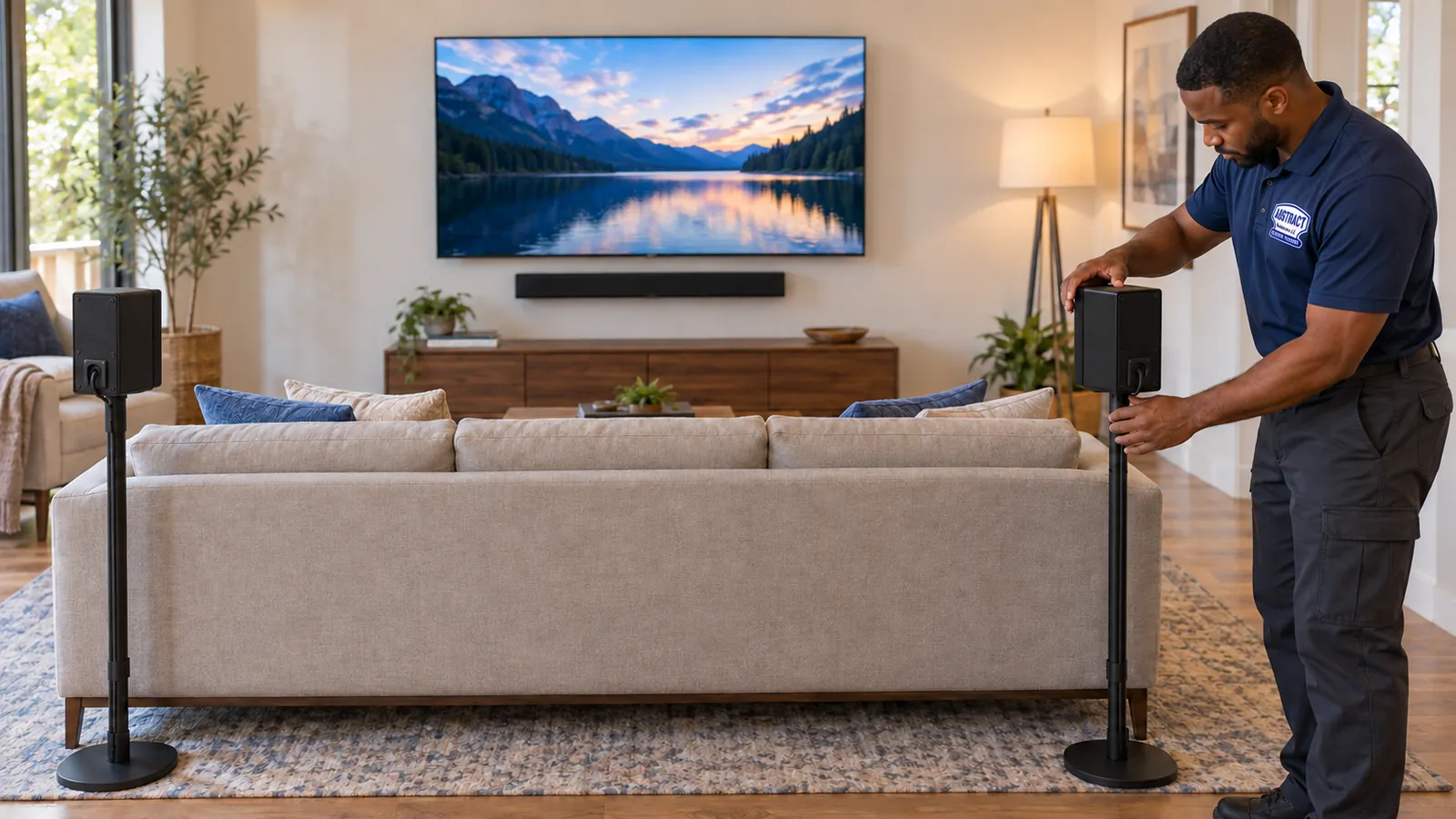
Rear speakers on stands behind a sofa that sits away from the wall, with the TV and bar on the far wall.
Matching Bar to Room
Choosing a Soundbar for a Harlem Room
Pick the bar for the room you have, not the one in the showroom. If you haven't bought yet, this is how we'd match bar and mount to the rooms we see most uptown. It's guidance from the job, not an endorsement of any brand.
Room
Bar
Sub?
Mount
Rowhouse parlor, 10–12 ft ceiling, tenant below
Mid-size, strong dialogue mode
Optional, set low, off the boards
Partition wall or TV-attached
Parlor with an open double room
Mid-size or flagship
Optional; mind both rooms
Solid wall in the room you use at night
Walk-up front room
Compact or mid-size
Usually not
Plaster over masonry, cord cover
Railroad living room
Compact
No
Low-profile or TV-attached
Tower living room
Mid-size smart bar
Optional, on a pad
Concrete or block, cord cover
New-build living room
Mid-size or flagship
Optional
Drywall on studs, in-wall kit
Barbershop or salon
Mid-size, speech mode
No
High wall bracket, volume capped
Three rules of thumb cover most of it. A bar close to the screen's width keeps voices anchored to faces. Height effects need a plain ceiling. And in a house where someone sleeps below the parlor, a well-set bar without a sub usually makes everyone happier.
Hold on to the carton and the receipt until install day is over: a bar with a dead port or a scuff from the courier goes back far more easily while it is still unmounted.
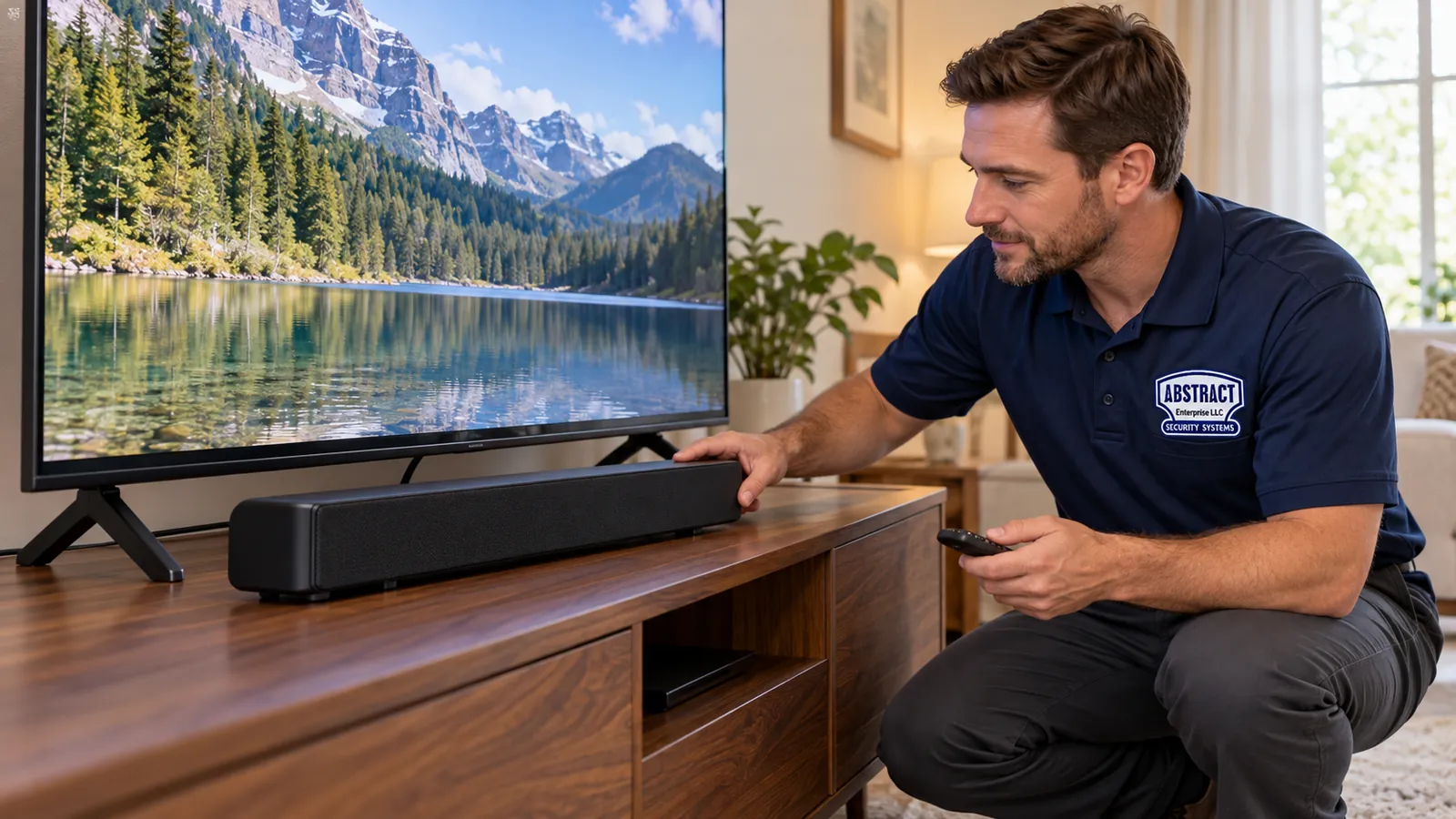
No drilling at all: the bar sits on the console in front of the TV's feet, lined up so it doesn't block the screen or its sensor.
Complete Services
Every Soundbar Installation Service in Harlem
A soundbar is often the first of several jobs in a Harlem house or apartment. These Manhattan services run from the same office, under the same license and insurance.
Arrival windows, return trips, rescheduling and hourly setup.
Field Notes
Field Notes From Harlem Parlors and Front Rooms
What our technicians check, in order, in a Harlem home — our routine, not an account of one particular visit
In a rowhouse the first question is which floor is whose. The technician asks who lives below and above, because that decides how far the sub can go before the bar is even out of its box. Then come the walls: which are party walls, which are partitions, and whether any partition hides a pocket door or a closed-up opening from the house's rooming-house years.
The knock test and the scanner come next, then a look at the mantel, the radiators and the windows, since in a parlor any one of them can rule out the spot you had in mind. Because the rowhouses and walk-ups here were built long before 1960, the drop cloth goes down and the vacuum goes on before the first hole.
Last comes the network. On an upper floor of a masonry house the router is often two flights away, so the bar's connection is checked from the TV wall before we leave, not discovered a week later when the music drops out.
FAQ
Harlem Soundbar Installation FAQ
What would a soundbar on a brownstone's brick party wall come to in Harlem, cord cover and parking included?
+
The wall mount is $129, a Sanus soundbar bracket $84.99, brick adds $65 and a paintable cord cover $59, which is $337.99. The flat $150 Manhattan parking charge brings it to $487.99. With your own rated bracket it is $403. A brick wall can't hide a cable, so the cord cover is the usual finish.
Can a soundbar bracket go on plaster that already has a long crack running through it?
+
Often, but not straight across the crack. A crack can mean the plaster has come loose from its lath there, so we tap along it, keep the fixings clear of it and land them in studs. If the plaster is loose across the whole spot, a plywood backer board ($85) spreads the load. Repairing the crack itself is plasterer's work.
Can the subwoofer sit inside the opening of a decorative fireplace that no longer works?
+
It can fit, but it rarely sounds good there. A brick firebox is a hard, boxy cavity that tends to make bass boom, and an unsealed flue lets soot and drafts reach the sub. Only consider it if the fireplace is permanently out of use and sealed. Usually the sub works better on the floor beside the hearth, on a pad, away from the corner.
Can the subwoofer live in the back parlor while the bar is in the front?
+
Not well. Bass a room away from the screen sounds detached, and a wireless sub has to reach through a masonry wall or a doorway to stay paired. Keep the sub in the same room as the bar, ideally along the front wall or beside the sofa. If space is tight, a bar without a separate sub is the better choice.
Are the screws and plugs that come in the soundbar's box good enough for an old Harlem wall?
+
Usually not. Boxed hardware is meant for drywall on studs. Plastic plugs have little to grip in old plaster and crack in brick; masonry, lath and metal studs each need their own fixings. We bring anchors for every wall type in the neighborhood and choose them once the wall is identified, at no extra charge beyond the wall line.
Can old cable-company coax stapled along the baseboards be tidied up on the same visit?
+
Yes, if it's yours to tidy. Spare runs that no longer serve anything can be cut back at the wall plate and the staples removed, and the active line can go into the same paintable cover as the soundbar cables. Coax in shared hallways or outside the house belongs to the provider or the building, so we leave it alone.
A piano or a tall bookcase has to stay against the TV wall — can the bar still be mounted above it?
+
Yes, as long as there is room for the bar under the screen and the technician can reach the wall safely. We don't move pianos or heavy furniture, so it stays put and gets covered. The bar has to clear the top of the furniture, and the TV may end up higher than ideal, which we'll mark on tape first so you can judge it.
All Areas Served
Soundbar Installation Across New York City and Beyond
From Central Park North to the Harlem River, if the bar has lost its sync, its sub, its Wi-Fi or its grip on the wall, call (929) 560-0737. Tell us the block and the symptom; the next free two-hour window is yours, and most faults like these take one to two hours on site.
Abstract Enterprises Security Systems · 460 E Fordham Rd, Bronx, NY 10458 · Manhattan line (929) 560-0737 · WhatsApp (718) 679-0359 via wa.me
NYS Low-Voltage License #12000287431 · 100% Licensed & Insured · Same-Day Estimates · Rated 4.7★ from 201 Google Reviews
Brackets and parts carry their manufacturer's warranty. Full terms — including 50% deposit, one-year parts-only warranty on AESS-supplied products, and the late-fee schedule — are set out in the service agreement. See our warranty page.
Last reviewed October 17, 2026. What's new: first published October 2026, covering Harlem parlors, walk-ups, tower complexes, the storefront sound rule and itemized prices.