Soundbars mounted and connected in farmhouses with horsehair plaster, Victorians, fieldstone-fireplace great rooms, log homes, lake houses and river-town lofts across Westchester, Rockland, Orange, Putnam, Dutchess and Ulster. We find solid fixing in walls that don't behave like drywall, keep the wires out of sight where the wall allows it, put the subwoofer where a big room needs it, and make the TV, the bar and your remote agree before we pack up.
Reviewed and updated October 17, 2026 · Written by Anwar Timothy, NYS licence #12000287431
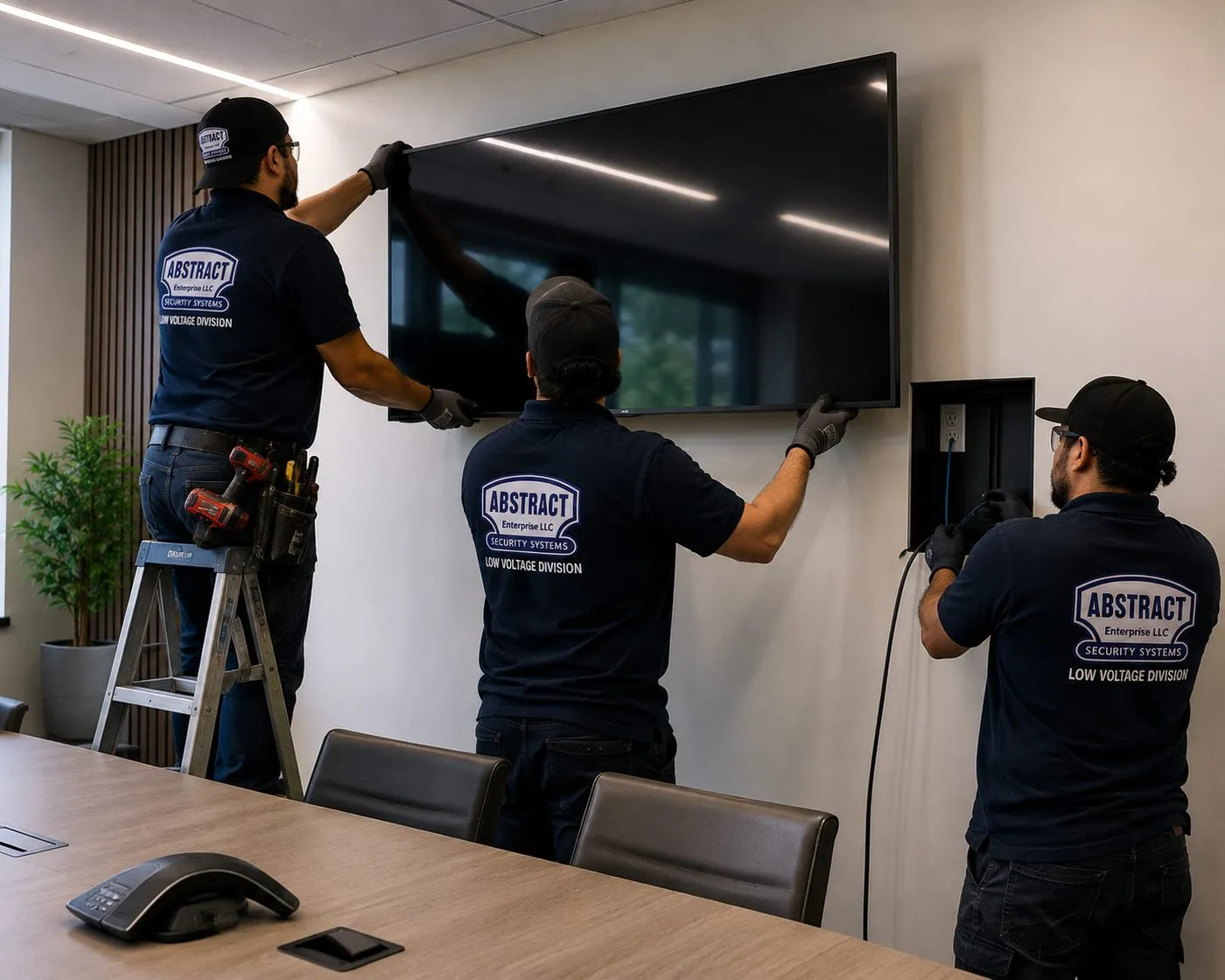
Two technicians lift a flat panel onto its wall bracket while a third dresses cable into a recessed power-and-data box beside it — the same mount-and-conceal work that sits under every soundbar we hang.
Get a Free Soundbar Quote
Tell us the town, the wall and the soundbar — we call back the same business day
✅
Request Sent!
We'll call you back the same business day.
25+
Years Experience
✓
Same-Day Estimates
100%
Licensed & Insured
4.7★
201 Google Reviews
Want a price for your wall before anyone drives out? Call (800) 486-0943 or send a photo through the 60-second quote form. A licensed technician reads it and tells you what the wall, the outlet and the bar will need.
Published line-item prices — the same in every town in a county
Booked in two-hour slots, any day from 8 in the morning to 8 at night
NYS licence #12000287431 · insured, certificate of insurance free on request
Why Hudson Valley Homes Need Professional Soundbar Installation
A soundbar is the simplest piece of home audio there is, right up until it has to hang on a Hudson Valley wall. The box says "easy setup", and on a flat sheet of drywall over pine studs sixteen inches apart it often is. The valley has plenty of that kind of wall in its post-war subdivisions. It also has a great deal of the other kind: two-coat horsehair plaster on hand-split lath in a Dutchess farmhouse, a fieldstone chimney breast that runs floor to ceiling in an Ulster great room, the round logs of a Putnam lake cabin, the brick and concrete of a converted factory in Beacon or Peekskill, a Victorian parlour in Nyack whose framing was laid out by eye in the 1880s. None of those walls takes a plastic anchor, and every one of them is a wall where somebody has tried.
The age of the housing is not a guess. U.S. Census Bureau figures compiled by Stacker in 2025 put the share of homes built in 1939 or earlier at 28 percent in Westchester — more than 109,000 houses — and at roughly 18 percent in both Dutchess and Putnam. Those are the houses where the TV went up first and the soundbar arrived years later, often hanging off a second set of holes below a mount nobody can remember installing. When we are called to a home like that, the job is rarely "attach bracket, plug in HDMI". It is finding what is actually behind the wall, deciding whether the soundbar should hang from the wall, from the TV mount or sit on furniture, and getting the cables to it without opening up plaster that would cost far more to repair than the soundbar cost to buy.
The rooms are different too. A city apartment living room is small and boxy; a Hudson Valley family room is just as likely to be a converted barn with a timber-framed cathedral ceiling, an open kitchen-and-great-room addition or a lakeside room with a wall of glass on one side. Sound behaves badly in rooms like that. Dialogue gets lost in the height, bass vanishes into the volume of air, and the clever up-firing speakers that make Dolby Atmos work in a showroom bounce off a sloped ceiling and go nowhere useful — Dolby's own setup guidance calls for a flat ceiling between 7.5 and 14 feet. People ask us for a soundbar because they cannot hear what the actors are saying. In a big valley room, solving that is as much about placement, settings and sometimes a subwoofer as it is about the bar on the wall.
Then there are the things that are simply true of living up here. Many homes sit at the end of a long driveway on a rural road, a good drive from the nearest installer. Many are second homes and weekend places that sit empty for weeks, so a system has to come back to life on a Friday night without a phone call. Some still sit on slow or unreliable internet, which makes a "smart" soundbar's setup, updates and streaming more fragile than the manufacturer's quick-start guide assumes. And the region's power is at the mercy of its weather: in July 2026 the Daily Freeman reported nearly 50,000 Central Hudson customers without power after storms crossed the region. Electronics plugged into the same circuit as a TV in a rural house see more surges and more hard power cuts than they would in a city tower.
That is the work this page is about. We are a licensed low-voltage contractor, and soundbar installation in the Hudson Valley is part of the same trade as the TV mounting, audio and cabling we already do across the six counties. We bring the right fixings for the wall you actually have, the parts to conceal the wiring in a code-compliant way, and the patience to set the audio up properly once it is on the wall. We do not do electrical work — a new or moved outlet is an electrician's job — and we will tell you on the phone if your wall or your plan needs one.
Hudson Valley facts that shape a soundbar install
28 percent: share of Westchester homes built in 1939 or earlier — 109,608 houses — with a median year built of 1958 (U.S. Census Bureau data via Stacker, September 2025). Dutchess is 18.0 percent, Putnam 17.9 percent and Rockland 11.5 percent.
7.5 to 14 feet: the flat-ceiling height range Dolby gives for Atmos setups, with the ceiling "not angled or vaulted" — the reason up-firing soundbars disappoint in so many valley great rooms.
15 Mbps: the connection Netflix recommends for a single 4K stream (5 Mbps for 1080p). A soundbar's own audio needs very little bandwidth; it is the picture, updates and voice assistants that suffer on a slow line.
Nearly 1,300: unserved homes, businesses and community facilities in remote parts of Ulster County covered by a $20.8 million ConnectALL broadband award announced in September 2025.
Nearly 50,000: Central Hudson customers without power after the storms reported by the Daily Freeman on July 5, 2026 — a reminder to put every soundbar and TV behind proper surge protection.
More than 100: wineries, breweries and distilleries across the region according to Hudson Valley Tourism — and a growing number of tasting rooms that want clear audio for a TV without turning the room into a bar.
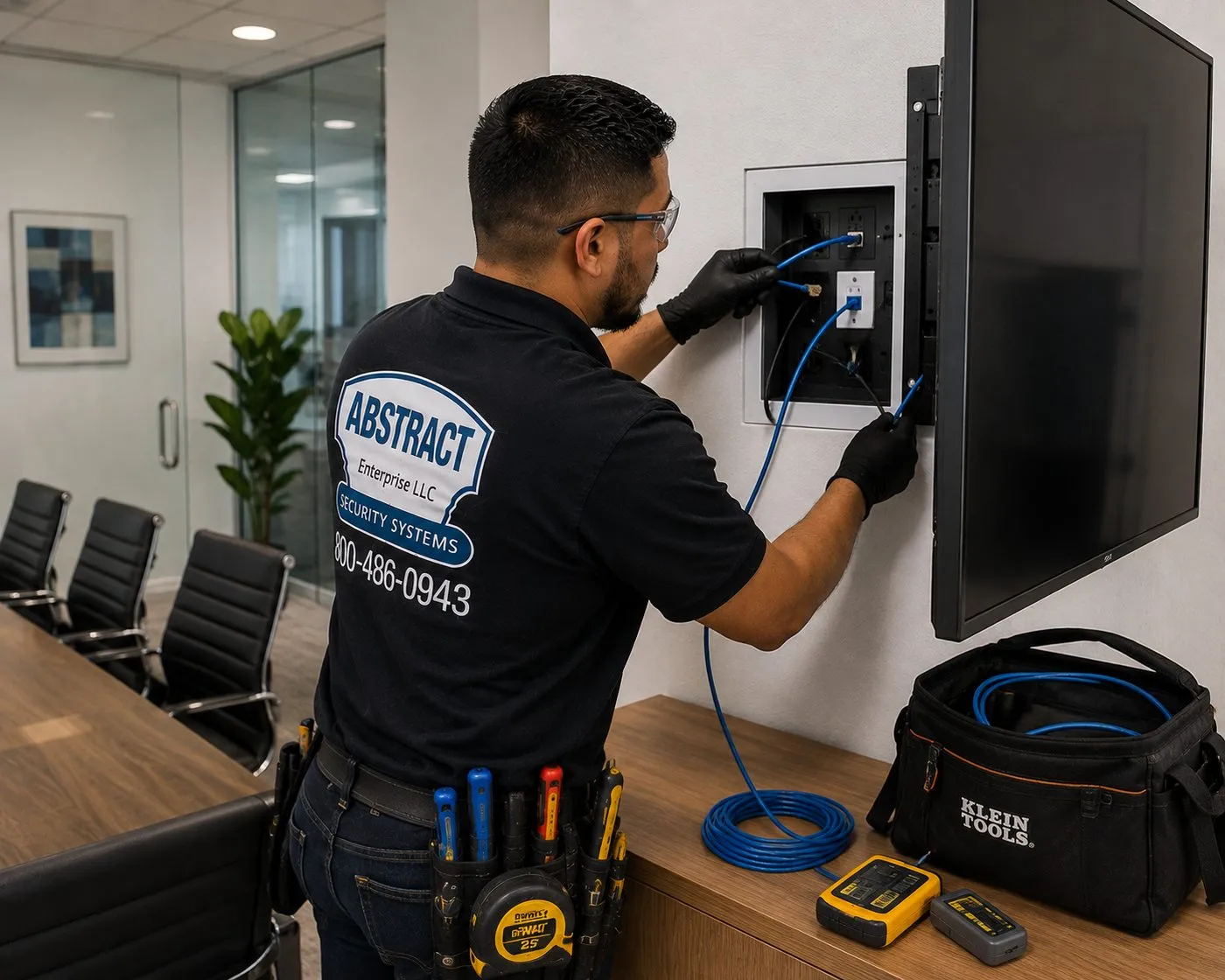
A technician patches cable inside a recessed box set into the wall behind a mounted screen, with a cable tester and tool bag on the credenza — the kind of hidden connection point that keeps soundbar wiring off the wall face.
Repair Capture
Soundbar Stopped Working in the Hudson Valley?
A soundbar that suddenly has no sound, a remote that no longer controls the volume, a subwoofer that has stopped pairing or a bar that cuts out after every power flicker is usually a setup or connection fault rather than a dead speaker. We can often sort it on a setup-only visit, billed at the published county hourly rate, and most of these faults are found and fixed within one to two hours once a technician is in the room. Call (800) 486-0943 and say it is a soundbar that has stopped working, and send the model number if you have it.
What We Install
Soundbar Installation Services in the Hudson Valley
Every service below is priced from the same published line items, and every one ends the same way: the bar level, the cables tidy, the TV sending audio to it, and your own remote turning it up and down.
Soundbar Wall-Mounted Under the TV
The standard job: a bracket fixed to the wall a few inches below the screen, the bar centred under the picture, levelled and connected. On plaster, stone and timber we choose the fixing for the wall rather than using whatever came in the box.
Soundbar Placed on a Console
For renters, for TVs on stands and for anyone who would rather not drill: the bar positioned on the media console clear of the screen's edge and IR sensor, connected, set up and tidied, with cables routed out of sight behind the furniture.
Soundbar Hung From the TV Mount
Where the wall below the TV is stone, a fireplace mantel or a window, a TV-attached bracket can carry the bar with the screen instead. It moves with a tilting or pull-down mount, which matters over many valley fireplaces.
Wires Hidden in the Wall
A code-compliant in-wall power and cable kit that carries power and HDMI from behind the TV to an outlet low on the wall, in hollow walls where we can fish it. We tell you plainly when a solid wall makes this the wrong choice.
Paintable Cord Covers
On stone, brick, log and plaster we would rather not open, a slim cover that runs from the bar to the nearest outlet, painted to match. It is the honest answer on a lot of older walls.
Cable Runs to a Cabinet or Closet
Cable boxes, game consoles and streaming devices kept in a cabinet across the room, with the HDMI and power run up to 25 feet so the only thing on the wall is the TV and the bar.
Subwoofers and Rear Speakers
Pairing and placing the wireless sub and surrounds that many bars support, in rooms big enough that a bar alone never fills them. Placement is half the result, and we try more than one spot.
Receivers, Sonos and Universal Remotes
A/V receiver connection, Sonos soundbar and system setup on your Wi-Fi, and a universal remote programmed so the household uses one control instead of three.
Fixing a Soundbar Someone Else Installed
Bars that lose sound, drift out of sync, ignore the TV remote or hang crooked off one bad anchor. We find the cause, re-fix or re-connect it, and explain what was wrong.
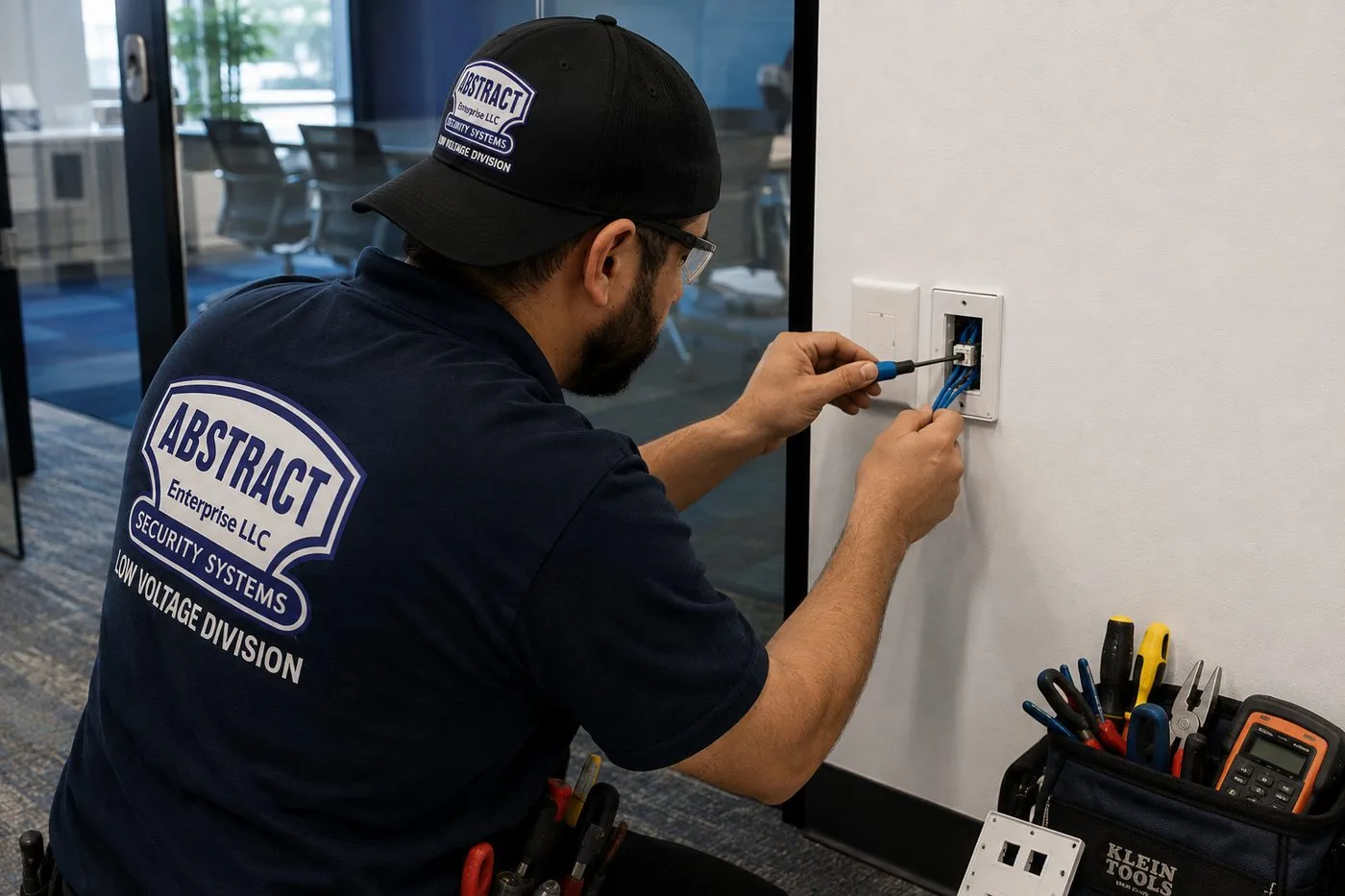
A technician kneels to terminate cable into a wall plate next to a light switch, with a tester and hand tools in a bag at his feet — the finishing step on any concealed audio or data run.
Building Specialists
Soundbar Installation for Hudson Valley Architecture
The same 46-inch soundbar goes up very differently in a 1790 stone house, a 1960s raised ranch and a 2020 timber-frame build. These are the house types we see most between the Westchester line and the Catskill foothills, and what each asks of the installation.
Farmhouses and Victorians
Horsehair or lime plaster on wood lath, framing that may be rough-sawn and irregularly spaced, and walls that are rarely plumb. The plaster carries almost no load on its own, so the bracket either reaches real framing or spreads its load across a backer fixed to that framing.
Colonial and Dutch Stone Houses
Thick fieldstone or rubble walls, sometimes plastered directly over the stone, especially in the old Ulster and Dutchess settlements. Masonry fixings hold superbly once you hit sound stone; mortar joints that crumble are the risk, and concealing cable inside the wall is usually off the table.
Fieldstone Fireplace Great Rooms
The TV goes over the hearth because it is the only wall without windows. The soundbar then has to share the stone with the mantel, the heat and the chimney, and the cables have no hollow cavity to disappear into.
Log and Timber-Frame Homes
Solid wood that will hold a lag screw all day, but walls that shrink and settle as the logs season and the humidity swings. Fixings, cord covers and cable paths need to allow for that movement rather than fight it.
Lake Houses and Weekend Places
Putnam and Ulster lake cabins, mountain houses and second homes that sit empty for weeks, often with humid air, seasonal heat and owners who are not there to reset anything. Setup has to be simple and has to survive a power cut.
Post-War Ranches, Splits and New Builds
Drywall on wood studs, hollow walls and accessible basements or attics — the easiest walls in the valley, and the best candidates for fully concealed in-wall wiring. Newer homes may have conduit or a media box already roughed in.
Methods and materials by wall type
Horsehair plaster on lath. We locate framing by measuring from corners and openings, by the lath nails a magnet finds, and by small test holes behind where the bracket will cover them. Where the studs fall in the right place, the bracket goes into them with structural screws long enough to pass through plaster and lath. Where they don't — and in an old house they often don't — a painted plywood backer board is fixed across two studs and the bracket goes onto the backer. We drill plaster slowly with sharp bits and without hammer action, because vibration is what breaks the plaster's grip on the lath and starts cracks running.
Fieldstone and brick. We pick a sound stone face rather than a joint, drill with a masonry bit sized to the anchor, and use sleeve or wedge anchors rated for the load rather than plastic plugs. Fieldstone is irregular, so a bracket may need shimming to sit level against an uneven face. Cables either run down the surface in a cover painted or stained to blend in, run down the side of the chimney breast where it meets a plaster or drywall wall, or go up into the TV mount and down behind a mantel. We do not chase channels into a historic stone wall.
Log, timber and plank walls. Lag screws into solid wood, with the bracket's slots allowing a little seasonal movement. Cable covers are fixed so they can ride with the wall, and cables are left with slack at both ends so a settling log doesn't pull on a connector. Where there is a stud-framed partition nearby, we route cables there instead.
Concrete, block and brick in converted industrial buildings. Hammer-drill work, dust extraction, and concrete-rated anchors. These walls can't be fished, so the plan is surface cover, a run up into a ceiling or a dropped soffit, or simply placing the bar on furniture.
Drywall on wood studs. Bracket into studs; if the bar has to sit between them, rated hollow-wall toggles sized for the bar's weight. This is where a code-compliant in-wall power and cable kit makes most sense, because the cavity is hollow and usually clear between the TV and the outlet location.
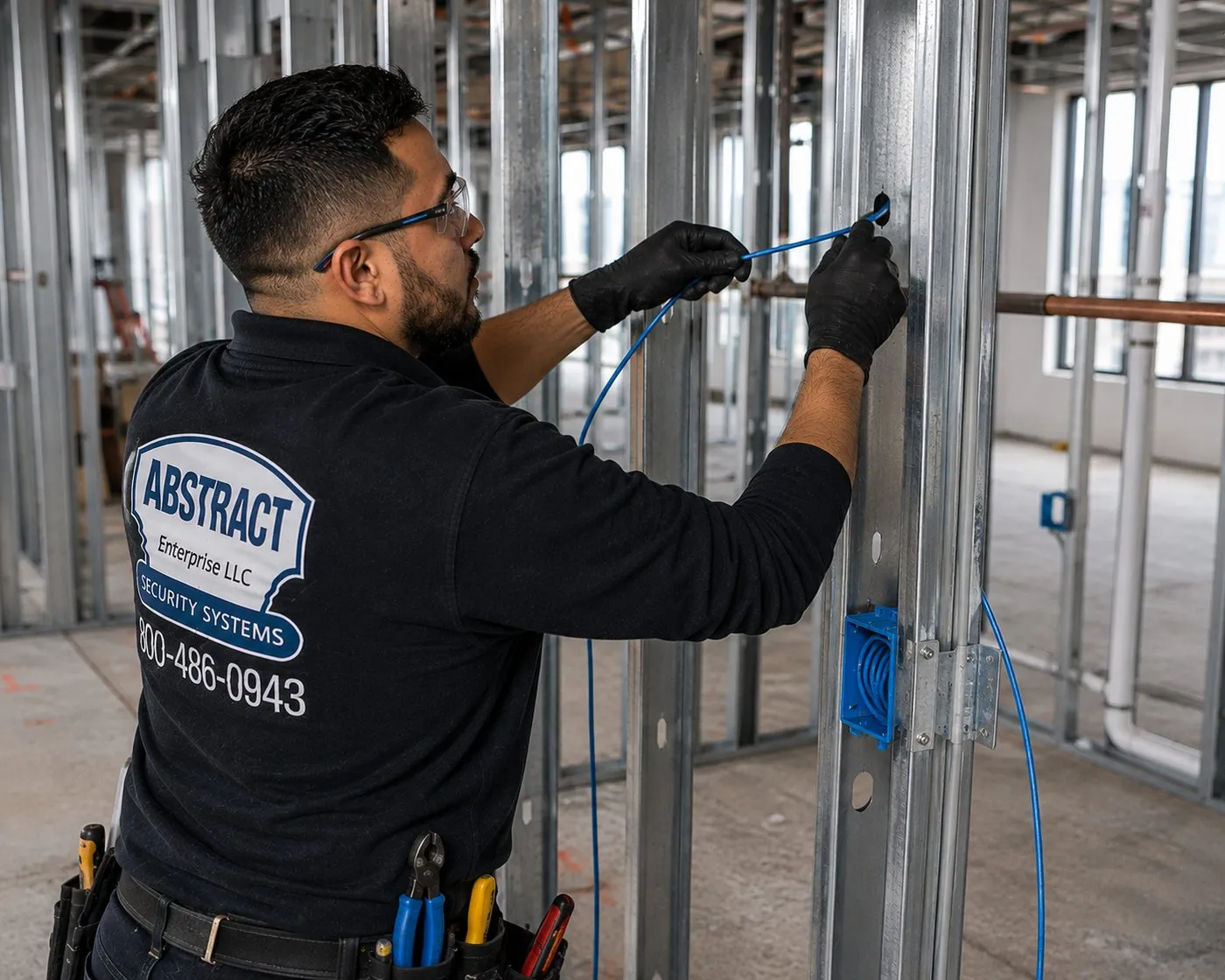
Cable is threaded through a punched hole in a metal stud toward a blue low-voltage box in an open wall — the routing we can only do where the wall is hollow or open.
Owners who add a soundbar in an older house often go on to put ceiling or in-wall speakers in another room once they see how the wiring can be hidden. Our AV and sound installation in the Hudson Valley covers whole-house and multi-room audio on the same walkthrough.
Commercial Soundbar Installation
Business Soundbar Installation in the Hudson Valley
A soundbar is a sensible commercial choice wherever one screen needs clear speech without a full sound system — a tasting room TV, a waiting area, a small conference room. These are the corridors where we see that work most, and what the businesses there usually ask for.
Beacon's Main Street
A historic Main Street close to a mile long, lined with restaurants, bars, galleries and shops, with brewery tasting rooms close by — Hudson Valley Brewery's Beacon room, for one, opens Thursday to Monday. Older brick buildings mean masonry fixings and surface-run cabling.
Kingston: Uptown and the Rondout
Restaurants and bars in buildings that range from colonial stone to nineteenth-century commercial brick. Screens tend to go where the wall is solid, and audio has to carry over a busy room without drowning the conversation at the bar.
Peekskill and the River Towns
Converted industrial and mixed-use buildings in Peekskill, Ossining and Haverstraw, with exposed brick, high ceilings and hard floors — rooms where a soundbar's dialogue enhancement and careful volume limits matter more than raw power.
Nyack and Piermont
Small restaurants, cafés and shops in older two- and three-storey buildings along the river, often with a single screen behind a counter and a tight space for anything else.
White Plains, Tarrytown and the Route 9 Offices
Professional offices, medical suites and small conference rooms where a display, a soundbar and a video-conferencing camera share one wall and one table connection.
Farm Breweries, Wineries and Cideries
Tasting rooms in barns and agricultural buildings across Orange, Dutchess and Ulster, with timber framing, high open roofs and screens that show a game on weekends and a slideshow the rest of the time.
Compliance callouts for commercial soundbar work
No electrical work. We connect to existing outlets and use listed in-wall power kits; any new circuit, receptacle or relocation in a restaurant or office is for a licensed electrician, and we coordinate with yours.
Egress and accessible routes. Screens and bars are mounted so they don't project into a corridor, exit route or accessible path, and cord covers are kept off the floor where people walk.
Cable listing. Any cable that goes inside a wall is rated for in-wall use; any cable in a commercial air-handling ceiling must carry the listing that space requires.
Volume and neighbours. In mixed-use buildings with apartments above, we set volume limits and turn off "night" bass boosts so that a Saturday game doesn't become a complaint upstairs.
Certificates of insurance. Landlords and management companies routinely ask for a COI before work starts; we provide one free and can name the landlord as additional insured.
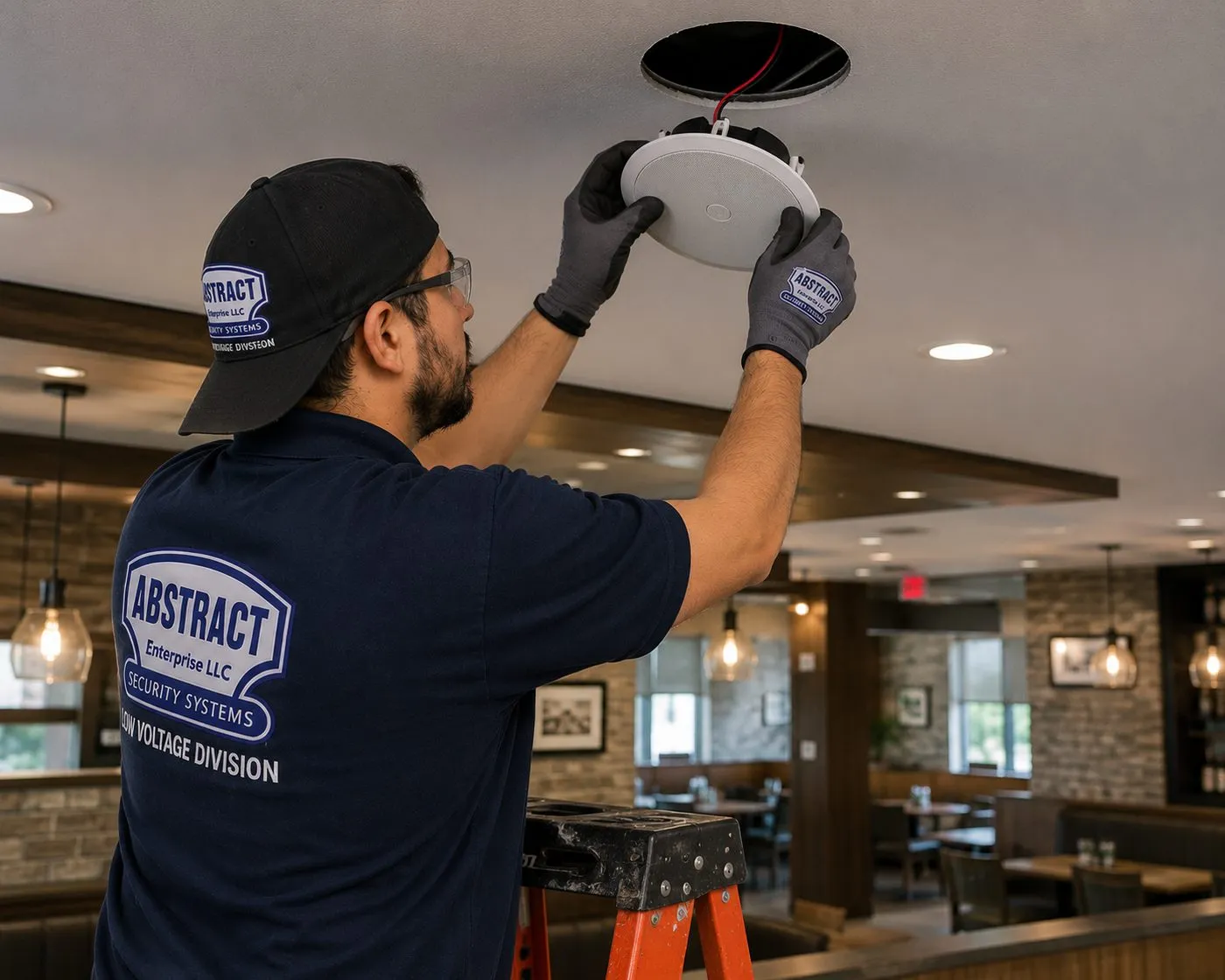
A technician on a stepladder seats a round ceiling speaker in a restaurant dining room with stone-faced walls, booths and pendant lights behind him — the step up from a soundbar when a whole room needs even sound.
County by County
Six Counties, Six Different Soundbar Jobs
The Hudson Valley is not one housing market, and soundbar work changes noticeably as you move north from the city line. This is what we tend to find in each county we serve.
Westchester. By Census measure more than a quarter of Westchester's homes predate 1940, and the county also sees a steady stream of high-end renovation. In Bronxville, Scarsdale, Larchmont and the river villages from Hastings to Croton we meet Tudor and colonial revival houses with thick plaster, plus finished basements and newer additions with drywall that can take in-wall wiring. Many families have a TV in the main room and another in a converted den or basement, and a soundbar is the usual answer for both. Westchester setup-only visits are billed at $235 for the first hour.
Rockland. Raised ranches, split-levels and colonials from the 1950s to the 1970s across Clarkstown, Orangetown and Ramapo, alongside older river-front homes in Nyack, Piermont and Grand View. The common Rockland job is a TV and bar in a lower-level family room where the outlet sits at baseboard height and the cable needs to climb a short drywall wall to the screen. Rockland shares Westchester's $235 first-hour rate.
Orange. A county that mixes historic Newburgh and Goshen stock with large newer subdivisions around Monroe, Chester and Middletown. Newer two-storey family rooms with tall ceilings are the typical setting, and they are exactly the rooms where up-firing Atmos channels and a lone soundbar disappoint. Orange setup-only visits are $250 for the first hour.
Putnam. Lake houses around Mahopac, Lake Carmel and the Putnam Valley lakes, plus older homes in Cold Spring and Garrison along the river. Humidity, weekend occupancy and long driveways shape the work; so does the fact that nearly 18 percent of Putnam's homes predate 1940. Putnam setup-only visits are $250 for the first hour.
Dutchess. Farmhouses, Victorians and stone houses from Rhinebeck and Red Hook to Millbrook and Pawling, Beacon's converted industrial buildings, and Poughkeepsie's mix of older city housing and suburban development. Nearly one in five Dutchess homes was built before 1940. Plaster and stone are the norm rather than the exception, and so is the question of whether wires can be hidden at all. Dutchess setup-only visits are $275 for the first hour.
Ulster. Kingston's stone houses and Victorian streets, New Paltz and Woodstock, Saugerties and the mountain towns toward the Catskills, with a good number of second homes, log and timber builds and houses on rural roads where internet service is still being extended. That last point matters more than people expect, and it is covered in the questions below. Ulster setup-only visits are $275 for the first hour.
Your Questions Answered
Soundbar Installation in the Hudson Valley: Questions Answered
Old plaster, stone, timber, big rooms, weak rural broadband, weekend houses and tasting rooms: each cluster below takes one Hudson Valley problem and answers it in the first lines. Short price-and-booking items sit in the FAQ near the bottom.
Old walls, stone and timber
Will my 1890s horsehair plaster hold a soundbar bracket, or does it need something behind it?
The plaster itself should never be what holds the bar. Horsehair plaster is hard on the surface but it is only as strong as its grip on the wooden lath behind it, and that grip weakens with age, past water leaks and every picture hook that has been hammered in over a century. A soundbar is not heavy — a Sonos Beam (Gen 2) weighs 6.35 pounds and an Arc Ultra a little over 13 — but it is long, it sits where people brush past it and it carries a cable that gets tugged. Hollow-wall anchors that work in drywall tend to crush the plaster around them and loosen over months.
So the bracket goes into the framing behind the plaster. If the studs are where the bracket needs to be, structural screws pass through plaster and lath into them. If they aren't — the bar has to be centred under the TV, and old framing is rarely laid out on modern spacing — we fix a plywood backer board across two studs, paint it to suit the room if you want, and mount the bracket to that. The backer is a published $85 line item, so you know before we start what it adds.
One more point that matters in older valley houses: plaster that has already let go of its lath — it bulges, sounds hollow when tapped or moves under a pressed hand — is not a mounting surface at all. If the plaster around the TV wall is like that, we will show you before anything is fixed, and the choices become a backer board that spans sound framing, a different position on the wall, or a repair by a plasterer first.
How do you find the framing behind old plaster when a stud finder reads nothing?
Electronic stud finders are built for half-inch drywall. Through an inch or more of dense plaster, over lath that is itself solid wood every few inches, most of them either read nothing or read everything. We use other methods. A strong magnet dragged slowly across the wall finds the nails that fix the lath to each stud, and a line of nails is a line of framing — it is the same trick old-house owners share on home-improvement forums. We also measure from corners, door and window openings, where framing has to exist, and look for the electrical boxes and baseboard nails that are almost always fixed to a stud.
When the evidence still isn't certain, we drill a small test hole in a spot the bracket will cover, and feel for wood or air behind the lath. It costs nothing in appearance, because the bracket hides it, and it removes the guessing. In balloon-framed Victorians and farmhouses the studs often run from sill to roof, and once we have found one we can usually predict the next.
What we do not do is open a hole the size of a hand to "have a look". If a wall can't be read with care and small holes, the answer is a backer board or a different mounting method, not a patching job left behind for you.
Will masonry anchors hold in a two-hundred-year-old stone wall with soft mortar?
In the stone itself, yes — very well. The colonial and Dutch stone houses of Ulster and Dutchess, the Kingston Stockade among them, were built of fieldstone and rubble laid in lime mortar, and a sound piece of that stone holds a masonry sleeve or wedge anchor far more securely than drywall ever could. The weak point is the mortar. Old lime mortar is soft by design, and two centuries of freeze, thaw and damp can leave joints that crumble under a fingernail. An anchor set in a joint like that will hold for a while and then work loose.
So the first job on an old stone wall is choosing where the holes go. We look for faces of solid stone large enough to take the anchor with margin around it, and plan the bracket's position around them rather than the other way round; a slightly wider bracket or a TV-attached bar gives more freedom to land on good stone. Where the stone is plastered over, as it often is inside these houses, we find the stone behind the plaster first and anchor into that, not into the plaster skin. Stone faces are uneven, so the bracket is shimmed to sit level. The published surcharge for brick or stone is $65.
What we won't do is cut channels into historic stone to bury a cable, or drill into a joint we can see is failing. If the wall needs repointing before it can carry anything, we will show you the joints and suggest a mason, and in the meantime the bar can sit on furniture or hang from the TV mount.
Is it safe to mount on log or timber walls that move with the seasons?
The fixing itself is about as safe as it gets — a lag screw into a solid log or a heavy timber holds a soundbar effortlessly. What needs thought is movement. Logs shrink as they dry out, especially in the first years of a new build, and the whole wall can settle by measurable amounts. Timber also swells and shrinks with the seasons as the humidity in a lake house or a heated cabin swings between summer and winter.
So we fix into one log rather than bridging two, so that the bracket moves with the wood it is in. We leave slack in every cable at both ends, and we fix cord covers in a way that lets them slide slightly rather than pulling on the screws. If there is a stud-framed partition or a chase in the room, we route cable there instead of across the logs. And because a level bar on day one can drift after a winter, we tell you how to re-level it — most brackets have a small adjustment.
What we avoid is cutting into a log wall to bury a cable. It weakens nothing structurally at that scale, but it is permanent, it is visible if the cable is ever removed, and it is never as tidy as a well-placed cover.
Big rooms, high ceilings and getting dialogue right
Why does my soundbar sound thin in a big room with a high ceiling?
Because a soundbar is designed for an average living room, and a converted-barn or open-plan great room is not one. The bar's small drivers can only move so much air. In a room twice the volume, with a ceiling that rises to the ridge and hard surfaces like stone, wood floors and glass, the same bar plays quieter, its bass disappears into the space and its sound reflects around the room so that speech blurs. People on home-theatre forums describe exactly this — "huge vaulted ceiling, can't hear dialogue at all".
Some of it is fixable with placement and settings alone. A bar mounted directly under the TV and aimed at the seating, not tucked into a deep shelf or set back behind the screen's stand, makes a large difference. Turning on the bar's speech or dialogue mode, turning off the TV's own speakers, and running the bar's room-calibration routine if it has one all help. We do all of that as part of the install.
Beyond that, a big room usually needs a dedicated subwoofer, so that the bar's own drivers are freed from trying to make bass and can concentrate on the voices. In the largest rooms, rear surrounds help too. If the room is very large or very reflective, we will also tell you honestly that a soundbar is not the right product, and that a receiver with proper speakers — or ceiling speakers — will do what you want where a bar cannot.
Where should a wireless subwoofer go in an open great room?
Not automatically in the corner next to the TV, which is where it ends up in most homes because that is where the box was opened. Bass in a room is shaped by the room itself: some spots reinforce particular notes into a boom, others cancel them almost completely. In a long open room with a kitchen at one end, a stone fireplace at the other and a staircase rising through the middle, those effects are strong and hard to predict.
The practical method is to put the sub where you sit, play something with steady bass, and walk the room's edges listening for where it sounds even and full — then put the sub there. We do that, within the limits of where you are willing to have a box and where there is an outlet, and then run the bar's calibration and set the sub level so it supports the bar rather than drowning it. A wireless sub still needs power, so the nearest outlet is part of the decision.
Two Hudson Valley specifics. In houses with old wood floors over a crawlspace or an open basement, a sub sitting directly on the boards can make the floor itself resonate; an isolation pad helps. And in homes with neighbours close by — a river-town row house or a semi-detached Victorian — placing the sub away from the shared wall makes a real difference to how much of your movie they hear.
Connections, internet and power
My TV is on HDMI ARC but the soundbar drops sound or lags — what is actually wrong?
Usually one of four things, and they are worth separating because the fixes are different. The first is the cable or the port: the soundbar has to be plugged into the one HDMI input on the TV that is marked ARC or eARC, and an old or poor-quality cable can cause dropouts. The second is HDMI-CEC, the control signal that lets the TV and bar talk to each other, which different makers call by different names; if it is switched off on either end, or confused by a satellite or cable box on another input, the bar may fall silent or stop responding to the TV remote.
The third is the audio format. Plain ARC carries compressed audio; eARC carries far more, including lossless formats. If the TV is set to pass through a format the connection can't handle, the result is silence or crackle. Setting the TV's digital audio output correctly — often "auto" or "bitstream" on the right input, with eARC turned on where both devices support it — fixes more soundbars than anything else. The fourth is lip-sync delay, which most TVs and bars let you adjust once the connection itself is stable.
In rural valley homes there is often a fifth cause on top: a satellite receiver or older cable box that resets overnight or after a power blip and re-negotiates its connection, taking the soundbar with it. We test every input you actually use, not just the TV's built-in apps, so that the setup works on the boxes you watch through.
Will a slow rural internet connection affect my soundbar or only the picture?
Mostly the picture. A soundbar connected to the TV by HDMI plays whatever audio the TV sends it, and that takes no internet at all. What a slow line affects is the stream itself — Netflix recommends 15 Mbps for 4K and 5 Mbps for 1080p, and when a connection can't sustain that the service drops quality, which can also mean a simpler audio track — plus anything the soundbar does over Wi-Fi: firmware updates, voice assistants, music streaming and app control.
That matters during installation more than people expect. Many smart soundbars, Sonos among them, want to download an update during setup, and on a weak or intermittent connection that step can take a very long time or fail. In parts of Ulster, Dutchess and Putnam where service is still being extended — Ulster County's 2025 ConnectALL award alone targets nearly 1,300 unserved locations — we plan for that: we check the signal where the bar will sit, and if the house has a weak Wi-Fi spot at the TV, we use a wired network connection where the bar has a port.
If you are on satellite or fixed-wireless internet and stream in 4K, set the streaming app's quality to match what the connection can really sustain. A steady 1080p picture with the full soundtrack is a better evening than a 4K picture that keeps stopping to buffer.
Our TV and power keep getting hit by storms and outages — how do we protect a new soundbar?
With a proper surge protector and a little planning, because valley power is genuinely rougher than city power. Summer storms knock out lines across the region every year; in July 2026 the Daily Freeman reported nearly 50,000 Central Hudson customers without power at once. Every outage ends with a restoration, and the moment power returns is when sensitive electronics take their hits.
We plug the TV, soundbar and subwoofer into a quality surge protector, not a basic power strip, and keep the HDMI connection between TV and bar short and direct. If the house has a coaxial cable or satellite line coming into the TV, that is also a path for surges; it should be grounded at the entry as the provider installed it, and if it isn't, that is worth raising with them. A small battery backup for the internet router helps the smart features recover more gracefully after a blip.
One more storm-related point: many soundbars and subwoofers lose their pairing or settings after a hard power cut. We show you the one or two button presses that restore them, and for second homes we can write them on a card that lives in the TV cabinet.
Second homes, distance and scheduling
We only use the lake house on weekends — how do you set it up so it works when we arrive?
By keeping it simple and making it survive an empty week. Weekend places have predictable failure points: the power goes off while nobody is there, the internet router restarts, a remote's batteries die, or a guest presses the wrong button and the soundbar is left on an input nobody remembers. The goal of a second-home setup is a system that comes back on correctly when you press one button on Friday night.
In practice that means using the TV's HDMI-CEC control so that turning on the TV turns on the bar and sets the volume control, wiring the bar to the TV by HDMI rather than relying on a Bluetooth pairing that may drop, setting the TV's audio output so it stays pointed at the bar after a power cut, and disabling auto-update behaviours that could leave the system half-updated when you arrive. If you want one remote for everything, a universal remote programmed at the install takes out the remaining confusion.
Humidity is the other weekend-house issue. A lake cabin closed up in August can get damp; electronics last longer in a room that is ventilated or kept at a steady temperature. We mount the bar and sub out of direct sun from lake-facing windows and away from anything that drips, and we tell you if the spot you have picked looks risky.
How far do you travel up the valley, and how does scheduling work for a long drive?
We cover all six counties — Westchester, Rockland, Orange, Putnam, Dutchess and Ulster — from the southern line up to Kingston, Saugerties and the towns west toward the Catskills. The prices for each county are published, and they already account for the drive, so a soundbar mount in Woodstock costs the same line-item price as one in Yonkers; only setup-only hourly visits and TV mounting base prices vary by county, and those are listed on this page.
Appointments run in two-hour arrival windows between 8 AM and 8 PM, seven days a week. For the far end of the valley we often group visits by area on a given day, which is why we ask for your town when you book. Same-day appointments are possible only when a two-hour window is open in your area that day; we will tell you honestly when the next one is.
Because the drive is long, the most useful thing you can do is send a photo of the wall, the TV and the outlet before we come. It lets us bring the right anchors and the right length of cable the first time, and it avoids the one thing that wastes everyone's day: a technician arriving for a drywall job and finding a stone chimney.
Lofts, alcoves and commercial rooms
Can a soundbar sit in a built-in niche or bookcase alcove in an older house?
It can, but it often sounds worse there, and it is one of the most common mistakes we are asked to undo. Old houses are full of tempting recesses — a niche beside a chimney, a shelf in a built-in bookcase, an old cabinet with the doors removed. A soundbar pushed back into one loses much of what makes it work: side-firing and up-firing drivers fire into wood, the bass builds up into a boom inside the box, and dialogue sounds muffled.
Manufacturers say so in their own guides. Sonos, for example, asks for at least four inches between an Arc Ultra and the TV above it and at least a foot of clearance from walls or obstructions at each end of the bar. If the bar has to live in a recess, it should sit at the very front edge of the shelf, with the opening as wide as possible, and with the bar's room-correction run in place.
Often the better answer is to mount the bar on the wall directly under the TV and keep the alcove for the cable box, the sub or the streaming device. We will show you both and let you choose.
What works in a converted factory loft with brick walls and very high ceilings?
River-town lofts in Beacon, Peekskill, Kingston and Newburgh combine the hardest conditions for a soundbar: hard brick and concrete walls, hard floors, tall ceilings and big windows. The sound bounces off everything. Mounting is straightforward — concrete-rated anchors into solid masonry hold superbly — but concealing the cable is not, because nothing in the wall is hollow.
The good loft installs we do usually have three things in common. The bar is mounted close under the screen at seated ear height, not high on a brick wall. The cable runs in a neat, painted surface cover or comes down from above through a soffit or a ceiling run if the building has one. And the room gets some help: a large rug, curtains or upholstered furniture reduce echo far more than any soundbar setting. A subwoofer is almost always worth it in a loft, placed away from shared walls and floors if there are neighbours.
What does a tasting room or brewery need that a living room doesn't?
Clear speech at moderate volume over the noise of a busy room, and a system the staff can't accidentally break. A tasting room TV is usually showing a game, a slideshow or a video about the farm; what customers need to hear is the commentary or the narration, not deep bass. A soundbar with a strong centre channel and a dialogue mode, mounted directly under the screen and aimed at the tables, does that well.
Barn and agricultural buildings bring the same issues as a big great room — tall open roofs, timber, hard concrete floors — plus a public setting. Mounting heights are set so the bar and screen are clear of heads, shoulders and anything carried through the room. Cables go into covers or up into the structure, never across the floor. We set maximum volume limits, label which remote does what, and if staff change shifts often, we program one universal remote and put the rest away.
Is a soundbar enough for a small conference room, or do we need ceiling speakers?
For a small room — a table for six to eight, one display, video calls — a soundbar under the screen is often all that is needed, and it is a fraction of the cost of a ceiling system. It puts the remote participants' voices where their faces are, which people find natural. Many video-conferencing bars combine a camera, microphones and speakers in one unit; others are a standard soundbar fed from the meeting-room PC or the display.
The limit is room size and shape. Once the table gets long, or the room is a training room with rows of seats, people at the far end hear the remote speaker poorly and their own voices are picked up badly by a microphone at the front. That is the point where ceiling speakers and distributed microphones earn their cost.
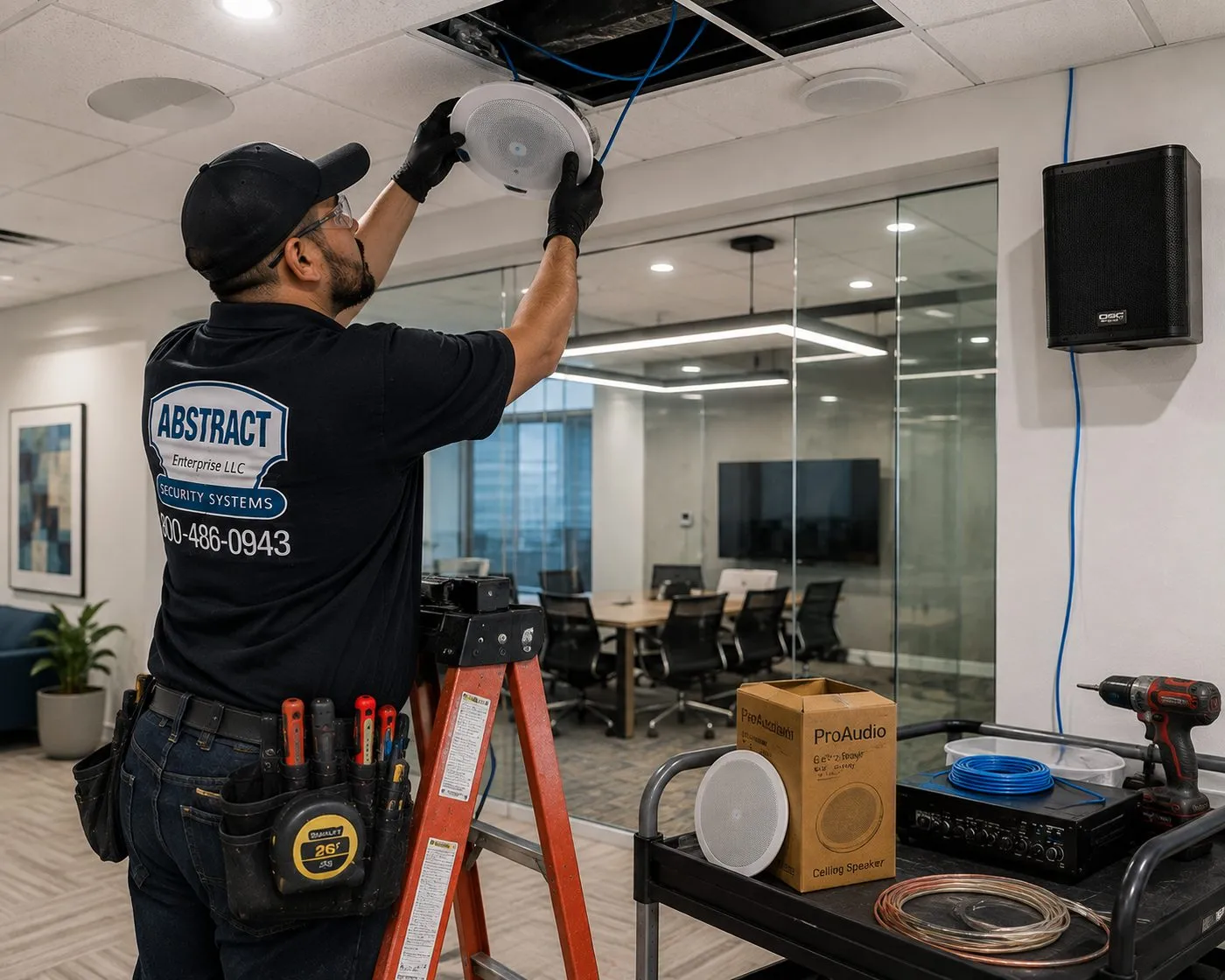
A technician fits a ceiling speaker into a drop ceiling outside a glass-walled conference room, with an amplifier, speaker wire and a boxed speaker on the cart beside him — what a larger meeting room needs once a soundbar is no longer enough.
Equipment
Types of Soundbar Systems We Install
We install the soundbar you have bought or the one you choose with us, from any of the major makers. These are the categories we fit most often in Hudson Valley homes and businesses, and where each one makes sense.
Compact 2.0 and 2.1 Bars
Short bars for bedrooms, dens and TVs under about 50 inches, sometimes with a small wireless sub. Fine in a modest room; the first to run out of breath in a great room. Many lack a dedicated centre channel, which is why dialogue can be hard to pick out.
3.0 to 5.1 Bars With a Centre Channel
A dedicated centre driver for voices is the single most useful feature for people who struggle with dialogue. These are our default recommendation for family rooms where speech clarity is the main complaint.
Dolby Atmos Bars
Flagship bars such as the Sonos Arc Ultra — 46.38 inches wide and 13.01 pounds — and the Atmos models from Samsung, Sony, LG, Bose and Vizio. Excellent bars in any room; the up-firing height effect needs a flat ceiling to work.
Compact Smart Bars
Bars like the Sonos Beam (Gen 2), 25.63 inches wide and 6.35 pounds, built for mid-size TVs with Wi-Fi, app control and voice assistants. Setup leans on a working internet connection, which we plan for in rural homes.
Wireless Subwoofers
The add-on that changes a big room most. Paired wirelessly to the bar, they still need an outlet and a sensible position, and they reward ten minutes of placement testing.
Rear Surrounds
Wireless rear speakers paired to the bar for a true surround effect. They need power near the back of the room, which in an open great room may mean a stand or a wall bracket near an existing outlet.
Soundbar Brackets
Wall brackets that come with the bar, model-specific wall mounts sold separately, universal TV-attached brackets that hang the bar from the TV mount, and the Sanus brackets we stock at $84.99.
In-Wall Power and Cable Kits
Code-compliant kits that carry power and HDMI inside a hollow wall from behind the TV to a low inlet, without running an extension cord through the wall — the only safe way to put the power cable in the wall.
Receivers, Sonos Systems and Remotes
A/V receivers for those who outgrow a bar, Sonos soundbars grouped with other Sonos speakers around the house, and universal remotes that bring the TV, bar and source boxes onto one control.
Choosing between a TV-attached and a wall bracket
There are two ways to hang a soundbar under a mounted TV. A wall bracket fixes the bar to the wall itself, independent of the screen. A TV-attached bracket clamps to the TV's mounting points and hangs the bar from the TV, so the two move together; some, like the Sanus mount designed for the Sonos Beam, offer around twelve inches of height adjustment and are designed only for mounting below the television. On a stone chimney or over a mantel with a pull-down mount, the TV-attached type is often the better choice. On a fixed mount over a drywall wall, a wall bracket is usually neater and puts no extra weight on the TV mount. We check the TV mount's rated capacity before adding a bar to it.
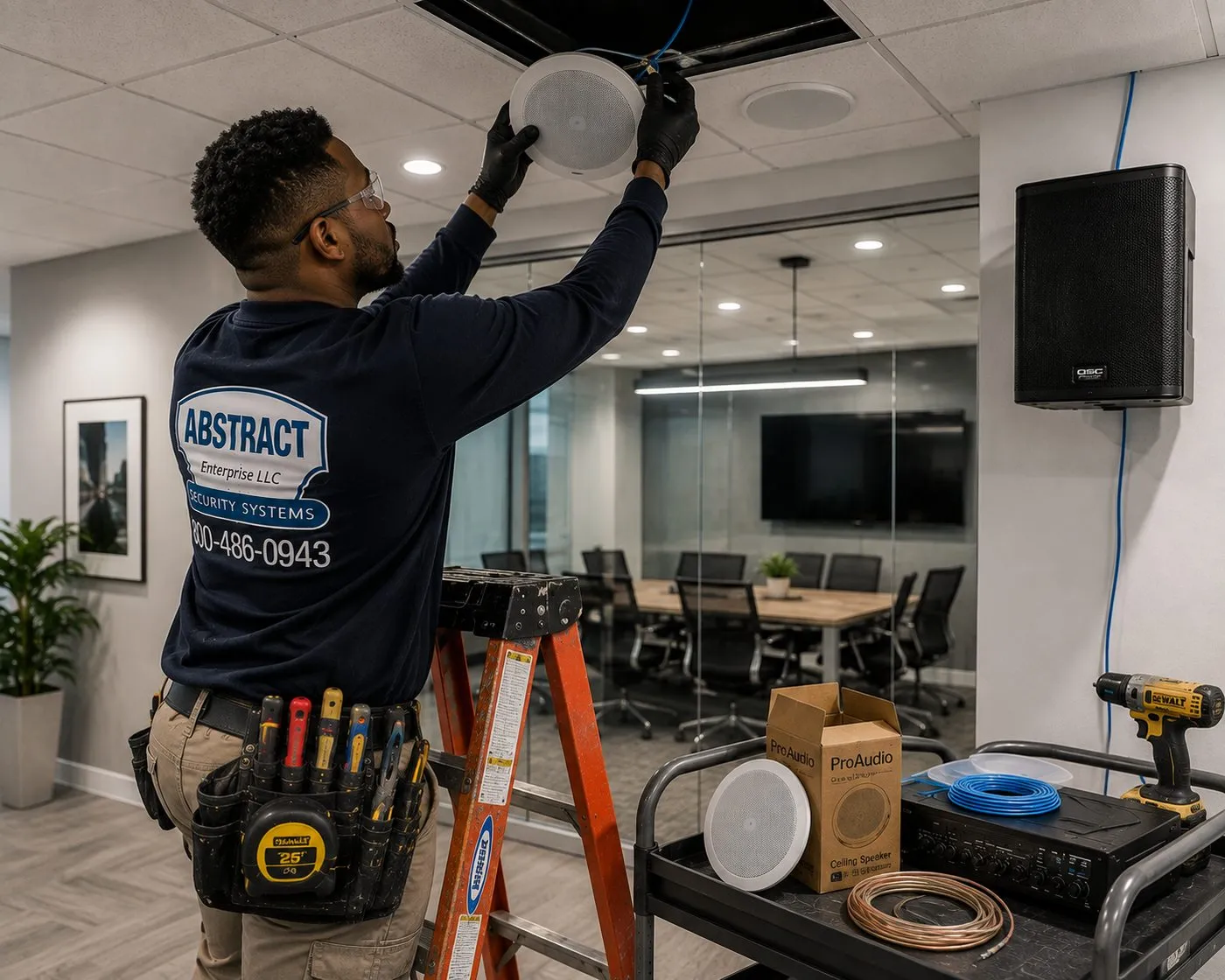
A technician on a ladder lifts a ceiling speaker into place while an amplifier, a spool of blue cable, copper speaker wire and a boxed speaker wait on the cart — the equipment that takes over when a room outgrows a soundbar.
AI Overview Reality Check
What AI Gets Wrong About Soundbar Installation in the Hudson Valley
Google's AI Overview text was not readable from the environment this page was researched in, and we will not make up what it says. Instead, the seven points below take statements printed on national cost guides, marketplace listings and manufacturer pages — the material chatbots summarise — and test each one against horsehair plaster, fieldstone and long valley drives.
"A soundbar bracket adds $30 to $100"
Angi's 2026 TV-mounting cost guide lists a soundbar bracket or soundbar mount at $30 to $100 as an add-on, and that is a fair range for the bracket as a part. A summary that reads it as the price of getting a soundbar on the wall is reading it wrongly.
The bracket is the cheap part of the job. The cost is in finding the framing behind plaster, fixing a backer where the studs aren't in the right place, drilling stone without cracking it, and routing the cable so it doesn't dangle. None of that is in a bracket price.
That is why our prices are split into lines you can check: $129 to wall-mount the bar under the TV, $84.99 if you want the Sanus bracket from us, $85 for a plywood backer where one is needed, and the published wall-type surcharge where the wall is plaster or stone.
"Fireplace mounting adds $100 to $300"
The same guide gives $100 to $300 for "installations above fireplaces or on masonry", and says complex jobs on brick or concrete add $50 to $200. National ranges like that are built from averages across the country.
For a Hudson Valley chimney breast, a range is less useful than knowing which wall you have. Our wall-type surcharges are fixed: brick or stone $65, plaster $45, concrete or block $75, tile or marble $95, and nothing extra for drywall on wood studs.
What a national number can't tell you is whether your fireplace even allows concealed wiring. Solid fieldstone doesn't; a framed and drywalled chimney chase often does. That decision changes the finished look far more than the surcharge changes the price.
"Concealed wiring costs $75 to $300"
Angi lists concealed wiring — power and HDMI inside the wall — at $75 to $300. Summaries often turn that into "you can hide the wires for about $150", as though any wall will take it.
In a hollow drywall wall, a code-compliant in-wall power and cable kit does the job, and ours is $169. In horsehair plaster on lath, it is sometimes possible and sometimes not, depending on blocking and fire stops inside the wall. In fieldstone, brick, log or concrete, it is not possible without cutting the wall itself.
So the honest answer for many valley houses is a paintable cord cover at $59, or a route that uses a neighbouring hollow wall. We tell you which on the walkthrough rather than promising a hidden-wire finish the wall can't deliver.
"TV mounting costs $121 to $234 nationally"
Thumbtack publishes a national average of $121 to $234 for TV wall mounting, and Angi puts the national range at roughly $150 to $350. Chatbots quote these freely when asked what a TV and soundbar should cost.
National averages are pulled down by the cheapest drywall jobs in the cheapest markets. They do not describe a 65-inch TV over a stone fireplace in Ulster County, two hours' round trip from the nearest big-box store.
Our TV mounting base prices for the valley are published by county — $219.99 in Westchester and Rockland, $229.99 in Orange and Putnam, $254.99 in Dutchess and Ulster — and the soundbar is added to that as its own line. You can add it up before you call.
"Get a Dolby Atmos soundbar for overhead sound"
Product pages and buying guides lead with the height effect, and AI answers to "best soundbar for a big room" tend to recommend an Atmos model on that basis alone.
In a room with a cathedral, vaulted or post-and-beam ceiling, the up-firing drivers that create that effect have nothing flat to bounce off. Dolby's own guidance asks for a flat ceiling between 7.5 and 14 feet; plenty of valley great rooms have neither.
An Atmos bar can still be the best-sounding bar for the room. Just buy it for its centre channel, its build and its sub pairing, not for an overhead effect your ceiling can't produce.
"You need eARC for Dolby Atmos"
This one appears in forum answers and summaries constantly, and it is half true. Atmos from streaming services travels inside Dolby Digital Plus, which ordinary ARC can carry. eARC is needed for the lossless versions, such as Dolby TrueHD from 4K Blu-ray.
For a household that streams, an ARC-only TV is not a reason to give up on a new soundbar. For a household that plays discs, eARC on both the TV and the bar matters, and so do the TV's audio-output settings.
The more common real problem we see is not ARC versus eARC at all, but a bar plugged into the wrong HDMI port, a TV set to the wrong output format, or a cable box that breaks the control link. Those are setup faults, and they are fixed in minutes once found.
"Any handyman or app-booked pro can mount a soundbar"
Listing sites such as Angi, HomeAdvisor and Thumbtack and big-box services such as Best Buy's Geek Squad offer soundbar mounting and setup, and many of the people doing that work are perfectly capable on a drywall wall.
The difference shows on the walls this region is full of. A booking made through an app usually assumes drywall; a technician who arrives for that and finds horsehair plaster or a fieldstone chimney either improvises or reschedules.
We ask for a photo and the wall type before the visit, bring the fixings for plaster, stone and timber, and publish the surcharges in advance, so the day goes the way the quote said it would.
A Soundbar Fixed to the Wall You Actually Have
Send a photo of the wall, the TV and the outlet. We will tell you the fixing, the wiring option and the price before anyone drives out.
Which county, what the wall is made of, and which bar you own — that is all we need to start. Expect a reply the same business day, or ring (800) 486-0943.
✅
We Got Your Request!
We'll call you back the same business day. If it's urgent, call us now at (800) 486-0943.
How It Works
Our Installation Process
The sequence is identical for a $79 console placement in Rockland and a full TV, bar and sub over an Ulster fieldstone hearth — only the time spent on step three changes.
1. Photo and quote
You send the town, a photo of the wall and outlet, the TV size and the soundbar model. We confirm the wall type, the wiring option and the line-item price before booking.
2. Two-hour arrival window
We book a two-hour window between 8 AM and 8 PM, seven days a week, grouping far-valley visits by area so the drive doesn't eat your day.
3. Wall check and layout
On site we read the wall: framing behind plaster, sound stone, log or drywall. We mark the bar's position centred under the picture and agree the cable route with you.
4. Mount and conceal
Bracket fixed into framing, a backer, masonry or timber as the wall requires; bar hung and levelled; cables run in-wall, under a cover or behind furniture.
5. Connect and set up
HDMI eARC or ARC connected, TV audio output set, CEC enabled so one remote works, sub and surrounds paired and placed, speech mode and calibration run.
6. Test and hand over
We play your real sources, check lip-sync and volume control, show you the controls and how to recover after a power cut, and take the packaging if you want it gone.
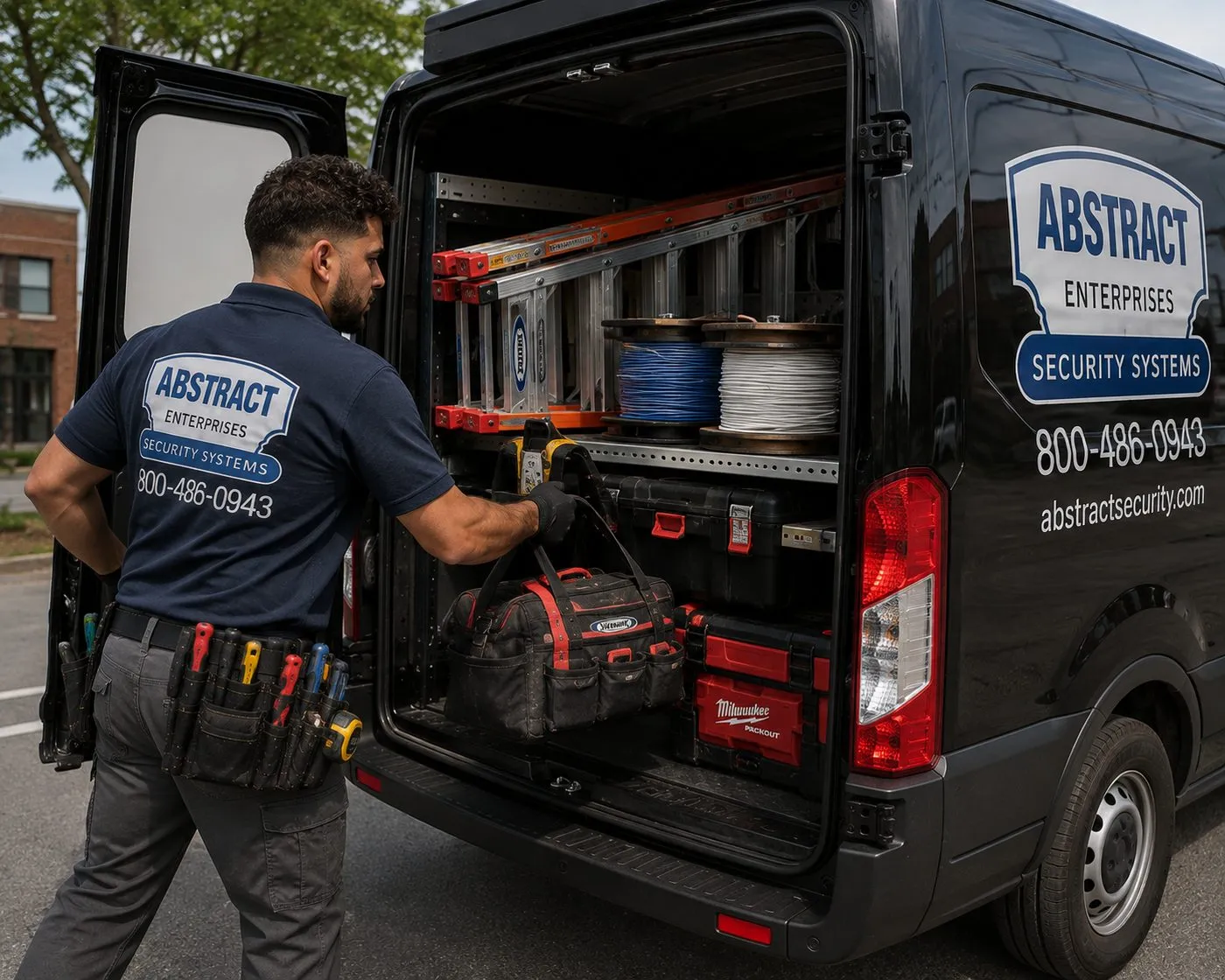
A technician lifts a tool bag from a racked van holding ladders, cable reels and tool cases — on a long valley drive, what is in the van decides whether the job finishes on the first visit.
Coverage Area
Soundbar Installation Near Hudson Valley Landmarks
The six counties we cover stretch from the New York City line to the edge of the Catskills. These landmarks mark the territory — we work in the homes and businesses around all of them.
Walkway Over the Hudson, Poughkeepsie–Highland
The 1888 railroad bridge reborn as a state historic park, 212 feet above the river and 1.28 miles long — the longest elevated pedestrian bridge in the world, linking Dutchess and Ulster.
Dia Beacon, Beacon
A nearly 300,000-square-foot former Nabisco box-printing factory built in 1929 of brick, steel, concrete and glass, now a museum — and the model for the converted industrial buildings across Beacon's riverfront.
Kingston Stockade District, Kingston
The National Historic Landmark district on the site of the mid-17th-century Dutch settlement of Wiltwyck, with colonial-era stone houses at all four corners of one intersection.
Storm King Art Center, New Windsor
A 500-acre outdoor museum of large-scale sculpture on Museum Road in Orange County, with work by artists including Alexander Calder and Andy Goldsworthy.
Lake Mahopac, Putnam County
The Putnam lake listed at 587 acres by lake-property sites, ringed by year-round houses, waterfront cottages and boathouses — classic lake-house soundbar territory.
Kykuit, Sleepy Hollow
The Rockefeller estate completed in 1913 above the Hudson in Westchester; its tours are on hiatus for 2026, but the river villages around it are full of the old houses we work in.
We also serve the Palisades Center area of West Nyack in Rockland, Newburgh and Middletown, Carmel and Cold Spring, Rhinebeck and Millbrook, New Paltz, Woodstock and Saugerties, and every town between the city line and the Catskills.
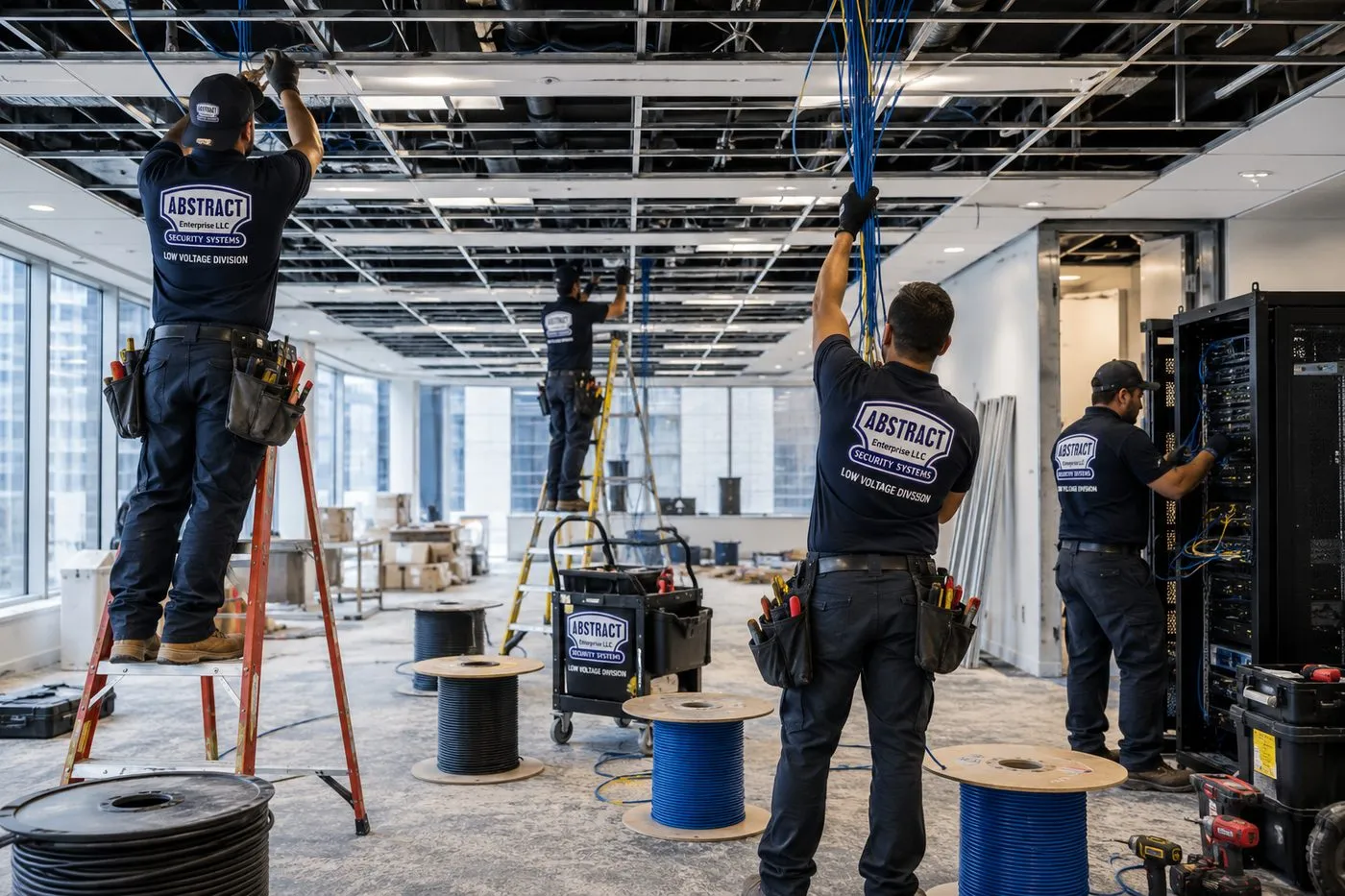
Technicians on ladders feed bundles of cable up into an open ceiling grid from spools on the floor, while another works at an equipment rack — larger-scale cabling from the same crews.
Pricing
Soundbar Installation Cost in the Hudson Valley
Soundbar work is priced by published line items, so you can add up a job before you book it. The soundbar, bracket and wiring lines below are the same in all six counties; the county only changes the hourly rate for setup-only visits and, if the TV is going up too, the TV mounting base price.
Item
Price
What it covers
Soundbar placed on console or stand
$79
Positioned, connected to the TV, set up and tidied
Soundbar wall-mounted under the TV
$129
Bracket fixed, bar centred and levelled, connected to the TV
Sanus soundbar bracket (if you need one)
$84.99
Supplied by us; manufacturer's warranty
In-wall concealment
$169
Code-compliant in-wall power and cable kit, hollow walls
Paintable cord cover
$59
Surface raceway from the bar or TV to the outlet
Cable run to a cabinet or other spot
$99
Up to 25 feet, for sources kept away from the TV
A/V receiver connection
$129
Receiver wired and set up with the TV and speakers
Sonos setup
$125
Sonos soundbar or system on your network and app
Universal remote programming
$99
One remote for TV, bar and source boxes
Streaming device setup
$49
Roku, Apple TV, Fire TV or similar, signed in and tested
Full home theater
$350
Bar or receiver, sub and surrounds connected and calibrated
Plywood backer board
$85
Where framing is not where the bracket needs to be
High mount (above about 8 ft)
$75
Bars mounted with a high TV over a hearth or in a tall room
Walk-up, 3rd floor or higher, no elevator
$40
River-town apartments and lofts
Box removal
$25
Packaging taken away
Certificate of insurance
Free
For landlords, associations and commercial buildings
Wall-type surcharges
Wall
Surcharge
Where we see it in the valley
Drywall on wood studs
$0
Ranches, splits, colonials and newer builds
Metal studs
+$30
Offices, newer commercial fit-outs, some condo conversions
Plaster
+$45
Farmhouses, Victorians, pre-war village houses
Brick or stone
+$65
Fieldstone fireplaces, stone houses, brick lofts
Concrete or cinder block
+$75
Converted industrial buildings, basements
Tile or marble
+$95
Tiled fireplace surrounds and feature walls
Setup-only visits and TV mounting by county
County
Setup-only visit (first hour)
TV mounting base
Westchester
$235
$219.99
Rockland
$235
$219.99
Orange
$250
$229.99
Putnam
$250
$229.99
Dutchess
$275
$254.99
Ulster
$275
$254.99
Setup-only visits — a bar that won't connect, a sub that has lost its pairing, a system that needs re-configuring — are billed at a flat first hour, then in 30-minute blocks. If the soundbar goes up with a new TV on the same visit, the soundbar line is simply added to the county's TV mounting base.
What the price includes, and what it doesn't
Included: mounting, levelling and connecting the soundbar to the TV, setting the TV's audio output, testing with your sources and showing you the controls.
Not included: electrical work. We don't add or move outlets; if the plan needs a new receptacle behind the TV or near the sub, that is a licensed electrician's job, and we will say so before the visit.
Not included: patching and painting. Holes left by an old mount or a previous installer's anchors are not filled and painted by us.
Return trips: a $150 return-trip fee applies if we arrive and can't start — for example, nobody home or the TV not yet delivered. Rescheduling is free with 24 hours' notice.
National brand versus local installer. Big-box services and app-booked pros sell soundbar mounting nationally, and on a plain drywall wall they can do a perfectly good job. Where a local licensed installer earns the difference is on the walls national pricing doesn't anticipate: plaster, stone, log and brick. We publish the surcharge for each in advance, carry the fixings for all of them, and answer to you directly rather than through a booking platform.
Shop Our Systems
Soundbar Installation Packages & Pricing
Pick the closest of these and adjust: every figure is a sum of the list prices shown in the tables, with plaster, stone, backer-board or high-mount lines added only when your wall calls for them.
Starter — On the Console
$79
Soundbar placed on console $79 = $79. Positioned clear of the screen and IR sensor, connected by HDMI, TV audio output set, cables tidied behind the furniture. Ideal for renters, TVs on stands and walls you would rather not drill.
Standard — Under the TV
$213.99
Soundbar wall-mounted $129 + Sanus soundbar bracket $84.99 = $213.99. Bar centred and levelled under a mounted TV and connected. On a plaster wall add $45; on stone add $65.
Premium — Wires Out of Sight
$382.99
Soundbar wall-mounted $129 + Sanus bracket $84.99 + in-wall concealment $169 = $382.99. Power and HDMI carried inside a hollow wall in a code-compliant kit, so nothing hangs below the bar.
Bring Your Own Equipment — Labour Only
If your soundbar came with its own rated wall bracket, or you have bought a model-specific mount, we install it for the labour-only wall-mount price of $129 — no bracket charge. Wall-type surcharges still apply where the wall needs them. Customer-supplied brackets and parts carry their manufacturer's warranty; we check the bracket's rating against your bar before fitting it.
Get Your Soundbar Priced From the List
A photo of the chimney breast, the plaster or the log wall is usually enough for us to add up the job from the tables above.
Where the Soundbar Should Go in a Hudson Valley Room
Most disappointing soundbars are not bad soundbars. They are good ones in the wrong place. These are the placement rules we apply in the rooms we see most often north of the city.
Directly under the picture, close to it. Voices should seem to come from the screen. The bar sits centred under the TV with a few inches of clearance — Sonos asks for at least four inches below an Arc Ultra — not a foot or more below it on a mantel.
At the front edge, not inside a shelf. A bar recessed into a cabinet or built-in loses its side and upward sound and booms. If it must sit on furniture, bring it to the front edge.
Clear of the TV's IR sensor and the screen edge. Tall bars on low stands can block the remote sensor or the bottom of the picture. We check both with the TV on.
Aimed at where people sit. In a great room with seating to one side, a bar centred on a wall that faces the kitchen helps nobody. Sometimes the TV wall itself should move; we will say so.
Away from heat. Over a working fireplace, keep the bar out of the hot air rising from the opening and check it is within the maker's temperature range.
Sub where the bass is even, not where the box fits. Test two or three positions from the seat before deciding.
Surrounds beside or slightly behind the seats. Wireless rears still need outlets; in a big open room a stand or bracket near an existing receptacle is often the answer.
Away from shared walls. In row houses, semi-detached Victorians and loft conversions, keep the sub off the party wall and the floor.
Mounting heights follow the TV. For most living rooms that means the centre of the screen near seated eye level, and the bar just under it. Over a fireplace, the TV is often higher than ideal; a pull-down mount that brings the screen down for viewing, with a TV-attached bar that comes down with it, is the best compromise we know. We install those as part of our TV installation in the Hudson Valley.
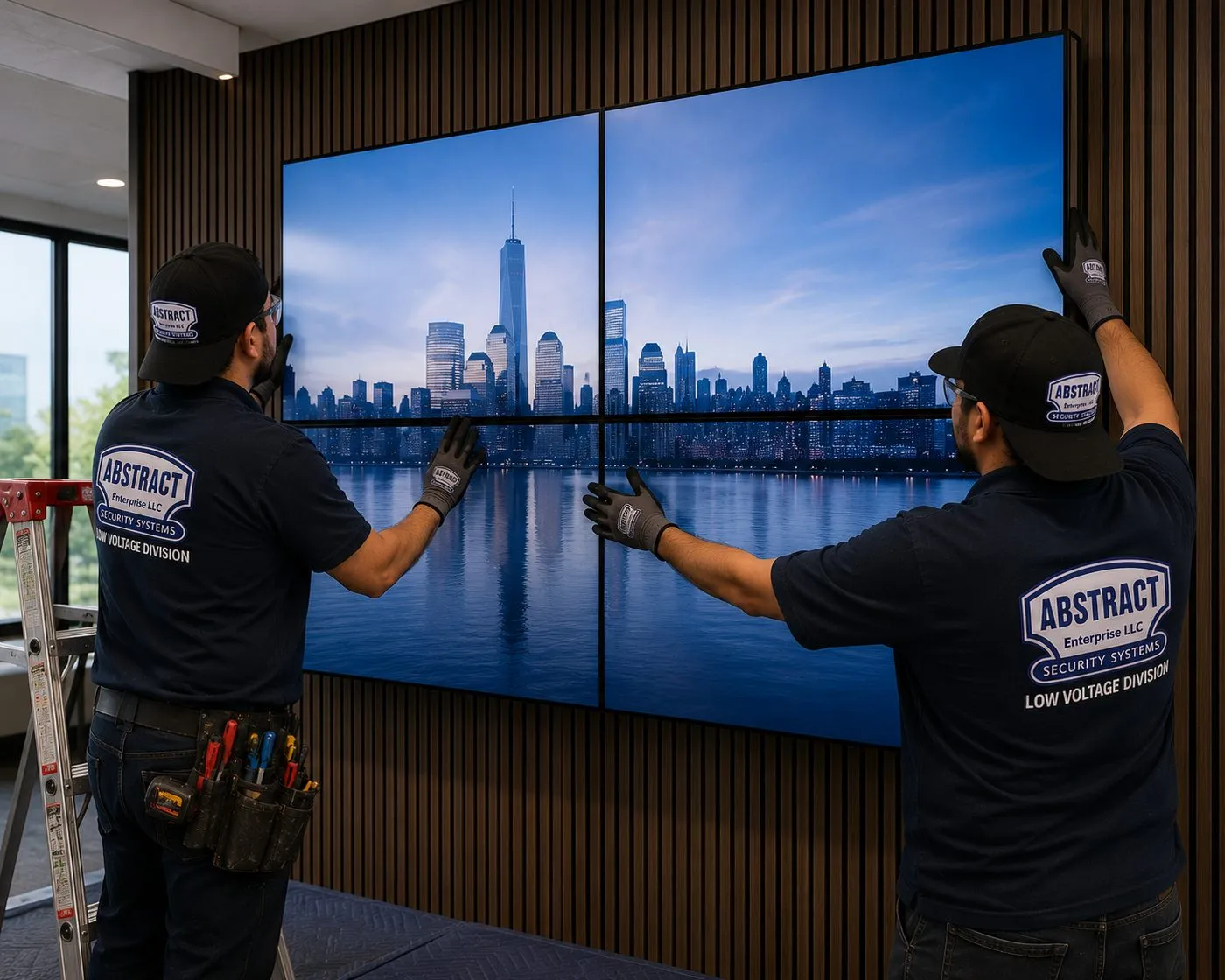
Two technicians press large display panels into alignment on a slatted wood feature wall, a stepladder at the left — centring and levelling against the wall is the same skill a soundbar under a TV needs.
Before We Arrive
A Short Checklist Before Your Soundbar Appointment
On a long valley drive, a few minutes of preparation is the difference between a finished job and a second visit. None of this is required, but all of it helps.
Photograph the wall. The whole TV wall, a close-up of the surface below the TV, and the nearest outlet. If you know the wall type — plaster, stone, log, drywall — tell us.
Have the soundbar on site and unboxed if you can. Check that the bracket and all cables are in the box. Note the model number.
Know your Wi-Fi password. Smart bars, Sonos systems and streaming devices need it during setup. If the router is in a far corner of the house, tell us.
Clear the area. About six feet in front of the TV wall, with breakables moved off the mantel or console.
Check the TV mount. If the bar will hang from the TV, tell us the mount's make or send a photo of the label; we check its capacity before adding weight.
Decide about the wires. In-wall, cord cover, or behind furniture. We will tell you what your wall allows; it helps to know your preference.
Tell us about outlets. If there is no outlet behind or near the TV, you may need an electrician first. Better to know before the day.
For second homes: tell us who will be on site and whether the power and internet are on.
Second Opinions
Common Problems With Soundbars Someone Else Installed
A fair share of our soundbar calls in the valley are to put right an installation that was done quickly. These are the faults we find most, and what fixing them involves.
Anchors pulling out of plaster. Drywall anchors in horsehair plaster hold at first and loosen over months as the plaster crumbles around them. The bar starts to tilt, one end first. We remove them, locate framing or fit a backer, and re-hang the bracket into wood. The old holes are covered by the bracket where possible; patching and painting are not part of our work.
An extension cord inside the wall. Running a household power cord through a wall cavity to hide it is not code-compliant and is a fire risk. We remove it and replace it with a listed in-wall power kit where the wall is hollow, or a surface cover where it isn't.
The bar plugged into the wrong HDMI port. Only one port on most TVs supports ARC or eARC. A bar on any other port will either play nothing or only through a separate optical cable. It is a five-minute fix that solves a surprising number of "broken" soundbars.
A bar mounted too far below the TV. Often because it was put at the height of an existing outlet rather than under the screen. Voices then seem to come from the floor. We move the bar up and route the cable properly.
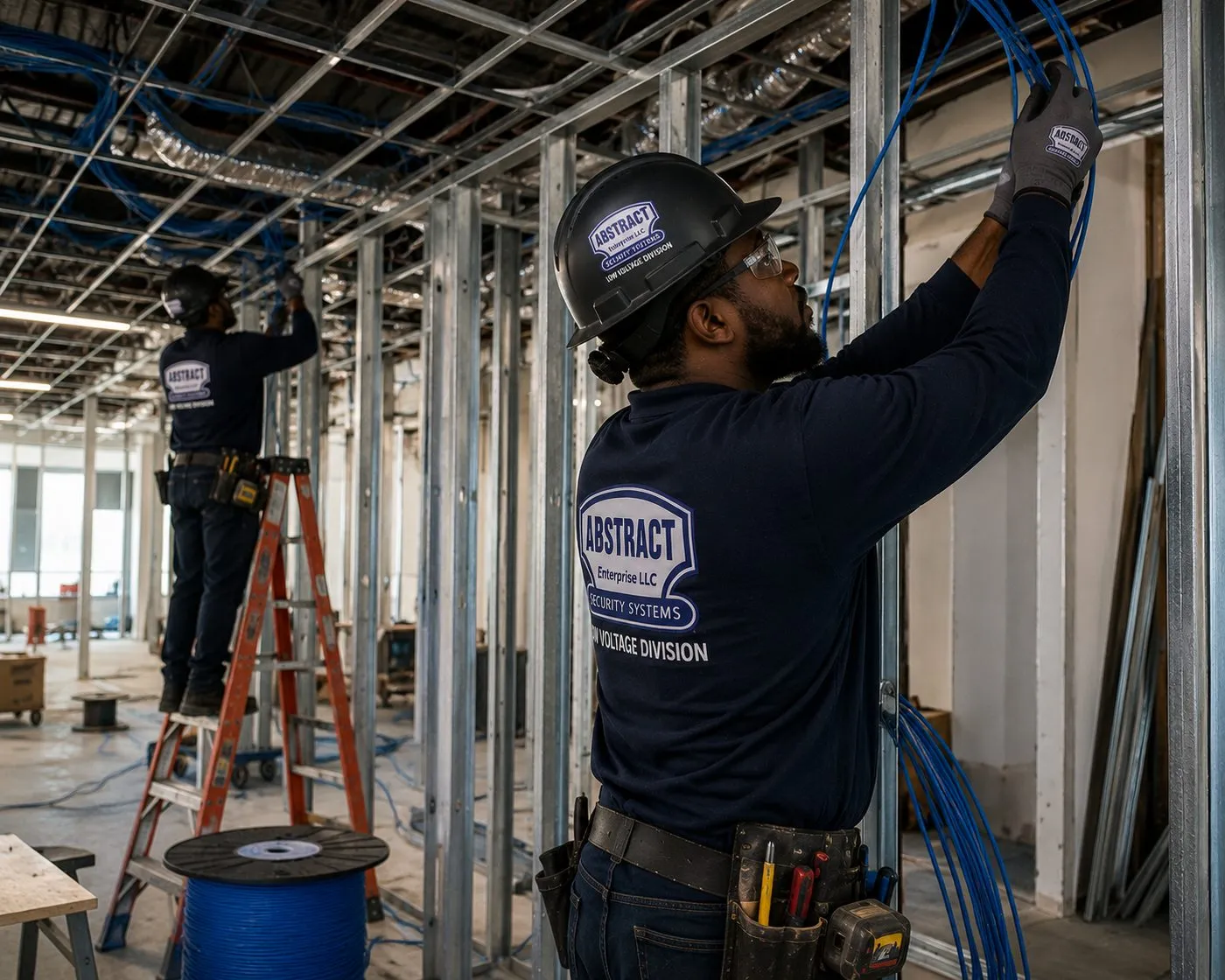
A technician in a hard hat guides a bundle of blue cable along open metal-stud framing while a colleague works overhead on a ladder — when walls are open during a renovation, it is the moment to pre-wire a TV and soundbar wall.
Complete Services
Every Soundbar Installation Service in the Hudson Valley
Valley customers who book a soundbar tend to ask about one of these next, so they are linked here in one place.
Everything Abstract Enterprises installs across New York.
Field Notes
Field Notes on Old Valley Walls
Three habits our crews bring to every pre-1940 valley house — general practice, not a story about one customer
Before anything is drilled in an older house, our installers put a hand flat on the wall under the TV and press. Sound plaster feels like stone; plaster that has let go of its lath gives slightly, and sometimes you can hear it move. That ten-second test decides more about the job than the soundbar's spec sheet does. If the plaster is loose, no anchor or screw through it should be trusted, and the conversation becomes about a backer board or a different position.
The second habit is to look at what is already in the wall. Old houses have been wired and rewired by generations of owners, and a TV wall often hides a previous installer's cables, abandoned boxes and the holes from two or three earlier mounts. We find them before choosing where the new bracket goes, so that new screws don't land in an old hole or, worse, near a buried cable.
FAQ
Hudson Valley Soundbar Installation FAQ
How much is soundbar installation in the Hudson Valley?
+
A soundbar placed on a console is $79 and a soundbar wall-mounted under the TV is $129. A Sanus bracket from us is $84.99 and in-wall concealment is $169. Plaster adds $45 and brick or stone $65; drywall on wood studs adds nothing. These line items are the same in all six counties.
Can you mount the TV and the soundbar on the same visit?
+
Yes, and most valley customers book them together. The soundbar is added to the TV mounting base for your county: $219.99 in Westchester and Rockland, $229.99 in Orange and Putnam, and $254.99 in Dutchess and Ulster.
Can you hang a soundbar on a metal-stud office wall?
+
Yes. Metal studs are thinner than wood, so we use fixings rated for steel framing and add the published $30 metal-stud surcharge. It is common in office suites, medical practices and newer commercial fit-outs.
Is hiding the soundbar wires inside the wall included?
+
No, it is a separate $169 line for a code-compliant in-wall power and cable kit, and it only works in hollow walls. On stone, brick, log or most plaster, a $59 paintable cord cover is the usual alternative.
Does the price change if the TV is mounted very high over the hearth?
+
Yes, by one published line. A soundbar mounted above about 8 feet, which happens with a high TV over a fireplace or in a tall room, adds a $75 high-mount charge. A pull-down TV mount with a TV-attached bar often avoids it.
What happens if the wall turns out to be stone or brick when you arrive?
+
We apply the published wall-type surcharge, $65 for brick or stone, and tell you before drilling. Sending a photo of the wall when you book lets us confirm it in advance and bring the right anchors.
Can the soundbar be mounted above the TV instead of below?
+
Sometimes. Some makers, Sonos among them, allow a bar above the screen with their own wall mount, though below is recommended for sound. Above-TV mounting suits a wall where a mantel or window leaves no room underneath.
My TV is older and has no ARC port. Can it still drive a soundbar?
+
Usually, through the TV's optical audio output. Optical carries stereo and compressed surround but not the newest lossless formats, and it does not let the TV remote control the bar, so we often add a programmed universal remote.
Will you take the soundbar packaging away?
+
Yes, if you want it gone. Box removal is a published $25 line. Many second-home owners keep the box for winter storage, so we ask before we take it.
Do you set up Sonos and streaming apps too?
+
Yes. Sonos setup on your Wi-Fi and in the Sonos app is $125, and a streaming device such as a Roku, Apple TV or Fire TV is $49, signed in and tested with the bar.
All Areas Served
Soundbar Installation Across New York
Westchester, Rockland, Orange, Putnam, Dutchess and Ulster will each get a dedicated soundbar page of their own. Until a county page is published, its link below opens the quote form — the crews and the price list are already working there.
Soundbar Gone Quiet? Need It Fixed in the Hudson Valley?
If the bar worked yesterday and plays nothing today, call (800) 486-0943. Same-day visits are possible when a two-hour window is open in your area; most connection, pairing and settings faults are fixed in one to two hours once we are on site, and we test every source you use before we leave.
Soundbar Installation Hudson Valley — Licensed, Insured, Published Prices
Abstract Enterprises Security Systems · 460 E Fordham Rd, Bronx, NY 10458 · (800) 486-0943 · WhatsApp (718) 679-0359 via wa.me
NYS Low-Voltage Licence #12000287431 · 100% Licensed & Insured · Same-Day Estimates · Rated 4.7★ from 201 Google Reviews
Brackets and parts carry their manufacturer's warranty. Full terms — including 50% deposit, one-year parts-only warranty on AESS-supplied products, and the late-fee schedule — are set out in the service agreement. See our warranty page.
Page reviewed and updated October 17, 2026. Changelog: first publication of the Hudson Valley soundbar installation hub. Photos on this page are from our low-voltage and audio work; dedicated soundbar photos will replace them as they are added.