Licensed Low-Voltage Contractor · St. George, 10301 · Hill Houses, Pre-War Co-ops, Lofts & New Rentals
Soundbar Installation in St. George, Staten Island
Victorian Parlors · Fort Hill Two-Families · Daniel Low Terrace Co-ops · Bay Street Lofts · Waterfront Rentals
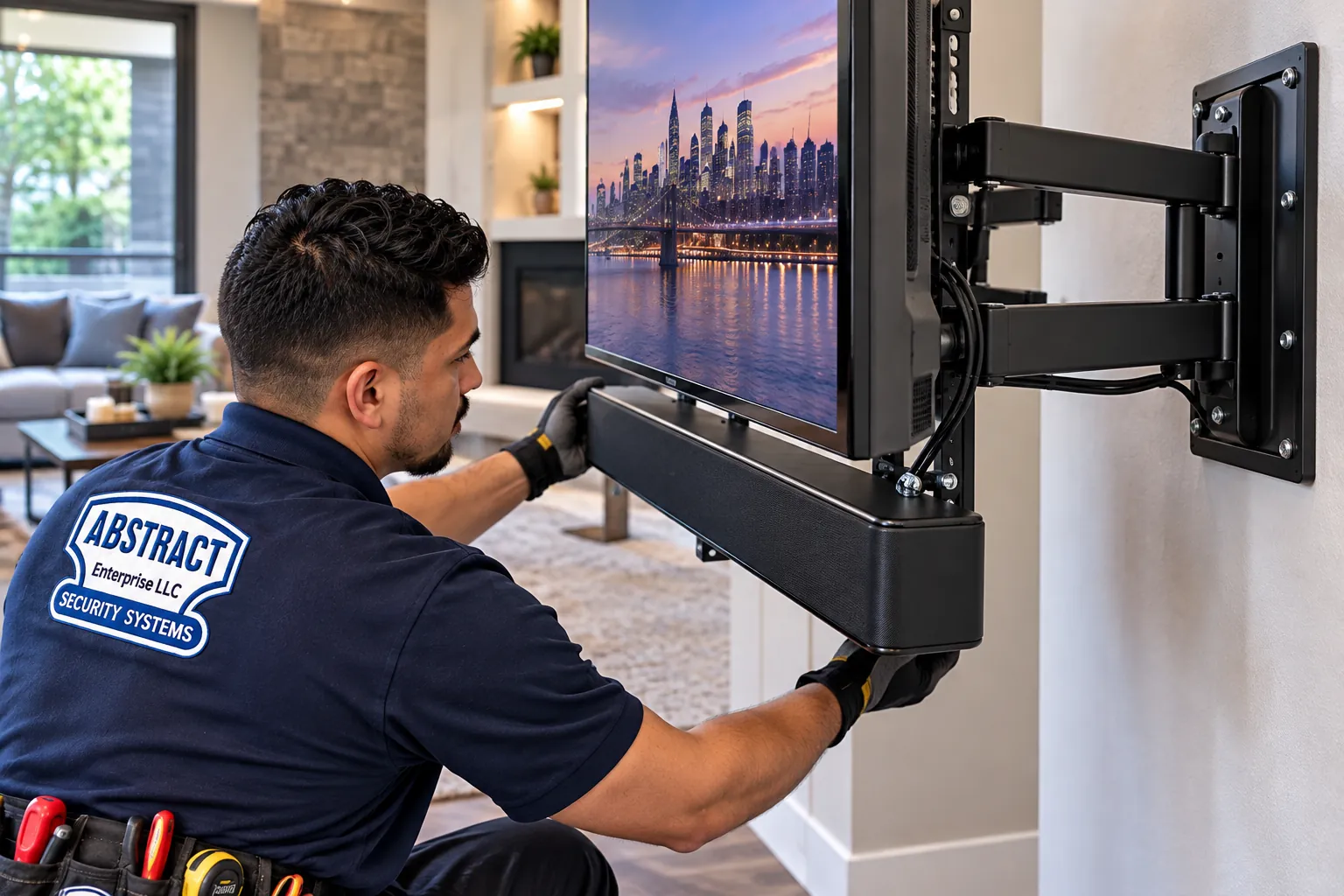
St. George is the corner of Staten Island that lives like the rest of the city. Above the ferry terminal, the streets climb a hill of Queen Anne and Shingle Style houses with lath-and-plaster walls; along the water sit converted warehouse lofts with bare concrete ceilings, a cluster of pre-war elevator buildings and towers, and new rentals facing Manhattan. Most households rent, many commute on the free boat, and the walls behind the TV change from one block to the next. We read the wall before we drill, hide the wiring in whatever way the building allows, set the bar up on the TV's eARC or ARC port so one remote runs everything, and book you into a two-hour window between 8 AM and 8 PM, seven days a week, so the visit fits around the ferry.
Reviewed and updated October 17, 2026 · Written by Anwar Timothy, NYS licence #12000287431 · Part of our Staten Island soundbar installation coverage
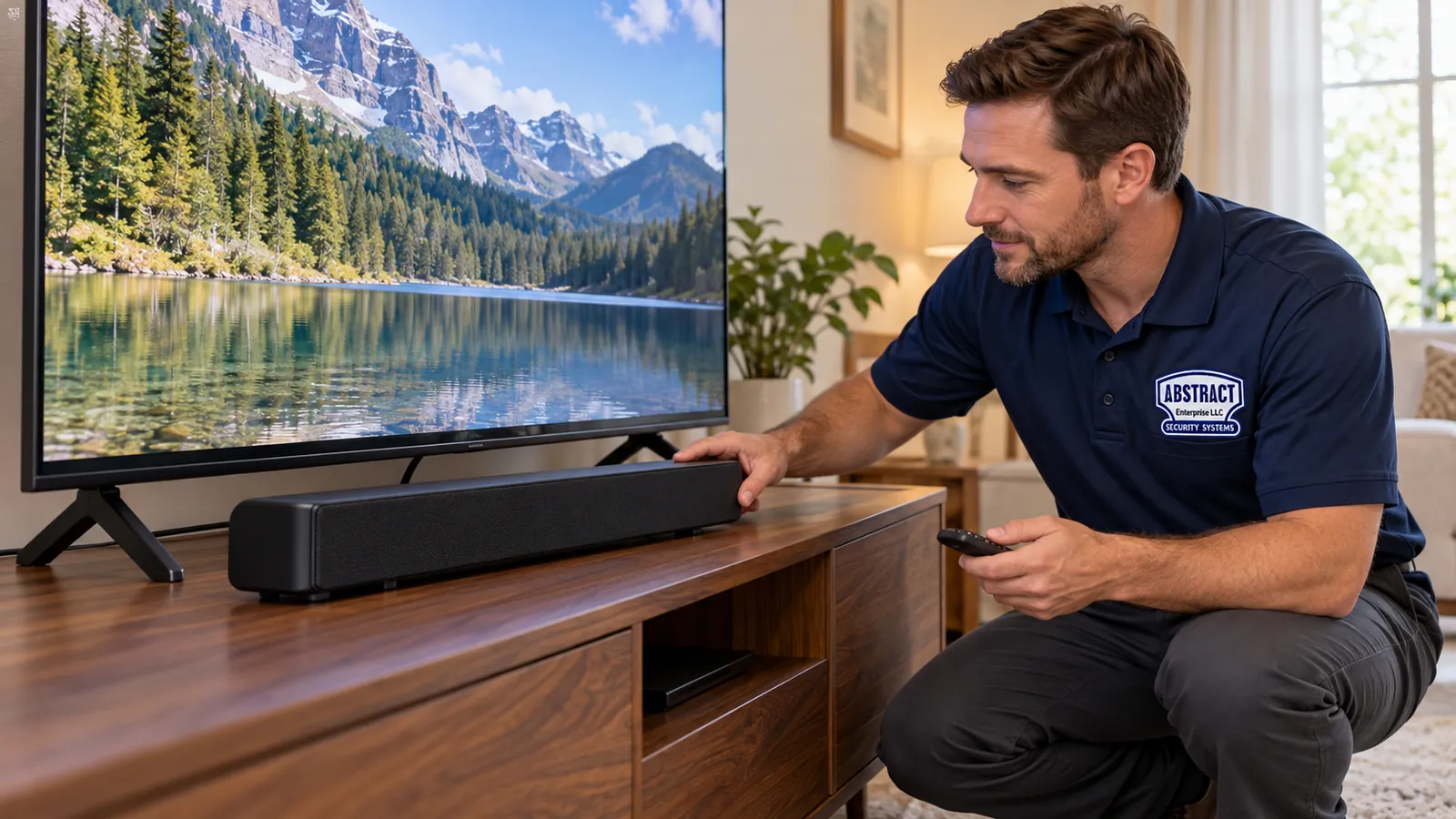
No holes at all: the bar sits on the console in front of the TV's feet, slid forward far enough that it clears the bottom edge of the picture. The no-drill option that suits many St. George renters.
St. George Soundbar Quote
House on the hill, co-op, loft or new rental? We call back with a price the same working day
✅
Request Sent!
Expect our call back the same business day.
25+
Years Experience
✓
Same-Day Estimates
100%
Licensed & Insured
4.7★
201 Google Reviews
New soundbar, old wall? Call (347) 934-8335 or use the sixty-second form. Tell us the street or building and what the wall behind the TV is made of, and the price comes back in writing, built from the same published lines you can read further down.
$79 for a bar that sits on the console with no holes; $129 to hang it under the screen
Evening and Sunday windows for people who work across the harbor
Licensed under NYS #12000287431; certificates of insurance for co-op and rental managers at no charge
Most of Staten Island is a borough of houses with driveways. St. George is not. It is the island's civic centre and its front door: Borough Hall stands on Richmond Terrace with the borough's courthouses close by, the ferry and the Staten Island Railway terminate here, and nearly every local bus route connects at the terminal at the foot of the hill. Real estate guides describe the neighbourhood as roughly 0.41 square miles in the 10301 zip code, one of the most densely built parts of the borough, with a younger population than most of the island. That density is the first thing that changes a soundbar job. A soundbar here goes into a rented apartment as often as an owned house, and the person paying for it is frequently someone who will move within a few years.
The second thing is age. The St. George Historic District, designated by the Landmarks Preservation Commission on July 19, 1994, protects houses that the Historic Districts Council dates from the 1830s to the 1930s, set into the steep topography above the shore. HDC's summary is that the neighbourhood only flourished after the 1880s, when the ferry terminal and the Staten Island Rapid Transit lines arrived, and that most of the houses still standing are Colonial Revival, Queen Anne and Shingle Style. In soundbar terms that means wood lath and plaster, tall parlor walls broken up by windows, pocket doors and fireplaces, framing that does not sit where a modern stud finder expects it, and an owner who does not want a single unnecessary hole.
Walk down the hill and the building stock changes again. Two- and three-family houses line the streets climbing south from Richmond Terrace. Pre-war elevator buildings such as the Ambassador Apartments on Daniel Low Terrace hold flats with plaster walls, a managing agent and building rules. The two towers of Castleton Park on St. Marks Place, among the tallest buildings on Staten Island, contain 454 apartments. On the water, Bay Street Landing turned century-old grain, coffee and dry-goods warehouses into loft co-ops and condos in the 1980s, keeping raw concrete ceilings and exposed columns in at least one of its buildings. And the newest homes are rentals such as Lighthouse Point, a 115-unit building of studios and one- and two-bedrooms on New York Harbor beside the terminal.
That spread is why a St. George soundbar job is never a copy of the last one. The technician who mounted a bar on a drywall partition in a new waterfront rental at ten in the morning can be fishing a cable through century-old plaster on the hill by two, and working out how to hang a bar on a concrete wall in a loft with no hollow cavity at all by five. Each needs a different anchor, a different way to hide the wires and, often, a different conversation with whoever owns or manages the building.
The people who live here describe it the same way. On Reddit's r/statenisland, residents answering a newcomer called St. George fairly walkable and pleasant, with a lot of old-style houses that have charm and character, and pointed out that it is the closest you can live to the ferry if you commute into Manhattan. Another thread called it the best neighbourhood on the island for someone starting a Manhattan job, citing an active community with neighbourhood events. Those are the households we meet: commuters who want the visit after work or on a weekend, renters who need the install to leave little behind, and owners of old houses who care more about the plaster than the price.
And St. George is about to change again. In September 2026 the Staten Island Advance reported a draft city plan for up to 2,500 apartments in seven towers on the waterfront around Empire Outlets and the former New York Wheel site, with construction proposed to start by 2029. Smaller projects nearby, including a 14-storey, 117-unit building the City Council approved in August 2026, would add hundreds more. Whatever happens to those plans, more of the neighbourhood's TVs will hang on new-build partitions in the years ahead, and the plaster houses on the hill will still be there.
St. George facts that shape a soundbar job
July 19, 1994: the date the Landmarks Preservation Commission designated the St. George Historic District (LPC designation report LP-1883). The district runs from Carroll Place to St. Marks Place and from Nicholas Street to Westervelt Avenue (Historic Districts Council).
About 70%: the share of housing units in the wider St. George–New Brighton area that are renter-occupied, according to a 2026 neighbourhood guide from Robert DeFalco Realty. Renters need installs that respect a lease.
454 apartments: in the two Castleton Park towers at 165–185 St. Marks Place (CAMBA Housing Ventures), described by the Staten Island Advance in 2015 as likely the island's tallest building at 20 storeys.
13 acres: the gated Bay Street Landing complex beside the ferry, where 20th-century warehouses became loft co-ops and condos in 1984 (Homes.com building profile).
115 units: at Lighthouse Point on Bay Street, a rental building of studios, one- and two-bedrooms directly on the harbor (Corcoran listing; New York YIMBY, February 2026).
25 minutes, 24 hours a day, free: the Staten Island Ferry to Whitehall (NYC DOT). It is why St. George households book evening and weekend installs.
2,500 homes in seven towers: the scale of the city's draft St. George waterfront plan reported in September 2026, with construction proposed to begin by 2029 and finish around 2036 (Staten Island Advance / SILive).
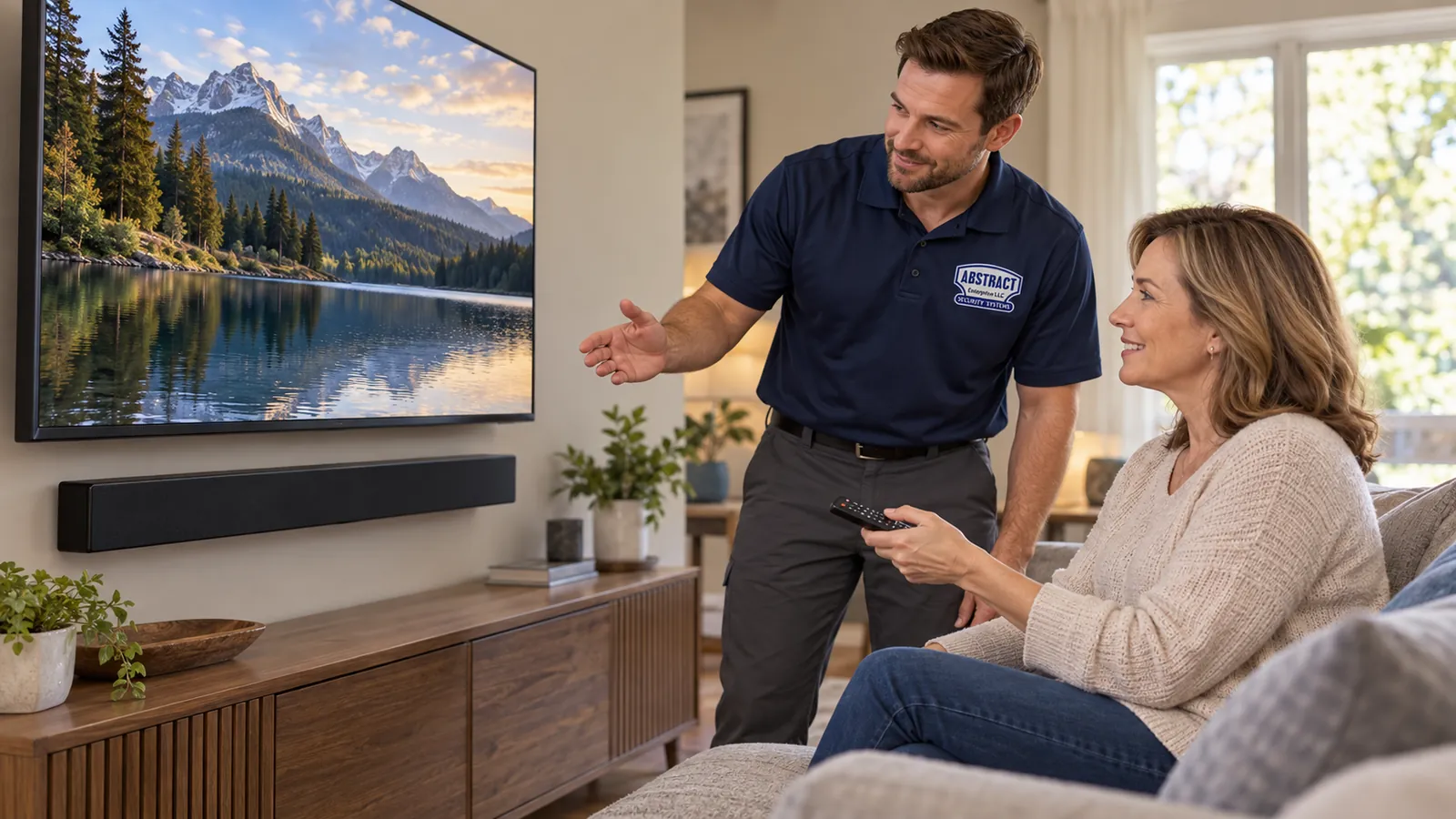
The last ten minutes of every visit: whoever uses the TV most holds the remote while the technician shows volume, input, dialogue and night settings on the bar just installed.
Building Specialists
Soundbar Installation for St. George's Architecture
Six kinds of home share these few hundred acres, and each one asks a soundbar for something different. Here is how we approach each, starting at the top of the hill and working down to the water.
Historic district houses on the hill
Queen Anne, Shingle Style and Colonial Revival houses between Carroll Place and St. Marks Place, most of them from the decades after the 1880s. Expect wood lath and plaster, often two layers of paint and wallpaper over it, parlors with fireplaces, bay windows and pocket doors, and framing that may be balloon-built, with studs running from the foundation to the roof.
The bracket goes into framing found by test-drilling rather than trusting a scanner, the screws are sized to pull the bracket tight without crushing the plaster keys, and cables either drop inside an open stud bay or run in a cover painted to match the trim.
Fort Hill and the two- and three-family streets
Just south of Hamilton Avenue the houses are similar in age and style to the designated district but outside its boundary, and two- and three-family houses are common on the streets climbing south from Richmond Terrace. Partitions added during those conversions can be anything from plaster on wood lath to drywall to old fibreboard.
We ask who owns the wall before we drill. In a divided house the owner may live upstairs and the TV may be on the wall shared with the stair hall that serves the other units, which is a reason to use a cover instead of opening the wall.
Pre-war elevator co-ops and rentals
Pre-war elevator buildings, such as the Ambassador Apartments on Daniel Low Terrace, typically put flats behind plaster on masonry or clay block, under a managing agent and, for co-ops, an alteration agreement. Paperwork is normal here: proof of insurance, permitted working hours, sometimes a request to keep dust off the corridor.
We send the certificate of insurance free, keep the job inside the unit, and choose a bracket that needs four holes instead of eight when the wall is solid masonry.
The St. Marks Place towers
Castleton Park's two towers hold 454 apartments, a $91 million CAMBA Housing Ventures partnership with Stellar Management aimed at keeping them affordable. Large managed buildings have their own rules for contractors, and many leases expect the tenant to undo anything they add.
For tower renters we favour the methods that leave least behind: a bar on the console, a TV-attached soundbar bracket that uses the TV mount's holes, and a paintable cover rather than in-wall work.
Bay Street Landing lofts
The warehouses were built for cargo, and at least one building kept its raw concrete ceilings and exposed support columns when it became condos. Concrete and brick do not have a hollow cavity to hide a cable in, and the TV often has to stand where the furniture works rather than against a wall.
Anchors here are sleeve or wedge types set with a hammer drill, priced with the concrete add-on, and wiring runs in surface raceway painted to the wall or under a console.
New waterfront rentals
Lighthouse Point and the buildings planned near it belong to the type of new construction that is typically a concrete or steel frame with drywall partitions, often on metal studs. These are the easiest walls in St. George to mount on, but they come with a lease, a management office and sometimes a building-supplied Wi-Fi network.
We use toggle-style anchors rated for the bar, which is light, and leave the walls looking the way the management office expects at move-out.
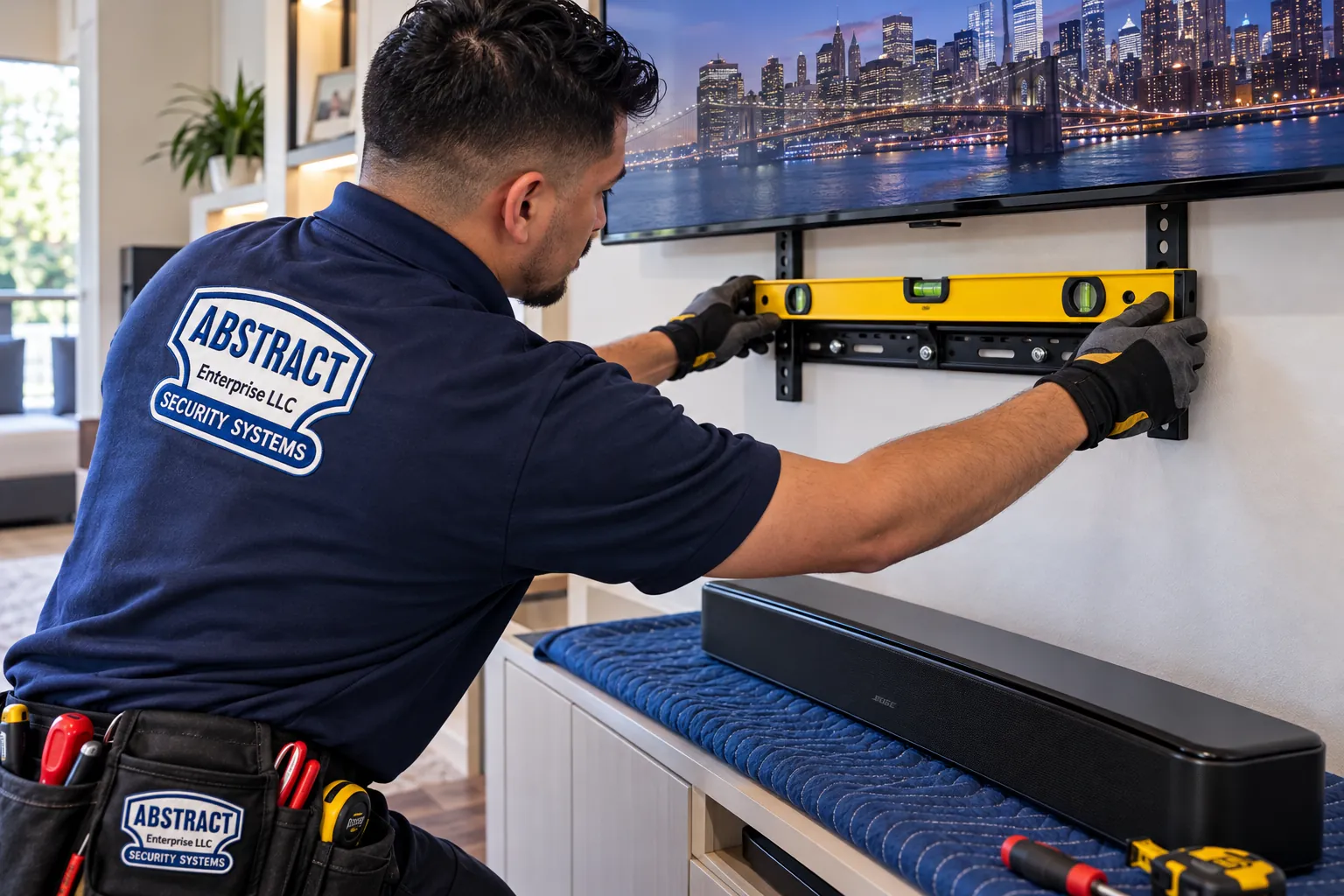
Bracket first, bar second. The level goes on the bracket while it is still loose enough to nudge, so the bar ends up parallel to the bottom of the screen even when an old floor or ceiling is not.
Walls, fixings and wiring routes, block by block
The table below is what our technicians actually reach for in each St. George setting. The add-on column is the published Staten Island wall line; the rest of the job is priced the same way everywhere.
Setting
What the wall usually is
How the bar is fixed
How the wires are hidden
Wall add-on
Historic-district parlor
Wood lath and plaster over balloon or platform framing
Screws into framing found by test-drilling; plaster pre-drilled to stop cracking
Down an open stud bay if fire blocking allows; otherwise a cover painted to the trim
+$45 plaster
Chimney breast in an old house
Brick behind plaster, sometimes with a flue still in use
Masonry anchors in solid brick, kept clear of the flue
Cover beside the breast; never inside the flue
+$65 brick
Divided two- or three-family
Plaster, drywall or old fibreboard partition
Into framing; fibreboard is never trusted on its own
Cover, or in-wall only when the owner agrees
$0 to +$45
Pre-war elevator building
Plaster over brick or clay block
Masonry anchors, fewest holes the bracket allows
Cover or along the baseboard
+$45 or +$65
Tower apartment
Drywall, plaster or concrete, depending on the wall
Matched after a scan; TV-attached bracket when holes must be minimal
Cover or through the TV mount
$0 to +$75
Converted warehouse loft
Poured concrete, block or old brick
Sleeve or wedge anchors set with a hammer drill
Painted surface raceway or under a console
+$65 or +$75
New waterfront rental
Drywall on metal studs
Toggle anchors rated for the bar's weight
In-wall kit where the lease allows, otherwise a cover
+$30 metal studs
Two things on that table are worth explaining. First, we treat old plaster as a material to protect, not just a surface to get through. Lime plaster on wood lath grips the lath with small keys of plaster pushed through the gaps; drill too fast or overtighten a screw and those keys snap, and a dinner-plate-sized patch comes loose. Pre-drilling with a sharp masonry bit at low speed and stopping the screw as soon as the bracket is snug avoids most of that. Second, metal studs in new buildings are thin, so we do not screw a bracket into them as if they were wood; a toggle anchor through the drywall carries a soundbar comfortably, because even the big bars are light.
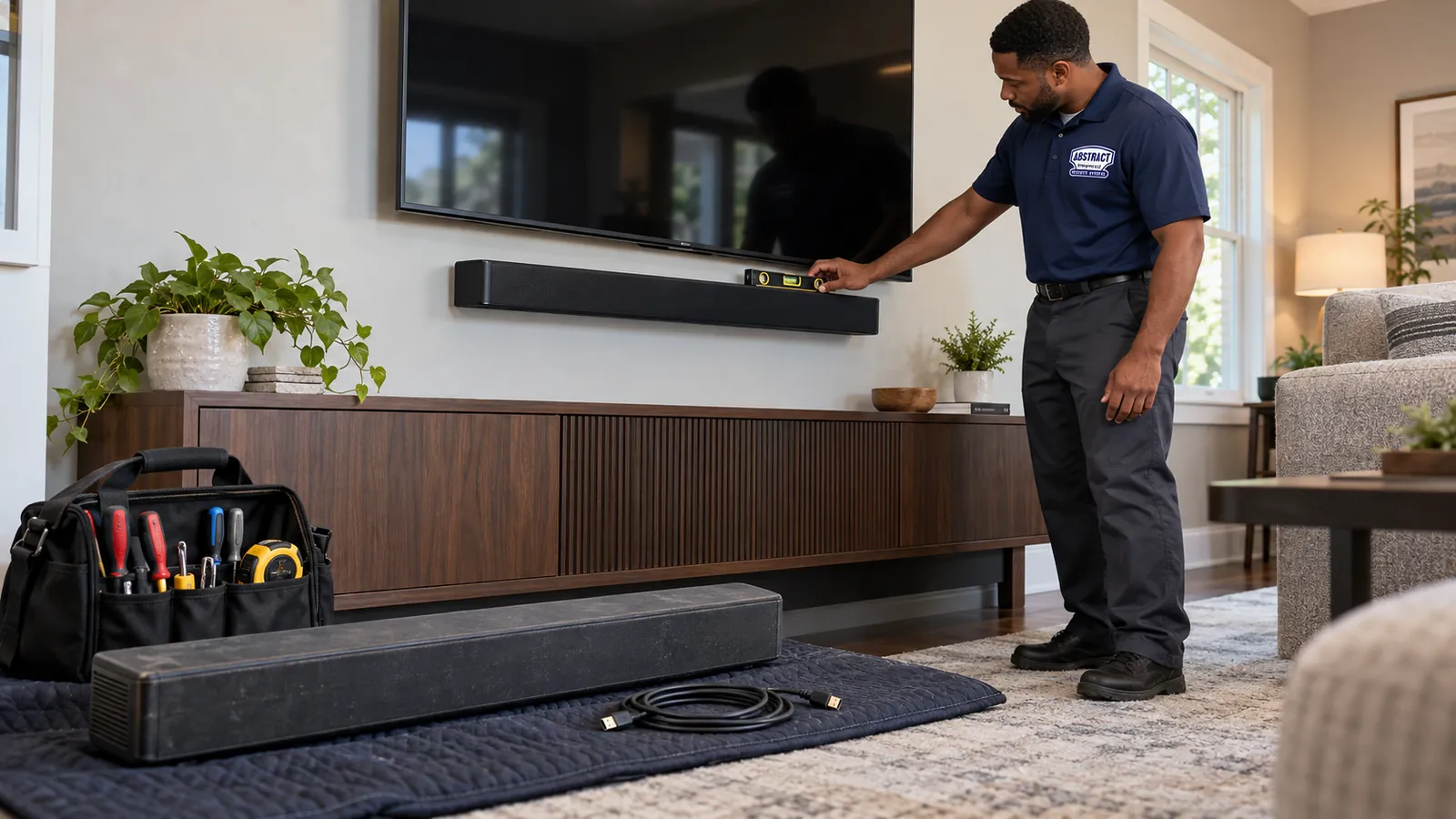
Diagram: simplified wall sections, not to scale. The dark bar on the right of each panel is the soundbar bracket; the red arrow shows where the fixing has to find its grip.A second level check once the bar is hanging, with the tool bag and a spare HDMI lead kept on a blanket so nothing scratches the floor.
Weight is the reason soundbars are forgiving. According to Sonos, the Arc Ultra is about 46.4 inches wide and weighs about 13 pounds, and the Beam Gen 2 is about 25.6 inches wide at roughly 6.4 pounds. Sanus rates its universal soundbar bracket for most bars up to 20 pounds. Those numbers are well inside what a properly anchored bracket holds in plaster, drywall or concrete; the work is in finding something solid and keeping the wall intact, not in fighting the load.
What We Install
Soundbar Installation Services in St. George
Every service below is priced from the same published Staten Island list. What makes them St. George services is the way each one is adapted to an old house, a managed building or a loft without a hollow wall.
🏛️
Soundbar on plaster
For parlors and bedrooms in the historic district and on Fort Hill. Framing located by test-drilling, plaster pre-drilled at low speed, bracket snugged rather than cranked. $129 plus the $45 plaster add-on.
📦
No-drill console placement
For renters in the towers and new buildings who would rather leave the walls alone. The bar is set on the console, lined up with the screen and kept clear of the TV's infrared window. $79.
📺
TV-attached soundbar bracket
The bar hangs from the TV mount instead of the wall, so no new holes are drilled and the bar moves with the screen if the mount swings or tilts. Useful in rentals and on fragile plaster.
🧱
Brick and concrete mounting
Chimney breasts in old houses, solid masonry in pre-war buildings, and the poured concrete of Bay Street's converted warehouses. Hammer-drilled anchors; $65 add for brick or stone, $75 for concrete or block.
🔌
Hidden wiring that suits the building
In-wall power and HDMI kit inside a stud wall for $169 where the owner allows it, or a paintable cord cover for $59 on plaster, brick and concrete. A run of up to 25 feet to a cabinet across the room is $99.
🔊
Sub, rears and full systems
Wireless subwoofer placement that respects the people downstairs, rear speakers on stands or brackets, and a full home theater hookup with a receiver for $350 when the room deserves it.
🎵
Sonos and app setup
Sonos bars paired with subs and rears, grouped with other rooms and added to the app for $125. Other brands' apps are set up as part of the normal install.
🎮
Consoles, streamers and one remote
Streaming sticks and games consoles connected on the right inputs for $49 each, and a universal remote programmed for the TV, bar and cable box for $99.
🛠️
Setup and troubleshooting visits
The bar is already up but drops sound, loses the subwoofer or ignores the TV remote. A setup-only visit on Staten Island is $225 for the first hour, then 30-minute blocks.
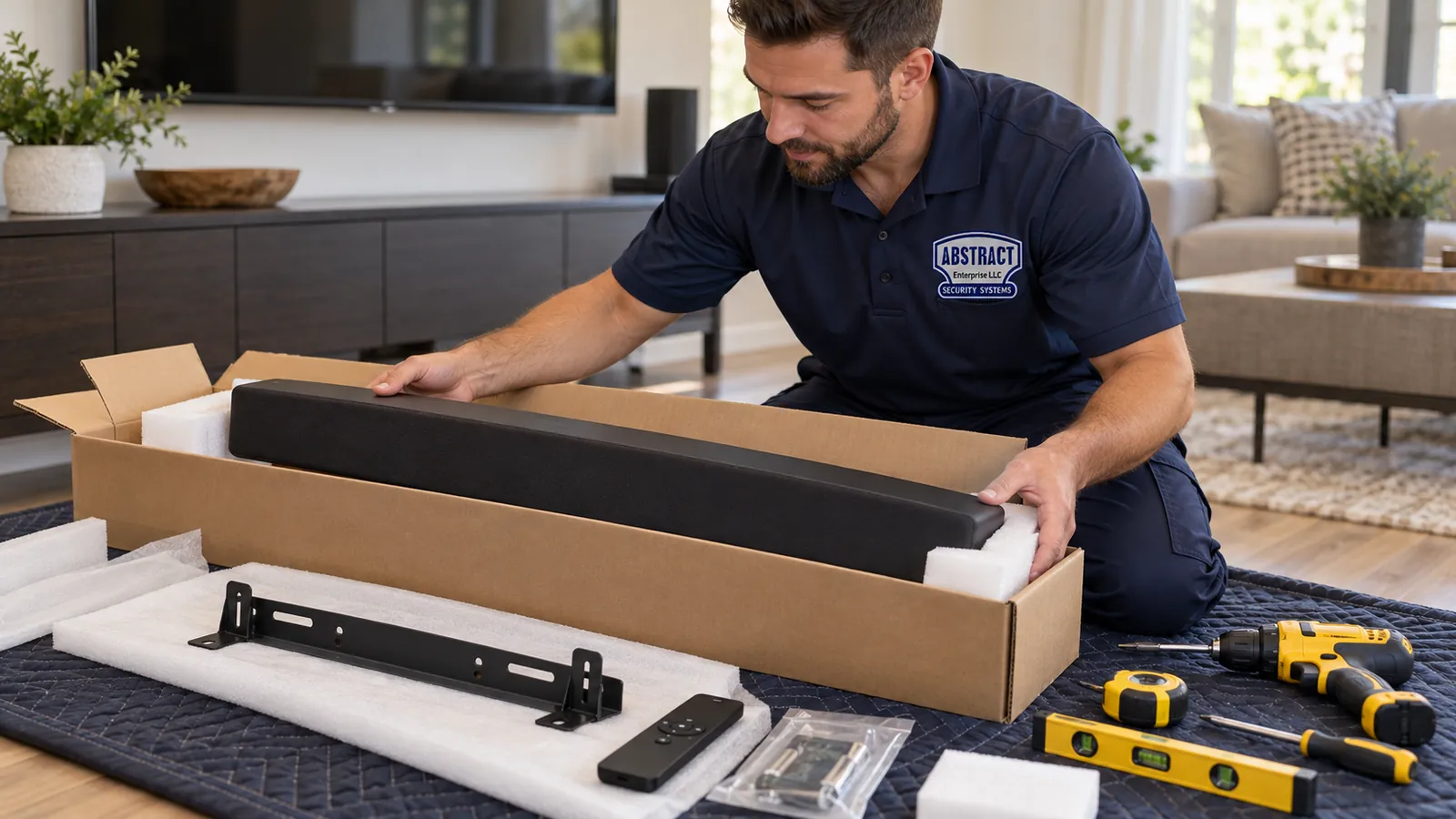
Everything out of the box and laid on a blanket before a single hole is drilled: bar, bracket, remote and the small bag of screws the manufacturer supplies.
Two services are deliberately absent. We do not add or move electrical outlets; if the TV wall in an old house has no outlet where the bar needs power, we refer you to a licensed electrician and come back once it is in. And we do not patch or repaint plaster. If a bracket is coming off an old wall, we leave the holes clean and tell you exactly what a plasterer will need to do.
Commercial Soundbars
Business Soundbar Installation in St. George
St. George is where Staten Island goes to work, see a judge, catch a boat and shop for outlet bargains. The businesses that need sound under a screen here are not the strip-mall dentists of the South Shore; they are offices that orbit the civic centre, shops and restaurants that live on ferry foot traffic, and the shared rooms of large residential buildings.
Richmond Terrace civic centre
Borough Hall, completed in 1906 to a Carrère & Hastings design and still in its original use, anchors a stretch of government buildings and the professional offices that serve them. Meeting rooms with a screen for video calls and reception TVs for visitors are the usual requests; quiet, clear speech matters more than bass.
Empire Outlets and the terminal
Empire Outlets at 55 Richmond Terrace opened on May 15, 2019 beside the St. George Terminal and bills itself as the city's only outlet shopping destination. Retail screens need sound that carries a few metres and no further, mounted where shoppers and trolleys cannot knock it.
Bay Street
Bay Street runs from the terminal past Lighthouse Point and Bay Street Landing toward Tompkinsville and Stapleton. The Bay Street corridor rezoning studied a 20-block, 45-acre area across Tompkinsville, Stapleton and St. George, and restaurants, bars and cafés along it are the typical TV-and-soundbar customers.
Ballpark and harbor-front venues
SIUH Community Park, the former Richmond County Bank Ballpark at 75 Richmond Terrace and home of the Staten Island FerryHawks, draws game-night crowds to the waterfront. Bars and function rooms that fill on those nights want commentary to carry over a crowd, which is where a bar's dialogue mode earns its place.
Building lounges and community rooms
Towers and new rentals often have a lounge, a fitness room or a community room with a TV. These are shared spaces, so the bar is set with a sensible maximum volume, the remote is labelled, and the building manager gets a one-page note of what was set and why.
Museums, schools and civic groups
The National Lighthouse Museum occupies a building of the former lighthouse depot complex that dates back to 1862, a short walk from the ferry, and Curtis High School stands on Hamilton Avenue. Institutions like these sometimes need a soundbar for a single exhibit or meeting room rather than a full sound system; we tell you honestly which one you need.
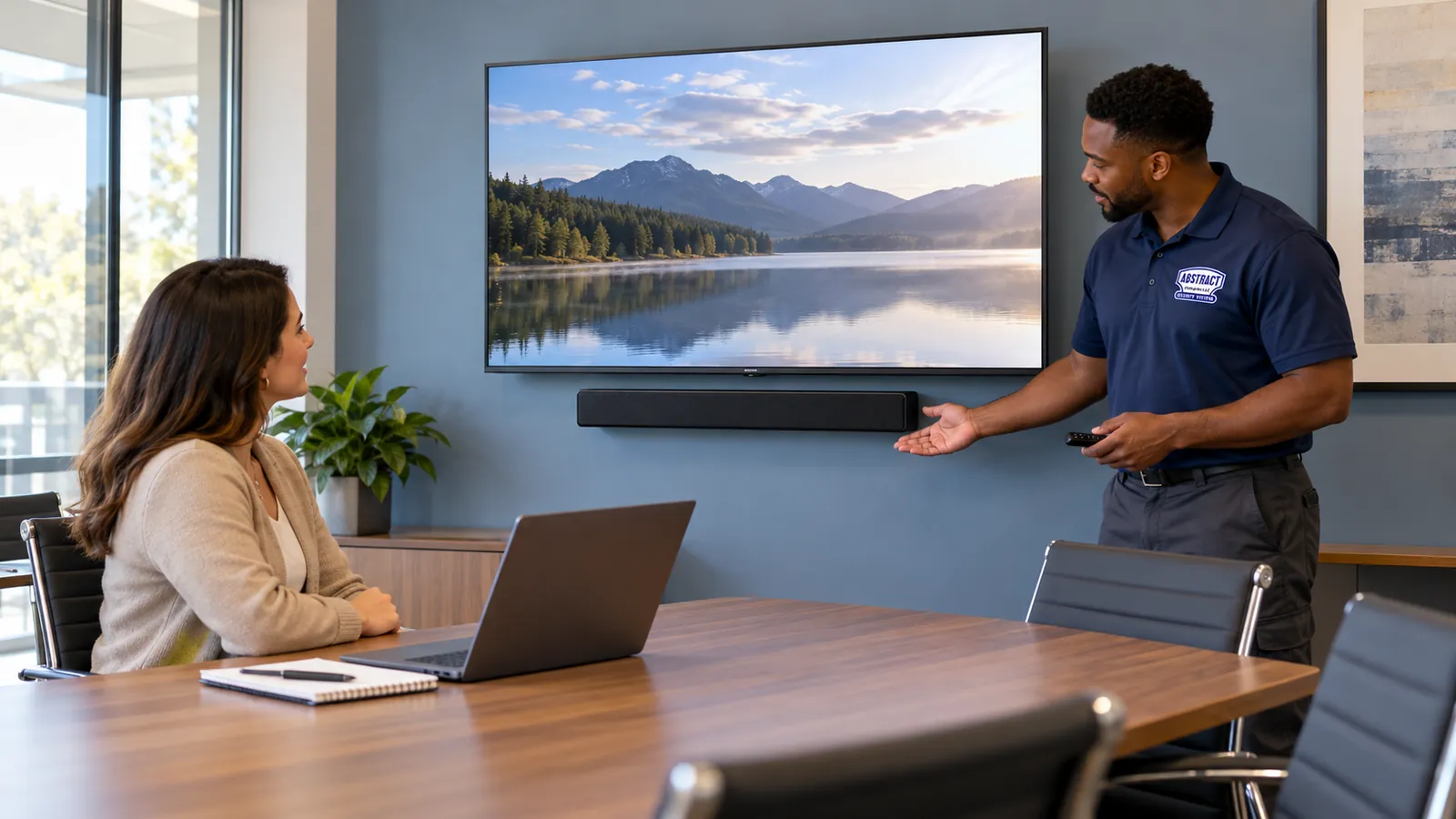
A meeting-room screen with the soundbar directly under it, explained to the person who will actually run the next presentation from the laptop.
Rules that apply to business screens
Projection into walkways. The 2010 ADA Standards (section 307.2) limit objects mounted on a wall between 27 and 80 inches above the floor to a 4-inch projection into a circulation path. A TV with a soundbar under it, on a reception wall beside a corridor, has to be either above 80 inches at its lowest edge or shallow enough to stay within that 4 inches. We measure this before drilling, because moving a bracket later leaves holes in a finished wall.
Sound that reaches homes. St. George puts restaurants, bars and shops underneath and beside apartments more than anywhere else on the island. The city's noise code guide sets limits on commercial music heard inside a nearby home — 42 decibels, and between 10 PM and 7 AM no more than 7 decibels above the ambient level — and treats low-frequency bass separately. A soundbar in a café is rarely the problem; a subwoofer on the floor against a party wall can be. We put the sub where its bass stays in the room and set a volume ceiling staff cannot easily override.
Power and certificates. Business tenants in managed buildings usually need a certificate of insurance before any contractor works on site. That certificate is free from us. Any new outlet or circuit is an electrician's work, not ours, and we tell you that at quote stage rather than on the day.
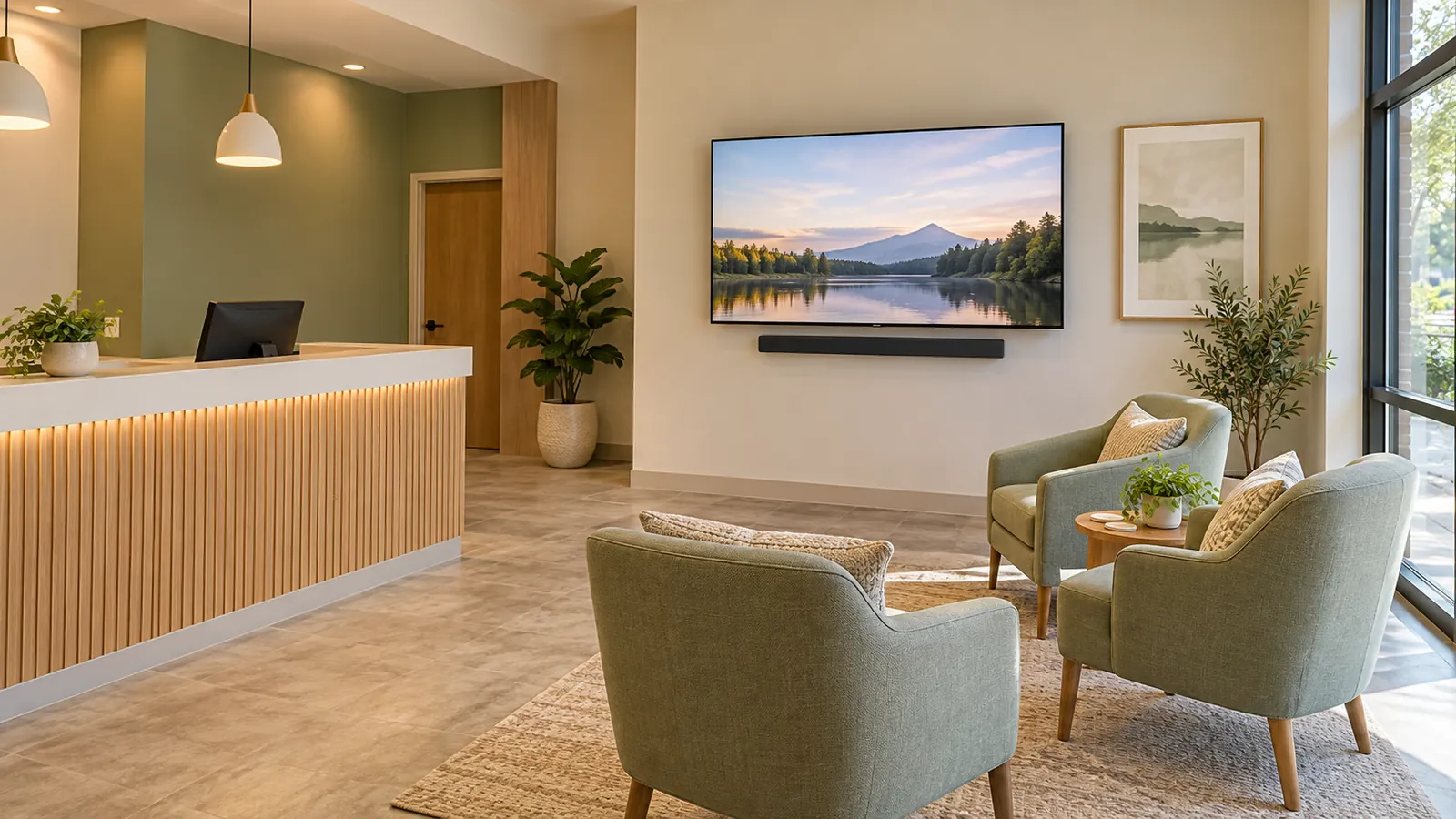
A reception area with the TV and a slim bar mounted together on one wall, well above the chairs and out of reach of a passing bag.
Soundbar Installation in St. George: Questions Answered
These are the questions that come up in St. George and almost nowhere else on Staten Island, grouped by the kind of home that raises them.
Old Houses on the Hill
Our parlor fireplace still has its original mirrored overmantel — where do the TV and soundbar go so it stays untouched?
Not over the fireplace. A carved overmantel with its mirror is usually fixed to the chimney breast with a few hidden screws or cleats, and the mirror glass is old enough that drilling anywhere near it is a risk nobody should take. Nor is it a good height for a screen: the top of a Victorian overmantel can sit well above eye level, and a TV hung there puts the picture at a neck-craning angle and the soundbar far above the ears it is meant to reach.
The answer is almost always another wall. In a front parlor with a bay window, the long wall opposite the fireplace or the wall beside the entrance often works, as long as it is not the one holding the pocket doors (see the next question). If no wall suits, the TV goes on a low console or a stand, and the soundbar sits on top in front of it for $79 with no holes at all. Some owners prefer that in a restored room, because the whole system can be moved out of the way when the room is used for guests.
If you are set on the chimney breast, the only arrangement we would consider leaves the overmantel in place and uses the plain plaster to one side of it, with the TV on a short articulating arm and the bar on a TV-attached bracket. We look at that in person first.
The longest wall in our Victorian parlor hides a pair of pocket doors — can the soundbar and its cables use that wall?
Usually not where the doors slide. A pocket door disappears into a cavity inside the wall, and that cavity has no studs in it for the length of the door. A bracket screwed in there finds nothing behind the plaster, and a screw that is long enough to grip will scrape or jam the door the next time someone closes it. A cable fished through the same cavity has the same problem: the door rubs it every time it moves.
What we do instead is find where the pocket ends. The framing on the far side of the pocket, beyond where the doors stop when they are fully open, is ordinary wall and can carry a bracket. We check that boundary by opening the doors fully, measuring how far they travel, and test-drilling past that point. If the TV has to be centred over the pocket for the room to work, the TV goes on a stand or a console in front of the wall and the bar sits on that, which keeps the doors working and the plaster whole.
Our house is balloon-framed — can the soundbar cables drop down an open stud bay from the attic or come up from the cellar?
Sometimes, and it is one of the few advantages an old house gives you. In balloon framing the studs run in one piece from the foundation sill to the roof plate, so a bay between two studs can be an open chute from cellar to attic. That is how electricians wired many of these houses in the first place. If the bay behind the TV is clear, a fish rod pushed up from the cellar or dropped from the attic can carry HDMI and the in-wall power kit to the spot behind the screen without opening the plaster except for two small plates.
Three things can stop it. Many old houses have had fire blocking added at the floor lines during renovations, which closes the chute. Some bays carry old knob-and-tube wiring or gas pipe that we will not disturb. And a parlor wall on the floor above the cellar is easy, but a second-floor bedroom wall means passing a floor in between. We confirm what we can from the cellar and attic before quoting the in-wall kit at $169, and if the bay is blocked, the fallback is a paintable cord cover for $59.
Balloon framing also means the stud bays connect to the attic, so a hole in the wall can draw air. We seal around the plates we install so the wall does not start whistling in winter.
Diagram, not to scale: in a balloon frame the studs run unbroken from the sill to the roof, so a clear bay can carry a cable from the cellar to the TV. Platform framing, and fire blocking added during renovations, close that path at each floor.
Can the rear speakers go high on the wall without cutting into the plaster cornice?
Yes. A cornice or crown moulding in an old parlor is run plaster or fixed wood, and it does not need to be touched. Rear surround speakers for most soundbars are small, and the brackets that suit them are fixed with one or two screws, so they can sit on the plain wall a hand's width below the cornice, high enough to keep them out of the way and angled down toward the seats.
The real question in a tall Victorian room is whether high is right at all. Rear speakers for most systems sound best a little above ear height when seated, not at the ceiling. In a parlor where the ceiling is well above the doors, mounting a rear speaker just under the cornice puts it so high that the surround effect floats over your head. We usually set them at about the height of the top of the door casing, or on floor stands behind the sofa, which avoids the plaster entirely.
The other check is power. Many “wireless” rear speakers still need an outlet each, and old parlors rarely have outlets where rears want to go. We tell you before the visit whether your rears need power and where it would come from.
Our TV sits on an antique sideboard — can the cables reach the soundbar without drilling it?
Yes, and we would not drill an antique anyway. A modern media console has holes and grommets built in; a sideboard or a dresser from the 1900s does not, and its back panel is often thin, original and part of what makes it valuable. The cables can almost always go another way.
The usual route is behind the piece: the sideboard stands a little off the wall, the power and HDMI run down the wall behind it in a cover painted to match, and they come up at the back edge of the top where the TV and bar sit. If the sideboard sits flat against the wall, felt pads on its back feet give it enough clearance without anyone noticing. A short, flat HDMI cable lies under the bar where it cannot be seen from the sofa.
The thing to watch is weight and heat. An antique top is not always as solid as it looks, so we check that it carries the TV evenly, and we keep the cable box and any streaming boxes out of closed drawers where they cannot breathe.
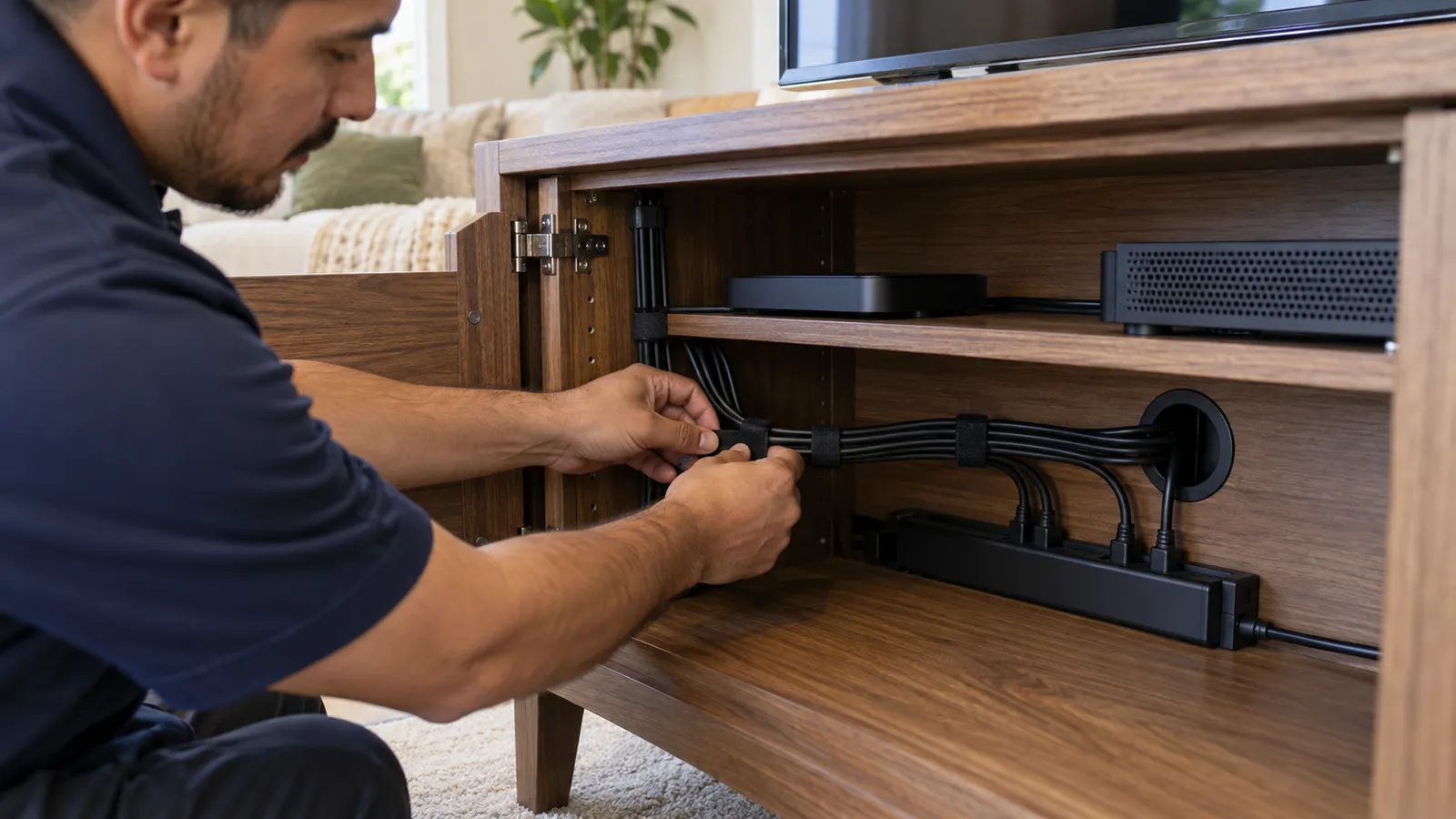
Cables bundled with hook-and-loop straps and passed through an existing grommet at the back of the cabinet, with the power strip lying flat on the cabinet floor.
Landmarks, Landlords and Divided Houses
Does a speaker or cable fixed to the outside of a landmarked St. George house need a Landmarks permit?
Very possibly, and that is a different matter from anything inside. The Landmarks Preservation Commission's published guidance says owners in a historic district must get a permit before work that affects the exterior of a designated property, while interior work needs one only when it requires a Buildings Department permit, when it affects the exterior, or when the interior itself is a designated interior landmark. A soundbar on a parlor wall is interior work that does not touch the outside. A speaker screwed to a porch post, a cable stapled up a clapboard wall or a hole drilled through the exterior to feed a porch speaker is exterior work on a landmarked building.
The Commission's staff say they can tell an owner whether a permit is needed for a particular job, and that is the right place to ask before anything goes on the outside of a district house. Our practice is simple: we do not drill through the exterior wall or fix anything to the facade of a house in the district unless the owner has confirmed with the Commission first.
For music on a porch there are easier answers. A battery-powered portable speaker that pairs with the soundbar or your phone, kept indoors when not in use, needs nothing fixed to the house at all.
Our apartment is in a subdivided old house and the TV wall is fibreboard, not plaster — what will hold a bracket?
Not the fibreboard itself. Old fibre wallboard of the kind used to divide houses into apartments in the mid-twentieth century is soft and crumbly compared with plaster or modern drywall. An anchor set into it alone can pull out with surprisingly little force, and a soundbar that is bumped while someone dusts is enough to do it.
So the bracket has to reach the framing behind. Partitions like these are usually built on wood studs, which a scanner can find through the board; we confirm each one with a thin test hole before the bracket goes up. If the studs do not fall where the bar needs to be, a painted plywood backer board fixed across two studs ($85) gives the bracket a solid base. In a rented apartment we ask whether you have the owner's agreement first, because the partition belongs to the house.
If the wall turns out to be something stranger, such as fibreboard over old plaster, we tell you on the spot and price it by the published line for whatever is behind it before anything is drilled.
When the TV swings on an arm, the bar rides with it on a TV-attached bracket instead of staying behind on the wall.
Living on Ferry Time
Can the TV and soundbar switch on by themselves on a timer for the morning news before the boat?
Usually yes, and the soundbar follows the TV rather than needing a timer of its own. Many TVs have an “on timer” or wake-up setting in their system menu that turns the set on at a chosen time and tunes it to a chosen input or channel. When the soundbar is connected to the TV's eARC or ARC socket with HDMI-CEC enabled, it wakes with the TV and plays the sound. We set the volume the TV wakes at, too, so the news comes on at a level that suits seven in the morning rather than last night's film.
Two things decide whether it works. The TV has to offer the timer at all; not every model does, and some only wake to the built-in tuner rather than a cable box. And the cable box or streamer has to be on, or set to wake with the TV, for its channel to appear. We test the whole sequence before we leave by setting the timer a couple of minutes ahead and watching it fire.
If your TV has no timer, a smart speaker routine or the streaming device's own app can sometimes do the same job. We tell you which options your equipment supports rather than promising one in advance.
Field notes from the installer's side. The first ten minutes in an old St. George house are the most important part of the job, and they involve no drilling. We look at the wall in raking light from a torch to see where earlier owners patched it, tap along the line where the bracket will go to hear where plaster has let go of the lath, open any pocket doors and closets that share the wall, and look for an outlet that will reach without an extension cord. Then we test-drill one small hole where the patch will be hidden by the bar. The dust that comes out tells us more than any scanner: grey and gritty is plaster, pale and soft is old wallboard, red is brick, and a sudden stop with fresh wood shavings means we have found the stud we were looking for. Only after that does the bracket go up. In the newer buildings by the water the same ten minutes are spent differently: reading the lease or the building's contractor rules with you, and checking whether the wall is drywall on metal or something harder.
From the Parlor to the Waterfront, One Price List
A Westervelt Avenue parlor and a Bay Street studio are priced from the same lines. Only the fixings and the cable route change, and you see both in writing first.
St. George packs people closer together than anywhere else on Staten Island, and a subwoofer does not respect a lease line. The soundbar itself is rarely the issue; its high and middle frequencies stay mostly in the room. The low notes from a subwoofer travel through floors and walls as vibration, and how far they go depends on how the building is put together. That is different on the hill, in the pre-war buildings, in the towers and in the lofts.
Divided houses on the hill
When an old one-family house was split into two or three apartments, the floors between them usually stayed what they always were: wood joists with boards on top and plaster on the ceiling below. That kind of floor carries a subwoofer's thump straight down. In these houses we keep the sub off the floor boards where we can, sitting it on a dense pad or a solid piece of furniture rather than directly on the boards, place it away from the wall shared with the stair hall, and set the bar's bass level a notch below the factory default. Night mode, which most bars offer, compresses the loud moments so dialogue stays clear without the explosions shaking the ceiling below.
Pre-war masonry buildings
Plaster on brick or clay block blocks airborne sound well, but the floors and the steam pipes running between flats can still carry low notes. Keeping the subwoofer out of corners helps more than people expect, because a corner makes bass louder in the room and louder in the structure. A bar with a built-in woofer and no separate sub is often enough in a one-bedroom flat in these buildings.
Towers and new rentals
Concrete slabs in a tower stop most airborne sound, and neighbours there tend to hear bass only when the sub is on the floor right against a shared wall. The fix is simple placement: a metre or so away from the party wall, facing into the room. In new buildings with drywall-on-metal-stud partitions between units, bass travels sideways more easily than through the slab, so the shared wall is the one to keep the sub away from.
Lofts
Converted warehouses were built to carry heavy loads, and their concrete floors rarely pass bass downstairs the way wood floors do. The challenge in a loft is the opposite: a big, hard room makes everything echo. A sub there can usually be turned up rather than down; the work goes into placing the bar so dialogue cuts through the reflections, and into adding rears if the sofa is far from the TV.
Rooms With a View
Harbor Windows, Parlor Bays and Where the Sofa Goes
In St. George the best wall for the TV is often decided by the view. On the waterfront, living rooms in the newer buildings are laid out around windows facing the harbor and the Manhattan skyline. On the hill, the parlors of the old houses have bay windows on the street side and a fireplace on the inside wall. Either way, the TV usually goes on the wall that is left over, and the soundbar's job is to make that choice sound right.
The rule that matters most is that the bar should face the seats squarely. A soundbar throws its dialogue channel straight ahead and bounces its surround effects off the side walls. If the sofa sits at an angle to the TV so that everyone can also see the water, the dialogue arrives off-centre and the side reflections bounce unevenly, one wall plaster and the other glass. Where the room allows, we suggest turning the sofa to face the TV and keeping a chair by the window for the view. Where it does not, we set the bar's centre channel a little louder and run the room calibration from the actual seat so the bar compensates.
Glass and bare floors make a room bright and echoey; plaster, books and a rug make it calmer. In a new rental with floor-to-ceiling windows, curtains or blinds drawn while watching do more for the sound than any setting, and a rug in front of the TV stops the floor reflecting dialogue back at the screen. In an old parlor with heavy curtains, rugs and upholstered furniture, the opposite can happen and the bar sounds a little muffled until its treble is lifted slightly.
The waterfront is also never completely quiet. A 2026 neighbourhood guide notes higher ambient noise for homes close to the ferry and bus terminal, and a Community Board 1 agenda in 2022 listed ferry horns at the Ferry Maintenance Facility during the night among the issues residents raised. In those apartments we lean on the bar's dialogue or speech mode rather than overall volume, so voices stay clear over the background without the whole system getting louder.
Bay windows deserve a note of their own. A three-sided bay behind the sofa is a poor place for rear speakers, because the angled glass scatters their sound. Rears work better on stands either side of the sofa, slightly behind the listeners, or on the plain walls beside the bay. And if the TV must go in the bay itself, the bar goes on a console in front, not on brackets screwed to the window frames.
Before the Visit
A Short Checklist for Each Kind of St. George Home
Ten minutes of preparation turns a two-hour visit into a one-hour visit. The list below is what we ask for, depending on where you live.
Home
Have ready
Ask or check first
House in the historic district
Access to the cellar and attic if you want in-wall wiring; the bar, its bracket and screws; the TV remote
Whether any past renovation added fire blocking; where the nearest outlet is on the TV wall
Two- or three-family house
Owner's agreement if you rent; the bar and bracket; a clear path from the street to the room
Which walls are shared with the stair hall or the other unit; who controls the cellar
Pre-war elevator building
The managing agent's contact for the certificate of insurance; permitted working hours
Whether the building needs notice before a contractor arrives; elevator booking if the TV is large
Tower apartment
Lease clause on wall fixings; the bar and its bracket; the TV remote and streaming logins
Whether the building supplies the Wi-Fi; whether contractors sign in at a desk
Waterfront loft
Where the outlets and any floor boxes are; the bar and bracket
Association rules on drilling concrete; where the TV will stand if not on a wall
New rental
Move-in handbook or management email about wall mounting; Wi-Fi network name and password
Whether the TV wall is shared with the next apartment or the corridor
Shop, office or restaurant
Opening hours; landlord or mall contact for the certificate of insurance
Whether the TV sits beside a walkway (the 4-inch projection limit) and how loud it should go
In every case, clear about a metre in front of the TV wall, put pets in another room, and have the TV's own remote to hand. If you are on the ferry when the technician arrives, tell us who will open the door and whether they can make decisions about the wall.
Renting in St. George
A Soundbar That Leaves With You
With roughly seven homes in ten rented across St. George and New Brighton, the most common install here is one designed to be undone. That is not a lesser job. It takes more planning to make a TV and soundbar look built-in when nothing is allowed into the wall than it does to cut in an in-wall kit in an owner's house.
Least left behind
The bar sits on the console in front of the TV ($79). Cables run behind the furniture and are strapped together so they never touch the floor. On move-out day there is nothing to undo but unplugging.
Best for the towers and new rentals where the lease is strict, and for anyone who expects to move within a year or two.
Some holes, all reversible
The bar hangs under the screen on its own bracket ($129) or on a TV-attached bracket, with power and HDMI in a paintable cover ($59). Four small holes for the bracket and a few for the cover clips, all of which a tenant can fill with spackle.
Best when the landlord allows picture-hanging-sized holes but not opened walls.
Diagram, not to scale. Prices are the published concealment lines; the console option costs nothing extra beyond the $79 placement.
Before you book any wall work, read the alterations or decorations clause of your lease, or ask the managing agent in writing. Many leases treat a few screw holes like hanging a picture; some do not allow any. We are glad to talk to a building manager directly if it helps, and a certificate of insurance naming the building is free.
Equipment
Types of Soundbar Systems We Install in St. George
We install the bar you have bought, from any brand, and we are happy to say before you buy whether it suits the room. The categories below are the ones we meet most often in St. George, with the room each one fits best. Specifications are the manufacturers' published figures.
📏
Compact bars for studios
Small single-box bars such as the Sonos Ray, about 56 cm wide and under 2 kg, with an optical input rather than HDMI. Right for a studio apartment in a tower or a bedroom TV in a divided house, where a big bar would overpower the room.
🏠
Mid-size bars for parlors
Bars around 25 inches wide, such as the Sonos Beam Gen 2 at roughly 6.4 lb, with HDMI eARC. A good match for a front parlor where the TV is under 55 inches and the sofa is close.
🎬
Full-width Atmos bars
Flagship bars such as the Sonos Arc Ultra, about 46.4 inches wide and 13 lb, with up-firing drivers. Sonos recommends leaving space between the bar and the TV above it. Best under a 65-inch or larger screen in a loft or a large room.
💥
Bar, sub and rears in a box
Packages such as Samsung's HW-Q990D (an 11.1.4-channel system per Crutchfield) arrive with a wireless subwoofer of about 26 lb and two rear speakers that each need their own outlet. Excellent in a loft; a lot of bass for a pre-war flat with neighbours below.
💻
Desk and monitor bars
Small bars that sit under a monitor and connect by USB, optical or Bluetooth. For the many St. George renters whose desk doubles as the TV, and for home offices that take video calls.
🔧
Brackets and fixings
The bar's own bracket when it is supplied and suitable; a Sanus universal soundbar bracket ($84.99) rated for most bars up to 20 lb when it is not; a Sanus TV-attached bracket for Arc-size bars under TVs of 50 to 90 inches; and anchors chosen for plaster, fibreboard, brick or concrete.
A small bar under a monitor on an arm: the right size of answer for a studio apartment or a desk that doubles as the TV.
How the bar connects, and which connection to choose
Connection
What it carries
When we use it in St. George
HDMI eARC
Lossless multichannel audio and Atmos at full quality; the TV remote runs the bar too
First choice whenever the TV and bar both have it; most newer rentals' TVs do
HDMI ARC
Lossy surround formats, which on many TVs can include Atmos wrapped in a Dolby Digital Plus stream, plus TV remote control of the bar
TVs a few years old; still gives you one remote
Optical
Stereo or basic surround; no remote control by itself
TVs without ARC, and compact bars like the Ray
Bluetooth
Stereo, with some delay
Music from a phone; a last resort for TV sound
Wi-Fi
Streaming music and app control, not the TV's own sound
Sonos and other app-based bars; needs a network the bar can join
Words you will hear from the technician
Balloon frame
An older way of building a wood house in which the wall studs run unbroken from the foundation to the roof, leaving open channels inside the walls.
Plaster keys
The blobs of plaster that squeezed through the gaps in wood lath when the wall was made and now hold the plaster on. Drilling too hard breaks them.
Backer board
A painted plywood panel screwed across two studs to give a bracket something solid when the wall surface, or the stud spacing, will not do it alone.
eARC and ARC
The HDMI socket on the TV that sends sound back down the cable to the soundbar. eARC is the newer, higher-capacity version.
HDMI-CEC
The setting that lets one remote control the TV and the bar together. Manufacturers give it brand names, so it may appear in your TV menu under another label.
Night mode
A soundbar setting that narrows the gap between quiet speech and loud effects, useful in divided houses and late at night.
Surface raceway
A slim plastic or metal channel fixed to the outside of a wall to carry cables where the wall cannot be opened, painted to match.
One local wrinkle: if your TV is a Samsung Frame or another model with a separate connection box, the soundbar plugs into the port marked eARC on that box, not on the screen. In a loft where the box sits in a cabinet across the room, that changes where the HDMI cable runs.
AI Overview Reality Check
What AI Gets Wrong About Soundbar Installation in St. George
Search for soundbar installation and you get confident summaries built from national booking sites and manufacturer blogs. Most of what they say is fine for a new house with drywall. Here is where it falls short in a neighbourhood of 1890s plaster, converted warehouses and managed towers.
“Soundbar mounting is a quick job: assess, mount, position, clean up.”
One national booking platform's Staten Island soundbar-mounting listing describes the service as assessing the location, securing the bracket, mounting and positioning the bar, and cleaning up. That is an accurate list for a modern wall, and it is the job we do in a new rental on Bay Street.
It misses the step that takes longest on the hill: finding out what the wall is. A Queen Anne parlor can be lath and plaster over balloon framing, a chimney breast can hide a working flue, and a divided house can have fibreboard partitions. Each changes the anchor, and getting it wrong cracks plaster that is expensive to repair.
So in St. George “assess” means a test hole and a look at the dust, not a glance. It adds minutes, not money, and it is the reason old walls come out of our visits intact.
“Hiding the wires costs $75 to $300.”
Angi's cost guide puts concealed TV wiring in that range nationally. As a national average it is reasonable, and our own in-wall kit at $169 sits inside it.
What the range cannot tell you is whether in-wall work is possible at all. In a Bay Street loft there is no cavity to hide a cable in; in a tower rental the lease may forbid opening the wall; in a balloon-framed house the bay may be open from cellar to attic or blocked at every floor.
That is why we quote in-wall concealment only after the route is confirmed, and why a $59 paintable cover is the honest answer for much of St. George. The price follows the building, not a national average.
“You need eARC to get Dolby Atmos.”
Some product guides state it flatly. eARC does carry Atmos at full quality, and when both the TV and bar have it we use it.
But owners in Sonos's own community forum point out that eARC is not required for Atmos: many TVs pass Atmos over ordinary ARC inside a Dolby Digital Plus stream, which is how most streaming services deliver it anyway. Plenty of St. George renters have a TV a few years old with ARC only.
So before anyone tells you to replace a working TV, we check what the TV and the services you watch actually output. Often the answer is a settings change, not a purchase.
“Atmos bars bounce sound off any ceiling.”
Polk Audio's Atmos setup guide is more careful: up-firing drivers want a flat, rigid, reflective ceiling, roughly 7.5 to 12 feet high, and acoustic tiles defeat them.
St. George has every kind of ceiling. A parlor ceiling on the hill can be taller than that range; a loft at Bay Street Landing may be raw concrete with beams and ducts breaking up the surface; a tower apartment's ceiling is usually flat and in range.
We look up before we recommend an Atmos bar. In a room where the ceiling will not cooperate, a bar without up-firing drivers plus rear speakers often sounds better and costs less.
“The best height for a soundbar is just below the TV.”
That line appears on booking-platform pages, and for a TV hung at a normal height it is right. Dolby's own guidance is to put the bar below the TV and near ear level, and Yamaha puts seated ear height at around 42.5 inches.
The trouble in old houses is that the TV is often not at a normal height. Where an overmantel, a radiator or a window seat pushes the screen up the wall, “just below the TV” can still be well above the ears of anyone on the sofa.
In those rooms the bar is often better on the console below, angled up slightly, even when the TV is on the wall. We show you both before drilling.
Diagram, not to scale. Dolby advises a soundbar below the TV and near ear level; Yamaha puts seated ear height at around 42.5 inches. When the screen has to sit high, the console is often the better home for the bar.
“Wireless rear speakers need no wiring.”
The box says wireless, and the audio link is. Power is another matter: Crutchfield's listing for Samsung's HW-Q990D notes that each rear speaker needs its own AC outlet, and the subwoofer needs one too.
In a new rental that is rarely a problem. In a Victorian parlor with two outlets, both on the fireplace wall, it can be the deciding factor, because an extension cord across a doorway is a trip hazard and a fire risk.
We count outlets at quote stage. If the rears cannot be powered sensibly, we say so and suggest a bar that does not need them.
“Any internet connection is fine for streaming to a soundbar.”
For the TV's own sound over HDMI, the internet does not matter at all. For streaming, Netflix recommends about 15 megabits per second for 4K, and app-controlled bars need a network they can join and see.
In St. George the snag is not speed but the network itself. Large buildings sometimes supply Wi-Fi through a managed system with a sign-in page, and some older bars, such as Sonos's Beam Gen 2, reach the router only over the 2.4 GHz band or Sonos's own wireless mesh, and 2.4 GHz is crowded in a dense block.
We check the network the bar will live on, and where it cannot join cleanly, we set it up so the TV sound works perfectly and tell you exactly what to ask the building for.
Talk to Someone Who Has Seen Your Kind of Wall
Plaster on the hill, concrete on the water or drywall in a new tower: one phone call gets the right method and a written total.
A Queen Anne parlor off St. Marks Place, a flat on Daniel Low Terrace, a loft at Bay Street Landing or a new rental on the harbor — send the room, the wall and the soundbar model, and the written quote arrives within the business day. Prefer to talk? Call (347) 934-8335.
✅
Thanks — Your St. George Request Is In
A technician will ring you back this working day with a written total. Something urgent? Phone (347) 934-8335.
How It Works
Our Installation Process
Seven steps, the same in a Shingle Style house and a harbor-front studio. What changes from building to building is how long step four takes.
01
Tell us the building, not just the bar
Say whether you are in a house on the hill, a pre-war elevator building, a waterfront loft or a new rental tower, and send the soundbar and TV models. A phone photo of the TV wall and the nearest outlet saves a guess.
02
Get the price in writing
We reply with a total built only from the published lines: console or wall placement, bracket, the add-on for plaster, brick or concrete if it applies, concealment and setup. Building paperwork such as a certificate of insurance costs nothing.
03
Pick a two-hour arrival window
Windows run from 8 in the morning to 8 at night, seven days a week, so a ferry commuter can book an evening or a Sunday. Moving the booking is free with 24 hours' notice.
04
Read the wall before drilling
On arrival the technician scans and test-drills to learn what the wall really is, finds the framing or masonry behind any plaster, tin or fibreboard, and holds the bar at the height you choose from your seat.
05
Mount, level and route the cables
Fixings matched to that surface go in, the bracket is levelled, the bar is hung, and power and HDMI are hidden inside a stud wall, under a paintable cover or through the furniture, whichever the building and the wall allow.
06
Connect, pair and tune
HDMI goes to the TV's eARC or ARC socket with CEC turned on, the subwoofer and any rears are paired and placed, dialogue and night modes are set, and lip-sync is checked on real programmes.
07
Hand over and clean up
You run the TV remote yourself while we watch, the settings are explained, the packaging can leave with us (box removal is $25), and the work area is vacuumed before the door closes.
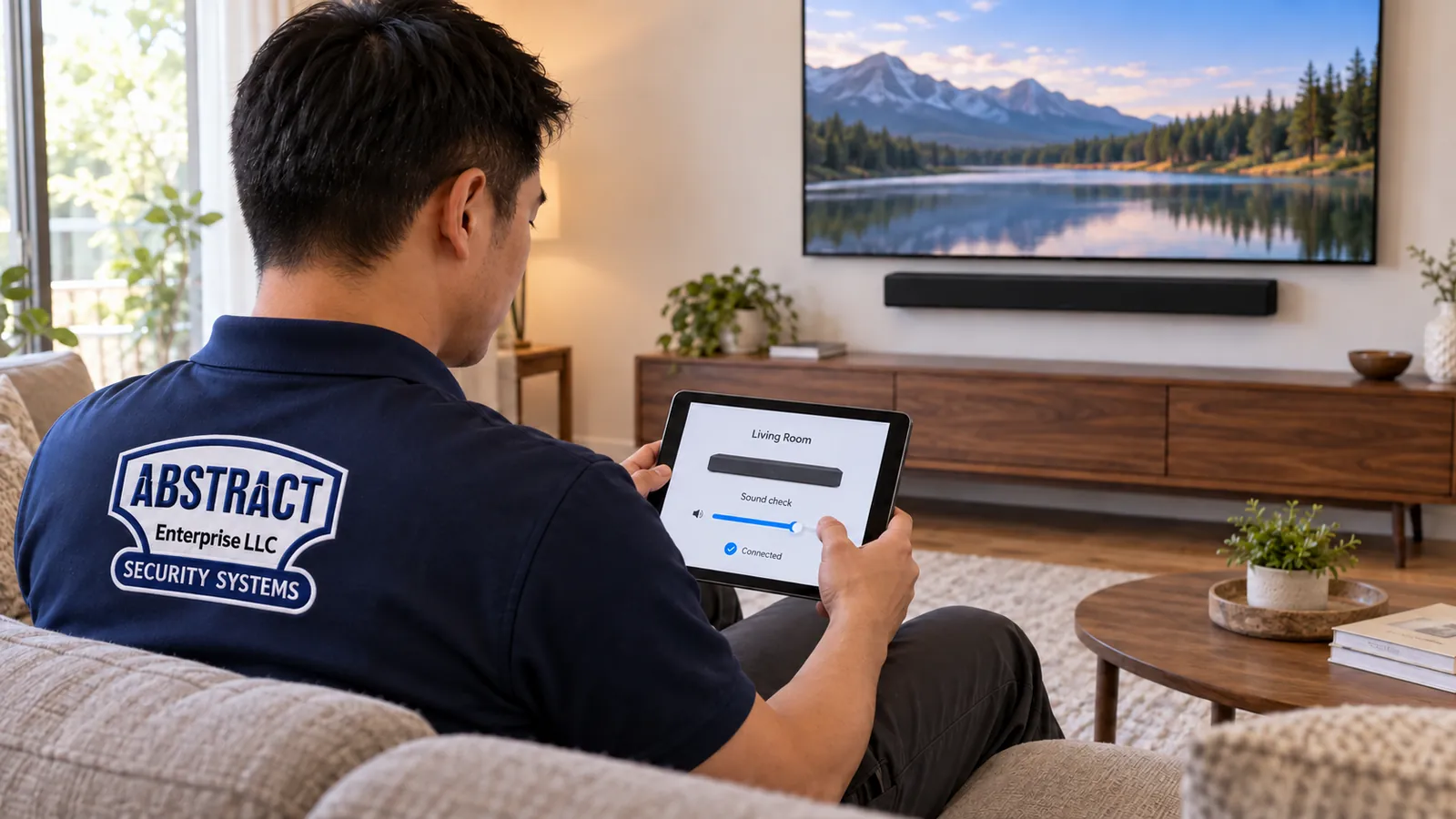
The tuning happens from the seat people will actually use, with the app open on a tablet and the bar on the wall across the room.
Most single-bar installs take one to two hours on site. Add time for a balloon-frame cable drop, a masonry wall or a full system with a subwoofer and rears; the quote tells you which applies.
Coverage Area
Soundbar Installation Near St. George's Landmarks
Everything in St. George is within a short, steep walk of the ferry. These six landmarks mark out the neighbourhood we cover on this page; the homes and businesses between them are where our St. George visits happen.
Staten Island Borough Hall
Completed in 1906 to a design by Carrère & Hastings, a designated city landmark still used as Borough Hall. John Carrère, a Staten Island resident, helped pick its hilltop site above Richmond Terrace. The streets of plaster houses climb behind it.
St. George Ferry Terminal
The island end of the free Staten Island Ferry, which NYC DOT runs 24 hours a day, 365 days a year, with a crossing of about 25 minutes to Whitehall. The reason so many St. George households want evening and weekend appointments.
Empire Outlets
Opened on May 15, 2019 at 55 Richmond Terrace, beside the terminal. In September 2026 the city's draft waterfront plan proposed towers over the existing mall and the former New York Wheel site.
National Lighthouse Museum
A three-to-five-minute walk from the ferry, in a building of the former U.S. Lighthouse Service depot complex that dates back to 1862. Bay Street's newer rentals and the Bay Street Landing lofts sit along the same shore.
“Postcards” 9/11 Memorial
Masayuki Sono's two 40-foot white wing-like sculptures on the St. George Esplanade, completed in 2004 and framing the view toward the former World Trade Center site. The harbor-view apartments behind it face the same skyline.
Curtis High School
Founded on February 9, 1904 as Staten Island's first high school, at 105 Hamilton Avenue, in a building designed by C.B.J. Snyder. Hamilton Avenue is also the northern edge of the Fort Hill area that preservationists have asked to add to the historic district.
We also serve the neighbourhoods around St. George: New Brighton and Randall Manor to the west, Tompkinsville and Stapleton along Bay Street to the south, Stapleton Heights and Grymes Hill up the ridge, and West Brighton and Livingston along the Kill Van Kull. Further afield, the Staten Island soundbar installation page covers the rest of the island, from the hi-ranch dens of the South Shore to the townhouse communities of the West Shore.
Richmond TerraceSt. Marks PlaceWestervelt AvenueHamilton AvenueCarroll PlaceDaniel Low TerraceFort PlaceNicholas StreetBay StreetBay Street LandingStuyvesant PlaceFort Hill
The Waterfront Is Changing
New St. George Buildings and What They Mean for Your TV Wall
No neighbourhood on Staten Island has as much housing proposed for it. The Staten Island Advance reported in September 2026 that the New York City Economic Development Corporation's draft plan would put up to 2,500 apartments in seven towers on the waterfront, including two 30-storey buildings beside the ballpark and others of 13 to 25 storeys, with a rezoning needed first. The same reporting counted close to 1,200 more units proposed on a single nearby block, a 56-unit building planned at 40 Bay Street and a 99-unit senior proposal on Fort Place. Lighthouse Point, already open, added its rental units beside the terminal; New York YIMBY reported affordable units still available there in February 2026.
Residents are divided. The same Advance coverage quoted a long-time St. George community advocate who welcomed new neighbours but worried about views and access to the waterfront, and an attendee at a Community Board 1 committee presentation who said they were surprised to see 30-storey buildings proposed right beside the ferry terminal. We have no view on the planning debate. What matters for this page is that the TV walls of St. George are shifting from plaster toward drywall partitions, and the rules shifting from owners toward management offices.
If you are moving into one of the new buildings, three things are worth knowing before the soundbar arrives:
Ask management about walls in writing. New buildings often have a move-in handbook that covers wall mounting. A short email asking whether a soundbar bracket and a cord cover are allowed saves an argument at move-out.
Check the network before buying an app-only bar. If the building supplies Wi-Fi, find out whether you get your own network name and password or share a managed system. The TV sound works either way; streaming and app control depend on it.
Think about the window wall. Harbor-facing apartments are built for the view, and the wall opposite the windows is often the only full-height solid wall. That is usually where the TV ends up, and the soundbar sounds best when the sofa faces it squarely rather than at an angle to the glass.
Pricing
Soundbar Installation Cost in St. George
There is no St. George premium. A soundbar on the hill or by the water costs exactly what it costs in Tottenville; where the borough does differ from Brooklyn or Queens is the TV base and the hourly setup rate, both shown below. Pick the lines your room needs, add them up, and that sum is your invoice. Should the wall prove to be different from what was booked, the revised sum is shown to you before a hole is made.
Item
Price
What it covers
Soundbar placed on a console or stand
$79
Placed, connected, set up and tested
Soundbar wall-mounted under the TV
$129
Bracket fixed, bar mounted and levelled, connected and tested
Sanus soundbar bracket
$84.99
Supplied when the bar's own bracket is missing or unsuitable
In-wall concealment
$169
Listed power-and-HDMI kit fished inside a stud wall
Paintable cord cover
$59
Surface channel for plaster, brick, concrete or rentals
Cable run to a cabinet or other spot
$99
Up to 25 ft
Sonos setup
$125
Sonos bar, sub and rears paired; app and grouping set up
A/V receiver
$129
Receiver connected and configured
Universal remote
$99
Programmed for TV, bar, cable box and streamer
Streaming device or games console
$49 each
Connected and set up on the right input
Full home theater hookup
$350
Bar or receiver, sub, rears and sources connected and tuned
Wall and access add-ons, as they show up in St. George
Condition
Add
Where you meet it here
Drywall over wood studs
$0
Renovated rooms and some divided-house partitions
Metal studs
+$30
New waterfront rentals, offices, shop fit-outs
Plaster
+$45
Historic-district and Fort Hill houses, pre-war flats
Brick or stone
+$65
Chimney breasts, pre-war masonry, warehouse brick
Concrete or cinder block
+$75
Bay Street Landing lofts, tower walls, cellars
Tile or marble
+$95
Kitchen and bar walls, restaurant fronts
Plywood backer board
$85
Fibreboard partitions and framing in the wrong place
High mount (above about 8 ft)
$75
Tall parlor walls, lofts
Box removal
$25
We take the packaging away
Certificate of insurance
Free
Co-ops, managing agents, new-building management
Worked totals for typical St. George rooms
Room
Lines
Total
Tower studio, bar on the console, nothing drilled
$79
$79
Parlor in the historic district, bar on plaster with the bar's own bracket
$129 + $45
$174
Same parlor, Sanus bracket and painted cord cover
$129 + $84.99 + $45 + $59
$317.99
Balloon-framed house, cables dropped inside the wall
$129 + $45 + $169
$343
Bay Street loft, bar on concrete with surface raceway
$129 + $75 + $59
$263
Fibreboard partition needing a backer board
$129 + $85 + $59
$273
New rental on metal studs, Sonos bar with in-wall kit
$129 + $30 + $169 + $125
$453
When the TV goes up at the same time
Plenty of St. George bookings are really two jobs: the screen and the bar. The Staten Island TV line begins at $209.99, which covers a 32-to-55-inch set on a fixed or tilting bracket fixed to drywall over wood studs. Bigger screens step up by $30 (56–65 inches), $60 (66–75) or $100 (76–85), and a mount above a fireplace is a further $130. Leaving the TV on its own feet and setting it up there is $137.99. When the bar is already on the wall and you only need it working properly, the setup-only rate is $225 for the first hour and then 30-minute blocks. The complete list of TV lines lives on the Staten Island TV mounting prices page.
Part of every job: locating studs or solid masonry, a bar that is level with the bottom of the screen, the HDMI or optical connection, cables dressed so nothing dangles, the TV remote set to control the bar, and the dust vacuumed up afterwards.
Not something we do: electrical outlets (an electrician with a licence installs or moves those), plaster repair and repainting, moving a piano, an antique sideboard or a heavy bookcase, and picture calibration of the TV itself.
When a visit cannot go ahead: if the bar or its bracket is not there, or no one can let the technician in, a $150 return-trip charge applies. Moving the appointment at least 24 hours ahead is free.
Surfaces that may crack: century-old plaster, ceramic tile, marble and mirror can chip even under a sharp bit at low speed. We point these out before drilling and you decide.
Shop Our Systems
St. George Soundbar Packages & Pricing
Renter, hill house or whole room: pick the nearest match, then trade any line for the wall you actually have. Nothing here is a bundle discount or a hidden extra.
RENTER
$79
Bar placed on the console in front of the TV, connected by HDMI eARC or ARC, CEC set so the TV remote controls volume, cables strapped out of sight. No holes, nothing to undo at move-out.
HILL HOUSE
$317.99
Wall mount on plaster with the Sanus bracket and a cord cover painted to the trim: $129 + $45 + $84.99 + $59. Framing found by test-drilling, plaster pre-drilled, bar levelled to the screen.
FULL ROOM
$648
Wall mount ($129) with in-wall concealment ($169) where the stud wall and the owner allow it, plus a full home theater hookup ($350) tying together the bar or receiver, subwoofer, rears and sources. Add the wall line for plaster or masonry if it applies.
Bring your own equipment. Every package is labour and parts only; the soundbar, subwoofer and rears are yours, bought wherever you like. If you have not bought yet, tell us the room and we will tell you which size of bar suits it before you spend anything. The only hardware we supply is the bracket, the anchors, the cover and the in-wall kit, at the prices listed.
Complete Services
Every Soundbar-Related Service in St. George
A soundbar is often the first job in a room, not the only one. These Staten Island services are run by the same company, priced from the same kind of published list, and can be booked on the same visit.
How can I tell whether our house is inside the St. George Historic District?
+
The Landmarks Preservation Commission designated the district on July 19, 1994. As the Historic Districts Council describes it, the district runs from the south side of Carroll Place to the north side of St. Marks Place, and from Nicholas Street to the west side of Westervelt Avenue. Fort Hill, just south of Hamilton Avenue, is outside it; residents have asked for an extension there. To check a single address, use the LPC's online map of designated properties. For a soundbar that stays indoors, the answer rarely changes what we do.
Our Queen Anne house has a rounded turret room. Can a TV and soundbar go on a curved wall?
+
Usually not on the curve itself. A flat bracket touches a curved wall at two points and leaves the TV rocking, and most turret walls are plaster on closely spaced framing, so there is little to anchor into. The better spots are the flat wall the turret opens from, or a low console inside the bay, where the bar sits on top for $79 and nothing is drilled. If you want the TV in the turret anyway, we look at it in person first.
Can we try the soundbar at a couple of heights before anything is drilled?
+
Yes, and on an old wall we prefer it. The technician holds the bar, or a strip of painter's tape the same length, at two or three heights under the TV while you sit where you normally watch. You choose; we mark the centre and level line, check what is behind the plaster there, and only then drill. It adds a few minutes, not a charge.
Our living room has a wall of old mirror tiles where the TV would go. Can you mount through them?
+
We do not drill mirror glass; it cracks too easily and the glued tiles can come off with the bracket. The choices are to have the tiles taken down by a glazier or the building first, then mount on the wall underneath at the normal price for whatever that wall is, or to leave the mirror alone and set the bar on a console under a TV on its stand, which is $79 for the bar.
Our shop has an old pressed-tin wall. Can a soundbar bracket go through it?
+
Often, yes. Pressed tin is a thin sheet nailed over furring or plaster, so the bracket's screws have to reach the framing or masonry behind it, not the tin. We find that structure first, drill the tin cleanly so the pattern doesn't dent, and price the job by the published add-on for whatever is behind it, such as plaster at $45 or brick at $65.
Our building supplies the Wi-Fi and we don't have the router login. Can the soundbar's streaming still be set up?
+
Yes for the TV sound itself, because HDMI eARC or ARC does not use the network at all. Streaming music and app control need the bar to join a Wi-Fi network, which works on most building networks with a normal password. Some managed networks show a sign-in page or keep devices from seeing each other, which can stop the app finding the bar; if so, we set it up over Bluetooth or through the TV, and tell you what to ask building management for.
Cameras, intercoms and networks are on the AESS home page; the people behind this page are introduced on our about page.
Soundbar Gone Silent Somewhere Between the Ferry and Fort Hill
Dialogue drifting out of step with lips, a subwoofer that no longer pairs, a TV remote the bar has started ignoring, or total silence after the TV downloaded an update: ring (347) 934-8335. The next free two-hour window is often today, and most connection faults take one to two hours to put right once we are there. On Staten Island a setup-only visit is $225 for the first hour.
Sources
Where the Local Facts on This Page Come From
Every local fact above comes from a published source we read while writing this page. Prices come only from the published AESS price list.
Soundbar Installation St. George — Licensed, Insured, Careful With Old Walls
Abstract Enterprises Security Systems · 1282 Troy Ave, Brooklyn, NY 11203 · serving St. George and all of Staten Island · (347) 934-8335 · WhatsApp (718) 679-0359 via wa.me
NYS Low-Voltage Licence #12000287431 · 100% Licensed & Insured · Same-Day Estimates · Rated 4.7★ from 201 Google Reviews
Brackets and parts carry their manufacturer's warranty. Full terms — including 50% deposit, one-year parts-only warranty on AESS-supplied products, and the late-fee schedule — are set out in the service agreement. See our warranty page.
Page reviewed and updated October 17, 2026. Changelog: first published for St. George households, from research into the 1994 historic district, Bay Street's warehouse lofts, the St. Marks Place towers and the 2026 waterfront plan.