Licensed Low-Voltage Contractor · Great Kills, ZIP 10308 · Ranches, Colonials, Capes & Semi-Attached Homes
Soundbar Installation in Great Kills
Staten Island's South Shore · Renovated Family Rooms · Ranch Basements · Harbor-Side Blocks
Great Kills is in the middle of a renovation wave. Houses built in the 1960s and '70s are being gutted, expanded or replaced block by block, so many soundbars here go onto walls somebody else just finished: a slat feature wall, a media wall with a recessed box, a fresh open-plan first floor, or a ranch basement with a steel column in the middle of it. Down by the harbor the question is where the expensive parts live when the water comes up. We fix the bar to whatever the wall really is, hide or dress the wiring, hook it to the TV's eARC or ARC port so one remote runs everything, and place the subwoofer for the room and the block. No bridge toll on the bill, and arrival windows are two hours wide, 8 AM to 8 PM, every day of the week.
Reviewed and updated October 17, 2026 · Written by Anwar Timothy, NYS licence #12000287431 · Part of our Staten Island soundbar installation coverage
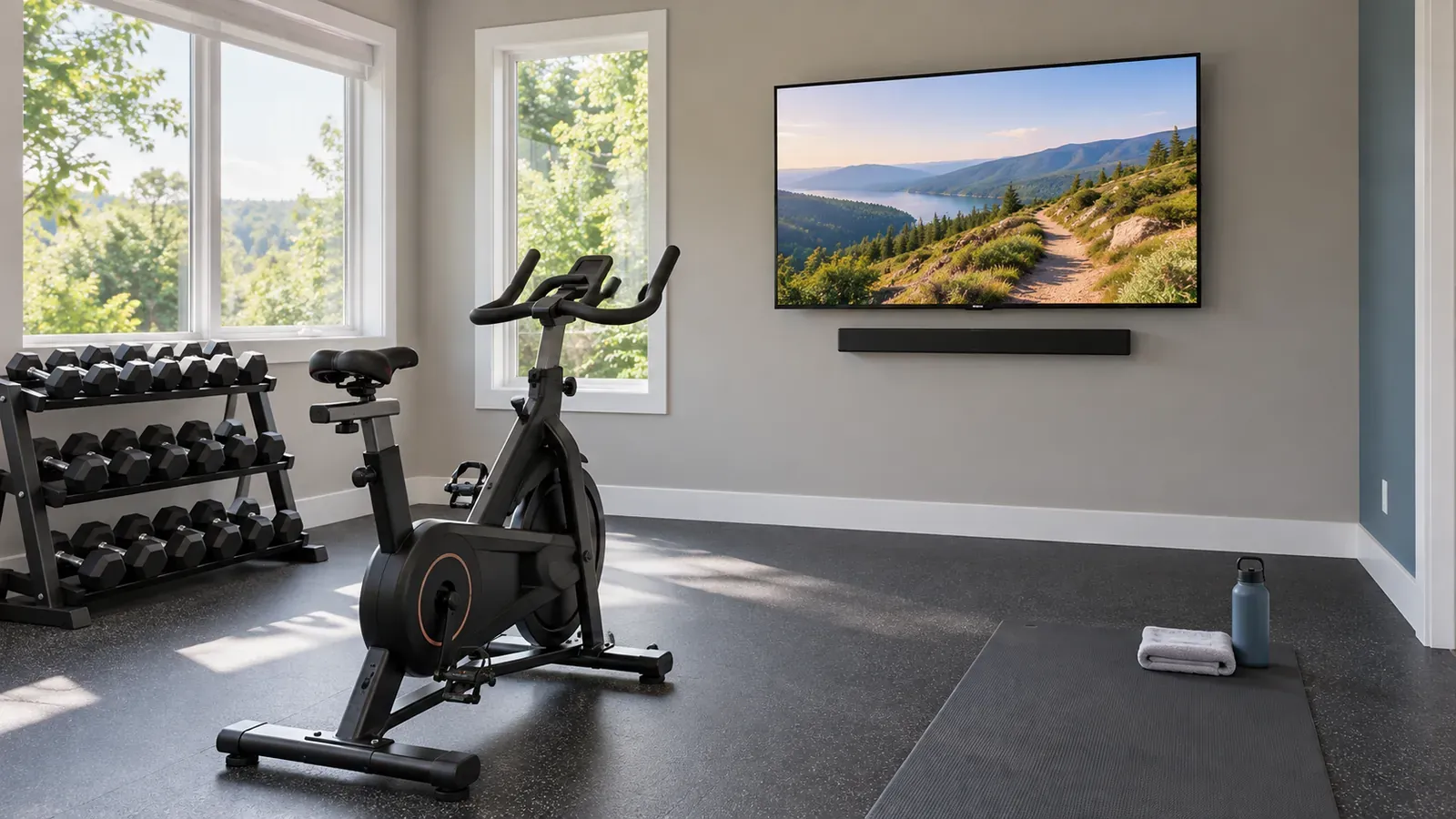
A converted spare room or garage gym: the TV on the wall, a slim bar a hand-width below it, and nothing on the rubber floor except the equipment.
Great Kills Soundbar Quote
Tell us the room and the wall — we call back with a written price the same working day
✅
Request Sent!
We'll call you back the same business day.
25+
Years Experience
✓
Same-Day Estimates
100%
Licensed & Insured
4.7★
201 Google Reviews
Just closed on a house off Amboy Road, or just finished one? Call (347) 934-8335 or send the short form. Say which room, what the wall is covered in and which bar you bought, and you get a written price built only from the lines published on this page.
The Verrazzano toll and our drive are never billed to a Great Kills address
$129 to hang the bar under a wall-mounted screen, $79 to set it on the console
NYS low-voltage licence #12000287431, insured, booked seven days a week
Great Kills is where a lot of Staten Island families end up when they want a real house with a driveway, a yard and a basement, and that shapes almost every soundbar job here. The neighborhood sits on the South Shore between Richmondtown to the north, Bay Terrace to the east, Eltingville to the west and Great Kills Harbor to the south. Its name has nothing sinister in it: "kill" is old Dutch for a creek or channel, and the area is threaded with small streams. For a long time it was farms, shoreline resorts and summer cottages near the railway stop that opened in 1860. Then the Verrazzano-Narrows Bridge arrived in 1964, and the fields filled in with the houses that most Great Kills families live in today.
You can still hear that story in how people talk about the place. One r/statenisland commenter wrote that their parents bought a house in Great Kills about a year after the bridge opened, on a lot that backed onto Kingfisher Pond. Brick Underground's neighborhood profile describes the same generation of homes: many of the detached and semi-detached houses date to the 1960s and '70s, in styles that run from ranches to center-hall colonials, and they typically come with backyards, driveways and garages. A local agent quoted in that piece put the average house size at about 4,000 square feet, which tells you something about the rooms a soundbar has to fill, even if plenty of the ranches and Capes are far smaller.
What is different now is the pace of change. A Staten Island brokerage that tracks Department of Buildings filings described Great Kills in March 2026 as a neighborhood where, "block by block, older homes are being expanded, repositioned, and replaced." Its permit review found major-alteration filings for additions and layout changes, interior-renovation filings for kitchens, baths and systems, and demolition permits on blocks where renovated homes had sold well. The same report put typical days on market at about 25 and sale prices at 101 to 103 percent of asking. For a soundbar installer that means two kinds of call keep arriving: owners who have just bought a renovated house and are living with a TV wall someone else designed, and owners who are about to open up their own walls and want the audio planned before the drywall closes.
The renovated house brings its own puzzles. Flippers and contractors like a feature wall behind the TV — vertical wood slats, a floating media wall with LED strips, a stacked-stone panel, sometimes a mirrored section left over from an older remodel. A recessed outlet box might already be behind the screen, at a height the new owner didn't choose. The open first floor that sells a house can leave one short wall for a 75-inch TV and nowhere to put a subwoofer. None of this is hard, but every one of those surfaces takes a different fixing and a different cable plan, and getting it wrong leaves holes in a finish that cost real money.
The older house brings different ones. A 1960s ranch basement often has a steel column holding up the main beam right where the sectional wants to go. The family room of a center-hall colonial is frequently at the back of the house, off the kitchen, with the cable service coming in on the opposite side. A semi-attached house shares one wall with the neighbor, and a Cape puts its bedrooms under the roof. Some of Great Kills is older still: a listing on McKee Avenue that Brick Underground featured was built in 1901, and houses of that age come with plaster and framing that don't behave like a 1970s stud wall.
Then there is the water. Great Kills has a working harbor with marinas and a yacht club, and a national park on its southern edge. That waterfront is the reason many people moved here, and it is also why a slice of the neighborhood has to think about storm surge. When Hurricane Sandy pushed into Great Kills Harbor in 2012, The Weather Channel reported that the water lifted boats over the docks, snapped their lines and carried them over the fences and onto the road. A climate-risk model from First Street now counts 1,230 Great Kills properties, about 14.4 percent of the total, as having some risk of flooding over the next 30 years. Most households are nowhere near the water's edge, but for those that are, the placement of a subwoofer, a power strip and a cable box is a real decision, not an afterthought.
Great Kills homeowners mostly decide for themselves what goes on their own walls, which keeps soundbar work simpler than in a Manhattan co-op. The exceptions are the condo and townhouse developments, where an association usually controls the exterior, the two-family houses where an owner and a tenant share a structure, and the newer backyard and garage units being added under the city's 2024 City of Yes zoning changes. We ask about all three when you book.
Great Kills at a glance, for anyone planning a TV wall
54,699 residents and 19,994 households in the Great Kills–Eltingville census tabulation area in 2020, with 22.9% of occupied homes rented (NYC Department of City Planning data, via Wikipedia). Most people here own the wall they want to drill.
1960s and '70s: the era of many of the neighborhood's detached and semi-detached houses — ranches, center-hall colonials and more — most with driveways, yards and garages (Brick Underground, 2023).
About 25 days on market, 101–103% of asking: a fast, renovation-driven market in which permit filings for expansions, interior gut jobs and teardowns are all active at once (Prodigy Real Estate, March 2026).
1,230 properties, 14.4%: Great Kills properties with some modeled flood risk over the next 30 years (First Street).
350 slips: the number of boat slips at Nichols Marina, in Great Kills Park, that Sandy destroyed; the marina reopened after a $6.5 million rebuild in May 2015 (NY1).
About 41,200 customers: the Con Edison customers in parts of Staten Island, Great Kills among them, asked to conserve power during repairs on July 2, 2026, by avoiding washers, dryers and microwaves (Staten Island Advance / SILive).
Put together, those numbers describe a neighborhood of owner-occupied family houses from the bridge era, many of them being reworked inside, on blocks that range from inland streets to harbor-side lots with genuine storm exposure. That is the job this page is written for, and it is why we ask about the renovation history and the location of the house as well as the wall.
Many Great Kills households that book a soundbar are also hanging, moving or upgrading the TV above it. The AESS TV mounting crew for Staten Island works from the same published price list, and when a single bar won't carry a long open-plan floor or a finished basement, our Staten Island AV and speaker installers plan a bigger system.
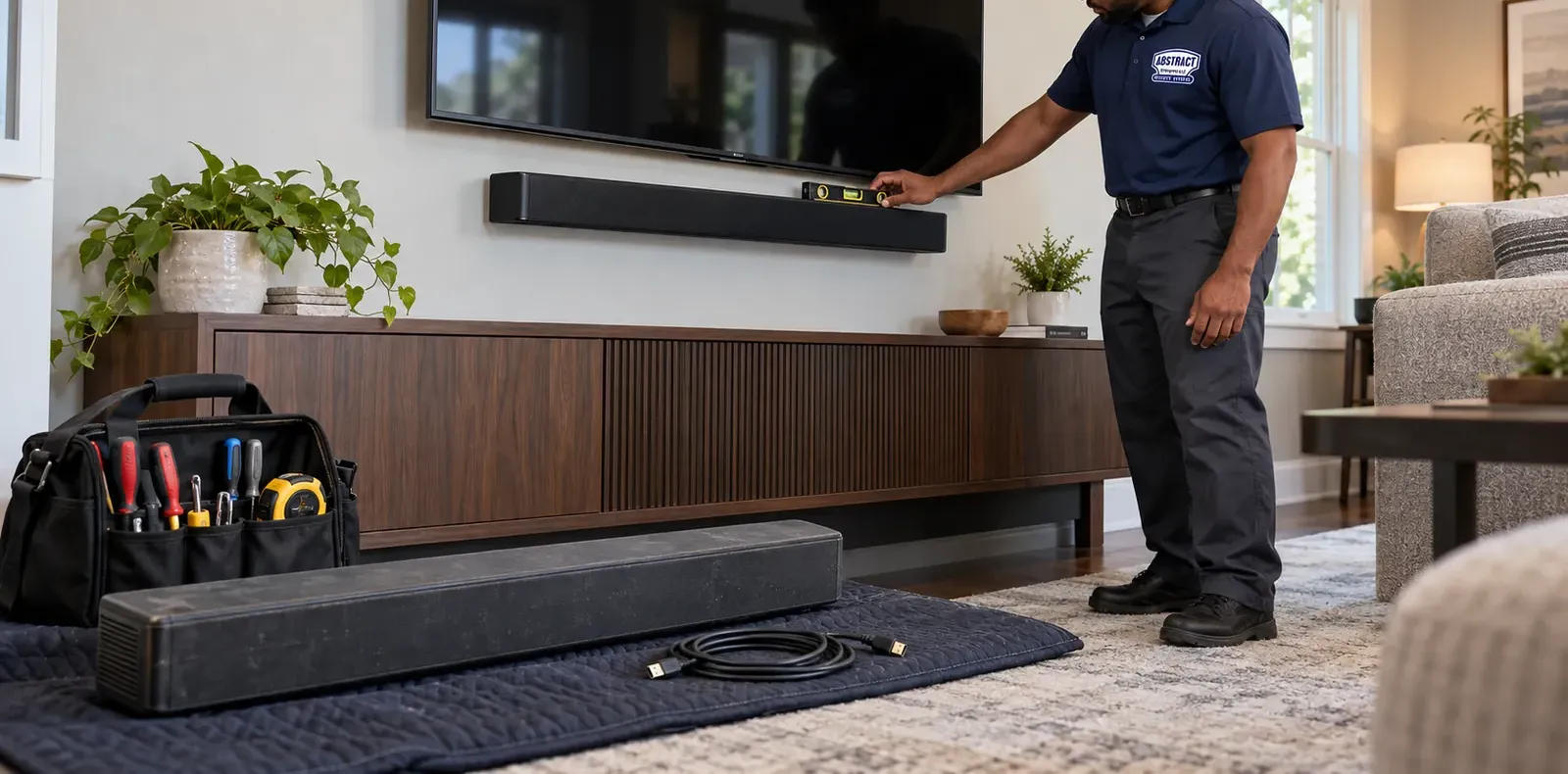
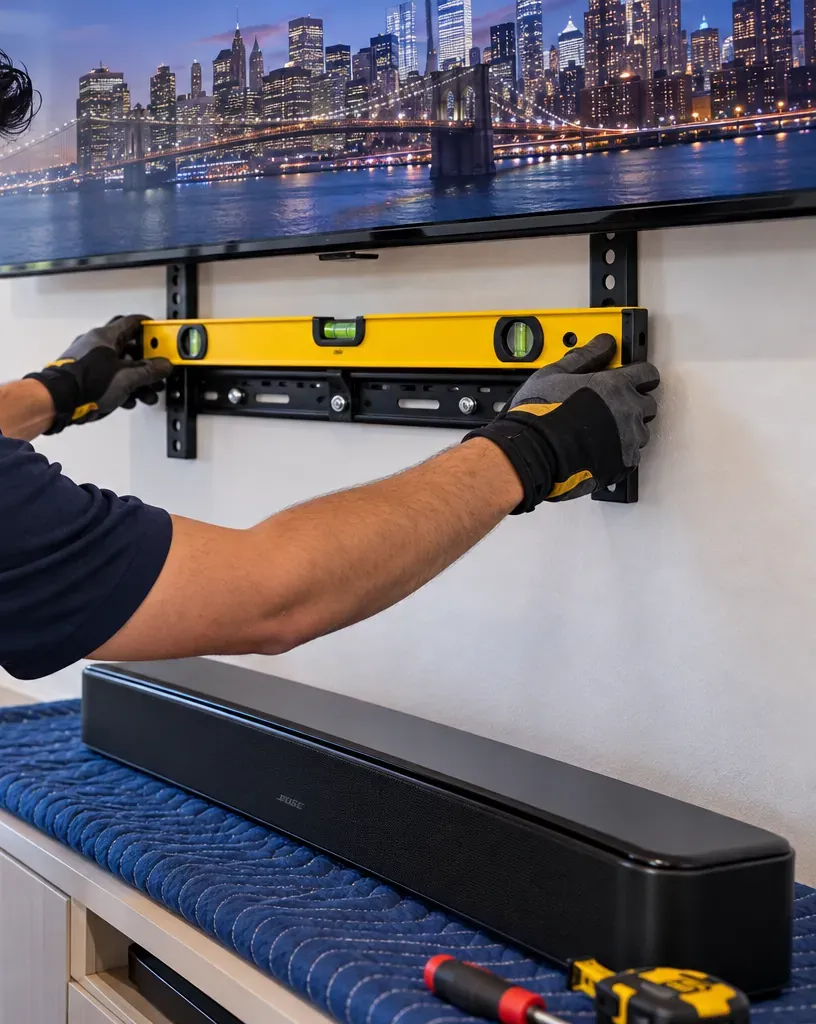
Level on the bar before the room is handed back. On a renovated wall this is also the moment to confirm the fixings have pulled tight into the framing.
The Renovation Wave
What a Great Kills Renovation Leaves Behind the TV
Department of Buildings paperwork has its own vocabulary, and it is worth knowing because it predicts what we'll find on the TV wall. A Prodigy Real Estate review of Great Kills filings in 2026 split them into three groups: major alterations (ALT-1) for structural work such as additions and layout overhauls, interior renovations (ALT-2) that modernize kitchens, baths and systems without moving structure, and demolition permits where a builder decided the land was worth more than the house. Each leaves a different kind of living room.
The Gut-Renovated Interior
New drywall over the original 1960s or '70s framing, fresh paint, new flooring, often an open kitchen. Studs are where they always were, which is good news, but the finished wall has no record of what's inside it. We scan, test-drill behind where the bracket will sit, and check for new plumbing or ductwork before committing.
The Expansion or Second Storey
An addition joins new framing to old. The family room may now be in the new part of the house, a long way from where the cable and fiber enter. We trace the route from the router to the TV before the bar goes up, because a soundbar that streams or groups with other speakers needs that link to be solid.
The Teardown Rebuild
A new house on an old lot, sometimes with a media niche, a recessed outlet and a conduit already built in. Sometimes the builder's idea of where the TV goes isn't yours. We work with what's in the wall where we can and tell you plainly when it would take an electrician to move.
The Feature Wall
Wood slats on felt, fluted panels, shiplap, a stone-look panel or an LED-lit floating wall. These are finishes, not structure. Every one needs the bracket fixings to pass through to studs or blocking, with spacers so the bar sits straight and the finish isn't crushed.
The Media Wall With a Recessed Box
A recessed power-and-data box behind the TV is the best thing a renovator can leave. It lets the TV hang flat and gives the soundbar a hidden path for HDMI and power. We check it actually contains what it should, and that the box sits where the screen will cover it.
The Basement Finished Fast
New drywall or panels over block, a drop ceiling, recessed lights and sometimes a steel column left in the room. Legal use matters here, and local brokers warn buyers to check permits and Certificates of Occupancy for finished lower levels; our job is simply to fix the bar and wire it safely to what's there.
If you are still in the planning stage of your own renovation, the cheapest soundbar install you will ever get is the one where we, or your contractor, decide the TV height, leave a recessed box and a clear path down to the cabinet, and put a strip of solid wood between the studs at the bracket line. If you have just bought somebody else's renovation, send us a photo of the wall and anything you know about who did the work. That's usually enough to tell you which fixings and which price line apply before a technician arrives.
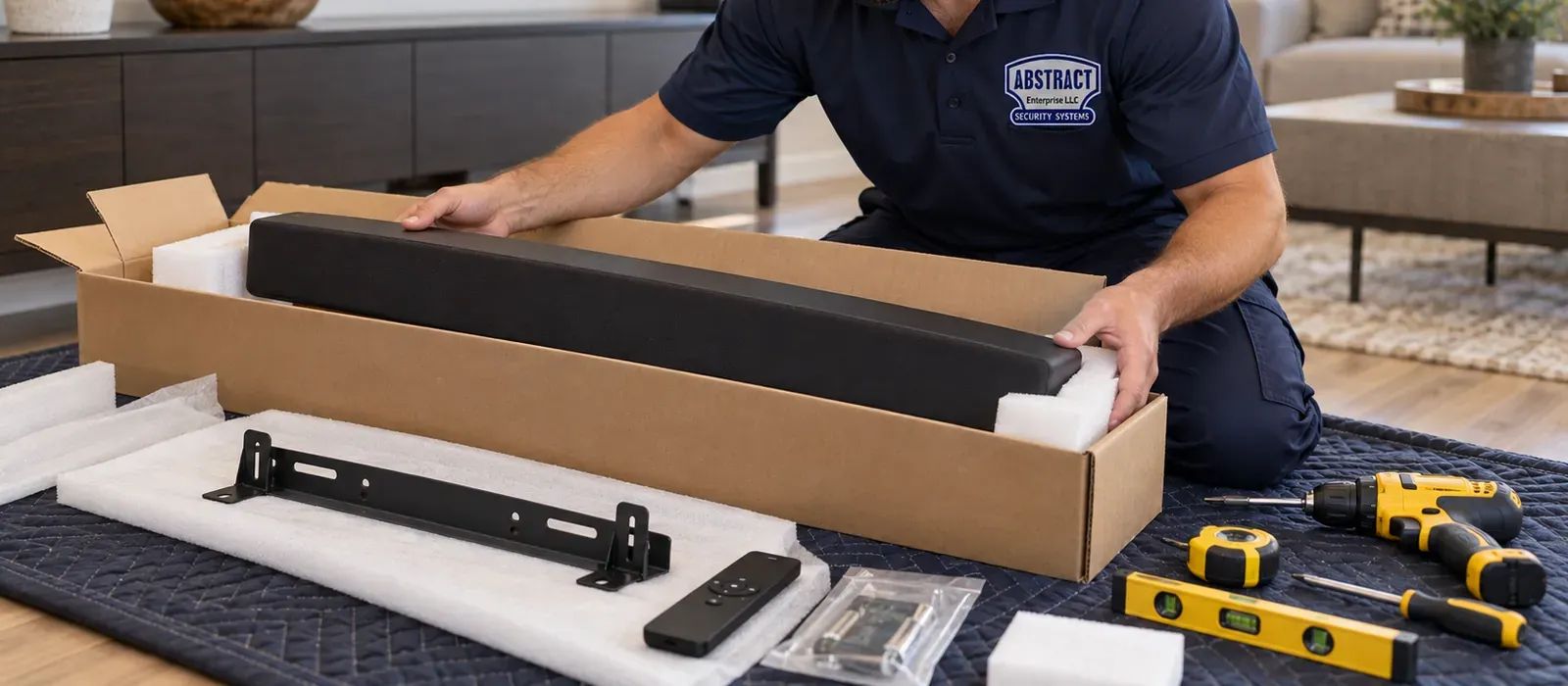
Bar, bracket, remote and hardware bag out of the box and checked before any drilling, so a missing part is found before the wall is touched.
What We Install
Soundbar Installation Services in Great Kills
Every Great Kills soundbar job is built from the fixed price lines further down this page. Whichever services you pick, the visit finishes the same way: the bar level under the picture, the wiring hidden or tidily dressed, the TV remote controlling volume, and a listen from the seat you actually use.
Bar Under a Wall-Mounted Screen
The core job. A bracket a few inches below the TV, centred on the picture rather than on the wall, fixed into studs, blocking or masonry with fixings chosen once we know what's there. $129 with the bar's own bracket.
Feature-Wall and Media-Wall Mounting
Slats, fluted panels, shiplap or a floating media wall. Fixings pass through the finish into structure, with spacers cut so the bracket lands flat and the finish isn't compressed or split.
Recessed-Box Wiring
Where a recessed box already sits behind the TV, we route the bar's HDMI and power through it so nothing shows. Where there isn't one, the in-wall kit ($169) does the job in a framed wall.
Ranch and Colonial Basements
Bar, wireless subwoofer and rear speakers in a lower-level room, placed around steel columns, stairs and the furnace room, with the sub kept off the floor where water has been before.
Console Placement
The bar on the media unit, connected and set so it doesn't block the picture or the remote sensor. $79. Right for a TV on its stand, a house about to be renovated, or a second room.
TV-Attached Brackets
The bar clamped to the TV or its mount. Useful on a mirror or stone-look panel you don't want drilled, and on full-motion arms in open-plan rooms where the screen swings toward the kitchen.
Cord Covers and Cabinet Runs
A paintable cord cover ($59) on block and masonry, or a cable run of up to 25 feet ($99) when the cable box lives in a cabinet across an open floor.
eARC, CEC and App Setup
The right HDMI port, CEC switched on, lip-sync checked, firmware updated and the bar's app joined to your network, so a Sonos, Samsung, Bose or Sony bar behaves the way its box promised.
Old Brackets Out, New System In
A renovated house often comes with someone else's hardware. We take down an old bracket ($45) or an old TV ($85), and can haul the old set away ($79) when the new one goes up.
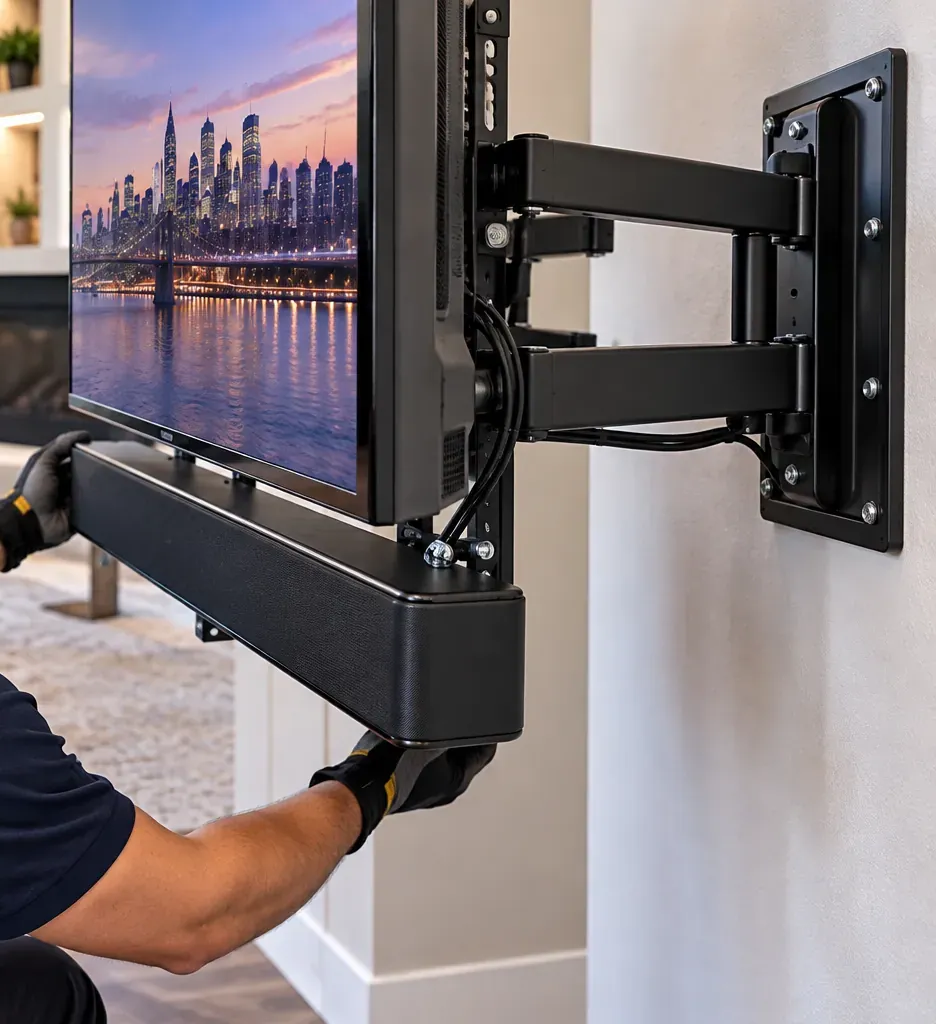
A TV-attached bracket keeps the bar with the screen when a full-motion arm swings it toward an open kitchen, and adds no holes to the wall.
Repair Capture
Soundbar Misbehaving in Great Kills?
If the bar went quiet after a TV update, a power cut or a contractor flipping breakers, if the TV remote no longer moves its volume, if voices have slipped out of step with mouths, or if the subwoofer has stopped pairing, that's a service visit rather than a fresh install. We put these into the next free two-hour window, and most connection and settings faults are fixed within one to two hours of a technician arriving. On Staten Island a setup-only visit is $225 for the first hour, then 30-minute blocks. Call (347) 934-8335 and say it's a soundbar problem; our TV and soundbar visit policies explain arrival windows and rescheduling.
Building Specialists
Soundbar Installation for Great Kills' Architecture
A Great Kills street can hold a 1901 frame house, a 1960 ranch with a built-in garage, a semi-attached 1975 house near the beach and a brick home from 1997 — all four appeared in a single Brick Underground listing round-up. Robert DeFalco Realty's 2026 neighborhood guide adds Capes, broad ranches, high ranches, split-levels, contemporary houses, townhomes and condos to the list. These are the house types we plan for, and what each means for the bar.
Center-Hall Colonials
A formal living room at the front, a family room at the back off the kitchen, bedrooms upstairs. The TV usually lives in the family room, often on a wall broken up by a slider or windows, with the cable service entering on the far side of the house. Drywall on wood studs; the work is in the cable route, not the fixing.
Ranches and Broad Ranches
Living space on one floor and a full basement below. Upstairs walls are plaster-board or drywall on studs; downstairs is block foundation, steel columns and a main beam. The basement is where the second, bigger system usually goes.
Semi-Attached Houses
Two homes joined at one wall, each with its own driveway and yard. Interiors are framed and easy to fix into; the shared wall is the one where we keep the subwoofer away and think twice before drilling deep.
Capes
Main rooms on the ground floor and bedrooms tucked under the roof. A Cape-lined block in Great Kills was the site of one of Staten Island's early City of Yes backyard-unit projects, reported by The City in 2025. Ground-floor TV walls are conventional; upstairs, short walls and sloping ceilings change where a bedroom bar can go.
High Ranches and Split-Levels
The family room half a level down beside the garage, the living room above it. The lower room tends to hold the router and the main TV; the steps between levels carry sound further than people expect.
Older Frame Houses
A minority of Great Kills homes date from before the bridge era, including the 1901 house on McKee Avenue that Brick Underground featured. Expect plaster, irregular stud spacing and decades of rewiring; we bring backer board and allow time to find the framing.
1980s–1990s Brick Homes
Brick outside, drywall inside, often a finished basement and a deck. The interior TV walls are straightforward; the brick matters only if the bar is going on the inside face of an exterior wall where cables can't be fished.
Townhomes and Condos
Developments, including the townhouse areas north of Amboy Road that residents mention online, with associations handling the outside. Inside the unit the walls are yours; anything through an exterior wall needs the association's agreement first.
Backyard Cottages and Garage Units
New accessory units allowed under the City of Yes for Housing Opportunity, passed on December 5, 2024. Small rooms, new framing, sometimes a separate tenant. A compact bar and a modest sub are usually right.
How we fix the bracket to each Great Kills surface
New drywall on old studs (no wall surcharge). The most common renovated wall. We find studs with a scanner, prove them with a small pilot hole behind where the bracket will sit, and drive the bracket screws into wood. Renovations sometimes add plumbing for a new bath upstairs or a duct run for central air, so we check the cavity before drilling deep. Plastic anchors alone in drywall are not used for a bar that will get bumped by a vacuum or a child.
Slat, fluted and shiplap feature walls (no surcharge for the finish itself). These are thin finishes fixed over drywall. The bracket's fixings go through a gap between slats, or through the panel, into the stud behind; a spacer the depth of the panel sits behind the bracket so tightening the screw doesn't crush the felt or bow the slats. If the slat wall is fixed straight to block, the masonry add-on applies.
Concrete block and poured foundation (+$75). Ranch and colonial basements. Hollow block takes anchors set into the solid webs or anchors made for hollow masonry; poured concrete takes concrete screws or wedge anchors and a hammer drill, with dust contained. A finished basement may hide block behind furring and drywall, which we find before choosing a fixing.
Plaster (+$45). The older frame houses. Slow drilling to keep the plaster keyed to its lath, fixings into studs, and a plywood backer ($85) where the framing is irregular and the load needs spreading.
Brick or stone (+$65). A brick fireplace wall or a true masonry accent wall. Sleeve anchors into the brick or stone, never the mortar joint. Stone-look panels and thin veneer glued to drywall are not masonry, and are treated like a finish over framing.
Tile or marble (+$95). A tiled wall behind a basement bar or a kitchen TV. Diamond or tile bits at low speed, tape over the mark, and a frank conversation first: tile and stone can crack even under a careful bit, and you decide whether we go ahead.
Metal studs (+$30). Newer basement fit-outs and some commercial spaces along Amboy Road and Hylan Boulevard. Toggle anchors designed for steel studs hold a soundbar bracket comfortably.
The bracket goes up and is leveled first, with the bar resting on a blanket on the console until the fixings are proven.
Commercial Soundbar Installation
Business Soundbar Installation in Great Kills
Great Kills businesses that call about a soundbar are mostly single-screen rooms: a pizzeria or deli with a TV over the counter, a waiting room, a gym, a salon, a small office, a marina office or clubhouse lounge. One bar under one screen is often exactly right. When the sound has to reach a whole dining room, an outdoor deck or several screens at once, we say so and price speakers through our AV team instead. These are the streets those calls come from.
Amboy Road
The neighborhood's main commercial corridor, according to Brick Underground, and where the "Welcome to Great Kills" sign stands. Supermarkets such as the Stop & Shop at 4343 Amboy Road and Top Tomato at 4045 sit among restaurants, pizzerias, cafés and service shops. Storefront TVs and counter screens are the usual soundbar jobs.
Hylan Boulevard
One of Great Kills' other major commercial streets, lined with strip centers, medical and dental offices, gyms and restaurants. Waiting-room TVs with clear dialogue and a capped volume are the typical request.
Arthur Kill Road
Part residential, part commercial, and home to Atrium Stadium Cinemas at 680 Arthur Kill Road. The plazas nearby hold the kind of small businesses that want one screen to sound right without a full audio system.
Giffords Lane and Nelson Avenue
The civic heart of the neighborhood: the Great Kills station of the Staten Island Railway, the public library at 56 Giffords Lane, the post office at 1 Nelson Avenue and the firehouse at 256 Nelson Avenue, with shops and offices around them.
Mansion Avenue and the Harbor
The marina strip along Great Kills Harbor, with boatyards, the Richmond County Yacht Club at 142 Mansion Avenue and waterfront restaurants. Indoor lounges and offices are soundbar territory; open decks need weather-rated speakers.
The Bay Terrace and Eltingville Edges
Amboy Road and Hylan Boulevard run on into the neighboring South Shore communities, and the plazas along the borders serve Great Kills households too. Salons, gyms, take-out counters and professional offices make up most of the single-screen calls.
For a business we schedule around opening hours inside our 8 AM to 8 PM windows, provide the certificate of insurance a landlord or plaza manager wants at no charge, keep drilling dust off counters and food areas, and leave the bar on settings the staff can't easily undo. More than one screen, an outdoor area or a menu-board wall gets a written quote rather than a menu price.
Rules a Great Kills business soundbar should respect
Protruding objects (ADA 2010 Standards, section 307.2). Anything wall-mounted with its leading edge between 27 and 80 inches above the floor may project no more than 4 inches into a circulation path. A soundbar on an extending arm at shoulder height in a narrow waiting room or a marina office corridor can break that; a low-profile bracket or a higher position solves it.
The city's commercial music limits. The NYC Department of Environmental Protection's Noise Code guide limits commercial music to 42 dB as measured inside a nearby home and to 7 dB over ambient on the street between 10 PM and 7 AM, and treats bass separately. A restaurant on Amboy Road with apartments above, or a harbor-side venue with houses across the street, should set the subwoofer with that in mind.
Cords stay out of the wall cavity. Ordinary power cords pushed through drywall are not allowed by the electrical code, which is why our concealment uses a listed in-wall power kit fed from an existing outlet. A new outlet or circuit is a job for a licensed electrician; we don't do electrical work.
Insurance paperwork. Plaza owners, landlords and clubs often ask for a certificate of insurance before a trade drills. We issue it free and name whoever needs to be named.
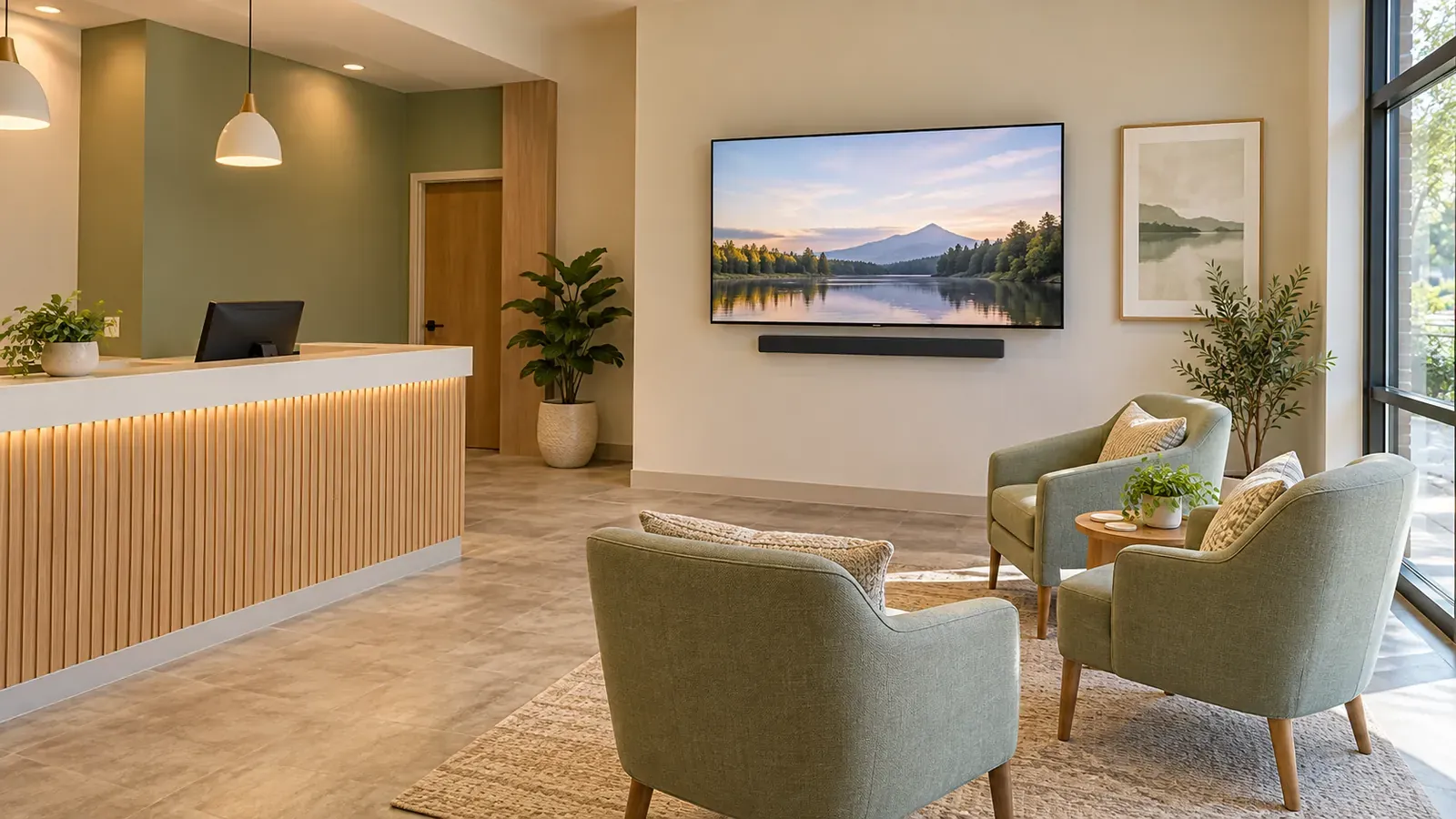
One screen, one slim bar tight beneath it, chairs facing it: the typical single-screen business job on Amboy Road or Hylan Boulevard.
Your Questions Answered
Soundbar Installation in Great Kills: Questions Answered
These are the questions Great Kills owners raise before booking, grouped by the situation behind them: a house someone else just renovated, a bridge-era ranch or colonial, and a home near the harbor. Shorter questions about price and booking are in the FAQ further down. The borough-wide Staten Island soundbar page covers hi-ranch den walls, stone fireplaces, paneled basements and townhouse party walls, so we don't repeat those here.
Houses someone else just renovated
The renovated house came with a wood-slat feature wall behind the TV — can the soundbar bracket go on it?
Yes, as long as the fixings go through the slats into what's behind them. Slat walls, whether real wood on a felt backing or fluted MDF panels, are a decorative layer usually glued or screwed over drywall. They look solid and they are not built to carry weight on their own. A bracket screwed only into a slat will hold at first and then loosen as the slat flexes, and on felt-backed panels the felt compresses so the bar ends up tilting forward.
What we do is find the studs behind the panel with a scanner, check the depth of the slat layer, and choose the bracket position so its screw holes land either in the gaps between slats or through a slat at a stud. A spacer block the same depth as the panel goes behind the bracket so the screws pull against solid material rather than squeezing the felt. The bar ends up straight and tight, and the slat pattern isn't cut or split.
There is an acoustic bonus to slat panels with felt behind them: they soak up some of the reflections that make a bare drywall room sound harsh, which helps dialogue. The only trade-off is that they can soak up a little of the "width" a soundbar creates by bouncing sound off the side walls, so we set the bar's room calibration after it is mounted, not before. If the slats were fixed straight onto block or a poured wall rather than drywall, the masonry add-on ($75 for block or concrete) applies; otherwise the job is the standard $129, plus the Sanus bracket at $84.99 if the bar's own bracket is missing or too shallow for the spacer.
Part of the living-room wall is still mirrored from an older remodel — can the TV and soundbar go there?
Not by drilling through the mirror. Glass mirror panels are glued or clipped to the wall, and drilling glass on site risks cracking the whole panel, which is both expensive and dangerous. A bracket clamped over the face of a mirror also has nothing solid to grip. So the question is really whether the mirror stays.
If you are keeping the mirror, the cleanest answer is usually to mount the TV beside it on plain wall and hang the bar from the TV mount with a TV-attached bracket, or to put the bar on a console below the mirror with the TV on a stand. If the mirror is coming down anyway, which is common in a house being modernized, have it removed first by a glazier or your contractor, let them patch the wall behind it, and book us for after the paint is dry. Mirror adhesive often pulls the paper face off drywall, and a patched area needs to be sound before it carries a bracket.
We will not remove mirror panels ourselves, and we won't drill near one without your agreement. If you send a photo of the wall showing where the mirror starts and stops, we can tell you whether there's enough plain wall to one side for the TV and bar without touching the glass.
Living with a media wall someone else designed
Floating media walls — a built-out panel with a TV recess, a shelf for the bar and LED strips around the edge — are a favorite of renovators because they photograph well. Living with one is mostly about three checks. First, whether the shelf meant for the soundbar is deep and tall enough: many bars need clear space above them for upward-firing drivers, and Sonos, for example, asks for at least 4 inches between its Arc Ultra and the TV above it. A bar pushed into a tight niche loses that space and the overhead effect with it.
Second, where the cables really go. A media wall usually has a hidden chase, but it may run to a cabinet you don't use or stop at an outlet that isn't switched the way you expect. We trace it before relying on it. Third, the LED strips: their power supplies sometimes sit in the same cavity as the HDMI cable and can add a faint hum or interference if a cheap supply sits right against an audio lead. Separating them by a few inches usually cures it.
If the shelf won't work, the bar can be mounted directly under the TV on the face of the media wall, which is a finish over framing like any other, or hung from the TV mount itself.
One open first floor where there used to be three rooms
The most common interior renovation in a bridge-era house takes out the walls between the kitchen, dining room and living room. It sells the house, and it changes the audio problem completely. Instead of a living room with four walls, the soundbar now faces a long, hard-surfaced space: a kitchen island, tile or vinyl plank floors, big windows at the back and often a ceiling with recessed lights instead of a plain flat surface. Sound that used to bounce off a nearby side wall now travels into the kitchen and fades.
The fixes are mostly about placement and expectations. The TV wall should be the one the sofa faces squarely, even if another wall looks better in photos, and the bar should be centered on the picture, not on the wall. Rear speakers or a sub help more than a longer bar in a room like this, and a full-motion mount ($40 on the TV line) lets the screen turn toward the island while someone cooks. If the room is very long, it's worth asking whether one or two ceiling speakers over the kitchen end, fed from the same system, would serve better than turning the bar up.
Open plans also tend to remove the wall the cable box used to hide behind. A cable run of up to 25 feet ($99) to a cabinet on the other side of the room, or a streaming device on the TV in place of a separate box, keeps the new space tidy.
Bridge-era ranches, colonials and Capes
A steel column holds up the middle of our ranch basement — where do the TV and soundbar go?
Usually on the long foundation or partition wall that the column isn't in front of, with the seating arranged so the column sits to the side of the sightline rather than in it. Basement columns in houses of this age support the main beam that carries the floor above, so they stay where they are: you can box them in or paint them, but you can't move one without an engineer and a permit, and we never fix anything to a structural column.
The column changes the sound plan more than the mount. A soundbar creates width by bouncing sound off the side walls, and a column a few feet in front of the bar casts a sort of acoustic shadow on one side. If the column is between the bar and the seats, we'll suggest shifting the TV wall so the column ends up behind or beside the sofa instead. Rear speakers often work well on either side of the seating, and the column can even help hide a rear speaker's power cord if the speaker sits just behind it.
Basements with a column also tend to have a low beam across the ceiling, ducts and a drop ceiling. We check the clearance for a TV and bar under the beam, keep any up-firing Atmos expectations realistic under ceiling tiles, and route the HDMI along the wall rather than across the floor where people walk.
The colonial family room and the cable that comes in on the other side of the house
In a center-hall colonial the TV often ends up at the back of the house in the family room, while the cable or fiber service, and therefore the router, enters on the front or side wall. That gap matters to a soundbar in two ways: the cable box has to reach the TV, and a streaming or multi-room bar needs a steady network link. Where the basement below is unfinished, we can often run a cable up through the floor into the back of a cabinet without opening a finished wall, using the cable-run line ($99 for up to 25 feet).
If the basement is finished, the alternatives are a mesh Wi-Fi point near the family room, a powerline adapter, or a properly run network line, which our Staten Island network cabling team can add. During setup we read the bar's signal strength in its app and choose the fix based on that number, not a guess.
Bedrooms under the roof in a Cape
Upstairs in a Cape the TV usually goes on the one full-height wall, often the gable end, because the side walls are short and slope away. A compact bar on a dresser below a wall-mounted TV is the most common setup we'd suggest, with the subwoofer left out or set low because the bedroom floor is directly over the main living area. The gable wall is framed like any other, but insulation in older Capes was sometimes added later and can be tightly packed, which slows any in-wall cable run; a cord cover is often the quicker answer up there.
Homes near the harbor
If an evacuation order covers our block, what should happen to the TV and soundbar before we leave?
Unplug everything and get the expensive pieces up off the floor — and plan for that on the day the system is installed, not the day the order comes. New York City has six hurricane evacuation zones, and when a coastal storm approaches the city can order evacuations starting with zone 1 and adding zones as needed; you can look up your address at maps.nyc.gov/hurricane or by calling 311. Emergency-management guidance commonly tells evacuating households to unplug televisions and other electrical equipment and to move important items to a higher floor if they can.
For a soundbar system that means a few things we set up in advance in harbor-side homes. All the parts plug into one surge-protected strip mounted where you can reach it, so one switch and one plug pull disconnect the TV, bar, subwoofer and cable box. The wireless subwoofer sits on a stand or shelf rather than the floor, and on a ground-floor or basement setup we leave its pairing simple enough that you can carry it upstairs and reconnect it later without help. The bar on a wall bracket is already above an inch or two of water; the floor-standing pieces are the ones that are lost.
When you come back, don't power anything until the outlets and the strip have been checked if water reached them (see the FAQ below). If the system simply lost power, turn the TV on first, then the bar; if they don't find each other over HDMI, a setup visit sorts out the CEC settings.
We keep a boat at one of the harbor marinas — can you put a soundbar in the cabin?
No, and we would rather tell you why than take the job. Home soundbars are built to run on household AC power in a dry, stable room. A boat's cabin has its own DC electrical system, shore-power connections, movement, vibration, damp and salt, and wiring on board is specialist marine work that has its own standards and its own trade. Mounting a household bar on a boat bulkhead and running it from an inverter is the kind of improvised job that ends with a corroded connector or worse.
Great Kills has a long boating culture — Nichols Marina in the park, the boatyards along Mansion Avenue, the Richmond County Yacht Club founded in 1923 — and marine electronics dealers who fit marine-rated stereos and speakers. That's the right route for the cabin. What we can do is the land side: the TV and bar in the clubhouse lounge, the marina office, or the den at home where you plan the next trip.
When Con Ed asks the neighborhood to cut back in a heat wave, is the soundbar worth switching off?
It's one of the smallest loads in the room. On July 2, 2026, Con Edison asked about 41,200 customers in parts of Staten Island, including Great Kills, to conserve power during repairs, and the appliances it named were washers, dryers and microwaves — the heavy users. A soundbar playing at living-room volume draws a small fraction of what an air conditioner or a dryer does, and the TV screen above it usually draws more than the bar.
That said, a conservation request is a sensible moment to turn off the subwoofer and anything you aren't watching, and to avoid running a big system loud for hours. More useful is what happens when the power dips or cuts out: the TV and bar can lose their HDMI link and come back confused. Plugging the system into one surge-protected strip, as above, and letting the TV start first usually brings it back cleanly. If it doesn't, the CEC settings are worth a look on a service visit.
If you have a whole-house generator or a battery backup, the bar and TV are light loads for it, but put them on the same protected circuit or strip so they come back together rather than one at a time.
Keeping the subwoofer and power strip safe on a harbor-side ground floor
Houses close to Great Kills Harbor are the ones local brokers single out for extra flood due diligence, telling buyers to ask about flood zones, elevation, where the mechanical systems are and whether the house has flooded before. The audio version of that advice is short: nothing that costs real money lives on the floor of the lowest level. The bar goes on a bracket, the subwoofer on a solid stand or a low shelf (it still sounds right a few inches up), the power strip on the back of the cabinet, and the cable box on a shelf rather than the carpet.
We also avoid running new cables along the base of an exterior wall facing the water. If your home was raised after Sandy, the borough page explains how we handle the long run from the utility entry to an elevated living floor.
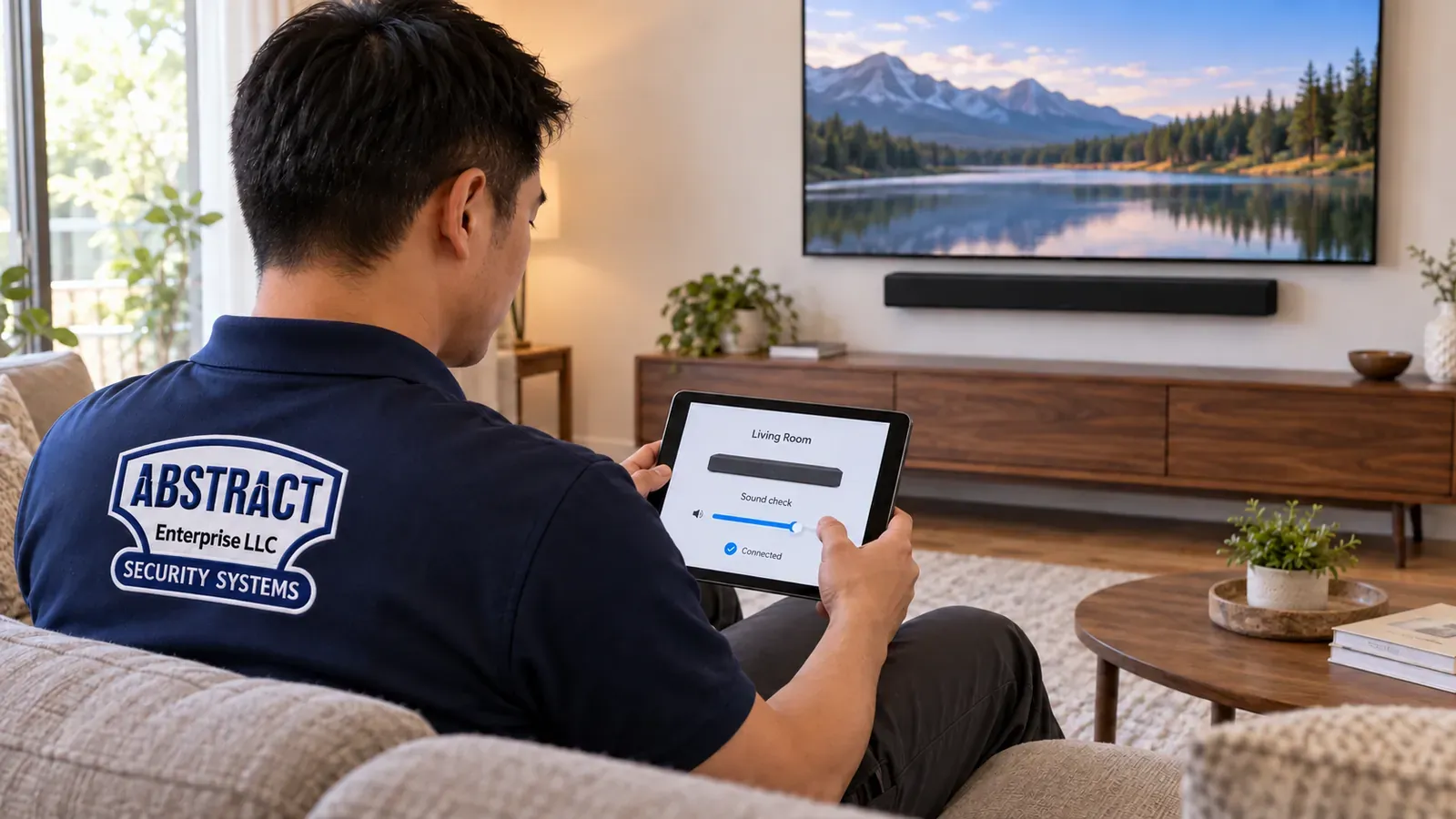
The app check is done from the seat people use. It also shows whether the bar is reaching the router reliably, which matters when the router lives in the basement.
Equipment
Types of Soundbars and Mounts We Install
We install the bar you bought — Sonos, Samsung, LG, Sony, Bose, Vizio, Polk, Yamaha, Denon and the rest — and supply brackets, cables and covers when you need them. We don't sell soundbars, so our advice on size and type is about fit for the room. These are the categories that suit the rooms we see most in Great Kills houses.
Compact Bars for Capes and Cottages
Short bars of roughly 22 to 26 inches, often without a separate sub. Sonos's Ray, for instance, is about 56 cm wide, under 2 kg, and connects by optical rather than HDMI. Right for an upstairs Cape bedroom, a backyard unit or a kitchen TV.
Mid-Size HDMI Bars for Family Rooms
The 25-to-40-inch bar with HDMI ARC or eARC. The Sonos Beam (Gen 2) is about 25.6 inches wide and 6.35 lb. A good match for 50-to-65-inch TVs in a colonial family room or a renovated living room.
Flagship Atmos Bars for Open Floors
Bars of 45 inches and more with up-firing drivers, such as the Sonos Arc Ultra at about 46.4 inches and 13 lb. They need a flat, hard ceiling to bounce height effects off and clear space above them on a media-wall shelf.
Bar, Sub and Rear Kits for Basements
Systems such as Samsung's HW-Q990D, 11.1.4 channels, where each wireless rear speaker still needs its own outlet. The favorite for a ranch basement, as long as the column and the outlets are planned around.
Wall Brackets and Spacers
The bracket from the box, or the Sanus soundbar bracket we supply for $84.99. On slat and fluted walls we add spacers cut to the panel depth so the bracket lands flat on the finish.
TV-Attached Brackets
Brackets that clamp the bar to the TV or its mount. Sanus makes extendable models for 50-to-90-inch TVs and universal versions for bars up to about 20 lb. The answer beside a mirror, on a full-motion arm, or wherever the wall shouldn't be drilled.
In-Wall Kits, Covers and Cabinet Runs
A code-compliant in-wall power and cable kit ($169) in framed walls, a paintable cord cover ($59) on block and masonry, and cable runs to a cabinet up to 25 feet ($99).
Surge Strips and Network Lines
One surge-protected strip for the TV, bar, sub and box, mounted where you can reach it before a storm. A wired network line or mesh point where the router sits far below or across the house.
Remotes, Streamers and Bias Lights
A universal remote ($99) when the cable box, streamer and bar won't share the TV remote; streaming device or console setup ($49 each); an LED bias light ($75) behind the TV for evening viewing in a dark basement.
Three ways to get a Great Kills soundbar on the wall, compared
Question
Do it yourself
App-based handyman or retailer service
Licensed low-voltage installer (AESS)
Slat panel, fluted wall or media wall
Guesswork about what's behind it
Often priced as plain drywall
Fixings through to framing, spacers cut on site
Mirror, tile or stone-look panel
Risk of cracking the finish
Varies by technician
Advice before drilling; TV-attached option offered
Basement column, beam and drop ceiling
Trial and error
Rarely planned for
Layout, clearance and cable route planned first
Storm and outage readiness
Whatever the outlets allow
Not usually discussed
One protected strip, gear off the floor, quick shut-off
eARC, CEC and lip-sync
Manuals and forums
Basic connection
Set up, tested and explained
Toll or travel to Great Kills
None
Varies by provider
None on the invoice
National platforms publish flat soundbar menus that are fine for a standard drywall wall. Great Kills' difference is how many walls aren't standard any more: new feature finishes, media walls, mirrors left from older remodels, and basements built around structural steel. A local installer who has priced those surfaces in advance can quote the actual wall.
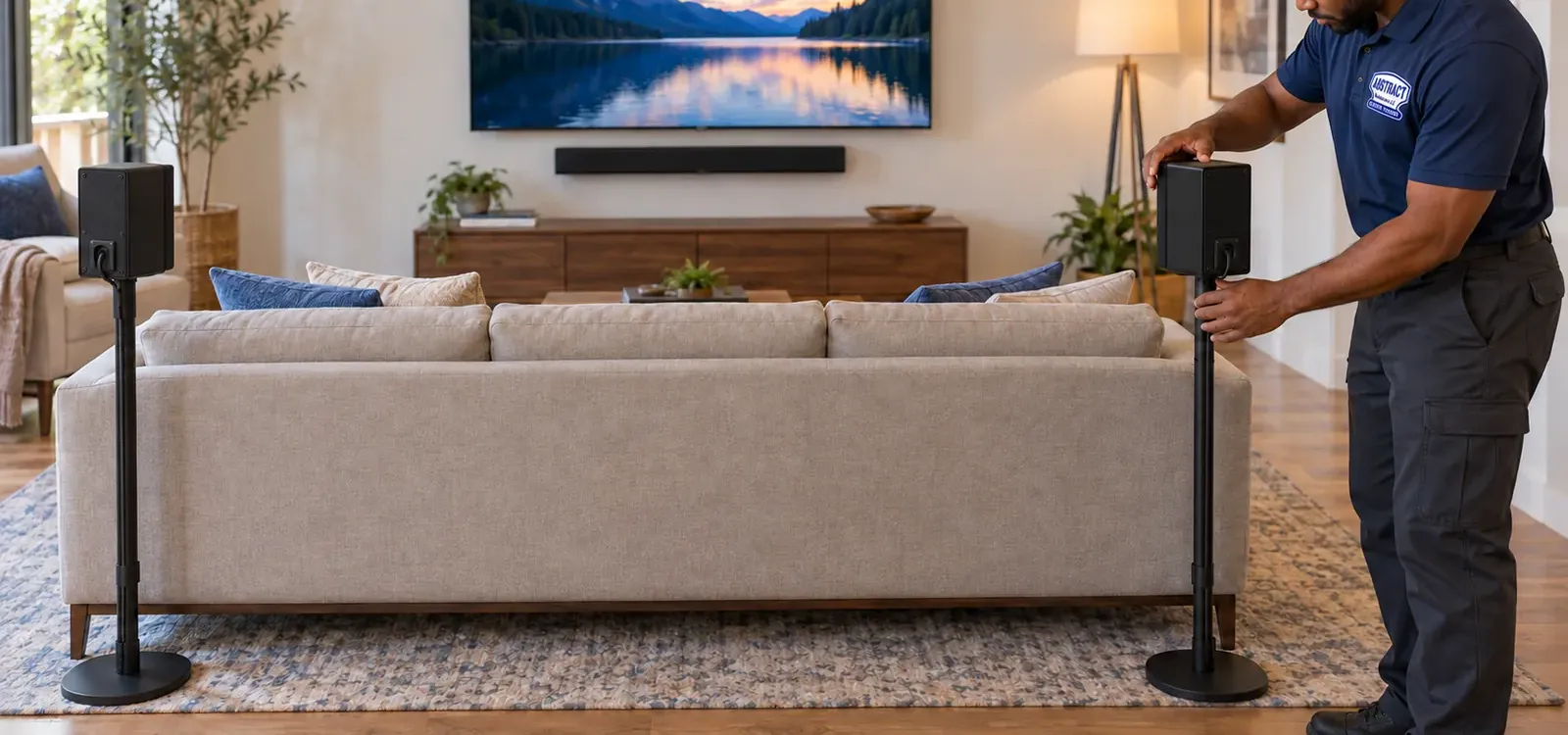
Rear speakers on stands either side of the sofa: the step up from a bar alone in a long open-plan room or a basement.
AI Overview Reality Check
What AI Gets Wrong About Soundbar Installation in Great Kills
The research tools used for this page could not display Google's AI Overview, so nothing below is presented as its wording. Each heading is a claim that a real cost guide, listing, manufacturer page or neighborhood article publishes, and that AI summaries tend to repeat. Under each is what changes once the bar is going into a Great Kills house.
"Great Kills houses are big, so buy the biggest soundbar you can"
An agent quoted by Brick Underground said Great Kills houses average about 4,000 square feet, and a summary could easily turn that into a buying rule: big house, big bar.
But a soundbar fills a room, not a house, and the room matters more than the deed. A 4,000-square-foot colonial may still have a family room of ordinary size, and plenty of Great Kills homes are compact ranches and Capes. The bar should be roughly the width of the TV or a little less, and its power should match the space between the screen and the sofa.
Where a house really is large and open, the better upgrade is usually a sub and rear speakers, or speakers in the ceiling, rather than a longer bar. We size the system to the room you send us a photo of.
"A renovated house is move-in ready, AV included"
Great Kills listings increasingly sell renovated homes at a premium; one 2026 market review found renovated and expanded houses selling well above homes in original condition. It's natural for a summary to assume a renovated living room is ready for a TV and soundbar.
Renovations vary enormously in what's behind the finish. Some flips include a recessed box, blocking and a conduit; many have new drywall over old framing with nothing planned for the TV; a few have a slat wall glued straight to masonry. None of that is visible in listing photos.
So we treat a renovated wall as unknown until it's scanned and, where needed, test-drilled behind the bracket. A tone tracer finds where an existing cable actually goes. The price lines don't change; what changes is that you know what you're fixing to.
"Hiding the soundbar wires costs $75 to $300"
Angi's TV installation cost guide gives a $75 to $300 range for concealed wiring, and AI answers often quote it as the price of hiding soundbar cables.
In a Great Kills house the real variable is the state of the wall. During a renovation, with the studs open, a recessed box and a path for HDMI and power cost very little to add. In a finished framed wall, an in-wall kit does the job. On a foundation wall, a slat wall over masonry or a mirror, the wall can't be opened at all and a cord cover or a TV-attached bracket is the answer.
Our lines are fixed: $169 for the code-compliant in-wall kit where the wall allows it, $59 for a paintable cord cover where it doesn't. A photo tells us which one your wall can take.
"Only waterfront houses need to worry about flooding"
Summaries of coastal neighborhoods tend to draw a neat line: houses on the water flood, the rest don't.
First Street's model counts about 14.4 percent of Great Kills properties, 1,230 of them, as having some flood risk over the next 30 years, and Robert DeFalco Realty's guide warns buyers not to assume a property is outside flood concerns simply because it isn't directly on the water. Basements also take water from heavy rain and backed-up drains, not only from the harbor.
For a soundbar that changes very little on most streets and quite a lot on a few. Wherever the TV room is the lowest level of the house, we keep the sub, strip and cable box off the floor as a matter of habit; it costs nothing at install time.
"Once it's unplugged and dried out, flooded electronics are fine to use"
Advice to "let it dry and try it" circulates widely, and AI answers sometimes repeat it for small electronics.
The Electrical Safety Foundation's guidance is blunt: water-damaged equipment, even if thoroughly dried, poses serious long-term safety and fire risk unless properly reconditioned, and items such as receptacles, surge protective devices and GFCI devices must be replaced. It recommends that qualified electricians evaluate water-damaged electrical equipment.
That means a strip or an outlet that sat in water gets replaced, and a soundbar or subwoofer that was submerged should be treated as lost rather than plugged in to see. We reinstall on equipment and outlets that an electrician has cleared.
"Put the soundbar on the shelf the media wall provides"
Product pages and design articles often show a bar tucked neatly into a media-wall niche, and summaries treat the shelf as the obvious place for it.
Manufacturers ask for space around their bars. Sonos's placement guidance for the Arc Ultra asks for at least 4 inches between the bar and the TV above it, and up-firing drivers need open space to the ceiling. A niche built for a slimmer, older bar can block those drivers and muffle the sound.
We measure the niche against the bar's specification before deciding. If it's too tight, the bar goes on the media wall's face just under the TV or on the TV mount, and the niche can hold a streaming box or a subwoofer instead, provided the sub has space to breathe.
"Wireless soundbars work anywhere in the house"
"Wireless" in retail listings usually refers to the link between bar, sub and rears, and AI answers stretch it to mean the bar needs no planning for its network connection at all.
The bar plays TV sound over HDMI without any network. But streaming, voice control, multi-room grouping and updates all depend on reaching the router, and in many Great Kills houses the router sits where the service enters — often low, at the front, or in a basement — while the TV is in a back family room or a new addition.
During setup we read the signal strength in the bar's app. If it's weak we suggest a wired line, a mesh point or a powerline adapter, chosen for that house rather than a blanket recommendation to pay for faster internet.
One Visit for the Wall You Inherited
Slats, mirror, media wall or a basement column — send a photo and the bar's model, and we'll reply with the method and the price before anyone drives over the bridge.
Great Kills moves quickly. A 2026 market review put the typical house at about 25 days on market and selling at 101 to 103 percent of asking, and Brick Underground's agents described bidding wars and contracts signed within a week. That pace leaves little time to think about where the TV goes. These notes are for the two moments when a little planning saves the most money.
Reading a listing for the TV wall. Listing photos show you the finish, not the structure, but they tell you more than you might think. Look for where the outlets are on the wall the furniture faces: an outlet or wall plate high up, where a TV would hang, suggests someone planned a recessed box. Look at whether the TV wall is an exterior wall, which limits in-wall cable runs, or an interior one. Note any feature finish, mirror or stone-look panel. In the basement, look for steel columns, the beam line and whether the ceiling is tiles or drywall. Those five details decide most of the method and the price.
Asking the seller the right questions. Who did the renovation, and was it permitted? Local brokers advise buyers to check permits and Certificates of Occupancy, especially for finished basements and lower levels. Is there a recessed box, conduit or blocking behind the TV? Where does the cable or fiber come in, and where is the router? Has the lowest level ever taken water? You don't need perfect answers, but any of them shortens the visit.
Planning your own renovation. If you are about to file for an interior renovation or an addition, decide the TV wall early and tell the contractor. Ask for a recessed power-and-data box behind the TV position, a second box low on the wall behind the cabinet joined by a smooth conduit, a network cable from the router to that cabinet, and a horizontal strip of solid wood between studs at the height the soundbar bracket will sit. Have your electrician place the outlet in the recessed box; we don't add outlets, but once the box is there, the soundbar and TV wiring becomes a quick, tidy job.
Thinking about the subwoofer before the floor goes down. A subwoofer on a floating vinyl or laminate floor over a slab sounds different from one on a framed floor upstairs, and a sub against a shared wall in a semi-attached house carries into the neighbor's room. If the family room is being redone, pick the sub's corner while there's still a choice about outlets near it.
Adding a backyard cottage or garage unit. City of Yes allows many one- and two-family lots to add an accessory unit, and early Staten Island projects included one on a Cape-lined Great Kills block. These are small rooms with new framing, which makes them easy places for a compact bar on a bracket and an in-wall kit. If the unit will be rented, decide now whether the soundbar belongs to the house or the tenant, and keep its network separate from yours.
If you send us the listing link or the contractor's drawings, we will tell you what the TV wall can take and roughly what the soundbar lines will come to, before you commit to the house or to the plans.
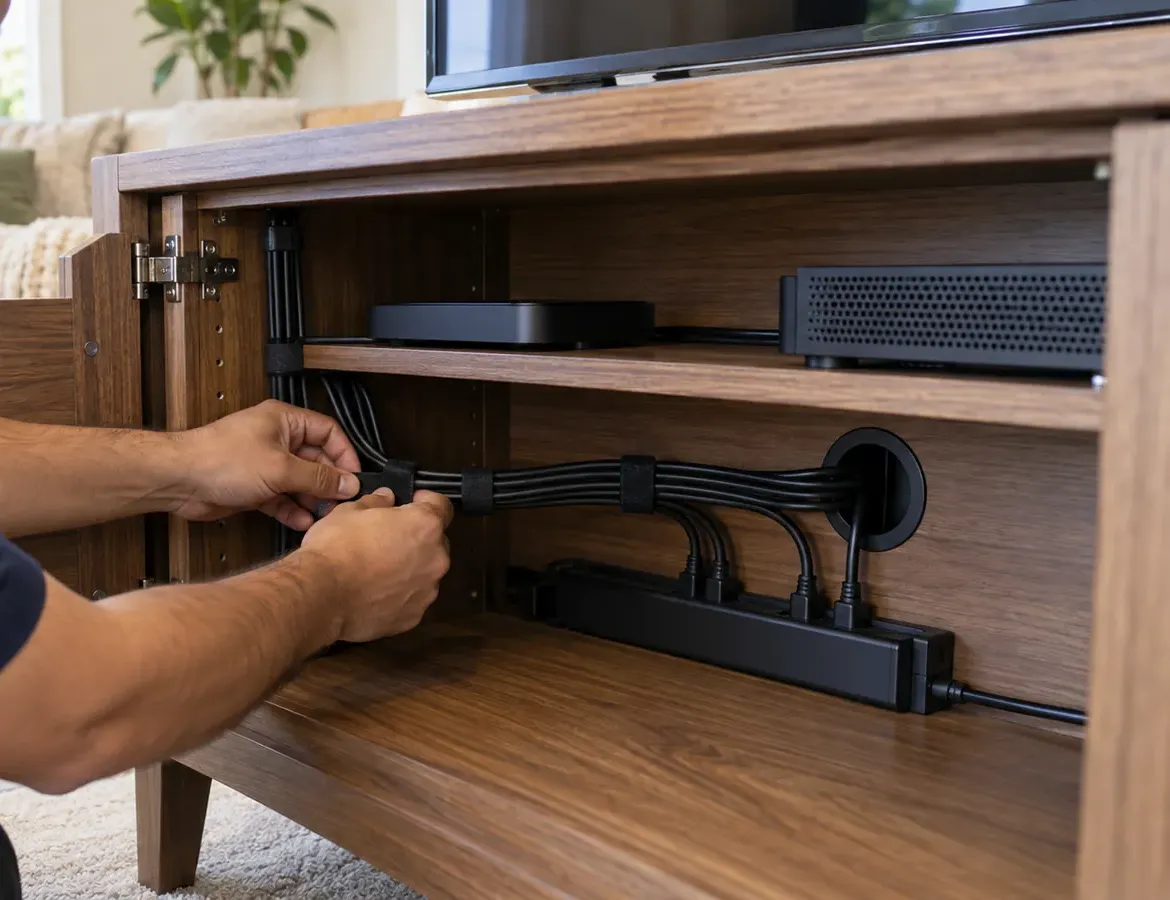
Cables strapped and passed through a grommet to one power strip inside the cabinet, the single shut-off point we recommend before a storm.
Get In Touch
Request a Free Quote
Renovated colonial off Amboy Road, ranch basement near Kingfisher Pond, semi-attached house by the harbor — tell us the room, the wall and the bar, and you get a written quote within the business day. Prefer to talk? Call (347) 934-8335.
✅
We Got Your Request!
Expect our call later today. Need someone sooner? Dial (347) 934-8335.
How It Works
Our Installation Process
Seven steps, whether it's a compact bar in an upstairs Cape bedroom or a bar, sub and rears around the column of a ranch basement.
1. Send a photo of the wall
Tell us the bar and TV models and the room, and send a photo of the TV wall. Mention any renovation history: slat panels, a media wall, a mirror, a recessed box, or a basement column.
2. Receive a written price
We reply with a total built from the published lines: console or wall mount, bracket, wall add-on, concealment and setup. No bridge toll and no travel charge appear on it.
3. Pick a two-hour arrival window
Windows run from 8 AM to 8 PM, seven days a week. Same-day slots are offered when one opens, and moving an appointment with a day's notice costs nothing.
4. Find out what is behind the finish
On arrival we scan the wall, test-drill behind the bracket position if the finish hides the framing, trace any existing cables, and mark the height and center with you at your usual seat.
5. Fix the bracket and route the wiring
Fixings matched to studs, blocking, block or plaster go in, with spacers on slat or fluted walls. HDMI and power run through a recessed box, an in-wall kit or a cord cover.
6. Connect, place and protect
HDMI to the eARC or ARC port with CEC on, the sub and rears placed around columns and off the floor, and everything on one reachable surge-protected strip.
7. Tune and walk you through it
Room calibration, dialogue and night modes, lip-sync and a test clip, then the remote checked for power and volume and the settings explained before we vacuum and leave.
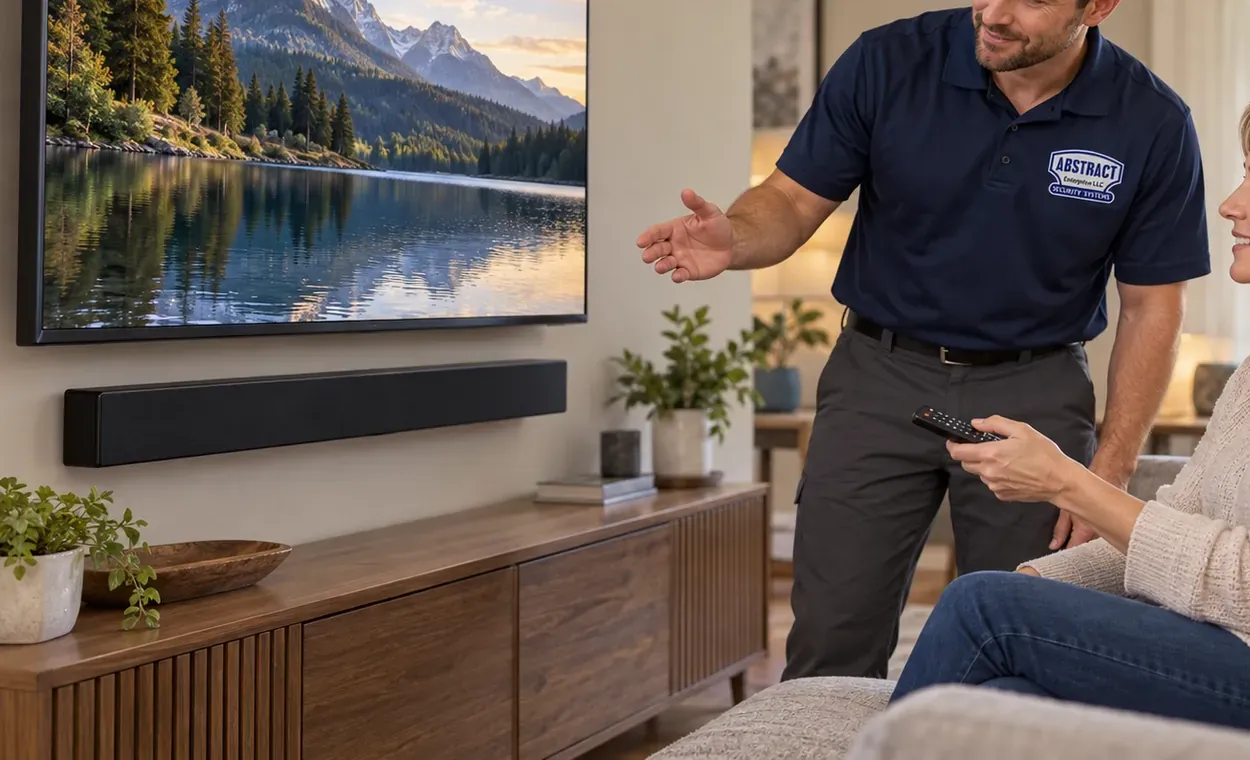
Handover: the person who will use the system holds the remote while the technician points out the bar and explains the inputs and volume.
Coverage Area
Soundbar Installation Near Great Kills' Landmarks
We work on every street in Great Kills, from the blocks north of Amboy Road down to the marinas on Mansion Avenue. These six landmarks mark out the neighborhood; the houses around each one tend to share a type and an age.
Great Kills Park
About 523 acres of Gateway National Recreation Area on the harbor, transferred from the city to the National Park Service in 1972. Its beach, multi-use path, fishing spots and marina stay open, while roughly 282 acres remain fenced off during a long-running radiological cleanup. Hylan Boulevard and the shoreline blocks sit along its edge.
Nichols Marina
The marina inside the park. Hurricane Sandy destroyed all 350 of its slips in 2012, and it reopened in May 2015 after a $6.5 million rebuild. The harbor-side streets near it are where storm-ready placement matters most.
Richmond County Yacht Club
Established in 1923 at 142 Mansion Avenue, with a deep-water pier on Great Kills Harbor. The marina strip around it holds boatyards, waterfront restaurants and the older shoreline houses of the neighborhood's resort era.
Great Kills Station
The Staten Island Railway stop on Giffords Lane near Amboy Road, with a brick stationhouse dating from the early-1930s grade-crossing project. Express trains run to St. George at rush hour; the streets around it mix older houses with shops and offices.
Great Kills Library
The New York Public Library branch at 56 Giffords Lane, in a three-storey building from 1954 that was fully renovated in 2005. It also holds the public record for the Great Kills Park cleanup. The surrounding blocks are classic bridge-era ranches and colonials.
Atrium Stadium Cinemas
The neighborhood's movie theater at 680 Arthur Kill Road. If you'd like the den to feel a bit more like it, a bar, sub and rears in the basement is the usual starting point.
We also install soundbars in the neighborhoods that border Great Kills — Bay Terrace, Eltingville, Richmondtown, Arden Heights, Annadale and Oakwood — and across the rest of the borough. The Staten Island soundbar installation page covers the island as a whole, from the North Shore to Tottenville.
Pricing
Soundbar Installation Cost in Great Kills
Great Kills uses the Staten Island price list, and soundbar lines are the same dollar figures across our service area; only the TV-mounting base and the hourly setup rate change by borough. Add the lines that apply to your room and that's the price. If the wall turns out to be something other than what was booked, you see the new total before any drilling.
Item
Price
Typical Great Kills use
Soundbar placed on a console or stand
$79
TV on its stand, a house about to be renovated, a second room
Soundbar wall-mounted under the TV
$129
Family rooms, renovated living rooms, basements
Sanus soundbar bracket
$84.99
Missing bracket, or one too shallow for a slat-wall spacer
In-wall concealment kit
$169
Framed walls, including new drywall on old studs
Paintable cord cover
$59
Block, slat-over-masonry, exterior walls
Cable run to a cabinet or other spot
$99
Up to 25 ft — open floors, runs through an unfinished basement
Sonos setup
$125
Sonos bar, sub and rears paired and grouped
A/V receiver
$129
Receiver-based basement systems
Universal remote
$99
Cable box, streamer and bar on one handset
Streaming device or games console
$49 each
Connected and set on the right input
LED bias light
$75
Behind the TV in a dark basement
Full home theater hookup
$350
Bar or receiver, sub, rears and sources tuned together
Remove old bracket
$45
Hardware left by a previous owner or renovator
Take down old TV / haul it away
$85 / $79
Replacing the set the house came with
Wall and access add-ons
Condition
Add
Where you meet it in Great Kills
Drywall over wood studs, including slat or shiplap over drywall
$0
Most renovated living and family rooms
Metal studs
+$30
Newer basement fit-outs, offices and shops
Plaster
+$45
Older frame houses
Brick or stone
+$65
Brick fireplaces and real masonry accent walls
Concrete or cinder block
+$75
Ranch and colonial basements; finishes glued straight to block
Tile or marble
+$95
Basement bars, kitchen TVs
Plywood backer board
$85
Irregular framing in older houses
High mount (above about 8 ft)
$75
Double-height rooms in expanded or rebuilt houses
Box removal
$25
We take the packaging with us
Certificate of insurance
Free
Condo boards, HOAs, plaza owners, clubs
When the TV goes up too
On Staten Island a TV mount starts at $209.99 for a 32-to-55-inch screen on a fixed or tilt bracket over wood-stud drywall; 56–65 inches adds $30, 66–75 adds $60 and 76–85 adds $100. A full-motion mount, handy when an open-plan room needs the screen to swing toward the kitchen, adds $40. Over a fireplace adds $130. A TV left on its stand is $137.99. If the bar is already up and needs only setup or troubleshooting, a setup-only visit is $225 for the first hour, then 30-minute blocks. Every TV line is on the Staten Island TV mounting price list.
Included in every visit: finding framing or sound masonry, hanging the bar level, the HDMI or optical connection, tidy cable dressing, single-remote control through CEC, and a vacuum over the work area.
Not included: new or moved outlets (a licensed electrician's job), patching and painting, removing mirrors or feature panels, moving heavy furniture, and picture calibration.
If we can't start: a missing bar or bracket, or no one home to let us in, means a $150 return-trip charge. Move the appointment with a day's notice and there's no charge.
Finishes that can crack: tile, stone, old plaster and some feature panels can chip under the most careful bit. If yours is one of them, you'll hear it first and decide.
Shop Our Systems
Soundbar Installation Packages & Pricing
Three packages that match the Great Kills jobs we're asked about most. Each card shows its arithmetic; other walls and extras from the tables above go on top.
Starter — Bar on the Console
$79
$79 sets the bar on the media unit, connects it to the TV, puts its volume on the TV remote and tucks the leads away. The sensible choice if the house will be renovated within the year, or the TV is staying on its stand.
Standard — Renovated Wall, Hidden Wiring
$382.99
Soundbar wall-mounted ($129) + Sanus soundbar bracket ($84.99) + in-wall concealment kit ($169) = $382.99. A bar on a new drywall or slat-over-drywall wall with nothing showing. Without the kit the same job is $213.99.
Premium — Basement Bar, Sub and Rears
$388
Soundbar wall-mounted ($129) + concrete or cinder block add ($75) + Sonos setup with sub and rears ($125) + paintable cord cover on the block ($59) = $388. A foundation-wall TV in a ranch or colonial basement, with the sub and rears placed around the column and kept off the floor.
Bring Your Own Equipment — Labour Only
Already have a bracket, from the soundbar box or bought separately? We charge the $129 mounting labour plus any wall add-on. A customer-supplied bracket must be rated for the bar and carries its own manufacturer's warranty. If it isn't suitable, we tell you before drilling and offer the Sanus bracket at $84.99.
A worked example with a TV. A 65-inch TV on a full-motion mount over a renovated drywall wall ($209.99 + $30 + $40 = $279.99), with the soundbar wall-mounted under it ($129) on a Sanus bracket ($84.99), comes to $493.98 before any optional extras.
Get the Great Kills Total in Writing
A photo of the wall and the soundbar's model number is enough. The figure comes straight from the tables above, with no toll and no travel line.
Water, Power and Evacuation: A Soundbar That Survives the Season
Great Kills Harbor is one of the reasons people choose the neighborhood, and the harbor's history is the reason a few of its streets plan a living room differently. In October 2012 Sandy's surge did not just flood the shoreline here; it moved boats. Reports from the days after describe vessels lifted over docks and fences and left in the road, and the Park Service's own Nichols Marina lost every one of its 350 slips. The marina reopened in 2015 after a $6.5 million rebuild, and the boatyards along Mansion Avenue were cleared and rebuilt too. The houses nearby carry that memory in where their owners keep anything valuable.
The protective works being built for the South Shore are a long project. New York State describes the Army Corps of Engineers' South Shore of Staten Island plan as roughly seven miles of seawalls, levees, revetments and drainage structures from the Verrazzano area to Oakwood Beach. That line ends at Oakwood Beach. Whatever it eventually does for the neighborhoods behind it, a household near the water still benefits from a few habits that cost nothing at install time.
Height. The bar on a bracket is already above minor water. The subwoofer, power strip, cable box, streaming stick and any spare remotes are the floor-level items. We put the sub on a stand or low shelf, the strip on the back of the cabinet or the wall, and the box on a shelf. In a basement media room on a harbor-side lot we'd also suggest a TV cabinet on legs rather than a solid plinth that wicks water.
One point of shut-off. Everything plugs into a single surge-protected strip in a reachable spot, labeled. Before a storm, one switch and one plug pull. After the power comes back, one plug-in, TV first. This also makes life easier during the heat-wave repairs and conservation requests that Con Edison has issued on Staten Island, most recently in July 2026 for about 41,200 customers including Great Kills.
Cables away from the water side. We don't run new HDMI or power along the base of an exterior wall that faces the harbor, and where the cable service enters low on a foundation, we route up and away from it.
A plan for after. If water reached an outlet, a strip or the gear itself, nothing gets plugged back in until an electrician has checked the circuit. The Electrical Safety Foundation's guidance is that water-damaged receptacles and surge protectors must be replaced, not dried and reused. Once the house is cleared, a reinstall is priced on the same lines as a new job; a bar that stayed dry on its bracket usually just needs reconnecting and its settings checked.
Most of Great Kills will never need any of this beyond the surge strip. For the blocks where it matters, it's ten minutes of thought during a visit that is happening anyway.
A compact bar on a desk under a monitor suits a small room: an upstairs Cape bedroom, a backyard cottage or a home office.
Street by Street
House by House in Great Kills: What We Expect Before We Arrive
Brick Underground's agents note that Great Kills has no formally named subsections, but people still describe where they live by landmark: near the marina, near Arthur Kill Road, near Amboy Road. We prepare for a visit the same way, from the neighborhood and the photo you send.
Around Amboy Road and the station. The commercial spine and the streets either side of it, close to Giffords Lane and the railway. A mix of older houses, bridge-era colonials and ranches, two-families, and the townhouse developments north of Amboy Road. We expect conventional framed walls, older wiring paths in the oldest houses, and association rules in the townhouses. Business calls here come from storefronts and restaurants on Amboy itself.
The residential middle, toward Kingfisher Pond and the schools. The heart of the 1960s and '70s housing: detached and semi-attached ranches, colonials and Capes, most with finished basements, many now renovated. This is where slat walls, media walls and steel basement columns come up most, and where a second system in the basement is the usual add-on.
Near Arthur Kill Road. Largely residential with some commercial stretches and the cinema. Larger detached houses, newer construction and expansions; we expect longer cable routes from the router to a TV in an addition, and sometimes a double-height room where the high-mount line applies.
Down by the harbor and Hylan Boulevard. The marina strip on Mansion Avenue, the streets toward Great Kills Park and Crescent Beach, and the older shoreline houses from the resort era. Here we add the storm habits described above, and expect a mix of rebuilt, renovated and original houses on the same block.
Condos and co-ops. Less common in Great Kills than in the rest of the city, but they exist, and buildings have managing agents who want a certificate of insurance before we come in. Renters lean toward console placement, TV-attached brackets and cord covers; owners can usually choose in-wall concealment if the building allows.
Backyard cottages and garage units. The newest housing type on the block, small and freshly framed. A compact bar, a bracket and an in-wall kit fit the scale.
Complete Services
Every Soundbar Installation Service in Great Kills
A soundbar visit in a renovated or newly bought house often turns into a wider conversation. These are the Staten Island services Great Kills households book alongside it.
Arrival windows, return trips, rescheduling and setup-only visits.
FAQ
Great Kills Soundbar Installation FAQ
We're planning a renovation within the year. Should the soundbar wait?
+
Not necessarily. Put the bar on the console now for $79 and it works the same day. When the walls are open, have a recessed box and blocking added behind the TV, and we move the bar to the wall afterwards on the usual $129 line. If you'd rather mount it now, taking it down later is quick and the holes are small.
Can you look at the TV wall of a Great Kills house we're about to buy?
+
We can't drill or test in a house until it's yours or the seller agrees, but send us the listing link or your own photos of the TV wall and basement. We'll tell you what the wall is likely to be, which fixings and price lines apply, and what to ask the seller about wiring.
Water reached the outlet behind our TV. Can we plug the soundbar back in once everything is dry?
+
No. Have a licensed electrician check the outlet and circuit first. The Electrical Safety Foundation says water-damaged receptacles and surge protectors must be replaced, and dried-out equipment can remain a fire risk. Treat a soundbar or sub that sat in water as lost; we reinstall once the circuit is cleared.
What would a Sonos bar with a sub and rears come to in a colonial family room?
+
On drywall over studs: wall mount $129, Sanus bracket $84.99 and Sonos setup with sub and rears $125, so $338.99. If the cable box sits in a cabinet across the room, the cable run adds $99, for $437.99. Hiding the bar's wires inside the wall adds the $169 kit.
Do you install soundbars in marina offices, yacht-club lounges and waterfront restaurants around the harbor?
+
Yes, indoors. A bar under the TV in a clubhouse lounge, a marina office or a dining room uses the same price lines as a home, and we provide the certificate of insurance free. Open decks and docks need weather-rated speakers, which our AV team quotes separately.
Can a soundbar go in a backyard cottage or garage unit added under City of Yes?
+
Yes. These are small, newly framed rooms, so a compact bar on a bracket ($129) with an in-wall kit ($169) is usually straightforward. If the unit will be rented, decide whether the bar belongs to the house or the tenant, and keep it on its own network rather than yours.
All Areas Served
Soundbar Installation Across New York
This page is about Great Kills. It sits under our Staten Island soundbar installers page, which in turn is part of the New York City soundbar installation hub for all five boroughs. Each borough and suburban county has its own page written for its housing, and a growing set of neighborhood pages goes further.
If the bar went quiet after an outage, after the contractor reset the breakers, or after a TV update, or the remote no longer controls it, call (347) 934-8335. We book the next open two-hour window, and most connection faults are fixed within one to two hours on site.
Soundbar Installation in Great Kills — Licensed, Insured, Renovation-Aware
Abstract Enterprises Security Systems · 1282 Troy Ave, Brooklyn, NY 11203 · serving Great Kills and all of Staten Island · (347) 934-8335 · WhatsApp (718) 679-0359 via wa.me
NYS Low-Voltage Licence #12000287431 · 100% Licensed & Insured · Same-Day Estimates · Rated 4.7★ from 201 Google Reviews
Brackets and parts carry their manufacturer's warranty. Full terms — including 50% deposit, one-year parts-only warranty on AESS-supplied products, and the late-fee schedule — are set out in the service agreement. See our warranty page.
Page reviewed and updated October 17, 2026. Changelog: page launched for Great Kills homes and businesses, built on neighborhood housing, renovation-permit, harbor and storm research.