Most living rooms in Long Island City, Queens, sit inside a building that did not exist twenty-five years ago: a poured-concrete tower around Court Square or on the Hunters Point waterfront, with a wall of glass on one side, a managing agent downstairs and neighbours on every side. Others are lofts carved out of 1920s factories, or parlor rooms in 1870s rowhouses on 45th Avenue. We fit the soundbar to whichever of those you live in — drilling the concrete only where it is safe, filing the paperwork the building asks for, routing cable where the building allows it, and tuning the bar so the movie reaches your sofa and not the apartment next door.
Reviewed and updated October 17, 2026 · Written by Anwar Timothy, NYS low-voltage license #12000287431
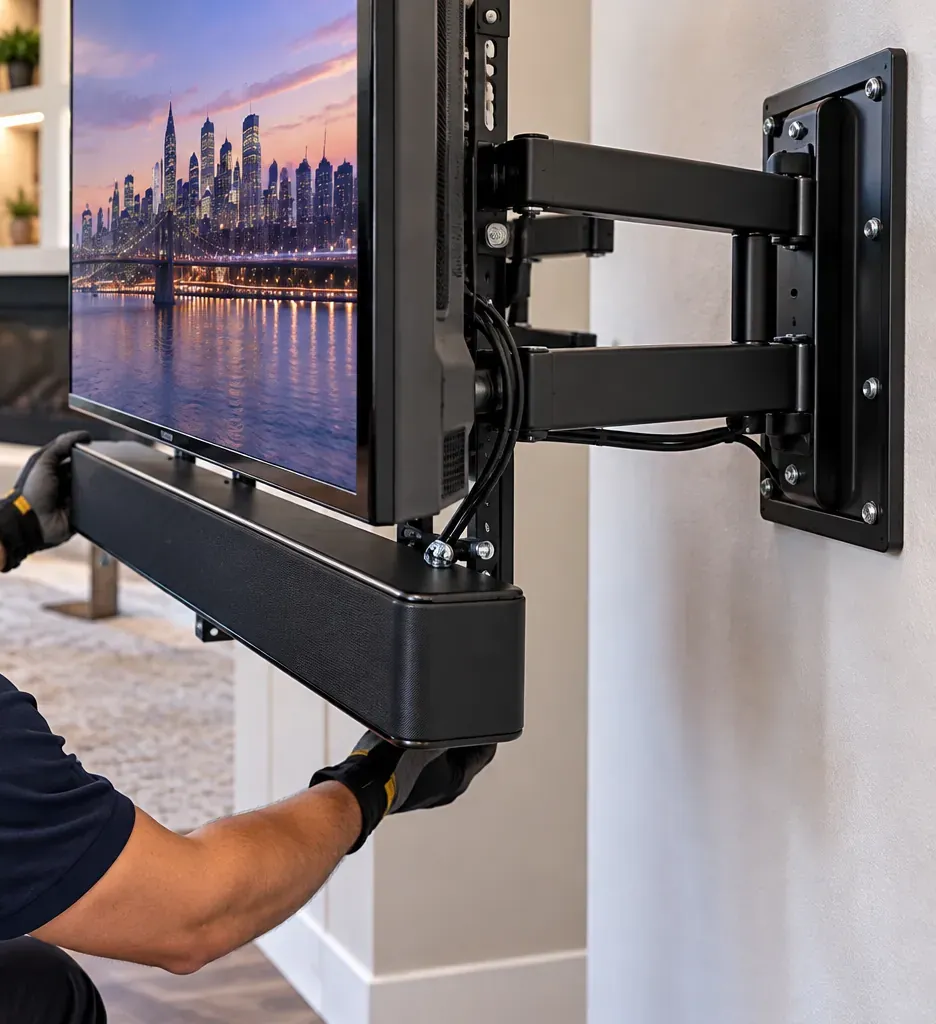
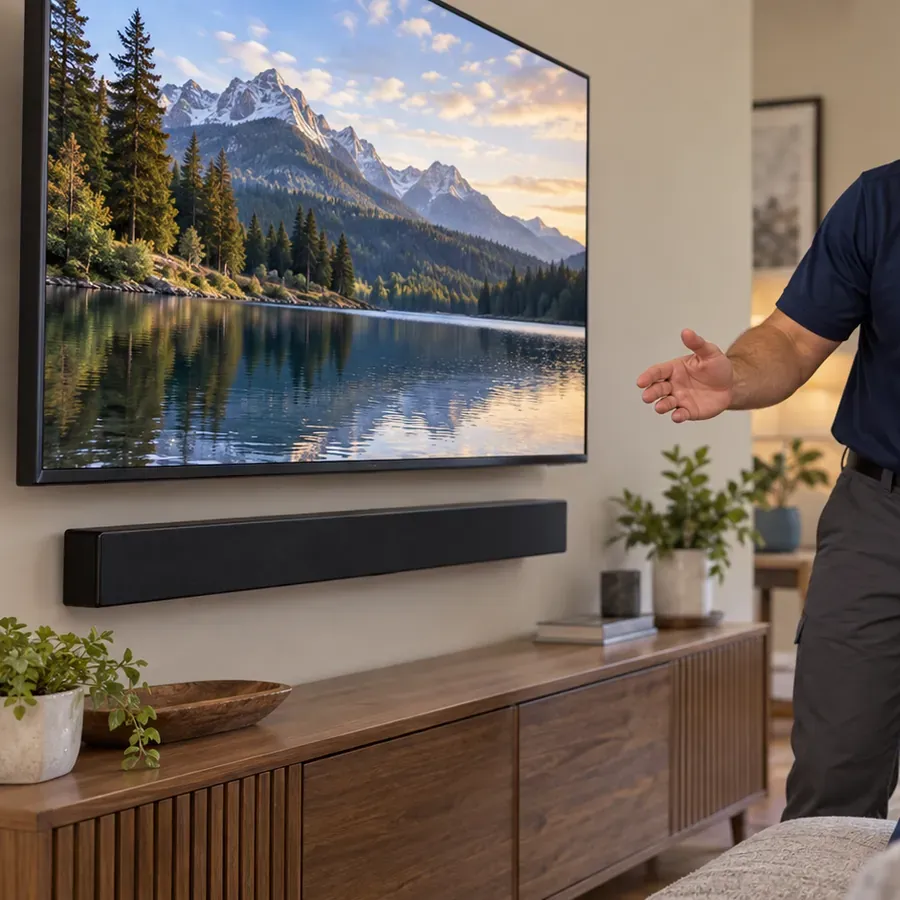
The bar rides on the TV’s own articulating arm, so the pair swing together and the wall takes no extra holes.
Free Long Island City Soundbar Quote
Building, floor and wall type — a written Queens price the same business day
✅
Request Sent!
Our Queens desk will call you back the same business day.
25+
Years Experience
✓
Same-Day Estimates
100%
Licensed & Insured
4.7★
201 Google Reviews
Moving into a new LIC apartment, or finally getting round to the TV wall? Ring (347) 434-6392 or use the 60-second form. Tell us the building and the floor, attach a photo of the wall, and a licensed installer answers with a written total built from the Queens price list — plus a note of anything your managing agent is likely to ask for.
Soundbar on a concrete wall from $214.20 (mount plus the concrete line), bracket extra if you need ours
Insurance certificate for your condo board or managing agent, free, naming whoever they list
State low-voltage license 12000287431 · a 2-hour arrival window you choose, mornings to evenings, seven days
Why Long Island City Homes Need Soundbar Installation
Long Island City was rebuilt as a place to live within living memory, and its walls show it. A rezoning in 2001 opened the Court Square area — until then, in the New York Times' description, mostly low warehouses and auto repair shops around the Citigroup tower — to apartment buildings, and the waterfront at Hunters Point followed. What went up is overwhelmingly concrete: flat concrete floor plates, concrete columns and shear walls, metal-stud partitions between rooms, and glass curtain walls facing Manhattan. That combination changes almost every decision in a soundbar install. The wall you want may be concrete with steel reinforcing a couple of inches in; the one beside it may be gypsum board on light steel framing; the third is glass. Each needs a different fixing, and one of them takes none at all.
The second difference is who else has a say. Very few people in LIC's towers own the building around them. Renters answer to a management company and a lease rider; condo owners answer to a board, a managing agent and an alteration agreement. Before anyone drills, those offices commonly want a certificate of insurance, a description of the work, sometimes a product sheet for the bracket, and a booking for the service elevator. None of that is difficult, but it decides whether the installer gets past the lobby on the day, so we treat it as part of the job rather than your homework.
Third, the neighbours are closer than they look. A tower apartment has people on both sides, above and below, often sharing a wall built of steel studs and board rather than masonry. Residents on the neighbourhood's own forum say so plainly: one r/longislandcity thread asks whether a new building's “walls are just very thin” because a neighbour's television always seems too loud, and in another a resident writes that they “find the new luxury buildings to be very noisy.” A soundbar that is placed and set up without that in mind is the easiest way to become the neighbour in somebody else's thread.
And the rooms themselves are unusual. Open-plan living rooms run straight into the kitchen; a window wall or a sliding balcony door takes one whole side; ceilings in many newer units and in the factory conversions are bare concrete, with no hollow space above them to hide a wire or a speaker. Lofts in the old Eagle Electric plant on Queens Street were marketed with 12- to 14-foot exposed concrete ceilings and floor-to-ceiling columns. Those are handsome rooms, and difficult ones for sound: hard surfaces everywhere, few places to run cable, and long distances between the TV and the outlet.
Not all of Long Island City is new, either. On 45th Avenue between 21st and 23rd Streets, the Hunters Point Historic District preserves a row of 1870s stone-fronted houses; Dutch Kills, north of Queens Plaza, still has lines of modest early-1900s rowhouses; and Queensbridge Houses, opened in 1939 beside the bridge, remains the largest public housing development in North America. A soundbar visit in one of those homes looks nothing like one on the fortieth floor of a Jackson Avenue tower — which is why this page exists separately from our Queens soundbar installation page.
Long Island City facts that shape a soundbar job
2001: the year the city rezoned the Court Square area for housing, which the New York Times later described as having been mostly low-lying warehouses and auto repair shops. By 2012 roughly a dozen developments with up to 4,700 apartments, most of them rentals, were planned there.
5,000 homes expected under the city's redevelopment of Hunter's Point South, including two TF Cornerstone towers of 56 and 46 storeys on Center Boulevard with 1,194 apartments between them (6sqft, 2021).
14,700 homes allowed under the OneLIC Neighborhood Plan, which the City Council approved in November 2025 for 54 largely industrial blocks, with 4,350 of them permanently affordable (6sqft). More concrete towers, and more first-time TV walls, are on the way.
About 70 storeys: The Orchard, at Orchard Street and Jackson Avenue, now the tallest building in Queens; nearby Lumen LIC rises 66 storeys with 938 apartments (6sqft).
3,142 apartments and nearly 7,000 residents at Queensbridge Houses, opened in 1939 (LIC Post, cited by Wikipedia).
High-risk flood zones: much of the Hunters Point area lies in FEMA's high-risk zones, according to the New York Times, and the Hunters Point Parks Conservancy notes the neighbourhood was heavily affected by Hurricane Sandy — worth remembering for anything installed at street level or in a storage cage.
Put together, that is the brief for a Long Island City soundbar: mostly concrete-and-glass apartments run by managers, a growing number of lofts, a small and precious stock of older houses, lots of near neighbours, and a waterfront that floods. Everything below is organised around those facts.
Most LIC households who call about a soundbar are mounting the TV at the same visit, or have just moved in. Our TV installation team for Queens hangs the screen and the bar together so the concrete is drilled once, and if a bar alone won't fill a double-height loft, AESS audio and sound work across Queens takes on receivers and separate speakers.
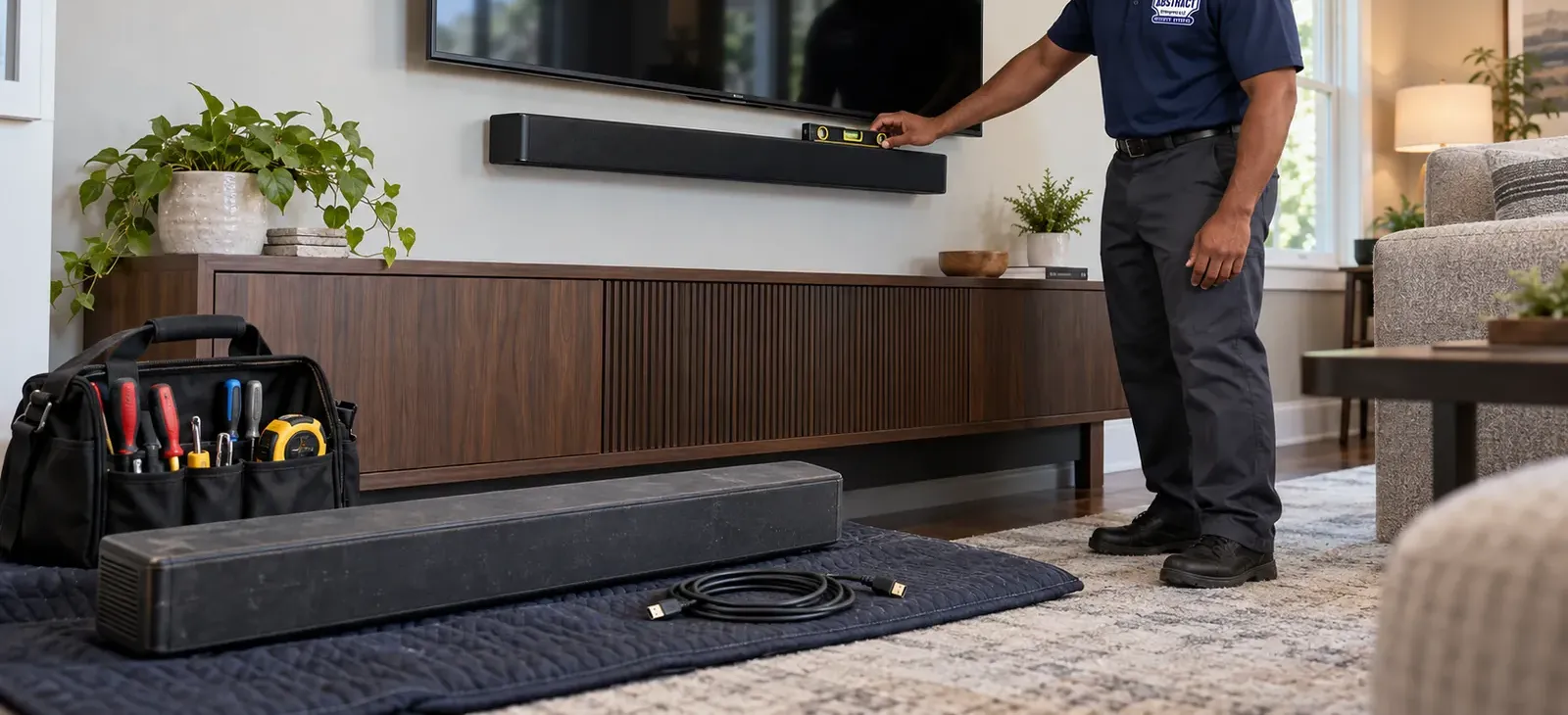
A level laid on the mounted bar before the room is handed back, with the tool bag and a spare bar still on the moving blanket.
Repair Capture
Long Island City Soundbar Not Working Right?
Sound that stopped after the building switched internet provider, a bar that lost its subwoofer when you moved from one tower to the next, a TV remote that no longer controls the volume after a firmware update, or a bracket that a previous tenant hung on two plastic plugs in concrete — those are repair calls, and we book them as such. Most control, pairing and connection faults are cleared in one to two hours once a technician is in the apartment, often on the same day if a 2-hour slot is free. Call (347) 434-6392, give us the building, the TV and the bar model, and tell us whether the service elevator needs booking. Setup-only visits are billed by time, as set out in our TV and soundbar service policies.
What We Install
Soundbar Installation Services in Long Island City
Nine kinds of soundbar work, chosen for the buildings LIC actually has. Any of them can be combined, every one is priced from the published Queens list, and none is signed off until the bar is level, the cables are dressed, the TV remote runs the volume and you have listened from your own seat.
Concrete-Wall Mounting
Bars fixed to poured concrete or block with wedge or sleeve anchors set in drilled holes, after a scan for reinforcing steel and embedded conduit. The usual job on a tower's shear wall or a loft column.
Steel-Stud Partition Mounting
Fixings designed for light-gauge steel framing or rated hollow-wall toggles in the board, on the interior partitions that divide most new LIC apartments. Often the only wall that can also hide a cable.
No-Drill Placement
The bar on the media unit, on a TV-attached bracket, or on a floor-standing TV stand with a soundbar shelf — for leases that forbid holes and for apartments where every solid wall is glass or shared.
Screen and Bar Together
TV and soundbar hung as one job so the gap between them, the viewing height from a low sofa and the single cable drop are decided once, and the concrete is drilled in one session rather than two.
Cable Routes Through the Building You Have
In-wall power and HDMI where a partition is hollow and management allows it, paintable raceway on concrete, and surface conduit in lofts where exposed metal pipe is part of the look.
Loft Installs Under High Ceilings
Brackets, cable paths and bar settings for converted factory spaces with 12- to 15-foot ceilings, concrete columns and long runs from the TV to the nearest outlet.
eARC, CEC and Streaming Setup
The bar on the TV's eARC or ARC socket, one remote for everything, lip-sync checked, and the bar's app joined to whatever internet your building or provider gives you — including networks you don't control.
Neighbour-Aware Tuning
Night mode, dialogue settings, subwoofer level and placement chosen for an apartment with people above, below and beside you, and glass that likes to rattle.
Shared-Household Setup
For roommates: who owns the app account, how guests and housemates connect, and how the system survives one person moving out with their phone.
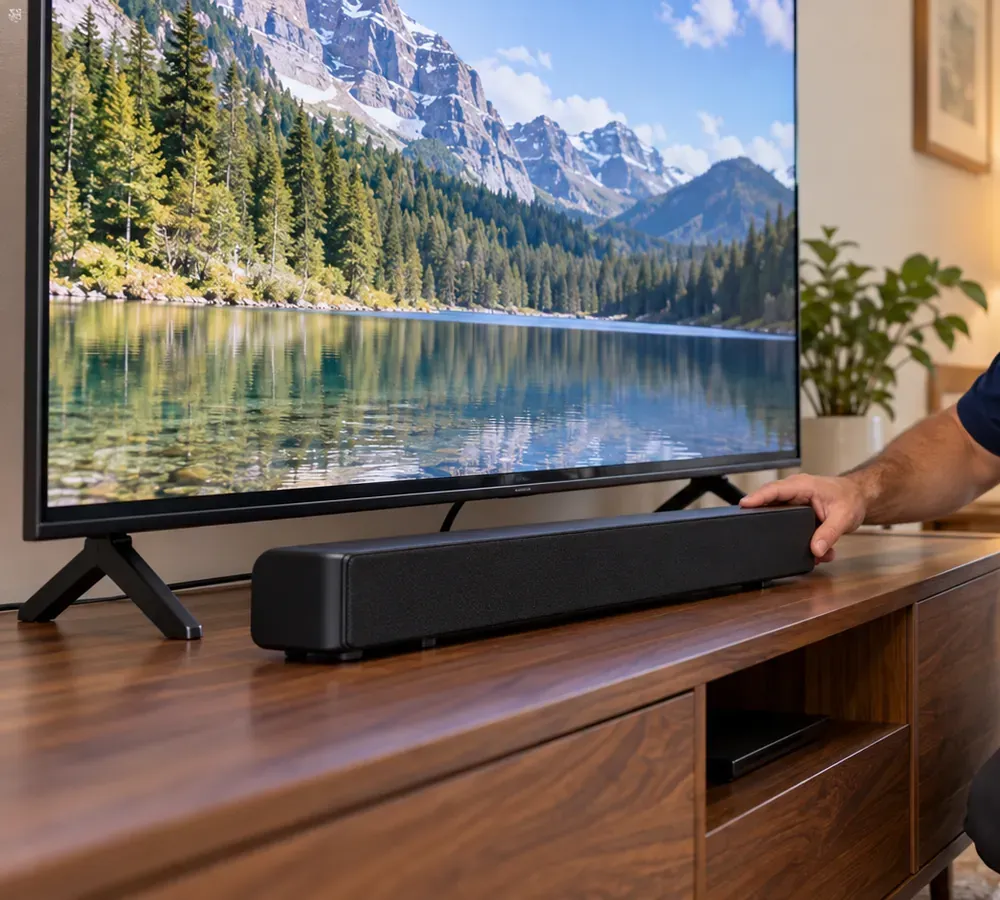
No holes at all: the bar sits on the console in front of the TV’s feet, lined up so it clears the screen.
Building Specialists
Soundbar Installation for Long Island City's Architecture
Six kinds of building make up almost all of the soundbar work in Long Island City. They differ in what the walls are made of, who has to approve the work and where a cable can travel, so we plan each one differently from the first phone call.
Court Square and Queens Plaza Towers
The post-2001 rental and condo towers around Jackson Avenue, Crescent Street, 23rd and 24th Streets and Queens Plaza — Linc LIC with its 709 units, the 5Pointz pair of 47 and 41 storeys, Lumen and The Orchard. Concrete frames, steel-stud partitions, a managing agent and a lot of near neighbours.
Hunters Point Waterfront Towers
The Center Boulevard and Hunter's Point South buildings along Gantry Plaza and the newer Malt Drive towers. Window walls toward Manhattan, balconies and terraces, many units let through the city's housing lottery, and street levels inside FEMA's high-risk flood zones.
Converted Factory Lofts
Industrial buildings turned into apartments, such as the 1920 Anchor Cap & Closure warehouse at 43-22 Queens Street that became Eagle Lofts, and the Factory House condominium on Crescent Street. High concrete ceilings, columns, original masonry and very long cable runs.
Hunters Point Historic District Houses
The 1870s Italianate, Second Empire and Neo-Grec rowhouses on 45th Avenue, landmarked in 1968 and long since divided into apartments. Masonry party walls, old plaster, and exterior changes that answer to the Landmarks Preservation Commission.
Dutch Kills and Ravenswood Rowhouses
Modest attached and semi-detached houses and small walk-ups north of Queens Plaza and toward the river, many built in the early 1900s. Owner-occupied floors over rentals, wood or masonry walls, and steeper stairs than any elevator building.
Public Housing by the Bridge
Queensbridge Houses, with 3,142 apartments in six-storey buildings beside the Queensboro Bridge, and Ravenswood Houses to the north. Masonry and plaster walls, and house rules set by the housing authority rather than a board.
What holds a soundbar in each Long Island City wall
Poured concrete in a tower. Shear walls, column faces and the occasional exposed slab edge are reinforced concrete. We scan the area first so the drill avoids rebar and any conduit buried in the pour, then use a hammer drill with a carbide bit, clear the hole with a vacuum and set wedge or sleeve anchors sized for the bracket. Concrete is the strongest fixing in the neighbourhood and the noisiest to make, so we drill inside the building's permitted hours and warn the neighbours through management when the rules ask for it. Nothing hides inside a concrete wall, so cable goes in a painted raceway or straight down behind the furniture.
Steel studs and gypsum board. Most interior walls in LIC towers are light-gauge steel framing with one or two layers of board. Steel does not grip a wood screw, so we locate the stud flanges, use self-drilling fasteners or toggles made for steel framing, and keep the load spread across the bracket. These partitions are usually hollow, which makes them the best candidates for hiding the bar's power and HDMI with an in-wall kit, subject to the building's alteration rules and to what the wall is for: a rated wall to the corridor or a party wall to the next apartment is treated very differently from a closet partition.
Concrete columns and original masonry in lofts. Factory columns are massive and often finished rough or sealed; old brick and block perimeter walls may be the building's original shell. Both take masonry anchors well. The difficulty in a loft is distance: the TV wall may be thirty feet from the nearest outlet across a concrete floor, so the cable route is planned before the bracket position, not after.
Stone-fronted and brick rowhouses. In the 45th Avenue houses and in Dutch Kills, party walls are brick under plaster and interior partitions may be wood framing. Plaster is drilled without hammer action to avoid cracking; the brick behind takes sleeve anchors. Interior work in a landmarked house is not normally what the Landmarks Preservation Commission regulates, but anything that reaches the facade — an outdoor speaker, a cable through a front wall — is a different conversation.
Housing-authority apartments. Walls are masonry or plaster over masonry and are handled like the rowhouse walls above, but permission comes from the development's management office. We work from what the tenant has been told is allowed and stop if the answer is no.
Glass, stone and tile. Window walls, back-painted glass splashbacks, stone-clad lobbies and tiled kitchens all appear in LIC apartments. We do not drill window glass or the window frames at all; tile and stone are drilled slowly with the right bit, at the tile surcharge, after a frank warning that glazed surfaces can still crack.
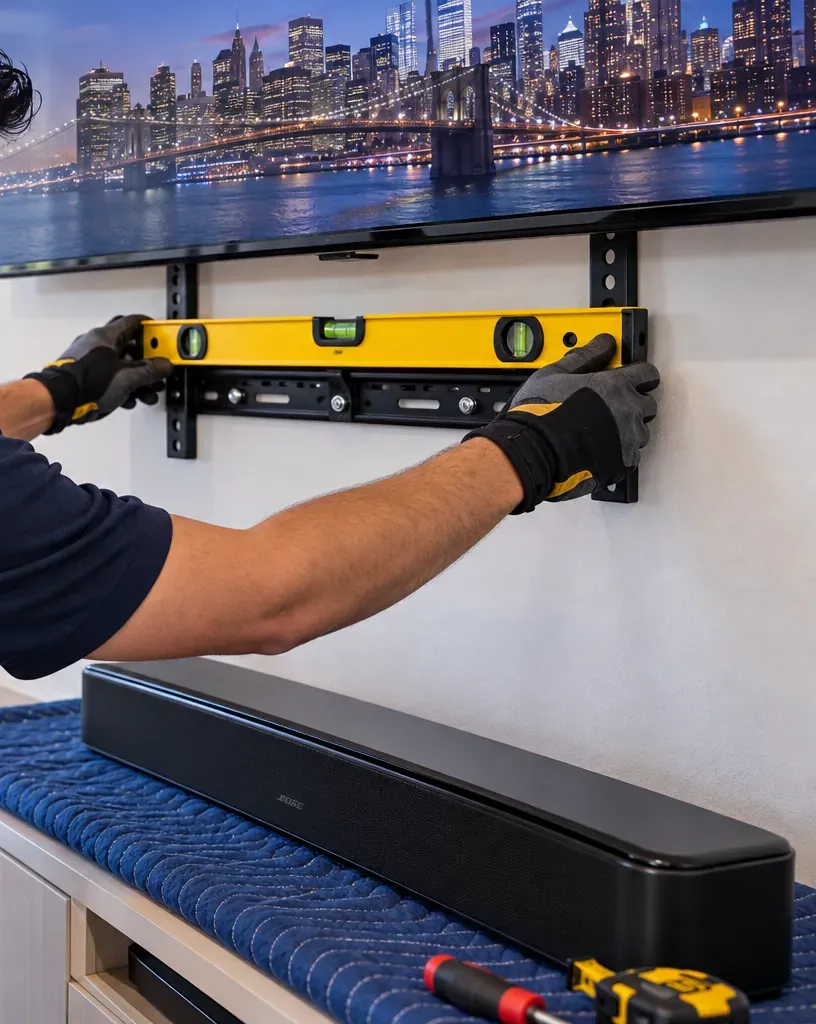
The bracket is fixed and levelled under the screen first; the bar waits on a blanket until the fixings have been checked.
New-building households who add a streaming soundbar often want the TV wall on a wired network instead of fighting the building's Wi-Fi. Our Queens structured cabling team can run a data line to the TV location where the building permits, and network installation in Queens covers the router and access points behind it.
Commercial Soundbar Installation
Business Soundbar Installation in Long Island City
Long Island City works as hard as it sleeps. The Long Island City Partnership runs what it calls the largest business improvement district in New York City by area, and the neighbourhood still mixes studios, offices, light industry, restaurants and new ground-floor retail. A soundbar is the simplest way to make one screen intelligible in a small room. These are the places we see that work most.
Vernon Boulevard
The restaurant and bar strip of Hunters Point, where the LIC Springs! street festival brings more than 15,000 people each year. Narrow dining rooms with a screen over the bar, apartments upstairs, and sidewalk cafés outside the door.
Jackson Avenue and Court Square
Cafés, gyms, clinics and shops at the base of the new towers, plus offices around One Court Square. Waiting-room and front-desk screens that should be heard at the counter and nowhere else.
Queens Plaza
Hotels, offices and street-level businesses under the elevated tracks and around the bridge approaches. Lobby and breakfast-room TVs that compete with constant street noise.
Film and Production Offices
Silvercup Studios has run on the former Silvercup Bread Bakery site since 1983, and production companies, post houses and prop shops cluster nearby. Edit suites and production offices want accurate, quiet playback rather than volume.
Leasing Offices and Model Apartments
New buildings furnish model units and leasing lounges to show the space. A TV with a properly fixed bar, no visible cable and a simple remote is part of the presentation.
Studios and Creative Workspaces
Galleries, design studios and makers in former industrial buildings around Hunters Point and Dutch Kills, where the walls are concrete or brick and the screens show work to clients.
Rules that touch business soundbars in Long Island City
Sidewalk and roadway cafés. The city's Dining Out NYC rules for sidewalk cafés say there may be no musical instruments or amplified sound unless a Street Activity Permit authorises it, and cafés must also comply with the Noise Control Code. We set business soundbars for the indoor room and do not aim them at the street.
Apartments over the shop. Most Vernon Boulevard and Jackson Avenue storefronts have homes above or beside them. The Department of Environmental Protection's noise guide caps commercial music at 42 decibels inside a nearby residence, with tighter late-night limits and a separate test for bass, so subwoofers in restaurants are placed and set conservatively.
Bars that stick out into a walkway. In a clinic corridor or a waiting area, a long bar on its bracket can project further than the 4 inches the 2010 ADA Standards allow for wall objects mounted between 27 and 80 inches above the floor; we mount it above that band or out of the walking route.
Landlord and building paperwork. Commercial landlords in mixed-use towers want insurance on file and often restrict drilling hours; we supply the certificate at no charge and book around the building's schedule.
Power belongs to an electrician. A soundbar connection is low-voltage work, but a new or moved receptacle is electrical work for a licensed electrician; we plan around existing outlets and tell you plainly if one is needed.
Street-level spaces near the water. In Hunters Point storefronts and cellars, keep amplifiers, power strips and subwoofer power off the floor; we mount what we can on the wall.
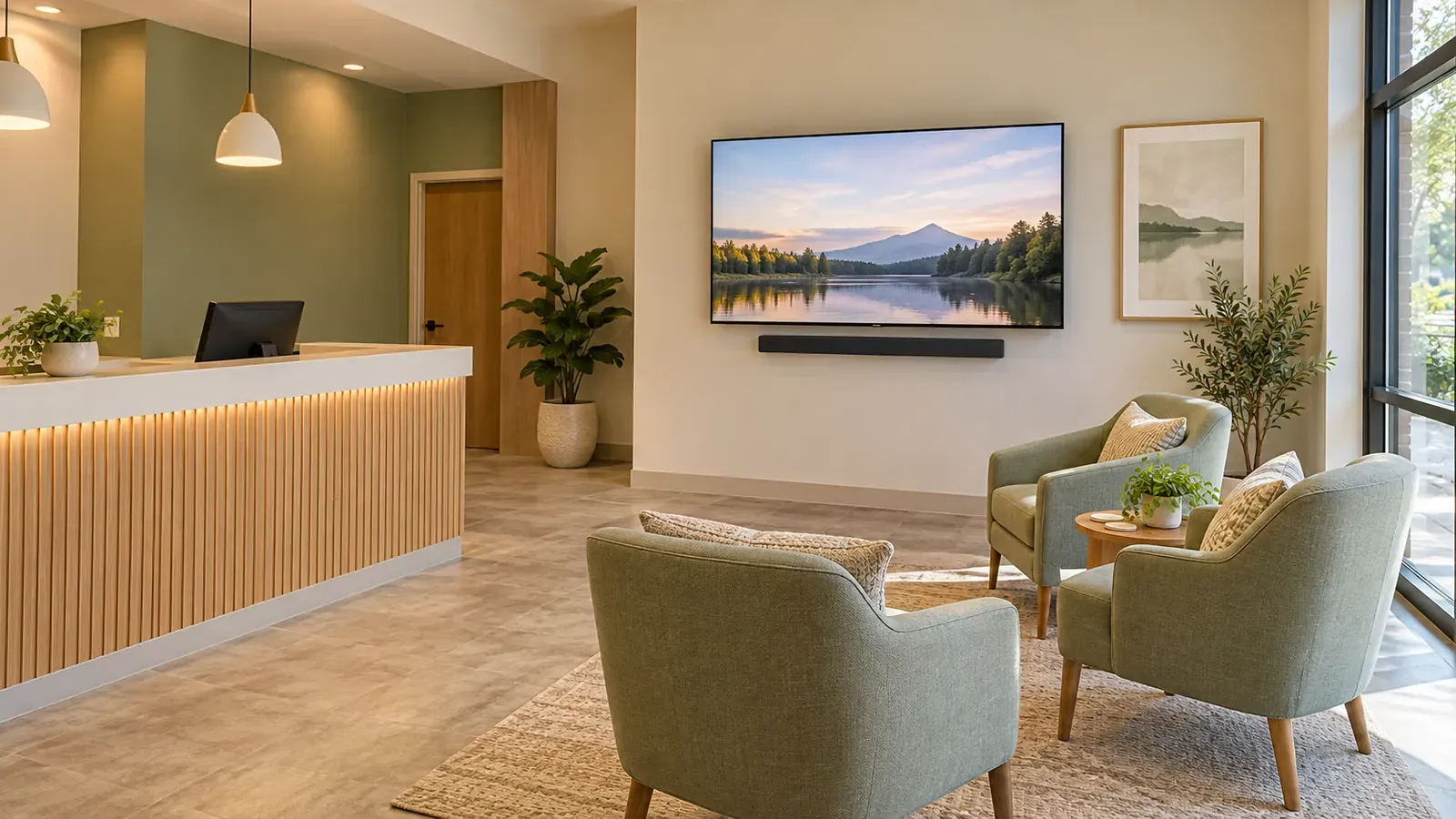
A reception lounge with the screen and bar on one wall and the seating facing it, the kind of room where speech has to carry a few yards and no further.
Businesses that call about a screen's sound usually have a door-entry panel, cameras or a back-office network that needs attention as well.Abstract Enterprises low-voltage installation in Queens handles audio, data and security under one licence, and the same crew can look at the rest on the same visit.
Your Questions Answered
Soundbar Installation in Long Island City: Questions Answered
These are the questions Long Island City residents and businesses raise before a soundbar goes up, grouped by what is behind them: concrete you can't see into, the systems and staff of a managed building, glass and shared households, lofts, and businesses. Booking details and quicker questions are in the FAQ further down.
Inside the concrete
What happens if the drill meets rebar inside the concrete wall of our tower apartment?
If we have done our job, it doesn't, because the wall is scanned before the first hole. Reinforced concrete walls and columns carry steel bars in a grid a short distance below the surface, and the reinforcing in a shear wall is part of what holds the building up. We run a scanner over the area where the bracket will go, mark the bars and any embedded conduit, and shift the bracket's holes to land between them. Most soundbar brackets have slotted or multiple holes precisely so there is room to do that, and the bar itself hides the result.
If a bit does touch steel despite the scan, the drill tells you at once: the dust changes, progress stops and the hammer action starts to ring. We stop. We do not switch to a rebar-cutting bit or try to drill through, because cutting reinforcing in a building we don't own is not our decision to make and almost never the building's policy either. The hole is abandoned, filled, and a new one is made a little to one side, which is why we keep a few inches of adjustment in every layout.
What this means for you is mostly time. On a concrete wall we allow for the scan, the occasional relocated hole and the cleanup of concrete dust, and the Queens concrete line on our price list covers that work. If the scan shows a wall so congested with steel or conduit that a safe pattern isn't possible, we tell you before drilling and switch to a steel-stud wall nearby or a TV-attached bracket.
Management told us the floors are post-tensioned — does that limit where cables or a ceiling bracket can go?
Yes, and it is worth taking seriously. In a post-tensioned slab, steel tendons inside the concrete are stretched tight after the pour; cutting or drilling into one can release that tension, damage the slab and injure people nearby. Concrete-scanning firms describe ground-penetrating radar as the only reliable way to confirm where those tendons run before anyone cores or drills. Not every LIC building uses post-tensioning, and we never assume yours does, but if management mentions it, the rule for your apartment is simple: no holes in the floor or the ceiling slab without the building's say-so and a proper scan.
For a soundbar, that rarely matters, because the bar goes on a wall, not the slab. Where it does matter is everything around the bar: anchoring a cable clip into the ceiling, hanging a projector or a ceiling TV mount, cutting a floor box for a sofa-side outlet, or fixing a rear speaker bracket overhead. We plan those around the slab: rear speakers on stands or on the walls, cable along walls rather than across the ceiling, and nothing that needs a floor core.
If you genuinely need something fixed into a post-tensioned slab — usually a ceiling-mounted screen — that becomes a building-approved job with its own scan by a specialist, arranged through management, before we come back to install. We would rather tell you that on the phone than discover it with a drill in hand.
The ceiling in our Court Square unit is bare concrete — is there a way to get surround or height sound without running wires overhead?
There is, and in most LIC apartments it is the better answer anyway. A bare concrete ceiling means no hollow space above for in-ceiling speakers or for hiding wire, and painted conduit across a concrete ceiling is a lot of visible metal for a pair of speakers. The alternatives are bars that create height effects themselves and wireless rear speakers. Dolby Atmos soundbars with upward-firing drivers bounce sound off the ceiling, and a flat, hard concrete ceiling at ordinary height actually reflects that sound well; the effect weakens in very tall loft ceilings, which we explain before you buy.
For surround, most current bars pair with a set of wireless rear speakers. “Wireless” means no speaker cable from the bar, not no cables at all: each rear still needs power. In an apartment where the sofa floats in the middle of an open-plan room, we look for outlets on the walls behind and beside it, use stands or small shelves rather than ceiling brackets, and run the short power leads along the floor edge or the furniture.
If you want proper overhead speakers in a concrete-ceilinged room, the honest route is a dropped soffit or a ceiling built down by a contractor, which some owners add during a renovation. That is a building alteration with its own approvals; we can wire into it once it exists, but it is not something a soundbar visit can create.
A sidewall sprinkler head sits high on the wall we picked for the TV — does the TV and soundbar layout have to work around it?
Yes. Many apartments in newer towers are protected by sprinklers that come out of the wall near the ceiling rather than down from it, and they are designed to throw water across the room in a particular pattern. A large TV pushed high on the wall, a tall bracket arm or a shelf above the screen can sit in the path of that spray. Sprinklers are life-safety equipment owned and maintained by the building; we never touch the head or its piping, never paint or cover it, and keep the screen, the bar and anything mounted with them clear of the head and below its spray.
In practice that usually means a slightly lower TV than people first imagine, which suits a soundbar anyway: the bar should sit close under the screen at roughly seated ear height, not up near the ceiling. Where the room is tight, we move the TV along the wall rather than up it. If you are unsure whether something on your wall is a sprinkler, a heat detector or a smoke detector, send a photo before the visit and we will tell you; if your building has specific clearances in its house rules, those win.
Drilling near any of those devices also raises dust, and in a building with a central fire alarm that can be a problem of its own. That is covered in the FAQ below, along with what we do to avoid setting it off.
Building rules, systems and staff
Our condo's alteration application wants a written scope of work and the bracket's spec sheet — what do you send?
A short, plain document that a managing agent can approve without phoning anyone. It names the apartment, says what is being installed and on which wall, what the wall is made of and how it will be fixed (for example, four wedge anchors into concrete after a scan, or steel-stud fasteners into an interior partition), confirms that no electrical, plumbing or sprinkler work is involved, and states the expected hours and duration of drilling. Attached are the manufacturer's product sheet for the bracket and the soundbar, our NYS low-voltage license number, and the certificate of insurance naming whoever the building lists.
Some LIC condos treat a soundbar as minor work that only needs the certificate and a service-elevator booking; others run every hole through the alteration process. We match the paperwork to what your building asks for rather than sending the same packet everywhere. If the application asks for something we can't properly provide — an architect's drawing, or a structural engineer's letter for a heavy item on a slab — we tell you so and explain what it would involve.
Start this early. Management offices often take a few business days to respond, and a visit booked before approval may hit the $150 return-trip charge if the lobby turns us away. Send us the managing agent's contact when you book and we will deal with them directly.
We just closed on a new condo — could drilling for the soundbar affect the sponsor's warranty on the apartment?
It is a fair worry in a neighbourhood full of first-generation condos, and the answer lives in your own paperwork rather than in a rule we can quote. New-development sponsors usually set out what they will repair, and for how long, in the offering plan, the purchase agreement or a separate warranty letter, and those documents commonly exclude damage caused by an owner's own alterations. Four anchor holes for a soundbar bracket are about as minor as alterations get, but the logic still applies: if something we drilled caused a problem, the sponsor could reasonably say it isn't theirs to fix.
So we keep the work well away from anything a warranty is likely to cover. We scan before drilling so we don't hit pipes, conduit or reinforcing; we don't open walls that carry plumbing; we never touch the building's electrical, sprinkler or ventilation systems; and on a steel-stud partition we fix into the framing rather than cutting it. If you are still inside the period when the sponsor is fixing punch-list items, it is sensible to let those repairs on the TV wall finish first, so nobody argues later about who made which hole.
If you want certainty, read the warranty section of your offering plan or ask the sponsor's customer-care contact in writing whether mounting a TV or soundbar affects coverage. Nothing on this page is legal advice. What we can give you is a written record of exactly what was installed, where and how, which is the document you would want if the question ever came up.
The building's in-house handyman offered to put the soundbar up — what would we get from a licensed installer instead?
Plenty of building staff are skilled and know the walls in their building better than any outsider, and for a light bar on a console there may be no difference at all. The differences show on harder jobs. We scan concrete before drilling, carry anchors rated for concrete and steel studs rather than the plastic plugs and wood screws packed in most bracket boxes, and set up the electronics as well as the hardware: eARC, HDMI-CEC so one remote works, lip-sync, the bar's app and its firmware, and the night and dialogue settings that matter in a building with near neighbours.
There is also the question of who stands behind the work. Building staff often do small jobs for residents as a favour or on their own time, which can leave nobody clearly responsible if a bracket fails or a wall is damaged. We carry liability insurance, provide a certificate the building can file, hold a New York State low-voltage license, and the terms of our work are in a written service agreement.
If you are happy with the handyman doing the mounting, we can still do the setup-only part — connecting and configuring the bar, sub and remotes — billed by time at the Queens hourly rate. Many residents find that the hardware is the easy half.
Our new condo came with a recessed box and a pipe in the wall where the TV is meant to go — can the soundbar use them?
Very likely, and it is one of the nicest surprises in a new LIC apartment. Some developers rough in a recessed media box at the TV location, with power and a conduit or flexible pipe running down inside the wall to an outlet or a box near the floor where a cabinet would sit. If yours is there, the soundbar's HDMI and the TV's connections can travel through that pipe out of sight, without opening the wall or using a separate in-wall kit.
We check three things on site. First, whether the pipe is continuous and clear: builders sometimes leave a pull string, sometimes nothing, and occasionally the pipe was cut or crushed during construction. Second, whether it is big enough for the connectors you need; an HDMI plug is larger than the cable, and a pipe sized for a single coax cable may only take a slim HDMI or nothing at all. Third, whether the recessed box sits at a sensible height for the TV and leaves room beneath the screen for the bar.
If the pipe works, the job is cheaper and neater than an in-wall kit. If it is blocked, we tell you, and use a raceway or the in-wall kit instead. Either way we do not run power cords through a low-voltage pipe; the recessed box's own outlet powers the TV, and the bar plugs in wherever the building's electrician put the lower receptacle.
Glass, bass and shared households
Our sliding balcony door and the glass panel beside it buzz whenever the subwoofer plays — what stops that?
This is a common complaint in waterfront and tower apartments, and it is almost always fixable without giving up the subwoofer. A sliding door is a large panel held in a track with a little play in it, and window walls have their own gaskets and frames; a subwoofer playing a note close to the frequency at which that panel likes to vibrate makes it rattle in sympathy. The fix starts with the subwoofer's position, because moving it even a couple of feet changes which frequencies the room reinforces. Corners and the floor directly beside the glass are usually the worst places.
After position, level and crossover. Many people run the subwoofer far louder than the bar, which both rattles the glass and pushes bass into the apartments around you. We set the sub to blend with the bar rather than dominate it, and use the bar's room-correction or bass adjustment where it has one. An isolation pad or riser under the sub reduces what goes into the floor, which in a concrete building is the path most likely to reach the neighbours. Finally, check the door itself: a loose latch or a missing bumper in the track rattles at almost any volume, and building maintenance can adjust it.
If one particular note still sets the glass off, many bars and their apps allow a lower subwoofer level or a night or late-evening mode that reins in the deepest bass. We play a few test scenes with you and stop at the level where the glass is quiet.
Three of us share a two-bedroom — whose phone and account should the soundbar be set up under?
Whoever is most likely to stay in the apartment longest, and ideally the person who bought the bar. Most smart soundbars are tied to one account in the manufacturer's app, which controls settings, updates and, for some brands, who can add the bar to a speaker group or a voice assistant. If that account belongs to a roommate who moves out, the bar may need a factory reset and fresh setup before anyone else can manage it, and any custom settings go with them.
During the visit we set the bar up under the account you choose, then add the others as household members or guests where the app supports it, so everyone can stream to it and change the volume without owning it. We write down the settings that matter — speech mode, night mode, subwoofer level, the TV's audio output setting — on a card that stays with the bar, so a reset doesn't mean starting from nothing. Basic TV sound needs no app at all: the TV remote controls the bar over HDMI-CEC for everybody.
It is also worth agreeing who owns the hardware. If the bar and bracket belong to one roommate, they will want to take them when they leave; a bracket screwed into concrete comes down in minutes, but the anchor holes stay behind, so it is worth knowing how your lease treats them before the drill comes out.
Lofts and older buildings
Our loft has exposed metal conduit everywhere — can the soundbar's cables run the same way instead of a plastic raceway?
Yes, and in a converted factory it usually looks far better than a white plastic channel. Painted or bare steel conduit, fixed to concrete with proper straps and set out in straight runs with square bends, matches the industrial pipework already in many LIC lofts. We use it for the low-voltage side of a soundbar install: HDMI from the bar or the TV down to the media cabinet, speaker or subwoofer leads, and network cable, each in a pipe sized for the connectors that have to pass through it.
What we do not do is carry mains power in that pipe. Extending or adding outlets is electrical work for a licensed electrician, and power and low-voltage cables are kept in separate pathways. In practice the electrician and we often run parallel pipes along the same route, which keeps the look consistent. In a condominium loft, exposed conduit on a shared wall or ceiling may also need the board's approval, the same as any other alteration.
Plan the route before choosing the TV position. A pipe that has to cross a doorway, a window or a column face gets complicated quickly, and the cheapest, cleanest loft installs are the ones where the TV goes on the wall nearest to where the cables need to end up.
Businesses
Our Vernon Boulevard restaurant wants the game to be heard at the sidewalk tables — is that allowed?
Not through speakers aimed outside. The city's Dining Out NYC rules for sidewalk cafés state that there may be no musical instruments or amplified sound unless authorised by a Street Activity Permit, and cafés must also comply with the Noise Control Code's rules on unreasonable noise. A soundbar pointed through an open window or door at the café tables is amplified sound outdoors in all but name, and with apartments above most Vernon Boulevard storefronts it is also the quickest way to a complaint.
What we can do is make the indoor room work well. A bar under the main screen, set for clear commentary at a moderate level, carries to the bar seats and the front tables; the outdoor screen, if you have one, runs captions. We keep the bar's level in check with the doors open, and leave the subwoofer off or very low in rooms with homes overhead, since bass is what travels.
If you are planning a special event with outdoor sound, the permit question belongs to the city's street-activity process, not to us. We are glad to set up indoor sound for it and take it out again afterwards.
Our Court Square office's glass-walled meeting room leaks sound into the open office — will adding a soundbar make that worse?
It can, if the bar is set up for a living room. Glass-fronted meeting rooms reflect sound around the room and pass more of it through than a solid wall would, so a soundbar running at living-room volume with its virtual-surround mode on makes calls clearer for the people inside and louder for everyone outside. Set up for speech instead, a bar usually helps: people in the room hear the far end clearly at a lower level, so they stop raising their own voices.
We mount the bar close under the display, aimed at the table, with surround and bass-boost modes off and dialogue mode on, and we cap the maximum volume where the bar or display allows it. For video calls the bar has to be the system's speaker output and the room microphone has to be a separate device that cancels the bar's sound; we check that the conferencing setup does that before leaving, because echo complaints are usually a settings problem, not a hardware one.
If the room needs real privacy rather than just a better speaker, that means acoustic treatment or a sound-masking system, which is a fit-out decision for the landlord and your facilities team. We will say so if a bar alone won't meet the need.
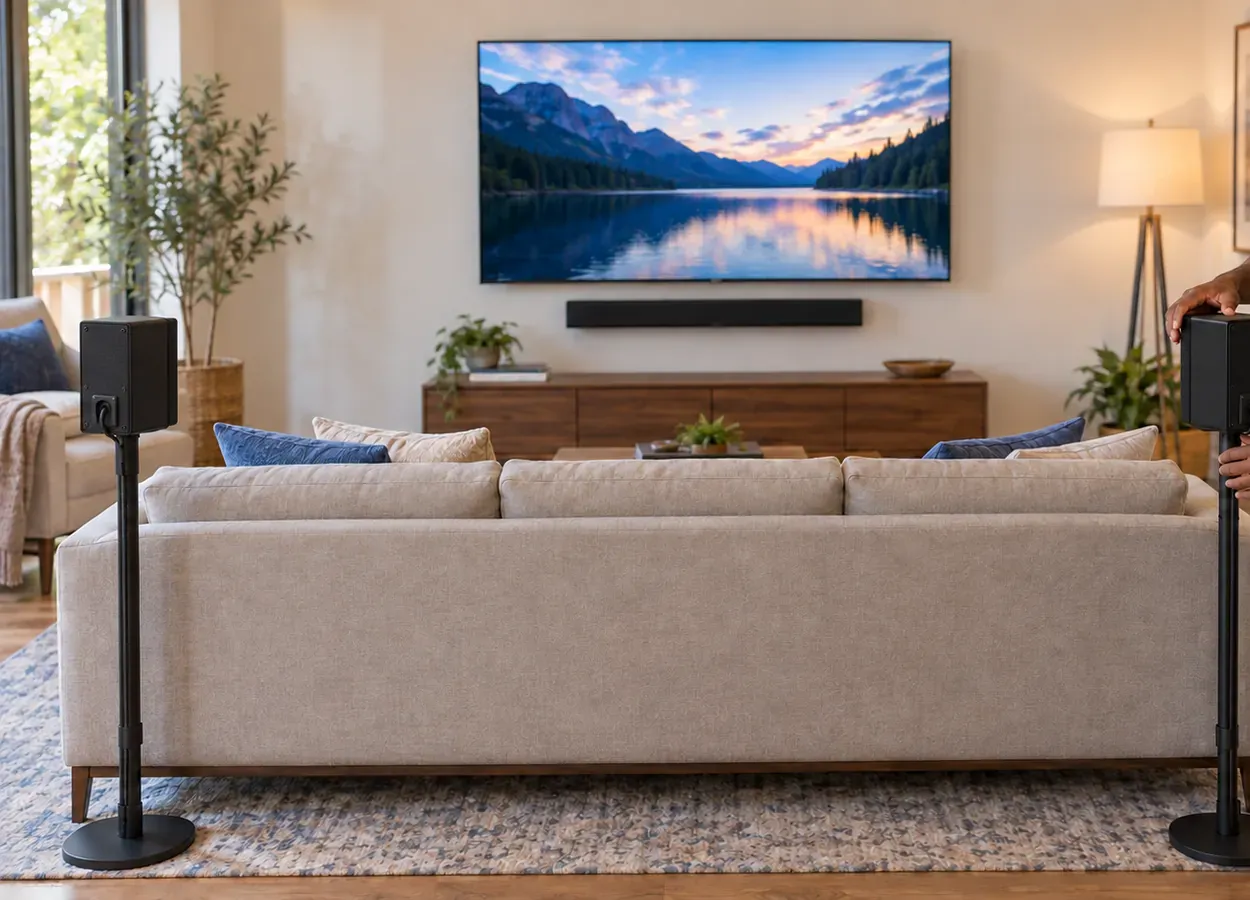
Surround without ceiling wiring: two rear speakers on floor stands behind the sofa, the TV and bar on the far wall.
Wall Finder
Which Wall in a Long Island City Apartment Should Carry the Soundbar?
In a tower apartment the choice of wall usually decides the method, the price and the paperwork in one go. This is the table we use on the phone when someone describes their living room; it is a starting point, and the scan on the day has the final word.
Wall you are looking at
What it usually is
How the bar is fixed
Cable finish
Watch out for
Thick, cold, solid when knocked; often beside the window wall or around the elevator core
Reinforced concrete shear wall or column
Wedge or sleeve anchors after a scan
Painted raceway or straight down behind furniture
Rebar, embedded conduit, drilling-hour rules
Hollow-sounding interior wall between rooms
Steel studs with gypsum board
Steel-stud fasteners or rated toggles
In-wall kit where building rules allow
Plumbing behind kitchen and bath walls
Wall shared with the next apartment
Rated party partition, studs or concrete
Avoided where possible; otherwise per building rules
Front-room wall in an 1870s or early-1900s rowhouse
Plaster over brick or wood lath
Sleeve anchors in brick, or into framing
Raceway on brick; in-wall on framing
Cracking plaster, old wiring
Two habits make the conversation shorter. Knock on the wall and note whether it rings hollow or sounds dead, and photograph it with the outlet and any devices near the ceiling in frame. With that and the bar's model number, we can usually tell you the method, the paperwork and the Queens total before anyone visits.
Equipment
Types of Soundbars and Mounting Hardware We Install
We install the bar you already bought, or help you choose one that suits an LIC apartment. These are the categories that come up most, described in terms of how they behave on concrete, steel studs and glass rather than in brochure language.
Slim Bars for Narrow Walls
Short, shallow bars that fit the stretch of wall between a window mullion and a column, or under a 43- to 55-inch screen in a studio. Light enough for steel-stud toggles; check the bar's depth so it clears the TV's lower edge.
Centre-Channel Bars for Speech
Three-channel bars that keep voices clear at modest volume — the right choice in a building where the aim is to hear the dialogue without the neighbours hearing it too.
Atmos Bars With Up-Firing Drivers
Height effects bounced off the ceiling. A flat concrete ceiling at normal height reflects them well; a 14-foot loft ceiling weakens the effect, which we tell you before you choose.
Bars With Wireless Rears and Sub
Surround without overhead wiring, useful under bare concrete ceilings. Every wireless rear and sub still needs a power outlet, which in open-plan rooms decides where they can go.
Concrete Anchors
Wedge and sleeve anchors sized for the bracket, set in clean, vacuumed holes after a scan. We never hang a bar on the plastic plugs packed in the box.
Steel-Stud Fasteners
Self-drilling screws for steel framing and toggles rated for hollow walls, used on the interior partitions that divide most tower apartments.
TV-Attached Brackets
Brackets that carry the bar on the TV or its mount, for leases that forbid extra holes and for full-motion arms in corner layouts. Universal models such as Sanus's SASB1 are rated for most bars up to 20 lb.
Floor Stands With Bar Shelves
Freestanding TV stands with a shelf or bracket for the soundbar — the clean no-drill answer for window-wall apartments and short leases.
Isolation Pads and Risers
Pads under the subwoofer that cut what goes into a concrete floor and the apartment below, and keep the sub off the floor in street-level rooms near the water.
Choosing the connection in a managed building
Situation
Connection
Why
Everyone uses the TV remote
HDMI eARC or ARC with CEC on
The TV powers the bar and sets its volume
Building-supplied Wi-Fi with a sign-in page
HDMI for TV sound; device registered by hardware address for the app
The bar has no browser to sign in with
Router or data jack behind the TV
Ethernet to the bar where it has a port
Takes the crowded airwaves out of the picture
Older TV without ARC
Optical
Works for stereo and compressed surround
Lossless Atmos from a console or disc player
HDMI eARC
Needed for TrueHD and DTS-HD Master Audio
Guests and roommates playing music
Wi-Fi casting, Bluetooth as a backup
Bluetooth adds delay, so not for TV sound
Bracket ratings and product details come from manufacturer pages checked for this October 2026 revision. Your exact model numbers decide the bracket and the anchors, so we plan around them rather than around a category.
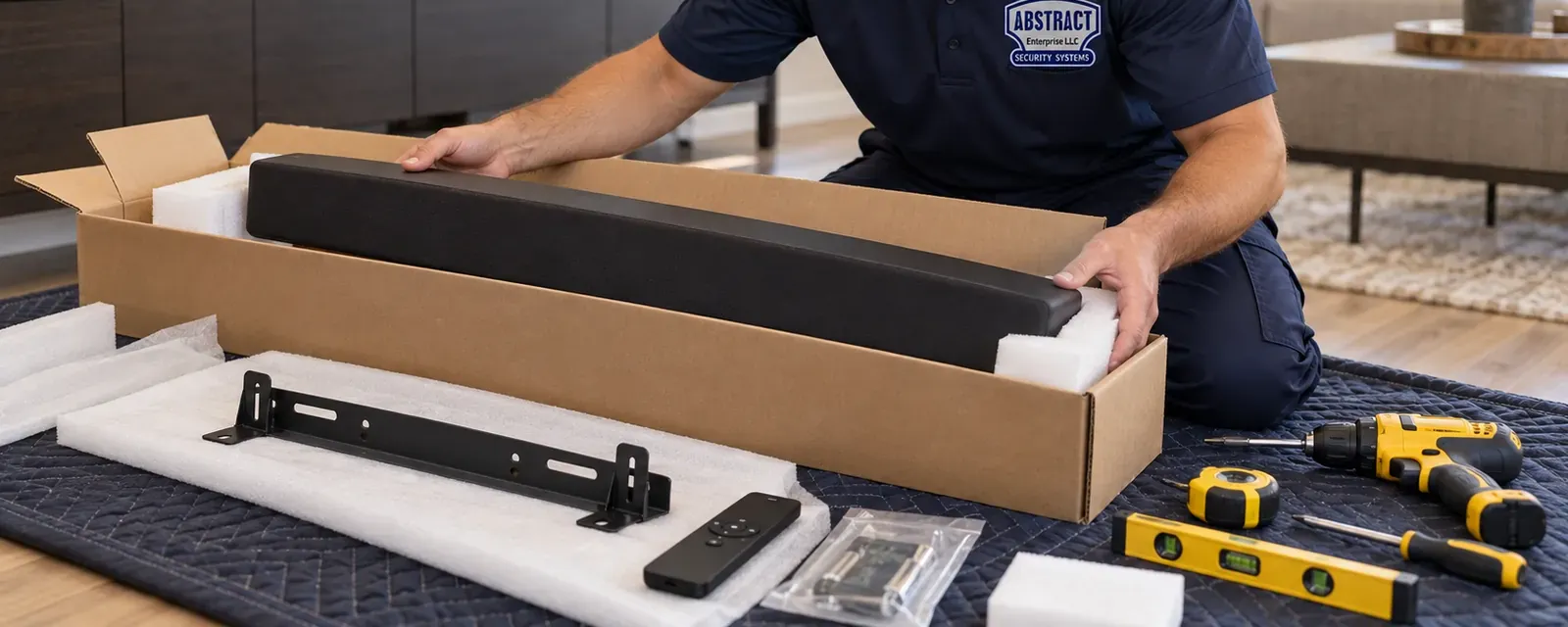
Everything out of the box and checked before any drilling: bar, bracket, remote, the hardware bag and the tools.
AI Overview Reality Check
What AI Gets Wrong About Soundbar Installation in Long Island City
First, how this section was built. Google's AI Overview could not be displayed in the research environment for this page, so nothing below is quoted as something it said. Each heading is a claim published by a cost guide, a manufacturer or a forum — the sort of sentence answer engines summarise and repeat — followed by what it misses in a Long Island City apartment.
“The estimated national average cost to install a soundbar starts at $58.43 to $231”
That range comes from Homewyse's soundbar installation estimate, and as a national figure for a bar on a wood-stud wall it is reasonable. Summaries tend to present it as what a soundbar costs to install, full stop.
The figure doesn't know about the concrete. In an LIC tower the TV wall is often a reinforced shear wall that needs a scan, a hammer drill and proper anchors, and the job usually starts with paperwork for a managing agent. Our Queens list prices the wall mount at $135.45 and adds $78.75 for concrete or block, so a bar on a concrete wall with our Sanus bracket comes to $303.44 — higher than the bottom of the national range, and fixed in writing before anyone drills.
The useful takeaway is to price the wall, not the soundbar. Ask any installer what their figure assumes about the wall, and what changes if it turns out to be concrete.
“Mount the soundbar about 42.5 inches off the ground, where your ear falls when seated”
Yamaha's mounting guidance gives roughly that height as a target for seated ear level, and the principle — bar close to ear height, aimed at the listener — is sound.
LIC living rooms complicate the number. Many furnish with low modern sofas, so seated ear height is lower than the guide assumes; a sidewall sprinkler or a window header can limit how high the TV goes; and on a concrete wall the bar's height also has to dodge reinforcing steel found by the scan. A fixed number can put the bar in the wrong place or put a hole in the wrong spot.
We measure from your actual seat, check the TV's lower edge and remote sensor, then fit the height to the scan. The result is usually within a few inches of the guide, but it is your room's number, not a national one.
“If you use an adjustable TV mount, attach the soundbar to the TV mount”
Dolby's placement article suggests a bracket connected to the TV mount when the screen moves, so the bar follows the picture. That is good advice, and in LIC it often doubles as the no-new-holes option a lease or condo board prefers.
The catch is weight and reach. A full-motion arm carrying a large TV is already working near its limits, and the anchors behind it carry everything; in a steel-stud partition that matters far more than it does in a wood-framed house. A long Atmos bar also changes how far the arm can swing before it hits a window frame or a column.
We check the arm's rated load against the TV plus bar and bracket, confirm the arm is fixed into concrete or properly into steel studs, and test the full swing before handing it over.
“You need eARC to get Dolby Atmos”
It is repeated constantly. AWOL Vision's explainer sets it straight, as does a Sonos owner on Reddit who points out that eARC is not required for Atmos. Plain ARC can carry Atmos inside Dolby Digital Plus from streaming apps; eARC is needed for lossless formats such as Dolby TrueHD and DTS-HD Master Audio from a disc player or console.
This matters in LIC because many residents rent and inherit whatever TV the last owner or the furnished-apartment company left, or are buying a mid-range TV for a small room. Spending money on a new TV purely for eARC may be unnecessary if you only stream.
We look at your TV's ports and how you watch, set the TV to pass Atmos where it can, and tell you plainly whether eARC would change anything for you.
“Universal soundbar mounts hold most soundbars up to 20 lb”
That is how Sanus describes its universal soundbar mount, and it is an accurate rating for the bracket. Quick answers stretch it into “any universal bracket will hold your bar”.
A bracket rating says nothing about what holds the bracket. The weak point in a tower apartment is almost never the steel arm; it is a wood screw in a steel stud, or a plastic plug in a concrete hole drilled too large. Those failures are slow — a bar that starts to tilt months later — and the bar usually hits the console on the way down.
So we treat the bracket rating as half the answer, choose the fixing for the wall the scan finds, and leave the plastic plugs in the box.
“Bass travels easily, so either don't use a subwoofer or get one that can be adjusted”
That advice comes from an r/AskNYC thread about neighbour-friendly soundbars, and it is a fair rule of thumb. It gets shortened to “skip the sub in an apartment”.
In a concrete LIC tower, the main route for bass to a neighbour is through the structure — the subwoofer sitting on a slab, or a bracket on a party wall — more than through the air. A modest sub on an isolation pad, away from shared walls and corners and set to blend with the bar, is often quieter next door than a bar with its bass turned up to compensate for no sub at all.
We set the level with you and, if you can arrange it, check with a willing neighbour before we leave. That is worth more than any rule of thumb.
“Big-box stores list soundbar setup and soundbar mounting as separate menu items”
They do; national retailers publish flat-price menu lines for setup, networked setup and mounting. That makes it look as if every soundbar job is a menu choice.
Menus don't list the parts of an LIC install that take the time: the managing agent's paperwork, the service-elevator booking, the scan of a concrete wall, the building-supplied Wi-Fi that needs a device registered, or the sprinkler head that decides the TV height. Those end up as surprises on the day, or as a technician who can't proceed.
Ask before you book what happens if management wants a certificate, or the wall is concrete. If the answer comes back with a line from a price list and a method, the installer has worked in buildings like yours.
Concrete Wall, Strict Building, Clear Sound
Send the building, the floor, the bar's model and a photo of the wall. You get a method, a Queens total and a list of what your managing agent will want from us.
A studio over Court Square, a two-bedroom on Center Boulevard, a loft on Queens Street or a parlor floor on 45th Avenue — this form gets you a written total from the Queens price list by the end of the business day. Rather talk it through? Call (347) 434-6392.
✅
Got It — We'll Be in Touch
Our Queens team will call before the business day ends. If it can't wait, phone (347) 434-6392.
How It Works
Our Installation Process
Seven steps, written for a building with a lobby, a managing agent and concrete walls. Rowhouse and loft jobs skip the parts that don't apply.
1. Photo, models and building
You send the TV and soundbar models, a photo of the wall with the outlet and any ceiling devices in view, and the building name and floor. We work out the wall type, the bracket and the connection from those.
2. Written Queens price
A total built from the Queens price list: mount, bracket, wall line, cable finish and any extras. No separate tower or waterfront rate.
3. Management packet
Certificate of insurance naming whoever your building lists, plus a scope of work and product sheets if the alteration process asks for them. We deal with the managing agent directly.
4. Slot inside building hours
You choose a 2-hour arrival window, 8 AM to 8 PM, seven days, inside the hours your building allows contractors, with the service elevator booked if needed.
5. Scan and layout
On arrival we confirm the wall, scan concrete for rebar and conduit, locate steel studs, check sprinkler heads and detectors, and agree height and centre line with you.
6. Fix, hang and connect
Anchors suited to concrete, steel studs or brick, dust vacuumed at the bit, bracket levelled, bar hung, cables dressed or routed, and the bar connected to eARC or ARC with CEC on.
7. Tune for the building
Dialogue and night modes set, subwoofer placed and levelled for the neighbours, glass checked for buzz, the app joined to your network, and the settings written on a card.
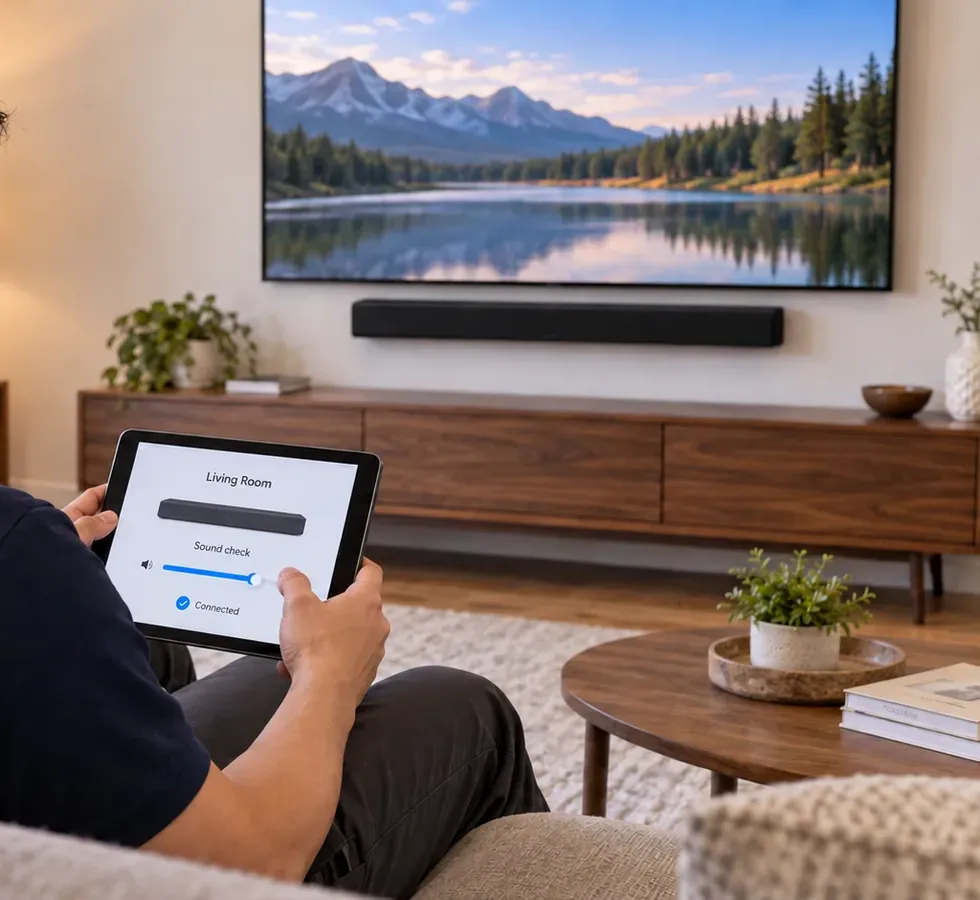
The final sound check is run from the sofa, with the bar’s app on a tablet and the TV and bar straight ahead.
Coverage Area
Soundbar Installation Near Long Island City's Landmarks
Long Island City packs 150 years of building into a short walk. These six places mark the range of homes and businesses our installers go into, and what each kind of building tends to mean for a soundbar.
Gantry Plaza State Park and the Pepsi-Cola Sign
A 12-acre state park on the East River that opened in 1998, with the neon Pepsi-Cola sign — built in 1940 atop the old bottling plant and designated a city landmark in 2016. The towers behind it are glass toward the river and concrete inside.
Hunters Point Historic District, 45th Avenue
Landmarked in 1968: a block of 1870s Italianate, Second Empire and Neo-Grec houses once called “White Collar Row”. Brick party walls, old plaster and apartments carved out of single-family houses.
Eagle Lofts, 43-22 Queens Street
A 1920 factory built for the Anchor Cap & Closure Corporation, later Eagle Electric's Plant #7, converted to loft apartments with ceilings of 12 to 15 feet. Concrete columns and long cable runs.
The Orchard and the Court Square Towers
The roughly 70-storey Orchard on Jackson Avenue is now the tallest building in Queens, rising among Lumen, the 5Pointz towers and the 50-storey One Court Square office tower. Shear walls, steel-stud partitions and managing-agent rules.
Hunter's Point South, Center Boulevard
The city-led waterfront redevelopment where about 5,000 homes are expected, many let through the housing lottery, beside the 11-acre Hunter's Point South Park. Window walls, balconies and low-lying ground floors.
Queensbridge Houses
Opened in 1939 beside the Queensboro Bridge with 3,142 apartments, the largest public housing development in North America. Masonry walls and housing-authority rules.
Screen and bar on the wall with the credenza clear beneath, being shown to the household before we leave.
Pricing
Soundbar Installation Cost in Long Island City
Long Island City is priced on the published Queens list — there is no separate tower or waterfront rate. Choose the lines that describe your job and add them up; that sum is the written quote and the bill. If the scan or the wall turns up something the photo couldn't show, you hear the price of it before any extra work begins. Queens prices include the borough's 1.05 area factor on the soundbar and accessory menu.
Soundbar service
Queens price
What it covers in an LIC apartment
Soundbar placed on a console or stand
$82.95
Connected, configured and tested, no drilling — including floor stands with a bar shelf
Soundbar wall-mounted under the TV
$135.45
Bracket fixed and levelled, bar hung, connected and tested
Sanus soundbar bracket
$89.24
When the bar came without a bracket, or its bracket suits neither concrete nor steel studs
In-wall concealment
$177.45
Code-compliant in-wall power and cable kit, for hollow partitions where the building allows it
Paintable cord cover
$61.95
Surface raceway on concrete, painted to match
Cable run to a cabinet or other spot
$103.95
Up to 25 ft — the usual loft and open-plan line
Sonos setup
$131.25
Sonos bar, sub and rears, app and grouping, including building-network registration
A/V receiver hookup
$135.45
Receiver connected and configured
Universal remote
$103.95
Programmed for the TV, bar and sources
Streaming device setup
$51.45
Roku, Apple TV, Fire TV, Chromecast or similar
Full home theater connection
$367.50
Several components set up as one system
Wall and access lines that apply in Long Island City
Your own bracket on a concrete shear wall: $135.45 mount + $78.75 concrete = $214.20.
Our Sanus bracket on concrete: $135.45 + $89.24 + $78.75 = $303.44, cable in a painted raceway adds $61.95.
Bar on a steel-stud partition with cables hidden inside it: $135.45 + $89.24 + $177.45 + $31.50 = $433.64.
No drilling, bar on a floor stand or console: $82.95.
Setup-only visits and TV mounting
When nothing has to be mounted — moving a bar to a new TV, registering it on a building network, fixing eARC, CEC or lip-sync, pairing a sub after a move — the visit is billed by time: the first hour at the Queens rate of $195, then 30-minute blocks. If the TV is going up at the same visit, the Queens base for mounting a 32- to 55-inch screen on a flat or tilt mount on drywall over wood studs is $179.99, with size, mount and wall adjustments listed on our Queens TV mounting price list.
What the price includes and leaves out
Included: the wall scan, fixing and levelling the bracket, hanging and connecting the bar, dressing the cables, HDMI-CEC so the TV remote runs the bar, speech and night settings, a building-friendly bass setting and vacuuming the drilling dust.
Not included: any outlet work, which is for a licensed electrician; patching and painting; and anything to do with sprinklers, smoke detectors or fire-rated walls, which belong to the building.
Return trips: if we arrive and can't start — no access, no bar, or management approval still pending — the visit is charged as a $150 return trip, which is why we chase the paperwork before the date.
Fragile finishes: back-painted glass, stone and glazed tile are discussed before drilling, and nothing goes ahead until you agree.
National menus and marketplace handymen versus a local licensed installer. Flat menu prices assume a wood-stud wall and no building to deal with. In Long Island City the time goes into concrete, scans, steel studs, management packets and elevator bookings. A Queens price list with a line for each of those, from an installer with a state low-voltage license and insurance your building can file, is the closest thing to a guaranteed number.
Shop Our Systems
Long Island City Soundbar Packages & Pricing
Three bundles cover most LIC apartments. Each card shows what is in it; wall and access lines from the table above are added on top.
Starter — No Drilling
$82.95
The bar on your console or on a floor-standing TV stand with a soundbar shelf ($82.95), connected on eARC or ARC, one remote, dialogue and night modes set, cables tied out of sight. The answer for strict leases and window-wall living rooms.
Standard — Wall Mount and Bracket
$224.69
Wall mount $135.45 plus our Sanus bracket $89.24. On a tower's concrete wall add $78.75 ($303.44 total); on a steel-stud partition add $31.50 ($256.19); on rowhouse brick add $68.25.
Premium — Cables Inside the Wall
$402.14
Wall mount ($135.45), Sanus bracket ($89.24) and the code-compliant in-wall power and cable kit ($177.45). Needs a hollow partition and the building's consent; in most towers that means a steel-stud wall, so add $31.50.
Bring Your Own Equipment — Labor Only
If you already have a bracket that suits your bar, you pay the Queens wall-mount labor of $135.45 plus the wall line — $214.20 on concrete. Your bracket must be rated for the bar and is covered by its own maker's warranty, not ours. If its packed fixings are wrong for concrete or steel studs, we fit proper anchors instead; if the bracket itself is unsuitable, you hear that before we drill, with the option of our Sanus bracket.
Want the LIC Total in Writing?
Building, floor, a photo of the wall and the bar's model. We add up the Queens lines and tell you what management will need.
Long Island City covers a lot of different ground for one neighbourhood name. The same soundbar can be a twenty-minute job on a rowhouse partition and a two-hour job with a scan and a management packet half a mile away. This is how the work tends to change from section to section.
Hunters Point waterfront and Center Boulevard
Glass towers facing Manhattan, from the first waterfront buildings near Gantry Plaza to the TF Cornerstone pair at Hunter's Point South and the newer Malt Drive towers. Living rooms tend to have the window wall on one side and a balcony door; the TV almost always ends up on an interior wall or a column. Many apartments here were let through the housing lottery, and lottery units are rent-stabilised for the length of the lease, so the lease and house rules shape what can be drilled. Street levels and storage rooms sit in high-risk flood zones that Sandy reached, so nothing valuable lives on the floor below grade.
Vernon Boulevard and the old Hunters Point blocks
The restaurant strip and the side streets around it mix 19th-century houses, small apartment buildings and mid-rise newer construction. Homes over shops, plaster and brick walls, and narrow staircases. This is where landmarked 45th Avenue is, and where business soundbars meet apartments upstairs and sidewalk cafés outside.
Court Square
The heart of the post-2001 rezoning: towers on Jackson Avenue, Crescent Street, 44th Drive and the streets around the courthouse, with the 5Pointz towers, Linc LIC and the offices of One Court Square. Several subway lines meet here, so it attracts commuters and first-time renters. Expect shear walls, steel-stud partitions, building-supplied amenities and plenty of paperwork.
Queens Plaza and the bridge approaches
Towers and hotels around the plaza, the elevated tracks and the bridge ramps, now reaching the tallest heights in the borough with The Orchard and Lumen. Very high floors, big window walls and serious street noise below; dialogue settings and wall choice matter as much as the bracket.
Dutch Kills
North and east of Queens Plaza, a pocket of modest rowhouses and small buildings, many from the early 1900s, increasingly surrounded by hotels and new apartment blocks. Owner-occupied floors over rentals, wood-framed partitions that suit hidden cabling, and the walk-up line on the upper floors.
Ravenswood and Queensbridge
The riverfront north of the bridge, with Queensbridge Houses, Ravenswood Houses and a growing number of new buildings along Vernon Boulevard and 21st Street. Masonry walls, management rules from the housing authority or a landlord, and often a TV that has to share the wall with radiators or windows.
Factory conversions along the Sunnyside Yard edge
East of Jackson Avenue, toward the rail yard, former industrial buildings such as the Eagle Electric plant have become lofts beside brand-new towers. High concrete ceilings, columns, exposed pipe and long runs: the jobs where cable routing is planned first and the bracket second.
Tower Checklist
Before the Installer Comes to Your Long Island City Building
Most failed install days in managed buildings come down to something that could have been arranged by email the week before. These are the things worth sorting before the date.
Who approves work in your apartment. Renters: the management office and the lease rider. Owners: the managing agent and, for anything more than minor work, the board's alteration process. Send us the contact and we take it from there.
The certificate of insurance. Buildings name specific parties — the condominium, the managing agent, sometimes the developer. We issue it free; it simply has to be on file before we arrive.
The service elevator and contractor hours. Many buildings allow contractor work only on weekdays within set hours and need the elevator booked. Tell us the window and we pick an arrival slot inside it.
Drilling rules. Some buildings ask contractors to avoid shared walls, require notice before hammer drilling, or forbid any holes in the ceiling or floor slab. We plan the wall around them.
Devices near the ceiling. Note sprinkler heads, smoke and heat detectors on the TV wall. Photograph them for us.
The network. Find out whether the building supplies your internet and how residents register a device without a browser. Have the Wi-Fi name and password ready if it is your own router.
The bar, its bracket and the remotes, in the apartment. Deliveries held at the front desk or in a parcel locker should be collected before the slot.
A clear path and a clear wall. A few feet in front of the TV wall, and the furniture under it moved if you can.
If the list looks like a lot, it isn't: in most LIC buildings it is two emails and a phone call, and we will make most of them for you.
After the installer leaves
Keep the card we leave with the bar's settings, the bracket model and the anchor type on it. If you move to another building — common in a neighbourhood of renters — it tells the next installer what to bring, and it tells you what the patching will involve at move-out.
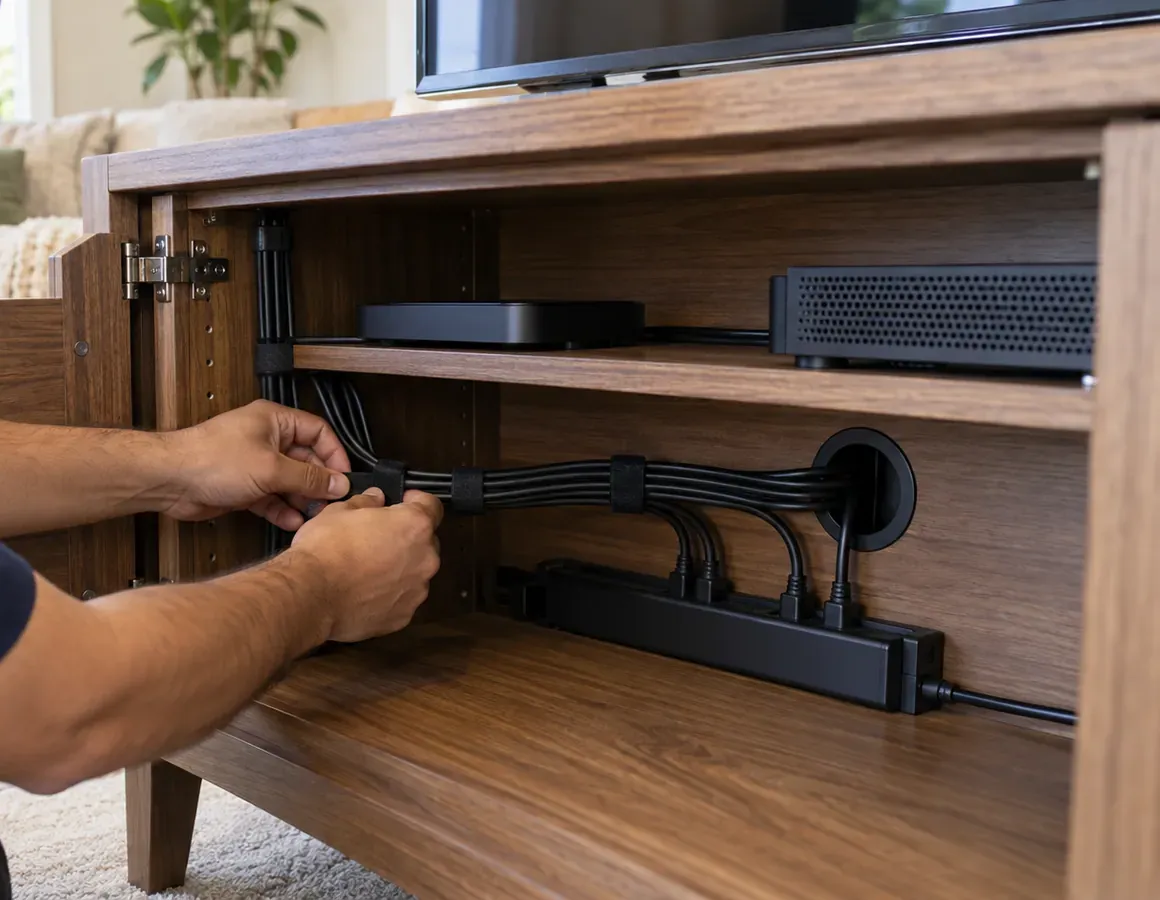
Cables bundled with straps inside the cabinet and fed through a grommet to the power strip, so nothing hangs behind the bar.
Complete Services
Every Soundbar Installation Service in Long Island City
A move into a new tower tends to bring several jobs at once. These are the neighbouring services LIC residents and businesses most often add to a soundbar visit.
Arrival windows, return trips, rescheduling and time-billed visits.
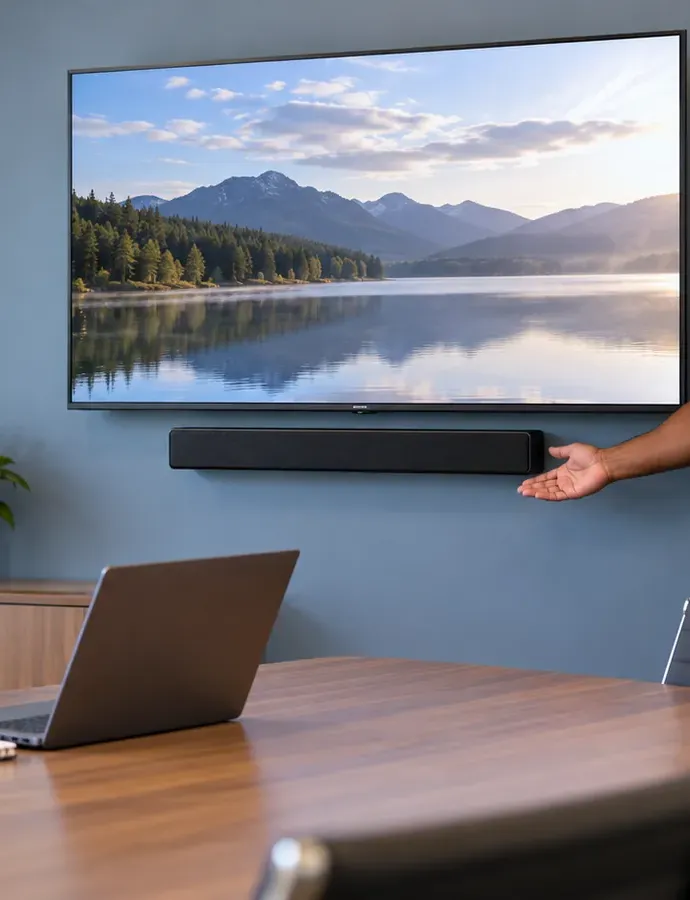
A meeting-room screen with the bar close beneath it, aimed down the table rather than out into the office.
Field Notes
Field Notes on Long Island City Soundbar Walls
How our crews read a tower or loft wall — working practice, not a story about any particular building
Start with your knuckles. A steel-stud partition sounds hollow between the studs and gives a little; a concrete wall sounds dead and feels cold. Then look at where the wall is: walls around the elevator core, beside the window wall and at the ends of the apartment are the likeliest to be concrete. A magnet slid along a hollow wall finds the screws in the steel studs faster than most stud finders.
On concrete, scan before you mark, mark before you drill, and keep the vacuum nozzle at the bit. Concrete dust is fine enough to drift into a smoke detector across the room and heavy enough to settle on everything else. If the bit stops and rings, you are on steel: stop, move, and fill the old hole.
In lofts, walk the cable route before agreeing the TV position. In rowhouses, assume the plaster is older than it looks and drill without hammer action until you reach brick. Everywhere, look up at the ceiling line for sprinkler heads and detectors before choosing a height, and look down for the outlet before choosing a wall.
FAQ
Long Island City Soundbar Installation FAQ
How long will the hammer drill be running, and how much noise and dust should the neighbours expect?
+
On a concrete wall, the drilling itself usually takes a few minutes per hole and only four to six holes are needed for a soundbar bracket, so the loud part is short. We drill inside the building's permitted hours, keep a vacuum nozzle at the bit to catch the dust, and tell management in advance if the house rules require notice of hammer drilling.
Could concrete dust from drilling set off our apartment's smoke detector and the building alarm?
+
It can if the detector is close to the work, which is why we take it seriously. We capture dust at the bit with a vacuum, keep holes few and clean, and if a detector is within a few feet of the wall we ask management how they want it handled; covering or isolating life-safety devices is the building's decision, never ours.
How can I tell whether our TV wall is concrete or drywall before booking?
+
Knock on it: a hollow, slightly springy sound means drywall on studs, while a dead, solid sound and a cold surface usually mean concrete. Walls around the elevator core, beside the window wall and at the ends of the apartment are the likeliest to be concrete. A photo with the outlet in view lets us confirm before the visit.
Can I just stick the soundbar to the concrete wall with adhesive strips instead of drilling?
+
We don't recommend it for anything but the lightest bars. Adhesive strips are rated for clean, smooth, dry surfaces and lose grip on painted or slightly dusty concrete over time, and a bar is held at the edge, which puts a peeling force on the strip. A TV-attached bracket or a floor stand gives you a no-hole option that won't let go.
Is a floor-standing TV stand with a soundbar shelf a good option for a window-wall apartment?
+
Often it is the best one. A sturdy floor stand keeps the screen and bar together, leaves every wall undrilled and can stand in front of a column or a short stretch of wall between windows. We assemble it, fix the bar to its shelf or bracket, run the cables down its spine and connect everything at the console price.
Do you fit soundbars in hotel rooms or extended-stay suites around Queens Plaza?
+
Yes, for owners and managers. Guest-room bars need to be fixed so they can't be lifted off, locked to a sensible maximum volume, set to follow the TV's power and volume over HDMI-CEC, and stripped of Bluetooth pairing and voice features guests could misuse. We work room by room around occupancy and leave a written settings sheet for the engineering team.
We live in a furnished apartment and the TV belongs to the landlord — can a soundbar still be added?
+
Usually, without changing anything permanent. The bar sits on the media unit or clips to the existing TV mount, connects to the TV's HDMI ARC or optical socket, and comes away again when you leave. If the landlord's TV has been locked into a hotel or commercial mode that hides its sound settings, we need the landlord to unlock it first.
Our living room has a dropped bulkhead along the ceiling — can the soundbar cables run inside it?
+
Sometimes, but not without the building's agreement. Bulkheads in tower apartments usually hide ductwork, sprinkler piping or the heating and cooling lines, so opening one is an alteration rather than a cable job. Where management allows access, we can route low-voltage cable inside; otherwise a painted raceway along the bulkhead's face does the job without opening anything.
Will drilling crack the smooth skim-coat finish on our concrete wall?
+
Rarely, if the hole is started carefully. We start each hole without hammer action until the bit is through the skim coat, then switch to hammer mode in the concrete, and keep the bit sharp. A tiny chip at the edge of a hole is hidden by the bracket; if your finish is a decorative plaster, tell us beforehand.
Do you set up TVs and soundbars in model apartments and leasing lounges for new buildings?
+
Yes. Leasing teams and stagers book us to mount screens and bars, hide every cable and leave a single, simple remote, so a tour runs without anyone hunting for inputs. We work to the building's schedule and paperwork and can return to take everything down when the model unit is sold or let.
Lost the Sound Somewhere Between Court Square and the Waterfront?
A bar that went quiet after the building changed its internet, a sub that stopped pairing after a move between towers, a remote that won't control the volume any more, or a bracket that a previous tenant hung on plastic plugs — call (347) 434-6392. You get the next open 2-hour slot inside your building's contractor hours, often the same day, and most control and pairing faults take an hour or two to put right.
Soundbar Installation Long Island City — Licensed, Insured, Ready for Your Building
Abstract Enterprises Security Systems · 460 E Fordham Rd, Bronx, NY 10458 · Queens line (347) 434-6392 · WhatsApp (718) 679-0359 via wa.me
NYS Low-Voltage License #12000287431 · 100% Licensed & Insured · Same-Day Estimates · Rated 4.7★ from 201 Google Reviews
Brackets and parts carry their manufacturer's warranty. Full terms — including 50% deposit, one-year parts-only warranty on AESS-supplied products, and the late-fee schedule — are set out in the service agreement. See our warranty page.
Last reviewed October 17, 2026. Revision history: Long Island City page launched with Queens pricing, concrete and steel-stud methods, building-paperwork guidance, loft and rowhouse notes, and rules for business sound near sidewalk cafés.