NYS Licensed Low-Voltage Contractor · Astoria to the Rockaways · Direct Queens Line
Sonos Installation in Queens
Two-Family Houses · Basement-Safe Equipment Plans · Attic-Fed Ceiling Speakers · Backyard Zones · Per-Floor Systems
A Queens house is rarely one household on one floor. The internet arrives in a basement that may have taken water in 2021, the bedrooms sit under an attic that bakes in July, a tenant or a grandparent lives on the other floor, and on some blocks a jet climbs out of LaGuardia over the back garden every few minutes. We plan Sonos around all of that: which floor each Amp and router lives on, whose system each speaker belongs to, which language each voice speaker answers in, and how the yard sounds when a plane goes over. Booked in 2-hour windows from 8 AM to 8 PM, seven days a week.
Reviewed and updated October 17, 2026 · Written by Anwar Timothy, NYS licence #12000287431
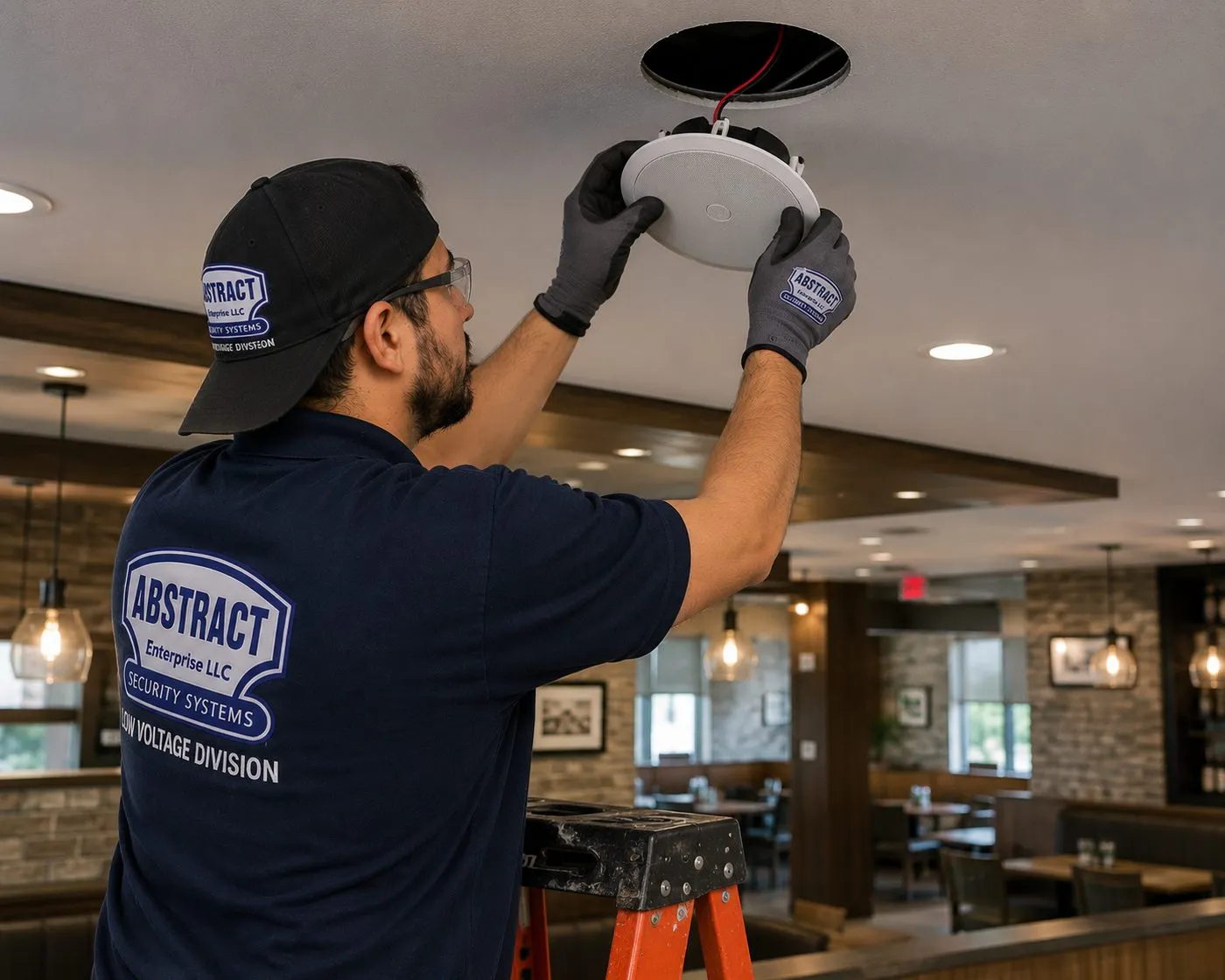
Seen from behind, a technician in a cap and grey gloves pushes a round white speaker up into a circular opening, red speaker leads trailing from the hole, with a wood-and-brick dining room and pendant lights beyond. No brand is legible on the speaker.
Free Queens Sonos Quote
Tell us the floors, the products and where the internet comes in — a written price follows the same business day
✅
Request Sent!
A Queens technician calls back the same business day.
25+
Years Experience
✓
Same-Day Estimates
100%
Licensed & Insured
4.7★
201 Google Reviews
Sonos boxes sitting in the hallway in Queens? Call our Queens line, (347) 434-6392, or fill in the 60-second form. Name the floors and the products and a licensed installer answers with a written figure built from the price lines published further down.
Sonos setup on the AESS Queens price list: $125, with no Queens parking charge added
Every Amp, Port and router placed above the floor of a basement, never on it
Work done under New York State low-voltage licence #12000287431, any day of the week, with a two-hour arrival window you pick between 8 AM and 8 PM
In Queens the Sonos question is less about the ceiling and more about the floors. Manhattan clients ask whether a plaster ceiling can take a speaker. Queens clients more often ask how one system can serve a house where the internet comes in by the boiler, the living room is on the parlor floor, a parent or a tenant lives upstairs and the kids want the basement den. Census figures make the point: the borough averages 2.72 people per household, and a little under half of its homes are owner-occupied, so a large share of Sonos customers here are owners sharing a building with renters, or renters sharing it with an owner.
The basement is where most Queens houses keep the modem, the router and too often everything else. In early September 2021, the remnants of Hurricane Ida brought what QNS called the greatest single-hour rainfall in New York City history, and eleven people died in Queens, ten of them in flooded basement or below-grade homes in East Flushing, Woodside, Jamaica, Forest Hills and Elmhurst. A Regional Plan Association report afterwards counted more than 40,000 buildings with basement units in Central Queens alone. After that night, nobody should design a sound system that depends on an Amp, a Port or a router sitting on a basement floor, and we don't.
The households themselves are as varied as the building stock. Nearly half of Queens residents were born abroad and more than half speak a language other than English at home, according to the Census Bureau. A StreetEasy analysis of Census data found Corona, East Elmhurst and Jackson Heights each had household crowding rates above 20 percent. In practice that means a Sonos system in Queens is often set up for three generations: grandparents who want the radio station from home in the kitchen and never touch an app, parents who stream on the parlor floor, and teenagers who want their own room left alone. Each of those needs its own rooms, sometimes its own system, and in some cases a voice speaker that answers in Spanish or Hindi rather than English.
Then there is the sky. Under the LaGuardia and JFK flight paths, a quiet backyard is not guaranteed. Speaking at a 2014 rally in Cunningham Park, the president of the group Queens Quiet Skies said of the planes, "People's walls shake, you can't hear the TV," and "Forget about sitting out in your back yard in the summer." Outdoor Sonos speakers in Bayside, Flushing or Howard Beach have to be planned for that: more speakers playing at moderate levels near the seating, not one loud pair aimed at the neighbors.
Finally there are the apartments. Jackson Heights holds the first and still the largest garden-apartment community in the United States, with co-op boards that review alterations at monthly meetings. Forest Hills, Kew Gardens and Rego Park line Queens Boulevard with pre-war and post-war elevator co-ops. Long Island City and Court Square have added towers of glass and concrete with building-wide networks. Each of those has its own rules, and we deal with each on its own terms rather than treating Queens as one market.
Queens numbers that shape a Sonos plan
2.72 people per household: the Census Bureau's 2020–2024 average for Queens County — more listeners, more rooms in use at once and more opinions about the music than a typical city apartment.
44.9 percent owner-occupied: the Census Bureau's rate for Queens homes, which is why so many of our Queens jobs involve an owner and a tenant sharing a house, a meter room and sometimes a router.
47.6 percent foreign-born and 55.4 percent speaking a language other than English at home: Census Bureau figures that shape how we set up voice control and how we leave written instructions.
11 deaths in Queens in the Ida flooding of September 2021, ten of them linked to flooded basement homes, as reported by QNS — the reason equipment placement comes first on every Queens visit.
More than 40,000 buildings with basement units in Central Queens, according to the Regional Plan Association's Preventing Another Ida report, which also found just three acres there designed to handle stormwater runoff.
92.3 percent of Queens households with a broadband subscription, per the Census Bureau — the internet is almost always there; the problem is getting it from the basement to the top floor.
Put together, those figures describe the typical Queens Sonos call: a full house, more than one household, gear that has to be kept dry and cool, and a network that starts in the worst possible place. Speakers are the last decision, not the first.
Many Queens owners adding Sonos also want the front door sorted at the same time. Our Queens smart lock installers often fit a keypad lock for the tenant's entrance on the same day, and Abstract Enterprises' home automation work in Queens ties lighting and thermostats into the same routines.
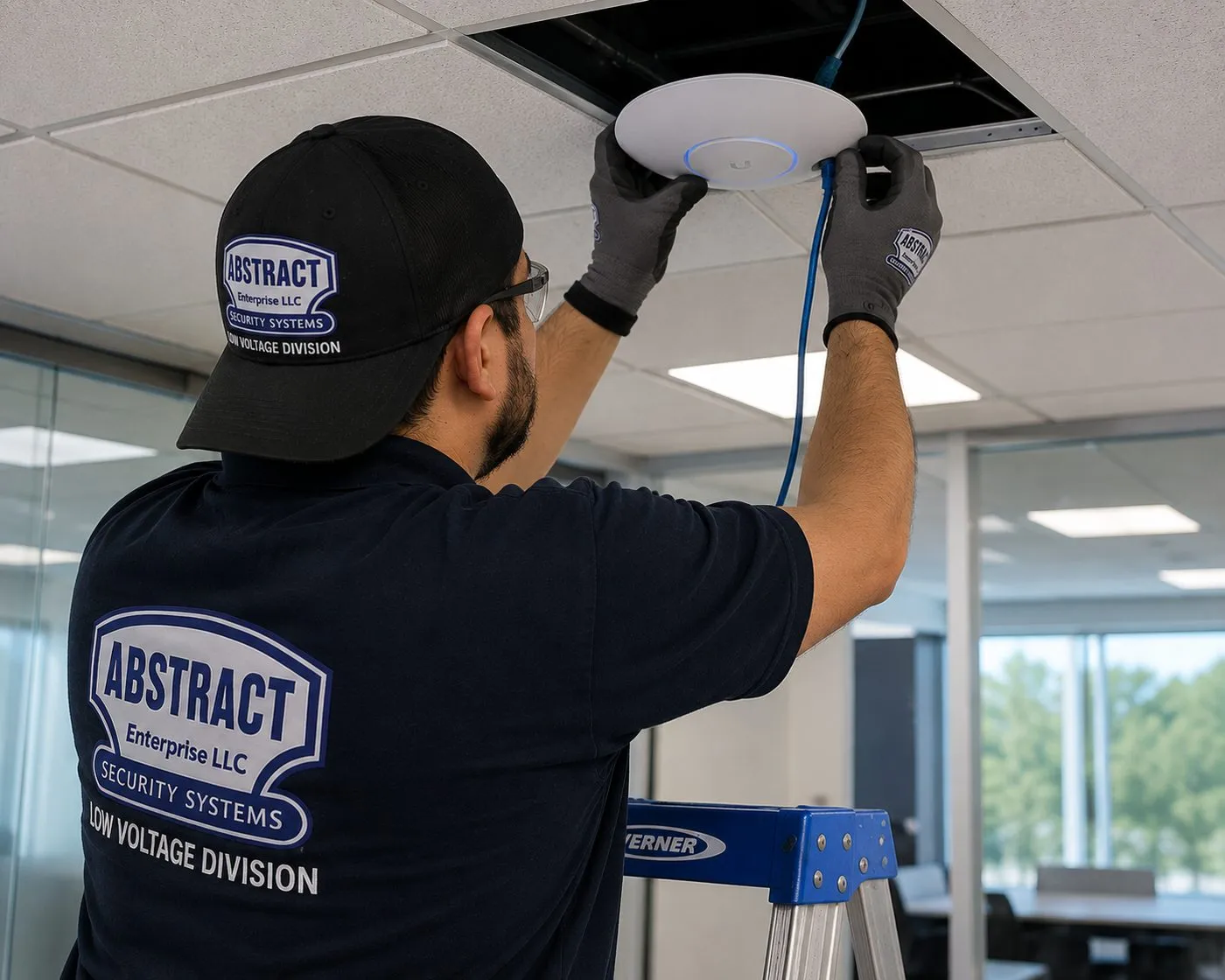
From behind, a technician on a blue stepladder raises a white disc access point toward an open ceiling panel while a blue network cable runs down beside it. A wired access point like this is how one floor of a house gets a strong signal without leaning on a router two floors below.
Repair Capture
Music Cutting Out Between Floors?
The upstairs speaker that disappears from the app every evening, a soundbar that went silent after the cable company swapped the modem, a basement Amp that hasn't been right since the storm, or rooms that won't group across two floors — those are service calls, and we take them in the next open 2-hour window. Most network and setup faults in Queens houses are sorted within one to two hours of the technician arriving. Ring (347) 434-6392 and say it's a Sonos repair; the first hour of a setup-only visit in Queens is $195, as set out in our TV and audio service policies.
What We Install
Sonos Installation Services in Queens
Most Queens Sonos visits combine three or four of the jobs below, and the order rarely changes. We decide where the equipment will live, get a strong signal to every floor, mount and wire the speakers, and only then set up the rooms, the households and the voices in the app.
Floor-by-Floor Network Plan
A wired link or a ceiling access point on each floor that has Sonos, fed from wherever the internet enters the house. In a two-family house that usually means a cable up the basement stair wall or a closet stack, not a plug-in extender, which Sonos doesn't support.
Equipment Above the Waterline
Router, Amps and Port moved off the basement floor onto a wall shelf or up to the first floor, with cable run to suit. The cheapest flood insurance a Sonos system can have, and usually done in the same visit.
Soundbar, Sub and Rears
Arc Ultra, Beam or Ray on the wall or the console in the living room, a Sub positioned for the floor you're on, and rear speakers placed where a family room actually has outlets.
Attic-Fed Ceiling Speakers
Top-floor bedrooms and hallways where the attic above gives direct access: speakers cut in from below, wire laid across the joists above and dropped to an Amp somewhere cooler than the attic itself.
Basement Den and Gym Audio
A Sonos room for the finished basement that doesn't put the Amp at risk: wireless speakers on brackets, or ceiling speakers wired to an Amp kept upstairs.
Backyard and Porch Zones
Sonos's outdoor architectural speakers on the house wall or under a porch roof, wired to an indoor Amp, aimed at the seating and away from the neighbors' windows, with levels set for the planes as well as the party.
Separate Systems per Household
Owner and tenant, or two branches of one family, each with their own Sonos system on their own network, so nobody's music, account or voice history ends up on someone else's phone.
Voices in the Family's Languages
Alexa set up speaker by speaker in the language that floor speaks, from the list Sonos supports, and the household's favorite stations saved so they can be called by name.
Port into the Old Stereo
The receiver and floor-standing speakers that came over with the family, kept and joined to Sonos through a Port, with the 12-volt trigger set so the old amplifier wakes when music starts.
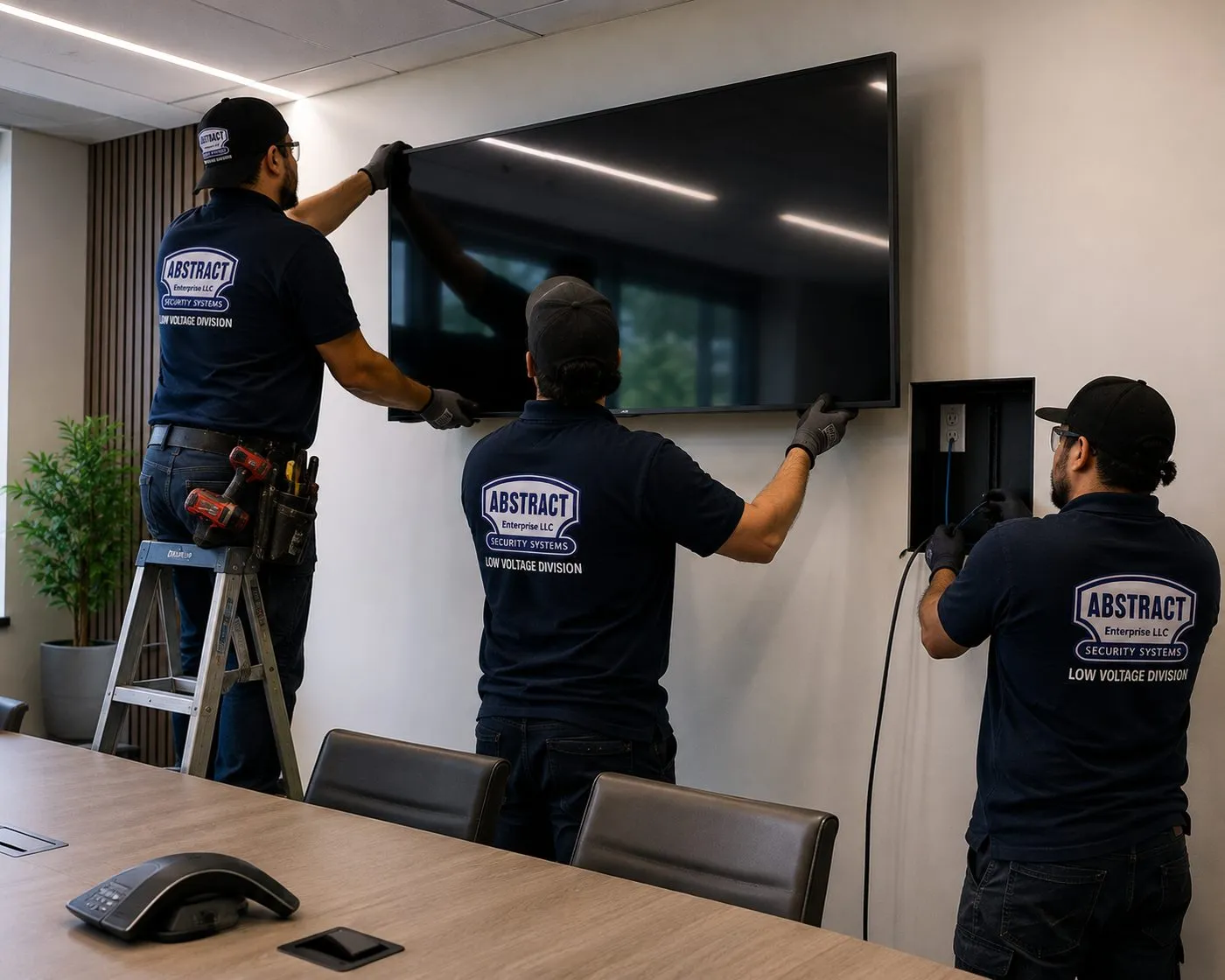
A crew of three: the man on the stepladder and the one beside him press a big black panel onto its bracket, and the third, lower down, has his hands in a recessed box cut into the wall underneath; a conference phone sits on the table in the foreground. The recessed box is where a soundbar's HDMI and power would come through.
A soundbar from another brand on the same wall? Our soundbar installation in Queens covers Samsung, Bose, Sony and the rest with the same wall-by-wall pricing.
Building Specialists
Sonos Installation for Queens' Architecture
Queens has more kinds of housing than any other borough, and each one changes where Sonos can go. These are the types we see most and what each does to the plan. Neighborhood names describe where the type is common, not particular buildings we have worked in.
Attached and Semi-Attached Two-Family Houses
Brick or frame rows of the kind found across Ridgewood, Woodhaven, Astoria and southeast Queens. Two units stacked over a shared basement, one meter room, one cable entry. The question is never “can we wire it” but “whose network is it.” Party walls are brick, so Wi-Fi between neighbors is weaker than in a frame house, and that helps.
Detached Houses With Attics
Tudors in Bayside, Queen Anne, Shingle Style and Colonial Revival houses in Douglaston, and freestanding homes across Little Neck, Jamaica Estates and beyond. Attics and basements make cable runs easy; the risks are attic heat and basement water, and the outdoor space is real.
Garden-Apartment Co-ops
The low-rise courtyard buildings of Jackson Heights, built mostly between 1914 and 1939, and smaller garden complexes elsewhere in the borough. Pre-war plaster, boards that meet monthly and shared gardens. Work inside the apartment, quietly, on weekdays.
Queens Boulevard Elevator Co-ops
Pre-war and post-war apartment buildings in Forest Hills, Rego Park, Kew Gardens and Briarwood. Brick and block walls, some plaster ceilings, some concrete slabs, and managing agents who want a certificate of insurance before the elevator is booked.
Long Island City and Court Square Towers
Glass curtain walls, concrete ceilings, drywall on metal studs and, often, building-supplied internet. Great for a bracket, poor for hidden wire, and thick with neighbors' networks.
Finished Basements and Lower-Level Units
Dens, gyms and family rooms below grade, sometimes a separate home for a relative. They need sound like any other floor, but every piece of equipment in them is treated as something that may one day sit in water.
Floor by floor: what each level of a Queens house does to the plan
The cellar or basement. Where the cable or fiber enters, where the gas meter and boiler live, and where water arrives first. We take the provider's line and move the router up and off the floor, ideally to the first floor, using a short cable up the stair wall. If a Sonos room is wanted down here, the speakers can be ceiling or wireless models, but the Amp powering them lives upstairs and its speaker wire comes down through the floor.
The first or parlor floor. Usually the living room and kitchen, and the best home for the main equipment: central, dry and cool. The TV wall gets the soundbar, and a hall or coat closet often makes a good spot for an Amp and a small network switch. From here a single wired link up the house is far more reliable than relying on Wi-Fi to cross a brick party wall and two floors.
The second floor. In a two-family house this is often the other household. If it is a tenant, they normally keep their own internet and, if they want Sonos, their own system. If it is family, a wired access point or one wired Sonos product on this floor keeps the upstairs rooms steady and lets the floors group together when everyone wants the same music.
The attic. The easiest route to top-floor ceiling speakers in the borough: lift the insulation, lay wire across the joists, cut from below. It is also too hot for electronics in summer. Sonos rates the Amp to operate between 32 and 104 degrees Fahrenheit, so the speakers go in from the attic but the Amp stays downstairs.
The yard. Narrow side passages, a deck or a patio, and on many blocks a flight path overhead. Outdoor speakers are wired back to an indoor Amp, mounted under an eave or on a wall, and aimed so the music stays in your yard.
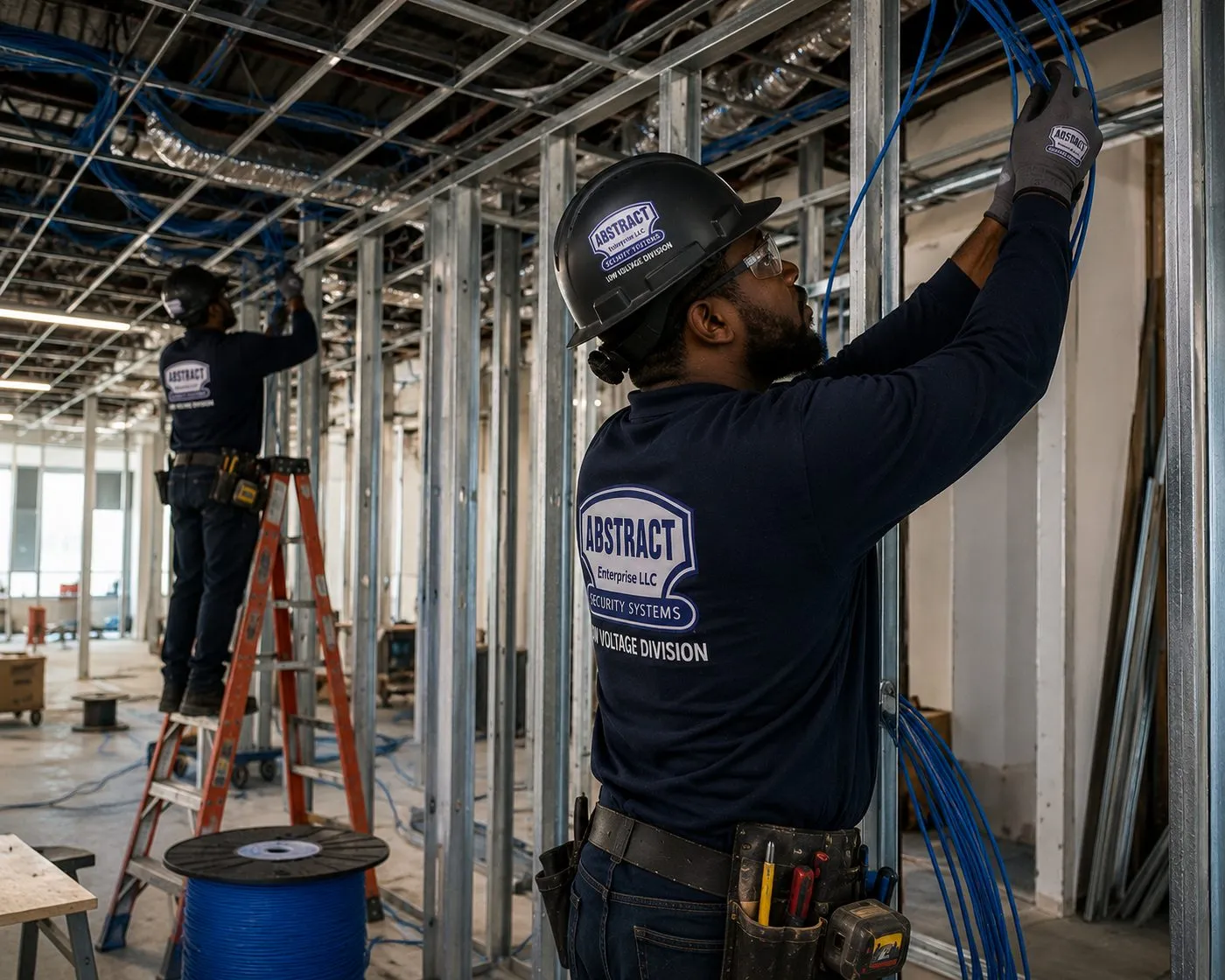
Before any wallboard: a technician in a hard hat reaches up to feed blue cable through the top of a run of steel studs, a spool on the floor and a second worker on a ladder further back. Renovations at this stage are the cheapest time to run speaker wire between floors.
Gutting a floor or finishing a basement? Run speaker wire and network cable while the studs are open. Our structured cabling installers in Queens pre-wire for Sonos and leave the cable labeled and tested, ready for the day the speakers arrive.
Flood Below, Heat Above
Where the Amp, Port and Router Live in a Queens House
Every Queens Sonos plan we write starts with a sketch of the house in cross-section. Water comes from below, heat from above, and in a two-family house a property line runs horizontally between the floors. Where each box sits matters more than which speakers are bought.
The city's Department of Environmental Protection tells homeowners to raise critical equipment such as boilers, electrical panels and meters to a higher floor or off the ground above the level of flooding. That flyer doesn't mention routers or amplifiers, but the same logic applies: a modem on the floor of a basement is the first thing to fail and the last thing to be replaced after a storm, and every Sonos room in the house goes quiet with it.
Equipment
Where we avoid
Where we put it in a Queens house
Provider modem and router
Basement floor, inside a metal cabinet, behind the boiler
Wall-mounted high in the basement at the cable entry as a minimum, ideally moved to the first floor on a short cable run
Sonos Amp
Attic, basement floor, sealed cabinet
A ventilated shelf in a first- or second-floor closet; Sonos rates it for 32–104°F
Sonos Port and the old receiver
Next to a radiator or boiler, boxed in without airflow
An open shelf with at least 2 inches of space all round, as Sonos specifies, away from heat
Network switch for wired Sonos
Under the basement stairs at floor level
Same closet as the Amp, or high on a wall in the basement with drip loops on the cables
Wireless speakers in a basement room
On the floor, on low stands
Wall brackets or high shelves, with plugs on outlets above floor level
Outdoor speakers
Facing a neighbor's bedroom window
Under an eave or porch roof, aimed at the seating, wired to an indoor Amp
Raising equipment doesn't make a flooded basement safe and isn't a substitute for the backwater valve, drainage and other measures DEP describes; those are for your plumber and contractor. What it does is keep the music, the internet and the Wi-Fi calling running on the floors above after a heavy storm, and keep an expensive Amp from being written off with the carpet.
Heat is the other limit. The Amp's rated ceiling of 104 degrees is easy to pass in a closed attic in July, and an Amp squeezed beside a boiler or a radiator in a utility room has the same problem in winter. Sonos asks for clearance around both the Amp and the Port. So the speakers can be in the attic floor, but the box that drives them lives somewhere you would be comfortable sitting.
And then there's ownership. In a house with two households, the cross-section sketch also shows which floor pays for which internet line, whose router each Sonos product joins and who holds each Sonos account. Getting that right on day one is far easier than separating two families' speakers after a tenant moves out.
Ways a cable gets from the cellar to the top floor
Moving equipment up out of the basement only works if a cable can follow it. In Queens houses these are the routes we use most, roughly in order of preference. We choose at the walkthrough, and the written quote names the route.
Route
Why it works
Watch out for
Stacked closets
Closets often sit one above another in two-family houses, so one hole in each closet floor carries cable straight up out of sight
Fire-blocking between floors, which we drill neatly and seal
Beside the stairs
The stair wall usually runs from the cellar to the top floor with a cavity behind it
Plaster on the stair side that has to be protected while fishing
An existing intercom or cable-TV path
An old cable already proves the route exists and can pull the new one through
Working intercom or bell wire, which stays untouched
Exterior conduit
Fast where interior walls are brick or finished in a way the owner wants left alone
Neatness on the facade, landmark rules in historic districts, and a sealed entry at each floor
Surface raceway
Paintable channel along a baseboard or corner when no cavity exists
Visible, so kept short and painted to match
Whichever route is chosen, the cable is tested end to end before anything depends on it, and labeled in the basement and at the top so the next electrician, plumber or tenant knows what it is.
After a storm: before anything is switched back on
If water does reach the basement, the order matters. Power to the affected area should stay off until an electrician or the utility says it is safe; no Sonos product, router or power strip that sat in water should be plugged back in to "see if it works". Once the space is safe and dry, we inspect each unit, check cables and wall plates for corrosion, and replace anything that was submerged rather than gamble on it.
Equipment that lived upstairs usually needs nothing more than the internet coming back. When the provider's modem has been replaced, the network name or password often changes; the speakers then need rejoining, which is a short setup-only visit. Keep the receipts and serial numbers for anything lost, because claims for damaged Sonos products go through your insurer or the retailer and Sonos, not through us.
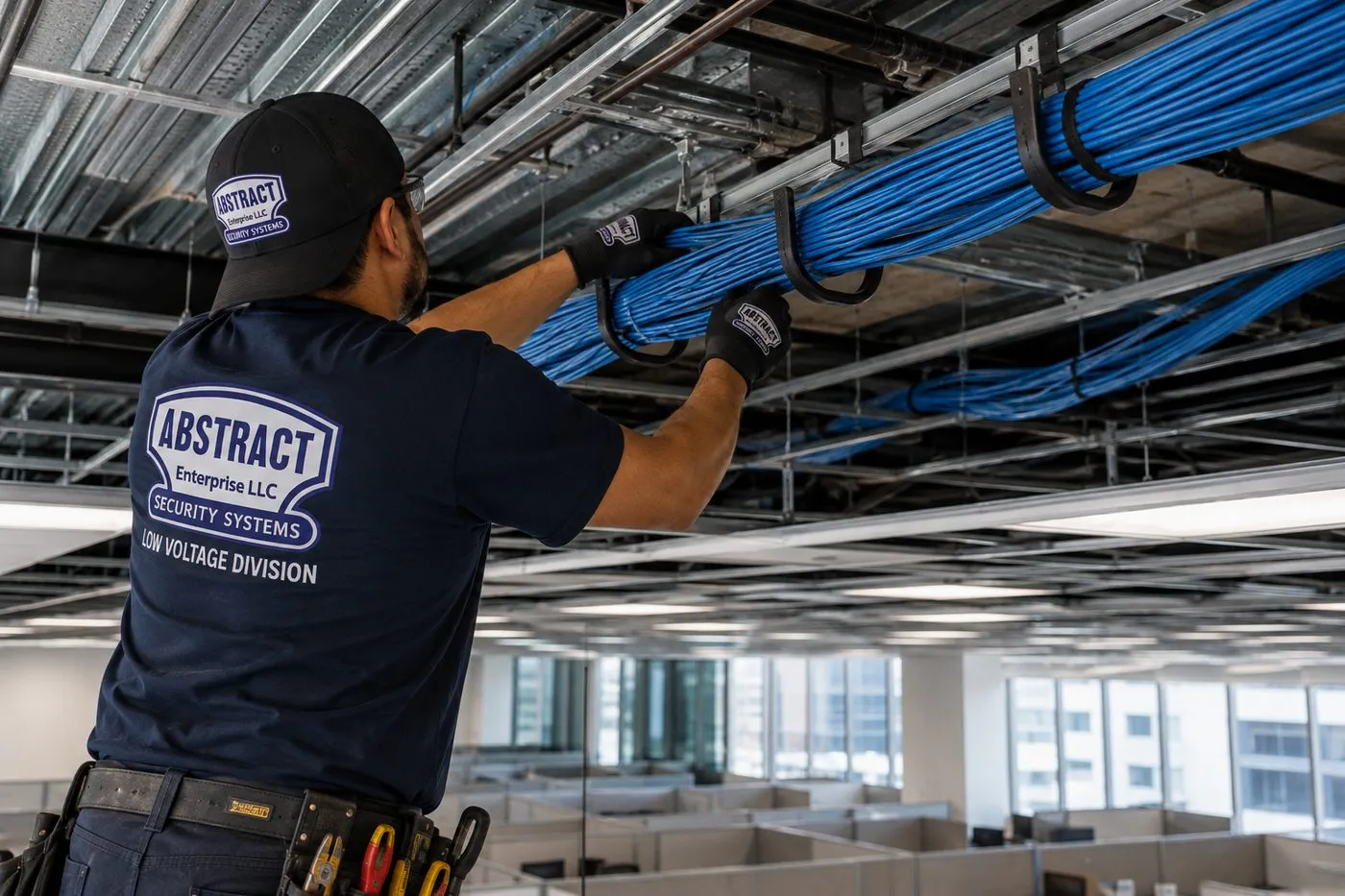
Viewed from behind, a technician on a ladder settles a heavy bundle of blue cables into a line of black J-hooks hung from the structure above an office floor. In a house the same idea applies on a smaller scale: cable supported off the floor and away from water, not draped across a basement slab.
Commercial Sonos Installation
Business Sonos Installation in Queens
Queens small businesses use Sonos for the same reason Queens families do: it's easy to run from a phone at the counter. Our commercial Sonos work in the borough is concentrated along its business corridors, several of them organized as business improvement districts that the City Council's small business committee listed at a February 2024 hearing.
Bell Boulevard, Bayside
A long restaurant strip — a council member at that hearing described it as consisting "mostly of restaurants these days." Dining-room ceilings with several speakers per Amp, a separate bar zone, and levels kept below what the apartments overhead will tolerate.
Downtown Flushing
Dense retail, food halls and offices around Main Street. Narrow, deep shops where even coverage matters more than volume, and business networks that need a separate music network so Sonos stays discoverable.
82nd Street, Jackson Heights
Storefronts under the elevated 7 train and around the 82nd Street Partnership's district. Speakers placed to carry over train noise near the door without blasting the back of the shop.
Long Island City
Offices, showrooms, studios and amenity floors in new towers, where a property manager sets the rules and staff need a system they can reset without calling anyone.
Jamaica Center
Retail, services and offices around Jamaica Avenue and the transit hub, with long opening hours and staff who change shifts — simple grouping and a written reset card at the counter help.
Myrtle Avenue and Gateway JFK
Neighborhood shops and salons along Myrtle Avenue on the Ridgewood–Glendale side, and businesses near the airport where aircraft noise outside sets how loud music needs to be inside.
Compliance callouts for Queens business Sonos systems
Homes upstairs. A great many Queens shops have apartments above them, and for a business the city sets a hard number: 42 dBA, measured inside the receiving apartment, per the Noise Code fact sheet. We keep speakers off shared walls and mark a maximum level in the app with the owner on the day.
Unreasonable noise outdoors. Section 24-244 of the city's Administrative Code bars operating a sound reproduction device so as to create unreasonable noise. Speakers in a sidewalk café or yard area are aimed inward and kept at background level.
The shop's Wi-Fi. Point-of-sale Wi-Fi with enterprise log-ins, a customer guest network or a sign-in page will all hide speakers from the app, because Sonos rules those out. The music gets a small network of its own, agreed with whoever looks after the shop's internet.
Power. Amps need outlets near where they live. New circuits and outlets are a licensed electrician's job; we coordinate with yours and never alter line-voltage wiring ourselves.
Landlord paperwork. Commercial landlords along these corridors usually want our insurance certificate naming them before work starts. It costs you nothing.
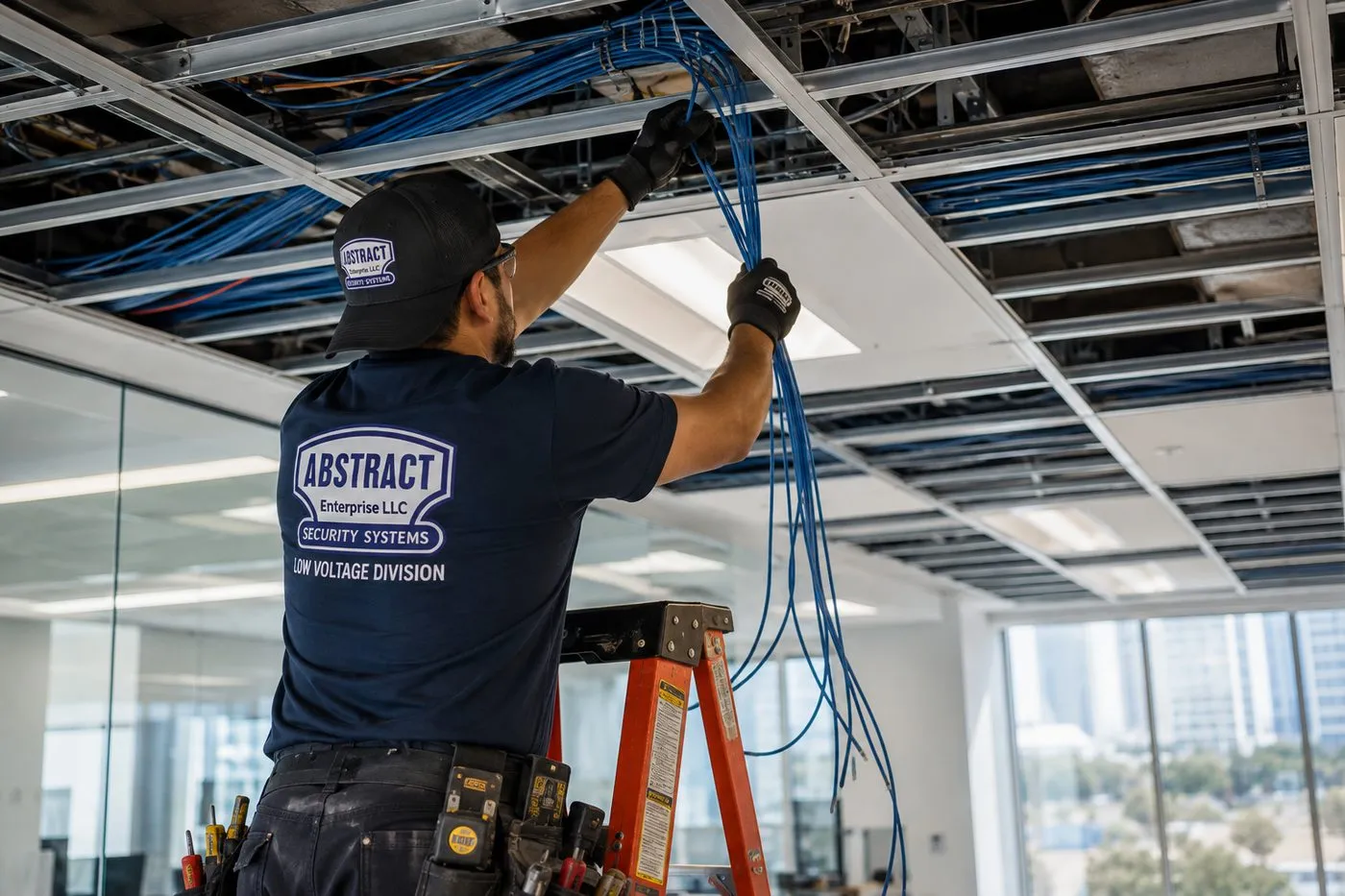
Halfway up an orange ladder with his back to us, a technician gathers a sheaf of blue cables out of a gap in the ceiling grid, glass partitions and big windows behind him. Drop ceilings like this make commercial speaker runs quick.
These are the questions Queens callers actually ask before booking, grouped by the part of the house they concern: the basement, the household, the attic and upper floors, the yard and the sky, and the apartment buildings. Prices, coverage and logistics are in the FAQ further down.
The basement: water, wires and the internet line
Our basement took water in Ida — should the Amp, router and Port stay down there?
No, not on the floor and preferably not in the basement at all. Ten of the eleven Queens deaths in the Ida flooding involved basement or below-grade homes, and the same water reached a great many basements where nobody lived but the modem did. The city's flood preparedness advice is to raise critical equipment to a higher floor or above the flood level; we apply that to everything a Sonos system depends on.
In practice we leave the provider's line where it enters, mount the modem high on the wall beside it, and run one cable up to a first-floor closet where the router, a small switch and any Amp or Port can live on a ventilated shelf. If the provider insists the router stays in the basement, it goes on the wall, as high as the cable allows, with the power supply off the floor. Either way the speakers upstairs keep playing if the basement takes water again.
Is a finished basement that might flood again a sensible place for in-ceiling speakers?
The speakers themselves, yes — they sit in the ceiling, the highest point in the room. What we avoid is putting the Amp that drives them in the same basement. So the basement speakers are wired up through the floor or along the stair wall to an Amp on the floor above, where water would have to rise a full storey to reach it.
If you would rather keep everything wireless, Era speakers on wall brackets with their plugs on outlets well above the floor do the same job without opening the ceiling. Either way, we ask how high water came last time before deciding, and we leave enough slack in the wiring that a damp section of ceiling can be replaced without rewiring the whole room.
How should cable cross a basement that has flooded before?
High, supported and unbroken. Wire that has to pass through the basement — the internet line climbing to the router, speaker cable heading down to a den, a run to the backyard — goes up between the joists or in hooks along them, never across the slab or tucked along the bottom of a wall. Any joint or connection sits upstairs or high on a wall, because a splice under water is the part that fails.
We also keep cables away from the sump pit, the boiler and the area around a floor drain, label each one at both ends so a contractor drying out the basement knows what it is, and leave a drip loop where a cable drops to a wall plate so water running down it falls off before the jack. It costs a little more cable than the shortest route and saves rewiring after the next storm.
Two households, three generations, one house
Our adult son’s family lives on the second floor — one Sonos system for the whole house, or one each?
It depends on how much the two floors want to share. One system means one account and one app view: anyone on the network can see and play to every room, and the floors can be grouped for a birthday or a holiday in a couple of taps. Two systems mean each floor sees only its own speakers, has its own music accounts and voice history, and can't accidentally turn up the other floor's kitchen at midnight.
Our usual advice for a Queens house shared by two branches of one family is a single system with clearly named rooms if the floors share the internet and like to listen together, and two systems if they pay for separate internet or value privacy more than grouping. Sonos needs the app and speakers on the same network, so the internet arrangement often decides it. Either way, the cable route through the shared basement can serve both floors.
Can the grandparents' floor and the kids' floor play different music without fighting over the app?
Yes, within one family system. Each floor's speakers become separate rooms in the app, and each room plays its own source at its own volume. Rooms are only joined into a group when someone chooses to group them, so the parlor floor's news radio and the top floor's playlist don't interfere with each other.
Where the friction comes from is everyone having the same app with every room in it. We name rooms clearly by floor and use ("Nana Kitchen", "Top Floor Bedroom"), set up each person's phone, and show the family how to check which room they are about to control before pressing play. For voice speakers, each one answers requests for its own room by default, which keeps one floor's request from changing another's music.
Can one speaker answer in Spanish while another answers in English?
With Alexa on Sonos, yes. Sonos's support pages say the Alexa language can be changed to any of Alexa's supported languages on Sonos, and that the setting is made speaker by speaker. Its list includes English, Spanish (with a US Spanish option), French, German, Hindi, Italian, Japanese and Portuguese.
So the kitchen speaker on the grandparents' floor can be set to Spanish and the teenagers' Era 100 left in English. We set each one during the visit, test a few everyday requests in each language with the person who will use it, and write down which speaker speaks which language. Languages outside Sonos's list aren't available for voice control, and we'll tell you that before you buy a voice-enabled speaker for that purpose.
Grandma doesn't use a smartphone — how does she put music on?
Several ways, none involving the app. Sonos speakers have play, pause and volume controls on the speaker itself, so the last thing played can be resumed with one touch. A voice-enabled speaker set to her language can play a named station or playlist on request. And a soundbar plays whatever the TV plays, controlled by the TV remote she already knows.
What makes this work is setup, not hardware. We save her favorite stations as favorites in the family's account, name them in words she would actually say, and leave the speaker where she listens, not where it looks best. A short written card beside it, in the language she reads, covers the three things she's likely to want.
We inherited an older Sonos from the previous owner — will it work alongside new speakers?
It depends on which app the older product can run. Some older Sonos products can only be used with the S1 app, and Sonos's support pages say products on separate S1 and S2 systems can't be grouped together, need both apps installed, and can't play the same single-stream music service account at once.
We check each inherited product's model on the visit. If it runs on the current app, we reset it, remove it from the previous owner's account and add it to yours. If it is S1-only, you can keep it as a separate system for one room, or retire it; we'll explain the trade-off rather than leave you with two apps that don't talk to each other.
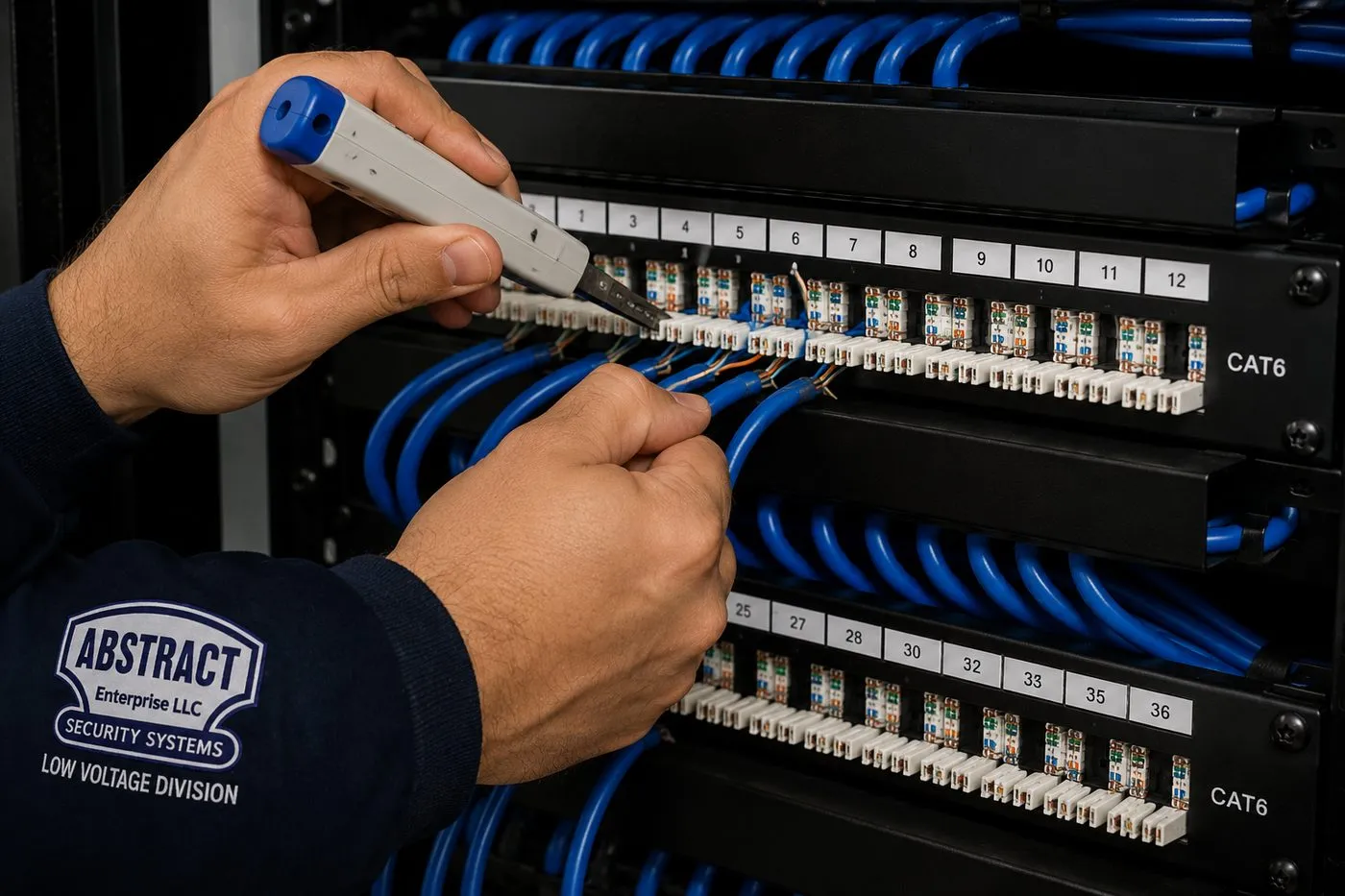
Close on the hands: one holds a blue punch-down tool against a numbered patch panel while the other steadies a row of blue cables, with a second panel and more cable below. In a house, a small panel like this keeps each floor's run labeled.
The attic, the boiler room and the upper floors
Can the Amp sit up in the attic next to the bedroom speakers it powers?
It's convenient, and we don't recommend it. Sonos gives the Amp an operating range of 32 to 104 degrees Fahrenheit, and a closed Queens attic under a summer roof can exceed the top of that range. In winter, an unheated attic can drop below the bottom of it. Neither does an amplifier any good.
The better arrangement is speakers in the attic floor, wire across the joists to a point above a closet, and a short drop to the Amp on a shelf below. The run is barely longer, the Amp sits where people are comfortable, and it's reachable when someone needs to restart it without climbing a ladder.
Is the attic the easiest way to add ceiling speakers to our top-floor bedrooms?
Usually, yes. With access from above, we can see the joists, wiring and any ducts before cutting, place the speaker exactly between joists, and lay its wire across the attic floor without opening a single wall. Sonos's in-ceiling manual tells installers to check for obstructions before cutting; from the attic, that check is a look rather than a guess.
Two cautions. Insulation has to be moved back around the speaker and restored afterwards, and older attics sometimes hide loose wiring or a vermiculite layer that shouldn't be disturbed. If we see anything that belongs to an electrician or an abatement specialist, we stop and tell you before going further.
Can the old intercom or doorbell wiring in our house be reused for speakers?
Rarely for the speakers themselves. The intercom and bell wire found in older Queens two-family houses is thin, low-current cable, much lighter than the 16-gauge or heavier speaker wire Sonos specifies for its outdoor speakers, and long runs of thin wire lose power and bass. Old runs are also often spliced in places nobody remembers.
What that old wiring can give us is a route. If an intercom cable already climbs from the front hall to the top floor, there is a path through the walls, and we can often use the old cable to pull a new speaker or network cable along the same way. We test and trace it first; if it belongs to a working intercom or doorbell, it stays where it is.
The yard, the planes and the neighbors
Planes roar over our yard every few minutes — do the outdoor speakers just need to be louder?
No, and louder rarely helps. Since 2012 the FAA has used the "Tennis Climb" departure route out of LaGuardia year-round, sending planes over residential Northeast Queens, and parts of south Queens sit under JFK traffic. A single pair of speakers turned up to compete with a jet will be far too loud for the neighbors in the minute between planes.
What works is more speakers closer to where people sit, each playing at a moderate level. Under a porch roof, along a fence line or at both ends of a deck, two pairs at background level carry music through most of a flyover without filling the next yard. We set levels with you outside, ideally while a plane passes, and save that volume as the yard's limit in the app.
Which part of an attached house’s back wall should outdoor speakers go on?
The middle of your own wall, under any overhang, angled toward where you sit. Sonos's outdoor architectural speakers are designed for humidity, salt spray, heat, UV and freezing temperatures and are rated IP66, so the overhang is about sound and longevity rather than survival. Brick holds their brackets well when the anchors go into the brick itself rather than the mortar joints.
What we avoid is the ends of the wall. On an attached or semi-attached row the neighbor's yard starts at the fence line, so a speaker at the corner of the house plays as much into their garden as yours. Mounted a few feet in from each end, at about head height and tilted down toward the seating, a pair covers a typical narrow Queens yard at modest volume. The speaker wire then enters the house through one sealed hole to reach the indoor Amp.
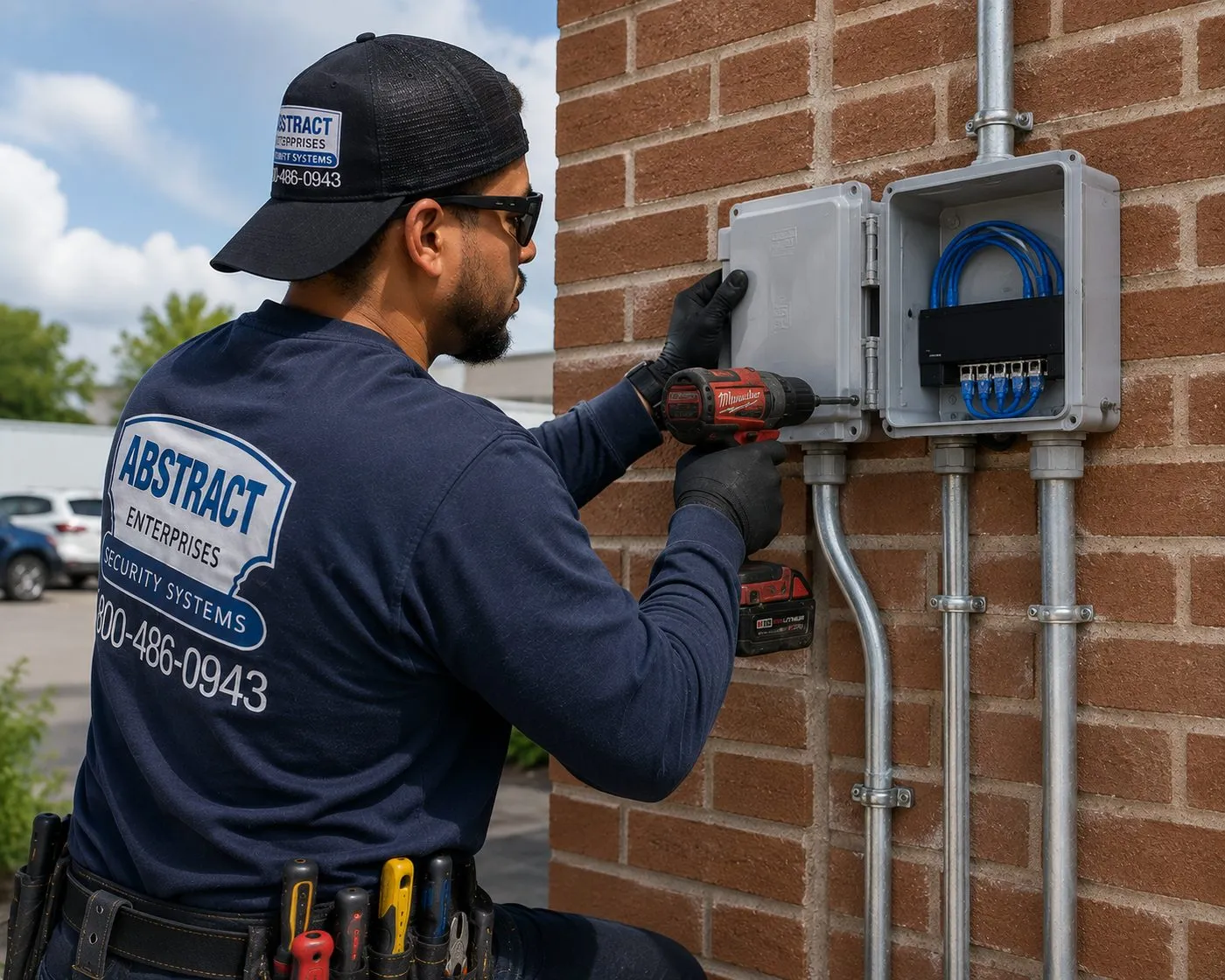
Outside, a technician in a cap and sunglasses holds a cordless drill to a brick wall beside an open grey enclosure full of blue cable, metal conduit running down the wall from it and a parking area behind. Outdoor speaker wire reaches indoors through a sealed entry like this.
Does the city's noise code put a limit on music in our backyard?
Not as a decibel number for homes. Section 24-244 of the city's Administrative Code says no one may operate a sound reproduction device in a way that creates unreasonable noise, and the separate 42 dBA figure in the city's Noise Code fact sheet applies to commercial establishments, measured inside a neighboring apartment. For a private yard, the standard is reasonableness, and complaints go to 311.
We take that as a design brief rather than a loophole: speakers aimed at your seating, moderate levels saved as a maximum in the app, and nothing mounted facing a neighbor's bedroom window. This is general information, not legal advice.
Garden co-ops and Long Island City towers
Our garden co-op shares a courtyard — can a speaker face it from our window or terrace?
Usually not as a permanent fixture. In Jackson Heights the courtyards are part of the shared garden design that made the neighborhood the country's first garden-apartment community, and a local renovation guide notes that exterior-facing work in these complexes goes through the co-op board and, within the historic district, the Landmarks Preservation Commission.
Inside your apartment, a speaker near an open window is your business, within reason. Anything fixed outside the window or to a terrace railing is the board's. A portable, weather-resistant Sonos speaker carried out for an evening and back in afterwards avoids the question entirely, and we can set it to join your system automatically.
In a Long Island City apartment with glass walls and a concrete ceiling, where do the rear speakers go?
Not on the glass, and not in the ceiling. Floor-to-ceiling windows leave few solid walls behind the sofa, and a concrete slab overhead rules out ceiling speakers without a dropped soffit. Sonos's own Era 300 wall mount is for stud mounting only, so the drywall partitions in these towers need a stud located before a bracket goes up.
Most often, the rears go on floor stands or on furniture behind the seating, wireless and powered from nearby outlets. Glass rates low for Wi-Fi loss in Sonos's interference table, but these towers are thick with neighboring networks, so we check the channel plan and wire the soundbar to the router if the building allows.
Which Sonos speakers cope with a steamy kitchen or bathroom?
Sonos describes some of its speakers as humidity-resistant and suitable for bathrooms, including the Era 100, Era 300, Five, Move 2 and Roam 2. It also warns that speakers which are not waterproof can be damaged if exposed directly to water or left outside for long periods.
In a busy multigenerational kitchen we mount the speaker away from the stove and the sink splash zone, on a bracket rather than the counter. In a bathroom it goes on a wall or shelf well clear of the shower. Ceiling speakers on an Amp are the other option for both rooms, since the grilles are flush and the electronics live elsewhere.
Households and Languages
Sonos for Multigenerational and Multilingual Queens Homes
Setting up Sonos for a three-generation Queens home is mostly about people, not products. The technology is the same in every house. What changes is who uses each room, how they ask for music and how much patience they have for an app.
We start the setup by asking who lives on each floor and what each person listens to. That conversation decides the room names, which rooms can be grouped, which speakers get voice control and in which language, and whether there should be one system or two. It's quicker than it sounds, and it saves the call a month later from a family whose kitchen keeps playing someone else's playlist.
Room names people say out loud. “Kitchen” is ambiguous in a two-family house with two kitchens. We name rooms by floor and by person where that helps.
Voice in the right language, speaker by speaker. Alexa on Sonos is set per speaker, so each floor can speak its own language from Sonos's supported list.
Favorites for the people who won't use the app. Stations and playlists saved and named, so a request by voice or a tap on the speaker gets them.
Separate systems where privacy matters. A tenant, a returning adult child with their own lease, or a relative who wants their own account gets their own system and network.
One person in charge. Someone in the household holds the main account and knows how to add a phone or a speaker. We show that person the settings that matter.
A written card per household. A single page, in the language each household prefers to read, left next to the main speaker: how to play, pause, change rooms and restart.
None of this costs extra; it's part of the $125 Sonos setup line. It simply takes a few minutes of conversation before anyone opens the app.
Before your Queens appointment
Products on site. The Sonos boxes in the house, opened or not. If anything is still in transit, tell us before the day so we don't charge a return trip.
Network details. Wi-Fi name and password for each household's network, and the Sonos account log-in if a system already exists. If the router is the provider's, have the account holder's details handy.
Access to every level. The basement or cellar where the internet enters, the attic hatch if there are top-floor speakers, and the yard. If a tenant's unit or a shared basement is on the cable route, give them notice in advance.
The people who will use it. If possible, have whoever will use each floor's speakers around for the last half hour, especially anyone who will rely on voice control or the speaker's own buttons.
Co-op and condo paperwork. The managing agent's email for the insurance certificate, and the building's contractor hours, sent when you book.
Flood history. How high water came in the basement in the last big storm. It decides where we put the equipment.
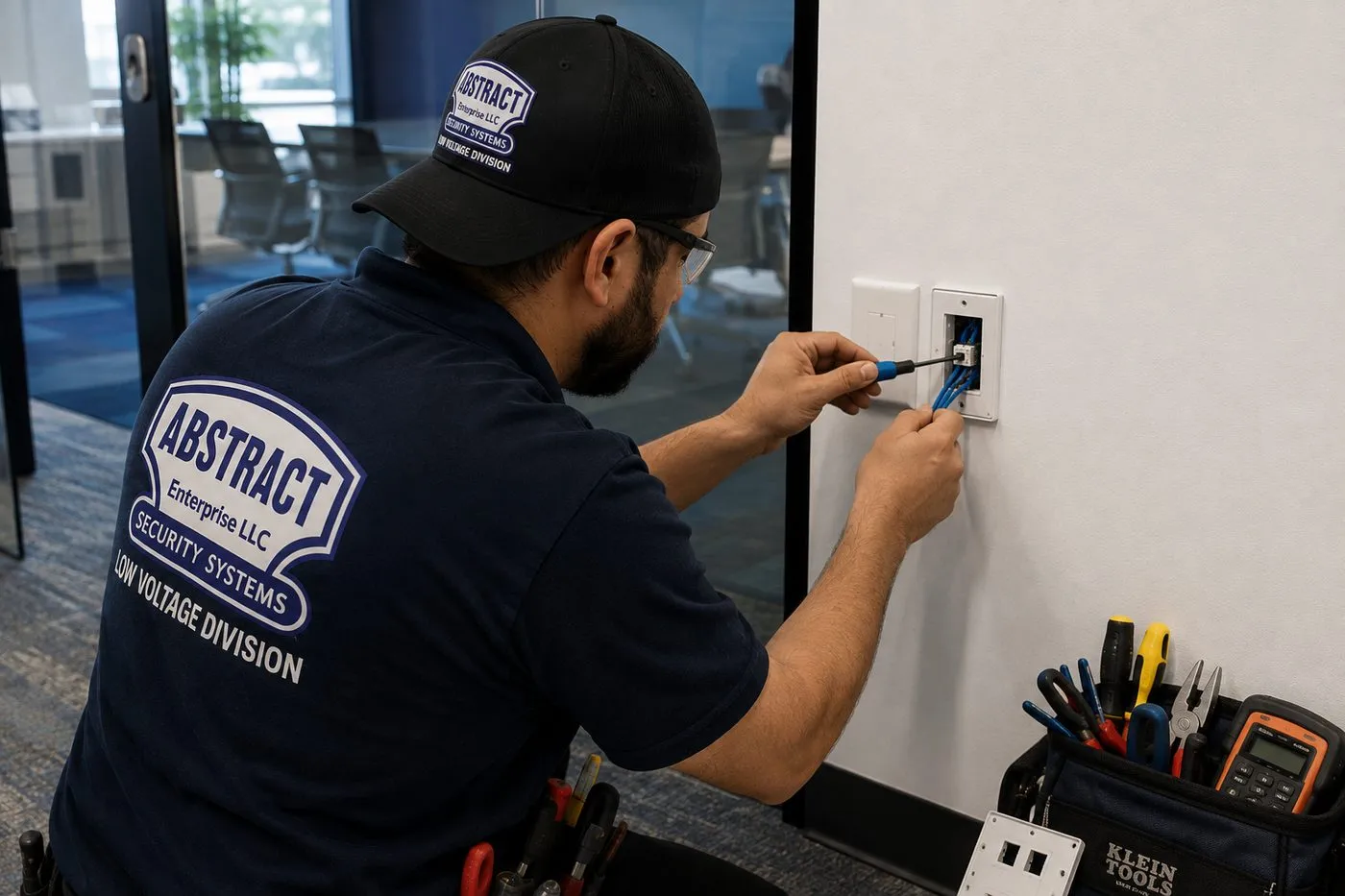
Seen over his shoulder, a technician in a cap uses a small tool to seat a blue cable into a white wall plate, an open bag of hand tools and a meter on the floor below. A plate like this on an upper floor is where a wired Sonos product or access point plugs in.
Equipment
Types of Sonos Systems We Install
Bring us the Sonos boxes you've bought, or a list of rooms and nothing else, and we'll take it from there. The cards below are the families we fit most in Queens homes, matched to the floor of the house they suit. Specifications come from Sonos's own product and support pages unless noted.
Arc Ultra
Sonos's largest soundbar, about 46.4 inches wide, for big living rooms and large TVs. On the wall, Sonos says it detects the mount and adjusts its EQ for the wall behind it.
Beam (Gen 2) and Ray
The Beam connects by HDMI ARC or eARC and suits most Queens living rooms; the Ray, connecting by optical, fits a bedroom, a basement den or a grandparent's room with an older TV.
Sub 4
Wireless, so it can sit where the floor transmits least bass to the unit below. Sonos allows corners, walls or under furniture with an inch of clearance above.
Era 100 and Era 300
Standalone speakers and rears, both on Sonos's humidity-resistant list, which makes them the usual pick for kitchens and bathrooms. The Era 300 wall mount is for studs only.
Amp
Drives passive ceiling, wall and outdoor speakers, up to three pairs of Sonos's architectural speakers in parallel. Rated for 32–104°F, so it lives on a ventilated shelf on a living floor.
In-Ceiling Speakers
Sonos and Sonance 6-inch and 8-inch models with paintable grilles and 8.25-inch and 10.125-inch cut-outs. Ideal for top floors fed from the attic and for basement ceilings with an Amp upstairs.
Outdoor Speakers
Sonos's outdoor architectural pair, rated IP66 and for −13°F to 149°F, wired to an indoor Amp. The answer for decks, patios and porches.
Port
For the family's existing receiver and speakers: analog and digital outputs and a 12-volt trigger. Needs 2 inches of clearance and distance from heat.
Portables
Move 2 (IP56) and Roam 2 for courtyards, terraces and beach days in the Rockaways, carried in rather than mounted outside.
Which Sonos products suit which level of a Queens house
Level
Usual products
Where the electronics live
Basement den or gym
Ceiling speakers, or Era speakers on wall brackets
Amp on the floor above; wireless speakers plugged in above floor level
First or parlor floor
Arc Ultra or Beam, Sub 4, Era rears; kitchen Era 100
Main closet: router, switch, Amps, Port
Second floor (family)
Bedroom Ray or Era; hallway ceiling speakers
Wired access point or wired Sonos on this floor
Second floor (tenant)
Tenant's own choice on the tenant's own network
Tenant's own router; no shared system
Top floor under the attic
In-ceiling speakers wired from above
Amp in a closet below, never in the attic
Yard, deck or porch
Outdoor architectural pair, or a Move 2 carried out
Amp indoors; wire through a sealed wall entry
Models change; before the visit we confirm each product's connections, mounts and Wi-Fi bands so the right anchors, cables and network parts come with us.
AI Overview Reality Check
What AI Gets Wrong About Sonos Installation in Queens
How these were chosen: our research tools could not load Google's AI-generated answers for Queens searches, so we don't quote them. Each heading below is an assumption that turns up repeatedly in quick answers, cost guides and forum advice about home audio, written in our own words. Under each one is what changes in a Queens house or apartment.
“A two-family house is just a bigger single-family house”
Generic whole-home audio advice assumes one household: one network, one account, one set of rooms that everyone may control. For a detached house with one family in it, that's fair.
In a Queens two-family house the second floor is often someone else's home, with its own internet, its own lease and its own expectations of privacy. Putting a tenant's speakers on the owner's Sonos system means each can see and control the other's rooms.
We treat the second household as a separate system unless they are family and want to share, and we plan cable routes through the shared basement so each floor's equipment is labeled and independent.
“Put the Amp and router in the basement, out of sight”
Plenty of whole-home audio guidance treats the basement or utility room as the natural home for amplifiers and network gear: out of the way, near the service entry, easy to wire.
In Queens that advice collides with recent history. The Ida flooding killed eleven people in the borough, ten of them in basement or below-grade homes, and more than 40,000 Central Queens buildings have basement units, according to the Regional Plan Association. DEP tells homeowners to raise critical equipment above the flood level.
We keep Amps, Ports, switches and routers on a living floor, or high on a wall at the very least, and run wire down to basement speakers rather than putting the electronics down there with them.
“In-ceiling speakers cost $200 to $500 for a pair”
That is close to the figure one online cost guide gives for a basic one- or two-speaker in-ceiling installation, and the same guide puts an average whole job at $1,000 to $2,000. For an easy drywall ceiling under an accessible attic, those numbers describe the labor reasonably.
A Queens top floor with an attic above can be that easy. A pre-war plaster ceiling in a Jackson Heights co-op, a concrete slab in Long Island City or a basement ceiling with the Amp a floor away is not, and the price follows the ceiling, not a national average.
So our soundbar and setup lines are fixed and published, while ceiling rooms get a written figure after someone has stood under the ceiling, within the $800 to $2,500 per zone range published for whole-home audio on our NYC AV page.
“Any weatherproof speaker will do for the backyard”
Quick answers about outdoor music tend to treat any speaker labeled weatherproof as interchangeable, or suggest leaving an indoor speaker on the patio for the summer.
Sonos itself warns that speakers which aren't waterproof can be damaged if left outside for extended periods. Its outdoor architectural speakers are rated IP66 and for −13°F to 149°F, but they are passive and need an Amp indoors and a wire through the wall.
For a permanent yard zone we fit the outdoor pair on the house wall or under the eave and wire it properly; for occasional use, a Move 2 carried out and brought back in is simpler and cheaper.
“Voice control on smart speakers only really works in English”
Many households assume voice assistants are English-only, and some quick answers don't mention language at all when recommending a voice-enabled speaker.
Sonos lists Alexa on Sonos in English, Spanish (including a US Spanish option), French, German, Hindi, Italian, Japanese and Portuguese, set speaker by speaker. In a borough where 55.4 percent of residents speak a language other than English at home, that matters.
We set each voice speaker to the language of the person who will talk to it, and we say plainly when a family's language isn't on the list, so nobody buys a voice speaker that can't understand them.
“A high-rise apartment is like any other apartment for Sonos”
General advice treats an apartment as an apartment: small, one router, a soundbar and maybe a couple of speakers.
A Long Island City tower apartment brings concrete ceilings that won't take a speaker, curtain-wall glass where a rear speaker would normally hang, and building-supplied internet that may be the kind of managed network Sonos doesn't support.
We check the building's network type before the visit, plan rears on stands or furniture, and add a router of your own behind the building's connection when the managed network won't let the app see the speakers.
“Outdoor speakers should be loud enough to hear over anything”
Party-sized outdoor audio is often sold on volume, and quick answers repeat the idea that bigger and louder is better outside.
Under the LaGuardia and JFK flight paths, "louder than the plane" means far too loud for the neighbors between planes, and the city's Administrative Code bars sound devices used to create unreasonable noise.
More speakers at modest levels, closer to the seating, beat one loud pair. We set and save the maximum level with you, outside, while a plane is passing.
A Queens Sonos Plan That Starts With the Cross-Section
Tell us the floors, who lives on each and where the internet comes in. You get back where every box should live, which speakers to buy and the written price.
A Ray for a grandmother's room in Elmhurst or ceiling speakers on three floors of a Bayside Tudor — this form is all we need to start, and a written figure comes back within the business day. Prefer to talk? Call our Queens line, (347) 434-6392.
✅
We Got Your Request!
Expect a call from Queens scheduling before the end of the business day. Can't wait? Call (347) 434-6392.
How It Works
Our Installation Process
Seven steps, whether it's one Beam in an Astoria walk-up or four floors of a Douglaston house with a backyard zone.
1. Describe the house, floors and households
You tell us the neighborhood, how many floors, who lives on each, where the internet line enters and which Sonos products you have or want, with photos of the TV wall, the basement entry point and any ceilings you want speakers in. We reply with a written price from our published lines and say what needs a walkthrough.
2. Walkthrough and cross-section sketch
For ceiling, attic, basement or backyard speakers we visit first, mark where water and heat could reach equipment, find a dry and cool home for each Amp and the router, and agree whose system each speaker joins. Simple soundbar and setup jobs skip this step.
3. Paperwork and booking
Co-ops and managed buildings get our certificate of insurance free of charge. We book a 2-hour arrival window between 8 AM and 8 PM, inside a co-op's contractor hours where those apply, and agree access to any shared basement or tenant's unit in advance.
4. Move the network out of harm's way
On arrival we lift the router off the basement floor or move it upstairs, run a wired link or add an access point for each Sonos floor, remove unsupported extenders and powerline adapters, and check signal in every room.
5. Mount, cut and wire
Soundbar and speaker brackets fixed with anchors for the wall we find, ceiling openings cut after a pilot-hole check or from the attic above, speaker wire run to an Amp on a dry, ventilated shelf, and outdoor speakers wired back indoors.
6. Set up each household and voice
Every product joined to the right system, rooms named the way the family talks about them, floors grouped where they should play together and kept apart where they shouldn't, music services signed in and voice control set speaker by speaker in the chosen language.
7. Tune, test and hand over
Trueplay run in each tunable room, outdoor levels set with you in the yard, a written one-page guide left for each household, and the app explained to whoever will use it most.
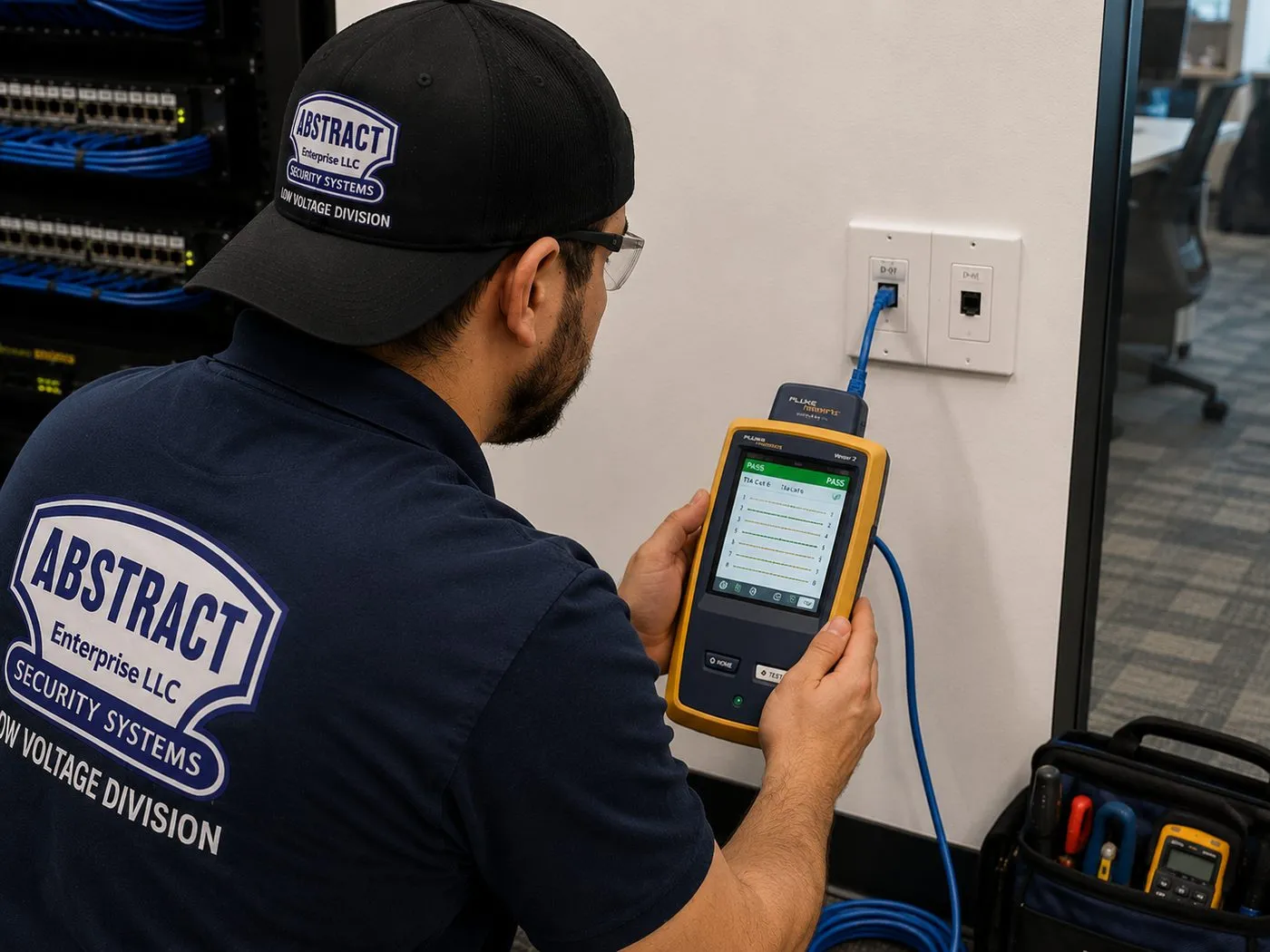
Profile view: the yellow certifier in the technician's hand shows a green pass, its lead running into a white jack on the wall, with patch panels in a rack at the left edge of the frame. Each new floor-to-floor link is tested like this before the system depends on it.
Coverage Area
Sonos Installation Near Queens' Landmarks
Give us the address and the neighborhood usually tells us the building before we arrive: the age of the house, the kind of walls, whether planes are overhead and how close the next house is. The six places below show that range across the borough.
Jackson Heights Historic District
Designated on October 19, 1993 and built mainly between 1914 and 1939, it is the first and still the largest garden-apartment community in the United States. Plaster walls, shared courtyards and co-op boards — Sonos indoors, quietly, with nothing fixed facing the gardens.
Douglaston Hill Historic District
A New York City historic district since December 14, 2004, laid out with large lots in 1853, with 83 contributing buildings mostly from 1890 to 1940 in Queen Anne, Shingle Style and Colonial Revival styles. Wood-framed houses with attics and basements: good cable paths and landmark rules for anything outside.
Fort Totten, Bayside
Bought by the federal government in 1857 for coastal defense, with construction starting in 1862, and today an Army Reserve post and a public park. The streets of Tudor houses inland from it are classic attic-fed ceiling speaker territory.
Bell Boulevard, Bayside
Known as Bell Avenue until 1916 and now lined mostly with restaurants, per a council member's description in 2024. Dining rooms under apartments, where commercial Sonos levels are set for the neighbors upstairs.
Flushing Meadows Corona Park and the Tennis Climb
The U.S. Open's home gave its name to the LaGuardia departure route created in 1993 to keep planes off the matches, which the FAA has used year-round since 2012 over residential Northeast Queens. The reason we set backyard levels while a plane passes.
43-25 Hunter Street, Court Square
Announced in 2013 by Rockrose as a 50-story, 975-unit tower, then the most units of any residential building in Queens. Glass, concrete and building-supplied networks — Long Island City's version of a Sonos job.
We also install Sonos in Astoria, Ditmars, Sunnyside, Woodside, Maspeth, Ridgewood, Glendale, Middle Village, Elmhurst, Corona, Rego Park, Forest Hills, Kew Gardens, Richmond Hill, Woodhaven, Ozone Park, Howard Beach, College Point, Whitestone, Flushing, Fresh Meadows, Oakland Gardens, Little Neck, Glen Oaks, Jamaica, Jamaica Estates, Hollis, St. Albans, Cambria Heights, Laurelton, Rosedale, Queens Village, Broad Channel and the Rockaways.
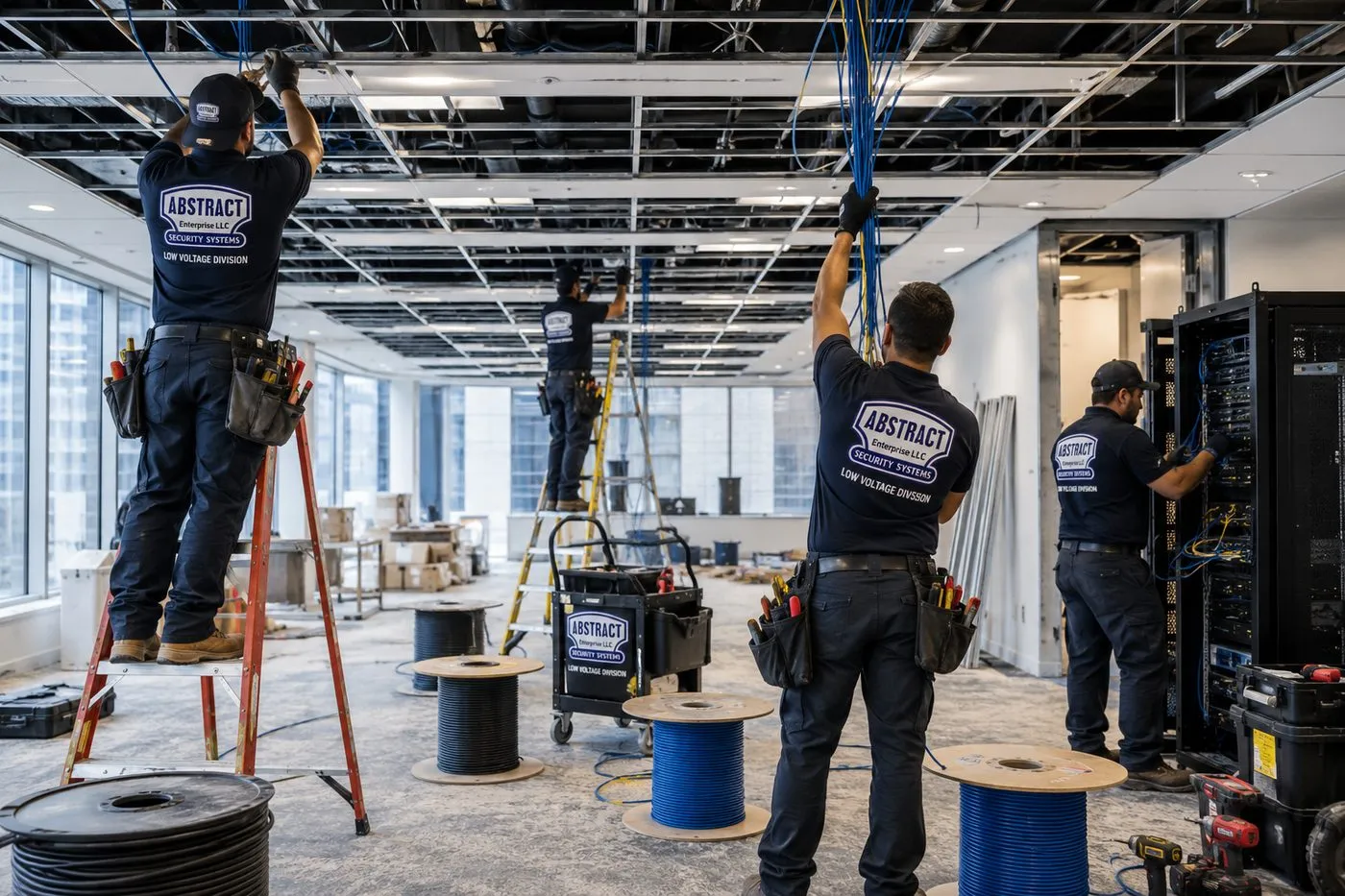
A wide view of an open-plan floor with the ceiling tiles out: two technicians on ladders feed blue cable upward, a third pulls from the spools on the carpet and a fourth works at an open rack at the right. Bigger multi-room jobs are run by a crew like this.
Pricing
Sonos Installation Cost in Queens
Nothing in these tables is new: each figure is copied from the Queens TV and audio price list AESS already publishes, or from the Sonos lines on our NYC Sonos page. Anything we can't price without seeing the house — ceiling speakers, outdoor zones, floor-to-floor cable — is quoted in writing after a walkthrough, before work starts. If something unexpected turns up on the day, you hear the price first.
Item
Queens price
What it covers
Sonos setup
$125
System, app, rooms, households, voice and Trueplay (the “Sonos / wireless surround” line)
Soundbar wall-mounted under the TV
$129
Arc Ultra, Arc, Beam or Ray on its bracket, levelled and connected
Soundbar placed on console or stand
$79
Positioned, connected and tested
Sanus soundbar bracket
$84.99
Supplied when you don't have a mount
In-wall concealment
$169
Code-compliant in-wall power and cable kit behind the TV
Paintable cord cover
$59
Surface raceway on walls that can't be opened
Cable run to a cabinet or other spot
$99
Up to 25 ft — e.g. router to the TV wall or soundbar
A/V receiver
$129
Receiver connected and configured, for example behind a Port
Universal remote
$99
Programmed for TV, Sonos and sources
Streaming device setup
$49
Per device
Full home theater
$350
Multi-component system set up together
Ceiling, in-wall or outdoor speakers on an Amp
Quoted at walkthrough
Within the $800–$2,500 per zone range published for whole-home audio
Certificate of insurance for a co-op, condo or landlord
Free
Parking charge
None in Queens
Setup-only visits and a TV on the same day
When nothing is being mounted or cut — rejoining speakers after a new modem, splitting one system into two households, setting voice languages, sorting dropouts between floors — the visit is billed by time: the first hour at the Queens rate of $195, then 30-minute blocks. If the TV is going up at the same visit, the Queens TV mounting base price is $179.99 for a 32- to 55-inch screen on a flat or tilt mount on drywall over wood studs, with the rest on our Queens TV mounting price list.
Included, and not included
Part of the job: brackets fixed and levelled, the TV link made, each speaker added to its household's system, rooms named by floor, signing in music services, voice language per speaker, Trueplay in each tunable room and dust clean-up.
Not our trade: new outlets, circuits and anything line-voltage go to a licensed electrician; backwater valves and drainage to a plumber; plaster and paint around ceiling cuts to your plasterer or painter.
Who buys what: the speakers, soundbars and Amps are yours to order from any store; the brackets, cable, raceway and in-wall kits can come from us at the prices listed.
Wasted visits: if the crew can't start — products not delivered, nobody home, basement access refused or the co-op hasn't signed off — the $150 return-trip fee applies. Rescheduling with 24 hours' notice is free.
Brittle finishes: a Jackson Heights plaster wall or a glazed kitchen backsplash may chip however slowly we go; we point at the risky spots during the walkthrough and wait for your yes.
National brands and app-based handymen versus a local licensed installer. National menus and gig listings price a soundbar on drywall in a single-family house, and for that job they are often fine. They don't price a router moved out of a flood-prone basement, an Amp kept out of a hot attic, a tenant's floor kept separate or a backyard set for planes. A local installer with a published Queens price list and a state low-voltage licence can price the real house and answers to you afterwards.
Shop Our Systems
Sonos Installation Packages & Pricing
Most Queens jobs begin from one of these three bundles. The price on each card is nothing more than published lines added together, and the lines are named so you can add them yourself. Wall surcharges and walk-up charges are added separately where they apply.
Starter — Sonos Setup
$125Sonos setup ($125): every product joined to the right system, rooms named by floor, voice language set per speaker, favorites saved and Trueplay run. For speakers you have already placed.
Standard — Two-Floor Link
$224Sonos setup ($125) plus a cable run of up to 25 ft ($99) wiring one Sonos product or an access point to the router: $224. The usual fix when the router is a floor away from the speakers.
Premium — Living-Room Theater
$507.99Sonos setup ($125), soundbar wall-mounted ($129) on a Sanus bracket ($84.99), with power and HDMI hidden in the wall by an in-wall concealment kit ($169): $507.99. Brick adds $65, plaster $45.
Bring Your Own Equipment — Labor Only
Got your own bracket already — the Sonos mount, or a third-party one rated for the weight? We charge for the labor alone: $129 to wall-mount plus any wall surcharge, and $125 for the full setup. A customer-supplied mount must be rated for the product and carries its maker's warranty; if it doesn't suit the wall we find, we say so before drilling and offer the Sanus bracket instead.
Ceiling, Basement and Backyard Zones
Speakers built into a ceiling or wall, or bolted outside, all run from a Sonos Amp, and each zone gets its own figure once we have seen it, because the attic, the floor between Amp and speakers and the wall entry set the work. The published range for whole-home audio is $800 to $2,500 per zone installed, and your written quote shows where each zone falls before you commit.
Ready to Map Your House Floor by Floor?
A photo of the basement cable entry, the TV wall and each ceiling, plus a list of who lives where, is enough for a written price.
The Sonos app is identical in Astoria and Arverne. The houses, the water, the planes and the households around it are not. This is how a typical job shifts as you cross the borough.
Astoria, Long Island City and Sunnyside
The west of the borough mixes older two-family houses and walk-ups in Astoria with the glass towers of Long Island City and Court Square. In the houses, the job looks like the rest of Queens: a router to rescue from a cellar and a second floor to reach. In the towers, it's concrete ceilings, metal-stud partitions, building-supplied internet and dozens of neighboring networks, so rear speakers go on stands and the soundbar is wired if the building allows a router of your own.
Jackson Heights, Elmhurst, Corona and Woodside
The garden co-ops of Jackson Heights bring plaster walls, monthly board meetings and courtyards where nothing is fixed outside. The surrounding blocks of Elmhurst, Corona and Woodside are full of houses with basement units, the area the Regional Plan Association studied after Ida, so equipment placement and cable routes through the basement get the most attention here. Households are often large and multilingual, which is where per-speaker voice languages and written cards earn their keep.
Forest Hills, Rego Park, Kew Gardens and Briarwood
Queens Boulevard's apartment buildings bring managing agents, certificates of insurance and contractor hours, while the side streets hold detached and semi-detached houses with attics and yards. A single day can include a co-op living room with a Beam on a plaster wall and, a few blocks away, a house with ceiling speakers fed from the attic.
Flushing, Bayside, Douglaston and Little Neck
Northeast Queens has many detached houses with real yards, and much of it sits under LaGuardia's Tennis Climb departure route. Backyard zones here are planned for flyovers: more speakers at lower levels, close to the seating. Douglaston Hill's historic district adds a landmarks check before anything goes on a visible facade, and Bayside's Tudors make attic-fed bedroom speakers straightforward.
Jamaica, St. Albans, Cambria Heights and Laurelton
Much of southeast Queens is one- and two-family houses with basements, driveways and backyards, and JFK traffic overhead on some blocks. Jobs tend to be whole-house: a living-room theater on the first floor, a finished basement den with its Amp kept upstairs, and a deck or patio zone. Requests for two separate systems in one house come up often.
Howard Beach, Broad Channel and the Rockaways
Near the water, salt air and storm surge join the list. Sonos designs its outdoor architectural speakers for salt spray as well as humidity, heat, UV and freezing temperatures, which makes them the right choice for a Rockaway porch over an indoor speaker left outside. Basement equipment placement matters here as much as anywhere in the borough, and portable speakers that come inside after the beach are popular.
Repairs by Floor
Common Sonos Faults in Queens Houses, and Their Fixes
Most Queens Sonos repair calls follow a pattern, and the floor the problem is on usually points to the cause. These are the faults we see most often, and what fixes them.
Every room went silent at once. Usually the provider replaced the modem or router, often in the basement, and the new one has a different network name or password. The speakers are fine; the system needs rejoining to the new network, and while we're there we lift the new box off the floor.
Only the top floor drops out, mostly in the evening. A weak link through two floors and a brick party wall, made worse when the neighbors' networks get busy. The fix is a wired access point or one wired Sonos product upstairs, not an extender.
The basement den stopped working after the storm. We check for water damage before anything is powered, then move surviving equipment and plugs above the floor and rewire what needs it.
The ceiling speakers upstairs cut out on hot afternoons. Often an Amp in a warm closet or, worse, the attic. Sonos rates the Amp to 104 degrees; we move it somewhere cooler and give it clearance.
The tenant can see our speakers. Both floors were set up on one network and one system. We separate them into two systems on two networks so each household controls only its own rooms.
Voice speaker answers in the wrong language. Alexa's language on Sonos is set speaker by speaker; a reset or a new speaker defaults back. We set each one again and write down which is which.
Backyard music can't be heard over the planes. One pair is being asked to do too much. Adding a second pair closer to the seating lets every speaker play quieter while the yard as a whole sounds fuller.
Repair visits are billed as setup-only time in Queens: $195 for the first hour, then 30-minute blocks, with any parts or cable on the published lines above. Call (347) 434-6392 and describe which floor is affected; it helps us bring the right parts.
Complete Services
Every Sonos Installation Service in Queens
Sonos tends to arrive with other changes in a Queens house — a tenant moving in, a basement being finished, a TV upgrade. Here is what people book with it.
Arrival windows, rescheduling, return trips and setup-only billing.
Field Notes
Field Notes From Queens Sonos Jobs
The first hour of a Queens house visit as our crews normally run it — a description of routine, not an account of any one client
The first stop is the basement, not the living room. We find where the internet line comes in, look at the walls and the floor for tide marks or fresh paint low down, and ask how high water reached in the last big storm. That answer decides where the router and every Amp will live before a single speaker is discussed.
The second stop is the top of the house. If there is an attic hatch, we go up with a light and check joist direction, insulation, old wiring and any ducts above the rooms that want ceiling speakers. Feeling the air up there also settles the Amp question quickly.
The third is a conversation at the kitchen table: who lives on each floor, who will use the app, who will only use their voice, and in which language. We sketch the floors on paper with the rooms, the boxes and the households marked, and that sketch becomes the quote.
FAQ
Queens Sonos Installation FAQ
Is Sonos installation priced differently in Queens than elsewhere in the city?
+
Mostly no. The Sonos setup line is $125 and the soundbar, bracket, concealment and wall lines are the same published prices used across the city. What differs by borough is the setup-only hourly visit: in Queens the first hour is $195, then 30-minute blocks, and the Queens TV mounting base price is $179.99. Ceiling and outdoor speaker rooms are quoted after a walkthrough.
Can we use the ceiling speakers the same day, or does the ceiling need patching first?
+
The same day. A Sonos in-ceiling speaker fills its own cut-out, so once it is wired and clamped in, it plays. Any cosmetic touch-up around the edge of an old plaster opening, or repainting the ceiling and grilles, can happen later without disturbing the speaker.
Can you leave written instructions for relatives who missed the setup?
+
Yes. Every household in the house gets a one-page card left by its main speaker covering how to play, pause, change rooms and restart, written in plain words. Tell us which language each household reads and we will do our best to match it; at minimum the room names and favorites are listed as they appear in the app.
Can Sonos speakers powered over the network cable simplify a shop installation?
+
Often, yes. Sonos describes the Era 100 Pro as designed for professional installation with PoE+, meaning one network cable carries both power and data, and says it adjusts its sound automatically for portrait, landscape or ceiling mounting. In a narrow Queens storefront that can mean no outlets near the speakers and no separate Amp, provided the shop's network switch can supply PoE+ power.
Can you work around a tenant's schedule when cable has to pass through their unit?
+
Yes. If a cable route crosses a tenant's floor or a shared basement, we agree the access time with you in advance so you can give your tenant notice, keep the time inside their unit as short as possible, and clean up before we leave. If access is refused, we plan a route that stays on your side.
Can outdoor speakers be mounted on aluminum or vinyl siding?
+
Yes, but not on the siding alone. Siding is a thin skin, so the bracket has to reach the solid wall behind it: we locate the framing, fix through to it, and use a mounting block so the siding isn't crushed and water can't get behind it. If the wall behind is brick or block under the siding, we use masonry anchors and say so in the quote.
Will a Sonos system interfere with our Wi-Fi security cameras?
+
It can if both are fighting for a weak signal. Sonos lists wireless cameras and video transmitters among the devices that cause interference, and recommends keeping its products at least 18 inches from other electronics. We check signal for both, separate them physically, and wire whichever devices can be wired so the cameras and the music stop competing.
Can a Sonos speaker live on a balcony or terrace in a Queens high-rise?
+
Not permanently, unless it is an outdoor-rated speaker and the building allows fixtures outside. Sonos warns that speakers which are not waterproof can be damaged if left outside for extended periods. For a tower balcony, a portable Move 2 or Roam 2 carried out and brought back in is the practical choice, and building rules on anything attached outside always apply.
Can the ceiling speaker grilles be painted to match our ceiling?
+
Yes. Sonos describes the grilles on its in-ceiling speakers as paintable and bezel-less. We remove the grilles before painting so the speaker cones are not touched, and refit them once the paint is dry, or leave them with your painter with instructions.
Can the backyard speaker wiring go in before the patio or deck is built?
+
Yes, and it is the cheapest time to do it. We lay speaker cable in conduit along the route the deck or patio contractor gives us, leave it labeled and capped at each speaker location and at the wall entry, and return to fit the speakers and the Amp when the building work is finished.
All Areas Served
Sonos Installation Across New York City
Queens is one of the city's Sonos pages. Each page below is written for its own housing and its own problems, and every one is served by the same licensed team.
Top-floor speaker greyed out, the basement den silent since the storm, a group that won't hold across floors? Call (347) 434-6392 for the earliest open arrival slot in Queens. With a technician on site, network and setup faults are typically fixed within one to two hours.
Sonos Installation Queens — Licensed, Insured, Planned Floor by Floor
Abstract Enterprises Security Systems · 460 E Fordham Rd, Bronx, NY 10458 · Queens line (347) 434-6392 · WhatsApp (718) 679-0359 via wa.me
NYS Low-Voltage Licence #12000287431 · 100% Licensed & Insured · Same-Day Estimates · Rated 4.7★ from 201 Google Reviews
Sonos products carry Sonos's manufacturer warranty through the seller; brackets and parts carry their maker's warranty. Full terms — including 50% deposit, one-year parts-only warranty on AESS-supplied products, and the late-fee schedule — are set out in the service agreement. See our warranty page.
Last reviewed October 17, 2026 by Anwar Timothy. Change history: Queens Sonos page first published on this date.