NYS Licensed Low-Voltage Contractor · Beacon to Pine Plains · Hudson Valley Line (845) 640-3835
Sonos Installation in Dutchess County
Plaster & Lath · Balloon Frames · Mill Lofts · Main Street Storefronts · Estates & Barns
Dutchess houses were built to last, not to be rewired. Horsehair plaster on wood lath in Poughkeepsie, open stud bays that run from cellar to attic in village houses, fieldstone foundations, original cornices you would never cut, brick mill lofts in Beacon with ceilings fifteen feet up, and barns a long walk from the router. We plan Sonos for that housing stock: wireless where the plaster must stay whole, wire only along routes that already exist through the basement and the attic, speakers chosen to sit on surfaces rather than in them, and a proper link out to the barn. Booked in 2-hour arrival windows from 8 AM to 8 PM, seven days a week.
Reviewed and updated October 17, 2026 · Written by Anwar Timothy, NYS licence #12000287431
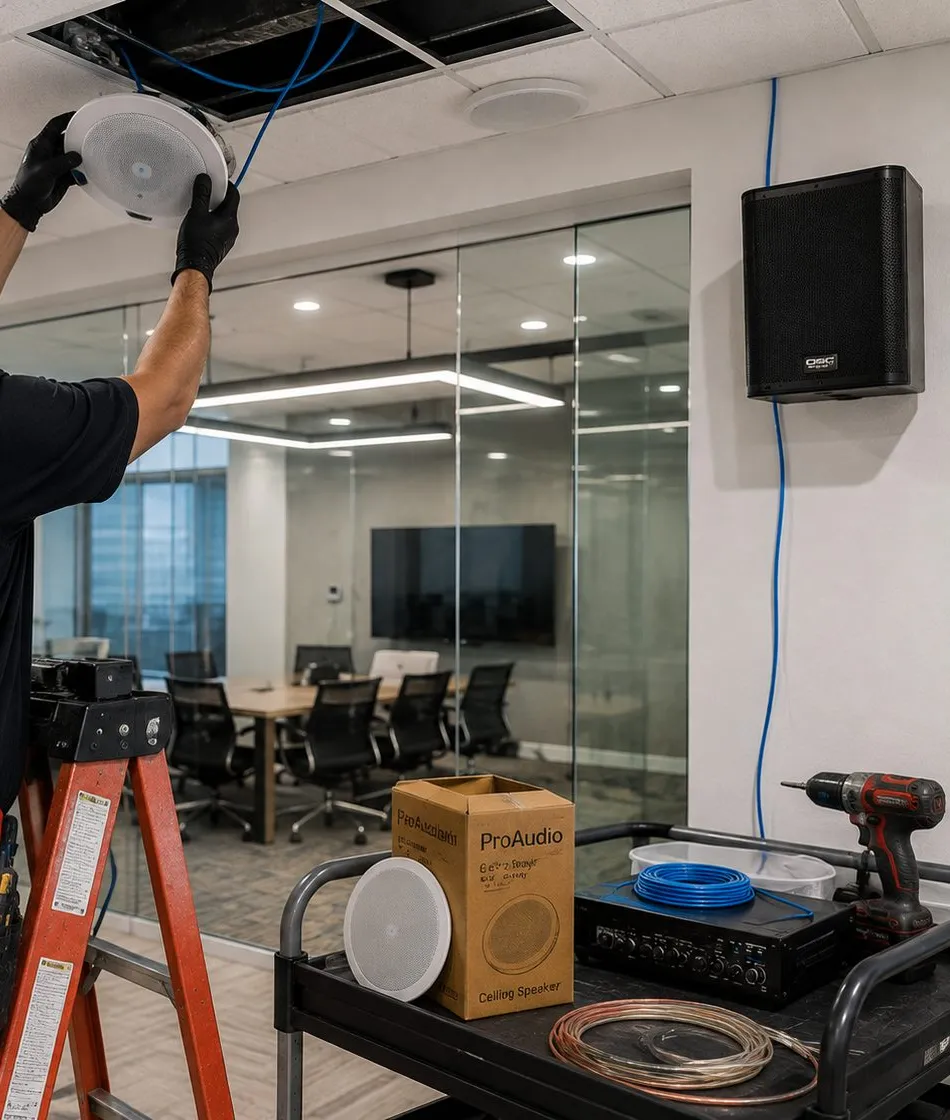
From the side, a technician’s gloved hands raise a round white ceiling speaker toward a gap in the ceiling grid, a blue cable looping down from above. A black wall speaker hangs to the right, and a cart below holds a second round speaker, a boxed ceiling speaker, an amplifier, a coil of blue cable, copper speaker wire and a drill. This is an office space, not a home.
Free Dutchess Sonos Quote
Tell us the town, the age of the house and the rooms — a written price follows the same business day
✅
Request Sent!
A Hudson Valley technician calls back the same business day.
25+
Years Experience
✓
Same-Day Estimates
100%
Licensed & Insured
4.7★
201 Google Reviews
Got an old Dutchess house and a box of Sonos speakers? Ring the Hudson Valley line, (845) 640-3835, or use the 60-second form. Tell us the town, roughly when the house was built and which rooms you want music in, and a licensed installer replies with a written figure taken from the price lines published lower on this page.
No travel charge anywhere in the county, from Beacon to Pine Plains, per the AESS Dutchess price list
Original plaster, trim and woodwork treated as untouchable unless you say otherwise in writing
Work carried out under New York State low-voltage licence #12000287431, any day of the week
Most Sonos advice is written for a drywall house built in the last thirty years. A good share of Dutchess was not built that way. Census figures compiled by Stacker put 18.0 percent of the county's homes, about 22,056 of them, in the built-in-1939-or-earlier column, and those houses are not spread evenly: they cluster in the City of Poughkeepsie, in Beacon, and in the village centers of Rhinebeck, Red Hook, Tivoli, Millbrook and Pawling, exactly where people most want music in the parlor and on the porch. Those are the homes where an installer who treats walls as disposable does the most lasting damage.
The construction itself sets the rules. Plaster troweled over wood lath is heavy, brittle and bonded to the lath by keys that let go if you saw carelessly. Many houses of that era are balloon-framed, with studs running unbroken from the sill to the roof, which can make a wire route from cellar to attic surprisingly easy but also means a hole in the wrong place gives fire a straight path between floors. Foundations are often fieldstone. Interior trim, plaster cornices and ceiling medallions are frequently original, and many owners rightly refuse to have any of it cut. A Sonos plan for these rooms starts from the question of what must not be touched, and works outward from there.
Sonos itself gives a reason to be careful with old walls. Its own support guidance on interference lists plaster among the materials with a high effect on wireless signal, alongside concrete, with metal rated higher still. In a solid-plaster house with several chimney stacks, a router in the front hall may simply not reach the kitchen at the back, and a soundbar in the parlor may drop off the system every evening. One owner on Reddit's Sonos forum summed it up in a thread title: "Old house, plaster walls, can't get through a song cleanly." The answer is rarely a bigger router; it is usually one carefully placed wired link, routed through space the house already has.
Then there is the newer old stock. Beacon's riverside mills and factories have become apartments and condominiums: The Lofts at Beacon, at 18 Front Street, describes itself as a brick textile mill originally built in 1870 and now holding 89 lofts and penthouses, many with exposed brick, ceilings of 15 to 20 feet and mezzanine levels. Main Streets in Beacon and Poughkeepsie are lined with mixed-use buildings, a shop at street level and apartments above, many with pressed-metal ceilings of the kind the National Park Service describes as widely used in Main Street shops, offices and restaurants. And beyond the villages there are estates and working farms: the USDA's 2022 Census of Agriculture counted 620 farms in Dutchess averaging 161 acres, many of them with barns, carriage houses and sheds that someone would like music in.
Put together, that is why a Dutchess Sonos job is mostly about restraint and routes. Which rooms can stay fully wireless, which need one wired product, which speakers can sit on furniture, stands or brackets instead of going into a ceiling, where a wire can travel through the basement and up an existing chase without opening a finished wall, and how the barn or the carriage house gets its own link. The speakers themselves are the easy part.
Dutchess figures that shape a Sonos plan
18.0 percent built in 1939 or earlier: roughly 22,056 Dutchess homes, per Census data compiled by Stacker in September 2025, with a county median year built of 1971 — plaster, lath and old framing are everyday conditions here, not exceptions.
124,843 housing units and a 69.2 percent owner-occupied rate, from the Census Bureau's QuickFacts for Dutchess County — most of our Dutchess callers own the walls they are asking us to protect.
620 farms averaging 161 acres: the USDA's 2022 Census of Agriculture count for the county, and the reason so many Dutchess Sonos plans include a second or third building.
89 lofts in an 1870 textile mill: The Lofts at Beacon's own description of its Front Street building, with ceilings of 15 to 20 feet — tall, hard-surfaced rooms that change speaker choice completely.
93.5 percent of Dutchess households with a broadband subscription, per the Census Bureau — internet is usually there; getting it through plaster and out to the barn is the work.
More than 20,000 customers back on by the morning after a Saturday nor'easter in late September 2026, by Central Hudson's own update — storms and outages belong in the plan, generator and all.
None of those numbers is about speakers, and that is the point. They describe the walls, the land and the power the speakers have to live with.
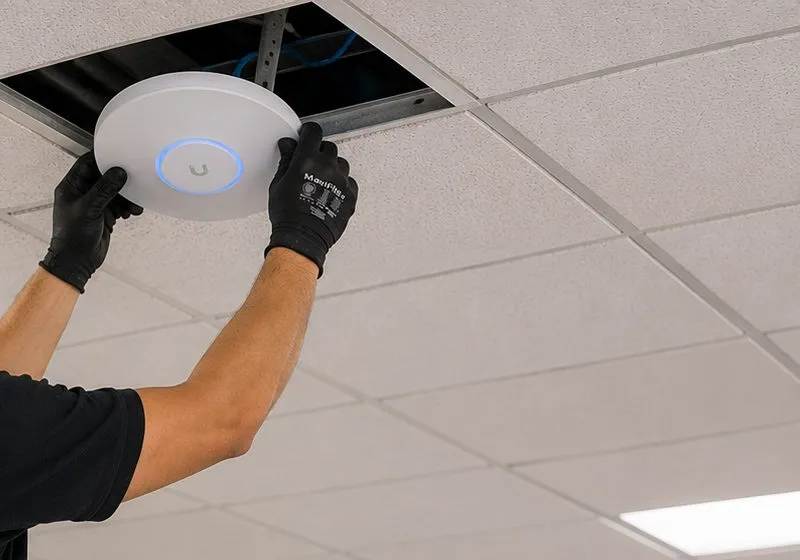
Close on two gloved hands pushing a white disc access point with a blue status ring up against an open ceiling panel, cable just visible in the dark space above. One wired access point placed past the plaster walls is often what lets a whole Sonos system play cleanly.
Repair Capture
Music Breaking Up Behind the Plaster?
A kitchen speaker that stutters whenever the microwave runs, a parlor soundbar that vanishes from the app after dark, a barn speaker that has not played since the last storm, or a whole system that went quiet when the internet provider swapped the modem — those are repair calls, and we book them into the next open 2-hour window. With a technician in the house, most network and setup faults are cleared within one to two hours. Call (845) 640-3835 and say it is a Sonos repair; a setup-only visit in Dutchess is $275 for the first hour, then 30-minute blocks, as our TV and audio service policies explain.
What We Install
Sonos Installation Services in Dutchess County
Every Dutchess Sonos job we take is built from some mix of the services below. The order is nearly always the same: survey the house and agree what cannot be touched, fix the network so the signal reaches every room through the plaster, place the speakers, and only then set up rooms, groups and voice in the app.
No-Cut Room Plans
Rooms where nothing may be drilled or cut get a fully wireless layout: an Era pair on stands or furniture, a soundbar on the media console, a Sub tucked beside the sofa, all on their own outlets, all reversible without a trace.
One Wired Anchor Through Old Walls
A single Ethernet run from the router to one Sonos product or access point, routed up from the basement or down from the attic so that the finished rooms are never opened. In a plaster house this one wire often fixes the whole system.
Surface-Safe Speaker Mounting
Brackets placed only where they can reach framing or masonry, set in mortar joints rather than old brick faces, kept clear of cornices and medallions, with cable dressed in paintable raceway when the wall cannot be opened.
Basement-Up and Attic-Down Wiring
Speaker and network cable laid along joists in the cellar and fished up into an interior wall, or dropped from the attic into a ceiling, using balloon-frame stud bays where they help and sealing each hole we drill as the fire code expects.
Ceiling Speakers Where the Ceiling Allows
Sonos in-ceiling speakers on a Sonos Amp in rooms with a plain plaster field, an accessible attic or a later drywall ceiling, laid out to stay clear of plaster ornament and to avoid joists, pipes and old wiring.
Loft and Mezzanine Sound
Beacon mill lofts and converted industrial spaces with tall ceilings, exposed brick and a level above the living area, set up so the main floor and the mezzanine both hear the music evenly and the neighbors below hear as little as possible.
Main Street Shop Audio
Background music for a storefront, café or gallery under a pressed-tin or plaster ceiling, on a business-licensed music service, kept apart from the owner's own apartment system upstairs.
Barn, Carriage House and Studio Links
A dedicated network link to an outbuilding — fiber or a point-to-point wireless bridge rather than a long copper run or an extender — so the speakers out there behave like they are in the house.
Storm-Ready Setup
The router, switch, Amp and Port plugged into surge protection and, where the house has one, a generator circuit that suits electronics, with the system set up to rejoin cleanly when the power comes back.
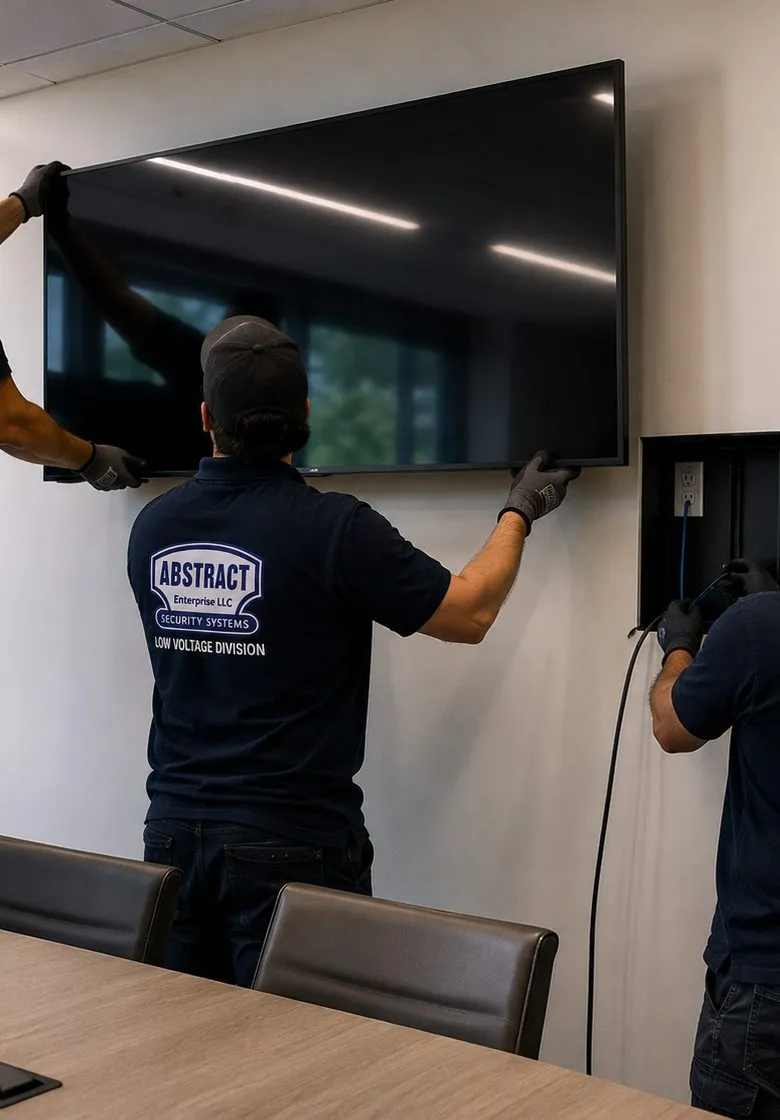
Seen from behind, one technician in a cap and grey gloves holds the lower edge of a large black screen against the wall while another hand steadies the left side; at the right, a third person feeds a black cable into a recessed box with an outlet set into the wall. A conference table sits in the foreground.
A soundbar from another brand under a different TV? Our soundbar installation in Dutchess County covers Samsung, Bose, Sony and others with the same respect for old walls.
Building Specialists
Sonos Installation for Dutchess County's Architecture
The county's houses come from very different centuries and trades, and each type pushes the Sonos plan in its own direction. These are the ones we meet most, from the river towns to the Connecticut line.
City of Poughkeepsie Victorians
Brick and frame houses in and around the Union Street and Academy Street historic districts, listed on the National Register in 1971 and 1982. Tall rooms, plaster cornices and pocket doors are common. Wireless first, with one wired anchor from the cellar.
Balloon-Framed Village Houses
Nineteenth-century frame houses in Rhinebeck, Red Hook, Tivoli, Pawling and Millbrook with studs running from sill to rafters. The open bays can carry a wire from cellar to attic in one pull — and every hole at a floor line has to be fire-blocked again afterwards.
Fieldstone Farmhouses
Stone foundations and sometimes stone walls, wide-plank floors and low beamed ceilings in the older farm properties of the eastern and northern towns. Speakers stay on furniture or brackets set into mortar, and wire travels in the cellar where joists are exposed.
Beacon Mill and Factory Lofts
Converted brick industrial buildings along Fishkill Creek and the river, with exposed brick, timber or steel structure and ceilings far higher than a ceiling speaker is designed for. Sound placement is about height, hard surfaces and the mezzanine.
Main Street Mixed-Use Buildings
A shop or restaurant downstairs and one or two apartments above, in Beacon, Poughkeepsie, Rhinebeck and Millbrook. Pressed-metal ceilings, shared basements, separate internet lines and two very different kinds of listener in one building.
River Estates and Gentleman Farms
Large houses along the Hudson from Staatsburg to Tivoli and in the Millbrook horse country, with staff quarters, pool houses, carriage barns and caretakers. More buildings than rooms, sometimes, and a network plan that has to cover all of them.
Working Barns and Outbuildings
Timber-frame barns, equipment sheds, riding arenas and converted studios. Dust, cold, damp, livestock and lightning all matter more than speaker brand. Portable or outdoor-rated products, and a link that cannot carry a surge into the house.
Mid-Century Ranches and Colonials
The counter-case: houses built in the postwar growth of Wappinger, LaGrange, East Fishkill and the Town of Poughkeepsie, with drywall, accessible attics and basements. Here ceiling speakers and in-wall cable are routine, and we treat them that way.
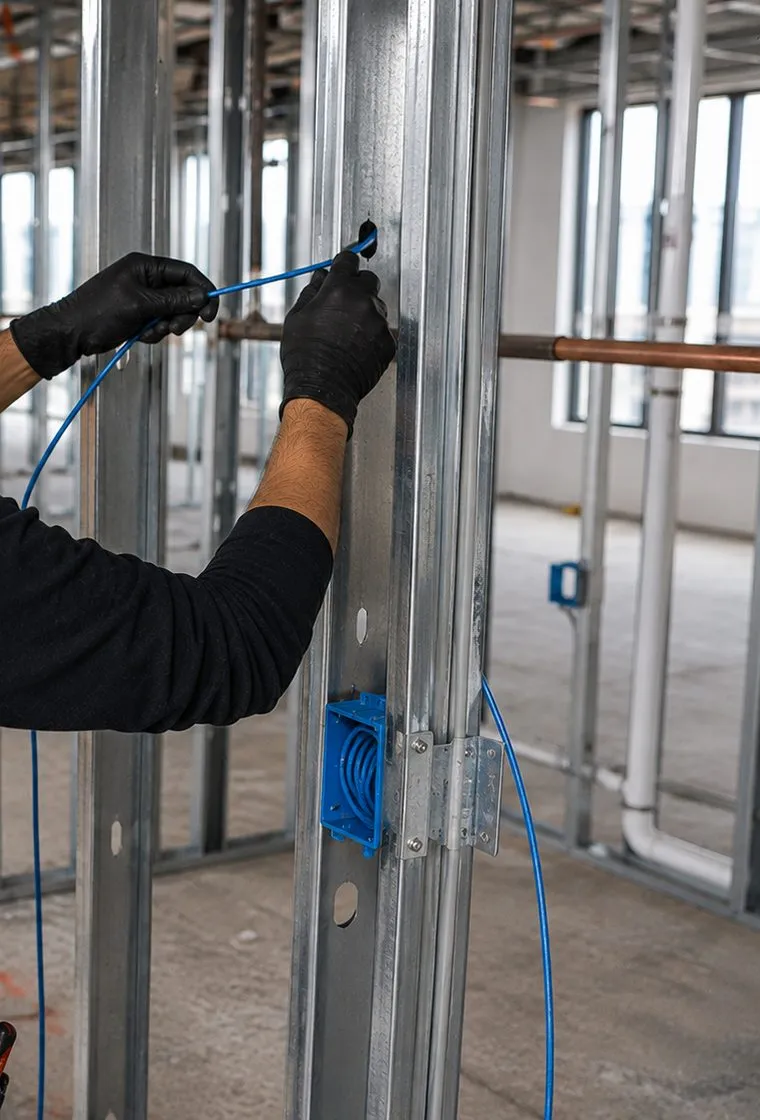
Two gloved hands draw a blue cable through a punched hole in a steel stud, with a blue wall box fixed lower on the stud and copper pipe running behind. Open framing like this, during a renovation, is the easiest time to run speaker and network cable.
Methods by material
What we do differs by what the wall or ceiling is made of. This is the working rulebook, and each line is something we settle with you before any tool comes out.
Surface
What we do
What we avoid
Plaster on wood lath
Locate lath direction and framing first; tape the surface; drill slowly with a sharp bit; screw-and-washer anchors that grip the lath where a bracket must go
Hammer drills, oscillating saws through ornament, anything on a cornice, medallion or cracked field
Plaster on brick or stone
Fix brackets into mortar joints, not the face of old brick; keep weight low; cable in surface raceway painted to match
Large-diameter holes in original masonry, fixings close to the edge of a brick
Pressed-metal ceilings
Leave the ceiling alone; speakers on walls, brackets or furniture; any cable above reached from the floor above or an access panel
Cutting a speaker opening through stamped panels or their pattern
Exposed brick (lofts)
Mortar-joint fixings, cable along beams or in color-matched raceway, wireless where possible
Chasing channels into brick faces
Timber beams and plank ceilings
Surface speakers and wiring along the beam line where it reads as part of the structure
Notching beams or cutting into plank ceilings to recess speakers
Later drywall over old framing
Standard Sonos in-ceiling or in-wall installation after an obstruction check
Assuming nothing is behind it — old houses hide old wiring and pipes
The No-Cut Plan
Wireless Sonos Layouts for Rooms That Can't Be Opened
In many Dutchess houses the best Sonos installation leaves no mark on the room at all. Sonos makes that easier than most brands: almost every speaker and soundbar it sells, apart from the passive architectural range, plugs into an ordinary outlet and joins the system without speaker wire. So the decision we make with you is room by room, and the default for an original room is wireless.
Room
Typical no-cut layout
The one thing to check
Front parlor with original cornice
Soundbar on the console under the TV, or an Era 300 pair on stands either side of the mantel
Outlet positions — old rooms often have two, in the wrong places
Dining room with medallion
One Era 100 on the sideboard; a second paired as stereo if the room is long
Distance from the router through plaster and chimney breasts
Library or study with built-in shelves
Era 100s on the shelves at ear height, cables down behind the uprights
Shelf depth and ventilation behind the speaker
Kitchen in the old service wing
An Era 100 on the counter or a short shelf away from the stove
Interference from the microwave and the cordless phone base
Bedrooms under a slate or old shingle roof
Era 100 on a dresser or nightstand
Signal through two floors — often the room that needs the wired anchor
Porch or veranda
A Move 2 or Roam 2 carried out, or outdoor speakers on the porch ceiling wired back indoors
Whether a bracket or wire would be visible from the street
A typical no-cut layout: soundbar, Sub and Era speakers on furniture and stands, with ornament marked off limits and the one cable hidden behind the console.
The wireless layout only works if the network does. In a plaster-and-lath house that usually means one product, or one access point, connected by cable to the router, with the rest of the system using that strong link. Sonos's own system requirements rule out the shortcuts people reach for first: it does not support wireless range extenders, Ethernet-over-power adapters, or guest and portal-login networks. So instead of plugging gadgets into the wall, we find one route for one cable and make it count.
Speakers on furniture also need a little care in old houses. Floors are rarely level, plaster near a radiator gets hot, and a heavy speaker on a narrow mantel shelf is one door slam away from the hearth. We level stands with shims rather than screws, keep products well away from radiators and stoves, and fit small, reversible restraints where a mantel or shelf is narrow. When you move the furniture next year, nothing has been drilled.
Finally, the wireless plan has to be quiet about its cables. Each speaker needs power, and some need a network cable. We route those along baseboards, behind furniture, up the back of bookcases and under rugs with flat cable protectors, and where a run has to cross open plaster we use a paintable cord cover rather than opening the wall. A good no-cut room should look like you simply put a speaker down.
Wire Routes
Wire Routes Through Old Dutchess Houses: Basement Up, Attic Down
When a room does need wire, we look for the path the house already gives us. In an old Dutchess house that is almost never the finished wall itself. It is the cellar with its exposed joists, the attic over the top-floor rooms, the stud bay beside a chimney, the back of a closet that stacks between floors, or the chase an old heating pipe once used. The aim is a run from the router to the room that opens nothing anyone will see.
How a typical older Dutchess house is wired for Sonos: one cable up from the cellar, one down from the attic, the rest wireless.
From the basement up. Most first-floor rooms can be reached from below. We drill up through the bottom plate of an interior wall from the cellar, fish the cable to a low wall plate or to the back of a built-in, and tie the run neatly along the joists back to the router or switch. Fieldstone foundations and damp cellars mean we keep cable up off the walls and floor and away from the sump, and keep any connection on the floor above.
From the attic down. Top-floor rooms and ceilings are usually best reached from above. If the attic is floored or has walkable joists, ceiling speakers can be placed by measuring from the attic side, wire laid across the joists, and openings cut only once we know nothing is in the way. If the attic holds loose vermiculite insulation, the plan changes, because the EPA's advice is to assume vermiculite contains asbestos and leave it undisturbed.
Through a balloon frame. In a balloon-framed house the stud bays run the full height of the wall, so a cable dropped from the attic can sometimes reach the cellar in one pull. That convenience is also the hazard: those open bays are exactly what modern codes block off to slow a fire. New York State's Residential Code calls for fireblocking at openings around cables and wires at ceiling and floor level, so every hole we make through a plate is sealed again with fire-rated material before we leave.
Next to old electrical wiring. Many older houses still have some knob-and-tube or early cloth-insulated wiring in the walls; Hudson Valley home-inspection guidance lists it among the quirks buyers of older homes should expect. Speaker and network cable is low-voltage and must be kept apart from power conductors — the National Electrical Code's Class 2 rules call for at least two inches of separation — so if a bay we planned to use carries old power wiring, we choose another route and tell you what we saw so your electrician can follow up.
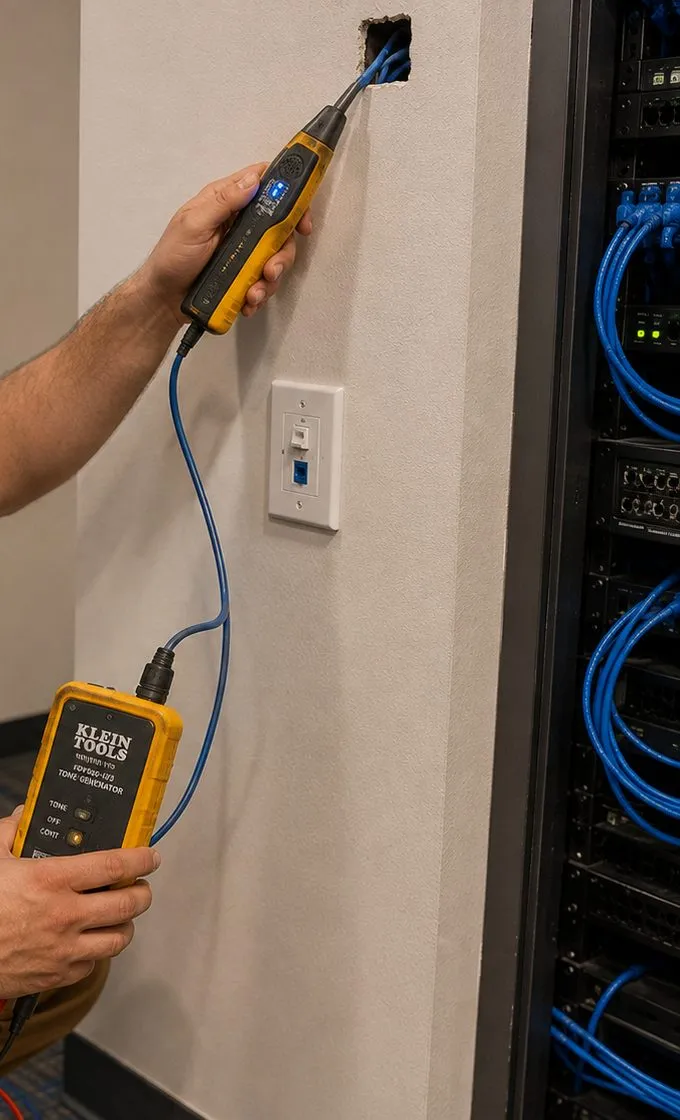
A yellow tone probe is held to blue cables emerging from a small hole high on a white wall; its lead runs down to a yellow tone generator in the technician’s other hand. A network wall plate sits between them and a rack of patched cables stands at the right edge.
We trace and test every route before relying on it. Old houses often contain wire left by earlier owners — a telephone line, an intercom, a speaker run that goes nowhere — and a tone generator and probe tell us which cable is which before anything is cut, joined or abandoned. Anything we leave in the walls is labeled at both ends.
Commercial Sonos
Business Sonos Installation in Dutchess County
Dutchess businesses tend to be small, local and often in old buildings: a shop with a tin ceiling, a café in a former storefront, a restaurant in a village inn, a farm store, a tasting room, a gallery. Sonos suits that scale well, and Sonos itself markets installed systems to businesses. The corridors below are where our Dutchess commercial audio calls come from.
Main Street, Beacon
Shops, galleries and restaurants in older brick buildings with apartments above, many under original pressed-metal ceilings. Speakers on walls or brackets rather than cut into the ceiling, and the shop's music kept apart from the tenants' networks upstairs.
Main Street, Poughkeepsie
Nineteenth-century commercial blocks such as the Cast Iron Building at Main and Garden Streets, rebuilt after an 1870 fire and finished in 1872 with a cast-iron facade. Tall ceilings, deep narrow floors and older electrical services shape where speakers and equipment go.
Rhinebeck Village Center
Restaurants, inns and shops in a village historic district, many in timber-frame and brick buildings. Background music for dining rooms and porches, with nothing added to street-facing walls that would draw comment.
Hyde Park and the Route 9 Corridor
Restaurants and hospitality near the Culinary Institute of America campus, whose own student-run restaurants are part of the Hyde Park landscape, and offices and medical practices along Route 9 toward Poughkeepsie.
Millbrook and the Eastern Villages
The Village of Millbrook, incorporated in 1895 and grown up around a railroad station, keeps a traditional village streetscape. Its shops, cafés and the businesses in nearby Amenia and Pine Plains want sound that suits small historic rooms.
Farms, Barns and Event Spaces
Farm stores, tasting rooms and barns used for gatherings across the county. Weather-tolerant speakers, a reliable link from the main building, simple controls for staff, and inputs for a microphone or a visiting DJ.
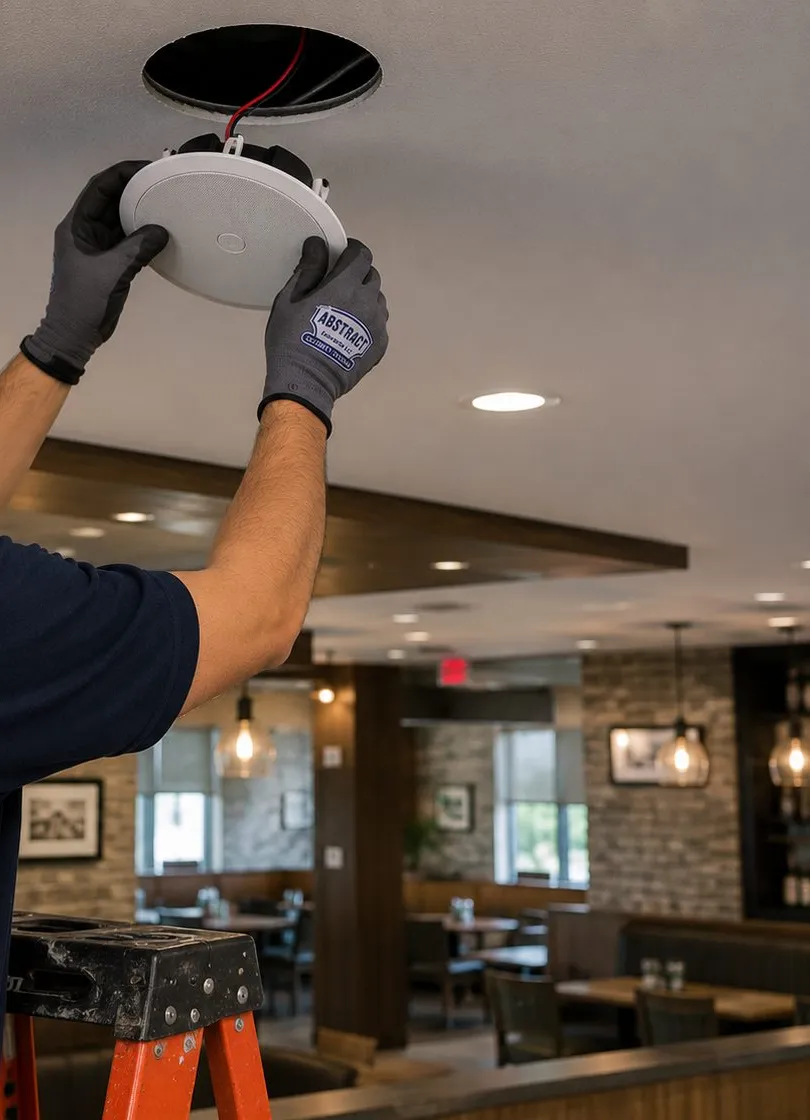
Close on grey gloved hands pushing a round white speaker into a circular opening in a plain ceiling, a red speaker lead trailing from the hole. Below, out of focus, is a restaurant with stone-clad walls, wooden booths and pendant lights.
Compliance callouts for Dutchess business audio
Licensed music, not a personal account. Spotify's own support page says its service is "only for personal, non-commercial use" and that you cannot play it publicly from a business such as a bar, restaurant, store or salon. Other consumer services carry similar terms. For a shop or restaurant we set Sonos up with a business-licensed music service of your choice, and the owner's personal account stays on the apartment system.
Exterior speakers in Beacon's historic overlay. Beacon's historic preservation chapter requires a certificate of appropriateness from the Planning Board for an "alteration" in its Historic District and Landmark Overlay zone, defined as a change to historical features visible from a public street, sidewalk or park — while excluding electrical work and minor, accessory or utility changes that do not substantially detract from the property. We keep exterior speakers and wire out of the street view so the question does not arise, and if it might, you check with the city first.
Fire blocking in old buildings. Any hole through a floor or ceiling plate for speaker cable is sealed with fire-rated material, following the fireblocking provisions of New York State's Residential Code; in commercial buildings the building's own code requirements and your landlord's rules apply.
Low-voltage kept apart from power. Speaker and network cable is run separately from electrical wiring and never through the same holes or boxes; new outlets, circuits and anything at line voltage are for a licensed electrician.
Certificates of insurance. Landlords and property managers on Main Street often ask for one before work starts. Ours is free.
Your Questions Answered
Sonos Installation in Dutchess County: Questions Answered
These are the questions Dutchess owners put to us about old houses, historic rules, lofts and shops, barns and storms. They are grouped by the part of the property they concern. Prices, booking and visit logistics are in the FAQ further down the page.
Plaster, lath and old framing
Our Poughkeepsie Victorian has plaster cornices and a ceiling medallion in the parlor — where can speakers go without touching them?
Usually on the floor, the mantel or the furniture, and the room will sound better for it. Ornamental plaster is the hardest thing in an old house to repair invisibly, so we treat the cornice, the medallion and a margin around each as off limits. In a tall parlor, a pair of Era 300 or Era 100 speakers on stands either side of the fireplace, or a soundbar under the TV with a Sub beside the sofa, fills the room without a single fixing.
If you do want ceiling speakers, the safe zone is the plain field of the ceiling well inside the cornice and away from the medallion, and only after we have checked from the floor above or the attic that the plaster is sound and the joists and old wiring are where we think they are. Sonos's in-ceiling speakers need a cut-out of about 8.25 inches for the 6.5-inch model, so we mark it, photograph it and get your approval before cutting anything. A cracked or sagging field is a job for a plasterer first.
Can speakers hang from the picture rail so the walls are never drilled?
We don't recommend it for speakers, even though picture rails were made to hang things without nailing into plaster. A picture hook takes a static load; a speaker vibrates, gets nudged and has a power cable pulling at it, and many old rails are held up by nails into plaster that has been loosening for a century. An Era 100 weighs under 5 pounds by Sonos's figures, which sounds light until it lands on a hearth.
The rail is still useful. It is a natural line to run a thin cable along, painted to match, and it marks where the plaster is often in better condition. For the speakers themselves, a narrow shelf or bookcase, a stand, or a bracket fixed through to framing gives the same position without the risk.
Do the holes drilled for speaker wire have to be sealed for fire safety?
Yes, and in an old frame house this matters more than anywhere. New York State's Residential Code requires fireblocking in wood-framed construction, including at openings around cables and wires at ceiling and floor level, sealed with an approved material that resists the passage of flame and smoke. In a balloon-framed house with open stud bays from cellar to attic, an unsealed hole through a plate gives a fire a ready-made chimney.
So every plate or floor we drill through for a speaker or network cable is sealed again with fire-rated sealant or foam before we leave, and we note where. If we find bays that were never blocked in the first place, we point them out; adding fireblocking across the house is work for a carpenter or contractor, but the holes we make are always closed.
We found knob-and-tube wiring in the walls — can speaker cable share those cavities?
Not alongside it. Speaker and network cable is low-voltage, and the electrical code keeps it physically apart from power wiring — the National Electrical Code's Class 2 rules call for at least two inches of separation, and old knob-and-tube conductors were designed to run in open air, so they should not be bundled, covered or disturbed. If a bay we hoped to use is carrying active knob-and-tube, we pick another route.
We will also tell you what we saw. Old wiring is a matter for a licensed electrician, and insurers frequently ask about it, but it does not stop a Sonos installation: the wireless rooms do not care what is in the walls, and the wired runs can almost always find a clear path through another bay, a closet or the cellar.
There's loose vermiculite insulation in our attic — can ceiling speaker wire still come down through it?
Not by pushing through it. The EPA's guidance on vermiculite insulation is to assume it contains asbestos and not to disturb it: leave it in place in the attic or walls, and use a trained professional if it ever has to be removed. Dragging cable across it, cutting a ceiling opening under it or kneeling in it all count as disturbing it.
So in a house with vermiculite overhead we plan the top-floor rooms without the attic: wireless speakers in the bedrooms, or wire brought up from below through a closet or chase. If you are having the insulation professionally abated anyway, that is the moment to run speaker and network cable, and we are glad to come in after the abatement contractor has cleared the space.
Historic districts and listed houses
Our house is on the National Register — does that restrict what we install inside?
Not by itself. The National Park Service, which runs the National Register, says that under federal law listing places no restrictions on what a non-federal owner does with their property unless the project involves federal assistance, typically funding or permits. The Village of Rhinebeck's own historic district page makes the same point locally: listing gives no automatic protection.
What can apply is a local law. The City of Beacon's historic overlay, the Village of Rhinebeck's historic district overlay and the City of Poughkeepsie's landmarks commission all deal with exterior changes, not with speakers in your living room. We still treat a listed interior as if it were protected, because that is usually why you bought the house, and we document anything we do so it can be reversed.
Can the wire for porch speakers on a Beacon house in the historic overlay stay out of sight from the street?
Usually, yes, and that is how we plan it. Beacon's code defines an alteration as a change to the historical features of a building visible from a public street, sidewalk or park, and it excludes electrical work and minor, accessory or utility changes that do not substantially detract from the property. Keeping speakers under the porch ceiling and the wire out of the street view respects the spirit of that rule.
In practice the cable comes out of the house inside the porch roof or through the floor of the porch from the cellar, the speakers mount to the porch ceiling framing facing the seating rather than the street, and anything that would show runs in paintable raceway matched to the trim. If a plan would visibly change the front of the house, we stop and you ask the city before we go further.
The TV wall is original plaster we won't open — how do the soundbar's cables disappear?
By going down instead of across. A soundbar needs power and an HDMI cable to the TV; in a house with a cellar, the neatest route is often straight down through the floor behind the media cabinet, along a joist and back up wherever the outlet and router are. Nothing on the wall changes and the floor hole is hidden by the cabinet.
Where there is no cellar access, a paintable cord cover run from the bracket down to the baseboard, painted to the wall color, is the honest alternative. It adds a slim line to the wall but leaves the plaster whole, and it can come off later without more than a little touch-up. In-wall concealment kits are for walls that may be opened, which an original plaster wall usually isn't.
Beacon lofts and Main Street buildings
Our Beacon loft has a mezzanine over the living area — how do we keep the sound even on both levels?
By treating the mezzanine as its own room in the app and grouping it with the main floor when you want one sound. Tall open lofts with brick, glass and concrete reflect a lot of sound, and a single soundbar aimed at the sofa leaves the mezzanine either too quiet or the main floor too loud. A small pair up top, set to play together with the downstairs speakers at a lower level, evens it out.
Trueplay helps here: Sonos's tuning measures how sound reflects off the walls and surfaces of each space, and we run it separately for the living area and the mezzanine. Because lofts in converted mills often have neighbors above and below, we also keep a Sub off shared walls and on a rug, and set sensible volume limits in the app for the late-night hours.
How we set up a mill loft with a mezzanine: two rooms in the app, grouped when you want one sound, with the Sub kept off shared surfaces.
Can Sonos speakers be fitted into a pressed-tin ceiling in a Main Street shop?
We advise against cutting into it. Pressed-metal ceilings are character-defining features of old commercial buildings, and the National Park Service's preservation guidance on them notes that later apertures for pipes and fixtures can affect both the soundness of the ceiling and the continuity of its pattern. Panels in many patterns are no longer made, so a cut is hard to undo.
The alternatives work well. Wall-mounted Era speakers or compact outdoor-style speakers on brackets below the cornice, or Sonos's Era 100 Pro on a wall mount powered over a single network cable, give even background music without touching the ceiling. Metal also blocks Wi-Fi strongly by Sonos's own rating, so in a tin-ceiling shop we wire at least one product and keep the router out from behind metal.
Can the shop downstairs play licensed business music while we stream our own playlists upstairs?
Yes, and the cleanest way is two separate Sonos systems. The shop's speakers join a system signed in to a business-licensed music service on the shop's network; the apartment upstairs has its own system on its own network with your personal accounts. Consumer services such as Spotify say their accounts are for personal, non-commercial use only, so the separation is about licensing as much as convenience.
Two systems also stop the shop staff from seeing or changing what is playing in your kitchen, and stop a family member from accidentally sending dinner music to the sales floor. If both share one internet line, we split it into two networks so each system only sees its own speakers.
Estates, farms and barns
Will dust from a hay barn or riding arena ruin a speaker?
An ordinary indoor speaker will clog and wear in that environment, so we choose products by their dust rating. The first digit of an IP rating, as the International Electrotechnical Commission defines it, grades protection against solids from 0 to 6, where 5 means dust protected and 6 means dust-tight. Sonos rates the Move 2 at IP56, the Roam 2 at IP67 and its outdoor architectural speakers at IP66.
For a working barn that usually means outdoor speakers mounted high on a beam, wired to a Sonos Amp kept in a clean, dry tack room, office or the house, or a portable that lives on a shelf and comes back to the house to charge. We keep anything with a fan or open vents, including the Amp, out of the dust altogether.
Lightning and the cable out to the barn
One more reason the barn link matters: a long copper cable between buildings can carry a surge from a nearby strike back into the house, which is why we prefer fiber for buried or overhead runs between buildings: glass carries no electricity, so the two buildings stay electrically separate. A short media converter at each end turns it back into ordinary Ethernet for the Sonos products and access point in the barn.
Where copper is the only practical choice, the cable is protected with surge protection devices at each building entry, bonded to a proper ground; that grounding work, and any power to the barn, belongs to a licensed electrician. A point-to-point wireless bridge is the other surge-free option when trenching is not possible. The one thing we never use is a plug-in extender, which Sonos does not support.
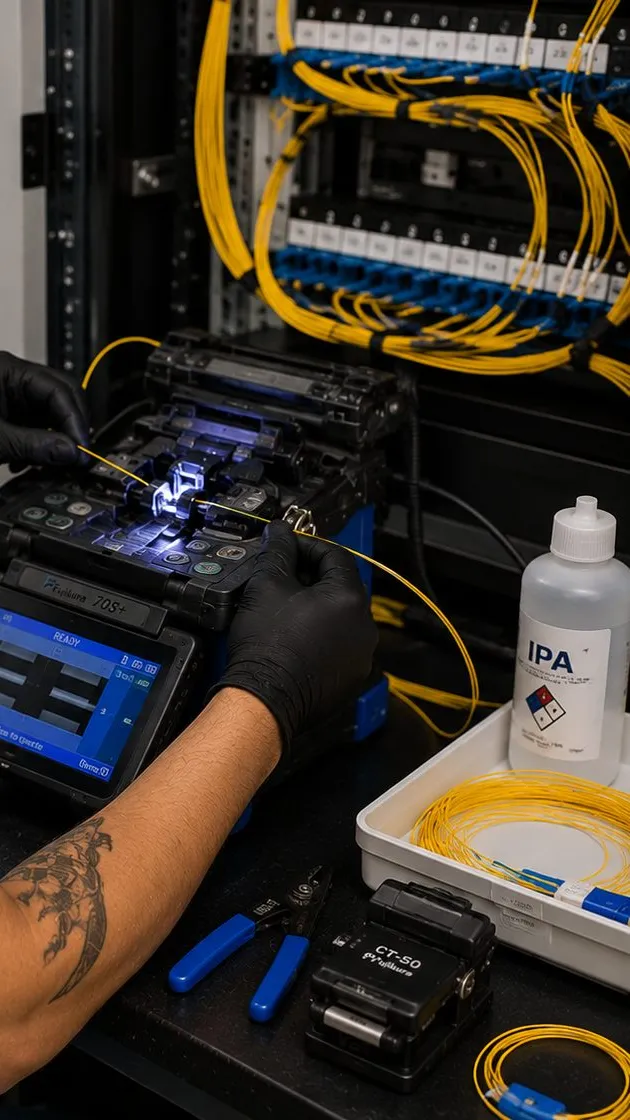
How we bring a barn and a carriage house onto the same Sonos system: fiber or a wireless bridge, never an extender.Gloved hands guide a strand of yellow fiber into a fusion splicer whose screen reads READY, with a rack of yellow fiber patch cords behind it, a bottle of isopropyl alcohol, a fiber cleaver and stripping tools on the bench. Glass between buildings carries no electrical surge from one to the other.
Our barn hosts parties and the odd wedding — how can a guest or a DJ plug in without changing our Sonos setup?
With a fixed input that only feeds the barn. A Sonos Port or Amp has an analog line input, and so do some speakers with Sonos's adapters; we wire a labeled input plate near where a DJ or a laptop would sit, so a visitor plugs into a cable, not into your account. Line-in can be set to start playing on the barn speakers automatically when a signal arrives.
Then we protect the rest of the system. Sonos's guest-access setting controls whether anyone on the same Wi-Fi can change playback and volume, so we turn it off on the event network or keep the barn on a network guests do not join. A volume limit on the barn room stops the speakers being pushed beyond what the house next door, or the horses, should hear.
Can the barn speakers switch themselves on for morning chores and off again?
Yes, with a Sonos alarm set on the barn room. Sonos's alarm settings let you choose the time, the room, what plays, the volume, which days it repeats and how long it plays before stopping, and a system can hold up to 32 alarms. So the barn can start a radio station at 5:30 on weekdays at a moderate level and go quiet on its own an hour later.
We set that up with whoever does the chores, so it matches the real routine, and add a separate weekend alarm if the schedule differs. Because the alarm lives on the speakers rather than on a phone, it keeps working when nobody brings a phone to the barn — as long as the barn link and the power are up.
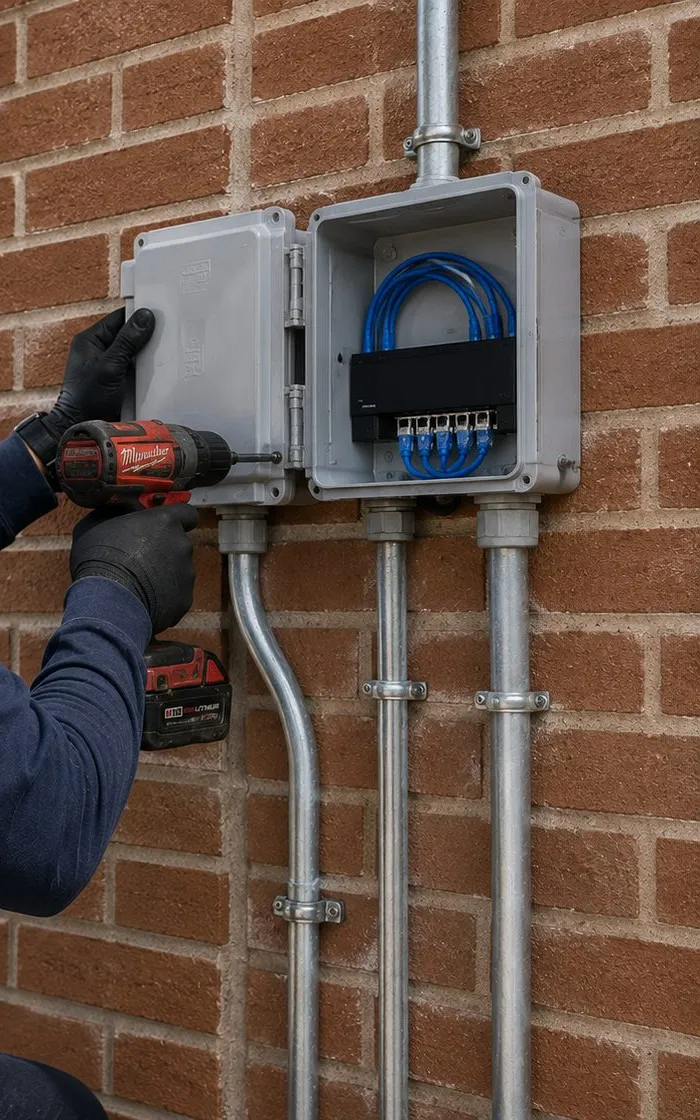
Outdoors, a gloved hand holds a red cordless drill against the edge of a grey weatherproof enclosure on a brick wall; the open box holds a small switch with blue patch cables, and three runs of metal conduit drop from it down the wall.
Storms, outages and generators
Will the Sonos keep playing on generator power when Central Hudson is out?
It can, if the generator produces clean power and the network is on the same circuits. Generators differ: Generac, for example, says its portable inverter generators produce power with total harmonic distortion under 3 percent, which it describes as safe for sensitive electronics, while older open-frame units can be much rougher. A home standby system or an inverter unit is what we want feeding the router, the switch and any Amp.
Just as important is which outlets are backed up. If the modem and router are on a circuit the transfer switch does not cover, the speakers have power but no network. We note which outlets your electrician has put on the generator and plug the network gear and the main Sonos products into those, behind surge protection, so the system comes back together on its own when the house switches over.
Equipment
Types of Sonos Systems We Install
You can buy the Sonos products wherever you like, or send us the room list first and we'll tell you what fits the house. The cards below are the families we fit most often in Dutchess homes, matched to the kind of room and building they suit. Specifications are from Sonos's own product and support pages unless another source is named.
Era 100
The workhorse of the no-cut plan: a compact speaker of a little over 7 inches tall and under 5 pounds by Sonos's figures, at home on a mantel, shelf, sideboard or kitchen counter. Pairs as stereo, or serves as rear surrounds.
Era 300
A larger speaker with upward-firing sound, good for tall parlors and loft living areas where a pair on stands can fill the space. Its Sonos wall mount is for studs only, so on plaster it lives on a stand or furniture.
Arc Ultra, Beam and Ray
Soundbars for the TV room. The Arc Ultra, about 46 inches wide, suits big parlors; the Beam fits most living rooms; the Ray connects by optical for an older TV in a study or guest room. All three can sit on a console, which spares the plaster.
Sub 4 and Sub Mini
Wireless subwoofers that can sit wherever an outlet is, including beside or under furniture, with clearance for the front opening. In lofts and attached Main Street buildings we place them away from shared walls and floors.
Sonos Amp with In-Ceiling Speakers
Passive in-ceiling speakers driven by an Amp rated at 125 watts per channel, for rooms with a plain plaster field, an accessible attic or a later drywall ceiling. Sonos says one Amp reliably powers up to three pairs of its architectural speakers wired in parallel.
Sonos Port
For the house with a cherished old receiver or a vintage stereo cabinet: it streams into the existing amplifier through analog or coaxial outputs and wakes it with a 12-volt trigger. Sonos asks for at least 2 inches of space around it on a shelf.
Move 2 and Roam 2
Battery speakers for porches, gardens, barns and the dock. Sonos rates the Move 2 at IP56 with up to 24 hours of play and the Roam 2 at IP67, and says the Move 2 charging base is for indoor use only.
Outdoor Architectural Speakers
Sonos's outdoor pair, made with Sonance, rated IP66 and specified from −13°F to 149°F, for porch ceilings, eaves and barn beams. Wired back to an Amp indoors, never left to fend for themselves.
Era 100 Pro
Sonos's professionally installed speaker, powered and connected over one PoE+ network cable and able to adjust its sound for wall or ceiling orientation — useful in shops and offices where outlets are scarce and ceilings must not be cut.
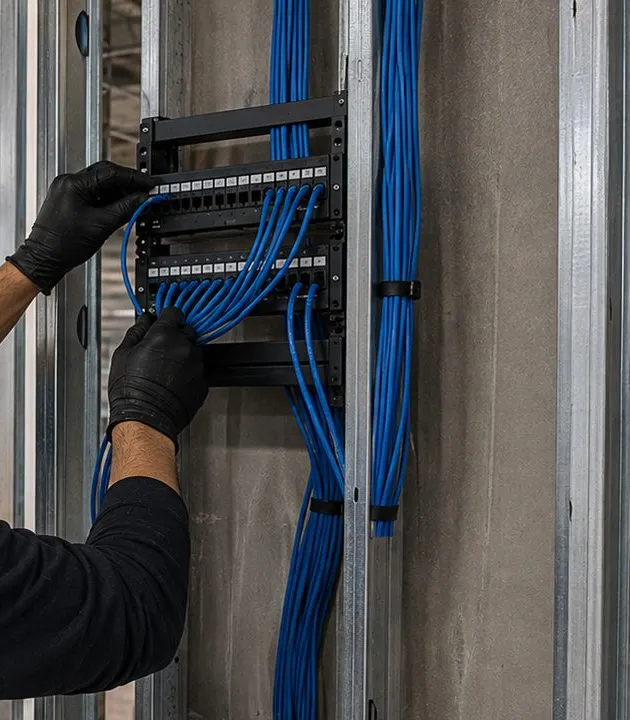
Two gloved hands work blue network cables into the ports of a compact two-row patch panel fixed between steel studs, a thick bundle of blue cable dropping beside it. A small panel like this keeps each room’s run labeled where the cables meet.
Network pieces that make an old house work
Piece
Why it matters in Dutchess
One wired Sonos product or access point
Gets a strong signal past plaster, brick and chimney breasts; Sonos supports wired setups but not extenders or powerline adapters
Small network switch
Lets the router, a wired Sonos product and an access point share one cable run from the cellar
Fiber or wireless bridge to outbuildings
Brings the barn, studio or carriage house onto the network without a surge path from building to building
Surge protection and generator-backed outlets
Keeps the network gear and the main speakers alive through Central Hudson outages and storms
Sonos Combo Adapter
Gives Era speakers a wired network connection or a line input; Sonos lists it at $39
AI Overview Reality Check
What AI Gets Wrong About Sonos Installation in Dutchess County
A plain note on method: our research tools could not display Google's AI-generated answers for Dutchess searches, so nothing below is quoted from one. Each heading is an assumption we keep meeting in quick answers, cost guides, forum replies and marketing about home audio, put in our own words. Under each is what changes in a Dutchess house, loft, shop or barn.
“An old plaster house just isn't suited to Sonos”
The worry is reasonable. Plaster blocks Wi-Fi more than drywall does, Sonos's interference guidance puts it in its high-impact category, and stories of speakers dropping out in old houses are easy to find online.
But the conclusion is wrong. Sonos is one of the easier systems to put in an old house, because almost everything it makes runs on an outlet with no speaker wire. The problem is the network, not the speakers, and it is usually solved by one well-routed cable.
In Dutchess we see far more old houses with good Sonos systems than bad ones. The bad ones were nearly all set up on a router in the wrong place with an extender added on top.
“Ceiling speakers are a quick cut-and-drop job”
In a modern drywall ceiling, a skilled installer can indeed cut a clean opening quickly after checking for obstructions. Cost guides and installer forums talk about the work in those terms, and for a mid-century ranch in Wappinger it is fair.
Old ceilings are different. Plaster keys can let go across a wide area when sawed, lath fights the blade, cornices and medallions are irreplaceable, ceilings may hide old wiring, and attics may hold vermiculite the EPA says should not be disturbed. Paint in older houses may also contain lead.
So in a Dutchess house a ceiling speaker starts with a look from above, a check of the plaster, a marked and approved position and a slow cut — or with a decision that this room is better served by speakers on the furniture.
“In a historic district you can't install anything”
People hear "historic district" and assume a speaker needs permission. The local rules that do exist are serious, and owners are right to respect them.
But they are mostly about what the street sees. Beacon's code, for instance, defines an alteration by changes to historical features visible from a public street, sidewalk or park, and leaves out electrical work and minor or utility changes that do not substantially detract. And the National Park Service says National Register listing alone places no restrictions on private owners.
Indoor Sonos is not what those rules govern. Exterior speakers, wire on a front facade and anything that changes the look of the house from the street are where you check first, and we plan to keep them out of view.
“For the barn, just add a Wi-Fi extender”
It is the first thing most home-networking advice suggests for a distant room, and plug-in extenders are cheap and easy.
Sonos's own system requirements list wireless range extenders among the things it does not support, alongside Ethernet-over-power adapters. A barn 150 feet away through stone walls and trees needs a real link: fiber, a buried cable with surge protection, or a point-to-point wireless bridge.
Done that way, the barn becomes part of the house network, the speakers group with the kitchen, and a storm does not have a copper path into the main house.
“Your Spotify account will do for the shop”
It feels natural: the owner already pays for a premium account, the shop has a Sonos speaker, and the music sounds fine.
Spotify's own help page says the service is only for personal, non-commercial use and cannot be played publicly from businesses such as bars, restaurants, stores and salons. Most consumer services have similar terms, and music played to customers is a public performance.
For Beacon and Rhinebeck shops, cafés and tasting rooms we set the business system up on a business-licensed service the owner chooses, and keep personal accounts on the apartment or home system.
“Expect $500 to $1,000 for every room you add”
National cost guides, Angi among them, put additional zones or multi-room audio at around $500 to $1,000 per room, and quote similar ranges whatever the house.
In a Dutchess old house the spread is wider in both directions. A wireless room that needs only Sonos setup is far below that range. A ceiling-speaker room in plaster with a route through the attic and a fireblocked stud bay can be above it.
That is why our prices below are the actual published AESS lines, and why anything involving cutting or a new cable route is quoted in writing after a walkthrough rather than guessed per room.
“Any generator will keep the music going in an outage”
With storms knocking out power to tens of thousands of Central Hudson customers at a time, owners reasonably assume a generator solves everything.
Power quality and circuit coverage both matter. Generac describes its portable inverters as producing clean power with distortion under 3 percent for sensitive electronics; rougher generators and unprotected circuits are harder on routers and amplifiers.
The practical fix is simple: the network gear and the key Sonos products on generator-backed outlets, behind surge protection, and a system that is set up to rejoin on its own when the power changes over.
A Dutchess Sonos Plan That Starts With What Stays Untouched
Tell us the town, roughly how old the house is and which rooms you want music in. You get back which rooms stay wireless, where one cable goes, what to buy and a written price.
Two Era speakers on the mantel of a Rhinebeck parlor or a fiber link out to a Millbrook barn — this form is all we need to start, and a written figure comes back within the business day. Rather talk it through? Call the Hudson Valley line, (845) 640-3835.
✅
We Got Your Request!
Expect a call from Hudson Valley scheduling before the end of the business day. Can't wait? Call (845) 640-3835.
How It Works
Our Installation Process
Seven steps, whether it is one Era speaker in a Beacon apartment or a Millbrook house with a barn, a pool house and a carriage house.
1. Describe the house and the rooms
You tell us the town, roughly when the house was built, which rooms you want music in and anything that must not be cut or drilled, with photos of the rooms, the ceilings, the cellar and the attic hatch. We reply with a written price from our published lines and say which parts need a walkthrough.
2. Walkthrough: what stays untouched
For ceiling speakers, cable routes or outbuildings we visit first, mark every cornice, medallion and original finish that is off limits, check the cellar and attic for routes, old wiring and insulation, and measure the signal in each room.
3. Written plan and booking
You get a room-by-room plan showing which rooms stay wireless, where any cable runs and how outbuildings connect, with a fixed price. We book a 2-hour arrival window between 8 AM and 8 PM and confirm access with you or your caretaker.
4. Fix the network first
On arrival we place the router where it serves the house, run the agreed wired link from the cellar or attic, add an access point or a link to the barn if planned, remove any extenders or powerline adapters, and check the signal again in every room.
5. Place, mount and wire
Speakers set on furniture and stands or mounted to framing and mortar joints, ceiling openings cut only where approved after a check from above, cable routed through existing paths, and every hole through a plate sealed with fire-rated material.
6. Set up the system
Every product joined to the right system, rooms named the way you use them, groups for the parlor and the porch or the house and the barn, music services signed in, line inputs and volume limits set, and business systems put on a licensed service.
7. Tune, test and hand over
Trueplay run in each tunable room, levels checked with you in the room and outside, the system tested after a router restart, and a short written note left showing what is where and which outlets are on surge protection or the generator.
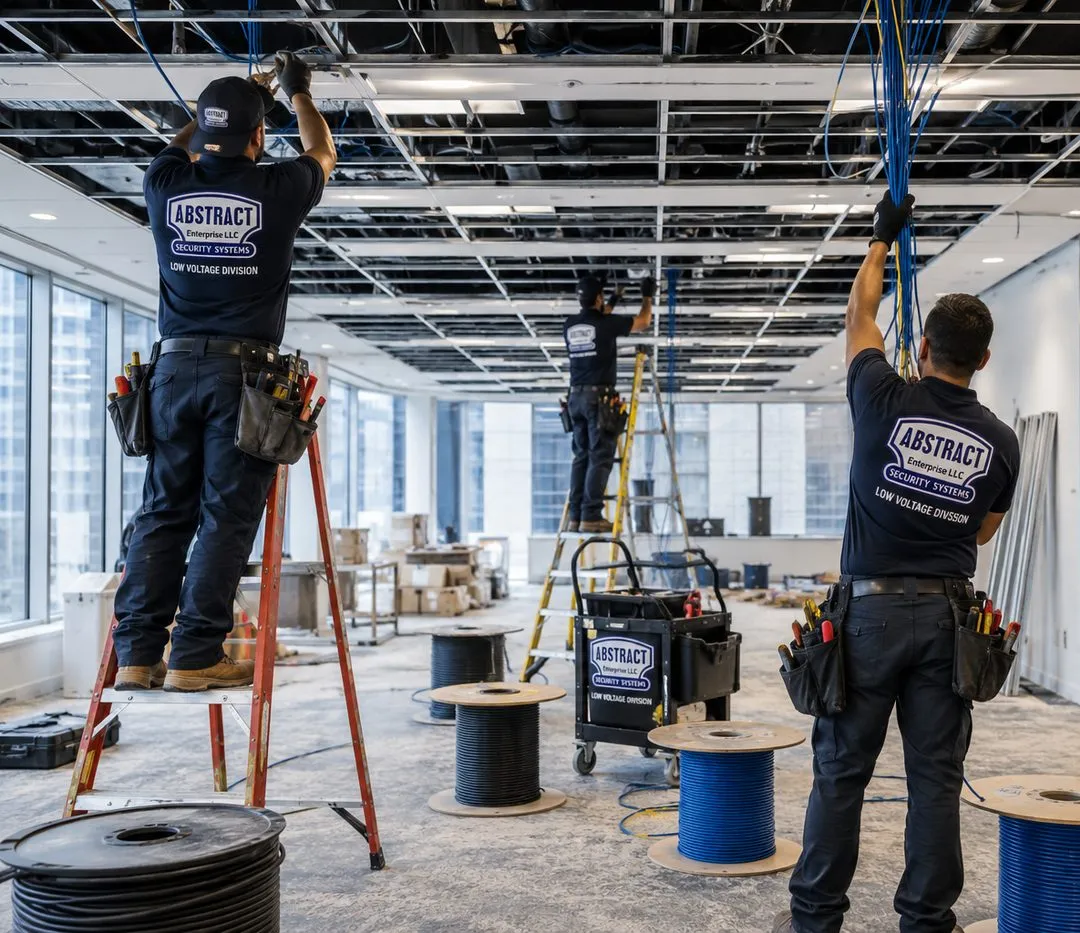
A wide open-plan floor with the ceiling tiles removed: one technician on an orange ladder and another on a yellow ladder further back feed cable upward, a third, seen from behind, holds a bundle of blue cable overhead, and spools of blue and black cable stand on the floor beside a tool cart.
Coverage Area
Sonos Installation Near Dutchess County's Landmarks
Tell us the address and the town usually tells us the building before we arrive: how old it is, what the walls are made of, whether there is a barn, and how far the router is from where the music needs to be. These six places show the range across the county.
Staatsburgh State Historic Site, Staatsburg
The Mills mansion, remodeled by McKim, Mead & White from 1895 and, by the Friends of Mills at Staatsburgh's account, a Beaux-Arts house of 65 rooms and 14 bathrooms when finished in 1896. River estates of that scale are why multi-building network plans are routine in the Hyde Park and Staatsburg area.
Howland Cultural Center, Beacon
Richard Morris Hunt's building of 1872, designed as a circulating library and now a center for art, history and a long-running chamber music series. Beacon's older houses around it share its era of plaster, brick and tall rooms.
The Lofts at Beacon, Front Street
A brick textile mill first built in 1870, renovated into 89 lofts and penthouses with exposed brick, 15- to 20-foot ceilings and mezzanine levels, by the building's own description. The model for the loft and mezzanine advice on this page.
Cast Iron Building, Poughkeepsie
Built after a December 1870 fire swept the block at Main and Garden Streets, designed by local architect James S. Post and ready for tenants in 1872, with a 54-foot cast-iron facade from the Ætna Iron Works, according to the Poughkeepsie Public Library District. Main Street's commercial blocks shape our shop work.
Old Rhinebeck Aerodrome, Red Hook
A living-history airfield whose runway, its founders' history says, was cut from three rocky fields, with hangars built from rough lumber; weekend air shows still run there. The rough-built, open-sided outbuildings of farm country look much the same, and so do the problems of getting sound and signal into them.
Village of Millbrook
Part of the 1697 Nine Partners Patent, named Millbrook in the 1860s and incorporated in 1895 after the railroad station drew its hamlets together, according to the village. Its traditional streetscape and the estates and horse farms around it bring both historic interiors and barns into the same job.
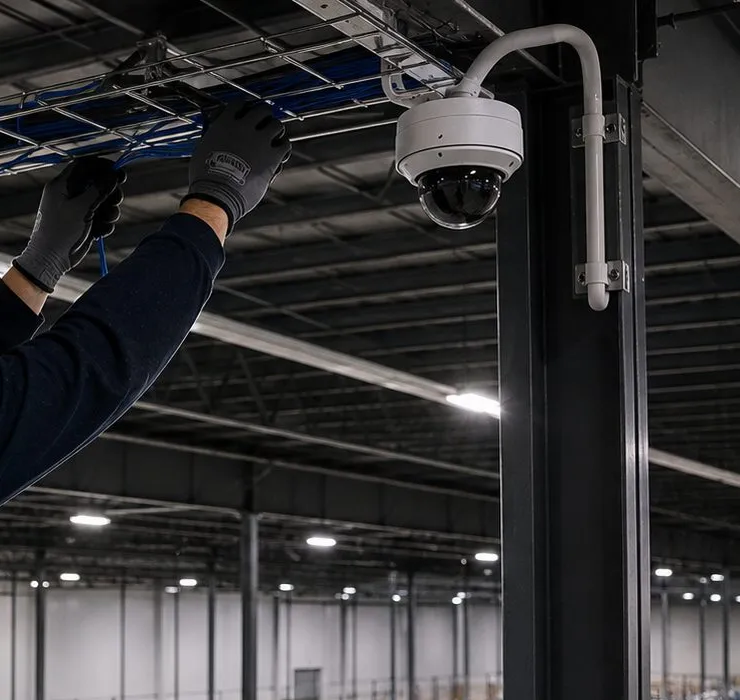
Two gloved hands set blue cable into a wire basket tray hung under a high steel roof, a white dome camera on a bracket on the column beside it and rows of high-bay lights stretching into the distance. Long runs in tall, open buildings are supported off the structure like this.
We also install Sonos in Beacon, Fishkill, Wappingers Falls, Hopewell Junction, East Fishkill, LaGrange, Pleasant Valley, the City and Town of Poughkeepsie, Arlington, Hyde Park, Staatsburg, Rhinebeck, Rhinecliff, Red Hook, Tivoli, Annandale-on-Hudson, Millbrook, Washington, Stanford, Pine Plains, Amenia, Millerton, Dover Plains, Pawling and Beekman, and in neighboring Putnam, Orange, Ulster and Columbia counties.
Pricing
Sonos Installation Cost in Dutchess County
Every figure below is already published by AESS: the Sonos and soundbar lines on our Hudson Valley Sonos page and the county rates on the AESS Dutchess TV and audio price list. Anything that depends on the house — ceiling speakers, new cable routes, outbuilding links — is quoted in writing after a walkthrough and before any work starts. If something unexpected turns up on the day, you hear the price before we carry on.
Item
Dutchess price
What it covers
Sonos setup
$125
Products joined, rooms and groups named, services signed in, voice and Trueplay done (published as “Sonos / wireless surround”)
Soundbar wall-mounted under the TV
$129
Bar fixed to its bracket, checked with a level and linked to the TV
Soundbar placed on console or stand
$79
Positioned, connected and tested — the usual choice on original plaster
Sanus soundbar bracket
$84.99
Supplied when you don't have a mount
Paintable cord cover
$59
Surface raceway for walls that must not be opened
In-wall concealment
$169
Code-compliant in-wall power and cable kit, for walls that may be opened
Cable run to a cabinet or other spot
$99
Up to 25 ft, such as router to the wired-anchor Sonos product
A/V receiver
$129
Existing receiver connected and configured, for example behind a Port
Universal remote
$99
Programmed for TV, Sonos and sources
Streaming device setup
$49
Per device
Full home theater
$350
Multi-component system set up together
TV mounting, Dutchess base
$254.99
A screen up to 55 inches into wood framing behind drywall, from the Dutchess price list
Ceiling, in-wall or outdoor speakers on an Amp
Quoted at walkthrough
Depends on the ceiling, the route and what must not be touched
Basement or attic cable routes, access points, outbuilding links
Quoted at walkthrough
Depends on distance, framing, fireblocking and the link type
Walls, heights and access
Condition
Price
Drywall on wood studs
$0
Metal studs
+$30
Plaster (Victorian and village houses)
+$45
Brick or stone (loft walls, fieldstone, chimney breasts)
+$65
Concrete or cinder block
+$75
Tile or marble
+$95
Plywood backer board
$85
High mount (above about 8 ft)
$75
Walk-up, 3rd floor and above, no elevator
$40
Box removal
$25
Certificate of insurance for a landlord, association or manager
Free
Travel within Dutchess County
No charge
Setup-only visits
When nothing is mounted or cut — rejoining speakers after a new modem, grouping rooms across floors, setting up line-in for the barn, sorting a speaker that keeps dropping out — the visit is billed by time: the first hour at the Dutchess rate of $275, then 30-minute blocks. That is the same Dutchess figure published on our Dutchess County TV mounting price list and on the Hudson Valley Sonos page.
What is in the price, and what is not
Included: brackets fixed and levelled, products connected and added to the system, rooms named the way you use them, groups and music services set up, Trueplay in each tunable room, every hole we drill through a plate fire-sealed, and dust cleaned up.
Not our trade: new outlets, circuits, generator transfer switches and anything at line voltage go to a licensed electrician; plaster repair to a plasterer; vermiculite or other asbestos work to a licensed abatement contractor.
Buying the gear: order your Sonos speakers, soundbar and Amp from whichever retailer you prefer; if you need a bracket, raceway, cable or an in-wall kit, we can bring it at the price shown in the table.
Wasted visits: if we arrive and cannot start — no access, products not delivered, the caretaker not told — the $150 return-trip fee applies. Moving the appointment with at least 24 hours' notice costs nothing.
Old finishes: however gently we work, old plaster and painted trim can crack or chip. We show you the risky spots at the walkthrough and wait for your go-ahead.
National brands and gig apps versus a local licensed installer. National menus and app-based handymen price a soundbar on new drywall, and for that job they are often fine. They do not price a wire route through a balloon frame with fireblocking, a plan around a plaster medallion, a fiber link to a barn or a shop system on a licensed music service. A local installer with published Dutchess prices and a state low-voltage licence can price the real house and is still here afterwards.
Shop Our Systems
Sonos Installation Packages & Pricing
Three common Dutchess starting points. Each package price is simply published lines added together, and every line is named so you can check the sum. Wall surcharges and heights are added where they apply.
Starter — Wireless Old-House Setup
$125Sonos setup ($125): speakers you have placed on furniture or stands joined to one system, rooms named, groups and music services set up, and Trueplay run where your phone allows. No drilling at all.
Standard — Parlor Soundbar on Plaster
$383.99Soundbar wall-mounted ($129) on a Sanus bracket ($84.99) into an old plaster wall (+$45), plus Sonos setup ($125): $383.99. Placing the bar on the console instead ($79) brings it to $204.
Premium — TV, Soundbar and Hidden Cable
$652.98Dutchess TV mounting base ($254.99), soundbar wall-mounted ($129) on a Sanus bracket ($84.99), a paintable cord cover ($59) instead of opening the wall, and Sonos setup ($125): $652.98. Plaster adds $45.
Bring Your Own Equipment — Labor Only
If you bought the mount yourself, you pay only for the work: $129 to fix the soundbar to the wall with your bracket, plus whatever wall line applies, and $125 for the Sonos setup. Your bracket stays covered by its own maker's warranty. Old walls are fussy, so if the one you bought cannot hold safely on the plaster or masonry we find, you hear that before any drilling, along with the Sanus option.
Ceiling Rooms, Cable Routes and Barn Links
Ceiling speakers on an Amp, basement-up or attic-down cable routes, access points and fiber or wireless links to an outbuilding are priced room by room after a walkthrough, because the plaster, the framing, the fireblocking and the distance set the work. Your written quote lists each part separately before anything is cut or ordered.
Want the Wireless and Wired Rooms Marked on Your Floor Plan?
Photos of the rooms, the ceilings, the cellar and the attic hatch, plus the year the house was built if you know it, are enough for a first written price.
The Sonos app is the same in Beacon and Amenia. The houses are not. This is how a typical job shifts as you move from the river towns to the Connecticut line.
Beacon
Two different jobs in one small city. In the older houses on the streets climbing from Main Street toward Mount Beacon, it is plaster, brick and tall rooms, with a wired anchor from the cellar and speakers on furniture. In the converted mills and newer apartment buildings near the river and Fishkill Creek, it is tall open lofts, exposed brick, mezzanines and neighbors on every side. Main Street shops add tin ceilings and the licensed-music question, and the city's historic overlay is a reason to keep exterior speakers out of the street view.
Fishkill, Wappingers Falls, East Fishkill and Hopewell Junction
Much of the southern county grew in the postwar decades; the Wappingers Historical Society describes farmland turned into suburban neighborhoods as IBM workers arrived in the 1950s and 1960s. These houses usually have drywall, accessible attics and full basements, so ceiling speakers, in-wall cable and a living-room theater are straightforward. The older hamlet and village centers keep some plaster houses, and the two kinds sit side by side.
City and Town of Poughkeepsie and Arlington
The city holds the county's densest stock of nineteenth-century houses, including the Union Street and Academy Street historic districts, plus Main Street's commercial blocks. Plaster cornices, pocket doors and tall windows are common, and so are multi-family houses where each unit needs its own network. Around Vassar and Arlington the mix includes rentals, so reversible layouts matter. The town beyond is mostly later, simpler construction.
Hyde Park and Staatsburg
River estates, historic sites and their neighbors, alongside mid-century houses on the Route 9 corridor. The estate work is multi-building: main house, pool house, carriage barn, staff cottage, often with a caretaker as our contact. Restaurants and hospitality around the Culinary Institute add commercial jobs.
Rhinebeck, Rhinecliff, Red Hook and Tivoli
Village centers full of nineteenth-century frame houses, many balloon-framed, plus river estates and farms between them. Rhinebeck's village historic district and overlay put exterior work under a closer eye, and the shops, inns and restaurants want sound that suits old rooms. Rentals near Bard in Red Hook and Tivoli favor no-cut layouts that can be packed up at the end of a lease.
Millbrook, Washington, Stanford and Pine Plains
Horse country and estate country. Large houses with formal rooms, barns, riding arenas and equipment buildings, long driveways and sometimes slow rural internet. The plan almost always includes an outbuilding link, dust-rated products for barns, surge and generator planning, and a system that a household member, a manager or a caretaker can all understand.
Amenia, Millerton, Dover Plains and Pawling
The eastern Harlem Valley towns mix farmhouses, village houses and weekend properties. Fieldstone foundations and stone walls show up often, the internet may be the limiting factor, and barns and studios are common. Pawling's village houses bring plaster and balloon framing into the mix again.
Repairs
Common Sonos Faults in Dutchess Houses, and Their Fixes
After enough old-house service calls, the faults start to repeat. Here are the ones that come up again and again in Dutchess, with the usual cure for each.
The back of the house drops out but the front is fine. The router is in the front hall and two plaster walls and a chimney stack stand between it and the kitchen. One wired Sonos product or access point in the back half, fed from the cellar, ends it.
Someone added an extender and things got worse. Sonos doesn't support range extenders or powerline adapters. We remove them and wire one product instead.
The barn speaker has not worked since a storm. Often a copper cable between buildings carried a surge into a switch or converter. We test the run, replace damaged gear and, if you agree, replace the copper with fiber.
Everything went silent after the internet company visited. A new modem or router with a different network name or password. The speakers are fine; the system needs rejoining, and we place the new box where the signal can reach.
The kitchen speaker stutters at dinner time. Microwave ovens in use, cordless phone bases and other wireless devices are on Sonos's list of interference sources. Moving the speaker or the base a short distance, or wiring the speaker, usually clears it.
The loft sounds boomy and the neighbors have complained. A Sub against a shared wall or on a bare floor in a hard-surfaced room. We move it, tune the rooms with Trueplay and set volume limits.
The system came back from an outage in pieces. The router restarted after the speakers did, or was not on the generator. We put the network gear on backed-up outlets behind surge protection and check that everything rejoins on its own.
A Sonos repair visit in the county costs the same as setup-only time — $275 for the opening hour and 30-minute blocks after that — and parts come from the price lines above. When you ring (845) 640-3835, say which rooms or which building has gone quiet; it tells us whether to load fiber gear, a switch or just a laptop.
Complete Services
Every Sonos Installation Service in Dutchess County
Sonos in an old Dutchess house tends to arrive alongside other work: a restoration, a new TV, a barn coming back into use, a shop opening. These are the services people book with it.
Arrival windows, rescheduling, return trips and setup-only billing.
Field Notes
Field Notes From Old-House Sonos Work
General installer practice on older houses, written as a routine — not an account of any particular Dutchess client or property
Before a tool comes out of the bag we walk the house with the owner and ask one question in every room: what here must never be touched? The answers go straight onto a sketch. A cornice, a medallion, a stretch of original wallpaper, a mantel, a painted-over panel someone hopes to strip one day. Everything that follows is planned around those marks.
Then we go down, not up. In the cellar we look for the internet line's entry, the direction of the joists, any old wiring still in service, signs of damp and the bottom plates of the interior walls. Most of the routes that save a finished room are found there. After that the attic, with a light and a look at the insulation before anyone steps in it.
Only then do we stand in the rooms with a phone and check the signal, because it is usually the network, not the speakers, that decides how much wire the house really needs.
Old-House Glossary
Old-House and Sonos Terms, in Plain English
The words below come up in almost every Dutchess walkthrough. Knowing them makes the written plan easier to read.
Term
What it means for your Sonos plan
Plaster and lath
Wet plaster pressed through narrow wood strips so it hooks behind them. Strong when undisturbed, brittle when sawed; the reason we drill slowly and avoid cutting where we can.
Plaster keys
The blobs of plaster that squeeze between the lath and hold the ceiling up. When keys break, a ceiling can sag well beyond the hole that was cut.
Balloon frame
Framing in which wall studs run from the sill all the way to the roof. Makes long vertical cable pulls possible and makes fire-sealing every hole essential.
Fireblocking
Material that closes off concealed spaces between floors so fire and smoke cannot race up them. The state residential code requires it around cables and wires at floor and ceiling level.
Knob-and-tube
Early electrical wiring run on porcelain knobs and through porcelain tubes. Low-voltage cable is kept well away from it, and questions about it go to an electrician.
Vermiculite
Loose, pebbly attic insulation, grey-brown to gold. The EPA says to assume it contains asbestos and leave it undisturbed.
Pressed-metal ceiling
Stamped steel panels nailed to wood strips, common in old shops. Treated as a feature to protect, not a surface to cut.
Mortar joint fixing
Drilling into the mortar between bricks or stones rather than the face of the masonry, so a bracket can come out later and the joint can be repointed.
Wired anchor
Our name for the one Sonos product or access point we connect to the router by cable, so the rest of the system has a strong signal to lean on.
Trueplay
Sonos's room tuning, which uses a phone's microphone to measure how sound reflects off the room and adjusts each speaker to suit.
Line-in
An analog audio input on a Port, an Amp or some speakers with an adapter, used for a turntable, a mixing desk or a guest's laptop.
IP rating
A two-digit code for protection against dust (first digit) and water (second digit). For barns and porches, the first digit matters as much as the second.
Media converter
A small box that changes a fiber-optic link back into ordinary Ethernet at each end of a run between buildings.
FAQ
Dutchess County Sonos Installation FAQ
Can a Sonos speaker sit on a radiator cover?
+
Not while the heat is on. Sonos rates the Era 100 and the Amp to operate up to 104°F, and its Port guide asks for that product to be kept away from radiators and other heat sources, and the top of a radiator cover in an old steam- or hot-water-heated house can run hotter than that. Radiator covers are tempting because they are often the only wide shelf under a window, but in a Dutchess winter we put the speaker on a bookcase, a sideboard or a wall shelf instead, and keep the cover for summer use only if you like the spot.
Is there an extra charge for a speaker or soundbar mounted high on a loft wall?
+
Only the published high-mount line. Anything fixed above about 8 feet adds $75, which covers the taller ladder or platform and the extra time. Exposed brick adds the $65 brick-and-stone line. A speaker on a mezzanine rail or a stand at floor level carries neither charge.
Our house was built before 1978 — how do you keep plaster and paint dust under control when drilling?
+
By keeping the work small and contained. Old paint may contain lead, so we drill rather than saw wherever possible, lay plastic under every work spot, use a vacuum with a HEPA filter at the bit, and clean up with damp wipes rather than sweeping. The EPA treats disturbing six square feet or less of interior painted surface as minor maintenance rather than a renovation under its lead rule, and a Sonos job normally stays far below that. Anything larger is a job for a lead-safe certified contractor.
Who pays if old plaster cracks while you are drilling?
+
We aim never to find out, which is why risky surfaces are pointed out at the walkthrough and nothing is drilled without your go-ahead. Where plaster is already loose, cracked or sagging we recommend a plasterer before any fixing goes in. Responsibility for damage is set out in the service agreement you sign before work starts, so you know where you stand in advance.
Can the Sonos Amp sit inside a closed antique cabinet or built-in?
+
Only if the cabinet can breathe. An Amp makes heat, and Sonos's product guide asks for at least 3 inches of clearance around it, while a Port needs about 2 inches on a shelf and must not have its ventilation blocked. A closed antique cabinet usually needs its back opened or a discreet vent added, which some owners will not want on a period piece. A ventilated closet shelf or a modern cabinet nearby is often the better home.
Can the soundbar go under a TV mounted over a fieldstone fireplace?
+
Sometimes, but heat decides. Sonos rates its Amp and the Era 100 to operate up to 104°F, and the wall above a working fireplace can get hotter than that. We check the surface while the fire is lit if possible; if it runs hot, the soundbar sits on the mantel shelf or a console instead, or the TV goes on another wall. Fixings into fieldstone use the $65 brick-and-stone line and go into mortar joints.
Can you leave a pull string so more speakers can be added later without opening the walls again?
+
Yes. Wherever we run cable through a cellar, attic or open bay, we can leave a pull string or a spare length of cable coiled and labeled at each end. When you add a speaker or a room later, the new cable is drawn through the same path. It costs very little during the first visit and can save opening a finished wall later.
Can our estate manager or caretaker be the contact for the visit?
+
Yes. Tell us their name and number when you book and we will confirm access, arrival windows and any decisions on the day with them, while the quote, any changes to it and the final sign-off still come to you. We send both of you the same written plan so nobody is guessing which rooms are wireless and which are wired.
All Areas Served
Sonos Installation Across the Hudson Valley and New York
Our Sonos coverage is split into regional pages because a Beacon loft, a Long Island colonial and a Manhattan co-op ask for different plans. The links below go to the hub and the other pages; one licensed team stands behind every one.
Planning cameras over the barn doors, an intercom at the gate or an alarm for the house too? The AESS home page lists every service, and our about page explains the licence and insurance behind the work.
Dutchess Sonos Gone Quiet Tonight? We Can Help
Parlor soundbar missing from the app, the barn silent since the storm, a group that falls apart between the front and back of the house? Call (845) 640-3835 for the earliest open arrival slot in Dutchess County. Once a technician is on site, network and setup faults are typically fixed within one to two hours.
Sonos Installation Dutchess County — Licensed, Insured, Gentle on Old Houses
Abstract Enterprises Security Systems · 460 E Fordham Rd, Bronx, NY 10458 · Hudson Valley line (845) 640-3835 · WhatsApp (718) 679-0359 via wa.me
NYS Low-Voltage Licence #12000287431 · 100% Licensed & Insured · Same-Day Estimates · Rated 4.7★ from 201 Google Reviews
Sonos hardware is covered by Sonos's own warranty through the store that sold it, and mounts and parts by their makers. Full terms — including 50% deposit, one-year parts-only warranty on AESS-supplied products, and the late-fee schedule — are set out in the service agreement. See our warranty page.
Last reviewed October 17, 2026 by Anwar Timothy. Change history: Dutchess County Sonos page first published on this date. This page describes how older Dutchess buildings and local rules affect Sonos installation; it is not legal advice.