NYS Licensed Low-Voltage · Ulster County · Kingston, New Paltz, Woodstock, Saugerties & the Catskill Towns
Sonos Installation in Ulster County
Port & Amp Joined to Your Stereo · Stone, Beam & Cathedral-Ceiling Houses · Fiber to the Studio · Licensed Music for Shops · Ready on Arrival
Ulster County takes its music seriously. A lot of the houses we walk into already have a turntable, a receiver, a pair of speakers somebody refused to sell, and sometimes a piano or a home studio. Sonos should join that, not replace it. We connect a Port to the stereo you love or an Amp to the speakers you own, carry the network through Dutch stone, plank-and-beam ceilings and A-frame roofs, and leave a system that plays the moment you arrive from the city.
Reviewed and updated October 17, 2026 · Written by Anwar Timothy, NYS licence #12000287431
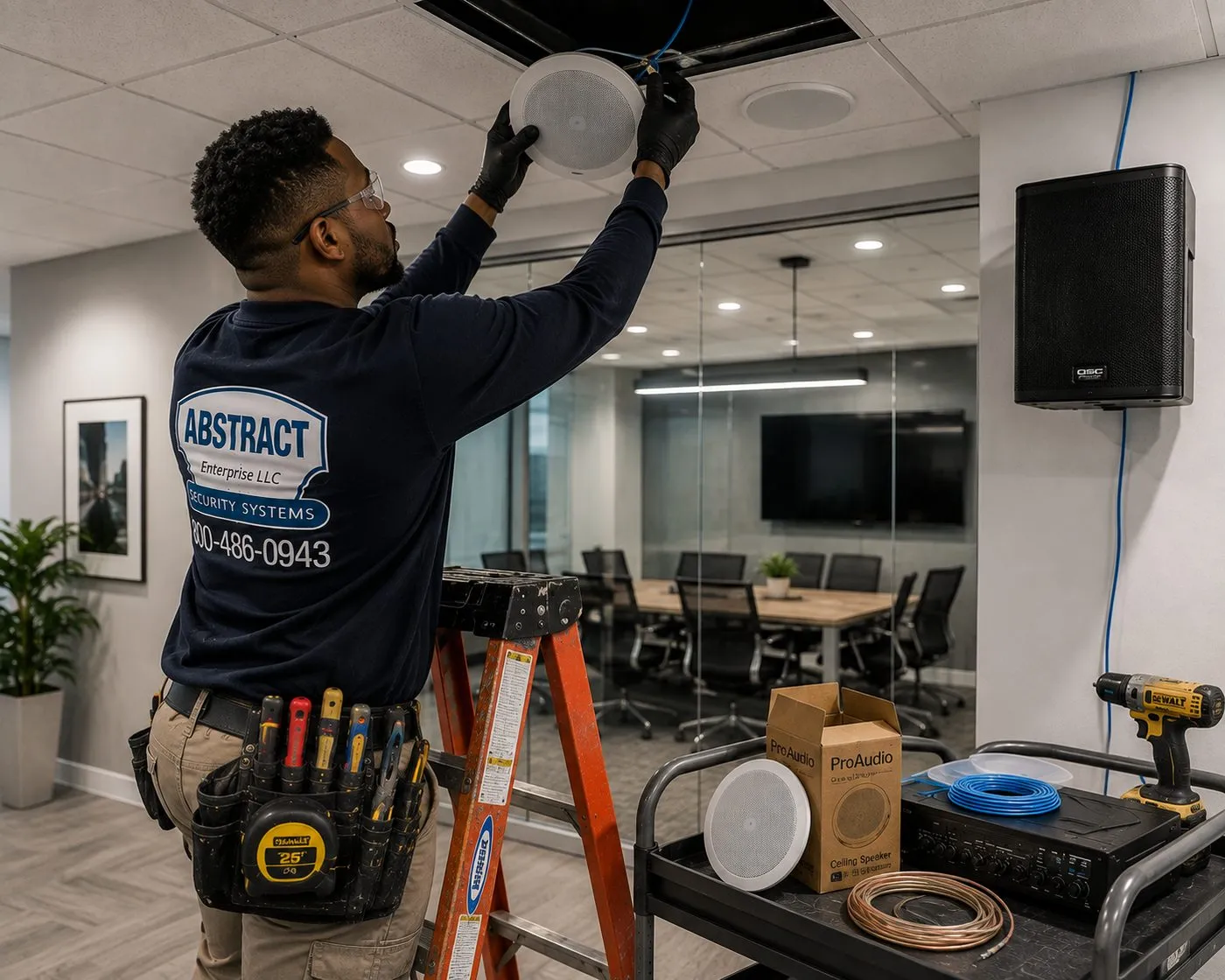
A round passive ceiling speaker is lifted into an opened tile while blue cable runs down the wall. On the cart below sit an amplifier, a second speaker, its box, blue cable and a coil of copper speaker wire — the kind of passive speaker a Sonos Amp is built to drive.
Plan Your Ulster Sonos
Town, house and the gear you own — a technician calls back the same business day
✅
Request Received
An Ulster County technician will call you back the same business day.
25+
Years Experience
✓
Same-Day Estimates
100%
Licensed & Insured
4.7★
201 Google Reviews
Got a receiver, a record collection and a box of new Sonos gear? Ring our Hudson Valley line at (845) 640-3835 or send the short form with your town, the age of the house and a list of what you already own. We tell you which parts are fixed-price, which need a look at the walls, and whether your old speakers can stay.
Nothing added for travel, whether the job is in Uptown Kingston or past Phoenicia on Route 28
Book a two-hour window any day of the week, starting as early as 8 AM and as late as 8 PM
NYS licence #12000287431 · certificates of insurance for landlords, inns and shops at no charge
Ask what an Ulster County house needs from a Sonos system and the honest answer is usually: to fit in. This is the county of the Maverick concert hall, built in 1916 for a summer chamber festival that still describes itself as the oldest continuous one in America, of the Bearsville studios and theater that Albert Grossman built on the edge of Woodstock, and of Radio Woodstock on 100.1. Some of the people who call us here are musicians or recording engineers; many more are simply listeners with opinions. When they call about Sonos, the first question is rarely which speaker to buy. It is whether Sonos can feed the amplifier they already trust, drive the speakers they would never sell, and still let the kids stream to the kitchen.
The answer is usually yes, but only if somebody does the integration properly. A Sonos Port sends a streamed signal into an existing receiver or integrated amplifier through its line or coaxial outputs; a Sonos Amp powers passive speakers directly. Each has rules that matter in a listening room: impedance limits on the Amp, a fixed or variable output on the Port, a 48 kHz ceiling on music files, a delay on anything plugged into a line-in. We explain those rules before anything is bought, so nobody discovers them with the receiver already wired in.
Then there are the buildings. Ulster’s housing goes back centuries: the Stockade District in Kingston, where four pre-Revolutionary stone houses stand on the corners of Crown and John Streets, the stone houses of Hurley and New Paltz, the brick of the Rondout, the 19th-century residences of the Chestnut Street and Fair Street districts. Census figures compiled by Stacker put a quarter of the county’s homes at 1939 or earlier. Up in the Catskill towns the houses get younger but no easier: A-frames and cabins with ceilings that follow the roof, log walls, plank floors laid straight across exposed beams. Stone and old plaster are hard on Wi-Fi, and a ceiling that is nothing but the floor of the room above has no cavity for a speaker.
Finally, Ulster is a place people arrive at. The county Comptroller found that 36% of short-term-rental owners use mailing addresses outside Ulster, with New York City the most common. Creeks rise — Irene set flood records on the Esopus, the Stony Clove and the Rondout in 2011 — and storms take the power out. A Sonos system here has to be ready when the car pulls in on Friday night, with nobody having touched it for a fortnight. Everything below is built around those three facts: the music already in the house, the walls around it, and the weeks when the house sits empty.
Ulster County in numbers that shape a Sonos plan
183,330 residents and 87,657 housing units (Census Bureau QuickFacts, July 1, 2025 estimates) — with 2.26 people per household, systems here are usually planned for couples and small families, not crowds.
69.9% of homes are owner-occupied (QuickFacts, 2020–2024), which is why most of our Ulster work is permanent wiring rather than renter-friendly setups.
25.3% of homes — 21,829 of them — were built in 1939 or earlier (Stacker, from Census data, September 2025): stone, brick, plaster and timber that change how cable and Wi-Fi travel.
92.4% of households subscribe to broadband (QuickFacts), yet the county identified 1,293 locations with no qualifying service at all and, on May 1, 2026, announced federal approval to bring fiber to every one of them.
11.53 inches of rain at Slide Mountain during Irene, judged at least a 200-year event, with record crests on the Upper Esopus, the Stony Clove in Phoenicia and the Rondout in Rosendale (Lower Esopus Watershed Partnership).
93,209 Central Hudson customers in Ulster, and more than 14,000 of them without power at the peak of the September 2026 nor’easter (Daily Freeman).
Most Ulster households that bring us in for Sonos also want the network under it done properly, which is the same crew that handles our network installation in Ulster County. Owners of older houses often pair the job with AV and sound installation for a projector room or a second listening space.
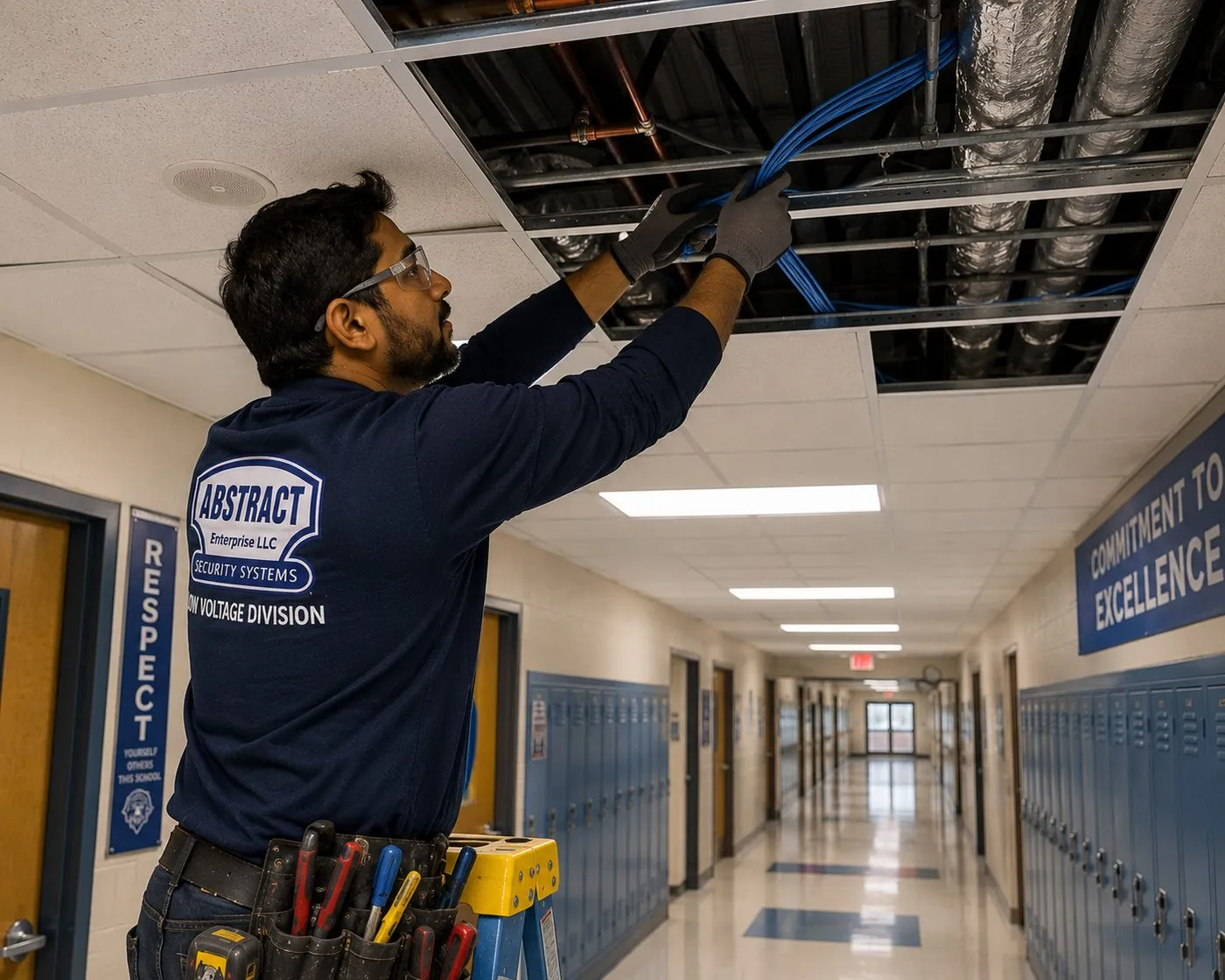
Blue cable is drawn through an opened ceiling grid past ductwork and copper pipe. A flush round speaker grille is already set in the next tile — above a ceiling, the cable path matters as much as the speaker.
Repair & Same-Day Help
Sonos Gone Silent Between the Ridge and the River
A Port that stopped feeding the receiver after a router swap, rooms that vanished after a storm, a hum that wasn’t there last week. Call (845) 640-3835. When a two-hour window is open we come the same day, and most network, grouping and connection faults are fixed in one to two hours once we’re inside. A setup-only visit in Ulster is $275 for the first hour, then billed in 30-minute blocks.
Every Ulster job starts by listing what is already in the house. The services below are the ones we do most here, roughly in the order people ask for them.
Sonos into the stereo you own
A Sonos Port connected to your receiver or integrated amplifier, set to fixed or variable output to suit how you like to control volume, with its 12V trigger used to wake an amplifier that supports one. Your turntable and phono stage stay exactly where they are.
An Amp for the speakers you won’t sell
A Sonos Amp driving the bookshelf or floor-standing speakers you already love, after we check their impedance and power rating against what Sonos says the Amp can safely run.
Ceiling and wall speakers where the house allows
Sonos and Sonance in-ceiling or in-wall pairs on an Amp, placed only where the structure has a cavity. In plank-and-beam rooms we say so plainly and offer a better route.
Theaters on stone, brick and timber
Arc Ultra, Beam or Ray mounted on the wall the house actually has, with Sub and surrounds placed, bonded and tuned. Brick and stone walls carry a published surcharge.
A network that crosses old walls
Ethernet runs, ceiling or wall access points and switches so Sonos reaches the far side of a thick stone wall — and fiber or a point-to-point link when a studio or cottage sits too far away for copper.
Music for shops, cafés and galleries
Sonos set up for a business, on a commercially licensed music service, with opening-time schedules, volume set for the room and cable kept out of sight on Wall Street, Main Street or Tinker Street.
Library and radio setup
Your music library added from a computer or network drive, Sonos Radio and TuneIn stations found and saved, and voice control set up only if you want it.
Re-homing and repair
Systems that fell off the network after an internet change, a power cut or a new router, brought back and tested room by room on a setup-only visit.
We don’t sell Sonos speakers and don’t claim to be a Sonos dealer: you buy from the retailer you prefer, and we install. We can supply the Sanus soundbar bracket on our price list. If you are not sure whether the gear you’ve bought will work with what you own, send us the model numbers before the boxes are opened.
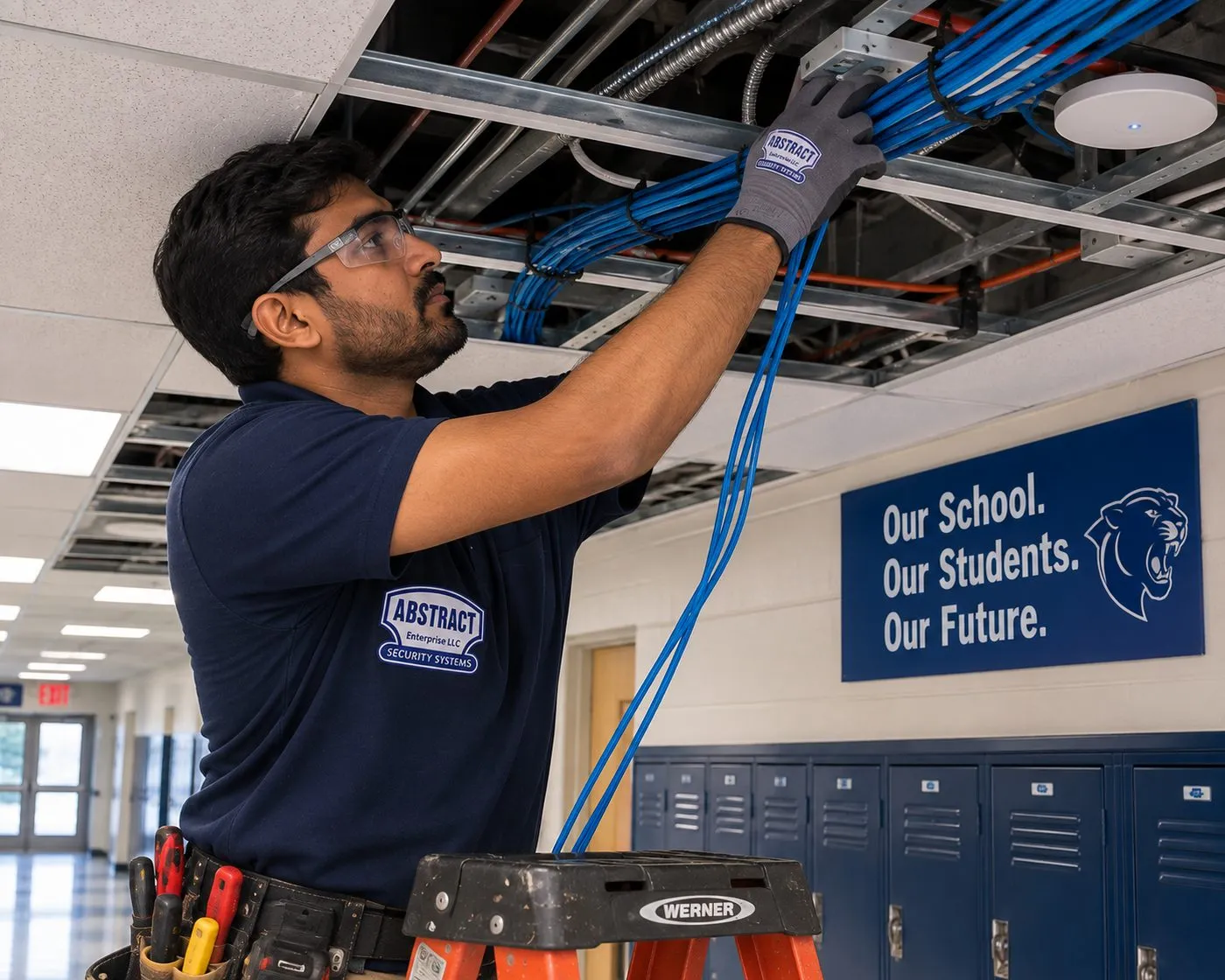
A bundle of blue network cable is dressed along the ceiling framing next to a white ceiling access point with its status light on. Wired access points are how a Sonos system reaches rooms behind thick walls.
Building Specialists
Sonos Installation for Ulster County’s Architecture
Ulster’s houses fall into a handful of families, and each one sends the cable and the Wi-Fi a different way. We plan the speakers last; the building decides first.
18th-century Dutch stone houses
Kingston’s Stockade, Hurley’s Main Street and the New Paltz stone-house tradition. Thick rubble-stone walls, beamed ceilings and wide floorboards. Wi-Fi stops at the walls; cable travels through the cellar and up through closets or later partitions.
Rondout brick and Victorian streets
The Rondout–West Strand district on the creek and the Chestnut and Fair Street districts uptown: brick, plaster over lath, tall ceilings and decorative plasterwork that should not be cut casually. Exterior changes in these districts need the city’s certificate of appropriateness.
Catskill cabins and A-frames
Phoenicia, Shandaken, Saugerties, the Woodstock hollows: ceilings that follow the roof, knotty pine and log walls, plank decks and wood stoves. Few hollow cavities and long empty winters.
Converted barns and timber-frame studios
Open timber volumes used as studios, rehearsal rooms or living space. Big air, hard surfaces, and frequently a separate building from the house and its router.
Post-war ranches and capes
The Town of Ulster, Lloyd, Marlborough and the edges of Kingston: drywall, attics and basements, and the easiest cable routes in the county. Most standard Sonos plans work here as they would anywhere.
River-town apartments and SUNY-area rentals
Kingston and New Paltz flats and shared houses, where nothing permanent can go in without the owner’s say. Free-standing speakers and a tidy network are the usual answer.
Four Ulster house types and the route Sonos usually takes in each. Drawn by AESS as a planning diagram, not a photograph.
Method notes, house by house
Stone. We don’t chase cable into old stone walls. The cellar is the highway: a cable runs along the beams below the first floor and rises in a closet, behind a later partition or beside a chimney chase. Where the house has a newer frame wing, that wing usually takes the access point and the Amp. Brackets fixed into stone carry the $65 brick-and-stone surcharge on our price list, and every fixing goes into sound stone or a mortar joint the owner agrees to.
Plaster and brick in the river towns. Old plaster is hard on wireless — Sonos lists plaster with concrete as a high obstruction — and brittle under a hole saw. Where a ceiling pair makes sense we survey with a stud finder and probe first, as Sonos’s own in-ceiling instructions direct, and the cut-out is 8.25 inches for the 6-inch model. Plaster brackets carry the $45 surcharge.
Beam ceilings and A-frames. When the ceiling is the floor of the room above, or follows a steep roof, there is often no cavity at all. Wall-mounted Era 100 or Era 300 speakers, or a pair on stands, give better sound there than forcing an in-ceiling speaker into a joist bay. Cable runs along a beam in a small timber or painted raceway, or comes up from below.
Logs and knotty pine. Log walls are solid and settle for years after building, so cable never crosses them rigidly; it travels in the floor system, the framed partitions or a surface raceway finished to match the wood. Knotty-pine panelling over studs is friendlier: a panel can sometimes be eased off, a cable fished behind it and the panel replaced, which beats any visible run in a cabin living room.
Timber volumes. Big open rooms with hard surfaces reward Trueplay tuning and careful speaker aim more than extra speakers. In a studio, we keep Sonos out of the recording chain entirely unless you want it there.
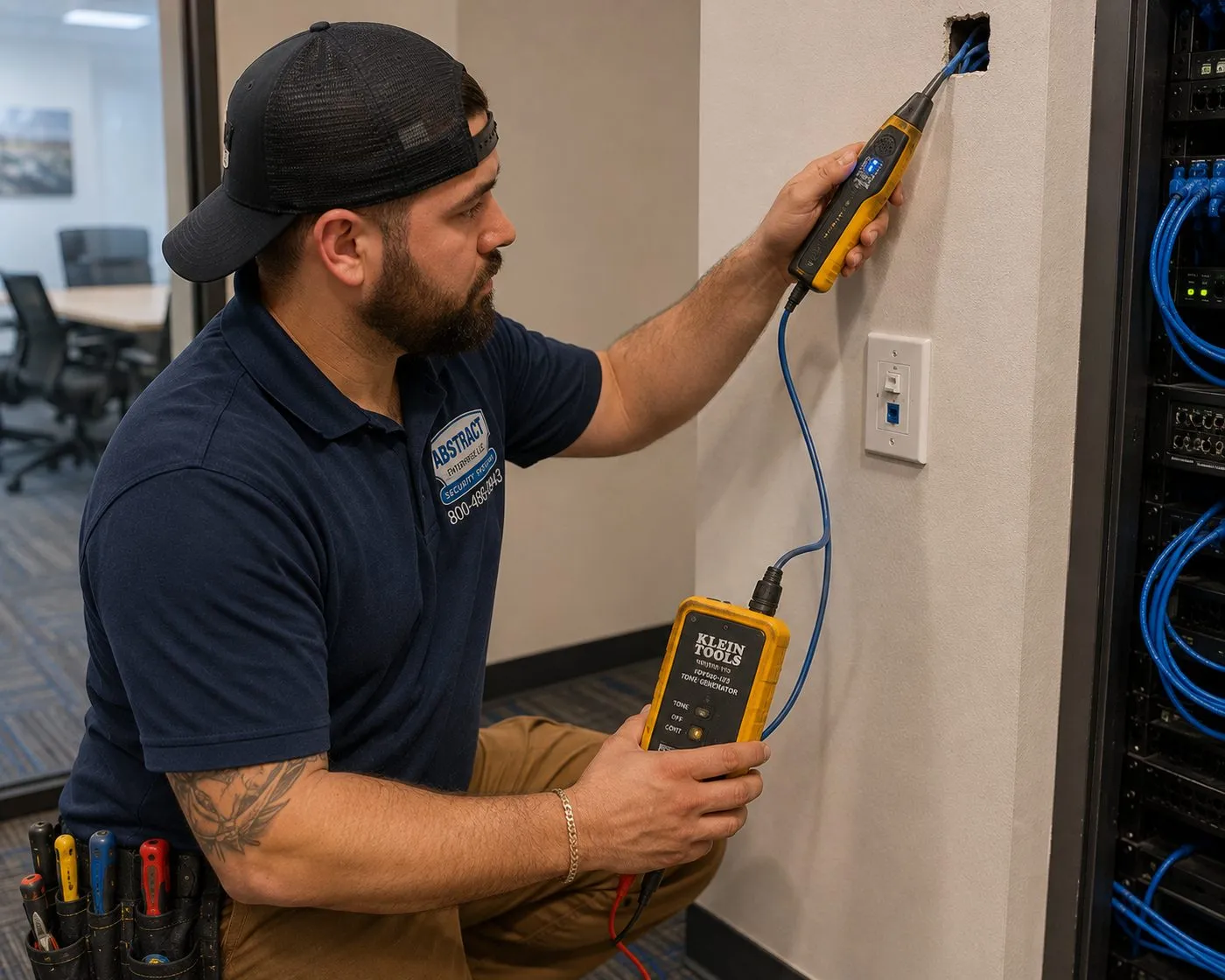
A tone generator is clipped to a blue cable coming out of a small wall opening while the probe confirms which run it is. Old houses often hold cable nobody has labelled, and tracing it first saves cutting new holes.
Commercial Sonos
Business Sonos Installation in Ulster County
Business music in Ulster is concentrated in a few walkable streets, and most of the buildings on them are old. We plan shop and restaurant systems around the hours the doors are open and the rules of the street the shop is on.
Uptown Kingston and the Stockade
Wall Street and North Front Street are lined with shops, restaurants and wine bars inside the Stockade District, where the Senate House on Fair Street began as a 1676 Dutch stone dwelling. Interior music is ours to plan; anything on the outside of a building goes to the city’s preservation commission first.
The Rondout waterfront
The Rondout–West Strand district slopes down to the Rondout Creek, a port that reached its peak around 1870 on the coal trade and now holds restaurants, galleries and taprooms. Brick walls, tall ceilings and big windows make for lively rooms that need tuning, not volume.
New Paltz Main Street
Route 299 through the village is shops and restaurants a short walk from SUNY New Paltz, with more than 6,100 undergraduates. Where staff rosters change from term to term, we set the music up so the schedule runs it, not whoever is behind the counter.
Tinker Street, Woodstock
Locally owned shops, galleries and restaurants along Tinker Street and Mill Hill Road, with the Bearsville Theater at 291 Tinker Street to the west. A town with its own noise law and a long memory for music.
Saugerties and Route 9W
The village’s shops and cafés and the 9W corridor through Saugerties, Highland and Milton, where restaurants and roadside businesses sit beside newer buildings that are easier to wire.
Route 209 and Route 28
Stone Ridge, High Falls, Ellenville and the Route 28 corridor through Boiceville and Phoenicia: inns, tasting rooms and weekend-trade shops where the internet connection may be the weakest link.
Rules that come with business music in Ulster
Licensed music. Spotify’s own help pages say the service is for personal, non-commercial use and can’t be played publicly from a business such as a bar, restaurant, store or salon. Sonos sells Sonos Pro to businesses, with commercially licensed music and scheduling. We set up whichever licensed service you choose.
Kingston’s historic districts. The city code requires a certificate of appropriateness from the Historic Landmarks Preservation Commission for material changes to exterior elements visible from a street in a Landmark District — the Stockade, Rondout–West Strand, Fair Street and Chestnut Street among them. Ordinary interior work, including speakers inside, is outside that review. Outdoor speakers or cable on a street-facing wall are not.
Woodstock’s noise law. Chapter 139 of the town code prohibits unnecessary noise between 11 p.m. and 7 a.m. and excessive sound from any sound reproduction system heard over a property line. The town’s zoning also sets a 64 dBA limit at the property line in commercial districts by day and 60 dBA at night, as Hudson Valley One reported in June 2025.
Electrical work. New circuits and outlets for an equipment cabinet belong to a master electrician licensed by the Ulster County Electrical Licensing Board. We do the low-voltage side and coordinate.
Paperwork. Certificates of insurance for landlords and building managers are free on our price list.
How we set up a shop or café system
A business system is planned around the hours it runs and the people who run it. We split the room into zones where the sound has to change — counter, seating, patio, fitting rooms — and set each zone’s level with customers in it, because an empty room with stone or brick walls is far louder than a full one. Music comes from the licensed service the business chooses, signed in under the business’s account, and schedules start and stop it so staff never need a personal phone on the system. Era 100 Pro speakers powered over a single network cable keep ceilings and walls tidy in a fit-out; in an older building with no ceiling cavity, wall-mounted speakers on an Amp do the same job.
Most Ulster shops are small, so most systems are one or two zones. The bigger decisions are about the building: a pressed or plastered ceiling that can’t be cut, a landlord who has to approve any fixing, a historic street outside the door. We take photographs and write the plan down so the landlord or the commission sees exactly what is proposed.
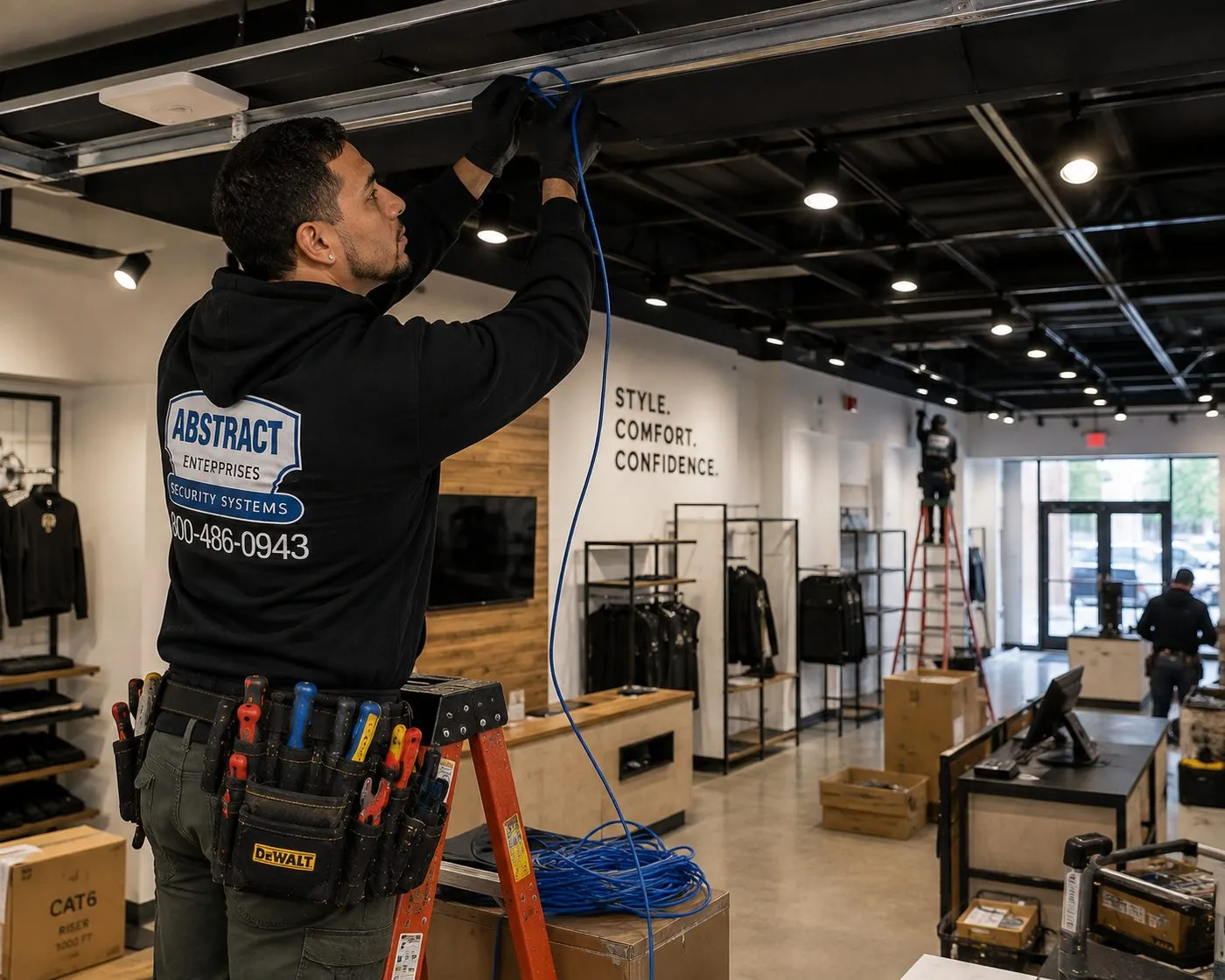
Blue cable is threaded along the open, black-painted ceiling of a clothing shop while a second technician works on a ladder near the entrance. Shop music is easiest to wire before the racks are full.
Historic Districts
Sonos and Kingston’s Landmark Districts
Kingston has more protected streets than anywhere else in the county, and its code is specific about what needs approval. Interior Sonos work is almost never affected. The outside of the building is a different matter.
Work
In a Kingston Landmark District
Why
Speakers, Amp, Port and network inside the house
No commission review
The code’s review covers exterior elements visible from a street or alley, plus designated publicly visible interiors.
Outdoor speakers on a street-facing wall or porch
Certificate of appropriateness first
A material change to an exterior element visible from the street, which the HLPC reviews before any building permit.
Outdoor speakers on a rear wall nobody can see from a street or alley
Ask the commission’s staff
Visibility decides it; we photograph the wall from the street and alley so the question is easy to answer.
Cable or conduit run up the outside of the building
Treat as visible exterior work
Surface conduit changes the appearance of a facade; we route inside wherever possible.
Repainting or repairing an existing bracket hole
Ordinary maintenance
The code exempts ordinary maintenance and repair that doesn’t change design, material, colour or appearance.
The districts the code names include the Stockade, the Rondout–West Strand on the creek, the Fair Street district running southeast from the Stockade to Henry Street, and the Chestnut Street district with its 19th- and early 20th-century residences. The commission emails a certificate to the applicant, owner and the Building & Safety Division once a project is approved. We prepare the photographs and a product sheet for your application; the application itself is yours, as owner.
Outside Kingston, the rules are town by town. Woodstock’s concerns are about sound, not appearance; other towns and villages have their own building departments. Nothing in this section is legal advice, and when a rule is unclear we stop and ask the town before drilling.
Your Questions Answered
Sonos Installation in Ulster County: Questions Answered
These are the questions Ulster owners actually put to us on walkthroughs, grouped the way the problems turn up: at the stereo, in the structure, out in the hollows, and behind the counter. Each answer starts with the short version.
Sonos beside the hi-fi you already own
Can a Sonos Amp drive the vintage floor-standing speakers we already own?
Usually, once we have checked two numbers on the back of each speaker or in its manual. Sonos’s Amp guide asks for speakers rated to handle at least 125 W at 8 ohms or 200 W at 4 ohms, and says never to connect anything below 4 ohms. Many classic floor-standers are 8-ohm designs and sit comfortably inside that. Some are nominal 4-ohm speakers whose impedance dips lower at certain frequencies; those we test, and if they don’t suit the Amp we suggest a Port into an amplifier built for them instead.
Two pairs of 8-ohm speakers can run in parallel on one Amp, which Sonos supports; series wiring is not. If your speakers have bi-wire terminals, we leave the factory jumpers in place and run a single good-gauge pair. Then Trueplay, where your phone supports it, tunes the speakers to the room.
Will Sonos play our 24-bit FLAC library at full resolution?
Up to a point. Sonos’s support pages list FLAC and ALAC at up to 24-bit and say Sonos plays files with sample rates up to 48 kHz; on the older S1 app, FLAC and ALAC are limited to 16-bit. AIFF and WAV are listed at 16-bit. So a 24/48 file plays as recorded. Files at 88.2, 96 or 192 kHz are a different matter: answers in the Sonos community explain that tracks above 48 kHz are streamed at CD resolution, 16-bit/44.1 kHz, instead.
If much of your library is high-sample-rate, we either point Sonos at a 48 kHz copy you make with your own software, or leave the critical listening to the system you already have and use Sonos for everything else. We tell you which before the job, not after.
A hum started when the Port was plugged into our stereo — what causes it?
Nearly always a ground loop: two pieces of equipment plugged into different outlets, joined by an RCA cable whose shield becomes the path between them. It is a long-standing complaint with Sonos’s line-level boxes — owners in the Sonos community describe the Port and the older Connect being easily affected, and the usual cures are the ones we try first: feed the Port and the amplifier from the same outlet strip, check the receiver’s ground, swap the analog connection for the Port’s coaxial digital output if your amplifier has a DAC input, and shorten or replace the interconnect.
We isolate it with the music off and the volume up, one change at a time, so you know which fix worked. If nothing in the room cures it, a ground-loop isolator on the analog line is a last resort, not a first one.
Is it worth running the Port’s digital output into the outboard DAC in our system?
If your DAC is better than the Port’s own converter, or you simply prefer its sound, yes. The Port has a coaxial digital output alongside its analog line out, so it can hand the stream to your DAC untouched and let the DAC do the conversion. It also takes one analog cable out of the chain, which removes one possible source of hum.
Two things to agree first. With a digital connection, volume normally belongs to your preamp or DAC, so we set the Port’s output to fixed. And the 48 kHz limit still applies to what Sonos sends, so the DAC improves conversion, not the resolution of the file. We listen with you on both connections before choosing.
Can a musician play a keyboard live through the Sonos speakers without hearing a lag?
Not comfortably. Sonos buffers anything that comes in through a line-in before it plays it, and owners in the Sonos community note that the app’s line-in delay settings start at 75 milliseconds rather than zero. That is fine for a turntable or a CD player, where nobody can hear the delay, but a player pressing a key and hearing the note late will notice at once.
For practice, keep the instrument on its own amplifier or monitors and use Sonos for backing tracks played from the app. If you want both through the same speakers, a small mixer feeding powered monitors does the live work, and a Port joins the house system for everything recorded.
Stone walls, beams and sloped ceilings
Our ceiling is the floorboards of the room above, carried on exposed beams — where can a ceiling speaker go?
Usually nowhere it will sound or look right. An in-ceiling speaker needs a cavity: Sonos’s 6-inch model needs 4.73 inches of depth behind an 8.25-inch hole. Where the boards are the ceiling, there is only the thickness of the floor above. Cutting a speaker into it means cutting the room upstairs too, and we don’t recommend it in an old house.
The better answers are on the walls and on furniture: a pair of Era 100s on wall brackets angled toward the seating, a Five on a sideboard, or a passive pair of your choosing on an Amp. Their cable can run along the top of a beam in a narrow, painted raceway or come up from the cellar through the floor at the wall.
In an A-frame whose living room rises to the roof peak, where should the speakers sit?
Low, and aimed at the people. Sound in a tall, steep room climbs and reflects off two sloped planes; speakers mounted high on the roofline put most of their energy into the peak. We usually place a stereo pair on the end wall or the gable side at about ear height when seated, or on stands, and let Trueplay tune them. Sonos’s ceiling guide suggests a stereo pair 6 to 10 feet apart, which a typical A-frame end wall accommodates.
If you want speakers overhead, the sloped ceiling under the loft is the one place a ceiling pair can work, because it is a flat, conventional framed section. Anything mounted on the slope itself goes into a rafter bay that has to be checked for insulation and vent channels first.
Can a network cable pass through the thick stone wall between the old house and the addition?
Yes, but rarely straight through. Drilling through thick rubble stone is slow, noisy and permanent, and the hole has to be sealed against air and insects afterward. In most houses there is an easier crossing: under the floor through the cellar, where the old foundation already has openings for pipes, or through the doorway framing where the addition joins.
Once a single cable crosses, an access point on the far side does the rest, and Sonos speakers in the old rooms connect to it rather than trying to hear a router through stone. If no crossing is possible, a pair of point-to-point wireless units set in the windows on either side can carry the network around the wall instead of through it.
Our log home has no hollow walls at all — how does speaker cable get to the right places?
From below, along the top, or in a chase that was built for it. Log walls are solid, and they settle: the inspectors’ association InterNACHI notes that a log wall can lose 3/4 inch per foot of wall height in the first two years, when most settling happens. A cable drilled through logs, or a speaker box fixed rigidly across them, can be pinched or pulled as the wall drops.
So we use the routes log builders leave: the floor system and crawl space below, the framed partitions and ceilings above, the electrical chases cut into the logs when the house went up, and window and door bucks with settling space. Where nothing exists, a surface raceway in a wood finish follows a corner or a top log. Free-standing speakers often make the most sense on the log walls themselves.
Hollows, creeks and weekend arrivals
There’s no cell signal at our place in the hollow — can we still run Sonos from our phones?
Yes. The Sonos app talks to the speakers over your home Wi-Fi, not over the cellular network, so a phone showing “No Service” still controls the system once it has joined the house network. Hudson Valley One reported in 2016 that coverage gaps follow Routes 212 and 28, where the mountains block signal, so this matters in a lot of Ulster kitchens.
What you do need is a working internet connection for streaming services and for setup, because the app signs in to your Sonos account. Local music — a library on a network drive, or a turntable through a Port or line-in — keeps playing over the home network alone. Sonos Voice Control, if you use it, is processed on the speaker itself rather than in the cloud.
Shops, cafés and venues
Can our café play Spotify through Sonos, or does a business need a licensed service?
It needs a licensed service. Spotify’s help page on public and commercial use is direct: the service is for personal, non-commercial use, and it can’t be played publicly from a business such as a bar, restaurant, store or salon. The same applies to the other personal streaming apps.
Sonos sells Sonos Pro to businesses, which streams commercially licensed music and adds scheduling and multi-location control, and other business music services work on Sonos too. We set up whichever you choose, lock the system to it so staff aren’t tempted to switch to their own phones, and leave the account in the business’s name.
Is a Sonos system loud enough to run a wedding reception or a packed gallery opening?
For background music, yes; as the main sound system for a crowd with speeches and dancing, no. Sonos makes home and small-business speakers. A barn reception or an opening night needs microphones, a mixer and speakers designed to project over a room full of people, which is a rental or a band’s own system.
Where Sonos earns its place is the rest of the day: dinner music in the courtyard, the cocktail hour on the lawn, the playlist before the band starts. We wire a line out from a Port so the event system can play from Sonos when the DJ isn’t using it, and keep the two from fighting over volume.
Can the shop’s music start on its own at opening and stop at closing?
Yes, using the app’s alarms, which Sonos describes for wake-ups but which work just as well for business hours. Each alarm sets a time, the rooms, the music, the volume, how often it repeats and how long it plays, and a system can hold up to 32 of them. A weekday alarm at opening time and a Saturday one an hour earlier covers most Main Street schedules.
Sonos Pro adds proper scheduling across locations if you run more than one shop. Either way, we set the levels with the room full rather than empty, so the morning volume isn’t too loud at 10 and too quiet at 2.
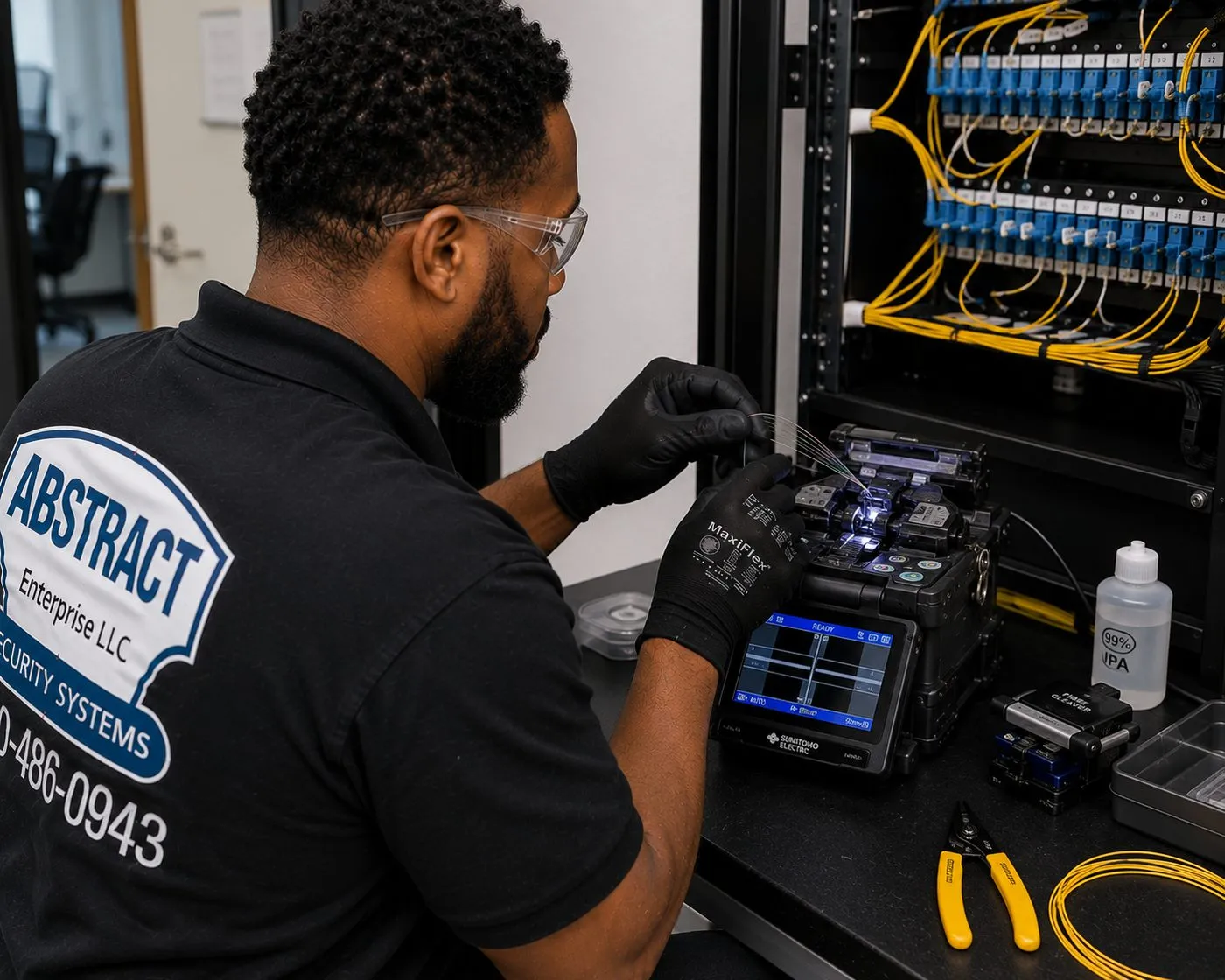
Several bare fiber strands are held over a fusion splicer next to an open rack of blue connectors and yellow patch cords, with a fiber cleaver and a strip tool on the bench.
Equipment
Types of Sonos Systems We Install
We install the whole current Sonos range and the network that carries it. Here is what each piece is for in an Ulster house, with the specifications Sonos publishes.
Sonos Port
The bridge to an existing stereo. Analog line out that can be fixed, variable or pass-through, a coaxial digital out, an analog line in, a 12V trigger and two Ethernet ports. Sonos asks for at least 2 inches of clearance around it on a shelf.
Sonos Amp
125 W per channel into 8 ohms with HDMI ARC/eARC and two Ethernet ports. Drives one pair of speakers, or two pairs of 8-ohm speakers in parallel. Operating range 32°F to 104°F, so not for an unheated outbuilding in January.
Era 100 and Era 300
Stand-alone speakers for rooms with no ceiling cavity. Sonos’s Combo Adapter, listed at $39 on its site, adds a line-in and an Ethernet port. Era 300 wall mounts are for studs only.
Arc Ultra, Beam and Ray
Soundbars for the TV room. Arc Ultra measures 46.38 inches wide and connects by HDMI eARC; Beam is the shorter choice for mid-size screens; Ray connects by optical.
Sub 4 and Sub Mini
Sub 4 lies flat under a sofa or stands in a corner; Sub Mini is the compact cylinder for smaller rooms. In a listening room, keep either away from the turntable’s shelf.
Architectural by Sonance
In-ceiling, in-wall and outdoor passive speakers designed for the Amp, which reliably powers up to three pairs. The outdoor pair is IP66 and rated from −13°F to 149°F.
Move 2 and Roam 2
Portable speakers for porches, docks and hikes to the creek. Move 2 is IP56 with up to 24 hours of battery; its charging base is for indoor use only.
Era 100 Pro
An installer speaker powered over the network cable (PoE+), with orientation-aware tuning for wall or ceiling. A tidy answer for galleries and shops.
Access points, switches, fiber
Ceiling or wall access points, managed switches set the way Sonos recommends, and fiber or wireless bridges for studios and cottages.
Port, Amp or line-in: which one joins your existing system?
You have
Best Sonos piece
Why
A receiver or integrated amp you like, plus speakers
Port
Keeps your amplifier and speakers; Sonos supplies the source. Fixed output if you use the amp’s knob, variable if you want the app to control volume.
Passive speakers but no amplifier you want to keep
Amp
Powers the speakers directly and joins the house system. Check impedance first.
A turntable with a phono stage, and nothing else
Era 100 with the Combo Adapter, or a Port into powered speakers
Gets records into Sonos. Expect the line-in delay, which a turntable never notices.
Powered studio monitors
Port
Line out into the monitors’ inputs; keep the monitors’ own volume as the master.
A home theater receiver with surround speakers
Port, or replace with Arc Ultra and surrounds
A Port adds music to the receiver; Sonos’s own theater replaces it.
Audio files and what Sonos plays from them
Format
What Sonos lists
FLAC, ALAC
Up to 24-bit (16-bit on the S1 app); sample rates up to 48 kHz
AIFF, WAV
16-bit
MP3, AAC, OGG, MP4, M4A
Up to 320 kbps
WMA
Up to 355 kbps
In stone rooms we tend to choose free-standing speakers over architectural ones simply because there is nowhere to cut. An Era 300 or a pair of Era 100s on wall brackets, tuned with Trueplay, gives a beamed parlour proper stereo without touching the structure, and the speakers move with you if the room changes.
Source: Sonos support, “Supported audio formats for Sonos music library.” Your library can sit on a computer or on a network drive; Sonos asks that a NAS use the SMBv2 or SMBv3 file-sharing protocol.
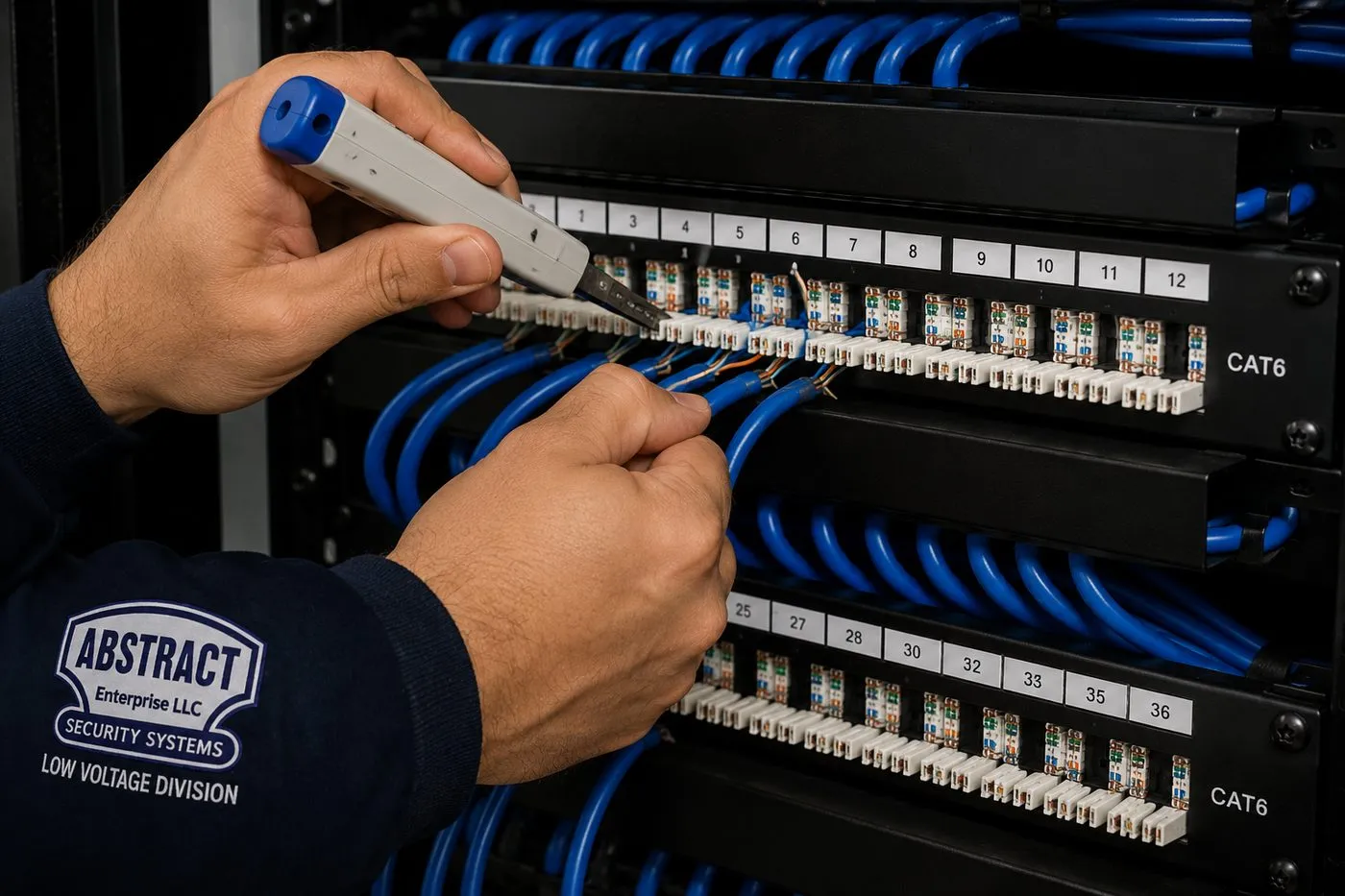
Blue Cat6 cable is punched down on a numbered patch panel with a hand tool. Each wired Sonos product, access point or switch gets a labelled port like these.
AI Overview Reality Check
What AI Gets Wrong About Sonos Installation in Ulster County
We couldn’t view Google’s AI Overview for Sonos installation in Ulster County from our build environment, so we haven’t quoted it. Below are seven claims that cost guides, forums and marketing pages publish — the material answer engines tend to repeat — set against what we find in Ulster houses.
“Sonos is hi-res audio.”
Marketing for streaming speakers leans on “hi-res” without saying what it means. Sonos’s own beginner’s guide defines hi-res as at least 24 bits and 48 kHz.
That is also the ceiling. Sonos supports FLAC and ALAC at 24-bit with sample rates up to 48 kHz, and files above that are not played at their native rate. AIFF and WAV are listed at 16-bit, and the older S1 app limits FLAC and ALAC to 16-bit too. For a listener with a library of 96 kHz downloads, that is a real limit, and it is the first thing an Ulster audiophile asks us about.
It isn’t a reason to avoid Sonos; it is a reason to plan. Keep the high-rate files on the system built for them and let Sonos carry the radio, the streaming and the rest of the house.
“Plug a Port into any stereo and you’re done.”
The Port does connect to almost any amplifier with a line input. What the simple version leaves out is ground: two boxes on different outlets, joined by an RCA cable, can hum.
Sonos community threads about Port buzzing go back years, and the fixes are practical: shared power, a digital connection, a better interconnect.
The other half is volume. Leave the Port’s output variable and the app and the amp’s knob fight; fix it and the app’s slider does nothing. We set it the way you actually listen.
“Multi-room audio costs $500 to $1,000 per room.”
Angi’s whole-home audio guide puts additional zones at $500–$1,000 per room and wall or ceiling modifications at $100–$500, without naming Sonos.
In a drywall ranch that range can hold. In a stone house it describes a different job: the cost is in getting a cable across the building, not in the room. A free-standing Era 100 in a beamed room costs our $125 setup line; a wired ceiling pair in plaster is quoted at walkthrough. The national figure also says nothing about joining an existing stereo, which in Ulster is often the cheapest and best-sounding room in the house: $254 for a Port on our list.
So we price the route first. Our Hudson Valley AV page publishes its own ranges for whole-home systems, and fixed lines below are the same in every valley county.
“Use the line-in for anything — turntable, TV, instruments.”
Product pages present line-in as universal, and for recorded sources it is.
The catch is the buffer. Owners in the Sonos community point out that line-in delay settings start at 75 ms, with no zero option. A guitarist or keyboard player hears that as lag.
Records and CDs don’t care; live playing does. That is why we tell musicians to keep their instruments on their own amplification and use Sonos for everything recorded. A rehearsal room is the one place in the house where Sonos should be a playback system only.
“Just play your Spotify in the shop.”
Plenty of small-business advice treats a personal streaming account as background music.
Spotify’s own terms say it is for personal, non-commercial use and can’t be played publicly from a business. Sonos sells Sonos Pro, with commercially licensed music, precisely because businesses need a different licence.
For a Wall Street café or a Tinker Street gallery, the right service costs less than a dispute later. We set the system up on it from day one, with the business as the account holder, and schedule it so the music changes at opening and closing without anyone touching a phone.
“A mesh kit or a range extender will cover the whole house.”
Router marketing promises whole-home coverage in a box.
Sonos’s system requirements list wireless range extenders and Ethernet-over-power adapters as unsupported, and its interference guidance rates brick as a medium obstruction and plaster and concrete as high. Thick rubble stone is at least as hard on a signal.
Mesh can work if its nodes are joined by cable, which is the point: in an old Ulster house, the network crosses the wall on a wire, then goes wireless on the other side. Sonos also asks that a wired mesh setup connect Sonos to the primary node, and that powerline adapters stay out of it entirely.
“Without good cell coverage, smart speakers are useless.”
It is a common assumption in the hollows, where phone signal comes and goes along Route 28 and Route 212.
Sonos doesn’t use the cellular network. The app reaches the speakers over Wi-Fi, local music plays without the internet, and Sonos says its own voice control processes requests on the speaker rather than in the cloud.
What does need the internet is streaming and the first setup. With the county’s fiber build now approved for its last unserved addresses, more of those houses will have it soon.
Tell Us What’s in the Rack. We’ll Tell You What Sonos Adds.
A photo of the back of your receiver, the model of your speakers and a rough plan of the house with the router marked are usually enough to price the fixed items and decide whether a walkthrough is needed.
Tell us the town, the house and the equipment you already own. A technician calls back the same business day.
✅
Request Received
An Ulster County technician will call you back the same business day.
How It Works
Our Installation Process
Six steps, the same order on every Ulster job, from a single Port in a Kingston flat to a stone house with a studio across the yard.
01
Inventory call
We list everything you own — receiver, turntable, speakers, TV, router — and the Sonos products you have bought or plan to, and check them against each other before anyone drives up.
02
Walkthrough of the building
Where the walls are stone, plaster, timber or log, we look at the cellar, the closets and the ceilings, test Wi-Fi in each room and mark where a cable can cross.
03
Written plan and price
Fixed lines from our list, plus a written quote for any wiring, access points or fiber, with the route drawn on a simple sketch.
04
Network first
Cable, access points and switches go in and are tested before a speaker is unboxed, so every room has a solid connection.
05
Sonos in, joined to what you own
Port or Amp connected and set, speakers placed or mounted, rooms named and grouped, library and radio added, Trueplay run where your phone supports it.
06
Proved and handed over
We play every source in every room, power-cycle the router and the system to prove it recovers on its own, and show you the app.
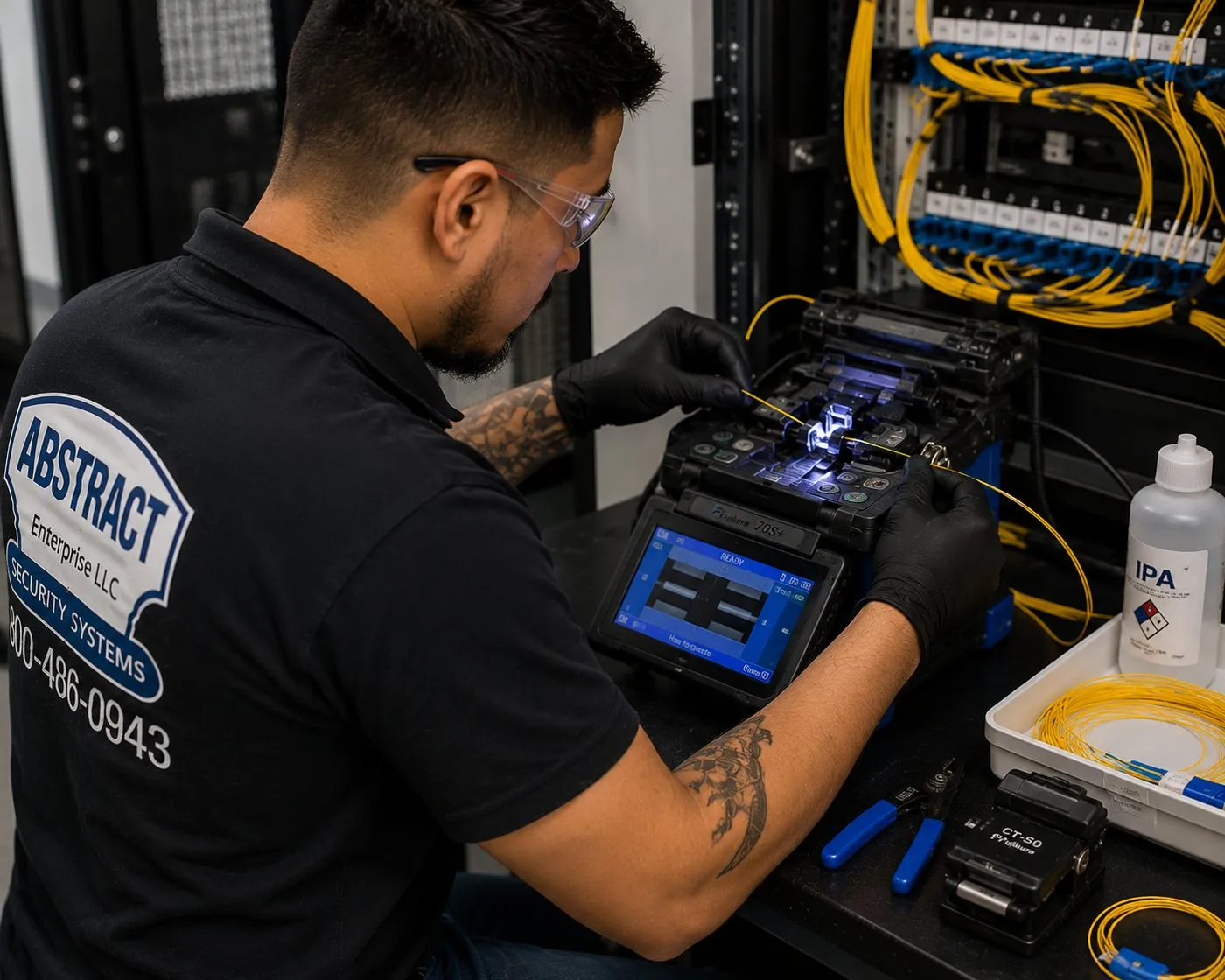
A yellow fiber strand is set into a fusion splicer whose screen shows the two fiber ends lined up. Fiber is one way to carry a network to a studio or cottage too far from the house for copper.
Coverage Area
Sonos Installation Near Ulster County’s Landmarks
Six places people in Ulster use to say where they live, from the Stockade to the bluestone country. None of them is our customer or our project; they are how we find you.
Senate House State Historic Site, Kingston
Built in 1676 as a single-storey Dutch stone house on Fair Street; in 1777 the first New York State Senate met in it. The Stockade houses around it are the reason our Uptown plans start in the cellar.
Ulster Performing Arts Center, Kingston
The Broadway Theatre opened in 1927 as a movie palace and vaudeville house; today the roughly 1,500-seat UPAC is the only unaltered pre-war theater left in the city. Midtown jobs on and off Broadway start here.
Maverick Concert Hall, near Woodstock
A rustic hall built in 1916 for the Maverick Concerts, which call themselves the oldest continuous summer chamber music festival in America. Fittingly, the hall itself sits in the Town of Hurley.
Bearsville Theater, Woodstock
At 291 Tinker Street, built by Albert Grossman beside the Bearsville recording studios he founded on the edge of Woodstock. The western end of Tinker Street and the Bearsville hollows are a short drive from it.
Opus 40, Saugerties
Harvey Fite’s 6.5-acre bluestone sculpture in an abandoned quarry at the foot of Overlook Mountain, begun in 1939. By 1898, Opus 40 notes, at least 10,000 people in Ulster made a living from bluestone.
Walkway Over the Hudson, Highland
The west gate of the 1.28-mile walkway, 212 feet above the river, opens on Haviland Road in Highland. Lloyd, Highland and the 9W towns are served from the same crews as Kingston.
We also install in Saugerties village and Malden, Hurley and West Hurley, Marbletown, Stone Ridge and High Falls, Rosendale and Tillson, Gardiner and Wallkill, Esopus and Port Ewen, Marlborough and Milton, Ellenville, Napanoch and the Town of Wawarsing along Route 209, and up Route 28 through Boiceville, Phoenicia, Mount Tremper and Shandaken. Neighbouring Hudson Valley Sonos installation covers the rest of the valley.
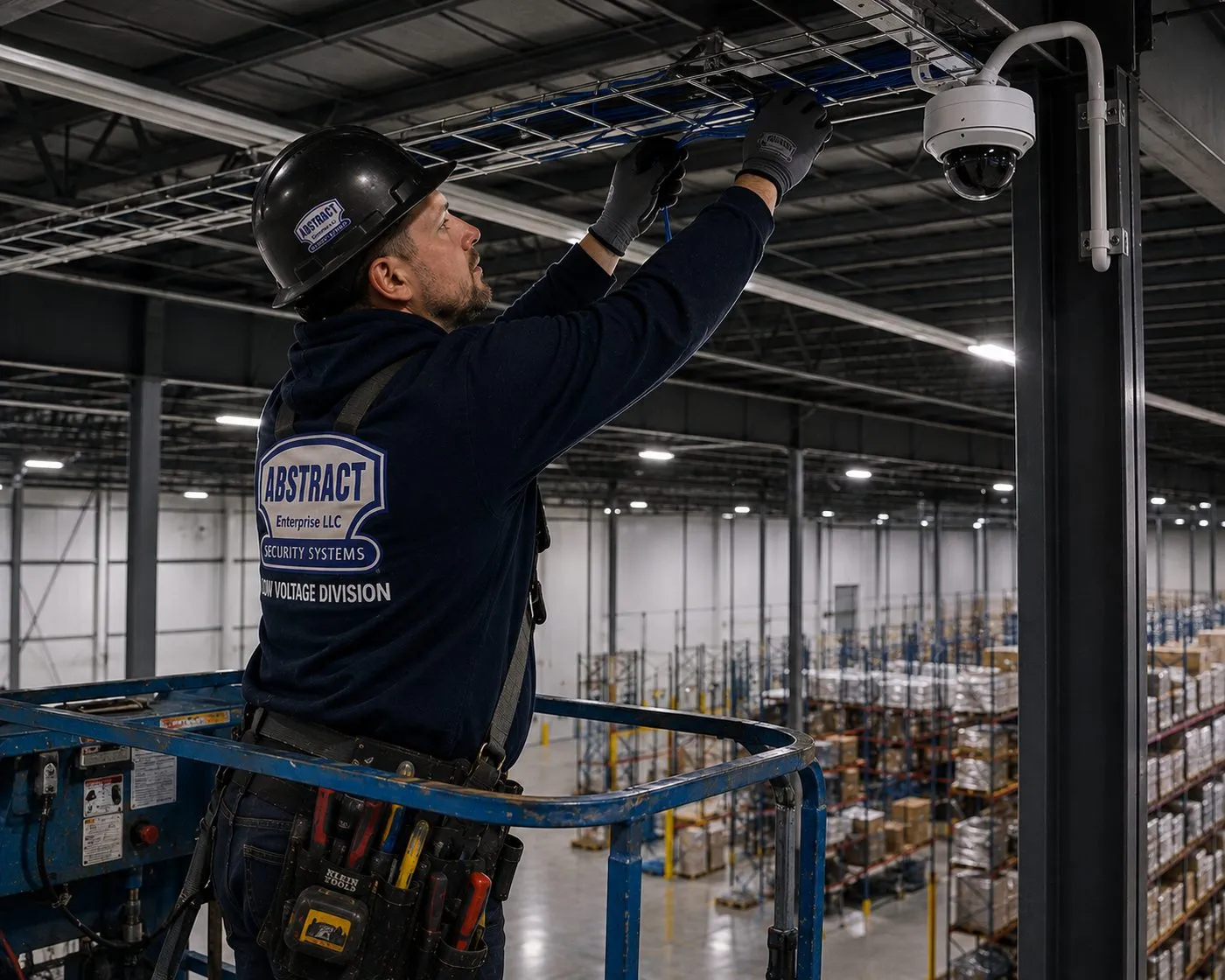
From a scissor lift, blue cable is laid into a wire basket tray running across a high ceiling, with a dome camera on a bracket beside the column. Long open spans like this are where cable is supported, not draped.
Pricing
Sonos Installation Cost in Ulster County
The fixed lines below are the same in every Hudson Valley county; what changes in Ulster is the setup-only hour and the TV mounting base. Ulster shares the highest valley rates on our list with Dutchess, and they already cover the drive: nothing is added for travel anywhere in the county.
Item
Price
What it covers
Sonos setup
$125
Sonos products added to your network and app, rooms named and grouped, tested
A/V receiver connection
$129
A Port or receiver-based system connected, output mode and trigger set
Soundbar wall-mounted under the TV
$129
Arc Ultra, Beam or Ray bracket fixed, levelled and connected
Soundbar placed on a console
$79
Positioned, connected and tidied
Sanus soundbar bracket
$84.99
Supplied by us if you need one
Full home theater
$350
Soundbar or receiver, Sub and surrounds connected and calibrated
Cable run to a cabinet or other spot
$99
Up to 25 feet, for a Port, receiver or turntable kept away from the TV
In-wall concealment
$169
Code-compliant power and cable kit at the TV, hollow walls only
Paintable cord cover
$59
Surface raceway where a wall can’t be opened — the usual answer on beams and stone
Universal remote programming
$99
One remote for TV, soundbar and sources
Streaming device setup
$49
Apple TV, Roku, Fire TV or similar
Plywood backer board
$85
Where framing isn’t where a bracket needs to be
High mount (above about 8 ft)
$75
Tall rooms, lofts and A-frame end walls
Box removal
$25
Packaging taken away
Certificate of insurance
Free
For landlords, inns, shops and managed properties
Wall type behind a bracket
Surcharge
Drywall on wood studs
$0
Metal studs
+$30
Plaster
+$45
Brick or stone (Stockade walls, bluestone)
+$65
Concrete or cinder block
+$75
Tile or marble
+$95
Ulster County rate
Price
Setup-only visit — first hour
$275, then 30-minute blocks
TV mounting base (32″–55″)
$254.99
Return trip if we can’t start (no access, equipment not on site)
$150
Rescheduling with 24 hours’ notice
Free
Quoted at the walkthrough
In-ceiling, in-wall and outdoor speakers on an Amp — the structure decides the labour, and in plank-and-beam rooms the answer may be no.
Ethernet, access points and switches — how many, and how hard the crossing through stone or between wings.
Studio, cottage and barn links — fiber, conduit or a wireless bridge, decided after we measure the distance and the ground.
Whole-house projects — for bigger jobs, the published ranges on our Hudson Valley AV and sound page apply: $1,200–$5,000 for its entry TV mount and Sonos starter package, up to $12,000–$35,000 for whole-home Sonos with Atmos.
Three worked examples
A Port into the receiver in a Kingston living room: Sonos setup $125 + A/V receiver connection $129 = $254. Add the $99 cable run if the receiver lives in a cabinet across the room: $353.
An Arc Ultra on the stone wall of a Hurley parlour: soundbar wall-mounted $129 + Sanus bracket $84.99 + brick-or-stone $65 + Sonos setup $125 = $403.99.
Two Era 100s on the end wall of a Phoenicia A-frame: Sonos setup $125, plus $75 if the brackets go above about 8 feet = $200. Speaker brackets are your purchase.
Included, and not included
Included: mounting and connecting the items listed, adding everything to your Sonos system, naming and grouping rooms, tuning where the product and your phone support it, testing every source you use, and showing you the controls. Not included: electrical work — new outlets and circuits are for a licensed electrician — plaster patching and painting, and the Sonos products themselves unless you buy a bracket through us.
National installer or local contractor? App-booked and big-box installers set up Sonos everywhere, and for one speaker in a modern room that is often all you need. What a local licensed low-voltage contractor adds in Ulster is the house and what’s already in it: the receiver that hums, the thick stone wall between wings, the beam ceiling with no cavity, the shop on a historic street. And a published price list you can check before booking.
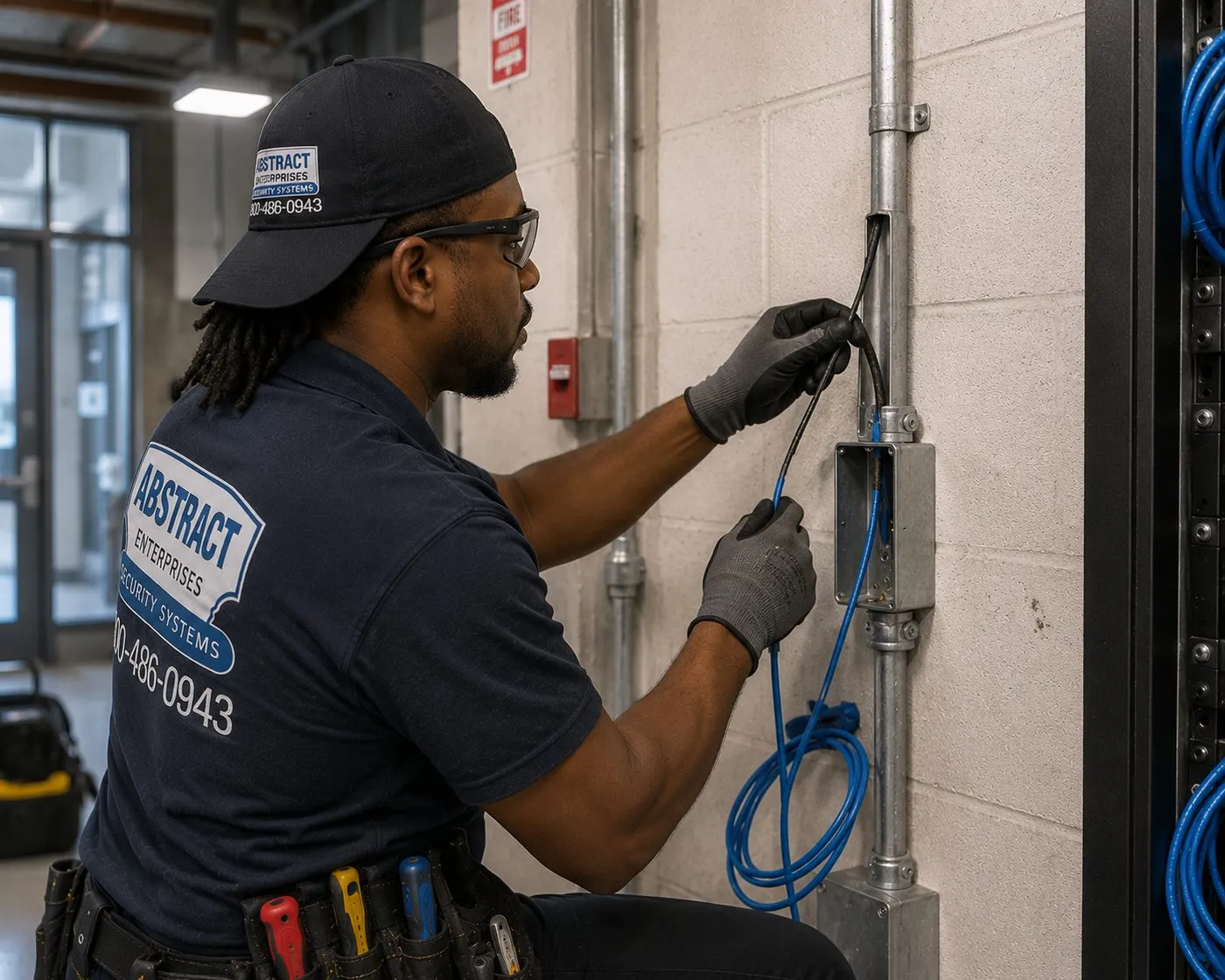
Blue and black cable is fed into a metal pull box on steel conduit fixed to a painted block wall, with a coil waiting at the floor and a rack at the edge of the frame. Surface conduit like this suits a cellar or utility wall.
A Photo of the Back of Your Receiver Saves a Trip
Send it with the form, along with the speaker models and the age of the house. We confirm what connects to what and give you the fixed price before we book a window.
Three common Ulster starting points, each added up from the list prices above. Wall surcharges beyond the one shown, a backer board or a high mount are added only if your room needs them; network and speaker wiring is quoted separately.
STARTER
Sonos on the Stereo You Own
$254
Sonos setup $125 + A/V receiver connection $129 = $254. A Port connected to your receiver or integrated amplifier, output and trigger set, library and radio stations added, and the rest of your Sonos rooms grouped with it.
STANDARD
Soundbar on Stone or Brick
$403.99
Soundbar wall-mounted $129 + Sanus bracket $84.99 + brick-or-stone surcharge $65 + Sonos setup $125 = $403.99. Arc Ultra, Beam or Ray fixed to an old masonry wall and joined to the house system.
PREMIUM
Theater Plus the Hi-Fi
$643
Full home theater $350 + soundbar wall-mounted $129 + brick-or-stone $65 + cable run $99 = $643. Soundbar, Sub and surrounds bonded and tuned, with a cable run to the cabinet where the turntable and receiver live.
Bring your own equipment — labour only. Already own the Sonos gear, the bracket and the speakers? We install customer-supplied products at the same labour lines, with no bracket charge — $129 to wall-mount your own soundbar on your own bracket, for example. Customer-supplied products carry their manufacturer’s warranty, and we check any bracket’s rating before it goes on the wall.
Fireplaces & Chimney Breasts
A Sonos Theater on a Stone Fireplace Wall
In a lot of Ulster living rooms the only wall that faces the sofa is a bluestone or river-rock chimney breast. That is where the TV wants to go, and the Sonos soundbar with it. It can work well, with a few rules.
Heat first. Before anything is mounted we check how hot the mantel and the stone above it get with the fire or the stove going. A wood stove has its own clearance to combustibles, which the stove’s listing or NFPA 211 sets; electronics and their cables stay well outside it, whatever the bracket could hold.
Fix into sound stone. Brackets go into solid stone or into mortar joints we have tested, with anchors made for masonry. Our list adds $65 for brick or stone behind a bracket.
Leave the bar room to breathe. Sonos’s Arc Ultra guide asks for at least 4 inches between the soundbar and the TV, and its wall mount keeps the bar close to the wall; Arc Ultra detects that it is wall-mounted and adjusts its bass to suit.
Run the cable around, not through. In a chimney breast nobody wants a cable chased into the stone. A short run down the side of the breast in a paintable cord cover ($59), or into a cabinet up to 25 feet away ($99), is the usual answer.
Put the Sub on the floor, off the hearth. Corner or beside the sofa, never on hearthstone where heat and vibration meet.
Example from our published Ulster lines
Total
75″ TV over a stone fireplace (TV mounting price list)
$509.99
Arc Ultra under it: soundbar wall-mounted $129 + Sanus bracket $84.99 + stone $65 + Sonos setup $125
$403.99
Cable down the side of the breast in a paintable cord cover
$59
All three together
$972.98
Surrounds and a Sub are added on the full home theater line ($350) when you want them. If the heat check says the space above the fire is too hot for electronics, we say so, and the TV and soundbar move to the next-best wall; a mount that pulls down from above the mantel is on our TV price list for rooms where nothing else works.
Listening Rooms
Bringing Sonos Into a Room Built Around a Stereo
Adding Sonos to a room built around a stereo is mostly about not disturbing what already works. This is the order we follow.
Write down the chain. Source, phono stage, amplifier, speakers, and which outlet each plugs into. Hum problems are solved on paper first.
Pick the join. A spare line input on the amplifier for the Port’s analog out, or a coaxial digital input if the amplifier has its own DAC. A tape loop or an unused AUX input is fine.
Decide who owns the volume. Fixed output keeps the amplifier’s knob in charge; variable hands it to the app. Pass-through exists for people who want both, and we explain the trade-off.
Use the trigger if you have one. The Port’s 12V trigger can wake an amplifier that supports it when music starts.
Give the Port air. Sonos asks for at least 2 inches around it on a shelf, away from radiators, and three can share one rack unit on a third-party shelf.
Wire it if you can. The Port has two Ethernet ports; a cable from the router or an access point takes Wi-Fi out of the listening chain.
Keep the Sub away from the turntable. Bass and a stylus share a shelf badly; the Sub goes on the other side of the room.
Leave the critical files where they are. Anything above 48 kHz belongs on the system built to play it.
Records in a Sonos house
Vinyl and Sonos get along once the order of the chain is clear. The turntable still plays through its phono stage into your amplifier exactly as before; nothing about Sonos changes that path. What Sonos adds is the reverse direction: a phono stage’s output can also feed the Port’s analog line in, or an Era 100 through the Combo Adapter, so the record playing in the living room can be heard in the kitchen or on the porch. Because Sonos buffers a line-in, the other rooms hear the record a moment after the living room does, which nobody notices from another floor but everyone notices standing in the doorway between the two. We set the delay as low as the app allows and suggest grouping rooms that are out of earshot of each other. If the turntable is the source people use most, we label the Port’s line-in in the app with something obvious, like “Records”, so anyone in the house can find it and send the side that’s playing to the room they are in.
Two practical notes. Line-level only: a turntable without a built-in or separate phono preamp is too quiet and the wrong tone for any line input, Sonos included. And keep the Sub, and any speaker standing on the floor, away from the turntable’s stand; bass that reaches the platter through the floor is a turntable problem that Sonos can make worse.
Studios & Rehearsal Rooms
Sonos in a House With a Home Studio
A home studio and a Sonos system can share a house without sharing a signal path. That is how most of the musicians we work for want it.
Keep Sonos out of the recording chain. A Port’s line out can feed monitors for playback, but nothing from Sonos goes into an interface you record through.
Give the studio its own group. The studio speakers join the house only when you add them, so nobody upstairs starts a playlist in the middle of a take.
Mind the microphones. On newer voice-capable Sonos speakers the microphone switch cuts power to the mics entirely; we show you where it is.
Spacing from other electronics. Sonos’s interference guidance asks for at least 18 inches between a Sonos product and other electronic devices, which also keeps the Port and its power supply clear of sensitive audio gear.
Live playing stays on the instrument amp. Line-in delay makes Sonos the wrong path for anything you play in real time.
Wire the network. A cabled access point in the studio keeps Wi-Fi traffic predictable, and a separate building gets fiber or a wireless bridge rather than a weak signal from the house.
If the studio is in a converted barn or a cottage across the yard, the network to it is the bigger job. Our Hudson Valley hub goes into outbuilding links in depth; in Ulster the same rule holds — carry the network to the building on a cable or a dedicated link, then let Sonos work inside it.
One more studio habit worth keeping: the neighbours. A rehearsal room or a deck system that carries over the property line late at night is exactly what Woodstock’s noise law addresses, with its 11 p.m. to 7 a.m. window, and other towns have their own rules. Sonos’s per-room volume limit is a simple guard for the outdoor zone and the studio playback speakers, and we set it with you rather than for you.
Weekend & Seasonal Houses
Keeping an Empty Ulster House Ready to Play
A house that sits empty for two weeks has to look after its own music. These are the checks we make before leaving a part-time Ulster house.
Above the water line
In houses on the Esopus, the Stony Clove, the Rondout or the Wallkill, the Amp, the Port, the router and the switch go upstairs or on a wall shelf, never on a cellar floor. Irene set record crests on three of them and came close on the Wallkill.
Power that comes back cleanly
Central Hudson outages hit Ulster hard in storms. We put the network gear on a small battery backup where you want one, and prove the system rejoins by itself after the power is cut on purpose.
Cable rodents can’t reach
Mice move into empty cabins to escape the cold. Speaker and network cable runs go in raceway or conduit through crawl spaces and attics, and cover plates are fitted tight.
Heat and cold
Sonos lists the Amp at 32°F to 104°F. In a house kept just above freezing, equipment lives in the room that stays warmest, not in a cold closet against an outside wall.
Arriving to music
An alarm in the app can start a playlist the evening you usually get in, and Sonos remembers each system you have connected to, so the same phone works in the city and upstate.
A record of where it all is
A one-page sketch of cables, access points and equipment, left in the house, so a caretaker can reset the right box.
Caretakers and neighbours who keep an eye on a weekend house are part of the plan too. We label the router, the switch and any Amp or Port with what they feed, leave the restart order taped inside the equipment cupboard, and, if you want, connect the caretaker’s phone to the system so they can check that every room still answers before you drive up. When the county’s fiber reaches an address that used to have no wired service, the new router changes the network’s name and password; that is a short setup-only visit, and worth booking for the same week the installer comes.
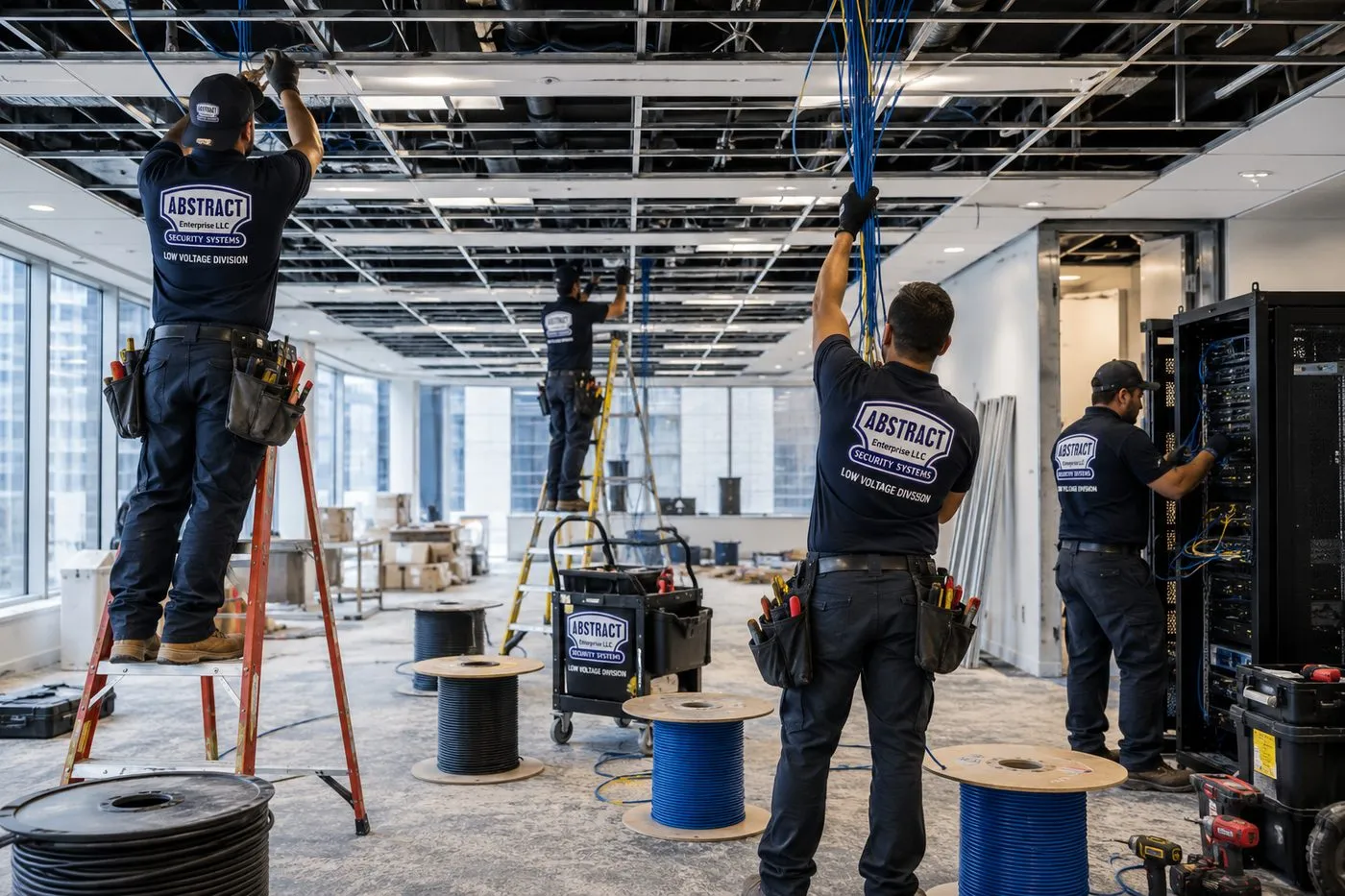
A crew pulls cable from spools on the floor up into an opened ceiling grid while one technician works at a rack. On a large building, cable is pulled by a team in one pass rather than room by room.
Town by Town
What Shapes a Sonos Plan Across Ulster County
Ulster stretches from the Hudson to the Catskill high peaks and the Shawangunk Ridge. These notes sum up what usually decides a Sonos plan in each part of the county.
Kingston
The Stockade’s stone houses, the Rondout’s brick, Midtown’s frame houses and the former IBM campus now known as iPark 87. Full short-term rental permits in the city have been capped at 1% of its housing units since 2023. Taprooms such as Keegan Ales host live music; shops on Wall Street and North Front need licensed background music.
New Paltz
Historic stone houses near the Wallkill, newer subdivisions on the edges, and a village that requires rental properties to be registered and inspected. In a rental, Sonos is set up so a tenant can use it without changing it.
Woodstock and Bearsville
Musicians, artists and second-home owners, a town noise law and a lot of serious stereos. The kind of town where a Port into an existing amplifier is the natural first job.
Saugerties
A village of shops and older houses near the 1869 lighthouse at the mouth of the Esopus, and hamlets like Malden and West Camp on the river side. Bluestone country: walls, steps and patios that carry the stone surcharge when a bracket goes into them.
Hurley, Marbletown and Rosendale
Stone houses along Hurley’s Main Street, Route 209 through Stone Ridge, and Rosendale on the Rondout Creek, where Irene’s rain was rated at least a 100-year event. Equipment goes upstairs in the creek-side houses.
Olive, Shandaken and Route 28
Boiceville, Phoenicia and Mount Tremper beside the Esopus and the Ashokan Reservoir, created in 1915 about 14 miles west of Kingston. The Comptroller found short-term rentals at close to a tenth of Shandaken’s housing; cabins and A-frames, weak phone signal and empty weekdays shape every plan.
Ellenville and Wawarsing
US Route 209 through Spring Glen, Ellenville, Napanoch and Wawarsing, with the Shawangunk Ridge above. Village houses and shops, and a long drive that costs you nothing extra.
Lloyd, Esopus and Marlborough
Highland at the west end of the Walkway, Port Ewen and the river towns, Milton and Marlborough along 9W. Newer houses with attics and basements, where standard Sonos plans work well.
Common Repairs
Why Ulster Sonos Systems Stop Working
Most Sonos service calls in Ulster come down to a handful of causes. Knowing which one you have saves time on the phone.
What you notice
Usual cause
What we do
Every room disappeared from the app
New router or new internet provider — including the fiber now reaching unserved addresses
Re-home the system onto the new network, re-wire the product that was cabled to the old router, and test
Some rooms missing after a storm
Products restarted before the router, or a switch that didn’t come back
Restart in the right order, then prove the system recovers on its own after a deliberate power cut
A hum through the stereo that wasn’t there before
New equipment on a different outlet, or a changed interconnect
Trace the ground path, share power, or move the Port to its digital output
An older speaker won’t join the new ones
An S1-only product on a system that has moved to the current app, or a router running settings older products don’t support
Identify the product, and either keep a separate S1 system or replace it
Music drops in the far wing of a stone house
Wi-Fi trying to cross masonry
Carry the network across on a cable and add an access point on the far side
The receiver plays nothing though the app shows music
Wrong input, output mode set to fixed at zero, or a trigger that didn’t fire
Check the input, the Port’s output mode and the trigger cable
Sonos lists products controlled by the S1 app as limited to 802.11b/g on 2.4 GHz and unable to use WPA3, which is why a router set to WPA3-only can strand an inherited older speaker. Setup-only visits for any of the above are $275 for the first hour in Ulster, then 30-minute blocks.
Before Install Day
Getting an Ulster House Ready for the Sonos Visit
A little preparation makes a first Ulster visit shorter and cheaper.
Model numbers. The receiver or amplifier, the speakers and any Sonos products, written down or photographed from the back.
The router’s location and login. Or the name of whoever set it up, especially in a rental or a house a caretaker looks after.
Access to the cellar, crawl space and attic. In a stone house or a cabin, that is where the cable route is decided.
The music services you pay for. For a business, the licensed service you have chosen, or want advice on.
Anything about the building we should know. A historic-district address in Kingston, a wall that floods, a ceiling that is the floor above.
On the day, the technician arrives inside the two-hour window you booked, walks the plan with you once more, and starts with the network. If the Sonos boxes or the bracket you ordered haven’t arrived, tell us at least 24 hours ahead and we move the visit at no charge; a van that arrives to an empty doorstep carries the $150 return-trip fee. For a part-time house, the person who will meet us needs the alarm code, the router location and a way to reach you while we work.
Most single-room jobs — a Port into a receiver, a soundbar on a wall, a couple of Era speakers — finish on the first visit. Jobs that need cable through a cellar, an access point in a far wing or a link to a studio are split into a wiring day and a setup day only when the building calls for it, and we tell you that in the written quote.
Glossary
Sonos Terms You’ll Hear on an Ulster Job
Port. Sonos’s component that streams into an existing amplifier or receiver. It has no speaker outputs of its own.
Amp. Sonos’s amplifier for passive speakers, with HDMI for a TV and outputs for one pair, or two 8-ohm pairs in parallel.
Fixed, variable and pass-through output. The Port’s line-out modes: fixed leaves volume to your amplifier, variable lets the Sonos app control it, pass-through sends the Port’s own line-in signal through.
12V trigger. A low-voltage signal the Port sends when it plays, which can switch on an amplifier with a matching input.
Impedance. A speaker’s electrical load in ohms. The Amp should not see anything below 4 ohms.
Ground loop. A hum caused by two pieces of equipment finding different paths to ground, usually through an audio cable’s shield.
Line-in delay. The buffer Sonos adds to a line-level source before playing it, which makes it unsuitable for live instruments.
Sample rate and bit depth. How finely digital audio is sampled. Sonos plays FLAC and ALAC at up to 24-bit and up to 48 kHz.
SMB share. The file-sharing method a computer or network drive uses to offer a music library to Sonos; version 2 or 3 on the current app.
Trueplay. Sonos’s room tuning, run with a supported phone, which measures how sound reflects off walls and furnishings.
PoE+. Power over the network cable, used by the Era 100 Pro so a single cable carries both power and data.
Combo Adapter. Sonos’s accessory, listed at $39 on its site, that adds a line-in and an Ethernet port to Era 100, Era 300 and several other models.
Sonos Pro. Sonos’s subscription for businesses, with commercially licensed music, scheduling and control across locations.
Certificate of appropriateness. Kingston’s approval for visible exterior changes to a landmark or a building in a Landmark District.
Complete Services
Every Sonos Installation Service in Ulster County
Sonos is one of the systems we put into Ulster houses and shops. These are the others, all on the same licence and the same crews.
Network Installation
Access points, switches and cable for the whole property.
Installer practice, not a customer story. We don’t publish anecdotes we can’t show you, so this is how our Ulster walkthroughs go rather than a tale from one of them.
The first ten minutes are spent at the stereo, not the router. We photograph the back panel of the amplifier, note the speakers’ impedance, and ask who uses the volume knob. Then we go to the cellar with a flashlight, because in a stone house that is where the cable will travel, and we look for the pipe openings, the later partitions and the chimney chase that make a crossing possible. Upstairs, we stand in each room with a phone and test the Wi-Fi; in the old rooms of a stone house the number often drops sharply once you step through the doorway. In A-frames and cabins we look up: if the ceiling follows the roof or is the floor above, we say early that in-ceiling speakers are out and show where wall speakers would go. In shops, we ask what music service the business pays for. Most jobs are priced from those notes the same day.
FAQ
Ulster County Sonos Installation FAQ
What does it cost to connect a Sonos Port to the stereo we already have in Ulster County?
+
Two lines from our price list: Sonos setup at $125 and an A/V receiver connection at $129, so $254 for the labour, with the Port bought by you. If the amplifier sits in a cabinet more than a few feet from where the Port goes, a cable run of up to 25 feet adds $99. If the visit turns into hum-hunting on an older amplifier, that time is billed as a setup-only visit, $275 for the first hour in Ulster.
Can our Sonos play Radio Woodstock and other Hudson Valley stations?
+
Yes. Sonos says TuneIn’s complete catalog is available inside Sonos Radio, alongside providers such as iHeartRadio, and Radio Woodstock 100.1 WDST is listed on TuneIn and streams live from its own site. We search for the stations you listen to during setup and save them as favourites in each room. A station that isn’t listed can be added by its stream address if the stream is MP3, AAC or WMA. Favourites can then be dropped into an alarm, so the house wakes up to the station you choose on the mornings you are there.
Can the same Sonos app run our city system and our Ulster system as two separate homes?
+
Yes. Sonos’s support pages describe connecting the app to a second system in a different location: once both are connected, the app recognises each one automatically when your phone joins that house’s Wi-Fi. The two systems stay separate, so a speaker in Kingston never turns up in the Brooklyn app and vice versa. We connect your phone, and anyone else’s you name, before we leave.
How do you keep mice from chewing the speaker wire in a cabin that sits empty all winter?
+
By not giving them anything to chew. Pest-control and electrical guides say the same thing: rodents come in to escape the cold and go for exposed wire, and the answer is sealing holes and keeping cable covered. We run speaker and network cable in raceway or conduit through crawl spaces, basements and attics, seal the holes we make with fire-rated or rodent-resistant filler, and fit wall plates tightly. Trapping and sealing the house itself is a job for a pest-control company. When we come back for a seasonal check, we look along the runs we installed for droppings or chewed jackets before the first speaker is switched on.
Can our caretaker check that the Sonos is working before we drive up for the weekend?
+
Yes. If you want, we connect the caretaker’s phone to the system so they can open the Sonos app and confirm that every room still answers before you leave the city. We also label the router, the switch and any Amp or Port with what they feed and leave the restart order taped inside the equipment cupboard, so whoever keeps an eye on the house can bring the system back after a power cut without calling anyone.
Can Sonos play the music library stored on our network drive?
+
Yes. Sonos can stream a music library from a computer or a network-attached storage drive on your home network. The drive has to share its music folder using the SMBv2 or SMBv3 protocol; the older SMBv1 is only for the S1 app and Sonos warns of its security risks. Sonos’s system requirements cap a library at 65,000 songs. We add the share in the app and check that the formats in your library are ones Sonos lists.
Can the microphones on our Sonos speakers be switched off?
+
On the newer voice-capable speakers, yes. Sonos says its latest speakers include a switch that disconnects power to the microphones entirely when it is off. If you do want voice control, Sonos Voice Control processes requests on the speaker itself and, according to Sonos, doesn’t record or send the audio to the cloud. We set up whichever you choose, or none.
Will our amplifier turn on by itself when we press play in the Sonos app?
+
If it has a 12V trigger input, it can. The Sonos Port has a 12V trigger output that switches on with playback; connected to an amplifier or receiver with a matching trigger input, the amplifier wakes when Sonos starts and sleeps when it stops. Plenty of older and vintage amplifiers have no trigger input, in which case the amplifier is simply left on the Port’s input, or switched on by hand. We look for a trigger input on the back-panel photo you send before the visit, so the right cable comes with us.
All Areas Served
Sonos Installation Across the Hudson Valley and New York
Ulster sits under our Hudson Valley Sonos installation hub, alongside five other valley counties. Pages for the remaining counties are being written one at a time. Until a county’s page is up, its link opens the quote form — our crews already work there.
Rooms missing after the power came back, a Port that has started to hum, or a system that won’t answer the app since the new router went in? Call (845) 640-3835. Same-day when a two-hour window is open; most network, grouping and connection faults are fixed in one to two hours once we’re in the house, on a $275 first-hour setup-only visit.
Sonos Installation Ulster County — Licensed, Insured, Built Around Your Stereo
Abstract Enterprises Security Systems · 460 E Fordham Rd, Bronx, NY 10458 · Hudson Valley line (845) 640-3835 · WhatsApp (718) 679-0359 via wa.me
NYS Low-Voltage Licence #12000287431 · 100% Licensed & Insured · Same-Day Estimates · Rated 4.7★ from 201 Google Reviews
Full terms — including 50% deposit, one-year parts-only warranty on AESS-supplied products, and the late-fee schedule — are set out in the service agreement. See our warranty page and installation policies.
Reviewed and updated October 17, 2026. Changelog: first published — Sonos joined to existing stereo equipment (Port, Amp, line-in), house-by-house routes for Ulster stone, Victorian, cabin and A-frame buildings, licensed music for businesses, seasonal-house checks, published Ulster prices.