Licensed Low-Voltage Contractor · Clarkstown, Orangetown, Ramapo, Haverstraw & Stony Point · Split-Levels to River Victorians
Sonos Installation in Rockland County
Multi-Level Sonos Systems · Lower-Level Home Theaters · Deck & Pool Audio Within Town Noise Limits · Sonos Amp Ceiling Speakers · Wi-Fi That Reaches Every Half-Floor
Most Rockland houses were built after the Tappan Zee opened in 1955, and a great many of them are split-levels and raised ranches: four short floors stacked half a storey apart, a router on one of them, a family room down a few steps against block, bedrooms over the garage and a deck out the back facing a neighbour forty feet away. We plan Sonos around that shape — where the signal climbs, where the bass travels, how loud the backyard can go under your town’s code — and then we put the speakers in. Call our Rockland line, (845) 640-3835.
Reviewed and updated October 17, 2026 · Written by Anwar Timothy, NYS licence #12000287431
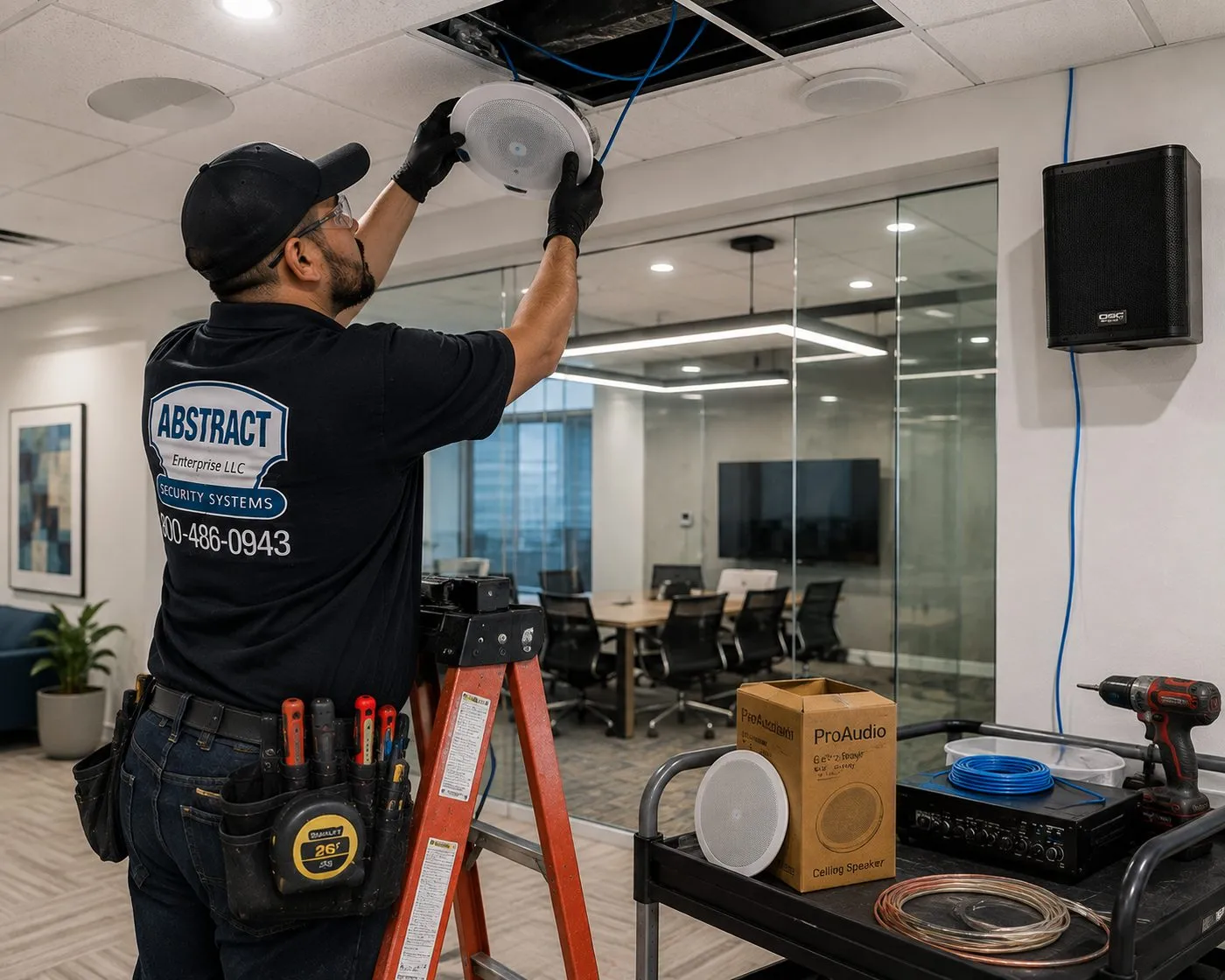
From an orange stepladder, a technician pushes a round white ceiling speaker up into an open ceiling tile; a black wall speaker hangs to his right and a cart below carries a boxed speaker, a drill and coils of copper and blue cable.
Free Rockland Sonos Quote
Town, house style and the rooms you want music in — a reply the same business day
✅
Request Sent!
We'll call you back the same business day.
25+
Years Experience
✓
Same-Day Estimates
100%
Licensed & Insured
4.7★
201 Google Reviews
Music on the main level but nothing in the bedrooms half a flight up? Ring (845) 640-3835 or send the 60-second form with your town and the style of house. A licensed technician reads every request and will tell you, before anyone drives over the Thruway, whether you need another speaker or a better path for the signal.
Rockland prices published line by line, at the county’s 1.30 area rate
Booked into two-hour slots any day of the week, first arrivals at 8 AM, last at 8 PM
Licensed in New York State (#12000287431) and insured; your association or landlord gets our insurance certificate free
Why Rockland County Homes Need Professional Sonos Installation
Rockland is small — the History Society of Rockland County calls it the smallest county in New York State outside the five boroughs, at 176 square miles — but its houses are anything but uniform. The same society’s brief history notes that in the 1950s homes went up here at a rate of more than a thousand a year, driven by the opening of the Tappan Zee Bridge in 1955 and the completion of the Palisades Interstate Parkway and the New York State Thruway in the same decade. The Journal News, looking back in 2016, put the result in one line: the county’s population jumped by 53 percent, from 89,276 in 1950 to 136,203. A great deal of what was built in that rush, and in the two decades after it, was the split-level and the raised ranch. Walk any street off Route 59 in Nanuet or Spring Valley, off Route 304 in New City or off Western Highway in Orangeburg and Blauvelt, and you see the shapes: a garage tucked under bedrooms, a front door between two floors, a living room up six steps and a family room down six.
Those houses are the reason a Sonos job in Rockland is rarely just “plug it in and open the app.” A Sonos speaker is a network device first. In a split-level, the router usually sits wherever the cable company’s line came into the house — often the lower-level den or the room behind the garage — and the signal then has to climb through two or three half-floors, each with a floor deck, a ceiling, ductwork and sometimes a block foundation wall in the way. Sonos’s own guidance on wireless interference rates plaster and concrete as high obstructions and metal as very high, and asks owners to keep their speakers at least 18 inches from other electronics. In a raised ranch, the lower level is half in the ground, with poured or block walls on two or three sides; in a back-split, the bedrooms sit over the garage and the kitchen’s range hood and refrigerator stand between the router and the dining room. None of that stops Sonos working well. It does mean the network has to be planned before the speakers.
The second thing these houses share is that sound travels in them the way the stairs do. A split-level’s living room usually opens straight up the half-flight to the bedroom hall, with no door anywhere. A raised ranch puts the TV room on the lower level and the children’s bedrooms directly over it. Music and movie bass that would stay put in a centre-hall colonial wander through the whole house, so where the speakers point, which rooms get a Sub, and how volume is limited at night all matter as much as which products you buy.
The third is the yard. Rockland lots are mostly suburban — big enough for a deck, a patio and quite often a pool, but small enough that the house next door is well within earshot. That makes outdoor Sonos a neighbour question and, in this county, a code question too. Orangetown’s noise chapter sets actual decibel limits for audio playback devices measured from the property line. Clarkstown’s chapter has no decibel figure; it treats any sound from an electronic device that annoys a reasonable person of normal sensitivities as unreasonable noise, with fines of up to $2,500 for a first offence. In June 2026 the Rockland County Business Journal reported on a long-running dispute over late-night swim parties at a house in Blauvelt, where the hosts had paid $10,000 in town fines in 2025 and agreed to keep outdoor gatherings between 9 a.m. and 11 p.m. through the end of 2027. A backyard speaker plan here needs aiming, zoning and a volume ceiling, not just weatherproof boxes.
And then there is everything that isn’t a split-level. Nyack, Upper Nyack, Grand View and Piermont along the river have Victorian and older houses — the Edward Hopper House on North Broadway was built in 1858 — with plaster, pocket doors and tall double parlours. Haverstraw village, the old brick-making centre of the East, has brick buildings, two-family houses and apartments over shops. Newer subdivisions and townhouse developments fill the gaps between the older neighbourhoods. And households here are large: the Census Bureau’s 2024 American Community Survey puts the county average at 3.3 people per household, which means more phones on the app and more rooms wanting different music at once. Each of those needs a slightly different Sonos plan, and this page walks through them. What we bring to every one is the same: a licensed low-voltage contractor’s view of the network, the cable paths and the speakers together, with published Rockland prices you can check before you book.
Rockland facts that shape a Sonos plan
176 square miles: Rockland’s size, the smallest county in the state outside New York City (History Society of Rockland County). Short drives between jobs keep travel off your bill.
More than 1,000 homes a year: the 1950s building rate the History Society records, after the Tappan Zee Bridge (1955), Palisades Interstate Parkway and Thruway arrived. Stacker’s September 2025 analysis of Census Bureau data gives Rockland a median build year of 1970, with just 11.5 percent of homes from 1939 or earlier.
109,671 housing units and 3.3 people per household: Census Reporter’s summary of the 2024 American Community Survey, which also puts single-unit buildings at 64 percent of the stock and owner-occupied homes at 66 percent.
70 decibels at 50 feet: Orangetown’s daytime limit for audio playback devices and loudspeakers measured 50 feet or more from the source’s property line, falling to 40 decibels between 11 p.m. and 7 a.m.
More than 47,000: Orange & Rockland Utilities customers affected by storms, heat and heavy rain from July 1, 2026, according to the utility’s July 6 update, with outages still open in Clarkstown and Ramapo at the time.
May 14, 2026: the effective date the county gives for the current Chapter 286, Rockland’s home improvement contractor law, adopted by the county legislature on April 14, 2026.
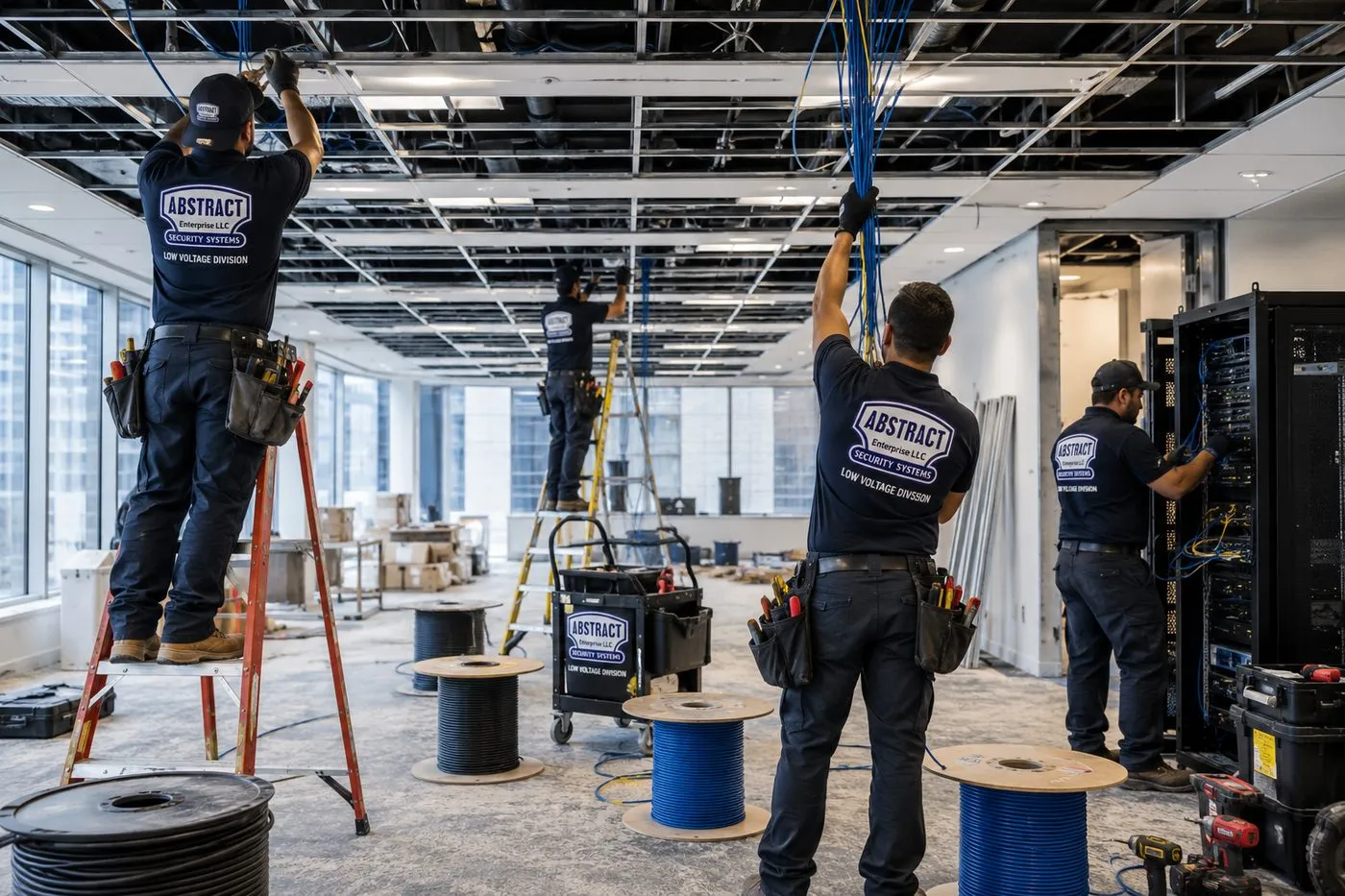
Three technicians work beneath an open ceiling grid: one on a ladder at the left, one feeding blue cable upward in the middle, one at an equipment rack on the right, with spools of cable spread across the floor.
Repair Capture
Sonos Cutting Out Somewhere Between Piermont and Suffern?
A bedroom speaker that drops off the app every evening, a Sub that stopped bonding after the storm knocked the power out, a deck speaker that only works with the slider open, a system that went quiet the day the new Optimum or Fios router arrived — these are nearly always network or settings faults, not dead speakers. A setup-only visit in Rockland is $235 for the first hour, then 30-minute blocks, and most of these faults are found and fixed in one to two hours once a technician is standing in the house. Call (845) 640-3835 and tell us what changed just before it started.
What We Install
Sonos Installation Services in Rockland County
Every one of these jobs begins on the stairs: which level the router is on, which levels need music, and what lies between them. The list below is what Rockland households ask us for most.
Sonos Across Every Level
Era 100, Era 300 and Five speakers placed on the main level, the bedroom level, the lower-level den and the room over the garage, joined into one system, named the way the family talks and grouped so a party can fill the house.
Lower-Level Home Theater
Arc Ultra, Beam or Ray in the den of a raised ranch or the family room of a split-level, with a Sub and rear speakers where the room allows — mounted on block, paneling or drywall and set up so late-night films don’t shake the bedrooms upstairs.
Sonos Amp With Ceiling Speakers
In-ceiling speakers in kitchens and great rooms driven by a Sonos Amp, using the reachable attic above a ranch’s top floor or the open joists of an unfinished lower level to keep the plaster and drywall closed.
Deck, Patio and Pool Audio
Outdoor Speakers made with Sonance under the eaves, or a weatherproof portable for the pool fence, aimed at your own yard, zoned separately from the house and capped with a volume limit that keeps you inside your town’s noise code.
Wi-Fi That Climbs the Half-Floors
A signal reading on every level, access points wired back to the router where the house allows, mesh nodes placed for the stairwell rather than for convenience, and a decision on whether any Sonos product should be wired.
Two-Family and Accessory-Apartment Setups
Separate systems for separate households under one roof — a Haverstraw two-family, a Ramapo house with a lower-level apartment — so neither family’s speakers turn up in the other’s app.
Shops, Salons and Offices
Background music for businesses along Route 59, Route 303 and the village main streets, with ceiling speakers where the space allows and a word about music licensing before the first song plays to customers.
River-Village Houses
Nyack, Piermont and Grand View Victorians with plaster walls and double parlours: wireless-first plans, speakers placed for tall rooms, and tuning that accounts for pocket doors.
Fixing a System That Grew Piece by Piece
The Beam bought one Christmas, the Era added the next, the Move from a birthday — reorganised into one tidy system on a network that can carry it, with old products checked for S1 or S2 compatibility.
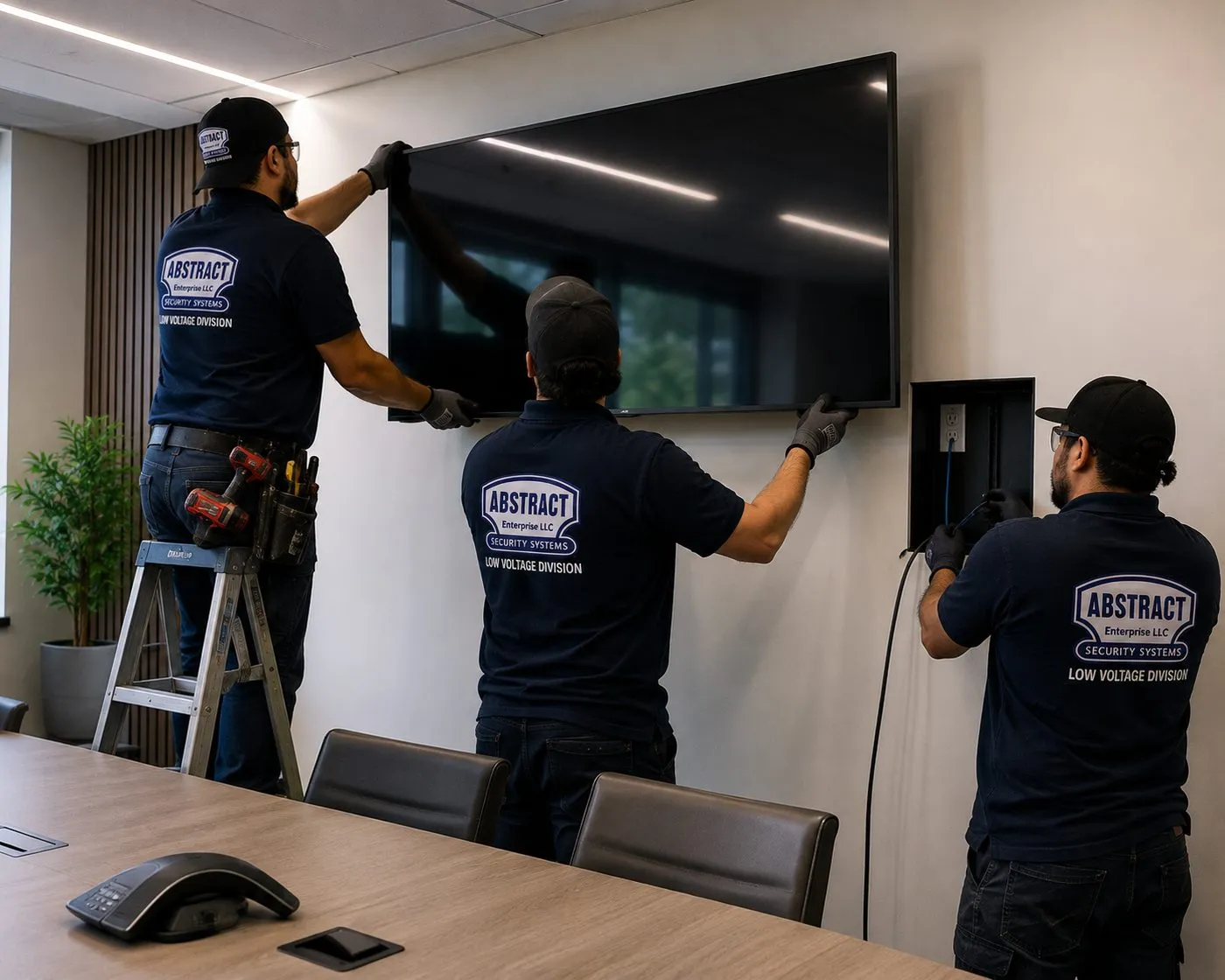
Three technicians hang and cable a large flat display: one on a stepladder steadies the left edge, one guides the middle, and the third works at a recessed wall box below the screen, beside a long conference table.
Building Specialists
Sonos Installation for Rockland County’s Architecture
The shape of a Rockland house decides where its Sonos speakers can go, how the signal reaches them and where any cable can hide. These are the house types we meet most between the New Jersey line and Tomkins Cove, and what each one asks for.
Side-Split and Back-Split Houses
Three or four levels half a storey apart. The router is often on the lowest level; the bedrooms are two half-flights above it. Plans centre on one well-placed access point or mesh node near the stair core, plus wired backhaul if a closet stack allows it.
Raised Ranches
A full upper floor over a lower level that sits partly below grade. The lower level’s block or poured walls stop Wi-Fi sideways; the floor between the two levels carries bass upward. The unfinished garage or utility room is usually the best place for an Amp and a switch.
Post-War Ranches and Capes
Single-storey or storey-and-a-half houses from the 1950s with an attic above and often a basement below — the easiest homes in the county for in-ceiling speakers on a Sonos Amp, because both sides of the ceiling can be reached.
River-Village Victorians
Nyack, Upper Nyack, Grand View and Piermont houses with plaster on lath, tall ceilings, pocket doors and porches. Usually a wireless-first plan with Era speakers and careful tuning, with wire only where a closet or cellar gives a hidden path.
Haverstraw Brick and Two-Family Houses
Masonry party walls and two households under one roof. Separate networks and separate Sonos systems for each unit, and speakers kept off the shared wall so neither side hears the other’s music.
Newer Subdivisions and Townhouses
Drywall, open plans and sometimes low-voltage conduit already roughed in. Condo and homeowners’ associations may set rules for exterior speakers and cable on outside walls; we check before anything goes on the outside of a townhouse.
Methods by material
Half-levels and the stair core
In a split-level, the stair core is the one place where every level meets. A ceiling-mounted access point or a mesh node on the landing between the main level and the bedroom level can often see three of the four floors at once, which is why we look there first. Where a wire is needed to that spot, the usual route is up through the back of a coat closet or a linen closet that stacks above it, or along the garage ceiling and up an outside-wall bay. Sonos’s system requirements say that in a mesh system with a wired Sonos product, that product has to be wired to the primary node — so the node by the router is where any Sonos Ethernet cable belongs.
Block and poured lower-level walls
The lower level of a raised ranch or a split-level den typically has one or more concrete-block or poured walls, often furred out with paneling or drywall. A soundbar or Era bracket on those walls needs masonry anchors rather than wood screws, which is why our price list carries a separate line for concrete or block. Cable along those walls is usually routed in the furring space or the joist bay above, rather than chased into the block.
Plaster in the river villages
The Sonos In-Ceiling installation guide asks the installer to survey for obstructions with a stud finder — studs, conduit, pipes, ducts, pocket doors and air returns — and to drill a small pilot hole and probe with stiff wire if unsure. In a plaster ceiling we add one more step: a scored outline and a slow cut, so the plaster keys stay intact around the opening. Where plaster is fragile, we steer the plan towards free-standing speakers instead.
Garages under bedrooms
Back-splits and raised ranches often put a bedroom over the garage. The garage ceiling is open or easily opened, so it gives an excellent cable route — but a garage is not a home for electronics. Sonos lists the Amp’s operating range as 32°F to 104°F, so in an unheated garage the Amp moves to a closet or the utility room and only the cable passes through.
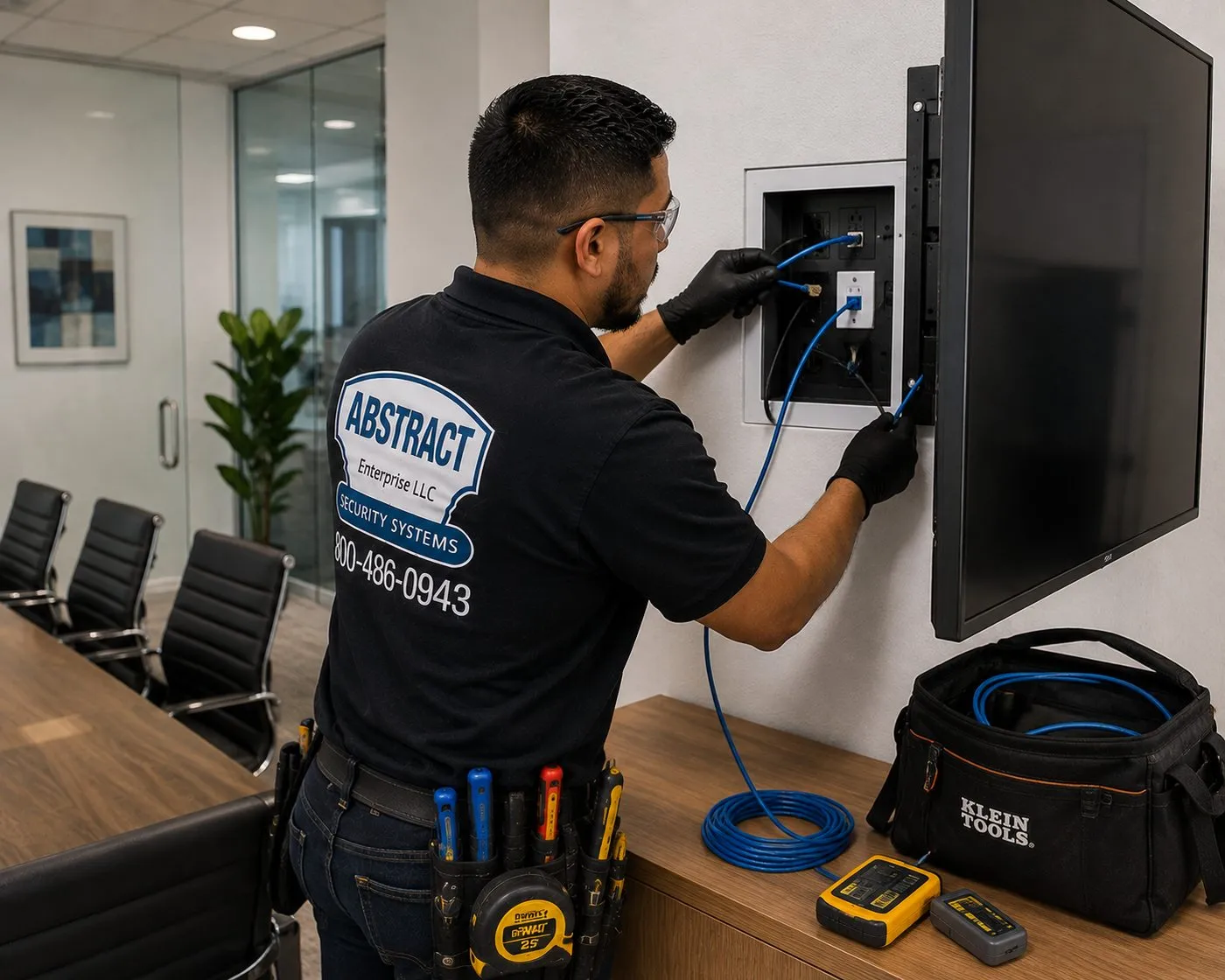
A technician connects a blue cable inside a recessed box cut into the wall beside a mounted screen; a black tool bag, coiled cable and a yellow tester sit on the counter below.
Split-Levels and Raised Ranches
Four Half-Floors, One Router: Planning Sonos for a Rockland Split-Level
A split-level is four small houses joined at a staircase, and the most common Sonos complaint we hear in them is that the music works on two levels and not the other two. The fix is almost never a different speaker. It is a better path for the signal between levels, and a clearer idea of which rooms should play together.
Start with where the internet comes in. In most Rockland split-levels and raised ranches the cable or fibre line enters on the lowest level — the den, the laundry, the room behind the garage — and the provider’s router sits right there. From that corner, a signal heading for the main bedroom has to cross the den ceiling, the main-level floor, often the kitchen with its appliances, and then the bedroom-level floor. Every floor deck, every duct trunk and every refrigerator takes a share. Sonos says every product it makes can connect on 2.4 GHz, the band that travels furthest through floors, and lists routers that broadcast only 5 GHz as unsupported. Many new mesh and provider routers merge the two bands under one name, which is fine for Sonos as long as the 2.4 GHz side stays switched on.
Next, decide where the second radio goes. One access point or mesh node near the middle of the stair core does more in a split-level than two nodes at the far ends of the house. If a cable can reach that point — up a closet stack, along the garage ceiling, or through an attic over the top level — it should, because a wired node keeps its full speed. If no cable can reach, a mesh node on the landing still usually beats one in a bedroom. What we avoid is the plug-in range extender: Sonos lists wireless range extenders and Ethernet-over-power adapters among the things its systems do not support.
Then group rooms by level, not by room count. A typical four-level house plays as four Sonos rooms or fewer: the main level (living, dining and kitchen often share one open volume and can be a single Era 300 or a stereo pair), the bedroom level (one small speaker per bedroom that wants music), the lower-level den (usually the home theater), and the top or over-garage room. Grouping across levels for a party is a two-tap job in the app once the network can carry it; keeping levels as separate rooms the rest of the time stops the teenager downstairs and the parent in the kitchen from fighting over one speaker.
Finally, think about where sound goes once it leaves the speaker. The open half-flight that lets you call up to the bedrooms also lets a soundbar’s bass and a kitchen speaker’s music climb straight to them. Pointing speakers into their rooms and away from the stairwell, keeping Subs off the walls that back onto bedrooms, and setting a volume limit on rooms near sleeping areas does more for family peace than any product upgrade.
Raised-ranch rule of thumb: treat the two floors as two separate networks joined by one good link. The lower level’s block walls stop Wi-Fi sideways, so a router in a lower-level corner may cover the room above it better than the lower-level room at the other end of the house. A cable from the router to an access point near the top of the inside stairs is usually the single most useful thing we install in these houses.
What a typical Rockland split-level system looks like
Level
Common Sonos layout
What usually needs attention
Lower level / den
Arc Ultra, Beam or Ray at the TV; Sub under or beside the sofa; Era 100 pair as rears if the room is deep enough
Block wall anchors; bass carrying into the bedrooms above; router often in the same room
Main level
Era 300 or a stereo pair of Era 100 in the open living-dining-kitchen space, or ceiling speakers on a Sonos Amp
Appliances and duct trunks between router and speakers; open stair to the bedrooms
Bedroom level
One small speaker per bedroom that wants music
Weakest signal in the house; volume limits for younger children’s rooms
Over-garage room
Era 100 or Five for an office, playroom or guest room
Garage below is cold and outside the heated envelope; the room is often furthest from the router
Deck or patio
Outdoor Speakers made with Sonance on an Amp, or a Move 2
Aim, zoning, volume ceiling and the town’s noise code
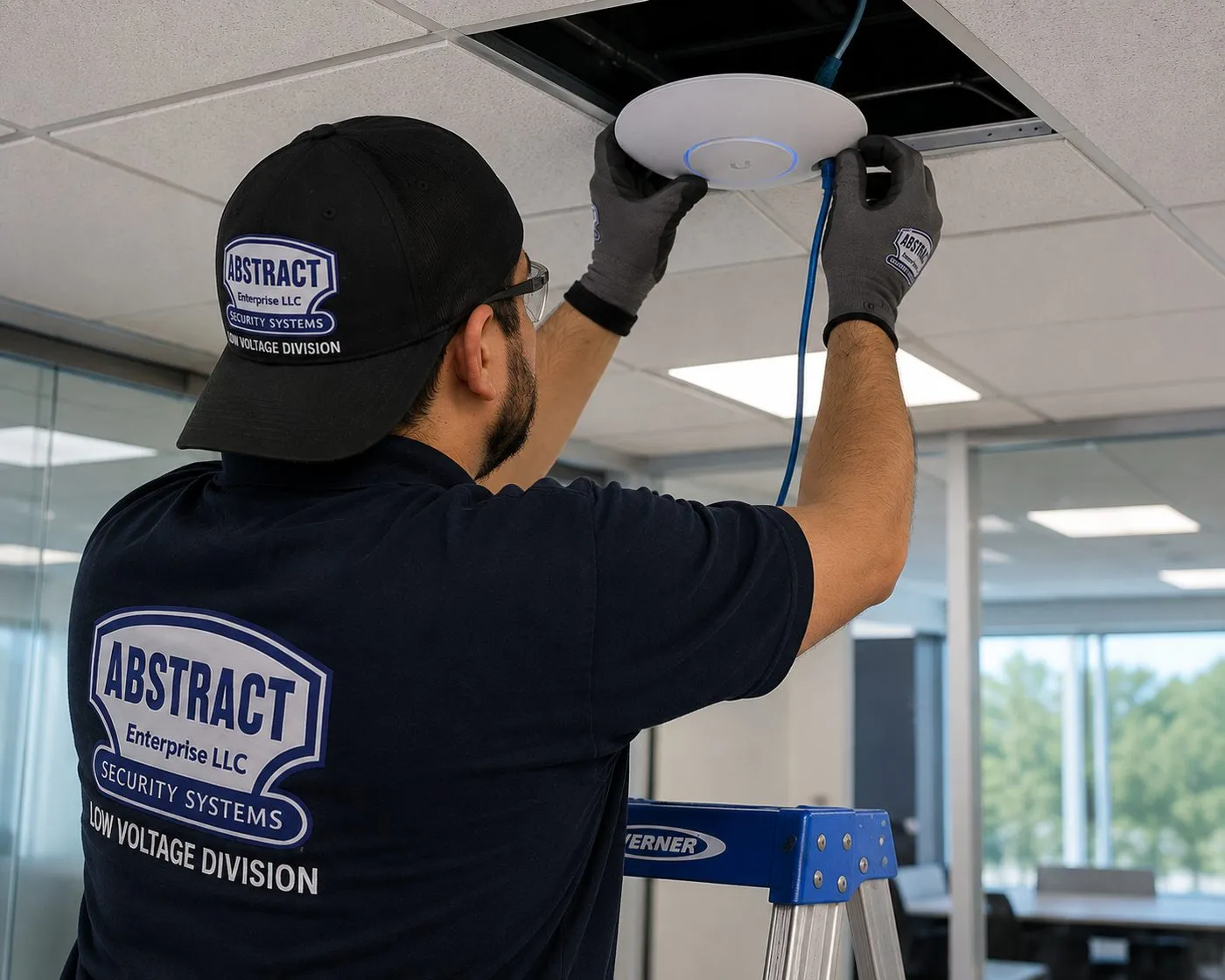
Seen from behind, a gloved technician raises a round white access point, its blue cable trailing, towards an open tile in a drop ceiling; a stepladder stands at his side.
Commercial Sonos
Business Sonos Installation in Rockland County
Sonos markets installed systems to businesses as well as homes, and in Rockland the shops, salons, studios and offices that want background music are spread along a few busy roads and a handful of village centres. Here is where we work and what each place tends to need.
Route 59 — Nanuet to Suffern
The county’s main commercial road, which the History Society notes roughly follows the old Nyack Turnpike between Nyack and Suffern. Strip centres, salons, gyms and medical offices in Nanuet, Spring Valley, Monsey and Airmont want even background music across a long, narrow unit.
Palisades Center, West Nyack
The four-level mall at Routes 59 and 303 opened on March 4, 1998, with about 2.2 million square feet of floor area. Mall tenants work to landlord rules on contractors and insurance, so a free certificate of insurance is often the first thing we send.
Route 303 — Orangeburg to Congers
Offices, light industrial units and showrooms along 303 through Orangeburg, Blauvelt, West Nyack and Congers. Break rooms, showrooms and reception areas are the usual Sonos spaces, often on a business network that needs Sonos placed on the right segment.
Nyack’s Main Street and Broadway
Restaurants, cafés, galleries and boutiques in older buildings with tin or plaster ceilings and apartments upstairs. Low, even music matters more than volume, and a residential neighbour is often just one floor away.
Haverstraw and Stony Point on Route 9W
Main Street shops in Haverstraw village, marinas and waterfront businesses along the river, and restaurants on 9W. Brick buildings, long narrow rooms and outdoor seating with speakers that must stop at the property line.
Village Centres: Pearl River, Suffern, New City
Small offices, studios, dental and medical practices with waiting rooms. Usually a Sonos Amp with ceiling speakers in a drop ceiling, or two Era speakers on wall brackets, with one simple control for the front desk.
Before the first song plays to customers: personal streaming accounts are not licensed for business use. Spotify’s own support page says the service is “only for personal, non-commercial use” and that you can’t play it publicly from a business “such as bars, restaurants, schools, stores, salons, dance studios.” We install and set up the speakers; choosing a business music service and any licences is the business owner’s decision, and we will connect whichever service you choose. Nothing here is legal advice.
Compliance callouts for Rockland businesses
Electrical work: a new outlet or circuit for an equipment rack or an outdoor speaker amplifier is for a licensed electrician. We tell you before the visit if your plan needs one.
Outdoor seating: speakers on a patio or sidewalk area are subject to the town’s noise rules in the same way as a backyard — Orangetown’s decibel limits apply to loudspeakers and sound amplifiers as well as playback devices.
Landlord and mall rules: many leases control contractor hours, ceiling access and insurance. We follow them and provide the certificate of insurance free.
Ceiling space: in drop-ceiling offices, speaker cable is supported independently rather than laid on the tiles, and anything in an air-return plenum must be rated for it.
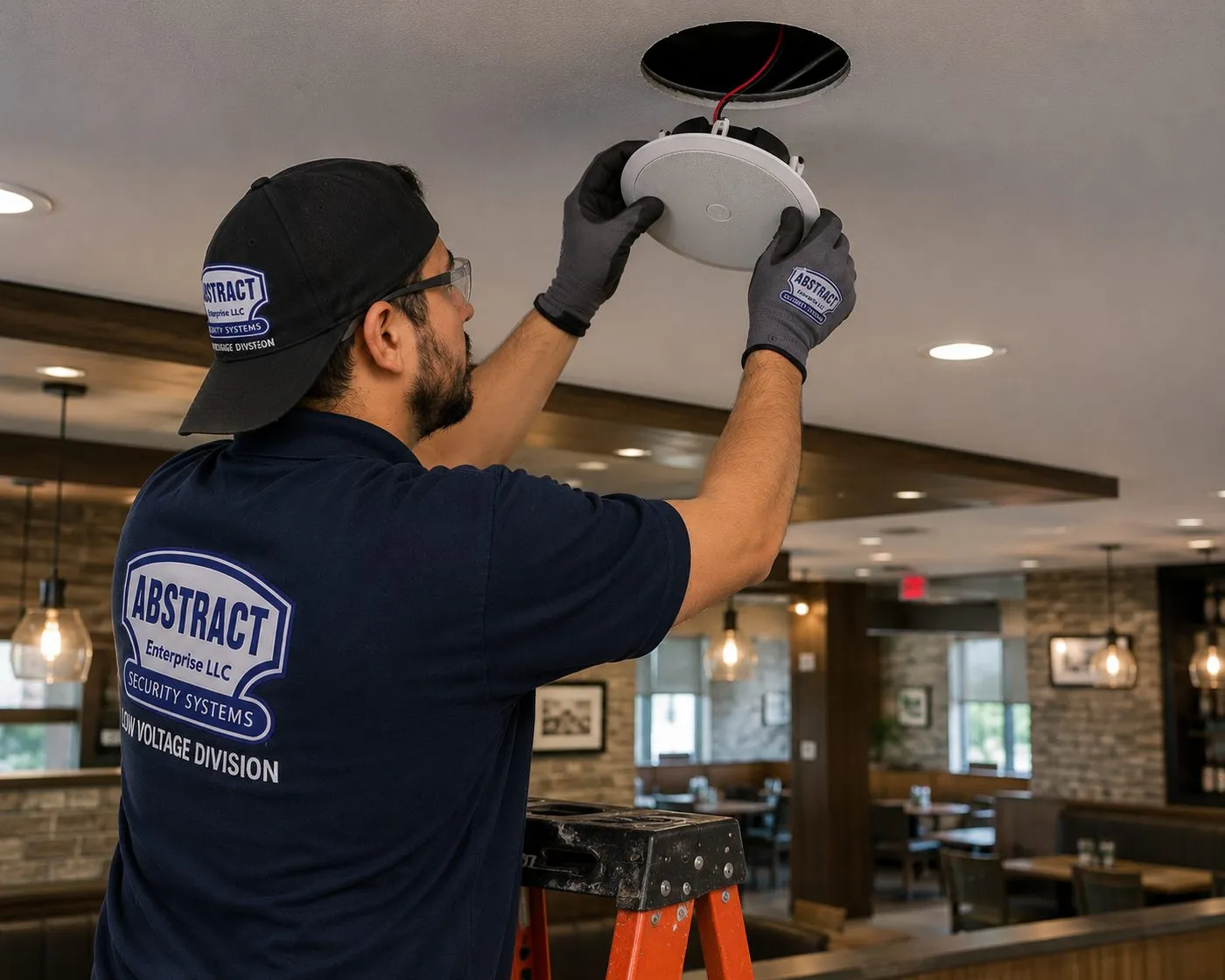
A technician in gloves pushes a round white ceiling speaker into its cut-out above a restaurant dining room, with wooden booths, pendant lights and an exposed brick wall behind him.
Outdoor Audio and the Law
Backyard Sonos and Rockland’s Town Noise Codes
Deck and pool speakers are among the most-requested Sonos jobs in Rockland, and also the ones most likely to end in a knock on the door. Two of the county’s five towns show how differently the rules can be written.
Orangetown: numbers you can measure
Chapter 22 of the Orangetown code, covering Blauvelt, Orangeburg, Pearl River, Tappan, Sparkill and the unincorporated areas around the villages, lists the playing of any “music or audio playback device … loudspeaker, or sound amplifier” in a way that disturbs the neighbours, with limits measured at the point of disturbance:
Time
Less than 50 ft from the source’s property line
50 ft or more from the property line
7:00 a.m. to 11:00 p.m.
80 decibels or greater
70 decibels or greater
11:00 p.m. to 7:00 a.m.
60 decibels or greater
40 decibels or greater
The overnight figure for 50 feet or more is half the daytime one, so in practice outdoor music in Orangetown should be off, or down to a murmur, by 11 p.m.
Clarkstown: no number, a reasonable-person test
Clarkstown’s Chapter 205, which covers New City, Nanuet, Bardonia, Congers, Valley Cottage, West Nyack and the other unincorporated hamlets, defines unreasonable noise as any sound from “any mechanical or electronic device” that is audible and “threatens to or actually annoys, disturbs, injures or endangers the comfort, repose, health, peace or safety of any reasonable person of normal sensitivities.” There is no decibel figure and no set quiet hour for music. Enforcement is by the Clarkstown Police Department, and the penalties climb: a fine of up to $2,500 for a first offence, and higher minimums for repeat offences within 18 months.
What that means for the speaker plan
Aim inward. Speakers under the eaves pointing back across the deck towards the house, not out towards the fence line, keep more sound on your own lot.
More speakers, less volume. Two or four speakers at a modest level cover a deck more evenly than one loud pair, and a quieter system at the property line.
Zone the yard separately. The deck should be its own Sonos room, so turning the house up for a party doesn’t turn the yard up with it.
Cap it. Sonos lets you set a volume limit for any room on a 0–100 scale in the app’s sound settings. We set the outdoor room’s ceiling with you at the property line, so nobody can accidentally exceed it.
Villages have their own codes. Nyack, Piermont, Suffern, Spring Valley and the county’s other incorporated villages write their own local laws; if you live in one, check its code or ask the village clerk.
This section summarises published town code text for planning purposes. It is not legal advice, and codes change; check the current text with your town or village.
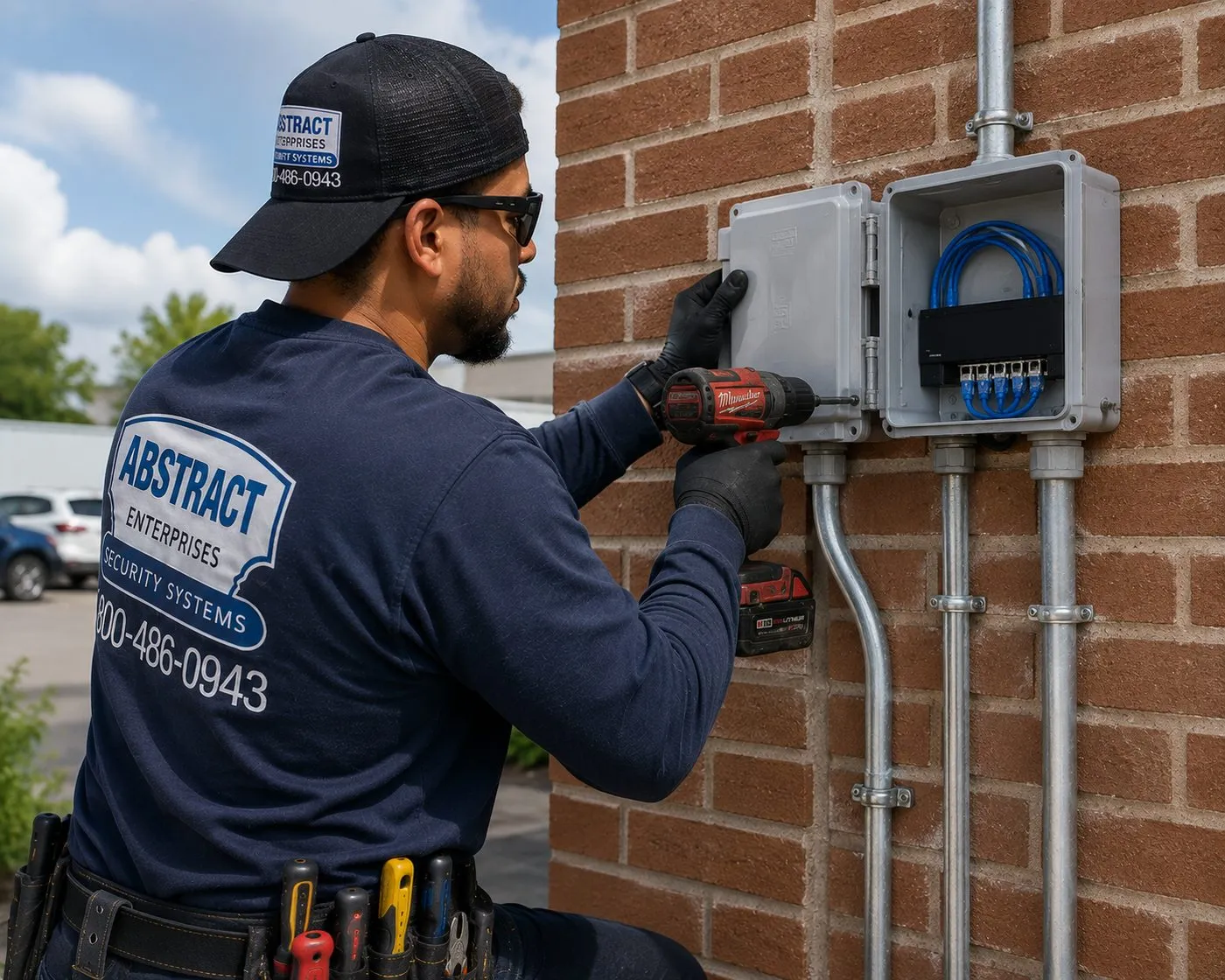
Outside on a brick wall, a technician drills to secure a grey weatherproof enclosure; runs of metal conduit drop from it, and a second open enclosure beside it shows blue cable inside.
Across Rockland
How Sonos Jobs Change Across Rockland’s Five Towns
Rockland has five towns and a long list of villages inside them. The house types overlap, but each town has a character that shows up in the Sonos work we are asked to do.
Clarkstown — New City, Nanuet, Congers, Valley Cottage, West Nyack, Bardonia
Street after street of split-levels and raised ranches from the post-bridge decades, with newer colonials mixed in. Typical jobs: a lower-level home theater, a speaker per level, and a deck zone. Clarkstown’s reasonable-person noise standard makes the outdoor volume limit worth setting carefully. Rockland Lake State Park sits on the Congers–Valley Cottage side of the town.
Orangetown — Pearl River, Orangeburg, Blauvelt, Tappan, Sparkill, Piermont, Nyack
A mix of post-war capes, ranches and split-levels across Pearl River, Orangeburg, Blauvelt and Tappan, and older river-village houses in Piermont, Grand View, South Nyack and Nyack. Typical jobs: wireless-first plans for plaster houses, ceiling speakers in ranches with reachable attics, and outdoor speakers set to Orangetown’s decibel limits.
Ramapo — Suffern, Spring Valley, Monsey, Airmont, Hillburn, Sloatsburg, Wesley Hills
Older village centres in Suffern and Spring Valley, newer subdivisions in the hamlets between them, and a good share of two-family houses and homes with a separate apartment. Typical jobs: whole-house systems for large households, separate systems for separate units, and business audio along Route 59.
Haverstraw — Haverstraw village, West Haverstraw, Garnerville, Pomona
Haverstraw village was, in the History Society’s words, the brick-making centre of the East, and its building stock still shows it: brick buildings, two-family houses and apartments over shops. Further from the river the housing turns to single-family streets with decks and yards. Typical jobs: two-family setups, brick-wall mounting and outdoor speakers on view decks.
Stony Point — Stony Point, Tomkins Cove
The northern end of the county, between the river and the parkland around Bear Mountain, with the Stony Point Battlefield and its 1826 lighthouse at the water. Typical jobs: longer runs from the house to a detached garage or pool area, and Wi-Fi coverage across bigger plots.
Your Questions Answered
Sonos Installation in Rockland County: Questions Answered
Rockland questions come in clusters: sound travelling between levels, the backyard and the neighbours, households sharing a house, walls and old rooms, and the paperwork. Each answer starts with the short version. Booking and price questions are in the FAQ further down.
Sound that travels between levels
Our split-level’s living room opens up the half-stairs to the bedrooms — how do we keep the music from filling the bedroom hall?
Point the speakers into the living room and away from the stair opening, keep them off the wall the stairs run along, and give the bedroom-level rooms their own volume limits. In most split-levels the living room’s back wall is the stairwell, which is exactly where people want to put a speaker because there is an outlet. A speaker on the opposite wall, firing back into the room and towards the sofa, delivers the same sound to the listener with far less of it going up the stairs.
For ceiling speakers, placement matters even more. Sonos’s guide to ceiling speakers suggests a left and right pair about 6 to 10 feet apart; in a split-level we keep the pair over the seating area, at least a few feet in from the stair opening, so the sound lands on the room rather than pouring through the gap. A stereo pair of small speakers at moderate volume also carries less up the stairs than one large speaker turned up to fill the same room.
Then use the software. Each Sonos room can have its own volume limit, and the living room can be grouped with the kitchen for a party and ungrouped afterwards so the bedrooms stay out of it. We set those limits with you standing in the bedroom hall, listening, rather than guessing.
Which Sonos settings keep late-night movies quiet without losing the dialogue?
Night Sound and Speech Enhancement, both in the home theater settings for Sonos soundbars. Sonos’s Beam guide describes Night Sound as enhancing quiet sounds and reducing the intensity of loud ones, so explosions and music cues come down while whispers stay audible. Speech Enhancement lifts dialogue so you can turn the overall volume lower without missing lines.
In a raised ranch, where the den is directly under the bedrooms, we also turn the Sub level down from its default after Trueplay has run, and place the Sub away from walls that carry up into the floor above. A Sub against the outside block wall of a lower level usually transmits less into the bedrooms than one against a stud wall that rises into the upper floor.
Finally, a volume limit on the den room stops anyone from accidentally starting the 11 p.m. film at the level the afternoon football was playing at. These are all app settings we show you at handover, so you can change them yourselves.
Our raised ranch has a TV on each floor — can one Sub serve both, or does each room need its own?
A Sonos Sub is added to one home theater room, so it serves the TV it is set up with, not both. If both TVs need deep bass, each room needs its own Sub; if only one does, the Sub goes with the room that hosts the films and the other room gets a soundbar on its own.
In practice most Rockland raised ranches put the “movie” system downstairs in the den, with an Arc Ultra or Beam, a Sub and rear speakers, and give the upstairs living room a Ray or Beam without a Sub, which keeps the bass off the bedroom floor at night. Sonos lists the Sub 4 as compatible with Arc Ultra, Arc, Beam (Gen 1 and 2) and Ray, among others, so either room can take one later.
Both soundbars still sit in one Sonos system. On a Saturday the two TV rooms, the kitchen and the deck can all be grouped to play the same music; on a weeknight they work independently.
The backyard and the neighbours
Measuring at the property line
The practical test is a measurement. With the deck speakers playing typical music at the level you like, someone walks to the property line with a sound level meter and takes readings while the volume is raised step by step. In Orangetown you can compare the readings with the code’s figures directly; in Clarkstown, where the test is whether a reasonable neighbour is disturbed, the measurement gives you a sensible, recorded ceiling rather than a number in the law.
We do this at handover for every outdoor zone we install, then note the app volume that produced an acceptable reading. That number becomes the room’s volume limit. It is not a guarantee that no neighbour will ever complain — wind, time of day and what is playing all change how sound carries — but it gives you a defensible, consistent starting point.
If you live in one of the county’s villages, its own code applies. We can look the chapter up with you before the visit so the measurement is made against the right rule.
A volume ceiling for the deck
Sonos lets you set a volume limit for each room on a 0–100 scale, from the room’s sound settings in the app. Once the deck room is limited, anyone who pushes the volume to the top — a guest, a teenager, a voice command — only reaches the level you agreed.
The limit applies to the room, not the phone, so it holds whoever is controlling it. It also holds when the deck is grouped with the house: the house can be louder while the deck stays at its ceiling.
If you want different limits by time of day, the simplest approach is two agreed levels — a daytime limit and a lower evening one — and a habit of switching at dusk. We show you where the setting lives so it takes seconds.
Orangetown’s limits drop at 11 p.m. — can the deck music switch itself off?
Yes, for a given session. Sonos’s sleep timer turns the music off automatically after a period you choose, so if guests are still out at half past nine, a 90-minute timer on the deck room ends the outdoor music before the overnight figures in Orangetown’s Chapter 22 apply. The house can keep playing.
The timer is set each time from the app; it is not a standing schedule. For households that entertain often, we pair it with a habit — deck zone off when the patio lights go off — and with the room’s volume limit as the backstop.
Households sharing a house
Keeping two households’ speakers apart
In a two-family house on one internet line, each family’s speakers can turn up on the other’s phone, which is why we split the network before setting up either system. When two households share one Wi-Fi network, their Sonos speakers can appear during setup on both sides and it becomes easy to add a neighbour’s speaker to your own system by mistake. Separate networks — two internet services, or one service split properly into two networks — keep each family’s speakers private.
Each system is registered to its own household’s Sonos account, named for that unit and controlled only from that family’s phones. If the owner upstairs ever wants to play music in the shared yard, the yard speakers belong to one system or the other; we agree which before we install them.
The same approach works for a house with a separate lower-level apartment for grandparents or a tenant. Sound is the other half of the job: we keep speakers off the wall or ceiling the two units share, and steer bass-heavy products away from it.
Our tenant has their own Sonos — can the yard speakers belong to both households?
Not at the same time. A Sonos product belongs to one system, so wired yard speakers on an Amp are controlled by whichever household’s system the Amp joins. We agree that with both of you before anything is mounted, and write it into the agreement.
If both families want the yard, the usual answer is that the owner keeps the wired speakers and the other household uses a weatherproof portable — Move 2 is rated IP56 and Roam 2 has up to 10 hours of battery — on their own system when the yard is theirs.
Different music in different rooms
Every Sonos room, or group of rooms, can play its own source independently, so the den can play a game’s soundtrack while the kitchen plays a podcast and a bedroom plays an album. That is the normal state of a multi-room system; grouping is the exception you choose.
What can limit it is the music service, not Sonos. Many streaming plans restrict how many streams one login can play at once, and family plans exist for exactly this reason. If two people want the same service in two rooms at once, check that your plan allows it or that each person has their own login.
With 3.3 people in the average Rockland household, we add each person’s service to the system during setup and show everyone how to pick their own room in the app, so nobody takes over someone else’s speaker by accident.
Walls, mounts and older rooms
An Arc Ultra on a painted block wall
It works well with masonry anchors set into solid block rather than the hollow cores, and with the cable route planned before the first hole. Sonos’s Arc Ultra measures 46.38 inches wide and weighs 13.01 pounds, and its dedicated wall mount keeps it close to the wall; Sonos says the Arc Ultra detects that it has been wall-mounted and adjusts its EQ to temper bass resonance from the wall.
The bigger question in a lower-level den is where the HDMI and power go. Block walls can’t take the in-wall power and cable kit that drywall can, so on block we use a paintable cord cover from the TV down to the outlet and media unit, or a short route through the furring space if the wall has been framed out. Our price list carries a block or concrete wall line for exactly this case.
Sonos’s guide also asks for at least 4 inches between the bar and the TV above it. On a low lower-level ceiling that can push the TV higher than you would like, so we measure with you before choosing heights.
Our Victorian’s double parlour has pocket doors — do we tune Sonos with them open or shut?
Tune it the way you usually listen. Sonos says Trueplay measures how sound reflects off walls, furnishings and other surfaces, so an open pair of pocket doors that doubles the room’s size gives a different result from a closed one. If the doors stand open most of the time, tune with them open.
Sonos also advises re-tuning after moving a speaker or changing a stereo pair. If you regularly switch between one big room and two small ones, the practical answer is to tune for the arrangement you use most and accept a small difference in the other, or to treat the front and back parlours as two Sonos rooms that you group when the doors are open.
Trueplay tuning takes about three minutes per room and, for most products, needs an iPhone or iPad; Arc Ultra, Beam Ultra, Era 100, Era 100 Pro and Era 300 can also use quick tuning from Android. If nobody in the house has an iPhone, we tune with ours during the visit.
Older Sonos products and the current app
Some older speakers can join a new system and some can’t, and we check each model before you buy anything new. Sonos runs two apps: products that only work on the older S1 app can’t be part of a system that runs on the current app with newer products such as Arc Ultra or Era 300.
S1-only products are also limited in how they connect: Sonos lists them as using 802.11b/g on 2.4 GHz only, without support for WPA3 security. A router configured for WPA3-only, as some newer models can be, will leave them stranded.
If an older product can’t join, you have choices: keep it as a separate small system in a room of its own, use a Port or Amp-based route for an older hi-fi instead, or retire it. We will tell you which products are holding the rest back.
Our bedrooms sit over the garage — is the garage ceiling a good route for Sonos speaker wire?
Often the best one in the house. In back-splits and raised ranches the garage ceiling is unfinished or simple drywall, so a cable can cross the whole footprint and turn up into a closet or an outside-wall bay above without touching a finished room. We drill up through the top plate inside a closet, where any patch stays out of sight.
Two cautions. The ceiling between a garage and living space is usually there for fire separation, so any opening we make is sealed again rather than left open. And the garage is outside the heated house: cable can pass through it, but Sonos lists the Amp’s operating range as 32°F to 104°F, so the electronics stay indoors.
Internet, contracts and licences
Does a slow upload speed on our cable internet affect Sonos?
Not for listening. Streaming music to Sonos uses your download speed; upload is barely involved. On r/Rockland, a resident comparing providers wrote that Optimum in Nanuet is “a DOCSIS 3.1 cable service, so the upload is asymmetric” — which matters for video calls and cloud backups, but not for a playlist in the kitchen.
What does matter is the home network inside the house: how far the Wi-Fi reaches, whether the router keeps 2.4 GHz switched on, and whether every Sonos product and every phone running the app are on the same network and subnet, as Sonos requires. Those are the faults behind most Rockland dropouts, whichever company brings the internet to the door.
One thing does change when you switch provider: the new router usually comes with a new network name and password, and the Sonos system has to be moved across. We can do that as a setup-only visit.
Chapter 286: Rockland’s contractor law and the person you hire
Rockland County requires anyone performing home improvement work on residential property to hold a county Home Improvement License under Chapter 286, enforced by the Office of Consumer Protection; the current law was adopted on April 14, 2026, and the county gives its effective date as May 14, 2026. Electrical and plumbing work are licensed separately and excluded from the chapter.
Whether a particular Sonos job counts as home improvement work is for the county to decide, not for a website. Setting up a speaker on a shelf is plainly different from cutting ceilings and running cable through walls. Our advice is simple: for any job that opens walls or ceilings, ask the installer for their county licence number and check it on the county’s Licensed Businesses dashboard before you sign.
Our New York State low-voltage licence number is 12000287431, and we provide a certificate of insurance free of charge. Nothing here is legal advice.
What the written agreement spells out
Exactly what will be installed, where, at what price, and how changes are handled. Chapter 286 sets a useful standard for home improvement contracts in the county: the agreement has to be in writing, legible and in plain English; the owner must receive a signed copy before any work starts; and additional work over $500 can’t be done without a written change order signed by both sides.
For a Sonos job, that means the list of rooms and products, which items are ours and which are yours, every line-item price, any wall surcharges, what is quoted after the walkthrough, and what is excluded — electrical work, patching and painting, and products you buy yourself. Whether or not a given job falls under Chapter 286, we write it up that way.
Our own terms are stated plainly too: Full terms — including 50% deposit, one-year parts-only warranty on AESS-supplied products, and the late-fee schedule — are set out in the service agreement.
If we add a room halfway through the job, how is the extra work approved?
In writing, before we do it. Chapter 286 says additional home improvement work over $500 can’t be performed without a written change order approved by both sides, and we follow the same habit for any change: the extra room, its line items and the new total on one page, signed before the drill comes out.
Small additions that come straight off the price list — another speaker added to the app, a cord cover — are still written onto the job sheet, so the final invoice never holds a surprise.
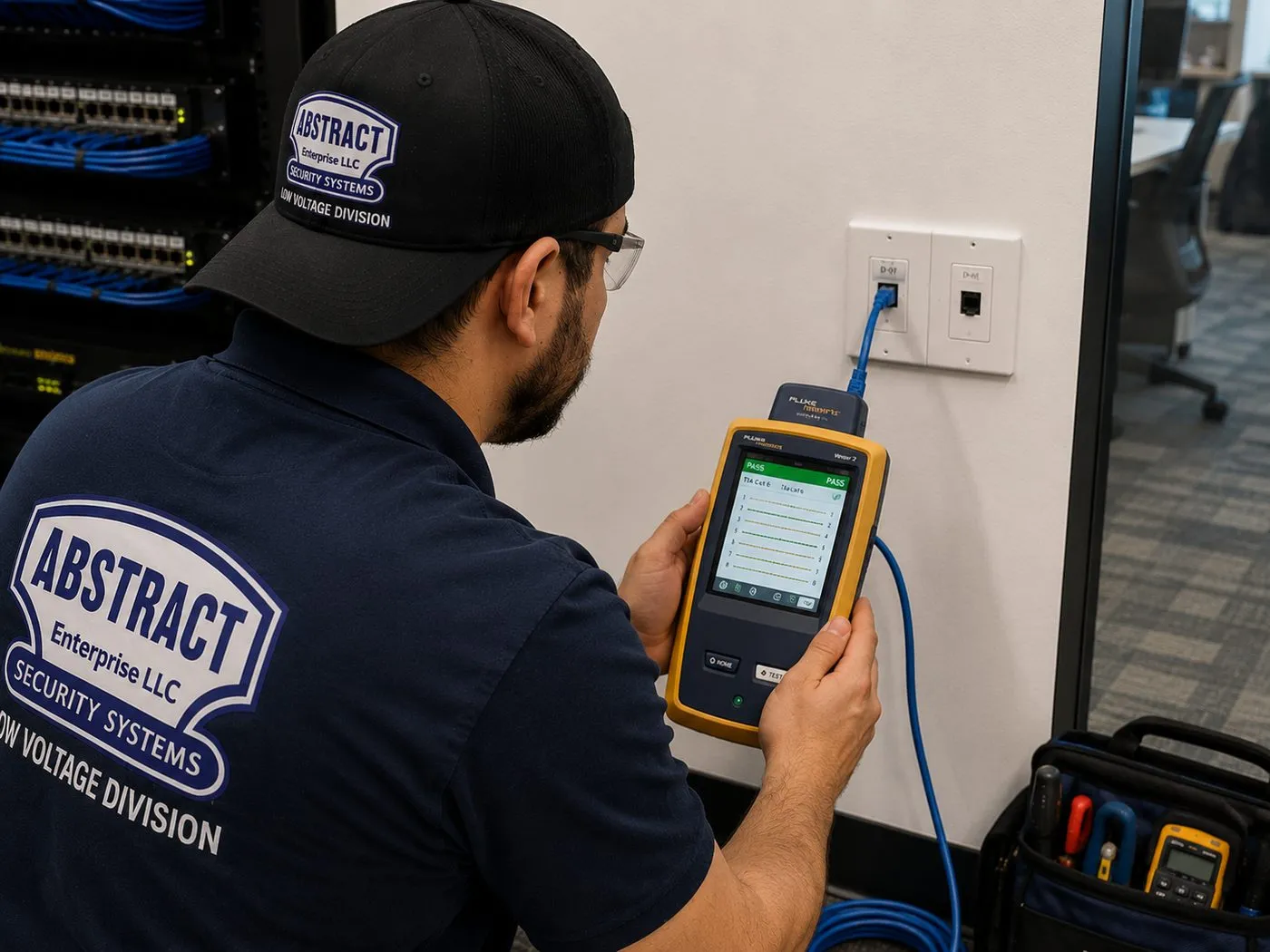
A technician holds a yellow handheld cable tester whose blue lead runs to a white wall jack, with a network rack full of blue patch cables at the left edge of the frame.
Equipment
Types of Sonos Systems We Install
We install the current Sonos range and connect the older products that can still join it. You can buy the products wherever you like, or ask us to supply them. Specifications below are as Sonos or a named reviewer publishes them.
Arc Ultra
The large soundbar: 46.38 inches wide, 13.01 pounds, HDMI eARC, Wi-Fi 6 and Bluetooth, Trueplay from iOS or Android. Detects wall-mounting and adjusts its EQ. Our first choice for a lower-level den with a big screen.
Beam (Gen 2) and Ray
Beam connects by HDMI ARC/eARC and suits mid-size rooms and upstairs living rooms; Ray connects by optical and is the compact choice for a bedroom TV or the over-garage room.
Sub 4
15.31 × 15.83 × 6.22 inches and 25.99 pounds; can lie flat under a sofa with at least an inch of clearance above. Joins Arc Ultra, Arc, Beam or Ray. Placed with the bedrooms above in mind.
Era 100 and Era 300
The everyday room speakers. Era 100 pairs as stereo or as rear surrounds; Era 300 adds height for spatial audio. Sonos’s Era 300 wall mount is stud-mounting only, not for drywall alone — which matters on paneling and plaster.
Sonos Amp
125 watts per channel into 8 ohms, HDMI ARC, line in, two Ethernet ports and a sub output. Drives in-ceiling, in-wall and outdoor passive speakers; up to three pairs of Sonos Architectural speakers in parallel. Operating range 32°F to 104°F, so it lives indoors.
In-Ceiling Speakers Made With Sonance
6-inch model needs an 8.25-inch cut-out; the 8-inch needs 10.125 inches. Passive, optimised for the Amp, paintable grilles. Sonos suggests a pair for spaces up to about 150 square feet.
Outdoor Speakers Made With Sonance
Rated IP66 and for −13°F to 149°F, engineered for humidity, water, salt spray, heat, UV and freezing temperatures. Driven by an Amp kept indoors; Sonos specifies 16-gauge wire or heavier.
Move 2 and Roam 2
Portables for the pool and the porch: Move 2 rated IP56 with up to 24 hours of battery; Roam 2 up to 10 hours. Move 2’s charging base is for indoor use only.
Port and Five
Port brings an existing receiver or hi-fi into the system with analog and coaxial outputs and a 12V trigger; Five is the large stand-alone speaker with a line-in for a turntable setup.
Which products connect how
Question
What Sonos says
What it means in a Rockland house
Which Wi-Fi band?
Every product connects on 2.4 GHz; routers broadcasting only 5 GHz are unsupported
Keep 2.4 GHz switched on in the provider or mesh router
Can products be wired?
A wired product creates a dedicated Sonos wireless network; Arc Ultra, Era 100, Era 100 Pro, Era 100 SL, Era 300, Move 2, Roam 2 and Sub 4, among others, don’t use it and stay on home Wi-Fi or Ethernet
In a mixed system of new and older products, the wired option is a judgment call we make on site
Extenders and powerline?
Wireless range extenders and Ethernet-over-power are unsupported
Mesh nodes or wired access points instead of plug-in extenders on the bedroom level
Guest networks?
Guest and portal log-in networks are unsupported
Visitors join your main network to use the app or AirPlay; a portable with Bluetooth can play straight from a guest’s phone
Wiring an Era?
Sonos’s $39 Combo Adapter hardwires Era 100, Era 300, Move 2 and others
Useful for the den speaker sitting next to the router
How many products?
Up to 32 in one system
Ample for even a large house
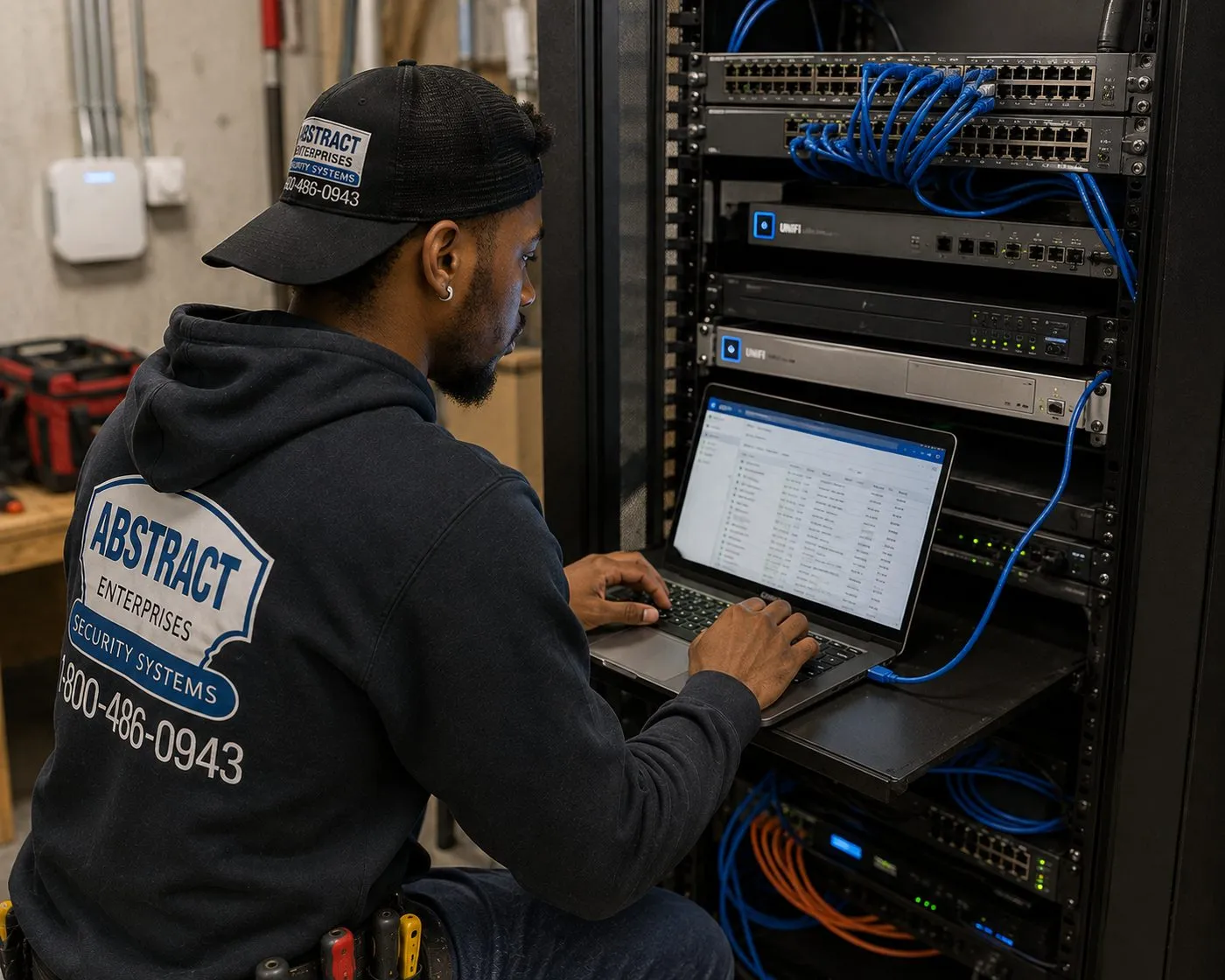
A technician sits at a laptop on a pull-out shelf in a network rack, with a row of switches and blue patch cables above him and orange cable looping in the lower part of the rack.
AI Overview Reality Check
What AI Gets Wrong About Sonos Installation in Rockland County
Google’s AI Overview could not be viewed from the environment this page was researched in, so we do not quote it. Instead, here are seven claims that cost guides, product marketing and online summaries repeat about Sonos, each checked against what Sonos publishes and against what Rockland houses actually do.
“One good router covers an ordinary family house”
In a single-storey ranch with the router in the hall, one router often does reach every room, and that is the picture most summaries have in mind.
A Rockland split-level is a different shape. A provider router in a lower-level corner has to push its signal through the den ceiling, the main floor, the kitchen appliances and another floor deck before it reaches the bedrooms, and Sonos rates concrete and plaster as high obstructions and metal as very high. The rooms furthest up the stairs are where speakers drop out.
The fix is usually one more radio in the right place — a mesh node or access point near the stair core, wired back if a closet stack allows — rather than a more powerful router in the same wrong corner.
“Speaker installation is a two-hour job at $50 to $100 an hour”
Angi’s guide to whole-home stereo installation quotes labour at $50 to $100 an hour for jobs of two to three hours, and separately puts extra zones at $500 to $1,000 per room. It doesn’t mention Sonos, and both are national averages.
A Rockland Sonos room built from wireless speakers doesn’t need that kind of labour: adding speakers to your network and app is a $163 line item on our Rockland list, whatever the number of rooms in that visit. A room of ceiling speakers on an Amp is a different job altogether, priced after a walkthrough because the cable path decides the hours.
Per-room averages hide that difference. Ask for a quote that separates setup, mounting and wiring, and you can see which rooms are cheap and which ones aren’t.
“A plug-in booster on the bedroom level will sort out the dropouts”
It is the most common quick fix in forums, and it is one Sonos explicitly rules out. Sonos’s system requirements list wireless range extenders and Ethernet-over-power adapters as unsupported.
In a split-level, the better answer is a mesh node or an access point near the stair core, ideally wired back to the router. If a Sonos product is wired in a mesh system, Sonos says it must connect to the primary node.
An extender may seem to work for a laptop on the bedroom level while still leaving the Sonos speakers there dropping out, which is why owners are often told the speaker is faulty when it isn’t.
“Ceiling speakers cost $200 to $500 to install”
Cost blogs such as XTEN-AV’s give basic in-ceiling installation of one or two speakers at $200 to $500. That can be fair for a single-storey ranch with an open attic directly above the room.
In a split-level, the ceiling over the main level is usually the floor of the bedroom level, with no attic access at all. Getting cable from those speakers back to an Amp in the utility room means finding a route through closets or along the garage ceiling, and that is where the hours go.
The Sonos In-Ceiling guide also asks for an obstruction survey before cutting — joists, ducts, pipes and pocket doors — which in a 1960s Rockland ceiling often turns up a duct trunk exactly where the speaker was going to go.
“Trueplay works with any phone”
Sonos’s own Trueplay article says most Sonos products require an iOS device for tuning. Arc Ultra, Beam Ultra, Era 100, Era 100 Pro and Era 300 add a quick tuning option that works on Android too, with advanced tuning still iOS-only.
That matters in a household of Android users with an older Beam or an In-Ceiling pair on an Amp: without an iPhone, those rooms can’t be tuned at all.
We bring an iPhone to every installation and tune every room that supports it, with your furniture in place, then explain when you should re-tune — after moving a speaker, or changing a stereo pair.
“Outdoor speakers only have to survive the weather”
Weather rating is half the story. Sonos rates its Outdoor Speakers made with Sonance at IP66 and for −13°F to 149°F, and pairs them with an Amp that has to stay indoors, since the Amp’s operating range starts at 32°F.
The other half is the neighbours and the law. In Orangetown, audio playback devices and loudspeakers are held to measured decibel limits at the property line, dropping sharply after 11 p.m.; in Clarkstown, the test is whether a reasonable person is annoyed.
A deck system that is weatherproof but aimed at the fence and turned up to 100 is a problem waiting for a summer evening. Aim, zoning and a volume limit are part of the installation.
“Adding a Sub improves every room”
A Sub adds real depth to films and music, and Sonos makes it easy: the Sub 4 joins an Arc Ultra, Arc, Beam or Ray, and Trueplay sets its phase automatically.
But bass is the part of the sound that travels through floors. In a raised ranch with the den under the bedrooms, a Sub against a stud wall can be more noticeable upstairs than in the den.
Where the bedrooms are close, we place the Sub with care, turn its level down after tuning, show you Night Sound for late viewing — or suggest leaving the Sub out of the upstairs TV room altogether.
Tell Us Which Level the Router Is On
That one detail, plus the style of house and the rooms you want music in, tells us most of what the plan needs. Call our Rockland line or send the form.
Your town, the style of house and where the router sits are enough to start. We reply in writing the same business day; our Rockland number is (845) 640-3835.
✅
We Got Your Request!
A licensed technician will be in touch today during business hours. If something has stopped working right now, call (845) 640-3835.
How It Works
Our Installation Process
Seven steps, the same in a Piermont Victorian as in a Nanuet raised ranch: signal first, speakers second, sound checked from the rooms where it might bother someone.
1. House sketch and fixed prices
You tell us the town, the house style, which level the router is on and which rooms and outdoor areas need music. We price the fixed line items and say whether a walkthrough is needed.
2. Written agreement
Rooms, products, prices, exclusions and how changes are approved, in plain English, signed and in your hands before any work starts.
3. Level-by-level signal survey
A reading on every floor and in every room that gets a speaker, a check that 2.4 GHz is on, and a look at closets, the garage ceiling and the attic for cable routes.
4. Network work first
Access points, mesh nodes or Ethernet runs installed and tested before any speaker joins the system.
5. Speakers placed and mounted
Holes marked and agreed with you, brackets fixed to studs or masonry, ceiling speakers cut in, Amps wired, soundbars connected by HDMI and every product added to one system.
6. Tune, name and limit
Trueplay where supported, rooms named the family’s way, volume limits set from the bedroom hall and the property line, Night Sound shown for the den.
7. Handover and written record
Every phone in the house connected, a power-cycle test, and a written record of rooms, products and network settings, with the system registered to your own Sonos account.
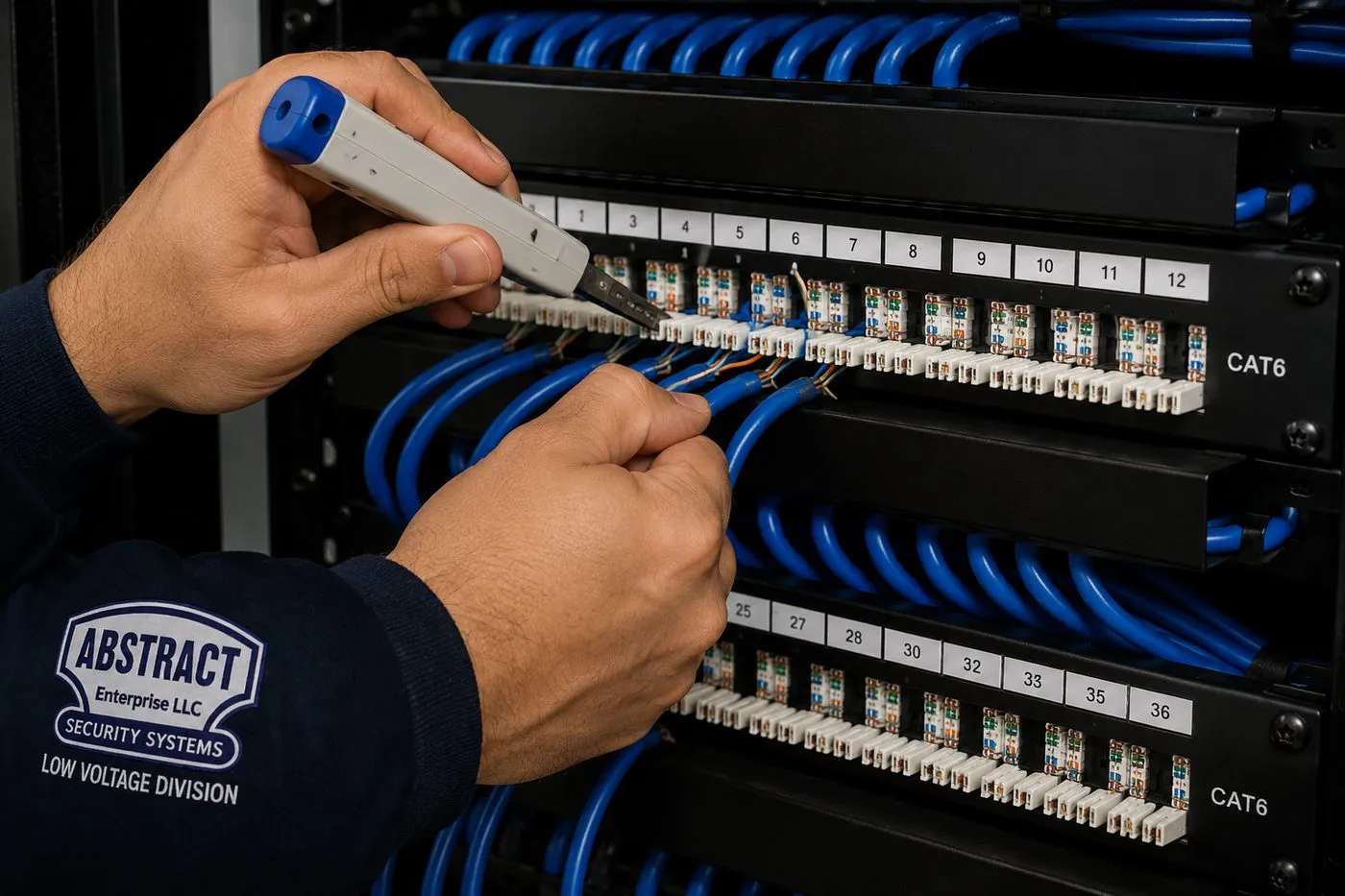
Close up, one hand guides a blue cable while the other presses it into a numbered patch panel with a blue punch-down tool; rows of blue Cat6 cable fill the panel above and below.
Coverage Area
Sonos Installation Near Rockland County’s Landmarks
Six places from across the county, from the Tappan end to the Stony Point end. We install Sonos in the homes and businesses around every one of them.
Edward Hopper House, Nyack
At 82 North Broadway, the house was built in 1858 by the artist’s maternal grandfather, John Smith, and was Edward Hopper’s home as he grew up in Nyack. Today a museum and study centre — and a reminder of the plaster-and-lath houses all around it.
Piermont Pier, Piermont
A pier reaching nearly a mile into the Hudson, built in 1841 as the eastern terminus of the Erie Railroad, according to the Rockland Audubon Society, and now owned by the village. Piermont’s river houses line the streets that lead to it.
DeWint House, Tappan
Built in 1700 and used as George Washington’s headquarters; the History Society records that on May 5, 1783, Washington received the British commander Sir Guy Carleton there to discuss the peace terms.
Rockland Lake State Park, Valley Cottage and Congers
Once the source of the Knickerbocker Ice Company’s “white gold”: three ice companies merged in 1855, and the last ice was harvested in 1924. The Knickerbocker Ice Festival returned to the park in January 2026.
Haverstraw Brick Museum, Haverstraw
At 12 Main Street, telling the story of a town that once had more than forty-two brickyards and supplied building materials for New York City’s growth for some seventy-five years.
Stony Point Battlefield and Lighthouse
Site of General Anthony Wayne’s July 1779 attack on the British fort, and home to the Stony Point Lighthouse, built in 1826, the oldest lighthouse on the Hudson, which operated for ninety-nine years.
We also install in Nanuet and the Palisades Center area, New City and Bardonia, Pearl River and Orangeburg, Blauvelt and Sparkill, Grand View and Upper Nyack, Suffern, Airmont and Hillburn, Spring Valley and Monsey, Pomona and Garnerville, Congers and Valley Cottage, Tomkins Cove, and every hamlet and village in between. Across the river, the Westchester County Sonos page covers the other end of the bridge.
Pricing
Sonos Installation Cost in Rockland County
Rockland prices are our published base prices multiplied by the county’s area rate of 1.30, rounded to the nearest dollar. The same rate applies in every town and village in the county. Fixed Sonos, mounting and connection work is priced from the list below; network design, ceiling and outdoor speaker runs are quoted after a walkthrough, because the house decides the hours.
Item
Rockland price
Base × 1.30
What it covers
Sonos setup
$163
$125 × 1.30
Every speaker or soundbar in that visit joined to your Wi-Fi and Sonos account, one room per level, tested from each phone
Soundbar wall-mounted under the TV
$168
$129 × 1.30
The bar’s bracket fixed under the TV, the bar hung level and its HDMI or optical lead connected
Soundbar placed on a console
$103
$79 × 1.30
Positioned, connected to the TV and tidied
Sanus soundbar bracket
$110
$84.99 × 1.30
Supplied by us, if you need one
Full home theater
$455
$350 × 1.30
Bar, Sub and rears bonded into one room and tuned with the furniture in place
A/V receiver connection
$168
$129 × 1.30
For a Port or receiver-based system
In-wall concealment
$220
$169 × 1.30
A code-compliant kit that carries power and HDMI inside a hollow drywall cavity; not possible on block
Paintable cord cover
$77
$59 × 1.30
Paint-to-match channel that hides cables on block, brick and plaster
Cable run to a media cabinet
$129
$99 × 1.30
A run of 25 feet or less when the cable box or player lives across the room
Universal remote programming
$129
$99 × 1.30
One remote for TV, soundbar and sources
Streaming device setup
$64
$49 × 1.30
Apple TV, Roku, Fire TV or similar
Plywood backer board
$111
$85 × 1.30
Spreads the load when studs fall in the wrong place or paneling hides them
High mount (above about 8 ft)
$98
$75 × 1.30
Brackets in tall rooms and over stairs
Box removal
$33
$25 × 1.30
Packaging taken away
Certificate of insurance
Free
—
For associations, landlords, malls and commercial buildings
Wall-type surcharges for brackets
Wall
Rockland surcharge
Base × 1.30
Drywall on wood studs
$0
—
Metal studs
+$39
$30 × 1.30
Plaster
+$59
$45 × 1.30
Brick or stone
+$85
$65 × 1.30
Concrete or cinder block
+$98
$75 × 1.30
Tile or marble
+$124
$95 × 1.30
Time-based visits
Visit
Price
When it applies
Setup-only visit
$235 first hour, then 30-minute blocks
Our published Rockland rate: moving a system to a new router, rooms that dropped out, a Sub that won’t bond, settings and tuning, with no mounting
Service and callback rate
$195/hr, 3-hour minimum ($585)
After-installation service calls; not charged on the initial installation
A worked example: lower-level den
An Arc Ultra hung under the TV on a painted block wall in a raised-ranch den, on our Sanus bracket, with the cables in a paintable cord cover and the system set up: soundbar wall mount $168 + Sanus bracket $110 + concrete or block wall $98 + cord cover $77 + Sonos setup $163 = $616. If you already have a bracket made for the bar, take off the $110.
What is quoted at the walkthrough
Ceiling, in-wall and outdoor speakers on a Sonos Amp — the number of rooms, the route from each ceiling to the Amp and whether an attic or open joists are available drive the labour.
Access points, mesh placement and Ethernet runs — how many, and how hard the route is between levels.
Two-family and apartment setups — separate networks and separate systems for each household.
Business systems — ceiling speakers in drop ceilings, landlord rules and after-hours work.
Inside and outside the Rockland price
Inside the price: the listed mounting and connection work, every product joined to one Sonos system, rooms named by level, Trueplay where the product allows it, volume limits on bedrooms and outdoor zones, a check of every source and a walk-through of the app for each person.
Outside it — electrician’s work: any new outlet, circuit or outdoor power feed is done by a licensed electrician, booked by you or through us.
Outside it — finishes and products: plaster patching and repainting, and the Sonos speakers themselves unless we supply them.
Rescheduling: free with 24 hours’ notice. A return-trip fee applies if we arrive and can’t start, for example because nobody is home or the equipment isn’t there.
National retailer versus local installer. Big-box and app-booked services set up Sonos well in a single, simple room. Where a local licensed low-voltage contractor earns its fee is the whole house: the bedroom level the Wi-Fi can’t reach, the den under the children’s rooms, the deck that has to stay inside Orangetown’s limits, and a price list you can check before booking.
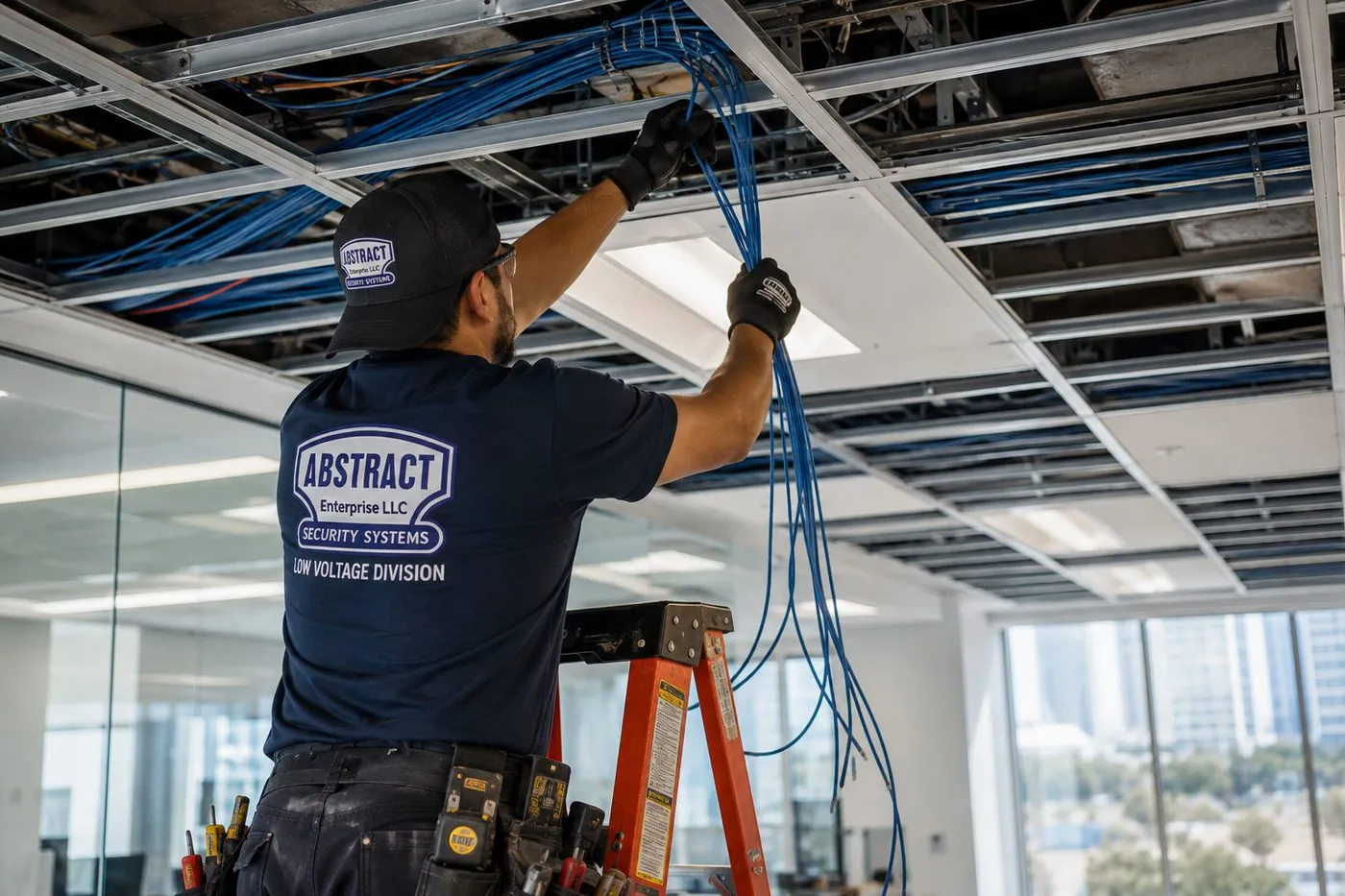
Standing on an orange ladder with his back to the camera, a technician draws a bundle of blue cables through an open drop-ceiling grid, with tall office windows behind him.
Shop Our Systems
Sonos Installation Packages & Pricing
Most Rockland jobs begin at one of these three totals, each built only from the line items above. Block, plaster or a backer board add their own line when the wall calls for them; Wi-Fi work and ceiling speakers are priced after the walkthrough.
Starter — Sonos Setup
$163
Sonos setup $163 = $163. Your speakers added to your network and app, a room per level, grouped for parties, volume limits set, and every phone in the house connected.
Standard — Soundbar on the Wall, Set Up
$441
Soundbar wall-mounted $168 + Sanus soundbar bracket $110 + Sonos setup $163 = $441 on stud-backed drywall. Arc Ultra, Beam or Ray under the TV, connected by HDMI and added to the house system.
Premium — Full Sonos Home Theater
$843
Soundbar wall-mounted $168 + in-wall concealment $220 + full home theater $455 = $843. Soundbar, Sub and rear speakers placed, bonded and calibrated, power and HDMI inside a hollow wall, Night Sound set up for late viewing.
Bring Your Own Equipment — Labour Only
Already own the Sonos products and a bracket made for them? We install customer-supplied products at the same Rockland line items with no bracket charge — for example $168 to hang your own soundbar on your own rated bracket, plus the wall line if there is one. Customer-supplied products carry their manufacturer’s warranty; we check any bracket’s rating before fitting it.
Get the Fixed Items Priced Before Anyone Visits
Send the model names of any Sonos gear you own, a phone photo of every wall a TV hangs on, and the level your router lives on. From those three things we can fix most of the price in writing.
Ten minutes with this list before the visit saves time on the day and often shows whether the job is a speaker job, a network job or both.
The network
Find the router. Note which level and which room it is in, and whether it is the provider’s box, your own router or a mesh system.
Check the bands. If you can, log into the router and confirm the 2.4 GHz band is switched on. Sonos lists 5 GHz-only routers as unsupported.
List the extras. Plug-in extenders, powerline adapters and guest networks are all on Sonos’s unsupported list; tell us which you have.
Check the security mode. WPA2 Personal works with every product; WPA/WPA2 Enterprise does not, and S1-only products don’t support WPA3.
Walk the levels with a phone. Note where video calls or streaming stutter. Those rooms are where a Sonos speaker will struggle too.
The house
Closet stacks. Closets that sit directly above one another are the easiest vertical cable routes in a split-level.
Attic and garage access. A pull-down attic stair over the top level, or an open garage ceiling, often decides whether ceiling speakers are practical.
Wall types at each TV. Drywall, paneling over block, plaster, or brick — a quick tap and a photo tell us which bracket line applies.
Outlets. Every Sonos product needs power. If a spot has no outlet, an electrician adds one before we mount there.
The household
Who controls what. Which phones need the app, whose Sonos account the system will be registered to, and whether any room needs a volume limit.
Music services. Have logins ready for the services you use; we add them during setup.
Neighbours. If the deck faces a close neighbour or you share a wall, tell us — it changes where speakers go.
Plain-English Terms
Sonos Words You’ll Hear on the Visit
Term
What it means for your house
Room
One speaker, a stereo pair or a soundbar with its Sub and rears, controlled as a single unit in the app. A split-level usually has one room per level.
Group
Two or more rooms playing the same thing in sync — the whole house for a party, then ungrouped afterwards.
Volume Limit
A ceiling for one room, set from 0 to 100 in the room’s sound settings. We use it for bedrooms and outdoor zones.
Night Sound
A soundbar setting that, in Sonos’s words, enhances quiet sounds and reduces the intensity of loud ones — the late-film setting for a den under the bedrooms.
Trueplay
Sonos’s tuning, which measures how sound reflects off the room’s walls and furnishings. About three minutes a room; re-run after moving a speaker.
HDMI eARC / ARC
The TV port that sends sound to Arc Ultra or Beam. Ray uses an optical cable instead.
Primary mesh node
The mesh unit plugged into the provider’s line. If any Sonos product is wired in a mesh system, Sonos says it must be wired to this one.
S1 and S2
Sonos’s older and newer software families. Products limited to S1 can’t join a system that runs the current app with newer speakers.
Passive speaker
A speaker with no amplifier or network of its own — ceiling, in-wall and outdoor models — powered and networked through a Sonos Amp.
Putting It Right
Sonos Problems We Fix in Rockland Homes
Many of our Rockland Sonos visits are to systems that grew over years, or were set up quickly by someone else. The same handful of faults come up again and again.
The bedroom-level speaker that drops every evening. Usually a weak signal made worse when the whole family is online after dinner. Fixed with a better-placed mesh node or a wired access point near the stairs, not a new speaker.
A system split in two after a new router. Some speakers joined the new network and some are still looking for the old one. We move every product across and remove the old network’s traces.
Speakers on a plug-in extender. Sonos doesn’t support range extenders; we replace the extender with a supported mesh node or access point and reconnect the speakers to it.
A Sub that rattles the room upstairs. Moved off the stud wall, level reduced after tuning, Night Sound explained.
Surrounds that never got tuned. Trueplay never run because nobody had an iPhone; we tune with ours.
A deck speaker that only works with the door open. The slider’s glass and frame plus an exterior wall in the way; fixed with a better radio position inside or a wired outdoor speaker on an Amp.
Old and new products that won’t share a system. S1-only products identified and either given their own small system or retired, so the rest of the house can update.
A shared house where speakers keep switching sides. Two households on one network; separated into two networks and two systems.
Complete Services
Every Sonos Installation Service in Rockland County
Sonos rarely arrives alone. These are the Rockland County services that most often go with it, all from the same licensed crews.
Soundbar Installation
Arc Ultra, Beam, Ray and other bars on block, plaster and paneling.
General installer practice, written by our team — not an account of any particular customer’s job.
The first thing we do in a split-level is stand on the landing between the main floor and the bedroom floor with a signal meter, because that spot tells us more about the house than any other. If the reading there is strong, the house usually needs one well-placed radio and some careful naming. If it is weak, the router is probably buried in a lower-level corner behind the boiler or the laundry, and no amount of speaker shopping will help until the signal is brought up the stairs.
The second thing is to open the coat closet by the front door and look up. In many post-war houses, a closet on the entry level sits under a linen closet on the bedroom level, and the two together make a vertical chase from the lower level to the attic without a mark on a finished wall. It is not always clear — ducts, plumbing and later insulation get in the way — so we check with a small inspection hole inside the closet, where a patch never shows.
The third is the den ceiling. In raised ranches it is the floor of the bedrooms, and we would rather find out with our ears than after the first movie night. Before we mount a Sub or tune a theater, someone stands upstairs while the test tones play. It takes five minutes and has changed more Sub positions than any measurement.
FAQ
Rockland County Sonos Installation FAQ
Do Sonos prices change from one Rockland town or village to another?
+
No. One county rate applies everywhere from Tappan to Tomkins Cove: our published base list multiplied by Rockland’s 1.30 area rate and rounded to the dollar, so Sonos setup is $163 and a soundbar wall mount $168 in Suffern, Nyack or Stony Point alike. The setup-only visit is the published Rockland rate of $235 for the first hour.
Where should our technician park?
+
In your driveway if there is room, or in a legal space on the street close to the front door, because ladders, cable and speakers go in and out all visit. If your development or homeowners’ association restricts contractor vehicles, tell us when you book and we will follow its rules.
Can we watch the work and ask questions while you install?
+
Yes. Most owners drop in and out, and the most useful moments to be there are when speaker and bracket positions are marked, when the first Trueplay tuning runs, and at the handover, when every phone in the house is connected and the volume limits are agreed.
Can the bookshelf speakers from our old stereo be powered by a Sonos Amp?
+
Often, yes. Sonos says the Amp can drive passive speakers of 4 ohms or more and should not be connected to anything below 4 ohms. We check the rating on the back of each speaker and test them before deciding whether they are worth keeping in the new system.
Do you price Sonos work per room or per job?
+
By line item. Fixed items such as Sonos setup, soundbar mounting and wall surcharges come straight from our Rockland price list, whatever the number of rooms. Ceiling speakers, outdoor zones and network runs are priced as one written quote for the job after the walkthrough.
Will you show us where every hole goes before drilling?
+
Always. Bracket positions, ceiling speaker cut-outs and cable entry points are marked and agreed with you before a drill comes out, and on plaster or paneling we explain what the patch will look like if a position ever changes.
All Areas Served
Sonos Installation Across the Hudson Valley and New York
You are on the Rockland County page. Its parent is the Hudson Valley Sonos installation hub, which covers old stone and plaster houses, barns and outbuildings, winter and weekend homes across all six valley counties. Neighbouring counties and the city and Long Island have their own Sonos pages, listed below.
Call (845) 640-3835 for rooms that have vanished from the app, a den theater that lost its Sub, or a deck zone that won’t play. Same-day visits are possible when a two-hour window is free in your part of the county, and most network and settings faults are fixed within one to two hours of the technician arriving. We test every room after a power cycle before we leave.
Sonos Installation Rockland County — Licensed, Insured, Published Prices
Our Rockland line is (845) 640-3835; to send photos of your TV walls and router, use WhatsApp (718) 679-0359 at wa.me. Office: Abstract Enterprises Security Systems, 460 E Fordham Rd, Bronx, NY 10458.
NYS Low-Voltage Licence #12000287431 · 100% Licensed & Insured · Same-Day Estimates · Rated 4.7★ from 201 Google Reviews
Sonos products and brackets you supply carry their manufacturer’s warranty. Full terms — including 50% deposit, one-year parts-only warranty on AESS-supplied products, and the late-fee schedule — are set out in the service agreement. See our warranty page.
The noise-code and licensing passages above are a plain summary of rules published by the county and its towns, checked in October 2026; they are not legal advice. Page reviewed and updated October 17, 2026. Changelog: first publication of the Rockland County Sonos installation page. Photos on this page are from our low-voltage, network and audio work; dedicated Sonos photos will replace them as they are added. Sonos, Era, Arc, Beam, Ray, Move, Roam, Sub, Port, Five and Amp are trademarks of Sonos, Inc.; Abstract Enterprises is an independent installer and is not affiliated with Sonos.