NYS Licensed Low-Voltage Contractor · Monroe to Port Jervis · Direct 845 Line
Sonos Installation in Orange County
Newer-Build Homes · Builder Wiring Put to Work · Finished Basements · Bonus Rooms · Patio & Pool Zones
Many Orange County homes were finished by a builder within living memory: a colonial off Route 17 in Chester or Monroe, a townhouse in Wallkill or New Windsor, a subdivision house in Montgomery with a basement waiting to be finished. Behind their drywall sit useful things, such as coax in every bedroom and a basement media panel, and a few you must not disturb, such as the attic air seal and the wall shared with the neighbor. We plan Sonos around what the builder left, then set it up for a household that is still growing. Older Newburgh and Port Jervis houses get their own plan. Two-hour arrival windows from 8 AM to 8 PM, seven days a week.
Reviewed and updated October 17, 2026 · Written by Anwar Timothy, NYS licence #12000287431
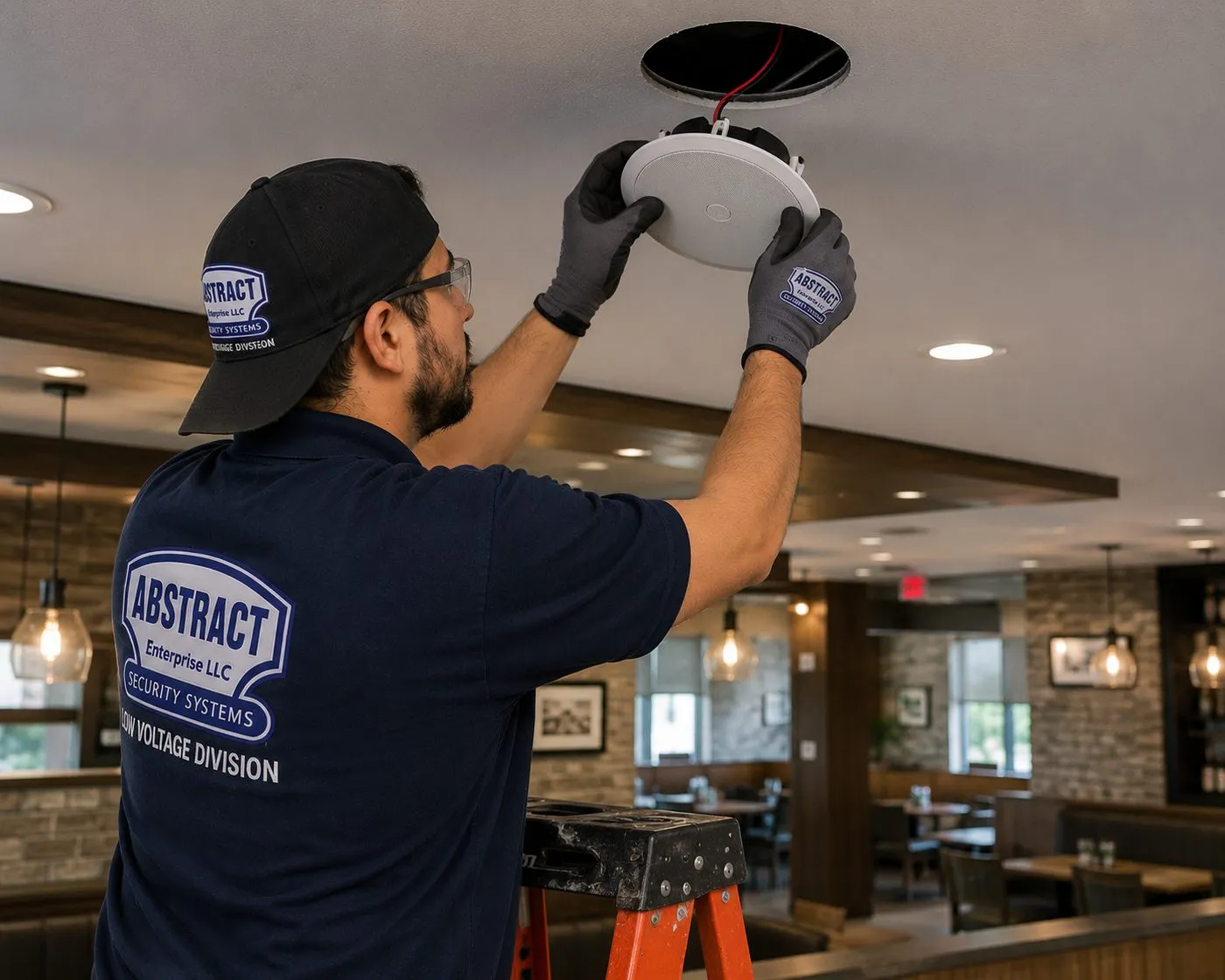
Seen from behind and below, a technician in a cap, safety glasses and grey gloves lifts a round white speaker into a circular opening in a flat ceiling, with red speaker leads running up into the hole. Pendant lights, dark wood trim and a stone-faced wall fill the room behind him. No brand is legible on the speaker.
Free Orange County Sonos Quote
Tell us the town, the year the house was built and the rooms — a written price follows the same business day
✅
Request Sent!
An Orange County technician calls back the same business day.
25+
Years Experience
✓
Same-Day Estimates
100%
Licensed & Insured
4.7★
201 Google Reviews
Just closed on a house in Orange County and the Sonos boxes are stacked in the garage? Call our Hudson Valley line, (845) 640-3835, or use the 60-second form. Tell us the town and roughly when the house was built, and a licensed installer replies with a written figure from the price lines published further down this page.
Sonos setup at $125, the same published line we use across the Hudson Valley, with no travel charge anywhere in the county
Builder coax, network jacks and media panels tested and used where they pass, rather than ignored
Licensed under New York State low-voltage licence #12000287431, booked seven days a week with arrival inside a two-hour slot from 8 AM to 8 PM
Orange County is the Hudson Valley county where a Sonos installer is most likely to be working in a house a builder handed over in the last twenty-five years. The Census Bureau’s 2019–2023 American Community Survey counts 148,460 housing units in the county, and 30,131 of them — about one in five — were built in 2000 or later. In the Town of Wallkill the share is 26.4 percent, in New Windsor 25.0 percent and in the Town of Newburgh 22.8 percent. Chester, Monroe and Montgomery all sit between roughly 18 and 20 percent. These are the subdivisions and townhouse developments strung along Route 17 and Interstate 84, and they are where a Sonos plan in this county most often has to start from builder wiring.
Newer does not mean simpler. A house built in 2005 or 2020 was wired by a builder’s low-voltage subcontractor to a budget, usually with coaxial cable to several rooms, a few network jacks, and a small enclosure in the basement or a closet where everything meets. The internet provider then dropped its modem and router wherever the line came in, often in that basement. Nobody planned the house for music. So the first part of a Sonos job here is working out what the builder left behind the drywall, which parts of it are usable, and where a new cable or a ceiling access point is the cheaper answer.
The second part is respecting what the newer house relies on. Top-floor ceilings sit under an insulated attic whose air barrier the energy code expects to be continuous; a careless speaker hole lets attic air into a bedroom. Floors are often framed with engineered I-joists that tolerate holes in the web but not cuts through the flanges. Townhouses share a fire-rated wall with the house next door. And a house only a few years old may still be inside its builder’s warranty period. Each of those changes where, and how, a speaker can go.
The third part is the household. Orange County keeps growing — USAFacts, working from Census estimates, reports that the population rose by about 2,600 between 2024 and 2025 and by 11.1 percent over the decade to 2025 — and the homes are big enough to fill. The ACS puts the median house at six rooms, and nearly three in ten homes have four bedrooms or more. A Sonos system here is often planned for a family that will add a nursery, finish the basement for teenagers, put a theater in the bonus room over the garage and spend summer evenings by a pool. We design for the house as it will be in five years, not only the room you want playing this weekend.
The older river cities are the contrast. In the City of Newburgh, 49.4 percent of homes were built in 1939 or earlier and only about 4 percent since 2000; in Port Jervis the pre-1940 share is 54.2 percent. Those houses bring plaster, brick party walls and balloon framing rather than coax runs and I-joists, and we plan them on their own terms, as the section on older homes below explains.
Orange County numbers that shape a Sonos plan
30,131 homes built in 2000 or later out of 148,460, about 20.3 percent, according to the Census Bureau’s 2019–2023 ACS (table B25034) — roughly the same number as the 29,991 built in 1939 or earlier, and the highest post-2000 share of the six Hudson Valley counties (Ulster 14.1, Dutchess 13.8, Rockland 13.3, Putnam 11.1 and Westchester 9.6 percent in the same table).
1,668 building permits issued in Orange County in 2025 and 154,492 housing units as of July 1, 2025, per Census Bureau QuickFacts — new houses are still being handed over every month.
2.84 people per household and a 67.8 percent owner-occupancy rate (QuickFacts, 2020–2024): mostly owners, mostly families, which is why so many of our Orange County jobs involve kids’ rooms and basement dens.
62.4 percent single-family detached and 6.8 percent attached (ACS 2019–2023): the attached share is the townhouse developments, where the wall between units shapes the speaker plan.
89.3 percent of households with broadband (QuickFacts, 2020–2024) — internet is almost always there, and Greenlight Networks says it has invested more than $26 million building fiber in Orange County since it began building in the region in 2023, so new connections keep landing in basements and garages.
A 34.1-minute average commute (QuickFacts, 2020–2024): households that leave early and get home late want a system that simply works when they walk in, without a weekend spent rebooting it.
Many Orange County owners adding Sonos also want the front door sorted on the same visit. Our smart lock installers in Orange County regularly replace the builder’s keyed locks on move-in day, and Abstract Enterprises’ home automation installation in Orange County brings lighting and thermostats into the same routines as the music.
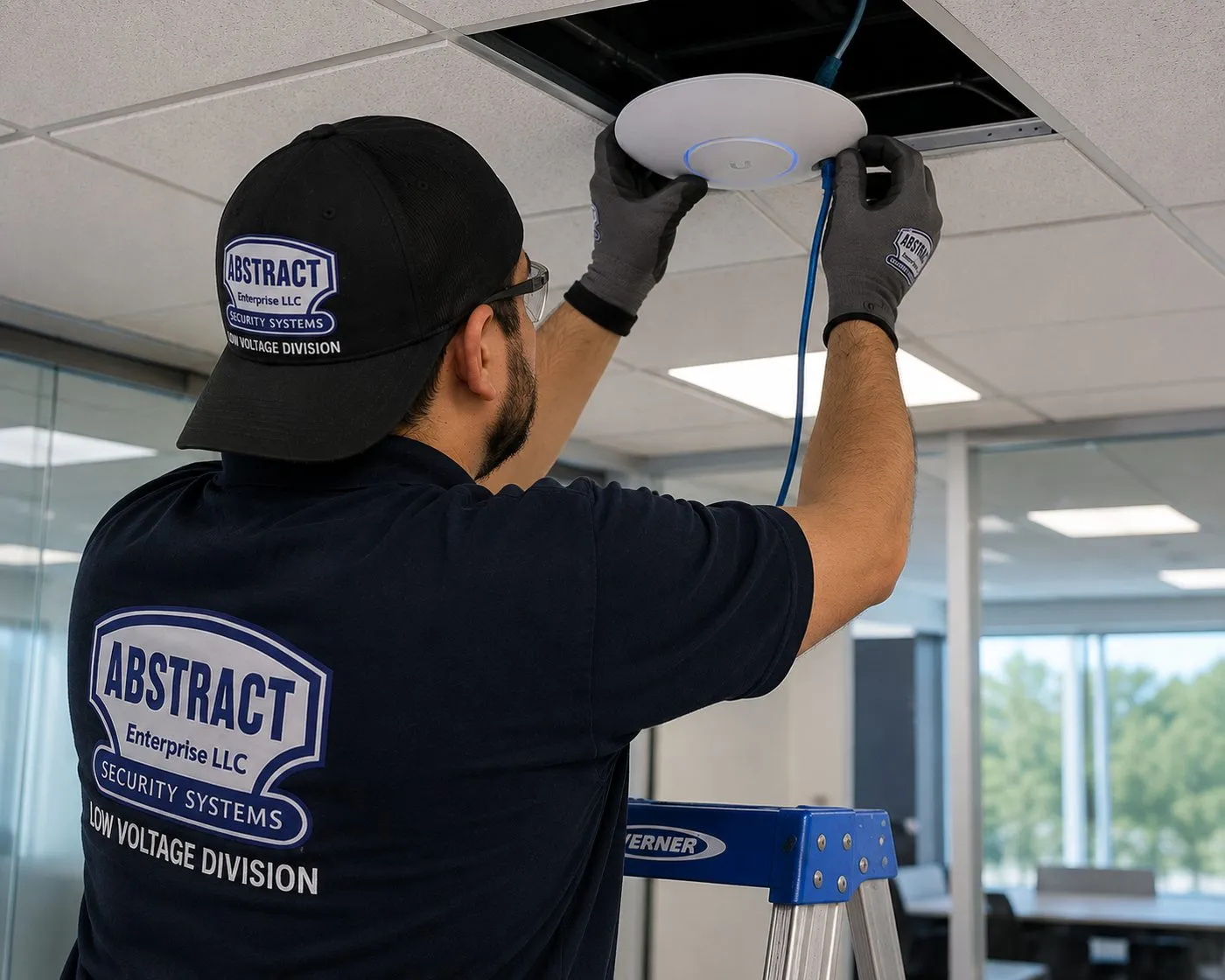
From behind, a technician on a blue stepladder holds a white disc-shaped access point against an open ceiling tile while a blue network cable drops through the gap beside it. A wired access point like this gives a far room its own strong signal instead of relying on a router at the other end of the house.
Repair Capture
Sonos Speaker Missing From the App in Orange County
The bonus-room speaker that vanishes from the app every evening, a soundbar that went silent after the fiber installer swapped the router, an Amp that stopped after a summer storm, or rooms that refuse to group across floors — those are service calls, and we take them in the next open two-hour window. Most network and setup faults in newer Orange County houses are fixed within one to two hours of the technician arriving. Call (845) 640-3835 and say it’s a Sonos repair; a setup-only visit in Orange County is $250 for the first hour, then 30-minute blocks, as set out in our TV and audio service policies.
What We Install
Sonos Installation Services in Orange County
A typical Orange County visit combines three or four of the jobs below, and it always starts with the network. We find out what the builder and the internet provider left, get a dependable signal to every room that will have Sonos, mount and wire, then set the system up for the people who actually live in the house.
Builder Wiring Audit
The basement or closet media panel opened, every coax and network jack traced and tested, and a written note of which runs are live, which are dead and which can carry Sonos. It often saves a new cable through a finished wall.
Network for the Far Rooms
A wired link, a coax adapter on a tested run, or a ceiling access point for the bonus room, the primary suite or the finished basement — the rooms a router in the basement panel never reaches well. Plug-in range extenders, which Sonos doesn’t support, come out.
Family-Room Theater
Arc Ultra, Beam or Ray under the TV, a Sub placed for the floor you’re on, and rear speakers where an open-plan room actually has outlets — including two-story great rooms and TV walls above a gas fireplace.
Ceiling Speakers Without Damage
Speakers cut into drywall ceilings after a scan and pilot hole, wire routed through engineered joists only where the maker allows, and top-floor openings sealed back to the attic air barrier so the bedroom doesn’t pull in attic air.
Finished Basement and Bonus Room
A theater, a teen den or a gym in the basement you’re finishing, with cable run while the framing is open; or a media room in the bonus room over the garage, planned around the bedroom next to it.
Patio, Deck and Pool Zones
Sonos’s outdoor architectural speakers under the eaves or on the deck framing, wired back to an indoor Amp through a sealed entry, aimed at the seating, and rated for the salt and spray of a saltwater pool.
Settings for a Growing Family
The explicit-content filter, per-speaker volume limits, sleep timers on the nursery and kids’ speakers, alarms for school mornings, and rooms named the way the family talks about them.
Pre-Wire During Construction
Where the builder agrees, speaker and network cable run after framing and before insulation, labeled at both ends, so the speakers can go in after closing without opening a single wall.
Model Homes and Small Businesses
Background music for model homes and sales centers, shops on village main streets and offices along Route 17, set up so staff can run it from one tablet without personal logins.
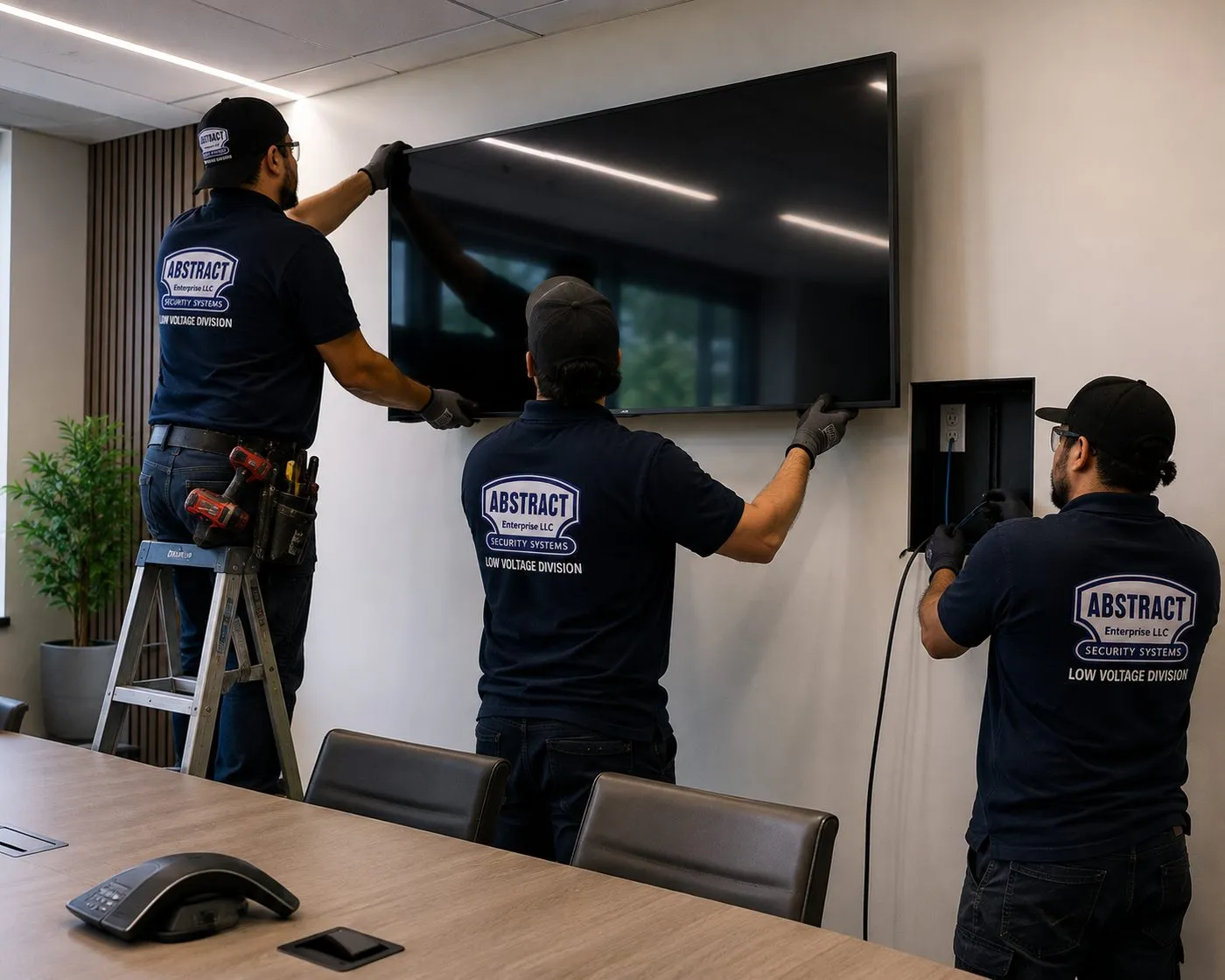
Three technicians seen from behind: one on a short stepladder and one at floor level hold a large black screen onto its wall bracket, while the third reaches into a recessed box with an outlet and a cable cut into the wall below it. A conference phone sits on the table in the foreground.
Sonos Installation for Orange County’s Architecture
Orange County’s housing falls into three broad eras: about a fifth built in 1939 or earlier and concentrated in the river cities and village centers, more than half built between the 1950s and the 1990s, and the newest fifth built since 2000. The construction of each era decides how speakers are fixed and how cable moves, so we plan by building type before we plan by room.
Post-2000 Subdivision Colonials
Two-story houses on cul-de-sacs in Chester, Monroe, Montgomery, Wallkill and New Windsor. Drywall on wood framing, often engineered floor joists, a full basement, an insulated attic and a builder’s media panel. The easiest walls in the county to work in, as long as the attic seal and joist rules are respected.
Townhouse Developments
Two- and three-story attached homes, including the three-story Pershing townhomes Zillow lists at Tuxedo Reserve. Narrow floor plates, stacked living space and a fire-rated wall shared with the neighbor, which rules out recessed speakers on that wall and shapes where the Sub can sit.
1970s–1990s Raised Ranches and Splits
The ACS counts more than 52,000 Orange County homes from those three decades. Dimensional lumber joists, half-finished lower levels and basements with low ceilings. Often the best candidates for wireless Era speakers upstairs and a wired Amp zone downstairs.
Newburgh and Port Jervis Row and Frame Houses
Brick Italianate row houses in Newburgh’s East End Historic District and wood-frame houses in Port Jervis, about half of them built before 1940. Plaster, brick party walls and balloon framing call for a wireless-first plan and careful cable routes.
Village-Center Homes
Older houses close to the main streets of Goshen, Warwick, Florida, Chester village and Walden, often updated several times. Every wall is a surprise, so we scan, probe and quote after seeing it.
New Rental Communities
New rental apartments such as the 124-unit Silverlake Ridge in the Town of Wallkill that the Orange County IDA backed in August 2026. Tenants usually need a no-holes setup on the building’s or their own network, and the landlord’s rules come first.
What the builder left you, and what it means for Sonos
What you find
Where it usually is
What we do with it
Coax outlets in bedrooms and the family room
Fed from a splitter in the media panel
Test each run; if it is clean, it can carry a network link to a far room through a coax adapter
Network jacks labeled “data” or “phone”
Kitchen desk, office, family room
Trace and test; older “phone” runs are often network cable that was never punched down
Structured media enclosure
Basement wall, laundry or a closet
Good for patching and a small switch; too enclosed for Amps, which need open air around them
Provider’s modem or fiber terminal and router
Wherever the line enters, often the basement or garage
Router moved up or supplemented with a wired access point so upper rooms get a strong signal
Builder ceiling speakers with a wall volume knob
Kitchen, patio, sometimes a bath
Speakers kept if they test well; the knob is removed or matched so the Sonos Amp sees a safe load
Empty conduit or a recessed box at the TV wall
Family room, sometimes the primary bedroom
Used for HDMI and power to a soundbar, with the in-wall concealment kit where code calls for it
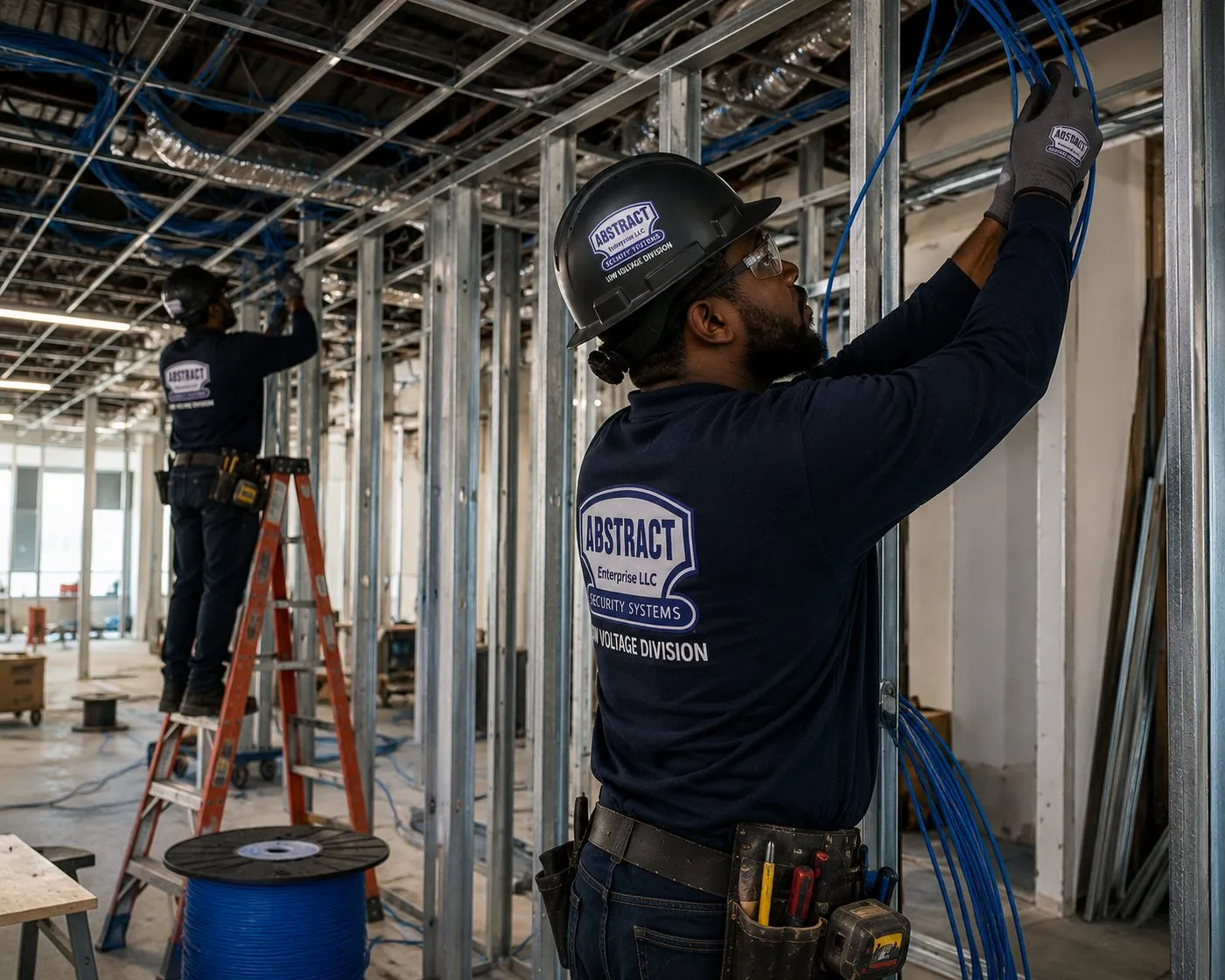
Two technicians, one on an orange stepladder in the background and one in a black hard hat in front, pull blue cable through open metal-stud walls and an exposed ceiling grid. A spool of blue cable stands on the floor. This is the stage at which speaker and network cable is cheapest to run.
Most Orange County families who add whole-house music also update the cameras at the same time. Our Orange County security camera installers work off the same network plan, so the cameras and the speakers stop competing for the same weak signal.
Builder-Grade Basics
Behind the Drywall of a Newer Orange County House
The most useful hour on a newer-house job is the one spent with the media panel door open. Builders in Orange County, as across most of the country, offer low-voltage packages at the design-center stage: a few coax outlets, a few network jacks, sometimes a pair of patio or kitchen ceiling speakers, all running back to one enclosure. National builders also sell connected-home packages; Ring’s page for Lennar homeowners, for instance, lists a wired video doorbell, a smart lock, a thermostat and an alarm kit. What those packages rarely include is a plan for Sonos.
That leaves owners with wiring of uncertain value. A coax run that tests clean from the panel to the bonus room is worth a lot: with a pair of coax network adapters it becomes a wired connection without a new hole, and Sonos community members describe running speakers and Sonos home theaters exactly that way. A network jack in the kitchen desk that was never connected at the panel end is worth nothing until someone terminates it. Ceiling speakers the builder fitted with a wall volume knob may be perfectly usable, or may present a load a Sonos Amp shouldn’t drive. None of it can be judged from the faceplate.
So the audit comes first. We open the panel, label every cable we can identify, put a tone on the ones we can’t, and test each run end to end. You get a short written list: which jacks and coax runs are live, which are dead, which carry signal well enough for a network link, and where a new cable or an access point will be needed anyway. That list becomes the network part of the quote, and it is yours to keep for the next contractor.
Five things to check in the first month after closing
Where the internet landed. If the provider put the router on the basement floor or inside the media panel, Wi-Fi to the upper floor will be weaker than it needs to be. Sonos lists metal among the materials that block wireless signal most, and a closed metal enclosure is exactly that.
The router’s default password. Change it before any Sonos product joins the network, so you don’t have to rejoin every speaker later.
Which jacks are live. A cheap tester or our audit will tell you; it is easier to find out before the furniture is in front of them.
What the builder’s walkthrough list says about low-voltage. If something in the package was promised and not delivered, raise it with the builder in writing while the house is new.
Whether the basement ceiling is still open. An unfinished basement is the best cable route in the house. Plan the speaker cable for the floor above before the basement is drywalled.
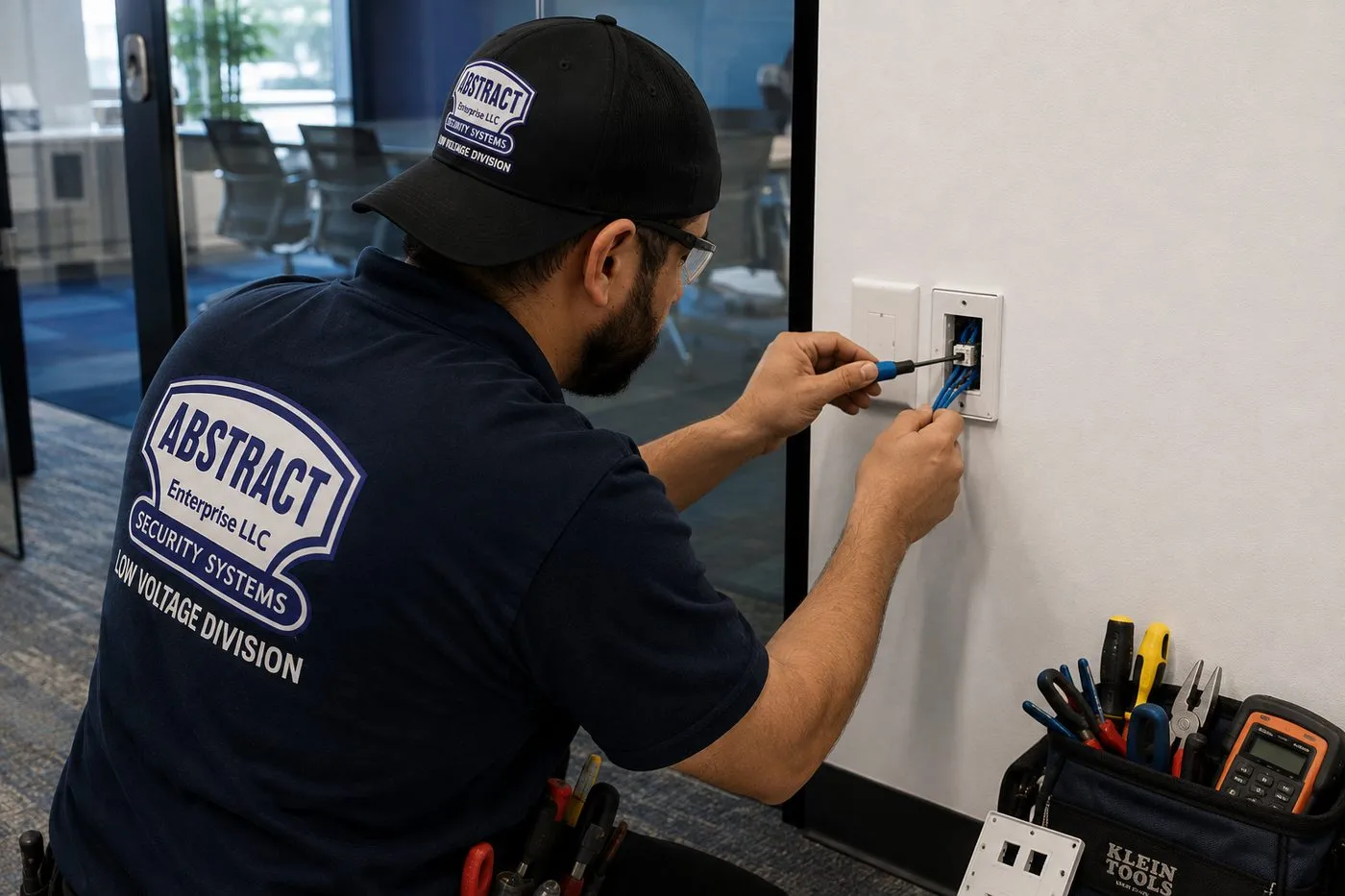
Seen from behind and to one side, a kneeling technician in a cap works a small screwdriver into a white wall plate with blue cables coming out of it, beside a blank switch-style plate. A tool bag with a multimeter sits on the floor and a spare faceplate lies against the wall.
If the builder’s wiring turns out to be thin, the fix is usually modest: one new cable from the panel to a central ceiling access point, or a wired link to the family room where the Sonos home theater lives. Sonos’s own system requirements describe products wired to the router at all times as one supported setup, and say that in a mesh system with a wired setup, the wired Sonos product must connect to the primary node. In a newer house, getting that one connection right does more for reliability than any number of extra speakers.
Commercial Sonos Installation
Business Sonos Installation in Orange County
Sonos markets installed systems to businesses, and in Orange County most of our commercial Sonos work is small: a shop, an office suite, a salon, a model home. The corridors below are where those businesses cluster. We name the corridors, not individual clients.
Route 211 and the Galleria at Crystal Run, Wallkill
Retail and service businesses around the Galleria, which opened on April 1, 1992, and along Route 211 East. Suites with drop ceilings, where an Amp in the back room and ceiling speakers on the sales floor are straightforward.
Route 32 and Woodbury Common, Central Valley
The outlet center north of Route 17, with 220 stores, and the strip of hospitality and service businesses that grew up around it. Fit-outs on tight opening schedules.
Main Street and the Government Center, Goshen
Law offices, title companies and cafés close to the county seat at 255 Main Street. Quiet background music in reception areas, kept low enough to talk over.
Front Street and Liberty Street, Newburgh
Waterfront restaurants on Front Street and the mixed-use blocks of Liberty Street in the East End Historic District, where exterior changes go through the city’s Architectural Review Commission.
Railroad Avenue and Main Street, Warwick
Shops and restaurants in the village center, many in older buildings, where a wireless-first plan avoids opening finished walls and ceilings.
Model Homes and Sales Centers
Builders’ model homes and leasing offices across the county’s new developments, where music is part of the showing and the system has to be reset or moved when the model sells.
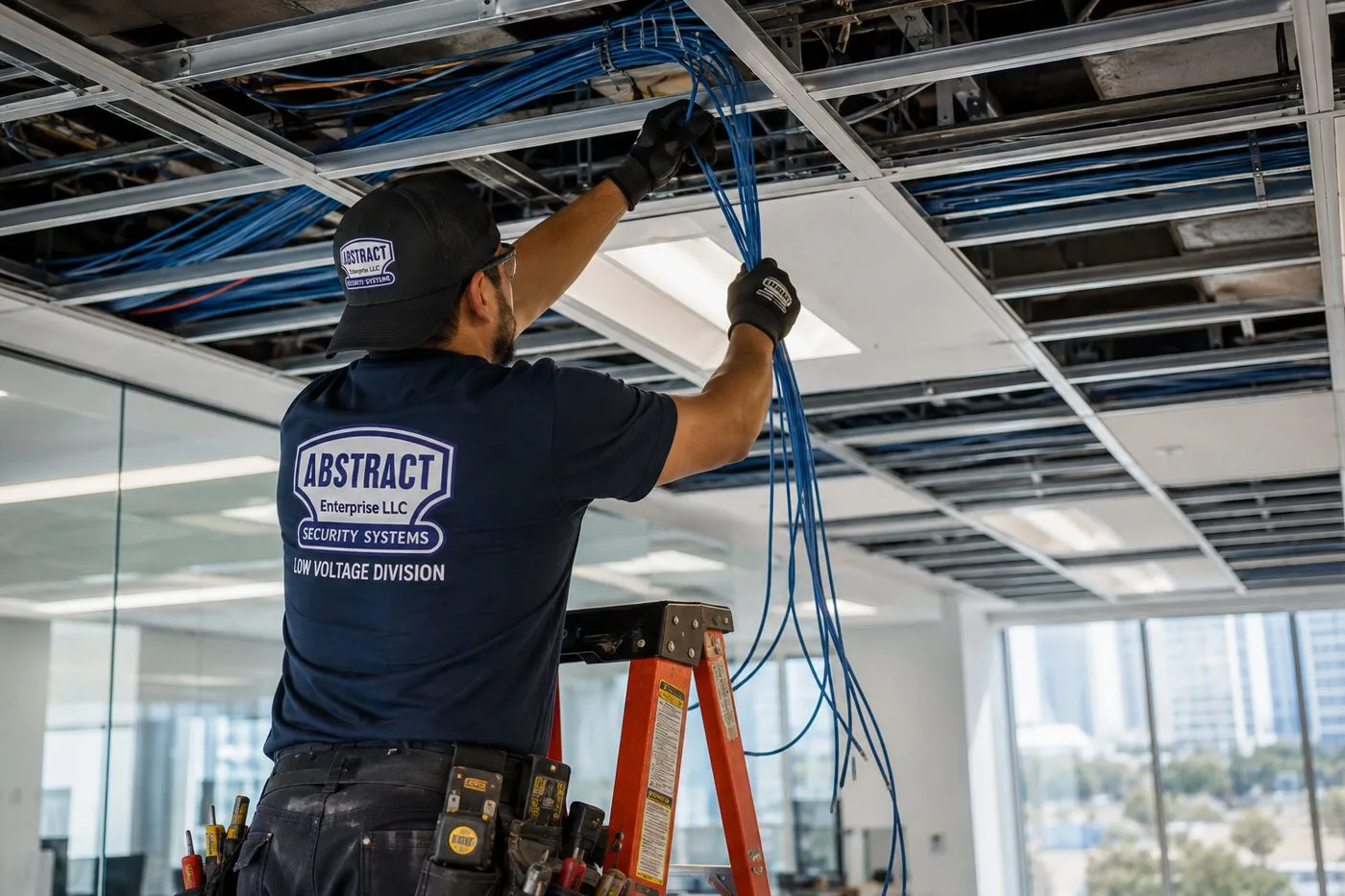
From behind, a technician on an orange stepladder draws a loose bundle of blue cables down from an open suspended ceiling, with ceiling tiles removed across the room and tall windows behind him. This is how cable reaches speakers in a shop or office with a drop ceiling.
Compliance callouts for Orange County business Sonos systems
Electrical work stays with an Orange County electrician. County law requires anyone working as an electrician in Orange County to hold a county-issued license, and village building departments such as Chester’s ask for the electrician’s Orange County license on permit applications. New outlets or circuits for an equipment closet are not part of our scope.
Permits follow the building work, not the speakers. The Village of Chester’s building department, for example, lists additions, alterations and conversions, electrical upgrades, pools, decks and generators among work that needs a permit. If your Sonos project rides along with one of those, the permit belongs to that project.
Historic exteriors need approval. In Newburgh’s historic districts, the city code requires a certificate of appropriateness from the Architectural Review Commission before exterior alterations; outdoor speakers or cable entries on a street-facing facade should be raised with the commission first.
Plenum and drop ceilings. Above a suspended ceiling used as an air return, cable has to be rated for that space. We specify plenum-rated speaker and network cable where the building calls for it and support it independently of the ceiling grid.
Background-music rights sit with the business. A personal streaming subscription is usually meant for home listening, so a shop, salon or model home should check that its service covers public playback. We connect whichever service you pick and leave the licensing question to you and the provider.
Your Questions Answered
Sonos Installation in Orange County: Questions Answered
These are the questions Orange County owners actually put to us on walkthroughs, grouped by the part of the house they concern. Each answer is the one we give on site, with the source named where a rule or a specification is involved.
What the builder left behind the walls
Our builder ran coax to every bedroom — can that cable give the upstairs Sonos a wired connection?
Often, yes, and it is one of the most useful things a newer house offers. A pair of coax network adapters — one at the media panel next to the router, one at the far outlet — turns a clean coax run into a wired network connection, and the Sonos product or an access point plugs into the far adapter by Ethernet. Sonos’s support pages rule out powerline adapters and plug-in range extenders, but they do not list coax adapters among unsupported setups, and Sonos community members describe wiring Sonos speakers and home theaters over coax this way successfully.
The catch is the run itself. Builder coax passes through splitters in the media panel, and a run that is fine for cable TV may lose too much signal for a network link. We test each run, replace old splitters with ones rated for the adapters, and fit a filter where the provider’s line enters so the signal stays inside your house. Then we test the Sonos product over the link before we rely on it. If a run fails, we say so and price a network cable or a ceiling access point instead.
The builder put a volume knob on the wall beside the kitchen ceiling speakers — will it work with a Sonos Amp?
Usually it is better removed or set out of the way. Builder wall knobs are often impedance-matching volume controls, made for receivers that drive several pairs of speakers at once, and they change the load the amplifier sees. Sonos’s Amp guide says not to connect speakers rated below 4 ohms, supports up to two pairs of 8-ohm speakers in parallel, and says speakers should not be wired in series — so whatever is on the wall has to leave the Amp seeing a load inside those limits.
With a Sonos Amp the volume control moves to the app, the voice assistant or a button on the Amp, so the knob mostly becomes something to trip over. We test the speakers behind it, and if they are sound we bypass or replace the knob with a blank plate, wire the speakers straight to the Amp and set a volume limit so the kitchen can’t be turned up past what you choose. If the speakers themselves are weak or damaged, we say so before you spend money on an Amp for them.
Will cutting speaker holes in a house that’s two years old affect the builder’s warranty?
It shouldn’t touch the warranty on the parts of the house we don’t work on, but read your builder’s written warranty before we cut. New York’s housing merchant implied warranty, in General Business Law section 777-a, runs one year for skillful construction, two years for the plumbing, electrical, heating, cooling and ventilation systems, and six years for material defects, and it survives the passing of title. The same section says it does not extend to defects that aren’t the builder’s own workmanship, materials or design.
In practice that means a crack or leak around an opening we cut is ours to answer for, not the builder’s, and we keep our work well away from the builder’s ducts, pipes and electrical so there is no argument about who caused what. Builders often sell their own limited warranty on top of the statutory one, and some say how owner alterations are treated. We photograph the ceilings before we start, and if your warranty has a claim open on a room, we leave that room until the claim is settled. This is practical guidance, not legal advice.
Joists, insulation and the wall you share
The basement ceiling shows engineered I-joists — can speaker wire be drilled through them?
Yes, in the right places. Engineered I-joists, common in floors built since the 1990s, are a thin web panel between a top and a bottom flange, and the makers publish where holes may go. Weyerhaeuser’s technical support, for example, explains that its chart for uniformly loaded TJI joists allows holes of 1½ inches and smaller anywhere in the web outside the marked zone near a bearing, and that larger holes must be at least 12 inches from the bearing. Speaker cable needs a hole well under an inch.
What we don’t do is cut or notch a flange, drill close to where the joist sits on a wall or beam, or cluster holes beside the holes the plumber and electrician already made. We read the stamp on the joist to identify the maker and series, follow that maker’s chart, and keep a printout in the van. Where the joists run the wrong way for the cable route, we use the open basement ceiling and a single bundled path rather than drilling across every joist.
Will speaker openings in the top-floor ceiling let attic air into the bedrooms?
They can if they are done carelessly, which is why we treat each one as a hole in the house’s air barrier. The model energy code’s air-barrier table (IECC 2021, table R402.4.1.1) says gaps in the air barrier at the ceiling and attic must be sealed, and that recessed light fixtures in the building envelope must be airtight, IC-rated and sealed to the drywall. A speaker isn’t a light, but an 8.25-inch cut-out for Sonos’s 6-inch in-ceiling speaker is at least as large as a typical recessed-light opening, and it deserves the same care.
Before cutting a top-floor ceiling we look from the attic side if there is a hatch. We clear the insulation from the spot, fit a back enclosure or build a sealed box over the speaker so attic air can’t pass around it, seal the cable entry, and put the insulation back over the top. In a room where the attic is inaccessible, we either choose a wall position instead or quote the extra time to do the sealing from below.
Can a speaker be recessed into the wall we share with the townhouse next door?
No, and we won’t try. In a townhouse the shared wall is a fire separation. The International Residential Code, the model code New York’s residential code builds on, requires townhouse units to be separated either by two 1-hour fire-resistance-rated walls or by a common 2-hour wall, and it limits openings in those walls tightly: the outlet-box exception covers steel boxes of no more than 16 square inches each, with a small total per 100 square feet of wall. A Sonos in-ceiling or in-wall speaker cut-out is several times that size.
The good news is that the other walls and the ceilings are usually ordinary construction. We put recessed speakers in the ceiling or on interior walls, use surface-mounted Era speakers on brackets near the shared wall if the room layout needs them there, and keep the Sub off the shared wall so bass doesn’t travel into the neighbor’s living room. If you are unsure which wall is the separation, the builder’s plans or your association will show it, and we check before drilling anything.
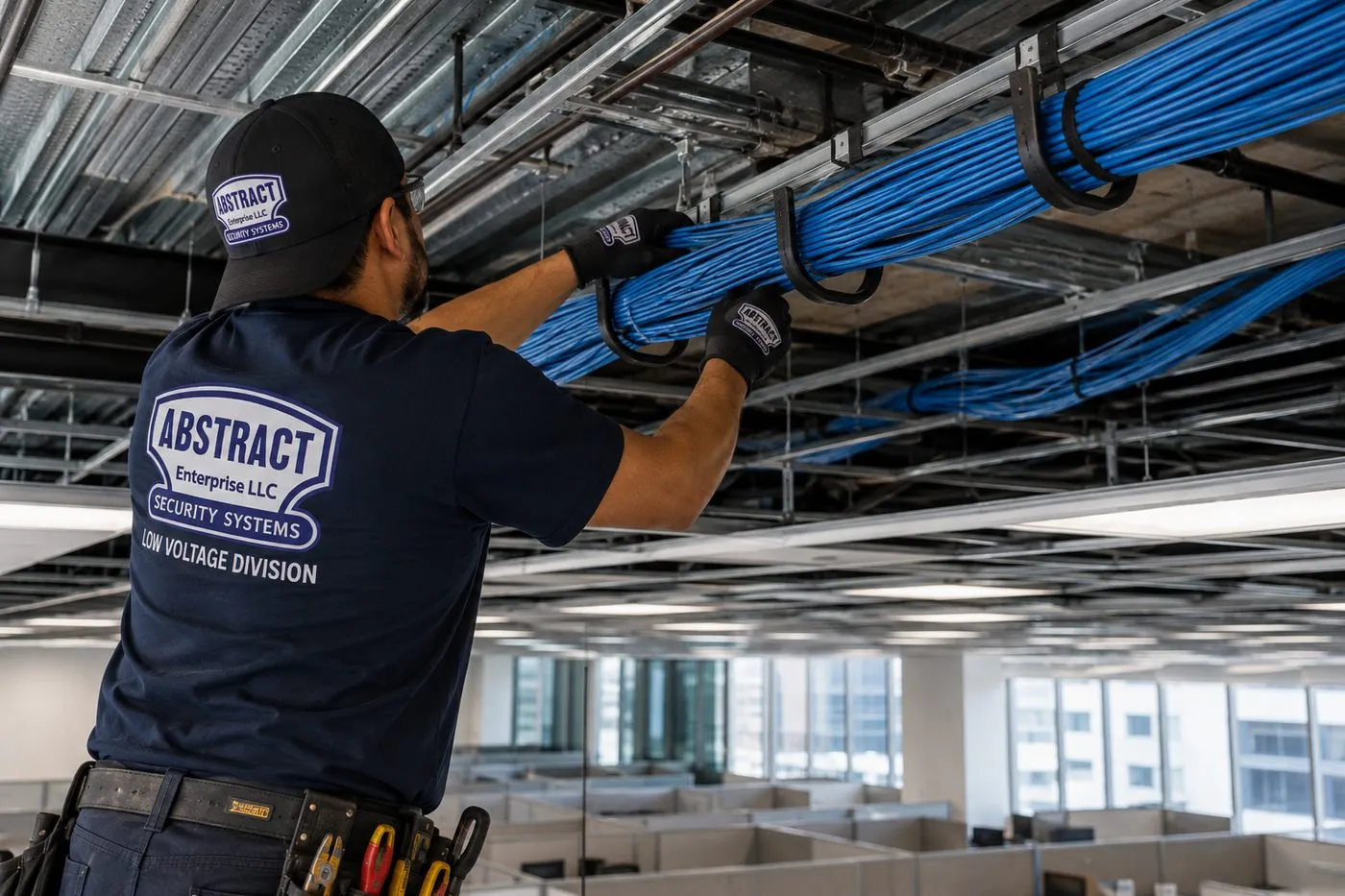
Seen from behind, a technician in a cap lifts a heavy bundle of blue cable into a row of black J-hooks hung below a metal deck, with an open-plan floor of cubicles below. Cable that is supported every few feet like this is not resting on pipes, ducts or the ceiling below.
Tall rooms, bonus rooms and echoes
Our family room is open to the second floor — where do speakers go when the ceiling is eighteen feet up?
Usually not in that ceiling. Sonos’s own guide to in-ceiling speakers explains that speakers project sound outward in a V shape, so a speaker in a 14-foot ceiling covers more floor than one in an 8-foot ceiling. At great-room heights the cone spreads so wide that the sound reaches you thinner and later, bouncing off the glass and the balcony first. Sonos’s installation manual gives spacing by ceiling height for exactly this reason.
In most two-story rooms we build the system at ear level instead: an Arc Ultra under the TV, a Sub on the floor, and either in-wall speakers or Era 300s on stud-mounted brackets at the sides or rear. If you want ceiling speakers for background music, the flat ceiling of the kitchen or the area under the balcony is the better place, and the great room plays as part of the same group.
Is the bonus room over the garage a good place for the Arc and Sub?
It can be a very good theater room, with three things to plan for. The first is temperature: rooms over garages run warmer in summer and cooler in winter than the rest of the house, and Sonos lists its Amp’s operating range as 32° to 104°F, so equipment should not sit in a closet that gets hotter than the room. The second is the signal: the bonus room is often the farthest point from a basement router, so it usually needs a wired link or its own access point.
The third is the neighbors inside your own house. A Sub on a framed floor over the garage won’t bother the cars, but the bedroom that shares the bonus room’s wall will hear it. We place the Sub against an outside wall, set the bass with Trueplay, and agree a night setting before we leave. And because the garage ceiling below is part of the house’s fire separation from the garage, cable reaches the bonus room from the house side, never through a hole cut in that ceiling.
Our two-story foyer and hardwood floors make every sound echo — will Sonos sound harsh in there?
It can, if the speakers fire straight into the hard surfaces. Newer Orange County houses often pair a two-story entry with hardwood or tile floors, painted drywall and a stair with no soft furnishings, and that combination reflects sound back and forth before it reaches you. Sonos’s Trueplay tuning exists for exactly this: Sonos says it measures how sound reflects off walls, furnishings and other surfaces and adjusts each speaker to suit the room.
We still start with placement. The foyer rarely needs its own speaker; music from the family room and kitchen, aimed into furnished space, carries into the entry at a comfortable level. Where a foyer or stair hall does get a speaker, we keep it low on the wall or under the landing rather than high in the open volume, tune it with Trueplay, and suggest a runner or a rug, which does more for echo than any setting.
Finishing the basement
We’re finishing the basement this winter — at what point does the speaker wire need to be in?
After the framing and the electrician’s rough-in, and before insulation and drywall. That window is the cheapest moment in the whole life of the house to run speaker and network cable, and it is short. Finishing a basement is building work, and local building departments treat it that way — the Village of Chester’s list of work requiring a permit includes additions, alterations and conversions — and inspections of framing and rough wiring usually come before the walls are closed. Ask your building department which inspections apply to you.
We run our cable once the electrician has finished, keep it apart from the electrical cable and boxes, label every end, and leave a coil at each speaker spot and at the equipment location. The ceiling speaker openings are marked on the joists so the drywall crew can cut them, or we cut them after the ceiling is up. Tell your contractor early: one phone call before the insulation goes in saves opening a new ceiling later.
The patio, the pool and the association
We have a saltwater pool — will the salt and chlorine damage the outdoor speakers?
Not if they are the right speakers in the right place. Sonos says its outdoor architectural speakers, made with Sonance, are rated IP66 and tested to the Mil Spec 810 standard for humidity, salt spray, temperature and UV, with an operating range of −13° to 149°F. Those are the speakers we mount around a pool. Indoor speakers carried outside are a different story: Sonos warns that speakers that aren’t waterproof may be damaged if exposed to water or left outside for long periods.
Placement matters as much as rating. We mount the speakers under the eaves or on the deck framing, out of the direct splash zone and pointed at the loungers rather than across the water, run the cable to an indoor Amp through a sealed entry, and keep any outdoor power and its distance from the water for your electrician and the inspector, since pools carry their own permit — the Village of Chester, for one, lists pools, hot tubs and decks around pools among the work that needs one.
Our homeowners’ association must approve exterior changes — what should we bring them for patio speakers?
A short, specific package. We give you a sketch of the back of the house with each speaker marked and its height noted, the Sonos product sheet showing its size and color, a note of how the cable enters the house and how the entry is sealed, and a photo of a similar installation. Most associations care about what can be seen from the street and the neighbors’ yards, so speakers tucked under the eaves in white or black usually raise fewer questions than anything on a fence or a post.
Your association’s declaration and design guidelines decide what is allowed, not us, so read them first and submit before the speakers are bought. If the association asks for changes — a different color, a position under the overhang instead of the wall — we redraw the plan and resend it at no charge.
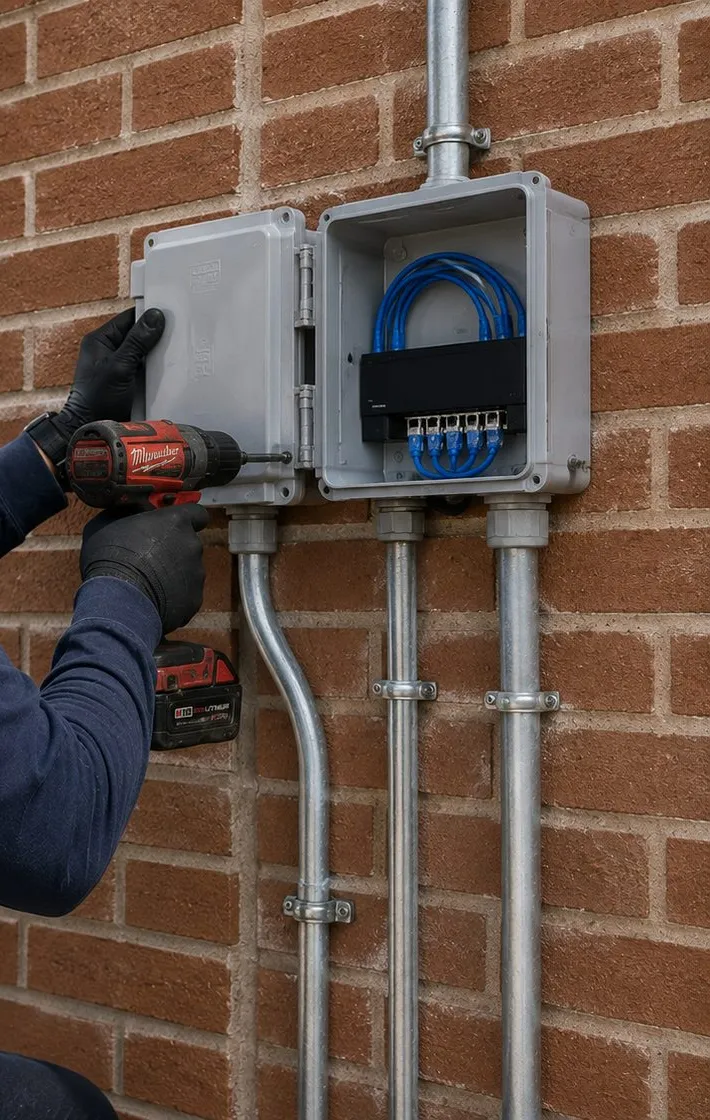
A gloved hand holds a red cordless drill against the lid of a grey weatherproof box fixed to a brick wall. A second box beside it is open, with blue cables and a small black terminal block inside, and three runs of metal conduit drop down the wall from the boxes.
As the family grows
Can the nursery speaker play white noise all night without the rest of the house hearing it?
Yes. Each Sonos speaker can play its own source, so the nursery speaker plays white noise or lullabies while the kitchen plays something else, as long as nobody adds the nursery to a whole-house group. We name the room clearly, leave it out of the groups we set up for parties, and show you how to set a sleep timer from the Now Playing screen, which Sonos says turns the music off automatically after the time you choose — or how to leave it playing all night if that’s what helps.
We also set a volume limit on that speaker, so an accidental tap in the app can’t blast the room, and place it on a high shelf or wall bracket with the power cord out of reach of a crib or a curious toddler. When the nursery becomes a big kid’s room, the same speaker gets a morning alarm instead.
Can we stop explicit lyrics playing in the kids’ rooms?
Partly, and it is worth knowing the limits before you rely on it. Sonos’s Parental Controls include a filter for explicit content, but Sonos says it applies to your entire system, not to one room, and it is password-protected through your Sonos account. It also only works with services that support filtering through Sonos — Sonos currently lists Amazon Music (US only), Apple Music and YouTube Music.
So in practice we switch the system-wide filter on if you want it, and for other services we set up the service’s own family or child settings on the accounts the kids use. Parents keep their own accounts on their own phones. We explain the arrangement at handover so nobody is surprised when a song plays in the kitchen but not in the bedroom.
The older house in the river city
We moved from a new Wallkill subdivision to an 1890s Newburgh row house — what changes for Sonos?
Almost everything about how the wiring is done, and very little about the speakers. A newer subdivision house gives you open basement ceilings, drywall, coax and an attic; a brick row house in Newburgh’s East End gives you plaster walls and ceilings, brick party walls and no builder wiring at all. Sonos’s own interference table rates brick as a medium obstacle to wireless signal and plaster as high, so a router in the front parlor may barely reach the back bedroom.
The plan therefore turns wireless-first: free-standing Era speakers and a soundbar rather than cut-in ceilings, a wired access point on each floor fed through a closet or the cellar, and in-ceiling speakers only where a ceiling is being replaced anyway. The street side of a house in the historic district is also subject to the city’s Architectural Review Commission, so outdoor speakers belong at the back. Pricing reflects the walls: our plaster surcharge is $45 per bracket and brick or stone is $65.
Room by Room
A Sonos Plan That Grows With an Orange County Family
A family-house Sonos system is often bought in stages. A soundbar the month the family moves in, a kitchen pair the next year, a basement theater when the basement is finished, the patio when the pool goes in. That is a perfectly good way to build a Sonos system, provided the first visit leaves room for the later ones: the network sized for more products than you own today, cable left in walls that will be closed, and the rooms named so the later speakers slot into the right groups.
Stage
What usually gets added
Settings we leave in place
Moving in
Soundbar and Sub in the family room, a speaker in the kitchen
Router moved or supplemented, default router password changed, Sonos account in the owners’ names
A new baby
A speaker on a high shelf in the nursery
Nursery kept out of whole-house groups, a volume limit, sleep timer shown to both parents
School-age kids
Speakers in the kids’ rooms
Explicit filter where the service supports it, school-morning alarms, a volume limit per room
Finishing the basement
Ceiling speakers on an Amp, or a second soundbar for a den or gym
Cable run before drywall, the basement as its own room or group, a wired link if it’s far from the router
Bonus room theater
Arc Ultra, Sub and rear speakers
Night settings, Sub placed away from the shared bedroom wall, Trueplay tuned
Pool and patio
Outdoor architectural speakers on an indoor Amp
Outdoor zone grouped with the kitchen for parties, its own volume limit for late evenings
Working from home
A speaker in the home office
Office left out of the house groups, so a call isn’t interrupted by someone else’s playlist
Two Sonos settings matter more as the household grows. Guest Access, which Sonos turns on by default, lets any device on the same Wi-Fi control playback, volume and grouping without full account access — handy when grandparents visit, less handy when a teenager’s friends discover the kitchen speaker. We set it the way you want.
Equipment
Types of Sonos Systems We Install
We install the Sonos range you buy from the retailer you prefer; AESS is not a Sonos dealer and doesn’t push one model over another. Here is how each product tends to fit an Orange County house.
Arc Ultra
Sonos’s largest soundbar, 46.38 inches wide, with HDMI eARC. Suits the family room or a bonus-room theater with a 65-inch or larger TV. Needs 4 inches below the TV and a foot of space at each end.
Beam (Gen 2) and Ray
Smaller bars for the primary bedroom, the basement den or a townhouse living room. Beam connects over HDMI eARC; Ray connects by optical cable, which some older TVs still prefer.
Sub 4 and Sub Mini
The Sub 4 for great rooms and basement theaters; the smaller Sub Mini for bedrooms and townhouse rooms where bass carrying through walls is a concern.
Era 100 and Era 300
Free-standing speakers for kitchens, offices and kids’ rooms, or as rear surrounds. The Era 300 wall mount is stud-mounting only, which in a newer house means finding the framing, not trusting an anchor.
Amp
Drives in-ceiling, in-wall and outdoor speakers: 125 watts per channel into 8 ohms, HDMI for a TV, and up to three pairs of Sonos architectural speakers. Needs open air around it, so it lives on a shelf, not inside the media panel.
In-Ceiling and In-Wall Speakers
Sonos’s architectural speakers made with Sonance, 6-inch (8.25-inch cut-out) or 8-inch (10.125-inch cut-out), with paintable grilles. The usual choice for kitchens, basements and hallways with drywall ceilings.
Outdoor Speakers
IP66-rated, tested for humidity, salt spray, temperature and UV, run from an indoor Amp. The speakers for patios, decks and pool surrounds.
Era 100 Pro
Sonos describes it as designed for professional installation, powered over the network cable with PoE+. Useful in model homes and small businesses where outlets near the speakers are scarce.
Port
For the hi-fi that moved with you: the Port feeds a receiver or amplifier from Sonos, and its 12-volt trigger switches that amplifier on whenever a song starts, so the old floor-standers in the basement den keep earning their space.
Which Sonos products suit which part of a newer Orange County house
Room
Typical choice
Why
Two-story family room
Arc Ultra, Sub 4, in-wall or Era 300 rears
Ear-level sound beats a ceiling eighteen feet up
Kitchen and breakfast area
Pair of in-ceiling speakers on an Amp, or one Era 100
Flat drywall ceiling, usually reachable from the basement or the floor above
Bonus room over the garage
Beam or Arc Ultra, Sub Mini, wired link or access point
Far from the router; the bedroom next door hears the bass
Finished basement
In-ceiling speakers wired before drywall, or a soundbar for the TV corner
The cheapest cable route in the house, if planned in time
Kids’ rooms and nursery
Era 100 on a shelf or bracket
Easy to move, easy to limit, no holes
Townhouse living room
Beam with Sub Mini, Era speakers off the shared wall
No recessed speakers in the fire separation wall
Patio and pool
Outdoor speakers on an indoor Amp
Rated for salt spray and freezing winters
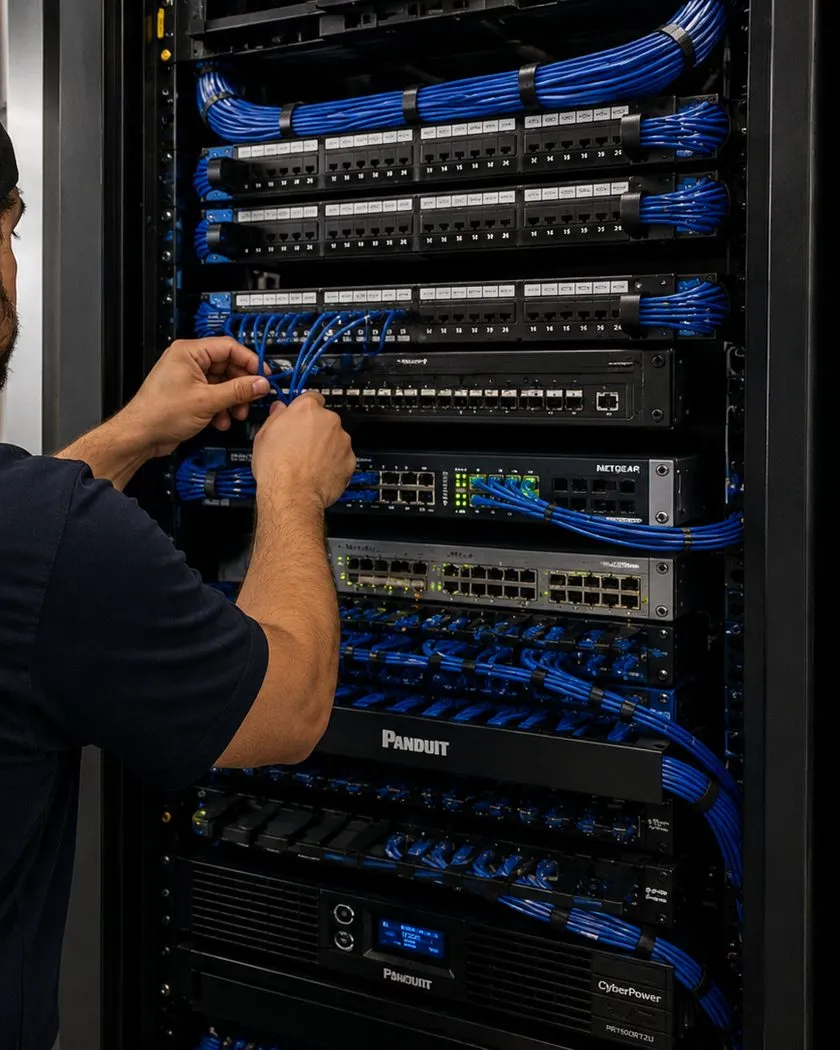
Close to a tall black rack, a technician’s hands thread short blue patch cables from a row of patch panels down to network switches, with more panels, a cable manager and a battery backup unit lower in the rack.
AI Overview Reality Check
What AI Gets Wrong About Sonos Installation in Orange County
We could not view Google’s AI Overview for these searches from our build environment, so this section answers claims that cost guides, forums and answer engines commonly repeat, and corrects each one with what we find in Orange County houses and what Sonos and the codes actually say.
“A new house comes ready for Sonos”
The assumption is understandable: a house built in the last few years has network jacks, coax outlets and a media panel, so surely it is wired for whole-house audio. Builder low-voltage packages are generally designed around TV and internet, so speaker cable to the rooms where you actually want music is usually there only if it was ordered as an option.
Even the wiring that exists is uneven. Jacks are sometimes never terminated at the panel end, coax runs pass through splitters that weaken them, and the provider’s router sits in a metal enclosure that Sonos’s interference table would rate as the worst place for a wireless signal.
The fix is not to rewire the house. It is an hour with a tester and the panel door open, followed by a short plan that uses what passes and adds only what is missing.
“A mesh system solves Wi-Fi in a big suburban house”
Mesh routers are a real improvement over a single router in the basement, and Sonos supports them. But Sonos’s system requirements add conditions: if you use a wired Sonos setup with a mesh system, the wired Sonos product has to connect to the primary mesh node, and range extenders are unsupported altogether.
In a 3,000-square-foot colonial with a bonus room over the garage, a mesh satellite placed in the hallway may be relaying a weak signal from the basement, and every Sonos product behind it inherits the weakness.
Mesh works best in these houses when at least one satellite is wired back to the router, which is often exactly what a tested coax run or one new cable makes possible.
“In-ceiling speakers are a weekend DIY job”
Sonos itself says architectural speakers often require a professional installer. In a newer Orange County house the reasons are specific: engineered I-joists that tolerate holes only in the web, a top-floor ceiling that forms part of the attic air barrier, and in townhouses a fire-rated wall that must not be cut.
None of that makes the job difficult for someone who knows it. It does mean a hole in the wrong place costs more than the speakers: a damaged joist flange, a draft from the attic, or a breach in a separation wall that an inspector or a future buyer will notice.
We scan, pilot-drill, follow the joist maker’s chart, seal top-floor openings and keep away from the shared wall. That is most of what a professional installation is buying.
“Whole-home audio costs $500 to $1,000 per room”
That range appears in Angi’s cost guide for additional zones or multi-room audio, and it is a national average across every kind of house. It can’t tell you what a kitchen pair costs in a house where the basement ceiling is still open, compared with the same pair in a finished house with no attic access.
In Orange County the biggest price swing comes from timing. Cable run during a basement finish or before drywall in a new build costs a fraction of the same run fished through finished walls later.
So we publish the lines we can fix in advance — $125 for Sonos setup, $129 to wall-mount a soundbar, $99 for a cable run of up to 25 feet — and quote ceiling and outdoor zones in writing after seeing the house.
“Any weatherproof speaker will do by the pool”
Many portable speakers are splash-resistant, and many owners carry one out to the pool. Sonos is clear about the difference: speakers that aren’t waterproof may be damaged if exposed to water or left outside for extended periods.
The speakers that stay outside year-round around an Orange County pool face chlorinated or salt spray in summer and freezing winters. Sonos rates its outdoor architectural pair IP66 and tests it for humidity, salt spray, temperature and UV, from −13° to 149°F.
Those are the speakers we bolt up for good. A portable can still come out for the afternoon, as long as it goes back inside.
“Parental controls block explicit songs in the kids’ rooms”
Sonos does have a filter for explicit content. What answer engines tend to leave out is that Sonos says it applies to the entire system, not one room, and that it works only with services that support filtering through Sonos — currently Amazon Music in the US, Apple Music and YouTube Music.
For a family that streams on another service, or wants different rules in the kitchen and the kids’ rooms, the Sonos filter alone won’t do it.
We combine the Sonos setting with the music service’s own child or family settings, give the kids their own accounts where the service allows it, and explain the arrangement so it is clear which control does what.
“The soundbar can go anywhere the TV goes, even over the fireplace”
Over-the-fireplace TVs are common in Orange County family rooms, and so are questions about putting the soundbar on the mantel. Sonos’s Arc Ultra guide asks for the bar not to be enclosed in a cabinet or corner, for 4 inches below the TV and for a foot of space at each end.
Heat matters too. Sonos community answers cite the Arc’s operating range as 32° to 104°F, and air above a running gas fireplace can exceed that.
So we measure with the fire on before mounting, put the bar on the wall rather than the mantel when we do mount there, and often recommend another wall for the TV and soundbar altogether.
An Orange County Sonos Plan Built on What’s Already in Your Walls
A few details by phone or form — the town, roughly when the house went up, the rooms that should play — and our reply covers the builder wiring worth keeping, the right home for the Amp and router, and the price in writing.
A Beam for a townhouse living room in New Windsor or ceiling speakers through a basement finish in Montgomery — this form is all we need to start, and a written figure comes back within the business day. Prefer to talk? Call our Hudson Valley line, (845) 640-3835.
✅
We Got Your Request!
Thanks — someone who books Orange County jobs will phone you back today if you sent this during business hours. In a hurry? Ring (845) 640-3835.
How It Works
Our Installation Process
Seven steps, whether it’s one Era 100 in a Goshen kitchen or a five-zone system through a new house in Wallkill. Steps 2 and 3 are skipped for a simple soundbar or setup job.
1. Send the house details
Tell us the town, when the house was built and by which builder if you know, which rooms you want music in and which Sonos products you have or plan to buy. Photos of the TV wall, the media panel or wherever the internet comes in, and any basement ceiling that is still open help us price it. We reply with a written figure from our published lines and flag anything that needs a walkthrough.
2. Walkthrough: panel, basement and attic
For ceiling, basement, bonus-room or outdoor work we visit first. We open the builder's media panel, test the coax and network jacks, look at the joists from the basement, check the attic hatch and insulation above any top-floor ceiling, and agree where each Amp, speaker and wire entry will go.
3. Approvals and booking
If your homeowners' association, landlord or builder needs to approve outdoor speakers or work during construction, we give you a drawing and product sheets to send. A certificate of insurance is free. We book a two-hour arrival window between 8 AM and 8 PM, any day of the week.
4. Get the network right first
On arrival we sort the network before any speaker goes up: router placement, a wired link or access point for the far rooms, coax put to work where it tests well, extenders and powerline adapters removed, and signal checked in every room that will have Sonos.
5. Cut, wire and mount
Speaker openings are scanned and pilot-drilled before cutting, holes through engineered joists stay inside the maker's allowed zones, top-floor openings are sealed back to the attic air barrier, and brackets go into framing or the right anchor for the wall.
6. Set up the rooms for the household
Every product is joined to your system and named the way the family names the rooms, music services are signed in, the explicit filter and volume limits are set where you want them, sleep timers and alarms are shown on the nursery and bedroom speakers, and voice control is set up if you use it.
7. Tune, test and hand over a room map
Trueplay is run in each room that supports it, every source is tested, and you get a short room map showing which Amp feeds which speakers, where each cable ends and what to check first if a room ever drops out.
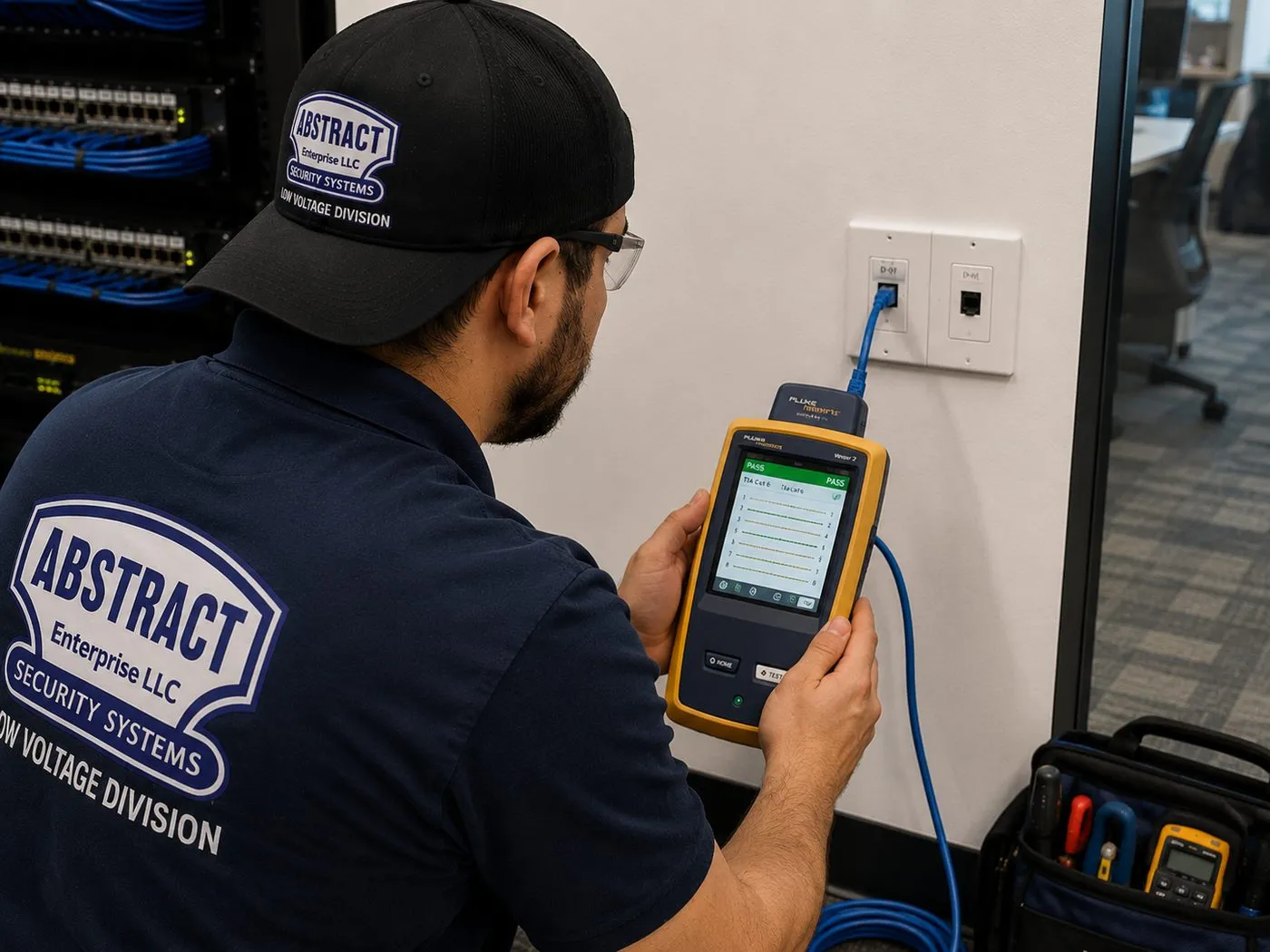
Over the shoulder of a kneeling technician in a cap, a yellow handheld tester connected to a wall jack by a blue patch cable shows a green PASS result. A network rack is at the left edge and a tool bag with a second meter sits on the floor.
Coverage Area
Sonos Installation Near Orange County’s Landmarks
Six places that help place our work in the county, from the newest planned community to the oldest historic district. The facts on each card come from the sources named in our research notes; none of these sites is a client.
Tuxedo Reserve, Tuxedo
The Lennar and Related community formerly known as Tuxedo Farms, planned for more than 1,600 homes on about 1,200 acres between Harriman State Park and Sterling Forest. A 2022 revision reported by the Times Herald-Record broke that down into 755 townhouses, 411 apartments and 269 single-family houses — a development in which townhouses outnumber every other home type.
Woodbury Common Premium Outlets, Central Valley
Opened in 1985 on Route 32 just north of Route 17, with 220 stores across 845,000 square feet. The retail anchor of the Monroe–Woodbury corridor, where new subdivisions such as Palisades Ridge at Woodbury Junction have followed.
LEGOLAND New York, Goshen
Opened on May 20, 2021, on about 150 acres themed within a larger property, with a Route 17 exit ramp relocated to serve it. A reminder of how much the Route 17 corridor has changed in a few years.
Galleria at Crystal Run, Town of Wallkill
The regional mall that opened on April 1, 1992, at the center of Wallkill’s commercial strip. Of the county’s six municipalities with more than 10,000 homes, the Town of Wallkill around it has the highest share built since 2000: 26.4 percent.
Goshen Historic Track, Goshen
The half-mile harness racing track on Park Place, established in 1838 and now a National Historic Landmark, a few minutes from the county government center in the village of Goshen.
East End Historic District, Newburgh
About 445 acres and more than 2,200 buildings, listed on the National Register in 1985, mostly two- and three-story brick Italianate row houses. The contrast case for everything on this page: plaster, brick and no builder wiring.
We also install Sonos in Port Jervis, where the Tri-States Monument marks the corner of New York, New Jersey and Pennsylvania beneath the I-84 viaduct; in Cornwall, Highland Falls and Fort Montgomery along the Hudson; in Washingtonville, Walden, Maybrook and Montgomery; in Florida, Warwick, Greenwood Lake and Sugar Loaf; and in the hamlets of Wawayanda, Mount Hope, Otisville and Deerpark. Commuters on the Port Jervis Line will know Harriman, the busiest station on the line, and Campbell Hall, which serves Goshen, Montgomery and Walden.
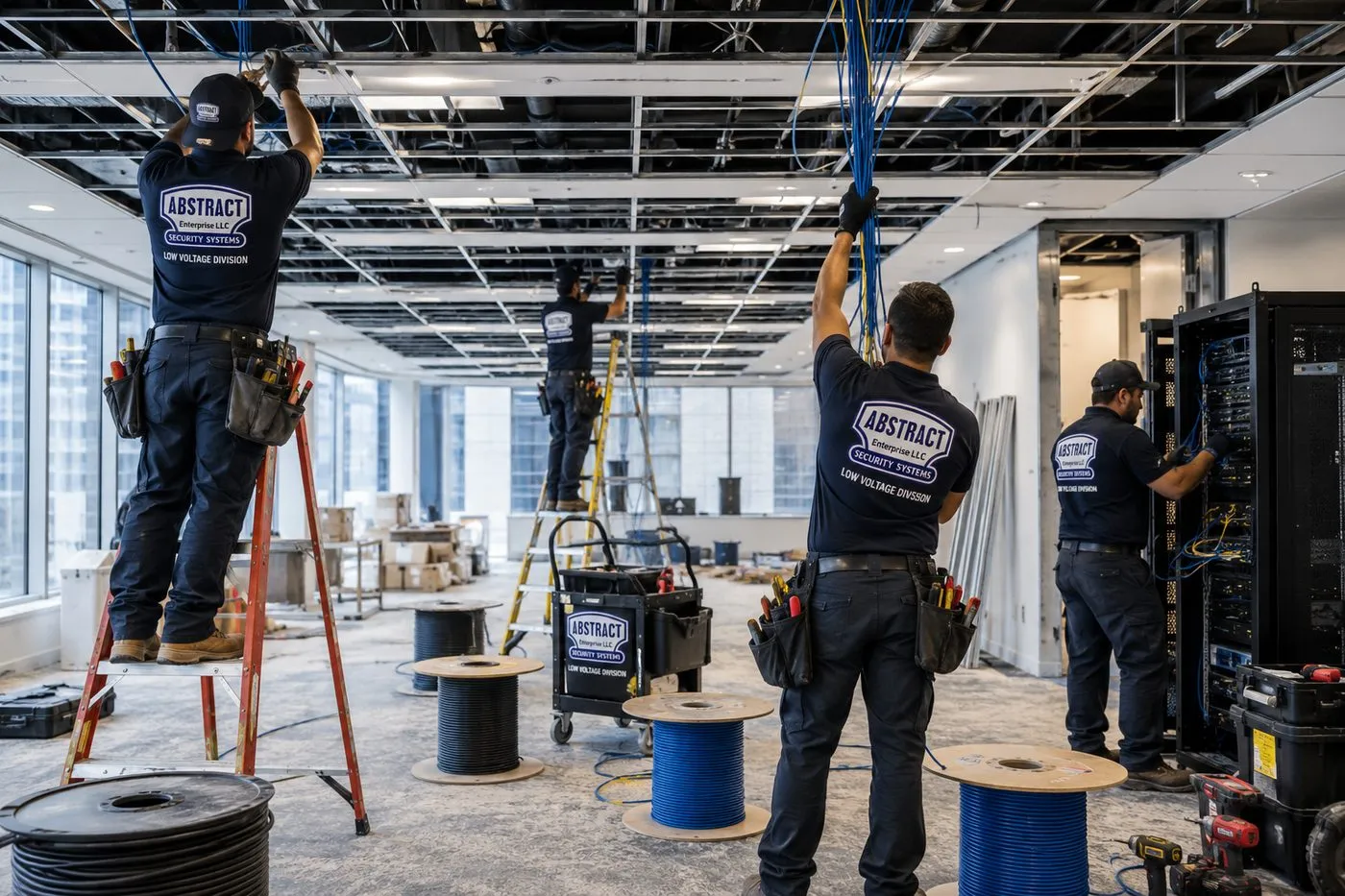
All seen from behind: two technicians on ladders and one on the floor lift blue cable from spools up into an open ceiling grid across a long room with tall windows, while a fourth works inside a black equipment rack at the right. A tool cart and more spools stand on the floor.
Pricing
Sonos Installation Cost in Orange County
Every figure below is copied from a price list AESS already publishes — our Hudson Valley Sonos page, the Orange County TV mounting price list and the TV-and-audio menu behind them. Nothing here is new. Work we can’t price without seeing the house — ceiling speakers, outdoor zones, cable through finished walls — is quoted in writing after a walkthrough and agreed before anything is cut.
Item
Orange County price
What it covers
Sonos setup
$125
Every product on your account and network, room names and groups, streaming services, voice assistant and Trueplay tuning
Soundbar wall-mounted under the TV
$129
Arc Ultra, Beam or Ray on its bracket, levelled and connected
Soundbar placed on a console or stand
$79
Positioned, connected and tested
Sanus soundbar bracket
$84.99
Supplied when you don’t have a mount
In-wall concealment
$169
Code-compliant in-wall power and cable kit behind the TV
Paintable cord cover
$59
Surface raceway on walls that won’t be opened
Cable run to a cabinet or other spot
$99
Up to 25 ft, for example router to the TV wall
A/V receiver connection
$129
For a Port or a receiver-based system
Universal remote programming
$99
One remote for TV, soundbar and sources
Streaming device setup
$49
Per device
Full home theater
$350
Soundbar or receiver, Sub and surrounds connected and calibrated together
Box removal
$25
Packaging taken away
Ceiling, in-wall or outdoor speakers on an Amp
Quoted at walkthrough
Number of zones, cable route, attic and joist access
Builder wiring audit, coax links, access points, new cable
Quoted at walkthrough
Depends on what tests good and what needs adding
Walls, height and access
Condition
Price
Drywall on wood studs (most post-2000 houses)
$0
Metal studs
+$30
Plaster (Newburgh, Port Jervis and village-center houses)
+$45
Brick or stone (row-house party walls, fireplace surrounds)
+$65
Concrete or cinder block (basement walls)
+$75
Tile or marble
+$95
Plywood backer board
$85
High mount, above about 8 ft (great rooms, stair walls)
$75
Walk-up, 3rd floor and above, no elevator
$40
Certificate of insurance for an HOA, landlord or builder
Free
Travel, parking or fuel charge
None anywhere in Orange County
Setup-only visits and a TV on the same day
When nothing is being mounted or cut — rejoining every speaker after the fiber installer swapped the router, splitting the basement off into its own room, sorting a Sub that won’t bond — the visit is billed by time: the first hour at the Orange County rate of $250, then 30-minute blocks. If the TV is going up at the same visit, the Orange County TV mounting base is $229.99 for a 32- to 55-inch screen on drywall over wood studs, with the rest on our Orange County TV mounting price list. The same county rates are set out on our Hudson Valley Sonos installation page alongside the other five counties.
Included, and not included
Inside the price: fixing into framing or the right anchor for the wall, joining every product to your system, room names that match what the family calls them, streaming accounts signed in, the parental and volume settings you ask for, Trueplay wherever the product offers it, and vacuuming up after ourselves.
Left to other trades: a new outlet, a dedicated circuit or a generator hookup needs an electrician holding an Orange County license, and finishing drywall or repainting a ceiling belongs to your painter.
Sourcing: order the Sonos products from whichever store gives you the best deal or the longest return window; we bring the brackets, cable, raceway and in-wall kits on the table above if you want them.
Return trips: a second trip caused by something outside our control — a delivery that hasn’t arrived, a locked house, a site the builder hasn’t handed over — carries the $150 return-trip fee. Moving the appointment costs nothing if you tell us 24 hours ahead.
National brands and app-booked handymen versus a local licensed installer. Big-box install services and gig apps price a soundbar on a drywall wall, and for that job they are often fine. They don’t price testing the builder’s coax, drilling an I-joist inside the maker’s chart, sealing a top-floor opening to the attic, or keeping speakers out of a townhouse separation wall. A local installer with a published Orange County price list and a state low-voltage licence can price the real house and is still answering the phone afterwards.
Shop Our Systems
Sonos Installation Packages & Pricing
Three common starting points for an Orange County house, each built from the price table above. We show the arithmetic on every card, and add a wall or height surcharge only when the room calls for one.
Starter — Sonos Setup
$125Sonos setup ($125) alone, for speakers already sitting where you want them: we add them to your account, name and group the family room and kitchen, sign in your streaming apps, set up the nursery or kids’ controls and tune with Trueplay.
Standard — Family-Room Soundbar
$338.99Soundbar wall-mounted under the TV ($129) on a Sanus bracket ($84.99), plus Sonos setup ($125): $338.99. Brick or stone around a fireplace adds $65; a great-room wall above about 8 feet adds the $75 high mount.
Premium — Move-In TV Wall
$737.98Orange County TV mounting base ($229.99), soundbar wall-mounted ($129) on a Sanus bracket ($84.99), power and HDMI hidden by the in-wall concealment kit ($169), and Sonos setup ($125): $737.98. The usual first visit after a closing.
Bring Your Own Equipment — Labor Only
Bought the mount with the soundbar? Then the bracket line simply drops off the bill, and you pay $129 for the wall-mount labor, any surcharge for the wall it goes on, and $125 if you want the Sonos setup as well. Your bracket stays under its own maker’s warranty, so it has to be rated for the bar it holds; when we find framing or masonry that bracket can’t handle, you hear about it before the first hole, with the Sanus option priced as an alternative.
Ceiling, Basement, Bonus-Room and Pool Zones
Speakers built into a ceiling or wall, or mounted outside, all run from a Sonos Amp, and each zone gets its own figure once we have seen it, because the attic, the joists, the cable route and the wall entry set the work. A zone pre-wired during a basement finish or before drywall is priced very differently from one fished into finished walls, and the written quote shows which you are getting.
Ready to Use the Wiring Your Builder Left?
One walkthrough tells you which coax runs and jacks will carry Sonos, where the Amp should live and what the whole system costs, room by room.
Orange County is large enough that the same Sonos request plays out differently from one end to the other.
Monroe, Harriman, Woodbury, Central Valley and Tuxedo
The southeastern gateway along Route 17 and the Thruway, where 18.4 percent of the Town of Monroe’s homes date from 2000 or later and new building continues at Tuxedo Reserve and Woodbury Junction. Expect townhouses with shared walls, three-story layouts where the router sits two floors below the bedrooms, and commuters who want the system to work without fuss when they get home from Harriman station.
Chester, Goshen, Florida, Warwick and Greenwood Lake
A mix of post-2000 subdivisions — 20.2 percent of the Town of Chester’s homes are that recent — and old village centers. In the Town of Warwick about 22 percent of homes predate 1940, so a single afternoon can take us from a new colonial with a coax-wired bonus room to a village house with plaster ceilings. Greenlight says it has connected more than 1,000 homes in the Village of Goshen to fiber, which often means a new terminal and router in the basement or garage.
Middletown and the Town of Wallkill
Among Orange County municipalities with more than 10,000 homes, the Town of Wallkill has the highest share built since 2000, 26.4 percent, and the 124-apartment Silverlake Ridge was approved for county incentives there in 2026; next door in Wawayanda, Ridgebury Estates in Slate Hill appears on the new-home listings. The City of Middletown mixes eras: about a third of its homes predate 1940 and about 18 percent are post-2000. Greenlight has said it planned to reach 6,000 Middletown homes within a year of its 2025 announcement, so fiber routers are turning up in Middletown basements too.
Newburgh, New Windsor, Vails Gate and Cornwall
The sharpest contrast in the county. In the City of Newburgh 49.4 percent of homes are pre-1940; next door, a quarter of New Windsor’s homes and 22.8 percent of the Town of Newburgh’s are post-2000. We plan East End row houses wireless-first and the newer houses around Route 300 and Route 32 on builder wiring. Cornwall’s housing is older on balance, with about a quarter built before 1940.
Montgomery, Walden, Maybrook, Washingtonville and Campbell Hall
The I-84 and Route 17K side of the county, where 17.8 percent of the Town of Montgomery’s homes are post-2000 and new houses such as those listed in Campbell Hall sit alongside village centers. Greenlight reports a $3.4 million fiber build in the Village of Walden and construction under way in Washingtonville, so expect new network equipment in houses that had copper-only service until recently.
Port Jervis, Deerpark, Otisville and Mount Hope
The western end of the county. More than half of Port Jervis’s homes, 54.2 percent, were built in 1939 or earlier, and fewer than one in ten since 2000. Greenlight’s $4 million Port Jervis build started downtown. Here the job looks more like a Newburgh row house than a Chester colonial: wireless speakers, careful cable routes and pricing that reflects plaster.
Highland Falls, Fort Montgomery and West Point
Along the river south of Cornwall. Greenlight says it is investing more than $2 million to bring fiber to Highland Falls. Family housing on post at West Point has its own rules: its community guidelines say alterations need a Request for Alterations form submitted to Community Management, so a no-holes Sonos setup on freestanding speakers is usually the right plan there.
Repairs
Common Sonos Faults in Newer Orange County Houses, and Their Fixes
Sonos faults in newer houses tend to fall into a handful of patterns, and most of them trace back to the network rather than the speakers.
Symptom
Usual cause in a newer house
What we do
Every speaker disappeared after the internet was upgraded
The new fiber or cable router came with a new network name and password
Re-home the system onto the new network, or give the new router the old name, and retire the old router properly
The bonus-room or primary-suite speaker drops in the evening
Weak signal far from a basement router, worse when the house is busy
Wired link, tested coax adapter or ceiling access point to that end of the house
The Sub in the basement theater keeps disconnecting
Interference from nearby electronics or the router itself
Move the Sub and router apart; Sonos advises keeping its products at least 18 inches from other electronics
No TV sound from the Arc after a new TV
The soundbar is on the wrong HDMI input, or eARC and CEC are off on the new set
Use the TV’s eARC port, switch on the TV’s audio control settings, retest every source
The kitchen ceiling speakers sound thin or distorted
A builder wall knob or an old splice between the speakers and the Amp
Bypass the knob, re-terminate the cable, check the load against the Amp’s limits
Patio zone silent after the winter
Moisture at a poorly sealed wall entry or a corroded connection
Re-terminate, reseal the entry, and test the speaker on its own before replacing anything
The app can’t find the system
The phone is on a guest network or a different band of a new router
Move the phone to the main network; Sonos doesn’t support guest networks for its products
Complete Services
Every Sonos Installation Service in Orange County
Sonos is rarely the only low-voltage work a newer Orange County house needs. These are the related services we provide in the county, each on its own Orange County page.
General installer practice: the order in which we look at a recently built Orange County house on a first visit. This describes our routine, not a particular customer’s home.
We start at the media panel. The door comes off, every cable gets a temporary label, and the ones nobody can identify get a tone. Within half an hour we know which coax runs are clean enough for a network link, which jacks were never connected and where the router really ought to be. That list decides the network plan before anyone talks about speakers.
Next is the basement ceiling, if it is still open. We read the stamp on the joists, note which way they run under the rooms that want ceiling speakers, and photograph the plumber’s and electrician’s holes so ours stay clear of them. Then, if there is a hatch, the attic: insulation depth, where the trusses land, and whether a top-floor speaker can be sealed from above.
Last is the kitchen table, where we ask how the house will change — a baby, a basement finish, a pool — and sketch the floors with the rooms, the Amps and the cable runs marked. That sketch becomes the written quote, with the stages you can do now and the ones that can wait.
FAQ
Orange County Sonos Installation FAQ
Can the ceiling speakers line up with the recessed lights the builder installed?
+
Usually, and it is worth asking for. Builders lay recessed lights out on a grid, so we measure that grid and place the speakers on the same lines or centered between lights, which makes the ceiling look planned rather than added to. Sonos's guidance allows the left and right speakers to sit anywhere from six to ten feet apart, which leaves room to follow the lighting layout without hurting the sound.
Will a ceiling speaker interfere with the smoke alarms nearby?
+
Not electrically, but it should not crowd them. Newer Orange County houses usually have hardwired, interconnected smoke alarms, and their makers publish placement guidance. We keep speakers clear of the alarms so nothing blocks them, never move, cover or disconnect a hardwired alarm, and leave any change to an alarm's position to a licensed electrician.
Is the router our internet provider installed good enough for Sonos?
+
Often it is, once it is in the right place. Sonos's system requirements ask for a router that offers 2.4 GHz Wi-Fi rather than 5 GHz only, WPA or WPA2 Personal security rather than Enterprise, and every product and the app on the same network, not a guest network. Most provider routers meet that. The usual problem is where the provider put it, in a basement or a closed media panel, so we move it or add a wired access point before suggesting a new router.
Do you need our Wi-Fi password, and what happens to it after the visit?
+
We need it while we work, because every Sonos product has to join your network. You can type it in yourself on our tablet or phone, and we do not write it down or keep it after the visit. If the builder or the internet provider's installer left the default password on the router, we suggest changing it before we start and joining the speakers to the new one.
Can you come while the house is still under construction, if the builder allows it?
+
Yes, when the builder agrees in writing and the site is safe to work in. Speaker and network cable is easiest to run after framing and before insulation and drywall, so that is the window we aim for. We coordinate with the site supervisor, label every cable end, and come back to fit speakers and set up Sonos after you close.
What happens if a planned ceiling speaker spot lands on a joist or a duct?
+
We move the speaker before we cut, not after. Every opening starts with a scan and a small pilot hole, and if a joist, duct or pipe sits where the speaker was drawn we shift it to the nearest clear bay and show you the new spot. Moving a speaker over by a joist bay rarely changes how the pair sounds, and it is far better than cutting into framing or ductwork.
Do you install Sonos in model homes and sales offices for builders?
+
Yes. A model home or sales center usually wants background music in the kitchen and living areas, a TV wall with a soundbar, and a system that sales staff can run from one tablet without logging into personal accounts. We set it up that way, document it, and can return to move or reset the system when the model is sold.
Can the ceiling speakers you wire be used with a different amplifier by a future owner?
+
Yes. In-ceiling speakers on a Sonos Amp are ordinary passive speakers on ordinary speaker cable, so a future owner can connect them to another amplifier or receiver. We label each cable at the equipment end by room and left or right, and leave that labeling written down so it survives a sale of the house.
All Areas Served
Sonos Installation Across the Hudson Valley and New York
This Orange County page sits under our Hudson Valley Sonos hub. The neighboring county pages and the city and Long Island pages each deal with the houses found there, and one licensed crew covers them all.
Their own Sonos pages are still being written. Until they are up, send the free quote form and the same Hudson Valley crew books the job.
A house that is new to you usually comes with a longer to-do list than speakers. The Abstract Enterprises home page covers cameras, alarms and access, and our about page explains the licensing behind the work.
Sonos Gone Silent Tonight in Orange County
Bonus-room speaker greyed out, the patio zone dead after the storm, a Sub that won’t pair with the basement soundbar? Call (845) 640-3835 for the earliest open arrival window anywhere from Monroe to Port Jervis. With a technician on site, network and setup faults are typically fixed within one to two hours.
Sonos Installation Orange County — Licensed, Insured, Planned Around Your Builder’s Wiring
Abstract Enterprises Security Systems · 460 E Fordham Rd, Bronx, NY 10458 · Hudson Valley line (845) 640-3835 · WhatsApp (718) 679-0359 via wa.me
NYS Low-Voltage Licence #12000287431 · 100% Licensed & Insured · Same-Day Estimates · Rated 4.7★ from 201 Google Reviews
Sonos products carry Sonos’s manufacturer warranty through the seller; brackets and parts carry their maker’s warranty. Full terms — including 50% deposit, one-year parts-only warranty on AESS-supplied products, and the late-fee schedule — are set out in the service agreement. See our warranty page.
Last reviewed October 17, 2026 by Anwar Timothy. Change history: Orange County Sonos page first published on this date.