In Westchester the hard part of a Sonos system is rarely the speaker. It is the sequence around it: a kitchen renovation whose walls close in three weeks, a co-op board in Yonkers that wants a written scope, a village building department with its own paperwork, an HOA that owns the patio wall. We plan Sonos around who has to sign off and when the walls are open — then install, tune and hand over a system that works from every phone in the house.
Reviewed and updated October 17, 2026 · Written by Anwar Timothy, NYS licence #12000287431
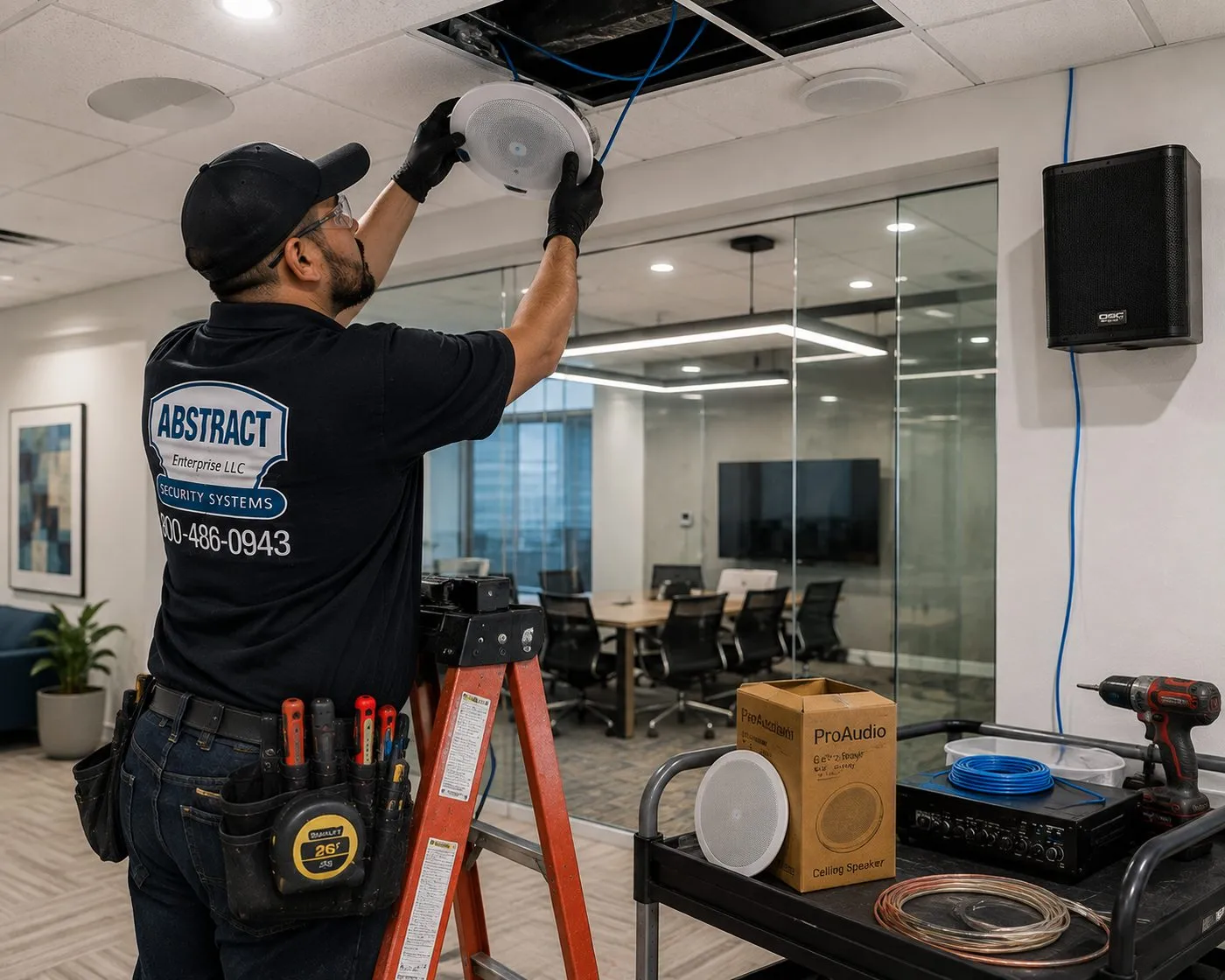
A round ceiling speaker is lifted into an opened ceiling tile while a cart below holds a boxed speaker, an amplifier, a drill, blue cable and a coil of copper speaker wire.
Get a Free Westchester Sonos Quote
Your town, the rooms, and any renovation or board dates — we call back the same business day
✅
Request Sent!
We'll call you back the same business day.
25+
Years Experience
✓
Same-Day Estimates
100%
Licensed & Insured
4.7★
201 Google Reviews
Walls coming open soon, or a board waiting on paperwork? Call our Westchester line, (914) 877-2578, or send the 60-second form with your town and your renovation dates. We will tell you what has to happen before the drywall goes back and what a managing agent or building department will want to see.
Westchester prices published below, at our 1.25 county rate
Two-hour arrival windows, 8 AM to 8 PM, seven days a week
NYS licence #12000287431 · insured, certificate of insurance at no charge
Why Westchester Homes Need a Sonos Plan Before the Walls Close
Most Sonos jobs in Westchester County begin with a date that somebody else set. The contractor is closing the kitchen ceiling on the twelfth. The co-op’s managing agent meets the board on the first Tuesday of the month. The spray-foam crew is booked for the attic next Thursday. The movers arrive at the new house in Rye on the thirtieth. Sonos itself is designed to be set up by its owner in an afternoon, and a single speaker on a shelf still is. But the systems people in this county actually ask us for — ceiling speakers in a renovated kitchen, an Arc Ultra over a stone fireplace in a 1920s Tudor, music on the terrace of a townhouse whose association owns the walls — depend on decisions taken by other people on other schedules. Miss the window and the same wire that cost little to drop through an open stud bay costs a great deal more to fish through finished plaster.
The county’s housing explains why that matters so much here. Westchester is not one market but two living side by side. The Census Bureau’s QuickFacts table counts about 399,600 housing units for 2025 and an owner-occupied rate of 61.8 percent for 2020–2024 — far below Long Island’s suburbs — because a large share of households in Yonkers, New Rochelle, White Plains and Mount Vernon live in apartments: post-war elevator buildings converted to co-ops and condos in the 1980s, and a new generation of downtown rental towers. The other Westchester is the one people picture: railroad suburbs of Tudors and colonials from the 1910s to the 1930s in Scarsdale, Bronxville, Larchmont, Pelham and Rye, and larger houses on larger lots further north. Stacker’s September 2025 analysis of Census data put 28 percent of the county’s homes — 109,608 of them — at 1939 or earlier. Each half of the county has its own gatekeepers. In the apartments, it is the board, the agent or the landlord. In the houses, it is the renovation schedule, the village building department and, increasingly, the homeowners’ association.
The licensing landscape adds a layer most buyers don’t expect. Westchester law requires home improvement contractors to hold a county licence from the Department of Consumer Protection, which says there are almost 9,000 licensed contractors in the county and asks residents to check the licence before paying anything. Electricians are licensed by the county too. Individual towns and villages run their own building departments: the Town of Greenburgh, for one, publishes an “Electrical or Low Voltage Permit Application” that asks low-voltage contractors for liability, workers’ compensation and disability insurance naming the town as certificate holder. None of that is a reason to avoid Sonos. It is a reason to have the paperwork, the insurance certificates and the scope of work ready before a cut is made — which is the part of the job a speaker’s box doesn’t mention.
Then there is the network, which in Westchester fails in its own particular ways. In pre-war houses, plaster on wire lath and masonry chimney stacks block Wi-Fi far more than drywall does; Sonos’s own interference guidance rates plaster and concrete as high obstructions and metal as very high. In new downtown towers, the walls are concrete and steel, and dozens of neighbours’ routers share the same channels. In the larger houses up-county, the router sits in a basement corner and the terrace is two floors and sixty feet away. A Sonos speaker that can’t hold a steady connection drops out, vanishes from the app or refuses to group — and no amount of re-pairing fixes a signal that was never strong enough. We design the network as part of the job, not as an afterthought.
This page describes how we do Sonos installation in that setting. We are a licensed low-voltage contractor; speaker wire, network cabling, access points, in-ceiling speakers, TV and soundbar mounting are the work we already do across the county. We time the wiring to your renovation, prepare the paperwork your building or association asks for, run cable where cable is the only reliable answer and use wireless products where the walls argue against wire. What we don’t do is electrical work: a new outlet for an Amp closet or a circuit for an equipment rack is for a county-licensed electrician, and we tell you before the visit if your plan needs one.
Westchester figures that shape a Sonos job
61.8 percent: the share of Westchester homes that are owner-occupied (Census QuickFacts, 2020–2024). The remainder — renters, mostly in the southern cities — usually need a Sonos plan that leaves a landlord’s walls intact.
28 percent (109,608 homes): built in 1939 or earlier, per Stacker’s September 2025 county ranking from Census data, with a county median year built of 1958.
About 42,000 co-op units: the county planning department’s count as of 2000, reported by The Cooperator in 2003, alongside about 25,000 condominiums — most of the conversions concentrated in southern Westchester.
About 3,700 apartments: CoStar’s September 2024 estimate of new units due to open that year in the downtowns of Yonkers, New Rochelle and White Plains, a record for the county.
Almost 9,000: home improvement contractors licensed by the Westchester County Department of Consumer Protection, which keeps a public list to check before you pay.
Nearly every home online: QuickFacts puts broadband subscriptions at 93.7 percent of county households for 2020–2024, so the incoming line is seldom what fails a Sonos system — the Wi-Fi trying to cross plaster and concrete is.
32: the most Sonos products one system supports, according to Sonos’s system requirements — a limit that some of the county’s larger houses reach.
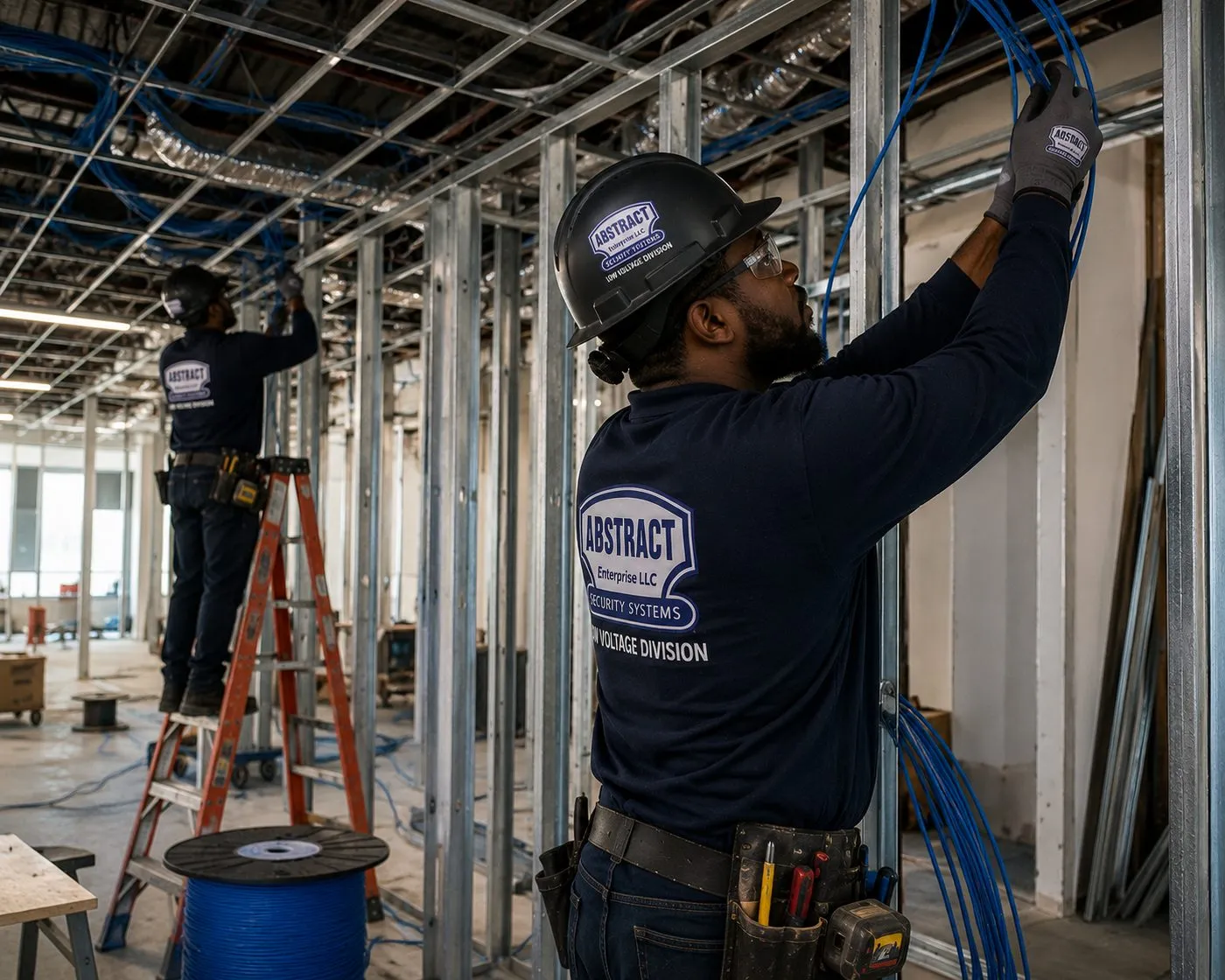
Two technicians feed blue cable through bare metal studs and an open ceiling, a spool of cable on the floor between them — walls this open are the cheapest moment to add speaker wire.
Repair Capture
When Sonos Acts Up in a Westchester House
Rooms missing from the app after the provider swapped the router, ceiling speakers that went quiet when the renovation crew moved the Amp, a soundbar that lost the TV after a firmware update, a Sub that won’t pair — nearly always a network or configuration fault rather than a broken speaker. Call (914) 877-2578 and tell us what changed recently. A setup-only visit in Westchester is billed at the published county rate, and most of these faults are traced and fixed in one to two hours once a technician can see the network.
What We Install
Sonos Installation Services in Westchester County
Every service below starts with the same two questions — who has to approve the work, and are the walls open or closed? — and ends with every speaker in the app, grouped, tuned and tested from each phone in the household.
Renovation Pre-Wire for Sonos
Speaker wire, Ethernet and pull strings run while the studs are bare, labelled at both ends and photographed before the insulation and drywall go in. We work to your contractor’s schedule and leave a drawing of every run.
Sonos Amp With In-Ceiling Speakers
Kitchens, family rooms and primary suites with Sonos Architectural speakers on an Amp. Paintable grilles that sit flush with the ceiling, and an Amp placed where it stays cool and reachable.
Arc Ultra and Beam Home Theater
A bar beneath the screen or on the mantel shelf, wired to the TV’s eARC port, plus a Sub and surrounds when the seating allows — and a plan for the masonry chimney breasts so many older Westchester family rooms are built around.
Co-op and Condo Apartment Systems
Scope letters for the managing agent, certificates of insurance, work inside the building’s permitted hours, and a plan that keeps the board’s alteration rules in view — often wireless speakers instead of holes.
Rental-Tower Setups
Sonos in new downtown apartments in New Rochelle, White Plains and Yonkers, planned around concrete walls, building-run internet and a lease that limits what can be drilled.
Whole-House Network for Sonos
Wired access points, Ethernet to the speakers that matter most, a switch in the right closet and router settings Sonos supports — so a large house holds every room, not just the ones near the basement router.
Terraces, Patios and Pool Decks
Weather-rated outdoor speakers on an Amp kept indoors, or a Move 2 for a terrace you don’t want drilled. Association approvals and cable routes are settled before anything goes on an exterior wall.
Taking Over an Inherited System
A house bought with the previous owners’ speakers still in the ceilings: ownership transferred or products reset, rooms renamed, old gear checked and anything that can’t join the current app identified.
Business Background Music
Shops, salons, restaurants, offices and practices across the county’s downtowns: ceiling speakers on an Amp, volume limits, schedules and a system staff can run without the owner’s phone.
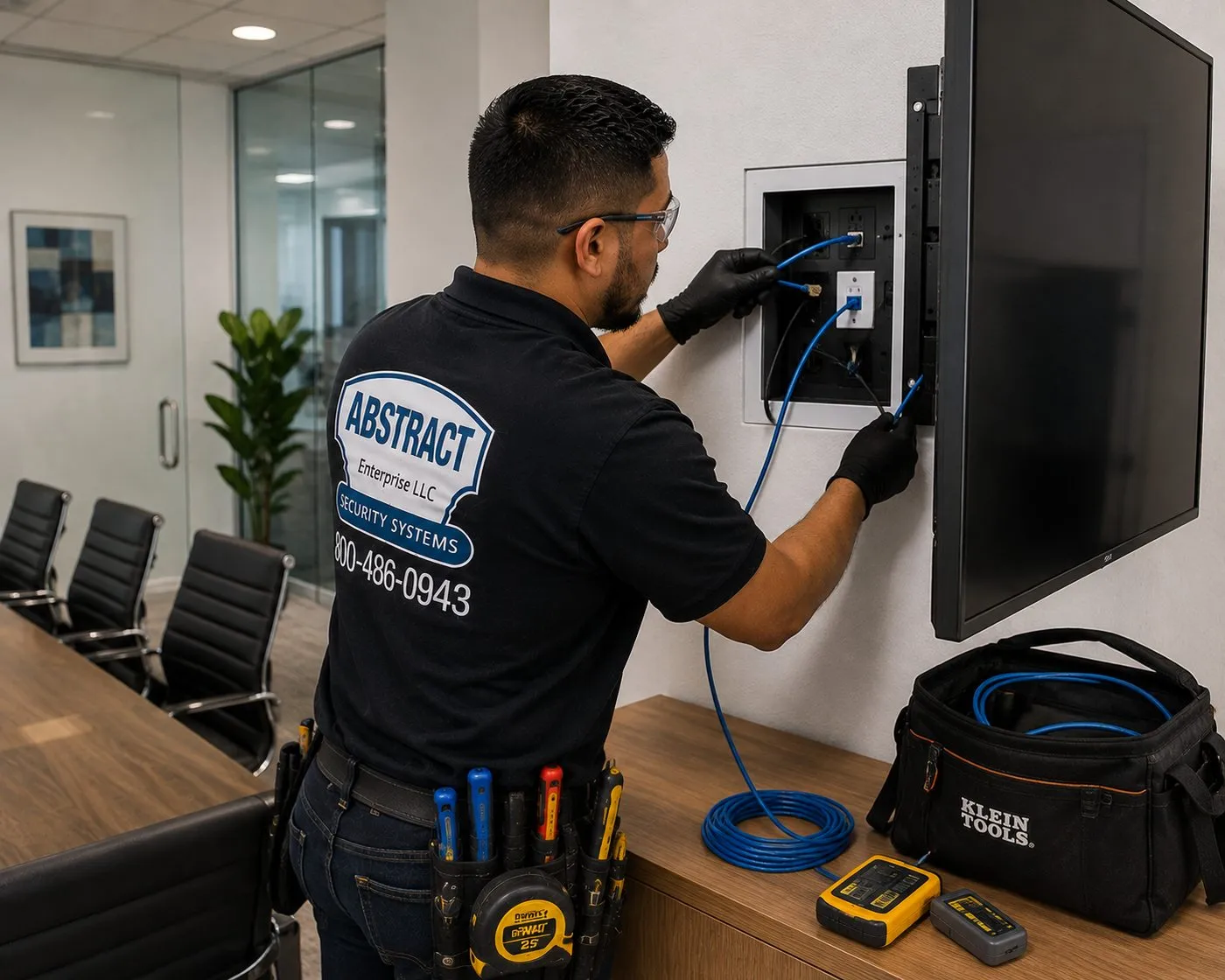
A technician plugs cables into a recessed box set into the wall beside a mounted screen, with a cable tester and a tool bag on the credenza below.
Building Specialists
Sonos Installation for Westchester County’s Architecture
Westchester grew along its rail lines first and its parkways second, and each wave left a different kind of building — and a different set of people who decide what can be done to it. These are the property types our crews see most, and what each asks of a Sonos system.
Railroad-Suburb Tudors
Scarsdale’s Fox Meadow and Crane-Berkley, which the Scarsdale Historical Society dates to development in 1928, and their counterparts in Bronxville, Larchmont and Pelham: stucco and half-timber outside, plaster on lath inside, stone or brick fireplaces, and second floors reached from attics with limited headroom.
Center-Hall Colonials
Rye, Harrison, Chappaqua, Pleasantville and much of mid-county: stacked closets and a basement that often make a clean path from the Amp to the first floor, but finished second floors where ceiling speakers mean working from a cramped attic.
Post-War Co-op Buildings
Elevator buildings in Yonkers, White Plains, New Rochelle, Mount Vernon and Hartsdale, many converted to co-ops in the 1980s: concrete slabs, plaster or block partitions, a managing agent, and alteration rules that set hours, insurance and what counts as an alteration.
Downtown Rental Towers
New buildings near the Metro-North stations in New Rochelle, White Plains and Yonkers: concrete and metal-stud construction, building-supplied internet in some, leases that limit drilling, and tenants who may move in two years.
Larger Houses Up-County
Armonk, Bedford, Pound Ridge, North Salem and parts of Somers and Yorktown: multiple wings, finished lower levels, long distances from the router, and enough rooms to run into Sonos’s per-system product limit.
Townhouse and Condo Communities
Associations across the county where the owner controls the inside and the association controls the exterior: patios, decks and outside walls that need written approval before a speaker or cable goes on them.
Methods we use by house and building type
Construction
What we do
What we avoid
Plaster on wood or wire lath (Tudors, older colonials)
Obstruction survey with a stud finder and a small pilot hole before any cut, as Sonos’s in-ceiling instructions advise; cuts made from a template; wire fished from the attic or basement through existing chases
Ceiling speakers under finished rooms with no access above, unless the plaster is coming down anyway
Open studs during a renovation
Speaker wire, Ethernet and spare pull strings to every likely speaker spot, labelled and photographed before inspection and drywall
Leaving speaker decisions until after the walls close
Concrete slabs (co-ops, towers)
Wireless Era, Five and soundbar systems; surface raceway where the board allows; ceiling speakers only where a dropped or furred ceiling already exists
Coring or chasing slabs without written approval from the building
Metal studs (newer apartments and offices)
Toggle-rated or blocking-backed mounts; Era 300 brackets only where they can go into a stud, as Sonos requires
Drywall-only anchors for anything that carries weight
Stone and brick fireplaces
Soundbar on the mantel or below the TV; HDMI and power routed beside, not through, the masonry where possible
Drilling flues or chimney masonry for cable
Spray-foamed attics and rim joists
Wire and conduit placed before foam goes on; sleeves left for future runs
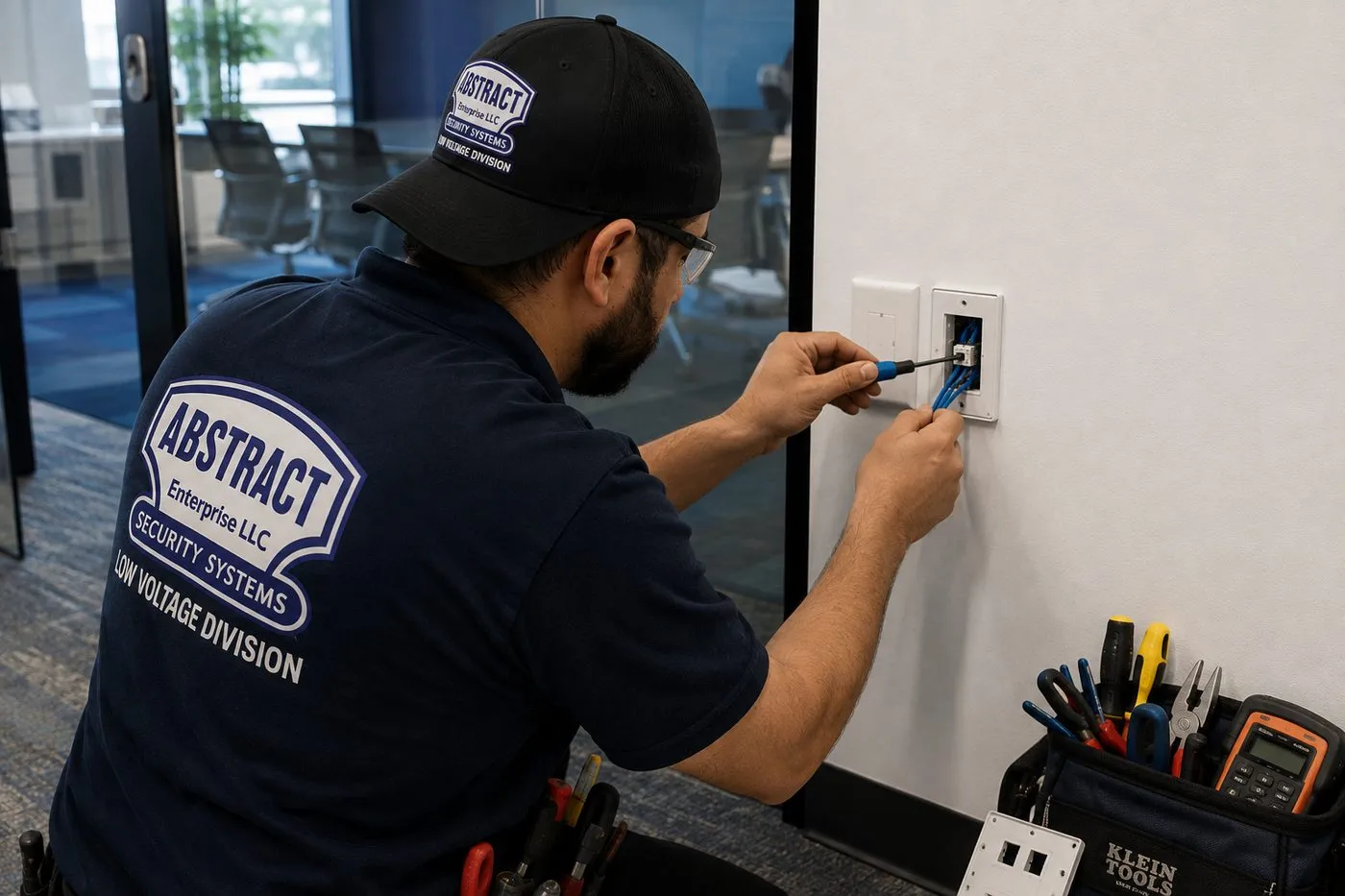
A kneeling technician seats blue network cables into a wall plate next to a switch, a tool pouch with a meter on the floor beside him.
Older Houses
Finding a Wire Path Through a Westchester Tudor or Colonial
In a finished pre-war house, the question is never whether a speaker can go in the ceiling. It is whether a cable can reach that ceiling from the Amp without opening a wall that took a plasterer a week to build. These are the routes our crews look for first in the Tudors and colonials of Scarsdale, Bronxville, Larchmont, Pelham, Rye and the river towns, roughly in the order they tend to work.
Stacked closets
Center-hall colonials were often built with a coat closet under a linen closet under an attic hatch. That vertical stack is the best friend a cable has: a single hole in each closet floor or ceiling, hidden behind shelving, carries wire from the basement to the attic with nothing visible in a finished room. We check every closet before suggesting anything else.
The attic over the second floor
Second-floor ceilings in many Westchester colonials can be reached from above, which makes in-ceiling speakers in bedrooms and the primary suite a manageable job. Tudors are harder: steep roofs, dormers and finished third-floor rooms leave kneewall spaces and short cavities rather than an open attic. We measure the depth above each proposed position, because Sonos’s in-ceiling speakers need roughly five inches of clear cavity, and a dormer can leave less than that.
The basement under the first floor
First-floor walls can often be fed from the basement through the bottom plate, which is how wire reaches a TV wall or an in-wall speaker in the living room. First-floor ceilings are the hard ones, because the floor above is finished. Unless there is a soffit, a bulkhead or a renovation under way, a first-floor family room is usually better served by a soundbar and wireless rear speakers than by ceiling speakers.
Old chases and retired chimneys
Older houses sometimes have an abandoned laundry chute, a retired gravity-heat duct or a disused chimney flue that runs between floors. Some of these make excellent cable routes; some are still connected to something, or carry fire-safety obligations. We only use a chase after we’ve confirmed what it is and that nothing still depends on it, and we never run cable through an active flue.
When no path exists
Sometimes the honest answer is that the cable can’t reach a particular ceiling without opening finished plaster. In that case we say so, and offer the alternatives: an Era speaker pair placed on shelves or brackets, a Five on a sideboard, or waiting for the next renovation and leaving a pull string when the walls do open. A good wireless room is better than a scarred ceiling, and Sonos’s wireless speakers are designed for exactly that choice.
Exterior walls deserve one more note. Many Westchester Tudors are stucco over masonry or over wire lath, and colonials may have brick veneer. Running a cable through an exterior wall for a terrace speaker means sealing the penetration properly against water and, in an association, getting approval first. We plan exterior penetrations as carefully as interior ones.
Commercial Sonos
Business Sonos Installation in Westchester County
Sonos markets installed systems to businesses, and in Westchester the businesses that ask for them are mostly small: a restaurant on a downtown avenue, a salon in a village centre, an office suite off the parkway, a medical practice waiting room. What changes from one to the next is the landlord, the building and the hours we’re allowed to work.
Mamaroneck Avenue, White Plains
Restaurants, bars and shops on the city’s main downtown avenue, plus office buildings nearby. Ceiling speakers on an Amp for the dining room, a separate zone for the bar, and volume limits so the evening crowd can’t push the system past where the room sounds good.
Central Park Avenue
The retail corridor running from Yonkers through Greenburgh’s Hartsdale and past Scarsdale: shopping-centre units with drop ceilings, landlord rules on after-hours work, and stores that want music on a schedule rather than at a manager’s whim.
Downtown New Rochelle
Ground-floor restaurants and services in and around the new towers built under the city’s 2015 downtown zoning. New construction often means metal studs, exposed ceilings and building management that wants contractor insurance on file before the first visit.
Village Main Streets
Larchmont, Mamaroneck, Rye, Pleasantville, Mount Kisco, Tarrytown and Hastings-on-Hudson: older two-storey commercial buildings with plaster or pressed-tin ceilings, where surface-mounted or pendant speakers often suit better than cutting the ceiling.
I-287 Office Parks
Suites along the corridor through White Plains, Harrison, Purchase and Rye Brook: reception areas, break rooms and conference rooms where an Era 100 Pro on PoE+ or ceiling speakers on an Amp share a managed network with the tenant’s own IT.
Practices and Studios
Dental and medical waiting rooms, physical therapy, yoga and fitness studios across the county: background music at a fixed ceiling volume, a separate zone for treatment rooms, and a schedule that starts and stops with the opening hours.
Compliance callouts for commercial Sonos work in Westchester
Insurance on file first. Landlords, managing agents and some town building departments ask for liability, workers’ compensation and disability certificates naming them before any work begins. Greenburgh’s low-voltage permit form specifies that the compensation and disability certificates cannot be on an Acord form. We send ours at no charge.
Permits where the town requires them. Whether a low-voltage job needs a permit varies by municipality and by the size of the job; Greenburgh’s form, for example, sets a fee of $15 per $1,000 of the cost of work. We check with the building department before the start date, not after.
Electrical work stays with electricians. In Westchester, electricians must be licensed by the county, and electrical work is inspected by an approved agency. New outlets for an Amp rack or a ceiling-mounted access point are theirs; the low-voltage cabling is ours.
Ceiling cable. Sonos’s in-ceiling instructions tell installers to consult local building codes before running speaker wire through ceilings. In a drop ceiling used as an air return, that means cable rated for the space — we specify it before buying wire.
Music licensing is the owner’s call. Playing music to customers can carry public-performance licensing obligations that have nothing to do with the hardware. We install the system; the business decides its music service.
Offices and practices with their own IT. Many Westchester offices run a managed network with separate VLANs, enterprise Wi-Fi log-ins and a firewall someone else administers. Sonos lists WPA and WPA2 Enterprise security as unsupported and needs its products and the controlling devices on the same subnet, so we agree with the tenant’s IT provider before the visit where the Sonos products will live on the network and which devices may control them. An Era 100 Pro on a PoE+ switch port, or an Amp on a dedicated port, keeps the music separate from the systems that run the practice.
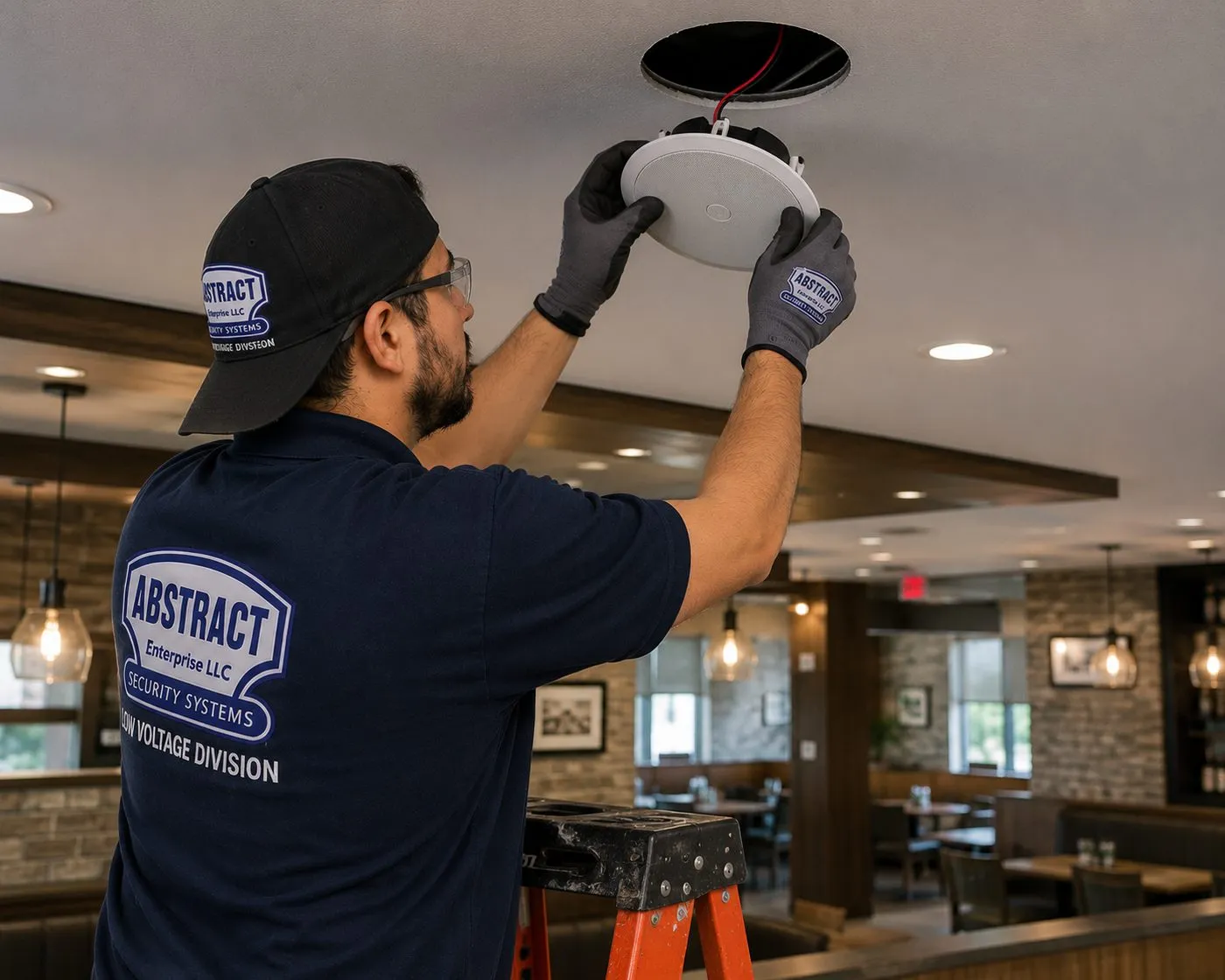
A gloved technician presses a white round speaker into a ceiling cut-out above a dining room of booths, pendant lamps and a stone-clad wall.
Approvals
Who Signs Off Before a Westchester Sonos Job
A Sonos installation in Westchester can need a yes from as many as four parties before a single hole is cut. Knowing who they are, and what each one wants to see, is the difference between a job that starts on the booked day and one that waits a month for the next board meeting.
The county: licences you can check
Westchester’s Department of Consumer Protection licenses home improvement contractors and keeps a public list of licensed firms, along with a list of contractors to avoid. Its spring advisories ask homeowners to see a contractor’s licence and to verify it before handing over any payment, and note that licensed contractors display a green sticker on the rear bumper of their vehicles showing when the licence expires. The department’s number is (914) 995-2155. Separate county licensing laws cover electricians and plumbers. Whatever kind of contractor you hire for a Sonos job — us included — ask for the relevant licence, check it, and keep a copy with the contract. Our own NYS low-voltage licence number, #12000287431, is printed on every page and invoice.
The town or village: building departments
Westchester’s cities, towns and villages each run their own building department, and their rules for low-voltage work are not uniform. Some publish forms that name low-voltage work explicitly — the Town of Greenburgh’s “Electrical or Low Voltage Permit Application” asks low-voltage contractors for insurance certificates naming the town, a NYS alarm installer licence where applicable, and an application through the state’s inspection system. Others treat speaker wiring inside a larger renovation as part of the general contractor’s building permit. Croton-on-Hudson’s engineering page reminds residents that electrical work associated with a building permit needs a certificate of electrical inspection before a certificate of occupancy is issued. During a renovation, the simplest path is to make sure your contractor’s permit and inspection schedule already includes the low-voltage scope; for a stand-alone job we check with the building department first.
The building: boards, agents and landlords
For co-op and condo owners in the southern cities, the building’s alteration rules usually decide more than any code does. Managing agents commonly ask for a written scope, certificates of insurance naming the corporation and the agent, and work inside set weekday hours. Cutting a ceiling for an in-ceiling speaker is a different request from placing a wireless speaker on a shelf, and many boards treat it that way. In rental towers the lease and the management office set the limits: a soundbar on a stand needs nobody’s permission; a bracket in a concrete wall may need the landlord’s written consent.
The association: exteriors and common walls
In townhouse and condominium communities, the association typically controls the exterior: siding, decks, patios and anything mounted on them. Outdoor speakers under an eave or a cable through a rim joist can need the same architectural approval as a new storm door. We give you a one-page description of what will be mounted, where the cable enters the house and what the finished install looks like, so the request goes to the committee complete the first time.
What we send before the start date: a written scope, a certificate of insurance naming whoever needs to be named, our licence details, the product list and, for exterior or ceiling work, a marked-up photo of where each speaker goes. If the building or association needs something else, we ask early.
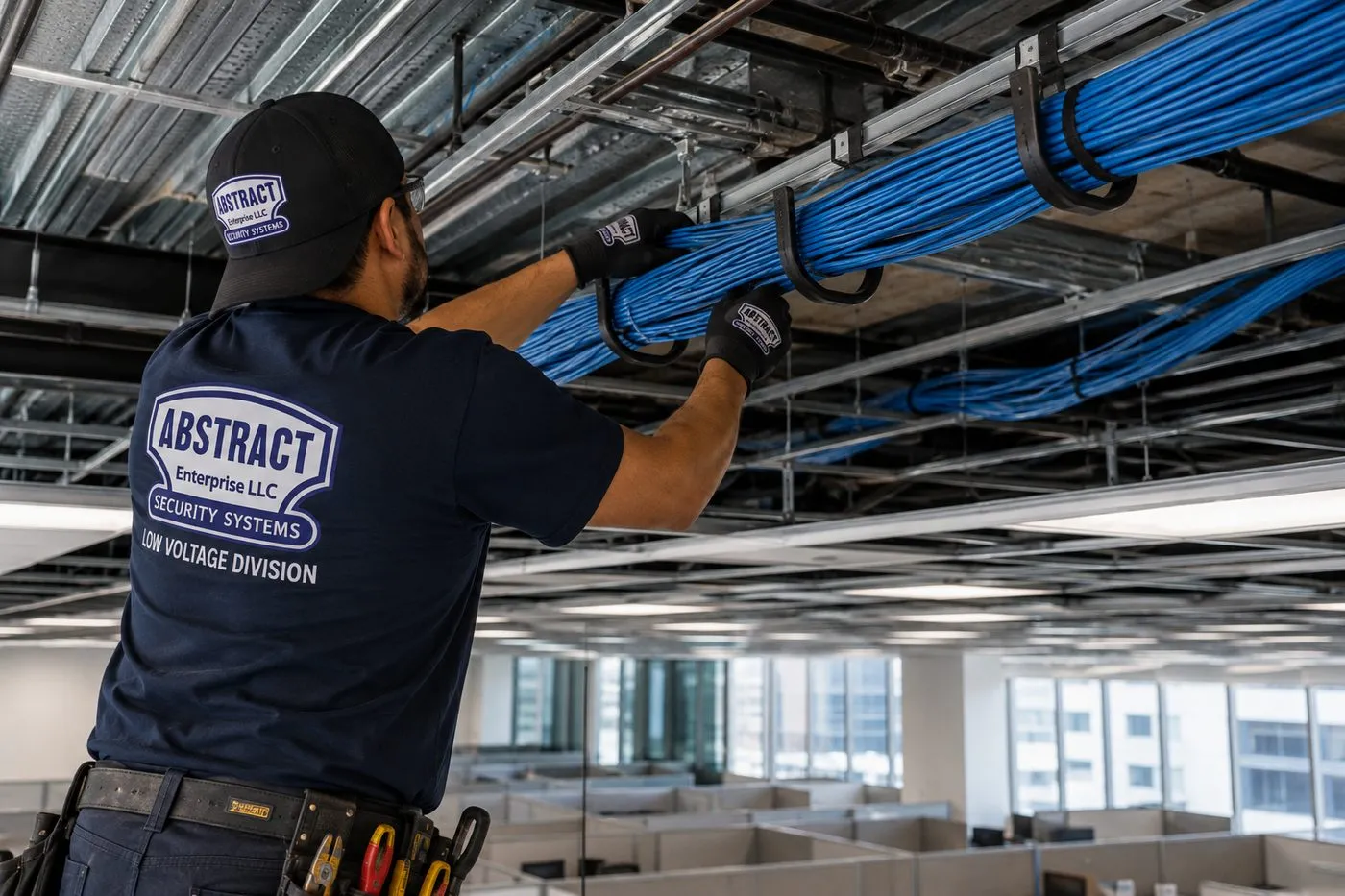
A technician guides a thick bundle of blue cable into black J-hooks hung from the ceiling structure above an open-plan office.
Renovation Timing
When Sonos Wiring Goes Into a Westchester Renovation
The Census Bureau counts 996 new housing units authorised by building permits in Westchester in 2025 — and that figure doesn’t include the kitchens, basements, attics and additions in existing houses that are opened up every year. For Sonos, those projects are the cheapest chance a house will ever offer to put wire where it belongs. The trick is knowing which stage of the project to join.
Before demolition: the plan
Decide which rooms get ceiling speakers, where the TV and soundbar go, where the Amps will live and where the network equipment sits. Sonos says one Amp can drive up to three pairs of its Architectural speakers wired in parallel, and that a single pair suits a room up to about 150 square feet. Those two facts set how many Amps you need and therefore how much space the equipment closet takes. We mark every speaker position on the architect’s drawings or on a phone photo of the bare room.
Framing and rough-in: the wire
This is our visit. With studs and joists exposed, we run speaker wire from each speaker spot back to the Amp location, Ethernet to the TV wall and to any speaker that should be wired, and a spare pull string or conduit to places you may want music later. Every run is labelled at both ends, tested and photographed with a tape measure in the frame. Speaker positions in the ceiling are checked against lights, sprinkler heads, HVAC registers and the joists, because Sonos’s in-ceiling speakers need a clear cavity: about 4.73 inches of mounting depth for the 6-inch model and 5.32 inches for the 8-inch.
Inspection, insulation and drywall: the hand-off
The wire has to be in before the inspector’s rough-in visit if the building department’s permit covers it, and before insulation in any case. Spray foam is the hard deadline: once it cures in an attic or around a rim joist, new wire through that space means cutting foam. We leave the coiled ends where the drywall crew can see them and protect them through taping and painting; mud-ring brackets or marked positions show the drywall crew where not to cover.
Finish: speakers, Amps and setup
When paint is dry, we come back to cut the ceiling openings — 8.25 inches for Sonos’s 6-inch in-ceiling speaker, 10.125 inches for the 8-inch — fit the speakers and grilles, terminate the Amps, set up the system, run Trueplay where supported and hand it over. If your contractor finishes faster than expected, the wire waits safely in the ceiling; the speakers can follow when you’re ready.
If the renovation has already closed up, all is not lost: wireless Era speakers and soundbars need only power, and wire can often still be fished from an attic or basement. It costs more and takes longer than doing it while the studs are open, which is why we ask for the contractor’s schedule at the first call.
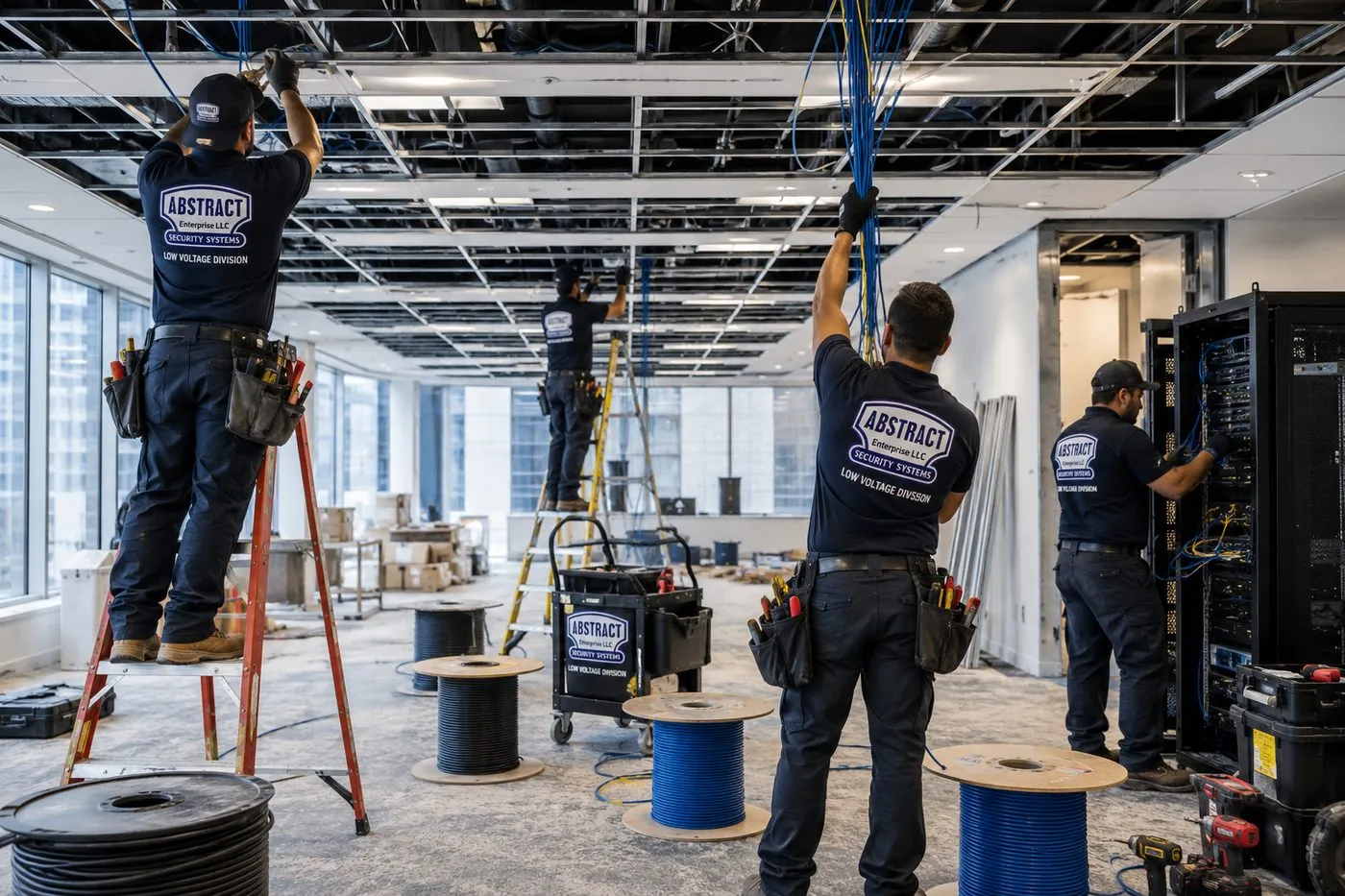
Four technicians work an open floor: two on ladders feeding cable into the ceiling grid, one holding a bundle overhead and one at a rack, with spools of blue and black cable on the floor.
Apartment Owners
A Sonos Checklist for Westchester Co-op and Condo Owners
Southern Westchester’s apartment buildings have their own rhythm, and a Sonos job that respects it goes through the board and the front desk without friction. This is the list we work through with co-op and condo owners in Yonkers, White Plains, New Rochelle, Mount Vernon, Hartsdale and Bronxville before the first visit.
Read the alteration agreement or house rules first. Many buildings distinguish between placing equipment and altering the apartment. A wireless system — soundbar, Sub and Era speakers — is usually the first kind; cutting a ceiling or chasing a wall is the second and goes to the board or agent.
Ask the agent what the certificate of insurance must say. The exact names of the corporation and the managing agent, the limits required and where to send it. We issue it at no charge, but the wording has to match before the doorman will let us up.
Book inside the building’s contractor hours. Weekday daytime windows are common in co-ops; some buildings also need the service elevator reserved. We schedule the first two-hour window that fits the building’s rules, not just ours.
Know what’s above and below you. Concrete slabs rule out most in-ceiling speakers unless a dropped or furred ceiling already exists. If it does, we confirm with the agent that speakers can go into it before any template is traced.
Check the building’s internet arrangement. Some newer buildings supply Wi-Fi to every unit. Sonos doesn’t support guest or portal log-in networks, so if the building’s service works that way, the apartment needs its own router or a network the building’s provider can configure for it.
Plan for the move-out. Condo owners may sell; co-op shareholders may be asked to restore alterations. Wireless speakers, a soundbar on a bracket and raceway that can be removed leave the fewest repairs behind.
None of this slows a well-prepared job. It simply moves the paperwork to before the visit instead of the morning of it, which is when a building’s front desk turns contractors away. When that happens because a certificate wasn’t filed, our $150 return-trip fee applies, so we’d rather send everything a week early.
What we bring to a renovation pre-wire visit
Speaker cable sized for the run lengths to the Amp location, and Ethernet for the TV wall, office and any wired speaker
Labels for both ends of every run, matched to a drawing we leave with you
Pull strings and, where a future run is likely, empty conduit or sleeves
Ceiling speaker templates for the 6-inch and 8-inch Sonos in-ceiling models, so positions are checked against joists and lights before the drywall goes up
A cable tester, so every run is proven before the walls close rather than after
Your Questions Answered
Sonos Installation in Westchester County: Questions Answered
These are the questions Westchester owners, boards and businesses ask us before a Sonos job — grouped by the decision they affect. The fixed prices are in the cost section further down.
Licences, permits and paperwork
County licences and what to ask any installer for
Westchester law requires home improvement contractors to hold a county licence, and the Department of Consumer Protection asks residents to see that licence and verify it on the county’s public list before paying anything. Separate county licensing laws cover electricians. Which licences apply to a particular Sonos job depends on its scope — a speaker set on a shelf is different from a renovation that opens ceilings — so the practical rule is simple: ask any contractor which licences they hold for the work they are quoting, check them on the county list or with the department at (914) 995-2155, and keep copies with the contract.
For our part, we are a New York State licensed low-voltage contractor, licence #12000287431, insured, and we put the licence number on the quote and the invoice. Where a job needs an electrician — a new outlet for an Amp closet, a circuit for a rack — we say so in writing and leave that work to a county-licensed electrician.
Village and town permits for low-voltage wiring
It depends on the municipality and the job. Westchester’s cities, towns and villages each run their own building departments. The Town of Greenburgh, which covers Hartsdale, Edgemont and the other unincorporated hamlets, publishes an “Electrical or Low Voltage Permit Application” that asks low-voltage contractors for insurance certificates naming the town and sets a fee of $15 per $1,000 of the cost of work. Other departments fold low-voltage wiring into the general contractor’s renovation permit or don’t require a separate filing for small jobs.
Before a stand-alone job we check with your building department and file if it asks us to. During a renovation, the cleanest route is for your contractor’s permit and inspection schedule to include our scope, so the inspector sees the wire at rough-in rather than discovering it later.
What goes in the scope letter for a Yonkers co-op’s managing agent
Agents and boards want to know three things: what will be touched, who is doing it, and how the building is protected. Our scope letter lists every product and where it goes, states plainly whether any ceiling, wall or slab will be cut and to what size, names the cable route, gives the expected hours and number of visits, and attaches our certificate of insurance naming the corporation and the agent as the building requires. If speakers are going into an existing dropped or furred ceiling, the letter says so, with photos.
Many co-op owners find the approval comes faster when the plan avoids cutting at all: wireless Era speakers, a soundbar on the TV wall, and a speaker cable hidden in a paintable raceway the board has approved before. We will draft both versions if you want to give the board a choice.
Patio speakers when the townhouse association owns the walls
Outdoor speakers are usually possible with the association’s written approval. Associations usually control siding, decks and anything attached to the exterior, so a speaker under the eave or a cable through the rim joist is their decision, not ours. We prepare a one-page request: a photo marked with each speaker position, the product and its finish, where the cable enters the house and how the hole is sealed, and confirmation that the Amp stays indoors.
If the committee says no, there are honest alternatives that need nobody’s permission: a Move 2 carried out to the patio on its charging base indoors, or speakers placed on furniture rather than fixed to the building. Sonos rates Move 2 at IP56, enough for a terrace in passing rain, though its charging base is for indoor use only.
Timing Sonos with a renovation
Kitchen gut renovations: the rough-in window
At rough-in, after framing and before insulation, drywall and the inspector’s rough-in visit if your permit covers low-voltage work. That is the only time the wire can go exactly where it should with no patching. We need about a week’s notice of the date the walls will be ready, and a short visit once the electrician has set the boxes, so ceiling speaker positions don’t collide with lights, ducts or joists.
Bring us in even earlier, before demolition, if you’re still deciding the layout. Where the Amps live and how many you need depend on the number of speaker pairs, and that decision affects the cabinetry or closet plan. A ten-minute conversation at that stage saves a lot of rework at the end.
The attic is about to be spray-foamed — what needs to be run before the insulation crew arrives?
Anything that will ever need to pass through that space: speaker wire to every second-floor ceiling speaker position you might want, Ethernet to an access point location on the top floor, and at least one empty conduit or sleeve from the attic down to the basement or equipment closet for future runs. Once spray foam cures around joists and rafters, adding a cable means cutting the foam and re-sealing it.
We label and photograph every run, coil the ends where the drywall or plaster crew will find them, and tag the conduit so the next installer knows it’s there. It’s one of the cheapest insurance policies in a Westchester renovation.
Our general contractor says his crew can run the speaker wire — what should we check first?
That they use the right cable and leave it where a speaker can actually go. Ask for speaker cable of the gauge the Amp manufacturer recommends for the run length, rated for in-wall use (and for plenum use if it passes through an air-return space), with no splices inside the walls. Ask that each run end at a marked position at least a joist bay clear of lights and ducts, be labelled at both ends, and be photographed before the walls close.
We’re happy to work either way: run the wire ourselves at rough-in, or give your contractor a marked plan and come back at finish to fit the speakers and set up the system. If someone else’s wire is already in the walls, we test every run before connecting an Amp.
Pre-war houses: fireplaces and ceilings
Soundbars under TVs on stone and brick chimney breasts
Usually on the mantel or on a bracket just below the TV, whichever keeps the bar closest to the screen. Sonos asks for at least 4 inches between an Arc Ultra and the TV so its upward-firing drivers aren’t blocked, and notes that Arc Ultra detects when it is wall-mounted and adjusts its sound for the wall. A deep mantel can be the better spot because it keeps the bar off the masonry entirely; a shallow one usually means mounting.
The HDMI and power routes matter more than the bar. On a masonry chimney breast we avoid drilling the flue or the chimney body, and route cable beside the breast inside the adjoining stud wall or behind a mantel return. If the chimney is drilled for the bracket, the brick or stone surcharge applies; the cable path is quoted at the walkthrough.
How should ceiling speakers be laid out in a beamed or coffered ceiling so the room still looks planned?
They don’t have to. Sonos’s in-ceiling speakers made with Sonance use paintable, bezel-less grilles, so they can be painted to match the ceiling and sit almost flush. In a coffered ceiling, we centre each speaker in a coffer and keep left and right speakers symmetrical; in a beamed ceiling, we set them between beams on the same line as the recessed lights so the ceiling reads as planned rather than patched.
What we won’t do is cut into a decorative beam or a plaster medallion. If the room has no clean cavity, a pair of Era speakers on brackets or furniture often sounds better than a compromise ceiling location.
Big houses, two households and houses that come with Sonos
The 32-product limit in large houses
Sonos’s system requirements list a maximum of 32 Sonos products in one system. A large house with ceiling speaker pairs on several Amps, a home theater with a Sub and surrounds, and speakers in bedrooms, baths and a gym can approach that. Surrounds and Subs count as products too.
When a plan gets close, we look at combining rooms on a single Amp, choosing products that cover larger spaces, or splitting the property into two systems — for example the main house and a pool house or guest wing — each with its own app connection.
An in-law suite over the garage: shared system or its own
If the people living there want their own music without seeing or controlling the main house’s rooms, give the suite its own system. Sonos lets a phone connect to more than one system, and an answer on Sonos’s community forum notes that more than one Sonos household can run on the same network. Each system then has its own rooms, groups and account, and the suite’s residents can’t accidentally start music in the main bedroom.
If the whole family wants to group the suite with the kitchen for a party, one shared system is simpler. We set it up whichever way matches how the household actually lives, and name rooms so nobody confuses “Kitchen” with “Suite Kitchen.”
Speakers the previous owners left behind
Sonos’s own instructions cover this case. If the previous owners can still sign in, they can use Transfer System Ownership in the Sonos app’s settings to hand the system to your account. If they can’t, each product is reset to factory settings, the app is reset, and the speakers are set up as a new system under your account — which erases the old settings. Any voice services have to be removed and added again after a transfer.
In practice we also check what you actually inherited: ceiling speakers wired to an Amp in a closet nobody mentioned, older products that only work with the S1 app, and wiring done by an unknown installer. We test each run, tell you which products will join the current app, and rename rooms to match the new household.
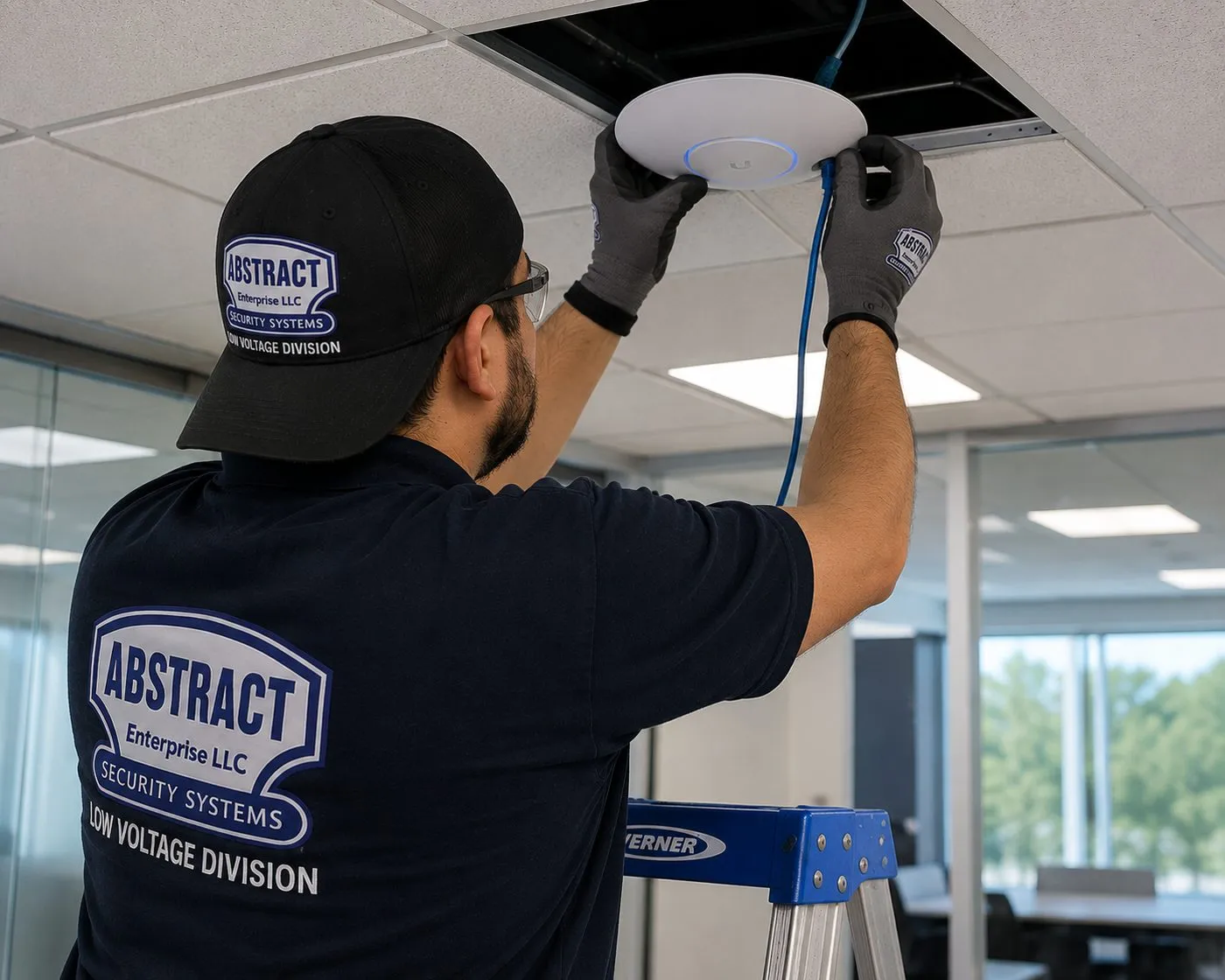
A technician on a blue stepladder holds a white access point with a glowing ring up to a ceiling tile, a blue cable dropping from the opening.
Home offices, businesses and everyday control
Will music in the rest of the house interfere with video calls in my home office?
Not if the network is planned for both. Sonos asks for the router’s Wi-Fi and the dedicated Sonos wireless network to run on separate channels, and recommends that any Ethernet connections run back to the router or a switch rather than through powerline adapters. In practice, home-office trouble comes from a single overloaded router at the far end of the house, not from the speakers.
For a Westchester household that works from home several days a week, we usually wire the office desk and the TV wall with Ethernet, place an access point near the office, and leave the office out of the house-wide music group so a party in the kitchen never plays through the room where someone is on a call.
Volume limits and schedules for shops and restaurants
The Sonos app lets you set a volume limit for each Sonos product on a scale of 0 to 100, so a server can turn the dining room up and down but never past the level you chose. We set the limit with the room full, not empty, and set a lower one for the bar or the treatment rooms where it should stay quiet.
We also set schedules with Sonos alarms — which play chosen music in a chosen room at a set time and volume, on the days you pick — so the music starts at opening and the closing manager doesn’t have to remember. Staff get a simple control plan and the owner keeps the account.
Equipment
Types of Sonos Systems We Install
We install the Sonos products you buy from the retailer you prefer, and the network gear that keeps them connected. We are an independent installer, not a Sonos dealer; the notes below are what matters about each product in a Westchester house or business.
Arc Ultra
Sonos’s largest soundbar, 46.38 inches wide and 13.01 pounds, connected by HDMI eARC. Sonos asks for at least 4 inches between bar and TV. Suits a family room or a wide TV over a mantel.
Beam and Ray
Smaller soundbars for dens, bedrooms and apartment living rooms. Beam connects by HDMI; Ray by optical. Both can be joined later by a Sub and rear speakers.
Era 100 and Era 300
Plug-in speakers for single rooms, stereo pairs or rear surrounds. Era 300 brackets must go into a stud, not drywall alone. The combo adapter Sonos sells adds Ethernet or line-in.
Sub 4
15.31 by 15.83 by 6.22 inches and 25.99 pounds, wireless with an optional Ethernet port, and slim enough to lie flat under a sofa — useful in apartments where the corner is taken.
Sonos Amp
125 watts per channel into 8 ohms, HDMI eARC for a TV, two Ethernet ports. Sonos says one Amp drives up to three pairs of its Architectural speakers in parallel; it needs clearance and a cool spot.
In-Ceiling and In-Wall Speakers by Sonance
Passive speakers made for Amp, with paintable bezel-less grilles. Cut-outs of 8.25 inches (6-inch model) or 10.125 inches (8-inch); Trueplay tuning with Amp and a supported iOS device.
Outdoor Speakers by Sonance
Rated IP66 with an operating range of −13°F to 149°F, driven by an Amp kept indoors. For terraces and pool decks once the association has approved the exterior mounting.
Era 100 Pro
Sonos’s speaker for professional installation, powered over PoE+ by one Ethernet cable, with automatic tuning for wall or ceiling orientation. A neat answer for offices and practices with a managed network.
Port
For the household that won’t part with its old hi-fi: Port feeds a receiver from Sonos through analogue or coaxial outputs and switches it on by 12V trigger. Two Ethernet sockets let it sit wired in a cabinet.
Network Gear
Wired access points, small managed switches and Ethernet runs. Sonos lists range extenders, powerline adapters, guest networks and routers that broadcast only 5 GHz as unsupported, so we plan around them.
Network settings we check on every Westchester Sonos job
Setting or device
What Sonos says
What we do
2.4 GHz band
Supported by the whole product line; a router limited to the 5 GHz band is on Sonos’s unsupported list
Make sure the 2.4 GHz band is on, even when a provider’s router hides it
Guest and portal networks
Unsupported
Keep Sonos and the controlling phones on the main network, on the same subnet
Range extenders and powerline
Unsupported for Sonos
Replace with wired access points or Ethernet runs
WPA/WPA2 Enterprise security
Unsupported (Personal modes supported)
Separate Sonos from office networks that use enterprise log-ins
Spacing from other electronics
Keep Sonos at least 18 inches (0.5 m) from other electronic devices
Move speakers off routers, cable boxes and cordless-phone bases
Wall materials
Plaster and concrete rated high obstruction; metal very high
Plan access points room by room in plaster houses and concrete apartments
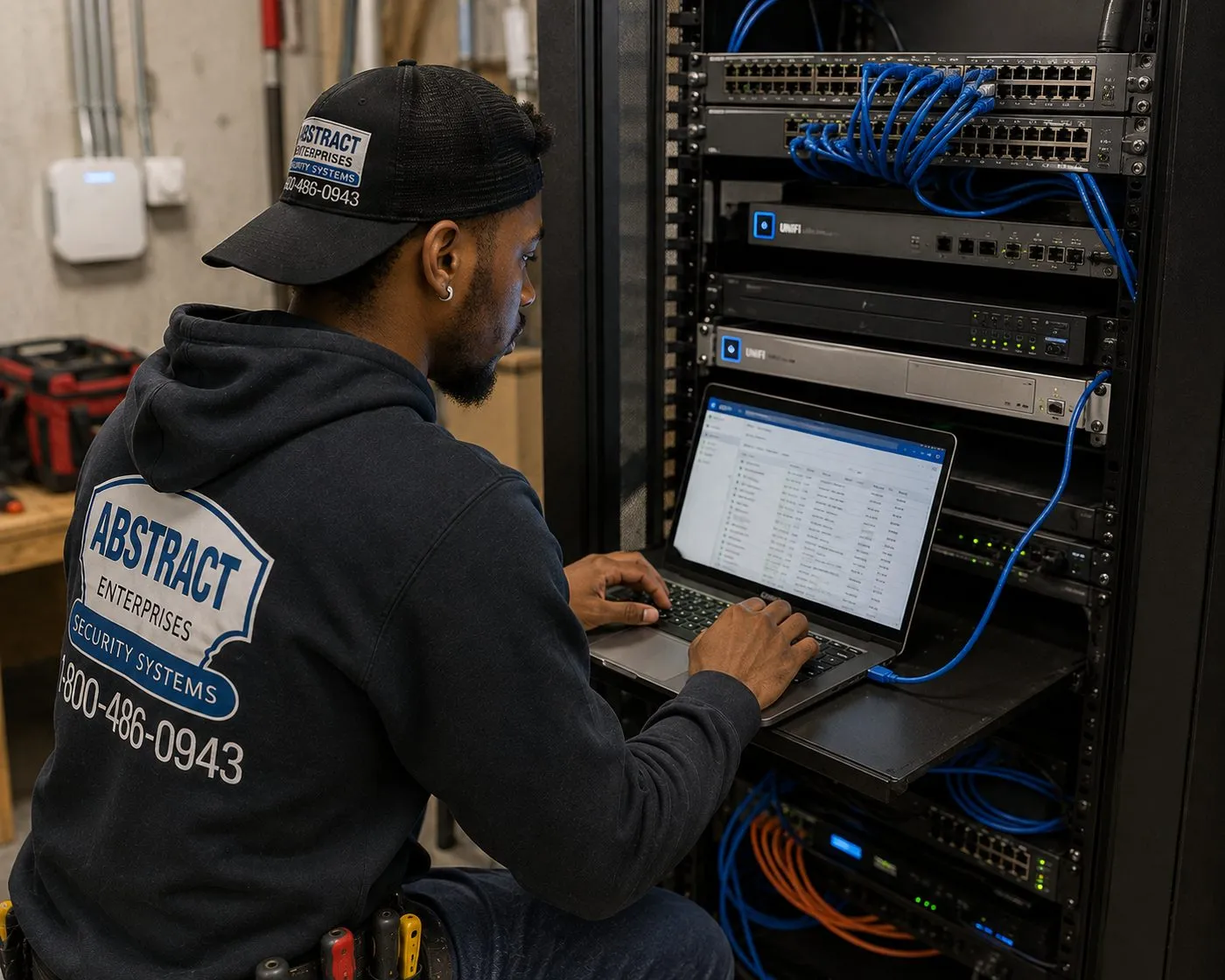
A technician types on a laptop resting on a rack shelf, blue patch cables running into the switches above and a wall-mounted access point behind him.
AI Overview Reality Check
What AI Gets Wrong About Sonos Installation in Westchester County
We could not view Google’s AI Overview for these searches from our build environment, so this section answers claims that cost guides, manufacturer marketing and forums publish — the material answer engines repeat — and corrects them with what we see in Westchester houses and buildings.
“Sonos is plug-and-play — you never need an installer”
For a speaker on a kitchen counter, that is fair. Sonos’s own buying guides say otherwise for architectural speakers: in-ceiling speakers “require special installation,” and in-wall speakers mean installing an Amp, cutting holes and running speaker cable. In a Westchester renovation, the difference is timing — whether that cable goes in at rough-in or gets fished later.
There is a second layer the plug-and-play claim misses here: paperwork. A Yonkers co-op may want a scope letter and a certificate of insurance before you drill a TV wall; an association may want to approve a patio speaker. None of that is in the box.
And the network is the system. A plug-and-play speaker on a router that broadcasts only 5 GHz, or on a guest network, simply won’t work properly, because Sonos lists both as unsupported.
“Multi-room audio costs $500 to $1,000 per room”
Angi’s cost guide gives that range for additional zones or multi-room audio, with labour at $50 to $100 an hour. It is a national figure, and it doesn’t say what kind of room or wall it assumes.
In Westchester the range depends on the stage of the house. A pair of ceiling speakers wired during a renovation is a different job from the same pair fished through plaster under a finished bedroom in a 1920s Tudor. Our published per-zone range at the Westchester rate is $1,000 to $3,125 installed, and the exact figure is set at the walkthrough.
Wireless rooms cost far less: setting up a speaker you already own is a fixed $156 line item at the county rate. The national average tells you little about either.
“Any handyman can put in ceiling speakers”
The physical cut isn’t complicated. What separates a good job is everything around it. Sonos’s in-ceiling instructions start with an obstruction survey — joists, conduit, pipes, ducts — and tell installers to consult local building codes before running speaker wire through ceilings.
In Westchester, add the county’s licensing rules for home improvement work, town permit forms for low-voltage work in some municipalities, and building or association approvals. Ask whoever you hire which licences they hold and check them on the county list.
Then ask what happens to the plaster. A careless cut in plaster on wire lath cracks well beyond the hole; patching and repainting a coffered ceiling can cost more than the speakers.
“A mesh Wi-Fi kit solves every dropout”
A well-placed mesh system with wired backhaul often helps. Sonos supports mesh routers, but its wired-setup guidance says that when Sonos is wired in a mesh system, it should be wired to the primary node, and it lists wireless range extenders as unsupported.
In a pre-war house, a mesh satellite placed behind a plaster wall can relay a weak signal and add little. In a concrete tower apartment, the problem is often channel congestion from neighbouring networks, not coverage.
We measure signal room by room before recommending anything, and in most larger Westchester houses the durable answer is one or two wired access points rather than another wireless hop.
“You can keep your old ceiling speakers and just add a Sonos Amp”
Sometimes you can. The Amp drives passive speakers rated at least 125 watts at 8 ohms or 200 watts at 4 ohms, according to Sonos’s Amp guide, and it should not be connected to loads below 4 ohms.
Houses changing hands in Westchester often come with ceiling speakers from an earlier system and wire of unknown age and route. We test each run for continuity and shorts, identify the speaker ratings where labels are readable, and only then decide how many pairs one Amp can safely drive.
Where the old speakers are past their best, the wire is often still worth keeping — and replacing a speaker in an existing hole is far quicker than cutting a new one, as long as the new speaker’s cut-out fits.
“Trueplay tunes every speaker from any phone”
Sonos says most of its products require an iOS device to run Trueplay. Arc Ultra, Beam Ultra, Era 100, Era 100 Pro and Era 300 offer quick tuning from iOS or Android; advanced tuning remains iOS-only. Sonos’s in-ceiling speakers on an Amp are tuned with a supported iOS device.
In an Android-only household, we bring an iPhone to run tuning during the visit. Sonos also advises re-tuning after moving a speaker, which matters in houses where furniture is rearranged after a renovation.
Tuning in an empty, echoing room after the renovation dust settles also gives a different result from tuning with rugs and sofas in place, so we prefer to tune on the final visit.
“Once it’s set up, Sonos runs itself”
Sonos systems need occasional attention. When Sonos released its redesigned app on May 7, 2024, owners lost features and reported problems, and the company’s chief executive publicly apologised; he stepped down in January 2025 while fixes continued.
Locally, the most common trigger is the internet provider replacing the router, which changes the network name or settings and takes every speaker offline. Renovation crews unplugging an Amp closet is a close second.
We leave a written record of how the system is set up — network name, Amp locations, wire labels — so a router swap is a quick fix rather than a mystery.
Plan the Sonos Job Around Your Calendar
Tell us when the walls open, who has to approve the work and which rooms you want music in. We’ll tell you what has to happen first — and what it costs at the Westchester rate.
Your town, the type of home, and whether a renovation, a board or an association is involved — that’s enough to start. We reply the same business day, or call (914) 877-2578.
✅
We Got Your Request!
Thanks — a licensed installer will phone before the end of the business day. Something can’t wait? Ring our Westchester line on (914) 877-2578.
How It Works
Our Installation Process
Whether it’s one Era speaker in a White Plains rental or a renovated Tudor with three Amps, the order is the same: approvals first, network second, speakers third, handover last.
1. Call, photos and approvals check
You tell us the town, the type of home, the Sonos products you have or want and any renovation dates. We ask who has to approve the work — board, agent, landlord, association, building department — and price the fixed items.
2. Paperwork sent
Scope letter, certificate of insurance naming whoever needs to be named, and a marked-up photo of each speaker position for ceilings and exteriors. We check with the building department where a permit may apply.
3. Walkthrough or rough-in visit
For renovations, we come while the studs are open to run and label wire. For finished homes, we survey ceilings and walls, measure Wi-Fi room by room and look at the router.
4. Network first
Access points, switches and Ethernet installed and tested, router settings checked against Sonos’s requirements, before any speaker is added.
5. Speakers, Amps and soundbar
Ceiling openings cut from template, speakers and grilles fitted, Amps terminated, soundbar mounted and connected by HDMI, every product added to one Sonos system.
6. Tune, name and limit
Each product given a plain room name, house-wide and floor-by-floor groups created, Trueplay completed with an iPhone where needed, and maximum volumes capped for children’s rooms, party walls or a shop floor.
7. Handover and written record
We show every member of the household the controls, power-cycle the network to confirm every room returns, and leave a record of wire labels, Amp locations and network settings.
What you keep after the handover
The system in your name. The Sonos system is set up under your own Sonos account and email address, never ours, so a future installer, a buyer of the house or a new tenant can be handed control cleanly.
A written record. Network name and band settings, which products are wired, where each Amp lives, the label on every speaker run and a photo set of any wire inside the walls.
Room names that make sense. “Kitchen,” “Den” and “Terrace” rather than product model numbers, so everyone in the house — and a sitter or cleaner with the app — can find the right room.
Limits and schedules where you asked for them. Volume limits on bedrooms and shared walls, alarms for wake-up or opening-time music, and the office left out of the house-wide group.
Paperwork for the building. For co-ops and condos, a short completion note for the managing agent describing what was installed and confirming no unapproved alterations were made.
A number to call. Our Westchester line, for the day the provider swaps the router or the next renovation crew unplugs an Amp.
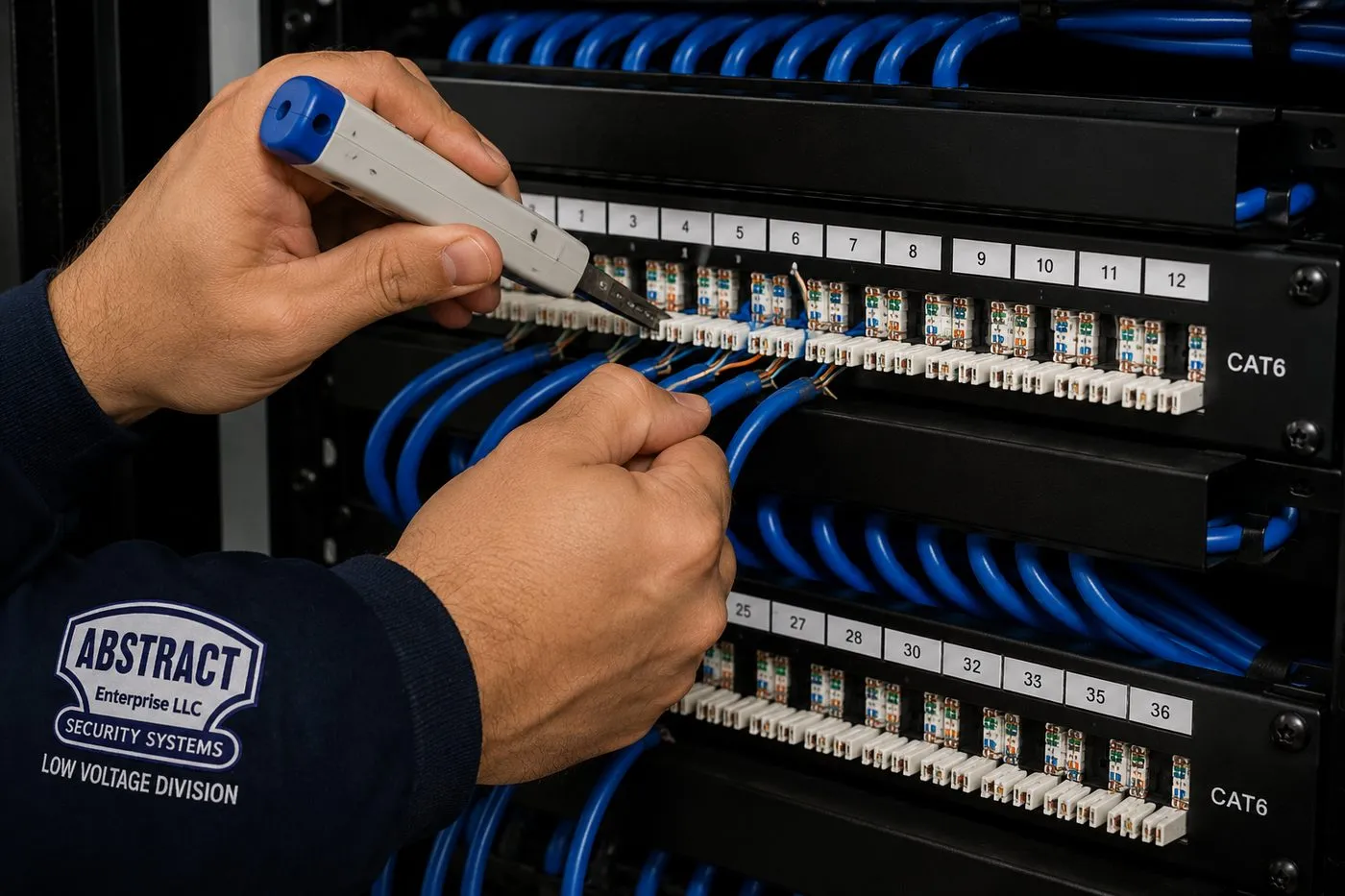
Close-up of hands with a punch-down tool seating conductors into a numbered patch panel, blue cables looping above and below.
Coverage Area
Sonos Installation Near Westchester County’s Landmarks
Some of the county’s best-known places are, fittingly, about sound and screen. We work in the towns around each of them.
The Capitol Theatre, Port Chester
Designed by theatre architect Thomas Lamb, it opened on August 18, 1926 as a movie palace whose first presentation was the silent film The Sea Wolf. Since its 2012 reopening as a concert venue, every artist who plays has been invited to sign its guest books. We install across Port Chester, Rye Brook and the Sound shore.
Jacob Burns Film Center, Pleasantville
Built around the village’s 1925 Rome Theater, a Spanish mission–style cinema, the center opened in June 2001 with three screens and added two more in March 2015. Its Media Arts Lab, opened in 2009, includes a recording studio and sound stage. We work in Pleasantville, Chappaqua and Briarcliff Manor.
Playland, Rye
Opened in 1928 on Long Island Sound and described in its National Register nomination as the first totally planned amusement park in the country; the Dragon Coaster and Derby Racer are among its original rides. Rye, Harrison and Mamaroneck houses are a short drive away.
Lyndhurst, Tarrytown
One of the country’s best-known Gothic Revival mansions, designed in 1838 by Alexander Jackson Davis and enlarged when he returned in the 1860s, overlooking the Hudson. We serve Tarrytown, Sleepy Hollow, Irvington and the other river towns.
Untermyer Gardens, Yonkers
The North Broadway estate gardens of lawyer and philanthropist Samuel Untermyer (1858–1940), listed on the National Register in 1974 and restored by a conservancy founded in 2011. Yonkers co-ops, condos and houses are among the jobs we do most.
Lawrence Park, Bronxville
The hillside neighbourhood William Van Duzer Lawrence began developing in 1890, part artists’ colony and part retreat, now a historic district of early houses. Bronxville, Eastchester and Tuckahoe plaster-and-lath homes are a regular part of our work.
We also install Sonos in Yonkers, Mount Vernon, New Rochelle, White Plains, Scarsdale, Hartsdale, Edgemont, Ardsley, Dobbs Ferry, Hastings-on-Hudson, Pelham, Larchmont, Mamaroneck, Harrison, Purchase, Armonk, Valhalla, Elmsford, Ossining, Croton-on-Hudson, Peekskill, Cortlandt, Yorktown, Somers, Mount Kisco, Bedford, Katonah, Pound Ridge and North Salem. For Rockland, Putnam and the counties further north, see the Hudson Valley Sonos installation hub.
Pricing
Sonos Installation Cost in Westchester County
Fixed Sonos and TV-audio work is priced from our published line items at the Westchester rate; renovation pre-wire, in-ceiling and outdoor speakers and network work are quoted after a walkthrough because they depend on the building and the stage it’s at. Our Sonos prices are published at a Brooklyn base, and Westchester carries our 1.25 area multiplier, so the labour lines below are the base price × 1.25, rounded half-up to the dollar where the result isn’t a whole number. Hardware we supply, such as a soundbar bracket, is charged at its street price, which doesn’t change by county.
Item
Westchester price
What it covers
Sonos setup
$156
Your Sonos speakers or soundbar added to the network and app, rooms named and grouped, tested
Soundbar wall-mounted under the TV
$161
Bar fixed below the screen, level with it, HDMI to the eARC port
Soundbar placed on a console or mantel
$99
Set on furniture or a deep mantel, cabled and tidied
Full home theater
$438
Bar, Sub and surrounds paired as one room and balanced for the seats
A/V receiver connection
$161
For a Port or receiver-based system
In-wall concealment
$211
Power and HDMI hidden inside a stud wall with a code-compliant recessed kit
Paintable cord cover
$74
Surface raceway where a board, landlord or masonry rules out opening the wall
Cable run to a cabinet or other spot
$124
Up to 25 feet, for sources kept away from the TV
Universal remote programming
$124
One remote for TV, soundbar and sources
Streaming device setup
$61
Apple TV, Roku, Fire TV or similar
Plywood backer board
$106
Where framing isn’t where a bracket needs it
High mount (above about 8 ft)
$94
Brackets in tall rooms and over high mantels
Walk-up, 3rd floor or higher, no elevator
$50
River-town and southern Westchester walk-ups
Box removal
$31
Packaging taken away
Sanus soundbar bracket (hardware)
$84.99
Supplied by us if you need one; hardware is not multiplied
Certificate of insurance
Free
For co-op boards, managing agents, landlords, associations and town building departments
Wall-type surcharges for brackets, at the Westchester rate
Wall
Surcharge
Drywall on wood studs
$0
Metal studs
+$38
Plaster
+$56
Brick or stone
+$81
Concrete or cinder block
+$94
Tile or marble
+$119
Rates that are already set for Westchester
Setup-only visit: $235 for the first hour in Westchester, then 30-minute blocks — our published county rate for a system to re-home onto a new router, rooms that dropped out or a Sub that won’t bond, with no new hardware.
Service and callback rate: $195 an hour with a three-hour minimum ($585), for service calls after the installation; it is not charged on the initial install.
When a visit can’t begin: our posted policies charge $150 if the crew is turned away at the lobby for missing paperwork or finds the Sonos gear hasn’t arrived. Moving the appointment costs nothing if you tell us a day ahead.
What is quoted at the walkthrough
In-ceiling and in-wall zones on a Sonos Amp: our published range is $800–$2,500 per zone at the Brooklyn base, which is $1,000–$3,125 per zone at the Westchester rate. Where your zone falls depends on open walls versus finished plaster, attic access and the cable distance to the Amp.
Renovation pre-wire: priced by the number of runs and visits once we see the drawings and the schedule.
Outdoor speakers: the cable route, the exterior surface and any association conditions drive the labour.
Network work: Ethernet drops, switches and access points, priced by count and route.
What the price includes, and what it doesn’t
Included: the labour for each line you book, joining every product to a single Sonos system under your account, room names and groups, Trueplay where the product and your phone allow it, a test of each music source and TV input, and a walk through the app with whoever will use it.
Included where needed: a scope letter for your board or agent and a certificate of insurance.
Outside the price: new outlets or circuits, which go to a county-licensed electrician; plaster patching and paint; any fee your town charges for a permit; and the Sonos hardware, unless you ask us to supply it.
National brands versus a local installer. Big-box and app-booked services set up Sonos nationally, and for a single speaker or a soundbar they do a fine job. A local licensed low-voltage contractor earns the difference where Westchester is particular: timing wire to your contractor’s rough-in, writing the scope a co-op board will accept, knowing that a Greenburgh job may need a low-voltage permit, and publishing the county price before you book.
Shop Our Systems
Sonos Installation Packages & Pricing
The three bundles Westchester customers book most, each simply the sum of the county line items in the table above. Plaster, stone or block surcharges, backer boards and high mounts are added only when your wall calls for them, and ceiling-speaker zones or network work are priced on their own after a walkthrough.
Starter — Sonos Set Up Properly
$156
Sonos setup $156 = $156. For owners who already have the speakers: we check the router supports them, join every product to one system, give the rooms the names your family uses, and confirm each phone in the house can play to every room.
Standard — Soundbar on the Wall, Set Up
$401.99
Soundbar wall-mounted $161 + Sanus soundbar bracket $84.99 + Sonos setup $156 = $401.99. The common first step in a Westchester living room — the soundbar fixed beneath the screen on a bracket we supply, its HDMI lead run to the TV’s eARC port, and the bar joined to any Sonos speakers elsewhere in the home.
Premium — Full Sonos Home Theater
$810
Soundbar wall-mounted $161 + in-wall concealment $211 + full home theater $438 = $810. The family-room theatre: bar on the wall, Sub and surrounds positioned for the seating, everything paired as one room, and the cables to the screen concealed inside a stud wall with a proper power kit rather than an extension cord.
Bring Your Own Equipment — Labour Only
Ordered your Sonos products and a matching bracket yourself? You pay only the Westchester labour line — $161 to hang a soundbar you supply on a bracket you supply, nothing for hardware. Before drilling, we compare the bracket’s weight rating with the bar it has to hold. Anything you buy stays covered by its maker’s warranty rather than ours.
Get the Fixed Items Priced Before the Walkthrough
Text or email the model names of your Sonos gear, one photo of the wall where the TV lives and the name of anyone who must approve the job. That is usually all we need to total the fixed items at the county rate and decide whether a walkthrough comes first.
Westchester stretches from the Bronx line to the Putnam border, and a Sonos job in Mount Vernon has little in common with one in North Salem. This is how the work shifts as you move through the county.
The southern cities: Yonkers, Mount Vernon, New Rochelle and White Plains
Apartments dominate. A large share of the jobs are co-ops and condos in post-war elevator buildings and rentals in new downtown towers, where concrete slabs rule out most ceiling speakers and the board, agent or landlord sets the rules. Plans lean on Arc Ultra or Beam at the TV, a Sub that lies flat under a sofa, and Era speakers that need only an outlet. The network work is about channel congestion and router placement rather than distance. New Rochelle alone added 2,456 apartments in 14 buildings between 2018 and May 2023, according to Lohud, so a growing share of these jobs are in buildings only a few years old.
The Sound shore: Pelham, Larchmont, Mamaroneck, Rye and Port Chester
Tudors, colonials and Victorians on modest lots, many with plaster on lath and stone or brick fireplaces. These are the houses where timing matters most: a kitchen or primary-suite renovation is the moment to wire ceiling speakers, and outside renovation season we often recommend wireless speakers rather than fishing wire through finished plaster. Terraces and porches are common requests, and in condo communities along the shore, so are association approvals.
Central Westchester: Scarsdale, Eastchester, Greenburgh and Harrison
A mix of 1920s Tudors in Fox Meadow and Edgemont, post-war colonials and ranches, and garden-apartment co-ops in Hartsdale. Families working from home want the office left out of the house-wide group and wired for calls. Greenburgh’s low-voltage permit form is a reminder to check the building department’s requirements before a stand-alone job starts.
The river towns: Hastings-on-Hudson to Croton-on-Hudson and Peekskill
Older village houses with porches and Hudson views, walk-up apartments over storefronts and hillside lots where the terrace sits a floor below the kitchen. Steep sites make cable routes to a lower terrace the main design question; the walk-up line item applies to third-floor apartments without elevators.
Northern Westchester: Armonk, Chappaqua, Bedford, Pound Ridge, Somers and North Salem
Larger houses, finished lower levels, pool houses and long distances from the router. These are the systems that approach Sonos’s limit of 32 products in one system, that need wired access points rather than another mesh satellite, and that sometimes run better as two systems. Equipment closets, Amp ventilation and a written record of every wire matter more here than anywhere else in the county.
Sonos’s Amp product guide asks for at least 3 inches of clearance around the unit, and two Amps fit in two rack units of space. In a house with four or five Amps, that adds up to a real piece of furniture or a small rack, with its own outlet and somewhere for the heat to go. We size the closet or cabinet with the homeowner and the electrician during the renovation, rather than discovering at the finish that the Amps have nowhere to live. Outbuildings far from the house — a pool house or a detached garage with a studio above — are planned as their own network problem, with the cable or wireless link chosen for the distance.
Room-by-room starting points we suggest in Westchester houses
Room
Typical Sonos plan
Westchester detail that changes it
Renovated kitchen
A pair of in-ceiling speakers on an Amp, or two for a long kitchen with an island
Only practical during the renovation in most plaster houses; afterwards, an Era 100 pair on a shelf
Family room with a fireplace
Arc Ultra or Beam, Sub, two rear speakers
Stone or brick chimney breast sets where the bar and cables can go; mantel depth decides mount versus shelf
Living room in a co-op
Soundbar and Sub on furniture, Era speakers as rears
Board rules and concrete slabs usually rule out ceiling speakers; a flat-lying Sub suits small rooms
Primary suite
One in-ceiling pair or a single Era 300
Attic access above a second floor decides whether ceiling speakers are a short job or a long one
Home office
A single Era 100, kept out of the house-wide group
Wired Ethernet to the desk and an access point nearby matter more than the speaker
Terrace or patio
Outdoor speakers on an indoor Amp, or a Move 2
Association approval for anything fixed to an exterior wall in townhouse communities
Finished lower level
In-ceiling pair in a dropped or drywall ceiling, or a soundbar at the TV
Often the easiest ceiling in an older house to wire, and close to the equipment closet
Pool house or guest wing
Its own zone, sometimes its own Sonos system
Distance from the main router; a wired access point usually beats a wireless hop
These are starting points, not rules. A walkthrough settles the plan, and it costs nothing; the room list above simply helps you decide which rooms to show us first and which purchases to hold until the network has been checked.
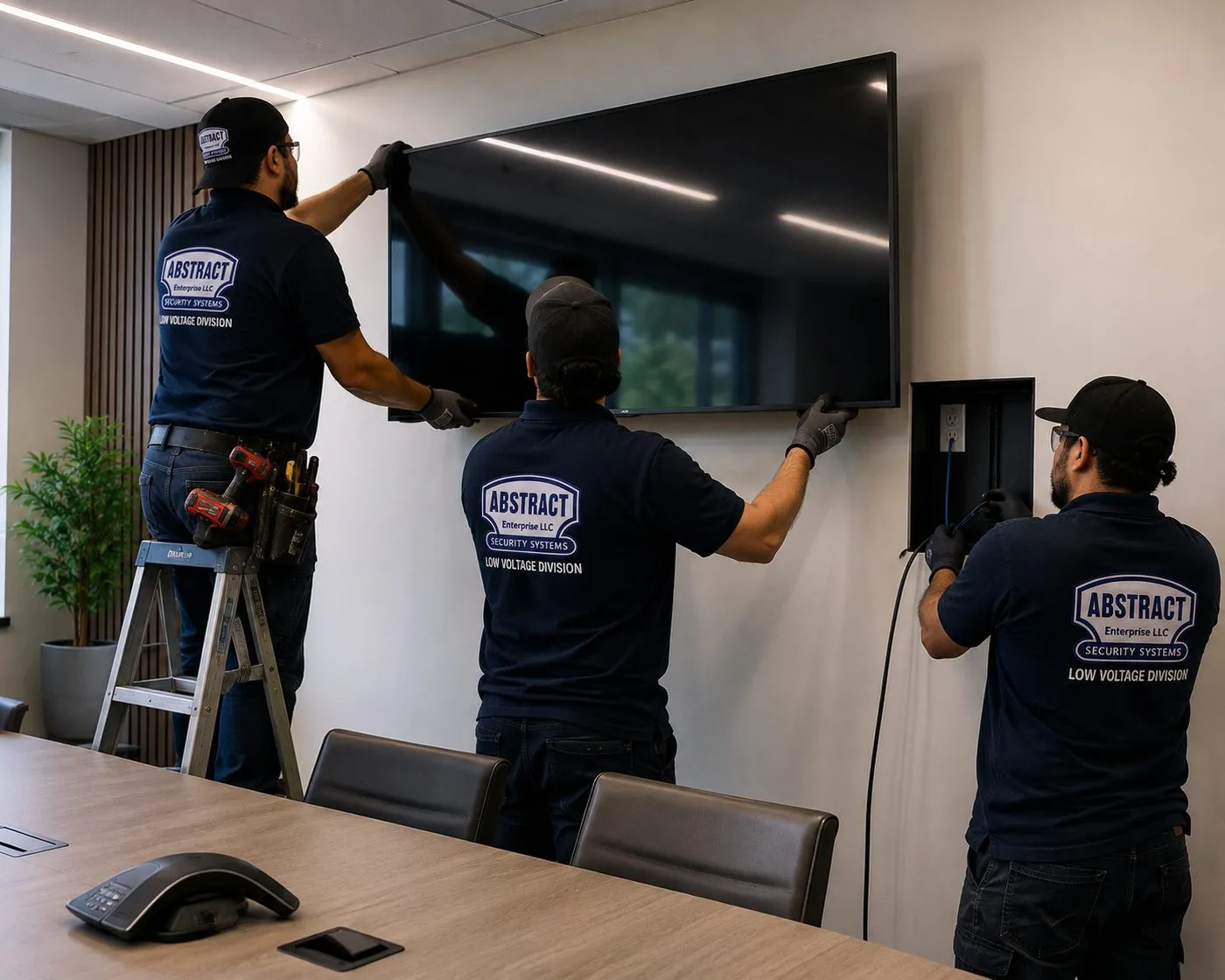
Two technicians steady a large flat screen against the wall while a third feeds a black cable into a recessed outlet box to its right, above a long meeting table.
Complete Services
Every Sonos Installation Service in Westchester County
Sonos rarely arrives alone. These are the related services Westchester customers book alongside it, each with its own county page.
Arrival windows, rescheduling, return trips and what to have ready.
Field Notes
Field Notes From Westchester Renovations
How our crews handle the hand-off with a renovation contractor — general practice, not the story of any one customer
The first thing our technicians ask on a Westchester renovation isn’t where the speakers go. It’s when the insulation is coming and who is doing the drywall. Those two dates decide whether the job is a morning of running wire through open studs or a week of fishing it through finished plaster later. With the dates in hand, the crew walks the space with the homeowner and the contractor together, marks each speaker position on the joists in paint, and checks each one against the electrician’s boxes and the HVAC runs before a single cable is pulled.
The second habit is photographs. Before the walls close, every run gets photographed with a tape measure in the frame and a label visible, and the pictures go to the homeowner with a simple drawing. Months later, when the speakers go in or someone wants a picture hung on that wall, that set of photos is the most useful thing we left behind.
FAQ
Westchester County Sonos Installation FAQ
Why do Westchester prices run higher than the Bronx or Brooklyn?
+
Our Sonos labour prices are published at a Brooklyn base and Westchester carries a 1.25 area multiplier, which covers travel time across the county and the longer visits older houses and building paperwork tend to need. Hardware such as a Sanus bracket stays at its $84.99 street price.
What deposit do you take, and when is the balance due?
+
The service agreement sets it out: a 50% deposit when you book, with the balance due on completion. Full terms — including 50% deposit, one-year parts-only warranty on AESS-supplied products, and the late-fee schedule — are set out in the service agreement.
Can we pay for the pre-wire now and buy the Sonos speakers later?
+
Yes. A renovation pre-wire is quoted and paid as its own job: wire run, labelled, tested and left coiled behind the drywall. Speakers, Amps and setup can follow months later at the Westchester line-item prices, and the photos we leave show exactly where each run ends.
Can a projector in a basement media room play its sound through Sonos?
+
Usually, but the connection decides how. Sonos soundbars and the Amp take TV sound over HDMI ARC or eARC, so the projector or its source needs that output; if it doesn’t, a receiver with a Sonos Port is the usual route, at the $161 Westchester receiver-connection line. We check the projector model before you buy anything.
Who supplies the speaker wire, Ethernet and mounting hardware?
+
We do, as part of the quoted labour for each run, sized for the distance and rated for the space it passes through. Sonos products, and any bracket you prefer to choose, can come from you; a Sanus soundbar bracket is $84.99 if you want ours.
Can you help us choose which Sonos products to buy before we order?
+
Yes. We look at the rooms, the walls and the network and recommend what to buy and where, so you don’t order an Era 300 for a wall it can’t be mounted on or more products than one system supports. You buy from the retailer you prefer.
Is Sonos the right choice over a dedicated whole-house audio system?
+
For most Westchester homes that want music in several rooms and good TV sound, controlled from phones, Sonos is a strong fit. Very large houses that want one control system for lighting, shades and audio may be better served by a dedicated control platform, and we’ll say so at the walkthrough.
Can music start by itself in the morning or when the shop opens?
+
Yes. Sonos alarms play the music you choose in the room you choose at a set time and volume, on the days you pick. We set them up during the handover for wake-up music at home or opening-time music in a business.
All Areas Served
Sonos Installation Across the Hudson Valley and New York
This is our Westchester County Sonos page. It sits under the Hudson Valley Sonos installation hub, which covers barns, stone houses, weekend homes and rural internet across all six valley counties. Rockland and Suffolk now have their own Sonos pages too; for other counties and boroughs, the regional hubs are the place to start, and the same crews work there.
If rooms have disappeared from the app, the ceiling speakers stopped after the renovation crew left, or the music cuts out every few minutes, call (914) 877-2578. Same-day visits are possible when a two-hour window is open near you, and most network and configuration faults are fixed in one to two hours once we’re on site. We power-cycle the network before we leave to confirm every room comes back on its own.
Sonos Installation Westchester County — Licensed, Insured, Renovation-Ready
Abstract Enterprises Security Systems, 460 E Fordham Rd, Bronx, NY 10458. Our Westchester line is (914) 877-2578; for photos and quick questions, WhatsApp (718) 679-0359 via wa.me.
NYS Low-Voltage Licence #12000287431 · 100% Licensed & Insured · Same-Day Estimates · Rated 4.7★ from 201 Google Reviews
Sonos products and brackets you supply carry their manufacturer’s warranty. Full terms — including 50% deposit, one-year parts-only warranty on AESS-supplied products, and the late-fee schedule — are set out in the service agreement. See our warranty page.
Nothing on this page is legal advice: it describes how Westchester licensing, building-department and association practices shape the way we install Sonos, and rules vary by municipality and building. Page reviewed and updated October 17, 2026. Changelog: first publication of the Westchester County Sonos installation page. Photos are from our low-voltage, network and audio work; dedicated Sonos photos will replace them as they are added. Sonos, Era, Arc, Beam, Ray, Move, Sub, Port and Amp are trademarks of Sonos, Inc.; Abstract Enterprises is an independent installer and is not affiliated with Sonos.