Wire Routes Planned House by House · Arc Ultra & Beam Theaters · Ceiling Speakers on Amp · Canal Decks & Pool Patios · Equipment Kept Above the Flood Line
In Nassau the speakers are the easy part. The real question is where a wire can travel: a Levittown ranch has no basement, a Garden City Tudor has plaster and a stucco skin, a Freeport canal house now sits a storey above its old front steps, and a Long Beach condo is poured concrete. We plan each Sonos system around the house you actually have, keep the electronics where water and heat can't reach them, and set it up so it plays nicely with the neighbours and the village code.
Reviewed and updated October 17, 2026 · Written by Anwar Timothy, NYS licence #12000287431
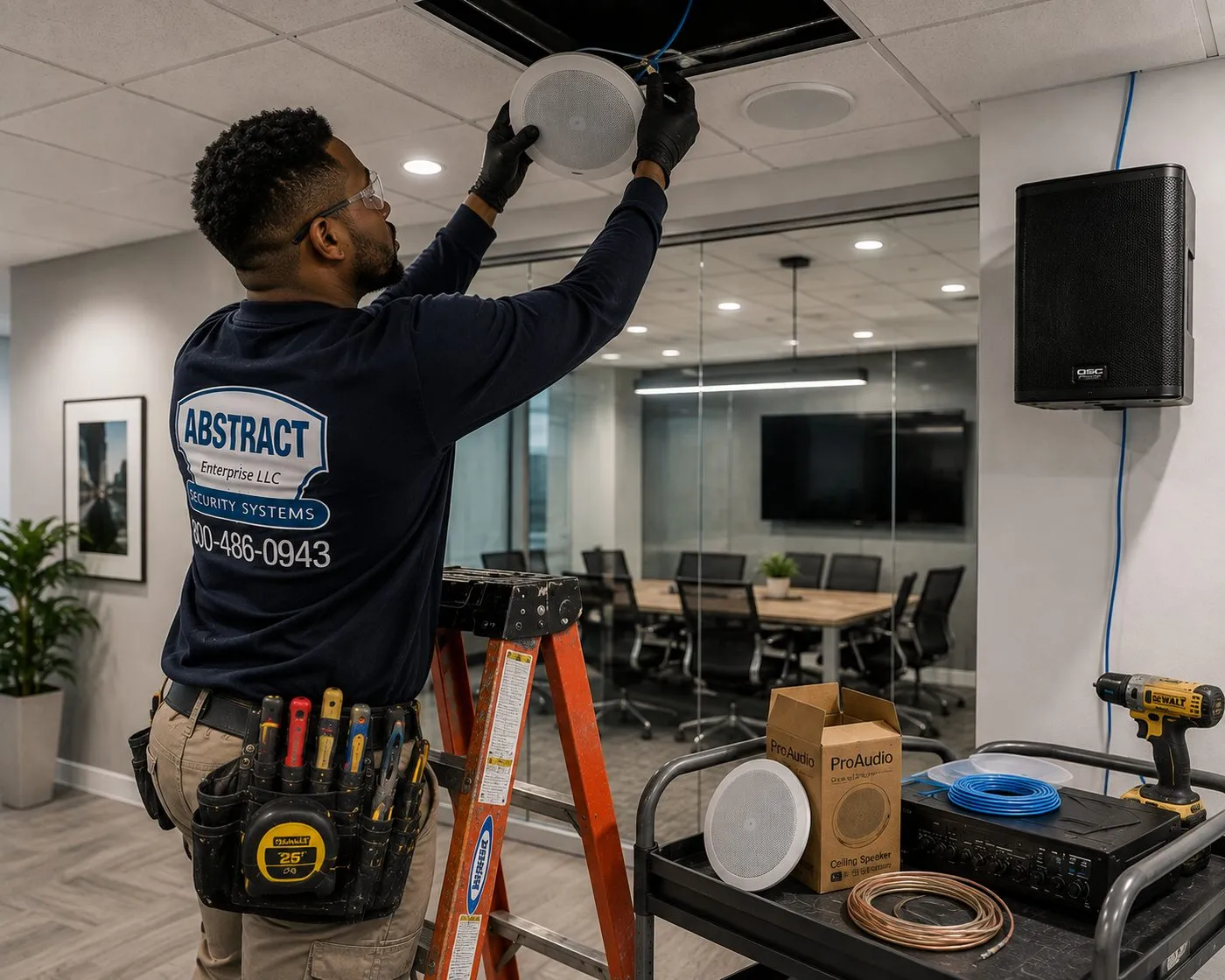
A technician seats a round ceiling speaker into an opened tile while blue cable runs down the wall to a cabinet speaker. The cart holds an amplifier, a coil of copper speaker wire and a spare speaker in its box — the same kind of passive speaker a Sonos Amp drives.
Plan Your Nassau Sonos
House type, rooms and town — a technician calls back the same business day
✅
Request Received
A Nassau technician will call you back the same business day.
25+
Years Experience
✓
Same-Day Estimates
100%
Licensed & Insured
4.7★
201 Google Reviews
Sonos boxes stacked in the den and no idea where the wire goes? Call the Nassau line at (516) 346-5778 or send the short form with your village or hamlet, the kind of house and the products you own. We tell you which parts are fixed-price and which need a walkthrough before anyone books a van.
No parking or travel surcharge anywhere in the county, from Inwood to Bayville
Two-hour arrival windows from 8 AM to 8 PM, seven days a week
NYS licence #12000287431 · certificates of insurance for boards and HOAs at no charge
A Sonos system is a set of speakers sitting on top of two things the box never mentions: a path for wire and a network that reaches every room. In most parts of the country those two things are roughly the same from house to house. In Nassau they are not. Within a ten-minute drive you can go from a post-war ranch poured on a slab, to a 1920s Tudor with plaster on wood lath, to a Gold Coast estate with stone walls and a pool house, to a canal house on the South Shore that was lifted onto new piers after Sandy, to an oceanfront condo in Long Beach built from concrete and steel. The same Arc Ultra, the same pair of ceiling speakers and the same Amp go into each of those in a completely different way, and the difference is where most of the cost, time and risk of the job actually lives.
Start with the house most people picture when they think of Nassau. Between 1947 and 1951 the Levitts built 17,447 houses in Levittown, and the ranch models sat on concrete slabs with hot-water radiant heating pipes running through them, according to an architecture firm’s history of the development and the Hofstra University Library’s Levittown exhibit. There is no basement to drop a wire into and nothing to drill through underfoot unless you want to find a heating pipe the hard way. Everything goes up: into the attic, along the top plates and down the inside of a wall. Thousands of Capes and ranches across Hicksville, Wantagh, Bethpage, Plainview and the rest of central Nassau were built on the same idea, and many have since grown dormers and rear extensions that cut the attic into pieces. Planning a Sonos system in one of those houses begins with a flashlight in the attic, not with a speaker catalogue.
Head north and the problem changes. Garden City was laid out from 1869 as one of America’s earliest planned villages, and its Estates section is known for Tudors, brick Georgians and centre-hall Colonials. Pre-war houses like these, in Garden City and in the older village centres around the county, usually do have basements, which makes the first floor easy to reach, but the walls and ceilings above are often plaster, the trim is original and owners rightly don’t want it touched. On the Gold Coast it is different again: more than 1,200 mansions were built on Long Island’s North Shore between the 1890s and the 1930s, according to WNET’s Treasures of New York, and fewer than a third of the grand estates survive. The ones that do, and the large modern houses built on the subdivided land around them, need more zones, more Amps and more network than a typical house, sometimes more than one Sonos system can hold.
Then there is water. Much of the South Shore lives on the water, with canal-front houses running behind Merrick Road from the Freeport area out to Massapequa. After Superstorm Sandy, FEMA inspectors found 860 homes in Long Beach alone substantially damaged, meaning they had to be raised or demolished, according to the city’s building commissioner as reported by the Long Beach Herald, and raised houses are now a familiar sight along the bays. A raised house moves the living space up a full storey and leaves an enclosure underneath that is meant for parking, storage and access. FEMA’s guidance for protecting building utilities says electrical equipment should sit above the required flood elevation, and that applies to the things a Sonos system depends on: the router, the network switch, the Amps and their power. A theatre that works perfectly until the next flood warning is not a good installation. In Long Beach, meanwhile, the city has about 43 high-rises of six to ten storeys along the boardwalk — the only oceanfront high-rises on Long Island, according to a 2021 report republished by the New York State Senate — and the salt air that corrodes their balconies is the same air an outdoor speaker has to live in.
Add the newer layer. Villages such as Westbury and Mineola are building apartments beside their Long Island Rail Road stations: Westbury approved a $97 million, 187-unit building in its transit-oriented district and, in September 2026, a further $100 million project on a former MTA parking lot, as reported by Long Island Business News. People moving into those buildings bring Sonos speakers that have to work on an apartment network, with no ceilings to cut and no landlord who wants holes in new drywall.
And then there are the neighbours. Lots are tight across much of Nassau, decks and pools sit within earshot of the house next door, and every town and village writes its own noise rules. The Town of North Hempstead’s noise chapter, for example, prohibits playing radios, sound amplifiers and similar devices between 10 p.m. and 8 a.m. in a way that creates a noise disruption across a property line. The Village of Hempstead’s chapter sets measured limits instead. A backyard Sonos zone that respects those rules is a design decision, made when the speakers are chosen and aimed, not a conversation with a police officer at 10:30 on a Saturday.
Nassau facts that shape a Sonos plan
17,447 houses: built in Levittown between 1947 and 1951; the ranch models were poured on concrete slabs with radiant heating pipes and no basement (Keri Murray Architecture’s Levittown history; Hofstra University Library Levittown exhibit). Wire in those houses travels through the attic, never the floor.
More than 1,200 mansions: built on the North Shore’s Gold Coast from the 1890s through the 1930s, with fewer than a third of the grand estates still standing (WNET, Treasures of New York) — the houses where one Sonos household can run out of room.
About 43 high-rises: six to ten storeys along the Long Beach boardwalk, the only oceanfront high-rises on Long Island, facing “sea air, blowing sand and corrosive salt water” (2021 report republished by the New York State Senate).
645,000 customer outages: left by Tropical Storm Isaias on Long Island on August 4, 2020, with full restoration taking eight days (LIPA’s 30-day report). Storm season is part of how a Nassau equipment shelf should be planned.
10 p.m. to 8 a.m.: the hours in which the Town of North Hempstead’s noise code bars sound amplifiers and similar devices from creating a noise disruption across a property line (Town Code Chapter 38, Local Law 13-2003).
187 apartments: in one transit-oriented building approved by the Village of Westbury beside its LIRR station, with a $100 million second project approved in September 2026 (Long Island Business News) — new renters bringing Sonos into buildings with shared networks.
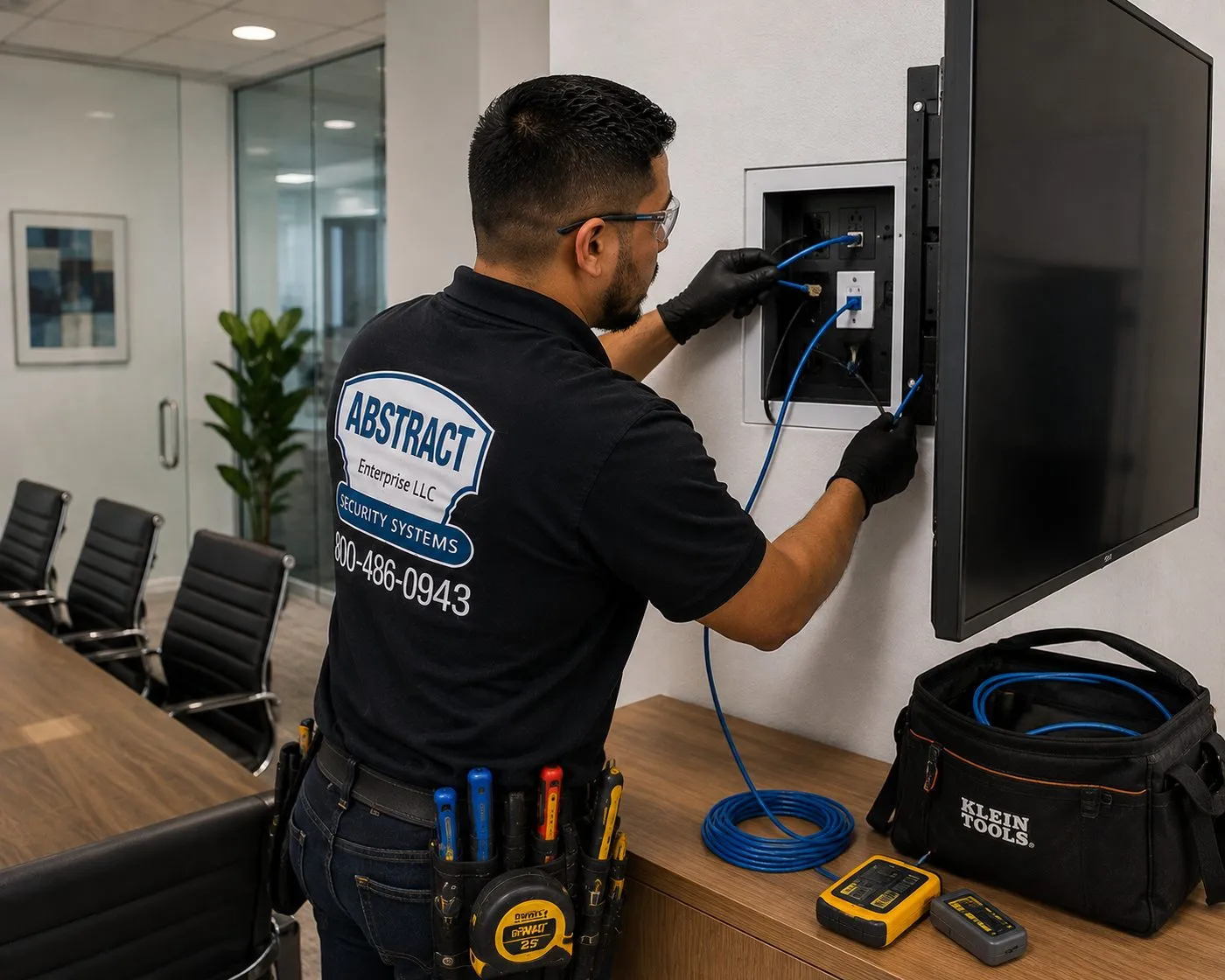
A technician connects blue cable inside a recessed box set into the wall next to a mounted screen, with two handheld testers and a Klein tool bag on the credenza below. Power, HDMI and Ethernet meeting in one recessed box is what lets a Sonos bar sit tight under the TV with nothing dangling.
Repair Capture
Need Your Sonos Fixed in Nassau County Today?
Rooms that vanished from the app after the power came back, a Sub that blinks and won’t bond, a deck zone that cuts out when the slider closes, or a theatre that went quiet after Optimum or Verizon swapped the router — these are repairs, not new installations. Nearly all of them come down to the network, a TV audio setting or a pairing, and once a technician is in the house most are sorted in one to two hours. In Nassau we book them as a setup-only visit: $225 flat for the first hour, then 30-minute blocks. Same-day when a two-hour window is open. Call (516) 346-5778 and tell us what the system is doing.
What We Install
Sonos Installation Services in Nassau County
Every service below starts with the same question: what does this house let us do? The products are the same in Elmont and in Old Westbury. The routes, the equipment locations and the network plan are not, so each card says where it matters most in the county.
Slab-House Sonos Plans
For Levitt ranches, slab-on-grade Capes and the lower levels of high ranches: wire comes down from the attic or along the ceiling line, never up through the floor. Where no attic path exists, self-powered speakers and a soundbar carry the system instead of ceiling speakers.
Pre-War Plaster Homes
Tudors and Colonials in Garden City’s Estates section and in other pre-war neighbourhoods: wire up from the basement to the first floor, down from the attic to the second, and cut-outs made with care so original plaster and trim survive.
Estate Systems
North Shore houses with wings, a pool house and a terrace: several Amps in a ventilated rack, wired Ethernet to each wing and a count kept against Sonos’s per-system product limit from the first sketch.
Raised and Flood-Zone Houses
Canal and bay houses along the South Shore that were lifted after Sandy: Amps, router and switch kept on the living floors, above the flood line, with cable routed so the enclosure underneath stays clear.
Canal Decks and Docks
Sonos outdoor speakers by Sonance on an indoor Amp, chosen for salt air and aimed down the yard rather than across the canal, with wire protected along the house and the network checked at the bulkhead.
Pool Patios on Tight Lots
Pool and patio zones laid out for lots where the neighbour’s bedroom window is twenty feet away: more small speakers at lower volume instead of two big ones, and the outdoor zone set up so it can be turned down by 10 p.m.
Concrete Condos and Co-ops
Long Beach and Great Neck buildings where nothing gets cut into a ceiling: soundbar, Sub and Era surrounds mounted to the wall the board allows, cables in paintable raceway and the network checked against the building’s own Wi-Fi.
New Apartments by the Station
Renters in the new buildings around the Mineola and Westbury stations: a theatre and a couple of rooms of music on the unit’s own router, with nothing that needs the landlord to repaint when the lease ends.
Two-Family Houses
Upstairs and downstairs households in the county’s two-family houses and legal basement apartments: two separate Sonos systems on two separate networks, so nobody’s app can turn up the other family’s kitchen.
Theatre Over the Fireplace
The Colonial family room where the TV has to go over the mantel: bar placement, Sub location and surround positions planned around the chimney breast, with the mantel-height TV mount priced from the published list.
Storm-Ready Equipment Shelves
Amps, router and switch on surge protection, labelled, ventilated and on one shelf you can reach in the dark, so the system comes back in order after a PSEG Long Island outage.
Main Street Businesses
Background music for shops, salons, gyms and restaurants along Northern Boulevard, Old Country Road, Sunrise Highway and Hempstead Turnpike, zoned so the counter and the floor run at different levels.
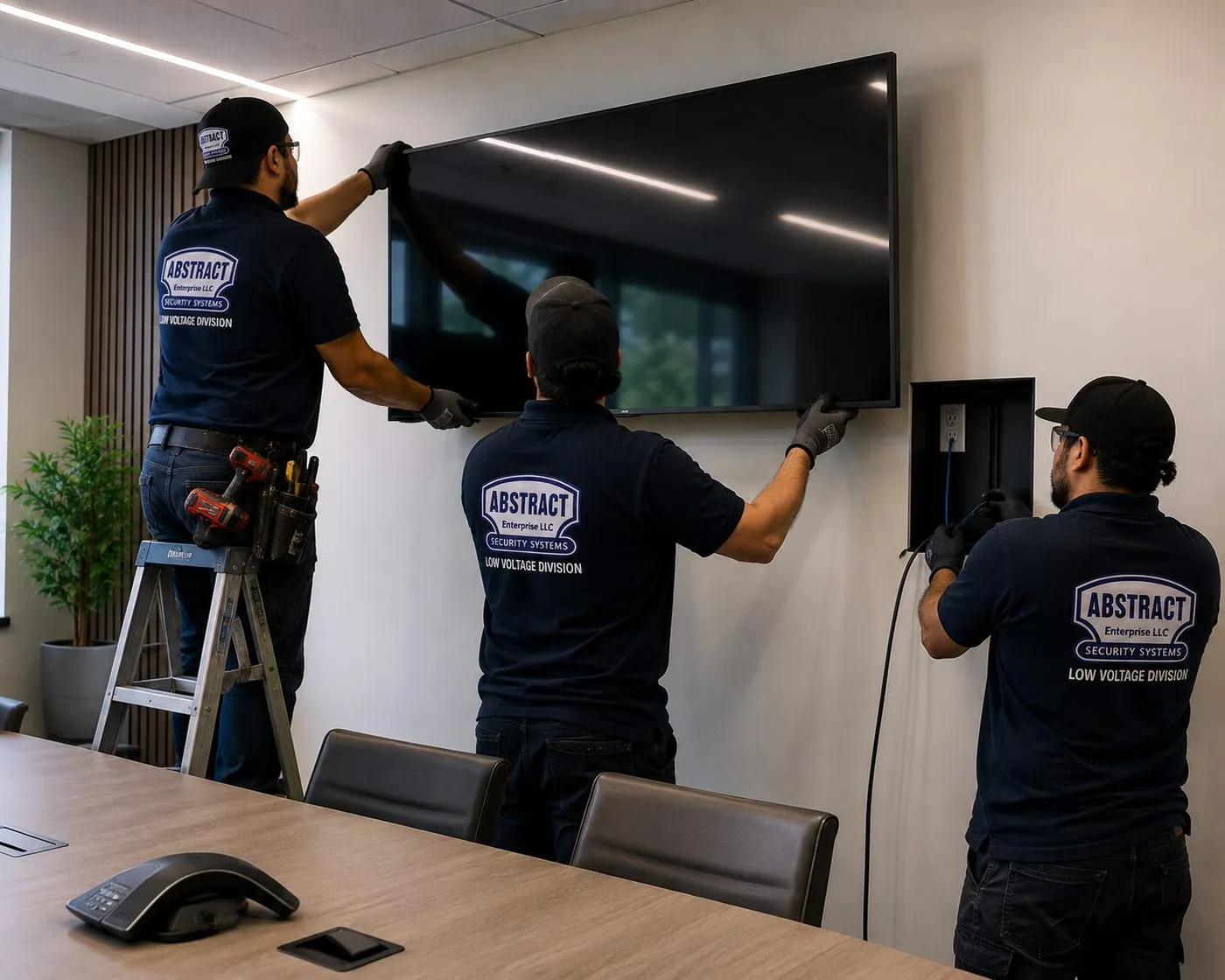
Two technicians lift a large flat screen onto its wall mount while a third feeds a cable into a recessed box with an outlet to the right. The screen goes up and gets levelled first; the Sonos soundbar is then centred and aligned to it.
Sonos Installation for Nassau County's Architecture
Nassau’s houses fall into a handful of families, and each family has one route that works for Sonos wire and one that will cost you a weekend of patching. We learn which one you live in before quoting, because it decides whether a room gets in-ceiling speakers on an Amp or a pair of self-powered speakers on a shelf.
Levitt Ranches and Slab Capes
One storey on a concrete slab with radiant heating pipes, an attic above and no basement below. Wire goes over the top and down inside interior walls. Ceilings are often reachable from the attic, which makes ceiling speakers in the living room and kitchen more practical than people expect, as long as insulation is put back properly.
Dormered and Expanded Capes
The same post-war houses after a dormer, a full second storey or a rear extension. The original attic is gone or split into knee-wall crawl spaces. Upstairs rooms are wired from those crawl spaces or from a closet; downstairs ceilings are often under finished floors and stay speaker-free.
High Ranches and Split-Levels
Half the living space up, half down, with a slab under the lower level. The family room and its TV usually sit on the lower half, the kitchen and living room above, and the stairway between them is the natural chase for wire and Ethernet.
Pre-War Tudors and Colonials
Full basements, plaster walls, original trim and, on many Tudors, a stucco exterior. The basement makes the first floor easy; the second floor is reached from the attic. Outdoor speakers need a mounting plan that respects the stucco rather than cracking it.
Gold Coast Estates and Large New Houses
Wings, guest rooms, pool houses, terraces and stone. More rooms than one router or one Amp can serve, long distances between the equipment and the farthest speakers, and a product count that has to be watched against Sonos’s limit of 32 products per system.
Raised Canal and Bay Houses
Living floors lifted a storey above grade, a new enclosure underneath for parking, storage and access, decks facing the water. The equipment shelf belongs upstairs with the people; wire to the deck runs along the house, not through the enclosure’s flood openings.
How the wire travels in each kind of Nassau house
Simplified diagram, not to scale: blue lines show the cable route we plan first in each kind of Nassau house; dark blocks are equipment or a TV and soundbar.
Slab ranches: over the top. In a slab house the attic is the only hallway. We go up the hatch, find the top plate of the wall behind the TV or above the speaker locations, drill it from above, and drop the cable down inside the wall to a low-voltage box. Ceiling speakers in the rooms below are fed directly from the attic. Before any hole is drilled we check what else lives up there — bathroom fan ducts, old knob-and-tube remnants in older sections, a whole-house fan — and we push insulation back over the work so the house doesn’t lose heat for the sake of a speaker. What we will not do in a slab house is drill the floor: radiant heating pipes in the concrete are a repair bill nobody wants.
Pre-war plaster: from below and from above. The basement is a gift in a Garden City Tudor. Wire for a living-room theatre or dining-room ceiling speakers comes up through the floor plate inside the wall cavity, not through the finished floor. The second floor is reached from the attic. Ceiling cut-outs in plaster are scored and cut slowly with the template Sonos supplies for its in-ceiling speakers, after an obstruction check with a stud finder and, where the manual suggests it, a small pilot hole probed with a length of stiff wire. Sonos’s in-ceiling speakers use a Roto-Lock clamp rated for ceilings up to 1-1/4 inches thick with the caps on or 1-7/8 inches with them off, which covers most plaster-and-lath ceilings; we measure before we promise.
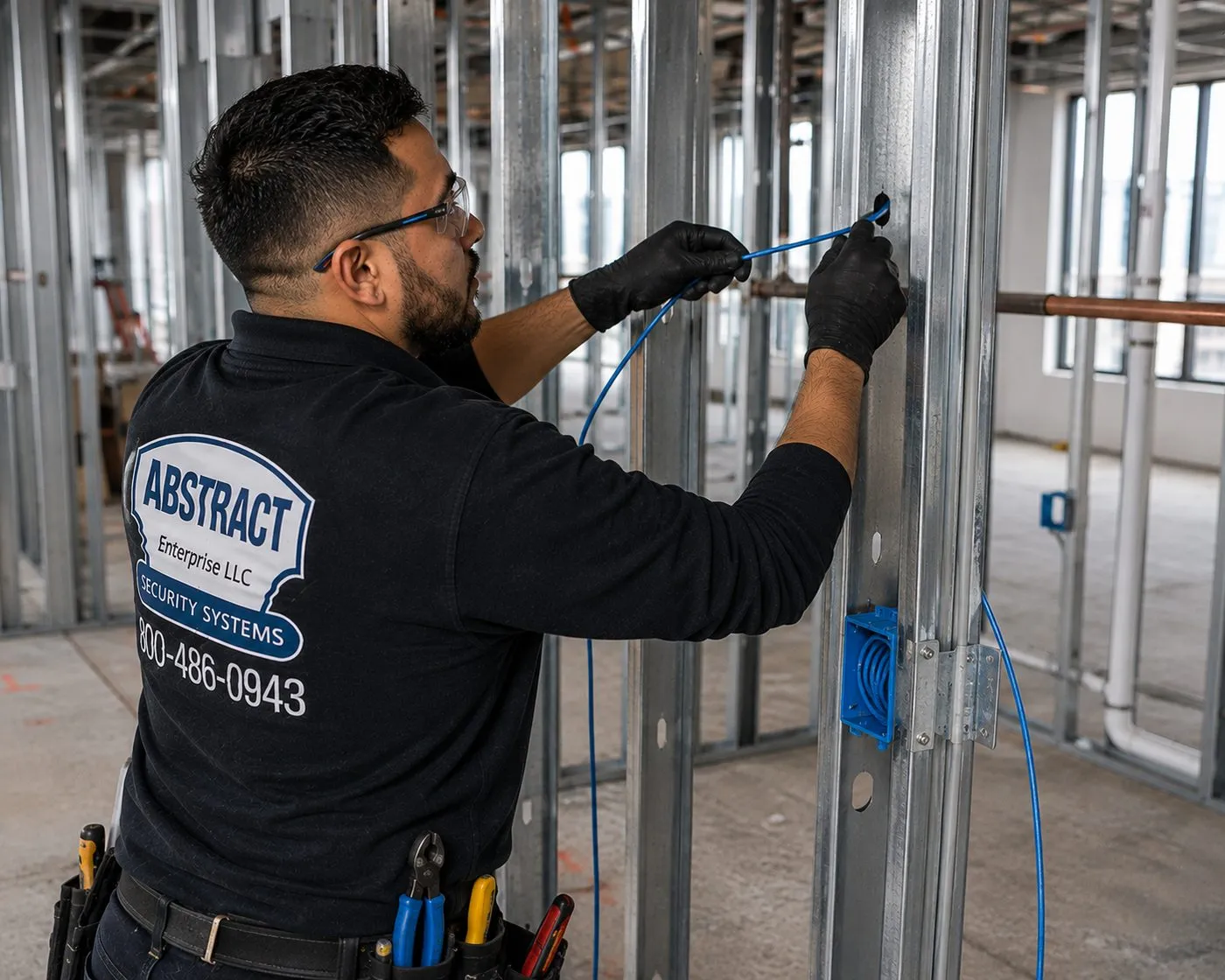
A technician threads blue cable through a punched hole in a metal stud next to a blue low-voltage box, in a space with open framing and no drywall yet. Whenever a Nassau renovation has the walls open, that is the moment to run speaker wire and Ethernet for Sonos.
Commercial Sonos Installation
Business Sonos Installation in Nassau County
Nassau’s business districts are strung along a few long roads, and the shops, salons, gyms, offices and restaurants on them want the same thing from background music: easy control, even sound across the room and no complaints from the apartment upstairs. Sonos markets installed systems to businesses, and its Amp, ceiling speakers and Era 100 Pro (designed for professional installation, with PoE+) suit the size of most of the storefronts we work in.
Northern Boulevard and the Miracle Mile
The North Shore’s retail spine, including the stretch through Manhasset commonly called the Miracle Mile around the Americana Manhasset at 2060 Northern Boulevard. Boutiques and showrooms where music has to sit quietly under conversation, zoned so fitting rooms and the sales floor can differ.
Old Country Road
The road along Mineola’s southern border that runs past the big shopping centres of Carle Place and Westbury, including Roosevelt Field — the largest mall on Long Island — and on through Hicksville. Showrooms, gyms, medical offices and restaurants in strip centres with drop ceilings that make ceiling speakers simple.
Sunrise Highway
The South Shore’s main road through Valley Stream, Lynbrook, Rockville Centre, Merrick, Wantagh and Seaford. Salons, barbers, cafés and fitness studios in one-storey buildings, many with an apartment or an office above that hears every bass line.
Hempstead Turnpike
From Elmont, past Belmont Park and UBS Arena, through Franklin Square and West Hempstead, downtown Hempstead (where it becomes Fulton Avenue for a stretch), past Hofstra and the Nassau Veterans Memorial Coliseum at 1255 Hempstead Turnpike, to East Meadow and Levittown. Restaurants, takeout counters and shops where a counter zone and a dining zone need separate volumes.
Jericho Turnpike and Mineola
Mineola’s commercial main street and the county seat, home to offices, medical practices and lunch spots around the county government buildings and NYU Langone Hospital–Long Island. Waiting rooms that need calm, low-level music on a schedule.
Freeport’s Nautical Mile
The waterfront strip along the Woodcleft Canal with dozens of restaurants, bars and shops and charter fishing boats. Indoor dining rooms and outdoor decks that face the same salt air as a canal-front house and the same neighbours late at night.
Rules that matter for business music in Nassau
Noise across the property line. Town and village noise chapters apply to businesses as well as homes. The Village of Hempstead’s code measures sound inside a neighbouring building and sets a limit of 45 dB(A) there, and limits loudspeakers that create unreasonable noise across a real property boundary; the Town of North Hempstead uses a noise-disruption standard across property boundaries. We aim and zone speakers so the music stays inside, and we set maximum volume limits in the Sonos app where the owner wants them.
Licensed trades stay licensed. New outlets for an Amp rack or a ceiling speaker location are electrical work for a licensed electrician with the town or village permit that goes with it. We do the low-voltage side under NYS licence #12000287431 and coordinate with your electrician on the same day where possible.
Landlords want paperwork. Strip-centre and mall landlords usually ask for a certificate of insurance before any contractor works in a unit. We issue ours at no charge.
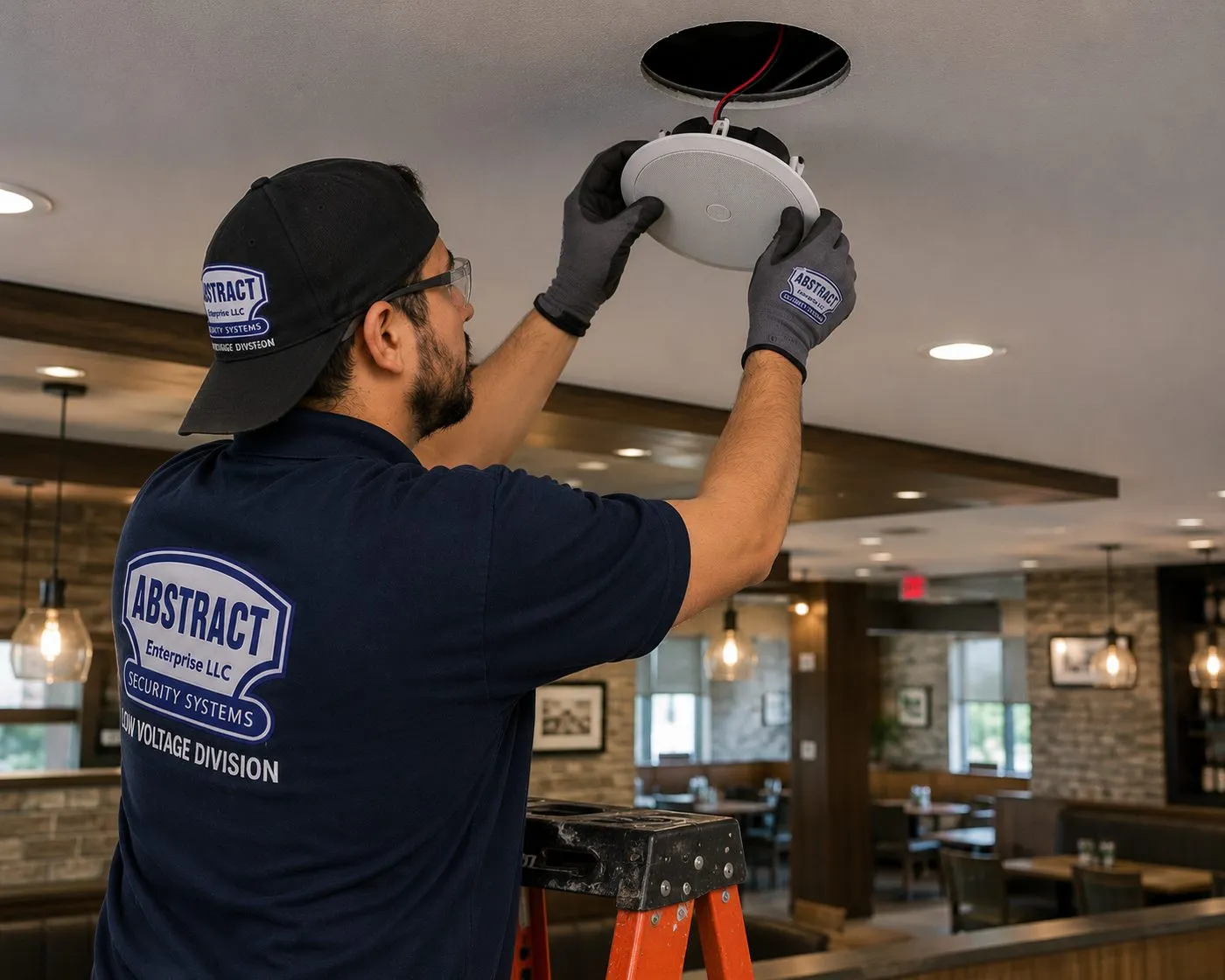
A technician in gloves lifts a round ceiling speaker into a clean circular cut-out, with the red and black speaker wire hanging from the opening, in a dining room with stone-faced walls, pendant lights and booths. Speakers like this, driven by a Sonos Amp, give a restaurant even sound with nothing on the walls.
Sonos Installation in Nassau County: Questions Answered
These are the questions Nassau households ask us on walkthroughs, grouped by the kind of house or situation they come from. Each answer is written for this county; questions about Sonos in general are answered on our Long Island Sonos installation hub.
Slab ranches and expanded Capes
Our Levittown ranch sits on a slab with radiant heat in the floor — how does speaker wire get anywhere without a basement?
It goes up instead of down. In a slab ranch the attic is the only route, so we go in through the hatch, locate the top plate of the wall where the cable has to come out, drill that plate from above and drop the cable inside the wall to a low-voltage box near the TV or the speaker location. Ceiling speakers are fed straight from the attic, which is why they are often easier in a ranch than people expect. What we never do is drill into the slab: the original Levitt houses were heated by hot-water pipes cast into the concrete, and many still are. If a route would need to cross the floor, for example to a Sub on the far side of a sofa, we use a wireless Sub instead or a flat raceway along the baseboard. Before quoting we check the attic for depth, insulation, ducts and anything left by earlier owners, and we put the insulation back the way it was.
Our Cape was dormered years ago and there’s no attic left over the bedrooms — can the upstairs still get ceiling speakers?
Often yes, through the knee-wall spaces. A dormer or a full second storey usually leaves triangular crawl spaces behind the short walls at the eaves, and many already have a small access door. From there we can reach the ceiling joists of the dormer rooms at their low edge and the wall cavities that run down to the first floor. Where the dormer ceiling is a flat ceiling with a small space above it, we can sometimes reach it from a hatch in a closet. If the upstairs ceiling has no space above it at all — common where a dormer was built with a cathedral or sloped ceiling — ceiling speakers would mean opening the drywall, and we say so before you buy anything. In those rooms a pair of Era 100 or Era 300 speakers on wall mounts screwed into studs, or on furniture, gives you the same Sonos zone with no cutting.
The attic over our 1950s Cape has loose, pebbly insulation — can speaker wire still be run through it?
Not until someone has identified it. Loose, grey-brown, pebble-like fill in an older attic may be vermiculite, and the EPA’s guidance is direct: assume vermiculite insulation contains asbestos and do not disturb it; asbestos becomes a risk when fibres get into the air, which is exactly what crawling through it and pushing cable across it would do. If we open your hatch and see material that could be vermiculite, we stop, take a photo and leave the attic alone. You can have it tested or removed by a trained professional, as the EPA suggests; until then, we plan the system without that attic — a soundbar and Sub, self-powered Era speakers, or wire routed through a closet or along trim instead. Fibreglass batts or blown cellulose are a different story: we work through them, keep cable on top of the joists where it won’t be crushed and put the insulation back. The same caution applies to any old cloth-covered wiring we find up there; we don’t touch it, and we tell you so an electrician can look.
Pre-war Tudors and Colonials
Can outdoor speakers be mounted on the stucco and half-timbering of our Garden City Tudor without cracking it?
Yes, if the bracket lands on something solid and the stucco is drilled the right way. Stucco is a thin, brittle skin over lath and sheathing; it cracks around a hammer-drilled hole or a bracket that pulls on it. We locate framing behind the stucco, drill with a masonry bit on rotary (not hammer) setting, seal each hole and fasten through into the framing so the stucco carries no load. The decorative timbers on many Tudors are applied boards rather than structure, so we don’t hang a speaker from them unless we can confirm there is framing behind. Sonos’s outdoor speakers by Sonance use FastMount brackets and need 16-gauge or heavier speaker wire back to an indoor Amp, so the other half of the job is getting that wire inside: usually through a single small sealed penetration under an eave or into the basement rim, never through the window frame. If the facade has been restored recently, we can also mount on a pergola, a garden wall or a post instead.
Can a Sonos Amp or Port live inside the built-in bookcases beside our fireplace?
It can, if the cabinet breathes. Sonos’s Amp product guide asks for at least three inches of clearance around the unit and an operating temperature between 32°F and 104°F; the Port guide asks for at least two inches all around on a shelf, not to block ventilation and to keep it away from radiators and other heat sources. A closed cabinet next to a working fireplace, or one with a cast-iron radiator in the wall below it, can run warmer than that. We check by measuring the space and, where it’s tight, by adding ventilation the cabinetmaker would approve of: a slotted back panel, a grille in the toe kick or a small quiet fan. We also bring Ethernet and power into the cabinet so the Amp isn’t depending on Wi-Fi from inside a wooden box. If the built-ins are original woodwork you don’t want altered, the Amp goes to the basement directly below and the speaker wire comes up through the floor plate instead.
The TV in our Colonial hangs over the fireplace — where do the Sonos soundbar and Sub go?
The bar goes directly under the TV, and that usually means on the chimney breast just above the mantel or on the mantel itself. Sonos’s Arc Ultra guide asks for at least four inches between the bar and the TV, and the up-firing drivers that give Dolby Atmos height effects need a clear path to the ceiling, so we check that the mantel shelf or the TV doesn’t overhang the bar. Arc Ultra detects when it is wall-mounted and adjusts its EQ for the wall, according to Sonos’s mount page. Power and HDMI for a mantel-height TV can’t always run inside a masonry chimney breast; where they can’t, we use a paintable cord cover or run the cable to the side wall and across behind the mantel. The Sub does not need to be near the bar — it is wireless — so it goes where the bass measures evenly at the sofa, often in a corner or lying flat under the sofa with the clearance Sonos specifies. Mounting the TV above a fireplace is a published add-on of $130 on top of the Nassau base price.
Estates and very large houses
We want Sonos in more than thirty places across the house, pool house and terrace — is there a limit?
Yes. Sonos’s system requirements state a maximum of 32 Sonos products in one system, and every product counts: each Amp, each Sub, each surround and each soundbar. Passive ceiling and outdoor speakers don’t count individually because they hang off an Amp, which is one of the reasons we use them heavily in large houses — Sonos says one Amp reliably powers up to three pairs of its Architectural speakers in parallel. When a plan still gets close to 32, we have three choices: combine rooms that are always used together into one zone, replace self-powered speakers in secondary rooms with ceiling speakers on a shared Amp, or split the property into two Sonos systems, for instance the main house and a guest cottage. Two systems can’t be grouped together in the app, so we only recommend that split where the buildings are really used separately. We draw the count on the plan before anything is bought.
Raised houses, canals and Long Beach
On our raised canal house, how does wire reach the deck speakers without going through the flood vents?
It leaves the house at the living level and stays there. The enclosure under a raised house is designed for parking, limited storage and building access, with flood openings in its walls so water can pass through instead of pushing the house over; FEMA’s recovery guidance after Sandy notes that every part of a building below the base flood elevation is susceptible to flooding. A cable threaded through those openings gets wet, blocks them with clutter and invites someone to put a power strip down there. So we plan from the top: the Amp sits on a shelf on the first living floor, the speaker wire leaves through one small sealed penetration in the wall of that floor, runs along the rim or under the deck boards in outdoor-rated cable, and comes up to the speakers on the deck rail or the house wall. If the speakers are on a lower dock or patio, the cable drops down a post in protected conduit and nothing powered goes with it. FEMA’s utilities guidance also recommends keeping electrical equipment above the required flood elevation, which is why every powered part of the system stays upstairs.
Our Long Beach condo board won’t allow anything fixed to the balcony or the facade — how do we get music outside?
With speakers that don’t need to be fixed to anything. Sonos’s portable speakers are the honest answer here: the Move 2 is rated IP56 with up to 24 hours of battery, and the Roam 2 is rated IP67 with up to ten hours, according to Sonos’s guides. Both join the same Sonos system as the indoor speakers over Wi-Fi, so the balcony becomes a zone you can group with the living room. Two cautions for an oceanfront building. Sonos says the Move 2’s charging base is for indoor use only and its operating range is 32°F to 104°F, so it comes inside at the end of the evening and in winter. And sand and salt are hard on anything left out; the city’s own building commissioner described the boardwalk buildings as being “sandblasted every day.” If the board will allow a wired speaker on the interior side of the balcony wall, we can show them the mounting details first; otherwise portable it is.
Internet, routers and storms
Can Sonos run on the gateway Optimum or Verizon installed, or do we need our own router?
Most of the time the provider’s equipment will run Sonos; whether it runs it well depends on the house. Verizon’s own Long Island page compares its Fios service with Optimum’s cable internet across Nassau and Suffolk, and one or the other supplies the gateway in most houses we visit. Either company’s gateway can work, provided its Wi-Fi offers 2.4 GHz (Sonos says routers that only provide 5 GHz are unsupported), the Sonos products and the phones are on the same main network rather than a guest network, and the security is WPA2 or WPA3 Personal rather than an enterprise login. Where a gateway struggles is coverage: one box in a front-hall closet rarely reaches the back deck of a ranch or the far wing of a large house. Then we either add a mesh system wired back to the gateway or put the gateway in bridge mode and let a better router run the house. We check the gateway’s settings before the speakers go in, because a Sonos fault that is really a router setting is the most common call we get after a provider swap.
Storms knock our power out every few years — how do we protect the Sonos Amps and the network gear?
Plug the equipment into proper surge protection, keep it in one labelled place and let it come back in order. Long Island knows what a long outage looks like: LIPA’s report on Tropical Storm Isaias counted about 645,000 customer outages in August 2020 and eight days to full restoration. When power drops and returns, the moments of switching are when sensitive electronics take a hit, so we put the Amps, the Port, the switch and the router on a surge-protected power strip or a small battery-backed unit on the equipment shelf rather than on whatever outlet is nearest. We label every plug. When power comes back, the router has to be up before the speakers can find it, and owners on the Sonos community forum note that older products take longer to reboot than newer ones, so the right move is patience before resetting anything. For outdoor speakers, nothing needs unplugging: the passive outdoor pair carries no electronics of its own and is powered from the indoor Amp.
Permits and licences
Does a Nassau village or town need to issue a permit for speaker wire and a Sonos install?
For the low-voltage work itself we have not found a Nassau town or village rule that requires a building permit to run speaker wire or set up Sonos products, and we don’t claim one exists. What does need permits is the work around it. The Town of Hempstead requires permits for electrical work, decks and pools, and village building departments such as Garden City and Westbury publish their own lists and forms. If your plan needs a new outlet behind the TV, a dedicated circuit for an Amp rack or power at the far end of a deck, that is a licensed electrician’s job and it comes with that municipality’s electrical permit. Building a new deck or pool to put speakers around comes with its own permit too. Nassau has three towns, two cities and 64 incorporated villages, so the answer depends on the street; we tell you which office applies before we schedule, and we coordinate with your electrician so the outlet exists before the speakers arrive.
Does whoever installs our Sonos need a Nassau County home improvement licence?
The county’s Department of Consumer Affairs licenses home improvement contractors working on homes of up to three families, and its published list of covered work includes carpentry, drywall, painting, swimming pools and many other trades. Speaker, audio, television and low-voltage wiring are not named on that list, and we don’t claim the county licence applies to them or that we hold one. What we do hold is a New York State low-voltage licence, #12000287431, and insurance, with certificates issued free for boards and HOAs. The practical point is about the trades around a Sonos job. Patching and painting after speaker cut-outs, building out a closet for an equipment rack or adding a soffit are carpentry, drywall and painting work, which is why we don’t include them; if you hire someone for that part, ask for their Nassau licence number, which the county requires on contracts.
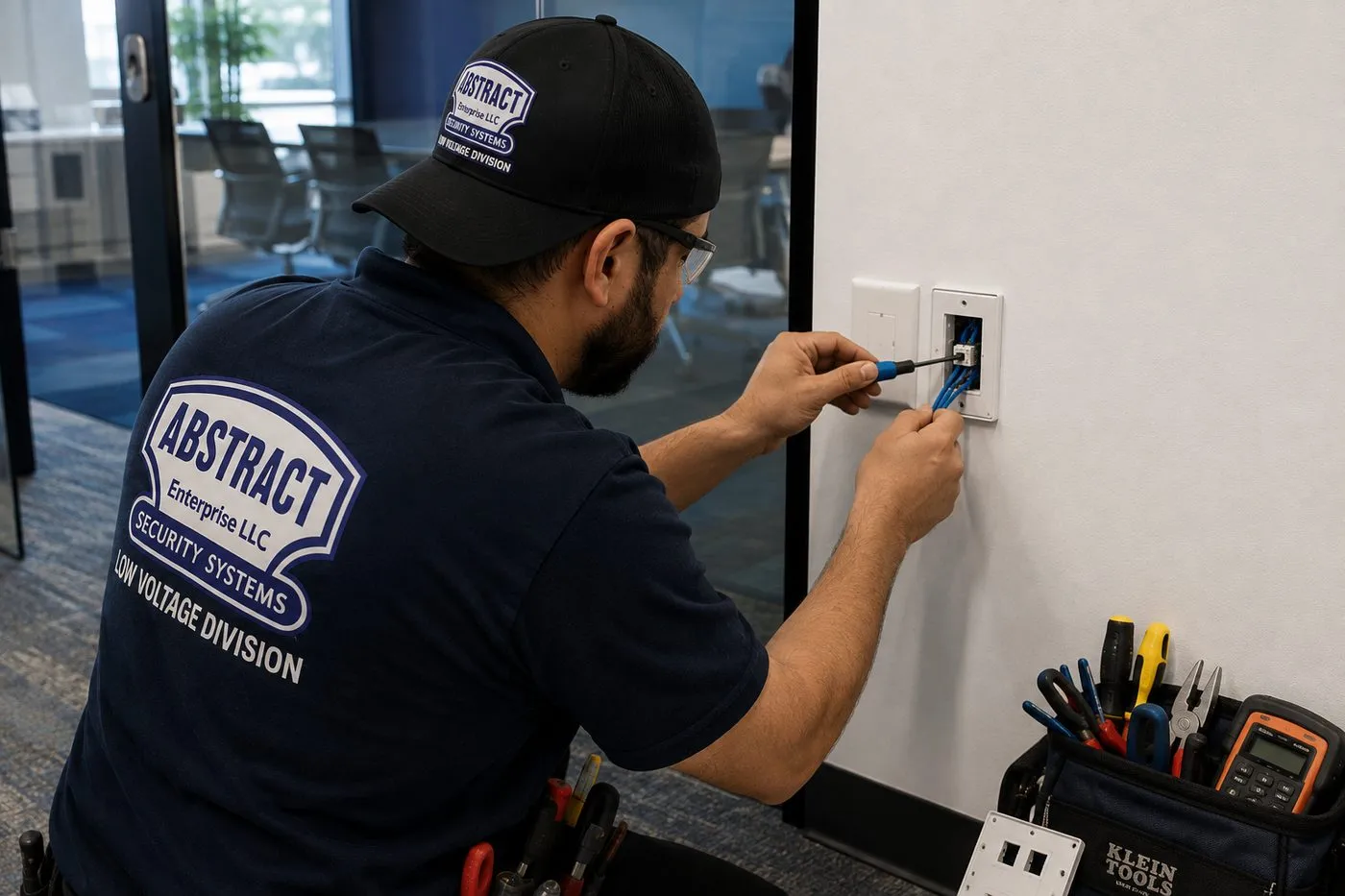
A technician kneels at a wall plate and seats blue cable into a keystone jack with a small screwdriver, a spare faceplate, a tool bag and a digital meter beside him. One wired jack like this behind the TV or at the equipment shelf is what turns a shaky Sonos system into a steady one.
Equipment
Types of Sonos Systems We Install
We install the full Sonos range and the network gear it depends on, and each product below has a place where it suits a Nassau house better than the alternatives. Specifications come from Sonos’s own product pages, guides and support articles; models change, so we confirm the current version before you buy. You buy Sonos from whichever retailer you prefer — we don’t claim dealer status.
Arc Ultra
Sonos’s largest soundbar, about 46.38 inches wide and 13 lb, with HDMI eARC and Wi-Fi 6. It detects wall mounting and adjusts its EQ. Our pick for the Colonial family room with a 65-inch-plus screen, including over-the-mantel set-ups where the bar sits on the chimney breast.
Beam (Gen 2) and Ray
Compact bars for slab-ranch living rooms, dens in split-levels, bedrooms and apartments. Beam connects by HDMI eARC/ARC; Ray connects optically. Both can add a Sub later, so a family can start small without replacing anything.
Sub 4
Wireless, with an optional Ethernet port, and happy upright or on its side under a sofa with the front opening clear and the clearance Sonos specifies. Ideal in slab houses, because the Sub never needs a wire across the floor — only an outlet.
Era 100 and Era 300
Self-powered speakers for rooms where ceiling cut-outs aren’t wanted: the dormer bedroom, the plaster-walled study, the rental apartment. The Era 300 wall mount is stud-mount only, not for drywall alone, with a ball joint that swivels 15 degrees each way.
Sonos Amp
125 W per channel into 8 ohms, HDMI ARC, line-in and two Ethernet ports. It drives the ceiling, in-wall and outdoor speakers; Sonos says up to three pairs of its Architectural speakers in parallel. Needs three inches of clearance and a room between 32°F and 104°F — never the flood-zone enclosure or an unheated garage.
In-Ceiling and In-Wall by Sonance
Passive speakers made for the Amp. The 6-inch in-ceiling model needs an 8.25-inch cut-out and about 4.73 inches of depth; the 8-inch needs 10.125 inches and about 5.32. Sonos suggests a pair for rooms up to about 150 sq ft. Common in ranch kitchens fed from the attic.
Outdoor Speakers by Sonance
Sonos tests this passive pair against salt spray, humidity, UV and temperature to Mil Spec 810 and rates it IP66, for use from −13°F up to 149°F. It has no electronics of its own: an Amp indoors drives it over 16-gauge or heavier cable. The one we specify for canal decks and bay-side pools.
Move 2 and Roam 2
The answer when a board, a lease or a dock rules out anything fixed. Move 2 carries an IP56 rating and up to 24 hours of play per charge; the smaller Roam 2 is IP67 with up to ten. Carried back indoors, each one rejoins the household’s Sonos system over Wi-Fi.
Port
Brings an existing receiver and its speakers into Sonos, with analog and coaxial digital outputs and a 12V trigger to wake the amplifier. Useful in the pre-war den with a good older stereo, where the owner doesn’t want to lose the speakers they love.
Mesh, Switches and Access Points
Not Sonos products, but the part that decides whether Sonos works in a long ranch, an estate wing or a deck at the end of the yard. Wired back to the router wherever possible; Sonos doesn’t support wireless range extenders or Ethernet-over-power.
Which product goes where in a Nassau house
House or space
What usually works best
Why
Levitt ranch living room and kitchen
Beam or Arc Ultra + Sub 4; ceiling speakers on an Amp in the kitchen
The attic reaches the kitchen ceiling; the Sub needs no floor wire
Dormered Cape bedrooms
Era 100 pair, or ceiling speakers if the knee-wall space reaches
No attic over sloped ceilings
Split-level family room
Arc Ultra or Beam + Sub 4 + Era surrounds
Wire comes down beside the stairs; the lower level is on a slab
Garden City Tudor dining room
Ceiling speakers on an Amp in the basement
The basement reaches the first-floor ceiling cavities from below
Estate wings and pool house
Several Amps in a rack, wired access points, Era 100 Pro where PoE suits
Keeps the product count under 32 and the network wired
Raised canal house deck
Outdoor pair on an Amp kept on the living floor
Salt-spray rating; nothing below the flood line
Long Beach condo
Soundbar + Sub indoors; Move 2 or Roam 2 on the balcony
Nothing cut into concrete or fixed to the facade
New rental near an LIRR station
Ray or Beam + Era 100s on the tenant’s own router
No holes; leaves with the tenant
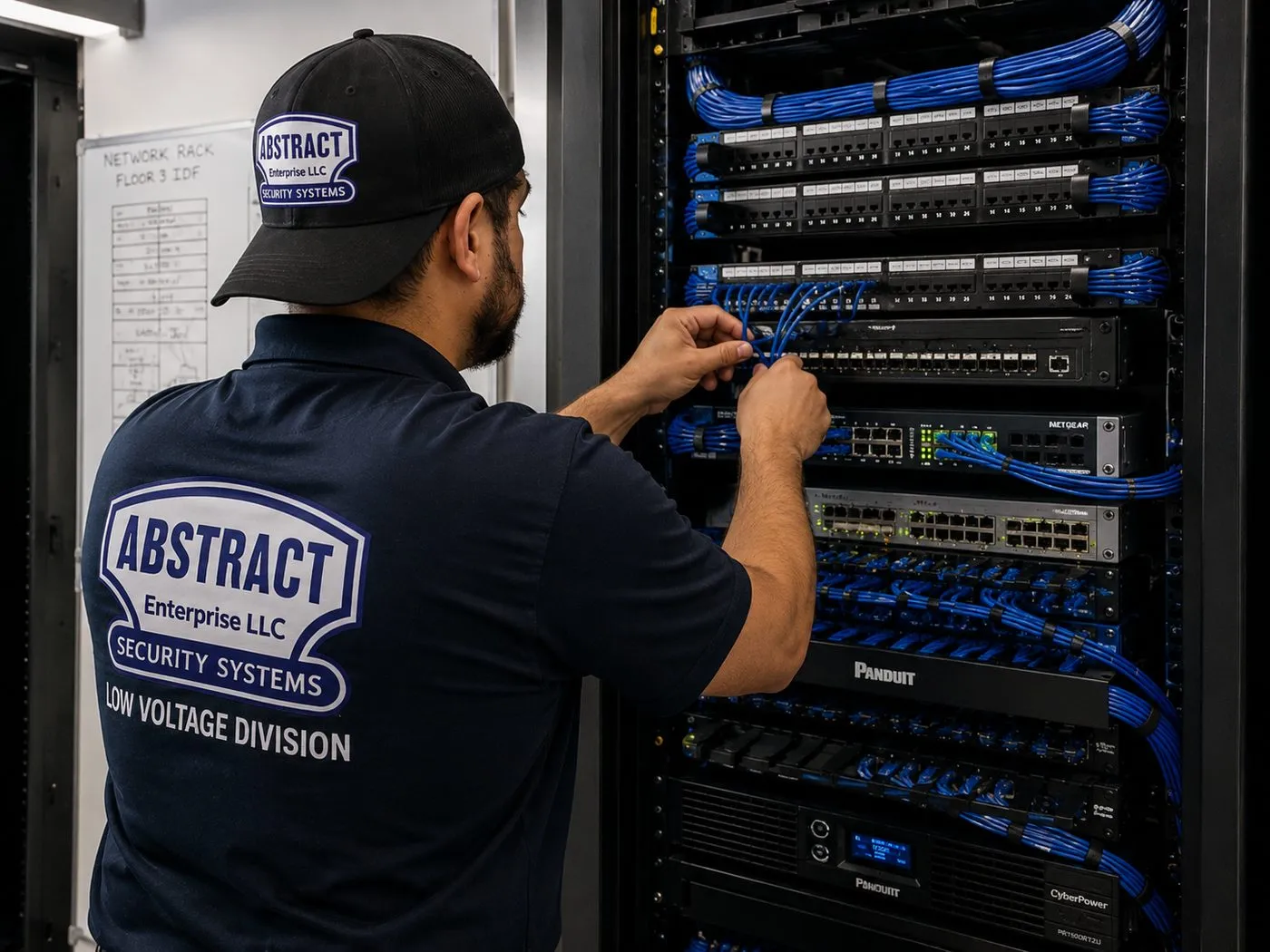
A technician patches short blue cables from a patch panel into a switch in a floor-standing rack, with more switches, cable managers and a battery-backup unit lower down and a whiteboard on the wall behind. In a large house, the Sonos Amps and the wired access points that keep every wing connected live in a rack like this.
AI Overview Reality Check
What AI Gets Wrong About Sonos Installation in Nassau County
We could not view Google’s AI Overview from our research environment, so we haven’t quoted it. The seven claims below are the ones we found published on marketplace pages, provider pages and general installation advice that answer engines draw on, each checked against what a Nassau house actually needs.
“Sonos setup is a $45-an-hour handyman job”
Marketplace pages set expectations low. TaskRabbit’s page for Hempstead says TV mounting there “starts at $45 per hour and will vary from Tasker to Tasker.” That figure is for hanging a television, not for planning wire routes through a slab house or setting up a multi-room system, and it is a starting rate rather than a price for a finished job.
A Sonos installation that works for years involves more than the screws: the right HDMI port and TV audio setting for eARC, a router that offers 2.4 GHz and isn’t on a guest network, Trueplay tuning, surround and Sub bonding, and a check that each zone holds together when grouped. Getting those wrong produces the “it worked on the day” calls that make up most of our repair visits.
Our Nassau prices are published per item instead of per hour: $125 for the Sonos system setup, $129 to wall-mount the bar, $350 for a full home-theatre hookup, and a setup-only visit at $225 for the first hour when something needs diagnosing. You know the total before we arrive.
“Hiding the wires in the wall costs about $139”
Thumbtack’s page for Massapequa Park lists “TV wall mount with wires hidden inside wall: $139” alongside a national average for TV mounting between $100 and $130. Figures like that get repeated as the going rate for concealing the cables behind a Sonos soundbar.
The number hides the question that matters: what is in the wall? Behind a TV in an expanded Cape there may be an old exterior wall with sheathing and insulation; behind one in a Tudor, plaster and lath; behind one on a chimney breast, masonry that can’t take a cable at all. And a power cord pushed inside a wall is not a code-compliant way to power a TV; a recessed power-and-cable kit is.
Our in-wall concealment is $169 and uses a code-compliant in-wall power and cable kit. Where the wall can’t take it, we tell you and offer a $59 paintable cord cover rather than forcing a route through brick.
“Faster internet will fix Sonos dropouts”
Provider marketing on Long Island leads with speed: Verizon’s Long Island page advertises Fios plans up to multi-gigabit speeds and compares them with Optimum’s. Upgrading the plan is the first thing many households try when the speakers cut out.
Sonos streams audio at a tiny fraction of those speeds. Dropouts almost always happen inside the house, between the router and the speaker: a gateway in a front closet trying to reach a Sub at the back of a ranch through plaster and brick, interference from cordless phones and baby monitors, or a mesh satellite placed where it can’t hear the main unit. Sonos’s own interference guidance lists plaster and concrete as high obstructions and metal as very high.
So we measure the Wi-Fi at each speaker, move or add access points, and wire one or more products where we can. A faster plan from the same gateway in the same closet usually changes nothing in the den.
“Just run the wire up from the basement”
Installation guides for in-ceiling and in-wall speakers commonly assume a basement or crawl space below the room, so the cable can be fished up through the floor plate. For a lot of the country, that is good advice.
In Nassau, thousands of houses were built without one. The 17,447 Levittown houses of 1947 to 1951 and the ranches and Capes built on the same model across central Nassau sit on slabs, and the Levitt ranches had radiant heating pipes in the concrete. Drill there and you can hit a heating line. The lower half of a split-level or a high ranch is usually on a slab too.
In those houses we route from above — attic, top plate, down the wall — or choose wireless products where the attic can’t reach. Deciding that before the speakers are bought is the difference between a clean job and an expensive patch.
“Any outdoor speaker can live by the water”
General outdoor-speaker advice treats weather as one thing: rain. Plenty of speakers sold as “outdoor” are built for a covered patio in a dry climate, and that advice gets repeated without a mention of salt.
Along the South Shore and in Long Beach, salt is the main enemy. Officials describing the Long Beach boardwalk buildings in 2021 talked about “sea air, blowing sand and corrosive salt water,” and an engineer said balcony steel there “looked like Swiss cheese.” Brackets, terminals and cheap grilles fail first. Sonos rates its outdoor pair by Sonance to Mil Spec 810 for humidity, salt spray, temperature and UV, with IP66 protection.
We specify salt-rated speakers for canal and bay houses, use stainless fasteners, seal the wire entry, and keep the Amp indoors. A Bluetooth speaker left on the deck rail all summer is a consumable; a properly specified outdoor pair is not.
“Put the electronics in the garage or under the house, out of sight”
Tidy-install advice often suggests hiding amplifiers and network gear in a garage, a basement corner or any space nobody uses. It looks clean in the photo.
On a raised South Shore house, the space nobody uses is the flood enclosure, and FEMA’s guidance is to keep electrical equipment above the required flood elevation. In a detached or unheated garage, a winter night can drop below the 32°F floor of the Amp’s operating range, and a July afternoon in a closed attached garage can pass its 104°F ceiling.
We put Amps, Ports and network gear on a living floor, in a ventilated cabinet or closet, on surge protection, with the clearance Sonos specifies. It is still out of sight, just not out of reach of the next flood or heat wave.
“Speaker work never involves licences or permits”
DIY content treats Sonos as a purely plug-in product and the wiring as nobody’s business. For the speakers and their low-voltage cable, that is largely true; we haven’t found a Nassau rule requiring a permit to run speaker wire.
The jobs around a Sonos installation are another matter. A new outlet behind a TV or power at the end of a deck is electrical work with a town or village permit. Nassau’s Department of Consumer Affairs licenses home improvement contractors, and its list includes carpentry, drywall and painting — the trades that patch speaker cut-outs and build out equipment closets.
We hold a New York State low-voltage licence, #12000287431, do the low-voltage work ourselves, and leave electrical, patching and painting to the trades licensed for them, coordinating so the outlet is in before we arrive.
Tell Us the House. We'll Tell You the Route.
Ranch on a slab, Tudor with plaster, raised canal house or concrete condo — send the type, the rooms and the products, and we’ll say how the wire gets there and what each step costs.
Ranch, Tudor, raised house or condo — say which, list the rooms and what’s already in boxes, and a Nassau technician replies the same business day. Rather talk it through? Ring (516) 346-5778.
✅
Request Received
A Nassau technician will call you back the same business day. If it can’t wait, call (516) 346-5778.
How It Works
Our Installation Process
Six steps, whether the job is a Beam and Sub in a Wantagh ranch or a dozen zones across a North Shore house and its terrace. One-room jobs usually finish in a single visit; wired systems are scheduled in stages agreed in writing.
1. Describe the house
Call (516) 346-5778 or send the form with the house type, the rooms, the Sonos products and where the router sits. Photos of the TV wall, the gateway and the attic or basement access help. We reply with the fixed-price lines and anything that needs a walkthrough.
2. Find the route
For wired zones a technician walks the house: attic, knee walls, basement or slab, the equipment spot on a living floor and Wi-Fi strength at each speaker position. You get a written zone-by-zone quote.
3. Book two-hour windows
Choose slots between 8 AM and 8 PM, any day of the week. Wired systems are split into agreed stages, such as wiring before the electrician or painter and fitting afterwards.
4. Wire, mount and protect
Cable runs along the planned route, ceiling and outdoor speakers are fitted, the bar is levelled to the TV and the Amps, router and switch go on a ventilated, surge-protected shelf above any flood line.
5. Network, setup and tuning
Every product joins your Sonos system on the main network, rooms are named, Sub and surrounds bonded, eARC confirmed, Trueplay run where supported and outdoor volume limits set.
6. Test and hand over
Each zone and group is tested with your TV, services and phones. We show the household the app, label the equipment shelf, leave a map of what feeds which room and take the boxes if you want them gone.
A technician types on a laptop resting on a pull-out rack shelf, with patched switches above and a gateway and more switches below; a wall-mounted access point and conduit are visible on the concrete wall behind. Settings on this gear — the same network for every product, 2.4 GHz available, no guest network — are what keep a Sonos system steady.
Coverage Area
Sonos Installation Near Nassau County's Landmarks
Six places people in Nassau use to give directions — several of them, fittingly, built around sound — and the neighbourhoods around each where we set up Sonos.
Jones Beach Theater, Wantagh
The open-air amphitheatre at Jones Beach, opened on June 26, 1952 and expanded in 1998 to its present capacity of about 15,000. Summer concerts on the barrier beach south of Wantagh, Seaford, Merrick and Bellmore, where canal-side decks get their own outdoor zones.
Tilles Center, Brookville
The concert hall at LIU Post, which opened seating about 2,250 with no audience member more than 125 feet from the stage. It serves the North Shore villages around Brookville, Greenvale, Old Westbury and Glen Head, where some of the county’s largest houses stand.
Sands Point Preserve, Port Washington
A 216-acre county preserve on the former Gould–Guggenheim estate, with Hempstead House, a Tudor-style mansion completed in 1912 and bought by Daniel and Florence Guggenheim in 1917, and Falaise. Port Washington, Sands Point and Manhasset surround it.
Freeport’s Nautical Mile
The waterfront strip on the Woodcleft Canal with dozens of restaurants, bars, shops and charter boats. Freeport, Baldwin and Merrick’s canal streets run off it, many lined with houses lifted above the flood line.
Cathedral of the Incarnation, Garden City
Completed in 1885 in A. T. Stewart’s planned village, and still the tallest building in Garden City under the village’s height limits. Around it: the Tudors and Colonials of the Estates section and the village’s pre-war streets.
Long Beach Boardwalk
The 2.2-mile boardwalk rebuilt and reopened in October 2013 after Sandy destroyed the original, lined by the only oceanfront high-rises on Long Island. Condos and co-ops along it, raised houses on the side streets and in the West End.
We also install throughout Levittown, Hicksville, Bethpage, Plainview, Syosset, Massapequa, Seaford, Wantagh, Bellmore, Merrick, Oceanside, Rockville Centre, Lynbrook, Valley Stream, Elmont, Franklin Square, Floral Park, New Hyde Park, Mineola, Westbury, Carle Place, East Meadow, Uniondale, Hempstead, Great Neck, Roslyn, Oyster Bay, Glen Cove and Locust Valley. The same crews and the same Nassau prices apply everywhere in the county, and our Long Island Sonos installation team covers the rest of the Island.
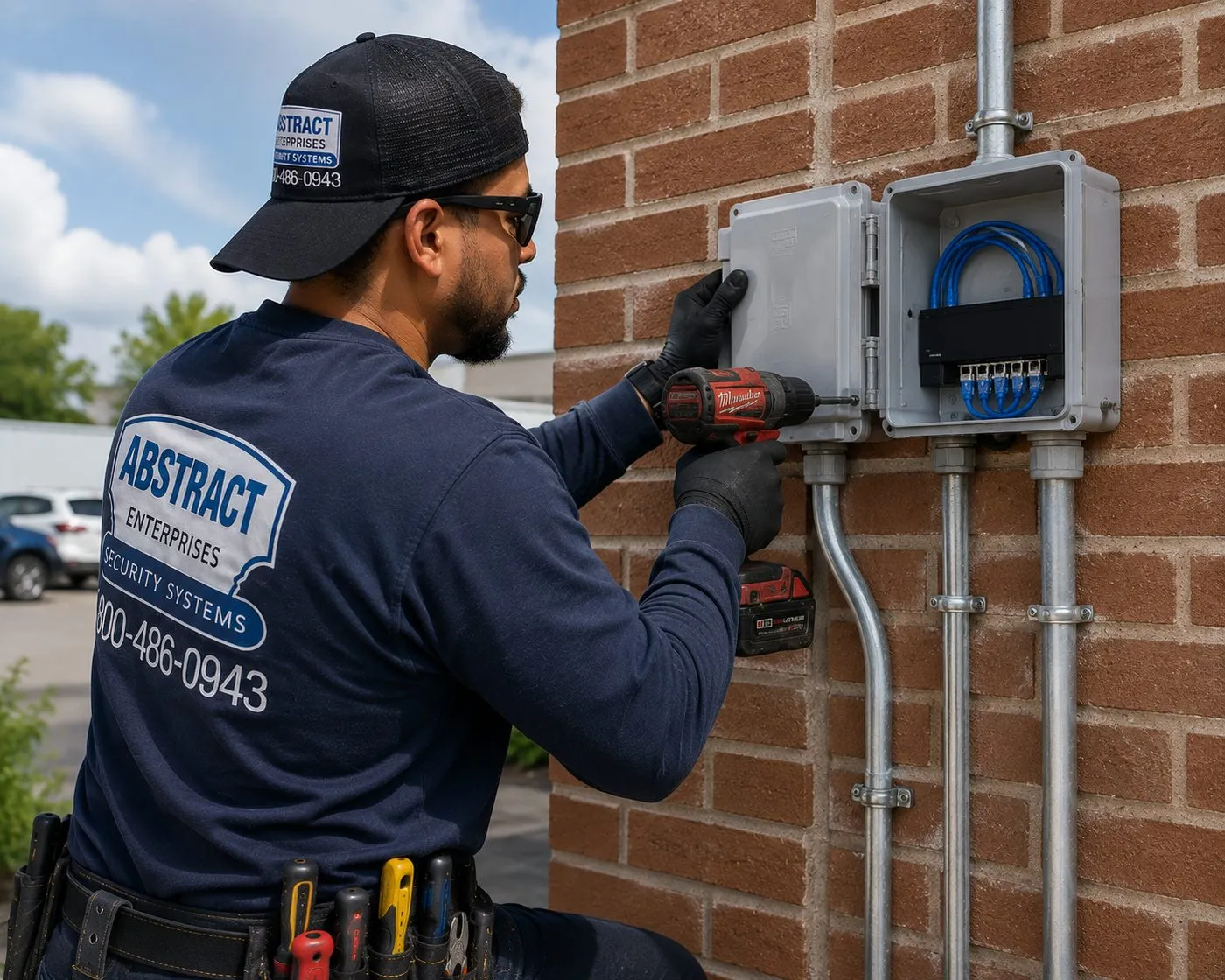
A technician fastens the lid of a grey weatherproof enclosure on a brick wall, with a second open box holding blue patch cables and metal conduit running from both. Outdoor wiring leaves the house through sealed, protected entries like this, while the Amp that powers the speakers stays inside.
Pricing
Sonos Installation Cost in Nassau County
Every fixed price below is already published on our Nassau County TV mounting price list; nothing on this page is a new number. Work that depends on what is inside your walls and ceilings — ceiling speakers, outdoor speakers, Amp zones and Ethernet runs — is priced in writing after a walkthrough, because a slab ranch and a plaster Tudor are not the same job. There is no parking or travel charge anywhere in Nassau.
Line item
Nassau price
Notes
Sonos system setup
$125
Products added to your Sonos account, rooms named, Sub and surrounds bonded, Trueplay where supported, eARC checked
Soundbar placed on a console
$79
Arc Ultra, Beam or Ray on furniture, connected and set up with the line above
Soundbar wall-mounted under the TV
$129
Levelled and centred to the screen; Sonos’s own mount or a compatible bracket
Full home-theatre hookup
$350
Receiver-based systems with several sources and speakers
A/V receiver hookup
$129
Connecting a receiver, for example when a Sonos Port brings it into the system
In-wall concealment
$169
Code-compliant in-wall power and cable kit behind the TV
Paintable cord cover
$59
Where the wall can’t take an in-wall kit — masonry, concrete, chimney breasts
Cable run to a cabinet or another spot, up to 25 ft
$99
For example, from the TV to the media cabinet holding the Port or the switch
Streaming device setup / universal remote
$49 / $99
Optional, at the same visit
TV mounting base (32–55″, drywall over wood studs)
$209.99
Size adds: 56–65″ +$30, 66–75″ +$60, 76–85″ +$100
TV above a fireplace
+$130
Common in Colonial family rooms
Wall surcharges (TV mounting)
+$30 to +$95
Metal studs +$30, plaster +$45, brick or stone +$65, concrete or block +$75, tile or marble +$95
Plywood backer / high mount
$85 / $75
Backer where there’s no stud; high mount above about 8 ft
Setup-only visit (fixes, no hardware)
$225 first hour
Then 30-minute blocks; for dropouts, router swaps and systems someone else set up
Ceiling, in-wall and outdoor speakers; Amp zones; Ethernet runs
Written quote
After a walkthrough of attic, basement or crawl spaces and the network
Box removal / certificate of insurance
$25 / free
COI for boards, HOAs and landlords at no charge
Two policies to know: if we can’t start because products, access or approvals are missing, a $150 return-trip fee applies; rescheduling is free with 24 hours’ notice. Patching and painting after cut-outs, and any new outlets, are not included — those belong to a licensed painter or electrician. Prices for these lines are the same in every part of the county; the setup-only rate is the Nassau rate, which differs from the city boroughs.
What common Nassau Sonos jobs add up to
Levittown ranch, Beam and Sub on the TV console. Soundbar placed $79 + Sonos setup $125 = $204. The Sub is wireless, so no floor wiring is needed; it just needs an outlet near where it sits.
Garden City Colonial, 65-inch TV over the fireplace on plaster, Arc Ultra under it. TV base $209.99 + 56–65″ $30 + above fireplace $130 + plaster $45 = $414.99; bar wall-mounted $129 + Sonos setup $125 = $254; total $668.99. A $59 cord cover on the chimney breast brings it to $727.99 if an in-wall route isn’t possible.
Long Beach condo, 55-inch TV on a concrete wall, bar and Sub. TV base $209.99 + concrete $75 = $284.99; bar wall-mounted $129; Sonos setup $125; cord cover $59; total $597.99. Balcony music with a Move 2 or Roam 2 is covered by the setup line.
Pre-war den, good old receiver, joining the Sonos system with a Port. A/V receiver hookup $129 + Sonos setup $125 = $254, plus $99 if the Port needs a cable run of up to 25 feet to the receiver’s cabinet.
Shop Our Systems
Sonos Installation Packages & Pricing
Three common starting points, each the sum of published Nassau line items. Labour only; you buy the Sonos products from any retailer, or we quote them separately if you’d rather we supply them.
Slab-House Starter — $204
Beam, Ray or Arc Ultra placed on your console ($79), plus the Sonos system setup ($125): bar connected over eARC, Sub and up to a pair of Era speakers added and bonded, Trueplay where your phone supports it, every family phone set up in the app.
Wall-Mounted Theatre — $353
Soundbar wall-mounted under your existing TV ($129), Sonos system setup ($125) and one cable run of up to 25 feet ($99) to the media cabinet or the spot where the Sub, Port or switch lives. The usual choice for split-level dens and ranch living rooms.
Screen-and-Sound Install — $731.99
A 32–55-inch TV mounted on drywall over studs ($209.99), soundbar mounted under it ($129), Sonos setup ($125), in-wall power and cable concealment ($169) and a programmed universal remote ($99). Size, fireplace and wall add-ons from the table above apply.
Bring your own equipment
Every price on this page is labour only. Most Nassau households buy their Sonos products, mounts and cable from a retailer they like and we install them; tell us the exact models before the visit so we can confirm the Amp matches the speakers, the surrounds are a matching pair and the mount suits the wall. Products you supply are covered by the retailer or Sonos under their own warranty. Full terms — including 50% deposit, one-year parts-only warranty on AESS-supplied products, and the late-fee schedule — are set out in the service agreement.
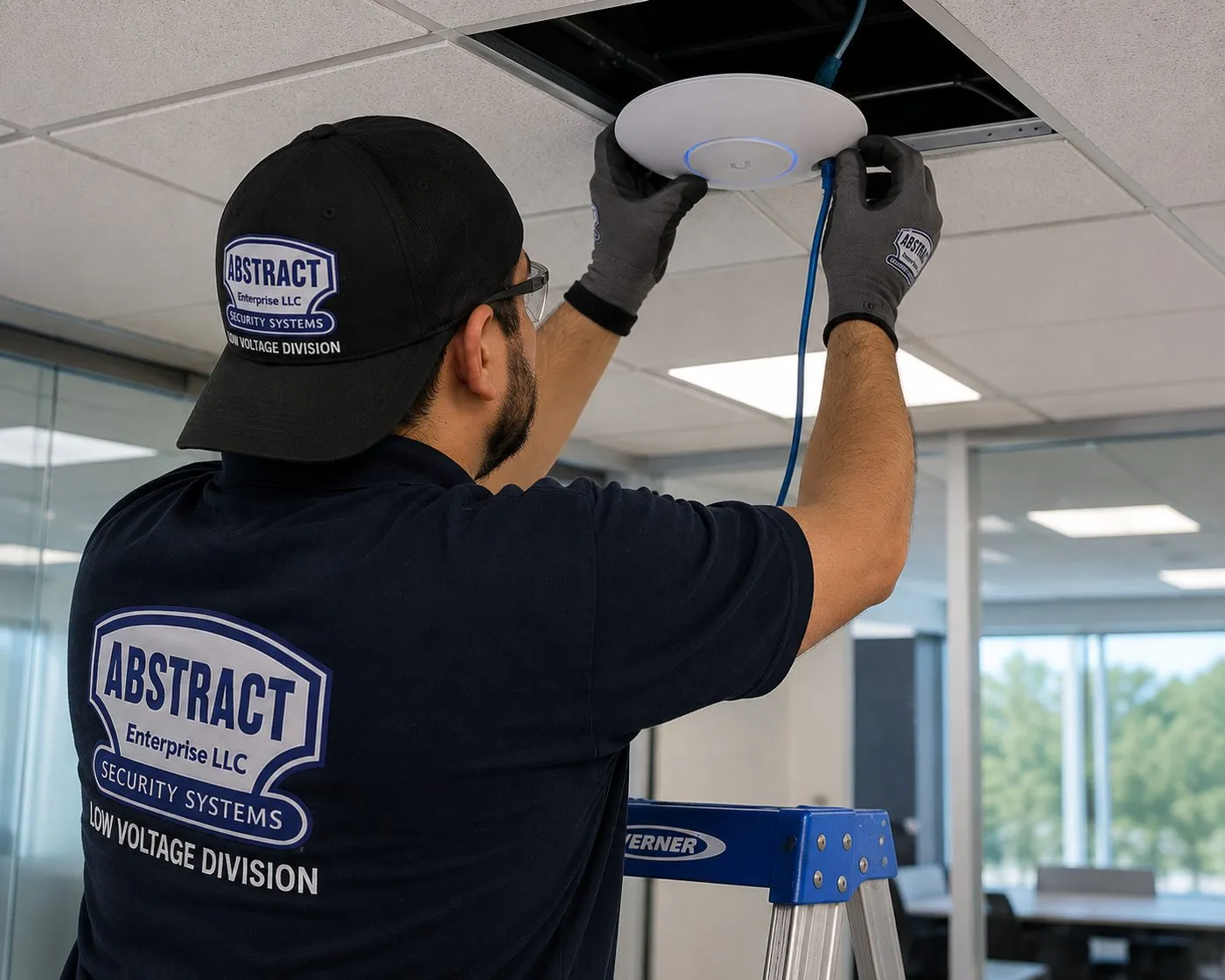
From a ladder, a technician presses a round white access point onto a ceiling tile, its blue network cable dropping from the opening above. A wired access point at the far end of a long ranch or an estate wing gives Sonos speakers there the strong signal a single router can’t.
A Photo of the Attic Hatch Helps More Than You'd Think
Send the form with a picture of the TV wall, the router and the attic or basement access, and we can often price the job without a walkthrough.
A raised house is two buildings stacked on top of each other: a living house that should stay dry and an enclosure below that is allowed to flood. FEMA’s Sandy recovery guidance puts it bluntly — every part of a building below the base flood elevation is susceptible to flooding during the base flood. A Sonos system can be designed for that in an afternoon; it is much harder to move afterwards. This is the list we work through on canal and bay houses from Inwood to Massapequa.
Find the living floor’s equipment spot first. A closet, a media cabinet or the space under an interior stair on the first living level, with an outlet on its own and room for the Amps’ three inches of clearance. The router and switch go here too, so the whole system shares one dry, ventilated home.
Bring the internet line up. Many raised houses still have the provider’s line arriving low, where the old house used to be. Moving the provider’s connection point is the provider’s job, but we plan the network so the gateway or our router sits on the living floor, not next to the meter at grade.
Keep the enclosure clear. No Amps, no switches, no power strips, no Port and no Sub in the parking and storage space below. If a cable has to pass through the enclosure on the way to a dock or a lower deck, it runs high, protected and continuous, with nothing powered down there.
Take deck wire out through the living level. Outdoor speaker wire leaves the house through one small, sealed penetration in the wall of the living floor, runs along the framing or under the deck boards in protected cable, and comes up at the speakers. Flood openings are left alone.
Specify for salt. Sonos’s outdoor pair by Sonance is rated for salt spray and IP66. Brackets and fasteners should be stainless, the wire jacket rated for outdoor use, and the connections sealed. Cheap outdoor speakers near the bay corrode from the terminals inward.
Write it down. We label the shelf and leave a one-page map of what is plugged in where. If a storm warning ever means unplugging and moving things, anyone in the house can do it in five minutes.
Outdoor Music and the Neighbours
Designing a Backyard Sonos Zone for a Nassau Lot
The best outdoor Sonos zone in Nassau is the one the neighbours never notice. Much of the county is built on lots where the deck, the pool and the house next door are all within a few dozen feet of each other, and every town and village has a noise chapter that can be enforced. Designing for that is not about turning the music down; it is about putting sound where people sit and nowhere else.
Spread it out, keep it low
Two large speakers on the back wall have to be loud to reach the far end of a pool, and the sound carries over the fence on the way. Four or six smaller speakers spread along the patio, each playing quietly, cover the same space evenly at a fraction of the level. With passive outdoor speakers on a Sonos Amp, Sonos says one Amp can drive up to three pairs of its Architectural speakers in parallel, so more speakers doesn’t necessarily mean more equipment.
Aim toward the house
Speakers mounted on the house wall and pointed out into the yard throw sound straight at the neighbours’ windows. Speakers mounted on posts, pergolas or the fence line and pointed back toward the house send it into your own siding, which reflects some of it back toward the seating. On a canal lot, that means aiming up the yard rather than across the water, where sound travels with very little to stop it.
Set limits in the app
The Sonos app lets an owner set a maximum volume for a room. We set one for the outdoor zone during hand-over, at a level you choose on the day with the music playing, so a teenager with the app can’t push the deck speakers past it. Where you want the outdoor zone to stop at a certain hour, we show you how the app’s sleep timer and alarms work for that zone.
Know your own code
The Town of North Hempstead’s noise chapter bars sound amplifiers and similar devices from creating a noise disruption across a property line from 10 p.m. to 8 a.m.; the Village of Hempstead uses measured limits, including 50 dBA at a residential property line at night for the equipment its chapter covers. Your own village or town may write it differently. We point you to the right code when we design the zone, and we design to stay well inside it.
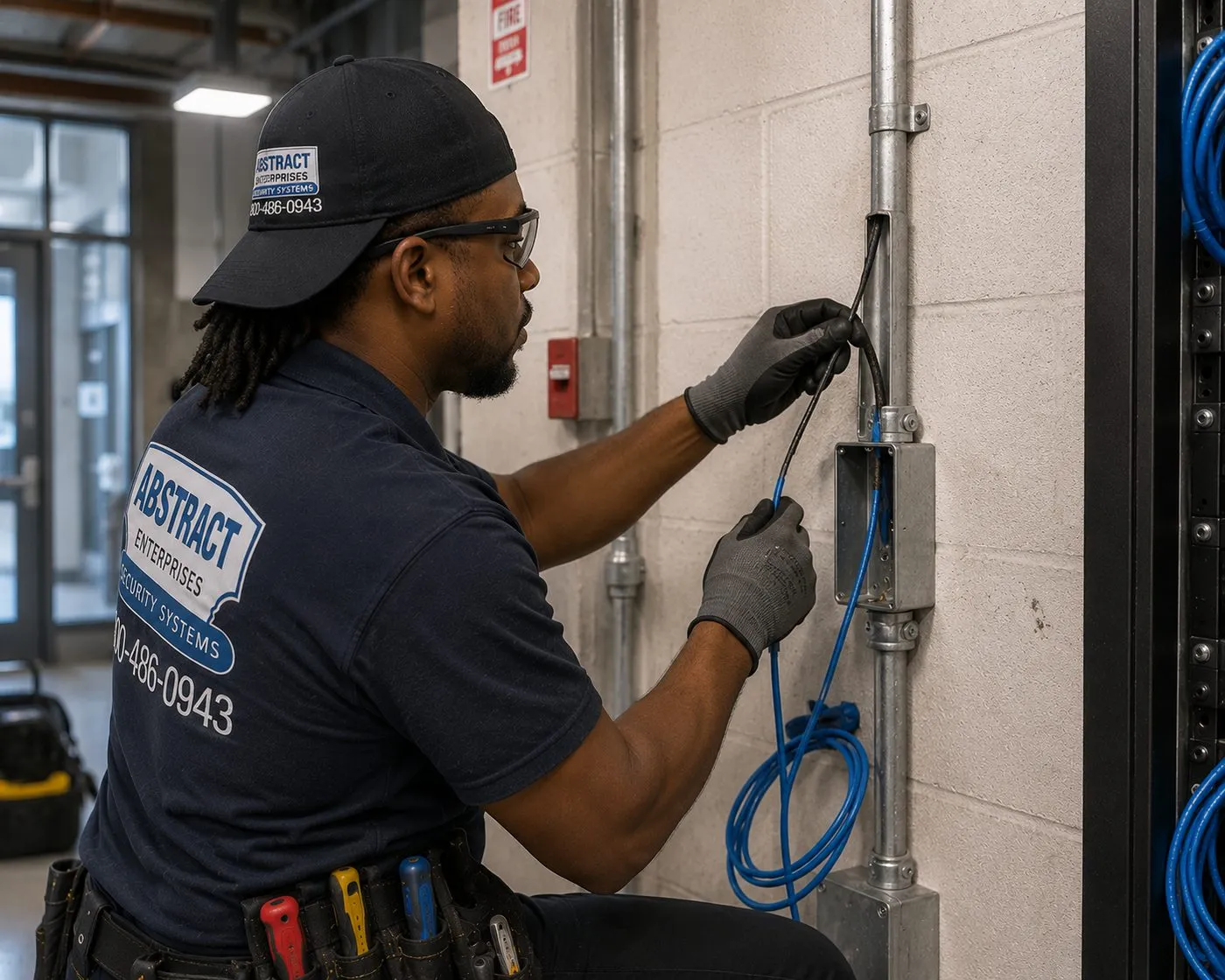
A technician pulls blue cable out of a metal conduit into a junction box mounted on a painted block wall, with a coil of cable hanging below and a rack edge on the right. Where speaker wire or Ethernet crosses a garage or a utility space on the way outside, it runs in a protected path like this.
North Shore Houses
Planning Sonos for an Estate or a Very Large House
In a Gold Coast house the speakers are rarely the hard part; the distances are. The surviving estates in the villages around Brookville, Old Westbury, Lattingtown and Sands Point, and the large houses built on the land around them, put rooms hundreds of feet from the equipment, with stone, plaster and steel in between. A Sonos system for a house like that is a small network project with speakers attached.
Start with a wired backbone. Each wing, the pool house and any detached garage or guest cottage gets Ethernet from the main equipment room, ideally in a pathway that can take another cable later. That cable feeds a wired access point or mesh node for Wi-Fi, a small switch for that area’s Amps and Sub, and, where the main soundbar is in that wing, one wired Sonos product. Sonos’s recommended settings for wired networks are clear: wire products back to a router or switch only, not into the spare port on a wireless mesh satellite unless that satellite is itself wired back, and don’t use Ethernet-over-power.
Count products before choosing them. A large house reaches Sonos’s 32-product limit faster than people expect once every room has a soundbar or a pair of self-powered speakers, plus subs and surrounds. Passive ceiling and in-wall speakers on shared Amps keep the count down: one Amp, up to three pairs of Architectural speakers, one product on the list. Era 100 Pro speakers powered over PoE+ are another way to cover offices and hallways from a network switch.
Condos, Co-ops and New Rentals
Sonos Without Holes in Long Beach Condos and Station-Area Rentals
Nassau has two very different kinds of apartment, and both need a Sonos plan that cuts nothing. The older one is the concrete-and-steel condo or co-op — the Long Beach boardwalk buildings, the co-ops of Great Neck Plaza and the garden-apartment complexes around the county. The newer one is the rental building going up beside an LIRR station in villages like Westbury and Mineola, with amenity floors, roof terraces and lease terms that require the unit to be handed back as it was found.
In the concrete buildings, ceiling speakers are almost never an option, and cutting a channel for cable in a structural slab is not something any board will allow. The system is built from a soundbar and Sub, Era speakers on stands or furniture, and portable speakers for the balcony. Mounting the TV and bar on a concrete wall takes masonry anchors and a published $75 surcharge; cable runs along the wall in a paintable cord cover. Concrete walls also block Wi-Fi heavily — Sonos’s interference article rates concrete a high obstruction — so in a larger unit we may add a mesh node to reach the bedrooms.
In the new rentals, the walls are drywall and the constraint is the lease. We mount only where screws are allowed, often just the TV and soundbar, and keep everything else freestanding. The most important step is the network: Sonos doesn’t support guest networks or sign-in portals, so a building-wide resident Wi-Fi with a login page will not run it reliably. The answer is a router of your own on the unit’s own internet connection, where the building provides one. If the building only offers managed Wi-Fi, we ask management what is possible before we install anything.
Complete Services
Every Sonos Installation Service in Nassau County
A Sonos job in Nassau tends to pull in the TV, the network and sometimes the alarm. These are the Nassau County pages for those pieces.
Our licensed low-voltage work across the county, from speaker wire to access control.
Field Notes
Field Notes on Nassau Sonos Walkthroughs
How our technicians read a Nassau house before suggesting a single speaker (general practice, not one customer’s job)
The first stop is outside, not in. From the driveway you can usually tell whether the house is a slab ranch, an expanded Cape, a split-level or a pre-war house with a basement, and whether it has been raised. Those four or five shapes decide most of the plan before we ring the bell.
Inside, we go to the router and then straight up or down: the attic hatch in a ranch, the knee-wall door in a dormered Cape, the basement stairs in a Tudor. In a raised house we check where the gateway and the panel ended up after the rebuild. We are looking for the route, and for anything that blocks it — ducts, old wiring, a heating line, a finished ceiling with no way in.
Only then do we stand in the rooms with the family and talk about where they want music. By that point we already know which rooms can take ceiling speakers on an Amp and which are better served by a speaker on a shelf, and we can say so plainly, with prices, instead of discovering it halfway through the job.
FAQ
Nassau County Sonos Installation FAQ
Why does Sonos installation cost more on the Nassau side of the city line than in Queens?
+
Most of it doesn't. The Sonos system setup is $125, a wall-mounted soundbar $129 and a full home-theatre hookup $350 on both sides of the line. What differs is the area rate: a setup-only visit to fix or diagnose a system is $225 for the first hour in Nassau against $195 in Queens, and the TV mounting base is $209.99 in Nassau against $179.99 in Queens. If you live in Floral Park, Elmont or Valley Stream, the Nassau prices apply.
Our house is about to be lifted — at what stage of the project should the Sonos wiring go in?
+
While the walls are open on the living floors and before insulation and drywall go back, which is usually after the house has been set on its new foundation and framing repairs are done. At that stage speaker wire, Ethernet and a home run to the equipment closet cost a fraction of what they cost later. Tell your contractor early so the low-voltage visit is on the schedule; the speakers and setup can follow once the family has moved back in.
Which parts of a Sonos job can you price over the phone, and which need a walkthrough?
+
Anything on the published list can be priced from photos: soundbar placed or wall-mounted, Sonos setup, TV mounting with its add-ons, in-wall concealment, cord covers, cable runs up to 25 feet and setup-only visits. Ceiling, in-wall and outdoor speakers, Amp zones and new Ethernet runs depend on attic, basement and wall access, so they are quoted in writing after a technician has looked.
Will ceiling speaker cut-outs in a ranch ceiling let heat escape into the attic?
+
Each cut-out is an opening in the ceiling below an insulated attic, so it is handled with care. The speaker frame fills the hole, we seal around it where the speaker's instructions allow, and we put the attic insulation back over and around the work following those instructions rather than leaving a bare patch. In a slab ranch fed from the attic, that is part of every ceiling-speaker job.
How far ahead should we book Sonos for a summer party or a graduation?
+
For a soundbar or speakers that need no wiring, a few days is usually enough, and same-day is possible when a window is open. Outdoor or ceiling speakers need a walkthrough, a written quote and sometimes an electrician first, so get in touch as soon as the date is set and tell us the date on the first call; we work back from it.
Will a Sonos soundbar work with the Optimum or Fios TV box we already have?
+
Yes. The cable box connects to the TV by HDMI as it does now, and the Sonos soundbar takes the sound from the TV through the TV's HDMI eARC or ARC port, or optically for Ray. We set the TV's audio output so everything from the box, the streaming apps and a games console comes through the bar, and we check that the TV remote or the box's remote controls the volume.
What happens if a ceiling speaker location turns out to sit on a joist or a duct?
+
We check before cutting. Sonos's in-ceiling instructions call for an obstruction survey with a stud finder, and a small pilot hole probed with stiff wire where there is doubt. If something is in the way, we move the speaker a few inches along the joist bay or to the next bay and agree the new spot with you before cutting. Nothing is cut until the location is clear.
What does your written quote for a wired Sonos zone actually list?
+
Each zone separately: which rooms it covers, the speakers and Amp it uses, the route the wire takes through the attic, basement or walls, any Ethernet runs, where the equipment will sit and what is not included, such as patching, painting or new outlets. Published lines such as the $125 Sonos setup appear at their listed prices, so you can start with some zones and add the rest later.
Can the Sonos Sub be hidden inside a cabinet or behind the sofa?
+
Behind or under the sofa, yes; inside a closed cabinet, we advise against it. Sonos's placement guide allows the Sub in a corner, against a wall or behind, under or next to furniture, but asks that the front opening stays clear and that there is at least an inch of clearance above it under furniture. A closed cabinet muffles the bass and rattles. Lying the Sub flat under a sofa is the usual way to hide it.
The TV sound from our Sonos is out of step with people's lips — can that be fixed?
+
Usually, yes. Lip-sync drift is most often a TV setting or the way the sources are connected rather than a fault in the soundbar. We check the TV's audio output format and eARC settings, how the cable box or streaming device is connected and whether the TV has its own lip-sync adjustment, then test with dialogue on screen. On an existing system that is a setup-only visit, $225 for the first hour in Nassau.
All Areas Served
Sonos Installation Across Long Island and New York
This Nassau County page reports to our Long Island Sonos installation hub. Sister pages for other counties and boroughs go live in turn; where one isn’t published yet, the link takes you to the quote form, and the same crews already take those jobs.
Speakers missing after the power came back, a deck zone that won’t group, or a soundbar with no TV sound since the new gateway arrived? Call (516) 346-5778. Same-day when a two-hour window is open; most network, pairing and eARC faults are fixed in one to two hours once we’re in the house, on a $225 first-hour setup-only visit.
Sonos Installation Nassau County — Licensed, Insured, Routed for Your House
Abstract Enterprises Security Systems · 1282 Troy Ave, Brooklyn, NY 11203 · Nassau line (516) 346-5778 · WhatsApp (718) 679-0359 via wa.me
NYS Low-Voltage Licence #12000287431 · 100% Licensed & Insured · Same-Day Estimates · Rated 4.7★ from 201 Google Reviews
Full terms — including 50% deposit, one-year parts-only warranty on AESS-supplied products, and the late-fee schedule — are set out in the service agreement. See our warranty page and installation policies.
Reviewed and updated October 17, 2026. Changelog: first published — Sonos wire routes by Nassau house type, raised-house and flood-zone equipment placement, outdoor zones under town and village noise codes, estate and condo planning, published Nassau prices.