NYS Licensed Low-Voltage Contractor · Mahopac to Cold Spring · Direct Hudson Valley Line
Sonos Installation in Putnam County
Lake Houses · Deck & Dock Zones · Long Speaker Runs · Garage & Boathouse Links · Storm-Ready Networks
In Putnam the music rarely stops at the back door. It has to reach a deck that steps down toward Lake Mahopac, a dock at the bottom of a sloping lawn on Lake Oscawana, a detached garage at the far end of a gravel drive, or a winterized Lake Carmel bungalow that was built for July and now gets used in January. We plan Sonos for the whole property: how far each speaker sits from its Amp, how the network crosses the yard, what happens when a summer storm takes the power down on a ridge road, and how a lake-house system is put to sleep for the winter and woken up in May. Booked in 2-hour windows from 8 AM to 8 PM, seven days a week.
Reviewed and updated October 17, 2026 · Written by Anwar Timothy, NYS licence #12000287431
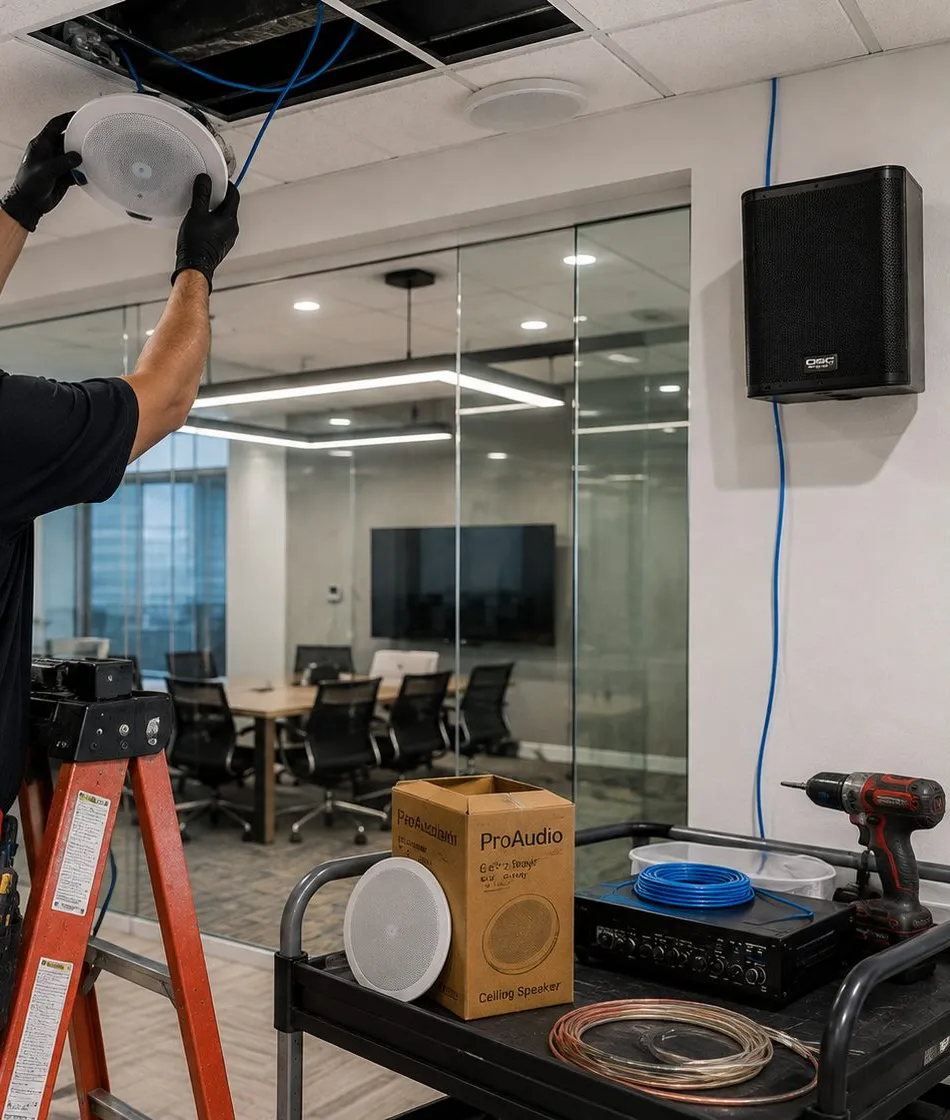
A technician's gloved hands push a round white speaker up into a gap in the ceiling grid, blue cable trailing from above. On the cart below sit a second speaker, its cardboard box, a black amplifier, a coil of blue network cable and a loop of bare speaker wire, with a wall-hung loudspeaker and a glass meeting room behind.
Free Putnam County Sonos Quote
Tell us the town, the rooms, and how far the deck, dock or garage sits from the house — a written price follows the same business day
✅
Request Sent!
A Putnam County technician calls back the same business day.
25+
Years Experience
✓
Same-Day Estimates
100%
Licensed & Insured
4.7★
201 Google Reviews
Got a lake house in Putnam County that should have music on the deck by Memorial Day? Ring our Hudson Valley line, (845) 640-3835, or send the 60-second form. Give us the town, the rooms and the rough distance from the house to the water, and a licensed installer replies with a written figure built from the price lines published further down this page.
$125 covers the Sonos setup line in Putnam; the drive up from the city is not billed, and neither is parking
Every outdoor speaker run measured against Sonos's own wire-gauge table before a single foot of cable is bought
Our state low-voltage licence number, 12000287431, goes on every quote; crews come out on weekends too
A Putnam Sonos job is measured in feet of lawn as much as square feet of living room. In Manhattan the hard part is the ceiling. In Putnam it is usually the distance: from the router in the basement to the deck, from the deck down the slope to the dock, from the house across the driveway to a garage that has become a gym or a studio. The county's own hazard mitigation plan describes nine municipalities spread over more than 240 square miles, and notes that Philipstown, Putnam Valley and the western part of Kent have the most rugged terrain, with many peaks above 1,000 feet. Houses on that ground sit back from the road, down long drives, on lots where the best part of the property is a long way from the electronics.
Then there are the lakes. Lake Mahopac, which the hamlet of Mahopac encircles, covers 587 acres and has three privately owned islands. It was a summer resort reached by rail from New York City in the nineteenth century, and became a year-round community after the last Putnam Division passenger train to Mahopac ran in 1959. Lake Oscawana, which the Town of Putnam Valley calls the largest of its lakes and ponds, is about 364 acres, roughly two miles long and half a mile wide, according to its lake association, with about seven miles of shoreline. And from 1928 the Smadbeck brothers, working with McGolrick Realty, laid out three planned summer communities around man-made lakes: Lake Carmel in Kent, Lake Peekskill in Putnam Valley and Putnam Lake in Patterson. The Patterson historical society's account of Putnam Lake records 20-by-100-foot lots sold for $50, with room for little more than a bungalow and an outhouse, and a community that was largely empty after Labor Day.
Those two kinds of lake house make two very different Sonos jobs. A lakefront house on Mahopac or Oscawana usually wants a soundbar in a living room with a wall of windows, a pair of speakers on the deck and, more and more often, music on the dock itself, a hundred feet or more from the nearest Amp. A winterized bungalow on a narrow Putnam Lake or Lake Carmel lot wants the opposite: small rooms, low ceilings, rooms added one at a time over decades, and speakers that fit a house never built to hide wire. A poster on a weekend-house thread in r/upstate_new_york described Lake Peekskill as having been “mostly converted summer bungalows on very small lots”, and that matches what we expect to find when we walk in.
Weather is the third part of the plan. Putnam's lines run through woods and along ridge roads, and storms take them down. On April 14, 2020, the day after a wind storm, NYSEG reported 3,800 customers still without power in its Brewster division, 2,700 of them in Putnam County. On Christmas Day that year, NYSEG said winds gusting to 71 mph had cut power to 27,375 customers across the same division, which covers Dutchess, Putnam and Westchester. On the Hudson side, The Journal News reported more than 700 Central Hudson customers in Cold Spring and Garrison without power on August 3, 2026, with Route 9D closed by flooding in Garrison. A Sonos system that lives at the end of those lines has to be built to ride through outages, not just to sound good on a calm evening.
Finally there are the people who own the houses. The Census Bureau counts 38,713 housing units in Putnam and puts the owner-occupied rate at 83.8 percent, so the person who calls us is almost always the person who decides where a cable may go. The American Community Survey counts 1,757 homes in the county as held for seasonal, recreational or occasional use, which is the census's term for second homes. And while 94.8 percent of Putnam households have a broadband subscription, New York's ConnectALL program announced in September 2025 an award of about $11.5 million to Comcast to bring fiber to 390 Putnam County locations that still lacked it. The internet is usually there; whether it is fast, and whether it reaches the far end of the property, is the question we answer on every visit.
Cold Spring and Garrison, on the Hudson, are the contrast. The Cold Spring Historic District is described as one of the best-preserved nineteenth-century townscapes in the Hudson River region, with most of its houses built before the Civil War, when the nearby West Point Foundry was at its height. Village houses there sit close together on small lots, the Village's Historic District Review Board reviews exterior changes that can be seen from the street, and a Sonos plan is much more about thick old walls and quiet neighbours than about a dock two hundred feet away.
Putnam County numbers that shape a Sonos plan
587 acres: the area of Lake Mahopac, per Wikipedia's article on the hamlet that surrounds it — the largest share of our deck and dock enquiries come from its shoreline and from the other big lakes.
1928: the year the Smadbeck developments at Lake Carmel, Lake Peekskill and Putnam Lake began, according to the Patterson historical society, on lots as small as 20 by 100 feet. Many of those cottages are now full-time homes with very little room for equipment.
2,700 Putnam customers still without power on April 14, 2020, the day after a wind storm, in NYSEG's own update — and 27,375 customers hit across the Brewster division on December 25, 2020. Outages are part of the design brief here.
1,757 seasonal homes: the American Community Survey's 2019–2023 count of Putnam housing units held for seasonal, recreational or occasional use, out of 38,369 — lake and weekend houses that sit empty for weeks at a time.
390 locations in Putnam County named in a September 17, 2025 ConnectALL award for new fiber, a reminder that the end of some drives still waits for proper broadband.
83.8 percent owner-occupied: the Census Bureau's 2020–2024 rate for Putnam, which means one decision-maker for the house, the deck, the dock and the garage.
Read together, those figures sketch the usual Putnam call: one owner, a property larger than its Wi-Fi, water or a long lawn below the house, and overhead lines that storms knock down.
Many Putnam owners adding music to a lake house also rethink the doors at the same time. Our Putnam County smart lock installers fit keypad locks on the lake-side slider and the cottage door, and AESS's home automation work in Putnam County ties lights, shades and heat into the same routines as the music.
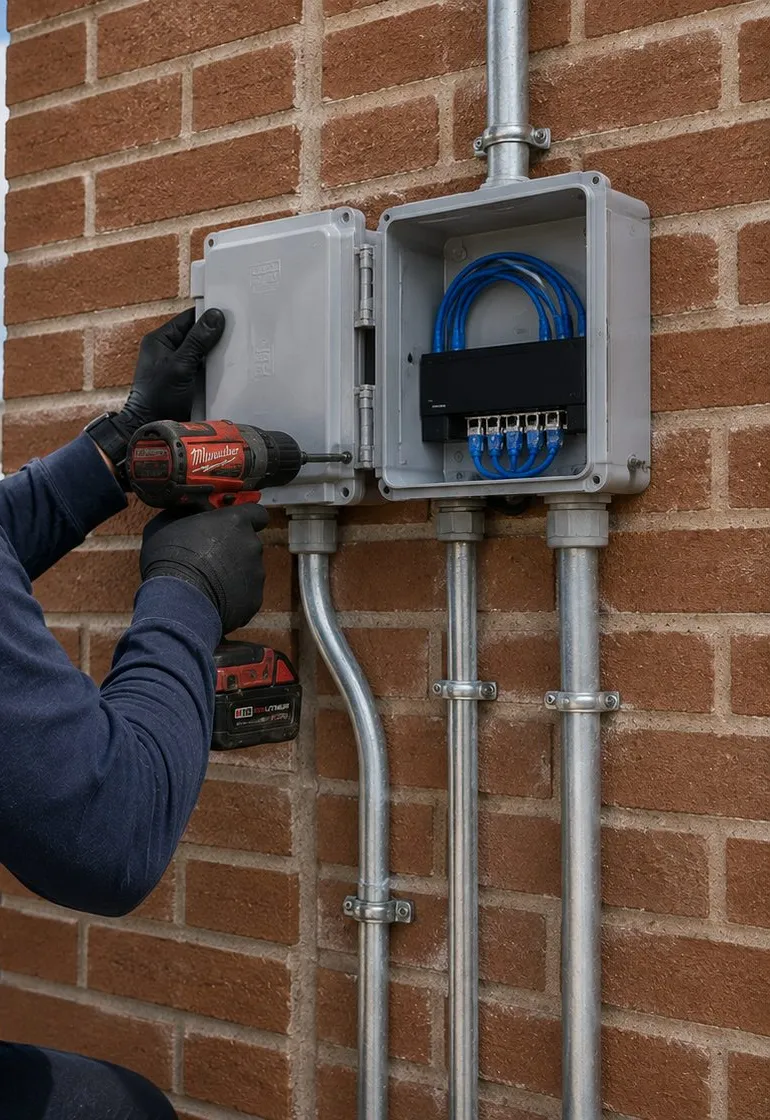
Outside on a brick wall, a gloved hand holds a red cordless drill against the lid of a grey weatherproof box while a second box beside it stands open, showing a small black switch with short blue patch leads. Three runs of metal conduit drop from the boxes down the wall. Outdoor network and speaker cable leaves a house through a sealed entry like this.
Repair Capture
Lake-House Sonos Gone Silent After a Storm?
The deck speakers that never came back after the power went out, a dock speaker that drops every time the wind picks up, a soundbar that lost the network when the provider swapped the modem, or a garage gym that hasn't played since the last thunderstorm — those are service calls, and we book them that way, in the next open 2-hour window. Most network and setup faults are sorted within one to two hours of the technician arriving. Call (845) 640-3835 and say it's a Sonos repair; the first hour of a setup-only visit in Putnam is $250, then 30-minute blocks, as set out in our TV and audio service policies.
What We Install
Sonos Installation Services in Putnam County
Most Putnam Sonos visits start indoors and end outside. We get the network right in the house, set up the living-room system, and then work outward along the property — deck, lawn, dock, garage — one distance at a time. These are the jobs we are asked for most.
Deck and Lawn Zones
Sonos's outdoor architectural pair under the eave or on the deck rail posts, wired back to an indoor Amp, aimed at the seating and the water rather than the house next door. One zone for the deck, another for the lawn if the two are used separately.
Dock and Waterfront Speakers
Music at the bottom of the slope: either a wired pair on the dock fed by heavier-gauge cable, or a second Amp in a boathouse or shed closer to the water. We pick the option by the measured distance, not by guesswork.
Long-Run Speaker Wire
Cable sized to the run using Sonos's own wire-gauge chart, laid in conduit where it crosses the lawn, labelled at both ends and tested before the speakers go up. No splices buried in the ground.
House-to-Garage and Boathouse Links
A network connection to a detached garage, studio, gym or boathouse: copper where the distance allows, fiber where it doesn't or where the building has its own electrical panel, and an outdoor-rated access point where only a wireless hop will do.
Lake-View Living Rooms
Arc Ultra, Beam or Ray under the TV, a Sub placed where the floor and the furniture allow, and rear speakers in rooms where one wall is mostly glass facing the lake.
Bungalow and Cottage Systems
Small, wireless-first systems for winterized lake cottages: Era speakers on brackets, a Ray or Beam on a compact TV wall, and ceiling speakers only where a crawlspace or a short attic gives us a route.
Storm-Ready Networks
Router, switch and Amps on a battery backup where the owner wants one, surge protection on cables that leave the house, and the equipment sited where a technician can reach it after an outage.
Seasonal Open and Close
A lake-house system set up so it can be powered down for the winter and brought back in spring with a short checklist, updates scheduled for a quiet hour, and nothing left that needs a technician every May.
Village-House Systems
For Cold Spring, Nelsonville and Brewster houses on small lots: wireless speakers where the walls are thick and old, nothing on a street-facing facade, and levels set with the neighbours' bedrooms in mind.
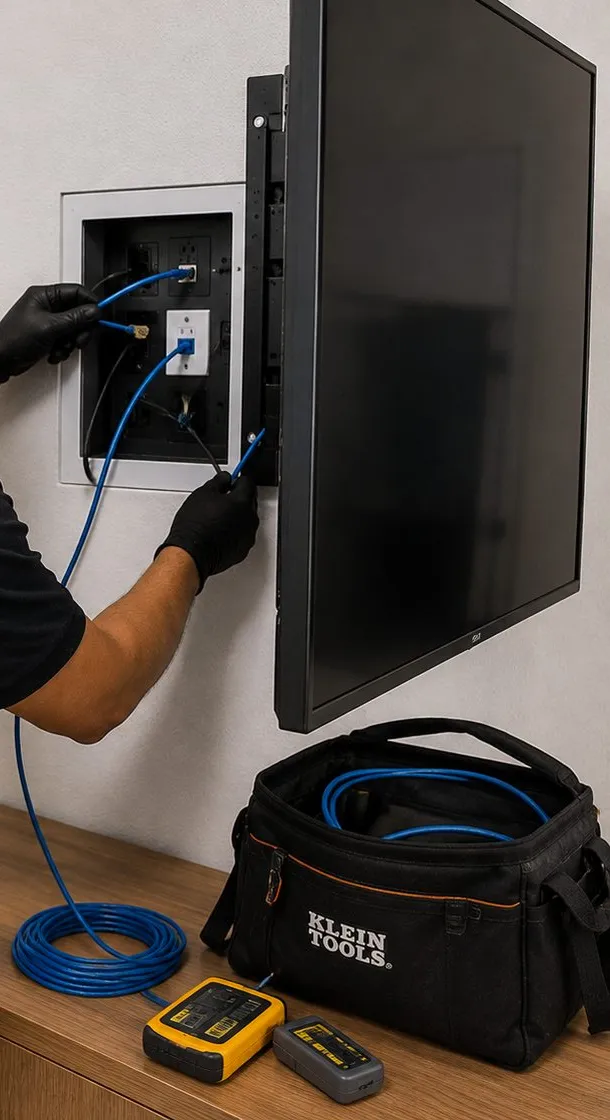
Close on the wall: two gloved hands work blue network cable into a recessed box with power and data plates, set into the wall just beside a large flat screen on its mount. Below, a coil of blue cable sits on a wooden credenza next to an open tool bag and two yellow cable testers. A recessed box like this is where a soundbar's power and connection are hidden.
The den or the guest room has a Samsung, Bose or Sony bar instead? That job sits under our soundbar installation in Putnam County, priced from the same county list.
Building Specialists
Sonos Installation for Putnam County's Architecture
Putnam's houses were built for summer weeks, for farming, for river trade and, since the parkways arrived, for commuting. Each kind shapes a Sonos plan differently. The place names below describe where a type is common, not particular houses we have worked in.
Winterized Lake Bungalows
The cottages of Putnam Lake, Lake Carmel and Lake Peekskill, many on lots laid out in the late 1920s and extended one room at a time. Low ceilings, small rooms, crawlspaces rather than full basements, and old exterior walls that now sit in the middle of the house.
Lakefront Houses on Mahopac and Oscawana
Larger homes with decks, walk-out lower levels, boathouses and docks. The living room faces the water through big windows, and the outdoor zones are the main event. Distances from house to dock are the first measurement we take.
Commuter Colonials, Splits and Raised Ranches
The post-war and later neighbourhoods of Carmel, Mahopac, Kent and Southeast: attached garages, family rooms a half-flight down, back decks, and a router wherever the cable company happened to drill in. Standard framing, and usually a straightforward wiring job.
Houses at the End of Long Drives
Hillside houses in Putnam Valley, Philipstown and western Kent, set well back from the road with detached garages, sheds and outbuildings. The network plan matters more than the speaker choice, and the internet line itself may be modest.
Village Houses in Cold Spring and Nelsonville
Closely set nineteenth-century houses above the Hudson, many inside the Cold Spring Historic District. Thick walls, plaster, narrow lots and neighbours a few feet away. Wireless-first plans and nothing visible on the street side.
Garrison and River-Side Estates
Large properties with long lawns toward the river, guest cottages and carriage houses. They combine the distance problem of a lake house with the old walls of the village, and often a second building that wants its own music.
Building by building: what each Putnam house type does to the wiring
Lake bungalows. Most have no attic worth the name and no basement to run cable through, so ceiling speakers depend on what the crawlspace allows. Where an addition meets the original cottage, there is often an old outside wall still inside the house, with whatever siding or sheathing it had when it was the exterior. Wi-Fi that reaches the kitchen can fade past that wall. We test signal in each room before recommending anything, and lean on wireless speakers on brackets, with a wired access point placed to cover the newer part of the house.
Lakefront houses. The walk-out lower level facing the water is usually the best home for an Amp that drives the deck and dock speakers: it is closer to the outdoor runs, it is heated, and the wall facing the lake is often already penetrated for outdoor lights and outlets. We keep the Amp on a ventilated shelf rather than the floor, because Sonos rates it to operate between 32 and 104 degrees Fahrenheit, and run outdoor cable through a single sealed entry.
Commuter houses. These are the most predictable. Drywall on wood studs, accessible attics over the bedrooms, unfinished areas over the garage. The challenge is usually that the router is at one end of a long house and the family room is at the other, a half-flight down. One wired Sonos product or a wired access point near the family room is often the whole fix.
Houses on long drives. Here the house is the hub for several buildings. We plan the indoor system first, then the links outward: the garage, the shed, the guest space. Each link is chosen by distance and by whether the outbuilding has its own electrical service. Where the internet itself is slow, we explain which music sources depend on it and which, such as a turntable on a line-in, do not.
Village houses. Thick walls stop Wi-Fi in its tracks, and Sonos's own interference guide rates plaster high and brick medium for signal loss. A wired access point on each floor, reached through a closet or a stair wall, usually does more than any speaker upgrade. Outdoor speakers go on the garden side of the house, if anywhere, and levels are set with you, because the next house is close.
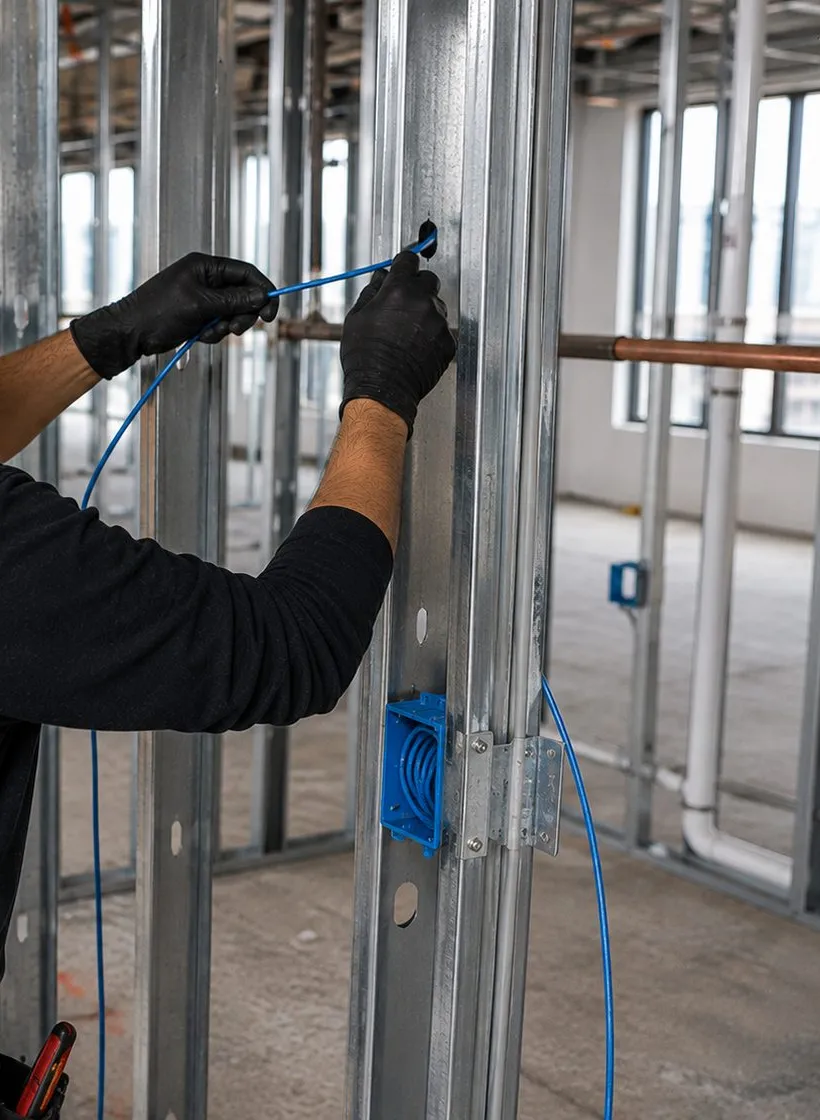
In an open stud wall, two gloved hands pull a thin blue cable through a punched hole in a steel stud, the cable looping down past a blue electrical box fixed to the stud lower down. Unfinished walls and a long room with windows stretch out behind. A renovation at this stage is the cheapest moment to run speaker and network cable.
Finishing a lower level or adding on to a lake cottage? Run the speaker and network cable while the studs are open. Our structured cabling installers in Putnam County pre-wire for Sonos and leave each run labelled and tested.
From the House to the Water
Planning Sonos Across a Putnam Lake Property
Every lake-house plan we write starts with a tape measure, not a product list. We walk from the place the Amp will live to each spot that wants music — the deck rail, the bottom of the lawn, the end of the dock, the boathouse door — and write down the distance. Those numbers decide the cable, where the Amps go and whether a second one is needed closer to the water.
Sonos publishes its own chart for this. For the distance between a Sonos Amp and its speakers, it recommends 16-gauge wire for runs under 80 feet, 14-gauge from 80 to 200 feet and 12-gauge from 200 to 300 feet, and says runs over 300 feet are not recommended. Thinner wire over a long run wastes power as heat and takes the punch out of the bass; on a lake property the long runs are exactly the ones that matter.
Where the music goes
Typical approach on a Putnam lake property
Why
Deck or patio against the house
Outdoor pair under the eave or on rail posts, 16-gauge to an indoor Amp
Short run, one sealed wall entry, Amp stays heated and dry
Lawn or fire-pit area partway down the slope
Outdoor pair on posts, 14-gauge in conduit if the run is 80–200 ft
Sonos's chart steps up the gauge at 80 ft; conduit protects the cable from mowers and roots
Dock or shoreline 200–300 ft from the Amp
12-gauge in conduit, or a second Amp in a boathouse or shed nearer the water
At this length the second Amp is often simpler and keeps each zone independent
Anything beyond 300 ft
A second Amp near the speakers, fed by a network link from the house
Sonos does not recommend speaker runs over 300 ft
Occasional use on the dock or a boat
A Move 2 or Roam 2 carried down and brought back up
No trench, no Amp; Roam 2 is rated IP67 and also plays over Bluetooth
Getting the network to the bottom of the property
A second Amp in a boathouse or garage only helps if the network reaches it. Ordinary copper network cable is rated for 100 meters, or 328 feet, end to end under the usual 10/100/1000BASE-T standard. Inside that distance, a buried Ethernet run in conduit to a small switch in the outbuilding is the steady option. Beyond it, or where the outbuilding has its own electrical service, we use fiber with a media converter at each end, which carries no electricity between buildings at all. Where trenching is not possible, an outdoor-rated access point on the house, aimed at the dock or the garage, can carry Sonos as long as it is wired back to the router: Sonos lists plug-in Wi-Fi extenders as unsupported, and tells owners not to plug Sonos products into the Ethernet port of an access point or extender unless that device is itself cabled back to the network.
A Sonos community answer to an owner wanting music on a dock put it simply: plug-in extenders cause problems, mesh systems and hard-wired access points are supported, and every Sonos device has to be on the same network. That is the rule we design to. Two separate networks — one for the house, one for the dock — leave the dock speaker invisible to the app on the porch.
Water, ice and power at the shoreline
Sonos's outdoor architectural speakers are designed for humidity, water, heat, UV and freezing temperatures, are rated IP66 and are specified for −13°F to 149°F, so a Putnam winter will not hurt them on a post or under an eave. What they cannot do is sit where the lake reaches them, where ice heaves a dock in March or where a wake soaks them every weekend. On a fixed dock we mount them high on the landward end; on a floating or seasonal dock we usually recommend a portable that comes back to the house.
Electricity on the dock is a separate trade. The National Electrical Code's Article 555 covers wiring for marinas, boatyards and docking facilities, and its ground-fault rules for receptacles near the water are strict, because shock hazards around docks are real. New dock outlets, lighting and boat-lift circuits belong to a licensed electrician. Our speakers on a dock are passive and run on low-voltage speaker wire from an Amp on dry land, which is one of the reasons we prefer them to plugging a powered speaker into a dock outlet.
Sound across the water
Owners are often surprised by how far music carries on a lake. On calm evenings, cooler air sits on the water under warmer air above, and acoustics researchers such as Penn State's Graduate Program in Acoustics describe how that kind of temperature inversion bends sound back down toward the surface instead of letting it rise away. A deck pair that sounds polite on the deck can be clearly heard across a narrow cove.
Town codes reflect that. The Town of Carmel's noise chapter limits noise in residential districts to 65 dB(A) between 8 a.m. and 6 p.m. and 55 dB(A) between 6 p.m. and 8 a.m., and its sound-amplification permits do not allow loudspeakers before 10 a.m. or after 8 p.m. Sunday through Thursday. The Town of Putnam Valley's noise law prohibits radio and recording sounds audible more than 100 feet from the source between 10 p.m. and 7 a.m. on weekdays and 11 p.m. and 9 a.m. on weekends. We aim outdoor speakers down at the seating and away from the open water, keep them close to where people sit, and set a maximum volume for each outdoor room in the app with you. This is general information, not legal advice; check your own town's code for events.
Before anyone digs
A conduit to the dock or the garage means a trench across a lawn that may hold a septic field, a well line, buried power to a boat lift or an invisible dog fence. The utility one-call system, reached through 811, asks for notice at least two and no more than ten days before digging, and marks utility-owned lines for free; private lines such as a well feed or a lamp post are the owner's to locate. We walk the route with you, ask what is buried, and route around septic fields and tree roots before a spade goes in.
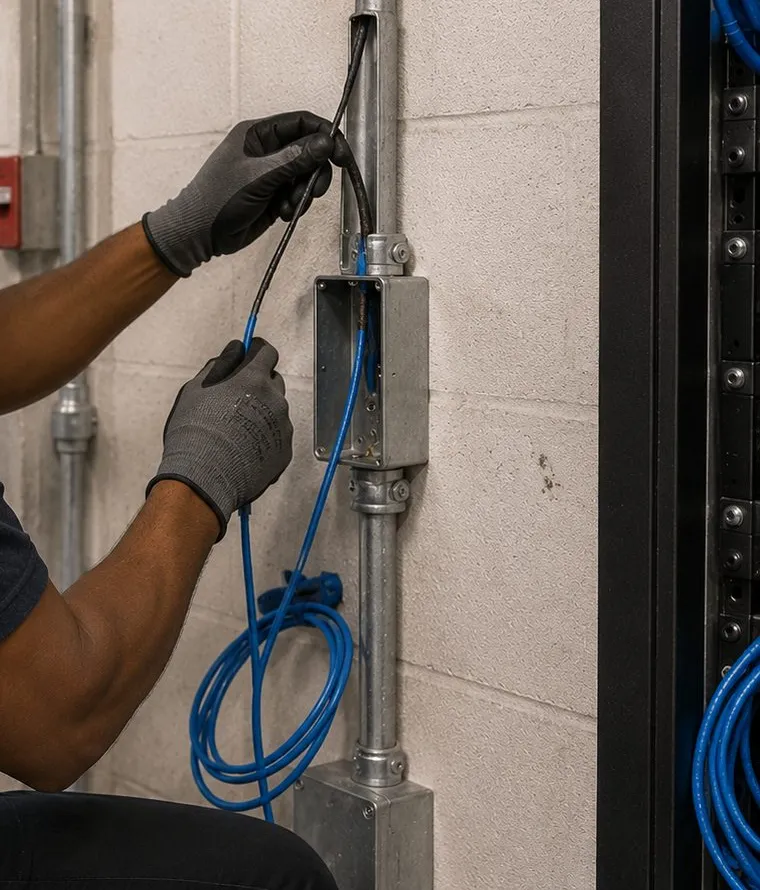
Against a painted block wall, two grey-gloved hands draw a black cable and a blue network cable out of an open metal junction box set into a vertical run of steel conduit, a loose coil of blue cable hanging below. The edge of an equipment rack fills the right of the frame. Cable to a garage or boathouse runs in conduit like this from the moment it leaves the house.
Storm Season
Building a Putnam Sonos System That Rides Through Outages
The utilities' own updates show why we plan for the power going out. NYSEG's Brewster division covers Putnam along with Dutchess and Westchester, and Central Hudson serves customers on the river side around Cold Spring and Garrison. Wind, wet snow and summer thunderstorms bring trees down onto lines along the ridge roads, and a house at the end of a long private drive may be among the last to be reconnected.
In our experience the Sonos products themselves usually rejoin the network once power and the router are back. The trouble comes from the pieces around them. A router that takes several minutes to boot, a modem that the provider replaced after a surge, a mesh satellite plugged into an outlet that tripped, or an Amp on a power strip that switched itself off — each can leave rooms missing from the app after the lights are back on.
Battery backup where it counts. A small uninterruptible power supply under the router, the switch and the Amp that drives the outdoor zones bridges the short flickers that come with every thunderstorm and gives equipment a clean shutdown in a long outage. It will not run the house; it keeps the network from rebooting every time the lights blink.
Surge protection on cables that leave the house. A run to the dock or a garage is a long conductor across open ground. We bring it into the house through a sealed entry, add surge protection rated for the cable type, and keep a fiber link wherever a building has its own electrical service.
Equipment you can reach. The router and Amps go somewhere a caretaker or family member can find and restart them, labelled, not behind a sealed cabinet panel.
A written restart order. Modem first, then router, then switches and access points, then the Sonos products if any are still missing. We tape it inside the closet door.
Generators are a decision for you and your electrician. If the house has one, we put the network equipment on a circuit it supports, so the Wi-Fi comes back with the generator.
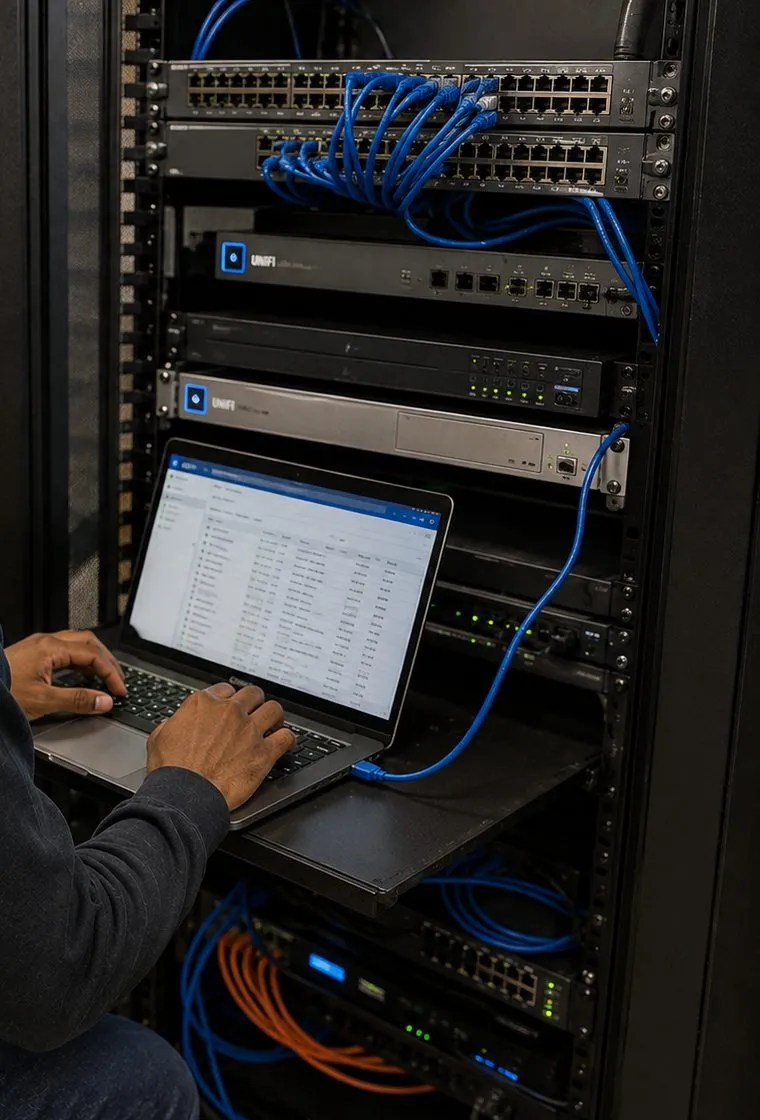
Inside a black equipment rack, two network switches at the top carry a bundle of blue patch cables, with a gateway and other units stacked beneath. On a pull-out shelf, a pair of hands types on a laptop showing a device list, and orange and blue cables fill the lower shelves. The network behind a whole-property Sonos system is configured and checked like this.
Commercial Sonos Installation
Business Sonos Installation in Putnam County
Putnam businesses are mostly small and owner-run, and they want music that the person opening up can start from a phone. The county's hazard mitigation plan places commercial land around the three villages and along State Routes 6, 9, 22 and 52, with more at the Interstate 84 interchanges. These are the corridors where we install business audio.
Route 6, Mahopac and Carmel
Plazas, restaurants, salons and fitness studios along the main road past Lake Mahopac. Dining rooms with ceiling speakers on an Amp, a separate bar or patio zone, and staff who need a one-tap way to start the day's playlist.
Main Street, Brewster
A village street close to the Metro-North Harlem Line, where many storefronts have tenants living overhead. The shop's speakers stay off the ceiling under a bedroom, and its music runs on a network of its own.
Main Street, Cold Spring
Shops, galleries and cafés in the historic village, busy with weekend visitors. Speakers indoors only, nothing on the facade, and quiet levels near shared walls.
Route 52 and Lake Carmel, Kent
Delis, offices and community spaces along the road past the lake. Small rooms where a couple of wireless speakers or a single Amp zone does the job.
Route 22 and the I-84 Corridor, Southeast and Patterson
Service businesses, showrooms and offices near the interchanges, where long opening hours and changing staff make a written reset card at the counter worth having.
Route 9, Garrison and Philipstown
Restaurants, inns and event spaces along the river side of the county, often with a terrace or garden where outdoor music has to stop at the property line.
Compliance callouts for Putnam business Sonos systems
Loudspeakers outdoors in Carmel. The Town of Carmel's sound-amplification permit form says no permit can be issued within 500 feet of a school, courthouse or place of worship during their hours, or within 500 feet of a hospital at any time, and lists a commercial fee of $100 per day. A patio sound system for an event needs the town's permit, not just our wiring.
Residential neighbours. Carmel's code caps noise in residential districts at 55 dB(A) from 6 p.m. to 8 a.m., and many Putnam businesses back onto houses. Outdoor speakers face inward and run at background level.
Cold Spring's historic district. The Village's Historic District Review Board guidance treats work that is not visible from the street as outside its review, which is why we keep speakers, conduit and enclosures off street-facing walls. Anything visible goes to the board first.
Contractor registration. Putnam County's Chapter 135 requires home improvement businesses working in the county to register with the county's Consumer Affairs office. Ask any installer, including us, for their registration before work starts.
Outlets and circuits. If an Amp closet has no receptacle, or a terrace needs power, a licensed electrician installs it. We plan the low-voltage side around their work and leave line voltage alone.
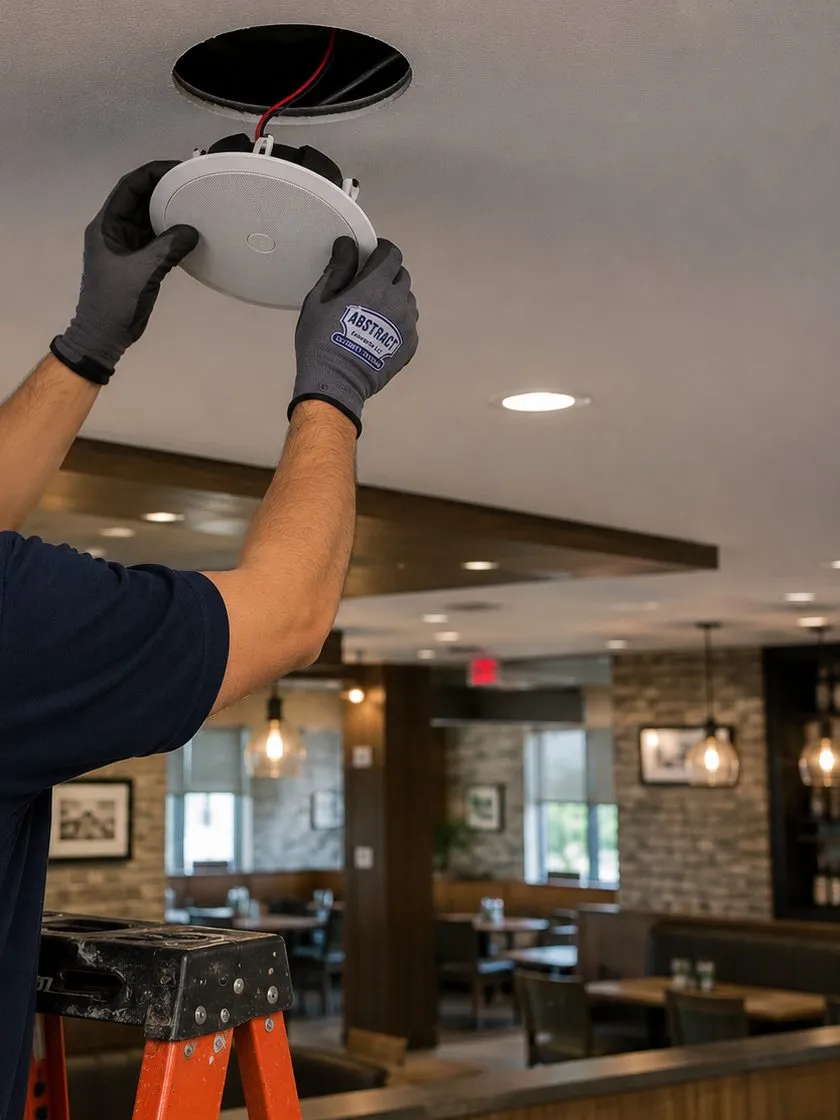
From below and behind, a technician's grey-gloved hands push a round white speaker toward a circular opening in a smooth ceiling, red and black leads hanging from the hole. Beyond him a dining room with wooden booths, stone-faced walls and glass pendant lights stretches toward the windows. Restaurant ceilings like this take several speakers on one Amp zone.
Sonos Installation in Putnam County: Questions Answered
The questions Putnam owners ask before booking, grouped by the part of the property they concern. Prices, booking and coverage are in the FAQ further down.
The lawn, the deck and the dock
How far down the lawn can a wired speaker go before the Amp has to move closer to the water?
Sonos's own guidance answers most of this. Its wire-gauge chart calls for 16-gauge cable under 80 feet, 14-gauge between 80 and 200 feet and 12-gauge between 200 and 300 feet from the Amp, and says runs longer than 300 feet are not recommended. So on a typical Mahopac or Oscawana lot, a deck pair and a lawn pair can usually share an Amp in the lower level of the house, and a dock pair can too if the dock is within about 300 feet of it.
In practice we start thinking about a second Amp well before the limit. If the dock is 220 feet away down a slope, the 12-gauge cable, the conduit and the trench all add cost, and a second Amp in a boathouse or shed near the water, fed by a network link, often comes out simpler. It also keeps the dock zone independent of the deck zone, which matters more than people expect on a busy summer weekend.
Can speakers on the dock run off the dock's existing outlet?
Not the way we install them, and we would be cautious about anyone who suggests it. Outlets on a dock fall under the National Electrical Code's Article 555, which covers wiring at marinas, boatyards and docking facilities and sets tight ground-fault rules because of shock hazards near water. Whether an existing dock outlet meets today's rules is a question for a licensed electrician, not for us.
What we fit on a dock are passive outdoor speakers. They need no outlet at all: they take low-voltage speaker wire from an Amp on dry land, inside the house or a boathouse. That keeps the powered electronics away from the water, and it means the only thing on the dock is a weather-rated speaker on a bracket and a cable in conduit.
Why does the music sound louder from across the lake at night than it does on our own deck?
Because of the air over the water. On calm evenings the lake cools the air right above it, while warmer air sits higher up. Acoustics researchers, including Penn State's Graduate Program in Acoustics, describe how that kind of temperature inversion bends sound back toward the surface instead of letting it spread upward and fade. Across open water there is nothing to absorb it, so a level that feels gentle on your deck can carry clearly to the houses on the far shore.
We plan around it in three ways: more speakers placed close to the seating rather than one pair turned up, speakers angled down toward the deck instead of out over the water, and a volume limit saved for each outdoor room in the app. Town codes in Carmel and Putnam Valley also put limits on evening sound in residential areas, so a quieter design is a practical one as well as a neighbourly one.
Can outdoor speakers be fixed to dock posts or the boathouse instead of the house wall?
Often, yes, and on a lakefront lot it usually sounds better. Sonos's outdoor architectural speakers are rated IP66 and specified for temperatures from −13°F to 149°F, so a solid post or the wall of a boathouse is fine for them. What matters is the structure: a fixed timber post or a framed boathouse wall can carry a bracket for years, while a floating section or a seasonal dock that comes out each autumn cannot.
We mount them high enough to stay clear of waves, ice and wet gear, on the landward end where possible, with the cable run in conduit along the underside or the frame rather than across the walking surface. If the dock is the kind that is pulled in for the winter, we put the speakers on the shore end or on the boathouse and leave the moving part free.
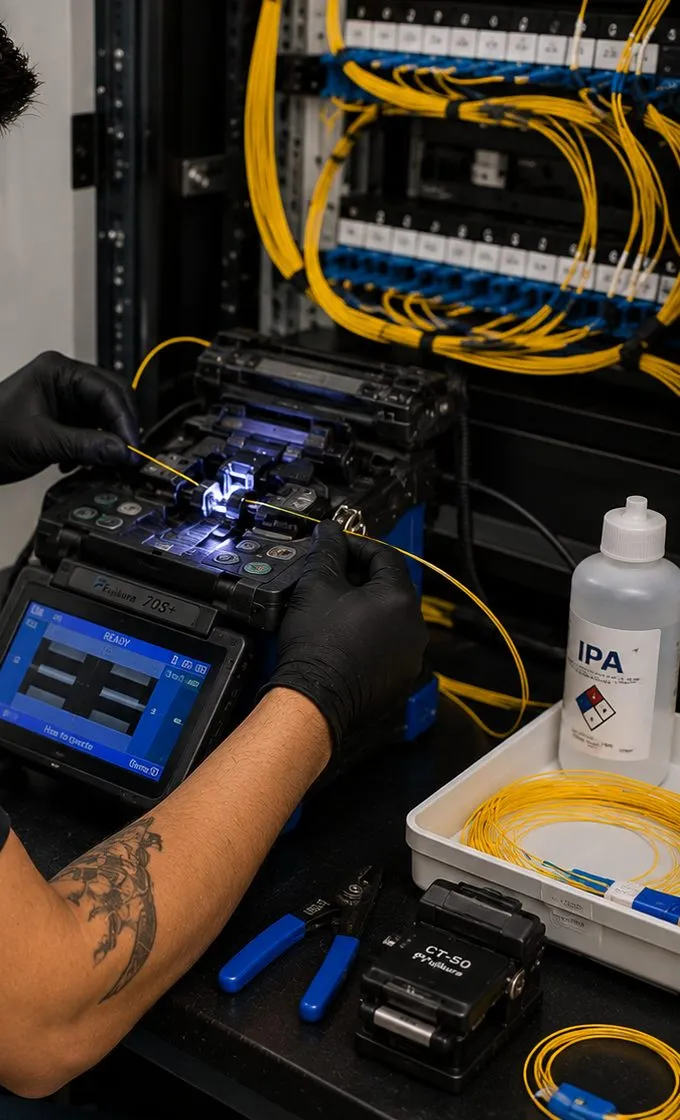
Close on a workbench: black-gloved hands feed a thin yellow fiber into the lit jaws of a fusion splicer whose screen reads READY, with a rack of yellow fiber patch cords behind it, a bottle of IPA cleaning alcohol, a tray of fiber, blue strippers and a cleaver in front. Splicing like this joins a fiber link between a house and a garage or boathouse.
Garages, boathouses and the far end of the drive
When does the run to the boathouse or garage need fiber instead of network cable?
Two things decide it: distance and electricity. Copper network cable is rated for 100 meters, or 328 feet, end to end under the usual Ethernet standard, so a garage 400 feet up the drive is beyond what copper should be asked to do. Fiber carries the signal far further than any Putnam property needs, with a small media converter at each end.
The second reason is the electrical service. If the garage or boathouse has its own panel or meter, copper between the buildings connects two separate grounding systems, and a nearby lightning strike or a fault can travel along it. Fiber is glass and carries no current, so it isolates the buildings completely. Under 328 feet, between buildings on the same service, buried Ethernet in conduit is usually fine; beyond that, or where the services are separate, we quote fiber.
Our detached garage has its own electrical panel — does that change how the music gets out there?
It changes the network link, not the speakers. A garage with its own panel is usually fed from the house by a buried power cable, and the panel in the garage may be bonded to its own ground rod. Running copper Ethernet between two buildings like that is exactly the case where we prefer fiber, so the network doesn't become a path between the two electrical systems.
Inside the garage, the plan is the same as a room in the house: a small switch or access point fed by the link, then either wireless Sonos speakers, a pair of ceiling or wall speakers on a local Amp, or both. Because a garage gym or workshop is often unheated, the Amp goes in a heated corner or a closet, or stays in the house with speaker wire running out if the garage is close enough on Sonos's wire chart.
Lightning struck a tree near the house last summer — can a surge travel in on the outdoor speaker wire?
It can, which is why we treat every cable that leaves the house as something that needs protecting. A long speaker or network run across a lawn or up a hillside is a conductor stretched across open ground, and a strike nearby can induce a surge in it even without a direct hit. The damage typically shows up in whatever the cable plugs into: an Amp, a switch port or the router.
Our approach is to bring outdoor cable into the house through one sealed entry, fit surge protection suited to the cable at that point, keep runs in conduit, and use fiber for links to other buildings so there is no copper path at all. None of that makes equipment strike-proof, and nothing does, but it gives a surge far fewer ways in. Damage that does occur is a matter for your homeowner's insurer and the product's maker.
Lake bungalows and cottages
Our winterized Putnam Lake bungalow has low ceilings and no attic — where can speakers go?
Usually on the walls rather than in the ceiling. Without an attic or a floor above, there is no way to see what sits behind a ceiling, run wire across it or reach a speaker later without cutting more holes, and many of these cottages were built and extended without much space in the roof at all. Sonos's in-ceiling manual tells installers to survey for joists, pipes, ducts and wiring before cutting, and in a shallow roof that survey often rules a ceiling speaker out.
The good news is that small rooms need little speaker. An Era 100 on a wall bracket or a shelf, a Ray or Beam on the TV wall, and a portable for the porch will fill most bungalows. Where there is a crawlspace under the floor, wall speakers low on an interior wall or a cable to a soundbar can be fed from below.
The cottage has been added onto three times — why does Wi-Fi die past the old part of the house?
Usually because the original outside wall is still there. When a lake cottage grows, each addition is built against the last exterior wall, and that wall often keeps whatever was on it — siding, sheathing, sometimes foil-faced insulation or an old window filled in. To a Wi-Fi signal, that's an outside wall in the middle of the house. Add a fireplace or a chimney stack, and one end of a long cottage can be very weak.
We test signal in each room before recommending anything, then fix the network rather than the speakers: one wired access point placed in the newer half, fed by a cable through the crawlspace or along a baseboard, or a supported mesh system with its nodes placed on each side of the old wall. Plug-in extenders are out, because Sonos doesn't support them.
There's only a crawlspace under the cottage — can speaker wire run beneath the floor?
Generally yes, and it is often the only hidden route in a bungalow. From the crawlspace we can drill up into an interior wall cavity, drop a cable to a soundbar or a wall speaker, and run speaker or network cable from one end of the cottage to the other without opening finished walls. Cable is fixed to the joists, not left on the ground, and kept away from the heating ducts and the plumbing.
Two cautions. Crawlspaces near a lake can be damp, so we use cable suited to the conditions and keep any connection points inside the house, not under it. And some are simply too tight, wet or blocked by old insulation to work in safely; if we see anything that belongs to a plumber, an electrician or an abatement specialist, we stop and tell you before going further.
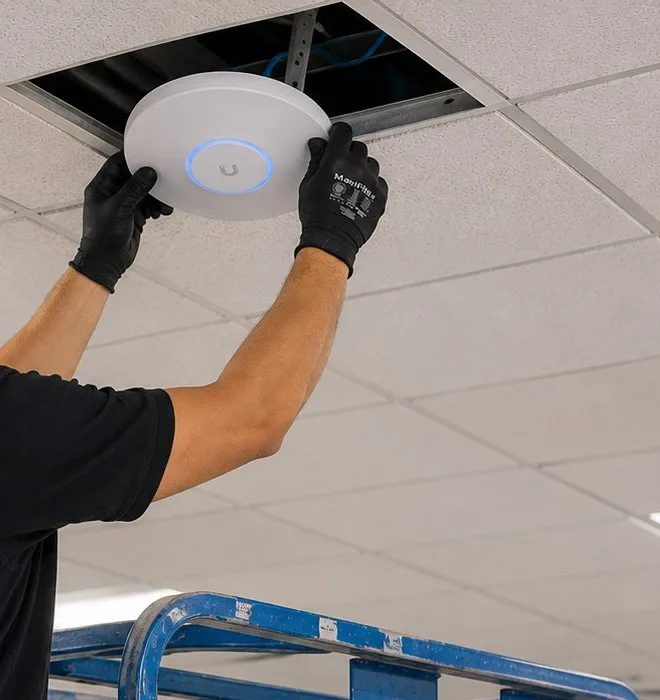
Looking up at a drop ceiling, a technician on a blue lift raises a white disc-shaped access point, its centre ring glowing blue, into an open tile space with a blue cable visible above. One cabled access point placed in the newer half of a long house does more for Sonos than any plug-in extender.
The seasonal house and storm season
We close the lake house from Labor Day to Memorial Day — what should happen to the Sonos system over the winter?
It depends on whether the heat and the internet stay on. If the house is kept heated and connected, the simplest choice is to leave everything running: the system keeps receiving updates, and Sonos lets owners schedule automatic updates for a chosen two-hour period, so nothing has to be updated on the first warm Saturday. If the house is shut down cold, unplug the Amps, soundbars and portables, bring any portable speakers back to the city with you, and leave the outdoor architectural speakers in place, since they are rated to −13°F.
On reopening, power the network first, then the Sonos products, and give them a few minutes before opening the app. We leave a one-page open-and-close sheet with every lake-house system covering exactly that, and we can book an opening visit each spring for owners who would rather not deal with it.
Is a battery backup worth adding for the router and the Sonos Amp?
For most Putnam houses on overhead lines, yes. A modest uninterruptible power supply under the modem, router, switch and the Amp that drives the outdoor speakers rides through the flickers that come with summer thunderstorms, so the network isn't rebooting every time the lights blink and the speakers don't fall out of their groups. In a longer outage it gives the equipment a clean shutdown instead of a hard one.
It is not a generator. A battery sized for network gear will not run a soundbar and a TV for an evening, and it shouldn't try. We size it for the equipment that keeps the network alive, put it where it can breathe and be reached, and label it so the next person knows what it is for.
Commuter houses on the ridge roads
Our split-level has half-flights between every room — can one Sonos zone cover the stair hall and the rooms off it?
Usually as two or three zones that are grouped together, rather than one. A split-level's open stair hall connects four short floors, and a single pair of speakers in the hall will be too loud on one landing and too quiet in the rooms off the next. Separate rooms in the app for the kitchen level, the family-room level and the bedroom level, grouped when you want the same music everywhere, give more even sound.
Wiring is easier than it looks. The levels overlap, so a cable can often drop from the attic over the bedrooms straight into the wall behind the family room, a half-flight down, without crossing a finished ceiling. And one wired Sonos product or a wired access point on the lower level usually fixes the weak signal that half-floors and a garage between them tend to cause.
Equipment
Types of Sonos Systems We Install
Send us the Sonos products you have bought, or just a sketch of the property, and we will match the two. These are the products we fit most often on Putnam properties, grouped by where on the land they make sense. Specifications come from Sonos's own product and support pages unless noted.
Outdoor Speakers
Sonos's outdoor architectural pair, rated IP66 and specified for −13°F to 149°F, designed for humidity, water, heat and UV. Passive, so they need an Amp and a cable — the backbone of every deck and dock zone.
Amp
The heart of an outdoor zone: 125 watts per channel, HDMI for a TV, and enough to drive up to three pairs of Sonos architectural speakers in parallel as one room. Rated to operate from 32 to 104°F, so it lives indoors on a ventilated shelf.
Move 2 and Roam 2
Portables for the dock, the boat and the fire pit. Sonos rates the Move 2 IP56 with up to 24 hours of battery; the Roam 2 is IP67, can survive being submerged up to about three feet for several minutes, and plays over Wi-Fi or Bluetooth.
Arc Ultra
At roughly 46.4 inches, the widest bar Sonos makes, sized for a large screen in a great room facing the lake. Sonos says that once it sits on its wall mount it senses this and retunes its bass for the wall.
Beam (Gen 2) and Ray
For the smaller TV walls of a bungalow or a split-level den. Beam takes an HDMI ARC/eARC link; Ray uses an optical cable, which makes it the easy pick for an older set in a cottage bedroom.
Sub 4
Wireless, so it can go wherever the room allows — a corner, against a wall or under a sofa with an inch of clearance. Useful in walk-out lower levels where the TV wall faces the lake.
Era 100 and Era 300
Standalone speakers for kitchens, bedrooms and the screened porch, and rear speakers for a soundbar. The Era 300 wall mount is for stud mounting only.
In-Ceiling Speakers
Sonos and Sonance 6-inch and 8-inch models with 8.25-inch and 10.125-inch cut-outs and paintable grilles, for commuter houses with attics and lower levels with accessible joists.
Era 100 Pro
Designed by Sonos for professional installation, powered over the network cable with PoE+. A tidy option for a garage gym, a studio or a boathouse room that already has a network cable and no spare outlets.
Which Sonos products suit which part of a Putnam property
Part of the property
Usual products
Where the electronics live
Lake-view living room
Arc Ultra or Beam, Sub 4, Era rears
TV wall, with one product wired to the network if possible
Deck against the house
Outdoor architectural pair
Amp indoors, in the lower level or a closet near the wall entry
Lawn, fire pit or shoreline
Outdoor pair on posts, or a Move 2
Same Amp if under the wire-chart limit; otherwise a second Amp
Dock
Outdoor pair on fixed structure, or a portable
Amp on dry land, in the house or a boathouse
Detached garage, gym or studio
Era speakers, Era 100 Pro, or ceiling speakers on a local Amp
Switch or access point fed by copper or fiber from the house
Lake bungalow
Era 100 on brackets, Ray or Beam, a portable for the porch
Router plus a wired access point in the newer half
Village house
Wireless speakers and a soundbar
Wired access point per floor through a closet or stair wall
Sonos revises its line-up often, so the week before a visit we check each model you own against its current spec sheet and load the van with the matching brackets, cable gauge and network parts.
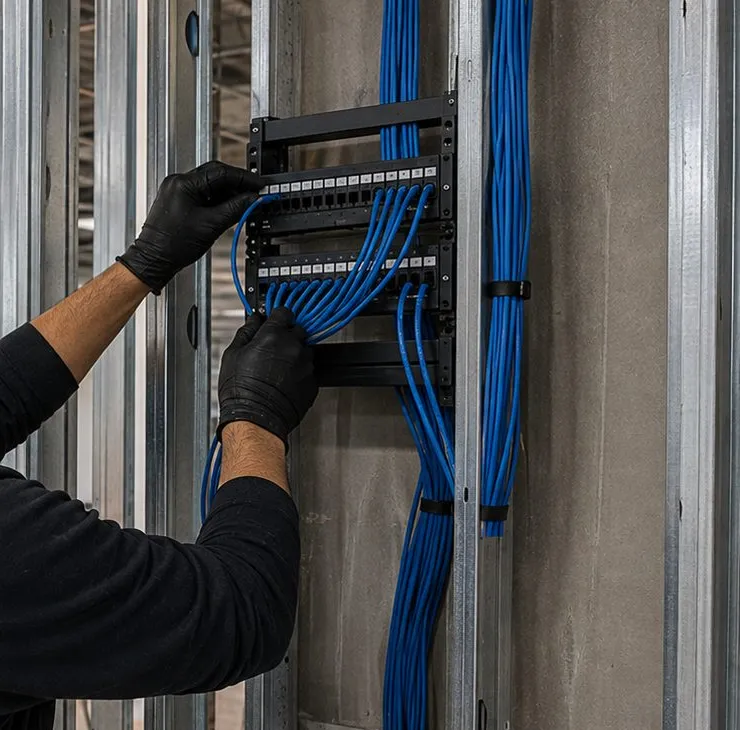
Between open steel studs, two black-gloved hands press a fan of blue cables into the ports of a small two-row patch panel fixed to the wall, with more bundles of blue cable strapped vertically on either side. A small panel like this gathers the runs to the deck, garage and outbuildings in one labelled place.
AI Overview Reality Check
What AI Gets Wrong About Sonos Installation in Putnam County
A note on method: our research tools could not load Google's AI-generated answers for Putnam searches, so we do not quote them. Each heading below is an assumption that turns up again and again in quick answers, cost guides and forum advice about outdoor and whole-home audio, written in our own words. Under each one is what changes on a Putnam property.
“A mesh Wi-Fi kit will cover the dock”
Quick answers about outdoor music tend to assume the house Wi-Fi, perhaps with one more mesh unit, will reach wherever the speakers go. On a quarter-acre suburban lot that is often true.
On a lakefront lot in Putnam the dock can be two hundred feet from the house and thirty feet below it, through trees and past a boathouse. Sonos supports mesh systems and hard-wired access points but not plug-in extenders, and every Sonos product has to be on the same network as the app.
We measure signal at the water, then choose between an outdoor access point cabled back to the router, a buried link to a boathouse, or a portable that doesn't need a permanent connection at all.
“Any speaker wire will do for outdoor speakers”
Generic installation guides often treat speaker wire as one product and leave the gauge as an afterthought, or suggest whatever came in the box.
Sonos's own chart says otherwise: 16-gauge under 80 feet, 14-gauge from 80 to 200 feet, 12-gauge from 200 to 300 feet, and no runs beyond 300 feet. Down a sloping lake lawn, the difference between the right gauge and the wrong one is audible.
We measure each run, size the cable to Sonos's chart, put it in conduit where it crosses the lawn and keep every connection above ground.
“Just run a network cable to the garage”
Forum advice about getting internet to an outbuilding often starts and ends with “bury a Cat6 cable”, and for a short run between buildings on one electrical service that is reasonable.
Copper Ethernet is rated for 328 feet end to end, and on Putnam properties where the garage sits at the top of a long drive, or the boathouse has its own panel, copper is either too short or the wrong material. Fiber carries no current between buildings.
We choose copper or fiber per link and say why in the written quote, so you are not paying for fiber where copper will do or risking copper where it won't.
“Outdoor speakers plug into the nearest outlet”
Many retail listings for outdoor speakers show powered models plugged into an outdoor outlet, and quick answers carry that picture over to every outdoor zone.
Sonos's outdoor architectural speakers are passive and need an Amp; and outlets on a dock come under the National Electrical Code's Article 555, with strict ground-fault rules near water. That is electrician's work, not a speaker installer's.
We keep powered electronics on dry land and run low-voltage speaker wire to the water, and we hand any new outlet or dock circuit to your licensed electrician.
“Outdoors, louder is better”
Party audio is sold on volume, and quick answers repeat the idea that outside you simply need bigger speakers turned up higher.
Over a lake, sound travels further than people expect, especially on still evenings when the air near the water is cooler than the air above. The Town of Carmel limits residential noise to 55 dB(A) after 6 p.m., and Putnam Valley's code restricts music audible beyond 100 feet late at night.
More speakers near the seating, angled down and kept at modest levels, carry music around a deck without carrying it across the cove. We set and save those levels with you on the deck.
“Multi-room audio runs $500 to $1,000 per room”
That range comes from a national cost guide, Angi, for adding zones or multi-room audio, and for an indoor room with easy wiring it is a fair rough figure.
An outdoor zone at the bottom of a Putnam lawn is not an indoor room. A trench, conduit, heavier cable, a sealed wall entry and possibly a second Amp in a boathouse change the cost entirely, and none of that shows up in a per-room average.
So our indoor setup and soundbar lines are fixed and published, while each outdoor zone gets a written figure after we have walked and measured it. AESS's Putnam AV page publishes its own package ranges for bigger systems.
“A Hudson Valley house means an old farmhouse or a new build”
General advice about the region tends to picture either a big new house with pre-wiring or a stone farmhouse with thick walls.
Putnam has plenty of both, but it also has hundreds of lake cottages laid out on 20-by-100-foot lots from 1928 onward and winterized since, and nineteenth-century village houses packed close together in Cold Spring. Neither has room for a rack or an equipment closet.
We design for the house that is actually there: wireless-first for bungalows and village houses, wired backbones where the property is large, and nothing that needs more space than the house can give.
A Putnam Sonos Plan That Starts With a Tape Measure
Pace out the lawn, or just guess the distances to the deck, dock and garage. We send back a plan naming the Amp locations, the cable for each run and a written figure.
A Ray for a Lake Carmel cottage bedroom or a deck, lawn and dock on Lake Oscawana — this form is all we need to start, and a written figure comes back within the business day. Prefer to talk? Call our Hudson Valley line, (845) 640-3835.
✅
We Got Your Request!
Got it. We read every request ourselves and will call with a couple of questions about the lawn, the dock or the garage. In a hurry? (845) 640-3835.
How It Works
Our Installation Process
The same sequence runs for a single soundbar over a Brewster shop and for a Mahopac shoreline lot with three outdoor zones; small jobs simply skip the walk.
1. Describe the house and the land
You tell us the town or lake, the rooms, the rough distances to the deck, dock and any outbuildings, where the internet comes in and which Sonos products you have or want, with photos. We reply with a written price from our published lines and say what needs a walkthrough.
2. Walk and measure the property
For outdoor zones, outbuildings and ceiling speakers we visit first, measure each run from where the Amp will live, test Wi-Fi at the far end of the lawn, ask what is buried along the route and agree where every box goes. Simple soundbar and setup jobs skip this step.
3. Written quote and booking
You get a quote naming the cable gauge, conduit route and link type for each zone. We book a 2-hour arrival window between 8 AM and 8 PM, arrange utility mark-outs if anything is to be dug, and supply our certificate of insurance free to an association or business.
4. Network first
We place access points where the house needs them, run copper or fiber to outbuildings, remove extenders and powerline adapters Sonos doesn't support, fit battery backup and surge protection where agreed, and check signal at every speaker location.
5. Mount, run and wire
Soundbar and indoor speakers fixed with anchors for the wall we find, outdoor speakers on eaves, rails, posts or a boathouse, cable laid in conduit to Sonos's gauge chart, one sealed entry into the house, and each Amp on a ventilated indoor shelf.
6. Set up rooms and limits
Every product added to your own Sonos account, rooms named for the way you use the property, deck, lawn and dock grouped or kept apart as you prefer, music services signed in, updates scheduled for a quiet hour and a volume limit saved for each outdoor room.
7. Tune, test and hand over
Trueplay run in each tunable room, outdoor levels set with you on the deck, every cable tested and labelled, and a one-page restart and seasonal open-and-close sheet left inside the equipment closet.
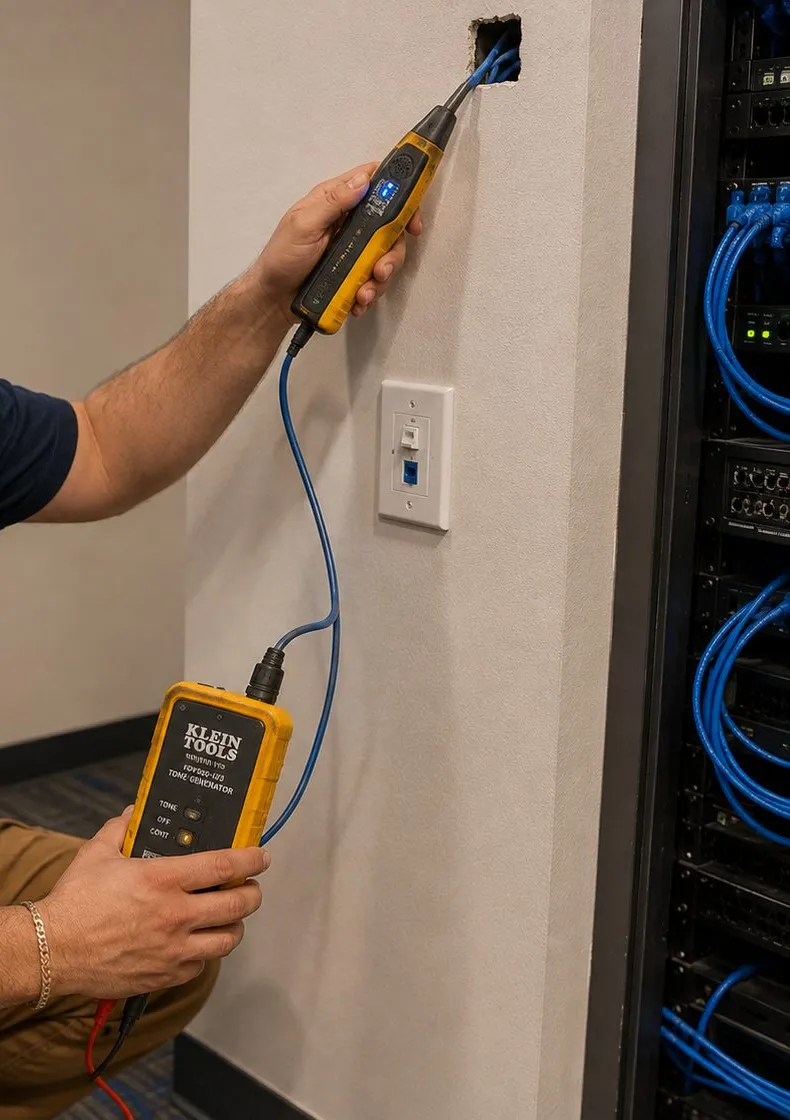
One hand holds a yellow Klein Tools tone generator clipped to a blue cable while the other holds a probe to a cable emerging from a small hole high in the wall, a white network wall plate below and a rack of blue patch cables at the right edge. Tracing and labelling each run like this is how every cable on the property is accounted for before handover.
Coverage Area
Sonos Installation Near Putnam County's Landmarks
Tell us which lake or village you are on, and we usually know the shape of the job before we arrive: how big the lot is, how far the water sits from the house and how old the walls are. These six places show that range across the county.
Lake Mahopac, Carmel
A 587-acre lake with three privately owned islands, encircled by the hamlet of Mahopac. A summer resort reached by rail in the nineteenth century, it became a year-round commuter community after the last Putnam Division passenger train in 1959. Decks, docks and boathouses on the shore; the longest outdoor runs we plan.
Lake Oscawana, Putnam Valley
A natural lake that the Town of Putnam Valley calls the largest of its lakes and ponds — about 364 acres and two miles long, with roughly seven miles of shoreline, per its lake association. Hillside lots that drop to the water, where the dock is often well below the house.
Putnam Lake, Patterson
A 200-acre lake made by damming Morlock Brook, at the centre of a development begun in 1928 where 11,000 lots were mapped and 2,000 homes built by 1932, according to the Patterson historical society. Compact winterized cottages, many now lived in all year.
Lake Carmel, Kent
The Kent sister of the same 1928 development, with residents-only beaches run by the Lake Carmel Park District, open 11 a.m. to 7 p.m., and a ban on motorboats on the lake. Small lots, quiet water and bungalows that need wireless-first systems.
Fahnestock State Park and Canopus Lake
A state park of about 22.4 square miles spanning parts of Putnam Valley, Kent and Carmel, created from a 1929 donation of about 2,400 acres, with a beach on Canopus Lake. The wooded roads around it are typical of Putnam's long-drive properties.
Cold Spring Historic District
Described as one of the best-preserved nineteenth-century townscapes in the Hudson River region, with most of its houses built before the Civil War when the West Point Foundry was at its height. Thick walls, close neighbours and a review board for anything visible from the street.
We also install Sonos in Carmel, Kent Lakes, Farmers Mills, Ludingtonville, Towners, Brewster, Brewster Hill, Peach Lake, Milltown, Tompkins Corners, Adams Corners, Lake Peekskill, Garrison, Manitou and Nelsonville, and along the borders with northern Westchester and southern Dutchess.
Pricing
Sonos Installation Cost in Putnam County
Every figure below is copied from the Putnam County TV and audio price list AESS already publishes, or from the Hudson Valley Sonos page's county lines. Anything we cannot price without walking the property — outdoor zones, trenches, outbuilding links, ceiling speakers — is quoted in writing after a walkthrough, before work starts. If something unexpected turns up on the day, you hear the price first.
Item
Putnam price
What it covers
Sonos setup
$125
Published as “Sonos / wireless surround”: account, rooms and groups, streaming services, outdoor caps and Trueplay
Soundbar wall-mounted under the TV
$129
Any Sonos bar on its bracket, level, linked to the TV and tested
Soundbar placed on console or stand
$79
Positioned, connected and tested
Sanus soundbar bracket
$84.99
Supplied when you don't have a mount
In-wall concealment
$169
Code-compliant in-wall power and cable kit behind the TV
Paintable cord cover
$59
Surface raceway where a wall can't be opened
Cable run to a cabinet or other spot
$99
Up to 25 ft — for example, router to the TV wall
A/V receiver
$129
Receiver connected and configured
Universal remote
$99
Programmed for TV, Sonos and sources
Streaming device setup
$49
Per device
Full home theater
$350
Multi-component system set up together
Deck, lawn and dock zones on an Amp
Quoted at walkthrough
Depends on measured distance, cable gauge, conduit and trench
Garage, boathouse and outbuilding links
Quoted at walkthrough
Copper or fiber chosen per link; access points and switches as needed
Ceiling or in-wall speakers, battery backup, surge protection
Quoted at walkthrough
Depends on the house, the access and the equipment protected
Walls and access
Condition
Price
Drywall on wood studs (most commuter houses)
$0
Metal studs
+$30
Plaster (Cold Spring village houses, older farmhouses)
+$45
Brick or fieldstone (chimney walls, old foundations)
+$65
Concrete or cinder block (walk-out lower levels)
+$75
Tile or marble
+$95
Plywood backer board
$85
High mount (above about 8 ft, such as over a lake-room fireplace)
$75
Walk-up, 3rd floor and above, no elevator
$40
Box removal
$25
Certificate of insurance for an association, landlord or business
Free
Travel or parking charge
None in Putnam
Setup-only visits and a TV on the same day
When nothing is being mounted or run — rejoining speakers after a new modem, regrouping rooms, setting outdoor volume limits, opening a lake house for the season, sorting dropouts at the far end of the property — the visit is billed by time: the first hour at the Putnam rate of $250, then 30-minute blocks. If the TV is going up on the same visit, the Putnam TV mounting base price is $229.99, with the rest of the menu on our Putnam County TV mounting price list.
Included, and not included
Part of the job: brackets fixed and levelled, the TV link made, every product added to your own Sonos account, rooms named, groups and outdoor volume limits set, music services signed in, updates scheduled, Trueplay in each tunable room, cables labelled and dust cleaned up.
Left to other trades: a licensed electrician handles dock receptacles, boat-lift and generator circuits and every line-voltage outlet; septic and well questions go to those contractors; touch-up paint goes to your painter.
Buying the gear: order Sonos products wherever you like. We can supply the mounting hardware, raceway and in-wall kits at the listed prices, and the outdoor cable appears as its own line in the quote.
When we can't begin: a locked gate at the bottom of the drive, Sonos boxes still in transit or a trench route not yet marked out by the utilities means a $150 return-trip fee. Moving the date a day or more ahead costs nothing.
National brands and app-based handymen versus a local licensed installer. National menus and gig listings price a soundbar on drywall in a suburban living room, and for that job they are often fine. They don't price a 200-foot run to a dock, fiber to a garage with its own panel, a lake cottage with no attic or a battery backup for a house on a ridge road. A local installer with a published Putnam price list and a state low-voltage licence can price the real property and answers to you afterwards.
Shop Our Systems
Sonos Installation Packages & Pricing
Three starting points we quote most in Putnam. None of them hides a new number: add the named lines from the table above and you reach the same total. A plaster or stone wall adds its surcharge on top.
Starter — Sonos Setup
$125For owners who have already placed their speakers, portables for the dock included: Sonos setup ($125) covers the account, room names, outdoor volume caps, a scheduled update window and Trueplay.
Standard — Lake-Room Soundbar
$254Soundbar wall-mounted under the TV ($129) plus Sonos setup ($125): $254. The usual first step in a lake-view living room, with the rest of the property added later.
Premium — Wired Theater Wall
$606.99A TV wall with nothing showing: in-wall concealment kit ($169) for power and HDMI, a Sanus bracket ($84.99) and the soundbar mounted on it ($129), a network cable of up to 25 ft to the router ($99) and Sonos setup ($125) — $606.99 in all. Fieldstone adds $65, plaster $45.
Bring Your Own Equipment — Labor Only
If a mount came with the house or you ordered Sonos's own, you pay labor only: $129 for the wall mount (plus any wall surcharge) and $125 for setup. Your mount needs a weight rating that covers the bar, and its warranty stays with its maker. Should it not suit the wall behind the TV, you hear that before any drilling, along with the Sanus option.
Deck, Dock and Outbuilding Zones
Outdoor speakers on an Amp, links to a garage or boathouse, and ceiling speakers are each priced after we have walked and measured them, because the distance, the cable gauge, the conduit and the ground set the work. AESS's Putnam County AV page publishes its own package ranges for bigger systems, from an entry TV-mount-plus-Sonos package at $1,200–$5,000 to whole-home Sonos with Atmos at $12,000–$35,000; your written quote shows where each zone falls before you commit.
Ready to Measure the Run to the Water?
Photos of the TV wall, the deck and the path to the dock or garage, plus rough distances, are enough for a first written price.
Putnam is only six towns and three villages, yet a job on Putnam Lake looks nothing like one above the Hudson in Garrison. Town by town, these are the differences we plan for.
Carmel and Mahopac
The county's most populous town wraps around Lake Mahopac and Lake Gleneida. On the Mahopac shore the jobs are lakefront: a soundbar in a room facing the water, a deck pair, and growing interest in music on the dock and the boathouse. Inland, colonials and raised ranches off Route 6 bring the classic commuter-house problem of a router at one end and a family room a half-flight down at the other. Carmel's noise code sets evening limits in residential districts, which we design under.
Kent and Lake Carmel
Lake Carmel's cottages sit on small lots around a quiet, motorboat-free lake, with residents-only beaches. Systems here are compact and mostly wireless, with a wired access point to reach the newer half of a much-extended bungalow. Western Kent rises into steep, wooded ground where houses sit high above the road and the network matters more than the speakers.
Patterson and Putnam Lake
Putnam Lake's 1928 grid of narrow lots means houses close together and a lake that carries sound from one side to the other. Outdoor speakers are placed close to the seating and kept quiet. Elsewhere in Patterson, older farmhouses and newer houses on larger lots bring the long-drive pattern: detached garages, barns and a need to decide between copper and fiber for each link.
Southeast and Brewster
Brewster village's older buildings near the Harlem Line station put apartments over shops, so soundbars and wireless speakers with sensible limits are the norm. Outside the village, houses near the reservoirs bring decks, pools and requests for power-cut resilience.
Putnam Valley, Lake Peekskill and Lake Oscawana
Putnam Valley combines the lake-cottage pattern of Lake Peekskill with the bigger lakefront houses of Lake Oscawana and some of the county's most rugged terrain. Docks below steep lawns, garages up long drives and internet that varies from road to road. Putnam Valley's noise law restricts recorded music audible more than 100 feet away late at night, so outdoor zones are aimed down and kept close.
Philipstown: Cold Spring, Nelsonville and Garrison
The river side of the county is the contrast case. In Cold Spring and Nelsonville, closely spaced nineteenth-century houses with plaster and brick call for wireless-first plans, wired access points per floor and nothing on a street-facing wall. In Garrison, larger properties with lawns toward the Hudson, guest cottages and carriage houses bring back the distance problem. Central Hudson, not NYSEG, serves much of this side, and outages there follow the same storm pattern.
Repairs Around the Property
Common Sonos Faults on Putnam Properties, and Their Fixes
Ask where on the property the music stopped, and the cause is usually half-found. Below are the faults we meet most often on Putnam lots, matched to what clears them.
Everything went quiet after a storm. The router came back slowly, or the provider replaced a modem damaged by a surge and the network name changed. The speakers are usually fine; they need rejoining, and while we are there we put the network gear on a battery backup.
The dock speaker drops whenever there are people on the deck. A wireless speaker at the edge of the Wi-Fi, losing out when phones crowd the network. A cabled outdoor access point aimed at the water, or a wired pair on an Amp, ends it.
The deck pair sounds thin and quiet. Speaker wire that is too light for the distance, or connections left outdoors that have corroded. We check the run against Sonos's gauge chart and remake the joins indoors.
The garage gym hasn't played since the thunderstorm. A surge on a copper link between buildings, often taking out a switch port. We replace what failed and, where the garage has its own panel, recommend fiber.
Repair visits are billed as setup-only time in Putnam: $250 for the first hour, then 30-minute blocks, with any parts or cable on the published lines above. Call (845) 640-3835 and tell us which part of the property is affected; it helps us bring the right parts.
Complete Services
Every Sonos Installation Service in Putnam County
Music usually arrives in a Putnam house alongside other work — a new deck, a finished lower level, a garage turned into a gym, a lake cottage made year-round. Here is what owners book with it.
Arrival windows, rescheduling, return trips and setup-only billing.
Field Notes
Field Notes From Putnam Sonos Walkthroughs
What a lakefront walkthrough normally involves for our crews; it describes the routine, and no real client or address
We start outside, not in the living room. With the owner, we walk from the back wall of the house to every place that wants music, counting paces or running a wheel: the deck, the lawn, the fire pit, the dock, the boathouse door. At the water we stand where people actually sit and check Wi-Fi on a phone. Those few minutes usually settle whether the outdoor zones share one Amp or need two.
Then we ask what is in the ground. Septic field, well line, buried power to the dock or a lamp post, an irrigation loop, a pet fence. The answers decide the conduit route before anyone draws it on paper, and anything uncertain waits for the utility mark-out and the owner's own records.
Last comes the inside: where the internet enters, where a ventilated shelf for the Amps can go near the lake-side wall, whether any outbuilding has its own panel, and how the house is used in winter. The sketch we make on the deck table, with distances written along each line, becomes the written quote.
FAQ
Putnam County Sonos Installation FAQ
Is there a travel charge for Sonos work at a Putnam lake house?
+
No. The AESS Putnam County price list carries no travel or parking charge, so a visit to a lake house in Patterson or a village house in Cold Spring is priced on the same lines: $125 for Sonos setup, $129 to wall-mount a soundbar, and $250 for the first hour of a setup-only visit, then 30-minute blocks. Outdoor zones and outbuilding links are quoted in writing after a walkthrough.
Can the deck pair and the dock pair on one Amp play at different volumes?
+
No. Every speaker connected to one Sonos Amp plays as a single room, with one source and one volume. Sonos says an Amp can drive up to three pairs of its architectural speakers in parallel, but they all play together. If you want the dock quiet while the deck is busier, or different music in each place, each zone needs its own Amp.
Who digs the trench for the cable to the dock or garage?
+
We plan the route, lay the conduit and pull the cable, and the written quote says who digs. Short, shallow runs across a lawn we can usually handle; long runs, rocky ground or work near a septic field go to your landscaper or excavator, with our conduit going in before the trench is backfilled. Either way, the utility one-call service through 811 is contacted first so buried utility lines are marked.
Is a screened porch indoors or outdoors as far as a Sonos speaker is concerned?
+
Treat it as outdoors. Rain blows through screens, morning dew settles on everything, and a porch can drop below freezing in winter. Sonos warns that speakers which are not waterproof can be damaged if left outside for extended periods, so on a screened porch we fit the outdoor architectural pair under the roof, wired to an indoor Amp, or leave a portable that comes inside when the season ends.
Our property has a main house and a guest cottage with separate internet. Can they share one Sonos system?
+
Only if both buildings are on the same network. Sonos requires the app and every speaker to be on one network, so two separate internet services mean two separate Sonos systems. If you want one system, we link the cottage to the main house's network with copper or fiber and retire the cottage's own router, or keep two systems and show you how to switch between them in the app.
Can you do outdoor work in winter when the ground is frozen?
+
Indoor work, network links through existing paths and anything mounted on the house can go ahead in any month. Trenching across a frozen lawn waits for the thaw, so in winter we often install the indoor side, the Amps and the wall entries first, cap the cable ends, and come back in spring to run the conduit and fit the dock or lawn speakers.
Can we take a Sonos speaker out on the boat?
+
A portable, yes. Sonos rates the Roam 2 IP67, saying it can be submerged in up to about three feet of water for several minutes, and it plays over Bluetooth from a phone when it is away from the house Wi-Fi. The larger Move 2 is rated IP56. Back at the house, either one plays on the home system again over Wi-Fi.
What kind of cable goes to the dock? Will ordinary speaker wire do?
+
Not for a buried run. Indoor speaker wire is not made to sit in damp ground or sunlight, so outdoors we use cable rated for the conditions, run inside conduit where it crosses the lawn, in the gauge Sonos's chart calls for at that distance. Every connection is made indoors or inside a sealed box, never left in the ground or on the dock deck.
All Areas Served
Sonos Installation Across the Hudson Valley
Own an apartment in the city or know someone across the river? The same licensed crews cover these areas, and each has a page built around its own housing.
A dock speaker greyed out in the app, the deck silent since the storm, a garage that won't group with the house? Call (845) 640-3835 for the earliest open arrival slot in Putnam County. With a technician on site, network and setup faults are typically fixed within one to two hours.
Sonos Installation Putnam County — Licensed, Insured, Measured to the Water
Abstract Enterprises Security Systems · 460 E Fordham Rd, Bronx, NY 10458 · Hudson Valley line (845) 640-3835 · WhatsApp (718) 679-0359 via wa.me
NYS Low-Voltage Licence #12000287431 · 100% Licensed & Insured · Same-Day Estimates · Rated 4.7★ from 201 Google Reviews
Sonos products carry Sonos's manufacturer warranty through the seller; brackets, cable and parts carry their maker's warranty. Full terms — including 50% deposit, one-year parts-only warranty on AESS-supplied products, and the late-fee schedule — are set out in the service agreement. See our warranty page.
Last reviewed October 17, 2026 by Anwar Timothy. Change history: Putnam County Sonos page first published on this date.