In Suffolk the house decides the Sonos plan before the speakers do. A 1950s ranch on a slab is wired from the attic down; a Cape is wired behind its knee walls; a split-level hides its den half below grade; a bay-front house was raised on piles and breathes salt air; an East End house sits empty half the year. We read the foundation, the roof and the distance to the water first, then fit the Arc, the ceiling speakers, the Amp and the network so the whole system still works the following summer.
Reviewed and updated October 17, 2026 · Written by Anwar Timothy, NYS licence #12000287431
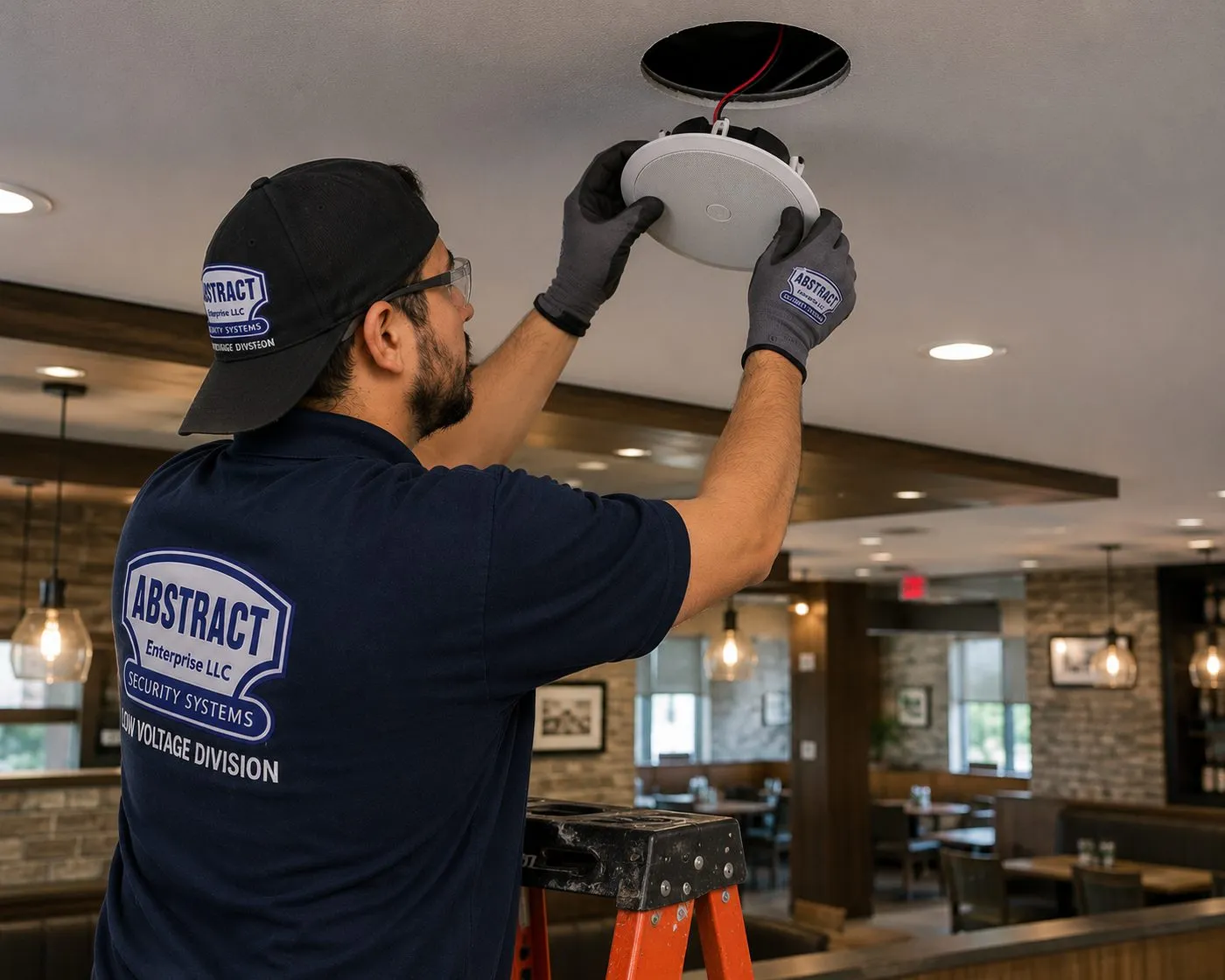
A technician in gloves on an orange ladder pushes a white round speaker up into a ceiling opening, with booths, brick-veneer walls and pendant lights in the room behind. A passive ceiling speaker like this is what a Sonos Amp drives.
Free Suffolk Sonos Quote
Your hamlet, the house type and the rooms — a technician calls back the same business day
✅
Request Sent!
A Suffolk technician will phone you the same business day.
25+
Years Experience
✓
Same-Day Estimates
100%
Licensed & Insured
4.7★
201 Google Reviews
From Huntington Station to Montauk, one number reaches the Suffolk desk:(631) 407-2884. Tell us the hamlet, whether the house has an attic hatch, a crawlspace or a basement, and which Sonos boxes are already in the hall closet. A licensed technician reads it, works out the wire path and gives you the published price of every line before a van leaves.
Suffolk prices published on this page; wired rooms quoted in writing after a walkthrough
Arrival booked inside a two-hour slot, any day of the week, between 8 in the morning and 8 at night, Babylon to East Hampton
NYS licence #12000287431 · certificates of insurance at no charge
Suffolk filled up fast, all at once, and in one-storey and storey-and-a-half houses. Newsday's history of the post-war years records the county's population at 197,255 before the war and 666,784 in 1960, more than three times as many people in two decades, and the 1970 census put it past 1.1 million. The houses built for those families — "a split-level, a ranch, a Cape Cod," in Newsday's words — still make up the core of the county. A summary of Census Bureau survey data puts more than half of Suffolk's housing units in the three decades from 1950 to 1979, with a median construction year of 1970. That is the single most important fact for anyone planning Sonos here, because it tells you where the wire can go.
A ranch from that era usually sits on a slab or a shallow crawlspace, with a low, insulated attic over every room. There is no basement ceiling to drop cable through, so ceiling speakers in a ranch are fed from above: up through the hatch in the hall, across the joists on hands and knees, down into the living-room ceiling. A Cape gives you a full first floor and a second floor tucked under the roof, with triangular voids behind the knee walls that become the wiring highway for the bedrooms. A split-level or raised ranch puts the den half a floor below the kitchen and the bedrooms half a floor above it, each level on its own framing, often with a concrete-block wall somewhere in between. None of these is hard to wire. Each one is wired differently, and a plan that ignores the difference ends in a hole in the wrong ceiling.
Then there is the water. Suffolk is surrounded on three sides by it, with close to a thousand miles of coastline according to New York State. Houses on the Great South Bay canals, along the North Shore harbors and on the East End live with salt air, wind-driven rain and, since 2012, the memory of Sandy — Newsday's tally from FEMA counted 20,798 Suffolk structures flooded, damaged or destroyed. Many South Shore houses were raised afterwards, and the space under them is limited by flood rules to parking, access and storage. Speakers on a dock, an Amp in a garage that floods, or a Port in an enclosure below the flood line are decisions that need to be made deliberately, not by whoever has a free outlet.
And then there is distance. The county runs about 86 miles from the Nassau line to Montauk Point. In the west, a Sonos system is part of a year-round family house in Huntington, Commack or Babylon. In the middle, it may be a young family in a Brookhaven split or one of the new apartments at Ronkonkoma. East of the canal, it is just as likely to be a second home that sits closed from October to May, with a router that the cable company replaced over the winter and a Sub that nobody has heard since Labor Day. The same Arc Ultra needs a different setup in each of those houses.
That is what a Suffolk Sonos installation actually involves: reading the house from the foundation up, choosing a wire path that the framing allows, keeping electronics away from heat, salt and flood, getting the network right for the internet service the house really has, and leaving a system the family — or the house-watcher — can live with. The speakers themselves are the easy part.
Suffolk facts that shape a Sonos plan
197,255 to 666,784: Suffolk's population before the war and in 1960, as reported in Newsday's "Long Island: Our Story." The ranches, Capes and splits built for that growth are the houses we wire most.
54.7% built 1950–1979: share of Suffolk housing units built across those three decades (17.2%, 19.7% and 17.8%), median year 1970, per Point2Homes' summary of Census Bureau survey data. Attics, crawlspaces and slabs — not basements — set the route.
583,777 housing units and 82.2% owner-occupied: Census QuickFacts for Suffolk. Owners can cut a ceiling; most of the work we do here is in houses the family owns.
1,399 building permits in 2025: Census QuickFacts. New construction is still going up, and it is the cheapest moment to pre-wire for speakers.
20,798 structures: Suffolk buildings flooded, damaged or destroyed in Sandy, according to the FEMA tally Newsday published in January 2013. Many of the South Shore houses we wire today were rebuilt or raised after it.
About 1,350 companies and 55,000 employees: the Long Island Innovation Park at Hauppauge, with some $13 billion in output, as described by the Hauppauge Industrial Association — the biggest single cluster of the offices and flex units that ask us for background music.
1,450 homes planned at Station Yards: the 53-acre, $1.2 billion transit-oriented development around Ronkonkoma, built in phases since a first 489-unit phase in 2020, next to what the Governor’s office calls Suffolk’s busiest LIRR station, with about 17,000 daily commuters. New apartments mean renters who need speakers without holes in the walls.
About 980 miles of coastline: New York State's county profile. Salt air and flood rules are a design input for decks, docks and garages near the water.
Audio and home theater cabling is a licensed trade category: Suffolk's rules for restricted electrician licences include a Communications Cabling category covering "audio and video systems and home theater systems" of 90 volts or less. Line-voltage connections remain a master electrician's job.
A soundbar can only be centred on a screen that is already where it should be, so if the TV is too high over a mantel or off-centre on the wall, the technicians behind our Suffolk County TV installation move it first, in the same appointment. When the network is the weak link, our structured cabling installation in Suffolk County runs the Ethernet that a wired Sonos system leans on.
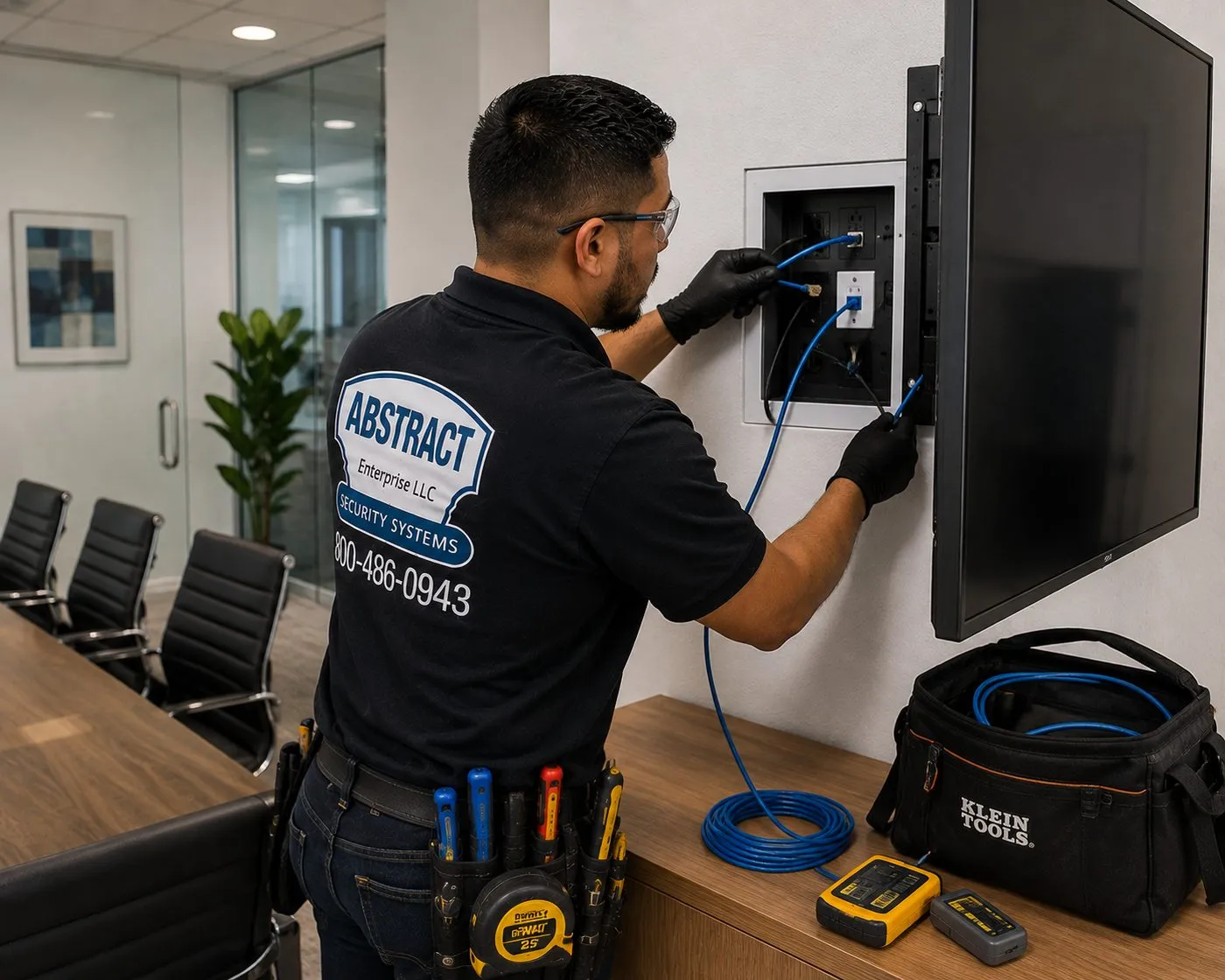
A technician connects blue cables inside a recessed box set into the wall next to a mounted flat screen; two handheld testers, a coil of blue cable and a tool bag sit on the credenza below. Power, HDMI and network meet in a box like this before a soundbar goes under the screen.
Repair Capture
When a Suffolk Sonos System Starts Dropping Rooms
A Sub that went quiet when the cable company swapped the gateway, a deck pair that stopped after a summer storm, ceiling speakers in the den that crackle on one side, or a seasonal house where nothing appears in the app on Memorial Day weekend — those are service calls, not installations. Most come down to the network, a pairing, a TV audio setting or one loose speaker terminal, and with a technician on site most are put right in one to two hours. We book them as a setup-only visit: $234 for the first hour in Suffolk, then 30-minute blocks. Same-day when a two-hour window is free. Call (631) 407-2884 and tell us it's Sonos.
What We Install
Sonos Installation Services in Suffolk County
Each card below is a job we plan around the house rather than around the box. A Suffolk family might start with a soundbar in the den, add ceiling speakers in the kitchen the next winter and finish with the deck before the following Fourth of July; we lay out the wire path on day one so each step slots in without opening the same ceiling twice.
Attic-Down Ceiling Speakers
Sonos in-ceiling speakers by Sonance, or compatible passive pairs, cut into the living-room, kitchen or bedroom ceiling of a ranch or Cape and wired from the attic above, with the insulation put back where it was. Quoted per room after we have been in the attic.
Den and Living-Room Theaters
The den or living room built around the TV: a Sonos bar sized to the screen, the Sub tucked where a ranch den has space, two rears behind the couch. At Suffolk rates the bar on the wall is $155, setup $150, and a whole theater setup $420.
Split-Level Lower Dens
The half-below-grade family room of a split or raised ranch, often panelled over furring or block. We find a route from the level above, choose between in-wall, on-wall and self-powered speakers, and check Wi-Fi at the bottom of the stairs.
Bay, Harbor and Canal Houses
Deck and dock audio specified for salt air, Amps and network gear kept inside the conditioned house, cable entries sealed, and nothing electronic left in a flood-limited enclosure under a raised house.
Seasonal and Second Homes
East End and North Fork houses set up so the system survives a winter closed: labelled equipment, surge protection on the gear we place, a written card of network details, and a simple spring check when the house reopens.
Old Intercom and Pre-Wire Reuse
Houses from the 1960s and 1970s sometimes still have a built-in intercom with speakers in every room, and newer ones may have speaker wire a builder left in the walls. We trace and test what is there before promising it can carry Sonos.
New-Build and Gut-Renovation Pre-Wire
Speaker cable and Ethernet run while the framing is open, home runs to one equipment location in conditioned space, and rough-in brackets set before the drywall crew arrives.
Network Work for Sonos
Gateway placement, bridge-mode decisions on cable-company equipment, wired anchors and mesh nodes positioned for the far end of a long ranch. Setup-only visits $234 for the first hour in Suffolk.
Existing Stereos and Turntables
Keep the 1980s tower speakers and the turntable: a Sonos Port feeds the receiver they hang off, and that receiver then plays whatever the kitchen is playing. Re-wiring the receiver itself is the $155 hookup line.
Business Background Music
Offices along Route 110, shops on village main streets, tasting rooms on the North Fork and studios in Hauppauge flex units, zoned so the front counter and the back room play at their own levels.
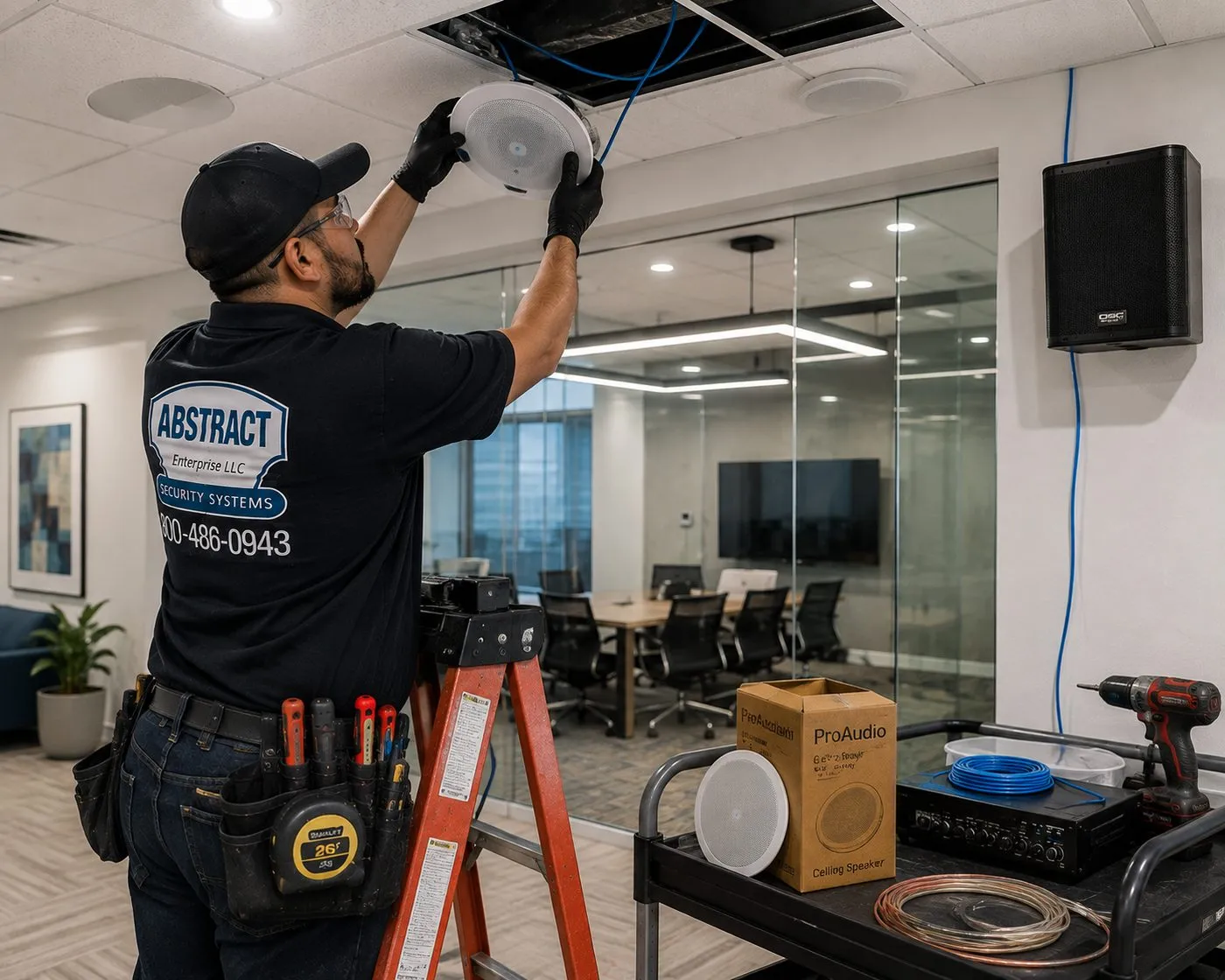
A technician on an orange ladder fits a white round speaker into an opening in the ceiling; blue cable runs down the wall to a black wall-mounted speaker. The cart below holds an amplifier, a boxed ceiling speaker, a loose speaker, a coil of copper wire, blue cable and a drill.
Sonos Installation for Suffolk County's Architecture
Ask where the wire will travel before you ask which speaker to buy. In most Suffolk houses the answer comes from three places: whether there is an attic you can crawl, whether there is a basement or only a slab, and how close the house is to salt water. The six house types below cover most of what we see between the Nassau line and the forks.
Post-War Ranches
One storey, often on a slab or crawlspace, with a low attic above every room. Wiring runs from above: ceiling speakers are easy, in-wall speakers less so because each wall cavity must be reached from the top plate. The router is often in a bedroom at one end of a long footprint.
Capes and Expanded Capes
A full ground floor with a half-storey above, sloped bedroom ceilings and knee walls with open voids behind them. Those voids carry wire to the upstairs rooms; the steep slope limits where a ceiling speaker can sit and still aim at the listener.
Splits and Raised Ranches
Three or four levels on staggered framing, a den part-way below grade, a garage beside it and a block or poured wall somewhere in the middle. Wi-Fi drops at every half-flight, and wire changes direction at every level.
Raised and Waterfront Houses
South Shore canal and bay houses lifted on piles or a new foundation, North Shore harbor houses on bluffs, and Fire Island and bay-island cottages. Salt air, wind-driven rain and flood-zone rules decide where electronics may live.
East End Shingle and Custom Houses
Larger new and renovated houses in the Hamptons and on the forks: high ceilings, open plans, pool houses and long distances between the router and the far wing. Ideal for in-ceiling speakers, demanding on the network.
North Fork Farmhouses and Older Village Houses
Older framing, plaster in places, small rooms and add-ons from several eras. Often better served by self-powered Era speakers in some rooms and wired speakers only where the ceiling can be reached cleanly.
How the wire actually travels, house by house
Ranches: from the attic down. We go up first, find the joists over the room, clear the insulation back from each speaker location and drop a pilot hole through the ceiling to confirm the spot from below. Speaker cable is laid across the top of the ceiling joists, kept clear of recessed-light housings and bath fans, and dropped down the inside of the wall cavity only where it needs to reach the Amp location. When the cable is in, the insulation is pushed back over it. We don't staple cable to the underside of the roof deck, where summer heat is worst.
Capes: behind the knee walls. The triangular voids behind a Cape's knee walls usually run the length of the house. A small access panel, or the one that is already there for storage, lets us lay cable along the floor of the void to each bedroom. For first-floor ceilings under the half-storey, we work from the upstairs floor cavity or from the void, depending on how the joists run.
Splits and raised ranches: from the level above. A lower-level den can rarely be wired from below because it sits on a slab. We come down from the kitchen level through an interior partition, follow a soffit or a duct chase, or, where the den wall is panelling over furring strips, run cable inside the furring space. Where the wall is block, in-wall speakers are generally off the table, and wall-mounted or self-powered speakers make more sense.
Raised houses: keep electronics up and inside. On a house lifted after a storm, Amps, Ports, switches and power supplies go in the conditioned living space. Cable to a deck or dock leaves the house through a sealed entry above the living floor, never through a fitting low on a flood-vented enclosure wall.
Slab additions and sunrooms. Rear additions and three-season rooms built on slabs are reached through the attic of the main house where the roofs connect, or with a short surface raceway along the trim where they don't.
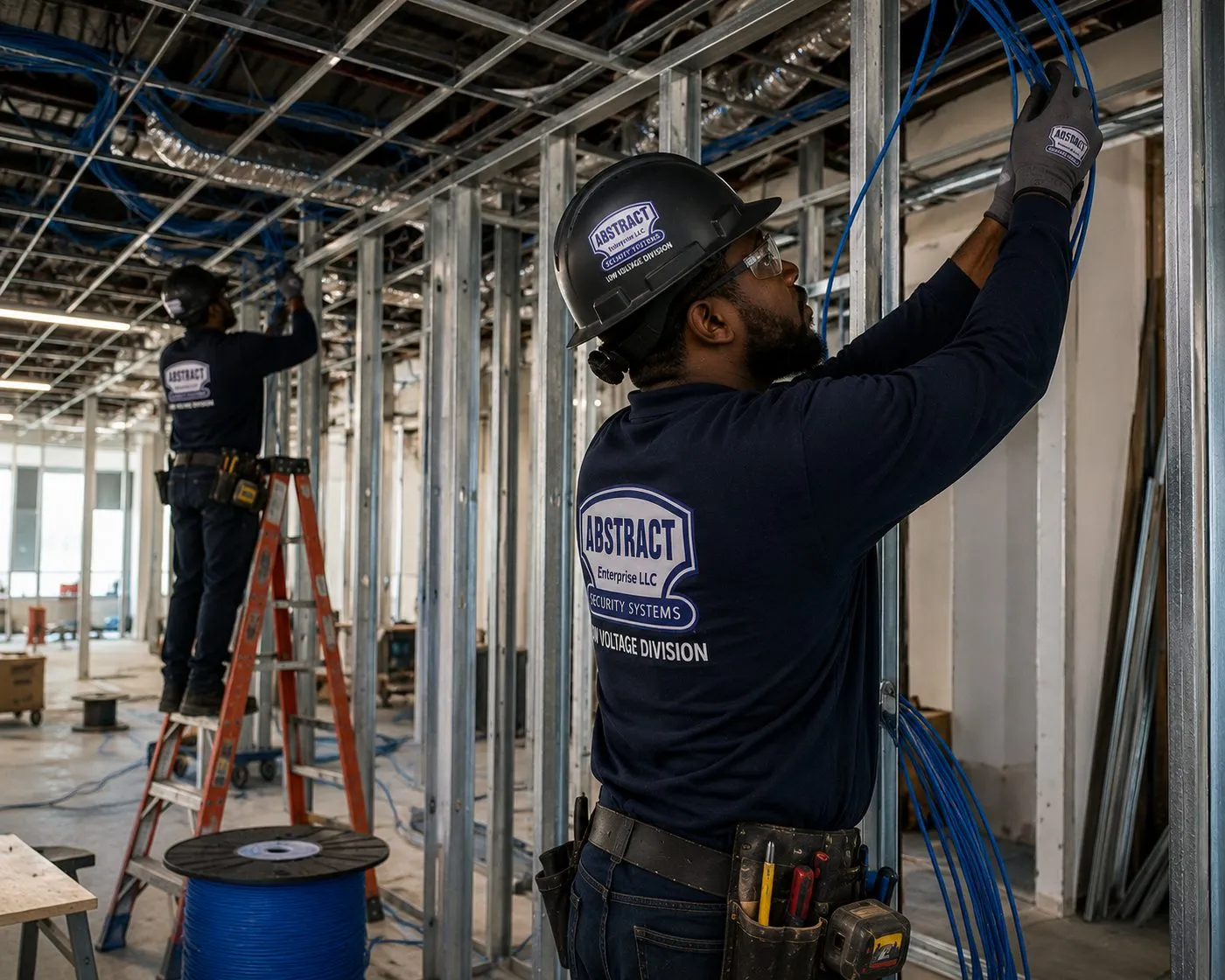
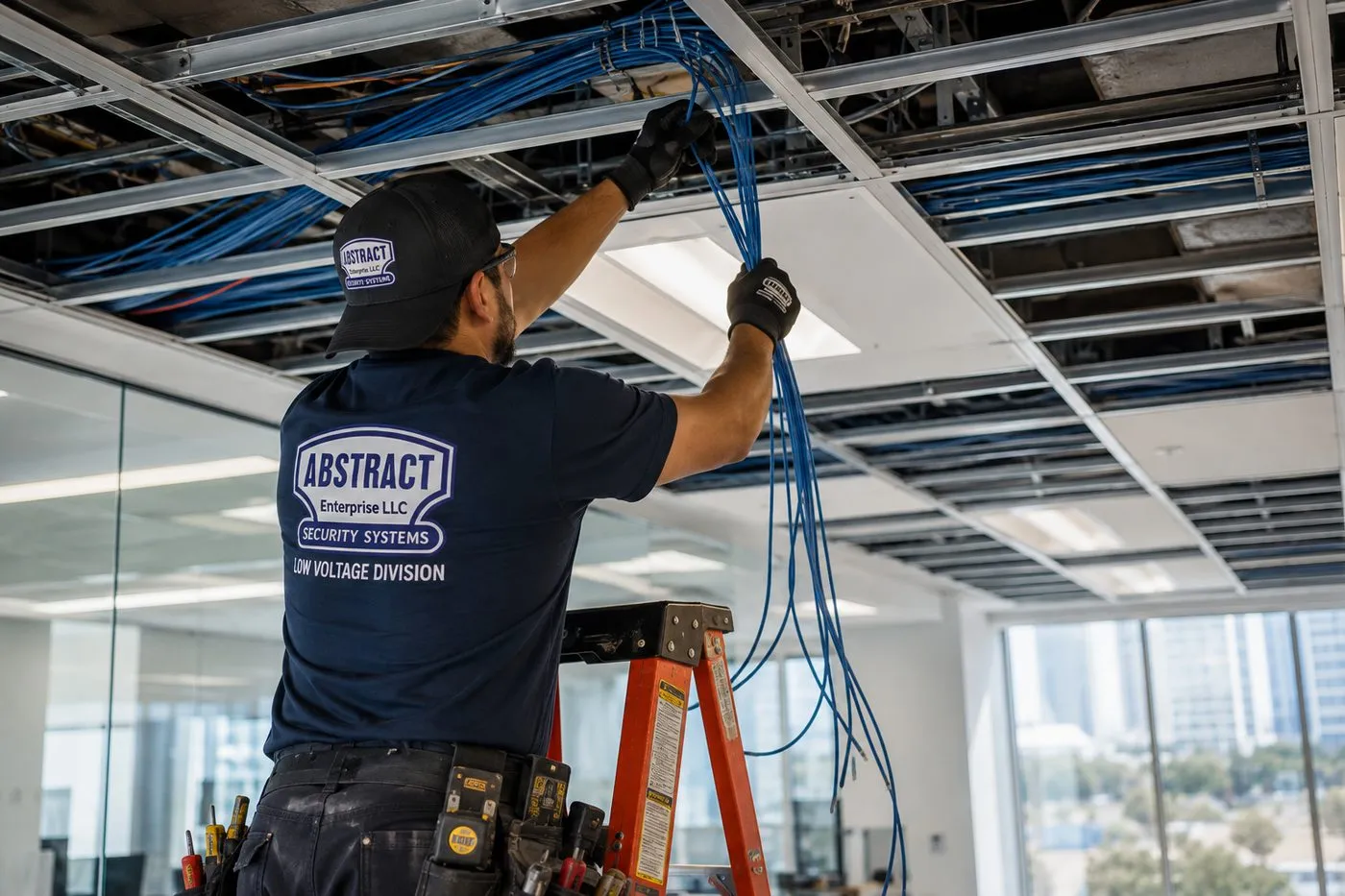
In a building with the framing still open, a technician in a hard hat draws blue cable down through metal studs; behind him a second technician works overhead from an orange ladder, and a spool of blue cable sits on the floor. Cable run at this stage costs a fraction of the same run after drywall.A technician on an orange ladder pulls a loose bundle of blue cable down through a ceiling grid with several tiles removed, more cable visible running above. Above-ceiling routes like this carry speaker and network cable to where a Sonos zone needs it.
Suffolk's businesses are spread along a few long roads and gathered in a handful of large parks. Sonos works best for the smaller ones: an insurance office, a dental practice, a hair salon, a fitness studio, a showroom, a tasting room. They want music the staff can control from a phone, a quieter level in the back, and no rack of amplifiers to maintain. These are the places in Suffolk where we do most of that work.
Route 110, Melville to Huntington Station
Office parks, medical buildings and showrooms line the road north and south of the LIE. Lobby and waiting-room music on a Sonos Amp with ceiling speakers, consult rooms left quiet.
Long Island Innovation Park, Hauppauge
Described by the Hauppauge Industrial Association as the second-largest industrial park in the country, with about 1,350 companies and 55,000 employees. Flex units with an office at the front and a warehouse at the back, which suit two Sonos zones.
Station Yards, Ronkonkoma
The transit-oriented development around Ronkonkoma's LIRR station — Suffolk's busiest, according to the Governor's office — planned for 1,450 homes with retail and office space around them. New ground-floor tenants and new apartments both.
Village Main Streets
Downtown Bay Shore, Patchogue, Huntington, Northport, Port Jefferson, Sayville and Babylon: narrow storefronts, long sales floors and tin or drop ceilings that take in-ceiling speakers on an Amp better than anything on a shelf.
Route 25 and Route 48, North Fork
Tasting rooms, farm stands and restaurants between Riverhead and Orient, many open on a seasonal calendar. A system staff can start with one tap on a busy Saturday, and that stays put when the room is rearranged for an event.
Montauk Highway, the Hamptons and Montauk
Boutiques, galleries and hospitality businesses in the South Fork villages, many reopening every spring. Music has to work on the first warm weekend, and we check it before then.
Rules that touch commercial Sonos work in Suffolk
Who may connect power. Suffolk County's rules for restricted electrician licences say only a master electrician may make direct line-voltage connections. If the amplifier shelf needs a new circuit or receptacle, your electrician installs it; our work starts at the plug.
Cabling as its own licensed category. The same rules list a Communications Cabling restricted licence covering cabling systems of 90 volts or less for networking, cable TV, fiber, "audio and video systems and home theater systems." Ask any installer working in the county which licences they hold, and check with Suffolk Consumer Affairs.
Plenum spaces. When the ceiling cavity of a unit doubles as the path air takes back to the heating and cooling system, any cable laid there must carry a plenum listing. We check the ceiling before choosing the cable.
Outdoor sound in the towns. Some towns limit amplified outdoor sound. Southampton's noise chapter, for example, treats exterior speakers as noise pollution, with an exemption for small outdoor speakers kept within the code's sound levels between 7 a.m. and 7 p.m. — 65 dBA at a residential lot line by day, 50 dBA at night. A patio or courtyard zone gets a volume cap that respects the local code.
Insurance certificates. Landlords and property managers usually want one before any trade works in a unit. Tell us who must be named; there is no charge.
What plays, and under what licence. A shop, studio or tasting room playing music to customers should check its streaming service's terms for public performance. That decision belongs to the business; we configure the service it settles on.
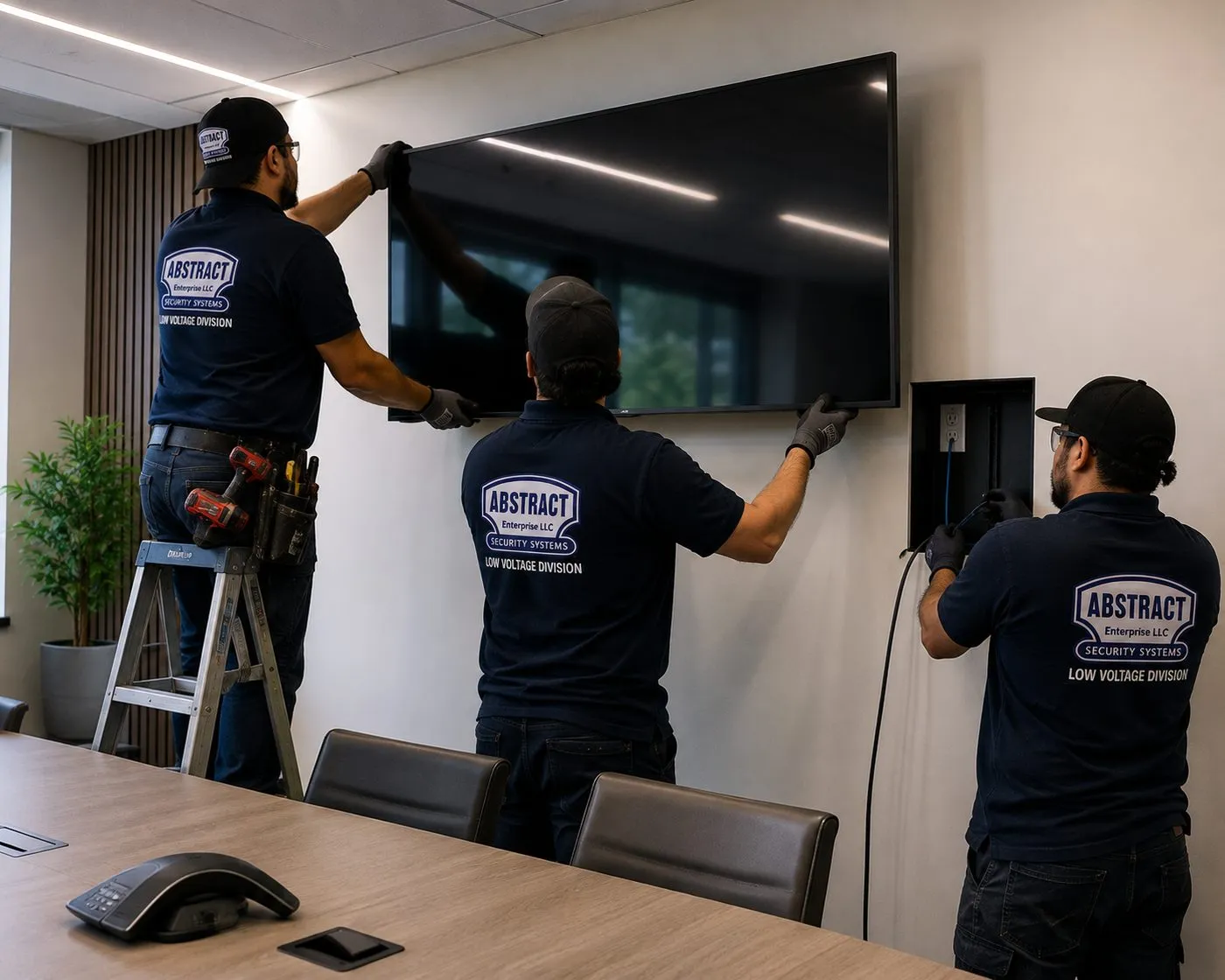
Two technicians lift a large flat screen onto its wall bracket from a step stool while a third, to the right, feeds a black cable into a recessed wall box; a conference phone sits on the table in front. The screen is hung and levelled first, and a soundbar is then centred under it.
A job in Dix Hills and a job in East Hampton share a brand and very little else. We find it useful to think of the county in three bands, because the house stock, the internet service and the way people use the system change as you drive east on the LIE and then on Route 27.
Band
Typical houses
What usually drives the Sonos plan
Western Suffolk — Huntington, Babylon, western Islip and Smithtown
1950s–60s ranches and Capes, colonials and high ranches, canal houses south of Montauk Highway
Attic-down ceiling wiring, a den theater, a gateway in the basement or a front bedroom, and South Shore houses that were raised or rebuilt after 2012
Central Suffolk — Brookhaven, eastern Islip and Smithtown, Ronkonkoma, Riverhead's western edge
Splits and raised ranches, 1970s–80s colonials, newer subdivisions and apartments near transit
Lower-level dens with block walls, half-flight Wi-Fi gaps, renters who need no-holes setups, and new construction ready for pre-wire
The East End — Riverhead, Southold, Southampton, East Hampton, Shelter Island
Farmhouses and village houses, shingle-style and modern custom houses, pool houses, seasonal cottages
Long distances inside the house, outdoor zones by the pool or the water, closed-for-winter routines, and booking around a busy summer calendar
Age matters within each band too. In Point2Homes’ summary of Census survey data, 9.1% of Suffolk’s housing units were built before 1940 and another 4.5% in the 1940s; those are the village houses and farmhouses where plaster, odd framing and add-ons from several eras slow the wiring down. At the other end, 8.3% went up between 2000 and 2009, 3.7% between 2010 and 2019 and 0.7% since 2020 — the newer houses where a pre-wire, an equipment closet and Ethernet to the TV walls may already be in place and simply need finding and testing.
The bands overlap, of course. There are ranches in Montauk and shingle houses in Lloyd Harbor. But when a call comes in from a hamlet we know, the first questions we ask — is there an attic hatch, where does the internet come in, how close is the water, is the house lived in all year — follow this map closely enough that most quotes start from the right assumptions.
Your Questions Answered
Sonos in Suffolk County: Questions Answered
These are the questions Suffolk owners put to us on walkthroughs, grouped by what is really being decided. Shorter questions about booking, payment and logistics sit in the FAQ further down.
Ceilings and walls in ranches, Capes and splits
Our Cape's knee-wall storage is packed with boxes — does it all have to come out before you wire the bedrooms?
Not all of it, but the strip we crawl along does. Behind a Cape's knee walls the cable usually runs along the floor of the void, close to the wall, for most of the length of the house, and we need a clear path about the width of a person from the access panel to each bedroom. Boxes stacked against the roof side can stay where they are. Anything fragile near the hatch is better moved by you before we arrive than by a technician on his knees with a coil of cable.
Two other things help on the day: a working light or an outlet near the hatch, and knowing whether the void floor is boarded or just open joists with insulation between them. Where it is open, we lay boards as we go and put the insulation back as we found it. If the void is completely inaccessible, we look at the small attic over the flat part of the bedroom ceiling instead, which is often reachable through a closet hatch.
The upstairs bedrooms in our Cape have sloped ceilings — will a speaker cut into the slope sound right?
It can, if the slope is gentle and the speaker is placed so it fires toward where people actually sit or lie. On a steep Cape slope, a flat ceiling speaker on the sloped section aims at the opposite wall rather than the bed, and the stereo image leans to one side. The usual answers are to put the speakers in the flat part of the ceiling between the slopes, where there is one, or to use a wall-mounted Era 100 or Era 300 on the knee wall instead.
Wiring a Cape bedroom is generally easier than the placement decision. The void behind the knee wall gives us a run along the length of the house, and the flat ceiling section is reached from the small attic above it. If the room only needs music in the morning and the evening, a single self-powered speaker on a shelf may be the honest recommendation, and we will make it. Sonos's guide to ceiling speakers suggests stereo pairs six to ten feet apart; Cape bedrooms are often narrower than that, which is another reason to keep the plan modest.
Our ranch already has recessed lights in every ceiling — can speakers fit between them without looking cluttered?
Usually, yes, and the light layout tells us where the joists are before we even go into the attic. Recessed lights are fixed to joists or hangers, so the bays between them are the bays we have to work with. We plan speakers on the same centre lines as the lights where possible, so the ceiling reads as one grid rather than two competing patterns. Sonos's in-ceiling speakers have paintable grilles, and a round grille the same colour as the ceiling is less noticeable than most people expect.
The practical limits are clearance and heat. Older recessed housings can run hot, and we keep speakers and their cable away from them; bath fans and ducts also take up joist bays in a ranch more often than you would think. If a speaker position collides with a fixture or a duct, we move it along the bay or switch to the six-inch model, which Sonos lists with a 8.25-inch cut-out against 10.125 inches for the eight-inch. None of that is guesswork once we have been up in the attic, which is why ceiling speakers are quoted after the walkthrough.
The den in our raised ranch is panelling over a block wall — can in-wall speakers go there?
Rarely, and we will tell you so at the walkthrough. A lower-level den in a split or raised ranch is often a poured or block foundation wall with furring strips and wood panelling over it. The space behind the panelling is the depth of the furring, typically far less than an in-wall speaker needs, and the block behind it cannot be cut back. In-wall speakers in that wall would either not fit or would sit in a cavity too shallow to sound right.
What works instead: ceiling speakers, if the den ceiling has accessible joists above it from the kitchen level; a Sonos soundbar and Sub for the TV, with Era 100s on stands or brackets as rears; or wall-mounted speakers on the stud walls that aren't on the foundation side. Cable can often be run inside the furring space horizontally to reach the TV wall, which keeps it out of sight even when the speakers themselves are on the surface. If the den is the room where everyone watches, we treat it as a theater room and plan around what the walls allow rather than what a catalogue shows.
Salt air, flood rules and houses by the water
Our house was raised after Sandy — can the network and Sonos gear go in the enclosure underneath?
We don't put them there. FEMA's technical guidance for the National Flood Insurance Program states that the use of enclosures under elevated buildings is limited to "parking of vehicles, building access, and storage," and FEMA's guide to protecting building utilities expects components below the required elevation to be designed for flood loads or moved above it. A Sonos Amp, a Port, a network switch or a power strip is none of those things. Beyond the rules, the enclosure is where water, salt and humidity collect, and electronics don't last there.
On a raised house we put every powered component in the living space: a closet, a cabinet in the den, or a small shelf near the gateway. Cable to a deck or a dock leaves the house above the living floor and runs down an outside post or under the deck framing in a protected path. If your house was lifted under a program with its own conditions, check those too; we work to whatever the stricter rule is.
A hurricane is in the forecast — should the deck speakers come down?
Usually not, but everything around them should be secured and the electronics protected. Sonos's outdoor speakers by Sonance are rated IP66 and marketed for water, salt spray and UV, and they are bolted to the house on their brackets; what does the damage in a big storm is loose patio furniture, a portable speaker left on the rail and, afterwards, the power. When Isaias came through in August 2020, Riverhead Local reported that PSEG Long Island had more than 420,000 customers without electricity, over 2,600 of them in Riverhead.
Our advice before a named storm: bring portables and their chargers inside, unplug the Amp that drives the outdoor zone and the network gear if you are leaving the house, and leave surge protection in place on everything else. If speakers are mounted somewhere exposed to direct impact, such as an open dock rail, take them down; the brackets are designed to come off and go back on. After the storm, power the network up first, then the Amps, then the speakers, and if a zone doesn't return, book a setup-only visit rather than resetting everything yourself.
Our cottage is on Fire Island — is a Sonos installation practical there?
It is, with planning, because getting there is the hard part. The National Park Service's off-road vehicle permit rules for Fire Island National Seashore allow contractors to apply for permits that only let them drive to the communities where they have work, and summer residents and renters aren't eligible; everyone else reaches the island by ferry, water taxi or private boat. That means fewer trips and a fully planned job: products on site before we arrive, the wire routes agreed in advance from photos, and everything we might need carried over in one go.
Cottages also tend to be small, raised and close to the water, so self-powered Era speakers indoors and a carefully sealed outdoor pair on an Amp kept inside are the usual answer. Tell us which community the cottage is in and how you reach it, and we will say plainly what is realistic and how the visit would be scheduled. Because travel time is part of the job, Fire Island work is quoted as a whole rather than from the fixed line prices alone.
Second homes on the forks and the East End
Should we unplug the Sonos system when we close the house for the winter?
Our advice is to leave the router and the network gear in whatever state the rest of your house systems need, and decide on the speakers based on how the house is kept. If the heat stays on and the power is reliable, leaving everything plugged in lets the system take software updates and saves a round of reconnections in the spring. If the house is fully shut down with the heat off, unplugging speakers and Amps is sensible: Sonos lists the Amp's operating range as 32°F to 104°F, and a cold house in January is outside it.
Either way, the equipment we place goes on surge protection, and we leave a closing-and-opening card with the house: which outlets the Sonos gear is on, the network name, and the order to power things back up. Many East End owners book a short spring visit to check that every room comes back and that any router change over the winter has been followed through. That is a setup-only visit at the Suffolk rate.
Our Hauppauge flex unit has an office up front and a warehouse behind — can one Sonos system serve both?
Yes, and it is a common layout in the Long Island Innovation Park, which the Hauppauge Industrial Association describes as home to about 1,350 companies. The office side usually has a drop ceiling that takes ceiling speakers on an Amp; the warehouse side has a high open structure where ceiling speakers would be too far from anyone to be heard. There, wall-mounted speakers on the same Amp or a separate one, aimed down at the work area, do better. The two sides become two rooms in one Sonos system, each with its own volume, grouped when you want the same music everywhere.
The network is the other half. Warehouses often have Wi-Fi only at the office end, so we either run a cable to the warehouse Amp or place a wired access point out there. Above the office ceiling, cable may need a plenum rating if that space carries return air. If the warehouse has forklifts or loud equipment, we also talk about whether music belongs there at all, or whether a paging feature from a separate system is what is really needed.
The internet and the equipment the house already has
Our guest cottage has its own internet service — can its speakers join the main house's Sonos system?
Not while the cottage is on a separate network. Sonos's system requirements expect the app and every Sonos product to be on the same network subnet, so a speaker in a cottage with its own internet line and router forms its own system, controlled separately. For many East End properties that is actually fine: guests get their own music, and the main house stays untouched.
If you do want one system across both buildings, the cottage has to join the main house's network. That means a cable or a point-to-point wireless link between the buildings, and the cottage's own router either removed or set to access-point mode so it no longer creates a second network. We look at the distance, whether a conduit already exists between the buildings, and which internet service you want to keep, then quote the link separately from the speakers.
Our split-level's den is half below ground with a low ceiling — will an Arc Ultra's upward-firing sound still work there?
It depends on the ceiling more than the bar. Dolby's speaker-setup guide says the ceiling for Atmos height effects should be flat, not angled or vaulted, with a height between 7.5 and 14 feet. A lower-level den in a split or raised ranch is often close to the bottom of that range, and Polk Audio's Atmos guide adds that the ceiling should be rigid and acoustically reflective, and that acoustic ceiling tiles work against it. A den with a drop ceiling of soft tiles, or a soffit right above the TV wall, will lose much of the height effect.
That doesn't make the Arc Ultra a poor choice for the den; its front, centre and bass performance don't depend on the ceiling. It does change what we suggest around it: keeping the bar's top clear of shelves or a soffit, and, if height effects matter to you, ceiling speakers on an Amp in a drywall section of the ceiling rather than relying on reflections from tiles. We check the ceiling height and material at the walkthrough before you buy.
Can we take a Sonos portable to the beach at Smith Point or Robert Moses without ruining it?
Sonos builds its portables for exactly that kind of day, within limits. Sonos rates Roam 2 and Sonos Play at IP67 and Move 2 at IP56, ratings that describe protection against dust and water. Move 2 also has a stated operating range of 32°F to 104°F, and Sonos notes that its charging base is for indoor use only, so the base stays in the house and the speaker goes to the beach charged.
Where we come in is the home end: the portables should be part of the same system as the rest of the house, so they show up in the app the moment they are back in Wi-Fi range, and a spot near the door or the deck with a charging base makes it easy to keep them topped up. Away from Wi-Fi they work over Bluetooth from a phone. If the family really lives on the deck all summer, we usually suggest a fixed outdoor pair on an Amp for the deck and keep the portable for the beach.
Our sunroom has glass on three sides — will Sonos speakers sound good in there?
Better than you might think, with the right speakers and a tuning pass. Glass and tile reflect sound, so a bare sunroom can be bright and echoey, especially at volume. Self-powered speakers that Trueplay can tune help a lot: Sonos describes Trueplay as measuring "how sound reflects off walls, furnishings and other surfaces," and the furniture you add to a sunroom changes the result, so we tune after the room is set up. Ceiling speakers are a good choice if the ceiling is a framed one with access above.
Wi-Fi is not usually the problem; Sonos rates glass as a low obstruction in its wireless-interference guide. The problem is power and heat: many sunrooms are three-season rooms on slabs with few outlets, and a speaker sitting in full sun on a windowsill gets hot. We place speakers out of direct sun and, where the room is unheated in winter, discuss the same seasonal unplugging as for a closed house.
Licensing and business use in Suffolk
The Amp shelf needs a new outlet — who installs it, and who does the speaker cable?
Two different trades, by Suffolk's own rules. The county's rules for restricted electrician licences reserve line-voltage connections to a master electrician, so a new receptacle for an Amp shelf, a recessed TV box or an outdoor outlet is your electrician's job. Speaker cable, Ethernet and the rest of the low-voltage side are ours; those same rules list a separate Communications Cabling category for cabling of 90 volts or less, naming "audio and video systems and home theater systems." Suffolk's home improvement licensing chapter, for its part, defines home improvement contracting as excluding work in the electrical and plumbing fields.
In practice we mark where the outlet is needed at the walkthrough, tell you the height and the load (an Amp and a network switch draw little), and coordinate the day so your electrician is finished before we arrive. AESS holds New York State low-voltage licence #12000287431 and puts its licence and insurance details in writing with the quote; for any contractor, Suffolk County Consumer Affairs is the place to check what you are told.
Our North Fork tasting room plays music for visitors — can it run on the owner's personal streaming account?
That is a question for the streaming service's terms and your music licensing, not for the installer, and it is worth answering before opening weekend. Read the terms of the service you use before opening weekend, and if they are unclear, ask the service or your own adviser; we don't give licensing advice. Sonos works with a long list of streaming services, so the hardware itself won't limit the choice you make.
What we do is set the system up so whichever service you choose is easy for staff: one favourite for the tasting room, another for the patio, volume limits so a busy Saturday doesn't drift louder than a neighbour or the town code would like, and a simple way to bring everything back if someone changes it. If the building also hosts private events with a band or DJ, we add a line input so their mixer can feed the house speakers without anyone unplugging the Sonos gear.
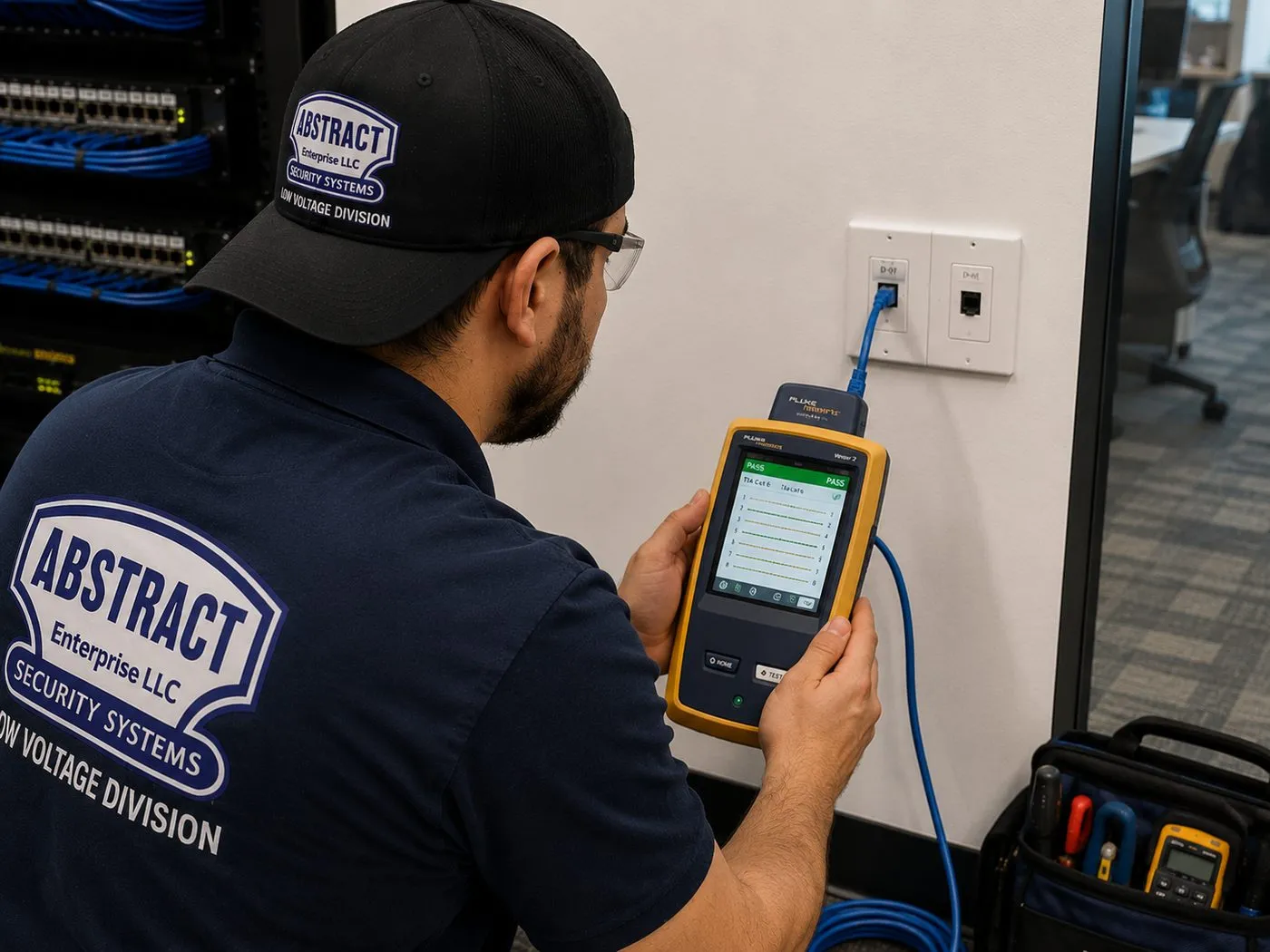
A technician crouches at a wall plate holding a yellow handheld cable tester connected by blue patch cable to the jack, its screen showing a list of results; a patch panel is visible at the left edge. Every network run feeding a wired Sonos product or mesh node is tested before hand-over.
Equipment
Types of Sonos Systems We Install
Sonos makes the products; the house decides which ones fit. You buy the equipment from the retailer you prefer, or we quote it separately. Specifications below come from Sonos's own product pages and guides unless a reviewer is named.
Arc Ultra
Sonos's large soundbar: 46.38 in wide, 13.01 lb, HDMI eARC, Wi-Fi 6 and Bluetooth, with Trueplay tuning from iOS or Android. When it is wall-mounted it detects the mount and adjusts its bass. Best for big Suffolk family rooms and open-plan great rooms.
Beam (Gen 2) and Ray
Beam is 25.63 in wide with HDMI eARC, right for a den or a Cape living room with a mid-size screen. Ray connects by optical and suits a bedroom or a TV with no eARC port.
Sub 4
The wireless sub that pairs with Arc Ultra, Arc, Beam, Ray and others, with an optional Ethernet port. It can lie flat under a sofa, which helps in a small ranch den where a corner is already taken.
Era 100 and Era 300
Self-powered speakers for rooms that can't be wired and for rears behind the sofa. The Era 300 wall mount is for studs only, not plain drywall. Both support quick Trueplay tuning from Android as well as iPhone.
Sonos Amp
What drives passive ceiling, wall and outdoor speakers. Sonos rates it at 125 W a channel into 8 ohms, with an HDMI ARC input for the TV, an analog line input and a pair of Ethernet sockets. Sonos says it reliably powers up to three pairs of its Architectural speakers in parallel. Operating range 32°F–104°F, so it lives indoors.
In-Ceiling and In-Wall by Sonance
Passive speakers designed for the Amp, in six- and eight-inch ceiling versions with paintable bezel-less grilles. Cut-outs of 8.25 in and 10.125 in; mounting depth under 5.5 in.
Outdoor by Sonance
Weather-built passive speakers, rated IP66 and marketed for humidity, salt spray, UV and freezing temperatures, from −13°F to 149°F. Powered by an Amp kept inside the house.
Sonos Port
Streams Sonos into an existing receiver or powered speakers through analog or coaxial outputs, with a 12V trigger to wake the receiver. The bridge between an older den stereo and the rest of the house.
Era 100 Pro
Sonos's speaker for professional installation, with PoE+ power over a single network cable and automatic tuning for wall or ceiling orientation. Useful in a business, or where one cable is easier than a speaker run and an outlet.
Combo Adapter
Sonos's adapter that lets an Era 100, Era 300, Move 2 and some others be hard-wired to the network, priced by Sonos at $39. Useful at the far end of a long ranch.
Network details that matter more in Suffolk houses
2.4 GHz must be on. Sonos's system requirements say every product connects to 802.11b/g 2.4 GHz, and routers that only offer 5 GHz aren't supported. Some newer gateways and mesh kits have to be told to keep 2.4 GHz available.
No range extenders, no powerline. Sonos lists wireless range extenders and Ethernet-over-Power among unsupported setups. In a long ranch, the fix is a mesh node with wired backhaul or a cable, not a plug-in extender.
No guest or sign-in networks. Sonos doesn't support guest networks or portal log-ins. Seasonal rentals and offices that use them need a separate main network for the speakers.
One subnet. The app and every product must sit on the same subnet. A gateway and a second router both routing break that rule.
Keep distance from other electronics. Sonos's interference guide asks for at least 18 inches between Sonos products and other electronics, and rates metal as a very high obstruction — worth remembering beside a refrigerator or behind a TV.
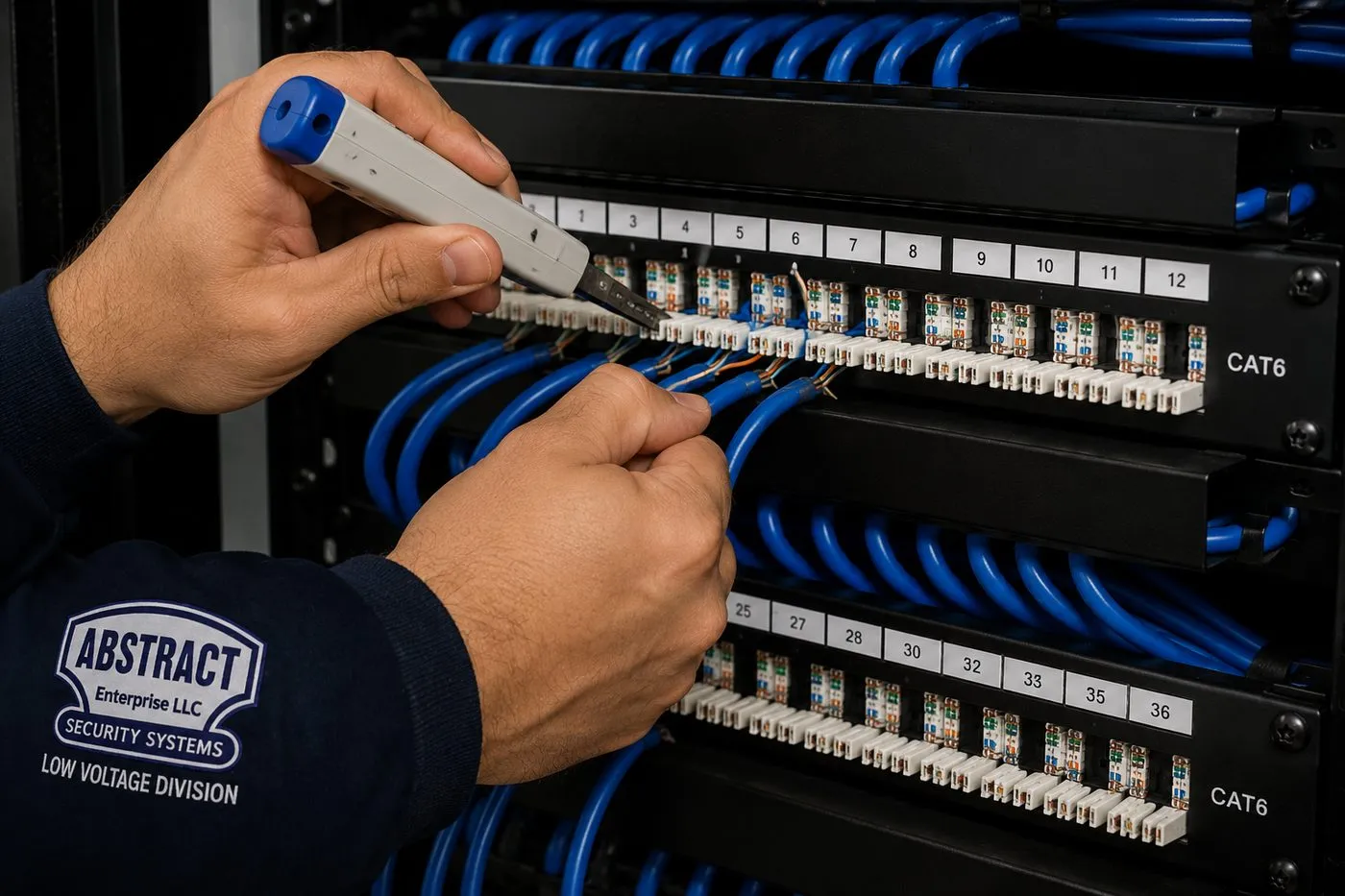
Close-up of a technician’s hands pressing blue cable conductors into a numbered patch panel labelled CAT6 with a blue punch-down tool, with rows of blue cable looping below. Where a house has a network closet, this is where the Ethernet for Sonos ends up.
AI Overview Reality Check
What AI Gets Wrong About Sonos Installation in Suffolk County
We could not view Google's AI Overview from our build environment, so we are not quoting it. The seven claims below are ones that cost guides, forums and installer marketing actually publish, and that answer engines tend to repeat. Each is set against what we find in Suffolk houses.
"Anyone handy can run speaker wire; it isn't real electrical work"
It is true that speaker cable carries low voltage, and nobody needs an electrician to plug in an Era 100. But Suffolk doesn't treat installed audio cabling as unregulated. The county's restricted electrician licence rules include a Communications Cabling category that names "audio and video systems and home theater systems," alongside networking, cable TV and fiber, for cabling of 90 volts or less.
The same rules reserve line-voltage connections to a master electrician, which matters the moment someone wants a new outlet for an Amp shelf or behind a wall-mounted TV. And the county's home improvement chapter defines home improvement contracting as excluding electrical work, which is why a general contractor's home improvement licence isn't the whole story.
None of that means a homeowner can't place their own speakers. It means that when you hire someone to cut ceilings and pull cable through a Suffolk house, it is reasonable to ask which licence they work under and to check it with Consumer Affairs.
"In-ceiling speakers are installed from below in an afternoon"
A low-voltage installers' discussion group puts the time at around 45 minutes to an hour per speaker, and in a house with an open basement below and a clear attic above, that's fair. In a Suffolk ranch it leaves out the attic: the climb, the raking back of blown-in insulation, the hunt for the right joist bay between lights and bath fans, and the time spent putting the insulation back properly.
In summer, attics are also hot. An insulation contractor's guide notes that a hot attic can reach 130 to 150 degrees on a sunny day, so we schedule attic-heavy ranch work for mornings in July and August, and that affects how many rooms fit into a day.
The cut itself is quick. The planning around it is what decides whether the job looks clean, and why we quote ceiling rooms after seeing the attic rather than from a per-speaker figure.
"Any outdoor speaker will be fine on the deck"
Plenty of outdoor speakers are rated for rain. Salt air near the bays, harbors and the ocean is a harder test, for the speaker and for every screw, bracket and terminal around it. Sonos markets its outdoor speakers by Sonance specifically for salt spray as well as humidity, UV and freezing temperatures, and that is the kind of rating to look for within reach of salt water.
The weak points are rarely the speaker cabinet. They are the bracket fasteners, the wire terminals and the cable entry into the house. We use stainless hardware where it is exposed, keep terminals protected, and seal the wall entry properly.
The amplifier is the other half of the claim: a passive outdoor speaker needs an Amp, and the Amp belongs inside the conditioned house, not in a shed or under the deck.
"Put the extra equipment in the garage or under the house"
It is common advice because it keeps the living room tidy. In Suffolk it often puts electronics in the worst place in the building. Sonos lists the Amp's operating temperature as 32°F to 104°F, and an uninsulated garage leaves that range in both directions over a year.
Under a raised house, the problem is regulatory as well as physical. FEMA limits the use of enclosures below elevated buildings to parking, building access and storage, and expects utilities below the required elevation to be protected from flood or moved above it.
The better spots are a hall closet, a basement where there is one and it stays dry, a cabinet in the den, or a small shelf near the network gear — all indoors, ventilated, and within reach of a cable run.
"Add a Wi-Fi extender for the far bedroom"
Plug-in range extenders are the first thing many guides suggest for a weak room, and a long single-storey ranch has plenty of weak rooms. Sonos lists wireless range extenders as unsupported, along with Ethernet-over-Power adapters.
The answer in a ranch is usually a mesh system with the nodes placed along the length of the house, ideally with Ethernet between them, or a cable from the network to one Sonos product at the far end. In a split-level, nodes go on the levels people actually use, not all on one landing.
Sonos's own interference guide is also worth reading before blaming the speakers: concrete is rated a high obstruction and metal very high, and the poured wall between a split-level's den and its garage is often the first of those.
"The router your internet company gave you is fine"
The gateway is fine as a gateway. The trouble starts when a homeowner adds their own mesh system behind it and leaves both routing, so the house has two networks on two subnets. Sonos requires the app and all of its products on the same subnet, and Sonos community answers and Reddit threads trace a lot of "half my speakers vanished" complaints to exactly this.
The fix is to have one router: either the cable company's gateway in bridge mode, with your own system routing, or your mesh in access-point mode behind the gateway. Which is right depends on the equipment and the provider.
Gateway swaps by the provider are also why seasonal houses lose their Sonos systems over the winter. The speakers remember the old network, and someone has to reconnect them to the new one.
"A city installer will just add a travel fee for the Hamptons"
Some New York City-based installers do price Suffolk by distance from Midtown and say a travel fee may apply in the Hamptons. That isn't wrong for them; it is just a different model from a crew that works across the county every week.
Our Suffolk prices are published on this page at our 1.20 Suffolk rate, the same from Huntington to Montauk, with no separate travel surcharge. What changes further east is scheduling, not price: we group East End and North Fork jobs, so booking a few days ahead gives you the most choice of arrival windows.
The exception is work that needs a ferry or boat crossing, such as Fire Island, which we quote as a whole job so the travel time is visible rather than hidden in an hourly figure.
Start With the Attic Hatch, Not the Catalogue
Send the hamlet, the house type and a photo of the room. We'll tell you how the wire gets there and what each line costs at Suffolk rates.
Tell us about the house and the rooms, and a Suffolk technician replies the same business day. Rather talk it through? Call (631) 407-2884.
✅
We Got Your Request!
A Suffolk technician will phone you the same business day. If it can't wait, call (631) 407-2884.
How It Works
Our Installation Process
Seven steps, from a single den theater in Lindenhurst to ceiling speakers through a Southold farmhouse. One-room jobs usually finish in one visit; ceiling and outdoor rooms are scheduled in agreed stages.
1. Describe the house
Phone (631) 407-2884 or send the form: hamlet, house type, rooms, and which Sonos boxes are already bought. The reply lists the Suffolk fixed prices that fit and anything that needs eyes on site.
2. Attic, basement and outside check
For wired rooms, a technician goes into the attic or knee-wall void, looks at any basement or slab, checks Wi-Fi in each room and walks the outside route to a deck or dock.
3. Written room-by-room quote
You get every room priced separately, with the wire route described, so you can start with two rooms and add the rest later.
4. Book the windows
Two-hour arrival windows from 8 AM to 8 PM, seven days. Attic-heavy work is booked early on hot days; East End jobs are grouped, so a few days' notice helps.
5. Wire, cut and mount
Cable laid across the joists or behind the knee walls, insulation put back, ceiling speakers fitted, the bar mounted to the screen and the Amp placed indoors with clearance.
6. Network, setup and tuning
One router on one subnet, every product added to your system, rooms named and grouped, Sub and rears bonded, Trueplay run in each room that supports it.
7. Hand-over and records
We walk through the app on your phone, leave labelled equipment, photos of every run and, for seasonal houses, a closing-and-opening card.
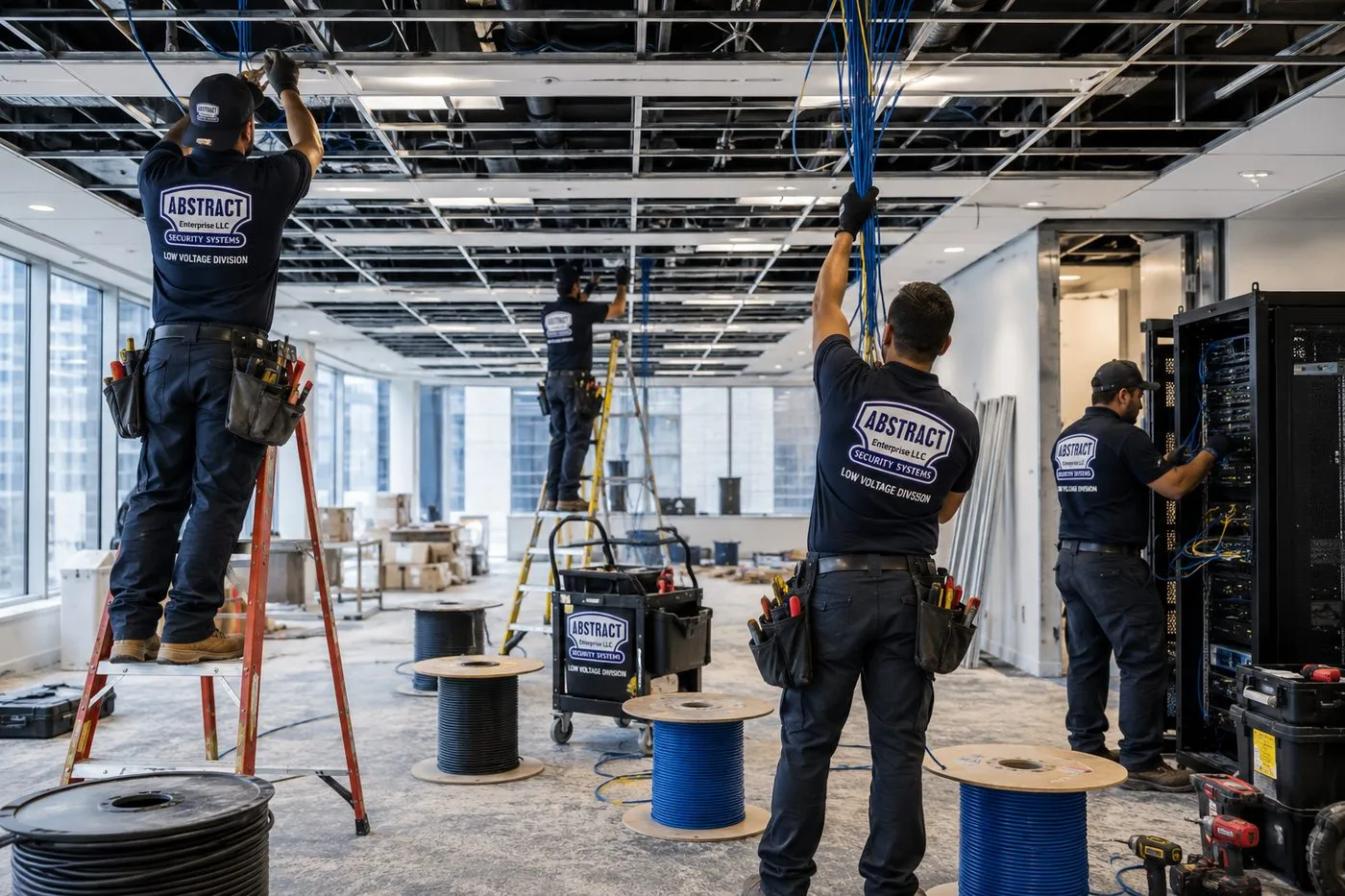
On an unfinished floor with the ceiling open, three technicians feed blue cable up into the structure from ladders and the floor while a fourth works at a network rack on the right; spools of blue and black cable stand on the concrete. Pre-wire for a whole building is laid out this way, run by run.
Coverage Area
Sonos Installation Near Suffolk County's Landmarks
Suffolk people give directions by the landmarks as much as by the roads. Here are six, from the North Shore to the North Fork, and we install Sonos in the houses and businesses around all of them.
Vanderbilt Museum, Centerport
Eagle's Nest, William K. Vanderbilt II's 43-acre waterfront estate above Northport Bay, built in stages between 1910 and 1936 in the Spanish Revival style and left to Suffolk County. It opened to the public in 1950 and includes the 147-seat Reichert Planetarium.
Heckscher Park, Huntington
An 18-acre park at Prime Avenue and Route 25A, a gift of August and Nannie Heckscher that passed to the Town of Huntington in 1954. Its Chapin Rainbow Stage hosts the Summer Arts Festival, first presented in 1966.
The Big Duck, Flanders
A 20-foot duck-shaped building put up in 1931 by duck farmer Martin Maurer as a shop on West Main Street in Riverhead, moved to Flanders in 1937 and listed on the National Register of Historic Places in 1997. Now a Suffolk County Parks site.
Brookhaven National Laboratory, Upton
The U.S. Department of Energy laboratory established in 1947 on the site of the former Camp Upton, in the hamlet of Upton in the Town of Brookhaven, the county's largest town.
Horton Point Lighthouse, Southold
A North Fork lighthouse commissioned in 1790 and built in 1857, one of the historic destinations on the Southold shore. Southold's farmhouses and newer houses spread out around it.
The Old House, Cutchogue
A house believed to date to about 1649 and designated a National Historic Landmark in 1962. A reminder that some North Fork houses are older than any wiring code.
We also install throughout Huntington Station, Melville, Dix Hills, Commack, Northport, Kings Park, Smithtown, Hauppauge, Bay Shore, Islip, Sayville, West Babylon, Lindenhurst, Amityville, Deer Park, Ronkonkoma, Centereach, Selden, Stony Brook, Port Jefferson, Patchogue, Medford, Shirley, Riverhead, Mattituck, Greenport, Westhampton, Southampton, East Hampton, Sag Harbor and Montauk. Suffolk is one of two counties covered by our Long Island Sonos installation hub.
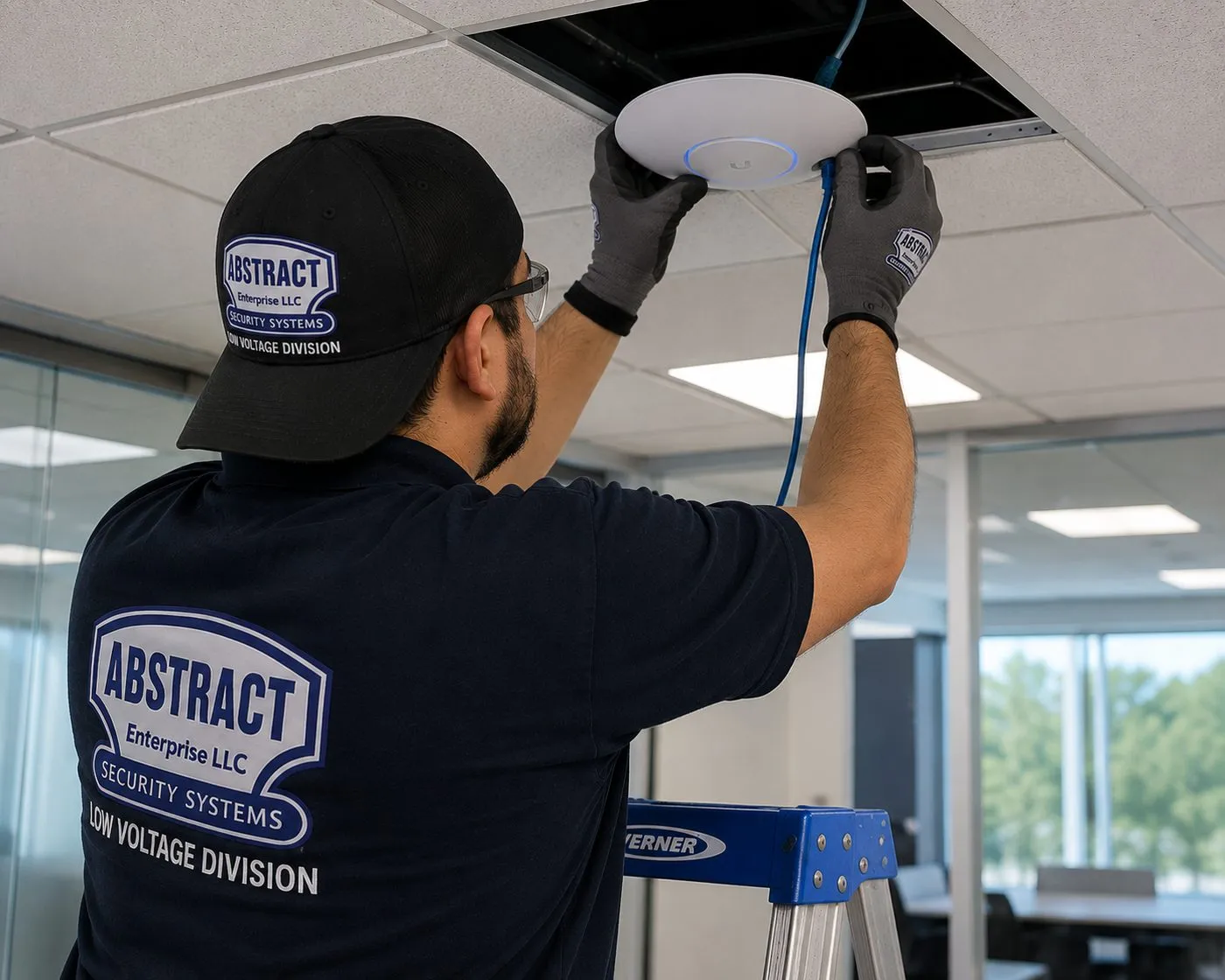
A technician on a stepladder lifts a round white wireless access point into an opening in a tiled ceiling, a blue network cable feeding it from above. A wired access point at the far end of a long house does more for Sonos than any plug-in extender.
Pricing
Sonos Installation Cost in Suffolk County
Every fixed price below is an AESS published line at our Brooklyn base, multiplied by the 1.20 Suffolk area rate and rounded half-up. Work that depends on the attic, the walls or the distance to the deck — ceiling speakers, outdoor speakers, new cable runs and pre-wire — is quoted in writing after a walkthrough, before anything is cut.
Item
Suffolk price
What it covers
Sonos setup
$150
All your Sonos products brought into a single system on the right network, with rooms, groups, streaming logins and tuning done
Soundbar wall-mounted under the TV
$155
The bar fixed below the TV on a bracket, centred to the screen and connected
Soundbar placed on a console or mantel
$95
Placed, connected to the TV and tested
In-wall concealment
$203
Recessed kit that takes the TV's power and HDMI inside a hollow wall the way the code allows
Paintable cord cover
$71
Surface raceway where the wall can't be opened, such as block or a slab-built addition
Cable run to a cabinet or other spot
$119
Up to 25 ft
A/V receiver hookup
$155
Receiver connected and configured, for example with a Sonos Port
Universal remote
$119
Programmed for TV, Sonos and sources
Streaming device setup
$59
Per device
Full home theater setup
$420
Multi-component system: TV, bar, Sub, rears and sources working together
Ceiling or wall speakers on a Sonos Amp
Quoted at walkthrough
Within our published whole-home audio range of $960–$3,000 per zone at Suffolk rates
Outdoor speakers, deck or dock runs, pre-wire
Quoted at walkthrough
Depends on route, wall entry, distance and framing
Wall and access add-ons at Suffolk rates
Condition
Price
Drywall on wood studs
$0
Metal studs
+$36
Plaster
+$54
Brick or stone, including most fireplace surrounds
+$78
Concrete or block, including split-level foundation walls
+$90
Tile or marble
+$114
Plywood backer board
$102
High mount (above about 8 ft), common in East End great rooms
$90
Box removal
$30
Certificate of insurance for a landlord, HOA or property manager
Free
Setup-only visits
Visits with no drilling or cutting in them — a system lost after the provider swapped the gateway, rooms to regroup, a dropout to chase, a summer house to bring back — are charged by time: $234 for the first hour in Suffolk, then 30-minute blocks.
What is included, and what isn't
In the price: the bracket fixed and the bar level, the TV link checked, all products in one Sonos system with sensible room names, your streaming logins entered, tuning run where the room allows it, attic insulation returned to where it was, and the dust vacuumed before we leave.
Not our trade: line-voltage wiring. Any new outlet for an Amp shelf or behind a TV is your electrician's job; plaster or ceiling patching and repainting are for your painter.
Who supplies what: the speakers, bars and Amps come from wherever you like to shop, or appear as a separate line on our quote; mounting brackets, cable, raceway and recessed kits are ours and are covered by the lines in the table.
No travel surcharge: the same prices apply from Huntington to Montauk. Jobs that need a ferry or boat crossing are quoted as a whole.
National averages versus a Suffolk quote. National cost guides assume an open basement, a convenient attic and a router in the middle of the house. A Suffolk quote has to account for the slab, the hot attic, the block wall in the den and the salt air on the deck. Our Suffolk TV mounting price page lists our TV mounting work for the county in one place.
Shop Our Systems
Sonos Installation Packages & Pricing
The three bundles below are simply published Suffolk lines added together, so nothing is hidden in a package price. Surcharges for brick, block or tile walls sit on top.
Starter — Sonos Setup
$150
Sonos setup ($150): every product you already own joined to one system on the right network, rooms named and grouped, services signed in and Trueplay run where supported. For a family with speakers in boxes, or a seasonal house that needs a clean start.
Standard — Bar on the Wall + Setup
$305
Sonos setup ($150) plus the Arc Ultra, Beam or Ray wall-mounted under the screen ($155): $305 in all. A brick fireplace surround adds $78; a block den wall adds $90.
Premium — Bar, Hidden Cables + Setup
$508
Standard ($305) with the cords gone: the TV's power and HDMI routed inside the wall through the recessed kit line ($203), for $508 in total. Needs a hollow wall; on block or brick we recommend the cord cover instead.
Bring Your Own Equipment — Labour Only
Bought the bracket with the bar? We fit yours for the same $155 wall-mount line plus any surcharge for the wall, and add $150 if you also want the system set up. The bracket has to be rated for that soundbar and is covered by its own maker's warranty; if it won't hold safely on your wall, you hear that before the drill comes out.
Ceiling-Speaker Rooms
Rooms with speakers cut into the ceiling or wall get their own price once a technician has seen the attic or the void behind the knee wall; that crawl, not the speaker, decides the labour. At Suffolk rates our published whole-home audio range is $960 to $3,000 per zone installed, and your written quote shows where each room falls before you commit.
A Price for Every Room Before Anything Is Cut
Fixed lines at Suffolk rates, ceiling rooms quoted after the attic visit, and no travel surcharge to the forks.
What We Check in a Ranch Attic Before Quoting Ceiling Speakers
Most of the price of a ranch ceiling-speaker room is decided in the first ten minutes in the attic. This is the list our technicians work through on the walkthrough, so you know what we are looking at when we disappear up the hatch.
Headroom over the room. Low-pitched ranch roofs leave little space near the eaves. A speaker near an outside wall may be unreachable from above, which moves it inward or changes the method.
Joist direction and spacing. Speakers sit between joists, and the joist direction decides whether a stereo pair can sit where the room needs it.
Insulation type and depth. Loose fill can be raked back and replaced; batts are lifted and laid back; sprayed foam on the attic floor is a different conversation.
What else lives in the bays. Recessed-light housings, bath-fan ducts, HVAC ducts and old cable all take space. We plan around them rather than through them.
The route to the equipment. Where the Amp will sit — a hall closet, a den cabinet, a basement where there is one — and how cable gets from the attic down to it through an interior wall.
Heat. The attic is for cable and speakers, never for the Amp. Cable is laid on the joists under the insulation, away from the roof deck, and we schedule attic work early on hot summer days.
Signs of old work. A coil of old speaker wire, a forgotten intercom cable or an abandoned antenna lead tells us what has been tried before and what might be reused.
If the attic answer is bad — no access, sprayed foam, or a room under a cathedral ceiling — we say so and suggest self-powered Era speakers or a wall-mounted pair instead. Some rooms are better without holes in the ceiling.
Seasonal Houses
Closing and Reopening an East End House With Sonos
A Sonos system in a house that is shut for seven months needs a routine, not a rescue every May. This is the routine we leave with East End and North Fork owners, adapted to how each house is kept over the winter.
When
What to do
Why
Closing in autumn
Note the network name and the gateway model; decide with your caretaker whether speakers and Amps stay powered; unplug outdoor-zone Amps if the heat will be off
The Amp's listed operating range is 32°F to 104°F; a closed, unheated house can go below it
Over the winter
Tell us, or your caretaker, if the internet provider replaces the gateway or changes the Wi-Fi details
The speakers keep looking for the old network and won't appear in the app until they are reconnected
Before opening
Power the network first, then Amps and Ports, then the speakers; open the app once everything has had a few minutes
Products reconnect more cleanly when the network is already up
Opening weekend
Play every room and every group once; check the outdoor zone at the far end of the yard
Problems found on a Thursday are easier to fix than ones found during a Saturday lunch
If a room is missing
Book a setup-only visit ($234 first hour in Suffolk)
Most reopening faults are network or pairing issues and are fixed in one to two hours
Owners who rent their house for part of the season should also check their town's rules; Southampton, for example, treats stays shorter than 14 days as transient rentals and requires a rental permit renewed every two years. Those rules are about the house, not the speakers, but they decide who will be using the system and for how long.
New Construction
Pre-Wiring a New Suffolk House for Sonos
Census QuickFacts counted 1,399 building permits in Suffolk in 2025, and every new house has a short window when cable is cheap. These are the points we add to a pre-wire plan in this county specifically.
Equipment in conditioned space. Choose a closet or a basement corner inside the heated envelope for Amps, the network switch and the gateway. Not the attic, not the garage, and on a raised flood-zone house never the enclosure below.
Home runs from every speaker location. Each ceiling and wall speaker gets its own cable back to the equipment location, labelled at both ends, so zones can be changed later without opening walls.
Ethernet to every TV wall and the far end of the house. East End houses with wings, pool houses and garages over the drive need a cable to each end for mesh nodes or a wired Sonos product.
A protected path to the deck, patio and pool. A sleeve through the rim joist or foundation wall, above the flood elevation where that applies, sealed and ready for outdoor cable.
Rough-in brackets before insulation. Brackets for ceiling speakers set between the joists so the drywall crew cuts around them and the insulation crew works around them.
Power where the equipment will be. Ask your electrician for a dedicated outlet at the equipment location and behind each TV; it is easier on the plans than after.
Photos before the walls close. We photograph every run with a tape measure in frame and send them to you, so anyone working on the house later knows where the cable is.
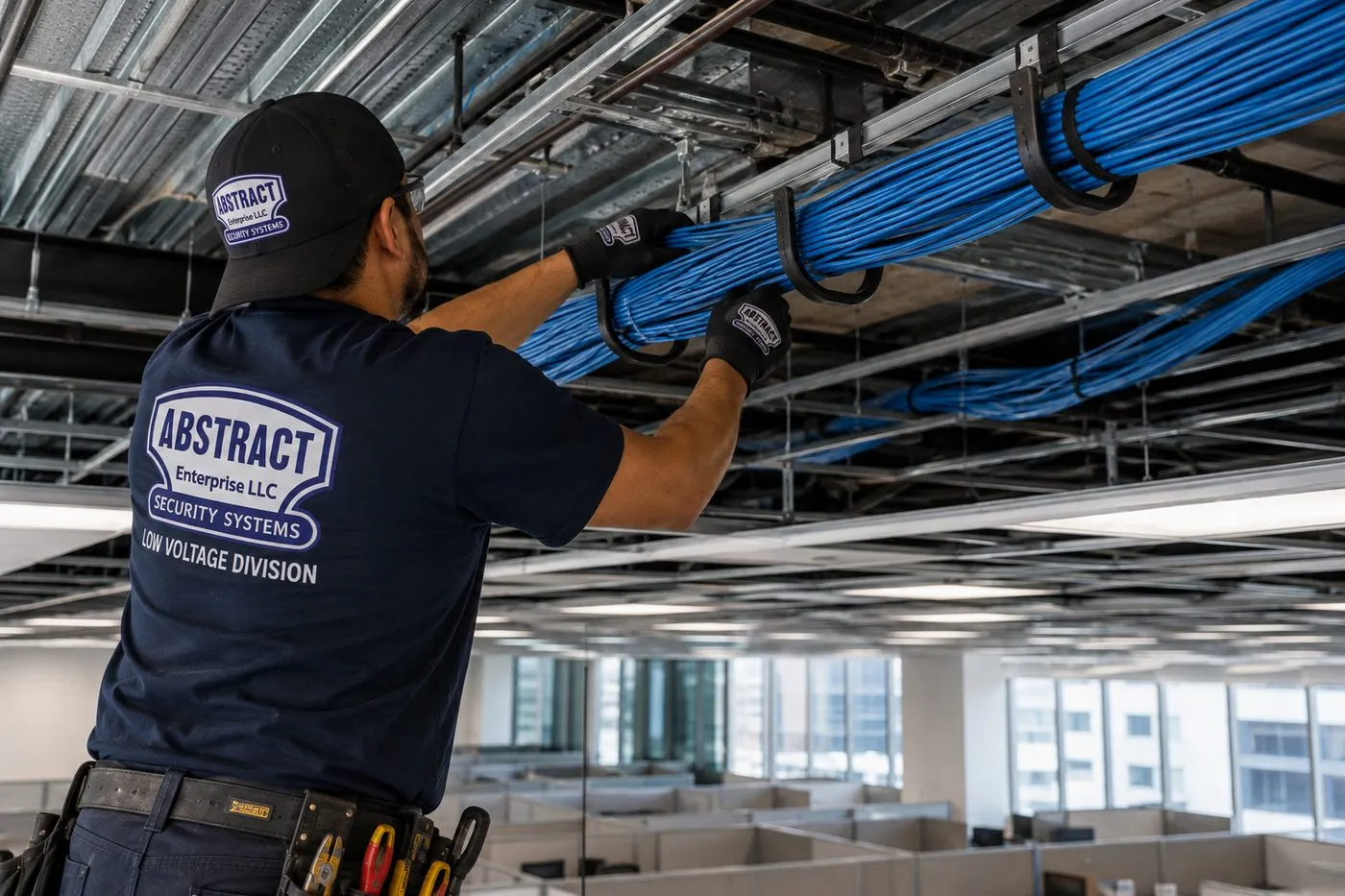
A technician reaches up to lay a thick bundle of blue cable into a row of black J-hooks hung from the structure of an open ceiling, with a cubicle floor and windows below. Supported, separated cable paths are what keep a pre-wire tidy and traceable years later.
Complete Services
Every Sonos Installation Service in Suffolk County
Most Suffolk Sonos plans end up involving a screen, a router or a door as well. These are the related pages for the county, all served by the same Suffolk desk.
Arrival windows, rescheduling and what is included, in full.
Field Notes
Field Notes From Suffolk Sonos Walkthroughs
How our technicians approach a first visit to a Suffolk house (general practice, not one customer's job)
We ask two questions on the doorstep before anyone talks about speakers: where is the attic hatch, and where does the internet come in? In a ranch the hatch is usually in a hallway or a closet, and the answer to "can we get over the living room?" is found within a few minutes of climbing up. In a Cape we ask to see behind a knee-wall panel. In a split we go to the lowest level first, because that is where Wi-Fi is weakest and walls are hardest.
Next we walk outside. If the house is near the water we look at the siding, the deck framing and where cable could leave the house above any flood line. If it was raised, we look at what is under it and make sure nothing we install ends up there. On the East End we ask how the house is kept in winter, because that changes where we put the Amps and how we label them.
Only then do we sit down with the owners and the list of rooms. By then the plan mostly writes itself: which rooms can take ceiling speakers cleanly, which should get a self-powered speaker, where the equipment will live, and what the network needs. The quote follows the same order, room by room, with the fixed lines at Suffolk rates and the ceiling rooms priced from what we saw in the attic.
FAQ
Suffolk County Sonos Installation FAQ
Does the Suffolk rate apply to the Sonos products themselves, or only to the labour?
+
Only to our published work lines. Those are set at a Brooklyn base and carry Suffolk's 1.20 area multiplier, rounded half-up, so a $125 setup line is $150 here. Sonos products you buy from a retailer cost whatever that retailer charges. If we supply products, they appear as separate lines on the quote, not inside the labour figures.
Do you charge extra to come out to Montauk or Orient Point?
+
No. The Suffolk prices on this page apply across the county, including the North Fork and the South Fork. What changes further east is scheduling: we group East End jobs, so booking a few days ahead gives you more choice of two-hour windows. Work that needs a ferry or boat, such as Fire Island, is quoted as a whole job.
Can outdoor speakers be installed in winter, or should we wait for spring?
+
The indoor half can be done any time: the Amp, the cable inside the house and the wall entry from inside. Outside work on a deck, a dock or a shingled wall goes better on a dry, mild day, so in winter we book it around the weather. Many owners have the cable and the Amp fitted in winter and the speakers hung on the first good spring day.
Is it worth adding Sonos before we put the house on the market?
+
We can't tell you what it adds to a sale price; that is a question for your agent. What we can say is that a simple, working system with labelled equipment is easier to hand over than a half-finished one, and that ceiling speakers are fixed to the house while bars and portables usually leave with you, so plan which is which.
Where cable can't go inside the wall, can the cover be painted to match the trim?
+
Yes. Where a wall can't be opened, such as block in a split-level den or a slab-built addition, we use a paintable cord cover, $71 at Suffolk rates. It is fixed tight along the trim or the corner, and your painter can finish it in the wall or trim colour so it all but disappears.
Can we add a second Sub or more rear speakers later without redoing the install?
+
Yes. Sonos lets Arc Ultra, Arc, Beam and Ray run two subs, either two Sub 4s or a Sub 4 with a Sub Gen 3, and rears can be added to a soundbar at any time. We place the first Sub and leave power where a second would go, so adding it later is a short setup-only visit rather than a new installation.
Can you install in a seasonal house while it is closed for the winter?
+
Yes, with access arranged through you or your caretaker. We ask that the heat be on for the visit and for the days after, because Sonos lists the Amp's operating range as 32°F to 104°F, and we test every room before leaving. You then get a short video or call to confirm each zone plays before you reopen the house.
How is payment handled on a large multi-room job?
+
A multi-room job is split into stages we write into the quote, and it is booked with a deposit under our service agreement. Full terms — including 50% deposit, one-year parts-only warranty on AESS-supplied products, and the late-fee schedule — are set out in the service agreement. Sonos products bought from a retailer carry Sonos's own warranty.
Our house is in a gated community on a private road — what do you need from us?
+
The gate code or the name to leave with the guard, the access rules for contractors, and any hours the association sets for trade work. Tell us when booking, and we put it on the job sheet so the technician arrives inside your two-hour window without a wait at the gate.
Can you take the Sonos gear down for a painter or a roofer and put it back afterwards?
+
Yes. We can remove the soundbar, wall-mounted speakers and outdoor speakers, cap and label the cables, and reinstall everything when the work is finished. Ceiling speakers can usually stay in place under a drop cloth. Each visit is booked at the Suffolk setup-only rate of $234 for the first hour, then 30-minute blocks.
All Areas Served
Sonos Installation Across Long Island, NYC and the Hudson Valley
You are on the Suffolk County page of our Sonos service. The links below go to the other Sonos pages that are published; areas without a page yet open the quote form, and our crews already work there.
The kitchen and the den have vanished from the app, the deck has been mute since the last storm, the TV plays but the Arc doesn't, or the summer house won't wake up? Call (631) 407-2884. Same-day when a two-hour window is open, and most network, pairing and eARC faults are fixed in one to two hours once we are in the house.
Sonos Installation Suffolk County — Licensed, Insured, Priced Up Front
Abstract Enterprises Security Systems · 1282 Troy Ave, Brooklyn, NY 11203 · Suffolk line (631) 407-2884 · WhatsApp (718) 679-0359 via wa.me
NYS Low-Voltage Licence #12000287431 · 100% Licensed & Insured · Same-Day Estimates · Rated 4.7★ from 201 Google Reviews
Full terms — including 50% deposit, one-year parts-only warranty on AESS-supplied products, and the late-fee schedule — are set out in the service agreement. See our warranty page.
Reviewed and updated October 17, 2026. Changelog: first published — Sonos wire paths for Suffolk ranches, Capes and splits, salt-air and raised-house rules, seasonal-house routines, Suffolk-rate pricing and licensing notes.