Four out of five Bronx homes are rented, and most of the rest sit inside a co-op, a condominium or a Mitchell-Lama tower with its own rulebook. That shapes a Sonos job here more than any speaker choice does. We start by asking who has to say yes — landlord, Riverbay, a Parkchester board, a managing agent — then design a system that sounds full in your living room without becoming the next 311 call from the apartment below. Soundbars set on brick and plaster, wireless rooms grouped and tuned, and ceiling speakers on a Sonos Amp where the owner and the building agree. Booked in 2-hour arrival windows from 8 AM to 8 PM, seven days a week, from our office on East Fordham Road.
Reviewed and updated October 17, 2026 · Written by Anwar Timothy, NYS licence #12000287431 · Bronx line (646) 490-0629
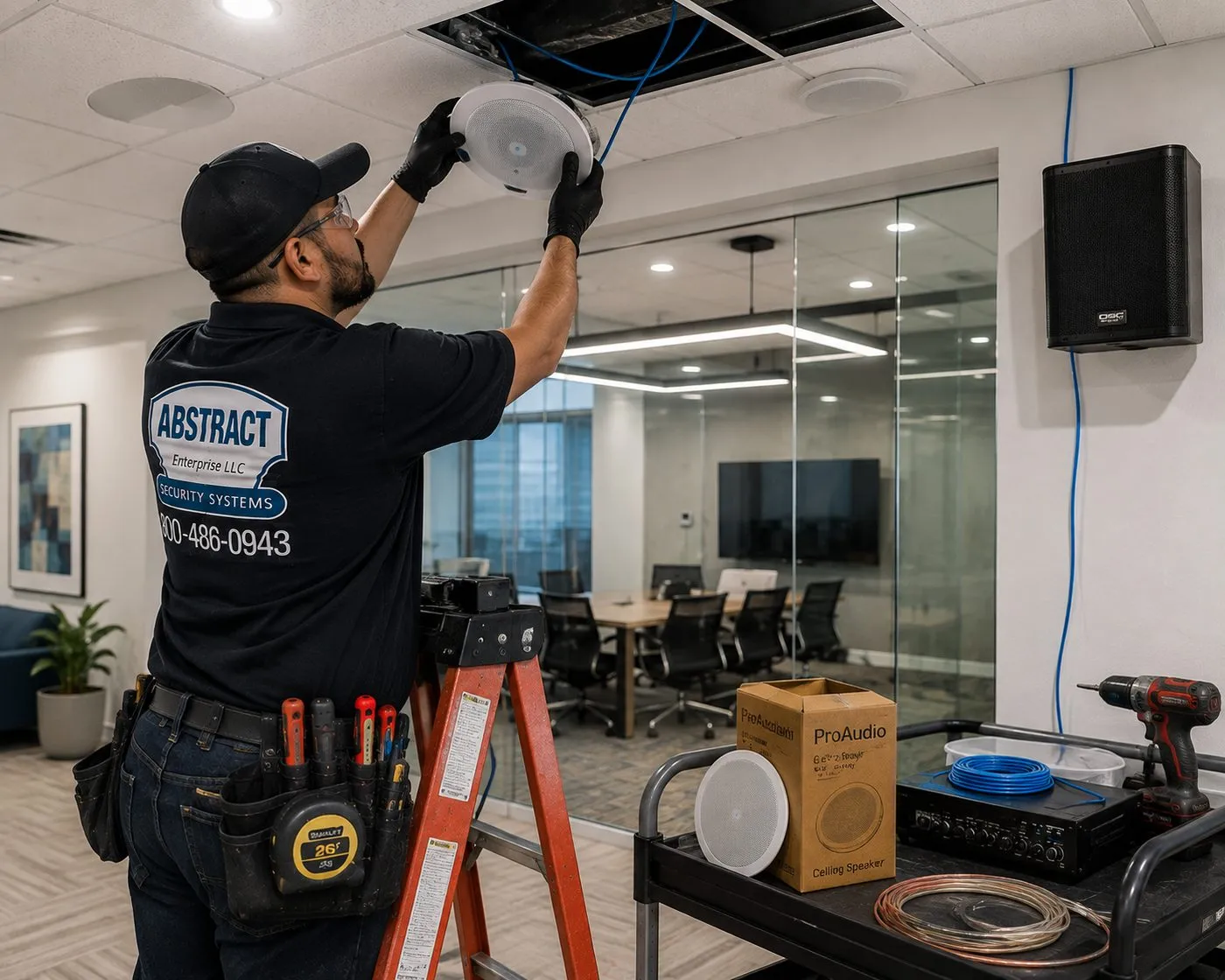
A technician on an orange stepladder lifts a white round speaker into an opening in a drop ceiling. A black box speaker hangs on the wall to his right, and a rolling cart holds a second round speaker, a boxed ceiling speaker, an amplifier, a drill and a coil of copper speaker wire. No brand can be read on the speakers.
Bronx Sonos Quote
Tell us the products, the rooms and whether you rent or own — written price back the same business day
✅
Request Sent!
The Bronx office will call you back the same business day.
25+
Years Experience
✓
Same-Day Estimates
100%
Licensed & Insured
4.7★
201 Google Reviews
Sonos speakers waiting by the door? Phone the Bronx line, (646) 490-0629, or send the short form. Say whether you rent or own and which building you live in, and a licensed installer comes back with a written price built from the published lines further down this page.
Full Sonos setup on our price list: $125, with no parking line added for a Bronx address
Certificates of insurance for Riverbay, Parkchester management or your managing agent, free and sent ahead of the visit
NYS low-voltage licence #12000287431; arrivals booked in two-hour slots between 8 AM and 8 PM, weekends included
The first question on a Bronx Sonos job is not which speaker. It is whose wall. The Census Bureau's latest five-year figures put the borough's owner-occupied rate at 20.1 percent, which means roughly eight households in ten are tenants. Most leases forbid alterations without the landlord's consent, and the Legal Aid Society's guidance to New York tenants is blunt about it: get the landlord's authorization, preferably in writing, before any work is done in the apartment. A Sonos system that needs no screws at all is often the right answer here, and when a soundbar does need a bracket, the conversation with the landlord comes before the drill.
The owners are rarely free agents either. Co-op City, the largest housing cooperative in the world, runs every alteration through a renovation form filed with the building's Cooperator Services Office. Parkchester's two condominium associations have written rules on loudspeakers and on how much of each floor must be carpeted. Riverdale's post-war co-ops along the Henry Hudson Parkway have boards and managing agents who ask for insurance certificates before a contractor goes upstairs. And the Grand Concourse, where the Landmarks Preservation Commission designated a historic district in 2011, is lined with brick and terra-cotta apartment houses whose owners decide what can be fixed to their walls. Planning a Bronx Sonos system means knowing those rules before the products are opened.
Then there is the sound itself. New York's 311 line logged 463,349 residential noise complaints in 2025, according to a New York Post analysis published in April 2026, and three of the city's five noisiest neighborhoods by that count were in this borough: Wakefield at the top, with Williamsbridge and Highbridge close behind. That is not a reason to avoid good audio. It is a reason to install it with the neighbors in mind — a Sub that sits on a rug rather than a bare floor, volume limits set in the app, Night Sound switched on for late films, and ceiling speakers only where the apartment above will not hear them.
The buildings add their own physics. The Landmarks Preservation Commission describes the Concourse's apartment houses of the 1920s and 1930s as largely brick and terra-cotta, and inside they are mostly plaster. Post-war high-rises like the Riverdale co-ops typically have concrete floors and block walls, and new high-rise rentals like those along Third Avenue and the Harlem River in Mott Haven typically pair concrete slabs with metal-stud partitions — something we confirm with a knock and a pilot hole rather than assume. Sonos rates plaster and concrete as high-loss materials for a wireless signal and metal as very high. A speaker that works perfectly in the living room can stutter in a back bedroom two masonry walls away, and the fix is usually in the network, not in a new speaker.
None of this makes Sonos a poor fit for the borough. The opposite is true: a system that can run almost entirely on Wi-Fi, grow one room at a time and leave with you when the lease ends suits a renter better than any wired stereo ever did. It simply has to be installed by someone who starts with the lease, the board and the people downstairs, and then gets to the speakers.
Bronx figures behind a Sonos plan
20.1 percent: the share of Bronx housing units that are owner-occupied in the Census Bureau's 2020–2024 estimates, so most Sonos systems here go into rented rooms where a wireless, no-holes layout matters.
583,114: housing units in Bronx County on July 1, 2025, by the Census Bureau's estimate, across 534,100 households.
86.8 percent: Bronx households with a broadband subscription in the same Census figures, which is the connection every Sonos speaker in the home relies on.
15,372: apartments in Co-op City's 35 high-rise buildings and seven townhouse clusters, according to Riverbay Corporation, every one of them governed by the same renovation-form process.
61 and 27: the apartment houses in the Grand Concourse Historic District, and how many of them were built in the Art Deco and Moderne years between 1935 and 1945, per the Landmarks Preservation Commission's designation report.
463,349: residential noise complaints logged by 311 citywide in 2025, as reported by the New York Post, with Wakefield, Williamsbridge and Highbridge among the top five neighborhoods.
Read together, those numbers describe the typical call we take from this borough: a tenant or shareholder in a masonry building, a household connection doing a lot of work, a building with rules, and neighbors who are close enough to hear the bass. The speakers come last.
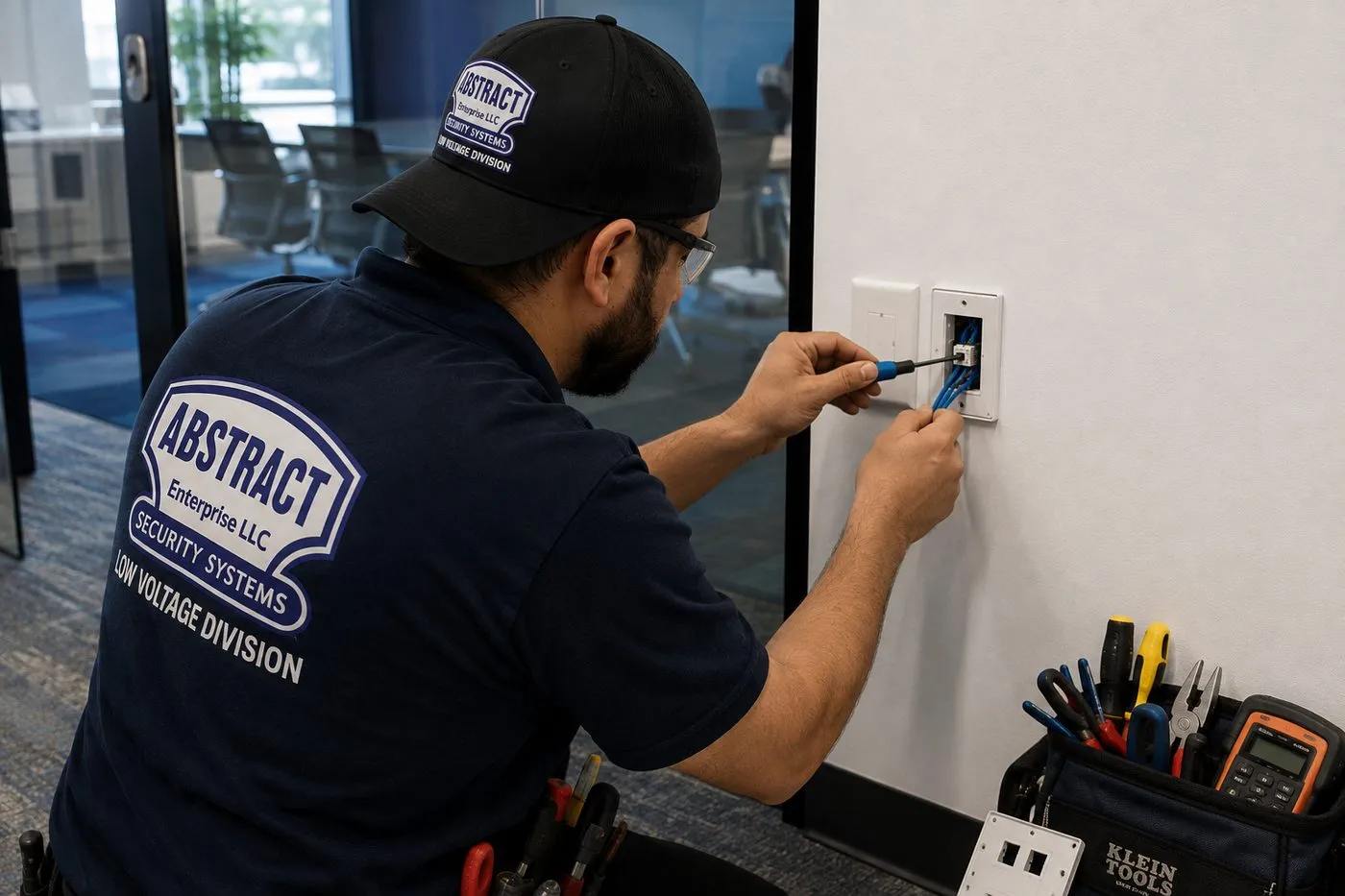
A technician in a black cap works a blue cable into a white wall plate with a small screwdriver, beside a glass-walled office. A tool bag holding pliers, screwdrivers and a meter sits on the floor next to a spare wall plate.
Repair Capture
Music Cutting Out in a Bronx Apartment?
A Beam that stopped answering the TV remote after an Optimum or Verizon equipment swap, rooms greyed out in the app, a Sub that drops every evening, or a stereo pair that plays a beat apart — those are repair visits, and we book them in the next free 2-hour window. Most network and setup faults are fixed within one to two hours once a technician is in the apartment. Ring (646) 490-0629 and say it's a Sonos fault; a setup-only visit in the Bronx is $225 for the first hour and then billed in half-hour blocks, as set out in our TV and audio service policies.
What We Install
Sonos Installation Services in the Bronx
Bronx Sonos work splits into two families: systems that leave the walls alone, and systems built into them. Renters mostly need the first; owners with board approval, and the borough's houses, can choose either. Every job ends the same way, with the app set up on your phone and the rooms tuned.
Wireless Room-by-Room Setup
Era, Five, Move and Roam speakers placed where the sound and the outlets work, joined to one system, named, grouped and tuned. Nothing is fixed to a wall, which is why it is the layout we suggest first to tenants and to anyone whose board has not yet answered.
Soundbars on Brick, Plaster and Block
An Arc Ultra, Arc, Beam or Ray hung under the TV on a bracket anchored for the wall we actually find, or set on the console with no hardware at all. Pre-war Bronx walls are often plaster over brick; we tell you which before the first hole.
Sub and Surround, Neighbor-Aware
A Sub or Sub Mini and a pair of rear speakers, positioned so the bass fills the room rather than the floor slab. We set the Sub level for an apartment, show you Night Sound, and put a volume ceiling on the room if you want one.
Ceiling and Wall Speakers on an Amp
For owners: passive architectural speakers cut into a plaster or drywall ceiling and wired back to a Sonos Amp. In a co-op or condo this follows the board's written approval; in a Fieldston or Throgs Neck house it follows a survey of joists and cable paths.
Shop and Restaurant Music
Ceiling or wall speakers on Amps for stores, salons, cafés and dining rooms on Fordham Road, the Hub, Arthur Avenue and City Island Avenue, set up with a music service licensed for business and volume limits that respect the apartments overhead.
Port to a Stereo You Already Own
A Port connected to the receiver and speakers already in the living room, so the old system joins the new one. The Port's 12-volt trigger can wake the amplifier when music starts, and the receiver connection is a published line on our price list.
Network Steadied for Sonos
Router moved out of the closet where the cable company left it, channels chosen away from the neighbors' crowd, extenders and powerline adapters removed because Sonos does not support them, and one Ethernet link added where a masonry wall blocks the signal.
Two-Household and Two-Family Setups
Owner-occupied two-family houses often have two internet connections and two families. We keep each household's Sonos system on its own network so the upstairs app never finds the downstairs speakers, and label which router belongs to whom.
Move-Out and Restoration Planning
For tenants and shareholders who will leave one day: a written list of every hole we made, bracket choices that leave small, easy-to-fill marks, and a take-down visit when it is time to go, so the restoration bill at move-out stays small.
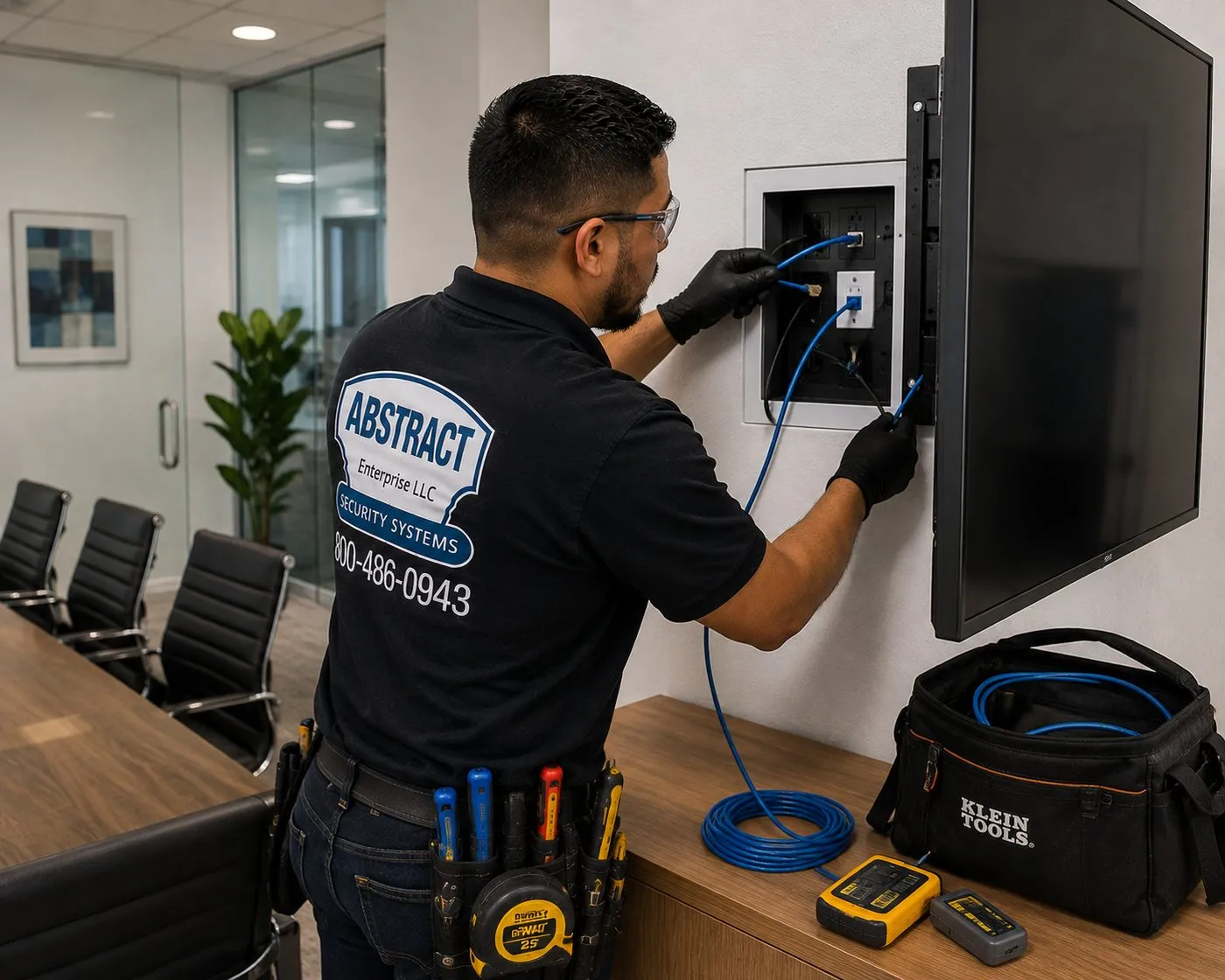
Wearing black gloves, a technician plugs blue cables into a recessed box set into the wall at the edge of a large wall-mounted screen. A boardroom table and black chairs fill the left of the frame, and a tool bag, a coil of blue cable and a yellow tester rest on the sideboard below.
Building Specialists
Sonos Installation for the Bronx's Architecture
The borough was built in waves, and each wave left a different wall behind. Here is how the main Bronx building types change a Sonos plan, from the rules that govern them to the materials a drill meets.
Grand Concourse Apartment Houses
Five- and six-story brick and terra-cotta buildings, many built to the lot line around big light courts, with the Art Deco and Moderne generation of the late 1930s known for curving walls and wrap-around corner windows. Inside: plaster on masonry, steam radiators under the windows and long railroad-style hallways that the Wi-Fi has to travel down.
Co-op City Towers
Thirty-five high-rises of 24 to 33 floors, designed by Herman Jessor and finished between 1968 and 1973 on landfill near the Hutchinson River Parkway. Jessor favored cross-shaped floor plans, so rooms branch away from the center of each apartment — and from the router. Any alteration goes through a renovation form at the building's Cooperator Services Office, so wireless layouts carry most systems.
Parkchester
The brick complex Metropolitan Life built between 1939 and 1942, now run as two condominium associations. Parkchester South alone oversees nearly 8,000 apartments. House rules govern loudspeakers and floor coverings, and owners — not management — handle most work inside their units.
Riverdale and Spuyten Duyvil Co-ops
The post-war building boom brought high-rise co-ops to Riverdale, many along the Henry Hudson Parkway and Johnson Avenue with river-facing living rooms. Typically concrete floors and block walls, and boards that want a certificate of insurance and service-elevator bookings before a contractor goes up.
Fieldston and Riverdale Houses
About 257 houses in the Fieldston Historic District alone, in Tudor, Medieval, Mediterranean, Dutch and Colonial revival styles of clapboard, brick, stucco, fieldstone and slate. Basements, attics and joist bays give real cable paths; stone walls and multiple levels test the Wi-Fi.
Two-Family and Attached Houses
Houses rather than towers fill much of the east and north Bronx, in Throgs Neck, Pelham Bay, Morris Park, Williamsbridge and Wakefield, and many are two-family homes with an owner on one floor and a tenant on the other. Drywall or plaster over wood framing, basements for an Amp, and two households to keep apart on the network.
City Island Houses
Victorian and other older houses on the side streets off City Island Avenue, a short walk from the water. Easy framing for cable runs, porches and yards where outdoor speakers come up, and salt air that decides which outdoor products are worth buying.
New Towers in Mott Haven and Melrose
New high-rise rentals on Third Avenue and the Harlem River waterfront: the 27-story Maven at 2413 Third Avenue with 200 apartments, and Third at Bankside's towers of 17 to 25 stories next door. New high-rise construction of this kind usually means metal-stud partitions and concrete ceiling slabs, and leases that say no to ceiling cuts.
What each wall and ceiling means on the day
Plaster over brick (Concourse and pre-war walk-ups): soundbar brackets go into the brick behind the plaster with masonry anchors, set slightly deeper than the plaster so the coat does not crack around the screw. The plaster surcharge on our price list is +$45 and brick is +$65; we tell you which one applies after a test hole the size of a pencil.
Concrete (common in post-war and new high-rises): no ceiling cavity for in-ceiling speakers, so built-in audio usually means wall speakers in a furred-out wall or none at all. Concrete drilling for a bracket is +$75 and is slower and louder, which matters in a building with quiet hours for trades.
Metal studs (new construction partitions): brackets need toggle-style anchors or a plywood backer behind the drywall; the metal-stud line is +$30 and a backer board is $85. Sonos's wall mount for the Era 300 is rated for stud mounting only, so in a metal-stud wall we confirm the fixing before the speaker goes up.
Wood framing (houses in Fieldston, Throgs Neck, City Island): the simplest walls in the borough for ceiling speakers and hidden cable, with basements and attics as natural routes. Sonos's in-ceiling manual still asks for an obstruction survey before any cut, and we do it with a stud finder and a pilot hole every time.
Steam radiators and window walls: many pre-war living rooms have radiators below every window, which rules those walls out for a soundbar's console or a Port. Sonos asks for ventilation space around the Port and to keep it away from radiators, so the media wall is chosen with the heat in mind.
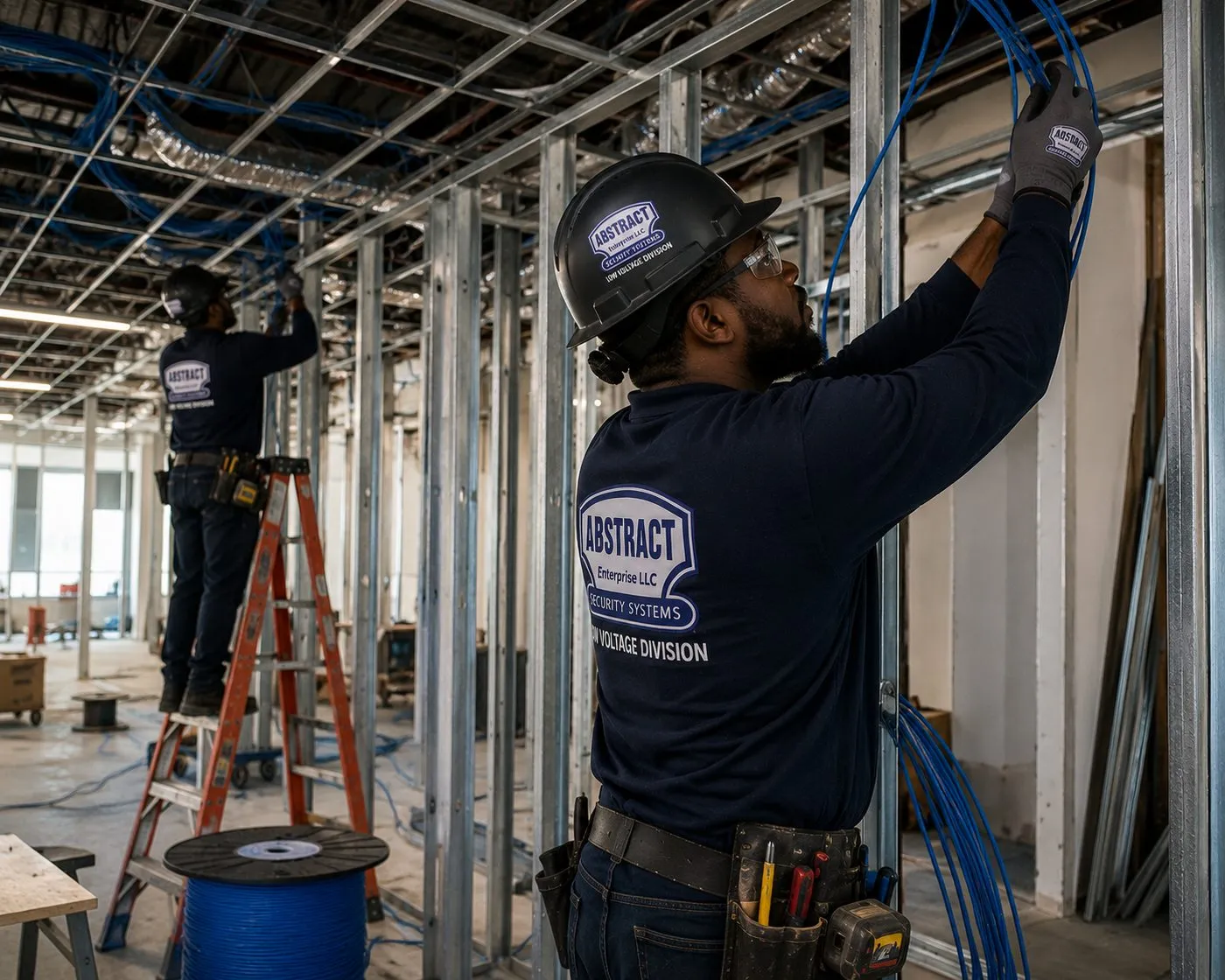
In an unfinished space with exposed ceiling ducts, a technician in a hard hat and safety glasses guides a bundle of blue cable down between bare metal studs, while a second worker on an orange ladder works further back. A spool of blue cable stands on the floor.
Concourse and Co-op City households pair a Sonos visit with better Wi-Fi more than with anything else. When the network needs more than a router move, AESS network installation in the Bronx handles the access points and wiring, and the same licence covers both.
Commercial Sonos
Business Sonos Installation in the Bronx
A Bronx storefront almost always has neighbors on the other side of the ceiling. The borough's shopping streets are lined with mixed-use buildings — stores and restaurants at street level, apartments above — so a business music system here is designed as much around the upstairs tenants as around the customers. These are the corridors where we fit Sonos for shops, salons, restaurants and offices.
Fordham Road
The Fordham Road Business Improvement District counts almost 300 specialty stores along the borough's best-known shopping street — the same street as our office at 460 E Fordham Rd. Clothing and shoe stores, phone shops and fast-casual restaurants that want even background music across a long, narrow floor.
The Hub, 149th Street and Third Avenue
Where East 149th Street, Willis, Melrose and Third Avenues meet: the oldest major shopping district in the Bronx and home of its first business improvement district, set up in 1990. The BID describes more than 200,000 daily visitors. Busy sales floors where music has to sit under the noise of the street without spilling onto it.
Arthur Avenue and Belmont
The Bronx's Little Italy, with the covered Arthur Avenue Retail Market that Mayor La Guardia championed and blocks of bakeries, butchers, cafés and restaurants. Dining rooms where a few ceiling speakers on an Amp keep music under conversation.
City Island Avenue
The island's main street of seafood restaurants, bars, galleries and shops, busy most evenings. Dining rooms that open onto decks and sidewalk seating, where outdoor speakers and the city's rules on sound carrying to the street both come into play.
Mott Haven's Bruckner Boulevard and Waterfront
Ground-floor cafés, studios and shops in Mott Haven and Port Morris, and the amenity lounges and gyms inside the new rental towers along Third Avenue and the Harlem River. Newer construction, where the landlord's rules on ceilings and networks apply.
Neighborhood Main Streets
White Plains Road, Westchester Square, East Tremont Avenue by Parkchester, and the shopping blocks of Riverdale: barbershops, salons, pharmacies and offices that need a simple, reliable music zone or two.
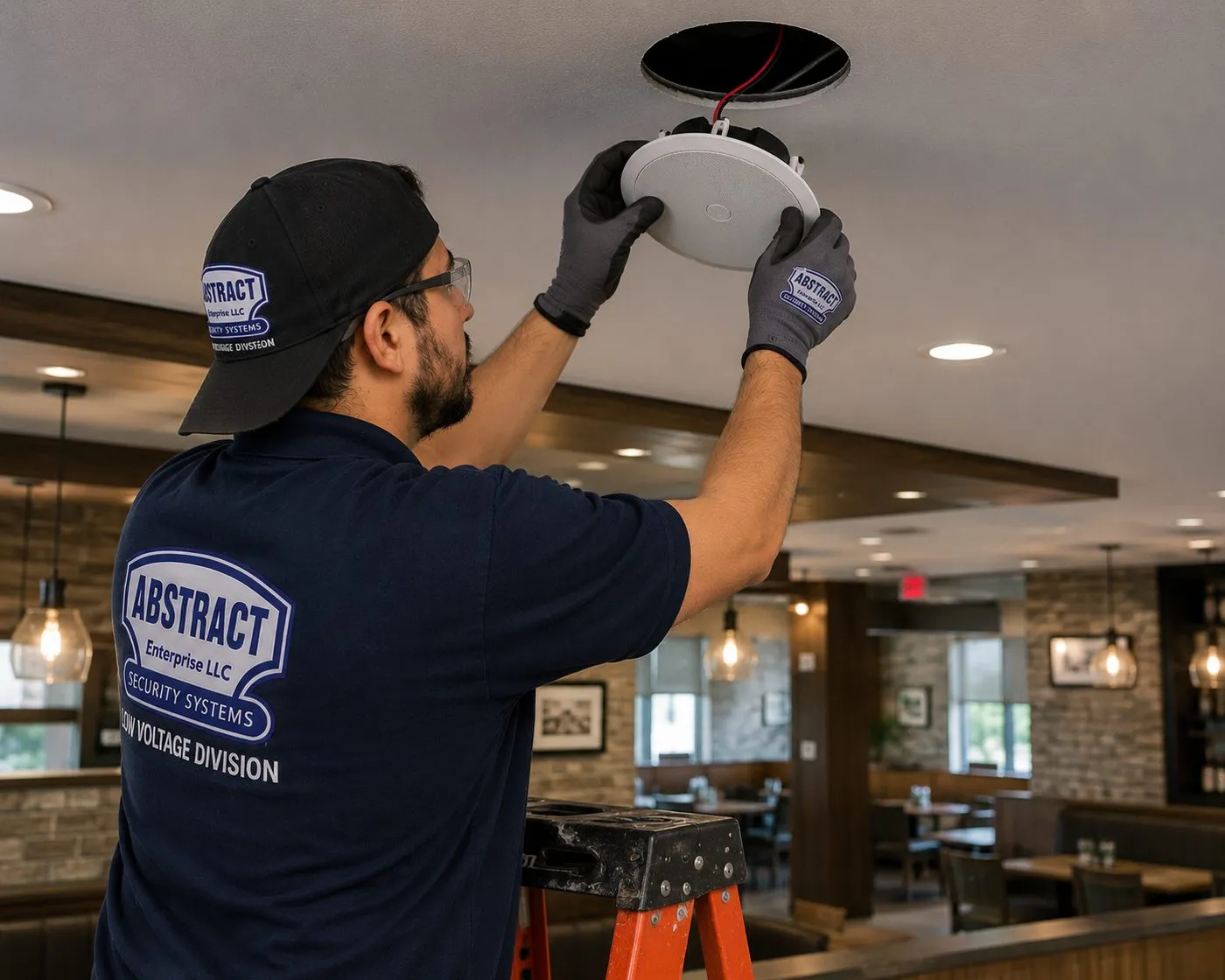
Over a dining room with exposed brick walls, booths and glass pendant lights, a technician in gloves holds a white round speaker up to a cut opening in the ceiling, a red and black wire hanging from the hole. The speaker's brand is not visible.
Rules a Bronx business music system has to respect
Apartments above the store: the city's Noise Code fact sheet limits music from a store, restaurant or bar to 42 dBA measured inside any apartment that receives it. We aim speakers down and away from shared walls, avoid hanging a sub on the ceiling, and set volume limits per zone in the Sonos app.
Sound aimed at the street: Section 24-244 of the Administrative Code bars businesses from using sound reproduction devices outside the premises, or through an opening onto a street or park, to advertise or attract attention. Outdoor speakers on a City Island deck are aimed at the diners, not the sidewalk.
Licensed music: Spotify's own help pages say the service is for personal, non-commercial use and can't be played publicly in bars, restaurants, stores or salons. Business systems are set up with a business music service in the Sonos app instead.
Permits for low-voltage wiring: under the city's Administrative Code, wiring designed to run at less than 50 volts for communication and signaling does not need an electrical permit when the work is done by a licensed electrician or a qualified person as the Electrical Code defines one. New outlets for an Amp are line-voltage work for your electrician, not for us.
Landlord paperwork: commercial landlords usually want our certificate of insurance before any ceiling is opened. It costs nothing and is normally emailed the same day.
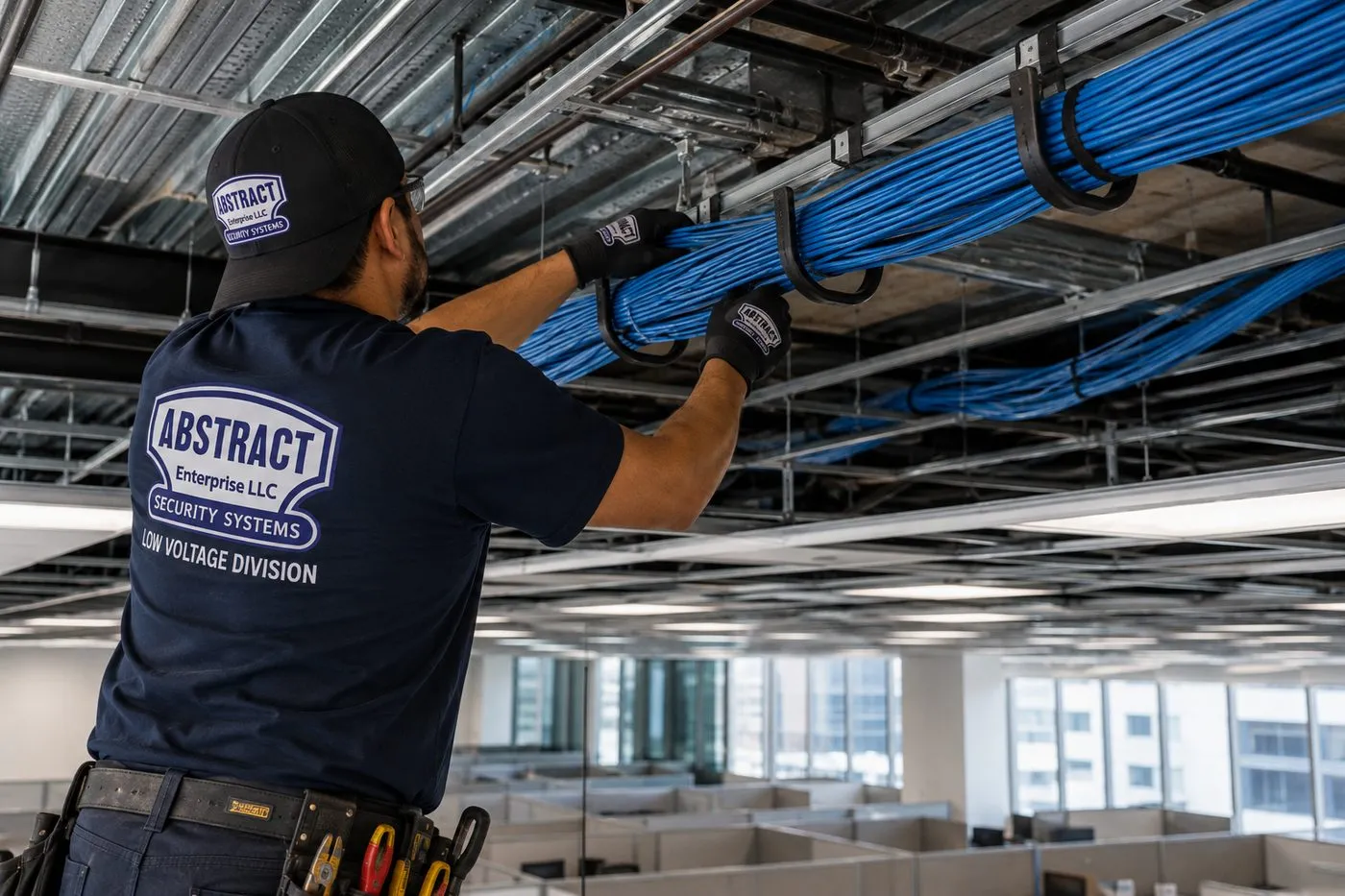
Seen from behind, a technician in a cap and gloves lays a thick bundle of blue cable into a row of black J-hooks hanging from the deck above an open office ceiling, with rows of cubicles and tall windows below.
Sonos Installation in the Bronx: Questions Answered
These are the questions Bronx callers actually ask before they book, grouped by what worries them: the lease, the board, the neighbors, the building, and the people who will use the system every day. Prices, payment and coverage are covered in the FAQ near the bottom of the page.
Renting in the Bronx
Do I need my landlord's written OK before you drill for a Sonos bracket?
If your lease has an alterations clause — and most New York leases do — then yes, ask first and get the answer in writing. The Legal Aid Society's guidance for city tenants says most leases prohibit alterations without the landlord's prior permission and recommends written authorization before any work. A screw hole for a soundbar bracket is small, but it is still a change to the landlord's wall, and a short email that says "yes, you can mount a soundbar under the TV in the living room" protects your security deposit and our crew.
What to send the landlord or super: the room, the wall, the product (an Arc or Beam, for example), and the fact that the bracket uses two to four anchors that can be filled and painted at move-out. If you want, we write that description for you after the quote. If the answer is no, or slow in coming, the system can start wireless with the soundbar on the console, and the bracket can go up later on a separate visit.
The same goes for anything else that touches the building: a cable taken through a wall, a cord cover stuck to the plaster, or speaker wire along the baseboard. Free-standing speakers, a soundbar on furniture and a Sub on the floor need nobody's permission.
What do NYCHA's house rules mean for a Sonos system in a public-housing apartment?
NYCHA's published house rules ask residents and their guests to keep noise at levels appropriate for the time of day and the surroundings, and they bar the use of sound amplification devices in common areas without an NYPD permit. Inside the apartment, the rules we have seen do not list speakers, but they do show how NYCHA treats holes: tenants may not drill into the door, frame or surrounding wall to mount a camera or video doorbell. We read that as a clear signal to ask management before fixing anything to a NYCHA wall.
So for NYCHA households we design a system that needs no fixings at all: a soundbar on the TV console, wireless rear speakers on stands or furniture, a Sub tucked beside the sofa, and every room grouped and tuned in the app. That setup sounds every bit as good as a wall-mounted one in most living rooms, and it can be packed up in an afternoon if the family transfers to another apartment.
If management does approve a bracket in writing, we follow whatever conditions come with the approval. And we keep the volume limit and Night Sound features in mind at handover, because the house rules put the burden of keeping things neighborly on the household.
Co-ops, condos and Mitchell-Lama
How long does Riverbay take to answer a renovation form, and should the install be booked before the approval comes back?
Co-op City's own FAQ says some alterations are allowed, but an apartment renovation form from your building's Cooperator Services Office has to be completed first, with an approximate response time of five business days. We plan around that: the wireless parts of a system — speakers placed, rooms grouped, a soundbar on the console — can be done straight away, because nothing is altered. Anything that touches a wall or ceiling waits for the signed form.
The practical order is quote, then form, then booking. Our written quote lists exactly where each bracket or speaker goes and what fixings it uses, which is the detail the CSO needs to judge the request. We send our certificate of insurance at the same time if the office asks for one. Once the approval is in your hands, you pick a 2-hour window and we come out.
Booking first and hoping the form arrives in time is the expensive route: if the crew arrives and the approval is missing, the $150 return-trip fee on our published policies applies, because the slot was held for you. Five business days is a short wait for a system you will keep for years.
The only closet that fits a Sonos Amp has the building's telephone riser cables in it — can they share the space?
Often yes, as long as nobody touches the riser. Co-op City's FAQ is explicit that the cables in the closets are riser cables used for telephone service and cannot be removed, and the same caution applies to any building's riser: we work around it, never through it. An Amp can sit on a shelf in the same closet if there is room for air to move and an outlet nearby.
Air is the real test. Sonos's Amp product guide asks for at least three inches of clearance around the unit, and its Port guide asks for two inches on every side and says not to block ventilation. A packed coat closet with the door shut all summer is a poor home for either. We measure the shelf, check for an outlet within reach of the power cord, and confirm the closet does not run hot beside a riser chase or a steam pipe.
If the closet fails any of those checks, the Amp moves to a media cabinet with a vented back, and the speaker wire follows the baseboard in a paintable cover. Either way, the riser stays exactly as the building left it.
Parkchester's house rules mention loudspeakers — what do they actually restrict?
The Parkchester North Condominium's published rules and regulations say no resident may operate a stereo, CD or DVD player, radio, computer, game device, television or other loudspeaker at any time if it prevents other occupants' quiet enjoyment of the building, and they bar practicing vocal or instrumental music between 10 PM and 9 AM. The same rules require rugs or carpet over 80 percent of each unit's floors outside the kitchen and bathrooms, and say electrical equipment in the unit must meet Board of Fire Underwriters and public-authority requirements.
For a Sonos system that translates into three things. The Sub sits on the carpet the rules already require, away from the wall shared with the next apartment. A volume limit is set in the Sonos app for the living room and any bedroom speakers, so a late-night playlist can't creep past a level you chose in daylight. And every product plugs into an ordinary outlet without extension-cord chains, which keeps the electrical side simple for a board that cares about it.
Unit owners handle most interior work themselves under Parkchester's management model, so if you rent from an owner, the owner's consent is the one you need for anything fixed to a wall.
If I leave Co-op City one day, do the holes from Sonos brackets have to be put back?
Plan for it. Riverbay's FAQ says outgoing shareholders are responsible for restoring their unit to its original standard, or the cost of the restoration is deducted from their equity. A pair of filled anchor holes is cheap to restore; a ceiling speaker cut-out or a wall opened for cable is a bigger job, and it is your equity paying for it.
That is why our Co-op City quotes describe every fixing in writing and favor hardware that leaves small marks: soundbar brackets with a minimal number of anchors, wall mounts that use the same holes for a future speaker, and surface cord covers instead of cutting into plaster where a cover will do. At the end of the job you get a list of every hole we made and where, which makes the move-out walkthrough far easier.
When the time comes, we can come back, take the system down, pack it for the move and leave the walls ready for patching and paint.
Neighbors and noise
How does the city measure whether music from my apartment is too loud for the people next door?
There is, though it isn't a single decibel number. Section 24-218 of the city's Administrative Code treats sound from any device as unreasonable noise if, measured inside a receiving property, it is 7 dB(A) or more above the ambient level between 10 PM and 7 AM, or 10 dB(A) or more above ambient between 7 AM and 10 PM. Separate from the code, many buildings set their own stricter house rules, like Parkchester North's.
In plain terms: the test is how much louder your music makes the neighbor's apartment than it is with your system off, and the daytime allowance is only a little more generous than the night-time one. A system that is pleasant at a normal volume in your living room will rarely come near that line. A Sub on a bare floor at full output at midnight can cross it easily, because low frequencies travel through structure.
We set systems up so the comfortable volume is the default one: the Sub level adjusted for an apartment rather than a showroom, the Sub placed on a rug away from shared walls, and the option of a volume ceiling per room.
A neighbor has already complained once — what can change without losing the sound?
Quite a lot, and most of it costs nothing. Complaints about a Sonos system in an apartment are nearly always about bass, because low notes travel through floors and walls far more easily than voices do. The first move is the Sub: off the floor slab and onto a thick rug, a few feet away from any wall you share, and its level turned down in the app's sound settings for the room rather than for a showroom demonstration.
The second is placement of the rear speakers. Rears fixed to a shared wall send vibration straight into the next apartment; moved to stands or a shelf on an outside wall, they do the same job for your seat without using the building as a speaker. Trueplay then retunes each room for the new positions, which Sonos recommends after any move.
The third is habit. Night Sound for late films, a volume ceiling in the app for the living room, and grouping only the rooms you are actually in. A short visit to reposition and retune is billed as setup-only time at the Bronx rate, and it is usually cheaper than a dispute with the managing agent.
Bronx buildings and homes
The only free wall has a steam radiator under the window — can the Sonos gear sit on the radiator cover?
Not the electronics. Radiator covers make tempting shelves in pre-war Bronx living rooms, but Sonos's Port guide tells installers to keep the unit away from radiators and other heat sources and not to block its ventilation, and the Amp's published operating range tops out at 104°F. A cover over a running steam radiator in January is no place for either, and a soundbar or speaker sitting on one is taking heat it was never designed for.
The usual answer is to turn the room around: put the TV and soundbar on the wall without a radiator, even if that means a longer cable to the cable box, and keep the radiator wall for books and plants. Where the window wall truly is the only option, the soundbar goes on a bracket under the TV with the TV itself mounted well above the radiator, and the Port or Amp moves to a cabinet elsewhere in the room.
Rear speakers near a radiator are fine on stands placed a short distance out from it. We check the heat with a hand on the cover during the visit, not just the picture you sent.
Our Art Deco living room has a wrap-around corner window — where do the soundbar and rear speakers go?
The Landmarks Preservation Commission's report on the Grand Concourse Historic District describes wrap-around corner window openings and steel-and-glass casement windows as hallmarks of the Bronx Art Deco apartment. They are lovely to live with and awkward for a surround system, because the corner that would hold a rear speaker is glass.
Sonos's surround guidelines ask for the two rear speakers to be the same model, facing the same way, behind and to the left and right of the main seat. In a corner-window room we usually move the seating so the glass is beside the sofa rather than behind it, then set one rear speaker on a stand and the other on a shelf or a wall mount on the solid side. If a symmetrical layout is impossible, the soundbar alone with a Sub is often the cleaner choice, and an Arc Ultra or Arc is designed to fill a room from the front.
The TV wall goes opposite or beside the window, never under it, so the picture is not fighting the light and the soundbar has a solid wall to mount on.
Our windows face an elevated train line — can the soundbar keep dialogue clear when a train goes by?
Better than turning it up can. Plenty of Bronx apartments sit beside elevated track, such as the Jerome Avenue Line, and the instinct when a train passes is to reach for the volume — which is exactly what the downstairs neighbor hears. Sonos soundbars have a Speech Enhancement setting that Sonos says makes dialogue clearer, and Night Sound, which raises quieter sounds while softening loud ones.
Placement helps too. A soundbar directly under the screen and out in the open delivers speech more clearly than one tucked inside a cabinet or behind a lip of furniture, and Trueplay tuning adjusts it for the reflections of that particular room. Rear speakers placed behind the seat, rather than by the street window, keep the room's sound centered on you.
At handover we play a dialogue-heavy scene with the windows as you normally keep them, switch Speech Enhancement on and off so you can hear the difference, and leave it set the way you prefer.
Can a speaker sit out on the fire escape on summer evenings?
No, and not just because of the weather. The FDNY's fire-safety guidance for apartment buildings tells residents to keep the fire-escape window clear of obstructions such as furniture, plants and air conditioners, and the department has said publicly that fire escapes should be completely free of stored items. City rules also require a clear passage of at least 21 inches beside any fixtures at a window opening that leads to a fire escape. A speaker, its cable or a stand on the landing all count against that.
The good news is that sound carries out of an open window just fine. A portable Move 2 or Roam 2 on the sill inside the room, or an Era speaker on a shelf near the window, fills a small balcony or stoop corner without anything going onto the fire escape, and the window can still open fully. Sonos rates the Move 2 at IP56, but its charging base is for indoor use only, so it comes back in at night either way.
If your apartment has a real terrace or balcony rather than a fire escape, the building's own rules decide what can be fixed there, and we read those before suggesting anything outdoors.
Everyday use at home
Can Sonos voice control understand requests in Spanish?
Not reliably today, as far as we can confirm. Sonos says availability of its own Sonos Voice Control varies by country and language, and a thread on Sonos's community forums from owners asking when Spanish would arrive suggests it was not available when they posted. We will not promise a feature Sonos itself doesn't list for your speaker.
What we do instead is check, during setup, which voice services and languages the app actually offers for your products, and set up the one that suits the household. If the people who will use the system most are more comfortable in Spanish, we often skip voice entirely and set up the TV remote and the app the way they are used to, with rooms named in whatever language the family prefers.
Sonos Voice Control processes requests on the speaker itself, according to Sonos, and does not record or send audio to the cloud, which some households like to know before switching any microphone on.
Can roommates each play music from their own Spotify or Apple Music account on one Sonos system?
Yes. Sonos's support pages explain how to use multiple accounts for the same content service, so two roommates with separate Spotify logins can both add them to the one system and switch between them in the app's browse tab. Different services can sit side by side as well, so one person's Apple Music and another's Spotify live in the same app.
During setup we sign in every account the household wants, check that each person's playlists appear under the right name, and show everyone how to pick their own account before pressing play. Each roommate installs the Sonos app on their phone and joins over the home Wi-Fi; nobody needs to share a password for their streaming service.
When someone moves out, their account is removed in a minute from the app's settings, and the speakers stay put for whoever holds the Sonos account. If the departing roommate is the one who owns the speakers, we can split the system between two apartments on a later visit.
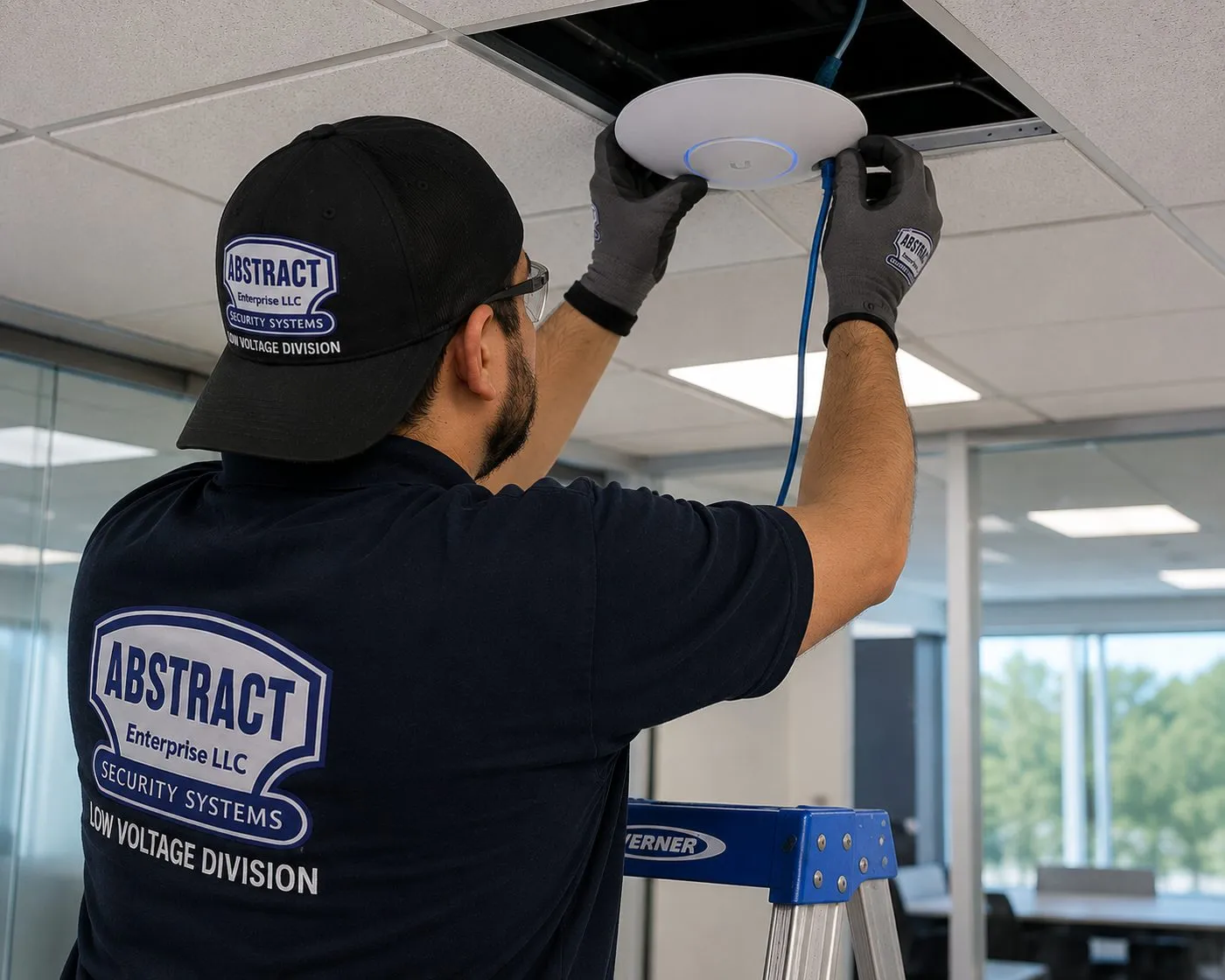
A technician on a blue stepladder holds a white disc-shaped access point at an open ceiling tile, a blue network cable feeding into it, in an office with glass walls and a window to the right.
Equipment
Types of Sonos Systems We Install
You buy the Sonos products from whichever store you prefer; we install them and, if you haven't bought yet, tell you which ones the room and the lease call for. Specifications below come from Sonos's own product and support pages, or from the reviews and guides named, and are there because they change how a product is mounted or wired in a Bronx home.
Arc Ultra
Sonos's largest soundbar: 46.38 inches wide and 13.01 pounds, with HDMI eARC and Trueplay tuning from iOS or Android. Sonos pitches it for large rooms and big TVs. On plaster over brick we anchor its mount into the masonry; in a rental it sits on a console at least as wide as the bar.
Beam (Gen 2)
25.63 inches and 6.35 pounds with HDMI ARC/eARC, the soundbar that suits most Bronx living rooms and bedroom TVs. Light enough to sit comfortably on a rated bracket, and small enough to share a console with a cable box.
Ray
The compact bar that connects by optical cable, for smaller TVs and for TVs without an ARC-capable HDMI port. A common choice for a bedroom in a Parkchester or Concourse apartment where the TV is on a dresser.
Sub 4 and Sub Mini
The Sub 4 is 25.99 pounds and can lie flat under a sofa, per Sonos's product page. In apartments we place it on carpet or a rug, off any wall shared with a neighbor, and set its level in the app for the room rather than for impact.
Era 100 and Era 300
Stand-alone speakers for music in any room, and the usual rear surrounds for a soundbar. Sonos's Era 300 wall mount is rated for stud mounting only, not hollow drywall, so in metal-stud or plaster walls we confirm the fixing first or use stands.
Move 2 and Roam 2
Battery speakers for a terrace, a yard or a kitchen counter. Sonos lists the Move 2 at IP56 with up to 24 hours of battery and the Roam 2 at up to 10 hours. Good for renters who want sound outside without fixing anything to a building.
Sonos Amp
Powers passive ceiling, wall or bookshelf speakers and joins them to the system, at 125 watts per channel into 8 ohms with HDMI ARC, line-in and two Ethernet ports. Needs an outlet, ventilation and a cable path to every speaker it drives.
Port
Streams Sonos into an existing receiver through analog or digital coaxial outputs, with a 12-volt trigger to wake the amplifier. Sonos asks for two inches of space around it and distance from radiators — a real constraint in pre-war rooms.
In-Ceiling and Outdoor by Sonance
Sonos's architectural speakers: the 6-inch in-ceiling model needs an 8.25-inch cut-out and the 8-inch a 10.125-inch cut-out; the outdoor pair is rated IP66. Both are passive and run from an Amp, which reliably drives up to three pairs wired in parallel, according to Sonos.
Choosing by tenure, not just by room
Your situation
Usual Sonos layout
What touches the building
Renter, no written consent yet
Beam or Ray on the console, Era speakers on stands, Sub on a rug
Nothing
Renter with landlord's written OK
Soundbar on a bracket under a wall-mounted TV, wireless rears
Bracket anchors only
Co-op City or other co-op shareholder
Wireless rooms now; brackets or built-in speakers after the renovation form or board approval
As approved in writing
Parkchester or other condo owner
Soundbar and surrounds, Amp-powered speakers where the walls allow
As the house rules and your plans allow
House owner in Fieldston, Throgs Neck or City Island
Ceiling speakers on Amps, wired backbone, outdoor pair
Ceilings, walls and cable paths, surveyed first
Shop or restaurant
Ceiling speakers on Amps, business music service, zone volume limits
Ceilings, with the landlord's approval
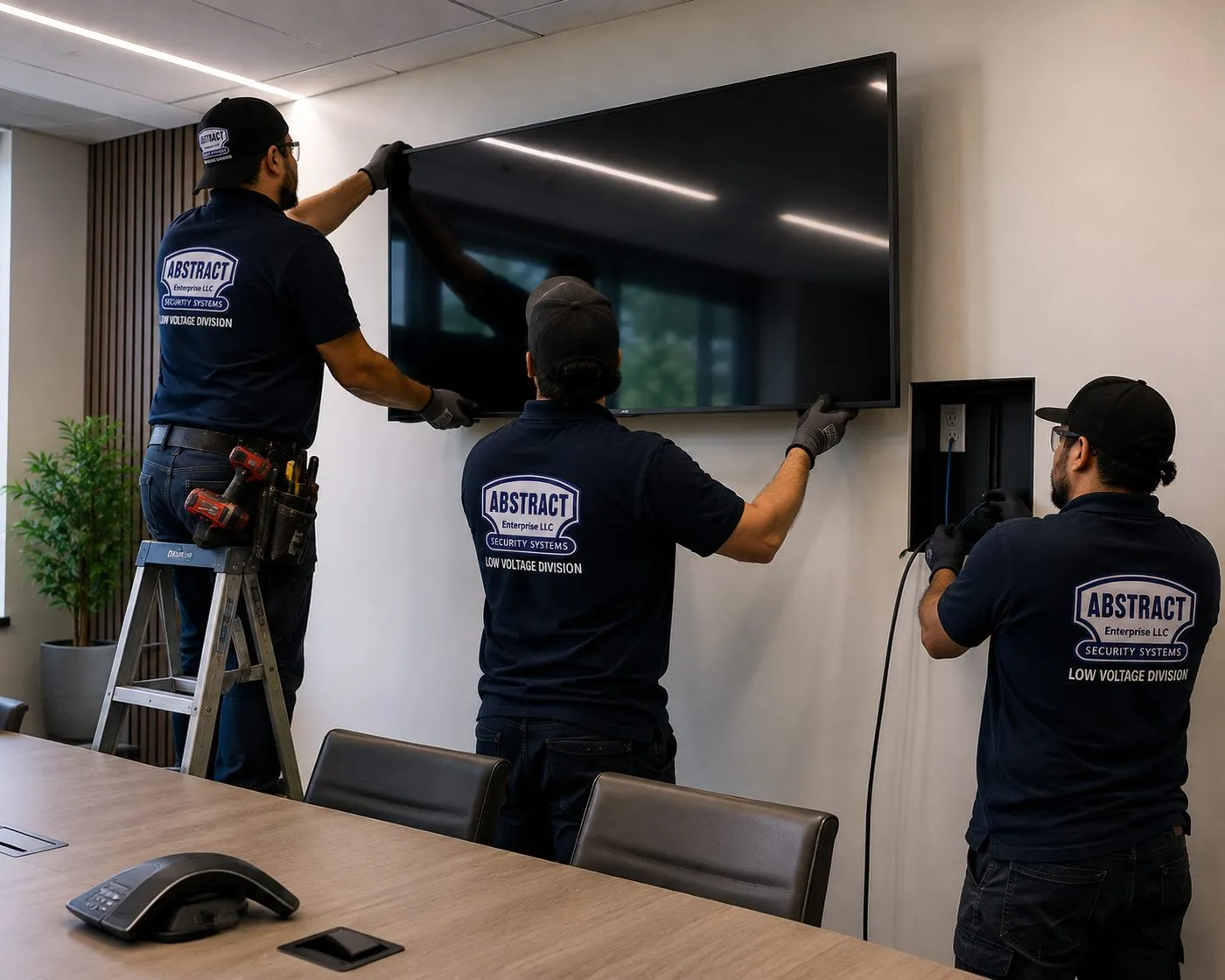
Seen from behind, two technicians — one on a small stepladder — guide a large black screen onto a wall mount while a third, in a cap, works at a recessed box in the wall below it. A conference phone sits on the table in the foreground.
AI Overview Reality Check
What AI Gets Wrong About Sonos Installation in the Bronx
A note on method: our research tools could not open Google's AI-generated answers, so nothing below is quoted from them. Each heading is a claim we found published — in a national cost guide, a manufacturer page, a gig platform or a forum — of the kind that AI answers tend to repeat. Underneath is what happens to that claim in a Bronx apartment, co-op or storefront.
"Surround sound installation costs between $241 and $1,350"
That range comes from Angi's national guide to surround-sound installation. It is a reasonable picture of a suburban living room where a crew runs wire to four or five speakers through an attic or basement and the homeowner can do what they like to the walls.
Most Bronx surround systems are nothing like that. A Sonos soundbar with wireless rears and a Sub has no speaker wire to run at all, and in a rented apartment it often has no bracket either. The labor is placement, connection, setup and tuning, which on our published list is a $125 Sonos setup plus $79 to place a soundbar on the console. Wall-mounting, a bracket and wall surcharges add to that when the lease allows them.
So the national figure overstates a typical renter's install and understates a house owner's ceiling-speaker job. A Bronx quote should say which of those you are getting, line by line, before anyone arrives.
"Additional zones or multi-room audio run $500 to $1,000 per room"
Angi lists that as an add-on for multi-room systems. The number assumes each room is a wired zone: speakers cut into the ceiling, wire pulled to a central amplifier, and the patching and repair that follow.
With Sonos, a room can be one wireless speaker placed on a shelf and added to the system in a few minutes. A household can have four or five rooms of Sonos with no wire in the walls at all. Where rooms are wired, our published range for whole-home audio is $800 to $2,500 per zone installed, and the walkthrough decides where each room falls.
The useful question is not "how much per room?" but "which rooms need to be built in?" In a co-op where the board has not approved ceiling cuts, the answer is often none.
"Basic in-ceiling speaker installation for one or two speakers costs $200 to $500"
An installation-cost article from xtenAV gives that range for a basic one-or-two-speaker job. It is plausible in a drywall ceiling with an attic above and an amplifier a few feet away.
The Bronx changes nearly every assumption behind it. Post-war high-rises tend to have concrete slab ceilings with no cavity to cut into. Pre-war plaster on masonry is slow, careful work and can crack. Co-op and condo approvals add time before anyone climbs a ladder. And a Sonos Amp still needs a ventilated home and a cable route to each speaker.
That is why we quote ceiling speakers only after seeing the ceiling and the paperwork. In a Riverdale or Fieldston house the national figure may be in the right neighborhood; in a Co-op City tower the honest answer may be wall speakers, or a wireless pair.
"Labor for a home stereo install runs $50 to $100 an hour"
Angi's whole-home stereo guide uses that hourly range for jobs of two to three hours. It reflects national averages for general installers.
Our setup-only rate in the Bronx is $225 for the first hour, then half-hour blocks, and it is published rather than negotiated at the door. That hour comes with a licensed low-voltage contractor, insurance certificates for the building, and a technician whose daily work is Sonos and home networks.
Most installation jobs aren't billed by the hour at all: soundbar mounting, Sonos setup and the other lines in our price table are fixed prices, so the cost doesn't climb if a plaster wall takes longer to drill than expected.
"Night Sound keeps late-night TV from disturbing anyone"
Sonos describes Night Sound as reducing the intensity of loud sounds while raising quieter ones, so dialogue stays clear without turning up the volume. It is a genuinely useful feature in an apartment, and we switch it on and show you where it lives.
It is not a sound barrier. Night Sound works on TV audio from the soundbar; it does not change how a Sub's bass travels through a floor slab, and it does nothing for music played from a phone. In apartment buildings, bass carried through the structure is the usual problem.
The fix is placement and limits: the Sub on a rug, away from shared walls, its level set for the room, and a volume ceiling in the app. Night Sound is the finishing touch, not the solution.
"Quiet hours are 10 PM to 7 AM, so before that you can play it loud"
Sites summarizing city noise rules, and plenty of forum answers, describe New York's quiet hours as 10 PM to 7 AM. The hours are real, but the conclusion people draw from them isn't.
Section 24-218 of the Administrative Code sets a daytime test as well as a night one: sound from a device measured 10 dB(A) or more above ambient inside a neighbor's home between 7 AM and 10 PM counts as unreasonable, against 7 dB(A) at night. Building rules can be stricter still; Parkchester North, for example, prohibits loudspeaker use that disturbs other residents at any time.
We set systems up so that the everyday volume is the neighborly one, whatever the clock says.
"Up to 50% cheaper than franchise dealers"
That line comes from a gig marketplace's page for Sonos help in New York, where customers post tasks with their own budgets. For a quick reconnection after a router swap, a marketplace can be a fine option.
What a marketplace listing can't promise is the paperwork a Bronx building often asks for: a certificate of insurance naming Riverbay, a Parkchester association or a managing agent, a licensed contractor's name on a renovation form, and someone accountable if a plaster wall cracks. When a building's approval depends on who is doing the work, the cheapest bid can be the one the building turns away.
Our prices are published on this page and sit next to the licence number. Compare them line by line with any quote you get.
Want a Bronx Sonos Price in Writing Today?
Send the product list, a photo of the TV wall and a word about your lease or board. We reply with fixed prices from the published lines.
A Ray on a Parkchester dresser or six ceiling speakers in a Fieldston house — the details below are enough to price it, and the written figure comes back by the end of the business day. Prefer to talk? Call the Bronx office at (646) 490-0629.
✅
Request Received
Your details are with our Fordham Road office and we'll call back the same business day. Need us sooner? Call (646) 490-0629.
How It Works
Our Installation Process
Seven steps for every Bronx Sonos job, from a single Era in Highbridge to an Amp-powered house in Country Club. Permission comes before hardware.
1. Tell us the lease or the board
Along with the Sonos products and the rooms, you tell us whether you rent, own a co-op or condo, or own the house, and what your building has said about drilling. That one answer shapes the whole plan.
2. Written plan and price
We send a fixed price from our published lines and a short description of every fixing — wording you can forward to a landlord, the Co-op City CSO or a managing agent. Built-in speakers get a walkthrough first.
3. Approvals and insurance
You collect the yes; we send the certificate of insurance the building asks for, free. Once approval is in hand, you choose a 2-hour arrival window between 8 AM and 8 PM, any day of the week.
4. Check the network and the heat
On arrival we test signal in every Sonos room, move or reconfigure the router if needed, take out unsupported extenders, and check radiators and closets before anything is placed near them.
5. Place, mount and wire
Speakers placed, brackets anchored for the masonry or studs we find, ceiling openings cut only where approved, Amp and Port given ventilated homes, and dust cleaned up as we go.
6. Set up and tune for neighbors
The speakers become one Sonos household with rooms you name, groups you choose and your streaming log-ins saved. Trueplay runs where the product supports it, the Sub is turned down to apartment level, and a volume ceiling goes on any room you ask for.
7. Handover and hole list
We walk you through the app, Night Sound and the remote, and leave a written list of every fixing we made so a future move-out or restoration is simple.
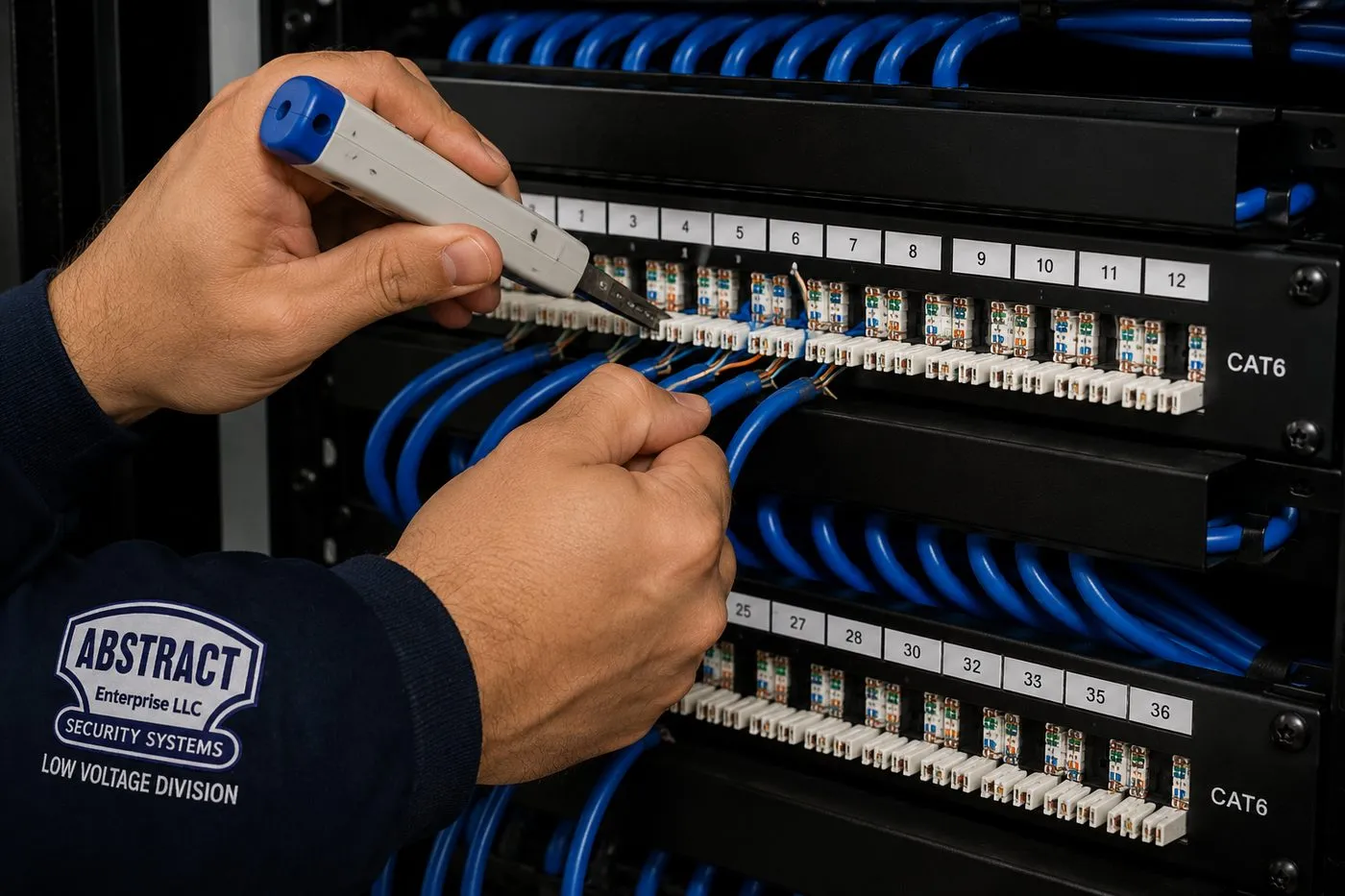
A close-up of two hands, one sleeve showing a company logo, seating blue cables into a numbered Cat6 patch panel with a white-and-blue punch-down tool. A second panel and rows of looped blue cable sit below.
Coverage Area
Sonos Installation Near the Bronx's Landmarks
Tell us the cross streets and we can usually guess the walls, the floors and the rulebook before we arrive. These six places cover most of the variety in the borough, from 1920s courtyards to a 2020s waterfront.
Grand Concourse Historic District
Designated October 25, 2011: 78 properties along a mile of the Concourse between East 153rd and 167th Streets, including 61 apartment houses built between 1917 and 1959 and the Bronx County Courthouse. Brick and terra-cotta exteriors, plaster inside, and light courts that leave some rooms far from the router.
Co-op City, Baychester and Eastchester
The world's largest housing cooperative by the 2010 census count, with 43,752 residents, built on the former Freedomland amusement-park site between 1966 and 1973. Ten triple-core, ten chevron and fifteen tower buildings, plus townhouse clusters, all under Riverbay's renovation-form process.
Fieldston Historic District, Riverdale
Designated January 10, 2006, around 257 houses on a 1909-onward plan for the Delafield estate, with streets and common areas owned by the Fieldston Property Owners' Association. Picturesque revival houses of stucco, fieldstone, brick and slate, where basements and attics make built-in audio practical.
Arthur Avenue Retail Market, Belmont
The covered market Mayor Fiorello La Guardia championed, at the heart of the Bronx's Little Italy. Around it, restaurants, bakeries and cafés where dinner music has to sit under conversation, and apartments above many of the storefronts.
City Island
Named after an unsuccessful plan to build a seaport city there, and later famous for building America's Cup yachts, according to the City Island Chamber of Commerce. A main street of seafood restaurants and galleries, and side streets of older houses with porches and yards close to salt water.
The Hub and the Third Avenue Towers, Mott Haven
The Bronx's oldest shopping district at East 149th Street and Third Avenue, and a few blocks south the new rentals: the 27-story Maven with 200 apartments at 2413 Third Avenue, and Third at Bankside's three towers on the Harlem River.
We also install Sonos in Kingsbridge, Bedford Park, Norwood, University Heights, Highbridge, Morrisania, Melrose, Hunts Point, Soundview, Castle Hill, Parkchester, Westchester Square, Pelham Bay, Throgs Neck, Country Club, Morris Park, Pelham Parkway, Williamsbridge, Wakefield, Woodlawn and Spuyten Duyvil — every neighborhood in the borough, from our office at 460 E Fordham Rd.
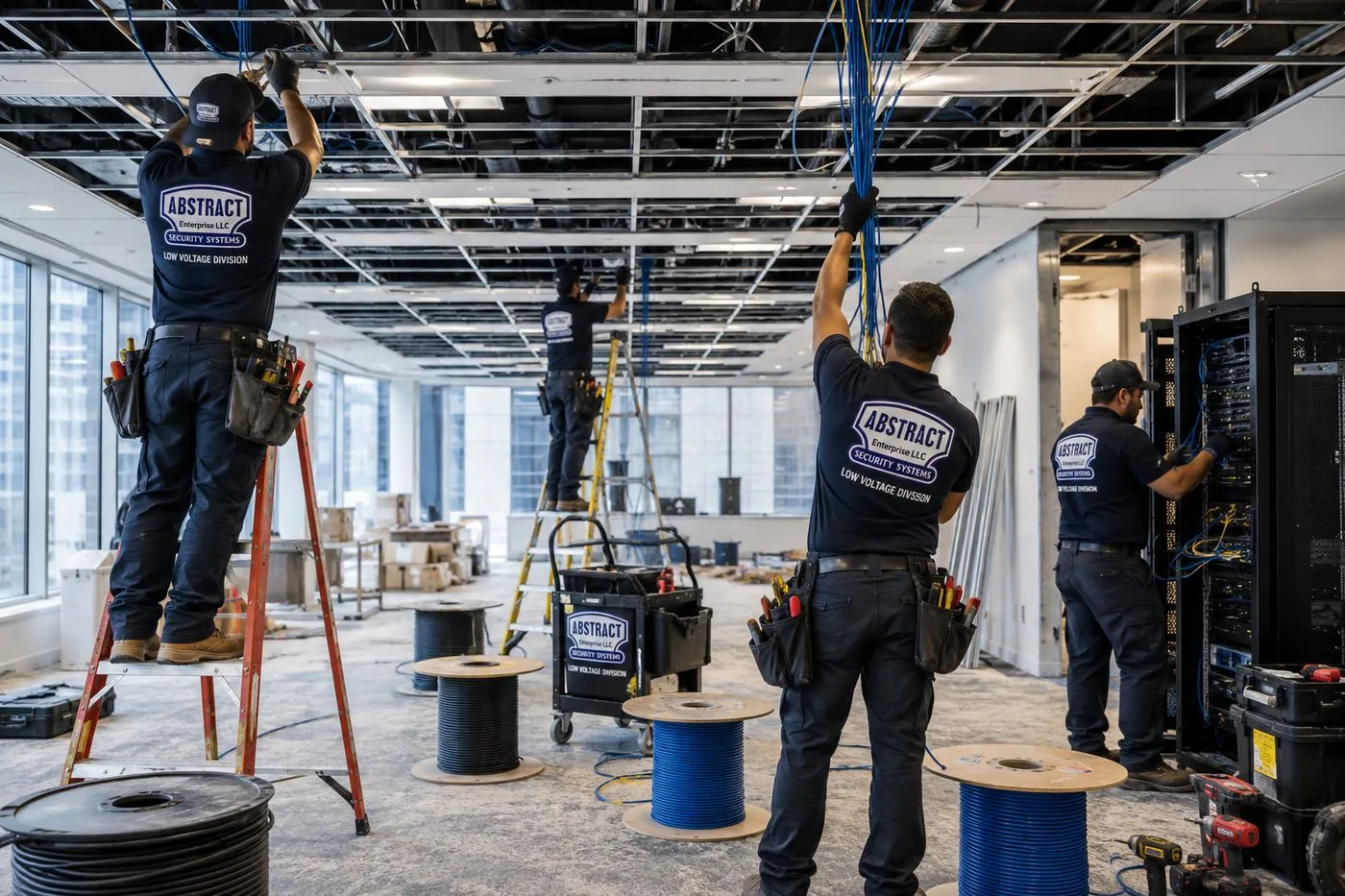
In a stripped-out open-plan floor with tall windows, one technician stands on an orange ladder at the ceiling grid, another on a yellow ladder further back, a third pulls blue cable overhead and a fourth works at a black network rack, with spools of blue and black cable on the floor.
Pricing
Sonos Installation Cost in the Bronx
The Bronx is priced at parity with Brooklyn on our area table, so the lines below are the same fixed prices published on AESS's TV and audio price list. Anything we can't price without seeing the ceiling, the wall or the building's approval is quoted in writing after a walkthrough. If something you didn't choose turns up on the day, you get its price before any work on it begins.
Item
Price
What it covers
Sonos setup
$125
Your speakers added to a single Sonos household, each room labelled, rooms grouped the way you listen, streaming accounts logged in, Trueplay on products that support it
Soundbar placed on console or stand
$79
No drilling — the renter's option; connected to the TV and tested
Soundbar wall-mounted under the TV
$129
Your Arc Ultra, Arc, Beam or Ray fixed to its bracket, set level and plugged into the TV
Sanus soundbar bracket
$84.99
Supplied when you don't already have a rated mount
Paintable cord cover
$59
Surface raceway where the wall can't or shouldn't be opened
In-wall concealment
$169
TV power and HDMI hidden inside a hollow wall using a code-compliant recessed kit, when the lease or board permits
Cable run to a cabinet or other spot
$99
Up to 25 ft
A/V receiver
$129
Receiver connected and set up, for example with a Port
Universal remote
$99
Programmed for TV, cable box and Sonos
Streaming device setup
$49
Per device
Full home theater
$350
Multi-component system setup
Remove an old bracket
$45
Before the new soundbar or TV goes up
Take down an old TV
$85
When the TV wall is being redone
In-ceiling or in-wall speakers on an Amp
Quoted at walkthrough
Each zone lands inside the $800–$2,500 whole-home audio band on AESS's published list
Amp or Port placement, outdoor speakers, Ethernet runs
Quoted at walkthrough
Depends on wall type, cable path and the building's approval
Wall, access and paperwork add-ons
Condition
Price
Drywall on wood studs
$0
Metal studs
+$30
Plaster
+$45
Brick or stone
+$65
Concrete or cinder block
+$75
Tile or marble
+$95
Plywood backer board
$85
High mount (above about 8 ft)
$75
Walk-up, 3rd floor and above, no elevator
$40
Box removal
$25
Certificate of insurance for Riverbay, a condo board or a managing agent
Free
Setup-only visits in the Bronx
When nothing is mounted or cut — reconnecting a system after an internet provider change, regrouping rooms, chasing dropouts — the visit is billed by time: $225 for the first hour in the Bronx, then 30-minute blocks. That is the same Bronx rate that appears on our Bronx TV mounting price list, alongside the $209.99 base price for mounting a 32″–55″ TV.
What's included, and what isn't
Included: placement or mounting, connection to the TV, joining every product to one system, rooms named and grouped, music services signed in, Trueplay in each tunable room, a volume limit where you want one, and clean-up.
Left to other trades: outlets are an electrician's work, so if an Amp needs a new receptacle you book a licensed electrician and we coordinate the timing. Filling and repainting around a ceiling opening belongs to your painter or plasterer.
Who buys what: the Sonos speakers, soundbars and Amps are yours to buy wherever the price is best. The brackets, cable, raceway and in-wall kits on the lines above can come from us.
Visits that can't start: if the crew arrives and can't begin — products not delivered, nobody to let us in, or the renovation form or board approval still missing — the $150 return-trip fee applies. Rescheduling with 24 hours' notice is free.
Brittle walls: a 1920s plaster coat or a tiled backsplash beside the TV can crack even when we drill slowly with the right bit. We point out that risk while quoting, and no hole is drilled until you say go ahead.
National averages versus a Bronx quote. Cost guides and app-based handyman platforms quote averages that assume drywall, an attic and an owner who can do what they like to the walls. A Bronx job usually adds a lease clause, a renovation form or a board, masonry, and neighbors through the floor. A local, licensed installer with published prices can quote that real job and still be here to answer for it next year.
Shop Our Systems
Sonos Installation Packages & Pricing
Three packages built for the way Bronx households live, each adding up published lines so you can check the arithmetic. Wall surcharges other than the one named, walk-up fees and similar extras are added separately.
Starter — Renter's No-Drill System
$263
Sonos setup ($125), the soundbar placed on the console and connected ($79), and a paintable cord cover to tidy the TV cables without opening the wall ($59): $263. Nothing that needs a landlord's consent beyond an adhesive raceway, which we can leave off.
Standard — Soundbar on a Plaster Wall
$383.99
Sonos setup ($125), the soundbar wall-mounted under the TV ($129) on a Sanus bracket ($84.99), with the plaster surcharge most pre-war Bronx living rooms carry (+$45): $383.99. Brick behind the plaster is +$65 instead.
Premium — Owner's Clean TV Wall
$606.99
Sonos setup ($125), soundbar wall-mounted ($129) on a Sanus bracket ($84.99), TV power and cables concealed in a code-compliant in-wall kit ($169), and a universal remote programmed for the whole system ($99): $606.99. For owners whose wall is hollow and whose building permits it.
Bring Your Own Equipment — Labor Only
Got the bracket already — Sonos's mount for the Arc Ultra or Beam, or a third-party mount rated for your bar's weight? Then the bill is labor: the $129 wall-mount line plus whatever surcharge the wall carries, and $125 if you also want the Sonos setup. Your mount keeps its maker's warranty. If we judge it wrong for crumbly plaster or hard brick, we tell you before the first hole and offer the Sanus bracket at $84.99.
Ceiling-Speaker Rooms for Owners
Built-in speakers can't be priced from a photo. The joists or slab overhead, the distance to the closet where the Amp will live, and what the board or renovation form allows all change the labor, so these rooms get a site visit first. The written figure for each zone falls inside the $800 to $2,500 band AESS publishes for whole-home audio, and you see it before anything is ordered.
Lease, Board or House — Which Bronx Plan Fits You?
Tell us who owns the walls and we'll tell you which package fits, in writing, the same business day.
Every Sonos speaker in the home depends on one router and one internet connection, and in the Bronx the choice of provider has been a long-running local story. A Bronx Times headline read "Co-op City Wants FiOS; Verizon Ignores Call." In an r/bronx thread titled "Any alternative to Optimum?", one reply says, "I have Verizon on the concourse and it works very well," and another mentions ads for 5G home internet. The Co-op City Times reported in July 2023 that Optimum subscribers in Buildings 3, 4, 5A and 5B could begin migrating to Optimum's newer service. In a Co-op City residents' group, a post headed "Verizon Service Comes to Co-op City, Ending Optimum Monopoly" notes that the service arrives over cellular.
For Sonos, the provider matters less than the equipment it leaves behind and where it sits. These are the checks we run on Bronx connections:
Where the gateway lives. Providers tend to install the modem-router wherever the line enters, often a hall closet or behind the TV. Masonry walls between that spot and the bedrooms are a frequent cause of dropouts. Moving the router, or adding a wired access point, usually beats buying more speakers.
Band and security settings. Sonos says every product works on 2.4 GHz and that routers offering only 5 GHz are unsupported, as are WPA/WPA2 Enterprise security, guest networks and networks with log-in portal pages.
Cellular and satellite connections. Sonos's system requirements list satellite, mobile hotspot and LTE connections among setups it doesn't support. If your home internet arrives through a cellular box, we test it on the day and tell you honestly how the system behaves, rather than promise.
Extenders and powerline adapters. Both are on Sonos's unsupported list. We take them out and, where coverage needs help, put in a wired access point instead.
A provider swap later. When the household changes provider, every Sonos product must be moved to the new network. That is a setup-only visit at the Bronx rate if you'd rather not do it yourself.
Census figures put broadband subscriptions in 86.8 percent of Bronx households. For the rest, Sonos still plays from the TV through a soundbar, but music streaming and the app need a working home network.
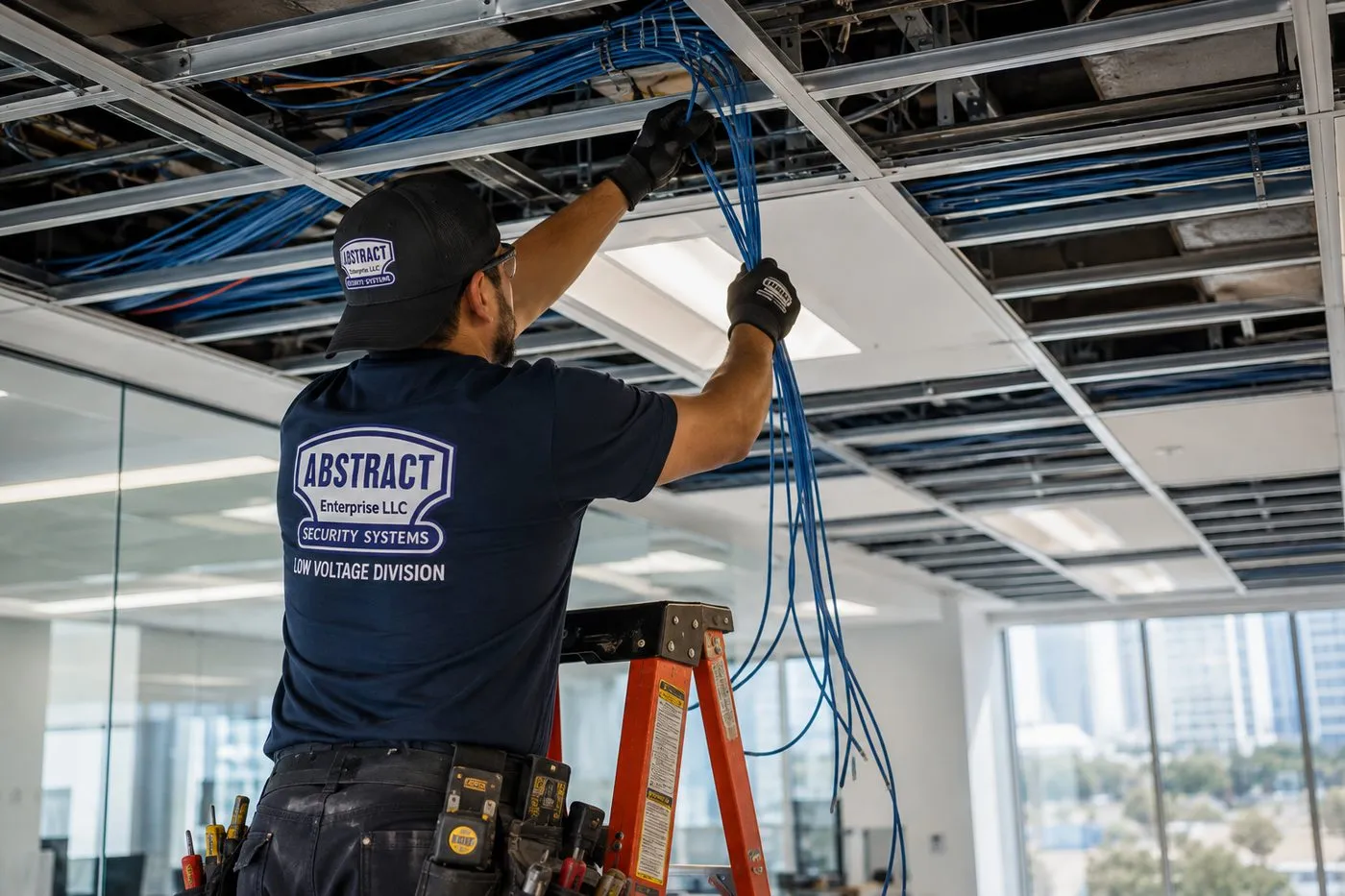
Standing on an orange ladder, a technician pulls a loose fan of blue cables down through an open ceiling grid, with glass-walled offices and a city view through the windows behind him.
Field Notes
Field Notes From Bronx Sonos Visits
The first twenty minutes of a Bronx apartment visit, as our installers work it every time — a routine, not a story about any one customer
Before a tool comes out, we ask to see the approval, whether it's a landlord's email, a Riverbay renovation form or a board letter, and we read what it actually permits. If it covers the soundbar but not the cord cover, the cord cover waits. Nobody wants to explain an extra hole at move-out.
Next comes the heat. In older buildings we put a hand on every radiator cover and feel the closet walls where an Amp or Port might live. A closet that shares a wall with a steam riser can run warm in winter, and electronics that are happy in July can struggle in January.
Then the floor. We look at what is under the spot where the Sub will go and ask where the downstairs neighbor's bedroom is, if the customer knows. A rug, a few feet away from the shared wall and a lower Sub level in the app make more difference than any setting on the speaker itself.
Only after those three checks do we walk the apartment with a phone, measuring signal from the router to each room, and start placing speakers.
Complete Services
Every Sonos Installation Service in the Bronx
A Sonos booking often arrives with a new TV, a network that needs help or a renovation. These are the Bronx services customers book alongside it.
What is the least a Bronx renter can spend on a properly set-up Sonos system?
+
$204: Sonos setup at $125 plus $79 to place and connect the soundbar on the console, with nothing drilled. Wall-mounting a soundbar is $129, a Sanus bracket $84.99, and plaster adds $45. Setup-only visits are $225 for the first hour in the Bronx, and ceiling speakers on a Sonos Amp are quoted after a walkthrough within the $800 to $2,500 per zone range we publish.
I live on the fifth floor of a walk-up off the Concourse. What gets added?
+
The walk-up line: $40 for a third floor or higher with no elevator, charged once per visit. Everything else is priced exactly as it would be on the ground floor.
Do you cover my part of the Bronx?
+
Yes. We work in every Bronx neighborhood, from Mott Haven and Melrose in the south to Riverdale, Wakefield and Co-op City in the north and City Island in the east, out of our office at 460 E Fordham Rd.
Can you take down the old surround speakers and bracket before the Sonos goes up?
+
Yes. Removing an old bracket is $45 and taking down an old TV is $85 on our price list. Loose speaker wire is removed or cut back neatly; wire buried in a wall or ceiling is left in place unless you ask us to quote its removal.
Does someone need to be home for the whole visit?
+
Someone has to let the crew in and be there at the end to approve the work. The person who holds the Sonos account and the music-service log-ins needs to be reachable to sign in. If nobody can let us in, the $150 return-trip fee applies.
Is the written quote free?
+
Yes. Quotes from the form or by phone cost nothing and come back the same business day. A walkthrough for ceiling or wall speakers is arranged when you are ready to plan built-in work.
Will my cable box remote still turn the volume up and down once the soundbar is in?
+
Usually, yes. A Sonos soundbar on the TV's HDMI ARC or eARC port follows the TV's volume commands, so a cable-box remote already set to control the TV's volume will work the soundbar too. If yours won't cooperate, we program it during the visit or set up a universal remote, which is $99 on our price list.
Will you also adjust the TV's picture settings?
+
Picture calibration isn't part of our installation work. We do set the TV's sound output to the soundbar and turn off its own speakers, so the audio comes only from the Sonos.
All Areas Served
Sonos Installation Across New York
One level up is our New York City Sonos installation hub. Pages for the other boroughs and counties go live in batches; if a link below opens the quote form instead, that area's page simply isn't finished yet — the crews already work there.
Cameras, intercoms, alarms and access control are all on the AESS home page, and who we are and how we are licensed is on the about page.
Speakers Gone Quiet? Bronx Help Today
A soundbar that lost the TV after a new cable box, a room missing from the app, or a system that never came back after the provider swapped the router — call (646) 490-0629 for the earliest open arrival window. Once we're inside, most Sonos network and setup faults are fixed in an hour or two.
Abstract Enterprises Security Systems · 460 E Fordham Rd, Bronx, NY 10458 · (646) 490-0629 · WhatsApp (718) 679-0359 via wa.me
NYS Low-Voltage Licence #12000287431 · 100% Licensed & Insured · Same-Day Estimates · Rated 4.7★ from 201 Google Reviews
Sonos products carry Sonos's manufacturer warranty through the seller; brackets and parts carry their maker's warranty. Full terms — including 50% deposit, one-year parts-only warranty on AESS-supplied products, and the late-fee schedule — are set out in the service agreement. See our warranty page.
Page reviewed and updated October 17, 2026. Changelog: first publication of the Bronx Sonos installation page, written around leases and boards, Co-op City and Parkchester rules, noise limits, radiators and two-family houses.