Ethernet · Cat6 · Data Jacks · High-Bay Distribution · Certified Testing
Fault location, retermination, network jack and panel repair, PoE troubleshooting and certified cable testing across Orange County, New York. Licensed NYS low-voltage contractor, working the I-84 and Route 17 distribution corridor as well as the county's towns and villages.
Ethernet, Cat6 and Data Cable Repair Across Orange County, NY
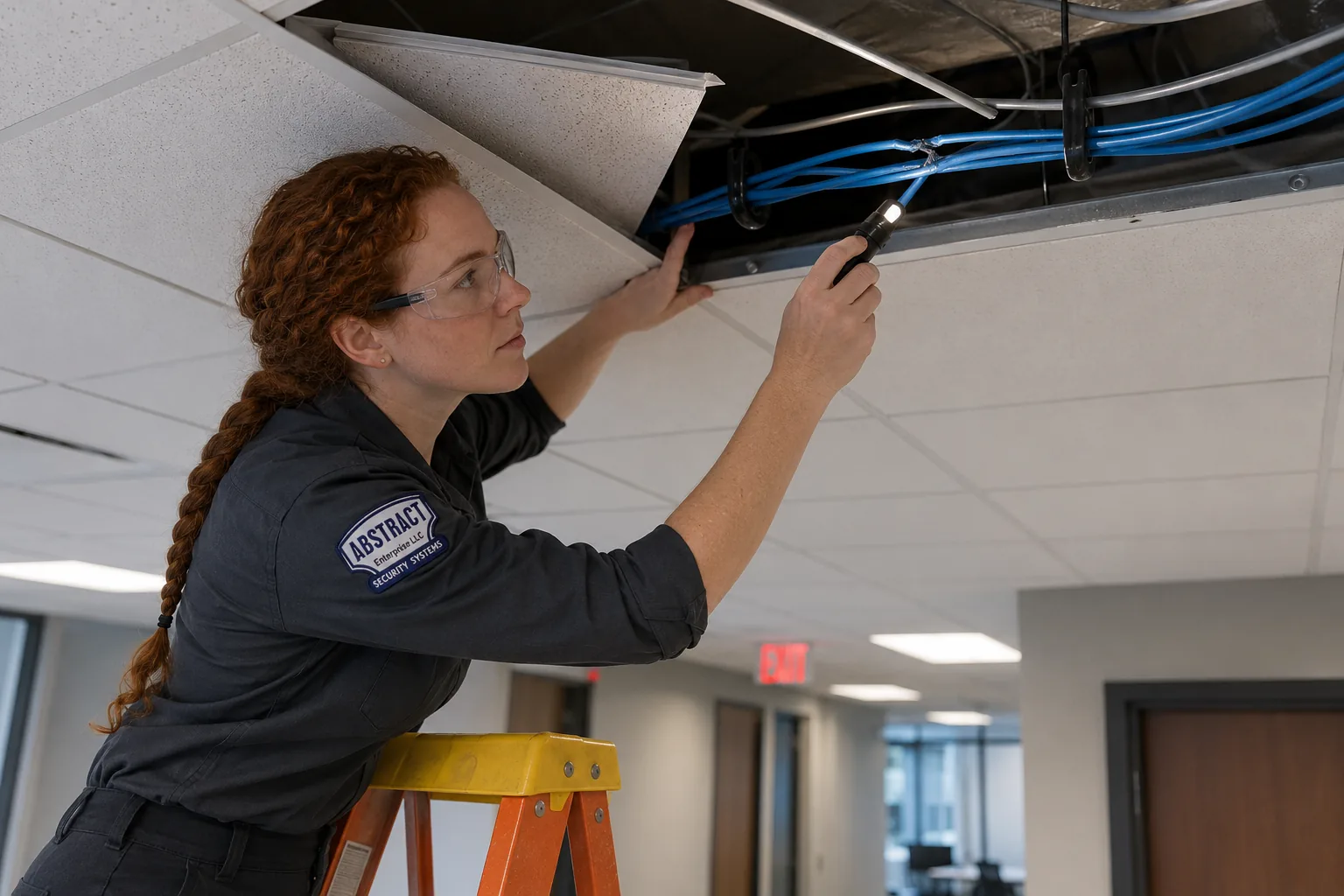
Orange County, New York has become one of the region's largest distribution markets, and the cabling problem that comes with it is height. A modern high-bay building here has a roof deck thirty-six to forty feet up, and the cable serving it runs at that level: along the structure, above the racking, out to access points and cameras and scanner positions that nobody can reach from a ladder. Abstract Enterprises Security Systems repairs Ethernet, Cat6 and data cabling across the county — the I-84 and Route 17 corridor and the towns and villages either side of it.
Two things follow from the ceiling height. The first is thermal: heat rises and collects at the deck, so cable at roof level sits in the hottest air in the building, several degrees above what anybody standing on the floor experiences. A link with little margin left fails up there long before anything on the office side complains. The second is access: everything at that height needs a lift, and lift time is the single largest variable in the cost of the work. Bringing one on the first visit rather than the second is most of what separates a sensible quote from a frustrating one.
Repair is charged at our specialty service rate of $195/hr with a three-hour minimum ($585). On high-bay work we establish the access requirement at booking, because a diagnostic visit that ends with ‘we need a boom lift’ has cost you a day and told you very little.
A note on the name: this page covers Orange County in New York State, in the Hudson Valley — not Orange County in California, Florida, Texas, North Carolina, Virginia or Indiana. If you have arrived here looking for one of those, we do not work there.
Network Down in Orange County?
Same-day and next-morning coverage across the county. On distribution sites we work around shift patterns and bring lift access rather than discovering we need it after arriving.
✔ NYS Lic. #12000287431✔ Certified wiremap & performance testing on every repair✔ 4.7★ from 201 reviews
Local Conditions
Why High-Bay Buildings Break Cable Differently
Start with the temperature gradient, because it explains faults that make no sense from the floor. In a building with a forty-foot deck, warm air collects at the top and the difference between floor level and roof level can be substantial, especially in summer and especially in a building with limited roof ventilation. Insertion loss on copper rises with temperature. A run at deck height therefore operates in the worst thermal conditions in the building, and a link that certifies comfortably in March can drift out of spec on an August afternoon while the office thirty feet below is perfectly comfortable.
Second, access economics. Nothing at deck level is reachable without a scissor or boom lift, and lift availability governs the schedule. If the site has one, the visit is straightforward. If it does not, one has to be hired and delivered, and that decides the day. This is why we ask about ceiling height and on-site lift availability when a call is booked rather than treating it as a detail — it is frequently the largest single line in the cost.
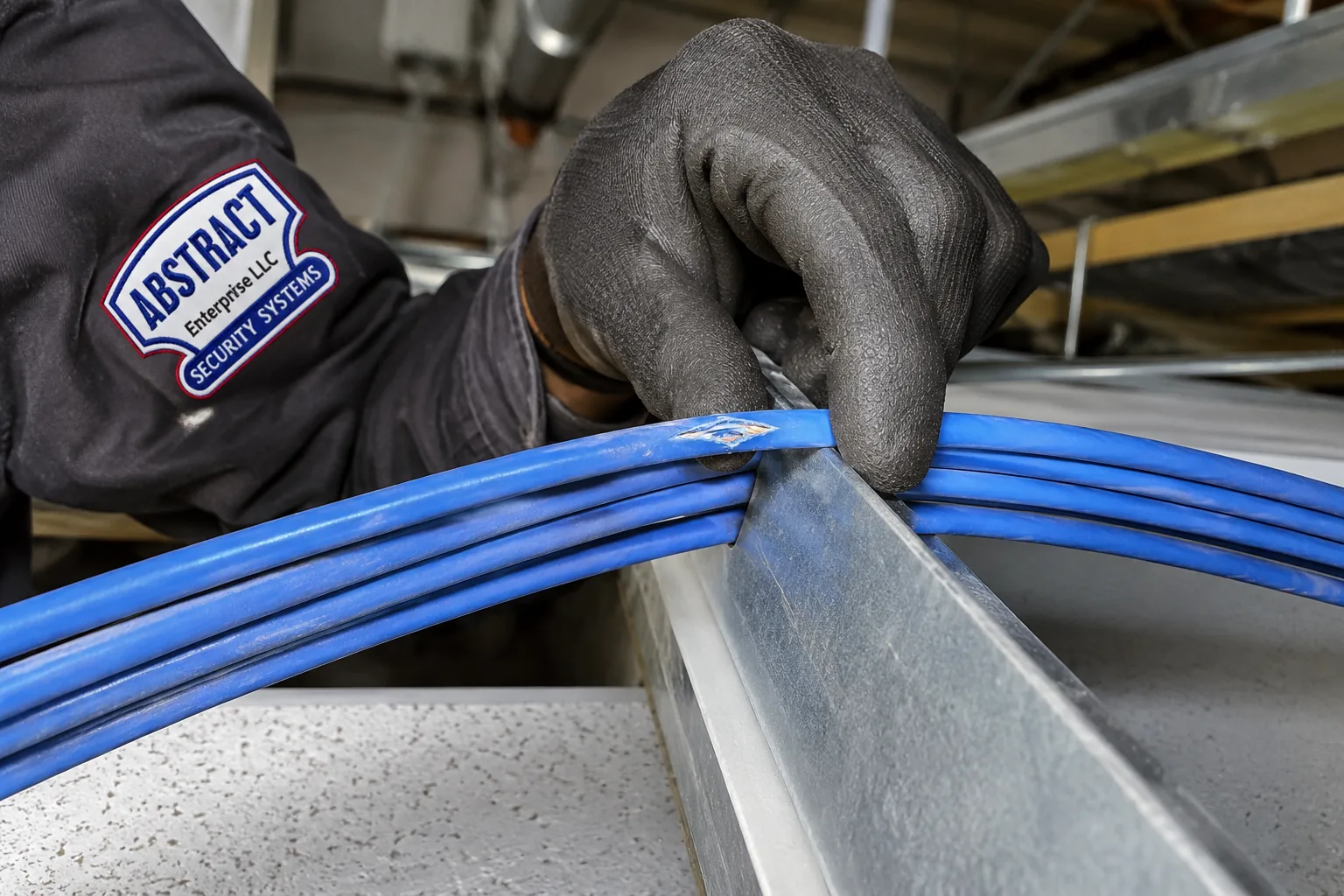
Third, what the cable is attached to. In high-bay construction, runs are supported off joists, purlins and structure rather than hidden above a grid. Support spacing matters more when a bundle spans open air, and cable resting against a purlin edge or tied to a sprinkler line has a wear point that will find it eventually. Sprinkler pipe in particular is not a cable support, and it is used as one constantly.
Fourth, the working floor below. Racking, reach trucks, order pickers and trailers all move through the space, and anything descending from the deck to a floor-level position passes through the zone where they operate. Drops to pack stations, scanner points and dock positions get struck, and the damage is mechanical rather than electrical.
Fifth, the county's other half. Middletown, Goshen, Warwick, Monroe, Port Jervis, Cornwall and the Newburgh waterfront hold ordinary main-street and small-commercial buildings with entirely different problems — older stock, no equipment room, cellar panels and improvised routes. Orange County is not one market and a contractor who only knows warehouses will be lost on a Goshen village high street.
What We Repair
What an Orange County Cable Repair Call Covers
We repair the physical layer, work at the height it actually sits at, and prove the result with a measurement.
High-Bay Access and Repair
Work at roof-deck level using scissor or boom lift, with the access requirement established at booking rather than discovered on arrival.
Thermal Margin Assessment
Measuring what a deck-level run has left in reserve, so a link that only fails in summer is identified before the next heatwave rather than after it.
Support and Attachment Correction
Runs bearing on purlin edges, tied to sprinkler pipe or spanning too far between supports. Moved onto proper hangers at consistent intervals.
Floor-Level Drop Repair
Pack stations, scanner points and dock positions where descending runs pass through the zone reach trucks and pickers work in.
Ethernet Cable Repair
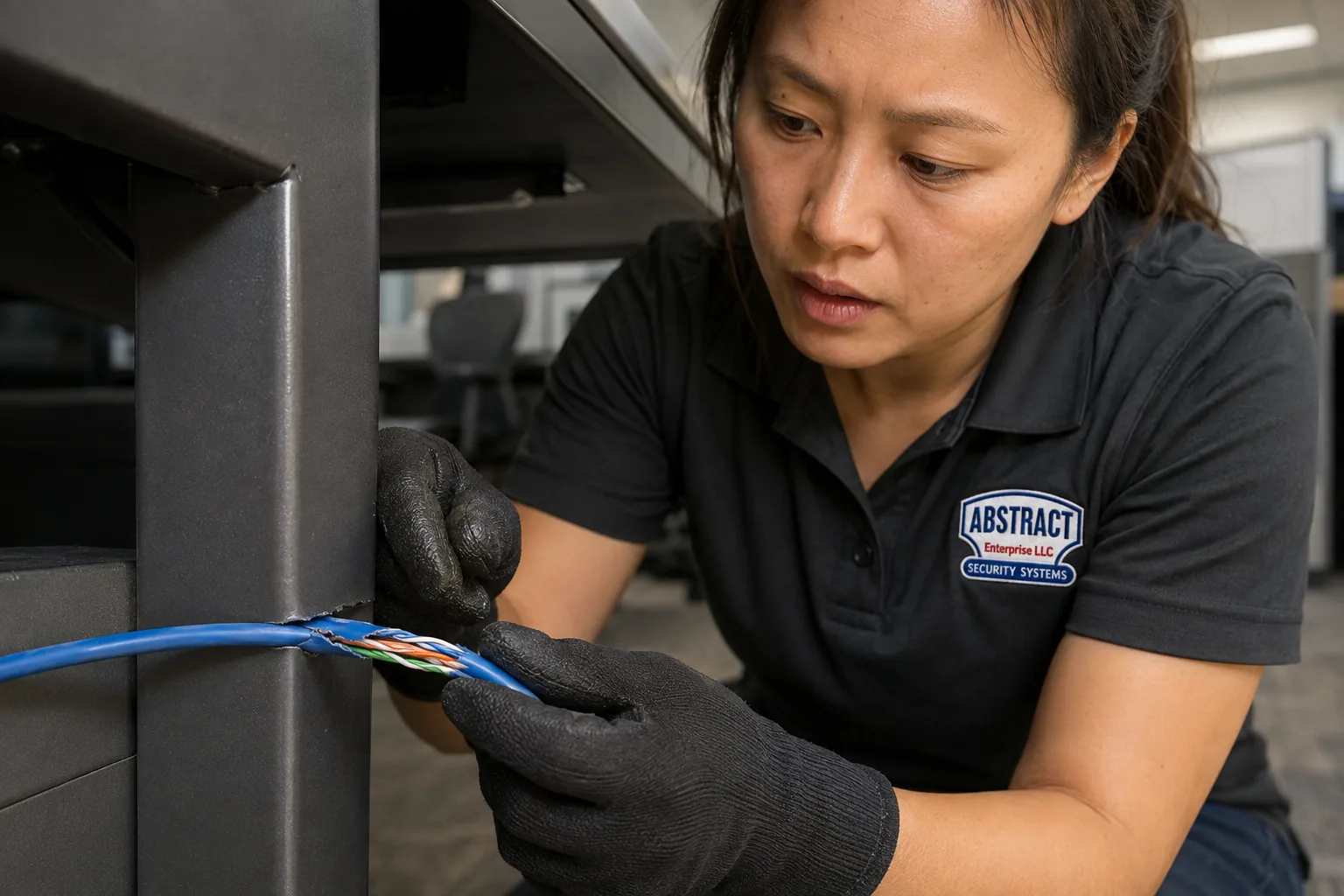
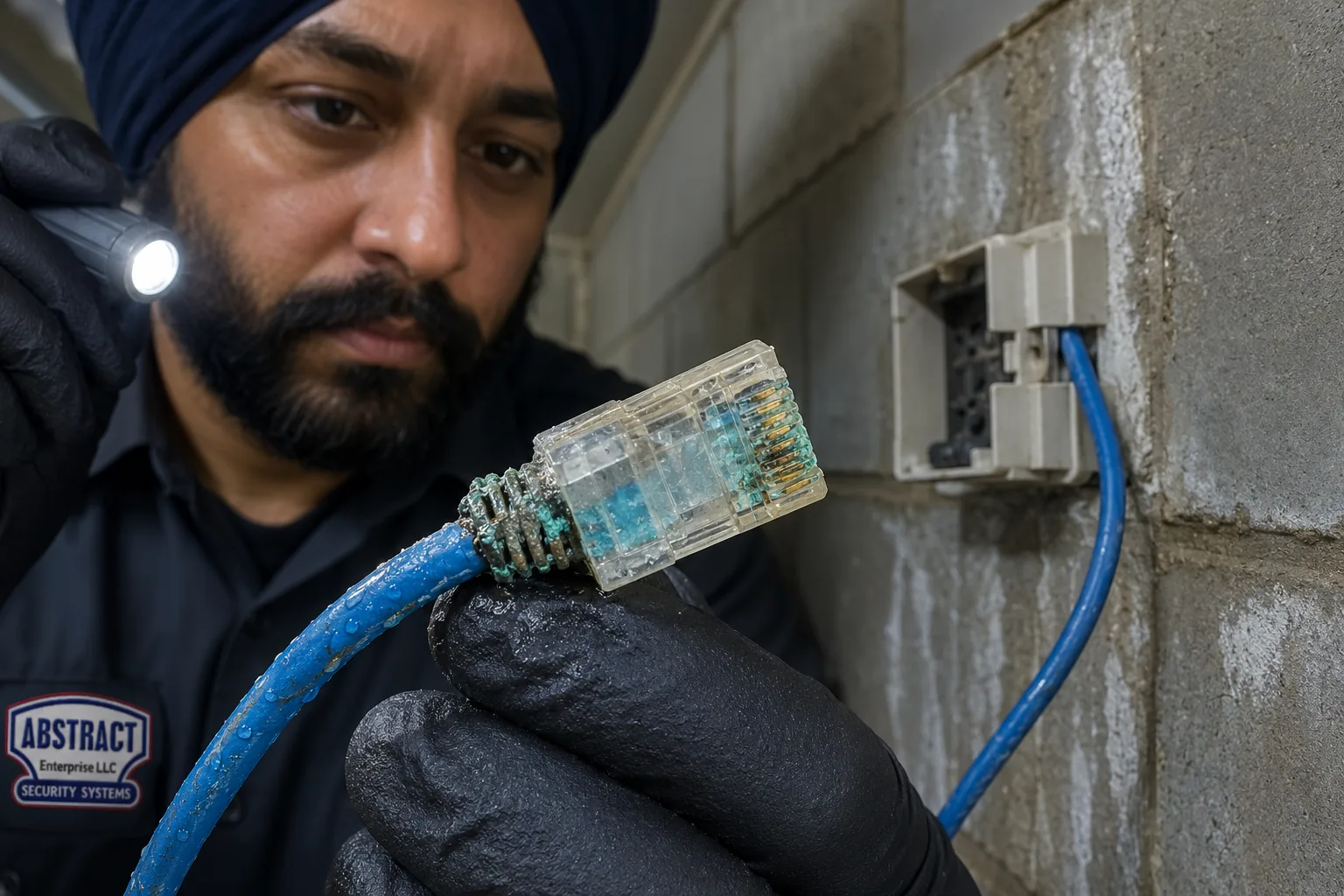
Severed, crushed, worn or heat-degraded runs restored with a junction of the correct grade and then measured.
Cat6 and Cat6A Retermination
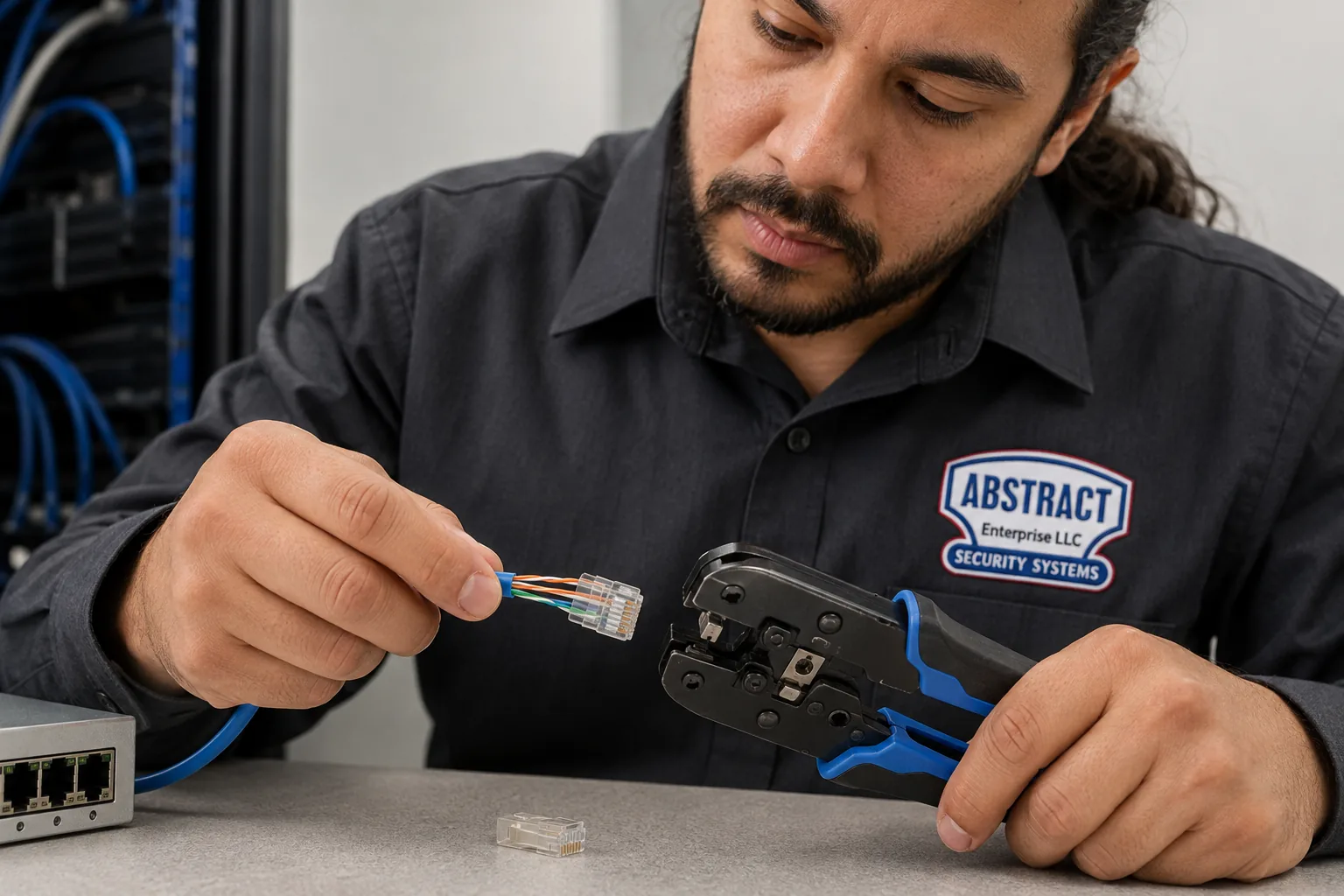
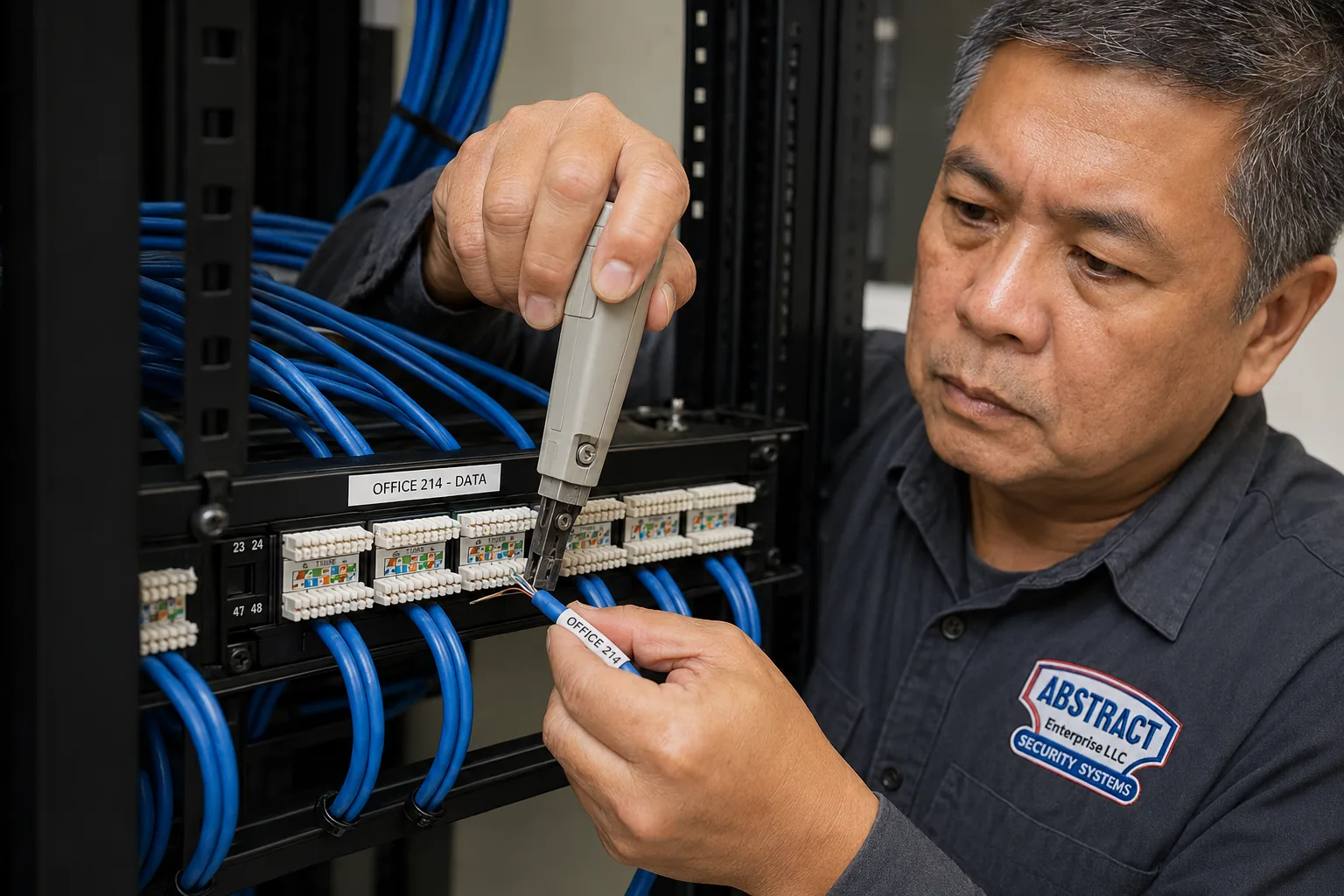
Terminations redone at both ends to T568B with twist held to the contact, so the link certifies rather than merely showing a light.
Network Jack and Panel Repair
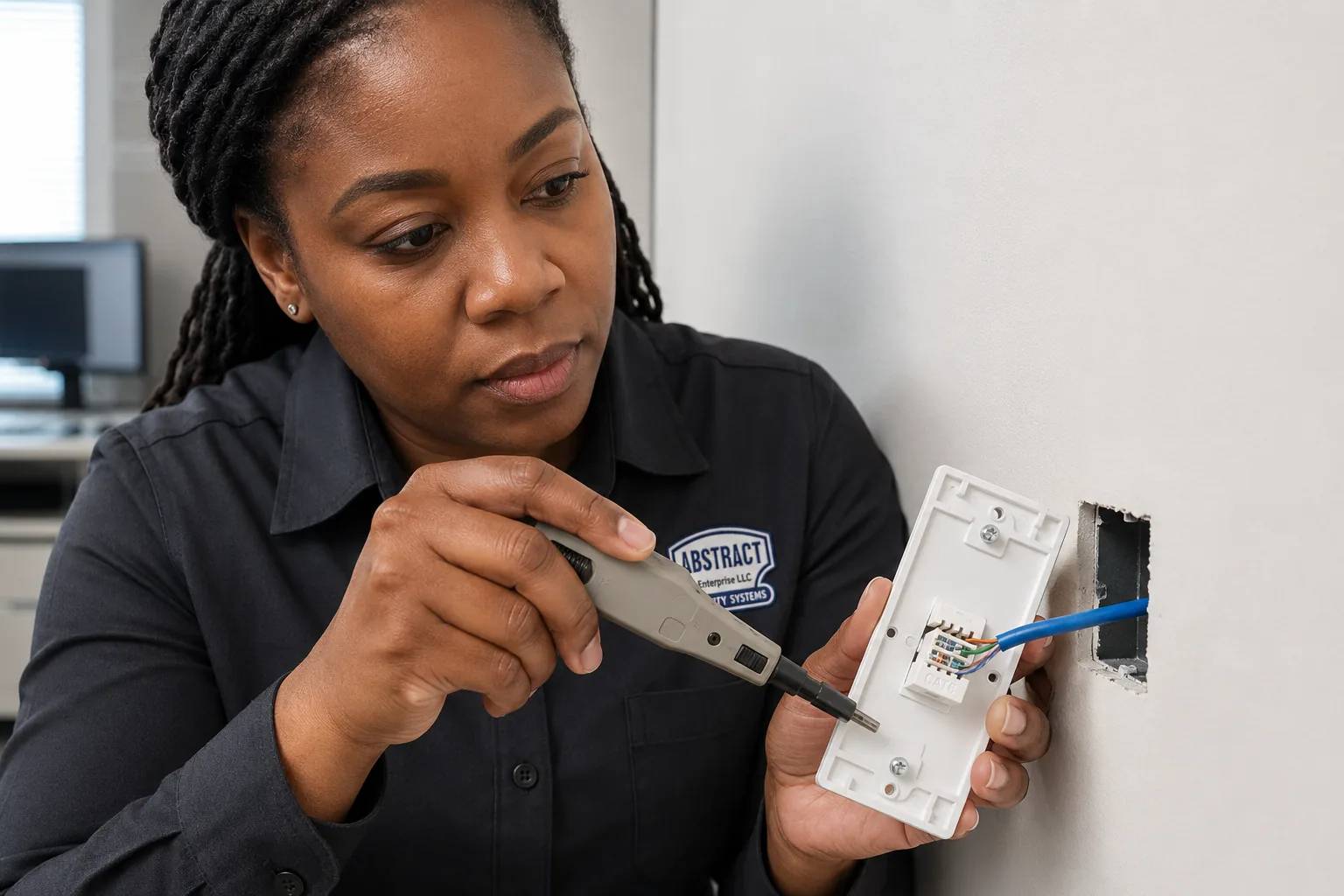
Outlets gone dead, jacks whose conductors were seated but never driven into the contacts, and panel positions finished to the wrong standard.
Certified Testing
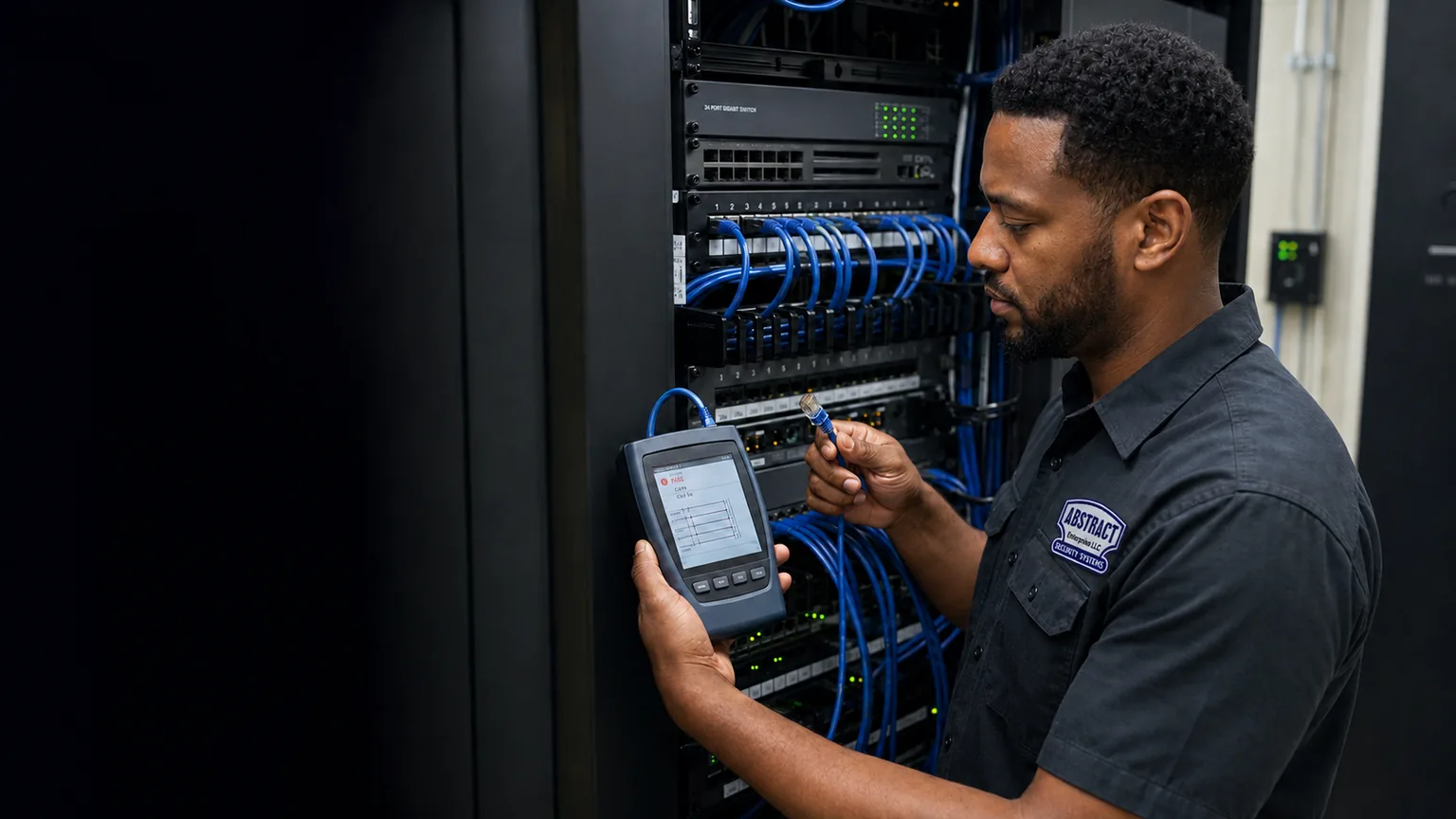
Wiremap, distance and performance measured on every repaired run, with the report saved and the margin recorded.
PoE Circuit Troubleshooting
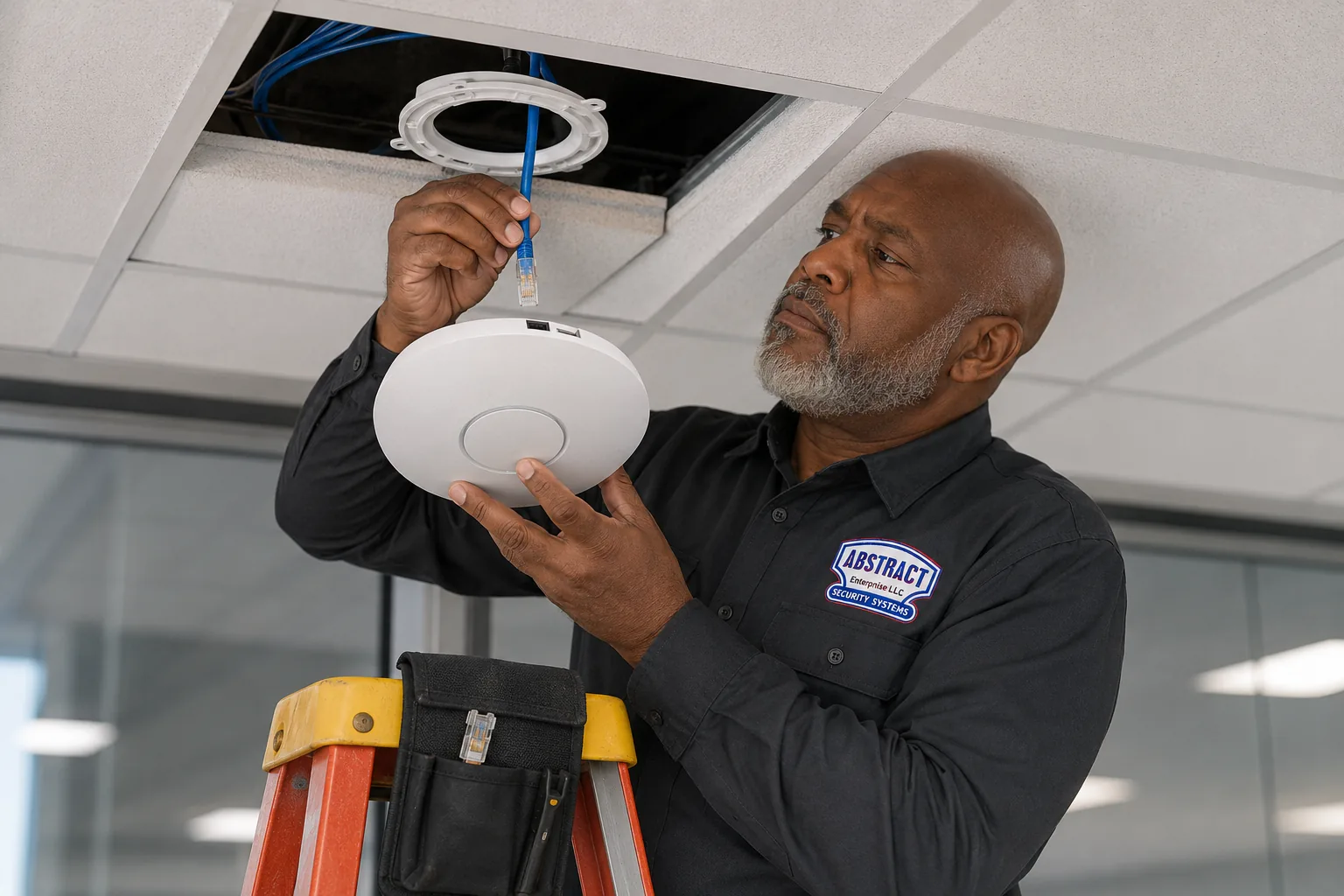
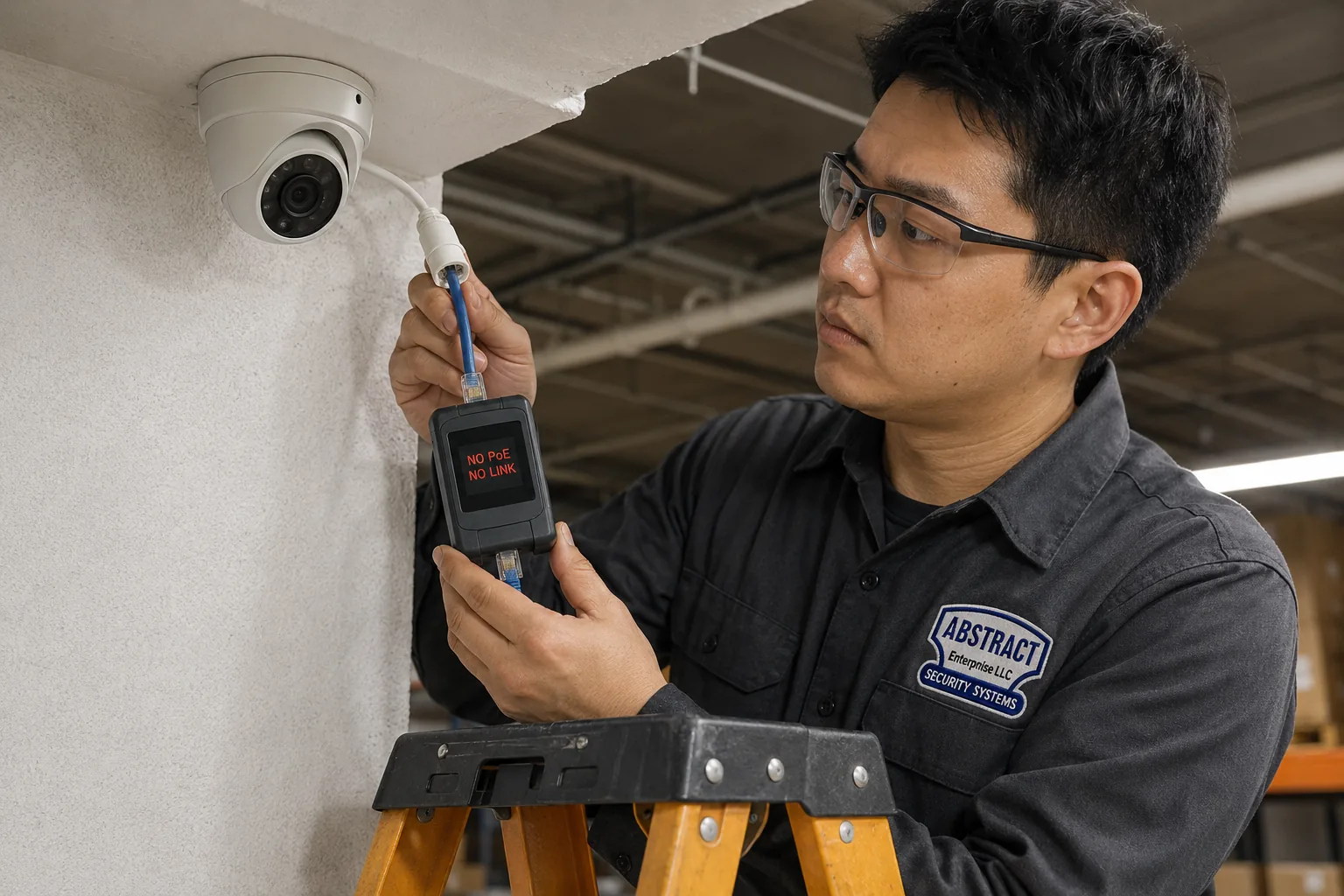
Deck-mounted access points and cameras that power up and cycle. Metered at the device while it is drawing.
Commonly paired: deck-level camera and access point runs share both the height and the lift with the data cabling. If a lift is already on site for one, testing the rest costs a fraction of mobilising again — see camera repair and access control.
Plain English
Terms That Come Up on an Orange County Job
Most of these describe height, heat or how the cable is held up — the three things that decide a high-bay repair.
Term
What It Means in an Orange County Building
High bay
A building with a roof deck typically thirty feet or more above the floor. Everything about cable access, support and temperature changes above that height.
Deck level
The underside of the roof structure where cable is routed. It is also where the warmest air in the building collects.
Thermal gradient
The temperature difference between floor level and roof level. It is why a run can be comfortable at head height and marginal thirty feet up.
Insertion loss
Signal given up along the run. It rises with temperature, which is what turns a deck-level link with little margin into an August failure.
Support spacing
How far apart cable hangers sit. Too far and the bundle sags, bears on structure and wears at the contact point.
Purlin
The horizontal roof member cable is frequently routed across. Its edge is a wear point where a bundle rests on it unprotected.
Lift access
Scissor or boom lift required to reach deck level. Availability on site is the largest single variable in scheduling and cost.
Split pair
Each wire is terminated but two sit in the wrong pairs. The result is a link stuck at 100 Mbps that will not negotiate higher, reported by users as slowness.
Certification
A recorded measurement against the category standard with the remaining margin stated, saved and printable.
Demarc
The end of the carrier's responsibility. Everything past it is the building's, and that is where our work begins.
Equipment
Hardware and Test Equipment on an Orange County Repair
We work with what is installed and replace with commercial-grade components matched to the existing link — Belden, CommScope, Panduit, Leviton, Hubbell, Ortronics, ICC, Berk-Tek and Superior Essex, with industrial-grade jacks and enclosures at floor positions that take knocks and proper hangers rather than improvised ties at deck level. Grade matching decides the result: a Cat5e outlet on a Cat6 link derates the whole link, and on a long deck run with thin thermal margin that is the difference between passing and not.
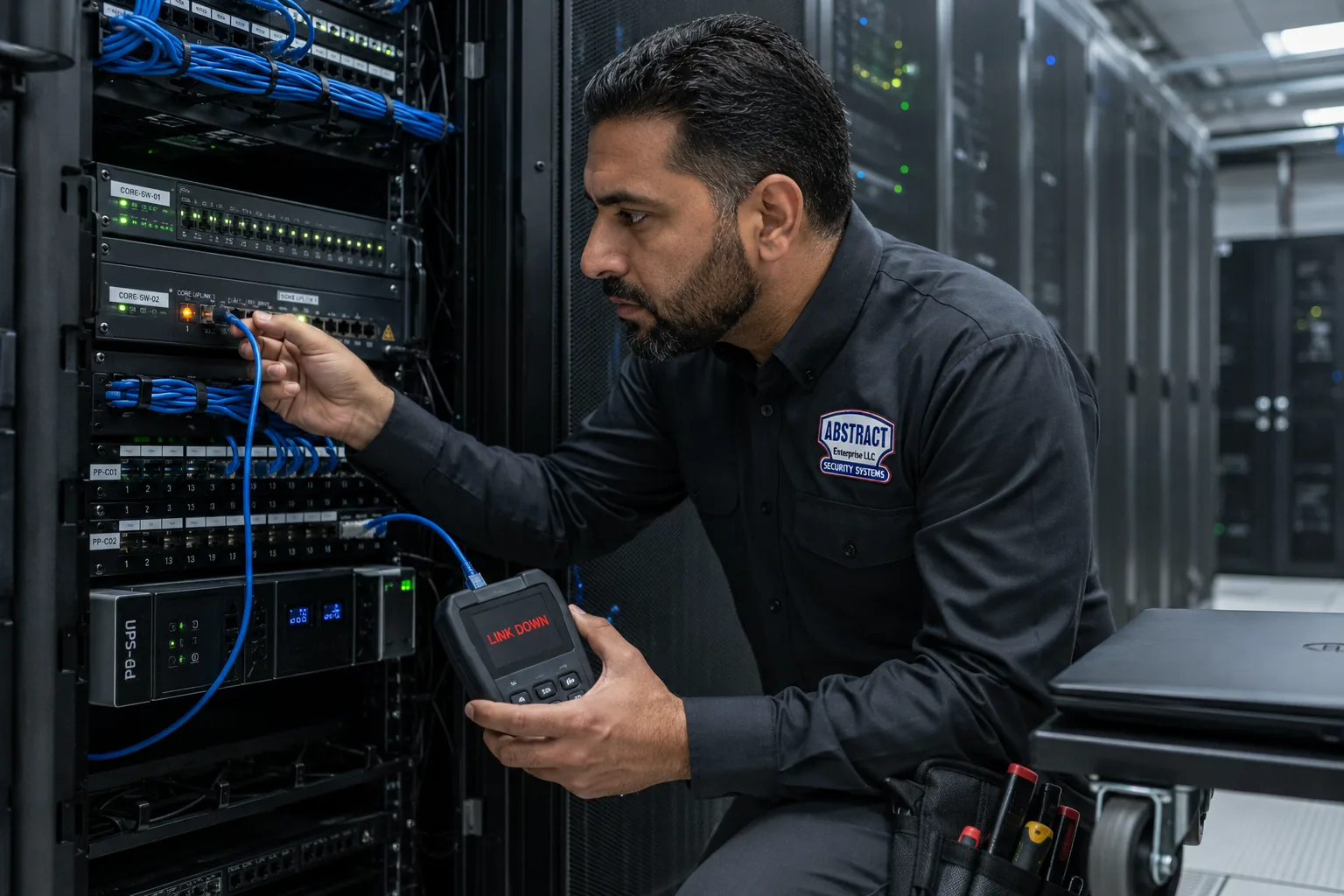
Where the active kit is Cisco, Meraki, Aruba, UniFi, Netgear, TP-Link, Luxul or Araknis, our part is the cable fault underneath it — and equally beneath deck-mounted access points, cameras, handheld scanner infrastructure, readers and time clocks. Configuration is not ours: no switch administration, no segmentation, no controllers, no firewall policy. We certify the link and pass the results to whoever runs the network.
The certifier matters here for a specific reason: on a deck run, the margin figure is the whole diagnosis. A link that passes with almost nothing in reserve in cool weather is a summer outage with a date on it, and the only way to know which runs those are is to measure and record them.
Need Repair in Orange County Today?
Same-day and next-morning coverage county-wide. On high-bay sites we confirm ceiling height and lift availability at booking so the visit is productive rather than exploratory.
On high-bay work the sequence starts before anyone leaves the yard.
The first question is height and lift. A building with a scissor lift on site is one kind of visit; a building without one is another, and hiring and delivering equipment is a scheduling matter rather than a surprise. Asking at booking is the difference between a productive first visit and a wasted one.
Then measurement before repair. On a deck run the useful number is not pass or fail but how much margin is left, because a link operating in the hottest air in the building with nothing in reserve will fail in summer whatever was done to it in March. Then the physical work — retermination, junction, support correction, or a fresh run — and then the measurement again, recorded, so the site knows which runs are comfortable and which are close to the edge.
Full Scope
Full Scope of an Orange County Network Cable Repair
Diagnostics
Ceiling height and lift requirement established before the visit
Measured length against the 90 m and 100 m limits
Fault location by measured distance on broken or shorted runs
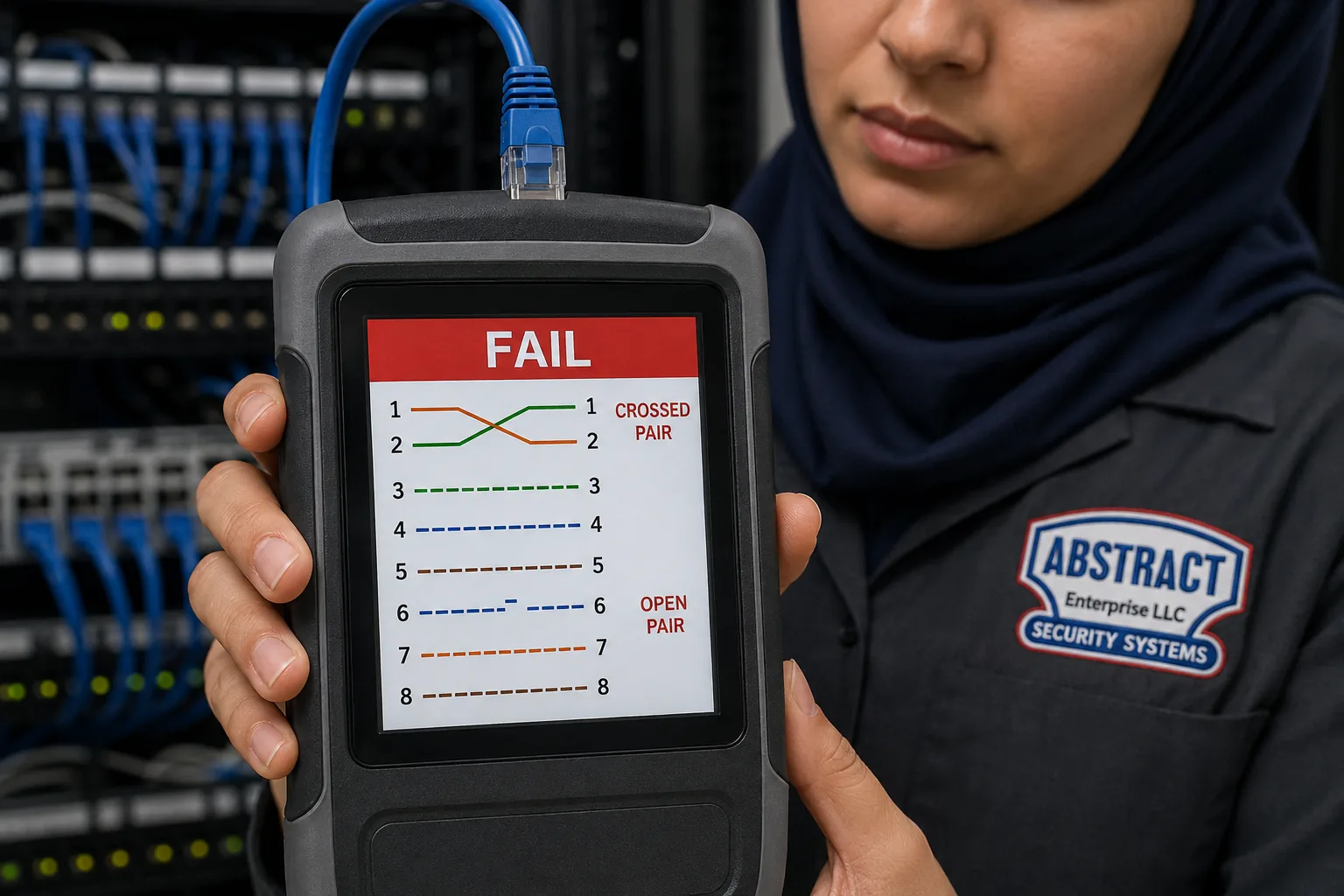
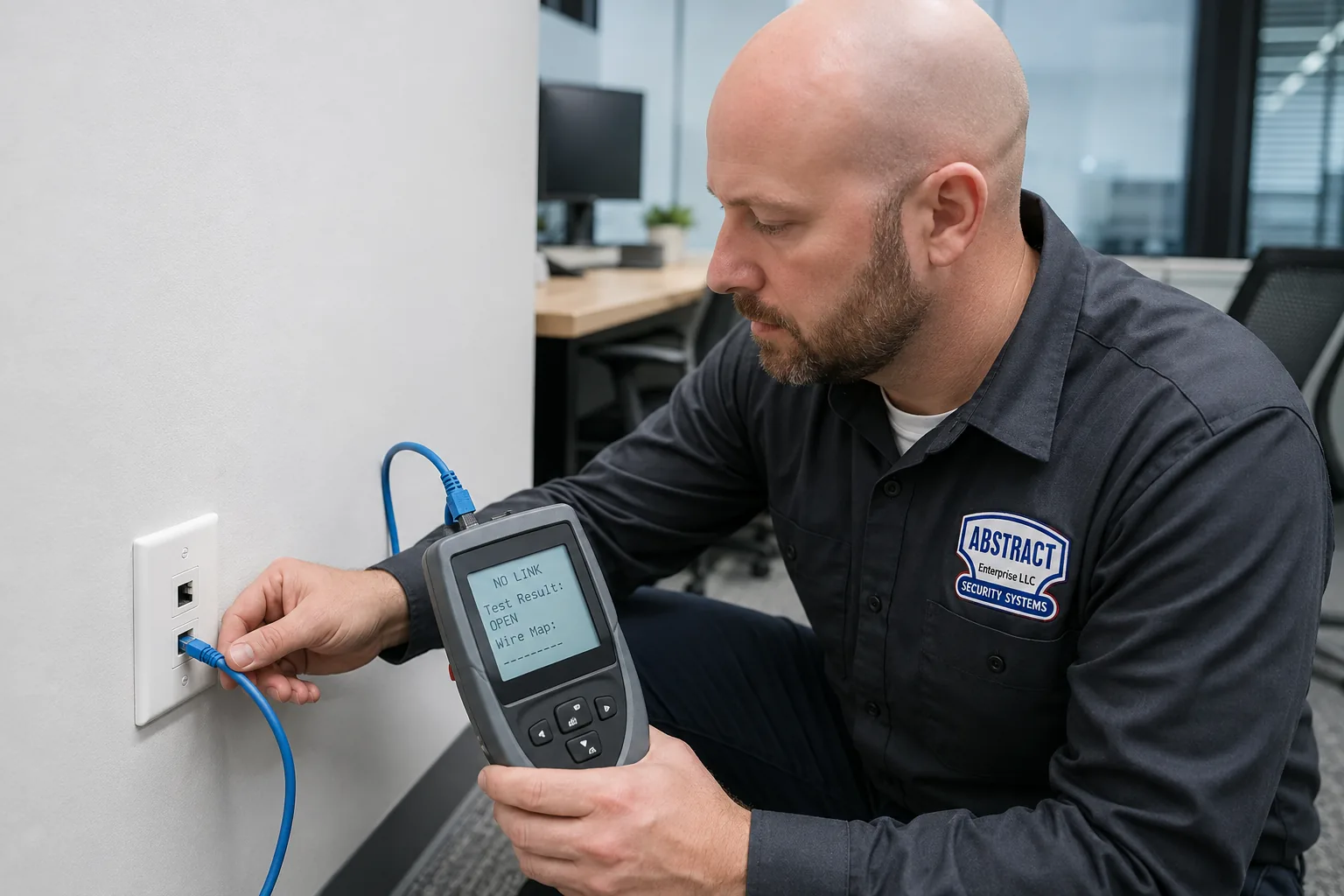
Wiremap faults: opens, shorts, reversals, split and crossed pairs
Insertion loss and crosstalk with remaining margin recorded
Identification of deck runs with thin thermal margin
PoE measurement at the device under genuine draw
Switch-port versus cable-fault isolation
Physical Repair
Keystone and patch panel retermination
Junction repair of matching grade on damaged runs
Support and hanger correction at deck level
Removal of cable tied to sprinkler pipe or resting on purlin edges
Protection where descending drops pass through equipment zones
Industrial-grade outlets and enclosures at floor positions
Full run replacement where certification fails
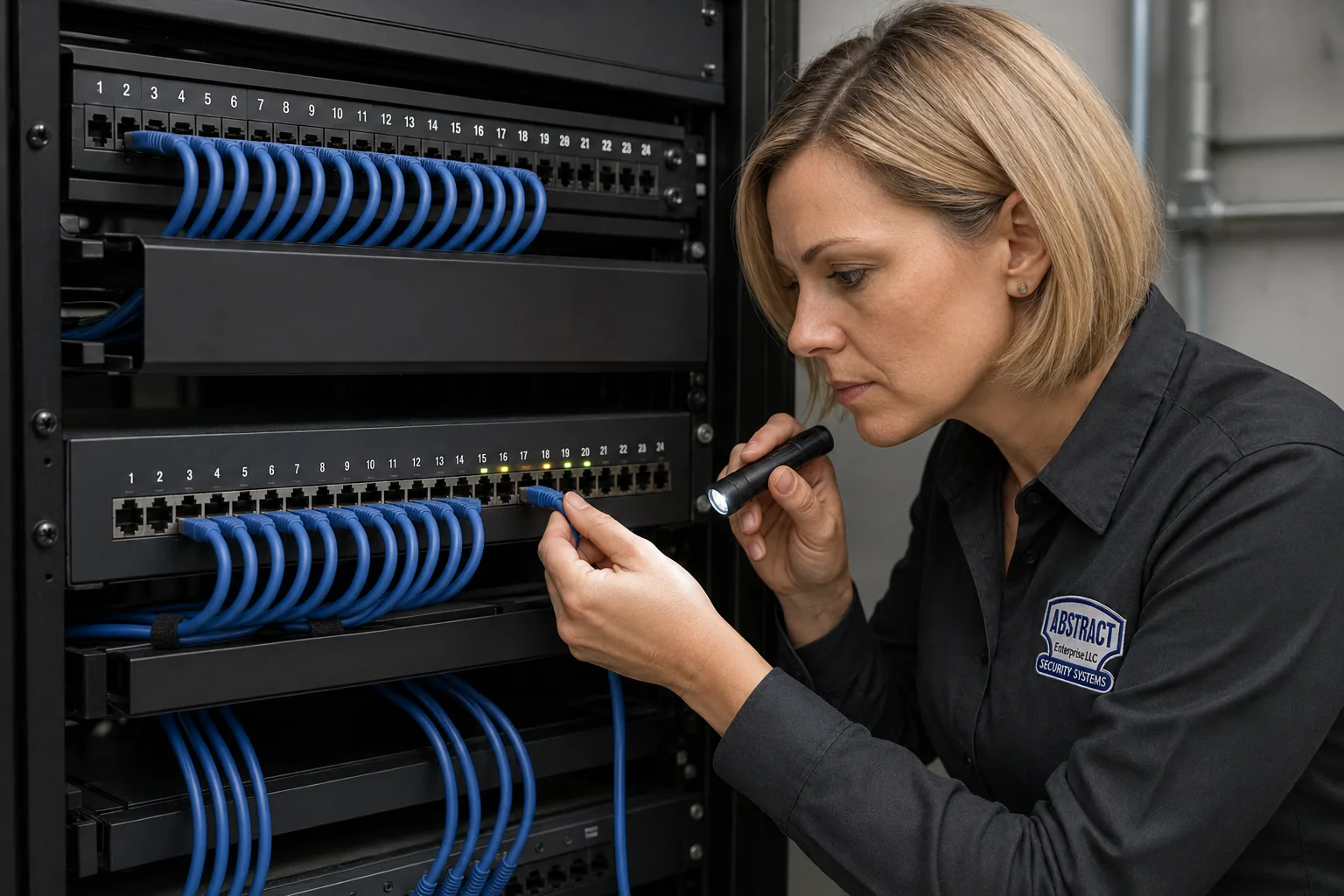
Rack and panel re-dress, cable management, patch cord replacement
Documentation
Saved test results per repaired run, with distance and margin
A list of deck runs identified as thermally marginal
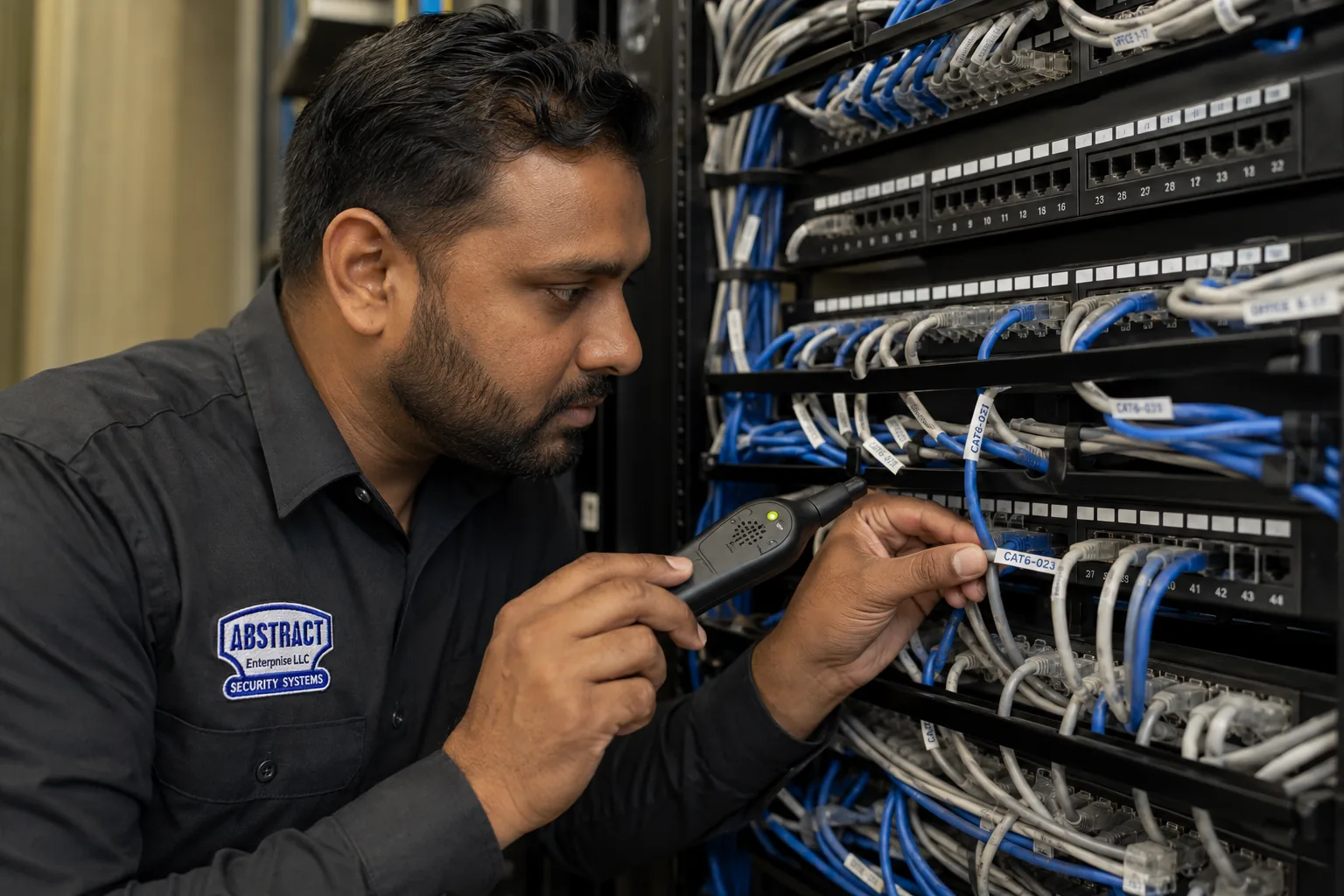
Both-end labelling and a legend for the equipment room
Photo record of support corrections and concealed repairs
Written findings for a site manager or IT provider
Site Logistics
Lift access arranged or confirmed before arrival
Work planned around shift patterns and receiving schedules
Certificate of insurance and site induction where required
High-visibility and site safety requirements observed
Coordination with warehouse management and health and safety
Coordination with your existing IT provider
Coverage Detail
Where We Work Across Orange County, New York
The distribution corridor follows I-84 and Route 17 across the middle of the county. Montgomery, Maybrook, Wallkill, New Hampton and the ground around Stewart International Airport in New Windsor hold the newest and largest high-bay buildings, with Newburgh's industrial edge and the Route 17K corridor feeding into them. This is where ceiling height, lift access and thermal margin dominate the work.
Newburgh and New Windsor combine that industrial edge with an older city: Broadway, Liberty Street and the waterfront hold nineteenth-century commercial buildings converted to offices, restaurants and studios, alongside newer retail along Route 300 and the Newburgh Mall area. It is two building types within a few minutes of each other.
The towns and villages spread west and south. Middletown along Route 211 and its downtown blocks, Goshen with the county seat and its village commercial, Chester, Warwick and Florida in the agricultural south, Monroe, Harriman and Woodbury along the Route 32 and Thruway corridor, Cornwall and Highland Falls near West Point, and Port Jervis at the Pennsylvania line. Older stock, main-street tenancies, no equipment rooms and improvised routes — a completely different job from a Montgomery distribution centre.
Who We Serve
Orange County Industries We Repair Cabling For
Distribution and Fulfilment
Montgomery, Maybrook, Wallkill, New Windsor. Deck-level runs, lift access, thermal margin and mechanical damage at floor positions.
Warehousing and Cold Chain
High-bay storage with racking, reach trucks and dock equipment moving through the space beneath the cable.
Light Manufacturing
Vibration, dust and heat, with cable routed through working areas rather than above finished ceilings.
Retail and POS
Route 211, Route 300, village main streets and the county's plazas. Register lanes failing at peak.
Medical and Dental Practices
Middletown, Newburgh, Goshen, Monroe. Imaging and practice systems intolerant of a marginal link.
Restaurants and Hospitality
Kitchen terminals in heat and grease, plus Warwick and Cornwall's tourism-driven seasonal trade.
Municipal and Institutional
County seat buildings in Goshen, town and village halls, libraries and district facilities.
Agricultural and Winery Properties
The southern towns, with more than one structure on a parcel and outdoor working areas.
Village Main Street Commercial
Warwick, Goshen, Cornwall, Port Jervis. Older buildings with cellar panels and no equipment room.
Real Questions
Fourteen Questions Orange County Businesses Actually Ask
Drawn from recurring themes in warehouse, trade, IT and Hudson Valley local discussion threads, grouped by the six question types that come up most.
Cost Questions
1. What does a repair cost here?
$195 an hour with a three-hour minimum, so the opening block is $585. That covers locating the fault, repairing it, certifying it and recording the result. New cable, where it is needed, starts at $175 for a commercial Cat6 drop.
2. Why do you ask about ceiling height before quoting?
Because at deck level nothing is reachable without a lift, and whether one is on site is frequently the largest single variable in the cost. Establishing it at booking is what stops a first visit ending in a hire order instead of a repair.
3. Do we need to provide the lift?
If you have one and an operator, that is simplest and cheapest. If not, we arrange it and it appears as its own line rather than folded into the hourly rate.
Quality and Trust Questions
4. How do we know a repair at deck level will survive the summer?
Ask for the margin. In the hottest air in the building, a link that only just passes in spring is an August outage waiting to happen. The report shows how much reserve is left, which is the only honest predictor available.
5. Do I need a licensed contractor?
Anything past changing a cord, yes. Cabling is low-voltage work with obligations on jacket rating and firestopping, and distribution sites will generally want a licence number, insurance and a site induction before anybody goes up in a lift. Ours is NYS Low-Voltage #12000287431.
6. Can you work around our shifts?
Yes, and on continuous sites it is the normal arrangement. We work the quieter part of the cycle and isolate an area at a time so the rest of the operation keeps running.
DIY and Pro Questions
7. Can our maintenance team fix a deck-level run?
They frequently have the lift and the access, which is the hard part. What they usually lack is a certifier, and on a run in the warmest air in the building the margin figure is the whole answer. A repair without a measurement up there is a guess with a season attached.
8. Is the tester from the supply house useful?
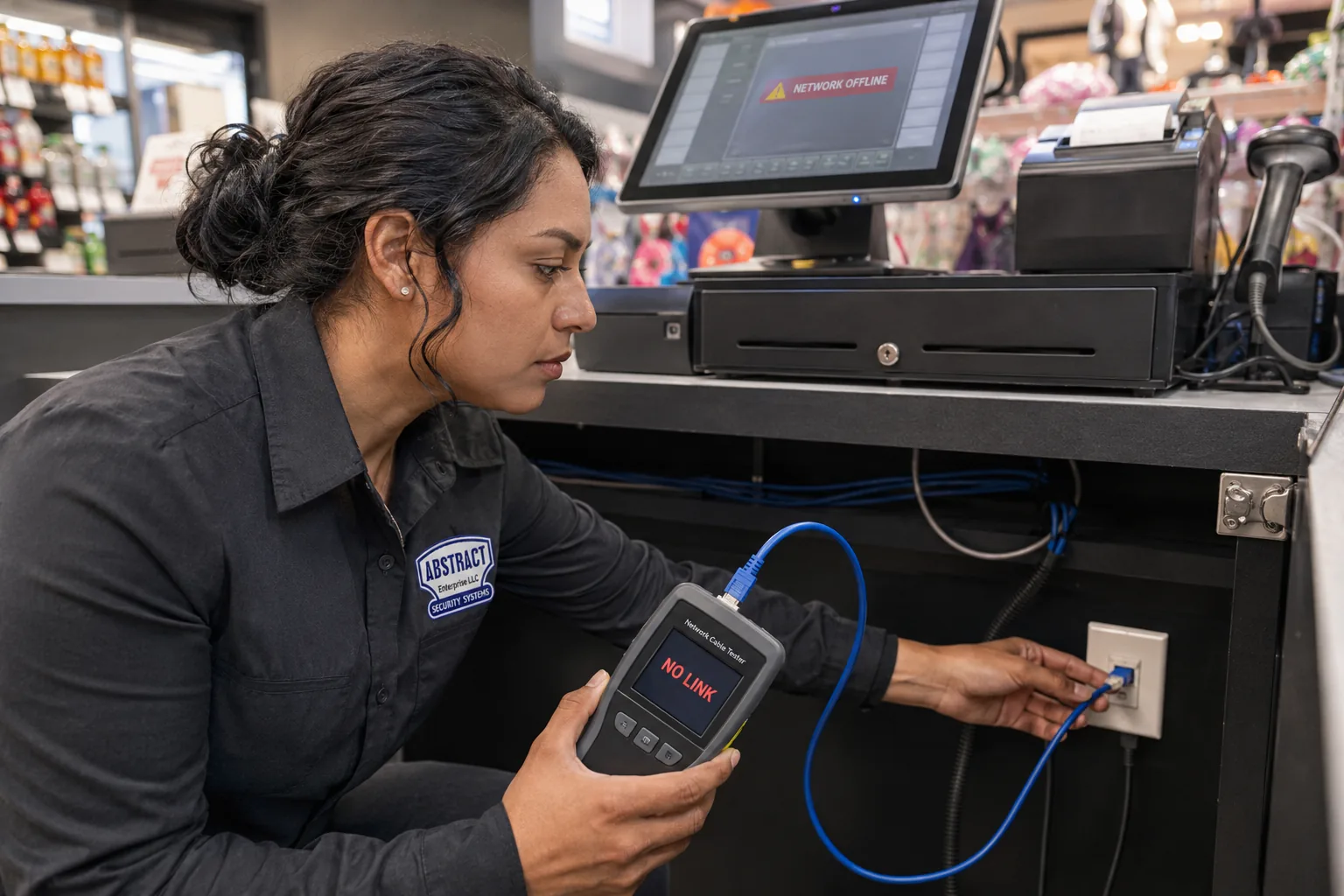
It confirms the wires reach the right pins. It reports no distance, no loss and no margin, and on a long deck run in a warm building those are exactly the numbers that decide whether it holds.
9. Can we tie cable to the sprinkler pipe to get it out of the way?
No. Sprinkler pipe is not a cable support and it is not there for that purpose. Beyond the practical problem of a wear point at every contact, it is the wrong thing to attach to in a building with fire protection design behind it.
Technical Questions
10. Why does an access point at the deck drop out on hot days when the office is fine?
Because it is thirty-odd feet up in the warmest air in the building. Insertion loss climbs with temperature, so a run with little reserve at deck level drifts out of spec in the afternoon while everything at head height stays comfortable.
11. A drop to the pack station keeps failing and the cable looks fine.
Look at the zone it passes through on the way down. Reach trucks, pickers and pallets all work in that space, and a descending run takes knocks that leave it working but weakened. The damage is mechanical and it is rarely at the end you can see.
12. One port holds 100 Mbps while the rest reach 1000. What is that?
A pair is broken or crossed. The older standard needed only two pairs so the port links happily, while gigabit needs all four and either refuses or negotiates and falls back.
Landlord and Tenant Questions
13. We lease a distribution building. Who owns the cabling above the racking?
Usually the tenant owns what serves their operation, with the landlord providing the shell and a point of presence, though industrial leases vary and many say nothing about infrastructure left by a previous occupier. We document what is live, what is abandoned and where the fault sits.
Complaint Questions
14. Somebody repaired this run last year and it has failed again in summer. Why?
Because it was repaired but never measured, or measured and the margin was never reported. At deck level a link that passes by a whisker in cool weather is a scheduled failure for the next hot spell, and nobody finds out until it happens.
Answer The Public
Answer The Public: Orange County NY Network Cable Questions
Who repairs network cable in Orange County, New York?
Licensed low-voltage contractors. An electrician handles pathway and anything energised but usually passes terminations on; an IT firm owns the network above the cable and rarely carries a certifier. A failing deck-level run in a Montgomery distribution building is cabling work. This is Orange County in New York State, not the Orange Counties in California, Florida, Texas, North Carolina, Virginia or Indiana.
What causes cabling to fail in Orange County buildings?
Thermal stress on deck-level runs in high-bay space, poor support and attachment to structure or sprinkler pipe, mechanical damage where descending drops cross equipment zones, terminations executed without twist discipline, and older village stock with improvised routes.
When does a run need replacing instead of repairing?
When it will not certify after both terminations are redone, when the measured distance exceeds spec, when it has been damaged in several places, or when it passes with so little margin that the next hot spell will take it out anyway.
Where do faults sit in a high-bay building?
At terminations first, then at deck level where the air is warmest and supports are furthest apart, then in the zone descending drops pass through on the way to floor positions.
How quickly can an Orange County repair be scheduled?
Same day or next morning county-wide, subject to lift availability on high-bay sites — which is why we ask about ceiling height at booking.
Reality Check
AI Overview Reality Check: What Search Results Miss About Orange County NY Cabling
Search for network cable repair in Orange County, New York and you get a national cost average, lead-generation directories, results for six other Orange Counties, and troubleshooting written for a room with a nine-foot ceiling. The county's growth market has ceilings four times that.
1. Search Cannot Tell Which Orange County You Mean
There are Orange Counties in California, Florida, Texas, North Carolina, Virginia and Indiana, and the largest of them is many times the size of the one in New York. Search results, cost pages and AI summaries blend them constantly.
The practical effect is that published pricing and contractor listings you find may describe a market three thousand miles away with different labour rates, different building stock and different code enforcement.
This page covers Orange County in New York State, in the Hudson Valley: Newburgh, Middletown, Goshen, Montgomery, Warwick, Monroe, Port Jervis. If you need any of the others, we are not the right firm.
2. Ceiling Height Is Absent From Every Cost Model
Aggregated cost pages assume a technician can reach the cable from a step ladder. In a high-bay distribution building the run is thirty-six to forty feet up.
Everything at that height needs a scissor or boom lift, and whether one is on site governs both the schedule and the largest single line in the price. A quote produced without asking about ceiling height has not been produced for this building.
It is also why we ask at booking rather than on arrival. A visit that ends with a hire order has cost a day and produced nothing.
3. The Warmest Air in the Building Is Where the Cable Lives
Generic troubleshooting treats a building as one temperature. In a high-bay space heat rises and collects at the deck, and the difference between floor and roof level can be considerable on a summer afternoon.
Copper loses more signal as it warms. A deck-level run with little margin therefore fails in exactly the conditions nobody is monitoring, while the office thirty feet below reports nothing wrong at all.
The diagnostic is the margin figure rather than the pass. A report that lists which deck runs are close to the edge tells a site which failures are coming, which is considerably more useful than confirming that everything worked in March.
4. Sprinkler Pipe Is Not a Cable Tray and Search Results Never Say So
In open structure, anything horizontal looks like a place to tie cable, and sprinkler pipe is the most convenient thing up there.
It is the wrong thing to use. Every contact point is a wear point, the pipe is part of a fire protection design rather than a support system, and a bundle hanging off it is somebody else's problem in an inspection.
The same applies to purlin edges. A bundle bearing on unprotected steel has a failure point already selected; it is simply a question of when.
5. Nothing Online Mentions the Zone Below the Cable
Advice written for offices assumes cable, once installed, is left alone. In a distribution building anything descending from the deck to a pack station, scanner point or dock position passes through the space reach trucks and order pickers work in.
Those drops take knocks that leave them working but weakened, and the resulting fault is intermittent, mechanical and rarely at the visible end. Replacing the outlet does nothing.
Protecting the descent is cheap while a lift is already on site and is almost never done because nobody has framed it as a cable problem.
6. Lead Directories Sell Your Number Rather Than Checking Anyone's Kit
Angi, HomeAdvisor, Thumbtack and their equivalents resell one enquiry to several firms, and the fastest reply reflects lead spend rather than capability. Ratings sit on accounts spanning many trades.
The categorisation is where it falls apart. Cable work shares a heading with router configuration and wireless troubleshooting, so a job requiring a certifier, a tone set, a punch tool and a boom lift lands with whoever answers first and owns none of it.
Three questions clear it: what certifier is on the van, can you work at forty feet, and what is your New York State low-voltage licence number.
7. The County Is Two Markets Fifteen Minutes Apart
The I-84 and Route 17 distribution corridor and the villages of Goshen, Warwick, Cornwall and Port Jervis are entirely different jobs. One is lift access and thermal margin; the other is cellar panels, masonry and improvised routes.
A contractor who only knows warehouses will be lost on a village main street, and one who only knows small commercial will underestimate a high-bay visit badly.
When briefing anyone, describe the building rather than the county: ceiling height, whether a lift is available, and whether there is a proper equipment room.
Confirm the Height Before the Visit, Not After.
Certified testing on every repair. Licensed NYS low-voltage contractor. 4.7★ from 201 reviews.
Costs nothing, takes moments, and settles a real proportion of reported faults.
Move to a different switch port
Yes
Sixty seconds to eliminate the switch as a suspect.
Test the device on a known-good outlet
Yes
If the machine behaves at another point, the fault is the original outlet or its run.
Note whether the fault tracks the weather or the shift
Yes
Free and genuinely diagnostic. Hot afternoons point at deck-level margin; shift patterns point at mechanical damage.
Re-punch a keystone jack at floor level
Borderline
Feasible with the right tool. Whether it certifies depends on the twist surviving to the contact, and on a long deck run there is no spare performance to lose.
Work at deck level without proper lift equipment
No
This is a fall risk before it is a cabling question. Ladders do not reach and improvised access is how people get hurt.
Tie cable to sprinkler pipe or lay it on purlins
No
Wrong support, wear at every contact, and the wrong thing to attach to in a fire-protected building.
Diagnose a run that only fails in summer
No
That is a margin measurement taken at height, and a pin checker cannot produce it.
Repair a descending drop without protecting the route
No
It passes through the zone equipment works in. Replacing the cable without addressing that guarantees a repeat.
A quarter hour, nothing owed: the four rows above marked yes. The weather-and-shift question is the most useful one here — it usually tells us whether to bring a lift before we set off.
Alternatives
How a Licensed Cabling Contractor Compares Here
vs. Your IT Provider
Strong above the cable and generally candid that copper is not their trade. The physical work is subcontracted, so the crew that arrives is a third party on somebody else's schedule — and may not be equipped for work at height.
vs. Lead-Generation Platforms
One enquiry resold to several bidders, with response speed reflecting advertising budget rather than capability. Nothing in those listings establishes whether the responder can work at forty feet or owns a certifier.
vs. Your Carrier's Technician
Their responsibility stops at the demarcation point, which is a fair position fairly stated. If the circuit measures clean there while outlets keep failing, the problem is inside the building and outside what they cover.
vs. Your Own Maintenance Team
Genuinely strong on access — they have the lift, the training and the site knowledge, which is the difficult half. What they usually lack is a certifier, and at deck level the margin figure is the whole answer.
vs. A General Electrician
The right trade for conduit, coring, bonding and anything energised, and frequently working alongside us in these buildings. Data terminations are a separate discipline with much tighter tolerances.
Warning Signs
Five Signs the Cable Is the Problem in a High-Bay Building
A deck-level device fails on hot afternoons while the office is fine. Thermal margin. The cable is in the warmest air in the building and the office is not.
A descending drop keeps failing and the visible cable looks perfect. Mechanical damage in the zone equipment moves through, well above the outlet.
One port holds 100 Mbps while its neighbours reach 1000. A pair is broken or crossed — the clearest free diagnostic there is.
A run is tied to sprinkler pipe or resting on a purlin. That is the failure point, whether it has failed yet or not.
A repair from last year has come back in the same season. It was fixed but never measured. Margin at deck level is what predicts the next failure.
Community
Community Chatter: Recurring Themes From Public Forums
Paraphrased themes from public homeowner, small-business and IT discussion threads — not customer reviews of AESS.
Warehouse operators repeatedly describe access points that behave all winter and drop out on hot afternoons, with the temperature explanation arriving long after the switch and the radio have been replaced.
Threads about high-bay work consistently note that lift availability rather than cable cost governs what a job actually takes.
Discussions among facilities teams frequently surface cable tied to sprinkler pipe, usually installed years earlier by somebody who needed it out of the way.
Owner forums regularly express surprise at how little of a cabling invoice is materials. It is an accurate reflection: reaching and finding the fault is the work.
Support procedures written independently by different organisations open with the same first three checks, which usually indicates a sequence proven against real faults.
Field Video
Watch: Field Diagnostics on a Orange County Repair Call
Short-form field clips from our channel: youtube.com/@openeye0007 Embed slot reserved — drop the Short iframe here once the clip ID is set.
FAQ
Network Cable Repair Orange County NY — Twelve Frequently Asked Questions
Is this Orange County in New York?
+
Yes. This page covers Orange County in New York State, in the Hudson Valley — Newburgh, Middletown, Goshen, Montgomery, Warwick, Monroe, Cornwall and Port Jervis. There are Orange Counties in California, Florida, Texas, North Carolina, Virginia and Indiana, and we do not work in any of them.
What does network cable repair cost in Orange County?
+
The specialty service rate is $195 an hour with a three-hour minimum, so $585 covers the opening block: locating the fault, repairing it, certifying it and recording the result. New cable starts at $175 for a commercial Cat6 drop. Lift hire, where the site does not have one, appears as its own line.
Why do you ask about ceiling height before quoting?
+
Because at deck level nothing is reachable without a scissor or boom lift, and whether one is available on site is frequently the largest variable in the cost. Establishing it at booking prevents a first visit that ends in an equipment hire rather than a repair.
An access point at the roof drops out on hot days but the office is fine. Why?
+
Heat rises and collects at the deck, so cable up there sits in the warmest air in the building. Copper loses more signal as it warms, so a run with little margin drifts out of spec on a summer afternoon while everything at head height stays comfortable.
A drop to our pack station keeps failing but the cable looks fine. What is going on?
+
Look at the space it passes through on its way down. Reach trucks, order pickers and pallets all work in that zone, and a descending run takes knocks that leave it working but weakened. The damage is mechanical and it is rarely at the end you can see.
Can we tie cable to the sprinkler pipe?
+
No. It is not a cable support, every contact is a wear point, and it is part of a fire protection design rather than a route for other trades. The same applies to laying bundles across unprotected purlin edges.
Can a run be repaired in place, or does it need pulling out?
+
A single accessible point of damage takes a properly made junction of matching grade, then a certifier to confirm it. Replace when it fails after both terminations are redone, when the measured distance breaks spec, or when it passes with so little margin that the next hot spell will take it out.
Nothing at all from one outlet. What gets checked first?
+
In order of likelihood: the cord and its latch, a panel position never terminated or done to the opposite standard, an outlet with conductors seated but never driven into the contacts, then damage along the run.
Can you work around our shift patterns?
+
Yes, and on sites running continuously it is the normal arrangement. We work the quieter part of the cycle and isolate one area at a time so the rest keeps running. It needs notice and site access arranged, not a premium.
Do you provide certified test reports?
+
Yes. Every repaired run is measured and you receive the saved result including distance and remaining margin, plus a list of any deck-level runs we consider thermally marginal.
What warranty covers the finished work?
+
AESS-supplied products carry a twelve-month parts warranty under the service agreement. Modifying or tampering with the installed work without prior written approval voids it.
Do you also work in the other Hudson Valley counties?
+
Yes. Every county in the region sits under the Hudson Valley hub, and the city is covered from the NYC hub.
Service Areas
Orange County, New York Coverage
The whole county — Orange County in New York State, not the six others that share the name.
Distribution Corridor
Montgomery, Maybrook, Wallkill, New Hampton, New Windsor, Stewart Airport area, the I-84 and Route 17 interchanges.
Newburgh and New Windsor
Broadway, Liberty Street, the waterfront, Route 300 and the Newburgh Mall retail area.
Middletown and the West
Middletown, Route 211, Wallkill, Goshen, Chester, Port Jervis, Deerpark.
The South and River Towns
Warwick, Florida, Monroe, Harriman, Woodbury, Cornwall, Highland Falls, West Point area.
Hudson Valley Hub
Parent page for this county and the five others in the region.
Applied only where ceiling space is used for return air
After-hours or weekend window
Premium applies
For buildings restricting low-voltage work to off-hours
Published starting rates for Orange County, New York. Final pricing follows from access, ceiling height, route, jacket rating and testing scope, and goes in writing before work starts. Shift-pattern working carries no labour premium. Full terms — including 50% deposit, one-year parts-only warranty on AESS-supplied products, and the late-fee schedule — are set out in the service agreement. See structured cabling pricing for new-installation drop rates and Cat6 installation Orange County for per-drop grade comparisons.
Cabling Problems Specific to Orange County Buildings
Thermal Stress at Deck Level
The defining high-bay fault. Cable in the warmest air in the building, losing more signal as the day heats, failing in summer while everything at head height reports nothing.
Improvised Support and Attachment
Bundles tied to sprinkler pipe, laid across purlin edges, or spanning too far between hangers. Every contact point is a wear point with a date on it.
Mechanical Damage on Descending Drops
Runs coming down to pack stations, scanner points and dock positions pass through the zone reach trucks and pickers work in, taking knocks that weaken rather than break them.
Access as the Governing Cost
Nothing at deck level is reachable without a lift. Where one is not on site, the schedule and a large part of the price follow from arranging it.
Cabling Installed Fast During Construction
In a county building distribution space quickly, cabling is frequently the lowest bid on a compressed programme, and handover testing gets skipped.
Village Stock With No Equipment Room
Goshen, Warwick, Cornwall, Port Jervis. Older main-street buildings with cellar panels, masonry walls and routes improvised decades ago.
Cross-sell note: deck-mounted cameras and access points share the height, the lift and the thermal conditions with the data runs. When a lift is already on site, testing the camera drops and access control runs alongside costs a fraction of mobilising again.
From the Field
Field Notes
Ask the ceiling height on the phone. It decides the equipment, the crew and most of the price, and it is the one question that reliably prevents a wasted first visit.
When a fault follows the weather, take the measurement at height rather than at the patch panel. A run can look perfectly healthy from the floor and be running with nothing in reserve where it actually lives.
While a lift is up, look at what the cable is touching. Sprinkler pipe, purlin edges and long unsupported spans are the three things we find on nearly every high-bay site, and correcting them costs minutes rather than another mobilisation.
On a descending drop, inspect the whole descent rather than the outlet. The knock that weakened it happened somewhere in the equipment zone, usually well above head height and out of sight from where the complaint was reported.
Get In Touch
Request a Free Quote
Fill out the form below and we'll get back to you within the hour. Or call us directly at (845) 640-3835.
✅
We Got Your Request!
We'll call you back within the hour. If it's urgent, call us now at (845) 640-3835.
Emergency
Need Repair in Orange County Right Now?
Network out, dock scanners dead, deck-level access points offline, register down. Same-day and next-morning county-wide, with lift access confirmed before we set off.
Last reviewed: August 25, 2026 · Next scheduled review: November 2026 Changelog: Aug 2026 — page published. High-bay ceiling height, deck-level thermal margin and lift access economics established as the primary Orange County thesis; support and attachment correction added to scope; lift hire shown as its own pricing line; descending-drop mechanical damage documented; Orange County New York disambiguation added against the six other US Orange Counties; pricing aligned to the $195/hr specialty rate with a three-hour minimum; direct Hudson Valley line (845) 640-3835 used throughout.
Network Cable Repair Orange County, NY — Licensed, Measured, Documented
NYS Low-Voltage Lic. #12000287431 · 4.7★ from 201 reviews · Serving New York City, Long Island and the Hudson Valley.