Commercial network installation across Ulster County — Kingston's Stockade and Rondout districts, the Route 9W and Thruway corridor, New Paltz and the college corridor, Saugerties and Highland, and the inns, wineries and event venues of Woodstock and the Rondout Valley.
A great many businesses here carry ten times more people in August than in February, and a network sized for the average fails in the month that pays for the year. We size wireless from peak device counts rather than floor area, wire the things that take money so they never share air with the public, and work around a protected facade where the building sits in a historic district.
Tell us the property and what your busiest week looks like — we'll come back with a number.
A great many businesses here carry ten times more people in August than in February, and a network sized for the average will fail in the month that pays for the year.
Itemised rather than absorbed: rack hardware, panels, switching and firewalls where we supply them, conduit where a building or a district requires it, firestop materials, coring, lift work, exterior and between-building work, and any concealment required on a historic facade. That last line is specific to this county and it is real money.
Worth asking any bidder here. What happens to this on the busiest Saturday in August? A design validated on a quiet weekday has been tested under conditions the business does not care about.
Hospitality, tourism, hospitality-adjacent retail, wineries, event venues and a college town — this county's commercial load swings harder across the year than anywhere else in the region.
A restaurant in Kingston, an inn in Woodstock, a winery with an events barn, a Main Street retailer in New Paltz — each of them has a period when the building holds several times its usual number of people, every one of those people carrying two or three devices, most of them expecting to use the wireless. And each of them has a February when the same building is nearly empty. A network specified against the average sits in the worst of both positions: over-provisioned for most of the year and inadequate exactly when the business is earning.
New Paltz has its own rhythm — a population that arrives in late August, disappears in December and January, and returns. Commercial premises there see the same swing on a different calendar, and the guest network at a café or a retailer near the campus behaves more like a public hotspot than a business courtesy. It gets designed accordingly, with isolation and a throughput ceiling as the baseline rather than as an addition.
Kingston's Stockade and Rondout districts, New Paltz's Huguenot Street area and the county's older village cores contain commercial premises where the exterior is protected and the interior is very old. Both facts change the job.
On a building within a historic district, running cable across an exterior wall, drilling a visible penetration or mounting a radio where it can be seen from the street is frequently not permissible — and where it is, it needs approval before rather than after. That matters most on multi-structure properties and anywhere a connection has to reach a second building, because the obvious route is usually the front of the building. The workable answers are interior routes, penetrations placed where they are not visible, concealed or colour-matched pathway where a run must be seen, and underground between structures rather than across a facade. All of them cost more than the obvious approach and all of them are quoted openly.
Very old commercial buildings in this county have stone and thick masonry interior walls, sometimes original and sometimes added over two centuries of alteration. They stop radio outright and the effect is invisible from inside the room. Coverage is designed room by room, the count runs well above what the floor area suggests, and a survey is the honest starting point rather than a formality.
In a converted mill or a stone-walled Stockade building there is frequently no cavity, no drop ceiling and no route that hides anything. Cable becomes a visible element, so it is designed: consistent heights, straight parallel runs, dressed bundles, surface raceway where that is the honest answer, and colour chosen deliberately. Clients who took these buildings for their character notice, and improvised routing in a room like that is permanent.
Where district approval is needed for anything visible, the lead time is part of the programme rather than a surprise in week two. We identify it during the survey and say plainly what it means for the date.
Where the property sits tells you what it is made of, who visits it and when.
The Stockade district uptown and the Rondout waterfront. Stone and brick buildings of considerable age holding retail, hospitality, professional offices and studios. Protected exteriors, thick interior walls, no concealed pathway, and a visitor season that reshapes the load from spring onward.
Kingston's midtown warehouse stock and the large redeveloped industrial and technology campus property along the Route 9W and Thruway corridor. Brick and heavy timber in the older conversions; long internal distances and multi-building parcels in the campus stock, where the copper limit is exceeded inside a single structure.
Lake Katrine, Saugerties, Highland and the approaches to the Thruway interchanges. Modern retail, service commercial, flex and distribution on their own lots. Conventional construction, straightforward pathway, and the ordinary constraints of trading hours.
Main Street commercial, hospitality, professional offices and retail serving a population that arrives and departs on an academic calendar. Guest wireless behaves like a public service, and capacity is the design question rather than coverage.
Woodstock, Saugerties' outlying properties, the Rondout Valley, wineries, farms, inns and event venues across the western towns. Multiple structures on a single parcel, outdoor coverage across yards and event space, seasonal staffing, and travel distances that make full-day scheduling sensible.
On a seasonal business the wired layer has one overriding job: making sure the things that take money never depend on the air the guests are using.
Point of sale, booking and reservation terminals, the back office, printers that produce anything a customer waits for, and any fixed display. All of it wired, all of it on its own segment, none of it competing with two hundred phones on a Saturday. This is the cheapest reliability decision available to a hospitality or retail business and it is skipped constantly, usually because a wireless terminal was easier to place during the fit-out.
Port and power headroom matter here for a specific reason: seasonal businesses add positions in the run-up to a season and nobody wants a supplier visit in June. A spare port, a spare run to the terrace or the events space, and a pre-cabled radio position mean the pre-season addition is a plug-in rather than a scheduled job at the worst possible moment.
One router or firewall per property, positioned where the circuit lands. On multi-structure sites — which is most of the rural and hospitality work here — consolidating separate connections into one edge with the others as failover is frequently the quickest saving available, and it is what makes a segmentation plan enforceable across the whole property. A gateway with a considered rule set serves most clients; a firewall that logs properly earns its price where card data or regulated information is involved.
Overhead distribution, heavy tree cover across much of the county and long feeders mean interruptions here are frequent and sometimes lengthy. Battery backup in every room rather than only the main one, and on properties with a generator it is worth confirming the network rooms are genuinely on the protected panel rather than assuming. For a business whose season is short, an outage during it is disproportionately expensive.
On most commercial networks the guest segment is a courtesy. On a hospitality or visitor business it is the largest population on the network, and the design starts there.
Without segments, everything attached can reach everything else — and on a busy Saturday that includes a couple of hundred devices belonging to people you have never met. The point is not suspicion; it is that a network where the till, the booking system and the public share one space has no way to protect the parts the business cannot lose.
| Segment | Typical occupants on an Ulster property | Why it is fenced |
|---|---|---|
| Payment and booking | Point of sale, card terminals, reservation systems | The revenue path — it shares with nothing |
| Staff | Workstations, back office, printers, storage | The working network, kept clear of the public |
| Public and guest | Visitors, diners, students, event attendees | Isolation and a throughput ceiling, with no route inward |
| Voice | Handsets across the property | Prioritised so calls hold when the building is full |
| Exterior and event space | Yard, terrace, barn and outdoor radios | Reachable from outside in a way nothing indoors is |
| Building services | Refrigeration monitoring, HVAC, sensors, gate equipment | Long-lived, rarely updated, and often controlling something expensive |
A Woodstock inn needs payment, staff and public separated three ways before anything else is discussed. A winery with an events barn adds the exterior segment, because the radios covering the barn are hardware a stranger can walk up to. Refrigeration monitoring is worth naming on food and beverage properties: it is frequently the oldest networked equipment on site and it controls stock that cannot be replaced.
The throughput ceiling is not optional here. Without one, guest use on a busy afternoon can consume the whole connection, and the first thing to fail is the terminal taking payments.
Wireless network installation here is a capacity exercise dressed as a coverage one, and getting that the wrong way round is the most common failure we are called to fix.
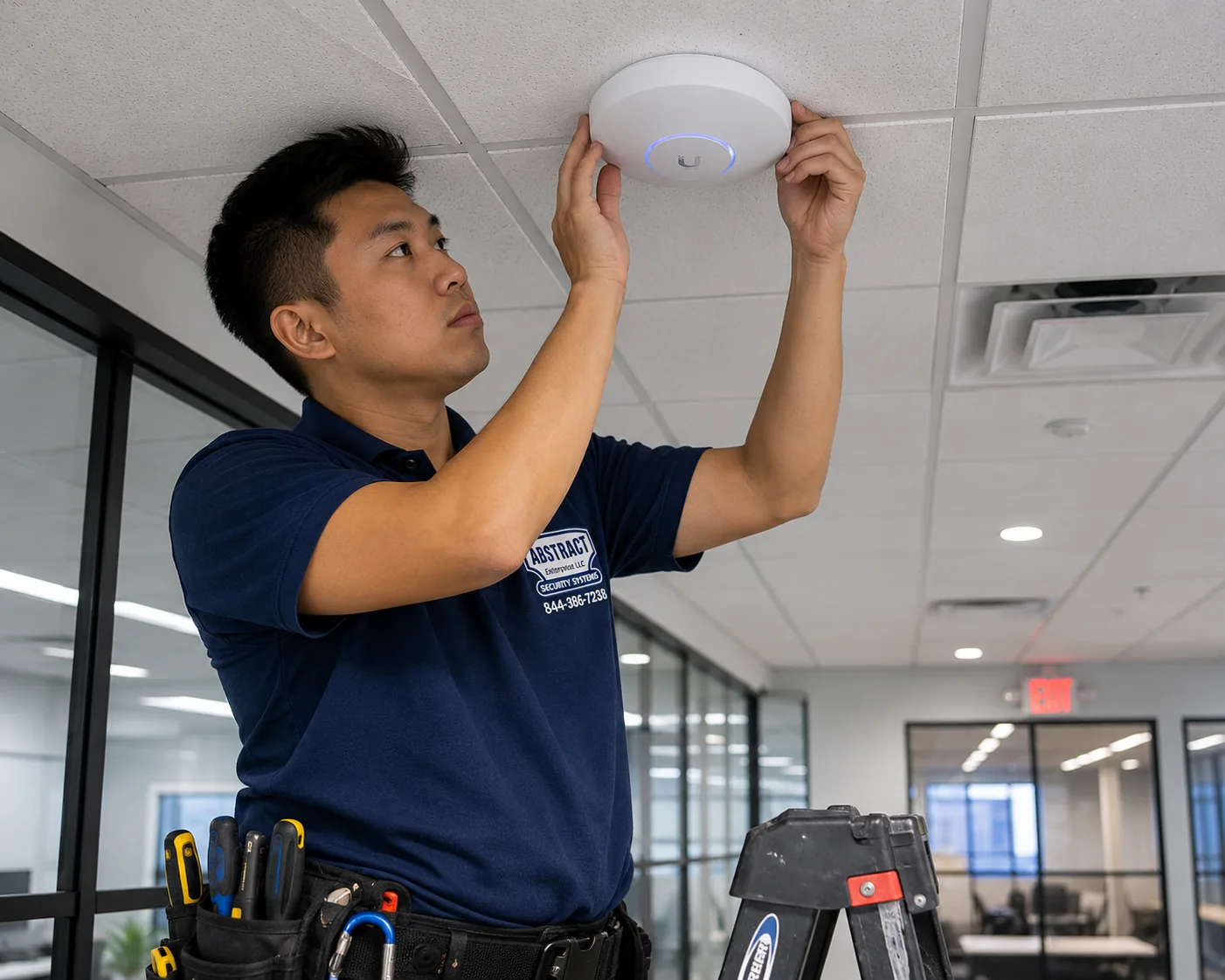
A single radio can cover a large dining room, a tasting room or a shop floor comfortably. What it cannot do is carry a hundred and fifty devices at once, because they are all contending for the same airtime regardless of how strong the signal is. The answer is more cells at deliberately reduced power, so each one carries fewer devices, rather than fewer cells turned up. That is counter-intuitive and it is the single most useful thing on this page for a hospitality business.
The complication is that many of these properties are also very old. Stone and thick masonry interior walls stop radio outright, so the room-by-room coverage problem sits alongside the capacity problem in the same building — a Stockade restaurant may need one radio for the front room's density and a second for the back room that gets nothing at all through the wall between them.
On a winery, a farm, an inn or an events venue the peak load is frequently on a terrace, in a barn or across a field. That needs exterior-rated radios, mounting that survives weather, cable rated for the run and a proper bond at the entry — and it needs to be counted in the capacity plan rather than treated as an extension of the indoor design.
| Space | Typical radio count | What actually drives it |
|---|---|---|
| Dining room or tasting room at capacity | 2–3 | Device density and airtime, not floor area |
| Stone or masonry building, room by room | 1 per enclosed room cluster | Walls that stop signal outright |
| Retail on a busy Main Street | 2 plus a guest ceiling | Peak footfall and stockroom shelving |
| Guest rooms in an inn | 1 per 3–5 rooms depending on construction | Wall material far more than room count |
| Terrace, barn or event field | 1–3 exterior-rated | Peak crowd, weather and bonding at entry |
| Modern Route 9W commercial unit | 2–3 | Conventional construction and clear spectrum |
A survey is a measurement, and on a seasonal property the date it is taken matters as much as the instrument.
A predictive exercise projects coverage from the drawings and whatever the walls are stated to be. On a modern commercial unit that is close enough to design against. An on-site survey records what is genuinely present — but a survey walked on a quiet February weekday tells you almost nothing about the Saturday the business actually cares about, so on seasonal properties we treat coverage and capacity as two separate questions and answer them differently.
Capacity is calculated from device counts at peak rather than measured on a quiet day — how many people the space holds when it is full, how many devices each of them carries, and what proportion will actually be using the connection. Where the season permits, we return and walk the space with a meter during a genuinely busy period, which is worth more than any prediction. The survey fee is $450, credited to the project, and the post-installation validation walk is included on every job regardless.
Power over Ethernet carries data and power down a single cable to a radio, a handset or a powered device. It is likewise the failure that arrives disguised as a different problem.
Each PoE switch holds one total wattage divided among all its ports, well below what every port could draw on its own. A 24-port switch offering PoE+ throughout might hold a 370-watt budget; connect thirty-watt devices and the power gives out around the twelfth port.
| Standard | Per-port budget | Typical devices |
|---|---|---|
| PoE (802.3af) | 15.4W | Handsets, sensors, older radios |
| PoE+ (802.3at) | 30W | Modern radios, video handsets, powered displays |
| PoE++ (802.3bt) | 60–90W | Wi-Fi 6E and 7 radios, large displays, PoE lighting |
The whole argument of this page — more cells at lower power to handle a crowd — means a property here runs more radios than its square footage would suggest, and every one of them draws from the same switch budget. A design that solves the capacity problem correctly and then puts it on an undersized switch has solved nothing. Exterior positions compound it: a radio in a heated enclosure on a terrace or in a barn draws several times its indoor figure, and it draws most in the coldest weather when nobody is checking.
The failure is quiet and selective — devices already powered keep working while new ones are refused — so what gets reported is that last season's radios are fine and this season's additions are dead, discovered in the week the property is preparing to open. Sizing generously before the season is a great deal cheaper than discovering the ceiling during it.
Do the arithmetic before the season, not during it. A property that adds two radios and a display every spring will exhaust an exactly-sized switch within a few years, and the discovery will happen at the worst possible time.
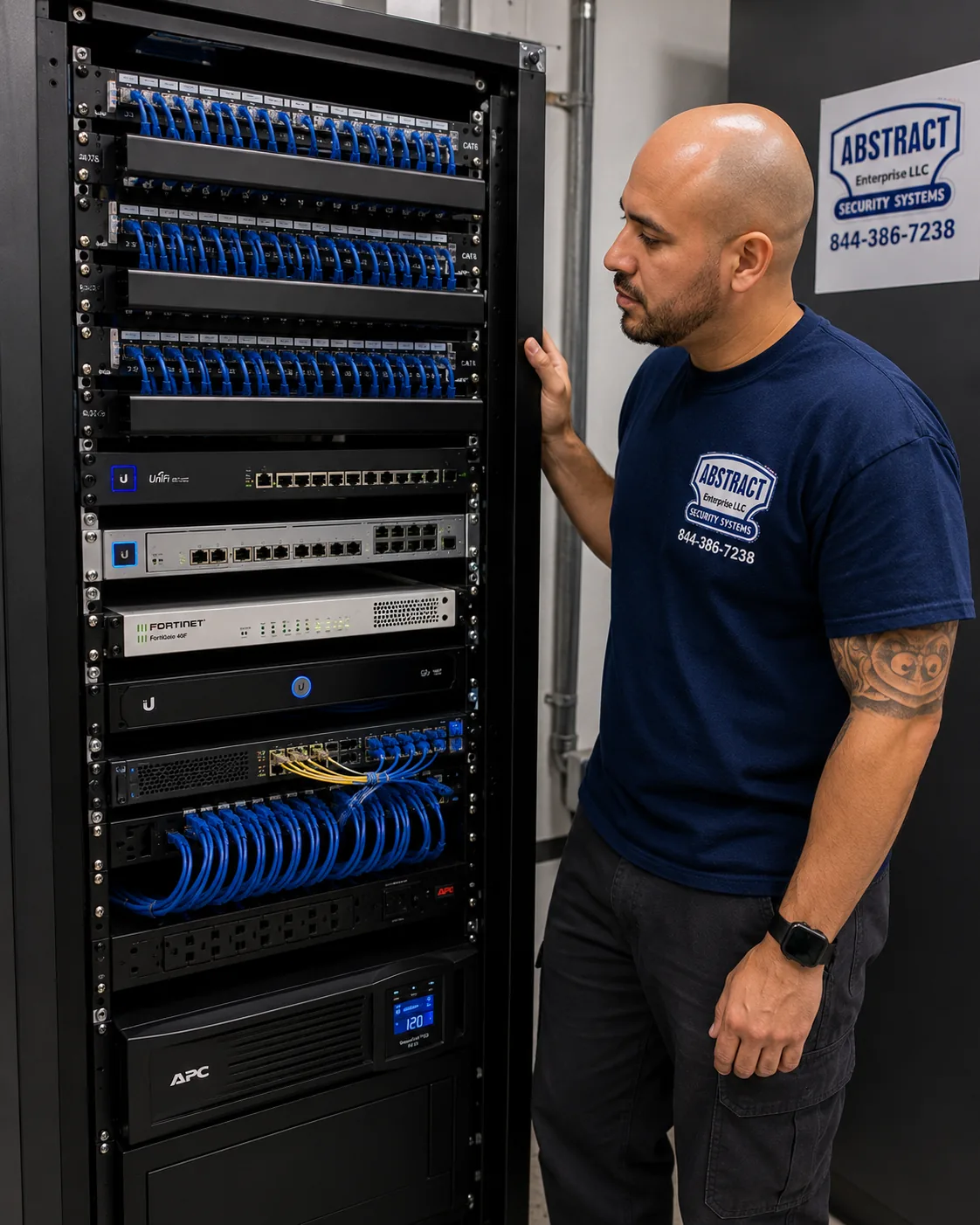
Old commercial buildings, converted barns and Main Street premises rarely came with a room for network equipment. Choosing where it goes is a design decision rather than an afterthought.
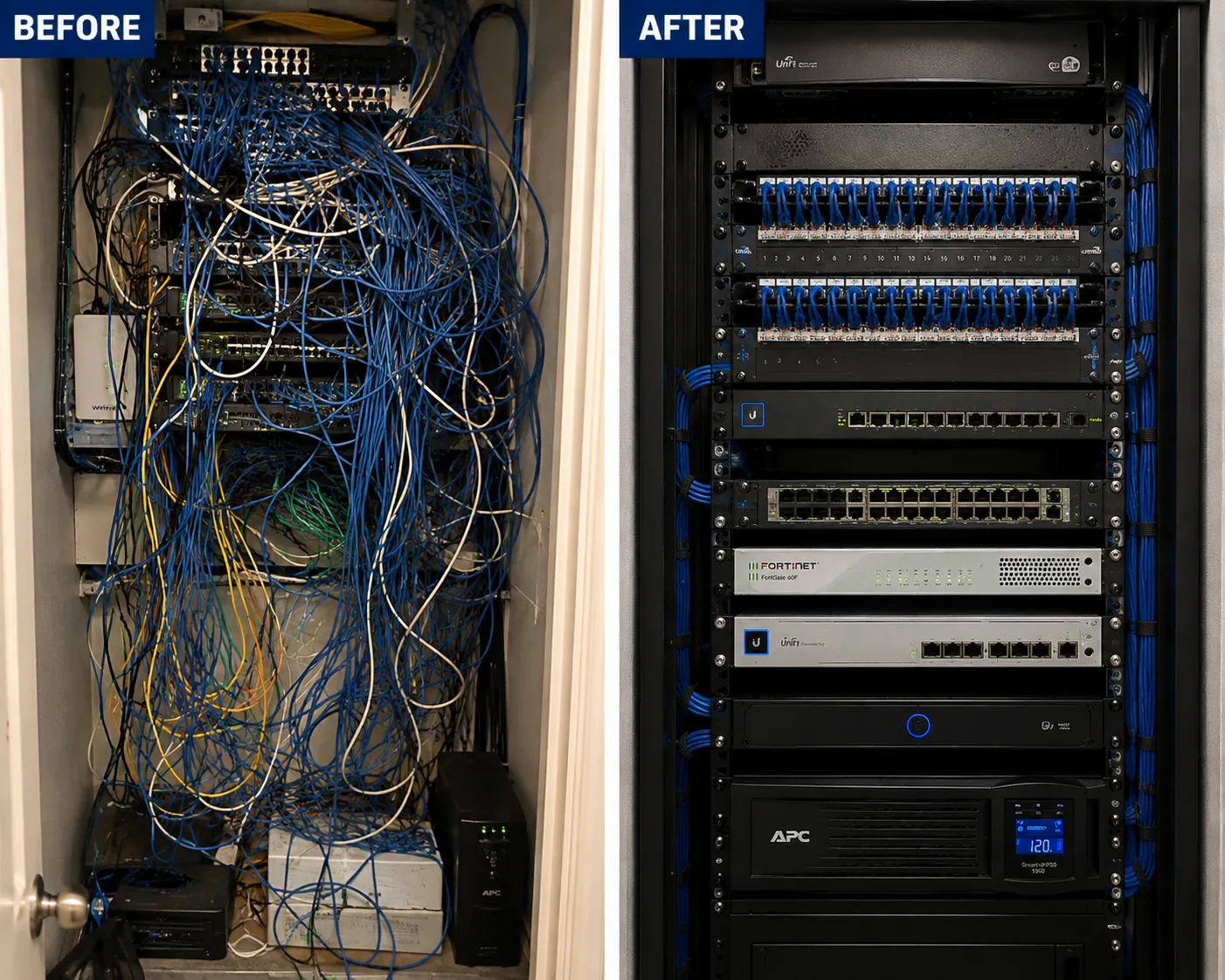
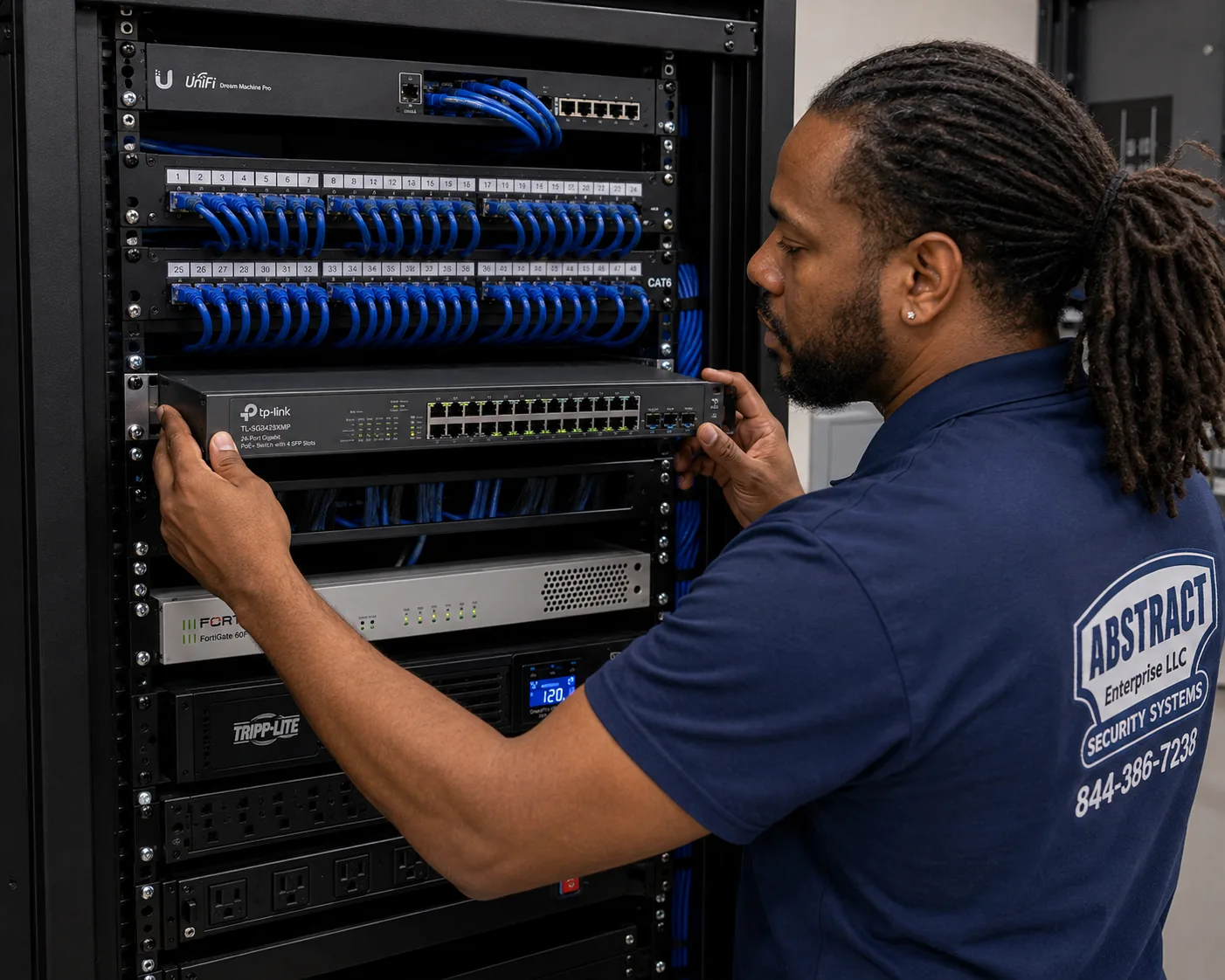
A good result looks unremarkable: panels above, switching below, short cords in consistent colours through managers, marked throughout, with air around it and space to grow. A poor one is equipment on a shelf in a back room that also stores stock, gets hot in August and cold in January, with a nest of cords behind it and nothing marked.
The space offered is frequently an unconditioned back room, a cellar or a corner of a barn. A sealed cabinet holding a switch delivering three hundred watts becomes an oven in August — during the season, when the property can least afford intermittent faults — and the same corner in January can sit below the equipment's operating range. Both are settled at design stage by choosing the space, venting the cabinet or specifying accordingly, and both are expensive to revisit once a business is trading.
A property that takes on temporary staff each season is a property where more people pass the equipment, and few of them know what it is. A lockable cabinet is worth its modest cost, and it is worth more than it looks on a site where an unplugged patch cord in July is a lost afternoon.
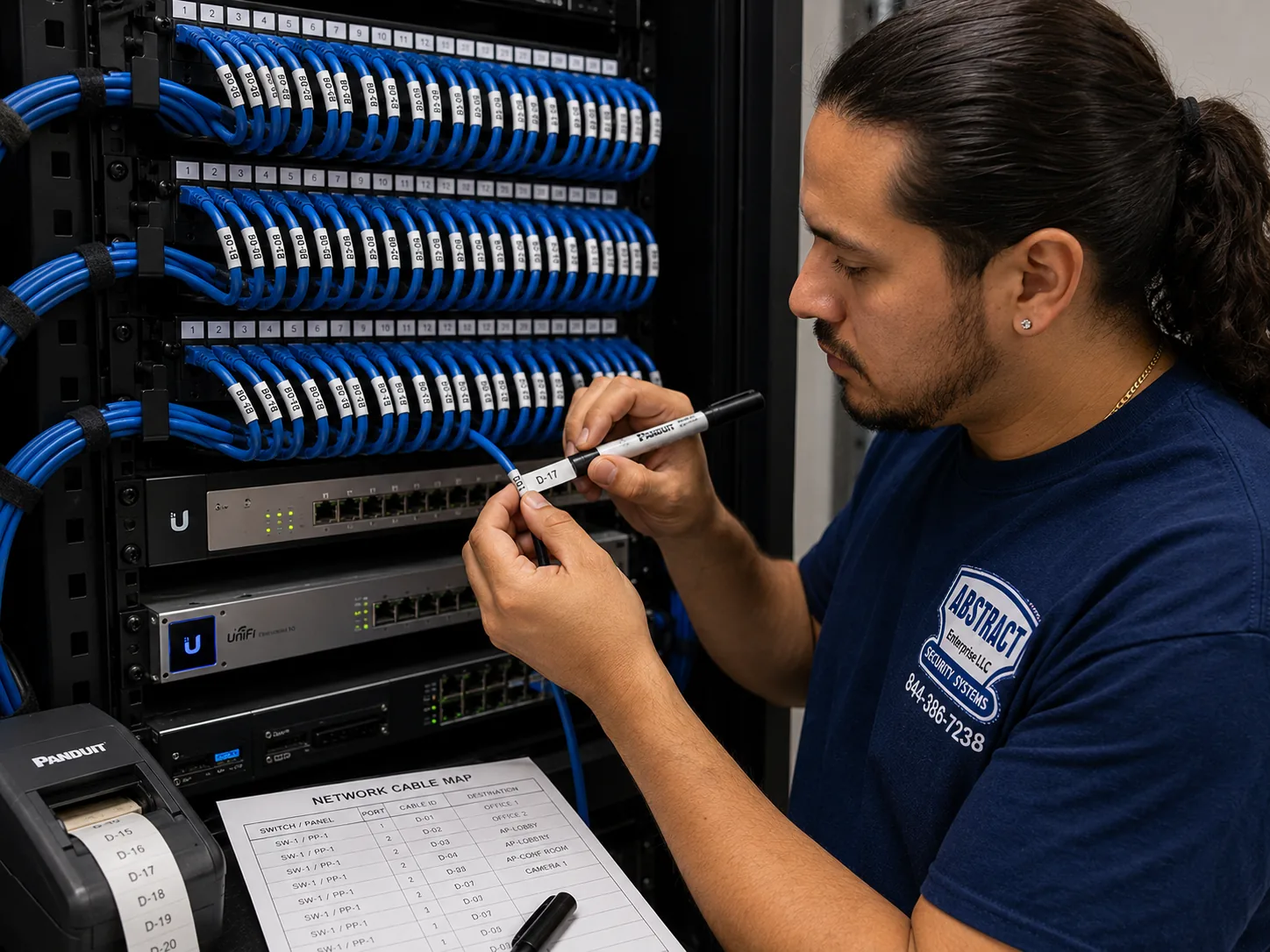
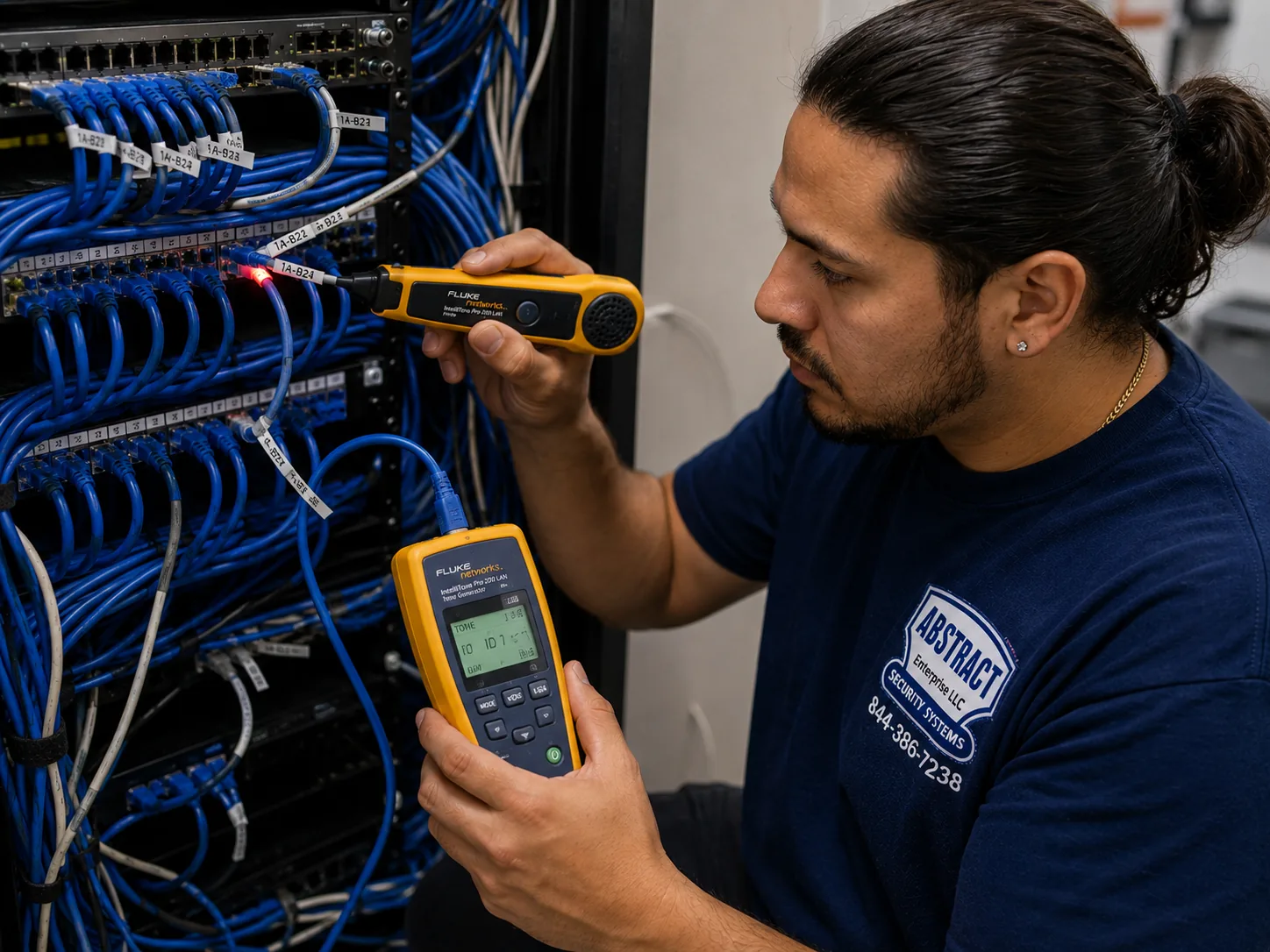
A great deal of the work here is a rack that grew across a decade of seasons, added to by several people, with nothing recorded. We trace, agree what is dead, remove it, re-route, re-terminate, dress, mark and produce a map — ideally in the off-season, when the building is quiet and the work costs nothing in trading.
Every build carries a decision about what is already there. Here that decision covers both a building that predates the concept of structured cabling and, usually, a run that leaves it.
Wireless still needs a wire. Radios are fed by cable, terminals take a run each, and everything lands on a panel. So the plant is inside the scope whether or not a new run is required.
Existing cable is often serviceable. Runs of Cat5e or better, landed on matching hardware, inside the distance limit and certifying clean carry a modern gigabit network without difficulty, and age is not a finding on its own. Two things are worth testing specifically here: physical condition on anything fished through old fabric, since it tends to have been stressed, and jacket condition on anything that has ever been outside, because weather does its work slowly and invisibly.
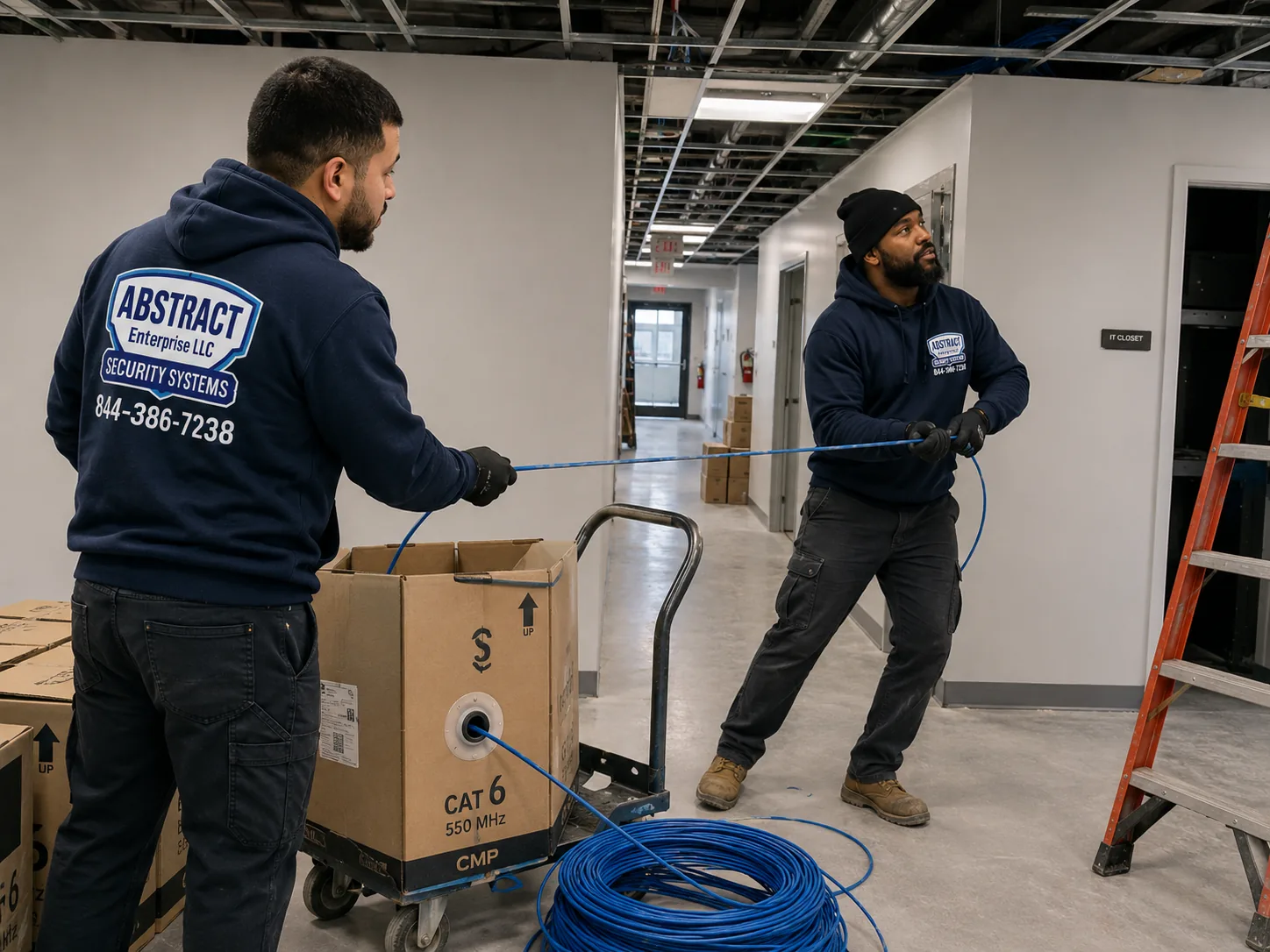
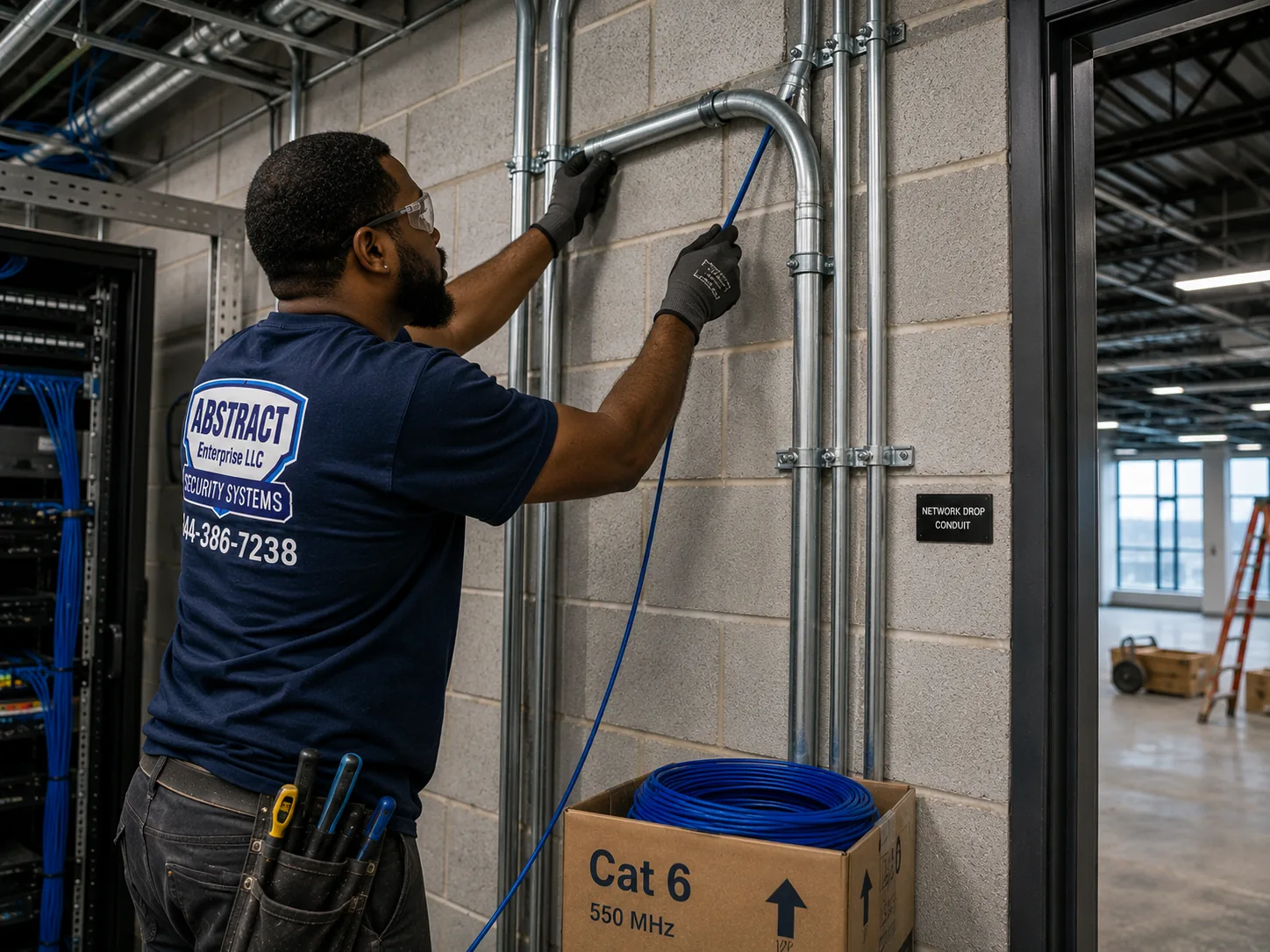
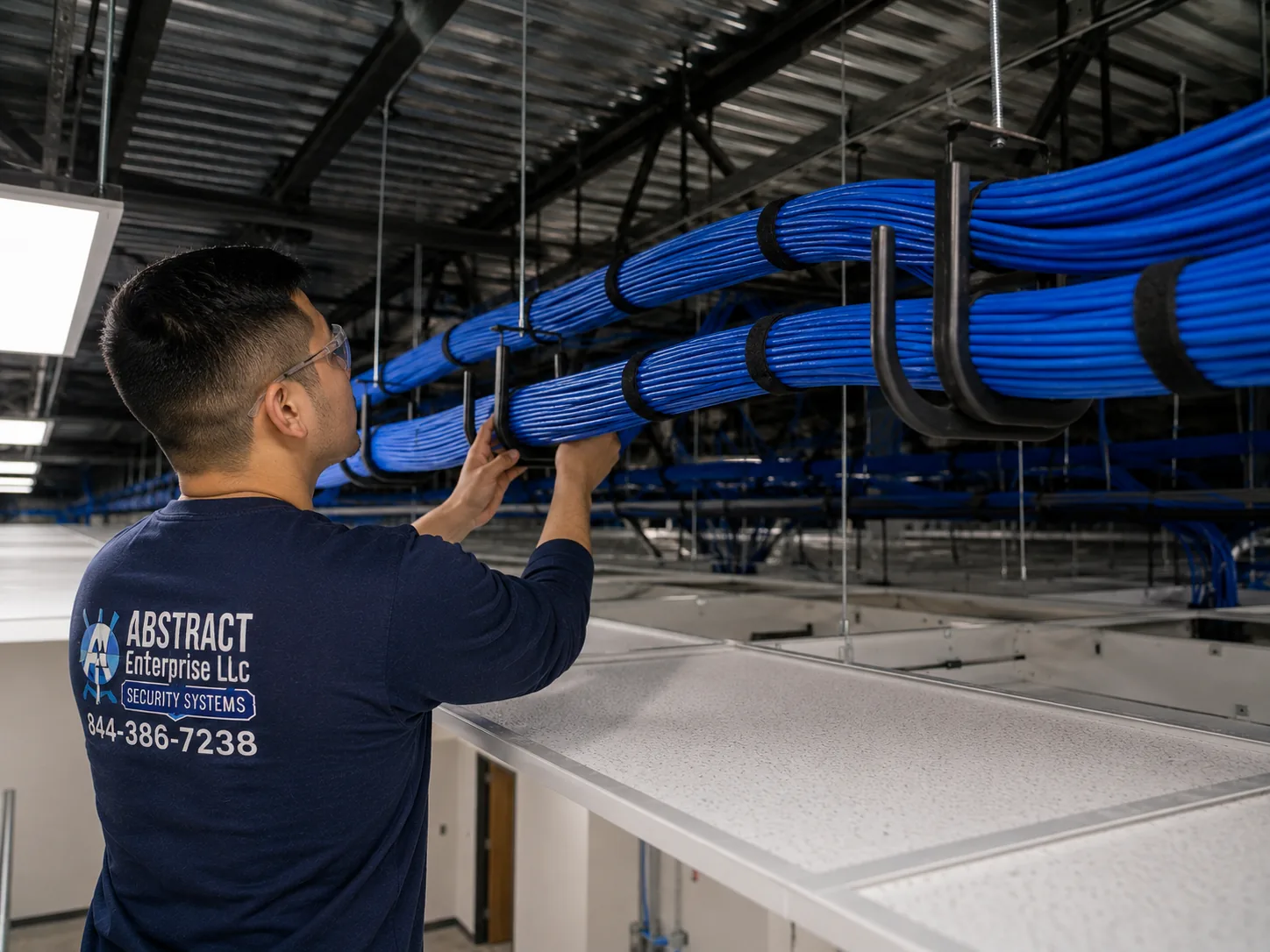
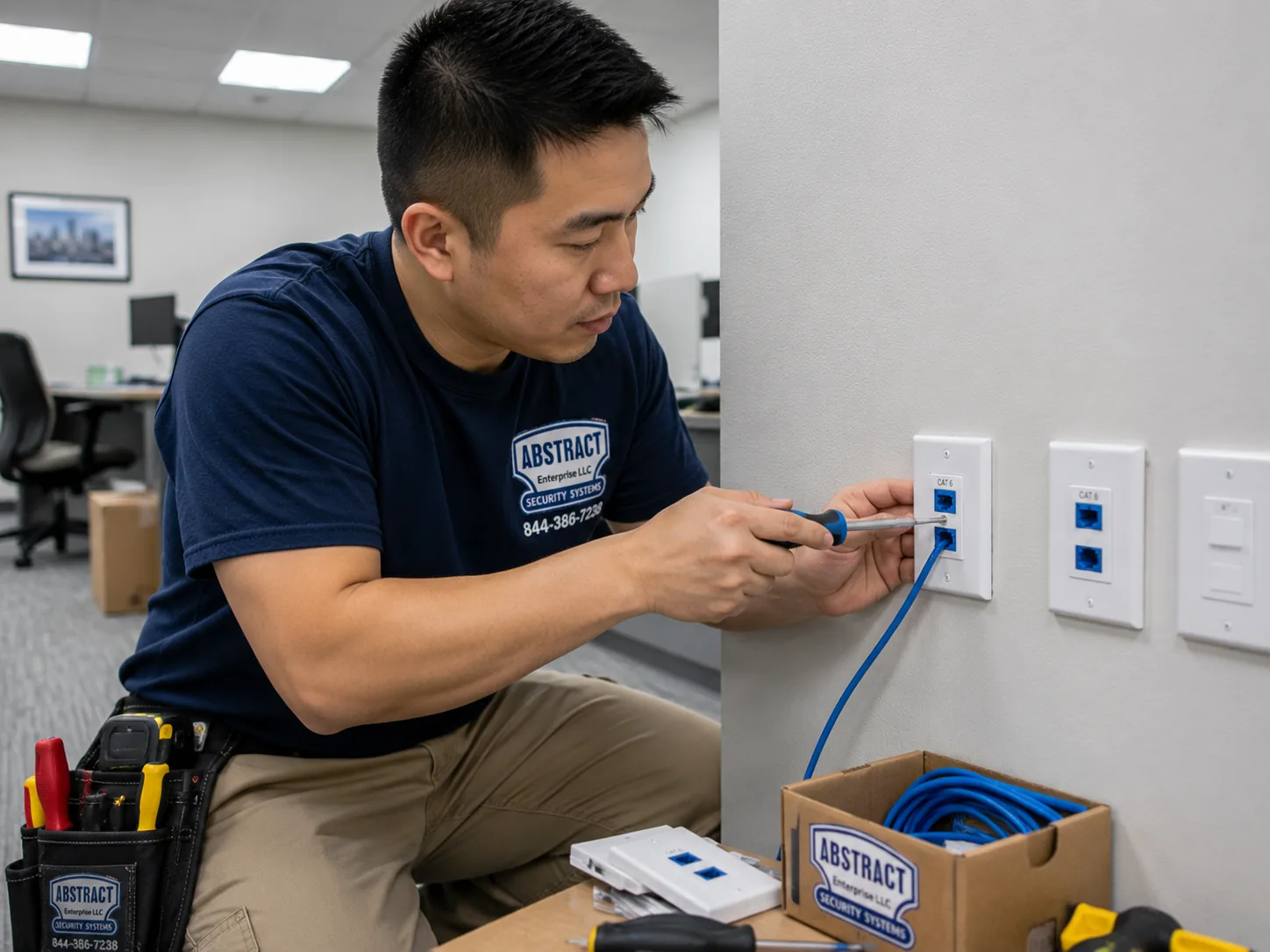
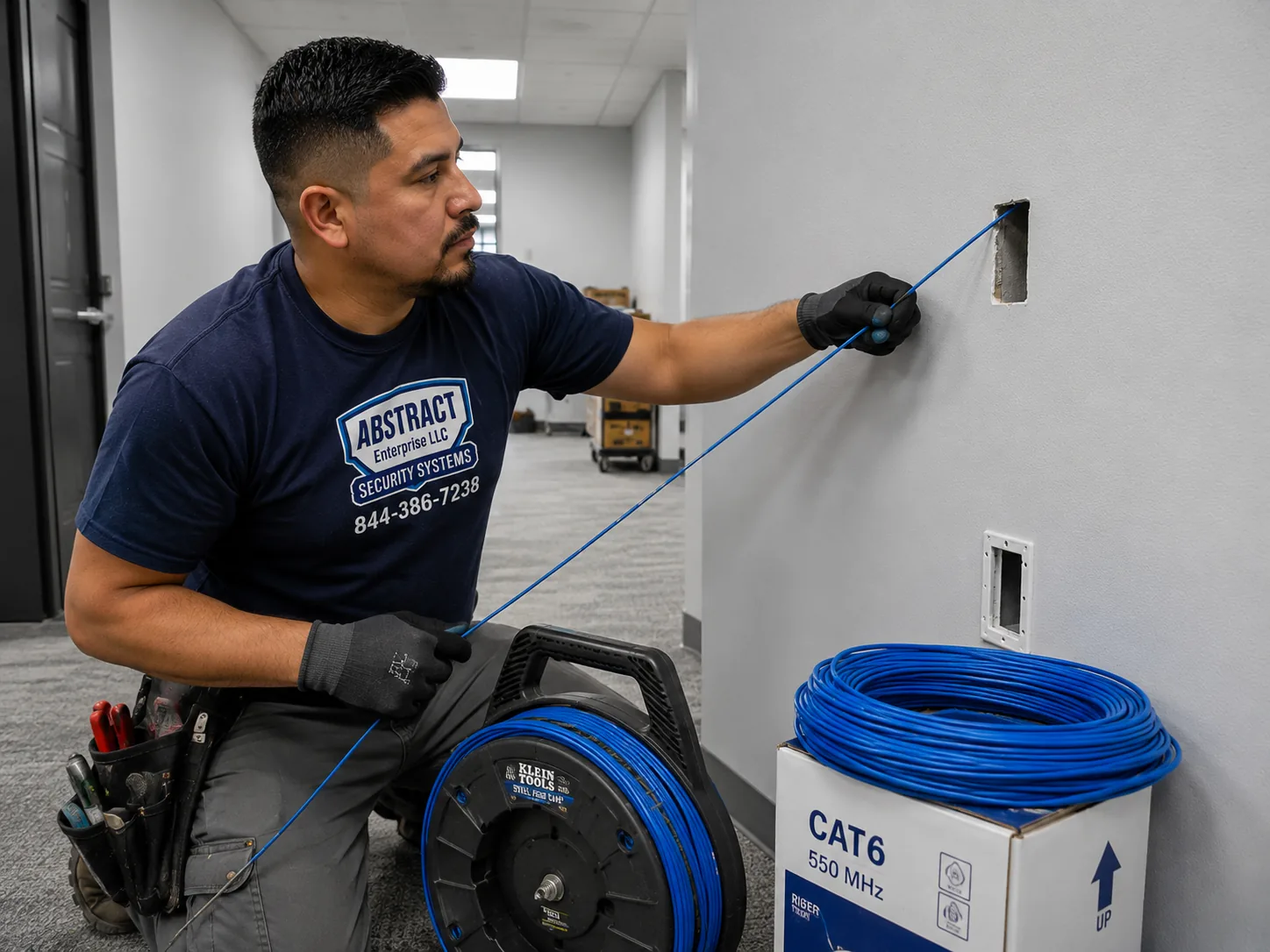
One rule set governs Ethernet installation on any network build, however many drops are involved: proper supports, a rating suited to the route, firestopping at rated penetrations, matched ends, marking and certification. Where a run must be visible in a historic interior it is designed as a visible element rather than improvised. Two ports at a fixed position and one at each ceiling position is the working default, with spares to the terrace, the barn or wherever the next season expands into. The cabling pages set out per-drop rates and compare the grades.
Related: structured cabling installation in Ulster County covers the whole plant. Cat6 installation Ulster County covers grade and per-drop pricing.
On a seasonal property the people who were there when the network was installed may not be there when it first goes wrong. The records have to survive that.
Every project closes with the same set, and on these properties it is written with turnover in mind.
The buried and exterior routes deserve emphasis on rural properties. A run under a driveway or across a field that nobody recorded is a run somebody eventually catches with a machine, and locating it afterwards costs considerably more than documenting it did.
On credentials, plainly: some contractors keep admin access to their own installations so that changing supplier means starting again. That is not how we work, and on a business with annual staff turnover it matters more than usual — a client locked out of their own equipment has no options at all. It is your network. You get the keys.
Almost every Ulster takeover we are called to begins with the same sentence: it was fine all winter.
The versions recur. A restaurant whose wireless works perfectly until the room is full. An inn that added rooms and never revisited the radio count. A winery that opened an events barn and connected it with whatever was in the van. A retailer whose card terminal fails on the busiest afternoon of the year and nowhere else. An installer who did the original work and no longer covers the area.
These present identically to the person reporting them and they have completely different remedies. A fault that appears only when the building is full is capacity; one that appears in the same room whatever the occupancy is coverage. We ask when it happens before we ask where, and on a seasonal property that single question resolves most of the diagnosis.
What is physically present, what certifies, what runs outside and in what, and what configuration is reachable. We produce a written assessment covering what is sound, what is failing, what is a hazard and what is merely unrecorded, and nothing changes until it has been read.
Where the problem is understood and the season has not started, the work is scheduled into the quiet period where it costs nothing in trading. Where the season has already started, we stabilise what is failing and schedule the redesign for afterwards rather than rebuilding a network during the weeks the business earns its year.
Even where little changes, the rack gets marked, a map gets produced and the operating note goes to the manager. On a business whose staff turn over annually, that note is frequently the only institutional memory the network has.
On a property whose load swings across the year, the timing of a fault is the most diagnostic thing about it.
Slow in every room, on cable and on wireless, at every hour and at every occupancy — that belongs to the circuit rather than the building, and a wired test at the edge settles it before anybody opens a ceiling. A single application dragging while everything else behaves is the application or its host, and one machine crawling while nothing else does is that machine. Establishing which over the phone costs nothing, and on a property well out in the county it saves a drive that helps nobody.
Published line items at our New York City labour rates, with the county mileage allowance stated openly. Switching, firewalls and radios come through as their own quote lines or are provided by you.
| Item | Price |
|---|---|
| On-site assessment, peak-load review and room planning | Free |
| Wireless site survey and heat map | $450 (credited to the project) |
| Capacity plan from peak device counts, with the guest ceiling set | Included with the survey |
| Return validation walk during a genuinely busy period | $250 |
| Network design — addressing, VLAN scheme, site plan, as-built drawings | $350–$650 |
| Item | Price |
|---|---|
| Router / gateway install and configuration | $350 |
| Business firewall install with rule set | $450–$900 |
| Managed switch install and configuration — 24-port | $250 |
| Managed switch install and configuration — 48-port | $400 |
| Each additional switch in a stack | $175 |
| VLAN / segmentation configuration, per segment | $125 |
| Public guest network with isolation, captive portal and throughput ceiling | $275 |
| Wi-Fi radio — mounted and tuned on an existing drop | $225 |
| Wi-Fi radio — including a new cable run | $300 |
| Exterior-rated radio — mounted, weatherproofed and bonded | $495 |
| Network rack or cabinet build — panels, managers, PDU, dressing | $650 |
| Lockable cabinet where seasonal staff or the public pass the equipment | from $850 |
| Additional room with fiber link back | from $2,400 |
| Rack cleanup, trace, re-route and re-mark | from $500 |
| Documentation package — port map, site as-built, operating note, credentials | $350 |
| Certification testing, per drop | $20 |
| Item | Price |
|---|---|
| Concealed or colour-matched pathway in a historic interior | from $18 per ft |
| Penetration placed and finished to avoid a visible facade | from $325 |
| Sealed and bonded exterior entry, per penetration | from $185 |
| Underground run between structures rather than across a facade | Custom, after route survey |
| Off-season scheduling to avoid trading disruption | No premium |
Listed separately because working in a protected district genuinely costs more than working in a modern unit, and a bid that does not mention it has priced the wrong building. Where district approval is required for anything visible, the lead time goes in the programme rather than surfacing in week two.
| Area | Mileage allowance |
|---|---|
| Ulster County | $145 per crew day |
Stated on its own line rather than folded into the hourly rate, so a Kingston or Woodstock project can be compared directly against one closer to the city. Multi-day work is scheduled in consecutive full days rather than scattered half days.
| Package | Scope | From |
|---|---|---|
| Small office or practice | Up to 10 users, 12 drops, firewall, 24-port PoE switch, 2 radios, wall cabinet, VLANs, documentation | $5,200 |
| Hospitality or retail at peak | Capacity-sized radio count, payment and booking wired and fenced, public network with a ceiling, staff segment, validation during a busy period | from $8,900 |
| Historic district premises | As above with concealed pathway, penetrations placed to avoid the facade and room-by-room coverage through masonry | from $12,400 |
| Multi-structure rural property | A room per structure, link between them, outdoor and event-space coverage, consolidated edge | from $19,500 |
Work on networks already installed — diagnosis and repair — is $195 an hour, three hours minimum, plus the county mileage allowance. During a season we will attempt to isolate the fault remotely first and prioritise stabilising what is failing over redesigning anything. Next-day attendance in most of the county. Should the attendance turn into a quoted project, those hours are credited back.
No manufacturer suits every property. On a business with a season, what matters most is that the equipment carries a crowd and can be looked after by whoever is there in July.
The common choice for hospitality and small commercial work here. Radios that handle density well when the cells are sized properly, one controller covering indoor, outdoor and switching across a multi-structure property, no licence per unit, and a guest portal that a manager can operate. What stands behind it is a user community, not a support agreement.
Cloud-managed with strong tooling and a manufacturer behind it, licensed per device annually and permanently — the hardware stops if a licence lapses. The right fit for institutional and municipal work in the county, and for larger hospitality groups that want a support contract behind a network their season depends on.
Budget-tier kit that punches above its cost, and nothing payable each year. Sensible for a village retailer or a small office where the network is infrastructure rather than a strategic asset and the peak load is modest.
Where the edge needs inspection, a dependable VPN, and logs that can be produced on request — which on a property handling card data is worth having. Fortinet when a manufacturer standing behind the box counts for something; pfSense or Netgate when an unsubscribed open platform is the better fit.
Where a radio has to live on a terrace, in a barn or across a yard, we specify equipment and enclosures built for it rather than putting indoor hardware in a box and hoping. On a property whose peak load is frequently outdoors that is not an optional refinement, and it appears as its own line because the alternative is replacing the same position every couple of seasons.
Where the equipment is already bought, or an IT provider works to a set standard, we fit and configure it. What we will say plainly is when something cannot do the job being asked — a single radio expected to carry a full dining room, an indoor unit destined for a barn, or a consumer router serving a property with a season.
One powerful radio in the middle of a room that fills up, which is the most common thing we replace and the least intuitive to explain. A guest network with no throughput ceiling. Indoor hardware mounted outdoors under a soffit. Payment terminals on the same wireless the public joins. And a faster circuit bought in the hope of fixing airtime contention, which it cannot touch.
They appear together in proposals and describe very different amounts of work.
| Term | What it covers | What it excludes |
|---|---|---|
| Cat6 installation | A cable grade with its fittings — runs, jacks, panels, terminations and the testing behind them. | Equipment, configuration, wireless design |
| Structured cabling | The physical build of a property — horizontal runs, backbone, telecom rooms, fiber, pathway and certification. | Configuring the switches, routing, firewall policy, VLAN work and radio tuning |
| Network installation | Everything that has to be true for traffic to move: design, addressing, switching, the edge, segmentation, coverage, records, and the cable plant supporting all of it. | Server administration, desktop support, software |
On a seasonal property the split creates a specific failure. Capacity design lives on the configuration side — cell sizing, transmit power, the guest ceiling — while radio positions and cable live on the physical side, and the two have to be decided together. Split them and you get radios installed where cabling was convenient, then tuned afterwards by somebody who cannot move them. That is precisely how a building ends up with excellent coverage and a network that collapses at seven on a Saturday.
This is the Ulster County page. The regional page above this one is network installation Hudson Valley, and above that again is the citywide hub, network installation NYC. The neighbouring counties are covered on network installation Dutchess County and network installation Orange County.
Headcount says little. How many people are in the building on the busiest afternoon of the year says most of it.
Capacity-sized radio counts rather than coverage-sized ones, payment and booking wired and fenced, a public network with a throughput ceiling, outdoor and terrace coverage in weather-rated hardware, and validation walked during a busy service rather than an empty one.
More than one structure on a parcel, an events barn that carries the peak crowd, payment terminals in a tasting room, seasonal staffing, and a single consolidated edge instead of a separate connection for each building.
Protected exteriors that dictate where a penetration can go, stone and masonry interiors that set the radio count room by room, visible pathway designed rather than improvised, and district approval lead time built into the programme.
Kingston, New Paltz, Saugerties, Woodstock. Payment wired and fenced from the network customers join, stockroom coverage that survives full shelving, peak-footfall capacity planning, and installation scheduled around trading hours.
Multiple buildings, infrastructure of mixed vintage, documented standards to work within, certification and drawings expected as deliverables, and a programme that follows the academic calendar rather than ours.
Modern retail, service and flex buildings on their own lots. Conventional construction, straightforward pathway, and the ordinary design questions — which makes these the most predictable jobs in the county.
Five stages, and the first asks about the busiest week of the year rather than a typical one.
How many people the space holds when full, how many devices each of them carries, when the season runs, which spaces carry the crowd — indoors and out — and what the walls are made of. Where the building sits in a historic district we establish at this stage what the exterior permits and what approval will take.
Radio count and cell sizing from peak device counts rather than floor area, the guest ceiling set, payment and booking identified for wiring, addressing and the VLAN scheme, switch capacity with reserve, the equipment list, and a line-item price with the historic-fabric and exterior lines shown separately.
Anything between structures first, then cable inside each on supported pathway rated for where it runs, firestopped at rated penetrations, with exterior entries sealed and bonded. Where a run must be visible in a historic interior it is designed as a visible element. Scheduled into the quiet period wherever the calendar allows.
Rack or lockable cabinet with panels, managers, power and battery backup, in a space chosen for its conditions. Switching, the edge firewall and radios fitted, configured and tuned — cells sized deliberately small, the guest ceiling applied, and the power budget proven against the full radio count including exterior enclosures at their winter draw.
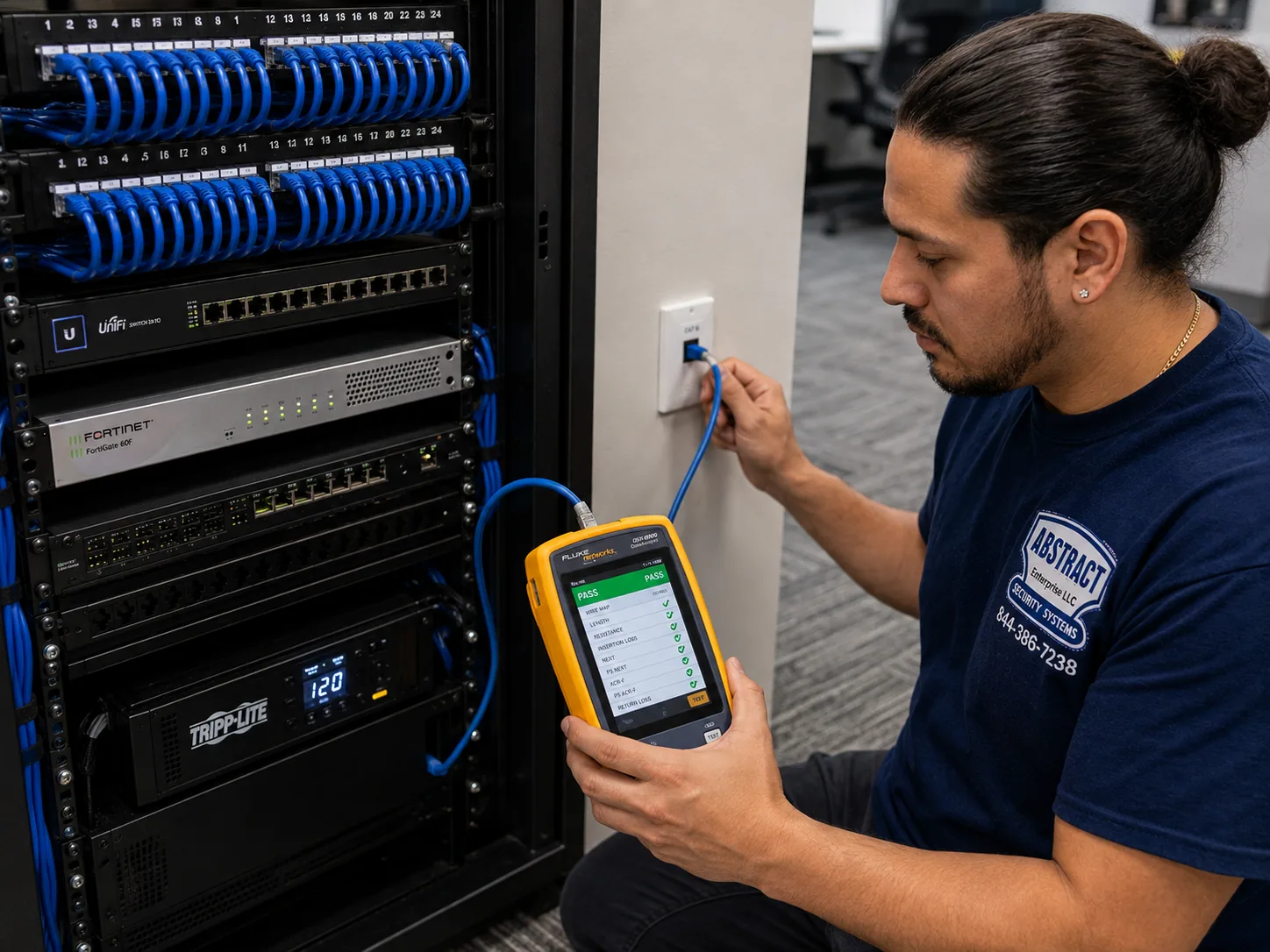
Every drop certified and a validation walk through every space, indoors and out. Where the season permits, we return during a genuinely busy period and measure it under real load. Then the package — port map, site as-built with exterior routes measured from fixed points, addressing record, equipment list and credentials — plus the operating note written for a manager.
Points you can check when the building is full, rather than adjectives.
A small office or practice of up to ten users starts near $5,200. A hospitality or retail property sized for its peak — capacity-based radio count, payment and booking wired and fenced, a public network with a throughput ceiling, and validation walked during a busy period — starts near $8,900. Premises inside a historic district start near $12,400, because concealed pathway, penetrations placed to avoid the facade and room-by-room coverage through masonry are all genuine extra work. A multi-structure rural property with a room per building starts near $19,500. Labour is at our New York City rates plus a stated mileage allowance of $145 per crew day, and the historic-fabric lines are published rather than buried.
Because it was sized for coverage and the problem is capacity. A single radio can cover a large dining room, a tasting room or a shop floor comfortably — what it cannot do is carry a hundred and fifty devices at once, since they are all contending for the same airtime regardless of how strong the signal is. The remedy is more cells at deliberately reduced power so each carries fewer devices, which is counter-intuitive and is the single most useful thing on this page for a seasonal business. It is also why we size from peak device counts rather than floor area, and why we offer a return validation walk during a genuinely busy period.
No, wherever running cable is possible. Point of sale, booking and reservation terminals, the back office and anything a customer waits on belong on cable and on their own segment, with a throughput ceiling applied to the public network so guest use cannot consume the connection they depend on. Payment sharing air with a public network is the most common reason a terminal fails on the busiest afternoon of the year, and wiring it is the cheapest reliability decision available to a hospitality or retail business.
Usually not without approval, and frequently not at all. On a building within a historic district, running cable across an exterior wall, drilling a visible penetration or mounting a radio where it can be seen from the street is often not permissible, and where it is, approval comes first rather than afterwards. The workable answers are interior routes, penetrations placed where they cannot be seen, concealed or colour-matched pathway where a run must be visible, and an underground run between structures rather than one across a facade. All of them cost more than the obvious approach, all of them are quoted openly, and the approval lead time goes into the programme at survey stage.
A walk that establishes peak occupancy rather than a typical day, a capacity plan built from device counts at peak with the guest ceiling set, identification of what should be wired rather than wireless, the plant on supported pathway rated for where it runs, the rack in a space chosen for its conditions, the switching and edge firewall, the Wi-Fi installation designed for density indoors and out, certification on every drop, and a handover package including the operating note written for a manager rather than an engineer.
Structured cabling is a property's physical infrastructure: horizontal runs, backbone, telecom rooms, fiber, pathway and certification. Network installation is every condition that must be met before traffic can flow — design, addressing, switching, the edge, segmentation, coverage, documentation — and the cabling underneath. On a seasonal property the split creates a specific failure: capacity design lives on the configuration side while radio positions and cable live on the physical side, and the two have to be decided together. Split them and you get radios installed where cabling was convenient, then tuned afterwards by somebody who cannot move them.
It depends on how many people are in it at capacity rather than how large it is. A dining or tasting room at full occupancy typically wants two or three radios with cells sized deliberately small, so each carries a manageable share of the devices. Add a radio per enclosed room cluster where stone or masonry walls stop signal, which in this county's older buildings is common. Guest rooms in an inn run roughly one radio per three to five rooms depending on what the walls are made of. A terrace, barn or event field carrying the peak crowd needs one to three exterior-rated units counted inside the capacity plan rather than added to it afterwards.
On a property where the public is the largest population on the network, yes, and without one a busy afternoon of guest use can consume the whole connection. The first casualty is usually the terminal taking payments. A ceiling costs nothing to configure, it is invisible to guests doing ordinary things, and it means the parts of the network the business cannot lose keep working when the building is full. Client isolation belongs alongside it, so devices on the public segment cannot see each other or anything internal.
A day or two covers a small office or a practice. A hospitality or retail property sized for peak runs three to five days depending on the radio count and how much of it is outdoors. Historic district premises run longer, because interior routes are slower than obvious ones and masonry raises the labour on every drop. Multi-structure rural properties depend on the link between buildings — an aerial run is a day, an underground one is a different scale of project. The items most likely to move a date are the provider's circuit install, historic district approval where anything visible is involved, and weather, since exterior work does not happen in frozen ground.
Yes, and we will suggest it rather than wait to be asked. Off-season work costs the same and disrupts nothing, which on a business earning most of its year in a few months is worth a great deal. Where work has to happen during a season we stabilise what is failing and schedule the redesign for afterwards rather than rebuilding a network in the weeks that matter. Evening and overnight work carries no premium on our labour rate.
It earns its fee in stone, masonry and very old buildings, since nothing models those walls honestly and this county has more of them in commercial use than any other we work in; on multi-structure rural properties, where outdoor coverage and roaming between buildings are in question; anywhere the peak load is outdoors, because tree lines, ground and structures shape the result and none appear on a plan; and anywhere wireless has already been attempted and did not work. One caution specific to seasonal property: a survey walked on a quiet February weekday tells you very little about the Saturday you care about, so we treat coverage and capacity as separate questions — capacity is calculated from peak device counts, and a return walk under real load is available for $250.
Battery backup sized to the rack keeps switching, the edge and the radios alive through a brief interruption and shuts everything down cleanly on a long one. That prevents the specific failure where power returns, equipment boots in the wrong order and nothing routes until somebody intervenes. Rural Ulster sees more interruptions and longer ones than anywhere closer to the city — overhead distribution, heavy tree cover and long feeders — and for a business whose season is short, an outage during it is disproportionately expensive. On properties with a generator it is worth confirming the network room is genuinely on the protected panel rather than assuming.
Past about eight people, yes, and on any property with a public network well before that. An unmanaged switch cannot segment traffic, cannot apply a ceiling, cannot prioritise voice, cannot report which port is saturating and cannot be monitored. Every one of those is central to running a network the public shares. It is also what lets us narrow a fault remotely during a season rather than sending somebody out on the busiest afternoon of the year.
Cat6A at ceiling and exterior positions in nearly every commercial case, and the reason is power and headroom rather than raw speed. Current Wi-Fi 6E and 7 units draw PoE++ under 802.3bt, and Cat6A's heavier conductors carry that with less heat rise through a packed bundle — which matters here because density design means more radios in the same building. It also delivers ten gigabit to the full hundred metres, and the radio gets replaced every five to seven years while the cable stays for fifteen. Cat6 remains correct for fixed terminals, printers and general connectivity. On anything leaving the building the jacket specification matters as much as the grade.
Three kinds of supplier compete for it here: licensed low-voltage contractors, IT businesses that put the physical work out to others, and cablers who finish once the panel is done. Anyone shortlisting a network installer here should also ask how the contractor sizes wireless, because in a county where hospitality, tourism and a college town dominate the commercial base, a design sized for coverage rather than capacity will fail in the month that pays for the year. We are the first kind and hold both layers: Abstract Enterprises Security Systems, NYS Low Voltage Electrical Contractor licence #12000287431, insured, working from Kingston and Saugerties across to New Paltz, Gardiner, Woodstock and the Rondout Valley. That covers the peak-load review and capacity plan, historic-fabric constraints, design and addressing, cabling and pathway, exterior and between-building work, the rack, switching, the edge firewall, VLAN segmentation, wireless design, certification, documentation and credential handover, plus repair and takeover of networks that cope until the season starts.
There is no building permit requirement for low-voltage cable work indoors. What can apply here is historic district approval for anything visible on an exterior, plus landlord approval, insurance on file and firestop documentation at rated penetrations.
Yes. NYS Low Voltage Electrical Contractor licence #12000287431, and current county and municipal requirements are confirmed during the survey rather than assumed from a previous job.
Airtime contention rather than weak signal. Too many devices are sharing one cell, and the fix is more cells at lower power rather than a stronger radio.
In a historic district, usually not without approval. We identify that at survey and price the alternative — an interior route, a concealed penetration, or an underground run between structures.
No, wherever cable is possible. Payment sharing air with a public network is the most common reason a terminal fails on the busiest afternoon of the year.
Yes, and we will suggest it. Off-season work costs the same and disrupts nothing, which on a business with a short season is worth a great deal.
Yes — exterior-rated radios, weatherproof mounting, rated cable and a proper bond at the entry, counted in the capacity plan rather than added on.
$450, credited to the project, including a capacity plan from peak device counts. A return walk under real load during a busy period is $250 more and worth it on a seasonal property.
The whole county. What changes between areas is the building fabric and when the busy season falls.
The Stockade district, uptown. Stone and brick buildings of considerable age holding retail, hospitality, professional offices and studios. Protected exteriors, thick interior walls, no concealed pathway, and a visitor season that reshapes the load from spring onward. The county's most constrained work and its most interesting.
The Rondout waterfront. Nineteenth-century commercial and warehouse buildings turned into restaurants, galleries, offices and hospitality. Masonry throughout, exposed ceilings where cable is designed rather than hidden, and peak loads concentrated in a short season.
Midtown and the Broadway corridor. Converted industrial stock, service commercial, institutional and civic property. Larger floor plates than the historic districts and considerably fewer constraints on how they are wired.
Lake Katrine and the Kingston commercial approaches. Modern retail, flex and service buildings on their own lots, plus the large redeveloped industrial and technology campus property nearby. Conventional construction, straightforward pathway, and multi-building parcels where distances need more than one room.
Saugerties. Village Main Street commercial and hospitality alongside modern development near the Thruway interchange, plus outlying properties with more than one structure. Two quite different design problems within a few miles.
Highland and the river crossing. Retail, hospitality and service businesses, with seasonal visitor traffic from the rail trail and the river corridor shaping their year.
New Paltz Main Street and the campus surroundings. Retail, restaurants, hospitality and professional offices serving a population that arrives in late August and departs in the spring. Guest wireless behaves like a public service, capacity is the design question, and the historic buildings around Huguenot Street bring the same exterior constraints Kingston does.
Gardiner and the Wallkill Valley. Wineries, farms, hospitality and event venues on larger parcels. Multiple structures, outdoor coverage across event space, and seasonal staffing.
Woodstock. Retail, hospitality, studios and small professional offices in older village buildings, with a visitor season that is the year for most of them. Masonry and converted stock throughout.
The Rondout Valley — Stone Ridge, High Falls, Accord and Kerhonkson. Inns, farms, event venues and small commercial on rural parcels. Multi-structure properties, exterior coverage, and travel distances that make full-day scheduling sensible.
Ellenville and the southwest. Village commercial, municipal and institutional property, and hospitality serving the surrounding countryside.
Phoenicia, Shandaken and the Catskill towns. Small hospitality, retail and service businesses whose season is short and whose distances are long.
This page sits under network installation Hudson Valley. The cable plant these networks run on is covered on structured cabling installation Ulster County, and cable grade and per-drop pricing on Cat6 installation Ulster County.
Tell us the property and what your busiest week looks like. We will walk it, size the design against that rather than an average, and come back with a line-item number.