Harbor-View Houses · Split Levels on the Slope · Garden Apartments & Hillside Condos · Licensed Low-Voltage
Sonos Installation in Grymes Hill
Planned Around the Window Wall · Networks That Climb Between Levels · Deck Sound Aimed Away From the Slope · Staten Island Price List
Grymes Hill climbs 374 feet out of the North Shore, and from the first estates onward its houses have been set down to face the view: out over the Narrows, the bridge and the harbor. That choice shapes a Sonos system more than any product does. The best wall in the living room is often glass. The front door sits at the street while the family room sits a level below, on the downhill side. The deck hangs over a wooded slope the city protects, with the neighbors' roofs below it. We plan Grymes Hill systems from the view inward: where the screen and soundbar can go without blocking the harbor, how the network reaches each stepped level, and how outdoor sound is kept on your deck instead of drifting down the hill.
Reviewed and updated October 17, 2026 · Written by Anwar Timothy, NYS license #12000287431 · Booked through our Brooklyn office at 1282 Troy Ave, which covers Staten Island
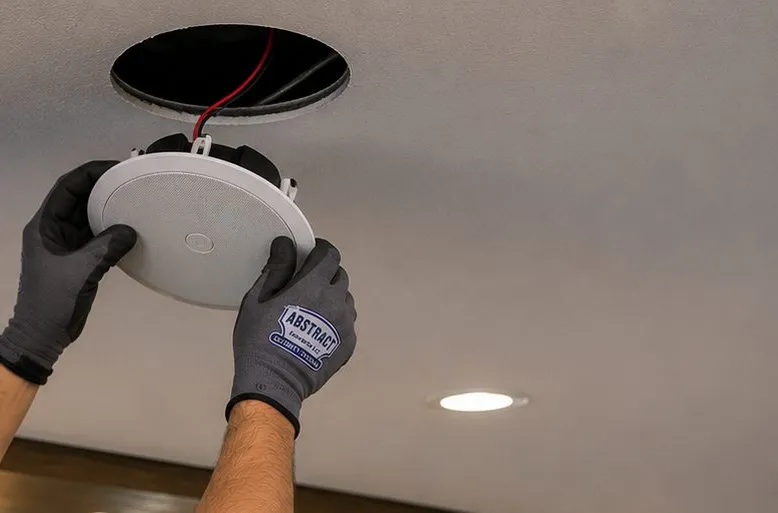
Close-up from beneath: a white round ceiling speaker is held in two gloved hands a few inches below its freshly cut hole, a single red lead looping down. The room behind is blurred into a dark timber beam, pendant lamps and recessed spots.
Grymes Hill Sonos Quote
Tell us which way the house faces and what you own — a written total the same business day
✅
Request Sent!
An installer will call about your Grymes Hill rooms the same business day.
25+
Years Experience
✓
Same-Day Estimates
100%
Licensed & Insured
4.7★
201 Google Reviews
Send one photo taken from the sofa, looking at the window. On the hill that single picture tells us where the light comes from, which wall is glass, where a screen could hang and whether there is a door out to a deck. Add a second photo of the router and we can usually price the job before anyone climbs Howard Avenue. Call (347) 934-8335 or use the form.
Sonos setup is $125 on our Staten Island list; there is no bridge toll, travel or mileage charge on top
Outdoor and ceiling zones get a free walkthrough and a written number before anything is ordered
Licensed for low-voltage work in New York State (#12000287431), with two-hour arrival windows every day between 8 AM and 8 PM
Grymes Hill is a hill first and a neighborhood second. Wikipedia describes it as a 374-foot rise of serpentine rock, the second-highest natural point on Staten Island after Todt Hill, with views of Lower New York Bay and the Narrows. The neighborhood around it covers a little under nine-tenths of a square mile. Its east side runs along Van Duzer Street and Richmond Road, the Staten Island Expressway and Clove Road close it off to the south, and Victory Boulevard runs along the west; people still argue about whether Cebra Avenue or Louis Street marks the northern edge. Howard Avenue is the spine. Part of it was once called Serpentine Road, after the green rock it crosses, and in 2016 the New York Times described the area's roads as "curving one way, then the other," with signs warning drivers that the "Hill Blocks View." A resident on Reddit put it more plainly: "It's a genuinely steep hill."
The houses on that slope were built for a view. Sir Edward Cunard put up his Italianate villa, Bellevue, around 1851 on a 38-acre estate he chose for its ocean view; it still stands on the Wagner College campus as Cunard Hall, where the college says he "literally watched his ships come in." The steamship owner John Gans built on the hill because it overlooked the harbor where his ships worked. Louis and Laura Stirn's 1908 mansion at 79 Howard Avenue was renamed Casa Belvedere, "house with a beautiful view," for its outlook over the Verrazzano Bridge and the harbor. Later houses followed the same rule. The Times found "angular contemporaries, with decks offering views of the Lower New York Bay and Verrazano-Narrows Bridge," which "cling to cliffs," next to red-tile-roofed houses in a Spanish mission manner and Craftsman bungalows that "hunker down in the woods."
A house turned toward the view is a particular kind of room to put sound into. The wall you would normally hang a TV on is the one with the window. Glass reflects sound hard, so a living room with a wall of it can feel bright and echoey with a soundbar that would sound full in a plaster-walled den. The sofa faces the harbor, which often means it faces away from the only solid wall. And because the house was set into a slope, its levels rarely stack neatly: the garage and front door may be at the street with the main rooms a half or full storey below, or the house may climb uphill from the road with the deck at the top. Wi-Fi from a router by the front door has to travel down through floors, around retaining walls and out through glass before it reaches the deck that everyone actually uses in summer.
Then there is the land itself. The hillsides and their trees are protected by the city's Special Hillsides Preservation District, in effect since 1987, which the Times described in 2016 as zoning "designed to protect against erosion." Within it, the Zoning Resolution counts any part of a lot with an incline of 25 percent or more as a steep slope, and it lists "tunneling for utilities," excavation, regrading and tree removal among the intrusions an "area of no disturbance" is protected from. A cable trench that would be a half-day job on a flat South Shore lawn is a different question on a Grymes Hill lot that falls away below the deck. So is a speaker post driven into the ground, because the rock under much of the hill is serpentinite, which comes to the surface in places — the Serpentine Art and Nature Commons trails off Van Duzer Street pass right over outcrops of it.
Grymes Hill is also not only big houses. Fred Trump built 423 garden apartments along Howard Avenue and Arlo Road in the late 1940s; the Times describes the Grymes Hill Apartments as "brick two-story buildings clustering along Arlo Road." Grymes Hill Manor Estates, built in 1953 as rental garden apartments, became a 152-unit co-op in 1983, centered on Seth Court. There are condominiums at 830 and 850 Howard Avenue and at 55 Austin Place, rental towers on Victory Boulevard, and two campuses. Wagner College, with its Collegiate Gothic Main Hall, bought the former St. John's University campus a quarter-mile away in May 2026, after St. John's ended classes there in May 2024. A Sonos visit on the hill can mean a four-level contemporary with a cantilevered deck in the morning and a rented brick garden apartment with no drilling allowed in the afternoon. This page explains how we plan for each.
Grymes Hill facts that shape a Sonos plan
374 feet: the hill's height, second on the island to Todt Hill (Wikipedia). Elevation is why so many living rooms here face glass, and why sound from an open deck can carry over the treetops below.
1987: the year the Special Hillsides Preservation District took effect over the North Shore slopes (Wikipedia; New York Times). Its rules on steep slopes, vegetation and "tunneling for utilities" shape how outdoor cable reaches a lower terrace.
25 percent: the incline at which part of a lot counts as a steep slope under the district's definitions (NYC Zoning Resolution, Article XI, Chapter 9).
423 and 152: the Grymes Hill Apartments' garden units along Howard Avenue and Arlo Road, and the apartments in the Grymes Hill Manor Estates co-op around Seth Court (Wikipedia) — homes where a free-standing system is often the right answer.
8,263 people: the population Wikipedia gives for the neighborhood, across 0.894 square miles. In the wider census tabulation area that includes West New Brighton and Silver Lake, 47.4 percent of occupied homes are rented.
Two campuses, one owner: St. John's University announced the sale of its 16.5-acre Staten Island campus to Wagner College on May 12, 2026 (St. John's University). Wagner's own campus, much of it former estates, covers about 105 acres by Wikipedia's count.
Taken together, the figures describe a neighborhood of views, levels and protected ground, with a large share of renters in the garden apartments and towers around the edges. None of that makes a good Sonos system harder to get. It makes the order of decisions different: the view and the slope come first, products second.
A Sonos visit on the hill usually includes the TV. Once the window wall is ruled out for the screen, screen and soundbar have to move together, so it is simplest to plan both on one visit. Our Staten Island TV installation crews work from the same price list, and when a renovation has the walls open, structured cabling on Staten Island can drop a network jack on each level at the lowest cost it will ever have.
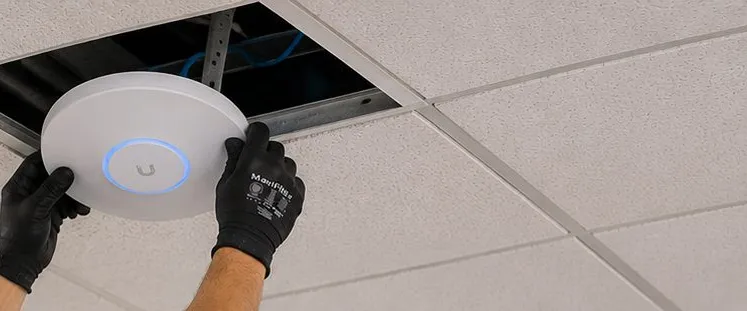
A round white access point with a lit blue ring is pushed up into the gap left by a lifted ceiling tile, two gloved hands holding its edges and a blue cable dangling in the darkness above.
Deck Speakers Silent Since the Last Storm on the Hill
Big trees are part of the hill, and in storms some come down — during Tropical Storm Isaias in 2020, SILive reported a large tree bringing down power lines on Cedar Terrace. When a branch takes out a line like that, or the provider swaps the router after an outage, the deck pair and the downstairs rooms are usually the first to vanish from the app. Call (347) 934-8335 and we book the next open 2-hour window. Most of these are back and regrouped within one to two hours of arrival, billed as a setup-only visit at $225 for the first hour on the Staten Island list.
These nine jobs account for nearly every booking on the hill. Three of them exist mainly because the houses face the water.
🪟
View-Room Home Theater
Screen and soundbar placed on a side wall or a low console so the harbor window stays clear, with rear speakers chosen for a room whose back wall is glass.
🏞️
Deck and Terrace Zones
Sonos outdoor speakers on an Amp, mounted under the deck roof or on the house wall and aimed back across the deck rather than out over the slope.
📶
Level-to-Level Networks
A wired product or access point on each level of a stepped house, so the room below the street and the deck above the trees stay on the system.
⭕
Ceiling Speakers
In-ceiling pairs on an Amp in contemporaries and additions with accessible framing, cut only after joists, ducts and lights are located.
🏛️
Estate-Era Houses
Free-standing and wall-mounted products in the hill's older mansions and colonials, with fixings kept off original plaster, paneling and stone wherever possible.
🏢
Garden Apartments and Condos
No-drill systems for rentals along Arlo Road, co-op-friendly plans for Seth Court, and concrete-wall soundbars in the Howard Avenue and Austin Place condominiums.
🪨
Routes Around Rock and Slope
Outdoor cable carried along the structure of the house and deck instead of trenched across protected ground, and portables where a wire has no sensible path.
🏫
Offices, Studios and Event Rooms
Background music for practices, studios and small venues on and around the hill, with volume limits and staff control that do not need anyone's personal phone.
🎚️
Tuning and Handover
Trueplay with the speakers in their final places, volume ceilings on the deck, rooms named by level, and a walk-through so you can regroup and retune yourself.
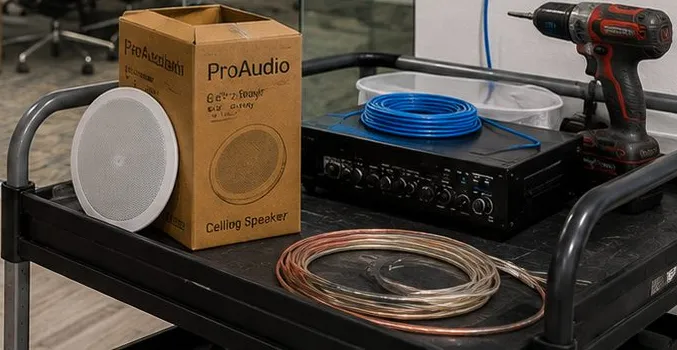
A wheeled cart carries a boxed ceiling speaker, a loose round speaker, a small black amplifier, a coil of blue cable, a loop of copper speaker wire and a red cordless drill.
Building Specialists
Sonos Installation for Grymes Hill's Architecture
Six kinds of home make up most of the hill, and the walls, ceilings and outdoor space differ sharply from one to the next.
Cliffside Contemporaries
The angular houses the Times found clinging to the slope, with decks toward the bay. Expect tall glass, open plans across split levels, drywall over wood or steel framing and an exposed deck structure that is often the best route for outdoor cable.
Estate-Era Mansions and Colonials
Houses from the hill's 19th-century and early-20th-century estates, and the "many fine homes dating from the 1920s" Wikipedia notes. Thick plaster, stone and stucco, deep window bays and original detail push the plan toward free-standing products.
Craftsman Bungalows
Early-1900s bungalows tucked into the woods, often with original etched or stained glass, porches and built-ins, as the Times described. Smaller rooms, low ceilings and much to keep untouched.
Mission-Style and Stucco Houses
Red tile roofs over stucco walls, sometimes stone. Exterior mounts go into framing behind the stucco, never into the stucco alone, and attic access under a tile roof is checked before any ceiling plan.
Garden Apartments and Co-ops
The brick two-storey buildings of the Grymes Hill Apartments along Arlo Road and the 1953 Grymes Hill Manor Estates around Seth Court. Shared walls, leases or co-op rules, and modest rooms that one or two good speakers fill.
Condos and Towers
The Highview condominium at 830 and 850 Howard Avenue (StreetEasy lists 830 as six storeys, 66 units, built 1981), 55 Austin Place and the towers on Victory Boulevard. Concrete, steel studs, crowded Wi-Fi and balconies facing the harbor.
What each home means for walls, cable and the outdoors
Home
Walls and ceilings
Network
Outdoors
Cliffside contemporary
Drywall on wood or metal studs; tall glass; cathedral or sloped ceilings in places
Router at the street-level entry, living levels below; one wired product or access point per level
Decks over the slope; cable run along joists and posts, sealed where it leaves the house
Estate-era house
Old plaster, stone, stucco; deep window bays; high ceilings
Thick walls weaken Wi-Fi from room to room; cable usually needed to reach a far wing
Terraces and stone walls; speakers under porch roofs rather than on masonry faces
Craftsman bungalow
Plaster or early drywall, wood trim and built-ins
Small footprint, usually one router plus one wired product
Porches; portables often better than fixed speakers
Mission-style or stucco
Stucco over lath or block; tile roof over the attic
Block walls between rooms behave like brick for Wi-Fi
Mounts into framing found behind the stucco; penetrations sealed and sloped
Garden apartment or co-op
Plaster or drywall over masonry; shared walls and ceilings
Neighbors' networks close by; one router usually enough
Small yards or none; any exterior work only with landlord or board consent
Condo or tower
Concrete columns and slabs; steel-stud partitions
Dozens of nearby networks; wire one product if you can
Balconies only, under building rules; nothing fixed to the facade without approval
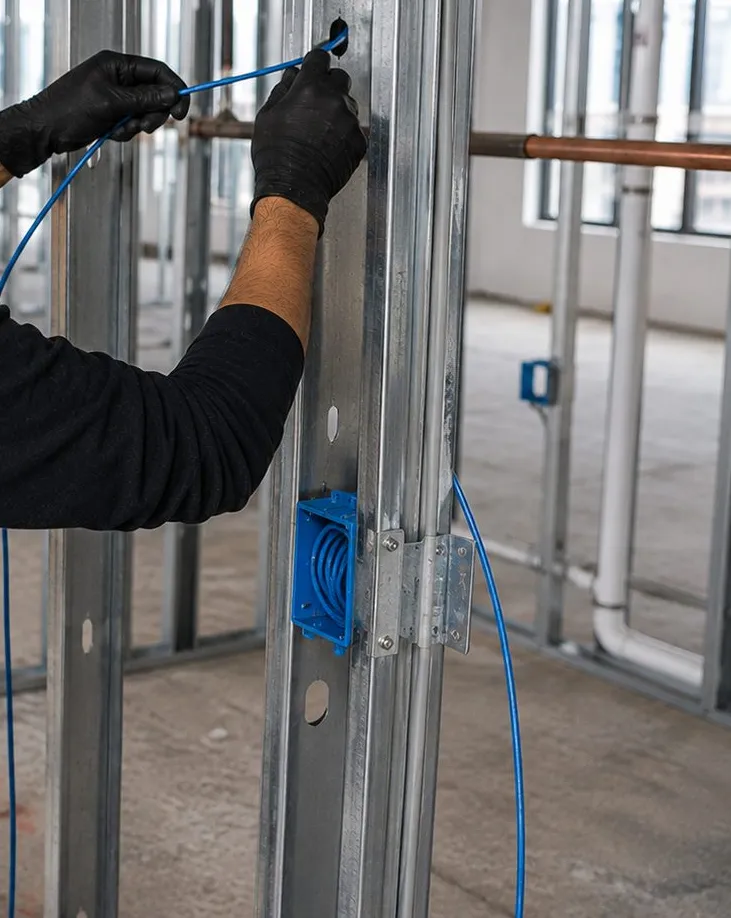
Black-gloved hands feed a blue cable through a hole in a galvanized steel stud, with a blue wall box fixed lower down and more open framing and a copper pipe behind.
The Window Wall
Sonos in Rooms Built Around a Harbor View
Most home-theater advice assumes a living room with a solid wall for the screen and a sofa across from it. A Grymes Hill view room turns that around. The sofa faces the window, the window faces the Narrows, and nobody wants a 65-inch black rectangle hung across the reason they bought the house. So before we talk about speakers we settle three questions with you: where the screen goes, where people sit to watch it, and what the room does when the screen is off, which on most summer evenings is most of the time.
Screen and soundbar off the view axis
The usual answers are a side wall at right angles to the window, a corner, or a low credenza in front of the glass with the TV on it, below the sightline. A soundbar works best directly under or in front of the screen, centered on it, wherever the screen ends up, because that is where dialogue should come from. If the screen moves to a side wall, the soundbar moves with it, and the seating either swivels or a second seating group faces the TV. An Arc Ultra is about 46 inches wide and suits a big screen on a long wall; a Beam (Gen 2), about 25½ inches, is easier to fit on a credenza below a window ledge. Sound leaves a soundbar to the sides as well as straight ahead, and a hard sheet of glass close to one end of the bar will exaggerate that side. We measure the distance from each end of the bar to the nearest glass before we choose the position.
Glass is loud, and that is fixable
Large panes reflect sound strongly. A room with glass on one or two sides, a stone or tile floor and a high ceiling tends to make speech harsh and blur fast music, and people turn the volume up to compensate, which makes it worse. The cures are mostly soft: a rug, curtains or shades that can be drawn for a movie, upholstered furniture between the soundbar and the glass. Then Trueplay, run with the room as you usually use it, measures how the room sounds and adjusts the speakers to suit. In a view room we run it twice if the curtains are sometimes open and sometimes shut, and keep the result that suits the way you actually watch.
Rear speakers when the back wall is glass
Surround speakers belong beside or slightly behind the main seats. When the seats back onto a window there is no wall to mount them on, so we use floor stands, a pair of Era speakers on side tables or a console behind the sofa, or ceiling speakers on an Amp if the ceiling is accessible. Sonos lets in-ceiling speakers on an Amp act as the surrounds for a soundbar, so a room with no rear wall can still have rear sound without cables crossing the floor.
Wi-Fi and the window between the room and the deck
Sonos's own interference guide rates ordinary glass as a low obstacle for wireless signals, alongside wood. Coated, energy-efficient glass is a different matter: Ranplan, a wireless-design company, explains that radio signals are reflected when they meet low-E coated glass, which "leads to high signal attenuation." If your big windows have been replaced with energy-efficient glass, the deck is on the far side of it. If a deck speaker or a Move 2 drops out only when it is outside, the window may be the reason. The fix is to give the outdoor zone a wired source — an Amp inside, wired to its speakers — or an access point placed where it can see the deck without looking through coated glass.
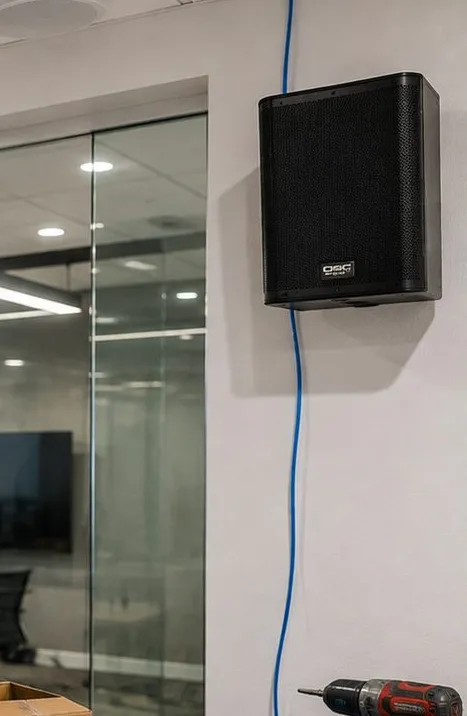
A black box speaker hangs high on a white wall, a blue cable running down from the ceiling beside it; a glass-walled meeting room and ceiling lights show to the left and a drill rests on a cart below.
Houses on the Slope
Houses That Step Down the Hill, Level by Level
A house on a slope rarely has floors directly above one another. It has levels: a garage and front door at the road, a living level a half-flight down at the back, bedrooms another half-flight down or up, a deck off whichever level meets the view. Each change in level puts a slab, a stair, or the uphill retaining wall between the router and the rooms that need music. That is why the problem to plan against in a stepped house is rarely the whole system failing; it is one level dropping out while the others play on.
Where the internet comes in
Where the service line arrives depends on the lot. On a house that climbs uphill from the road it tends to come in at the garage or entry, the lowest level; on a house that drops away behind the street it often arrives at the same street-level garage, with the living levels below. Either way the router can end up at one end of a long vertical path. Sonos asks that its products be at least 18 inches from the router and from other electronics, and it rates concrete as a high-interference material — and the wall a house is built against on a slope is often concrete or block holding back the hill. We map where the service comes in, which walls are holding back soil, and which level the family actually lives on before choosing where the network should be strongest.
One wired point per level
In a stepped house the reliable pattern is simple: one Sonos product or one access point on each level, connected by cable rather than by a wireless hop through the slab. Sonos does not support Wi-Fi extenders, and a mesh satellite that relays wirelessly through two floors of concrete gives Sonos a weak link to depend on. A single cable run up to 25 feet, which is $99 on our list, often connects a soundbar on the level below to the router above through a stair closet or along the garage ceiling. Longer or more awkward paths are priced after we have seen them.
Naming the levels so everyone understands them
Split-level houses confuse guests and sometimes the people who live in them. We name rooms in the Sonos app by what the household calls them — Entry Level Kitchen, Lower Family Room, Deck, Bedroom Level — and group them in the order you walk through the house. When the deck pair, the room inside the deck door and the kitchen are grouped for a party, everyone can see what is playing where.
The garage cut into the hill
Many hillside garages are dug into the slope, with a back wall of block, poured concrete or bare rock. They are tempting places for the Amp, the router and the network switch because they are close to where the service comes in. They can also be damp. Sonos's Amp is rated for 32°F to 104°F and needs a few inches of clear space around it; condensation on a cold wall in July is a separate problem the rating does not cover. We look at the walls, ask about summer humidity and check for water staining before suggesting the garage, and often place the equipment on a dry shelf indoors on the same level instead.
Hands type on a laptop resting on a pull-out shelf in a black network rack, with switches and blue patch cables above it and orange and blue cables below.
Decks Over the Slope
Outdoor Sonos for Decks That Hang Above the Trees
The deck is where Grymes Hill households spend their summer evenings, and it is the hardest part of the house to put sound into well. It is high, often a full storey or more above the ground beneath it. It faces open air and the roofs of the houses below. Its underside may be over a slope that is protected land. And the cable from the Amp inside has to leave the house somewhere without letting water in.
Aim the sound at the deck, not the view
Speakers mounted on the house wall or under the deck roof and angled back across the deck put the sound where people sit. Speakers aimed outward toward the water send it over the railing, across the treetops and down to the next street, where there is nothing in the way to stop it. On the hill we mount outdoor speakers high on the house side of the deck, pointed down and inward, and keep them close enough to the seating that they can play at a moderate level. More speakers at lower volume beat two speakers working hard. The NYC Administrative Code bars using a sound reproduction device "in such a manner as to create unreasonable noise," and a deck above the neighbors' bedrooms is exactly where that line is easiest to cross.
The outdoor products that suit a high, exposed deck
Sonos's Outdoor speakers, powered by an Amp, are rated IP66 and designed, in Sonos's words, for "humidity, water, salt spray, heat, UV rays, and freezing temperatures," across roughly −13°F to 149°F. They are the right choice for a deck that is used every summer and left up year-round. A Move 2 is rated IP56 and is fine to carry out for an evening, but its charging base is for indoor use and it should come in when the weather turns. A Roam 2 is IP67 and small enough to take down the steps to a lower terrace. We set a volume limit on any outdoor zone so that a guest reaching for the app cannot push it beyond a level you have agreed.
Getting cable out of the house and across the deck
The cleanest route is almost always along the structure: through the rim joist or the wall behind the deck at a sealed, downward-sloping entry with a drip loop, then along the deck's own joists, beams or ledger to the speaker positions. On a high deck that work happens from a ladder on the deck or, where the underside must be reached, from the ground below on ladder levelers or from staging we price in writing. We do not trench across a steep slope, cut roots or clear planting to bury a cable. Where the lower terrace or a garden below the deck needs music and there is no route along a wall, path or stair, a Roam 2 is the honest answer.
Decks, railings and permits
Sonos work does not change a deck's structure, but a new deck or a rebuilt one does need the Department of Buildings. The DOB says decks need approved plans and permits prepared by a licensed professional, with railings at least 42 inches high. If your deck is about to be rebuilt, ask the builder to leave a conduit or a pull string from the house wall to each future speaker position; it costs very little while the boards are off.
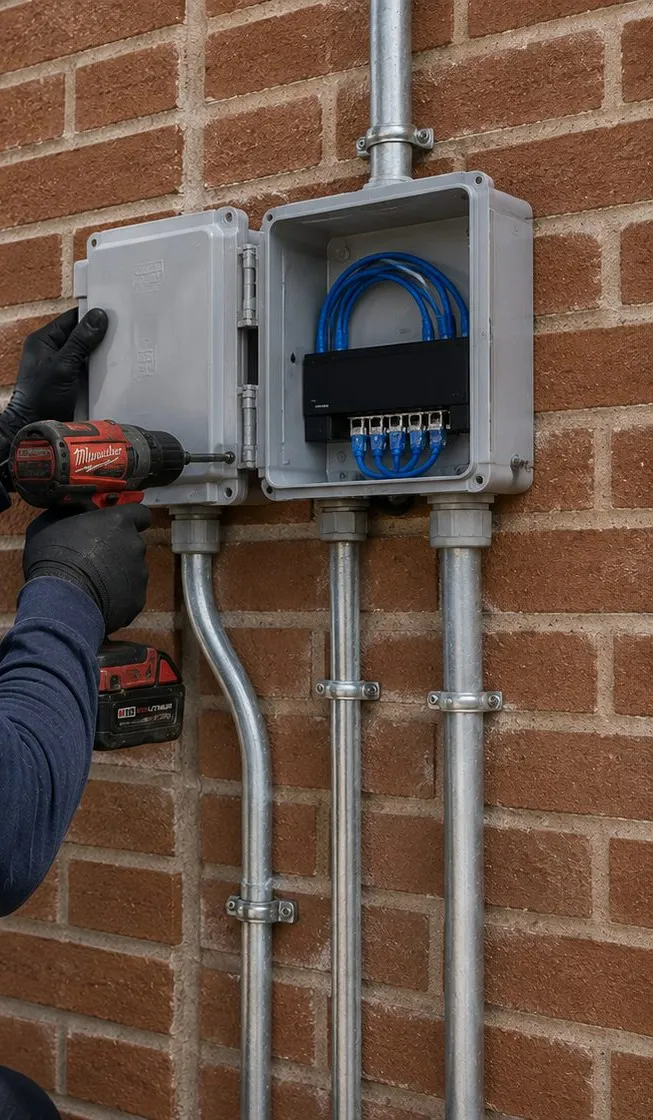
Against red brickwork, a gloved hand presses a red drill to the lid of a grey outdoor enclosure; its neighbor stands open with blue cable coiled inside, and three steel conduits drop from the boxes toward the ground.
Commercial Sonos
Business Sonos Installation in Grymes Hill
The Times noted in 2016 that stores and restaurants are "almost nonexistent" on the hill itself. Business music here is less about shopfronts and more about the hill's institutions and the offices, practices and event rooms on the streets around it. These are the settings we plan for; naming a place below describes the kind of building, not a client.
Estates Turned Institutions
Mansions that became college buildings, a cultural center and a school — Cunard Hall at Wagner, the Gans house that became Flynn Hall, the Dreyfus estate at Notre Dame Academy. Rooms are large, often paneled or plastered, and alterations need the owner's facilities approval.
Event and Class Rooms
Spaces like those at Casa Belvedere, which hosts language and cooking classes, film screenings and musical performances. Music between sessions, a microphone handled by the venue's own sound system, and a terrace zone with a firm volume ceiling.
Victory Boulevard Offices and Practices
Waiting-room music for medical, dental and professional offices in the apartment buildings and storefronts along Victory Boulevard, set loud enough to mask conversations and no louder.
Clove Road and Van Duzer Street
Small businesses and studios at the foot of the hill, where a Sonos system needs to run on its own network away from customer Wi-Fi and start without a staff member's phone.
Building Lobbies and Common Rooms
Background music in condominium and co-op common spaces, approved by the board and capped so it never reaches the apartments above.
Compliance notes for business music near the hill
Licensing: personal streaming accounts are licensed for personal, non-commercial use. A business should use a service licensed for public performance; we can connect Sonos to the service you choose but cannot license the music.
Noise: Administrative Code §24-244 restricts sound devices used to attract attention outside premises that face a street or park, and the DEP's guidance sets a 42 dBA limit for commercial music heard inside a nearby home. Outdoor and terrace zones get volume limits from the start.
Insurance and approvals: we provide a certificate of insurance free for a college, condominium or managing agent, and we do not start work on an institution's or association's building until their written approval is in hand.
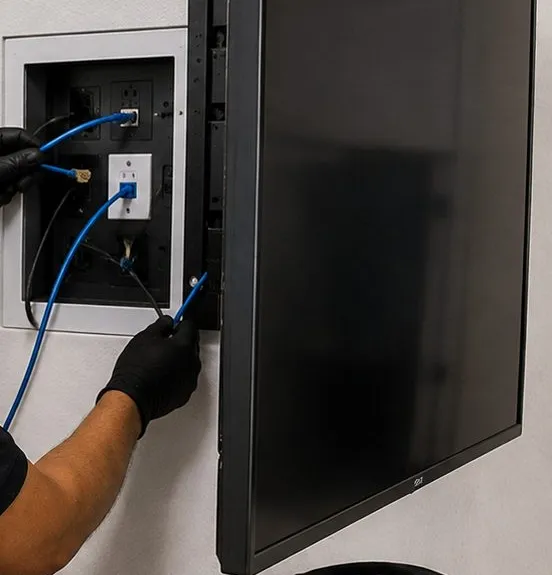
Two black gloves work inside a box set into the wall beside a flat screen's edge, plugging blue network leads into the data ports between two power outlets.
Your Questions Answered
Sonos Installation in Grymes Hill: Questions Answered
These are the questions that come up because of where the houses sit: high, glassy, stepped into the slope and backed by protected woods. Each answer is the one we would give on a walkthrough.
Rooms that face the water
Can a soundbar sit on a low credenza in front of a floor-to-ceiling window, or does it need a solid wall behind it?
It does not need a wall. A Sonos soundbar works on a table or credenza as well as on a bracket; what matters is that it sits centered under or just in front of the screen, at roughly ear height for seated viewers, and that nothing blocks its front grille. Glass a foot or two behind it is fine. Glass right against its back edge can add a slight hardness, so we usually pull the credenza a few inches off the window and keep the bar at the front edge of the top. If you want the screen on the same credenza, we choose a stand or a low mount that keeps the top of the TV below the line you see the harbor along when you are sitting down. Placement on a console is $79 on our list, and the Sonos setup that joins it to the rest of the house is $125.
Our TV stand has glass shelves — is that a good place for the soundbar and the Sub?
For the soundbar, usually yes, if the shelf is thick tempered glass, sits firmly in its frame and the bar is at the front edge. For a Sub, no. A Sub moves a lot of air and vibrates whatever it stands on, and a glass shelf can buzz, rattle in its clips or walk the Sub toward the edge. A Sub belongs on the floor, on a solid surface or a dense pad, beside or near the TV furniture rather than inside it. Sonos's Sub Mini and Sub 4 both connect wirelessly to the soundbar, so the floor position does not need any extra cable apart from power. If the stand rattles even with the Sub on the floor, we adjust the Sub's level in the app with you listening, not by the numbers.
Decks high above the slope
Our deck sits a full storey above the treetops on the downhill side — does music carry farther from up there than from a yard at ground level?
Yes, it tends to. At ground level, fences, hedges, garden walls and the houses themselves block and soak up a good part of the sound before it travels far. From a deck above the treetops on a downhill lot, there may be nothing between the speakers and the windows below. So we treat a high deck as a more sensitive spot than a flat yard: speakers mounted on the house side, angled down at the seating, more of them at lower volume rather than two at full stretch, and a volume limit set in the Sonos app for the outdoor zone. Bass carries farthest of all, so outdoor zones get their bass turned down a notch at handover, and a Sub stays indoors.
Out at the far end of the deck the Sonos app suddenly can't find any speakers, even though the music keeps playing — why?
Because the app finds the system over your home Wi-Fi, and your phone has probably left it. As the signal fades toward the railing, many phones quietly switch to mobile data — Apple calls the iPhone setting Wi-Fi Assist — and from that moment the app is looking for speakers on a network that has none. The speakers themselves are fine and carry on playing. There are two cures. The better one is coverage: an access point placed so the whole deck sits inside the home network, which also helps the outdoor zone. The quick one is to turn off the phone's automatic switch to mobile data, or to step back toward the door before changing the music. We check the deck end with a phone in hand before we leave, so you know where the edge of the network is.
The deck has frameless glass railing panels — will they change how the deck speakers sound?
A little, and mostly for the better if the speakers are placed with them in mind. Glass panels reflect sound back toward the deck instead of letting it spill straight out over the slope, which helps keep the music on your side of the railing. The trade-off is some extra brightness for people sitting close to the glass. We avoid aiming a speaker directly at a panel from close range, because that produces a harsh reflection and sends some of the sound sideways along the railing toward a neighbor's deck. Mounted high on the house wall and angled at the seating, the speakers reach the people first and the glass second. We tune by ear on the deck itself with the outdoor zone playing.
The underside of our deck is two storeys above a steep drop — how do you reach it to mount speakers and run cable safely?
Most of the time we don't need to. Speakers are mounted on the house wall or under the deck's own roof, reached from a ladder standing on the deck boards, and the cable runs along the house-side ledger or the joists closest to the wall. When a run genuinely has to go along the underside over a slope, we look at it on the walkthrough: sometimes it can be reached from the ground on ladder levelers, sometimes it needs staging, and sometimes the honest answer is a different route. Any access beyond our ladders is priced in writing before the visit is booked, and the high-mount line of $75 applies to work above about eight feet. We do not work from a ladder set on loose ground on a steep slope.
Rock, slope and the preservation district
Our back lot falls inside the Special Hillsides Preservation District — can a speaker cable be trenched down the slope to the lower terrace?
Not by us, and probably not easily by anyone. The district's rules in the Zoning Resolution treat slopes of 25 percent or more as steep slopes and list "excavation or regrading, tunneling for utilities, removal of trees, topsoil or any living vegetation" among the intrusions protected areas are kept free of; site alterations also include removing vegetation more than 15 feet from the foundation of an existing building. Whether a particular narrow trench needs an authorization is a question for the Department of City Planning or your architect, not an installer. What we can do is run cable along existing structure — a stair, a path edge, a wall — where one already reaches the terrace, or use a Roam 2 down there, which needs no cable at all.
Our garage is dug into the hill and its back wall is bare rock that sweats in summer — can the Amp and the router live there?
Not against that wall. Sonos rates the Amp to run between 32°F and 104°F with a few inches of clear air around it, but a wall that beads with water on humid days means moisture in the air and on anything stored close to it. We look for a dry spot on the same level instead: a shelf on the house side of the garage, an interior closet, a utility room with conditioned air. If the garage is the only place the internet can enter, we keep the provider's box where it is and run a cable to the router and Amp somewhere drier, which is usually a single cable run of up to 25 feet at $99. Equipment that has already been sitting in a damp corner is checked for corrosion on the connectors before we rely on it.
Green serpentine rock breaks the surface in our garden — is it safe to drill into an outcrop to mount a speaker?
We don't drill or cut exposed rock. Wikipedia's article on the Staten Island Serpentinite lists chrysotile, a form of asbestos, among the accessory minerals in the rock, and drilling or chipping it makes dust. Whether a given outcrop is a hazard is a question for an environmental professional, not for a speaker installer, and a speaker post does not justify finding out. Outdoor speakers on the hill go on the house, on the deck structure or on a post set in soil away from the rock. If a garden corner can only be reached by mounting on stone, a portable Roam 2 or Move 2 brought out for the evening covers it without any drilling.
Apartments, co-ops and condos on the hill
Renting along Arlo Road
The brick garden apartments are compact, two-storey buildings with shared walls, and a lease usually decides what can be fixed to them. For renters we build systems that leave nothing behind: a soundbar on the TV furniture, Era speakers on shelves, and a portable for the small yard or a summer walk. The whole setup moves out in an hour on the day the lease ends. On Reddit, one resident describes the garden-apartment community between Wagner and the former St. John's campus as pet friendly, and another lists it alongside housing for the colleges' students — a useful reminder that cables along the floor are better kept in a paintable cover or behind furniture, away from paws and moving boxes.
The co-op around Seth Court
In Grymes Hill Manor Estates, as in any co-op, the board's alteration rules come first. Free-standing products need no approval. Anything that opens a wall or ceiling, or fixes to an exterior wall, goes through management before we book, and we supply a certificate of insurance free of charge if they ask for one.
Condos facing the harbor
The Howard Avenue condominiums, 55 Austin Place and the Victory Boulevard towers combine concrete, steel-stud partitions and a crowd of nearby networks. We wire one Sonos product to the router wherever a cable can reach it, mount soundbars into concrete with masonry anchors, and keep anything on a balcony free-standing unless the building says otherwise.
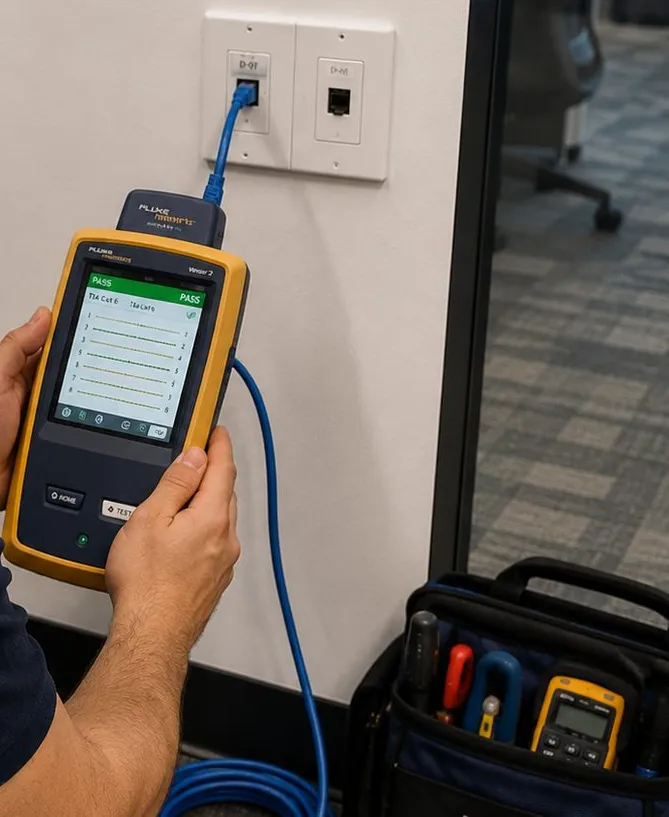
Hands hold a yellow cable tester showing a green PASS result, its lead plugged into a white wall jack; a tool bag with pliers, screwdrivers and a meter sits on the floor.
Equipment
Types of Sonos Systems We Install
We install every current Sonos home product. On the hill, choosing between them depends on the window, the deck and how many levels separate the router from the room.
Arc Ultra
The largest soundbar, about 46 inches across, for a big screen on a long side wall. It wants a clear path to the ceiling above it, so we keep it off deep window reveals and out from under shelves.
Beam (Gen 2)
About 25½ inches wide and the easiest bar to fit on a credenza in front of a window. Rated to operate from 32°F to 104°F, like the rest of the indoor range.
Ray
A compact bar for a bedroom level or a garden apartment living room, happy on a console with no drilling at all.
Era 100
The standard room speaker, often one per level in a split-level house, and the first choice for kitchens and bedrooms that face the view.
Era 300
A spatial-audio speaker that suits a pair beside a view window on stands; its wall mount must go into a stud, which matters in a house with steel framing.
Sub Mini and Sub 4
Wireless subwoofers that pair with the soundbar. On the hill they stay indoors, on the floor, away from glass shelves and shared walls.
Amp
Powers ceiling, wall and outdoor speakers, including passive landscape speakers Sonos says can be connected to it. Rated 32°F to 104°F, so it lives indoors on a dry, ventilated shelf.
Outdoor Speakers
Sonos's weatherproof pair for the deck, rated IP66 and built for humidity, water, UV and freezing weather, mounted on the house side and aimed at the seating.
Roam 2 and Move 2
Battery portables for lower terraces and garden corners no cable can reasonably reach. Roam 2 is IP67; Move 2 is IP56 with an indoor-only charging base.
Port
Brings a receiver, turntable or older stereo into the system, and lets a hi-fi in the view room play the same music as the deck.
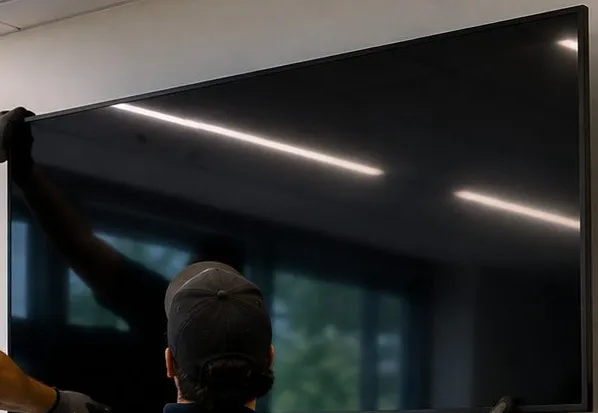
Gloved hands guide a large black flat screen onto its wall mount; the back of an installer's cap shows below the screen and window light reflects in its glass.
AI Overview Reality Check
What AI Gets Wrong About Sonos Installation in Grymes Hill
We could not open Google's AI Overview from the tools we used to build this page, so we have not quoted it. Instead, these are seven claims that cost guides, product pages and forums publish and that AI summaries tend to repeat, checked against what a hillside house actually asks of a system.
Claim one: "Budget $500 to $1,000 for every room"
Angi's whole-home stereo guide gives figures of $500 to $1,000 per room, $50 to $100 an hour for labor and $100 to $500 for modifications. A per-room number is a reasonable way to think about a house whose rooms are all alike. Grymes Hill houses are not like that.
On the hill the indoor rooms are often the cheap part. A soundbar on a console with the system set up is $204 on our list. What moves the total is the deck, the levels between the router and the furthest room, and whether a route exists for an outdoor cable that does not cross protected ground.
So we price by zone and by route rather than by room. Outdoor and ceiling zones fall inside the $800 to $2,500 per zone figure we publish for whole-home audio, and the walkthrough pins your number down before anything is bought.
Claim two: "Sonos works anywhere your Wi-Fi reaches"
This one is half true. Sonos needs a network it can depend on, and Sonos itself says it does not support Wi-Fi extenders. A phone that shows two bars on the deck is not the same as a speaker that will stream there all evening.
In a house stepped into a slope, the router is often at one end of a vertical path through slabs and a retaining wall, and Sonos rates concrete as a high-interference material. One level can be perfect while the next drops out every few songs.
The fix is usually one cable per level rather than a stronger router: a wired Sonos product or access point on the level that struggles, so the system no longer depends on a wireless hop through the hill.
Sonos's own interference table does rate glass as low, alongside wood. For ordinary window glass that is fair, and many deck speakers work perfectly through an open slider.
Energy-efficient glass is different. Ranplan explains that radio signals are reflected by low-E coatings, which "leads to high signal attenuation." On a hillside house the biggest windows are usually the ones between the living room and the deck.
When an outdoor zone fails only with the doors shut, we stop looking at the speakers and look at the glass, then wire the outdoor zone or move the access point so it no longer has to see through the coating.
Claim four: "Just bury the speaker wire across the yard"
Guides for flat suburban lots make outdoor wiring sound like a weekend job with a spade. On a Grymes Hill lot, the ground below the deck may be a steep slope inside the Special Hillsides Preservation District.
The Zoning Resolution lists "tunneling for utilities," excavation, regrading and vegetation removal among the intrusions its protected areas are kept free of. Serpentine rock near the surface adds a second reason not to dig or drill casually.
We route outdoor cable along structure that is already there, and where the music has to go somewhere no structure reaches, we recommend a battery speaker rather than a trench.
Claim five: "Point outdoor speakers toward where you want the sound to go"
It sounds obvious, and on a deck facing the harbor it usually means pointing them at the view. That sends the music over the railing and the treetops toward houses with nothing in the way.
The sound you want goes to the people on the deck, who are much closer than the view. Mounted on the house side and angled down at the seating, speakers reach the listeners first and lose energy before the railing.
Add a volume limit for the outdoor zone and a little less bass, and the deck sounds full without carrying down the hill. The city's noise code is written around "unreasonable noise," and aim is the cheapest way to stay on the right side of it.
Claim six: "Ceiling speakers are simple in a modern house with drywall"
Drywall is easier to cut than old plaster, which is why the claim spreads. But the hill's contemporaries often have sloped or cathedral ceilings, insulation packed against the roof deck, recessed lights in a tight grid and, under a flat roof, no attic at all.
Sonos's own guide says its in-ceiling and in-wall speakers "require special installation," and in a contemporary the special part is finding a joist bay that runs where the speakers should go and a path back to the Amp.
We survey first. Where a ceiling can't take speakers in the right place, a pair of Era speakers on stands or a wall bracket will sound better than ceiling speakers in the wrong place.
Claim seven: "Trueplay tuning fixes any room"
Trueplay is a good tool. It listens to the room and adjusts the speakers' sound to suit it, and it is worth running in every room that supports it, with the speakers in their final positions.
What it can't do is take the glass out of a view room. Strong reflections from a window wall and a stone floor still blur speech; Trueplay softens the result, it does not remove the cause.
So in the brightest rooms we combine it with placement, a rug, curtains for movie nights and, where it helps, a second Trueplay pass with the curtains drawn, and we leave the result that matches how you really use the room.
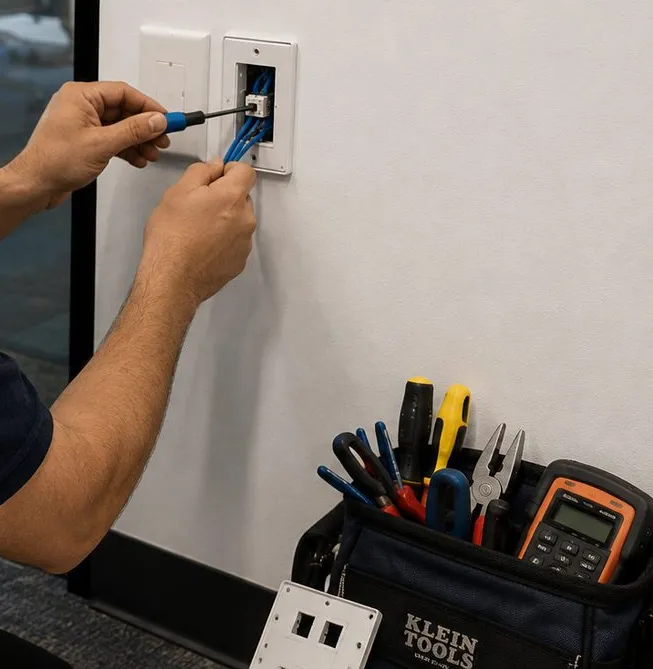
At a white wall, two bare hands fit a jack into an open plate with a narrow screwdriver, a blank plate mounted alongside; on the floor a black tool bag bristles with pliers and screwdrivers around an orange meter, a spare faceplate propped against it.
Keep the View, Get the Sound, Know the Price First
Tell us which way the windows face, how many levels the house has and what is below the deck. We'll send back a plan and a written Staten Island price.
Most hillside quotes need only four things: what type of house it is, how many levels it has, which Sonos products you own or want, and what lies between the living room and the deck. You get a written total the same business day, or you can talk it over by phoning (347) 934-8335.
✅
We Got Your Request!
Thanks — that's with us. Expect a call before the business day is out about the levels, the view room and the deck; if the music is out right now, dial (347) 934-8335 instead of waiting.
How It Works
Our Installation Process
Six steps, whether the job is a Ray on a garden-apartment console or four levels and a deck on Howard Avenue. On the hill the first two steps take longer than anywhere else on the island.
1. Sit where you watch
We start in the view room, seated where the household sits, to see where a screen would block the harbor, where the afternoon sun lands and which walls are glass, solid or shared.
2. Count the levels
We find where the internet comes into the house and count every change of level, slab and retaining wall between the router and the rooms and deck that need music.
3. Give each level a wired point
Any level the Wi-Fi cannot serve reliably gets a wired Sonos product or access point, so no part of the system depends on a wireless hop through concrete or coated glass.
4. Mount inside, then on the deck
Soundbars and speakers go on fixings chosen for each wall; outdoor speakers go on the house side of the deck, aimed at the seating, with cable run along the structure to a sealed, downward-sloping entry.
5. Tune and set the ceilings
Trueplay runs with each room set up the way you use it; outdoor zones get a volume limit and a little less bass, and we listen from the far edge of the deck before calling it done.
6. Name and hand over
Rooms are named by level, the deck and view room are grouped, music services are signed in, and we show you how to regroup, retune and change the limits yourself.
Coverage Area
Sonos Installation Near Grymes Hill's Landmarks
Our crews cover the whole hill, from the foot of Van Duzer Street across to Victory Boulevard and from the expressway north to Louis Street. When people describe where they live, they usually start from one of these six places.
Casa Belvedere, 79 Howard Avenue
Louis and Laura Stirn's 1908 mansion, Italianate and neo-Renaissance outside and Arts and Crafts inside, protected as a city landmark in January 2001 and since 2010 home of the Italian Cultural Foundation, named for its view of the bridge and the harbor (Casa Belvedere).
Wagner College Main Hall and Sutter Oval
The Collegiate Gothic Main Hall of 1930, restored in 2012, faces the lawn named for Rev. Frederic Sutter, who moved the college to the former Cunard estate in 1918 (Wikipedia; Wagner College).
Cunard Hall
Sir Edward Cunard's Italianate villa of about 1851, one of the earliest buildings on the Wagner campus, where Wagner says Cunard "literally watched his ships come in" from the front porch (Wagner College; Wikipedia).
Serpentine Art and Nature Commons
An 11.5-acre preserve on the hillside held by the Trust for Public Land, with trails from 599 Van Duzer Street at the bottom of the hill and an entrance from Howard Avenue at the top, past outcrops of serpentine rock (Wikipedia; New York Times).
Former St. John's Campus
The 16.5-acre campus that began as Notre Dame College, joined St. John's in 1971, ended classes in May 2024 and was sold to Wagner College, a quarter-mile away, as announced on May 12, 2026 (St. John's University).
Hero Park, Victory Boulevard and Louis Street
The hill's only public park, donated in 1920 by Dr. and Mrs. Louis A. Dreyfus, beside the Notre Dame Academy grounds that include the family's former estate (Wikipedia; New York Times).
The hill has been called Signal Hill, after a British signal station, and Castleton Heights in 1830s deeds, before taking the name of Suzette Grymes, whose first husband had been Louisiana's first governor and who settled here in 1836 as the wife of the New Orleans lawyer John Randolph Grymes. Major George Howard bought 42 acres between Eddy and Louis Streets in the early 1830s and built many of the first houses; Howard Avenue still carries his name (Wikipedia; Casa Belvedere).
We also install around the hill: Silver Lake, Sunnyside, Emerson Hill, Ward Hill, Stapleton Heights, Stapleton, Concord, St. George, West Brighton, Randall Manor and Castleton Corners, all on the same Staten Island price list.
Pricing
Sonos Installation Cost in Grymes Hill
Grymes Hill is priced on our Staten Island list. The Sonos, soundbar and wiring lines are the same dollar amounts we publish in every borough; Staten Island's 1.10 area rate shows up in the hourly setup visit and the TV-mounting base. Anything we cannot price without seeing it — a deck zone, ceiling speakers, a cable between levels — is quoted in writing after a free walkthrough, and nothing is added on the day without your agreement.
Line
Price
Where it comes up on the hill
Sonos setup
$125
All your Sonos products brought into one household, rooms labeled level by level, streaming accounts added, tuning run on supported speakers
Soundbar wall-mounted under the TV
$129
Side-wall screens in view rooms, bedroom levels, condo living rooms
Soundbar placed on a console
$79
Credenzas in front of the window; rentals where nothing is drilled
Sanus soundbar bracket
$84.99
When you don't already have a suitable mount
In-wall concealment
$169
Concealed power and HDMI kit inside a hollow wall behind a side-wall screen
Paintable cord cover
$59
Stucco, stone and rented walls that should not be opened
Cable run to a cabinet or other spot
$99
Up to 25 ft — often the wire that gives one level its own connection
A/V receiver
$129
Receiver connected and configured, for example with a Port
Universal remote
$99
Programmed for TV, soundbar and sources
Streaming device
$49
Per device
Full home theater
$350
Multi-component system connected and set up
Setup-only visit
$225 first hour
Billed in 30-minute blocks after that: a level that keeps dropping, regrouping, products rejoined to a new router
TV mounted on the same visit
From $209.99
32″–55″ on wood-stud drywall; 56″–65″ adds $30, 66″–75″ adds $60
Deck or terrace speakers on Amp
Quoted at walkthrough
Within our published $800–$2,500 per zone for whole-home audio
Ceiling speakers on Amp
Quoted at walkthrough
Same published range; the ceiling framing and the route back to the Amp decide where in it
Wall and access lines
Condition
Add
Where we meet it on the hill
Drywall on wood studs
$0
Most contemporaries and later additions
Metal studs
+$30
Condo partitions and some newer houses
Plaster
+$45
Estate-era houses, bungalows, garden apartments
Brick or stone
+$65
Fireplace walls, stone-faced colonials
Concrete or cinder block
+$75
Retaining walls, garages cut into the slope, tower columns
Tile or marble
+$95
Kitchens, baths, bar walls
Plywood backer board
$85
Where studs fall in the wrong place for a bar
High mount, above about 8 ft
$75
Tall view rooms, high deck walls
Walk-up, 3rd floor and above, no elevator
$40
Some apartment buildings around the hill
Box removal
$25
We take the cartons with us
Certificate of insurance
Free
Co-op boards, condominium managers, institutions
Six Grymes Hill totals, added up
Every example is built only from lines in the tables above; the real figure for your home follows from the wall, floor and cable route found on the day.
Example
Lines
Total
Garden apartment: Ray on the console, the rest of the system joined
$79 console + $125 setup
$204
Split-level: one level wired to the router so its speakers stop dropping
$99 cable run + $125 setup
$224
Howard Avenue condo: Arc Ultra fixed to a poured-concrete wall on the Sonos mount that comes with it
$129 + $75 concrete + $125 setup
$329
Estate-era house: Beam high on a plaster wall with our bracket
$129 + $84.99 bracket + $45 plaster + $75 high mount + $125 setup
$458.99
View room: 75-inch TV on a side wall, Beam beneath it, system set up
After a provider's router swap: every level rejoined and regrouped
$225 setup-only first hour
$225
Included, and not included
What the price covers: mounting and placing products, connecting them, joining everything into one Sonos household, labeling rooms by level, signing in your music services, Trueplay, an outdoor volume limit, a single-page map of the network points, and leaving the rooms clean.
Not our trade: new outlets and any line-voltage work go to a licensed electrician; deck structure and railings go to the deck builder; anything that disturbs protected slope or vegetation needs the right approvals first.
Products: buy your Sonos speakers from whichever store you like; the brackets, cable, raceway and in-wall kits are supplied by us at the prices listed.
Return trips: a $150 fee applies when the crew arrives and the job cannot begin — for instance if the speakers haven't been delivered, nobody can open the garage or the deck gate, or a board's approval hasn't come through. Moving the date with at least 24 hours' notice costs nothing.
Old walls: stucco, stone veneer and old plaster can chip even with slow, careful drilling. We point out the risk on the walkthrough and wait for your go-ahead.
National averages versus a Staten Island installer. A national guide prices an average room on a flat lot. It cannot price a deck over a protected slope or a router two levels above the family room. Every line we charge is on our Staten Island TV mounting price list, with no bridge toll, travel or mileage charge added.
Shop Our Systems
Sonos Installation Packages & Pricing
Most first visits on the hill fit one of three bundles. The price on each card is the sum of lines from the tables above, written out so the math is visible; surcharges for the wall or for access appear only where your room calls for them.
Starter — Console Soundbar + Setup
$204
A soundbar placed on the credenza or TV furniture ($79) and the whole household joined to one system ($125). The right start for a garden apartment, a rental, or a view room where nothing should be fixed to the wall yet.
Standard — Stone or Brick Wall Soundbar + Setup
$403.99
A soundbar hung beneath a side-wall screen ($129) on a Sanus bracket ($84.99), the brick or stone surcharge ($65) that the hill's fireplace walls and stone-faced houses often need, and Sonos setup ($125). On plain drywall the same job is $338.99.
Premium — Full Theater With a Wired Level
$662.99
The full home theater hookup ($350), the soundbar wall-mounted ($129) on a Sanus bracket ($84.99), and a cable run of up to 25 feet ($99) so the theater level has its own wired connection to the router instead of a wireless hop through the slab.
Bring Your Own Equipment — Labor Only
If you already have the mount, you pay labor only: $129 for the bar on the wall, any wall-type line that applies, and $125 for Sonos setup if you want it. Sonos's outdoor speakers come with their own brackets, which we use. A mount you supply stays under its maker's warranty and must be rated for the load; if it doesn't suit the wall we find, you hear that before a hole is drilled, along with the Sanus alternative.
Deck, Terrace and Ceiling Zones
Hillside decks vary too much for one number. Two speakers under a deck roof next to the kitchen slider take little time; a deck whose cable can only run along the underside above a slope takes much more. Outdoor and ceiling zones are priced inside the $800 to $2,500 per zone range we publish for whole-home audio, with your figure fixed in writing after the walkthrough.
A Written Price for Your House on the Hill
A photo of the view room, a photo of the router and a line about the deck are enough for a written Staten Island price. Deck and ceiling work gets a walkthrough first, at no charge.
Scheduling, rescheduling, return trips and what to expect on installation day.
Field Notes
Field Notes: Reading a Grymes Hill House Before Talking Products
What follows is the routine our installers use on a first visit to the hill, written as practice rather than as any customer's story.
We start at the curb and look at the house from the street, because on a slope the street tells you where the levels are: a garage door at the sidewalk with the roof barely above it means the living space is below, and a long flight of steps up means the deck is at the top. Inside, we find the router before anything else and count the changes of level between it and the room the family uses most. Then we go to the view room and sit where the household sits, because that is the only way to see where a screen would block the harbor and where sun lands in the afternoon. We open the slider and step onto the deck, look over the railing at what is below — lawn, rock, woods or the next roof — and listen to how quiet the hill is. We ask whether the windows have been replaced and when. We look for a dry place for the Amp. Only after all that do we talk about products, and by then the plan usually starts with the deck and the network, not with another speaker.
FAQ
Grymes Hill Sonos Installation FAQ
Can the garden have speakers that look like rocks or sit in the planting beds, instead of being fixed to the house?
+
Yes, as long as there is a sensible route for the wire. Sonos does not make rock-style or in-ground speakers itself, but its outdoor speaker guide says passive landscape speakers you like can be connected to a Sonos Amp for power. On the hill the question is the cable. A short, shallow run in a planting bed close to the house or along a path edge is ordinary work; a run across a steep slope, or through planting more than 15 feet from the house, touches the Special Hillsides Preservation District's rules on digging and vegetation, so we route another way or suggest a portable. Third-party speakers carry their own maker's warranty.
Can a speaker go in the outdoor kitchen, right beside the grill?
+
Near it, but not right beside it. Sonos rates its outdoor speakers for heat, water and UV across roughly -13°F to 149°F, yet the air just above a grill or pizza oven can be far hotter than that, and grease and smoke coat a grille quickly. We mount outdoor-kitchen speakers on the house wall or under the roof a few feet to the side of the cooking area and above head height, never directly over the heat, with the cable entry sealed and sloped down. A portable should be kept well clear of the grill and brought indoors afterward; the Move 2's charging base is for indoor use only.
We're replacing the windows with energy-efficient glass next year — should anything about the Sonos plan change first?
+
Two things. First, if the new glass has a low-E coating, expect a weaker wireless link between the living room and the deck once it is in: Ranplan describes coated glass reflecting radio signals and causing high attenuation, even though Sonos rates ordinary glass as a low obstacle. Wiring the outdoor zone to an Amp indoors, or planning an access point with a clear path to the deck, avoids depending on that link. Second, if the soundbar or speakers sit by the old windows, book our visit after the window crew has finished so nothing is moved twice. Then re-run Trueplay in the rooms with new glass, because new panes and frames change how a room sounds.
All Areas Served
Sonos Installation Across Staten Island and New York
Grymes Hill belongs to our Sonos installation on Staten Island page, and that page reports to the New York City Sonos hub. Below, every page in the Sonos series is grouped by neighborhood, city borough, Long Island and the Hudson Valley.
Each place, figure and quoted phrase above traces to one of the sources below; every price is taken from the AESS Staten Island price list and nothing else.
Housing types, roads, "Hill Blocks View," the Hillsides district, condominiums and rentals: C. J. Hughes, "Grymes Hill: Manhattan Views, West Coast Feel," The New York Times, July 10, 2016 (reprint hosted by Wagner College).
Resident comments: r/statenisland threads on living in Grymes Hill and renting on Staten Island (excerpts). Rules: NYC Administrative Code §24-244; NYC DEP noise code guidance; NYC Department of Buildings, decks, porches and swimming pools.
Product facts: Sonos interference guide, Beam (Gen 2) user guide, outdoor speaker guide, system requirements, Trueplay, volume limit, Amp, Port, Sub, Era 300, Move 2 and Roam 2 documentation on sonos.com and support.sonos.com; low-E glass: Ranplan Wireless; cost guide figures: Angi.
Grymes Hill Sonos Down Tonight? We Can Be Up the Hill Soon
One level going silent usually traces back to something that changed nearby: a provider's new router, a storm outage, a replaced window. Phone (347) 934-8335 for the next open two-hour slot; most of these calls are sorted within an hour or two of the technician arriving.
Sonos Installation Grymes Hill — Licensed, Insured, Planned Around the View
Abstract Enterprises Security Systems · 1282 Troy Ave, Brooklyn, NY 11203 · (347) 934-8335 · WhatsApp (718) 679-0359 via wa.me
NYS Low-Voltage License #12000287431 · 100% Licensed & Insured · Same-Day Estimates · Rated 4.7★ from 201 Google Reviews
Sonos products carry their manufacturer's warranty. Full terms — including 50% deposit, one-year parts-only warranty on AESS-supplied products, and the late-fee schedule — are set out in the service agreement. See our warranty page.
Page reviewed and updated October 17, 2026. Changelog: Grymes Hill page launched as a neighborhood child of the Staten Island Sonos page, covering harbor-view rooms, split-level houses, decks over the Special Hillsides Preservation District, the garden apartments and co-op, the Howard Avenue condominiums and the hill's institutions.