Licensed Low-Voltage Installer · Douglas Manor, Douglaston Hill & Douglaston Park · Detached Houses, Co-ops & Boulevard Shops
Sonos Installation in Douglaston, Queens
Inside First · Outside Only Where the Rules Allow · Long Houses Wired End to End · Clear of Trees, Tanks and Sprinklers
A Douglaston Sonos plan starts indoors and works outward. Inside a detached house the walls, ceilings and closets are yours to use, and the job is mostly about distance: rooms spread across a long plan, a router at one end and a family room at the other, a finished basement and an attic bedroom three floors apart. Outside, in the two historic districts, the facade answers to the Landmarks Preservation Commission and the yard to the Douglas Manor deed restrictions, the big trees are protected, and the ground can hide a septic tank and sprinkler lines. So we wire and tune the inside properly first, then add outdoor sound only where it stays out of sight from the street and clear of everything buried.
Reviewed and updated October 17, 2026 · Written by Anwar Timothy, NYS low-voltage license #12000287431 · Prices from the published Queens list
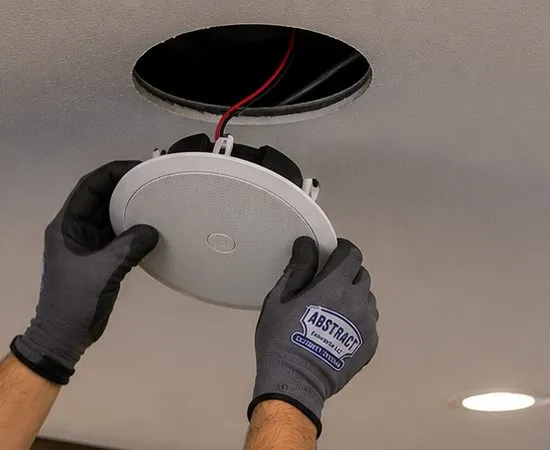
Close up, two grey work gloves raise a round white in-ceiling speaker toward a freshly cut circle in a pale ceiling; a red wire drops out of the opening and a recessed light glows lower right.
Douglaston Sonos Quote
Tell us the rooms, the products and whether your house is in a historic district — a written Queens figure the same business day
✅
Request Received
An installer who covers northeast Queens will phone you back before the end of the business day.
25+
Years Experience
✓
Same-Day Estimates
100%
Licensed & Insured
4.7★
201 Google Reviews
A Tudor in the Manor with a router in the front hall and a family room at the far end, or a ranch near P.S. 98 that just needs the TV sound sorted? Phone (347) 434-6392 or send the short form with your Sonos models and a photo of each room. A licensed installer adds up the matching lines from the Queens price list further down and sends the total back in writing; anything outdoors, or anything that needs a ceiling opened, is marked as a walkthrough item rather than guessed.
Queens list: Sonos setup $125, soundbar on furniture $79, soundbar on the wall $129
No parking line in Queens; insurance certificates for co-ops and managing agents at no charge
NYS low-voltage license 12000287431 · arrival windows of two hours, seven days a week, 8 AM to 8 PM
Douglaston is the part of Queens where a Sonos system has to cover a whole house rather than a few rooms. North of Northern Boulevard the neighborhood reads more like a North Shore village than a city district: detached houses on wide lots, a private waterfront on Little Neck Bay, a railroad station that opened in 1866 and no subway at all. A historical society trustee put it to the Wall Street Journal in 2012 in a sentence residents still repeat: it has always been "kind of the country, not really the city, even though we are part of the city." That character is exactly what makes multi-room audio worth doing here, and exactly what makes it harder than in an apartment. The rooms are many, the floors are several, and the walls between the router and the far bedroom are old.
The biggest single piece of the neighborhood is the Douglaston Historic District, which most people simply call Douglas Manor. The Landmarks Preservation Commission designated it on June 24, 1997. It covers a mile-long peninsula pushing into Little Neck Bay, and the National Register listing counts 631 contributing buildings on 197 acres, all but one of them in residential use. The houses were built mostly in the first half of the twentieth century after the Rickert-Finlay Realty Company bought the Douglas family estate in 1906 and laid out a planned suburb, and the styles run from Tudor and Colonial Revival to Mediterranean Revival and Arts and Crafts. The local historical society notes that the Manor holds the city's largest collection of Arts and Crafts-influenced houses, three designed by Gustav Stickley and eight by Josephine Wright Chapman, along with mail-order kit houses from Aladdin and Sears that were delivered by rail. Since 1997, no new building and no exterior alteration there happens without the Commission's approval.
South of the Manor, between the railroad and Northern Boulevard, sits the much smaller Douglaston Hill Historic District, laid out with very large lots in 1853 and designated by the city in December 2004. Beyond the boulevard the neighborhood changes again: Douglaston Park, with large older homes, Capes, Tudors and 1960s ranches around the municipal golf course; the blocks of mostly 1970s raised ranches that local agents call the "P.S. 98 area"; rows of attached single-family homes from the 1950s to the 1970s; and a scattering of mid-rise co-ops and 1980s condominiums. Lots are big by city standards. When the City Council rezoned about 135 Douglaston and Little Neck blocks in December 2006, it created the first R1-1 district in Queens for about eighteen blocks of the historic district, setting a minimum lot of 9,500 square feet and 100 feet of frontage for any new one-family house.
All of that shapes a Sonos job in three ways. First, distance. A detached house on a 100-foot lot puts the far rooms a long way from wherever the internet comes in, often through plaster, brick or stucco, and that is where Sonos systems drop rooms. Second, the split between inside and outside. Interior work in a landmarked house is the owner's business, but the moment a speaker, a cable or a box appears on a facade or in a front yard, it becomes a question for the Commission, and outbuildings, fences and walls also need a letter from the Douglas Manor Association. Third, the ground. Many Douglas Manor homes are not on the city sewer and rely on septic systems that need pumping, mature trees of twelve inches or more across the trunk are protected, and most gardens have irrigation. A cable buried without knowing what is underneath can cause damage that costs far more than the speakers.
None of this argues against Sonos in Douglaston. It argues for doing the work in the right order. Inside first: a network that reaches every room, speakers placed and tuned where the family actually spends time, ceiling speakers where the ceiling can take them. Outside second, and only where it belongs: on a rear wall or under a back porch roof that cannot be seen from the street, on a cable route that stays clear of roots, tanks and sprinkler heads, with any visible conduit kept short and painted to match. That order is the thread running through this page.
Douglaston facts that change a Sonos plan
June 24, 1997: the date the Landmarks Preservation Commission designated the Douglaston Historic District; 631 contributing buildings on 197 acres (National Register listing, 2005). Facades and yards there need the Commission's approval for changes; interiors are not covered by the district's Master Plan.
December 14, 2004: Douglaston Hill becomes a city historic district, extended in January 2007; 22.5 acres and 83 contributing buildings, most built between 1890 and 1940 in Queen Anne, Shingle and Colonial Revival styles.
9,500 square feet and 100 feet of frontage: the minimum lot for a new house in the R1-1 zone the city created for part of the historic district in 2006, the first R1-1 district in Queens (Department of City Planning). Big lots mean long cable runs and far rooms.
12 inches: the trunk diameter at which the district's Master Plan treats a tree as a protected "Mature Tree". Speaker cable routes are planned around root zones, not through them.
Not on the city sewer: brokers told the New York Times, as reported by Patch in August 2021, that Douglas Manor homes rely on systems that need pumping. Where the tank and its access sit decides where a cable may be buried.
Spring 2018: a nor'easter damaged the embankment and timber walls under Shore Road along Little Neck Bay; the city's emergency repair, finished in 2022, cost $4.9 million. Weather off the bay is real, and outdoor gear on the water side of a house has to be rated for it.
Most Douglaston Sonos jobs travel with a bigger project. When the family room is getting a new screen, our TV installation team for Queens hangs it on the same visit, so the soundbar, the bracket and the hidden cable are planned together. When the plan grows into speakers in every room, a wired network through the house or a lighting system that starts the music, our Queens audio and sound installers and the home automation crew for Queens take on the larger design.
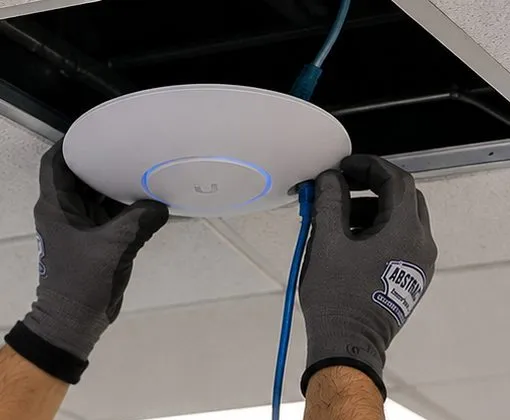
Two gloved hands press a flat white access point with a blue status ring against a ceiling tile; a blue network cable rises from the device into a dark gap where a neighboring tile has been lifted.
Repair Capture
Sonos Losing Rooms Across a Douglaston House
The typical Douglaston repair call is about the far end of the house. The kitchen and living room play perfectly while the primary bedroom over the garage, the attic office or the basement den keeps vanishing from the app. Sometimes it began when a new internet box went in by the front door, sometimes when someone added a plug-in range extender to "help", sometimes when the patio speakers were added on the edge of the signal. We can usually book the next open two-hour window, frequently the same day, and most of these are put right in an hour or two once we are inside. Call (347) 434-6392, say it is a Sonos dropout, and tell us roughly where the router is and which rooms fail, so the van carries enough cable and a switch. A visit where nothing is mounted is billed on time under our service policies: $195 for the first hour at the Queens rate, then 30-minute blocks.
The Douglaston Approach
Inside Is Yours, Outside Is Reviewed: What the Landmarks Rules and the Deeds Actually Touch
Owners in the two historic districts often assume a Sonos installation means a trip to the Landmarks Preservation Commission. For most of the work, it doesn't. The Commission's own guidance says interior work needs its permit only when the work also needs a Department of Buildings permit, when it affects the exterior, or when the interior itself is a designated landmark. Low-voltage speaker wire, a soundbar, ceiling speakers cut into a bedroom ceiling and an Amp on a basement shelf touch none of those triggers in an ordinary house. The Douglaston Historic District's Master Plan, the document the Commission uses to decide applications in the Manor, is entirely about exteriors and landscape: roofs, windows, siding, fences, driveways, pools, decks and trees. It does not address interiors at all.
The picture changes at the outside wall. Equipment on a facade is an exterior alteration. The Commission's permit guidebook chapter on health, safety and utility equipment does not mention speakers by name, but its general rules for small equipment on landmarked buildings are clear enough to plan around: equipment should not go on or in front of a primary facade unless there is no other option; conduit should be concealed by passing through plain masonry or cladding behind the device; where that is impossible, staff may approve roughly ten inches of visible conduit; and surface conduit must be painted to match the wall behind it. Equipment should be as small as possible and finished to blend in. A pair of outdoor speakers under a rear porch roof, invisible from Shore Road or the street in front, is a very different conversation from a pair bolted beside the front door.
The Douglas Manor Association adds a second layer in the Manor. Under the Master Plan, applications for additions, new buildings, outbuildings, fencing or retaining walls must include a letter from the Association confirming the work does not break the deed restrictions, which predate the city's first zoning law. Those restrictions also set front setbacks, bar fences other than hedges within twenty feet of the street line, require outbuildings to sit at least sixty feet back from the front lot line, and forbid flat roofs. Speakers are not listed. A speaker mounted on a new pergola, a post in a front bed or a small outdoor equipment cabinet, though, starts to look like the things on that list, and that is when we suggest the owner asks before anyone digs.
Part of a Sonos job
Who has a say in a Douglaston historic district
How we plan it
Freestanding speakers, soundbar, Sub, surrounds
The owner only
Placed and tuned room by room; nothing fixed to the building
Ceiling or in-wall speakers inside the house
The owner; the Commission only if the interior is a designated landmark or the work needs a Buildings permit
Obstruction survey, pilot hole, cut-out to the speaker's template
Network cable through basement, attic and closets
The owner
Routed inside the house; no new hole in an outside wall unless agreed
Outdoor speakers on a rear or secondary wall, not visible from the street
The Commission's rules on small exterior equipment; ask before work
Smallest suitable speaker, wire through the wall behind it, any visible conduit short and painted
Anything on a primary facade or in a front yard
The Commission, under the Master Plan
We recommend against it and suggest a rear location instead
Cable buried near a tree of 12 inches or more
The Master Plan's mature-tree protections
Routed around the root zone; never trenched through it
A new post, pergola or outbuilding to carry speakers
The Commission and, in the Manor, a Douglas Manor Association letter
Built by others once approved; we wire it afterward
This page is practical guidance from an installer, not legal advice, and the Commission decides its own cases. What the table does is sort a Sonos project into the parts you can book this week and the parts worth raising with the Commission's Queens staff first. In our experience, nearly every Douglaston system that people actually want sits wholly in the first group, with a pair of patio speakers as the only item that needs thought.
Outside the historic districts the rules relax to the city's ordinary ones. In Douglaston Park, the P.S. 98 area, the attached-house rows and the blocks south of the expressway, there is no landmarks review for an outdoor speaker on the back wall; what remains is the city's general rule against unreasonable noise and, on attached houses, a conversation with the neighbor who shares the wall. Co-op and condo owners answer to their board or managing agent for anything that touches common walls, and we provide the insurance certificate those offices ask for.
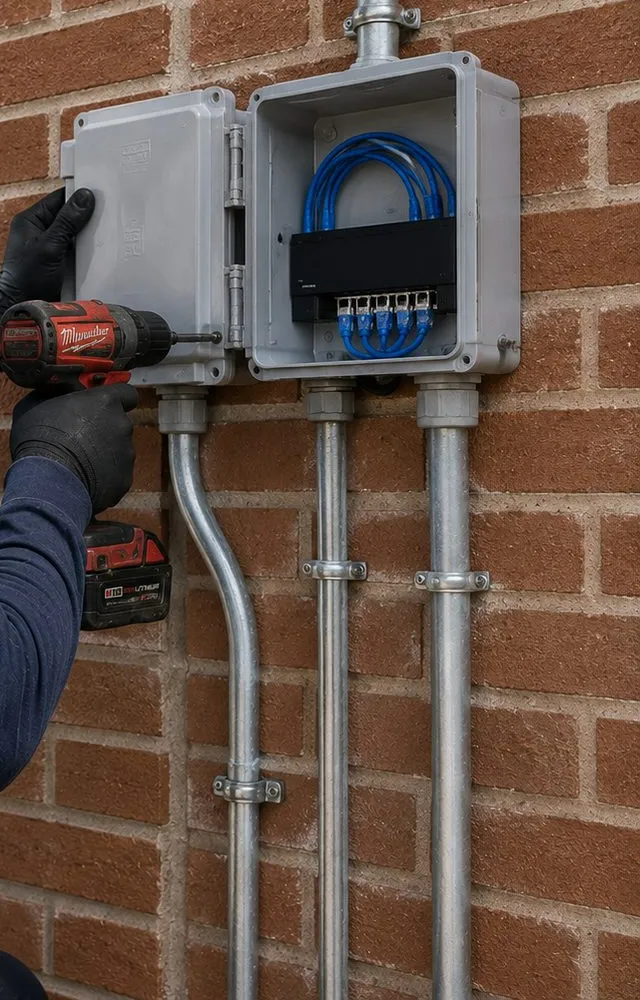
Two grey weatherproof enclosures are fixed to a red brick wall, one open to show blue cables landing on a black terminal strip; silver conduit drops from both, and a gloved hand drives a screw with a red cordless drill.
What We Install
Sonos Installation Services in Douglaston
The work below covers nearly every Douglaston request we see, from one soundbar in a raised ranch to a dozen rooms and a terrace in a Manor house. Each card says what we do and what it means in this neighborhood's houses.
Whole-House Room Map
Before anything is bought, we walk the house with you and mark which rooms get their own speaker, which share one, and which are better served by a portable. In a long center-hall Colonial or a dogleg plan, that map saves buying speakers for rooms that hear each other anyway.
A Network That Reaches the Far Rooms
We test signal room by room, then fix the weak end properly: one Sonos product wired to the router, a cable to a second access point in the attic or basement, or both. Plug-in range extenders are not supported by Sonos, so we take them out of the plan rather than adding more.
Family-Room Home Theater
Arc Ultra, Beam or Ray connected to the TV, with Sub and rear speakers where the room allows, set to the furniture you actually have. In older living rooms with a fireplace wall, we work out where the bar and Sub can sit without fighting the mantel.
Ceiling Speakers on an Amp
In-ceiling speakers in kitchens, dens and bedrooms, run from a Sonos Amp in a basement or closet. We survey for joists, pipes and ducts first, probe with a pilot hole, and cut to the speaker's template so the grille sits flush in plaster or drywall.
Basement and Attic Floors
Finished basements and converted attics are where Douglaston families watch films and work from home, and where the signal is weakest. We bring the network down or up with a cable rather than hoping a speaker can reach through two floors.
Rear Patio and Garden Sound
Outdoor speakers on a rear wall or under a back porch roof, wire passed through the wall behind them, and an Amp indoors. In the historic districts we plan for invisibility from the street and keep any surface conduit short and painted to match.
Co-op and Condo Apartments
For the mid-rise co-ops and the condominiums built in the 1980s, the job is smaller and the rules are the building's: freestanding speakers, a soundbar, possibly one bracket, and the insurance certificate the managing agent wants before we arrive.
Music for Boulevard Businesses
Sonos for shops, cafés and offices on Northern Boulevard, Douglaston Parkway and in Douglaston Plaza, set up so staff can run it from a shop device and the levels suit the room and the neighbors upstairs.
Repairs and Re-Joins
Speakers missing after a router swap, a Sub that stopped pairing, ceiling speakers gone silent, an old S1 product in a new system. Time-billed visits put a system back together without anything new being cut.
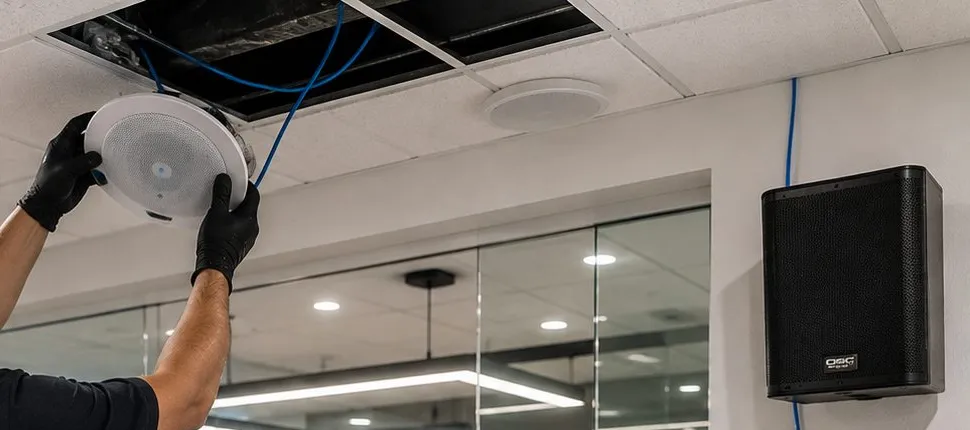
Gloved hands hold a white round ceiling speaker under an open ceiling panel with blue cable dangling from it; to the right a black box speaker hangs on a white wall above a glass-walled meeting room.
Building Specialists
Sonos Installation for Douglaston's Architecture
Douglaston packs a century of American house-building into a small area. These are the house types we plan around, and what each one means for speakers and cable.
Arts and Crafts Houses in the Manor
Deep porches, built-in cabinetry, beamed or boxed ceilings and plenty of original woodwork. We keep speakers off the woodwork, favor freestanding speakers and soundbars in the rooms with the best detail, and save ceiling speakers for kitchens, baths and bedrooms where the ceiling is plain.
Tudor and Colonial Revival Houses
The most common Manor and Douglaston Park houses: steep gables, plaster walls, a center hall or a side-hall plan, often an attic room under the roof. The center hall makes a natural spine for one cable from basement to attic, which then feeds the rooms either side.
Mediterranean Revival Houses
Stucco walls, tile roofs and terraces. Stucco can be laid over wire mesh, which some inspectors describe as a hidden Faraday cage, so the terrace may be beyond Wi-Fi even a few feet outside. We test before promising wireless outdoor sound and plan a cable if needed.
Queen Anne and Shingle Houses on Douglaston Hill
Most built between 1890 and 1940 on the old large lots: irregular rooms, bay windows, turned stairs and towers or porches added over the years. Irregular rooms favor Trueplay tuning and freestanding speakers, and we open the cellar and attic hatches before judging how hard a vertical cable run will be.
Capes, Ranches and Raised Ranches
Douglaston Park's 1960s ranches and the 1970s raised ranches around P.S. 98 have drywall, accessible attics or lower floors and straightforward cable routes. These are the quickest houses in the neighborhood for ceiling speakers and a wired Sonos product.
Attached Houses, Co-ops and Condos
The 1950s–1970s attached rows such as Beech Hills and Deepdale share walls, so we keep the Sub and in-wall speakers off the party wall. Mid-rise co-ops and the 1980s condos mean board rules, freestanding gear and, at most, a bracket.
What each Douglaston wall and ceiling means for the fixings
Surface
Where it turns up
Our method
Plaster on wood or metal lath
Pre-war Manor and Hill houses
Pilot hole and probe first, scored cut, speaker clamps sized for the ceiling's thickness; brackets into studs or with plaster-rated anchors
Stucco exterior
Mediterranean Revival houses, some Tudors
Outdoor speakers only on secondary walls; masonry bits, sealed fixings; Wi-Fi tested through the wall before relying on it
Brick or stone
Chimney breasts, foundations, garden walls
Sleeve anchors in brick, never in the mortar of a historic wall face where a joint fixing will do
Drywall on wood studs
Ranches, raised ranches, renovated rooms
Standard cut-outs and fixings; the easiest ceilings for in-ceiling speakers
Wood paneling and built-ins
Arts and Crafts libraries and dens
Not cut. Freestanding speakers or a ceiling position instead
Concrete slab and block
Co-op buildings, some basements
Surface raceway or freestanding speakers; drilling only with the board's consent
The cross-sell we raise most often in the older houses is not more speakers but better wiring. A house that is getting cable for a Sonos product in the attic usually benefits from a proper network installation at the same time, and an owner planning ceiling speakers in three rooms may want the structured cabling team to run the whole floor in one visit.
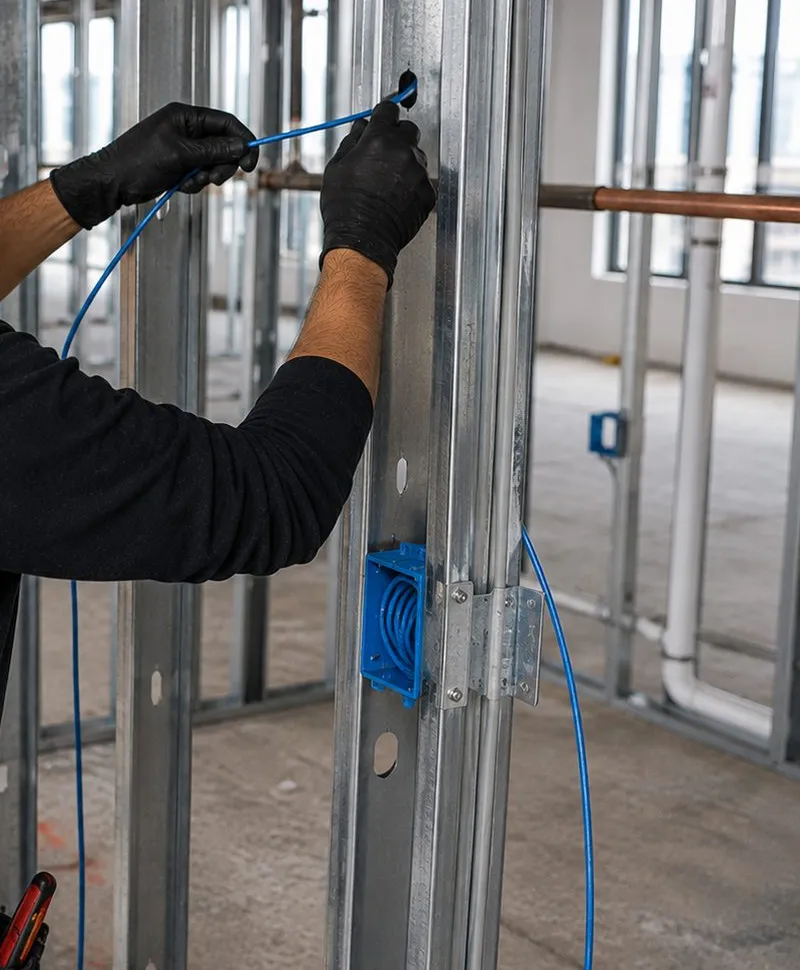
In an unfinished room framed with metal studs, two black-gloved hands feed a blue cable through a punched hole in a stud; below, the cable loops into a blue plastic wall box, and a copper pipe crosses behind.
Distance and Signal
Big Lots, Long Houses: Getting Sound and Signal to Every Room
Apartment dwellers fight their neighbors' Wi-Fi. Douglaston homeowners fight their own house. On a lot of a hundred feet or more, with side yards between you and the next family, the airwaves are comparatively quiet. What stops a Sonos speaker reaching the router is the building itself: a long plan, several floors and old materials. Sonos's own interference guidance rates plaster and concrete as high obstructions, brick and water as medium and metal as very high. A Manor Tudor might put three plaster walls, a brick chimney and a staircase between the cable modem in the front hall and the den at the back, before you even count the floor between the den and the attic bedroom.
Where the internet comes in decides the plan
Internet service usually arrives wherever the provider found it easiest to enter the house, which in an older house is often the front hall, the basement or a front room near the street. That is rarely where the family listens to music. The first question we ask on a Douglaston visit is where the line enters and whether the router can move to the middle of the house on a cable. Moving the router twenty feet inward often does more for a Sonos system than any amount of extra hardware at the edges.
One wired Sonos product, or a second access point
Sonos supports two network arrangements. In the usual one, every product joins your home Wi-Fi. In the other, at least one Sonos product stays connected to the router by cable and the system runs its own wireless network between its products. In a large house either can work, provided the network is built for it: Sonos does not support plug-in range extenders, powerline adapters or guest networks, and every product and phone must be on the same subnet. Where a house already has a mesh system, Sonos asks for any wired product to connect to the main unit. Our job is to choose one arrangement, make it solid end to end, and remove the gadgets that were added in hope.
The cable that does the heavy lifting
Most large-house fixes come down to one well-placed network cable: from the router to a second access point in the attic, or to a Sonos product at the far end of the ground floor. In a center-hall house, a closet stacked above a closet or the space beside a chimney often gives a clean vertical route; in a ranch the attic or the basement ceiling does the same job horizontally. We look for the route that needs the fewest openings, test the cable once it is pulled, and finish the jack neatly rather than leaving a loose end behind a sofa.
Garages, sunrooms and the room over the porch
The Master Plan requires outbuildings in the Manor to stand at least sixty feet back from the front lot line, so a detached garage is often at the very back of the property, with a workshop or gym inside. Many houses also have a sunroom or an enclosed porch added decades ago, with different walls from the rest of the house. These are the rooms most likely to sit at the edge of the signal. Before suggesting a speaker there we measure, and if the signal is marginal we say so and price a cable or an outdoor-rated access point, instead of installing a speaker that drops every evening.
Basements, attics and the vertical problem
A Douglaston house often has living space on four levels: finished basement, two main floors and a room under the roof. Wi-Fi travels poorly through floors with plaster ceilings and dense joists, and the basement den with the big TV is frequently the room with the worst reception. The fix is usually to put a wired Sonos product or access point on the floor that suffers, with the cable dropped through a closet or utility chase, so each level has its own strong signal rather than borrowing from the floor above.
A tall black rack holds two network switches threaded with blue patch cables and several gateway units; on a pull-out shelf below, a laptop screen shows a device list while a hand rests on the keyboard, and orange and blue cables fill the lower bays.
Outdoor Sound
Speakers Outside a Landmarked House: Rear Walls, Roots and Buried Lines
A local broker summed up the Manor's attitude in 2012: "We preserved it. We saved our trees, we saved our houses." Outdoor speakers in Douglaston are planned with that sentence in mind. The goal is music on the patio or terrace that nobody walking down the street would know is there, with every cable and fixing reversible and nothing disturbing what the neighborhood has spent a century protecting.
Choose the wall the street can't see
The Commission's guidance keeps equipment off primary facades unless there is no other choice. In practice the rear wall facing the garden, the underside of a back porch roof or the inside face of a rear wing nearly always gives a better listening position anyway, because that is where people sit. On corner lots and on houses facing Little Neck Bay or Udalls Cove, more than one side can count as visible, so we look at the house from each public way before choosing.
Through the wall, not along it
The cleanest outdoor installation feeds the speaker wire straight through the wall behind the speaker bracket, so no cable runs across the facade at all. Where that can't be done, the Commission's staff may approve roughly ten inches of visible conduit, and surface conduit has to be painted to match the wall. We plan for the through-wall route first, seal it properly, and note on our sketch where any visible conduit would sit so you can share it with the Commission if you choose to ask.
Roots, tanks and sprinkler lines
The Master Plan defines a "Mature Tree" as one whose trunk is twelve inches or more across, and removal needs an arborist's or engineer's report. Even without removal, a trench through a root zone can harm a tree. Many Manor homes also rely on septic systems rather than the city sewer, and most gardens have irrigation. So we prefer routes that stay on or near the house: along a foundation bed, under an existing porch, or out through the wall nearest the patio. Where a run must cross the garden, we ask where the tank, the pumping access and the sprinkler zones are before anything goes into the ground, and we keep well clear of all of them.
Weather off the bay
The peninsula takes weather from Little Neck Bay; the 2018 nor'easter that undermined Shore Road is the obvious reminder. Houses on the water side get outdoor speakers rated for outdoor use, mounted under cover where possible, with the Amp indoors. Portable Sonos speakers stay portable: they come out for the evening and go back inside. And no installation of ours extends onto the Association's waterfront, dock or park, which belong to the community rather than any one house.
Keeping the neighbors on side
Big lots don't make sound stop at the property line, and on a quiet peninsula an evening playlist carries further than it would on a busy street. The city's noise code bars operating a sound device so as to create unreasonable noise. We aim outdoor speakers down at the seating and toward the house rather than out across the garden, keep the pair close together at moderate volume rather than one loud speaker at the end of the lot, and show you how to set a volume limit for that zone in the app.
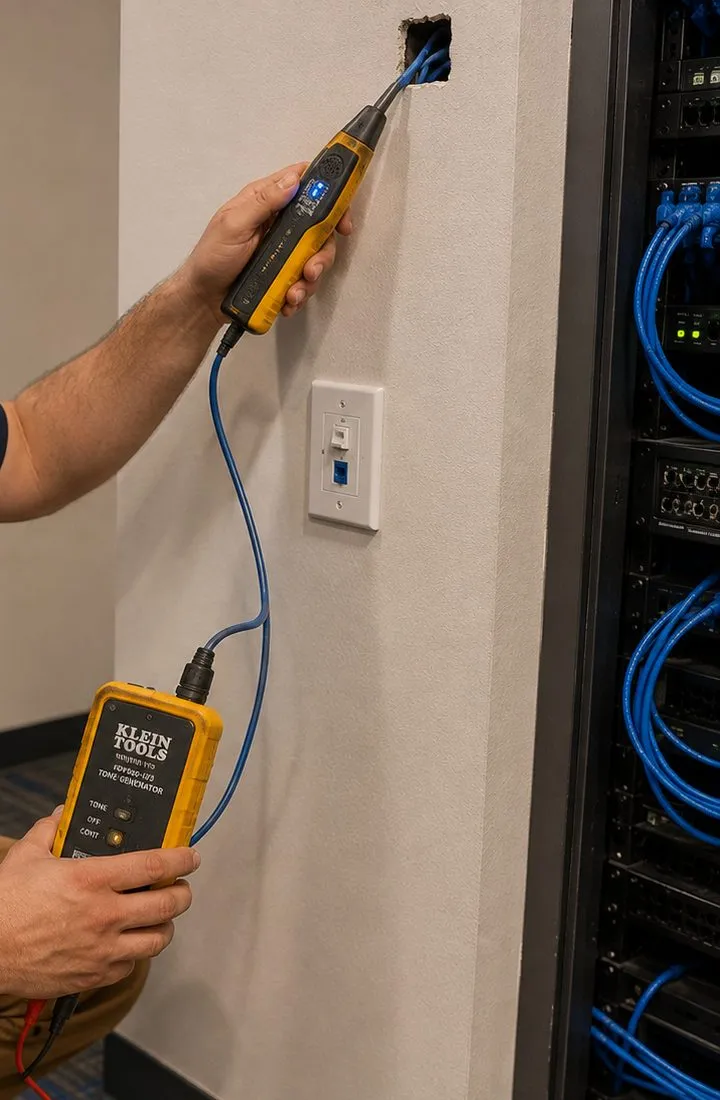
One hand presses a yellow-and-black tone tracer probe to blue cables poking out of a small square opening high on a cream wall; a blue lead runs down to a yellow tone generator held near the floor, beside a light switch and a rack of patched cables.
Commercial Sonos
Business Sonos Installation in Douglaston
Douglaston's commercial life is small and concentrated, which makes it easy to describe and important to get right: a few corridors, many of them with apartments or offices above the shops, and a community that notices when music spills onto the sidewalk. Sonos markets installed systems to businesses, and for a single shop, café or office it is often the right size. These are the corridors where we set it up.
Northern Boulevard
The neighborhood's commercial spine and the route of the Memorial Day Parade from Great Neck to Douglaston Parkway. Shopfronts, restaurants and professional offices, many in older two-storey buildings with a tenant upstairs. We keep subwoofers off the shared ceiling and speakers aimed into the room.
Douglaston Parkway
A block of shops that includes the National Art League, with its classes and exhibitions. Small rooms with hard floors and shop windows: two well-placed speakers usually do better than four, and a classroom or studio needs a level low enough to talk over.
Douglaston Plaza
The shopping center with the supermarket, stores and restaurants, where National Night Out is held each August. Larger floor plates with dropped ceilings suit in-ceiling speakers on an Amp, with the network run kept separate from anything the landlord controls.
Little Neck Parkway
The commercial corridor near Northern Boulevard on the Little Neck side, just over Marathon Parkway. Mixed shops and services; the same rules about upstairs neighbors and street-facing doors apply.
Offices and Waiting Rooms
Dental, medical and professional suites along the boulevard want quiet background music in reception and none in the treatment or meeting rooms. Sonos rooms make that split simple, and staff control it from one shop device.
Halls and Community Spaces
Churches and community buildings host concerts, plays and meetings — Douglaston Community Church holds monthly concerts, and theater groups perform at it and at Zion Episcopal Church. For background music in a fellowship room or lobby, Sonos can work; for live performance, a proper sound system is the better tool, and we say so.
Rules Douglaston businesses should know before the music starts
Commercial music limit. The city's noise code fact sheet says commercial music from a store, restaurant or bar must not exceed 42 dBA measured inside any dwelling unit receiving the noise. With apartments above so many boulevard shops, that is the figure that matters.
Unreasonable noise. Separately, the Administrative Code bars operating a sound reproduction device in a way that creates unreasonable noise. A speaker pointed out of an open door is the usual way to break it.
Music rights. Consumer subscriptions such as the ones on your phone are sold for listening at home, so a shop or office that plays music to the public should sign up for a commercial background-music service. Whichever one you pick, we connect it to Sonos; the licence itself is between you and that provider.
Landlord and storefront rules. Anything on a facade, awning or sidewalk-facing window is a landlord matter first, and in a historic building a landmarks matter too. We keep equipment inside.
Insurance certificate. Landlords and managing agents usually want one before we start; we send it free.
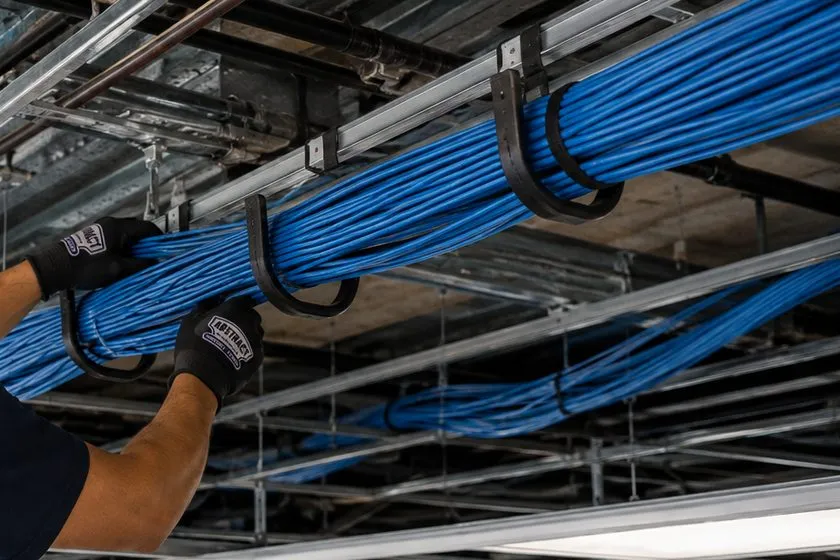
Under an open ceiling of steel deck and ductwork, two gloved hands steady a thick bundle of blue cables resting in a row of black J-hooks; office cubicles and windows sit far below.
Your Questions Answered
Sonos Installation in Douglaston: Questions Answered
These are the questions Douglaston homeowners and business owners raise that other neighborhoods rarely do, grouped by the situation behind them. General questions — network basics, co-op approvals, whether landmarks rules apply to speakers at all — are answered on our New York City Sonos page and the Queens Sonos installation page.
Long houses and the signal inside them
In a dogleg-plan house, can a stereo pair work across the bend where the wing turns?
Not well, and it is better not to try. Douglas Manor has, according to the local historical society, the largest number of "dogleg" plan houses in the city: houses where one wing turns off the main block at an angle. A stereo pair works by sending the left and right channels to two speakers that you sit facing, roughly the same distance from each. Sonos suggests spacing a pair eight to ten feet apart with the listening spot eight to twelve feet away. Put one speaker in each leg of a dogleg and nobody sits anywhere that faces both; in most of the room you hear one channel clearly and the other around a corner, which sounds lopsided rather than wide.
The arrangement that works is to treat each leg as its own room in the Sonos app. A stereo pair goes in the leg where people sit, on the wall they face. The other leg gets its own speaker, grouped with the first so the music is the same throughout, with its volume set by ear from the point where the two spaces meet. If the turn of the house is a hallway or a stair landing, a single speaker there can bridge the two at low level.
After any pairing or regrouping we run Trueplay again, because Sonos asks for re-tuning whenever a stereo pair is created or a speaker moves. In an angled room the tuning makes a noticeable difference: it hears how the walls reflect sound and adjusts each speaker for its position.
Our nearest neighbor is a hundred feet away — is changing the Wi-Fi channel still worth doing for Sonos?
It's worth a check, but it is rarely the cure here. Channel advice comes from apartment buildings, where dozens of networks overlap. On a Douglaston lot your own house makes most of the interference. Sonos lists the usual culprits: cordless and DECT phones, wireless cameras and video senders, baby monitors, microwaves while running, other access points and extenders, smart-home hubs and some monitors. It asks for Sonos products to sit at least eighteen inches from other electronics, and suggests restarting the router so it chooses a fresh channel when interference is suspected.
So our order of work in a large house is different from an apartment. First, we look at what sits next to each speaker: a Sonos on the same shelf as a cordless phone base or a camera hub is an easy move. Second, we look at the path: a speaker three plaster walls and a floor from the router is a distance problem that no channel change fixes. Third, and only then, we look at channels, using a survey app to see what the house's own devices are doing.
The real fix for a big house is almost always structure rather than settings: the router moved toward the middle, one Sonos product wired, or a second access point on a cable. Once that is right, channel choice becomes a small refinement rather than the thing standing between you and music in the den.
Our house arrived as a mail-order kit in the 1920s — does that change how speaker wire gets into the walls?
The catalog origin matters less than the century since. The historical society records that Aladdin and Sears mail-order houses were delivered to Douglas Manor by rail, and owners are rightly proud of them. But what decides a cable route today is what the walls hold now: original plaster or later drywall, insulation added in some decade, old wiring abandoned in the cavities, ductwork from a heating conversion, and whatever a previous renovation left behind. Two kit houses built from the same plan can be completely different inside.
So we treat a kit house exactly like any other older house. We follow the obstruction survey Sonos's own in-ceiling instructions describe: a stud finder across the area, a small pilot hole, a probe with a bent wire to feel for joists, pipes, ducts and pocket doors before any full-size opening is cut. We look from the cellar and the attic for clear vertical paths, and we prefer routes through closets and stacked spaces that leave finished rooms untouched.
Our stucco house loses Wi-Fi the moment we step onto the terrace — could the walls themselves be the cause?
They could. Douglaston's Mediterranean Revival houses, and some Tudors, are finished in stucco, and stucco is often applied over metal mesh. A home-inspection training article quotes a specialist describing houses plastered over wire mesh as "essentially Faraday cages hidden in the walls," and Sonos's own interference table rates metal as a very high obstruction. Plaster alone is far kinder to Wi-Fi. We can't tell whether your walls contain mesh from the outside; what we can do is measure the signal inside and out, and the sudden drop at the door usually tells the story.
Happily, outdoor sound doesn't need outdoor Wi-Fi if it is wired. Sonos outdoor speakers are passive: they run on speaker wire from a Sonos Amp, and the Amp can sit indoors next to the router or on a cable from it. The wire passes through the wall behind the speakers, so the mesh no longer matters. If you want a portable Sonos on the terrace as well, the fix is an access point just inside a window or door, or an outdoor-rated one on a cable, placed where the terrace can see it.
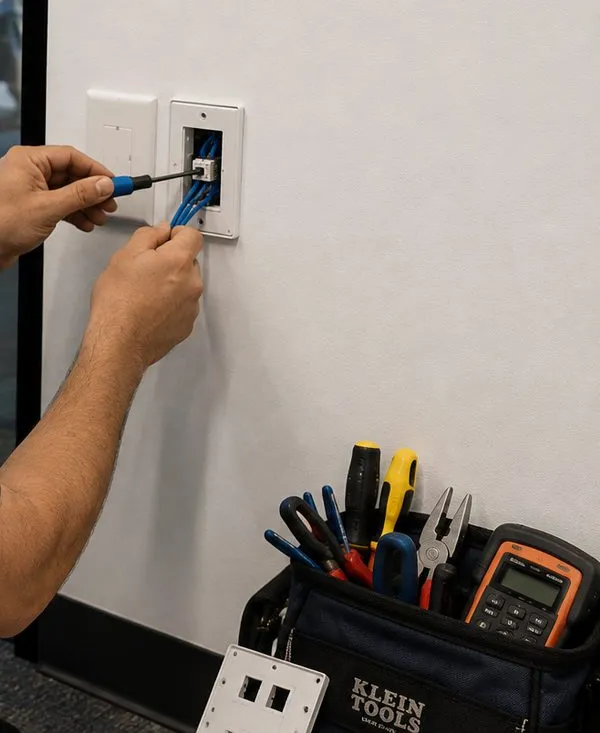
Two hands work a small blue-handled screwdriver at a network jack set in a white wall plate beside a second plate; below, an open black tool bag holds pliers, screwdrivers and an orange multimeter, with a spare plate on the floor.
The yard, the trees and the tank
A mature tree stands between the house and the patio — how does speaker cable get past its roots?
Usually by not going near them. The district's Master Plan treats any tree with a trunk twelve inches or more across as a "Mature Tree" and allows removal only on an arborist's or engineer's report, and residents are protective of them for good reason; the Manor lost a 600-year-old white oak on Arleigh Road in 2009. Removing a tree isn't on the table for a speaker, and trenching through the ground under its canopy can damage roots it depends on.
The route we look for first keeps to the house. If the patio adjoins the house, the speakers go on the rear wall or under the porch roof and the wire comes straight through the wall from an Amp inside: no trench at all. If the patio is out in the garden, we look for a path along the foundation bed, beneath an existing walkway or deck, or around the tree well outside its canopy, even if that makes the run longer. Speaker wire comfortably covers the extra distance from an Amp.
When no route avoids the roots, we say so and suggest a battery-powered Sonos speaker that lives on the patio for the evening, rather than risking the tree. We never route cable across the public sidewalk or the cobblestone gutters, which the Master Plan lists among the district's significant landscape features.
Our house isn't on the city sewer — does the septic system limit where a cable can be buried?
Yes, and it's one of the first things we ask in the Manor. Brokers told the New York Times, as Patch reported in 2021, that Douglas Manor homes are not connected to city sewers and need their systems pumped. That means somewhere in the yard there is a tank, a cesspool or a leaching area, and a route the pumping truck's hose takes to reach it. None of those is a place for a cable trench: digging near them risks damage, and a cable over the access point gets dug up the next time the system is serviced.
Before we propose any buried run we ask you to show us, or find from the pumping company, where the tank, its lids and any leaching field are, and which way the truck approaches. We then route on the other side of the house or along it. Most patio jobs never need to cross the garden at all, because the speakers can live on the rear wall with the wire coming straight through from inside.
If a run does have to go out to a far seating area, it goes in protective conduit at a sensible depth along a path you have approved, away from the system and the irrigation lines, and we mark it on the sketch we leave behind so the next contractor knows where it is.
Is a landscape speaker staked in a flower bed treated like garden furniture under the historic district's rules?
Not necessarily, and we wouldn't assume so. The Master Plan lists work that needs no Commission approval, including pruning and planting, removing hedges, seasonal flower beds and installing "garden furniture, ornaments, or play equipment." Speakers aren't named. A small speaker disguised as a rock or staked among the shrubs is arguably close to an ornament, but it also comes with buried cable and, often, a transformer or Amp connection, which is more than a bench or a birdbath involves.
Our practical line is this. In a rear garden not visible from any street, low landscape speakers among the plantings are about as discreet as outdoor audio gets, and they are often the best way to cover a large lawn at low volume. In a front or side yard visible from the street, we recommend asking the Commission's staff before anything goes in, and we provide the product sheet and a marked photo to make that easy.
Either way, the buried cable follows the same rules as any other: clear of mature trees, the septic system and the sprinkler lines, in conduit where it crosses open ground, and drawn on a sketch you keep. That is what makes a garden speaker system something you never think about again.
One house, many rooms, one doorbell
Over the music we can't hear the doorbell from the back of the house — can the Sonos speakers chime when someone is at the door?
Not on their own. Sonos doesn't offer a built-in doorbell chime, and long-running threads in Sonos's own community show owners of popular video doorbells building workarounds: automation services that play a chime file through Sonos, or home-automation software that makes an announcement. The same owners report delays of around a second or more, and the setups depend on third-party services that can change. That's fine for some households and frustrating for others.
In a big Douglaston house we usually recommend something simpler first. Most doorbell makers sell plug-in chimes that can sit in the back of the house, the basement or the attic office, and the doorbell's own app alerts every phone. Those keep working whatever happens to the music. If you would still like the music to pause or the speakers to sound when the bell rings, we will look at what your particular doorbell and Sonos products support, set it up, test the delay with you standing in the far room, and leave it only if you're happy with it.
If you are choosing a new doorbell as part of the project, our intercom installers in Queens can talk through models that integrate better with whole-house audio, and the Queens smart lock team can add the front-door lock on the same visit.
Can we call everyone down to dinner through the speakers on every floor?
Partly, depending on which products you have and which voice assistant you use. In 2018 Amazon's Alexa Announcements feature came to Sonos speakers with Alexa built in, starting with the Sonos One and Beam: say "announce" and the message plays as a one-way broadcast in your own voice after a chime, and a speaker set to Do Not Disturb won't receive it. Sonos's current support page for Alexa lists what doesn't work on Sonos, and Drop In and voice calling are on that list, so two-way intercom conversations between rooms are not something to buy Sonos for.
The practical consequence in a large house is that announcements reach the rooms with a voice-enabled Sonos product, with its microphone switched on, and not necessarily the others. A pair of ceiling speakers on an Amp, or a speaker with its microphone turned off, may stay silent. Before promising "every floor," we list which of your rooms would hear an announcement and test it during hand-over.
Studios, shops and offices on the boulevard
During a class in a Douglaston Parkway studio, can the teacher stop the music from the front of the room without picking up a phone?
Yes, in three ways, and we usually set up two of them. The simplest is the speaker itself. Sonos speakers carry their own controls, so a tap on the play/pause control of the speaker nearest the teacher stops or restarts the music for that room. That works best when the speaker sits where the teacher stands, so we place it at the front of the room rather than in a back corner, at a height a hand can reach. We also keep the studio speaker in its own room in the app, so a pause at the front of the class affects that room and nothing else.
The second is voice. Sonos's support page for Amazon Alexa lists basic playback commands such as play, pause, skip and volume up or down as supported on Sonos speakers with Alexa built in. In a classroom that can mean "Alexa, pause" from across the room. The same page lists features that are not supported on Sonos, including alarms, sleep timers and calling, so we set expectations before relying on voice for anything beyond playback.
The third is a single shared device: an inexpensive tablet left on a stand by the door, signed in to the studio's business music account rather than anyone's personal phone, so whoever teaches that day can pick the playlist. For galleries and art classes, where long stretches of quiet matter as much as the music, we also set a volume ceiling for the room so nobody accidentally turns a critique session into a concert.
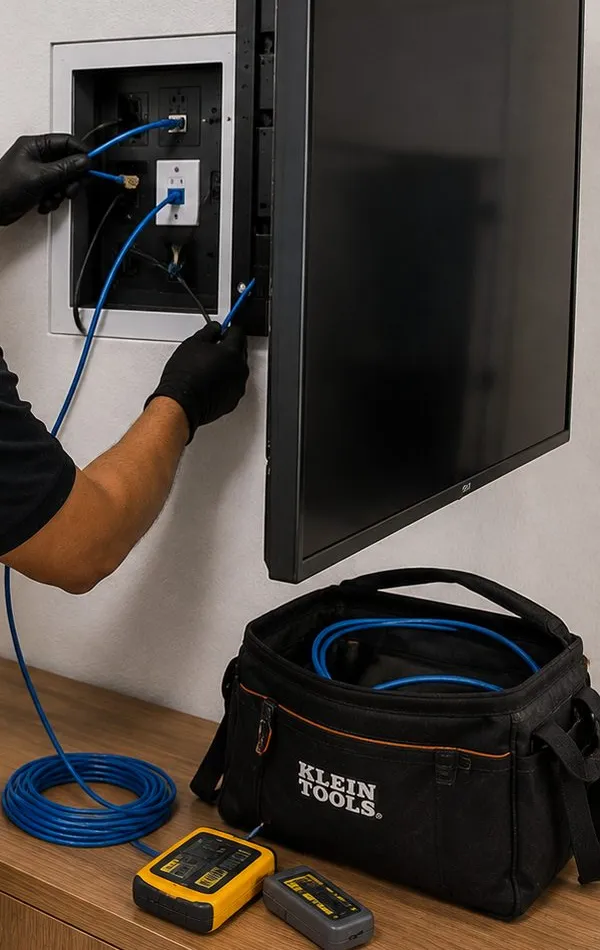
Black-gloved hands plug cables into a recessed wall box holding outlets and a network jack, just beside the edge of a wall-mounted flat-screen; on the wooden sideboard below sit a coil of blue cable, a black tool bag and a yellow tester.
Equipment
Types of Sonos Systems We Install
You buy the Sonos products from whichever retailer you like; we install, connect and tune them. Specifications below come from Sonos's own product pages and guides, or from reviews where Sonos doesn't publish the figure, and each card says where the product earns its place in a Douglaston house.
Era 100
The compact speaker for kitchens, bedrooms and studies, alone or as a stereo pair. Works on 5 GHz Wi-Fi as well as 2.4 GHz and supports quick Trueplay tuning from Android as well as iPhone. The default choice for the many small rooms of an older house.
Era 300
Spatial-audio speaker that fires sound up and to the sides. Best in a large living room or as rear surrounds for an Arc Ultra. Sonos's wall mount for it is for stud mounting only, not drywall anchors, so in plaster houses we find the stud first.
Arc Ultra
The flagship soundbar for big family rooms. Sonos says it detects when it is wall-mounted and adjusts its EQ to temper bass from the wall, and asks for space between bar and TV. Our first choice where a living room has the width for it.
Beam (Gen 2)
A mid-size bar with HDMI eARC for dens, basement media rooms and bedrooms. About 25.6 inches wide, so it suits the narrower TV walls of a Cape or a converted attic.
Ray
The small bar that connects by optical cable, for a second TV in a study or a guest room, or an older set without HDMI ARC. Front-firing, so it can live on a shelf of a media cabinet.
Sub 4 and Sub Mini
Wireless subwoofers that can sit in a corner, against a wall or beside furniture with the front opening clear. Sub Mini for dens and bedrooms; Sub 4 for big rooms, and two can be paired with the larger soundbars. On an attached house we keep them off the shared wall.
Amp
Powers passive ceiling, wall and outdoor speakers. Reviewers measured 125 watts per channel into 8 ohms; Sonos says it reliably powers up to three pairs of its architectural speakers wired in parallel. Rated for 32° to 104°F, so it belongs indoors, not in an unheated garage.
In-Ceiling by Sonance
Six-inch and eight-inch in-ceiling speakers, cut-outs of 8.25 and 10.125 inches, paintable bezel-less grilles. Designed for the Amp and tunable with Trueplay. The usual choice for kitchens and bedrooms with plain ceilings.
Outdoor by Sonance
Passive outdoor speakers run on wire from an Amp indoors. The right product for a rear wall or porch ceiling, because only the small speaker and its wire are outside. That suits both the weather off the bay and the historic district's preference for discreet exteriors.
Port
Brings an existing receiver or stereo into the Sonos system, with line and digital outputs and a 12-volt trigger to switch the amplifier on. Sonos asks for at least two inches of space around it on a shelf and no nearby heat sources.
Move 2 and Roam 2
Battery speakers for patios, porches and gardens where cable isn't wanted. Sonos rates the Move 2 for 32° to 104°F with a charging base meant for indoors; the Roam 2 is smaller and rated IP67. Ideal where a buried route would disturb a tree or the septic area.
Era 100 Pro
The business version of the Era 100, powered over its network cable. In a boulevard office or shop with an existing network, one cable per speaker carries both power and data.
Which Sonos setup suits which Douglaston room
Room
Usual choice
Why
Formal living room with original woodwork
Era 100 stereo pair or Era 300s on furniture
Nothing cut into the room's best surfaces
Family room with the main TV
Arc Ultra, Sub 4, two Era 100 or Era 300 rears
The room that gets used most, and the widest TV wall
Kitchen and breakfast room
Pair of in-ceiling speakers on an Amp, or one Era 100
Counter space stays clear; ceilings are usually plain
Finished basement
Beam (Gen 2) and Sub Mini, wired Sonos product
The signal is weakest here, so one product goes on cable
Attic bedroom or office
Era 100, access point on a cable
Sloped ceilings and distance from the router
Rear patio or porch
Outdoor by Sonance pair on an Amp, or a Move 2
Discreet from the street; portable where cable can't go
Co-op living room
Beam (Gen 2) or Ray on the console, Era 100s
Freestanding; no board application needed
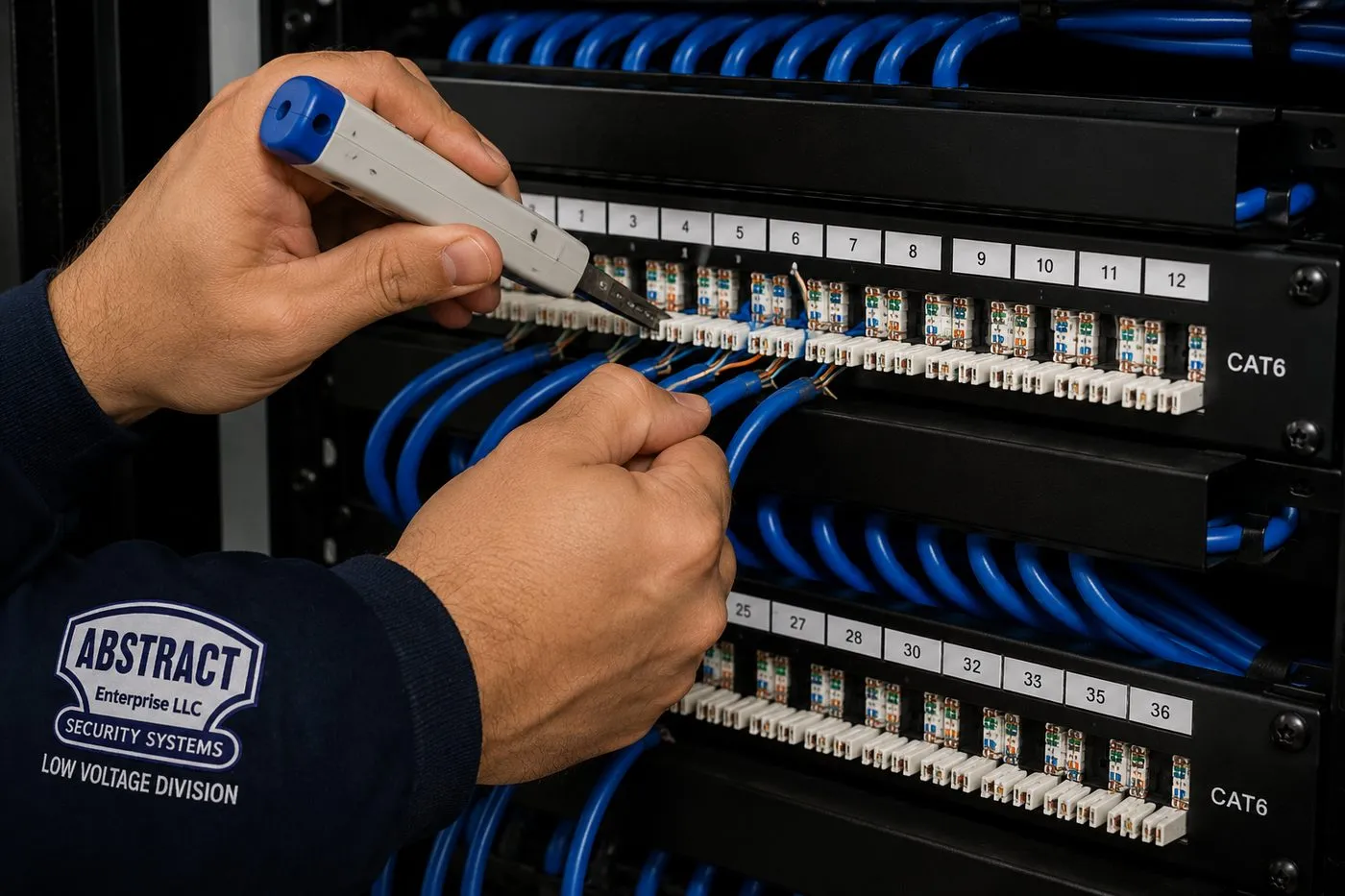
Two hands hold a white-and-blue punch-down tool against a numbered black patch panel, seating the wires of blue network cables; a second panel below carries more blue cables and port labels up to 36.
AI Overview Reality Check
What AI Gets Wrong About Sonos Installation in Douglaston
Google's AI Overview could not be viewed from our research environment, so we don't quote it. Instead, these are the assumptions that circulate in cost guides, forums and marketing copy and get repeated by answer engines, each checked against Sonos's own documentation, the Landmarks Preservation Commission's published rules and what we find inside Douglaston houses.
“Any work on a landmarked house needs a Landmarks permit”
This one stops people before they start. The Commission's own guidance says interior work needs its permit only when the work also requires a Department of Buildings permit, when it affects the exterior, or when the interior is itself a designated landmark. The Douglaston Historic District's Master Plan deals entirely with exteriors and landscape.
So speakers on furniture, a soundbar under the TV, ceiling speakers in a bedroom and network cable through the basement are, in an ordinary Manor house, interior matters for the owner alone. What does come under review is anything that changes the outside: a speaker or conduit on a facade, a new structure in the yard, work that disturbs a protected tree.
The practical lesson is to split the project. Book the inside now; take the outside, if any, to the Commission's staff with a sketch. Most families find the inside is where nearly all the value lies.
“Outdoor speakers aren't allowed in a historic district”
The opposite overstatement. The Master Plan doesn't mention speakers at all, and the Commission's guidebook for small exterior equipment describes how such things are judged: off primary facades where possible, as small as possible, finished to blend in, with conduit concealed through the wall or kept to roughly ten inches and painted to match.
A pair of small outdoor speakers under a rear porch roof, wired through the wall from an Amp inside, sits comfortably within that logic. A large speaker on a pole in the front garden doesn't. The question is never simply "allowed or not" but where, how big and how visible.
We plan rear-of-house positions first, document them, and leave the decision about whether to ask the Commission with you. We don't claim approval on the Commission's behalf.
“Whole-home audio costs $500 to $1,000 per room”
A widely read cost guide does give $500 to $1,000 per room for additional zones of a whole-home stereo system, with labor at $50 to $100 an hour, and that range gets repeated as if it applied to everything. It mixes products, labor and wall work into one number and doesn't separate a freestanding speaker from a ceiling pair.
In a Douglaston house the spread is wider in both directions. A room with a freestanding Era 100 needs only setup, which is $125 on our Queens list for the whole system, not per room. A pair of ceiling speakers in an old plaster ceiling, wired to an Amp two floors away, is quoted after a walkthrough within the $800 to $2,500 per zone range we publish for whole-home audio.
The useful number is the one built from your rooms: setup, any mount and bracket, any cable run, and each ceiling zone listed separately with its own figure.
“A mesh Wi-Fi system fixes Sonos in a big house”
Mesh often helps, and it is a big improvement on plug-in extenders, which Sonos doesn't support at all. But a mesh whose satellites talk to each other wirelessly through plaster and brick can still leave the far rooms marginal, and Sonos asks that any wired Sonos product connect to the main unit rather than a satellite.
In the long, old houses of the Manor and the Hill, the arrangement that holds up is a mesh or access-point system with at least one satellite or access point on a cable, so the back of the house or the attic has a wired link to the router rather than a wireless hop.
We test the result room by room with the Sonos products in place, because what matters is whether the music plays without dropouts, not what the router's app says.
“Trueplay works with any phone”
The tuning feature is more particular than people assume. According to Sonos, an iPhone or iPad is needed to tune most of its products. A shorter "quick" tuning that runs from an Android phone exists for several current models, the Era 100, Era 300 and Arc Ultra among them, yet the fuller "advanced" measurement on those same speakers is still an Apple-only process.
In a household of Android users with older Sonos speakers, that matters: some rooms won't be tuned at all unless someone brings an iPhone. We bring one, tune every room, and re-tune after any speaker moves or a stereo pair is made, as Sonos recommends.
Trueplay takes a few minutes per room and needs quiet. On a Douglaston visit that usually means waiting for the landscaper's leaf blower to stop rather than for a train, but the principle is the same.
“Speaker wire can just be buried across the lawn”
Plenty of how-to articles suggest burying direct-burial speaker cable a few inches down and calling it done. In much of Douglas Manor the ground holds a septic system that needs pumping, sprinkler zones, and the roots of trees the Master Plan protects once they reach twelve inches across the trunk.
A shallow trench through any of those can cause damage worth far more than the speakers, and a cable laid without a record gets cut by the next person with a spade. That's why we start with routes that stay on the house and only bury where the owner has shown us what's underground.
Where cable must cross open ground it goes in conduit, along an agreed line, and onto a sketch the owner keeps.
“Sonos is plug-and-play, so you don't need an installer”
Set one Era 100 on a counter and the claim holds up. Architectural audio is another matter, and Sonos itself says so: its guide to ceiling speakers notes that they "require special installation", and its in-wall guide expects an Amp to be fitted, openings cut and speaker cable pulled, usually by a professional.
A whole Douglaston house adds the network questions above, the choice of which rooms share a speaker, and outdoor work governed by rules most installers outside landmarked neighborhoods never deal with. The products set themselves up easily; the house doesn't.
Inside First, Outside Only Where It Belongs
Send your room list and a photo of each room for a written figure on everything indoors today. Patio and garden work gets a walk around the house first, with the route drawn for you to keep.
A Manor house by the bay, a Queen Anne on the Hill, a ranch by the golf course, a co-op off Northern Boulevard or a shop on Douglaston Parkway — send the details and a written Queens total comes back by the end of the business day. Rather talk it through? Call (347) 434-6392.
✅
Thanks — Request Received
Got it. Someone from the northeast Queens crew rings you back today, during business hours. Can’t wait? Dial (347) 434-6392.
How It Works
Our Installation Process
Seven steps, whether the job is one soundbar in a raised ranch or speakers through a Manor house and out onto the terrace. What sets the Douglaston version apart is step one: sorting the inside, which you can book straight away, from the outside, which may need a word with the Commission.
1. Room list and the inside-outside split
Send the rooms you want music in, the Sonos models, a photo of each room and one line saying whether the house is in Douglas Manor or on Douglaston Hill. We sort the job into indoor work you can book now and any outdoor work that needs a closer look.
2. A written figure from the Queens list
The total adds up published lines from the price tables below: setup, any mount and bracket, cable runs, wall surcharges. Ceiling and outdoor zones appear as walkthrough items with the published per-zone range, so nothing is a guess.
3. A walk through the house and around it
For ceiling, cable or outdoor work we visit first. Inside we find where the internet enters and the clearest vertical route; outside we look at the house from the street, note mature trees, and ask where the septic tank and sprinkler zones are.
4. A sketch you can keep, or share
Outdoor plans come with a marked photo and product sheets showing speaker positions, the through-wall route and any visible conduit. If you decide to ask the Commission's staff or the Association, you have what they will want to see.
5. Network first, end to end
On the day, the router comes first: one subnet, no guest network, extenders and powerline adapters removed, the cable to a far access point or a wired Sonos product pulled and tested. Only then does any speaker come out of its box.
6. Install, place and tune each room
Ceiling speakers after a pilot hole, brackets into studs or masonry, outdoor wire through the wall behind the speaker. Every room is tuned with Trueplay and checked by ear; grouped rooms are balanced at the points where they meet.
7. Hand-over and the house map
Everyone who will use the system gets it working on their phone. You keep a map of every product, Amp, access point, jack and buried cable route, so future work on the house — a new patio, a roofer, a landscaper — knows what is where.
Coverage Area
Sonos Installation Near Douglaston's Landmarks
We work throughout Douglaston, from the tip of the peninsula to the blocks south of the expressway. These six places are the ones people use to tell us where they live.
The Douglaston Club
The Greek Revival mansion built in 1819 by Wyant Van Zandt and bought in 1835 by George Douglas, whose family gave the neighborhood its name. Today a private club with tennis, pools and the Douglaston Yacht Squadron, at the heart of the Manor.
Zion Episcopal Church and Douglaston Hill
The church, its 1890 rectory and its cemetery, where a marker reads "Here rest the last of the Matinecoc," anchor the Douglaston Hill Historic District. In 2012 some of the Hill's numbered streets got their original names back, among them Pine Street.
The Cornelius Van Wyck House
A shingled Dutch Colonial farmhouse of about 1735 at West Drive and Alston Place, a survivor of the peninsula's farming days and, with the Allen-Beville House of about 1848, listed on the National Register.
Douglaston Station
The Long Island Rail Road's Port Washington Branch stop at 235th Street and 41st Avenue, opened in 1866. With no subway in the neighborhood, the station is the line between the Manor to the north and the Hill and the boulevard to the south.
Douglaston Park Golf Course
An 18-hole, par-67 municipal course on 104 acres, opened in 1927 as the North Hills Country Club and sitting on one of the highest points in Queens. Around it are the larger older homes, Capes, Tudors and ranches of Douglaston Park.
Alley Pond Park and Udalls Cove
The 635-acre park on the western waterfront, home to the Queens Giant tree, and the 90-acre Udalls Cove sanctuary to the east frame the neighborhood. On the streets near the water and the park edges, outdoor sound is planned as carefully around the setting as around the house.
We also install Sonos in the neighborhoods around Douglaston: Little Neck across Marathon Parkway, Bayside and Bay Terrace to the west, Oakland Gardens, Glen Oaks and Fresh Meadows to the south, and Whitestone along the North Shore. Across the city line, our Nassau County Sonos page covers Great Neck and the rest of the county.
Pricing
Sonos Installation Cost in Douglaston
Douglaston is priced on the published Queens list; it carries no surcharge of its own. Every figure on this page is taken from the Queens Sonos page and the Queens TV and audio price list. Pick the lines your job needs and the sum is both the quote and the invoice. Ceiling speakers, in-wall speakers, outdoor speakers and cable through floors or outside walls are priced in writing after a walkthrough, before any work begins.
Sonos service
Douglaston (Queens) price
What it includes
Sonos setup
$125
One charge per system, not per speaker: rooms created and named, pairs, surrounds and Sub built, each family phone and streaming account added, Trueplay run (the "Sonos / wireless surround" line)
Soundbar placed on console or stand
$79
Arc Ultra, Beam or Ray positioned, connected and tested without drilling
Soundbar wall-mounted under the TV
$129
Bracket fixed, bar hung level, connected
Sanus soundbar bracket
$84.99
Supplied where the bar has no suitable mount
In-wall concealment
$169
Code-compliant in-wall power and cable kit behind the TV
Paintable cord cover
$59
Surface raceway where a wall is staying closed
Cable run to a cabinet or other spot
$99
A single network cable of up to 25 ft, typically linking the router to an access point or to one Sonos product
A/V receiver
$129
Receiver connected and configured, for example behind a Port
Universal remote
$99
Programmed for TV, soundbar and sources
Streaming device setup
$49
Per device
Full home theater
$350
Several components set up together
Ceiling, in-wall or outdoor speakers on an Amp
Quoted at walkthrough
Within the $800–$2,500 per zone range published for whole-home audio
Walls, ceilings and access
Condition
Price
Where we meet it in Douglaston
Drywall on wood studs
$0
Ranches, raised ranches, renovated rooms
Metal studs
+$30
Some co-op partitions and commercial suites
Plaster
+$45
Most pre-war Manor and Hill houses
Brick or stone
+$65
Chimney breasts, foundations, stucco over masonry
Concrete or cinder block
+$75
Co-op buildings and basement walls
Tile or marble
+$95
Kitchens and bathrooms
Plywood backer board
$85
Where a hollow wall needs a solid fixing
High mount (above about 8 ft)
$75
Stair halls, cathedral ceilings, shop walls
Walk-up, 3rd floor and above, no elevator
$40
Rare here; some older apartment buildings
Certificate of insurance for a co-op, condo or managing agent
Free
Mid-rise co-ops and commercial landlords
Parking charge
None in Queens
—
Visits billed by time, and a TV on the same day
Some visits involve no drilling at all: putting speakers back on the network after the provider swaps the router, carrying a speaker to a different room and tuning it again, or separating older S1 products from newer S2 ones. Those are charged by the clock — $195 covers the first hour at the Queens rate, and each half hour after that is billed as a block. Adding a TV to the same visit? The Queens base for mounting a 32- to 55-inch set on a flat or tilting bracket, on drywall over wood studs, is $179.99, and every other size and wall is on our TV mounting price list for Queens.
Included, excluded, and what a missed start costs
What the price covers: one system containing all your products; room names that match how the household refers to each space; pairs, surrounds and the Sub configured; phones and music accounts connected; Trueplay wherever the products and your phone allow it; a written house map of products and cable routes; and a clean-up of dust before we leave. What it doesn’t: new outlets or other line-voltage work, which is for a licensed electrician; long garden trenches, which your landscaper can dig along the line we mark; and any filing with the Commission or the Association, which you make using our sketch. Who supplies what: Sonos gear from any retailer you like, and brackets, cable, raceway and in-wall kits from our list if you want them. If we can’t start: when the crew arrives to find the products missing, no one home or the basement or attic inaccessible, the $150 return-trip fee is charged; moving the appointment at least 24 hours ahead is free.
National franchises and gig apps versus a local licensed installer. National price menus are built around a soundbar on drywall in a modern house, and for that job they can be fine. They don't price a cable through a 1920s center hall, a terrace beyond stucco, or an outdoor pair that has to stay invisible from the street in a landmarked district. A local installer with a published Queens list and a state low-voltage license prices the house you actually live in and is still answerable afterward.
Shop Our Systems
Sonos Installation Packages & Pricing
Three starting points that match what Douglaston households ask for most. Each price is only published Queens lines added together, named so you can check the arithmetic; wall surcharges from the table above are added where they apply.
Starter — Den or Bedroom Soundbar
$204
Soundbar placed on the console ($79) plus Sonos setup ($125): $204. Right for a Beam or Ray in a finished basement, a study or a co-op living room: connected to the TV, a Sub and rears assigned if you have them, everyone's phone added, the room tuned. Nothing drilled.
Standard — The Far-Room Fix
$224
Sonos setup ($125) plus a cable run of up to 25 ft ($99): $224. The cable links the router to one Sonos product or to an access point at the weak end of the house, then the whole system is rebuilt on top of it. The single most effective fix for dropouts in a long Douglaston house.
Premium — Family Room, Wired and Hidden
$606.99
Five published lines: the soundbar hung on the wall ($129) using a Sanus bracket ($84.99), power and HDMI pulled behind the drywall with an in-wall kit ($169), a network cable of up to 25 ft so the bar or a Sonos product beside it is wired rather than wireless ($99), and system setup ($125). Total $606.99. Add $45 for plaster or $65 for brick or a stone chimney breast.
Bring Your Own Equipment — Labor Only
Bought the official Sonos mount with the bar, or a bracket from another maker that is rated for its weight? Then the bill is labor alone: the $129 wall-mount line, any surcharge for the wall it goes on, and $125 for setting up the system. Hardware you provide stays under its own maker’s warranty. If we open the box and find the bracket is wrong for the wall or the bar, you hear it from us before a single hole is drilled, along with the option of the Sanus bracket from our list.
Ceiling, In-Wall and Outdoor Zones
Architectural speakers indoors and outdoor speakers on the back of the house all run from a Sonos Amp, and each zone gets its own figure after we have seen the ceiling or wall, the route to the Amp and, outdoors, what lies in the ground. The published range for whole-home audio is $800 to $2,500 per zone installed; your written quote shows each zone separately, and outdoor zones come with the marked route sketch.
Get the Inside Priced Today
A room list and photos are enough for a written figure on every freestanding speaker, soundbar and cable fix. Ceilings and anything outdoors get a visit first.
Arrival windows, time-billed visits, rescheduling and the return-trip fee in full.
Field Notes
Field Notes From Douglaston Sonos Visits
General rules of thumb from northeast Queens house calls. They describe how we work, and none of them recounts a specific client or address.
Find the internet's way into the house before looking at a single speaker position. In older houses it comes in wherever the cable company found it easiest decades ago, and moving the router to the middle of the house is often the whole fix.
Walk to the sidewalk and look back at the house before choosing any outdoor position. If you can see the spot from the street, so can the Commission, and there is nearly always a better place round the back where the family actually sits.
Ask about the tank, the sprinklers and the big tree before anyone mentions trenching. The answers usually move the cable to the house wall, which is quicker and safer anyway.
Open the cellar and the attic hatch on every visit. The straightest route between floors is almost always visible from one or the other, and it saves opening a finished wall. Leave the map of every cable and Amp with the owner; the next tradesperson will thank them.
FAQ
Douglaston Sonos Installation FAQ
We have an in-ground sprinkler system — how do you avoid cutting its lines when cable goes underground?
+
We ask for the irrigation zone map or have you run each zone while we watch where the heads pop up, then route the cable along the house or under existing paving wherever possible. Where a run must cross a zone, it goes across the line rather than along it, in conduit, and onto the sketch you keep.
Can speaker wire hide inside a downspout?
+
No. Downspouts carry water and ice, get taken apart for cleaning, and a cable inside one is soon damaged or in the way. Outdoor speaker wire goes through the wall directly behind the speaker; if any has to show, it runs in a short length of conduit painted to match the wall, which is what the Landmarks Commission's equipment guidance expects in the historic districts.
Should we buy the outdoor speakers before or after the exterior plan is settled?
+
After. Buy and install the indoor products whenever you like, but wait on outdoor speakers until we have walked the house and you have decided whether to ask the Commission or the Douglas Manor Association anything. The agreed position decides the size and finish of speaker that suits it, and a small model that blends in may be the better choice.
Can a speaker go high on the gable end of a Tudor, and what does that involve?
+
On a rear gable that can't be seen from the street, often yes, though rarely the best place to listen from. It means extension ladders or a lift, a fixing into solid framing or masonry rather than stucco alone, and a wire route through the attic. A street-facing gable is a primary facade, so we steer away from it. High outdoor positions are priced at the walkthrough.
All Areas Served
Sonos Installation Across Queens and New York
You are reading the Douglaston page of the AESS Sonos service. One level up is the page for Sonos installation in Queens, and above that the New York City Sonos installation hub. We publish neighborhood pages gradually, and every one is built from research on that neighborhood’s own houses and streets rather than from a template.
Here for something other than music? Cameras, intercoms, alarms and Wi-Fi all start from the AESS home page. The about us page explains who we are, and any job at all can be sent through the free quote page.
Douglaston Sonos Gone Quiet — Same-Day Visits
The attic office dropped off the app again, the basement Sub stopped pairing, the patio speakers went silent after the router was replaced? Call (347) 434-6392 for the first open two-hour window, often today; most of these are back to normal within an hour or two of a technician walking in.
Sonos Installation Douglaston — Licensed, Insured, Inside Out
Abstract Enterprises Security Systems · 460 E Fordham Rd, Bronx, NY 10458 · Queens line for Douglaston (347) 434-6392 · WhatsApp (718) 679-0359 via wa.me
NYS Low-Voltage License #12000287431 · 100% Licensed & Insured · Same-Day Estimates · Rated 4.7★ from 201 Google Reviews
Sonos products are covered by Sonos's own warranty, and brackets and parts by their makers'. Full terms — including 50% deposit, one-year parts-only warranty on AESS-supplied products, and the late-fee schedule — are set out in the service agreement. See our warranty page.
Last reviewed October 17, 2026. Revision history: Douglaston Sonos neighborhood page launched with Queens pricing, an inside-versus-outside plan for houses in the Douglaston and Douglaston Hill historic districts, guidance on signal in large detached houses, outdoor routing around trees, septic systems and irrigation, and setup notes for boulevard businesses.