Watts, Ohms & Wire Gauge Planned Before Drilling · Speaker Cable Kept Clear of House Wiring · Detached & Two-Family Houses · Bronx Price List
Walk north through Country Club and the street signs read like a physics lesson: Ampere Avenue, Ohm Avenue, Watt Avenue, Radio Drive, Research Avenue. They were named for the science of electricity, and a Sonos system in one of these houses is, underneath the music, an electrical job — amplifier watts matched to speaker ohms, wire thick enough for the distance, power drawn from the right outlet, and low-voltage speaker cable kept apart from the house's own wiring. Most homes here are houses rather than apartment buildings, which usually means the people who live in them can decide to wire them properly. We plan the electrical side first, then the listening, and every line on the bill comes from the same Bronx price list we use across the borough.
Reviewed and updated October 17, 2026 · Written by Anwar Timothy, NYS low-voltage licence #12000287431 · Scheduled from the AESS Bronx office, 460 E Fordham Rd

Before we talk speakers, take one photo of your breaker panel with the door open and one of the wall where the TV lives. In a Country Club house those two pictures tell us how the circuits are laid out, whether the TV wall shares power with the kitchen, and how far the Amp will sit from the rooms it feeds. Phone the Bronx line, (646) 490-0629, or send the form — a minute is enough.
Few places in New York name their streets after units of measurement, and fewer of those units belong to an audio amplifier's spec sheet. Country Club does both. According to an NYC Parks historical sign, "Ampere Avenue, located near Radio Drive and Ohm Avenue in the Bronx" is named for André Ampère, and the streets "were given electric names after Issac Leopold Rice, president of the Electric Storage Battery Company, donated the land" to the city. Untapped New York adds Watt Avenue and Research Avenue to the list and dates the layout to the 1920s. Rice, as the writer Rob Stephenson notes in his newsletter The Neighborhoods, ran the Electric Storage Battery, Electric Boat and Electric Vehicle companies — and before any of that studied music in Paris and taught it for a living. An electrician's vocabulary and a musician's ear, written into the street grid: it is hard to think of a better brief for a home audio installer.
The neighbourhood's name is older than its streets. In late 1883 James M. Waterbury rang a dozen friends and founded the Country Club of Westchester County; by 1889 it had outgrown its first home and moved across Pelham Bridge onto Throggs Neck. Blake A. Bell's Historic Pelham blog transcribes the New-York Tribune of May 4, 1890, describing the new clubhouse as "pure Colonial in style" with an "exterior … of unstained shingles," a membership of 450 and piers, boathouses and floats on the bay. The Bronx Times reported in 2018 that the clubhouse burned in 1922, that its grounds had by then begun to be divided into building lots, and that the arrival of the IRT line sped up the sales. Country Club Road and Polo Place still mark where the club stood.
What grew on those lots is the reason this page exists. Wikipedia describes Country Club as a residential neighbourhood bounded by Middletown Road and Watt Avenue to the north, Eastchester Bay to the east, Layton Avenue to the south and the New England Thruway to the west, with Pelham Bay Park just beyond. When the Department of City Planning studied the area for its Throgs Neck Area Rezoning in the early 2000s, it mapped lots here as detached, semi-detached and attached houses and set out to stop "large townhouses taking the place of single & 2-family homes." Ask on Reddit where the Bronx keeps its houses and you get answers like this one in r/bronx: "probably Throggs Neck/Country Club … real nice place if you can get in." In plain terms: this is a neighbourhood of houses, not apartment blocks.
That changes a Sonos job more than any other single fact. A renter in an apartment building usually wants free-standing speakers and nothing drilled. An owner of a detached or two-family house can have an Amp in the basement feeding ceiling speakers on two floors, a soundbar with its power and HDMI hidden in the wall, and a pair of weather-rated speakers on the deck facing Eastchester Bay. Every one of those upgrades brings electrical questions with it — how many watts, how many ohms, what gauge of wire, which outlet, which circuit, and where our low-voltage work stops and an electrician's begins. The streets have already set the theme. We take it literally.
There is a second set of street names, and it matters too. Siegfried Place, Lohengrin Place and Parsifal Place are titles of Wagner operas; The Neighborhoods, citing the Bronx historian Lloyd Ultan, credits them to Eugene Rosenquest, an opera enthusiast who was president of the Westchester Electric Light Company. Electricity and music again. We do not assume anything about who listens to what on those blocks, but the names are a fair reminder that a system has to handle a whispered aria as well as a ball game, and we come back to that below.
Taken together, the picture is a quiet neighbourhood of houses with basements, yards and, along the bay, decks and docks. None of that is complicated for Sonos. It does mean a good installation here is judged less on how quickly a speaker comes out of its box and more on what you cannot see afterwards: wire of the right size, connections the right way round, and power drawn sensibly from circuits that were never designed with an amplifier in mind.
Many Country Club owners combine a Sonos visit with a TV move or a network upgrade, since the soundbar, the screen and the router tend to share one wall. The Country Club TV installation crew works from the same Bronx price list, and structured cabling in Country Club can run the network cable a wired Sonos product needs during the same trip.

When the power drops and comes back, the router usually takes longest to recover, and a Sonos system that boots before the network is ready can come up with rooms missing or a soundbar that no longer hears the TV. A tripped breaker on the TV wall does the same thing more quietly. Ring (646) 490-0629 and we book the next open two-hour window; most of these are sorted within one to two hours on site, billed on the Bronx setup-only line of $225 for the first hour and half-hour blocks after that.
Houses make for longer, more permanent jobs than the apartments that fill most of the borough. These are the nine we are asked for most in Country Club, and the electrical thinking that comes with each.
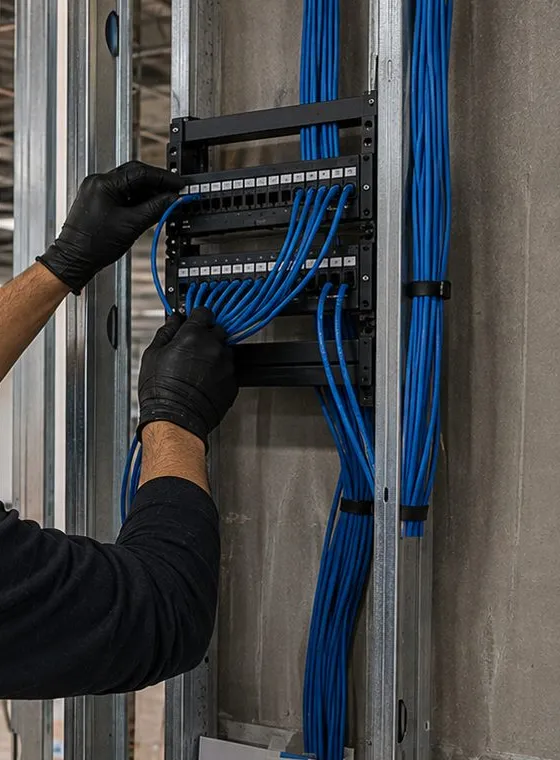
Before anything is bought, a sketch of where each product draws power, which circuits already carry the TV, kitchen and air conditioner, and where low-voltage cable can travel without sharing a hole with house wiring.
Pairs of in-ceiling speakers in the kitchen, family room or primary bedroom, wired back to an Amp with the gauge Sonos specifies for the distance and checked for polarity before the grilles go on.
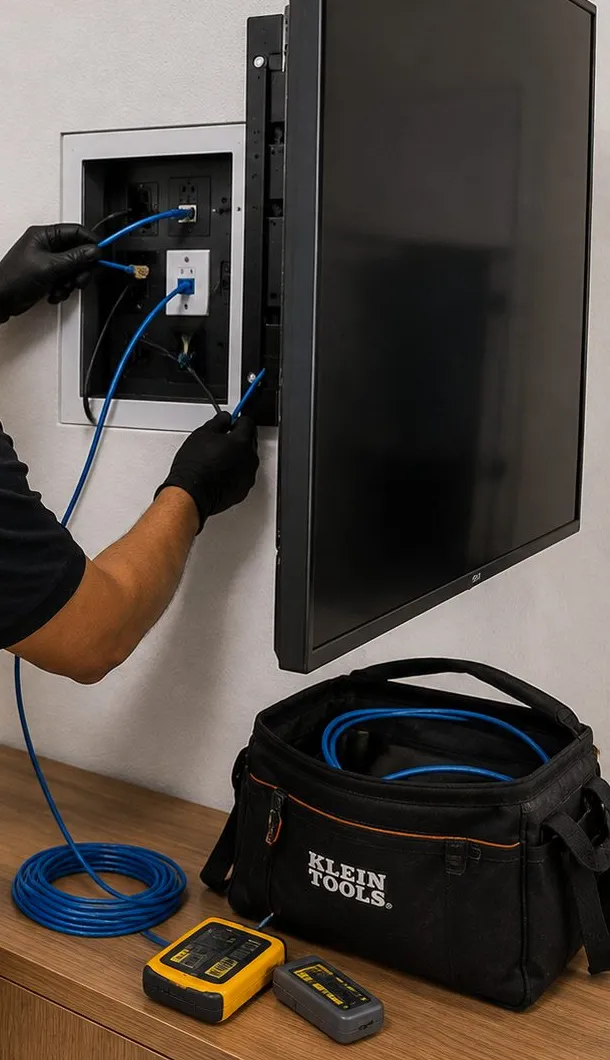
Arc Ultra, Beam or Ray beneath the TV, with power and HDMI routed inside the wall through a code-compliant in-wall kit rather than a cord dangling to the skirting.
Sonos's passive outdoor speakers on decks, porches and patios facing Eastchester Bay, powered by an Amp that stays indoors, so the deck needs speaker wire rather than an extra outlet.
A Sub and a soundbar or ceiling pair for the finished basement many local houses have, placed so bass stays downstairs and the Amp has the air space Sonos asks for.
One Sonos household per apartment, or one shared system for an extended family, with the equipment powered from the right side of a building that has two electric meters.
An Era 100 Pro in a garage or basement workshop, powered and connected over a single network cable from a PoE+ switch, where there is no convenient outlet.
Tracking down hum and buzz in ceiling speakers, separating speaker runs from lighting circuits, and putting the network and audio gear behind sensible surge protection.
Background music for function rooms, marina offices and the specialty food shops the neighbourhood is known for, on a staff network and a business-licensed music service.

The city's own rezoning study sorted Country Club's lots into detached, semi-detached and attached houses, and named protecting one- and two-family homes as its aim. Add the waterfront rows along the bay and the handful of clubs and shops, and you have almost every call we take here.
Free-standing houses on their own lots, built over many decades on the old club grounds. Four outside walls, a basement and usually an attic or crawlspace give us the most routes of any house type for cable to reach every floor.
Two houses sharing one party wall. The shared wall is the one we avoid for in-wall speakers and heavy brackets; the three outside walls, the basement ceiling and the attic carry the wiring instead.
Houses joined on both sides, including newer gated rows such as Sunrise Marina on Outlook Avenue, built in 2002 according to 6sqft. Runs travel front to back through basements and joist bays, and outdoor work happens on rear decks and patios.
Owner downstairs and a second apartment upstairs, or two generations of one family under one roof. StreetEasy, for instance, lists a three-storey two-family house of 1987 on Ampere Avenue. Two households, often two meters, sometimes two internet services.
Houses on the Eastchester Bay edge, some with private docks and boat slips. Big rear decks and porches, open views across the water toward City Island, and the longest speaker runs in the neighbourhood.
Beach-club function rooms, the marina and seaplane base at Outlook Point, and the small food shops and delis that serve the area. Mostly one large room, used hard in summer.
| House type | Where the Amp usually ends up | Typical speaker-wire route | Electrical points we check |
|---|---|---|---|
| Detached one-family | Basement shelf or utility room near the router, or a ventilated closet on the main floor | Up through the basement ceiling into first-floor rooms; down from the attic into top-floor ceilings | Which circuit feeds the Amp's outlet; distance to the farthest speaker for gauge |
| Semi-detached | Basement, against an outside wall rather than the party wall | Along the basement ceiling to outside walls, then up | Shared-wall wiring left alone; existing cable bays identified before drilling |
| Attached row | Basement or a hall closet midway along the house | Front to back through joist bays; rear wall to the deck | Rear-wall penetration sealed; deck run length measured for the 80-foot gauge break |
| Two-family | On the owner's side of the building, or one Amp per apartment | Kept within each apartment unless both households share a system | Which meter the equipment draws from; separate networks if two internet services |
| Waterfront with deck | Indoors, on the floor nearest the deck | Through the rear wall or the deck ceiling to outdoor speakers | No outdoor outlet needed for passive speakers; GFCI status of any existing deck outlet |
| Club, marina or shop | Back office or behind the counter, away from heat | Ceiling space above the main room | Dedicated or lightly loaded circuit; licensed music service |
Two methods matter more in Country Club than in the denser parts of the Bronx. The first is starting in the basement. Most of these houses have one, and most internet providers bring their line in there or close to it. A basement ceiling with exposed joists is the easiest place in any house to run cable from end to end, and it lets us reach first-floor ceilings from below without opening a single finished wall. Where a speaker belongs on the top floor, we go into the attic instead and come down. The finished middle floor is the last place we cut.
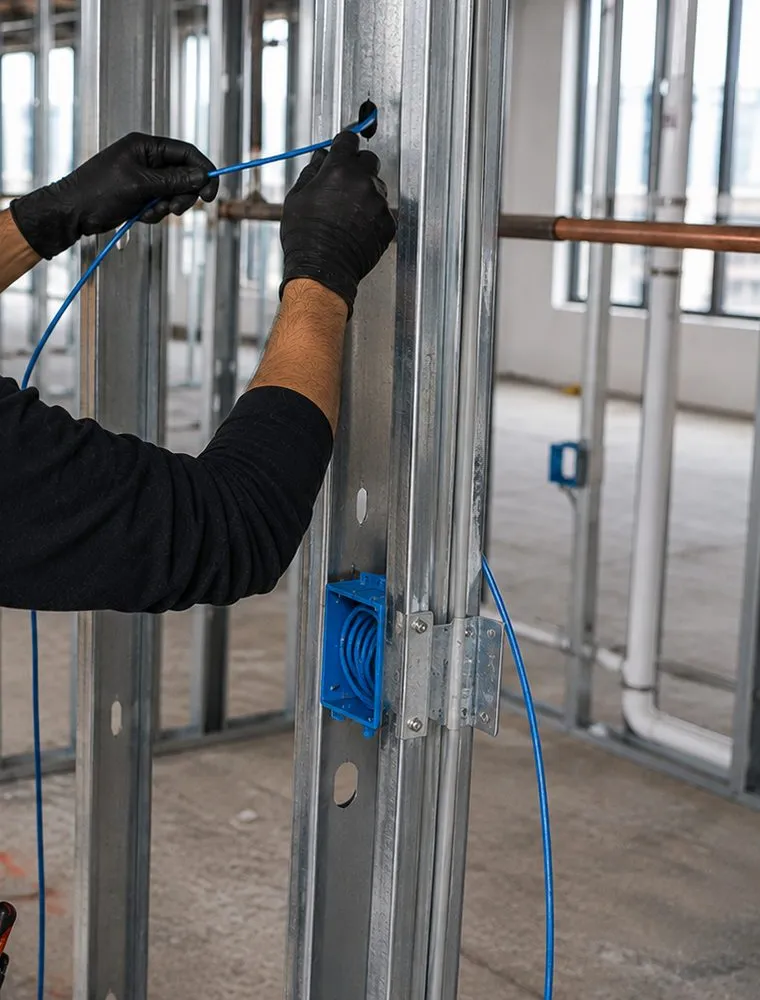
The second is treating the house's own wiring as a neighbour we do not touch. Older houses can have electrical cable running anywhere, including through the same stud bay a speaker cable wants. We trace before we drill, keep speaker and network cable in their own holes, cross power cable at a right angle when the two have to meet, and never borrow an electrical box or a junction for low-voltage work. It costs a few minutes and saves the buzz, the safety question and the awkward conversation with your electrician later.
While the joists are exposed, think about cameras and the front door as well. The cable path that carries speaker wire to the deck will carry a camera cable just as easily, and a two-family entrance often needs a better doorbell or entry panel. Book the Country Club security camera installers or the AESS intercom team for Country Club for the same day and the basement is opened only once.

If you live on Ampere, Ohm or Watt Avenue you already have the vocabulary. Here is what each of those words means for the Sonos equipment in your house, using the figures Sonos itself publishes. None of it requires you to become an electrician; it does explain why we ask the questions we ask before the first hole is drilled.
Sonos rates its Amp at 125 watts per channel into 8-ohm speakers, from a Class-D amplifier. That is output: what the Amp can push into a speaker at full stretch. Sonos asks that the speakers be rated to handle at least 125 watts if they are 8-ohm models, and at least 200 watts if they are 4-ohm models, so that a party-volume afternoon does not overdrive a speaker that was never meant for it. When customers bring us speakers they have already bought, the power rating on the box is the first thing we read.
Input is a different story. Sonos lists the Amp's power supply as auto-switching, 100 to 240 volts, 2.5 amps maximum. A typical household circuit is protected at 15 or 20 amps, so one Amp is a modest load. The catch is what else lives on that circuit: a TV, a cable box, a game console, a space heater in winter or a window air conditioner in summer. We ask which outlets share a breaker because a circuit that trips when the air conditioner starts will take the music down with it.
And then there is the power the system draws doing nothing. Sonos publishes idle figures for every product at 120 volts. The numbers are small, but a whole house of products is on around the clock, so the arithmetic is worth seeing once.
| Product | Sonos idle figure (120 V) | Energy over a year if left on (our arithmetic) |
|---|---|---|
| Amp | 7.3 W | About 64 kWh |
| Beam (Gen 2) | 6.04 W | About 53 kWh |
| Arc Ultra | 4.6 W | About 40 kWh |
| Port | 3.6 W | About 32 kWh |
| Sub Mini | 2.98 W | About 26 kWh |
| Ray | 2.92 W | About 26 kWh |
| Era 100 | 1.98 W | About 17 kWh |
| Sub 4 | 1.75 W | About 15 kWh |
| Era 300 | 1.71 W | About 15 kWh |
The annual column is simply watts multiplied by the 8,760 hours in a year and divided by a thousand; it assumes the product never plays, which is never quite true. Multiply by whatever your Con Edison bill says you pay per kilowatt-hour and you have the real cost of leaving things on. For most households it is a small figure, and switching products off at the wall each night tends to cause more trouble — rooms missing from the app, updates that never install — than it saves.
Ohms describe a speaker's electrical load. Lower numbers ask more of an amplifier. Sonos's rule for its Amp is clear: speakers with a nominal impedance above 4 ohms are fine, two pairs of 8-ohm speakers wired in parallel are supported, and nothing rated below 4 ohms should be connected. Sonos also tells installers not to wire speakers in series, because the sound suffers. Those three sentences decide how many speakers one Amp can carry, and whether a second Amp is needed for the deck. We read the impedance off every speaker, including the ones a previous owner left in the ceiling, before any of them is connected.
Thin wire over a long run wastes some of the Amp's power as heat in the cable and softens the bass. Sonos publishes a simple table, and it is the one we work from. In most Country Club houses the runs are under 80 feet; the exceptions are long attached rows and waterfront lots where the Amp is at the front of the house and the speakers are at the far end of the deck.
| Distance from Amp to speaker | Sonos recommendation | Where we meet it in Country Club |
|---|---|---|
| Less than 80 ft | 16 AWG | Kitchen, living room and bedroom ceilings in most detached and semi-detached houses |
| 80 to 200 ft | 14 AWG | Front-of-house Amp to a rear deck on a long lot or across an attached row |
| 200 to 300 ft | Heavier wire, per Sonos's table | Rare; usually a sign the Amp should move closer instead |
| Over 300 ft | Not recommended by Sonos | Move the Amp, or use a powered speaker on a network cable |
Sonos's own setup article recommends speaker wire between 12 and 16 gauge for the Amp. In-wall runs should also carry a fire rating suitable for inside walls; that is a question of the cable jacket rather than its thickness, and we supply the right kind.
Every speaker terminal has a plus and a minus. Sonos warns that mismatching them "will result in weak central sound and a distorted sense of sound direction." In a ceiling installation where both wires look alike, a single reversed connection is one of the most common faults we are called to fix. We mark conductors at both ends, check each pair before the speaker goes into the ceiling, and listen for it again once the room is tuned.
This is where a careful installer and a licensed electrician divide the work. The New York City Department of Buildings says an electrical permit "is required for most electrical work, including handling of electrical wires that is performed in a residential home," carried out by electrical contractors the department licenses. New outlets, new circuits, moving a receptacle behind the TV, and anything inside the breaker panel are that kind of work. Speaker wire, network cable, the HDMI behind the screen and the Sonos products themselves are low-voltage work, which is what AESS does under its New York State licence. The in-wall kit we fit behind TVs is a listed product made for the purpose, so the soundbar and screen can draw power without anyone running an extension cord inside a wall.
| Task | Who does it | Notes |
|---|---|---|
| Speaker wire, network cable, HDMI runs | AESS | Low-voltage, kept apart from line-voltage cable |
| Mounting soundbars, speakers, Amps | AESS | Fixings chosen for the wall type |
| Code-compliant in-wall power kit behind a TV | AESS | Listed kit, $169 on the Bronx list |
| New outlet, new circuit, moving a receptacle | Licensed electrician | DOB-licensed contractor, with a permit |
| Panel work, breaker changes, GFCI replacement | Licensed electrician | We label what our equipment uses if you want |
| Diagnosing a circuit that trips | Licensed electrician | We can tell you which of our products is on it |
Half the words on the neighbourhood's northern street signs turn up again in a Sonos manual. Here is what each one means when it appears on a spec sheet or in one of our quotes.
| Word on the sign | What it measures | Where it matters in a Sonos system |
|---|---|---|
| Ampere (amp) | Electric current | The 2.5-amp maximum input of a Sonos Amp, against the 15 or 20 amps a household circuit is protected for; also the product's name, which is short for amplifier |
| Ohm | Resistance, or a speaker's load | Sonos's 4-ohm floor for the Amp, and the reason two 8-ohm pairs in parallel are fine while a 4-ohm pair wants its own Amp |
| Watt | Power | 125 watts per channel out of the Amp into 8 ohms, the speaker power ratings Sonos asks for, and the idle figures in the table above |
| Radio | Wireless transmission | Wi-Fi is radio: Sonos products use the 2.4 and 5 GHz bands, which is why we keep them a little apart from other wireless devices and cable one product to the router where we can |
| Research | Finding out before acting | Reading the panel labels, the speaker labels and the run lengths before anything is bought, which is the whole method of this page |
Volt, the one unit missing from the street map, is the line we do not cross: household outlets run at 120 volts, and that side of the house belongs to a licensed electrician. Everything we install runs at low voltage or plugs into an outlet that already exists.

The city's rezoning documents for this part of the Bronx talk about one- and two-family homes in the same breath, and set parking rules for each. Two-family houses are a large part of what we see here, and they raise questions a single-family house never does. The answers depend less on Sonos than on how the building is divided: who pays for which electricity, who owns which router, and whether the two households want to share music at all.
Most two-family owners want two independent Sonos households, one per apartment, each on that apartment's own network. That keeps the upstairs speakers out of the downstairs app, lets each household choose its own music services, and means a move-out never involves untangling a shared system. Where one family occupies both floors — parents downstairs, grown children upstairs — a single household with rooms named for each floor often works better, provided both floors are on one network.
Two-family houses commonly have two electric meters, sometimes a third for common areas. A shared piece of equipment — an Amp in the basement driving speakers in the shared yard, for instance — draws power from whichever outlet it is plugged into, and that outlet belongs to someone's meter. The draw is small, as the idle table above shows, but it is better decided on purpose than discovered later. We ask which basement outlets are on which meter before choosing the Amp's shelf.
Running cable from one apartment to the other is easy in a two-family house, because the owner controls both. It is also worth thinking twice about. A cable that crosses between apartments can join two networks that should stay separate. If both households want music on the shared deck, we often give the deck to one apartment's system and leave the other with a free-standing portable, rather than linking two networks for one pair of speakers.
When each apartment pays for its own internet, each has its own router, usually installed wherever the provider's technician found it convenient — often side by side in the basement. Sonos needs every product in a household on the same network, so each apartment's speakers belong on that apartment's router and nowhere else. The practical consequence is cabling: if the upstairs apartment wants a wired Sonos product or an access point, the network cable runs from the upstairs household's own router, not from the nearest one. We label both ends so a future provider visit does not swap them by accident.
Two-family houses change hands within families, and tenants come and go. A system built as two separate Sonos households survives those changes with no work at all: the departing household removes its products from its own account and the other floor never notices. That is the main reason we recommend separation by default, even for relatives who get on well. Joining two households later is easy; untangling one shared system in the week somebody moves out is not.

Three short streets in Country Club carry the names of Wagner operas. We take them as a prompt rather than a profile of who lives there: most Sonos systems in this city are tuned for television dialogue and streaming playlists, and very few are set up for the music with the widest range between quiet and loud. Opera, orchestral music, jazz, piano recitals and well-mastered older recordings all reward a little extra care.
For music, a stereo pair beats a single speaker in almost any room larger than a bedroom, and two Era 100s or a pair of ceiling speakers spaced to suit the listening seat will image better than one bigger product in the corner. In detached houses with plaster or drywall over wood framing we can put ceiling pairs where the geometry is right rather than where the joists happen to allow it, because we can reach the ceiling from the attic or basement. Trueplay, run with each speaker in its final position, then corrects for the room's reflections.
Sonos gives every room bass, treble and loudness controls, plus balance on products such as the Amp and Port. Sonos describes loudness as boosting certain frequencies, including bass, at low listening volumes, "to compensate for normal changes in the ear's sensitivity." That is welcome for background music at dinner and less welcome when the volume is up for a full orchestra, which is why we show owners where the switch is and let them decide room by room rather than setting it once for the whole house.
The enemy of soft music is noise, and in a house much of the noise is electrical: a buzzing ceiling speaker on a dimmed lighting circuit, a hum from a ground loop at an old receiver, a fan in a cabinet. Wiring that keeps low-voltage cable away from line voltage, products that are not stacked on top of other electronics, and an Amp with the open space Sonos asks for are what let a pianissimo come through without a background hiss. It is the same electrical discipline as the rest of this page, heard rather than seen.

Country Club is overwhelmingly residential, so its businesses are few and specific: clubs on the water, a marina, a school campus and the food shops that serve the neighbourhood and its edges. Each wants simple, dependable background music that staff can run without a manual.
Rob Stephenson counted two clubs still operating in Country Club in 2023, the American Turners Club and the DA Beach Club, whose sign dates it to 1937; 6sqft quotes a 2003 Times piece naming the Manheim and the American Turners among the beach clubs that have anchored local social life for decades. Function rooms, poolside decks and bars that host family parties.
Wikipedia places the marina and its seaplane base on the west bank of Eastchester Bay at Outlook Point. Marina offices and waterside lounges want music that carries across one large room and switches off when the last boat is in.
The Bronx Times reported in 2018 that a former beach-club property at Palmer Inlet, beside Villa Maria Academy, was being given to Fordham University for its sailing and crew programmes. Institutional buildings like these need volume limits and a schedule more than they need power.
Wikipedia, citing the Times, notes the neighbourhood's many family-owned Italian specialty stores and delicatessens. A counter shop needs one or two speakers, music that starts when the shutters go up and a service licensed for business use.
A professional working from the ground floor of a house, or any small waiting room, needs quiet background sound in one room only, and nothing a visitor can change from their own phone.
Halls used for meetings, parties and fundraisers, where a mixed crowd needs a microphone-free system that a volunteer can switch on, set to a sensible level and leave.
Club and marina rooms swing between empty weekday afternoons and packed summer weekends. We usually split such a room into two Sonos groups — the bar and the main floor — so staff can keep the bar quiet while the dance floor is busy, set a volume ceiling on each, and give the duty manager a simple routine for opening and closing the room.

These are the electrical and wiring questions that come up when owners plan Sonos in their own houses. Each is answered from Sonos's published guidance, the city's licensing rules, or plainly labelled installer practice.
It can share. Sonos rates the Amp's supply at 2.5 amps at most, and in normal listening it draws far less, so it sits comfortably on an ordinary household circuit alongside a TV and a cable box. What we avoid is a circuit that also carries a heavy, switching load such as a window air conditioner, a space heater or a microwave, because those are the circuits that trip on a hot evening and take the music with them. If your TV wall has only one receptacle and everything ends up on a power strip, we tell you; an extra outlet is a job for an electrician, and it is often worth doing at the same time.
Less than most people expect. Sonos publishes idle consumption for each product: 7.3 watts for an Amp, 6.04 for a Beam (Gen 2), 4.6 for an Arc Ultra and under 2 watts for an Era 100, Era 300 or Sub 4. A typical Country Club setup of one Amp, one soundbar and three Era speakers idles at roughly 20 watts, which works out at about 175 kilowatt-hours over a year if it never played at all. Multiply that by the per-kilowatt-hour figure on your Con Edison bill for the real cost. Turning everything off at the wall nightly saves a little and tends to leave rooms missing from the app in the morning.
We recommend it for the Amp, the router and anything plugged in at the TV wall, and yes, the kind matters. A plain power strip only adds outlets; a surge protector has a joule rating and an indicator that tells you it is still working, and the cheap ones quietly stop protecting after a large surge. Protect the network gear as well as the audio, because a dead router stops every Sonos product in the house. Sonos's own Amp guide also asks owners to unplug it during lightning storms. Whole-house surge protection at the panel is a separate option, fitted by an electrician.
A brief dip is unlikely to harm it: Sonos specifies an auto-switching supply that accepts 100 to 240 volts, so it rides through small swings that would bother older equipment. But dimming every time a compressor starts is a sign that the circuit or the house's service is working hard, and that is worth an electrician's look in its own right. Our part is simple: we keep the Amp and the router off the air conditioner's circuit, put them behind a surge protector, and, if dropouts line up with the compressor, we say so in writing so the electrician knows where to start.
Usually not. The panel needs clear working space in front of it so an electrician or a firefighter can open it quickly, and shelves of electronics in that space get in the way. Panel closets are also often small and warm, while Sonos asks for at least three inches of clearance around the Amp and an operating range of 32 to 104°F. We would rather put the Amp on a basement shelf or in a ventilated utility space nearby, with a short run of speaker wire, and leave the panel exactly as accessible as your electrician needs it.
Not as two separate zones, and not safely as one either. An Amp plays one stream to one pair of outputs, so the kitchen and the deck would always play the same thing at the same relative volume. And Sonos's rule is that two pairs in parallel are supported only when they are 8-ohm speakers; wiring a 4-ohm pair in parallel with anything drops the load below the 4-ohm floor Sonos sets. The clean answer is two Amps, one per zone, which also lets the deck play quietly while the kitchen plays louder. If the deck pair is already bought and is a 4-ohm model, it gets an Amp to itself.
Sometimes. We test it before deciding. Sonos recommends 16-gauge wire for runs under 80 feet and 14-gauge from 80 to 200 feet, and its Amp setup guide suggests staying between 12 and 16 gauge. Thin, unmarked "zip cord" stapled along baseboards decades ago often fails that test, or turns out to be broken or shorted somewhere out of sight. If the old wire is the right size, continuous and rated for use inside walls, we reuse it and save you the cost of a new run. If not, we leave it in place, disconnected, and pull new cable alongside.
Almost certainly a reversed connection. When one speaker's plus and minus are swapped, its cone moves out while its partner moves in, and the two cancel each other in the middle of the room; Sonos describes the result as "weak central sound and a distorted sense of sound direction." It is common where both conductors look alike and the cable was marked badly, or not at all. The fix is to swap the two wires at one end. On our own installations we mark every conductor at both ends and check each pair before the grilles go on, so this is one fault we should never leave behind.
We keep them apart. Electrical codes treat low-voltage cable and household power wiring as separate systems, and running them through the same bored hole or bundling them together invites both a code problem and audible hum. In practice we drill separate holes, keep a few inches between speaker cable and power cable where they run side by side in a bay, and cross power cable at a right angle when the two must meet. We never use an electrical box, a junction box or a fixture's opening as a pathway for speaker or network cable.
Very likely. Many dimmers work by chopping the electrical waveform, and that chopping creates electrical noise that can be picked up by a speaker cable running alongside the lighting cable, especially in the same joist bay as recessed lights. The tell-tale sign is exactly what you describe: silence at full brightness, buzz as the dimmer comes down. The lasting fix is to reroute the speaker cable away from the lighting circuit, cross it at right angles, and, where the dimmer itself is noisy or mismatched to the bulbs, have an electrician swap it for a better-suited model. A shielded patch rarely solves it on its own.
Whoever owns the system, in most cases. If the owner's family runs a Sonos system that includes the shared yard or basement, the Amp and router should plug into an outlet on the owner's meter, so the tenant never pays for the owner's music, however little it costs. We find out which basement outlets belong to which meter, usually by checking against the panel labels with you, and put the equipment there. If two households share one system by agreement, we still pick one meter and write it down, which saves a disagreement later.
Try it both ways, but most people end up switching it off for serious listening at a decent volume. Sonos explains that loudness boosts certain frequencies, including bass, at low volumes to compensate for the ear's lower sensitivity when music is quiet. At background levels that helps a string quartet sound less thin. At the levels people choose for a full orchestra or a big voice, the extra bass can blur things. Because the setting is per room, a sensible pattern is loudness on in the kitchen and off in the room where you sit down to listen.

Every product below is one we fit regularly in Country Club houses. Alongside what each is for, we have noted how it connects and what Sonos says it draws when idle, since that is the side of the job this page is about.
Sonos's flagship soundbar, about 46 inches long, on HDMI eARC. For a large family room or a wide basement screen. Idle draw 4.6 W. On Sonos's own wall mount it detects the wall and adjusts its bass.
About 25½ inches, HDMI ARC or eARC. The bar that fits most living rooms and bedrooms here. Idle draw 6.04 W; pairs with a Sub Mini or Sub 4 later without rewiring.
Sonos's smallest bar takes its sound over an optical lead, which suits the TV in a back bedroom or the upstairs apartment of a two-family house. Idle draw 2.92 W.
The everyday speaker, and the easiest stereo pair for a music room. Idle draw 1.98 W. Plugs into any ordinary outlet; no Amp needed.
A larger speaker with upward- and side-firing drivers, for rooms where one speaker has to fill a lot of air. Idle draw 1.71 W. Sonos's wall mount for it is stud-mount only.
Wireless bass units. Sub 4 for large rooms and basements, idle 1.75 W; Sub Mini for small and medium rooms, idle 2.98 W. Both need only power and a place where the bass will not travel straight into a bedroom.
Powers passive ceiling, wall and outdoor speakers: 125 W per channel into 8 ohms, nothing below 4 ohms, two 8-ohm pairs in parallel at most, 2.5 A maximum input. Idle 7.3 W. Needs 3 inches of space on every side.
The bridge for owners who are keeping a favourite receiver or integrated amplifier: line and coaxial outputs, plus a 12 V trigger that switches that amplifier on when music starts. Idle 3.6 W, on a shelf next to the stereo.
Sonos's professional speaker powered over the network cable: optimised for PoE+ at up to 30 W, compatible with standard PoE at 15.4 W, 2.4 W idle. Useful in a garage or workshop with network cable but no handy outlet.
Sonos's passive outdoor pair, rated IP66, powered from an indoor Amp through speaker wire. The deck needs a sealed wall penetration, not a new outlet.
Battery portables that join the home system on Wi-Fi and go out to the deck or the dock for the afternoon. Move 2 idles at 1.6 W on its base; the base itself is for indoor use.

Google's AI Overview did not load for us when we researched this page, so nothing below is a quotation of it. Instead we took seven statements about Sonos that turn up again and again in cost guides, product marketing and chatbot answers, and held each one up against Sonos's own specification pages, New York City's licensing rules and the wiring we actually find in Country Club houses.
The speakers stream wirelessly, but every one of them still needs power, and the architectural products need copper. A Sonos Amp drives passive ceiling, wall and outdoor speakers through speaker wire; a soundbar needs a power cable and an HDMI cable to the TV; a reliable system often has at least one product cabled to the router.
In an apartment, "wireless" is close enough to true, because most renters use plug-in speakers on a shelf. In a Country Club house, where owners want ceiling speakers in the kitchen and a pair on the deck, the wiring is the job and the wireless part is the easy last step.
That is why our quotes describe routes, wire and outlets before they mention products. The music arrives wirelessly; the sound comes out of speakers that are as well wired as the cable behind them.
Most will, but not all. Sonos says the Amp can drive speakers above 4 ohms, supports two pairs of 8-ohm speakers in parallel, and should not be connected to anything rated below 4 ohms. It also asks for speakers rated to handle at least 125 watts if they are 8-ohm and at least 200 watts if they are 4-ohm.
The speakers most likely to break those rules are the ones already in a house: an older pair left in a ceiling, or two pairs a previous owner wired together to cover one big room. We read the labels, measure what we cannot read, and plan the number of Amps from that.
"It will probably be fine" is how amplifiers end up shutting down mid-party. Checking takes minutes and is part of every quote we write.
Not past a point. Sonos's guidance is plain: 16 gauge for runs under 80 feet, 14 gauge from 80 to 200 feet, heavier beyond, and nothing over 300 feet. Thicker wire than the run needs does not improve the sound; it just costs more and is harder to pull through old framing.
In most Country Club houses, ceiling speakers sit well within 80 feet of a basement Amp. The runs that need 14 gauge are the long ones to rear decks on deep lots or across attached rows.
What genuinely affects the sound is a sound connection: wire that is continuous, the right way round, properly terminated and kept away from lighting circuits. We spend our effort there.
Sonos publishes idle figures for every product, and they are small: 7.3 watts for an Amp, 6.04 for a Beam (Gen 2), around 2 watts or less for an Era 100, Era 300 or Sub 4. An Amp, a soundbar and three Era speakers together idle at roughly 20 watts.
Owners who switch everything off at the wall each night save a modest amount and often lose more in convenience: products have to rejoin the network every morning, updates arrive late, and rooms go missing from the app.
If the electricity matters to you, the better move is fewer, better-placed products rather than nightly unplugging. We will show you the idle table and do the arithmetic with you before you buy.
A power strip is an extension with more sockets. A surge protector is a different product with a rated capacity, and many inexpensive models stop protecting after absorbing one large surge while still passing power, so nothing looks wrong.
For Sonos, the piece most worth protecting is often not a speaker at all but the router and switch the whole system depends on. Sonos's own Amp guide adds the low-tech advice of unplugging during lightning storms.
Our approach is installer practice rather than a Sonos rule: a surge protector with a working indicator for the Amp, the TV wall and the network gear, replaced when the indicator says so, and an electrician's opinion if you want whole-house protection at the panel.
Not legally, in New York City, unless they are also a licensed electrician. The Department of Buildings states that most electrical work in a home needs a permit and must be carried out by electrical contractors it licenses. New receptacles, new circuits and anything in the panel fall on that side of the line.
What a low-voltage installer can do is everything at low voltage — speaker wire, network cable, HDMI, mounting — and fit listed in-wall power kits made for TV walls, which avoid the dangerous habit of running an extension cord inside a wall.
We tell you at the quote stage if a job needs an electrician, and we are happy to work on the same day as yours so the room is opened once.
Powered outdoor products do, and a battery portable needs a charge. But Sonos's outdoor speaker pair is passive: it takes its power through speaker wire from an Amp that stays indoors, so the deck itself needs no new receptacle.
That matters on the bay side, where a deck outlet may be old, unprotected or tripping in the rain. The national model electrical code requires ground-fault protection for outdoor receptacles at homes, and an electrician can tell you whether yours meets what New York City requires.
We would rather run one sealed speaker cable through the rear wall than ask a deck outlet to power an amplifier outdoors. The Amp stays dry, warm and within Sonos's 32–104°F operating range.
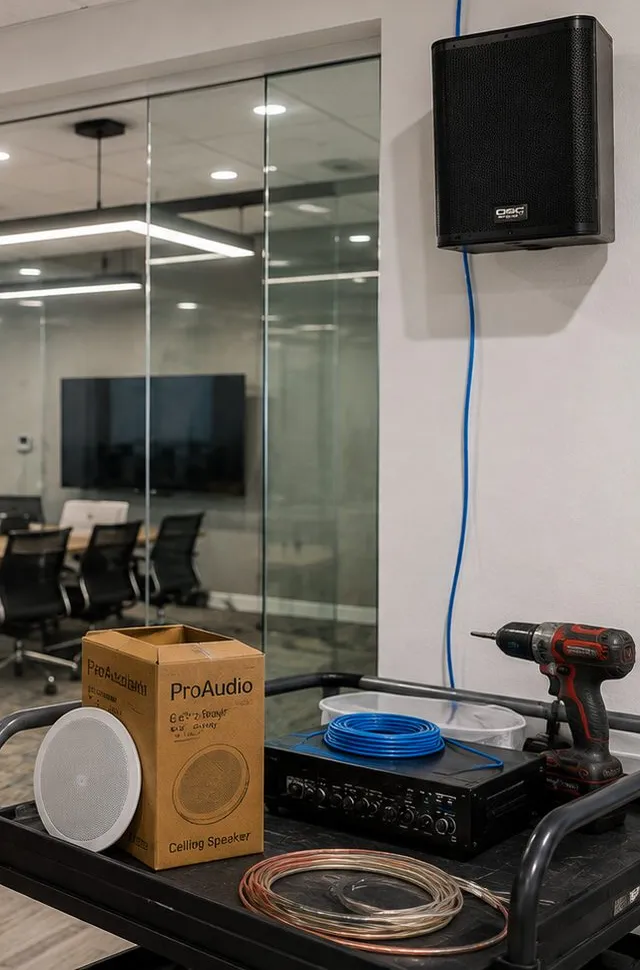
Send the house type, the rooms, a photo of the breaker panel and the TV wall. We'll tell you where the Amp should live, which runs need heavier wire and what it all costs on the Bronx list.
Most Country Club jobs can be priced from a few lines: the house type, the rooms that want music, the products you own or plan to buy, where the internet arrives and roughly where the breaker panel is. The figure comes back in writing the same business day. If you would rather talk it through, call (646) 490-0629.
Your details are with an installer now, and a written figure or a phone call follows today. If something has stopped working and cannot wait, ring (646) 490-0629.
The order of work is the same for a single Ray in a Parsifal Place bedroom and for a basement Amp feeding six rooms and a bayfront deck. The difference between a tidy job and a troublesome one is mostly decided in the first two steps.
We start at the breaker panel and the outlets on the walls that will hold equipment, noting which circuits carry the TV, the kitchen and any air conditioner, and testing the receptacles we plan to use.
We measure from the planned Amp location to every speaker, choose wire gauge from Sonos's table, and read the impedance and power rating of every speaker, including any already in the house.
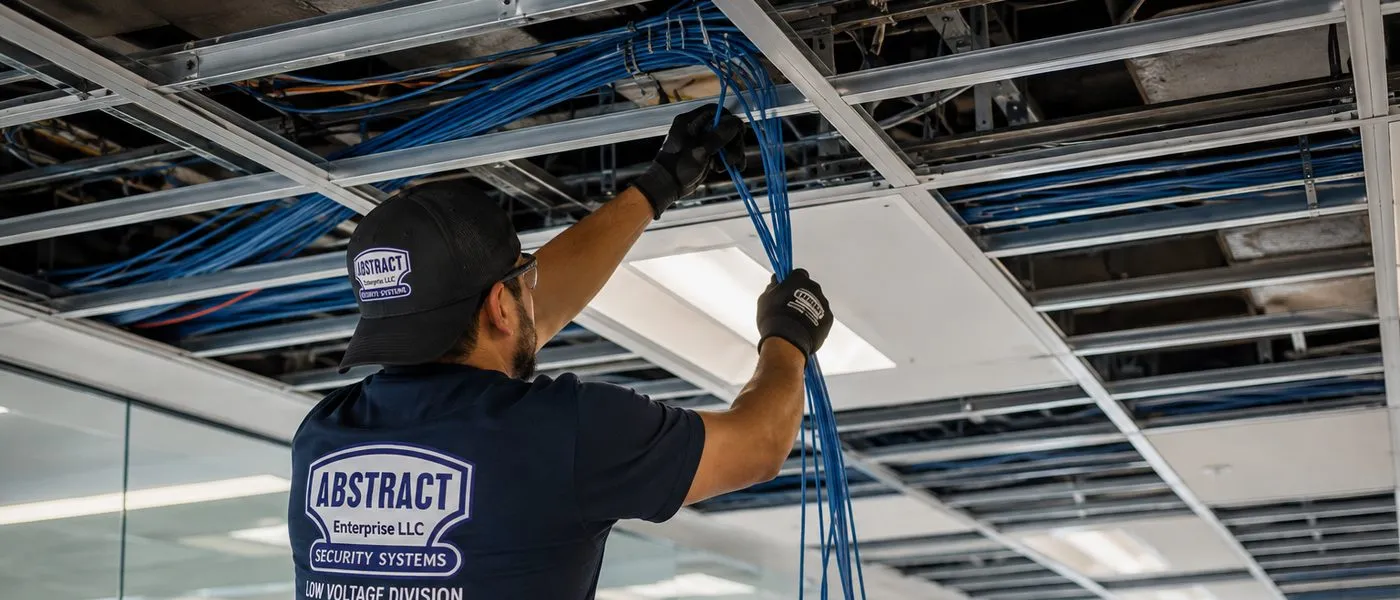
Cable goes in through the basement ceiling or the attic, in its own holes, crossing house wiring at right angles; anything that needs a new outlet is booked with your electrician.
Soundbars, ceiling and outdoor speakers go up on fixings suited to the wall; every conductor is marked at both ends, and each pair is checked for polarity before the grilles go on.
Equipment goes on surge protection, Trueplay runs in each supported room, and we listen at low volume with the lights dimmed for buzz or hum before calling a room finished.
Rooms get the names you use, music services are signed in, loudness is set the way you like it, and you get a short note of which outlet and breaker each piece of equipment uses.

Our crews cover the whole neighbourhood, Middletown Road down to Layton Avenue and the Thruway east to the bay. When customers give directions, these six names come up most.
Ampere Avenue, Ohm Avenue, Watt Avenue, Radio Drive and Research Avenue, laid out in the 1920s and named for electrical science in honour of Isaac L. Rice of the Electric Storage Battery Company (Untapped New York; NYC Parks).
Three short streets named after Wagner operas, credited by the Bronx historian Lloyd Ultan to Eugene Rosenquest of the Westchester Electric Light Company (as cited in The Neighborhoods, 2023).
The road that once formed the northern edge of the old club's grounds, now running past Villa Maria Academy to the waterfront property at Palmer Inlet that the Bronx Times reported going to Fordham's sailing and crew programmes in 2018.
One of the street names, with Country Club Road, that the Bronx Times identifies as a reminder of the Country Club of Westchester, whose 1890 clubhouse on the bay offered polo, boating and drag hunts before it burned in 1922.
The marina and seaplane base on the west bank of Eastchester Bay (Wikipedia), around the corner from the gated Sunrise Marina homes on Outlook Avenue described by 6sqft.
New York City's largest park, just north of the neighbourhood, where Rice Stadium — funded in Isaac Rice's memory — stood until the late 1980s and the statue American Boy from its grandstand still stands (Untapped New York).
We also install Sonos in the neighbouring parts of the East Bronx the city's rezoning study grouped with Country Club — Pelham Bay, Spencer Estates, Schuylerville, Throgs Neck and Edgewater Park — and across the water on City Island.
Country Club is priced on the Bronx list, and our area table puts the Bronx level with Brooklyn — no neighbourhood premium, no charge for parking on a quiet residential street. Every figure below is already published on that list. Work we cannot price without seeing the basement, the attic or the deck framing is quoted in writing after a look, and nothing gets added on the day unless you agree to it first.
| Line | Bronx price | How it shows up in a Country Club house |
|---|---|---|
| Sonos setup | $125 | Every Sonos product on one household, rooms named the way your family talks, music services signed in, Trueplay run where supported |
| Soundbar wall-mounted under the TV | $129 | Beam, Ray or Arc Ultra fixed level below a living-room or basement screen |
| Soundbar placed on a console | $79 | For a bar that stays on its cabinet, or a room you may rearrange |
| Sanus soundbar bracket | $84.99 | When you have no mount rated for the bar you bought |
| In-wall concealment | $169 | Listed in-wall power and cable kit so the TV and bar draw power without a cord on show |
| Paintable cord cover | $59 | Slim raceway on brick or a wall you would rather not open |
| Cable run to a cabinet or other spot | $99 | Short HDMI or network run of 25 ft or less, say TV wall to sideboard |
| A/V receiver | $129 | Connecting a receiver, including to a Sonos Port |
| Universal remote | $99 | One remote for the TV, the cable box and the Sonos volume |
| Streaming device setup | $49 | Each box or stick, signed in |
| Full home theater | $350 | Multi-component setup in a family room or basement |
| Remove an old bracket | $45 | Before the new soundbar or TV goes up |
| Take down an old TV | $85 | When the TV wall is being redone |
| Setup-only visit | $225 first hour | Half-hour blocks after that; typical after a power cut or a new router |
| TV mounted on the same visit | From $209.99 | Bronx starting price for a 32″–55″ set, wall and size lines extra |
| Ceiling, wall or outdoor speakers on an Amp | Quoted at walkthrough | Written per zone once we have measured the runs; AESS publishes $800–$2,500 per zone for whole-home audio |
| Speaker-wire and network runs, Amp location work | Quoted at walkthrough | Set by basement and attic access and how far the speakers are from the Amp |
| Condition | Price | Where we meet it here |
|---|---|---|
| Drywall on wood studs | $0 | Renovated rooms and newer houses |
| Metal studs | +$30 | Some newer partitions and finished basements |
| Plaster | +$45 | Original walls in older houses |
| Brick or stone | +$65 | Fireplace surrounds and chimney breasts |
| Concrete or cinder block | +$75 | Basement and foundation walls |
| Tile or marble | +$95 | Kitchens and bathrooms |
| Plywood backer board | $85 | When the studs fall in the wrong place for a bar |
| High mount, above about 8 ft | $75 | Tall family rooms and club halls |
| Walk-up, 3rd floor and above, no elevator | $40 | Top-floor apartments in two-family houses |
| Box removal | $25 | If you want the cartons taken away |
| Certificate of insurance | Free | For a club board, a marina office or a landlord |
These are worked sums, not offers: each total is built from lines already printed above, in the same way a written quote is assembled. Wall type, discovered on the day, can move a figure up by its listed amount.
| Example | Lines | Total |
|---|---|---|
| Bedroom Ray left on its stand, with the household set up | $79 console placement + $125 Sonos setup | $204 |
| Living-room Beam on drywall over wood studs, our bracket | $129 + $84.99 bracket + $0 drywall + $125 setup | $338.99 |
| Beam on an original plaster wall, our bracket | $129 + $84.99 bracket + $45 plaster + $125 setup | $383.99 |
| Screen above a brick chimney breast: Beam bracketed beneath it, wiring in painted raceway | $129 + $84.99 bracket + $65 brick + $59 cord cover + $125 setup | $462.99 |
| Basement bar on its console plus one remote for everything | $79 console + $125 setup + $99 universal remote | $303 |
Cost guides versus a Country Club quote. National averages assume an average room and say nothing about whether the Amp is 30 feet or 120 feet from the deck, whether the old ceiling speakers are 4-ohm, or whether the TV wall has a spare outlet. Every line we charge appears on our Bronx TV mounting price list.
Three bundles cover the bulk of requests from this neighbourhood. They are conveniences rather than discounts: every figure is the sum of ordinary price-list lines, and a wall surcharge appears only when your particular wall calls for one.
$204
Your soundbar placed on its console and connected ($79), and every Sonos product in the house brought together and tuned ($125). No drilling and no new wiring: the right choice for a bedroom, a second TV or the upstairs apartment in a two-family house.
$383.99
A Beam, Ray or Arc Ultra mounted below the TV ($129) on a Sanus bracket ($84.99), the plaster line for an older wall ($45) and system setup ($125). On drywall over wood studs the plaster line drops off and the total is $338.99.
$606.99
A wall-mounted bar on our bracket ($129 + $84.99), the listed in-wall kit so the TV and bar draw power with nothing showing ($169), setup ($125) and a universal remote programmed for TV, cable box and Sonos ($99).
Bought the official Arc Ultra or Beam wall mount, or a third-party bracket with the right weight rating? Then our charge is the work: $129 to fix the bar, plus the wall line for your surface, plus $125 if the household needs setting up. Warranty on the bracket stays with its manufacturer. Should your plaster or brick look too weak for it, we raise that before the drill comes out and quote the Sanus alternative at $84.99.
Architectural work is priced zone by zone after a site visit, because the answer depends on run lengths, speaker impedance and how many Amps the plan needs. Expect each zone to land inside the $800 to $2,500 range AESS publishes for whole-home audio; the written quote lists every room separately so you can phase the work.
Four phone pictures usually do it — screen wall, open breaker panel, basement joists and the back deck — and the written figure tends to arrive before the day is out.
6sqft described Country Club as sitting on Eastchester Bay across from City Island, with "beach clubs, private docks, and a quiet, laid-back lifestyle," and the listing it featured had a rear porch of nearly 350 square feet with a pergola. Decks like that are where many owners here want music most. The electrical plan for them is simple once one principle is accepted: the amplifier stays inside.
Sonos's outdoor speaker pair is passive and rated IP66, designed to live outside and be driven by an Amp through speaker wire. The Amp itself is an indoor product: Sonos lists an operating range of 32 to 104°F and warns against exposing it to rain or moisture. So the Amp goes on a shelf inside, on the floor nearest the deck, and one cable runs out through a sealed hole in the rear wall or down through the deck ceiling. No outdoor receptacle is involved, and nothing powered sits in the weather.
The hole for the deck cable is drilled on a slight downward slope toward the outside, so water that reaches it runs out rather than in. The cable gets a drip loop before it enters, the opening is sealed on both faces, and on brick or block walls we use the masonry line on the price list rather than forcing a wood bit. Where the deck has a roof or a ceiling of its own, we prefer to come down through that from the room above and avoid a wall penetration altogether.
Plenty of decks have an outlet that trips in the rain or has lost its weatherproof cover. The national model electrical code requires ground-fault protection on outdoor receptacles at dwellings, and an electrician can tell you whether yours meets New York City's rules. You may still want that outlet for a portable speaker's charger or the string lights; a Move 2 or Roam 2 can join the house system for an afternoon. Sonos notes that the Move 2's charging base is for indoor use, so the base stays inside even when the speaker goes out.
Bay-side lots can be deep. If the router and the natural spot for the Amp are at the front of the house, the cable to the far corner of the deck may pass 80 feet, the point at which Sonos's gauge table moves from 16 to 14 gauge. We measure it rather than guess, and if the run is very long we suggest moving the Amp toward the back of the house with a network cable to it, which shortens the speaker wire and keeps the bass firm.
Houses here are close enough that a deck party is a shared experience. Two speakers aimed back toward the house, mounted under the eave and set with a volume limit in the app, carry better for the people on the deck and less across the yards than one loud speaker on a post. We set that limit with you on the day, before the first barbecue rather than after the first complaint.
Once the basement ceiling is open and the panel is mapped, other low-voltage jobs cost less to add than to book separately. These are the services Country Club owners most often pair with Sonos, each billed from the Bronx list.
The borough page this one sits under, covering apartment buildings, leases and co-op rules elsewhere in the Bronx.
Screen and soundbar mounted together, with the in-wall power kit fitted once.
Network cable from the router to the TV wall, the Amp shelf or a PoE switch for an Era 100 Pro.
Driveway, deck and dock coverage, with camera cable pulled along the speaker-wire routes.
Door entry for houses and two-family buildings, run through the basement routes opened for speaker wire.
Keypad and card entry for club gates, marina offices and shared side doors.
Bars from other makers hung and connected by the crew that does the Sonos work.
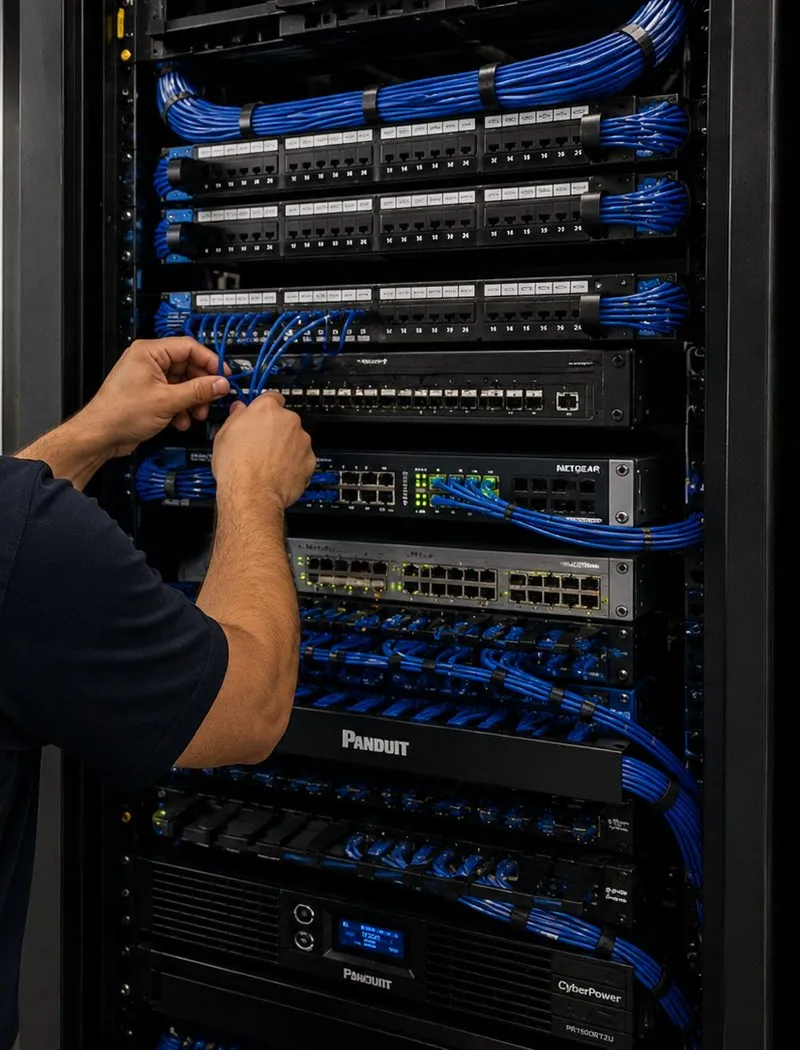
Routers, switches and wired access points that give a whole-house Sonos system a steady network.
Larger sound systems, projectors and receivers for clubs, halls and media rooms.
Lighting scenes and schedules that can include the Sonos rooms.
Scheduling, rescheduling, return visits and what to expect on the day.
What follows is our standard first half-hour in a local house, described as a checklist we follow, not a story about one customer.
We go to the breaker panel first and read the labels with the owner, because the labels are often decades old and somebody in the family usually knows which ones are wrong. Then we look at the TV wall: how many receptacles, what is already plugged in, whether a power strip is doing the work of an outlet that was never installed. A plug-in tester goes into each outlet we plan to use; a wiring fault found now is a call to the electrician, not a mystery later. Downstairs, we look up at the basement ceiling to see which way the joists run and where the house wiring travels, because that decides where our cable can go without sharing a hole. If there are old speakers in a ceiling, we find their labels and their wire before anyone mentions new products. Out back we pace the distance from the likely Amp shelf to the far corner of the deck. Only then do we talk about soundbars and speakers, and by that point the house has usually told us how many Amps it needs and where they should live.
Yes, if you would like us to. Once we know which outlet the Amp, the soundbar and the router use, we confirm which breaker controls each with you and add a clear label at the panel, plus a line in the handover note. We do not open the panel or touch any breaker beyond switching it off and on with your permission to confirm the circuit. If the existing labels turn out to be wrong elsewhere, we tell you, and a licensed electrician can correct the full schedule.
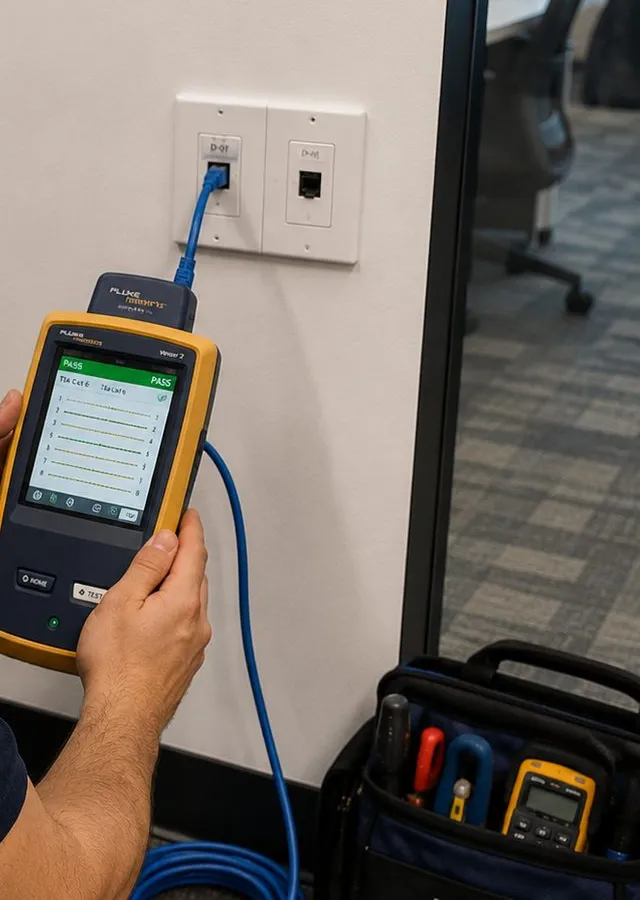
We do. Every receptacle we plan to use gets a plug-in tester, which shows common wiring faults such as a missing ground or reversed hot and neutral. If an outlet fails, we use a different one for now and give you a written note of what we found for your electrician, since repairing household wiring is line-voltage work. It takes seconds per outlet and is part of the visit, with no extra charge.
We advise against it. Sonos products are designed to stay powered so they remain on the network, receive updates and respond instantly; cutting their power at a wall switch makes them disappear from the app and reboot every time the lights go on. If you want music to start when you walk in, the better routes are a Sonos schedule or a lighting system that sends a play command rather than cutting power. Rewiring a switched outlet is also an electrician's job.
Very little. Pause any music, and if the Amp or soundbar is on a surge protector you can switch that off, so everything comes back together when the power returns rather than in bursts while the electrician tests circuits. Nothing needs resetting beforehand. When the work is finished, turn the router on first, give it a few minutes, then the Sonos equipment. If a room still fails to reappear, a setup-only visit sorts it out, and we can come the same day the electrician finishes.
This page sits under our Bronx Sonos installation page, which in turn reports to the citywide AESS Sonos hub. Every borough, county and neighbourhood page in the Sonos series is linked here so you can compare how the work changes from one kind of house to another.
Back to the Bronx · City Island, Bronx · Cobble Hill, Brooklyn · Astoria, Queens · Douglaston, Queens · Great Kills, Staten Island · Upper East Side, Manhattan · Park Slope, Brooklyn · Forest Hills, Queens · Riverdale, Bronx · Todt Hill, Staten Island · Greenwich Village, Manhattan · Grymes Hill, Staten Island · Battery Park City, Manhattan · Ditmas Park, Brooklyn
NYC Sonos installation · Manhattan · Brooklyn · Queens · the Bronx · Staten Island
Sonos installation on Long Island · Nassau County · Suffolk County
Hudson Valley Sonos installation · Westchester · Rockland · Orange · Putnam · Dutchess · Ulster
Sonos is one service among many: cameras, door entry, alarm systems and building networks come from the same licensed crews. Start at the Abstract Enterprises Security Systems home page for the full list, and check who we are and how we are licensed whenever you like.
Neighbourhood history, street names, building types, licensing rules and product figures on this page come from the sources below. Every dollar amount is from the AESS Bronx price list and nowhere else; the kilowatt-hour figures are our own arithmetic from Sonos's published idle watts.
Nine times out of ten the cause is electrical or network housekeeping rather than a broken speaker: a breaker that tripped with the air conditioner, a power cut that brought the speakers back before the router, or a replacement router from the provider. Ring (646) 490-0629 for the next free two-hour arrival slot; the usual fix takes an hour or two on site.
Abstract Enterprises Security Systems · 460 E Fordham Rd, Bronx, NY 10458 · (646) 490-0629 · WhatsApp (718) 679-0359 via wa.me
NYS Low-Voltage Licence #12000287431 · 100% Licensed & Insured · Same-Day Estimates · Rated 4.7★ from 201 Google Reviews
Sonos products carry their manufacturer's warranty. Full terms — including 50% deposit, one-year parts-only warranty on AESS-supplied products, and the late-fee schedule — are set out in the service agreement. See our warranty page.
Page reviewed and updated October 17, 2026. Changelog: Country Club page launched as a neighbourhood child of the Bronx Sonos page, covering the electrical side of Sonos (Amp watts and ohms, wire gauge, polarity, idle power, outlets and circuits, low-voltage versus electrician work), two-family houses, listening settings and bayfront decks on Eastchester Bay.