Gear Kept Above the Waterline · Outdoor Speakers Built for Salt Spray · Wired From the Attic Down · Bronx Price List
City Island is a mile and a half of wood-frame houses surrounded by Long Island Sound, and the water decides more about a Sonos system here than the furniture does. Some side streets flood several times a month; the Sound side takes the wind and the spray; the houses are clapboard over timber, which makes wiring easy if it starts in the attic and risky if it starts in a basement that floods. We plan City Island systems around three heights — where the water gets to, where the speakers sound best, and where the electronics will be safe — and we price every line from the same Bronx list we use on the mainland.
Reviewed and updated October 17, 2026 · Written by Anwar Timothy, NYS licence #12000287431 · Booked through our Bronx office at 460 E Fordham Rd

Send two photos before anything else: the spot where your internet line enters the house, and the lowest floor you would ever put a speaker on. On City Island those two pictures tell us whether the system's brains can stay where the provider left them or need to move upstairs. Ring the Bronx line, (646) 490-0629, or use the form; it takes about a minute.
City Island is the only part of the Bronx where every address is close to open water. Wikipedia describes the island as roughly 1.5 miles long and half a mile wide, set at the western end of Long Island Sound with Pelham Bay Park to the north and Eastchester Bay to the west, and counts 4,417 residents in the 2020 census. Benjamin Palmer bought it in 1761 meaning to build a seaport to rival New York, which is where the name came from; the port never happened, and the island became a place of oystermen, boatyards and, later, seafood restaurants. It joined New York City by a narrow vote in 1895, in exchange for a bridge, and one bridge is still the only road on or off. Writing for Forgotten New York, Kevin Walsh compared it to "a New England seaside town transplanted into the five boroughs." For a Sonos installer, that comparison is useful: the houses, the weather and the risks are coastal-village ones, not big-city ones.
The first thing that shapes the job is water at street level. In 2021 City Limits reported that on some City Island blocks the front of a house "becomes a lake" several times a month, whenever there is a new moon or more than a drizzle, and quoted John Doyle of the community group City Island Rising: "This is not a once-a-season problem, this is a Tuesday problem." Superstorm Sandy in 2012 flooded living rooms and tore the neon lobster off the Lobster House at the southern end of the island. This September News 12 Bronx filmed waterfront businesses stacking tables and covering chairs ahead of a nor'easter, with the Lobster House's manager recalling how Sandy's water ran into the parking lot and the street "and then there was no way for the water to go." In a house like that, the place the internet provider drops the router — often a basement or a ground-floor wall near the meter — is exactly where the most expensive Sonos parts should not live.
The second thing is the houses themselves. The Landmarks Preservation Commission's research staff, writing about the island's newest individual landmarks in 2017, described City Island's housing as "predominantly Italianate and Second Empire," and three of the houses the Commission has designated individually on the island show the range: the William H. Schofield House on Schofield Street, a transitional Italianate farmhouse of about 1860 sheathed in wood clapboard; the Booth House on Centre Street, a two-and-a-half-storey Stick-Style Queen Anne cottage of the late 1880s or 1890s; and the Stafford House on Pell Place, a 1930 Craftsman bungalow bought as a kit from Sears Roebuck. Wikipedia notes larger Victorian houses "mostly on the Sound side, complete with tall pointy spires and gables." Almost all of it is timber framing — good news for anyone who wants ceiling speakers, because wood joists and open attics are the easiest structure in the city to wire through.
The third thing is the air. Spray off the Sound, wind across Eastchester Bay and a long boating season mean that anything left outside on a porch or deck lives in conditions closer to a marina than a backyard. Sonos's own outdoor speaker pair is described by the company as "engineered for humidity, water, salt spray, heat, UV rays, and freezing temperatures," with an IP66 rating — but the portable speakers people carry out to the porch are rated for splashes and dunks, not for a summer of salt settling on the grille. Matching each product to where it will actually sit is most of the outdoor work we do here.
And then there is the neighbour on the next island. High Island, connected to the north end of City Island by a private bridge, carries the transmitter towers for two of the region's big AM stations, WFAN on 660 and the 880 station long known as WCBS. Strong nearby radio signals are one of the classic causes of buzzing in audio equipment, and a long run of unshielded speaker wire can behave like an antenna. It is not a problem in most houses, but it is a City Island question no installer on the mainland has to think about, and we cover it below.
Put together, the numbers describe a small, old, wooden, low-lying community that lives with the weather. None of that makes a good Sonos system harder to own. It changes where the parts go, which products face the outside, and how the network is built so that it comes back by itself after the power and the water have gone.
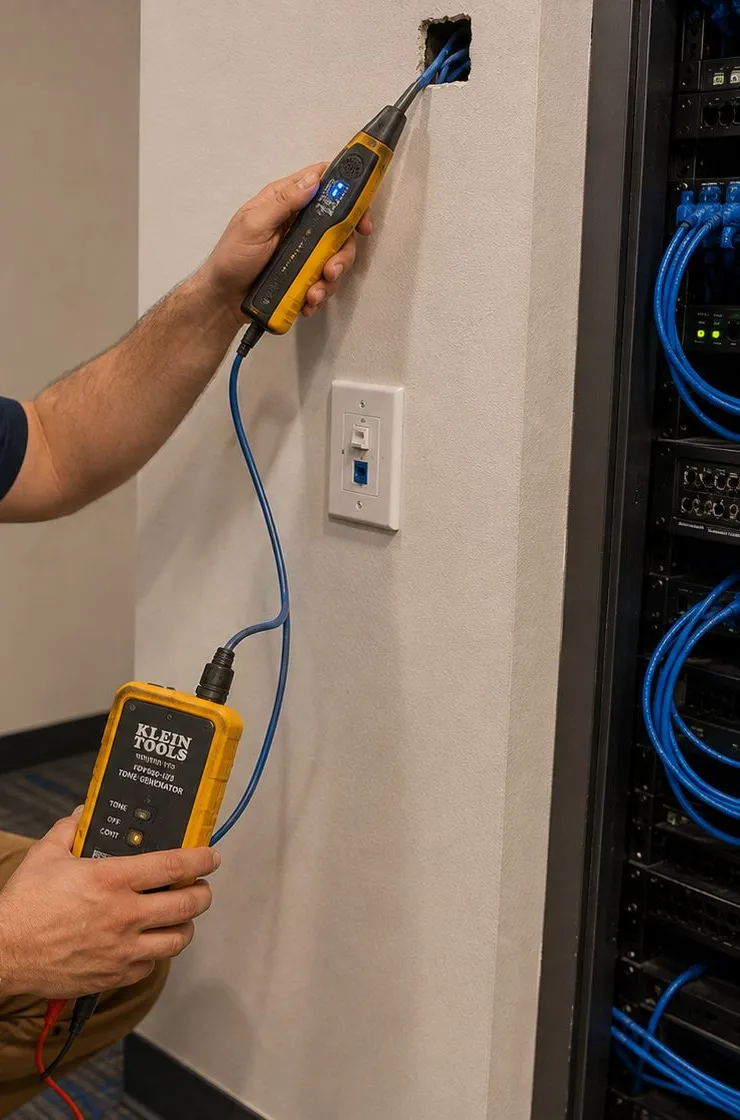
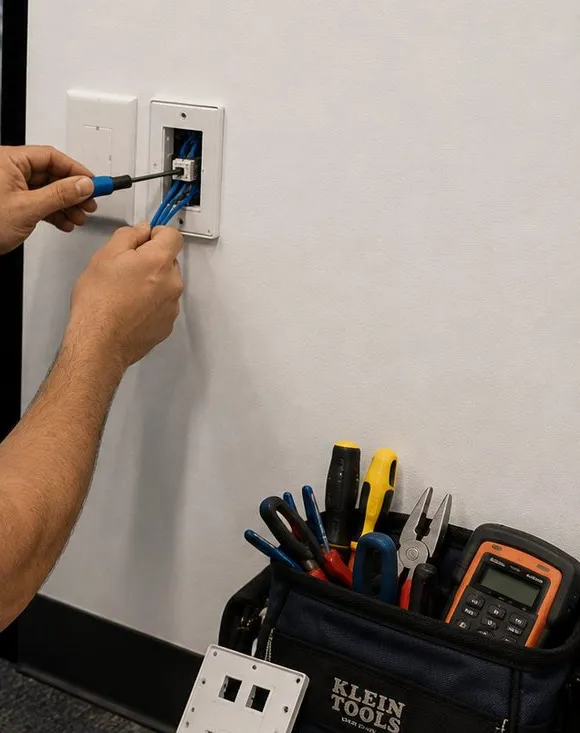
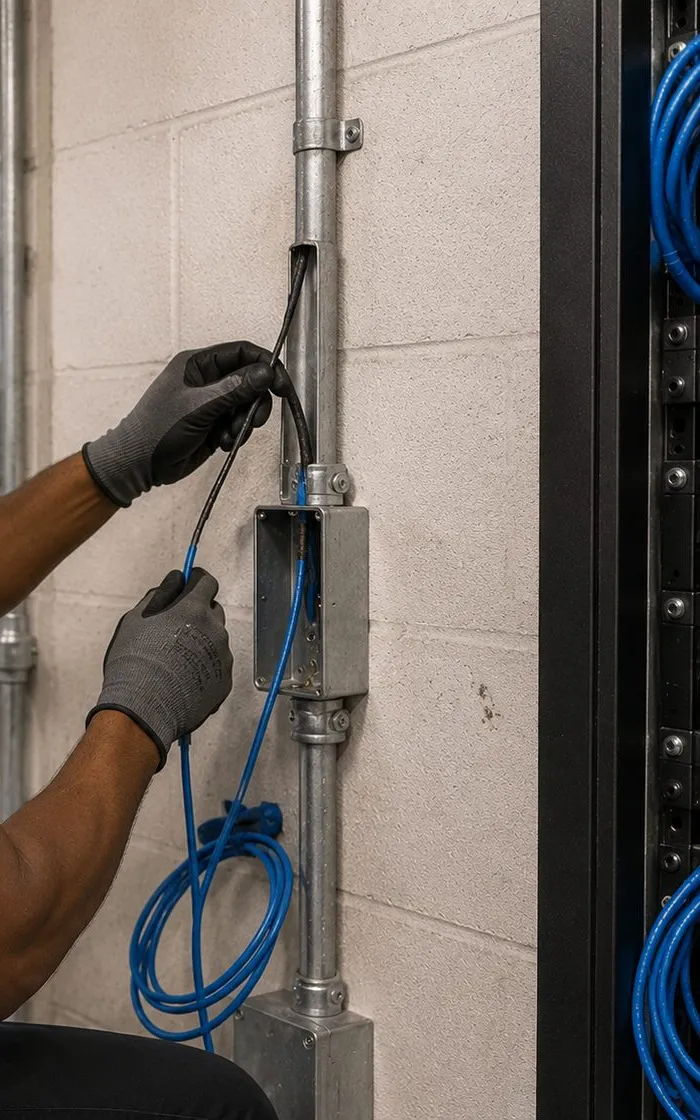
Most City Island households pair a Sonos visit with a TV move or a network fix, since the soundbar, the screen and the router are usually all on the ground floor and all due for a rethink. Our City Island TV installation crew prices from the same Bronx list, and structured cabling on City Island can carry a network cable from the provider's entry point up to a dry upper floor in the same visit.

After a nor'easter or a power cut, the usual City Island call is a system that came back with half its rooms missing, or a soundbar that no longer hears the TV. It is almost always the network rather than the speakers. Call (646) 490-0629 and we book the next open 2-hour window; most of these are back and regrouped within one to two hours of arrival, billed as a Bronx setup-only visit at $225 for the first hour, then 30-minute blocks.
Island jobs sort into nine types. The first and the fourth — lifting equipment out of the flood zone and fitting coastal outdoor speakers — are requests we hardly ever get on the mainland.
Router, Amp, Port and any network switch moved off the basement floor or ground-floor shelf to a closet or landing on a dry floor, with one cable back down to where the internet enters.
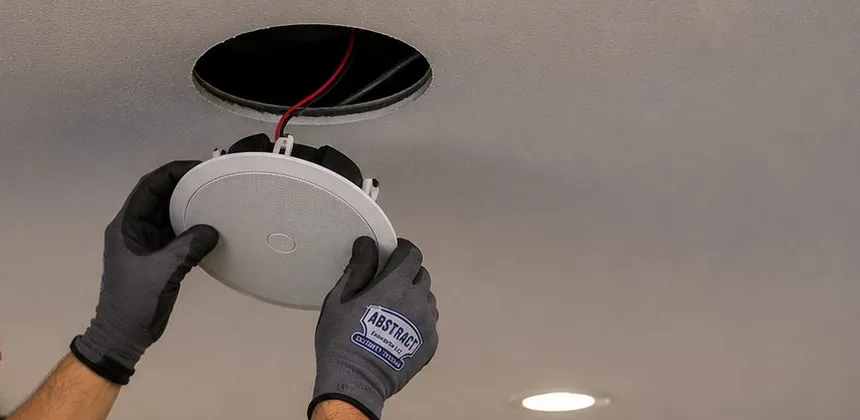
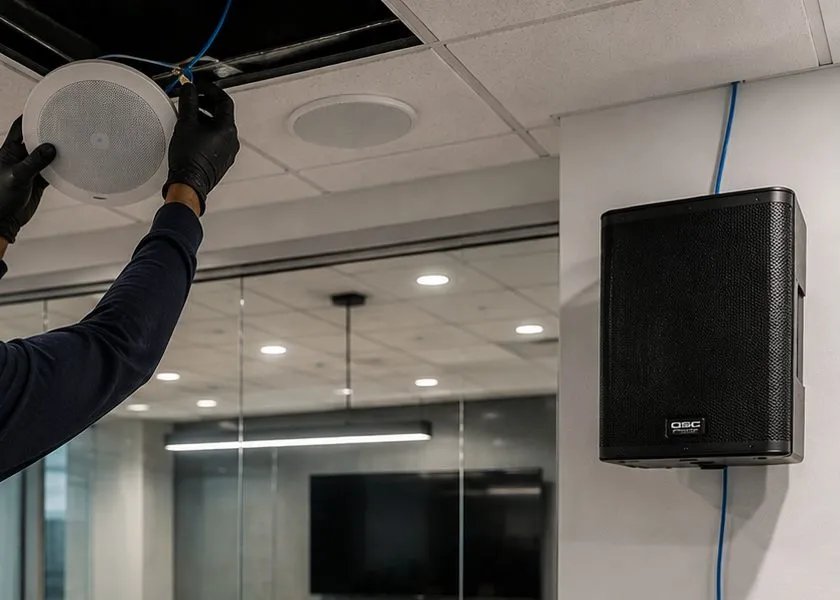
Sonos in-ceiling speakers on an Amp in upstairs rooms of wood-frame houses, wired from the attic so nothing has to pass through a flood-prone floor or wall.
Arc Ultra, Beam or Ray placed under the TV in parlors with tall windows, bay fronts and clapboard outside walls, fixed to the studs or kept free-standing on a console.
Sonos outdoor speakers on an Amp for porches, decks and yards facing the Sound, with brackets, fixings and cable chosen for salt spray and wind rather than a sheltered patio.
A wired access point or wired Sonos product on each floor of a tall Victorian, so the system does not depend on Wi-Fi fighting its way up through timber, plaster and metal storm windows.
Systems built to recover on their own after an outage: network gear on a battery backup where you want one, products named and grouped so everything finds its place again when the power returns.
Dining rooms, bars and enclosed decks along City Island Avenue and at Belden Point, with Sonos kept on a staff network, a licensed music service and volume limits that hold through a full summer night.
Clubhouse bars and function rooms at the yacht clubs, sail lofts and marina offices, where one system has to handle a quiet weekday and a crowded race weekend.
Tracing noise in speakers and amplifiers, including the radio-frequency pickup that strong nearby transmitters can cause, and fixing it with routing, shielding and filtering.

Six kinds of property make up almost every City Island call. Most are wood-framed; what separates them is age, height, how close they sit to the water and who else, if anyone, has a say.
The island's characteristic nineteenth-century houses: square plans, tall windows, bracketed eaves, porches and verandas, and in the Second Empire examples a mansard top floor. Clapboard over timber framing, with attics and joist bays that take speaker cable readily.
The larger Victorian houses Wikipedia places mostly on the Sound side, with spires, gables and wraparound porches facing the water. Big rooms, several floors, long distances from the router, and outdoor spaces that take the full force of the weather.
Asymmetric two-and-a-half-storey houses like the landmarked Booth House on Centre Street: gables, deep eaves, bay windows and irregular rooms where speaker placement is decided by measurement rather than symmetry.
One-storey and storey-and-a-half houses, including Craftsman bungalows like the 1930 Sears kit house on Pell Place. Low roofs, shallow attics and living space close to the ground — which puts flood height at the centre of the plan.
Newer buildings such as the 43-unit On the Sound complex of 2015, with big windows onto the water, modern partitions and a condominium board whose rules cover anything on balconies and exterior walls.
Flats over shops on City Island Avenue, units in the six-storey Pickwick Terrace of 1963 (which Forgotten New York, writing in 2000, called the island's tallest building) and apartments carved from older houses — renters first, so free-standing systems are the default.
| Property | Structure we expect | Best cable route | Where the electronics should live |
|---|---|---|---|
| Italianate or Second Empire house | Timber frame, clapboard outside, plaster or later drywall inside, an attic or mansard space above | Down from the attic into upstairs ceilings; up through closets from a dry first floor | A closet or landing on the first floor or higher, never the cellar if it has taken water |
| Sound-side Victorian | Several floors of timber framing, large porches, long room-to-router distances | A cable spine up the house to an access point or wired Sonos product on each floor | Upstairs equipment closet with ventilation; porch speakers powered from an indoor Amp |
| Queen Anne cottage | Irregular rooms, gables, bay windows, deep eaves | Through eave spaces and knee walls, following the roof lines | Upstairs, near the centre of the house to keep runs short |
| Bungalow or small cottage | One storey, low attic or none, floor close to grade | Through the attic where there is one; surface channel where there is not | As high as the house allows: a shelf in an upper closet, not under the sink or on the floor |
| Waterfront condo | Modern framing or steel studs, large glass, board rules | Through new partitions; developer wiring tested before use | Inside the unit, away from the glass wall and any balcony door |
| Apartment over a shop | Older timber or masonry, landlord's rules | Rarely needed: wireless products plus one wired to the router | Where the router already is, if it is dry and away from heat |
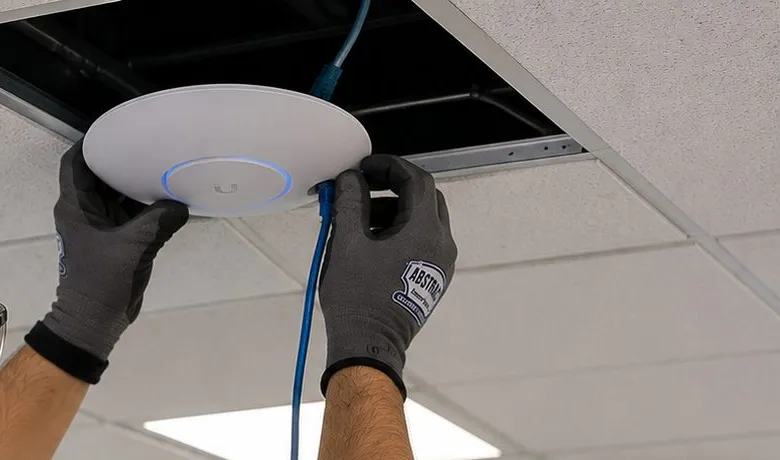
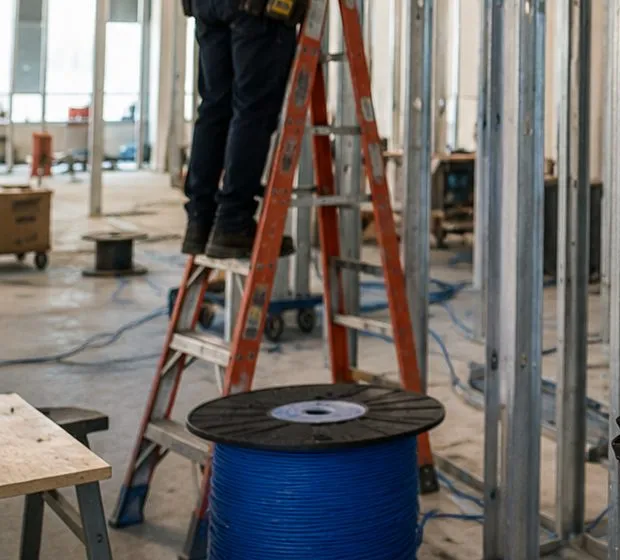
Two methods matter more on City Island than in the rest of the borough. The first is the direction of the wiring. On the mainland we often start in a basement because that is where the internet arrives and where there is room. Here we try to start at the top: we go up into the attic or the mansard space, run cable down into the bedrooms and upper rooms that want ceiling speakers, and bring a single network cable down to the provider's equipment. The basement becomes a place the cable passes through on its way up, not a place where anything powered is left behind.
The second is the outside wall. Clapboard houses lose heat and let in drafts around every hole, and on the Sound side a hole in the wrong place lets in water driven by the wind. Where cable has to pass through an exterior wall to reach a porch or deck speaker, we drill on a slight downward slope toward the outside, use a sealed entry, form a drip loop in the cable and seal the penetration, then check it from both sides. Where we can, we avoid exterior penetrations altogether by bringing porch cable down through the porch ceiling from an upstairs room.
An open attic is a good moment for the rest of the low-voltage list. Island owners regularly add a porch camera or a new door intercom on the same cable routes. Our City Island security camera installers and the AESS intercom team on City Island work from the same Bronx office and can share the visit.

Every Sonos system has a few parts that matter more than the speakers: whatever connects it to the internet, whatever powers the passive speakers, and whatever bridges it to an older stereo. On City Island those parts — the router, the Amp, the Port, and any switch or access point that ties floors together — are the ones we move first, because they are the ones most often sitting where the water arrives.
Internet providers install their equipment where the line comes into the building, and on an older island house that is commonly a cellar wall, a crawlspace entry or a ground-floor room by the front door. Nobody asks whether that spot took water during Sandy or floods at the new moon. The City Limits report on island flooding describes residents carrying out the contents of whole living rooms after Sandy, and blocks where water collects "even after the slightest weather events." An Amp on the cellar floor in one of those houses is a matter of when, not whether.
The water height. We ask what the street and the house have actually done: did the ground floor take water in 2012, does the cellar get wet in a heavy rain, does the front walk flood at the new moon? Owners usually know to the inch. That line, plus a margin, is the floor below which nothing powered and permanent goes.
The listening height. Speakers belong where they sound right and where the household spends time: soundbars under the TV, ceiling speakers over the kitchen island or the bed, outdoor speakers under the porch roof. A speaker on a ground floor that sometimes floods is acceptable if it can be lifted or replaced; the Amp feeding it should not be on that floor.
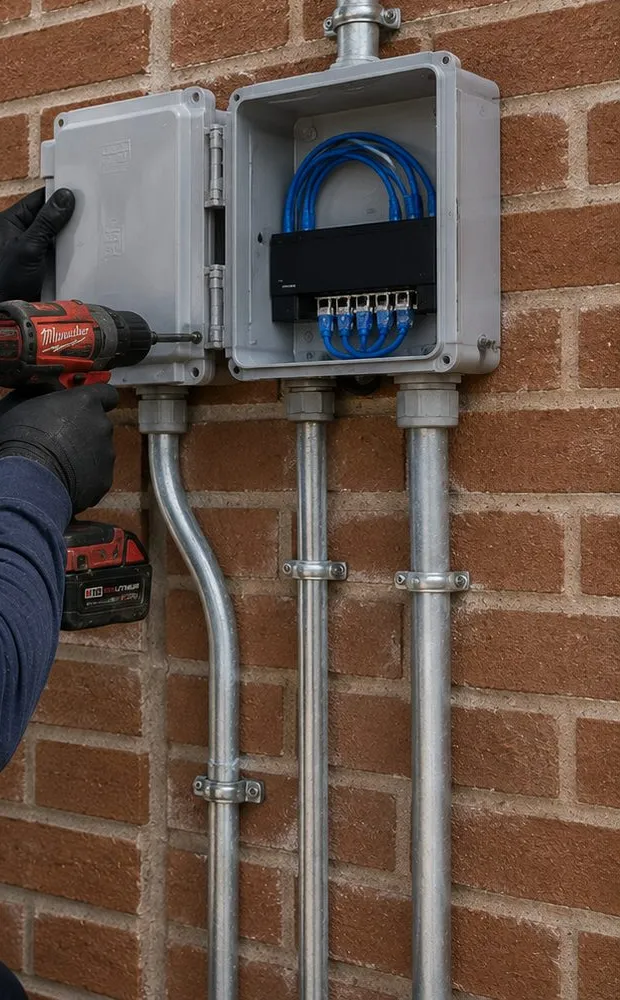
The equipment height. The Amp, Port, switch and, where possible, the main router move up — to a hall closet on the first floor of a raised house, a landing cupboard, or a ventilated shelf on the second floor. One network cable runs back down to the provider's box, which stays where it is because the provider owns it. Sonos's guidance asks for open space around the Amp — about three inches — and a working range of 32–104°F, which also rules out unheated porches and uninsulated attics in January and August.
| Part | Where we usually find it on City Island | Where we usually move it | Why |
|---|---|---|---|
| Provider's modem or gateway | Cellar wall or ground-floor entry | Usually stays; raised off the floor on a shelf if the provider allows | The provider's equipment and line; we run a cable up from it |
| Main router or mesh base | Beside the modem | First or second floor, central in the house | Keeps Wi-Fi strong upstairs and the router dry |
| Sonos Amp | Basement shelf or TV cabinet | Upstairs closet or ventilated cabinet on a dry floor | Most expensive electronics in the system; needs air and a 32–104°F room |
| Sonos Port | Behind a stereo on the ground floor | With the stereo it serves, raised off the floor | Needs clearance and distance from heat, and goes where the receiver goes |
| Network switch or access point | Not present, or in the cellar | Landing or closet on each floor that needs it | Builds the wired backbone above the water |
Moving the brains up does more than protect them. A router in the middle of the first or second floor reaches more of a tall Victorian than one in a stone cellar, and the cable that connects it back down becomes the start of a wired backbone that Sonos uses happily. On a house where the cellar is dry and always has been, none of this is necessary — we say so and leave things where they are.
When water has been in the house, the order of work matters more than speed. The CDC's guidance on re-entering a flooded home is plain: have an electrician check the electrical system before the power goes back on, and "all electrical equipment and appliances must be completely dry before returning them to service." We do not plug in or test any Sonos product that sat in floodwater until the electrician has cleared the house, and we do not close up any wall or ceiling cavity that is still drying. Once it is safe, we re-join what survived, replace what did not, and use the visit to move the survivors upstairs.

A wraparound porch with a view across Eastchester Bay, a deck at the end of a Sound-side lot, a back yard that runs down to a seawall: City Island's outdoor spaces are the reason many people live here, and they are the hardest places on the island for electronics. Three things work against a speaker outdoors here — salt carried on the wind, driving rain off the water, and the plain force of the wind on anything mounted high.
For a permanent outdoor zone we use Sonos's outdoor speakers, powered by an Amp kept indoors. Sonos describes them as "engineered for humidity, water, salt spray, heat, UV rays, and freezing temperatures," rates them IP66 and gives an operating range of −13°F to 149°F. They are passive speakers: the only thing outside is the speaker and its cable, while the Amp sits in a dry room. That split is exactly right for the island.
Portables are different. The Move 2 is rated IP56 and Sonos says its charging base is for indoor use only; the Roam 2 is rated IP67, which covers a dunk in fresh water for a short time. Neither rating is a promise about months of salt air, so we treat portables as things that go out for the evening and come back in, not as fixtures on a porch rail.
| Outdoor spot | What we recommend | What we avoid |
|---|---|---|
| Covered wraparound porch, Sound side | Outdoor speakers under the porch roof on brackets into framing, cable down through the porch ceiling from indoors | Any portable or indoor speaker left out on the rail |
| Open deck or roof deck facing the water | Outdoor speakers mounted under an eave or overhang, angled down toward the seating | Mounting high on an exposed corner that takes the full wind |
| Back yard toward Eastchester Bay | Outdoor speakers on the house wall facing the yard, or a portable that comes in at night | Cable laid across a lawn that floods, or speakers on posts near the seawall |
| Screened or glassed-in porch | Indoor products with humidity resistance, such as Era 100 or Era 300, kept back from the screens | Products sitting where rain blows through the screen |
Brackets go into framing, not just into clapboard or trim, because a speaker that shifts in one winter storm pulls its fixings loose. Fixings are corrosion-resistant. Cable is outdoor-rated, runs inside the porch structure wherever possible, and enters the house through a sealed, downward-sloping penetration with a drip loop. Where a cable has to run along a surface, it goes in a channel on the sheltered side of a post or beam rather than on the face that takes the weather.
We also think about where the sound goes. Water carries sound, and on a calm summer evening music from a deck facing the bay can travel across to the boats on their moorings and to the houses on the other side of the harbour. Outdoor speakers are aimed down at the seating, not out at the horizon, and we set volume limits on outdoor zones at handover so the level that sounds right on the deck is not the level heard across the water.
Outdoor speakers rated for the cold can stay up all year; the Amp indoors is what needs a heated room. Before a big storm we suggest owners bring in any portable, and before the season ends we check fixings and seals on porch and deck speakers in the same visit as any other work. Salt that has dried on a grille comes off with a cloth dampened in fresh water; we show owners how at handover.

Wikipedia's description of the island's commerce is short: most businesses cluster along City Island Avenue, and the island is "most famous for its numerous seafood restaurants and antique stores." Add the yacht clubs, sail lofts and marinas, and you have the list of places that call us for business music here. Many of them are busy in summer and quiet in winter — Wikipedia notes that a few restaurants close for the winter months while most stay open all year — and the system has to suit both.
Seafood restaurants, bars and cafés along both sides of the main street, many with dining rooms that run back from a narrow frontage and apartments or neighbours close by. Ceiling or wall speakers on Amps, with volume limits by room.
The southern tip of the island, named for William Belden, who opened an amusement park and resort there in 1887 (Wikipedia, citing NYC Parks). Today it is home to large seafood restaurants with waterside seating and a public greenspace dedicated in 2016.
The Harlem Yacht Club, City Island Yacht Club and Morris Yacht and Beach Club line the Eastchester Bay side of the island (Wikipedia). Clubhouse bars and function rooms want background music on a weekday and something livelier after a race.
Two active sail lofts and several commercial marinas operate on the island (Wikipedia). Large open lofts and marina offices need sound that carries across a big floor without filling the yard outside.
Small shops along the Avenue where music should sit quietly under conversation, start when the door opens for the day and stop at closing.
Church halls, the City Island Theater Group's productions and the meeting rooms of the island's many civic and boating organisations — places that need simple controls volunteers can use.
A dining room that seats a full house on a July Saturday and a dozen regulars on a February Tuesday needs two different volumes, and staff rarely remember to change them. Sonos alarms can start music at a chosen time, in a chosen room, at a chosen volume, and volume limits stop anyone pushing the level past what the neighbours will accept. We set up a quiet-season level, a peak-season level and the limit above both, and show the manager the two controls staff are allowed to touch.

These are questions City Island owners and businesses ask that come from the island itself — the water, the old houses, the towers next door and the restaurant trade. Wider Sonos questions about leases, co-op forms, neighbours and noise law are answered on our Bronx Sonos installation page and the New York City Sonos hub.
Not quickly, but it is worth placing them with the air in mind. Sonos does not publish a salt rating for its indoor speakers; it does name the Era 100, Era 300, Move 2 and Roam 2 as products built to cope with humidity, which is why we choose those for rooms that are open to the water for months at a time. What actually harms an indoor speaker by an open window is spray and condensation landing on it, and salt residue building up on the grille and the connections at the back.
So we keep speakers back from the sill rather than on it, out of the path of rain that blows in, and away from the corner where a window air conditioner drips. At handover we show you how to wipe the grille with a cloth dampened in fresh water at the end of the season. If a room is effectively a screened porch for half the year, we treat it as one and plan it with the outdoor section above in mind.
Do not plug them in to find out. Floodwater on City Island is seawater mixed with whatever it picked up on the way, and electronics that have been under it can be damaged in ways that only show once power is applied. The CDC's guidance for flooded homes says the house's electrical system should be checked by an electrician before power is turned back on, and that all electrical equipment and appliances "must be completely dry before returning them to service." In practice, a speaker or Amp that was submerged in salt water is usually a replacement, not a repair.
What can be saved is the system itself. Once the house is cleared, we re-join any products that stayed dry upstairs, set up the replacements in the same rooms with the same names and groups, and use the visit to move the Amp, Port and router above the level the water reached. If your insurer needs a written description of what was installed and where, we can provide one from our records of the original job.
Usually, yes. A wood-frame house is a light structure compared with a masonry building, and old sash windows, loose glass panes, cabinet doors and glassware on shelves all have their own resonant frequencies. When a Sub happens to hit one of them, the house buzzes along. The fix starts with where the Sub sits: moving it a few feet along a wall, out of a corner or off a hollow floor section often changes which notes are reinforced and stops the rattle completely.
After placement, we adjust the Sub's level and use Trueplay on the soundbar so the room is not over-driven in the first place, and we put the Sub on a dense pad where it stands on old floorboards. If one window still buzzes on a particular note, the problem is the sash, not the Sonos — a small weatherstrip or a turn of the sash lock usually ends it. We find the culprit with you in the room before we leave.
Not in the middle of the curve. A round or many-sided room tends to focus sound toward its centre, so a speaker placed facing straight across the room can create a spot where everything sounds louder and boomier than elsewhere. In a tower room we usually place a single Era 100 or Era 300 to one side of the curve, firing across the room at an angle rather than through its centre, or at the flat wall where the tower joins the main house if there is one.
Ceiling speakers are possible if there is a flat section of ceiling below the spire and a way into it from the attic, but conical or domed ceilings rarely suit them. Whichever product we use, Trueplay is run with it in its final spot, because a curved room is exactly the kind of space where automatic tuning earns its keep. We also check the windows: towers often have more glass than wall, which leaves fewer places to mount anything.
Quite possibly. Sonos's guidance on wireless interference rates metal as a very high obstruction for Wi-Fi, higher than plaster or brick, and a run of aluminum storm windows and a metal storm door between the router and the porch can cut the signal sharply. Foil-faced insulation and metal porch screens have the same effect. A speaker on the far side of that barrier may work when the house is quiet and drop out when the network is busy.
The cure is to stop asking Wi-Fi to pass through the metal. Porch speakers on an indoor Amp do not need Wi-Fi outside at all: the Amp sits inside and the porch gets speaker cable. For a wireless speaker on a screened porch, we put a wired access point or a wired Sonos product on the inside of the wall closest to the porch. Range extenders are not the answer; Sonos lists them among the setups it does not support.
It can, though most houses never notice it. The ARRL, the national association for amateur radio, explains that interference happens when audio equipment picks up radio signals it was never meant to receive, and that a strong nearby signal can overload equipment "even if a nearby radio signal is being transmitted on its assigned frequency." The FCC's interference handbook, as the ARRL summarises it, treats audio devices that pick up radio signals as improperly acting as receivers, with the cure being filtering applied to the affected device. High Island has carried the transmitters for 660 and 880 AM since 1963, a short distance across the water from the north end of City Island.
The symptom is usually a faint voice, music or buzz in passive speakers, an older receiver connected through a Port, or a turntable preamp. Long runs of speaker wire are the most likely pickup. We keep runs short, twist pairs, route speaker cable away from network and power cables, ground equipment properly and, where needed, fit ferrite chokes or filters at the affected component. Sonos's own wireless speakers, with no long cable runs, are the least likely part of a system to be affected.
No; they work in a completely different part of the radio spectrum. WFAN broadcasts on 660 kHz and the 880 station on 880 kHz, while Sonos runs on Wi-Fi at 2.4 GHz and above — thousands of times higher in frequency. A dropout on a City Island Sonos system is almost always caused by the same things that cause dropouts everywhere: distance, walls, metal, crowded Wi-Fi channels and products that are not where the network expects them.
If your speakers drop out, the useful questions are where the router is, what is between it and the speaker, and whether anything has changed on the network recently. Sonos asks for at least 18 inches between its products and other electronics and lists neighbouring Wi-Fi, microwaves and cordless phones among common interference sources. We check all of those before blaming anything as exotic as a radio tower.
Not automatically. Sonos does not measure crowd noise and raise or lower the volume to match it. What it does offer is scheduling and limits, and between them they solve most of the problem. Sonos alarms can start a playlist at a set time, in a set room, at a set volume; volume limits cap how loud any room can go, whoever is holding the phone. For a seasonal restaurant we set two opening levels — one for the quiet months, one for the summer — and a ceiling above both.
The rest is training. We show the manager how to switch between the two schedules when the season changes and how far staff can turn things up on a busy night before the limit stops them. Because the 42 dBA rule for commercial music is measured in the homes that receive it, a limit set with the neighbours in mind protects the restaurant as much as the people next door.
No. Sonos's system requirements list guest networks among the setups it does not support, and a customer network is the wrong place for business equipment anyway: anyone on it could, depending on settings, see and control the speakers. The Sonos system belongs on the staff or business network, together with the tablet or phone your staff use to run it, while customers stay on a separate network that cannot reach it.
Sonos also has a guest access setting that controls whether devices on the same Wi-Fi can control playback and volume without administrative rights; on a business network we usually switch it off. We set this up with whoever manages your internet service, label which network is which, and leave a written note so the next router swap does not undo it.

Buy your Sonos products wherever the price is right; we fit and configure them. Here is how each one tends to work out on the island — including the spots where we would steer you to something else.
The flagship soundbar, a little over 46 inches long. Right for a wide Victorian front room with a big screen or a condo living room facing the water; too long for a TV squeezed between two tall Italianate windows.
About 25½ inches long, on HDMI ARC or eARC. The bar that fits most island front rooms and bedrooms, and the one we suggest when the TV is 55 inches or smaller.
Sonos's smallest soundbar, fed over optical. It suits a bungalow bedroom, a flat above an Avenue storefront, or the older set in a summer sitting room.
The everyday speaker, and on Sonos's list of humidity-resistant products. Kitchens, bathrooms, rooms with windows open to the Sound, and the bar of a small restaurant.
A larger, humidity-resistant speaker with upward and sideways drivers. Best in tall Victorian rooms and in a tower room where one speaker has to fill an awkward shape; its Sonos wall mount needs a stud.
Bass units. The Sub Mini suits small and medium rooms and pairs with a Beam, Ray or Era 100; the Sub 4 is for large rooms. In old wood-frame houses we place either one with rattling sash windows in mind.
Powers passive ceiling, wall and outdoor speakers; it drives up to three pairs of Sonos architectural speakers. Kept indoors, on a dry floor, with about three inches of air around it, in a room between 32°F and 104°F.
Sonos's passive outdoor pair, rated IP66 and described by Sonos as engineered for salt spray, humidity, UV and freezing temperatures. The right choice for porches and decks facing the Sound, run from an indoor Amp.
Battery portables that join the home system on Wi-Fi. The Roam 2 is rated IP67 and can play from a phone over Bluetooth when Wi-Fi is unavailable, Sonos says; the Move 2 is rated IP56 and its charging base is for indoor use only.
The bridge between Sonos and a hi-fi you want to keep: line-level analog and digital out, plus a 12 V trigger to wake the amplifier. It lives beside that stereo, lifted off the floor, with air around it and no radiator close by.

We could not view Google's AI Overview from our build environment, so we have not invented one. The claims below are the ones that cost guides, product pages and forum threads repeat — the material answer engines are trained on — set against what we find on City Island.
Product listings put a water rating on almost everything that might go near a patio, and buyers reasonably read IP56 or IP67 as permission to leave a speaker outdoors. Many online answers treat "outdoor" as one category.
Ratings measure specific tests. Sonos's own guidance says speakers that are not waterproof "may be damaged if exposed directly to water or left outside for extended periods," and describes only its passive outdoor pair as engineered for salt spray, UV and freezing temperatures. A Move 2's charging base is for indoor use. On a Sound-side porch, the difference between a splash rating and a salt-spray design is the difference between a speaker that lasts and one that corrodes.
For anything that stays outside on City Island we use the outdoor pair on an indoor Amp. Portables come in at night.
Installation guides and forum replies often recommend tucking the noisy, unattractive equipment into a basement or utility room, and on most of the mainland that is sensible advice.
On an island where City Island Rising calls flooding "a Tuesday problem" and Sandy filled living rooms, the basement is the one place guaranteed to meet the water first. It is also the worst place for a router in a tall wood-frame house, because the signal has to climb every floor.
We put the brains of the system on a dry floor and run one cable down to the provider's equipment. The basement keeps only what the provider owns.
National cost guides price whole-home audio by the room; Angi gives $500 to $1,000 per room, with labour at $50 to $100 an hour and $100 to $500 for modifications. Answer engines repeat those figures for any city.
A per-room average says nothing about a City Island house in which half the rooms need no fixed speaker, the porch needs the most expensive weatherproofing, and the real cost driver is moving equipment upstairs. It also can't tell a wood-frame ceiling, which is straightforward, from a plaster one, which needs care.
Setting up Sonos you already own is $125 on our Bronx list; hanging a soundbar is $129 plus the wall line. Ceiling and outdoor zones are quoted after a walkthrough inside the $800–$2,500 per-zone band AESS publishes.
Plug-in repeaters are marketed for every dead zone, and plenty of forum replies recommend one when a speaker at the far end of the house keeps vanishing.
Sonos's system requirements list wireless range extenders, Ethernet-over-power adapters and guest networks among setups it does not support. Its interference guidance rates metal as a very high obstruction — and many island porches sit behind aluminum storm windows and metal storm doors.
An indoor Amp with speaker cable to the porch, or a wired access point on the inside of the porch wall, solves the problem without adding a device Sonos tells you not to use.
Sonos's own guide says its ceiling and wall speakers "require special installation," and homeowners often picture opened ceilings and weeks of plaster work.
In a City Island wood-frame house with an attic, the opposite is usually true. Sonos rates wood as a low obstruction for Wi-Fi, timber joists are easy to work between, and from the attic we can drop cable into upstairs ceilings with nothing opened but the speaker holes themselves. The harder cases are lower floors with finished ceilings above and below, and original plaster we treat with care.
We survey for joists, pipes and wiring through a pilot hole first, then cut only the openings the speakers need.
Forum threads about humming or buzzing speakers usually end in a return or a replacement, and answer engines tend to summarise them that way.
Hum and buzz have many causes that have nothing to do with a defective product: ground loops between a receiver and a cable box, speaker cable run alongside power cable, and — on the north end of City Island — pickup of the strong AM signals from the High Island towers, which the ARRL describes as audio equipment acting as an unintended radio receiver.
We trace the cause before anything is replaced: rerouting, shorter runs, proper grounding and filters at the affected component fix most of these.
Smart-speaker marketing emphasises self-tuning, and it is easy to conclude that a speaker will sound right anywhere once the software has run.
Sonos says Trueplay measures how sound reflects off walls, furnishings and other surfaces, asks you to keep the room quiet while it runs, and advises re-tuning after a speaker is moved. That makes it a correction for one position in one room — it cannot stop a curved tower room from focusing sound, or a Sub from rattling a loose sash.
Position comes first and tuning second; at handover we also walk you through repeating the Trueplay pass whenever furniture or speakers move.
Tell us the street, the floors, where the internet comes in and how high the water has reached. We'll tell you where each part should go and what it costs on the Bronx list.
A few lines are enough to price most City Island jobs: the kind of house, the floors, the Sonos products, where the internet enters and whether that floor has ever flooded. The total comes back in writing the same business day. To talk it through, phone (646) 490-0629.
Received. An installer will look over your island house details and get back to you today; for anything urgent, ring (646) 490-0629.
The sequence is the same for a single bar in a Pell Place bungalow and for a three-storey Sound-side Victorian with speakers on the porch. What makes it an island job happens before any product comes out of its box.
Before products, we ask what the street and the house have done in storms and at the new moon, and where the internet line enters. That sets the height below which nothing powered and permanent goes.
We go into the attic or mansard space first and plan cable down into the rooms that want speakers, with one network cable down to the provider's box, so the basement holds as little as possible.
The router or mesh base, any switch and the Amp go in a ventilated closet or cabinet above the water line, and each floor that needs it gets a wired access point or a wired Sonos product.
Soundbars go on fixings chosen for the wall, ceiling speakers into surveyed joist bays, and outdoor speakers into framing under cover, with sealed, downward-sloping entries and drip loops where cable leaves the house.
Trueplay runs in each supported room with the speaker in its final place; outdoor and restaurant zones get volume limits; we listen for rattles and radio pickup and fix them before we move on.
Each room gets the name your family already uses, streaming accounts go in, and before leaving we demonstrate grouping, a fresh Trueplay pass, how to rinse salt from outdoor grilles and the short checklist for a forecast storm.

We work on every street from the bridge to Belden Point, on both the Eastchester Bay and the Sound sides. These six places are the ones customers mention when they tell us where they live.
The island's only road link. A bridge built by local businessmen in 1873 was replaced by a 950-foot steel bridge in 1901; after a temporary span carried traffic from December 2015, the New City Island Causeway Bridge opened on October 29, 2017 (Wikipedia).
Housed in the former Public School 17 at 190 Fordham Street, built in 1897 and listed on the National Register of Historic Places in 1984, with exhibits on the island's shipbuilders, fishermen and America's Cup yachtsmen (Wikipedia; Forgotten New York).
Home of the William H. Schofield House at No. 65, a clapboard Italianate farmhouse of about 1860 designated a city landmark on April 12, 2016 (LPC; Historic Pelham). Forgotten New York called the street the island's best showcase of Victoriana.
The southern tip, where William Belden opened an amusement park and resort in 1887; now home to seafood restaurants and a waterfront greenspace dedicated in 2016 (Wikipedia).
Named because the island was still part of the Westchester town of Pelham when the cemetery was laid out in the 1880s; Forgotten New York describes it as the only waterside cemetery in the city. King Avenue's houses look across Pelham Bay.
The New York Public Library branch at 320 City Island Avenue, operating since 1903, in its current building since 1970 and doubled in size by a 1997 renovation, with a ship collection of more than a thousand items (Wikipedia).
The island's own history explains its houses. The Landmarks Preservation Commission's report on the Schofield House traces how oystering, which Orrin Fordham revolutionised here around 1830 by planting shells to cultivate oysters, and shipbuilding, from the D. Carll yard of 1862 onward, paid for the Italianate and Second Empire houses, and how "limited access to the island discouraged dense development." The result is the small-town island that customers describe to us today.
We also serve the neighbourhoods across the bridge: Pelham Bay, Country Club, Throgs Neck, Schuylerville, Co-op City and Westchester Square in Bronx Community District 10, along with Morris Park, Pelham Gardens and the rest of the borough, all on the same Bronx price list.

City Island is priced on the Bronx list, which our area table sets at parity with Brooklyn — there is no island surcharge. Every line below is published on that list. Anything we can't price without seeing the attic, the porch framing or the route to a dry floor is quoted in writing after a walkthrough, and nothing is added on the day without your agreement.
| Line | Bronx price | Where it applies on City Island |
|---|---|---|
| Sonos setup | $125 | All your Sonos on a single household, island rooms labelled, streaming logins added, each tunable speaker run through Trueplay |
| Soundbar wall-mounted under the TV | $129 | Bar hung level under the screen in a parlor, a bedroom or a waterfront condo |
| Soundbar placed on a console | $79 | Rentals, summer rooms and any wall you'd rather not drill |
| Sanus soundbar bracket | $84.99 | If you don't already have a rated mount for the bar |
| In-wall concealment | $169 | Power and HDMI fed inside an interior stud bay behind the screen |
| Paintable cord cover | $59 | A slim painted raceway for clapboard-era plaster or brick you'd rather leave whole |
| Cable run to a cabinet or other spot | $99 | Runs of 25 ft or less, such as screen to sideboard |
| A/V receiver | $129 | Connecting a receiver, for example to a Sonos Port |
| Universal remote | $99 | Programmed for TV, cable box and Sonos |
| Streaming device setup | $49 | Per device |
| Full home theater | $350 | Multi-component system setup |
| Remove an old bracket | $45 | Before the new soundbar or TV goes up |
| Take down an old TV | $85 | When the TV wall is being redone |
| Setup-only visit | $225 first hour | Billed in half-hours after that; the usual line after a storm or a provider's router swap |
| TV mounted on the same visit | From $209.99 | Starting price on the Bronx list for a 32″–55″ set, wall and size lines extra |
| Ceiling, wall or outdoor speakers on an Amp | Quoted at walkthrough | Written per zone after a look at the attic and porch; AESS publishes $800–$2,500 as its whole-home audio span |
| Moving router, Amp or Port to a dry floor; Ethernet runs | Quoted at walkthrough | Set by the attic access, closet stack and how far the dry floor is from the provider's box |
| Condition | Price | Where we meet it here |
|---|---|---|
| Drywall on wood studs | $0 | Renovated rooms in frame houses, newer condos |
| Metal studs | +$30 | Some newer condominium partitions |
| Plaster | +$45 | Original rooms in nineteenth-century houses |
| Brick or stone | +$65 | Chimney breasts and fireplace surrounds |
| Concrete or cinder block | +$75 | Foundations, basement walls and some commercial buildings |
| Tile or marble | +$95 | Kitchens and bathrooms |
| Plywood backer board | $85 | When studs fall in the wrong place for a bar |
| High mount, above about 8 ft | $75 | Tall Victorian rooms and restaurant walls |
| Walk-up, 3rd floor and above, no elevator | $40 | Top floors of large houses and older apartment buildings |
| Box removal | $25 | If you'd like the cartons taken away |
| Certificate of insurance | Free | For a condominium board, club, landlord or managing agent |
Nothing below is a new price — each row simply adds published lines together, the same way your written quote will. The house we find on the day sets the final figure.
| Example | Lines | Total |
|---|---|---|
| Pell Place-style bungalow: a compact bar left on its stand and a kitchen speaker, set up together | $79 console placement + $125 Sonos setup | $204 |
| Renovated room in a frame house: Beam on drywall over wood studs with our bracket | $129 + $84.99 bracket + $0 drywall + $125 setup | $338.99 |
| Original Italianate parlor: Beam on a plaster wall with our bracket | $129 + $84.99 bracket + $45 plaster + $125 setup | $383.99 |
| TV over a brick chimney breast: old bracket off, Beam on our bracket, cord cover on the brick | $45 removal + $129 + $84.99 bracket + $65 brick + $59 cord cover + $125 setup | $507.99 |
| Storm recovery: rooms missing from the app after an outage and a new router | $225 setup-only first hour | $225 |
National averages versus an island quote. Cost guides assume an average house on dry ground. They don't price a router that has to move two floors up, a porch that needs salt-rated speakers or a ceiling that's easy because the attic is open. Every line we charge is on our Bronx TV mounting price list.
Most island bookings fall into one of these three. None carries a special price: each figure is a handful of Bronx-list lines summed, and wall or access lines join the bill only if your room calls for them.
$204
The soundbar set on the console and connected ($79) and the whole household brought onto one system ($125). Nothing drilled, nothing fixed, nothing left on a floor that floods — the bundle for rentals, summer rooms and anyone who wants to move furniture freely.
$338.99
A Beam, Ray or Arc Ultra hung beneath the screen ($129) on a Sanus bracket ($84.99), plus system setup ($125). Priced for drywall over wood studs, which most renovated island rooms have; original plaster adds $45 and a brick chimney breast $65.
$556.99
The Standard bundle ($338.99) with TV power and HDMI hidden inside a hollow interior wall ($169) and the streaming box behind the screen set up and signed in ($49). For owners with a wall that can be opened who want nothing but the TV and the bar in sight.
Already have Sonos's own mount for the Arc Ultra or Beam, or another bracket rated for your bar? Then you pay for labor only: $129 to hang it, plus whatever line your wall carries, and $125 if you want the system set up. A bracket you supply stays under its maker's warranty. If we think it won't hold in old plaster or brick, we say so before drilling and offer the Sanus bracket at $84.99.
Ceiling pairs wired from the attic, outdoor speakers on a Sound-side porch, and moving the router and Amp to a dry floor are priced in writing after we have seen the house. Each zone falls inside the $800 to $2,500 band AESS publishes for whole-home audio, and you see the figure for every room before anything is ordered.
A photo of the TV wall, the attic hatch, the porch and the spot where the internet comes in is enough for a written Bronx-list price, usually the same business day.
Life on the island runs on a calendar the mainland barely notices: a boating and restaurant season that fills City Island Avenue with visitors, and a storm season that empties it. A Sonos system here gets used differently in each, and the setup we leave behind is meant to handle all of them without a call to us.
The porch and deck come back into use, boats go back in the water and restaurants reopen their waterside seating. This is the time to check outdoor speaker fixings after the winter winds, rinse salt from the grilles, confirm that cable entries are still sealed, and bring the outdoor zones back into the app's groups. If you are adding outdoor speakers, spring is also the easiest time to work under porch roofs and along eaves.
Windows stay open, sound carries across yards and over the water, and the island's restaurants fill up on weekend nights. We set volume limits on outdoor and Sound-facing zones so the level that's comfortable on your porch isn't the level the neighbours hear, and restaurant systems switch to their busy-season schedule. Portables come out for evenings on the deck and go back in afterwards — their charging bases, Sonos notes for the Move 2, are for indoor use.
Nor'easters and the tail ends of hurricanes bring wind, rain and the highest tides. Before a forecast storm, the routine we leave with owners is short: bring portables in, make sure nothing powered sits on a floor that has flooded before, and leave the rest alone. Outdoor speakers designed for the weather can stay up; the Amp powering them is indoors on a dry floor. After the storm, if a room is missing from the app, a restart of the router usually brings it back; if not, it's a setup-only visit.
Some restaurants close or cut their hours, and some houses are used less. Sonos products can stay plugged in; what matters is that the room holding the Amp stays within Sonos's 32–104°F range, so an Amp should not live on an unheated porch or in an uninsulated attic. It is a good season for indoor work — ceiling speakers from the attic, moving equipment upstairs, rebuilding the network — ready for the next spring.
An audio visit on the island often turns into a wider one. These are the other AESS jobs booked most often alongside Sonos here, all quoted from the same Bronx sheet.
Our parent page for the borough: leases, Riverbay and Parkchester rules, and keeping peace with the apartment below.
Screen and bar hung in one trip, whether the wall is stud-framed, old plaster or a brick chimney breast.
Network cable from the provider's entry point up to a dry floor, and a jack wherever the Sonos plan needs one.
When the bar under your TV isn't a Sonos, the same crew mounts and connects it.
Moving the router up out of the cellar and adding wired access points until the top bedroom sees full bars.
Projectors, receivers and bigger sound systems for clubhouses, halls and dedicated media rooms.
Cameras for houses, porches, docks and storefronts, often wired on the same visit as Sonos.
Front-door handsets and video entry, run through the attic paths opened for the speakers.
Lighting, shades and scenes that can include Sonos rooms.
Scheduling, rescheduling, return trips and what to expect on the day.
What follows is the order our crews check things on the island, written as a routine rather than an account of a particular household.
We ask about the water before we ask about the music: how high it came in 2012, whether the street floods at the new moon, whether anything in the cellar has ever been ruined. Then we find where the internet line comes in, because that is where the provider will have put the router, and on this island that spot is often the lowest point in the house. Next we look for the attic hatch or the way into the mansard space, since a frame house with an open attic changes the whole plan for the better. On the way up we note the windows: aluminum storm sashes and metal doors tell us where Wi-Fi will struggle. Outside, we stand on the porch and feel which way the wind comes off the water, look at what the framing above the porch is made of, and check how far the nearest neighbour is across the yard. At the north end we mention the radio towers, and if the house has an old receiver we listen to it before we connect anything. Only then do we talk about products, and by that point the house has usually told us where everything has to go.
Yes. If your block is one of the low ones that takes water at the new moon or in heavy rain, tell us when you book and we will pick an arrival window away from the high tide and check the forecast the day before. Our van carries ladders, cable and tools, and it needs to park near the house and reach the porch or the cellar door without driving through standing salt water. If a storm makes the street impassable on the day, rescheduling with 24 hours' notice is free.
A little, and mostly you can do it yourself. Salt carried on the wind dries on grilles and brackets, so a wipe with a cloth dampened in fresh water once or twice a season keeps them clean; no pressure washers or solvents. Sonos's outdoor speakers are designed for salt spray, but the fixings and cable entries around them benefit from a look each spring. If you book other work with us, we check outdoor fixings and seals during the same visit, billed only as part of that job's time.
Upstairs work can usually go ahead as soon as an electrician has cleared the house's electrical system; work on the flooded floor should wait. The CDC advises drying a flooded home out as soon as possible to prevent mold, and we will not close up a wall or ceiling cavity that is still wet or run cable through damp framing. In the meantime we can set up free-standing products upstairs, move the Amp and router to a dry floor, and come back for the ground floor once the walls are dry and repaired.
Only on a battery portable. Sonos's mains-powered speakers, soundbars and Amps stop when the power does. A Roam 2 or Move 2 keeps playing on its battery, and Sonos says the Roam 2 can stream from a phone over Bluetooth when Wi-Fi is unavailable, which is what you will have if the router is down too. Keep a portable charged when a storm is forecast. When the power returns, the rest of the system reconnects to the network on its own once the router is back up.
Up one level is Sonos installation in the Bronx, and above that the AESS New York City Sonos hub. The full set of Sonos area and neighbourhood pages follows.
NYC Sonos installation · Manhattan · Brooklyn · Queens · the Bronx · Staten Island
Sonos installation on Long Island · Nassau County · Suffolk County
Hudson Valley Sonos installation · Westchester · Rockland · Orange · Putnam · Dutchess · Ulster
AESS also installs cameras, intercoms, alarms, access control and networks; see the Abstract Enterprises Security Systems home page, and read about the company and its licensing before you book.
Island history, landmarks, flooding reports and product details below are drawn from the sources listed; every dollar figure is from the AESS Bronx list and nowhere else.
A power cut, a provider's router swap or water in the cellar is the usual reason a working system stops. Call (646) 490-0629; we book the next open 2-hour window, and most of these are back up within one to two hours of arrival.
Abstract Enterprises Security Systems · 460 E Fordham Rd, Bronx, NY 10458 · (646) 490-0629 · WhatsApp (718) 679-0359 via wa.me
NYS Low-Voltage Licence #12000287431 · 100% Licensed & Insured · Same-Day Estimates · Rated 4.7★ from 201 Google Reviews
Sonos products carry their manufacturer's warranty. Full terms — including 50% deposit, one-year parts-only warranty on AESS-supplied products, and the late-fee schedule — are set out in the service agreement. See our warranty page.
Page reviewed and updated October 17, 2026. Changelog: City Island page launched as a neighbourhood child of the Bronx Sonos page, covering flood-height equipment placement, salt-rated outdoor speakers, attic-down wiring in wood-frame houses, the High Island radio towers and City Island Avenue restaurants.