Walk five minutes in Mott Haven and you pass three different kinds of home: an 1880s rowhouse on Alexander Avenue or the Bertine Block, a twenty-storey Housing Authority tower, and a glass-and-brick rental that went up after the Bruckner Boulevard and Lower Concourse rezonings. A soundbar goes into each of them differently. The wall behind the TV changes, the person who has to agree to the holes changes, and so does what you can hear through the window or the floor. We work out which of the three you live in before we quote, mount the bar on fixings made for that wall, and tune it for an apartment a few blocks from the Major Deegan and the Bruckner Expressway.
Page checked October 17, 2026 by Anwar Timothy, owner and holder of NYS low-voltage licence #12000287431 · Mott Haven bookings on (646) 490-0629
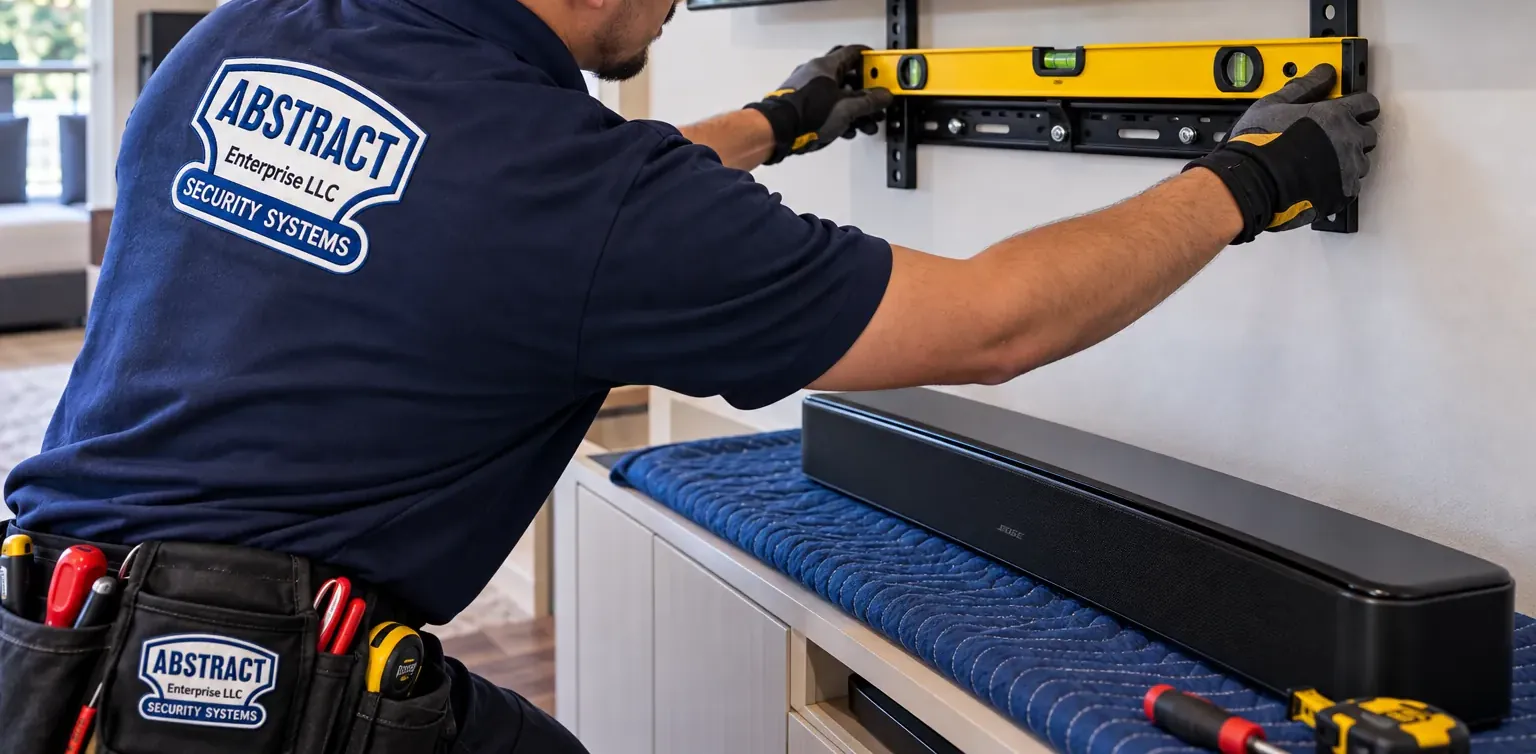
Level first, bar second: the bracket is squared under the TV while the soundbar waits on a padded blanket below.
Mott Haven Soundbar Quote
Building type, floor and bar model — a written price comes back the same business day
✅
Request Sent!
A Bronx installer will call you back the same business day.
25+
Years Experience
✓
Same-Day Estimates
100%
Licensed & Insured
4.7★
201 Google Reviews
Bar still boxed in the hallway? Text a photo of the wall or ring (646) 490-0629; the form takes about a minute. Whoever answers holds the trade, not a sales script, and what comes back is a written figure assembled from the priced lines lower on this page — nothing estimated, nothing rounded up.
We tell you who has to agree — rowhouse owner, NYCHA or PACT manager, or the new building's management — before you book
Free certificates of insurance for management offices and commercial landlords
NYS licence #12000287431 · 2-hour arrival windows, 8 AM–8 PM, every day
Mott Haven is one of the most renter-heavy corners of New York City, and a large share of those rentals are public housing. The NYU Furman Center's profile of Mott Haven/Melrose puts the homeownership rate at 6.1 percent in 2024, against 32.7 percent citywide, and counts 12,946 NYCHA public-housing apartments — 24.1 percent of all rental units in the district. Put another way, roughly one renting household in four lives in a Housing Authority development, and nearly everyone else rents from a landlord, a rowhouse owner or a new building's management company. Very few people who call us from 10451 or 10454 own the wall they want the soundbar on.
What makes the neighbourhood unusual is how different the buildings are from one block to the next. Alexander Avenue between East 137th and East 141st Streets is the spine of the Mott Haven Historic District, which the Landmarks Preservation Commission designated in 1969 — the Bronx's first historic district — for nineteenth-century architecture. The Mott Haven East Historic District on East 139th and East 140th Streets and the Bertine Block on East 136th Street between Willis Avenue and Brown Place followed in 1994. A short walk away stand the post-war towers: Patterson Houses, finished in 1950, Mill Brook, Mitchel, Mott Haven Houses and Moore Houses, most of them sixteen to twenty-two storeys high, alongside the low-rise Betances buildings of the 1970s and early 1980s.
The third layer is new. In 1997 the City Planning Commission created the Port Morris Special Mixed Use District; in 2005 the Council rezoned a stretch of Bruckner Boulevard for mixed residential and commercial use; and in 2009 the Lower Concourse rezoning opened thirty blocks along the Harlem River to housing. Bankside, the largest of the projects that followed, broke ground in 2019. The Furman Center counts 1,444 new homes authorised by building permits in Mott Haven/Melrose in 2019 alone. The results line Third Avenue, Lincoln Avenue and Bruckner Boulevard: Third at Bankside and Lincoln at Bankside on either side of the Third Avenue Bridge, Maven at 2413 Third Avenue, Bruckner House at 40 Bruckner Boulevard, 138 Bruckner and Estela, most mixing market-rate apartments with rent-stabilised ones.
Wrapped around all three are the highways. The Mott Haven section of the Major Deegan Expressway went in between 1937 and 1939, the Bruckner Expressway runs along its southern side, and the Third Avenue and Willis Avenue Bridges pour traffic in from Manhattan. Some of the newest buildings were required to answer that directly: an environmental report for 132–138 Bruckner Boulevard records an E-designation for noise, with facades that must achieve 40 dBA of combined window and wall attenuation and a way to ventilate with the windows shut. Older apartments have no such protection. So a soundbar here is set up for one of two quite different problems — dialogue lost under a truck downshifting on the ramp, or a sealed, quiet tower where the loudest thing left is the neighbour's television.
None of that is about which brand of soundbar you bought. A current bar from Samsung, LG, Sony, Sonos, Bose, Vizio or TCL sounds good once it sits close under the screen, plugs into the TV's ARC or eARC port and is set for the room. What goes wrong in Mott Haven is the planning: a hammer drill run at full tilt next to an 1880s plaster cornice, a bracket screwed into a fire-rated wall between two new apartments without a thought for what that wall is for, a subwoofer tuned at rush hour that booms at one in the morning, or a contractor sent to a PACT building who doesn't know the management office changed hands.
Mott Haven numbers behind a soundbar job
6.1 percent: homeownership in Mott Haven/Melrose in 2024, per the NYU Furman Center, compared with 32.7 percent across the city. Somebody other than the occupant usually has a say about the wall.
12,946 apartments, 24.1 percent of rentals: NYCHA public housing in the district in 2025 (Furman Center, from NYCHA and City Planning data) — written consent from the development's management comes before any bracket.
1969 and 1994: the years the Landmarks Preservation Commission designated the Mott Haven Historic District and then the Mott Haven East and Bertine Block districts (Historic Districts Council). Interiors here are plaster and lath behind decoration that cracks if handled roughly.
31 buildings: the Bertine Block, East 136th Street between Willis Avenue and Brown Place, built 1877–1899 as rowhouses, two-family houses and four eleven-family tenements (Historic Districts Council).
40 dBA: the combined window-and-wall noise attenuation an environmental assessment for 132–138 Bruckner Boulevard says that site's facades must reach under its noise E-designation, with ventilation that works with the windows closed.
1,379 apartments: Third at Bankside (458) plus Lincoln at Bankside (921), the two residential halves of Brookfield's seven-tower development at the Third Avenue Bridge (Brick Underground; 6sqft).
Taken together, those figures describe the typical Mott Haven soundbar call: a renter, almost always; a building that falls clearly into one of three very different eras; a wall that someone else controls; and a sound problem that is either too much city coming in or too much neighbour coming through. The rest of this page is organised around those three building types and those two sound problems.
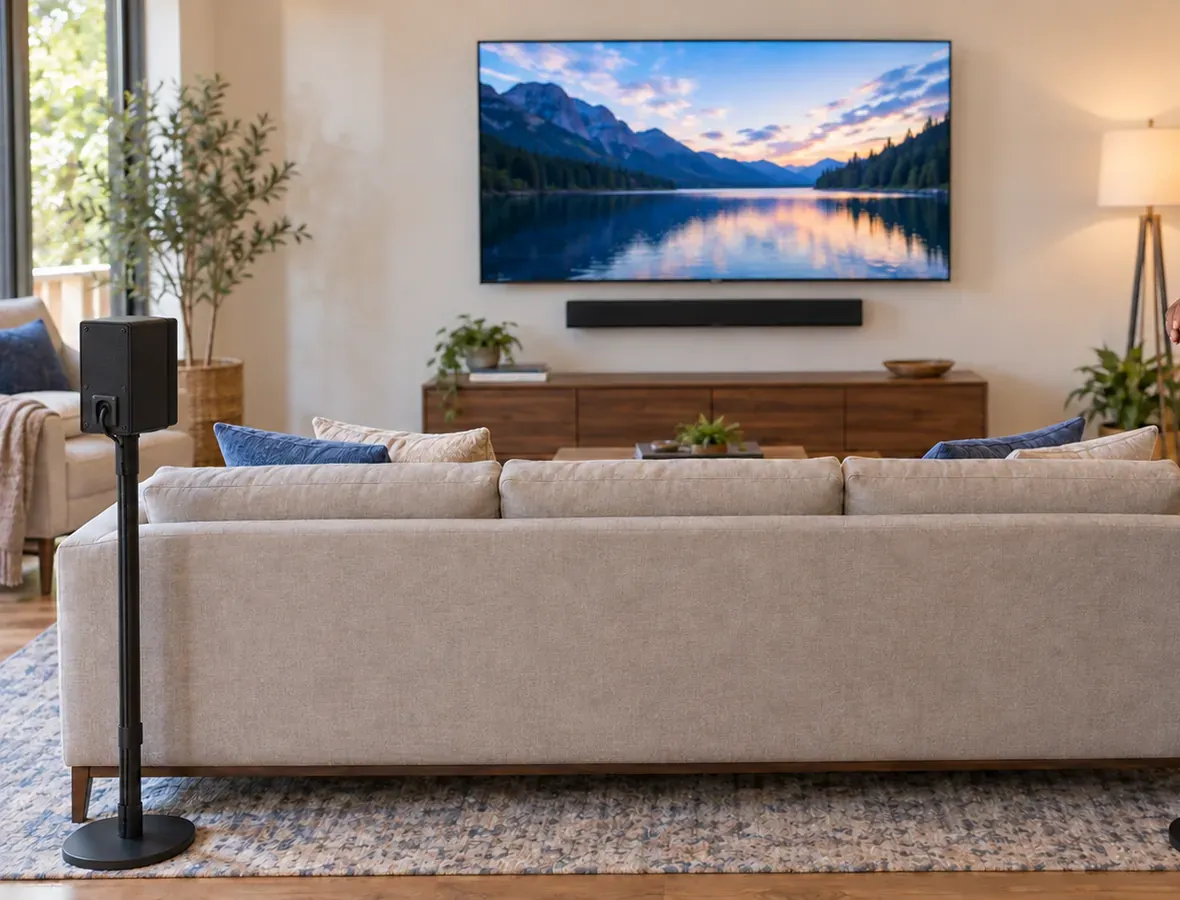
Bar under the screen across the room, a rear speaker on its stand at the end of the sofa, aimed at the seats.
Repair Capture
Soundbar Trouble in Mott Haven Today
No sound since the cable box was swapped, the TV remote suddenly ignoring the bar, lips moving a beat before the words, a subwoofer that has stopped pairing, or a bracket starting to tilt out of old plaster — those are service calls, not new installs. Call (646) 490-0629 and say it is a soundbar repair in Mott Haven. We book the next open 2-hour window, and most connection and settings faults are fixed within one to two hours of the technician walking in. How setup-only time is billed is set out in our TV and soundbar service policies.
What We Install
Soundbar Installation Services in Mott Haven
Every Mott Haven soundbar job is assembled from the services below, each with a published Bronx price. Which ones make sense depends mostly on the building: a rowhouse owner can open a wall, a NYCHA resident waiting on consent cannot drill at all, and a tower tenant sits somewhere in between.
Stand Setup, Nothing Drilled
The bar placed on the console or dresser, connected and configured, kept clear of the TV's remote sensor, cables gathered out of sight. The right first step in a NYCHA or PACT apartment while written consent is pending, and in any lease that forbids alterations.
Bar Under a Swing Arm or Existing Mount
A TV-attached bracket hangs the bar from the TV's own mount, so it turns with the screen and the wall gets no new holes. Useful in tower living rooms where the TV swings between the sofa and the dining table.
Wall Mount on the Wall We Find
Its own bracket, a short drop below the TV, centred and checked with a level — held by toggles in lath and plaster, sleeve anchors in brick, concrete anchors in a tower or steel-stud fasteners in new drywall, whichever the wall turns out to need.
TV and Bar in One Visit
Hanging both together means one agreed height, one cable route and one set of holes. The usual choice for people moving into a new building on Third Avenue or Bruckner Boulevard.
Painted Surface Channel
A slim channel from the bar down to the outlet, painted to the wall. The standard finish on tower concrete and block, on brick in a loft, and in any rental where you would rather leave a few screw holes than a patched wall.
In-Wall Power and Cable
Power and HDMI hidden inside a hollow wall with a code-compliant in-wall power and cable kit, where the owner agrees and the wall is not one that must stay intact for fire or sound separation. Mostly rowhouse owners and owner-occupied units.
Traffic-Aware Sound Setup
Dialogue and bass set for the apartment's real noise — an expressway ramp outside an old window, or the hush of a sealed new facade — with night mode and a clear-voice setting on buttons people actually use.
One-Remote Control
Connected through the TV's eARC or ARC socket with HDMI-CEC enabled, so a single remote handles power and volume; audio sync checked against the picture, and the bar's software brought up to date wherever it can get online.
Storefront and Waiting-Room Bars
Soundbars for barbershops, delis, clinics and cafés along East 138th Street, Willis Avenue, Third Avenue and Bruckner Boulevard, mounted out of the way and capped at a level that suits the room.
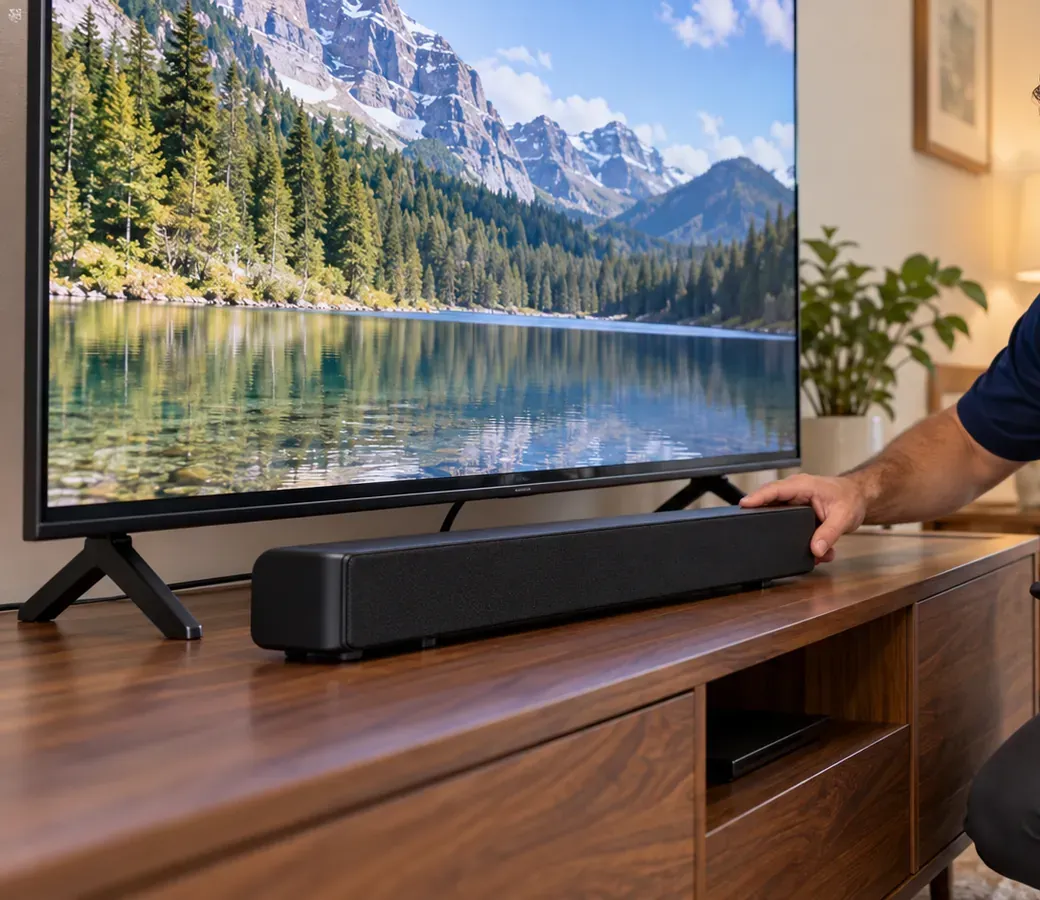
Nothing drilled: the bar sits on the console in front of the TV's feet and a hand nudges it square to the screen.
Building Specialists
Soundbar Installation for Mott Haven's Architecture
Three building booms, more than a hundred years apart, shaped Mott Haven — and each one put a different kind of wall behind today's televisions. Below are the six building types we meet in the neighbourhood, what each means for a soundbar, and whose agreement is usually needed.
Historic-District Rowhouses
Brick and brownstone rowhouses on Alexander Avenue, East 139th and 140th Streets and the Bertine Block, mostly from the 1870s to the 1890s. Interior partitions are typically plaster on wood lath, parlours have high ceilings and decorative plaster, and the owner is often living downstairs. Exterior changes fall under the Landmarks Preservation Commission.
Tenements and Walk-Ups
Five- and six-storey walk-ups on Willis, Brook, St. Ann's and Cypress Avenues and the numbered streets between, many laid out as long railroad apartments. Walls skimmed and repainted for a hundred years, few outlets, and every tool carried up the stairs in one trip.
NYCHA Towers
Patterson, Mill Brook, Mitchel, Mott Haven and Moore Houses — brick-clad towers from 1950 to the mid-1960s, most of them sixteen storeys or more. Masonry partitions behind plaster, a living-room window that often faces a highway or a bridge approach, and written consent from the development's management before anything is fixed to a wall.
PACT and RAD Developments
Developments converted under NYCHA's PACT programme are still NYCHA-owned but run day to day by a private manager — at the Betances Houses, between 136th and 145th Streets, that is Wavecrest, according to the Mott Haven Herald. Renovated kitchens, baths and windows, and a new office to ask before drilling.
New Rental Towers
The buildings that followed the 2005 and 2009 rezonings: Bankside, Maven, Bruckner House, 138 Bruckner, Estela and their neighbours. Concrete structure, drywall partitions on light steel studs, rated walls between apartments, sealed facades on the noisiest blocks, and a management office with its own contractor rules.
Port Morris Factory Lofts
Converted industrial buildings such as the Estey Piano factory at Lincoln Avenue and Bruckner Boulevard, now rental lofts under its clock tower. Thick brick walls, exposed beams or columns, tall windows and long open rooms that make bass behave very differently from a small apartment.
Fixings and methods, building by building
Rowhouse partitions: plaster on wood lath. Most interior walls in a nineteenth-century rowhouse are three coats of plaster pressed through wooden lath strips nailed to studs. Where the bracket lines up with a stud, a long screw into the stud does the work. Where it doesn't, a toggle sized for the bracket spreads the load behind the lath. We drill those holes slowly, on rotation only, and score the paint first so the plaster face doesn't flake around the hole.
Rowhouse party walls and front walls: brick. The walls you share with the house next door, and the street wall, are usually solid brick behind a coat of plaster. Brick takes a sleeve or screw anchor well, but the plaster on top can be loose; we sound it by tapping first and keep the anchor deep enough to bite the brick, not the plaster. Because these walls carry sound between houses, a bar on a party wall is set with the subwoofer elsewhere in the room.
Tenement walls: patched, skimmed and sometimes hollow. In an old walk-up the TV wall may be original plaster, plaster over a newer layer of board, or a later partition of block or terracotta. A small pilot hole where the bracket will hide it, and a look at the dust, settles which. The bar is levelled to the screen even where the wall surface wanders, using shims or a bracket with depth adjustment.
Housing Authority towers: masonry behind plaster. Partitions in the post-war towers are generally masonry finished in plaster, which means a hammer drill, masonry anchors and a painted surface channel rather than wire inside the wall. Holes go into the face of the block or brick, not the mortar line, and a vacuum is held at the bit so the dust stays out of the apartment.
New towers: drywall on steel studs, concrete behind. Inside the new buildings most partitions are gypsum board on light-gauge steel studs, which needs fasteners made for steel or toggles through the board — the wood screws packed with many soundbars are no use. Columns and shear walls are poured concrete and take concrete anchors after a scan. The wall between your apartment and the next one is usually a fire-rated assembly. The International Building Code, which New York City's code is based on, says recessed fittings in a rated wall must not reduce its fire resistance and sets rules for how close boxes can sit on opposite sides, so we do not cut an in-wall kit into a demising wall; that run stays on the surface or moves to an interior partition.
Factory lofts: brick, timber and steel. The brick in a Port Morris loft is often a foot or more thick and old enough that its face crumbles under a careless bit. We drill the brick itself, not the joint, with anchors rated for old masonry, and keep long cable runs on the surface in a channel painted to match the brick or the column. Where the TV floats in the middle of a big room, a floor stand or a ceiling or beam bracket is often a better answer than a wall at all.
Radiators, PTACs and window walls. Rowhouses and the older towers are heated by radiators under the windows; many new apartments use through-wall heating and cooling units instead, and on the sealed facades those units are part of how the building ventilates with the windows shut. Either way we keep the bar out of the warm air coming off the unit and away from its intake, and we never block a through-wall unit's grille with a TV wall.
Rowhouse owners opening up a floor often ask for a data cable to the TV wall while they are at it, since Wi-Fi fades fast through a brick party wall. That is a job for structured cabling installation in Mott Haven, scoped on the same visit, while network cable repair in the Bronx revives older runs that have gone dead.
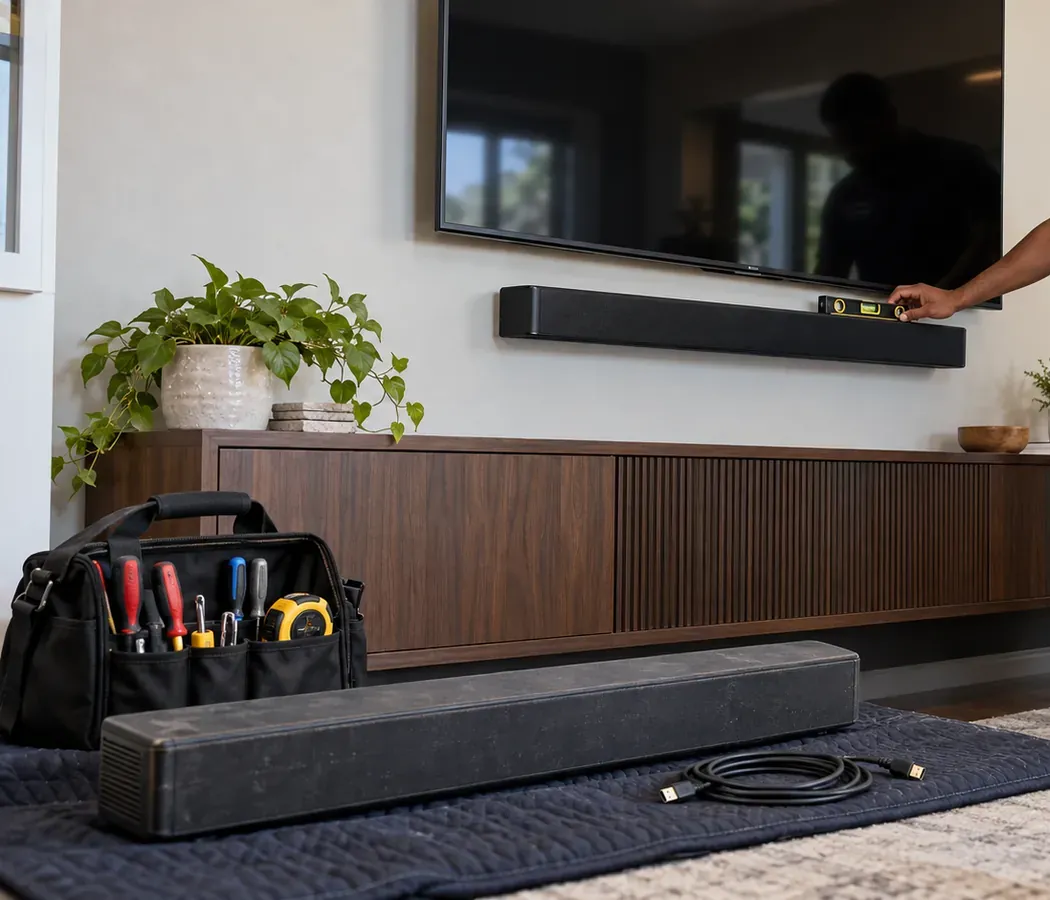
One last level across the top of the bar before the room is handed back; the tool bag waits on the rug.
Commercial Soundbar Installation
Business Soundbar Installation in Mott Haven
Mott Haven's shopping streets are small-business streets, and a soundbar is the cheapest way to make a shop TV understandable. A 2021–2022 Commercial District Needs Assessment by the city's Department of Small Business Services and the New Bronx Chamber of Commerce surveyed Third Avenue, Alexander Avenue, Brook Avenue, Bruckner Boulevard, Canal Place, St. Ann's Avenue, Willis Avenue and the numbered side streets. It counted 38 delis and bodegas, 26 beauty salons, nail salons and barbershops, 23 limited-service restaurants, 18 doctors', dentists' and medical offices, 19 schools and day-care centres and 15 coffee shops, cafés and bakeries, with storefront vacancy at 8.3 percent. Those are exactly the businesses that run a TV all day.
East 138th Street
The neighbourhood's main shopping street, running from Third Avenue past the 6 train to Willis and beyond. Barbershops, salons, phone shops and food counters with a screen on the wall, where a bar has to be heard over clippers, dryers and the street door.
Bruckner Boulevard
The South Bronx “Antique Row” described in City Planning's 2005 rezoning material, now with restaurants and bars under new apartments. Game-day sound in a room with neighbours upstairs means bars tuned for speech and a bass level that stays in the room.
Third Avenue and Graham Triangle
Where East 138th Street, Lincoln Avenue, Morris Avenue and Third Avenue meet, close to the Third Avenue Bridge and the new waterfront towers. Clinics, offices and ground-floor retail in mixed-use buildings, with waiting rooms that need captions and calm, steady sound.
Willis Avenue
A busy north–south strip from the Willis Avenue Bridge up through the neighbourhood, with food, pharmacy, tax and money-transfer storefronts. Narrow shops where the bar must stay out of the path between the door and the counter.
Alexander Avenue and the Historic District
Cafés and small businesses on the ground floors of the historic district's avenue. Inside is ordinary interior work; anything fixed to a protected facade — a speaker over a door, a screen in a window frame — is a question for the Landmarks Preservation Commission first.
Port Morris
Warehouses, studios, event spaces and breweries between the Bruckner Expressway and the water, from East 132nd to East 136th Street. Big rooms, hard surfaces and high ceilings, where one bar under one TV rarely fills the space and ceiling speakers sometimes make more sense.
Compliance callouts for Mott Haven businesses
The city's commercial music limits. Under the Noise Code, as the Department of Environmental Protection summarises it, music from a business may not exceed 42 decibels measured inside a nearby home, and from 10 p.m. to 7 a.m. may not exceed 7 decibels over the ambient level on the street 15 feet or more away. Most Mott Haven storefronts have apartments above them, so we keep subwoofers out of shop installs or set them very low.
Keep the aisle clear. Section 307.2 of the 2010 ADA Standards limits anything fixed to a wall in a circulation path to a 4-inch projection when its lower edge sits between 27 and 80 inches off the floor. A soundbar under a shop TV in a narrow Willis Avenue storefront or a clinic hallway therefore goes higher than that band, or somewhere nobody walks.
Landmarked fronts. In the three historic districts, the Landmarks Preservation Commission requires a permit for work on a building's protected features, including work that needs no Department of Buildings permit. Keep speakers and screens inside, off the facade and the stoop.
Outlets are an electrician's job. Mounting and connecting a soundbar is low-voltage work; a new or moved outlet is electrical work. If the only outlet is across the shop, the options are a longer surface channel or an electrician first.
Insurance for the landlord. Commercial leases on the 138th Street and Third Avenue strips commonly ask that contractors be insured with the owner named. Give us the names and the certificate goes out free, usually the same day.
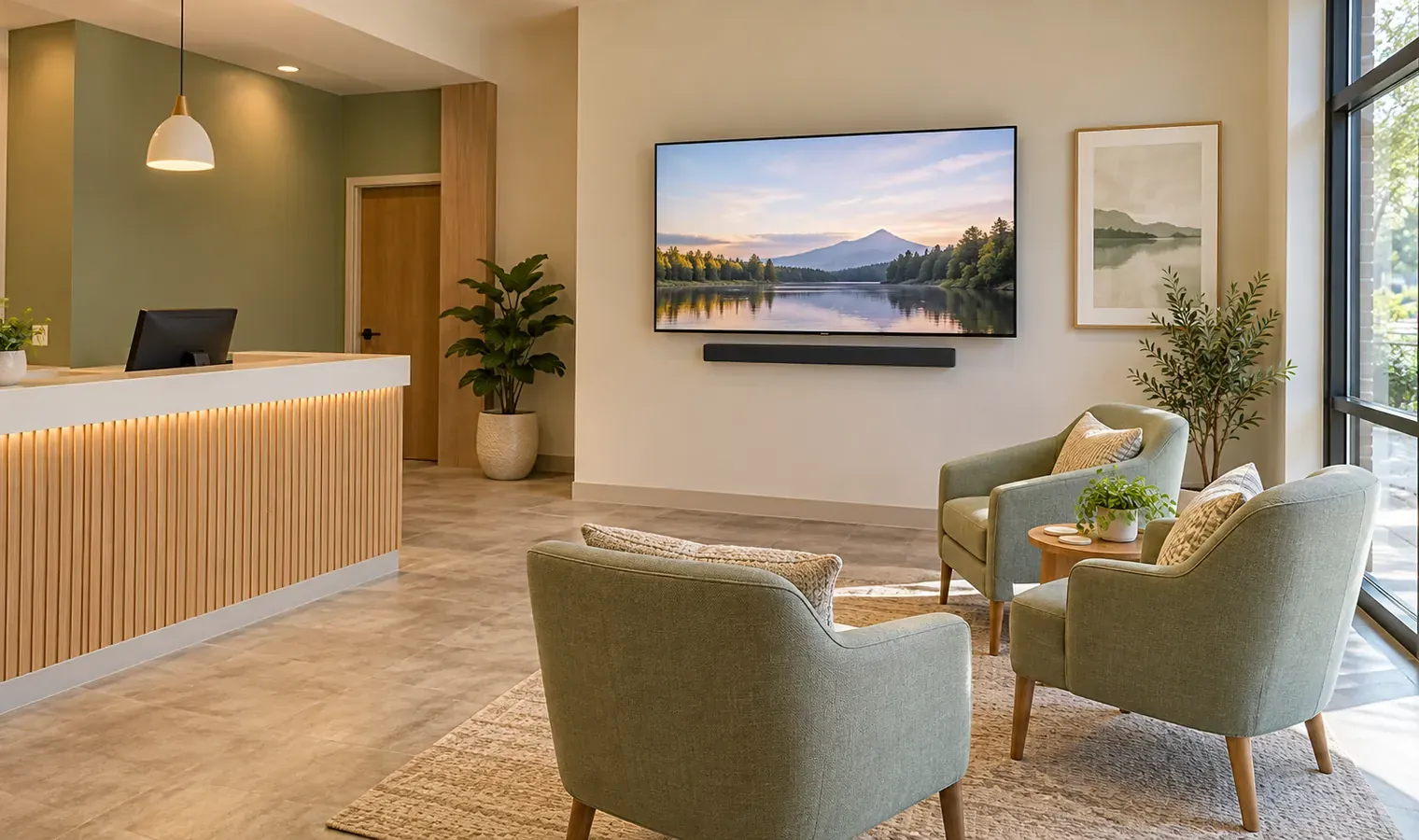
A reception desk on one side, armchairs on the other, and a slim bar centred under the screen at a height nobody walks into.
Soundbar Installation in Mott Haven: Questions Answered
These are the questions Mott Haven callers put to us before they book, grouped by the kind of building behind them: the historic rowhouses and the old walk-ups, the Housing Authority and PACT developments, the new rental towers, the lofts and shops of Port Morris and 138th Street, and the traffic that surrounds all of them. Prices, intercoms, Wi-Fi sign-in pages and similar quick answers are in the FAQ further down. Nothing here is legal advice; where a lease, a house rule or a landmark rule is involved, the document and the office that issued it decide.
Rowhouses and walk-ups in the historic districts
Will drilling for the bracket shake loose the plaster cornice or ceiling medallion in our 1880s parlour?
Not if the drilling is done the way old plaster needs. Decorative cornices and medallions are run or cast plaster keyed to the ceiling and wall, and what loosens them is sustained hammering transmitted through the lath, not the small number of holes a soundbar bracket needs. On lath and plaster we drill on rotation only, with a sharp bit, after scoring the paint so the surface doesn't chip, and we avoid the hammer setting entirely unless the hole has reached brick.
Position matters as well. A soundbar sits a few inches under the TV, usually at chest height and well away from the cornice line, so the vibration path to the ornament is long. Where the TV wall is the brick party wall and the hammer setting is unavoidable, we start slowly, keep the bit straight and stop to look at the ceiling after the first hole. If there is an old crack running toward the cornice, we point it out before we begin, not after.
If a ceiling is already loose — sagging, cracked in a ring around the medallion, or sounding hollow when tapped near the wall — that is a plasterer's job before it is ours. We will tell you what we see and leave the bar on the stand until it is fixed.
We want a TV and speakers on the back terrace of our landmarked rowhouse — does anything on the outside wall need approval?
Very possibly, and you should ask before anything is drilled. In a historic district the Landmarks Preservation Commission requires a permit for work on a building's protected features, and that includes work that needs no Department of Buildings permit at all — the city's guidance calls that a Permit for Minor Work. Only simple repairs and maintenance, such as replacing broken glass or repainting in the same colour, are described as needing no LPC review. A bracket, a box or a cable fixed to the brick of a rear facade is not ordinary maintenance.
Which parts of a particular house are protected, and whether a rear wall that cannot be seen from the street is treated the same way, is the Commission's call, not ours. The practical route is to describe the job to LPC staff in plain terms — size of the screen, where the bracket goes, how the cable enters the house — and keep the answer. We can give you that description with drawings of the bracket positions.
Until then, a freestanding outdoor speaker or a portable bar brought out for the evening keeps everything off the facade. Inside the house, a soundbar on an interior wall does not touch the building's exterior at all.
Our walk-up is a railroad apartment — which room should the TV and soundbar go in so the sound doesn't run the length of the flat?
Usually the front room, with the bar firing toward the street wall rather than down the length of the apartment. A railroad flat is a line of rooms with the doorways often aligned, so a bar placed on a side wall and aimed along that line sends sound straight through every room to the kitchen at the back. Put the TV on the wall that closes off the end of the run, and the doorways sit behind or beside the listener instead of in front of the speaker.
Where the only workable wall faces down the flat, a door or a heavy curtain at the first doorway does more than any setting. On the bar, we turn on the dialogue mode and lower the subwoofer, because low bass travels through doorways and thin partitions far more easily than voices do, and most railroad walls are shared with a neighbour on one side.
The middle rooms of a railroad flat are often bedrooms with no window, and people sleep in them while others watch TV. If that is your situation, the night-mode button matters more than the bracket, and we will make sure everyone in the home knows where it is.
NYCHA and PACT developments
Our development was converted under PACT and is now run by a private company — whose permission do we need now?
The management office that runs your development today. Under the PACT and RAD conversions, buildings stay NYCHA-owned but day-to-day management passes to a private company; the Mott Haven Herald reported that at the Betances Houses, whose buildings run from 136th to 145th Streets, that company is Wavecrest. Repairs, rules and permission for fixtures now go through that office rather than the old NYCHA property management office.
So the request goes to the new manager, in writing, and the answer you keep is theirs. Describe the work small and exactly: a soundbar of a given length, two to four anchors under the existing TV, a painted channel on the surface rather than anything inside the wall. A new manager that has just paid for renovated kitchens, bathrooms and windows will want to know that nothing touches those.
If the answer is slow, the bar can go on the stand from day one, or hang from a TV mount that is already approved. When consent arrives, moving it to the wall is a short follow-up booked on the same published menu.
If the elevator in our tower is out of service on the day, do we pay the walk-up charge or reschedule?
You choose. If the technician can reach your floor by the stairs and you want to go ahead, the job is priced with our published walk-up line — $40 for the third floor and above with no working elevator — in place of the elevator access the quote assumed. Most soundbar jobs are carried in one trip, so a stair climb is tiring rather than impossible, even well above the tenth floor.
If you would rather wait for the elevator, call us as soon as you know it is out. Rescheduling is free with 24 hours' notice, and with less notice we would still rather move the booking than send someone to a building they cannot work in. What we want to avoid is a wasted trip: the $150 return-trip fee in our terms is there for visits that cannot start because there is no access.
It also helps to tell us the building, the section and the floor when you book. A quick call to the lobby or the super on the morning of the visit tells everybody where things stand before anyone sets off.
The new towers on Bruckner Boulevard and the waterfront
Our building on Bruckner Boulevard was built to keep expressway noise out — why do we now hear the neighbours' TV?
Because the building did its job on the outside. A site under a noise E-designation has to show that its facade — windows and wall together — cuts outside noise by a set amount; for 132–138 Bruckner Boulevard, the figure in the environmental report is 40 dBA, with ventilation that works when the windows are shut. Once the traffic is turned down, the background in the apartment drops, and the sounds that remain — footsteps, a door, a television through a party wall — stand out against the quiet.
That works both ways. Your soundbar will be heard next door more readily than it would in an old building where traffic masks everything. The biggest offender is bass, which passes through floors and walls far more easily than speech, so in a sealed tower we place the subwoofer away from the shared wall and off the floor's hard surface, and set it lower than the factory default.
The good news is that quiet rooms need less volume. Dialogue that would have been lost under a passing truck in a walk-up is clear at a modest level here, which is exactly the level that does not travel. We set the everyday volume with that in mind and show you night mode for late films.
We may leave our new-building apartment when the lease ends next year — is a wall mount still worth it?
Often yes, if the bracket is planned for leaving. A soundbar bracket on steel-stud drywall needs two to four fasteners, and the holes are small and easy to fill when you go. The parts that cost more to undo are a long run of cable channel glued to fresh paint and anything cut into a wall, so on a one-year lease we keep the channel short or use the TV's own mount for the bar.
Ask the management office what it wants at move-out before you book. Some buildings are happy for tenants to leave filled holes; others prefer that the tenant leaves nothing. Either way, keeping the bracket count low and the cable route simple makes the exit inspection easy.
If you are fairly sure you will move, the stand setup at $79 gets you the improvement in sound for the year without a single hole, and the same bar goes on the wall at the next apartment.
Lofts and shops: Port Morris and 138th Street
Can the TV and soundbar hang from an exposed beam in a converted factory loft instead of the brick?
Sometimes, and it is worth asking the building first. Old timber beams and steel girders in a loft conversion are usually part of the structure, so fixing a mount to them is a question for the landlord or managing agent, and occasionally their engineer. If they agree, a ceiling or beam mount puts the TV where the room needs it, and the bar hangs from the TV with an attached bracket so it moves with the screen.
On timber we use lag screws into sound wood well away from cracks and old bolt holes; on steel, clamps rather than drilling wherever the mount allows. Cable runs down a column or along the beam in a painted channel rather than hanging loose across the room.
In a loft the bigger issue is often sound rather than the mount. Long rooms with brick and high ceilings make bass boom and dialogue echo, so we keep the bar close under the screen, run its room calibration where it has one, and talk honestly about whether a bar can fill the space or whether a small speaker system would serve it better.
Our barbershop on East 138th Street has clippers and dryers going all day — how does a soundbar stay understandable?
By aiming for clarity, not loudness. Clippers, dryers and conversation sit in the same middle range as speech, so turning everything up just makes the room louder. A bar with a dedicated centre channel and a dialogue or clear-voice mode, mounted close under the screen and pointed at the chairs, keeps voices on top of the noise at a moderate level.
Placement does a lot of the work. We mount where the waiting customers and the chairs both face, high enough to clear the path from the door to the chairs, and away from the dryer station. Captions on the TV help too; in a shop, many people read the game as much as they hear it.
We leave the subwoofer out or set it very low, because there are usually apartments upstairs and bass does nothing for intelligibility. One remote behind the counter, and the volume buttons on the bar itself switched to a sensible ceiling where the model allows it.
Can a soundbar sit above the refrigerated case behind a deli counter?
It can, with care about heat and vibration. The top of a refrigerated case is often where the compressor's warm air leaves, and the case vibrates when it runs. A bar sitting directly on top will pick up the hum and get warm, so we mount the TV and bar on the wall above, with a gap, rather than resting anything on the case.
Grease and dust are the long-term enemy behind a counter. A bar on a bracket can be wiped down; one tucked into a gap over the cooler cannot. We keep the cable in a sealed channel and the power connection well away from any sink or ice machine.
Before mounting, check that the landlord and any equipment supplier are happy with fixings above their case; refrigeration companies sometimes need clear access to the top for servicing.
Traffic outside, neighbours inside
Bass that sounds right at rush hour feels far too heavy at one in the morning once the Deegan quiets down — can the soundbar handle both?
Yes, and it is one of the most common settings we change in apartments near the expressways. Steady traffic noise is strongest in the low frequencies, so in the evening rush it masks the bar's bass and people turn the subwoofer up to compensate. Late at night the traffic thins, the masking disappears, and the same setting suddenly sounds boomy — to you and to the people below.
The fix is to set the subwoofer for the quiet hours, not the busy ones, and to give you a quick way to add bass when you want it. Many bars have a night or dynamic-range mode that compresses loud effects and keeps speech clear at low volume, and some let you save a second sound setting in their app.
If your windows face the Major Deegan or a bridge approach and are always open in summer, we may also suggest the TV wall that faces away from the window. Moving the listening position a few feet out of the window's path often helps more than any setting.
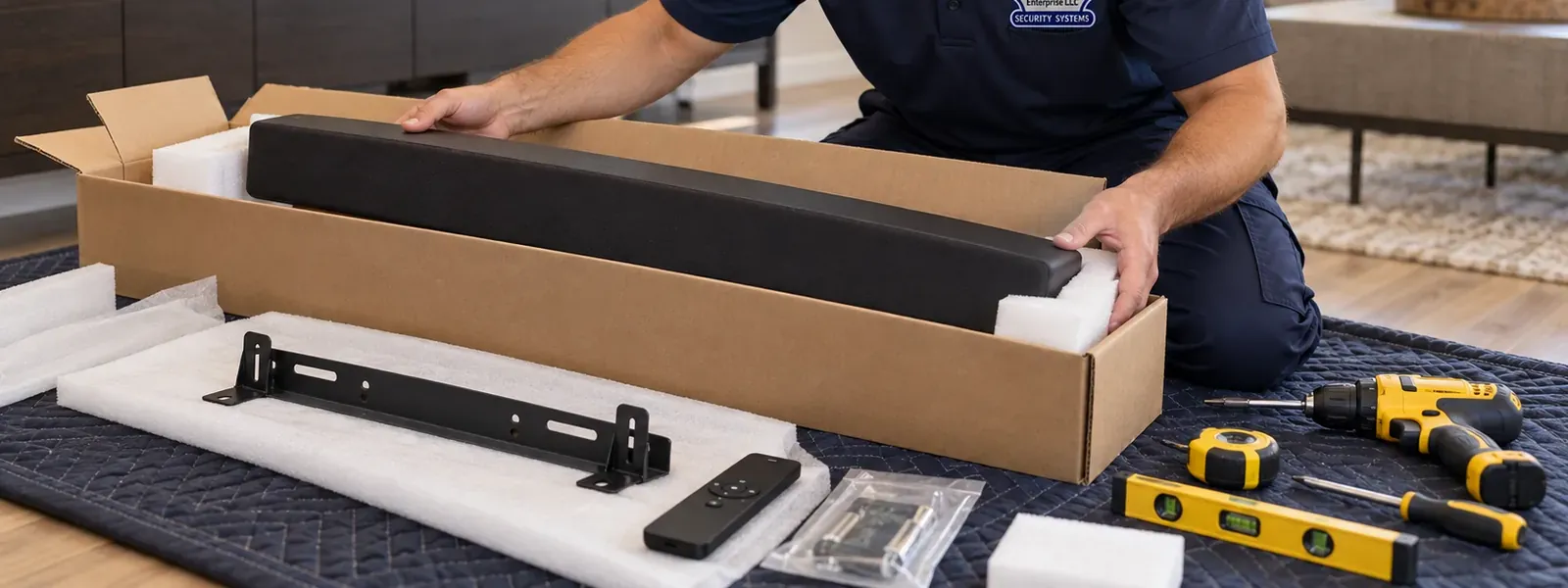
Out of the box and counted before any hole is marked: bar, bracket, remote, the hardware bag, a drill and a level.
Equipment
Types of Soundbars and Mounts We Install
We install the bar you already own, and if you are still choosing, we will tell you what suits the building before you buy. These are the categories that come up most in Mott Haven, with what changes about each one between a rowhouse parlour, a tower living room and a loft.
Compact Bars
Short, light bars for screens under about 50 inches — the bedroom of a railroad flat, a studio in a new building, a TV on a desk. The Sonos Ray, at about 56 cm wide and under 2 kg, connects by optical rather than HDMI. Light bars are kind to old plaster and to the neighbours.
Bars With a Centre Channel
Bars with a dedicated centre speaker put voices in their own channel, connected over HDMI ARC or eARC. At roughly 6.35 lb the Sonos Beam (Gen 2) is typical, and Samsung, LG, Sony and Bose all sell rivals. Under a 50- to 65-inch screen this is the safest all-round pick, and in a shop where people need to follow speech it is the one we suggest.
Atmos Bars
Long bars with up-firing drivers that bounce height effects off a flat ceiling. Sonos lists the Arc Ultra at 46.38 inches wide and 13.01 lb. Tower ceilings are usually flat and modest in height, which suits them; a tall rowhouse parlour or a loft with exposed beams is much less predictable.
Wireless Subwoofers
Separate bass units paired to the bar. Where the sub sits, and on what, matters more than its size: off the shared wall, out of the corner and on a dense pad, it gives fuller sound at a lower setting. In a sealed new building that matters more, not less.
Wireless Rear Speakers
Small surrounds that pair to the bar with no speaker cable, though each still needs its own outlet. Old walk-ups with one outlet per room often decide this for you; new apartments usually have outlets where rears want to go.
Universal Soundbar Brackets
For bars sold without a bracket, or where the one in the box suits only wood studs. Sanus's SASB1 universal mount takes most bars up to 20 lb, from behind or below, with depth adjustment that helps on wavy plaster. We supply a Sanus soundbar bracket for $84.99.
TV-Attached and Swing-Arm Brackets
When the screen is on an articulating arm that swings toward the kitchen table, the bar has to ride on the TV, not the wall. Sanus makes the WSSATM1 for exactly that, built with Sonos for the Arc and listed for most 50- to 90-inch sets on other makers' mounts too.
Surface Channels and In-Wall Kits
Paintable channels for masonry, brick and rented walls; code-compliant in-wall power and cable kits for hollow interior partitions where the owner agrees. The kit feeds the TV and bar from an existing outlet lower on the same wall, with no new electrical circuit.
Cables, Remotes and Repeaters
An HDMI lead rated for eARC, an optical lead for older sets, a universal remote for households juggling a cable box, a streamer and a console, and an infrared repeater where a cable box has to hide behind the screen.
Which mounting approach suits which Mott Haven wall
Where the TV is
What the wall usually is
Bracket approach
Cable finish
Rowhouse parlour, interior wall
Plaster on wood lath over studs
Screws into studs, or toggles through the lath
In-wall kit where the owner agrees; otherwise painted channel
Rowhouse party or front wall
Plaster over solid brick
Sleeve or screw anchors set into the brick
Painted channel; subwoofer kept off this wall
Walk-up railroad flat
Old plaster, patched board or block
Decided after a pilot hole; shims for wavy walls
Short painted channel to the nearest outlet
NYCHA or PACT tower
Masonry behind plaster
Masonry anchors, hammer drill, dust vacuum
Painted channel; nothing inside the wall
New tower, interior partition
Gypsum board on light steel studs
Steel-stud fasteners or toggles
In-wall kit possible with management's agreement
New tower, wall to next apartment
Fire-rated demising assembly
Surface fixings only, sub away from the wall
Surface channel; no boxes cut into the wall
Port Morris loft
Thick old brick, beams, columns
Anchors for old masonry, or a beam or ceiling mount with permission
Channel down a column or along a beam
The dimensions quoted in the cards come from Sonos and Sanus product pages as they stood when this page was last reviewed; new models arrive every year. Send the model number when you book and we check its inputs, its weight and the bracket it ships with, which is also how we know whether to bring toggles, sleeve anchors or concrete anchors for your particular wall.
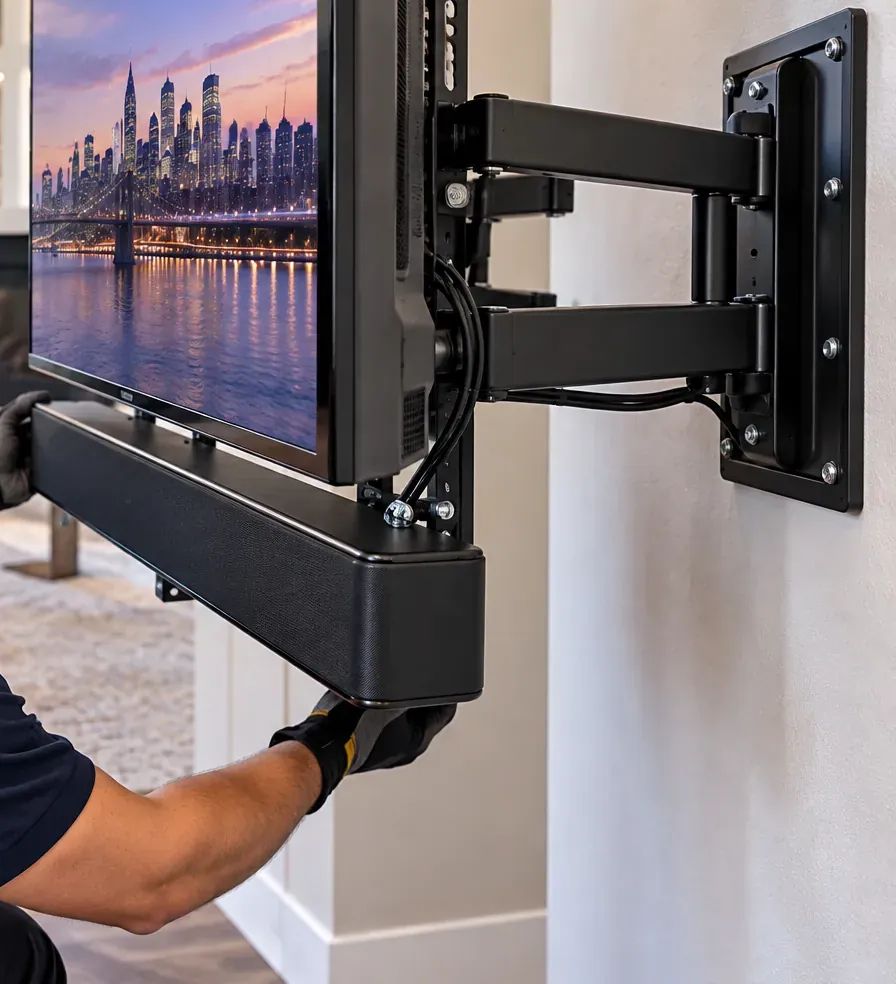
On a swing arm the bar hangs from the TV itself, so it turns with the screen instead of staying behind on the wall.
AI Overview Reality Check
What AI Gets Wrong About Soundbar Installation in Mott Haven
A note on method first. The research tools behind this page could not display Google's AI Overview, so no heading below claims to quote it. Instead, every heading repeats something a cost guide or installer site really publishes — the sort of sentence an answer engine lifts — and the paragraphs underneath test it against Mott Haven walls, leases and landmark rules.
“TV mounting typically requires a permit”
A cost-estimate site for TV mounting says exactly that about the town it covers, and versions of the line circulate widely. In New York City it points people at the wrong office. Hanging a soundbar on an interior wall and plugging it into the TV is not the kind of work the Department of Buildings issues permits for; adding or moving an outlet is electrical work, and that is a different trade and a different permit.
The approvals that actually stop Mott Haven soundbar jobs are not city permits at all. They are the written consent of a NYCHA development's management office, the say-so of a PACT company that took over a development's day-to-day running, a new building's rules for contractors, or a rowhouse owner's agreement when you rent the parlour floor.
That is why our first question is about the building, not the bar. A quote that ignores who owns the wall is a quote for a visit that may not be allowed to start.
“Permits are only needed for electrical work or structural changes”
Angi's TV cost guide says permits are required only for electrical work or structural changes. For most apartments that is fair. In the Mott Haven, Mott Haven East and Bertine Block historic districts it leaves something out: the Landmarks Preservation Commission needs a permit before work on a building's protected features even when no Department of Buildings permit is involved, which the city calls a Permit for Minor Work.
That rarely affects a soundbar inside the house. It does affect a speaker over a stoop, a TV on a rear terrace wall, a cable drilled through a front facade to reach a satellite dish, or a shop's speaker fixed above a landmarked doorway on Alexander Avenue. None of those count as the simple repairs the city lists as exempt.
If any part of what you want is outside, ask LPC before you book, and keep the cable entry inside the house where the Commission's rules don't reach.
“Mounting over the fireplace with the wires hidden runs about $179–$249”
That figure is a price example on Thumbtack's TV-mounting listings. It assumes a drywall chimney surround with a hollow space to hide wire in. A Mott Haven rowhouse parlour is the opposite case: the chimney breast is brick, there may be a live or abandoned flue behind it, and the mantel is often original marble or carved wood that nobody wants drilled.
In that room we usually put the TV and bar beside the chimney breast rather than on it, or on a stand in front of a mantel that stays untouched. Where an owner does want the screen over the mantel, wire goes down the side of the breast in a painted channel, not through it, and the bar sits on a TV-attached bracket so nothing new goes into the stone.
On our menu the parts are separate lines: $129 to wall-mount the bar, $65 extra on brick, $59 for a painted channel, $84.99 for a Sanus bracket where one is needed. You see each one before anything is drilled.
“Most people pay $117–$227 to have a TV wall-mounted”
Thumbtack publishes that range as a national average for TV wall mounting, with most customers paying about $162. A national average describes a ground-floor living room with wood studs and a car parked outside. Mott Haven buildings add the lines that averages smooth away: concrete or block in a tower, plaster in a rowhouse, a third-floor walk-up, and the time it takes to get a certificate of insurance to a management office.
Our Bronx prices are published as fixed lines. A soundbar wall-mounted under the TV is $129; a wall surcharge is a fixed $45 for plaster, $65 for brick and $75 for concrete or block; a walk-up above the second floor with no elevator is $40. If a TV goes up at the same visit, the Bronx TV-mounting base for a 32- to 55-inch set on drywall is $209.99.
Comparing an average with a fixed line misses the point. The useful question is what the total will be for your wall on your floor, and that is the number you should get in writing first.
“A soundbar bracket costs $30 to $100”
Angi lists soundbar brackets and mount add-ons at $30–$100, which is a reasonable range for the hardware. The bracket is rarely what fails. What fails is the fixing between the bracket and a wall the bracket was never designed for: plastic plugs in old plaster, wood screws in a steel stud, or a plug pushed into mortar instead of brick.
Our Sanus soundbar bracket is $84.99, and if your bar came with a bracket rated for it, we use that instead. Either way, the price of the anchor that suits a Mott Haven wall is inside our wall-mount line and the wall surcharge, not added at the door.
So the better question about a bracket is not what it costs but what it will be screwed into. Send a photo of the wall and we will tell you.
“Mount the soundbar 4–6 inches below the TV”
A New York installer's blog gives that rule of thumb, and it is a sensible starting point for a bar on its own bracket. It is not a fixed rule. A swing-arm TV that turns toward the kitchen needs the bar attached to the TV, not the wall; a TV on its feet needs the bar low enough not to cover the screen or the remote sensor; a tall rowhouse window behind the sofa may change the best height for the whole wall.
We set the gap by checking three things on site: that the bar clears the bottom edge of the screen and the TV's infrared sensor, that its drivers point at the ears of people on your sofa rather than at their knees, and that the bracket screws land on something solid.
Where those three disagree, the remote sensor and the seating usually win. A bar a little further below the screen than the rule of thumb looks fine; one that blocks the remote is annoying every day.
“Concealed wiring is a standard add-on”
Cost guides from Angi to Thumbtack list hidden wiring as a routine extra, and on hollow drywall in a house it is. In Mott Haven it is standard in one building type out of three. Rowhouse interior partitions can usually take an in-wall kit; masonry in a Housing Authority tower cannot; and in a new tower the wall you share with the next apartment is a fire-rated assembly that the building code says must not lose its fire resistance to recessed fittings.
So we only quote the $169 in-wall line where the wall is hollow, the owner or management agrees, and the wall is not a rated separation. Everywhere else the finish is a slim painted channel for $59, which looks tidy, comes off cleanly at move-out and keeps the building's walls doing their jobs.
The question to ask any installer, including us, is which wall the cable will go inside and who said yes to it. A clear answer before the visit is worth more than a low add-on price.
A Soundbar Built for Your Building, Not an Average
Say whether it is a rowhouse, a development or a new tower, attach a picture of the wall and name the bar. Back comes a fixed total, the fixing we will use, and a list of anything your owner or management office is likely to ask for.
From a parlour on Alexander Avenue to a Mitchel Houses tower, a new Bruckner Boulevard apartment or a Port Morris loft: name the bar, the TV, the wall and the building's manager, and you will have a written price by the end of the business day. Rather speak to someone? (646) 490-0629.
✅
Request Received
Got it. A licensed installer at the Fordham Road office will read your Mott Haven details and phone you the same business day. In a hurry? (646) 490-0629 reaches us directly.
How It Works
Our Installation Process
Seven steps, whether it is a compact bar on a console in a Patterson Houses bedroom or an Atmos bar under a new TV on the nineteenth floor by the river. The first two are where Mott Haven jobs are won or lost.
1. Tell us which Mott Haven building it is
Rowhouse, tenement walk-up, NYCHA or PACT development, new rental tower or Port Morris loft, plus the floor, the bar and TV models and a photo of the wall. The written price comes back built from the published Bronx menu.
2. Line up whoever decides
The rowhouse owner, the PACT or NYCHA management office, or the new building's leasing and management team. We send any certificate of insurance they ask for at no charge.
3. Pick a 2-hour window
Arrival windows are two hours long, every day from 8 a.m. to 8 p.m.; when a same-day window is free we offer it first, and you can move the booking free of charge with a day's notice.
4. Read the wall in front of you
A small pilot hole and a scan tell us whether it is lath and plaster, brick, block, concrete or drywall on steel studs, and whether the partition is a rated wall between apartments.
5. Fix, level and dress the run
Bracket on fixings that suit that wall, levelled to the screen, bar hung, then the cable route finished in a painted channel or inside the wall where the wall and the owner allow it.
6. Connect and set for the street outside
HDMI eARC or ARC, CEC so the TV remote runs the bar, lip-sync checked, and bass and dialogue levels set for the traffic and the neighbours that particular apartment has.
7. Hand over and clean up
Dust vacuumed, packaging taken if you booked it, and a short walkthrough of power, volume, night mode and how to get back to normal if someone changes a setting.
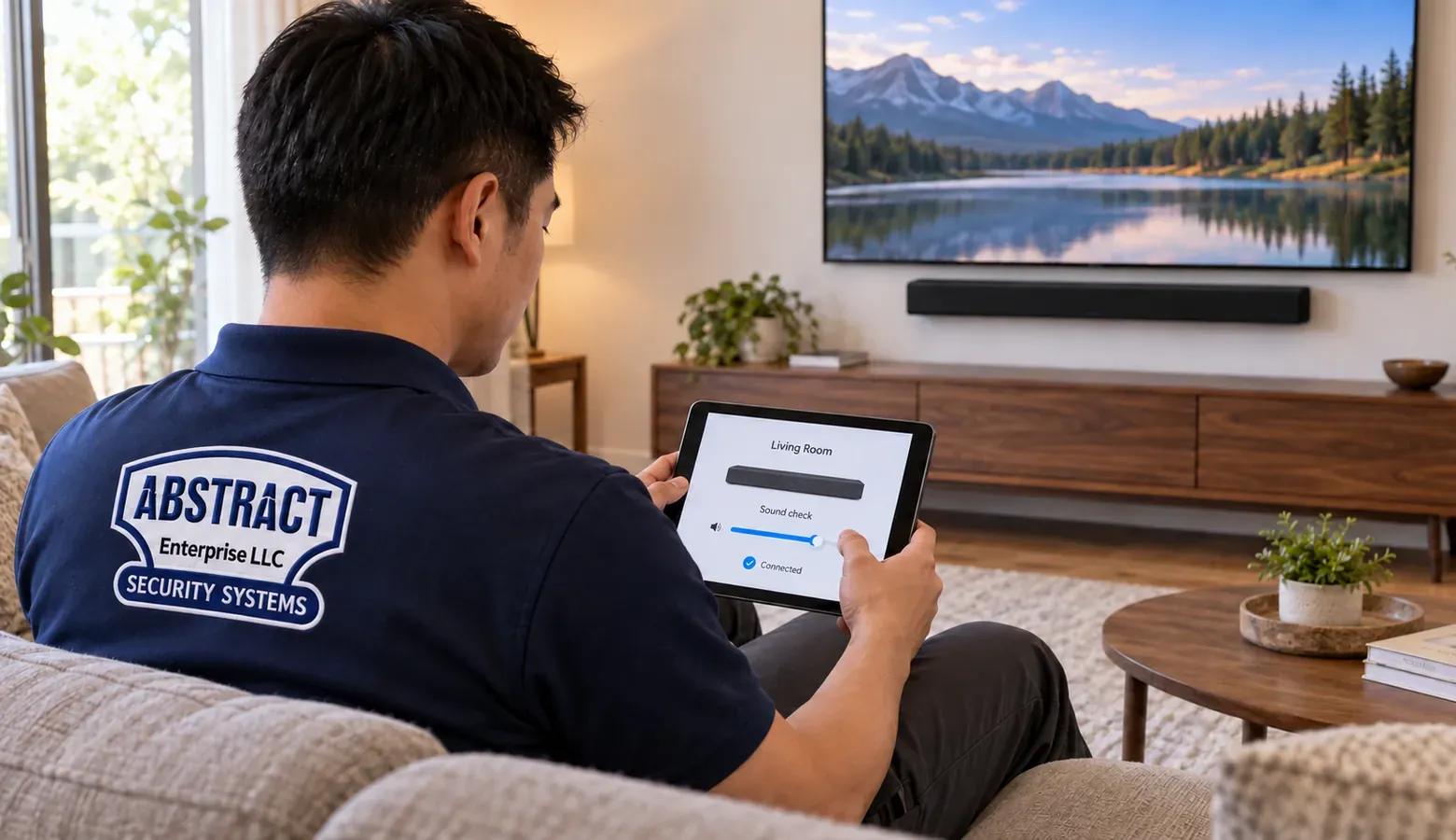
Calibration done from where people actually sit: tablet in hand, bar and TV on the wall ahead.
Coverage Area
Soundbar Installation Near Mott Haven's Landmarks
In Mott Haven a landmark is a fair guide to the building stock around it. Tell us which of these you live near and we can usually guess the wall, the stairs and the paperwork before we see a photo.
Alexander Avenue
The centre of the Mott Haven Historic District, designated on July 29, 1969, once nicknamed “the Irish Fifth Avenue” and lined with rowhouses, St. Jerome's church complex and the 40th Precinct station house at 257 Alexander Avenue. Lath and plaster partitions, brick party walls, owners who often live on the premises.
The Bertine Block
East 136th Street between Willis Avenue and Brown Place: 31 buildings put up by Edward Bertine between 1877 and 1899, from neo-Grec and Queen Anne rowhouses to Renaissance Revival two-families and four eleven-family tenements. A whole street of plaster walls and narrow parlours.
The Estey Piano Factory Clock Tower
The oldest known piano factory still standing in the Bronx, opened in 1886 at Lincoln Avenue and Bruckner Boulevard, extended until 1919, designated an individual landmark in 2006 and now rental lofts. Thick brick, long rooms and tall windows.
Bankside and the Third Avenue Bridge
Brookfield's seven-tower development on both sides of the bridge, with Third at Bankside and Lincoln at Bankside opened in 2022 and a 34,000-square-foot waterfront park opened in 2024. Steel-stud partitions, concrete structure and a management office with contractor rules.
Patterson Houses
Fifteen buildings of six and thirteen storeys with 1,788 apartments, completed in 1950 — the oldest of Mott Haven's large Housing Authority campuses, with Mill Brook, Mitchel, Mott Haven and Moore Houses close by. Masonry behind plaster and written consent before any bracket.
St. Ann's Church and St. Mary's Park
The fieldstone church that Gouverneur Morris Jr. built in 1841 on St. Ann's Avenue, a landmark since 1969, and the 35-acre park nearby that was once part of Jonas Bronck's estate. Walk-ups and NYCHA towers on the surrounding blocks.
We also cover Port Morris down to the Randall's Island Connector at East 132nd Street, Melrose, the Hub at 149th Street, Concourse Village, Longwood, Hunts Point and the rest of the South Bronx, and from the same crews every other Bronx neighbourhood, Manhattan and Queens. Port Morris and Melrose have their own pages for TV installation in Port Morris and TV installation in Melrose.
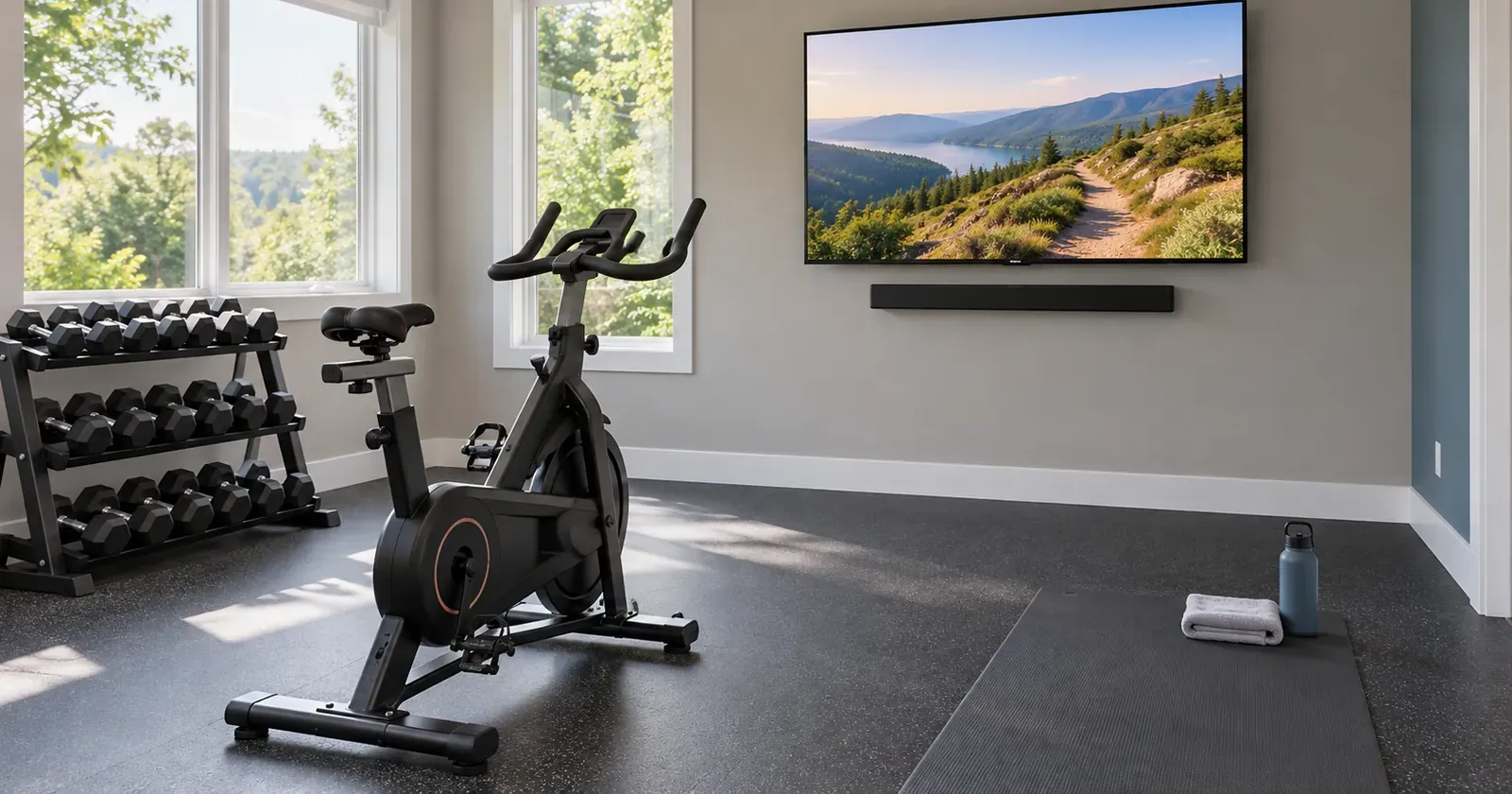
A second room, a plain wall: TV and a compact bar mounted together, the cables kept off the rubber floor.
Pricing
Soundbar Installation Cost in Mott Haven
There is no separate Mott Haven tariff: the neighbourhood uses the Bronx price list, and your total is simply the lines that fit your building added together. Installation lines in the Bronx match our Brooklyn base. Only two things differ by borough — the rate for visits where nothing is mounted, and the starting price for hanging a TV — and both are spelled out below. Anything unexpected on the day is priced to you before it is done, never after.
Line item
Price
What it covers
Soundbar placed on a stand or console
$79
Placed, connected to the TV and set up, with nothing drilled
Soundbar wall-mounted under the TV
$129
Bracket fixed for your wall type, bar hung and levelled, connected and checked
Sanus soundbar bracket
$84.99
For bars without a bracket, or to hang the bar from the TV mount
Paintable cord cover
$59
Surface channel from the bar to the outlet or the console, ready to paint
In-wall concealment
$169
Power and HDMI inside a hollow interior partition with a code-compliant kit — never in a rated wall, and only with the owner's yes
Cable run to a cabinet or other spot
$99
Up to 25 ft
Sonos setup
$125
Sonos app, room setup and grouping
A/V receiver
$129
Receiver connected and configured
Universal remote
$99
One handset for the TV, bar, cable box and streamer
Streaming device setup
$49
Roku, Apple TV, Fire TV or similar
Full home theater
$350
Multi-component system setup
Wall, height and access lines — and where they turn up in Mott Haven
Condition
Price
Where you will meet it
Drywall on wood studs
$0
Renovated rowhouse rooms and some gut-renovated walk-ups
Metal studs
+$30
Interior partitions in Bankside, Maven, Bruckner House and other new towers
Rowhouse party and front walls, Port Morris lofts, chimney breasts
Concrete or cinder block
+$75
Housing Authority towers, new-tower columns and shear walls
Tile or marble
+$95
Feature walls, salon and clinic interiors
Plywood backer board
$85
Old plaster too broken to hold anchors directly
High mount (above about 8 ft)
$75
Bars over tall TVs in high rowhouse parlours and lofts
Walk-up, 3rd floor and above, no elevator
$40
Rowhouse upper floors, tenement walk-ups, towers with the elevator out
Box removal
$25
We take the packaging away
Certificate of insurance
Free
NYCHA and PACT managers, new-building management, commercial landlords
Setup-only visits and TV mounting in Mott Haven
Some visits involve no bracket at all: the bar needs reconnecting to a replacement TV, eARC has stopped passing sound, or the subwoofer has lost its pairing. In the Bronx those are charged by time — $225 covers the first hour, and after that we bill in 30-minute steps. Hanging a 32- to 55-inch TV on drywall starts at $209.99 in the Bronx, a corner or full-motion mount adds $40, and setting a TV on its stand without mounting is $137.99. Removing an old TV costs $85, an old bracket $45, and taking an old set away for recycling $79. Unusual work beyond this menu — chasing a fault in the building's own wiring, for instance — is quoted at our $195 hourly specialty rate with a three-hour ($585) minimum, which never applies to an ordinary soundbar job.
Included, excluded and the small print
In every job: a level bar centred on the screen, the correct HDMI or optical input, tidy cables, the TV remote set up to control volume through CEC, and the drilling dust cleaned up.
Not ours to do: new or moved outlets need a licensed electrician, and filling and painting old holes needs a painter. Neither appears on an AESS invoice.
When a visit cannot begin: we charge a $150 return-trip fee if the installer arrives to find no bar or bracket, no way in, or no approval yet from the owner, NYCHA, the PACT manager or the building — which is why we ask about permission on the first call.
Old and hard surfaces: nineteenth-century plaster, clay tile, ceramic and stone can crack however carefully they are drilled. You hear that from us before we start, and you decide.
Why a local licensed installer rather than a national booking app. App and big-box menus are priced for a hollow wall in a house with a driveway. Mott Haven jobs turn on exactly what those menus skip — lath and plaster beneath a cornice, tower masonry, rated walls between new apartments, five flights of stairs, and a management office that wants paperwork. A Bronx contractor with a priced line for each of those can tell you the true total and answer for the work later.
Shop Our Systems
Soundbar Installation Packages & Pricing
Three combinations cover most Mott Haven requests, one for each of the neighbourhood's building types. Each card shows its arithmetic, and any walk-up, height or access line from the tables above is added to the total.
Consent Pending — Stand Setup
$79
No holes at all: the bar on your console ($79), on the TV's eARC or ARC port with CEC on and the cables tucked away. The usual start in NYCHA and PACT apartments while written consent is on its way, and the whole job where a lease rules out drilling.
Rowhouse Parlour — Plaster Wall
$317.99
$129 wall mount, $84.99 Sanus bracket, $45 plaster surcharge and a $59 painted channel: $317.99. Owners who prefer the wire hidden inside a hollow interior partition swap the channel for the $169 in-wall kit, making $427.99.
Tower Living Room — Concrete or Block
$347.99
$129 wall mount, $84.99 Sanus bracket, $75 concrete or block surcharge and a $59 painted channel: $347.99. Housing Authority towers and the structural walls of new buildings, where nothing goes inside the wall.
Bring Your Own Equipment — Labour Only
Already have a bracket rated for your bar, from the box or bought separately? Then labour alone is $129 plus your wall's surcharge. Your own bracket is covered by its maker's warranty, not ours. When it is wrong for the wall — a kit meant for wood studs facing Port Morris brick, for example — you hear that before any drilling, along with the option of our Sanus bracket.
Worked example, from the lines above. A bar wall-mounted on the steel-stud partition of a new tower apartment, with the bar's own rated bracket and a short painted channel, comes to $129 + $30 + $59 = $218. The same bar in a fourth-floor walk-up on plaster, with our bracket and a channel, is $129 + $84.99 + $45 + $59 + $40 = $357.99.
Get Your Mott Haven Total Before Anyone Drills
Name the building, photograph the wall and tell us the floor; the written figure follows the same day.
Rowhouse, Tower or New Rental: Planning a Mott Haven Soundbar
Before we pack a single anchor, we place your home in one of Mott Haven's housing eras. This is the comparison our installers carry in their heads. It is a practical guide, not legal advice; your lease, the management office's rules and, outside the house, the Landmarks Preservation Commission have the final word.
Historic rowhouse or walk-up
NYCHA or PACT tower
New rental tower
Built
Mostly 1870s–1900s
1950 to the early 1980s
Since the 2005 and 2009 rezonings
Typical TV wall
Plaster on lath, or plaster over brick
Masonry behind plaster
Drywall on steel studs; concrete columns
Who says yes
The owner, often living in the house
The development's management office (NYCHA or the PACT company)
The building's management, under the lease
What we usually need
The owner's OK; LPC only for exterior work
Prior written consent
Management's contractor rules and a COI
Sound problem
Street and traffic noise through old windows; bass into the house
Highway and bridge noise; neighbours above and below
Quiet sealed rooms that make neighbours' sound stand out
Typical finish
In-wall on interior partitions, channel on brick
Stand while waiting, then wall mount with a channel
Wall mount, short channel; nothing cut into the wall to the next apartment
Whatever the column, the same two habits prevent most problems. Get the yes in writing — a text from the owner or an email from management will do — and keep it. And make the request concrete: so many inches of soundbar, two to four screws, a channel stuck to the surface. A clear picture gets a quick approval.
If your building doesn't fit neatly — a rowhouse converted into flats, a tenement gut-renovated into condos, a loft with a residential lease — tell us how it is run and we will suggest where to start. We are also happy to explain the work directly to a super, a management office or an owner, in installer's terms.
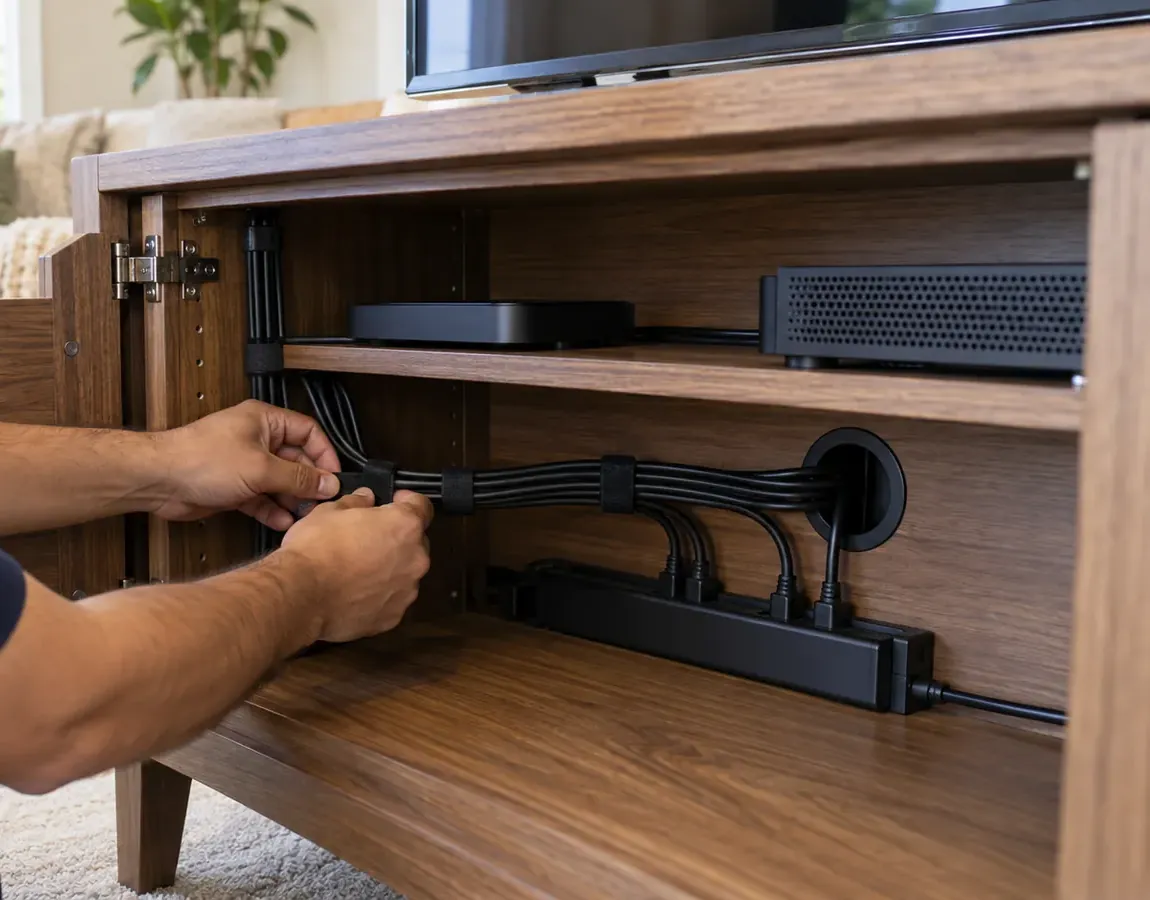
Inside the console: leads bundled with hook-and-loop straps and fed through the grommet to one power strip.
Buying Guide
Choosing a Bar for a Mott Haven Room
If the soundbar is still in your basket, five checks drawn from Mott Haven rooms will save a trip back to the store.
Measure the space under the screen. In a railroad flat or a tower bedroom the TV often sits on a dresser; check the gap between the bottom of the screen and the furniture before buying a tall bar.
Look at the TV's ports. An HDMI socket marked ARC or eARC means one cable and one remote. If there is neither, choose a bar with an optical input and expect to keep its own remote.
Match the bar to the wall. A compact or mid-size bar is far kinder to century-old plaster than a long flagship; on a tower's masonry, weight matters less than the right anchor.
Decide about the subwoofer first. In a sealed new building or over a neighbour's bedroom, a bar with decent built-in bass, or one where the sub is optional, keeps your choices open.
Count outlets for rears. Every wireless rear speaker and sub needs power. A walk-up with one outlet per room may make rears more trouble than they are worth.
Still deciding? Message us the model with a picture of the wall it will go on, and we will say how it would be fixed and roughly what the job comes to before you buy.
Before the technician arrives
Six small things shorten the visit. Keep the written permission handy, whether it came from the owner, NYCHA, the PACT company or the building's managers. Have the bar, its bracket and any sub or rear speakers indoors; unopened boxes are fine. Clear a path to the TV wall and move breakables off the console. Find the nearest outlet that works, and find out whether the TV wall is shared with the next apartment. Warn the lobby, the super or the front desk about the window, and if the buzzer is unreliable give us a number we can call from the sidewalk. Finally, if you already have a spot in mind for the subwoofer, tell us; we advise, you decide.
One more thing helps in the new buildings: check whether management wants contractors registered in advance through its resident portal or front desk, and pass us the name of the person to send the certificate of insurance to. In a rowhouse, let the owner know the day and the window if you rent from them, so nobody is surprised by a drill on the parlour floor. And in a NYCHA or PACT development, keep the written consent somewhere you can show it on the day; the technician will ask to see it before marking a single hole.
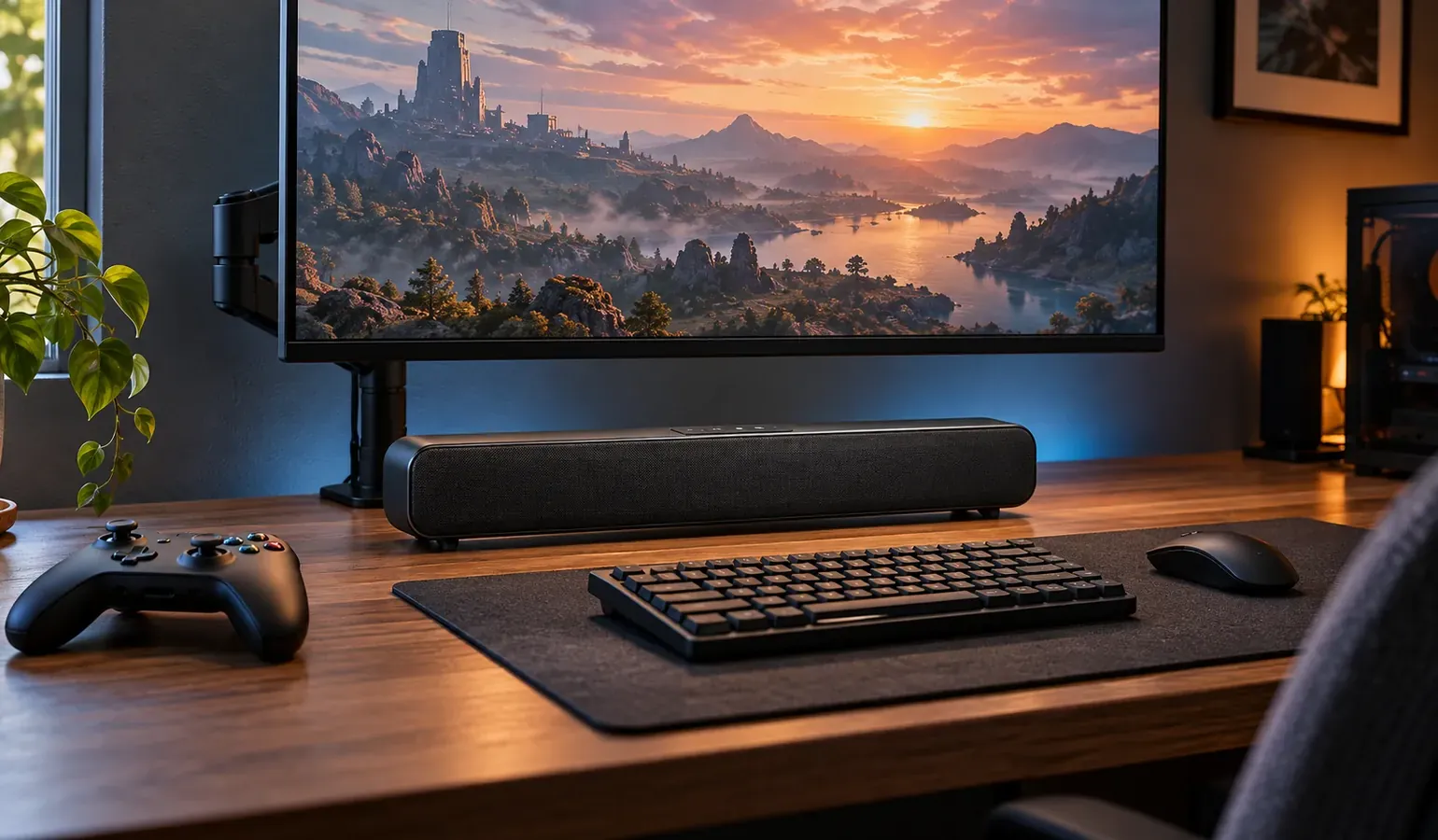
Where the TV doubles as a monitor, a short bar on the desk does the work a long one can't fit.
Complete Services
Every Soundbar Installation Service in Mott Haven
Related pages for Mott Haven and the Bronx, for when the soundbar is one job on a longer list.
Not sure which page fits? Describe the job once and we will price it.
Building Timeline
From Iron Works to Waterfront Towers: What Each Era Left Behind the TV
The date a Mott Haven building went up tells an installer more about the wall than any stud finder. This short timeline, drawn from the Historic Districts Council, the Landmarks Preservation Commission, City Planning and local reporting, is how we read the neighbourhood — with what each period means for a soundbar today.
1841 — Jordan L. Mott buys land by the Harlem River. His iron works gave the neighbourhood its name; the oldest surviving sections of the factory at 2403 Third Avenue date to the 1860s. Industrial buildings like it are the ancestors of today's Port Morris lofts: thick brick, heavy floors and very little hollow wall.
1841 — St. Ann's Church. Gouverneur Morris Jr. built the fieldstone church on his estate, at an angle to the later street grid. The streets around it filled in later with walk-ups and, after the war, Housing Authority towers.
1870s–1890s — the rowhouse decades. Alexander Avenue's rowhouses and the Bertine Block (built 1877–1899, mostly after the Suburban Rapid Transit line was completed in 1887) went up as rapid transit reached the area. Plaster on wood lath inside, brick party walls, decorative plaster in the parlours: toggles or studs for the bracket, gentle drilling, and an owner close at hand to say yes.
1886–1919 — the piano factories. The Estey factory opened at Lincoln Avenue and Bruckner Boulevard in 1886 and grew until 1919; by the early twentieth century, 60 piano factories stood in the Bronx, many of them in Mott Haven. Today's lofts in those buildings mean brick a foot thick, long rooms and echo.
Turn of the century — tenements. Five- and six-storey walk-ups filled the numbered streets, many with long railroad layouts. Old plaster, later patches, few outlets and stairs: a pilot hole first, a short painted channel, and night mode explained to the whole household.
1937–1939 — the Major Deegan's Mott Haven section. The expressway displaced homes between East 134th and 135th Streets and began the traffic noise that shapes sound settings in older apartments to this day.
1950–1966 — the Housing Authority towers. Patterson Houses (1950), Mill Brook (1959), Moore (1964), Mott Haven Houses (1965) and Mitchel (1966). Masonry behind plaster, high floors, and written consent before any fixture.
1969 and 1994 — landmark protection. The Mott Haven Historic District in 1969, the Bronx's first; Mott Haven East and the Bertine Block in 1994. Interiors stay the owner's business; facades, stoops and protected features need the Landmarks Preservation Commission.
1973–1982 — the Betances buildings. Low-rise Housing Authority buildings across the blocks from 136th to 145th Streets, later renovated and handed to a private manager under RAD, according to the Mott Haven Herald. Ask the manager now running the development, not the old office.
1997, 2005 and 2009 — the rezonings. The Port Morris Special Mixed Use District, the Port Morris/Bruckner Boulevard rezoning and the thirty-block Lower Concourse rezoning along the Harlem River opened former industrial land to apartments.
2019–2024 — the new waterfront. Bankside broke ground in 2019, its first two residential complexes opened in 2022, Maven opened in 2023 and Bankside Park in 2024. Steel-stud partitions, concrete structure, rated walls between apartments and, on the noisiest sites, facades built to a noise E-designation.
Most Mott Haven apartments fall clearly into one of those bands, and a few — a rowhouse cut into flats in the 1980s, a tenement gut-renovated last year — straddle two. When you book, the age of the building and the date of the last renovation are the two facts that help us most, after the photo of the wall.
Field Notes
Field Notes: Telling Mott Haven's Three Walls Apart
How our installers approach Mott Haven buildings in general — a description of method, not of anyone's actual apartment
Ask about the building before the wall. A rowhouse owner can say yes on the spot; a PACT or NYCHA apartment needs a written answer from an office; a new tower has rules in the lease. That answer decides whether the day ends with the bar on the wall or on the console.
Then knock. Lath and plaster sounds hollow between studs and dull over them, with a faint give; brick under plaster sounds solid everywhere; tower masonry sounds dead and hard; steel-stud drywall sounds hollow and light, with studs that don't take a wood screw. One small pilot hole where the bracket will cover it confirms it: grey grit for block or concrete, red for brick, white powder and then a sudden give for plaster over lath.
Ask what is on the other side of the wall. In a tower, the answer is often the next apartment's bedroom, and that changes where the subwoofer goes. Look out of the window and listen for a minute. If it is the Deegan or a bridge ramp, set the bass for the quiet hours. If it is silence behind sealed glass, set everything lower than you think.
FAQ
Mott Haven Soundbar Installation FAQ
Can a tenant association put a soundbar on the TV in a development's community room?
+
Yes, once the property management office has agreed in writing, because the room belongs to the development rather than to the association. We mount the bar above reach, run the cable in a painted channel, set a sensible volume ceiling and send management a certificate of insurance at no charge.
Can our building's video intercom chime play through the soundbar?
+
Usually not. Building intercoms ring a handset or an app on your phone, and soundbars have no input that a building entry panel can reach. If you miss the buzzer while watching, we can show you how to make the phone app louder or set the bar's night mode so you still hear the phone.
Our TV sits on a rolling cart that moves between rooms. Can the soundbar ride along with it?
+
Yes, if the cart has a shelf or a frame the bar can sit on or clamp to. We set the bar on the cart's lower shelf or fit a TV-attached bracket, strap the HDMI and power leads to the frame, and leave one plug to pull when the cart moves. It is priced as a stand setup at $79, plus a bracket if one is needed.
Do you install soundbars in day-care centres and after-school rooms?
+
Yes. The bar goes on the wall above children's reach rather than on a low stand, every cable runs in a channel well above the floor, and the volume is capped at a level that carries to the reading rug without filling the corridor. Tell us if the landlord or the programme operator needs a certificate of insurance.
Can the cable box hide behind the TV so only the soundbar shows under the screen?
+
Often. A slim box can live on a small shelf behind a wall-mounted TV, but a box that is controlled by an infrared remote needs to see the remote, so we check that first. Where it does, a small infrared repeater or an HDMI-CEC remote setup keeps it working; where it does not, the box stays on the console.
Our new building's Wi-Fi has a sign-in page. Will the soundbar connect to it?
+
Many soundbars cannot get past a sign-in page, because they have no browser to accept the terms. TV sound still works over HDMI without any Wi-Fi. For app features and updates, the usual answers are your own router plugged into the apartment's data jack, or asking the building's provider to register the soundbar's network address.
Will Bluetooth from a phone in the back room of a railroad apartment reach the soundbar in the front room?
+
Not reliably. Bluetooth is meant for one room, and in a railroad flat the signal has to pass through several plaster walls in a line. Standing within a room or two of the bar works; for music anywhere in the apartment, a bar with Wi-Fi streaming from its own app is the better route.
All Areas Served
Soundbar Installation Across New York
This page covers Mott Haven. Its parent is the Bronx soundbar installation page, and the citywide overview sits on the NYC soundbar installation hub. Every other borough and county we serve has a page of its own, and two more neighbourhood pages sit alongside this one.
Silent since the TV was replaced, lagging behind the picture, lost its subwoofer, or hanging crooked on a rowhouse wall? Ring (646) 490-0629 from anywhere between the Harlem River and St. Mary's Park. The first free 2-hour window is yours, and a typical fault — a port, a setting, a pairing, a loose anchor — is put right within an hour or two of our installer reaching your door.
Abstract Enterprises Security Systems · 460 E Fordham Rd, Bronx, NY 10458 · (646) 490-0629 · WhatsApp (718) 679-0359 via wa.me
NYS Low-Voltage Licence #12000287431 · 100% Licensed & Insured · Same-Day Estimates · Rated 4.7★ from 201 Google Reviews
Brackets and parts carry their manufacturer's warranty. Full terms — including 50% deposit, one-year parts-only warranty on AESS-supplied products, and the late-fee schedule — are set out in the service agreement. See our warranty page.
Sources consulted for this page include the NYU Furman Center's Mott Haven/Melrose profile, the Historic Districts Council and Landmarks Preservation Commission designation material, NYC Business guidance on landmarked properties, NYC Department of City Planning rezoning summaries, a New York State DEC environmental report for 132–138 Bruckner Boulevard, NYC Small Business Services' Mott Haven Commercial District Needs Assessment, the Mott Haven Herald, 6sqft and Brick Underground.
Page reviewed and updated October 17, 2026. Changelog: first publication of the Mott Haven soundbar installation page, written around the neighbourhood's three building eras — historic rowhouses, NYCHA and PACT towers, and the new rental towers — and the traffic noise that surrounds them.