NYS Licensed Low-Voltage Installer · The Gardens, 108th Street & Queens Boulevard
Soundbar Installation in Forest Hills
Concrete-Panel & Plaster Anchoring · Co-op Paperwork · Tower Concrete · eARC & One Remote · Bass Kept in the Room
Forest Hills was built to other people's plans — the Russell Sage Foundation's Tudor village south of the railroad, the Cord Meyer Company's house lots, then the six-storey elevator buildings and post-war towers that followed the subway down Queens Boulevard. Those plans still decide what is behind your TV wall and who has a say in it. We mount soundbars into Atterbury's precast concrete, 1930s co-op plaster and tower concrete alike, wire them to the TV so one remote does everything, and keep the bass from becoming the neighbors' business.
Reviewed and updated October 17, 2026 · Written by Anwar Timothy, NYS low-voltage license #12000287431
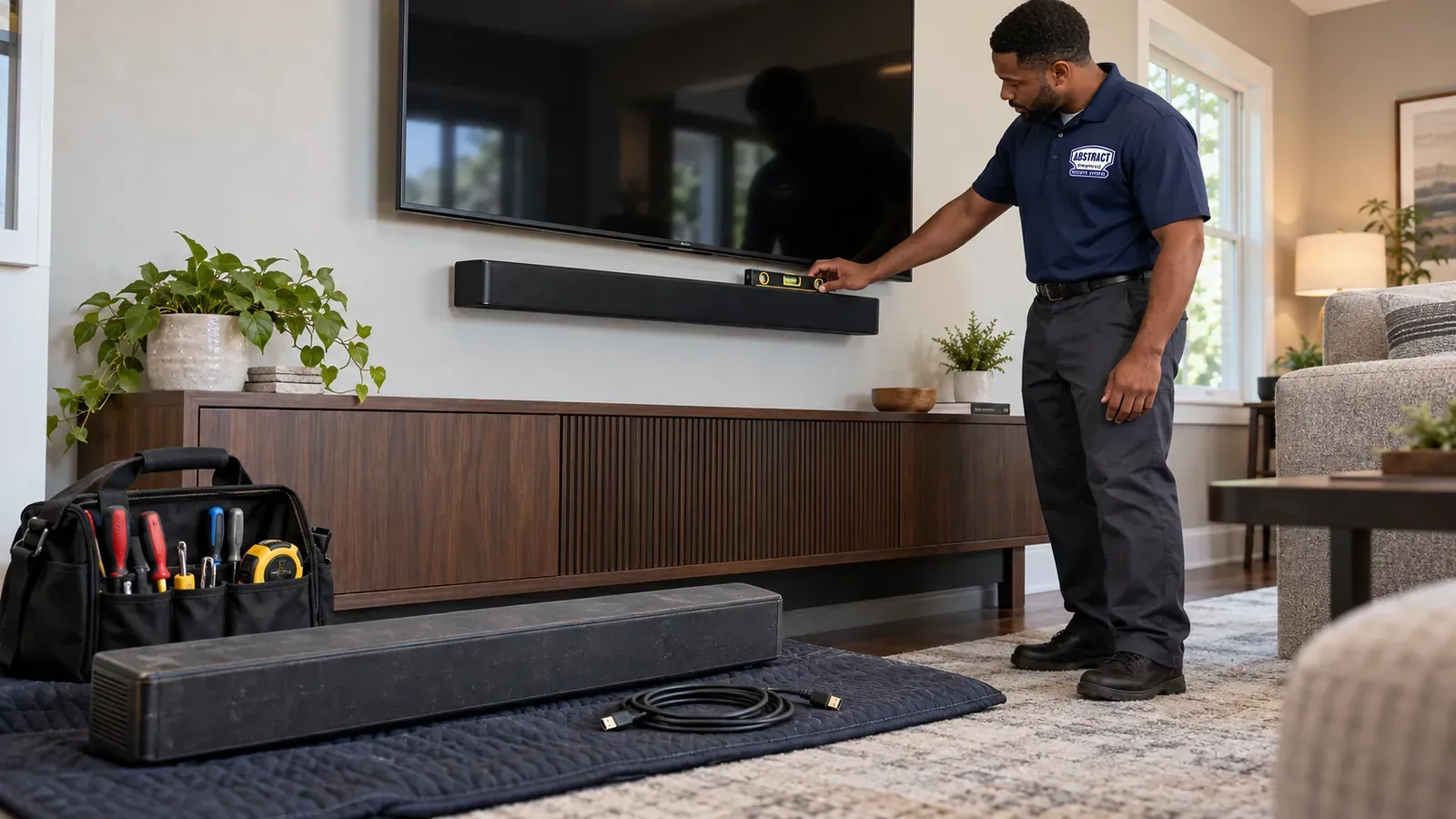
The last check before handing the room back: a level laid along the bar, with the tool bag, an HDMI lead and the packed bar still on the blanket.
Forest Hills Soundbar Quote
Tell us the building and the wall — a written Queens price comes back the same business day
✅
Request Sent!
An installer will ring you back the same business day.
25+
Years Experience
✓
Same-Day Estimates
100%
Licensed & Insured
4.7★
201 Google Reviews
Got a bar in a box and a wall you're unsure of? Ring (347) 434-6392 or use the short form: the bar's model, a phone picture of the wall with the outlet in it, and whether you're in the Gardens, a co-op or a tower. A licensed installer answers with a written figure from the Queens price list below.
On the wall under the TV for $135.45 before any wall surcharge
Insurance certificates for boards and managing agents at no cost
License 12000287431 · arrival inside a 2-hour window you choose, 8 AM to 8 PM, seven days
Very little in Forest Hills was built by accident, and that is the first thing a soundbar installer has to understand here. In 1906 the Cord Meyer Development Company bought roughly 600 acres of farmland in central Queens and gave it the name Forest Hills, after the park on its southern edge. Two or three years later Margaret Sage's Russell Sage Foundation took 142 of those acres and hired Frederick Law Olmsted Jr. and the architect Grosvenor Atterbury to plan a model village around a railroad station. When the IND subway opened under Queens Boulevard in 1936, a third plan arrived: blocks of mostly six-storey apartment buildings, and after the war, towers. Each plan left a different kind of wall behind, and a different set of people who expect to be consulted before anyone drills into it.
South of the Long Island Rail Road, in Forest Hills Gardens, the walls are often not what a stud finder expects. Atterbury built many of the early houses from standardized precast concrete panels — about 170 of them per house, cast off site with hollow insulating chambers and lifted into place by crane. Later Gardens houses are brick and stucco Tudors with leaded glass, slate or red clay tile roofs and plaster inside. The whole enclave is governed by the Forest Hills Gardens Corporation under a covenant dating to 1913 that bars exterior alterations without approval, looks after its own streets and parking, and expects contractors' vehicles to carry a resident's guest sticker. None of that stops a soundbar going up in a living room, but it does change how the visit is planned.
North of the tracks and along the boulevard, the conditions flip. The pre-war buildings on 108th Street, Yellowstone Boulevard and the side streets off Queens Boulevard are co-ops for the most part, with plaster partitions, elevators, a live-in superintendent and a managing agent who wants a description of any work and a certificate of insurance before a technician arrives. The towers — the three 20-storey buildings of Parker Towers toward the Rego Park end of the boulevard, the 12-storey Forest Hills Co-op Houses at 108th Street and 62nd Drive — are concrete, where a TV wall needs a hammer drill and every apartment has neighbors above, below and beside. Between the two sit the 1920s garden courts, Arbor Close and Forest Close, where attached Tudor houses share walls around a common green.
The sound problem here usually runs in the opposite direction from the rest of Queens. Forest Hills is a quiet, leafy place, and on most evenings the loudest thing on an apartment's floor is somebody's television. Residents say so. In an r/ForestHills thread asking about co-op life, one shareholder wrote about an upstairs neighbor who “is still loud at all hours, blasting their terrible music, their TV”; a renter in another thread described upstairs neighbors as “needlessly noisy.” A soundbar with a wireless subwoofer, left on its factory settings, is exactly the kind of equipment that produces those posts. So in a Forest Hills co-op the installation is as much about where the bass goes as about where the bar hangs.
The exception is summer. Forest Hills Stadium, the 1923 horseshoe beside the West Side Tennis Club that hosted the U.S. national championships for decades, has been an outdoor concert venue since 2013, with room for up to 14,000 people and 37 performances in 2024. City inspectors issued nine noise violations at the stadium during the 2025 season, and the Gardens Corporation's board president told Columbia News Service that the concerts send “vibrations through residents' houses for hours at a time.” Households within earshot have a seasonal version of the problem everyone else in Queens has year-round: an outside noise that competes with the dialogue. We cover both directions further down the page.
Forest Hills figures that shape a soundbar job
122,344 residents in the Forest Hills and Rego Park community district, with a median age of 43.6 and a median household income of $96,845 (Census American Community Survey 2022, via Data USA). An older, settled population that watches a lot of television and expects the setup to be simple.
48.4 percent of homes in the district are owner-occupied, and in 61.2 percent of households the language everyone shares at home is not English (Data USA, 2022). Many owners here are co-op shareholders, which is why paperwork comes up on so many calls.
Over 800 houses and 11 apartment buildings make up Forest Hills Gardens, home to about 4,500 people, according to a 2014 6sqft profile. Each house in the early phase used about 170 precast concrete panels (Southampton Historical Museum archive on Grosvenor Atterbury).
1931, six storeys, 50 apartments: a typical 108th Street co-op as listed by CityRealty. Buildings of this vintage, with plaster walls and an elevator, make up much of the apartment stock around 108th Street.
1,327 apartments in three 20-storey towers at Parker Towers on Queens Boulevard (The Real Deal, 2018), and 432 co-op apartments in three 12-storey buildings at the Forest Hills Co-op Houses, the scaled-down result of Mario Cuomo's 1972 mediation (Queens Daily Eagle).
55 decibels measured by inspectors inside a home near the stadium during a September 2025 concert, against the city noise code's 42-decibel limit for commercial music inside a residence; the stadium runs to a 10 p.m. curfew (Queens Daily Eagle, October 2025).
Put together: an older, often multilingual population, half of it owning the walls it lives behind, split between a private Tudor village, a belt of co-ops and a handful of very large towers, with a concert venue in the middle. That is the brief for a soundbar in Forest Hills, and it is different enough from Astoria or Jamaica to deserve its own page.
Many Forest Hills calls about the bar turn out to be calls about the television as well. Our Queens TV installation service hangs the screen and the bar as one job, and households that want a full system rather than a bar can move up to AV and sound installation across Queens without starting over.
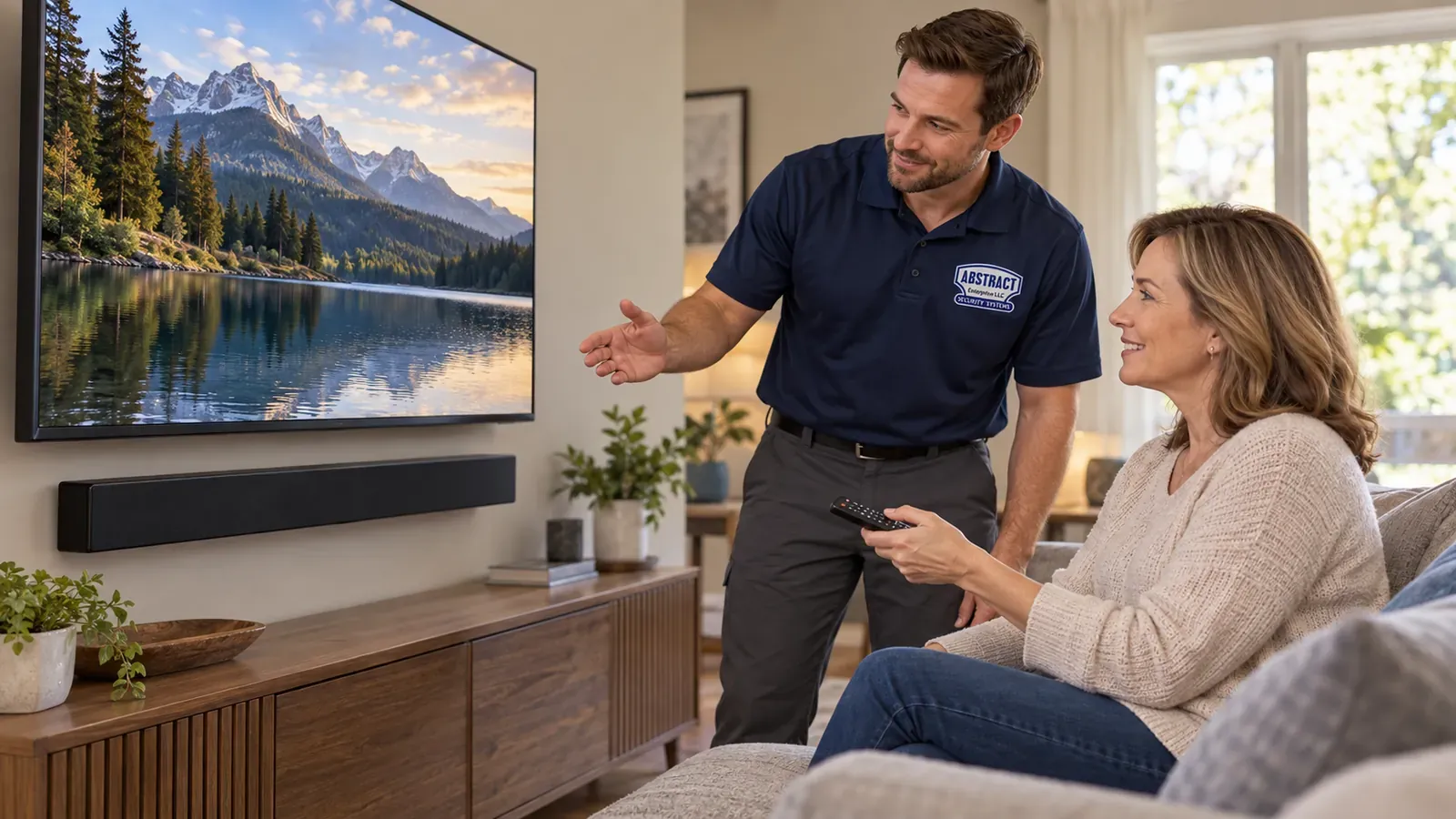
The handover: the person who will use the TV most holds the remote while the technician goes through inputs, volume and the speech setting.
Repair Capture
Forest Hills Soundbar Misbehaving?
If the bar went quiet after the TV updated, the remote has stopped controlling the volume, the subwoofer won't pair, voices lag the picture, or a bracket is easing out of old plaster, that is a repair call. We fit it into the next free 2-hour window, frequently the same day, and most pairing, control and connection faults are cleared within an hour or two of a technician walking in. Phone (347) 434-6392, say “soundbar repair,” and give us the TV and bar models so the right leads come in the van. A bar that has stopped working altogether is checked against a known-good HDMI lead and the TV's own speakers first, so you find out quickly whether the fault is the bar, the cable or a TV setting. Time-billed visits follow our TV and soundbar service policies.
What We Install
Soundbar Installation Services in Forest Hills
Eight services, booked alone or together, all priced from the Queens list. A job isn't finished until the bar is level and centered on the screen, nothing dangles, the TV remote runs the volume and the main viewer has heard a scene from their own chair.
Bar on the Wall Under the Screen
A bracket a few inches below the TV, fixed with hardware chosen for what the wall turns out to be: concrete sleeve anchors in a Gardens panel or a tower wall, toggles in pre-war plaster, wood screws in the studs of a north-side house.
Console Setup, No Drilling
The bar on the media unit, connected, clear of the TV's infrared window and with its cables tied off. The usual choice in rentals, in co-ops waiting on paperwork, and in rooms where the screen stands on its own feet.
Bar Fixed to the TV's Mount
A bracket that clamps the bar to the television or its arm, so the two move as one and the wall gets no extra holes — useful on articulating arms in the corner of a Tudor living room.
Screen and Bar Together
TV and soundbar planned in one visit, so the height, the gap and a single cable route to the outlet are settled at once. Common after a move into one of the boulevard co-ops.
Cables Out of Sight
Inside the wall where it is hollow and the building allows it; in a painted surface raceway where it is concrete panel, block or plaster over masonry; or routed behind furniture where nothing may be fixed at all.
eARC, CEC and One Remote
Sources go into the TV, the TV hands the sound to the bar through its eARC or ARC socket, CEC lets one remote power everything up and set the volume, and we confirm voices match lips before we leave.
Bass Set for Neighbors
Subwoofer position, level and night mode chosen with the apartment below and the house next door in mind, and demonstrated so the household knows which setting to reach for after 10 p.m.
Moves, Rears and Add-Ons
Taking a bar down and rehanging it in a new room or a new apartment, pairing wireless rears and subs, and adding a streaming box, universal remote or Sonos setup on the same appointment.
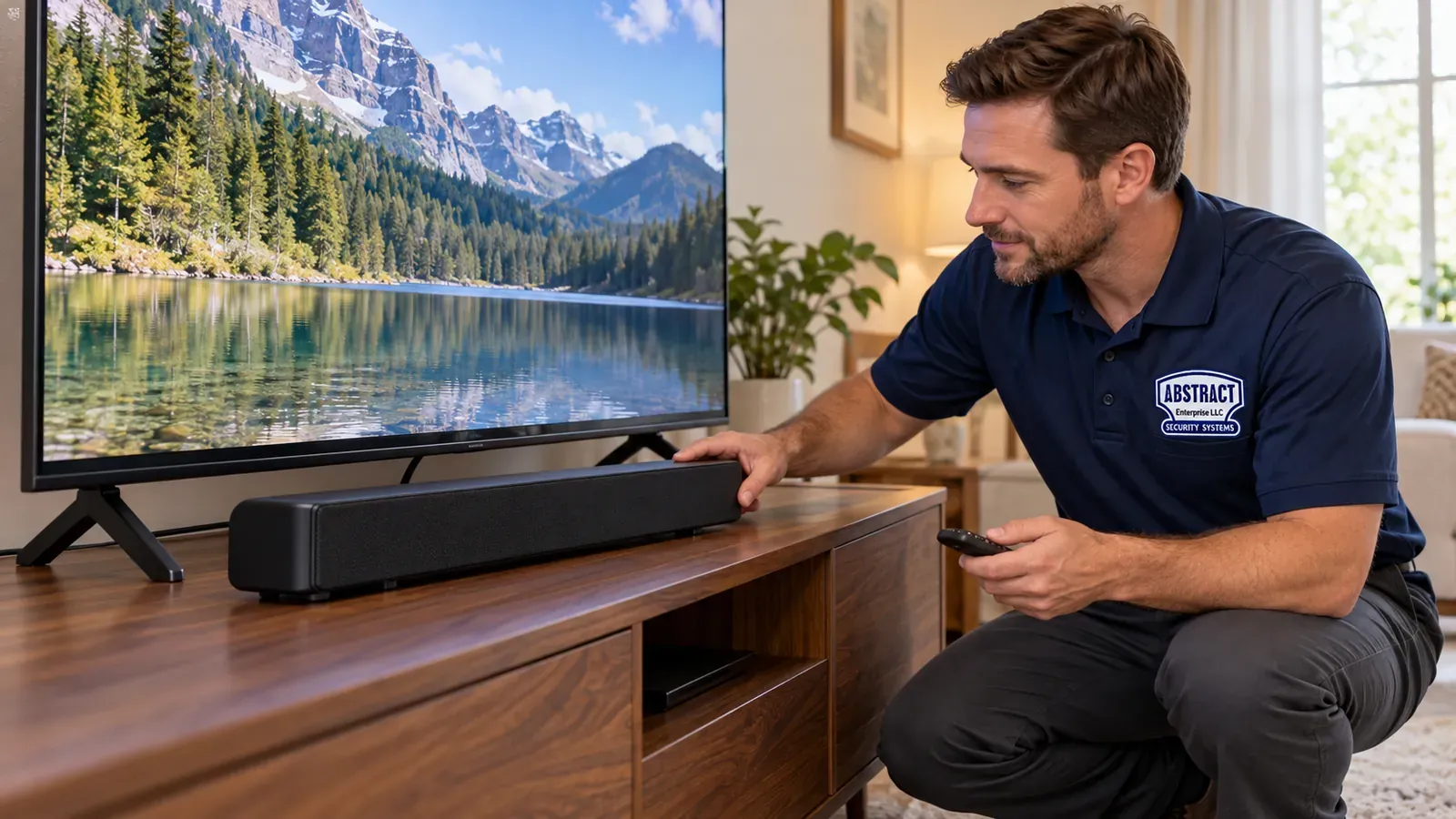
The no-drill option: the bar is lined up on the console in front of the TV's feet so it blocks neither the picture nor the remote sensor.
Building Specialists
Soundbar Installation for Forest Hills' Architecture
The bar is the light part; the building is what we plan around. Six kinds of home account for almost every Forest Hills call, and they ask for six different approaches to the fixing, the cable and the sound.
Atterbury's Concrete-Panel Houses
The early Gardens houses, assembled around 1910–1917 from factory-cast concrete panels with hollow chambers. Solid where the web of the panel is, hollow where the chamber is — so the drill tells us which we have found before an anchor goes in.
Gardens Tudors in Brick and Stucco
The later houses on streets such as Greenway North and Markwood Place: brick or stucco outside, plaster inside, leaded glass, wood-burning or gas fireplaces and, in some, beamed sunrooms. Exterior changes need the Corporation's approval; interiors are the owner's.
Garden-Court Rows
Arbor Close (1925) and Forest Close (1927), attached neo-Tudor houses grouped around shared gardens; Forest Close's 38 houses sit on Austin Street between 75th and 76th Avenues. Party walls on one or both sides, compact front rooms and neighbors who are also friends across the green.
Detached Houses North of the Tracks
The Cord Meyer lots, where Robert Tappan and William Patterson designed houses to complement each other, plus newer rebuilds. Usually wood framing with plaster or drywall — the best chance in the neighborhood for fully concealed cabling.
Pre-War Elevator Co-ops
The six-storey buildings that followed the 1936 subway along 108th Street and the streets off Queens Boulevard. Plaster partitions, a superintendent, a managing agent with forms, and apartments stacked tight above and below.
Concrete Towers
Parker Towers' three 20-storey buildings, the Forest Hills Co-op Houses and the high-rises along the boulevard. Poured concrete or block walls, conduit inside them, management work rules, and bass that travels through the frame.
What each wall asks of the bracket
Precast concrete panels. We start with a small pilot hole at the bracket's fixing points, using a masonry bit without the hammer function until we know what is behind the surface. Steady resistance all the way to depth means the solid web of the panel, and a concrete sleeve or wedge anchor goes in. A sudden drop means the bit has broken into one of the panel's hollow chambers; there we either slide the bracket along to find solid concrete or use a hollow-wall anchor designed for cavities in masonry. No cable goes inside these walls — the chambers were cast as insulation, not as conduits — so the finish is a painted raceway or a route down behind the furniture.
Brick and stucco Tudors. Inside, these are usually plaster over masonry on the outside walls and plaster on lath or block on the interior ones. Plaster over masonry gets a pilot through the plaster and masonry anchors into the brick behind; plaster on lath gets toggles behind the lath or fixings into the framing. Fireplace walls and chimney breasts are left to the end of the conversation, because they bring heat, flue questions and often a mantel that dictates the TV height.
Garden-court party walls. When the TV wall is the one shared with the next house, we check its construction with a pilot hole before committing, keep anchor depths short of the wall's full thickness, and usually move the subwoofer to the opposite side of the room. The front-room layouts in Arbor Close and Forest Close are compact, so a mid-size bar often suits them better than a long Atmos bar.
Wood framing north of the tracks. Stud-located fixings, a scanner run across the whole bay to find pipes and cables, and, where the homeowner wants nothing visible, an in-wall power and cable kit from behind the TV down to an outlet on the same wall. A basement under the living room can make the route even simpler.
Pre-war co-op plaster. Plaster that is still keyed to its lath holds a bracket well if it is drilled without hammer action; plaster that sounds hollow when tapped gets fixings that reach the framing or a TV-attached bracket instead. We stay away from radiator risers and from any wall the managing agent has ruled off limits.
Concrete towers. Hammer drill, carbide bit, dust extraction at the hole and concrete anchors, booked inside the building's permitted work hours because it is loud. Before the first hole we scan for embedded conduit and keep clear of the vertical lines above and below outlets and switches.
Fireplace walls in the Gardens. Many Gardens living rooms are arranged around a wood-burning or gas fireplace, and the wall above the mantel is the obvious place for a TV even when it is not the best one. A screen over a mantel sits higher than seated ear height, and a bar on the mantel shelf can block the lower edge of the picture or sit in rising warm air when the fire is lit. We look at the alternatives first — the wall beside the fireplace, a corner on an arm — and if the mantel wins, we mount the bar on the wall or the TV rather than on the shelf, angled toward the seats where the bracket allows, and keep cables out of the firebox surround.
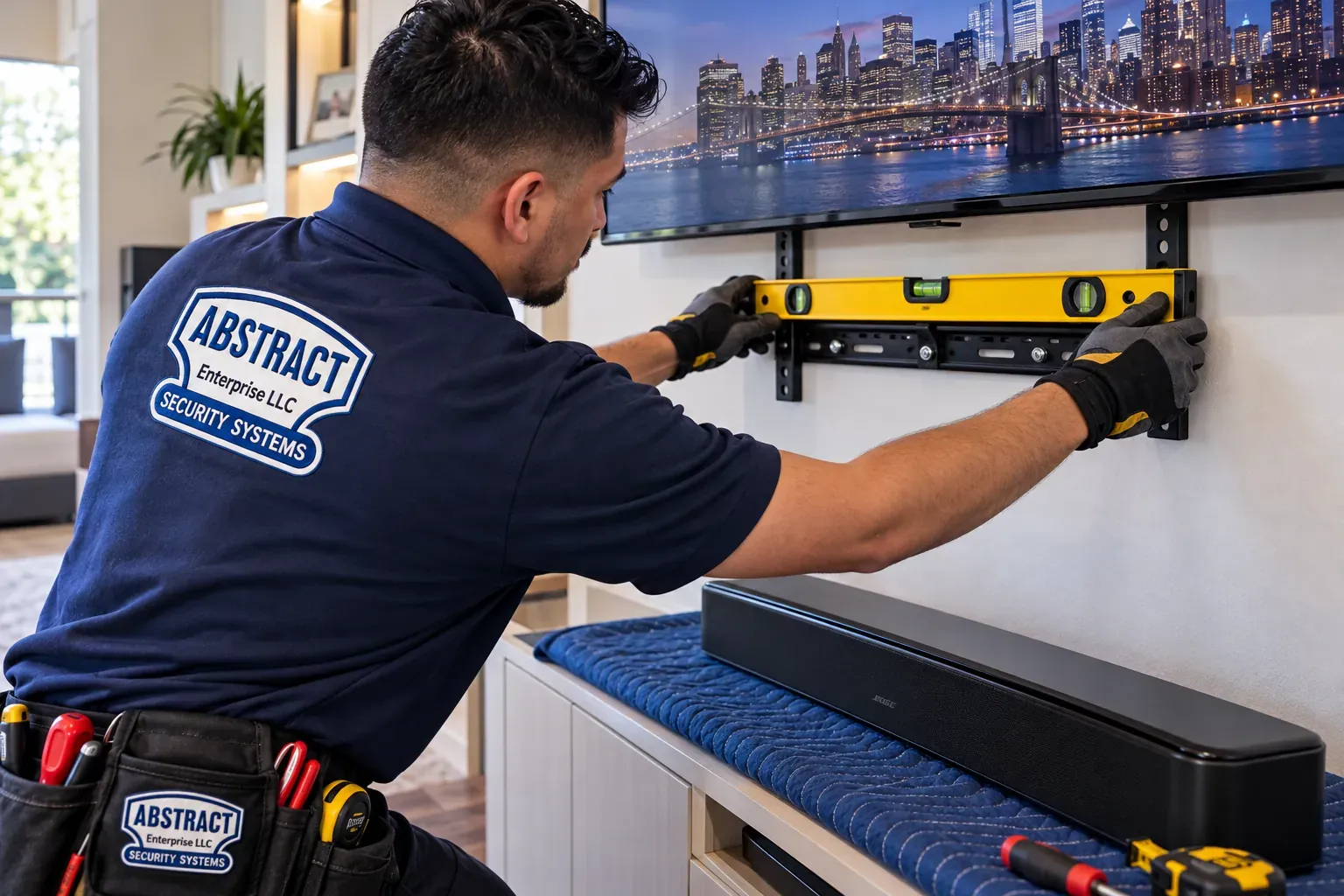
Bracket first, bar second: a gloved technician levels the bracket under the TV while the soundbar waits on a padded blanket on the cabinet below.
Owners in the Gardens and the bigger co-ops often ask for a wired network point behind the TV while we are there.AESS structured cabling in Queens can run that cable on the same visit, which keeps a networked bar and a streaming box off crowded Wi-Fi.
Commercial Soundbar Installation
Business Soundbar Installation in Forest Hills
Forest Hills' business streets are short on bars and long on waiting rooms. A 2014 Brownstoner piece asked whether Austin Street was turning into “medical center row” as urgent-care centers and clinics took over storefronts, and much of the commercial soundbar work here is exactly that: a screen in a reception area that needs to be heard by the people in the chairs and nobody else.
Austin Street
The neighborhood's main shopping street, about a mile from Yellowstone Boulevard to Ascan Avenue, with clinics, cafés, restaurants and chain stores. In late summer 2026 the block between 71st Avenue and 71st Road hosted four Sunday open streets.
71st Avenue and Continental Avenue
The transit knot where the E, F, M and R stop at Forest Hills–71st Avenue and the LIRR station sits above Continental Avenue. Offices and professional suites above the shops, with meeting rooms that use a TV for video calls.
Station Square
The Gardens' public front door: the 1906 station, its clock tower and arcaded walks. Shops and offices here sit inside the Gardens' architecture, so anything visible from outside is a conversation with the building first.
Queens Boulevard
Ground-floor professional offices, gyms and restaurants under apartment towers. The usual room is a waiting area or a dining room with residents directly above, which puts bass and late-night levels front and center.
108th Street
A shopping strip serving the surrounding apartment blocks and the area's Bukharian Jewish community, with restaurants and shops where a counter TV carries news and sport through the day.
Metropolitan Avenue
Smaller storefronts and service businesses; National Grid's Forest Hills Reliability Project has had the avenue under excavation in 2026, worth knowing when booking a weekday visit.
The offices above the shops around 71st Avenue and Continental Avenue bring a different request: a meeting-room display that people can actually hear on a video call. A bar on the display's eARC socket, or connected to the room's computer, lifts far-end voices above the hum of a small office, and a sensible fixed level keeps the room next door out of the meeting. For larger rooms with microphones around a table, ceiling audio is the better answer and our AV team takes that on.
Compliance notes for Forest Hills businesses
Apartments upstairs. The city's noise code, as summarized by the Department of Environmental Protection, limits commercial music to 42 decibels inside a nearby residence and, between 10 p.m. and 7 a.m., to 7 decibels above the street's background level at 15 feet, with a separate limit on pervasive bass. A soundbar in a Queens Boulevard storefront is set with that ceiling in mind.
Corridors and waiting rooms. A long bar on a bracket can project past the 4-inch limit for wall-mounted objects between 27 and 80 inches off the floor in the 2010 ADA Standards. In a clinic hallway we mount above that band, recess it, or keep it off the circulation route.
Outlets are electrical work. Connecting a soundbar is low-voltage work and needs no Department of Buildings permit of its own; a new outlet behind the screen does need a licensed electrician.
Landlord paperwork. Commercial landlords typically ask for a contractor's certificate of insurance; ours costs nothing and names whoever your lease requires.
Inside the Gardens. For premises on or near Station Square, anything that changes the outside of a building — a speaker under an arcade, a cable through a façade — belongs to the Corporation and the landlord to approve before we touch it.
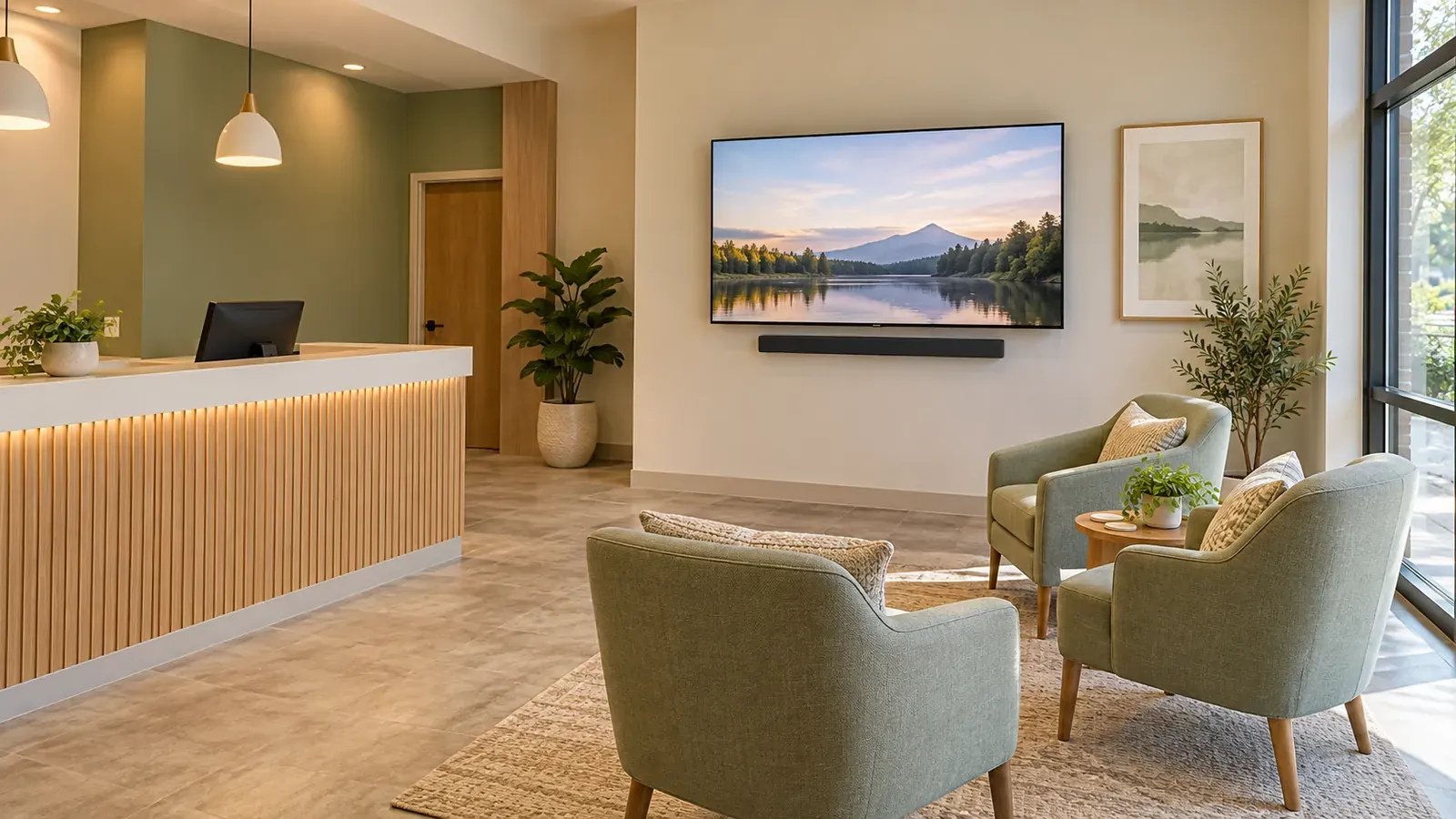
A reception area of the kind Austin Street is full of: TV and slim bar on the wall facing the chairs, the front desk off to one side.
Practice managers who call about a waiting-room screen often add door entry or cameras to the list.Low-voltage installation from AESS in Queens covers sound, data and security under the same license.
Your Questions Answered
Soundbar Installation in Forest Hills: Questions Answered
These are the questions that come from Forest Hills addresses in particular — Gardens houses, garden courts, co-ops, towers and the businesses around Austin Street. General questions about booking and equipment are in the FAQ near the end.
Houses in Forest Hills Gardens
Our Gardens house is one of Atterbury's precast concrete houses — what actually holds a soundbar bracket in a panel wall with hollow chambers inside?
A concrete anchor in the solid part of the panel, once we have found it. Atterbury's panels were cast with hollow chambers for insulation, so the same wall is solid concrete in some places and a skin of concrete over an air space in others. A soundbar weighs a few pounds to a little over a dozen, which concrete carries easily — the risk is not strength but an anchor set into a thin face over a void, where it can spin or crack the face. We drill a small pilot at each fixing point, without hammer action at first, and feel for the change: steady resistance all the way in is solid, a sudden give is a chamber.
Where the bracket's holes fall on solid concrete we use sleeve or wedge anchors sized to the bracket. Where they fall on a chamber, we shift the bracket a little sideways, use a bracket with more mounting slots, or switch to an anchor made for hollow masonry. The cables can't be fished through these walls, so we run a slim painted raceway from the bar to the outlet or route everything down behind the console. On the price list this is the concrete-wall line, and we tell you before drilling that a century-old surface can spall around a hole, which is why we start small.
We live inside Forest Hills Gardens — which parts of a soundbar job touch the Corporation's rules on exterior changes?
For a bar on an inside wall, usually none; for anything that shows on the outside of the house, possibly all of it. The 1913 covenant that every Gardens buyer signs prevents exterior alterations without the Corporation's express approval. A soundbar, its bracket and its cables inside your living room are not exterior work. A speaker or TV on a porch, a cable drilled through an outside wall to reach a terrace, or anything fixed to the façade is the kind of change the Corporation reviews, and we won't do that part until you have its answer in writing. We can describe the work for you, but only the Corporation can interpret its own rules.
The visit itself needs one bit of planning. The Corporation looks after the Gardens' streets and parking, and visitors' vehicles are expected to show a resident's guest sticker. When you book, tell us where we can stop and arrange the guest pass the way you would for any contractor, so the technician isn't circling with a van full of tools or carrying a drill case three blocks.
Will a subwoofer make the leaded glass windows in our Tudor living room rattle?
It can, if the glass is loose in its lead or the sash is loose in its frame. Leaded windows are made of small panes held in lead strips, and over a century some of those joints relax. Low bass carries energy that can set a loose pane or a loose casement buzzing at particular notes, which sounds like a fault in the soundbar when it isn't. It is more likely with the subwoofer close to the window wall and turned up.
We place the sub away from the window wall, ideally on the inside wall of the room, and set its level so it fills out the bottom without shaking the glass. On the day we play a bass-heavy scene and listen at the windows. If a particular pane still buzzes, the cure is with the window — re-cementing or tightening by someone who restores leaded glass — and we'll point out exactly which one so you can show them.
Garden courts and older houses
Before you drill, should we photograph the hairline cracks already in our 1920s plaster?
Yes, and we do the same. Plaster in a house from the 1920s has usually moved with a hundred winters, and fine cracks around doorways, ceilings and windows are normal. When a bracket goes up on a cracked wall, nobody wants an argument later about which cracks were there first. A few photos taken in daylight before the visit, with the TV wall and the walls either side in frame, settle it.
On arrival the technician looks over the TV wall with you, notes any existing cracks or loose areas on the work order and photographs them. Where plaster sounds hollow or a crack runs through the spot the bracket wants, we move the fixings to sound plaster or to the framing, or recommend a TV-attached bracket so the wall isn't asked to do more than it can.
Co-ops and towers
Our co-op's managing agent wants a written description of the work before approving it — what should it say for a soundbar?
Short and specific: what is being installed, where, how it is fixed, and what it does not involve. For a typical job that means the bar's make and model, the room and wall, the number and type of anchors (for example, four concrete anchors or two toggles behind plaster), the cable finish (surface raceway, no openings in the wall), and a line confirming there is no electrical, plumbing or structural work. Add the expected duration, the contractor's name and license number, and the date you want.
We write that description for you from the photo and models you send, and our certificate of insurance goes to the agent at no charge with whatever additional insureds the building lists. If the alteration agreement calls for anything we don't do — a new outlet, for instance — the description says so plainly, so the approval covers exactly what happens on the day.
The TV wall in our tower apartment is solid concrete — could the drill hit electrical conduit buried inside it?
It could, which is why we look before we drill. Concrete buildings often carry wiring in conduit cast into the walls, running mostly straight up and down from outlets and switches or across at their height. A hole that meets a conduit can damage the cable inside and cut power to part of the apartment, or worse. The bracket only needs anchors a couple of inches deep, but that is enough to reach conduit near the surface.
So we scan the area with a detector that finds metal and live wiring, mark the likely conduit routes above and below the outlets and switches, keep the anchors clear of those lines, and use a depth stop on the drill. If the scan is uncertain at a fixing point, we move the bracket rather than gamble. Where the building has drawings showing conduit runs, the superintendent can often tell us where to avoid.
Households that watch in more than one language
Our parents watch Russian-language channels through an internet TV box — does the soundbar's dialogue mode work as well for Russian as for English?
Yes. Dialogue and speech modes work on sound, not on words: they lift the range of frequencies where human voices sit and, on some bars, turn down the effects and music around them. A Russian news anchor, a Spanish-language drama and an English sitcom all have voices in that same range, so the mode helps each of them in the same way. What changes clarity more than language is how the channel was mixed — some imported programs arrive with music loud under the speech — and that is where a center-channel bar and its voice setting earn their keep.
The box itself connects like any streaming player: HDMI into the TV, with the TV passing the sound to the bar over eARC or ARC so the TV remote still controls the volume. If the box has its own remote that older viewers prefer, we check that its volume buttons can be set to drive the TV or the bar, and we leave a short note of the settings in whichever language the household gives us, so a grandchild or a neighbor can put things right after an update.
Concert nights
Is it a problem to book the installation on a day when the stadium has a concert?
Not for the work, but it can be for getting there. On show days residents have described street closures and parking taken up around the stadium, and the Gardens streets nearest the venue are the busiest. A technician with a van of tools and a bar to carry needs a place to stop near your door, which is harder in the hours before a show.
When you book, tell us if there is a concert that day and we will pick an early arrival window, well before crowds gather, or another day. Shows end by the stadium's 10 p.m. curfew, so an evening appointment that day is the one to avoid. Everything else — mounting, wiring and tuning — is indifferent to what is happening on the stage.
Austin Street businesses
Can the soundbar in our waiting room help keep conversations at the reception desk from carrying to patients in the chairs?
A little, but it shouldn't be relied on for privacy. A TV playing at a comfortable level does give the room some background sound, which makes nearby speech slightly harder to follow. But a soundbar is designed to make speech clear, which is the opposite of what masking needs, and the gaps between programs leave the desk exposed. Turning the bar up to cover conversations only annoys the people waiting.
What helps is placement: the screen and bar on the far side of the waiting area, aimed at the seats and away from the desk, at a moderate fixed level. For genuine speech privacy at a reception counter, a dedicated sound-masking system with small ceiling emitters is the right tool, and our AV and sound team for Queens can price one. Anything the practice needs for legal compliance is a question for its own advisers, not for an installer.
When our Austin Street restaurant opens its front for the Sunday open street, can the soundbar's sound stay inside?
Mostly, with the right wall and the right level. A soundbar throws its sound forward from the bar, so the first choice is to mount the screen on the back or side wall facing the tables, not above the window facing the street. Aimed inward, the bar reaches the diners and the open frontage gets the spill rather than the full output. A bar mounted over the door aims straight out at the pavement.
We set a sensible maximum volume where the bar or TV allows it, leave the subwoofer low or off, because bass escapes through any opening, and show staff a quick way to lower the level when the front is open. The city's commercial-music rules don't pause for an open street, and the apartments over Austin Street's storefronts hear the difference.
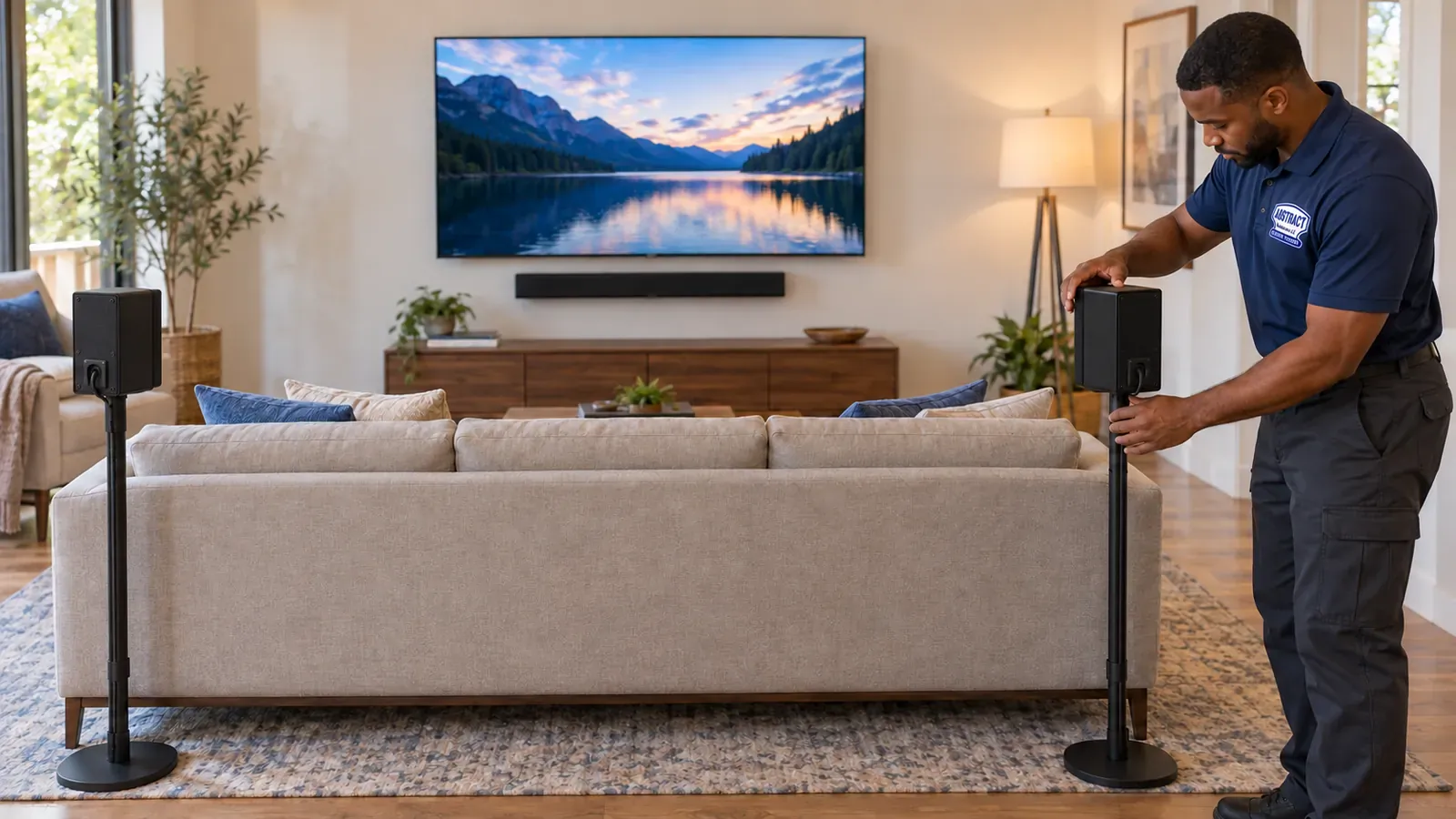
Rear speakers on stands behind the sofa, adjusted from the listening position, with the TV and bar on the far wall.
Forest Hills Home Planner
Matching the Soundbar Setup to the Forest Hills Home
When you call, four questions get us most of the way to a method and a price: which kind of building, what the TV wall is made of, who else has a say, and who lives on the other side of the wall or floor. The table is the shortcut we use on the phone.
Home
Usual TV wall
Usual fixing
Cable finish
Who to ask first
Sound note
Gardens concrete-panel house
Precast concrete with hollow chambers
Concrete anchors in the solid web; hollow-masonry anchors over chambers
Painted raceway or behind furniture
Nobody for inside work; the Corporation for anything outside
Plenty of room; mind the leaded windows
Gardens brick or stucco Tudor
Plaster over brick or on lath
Masonry anchors or toggles
Raceway; in-wall only on framed partitions
As above
Fireplaces and beams shape the layout
Garden-court row house
Party wall or plaster partition
Short anchors after a pilot test
Raceway
Your neighbors, as a courtesy
Sub off the shared wall
Detached house north of the tracks
Wood framing
Into studs
In-wall kit or basement route
Nobody
Most freedom for sub and rears
Pre-war elevator co-op
Plaster on lath or block
Toggles, framing fixings or a TV-attached bracket
Raceway unless the board allows more
Managing agent and superintendent
The apartment below decides sub placement
Concrete tower
Poured concrete or block
Concrete anchors after a conduit scan
Raceway or behind furniture
Management office
Bass travels through the frame
Rental apartment
Whatever the lease lets you touch
Console or TV-attached bracket
Along the TV's own cables
Landlord
Night mode, modest sub
Before you buy a bar for a Forest Hills room
Measure the space under the screen. Note the TV's width, the gap between the bottom of the screen and whatever sits below it, and how far the nearest window, door frame or radiator is from each end. Long bars want open space at their ends, and many Gardens and garden-court rooms have a window or door close to the TV wall.
Look at the back of the TV. An HDMI socket marked eARC or ARC means one cable carries the sound and one remote runs everything. An older second-room TV with only an optical output still works, with a few compromises on control.
Think about the ceiling before paying for Atmos. Up-firing height speakers need a flat, reflective ceiling over the seats. A plaster living-room ceiling suits them; beams, slopes and glass do not.
Decide where a subwoofer could go before buying one. In a co-op or a garden-court house the honest answer is sometimes "nowhere it won't bother someone," and then a bar with good built-in bass is the better purchase.
Check the box for a wall bracket. Some bars include one, some sell it separately and some need a third-party bracket. Knowing which saves a second trip.
Concert Season
Quiet Streets, Loud Summers: Sound Settings for Forest Hills
For ten months a year the main sound question in Forest Hills is how not to be the noisy neighbor. From late spring to early autumn, near the stadium, it is also how to hear the film. The two call for different settings, and a well-set-up bar can switch between them in a couple of button presses. This is how we approach both.
Keeping your sound in your apartment
Bass is the part that travels. Treble and speech fade quickly through plaster and concrete; low bass passes through floors and walls far more easily. Most of the complaint posts on neighborhood forums are about the thump, not the words, so the subwoofer is where we spend our attention.
Subwoofer off the shared surfaces. In a co-op, the sub goes on the floor away from the party wall and off any spot directly over the neighbor's bedroom where we can tell, on a dense pad rather than straight on the floorboards.
Corners avoided. A sub pushed into a corner sounds louder in the room and excites the structure more; a position along a wall, out of the corner, gives an even sound at a lower setting.
Night mode found and labeled. Most bars have a night or late-night mode that compresses loud peaks. We set it up, show it to everyone who uses the TV and, if the household wants, set the bar's default so it wakes up at a sensible level.
Speech first, volume second. A bar with a center channel and its dialogue mode on can be played several notches lower for the same intelligibility, which helps everyone on the floor.
Hearing the dialogue when the stadium is playing
On show nights the problem is reversed. A concert carries a broad wash of low-frequency sound that fills the gaps in speech, and turning the TV up mostly makes the room louder without making voices clearer. What helps is the same discipline as the rest of Queens uses against traffic: the bar mounted close under the screen at seated ear height, its speech mode on, any automatic leveling mode tried, and captions one press away. If the household sits with its back to the windows that face the venue, the bar's sound reaches them before the concert does.
The stadium's season and its 10 p.m. curfew mean the overlap is a few hours on a few dozen evenings a year. We don't design the whole room around it, but we do make sure that the person who watches most knows which two settings to change on those nights and how to change them back.
Before the visit
Have the bar, its bracket, any sub or rear speakers and the TV remote in the room, with a few feet cleared in front of the TV wall. Tell us whether you own or rent, whether a co-op agent or the Gardens Corporation is involved, and who uses the TV most. If you know where the neighbors' bedrooms are relative to your living room, say so; it changes where we suggest the subwoofer goes.
If you are in a co-op, check whether the house rules set quiet hours or limit when contractors may drill, and give us the superintendent's name; in a tower, ask the management office whether the elevator needs reserving for a delivery-sized box. In the Gardens, have the guest pass ready. Those three details are the usual reasons a visit starts late, and every one of them is easier to settle the day before than at the front door.
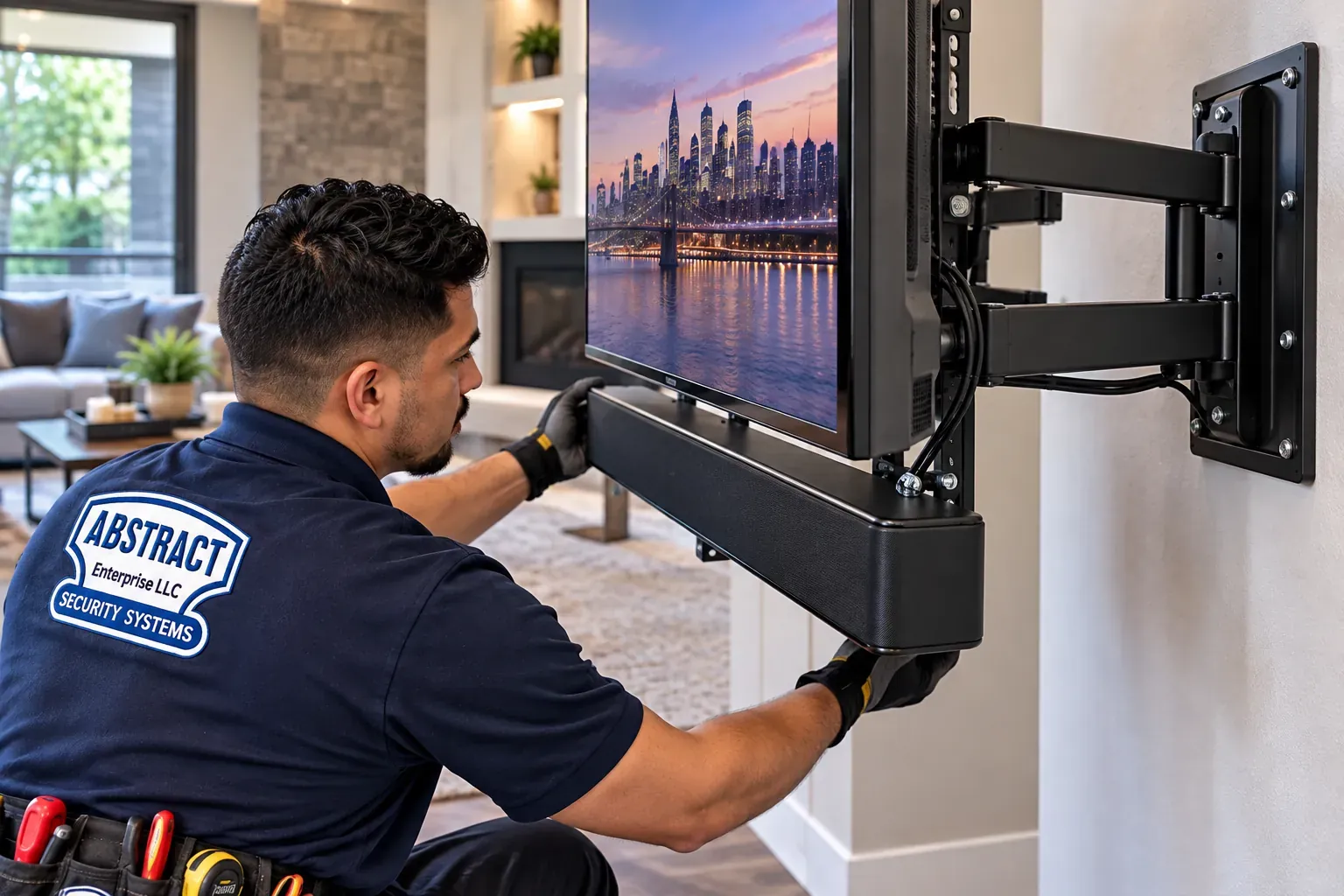
On an articulating arm the bar is fixed to the TV itself, so screen and sound swing together when the TV is turned toward a different seat.
Equipment
Types of Soundbars and Mounting Hardware We Install
Buy the bar yourself or ask us what suits the room. These are the categories we fit most often in Forest Hills homes and offices, with the details that matter for the wall and the neighbors.
Center-Channel Bars
3.0 and 3.1 bars with a dedicated speech channel. For older viewers and for apartments where the volume has to stay modest, clear dialogue matters more than size.
Compact Bars
Short bars for bedroom and kitchen screens, light enough for toggles in plaster. Some connect by optical rather than HDMI, which suits the older TVs still common in second rooms.
Mid-Size Smart Bars
The everyday bar for a 55- to 65-inch screen, connected over HDMI eARC, with an app for speech and night settings. The best fit for compact garden-court front rooms.
Atmos Bars With Up-Firing Drivers
Long bars that bounce height effects off the ceiling. Best under a flat plaster ceiling; less useful under beams or sloped sunroom roofs.
Bars With Separate Sub and Rears
Systems shipped with a wireless subwoofer and rear speakers, each needing its own outlet. In a co-op the sub's position is planned before the box is opened.
Wall and TV-Mount Brackets
Two families: a wall bracket gripping the bar from behind, or a clamp that hangs it from the television or the arm. When we supply it, the Sanus bracket costs $89.24 at Queens rates.
Masonry and Hollow-Wall Anchors
Sleeve and wedge anchors for solid concrete and brick, hollow-masonry anchors for chambered panels and block, toggles for plaster on lath, and steel-stud fasteners for newer partitions.
Isolation and Cable Finish
A heavy pad under the sub to stop it driving the floorboards, raceway we leave ready for paint, a code-compliant kit where a wall is hollow, an HDMI lead certified for eARC, and a surge strip fixed up off the carpet.
Size the bar to the room and the screen, not to the shelf in the shop. In a garden-court front room or a one-bedroom co-op, a bar about as wide as the TV, or a little narrower, sits well and leaves the open space at its ends that it needs. Very long bars suit the bigger Gardens living rooms, where the seating is farther back and a wider spread of sound has room to work. If the sofa is close to the screen, a center channel matters far more than width.
Matching the connection to the household
What the household wants
Connection
Why
One remote for everything
HDMI eARC or ARC with CEC on
The TV remote powers and sets the bar
Lossless sound from a disc player or console
HDMI eARC
Only eARC carries lossless formats
Older second-room TV without ARC
Optical
Stereo and compressed surround; remote may need learning
Quiet late-night viewing
Any, with night mode set
Peaks compressed; sub level reduced
Music from phones
Wi-Fi casting or Bluetooth
Fine for music; Bluetooth adds delay for TV
Your exact model number decides the bracket, the anchor count and the connection, so send it with the photo; specifications change from one generation of a bar to the next.
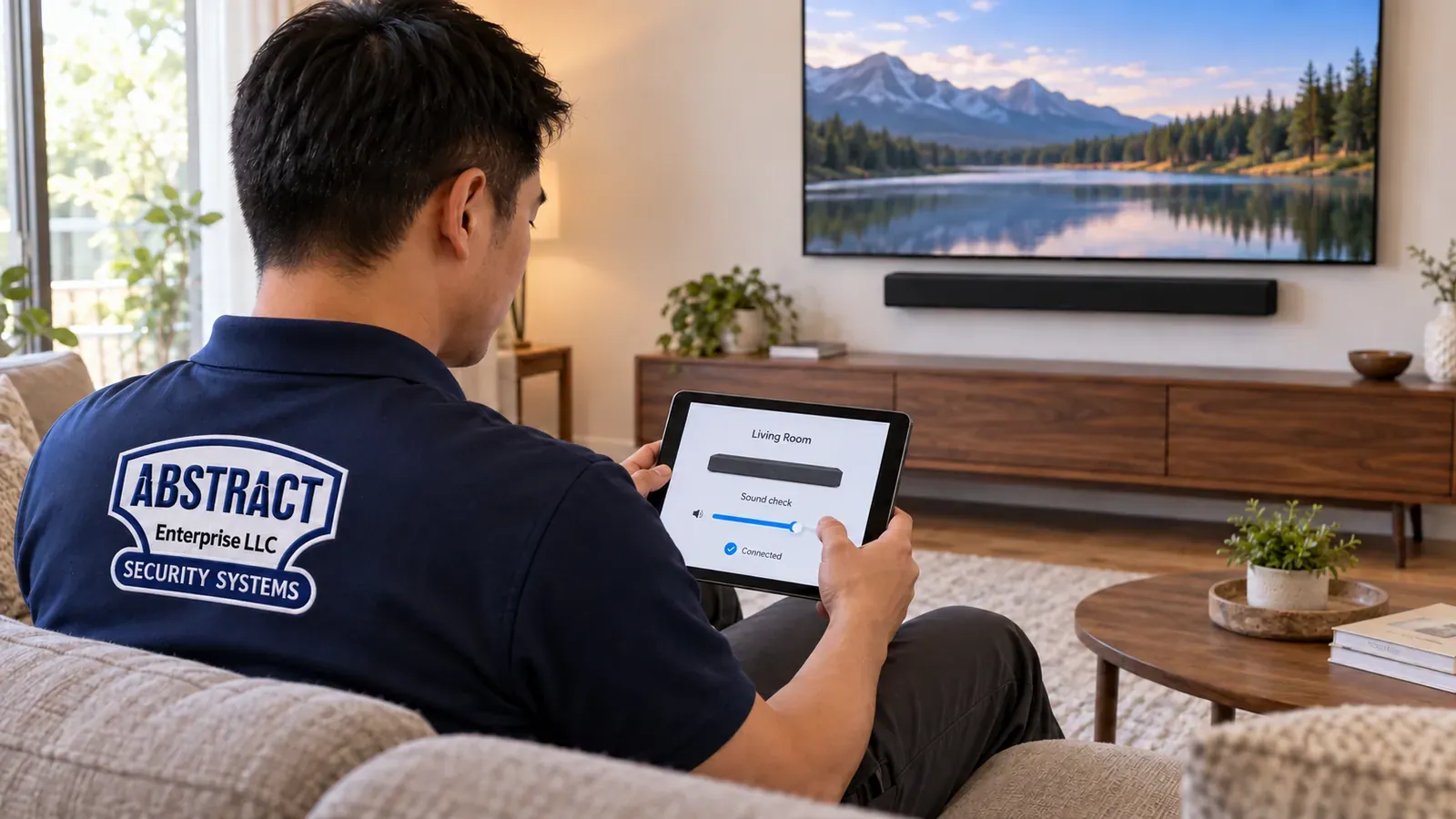
Settings are judged from the seat people actually use, with the bar's app open on a tablet and the TV and bar on the wall ahead.
AI Overview Reality Check
What AI Gets Wrong About Soundbar Installation in Forest Hills
A note on method: the tools used to research this page could not display Google's AI Overview, so nothing below is presented as its words. Each heading is a claim published by a manufacturer, a cost guide or an installer — the kind of line answer engines summarize and repeat. Under each is what it leaves out once the wall is in Forest Hills.
“Find your studs — drywall anchors can work, but one screw into a stud is better”
That is the first step in one New York TV-mounting company's soundbar guide, and it is the first step in most DIY instructions. In a framed house with drywall it is sound advice.
In a good share of Forest Hills there are no studs to find. Atterbury's Gardens houses are precast concrete panels, the towers are poured concrete, and many pre-war co-op partitions are plaster on lath or over block. A stud finder on those walls either reads nothing or reads nonsense, and a drywall anchor has nothing to grip.
The question to ask first is not where the studs are but what the wall is made of. We answer it with a pilot hole and choose the anchor afterwards.
“Install a soundbar without a stud finder — quick, safe and damage-free”
No-stud hanging systems are marketed as a way to put up a soundbar quickly without searching for framing, and for the walls they are designed for they may do just that.
The difficulty is the word “wall”. A system rated for gypsum board says nothing about a concrete panel with a hollow chamber behind its face, or crumbly 1930s plaster, or a poured-concrete tower wall. Using a fixing outside its rating is how bars end up on the floor.
If you want to try a no-stud product, check that its maker lists your wall type. If they don't, a pair of correctly chosen anchors is a small cost against a dropped bar.
“Align the template's center line with the center of your TV”
Samsung's instructions for its soundbar wall mount have you tape a paper template to the wall and line it up with the middle of the television. It is the right way to get the bar centered on the screen.
It assumes the TV itself is in the right place. In many Tudor living rooms the obvious wall has a window, a door or a fireplace that pushes the screen off the room's center line, and in garden-court front rooms the seating may not face the middle of the wall at all.
We settle the TV's position against the seating first, then center the bar on the TV using the template. Doing it in that order avoids a perfectly centered bar on a badly placed screen.
“Avoid putting the subwoofer directly against a wall or in a corner”
Polk Audio's placement advice warns that bass reflections build up against walls and in corners. That is accurate, and it is about sound quality in your own room.
In a Forest Hills co-op or a garden-court row house the same advice has a second reason. A sub against the party wall or in a corner shared with the next apartment pushes more energy into the structure the neighbors live in, and that is what starts noise disputes.
We follow Polk's rule for your sake and add one for the neighbors': the sub goes off shared walls and on an isolation pad, at the lowest level that still sounds full from the sofa.
“With an adjustable TV mount, put the soundbar on a bracket attached to the mount”
Dolby's guide to soundbar placement suggests that if the TV is on an adjustable mount, the bar can ride on a bracket connected to that mount so the two stay together.
It is a good idea with a condition attached: the arm then carries the TV and the bar. A full-motion arm swung out from a plaster wall in a corner places the combined weight a long way from the wall, and the arm's rating and its anchors have to allow for both.
Before fitting a TV-attached bracket we add the bar's weight to the TV's, check it against the arm's published limit, and confirm the arm's own anchors suit the wall.
“Mount the soundbar closest to 42.5 inches off the ground, where a seated listener's ears fall”
Yamaha's guide to mounting a TV and soundbar gives about 42.5 inches off the floor as the height where a seated listener's ears fall, and the principle — sound at ear level — is right.
Forest Hills rooms don't always cooperate. A Gardens living room with a fireplace and mantel puts the TV higher than ideal, a sunroom with a low window sill puts it lower, and an older relative in a high-backed armchair sits at a different height from a family on a low sofa.
We measure the actual seats, then choose between bar under the screen, bar on the TV, or a slight downward angle where the bracket allows, so voices arrive at the heads of the people watching.
“Installing a soundbar costs $58 to $231”
Homewyse's cost estimator put the national average cost to install a soundbar at $58.43 to $231 in September 2026, and a range like that is easy for a summary to repeat as the going rate.
A national range can't know that your wall is a concrete panel or that your building needs an insurance certificate. In Forest Hills the bar on the wall is $135.45 on our Queens list, a concrete or block wall adds $78.75, plaster adds $47.25, and the certificate is free.
The useful number is the one built from your own wall and building, written down before anyone arrives. That is what the price section below is for.
Clear Dialogue, Quiet Neighbors
A model number and a photo of the TV wall are enough for a plan, a Queens price and a list of anything your co-op or the Gardens will want from us.
A concrete-panel house on a Gardens street, a 1930s co-op off 108th Street or a tower apartment on the boulevard — this form brings a written price by the end of the business day. Would rather talk? Call (347) 434-6392.
✅
Thanks — Request Received
An installer will call before the business day ends. If it can't wait, phone (347) 434-6392.
How It Works
Our Installation Process
Seven steps, whether it is a compact bar in a 108th Street one-bedroom or a bar, sub and rears in a Gardens living room.
1. Photo, models, building
You send the bar and TV models, a photo of the TV wall with the outlet in view, and tell us whether a co-op agent or the Gardens Corporation is involved.
2. A written Queens price
We reply with a written total from the Queens price list — mount, bracket, wall line, cable finish and extras — before you commit to a date.
3. Approvals and parking
We draft the work description, send the certificate of insurance free, confirm building hours, and agree where the van can stop or how the guest pass works.
4. Your 2-hour window
Pick a 2-hour arrival slot, 8 AM to 8 PM, any day of the week. Same-day slots happen when free, and a day's notice moves the booking at no cost.
5. Wall test and layout
A pilot hole confirms the wall, a scan checks for conduit, pipes and wiring, and the height and center line are agreed with you against the seating.
6. Mount and connect
Anchors matched to the concrete, plaster, block or studs, then the bracket and bar, a tidy cable finish, and the HDMI eARC or ARC link with CEC enabled.
7. Tune and hand over
Speech and night modes set, the sub placed for the neighbors, the remote tried by the main viewer, existing wall marks noted, and the dust cleaned up.
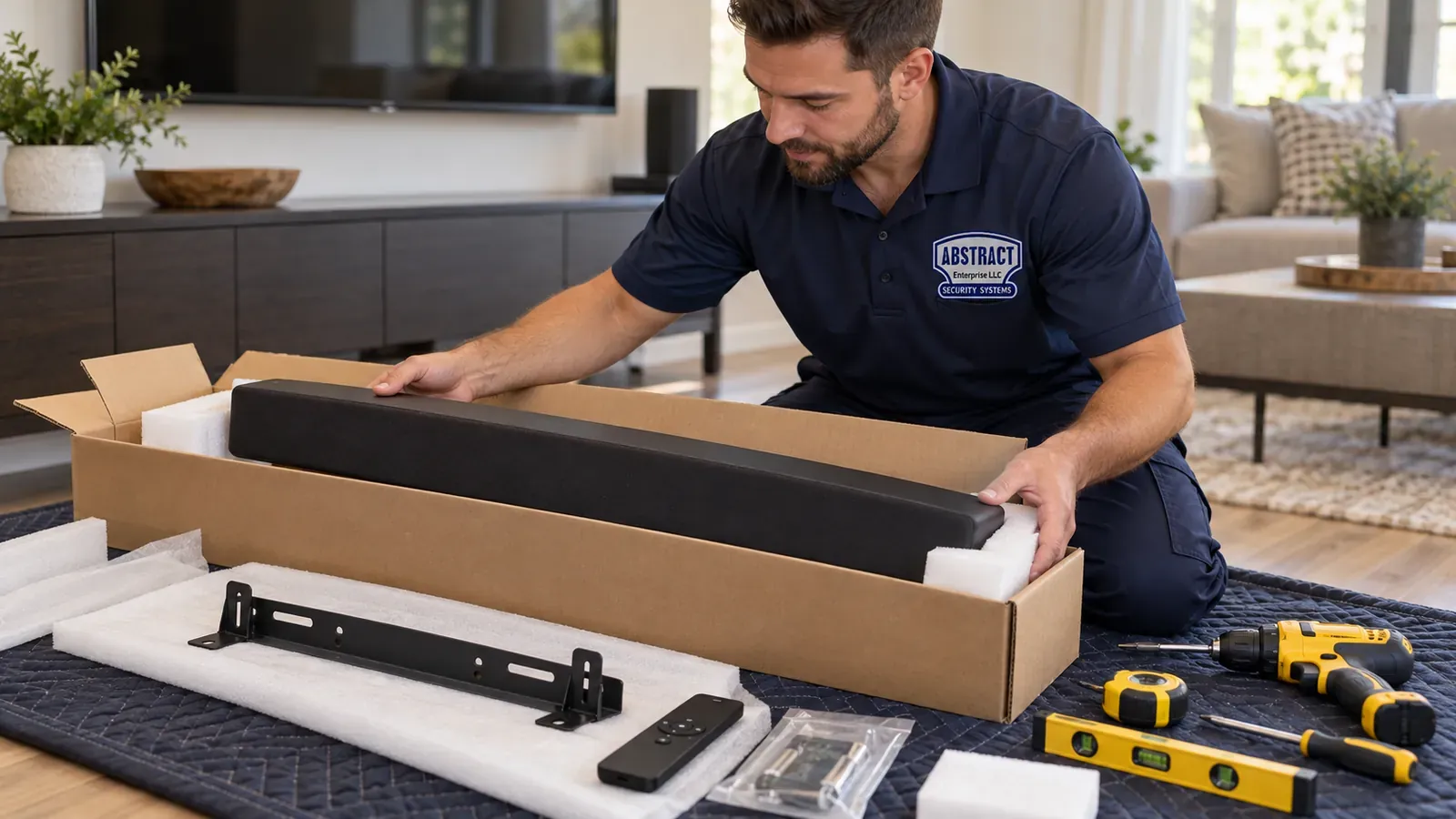
Before any drilling, the box is emptied onto a blanket: the bar, its bracket, the remote and hardware bag, with a drill, tape and level alongside.
Coverage Area
Soundbar Installation Near Forest Hills' Landmarks
Six places that mark out the neighborhood and the kinds of homes around them.
Station Square and the LIRR Station
The Gardens' town square, around the Long Island Rail Road station above Continental Avenue, opened in 1906. Theodore Roosevelt spoke from its steps on July 4, 1917. The concrete-panel and Tudor houses spread south from here.
Forest Hills Stadium
Built in 1923 for the West Side Tennis Club, home of the U.S. national tennis championships until 1977 and a concert venue since 2013. The reason some Gardens households tune their bars for summer evenings.
Forest Close and Arbor Close
Two 1920s garden courts of attached neo-Tudor houses around shared greens — Arbor Close from 1925 and Forest Close, 38 houses, from 1927. Party walls and compact front rooms.
Forest Hills Co-op Houses
Three 12-storey buildings with 432 apartments at 108th Street and 62nd Drive, the compromise Mario Cuomo brokered in 1972 after a plan for three 24-storey towers. Concrete walls and cooperative procedures.
Parker Towers
Three 20-storey towers with 1,327 apartments on Queens Boulevard toward Rego Park. Concrete construction, management rules for contractors and a great many TV walls.
Forest Park
The 507-acre park whose nearness gave Forest Hills its name when the Cord Meyer Company bought the land in 1906. Detached and attached houses line the streets on the way to it.
We also install in Rego Park, Kew Gardens, Kew Gardens Hills, Middle Village, Glendale, Richmond Hill and Corona, across the rest of Queens, and throughout New York City, Long Island and the Hudson Valley.
Pricing
Soundbar Installation Cost in Forest Hills
Forest Hills is priced on our published Queens list — the same lines whether you are on a Gardens street or a Queens Boulevard high floor. Choose the lines that describe the job and add them; that sum is the written quote and the bill. If something the photo didn't show turns up on the day, you hear the price before the extra work starts. Queens prices carry the borough's 1.05 area factor on the soundbar and accessory menu.
Soundbar service
Queens price
What it covers
Soundbar placed on a console or stand
$82.95
Positioned, connected, set up and tested
Soundbar wall-mounted under the TV
$135.45
Bracket fixed, bar hung and leveled, connected and tested
Sanus soundbar bracket
$89.24
When the bar came without one or its own won't suit the wall
In-wall concealment
$177.45
Code-compliant in-wall power and cable kit, hollow walls only
Paintable cord cover
$61.95
Surface raceway from bar to outlet or console
Cable run to a cabinet or other spot
$103.95
Up to 25 ft
Sonos setup
$131.25
Sonos bar, sub, rears, app and grouping
A/V receiver hookup
$135.45
Receiver connected and configured
Universal remote
$103.95
Programmed for TV, bar and sources
Streaming device setup
$51.45
Roku, Apple TV, Fire TV, Chromecast or similar
Full home theater connection
$367.50
Several components set up together
Walls and access
Condition
Queens price
Where you meet it in Forest Hills
Drywall on wood studs
$0
Renovated and detached houses north of the tracks
Metal studs
+$31.50
Newer partitions in renovated apartments
Plaster
+$47.25
Pre-war co-ops, Tudor and garden-court interiors
Brick or stone
+$68.25
Outside walls of brick Tudors, fireplace surrounds
A Gardens concrete-panel living room with a bar on our Sanus bracket and a painted raceway down to the outlet: wall mount $135.45, bracket $89.24, concrete line $78.75 and cord cover $61.95, for $365.39. A 108th Street co-op where the bar came with its own bracket and the wall is plaster: wall mount $135.45, plaster $47.25 and cord cover $61.95, for $244.65, with the insurance certificate free. A framed house north of the tracks with a Sonos bar, sub and rears and every cable hidden: the Premium package at $402.14 plus Sonos setup at $131.25, for $533.39. Your own total is built the same way, line by line, before the visit.
Setup-only visits and the TV itself
Some visits involve no drill at all: a replacement TV that has lost touch with the bar, a sub that dropped its pairing, a remote that stopped controlling the volume, settings that need redoing after an update. Those are charged on time — $195 for the first hour on the Queens rate, then by the half hour. If the TV is going up at the same visit, the Queens base for a 32- to 55-inch screen on a flat or tilt mount on drywall over studs is $179.99, with other sizes, mounts and walls on our TV mounting prices for Queens.
Included and not included
Included: testing the wall, fixing and leveling the bracket, hanging and connecting the bar, tidying cables, turning on HDMI-CEC, setting speech and night modes, placing the sub, and cleaning up dust.
Left to others: any outlet that has to be added or moved goes to a licensed electrician, and filling and painting old holes go to your painter.
Return trips: if the job can't start because the bar isn't there, nobody can let us in, or the co-op or Corporation approval hasn't come through, the visit is charged as a $150 return trip.
Fragile surfaces: old plaster, a concrete panel face, glazed tile or stone can chip around a hole; we say so before drilling and go ahead only with your agreement.
National brand menus and app-booked handymen versus a local licensed installer. Flat national prices assume a stud wall in a suburban house, and for that wall they are fair. They don't price a precast concrete panel, a managing agent's paperwork or a guest-sticker street. A local installer with a wall-by-wall Queens list and a state low-voltage license quotes the job you actually have and stays answerable for it.
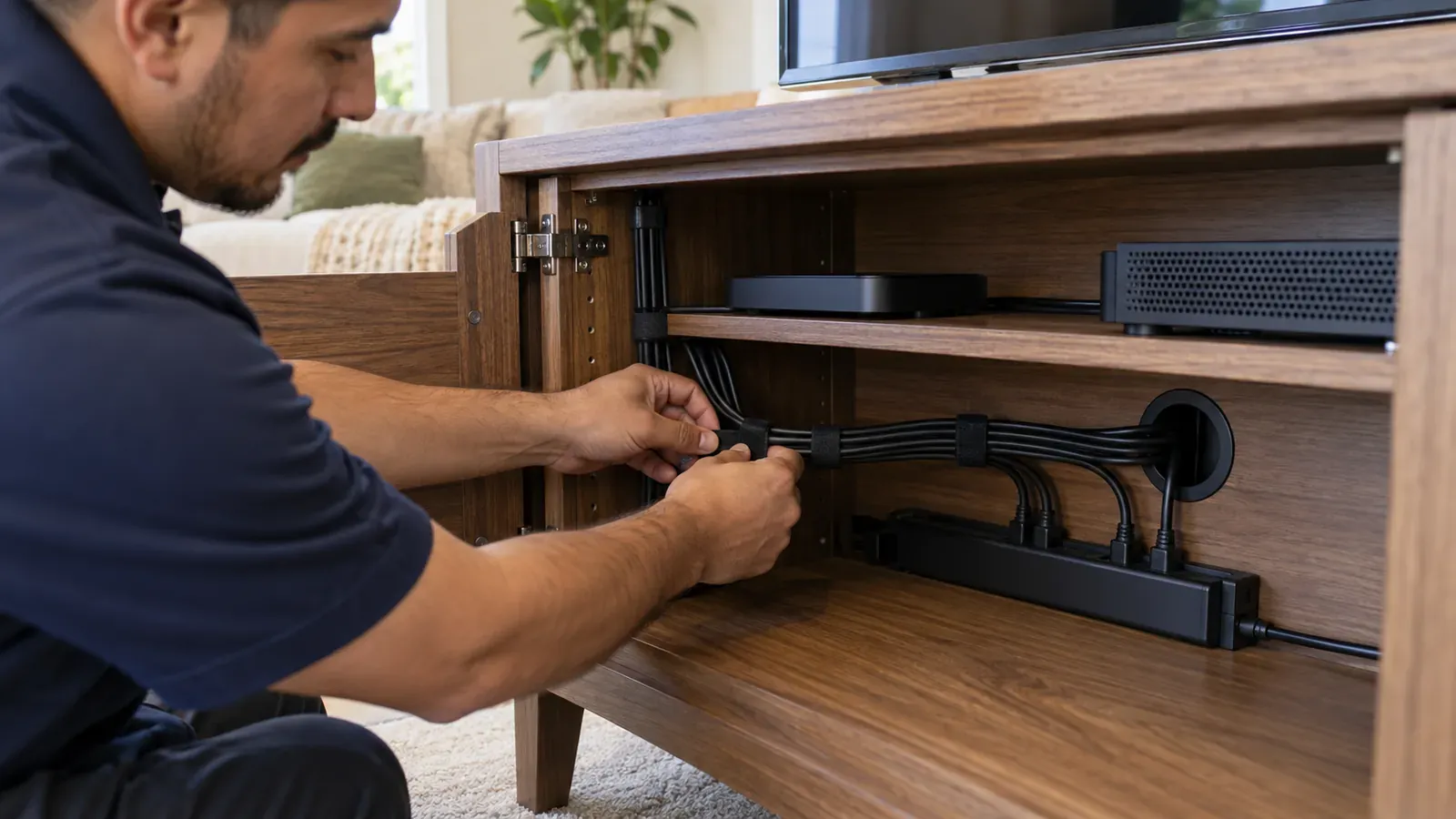
The tidy finish costs nothing extra: cables strapped and routed through a grommet to a surge strip inside the cabinet.
Shop Our Systems
Forest Hills Soundbar Packages & Pricing
Three bundles cover most Forest Hills jobs. The wall line from the table above is added to whichever you choose.
Starter — On the Console
$82.95
The bar placed on the media unit ($82.95), connected over eARC or ARC, CEC on so the TV remote runs it, speech and night modes set, cables tied away. Nothing drilled — a good fit while co-op paperwork is pending.
Standard — On the Wall
$224.69
The wall mount ($135.45) plus our Sanus bracket ($89.24) for $224.69. In a Gardens concrete-panel house or a tower add $78.75; in co-op plaster add $47.25.
Premium — Wall, Cables Inside
$402.14
Everything hidden: $402.14 adds the $177.45 in-wall power and cable kit to the $135.45 mount and the $89.24 Sanus bracket. It only works where the wall is hollow — framed houses north of the tracks, newer partitions — and where the building is happy for it to be opened.
Bring Your Own Equipment — Labor Only
Using the bracket that came with the bar, or one you bought, leaves the Queens wall-mount labor of $135.45 plus the wall line. Your bracket must be rated for the bar and is covered by its own maker. If it looks wrong for the wall, you hear that before we drill, with the option of our Sanus bracket.
Your Forest Hills Total, Line by Line
Send the bar's model and a picture of the TV wall; the written Queens total comes straight back.
Forest Hills covers a little over 1,300 acres, but a visit on a curving Gardens street has little in common with one twenty floors up on the boulevard. This is how the work shifts from one part to the next.
Forest Hills Gardens, south of the railroad
Curving streets laid out to discourage through traffic, Station Square at the top, and houses that are either Atterbury's concrete panels or brick and stucco Tudors. Walls are tested before anything is promised, cables usually stay on the surface or behind furniture, and anything outside the house goes to the Corporation first. Parking needs a guest sticker, so we plan arrival with the household. Rooms tend to be generous, with fireplaces and sunrooms, which brings mantel heights and ceiling shapes into the conversation.
Room by room in a Gardens house
The living room usually has the fireplace, so the first decision is mantel or side wall. Sunrooms and solariums are popular for a second TV, but their windows on several sides leave little wall, and exposed beams or sloped glass make up-firing Atmos drivers a poor buy there; a plain bar on the TV or its arm suits them better. Libraries and dens with built-in shelving tempt people to slide the bar into a shelf, which muffles it unless the bar sits at the very front edge with open space at its ends. Upstairs bedrooms under the roof are where compact bars and night mode earn their place, because the people sleeping next door are your own family.
Station Square, Austin Street and 71st Avenue
The commercial heart: the LIRR and the E, F, M and R trains, Austin Street's clinics, restaurants and shops, and offices upstairs. Waiting rooms and dining rooms dominate the commercial work, with apartments above many storefronts and the noise code's indoor limit on music in mind.
The 108th Street and Yellowstone Boulevard co-ops
Pre-war and mid-century elevator buildings, most of them cooperatives, with plaster walls, superintendents and managing agents. The pattern here is paperwork first — a work description and an insurance certificate — then toggles in plaster or a TV-attached bracket, a surface raceway, and a subwoofer placed with the apartment below in mind. 108th Street's shops add counter TVs to the commercial list.
Queens Boulevard towers
Parker Towers, the Forest Hills Co-op Houses and the high-rises along the boulevard: concrete walls, conduit cast into them, set hours for drilling and neighbors on every side. Hammer-drill days are booked within the building's rules, anchors keep clear of conduit lines, and the bass is set with the whole stack of apartments in mind.
The garden courts
Arbor Close and Forest Close, attached Tudors around shared greens. Party walls on one or both sides make sub placement the main decision, and compact front rooms suit a mid-size bar. Working hours matter to neighbors who share a garden.
The detached-house streets north of Queens Boulevard
The Cord Meyer section, with detached houses from the early twentieth century and newer rebuilds, mostly framed in wood. The best place in the neighborhood for a fully hidden install: in-wall kits, a basement route under the living room, and space for a sub that doesn't sit over anyone else's bedroom.
Complete Services
Every Soundbar Installation Service in Forest Hills
A move into a new co-op, a renovation in the Gardens or a new TV usually pulls in one of these neighboring services too.
Describe the room once and get one written price for everything on it.
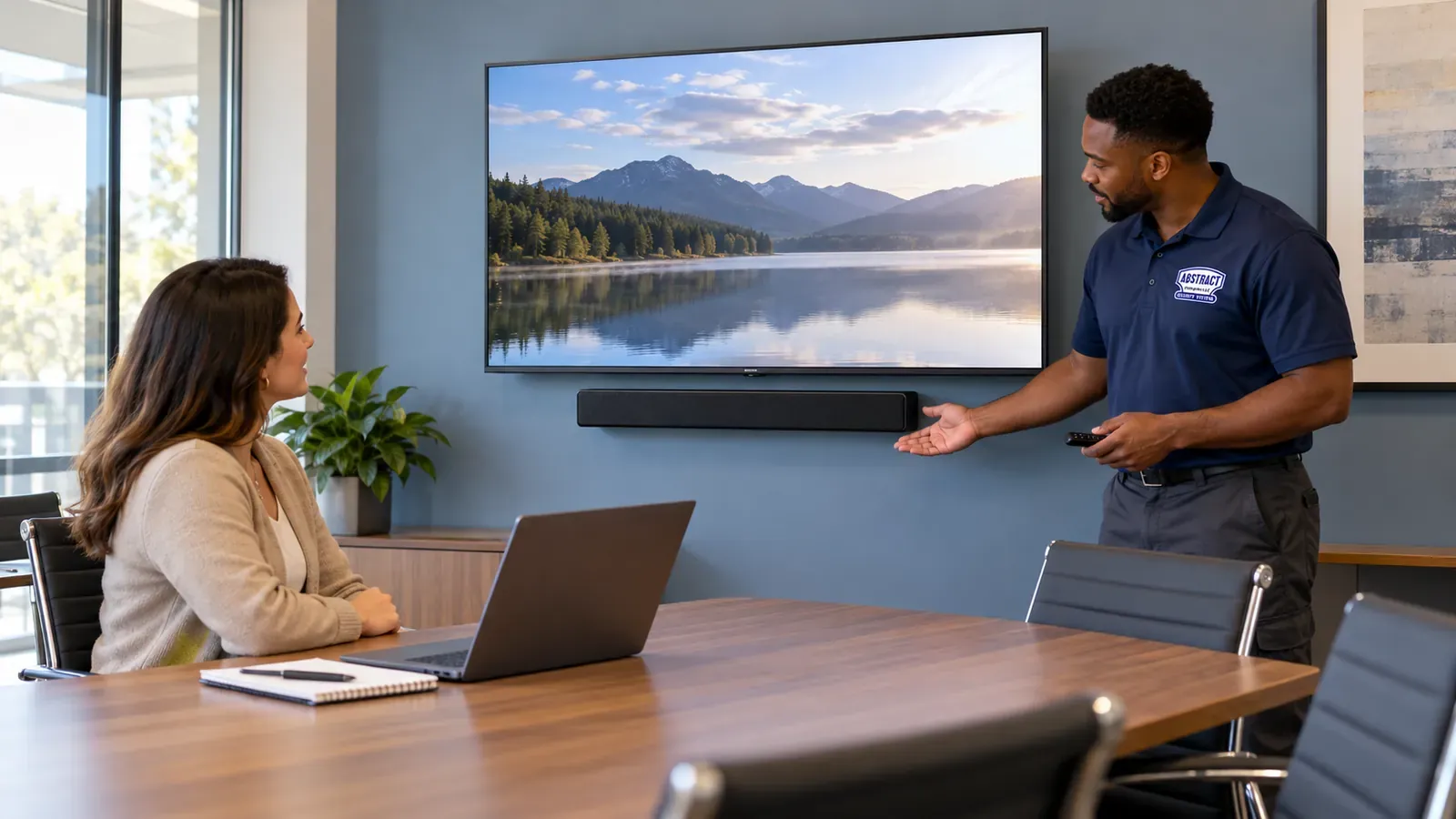
A meeting-room handover: the technician points out the bar under the display while the person who books the room watches from the table.
Field Notes
Field Notes on Forest Hills Walls
Habits our crews follow on these walls — general practice, not the story of any one home
On a Gardens street, assume nothing about the wall until the first pilot hole. Concrete dust is grey and fine; when the bit suddenly runs free, it has found one of the panel's chambers, and the fixing moves rather than forcing an anchor into the thin face. Stucco-and-brick Tudors give red or buff dust behind the plaster on outside walls and white dust then nothing on lath partitions.
In the boulevard co-ops, read the alteration rules before the drill comes out of the case: work hours, whether the super wants to see the wall, and which walls are off limits. A two-minute call with the superintendent often saves an hour.
In the towers, scan above and below every outlet and switch on the TV wall and treat those vertical lines as conduit until proven otherwise. And everywhere in Forest Hills, ask where the neighbors sleep before choosing the subwoofer's spot.
FAQ
Forest Hills Soundbar Installation FAQ
Will mounting the soundbar on the wall void the manufacturer's warranty on the bar or the TV?
+
Not by itself. Wall-mounting with a bracket made for the bar, or with the maker's own bracket, is normal use. What can cause trouble is damage from a fixing that failed or from drilling into the product. We use brackets rated for your model, and brackets and parts carry their own manufacturer's warranty.
Can a soundbar go on a mirrored wall?
+
Not by drilling through the mirror. Old mirror panels can crack under a drill and are often glued to the wall behind. The usual answers are to fix the bar to the TV or its mount, place it on a console in front of the mirror, or mount on a section of wall beside or below the glass.
How should a wall-mounted soundbar be cleaned?
+
Switch it off and wipe the case with a dry microfiber cloth. Use a soft brush or a vacuum on low with a brush tool for the grille, and never spray cleaner onto the bar, because liquid can get inside. If it sits over a radiator, clean it more often in winter, when rising air carries dust into the grille.
Does a wall-mounted soundbar need space behind it for air?
+
Most bars don't run hot, but they do need their vents and ports clear. Leave the gap the maker's bracket sets, keep rear ports uncovered, and never box the bar into a recess or shelf with no air around it. Bars with a rear port or an up-firing driver need that clearance most.
Should I set up the soundbar maker's app account before you arrive?
+
It helps. If the bar uses an app, install it on your phone and create the account with your own email beforehand, and have your Wi-Fi password ready. We then add the bar to your account during the visit so updates and settings stay under your control, not ours.
If I decide the soundbar is wrong after it's mounted, can it still go back to the store?
+
Usually, if you keep the box, the packing and every part, and you are inside the retailer's return period. We take the bar off the bracket undamaged and repack it. The bracket and the holes stay, so if you are unsure of the model, a console setup first is the cheaper way to try it.
Our TV is on a rolling floor stand — can the soundbar travel with it?
+
Yes, if the stand has a shelf or a bracket point below the screen. We fix the bar to the stand or the TV, route the HDMI and power down the stand's column, and leave one plug to move between rooms. A wireless sub stays behind or moves separately.
Can the soundbar be mounted upside down or on its side to fit the space?
+
Usually not. Most bars are designed to sit level with the drivers facing forward and any up-firing drivers on top; turned over or on end, the left and right channels and height effects no longer land where they should. We follow the mounting directions in your model's manual, and if the space is tight, a slimmer bar or a bracket on the TV mount is the usual fix.
No sound after an update, a remote that no longer moves the volume, a subwoofer that won't pair, or a bracket working loose in old plaster — call (347) 434-6392. You get the next free 2-hour window, often today, and most faults of that kind take an hour or two to put right.
Abstract Enterprises Security Systems · 460 E Fordham Rd, Bronx, NY 10458 · Queens line (347) 434-6392 · WhatsApp (718) 679-0359 via wa.me
NYS Low-Voltage License #12000287431 · 100% Licensed & Insured · Same-Day Estimates · Rated 4.7★ from 201 Google Reviews
Brackets and parts carry their manufacturer's warranty. Full terms — including 50% deposit, one-year parts-only warranty on AESS-supplied products, and the late-fee schedule — are set out in the service agreement. See our warranty page.
Sources: Cord Meyer purchase, Gardens history, subway and LIRR stations and population (Wikipedia, Forest Hills and Forest Hills station articles); Atterbury precast panels (Southampton Historical Museum archive; 6sqft, 2014); Olmsted plan and Station Square (The Cultural Landscape Foundation); Forest Close and Arbor Close (6 to Celebrate); stadium (Columbia News Service, January 2025; Queens Daily Eagle, October 2025); Forest Hills Co-op Houses (Queens Daily Eagle); Parker Towers (The Real Deal, 2018); district statistics (Data USA, ACS 2022); Austin Street (Brownstoner, 2014; QNS, September 2026); Metropolitan Avenue works (National Grid notice, August 2026); noise code (NYC DEP summary).
Last reviewed October 17, 2026. Revision history: Forest Hills page launched with concrete-panel, co-op and tower mounting guidance, stadium-season sound settings and Queens pricing.