Licensed Low-Voltage Contractor · Bronx Office on East Fordham Road · Detached Houses, Two-Families & Avenue Apartments
Soundbar Installation in Pelham Bay
Framed Walls · Basement Cable Drops · Two-Family Floors · Bass Kept Off the Block · eARC & One Remote
Pelham Bay is the corner of the Bronx where most people own the wall they want the soundbar on. City Planning's survey of the neighbourhood counted roughly seven residential buildings in ten as detached houses, with semi-detached homes most of the rest and apartment buildings mainly along Westchester, Crosby and Buhre Avenues. So the questions on a soundbar job here are less about permission and more about the house itself: which floor and which room, whether the cables can disappear inside a hollow wall or drop through the basement, and how to keep a subwoofer from carrying across a driveway to the family next door. We plan those with you, then mount, wire and tune the bar so one remote runs it.
Reviewed and updated October 17, 2026 · Written by Anwar Timothy, NYS licence #12000287431 · Bronx line (646) 490-0629
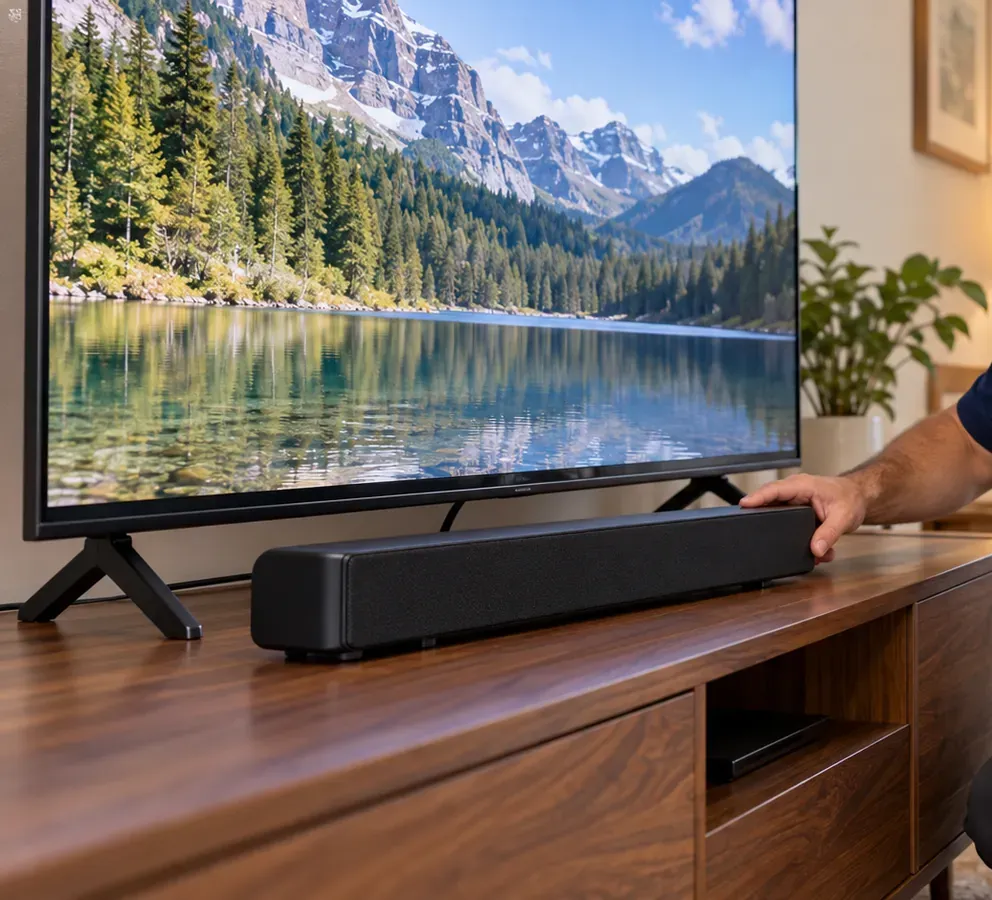
A soundbar placed on a wooden media console in front of a TV on its own feet, a hand still resting on the bar as it is lined up.
Pelham Bay Soundbar Quote
The bar, the room and the floor below it — written price the same business day
✅
Request Sent!
An installer from our Bronx office will call you back the same business day.
25+
Years Experience
✓
Same-Day Estimates
100%
Licensed & Insured
4.7★
201 Google Reviews
Picked up a bar for the game this weekend? The Bronx line is (646) 490-0629; the short form takes a minute. Whoever answers holds a low-voltage licence, and what you get back is a written total added up from the menu further down, line by line.
Hidden wiring quoted only where the wall is hollow and you agree to it
Owner and tenant floors in a two-family priced separately if you ask
Pelham Bay doesn't look like the Bronx most soundbar guides imagine, and that changes the job. When the Department of City Planning studied the neighbourhood for its 2006 rezoning, it found detached houses made up about 72 percent of the residential stock, semi-detached homes about 17 percent, attached houses roughly 6.6 percent and multifamily buildings only about 4.5 percent, with the apartment buildings concentrated on the wider avenues. The City Council adopted that rezoning on March 22, 2006, and the new R5A district it created limits new construction to one- and two-family detached homes with a 35-foot height cap. In other words, the inner blocks between Westchester Avenue and Pelham Parkway are a neighbourhood of houses, and the city has deliberately kept them that way.
That matters for a soundbar because a house gives you choices an apartment rarely does. Interior walls in a detached house are usually framed and hollow, which means power and HDMI can often travel inside the wall instead of down a plastic channel. There's frequently a basement or cellar under the living room, so a cable can drop through the floor to a cabinet, a closet or the equipment shelf. And the person asking for the work is usually the person who owns the wall, so the conversation that dominates jobs in rental-heavy parts of the borough — who has to sign off — is often settled on the first call. The flip side is that more choices mean more decisions, and a few of them are easy to get wrong.
The first is which room. A Pelham Bay house might have the main TV in a front living room, a second set in a finished basement and a third in a bedroom, and a two-family adds a whole second household on another floor. The best place for the soundbar isn't always where the TV is now: a front room that faces the elevated tracks on Westchester Avenue or the traffic toward the Bruckner has a noisier background than a back room facing the yard, and that changes how loud the bar has to play to keep dialogue clear. We talk through the rooms before we talk about brackets.
The second is the neighbours, who are closer than the word “detached” suggests. The R5A district sets a minimum lot width of just 30 feet for new homes, so a side window can easily face the house next door across a single driveway. In April 2025, News 12 reported Pelham Bay residents being woken late at night by music with thumping bass — one described hearing “boom, boom, boom, boom” through the whole house — and a local council member urging people to file 311 complaints. That noise came from outside, not from anyone's living room, but it shows how far low frequencies carry here. A subwoofer that is perfectly reasonable inside a detached house can still reach the people next door through an open window on a summer night.
The third is the household itself. City figures for the wider area show an older, settled population: Data USA's profile of the Co-op City, Pelham Bay and Schuylerville census area gives a median age of 41.7 and a homeownership rate of 45.7 percent in 2021, more than twice the borough-wide 19.7 percent the NYU Furman Center reports for 2024. The neighbourhood has a long-standing Italian American community and a sizeable Greek one, with Puerto Rican families making up much of the Hispanic population and newer Hispanic and Asian residents arriving. That adds up to a lot of multigenerational homes, where one TV serves a grandparent's evening shows and a teenager's games, and the soundbar has to suit both.
Pelham Bay facts that shape a soundbar job
About 72 percent detached: City Planning's Pelham Bay rezoning study put detached homes at roughly seven in ten residential buildings, semi-detached at about 17 percent, attached at 6.6 percent and multifamily at 4.5 percent. Hollow framed walls and basements are the norm we plan for, not the exception.
R5A since March 22, 2006: the rezoning, covering about 45 blocks, restricts new construction to one- and two-family detached homes with a 35-foot height limit (City Planning; CityLand). Two-family houses with an owner on one floor and a tenant on the other are a big part of the soundbar work here.
45.7 percent homeownership: Data USA's 2021 figure for the Co-op City, Pelham Bay and Schuylerville census area, against 19.7 percent for the Bronx as a whole in the Furman Center's 2024 profile. The owner can usually say yes to in-wall wiring on the spot.
39.7 percent: share of households in that same census area whose main shared language at home isn't English (Data USA, 2021). TV menus and captions are set in the language the main viewer reads, where the set supports it.
December 20, 1920: the day the IRT Pelham Line reached its terminal at Pelham Bay Park station, an elevated stop at Westchester Avenue and the Bruckner. Trains still run overhead along Westchester Avenue, with stations at Middletown Road and Buhre Avenue too.
2,772 acres: Pelham Bay Park, the largest public park in New York City and slightly more than three times the size of Central Park. Many homes here back toward the park, the parkways and the expressways that ring it.
If the TV itself is going up or moving at the same time, book the two together so the height and cable route are planned once — our TV installation team for Pelham Bay uses the same price menu. And if you've already decided a bar isn't enough, the Bronx AV and sound installation service covers wired surround and ceiling speakers.
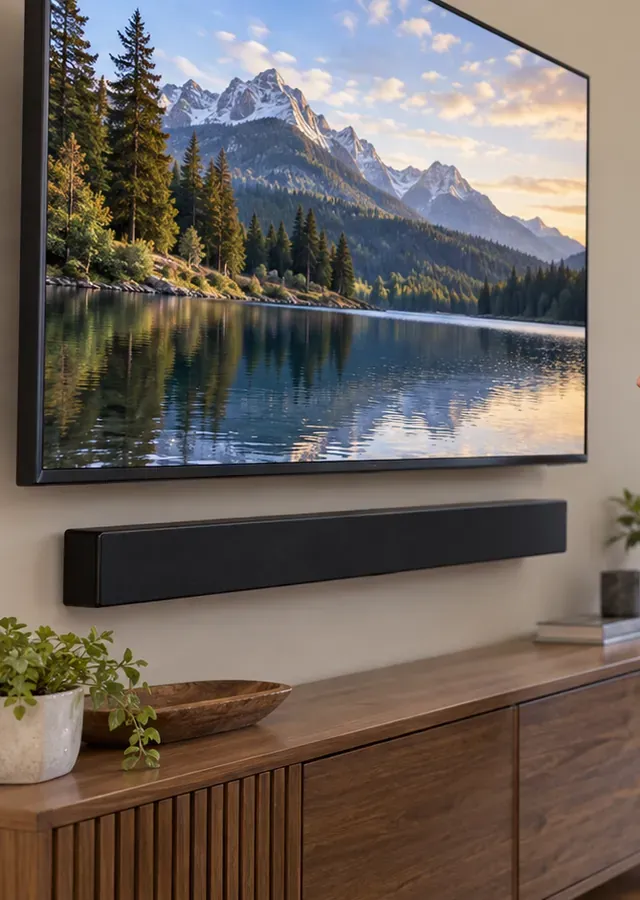
A long, slim soundbar on the wall directly below a large TV, with a wooden credenza and potted plants underneath.
Repair Capture
Pelham Bay Soundbar Gone Silent
No sound after the cable company swapped the box, a TV remote that no longer touches the bar's volume, a subwoofer that lost its pairing after a power cut, voices running behind the picture, or a bracket that someone leaned on and bent — those are service visits rather than installs. We fit them into the next open two-hour window where we can, and most setting and connection faults are put right within one to two hours of the technician walking in. Ring (646) 490-0629 and say it's a soundbar repair in Pelham Bay; our TV and soundbar service policies set out how setup-only time is charged.
What We Install
Soundbar Installation Services in Pelham Bay
Every Pelham Bay soundbar job is assembled from the services below, and each has its own published price. They're listed from the simplest to the most involved, because in a house the question is usually how far you want to go rather than how far you're allowed to.
Stand Placement and Setup
The bar set on the media console or dresser, connected over HDMI, positioned clear of the TV's remote sensor and tuned. Right for a bedroom set, a rented apartment on the avenue, or anyone who wants to live with the sound before committing to holes.
Wall Bracket Under the Screen
The bar on its own bracket a short distance below the TV, centred and level, fixed to a stud where one lines up or with toggles in the board where it doesn't. The most common Pelham Bay request.
Bar Hung From the TV Mount
A TV-attached bracket carries the bar on the TV's own mount, so it swings and tilts with the screen. Useful on articulating arms in basement dens, and on walls the owner would rather not drill again.
Hidden In-Wall Wiring
Power and HDMI fished inside a hollow wall using a code-compliant in-wall power and cable kit, fed from an outlet that is already there. Practical in most framed partitions, and only quoted after we've scanned the cavity.
Basement Drop to a Cabinet
Where the living room sits over an open basement ceiling, a cable can travel down through the floor and back up to a cabinet or closet so the boxes live out of sight. Priced as a cable run up to 25 feet.
Paintable Cord Cover
A slim surface channel from the bar to the outlet, painted to match. The finish on brick, block or plaster walls with no usable cavity, and on any wall the owner doesn't want opened.
TV and Bar Hung Together
When the screen goes up at the same visit, height, spacing and cable path are decided once. Typical when a family buys a new set, or after a renovation.
eARC, CEC and Settings
We find the TV's eARC or ARC socket, enable the HDMI control setting so a single handset switches and turns up everything, line voices up with lips, pull the latest firmware down, and switch on-screen menus to whichever language Grandma or Dad actually reads.
Sub and Rear Placement
Wireless subwoofer and rear speakers paired, placed where there's power, and levelled for a house with bedrooms over the living room and a neighbour beyond the side wall.
Most visits combine two or three of these. A wall bracket with hidden wiring and a quick settings pass is the classic owner's job; a stand placement plus settings is the classic upstairs-tenant job. The quote lists each line separately so you can drop anything you don't need.
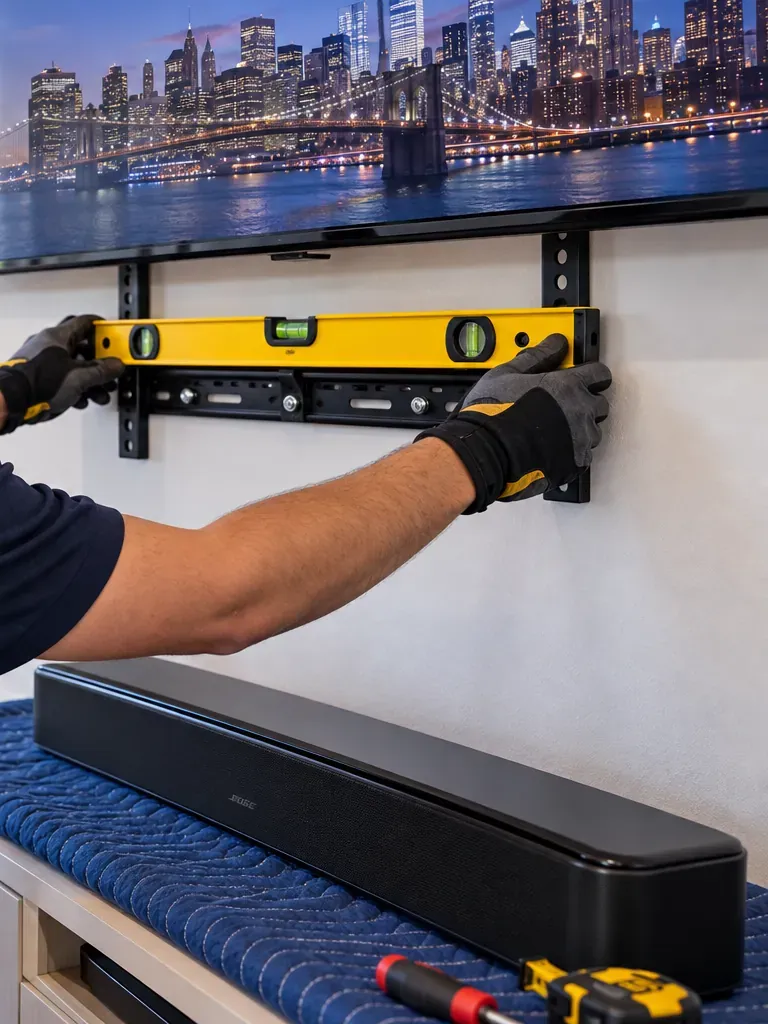
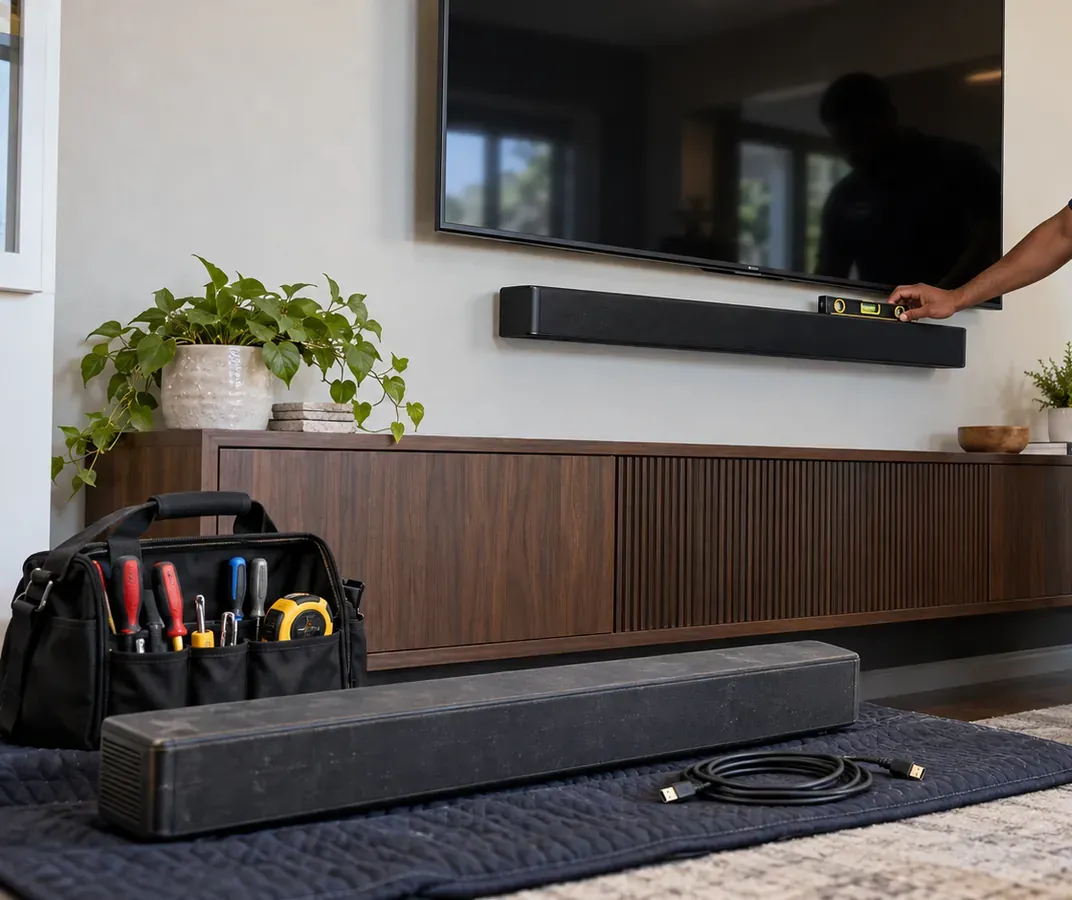
A yellow level held across a black bracket fixed under the TV; the soundbar waits on a blue moving blanket on the cabinet below.
Building Specialists
Soundbar Installation for Pelham Bay's Architecture
The housing in and around Pelham Bay is mostly low-rise and mostly owned, but it isn't all one kind. These are the building types our installers meet across the neighbourhood and the blocks either side of it, and what each tends to mean for a soundbar.
Detached One- and Two-Family Houses
The bulk of the inner blocks. Framed interior walls, a basement in many cases, and often a second household on another floor. The owner decides, and hidden wiring is usually on the table.
Semi-Detached Houses
About one residential building in six here. One side wall is shared with the house next door, so we prefer the TV on a wall that isn't the shared one and keep the sub away from it.
Avenue Apartment Buildings
Walk-up and elevator buildings along Westchester, Crosby and Buhre Avenues and near the parkway. Tenants need the landlord's agreement for holes, masonry is more likely behind the TV, and someone lives below.
Mixed-Use Buildings Over Shops
Storefronts at street level with apartments above, mainly on the commercial corridors under and near the elevated line. Two very different soundbar jobs can share one address.
Country Club and City Island Homes
East of I-95 in Country Club, and out on City Island, houses sit close to the water. Where a room is mostly window toward the bay, the TV and bar usually go on the opposite wall, and the cable route is planned from there.
Co-op City Towers Nearby
Just north, beyond the parkway: 35 cooperative towers of 24 to 33 storeys under Riverbay's rules. A completely different job from a Pelham Bay house, covered on our borough page.
Walls and fixings in a Pelham Bay house
Drywall on wood studs. Common in houses that have been renovated, extended or finished over the years. The stud is the strongest fixing there is for a soundbar bracket, and we use it when it lines up with where the bar needs to sit. When it doesn't, a toggle sized for the bracket spreads the load behind the board. Either way the wall line on your quote is $0, and this is the wall where hidden wiring is most straightforward.
Plaster over wood lath. Found in older houses that have kept their original walls. The plaster is hard and brittle, the lath behind it is a series of thin wooden strips, and the studs are somewhere behind both. We scan first, drill slowly without hammer action, and fix to the framing where we can; a toggle through the plaster and lath does the job where we can't. Plaster carries a $45 line because it takes longer and needs more care.
Brick and block. Party walls in semi-detached and attached houses, foundation walls in basements, and many walls in the avenue apartment buildings. These take sleeve or screw anchors set with a hammer drill, placed in the face of the brick or block rather than the mortar joints. There's no cavity to hide a cable in, so the finish is a painted channel or surface conduit. Brick or stone is $65 on our wall table and concrete or block $75.
Paneling and basement finishes. Finished basements often have wallboard or paneling on furring strips over the foundation wall. The furring strip is not a reliable fixing for anything that gets knocked, so we find what's behind it and anchor through to the masonry or to proper framing.
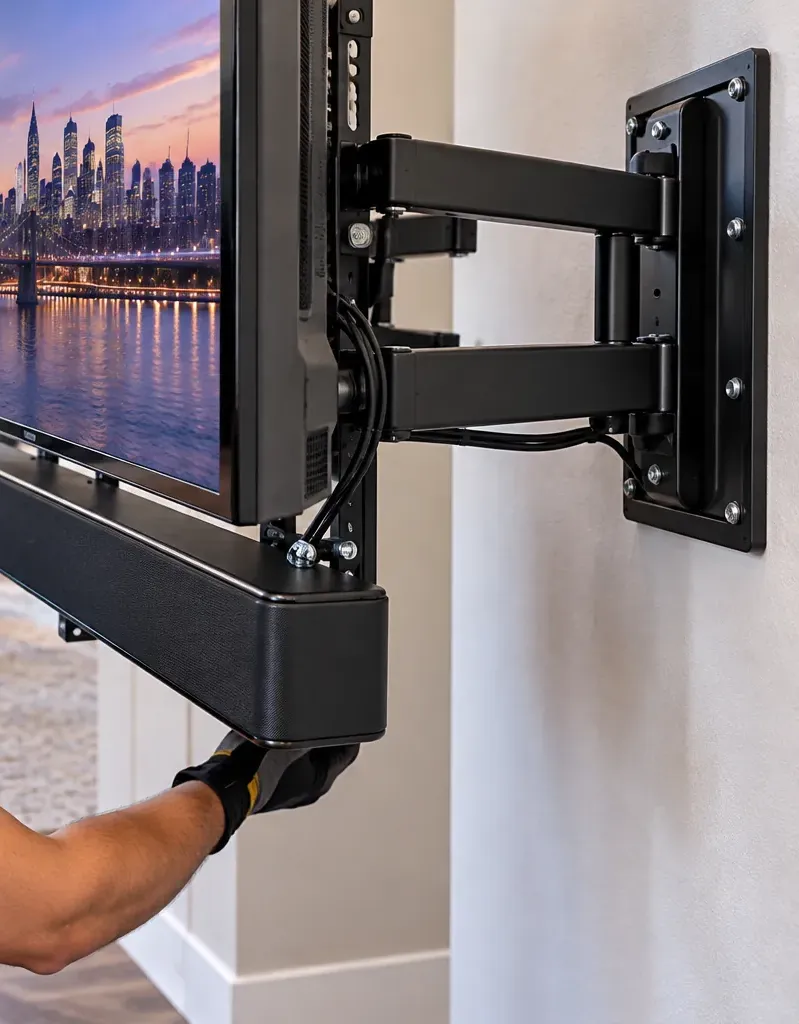
Gloved hands fix a soundbar beneath a TV on an articulating wall arm, so the bar swings and tilts with the screen.
Old wiring and mystery cables. Houses that have been lived in for decades collect cable: old coax from earlier TV services, phone wire, speaker wire from a stereo two owners ago. Before any of it is reused or ignored, we identify where it goes, because a run that turns out to end in a sealed-up wall is worth knowing about before the bar is mounted around it.
Stairs, chimneys and ducts. In a house, the wall that looks empty may hide a stair stringer, a flue or a heating duct. A scan and one small pilot hole tell us what's there, and the bracket position is chosen around it rather than through it.
A level laid on a soundbar mounted a few inches below the TV, with the tool bag, a second bar and an HDMI cable on a blanket below.
Wi-Fi from a router in the basement often struggles to reach a TV two floors up, and a bar that streams is only as steady as that link. If you'd like a wired drop to the TV wall while we're there, structured cabling installation for Pelham Bay can be priced into the same visit; for an existing house run that's gone dead, see AESS network cable repair in the Bronx.
Commercial Soundbar Installation
Business Soundbar Installation in Pelham Bay
The shops and offices of Pelham Bay sit on a handful of streets, and most of them have someone living upstairs. Westchester, Crosby and Buhre Avenues carry the neighbourhood's commercial zoning, with Middletown Road joining Crosby at one of its main crossroads. A soundbar in a storefront here has to make a TV understandable to customers without reaching the apartment above or the sidewalk outside.
Westchester Avenue Under the El
The 6 runs overhead from Middletown Road through Buhre Avenue to the terminal at Pelham Bay Park, and the shops below it live with trains passing above. A bar there is set for clear speech against that background, not for volume, and mounted so the TV and bar don't face the open door.
Pelham Bay Park Station Area
Where Westchester Avenue meets the Bruckner, the end of the 6 meets a cluster of bus routes. NYC DOT said buses around the station carried about 64,000 riders a day before the pandemic and reworked the Bx12 Select Bus stops there in 2023. Waiting customers, short visits, captions on.
Buhre Avenue
Commercial frontage near the Buhre Avenue station, including stretches City Planning rezoned in 2006 to keep shops on the avenue rather than spreading into residential side streets. Small rooms where a compact bar is usually plenty.
Crosby Avenue
One of the two main shopping streets, home to the Pilgrim Station post office at 1545 Crosby Avenue. Counters, salons and food businesses with a wall TV, and apartments directly overhead.
Middletown Road
Running past the Crosby crossroads to the Pelham Bay branch library at 3060 Middletown Road, the road mixes shops with houses. Offices and waiting rooms want sound at a modest, fixed level.
Westchester Square Next Door
At the neighbourhood's western edge, the Westchester Square–East Tremont Avenue station and its shopping streets. Busier rooms, more screens, and owners who want one remote staff can't lose.
Compliance points for Pelham Bay businesses
Music limits with neighbours upstairs. The Department of Environmental Protection's summary of the city Noise Code limits commercial music to 42 decibels measured inside a nearby residence, and between 10 PM and 7 AM to 7 decibels over the ambient level on the street at 15 feet or more, with a separate limit for pervasive bass. Over a Crosby Avenue or Westchester Avenue shop, that usually means a bar set for speech with the subwoofer low or left out.
Keep the aisle clear. Anything hung between 27 and 80 inches up a wall that people walk past should stand out no more than 4 inches under the 2010 ADA Standards (section 307.2) — a TV plus bar easily exceeds that. Behind a counter is fine; beside the door to the street usually means higher up.
Power is a separate trade. HDMI and the bar's own low-voltage hookup sit inside our licence with no separate Buildings permit, but adding a receptacle behind a shop TV is a job for a licensed electrician. If the only outlet is on the wrong wall, we work out the TV spot around it or you call an electrician first.
Insurance for the landlord. Commercial leases often require contractors to carry insurance naming the building owner. Send us the names and the certificate goes out at no charge, usually the same day.
Ratings on the jacket. Anything we hide above a dropped ceiling or behind board carries the rating that space calls for; the thin patch lead packed with the bar stays on the visible final hop.
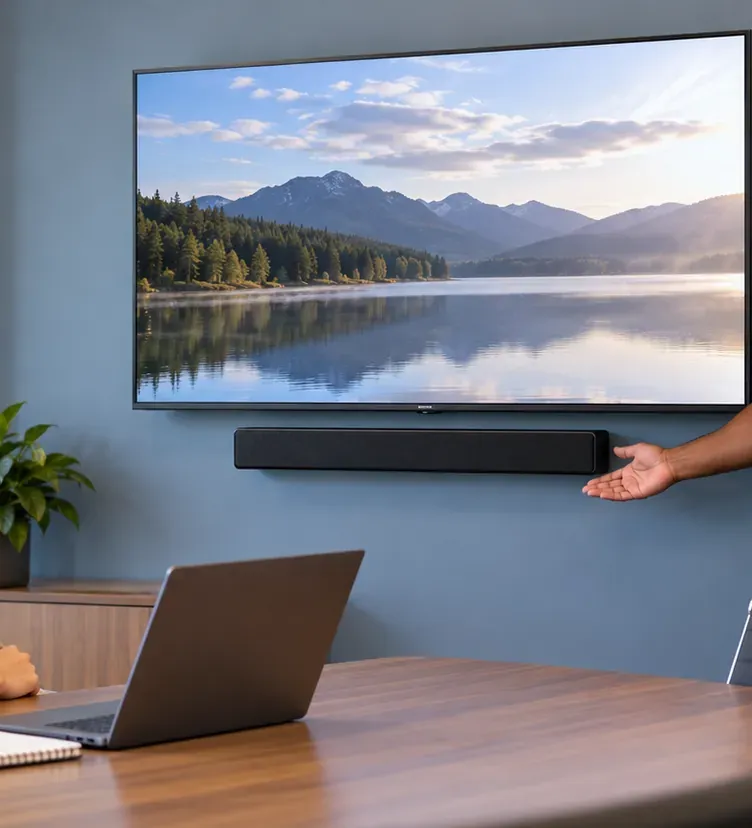
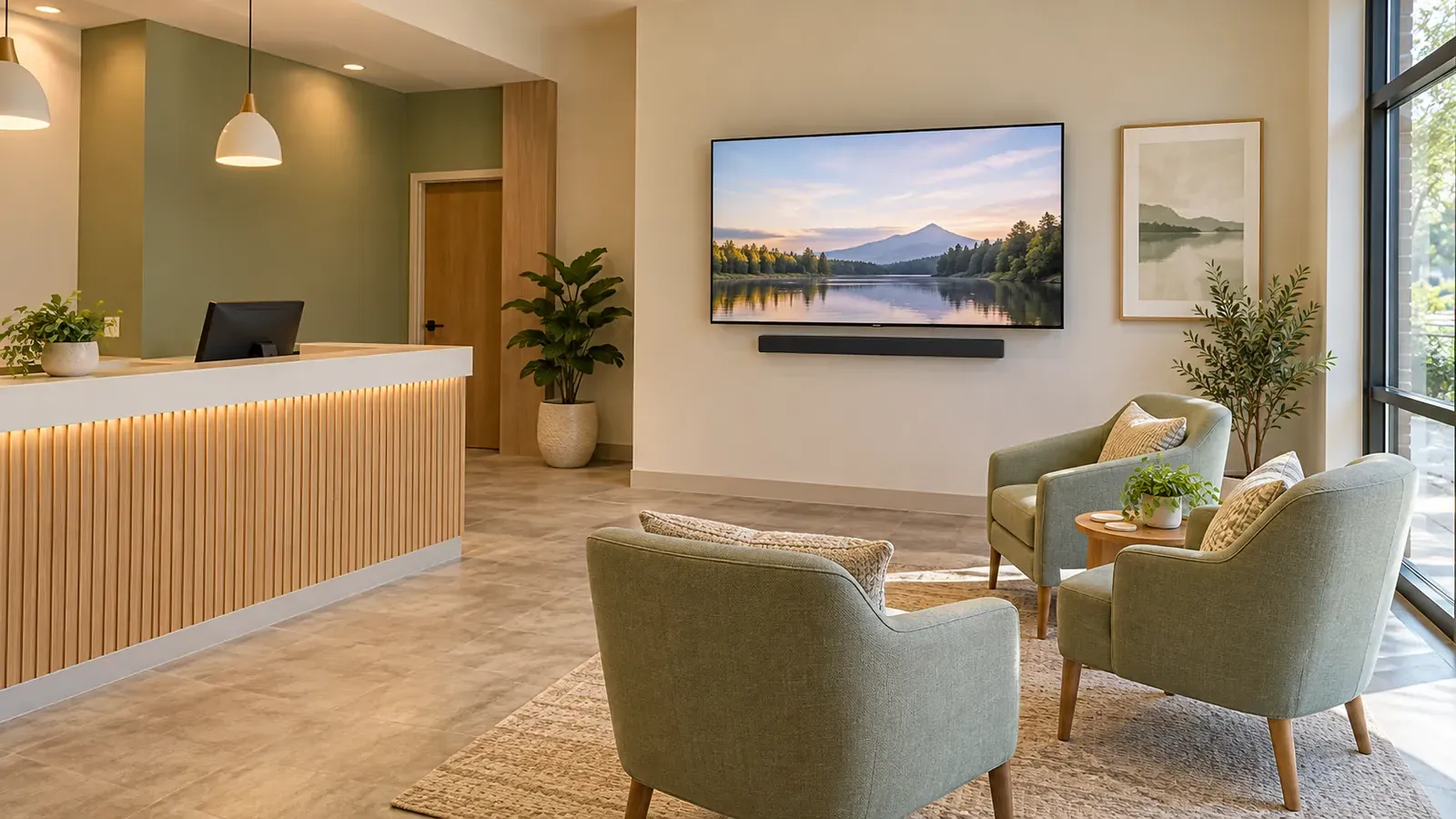
In a meeting room, a hand gestures toward the soundbar mounted under the wall TV while a laptop sits open on the table.A reception area with a wall-mounted TV and a slim soundbar right beneath it, facing green armchairs beside the front desk.
Soundbar Installation in Pelham Bay: Questions Answered
These are the questions Pelham Bay callers ask before they book, grouped by what lies behind them: what an owner can do with a framed house, how sound behaves on a block of houses, how a two-family shares one system, and the practical matters of where you live and who serves you. Prices for particular situations are in the FAQ further down. Nothing here is legal advice; where a lease or code is involved, the document and whoever issued it have the final word.
What an owner can do with a framed house
We own the house — is in-wall wiring worth paying for over a cord cover?
For a main living room you'll look at every day, usually yes. On our menu a painted cord cover is $59 and hidden wiring with a code-compliant in-wall power and cable kit is $169, so the difference is $110. For that, the wall under the TV is completely clear: no channel to paint, no seam to catch dust, nothing for a toddler or a vacuum to knock. In a framed partition the job is routine, and because the kit feeds the TV and bar from an outlet already on that wall, no new electrical circuit is involved.
A cord cover makes more sense in some rooms. On a brick party wall or a foundation wall there's no cavity, so the channel is the only tidy option. In a bedroom where the TV may move in a year or two, a channel is easier to take down. And if you're planning to renovate the room, there's no point opening a wall that will be opened again; we'd rather put the bar on a stand or a TV-attached bracket for now.
The deciding question is how permanent the arrangement is. If the TV wall, the TV height and the seating are settled, hide the wires. If any of the three is likely to change, a cover keeps your options open for less money.
What can stop a hidden cable run inside the wall of an older frame house?
Three things, mostly. The first is blocking: horizontal pieces of timber nailed between the studs partway up the wall, which builders used to stiffen the frame and slow fire spreading through the cavity. A fish tape dropped from the TV height stops dead on them. We find them with the scanner and, where the run needs to pass one, drill a small hole through it from a cut-out that the in-wall kit's plate later covers.
The second is what else is in the cavity. Electrical cable, plumbing to a bathroom upstairs, a heating pipe or a duct can all share the stud bay we'd like to use. The scan shows most of it, and we move one bay over rather than squeeze past anything. The third is insulation: an outside wall packed with insulation is slow to fish and sometimes not worth disturbing, which is why we prefer an interior wall for hidden runs.
If a run turns out to be blocked in a way we can't get past cleanly, we tell you before cutting anything else and offer the alternatives: a different bay, a drop through the basement, or a painted channel. You pay for the finish you end up with, not for the attempt.
How do you tell a framed partition from a solid brick wall before the drill goes in?
We start by knocking and scanning. A framed wall sounds hollow between studs and solid over them, and the scanner shows the studs at regular spacing. A brick or block wall sounds the same everywhere and shows no studs. Then we look at where the wall is: in a semi-detached house the shared side wall is often masonry, and so are basement foundation walls and many walls in the avenue apartment buildings.
The pilot hole settles it. We drill one small hole where the bracket will cover it, slowly and without hammer action. Pale dust and a quick break-through mean board over a cavity; a long, gritty, red or grey drill means brick, block or concrete. Plaster over lath shows a hard white layer, then wood. That one hole decides the anchor, the drill bit and whether hidden wiring is possible on that wall.
It also decides the price line, which is why we confirm it with you before carrying on. If the quote assumed drywall and the wall turns out to be brick, you'll hear the $65 difference before any more holes are made.
The staircase climbs behind our TV wall — does that change where the bracket and cables can go?
It can, in both directions. The stair stringer, the sloped board that carries the treads, often runs diagonally through the wall behind a living room, and it is a very solid place to fix a bracket if it falls where the bar needs to be. More often it cuts across the stud bays at an angle, which means a cable can't drop straight down to the outlet and the scanner picture looks confusing until you know what you're seeing.
Where the space under the stairs is a closet, it can be the best thing about that wall: the cable can go through the wall into the closet, along it and out near the equipment, with nobody needing to fish through the stringer. We look inside the closet before deciding.
We also think about sound. A soundbar on the wall shared with an open stairwell sends some of its output straight up to the landing and the bedrooms, so in a house where people sleep upstairs we set the night mode as the everyday default and keep the subwoofer off that wall.
Sound on a block of houses
In a detached house with nobody living below, is there any reason to keep the subwoofer turned down?
Yes, though the reasons are different from an apartment's. Without a neighbour underneath, the floor isn't the problem; your own household is. Bass travels through the framing of a house and up the stairs, so a sub that sounds right in the living room can be the loudest thing in the bedroom above it. If someone in the house sleeps early or works nights, that's who notices.
The other reason is the house next door. Low frequencies pass through windows and siding far more easily than speech does, and Pelham Bay residents know what that sounds like: the News 12 report from April 2025 described neighbours woken by thumping bass late at night. A wireless sub in a room with the windows open in summer can be heard across a driveway even when the dialogue isn't.
So we level the sub to the room rather than to the box's default, which on many systems is set for a showroom, place it on a firm pad a little out of the corner, and show you the night or dynamic-range mode that trims bass after dark. You can always turn it up for the game.
Our side windows look straight at the neighbour's house across a narrow driveway — does the soundbar's sound leave through the glass more than through the walls?
Generally, yes. A framed exterior wall with siding, sheathing, insulation and plaster or board is a far better barrier than a single window, and an open window is no barrier at all. In houses set close together, the side windows are the easiest route for sound to reach the next house, and bass gets through even closed glass more readily than speech.
That makes TV placement worth a second look. A bar on the wall facing the side windows points its sound straight at them; the same bar on an interior wall, facing into the room, sends far less directly toward the neighbour. Where the room only works with the TV on the window side, we keep the sub away from that wall and use the bar's dialogue mode so the volume people choose is lower.
In summer, when windows are open, the simplest habit is the most effective: switch to night mode in the evening. It's one button on most remotes, and we make sure you know which one before we leave.
Can the living-room soundbar double as music for a backyard party?
It can play the playlist, but it won't do it well outdoors, and it may cause more trouble than it solves. A soundbar is designed to throw sound toward a sofa a few metres away; aimed through an open back door, most of it is lost before it reaches the yard, so people turn it up, and the house next door hears more than your guests do.
For a gathering in the yard, a portable speaker placed among the guests, at a modest volume, usually sounds better and carries less. If you want something permanent outside, that's an outdoor speaker job, with weather-rated speakers and wiring, quoted separately through our AV service.
Inside, though, a soundbar is ideal for the part of the party around the TV: the game in the living room while the cooking happens in the kitchen. We can set it so the sound is clear across the room without being loud at the door.
One house, two households
Our tenant and we share the house's Wi-Fi — can each floor's soundbar be kept out of the other household's app?
Often, yes, and it's worth doing. Many app-controlled soundbars appear to anyone on the same network who opens the brand's app, and in a two-family with one router that can mean the upstairs household's phone showing the downstairs bar. Most of the time nobody touches it, but an accidental tap can change a volume or start music on the wrong floor.
The cleanest fix is separate networks: a guest network or a second network for the tenant's floor, with each bar joined to its own household's network. Many routers can do this without new equipment. Where that isn't possible, we register each bar to its own household's account and name the bars clearly, so it's obvious which is which.
We only change network settings with the owner's agreement, and we write down what we set up for both households so nobody is left guessing later.
Where you live and who comes
I rent in one of the apartment buildings on Westchester Avenue — what's different from a soundbar job in a house?
Mainly permission, walls and neighbours. In a house the owner usually books the work; in an apartment building the landlord or managing agent should agree before brackets go up, so get that in writing first — an email reply is enough. We'll wait for it, and in the meantime a stand setup or a TV-attached bracket gives you the sound with no new holes.
The walls are more likely to be masonry behind plaster than in the houses on the side streets, so expect anchors set with a hammer drill and a painted channel rather than hidden wiring. And there are people below and beside you, so the sub is set lower and placed more carefully than it would be in a detached house.
Buildings beside the elevated line also have trains passing the windows. We set the dialogue mode so speech stays clear through that background without the bar being pushed loud, which is better for you and for the apartment next door.
We're in Pelham Bay, not the village of Pelham — which AESS office and price list covers us?
Our Bronx office on East Fordham Road and the Bronx price list. The names cause confusion: Pelham and Pelham Manor are villages in Westchester County, and search results for “Pelham” installers often point there. Pelham Bay, in ZIP code 10461, is a Bronx neighbourhood named after the park beside it, and it was never part of the historical Town of Pelham.
That matters for the price. Bronx soundbar installs are priced at our base rates, the same as Brooklyn, and the Bronx setup-only hour is $225. Westchester work is priced from our Westchester County menu, which is higher. If you're in Pelham Bay, Country Club, City Island or Westchester Square, it's the Bronx menu on this page.
When you call the Bronx line, (646) 490-0629, mention the cross streets and we'll confirm the area straight away.
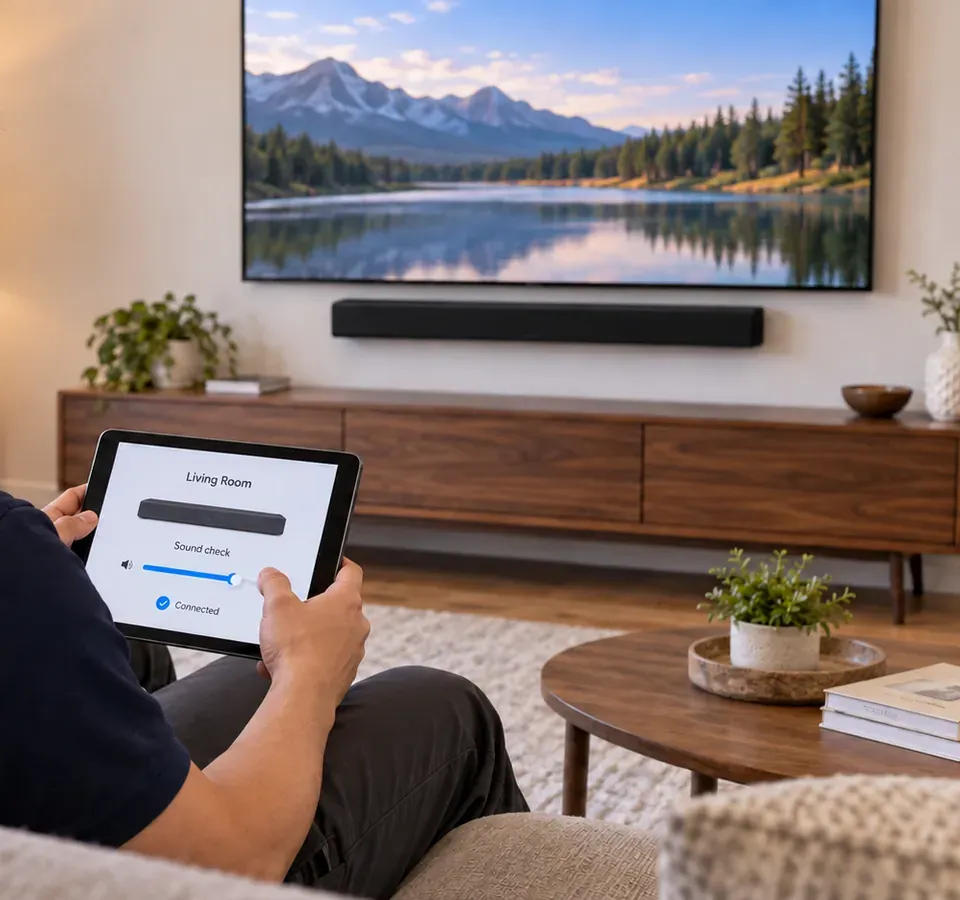
A tablet held from the sofa shows a sound-check slider, with the TV and soundbar on the wall straight ahead.
Equipment
Types of Soundbars and Mounts We Install
Bring whatever brand you like; still shopping, and we'll steer you toward something that fits the house. Below are the kinds of hardware we handle most around Pelham Bay, plus the specifics that affect mounting.
Compact Bars
A second TV in a back bedroom or kitchen rarely needs more. At roughly 56 cm across and below 2 kg, a Sonos Ray takes an optical lead instead of HDMI, handy when that set is ten years old, and it barely loads a plaster wall.
Mid-Size Bars With a Centre Channel
A speaker aimed straight out for speech makes the news easy to follow for older ears. The Beam (Gen 2) from Sonos weighs roughly 6.35 lb; Samsung, LG, Sony and Bose all sell rivals. Matches most front-room screens from 50 to 65 inches.
Flagship Atmos Bars
Long bars with up-firing drivers that reflect height effects off a flat ceiling. The Sonos Arc Ultra is about 46 inches wide and around 5.9 kg, so it wants a TV at least as wide and a bracket matched to it.
Wireless Subwoofers
Separate bass units paired to the bar. In a house, the pad it sits on and its distance from the corner and the side windows matter more than its size.
Wireless Rear Speakers
Small surrounds paired to the bar. No speaker wire back to the bar, but each one needs an outlet, and on stands behind a sofa their cords need routing along the wall rather than across a walkway.
Universal Wall Brackets
For bars sold without a bracket, or with one that doesn't suit the wall. Sanus describes its SASB1 as fitting most soundbars up to 20 lb, with depth adjustment that helps on uneven plaster. We supply a Sanus soundbar bracket for $84.99.
TV-Attached Brackets
Bar and screen ride together on the arm in a basement den where the TV swings toward the bar or the sofa. Sanus built its WSSATM1 around the Sonos Arc; it fits most sets between 50 and 90 inches and other makers' arms too.
In-Wall Kits and Surface Channels
Code-compliant in-wall power and cable kits for hollow walls, carrying power from an outlet already on the wall; paintable channels for brick, block and plaster without a usable cavity.
Which connection the bar will use
TV socket
Connection
What it carries
Where it fits in a Pelham Bay house
HDMI marked eARC
HDMI eARC
Lossless formats including Dolby TrueHD; TV remote runs the bar
New living-room set with an Atmos bar
HDMI marked ARC
HDMI ARC
Lossy surround; streaming Atmos rides along in Dolby Digital Plus; one handset
Most streaming households; mid-size bars
No ARC, optical output
Optical
Two-channel or basic surround; the bar's remote may be needed for level
Older basement or bedroom TV with a compact bar
Phone or tablet only
Bluetooth
Compressed stereo with a small delay
Music in the kitchen; not ideal for TV
Dimensions quoted here reflect what the makers list as of this October 2026 revision. Ranges get refreshed often, so before the appointment we match your model's inputs, weight and bracket to the wall, which also decides what fixings go in the van.
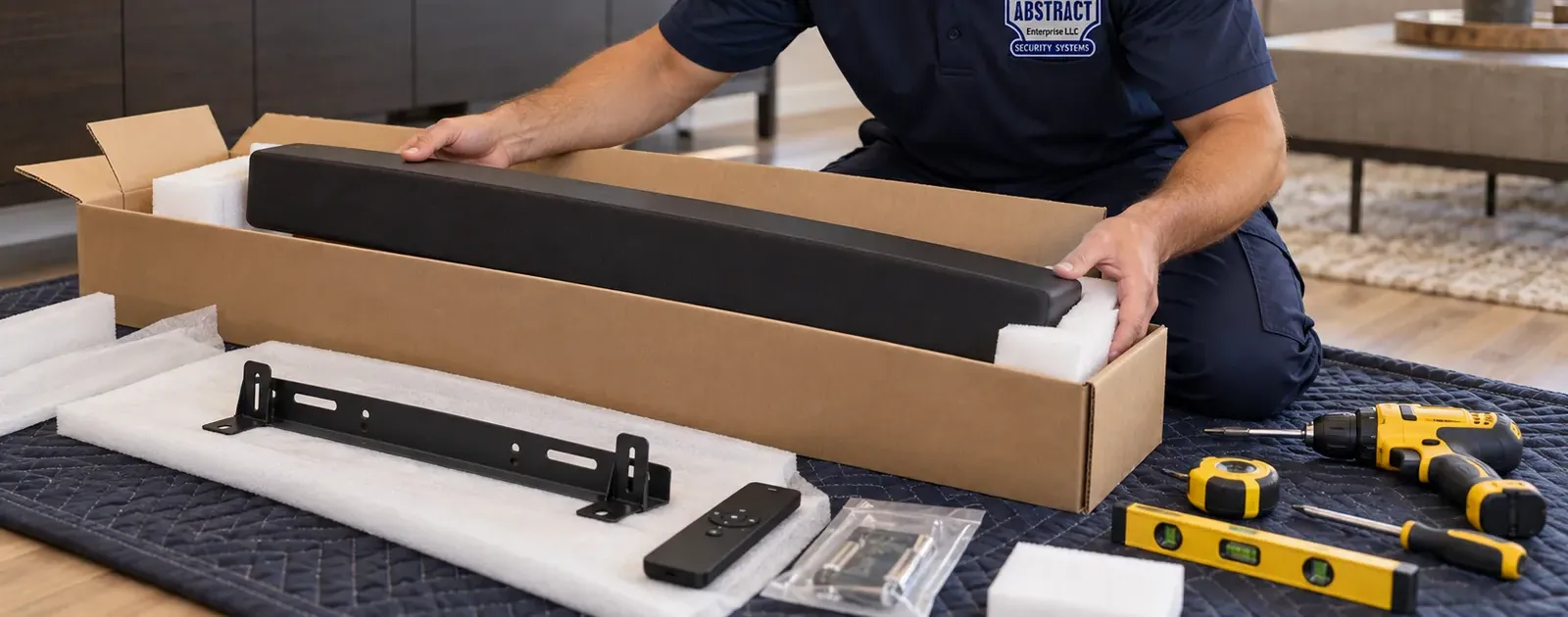
The bar in its opened box on a blanket, with the bracket, remote, bag of hardware, drill, tape measure and level laid out alongside.
AI Overview Reality Check
What AI Gets Wrong About Soundbar Installation in Pelham Bay
A word on sources first. We had no way to load Google's AI summary while researching, so we don't put words in its mouth. Instead, every heading quotes something a pricing site, an installer's page or a Reddit thread actually publishes, because that is the raw material chatbots and search summaries draw on. Underneath each sits the Pelham Bay reality.
“Quick service across all Pelham neighbourhoods”
That line comes from an app-based installer's soundbar-mounting page for Pelham, New York — and the page is about the Westchester villages of Pelham and Pelham Manor, ZIP 10803. Searching for a soundbar installer in “Pelham” turns up pages like it, and an answer engine summarising them can easily blur the two places together.
Pelham Bay is in the Bronx, named after the park on its edge, and was never part of the historical Town of Pelham. It's served from a different office, on a different price list, with different building stock: City Planning's own study found most homes here are detached one- and two-family houses, on blocks rezoned in 2006 to keep them that way.
If you're comparing quotes, check that the company means the Bronx neighbourhood. Ours comes from the Bronx office on East Fordham Road, at Bronx rates, with the Bronx line on the quote.
“Installing a soundbar costs $58.43 to $231”
Homewyse publishes a national-average estimate for installing a soundbar starting at $58.43–$231 per soundbar. As a ballpark for labour alone, that's not far off; our own lines are $79 for a stand placement and $129 for a wall mount.
What the national figure can't tell a Pelham Bay owner is what their particular wall and finish add. A bracket into a wood stud carries no surcharge on our table; the same bracket into plaster is $45 more, into brick $65. Hidden wiring is $169, a cord cover $59, and a bracket, if the bar didn't come with one, $84.99. Those choices, not the average, decide the bill.
We'd rather you see the parts. Every quote lists the mount, the bracket, the wall line and the finish separately, so you can see exactly where the money goes and drop anything you don't need.
“TV wall mounting averages $121 to $234”
Thumbtack puts the national average for TV wall mounting at $121–$234. Answer engines sometimes fold the soundbar into that number, as if the bar came free with the TV mount. It doesn't, on our menu or on most others.
When the TV and soundbar go up together in the Bronx, our TV-mounting base for a 32- to 55-inch set on drywall is $209.99, and the soundbar wall mount is its own $129 line. Doing both in one visit saves a second trip and means the gap between screen and bar, and the cable path for both, are planned together.
So a realistic figure for a living room with a new 50-inch TV, a bar on our bracket and hidden wiring in a framed wall is $209.99 + $129 + $84.99 + $169 = $592.98, before any wall surcharge. That's more than a national average, and every line of it is visible.
“Mount the soundbar closest to 42.5 inches off the ground”
Yamaha's guide suggests about 42.5 inches, roughly where a seated listener's ears fall, and Dolby's advice is to mount the bar below the TV and as close to it as practical. Both are sound starting points for a sofa facing a wall.
In a house the TV height is often set by something else: a fireplace or mantel, a window sill, a console that's staying, or a basement den with a low ceiling and a soffit. In those rooms the bar follows the screen, sitting a few inches under it, and the height of the TV is the real decision.
Where the TV ends up high, we angle the bar slightly if the bracket allows and lean on the dialogue mode, rather than separating bar and screen so that voices seem to come from the wrong place.
“Bass travels easily, so skip the subwoofer”
That advice appears in r/AskNYC threads about soundbars for apartment dwellers, where the concern is the neighbour below. Answer engines repeat it as general advice for anyone in the city.
In a detached Pelham Bay house there's usually no neighbour underneath, so the advice is aimed at the wrong problem. The people a sub really affects here are the household upstairs and the family across the driveway, especially with windows open. Dropping the sub altogether makes many bars sound thin, which tempts people to turn the whole system up.
A better answer for a house is a sub on a pad, a little out of the corner and away from the side windows, levelled to the room, with night mode for late evenings. You get the fuller sound at a lower overall volume, which is what the people around you notice.
“The screws in the box often won't work in NYC walls”
A New York installer's blog says the included screws often don't suit city walls, with metal studs in mind. That's true in many Manhattan and Brooklyn apartments, and it gets repeated as if every New York wall were the same.
Pelham Bay houses are a different case: interior partitions are often framed, older rooms may still be plaster over lath, and party and foundation walls are brick or block. In a wood stud the bracket's own screws, or lag screws of the right size, may be exactly right; in plaster or masonry they aren't.
The rule we follow is simple. The pilot hole decides the fixing, not the city and not the box.
“You need eARC for Dolby Atmos”
This one circulates widely, and it leads people to replace TVs they don't need to replace. Plain HDMI ARC can carry Dolby Atmos inside a Dolby Digital Plus stream, which is how most streaming services deliver it. eARC adds the bandwidth for lossless formats such as Dolby TrueHD, mainly from discs and some media players.
In practice, many Pelham Bay households with a TV that has ARC but not eARC can still get Atmos from streaming apps once the TV's audio output is set correctly. Older sets with only optical out are a different matter, and we'll say so if your TV is one of them.
We check the TV's ports and settings before recommending anything, because the cheapest upgrade is often a menu setting.
One Visit, the Right Room, Sound That Stays Home
Tell us the bar, the room and what's under the floor, and you'll get back a written price, a mounting method and a cable route for your house.
A detached house off Buhre Avenue, the top floor of a two-family near Middletown Road, an apartment over Westchester Avenue or a shop on Crosby — tell us the bar, the TV, the room and what's under the floor, and a written price comes back the same business day. Prefer to talk? Call (646) 490-0629.
✅
Got It
Your request is in the Bronx queue. On a weekday, expect a call or a written figure before close of business; if it can't wait, dial (646) 490-0629.
How It Works
Our Installation Process
From the first photo to the last button press, this is the order every job follows, small bedroom bar or full front-room Atmos setup. In a house with a basement and two floors, choosing the room and finish takes the most care.
1. Tell us the house
Send the models of both the bar and the set, a picture of the TV wall and the floor under it, and say whether a basement or another household is beneath that room. You get an itemised total from the menu.
2. Choose the room and the finish
Living room, basement den or bedroom; stand, wall bracket or TV-attached bracket; cord cover or hidden wiring. In a two-family, the owner and the tenant agree the wall before we book.
3. Book a two-hour window
Windows run from 8 AM to 8 PM, seven days. A booking can be moved free of charge with 24 hours' notice, and same-day windows are offered first when one is open.
4. Scan, probe and mark
We scan the wall, drill one small pilot hole where the bracket will hide it, check what's under the floor if cables are to drop, and mark the height and centre with you.
5. Mount and route
Bracket fixed and levelled against the screen, bar hung, and cables run inside the wall, through the basement or in a painted channel, as agreed.
6. Connect and tune
HDMI eARC or ARC, CEC so the TV remote runs everything, lip-sync checked, firmware updated, and dialogue and night modes set for a house with bedrooms nearby.
7. Walk through and tidy
Sub placed and levelled to the room, packaging away if you booked removal, dust vacuumed, and a run-through of power, volume and night mode with the people who'll use it.
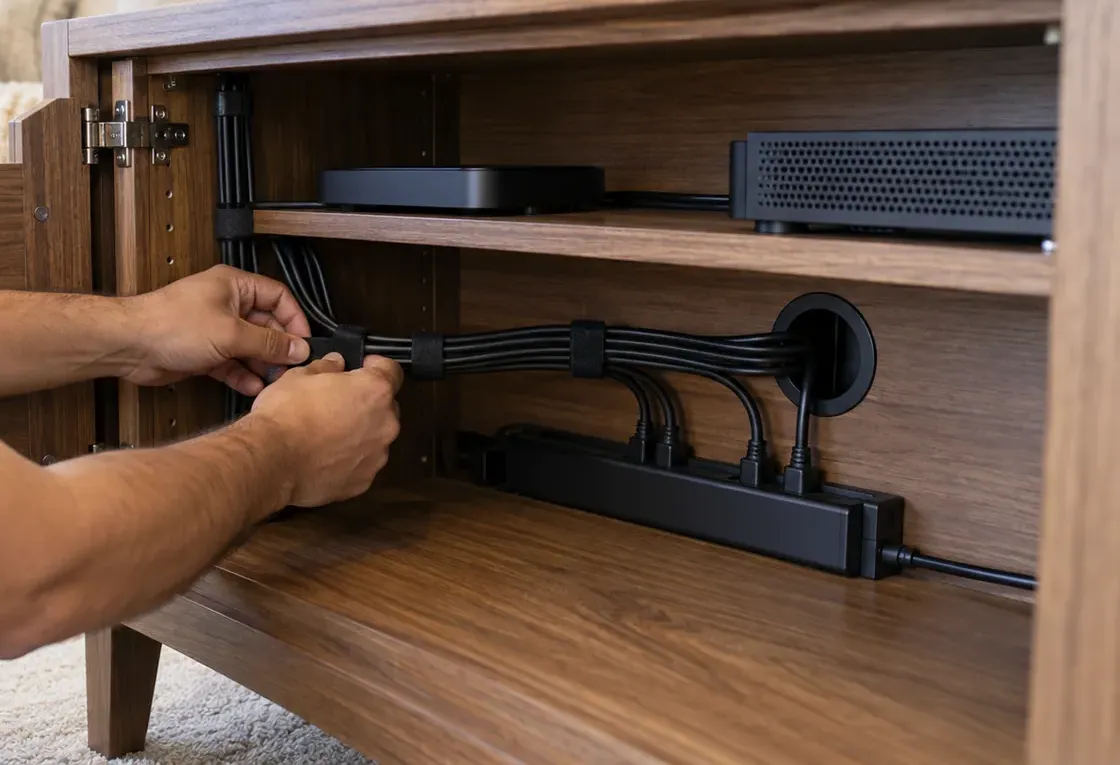
Hands bundle black cables with straps inside a wooden media cabinet and route them through a grommet toward a power strip.
Coverage Area
Soundbar Installation Near Pelham Bay's Landmarks
Landmarks are a quick way to tell us what kind of house and street you're on. Mention one of these and we already know a fair amount about the building, the parking and the likely walls before the photos arrive.
Pelham Bay Park
At 2,772 acres, the largest public park in New York City and slightly more than three times the size of Central Park. The neighbourhood takes its name from the park and from Pelham Bay, the body of water inside it.
Orchard Beach
Robert Moses's 1.1-mile, 115-acre beach in the park, officially opened on June 25, 1937 and modelled on Jones Beach. If your street is on a route toward it, mention that when booking a summer weekend window.
Bartow-Pell Mansion
A Greek Revival house of 1842 inside the park, a National Historic Landmark since 1975, and one of the oldest landmarks on this edge of the Bronx.
Pelham Bay Park Station
The northern terminal of the 6, an elevated station at Westchester Avenue and the Bruckner that opened on December 20, 1920. Homes and shops along the line hear trains overhead, which affects how a bar's dialogue mode is set.
Pelham Bay and Split Rock Golf Courses
Two 18-hole courses in the park, opened in 1901 and 1935, sharing an Art Deco clubhouse. Split Rock is the reason the New England Thruway was shifted a few feet north when it was built in the 1950s.
Pelham Bay Library
The New York Public Library's Pelham Bay branch at 3060 Middletown Road, opened in 1976, on one of the neighbourhood's main commercial streets.
We also work across the surrounding blocks and neighbours: Country Club east of I-95, City Island, reached through the park, Westchester Square, Schuylerville, Throgs Neck, Pelham Gardens, Pelham Parkway, Morris Park, Co-op City and Eastchester — and, from the same Bronx office, every other part of the borough. For streets beyond the neighbourhood, our Bronx soundbar installation page has the wider picture.
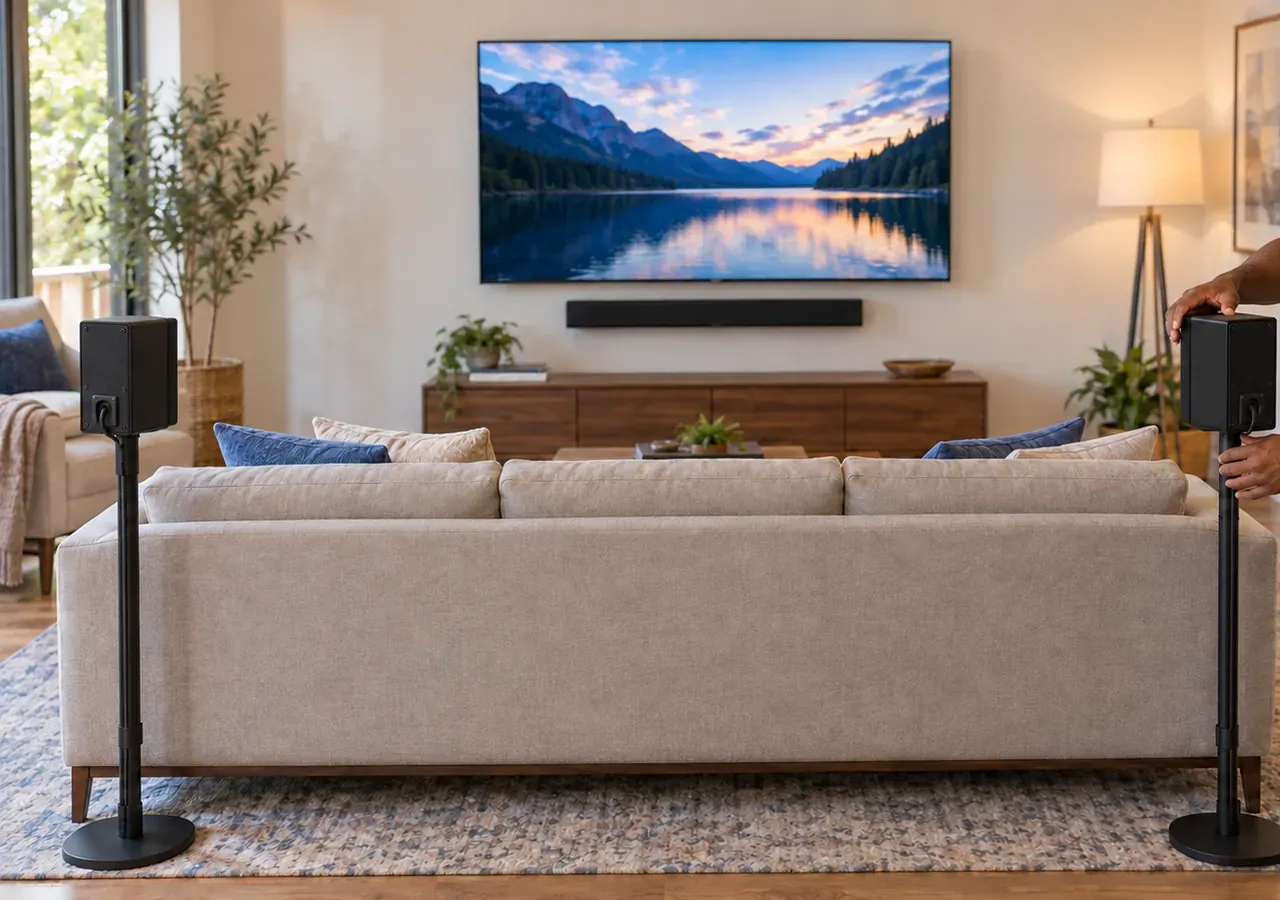
Rear speakers on floor stands at both ends of the sofa, facing the seats, with the TV and soundbar on the far wall.
Pricing
Soundbar Installation Cost in Pelham Bay
No hourly guessing for installs: Pelham Bay homes pay the Bronx menu, one line per thing done. Those line prices equal our Brooklyn base. Only two Bronx figures differ from other boroughs — the hourly charge when nothing gets mounted, and the TV-mount starting price — and both appear below. Anything unexpected found on site is priced aloud before work on it starts.
Line item
Price
What you get
Soundbar placed on a stand or console
$79
Positioned on your furniture, connected and set up, no drilling
Soundbar wall-mounted under the TV
$129
Into a stud, toggles or masonry anchors as the wall demands; bar squared under the TV and played
Sanus soundbar bracket
$84.99
Our stock part, for a bar that arrived bracketless or for TV-arm hanging
Paintable cord cover
$59
Surface channel from the bar to the outlet, ready to paint
In-wall concealment
$169
We fish both leads down inside a hollow partition using a code-compliant in-wall power and cable kit, fed from the outlet already below; only with the owner's say-so
Cable run to a cabinet or other spot
$99
Up to 25 ft — including a drop through the basement and back up
Sonos setup
$125
Sonos system, app and grouping
A/V receiver
$129
Receiver connected and configured
Universal remote
$99
One remote programmed for the TV, bar and boxes
Streaming device setup
$49
Roku, Apple TV, Fire TV or similar
Full home theater
$350
Multi-component system setup
Wall, height and access lines
Condition
Price
Where it turns up around Pelham Bay
Drywall on wood studs
$0
Renovated and extended houses, finished rooms
Metal studs
+$30
Newer partitions and some commercial fit-outs
Plaster
+$45
Older houses with original walls
Brick or stone
+$65
Party walls of semi-detached houses, avenue apartment buildings
Concrete or cinder block
+$75
Basement foundation walls, some storefronts
Tile or marble
+$95
Feature walls and fireplace surrounds
Plywood backer board
$85
Weak or damaged plaster that won't take anchors directly
High mount (above about 8 ft)
$75
A bar above a TV set high over a mantel
Walk-up, 3rd floor and above, no elevator
$40
Upper floors of walk-up buildings on the avenues
Box removal
$25
We take the packaging away
Certificate of insurance
Free
Landlords, managing agents and commercial owners
Setup-only visits and TV mounting in the Bronx
Some calls involve no drill at all: a replacement TV that won't talk to the bar, a remote link that broke, a sub lost after a blackout. Those are timed, with $225 covering hour one in the Bronx and half-hour blocks after. Want the screen hung on the same trip? A 32- to 55-inch set on drywall starts at $209.99 here, or $137.99 if it just stands on furniture. Old-TV extras: $85 to take one off the wall, $45 to unbolt a leftover bracket, $79 to cart the set away for recycling. Chasing a fault through wiring already buried in a house sits outside the menu and is quoted at our $195-an-hour specialty rate, three hours minimum ($585) — never charged on an ordinary soundbar job.
Included, and not included
Part of every job: a level bar under the screen, the correct HDMI socket, tidy leads, single-remote control enabled, and a vacuum run over the drill spot before we leave.
Left to other trades: receptacle work belongs to an electrician and filling or painting to a painter; you won't see either billed by AESS.
Wasted trips: when we arrive and can't begin — missing hardware, a locked door, or a tenant without the owner's go-ahead — a $150 charge covers the return.
Brittle walls: original plaster, glazed tile or a stone fireplace surround may chip even under a slow bit. You'll hear that before the first hole and the call is yours.
App platforms and big-box menus compared with a local licensed installer. Flat national menus are written around a drywall house, which suits some Pelham Bay rooms well. Where they fall short is the rest: plaster and brick, a basement drop, a two-family with two households to set up, or a storefront with an apartment upstairs. A licensed local installer with a wall-by-wall price list can quote the real room and stand behind it afterwards.
Shop Our Systems
Soundbar Installation Packages & Pricing
Around here, most bookings land on one of these. Every card adds its parts out loud; wall, ladder-height and stair lines from the tables stack on top.
Starter — Stand Setup
$79
The bar on your console or dresser ($79), connected to the TV's eARC or ARC port with CEC on and the cables tidied. Ideal for a bedroom TV, a tenant's apartment, or trying the sound before deciding on a wall.
Standard — Wall Mount With Bracket
$213.99
The $129 wall mount plus our $84.99 Sanus bracket comes to $213.99. On drywall over wood studs there's nothing to add; plaster adds $45, brick $65, block or concrete $75.
Premium — Wall Mount, Bracket and Hidden Wiring
$382.99
Add $169 for leads tucked inside the partition (code-compliant in-wall power and cable kit) to the $213.99 Standard and you reach $382.99. Most owners choose this for the main room once the scan confirms a hollow wall.
Bring Your Own Equipment — Labour Only
Ordered a bracket yourself, or got a decent one in the box? You pay $129 plus your wall's line. Its warranty stays with whoever made it. Should it prove too weak or the wrong shape for your wall, that comes up before any drilling, along with our Sanus alternative.
Three worked examples, from the lines above. A bar on our bracket on an old plaster living-room wall, with a painted cord cover: $129 + $84.99 + $45 + $59 = $317.99. The same bar on the brick side wall of a semi-detached house, with a cord cover because brick has no cavity: $129 + $84.99 + $65 + $59 = $337.99. And a stand setup for the tenant's floor of a two-family, plus a streaming stick set up on the same remote: $79 + $49 = $128.
Get a Pelham Bay Soundbar Price in Writing
One picture of the TV wall, one of whatever sits beneath that floor, plus the model number: that is enough for us to add up your lines today.
Room by Room: Where the Bar Goes in a Pelham Bay House
In a house, the first decision is the room, and it's the one people most often skip. This is how we compare the usual candidates in a Pelham Bay home. It's a guide built from what each room typically offers, not a rule; your floor plan decides.
Room
What usually helps
What usually works against it
Typical finish
Front living room
Biggest seating area; often a framed interior wall for the TV
Faces the street, the elevated line or the expressway traffic; side windows close to the next house
Wall mount, hidden wiring on an interior wall
Back living room or extension
Quieter background, facing the yard
Extensions can have different wall build-ups from the original house
Wall mount; check which wall is original
Finished basement den
Nobody below; cable can run in the ceiling
Foundation walls are masonry; low ceilings and soffits; damp in some basements
Bar on the TV mount or on a framed wall; sub off the floor slab corner
Bedroom
Small room, short listening distance
Shares walls and floors with other sleepers
Compact bar on a stand or bracket, night mode as default
Tenant's floor of a two-family
Self-contained apartment
Shares the floor-ceiling with the owner's household
Stand or bracket agreed with the owner; sub set low
Two habits make the choice easier. First, sit in the room at the time of day you watch most and listen: if trains, buses or traffic dominate, that background will set the volume the bar has to reach. Second, think about who is above, below and beside the room at that hour. The best-sounding wall is not always the kindest one to the rest of the house.
If you can't decide, we'll look at two rooms during the visit and price both before anything is drilled.
Street Sound
Trains, Parkways and the Window Wall
Pelham Bay is ringed by transport: the elevated 6 along Westchester Avenue, the New England Thruway on the east, the Bruckner Expressway on the south, the Hutchinson River Parkway on the west and Pelham Parkway to the north. Every one of those is a source of background sound, and background sound decides how loud a soundbar gets turned up.
Set for speech, not volume. A bar's dialogue or voice mode lifts the frequencies where speech lives, so voices stay clear over a passing train without raising the overall level. We switch it on as the default in rooms that face the street.
Use the TV's auto-volume carefully. Some TVs and bars can level out loud adverts and quiet scenes. It helps in a busy room but can make music sound flat, so we show you where the setting is and leave the choice to you.
Pick the quieter wall. A TV on a wall facing into the house, with the seating facing away from the street-side windows, hears less of the outside and sends less of itself back out.
Mind the window wall. Glass passes sound both ways. A bar on the wall with the windows pushes sound at the street and at the neighbour; the opposite wall is usually better for both.
Keep the sub off the side wall. Low frequencies pass through siding and windows most easily, so the sub belongs away from the wall that faces the house next door.
Summer is different. With windows open, everything carries further, in both directions. Night mode in the evening is the simplest fix.
None of this asks you to watch quietly. It's about getting clear dialogue at a sensible level in a house that has a train line, three highways and a neighbour's window within earshot.
Two-Family Homes
One House, Two Households, Two Soundbars
The 2006 rezoning made the one- and two-family detached house the only new building type allowed on the rezoned blocks, and many existing houses already hold two households. A soundbar in a two-family touches both, so this is how we handle it.
The owner agrees the wall. Whether the bar is for the owner's floor or the tenant's, the owner says where holes may go. A tenant booking for their own floor should have that agreement in writing before the visit.
Floors carry bass. The floor-ceiling between two apartments in a framed house is a weaker barrier to low frequencies than masonry, so a sub on the upper floor is set low and placed on a pad, and night mode is the default.
Separate the systems. Each floor's bar is linked to its own household's app and, where the router allows, its own network, so neither household can change the other's settings by accident.
One visit, two quotes. If both floors are being done, we can do them in consecutive windows and write separate quotes and invoices, so each household pays for its own lines.
Write it down. We leave a short note of what was installed on each floor, which account each bar is registered to, and which network it uses.
If the tenant moves out, the bracket and any cord cover usually stay with the wall and the bar goes with the tenant. Agreeing that at the start saves an awkward conversation later.
Basement Dens
Soundbars Below Ground: Setting Up the Basement Den
Plenty of Pelham Bay houses have a basement, and many families have turned theirs into the room where the big TV lives. A basement den is a good home for a soundbar: there's usually nobody underneath, the room is away from the street, and the ceiling above is often the easiest place in the house to run a cable. It also has its own quirks, and they're worth knowing before the bracket goes up.
Foundation walls are masonry. Behind the paneling or wallboard on an outside basement wall there's usually block or poured concrete, with furring strips in between. The furring strip won't hold a bracket that gets knocked, so we either anchor through to the masonry or, better, put the TV and bar on a framed interior partition if the room has one.
Soffits and beams set the height. Ducts, pipes and the main beam often run in a boxed soffit along one wall, which can leave little room above the screen. The bar then goes under the TV as usual, and the TV height is chosen so the bar isn't almost on the floor.
Ceilings carry the cables. A drop ceiling lifts out, and an open or drywalled ceiling usually has joist bays running toward the stairs. Either can take the HDMI and power from the TV wall to a shelf or closet where the boxes live.
Keep the sub off a damp floor. Some basements stay dry for years and then take water in a storm. A wireless sub on a pad or low stand, rather than directly on the slab, is cheap insurance, and so is keeping power strips off the floor.
Height effects need a flat, reflective ceiling. Up-firing Atmos drivers bounce sound off the ceiling. A low, flat drywall ceiling can work well; acoustic tiles soak up much of the effect, so in a drop-ceiling den a bar without up-firing drivers may be the better buy.
Bass still goes upstairs. With nobody below, the household above becomes the audience for the subwoofer. We level it with the basement door closed and again with it open, because that's how the room gets used.
Visit Prep
Before the Technician Arrives
A few minutes of preparation makes a Pelham Bay visit quicker and keeps the price on the quote.
Have the bar, its bracket, and any sub or rear speakers in the house — boxed is fine.
If hidden wiring is planned and there's a basement under the room, clear a path to the spot below the TV wall so the technician can check the ceiling there.
Know where the nearest working outlet is on the TV wall.
Move anything fragile off the console and clear about a metre in front of the wall.
In a two-family, make sure the owner has agreed the wall, and that whoever is home can let us into any basement or shared space we need.
Tell us about parking: a driveway we can use for the van, or the street. Mention if the driveway is shared with the house next door.
Have the Wi-Fi name and password ready for app-based bars.
If the new TV is still boxed, leave it sealed; we check its mounting pattern against the bracket first.
Keep pets and small children out of the room while we drill, for their safety and ours.
And if you already know where you want the subwoofer, say so. It's your room; we advise, you decide.
Complete Services
Every Soundbar Installation Service in Pelham Bay
Other AESS work nearby, in case the TV wall is only the start.
Plain-language terms: rescheduling, visits that can't start, and how setup-only time is billed.
Field Notes
Field Notes: Reading a Pelham Bay House From the Basement Up
How our installers approach a house of this kind in general; no specific client's home is described here.
In a house, start below the room, not on the wall. If there's a basement, go down and stand under the TV wall: you can often see the joists, the bottom of the wall cavity, any pipes or cables passing through, and whether a cable could come down here and go where the equipment lives. Five minutes in the basement settles whether hidden wiring is easy, awkward or not worth it.
Back upstairs, knock along the wall and scan it. Studs at even spacing mean framing; a dead, even sound means brick or block. Find the outlet, the windows and the stairs, and ask who sleeps on the other side of each wall and above the ceiling. Drill one small pilot hole where the bracket will hide it and read what comes out before choosing the anchor.
Before leaving, play a dialogue-heavy scene at the volume the household actually uses, step outside the room and then outside the house by the side windows. If the bass is the loudest thing out there, turn the sub down until it isn't. That one check prevents most complaints, from upstairs and from next door.
FAQ
Pelham Bay Soundbar Installation FAQ
Is there a stairs charge when the soundbar goes into the second-floor unit of a Pelham Bay two-family?
+
No. The walk-up line on our Bronx menu, $40, starts at the third floor and above in a building with no elevator. A second-floor apartment in a two-family house is priced exactly like a first-floor one, so the total is just the mount, the bracket if needed, the wall type and any cable finish you choose.
Does the price change if the bracket lands on a wood stud rather than between studs?
+
No. Drywall on wood studs carries no wall surcharge, whether the screws go into a stud or into toggles in the board between studs. We choose the fixing after scanning the wall; the line on your quote stays the same either way.
If I bought my own soundbar bracket online, what does the labour-only mount cost?
+
The wall-mount line, $129, plus the surcharge for your wall type if it has one. Your bracket needs to be rated for the bar's weight and suited to the wall; it keeps its own manufacturer's warranty. If we find it won't hold properly, we say so before drilling and offer the Sanus bracket at $84.99 instead.
Could the subwoofer sit in the basement and play up through the living-room floor?
+
We advise against it. Bass is meant to be heard at the seat, and a sub under the floor shakes the joists and the whole house more than it fills the room. It also tends to reach the bedrooms before the sofa. The sub belongs in the same room as the bar, on a firm pad, a little away from the corner.
We're closing on a Pelham Bay house next month — can you price the soundbar from the listing photos before we have the keys?
+
We can give you a written estimate from listing photos and the bar's model, marked as provisional. The wall type is the one thing photos can't always confirm, so the final line is fixed once we see a close-up of the TV wall or knock on it on the day. Nothing is charged for the estimate.
Will a soundbar bracket on a framed wall need tightening after a few months?
+
It shouldn't. Screws driven into a stud, or toggles spread behind the board, don't work loose under a soundbar's weight. If a bar ever starts to sag or lean, stop using it as a handle and call the Bronx line; a loose bracket is worth looking at, not living with.
Our TV wall has a through-the-wall air-conditioner sleeve — can the soundbar go near it?
+
Yes, with a margin. We don't fix anything to the sleeve or its trim, we keep the bar out of the stream of air and condensation the unit gives off, and we keep cables away from its plug. Where possible the bar goes on the far side of the TV from the sleeve, so the unit's hum isn't sitting right beside the dialogue.
Can the soundbar's app be set up on several phones in the family?
+
Usually, yes. Most app-controlled bars are linked to one account, then other phones on the same Wi-Fi are added or invited. We set up the account with whoever should own it, add the other phones you name, and write down which email the bar is registered to so it isn't lost when someone changes phone.
Silent since the new set arrived? Sub blinking after a summer storm? Volume ignoring the remote? Phone (646) 490-0629 for the first free two-hour slot; a typical settings or connection fault takes an hour or two once someone is in the room.
Soundbar Installation Pelham Bay — Licensed, Insured, House-Savvy
Abstract Enterprises Security Systems · 460 E Fordham Rd, Bronx, NY 10458 · (646) 490-0629 · WhatsApp (718) 679-0359 via wa.me
NYS Low-Voltage Licence #12000287431 · 100% Licensed & Insured · Same-Day Estimates · Rated 4.7★ from 201 Google Reviews
Brackets and parts carry their manufacturer's warranty. Full terms — including 50% deposit, one-year parts-only warranty on AESS-supplied products, and the late-fee schedule — are set out in the service agreement. See our warranty page.
Page reviewed and updated October 17, 2026. Changelog: first publication of the Pelham Bay soundbar installation page, written around detached and two-family houses, hidden wiring in framed walls, basement cable routes, outside noise from the elevated line and parkways, and two-household setups.