What are you looking for?
About Us Contact Us Careers Get a Free Quote (800) 486-0943
Pick a service
✅ Got Your Own System?
🎬 Home TheatreQuote 🎶 AV SoundQuote 🔑 Access ControlQuote
Now pick your area
Pick your area
Long Island
Hudson Valley
Services available
Pricing & Tools
Pick a service for pricing
🚪 Intercom Pricing 🔔 Buzzer Repair Pricing
Calculators
📹 Camera System Calculator 🚨 Alarm Calculator ⚡ Cabling Quote Builder ✅ Got Your Own System?
Select your area
Home › Soundbar Installation NYC › Staten Island › Todt Hill
Licensed Low-Voltage Contractor · Todt Hill, Staten Island · Estate Houses, Flagg Stone Cottages, Hillside Lower Levels & Apartments

Soundbar
Installation on
Todt Hill

The Top of Staten Island · Big Rooms · Stone Walls · Houses That Step Down the Slope

A soundbar is designed around an ordinary living room: one wall, one sofa, a few metres between them. Todt Hill rarely offers that. Up the hill, off Todt Hill Road, Ocean Terrace and the private lanes behind their gates, the family room may be twice the usual depth with a ceiling that climbs to a peak; the lower level may be dug into the slope on one side and all glass on the other; and in the stone cottages Ernest Flagg built on his Stone Court estate, the wall behind the TV is serpentine rock set in poured concrete. At the foot of the hill, between Manor Road and Laguardia Avenue, the seven buildings of the Todt Hill Houses are being rebuilt apartment by apartment. We size the bar to the room and fix it to whatever the wall really is, connect it to the TV’s eARC or ARC port so one remote runs the lot, and hide or dress every cable. Two-hour arrival windows, 8 AM to 8 PM, seven days a week.

Reviewed and updated October 17, 2026 · Written by Anwar Timothy, NYS licence #12000287431 · Part of our Staten Island soundbar installation coverage

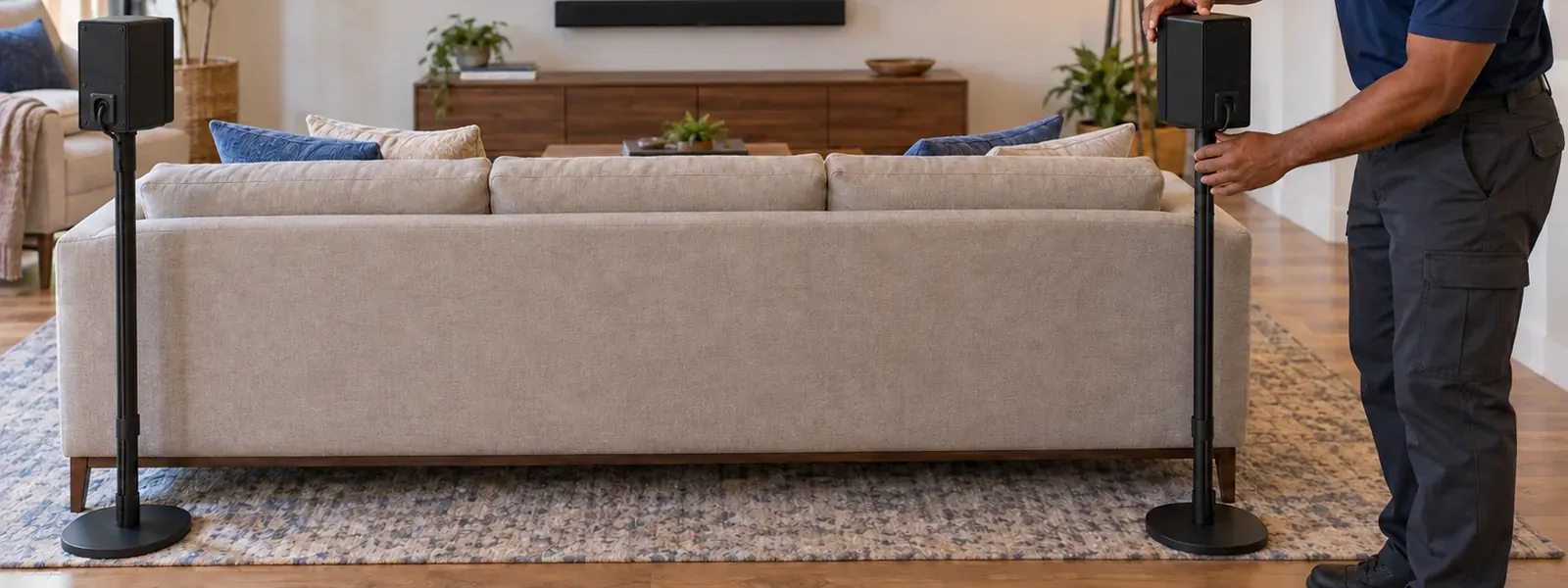
Technician setting a black rear surround speaker on a floor stand behind a beige sofa, a matching speaker on a stand at the other end, media console and rug beyond — Todt Hill, Staten Island soundbar installation
Rear speakers on stands behind the seating, the way a bar-and-surround system is finished in a room deep enough to need them. In the bigger Todt Hill family rooms the sofa often floats well away from any wall, so stands like these are the usual answer.
Todt Hill Soundbar Quote
Room size, wall and bar model — a written figure comes back the same working day

✅
Request Sent!
We’ll call you back the same business day.
25+
Years Experience
✓
Same-Day Estimates
100%
Licensed & Insured
4.7★
201 Google Reviews

Big room, hard wall or both? Tell us how far the sofa sits from the screen and what the wall is made of. Ring (347) 934-8335 or use the short form. The written figure is built only from the price lines published on this page, so you can add it up yourself.

  • Wall mount $129; add $65 if the wall is rock, $75 if it is poured concrete or block
  • Up the hill, down the hill or in the Todt Hill Houses — same price list, no distance charge
  • NYS low-voltage licence #12000287431, insured, seven days a week
The Neighborhood

Why Todt Hill Homes Need Soundbar Installation

Todt Hill is the high ground of Staten Island, and the houses on it were built to match. The Landmarks Preservation Commission’s 2007 designation report on a house on Circle Road puts the summit at 409.8 feet and repeats the long-standing claim that it is the highest natural point on the eastern seaboard from Maine to Florida. Wikipedia’s figure is 401 feet, and it calls the hill the highest natural point in the five boroughs; Atlas Obscura goes further and calls it the highest point on the entire Atlantic coastal plain. Whichever number you prefer, the summit sits near Todt Hill Road and Merrick Avenue, the hill itself is serpentine rock, and most of its crown is woodland inside the Staten Island Greenbelt. Everything else on the hill is private houses, and the way those houses were built is what this page is about.

The LPC report tells the story briefly. In the nineteenth century the hill “became the location of country homes on large estates.” Two families shaped what came next. George Cromwell, the first borough president of Staten Island, began selling off acreage of his property for development in the early twentieth century. The architect Ernest Flagg, who designed the Singer Building in Manhattan, bought land on the hill from 1897 onward until his estate held more than 300 acres by the mid-1940s; it too was eventually subdivided and sold. Flagg left behind his own mansion, Stone Court, and a group of small stone cottages built by a method of his own invention. The subdivided land became the streets you know now: Flagg Place, Benedict Road, Circle Road, Willow Pond Road and the lanes off Todt Hill Road and Ocean Terrace. Forgotten New York describes Benedict, Circle and Willow Pond Roads as the “exclusive, walled-off part of Todt Hill.”

What does that mean for a soundbar? Three things. First, scale. A 2017 Brick Underground guide to the neighbourhood quoted a broker describing “mostly massive mansions with over 3,000 square feet of space,” pictured a house of more than 13,000 square feet, and noted “gargantuan cast iron gates” and private roads. Rooms in houses of that size are often deeper, wider and taller than the room a soundbar’s engineers had in mind, and the bar that sounds full in a showroom can sound thin from a sofa twenty feet back. Second, the ground. The city’s Special Natural Area District rules describe the “central, serpentine, hilly spine” of Emerson Hill, Dongan Hills, Todt Hill and Lighthouse Hill as “richly endowed with steep slopes, rock outcrops, erratic boulders and ponds.” Houses on slopes like that step down: a main floor at the street, a lower level that is underground at the back and opens to the garden at the front, sometimes a third level below that. Third, the walls themselves, which range from Flagg’s stone-and-concrete to post-war plaster to modern drywall over steel in a new build.

Then there is the other Todt Hill. At the bottom of the north-western slope, in the part of the neighbourhood NY1 places in Manor Heights, stand the Todt Hill Houses: seven six-storey buildings with 502 apartments and about a thousand residents, completed in 1950 as the first public housing development on Staten Island. NYCHA awarded a contract worth more than $150 million in January 2024 to modernise the whole development, with new kitchens and bathrooms, full plumbing and electrical upgrades, new floors and windows, and the removal of lead-based paint. NY1 reported in December 2025 that residents are moved temporarily to other NYCHA apartments while their building is done, with the right to return, and that the work is expected to finish by mid-2027. The census tract that holds the hill, Todt Hill–Emerson Hill–Lighthouse Hill–Manor Heights, is 30.3 percent renter-occupied, and many of those renters live here and in the apartment buildings near Richmond Road.

Finally, getting here. Wikipedia notes that no public transit serves the hill itself and that most streets, Todt Hill Road included, have no sidewalks; Brick Underground adds that most have no street lights either, and that “no buses climb Todt Hill.” Buses run along Richmond Road, which marks the border between Todt Hill and Dongan Hills. None of that changes a price on this page, but it does change how a visit runs: we drive to the door, we bring everything in one trip, and on a winter evening the technician arrives with a torch because the lane outside will be dark.

Todt Hill in figures, for anyone planning a TV room

  • 409.8 feet at the summit (LPC, 2007); Wikipedia gives 401 feet and the Greenbelt article 410. The highest natural ground in New York City by any of those figures.
  • 32,822 residents and 10,623 households in census tract area SI0203 (Todt Hill–Emerson Hill–Lighthouse Hill–Manor Heights) at the 2020 census, up 6.4% from 2010; 32.7% of households have children under 18 and the largest age group is 55–74 (Wikipedia, citing NYC Planning).
  • 30.3% renter-occupied in that tract, so roughly seven homes in ten are lived in by their owners (Wikipedia).
  • Median year built 1967; 22% built in 1939 or earlier across the wider Todt Hill area Point2 draws from the 2019–2023 American Community Survey, with 32.6% of units in detached houses and 18.6% in two-unit buildings. Point2’s boundary reaches well beyond the hilltop, so read these as the surrounding district, not just the estates.
  • 502 apartments, seven buildings, 1950: the Todt Hill Houses, Staten Island’s first public housing, now in a modernisation contract of more than $150 million (NYCHA).
  • 2,800 acres of Staten Island Greenbelt around the summit, the second-largest park in the city after Pelham Bay Park (Wikipedia).

Read together, the numbers explain why one page can’t treat every Todt Hill job the same. An owner-occupied estate house, a 1960s split near Richmond Road and a renovated NYCHA apartment share a ZIP code and a hill, and almost nothing else. The question we ask first on the phone is not “what soundbar have you got?” but “how big is the room, and what is the wall?”

Most Todt Hill bookings that start as a soundbar end up including the TV above it. Our Staten Island TV mounting team works from the same price list. When a room is simply too large for one bar, the AV and in-ceiling speaker crew for Staten Island designs something bigger, and owners who already have keypads on the gates often add smart locks on Todt Hill or home automation for Staten Island houses on the same visit.

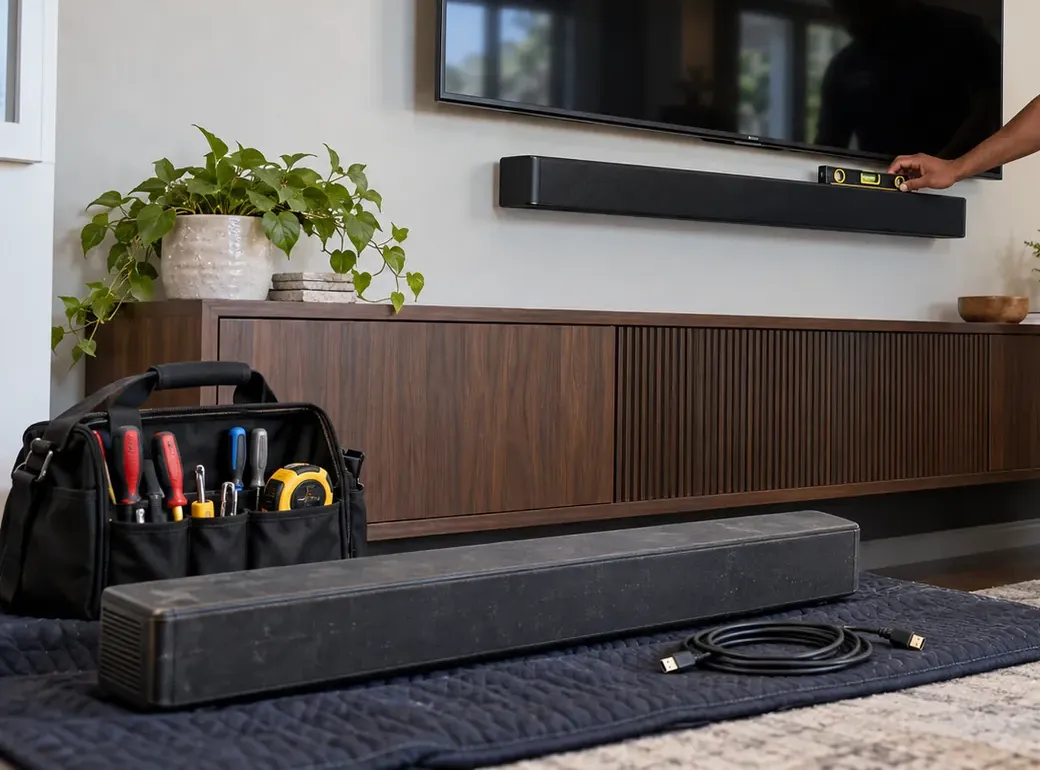
Hand resting a small level on top of a black soundbar mounted under a wall TV, a slatted walnut console below, an open tool bag and a second soundbar on a navy blanket in the foreground — Todt Hill Staten Island soundbar installation
The final check: a short level laid along the top of the bar once it is on the bracket. In a wide room the eye reads a few millimetres of tilt across a long bar more easily than it does on a small one.
Scale and Stone

Big Rooms and Hard Walls: Reading a Todt Hill TV Room

We sort a Todt Hill TV room on two questions before anything else: how far is the listener from the screen, and what will the drill meet? The first decides what to install. The second decides how it is fixed. The tables below are the short version; the sections that follow explain each line.

Todt Hill rooms by size: what a soundbar can and can’t do
Room Typical distance, sofa to screen What we usually recommend
Bedroom, study, apartment living room About 6 to 10 feet A compact or mid-size bar; no subwoofer needed in many cases; console placement is fine
Ordinary family room or den About 9 to 13 feet A full-width bar with its subwoofer; rear speakers optional
Great room or deep family room About 13 to 20 feet A flagship bar with subwoofer and rear speakers on stands or brackets; dialogue setting raised; room calibration from the actual seat
Very large or two-zone room Two seating groups, or more than 20 feet Bar for the near group plus in-ceiling or in-wall speakers for the far one, designed with our AV team; or a receiver-based system
Walk-out lower level with a bar or pool table Seats scattered around the room Bar for the TV plus a separate music system for the rest of the floor

Those distances are rules of thumb we use, not a manufacturer specification. The point they make is simple: a soundbar is a cluster of small drivers in one box, and the further away you sit, the more of what you hear is the room rather than the bar. In a big room with hard surfaces — stone, glass, tile, a high ceiling — that room sound can wash out speech. Rear speakers and a subwoofer help because they put sound nearer the listener; a dialogue setting helps because it lifts the voice band above the reflections; calibration helps because the bar measures the room from where you sit. None of those turns one bar into a cinema in a 40-foot room, and we would rather say so on the phone than on the day.

Todt Hill walls: what the drill meets
Wall Where you find it How the bracket is fixed Price line
Mosaic-rubble stone with a concrete backing Flagg’s Todt Hill cottages and estate buildings, some later stone houses Masonry anchors set into the stone face or the concrete behind it; holes placed to miss the decorative joints where possible Brick or stone +$65
Plaster on lath or on a fabric screen Houses built before the war, and some Flagg partitions A hidden test hole locates the timber; a plywood spreader goes on where the timbers are too far apart Plaster +$45; backer board $85
Drywall on wood studs Most houses from the 1950s on, and renovations Two or more screws into studs $0 add
Drywall on metal studs Newer builds, basements, offices Toggles rated for metal stud, or a backer board spanning studs Metal studs +$30
Poured concrete or block Lower-level walls cut into the slope; garage-side walls; some apartment walls Masonry anchors; cable on the surface or in a channel Concrete or block +$75
Stone veneer or a stone chimney breast Great-room fireplaces Anchors into the solid masonry behind, never the veneer alone Brick or stone +$65

A large share of what we see on the hill falls in the middle rows: ordinary framing behind ordinary drywall, in a room that happens to be big. Where a job gets interesting is the top and bottom of that table — a cottage whose walls are rock, or a lower level whose TV wall is the foundation holding back the hill.

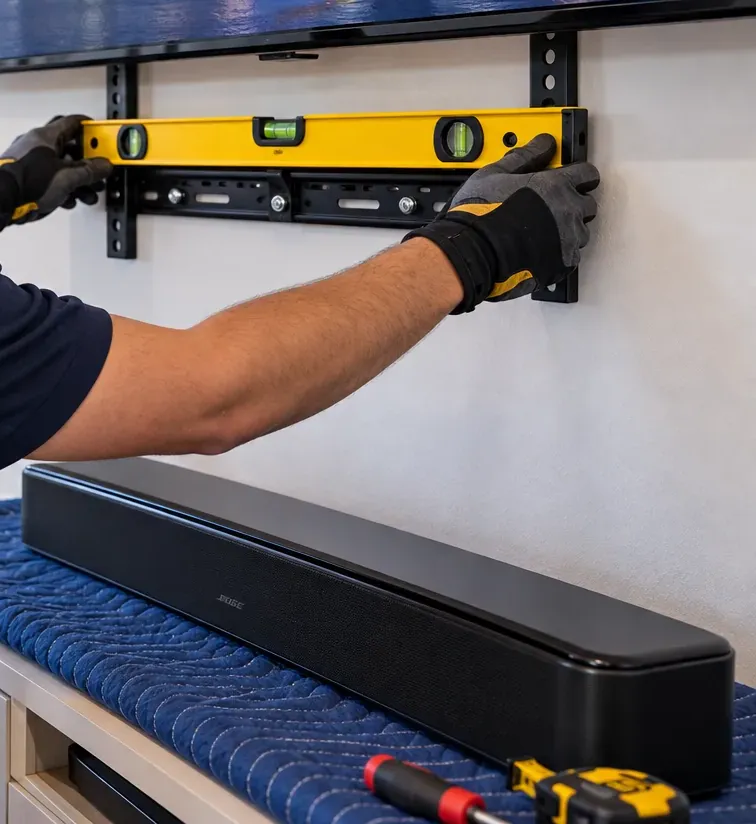
Gloved hands pressing a long yellow spirit level onto a black TV wall plate on a white wall, a black soundbar resting on a blue moving blanket on the console below — Todt Hill Staten Island soundbar bracket
The plate is levelled before anything heavy goes on it. On a stone or concrete wall the anchor holes can’t be nudged after they are drilled, so the level and the marks come first.
What We Install

Soundbar Installation Services on Todt Hill

Every piece of a Todt Hill job has a line in the price tables further down. Whatever combination your room needs, we don’t leave until the bar is level under the picture, the cables are inside the wall or neatly dressed along it, one remote controls the sound, and you have listened to dialogue from the seat you actually use.

Bars on Stone and Concrete

Masonry anchors into Flagg-style mosaic rubble, a stone chimney breast or a poured lower-level wall. $129 for the mount plus $65 for stone or $75 for concrete or block.

Great-Room Systems

A flagship bar with its subwoofer and rear speakers, calibrated from the seat that matters. The full home theater hookup line is $350; rear stands and brackets are fitted as part of it.

Bars Under Very Large Screens

Mounting under 77- to 98-inch TVs, where the bar is often narrower than the screen. We centre it on the picture, not the wall, and keep it clear of the TV’s sensor.

TV-Attached Brackets

A clamp kit that carries the bar on the TV’s own mount: one set of holes in a stone wall instead of two, and a bar that follows a swing arm. $84.99 for the Sanus version.

Long Runs to an Equipment Closet

HDMI and power taken from the TV wall to a cabinet or closet. The published line covers up to 25 feet for $99; longer runs are assessed in writing before the visit.

In-Wall Concealment

Where the bay behind the screen is hollow and clear, the $169 kit carries power and HDMI down inside it. Rock, poured concrete and fragile plaster get a $59 cord cover painted to match instead.

Several Rooms in One Visit

Family room, primary bedroom, gym and lower level, each with the bar that suits it and each on its own line of the quote.

Console Placement

No drilling at all: the bar on the media cabinet, connected by HDMI and following the TV remote. $79.

Apartment Installs

For the Todt Hill Houses and the rental buildings near Richmond Road: compact bars, console placement or a wall mount where the lease and management allow it.

Two things we don’t do: new or moved electrical outlets, which are a licensed electrician’s work and which we will happily follow on the same day, and patching or painting. If a great room needs an outlet behind a high TV for an in-wall kit, we say so before booking so the electrician can come first.

Repair Capture

Todt Hill Soundbar Dropping Out Across a Big Room?

A subwoofer that loses its link when the dishwasher runs, rear speakers that go quiet half way through a film, a bar that stopped answering the TV remote after a software update, or voices that land a beat behind the lips: none of those needs a new install. They are service calls, booked into the first free two-hour window, and the usual settings or connection fault is put right within one to two hours of the technician arriving. On Staten Island a setup-only visit is $225 for the first hour, then 30-minute blocks. Call (347) 934-8335 and say it’s a soundbar fault; our visit and rescheduling policies explain the windows.

Building Specialists

Soundbar Installation for Todt Hill’s Architecture

The hill was built in waves, and each wave left a different kind of wall. Estate houses of the nineteenth and early twentieth centuries, Flagg’s experimental stone cottages, mid-century houses on the first subdivisions, large modern houses on the last of the estate land, and the brick apartment blocks at the foot of the slope. Here is what each usually means for a soundbar.

Flagg’s Stone Cottages

Ernest Flagg built a group of small houses on the grounds of Stone Court using what he called mosaic rubble: flat-faced stones set in reusable timber forms with concrete poured behind them. Bowcot on West Entry Road (1916–17), Wallcot at 285 Flagg Place (1918–21) and the McCall’s Demonstration House at 1929 Richmond Road (1924–25) are designated landmarks. The stone, the LPC records, was serpentine from a quarry on the estate. For a soundbar that means a wall of hard stone faces backed by concrete, and anchors chosen for both.

Older Estate Houses

The country houses that survive from the nineteenth-century estates, and houses moved or rebuilt on the hill, such as the Gillett-Tyler House on Circle Road, built around 1846 and re-erected here in 1931. Plaster walls, deep window reveals and original trim that nobody wants scarred.

Mid-Century Houses

Colonials, ranches and splits from the first subdivisions of the estates. Mostly plaster or early drywall on wood studs, with family rooms added later and lower levels finished in the 1970s and 1980s.

Large Modern Houses

The big houses on private lanes and cul-de-sacs: two-storey great rooms, open kitchens, stone fireplaces, glass walls toward the trees, and in many cases a finished walk-out lower level. Drywall on studs for the most part, with stone veneer and large-format tile as feature finishes.

Lower Levels Cut Into the Slope

Whatever the age of the house, a lower level on this hill often has a poured or block wall on the uphill side and windows or doors on the downhill side. The TV usually wants the solid wall; the solid wall is usually concrete.

The Todt Hill Houses

Seven six-storey brick buildings from 1950, now being modernised with new kitchens, bathrooms, floors, windows and electrical work. Apartment rules and the condition of newly finished walls come before any bracket.

What Flagg’s method means for a drill bit

Flagg published his building system in a book called Small Houses, and the LPC’s designation report on the McCall’s Demonstration House describes it in detail. Timber uprights and cross-bars stood on footing sleepers to make a trough. Stones went into the trough with their flat faces against the outer form, and concrete was poured in behind them as a backing. When that course set, the forms were raised and the process repeated. Only the joints were pointed afterwards. The corners at Bowcot, according to the Historic Districts Council’s 6 to Celebrate guide, were made of concrete blocks with vertical reinforcing rods, filled with concrete — an idea about twenty years ahead of general use.

Inside, that gives a TV wall with no stud and no cavity. The drill meets either a stone face, a pointing joint or concrete, sometimes all three within the width of a bracket. Serpentine is a dense, often slippery rock; a hammer drill and a sharp masonry bit go through it, but slowly, and the bit must be kept cool. We mark every hole, decide whether it lands in stone, joint or concrete, and choose anchors to suit each one rather than one type for all. Where the inside face of the wall has been plastered, we treat the plaster as a finish only and anchor through it into the masonry.

The same report notes that Flagg’s method for interior partitions in Small Houses used plaster applied to a jute or burlap screen rather than to wooden lath, while saying it can’t confirm that every house used it. If your TV is going on an interior partition in one of these houses, we test-drill before promising anything: a fabric-backed plaster partition has nothing for a hollow-wall anchor to grip, and the bracket has to reach framing, the masonry at either end, or a backer board spanning between them.

Landmarked houses and the inside of the room

Several houses on and around the hill are individual landmarks. The Landmarks Preservation Commission says an LPC permit for interior work is required when the work needs a Department of Buildings permit, when it affects the exterior, or when the interior itself is a designated interior landmark; ordinary repairs and maintenance need no permit. A soundbar fixed to an inside wall, wired inside the room, normally needs no DOB permit and touches nothing outside. That is our reading of the LPC’s published guidance, not legal advice. If you are unsure, or if any part of the job would touch the outside of the house — a speaker on a terrace wall, a cable through a stone sill — check with the Commission before we come, and we will hold that part of the job until you have its answer.

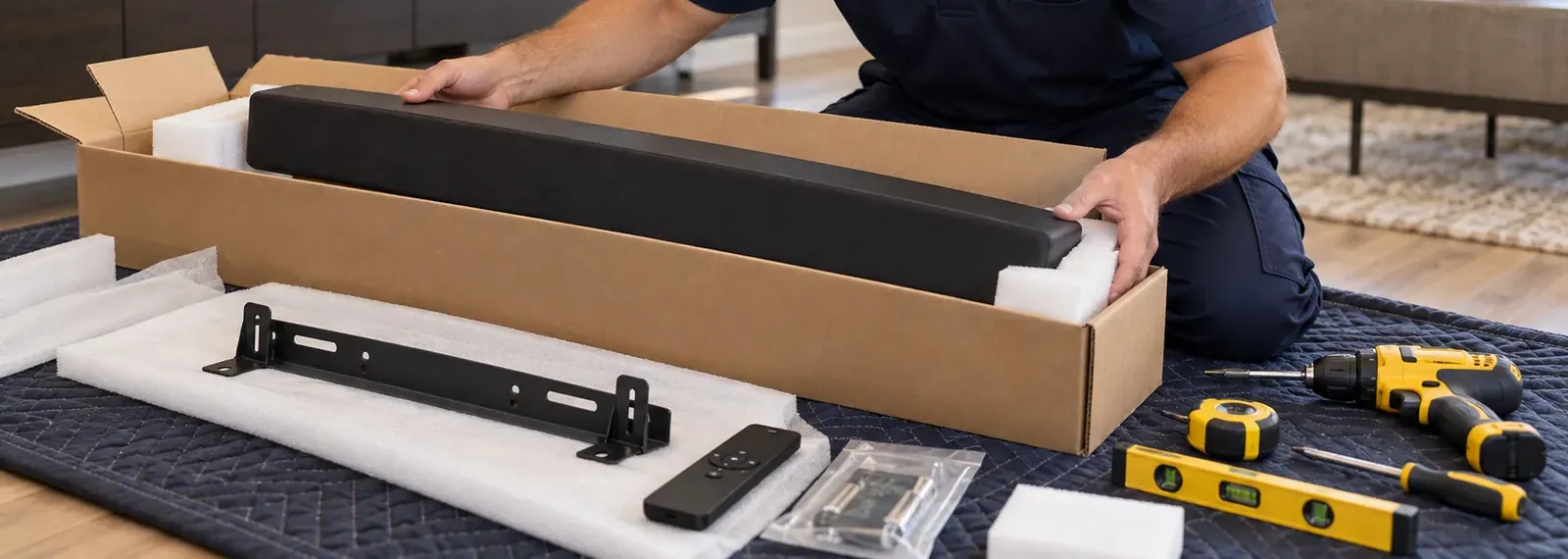
Black soundbar lifted from its cardboard carton on white foam, the wall bracket, a remote, a bag of screws, a drill, a tape measure and a yellow level laid on a navy moving blanket — Todt Hill Staten Island soundbar unboxing
Everything out of the carton and onto the blanket before the first hole. The screws in the little bag suit drywall over studs; on stone or concrete they are set aside for masonry anchors.
Commercial Soundbar Installation

Business Soundbar Installation on Todt Hill and Richmond Road

Todt Hill itself is almost entirely residential, but the institutions around it are not. The commercial and institutional rooms where a TV needs better sound sit along the edges of the hill and on Richmond Road below it. We install soundbars for offices, clubs, schools, places of worship and retreat centres, and the same price lines apply.

Richmond Road

The road that marks the border with Dongan Hills and carries every bus that serves the area: the S74, S76, S84, S86 and the SIM15 express. Offices, practices and shops along it have waiting rooms and staff rooms where a TV runs all day.

Clubs and Clubhouses

Richmond County Country Club, organised in 1888 and at its present Dongan Hills site since 1897, plays a course laid out in 1916 whose front nine climbs towards the summit. Club lounges and grill rooms are the kind of space where speech has to carry over conversation.

Schools

Staten Island Academy, founded in 1884, has its 14-acre Pre-K to 12 campus at 715 Todt Hill Road. Classrooms and meeting rooms with a single screen often need nothing more than a bar fixed at a sensible volume.

Retreat and Faith Buildings

The St. Francis Friary and Center for Spirituality at 500 Todt Hill Road, built as a seminary in 1928, and the chapels and halls nearby. Large rooms, hard floors, plaster or stone.

Home Offices

Plenty of Todt Hill businesses are run from a study in the house. A bar under a meeting screen there is priced exactly like a domestic install.

Property and Estate Managers

Houses run by a manager or a family office, where the work is booked by someone other than the owner and the invoice goes elsewhere. We work to whoever is named on the booking.

Compliance notes for business rooms

Two rules come up regularly. The first is the reach of wall-mounted objects in public circulation space under the ADA standards: things fixed to a wall between 27 and 80 inches above the floor should not project more than 4 inches into a walkway, which is why a TV and soundbar in a corridor or lobby usually go above 80 inches or into a recess. The second is noise. New York City’s noise code limits sound from commercial music that carries outside the premises, and a bar in a club room or office is very unlikely to approach that, but we set a sensible maximum volume where staff or members can reach the remote. We also supply a certificate of insurance free of charge when a club, school or landlord asks for one.

We are not the right people for a public-address system, a hearing loop or a full sound-reinforcement install in a hall. When a room needs one of those, the conversation moves to the AV team and a design visit.

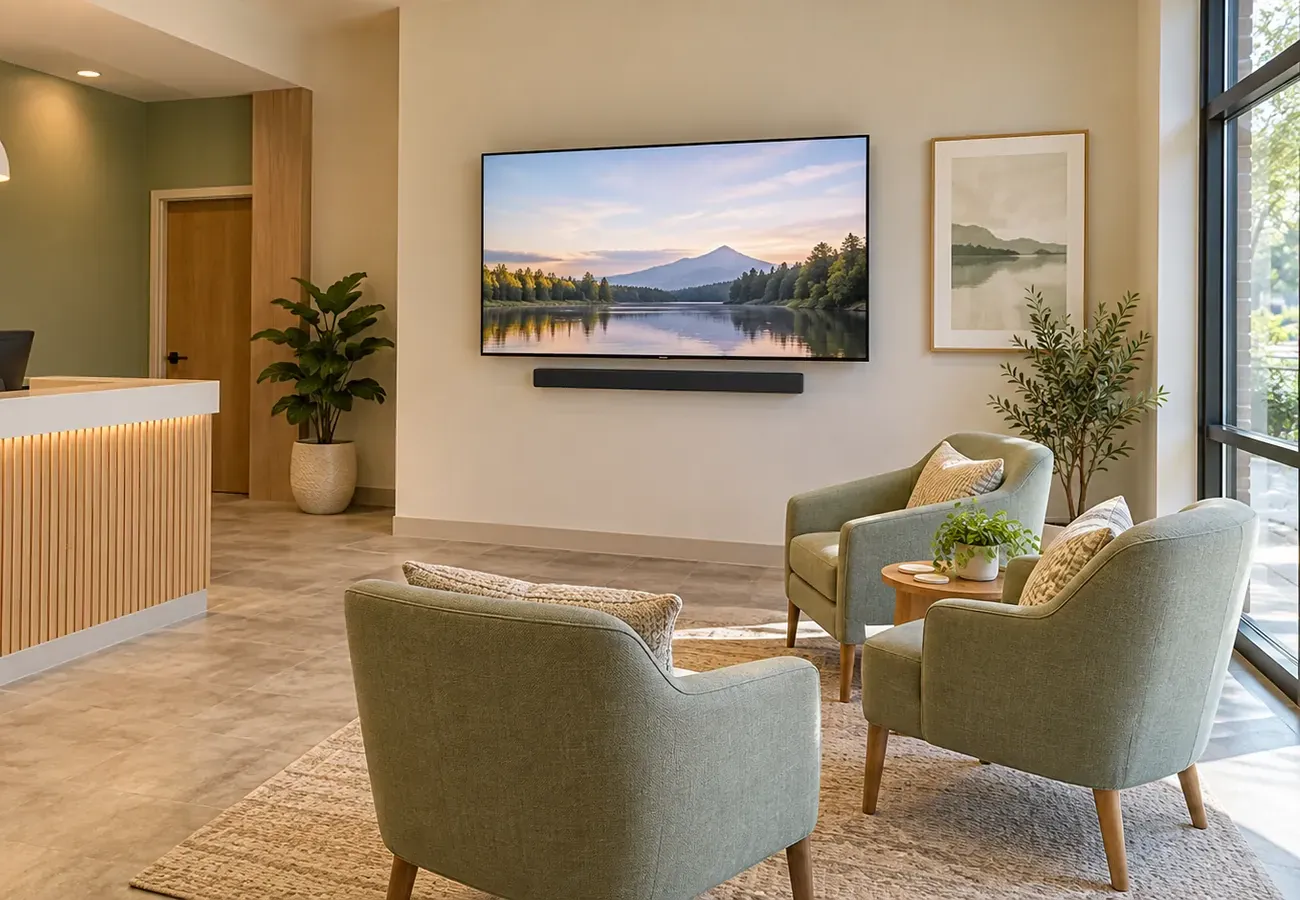
Wall-mounted TV above a slim black soundbar in a reception area with sage-green armchairs, a framed landscape print, a potted olive tree and tall windows, a reception desk at the left — Todt Hill Staten Island business soundbar
A waiting-area screen with the bar fixed directly beneath it. In business rooms we set a volume limit, label the input, and leave the remote where staff can find it.
Your Questions Answered

Soundbar Installation on Todt Hill: Questions Answered

These are the questions that come up on Todt Hill and rarely anywhere else: stone walls, very large rooms, houses that step down a slope, and apartments in the middle of a rebuild. Short questions about booking and payment are in the FAQ further down, and the Staten Island soundbar page covers hi-ranch block walls, stone-veneer fireplaces and townhouse party walls across the borough.

Stone, rubble and fabric-backed plaster

Our TV wall is Flagg-style stone with concrete poured behind it — what does the drill actually go into, and which anchor holds?

A wall built by Flagg’s mosaic-rubble method is three materials in one: hard, flat stone faces on the room side, mortar pointing between them, and a concrete backing that fills every gap behind the stones. Where the inside face has been plastered over, there is a fourth layer that is decoration only. Within the width of a typical soundbar bracket, the four or six holes may land in any of those, and each behaves differently. Serpentine and similar hard stone drill slowly and cleanly; pointing is softer and can crumble around a fast bit; the concrete backing is consistent and is usually the best material to anchor into.

So we map before we drill. The bracket is held up level, the hole positions are marked, and each mark is judged: stone, joint or concrete. Where we can move the bracket a few centimetres to put every hole in stone or concrete, we do. Where a hole has to fall in a joint, we go deeper so the anchor engages the concrete behind, and we use an anchor that doesn’t rely on expanding against crumbly mortar. The bit is new, sharp and kept cool, the hammer action is used gently, and dust is caught at the hole.

A soundbar is light compared with a TV, so the load is not the worry; the worry is a chipped stone face that you will see for the next fifty years. That is why the stone add on the price list (+$65) is there, and why, if a stone face looks fragile, we will suggest the TV-attached bracket so that the bar hangs from the TV mount and the wall is drilled only once.

A partition in our older house rang hollow when we tapped it, and the stud finder found nothing — could it be plaster on a fabric screen, and what holds a bracket then?

It could. The LPC records that Flagg’s published method for interior partitions used plaster on a jute or burlap screen instead of wooden lath, though it doesn’t say every house followed it, and other houses of that age used metal lath or early gypsum board. All three can fool an electronic stud finder. What they share is that the plaster is thin and the space behind it may have no wood where you’d expect a stud.

We find out with a small test hole behind where the bracket will sit, so the hole is hidden afterwards. If there is framing, we fix into it. If the partition is fabric- or mesh-backed with framing too far apart, a hollow-wall toggle won’t grip reliably and we don’t pretend it will. The answer is a plywood backer board ($85) screwed across the nearest framing members and painted to match, with the bar bracket fixed to that, or the TV-attached bracket, or console placement if the TV is on its stand.

Either way, you hear which one before we drill a second hole, and the price you agree is made of the published lines: $129 for the mount, $45 for plaster, $85 for a backer board if one is needed.

Very large rooms

Our great room has a conversation area near the TV and a second sofa across the room by the kitchen — can one bar serve both groups?

It can serve one of them properly and the other acceptably, and it is worth deciding in advance which is which. A soundbar’s room calibration measures from one place, usually where you hold the phone or the bar’s microphone picks up its test tones, and it tunes the bar for that seat. Sit twice as far away and you hear the same bar with more of the room mixed in: voices get softer relative to the music and effects, and bass from a subwoofer placed for the near seats may boom or vanish at the far ones.

Our usual approach is to calibrate for the main seating group, then walk to the second group and adjust the dialogue or voice setting until speech is clear there without being harsh up close. Many bars let you raise the centre channel or voice band independently of the overall volume, and that single control does more for a far sofa than turning everything up. Where the second group is used for watching as often as the first, a second pair of rear speakers is not an option on most bars, so the real fix is a speaker near that group — an in-ceiling or in-wall pair fed from a receiver — and that is a design job for our AV team rather than a soundbar job.

Tell us how the room is actually used. If the far sofa is for reading while the game is on, one bar tuned for the near seats is right. If it’s the family’s main seat on movie night, we plan around it instead.

One side of our great room is floor-to-ceiling glass and the other is a stone fireplace wall — will the bar sound lopsided?

It can, a little, and it is one of the more common complaints in big modern rooms. Glass and stone are both hard, but they sit at different distances from the bar and reflect differently, and an open kitchen on one side swallows sound that a solid wall on the other side throws back. The result is a sound image that leans: voices seem to come from slightly left or right of the screen, and effects that should travel across the room bunch up on one side.

Most of the cure is in setup rather than equipment. The bar should sit centred on the screen, not on the wall, and the main seat centred on the bar where the furniture allows. Room calibration from that seat corrects much of the imbalance, because the bar measures what actually reaches you. If the bar has rear speakers, we place them symmetrically about the seat rather than about the room, and set their levels separately. Soft furnishings help more than people expect: a large rug between the bar and the sofa and curtains that can close over part of the glass take the edge off the reflections.

What we can’t do is make a room with one glass wall sound like a room without it. If the imbalance still bothers you after calibration, the next step is acoustic treatment or a speaker layout designed for the room, which our AV team can quote separately.

We’re buying a large flagship bar to hang from the TV mount — is there a weight limit we should know about?

Yes, two of them. The TV-attached soundbar bracket has its own rated load, printed on its box and in its manual, and flagship bars with up-firing drivers and several woofers weigh noticeably more than compact ones. The second limit is the TV mount: whatever hangs from the TV is added to the TV’s weight, and on an articulating arm it also adds leverage, because the bar sits further from the wall when the arm is extended.

Before we book we check the bar’s weight against the bracket’s rating, and the TV plus bar against the mount’s rating. If either is close, we fix the bar to the wall on its own bracket instead, which takes it off the TV mount altogether. On a full-motion arm we also check that the bar clears the wall and furniture through the whole range of movement and that its cables have enough slack to follow.

The Sanus bracket we supply is $84.99. If you’ve bought another TV-attached bracket, we’ll use it if it’s rated for your bar and fits your TV’s mounting pattern; if it isn’t, we’ll tell you before the bar goes on it.

All our boxes live in a closet more than 25 feet from the TV — what happens beyond the 25-foot line on your price list?

The published cable-run line is $99 for up to 25 feet, and that is all the price list covers. Beyond 25 feet two things change. The route usually needs more work — through a basement ceiling, along a different floor, around a stair — and an ordinary passive HDMI cable may not carry a 4K signal reliably that far. Longer runs normally need an active or fibre-optic HDMI cable, which is designed for distance and has a direction marked on it.

Because none of that is on the published list, we don’t guess a price on the phone. We ask for photos of both ends and a description of the route, and send you in writing either a plan that uses the published lines (for example two runs to an intermediate cabinet) or a statement that this part of the job needs a site visit. Nothing is charged that you haven’t seen in writing first.

Often there is a simpler answer: move only the streaming box to the TV wall and leave the rest in the closet. The bar needs one HDMI connection, to the TV’s eARC or ARC port; everything else can feed the TV wherever it sits.

We have TVs in six rooms — which of them actually need a soundbar, and which are fine on their own speakers?

Most houses don’t need six bars. A useful test is how the room is watched. Rooms where people sit for films, sport or long evenings — the family room, the lower-level den, often the primary bedroom — repay a good bar, because thin TV speakers are what makes dialogue hard to follow. Rooms where the TV is background — a kitchen, a gym, a guest room used a few nights a year — often do fine with the TV’s own speakers, or with a compact bar on the console for $79 if speech is hard to hear there.

Two further questions decide it. Does anyone in the household have trouble following speech? Then the rooms that person uses come first, and a bar with a good voice-enhancement mode is worth more than one with the biggest bass. And does the household want music in several rooms at once? Then it may be better to choose bars from one maker’s system so they can be grouped, and to plan the rooms together rather than one at a time.

We price each room on its own line, so you can do the important rooms now and the others later without paying for a plan you won’t use.

Houses that step down the slope

Our walk-out lower level is underground on the uphill side and opens to the garden on the downhill side — which wall should carry the TV and bar?

Usually the uphill wall, but for reasons of light as much as sound. The downhill side is where the windows and doors are, and a TV facing them will reflect the garden all afternoon; a TV on that side faces the dark end of the room and the viewers face the glare. The uphill wall is solid, faces the light, and puts the seating with its back to the view, which most families accept for a TV room.

The catch is what the uphill wall is made of. On a slope like this it is often poured concrete or block, holding back the hill, sometimes with a framed and drywalled finish wall a few inches in front of it. If there is a finish wall, the bracket goes into its framing and we stay clear of the concrete. If the TV wall is bare or painted masonry, we anchor into it (+$75) and run the cables on the surface in a paintable cord cover ($59), because there is no cavity to hide them in. We don’t drill deep into a wall holding back earth just to bury a cable.

For sound, the uphill wall is also the better choice: hard concrete behind the bar gives a solid, even base, and the open garden side of the room behind the seats lets the sound out rather than bouncing it back.

Our subwoofer seems to boom in the upstairs bedrooms through the heating ducts — is that possible, and what can be done?

It is possible. Forced-air ducts are long sheet-metal tubes that connect rooms on different floors, and low bass travels along them with little loss. A subwoofer placed close to a floor or wall register, or in a lower-level room whose return duct runs straight up to the bedrooms, can make the bedrooms hear more bass than the rooms in between.

The first step is placement. We move the subwoofer away from any register or return grille and try two or three spots, listening upstairs as well as in the room. The second step is level: subwoofers are very often set too high after unboxing, and turning the sub down a few steps relative to the bar, together with the bar’s night mode in the evening, solves most cases. The third step, if you want it, is a heating contractor’s job — flexible duct sections or duct liners can reduce sound travelling through the system — and we’ll tell you if we think it’s worth asking about.

What we don’t recommend is blocking a register with the subwoofer or with furniture to stop the sound. That stops the heating and cooling too.

The lower-level TV hangs on the end wall of the games room, past the pool table — will the bar get knocked by cues, and will anyone at the sofa hear it?

Both are fair worries. A pool cue on the backswing reaches well beyond the end of the table, and a bar mounted at ordinary height under a TV on the end wall can sit right in its path. We measure from the cushion to the wall before deciding the height. Where the gap is tight, the bar goes higher, tight under the TV on its own bracket, or on a TV-attached bracket so it sits within the TV’s footprint; the screen itself usually needs to go up anyway so players can see over the table.

Raising the bar helps the cue problem and hurts the sound a little, because the drivers point over the heads of seated viewers. Most bars cope with a modest height if the calibration is run from the sofa, and a bar with a good voice mode keeps speech clear. If the seating is at the far end of the room, past the table, we can place the subwoofer and any rear speakers near the sofa so the sound doesn’t have to cross the table at all.

The price is the ordinary mount ($129) plus whatever the wall is — lower-level end walls on the hill are often concrete (+$75) — and the high-mount line ($75) only if the bar ends up above about 8 feet.

Networks in large houses

Our mesh Wi-Fi has a node in the TV cabinet — can it sit right next to the soundbar and subwoofer, or will they fight each other?

They can share the cabinet, but placement inside it matters. Many soundbars link to their subwoofer and wireless rear speakers by their own radio connection, and mesh nodes are busy radios too. Packed tightly behind a cabinet door, with a cable box and a games console adding heat and their own electronics, the links can drop out when everything is busy.

We keep the node at the front or top of the cabinet with its antennas clear, at least a hand’s width from the bar’s wireless hub if it has one, and we leave the cabinet ventilated. If the house has wired network points, the bar and the node can both use them; a wired connection to the bar takes its streaming off the wireless network entirely and leaves more room for the sub and rears. Where the node can sit on a shelf outside the cabinet, that is better still.

If your network itself is the weak point — dead spots at the far end of a long house, a lower level the signal never reaches — our Staten Island network installers can run cable to the TV wall or add access points, and the soundbar visit can follow.

Apartments at the foot of the hill

We’ve just moved back into our modernised Todt Hill Houses apartment — how do we choose the TV wall now that the outlets and layout have changed?

Start with the outlets, not the furniture. NYCHA’s presentation to Todt Hill residents recorded requests for more outlets and lights in the apartments, and the modernisation includes full electrical upgrades, so the outlets in a renovated apartment may not be where they were. A TV and soundbar want one outlet close behind or below the screen; a wall without one means a long cord across the floor, and moving an outlet is an electrician’s job, not ours.

Next, light. The renovation includes new windows, and a TV facing a window will show reflections all afternoon. The best TV wall in most of these living rooms is the one the window faces, with the outlet nearest to it. Then ask management whether wall mounting is allowed on the new finishes before anything is drilled; we don’t drill a NYCHA wall without the resident confirming that. If the answer is no, or not yet, the bar goes on the TV stand for $79 and works exactly the same.

If the wall is allowed and turns out to be masonry, the mount is $129 plus $75, with the cable in a $59 cord cover so nothing is cut into the new walls. Keep the bar’s box and bracket from before the move; a missing bracket is the most common snag after a relocation.
Equipment

Types of Soundbars and Mounts We Install

We install the bar you have chosen, from any maker, and we’ll tell you honestly if it’s the wrong size for the room. These are the kinds of equipment we fit most often on the hill, and where each one belongs.

Compact Bars

Short bars of around two feet for bedrooms, studies, kitchens and apartment living rooms. They sit on a console or under a 43- to 55-inch screen and rarely need a subwoofer in a small room.

Full-Width Bars with Subwoofer

The standard family-room package. The bar carries dialogue and effects; the wireless sub does the low end and goes where the room and the floors above it allow.

Flagship Bars with Height Channels

Bars with up-firing drivers for Dolby Atmos and similar formats. Excellent under a flat ceiling of ordinary height; less effective under a cathedral ceiling, as explained above.

Wireless Rear Speakers

Paired to the bar and powered from a nearby outlet. In deep rooms where the sofa floats, they stand on floor stands; against a back wall, on small brackets.

Sonos Systems

Sonos bars, Sub and rears paired, grouped and named in the app, with other rooms added for music. Sonos setup is a separate $125 line.

Receiver-Based Systems

Where a room has outgrown a bar, an A/V receiver ($129 to connect) with in-wall, in-ceiling or floor-standing speakers. We connect and configure; the speaker installation itself is designed with our AV team.

Wall Brackets

The bracket from the soundbar box, or the Sanus bracket we supply for $84.99 when the box bracket is missing, flimsy or wrong for the wall.

TV-Attached Brackets

Clamps or arms that hang the bar from the TV mount’s uprights, so the bar follows a swivel arm or saves drilling a second set of holes in stone.

Concealment

In-wall power-and-HDMI kits ($169) for clear stud bays, paintable cord covers ($59) for masonry, and cable runs to cabinets ($99 for up to 25 feet).

HDMI eARC, ARC and optical: which connection your TV offers

The best connection is HDMI eARC: the TV sends the sound from every source — its own apps, the cable box, a streamer or a console — to the bar over one cable, including lossless and object-based formats, and the TV remote controls the bar’s volume through HDMI-CEC. Ordinary ARC does nearly the same job but carries compressed formats only. Optical is the fallback for older TVs: it carries sound reliably but not the newest formats, and usually needs the bar’s own remote or a learning setting for volume. We check which port is which before connecting, because on many TVs only one of the HDMI inputs supports eARC, and plugging the bar into the wrong one is the most common reason a new bar sits silent.

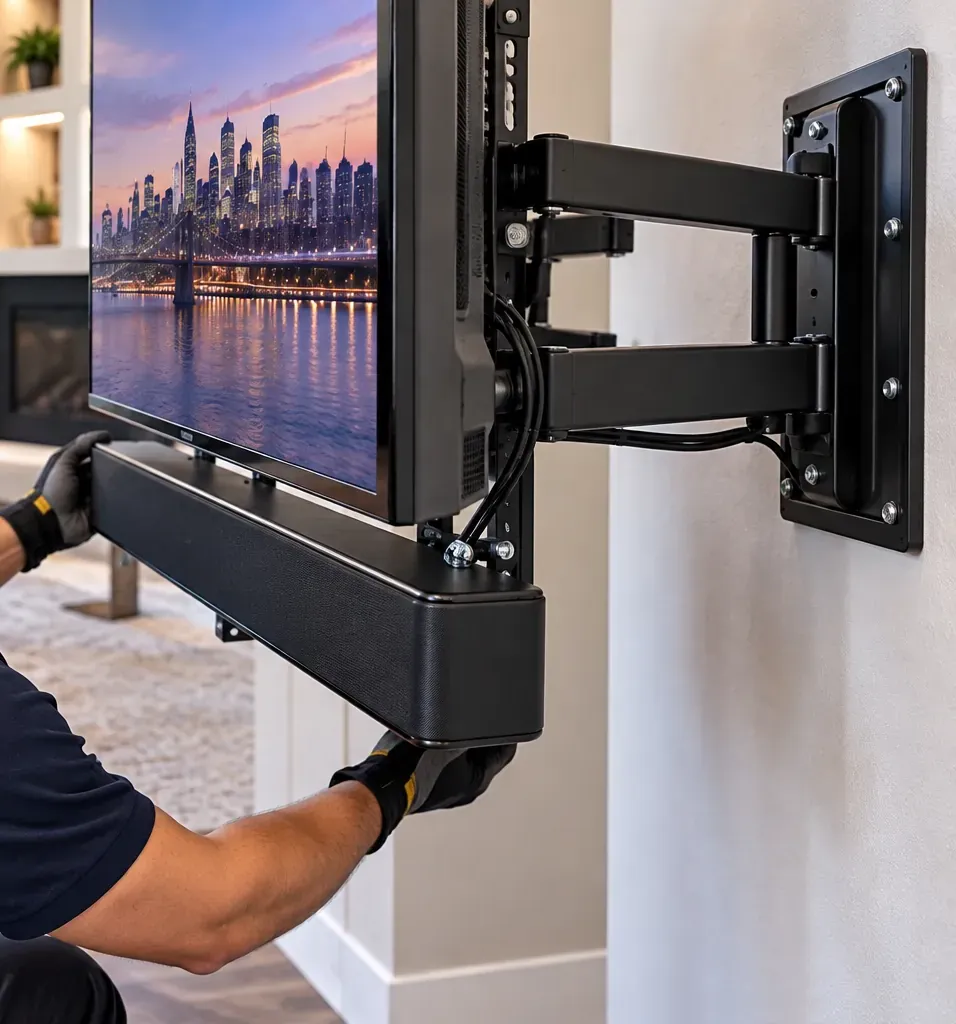
Gloved hands fitting a long black soundbar to a bracket hanging beneath a TV on an extended articulating wall arm against a pale grey wall — Todt Hill Staten Island TV-attached soundbar
A TV-attached bracket on a full-motion arm: the bar swings with the screen. The arm’s rating has to cover the TV and the bar together, which we check before booking.
AI Overview Reality Check

What AI Gets Wrong About Soundbar Installation on Todt Hill

Search summaries and cost sites are useful for the basics, but they average out the whole country. Here are seven claims that turn up in AI answers and national cost guides, and how they look from a Todt Hill living room. Where a claim comes from a named site, we say so; we couldn’t capture the exact AI Overview text in our build environment, so the claims below are paraphrased as they commonly appear.

“A soundbar is plug and play — anyone can install one in fifteen minutes”

On a console in front of a TV on its feet, that is close to true, and we say so: the $79 console line exists because it is a short job. The claim stops being true the moment the bar goes on a wall, and on Todt Hill the wall is often the problem. A drill that meets a serpentine face backed by concrete, or a plaster partition with fabric behind it, is not a fifteen-minute task for anyone.

The national guides that quote short install times are describing drywall over studs, which is the common case across the country. On the hill it is common too, but not universal, and the uncommon walls are exactly the ones where a rushed hole becomes a chipped stone or a bracket that pulls out of plaster in a year.

Our price list separates the two. The labour line covers the ordinary wall; the add-on lines for stone (+$65), concrete or block (+$75), plaster (+$45) and backer board ($85) cover the walls that take longer, and you see them before the job starts.

“Bigger room? Just buy a bigger soundbar”

A bigger bar helps up to a point. A flagship bar plays louder, wider and lower than a compact one, and in a family room of ordinary size it makes a real difference. But in a great room where the seats are fifteen or twenty feet back, the limit is not the bar’s size; it is that all the sound starts from one spot under the screen and reaches you after bouncing around a large, hard room.

That is why the answer for the biggest Todt Hill rooms is usually not “bigger” but “closer”: rear speakers on stands near the seats, a subwoofer placed for the listening position, and the voice setting raised. In the very largest rooms, or rooms with two seating zones, the answer is speakers in the ceiling over the far seats, which is no longer a soundbar job at all.

We would rather tell you that before you buy than after. Send us the room’s rough dimensions and the bar you’re considering, and we’ll say plainly whether it will carry.

“Soundbar installation costs $100 to $300”

National cost sites such as Angi, HomeAdvisor and Fixr publish ranges in that region for a basic wall mount, and for drywall over studs our own line, $129, sits inside it. The range quietly assumes the cheapest wall and no extras. It doesn’t include a bracket, a stone or concrete wall, cable concealment, a long run to a closet, rear speakers or calibration.

On Todt Hill, where many jobs involve at least one of those, an honest total is the sum of several lines. A bar on Flagg-style stone on the Sanus bracket is $129 + $84.99 + $65 = $278.99. A great-room system with in-wall wiring, full home theater hookup and a universal remote adds up to $831.99, shown line by line in the packages below.

The useful thing about a published line-by-line list is that you can do the arithmetic yourself, and you can see which lines you could skip. A cost site’s range can’t tell you that.

“Hide the wires by running them inside the wall — it’s always possible”

In a drywall stud bay with nothing in the way, an in-wall kit is a tidy job, and we fit plenty of them on the hill for $169. But “always” is wrong. A mosaic-rubble wall has no cavity at all. A poured lower-level wall holding back the slope has no cavity either, and drilling deep channels into it to bury a cable is not something we’ll do. Some older partitions are full of blocking, old wiring or insulation that shouldn’t be disturbed.

For those walls the tidy answer is on the surface: a slim paintable cord cover ($59) painted to the wall colour, run into the corner of a reveal or down beside a trim line, or a cable run along the baseboard to a cabinet ($99 up to 25 feet). Done carefully, it’s barely visible from the sofa.

We tell you which kind of wall you have before booking, from your photos, and confirm it with a look and sometimes a test hole when we arrive.

“Ring, ADT or SimpliSafe can add the TV sound when they install your smart home”

National security brands sell alarms, cameras and doorbells, and some bundle smart-home devices. They don’t mount soundbars, and their installers aren’t sent to configure eARC or calibrate a subwoofer. If you already have one of those systems, nothing about it changes when a bar goes in; the bar sits on your Wi-Fi like any other device.

Where integration is genuinely useful — the TV and bar switching on with a scene, or a doorbell chime announced in the family room — it depends on the bar’s own app and voice assistant, not on the alarm company. We set up what the bar supports and leave the security system alone.

For households who want one company for both, AESS also installs cameras, access control and smart locks; those are separate services with their own pages and prices.

“Every room in a big house should get the same soundbar”

Some summaries recommend picking one model and repeating it in every room for simplicity. Matching makes sense where you want multi-room music from one app, because bars from the same maker group together easily. It makes less sense as a sound decision: the bar that suits a 25-foot great room is wasted, and often too big physically, under a 50-inch bedroom TV, and the compact bar that suits the bedroom will struggle downstairs.

Our advice is to choose a family of products if multi-room music matters, then choose the size within that family for each room. A house might have a flagship bar with rears in the family room, a mid-size bar in the lower level and compact bars in two bedrooms, all in one app.

Each room is priced on its own line, so mixing sizes doesn’t change the arithmetic.

“A landmarked house means the Commission must sign off on any drilling at all”

Not quite. The Landmarks Preservation Commission says a permit for interior work is needed when the work requires a Department of Buildings permit, when it affects the exterior, or when the interior is a designated interior landmark. Ordinary repairs and maintenance need no LPC permit. A soundbar fixed to an inside wall of an individually landmarked house typically touches none of those triggers.

Where the claim is right is on the outside. A speaker on a terrace wall, a cable through a stone wall to a garden TV or anything fixed to a landmarked facade needs checking with the Commission first. If any part of your job goes outside, we hold that part until you have the Commission’s answer.

None of this is legal advice; it is our reading of the LPC’s own published guidance, and the Commission’s staff are the people to ask in a doubtful case.

Sized for the Room, Fixed to the Real Wall

Tell us how far you sit from the screen and what the wall is made of. We’ll tell you whether the bar will carry, and what the job adds up to, before anyone drives up the hill.

Full Service List

Every Soundbar Installation Service We Handle in Todt Hill, Staten Island

On Staten Island, soundbar jobs come mostly from single-family homes, finished basements and family rooms, plus local restaurants and shops. Soundbar installation, or sound bar installation as some people write it, is more than hanging a bar under the TV.

Soundbar Mounting and Brackets in Todt Hill, Staten Island

Our soundbar installation services in Todt Hill, Staten Island start with the mount. As a soundbar installer, we handle soundbar mounting, sound bar mounting and soundbar wall mounting with the bracket that came in the box or a better one. Soundbar wall mount installation, soundbar wall bracket installation, soundbar bracket installation and soundbar mounting hardware installation are all part of a standard visit, and soundbar mounting bracket replacement or soundbar mounting hardware replacement fixes a bar that sags or came with the wrong hardware. Staten Island homes usually have drywall over wood studs, which makes for a solid stud mount.

Every professional soundbar installation follows the same steps: soundbar unboxing and installation, soundbar equipment inspection, soundbar bracket measurement and soundbar wall measurement, then soundbar mounting preparation. We do soundbar stud mounting and soundbar mounting to wall studs wherever the studs line up, and soundbar wall anchor installation rated for the bar's weight where they don't. Soundbar bracket leveling, soundbar installation with level, soundbar mounting alignment, soundbar mounting height adjustment and soundbar mounting position adjustment keep it centered and straight.

Soundbar and TV Mount Installation

Most bars go with a TV. We do soundbar mounted below TV, soundbar mounted under TV and soundbar mounted above TV layouts, as well as soundbar mounting to television brackets and soundbar attached to TV mount kits that move with the screen. TV and soundbar installation in one visit, TV mounting with soundbar, soundbar TV mount installation and soundbar installation with TV mounting save a second trip.

Already have a TV up? Soundbar installation on existing TV setups is common, including soundbar installation under wall mounted TV, soundbar installation on articulating TV mount, soundbar installation on swivel TV mount, soundbar installation on full motion TV mount, soundbar installation on fixed TV mount and soundbar installation on tilting TV mount. We also handle soundbar installation with smart TV, soundbar installation with OLED TV, soundbar installation with QLED TV, soundbar installation with LED TV and soundbar installation with projector screens.

Every Wall Type, Including Fireplaces

Soundbar installation on drywall, soundbar installation on plaster wall, soundbar installation on brick wall, soundbar installation on concrete wall and soundbar installation on stone wall each need different anchors and drill bits, and we bring them all. Soundbar installation on fireplace wall layouts include soundbar installation above fireplace and soundbar installation below fireplace mounted TV, with the bar kept clear of heat. Staten Island family rooms often have a fireplace or stone accent wall where the TV and bar go.

Homes, Apartments and Businesses

Residential soundbar installation covers soundbar installation in living room, soundbar installation in bedroom, soundbar installation in home theater, soundbar installation in apartment and soundbar installation in condominium spaces. We do soundbar installation for luxury homes, soundbar installation for apartments, soundbar installation for home offices, soundbar installation for media rooms and soundbar installation for home cinema alike. Staten Island basements and family rooms are where most home theater and media room setups end up.

Commercial soundbar installation includes soundbar installation in office, soundbar installation in conference room, soundbar installation in restaurant, soundbar installation in retail store and soundbar installation in commercial space. Soundbar installation for businesses and soundbar installation for conference rooms usually means making sure the bar works with the room's TV, video calls and remotes.

Connections, Setup and Remotes

Soundbar HDMI installation is the best connection for most TVs. Soundbar HDMI ARC setup and soundbar HDMI eARC setup, or an HDMI ARC soundbar connection or HDMI eARC soundbar connection, let the TV remote control the bar through soundbar CEC configuration. Where HDMI isn't an option, soundbar optical cable installation and soundbar optical audio setup give a solid soundbar digital audio connection.

Wireless soundbar installation, wired soundbar installation, soundbar Bluetooth setup and soundbar WiFi setup are matched to the bar and the room. Soundbar TV audio connection and soundbar audio output configuration make sure sound comes out of the bar, not the TV speakers. Soundbar TV remote programming, soundbar universal remote setup, soundbar volume control setup, soundbar synchronization setup and soundbar lip sync adjustment finish the setup.

Subwoofers, Surround and Sound Tuning

Soundbar and subwoofer installation, soundbar surround sound installation, wireless subwoofer setup, wireless surround speaker setup and soundbar rear speaker installation turn a bar into a full system. Soundbar subwoofer pairing and soundbar speaker placement are done in the room, not guessed.

Dolby Atmos soundbar installation and Dolby Atmos soundbar setup, Dolby Digital soundbar setup and DTS soundbar configuration get the right audio format from each source. Soundbar audio calibration, soundbar sound optimization, soundbar dialogue enhancement setup and soundbar bass adjustment make voices clear and keep bass from shaking the neighbors. That's home theater soundbar installation, home entertainment soundbar setup and soundbar home theater integration done properly.

Hidden Wires and Clean Finishes

Soundbar cable concealment, soundbar wire concealment and soundbar hidden wire installation are what make the job look finished. Soundbar in wall cable management uses low-voltage in-wall kits where the wall allows, and soundbar cable cover installation, soundbar raceway installation and soundbar wire molding installation work where it doesn't. Soundbar cable routing, soundbar cable organization, soundbar cord hiding, soundbar power connection installation and soundbar power cable management keep the cords out of sight. Staten Island homeowners can often run wires in the wall behind the TV, giving the cleanest finish.

The result is soundbar installation with concealed cables, soundbar installation without visible wires, soundbar installation with hidden connections and soundbar installation with clean finish. If a new outlet is needed behind the TV, we handle soundbar power outlet installation coordination with your licensed electrician, since we don't do electrical work ourselves.

Media Consoles, Devices and Brands

Not every bar goes on the wall. Soundbar installation with media console, soundbar installation inside entertainment center, soundbar installation above media cabinet, soundbar installation with TV cabinet, soundbar installation below floating TV and soundbar installation with floating entertainment center are all common. Soundbar connection inside media cabinet and soundbar cable management inside console keep everything tidy.

We connect everything around it: soundbar installation with cable box, soundbar installation with streaming device, soundbar installation with Apple TV, soundbar installation with Roku, soundbar installation with Fire TV and soundbar installation with gaming console.

We install every major brand: Samsung soundbar installation, LG soundbar installation, Sony soundbar installation, Bose soundbar installation, Sonos soundbar installation, JBL soundbar installation, Vizio soundbar installation, Polk soundbar installation, Yamaha soundbar installation, Sennheiser soundbar installation and Klipsch soundbar installation. That includes Samsung Q Symphony soundbar setup, LG WOW Orchestra soundbar setup, Sonos Arc installation, Sonos Beam installation, Bose Smart Soundbar installation and Sony Bravia Theatre soundbar installation.

Troubleshooting, Moves and Upgrades

Soundbar not working repair starts with soundbar connection troubleshooting. Soundbar no sound troubleshooting, soundbar HDMI ARC troubleshooting, soundbar eARC troubleshooting, soundbar optical connection troubleshooting, soundbar Bluetooth troubleshooting, soundbar wireless connection repair, soundbar audio delay troubleshooting and soundbar TV compatibility troubleshooting find whether it's the cable, the settings or the TV.

Soundbar relocation service, soundbar remounting service and soundbar removal and reinstallation handle moves and new TVs. Soundbar installation upgrade and soundbar replacement installation swap an old bar for a new one, and soundbar installation troubleshooting fixes a job someone else started.

Tested Before We Leave

Every job ends with soundbar installation and testing: soundbar audio testing, soundbar final system testing and a soundbar installation quality check with you in the room.

Beyond the bar, we handle TV sound system installation, TV audio system installation, home audio installation, home theater audio installation, audio video installation and AV installation services as a low voltage audio installation contractor. If you've been searching for soundbar installation near me in Todt Hill, Staten Island, we're a soundbar installation company and soundbar installation contractor offering professional TV audio setup and soundbar mounting service across the whole area. Customers find us searching for soundbar installation NYC, soundbar installation Manhattan, soundbar installation Brooklyn, soundbar installation Queens, soundbar installation Bronx, soundbar installation Staten Island, soundbar installation Long Island, soundbar installation Nassau County, soundbar installation Suffolk County, soundbar installation Westchester County, soundbar installation Rockland County and soundbar installation Hudson Valley.

Get In Touch

Request a Free Quote

A stone cottage off Flagg Place, a great room on a private lane or an apartment near Manor Road: describe the room, the wall and the bar, and a written figure comes back before the working day ends. Prefer to talk? Call (347) 934-8335.

✅

We Got Your Request!

A technician or the office will phone you back today. In a hurry? Ring (347) 934-8335.

How It Works

Our Installation Process

The same sequence runs for a two-foot bar in an apartment off Manor Road and for a full surround system in a 25-foot family room; only the time each step takes changes.

1. Describe the room and send photos

Bar and TV models, the rough size of the room and the distance from the sofa to the screen, a photo of the TV wall and one of where the cable box and router live. Mention stone, a concrete lower-level wall or anything that sounded hollow.

2. Get a written price

The figure is the sum of published lines: mount, bracket, any wall add-on, concealment, setup. Anything outside the list, such as a cable run longer than 25 feet, is described in writing before you book.

3. Pick a two-hour window

Windows start between 8 AM and 8 PM on any day. Tell us about a gate, a private lane or a long drive, and who will let the technician in.

4. Map the wall

The bracket is held up level and every hole is marked. Plaster gets a hidden test hole first; on rubble walls each mark is judged as stone face, joint or concrete. You sit in your usual seat while we settle the height.

5. Fix the bracket and route the cables

Screws into framing, anchors into masonry or a backer board where framing is sparse. In-wall kits only in clear stud bays; cord covers or cabinet runs everywhere else.

6. Connect and place

The bar goes on the TV’s eARC or ARC port with HDMI-CEC on. The subwoofer and rears are placed for the main seats, away from registers and clear of heated-floor tubing, and every plug goes to one surge strip.

7. Tune for the listener and hand over

The bar’s room-correction routine is run with the microphone at the main sofa. We then walk to any far seats and adjust the voice level, switch on night mode for late viewing, check lip-sync with a test clip, show you the remote, and vacuum the work area.

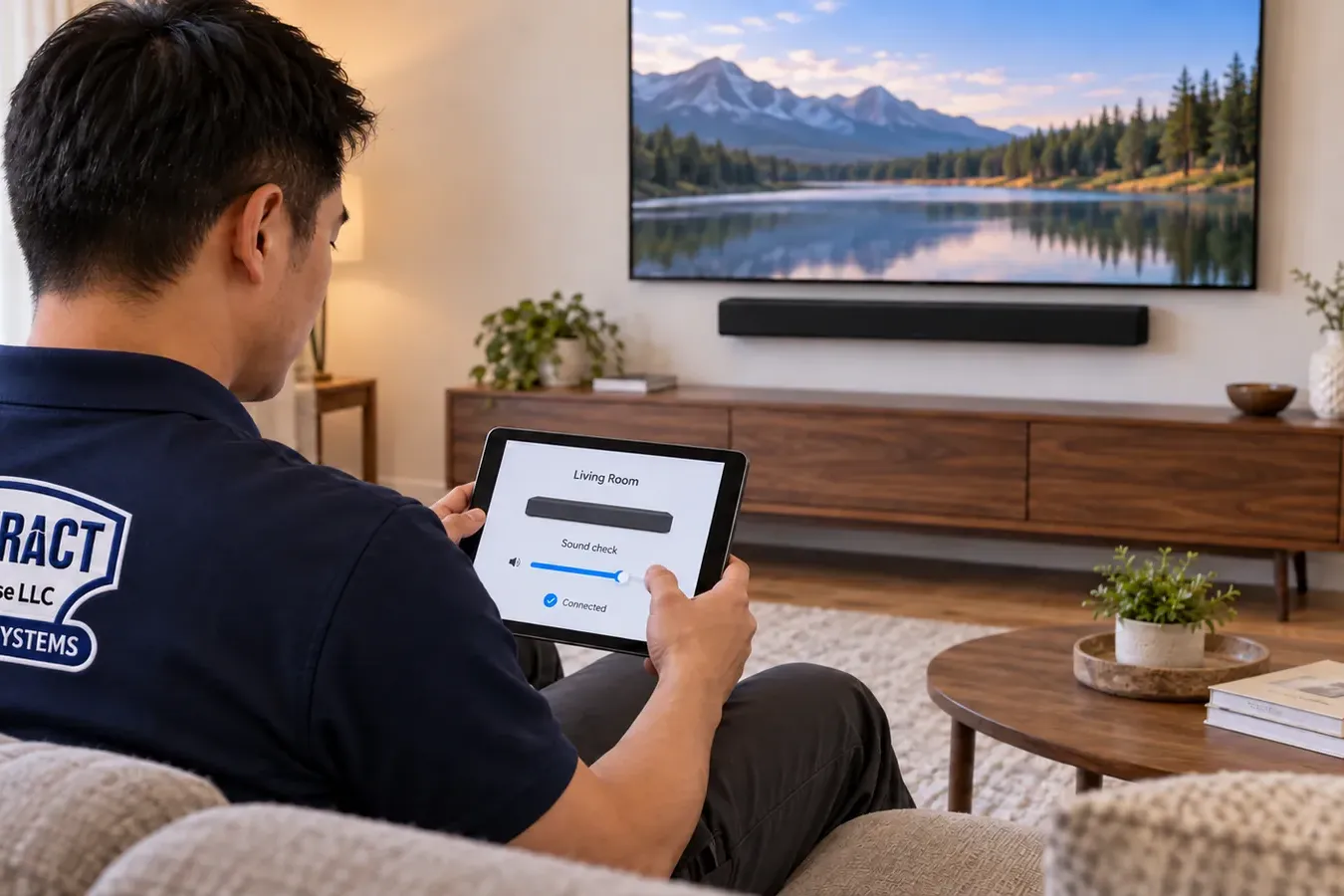
Technician seen from behind on a sofa holding a tablet showing a Living Room sound-check screen, a wall-mounted TV and soundbar above a walnut console on the far wall — Todt Hill Staten Island soundbar calibration
Calibration is run from the seat, not from the doorway. In a deep room the difference between the two can be the difference between clear voices and muddy ones.
Coverage Area

Soundbar Installation Near Todt Hill’s Landmarks

We work on every street on the hill and around it, from the estate lanes off Todt Hill Road to the apartment blocks near Manor Road and the houses along Richmond Road. These six places mark out the neighbourhood.

The Summit and Highest Point Pond

The top of the hill near Todt Hill Road and Merrick Avenue, 409.8 feet by the LPC’s figure. Forgotten New York notes a small kettle pond near Todt Hill Road and Ocean Terrace, the WSIA 88.9 FM tower of the College of Staten Island at the summit, and the outlook Jasper Cropsey painted in 1895 as Looking Oceanward from Todt Hill.

Staten Island Greenbelt

2,800 acres of woodland and trails wrapped around the hill, the second-largest park in the city. Its Nature Center is at 700 Rockland Avenue, and Moses Mountain — renamed Paulo’s Peak in 2021 — is a 200-foot mound of rock dug out for a highway that was never built, with a 360-degree view of the island.

Ernest Flagg’s Stone Court and Cottages

Flagg’s estate on the scarp above Richmond Road, with the mansion, gatehouse and the small mosaic-rubble cottages, several of them individual landmarks: Bowcot, Wallcot at 285 Flagg Place, and the McCall’s Demonstration House at 1929 Richmond Road.

Moravian Cemetery

113 acres at 2205 Richmond Road at the foot of the hill, with the Vanderbilt family mausoleum by Richard Morris Hunt (1885–86) and grounds by Frederick Law Olmsted. Parts of the cemetery became a city landmark in 2016.

Richmond County Country Club and Staten Island Academy

The club, organised in 1888, on its Dongan Hills grounds since 1897; and the Academy, founded in 1884, on its 14-acre campus at 715 Todt Hill Road.

Todt Hill Houses

Seven six-storey buildings between Laguardia Avenue and Manor Road and between Schmidts Lane and Westwood Avenue, completed in 1950 and now under a full modernisation.

We also serve the hillside neighbourhoods around Todt Hill: Dongan Hills and Emerson Hill to the east, Lighthouse Hill to the south, Manor Heights, Castleton Corners and Westerleigh to the north, and Willowbrook to the west. All are covered by the soundbar installation page for Staten Island and the same prices.

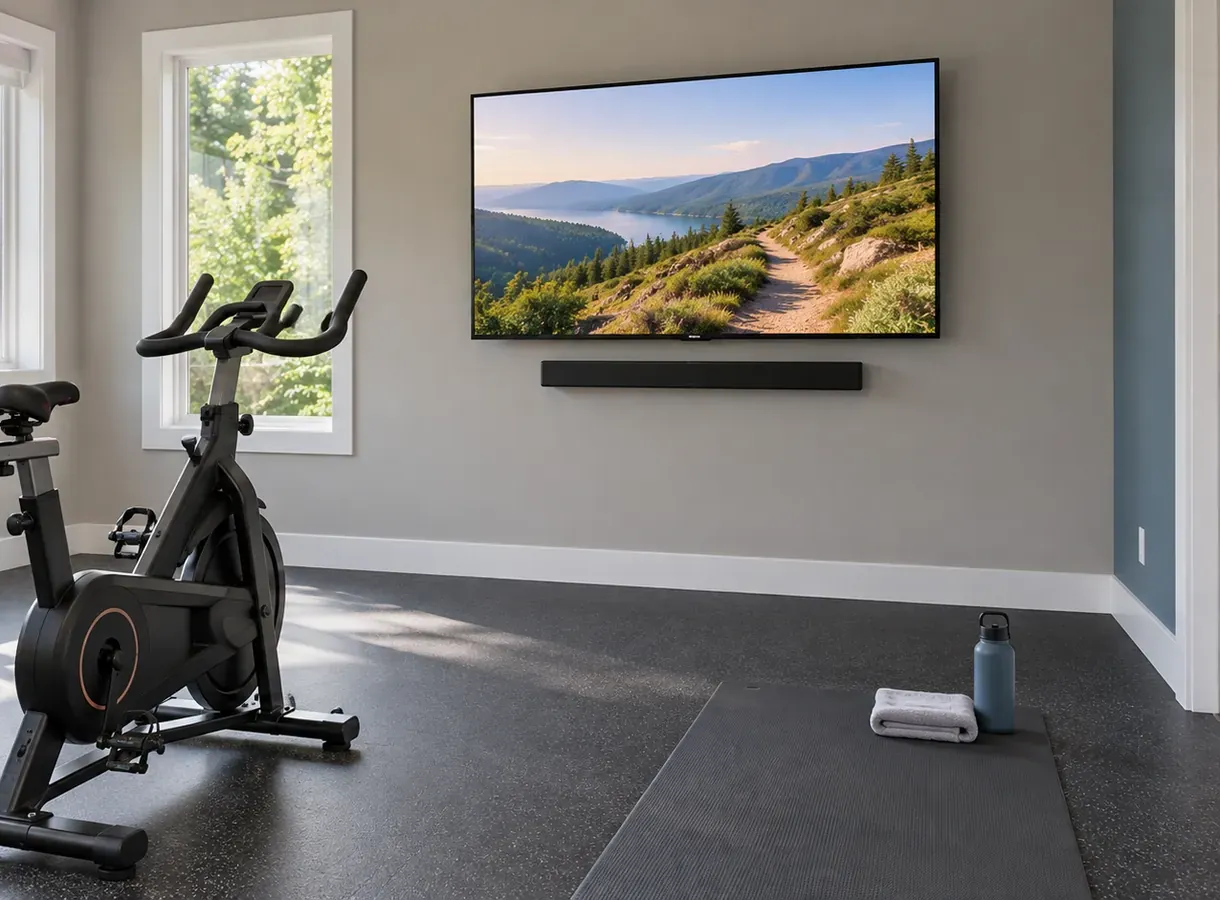
Exercise room with a large wall-mounted TV showing a hillside trail and a slim soundbar below it, an exercise bike, a dumbbell rack edge, rubber flooring and two tall windows onto trees — Todt Hill Staten Island home gym soundbar
A home gym with the bar under the screen. In rooms like this the TV is usually background, so a slim bar fixed at a set volume is plenty.
Pricing

Soundbar Installation Cost on Todt Hill

Todt Hill addresses pay the Staten Island rates, whatever the size of the house. The soundbar lines are the same dollar amounts in every borough; only the TV-mounting base and the hourly setup rate change by area. Pick the rows that describe your room and add them up. If the wall turns out to be different from the one booked, the new total is shown to you and agreed before anything is drilled.

Soundbar price lines for Todt Hill, Staten Island
Item Price Where it comes up on the hill
Soundbar placed on a console or stand $79 Bedrooms, guest rooms, apartments, temporary moves
Soundbar wall-mounted under the TV $129 Family rooms, great rooms, lower levels, studies
Sanus soundbar bracket $84.99 Missing or flimsy box bracket; TV-attached bracket on an arm or over stone
In-wall concealment kit $169 Clear drywall stud bays in later houses and renovations
Paintable cord cover $59 Stone, rubble, poured concrete and plaster that shouldn’t be opened
Cable run to a cabinet or other spot $99 Up to 25 ft; longer runs assessed in writing first
Sonos setup $125 Sonos bar, Sub and rears paired and grouped with other rooms
A/V receiver $129 Rooms that have outgrown a bar
Universal remote $99 TV, bar, cable box and streamer on one handset
Streaming device or games console $49 each Connected and set on the right input
Full home theater hookup $350 Bar or receiver, sub, rears and sources connected and tuned together
Remove old bracket / take down old TV $45 / $85 Hardware and sets left by a previous owner
Haul away old TV $79 When the old set leaves with us

Wall and access add-ons

Wall and access add-ons
Condition Add Where you meet it on Todt Hill
Drywall over wood studs $0 Most houses from the 1950s on and most renovations
Metal studs +$30 Some new builds, finished basements and offices
Plaster +$45 Older estate houses, some Flagg-era partitions
Brick or stone +$65 Mosaic-rubble walls, stone chimney breasts, stone accent walls
Concrete or cinder block +$75 Lower-level walls cut into the slope, garage-side walls, some apartment walls
Tile or marble +$95 Large-format tile feature walls, bars and kitchens
Plywood backer board $85 Sparse framing or fabric-backed plaster partitions
High mount (above about 8 ft) $75 Two-storey great-room walls
Box removal $25 We take the packaging with us
Certificate of insurance Free Clubs, schools, landlords and building managers

When the TV goes up too

On Staten Island a TV mount starts at $209.99 for a 32-to-55-inch screen on a fixed or tilt bracket over wood-stud drywall; 56–65 inches adds $30, 66–75 adds $60 and 76–85 adds $100. A full-motion mount adds $40. Mounting over a fireplace adds $130, and a pull-down mantel mount adds $160. A TV placed on its stand with no wall mount is $137.99. If the bar is already up and only needs setup or troubleshooting, a setup-only visit is $225 for the first hour, then 30-minute blocks. Every TV line is on the Staten Island TV mounting price list.

  • Part of every job: finding framing or sound masonry, a level bar, the HDMI or optical hookup, tidy cables, TV-remote control of the bar where the TV allows it, and the dust vacuumed up afterwards.
  • Not included: new or moved outlets (a licensed electrician’s work), patching and painting, moving heavy furniture, heating or duct work, and picture calibration.
  • Return trips: if the technician arrives to find no bar, no bracket or nobody to open the gate or door, a second visit is $150. Rescheduling a day or more ahead costs nothing.
  • Risk to a fragile face: a serpentine stone, a century of paint on old plaster or a sheet of polished tile may flake at the edge of a hole however gently it is drilled. We point out any such surface while you are standing next to it, and the decision to go ahead is yours.
Shop Our Systems

Soundbar Installation Packages & Pricing

On the hill, most quotes end up looking like one of the following three. The sums are written out in full; add any other row from the tables above to the one closest to your room.

Starter — Bar on the Console

$79 — the bar on the media unit, connected to the TV, its volume on the TV remote and the leads tucked away. Right for a bedroom, a guest room, an apartment, or a family that has just been moved for a renovation.

Standard — Stone Wall

$278.99 — the stone add ($65) plus the Sanus bracket ($84.99) plus the $129 mount. For a rubble, fieldstone or chimney-breast wall, every anchor set in masonry. Keep the bracket that came with the bar and it drops to $194.

Premium — Great Room, Hidden and Tuned

$831.99 — a $350 full home theater hookup and a $99 universal remote on top of the $129 mount, the $84.99 Sanus bracket and the $169 in-wall kit. Built for the great room: bar, sub and rears balanced for the main sofa, cables inside the stud bay, one handset on the coffee table.

Bring Your Own Equipment — Labour Only

If you already have a bracket, from the box or bought separately, the job is the $129 labour line plus any wall add-on. A customer-supplied bracket must be rated for the bar, and its warranty stays with its maker. If it doesn’t suit the wall — plastic plugs meant for drywall offered up to a stone face is the usual case — you hear that before any drilling, with the $84.99 Sanus bracket as the alternative.

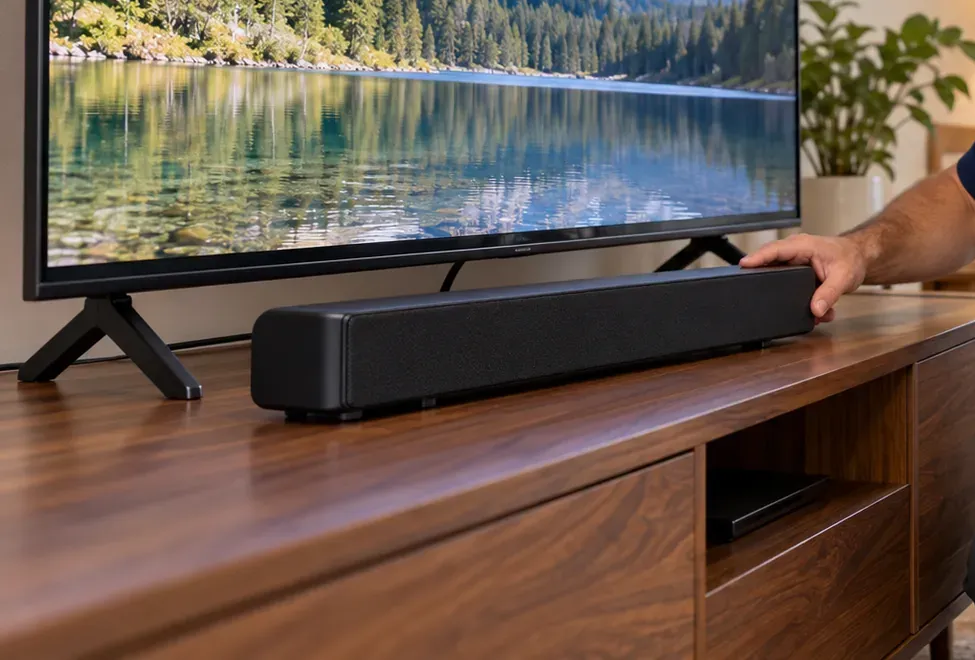
Hand setting a black soundbar on a walnut media console in front of a TV standing on its own feet, the screen showing a lake and forest — Todt Hill Staten Island soundbar console placement
The Starter package in one picture: no drilling, the bar on the console, low enough to clear the bottom of the screen and the TV’s remote sensor.

Big screen, stone hearth. Hanging an 85-inch set above the great-room fireplace is $439.99 ($209.99 base, $100 for the 76–85-inch size, $130 for the fireplace position). Put the bar beneath it on the $84.99 Sanus bracket for $129 more and the total is $653.98; if the bar’s own patch of wall is stone, another $65.

A worked example across three rooms. A bar on the family-room drywall with its own bracket and an in-wall kit ($129 + $169), a compact bar on the primary-bedroom dresser ($79), and a bar on the lower level’s concrete wall with a cord cover ($129 + $75 + $59) add up to $640.

A worked example for an apartment. In a Todt Hill Houses apartment where management allows a wall mount and the wall proves to be masonry, a bar on the wall ($129 + $75) with its cable in a cord cover ($59) is $263. On the TV stand instead, $79.

Want the Todt Hill Figure Before Anyone Drills?

Measure the room roughly, photograph the TV wall and note the bar model. That is all it takes for a written total built from rows you can check, and the drive up the hill costs nothing.

Up and Down the Hill

Up and Down Todt Hill: What We Plan for Before We Arrive

Where a house sits on the hill tells us a lot about the room before the van leaves. Treat this table as our working assumptions; the wall itself has the last word once we are inside.

Todt Hill by area: what we expect
Part of the hill What we expect What comes in the van
Flagg Place, West Entry Road and the Stone Court grounds Mosaic-rubble stone cottages and estate buildings, several landmarked; plaster or fabric-backed partitions Masonry bits and several anchor types, backer board, cord covers, TV-attached brackets
Benedict, Circle and Willow Pond Roads and the gated lanes Large houses behind walls and gates; great rooms, stone fireplaces, lower levels Flagship-bar brackets, rear-speaker stands, long HDMI, calibration kit
Todt Hill Road and Ocean Terrace A mix of older houses, mid-century houses and new builds along the ridge roads; no sidewalks Both kits: we check the era at the door
The slopes down to Richmond Road Houses stepping down the hill with walk-out lower levels and concrete uphill walls Concrete anchors, cord covers, cable-run kit, subwoofer pads
Manor Road, Westwood Avenue and the Todt Hill Houses Six-storey 1950 brick apartment buildings under modernisation; compact rooms; new finishes Compact-bar options, console setups, written permission check
Richmond Road Offices, practices, shops and the border with Dongan Hills Metal-stud toggles, volume-limit setup, certificate of insurance

A note on getting there. The hill has steep roads, no sidewalks on most streets and, on many, no street lights. Forgotten New York calls Four Corners Road, up from Richmond Road, one of the steepest and most arduous climbs by foot in the city. We drive; there is no charge for any of it; but if your gate needs a code or your lane needs directions that a map app gets wrong, tell us when you book.

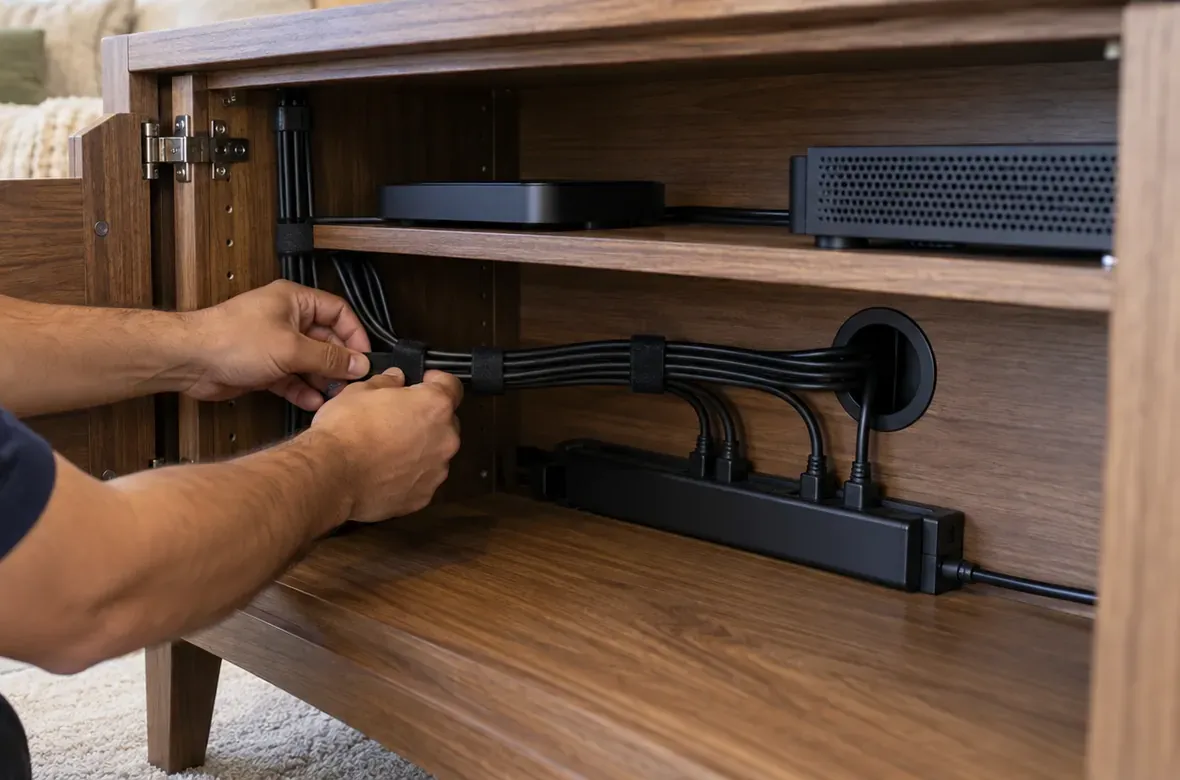
Hands bundling black cables with hook-and-loop ties inside an open wooden media cabinet, a power strip on the cabinet floor, two small devices on the shelf above and a grommet hole in the back panel — Todt Hill Staten Island soundbar cable management
The boxes stay in the cabinet, the cables are tied and labelled, and everything feeds one surge strip. When a TV wall is stone or concrete, a cabinet like this is where the wiring disappears instead.
Complete Services

Every Soundbar Installation Service on Todt Hill

A soundbar visit is often the moment a household finally deals with the TV, the Wi-Fi dead spot or the gate keypad. These are the related AESS services on Staten Island.

TV Mounting on Staten Island

Large screens on stone, concrete or drywall, set at the right height for the bar beneath.

Staten Island TV Mounting Prices

Screen-size steps, the over-fireplace and pull-down lines and the masonry add-ons, all on one page.

Sonos Installation on Staten Island

For households already on Sonos: the bar and Sub tuned in the TV room, other rooms grouped for music.

AV and Sound Systems, Staten Island

In-ceiling and in-wall speakers for great rooms, lower levels and rooms one bar can’t fill.

Home Network Installation, Staten Island

A cable to the back of the TV and Wi-Fi that reaches the far wing or the lower level.

Structured Cabling on Staten Island

Conduit and cable laid while a renovation still has open walls, so the TV wall is ready later.

Smart Locks on Todt Hill

Keypads and app locks for gates, front doors and side entrances on the hill.

Home Automation on Staten Island

Lights, shades and the TV system on one app or handset.

Visit Policies

Arrival windows, rescheduling, return trips and what’s included.

FAQ

Todt Hill Soundbar Installation FAQ

Most streets on the hill have no street lights or sidewalks — can we still book an evening window?
+

Yes. Windows run until 8 PM every day, and the technician drives to the door and carries a torch for the walk from the van. An evening visit takes the same time as a daytime one, and the room lights are all we need once inside.

Does a big house cost more per room than a small one?
+

No. Each room is priced from the same published lines whatever the size of the house, and there is no charge for the distance between rooms or for the climb up the hill. What changes the total is the wall, the extras and how many rooms you choose, all of which you see in writing first.

Can you work while our general contractor's crew is still finishing the house?
+

Yes, once the TV wall is finished and painted and the outlet behind the TV is live. We coordinate with the contractor so we are not drilling while they are sanding or painting in the same room, and we ask that the room is clear enough to set up a ladder and a blanket.

Should we put the alarm's motion sensor in the TV room on bypass during the visit?
+

It helps. A technician moving around the room, a ladder and drill dust can all trip a motion zone. Bypassing that zone, or telling your monitoring company that work is under way, avoids a false alarm. We never need your alarm code; someone in the household sets the bypass and restores it when we leave.

Our TV has ARC but not eARC — will a new Dolby Atmos bar still play Atmos from our streaming apps?
+

Often, yes. Streaming apps usually deliver Atmos inside Dolby Digital Plus, a compressed format that ordinary ARC can carry. What ARC can't carry is lossless Atmos from a Blu-ray player or some consoles; that needs eARC, or a bar with its own HDMI input that the source plugs into first. We check what your TV passes through and show you the bar's format indicator before we leave.

The wall behind our TV backs onto an indoor pool or spa room — is the humidity a problem?
+

The bar itself sits in the TV room, so what matters is that room's air, not the pool's. Where a cable has to pass through a shared wall, we seal around it so damp air doesn't travel through the hole, and we keep electronics out of the pool room itself unless they are rated for it.

Mobile signal is weak inside our stone house — will that stop the soundbar's app setup?
+

No. The bar's app sets it up over your home Wi-Fi, not the mobile network, so a phone with no bars of signal can still finish the job as long as it is on the house Wi-Fi. If you need to receive a sign-in code by text, stand near a window or the door for that step.

Will the technician need to get into our electrical panel or the basement?
+

Usually not. A soundbar plugs into an existing outlet, so the panel only matters if the outlet behind the TV turns out to be dead and we need to find which breaker feeds it. The basement matters only if a cable run is planned through its ceiling. If either applies, we say so when we quote, so someone can show the technician the way.

Compact black soundbar on a wooden desk below a large monitor on an arm, a keyboard on a desk mat, a mouse, a game controller and a potted plant in warm evening light — Todt Hill Staten Island desk soundbar
A compact bar on a desk, fed from the monitor or the computer: the usual answer for a study or a teenager’s room in a big house.
All Areas Served

Soundbar Installation Across New York

Todt Hill is one page in a larger network. Its parent is the Staten Island soundbar installers page, and above that the New York City soundbar installation hub connects the five boroughs. Long Island and the Hudson Valley have hubs of their own, and neighbourhood pages like this one look closely at single parts of each.

Cameras for a long driveway, an intercom at the gate or cabling for a home office are listed on the AESS home page; the about page introduces the people behind the work.

Lost the Sound Somewhere on the Hill Tonight?

When the TV plays but the room stays quiet, phone (347) 934-8335 and say it’s a soundbar fault. We offer the earliest open two-hour window, and lost pairings, wrong inputs and update glitches are normally sorted inside the first hour or two on site.

Soundbar Installation on Todt Hill — Licensed, Insured, Stone-Wall Careful

Abstract Enterprises Security Systems · 1282 Troy Ave, Brooklyn, NY 11203 · serving Todt Hill and all of Staten Island · (347) 934-8335 · WhatsApp (718) 679-0359 via wa.me

NYS Low-Voltage Licence #12000287431 · 100% Licensed & Insured · Same-Day Estimates · Rated 4.7★ from 201 Google Reviews

Brackets and parts carry their manufacturer’s warranty. Full terms — including 50% deposit, one-year parts-only warranty on AESS-supplied products, and the late-fee schedule — are set out in the service agreement. See our warranty page.

Page reviewed and updated October 17, 2026. Changelog: page launched for Todt Hill homes, apartments and businesses, built on Landmarks Preservation Commission designation reports, NYC Planning zoning text, NYCHA and NY1 reporting on the Todt Hill Houses, census figures and local history sources. No Field Notes story is included because we have no documented Todt Hill job to report yet.

Sources used on this page

  • Landmarks Preservation Commission, Gillett-Tyler House designation report (2007) — summit 409.8 ft and the Maine-to-Florida claim; estates; Cromwell and Flagg land history; Todt Hill Road route.
  • Landmarks Preservation Commission, McCall’s Demonstration House designation report — Flagg’s mosaic-rubble method, serpentine from the estate quarry, plaster-on-burlap partitions.
  • Historic Districts Council, Wallcot and Bowcot (6 to Celebrate) — addresses, dates, mosaic rubble, concrete-block quoins.
  • LPC web guidance on permits for designated buildings — the three cases in which interior work needs Commission review.
  • NYC Zoning Resolution §105-941 (Special Natural Area District NA-1) — the serpentine hilly spine and its natural features.
  • Wikipedia, Todt Hill, Staten Island — 401 ft, sidewalks, transit, 2020 census tract figures.
  • Atlas Obscura, Todt Hill — highest natural point on the Atlantic coastal plain.
  • Brick Underground, “What you need to know about buying in Todt Hill” (April 24, 2017) — house sizes, gates, private roads, sidewalks and street lights, buses.
  • Forgotten New York, Todt Hill parts 1 and 2 — streets, Highest Point Pond, WSIA tower, Cropsey outlook, Four Corners Road, Flagg’s estate on the scarp.
  • NYC Parks, Moses Mountain virtual tour — origin, 200-foot height, renaming as Paulo’s Peak.
  • Wikipedia, Staten Island Greenbelt; Moravian Cemetery; Staten Island Academy; Richmond County Country Club — acreage, addresses, founding dates.
  • NYCHA, Todt Hill Houses comprehensive modernization presentation and press release (January 17, 2024) — 1950, seven six-storey buildings, 502 apartments, scope of work, resident requests.
  • NY1, December 18, 2025 — Todt Hill Houses renovation progress and temporary relocation.
  • Point2, Todt Hill demographics (ACS 2019–2023) — housing age and type for the wider area.