NYS Licensed Low-Voltage Installer · Queens Line (347) 434-6392 · Bayside Hills Houses, Bay Terrace Co-ops & the Bell Boulevard Strip
Soundbar Installation in Bayside
Inter-War Plaster · 1950s Garden Co-ops · Two-Family Houses · Bell & Northern Boulevard Businesses · One Remote
Bayside is the corner of Queens where most people live in a house or a low garden-apartment building rather than a tower. About a third of its homes went up in a single decade, the 1950s; Bayside Hills was laid out on a former golf course in 1936; and the Bay Terrace co-ops were built as courtyard garden apartments around the same time the Port Washington line made the neighbourhood a one-train commute. Those buildings decide how a soundbar goes up far more than the logo on the box. Old plaster can fool a stud finder from one end of the wall to the other, a garden co-op has neighbours beside, above and below you, and a two-family house has two households to keep happy. We plan for that, then mount, connect and tune the bar so the TV remote runs everything.
Reviewed and updated October 17, 2026 · Written by Anwar Timothy, NYS licence #12000287431 · Bayside visits are booked through our Queens line, (347) 434-6392
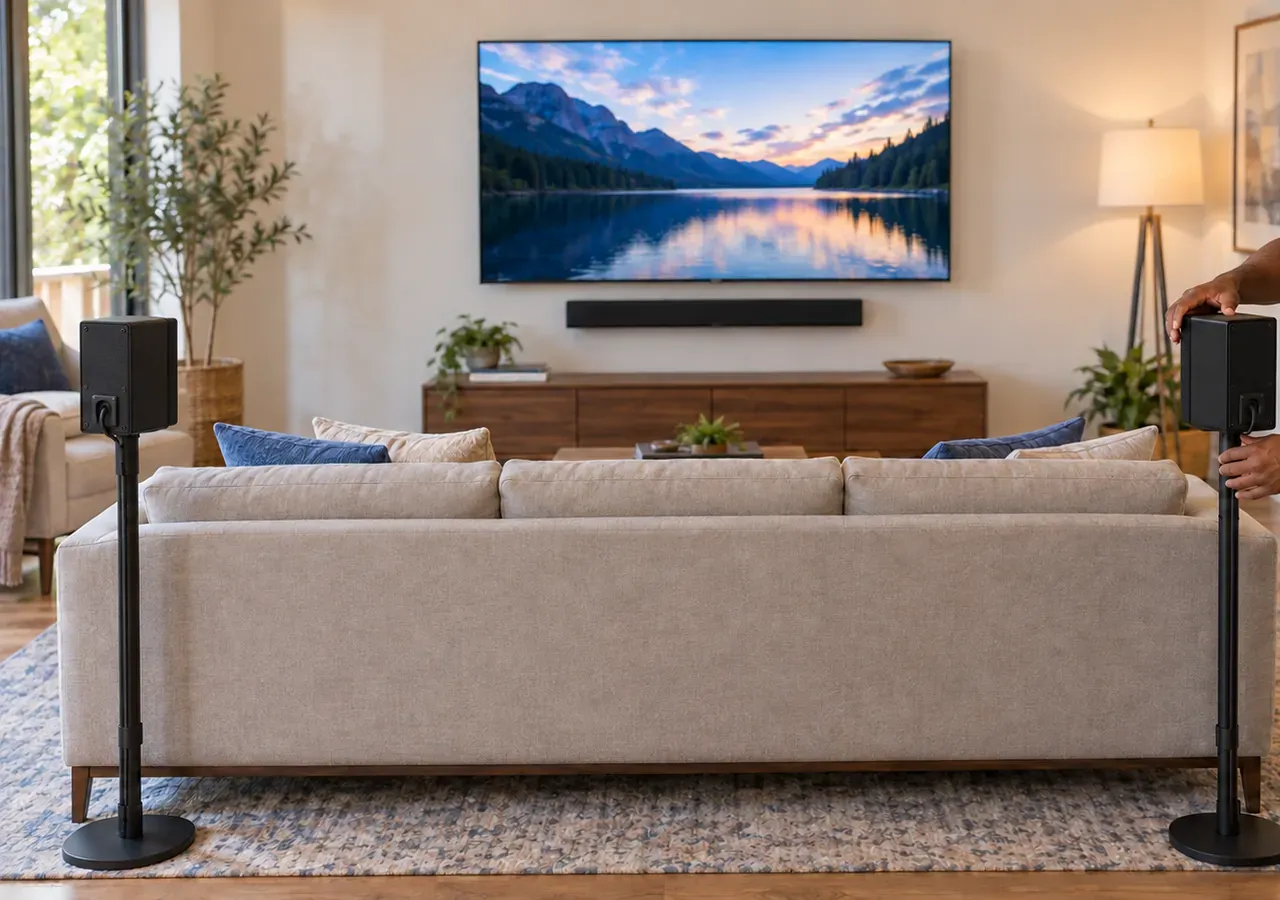
A full living-room layout: one rear speaker on a stand at each end of the sofa, the wall TV and its bar straight ahead above a low walnut console.
Bayside Soundbar Quote
Tell us the bar, the wall and the building — a written price comes back the same business day
✅
Request Sent!
A Queens installer will call you back the same business day.
25+
Years Experience
✓
Same-Day Estimates
100%
Licensed & Insured
4.7★
201 Google Reviews
Bought the bar and want it working this week? Ring the Queens line at (347) 434-6392, or use the short form, which takes about a minute. A licensed low-voltage installer answers, and the figure you get back is added up from the published Queens menu lower down this page rather than guessed at over the phone.
Tell us the decade the house or building went up — it tells us what the wall is likely to be
Garden-co-op and two-family jobs planned around the neighbours before anything is drilled
NYS licence #12000287431 · two-hour arrival windows, 8 AM–8 PM, seven days a week
Bayside looks suburban from the street, but its living rooms were built in three quite different eras, and each one treats a soundbar bracket differently. Wikipedia's account of the neighbourhood places it in Queens Community District 11, between Little Neck Bay and the Cross Island Parkway on one side and Francis Lewis Boulevard and Auburndale on the other, with Oakland Gardens and Hollis Hills usually counted in. It grew as a resort and farm district, gained film-star houses in the 1920s and 1930s, and then filled up quickly after the Second World War, largely because the Bayside station on the Long Island Rail Road's Port Washington Branch put Penn Station one train away. The result is a neighbourhood of detached and attached houses, two-family homes, low-rise garden-apartment co-ops and a handful of towers by the bay — and very few of the glass-and-concrete rooms that most soundbar advice now assumes.
The oldest layer is the inter-war house. Bayside Hills, the subdivision between 48th Avenue, the Long Island Expressway, 211th Street and Springfield Boulevard, was born in 1936 on what had been a farm and then a golf course, according to the Queens Chronicle's history of the enclave, and today counts more than 1,200 households behind its gatehouses and planted street malls. Houses from that period across Bayside were generally finished with plaster rather than drywall, and plaster is where most of our planning goes: it is hard, it can crack if it is drilled carelessly, and depending on what it was applied over — wood strips, gypsum lath or metal mesh — it can leave an ordinary stud finder either silent or beeping the whole way across the wall. We find the framing by other means before the bracket goes anywhere.
The biggest layer is the 1950s. American Community Survey figures compiled by Point2Homes put roughly 31 percent of Bayside's homes in that single decade, more than in any other. That is the era of the Bay Terrace garden apartments — nine co-op sections, Habitat magazine reports, built on land owned by Cord Meyer Development — and of the garden co-ops of Oakland Gardens, low brick buildings set around lawns and courtyards. It is also the era of many of the Capes, ranches and two-family houses on the side streets. A garden-apartment living room may share a wall with the next unit, a floor with the apartment below and a ceiling with the one above, and it sits in a co-op whose board and managing agent have their own alteration rules. Most of the questions we hear from Bay Terrace and Oakland Gardens are about those two things: the neighbours and the paperwork.
Then there is ownership. Point2Homes' summary of the same survey counts about two-thirds of Bayside's occupied homes as owner-occupied, and more than a fifth of its housing units sit in two-unit buildings. In practice that means many visits are to a family that owns the house and rents out a floor, or to a tenant whose landlord lives upstairs. The owner decides what goes into the walls; the tenant needs the owner's yes before a bracket is fixed; and the subwoofer is placed with the other household in mind, not just the one paying for the bar.
Finally, Bayside works as well as sleeps. Bell Boulevard is the neighbourhood's main street, lined with bars and restaurants for eight blocks north of Northern Boulevard, and Northern Boulevard itself carries a long run of restaurants, including Korean restaurants and all-you-can-eat barbecue rooms in and around the 11361 ZIP code. Those rooms want a TV people can follow without anyone shouting, in spaces with hard floors, open kitchens and, at a barbecue table, grill smoke in the air. We quote them as carefully as a living room, because the conditions are just as particular.
The Bayside figures that shape a soundbar visit
About 31 percent built in the 1950s: 6,530 of roughly 20,800 housing units, by Point2Homes' reading of American Community Survey data, against about 17 percent built in 1939 or earlier and 15 percent in the 1960s. Expect early post-war walls more often than either very old or very new ones.
26 percent detached, 17 percent attached, 22 percent two-unit: the same source's breakdown of building types, with only about one home in ten in a building of fifty units or more. Most Bayside soundbars hang in a house or a low-rise co-op.
1936 and 117 acres: when Bayside Hills began and how much land it took up, according to the Queens Chronicle, which traces it from the Cain Farm through the Belleclaire Country Club to the homebuilders of the 1930s. Wikipedia credits many of its houses to the builder Gross Morton.
Nine co-op sections: the Bay Terrace garden-apartment co-ops Habitat magazine describes, built in the 1950s on Cord Meyer land, most of which have since been buying out the 99-year land leases beneath them. Section IV alone holds 125 apartments.
A 346-block rezoning: the lower-density contextual zoning the City Council adopted for Bayside in 2005, after a City Planning proposal the Queens Gazette called the largest of its kind ever undertaken in Queens. New houses are meant to match the old ones in scale, so the house stock you see is the house stock that stays.
12.6 miles to Penn Station: the distance from the Bayside LIRR station at 213th Street and 41st Avenue, where the tracks were lowered beneath Bell Boulevard between 1928 and 1930. The commute shaped the neighbourhood; it rarely shapes the soundbar, because the line runs in a cut below the street.
Still deciding where the screen itself should hang? Our Queens TV installation service can put the TV up at the same visit, so there is one height, one cable route and one bill. And if a single bar will not fill a room the way you want, AV and sound installation in Queens covers wired surround and ceiling speakers.
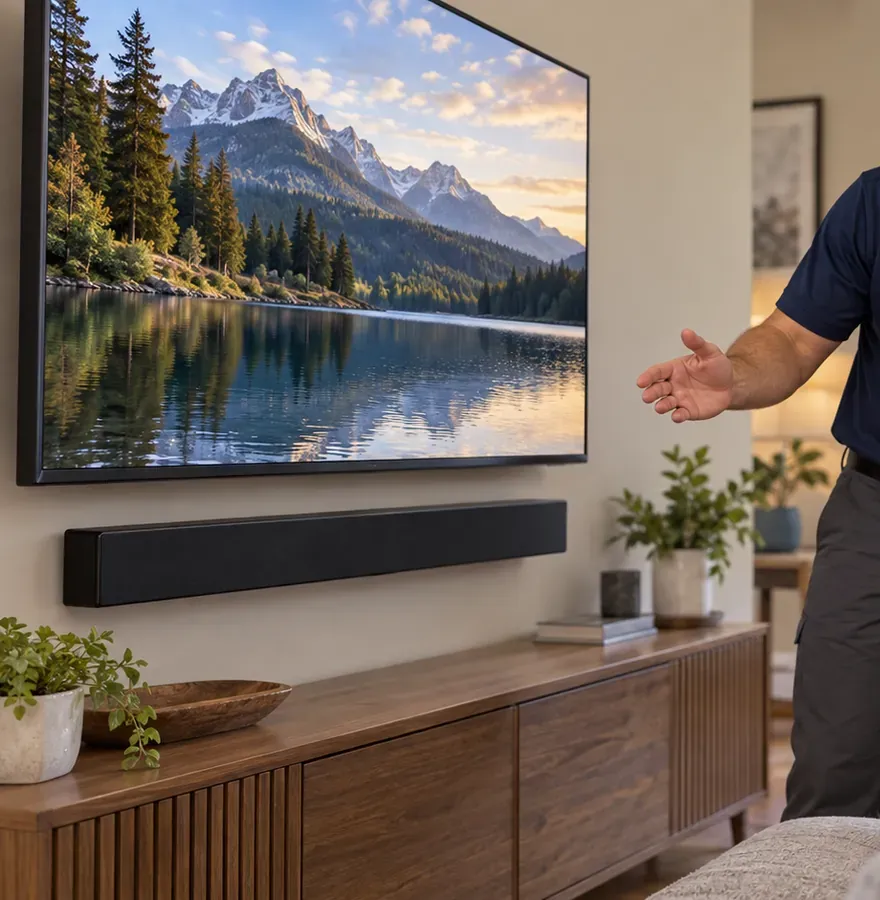
Explaining the finished wall: an open hand points to the bar fixed just below the screen, with a low ribbed console, a potted plant and a wooden bowl beneath.
Repair Capture
Bayside Soundbar Gone Quiet or Out of Sync — Service Visits
A bar that stopped answering the TV remote after a cable-box swap, a subwoofer that blinks and will not pair, voices that arrive a beat after the lips move, or a bracket that has crept out of level in old plaster — none of those needs a new installation. We fit service calls into the next open two-hour window, and most connection and settings faults are put right within one to two hours of the technician walking in. Call (347) 434-6392 and say it is a soundbar repair in Bayside; our TV and soundbar service policies set out how setup-only time is charged.
What We Install
Soundbar Installation Services in Bayside
A Bayside soundbar visit is put together from the pieces below, and each piece is a separate line with its own published Queens price. They run from the lightest touch to the most involved. In a garden co-op or a rented floor of a two-family, the lighter options near the top are often the right ones; in a house you own outright, the hidden-wire options open up.
Bar on the Console, Nothing Drilled
The bar set on the media unit, connected to the TV's eARC or ARC socket, moved clear of the remote's sensor and tuned to the room. The usual starting point for a tenant on the upper floor of a two-family, or a co-op owner still waiting on the managing agent.
Bracket Under the Screen
A dedicated bracket an inch or two below the TV, squared to the picture and fixed to whatever the wall really is — timber found behind the plaster, toggles in board, or masonry anchors in brick and block.
Bar Riding on the TV Arm
A bracket that clamps the bar to the TV mount, so screen and bar swing together. It suits a Bayside living room that opens to a dining room, where the TV turns between the sofa and the table.
Leads Hidden in a Hollow Wall
Power and HDMI carried through the stud bay with a code-compliant in-wall power and cable kit, fed from the socket already on that wall. Offered only where the owner agrees and a probe shows the bay is clear.
Paintable Channel on the Surface
A slim cover from the bar to the outlet, ready for your paint. The neat answer on brick, on block, on a co-op wall the board would rather not see opened, and on any plaster we would rather not cut.
Cable Run to a Closet or Shelf
As much as 25 feet of HDMI and power taken along the skirting, around a corner or through a partition wall, so the boxes move into a closet or cabinet and the TV wall stays clear.
Screen and Bar Together
Booking the screen with the bar lets us fix both heights, the space between them and one shared cable route in a single decision, so an older living room's main wall ends up looking designed rather than added to.
Settings, Remotes and Sound
The right HDMI socket chosen, the TV's control link enabled so its remote handles volume, picture and sound brought into sync, software updated, and voice and bass balanced for your room instead of left at the out-of-the-box setting.
Subwoofer and Rears Placed With Care
Wireless sub and rear speakers paired and put where there is power, with the sub kept off the floor you share with the apartment below and away from the wall you share with the house next door.
Most Bayside bookings combine two or three of these. A bracket, a painted channel and a settings pass is the everyday garden-co-op job; a bracket with hidden leads is common in a house the family owns; a console setup with the TV remote taking over the bar's volume is a frequent first step for a tenant. Every line appears separately on the written quote, so anything you do not want simply comes off.
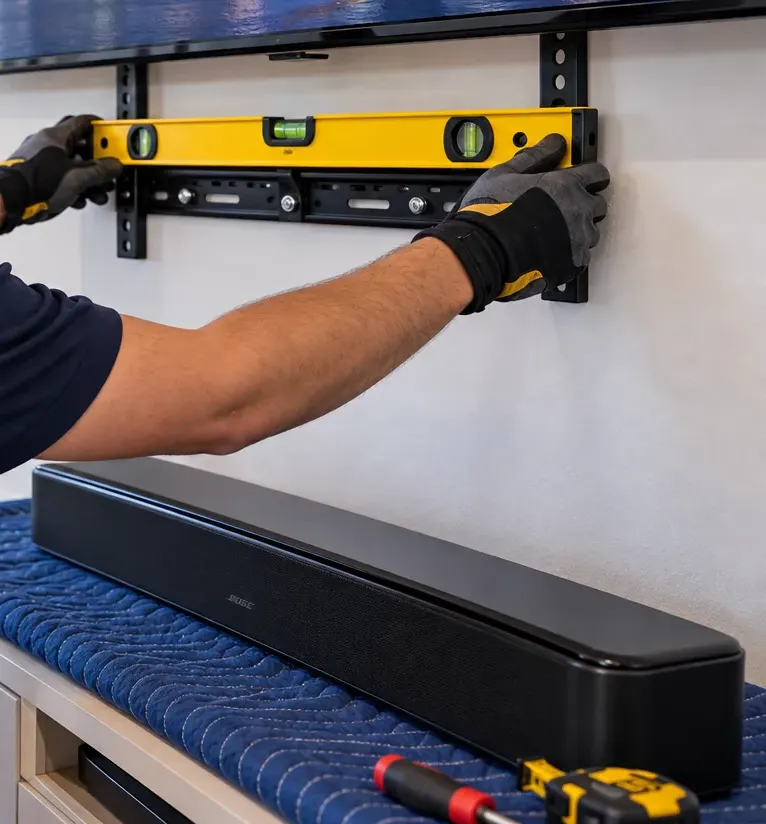
Gloved hands hold a yellow level against a black bracket on a pale wall; the bar waits underneath on a quilted blue blanket next to a screwdriver and a drill.
Building Specialists
Soundbar Installation for Bayside's Architecture
Bayside's buildings are mostly low, but they were put up over roughly a century, under different builders and different kinds of ownership. These are the types our installers meet between Little Neck Bay and Union Turnpike, and what each tends to mean for a soundbar.
Bayside Hills Houses
Detached houses of the 1930s and later inside the enclave's gatehouses and street malls. A source on the area describes brick and stucco Tudors, Colonials and Mediterranean-style homes; inside, plaster walls are the norm and many living rooms are arranged around a fireplace.
Post-War Capes, Ranches and Split-Levels
The houses that filled the side streets after the war, described by local brokers as Capes, ranches and split-levels alongside older Colonials and Tudors. Walls may be early gypsum board or plaster on gypsum lath, and dens are often down a short flight of stairs.
Two-Family Houses
Over a fifth of Bayside's homes are in two-unit buildings. The owner's living room may sit directly over the tenant's bedroom, or the reverse, so bar size, sub placement and wiring routes are planned for both households.
Bay Terrace Garden Co-ops
The 1950s courtyard apartments north of 28th Avenue, organised as separate co-op sections, each with its own board. Low brick buildings, units side by side and stacked, and a shared basement and grounds that belong to the corporation.
Oakland Gardens and Windsor Park
Garden-style co-ops south of the expressway, near Alley Pond and Cunningham parks, described as low-rise brick buildings around lawns and courtyards. The same planning as Bay Terrace: who approves, who lives below, and where the cable can legally travel.
Towers on the Bay
The Bay Club's two condominium towers, which its own history says opened in 1981 inside a gated 13-acre estate, plus Baybridge, the Towers at Waters Edge and other Bay Terrace co-ops and condos. Managing agents, insurance certificates and concrete in the walls.
What the walls are made of, house by house
Plaster in the inter-war houses. A 1930s Bayside living room was almost always plastered, and the plaster was applied over something: thin wood strips, panels of gypsum lath, or expanded metal mesh. Each behaves differently. Wood-lath plaster gives a stud finder false readings because the strips run across the whole wall; gypsum lath reads more like drywall; metal mesh can make a scanner light up everywhere. So we do not trust a single tool. We scan the full width of the wall, look for nail heads with a strong magnet, check where the outlet box is fixed, and confirm with one small pilot hole where the bracket will hide it. Plaster is a $47.25 line on our Queens table because it takes longer and needs more care.
Textured finishes. Some houses, particularly those finished in a Spanish or Mediterranean manner, have a sand, swirl or trowelled texture on their walls. Texture does not stop a bracket, but it changes how it sits and what sticks to it. We shim the bracket where the surface rises and falls, so the bar stays level and the screws are not levered against a bump, and we fix cord covers with screws rather than relying on adhesive tape alone.
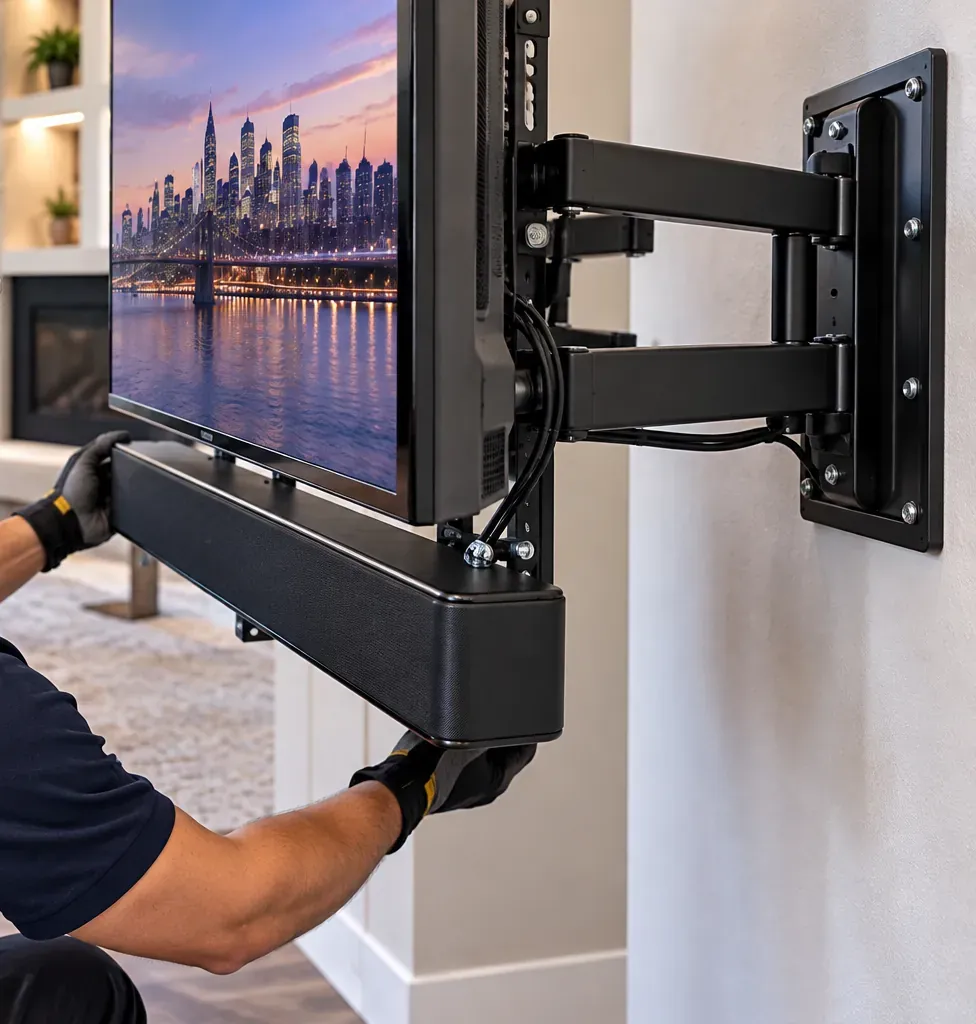
Bar and screen moving as one: the soundbar sits under a TV held out from the wall on a black extending arm, its square wall plate fixed to the pale wall.
Brick around the fireplace. Many Bayside living rooms are arranged around a brick chimney breast, and it is a popular place for the TV. Brick takes a sleeve or screw anchor well when the hole is drilled into the face of the brick rather than the mortar joint, and the bar can sit just below the screen on the same breast. There is no cavity to hide leads in, so cables come down in a painted channel or travel sideways to the cavity wall beside the breast. On the Queens wall table, brick or stone is $68.25.
Block and concrete in the garden co-ops and towers. Some garden-apartment partitions, basement walls and every tower's structure are block or poured concrete. A hammer drill sets anchors into the solid part of each block, and the bracket goes on just as firmly as it would on timber. Hidden wiring is rarely possible in solid masonry, so a painted channel is the usual finish. Concrete or cinder block is $78.75 on our table.
Newer drywall. Renovated rooms, extensions and the houses built since the 2005 rezoning are usually drywall on wood studs, which is the easiest wall in Bayside to work with and carries no surcharge. Before drilling, we ask whether the builder or a previous owner ran anything in that wall we should know about, and we probe the bay before promising hidden leads.
A bar that streams music depends on the house network, and in a deep Bayside house the signal is often weakest at the back or down in the den. If a wired connection to the TV wall makes more sense, structured cabling installation in Queens can be priced into the same visit; for cabling already in the walls that has stopped working, see AESS network cable repair for Queens.
Commercial Soundbar Installation
Business Soundbar Installation in Bayside
Bayside's businesses gather along two boulevards and around one big shopping centre, with a few institutions out on the point. Bell Boulevard is the main street, Northern Boulevard crosses it as the long east–west restaurant row, and the Bay Terrace Shopping Center anchors the north end. A soundbar in any of them has one job: make the screen easy to follow for the people in the room without spilling into the flats above, the dining room next door or the sidewalk outside.
Bell Boulevard and the Bayside Village BID
The business improvement district covers an eight-block strip of Bell Boulevard between Northern Boulevard and 35th Avenue, plus a block either side along 41st Avenue, with its office at 213-33 39th Avenue. Its own page says it represents more than 200 businesses; locals on Reddit sum the strip up as having “a ton of bars.”
Festival Days on the Boulevard
For the 2026 Bell Blvd Food & Music Fest, Queens Economic Development Corporation's listing described seven car-free blocks from 38th to 43rd Avenue, bands on every block, some karaoke, more than 35 local establishments and at least 3,000 expected visitors. Screens near open doors need a level that suits a crowd one day and a quiet Tuesday the next.
Northern Boulevard
The wide commercial road that carries much of the area's restaurant trade, including Korean restaurants with addresses in the 215-hundreds and the Queens Library's Bayside branch at 214-20 Northern Boulevard. Big dining rooms, hard floors and, at barbecue tables, smoke and grease in the air.
Bay Terrace Shopping Center
Cord Meyer Development's 326,445-square-foot centre near the bridge approaches, where New York YIMBY reported in June 2026 that work had begun on three five-storey buildings with 145 rental units. Shops, cafés and offices with landlord fit-out rules, and new apartments arriving above them.
Condo and Co-op Amenity Rooms
The Bay Club's own history describes a residents' club with party and card rooms, a library and a large screened theatre. Amenity rooms like these are run by a board and a managing agent, and they need screens that anyone can switch on without a manual.
Fort Totten and the College
Fort Totten holds the FDNY EMS Training Academy and the Bayside Historical Society's home in the Castle, and Queensborough Community College, a CUNY college established in 1959, sits on a 37-acre site that was once the Oakland Golf Club. Meeting rooms, lecture spaces and event halls where speech has to carry.
Rules that apply to a business soundbar in Bayside
A game's commentary counts as commercial music. Under the Department of Environmental Protection's summary of the Noise Code, sound from a business may not exceed 42 decibels when measured inside a neighbouring home; overnight, from 10 PM to 7 AM, it also may not rise more than 7 decibels above the street's background level measured 15 feet or more away, and there is a separate test for bass that pervades a building. A Bell Boulevard bar with apartments over or behind it is therefore best served by a speech-tuned soundbar with little or no subwoofer.
Mind the aisle. The 2010 ADA Standards, section 307.2, allow a wall-mounted object between 27 and 80 inches off the floor to stick out no more than 4 inches into a route people walk along. A screen plus a soundbar exceeds that, so in a restaurant passage it is mounted above 80 inches or placed behind the service counter.
Power outlets are outside our licence. We are licensed for low-voltage work — HDMI, the bar's connections and its wireless links — which does not itself need a Department of Buildings permit. If the restaurant wants a socket behind the screen, a licensed electrician installs it before our visit; otherwise the screen goes near an existing outlet.
Paperwork for the landlord. A shopping-centre or storefront lease will often require any contractor to carry insurance naming the property owner and its agent. Forward the exact names required and we issue that certificate at no charge, normally within the day.
Keep gear out of the kitchen's air. Bars and their power strips stay out of the plume of a range hood or a table grill and away from the floor that gets mopped every night; the right spot is usually on a dining-room wall well back from the cooking.
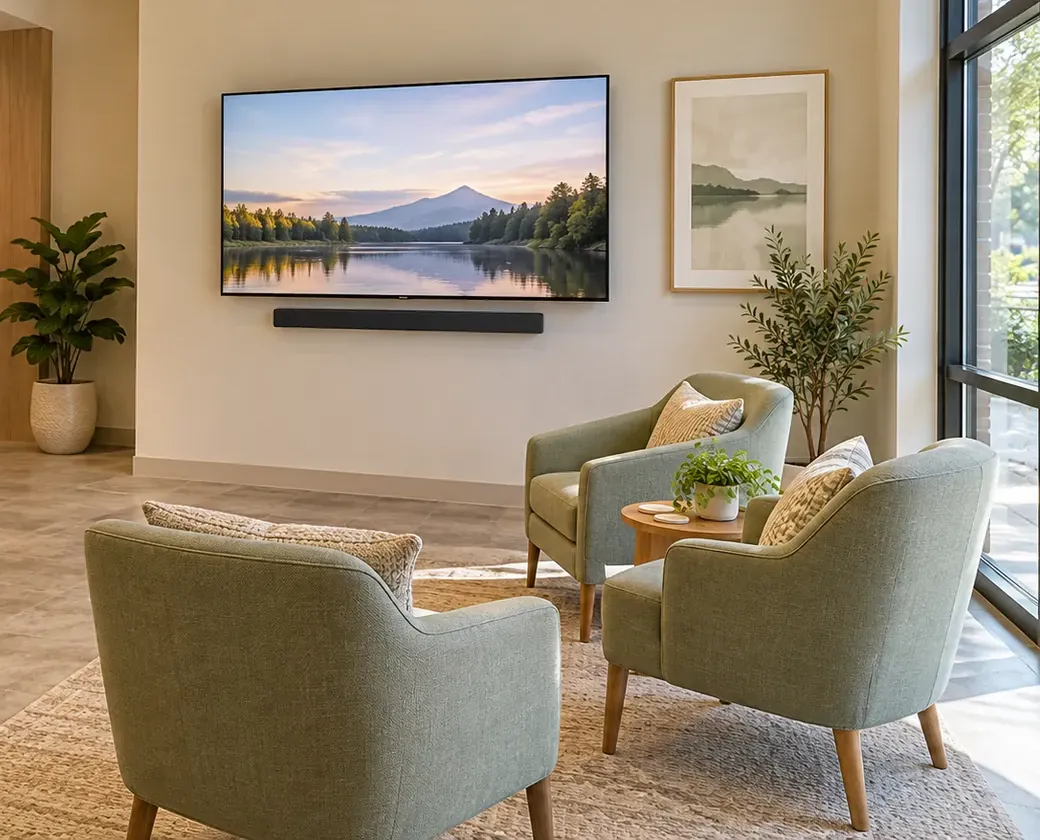
A bright seating area: three sage-green armchairs round a small table face a wall TV with a slim bar under it, a framed print and a potted tree to the right.
Soundbar Installation in Bayside: Questions Answered
These are the questions Bayside households and business owners put to us before booking, grouped by the kind of building behind them: the inter-war houses, the post-war houses, the garden co-ops, and the two boulevards. Prices for particular combinations are in the FAQ further down. Nothing here is legal advice; where a co-op's proprietary lease, a commercial lease or a code is involved, that document has the final word.
Bayside Hills and the inter-war houses
The stud finder beeps all the way across our 1930s Bayside Hills living-room wall — what is behind the plaster, and where does the bracket go?
Almost certainly plaster over metal mesh, or plaster thick enough that a basic scanner cannot see past it. Houses of that period were plastered over one of three backings: thin wood strips, panels of gypsum lath, or expanded metal lath. Metal lath is the one that makes an electronic finder light up from corner to corner, because the scanner reads the mesh rather than the studs behind it. A mounting company's guide to plaster walls puts it plainly: electronic stud finders misread plaster, and metal mesh, nails and reinforcement create false readings.
So we switch tools. A strong magnet run slowly across the wall finds the lath nails or screws, which line up vertically over each stud; the side of the nearest outlet box shows where one stud is; and a deep-scanning sensor narrows the rest. Then we drill one small pilot hole where the bracket will cover it and read what comes out — wood shavings, gypsum or metal — before choosing the fixing. Through mesh we drill slowly with a sharp masonry bit and no hammer action, so the plaster key is not shaken loose around the hole.
Plaster on metal lath is usually strong, and a bracket screwed through it into a stud holds very well. Where the bar has to sit between studs, a toggle sized for the bracket spreads the load behind the plaster. If an old patch turns out to be soft or hollow, a plywood backer board ($89.25) fixed into sound framing carries the bracket instead. On the Queens table, plaster adds $47.25 to the $135.45 mount.
Our Mediterranean-style house has heavily textured plaster walls — will the bracket sit flat, and will a cord cover stay stuck to that surface?
The bracket will, with a little work; the cord cover needs screws. A trowelled, swirled or sand-finish texture rises and falls by a few millimetres across a hand's width. A bracket pulled hard against a ridge can rock or twist, and the bar then sits a fraction off level with the screen. We find the high points under the bracket's feet and pack the low ones with thin shims, so the screws pull the bracket square rather than levering it against a bump.
Adhesive-backed channels are made for smooth paint. On a deep texture the tape only touches the peaks and lets go, often after the first warm spell. We fix the channel with small screws and anchors at intervals along its length, cut it neatly where it meets the baseboard, and leave it ready for your painter to match the wall. If you would rather keep a textured wall completely untouched, a bar on the console or on a TV-attached bracket needs only the holes the TV mount already uses.
One caution applies to any textured finish applied before the late 1970s. Washington State's health department, summarising the federal position, notes that asbestos may be present in textured paint and in patching compounds used on wall and ceiling joints, and that their use was banned in 1977. A handful of small bracket holes drilled slowly with dust collected at the bit is a very different matter from sanding a wall, but if you know or suspect an old textured coat, have it tested before any larger job such as chasing a cable into the wall, and tell us before we arrive.
Post-war houses and two-families
We want TVs back to back on the wall between our living room and the den — can both share one cable route without one room's bass coming through to the other?
They can share the wall; they should not share a stud bay. When two TVs, two brackets and two sets of in-wall plates sit directly back to back in the same cavity, the cavity behaves like a little drum: the bar and sub in one room push sound straight into the other through two thin layers of board or plaster and an open hole. Offsetting the two mounting positions by at least one stud bay, so each room's plates open into a different cavity, keeps most of that sound where it belongs and costs nothing extra.
The cables can still meet in one place. A cabinet or closet on one side of the wall, or the basement below a ranch or split-level, can hold the cable box, the router and the streaming boxes for both screens, with a run of up to 25 feet ($103.95) bringing each TV's HDMI to it. The subwoofer, if there is one, goes on an outside wall of its own room, not against the shared partition.
On the Queens menu, a living-room bar on our bracket with the leads hidden in the wall is the $402.14 Premium combination, and a den bar on its own bracket with a painted channel is $224.69 + $61.95 = $286.64. Together that is $688.78 on drywall or plaster-on-gypsum walls over wood studs, before any surcharge for older plaster or a cable run to a shared cabinet. If one room is a tenant's, the owner decides about the shared wall and the tenant's bar is planned with them.
The garden co-ops
Our garden co-op's basement is shared space under several apartments — can the soundbar cable go down there and come back up behind the TV?
Only with the co-op's written approval, and many co-ops will say no. In a garden-apartment building the basement, its ceiling and the floor structure between you and it are usually the corporation's property rather than part of your apartment. Drilling down through your floor, running a cable across a common basement and coming back up behind the TV is an alteration to building elements, and it creates a new opening between apartments and common space that the board, its managing agent and its engineer will want to know about first. Some sections allow it with conditions such as fire-stopping the holes; some do not allow it at all.
If you want to try, ask the managing agent for the alteration application before we book. We can supply a written description of the route, the cable type and how each opening would be sealed, plus a free certificate of insurance naming the corporation and the agent. We do not drill a floor or a common-area wall in a co-op without that approval in hand.
Most Bay Terrace and Oakland Gardens owners end up not needing it. A cable run of up to 25 feet ($103.95) along the baseboard, round the room and into a cabinet usually reaches where the boxes live, a painted channel ($61.95) tidies the drop from the bar, and wireless rears and subwoofers only need a socket nearby. Everything stays inside your own apartment, which is the part of the building you control.
Bell Boulevard and Northern Boulevard
Our Northern Boulevard barbecue restaurant has a grill at every table — will smoke and grease in the air ruin a soundbar?
Not if it is placed well, but placement is everything. A dining room with table grills carries fine grease and smoke even with good extraction, and the film it leaves builds up on whatever sits in the moving air — ceilings, light fittings, and the fabric grille of a soundbar. A bar mounted in the path between the grills and the extraction, or right above a row of tables, will end up coated and its controls sticky; a bar on a side wall away from the cooking, at the height of the screen, stays much cleaner.
We plan the screen and bar position with the airflow in mind: away from the exhaust path and the range hood, out of the direct heat over the grills, and off the floor that is mopped every night, with the power strip fixed to the wall rather than left by the baseboard. A bar with a metal grille is easier to wipe down than one wrapped in cloth, and a short monthly wipe with the power off keeps it presentable. We would also set the bar for speech at a fixed level, because sizzling grills and conversation compete with the commentary, not the bass.
Two cautions. Never mount anything inside a kitchen hood's capture area or near a fire-suppression nozzle; those spaces belong to the hood installer and the fire inspector. And if the screens are on a wall shared with a neighbouring business or a flat upstairs, the city's commercial music limits still apply to the TV's sound.
Our Bell Boulevard bar runs the games with captions and the sound off — when does adding a soundbar actually help?
When people at one end of the room want to hear the commentary and everyone else is happy talking. Captions do a fine job on a busy Friday when the room is loud and the action on screen speaks for itself; a soundbar earns its place at the moments when the sound matters — a fight night, a playoff overtime, the quieter afternoon hours when regulars come in for a particular match. A bar aimed down at the seats nearest one screen, set to its speech or dialogue mode, can make that screen audible to the tables in front of it without turning the whole room into a contest of volumes.
The set-up matters more than the model. We mount the bar under the screen where the listeners are, not the screen nearest the door; set a fixed maximum level and lock the buttons where the bar allows, so the volume does not creep up through the night; leave the captions on for everyone else; and route the HDMI so the bar follows whichever source the screen is showing. The sub, if there is one, stays low or switched off, because bass is what carries through the floor and ceiling.
Where there are flats above or behind the bar, the Department of Environmental Protection's commercial music rules apply to TV sound as much as to a playlist, measured inside the nearby home. A bar tuned for speech at a sensible level is usually the most a busy room can use anyway.
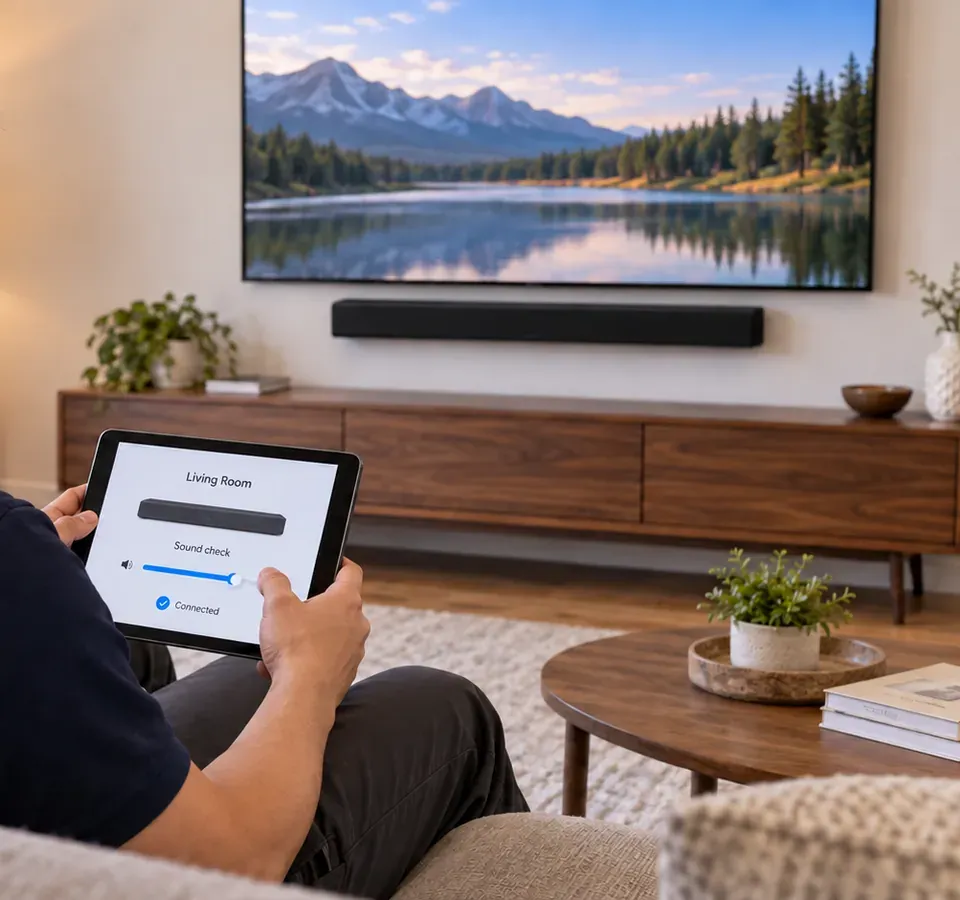
Fine-tuning from the seat: a tablet held at sofa height shows a Living Room sound-check slider and a Connected tick, with the bar and screen across the room.
Equipment
Types of Soundbars and Mounts We Install
We mount whatever make you own, and if you are still shopping we will point you toward a size and type that suits a Bayside living room, den or co-op apartment. Below is the hardware we handle most here, with the mounting details that matter for each.
Compact Bars for Bedrooms and Dens
For a garden-apartment bedroom or a den down a few steps, a short bar matches a 43- or 50-inch screen. Sonos' Ray measures roughly 56 cm and weighs less than 2 kg; it takes an optical lead instead of HDMI, handy with an older set.
Centre-Channel Bars for Clear Speech
A driver aimed straight out carries voices, which matters when several generations share the sofa. The Sonos Beam (Gen 2) is about 25.6 inches long and 6.35 lb; Samsung, LG, Sony, Bose and others make rivals.
Full-Width Atmos Bars
Up-firing drivers bounce height effects off a flat ceiling. A Sonos Arc Ultra is about 46.4 inches and 13 lb, and Sonos suggests keeping it about 4 inches below the TV and a foot from side walls — easier on a long Bayside Hills wall than in a narrow den.
Wireless Subwoofers
A separate bass unit paired to the bar. In a garden co-op or a two-family it goes on an outside wall, on a solid floor and away from the neighbour's side; in a detached house there is more freedom, but the bedrooms above still count.
Wireless Rear Speakers
Rears join the bar over the air but each still needs mains power, so we plan sockets behind or beside the sofa and keep leads along the baseboard rather than across the floor.
Universal Soundbar Brackets
Sanus rates its SASB1 for most soundbars up to 20 lb. Its arms grip the bar from behind or below and slide to set the gap from the wall, which helps when the factory bracket is missing or unsuited to old plaster. It is $89.24 on our Queens list.
Brackets on the TV Mount
The Sanus WSSATM1 was built for the Sonos Arc and fixes to most brands of TV mount on screens of about 50 to 90 inches. Swing the TV toward the dining table and the bar turns with it.
In-Wall Kits and Surface Channels
Where the wall is hollow, a code-compliant kit carries power and signal inside it from the nearest socket. Where it is brick, block, textured plaster or a co-op wall nobody wants opened, a slim channel you can paint does the job.
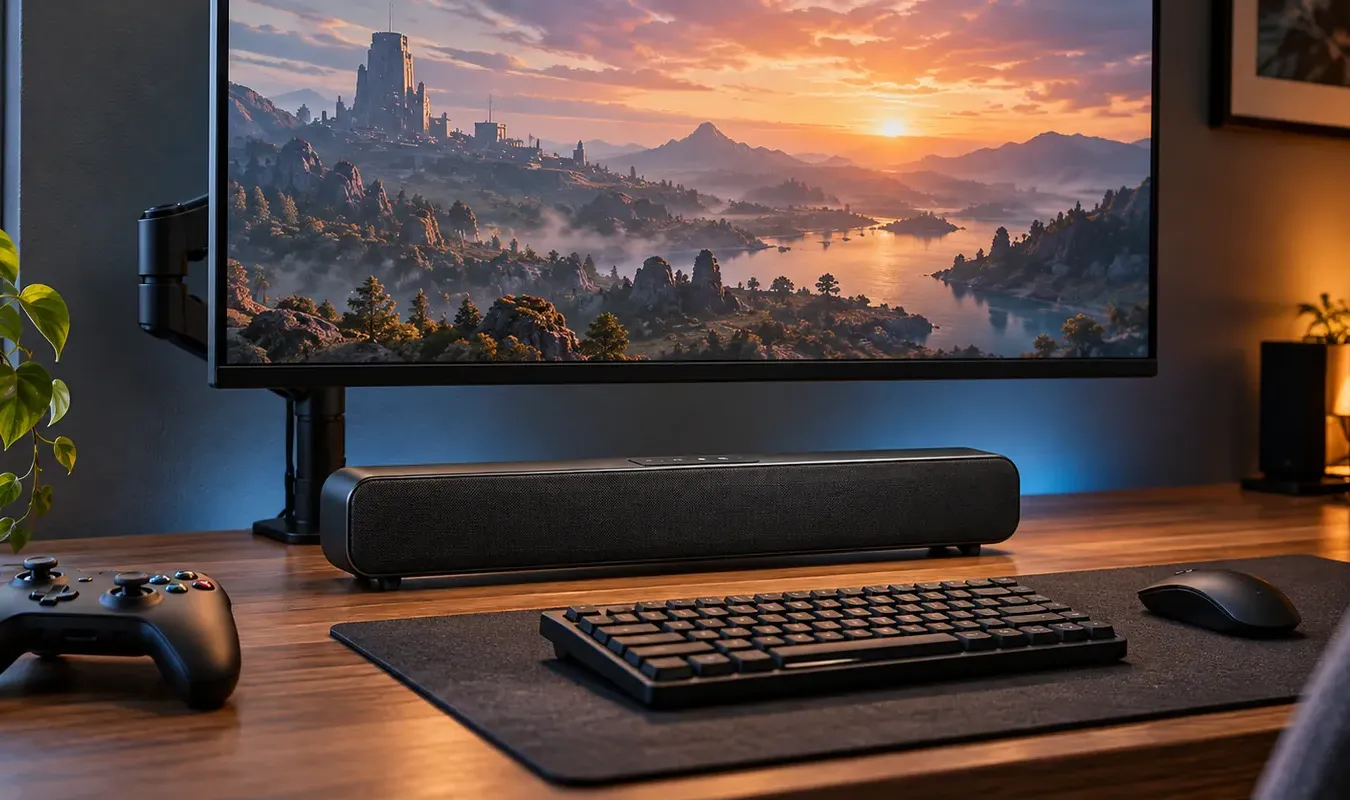
Bedroom or study scale: a short bar on a warm wooden desk below an arm-mounted monitor, a keyboard and mouse on a dark mat and a controller to the left.
Matching the bar to a Bayside room
Room
Usually works well
Think twice about
Why
Bayside Hills living room with a long plaster wall
Full-width bar on a bracket under the TV
Hidden leads through plaster without probing first
Long walls suit wide bars; old plaster rewards care over speed
Garden-co-op living room
Centre-channel bar, sub on an outside wall
A large sub on a shared floor
Neighbours beside and below share the bass
Split-level or ranch den down a few steps
Compact or mid-size bar; cable run to the room above
Atmos under a low basement ceiling
Short ceilings and soffits limit height effects
Two-family, owner's floor over a tenant
Bar tuned for speech, sub low or omitted
A sub against the floor over the bedroom below
Two households share one structure
Bay Terrace tower apartment
Bracket on block or concrete, painted channel
Promising hidden leads in a solid wall
No cavity in masonry; managing agent approval
Which socket on the TV the bar will use
Socket on the TV
Link
What it carries
Typical Bayside use
HDMI labelled eARC
HDMI eARC
Full-resolution audio, Dolby TrueHD included, plus single-remote control
A new living-room TV with a full-width bar
HDMI labelled ARC
HDMI ARC
Compressed surround, including streaming Atmos inside Dolby Digital Plus; one remote
Most streaming households and mid-size bars
No ARC, optical out only
Optical
Stereo or basic surround only, and often a second handset for volume
An older second TV in a bedroom or den
Phone or tablet only
Bluetooth
Compressed stereo with a small delay
Music in the kitchen; not ideal for watching TV
Model ranges change every year; the measurements quoted here were correct when we checked them in October 2026. Before your appointment we look up your own bar's inputs, weight and mounting holes and compare them with the wall in your photo, which is how we decide what hardware to load into the van.
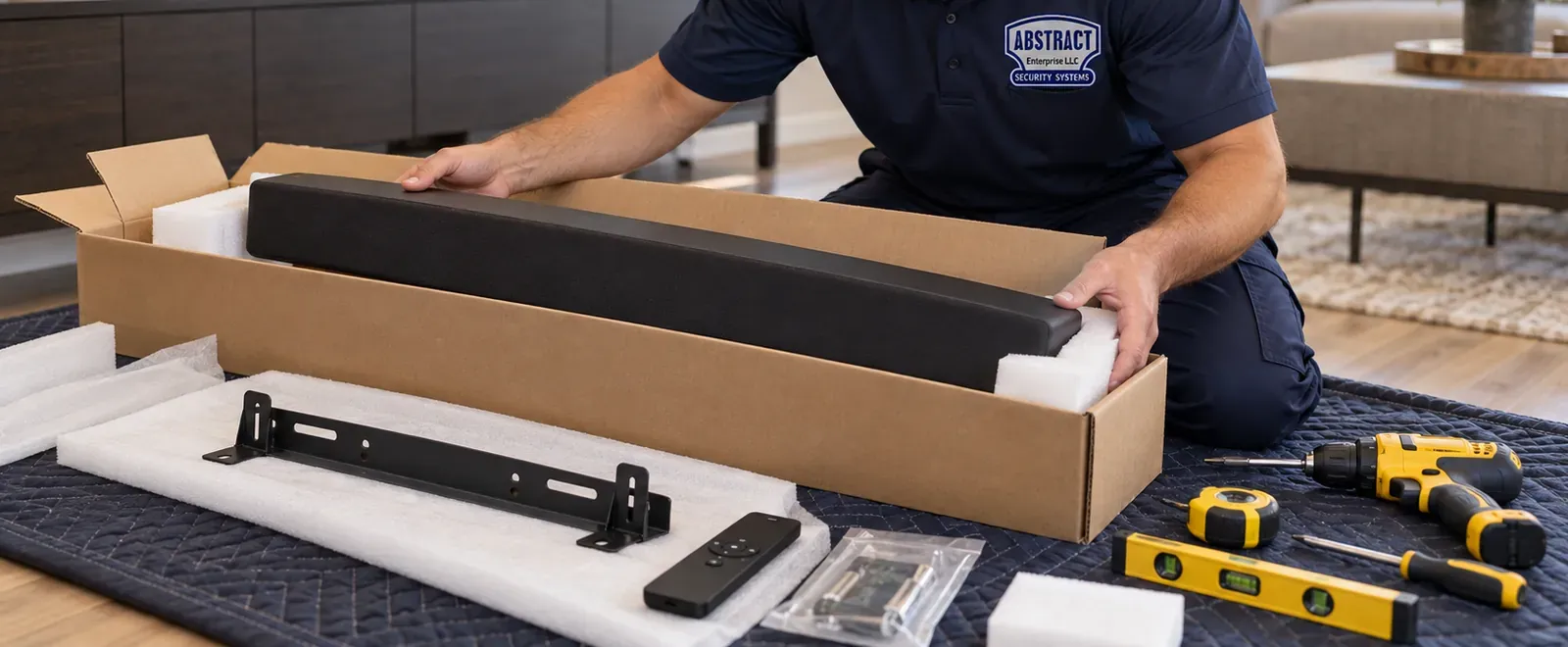
Checked before drilling: the bar comes out of its foam-lined carton while the bracket, remote, a bag of screws, a drill, a tape and a level wait on the blanket.
AI Overview Reality Check
What AI Gets Wrong About Soundbar Installation in Bayside
A word on method first. We could not load Google's AI summaries while researching this page, so we do not pretend to quote them. Headings in quotation marks are things a cost guide or a published source actually says; headings without them paraphrase advice that circulates widely and that search summaries and chatbots tend to repeat. Under each is what it means in a Bayside home or business.
“Professional TV mounting costs between $153 to $353 on average”, with a soundbar mount added for $30 to $100
Angi's cost guide gives those national figures, and a summary built on them will tell you a soundbar adds a modest sum to any TV job. As national ranges they are not unreasonable, and they are often the first numbers a Bayside homeowner sees.
What a national add-on cannot know is your wall. On our Queens menu the soundbar wall mount is $135.45 including connection and set-up; plaster adds $47.25, brick $68.25 and block $78.75; our Sanus bracket is $89.24 if the box came without one; and hiding the leads is $177.45, or a painted channel $61.95. A Bayside Hills living room and a newer drywalled den can therefore cost quite different amounts for what sounds like the same job.
The fair test is a written quote that names your wall and your finish. Ask every installer for one; ours breaks the job into the same published lines shown on this page, so nothing is hidden inside a single round number.
Use the anchors that come in the box
Many quick guides treat the plastic plugs packed with a soundbar as the standard fixing, and for drywall over studs they often are adequate for a light bar. Summaries repeat that as if it applied to every wall.
Bayside's walls are rarely that simple. In inter-war plaster a small plastic plug can spin in a crumbly hole or crack the key around it; in brick it needs the right bit and depth; in block it may land in a hollow core. The weight of a bar is modest, but a bracket also takes knocks from cleaning, children and the occasional elbow.
We choose the fixing after the scan and the pilot hole: a screw into a stud where one lines up, a toggle sized to the load behind plaster or board, sleeve anchors in brick and block, and a plywood backer board ($89.25) where the surface is too weak to hold anything directly. The in-box hardware goes back in the bag for you to keep.
“Permits: Required only for electrical work or structural changes”
Angi's guide says that about TV and soundbar work, and as a statement about city permits it is broadly right: a bracket and a bar need no Buildings permit, and our low-voltage licence covers the signal wiring.
The trap is reading “no permit” as “no permission.” In a Bay Terrace or Oakland Gardens garden co-op, or a tower like the Bay Club, the proprietary lease and the house rules decide what counts as an alteration, and many boards want an application, a certificate of insurance and agreed working hours even for a bracket. In a two-family house the owner decides for the whole building.
So the first question in a co-op is not “does the city need a permit?” but “what does our managing agent need?” We supply the description and the certificate; the approval itself comes from your board.
Wireless surround speakers mean no more wires
Wireless rear speakers and subwoofers are sold on the promise of no cables, and summaries often stop there, as if a full surround system could be set up anywhere in the room with nothing to plug in.
The audio travels wirelessly; the power does not. Each rear speaker and each sub still needs a mains socket. In many older Bayside living rooms the sofa floats in the middle of the room or backs onto a window, and the nearest outlets are on the walls. That is where cords end up crossing the floor if nobody plans them.
We plan the rears' power before the speakers come out of the box: a socket behind the sofa if there is one, leads routed along the baseboard and under a rug edge if not, and stands placed where nobody will trip. A new outlet, if you want one, is an electrician's job and is booked before our visit.
“Why You Should Use the Same SSID for 2.4GHz and 5GHz Wi-Fi”
Network vendors publish that advice, and for everyday use it is sound: one network name lets phones and laptops move between bands without fuss. Summaries carry it over to every device in the house.
Some streaming soundbars and their apps are fussier during first-time setup, especially when the router steers devices between bands on its own. When a bar will not join, a router maker's own instructions for band steering describe the fix: turn steering off and give the two bands different names so you can choose.
We do that only if your bar needs it, only with your say-so, and we can put the names back afterwards. A bar that plays the TV's sound over HDMI needs no Wi-Fi at all; the network matters only for streaming music, app control and updates.
Turn on night mode and the neighbours will not hear a thing
Night mode, or dynamic-range compression, is a genuinely useful setting: it keeps quiet speech audible while taming sudden explosions. It is widely described as the answer to late-night viewing in shared buildings.
In a two-storey garden-apartment building or a two-family house, though, what travels is mostly low bass through the structure, and night mode does not always reduce the subwoofer's output on its own. A sub sitting on a floor that is the ceiling of the bedroom below, or pushed against a party wall, can still be felt next door with night mode on.
So we combine settings with placement: the sub on an outside wall and on a solid part of the floor, its level set for the room rather than the showroom, and night mode or the bar's own bass control shown to you as one button for the evening. In the most sensitive layouts, a bar without a separate sub is the honest recommendation.
You cannot hide wires in an old house
A common assumption, repeated in summaries, is that older houses rule out concealed wiring and that surface channels are the only tidy option before 1950.
Many Bayside houses of the 1930s and the post-war years have plaster or early gypsum walls on wood studs, which means hollow bays that cables can travel through. What gets in the way is not age but specifics: horizontal blocking between studs, an old pipe or vent, a chimney breast, a wall that turns out to be brick, or plaster that is too fragile to cut cleanly.
We probe the bay before promising anything, then quote the code-compliant in-wall kit ($177.45) where it will work and a painted channel ($61.95) where it will not. Either way you know which it is before the drill comes out.
Plaster, Co-op or Two-Family — Planned Before We Drill
Send the bar's model, a photo of the TV wall and the decade the house or building went up, and we will send back a written price and a mounting method for your wall.
A Tudor inside Bayside Hills, a Cape on a side street off Bell Boulevard, a garden co-op in Bay Terrace or Oakland Gardens, a tower apartment by the bay, or a bar on Northern Boulevard — tell us the bar, the TV, the wall and the building, and a written price comes back the same business day. Rather talk it through? Call (347) 434-6392.
✅
Thanks — Your Request Is With Our Queens Team
On weekdays we usually phone back, or email a priced reply, within the afternoon. For anything that cannot wait, ring (347) 434-6392 straight away.
How It Works
Our Installation Process
Whether it is a small bar for a Bay Terrace bedroom or a television and Atmos bar above a Bayside Hills fireplace, the sequence below never changes. What is different about Bayside is how much of the work happens in steps one and two: identifying the wall and getting the right person's agreement.
1. Tell us the building and the decade
Send the bar and TV models, a photo of the wall and roughly when the house or building went up. A 1930s house, a 1950s garden co-op and a newer drywalled room each point to different fixings, and the quote is itemised from that.
2. Clear it with whoever decides
Co-op owners check the managing agent's rules and we send a certificate of insurance; tenants forward the owner's go-ahead; owners of a two-family tell us who lives on the other floor.
3. Book a two-hour window
Choose any two-hour slot from 8 AM to 8 PM, seven days a week. Moving it costs nothing with 24 hours’ notice, and if an earlier same-day slot opens up we offer it to you first.
4. Find the framing properly
Behind plaster, the scanner is only a first opinion: a magnet tracks lath nails, the outlet box marks one stud, and a single pilot hole hidden behind the bracket settles what the fixing will be.
5. Fix, level and route
Depending on the wall, the bracket goes into a stud, onto toggles, into masonry anchors or onto a backer board, with shims under it on textured plaster. The bar is aligned with the TV and its leads go inside the wall, to a closet, or into a channel you can paint.
6. Connect and place the sub
HDMI eARC or ARC set up, HDMI control switched on so one remote works, lip-sync checked and firmware updated; subwoofer and rears placed with the neighbours beside and below in mind.
7. Tune and hand over
We balance voices against bass for your space, demonstrate the late-night setting, remove the cartons if that line was booked, clean up, and walk the main viewer through switching on, volume and changing sources.
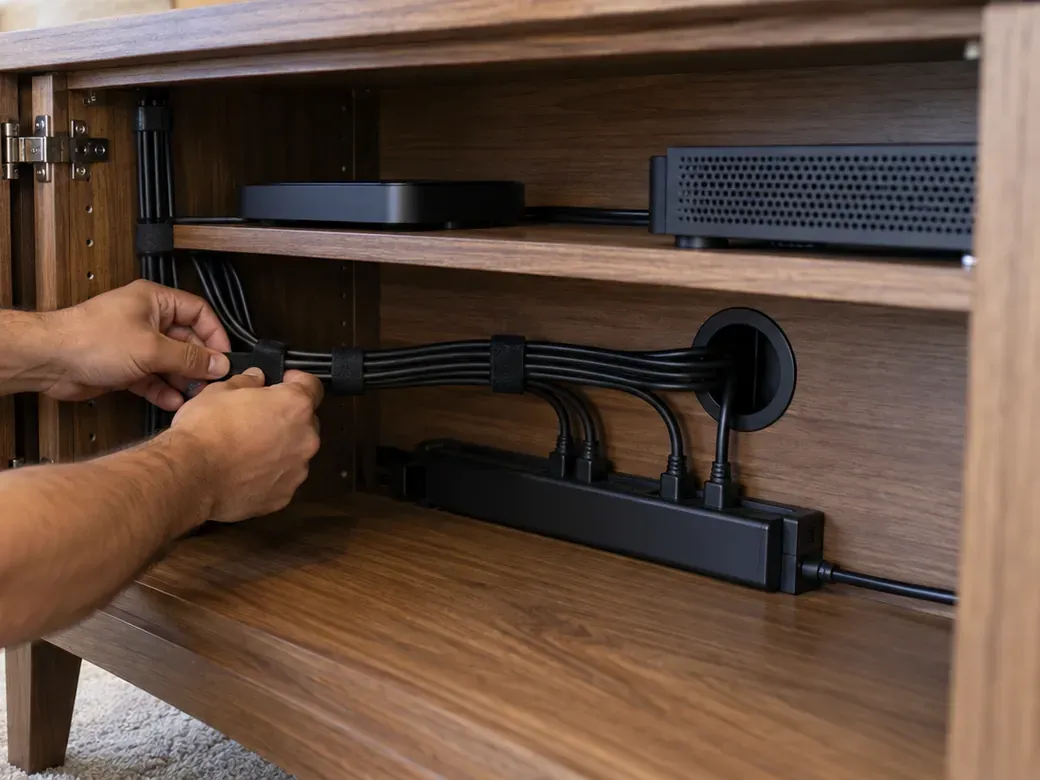
Hands wrap black hook-and-loop ties round a cable bundle in a walnut cabinet; the bundle drops through a round port to a power strip, two set-top boxes on the shelf overhead.
Coverage Area
Soundbar Installation Near Bayside's Landmarks
Mention one of these when you call and we already have a fair idea of the street, the building type and the way in before your photos arrive.
Fort Totten and the Castle
Established in 1857 as the Fort at Willets Point to defend New York Harbor, Fort Totten has more than 100 buildings from the 1830s to the 1960s and became a city historic district on June 29, 1999. Its Gothic Revival Castle, built in 1887 as the Army engineers' officers' mess and club, has housed the Bayside Historical Society since 1984.
The Bayside Hills Gatehouses and Malls
The enclave between 48th Avenue and the Long Island Expressway is known for its 33 planted street malls, the gatehouse at Bell Boulevard and 48th Avenue, and a street clock its civic association put up for the neighbourhood's 60th anniversary. Inter-war houses and plaster walls start here.
Bayside LIRR Station
The Port Washington Branch stop at 213th Street and 41st Avenue, just off Bell Boulevard and north of Northern Boulevard. Its station building dates from 1923, and the tracks were lowered beneath Bell Boulevard between 1928 and 1930. The streets around it mix two-families, apartments and shops.
Crocheron Park and Joe Michaels Mile
The park on Little Neck Bay off the Cross Island Parkway between 33rd and 35th Avenues, on the site of the Crocheron House hotel of the 1850s. The 2.4-mile shoreline path that runs out of it was named Joe Michaels Mile on April 24, 1988. Detached houses on the blocks above it.
Bay Terrace and Bayside Gables
The north end of Bayside, bounded by the Clearview Expressway, 26th and 28th Avenues and the bay, with the shopping centre, the garden co-op sections, the Bay Club and Baybridge, and the gated Bayside Gables enclave — some of the area's only single-family homes, by Wikipedia's account.
All Saints Church and Lawrence Cemetery
Two reminders of Bayside before the suburbs: All Saints Episcopal Church, built in 1892 and containing work by Louis Comfort Tiffany, and the Lawrence family cemetery at 216th Street and 42nd Avenue, a short walk from the station and Bell Boulevard.
We cover all of Bayside and its edges — Bay Terrace, Bayside Hills, Oakland Gardens, Hollis Hills, Auburndale, Whitestone, Douglaston, Little Neck and Fresh Meadows — and, on the same Queens price list, the rest of the borough. For the wider picture, see our Queens soundbar installation page.
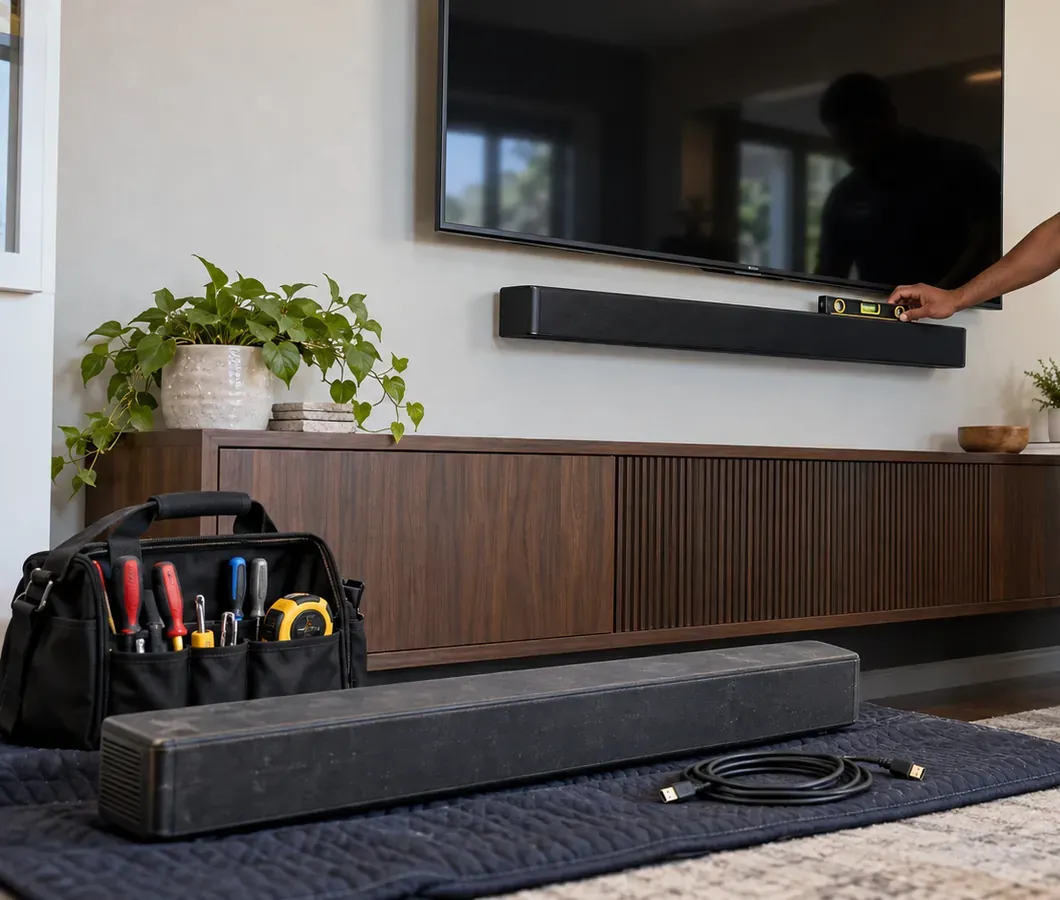
A small yellow level sits on top of the mounted bar beneath the dark screen; below, a red-handled tool bag, another bar and a loop of HDMI cable lie on a navy blanket.
Pricing
Soundbar Installation Cost in Bayside
Bayside is Queens, so it is priced from our Queens menu: one published line for each piece of work, with the borough's 1.05 area factor already applied to the soundbar and accessory lines. There is no extra charge for the trip out to the north-east corner of the borough. Two figures are specific to Queens — the hourly rate for visits where nothing is mounted, and the TV-mounting starting price — and both appear below. If something turns up on the day that your photo could not show, you hear the price before any work on it starts.
Line item
Queens price
What you get
Soundbar placed on a console or stand
$82.95
Sits on your own console or stand, wired to the TV and adjusted; no drilling at all
Soundbar wall-mounted under the TV
$135.45
Bracket screwed to what your wall really is, bar lined up with the picture, then a test film played through it
Sanus soundbar bracket
$89.24
Our own bracket, for a bar shipped without one or with hardware unfit for plaster or brick
In-wall concealment
$177.45
Power and HDMI fed inside a hollow bay through a code-compliant kit that draws on the socket already there
Paintable cord cover
$61.95
A narrow paint-ready cover carrying both leads down the wall face
Cable run to a cabinet or other spot
$103.95
Up to 25 ft, so boxes can sit in a closet, a cabinet or the room next door
Sonos setup
$131.25
Sonos bar, sub and rears joined in the app and grouped
A/V receiver hookup
$135.45
Receiver connected and configured
Universal remote
$103.95
One handset programmed for the TV, the bar and your sources
Streaming device setup
$51.45
Roku, Apple TV, Fire TV, Chromecast or similar
Full home theater connection
$367.50
Several components connected and set up together
Walls, height and access
Condition
Queens price
Where it turns up in Bayside
Drywall on wood studs
$0
Renovated rooms, extensions, newer houses
Metal studs
+$31.50
Some shop fit-outs and newer condo partitions
Plaster
+$47.25
Inter-war houses, including much of Bayside Hills, and many post-war rooms
Brick or stone
+$68.25
Chimney breasts and brick feature walls
Concrete or cinder block
+$78.75
Tower apartments, some garden-co-op and basement walls
Tile or marble
+$99.75
Fireplace surrounds, restaurant feature walls
Plywood backer board
$89.25
Soft or patched plaster that will not hold a fixing directly
High mount (above about 8 ft)
$78.75
Bars above head height in restaurants and tall extensions
Walk-up, 3rd floor and above, no elevator
$42
Upper floors of walk-up apartment buildings
Box removal
$26.25
We take the cartons and foam away
Certificate of insurance for a co-op, condo or landlord
Free
Bay Terrace and Oakland Gardens co-ops, tower managing agents, commercial landlords
Setup-only visits and TV mounting in Queens
Plenty of Bayside calls need no mounting: a new TV that will not talk to the old bar, a sub that dropped its pairing, lip-sync drift, or inputs scrambled by a replacement cable box. We charge those by the clock — the Queens first hour is $195, and any further time goes in 30-minute steps. If a TV is going up on the same visit, the Queens TV-mounting base price is $179.99 for a 32- to 55-inch screen on a flat or tilting mount on drywall over wood studs, with size, mount and wall additions from our Queens TV mounting price list.
What the price covers, and what it does not
Part of every mounted job: locating studs or solid masonry, a bracket that is fixed and dead level, the bar hung and wired to the TV, leads dressed neatly, the TV remote given control of the bar, dialogue and late-night settings chosen with you, and the dust cleaned up before we go.
Other trades: outlets of any kind are a licensed electrician's work, and patching and painting belong to your decorator; neither appears on our invoice.
Wasted trips: a $150 return-trip charge applies when we arrive and cannot begin — for example, the bar has not been delivered, no one is home to open up, or the board or landlord has not yet approved the work.
Surfaces that may chip: we tell you before drilling original plaster, glazed tile or stone, which can flake even with care, and nothing goes ahead until you agree.
National booking apps and big-box menus compared with a licensed local installer. Flat national prices are written for a drywall wall in a standard suburban room, and some Bayside rooms are exactly that. What they do not price is the rest: plaster on metal lath, a textured Mediterranean finish, a brick chimney breast, a garden co-op's paperwork, or a two-family where the sub has to be planned around the people downstairs. A licensed installer working from a wall-by-wall Queens price list can quote the room you actually have and is answerable to you afterwards.
Shop Our Systems
Soundbar Installation Packages & Pricing
Most Bayside customers end up choosing one of these three bundles. The arithmetic is printed on every card; a surcharge from the wall and access table is simply added where it applies.
Starter — On the Console
$82.95
The bar placed on your media unit for $82.95, connected on eARC or ARC, HDMI control on so the TV remote runs it, speech mode set and leads tied out of sight. Nothing is drilled, which suits a tenant's floor or a co-op still waiting on its managing agent.
Standard — Bracket Under the Screen
$224.69
The $135.45 wall mount plus our $89.24 Sanus bracket comes to $224.69 on drywall over studs. Add your wall's line where it differs: $47.25 for plaster, $68.25 for brick, $78.75 for block, $89.25 for a backer board behind soft plaster.
Premium — Bracket With the Leads Hidden
$402.14
The mount ($135.45), the Sanus bracket ($89.24) and a code-compliant in-wall kit carrying power and HDMI inside the wall ($177.45) total $402.14. It needs a hollow stud bay and an owner who agrees, which a Bayside house often has and a garden co-op often does not.
Bring Your Own Equipment — Labour Only
Already own a suitable bracket, perhaps the one packed with the bar? You pay the $135.45 Queens wall mount plus your wall's line. Your bracket must be rated for the bar and stays under its maker's warranty, not ours; if it looks wrong for plaster or brick, you hear that before any drilling, along with the option of our Sanus bracket.
Three worked examples, from the published lines. A bar on our bracket on a textured plaster wall, with a painted channel screwed down to the outlet: $135.45 + $89.24 + $47.25 + $61.95 = $333.89. A bar placed on the console in a garden-apartment bedroom with a new streaming stick set up at the same time: $82.95 + $51.45 = $134.40. And a 32- to 55-inch TV mounted on drywall with the bar hung beneath it on our bracket: $179.99 + $135.45 + $89.24 = $404.68.
Get Your Bayside Soundbar Total in Writing
Text or email us the bar's model, one picture of the wall and whether you live in a house, a two-family, a garden co-op or a tower, and the itemised total comes back today.
Bayside covers a lot of ground, from the bridge approaches at Bay Terrace down to Union Turnpike, and the buildings change several times along the way. Wikipedia gives Bayside and Bayside Hills alone more than 1,850 acres, and the ZIP codes split it roughly in three: 11360 north of 32nd Avenue, 11361 between 32nd and 48th Avenues, and 11364 from 48th Avenue down to Union Turnpike. This is how the work tends to differ from one part to the next.
Part of Bayside
Typical building
Usual TV wall
Who has a say
Most common finish
Bay Terrace (11360)
1950s garden co-ops, condo and co-op towers, gated houses at Bayside Gables
Plaster or block in the co-ops; concrete or block in the towers
Section board or condo board, managing agent
Bracket with a painted channel
North and central Bayside, around Crocheron Park and the station (11361)
Detached houses, two-families, apartments over Bell Boulevard shops
Plaster or drywall on wood studs; brick chimney breasts
Owner; tenant needs the owner's yes
Bracket with hidden leads where the bay is clear
Bayside Hills (11364)
Inter-war detached houses inside the gatehouses
Plaster, sometimes on metal lath; textured finishes
Owner
Bracket fixed to studs found behind plaster
Oakland Gardens and Hollis Hills (11364)
Garden-apartment co-ops such as Windsor Park, Capes and ranches near the parks
Plaster or early gypsum; block in some co-op walls
Co-op board for apartments; owner for houses
Console setup or bracket with a channel in co-ops
Bell and Northern Boulevards
Bars, restaurants, shops and offices
Drywall, block or tile feature walls
Landlord or managing agent
Bar tuned for speech at a fixed level
Bay Terrace. The garden co-ops are the defining building here: nine sections, each a separate corporation, built in the 1950s on land owned by Cord Meyer Development. Habitat magazine's reporting describes most of them buying out the 99-year land leases beneath them, which matters to shareholders' finances but not to an indoor bracket. What matters to us is the section's alteration rules and the neighbours. The towers along the bay — the Bay Club, Baybridge, the Towers at Waters Edge — bring concrete and block, managing agents and certificate requests, and a new generation of rental apartments is going up at the shopping centre.
North and central Bayside. Between the bay and Northern Boulevard the streets are mostly houses: older detached homes on the blocks above Crocheron Park, two-families and attached houses nearer the station, and apartments over the shops of Bell Boulevard. These are the jobs where hidden wiring is most often possible, because many interior walls are hollow wood-framed partitions, and where the two-family question — whose floor, whose ceiling — comes up most.
Bayside Hills. South of 48th Avenue the enclave's 1930s houses set the pattern: plaster walls, and living rooms often arranged around a fireplace, with the dining room opening off them. Finding the framing behind plaster is the main skill, and a bar on a TV-attached bracket is a popular choice where the TV swings between the sofa and the dining table.
Oakland Gardens and Hollis Hills. South of the Long Island Expressway, garden-style co-ops such as Windsor Park sit beside streets of Capes, ranches and brick houses near Alley Pond and Cunningham parks. The co-op jobs follow the Bay Terrace pattern; the houses follow the post-war one, often with a den or family room down a few steps where a compact bar suits the lower ceiling.
The boulevards. Bell Boulevard's bars and restaurants, Northern Boulevard's dining rooms and the offices above them need a TV people can follow without the volume climbing all night. We tune those bars for speech, fix their levels where the bar allows, and keep them clear of kitchen air and walkways.
Garden Co-ops
A Soundbar Checklist for Bay Terrace and Oakland Gardens Garden Apartments
Garden apartments were built to feel like houses, with lawns, courtyards and low brick buildings, but they are shared buildings with shared rules. A soundbar in one is a small job that goes smoothly when a few things are settled first. This is the list we work through with co-op owners before booking.
Ask for the alteration rules. Each section or co-op has its own. Some treat a bracket as routine maintenance; others want an application, a description of the work and the board's sign-off. The managing agent's office will know.
Get the certificate wording right. If a certificate of insurance is required, ask exactly which names it must show — usually the corporation and the managing agent — and send it to us. It is free and usually goes out the same day.
Check the working hours. Many co-ops limit contractor work to weekdays and set hours for noisy work. Drilling a bracket takes minutes, but it still counts.
Think about all four directions. A garden apartment may have neighbours through the side walls, upstairs and downstairs. The TV wall is better on a wall you do not share where the layout allows it, and the sub belongs on an outside wall and a solid part of the floor.
Keep everything inside your apartment. Basements, attics, hallways and outside walls usually belong to the corporation. Cable runs along your own baseboards, painted channels and wireless rears avoid them completely.
Expect plaster or block. Garden apartments of the 1950s were commonly finished in plaster, and some walls are masonry. We bring fixings for both and confirm with a pilot hole.
Keep the paperwork. Hold on to the approval letter, the certificate and our itemised invoice. Boards sometimes ask about past alterations when an apartment is sold.
None of this needs to delay the sound. Until approval comes through, a bar on the console with the TV remote running it gives you nearly everything; the bracket can follow later without redoing the connections.
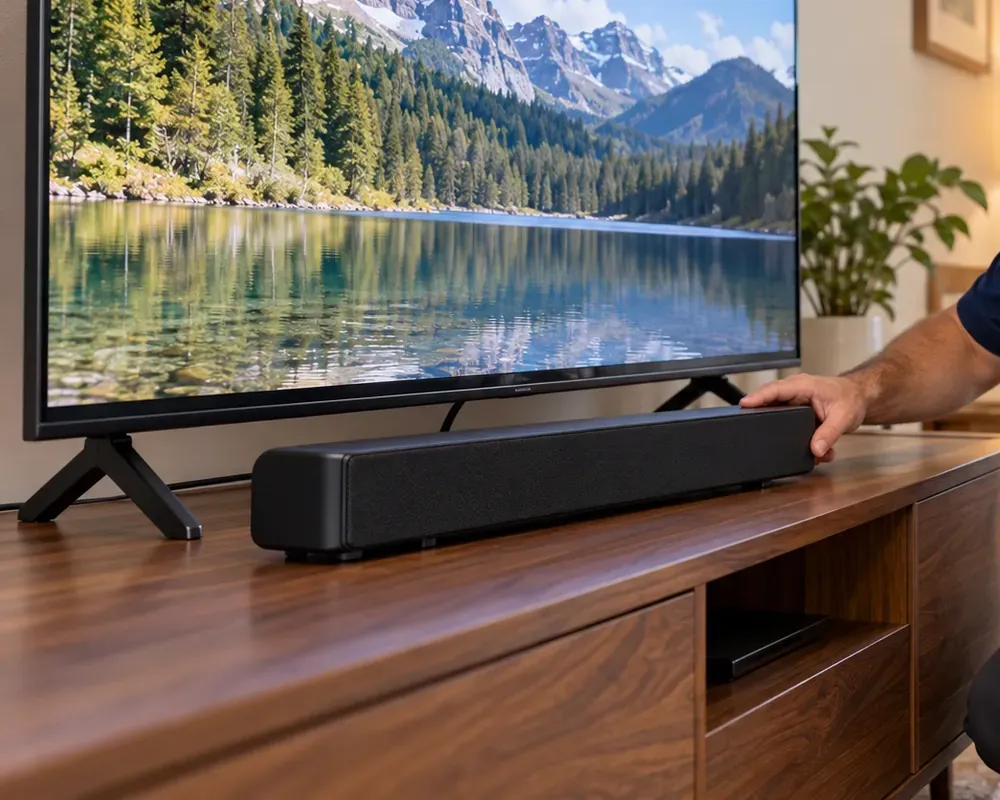
No holes yet: a hand slides the bar into place on a walnut console in front of a TV on its own feet, a set-top box visible on the open shelf underneath.
Two Households
Two Households, One House: Soundbars in Bayside Two-Families
More than a fifth of Bayside's homes sit in two-unit buildings, and a soundbar in one of them affects both households. Many of these houses are owned by a family living on one floor and renting the other; some are shared by relatives across generations. Either way, three questions decide the job.
Who decides about the walls? The owner, always. A tenant can have a console setup at any time, but a bracket, a hole or a hidden lead needs the owner's go-ahead, ideally by text or email so we can see it on the day.
Whose ceiling is under the subwoofer? If the living room sits over the other household's bedroom, the sub goes on a solid part of the floor near an outside wall, or the bar is chosen without a separate sub. If you live downstairs, the sub's bass rises less, but a bar on a ceiling-height bracket is still heard upstairs through the joists.
Which walls carry the other household's services? Water pipes, gas lines and the upstairs unit's wiring can run through walls on either floor. We scan and probe before drilling, and we do not hide leads in a wall whose contents nobody can confirm.
The same thinking applies to attached houses that share a party wall with the next home. The bar can go on that wall; the subwoofer should not. And if both households want soundbars, booking them at one visit means one set of decisions about the shared floor and one trip on the menu.
Visit Prep
Before the Technician Arrives
Eight quick jobs on your side mean the technician spends the visit on the wall, and the invoice matches the written figure.
Make sure the bar, any bracket, sub and rear speakers have been delivered; there is no need to open the boxes.
Clear a working space in front of the TV wall and take ornaments and photos off the console.
Point out the socket the screen and bar will plug into, and flip any wall switch nearby to see whether it kills that socket.
In a co-op, confirm the approval and the certificate are in place and tell us which entrance and parking the building prefers.
Renting a floor of a two-family? Forward the owner's message saying the bracket is fine.
Streaming or app-controlled bar? Have the Wi-Fi name and its password written down for the technician.
New TV arriving for the same appointment? Keep it in its carton; we pair its rear screw holes with the bracket before anything is unpacked.
Dogs, cats and toddlers are happier in another room while the drill runs; it is only a few minutes.
If you already know where the subwoofer must or must not go, say so at the start. We will give our view on the sound, and then it goes where the household wants it.
Complete Services
Every Soundbar Installation Service in Bayside
Related services from the same Queens office, for Bayside households and businesses planning more than a bar.
For Sonos owners: the bar, a Sub and any Era or One speakers joined in the app, then named by room so the family can send the ballgame to the kitchen or keep it in the den.
Plain-language terms for rescheduling, for a wasted trip, and for hourly billing on visits where no bracket goes up.
Field Notes
Field Notes: Finding a Stud Behind 1930s Plaster
What follows is the routine our installers use on old plaster in general, written down; it does not describe one household's job.
Start by not trusting the scanner. On old plaster it will either find nothing or find everything, and both answers are wrong. Run a strong magnet slowly across the wall at bracket height and mark every point where it grabs; the lath nails line up in vertical rows over the studs, usually at regular spacing, and a row that breaks the pattern is often a window or door header rather than a stud.
Check the marks against the outlet box, which is normally fixed to the side of a stud, and against the trim around the nearest door. Then drill one small pilot hole where the bracket will hide it, slowly and without hammer action, and look at what comes out: pale wood means a stud, grey grit and then air means plaster on lath over a cavity, and a bite of metal means mesh. Only then choose the fixing, and if the plaster crumbles around the pilot, stop and talk about a backer board.
Before leaving, hold the level on the bar one more time with the TV on. Old houses settle, floors slope and ceilings are rarely true, so the bar is levelled to the bottom edge of the screen, not to the ceiling line.
FAQ
Bayside Soundbar Installation FAQ
How much is a soundbar on the brick chimney breast of a Bayside house, with the cable box moved into a nearby closet?
+
On the Queens menu: $135.45 to wall-mount the bar, $89.24 for our Sanus bracket if the bar came without one, $68.25 for drilling brick, and $103.95 for a cable run of up to 25 feet to the closet. That is $396.89 in all. If the leads come down the face of the brick rather than travelling sideways, add a painted channel at $61.95.
A relative brought our soundbar back from Korea — can it be plugged in and mounted here?
+
Usually, but check the power rating first. South Korea uses 220-volt, 60-hertz power with round-pin Type C and F plugs, while US outlets supply 120 volts. If the label on the bar or its power adapter reads 100–240V, a plug adapter or a US power cord is all it needs; if it reads 220V only, it needs a step-up converter rated for its wattage, and we will not plug it straight into a US outlet. The menus, app and warranty may also be region-specific, so check those before the visit.
Our TV's menu has nothing called HDMI-CEC — what is the setting actually called?
+
Each maker uses its own name. Samsung calls it Anynet+, LG SimpLink, Sony BRAVIA Sync, Philips EasyLink, Sharp Aquos Link, Toshiba CE-Link or Regza Link, and Panasonic VIERA Link or HDAVI Control, while Vizio and TCL simply say CEC. Switch it on together with ARC or eARC and set the TV's sound output to the HDMI or receiver option, and the TV remote will run the bar's power and volume.
Our soundbar already works over an optical cable — is it worth switching it to HDMI?
+
Usually, if the TV has an ARC or eARC socket. Over HDMI the TV remote controls the bar's volume and power, the bar switches on with the TV, and it can receive formats an optical link cannot carry, such as Dolby Atmos inside Dolby Digital Plus over ARC or lossless audio over eARC. If the TV has no ARC socket, optical remains the right link. On its own, the change is a setup-only visit at the Queens rate; during an installation it is part of the job.
The HDMI sockets on our new TV face sideways and the cable sticks out past the edge once it's on the wall — can that be hidden?
+
Yes. A right-angle HDMI adapter, or a cable with an angled head, turns the plug flat against the back of the set so nothing shows past the edge, and the lead then runs down behind the screen to the bar. For the eARC socket we use a cable or adapter rated for the job, because cheap adapters are a common cause of audio dropouts. We check the clearance between the TV and the wall before choosing which one.
Can we switch back to the TV's own speakers for the early-morning news without unplugging the soundbar?
+
Yes. Nearly every TV lets you choose its sound output in the audio menu, between its internal speakers and the HDMI or receiver option the bar uses, and many put that choice in a quick-settings panel a couple of presses away. The bar simply goes to standby until you switch back. We show whoever uses the TV in the morning exactly where that setting is before we leave.
Soundbar Trouble Anywhere From Bay Terrace to Union Turnpike, Sorted Today
TV remote no longer turning the bar up, a sub that stays unpaired after the lights went out, or speech lagging behind mouths on screen? Call (347) 434-6392 for the first free two-hour slot; faults like these are normally fixed inside one or two hours on site.
Sources
Where the Local Facts on This Page Come From
Every Bayside fact on this page traces back to one of the documents below. Where sources disagree — the Bay Club's own history says it opened in 1981, while property listings give 1983 as the year built; Wikipedia and the Queens Chronicle place the Bayside Hills clock differently — we have used the wording that does not depend on the difference. Housing percentages come from Point2Homes' summary of American Community Survey data, whose Bayside boundary may not match yours exactly. Prices come only from our own published Queens menu.
New York City Council, Res. 0929-2005, Bayside Rezoning — https://legistar.council.nyc.gov/LegislationDetail.aspx?ID=443978&GUID=F6643130-6D73-4B43-8670-ABC7D2E7EA36
The Bay Club, “History of the Bay Club” — https://www.bayclub-bayside.com/HISTORY-OF-THE-BAY-CLUB
New York YIMBY, “Three-Building Bay Terrace Residential Complex Begins Construction in Bayside, Queens” (June 7, 2026) — https://newyorkyimby.com/2026/06/three-building-bay-terrace-residential-complex-begins-construction-in-bayside-queens.html
Bayside Village BID — https://www.baysidevillagebid.com/
QEDC It’s In Queens, “The Bell Blvd Food & Music Fest Is in Bayside on June 7” (June 2, 2026) — https://itsinqueens.com/newsflash-the-bell-blvd-food-music-fest-is-in-bayside-on-june-7/
Historic Districts Council, Fort Totten Historic District — https://hdc.org/hdc-across-nyc/queens/queens-landmarked/fort-totten/
Bayside Historical Society, About BHS and the Castle — https://www.baysidehistorical.org/about-bhs
NYC Parks, Crocheron Park and Joe Michaels Mile — https://www.nycgovparks.org/parks/crocheron-park
Washington State Department of Health, Asbestos around the home — https://doh.wa.gov/community-and-environment/contaminants/asbestos
Express Mounting, “How to Find Studs Behind Plaster and Lath Walls” — https://expressmounting.com/blog/how-to-find-studs-behind-plaster-lath-walls/
Remitly, “Electrical Outlets in South Korea” — https://www.remitly.com/blog/technology/electrical-outlets-in-south-korea/
Angi, TV mounting and soundbar cost guide — https://www.angi.com/articles/how-much-does-buying-and-repairing-tv-cost.htm
Uplevel Systems, “Why You Should Use the Same SSID for 2.4GHz and 5GHz Wi-Fi” — https://www.uplevelsystems.com/blog/why-you-should-use-the-same-ssid-for-2-4ghz-and-5ghz-wi-fi/
Abstract Enterprises Security Systems · 460 E Fordham Rd, Bronx, NY 10458 · Queens line for Bayside (347) 434-6392 · WhatsApp (718) 679-0359 via wa.me
NYS Low-Voltage Licence #12000287431 · 100% Licensed & Insured · Same-Day Estimates · Rated 4.7★ from 201 Google Reviews
Brackets and parts carry their manufacturer's warranty. Full terms — including 50% deposit, one-year parts-only warranty on AESS-supplied products, and the late-fee schedule — are set out in the service agreement. See our warranty page.
Page reviewed and updated October 17, 2026. Changelog: first publication of the Bayside soundbar installation page, written around inter-war plaster in Bayside Hills, the 1950s garden-apartment co-ops of Bay Terrace and Oakland Gardens, two-family houses, the towers on Little Neck Bay, and the bars and restaurants of Bell and Northern Boulevards. No Field Notes job story is included because no documented Bayside job was available; the Field Notes section describes our general method.