NYS Licensed Low-Voltage Installer · Bronx Office, 460 E Fordham Rd · Broadway Under the 1 Train, the Step Streets & Kingsbridge Heights
Soundbar Installation in Kingsbridge
Apartments Beside the El · Tudors & Frame Houses on the Slopes · Co-op Towers · Pubs on West 231st · One Remote
Kingsbridge sits in a valley. Broadway runs along the floor of it, under the steel of the elevated 1 train, through the busiest shopping strip in the northwest Bronx; on either side the ground climbs — west up the step streets toward Spuyten Duyvil and Riverdale, east past the Major Deegan into Kingsbridge Heights. Packed into that small area is one of the most mixed housing stocks in the borough: frame houses from the 1900s, Tudors from the 1930s, six-storey pre-war apartment buildings, 1960s and 1970s co-op towers and the Marble Hill Houses. A soundbar job here depends less on the brand of bar than on which of those buildings you live in, how far your windows are from the tracks, and whether the way to your front door is a sidewalk or a flight of public stairs. We plan for all three, then mount, wire and tune the bar so one remote runs it.
Reviewed and updated October 17, 2026 · Written by Anwar Timothy, NYS licence #12000287431 · Kingsbridge, Marble Hill and Kingsbridge Heights jobs are booked through the Bronx line, (646) 490-0629
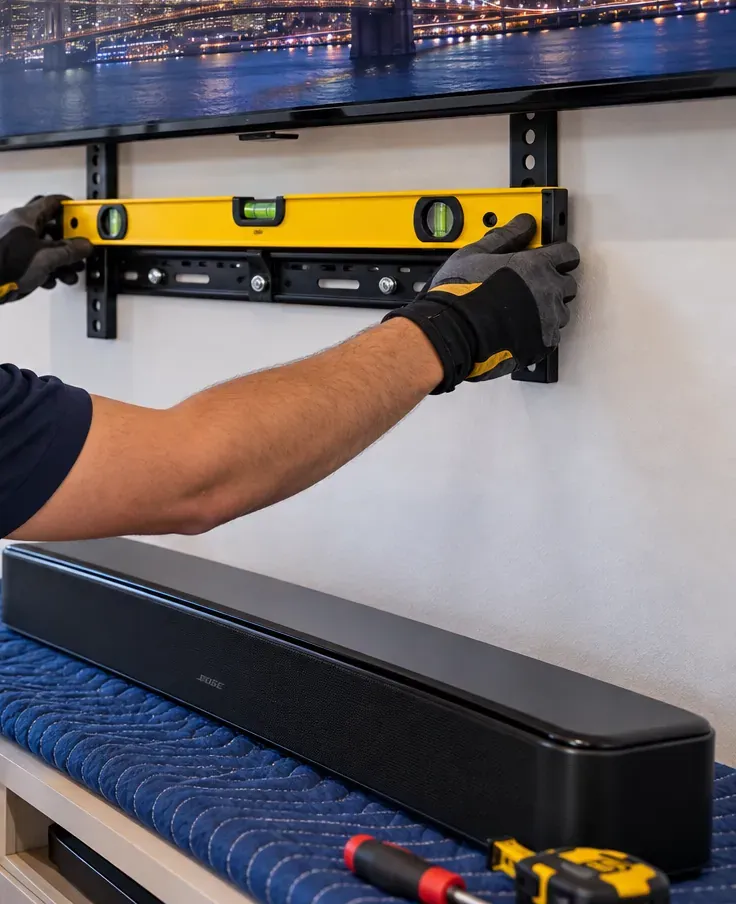
Gloved hands hold a long yellow spirit level along a black bracket screwed below a city-skyline TV image; the bar lies ready on a quilted blue pad.
Kingsbridge Soundbar Quote
Your building, your wall and the way to your door — a written price the same business day
✅
Request Sent!
The Bronx office will call you back the same business day.
25+
Years Experience
✓
Same-Day Estimates
100%
Licensed & Insured
4.7★
201 Google Reviews
Just carried a soundbar home from Broadway Plaza? Phone the Bronx line, (646) 490-0629, or use the one-minute form. A licensed low-voltage installer reads every request, and the figure you get back is added up from the published Bronx menu lower down this page, one line at a time.
Tell us the floor, the elevator situation and whether your door is on a stair street; we plan the carry before the day
Same Bronx prices in Kingsbridge, Marble Hill and Kingsbridge Heights — no surcharge for the hills
NYS licence #12000287431 · two-hour arrival windows, 8 AM–8 PM, every day of the week
Kingsbridge is small on the map and crowded with different kinds of home. By the boundaries the Riverdale Press has used, it runs from West 230th Street north to Manhattan College Parkway, and from Irwin Avenue east to Bailey Avenue and the Major Deegan Expressway — well under half a square mile. Broadway cuts through the middle of it, and the elevated 1 train runs above Broadway the whole way, stopping at 231st Street and 238th Street. The neighbourhood takes its name from the King's Bridge, put up in 1693 across a stretch of Spuyten Duyvil Creek that was later filled in; the bridge is said to lie buried roughly parallel to today's 230th Street. Everything that came afterwards — the trolley, the elevated tracks, the apartment buildings along Broadway, the houses on the hillsides — was built on or around that low ground, and it still shapes how a soundbar job goes.
Start with the el. A broker quoted by Brick Underground in 2023 called the No. 1 train “the focal point of the neighborhood,” and it is. The apartment buildings that line Broadway and the first blocks off it live with it every day: residents on Reddit describe Broadway under the tracks as having “train noise, less sunlight, lots of pigeons,” and the same threads note that it is “pretty quiet just a few blocks from broadway.” For a soundbar, that means two different kinds of apartment a block apart. In one, the sound has to carry speech clearly over a train passing every few minutes without being turned up so far that it bothers the neighbours once the train has gone. In the other, the room is quiet and the main job is keeping bass inside the apartment. We ask which kind you have before we suggest a bar.
Then there are the slopes. The streets that climb west from Broadway toward Riverdale include what the city calls step streets — public stairways where a road was too steep to build. Wikipedia's account of the neighbourhood puts the longest of them at as many as 160 steps, and Atlas Obscura describes the West 230th Street stairs as three flights connecting Irwin, Johnson, Edgehill and Netherland Avenues, 295 feet long and 38 feet high, with houses whose entrances open straight onto the steps. To the east, the ground rises again past the expressway into Kingsbridge Heights. A van can't stop at the door of every house in Kingsbridge, and a technician carrying a bracket, a drill and a 65-inch TV needs to know that before the day, not on the sidewalk.
The third thing is the housing mix. Brick Underground's buyer's guide lists Tudors, “Bronx bricks” and attached rowhouses alongside co-ops and a handful of condos, and its sample listings span a 1901 house on Kingsbridge Terrace, a 1910 frame house with a wraparound porch on Fort Independence Street, a 1938 Tudor on Tibbett Avenue, a twelve-storey co-op of 1961 and a six-storey co-op of 1974. Add the pre-war walk-ups and elevator buildings near Broadway, the four Marble Hill Houses towers that stand on the Kingsbridge side of the line, and the Amalgamated co-op's mix of 1920s Tudor-style blocks and post-war towers just east in Van Cortlandt Village. Within a ten-minute walk a technician can meet lath and plaster, textured 1930s plaster, poured concrete, block and fresh drywall. We don't guess which one is behind your TV; we find out.
Kingsbridge is also a neighbourhood that watches sport together. Gaelic Park, at West 240th Street and Broadway and now run by Manhattan University, hosts Gaelic football and hurling, and the pubs along West 231st Street and Broadway show matches for a crowd. At home, a TV that the whole family shares, from the grandparents to the teenagers, usually needs to work from one ordinary remote, which is why we treat the handover as part of the job rather than an afterthought. None of this makes a Kingsbridge job hard. It makes it specific: which side of Broadway, how high up the hill, which decade the building is from, and who will be holding the remote.
Kingsbridge figures that change a soundbar job
200 merchants: the size of the Kingsbridge Business Improvement District, which describes itself as the largest shopping district in the northwest Bronx. Its area runs along Broadway from West 230th to West 236th Street and along West 231st Street from the Major Deegan west to Corlear Avenue — most of it under or beside the el.
1.2 miles: the stretch of elevated steel above Broadway, from 225th to 242nd Street, that the MTA is repairing and repainting. The Riverdale Press reported in July 2025 that the work runs north in 1,000-foot sections, generally 7 a.m. to 7 p.m., finishing between 240th and 242nd Streets by summer 2027.
295 feet and 38 feet: the length and rise of the West 230th Street step street, which Atlas Obscura calls the longest in the city. Houses on and near it are reached on foot; we pack for one carry.
1901, 1910, 1938, 1961, 1974: the build years of five Kingsbridge homes in Brick Underground's 2023 guide — a frame house, a porch house, a Tudor and two co-op buildings. Five decades, five different walls.
11 towers, 4 in Kingsbridge: the Marble Hill Houses, completed in 1952; Wikipedia counts seven of its towers in Marble Hill and the other four in Kingsbridge. The housing authority has a say before anything is screwed to a wall there.
10463: the ZIP code shared by Kingsbridge and Marble Hill, served by the Kingsbridge Station post office at 5517 Broadway and the 50th Precinct at 3450 Kingsbridge Avenue. Every address in it is priced from our Bronx menu.
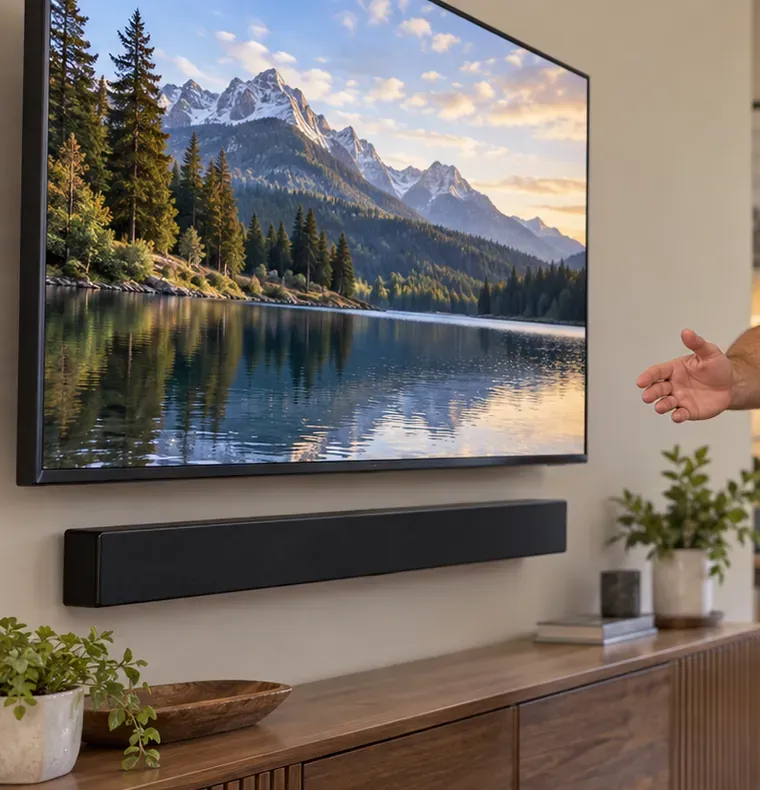
A finished wall: the bar hangs a short gap under the screen, clear of the walnut console and its slatted doors, while a hand gestures toward it from the edge of the frame.
Repair Capture
Kingsbridge Soundbar Lost Its Voice? Same-Week Repair Visits
A bar that went quiet when the cable company swapped your box, a subwoofer that won't pair since the power blinked, voices that arrive after the lips move, or a bar knocked crooked during a move — those are service visits, not new installs. We book them into the next open two-hour window, and most connection and settings faults are fixed within one to two hours of the technician walking in. Ring (646) 490-0629 and say it's a soundbar repair in Kingsbridge; the AESS TV and soundbar service policies explain how time is billed when nothing new gets mounted.
What We Install
Soundbar Installation Services in Kingsbridge
Each visit is built from the pieces below, and each piece has its own published price. They run from the lightest touch to the most involved. In a rented apartment near Broadway the first card is often the right one; in an owner-occupied Tudor or a renovated co-op the later ones come into play.
Bar Set on the Console
The soundbar placed on your media console or dresser, connected to the TV's eARC or ARC socket, moved clear of the remote sensor and tuned to the room. Nothing is drilled, so it suits a lease that frowns on holes or a household that wants to try the sound first.
Bracket on the Wall Below the Screen
The everyday Kingsbridge booking: a dedicated bracket an inch or two under the TV, squared to the picture and fixed to whatever the wall really is — timber, lath and plaster, concrete or block — with the anchor that suits it.
Bar Riding on the TV Mount
If the screen sits on an extending arm that turns toward the sofa or the table, the bar can clip to the TV mount rather than the wall and turn with it.
Leads Hidden in a Hollow Wall
A code-compliant in-wall kit takes mains and HDMI down inside the cavity, drawing power from an outlet on that same wall. Offered only where the scan shows a clear cavity and the owner agrees — more often in a house or a renovated co-op than a pre-war rental.
Painted Channel on the Wall Face
A slim, paintable cord cover from the bar down to the outlet. The neat answer on plaster you'd rather not open, on concrete and block, and on any wall a landlord or board wants left whole.
Cable Run to a Shelf or Cabinet
Up to 25 feet of HDMI and power around a door frame, along a skirting or across to a closet, so the cable box and console can sit somewhere other than directly under the screen.
Screen and Bar in One Visit
When the TV is going up at the same time, its height, the gap to the bar and the cable path are decided together. In a pre-war living room with one usable wall, that is usually what makes the result look planned.
Tuning for a Busy Street or a Quiet One
eARC or ARC chosen, CEC switched on so the TV remote runs the bar, lip-sync checked, firmware updated, and dialogue, bass and any volume-levelling feature set for a flat beside the tracks or a house up the hill — which want different things.
Subwoofer and Rears Placed With Neighbours in Mind
Wireless sub and rear speakers paired and placed where there's power. In an apartment building, the sub goes off the shared wall and off the bare floor; in a detached house, it goes where it sounds best.
Two or three cards usually make up one booking. In a pre-war rental that tends to mean the bracket, the raceway and the tuning; a console setup with a universal remote is what a lot of families choose for a grandparent's room; a bracket with hidden wiring suits the drywalled rooms of a renovated house on the slopes. Each line is listed separately on your quote, so anything you don't want simply comes off.
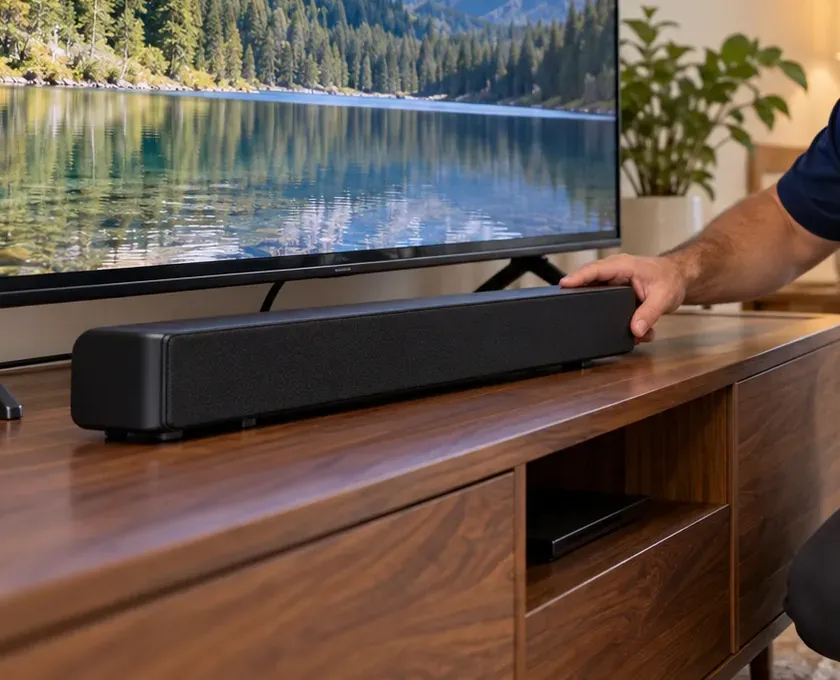
No holes at all: a hand settles a black bar on a walnut console with an open shelf, just in front of a TV standing on angled feet.
Building Specialists
Soundbar Installation for Kingsbridge's Architecture
Few Bronx neighbourhoods fit so many building types into so few blocks. These are the ones our installers meet between Marble Hill and Manhattan College Parkway, and what each usually means for a soundbar.
Pre-War Apartment Buildings Along Broadway
Five- and six-storey walk-ups and elevator buildings on Broadway and the first blocks off it, many within sight of the el. Plaster walls, radiators under the windows, and a landlord who decides about holes.
Houses West of Broadway
The area Brick Underground calls the Dash Estate, with the neighbourhood's biggest concentration of single-family houses and part of the Manhattan University campus. Tudors, frame houses and brick houses, some on streets that turn into stairs.
Tudors and Brick Houses Near Tibbett Avenue
1930s houses — Brick Underground's 1938 Tibbett Avenue example has leaded-glass windows, hardwood floors and a fireplace — in the stretch Wikipedia still describes as the centre of the neighbourhood's Irish community around Bailey and Tibbett Avenues.
Turn-of-the-Century Frame Houses
Houses from around 1900–1910 on Kingsbridge Terrace, Fort Independence Street and the side streets of the Heights, often with porches, attics and decades of alterations behind the drywall.
Post-War Co-op Buildings
Co-ops from the 1960s and 1970s, such as the twelve-storey, 224-unit building of 1961 on Tibbett Avenue and the six-storey, 72-unit building of 1974 on West 232nd Street. Usually concrete-framed inside, with a board and a managing agent to satisfy.
Marble Hill Houses and Van Cortlandt Village
NYCHA's eleven towers of 1952, four of them on the Kingsbridge side, and the Amalgamated co-op's 1,468 apartments between Van Cortlandt Park and the reservoir. Masonry walls and an organisation with rules about what's fixed to them.
What's behind the TV wall in a Kingsbridge home
Lath and plaster in the pre-war buildings. Pre-war apartment buildings like those near Broadway were typically plastered over wood or metal lath, and decades of patching and skim coats can leave the surface hard, uneven and hollow-sounding in places. We drill slowly, without hammer action, and look for framing or solid masonry behind the plaster rather than trusting a screw in the lath. Where the plaster is tired, a plywood backer board spreads the load. Plaster is a $45 line on our wall table because it takes longer and more care than drywall.
Hand-finished plaster in the 1930s houses. Tudor-era interiors were often finished with textured or troweled plaster rather than a flat skim, and it is usually harder than modern board. It drills well with the right bit and patience; what it doesn't do well is take adhesive, which matters for cord covers (see the questions below). We fix to the studs behind it wherever they fall in the right place.
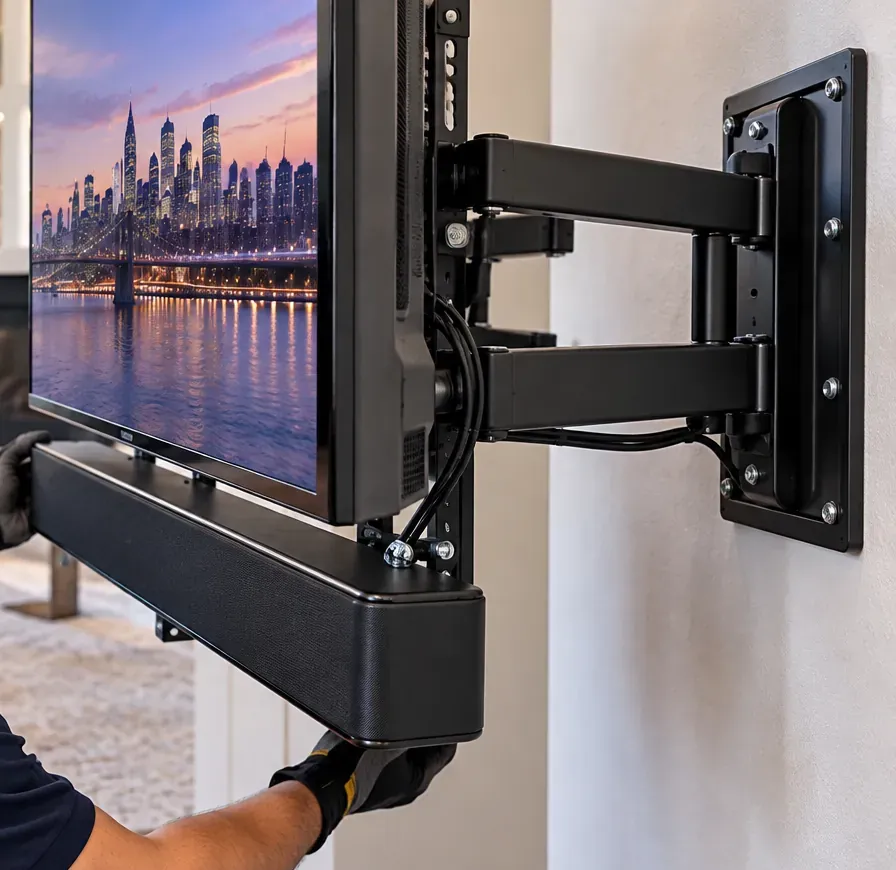
Bar and screen moving together: a soundbar attached beneath a TV on a double-arm wall mount, steadied by a gloved hand underneath.
Concrete in the co-op towers. Co-op buildings of the 1960s and 1970s, and post-war towers like those in Van Cortlandt Village, are typically concrete-framed, with block or concrete behind the plaster or board. We use a hammer drill and sleeve or wedge anchors, scan first for conduit and reinforcing, and carry the cables in a painted channel because there is no cavity to fish through. On our table, concrete or block adds $75.
Frame houses that have been altered many times. A house built around 1900 has usually been rewired, re-plastered and partly re-boarded more than once. One wall can be plaster at one end and drywall at the other, and old openings may have been closed up behind the surface. We scan the whole width of the wall and drill one small pilot hole where the bracket will cover it before choosing the fixing. Where the scan shows a clear stud bay, hiding the wires inside the wall is usually possible.
Brick in the rowhouses and two-families. The attached brick houses and two-families east of Broadway often have solid brick or block party walls and plaster on the inside of the front and back walls. We anchor into the face of the brick rather than the mortar joint and keep the cable on the surface in a painted channel. Brick or stone is a $65 line on the table.
Thick plaster and masonry swallow Wi-Fi, so a bar that streams music can stutter two rooms from the router. An Ethernet cable to the back of the TV is the permanent cure, and our structured cabling installation in Kingsbridge can run one on the same day. Old network wiring that has gone dead inside the plaster is a job for network cable repair across the Bronx.
Commercial Soundbar Installation
Business Soundbar Installation in Kingsbridge
Kingsbridge's businesses crowd along one avenue and one cross street, with two big shopping centres at the south end and a college on the hill. Most of them have flats overhead and a train going past the window, so a soundbar in a Kingsbridge shop or bar has a narrow brief: make the TV easy to follow for the people in the room, and keep it from reaching the apartment upstairs or the sidewalk outside.
Broadway Under the El
The heart of the Kingsbridge BID, from West 230th to West 236th Street, where storefronts sit directly beneath the 1 train. Narrow shops, a TV above the counter, and a train overhead every few minutes — a bar here is set for clear speech, not volume.
West 231st Street
The BID's cross street, from the Major Deegan west to Corlear Avenue, and home to the bars and restaurants locals recommend. The pub that was Piper's Kilt in The Devil's Own now trades as The Bronx Public, Brick Underground reports. Game-day crowds, hard floors and flats above.
Gaelic Park
The athletic grounds at West 240th Street and Broadway, run by Manhattan University, where Gaelic football and hurling are played. City Lore describes a playing field, a dance hall, a pub and a restaurant on the site — rooms built for a crowd watching a match.
Broadway Plaza and River Plaza
The big-box centres at the south end: Broadway Plaza, with Best Buy, T.J. Maxx and Bob's Discount Furniture, and River Plaza on West 225th Street in Marble Hill, which opened in 2004 with a 640-space rooftop car park. Large rooms and break areas where a bar's dialogue mode matters more than its bass.
Manhattan University and the Hill
The campus west of Broadway, around Manhattan College Parkway, and the offices and practices that serve it. Small meeting rooms and waiting areas that need a TV people can hear without anyone raising their voice.
Kingsbridge Road and the Armory
The Kingsbridge Armory in Kingsbridge Heights, whose redevelopment the City Council approved in October 2025. NYCEDC says phase one, centred on the 180,000-square-foot drill hall, is expected to break ground in 2026 and finish in 2030, with community and light-manufacturing space for local businesses.
Not every Kingsbridge business is a shop or a bar. The BID's own board lists a funeral home, a podiatry practice, a bank and a doughnut franchise among its members, and each of those has a room where a TV either informs, comforts or keeps people company while they wait. The right setup in a viewing room is not the right setup in a pub, and we ask what the room is for before suggesting a bar.
Rules a Kingsbridge business should know
A pub's TV sound counts as commercial music. Under the city Noise Code, as summarised by the Department of Environmental Protection, music from a business may not exceed 42 decibels when measured inside a neighbouring residence; between 10 PM and 7 AM it also may not exceed the street's ambient level by more than 7 decibels at a distance of 15 feet or more, and bass is assessed separately. With flats over most of Broadway and West 231st Street, that usually means a bar tuned for speech and a sub set low or left out.
Customers walk under it. In a shop, anything fixed to the wall at between 27 and 80 inches off the floor next to a route people walk along may stick out 4 inches at most, under 2010 ADA Standards section 307.2. Screen plus bar is deeper than that, so they belong behind a counter, or above the 80-inch line beside an aisle.
Power stays with electricians. A soundbar job is low-voltage work under our state licence and doesn't call for a Buildings Department permit. Mains wiring is different: if there's no outlet where the screen should go, a licensed electrician installs one before our visit, or the TV moves to where an outlet already is.
Certificates of insurance on request. Commercial landlords along the avenue often want their name on a contractor's certificate. Send the wording; we issue it free, usually the same day.
Concealed cable has to be the in-wall kind. Ordinary patch leads aren't meant to live inside a partition or above a drop ceiling; we use cable rated for the space it passes through and keep the bar's boxed lead for the visible last foot.
A waiting area set up for quiet listening: the slim bar sits just under the screen, above a pair of sage-green armchairs and a small round table.
Soundbar Installation in Kingsbridge: Questions Answered
Below are the situations Kingsbridge callers most often describe before booking, sorted by where they come from: the apartments near Broadway, the houses on the slopes, watching sport at home, and the businesses on the avenue. Prices for specific combinations are in the FAQ further down. Nothing here is legal advice; where a lease, a board or a code is involved, that document has the final word.
In the apartments near Broadway
Our Art Deco–era apartment has a sunken living room two steps below the foyer — does that change how high the TV goes or where the subwoofer sits?
It changes where you measure from. The usual advice — keep the bar just below the screen and aim it toward the ears of someone sitting down — still holds, but the seats are on the lower floor, so the TV height is worked out from that floor, not from the foyer. Measured from the foyer, the screen ends up a step or two too high for the sofa, and the bar beneath it follows. We measure from the floor the sofa stands on and agree the height with whoever watches most.
People in the foyer or a raised dining area will see the screen from above; that's normally fine for a few minutes of watching on the way through. What matters more is that nothing sits on or across the steps. The subwoofer goes on the lower floor, near the front wall, never on a step edge where it can be kicked or tipped, and cables run along the wall in a painted channel rather than crossing the change in level, where they become a trip hazard.
A sunken room often sounds a little fuller than a flat one, because the walls of the step-down hold some of the bass in. That usually means the sub can be set lower than you'd expect. We set it with you sitting where you sit, then show you the night or dynamic-range setting for later in the evening.
Steel crews are blasting and repainting the el outside our windows for the next few months — should the sound tuning wait until they've moved further up Broadway?
There's no need to wait for the mount itself. The MTA's painting and steel-repair project works north along Broadway in 1,000-foot sections, and the Riverdale Press reported that work generally runs from 7 a.m. to 7 p.m., with containment around the blasting and noise mitigation in those areas. Drilling and fixing a bracket inside your apartment is not affected by what is happening outside, and with the windows shut the dust stays out.
The part that benefits from a quieter room is the final tuning: setting dialogue, bass and any automatic volume levelling so speech stays clear over the trains without being too loud when they've gone. Our two-hour windows run until 8 PM, so an evening slot after the crews have stopped for the day gives the truest picture of how the room sounds normally. If an evening doesn't suit, we tune during the day and show you the two or three settings that matter, so you can nudge them once the work has moved on.
The project is scheduled to reach its last section, between 240th and 242nd Streets, by summer 2027. Apartments south of that will see the crews come and go well before then. Ask us at booking which window is likely to be quietest on your block.
In the houses on the slopes
The plaster in our 1930s Tudor has a rough, swirled texture — will a paintable cord cover sit flat and stay stuck to it?
Not if it relies on the adhesive alone. The tape on the back of a cord cover is made for a smooth, painted surface; on textured or troweled plaster it touches only the high points of the pattern, and sooner or later the channel peels away, often on a warm day. So on a textured wall we don't trust the tape. We fix the channel with small screws and anchors at regular intervals, the way the cord cover on our Bronx menu is fitted anyway: stuck and screwed to the wall.
Screwing it down keeps it secure, but a rigid channel can still leave small shadows where the texture dips behind it. The usual fix is cosmetic: your painter runs a fine bead of paintable caulk along both edges and paints the channel with the wall, and from across the room it disappears. We can also route the channel along a door casing or into a corner, where a straight line looks intentional.
Often the better answer in a Tudor is not to use a channel at all. Many interior walls in houses of that age are hollow plaster over wood studs, and if the scan finds a clear bay between the bar and the outlet, a code-compliant in-wall power and cable kit hides everything for $169, against $59 for the cord cover. We'll tell you on the day which your wall allows.
Watching the match at home
We'd rather watch the match with the TV commentary off and a radio or app commentary on — can the soundbar play that while the TV shows the picture?
Yes. Most soundbars accept Bluetooth from a phone or tablet as well as sound from the TV, so the radio or app commentary can play through the bar while the TV shows the picture with its own sound off. Switching between them is just a change of input on the bar, which we can put on one button of the remote you use most.
The catch is timing. A radio or streamed commentary and the TV picture are rarely in step, because each travels by a different route with its own delay, and Bluetooth adds a small delay of its own. Sometimes the commentator calls the score before you see it; sometimes after. If you watch through a cable box that can pause live TV and the picture is running ahead, pause it for a moment to let the radio catch up; if the commentary is the one running ahead, pausing the radio app briefly does the same job. The bar can't fix that delay for you, but it makes the sound good.
For a household that switches back and forth, we label which input is which on the handover note and leave the TV's own sound routed through the bar as the default, so the next person to switch on doesn't wonder why the room is silent.
On Broadway and West 231st Street
Our pub shows two matches side by side — can one soundbar switch between their commentary with a single button?
Usually, yes, with a little planning. Most soundbars have one HDMI eARC or ARC connection to a TV and at least one other input, often optical. We connect the first TV to the bar over HDMI and the second TV's audio output into the bar's optical input, then set the bar's remote, or a programmed universal remote, so a single press flips between them. Staff choose which match the room hears; the other plays silent with captions on.
Two cautions. First, HDMI control works with one TV at a time, so the second TV won't turn the bar on or off by itself; we set things up so the bar follows the main screen. Second, optical carries less than HDMI — fine for match commentary, not for lossless film sound — which is irrelevant in a pub but worth knowing. If the bar has no spare input, a small audio switch does the same job, and we'll price it in.
If you'd rather have different sound in different parts of the room, two bars, one under each TV, can be set to modest levels so each side hears its own match. Whichever you choose, the commercial music limits in the Noise Code still apply once the flats above are home for the night.
Can a soundbar play a memorial video at a gentle level in a funeral home's viewing room?
Yes, and it is one of the cases where a soundbar does better than a TV's own speakers. Spoken tributes and soft music need to be clear at a low volume to people sitting a few rows back, and a bar with a centre channel and a speech-enhancement setting does exactly that without anyone turning it up. We mount the bar just under the screen, set the subwoofer low or leave it out, and set a comfortable level for the room with the chairs in place.
The video usually comes from a laptop, a USB stick or a streaming account. A laptop on a lectern or side table can connect through a run of HDMI and power of up to 25 feet ($99), so the TV and bar stay on the wall and the laptop stays where the family or staff can reach it. Where the bar allows, we limit the maximum volume so nobody can accidentally fill the room with sound mid-service.
Everything is set so staff need only the TV remote: on, off and a gentle volume. Cables are concealed in the wall or in a painted channel, the bracket keeps the bar tight to the wall, and we leave a short written note of the settings for whoever sets the room up next time.
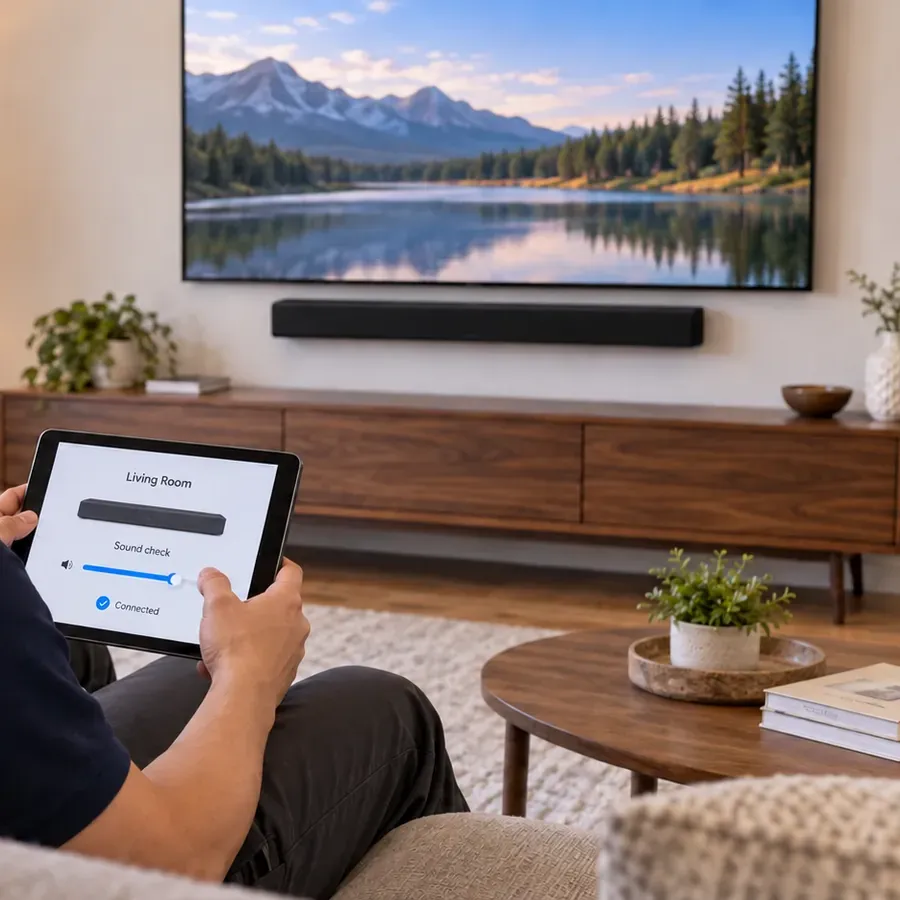
Seen over a shoulder on the couch: a tablet app reads Living Room, Sound check and Connected, while the wall-mounted bar and TV sit across the room.
Equipment
Types of Soundbars and Mounts We Install
Whatever you've bought, we'll fit it; if you're still choosing, describe the room and we'll point you to a size and type rather than a price tag. These are the kinds of hardware we fit most across Kingsbridge, with the details that change how each is mounted.
Compact Bars for Bedrooms and Small Living Rooms
Under a 43- or 50-inch screen, a shorter bar looks proportionate and aims its sound at the seats rather than the walls. Sonos's Ray, for instance, measures roughly 56 cm, weighs less than 2 kg and uses an optical input instead of HDMI — handy for an older spare-room TV.
Bars With a Centre Channel
Speech lives mostly in the middle of the bar, so models with a forward-firing centre driver stay intelligible when an el train rattles past. Sonos's Beam (Gen 2), at about 6.35 lb, is one; Bose, LG, Samsung and Sony all sell competitors.
Full-Width Atmos Bars
Height effects come from drivers aimed at the ceiling. A Sonos Arc Ultra is around 46 inches long and 5.9 kg, wants a TV of similar width, and works best under a flat ceiling — which most pre-war living rooms in Kingsbridge do have.
Wireless Subwoofers
Separate bass units paired to the bar. In an apartment building, placement and level matter far more than size: off the party wall, off the bare floor, and set for the room rather than the showroom.
Wireless Rear Speakers
“Wireless” refers to the audio link only: each rear still needs a power socket. Older rooms rarely have outlets behind the sofa, so we find power for them before promising positions.
Universal Soundbar Brackets
Our $84.99 bracket is the Sanus SASB1, which its maker rates for most bars up to 20 lb. It grips the bar from behind or below and has adjustable depth, so it rescues a carton with no bracket or one that suits the wrong wall.
Brackets That Hang From the TV Mount
For an articulating TV arm, Sanus makes the WSSATM1: built with the Sonos Arc in mind, compatible with most 50- to 90-inch screens and with TV mounts from other brands, it lets the bar swing with the picture.
In-Wall Kits and Surface Channels
Where the wall is hollow, a code-compliant kit takes power and HDMI behind the surface from an outlet already there. Where it isn't — concrete, brick, a board-controlled wall — a paintable raceway screwed along the surface does the job.
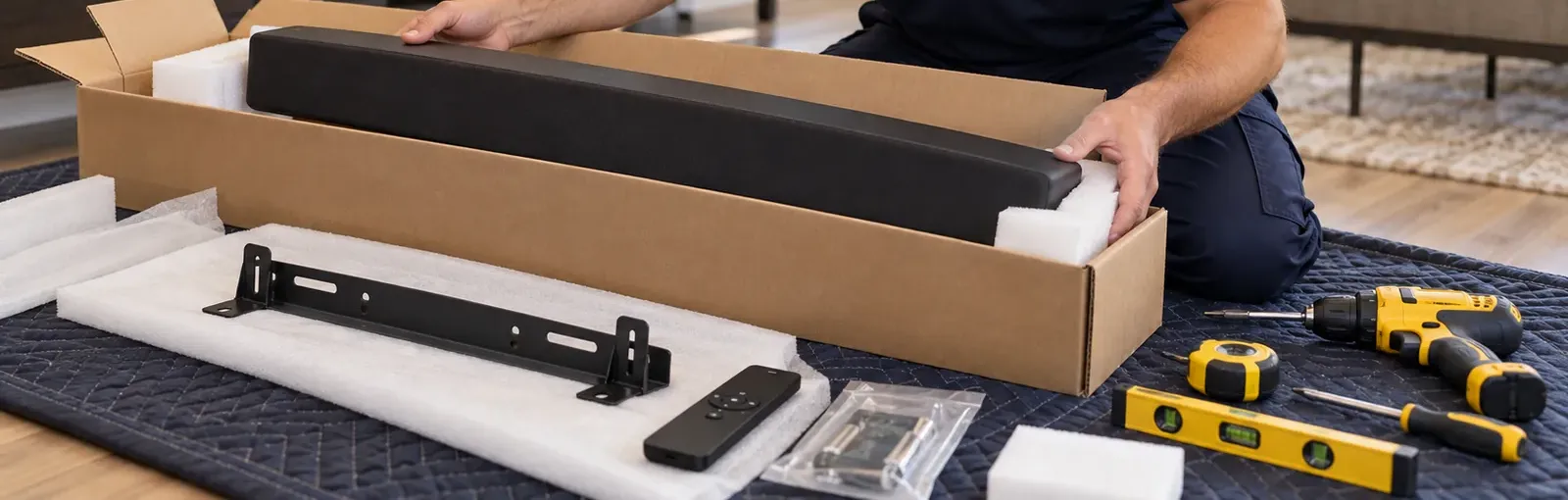
Unpacking on a navy moving blanket: hands lift the bar from its cardboard tray, with a black bracket on white foam, a small remote, bagged screws and a yellow drill, tape and level nearby.
Matching the bar to a Kingsbridge room
Room
Usually works well
Think twice about
Why
Pre-war living room facing the el
A bar with a centre channel; speech or night mode
Relying on volume alone to beat the trains
Clear speech carries over a passing train better than loudness does
Pre-war living room on a quiet side street
Mid-size bar; sub set low and off the party wall
A large sub on the bare floor
Bass travels through floors and shared walls to neighbours
Co-op tower apartment with concrete walls
Wall mount with a painted channel
Planning on hidden wiring
No cavity in concrete to carry the cable
Tudor or frame house
Wall mount with hidden wiring if the scan allows
Adhesive-only cord covers on textured plaster
Hollow stud bays are common; textured plaster rejects tape
Pub, shop or waiting room
Bar tuned for speech, fixed or limited volume
A sub at full level
Flats overhead and the Noise Code's business limits
Which connection the bar will use
Socket on the TV
Link
What it carries
Typical Kingsbridge use
HDMI labelled eARC
HDMI eARC
Lossless formats such as Dolby TrueHD; TV remote controls the bar
A new living-room TV with a full-width bar
HDMI labelled ARC
HDMI ARC
Data-reduced 5.1 sound (streamed Atmos arrives packed as Dolby Digital Plus); the TV handset adjusts the bar
Most streaming households; mid-size bars
Optical out only
Optical
Stereo or basic surround; the bar may keep its own remote for volume
An older bedroom TV, or the second screen in a pub
Phone or tablet
Bluetooth
Compressed stereo with a slight delay
Radio or app commentary; music in the kitchen
Model names, sizes and weights shift with every product cycle; ours were checked in October 2026. Before your appointment we look up your exact bar — its inputs, its weight, its bracket — and match the fixings in the van to the wall in your photo.
AI Overview Reality Check
What AI Gets Wrong About Soundbar Installation in Kingsbridge
How this section works: our research tools couldn't display Google's AI answers, so none of the headings below pretends to be one. Each heading below is a claim that a cost guide, a manufacturer, a forum or a retailer actually publishes — the material search summaries and chatbots are built from — followed by what it means in a Kingsbridge home.
“National average cost for TV wall mounting ranges from $121–$234”
Thumbtack publishes that range from its own data, and it often turns up when people ask what mounting costs. It is a figure for hanging a television, not a soundbar, and it is national; a summary that blends the two can leave you expecting a bar to cost the same as a TV, or a Bronx job to cost the same as one in a suburb.
On our Bronx menu the bar is priced on its own: $79 on a console, $129 on the wall, $84.99 for our Sanus bracket if you need one. The wall adds its own line — nothing for drywall on wood studs, $45 for plaster, $65 for brick, $75 for concrete or block — and a TV hung at the same visit starts at $209.99 for a 32- to 55-inch set on drywall.
The useful comparison is not an average but a written list of what is included for your wall. Ours itemises every line, so you can see exactly what a pre-war plaster wall costs compared with a drywall partition.
“Soundbar bracket or mount: $30–$100” · “Concealed wiring: $75–$300”
Angi's TV cost article lists those add-on ranges, and they are a fair sketch of the market. Summarised, they suggest that hiding wires is a simple extra you can always buy.
In Kingsbridge, whether concealment is possible at all depends on the building. A Tudor or a frame house with hollow stud bays usually allows it; a 1960s co-op with concrete walls does not, because there is no cavity; and a pre-war rental may allow it in principle while the lease forbids opening the wall. That's why our in-wall line ($169) is offered only after a scan and with the owner's agreement, and why the painted channel ($59) exists.
Ask any installer, us included, to say before the day whether your particular wall can take hidden wiring. A range on a cost guide can't answer that.
“Permits are only needed for electrical work or structural changes”
Angi makes that point about permits, and for a soundbar it is broadly right: a bracket and low-voltage cabling don't need a Buildings Department permit. A summary that stops there, though, leaves out the approvals that do apply in Kingsbridge.
In a co-op tower, the board or managing agent usually wants to know who is drilling and to see a certificate of insurance. In a rented pre-war apartment, the landlord decides about holes. In the Marble Hill Houses, the housing authority has its own rules. None of these is a permit, but any of them can stop a job on the day if it's missing, which is when our $150 return-trip charge applies.
So the practical question isn't “do I need a permit?” but “who has to say yes?” We ask that on the first call, and the certificate of insurance is free.
“Mount Arc Ultra to the wall below (recommended) or above your TV”
Sonos's own guide for its flagship bar says that, and it recommends leaving about 4 inches of space around it. It's good guidance, and summaries tend to pass on the “below” part while dropping the clearance.
In a pre-war Kingsbridge living room the spacing is what catches people out: a radiator under the window, a door casing close to the TV wall, or a shelf above the console can leave less room than the bar wants. The bar then sounds boxed-in, or its up-firing drivers fire into a shelf. We measure the clearances before choosing the bracket height, not after.
Several bars, including the Arc Ultra according to Sonos owners on Reddit, also adjust their sound once they detect a wall mount. Where a bar has a placement setting instead, we set it ourselves.
“Atmos over ARC travels inside Dolby Digital Plus; lossless TrueHD Atmos needs eARC”
AWOL Vision's explainer puts it that way, and it is accurate. Summaries sometimes turn it into “you need eARC for Atmos,” which isn't true: streaming Atmos plays fine over ordinary ARC.
That matters in Kingsbridge because many households keep an older TV in a second room or have a set from a few years ago in the living room. If it has ARC but not eARC, a new Atmos bar will still play Atmos from the streaming apps; what it won't get is the lossless version from a Blu-ray player connected to the TV.
We check which socket your TV has, connect to the right one and switch on the TV's audio pass-through settings, which are often off by default. That is part of every install line, not an extra.
“The estimated national average cost to Install Soundbar starts at $58.43 - $231 per soundbar”
Homewyse's estimate gets quoted in AI answers about installation cost. As a range for labour on an ordinary wall it is reasonable.
What a national figure can't include is the walk up a step street with the gear, the fourth-floor walk-up off Broadway, the textured plaster that needs a screwed channel, or the concrete wall of a co-op tower. Each of those is a line on our menu, and each is shown separately in the worked examples further down, which run from $79 for a console setup to several hundred dollars for a TV and bar hung together.
Treat the national figure as the start of a conversation. A photo of your wall gets you the real one.
“Seated ear height is roughly 42.5 inches”
Yamaha's mounting guide offers about 42.5 inches off the floor as a typical seated ear height, and summaries repeat it as a target for the bar.
In Kingsbridge the floor itself is sometimes the question. A sunken living room, a sofa on a raised platform in a converted attic, or a pub where people stand at the bar all change what “ear height” means. And the bar follows the TV: once the screen height is right for the seats, the bar goes a short gap beneath it.
So we start with the screen and the people watching it, then place the bar. A slight tilt, where the bracket permits, and the speech setting do more for dialogue than chasing a number on a tape measure.
Clear Voices Under the El, Quiet Bass Up the Hill
Tell us which side of Broadway you're on, what the wall is and what the bar is called, and you'll get back a priced, written plan — fixings, route and all.
A pre-war flat beside the 1 train, a Tudor near Tibbett Avenue, a frame house on Kingsbridge Terrace, a co-op on West 232nd Street, a home in Marble Hill or a pub on West 231st Street — tell us the bar, the TV, the wall and how we reach your door, and a written price comes back the same business day. Prefer to talk? Call (646) 490-0629.
✅
Thanks — The Bronx Office Has It
A person at the Fordham Road office will phone or email a price, normally that afternoon on weekdays. Urgent? Dial (646) 490-0629 now.
How It Works
Our Installation Process
Whether it's a small bar on a Marble Hill dresser or a big screen and Atmos bar in a Tudor, the visit follows this order. The first two stages matter more here than in most of the Bronx, because the route to the door and the age of the building vary so much from block to block.
1. Tell us the way in
Send the bar and TV models, a photo of the wall, your floor, whether there's an elevator or a working buzzer, and whether your door is on a sidewalk, a stoop or a step street. You get an itemised total and a plan for the carry.
2. Read the building
We work out from the building's age which wall to expect and who has to approve the drilling: the landlord, the co-op board, the managing agent or the housing authority. Certificates of insurance go out free.
3. Book a two-hour window
Choose any two-hour slot from 8 AM to 8 PM, any day of the week. An evening slot suits a flat facing the el while daytime steel work is under way outside.
4. Scan and test the wall
A scanner goes across the whole wall, not just the bracket area, looking for studs, pipes and conduit. One test hole, later hidden by the bracket, tells us from the dust whether it's plaster, brick or concrete.
5. Fix, level and route
Depending on the scan: screws into studs, a plywood backer behind weak plaster, or sleeve anchors in brick and concrete. The bar is squared to the picture, and leads go inside a hollow wall, across to a shelf, or into a screwed raceway.
6. Connect and set up
HDMI eARC or ARC connected, CEC switched on so one remote works, lip-sync checked, firmware updated, and any second input or Bluetooth source labelled so the household knows which is which.
7. Tune for the street and hand over
Dialogue, bass and levelling set for a room beside the tracks or a quiet one up the hill, night mode shown, packaging taken if you booked removal, dust vacuumed, and the two buttons that matter shown to whoever uses the TV most.
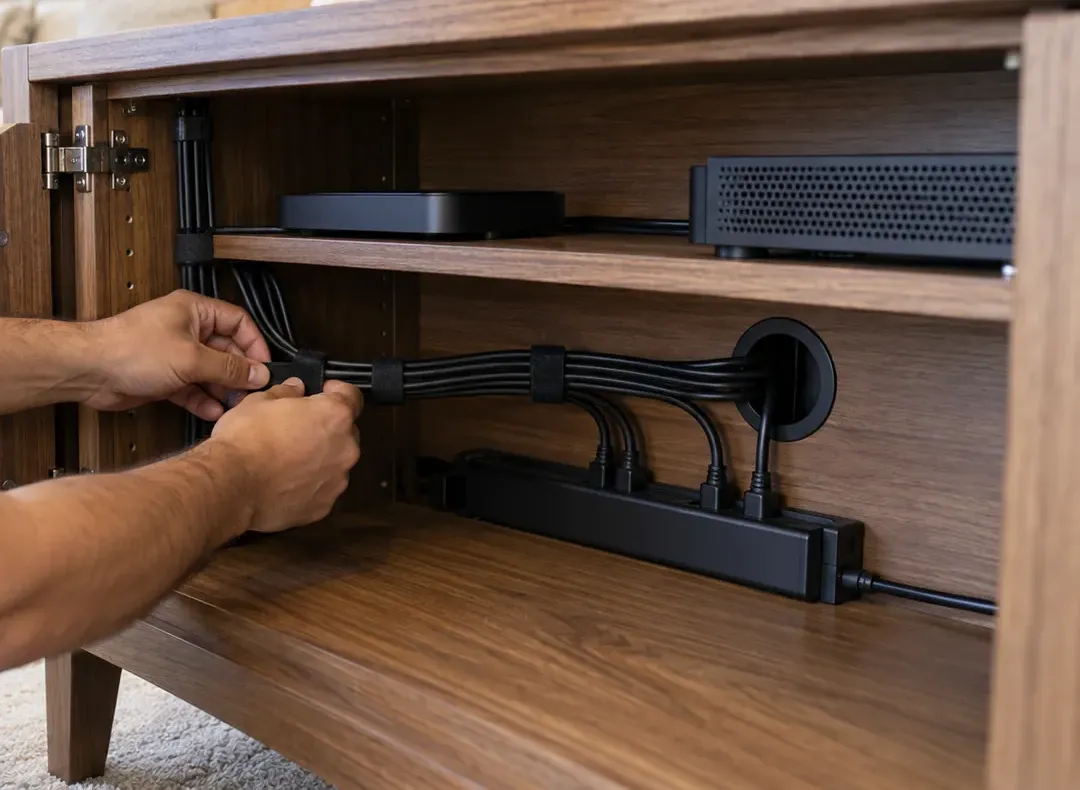
Behind the cabinet door: a hand pulls a hook-and-loop strap around a bundle of leads that drops through a round grommet to a black power strip, boxes on the shelf above.
Coverage Area
Soundbar Installation Near Kingsbridge's Landmarks
These six places help us picture a caller's street. Tell us which one you're near, and we can usually guess the building type and the walk to the door before seeing a photo.
Kingsbridge Armory
The vast armory on Kingsbridge Road opened in 1917, served the military until 1994 and returned to the city in 1996; it was designated a city landmark in 1974. Its 180,000-square-foot drill hall is the centre of the redevelopment NYCEDC expects to finish in 2030, with about 500 affordable homes next door by 2032.
West 230th Street Step Street
Three flights of public stairs linking Irwin, Johnson, Edgehill and Netherland Avenues, 295 feet long and 38 feet high — the longest step street in the city, according to Atlas Obscura — with the 231st Street station of the 1 train at the bottom of the hill.
Gaelic Park
The grounds at West 240th Street and Broadway, now operated by Manhattan University, where Gaelic football and hurling are played. A reference point for the blocks around the 238th Street station and the north end of the el.
Van Cortlandt House Museum
Frederick Van Cortlandt's fieldstone house of 1748, the oldest surviving house in the Bronx and a National Historic Landmark, in the southwest corner of Van Cortlandt Park — the 1,146-acre park that forms the neighbourhood's northern edge.
Marble Hill and the Broadway Bridge
Legally part of Manhattan but joined to the Bronx mainland by landfill in 1913, Marble Hill shares Kingsbridge's 10463 ZIP code, its community board and its precinct. River Plaza, on West 225th Street, opened there in 2004.
Jerome Park Reservoir
The reservoir of 1906, about 2.2 miles around, that dominates Kingsbridge Heights. On its north side, the Amalgamated Housing Cooperative, founded in 1927, holds 1,468 apartments across eleven buildings between the reservoir and Van Cortlandt Park.
We work across all of Kingsbridge and its edges: the blocks along Broadway and West 231st Street, the houses west of Broadway up toward Riverdale and Spuyten Duyvil, Kingsbridge Terrace and Sedgwick Avenue in the Heights — where a stone wall in Fort Independence Park is believed to be the last trace of a fort of 1776 — Van Cortlandt Village and Marble Hill, and, from the same office on East Fordham Road, every other part of the Bronx. For the whole borough, see our Bronx soundbar installation page.
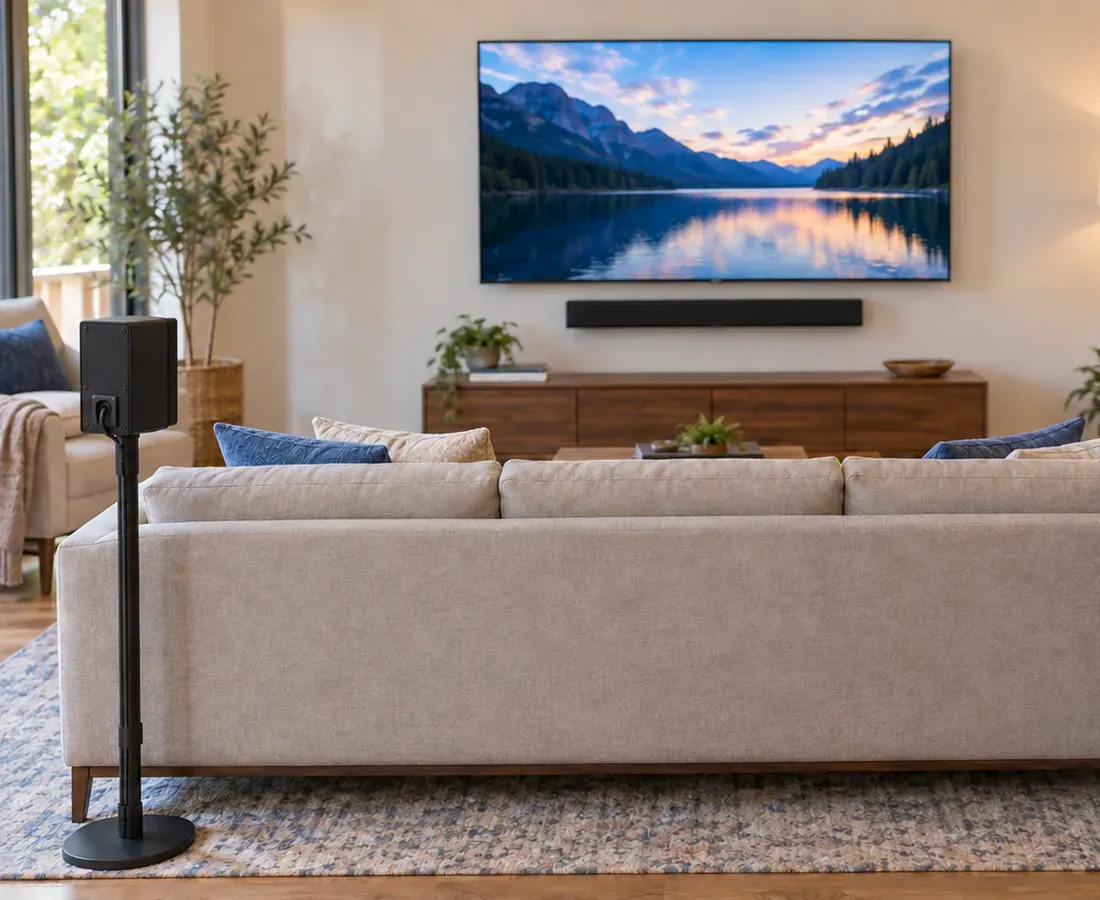
A rear-channel speaker on a thin pedestal stand beside an oatmeal sectional, aimed at the cushions, with the wall TV and its bar in the distance.
Pricing
Soundbar Installation Cost in Kingsbridge
There is no Kingsbridge premium. Homes here, in Marble Hill and up in the Heights are charged from the same itemised Bronx list as the rest of the borough, and the public stairs outside cost you nothing extra. Bronx installation lines are identical to our Brooklyn base prices; the borough has its own figures in just two places, the setup-only hourly rate and the starting price for hanging a TV, both listed further down. Should the wall reveal a surprise, we stop and quote it before doing anything about it.
Line item
Price
What it covers
Soundbar placed on a stand or console
$79
Set on your furniture, connected and tuned; no drilling
Soundbar wall-mounted under the TV
$129
Fixing chosen for your wall, bar squared to the screen, connected and tested with a clip
Sanus soundbar bracket
$84.99
Our bracket when the box had none, or when the bar hangs from the TV mount
Paintable cord cover
$59
Slim plastic raceway you can paint, fixed with tape and screws, carrying the leads down to the socket
In-wall concealment
$169
Leads hidden inside a cavity wall via a code-compliant power and cable kit, with the owner's approval
Cable run to a cabinet or other spot
$99
A run as long as 25 feet, so the cable box or console can live somewhere other than under the screen
Sonos setup
$125
Sonos system, app and grouping
A/V receiver
$129
Receiver connected and configured
Universal remote
$99
One handset programmed for the TV, the bar and the boxes
Streaming device setup
$49
Roku, Apple TV, Fire TV or similar
Full home theater
$350
Multi-component system setup
Wall, height and access lines
Condition
Price
Where you'll meet it in Kingsbridge
Drywall on wood studs
$0
Renovated houses and apartments, newer partitions
Metal studs
+$30
Gut-renovated units, shop and office fit-outs
Plaster
+$45
Pre-war apartments near Broadway; Tudors and older frame houses
When the job is purely settings — a bar that needs introducing to a replacement TV, a sub that lost its pairing, a remote that stopped controlling volume — there's nothing to mount, so we charge by time instead: $225 for the first hour in the Bronx, then half-hour blocks. Hanging a TV alongside the bar starts at $209.99 for a 32- to 55-inch screen on drywall; standing one on furniture and connecting it is $137.99. Getting rid of the old set is itemised too: $85 to lift it down, $45 to unbolt its bracket, $79 to cart it away. Hunting down a fault inside wiring that's already buried in a building isn't on the menu at all — that's specialty work at $195 an hour with a three-hour minimum ($585), and it is never added to a normal soundbar job.
What the price includes, and what it doesn't
Part of every line, never extra: squaring the bar to the picture, choosing the right HDMI port, dressing the leads, turning on CEC so a single remote works, and vacuuming the drill dust before leaving.
Work we leave to others: an outlet added or moved behind the screen needs a licensed electrician, and patching old holes or repainting needs a decorator. You won't find either on our bill.
Visits that can't start: if we arrive and can't begin — the bar or bracket isn't there, nobody can let us in, or the landlord's, board's or housing authority's approval is missing — a $150 return-trip charge applies. A working buzzer and a name left with the super go a long way.
Fragile finishes: century-old plaster, glazed tile and stone can spall around a hole even with a sharp bit and a slow drill. We point that out before starting, and the decision to proceed is yours.
How a big-box or app booking compares. Fixed menus from national services assume a plain drywall partition, and if that's your wall they may suit you. Kingsbridge throws up plenty that they don't price: lath and plaster, a concrete co-op wall, textured Tudor plaster that won't hold tape, a fourth-floor walk-up, a step street between the van and the door, or a board that wants a certificate before anyone drills. A licensed installer with a wall-by-wall price list can quote the room you actually have and stand behind it afterwards.
Shop Our Systems
Soundbar Installation Packages & Pricing
Most Kingsbridge requests fall into one of the bundles below. Each card shows how its total is reached; surcharges for your wall, a high mount or the stairs come from the tables and sit on top.
Starter — On the Console
$79
The bar placed and connected with no holes ($79): HDMI into the eARC or ARC socket, one-remote control on, leads tidied. The usual choice in a rented pre-war apartment, a bedroom, or anywhere you'd like to hear it before committing a wall.
Standard — Bracket Under the Screen
$213.99
$129 for the wall mount plus $84.99 for the Sanus bracket makes $213.99 on drywall over wood studs. Your wall's line goes on top: $45 for plaster, $65 for brick, $75 for a concrete or block co-op wall, $85 for a backer board behind tired plaster.
Premium — Bracket and Hidden Leads
$382.99
Take the Standard ($213.99) and add the $169 in-wall line, which hides power and HDMI behind the surface with a code-compliant kit, for $382.99. Best suited to a house or renovated apartment where the scan finds a clear stud bay and the owner says yes.
Bring Your Own Equipment — Labour Only
If the soundbar's own bracket came in the carton, or you bought one you like, we use it: the bill is the $129 mounting line plus whatever your wall adds. Its warranty stays with its maker. Should its weight rating fall short of the bar, or its design not suit your wall, you'll hear that before any drilling, along with the option of our Sanus bracket.
Four worked examples, all from the lines above. A bar on our bracket in a 1930s Tudor with textured plaster, with a screwed and painted channel to the outlet: $129 + $84.99 + $45 + $59 = $317.99. The same in a pre-war walk-up on the fourth floor off Broadway: $129 + $84.99 + $45 + $40 + $59 = $357.99. A bar on the concrete wall of a 1960s co-op, with a channel: $129 + $84.99 + $75 + $59 = $347.99. And a viewing-room setup with a 25-foot HDMI run to a laptop table, on drywall: $129 + $84.99 + $99 = $312.99.
Get Your Kingsbridge Soundbar Price in Writing
Snap the wall, read us the model number off the box, tell us your floor — the itemised figure usually comes back within hours.
Living Beside the 1 Train: Setting Up Sound for a Broadway Apartment
The 1 train has run on its steel viaduct above Broadway since the line opened in 1907, and the buildings along it were built around it. The Riverdale Press, reporting on the MTA's current repair contract, describes the elevated line “visible over Broadway through Kingsbridge and Marble Hill” and notes that the stretch between 225th and 242nd Streets had its last major structural rehabilitation in 1988. For anyone living in the apartments that face it, a train passing the window is part of every evening's viewing, and a soundbar set up as if the room were silent will be either too quiet when a train goes by or too loud when it has gone.
Speech first, volume second. A bar with a dedicated centre channel and a speech-enhancement mode keeps voices understandable over a passing train at a lower overall level than turning everything up. That's the single biggest difference between a good setup beside the el and a poor one.
Use the levelling feature with care. Many bars and TVs have an automatic volume or dynamic-range setting. It smooths out loud adverts and explosions nicely, but some versions also lift quiet passages so much that background music swamps dialogue. We try it with you and leave it on only if it helps.
Face the bar into the room, not the window. In a room where the window wall faces Broadway, the TV usually belongs on a side or inner wall, so that the sound is aimed away from the glass and the screen isn't fighting the light. Residents on Reddit mention less daylight under the tracks; the darker side of the room is often the better TV wall anyway.
Keep the sub modest. It's tempting to add bass to cover the rumble of the train. In a pre-war building, that bass goes into the floor and the neighbours' ceilings long after the train has passed. We set the sub for the quiet moments and let the centre channel handle the busy ones.
Close the window you sit beside. It sounds obvious, but a soundbar is tuned with the room as it normally is. If you always watch with one window open in summer, tell us, and we'll tune it that way.
The MTA's painting and steel-repair project is moving north along this stretch in 1,000-foot sections and is scheduled to finish between 240th and 242nd Streets by summer 2027. Crosswalks and access to buildings beside the viaduct are being kept open throughout, the Press reported, though traffic on Broadway may shift as crews move equipment. For our visits, that mostly means allowing a few extra minutes to find somewhere to stop the van near your door.
Where your living room is
What usually helps most
What to avoid
Front of a building facing the tracks
Centre-channel bar, speech mode, TV on an inner wall
Turning up the sub to mask the trains
Back of the same building
Mid-size bar, sub low and off the party wall
Assuming the noise of the street will hide the bass
A block or two off Broadway
Any well-sized bar; night mode for late viewing
A sub on the bare floor of an upper flat
Shop or bar at street level under the el
Speech-tuned bar at a fixed or limited level
Volume set by whoever is nearest the remote
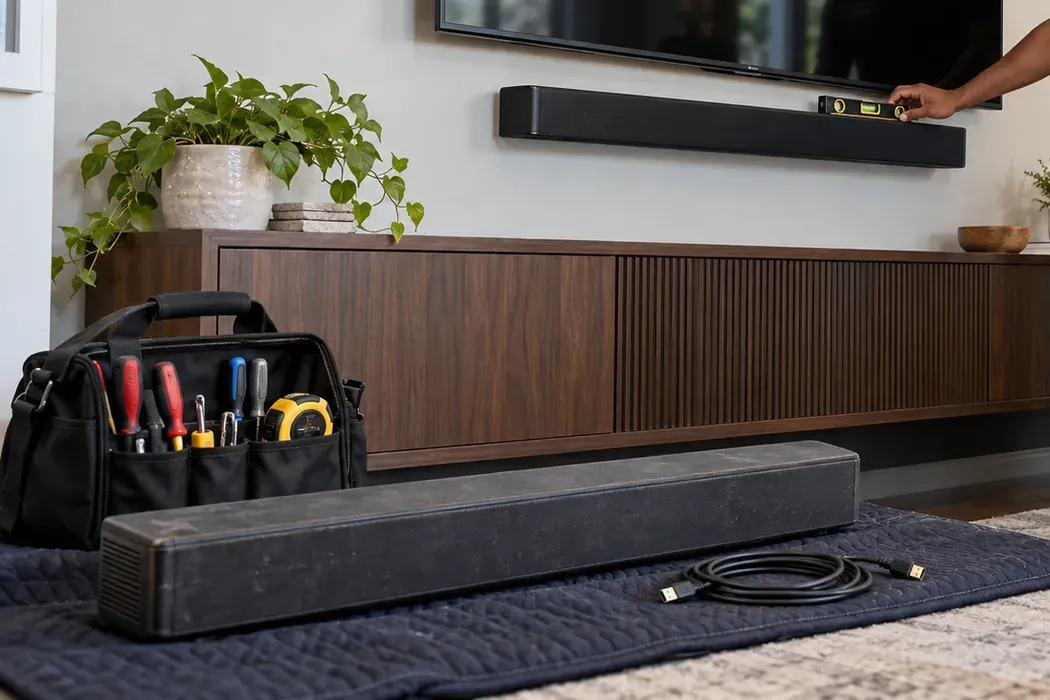
Above a fluted walnut cabinet, a hand holds a stubby yellow level on the newly hung bar; on the floor sit an open bag of screwdrivers, a second bar and an HDMI coil.
Up the Steps
Getting Equipment to Your Door on Broadway, the Step Streets and the Heights
On most Bronx jobs the hardest part of arriving is the parking. In Kingsbridge it can also be the stairs — the public ones. Broadway itself is busy: the Kingsbridge Historical Society, writing about the corner, notes that “most area residents know that 231st and Broadway is a busy intersection,” with double-parked cars, buses and turning traffic. West of Broadway, some streets give way to step streets climbing toward Riverdale, and houses there may open straight onto the stairs. East of the Deegan, Kingsbridge Heights has its own hills. None of this is a problem if we know about it when you book.
Tell us how the street meets your door. A sidewalk, a steep driveway, a long stoop, or a flight of public steps — each changes how we carry the gear, and a photo of the front of the building helps.
Give us the floor and the elevator. Third floor and above with no elevator is a $40 line on our menu. If your building has an elevator that is often out of service, say so; we can bring a lighter load and plan the carry.
Check the buzzer. Plenty of pre-war buildings have intercoms that work some days and not others. If yours is unreliable, tell us and keep your phone close; the technician will call from the door. Our door buzzer repair service in Kingsbridge can fix the intercom itself if it's beyond the landlord.
One load, carried once. The technician brings a single kit — drill, scanner, level, anchors chosen from your photo, bracket, leads and dust sheets — so there's no second walk back to a van that may be parked around the corner.
A big TV needs two people. If a 65-inch or larger screen is going up at the same visit, tell us when you book, especially if the way in includes outdoor stairs. We plan a second pair of hands rather than carry it up a step street alone.
Leave a name with the super or the front desk. In co-op and elevator buildings, the person at the door will want to know a contractor is coming, and some boards ask for the certificate of insurance first. Send us the details and we'll sort the certificate free.
The same planning applies in Marble Hill and the Marble Hill Houses, where the towers are run by the housing authority and the rules on what can be fixed to the walls are theirs to set. Check with your management office before the visit; until then, a console setup gives you the sound with nothing fixed to anything.
House by House
Five Decades of Building in a Ten-Minute Walk: Matching the Install to the House
Most neighbourhood pages can describe “the” local building. Kingsbridge can't. Brick Underground's 2023 guide picks out five homes for sale that span 73 years of building, and the variety is typical: a single-family house of 1901 on a double lot on Kingsbridge Terrace, a two-storey house of 1910 with a wraparound porch on Fort Independence Street, a four-bedroom Tudor of 1938 on Tibbett Avenue, a twelve-storey, 224-unit co-op of 1961 on Tibbett Avenue with balconies, and a six-storey, 72-unit co-op of 1974 on West 232nd Street with its own garage. The same guide describes the houses as “older” with “high ceilings”. Each of those homes would get a slightly different soundbar install.
Home
Wall we usually expect
Who decides about holes
Typical finish
Pre-war apartment, Broadway and side streets
Plaster on lath, sometimes over masonry
The landlord
Bracket and a painted channel, or a console setup
House of around 1900–1910
Mixed plaster and drywall over wood framing
The owner
Bracket with hidden wiring if the scan allows
1930s Tudor
Hard, often textured plaster over wood studs
The owner
Hidden wiring, or a screwed and caulked channel
1960s–70s co-op tower
Concrete or block behind plaster or board
The shareholder, within the board's alteration rules
Bracket on sleeve anchors and a painted channel
Brick rowhouse or two-family
Brick party wall; plaster on the front and back walls
The owner (and the tenant's wishes if it's the rented floor)
Bracket on brick anchors, channel on the face
Marble Hill Houses
Masonry
The housing authority, under its own rules
Console setup until consent is confirmed
The Amalgamated Housing Cooperative on Van Cortlandt Park South is a neighbourhood of its own: Wikipedia describes Tudor-style clusters built between 1927 and 1932, a building of 1941, concrete high-rises of 1949–51 and two towers of the early 1970s, all in one co-op. A shareholder in one of the 1920s blocks and a shareholder in a 1970s tower may have very different walls, and the co-op's own rules come first in both. Tell us which building you're in, and send us anything the co-op has given you about alterations.
Kingsbridge Heights, east of the Deegan, adds its own variety. Wikipedia describes its housing as dominated by multi-unit detached houses, with older apartment buildings in the central and southern parts and newer rental and co-op buildings in Van Cortlandt Village. It also notes the house at 2744 Kingsbridge Terrace known as the Castle of Kingsbridge, built in 1914. It is a fair reminder of how varied these streets are, and of why we ask for a photo before quoting.
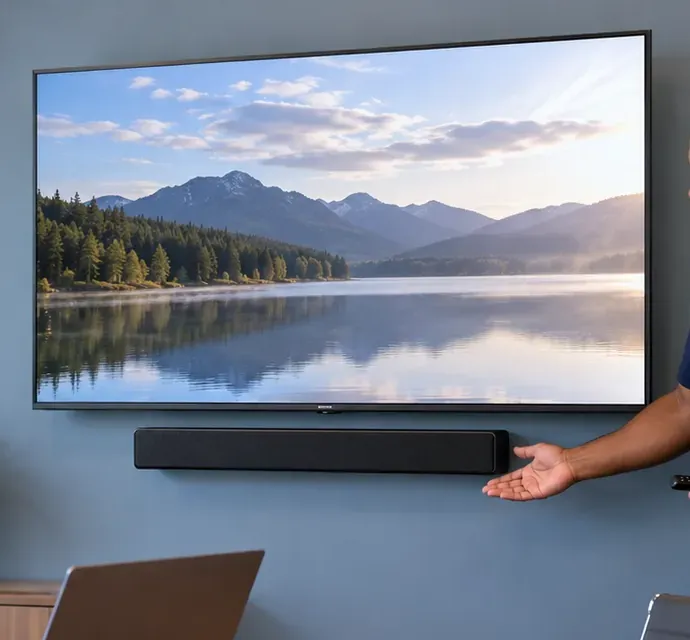
A room set up for talking over a screen: a slim bar centred under a large TV on a blue-grey wall, an open hand indicating it, a laptop lid at the bottom edge.
Low Ground
The Buried Brook Under Broadway, and Why the Floor Is the Wrong Place for a Subwoofer Here
Broadway runs along what was once marsh and creek. The Kingsbridge Historical Society's account of the years around 1900 describes Tibbetts Brook flowing through Kingsbridge into Spuyten Duyvil Creek before both were filled in, the brook channelled into a sewer under Broadway, and low-lying parts of the neighbourhood raised with fill. It quotes a turn-of-the-century resident recalling houses “plagued by flooding cellars”. Today the city is reversing part of that: the Riverdale Press reported in 2026 that the Department of Environmental Protection's $149.5 million Tibbetts Brook daylighting project — uncovering more than a mile of the brook from the Mill Pond in Van Cortlandt Park to West 230th Street — was set to break ground this fall, partly to relieve the sewers in heavy rain.
A soundbar isn't flood equipment, and we make no claims about any particular building's basement. But in ground-floor and lower-level rooms near Broadway, a few habits cost nothing and protect the gear if water ever does come in:
Subwoofer on a stand or pad, not the bare floor, in any room at or below street level. It's better for the neighbours' ceilings in an apartment, too.
Power strip fixed up off the skirting, not lying on the floor behind the console.
Boxes on a shelf. A cable run of up to 25 feet ($99) can move the cable box and console up and out of the bottom of the cabinet.
No cable routes through a damp cellar. In a house where the basement takes water, we keep HDMI and power in the walls of the living floor or in a painted channel.
Leave it unplugged if water reaches it. If water ever reaches an outlet, the strip or the sub, leave everything off and have an electrician check the circuit before switching back on.
For most Kingsbridge homes, up on the slopes or several floors up a Broadway building, none of this applies. It's simply part of the questions we ask about a ground-floor room.
Visit Prep
Before the Technician Arrives
Ten minutes of getting ready is the difference between a visit that matches the quote and one that runs long.
The bar, any bracket, sub and rear speakers need to be in the apartment or house when we arrive; still sealed is fine.
Fragile frames and vases on the console are safest put away; a clear stretch of floor in front of the wall helps.
Plug a lamp into the outlet behind the TV; if a light switch by the door turns it off, tell us.
Test the buzzer, or tell us it doesn't work; let the super, doorman or co-op office know a contractor is coming.
Tenants: a short email from the landlord approving the bracket is all we need to see. Marble Hill Houses residents should speak to management beforehand.
Keep the Wi-Fi name and password handy if the bar streams or uses an app.
Buying a screen as well? Keep its box closed; we read the VESA hole spacing off the carton and the manual before choosing a mount.
Dogs, cats and toddlers do best in another room for the ten or so minutes of drilling.
Strong views on where the sub lives, or a corner it must never occupy? Say so at hello. We'll tell you what we hear, but the household has the final vote.
Complete Services
Every Soundbar Installation Service in Kingsbridge
Related jobs handled from Fordham Road for homes and shops in and around Kingsbridge.
Rescheduling, wasted trips and hourly setup time, explained without the small print.
Field Notes
Field Notes: Reading a Kingsbridge Building From the Sidewalk
What follows is general practice for Kingsbridge-type buildings, written as guidance; it does not describe a particular job or client.
In Kingsbridge, start outside. Note which side of Broadway you're on, how far the building is from the el, and whether the front door is on a sidewalk, up a stoop or on a set of public stairs. Count the floors and look for an elevator. A building's age usually shows in its brick and its windows, and that age tells you which wall to expect before you've touched one.
Inside, ask which way the living room faces. A room on the track side wants a speech-tuned bar and a TV on an inner wall; a room at the back wants the sub kept low. Then scan the whole width of the wall, not just where the bracket will go: pre-war plaster, textured 1930s plaster and post-war concrete all look the same under paint. Drill one small pilot hole where the bracket will cover it and read the dust before choosing an anchor — white and gritty for plaster, grey and hard for concrete, red for brick.
Before packing up, sit where the household sits and play something with speech and something with a train going past outside, if one obliges. Set the dialogue level for both. Then hand over the remote and show the two buttons that matter most, to the person least likely to read the manual.
FAQ
Kingsbridge Soundbar Installation FAQ
What would a bar on tired pre-war plaster come to if it needs a backer board, with your bracket and a painted channel?
+
On the Bronx menu: $129 to wall-mount the soundbar, $84.99 for our Sanus bracket, $45 for the plaster wall, $85 for a plywood backer board where the plaster won't hold an anchor on its own, and $59 for the paintable cord cover. That is $402.99 in total. If the building is a walk-up and you're on the third floor or higher, add $40.
What does it cost to set a new TV on its stand, put the soundbar in front of it and connect a streaming stick, with nothing drilled?
+
Setting up a TV on its stand without mounting it is $137.99 in the Bronx, placing and connecting the soundbar on the console is $79, and setting up a streaming device such as a Roku, Apple TV or Fire TV stick is $49. That comes to $265.99, with no holes in the wall, which suits a lease that doesn't allow drilling.
Our building's buzzer doesn't work reliably — how will the technician get in?
+
Tell us when you book, and keep your phone with you on the day. The technician calls when they reach the front door, and you or the super can come down to let them in. If the intercom has been dead for a while, our separate door buzzer repair service can fix it, and if we can't get in at all the $150 return-trip charge applies, so a call from the door is the simplest plan.
Our soundbar's settings menu has a wall-mount or placement option — does it matter, and will you set it?
+
It can matter. A bar on a wall can sound boomier than the same bar on a console, because the wall reinforces the bass, and some models offer a placement or wall setting to correct for it; a few adjust themselves once they detect a wall mount. Where your bar has the option, we set it to match how it's installed and check the result by ear from the sofa.
We're taking the soundbar off the wall for good — can you remove it and the bracket, and how is that charged?
+
Yes. When nothing new is being mounted, the visit is billed as a Bronx setup-only visit: $225 for the first hour, then half-hour blocks, and taking down a bar and its bracket normally fits well inside the first hour. The holes are left clean for your decorator to fill; filling and painting are not part of our work.
Soundbar Trouble Between Marble Hill and Van Cortlandt Park? Booked Today
Picture on but the room silent, a sub blinking and refusing to pair since the lights went out, a volume button that does nothing: call (646) 490-0629. We book you into the earliest open two-hour window, and most of these faults are cleared within an hour or two of the technician arriving.
Sources
Where the Local Facts on This Page Come From
Every Kingsbridge fact on this page comes from one of the documents below, and where they disagree we say so — Brick Underground, for instance, counts Kingsbridge Heights as a subsection of Kingsbridge, while Wikipedia treats it as its own neighbourhood. Prices come only from our own published Bronx menu.
Brick Underground, “What to know about buying in Kingsbridge, the Bronx” (June 28, 2023) — https://www.brickunderground.com/buy/buy-curious-kingsbridge-bronx-houses-coops-pricing-restaurants-transportation
Kingsbridge BID, About — https://www.kingsbridgebidnyc.org/about
The Riverdale Press, “Tibbetts Brook daylighting project clears final hurdles, set to begin this fall” (2026) — https://www.riverdalepress.com/stories/tibbetts-brook-daylighting-project-clears-final-hurdles-set-to-begin-this-fall,234754
The Kingsbridge Historical Society, “Burying Tibbetts Brook – Construction and Chaos in Kingsbridge ca. 1900” — https://kingsbridgehistoricalsociety.org/forums/topic/burying-tibbetts-brook-construction-and-chaos-in-kingsbridge-ca-1900/
NYCEDC, City Council approves vision for the Kingsbridge Armory (2025) — https://edc.nyc/press-release/city-council-approves-historic-vision-kingsbridge-armory-bronx
City Lore, “Gaelic Park” — https://citylore.org/places/gaelic-park/
Reddit r/AskNYC, “What do you think of Kingsbridge in the Bronx?” — https://www.reddit.com/r/AskNYC/comments/14b3zx8/what_do_you_think_of_kingsbridge_in_the_bronx/
Reddit r/bronx, “What's the atmosphere like in Kingsbridge?” — https://www.reddit.com/r/bronx/comments/1j3cm4f/whats_the_atmosphere_like_in_kingsbridge/
AWOL Vision, “eARC vs ARC” — https://awolvision.com/blogs/awol-vision-blog/earc-vs-arc
Angi, TV cost guide — https://www.angi.com/articles/how-much-does-buying-and-repairing-tv-cost.htm
Thumbtack, TV wall mount installation cost — https://www.thumbtack.com/p/tv-wall-mount-install-cost
Homewyse, cost to install a soundbar — https://www.homewyse.com/maintenance_costs/cost_to_install_soundbar.html
Yamaha Hub, “How and where to mount a TV and sound bar” — https://hub.yamaha.com/audio/a-how-to/how-and-where-to-mount-a-tv-and-sound-bar/
Sanus, SASB1 universal soundbar mount — https://www.sanus.com/en_US/products/speaker-stands/sasb1/
Sanus, WSSATM1 soundbar TV mount — https://www.sanus.com/en_US/products/speaker-stands/wssatm1/
Soundbar Installation Kingsbridge — Licensed, Insured, Built Around the El
Abstract Enterprises Security Systems · 460 E Fordham Rd, Bronx, NY 10458 · (646) 490-0629 · WhatsApp (718) 679-0359 via wa.me
NYS Low-Voltage Licence #12000287431 · 100% Licensed & Insured · Same-Day Estimates · Rated 4.7★ from 201 Google Reviews
Brackets and parts carry their manufacturer's warranty. Full terms — including 50% deposit, one-year parts-only warranty on AESS-supplied products, and the late-fee schedule — are set out in the service agreement. See our warranty page.
Page reviewed and updated October 17, 2026. Changelog: first publication of the Kingsbridge soundbar installation page, written around apartments beside the elevated 1 train on Broadway, access by step streets and hillside stairs, the neighbourhood's mixed housing from 1900s frame houses and 1930s Tudors to post-war co-op towers and the Marble Hill Houses, and the pubs, shops and family businesses of Broadway and West 231st Street.