What are you looking for?
About Us Contact Us Careers Get a Free Quote (800) 486-0943
Pick a service
✅ Got Your Own System?
🎬 Home TheatreQuote 🎶 AV SoundQuote 🔑 Access ControlQuote
Now pick your area
Pick your area
Long Island
Hudson Valley
Services available
Pricing & Tools
Pick a service for pricing
🚪 Intercom Pricing 🔔 Buzzer Repair Pricing
Calculators
📹 Camera System Calculator 🚨 Alarm Calculator ⚡ Cabling Quote Builder ✅ Got Your Own System?
Select your area
Home › Soundbar Installation NYC › Staten Island › New Dorp
Licensed Low-Voltage Contractor · New Dorp, Staten Island · Flats Over New Dorp Lane, Attached & Semi-Attached Houses, New Dorp Beach Bungalows & Rebuilt Homes

Soundbar
Installation in
New Dorp

The Lane · The Station · The Semis · The Shore Below Hylan

New Dorp is a neighbourhood with a main street, and the main street sets the pattern. Along New Dorp Lane, between the railway cut and Hylan Boulevard, people live in flats over pizzerias, bakeries, salons and dental offices. On the blocks either side stand rows of attached and semi-attached houses from the 1960s and 1970s, many with a garage tucked under the living room and a second household on the other floor. Below Hylan Boulevard, toward Miller Field and the bay, New Dorp Beach mixes old summer bungalows with houses rebuilt and raised after Sandy. Each of those homes puts a TV on a different kind of wall. We match the soundbar to the room, fix it to whatever the wall turns out to be, connect it to the TV’s eARC or ARC port so a single remote runs everything, and dress or hide every cable. Two-hour arrival windows from 8 AM to 8 PM, seven days a week.

Reviewed and updated October 17, 2026 · Written by Anwar Timothy, NYS licence #12000287431 · Part of our Staten Island soundbar installation coverage

Hand setting a black soundbar on a walnut TV console in front of a TV standing on its own feet, its screen showing a mountain lake, a technician's navy sleeve at the right — New Dorp, Staten Island soundbar on a console
No holes at all: the bar on the console, low enough to clear the bottom of the picture. In the rented flats over New Dorp Lane this is often the first choice.
New Dorp Soundbar Quote
Which floor, which wall, which bar — a written figure comes back the same working day

✅
Request Sent!
We’ll call you back the same business day.
25+
Years Experience
✓
Same-Day Estimates
100%
Licensed & Insured
4.7★
201 Google Reviews

Tell us which floor the TV is on and what the wall sounds like when you knock on it. Phone (347) 934-8335 or fill in the short form. Your written figure is made only from price lines printed on this page, so you can check the arithmetic yourself.

  • Bar on the console $79; on the wall $129; plaster adds $45, metal studs $30
  • Over the Lane, inland or below Hylan — one Staten Island price list, no distance charge
  • NYS low-voltage licence #12000287431, insured, working seven days a week
The Neighborhood

Why New Dorp Homes Need Soundbar Installation

New Dorp takes its name from the Dutch Nieuw Dorp, the “new village”, and it has been a village with a centre ever since. Wikipedia dates the settlement to 1671, when lots along the South Shore were laid out beyond the older Oude Dorp, the place we now call Old Town. The modern neighbourhood is bounded roughly by Mill Road, Tysens Lane, Amboy and Richmond Roads and Bancroft Avenue, with Todt Hill rising behind it and Oakwood, Grant City, Dongan Hills and Midland Beach around it. Its ZIP code is 10306. What makes it different from most of Staten Island is that you can live here and walk to the shops, the library and a train.

The spine is New Dorp Lane. The Landmarks Preservation Commission’s 1988 report on the Lane Theater records that the Lane existed by the time of the Revolution, that development first came in the 1880s when James W. Hughes and William Ross bought up tracts here, and that by 1917 a commercial strip had grown along the Lane facing the railroad. In 2005 the City Council approved a rezoning for the Lane; CityLand’s summary says commercial-only buildings were capped at two floors, mixed-use buildings at 35 feet, and that residential units were barred from the ground floor. The practical result is the streetscape you see today: shops at street level, homes upstairs. In 2017 the Council created the New Dorp business improvement district — 146 properties and about 180 businesses along the Lane and the streets next to it between Hylan Boulevard and Richmond Road, according to CityLand.

The Lane is changing again. In July 2026 The City Reporter described Chinese-owned restaurants, pharmacies, dentist offices and clinics with Chinese-language signs clustered around New Dorp Lane, an Asian supermarket that opened on Hylan Boulevard in 2022, and a Staten Island Chinese School in New Dorp whose enrolment rose 45 percent in 2023. The 2020 census figures Wikipedia cites for the New Dorp–Midland Beach area show 29,083 residents, up 5.3 percent in ten years, with 15.5 percent of residents Asian. For a soundbar installer that means more households with two or three generations under one roof, more TVs fed by more than one box, and more shopkeepers who want the screen by the counter to be heard and nothing more.

Behind the Lane, most of New Dorp is houses, and many of them share walls. The Point2 summary of the 2019–2023 American Community Survey for New Dorp counts 41.4 percent of homes as detached single-family houses, 25.3 percent as attached single-family houses and another 17.7 percent in two-unit buildings. The median home was built in 1968, and the 1960s alone account for nearly a quarter of the stock. That is the era of the brick-fronted attached house with a garage at street level and the living room above it, of the semi-attached pair that mirrors its neighbour, and of the two-family house where parents live on one floor and grown children on the other. Those houses are why so many New Dorp jobs begin with the question “which wall is left?”

Then there is the shore. New Dorp Beach, between Midland Beach and Oakwood Beach, began as a resort of hotels, campgrounds and summer bungalows off Cedar Grove Avenue, and Wikipedia notes that most of its houses are converted beach houses, with many attached homes among them. Sandy flooded it badly in 2012. Residents asked the state to extend its buyout programme to their streets, as DNAinfo reported in December 2013, but in April 2014 the state said no more neighbourhoods would be added. So, unlike Oakwood Beach next door, New Dorp Beach mostly stayed, and rebuilt: some houses were repaired and raised, others were bought through the city’s acquisition programme and rebuilt under post-Sandy rules. Walk the streets near Cedar Grove Avenue today and a single block can hold an original bungalow, a renovated cottage and a new house standing a storey up on its foundation.

New Dorp by the numbers, for anyone planning a TV wall

  • 29,083 residents and 10,148 households in the New Dorp–Midland Beach area at the 2020 census, up from 27,623 in 2010; 31.8 percent of households include children under 18 (Wikipedia, citing NYC Planning).
  • 25.3 percent attached single-family houses and 17.7 percent two-unit buildings in Point2’s New Dorp area (ACS 2019–2023), against 41.4 percent detached — so more than four homes in ten share a wall or a building with another household.
  • Median year built 1968; 23.5 percent of homes date from the 1960s and 14.0 percent from the 1970s, while 13.7 percent are from 1939 or earlier (Point2). Point2 reports 69.3 percent owner-occupied; Wikipedia gives a much higher renter share for its wider area, so we treat tenure as mixed.
  • Mixed-use buildings no taller than 35 feet, and no homes at street level on the Lane under the 2005 rezoning (CityLand) — the reason so many New Dorp flats sit above a storefront.
  • 1860: the year New Dorp station opened on the Staten Island Railway. It sits in an open cut at New Dorp Lane, morning rush-hour expresses to St. George begin their express run here, and in September 2023 it became the first SIR station with elevators (MTA; Wikipedia).
  • No state buyout: New Dorp Beach asked to join the post-Sandy enhanced buyout programme and was turned down in April 2014, when Graham Beach became the last neighbourhood added (DNAinfo).

Put together, those figures describe a neighbourhood where the TV is rarely in the obvious place. In a flat over the Lane it might share a wall with the stair that climbs up from the street door; in an attached house it might hang over the stairs to the garage; in a raised house by the beach it sits a full storey above the street, and the cable service may come in near the ground. The questions we ask first are “which floor?” and “what is on the other side of that wall?”, and only then “which soundbar?”

Plenty of New Dorp soundbar visits turn into a TV visit as well. Our Staten Island TV mounting crew uses the same price list and can hang the screen first. Households who want music in more than one room often add Sonos installation across Staten Island, and shopkeepers on the Lane who are already rethinking the front door can pair the visit with smart locks in New Dorp.

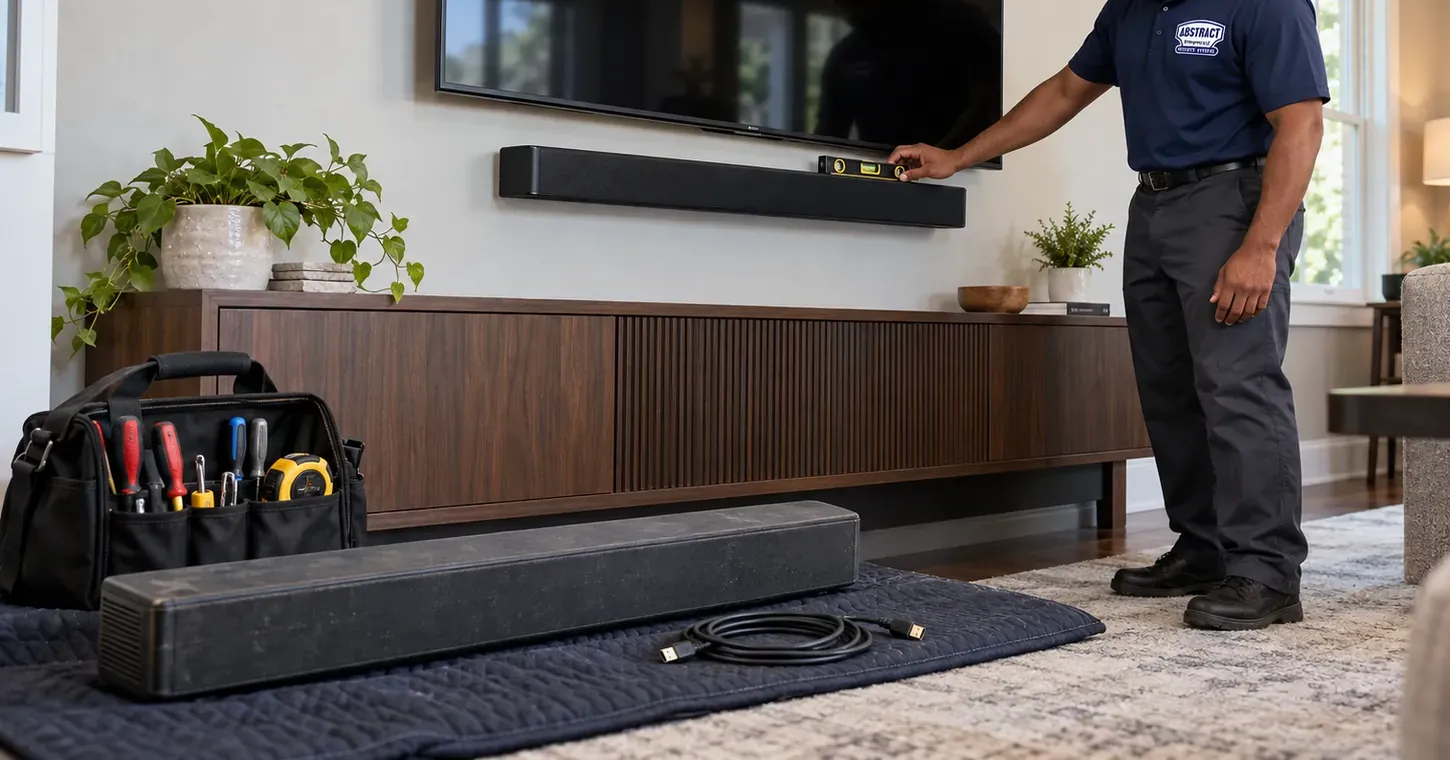
Technician in a navy work shirt resting a small level on a black soundbar mounted under a wall TV, a slatted walnut console below, an open tool bag and a second soundbar on a navy moving blanket in front — New Dorp Staten Island soundbar installation
The last check: a short level along the top of the bar once it is on its bracket. A narrow attached-house living room puts the bar close to your eye, so a small tilt shows.
Three New Dorps

Over the Lane, Between the Semis, Below Hylan: Three Kinds of TV Room

Ask us where you live in New Dorp and the answer tells us half the job. The neighbourhood falls into three parts, and each part has its own usual room, its own usual wall and its own usual snag. The table is the short version; the paragraphs below it explain the reasoning.

New Dorp homes and the TV rooms they tend to have
WhereTypical homeTypical TV wallThe snag we plan for
On and just off New Dorp LaneFlat over a shop in a two- or three-storey mixed-use buildingOld plaster, or drywall on metal studs after a refitNarrow side stairs, the shop’s ceiling under your floor, a landlord’s say on holes
Inland blocks between Richmond Road and Hylan Boulevard1960s–70s attached or semi-attached house; two-family housesDrywall on wood studs; a party wall on one sideLiving room over the garage, few free walls, two households in one building
Larger lots toward Richmond Road and the slopeDetached colonials, high ranches and older frame housesDrywall, plaster or panellingLong runs to built-ins; lower-level dens
New Dorp Beach, below Hylan BoulevardConverted bungalows and cottages; houses rebuilt and raised after SandyBoard or panel walls in bungalows; new insulated drywall in rebuilt housesSpringy floors on piers, full wall cavities, equipment kept off the lowest level
Apartment complexes near Mill Road and Ebbitts StreetRental flats in larger complexes such as Tysens ParkBlock or drywallManagement rules on drilling; console placement often simplest

Over the Lane

Because the 2005 zoning keeps homes off the ground floor, almost every flat on New Dorp Lane is reached by a door beside the shop and a stair that rises straight up between party walls. The living room usually faces the Lane, with one or two big front windows, and the TV goes on a side wall. Those side walls are frequently the oldest surfaces in the building: plaster on wood lath in the earlier structures, plaster over brick in some, and drywall on light steel studs where a landlord has refitted a flat between tenants. We bring the tools for all three. Below the floor is someone else’s business — often a commercial ceiling with lighting, ductwork and sometimes a suspended grid — so we never route a cable downward without the landlord’s agreement.

Between the semis

The inland streets are the New Dorp most people picture: short front yards, driveways, and pairs or rows of brick and siding houses. In a typical attached house the garage and a utility room take the street level, the living room sits half a flight or a full flight up, and the bedrooms are above that. One long side of the living room is the party wall; the other long side often carries the staircase. The front wall is a picture window and the back opens to the kitchen. That leaves very little blank wall, and the wall that does remain may sit directly above the garage door opening, where the framing has to carry a header. We find the studs, keep clear of the header, and talk about where the bass will go — because under that floor is a hollow garage, not soil.

Below Hylan

South of Hylan Boulevard the ground drops toward Miller Field and the bay, and the houses change. The surviving bungalows are small, low and often still on piers or short foundations, with board, panel or beadboard walls and floors that move underfoot. The rebuilt houses are the opposite: tall, stiff and new, with insulated walls, modern wiring and a living floor raised above the flood elevation. The city’s Department of Buildings, in a 2022 bulletin on flood-resistant construction, limits the enclosed space below that elevation to parking, storage and building access. For a TV system that settles one question straight away: the soundbar, subwoofer, receiver and power strip all live on the living floor, and nothing goes in the enclosure underneath.

None of these zones changes a price on this page; they change what the technician puts in the van and how long the first ten minutes take. Tell us which of the three you are in and we arrive with the right anchors, the right length of cable and a realistic idea of where the TV can go.

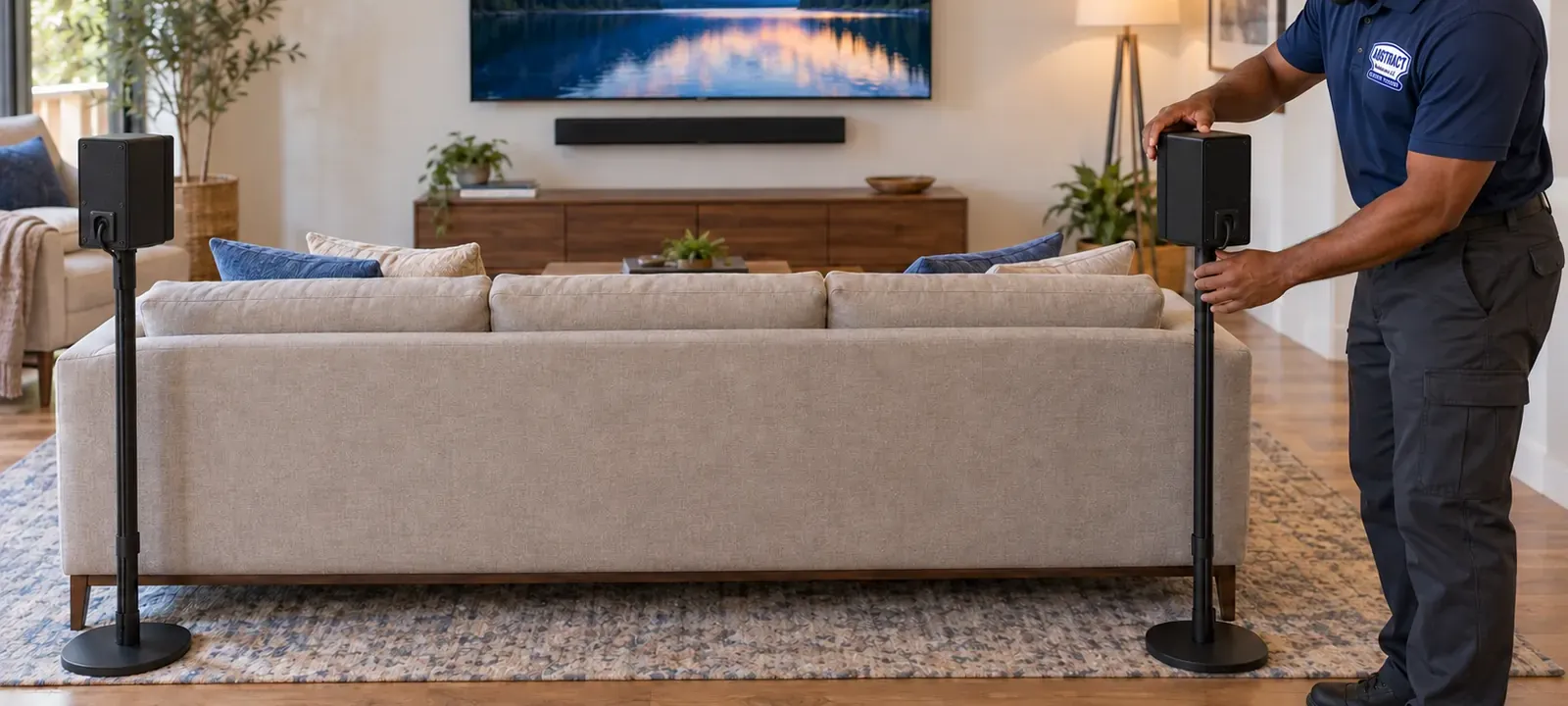
Two black rear speakers on slim floor stands at either end of a beige sofa, a technician adjusting the right-hand one, a wall TV and soundbar above a wooden console across the room — New Dorp Staten Island surround soundbar setup
Rear speakers on stands at each end of the sofa. In many New Dorp living rooms the sofa backs onto the party wall, so stands or small brackets at its ends are the usual answer.
What We Install

Soundbar Installation Services in New Dorp

Every service below has its own row in the price tables further down the page. Whatever mix your room needs, the visit ends the same way: the bar sits level beneath the picture, its cables are inside the wall or neatly dressed along it, the TV remote controls the volume, and you have heard a few minutes of dialogue from the seat you actually use.

Flats Over the Shops

Bars on plaster or steel-stud partitions in the apartments above New Dorp Lane, carried up narrow side stairs and fixed so the landlord sees two small holes, not a patched wall. $129 for the mount, plus $45 for plaster or $30 for metal studs.

Attached and Semi-Attached Houses

Mounts on the walls that are left once the stairs, windows and party wall are counted, with the subwoofer placed so it doesn’t drum on the garage below or boom into the house next door.

Two-Family Houses

A bar for each floor, set up so the upstairs app can’t switch on the downstairs system and each household keeps its own Wi-Fi and its own settings.

Bungalow Living Rooms

Compact bars and small subwoofers for the low, narrow front rooms of New Dorp Beach cottages, fixed to board or panel walls with fasteners that suit them.

Rebuilt and Raised Houses

Hidden wiring in new insulated walls where the cavity allows it, equipment kept on the living floor, and a single surge-protected strip for the whole TV system.

Bar, Subwoofer and Rears

The full home theater hookup at $350: bar, sub and rear speakers connected, placed and tuned from the main seat, with stands where the sofa floats in the room.

TV-Attached Brackets

A clamp kit that hangs the bar from the TV’s own mount — one set of holes in a rented wall instead of two. $84.99 for the Sanus bracket.

Console Placement

No drilling at all: the bar on the TV stand or dresser, connected by HDMI and following the TV remote. $79. The usual choice in rentals and short leases.

Shops, Clinics and Offices

Waiting-room and counter TVs along the Lane and on Hylan Boulevard, with a capped volume, a labelled input and a remote that lives where staff can find it.

Two things fall outside our work. New or relocated electrical outlets are a licensed electrician’s job; we will happily come the same day once the outlet is in. Patching and painting are also left to you or your painter, although our holes are small and sit behind the bar.

Repair Capture

New Dorp Soundbar Went Quiet, Lagging or Crooked? Same-Day Service Calls

A bar that no longer follows the TV remote, a subwoofer that has lost its pairing, voices a beat behind the lips, or a bracket somebody else hung that now tips forward: none of those needs a new installation. They are service calls, booked into the first open two-hour window, and the usual settings, pairing or connection fault is put right within one to two hours of the technician arriving. On Staten Island a setup-only visit is $225 for the first hour, then 30-minute blocks. Phone (347) 934-8335 and say it is a soundbar fault.

Building Specialists

Soundbar Installation for New Dorp’s Architecture

New Dorp was built in layers, and each layer left its own kind of wall. A nineteenth-century railroad village, a commercial strip from the early twentieth century, the post-war and 1960s housing that filled the farms, a summer colony by the water, and a wave of rebuilding after 2012. This is what each usually means for a soundbar.

Mixed-Use Buildings on the Lane

Two- and three-storey buildings with shops below and one or two flats above, held to 35 feet for mixed use since the 2005 rezoning. Older ones have plaster on lath or plaster on masonry; refitted flats often have drywall on light steel studs. The stair is narrow and the floor is the shop’s ceiling.

Attached Houses of the 1960s and 1970s

The largest single group by era in Point2’s figures. Brick or siding fronts, a garage at street level, the living room above, drywall over wood studs inside. Party walls are usually masonry or fire-rated framing; interior walls are ordinary studs at regular spacing.

Semi-Attached Pairs

Two houses sharing one wall, each a mirror of the other. Free walls on three sides make TV placement easier than in a row, but the shared wall still carries sound, and the TV often ends up on the same wall as the neighbour’s.

Two-Family Houses

Almost one home in five in Point2’s New Dorp area is in a two-unit building. Two kitchens, two meters, often one router or two. Each floor’s TV room is its own job, and the floor between them is the only thing separating one household’s bass from the other’s sleep.

Older Houses Toward Richmond Road

The 13.7 percent of homes from 1939 or earlier include frame houses on the older streets near the railway and up toward Richmond Road and New Dorp Heights. Expect plaster, irregular framing and outlets that may be older than the TV is used to.

Bungalows and Cottages at New Dorp Beach

Small converted summer houses, some on piers, with walls of boards, panelling or beadboard and low ceilings. Light framing, light floors and very little space behind the TV for anything except a slim bracket.

Houses Rebuilt After Sandy

Raised or rebuilt to post-2012 rules, with the living floor above the design flood elevation and only parking, storage and access below it. New drywall, deep insulated cavities, plenty of outlets — and sometimes a stair up from the street that is longer than the old house was tall.

Apartment Complexes

Larger rental complexes near Mill Road and Ebbitts Street, such as Tysens Park, with studios to two-bedroom flats. Management decides about drilling; we work within whatever the lease allows.

How we tell the walls apart before drilling

Knocking tells you a lot. Drywall on studs sounds hollow between studs and dull over them, and a magnet finds the screw heads in a straight line. Steel studs give the same hollow sound but the magnet clings along the whole stud, and they need toggles rated for metal or a backer board across two studs (the metal-stud add is $30). Plaster on lath sounds harder and gives a stud finder false readings; we drill one small test hole where the bracket will cover it and fix into the timber we find (the plaster add is $45). Masonry — the party wall in some attached houses, or the brick behind plaster on the Lane — sounds solid everywhere and takes masonry anchors set with a hammer drill ($65 for brick, $75 for block or concrete). Board and panel walls in bungalows are a category of their own, covered in the questions below.

What “post-Sandy construction” means behind a TV

A rebuilt house is easier for the drill and harder for the cable. The walls are straight, the studs are where they should be and the outlets are modern. But the cavities may be full — packed with insulation, crossed by fire blocking at mid-height, and sealed at top and bottom for air-tightness and energy rules. An in-wall kit ($169) still works in many of those walls; in others we route the cable down to a cabinet or use a painted cord cover ($59) rather than tear into a new wall. We tell you which, and why, before drilling.

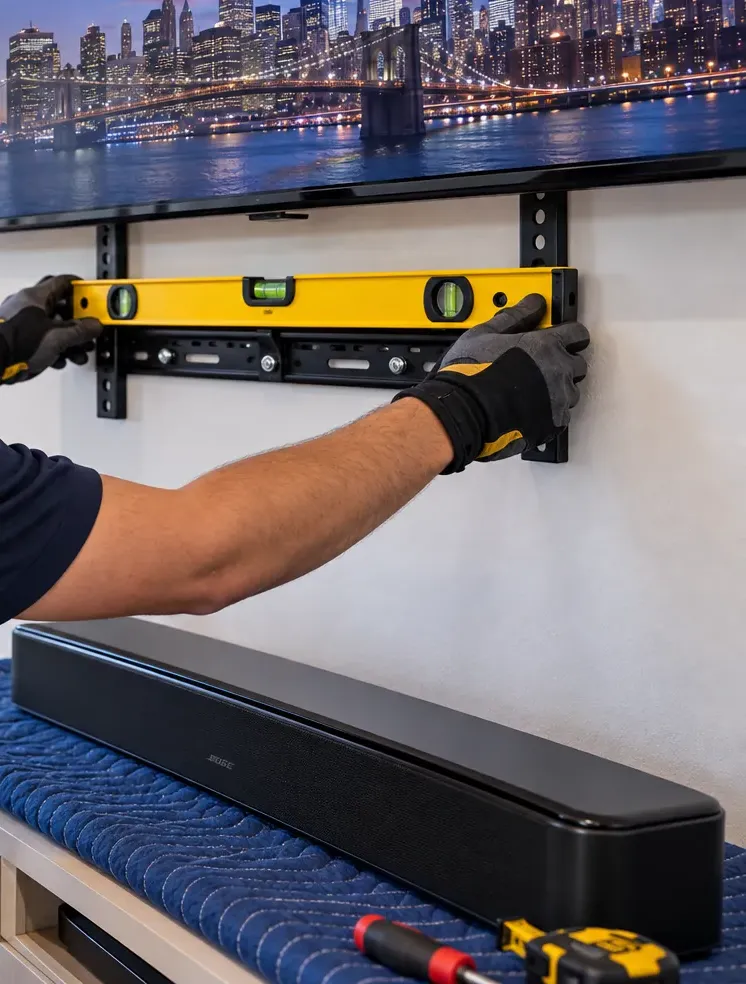
Gloved hands holding a yellow spirit level on a black TV wall plate beneath a screen showing a city skyline at night, a black soundbar resting on a blue moving blanket below with a screwdriver and tape measure — New Dorp Staten Island bracket levelling
The plate is levelled before anything heavy goes on it. Old plaster and steel studs don’t forgive a second set of holes, so the marks come first.
Commercial Soundbar Installation

Business Soundbar Installation on New Dorp Lane and Hylan Boulevard

New Dorp has two commercial streets that work in very different ways. New Dorp Lane is a walking street of small, mostly family-owned shops — the BID counts about 180 businesses — while Hylan Boulevard is a strip of shopping centres and larger stores built for the car. Both have screens that need sound.

New Dorp Lane, Station End

Between the railway and Richmond Road: cafés, bakeries, salons and services within a few steps of the station house. Small rooms, short counters, TVs that play news or music video at low volume. A compact bar with a capped volume is usually right.

New Dorp Lane, Toward Hylan

Restaurants, pharmacies, dentists and clinics, including the Chinese-owned businesses The City Reporter described in 2026. Waiting rooms with chairs along two walls, where the bar has to be heard at the far chair without being loud at the near one.

Hylan Boulevard Shopping Centres

Wikipedia counts five 1960s shopping centres along Hylan in New Dorp, the largest being Hylan Plaza, opened in 1966. Larger tenants, metal-stud partitions, dropped ceilings and break rooms where a TV runs all day.

Medical and Care Offices

Clinics, dental practices and the adult day-care centres that The City Reporter noted serving Chinese-speaking residents. Captions on, volume steady, nothing a client can unpair by accident.

Schools and Community Rooms

New Dorp High School and Staten Island Technical High School both stand in the neighbourhood, and community and church rooms use TVs for meetings and events. Rolling carts and wall mounts both work; carts need the bar fixed to the cart.

Landlords Above the Shops

Owners of mixed-use buildings who let the flats upstairs: one visit can cover the shop’s screen and a tenant’s TV, each on its own line and each invoiced to whoever is paying for it.

Compliance notes for business rooms

  • Things that stick out. Where people walk past a screen — a clinic corridor, the aisle beside a counter — the accessibility rules in §307.2 of the 2010 ADA Standards cap anything fixed to the wall between 27 and 80 inches up at four inches of depth. A TV plus a bar beneath it can exceed that, so in those spots we lift the pair above 80 inches or move it out of the path.
  • Music after 10 PM. The city noise code’s commercial-music rules apply between 10 PM and 7 AM, including limits measured inside nearby homes. Flats sit directly above New Dorp Lane businesses, so a restaurant or bar should treat the soundbar’s night setting as part of the installation, not an afterthought.
  • Low-voltage work. Soundbar wiring is low-voltage and doesn’t need a separate DOB permit in our experience; new outlets do, and those are an electrician’s job.
  • Insurance certificates. Shopping-centre managers and landlords often ask for one before work starts. Ours is free; send us the wording they need.

Retailers on the Lane who already have cameras or a door entry system can add a soundbar to the same visit; our AV and sound team for Staten Island businesses handles rooms where ceiling speakers make more sense than a bar.

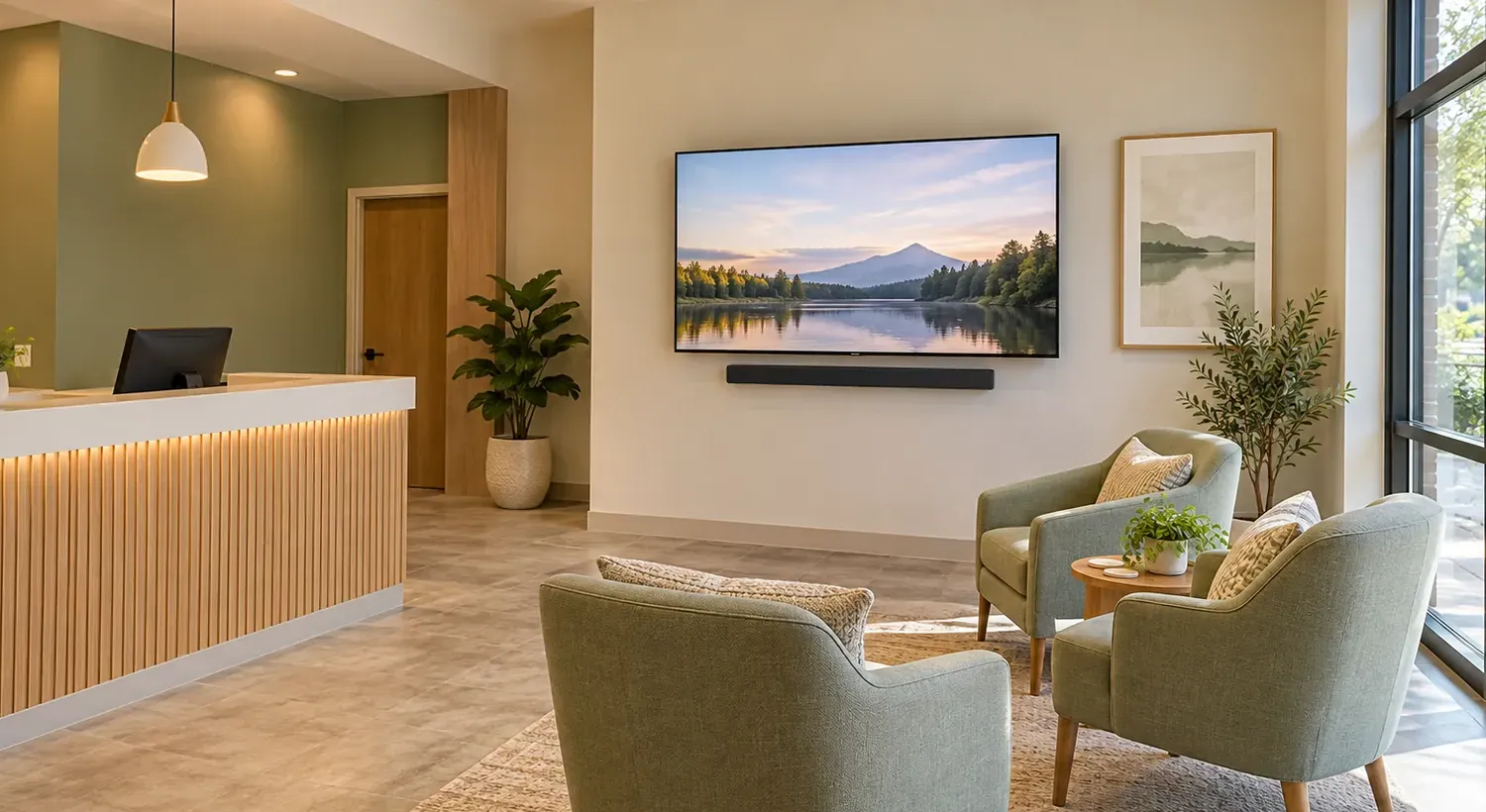
Reception area with a wall-mounted TV above a slim black soundbar, sage-green armchairs around a small table, a framed landscape print, a potted tree, pendant lights and a reception desk at the left — New Dorp Staten Island business soundbar
A waiting-area screen with the bar directly below. For clinics and offices along the Lane we cap the volume, label the input and leave the remote with staff.
Your Questions Answered

Soundbar Installation in New Dorp: Questions Answered

These are the questions New Dorp households ask that we rarely hear elsewhere: living rooms over garages, flats over shops, floors that move and walls that are full. Shorter questions about booking and the visit are in the FAQ further down, and the Staten Island soundbar page covers the borough-wide ones such as shared townhouse walls and stone-veneer fireplaces.

Attached and semi-attached houses

Our semi-attached house has the living room directly above the garage — will the subwoofer boom down through the garage ceiling?

It can, and it is one of the most common surprises in New Dorp’s raised-garage houses. A subwoofer standing on the floor pushes on that floor as much as on the air. Over a basement full of soil and concrete, that energy has nowhere much to go. Over a garage, the floor is a framed deck with a large, hollow, usually uninsulated space beneath it and a thin metal door at one end — very close to a drum. The result is bass that sounds bigger in the garage, in the utility room and sometimes in the house next door than it does on the sofa.

The fixes are mostly about position and setting, not equipment. We keep the subwoofer off the middle of the floor span, where the joists flex most, and put it near a wall or corner where the floor is supported, ideally a wall that doesn’t sit over the garage door header. A dense pad or a heavy rug under the sub helps a little; turning the sub’s level down a few steps and letting the bar’s room-correction routine set the crossover helps a lot more. If the bar offers a night or reduced-bass mode, we show you where it is.

If the living room is mostly over the garage and you watch late, a bar with a built-in woofer and no separate subwoofer can be the better buy. It will never shake the room the way a sub does, but it won’t shake the garage either. We would rather tell you that before you buy than after the sub is unboxed.

In our attached house the front wall is mostly window and door, the back opens to the kitchen and one side is shared — which wall is actually left for the TV?

Usually the long wall opposite the party wall, and usually only part of it, because that is where the staircase runs. That still works. In most of these houses the stair is open on the living-room side or enclosed by a framed partition; either way, the first few feet of that long wall nearest the front window are often clear. A TV of up to about 55 inches and a bar below it fit there, with the sofa against the party wall facing it. The geometry isn’t perfect — you may sit a little off-centre — but a soundbar copes with that far better than TV speakers, and its dialogue setting keeps voices clear from a slight angle.

The other options each have a catch. The party wall itself can carry the TV, and the shared-wall question on our borough page covers what that means for your neighbour. The front window wall can carry it only if the TV goes beside the window rather than in front of it, and screens facing a bright window wash out by day. The kitchen opening sometimes leaves a short return wall that suits a smaller TV and a compact bar, especially if the family watches from the dining table.

Whatever wall you choose, send us one photo taken from where you sit. We check the stud layout, the outlet position, the clearance to the stair rail and whether the cable can reach a cabinet or the boxes can sit under the TV. A figure for the room comes back with that check, the same working day.

Living over New Dorp Lane

Our apartment over a New Dorp Lane shop is reached by a steep, narrow side stair — can a long soundbar box and a ladder make it up?

Almost always. Full-width soundbar cartons run to about four feet long, but they are slim and light, and we carry them up on end. The awkward items are the subwoofer box, which is heavy but compact, and a stepladder, which we bring folded and carry up first. In the narrowest stairs we unbox on the landing or on the street so the cardboard doesn’t scrape your walls, and take every piece of packaging away afterwards (the box-removal line is $25 if you want that).

The Staten Island price list on this page has no stairs line for a flat over a shop. What does help is knowing in advance: the stair’s width at its narrowest point, whether there is a turn at the top, and whether the street door is shared with the shop or has its own key. If the shop opens before your appointment, tell the staff someone is coming up; if the street door is the shop’s door, make sure somebody will be there to open it inside our two-hour window.

Getting a TV up the same stair is a different matter. Screens of 75 inches and up arrive in very large, rigid boxes that don’t bend around a turn. If you are planning a new TV as well, measure the stair before you order, or ask the store about delivery to the room; we can then hang it and fit the bar below it in one visit, priced from the Staten Island TV lines further down.

The ceiling in our apartment over the stores is a dropped grid of tiles — can the soundbar cable run above it?

Sometimes, but it is rarely the best route, and it needs the landlord’s agreement first. A suspended ceiling in a flat often hides old plaster, pipes, ductwork and other people’s cables, and in mixed-use buildings it can be part of a fire-separation arrangement between the shop and the homes above. Cables must not be laid loose on the tiles, and anything run there should be supported on its own and rated for the space it passes through.

What usually makes more sense is shorter: the TV, the bar and the boxes on the same wall, with the HDMI and power dropping straight down behind the TV to a console. On plaster or steel studs, a slim painted cord cover ($59) does that neatly without opening anything. If the boxes must live across the room, the cable run line ($99, up to 25 feet) covers a route along the skirting or behind furniture.

If your landlord is happy with a ceiling route and the space above the grid is clean and accessible, we look at it on the day and tell you whether we would use it. We won’t lift tiles that are stained, sagging or held in with clips we can’t refit, and we won’t touch anything that belongs to the shop below.

We own a two-storey building on the Lane, with the store downstairs and our own apartment upstairs — can one visit handle both TVs, and is each priced the same way?

Yes on both counts. Each TV is priced from the same lines on this page, whether it hangs over a shop counter or a living-room console, so the shop TV and the home TV are simply two sets of rows on one quote. There is no separate commercial rate for a small shop. If you want the shop part on the business’s invoice and the apartment part on a personal one, say so when you book and we split the paperwork that way.

What changes between the two rooms is the setup, not the price. Downstairs we cap the bar’s maximum volume, turn off the features a customer could trigger from a phone (Bluetooth pairing and voice assistants), label the input, and leave the remote somewhere sensible. Upstairs we set the bar for evenings: dialogue lift, a night mode and the subwoofer level chosen with the shop closed and the street quiet.

One practical detail: if both TVs are on the same Wi-Fi, the soundbar apps will see each other. We name them clearly — “Shop” and “Living Room” — and, where the bars allow it, put them on separate networks or turn off grouping so a phone upstairs can never start music in the store.

Below Hylan Boulevard

Our converted New Dorp Beach bungalow sits on piers and the floor bounces when someone walks across — will the TV and bar shake, and where does the subwoofer go?

A wall-mounted TV and bar are the right answer in a bouncy room, because the wall moves far less than the floor. A TV on a stand or a bar on a console rocks every time someone crosses the room; the same pair on the wall stays still. We fix the bracket into the wall studs, which in a bungalow are often lighter and further apart than in a modern house, and if the studs are thin or the wall is boarded we spread the load with a plywood backer board ($85) across several of them.

The subwoofer is the harder part. On a light floor over a crawl space, a sub excites the whole floor, and you feel it in your feet as much as hear it. We place it on the stiffest part of the floor — near an outside wall or over a beam rather than mid-span — and turn it down until the floor stops buzzing. In a small bungalow living room, a bar with built-in bass may simply sound better than any separate sub.

We don’t route cables down through the floor into the crawl space. Parts of New Dorp Beach, between Marine Way and Tysens Lane, sit at or below sea level and flood regularly, and anything under the house is the first thing water reaches. Cables go along the wall or behind furniture instead, and every plug goes to one surge strip above the floor.

Our house was rebuilt after Sandy and the walls are filled with spray-foam insulation — can a cable still be fished inside them?

Not usually, and we won’t force it. Spray foam, especially the closed-cell kind, fills the stud bay completely and sets hard. A fish tape can’t pass through it, and cutting a channel means opening the wall and breaking the air and insulation seal the builder worked to achieve. Fibreglass batts are different: a cable can often be eased down beside them, so it is worth knowing which insulation your builder used.

There are good alternatives. If an interior wall carries the TV — a partition between rooms rather than an outside wall — it is often uninsulated or loosely filled, and the in-wall kit ($169) goes in normally. If the TV must be on an insulated outside wall, a painted cord cover ($59) from the bar down to a console is tidy and invisible from the sofa. And in a new build, the boxes can often live in a cabinet directly beneath the TV, so the only visible cable is a short one.

If you are still building or renovating, there is a better answer: ask the contractor to set an empty conduit or a recessed media box between the TV position and the cabinet before the foam goes in. That costs little at framing and leaves a clean route for every future TV. Our structured cabling team on Staten Island can plan it with your builder.

The desk in the teenager’s room

Our teenager wants one compact bar on the desk to play both the gaming PC and the console — can it switch between them?

Yes, provided the bar has the right inputs, and many compact bars do. The neatest arrangement uses the monitor as the hub: the PC and the console both plug into the monitor by HDMI or DisplayPort, the monitor’s audio output feeds the bar, and switching the monitor’s input switches the sound with it. That works when the monitor has a headphone or optical output, which most gaming monitors do.

The alternative is a bar with two inputs — say optical from the console and USB or Bluetooth from the PC — selected with the bar’s remote or app. It works, but somebody has to remember to switch, and Bluetooth adds a delay that gamers notice. For games we prefer a wired connection and turn on the bar’s low-latency or game mode, then check lip-sync with a test clip.

On a desk, a compact bar sits on a small stand or on the desk itself in front of the monitor foot; a wall mount is rarely needed. The console-placement line ($79) covers it, and the streaming device or games console line ($49 each) covers setting each source to the right input.

Equipment

Types of Soundbars and Mounts We Install

We install the bar you have bought, from any maker, or help you choose one before you buy. The groups below are how we think about the choice for New Dorp rooms, which tend to be narrower and closer to the neighbours than the rooms in the brochures.

Compact Bars

Two feet wide or a little more, often with no separate subwoofer. Right for bedrooms, desks, bungalow front rooms and flats over the Lane, where the sofa is eight or nine feet from the screen and the neighbours are close.

Full-Width Bars With a Subwoofer

The usual choice for an attached-house living room with a 55- to 65-inch TV. The sub is the part that needs thought in New Dorp: over a garage, on a light floor or beside a party wall it is placed and set with care.

Atmos Bars With Height Channels

Up-firing drivers that bounce sound off the ceiling. Dolby’s guidance is a flat ceiling between 7.5 and 14 feet; most New Dorp living rooms qualify, sloped bungalow ceilings and dropped tile grids usually don’t.

Wireless Rear Speakers

“Wireless” means no speaker wire from the bar, not no power: each rear speaker or its amplifier still plugs into an outlet. In a narrow living room with the sofa against a wall, rears go on small brackets or stands at the sofa ends.

Sonos Systems

Beam, Arc Ultra, Ray, Sub and Era rears, paired and grouped in the Sonos app. The Sonos setup line is $125. Useful in two-family houses, where each floor keeps its own system on its own network.

Receiver-Based Systems

For rooms that have outgrown a bar, or households with good speakers already. The A/V receiver line is $129. Bigger rebuilt living rooms by the beach sometimes justify it.

Wall Brackets

The bracket in the soundbar box, or the Sanus soundbar bracket we supply at $84.99 when the box bracket is missing, flimsy or wrong for the wall.

TV-Attached Brackets

Clamp kits that carry the bar on the TV’s own mount, so a rented wall gets one set of holes and a full-motion TV swings with its bar. The mount’s rating has to cover the TV and the bar together.

Concealment

The $169 in-wall kit for clear, uninsulated stud bays; the $59 paintable cord cover for plaster, steel studs, panelling and foam-filled outside walls; and cabinet routing where the boxes live below the screen.

HDMI eARC, ARC and optical: what your TV offers decides the cable

Most TVs sold in the last few years have one HDMI port labelled eARC or ARC. Plug the bar in there, turn on HDMI-CEC in the TV menu, and the TV remote controls the bar’s volume and power. Plain ARC carries Dolby Atmos from streaming apps inside Dolby Digital Plus; eARC also carries the lossless formats used by discs and some consoles. Older TVs without ARC still work through an optical cable, but then the bar usually needs its own remote or a learned code, and lossless formats are lost. Before we leave, we play a test clip and show you the bar’s format indicator so you know what it is receiving.

One TV, several boxes

Many New Dorp households run more than one source into the TV: a cable box, a streaming stick and, increasingly, an internet TV box for programmes in Mandarin, Cantonese, Spanish, Italian, Albanian or Russian — all languages of communities Wikipedia lists in the area. The simplest rule is that every box plugs into the TV and the TV sends sound to the bar over eARC or ARC. Then the bar plays whatever the TV is showing, and nobody needs to change the bar’s input when they change the channel. Where a box only outputs stereo, or its remote won’t control the TV, a programmed universal remote ($99) puts everything on one handset.

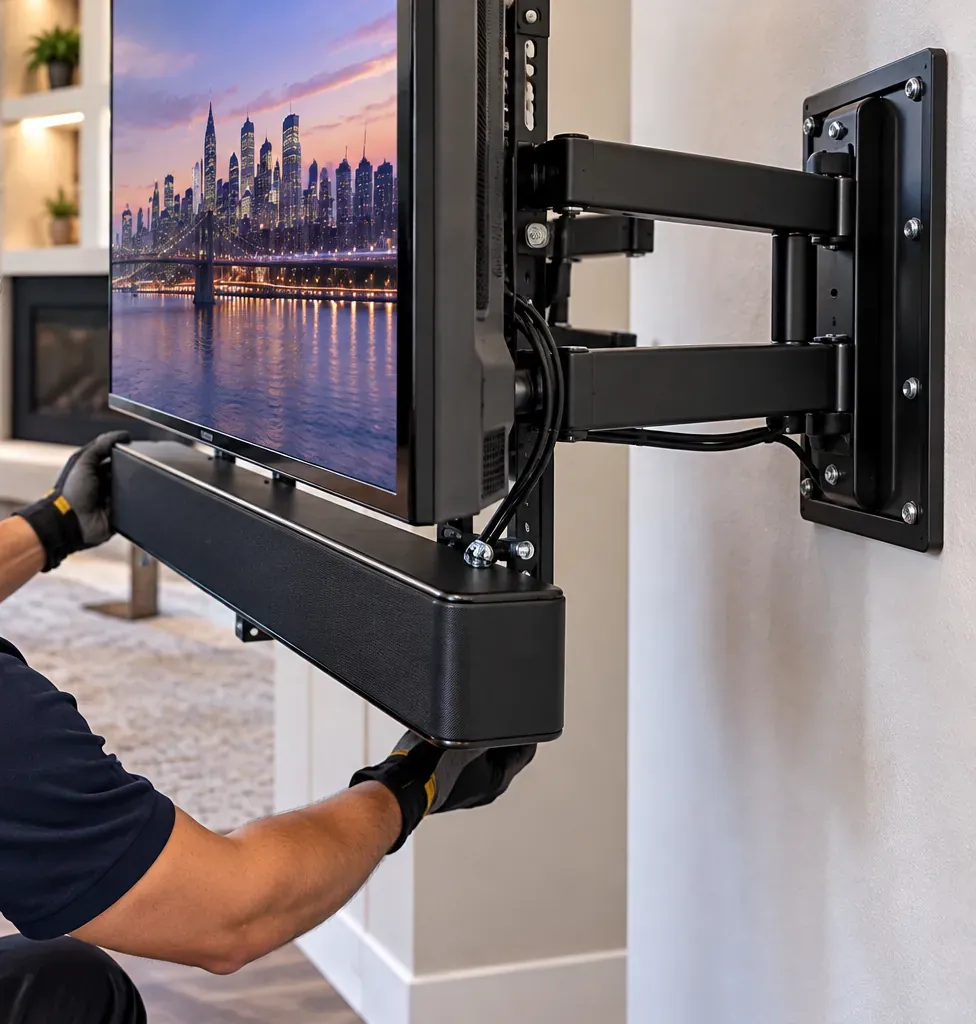
Gloved hands fitting a long black soundbar to a bracket beneath a TV on an extended articulating wall arm, a pale wall and a living room with a fireplace beyond — New Dorp Staten Island TV-attached soundbar
A TV-attached bracket: the bar rides with the screen. One set of holes in the wall instead of two, which landlords over the Lane tend to prefer.
AI Overview Reality Check

What AI Gets Wrong About Soundbar Installation in New Dorp

We could not open Google’s AI Overview from our build environment, so the claims below are paraphrases of what national cost guides and product pages commonly publish, not quotations from it. Each is then set against what we actually find in New Dorp houses and flats.

“A soundbar install is a fifteen-minute, plug-and-play job”

Connecting a bar to a TV can be quick. Installing it in a New Dorp room is usually not, because the time goes on everything around the connection: finding the studs in a 1960s partition, deciding which of three cramped walls is really free, carrying the bar and a ladder up a side stair off the Lane, and settling the subwoofer so the garage under the living room doesn’t drum.

Then there is the setup nobody counts. HDMI-CEC has to be switched on in the TV, the bar’s firmware often updates on first connection, the subwoofer and rears have to pair, and the room-correction routine runs from the seat. In a two-family house the app must be told which floor’s bar is which.

A typical New Dorp wall-mount visit takes about an hour to two hours from the van door to the handover. A plug-and-play claim isn’t wrong about the cable; it just leaves out the room.

“Soundbar installation costs about $58 to $231”

Homewyse publishes a national estimate starting at $58.43 to $231 per soundbar, and Thumbtack gives a national average of $121 to $234 for TV wall mounting. Those are reasonable national figures, but they are averages across every kind of wall in the country, and they don’t tell you what your wall will cost.

Our New Dorp price for a bar on the wall is $129, and the figure moves only when the wall or the extras do: $45 more for plaster in an older flat on the Lane, $30 more for steel studs in a refitted one, $84.99 if you need our bracket, $169 or $59 to hide or cover the cable. Every line is on this page.

So the honest comparison isn’t our total against a national average; it is our total against another installer’s written total for the same wall. We are happy to be compared that way.

“Concealed wiring adds $75 to $300 and can go in any wall”

Angi’s cost guide puts concealed wiring at $75 to $300, which is a fair range. The trouble is the assumption that every wall can take it. In New Dorp, plenty can’t, or shouldn’t.

A party wall of masonry has no cavity. A rebuilt house’s outside wall may be packed with spray foam. A flat over a shop belongs to a landlord who may not want it opened, and plaster on lath cracks when it is fished carelessly. Each of those gets a cord cover ($59) or a route to a cabinet, not a hole and a patch.

Where a wall is a clear, uninsulated stud bay — a typical interior partition in a 1960s attached house — our in-wall kit is $169 and uses a listed power-and-HDMI assembly, not a power cord pushed through the wall, which the electrical code doesn’t allow.

“Bigger subwoofer, better sound”

Product pages love a big sub. In New Dorp, the size of the subwoofer matters less than what it sits on and who lives on the other side of the floor or wall. A large sub over a hollow garage, on a bungalow floor or beside the wall you share with the other half of a semi will annoy people long before it impresses them.

The bass you hear on the sofa depends heavily on where the sub stands in the room. Moving it a few feet, out of the middle of a floor span and near a supported wall, often makes a modest sub sound fuller than a big one in the wrong spot.

We set the sub level with the room-correction routine and then turn it down for night viewing. In two-family houses we listen from the other floor before we leave.

“Ring, ADT or SimpliSafe can add the TV sound when they put in your smart home”

National security brands install alarms, cameras and video doorbells; their technicians don’t mount soundbars or tune home theatre. If a soundbar comes up during an alarm installation, it is usually as a voice-assistant speaker, not as the TV’s sound system.

There is one link worth knowing about. Many video doorbells can announce visitors through a smart speaker, and some soundbars include a voice assistant that can do the same. Whether that is welcome in a living room over a busy street is a choice; we can switch it on or leave it off.

AESS is a licensed low-voltage contractor that does both. If you want the doorbell, the cameras over the shop and the TV sound handled by one firm, ask, and each job is quoted on its own lines.

“A soundbar should always be mounted 4 to 6 inches below the TV”

It is a good starting point, and Sonos, for one, asks for at least four inches between the TV and an Arc Ultra. But in New Dorp rooms the real constraint is often something else: a stair rail that the bar must clear, a radiator or register under the TV, the garage door header in the wall, or a low bungalow ceiling that pushes the TV down.

Yamaha suggests a bar height near 42.5 inches, roughly seated ear level. In a living room half a flight above the street, where the sofa is low and close, we often set the TV a little lower than people expect and the bar just below it, so voices come from the picture rather than from above it.

We hold the bracket up and let you sit in your usual seat before any hole is drilled. A rule of thumb is useful; your sofa is better.

“After Sandy, homes near the beach can’t have electronics on the ground floor at all”

The rule is narrower than that. For buildings in the flood zone that were rebuilt or substantially improved, the DOB’s 2022 bulletin limits the enclosed area below the design flood elevation to parking, storage and building access. Living space, and with it the TV room, sits above that line.

It doesn’t mean every ground floor in New Dorp Beach is off limits — many older bungalows and houses were never raised, and their living rooms remain where they were. It does mean that in a raised house the TV, soundbar and power strip belong on the living floor, and nothing of value should be installed in the enclosure underneath.

If you aren’t sure which rules applied to your house, the elevation certificate from the rebuild or your insurer will say. We don’t give flood-compliance advice; we simply keep the equipment where it is safest.

The Right Wall, the Right Bar, One Remote

Tell us the floor, the wall and the bar. We’ll tell you whether the room suits it and what the job adds up to, before anyone parks outside.

Get In Touch

Request a Free Quote

A flat over the Lane, an attached house off Rose Avenue or a cottage near Cedar Grove Avenue: describe the room, the wall and the bar, and a written figure comes back before the working day ends. Prefer to talk? Call (347) 934-8335.

✅

We Got Your Request!

Thanks — expect a call back from our Staten Island team before the working day is out. Need us sooner? Dial (347) 934-8335.

How It Works

Our Installation Process

The same seven steps run for a compact bar in a flat over the Lane and for a bar, sub and rears in a rebuilt house by the beach; only the time each step takes changes.

1. Tell us about the room

Bar and TV models, which floor the room is on and what lies under it — garage, shop, crawl space or living space — plus a photo of the TV wall from your seat and one of where the boxes and router live.

2. Get a written price

The figure is built only from published lines: mount, bracket, wall add-on, concealment and setup. Anything we can't price from the photos is described in writing before you book.

3. Pick a two-hour window

Windows start between 8 AM and 8 PM on any day. Tell us about the street door, the stair, the driveway and who will let the technician in.

4. Read the wall

The bracket is held up level and every hole is marked while you sit in your usual seat. Plaster gets a hidden test hole, a magnet confirms steel studs, and masonry is checked before the hammer drill comes out.

5. Fix the bracket and route the cables

Screws into studs, toggles rated for steel, anchors in masonry and a backer board on light bungalow framing. In-wall kits go only in clear, uninsulated bays; cord covers or cabinet runs everywhere else.

6. Connect and place

The bar goes on the TV’s eARC or ARC port with HDMI-CEC on. The subwoofer goes on the stiffest part of the floor and away from shared walls, rears go at the sofa ends, and every plug goes to one surge strip on the living floor.

7. Tune and hand over

Room correction runs from the main seat. We set dialogue and night modes, check lip-sync with a test clip, listen from the other floor in a two-family house, show you the remote and vacuum the work area.

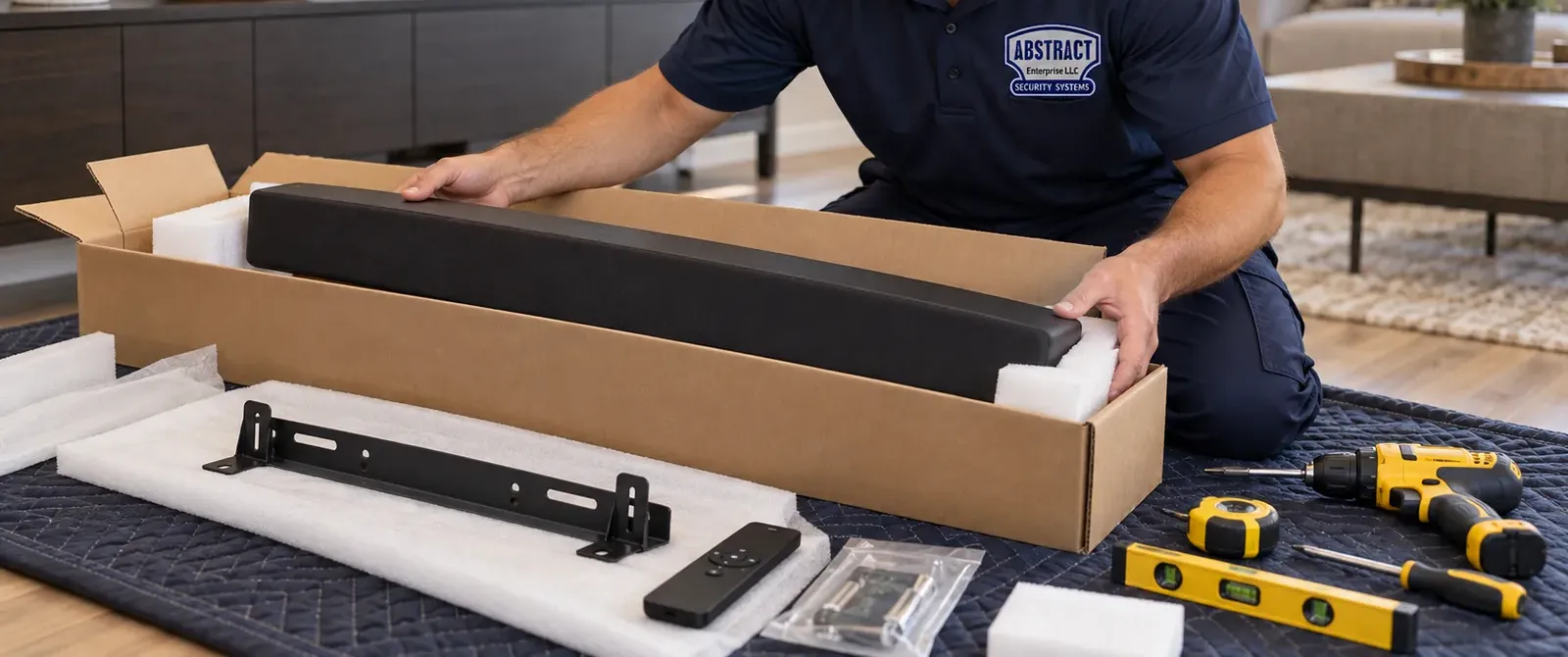
Technician kneeling on a navy moving blanket lifting a black soundbar from its cardboard carton, the wall bracket on white foam, a remote, a bag of screws, a drill, a tape measure and a yellow level beside it — New Dorp Staten Island soundbar unboxing
Everything out of the carton and onto a blanket before the first hole — on the stair landing if the flat is small. The screws in the bag suit studs; plaster and masonry get their own fixings.
Coverage Area

Soundbar Installation Near New Dorp’s Landmarks

These are the places New Dorp people give us as directions. If you live near any of them, you are in the area this page covers.

New Dorp Station

Opened in 1860 on the line from Vanderbilt’s Landing to Eltingville and rebuilt in an open cut in 1965–68 to remove the grade crossings, the station has its station house on New Dorp Lane and a south exit to Rose Avenue. Its two elevators, opened in September 2023, made it the first fully accessible SIR station with lifts.

The Lane Theater

At 168 New Dorp Lane, designed by John Eberson and opened on February 10, 1938. The LPC designated its Art Moderne interior a landmark in 1988, calling it a 1930s, modernistic version of the atmospheric cinema. Crossroads Church has used the building since 2012.

Miller Field

The former Vanderbilt farm, sold to the federal government in 1919 and completed as an Army air coast defence station in 1921. It closed as an airbase in 1969, became part of Gateway National Recreation Area in 1972, and today holds ball fields reached from New Dorp Lane. Its historic district was added to the National Register in 1980.

Cedar Grove Beach and New Dorp Beach

The old resort shore at Cedar Grove Avenue and Ebbitts Street, where the Cedar Grove Beach Club’s bungalows stood until the city took control of the property in 2010. Now parkland, with dunes covering the old hotel sites and a public beach listed for the 2026 season.

New Dorp Library

The NYPL branch at 309 New Dorp Lane, founded by residents as the New Dorp Community Library in 1907, part of the NYPL since 1926 and remodelled in 2000. One of the busiest branches on the island.

New Dorp High School and Staten Island Tech

New Dorp High School stands directly west of Miller Field. Staten Island Technical High School, one of the city’s specialized high schools, occupies the former New Dorp High School building at 485 Clawson Street.

We also install soundbars next door in Oakwood, Grant City, Dongan Hills and Midland Beach, up the hill on Todt Hill, and further along the South Shore in Great Kills — all on the same Staten Island price list.

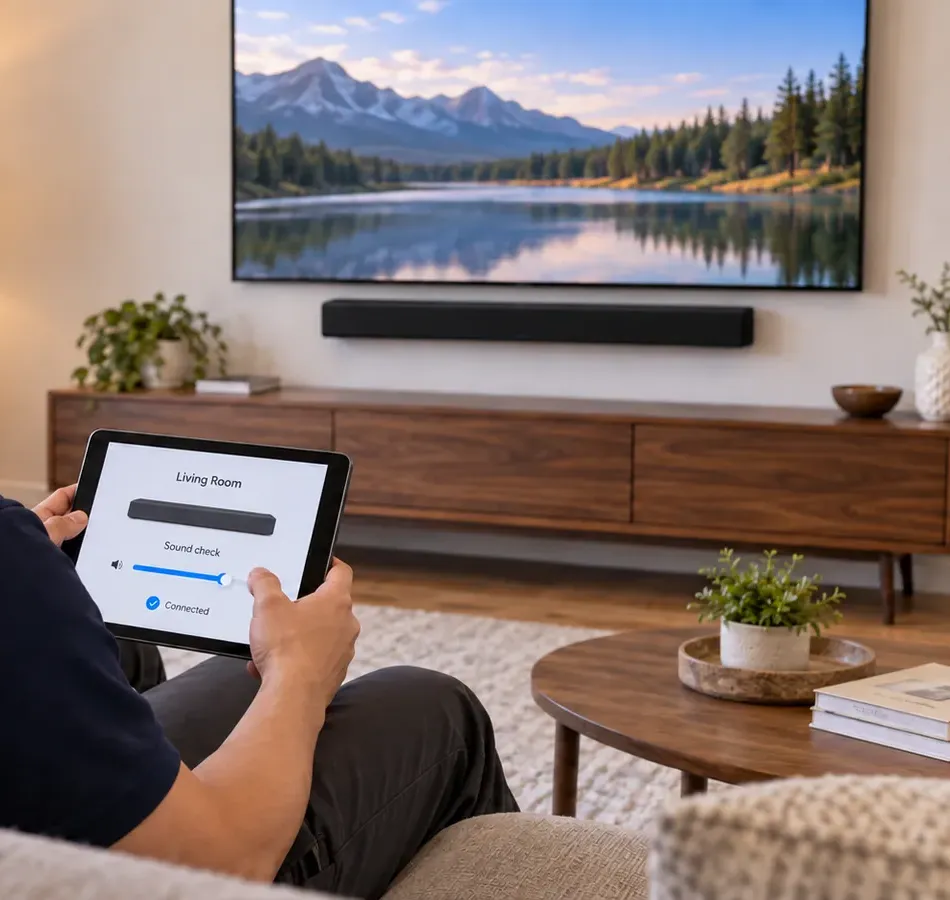
Person seated on a sofa holding a tablet showing a Living Room sound-check screen marked Connected, a wall TV and black soundbar above a walnut console across the room — New Dorp Staten Island soundbar calibration
Calibration is run from the seat you actually use. In a two-family house we then go to the other floor and listen there too.
Pricing

Soundbar Installation Cost in New Dorp

New Dorp pays the Staten Island rates, whether the TV is over a shop, over a garage or over the old beach. The soundbar lines are the same dollar amounts in every borough; only the TV-mounting base and the hourly setup rate change by area. Pick the rows that describe your room and add them up — that is the price. If the wall turns out to be different from the one you described, you see the new total before any hole is drilled.

Soundbar price lines for New Dorp, Staten Island
ItemPriceWhere it comes up in New Dorp
Soundbar placed on a console or stand$79Rented flats, complexes near Mill Road, bedrooms, desks
Soundbar wall-mounted under the TV$129Attached-house living rooms, bungalow front rooms, rebuilt houses
Sanus soundbar bracket$84.99Missing or flimsy box bracket; hanging the bar from the TV mount
In-wall concealment$169Clear, uninsulated stud bays in interior partitions
Paintable cord cover$59Plaster over the Lane, steel studs, foam-filled outside walls, rentals
Cable run to a cabinet or other spot$99Up to 25 ft — boxes across the room or in a built-in
Sonos setup$125Sonos bar, sub and rears paired, app and grouping set up
A/V receiver$129Receiver connected and configured
Universal remote$99TV, bar, cable box and an internet TV box on one handset
Streaming device or games console$49 eachConnected and set on the right input
Full home theater hookup$350Bar or receiver, sub, rears and sources connected and tuned

Wall and access add-ons

What the wall adds, and where you meet it in New Dorp
ConditionAddWhere in New Dorp
Drywall over wood studs$0Most attached and semi-attached houses from the 1960s on; rebuilt houses
Metal studs+$30Refitted flats over shops; offices and shopping-centre units on Hylan
Plaster+$45Older mixed-use buildings on the Lane; pre-war houses toward Richmond Road
Brick or stone+$65Brick party walls; brick behind plaster in some Lane buildings
Concrete or cinder block+$75Garage-level dens, block walls in apartment complexes
Tile or marble+$95Kitchen backsplash TVs, salon and clinic walls
Plywood backer board$85Light or widely spaced bungalow studs; boarded walls
High mount (above about 8 ft)$75Tall living rooms in some rebuilt houses
Box removal$25We take the packaging with us — useful when the bins are behind a shop
Certificate of insuranceFreeLandlords, shopping-centre managers, complex management

When the TV goes up too

Hanging the screen as well? For a 32-to-55-inch set on a fixed or tilting bracket, screwed through drywall into wood studs, Staten Island’s TV price is $209.99. Bigger screens step up: $30 more for 56–65 inches, $60 more for 66–75 and $100 more for 76–85. A fireplace position adds $130 and a pull-down mantel mount $160, while a TV simply set on its own stand is $137.99. When the bar is already on the wall and just needs sorting out, the setup-only rate here is $225 for the first hour and then half-hour blocks. Every TV line is on our Staten Island TV mounting prices page.

  • Always in the price: locating studs or solid masonry, a bar set true to the level, the HDMI or optical connection, cables tied and dressed, the TV remote working the bar wherever the set supports CEC, and the dust cleaned up before we go.
  • Not on our list: electrical outlets, new or relocated, belong to an electrician. So do the jobs after us and around us — plastering and painting, carrying a heavy wall unit out of the way, and colour-calibrating the screen.
  • A wasted trip: if the technician climbs the stair to find the bar still in transit, the bracket missing or the street door locked with nobody to answer, coming back costs $150. Change the date with at least a day’s notice and nothing is charged.
  • Surfaces that can chip: old plaster with decades of paint, ceramic tile behind a salon or kitchen TV, or a thin board in a bungalow can split or flake at the edge of a hole however gently it is drilled. We point it out first and the decision to go ahead is yours.
Shop Our Systems

Soundbar Installation Packages & Pricing

In New Dorp most quotes end up close to one of these three. The arithmetic is written out so you can check it; add any other row from the tables above to the package nearest your room.

Starter — Bar on the Console

$79 — the bar on the TV stand, dresser or desk, connected to the TV, answering its remote, leads tucked away. The usual pick for a rented flat over the Lane, a complex apartment, a bedroom or a teenager’s desk.

Standard — Plaster Wall Over the Lane

$317.99 — soundbar wall-mounted ($129) + plaster add ($45) + Sanus soundbar bracket ($84.99) + paintable cord cover ($59). A bar fixed to the timber behind old plaster, its cable in a painted channel down to the console. On drywall over studs with the bar’s own bracket and no cover, the same mount is $129.

Premium — Rebuilt House, Hidden and Surround

$732.99 — soundbar wall-mounted ($129) + Sanus bracket ($84.99) + in-wall concealment ($169) + full home theater hookup ($350). For an interior wall with a clear stud bay: bar, sub and rears tuned from the main seat and the cable inside the wall.

Bring Your Own Equipment — Labour Only

If a bracket came in the soundbar’s carton, or you ordered one yourself, you pay the $129 labour line and whatever the wall adds — nothing for hardware. A customer-supplied bracket must be rated for the bar, and it carries its own maker’s warranty. If it doesn’t suit the wall — drywall plugs offered up to old plaster or a party wall is the usual case — you hear that before drilling, and the Sanus bracket at $84.99 is the alternative.

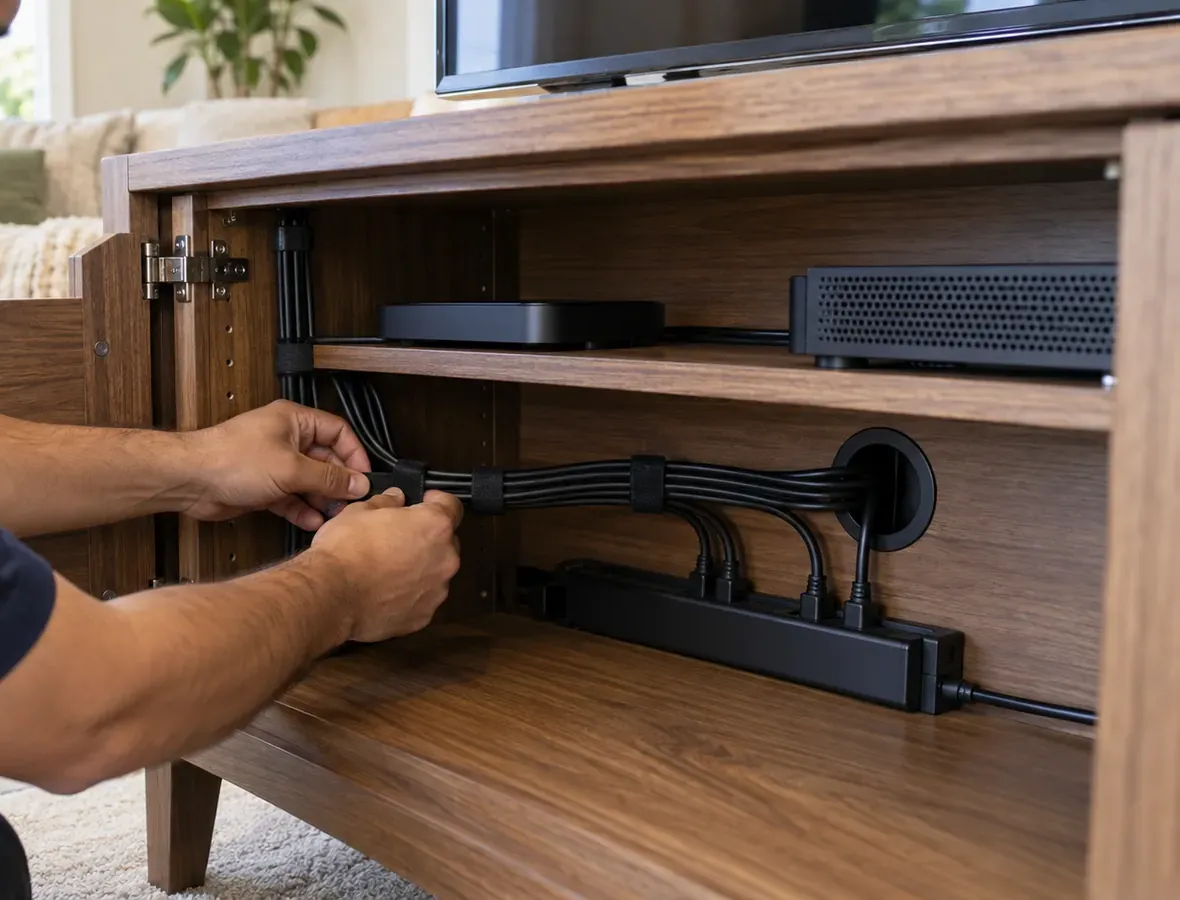
Hands tying black cables with hook-and-loop straps inside an open wooden TV console, a power strip on the cabinet floor, two small boxes on the shelf and a round cable grommet in the back panel — New Dorp Staten Island soundbar cable management
Boxes in the cabinet, cables tied and labelled, everything on one surge strip. Where a wall is full of foam or belongs to a landlord, this is where the wiring disappears instead.

A new TV and bar together. A 75-inch TV on the drywall of a rebuilt living room is $269.99 ($209.99 base + $60 for 66–75 inches). Add the bar beneath it on the Sanus bracket ($129 + $84.99) and the total is $483.98 before any concealment.

A shop and the flat above it, one visit. Downstairs, a bar on a steel-stud wall behind the counter with a cord cover ($129 + $30 + $59) is $218. Upstairs, a bar on the living-room console ($79). Two lines, two invoices if you want them: $218 and $79.

A bungalow front room. A bar on light studs with a backer board to spread the load ($129 + $85), with its cable in a cord cover ($59), is $273. On the console instead, with a universal remote for the TV, cable box and bar ($79 + $99), $178.

Get the New Dorp Total in Writing Before Anyone Drills

Photograph the TV wall from your seat, note the bar model and which floor you are on. That is enough for a written total built from rows you can check.

New Dorp Beach

The Shore That Stayed: TV Rooms in New Dorp Beach After Sandy

New Dorp Beach is the part of the neighbourhood with the longest memory. Wikipedia records a first land grant here in 1671 and a resort that grew after the Civil War: campgrounds and seasonal bungalows on the gridded side streets off Cedar Grove Avenue, wooden piers and hotels on the waterfront, the New Dorp Beach Hotel and the Cedar Grove Beach Club with its row of summer cottages. The city took much of the old resort by eminent domain for Robert Moses’s Shore Front Drive, a highway that was never built, and the land behind the dunes became parkland. The streets inland of it kept their small houses, most of them converted from summer use, with many attached homes among them.

Sandy reached those streets in October 2012. In The Neighborhoods, Rob Stephenson writes that parts of New Dorp were left under about six feet of water. A year later, residents met at the New Dorp Beach Civic Association and signed letters asking Governor Cuomo to extend the state’s voluntary buyout programme to them; DNAinfo reported that the state wanted at least 80 percent of residents to sign before considering it. In April 2014 the state said no more neighbourhoods would be added. Oakwood Beach and Ocean Breeze were bought out; New Dorp Beach was not.

What happened instead was rebuilding, house by house. Some owners repaired and raised their homes; others sold through the city’s acquisition programme, which, unlike the buyouts, resold lots to be built on again. Stephenson describes the rebuilt houses as “suspended over their foundations”. The result, today, is a neighbourhood of three kinds of house standing side by side, and each needs a different approach to the TV.

The original bungalow

Small rooms, low ceilings, light framing and, often, a floor on piers. Walls may be boards, wood panelling or beadboard over studs spaced further apart than modern ones. A compact bar on a slim bracket, a backer board if the studs are light, cables along the wall rather than under the floor, and a subwoofer only if the floor can take it.

The renovated cottage

A bungalow brought up to date — new drywall, new wiring, sometimes a second storey added. Inside, it behaves much like a 1960s house: studs where you expect them, outlets behind the TV, an ordinary wall mount. The old floor structure may still be underneath, so the subwoofer question remains.

The raised or rebuilt house

Living space on the upper level, parking and storage in the enclosure below, a long stair from the street. New insulated walls that may be closed to cable, plenty of outlets, and often fibre or cable service that enters near the ground. We keep the router, the TV boxes and the soundbar system all on the living floor, run any cable from the service entry upward inside the house rather than along the lowest level, and give the whole TV system one surge-protected strip you can reach and switch off.

Whichever house you have, the same principle applies: the expensive parts of the system live as high in the house as the room allows, and nothing that matters is installed where water reaches first. That costs nothing extra; it is simply where we put things.

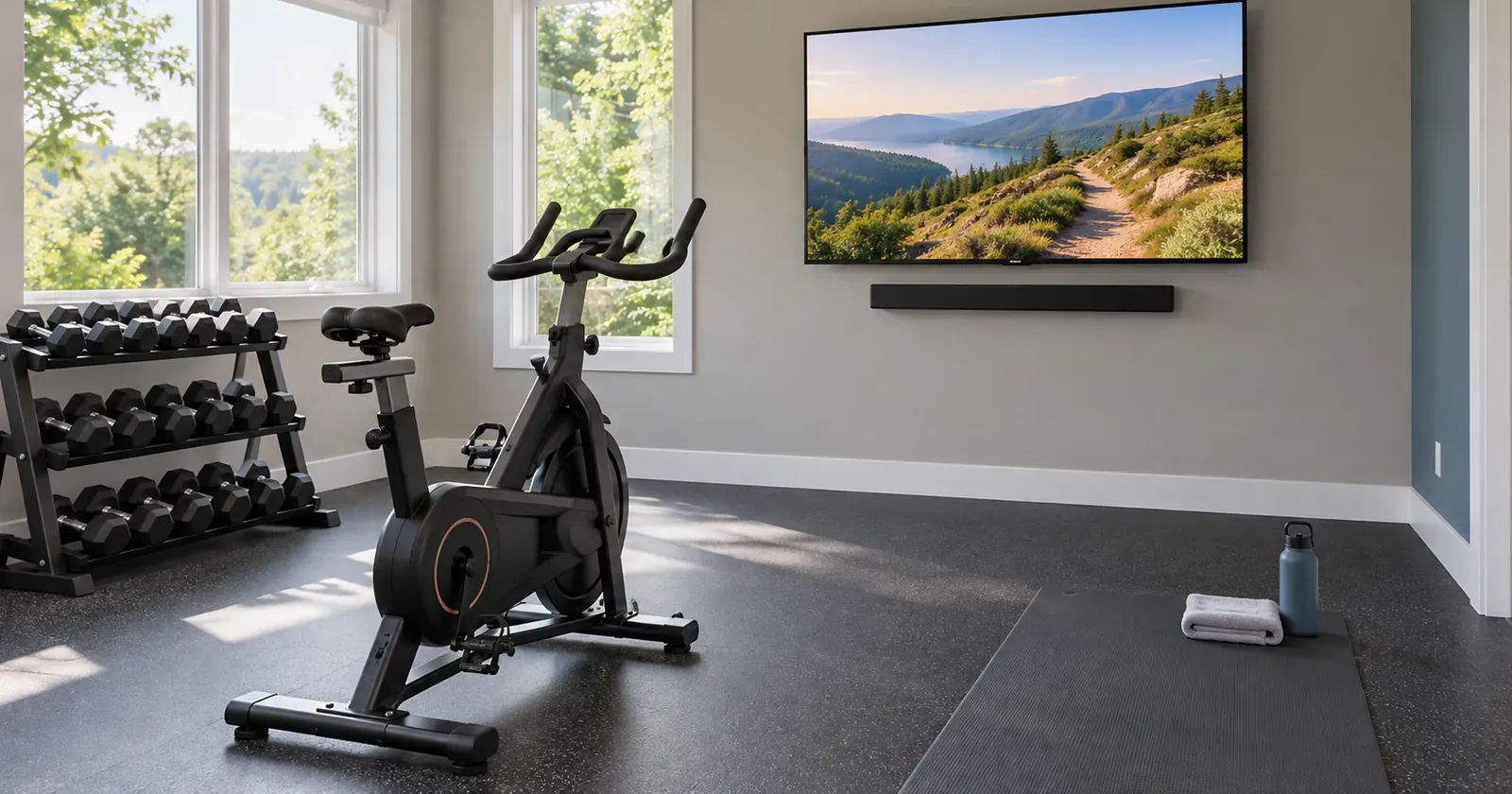
Exercise room with a wall-mounted TV showing a hillside trail and a slim black soundbar beneath it, an exercise bike, a dumbbell rack, black rubber flooring and two windows onto trees — New Dorp Staten Island home gym soundbar
A slim bar under a gym TV. In a rebuilt house the bonus room on the living floor often becomes this, and a bar fixed at a set volume is all it needs.
Before the Visit

Getting a New Dorp TV Room Ready for the Technician

A little preparation makes a two-hour window go further. None of this is required, but each item saves time on the day.

A short checklist by type of home
HomeWorth doing beforehand
Flat over a shop on the LaneAsk the landlord about holes in writing; tell the shop someone is coming; measure the stair if a new TV is involved; leave the street-door key with someone if you’ll be out.
Attached or semi-attached houseClear a path to the TV wall; move the car if the van needs the driveway; tell us if the living room is over the garage.
Two-family houseAgree with the other floor about the visit; note which router each floor uses; decide whose name the soundbar app should be under.
Bungalow at New Dorp BeachTell us if the floor is on piers or the walls are boarded; show us where the outlets are and which ones are on the same circuit.
Rebuilt or raised houseFind out from the builder or plans what insulation is in the TV wall; show us where the cable or fibre enters; keep the stair clear.
Shop, clinic or officePick a time before opening or after closing; get the certificate-of-insurance wording from the landlord or centre manager; decide the maximum volume staff should be able to reach.

For everyone: have the soundbar, its bracket and its remote unboxed or at least in the room; know your Wi-Fi password; and if you have the soundbar maker’s app, install it on the phone of the person who will use it most. Everything else we bring.

Complete Services

Every Soundbar Installation Service in New Dorp

A soundbar visit is often when a household finally deals with the TV, the Wi-Fi dead spot or the front door. These are the related AESS services for New Dorp and the rest of Staten Island.

TV Mounting on Staten Island

Screens hung on plaster, steel studs or new drywall, at the right height for the bar beneath.

Staten Island TV Mounting Prices

Screen sizes, fireplace positions and wall add-ons, line by line.

Sonos Installation, Staten Island

Bars, Subs and rears tuned in the TV room, with music grouped to other rooms or floors.

AV and Sound Systems on Staten Island

Ceiling and wall speakers for shops, clinics and rooms a bar can’t fill.

Home Network Installation

A wired connection to the TV and Wi-Fi that reaches the far floor of a two-family house.

Structured Cabling

Conduit and cable placed while a rebuild or renovation still has open walls.

Smart Locks in New Dorp

Keypads and app locks for shopfronts, side doors to the flats above and houses inland.

Home Automation

Lights, shades and the TV system on one app or one handset.

Visit Policies

Arrival windows, rescheduling, return trips and what’s included.

FAQ

New Dorp Soundbar Installation FAQ

We share the driveway with the other half of our semi — where should the van park?
+

On the street outside if there is room, so neither household's car is blocked. If parking is tight near the Lane or the station, tell us and the technician can use your side of the driveway for the visit. Everything comes in on one trip, so the van doesn't need to sit in front of the door for long. It is worth letting your neighbour know a van will be there for an hour or two.

Our shop on the Lane opens at 10 — can the soundbar go up before we unlock the door?
+

Yes. Arrival windows start at 8 AM, seven days a week, and a single bar in a shop is usually finished inside the window. Book the 8-to-10 slot, tell us your opening time, and we do the drilling first so the noisy part is over before customers arrive. Visits at closing time, with windows starting as late as 8 PM, work too.

Can the soundbar be set to come on at the same moderate volume every time, whatever the last person left it at?
+

Many bars can, although each maker names the setting differently — look for a start-up volume, maximum volume or volume limit option in the app. Where the bar has it, we set a comfortable start-up level and, if you want one, a ceiling. Where it doesn't, the TV's own volume limit, or a universal remote programmed with a fixed volume step, can do a similar job.

Our soundbar spent two years in a storage unit while the house was rebuilt — is it safe to plug in again?
+

Usually, but check it first. Let it sit indoors for a day so any condensation dries, then look for corrosion on the connectors, rust on the screws, a cracked power cord or a musty smell. If the unit was stored somewhere that flooded or stayed damp, don't plug it in; we can test it on the day, and a bar showing signs of water damage shouldn't be mounted. Expect a large firmware update the first time it connects.

We sing karaoke at family parties — can microphones run through the soundbar without the voice lagging?
+

Not well, in most cases. A soundbar processes sound before playing it, and when a microphone signal passes through a TV or app and then the bar, the delay is enough to throw a singer off. The better arrangement is a karaoke machine or small mixer with its own speaker for the microphones, while the TV and bar play the music and lyrics. Some bars have a low-latency mode that narrows the gap; we can set it and connect the karaoke box, but we won't promise lag-free singing through a bar alone.

Our cats walk along the TV console — how do we stop them knocking the soundbar off?
+

Put the bar on the wall. A wall-mounted bar ($129) sits above the console, out of a cat's path, and its cables go into a cord cover or the wall so there is nothing to bat or chew. If the bar has to stay on the console, we set it back from the front edge, use removable non-slip pads under it and route the cables behind the furniture.

Compact black soundbar on a wooden desk below a large monitor on an arm, a keyboard on a desk mat, a mouse, a game controller and a potted plant in warm evening light — New Dorp Staten Island desk soundbar
A compact bar on the desk, fed from the monitor so the PC and the console share it. The console-placement line covers it.
All Areas Served

Soundbar Installation Across New York

New Dorp is one page in a larger network. Its parent is the Staten Island soundbar installers page, and above that the New York City soundbar installation hub links the five boroughs. Long Island and the Hudson Valley have hubs of their own, and neighbourhood pages like this one look closely at single parts of each.

Cameras over a shopfront, an intercom for the flats upstairs or cabling for a home office are listed on the AESS home page; our about page introduces the people who do the work.

TV Talking but the Bar Silent? We Cover New Dorp Tonight

When the picture plays and the room stays quiet, phone (347) 934-8335 and say it’s a soundbar fault. We offer the earliest open two-hour window, and lost pairings, wrong inputs and update glitches are normally sorted inside the first hour or two on site.

Soundbar Installation in New Dorp — Licensed, Insured, Careful With Every Wall

Abstract Enterprises Security Systems · 1282 Troy Ave, Brooklyn, NY 11203 · serving New Dorp, New Dorp Beach and all of Staten Island · (347) 934-8335 · WhatsApp (718) 679-0359 via wa.me

NYS Low-Voltage Licence #12000287431 · 100% Licensed & Insured · Same-Day Estimates · Rated 4.7★ from 201 Google Reviews

Brackets and parts carry their manufacturer’s warranty. Full terms — including 50% deposit, one-year parts-only warranty on AESS-supplied products, and the late-fee schedule — are set out in the service agreement. See our warranty page.

Page reviewed and updated October 17, 2026. Changelog: page launched for New Dorp flats, houses, bungalows, rebuilt homes and businesses, built on Landmarks Preservation Commission, CityLand, MTA, National Park Service and NYC Buildings sources, census-based housing figures, and local reporting on New Dorp Lane and New Dorp Beach. No Field Notes story is included because we have no documented New Dorp job to report yet.

Sources used on this page

  • Wikipedia, New Dorp, Staten Island — name, 1671 founding, boundaries, ZIP, 2020 census figures, Hylan Boulevard shopping centres, communities, schools, library, transit.
  • Wikipedia, New Dorp Beach — resort history, Shore Front Drive, converted beach houses, flooding between Marine Way and Tysens Lane, Cedar Grove Beach.
  • Landmarks Preservation Commission, Lane Theater interior designation report (November 1, 1988) — address, architect, opening date, Art Moderne interior, New Dorp Lane development history.
  • CityLand, New Dorp Lane rezoning (December 2005) and New Dorp BID (April 2017) — height and ground-floor rules; 146 properties and about 180 businesses.
  • Point2, New Dorp demographics (ACS 2019–2023) — building types, year built, tenure.
  • The City Reporter / Documented, Carol Chen (July 30, 2026) — Chinese-owned businesses around New Dorp Lane, Staten Island Chinese School enrolment.
  • DNAinfo, Nicholas Rizzi (December 6, 2013) and April 11, 2014 — New Dorp Beach buyout campaign and the state’s decision.
  • Rob Stephenson, The Neighborhoods, “New Dorp – Staten Island” (May 22, 2025) — Sandy flooding, rebuilt raised homes.
  • NYC Department of Buildings, Buildings Bulletin 2022-001 — uses allowed below the design flood elevation.
  • MTA press release (September 19, 2023) and Wikipedia, New Dorp station — elevators, open cut, history, exits.
  • National Park Service and Wikipedia, Miller Field — Vanderbilt farm, 1919 sale, 1921 completion, 1969 closure, Gateway since 1972, National Register 1980.
  • City Limits (May 2011) and NYC Parks beach listings (2026 season) — Cedar Grove Beach Club and the public beach.
  • NYPL, New Dorp branch history; Wikipedia, Staten Island Technical High School.
  • Silo-wide technical sources: Dolby Atmos ceiling guidance, Sonos and Yamaha placement guidance, AWOL Vision on eARC and ARC, Homewyse, Thumbtack and Angi cost guides, ADA 2010 §307.2, NYC noise code commercial-music summary.