Decoration Agreements · Finished Interiors · Plaster on Block · Yorkville Walk-Ups · Second Avenue Towers
East of the park, the hard part of a soundbar job is rarely the soundbar. It is the managing agent's paperwork, a service elevator that runs on the building's clock, and a living room that someone has already finished with care — upholstered walls, hung paintings, lacquered millwork, a plaster cornice nobody wants touched. We plan the visit around all of that first, then fix the bar to whatever is really behind the finish and tune it for a household with neighbours on every side.
Reviewed and updated October 17, 2026. Building and district notes for the blocks from Fifth Avenue to the East River, East 59th to East 96th Street, compiled by Anwar Timothy, owner of AESS, NYS license #12000287431.

From Lenox Hill to the edge of East Harlem, most of our Upper East Side calls begin with a building question, not a speaker question. Ring (929) 560-0737 or use the short form. You get a figure built from the Manhattan menu printed on this page, with the wall and access lines your building adds named before anything is booked.
On the Upper East Side, the living room is usually finished before the television arrives, and the building has rules about touching it. That single fact separates this neighbourhood from most of the city. A bar under a screen is a small job anywhere, but here it lands in apartments where a decorator chose the wall covering, an art handler hung the pictures, a cabinetmaker built the shelving, and the co-op's managing agent wants to see paperwork before a drill crosses the service entrance. Getting the sound right is the last step; getting permission, access and a clean fixing through a finished surface come first.
The building stock explains why. The Landmarks Preservation Commission designated the Upper East Side Historic District in 1981, and Friends of the Upper East Side describes it as one of the city's largest landmark districts, running along Fifth Avenue from 59th to 78th Street and in places as far east as Third Avenue, with brownstone row houses, town houses, mansions and big apartment houses side by side. North of it, the Park Avenue Historic District, designated in 2014, protects 64 buildings between East 79th and East 91st Streets; DNAinfo's report on the designation notes that upper Park Avenue is defined by mid-rise apartment houses of the 1910s and 1920s, many by J.E.R. Carpenter and Rosario Candela. Above 86th Street, the Carnegie Hill district, designated in 1974 and expanded in 1993 according to the Historic Districts Council, carries the same mix uptown.
Those prewar apartment houses set the pattern for a typical job. Their walls are plaster laid over hollow block or brick, their ceilings are high, their principal rooms have fireplaces and deep window reveals, and their living rooms were planned for furniture and conversation rather than a screen. A building like 740 Park Avenue, completed in 1930, is known for apartments that often span entire floors; its smaller neighbours follow the same construction on a smaller scale. When a household in one of these buildings asks for a soundbar, the real question is how to make a modern bar sit quietly in a room designed eighty or a hundred years before it.
East of Third Avenue the neighbourhood changes character. Yorkville grew up as a working district: the writer Rob Stephenson notes that jobs at its two large breweries drew German workers, and that its Central European communities clustered by street — Czechs near 72nd, Hungarians near 79th, Germans on 86th Street, once nicknamed Sauerkraut Boulevard. Plenty of its older walk-up buildings remain, now rentals and small co-ops without elevators, with brick party walls and narrow rooms. Between and above them stand the postwar doorman towers on First, Second and York Avenues, and since the Second Avenue Subway opened its 72nd, 86th and 96th Street stations on January 1, 2017, a further layer of new condominium and rental towers. The NYU Furman Center counts 4,025 homes added in buildings of four or more units between 2010 and 2025.
The people living here shape the work as much as the walls. Furman's 2024 profile estimates 224,027 residents, the city's fourth-largest neighbourhood by population, with the fourth-highest median income and the sixth-most-expensive rents of its 59 neighbourhoods. Homeownership stands at 37.9 percent against 32.7 percent citywide, up 5.2 points since 2010. That adds up to a great many co-op shareholders and condo owners, each answering to a board, and a great many apartments where the interior is valuable in itself. A soundbar visit that would be routine in a rental can, in a finished co-op living room, involve a decoration agreement, an elevator booking and a conversation about who moves the painting.
Residents notice the gap between what they need and what a generic handyman offers. In an r/uppereastside thread about mounting a TV on a cinder-block wall the super had approved, the poster wrote that app-booked helpers they had used were usually only capable "if there's wood studs or something super basic". In another, a resident asking whether a big-box retailer's installers could produce a building's certificate of insurance was told not to assume the same contractors handle TV mounting. Those two complaints — the wall is not wood and drywall, and the building wants paperwork — describe most of our Upper East Side calls.
Taken together, the figures describe a neighbourhood where almost every installation has three parties with an opinion: the household, the building and the room itself. Our job is to satisfy all three without a second visit.
Upper East Side households changing the TV at the same time usually book the screen and the bar together through our Manhattan TV installation service. Those already living with speakers in other rooms often want the new bar on the same app, which our Manhattan Sonos installers handle, and residents updating the front door at the same time can ask about Upper East Side smart lock installation, done under the same building approval.

A bar that lost the TV after a software update, voices that run ahead of the picture, a subwoofer that blinks and won't pair, or a bracket starting to tilt out of old plaster: those are repair visits, and they are booked differently from a new installation. Call (929) 560-0737 with your cross streets and what the bar is doing. We hold the next open two-hour window, and most connection and settings faults are put right within an hour or two of arrival. The way setup-only time is billed is set out in our TV and soundbar visit policies.
Each service below is a line on a published menu, and each exists because of something specific to Upper East Side apartments. Most visits combine two or three of them.
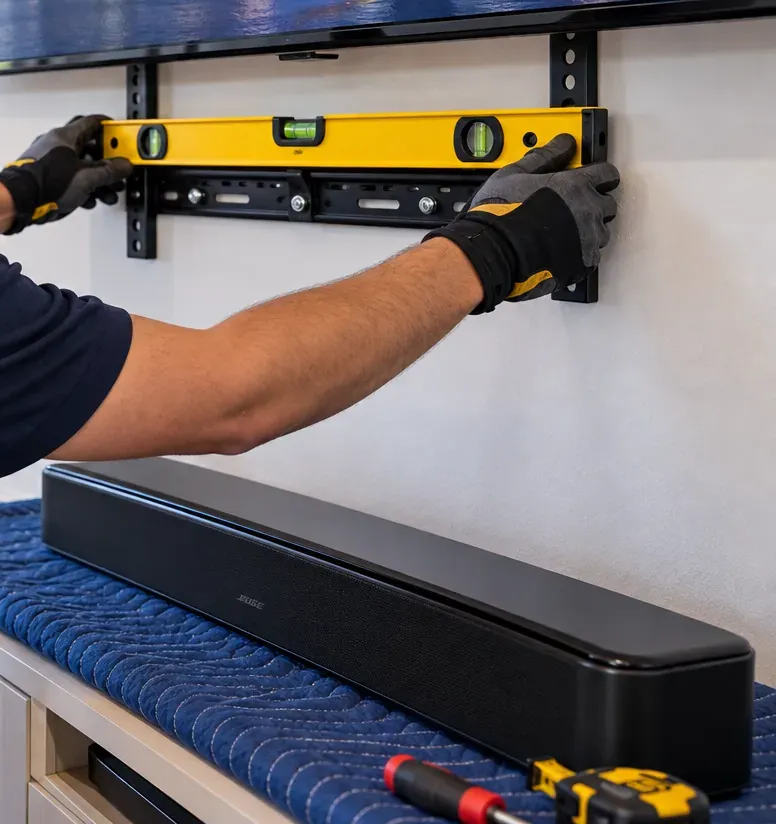
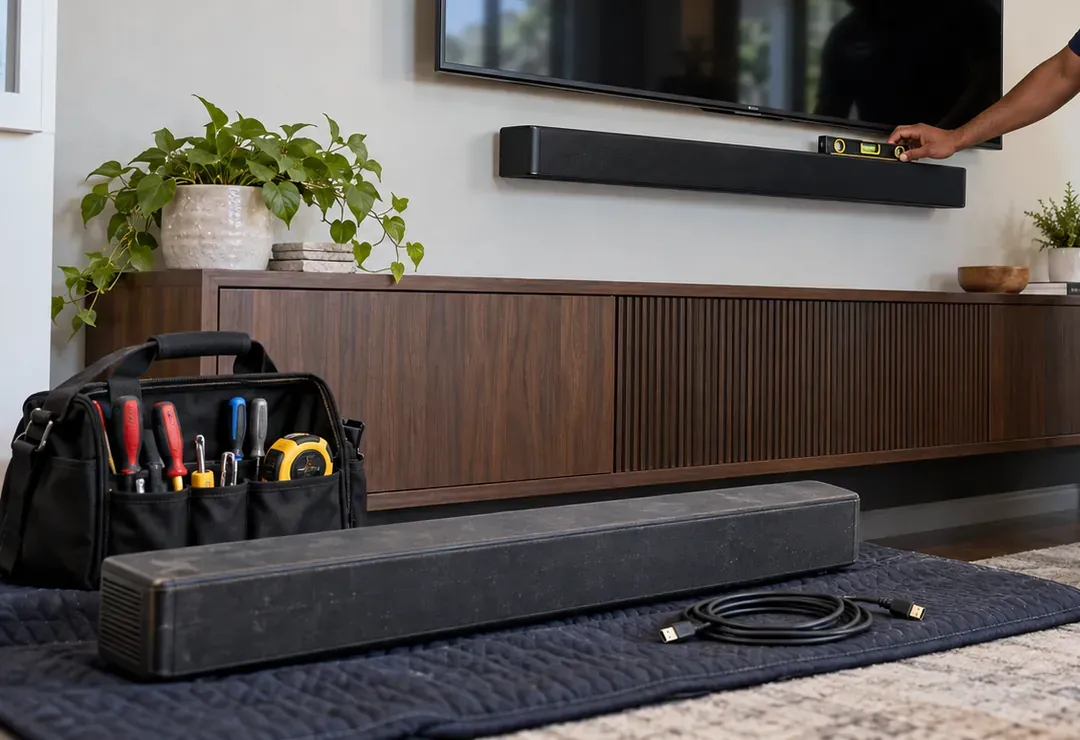
A bracket fixed below the TV into plaster over block or brick, with anchors chosen after a small test hole tells us which. The bar is levelled to the screen, not to a ceiling that may have settled, and checked from the main chair.
Upholstered panels, grasscloth, decorative paint or a lacquered wall: we locate the solid wall underneath, open the finish as little as possible and keep the bracket's fixings out of sight behind the bar.
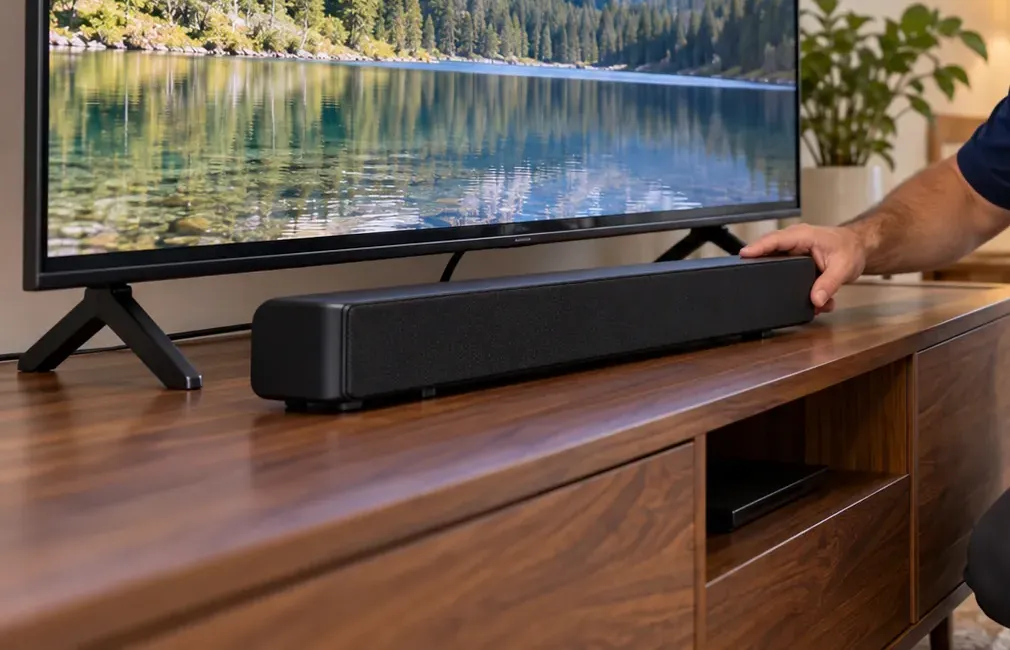
When the board has not yet signed off, the finish is too precious to drill, or the apartment is rented, the bar sits on the furniture, clear of the TV's infrared window, with cables bundled out of view and every setting made as if it were on the wall.
If a new TV is going up anyway, doing both at once means the desk, the service car and the parking are dealt with a single time, and the screen is hung at a height that already allows for the bar, so nobody re-drills next year.
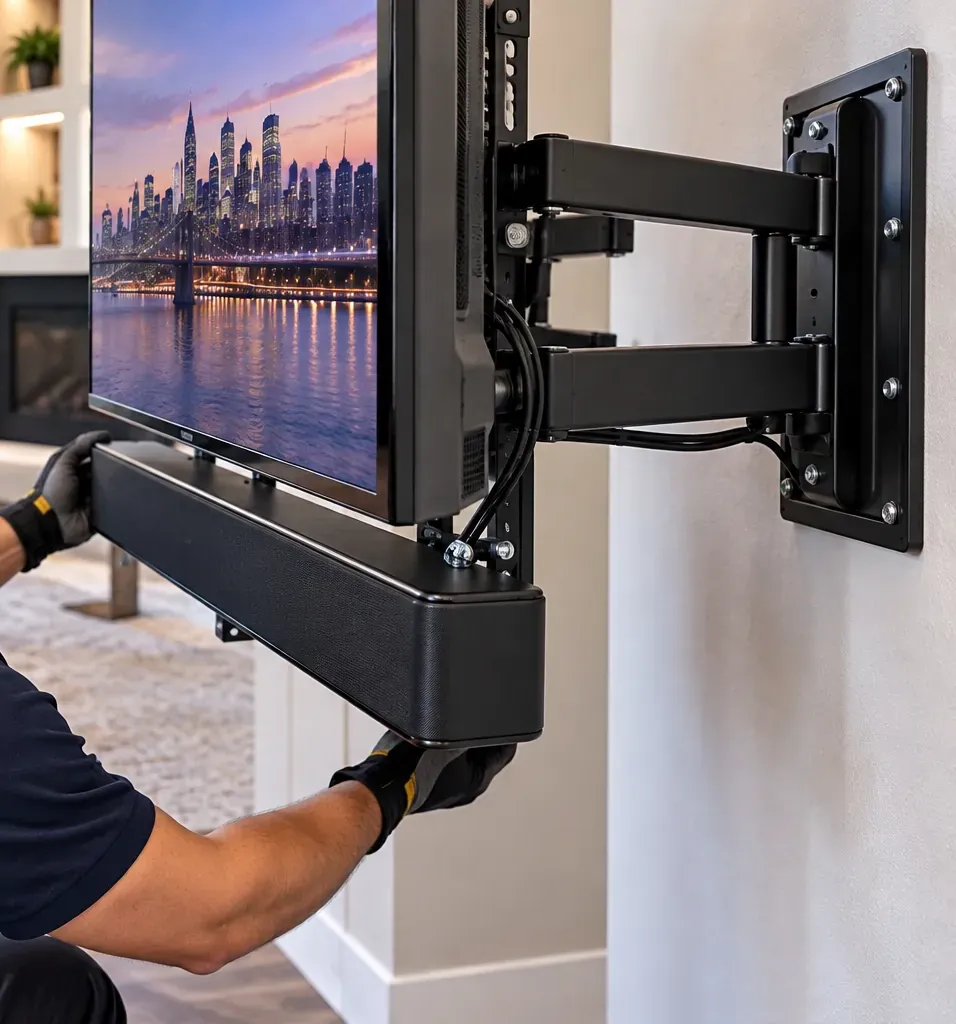
Where the screen sits on an articulating arm so it can face the sofa or the dining table, a TV-attached bracket lets the bar swing with it and leaves the wall below untouched.
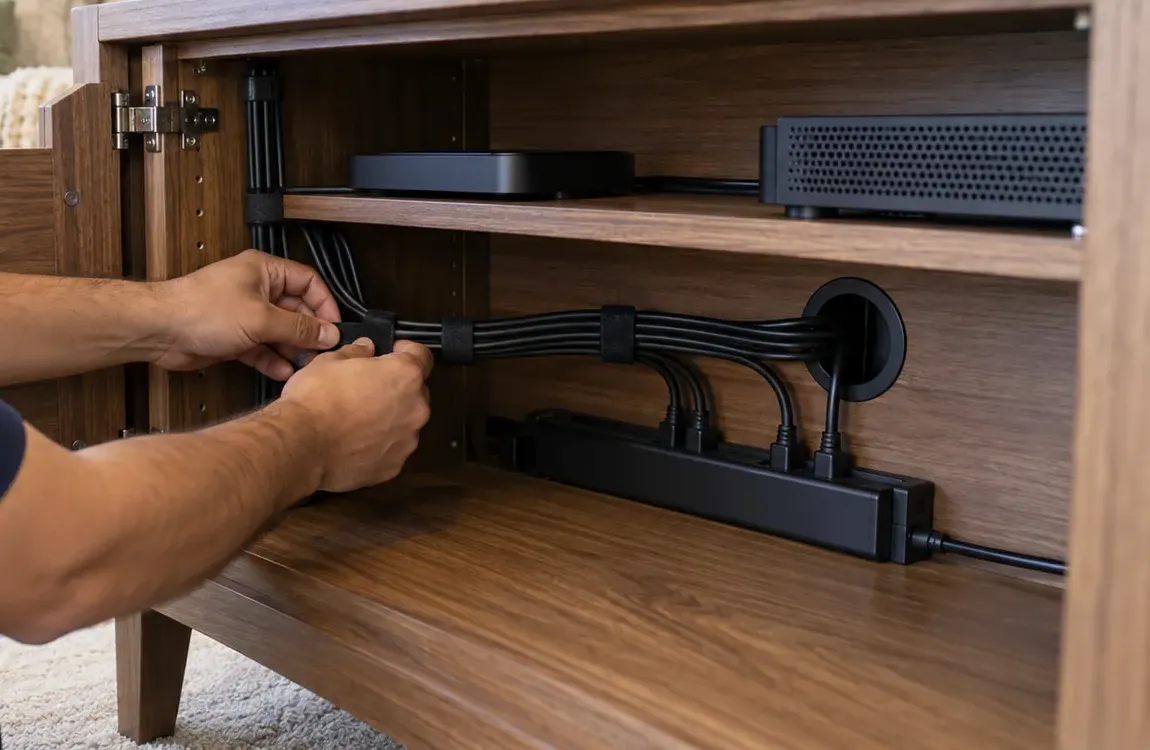
Paintable channel kept below cornices and beside door casings, runs hidden behind bookcases and credenzas, or an approved in-wall kit in a hollow partition — never a cable stapled across a moulding.
The TV's audio-return input found and used, device control switched on, lip-sync checked with a talking scene and firmware brought up to date, so the household and anyone who helps run it need only the TV remote.
The router in a combined or prewar apartment often lives in a back bedroom behind several masonry partitions. Before leaving we confirm the bar holds its connection at the TV wall, plug in a network cable if the bar takes one, and tell you straight if a wired point is needed.
Madison Avenue boutiques and galleries, Lexington Avenue offices, and practices near the York Avenue hospitals: bars kept at a set level, pointed at the people in the room, with the remote held at the front desk.

Six kinds of building make up most of the neighbourhood, and each one decides the fixing, the cable route and the paperwork in its own way. Tell us which you live in and we can usually predict the wall before we see it.
The 1910s–1930s apartment houses of Carpenter, Candela and their contemporaries: plaster over hollow block partitions, brick or block outer walls, tall ceilings, fireplaces and formal room sequences. Expect a managing agent, a decoration or alteration agreement for anything beyond the simplest job, staffed elevators and fixed contractor hours.
Single-family houses and converted multi-unit houses on the East 60s, 70s and 80s side streets, many altered in the 1910s and 1920s behind older fronts. Brick party walls, wood-joist floors, plaster on wood or metal lath, and sometimes a small residential lift. The owner usually decides alone; the neighbour through the party wall still matters.
Older walk-up apartment buildings east of Third Avenue, now rentals and small co-ops. Brick party walls, plaster that has been patched for generations, narrow living rooms, and stairs instead of elevators — which is why the walk-up line on our price list exists.
The doorman buildings of the 1950s to 1970s on First, Second, Third and York Avenues. Concrete slabs, block or plaster-on-block partitions, through-wall air conditioners and long corridors. Management offices run clear rules on hours, elevators and certificates of insurance.
Post-2010 buildings, many clustered near the Second Avenue Subway stations. Steel-stud and gypsum partitions, concrete columns and ceilings, window walls and resident handbooks that spell out which walls may be opened and by whom.
Ground-floor apartments with their own street door, and ground-floor medical or professional suites in residential co-ops along Park Avenue. Same building, same board, but a different route in and, for practices, different hours and furniture.
One rule runs across every type: the bar is never fixed to a wall the house rules reserve, and never to a radiator enclosure, a bookcase face or a sliding door. Where a board or managing agent has named the walls that may carry equipment, we follow that list exactly and say so in the quote.

Commercial screens on the Upper East Side are rarely loud. They play a fashion film in a boutique, a video piece in a gallery, the news in a waiting room or a looping welcome in a lobby. The bar's job is to make speech clear to the people in the room and keep everything else down, under rules set by a landlord, a co-op board or a practice manager.
The Madison Avenue Business Improvement District runs from East 57th to East 86th Street and covers the commercial parts of the side streets. Boutiques and galleries share old buildings with residents upstairs, so we fix to the shop's own walls and keep bass out of the floor.
Madison's autumn Gallery Walk listed 42 participating galleries between 57th and 86th Streets. Video work often needs sound that stays at the piece; a compact bar on a shelf or plinth, aimed tight and volume-capped, does that without a visible speaker on the wall.
Offices, salons, studios and showrooms in mixed buildings. Screens in reception areas and treatment rooms, often on steel-stud walls put in by a tenant fit-out, with a landlord certificate to supply.
The spine of Yorkville, once nicknamed Sauerkraut Boulevard for its German cafés and halls, and still the neighbourhood's busiest cross street for shops. Screens over counters and in waiting areas, where the bar needs a fixed level and a remote kept behind the desk.
Restaurants and bars along the avenue the Q train now runs beneath, many in older walk-up buildings with apartments directly above. Game-day screens where the sound has to stay inside the room and out of the bedrooms upstairs.
NewYork-Presbyterian/Weill Cornell Medical Center, an 862-bed hospital at 525 East 68th Street, anchors a cluster that includes Hospital for Special Surgery, Memorial Sloan Kettering and Rockefeller University. Around them sit medical practices and offices with patient-facing screens.
Practices and showrooms installing several screens can book them on one visit with a single parking line; see the pricing section for how the lines add up. Offices wiring a meeting room as well as a reception screen may also want our Manhattan AV and sound installation team for ceiling speakers.

The questions below are the ones Upper East Side households raise that we rarely hear elsewhere: about rooms that are already finished, about getting into and up the building, about opening a wall, and about the walk-ups and towers east of Third Avenue. Booking, coverage and price details sit in the FAQ and pricing sections further down.
Yes, but the fabric is not what holds it, and the order of work matters. An upholstered wall is built in layers: a wood or plastic track fixed around the edges of each wall, a layer of padding laid inside the track, and the fabric stretched over the top and stapled into the track, with welt or trim glued on to hide the staples. The wall-upholstery installer Vethoman describes exactly that sequence. Behind all of it is the original plaster wall, and that is what the bracket has to reach.
If the soundbar is going under a TV that is already mounted, the bracket position is decided by the screen, and we work inside it: a small cross-cut in the fabric only where each fixing goes, the padding parted rather than cut out, and a spacer of the right depth so the bracket bears on the plaster and does not crush the padding into a dent around the bar. The bar then covers the cuts. If the wall has not been upholstered yet, the better plan is to fix the bracket, or a plywood backer, to the plaster first and let the upholsterer work around it. Either way we ask for the upholsterer's name in case a panel needs re-tensioning afterwards; fabric that has been stretched for years can move when a section is released.
Two things we will not do: cut a long run of fabric to hide a cable inside the padding, which tends to show as a ridge, or fix anything to the track alone. A slim cord cover upholstered to match, made by your upholsterer, is the tidy finish if the outlet is not directly below the bar.
Please have valuable or heavy pieces moved before we arrive, by you or by the art handler who hung them. Our technicians are equipped and insured for brackets, screens and cables, not for handling works of art, and a picture that has hung for years may have hardware, wire or a frame that only its handler understands. A light decorative print or mirror on an ordinary hook is a different matter; tell us when you book and the technician will lift it down on the day and set it safely aside.
It helps to think about the rehang at the same time as the TV plan. Picture hooks leave small holes at a height that often falls just where a bracket wants to go, and an existing hanging system may already show where the building's plaster is sound. Send a photo of the wall with the art still up and we will mark where the screen and bar would sit, so the pictures can go back around them without new holes in the wrong places.
One more practical point: after drilling, fine dust settles on frames and glass nearby even with extraction running. We cover the floor and any furniture under the wall, but works hung on adjacent walls are best covered or moved for the hour that drilling takes.
High-gloss lacquer, hand-applied plaster finishes and natural-fibre papers all share one weakness: they cannot be patched invisibly. We treat them as a reason to choose the bracket position with extra care, because a hole placed and then abandoned stays visible. The bar's footprint is measured and marked with low-tack tape, you approve the marks, and the pilot holes go in only once the screen and bar are confirmed in their final place. Masking tape on the finish where the drill enters stops a gloss surface from chipping at the edge of the hole.
If the finish is still to be applied, the simplest answer is to mount first and finish after. Decorators working in co-ops on Park and Fifth are used to that order; it saves a touch-up visit and leaves the bracket screws under the final coat.
Libraries and dens in prewar co-ops often have bookcases running floor to ceiling on either side of the TV, with the screen on a short stretch of plaster in between. That works well for a bar, provided the cables have somewhere to go. We look for a route behind the bottom cupboard of one bookcase, where a small grommet in the back panel is far easier to hide than a channel on the wall. We do not cut into the cabinetry itself; if a grommet is needed, your cabinetmaker drills it or you approve our doing it at the bottom of a cupboard where it cannot be seen.
It changes the timing more than anything else. The New York Post's 2025 profile of the operator at 863 Park Avenue, a prewar co-op, quoted a Department of Buildings estimate that only about 50 hand-operated elevators remain across Manhattan and a few in Brooklyn, mostly in older co-ops and historic hotels — the kind of building that lines Park and Fifth Avenues. In those buildings the operator, not the visitor, decides when the car moves, and residents' trips come before ours.
So we ask, when you book, whether contractors ride the passenger car with the operator or use a separate service elevator, and what hours each runs. Long soundbar cartons, some well over four feet, need to stand upright in a small car, so the technician brings the bar up unboxed only if the box will not fit and you agree to the box being opened in the service area. We allow extra time at each end of the visit, and we book early enough in the building's contractor hours that a wait for the car does not push drilling past the cut-off.
If the building also has a manually operated service car, the super usually runs it or names who does. A short note from you to the desk the day before — technician's name, arrival window, apartment — is the single most useful thing for a smooth arrival.
Many Upper East Side co-ops have two levels of paperwork. Brick Underground explains that besides the full alteration agreement used for renovation, some buildings use a simpler decoration agreement for minor work such as paint and floors, and that a decoration agreement can sometimes be approved by the managing agent without a full board review, in less than a week. A Reddit reply in r/uppereastside put the practical side simply: most, if not all, co-ops will want an alteration agreement or something similar before you start anything.
A bracket on a wall, with no electrical work and no opening, usually sits at the decoration end of that scale, and some buildings need nothing more than notice to the desk and our insurance certificate. An in-wall cable kit, which cuts two openings in a partition, can move the job up to the alteration level in stricter buildings. Ask the managing agent which form applies, or let us ask on your behalf; we supply the bracket's specification sheet and a short written scope if the form wants one.
Most prewar and postwar buildings here send contractors through a service entrance on the side street, sign them in at a separate desk, and route them up a service elevator that opens near the kitchen. That route decides what we carry and how far: from the service door to the living room may be the full length of a long apartment. Our technician lays a runner along it before bringing in tools, and keeps the drill, ladder and boxes off the finished floors.
Supers and handymen in these buildings know the walls better than anyone. If yours will tell us where the risers, the old gas lines or a hidden steel column run, we will gladly take that advice before drilling; it is often better information than any scanner.
An in-wall power and cable kit gives the cleanest finish, but on the Upper East Side it only suits a hollow wall, a building that permits it and a household happy to wait for approval. Plaster over block, brick party walls and concrete are not hollow in the way the kit needs, and in those walls a slim paintable channel down to the outlet is the honest answer. We quote both where both are possible, so you can weigh the extra line and the extra paperwork against a cable channel that disappears once it is painted.
In a fifth-floor walk-up off First Avenue, the technician carries everything up the stairs, which is what the $40 line for the third floor and above covers. The rooms are narrower than in the avenue co-ops, so the TV often goes on the long party wall, which is brick shared with the next building. We use sleeve anchors into the brick face and keep the bar's bass trimmed, because the household on the other side of that wall is close. Older plaster in these buildings has usually been patched many times; a small test hole tells us whether the bracket is reaching brick or a filled void before we commit.
In a white-brick doorman tower from the 1960s, the TV wall is often block or concrete and the drilling is slow and loud, so we book early in the building's hours. In a post-2010 condominium near the Second Avenue Subway, the partition is usually steel studs and gypsum, quick to fix to, but the building's resident handbook may say exactly which walls may be opened and require a licensed electrician for any power work. We read the handbook section you send us before we quote, and we work to it.

Walk east across the Upper East Side and the soundbar job changes every few hundred yards. This is the pattern we plan from before we see a single photo.
Prewar co-ops facing Central Park, with long living rooms whose best wall is often the one opposite the windows. Paintings, mirrors and panelled libraries compete for that wall. Paperwork is thorough, contractor hours are tight and the service entrance is around the corner. Note the calendar too: on the evening of the Museum Mile Festival, Fifth Avenue is closed to traffic for the evening from 82nd Street northward (it ran from 6 to 9 PM on June 9 in 2026), and the gallery and museum crowds make that a poor evening for a visit with tools.
Madison mixes shops and galleries at street level with apartments above. Park Avenue, from the Armory at 66th Street to the Carnegie Hill blocks, is lined almost continuously with prewar apartment houses, many inside the Upper East Side or Park Avenue historic districts. Expect plaster over block, staffed elevators, maisonettes and ground-floor medical suites, and a managing agent who wants the insurance certificate a few days before the visit.
Busier, more mixed. Prewar rental buildings, postwar towers and townhouses converted to apartments sit side by side, and many households rent. That shifts the question from the board to the landlord or the lease, and makes console placement and TV-attached brackets more common. The side streets between Park and Third hold many of the neighbourhood's townhouses, where the owner decides and the party wall decides with them.
The avenue of the Q train, with new towers near the 72nd, 86th and 96th Street stations and older walk-ups between them. A single block may hold a steel-stud condo and a century-old tenement, and the job is priced quite differently in each: a quick fixing into a stud flange with an elevator, or a brick party wall five flights up.
Postwar doorman towers, the hospital buildings along York, Yorkville walk-ups, and, at the river, the quieter blocks around Carl Schurz Park and Henderson Place. Many households here work hospital shifts, so morning, evening and weekend windows inside the building's permitted hours are the ones most asked for. We offer two-hour arrival windows from 8 AM to 8 PM every day, then narrow them to the hours your building allows.
Whichever avenue you are on, the same three facts settle the price: what the TV wall is made of, how we get the tools to it, and whether the building wants anything opened. The quote form asks for exactly those three.

A bar that sounds right in the shop can sound wrong at home, and on the Upper East Side the building is usually the reason. Three kinds of construction behave in three different ways, and the settings we leave you with depend on which one you live in.
Plaster over block and brick partitions stop ordinary speech and television sound well, which is why prewar co-ops feel calm. What they do not stop is vibration. A subwoofer standing on bare parquet, a bar fixed hard to a shared wall, or rear speakers screwed into a party wall all feed low notes into the masonry, and the building carries them to the next apartment. Our default in these buildings is the bar on the wall you own outright, the subwoofer on a rug and away from shared walls, and the bass level set by ear at the volume you actually watch at, not at demonstration level.
Many 1960s and 1970s towers have block or gypsum partitions that let more airborne sound through, and living rooms with large windows and hard floors that make a bar sound bright and echoey. Here the gain comes from the room as much as the bar: a rug, curtains and a sofa against the right wall soften the sound, and the bar's room-correction routine, where it has one, takes care of the rest. We run it with you in the main seat.
A Yorkville tenement puts another household on the far side of the party wall, above the ceiling and below the floor, sometimes within a few feet of the TV. Night mode, which narrows the gap between loud and quiet passages, and dialogue enhancement, which lifts the voices, let you watch at a lower overall level without losing the words. We set both, show you where they live in the bar's app or remote, and keep the subwoofer level conservative.
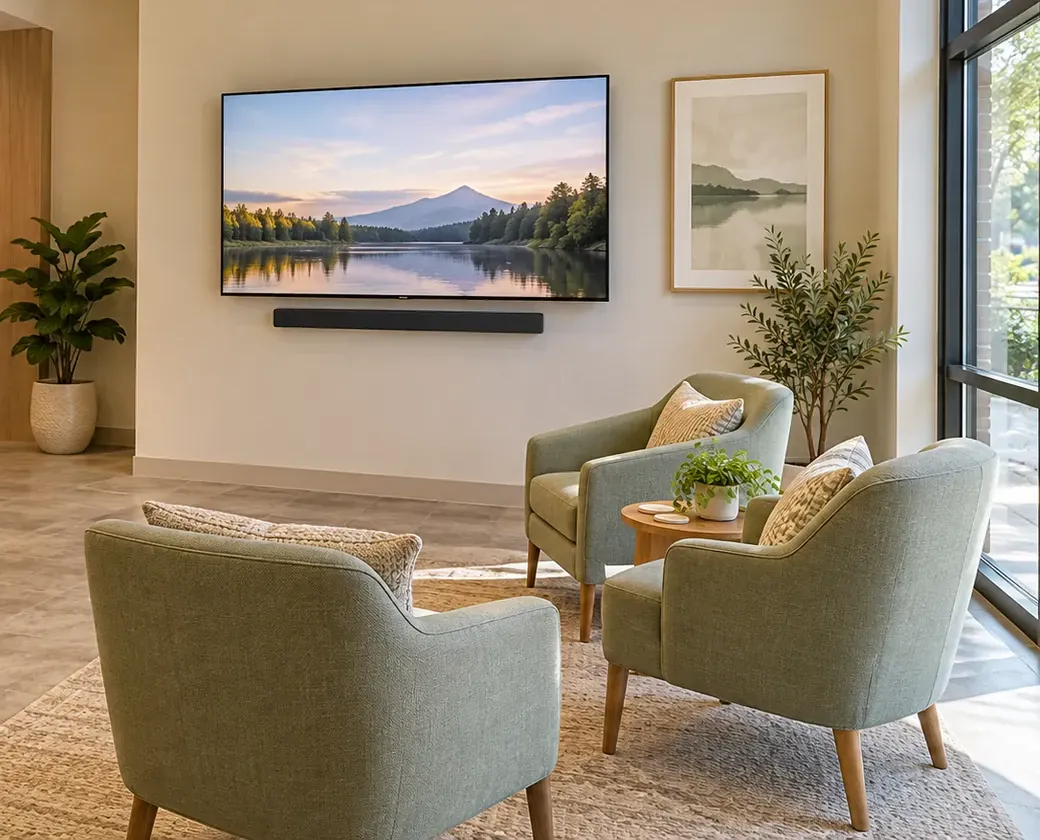
In most Upper East Side living rooms the request is not for more bass but for clearer voices: the news, a drama with quiet dialogue, a concert broadcast where the presenter speaks between pieces. A centre channel that the bar provides, aimed at the main seat from directly under the screen, does more for intelligibility than any other single change to a TV. That is why we keep the bar under the picture and never move it away to suit a shelf or a decorative scheme.
If several people watch at different volumes, we can set the bar to switch off with the TV, start at a sensible level, and leave its night mode within easy reach. Simple habits, chosen once, avoid most of the calls from neighbours and most of the calls to us.
Whatever make you have bought, we fit it. Below are the kinds of bar and mount Upper East Side households ask for most often, with what each one means for the wall, the room and the people next door.
Short bars for the library, the guest room or a bedroom TV on a dresser. Light enough for a small bracket on plaster, and often the right choice for a room shared with a neighbour's bedroom wall.
Bars roughly the width of a 50- to 65-inch screen, with HDMI eARC and network streaming. The everyday choice in prewar living rooms, and the easiest to keep tidy on a single bracket.
Wider, heavier bars with up-firing drivers. They want a flat ceiling at a sensible height to bounce from; under very tall prewar ceilings the effect is weaker, and we say so before you buy rather than after.
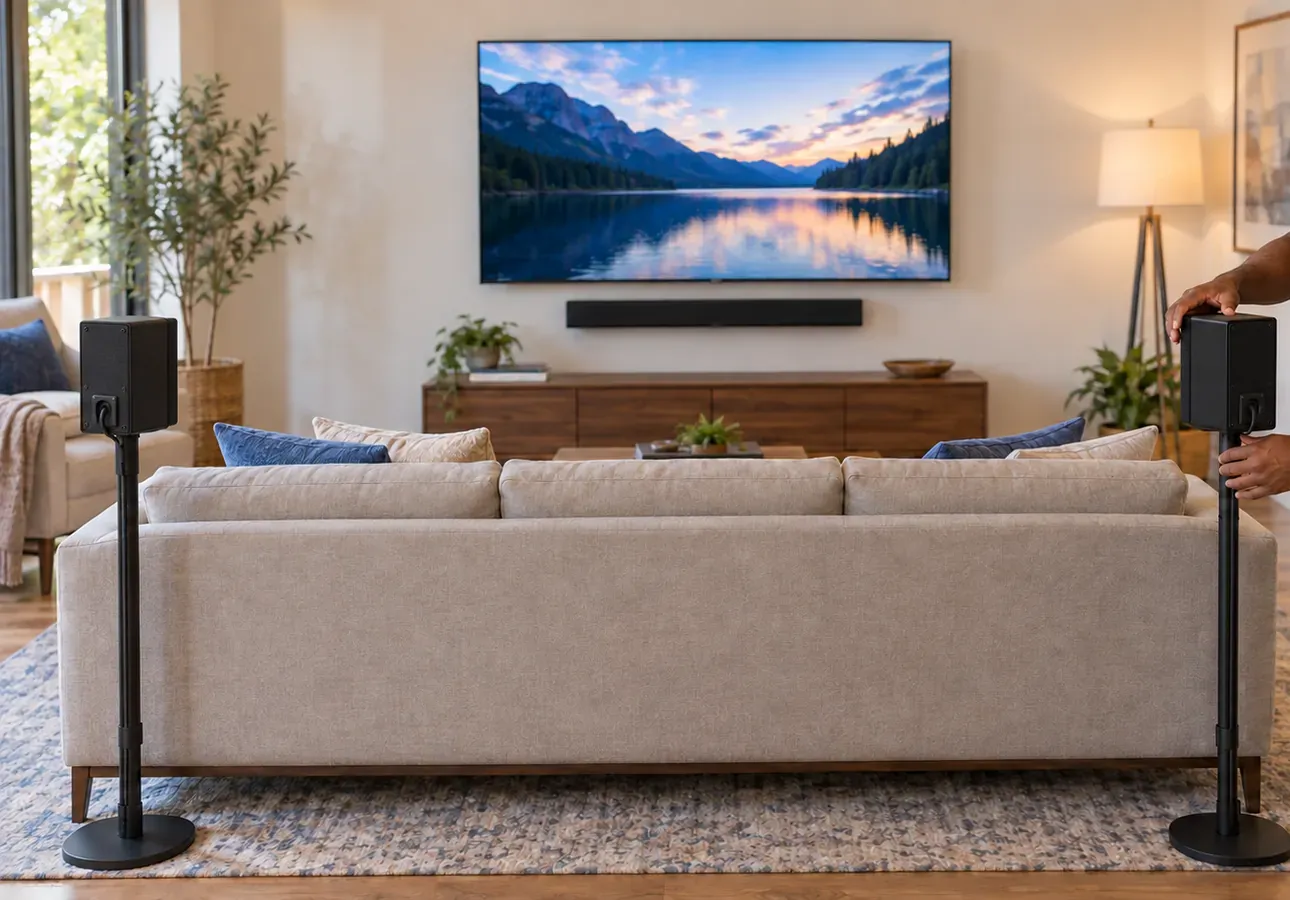
Wireless rears on stands or shelves and a subwoofer placed with the floor below in mind. On the Upper East Side the subwoofer usually goes on a rug, away from the shared wall, at a level set for evening.
Brackets that hold the bar close to the wall under the screen, chosen for the bar's weight and the wall's material. The Sanus soundbar bracket on our price list suits most bars that arrive without one.
Clamp the bar to the TV mount itself, so nothing new is fixed to a finished wall and the bar moves with an articulating screen.
Paintable surface channel, cable bundles strapped inside a credenza and grommets in cabinet backs. On masonry walls this is the normal way to hide the cable.
For hollow partitions in buildings that allow an opening: a code-compliant kit that brings power and HDMI behind the screen from an outlet that is already there.
A universal remote programmed for the TV, the bar and the cable box, and streaming devices set up on your accounts — useful in households where several people, and sometimes staff, run the TV.
Big-box stores and online marketplaces sell installation alongside the bar, and for a stud wall in a house that is often all you need. In a co-op on Park Avenue the gaps show quickly. A national booking system may not issue a certificate of insurance in your building's exact wording, and, as one r/uppereastside reply noted, the contractors who deliver and connect appliances are not necessarily the ones who mount screens. App-booked handymen are frequently set up for wood studs and drywall, not plaster over block, brick or concrete.
A local specialist costs the published lines on this page, no more and no less. What you get for them is a certificate in the right names, a technician who expects the service entrance, the operator and the decoration agreement, anchors for the wall that is actually there, and someone to call when the bar loses the TV after a software update.
Whatever you choose, ask three questions before booking: will the installer issue the certificate in your building's wording, what anchors will they use in plaster over block, and what happens if the managing agent turns them away at the desk. The answers tell you most of what you need to know.

Our build environment could not load Google's AI Overview for an Upper East Side search, so we have taken the claims that AI answers and national how-to articles typically repeat. They are not foolish. Each one simply stops being true inside a staffed co-op on the East Side.
For the work at the wall, that is roughly right. Hanging a bracket, fixing the bar and making the HDMI connection on an ordinary wall is a short job, and national guides time it honestly.
On the Upper East Side the hour sits inside a longer visit. Signing in at the service desk, waiting for an operator-run or booked service car, walking tools the length of a prewar apartment, laying floor protection and identifying the wall all come before the first hole. In a staffed co-op that can add as much time as the mounting itself.
That is why our quotes describe the visit, not just the mount, and why we book early in the building's contractor window. The price lines do not change with the waiting; the scheduling does.
Bracket kits ship with fixings meant for the commonest wall in the market the bar was sold into: wood studs and drywall. For that wall they are fine.
Prewar partitions here are plaster over hollow gypsum or terra-cotta block; party walls are brick; postwar towers are block and concrete. Plastic plugs from a bracket kit can spin in hollow block or crack old plaster around them. The anchor has to match the substrate, and the substrate is only known once a pilot hole shows what is behind the paint.
We carry anchors for each wall type and charge the published wall line for the extra work. The box hardware goes back in the box for you to keep.
It is a cautious rule of thumb, and in some buildings it is literally true. Co-ops are entitled to set their own house rules, and many require notice for any contractor at all.
In practice, Brick Underground describes a two-tier system in many buildings: a full alteration agreement for renovation, and a simpler decoration agreement for minor work that a managing agent can sometimes approve without the board, in less than a week. A bracket with no electrical work and no opening usually belongs in the lighter tier, or needs only notice and an insurance certificate.
The correct answer is building by building. Ask the managing agent what form, if any, the job needs; if you would rather not, we will ask for you and send them the specification sheet.
Online guides present in-wall routing as the default finish. In a house with hollow stud walls and an owner in charge, it often is.
Here, many TV walls are masonry with no cavity to fish a cable through, and in buildings that do have hollow partitions, opening a wall can bring in an alteration agreement and, in stricter co-ops, an asbestos survey before any cutting, under rules that put the survey on the owner. A cable that would take twenty minutes to hide in a suburban house can take weeks of paperwork here.
A paintable channel, a route behind the furniture, or a bar positioned so the outlet below it is barely visible are usually the better Upper East Side answers. We quote in-wall routing where the wall and the building allow it.
The acoustics are sound: tweeters aimed at the listener's ears give the clearest speech. In a purpose-built media room, matching bar height to seated ear height makes sense.
In a prewar living room, the bar almost always goes directly under the screen, and the screen's height is set by the fireplace, the window sills, the radiator enclosure and the sightline from the sofa. Moving the bar away from the screen to chase ear level puts the voices in the wrong place and adds a second set of holes in plaster nobody wants to patch.
We keep the bar under the picture and use the bar's own dialogue and height settings, and the TV's tilt, to bring the speech to the listener.
Corner placement does reinforce low notes; it is standard advice in hi-fi guides, and in a detached house it is a fair way to get more bass from a small sub.
In a co-op, that extra bass is exactly what travels. A sub in a corner sits against two walls, and often against the floor above someone else's ceiling; the low notes pass into the structure and arrive in the apartment below or next door as a hum the neighbours notice before you do. Prewar masonry stops a lot of airborne sound, but it carries vibration from anything touching it.
We place the subwoofer away from shared walls, on a rug rather than bare boards, set its level for an evening rather than a demonstration, and show you the bar's night mode. Most households find they did not want the corner bass in the first place.
Plenty of installers price it that way, and for a house with stud walls it is fair. One installer's post in r/handyman listed $300 per TV to hang it and hide the wires, plus $100 for a soundbar.
A Manhattan visit is built differently. Our published Manhattan menu charges $129 to mount the bar, adds $45 for plaster, $65 for brick or $75 for concrete and block, $40 for a third-floor-or-higher walk-up, and one flat $150 parking line per visit, whether or not a TV is mounted the same day. A typical prewar plaster job with our bracket comes to $408.99; console placement with no drilling is $229.
Those numbers are higher than a suburban add-on and lower than a surprise. Every line is on this page, and the quote you receive is simply the sum of the lines your job needs.
Tell us three things — the wall, the bar, and the way contractors get into your building — and the written figure that comes back is the one you pay, parking and all.
Tell us the cross streets, what the TV wall is finished in, how contractors get into your building and which bar you have. Someone who works in Upper East Side buildings every week reads it and replies with a written total built from the menu below, parking included. To talk it through instead, call (929) 560-0737.
Thanks — your request is in. We read each one by hand, check the wall and the building notes, and reply with a figure the same business day. Something urgent? Ring (929) 560-0737.
The order never changes, whether the job is a small bar on the fourth floor of a Yorkville walk-up or a large one in a Fifth Avenue co-op. Steps one to three happen by phone and email, and on the East Side they matter most.
Send a photo of the TV wall with the outlet in view, a close-up of its surface, and the bar and TV models. We identify what the finish and the wall are likely to be and send an itemised quote, parking line included.
We confirm, with you or directly with the managing agent, whether the job needs notice, a decoration agreement or more, issue the free insurance certificate in the requested names and supply the bracket's spec sheet.
We hold arrival windows of two hours, any day between 8 AM and 8 PM, and pick one that leaves time for the sign-in, the ride up and every hole before the building's quiet hour. Rescheduling a day ahead costs nothing.
The technician signs in at the service desk, rides the car the building assigns, lays a runner from the service door to the room and a drop cloth under the wall. Art and fragile pieces nearby have already been moved.
Before any drilling we sweep the area with a scanner for water, heat and electrical lines and make one pilot hole where the bar will cover it. The dust shows block, brick, lath, concrete or stud; then you sign off on the pencil marks.
The anchor type follows from step five. Bracket on and checked with a level, bar hung and checked again, HDMI into the TV's audio-return port with device control switched on; the cable then goes into a channel, behind the furniture or through an approved in-wall kit.
Dialogue and night modes set, the subwoofer placed with the floor below in mind, lip-sync checked, firmware updated and the network tested from the TV wall, then a short walkthrough for whoever runs the TV day to day.

These six places mark out the neighbourhood and the kinds of building around them. We list them for orientation only; none is a claim of a job done inside.
Built for the Seventh Regiment between 1877 and 1881, with a 55,000-square-foot drill hall under an 80-foot barrel vault. Its period rooms, by Tiffany's Associated Artists among others, show the kind of interior detail that still survives in the co-ops around it.
Built in 1799 at East End Avenue and 88th Street as Archibald Gracie's country house, and the mayor's official residence since 1942. The river end of Yorkville, with quieter blocks and postwar towers around the park.
Designated in 1969: 24 surviving Queen Anne houses of the 32 that Lamb & Rich designed for John C. Henderson in 1881–82, built for "persons of moderate means". Small rooms, old plaster and party walls.
Frank Lloyd Wright's spiral at 1071 Fifth Avenue, completed in 1959 after fifteen years of design and construction. A marker for the Museum Mile stretch of Fifth Avenue and its prewar co-ops facing the park.
Designated in 2014: 64 buildings from East 79th to East 91st Street, mostly mid-rise apartment houses of the 1910s and 1920s by architects including J.E.R. Carpenter and Rosario Candela, with St. Ignatius Loyola at 84th Street.
Opened on January 1, 2017 with three new stations at 72nd, 86th and 96th Streets, carrying the Q train. The new condominium and rental towers that followed along the avenue bring steel studs and resident handbooks.
We cover the whole of the Upper East Side: Lenox Hill, Carnegie Hill and Yorkville, from Fifth Avenue to the East River and from East 59th to East 96th Street — the core of Manhattan Community District 8, whose census profile also takes in Roosevelt Island. Neighbours to the north in East Harlem, to the south in Midtown East and across the park on the Upper West Side are booked through our Manhattan soundbar installation page and the same Manhattan menu.

Upper East Side visits are priced from the same published Manhattan menu as the rest of the borough. Pick the lines that describe the job, add the wall line for what is behind the finish, and add one $150 Manhattan parking charge for the visit. If the pilot hole shows a different wall from the one the photo suggested, you hear the revised figure before any further work.
| Soundbar line | Price | Where it comes up on the Upper East Side |
|---|---|---|
| Soundbar wall-mounted under the TV | $129 | Wall identified by pilot hole, anchors matched, bar centred and levelled to the screen |
| Soundbar placed on a console or stand | $79 | While a decoration agreement is pending, on a finish too precious to drill, or in a rental |
| Sanus soundbar bracket | $84.99 | For bars without a bracket, or when the boxed one is wrong for plaster over block |
| In-wall concealment | $169 | Hollow partitions only, once the building has agreed; code-compliant power and cable kit fed from an existing outlet |
| Paintable cord cover | $59 | The standard answer on masonry walls; your painter or decorator finishes it to match |
| Cable run up to 25 ft | $99 | To a credenza, a bookcase cupboard or a router in the next room |
| Sonos setup | $125 | Bar, sub and rears grouped with speakers already in the apartment |
| A/V receiver setup | $129 | Where a library system or an older receiver stays in use |
| Universal remote programming | $99 | One remote for the household and anyone who helps run it |
| Streaming device setup | $49 | Apple TV, Roku, Fire TV and similar, signed in on your accounts |
| Full home theater setup | $350 | Multi-component systems in a den or media room |
| Manhattan parking, per visit | $150 | Charged once per visit, however many lines are on it |
| Wall, access and building line | Price |
|---|---|
| Drywall on wood studs | $0 |
| Drywall on metal studs (new towers) | +$30 |
| Plaster (prewar co-ops and townhouses) | +$45 |
| Brick or stone (party walls, walk-ups) | +$65 |
| Concrete or cinder block (postwar towers) | +$75 |
| Tile or marble | +$95 |
| Plywood backer board | $85 |
| High mount, above about 8 ft | $75 |
| No elevator, 3rd floor or above | $40 |
| Remove an old bracket | $45 |
| Box removal | $25 |
| Certificate of insurance for the managing agent | Free |
| Job | Lines | Total |
|---|---|---|
| Bar on the credenza in a Park Avenue co-op while paperwork is pending | $79 + $150 parking | $229 |
| Prewar plaster over block, our bracket | $129 + $84.99 + $45 + $150 | $408.99 |
| Old bracket taken down, bar rehung on plaster behind upholstered fabric, our bracket | $45 + $129 + $84.99 + $45 + $150 | $453.99 |
| Yorkville fifth-floor walk-up, plaster wall, our bracket, cord cover | $129 + $84.99 + $45 + $40 + $59 + $150 | $507.99 |
| Postwar tower, block partition, own bracket, 25-ft run to a cabinet | $129 + $75 + $99 + $150 | $453 |
| New condo near the Q, steel studs, our bracket, approved in-wall kit | $129 + $84.99 + $30 + $169 + $150 | $562.99 |
| Marble-faced den wall, our bracket | $129 + $84.99 + $95 + $150 | $458.99 |
| Sonos bar on plaster, our bracket, grouped with existing Sonos speakers | $129 + $84.99 + $45 + $125 + $150 | $533.99 |
Not every call involves the wall. When a replacement TV will not hand its sound to the bar, speech arrives before the lips move, the sub refuses to pair, or the bar should move from Wi-Fi to a cable, we charge by the clock: $265 covers the first hour in Manhattan, extra time is counted in half-hours, and the $150 parking line is added, so a one-hour visit totals $415. Hanging the TV on the same trip starts from our Manhattan TV base of $244.99 (a 32- to 55-inch screen on wood-stud drywall); the soundbar lines are added to it and parking is still charged once. A TV that stays on its stand is $162.99.

Three combinations account for most Upper East Side bookings. The sum is printed on each card with the parking line in it; a brick, concrete, marble or walk-up charge goes on top only where your job needs one.
$229
Bar placed on the console ($79) + Manhattan parking ($150) = $229. eARC or ARC connected, device control on, dialogue and night modes chosen, cables bundled behind the furniture. No wall is touched, so there is nothing for a managing agent to approve.
$408.99
Mount $129, Sanus bracket $84.99, plaster $45 and parking $150: $408.99. This is the job we do most between Fifth and Third Avenues — the bar under the screen, with anchors set into the hollow block behind the plaster rather than the plaster alone.
$592.99
Mount $129, bracket $84.99, plaster $45, paintable channel $59, Sonos grouping $125, parking $150: $592.99. Aimed at apartments that already have Sonos in other rooms and want the new bar on the same app with no cable showing.
Some households have a bracket already — the one packed with the bar, or one they picked themselves. Then we charge only the work: $129 to hang the bar, the line for your wall, and $150 parking, so $324 on prewar plaster or $344 on a brick party wall. The bracket has to be rated for your bar, and its maker's warranty covers it rather than ours. If we judge it unsuitable for the wall, we explain why at the walkthrough and offer the Sanus bracket.
Start with a picture of the wall and the make and model of the bar. You get back one number, with the wall surcharge, any stairs and parking already inside it.
A soundbar job in a staffed building goes smoothly when five things are settled the week before. None of them is difficult; most of them are a single email.
Missing an answer — a managing agent who has gone quiet, or a finish you cannot name? Go ahead and book, and mention it. We can chase the agent ourselves, and we price both likely walls, so whichever turns up behind the paint or the fabric, the day's figure is already agreed.
A word on renters, who make up the majority of Upper East Side households by Furman's homeownership figure. A lease rarely needs the paperwork above, but it often has a clause on holes and alterations, and many rental buildings have their own contractor rules at the desk. Read the clause, ask the management office if in doubt, and if drilling is ruled out, choose console placement or a TV-attached bracket. Both sound just as good.
Large prewar apartments here often have more than one room that could take a television, and the right one is rarely the grandest. These are the rooms we are most often asked about, and what usually decides each.
Usually the biggest room, with the best light and the most demands on its walls: windows down one side, a fireplace on another, doors to the foyer and the dining room, and paintings on whatever remains. A bar here works when the screen goes on the one uninterrupted wall and the seating is pulled in to face it. If the sofa ends up fifteen feet away, a larger bar or added rear speakers keep the dialogue clear.
Often the room where the TV actually lives in a co-op: smaller, carpeted, lined with books that soften the sound, and closer to the bedrooms. A mid-size bar suits it well. Bookcases either side of the screen give the cable a hidden route, and a smaller room means lower volumes and fewer complaints from below.
A compact bar on a dresser or a small bracket under a wall TV. The priorities are a bar that switches off with the screen, a front display that can be dimmed, and night mode as the default. If the bedroom wall is shared with a neighbour's bedroom, the console or dresser is a kinder place for the bar than the wall.
Bars here go on the wall, high enough to be out of reach, with cables in a channel rather than loose behind furniture. A universal remote with the volume limited where the bar allows it keeps the TV sound from carrying down the hall.
In a side-street townhouse, the formal parlour floor and a lower or upper media floor often both want a screen. The parlour bar stays discreet, under a screen planned around the mantel and the windows; the media floor can take a bar with a subwoofer and rears, because the only neighbour is through the party wall rather than overhead.
Whichever room you pick, send us a photo of the wall from the main seat as well as close up. It shows the distance, the light and the obstacles in one frame, and lets us suggest the bar size and position before we visit.
Upper East Side apartments seldom change just the sound. The services below come from the same Manhattan office, travel under one insurance certificate, and can share a visit and one building approval if the building agrees.
A screen placed above the mantel line and clear of the window sills, with the space under it kept free for the bar.
What screens cost to hang in Manhattan, by size and by wall, posted before anyone books.
A new bar joined to the Sonos speakers already in the kitchen, bedroom or study, all answering to one app.
When a library or a townhouse media floor calls for a receiver and ceiling speakers rather than a single bar.
When the TV wall sits behind brick and block, a cabled network point or stronger wireless brought to the screen.
One control for the window shades, the lamps and the screen, laid out around walls that are already finished.
Keyless apartment and townhouse doors, under the same building approval as the soundbar where rules allow.
Read before booking: how the two-hour slots work, the free change of date with a day's warning, when $150 is charged for a wasted trip, and how setup hours add up.
In Manhattan, soundbar jobs are mostly apartments, co-ops and condos, plus offices, conference rooms, restaurants and retail floors. Soundbar installation, or sound bar installation as some people write it, is more than hanging a bar under the TV.
Our soundbar installation services in Upper East Side, Manhattan start with the mount. As a soundbar installer, we handle soundbar mounting, sound bar mounting and soundbar wall mounting with the bracket that came in the box or a better one. Soundbar wall mount installation, soundbar wall bracket installation, soundbar bracket installation and soundbar mounting hardware installation are all part of a standard visit, and soundbar mounting bracket replacement or soundbar mounting hardware replacement fixes a bar that sags or came with the wrong hardware. Manhattan apartments often have concrete or plaster walls with few studs, so the right anchor matters more than anywhere.
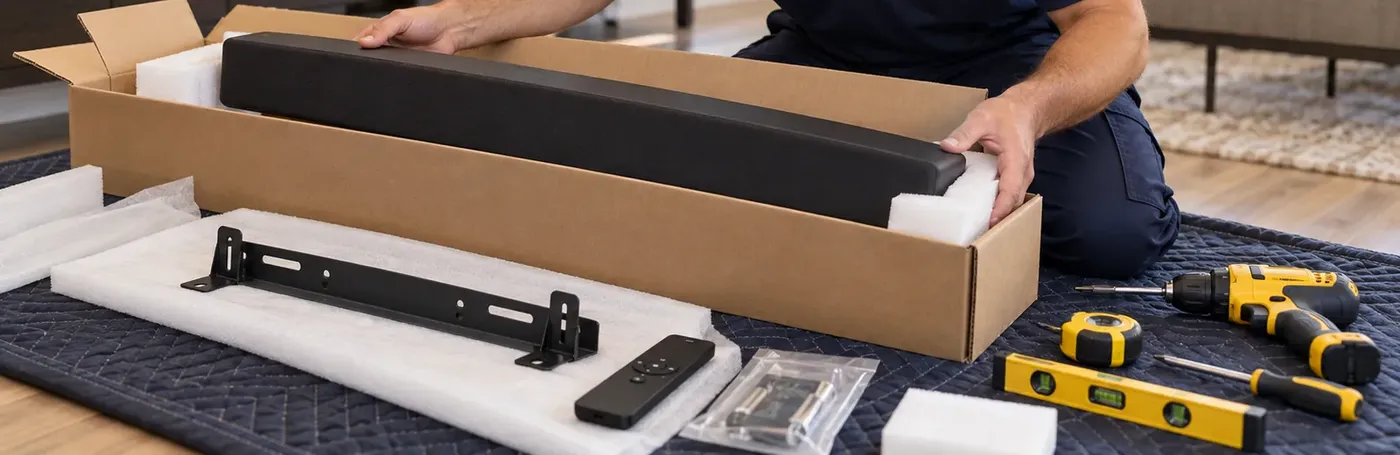
Every professional soundbar installation follows the same steps: soundbar unboxing and installation, soundbar equipment inspection, soundbar bracket measurement and soundbar wall measurement, then soundbar mounting preparation. We do soundbar stud mounting and soundbar mounting to wall studs wherever the studs line up, and soundbar wall anchor installation rated for the bar's weight where they don't. Soundbar bracket leveling, soundbar installation with level, soundbar mounting alignment, soundbar mounting height adjustment and soundbar mounting position adjustment keep it centered and straight.
Most bars go with a TV. We do soundbar mounted below TV, soundbar mounted under TV and soundbar mounted above TV layouts, as well as soundbar mounting to television brackets and soundbar attached to TV mount kits that move with the screen. TV and soundbar installation in one visit, TV mounting with soundbar, soundbar TV mount installation and soundbar installation with TV mounting save a second trip.
Already have a TV up? Soundbar installation on existing TV setups is common, including soundbar installation under wall mounted TV, soundbar installation on articulating TV mount, soundbar installation on swivel TV mount, soundbar installation on full motion TV mount, soundbar installation on fixed TV mount and soundbar installation on tilting TV mount. We also handle soundbar installation with smart TV, soundbar installation with OLED TV, soundbar installation with QLED TV, soundbar installation with LED TV and soundbar installation with projector screens.
Soundbar installation on drywall, soundbar installation on plaster wall, soundbar installation on brick wall, soundbar installation on concrete wall and soundbar installation on stone wall each need different anchors and drill bits, and we bring them all. Soundbar installation on fireplace wall layouts include soundbar installation above fireplace and soundbar installation below fireplace mounted TV, with the bar kept clear of heat. Manhattan high-rises usually mean concrete walls, while pre-war co-ops mean plaster, and many apartments have a decorative fireplace under the TV spot.
Residential soundbar installation covers soundbar installation in living room, soundbar installation in bedroom, soundbar installation in home theater, soundbar installation in apartment and soundbar installation in condominium spaces. We do soundbar installation for luxury homes, soundbar installation for apartments, soundbar installation for home offices, soundbar installation for media rooms and soundbar installation for home cinema alike. Manhattan co-op and condo buildings often require a certificate of insurance and set work hours, which we plan for.
Commercial soundbar installation includes soundbar installation in office, soundbar installation in conference room, soundbar installation in restaurant, soundbar installation in retail store and soundbar installation in commercial space. Soundbar installation for businesses and soundbar installation for conference rooms usually means making sure the bar works with the room's TV, video calls and remotes.
Soundbar HDMI installation is the best connection for most TVs. Soundbar HDMI ARC setup and soundbar HDMI eARC setup, or an HDMI ARC soundbar connection or HDMI eARC soundbar connection, let the TV remote control the bar through soundbar CEC configuration. Where HDMI isn't an option, soundbar optical cable installation and soundbar optical audio setup give a solid soundbar digital audio connection.
Wireless soundbar installation, wired soundbar installation, soundbar Bluetooth setup and soundbar WiFi setup are matched to the bar and the room. Soundbar TV audio connection and soundbar audio output configuration make sure sound comes out of the bar, not the TV speakers. Soundbar TV remote programming, soundbar universal remote setup, soundbar volume control setup, soundbar synchronization setup and soundbar lip sync adjustment finish the setup.
Soundbar and subwoofer installation, soundbar surround sound installation, wireless subwoofer setup, wireless surround speaker setup and soundbar rear speaker installation turn a bar into a full system. Soundbar subwoofer pairing and soundbar speaker placement are done in the room, not guessed.
Dolby Atmos soundbar installation and Dolby Atmos soundbar setup, Dolby Digital soundbar setup and DTS soundbar configuration get the right audio format from each source. Soundbar audio calibration, soundbar sound optimization, soundbar dialogue enhancement setup and soundbar bass adjustment make voices clear and keep bass from shaking the neighbors. That's home theater soundbar installation, home entertainment soundbar setup and soundbar home theater integration done properly.
Soundbar cable concealment, soundbar wire concealment and soundbar hidden wire installation are what make the job look finished. Soundbar in wall cable management uses low-voltage in-wall kits where the wall allows, and soundbar cable cover installation, soundbar raceway installation and soundbar wire molding installation work where it doesn't. Soundbar cable routing, soundbar cable organization, soundbar cord hiding, soundbar power connection installation and soundbar power cable management keep the cords out of sight. In Manhattan apartments where cutting walls isn't allowed, slim raceway painted to match is the usual answer.
The result is soundbar installation with concealed cables, soundbar installation without visible wires, soundbar installation with hidden connections and soundbar installation with clean finish. If a new outlet is needed behind the TV, we handle soundbar power outlet installation coordination with your licensed electrician, since we don't do electrical work ourselves.
Not every bar goes on the wall. Soundbar installation with media console, soundbar installation inside entertainment center, soundbar installation above media cabinet, soundbar installation with TV cabinet, soundbar installation below floating TV and soundbar installation with floating entertainment center are all common. Soundbar connection inside media cabinet and soundbar cable management inside console keep everything tidy.
We connect everything around it: soundbar installation with cable box, soundbar installation with streaming device, soundbar installation with Apple TV, soundbar installation with Roku, soundbar installation with Fire TV and soundbar installation with gaming console.
We install every major brand: Samsung soundbar installation, LG soundbar installation, Sony soundbar installation, Bose soundbar installation, Sonos soundbar installation, JBL soundbar installation, Vizio soundbar installation, Polk soundbar installation, Yamaha soundbar installation, Sennheiser soundbar installation and Klipsch soundbar installation. That includes Samsung Q Symphony soundbar setup, LG WOW Orchestra soundbar setup, Sonos Arc installation, Sonos Beam installation, Bose Smart Soundbar installation and Sony Bravia Theatre soundbar installation.
Soundbar not working repair starts with soundbar connection troubleshooting. Soundbar no sound troubleshooting, soundbar HDMI ARC troubleshooting, soundbar eARC troubleshooting, soundbar optical connection troubleshooting, soundbar Bluetooth troubleshooting, soundbar wireless connection repair, soundbar audio delay troubleshooting and soundbar TV compatibility troubleshooting find whether it's the cable, the settings or the TV.
Soundbar relocation service, soundbar remounting service and soundbar removal and reinstallation handle moves and new TVs. Soundbar installation upgrade and soundbar replacement installation swap an old bar for a new one, and soundbar installation troubleshooting fixes a job someone else started.
Every job ends with soundbar installation and testing: soundbar audio testing, soundbar final system testing and a soundbar installation quality check with you in the room.
Beyond the bar, we handle TV sound system installation, TV audio system installation, home audio installation, home theater audio installation, audio video installation and AV installation services as a low voltage audio installation contractor. If you've been searching for soundbar installation near me in Upper East Side, Manhattan, we're a soundbar installation company and soundbar installation contractor offering professional TV audio setup and soundbar mounting service across the whole area. Customers find us searching for soundbar installation NYC, soundbar installation Manhattan, soundbar installation Brooklyn, soundbar installation Queens, soundbar installation Bronx, soundbar installation Staten Island, soundbar installation Long Island, soundbar installation Nassau County, soundbar installation Suffolk County, soundbar installation Westchester County, soundbar installation Rockland County and soundbar installation Hudson Valley.
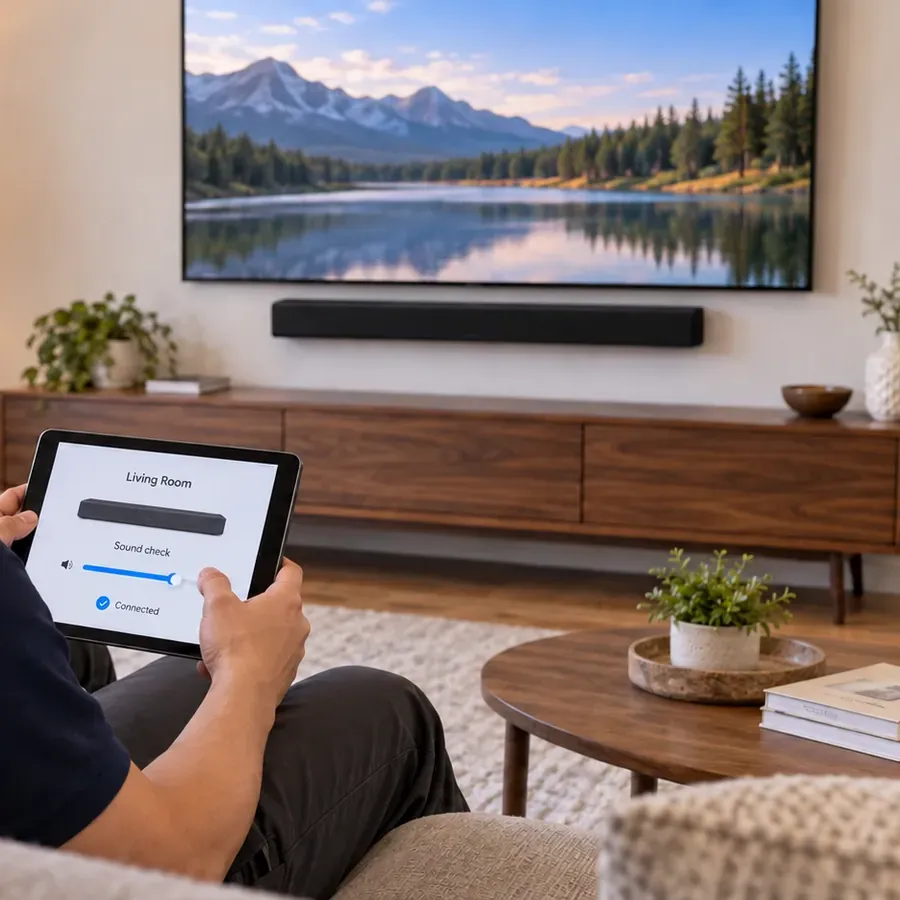
A bar on a bracket opens no wall; an in-wall cable kit does. New York City's asbestos rules put the duty on the building owner to have a DEP-certified investigator survey an area before alteration work that may disturb asbestos, and many co-ops require that survey before any opening. Whether two small kit openings need one is the building's call, and the owner arranges it. If a survey is required, we hold the in-wall part until the paperwork is in place and hang the bar in the meantime with a cord cover.
Often, but the building decides. A maisonette is a ground-floor apartment with a dedicated street entrance that still shares the building's staff and services, so the co-op's contractor rules normally apply to it too. Some buildings are happy for contractors to use the private door; others still want sign-in at the service desk. Ask the managing agent, and if the street door is allowed, tell us so the technician parks and unloads at the right address and is not left waiting at a desk that is not expecting them.
Both the co-op's and your own. Ground-floor medical and professional suites in residential co-ops along Park Avenue are part of the cooperative, so the board's house rules on contractor hours, insurance and alterations still govern the work, even with a private street entrance. Within that, the waiting room is yours to plan: we set a capped volume, aim the bar at the chairs, and keep its bass off the floor of the apartments above. Send us the building's contractor requirements along with the practice's preferred hours.
You are on the Upper East Side page. Above it sit our soundbar installation page for all of Manhattan and the AESS New York City soundbar hub; below are the other neighbourhoods and every area we serve, and anywhere without a page of its own can still be booked from the quote form.
Upper West Side, Manhattan · Harlem, Manhattan · Tribeca, Manhattan · Chelsea, Manhattan · Brooklyn Heights, Brooklyn · Park Slope, Brooklyn · Williamsburg, Brooklyn · Bay Ridge, Brooklyn · Flushing, Queens · Astoria, Queens · Long Island City, Queens · Forest Hills, Queens · Riverdale, Bronx · Mott Haven, Bronx · Pelham Bay, Bronx · Throgs Neck, Bronx · St. George, Staten Island · Great Kills, Staten Island · Tottenville, Staten Island · Todt Hill, Staten Island
Hudson Valley hub · Westchester · Rockland · Orange · Putnam · Dutchess · Ulster
Need cameras, intercoms or cabling instead? See every service Abstract Enterprises offers, or read about the team behind AESS.
Every figure and local fact above comes from a published source. Where we could not reach a source from our build environment, we left the point out rather than guess.
Sound drifting behind the lips, a quiet subwoofer, a bar that will not stay on the network, a bracket loosening in old plaster: from Lenox Hill and Carnegie Hill east through Yorkville to the river, phone (929) 560-0737, give us the cross streets and describe the fault. The next open two-hour slot is yours, and most of these faults are cleared within an hour or two on site.
Abstract Enterprises Security Systems · 460 E Fordham Rd, Bronx, NY 10458 · Manhattan line (929) 560-0737 · WhatsApp (718) 679-0359 via wa.me
NYS Low-Voltage License #12000287431 · 100% Licensed & Insured · Same-Day Estimates · Rated 4.7★ from 201 Google Reviews
Brackets, kits and cables carry their makers' warranties. Full terms — including 50% deposit, one-year parts-only warranty on AESS-supplied products, and the late-fee schedule — are set out in the service agreement. See our warranty page.
Page history: written and first published in October 2026; last checked October 17, 2026. Covers walls in prewar co-ops, townhouses, Yorkville walk-ups and new towers; decoration and alteration agreements; operator-run elevators, maisonettes and professional suites; upholstered and finished walls; and worked Upper East Side totals from the Manhattan price menu.