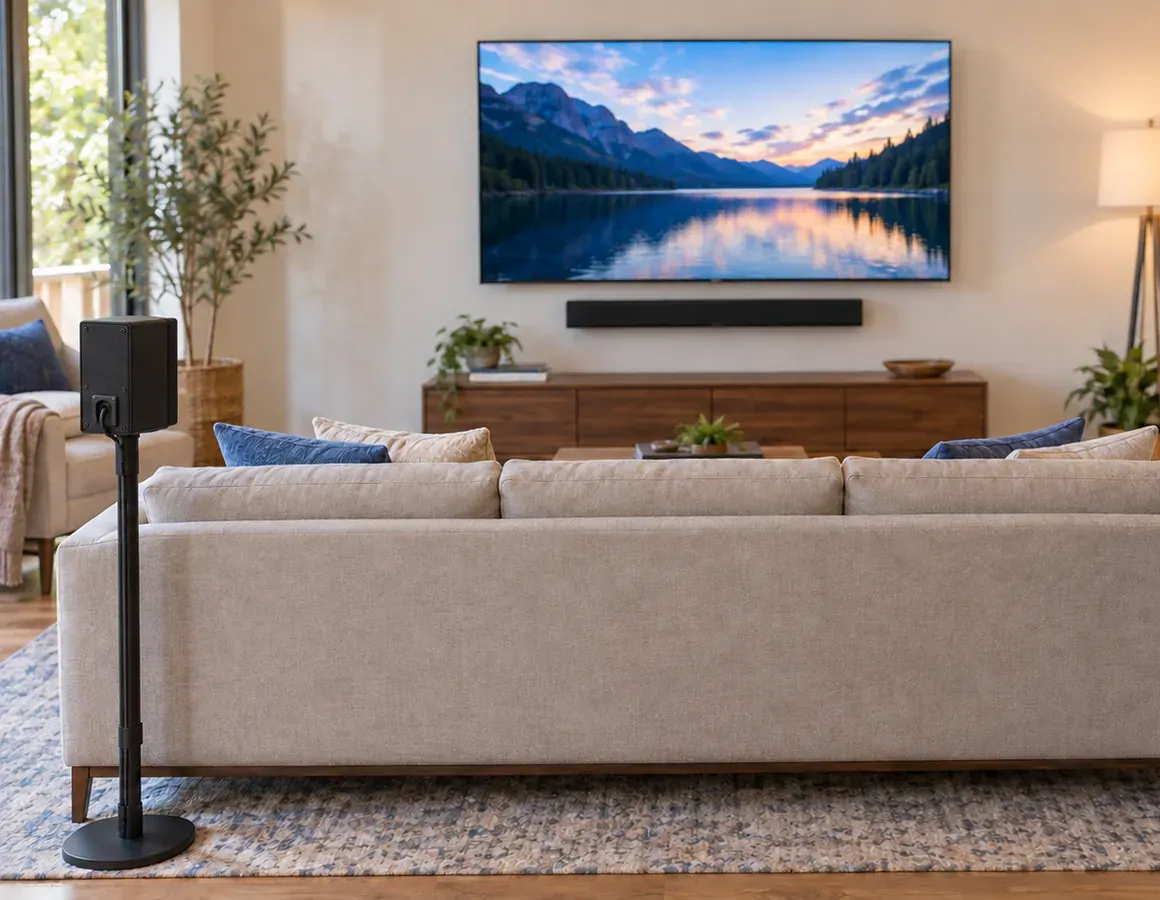
Cottage-Scale Rooms · Light Old Framing · Gated Lanes · Gear Kept Above the Flood Line · One Remote
Throgs Neck is a peninsula of small houses on small lots. A good share of them began in the 1920s as summer cottages and were winterized into year-round homes; hundreds sit inside Edgewater Park and Silver Beach, private co-ops where you own the house and lease the land; and many stand within a short walk of Long Island Sound or the East River. That shapes a soundbar job more than the brand of bar does: the room is small and the wall is often light, old framing; the van may have to stop at a gate or a lot rather than your door; and on the low streets near the water the subwoofer, the power strip and the cable box all belong up off the floor. We plan around those three things, then mount, wire and tune the bar so a single remote runs it.
Reviewed and updated October 17, 2026 · Written by Anwar Timothy, NYS licence #12000287431 · Throgs Neck jobs are booked through the Bronx line, (646) 490-0629

New bar still in the box by the front door? Ring the Bronx line, (646) 490-0629, or fill in the short form; it takes about a minute. You'll speak to a licensed low-voltage installer, and the price you get back is built line by line from the published menu further down this page, not from a guess.
Most soundbar advice is written for a big living room in a suburban house or a tall apartment block. Throgs Neck is neither. The peninsula runs south-east from the Bruckner Expressway and Baisley Avenue to the point where the East River meets Long Island Sound, with Westchester Creek along its western side, and much of what is built on it is small. When the estates that once covered the neck were broken up in the 1920s, the land went largely to modest row homes and tightly packed bungalow lots. Two of those bungalow colonies, Edgewater Park and Silver Beach, started as summer camps by the water and turned into year-round neighbourhoods; both are now private cooperatives. Around them stand blocks of detached houses and brick two-families along and off East Tremont Avenue, the Throggs Neck Houses public housing development, and a scattering of waterfront condominiums. A soundbar has to suit all of them, and the smallest are the ones that most often call for help.
Start with the bungalows, because they set the tone for the whole job. The Department of City Planning's 2016 study of Edgewater Park describes a co-op of 675 single-family homes on 55 acres, most of them summer cottages put up in the 1920s and winterized during the Depression, on plots only 20 to 30 feet wide and 50 to 70 feet deep. Side yards are often two to five feet, and in places the eaves of one roof meet the next. City Planning calls these “older, light-frame” buildings. Inside, that usually means smaller rooms than the soundbar's box art imagines, walls whose framing was added to or doubled up as each owner extended the house, and ceilings that can be low, sloped or both. A 55-inch TV and a full-width bar can fill the wall of a room like that, and the sofa may sit eight or nine feet from the screen rather than twelve.
Then there is the question of who decides. In Edgewater Park and Silver Beach you own your house outright but lease the ground beneath it from the cooperative, and the co-op's board publishes architectural and construction guidelines for what gets built. A soundbar inside your living room is your own business; anything that changes the outside of the house — a cable through an exterior wall, a speaker on a deck, a TV on a porch — is the kind of thing those guidelines exist for, and the co-op office is the place to ask first. Getting there is its own small project: City Planning describes Edgewater Park's streets as small, narrow and mostly unmapped, often 12 to 15 feet wide with no sidewalks, and Silver Beach sits behind a gate. We plan the arrival with you so the visit starts on time.
The third thing is the water. Edgewater Park's front row of houses sits as close as ten feet from the Sound behind a five-foot concrete bulkhead, and City Planning counted roughly 278 of its homes — just over 40 percent — inside the 1% annual chance floodplain, with base flood elevations it describes as among the highest in the city. The study projects that share could reach three-quarters of the community by the 2050s. A soundbar is not flood equipment, but where it, the subwoofer and the power strip sit decides whether they survive a wet night. In a Throgs Neck house near the shore, the answer is up: on the bracket, on a shelf, never on the floor of a ground-level room, and never routed through a basement that takes water. That is the opposite of the advice we give in parts of the Bronx where a dry basement is the best cable route in the house.
None of this makes a Throgs Neck job difficult. It makes it particular. Small rooms want a bar sized to the screen and a sub set for the room rather than the showroom. Light walls want the right fixing, found by scanning and a pilot hole rather than assumed. Co-op lanes want a time and a place for the van agreed in advance. And homes near the water want the equipment kept high and the cables tidy enough that moving everything before a storm takes minutes, not an afternoon. We build every quote around those four points.
Is the screen still on its stand, or hung somewhere you'd change? Pairing the bar with the TV installation team for Throggs Neck means one height, one cable path and one Bronx price list. And if a single bar won't fill the room you have in mind, the Bronx AV and sound installation service handles wired surround and ceiling speakers.

Picture but no sound since a new box arrived, a sub that sits blinking after the storm cut the power, lips that move before the words, or a bar knocked crooked by a vacuum — none of that needs a new install, just a service visit. We fit them into the next open two-hour window, and most connection and settings faults are put right within one to two hours of the technician arriving. Call (646) 490-0629 and say it's a soundbar repair in Throgs Neck; our TV and soundbar service policies explain how setup-only time is billed.
Every soundbar visit on the peninsula is made of the pieces below, and each piece is a line with its own published price. They run roughly from the lightest touch to the most involved. In a small house the right answer is often near the top of the list; the wall and the room decide, not the size of the bar.
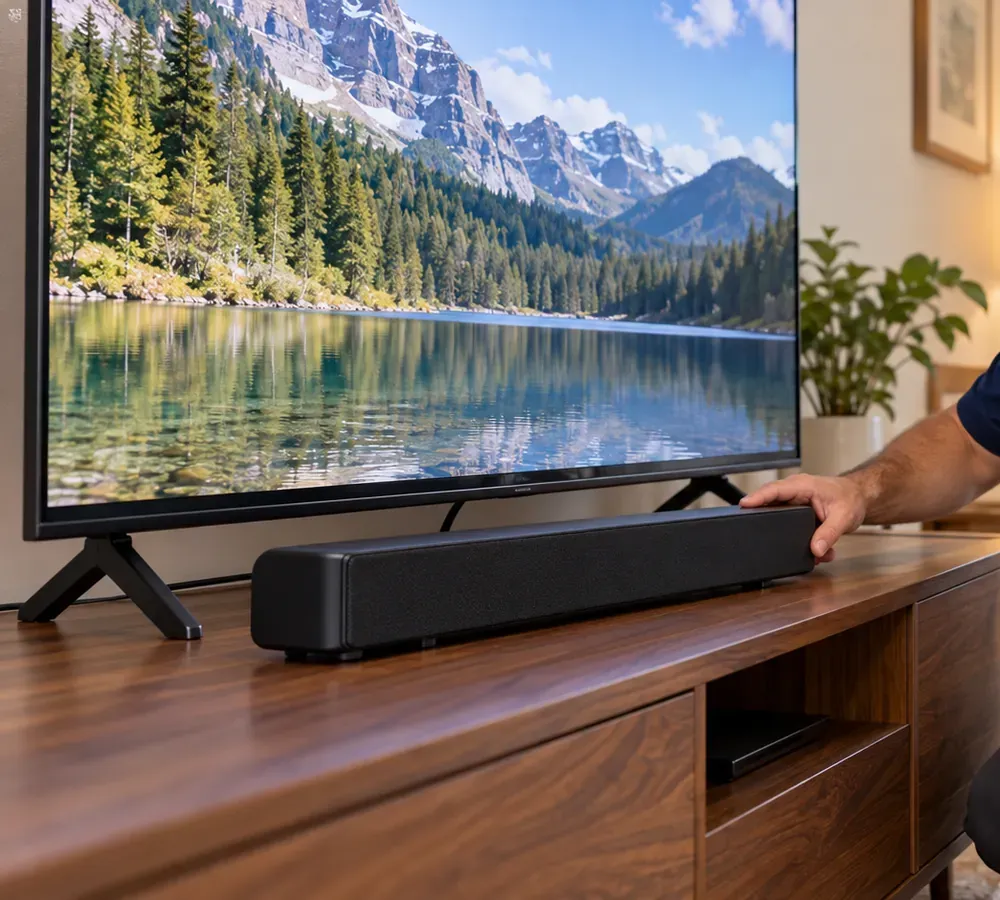
The bar placed on the media console or a dresser, plugged into the TV's eARC or ARC socket, nudged clear of the remote sensor and tuned to the room. A sensible first step in a rented apartment, a bedroom, or a cottage whose walls you'd rather not touch yet.
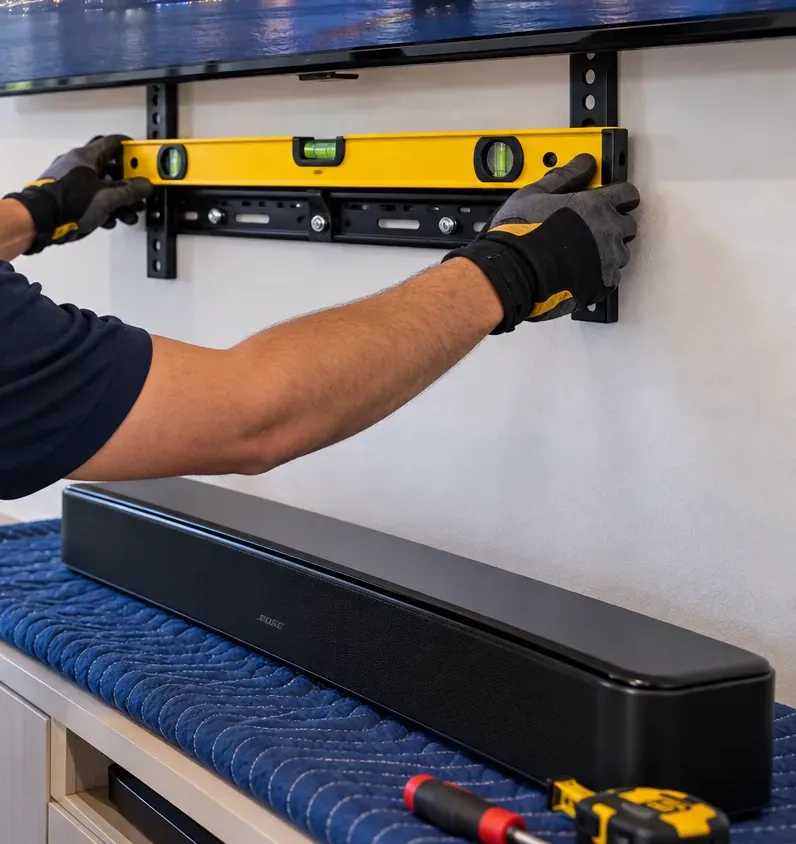
Most of our peninsula bookings are this one: a dedicated bracket an inch or two under the screen, squared to the picture, screwed to timber when a stud falls in the right place and to toggles or masonry anchors when it doesn't.
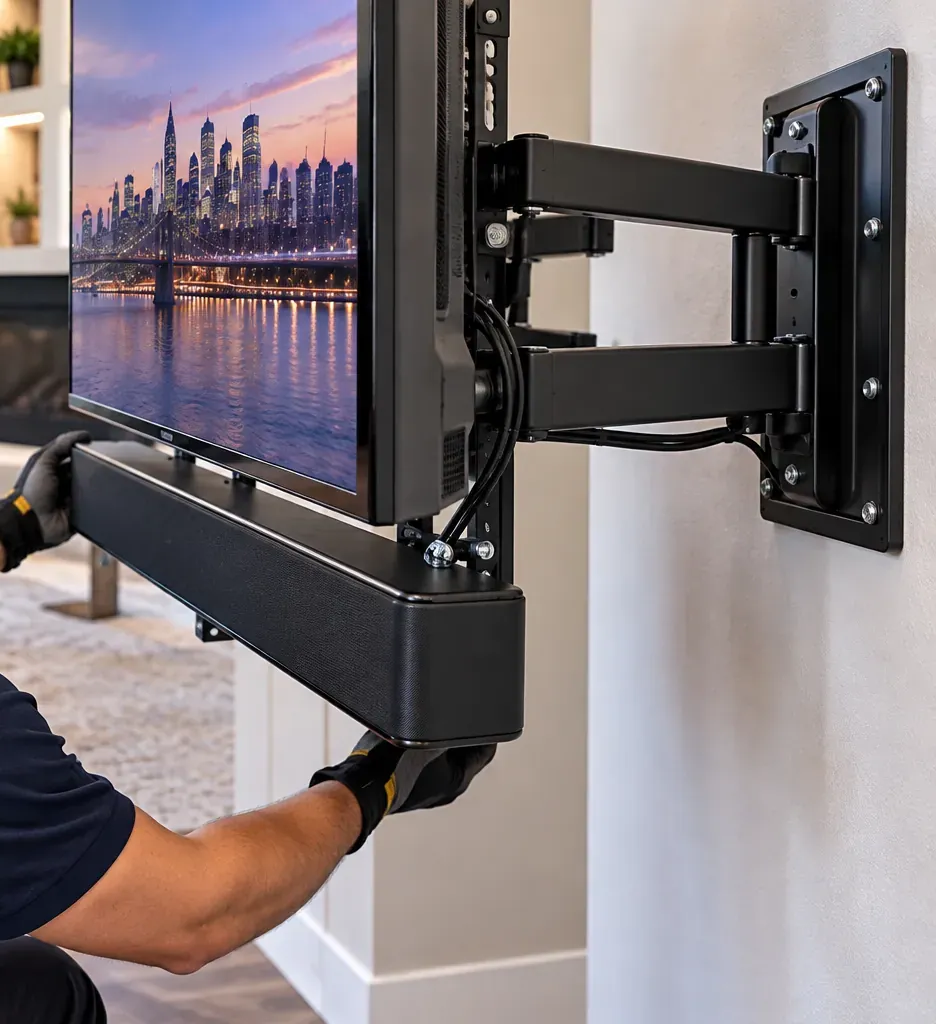
A TV-attached bracket hangs the bar from the TV mount itself, so bar and screen swing together. Handy in an open cottage room where the TV turns between the sofa and the kitchen table.
Power and HDMI fished through the cavity with a code-compliant in-wall power and cable kit, fed from the outlet already on that wall. Quoted only after a scan shows a clear stud bay, and only with the homeowner's yes.
A slim cord cover from the bar to the outlet, ready to paint. The tidy finish on block, brick, a wall with no clear cavity, or a wall in a co-op house you'd rather not open.
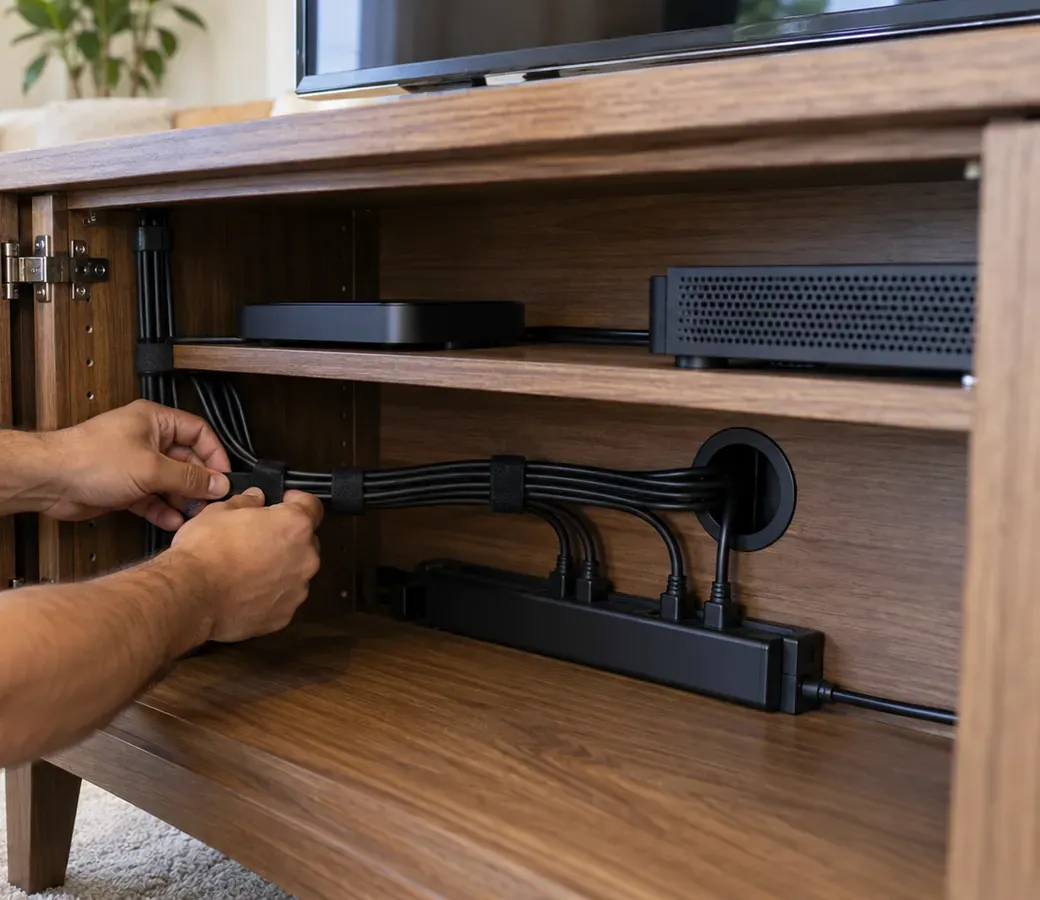
Up to 25 feet of HDMI and power along a skirting, through a partition or round a corner, so the cable box and console can live on a shelf at a sensible height instead of on the floor.
When the screen goes up at the same time, its height, the gap to the bar and the cable path are settled together — the best way to make a small wall look planned rather than crowded.
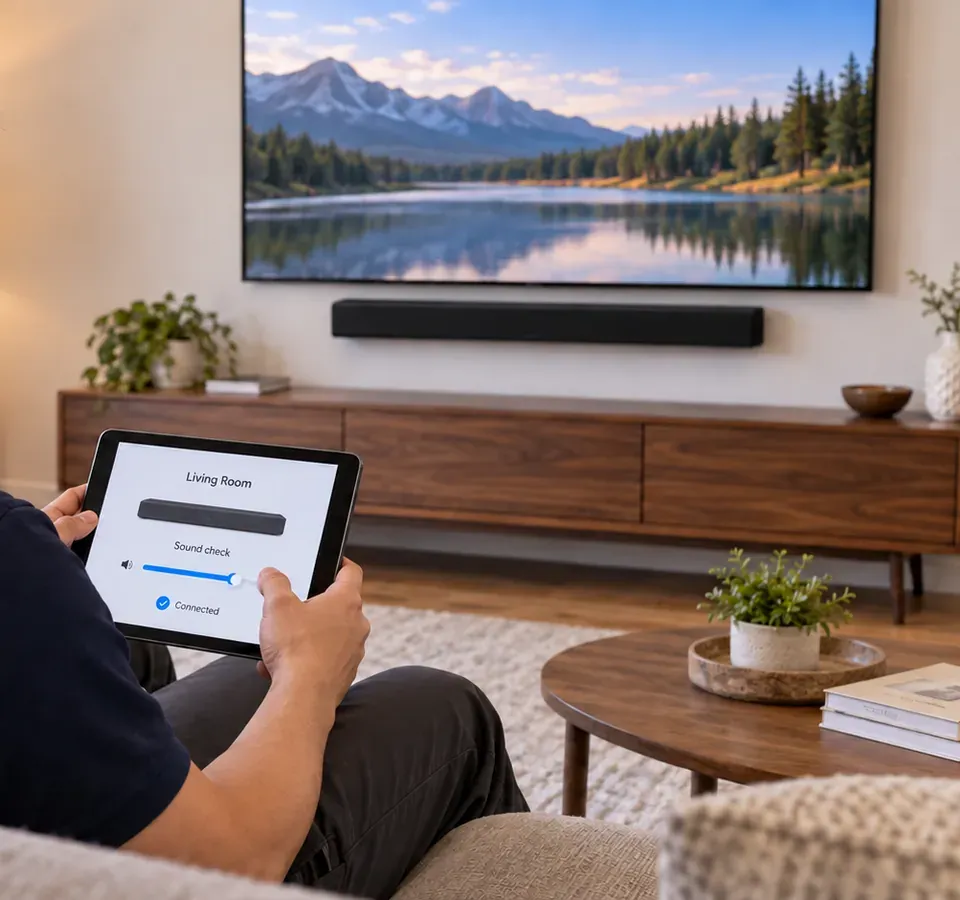
eARC or ARC chosen and switched on, CEC enabled so the TV remote runs the bar, lip-sync checked, firmware updated, and the subwoofer and dialogue levels set for a room the size of yours rather than the factory default.
Wireless subwoofer and rears paired, put where there's power, and set off the floor where water is a risk. In a narrow house, placed so their sound stays in the room instead of crossing a two-foot side yard.
Most bookings combine two or three of these. A bracket, a painted channel and a settings pass is the everyday co-op cottage job; a console setup with a universal remote is a common choice for an older relative's front room; a bracket with hidden wiring suits the drywalled extension many houses gained over the years. Each line appears separately on the quote, so anything you don't want simply comes off.

The peninsula's housing is mostly low-rise, but it was built in very different ways and under very different kinds of ownership. These are the building types our installers meet between the Bruckner and the point, and what each tends to mean for a soundbar.
Converted 1920s summer cottages and newer two-storey rebuilds on narrow co-op plots near Weir Creek and Eastchester Bay. Light framing, small rooms, close neighbours, and a co-op office that sets the rules for anything outside.
The gated colony by the East River, its lanes named for the trees and flowers of the old Hammond estate. Close-set houses that began as summer bungalows; some front a walkway rather than a street.
Single-family homes on the small peninsula between Harding Avenue, the Throgs Neck Bridge and Eastchester Bay, on what was once an island. Larger rooms than the colonies, often with the water on more than one side.
The side streets off East Tremont Avenue and toward Schuylerville: detached frame houses and brick two-families, often with an owner on one floor and a tenant on the other. The wall is the owner's call.
NYCHA's development, opened in 1953 as one of the city's early low-income projects and expanded twice, plus Throggs Neck Addition and the Randall Avenue–Balcom Avenue senior buildings. Masonry walls, and the housing authority or its manager has a say before anything is fixed.
The up-market waterfront condominiums that Wikipedia's account of the neighbourhood mentions. Board and managing-agent approval, certificates of insurance, and living rooms built around the view.
Light framing in the old cottages. Houses built as summer camps and closed in later were rarely framed like a modern home. Stud spacing can wander, an old exterior wall can end up inside the house after an extension, and a single wall may change from one build-up to another halfway along. We don't assume a sixteen-inch grid. We scan the whole width of the wall, confirm what the scanner shows with one small pilot hole where the bracket will hide it, and fix to the strongest timber we find. Where there isn't timber where the bar needs to sit, a toggle sized for the bracket spreads the load behind the board. Drywall on wood studs carries no surcharge on our wall table.
Panelling and planks. Plenty of cottages still have wood panelling or board walls from an earlier life. Panelling over furring strips is not a fixing in itself; we go through it to the framing or to whatever solid surface lies behind. Where boards are the wall, there may be no cavity at all, so hidden wiring is off the table and a channel or a TV-attached bracket is the tidy answer. We tell you which before anything is drilled.

Plaster in the older detached houses. Some of the houses along and off East Tremont Avenue kept their original plaster over wood lath. Plaster is hard and brittle, so we drill slowly without hammer action and reach the framing where possible. Plaster is a $45 line on our table, because it takes longer and more care.
Masonry. Expect solid brick or block in the brick two-families, in the public-housing towers, and in some ground floors and foundations close to the shore. Our hammer drill sets sleeve or screw anchors into the solid face of each unit rather than the joint between them. With no void to fish through, cables travel in a painted channel instead. On the wall table that's $65 for brick or stone and $75 for concrete or block.
Rebuilt and raised houses. A few homes in the flood zone have been rebuilt or raised under flood-resistant rules since Hurricane Sandy, and City Planning's study sets out how an Edgewater Park home can be lifted so its living space sits above the design flood elevation. New framing behind fresh drywall is the easiest wall on the peninsula to work with; we simply ask before drilling whether the builder ran anything in that wall we should know about.
Wi-Fi in a long, narrow house can fade toward the back rooms, and a streaming soundbar is only as steady as the signal it gets. If a wired drop to the TV wall makes more sense, structured cabling installation in Throggs Neck can be priced into the same visit; for a cable already in the walls that has stopped working, see AESS network cable repair in the Bronx.
Business on the peninsula clusters along one long avenue, one shopping centre and a handful of clubs by the water. East Tremont Avenue is the neighbourhood's main street, the Throggs Neck Shopping Center sits off the Hutchinson River Parkway, and the shoreline is dotted with private clubs. A soundbar in any of them has a single job: make the TV easy to follow for the people in the room, without reaching the apartment above, the sidewalk outside or the houses across the lane.
The shopping strip that runs down the spine of the peninsula, where the Throggs Neck Merchants Association has championed everything from pizzerias and burger bars to phone and party stores, at addresses running from the 3500s into the 4000s. Small rooms, televisions over counters, and apartments upstairs.
The business improvement district's office is at 3863 East Tremont Avenue. Members' storefronts are compact and busy, so a bar is set for clear speech at a modest, fixed level rather than for volume.
The centre at 815 Hutchinson River Parkway, with national retailers such as Target and TJ Maxx and a row of restaurants. Bigger rooms and harder surfaces than the avenue, where a bar's dialogue mode does more work than its subwoofer.
The service road along the northern edge of the neighbourhood, home to Engine 89 and Ladder 50 at 2924 Bruckner Boulevard and to bars that advertise game nights. Traffic noise outside, conversation inside.
Private social, beach and gymnastics clubs line the shore streets; the Redwood Club and the Sokol Orel hall of the American Bohemian Gymnastics Society are two on Schurz Avenue. Function rooms with hard floors and big windows facing the river.
The road to SUNY Maritime College at 6 Pennyfield Avenue, past the waterfront at the tip of the peninsula. Offices, waiting areas and small meeting rooms that want a TV people can hear without anyone shouting.

Shop owners on the avenue often fold other low-voltage jobs into the same booking. Security camera installation in Throggs Neck and Throggs Neck intercom installation are handled by the same licensed team, and Abstract Enterprises low-voltage installation in the Bronx covers the rest of a shop's wiring.
These are the questions people on the peninsula ask before they book, grouped by what sits behind them: living inside one of the co-op colonies, the quirks of a house that began as a summer cottage, the water, and the businesses on the avenue. Prices for particular situations are in the FAQ further down. Nothing here is legal advice; where a co-op's guidelines, a lease or a code is involved, that document and whoever wrote it have the last word.
For work that stays inside the four walls, usually yours. City Planning's study of Edgewater Park describes the arrangement plainly: residents own their homes outright and lease the land, divided into shares, from the cooperative, which sets architectural and construction guidelines through a board of stockholders. A bracket on an interior wall, a cord cover and a sound setup don't change the building's footprint, height or appearance, which is what those guidelines are written to control.
The picture changes the moment anything reaches the outside. A cable through an exterior wall to a TV on the deck, a speaker under the eaves, a dish, or a new opening for power is the kind of change a co-op board expects to hear about first. The same goes for Silver Beach, where the house is likewise yours and the ground the cooperative's. If your plan includes anything like that, ask the co-op office before we book, and we'll quote the indoor part separately so it isn't held up.
If you rent your house from its owner, the owner decides about holes, exactly as in any rented home. A short email from them saying the bracket is fine is all we need on the day; until then, a console setup gives you the sound with nothing fixed to the wall.
On foot, and we plan for it. Silver Beach has lanes that are walkways rather than roads — one writer who walked Indian Trail described it as a five-foot-wide strip of asphalt between the cottages and the drop to the beach — and City Planning describes Edgewater Park's streets as narrow, mostly unmapped and often 12 to 15 feet wide, with two surface parking lots serving the community. A work van can't always stop outside, and sometimes it can't get close at all.
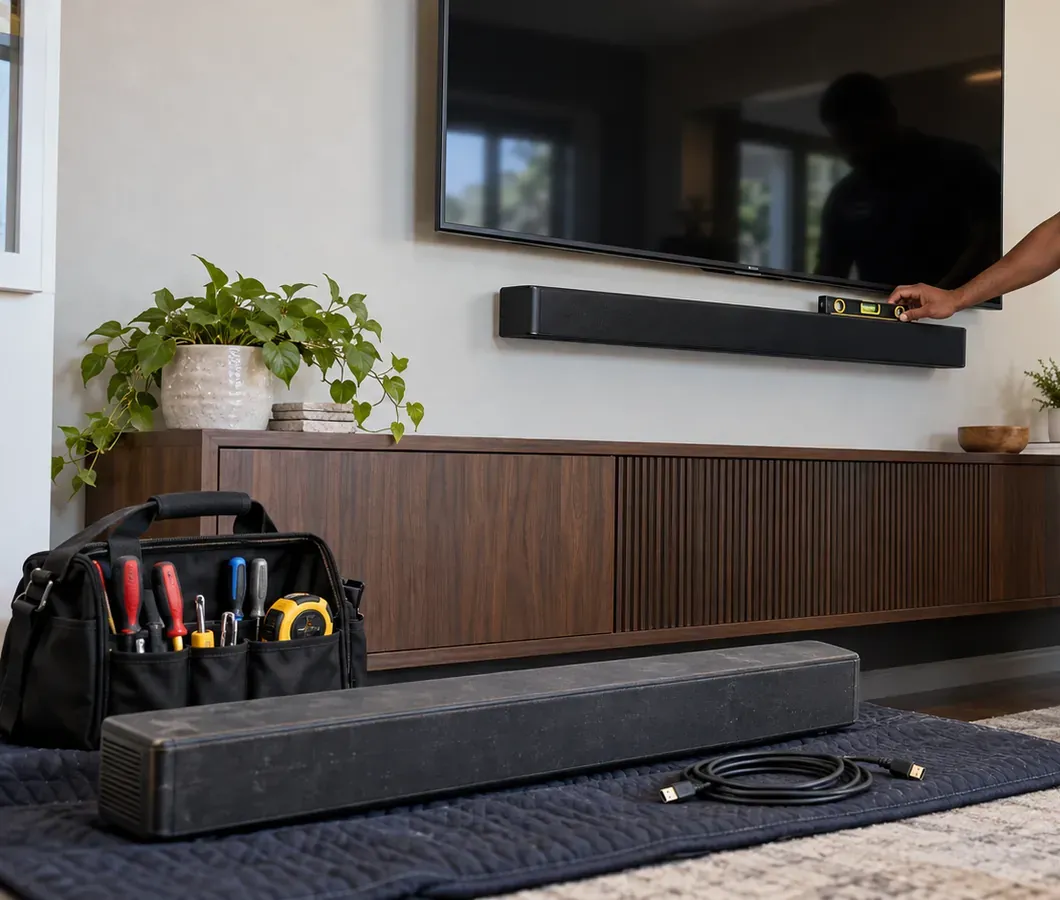
So when you book, tell us where a van can legally stand and how far it is to your door. We bring what we need for your wall in one carry: the bracket, the fixings for the wall type we expect, a drill, a scanner, a level, cables and drop cloths, all packed so one technician can walk it in. If a large TV is going up at the same visit, say so when you book, and we plan a second pair of hands for the carry.
Gated colonies add one more step. Silver Beach has a guard booth at its entrance, and visitors are expected to be visiting someone. Give the gate your name and ours for the day, and answer your phone when the technician calls from the entrance; the job starts the moment we're through.
Sometimes, and it depends on which way the slope runs. Up-firing drivers send sound toward the ceiling so it reflects down onto the seats and seems to come from above. Dolby's own placement advice assumes a flat, reflective ceiling. Under a sloped ceiling the reflection lands somewhere else: if the ceiling rises away from the TV toward the back of the room, the bounce tends to carry over and past the sofa; if it slopes down toward the seats, it can land in front of you.
In a cottage room the ceiling may also be low, which shortens the path and often helps, or clad in boards, which reflect well, or finished with acoustic tile in a later renovation, which soaks the effect up. We can't promise height effects from a spec sheet. What we can do is test: with the bar in place we play a height-test clip, sit where you sit, and tell you honestly whether it's working.
If it isn't, the bar still does everything else well, and many have a setting to turn the up-firing channels down. And if you haven't bought yet, a good bar without up-firing drivers can be the better spend under a pitched ceiling; we'll say so when you send us a photo of the room.
Yes, and in a small room it usually transforms the space. A screen hung near the ceiling of a cottage-sized room forces everyone to look up from a sofa only a few feet away, and a soundbar under it ends up far above ear height, so voices seem to come from the wrong place. Dolby's advice is to keep the bar below the TV and as close to it as practical, and Yamaha's guide suggests aiming for roughly where a seated listener's ears are; in a low, small room both point to bringing the whole arrangement down.
On our Bronx menu the parts are simple. Lifting the TV off its old mount is $85 and unbolting the old bracket from the wall is $45. Re-hanging a 32- to 55-inch TV on drywall at the new height is the Bronx TV-mounting base of $209.99. The soundbar wall mount is $129, plus $84.99 if you need our Sanus bracket. So a typical lower-and-add-a-bar visit is $85 + $45 + $209.99 + $129 + $84.99 = $553.98, before any surcharge for plaster or block.
The old holes stay behind when the bracket comes off. Filling and painting them is a decorator's job rather than ours, but the new TV position often covers most of them, and we plan the height with you so the screen, the bar and any leftover marks line up as neatly as the wall allows.
Worked around, almost always; moved, sometimes. In small houses the point where the TV service enters is often the living-room wall nearest the street or the lane, and the coax or fibre may pop out of a plate right where the screen ought to hang. A bracket can sit beside or above that plate, and a short channel can carry the line to a cable box on a shelf, so nothing looks improvised.
Moving the entry point itself is your provider's job: the line from the pole or the street to the house belongs to them, and so does the equipment that terminates it. If the plate truly has to move, ask them to relocate it before we come, and we'll plan the TV wall around the new position.
What we won't do is bury a provider's live line inside a wall behind the TV, where nobody can reach it when the service needs work. The bar's own HDMI and power can go in the wall; the provider's cable stays where a technician can find it.
Indoors, not much. The brackets we fit are powder-coated steel made for living rooms, and a heated, lived-in room by the water is still a living room. The guides that call for corrosion-resistant hardware, sealed cable entries and drip loops near the coast are written for TVs mounted outdoors, on decks and patios, where spray and rain reach the metal directly.
Where damp does matter indoors is in rooms that aren't heated or lived in every day: an enclosed porch, a ground-floor room left closed up, a space below the living floor in a raised house. We'd rather not put a soundbar in any of those. Where the TV is going to be there anyway, we keep the bar and the power strip off outside walls that sweat in winter and leave space behind the bar so air can move.
The simplest protection is ordinary use. A room that's heated and aired stays dry enough for electronics, and a bar that's switched on most evenings keeps its own components a little warmer than the air. If you're closing a house for a long stretch, unplug the bar and the sub rather than leaving them on standby.
Most will, provided it is set up for the job rather than for a living room. A soundbar playing speech at a moderate level for twelve hours is not working hard; what shortens its life in a shop is heat and dust building up around it, a bar wedged into a cabinet with no air, or one turned up to full by whoever is nearest the remote. So we mount it in open air under the screen, away from heaters, ovens and the top of a fridge, and set a level that carries to the counter without strain.
A few settings matter more in a shop than at home. Automatic standby can switch the bar off during a quiet spell while the TV keeps playing, so we check how it behaves with your TV and adjust it where the bar allows. Automatic firmware updates can restart a bar in the middle of the afternoon; where the app lets us, we schedule them for closing time. And we lock in the input and volume behaviour so the TV remote, not the bar's own buttons, is the only thing staff need.
One thing to check yourself is the warranty. Some manufacturers word their consumer warranties around household use, so read the terms that came with your bar before buying a second one for the shop. Our own terms are set out in the service agreement, as they are for every job.

Bring any brand; if you haven't bought yet, we'll suggest something that suits the room rather than the showroom. These are the kinds of hardware we handle most across the peninsula, with the details that change how they're mounted.
A short bar is often the right size, not the budget choice, under a 43- or 50-inch set in a small front room. The Sonos Ray is about 56 cm across and under 2 kg and connects by optical rather than HDMI, which also suits an older TV.
A driver aimed straight out carries speech, which is what makes news and dramas easy to follow in a room with a fan or traffic outside. The Sonos Beam (Gen 2) weighs about 6.35 lb; Samsung, LG, Sony, Bose and others make rivals.
Height effects come from drivers angled at the ceiling. At around 46 inches and 5.9 kg, a Sonos Arc Ultra needs a TV of matching width and a flat ceiling to reflect from, which a converted cottage can't always offer.
Separate bass units paired to the bar. In a narrow house, where it sits and how high it's set matter far more than its size; near the water, it sits on a stand or pad, not the bare floor of a ground-level room.
Rears join the bar over the air, yet each still plugs into the mains, so in a compact room we plan their sockets and keep the leads along the skirting, out of the one path across the floor.
When the box had none, or the one supplied won't suit your wall: the Sanus SASB1 is rated by its maker for most bars up to 20 lb, clamps to the back or underside and adjusts for depth. Ours costs $84.99.
Sanus designed the WSSATM1 around the Sonos Arc; it fits most TVs from 50 to 90 inches and works with other makers' TV mounts, so the bar moves with an articulating arm in an open room.
Code-compliant in-wall power and cable kits for hollow walls, fed from an existing outlet; slim paintable channels for block, brick, boards and any wall you'd rather not open.

| Room on the peninsula | Usually works well | Think twice about | Why |
|---|---|---|---|
| Cottage front room, sofa 8–10 ft from the TV | Compact or mid-size bar with a centre channel | A very long bar under a small screen | A bar much wider than the TV looks odd and throws sound past the seats |
| Room with a sloped or board ceiling | A strong front bar; test height effects on site | Paying extra only for up-firing drivers | Reflections depend on a flat ceiling at a predictable height |
| Rebuilt or raised house with new drywall | Wall mount with hidden wiring | — | Clean, regular framing and clear stud bays |
| Brick two-family off East Tremont Avenue | Wall mount with a painted channel | Hidden wiring on the masonry wall | No cavity in brick; an interior partition may suit better |
| Ground-level room near the water | Everything on the wall or a shelf | A floor-standing sub on the bare floor | Water reaches the floor first |
| Socket on the TV | Link | What it carries | Typical Throgs Neck use |
|---|---|---|---|
| HDMI labelled eARC | HDMI eARC | Lossless formats such as Dolby TrueHD; the TV remote runs the bar | New living-room set with a full-width bar |
| HDMI labelled ARC | HDMI ARC | Compressed surround; streaming Atmos carried inside Dolby Digital Plus; one remote | Most streaming homes; mid-size bars |
| No ARC, optical out only | Optical | Two-channel or simple surround; volume may stay on the bar's handset | An older second TV with a compact bar |
| Phone or tablet only | Bluetooth | Compressed stereo with a slight delay | Music in the kitchen; not ideal for TV |
Manufacturers revise their ranges constantly; the figures above were current in October 2026. Your own model's sockets, weight and bracket get checked against your wall before the day, and that check is what decides which anchors travel with us.

First, how this section was put together. We couldn't load Google's AI summaries while researching this page, so we don't pretend to quote them. Each heading below is something a price guide, an installer, a manufacturer or a retailer actually publishes — the raw material search summaries and chatbots draw on — and under each is what it means in a Throgs Neck house.
A New York City installer's Bronx TV-mounting page lists soundbar installation “from $69 / per item.” Starting prices like that are real, and a summary that collects them will tell you a soundbar costs about that much to put up anywhere in the Bronx.
The “from” is doing a lot of work. In a converted cottage the wall may be drywall over framing, plaster, panelling or block, and each takes a different fixing and a different amount of time. On our menu a bar on a stand is $79 and a wall mount is $129; plaster adds $45, brick $65 and block $75, and our Sanus bracket is $84.99 if your bar came without one. Hiding the wires is $169, or a painted channel $59.
So compare like with like. Ask any installer what their figure includes for your wall and your finish, in writing, before the day. Ours lists every line separately so you can see where each dollar goes.
That advice comes from a guide to protecting outdoor TVs from salt air, and for a screen on an open deck by the Sound it's sensible. Summarised loosely, though, it turns into “homes by the water need marine-grade equipment”, which sends people shopping for things an indoor soundbar doesn't need.
Inside a heated, lived-in Throgs Neck house the bracket behind your TV is in an ordinary living-room environment, and an ordinary powder-coated bracket is the right part. What the water does change is height: in a house near the shore, the risk to a soundbar system is water on the floor, not spray on the bracket, so the sub, the power strip and the cable box go up.
If you do want sound outdoors, that's a different job with weather-rated speakers and wiring, and in a co-op it's also an exterior change to raise with the co-op office first. We quote it separately through our AV service.
Dolby suggests this for TVs on adjustable mounts, so the bar stays lined up with the screen as it moves. It's good advice, and it gets repeated as if every wall-mounted TV should carry its bar this way.
It suits some Throgs Neck rooms very well: an open cottage room where the TV swings between the sofa and the table is exactly the case Dolby has in mind. On a fixed or tilting mount, though, a TV-attached bracket adds weight to the TV mount and depth to the whole assembly in a small room, where a separate bracket on the wall is usually neater.
The deciding questions are whether the TV moves and whether the TV mount is rated for the extra weight. We check the mount's rating against the TV and the bar together before hanging anything from it.
That's how Sanus describes its universal SASB1 bracket, and it's accurate for the bar. Summaries tend to stop there, as though a rated bracket guarantees a safe mount.
The weak point is rarely the bracket. It's what the bracket is fixed to. A light cottage partition, panelling on furring strips, or crumbling plaster can fail long before a 20-pound rating matters, which is why our price changes with the wall rather than with the bar.
We match the fixing to what the scanner and the pilot hole find: framing where it lines up, a toggle sized to the load in board, sleeve anchors in block, and plywood backer board ($85) where the surface is too weak to take anything directly.
Homewyse publishes that national estimate, per soundbar, and it often surfaces in AI answers about installation cost. As a range for labour alone it isn't unreasonable.
What a national range can't include is a Throgs Neck finish. Lowering a TV that a previous owner hung too high, adding a channel along a board wall, or hiding wires in a rebuilt house's new drywall each move the number. Our worked examples further down add the lines up openly, from $79 for a stand setup to a few hundred dollars for a TV and bar hung together.
A national average is a starting point for a conversation, not a quote. A photo of your wall gets you the real figure.
A mount maker's placement guide puts it that way, and Yamaha's guide offers about 42.5 inches off the floor as a typical seated ear height. Both are good rules for a standard living room with a standard sofa.
In a cottage room the TV height is often fixed by something else: a window sill, a low ceiling, a radiator, or a wall interrupted by a door. The bar then follows the screen, a short gap beneath it, and the real decision is the height of the TV, which in a small room should usually be lower than people expect.
If the screen can't come down, the bar still hugs its lower edge. A small downward tilt, where the bracket permits, and the speech-enhancement setting do more good than parking the bar at ear height while the faces talk from a foot above it.
Big-box service menus list “Soundbar Setup”, “Soundbar Installation”, “Networked Soundbar Setup” and “Soundbar Setup & Mounting” as separate items, and summaries pass that structure on as if connecting the bar were an optional extra after mounting it.
On our menu, connecting and setting up the bar is part of every install line: the correct HDMI socket, CEC so one remote works, lip-sync checked and the levels set for the room. You don't pay twice to get sound out of a bar we've just hung.
What is separate is work beyond the bar itself: a Sonos system across several rooms ($125), a receiver ($129), a universal remote ($99) or a streaming device ($49). Those appear as their own lines only if you ask for them.
Send the bar, a photo of the TV wall and a note about the gate or the lane, and we'll send back a written price, a mounting method and an arrival plan for your house.
In the Bronx, soundbar jobs come from pre-war apartments, co-ops, private houses in Riverdale and Throgs Neck, and bars and restaurants along the main corridors. Soundbar installation, or sound bar installation as some people write it, is more than hanging a bar under the TV.
Our soundbar installation services in Throgs Neck, the Bronx start with the mount. As a soundbar installer, we handle soundbar mounting, sound bar mounting and soundbar wall mounting with the bracket that came in the box or a better one. Soundbar wall mount installation, soundbar wall bracket installation, soundbar bracket installation and soundbar mounting hardware installation are all part of a standard visit, and soundbar mounting bracket replacement or soundbar mounting hardware replacement fixes a bar that sags or came with the wrong hardware. Bronx pre-war apartments often have plaster over brick or block, which needs masonry anchors instead of drywall hardware.
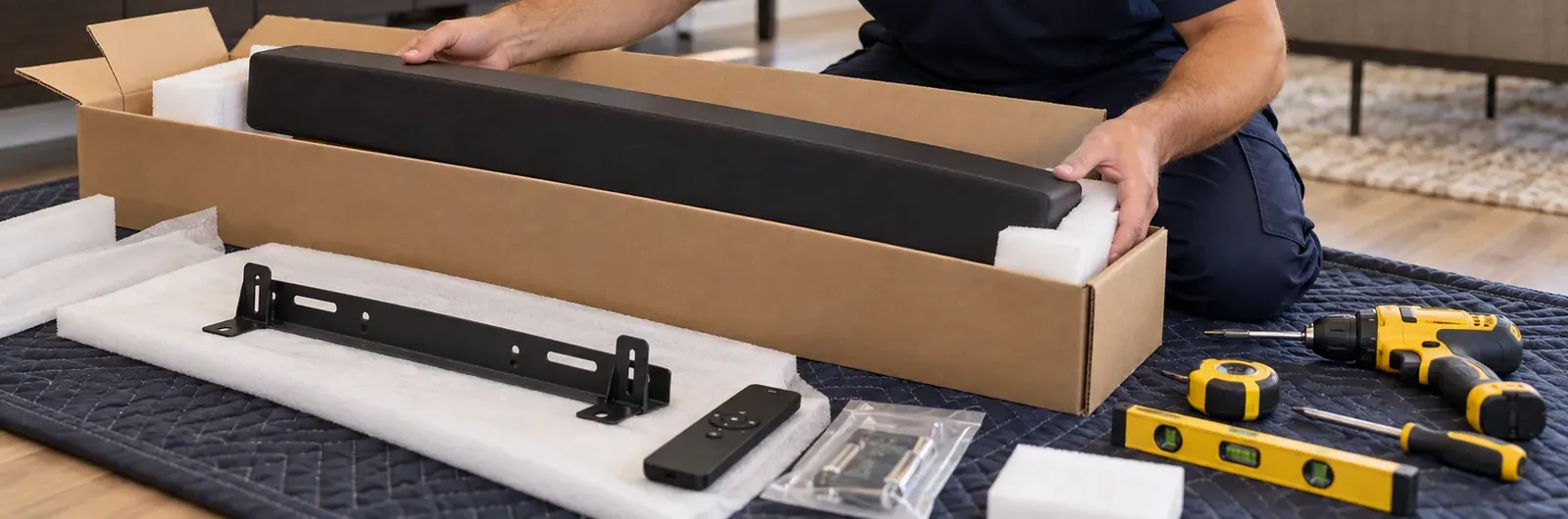
Every professional soundbar installation follows the same steps: soundbar unboxing and installation, soundbar equipment inspection, soundbar bracket measurement and soundbar wall measurement, then soundbar mounting preparation. We do soundbar stud mounting and soundbar mounting to wall studs wherever the studs line up, and soundbar wall anchor installation rated for the bar's weight where they don't. Soundbar bracket leveling, soundbar installation with level, soundbar mounting alignment, soundbar mounting height adjustment and soundbar mounting position adjustment keep it centered and straight.
Most bars go with a TV. We do soundbar mounted below TV, soundbar mounted under TV and soundbar mounted above TV layouts, as well as soundbar mounting to television brackets and soundbar attached to TV mount kits that move with the screen. TV and soundbar installation in one visit, TV mounting with soundbar, soundbar TV mount installation and soundbar installation with TV mounting save a second trip.
Already have a TV up? Soundbar installation on existing TV setups is common, including soundbar installation under wall mounted TV, soundbar installation on articulating TV mount, soundbar installation on swivel TV mount, soundbar installation on full motion TV mount, soundbar installation on fixed TV mount and soundbar installation on tilting TV mount. We also handle soundbar installation with smart TV, soundbar installation with OLED TV, soundbar installation with QLED TV, soundbar installation with LED TV and soundbar installation with projector screens.
Soundbar installation on drywall, soundbar installation on plaster wall, soundbar installation on brick wall, soundbar installation on concrete wall and soundbar installation on stone wall each need different anchors and drill bits, and we bring them all. Soundbar installation on fireplace wall layouts include soundbar installation above fireplace and soundbar installation below fireplace mounted TV, with the bar kept clear of heat. Plaster, brick and concrete walls are the norm in Bronx apartment buildings, and fireplaces turn up in older private houses.
Residential soundbar installation covers soundbar installation in living room, soundbar installation in bedroom, soundbar installation in home theater, soundbar installation in apartment and soundbar installation in condominium spaces. We do soundbar installation for luxury homes, soundbar installation for apartments, soundbar installation for home offices, soundbar installation for media rooms and soundbar installation for home cinema alike. Bronx apartment dwellers often need a clean setup that keeps sound inside their unit.
Commercial soundbar installation includes soundbar installation in office, soundbar installation in conference room, soundbar installation in restaurant, soundbar installation in retail store and soundbar installation in commercial space. Soundbar installation for businesses and soundbar installation for conference rooms usually means making sure the bar works with the room's TV, video calls and remotes.
Soundbar HDMI installation is the best connection for most TVs. Soundbar HDMI ARC setup and soundbar HDMI eARC setup, or an HDMI ARC soundbar connection or HDMI eARC soundbar connection, let the TV remote control the bar through soundbar CEC configuration. Where HDMI isn't an option, soundbar optical cable installation and soundbar optical audio setup give a solid soundbar digital audio connection.
Wireless soundbar installation, wired soundbar installation, soundbar Bluetooth setup and soundbar WiFi setup are matched to the bar and the room. Soundbar TV audio connection and soundbar audio output configuration make sure sound comes out of the bar, not the TV speakers. Soundbar TV remote programming, soundbar universal remote setup, soundbar volume control setup, soundbar synchronization setup and soundbar lip sync adjustment finish the setup.
Soundbar and subwoofer installation, soundbar surround sound installation, wireless subwoofer setup, wireless surround speaker setup and soundbar rear speaker installation turn a bar into a full system. Soundbar subwoofer pairing and soundbar speaker placement are done in the room, not guessed.
Dolby Atmos soundbar installation and Dolby Atmos soundbar setup, Dolby Digital soundbar setup and DTS soundbar configuration get the right audio format from each source. Soundbar audio calibration, soundbar sound optimization, soundbar dialogue enhancement setup and soundbar bass adjustment make voices clear and keep bass from shaking the neighbors. That's home theater soundbar installation, home entertainment soundbar setup and soundbar home theater integration done properly.
Soundbar cable concealment, soundbar wire concealment and soundbar hidden wire installation are what make the job look finished. Soundbar in wall cable management uses low-voltage in-wall kits where the wall allows, and soundbar cable cover installation, soundbar raceway installation and soundbar wire molding installation work where it doesn't. Soundbar cable routing, soundbar cable organization, soundbar cord hiding, soundbar power connection installation and soundbar power cable management keep the cords out of sight. In Bronx apartments where opening walls isn't allowed, raceway and cord covers keep the wires hidden.
The result is soundbar installation with concealed cables, soundbar installation without visible wires, soundbar installation with hidden connections and soundbar installation with clean finish. If a new outlet is needed behind the TV, we handle soundbar power outlet installation coordination with your licensed electrician, since we don't do electrical work ourselves.
Not every bar goes on the wall. Soundbar installation with media console, soundbar installation inside entertainment center, soundbar installation above media cabinet, soundbar installation with TV cabinet, soundbar installation below floating TV and soundbar installation with floating entertainment center are all common. Soundbar connection inside media cabinet and soundbar cable management inside console keep everything tidy.
We connect everything around it: soundbar installation with cable box, soundbar installation with streaming device, soundbar installation with Apple TV, soundbar installation with Roku, soundbar installation with Fire TV and soundbar installation with gaming console.
We install every major brand: Samsung soundbar installation, LG soundbar installation, Sony soundbar installation, Bose soundbar installation, Sonos soundbar installation, JBL soundbar installation, Vizio soundbar installation, Polk soundbar installation, Yamaha soundbar installation, Sennheiser soundbar installation and Klipsch soundbar installation. That includes Samsung Q Symphony soundbar setup, LG WOW Orchestra soundbar setup, Sonos Arc installation, Sonos Beam installation, Bose Smart Soundbar installation and Sony Bravia Theatre soundbar installation.
Soundbar not working repair starts with soundbar connection troubleshooting. Soundbar no sound troubleshooting, soundbar HDMI ARC troubleshooting, soundbar eARC troubleshooting, soundbar optical connection troubleshooting, soundbar Bluetooth troubleshooting, soundbar wireless connection repair, soundbar audio delay troubleshooting and soundbar TV compatibility troubleshooting find whether it's the cable, the settings or the TV.
Soundbar relocation service, soundbar remounting service and soundbar removal and reinstallation handle moves and new TVs. Soundbar installation upgrade and soundbar replacement installation swap an old bar for a new one, and soundbar installation troubleshooting fixes a job someone else started.
Every job ends with soundbar installation and testing: soundbar audio testing, soundbar final system testing and a soundbar installation quality check with you in the room.
Beyond the bar, we handle TV sound system installation, TV audio system installation, home audio installation, home theater audio installation, audio video installation and AV installation services as a low voltage audio installation contractor. If you've been searching for soundbar installation near me in Throgs Neck, the Bronx, we're a soundbar installation company and soundbar installation contractor offering professional TV audio setup and soundbar mounting service across the whole area. Customers find us searching for soundbar installation NYC, soundbar installation Manhattan, soundbar installation Brooklyn, soundbar installation Queens, soundbar installation Bronx, soundbar installation Staten Island, soundbar installation Long Island, soundbar installation Nassau County, soundbar installation Suffolk County, soundbar installation Westchester County, soundbar installation Rockland County and soundbar installation Hudson Valley.
A cottage on an Edgewater Park lane, a house behind the Silver Beach gate, a Locust Point home by the bay, a brick two-family off East Tremont Avenue or a shop on the avenue itself — tell us the bar, the TV, the wall and how we reach your door, and a written price comes back the same business day. Rather talk it through? Call (646) 490-0629.
Weekday requests get a phone call or a priced reply the same afternoon. Anything urgent, dial (646) 490-0629 straight away.
The same order applies to every visit on the peninsula, from a compact bar in a cottage bedroom to a TV and Atmos bar hung together in a rebuilt house. In Throgs Neck the first two steps — the arrival plan and the height question — take a little more thought than elsewhere in the borough.
Tell us where a van can stand, whether there is a gate or a guard, and how far it is to your door, along with the bar and TV models and a photo of the wall. You get an itemised total and an arrival plan.
In a small room the TV height decides everything else. We agree it with the people who will sit on the sofa, then place the bar a short gap beneath the screen.
Pick any two-hour slot between 8 AM and 8 PM, any day of the week. Need to change it? Give us 24 hours’ notice and there is no charge, and if a same-day slot opens up we offer it to you first.
We scan the full width of the TV wall, look for extensions, panelling and old outside walls, and drill one small pilot hole where the bracket will hide it before choosing the fixing.
Bracket fixed to framing, toggles, masonry anchors or a backer board as the wall demands; bar levelled to the screen; cables hidden in the wall, run to a shelf or carried in a painted channel.
Subwoofer, power strip and boxes placed off the floor where water is a risk; HDMI eARC or ARC set up, CEC switched on so one remote works, lip-sync checked and firmware updated.
Bass and dialogue set for the size of your room, night mode shown, packaging taken if you booked removal, dust vacuumed, and a run-through of power, volume and how to unplug everything quickly.

Mention one of these when you call and we already know something about your street, the way in and the kind of house you're likely to be in before the photos arrive.
The fort at the tip of the peninsula, built between 1833 and 1856 to guard the eastern approach to New York, is home to SUNY Maritime College at 6 Pennyfield Avenue, which describes itself as the oldest and largest maritime school in the country. Its training ship, the Empire State VII, returns to the college's Olivet Pier after each summer sea term.
Othmar Ammann's suspension bridge opened on January 11, 1961, with a main span of 1,800 feet linking the Bronx to Bay Terrace in Queens. Its northern approach and toll plaza were built partly on landfill that joined Locust Point to the mainland.
The park beside the Bronx–Whitestone Bridge: a 110-acre western side with soccer and cricket fields and the ferry stop, and a 420-acre eastern side with a promenade, a golf course and a waterfront restaurant, according to Wikipedia's account of the neighbourhood.
The co-op colony on the north-east shore, bounded by Miles Street, the Throgs Neck Expressway and Veterans Memorial Park, Weir Creek and Eastchester Bay, with a fieldstone bulkhead and three sandy beaches along half a mile of shoreline. Wikipedia lists its volunteer fire department as one of nine in New York City.
The gated colony on the East River, where the 1795 house Abijah Hammond built on the old Stephenson farm now holds the offices of the Silver Beach co-op, and Indian Trail runs along the edge above the beach with a view of the Throgs Neck Bridge.
The New York Public Library's branch at 3025 Cross Bronx Expressway Extension, open since 1954 and in its current one-storey building since 1974. A handy reference point for the blocks around the expressway and Edgewater Park.
We work across the whole peninsula and its edges: Locust Point, Silver Beach, Edgewater Park, Schuylerville, the blocks along East Tremont Avenue and Lafayette Avenue, Country Club across the water, Pelham Bay, Westchester Square and Castle Hill — and, from the same office on East Fordham Road, every other part of the Bronx. For the wider picture, our Bronx soundbar installation page covers the whole borough.

Throgs Neck is the Bronx, so it pays the Bronx menu: one published line for each thing we do, and nothing added for the trip out to the end of the peninsula. The Bronx lines match our Brooklyn base. Only two figures are specific to the borough — the hourly rate for visits where nothing is mounted, and the TV-mounting starting price — and both are set out below. If something unexpected turns up on site, you hear the price before any work on it begins.
| Line item | Price | What it covers |
|---|---|---|
| Soundbar placed on a stand or console | $79 | Set on your furniture, connected and tuned; nothing drilled |
| Soundbar wall-mounted under the TV | $129 | We pick the fixing for your wall, square the bar to the picture, then hook it up and play a test clip |
| Sanus soundbar bracket | $84.99 | Supplied by us when the box had no bracket, or when the bar is to ride on the TV's arm |
| Paintable cord cover | $59 | A slim plastic run on the wall face linking bar and socket; you or your painter colour it |
| In-wall concealment | $169 | A code-compliant in-wall power and cable kit carries both leads through the stud bay from the existing socket; only on a hollow wall the homeowner agrees to |
| Cable run to a cabinet or other spot | $99 | Up to 25 ft, so boxes can live on a shelf or in a closet |
| Sonos setup | $125 | Sonos system, app and grouping |
| A/V receiver | $129 | Receiver connected and configured |
| Universal remote | $99 | One remote programmed for the TV, bar and boxes |
| Streaming device setup | $49 | Roku, Apple TV, Fire TV or similar |
| Full home theater | $350 | Multi-component system setup |
| Condition | Price | Where it turns up on the peninsula |
|---|---|---|
| Drywall on wood studs | $0 | Extensions, rebuilt and raised houses, renovated rooms |
| Metal studs | +$30 | Some newer condo partitions and shop fit-outs |
| Plaster | +$45 | Older detached houses that kept their original walls |
| Brick or stone | +$65 | Brick two-families, chimney breasts |
| Concrete or cinder block | +$75 | Public-housing walls, foundation and ground-floor walls near the water |
| Tile or marble | +$95 | Feature walls and fireplace surrounds |
| Plywood backer board | $85 | Panelling or tired plaster that won't take a fixing directly |
| High mount (above about 8 ft) | $75 | A bar over a TV set high in a raised house's tall room |
| Walk-up, 3rd floor and above, no elevator | $40 | Upper floors of walk-up buildings |
| Box removal | $25 | We take the packaging away |
| Certificate of insurance | Free | Co-op offices, condo boards, managing agents, commercial landlords |
Not every visit involves a bracket. Reconnecting a bar to a new TV, re-pairing a sub after an outage or getting the remote to work the volume again is billed by time: in the Bronx, $225 covers the first hour and later time goes in half-hour blocks. If the screen is going up on the same visit, a 32- to 55-inch TV on drywall starts at $209.99 here, or $137.99 if it simply stands on furniture; a 65-inch set starts at $239.99. For an old set: $85 to take it off the wall, $45 to remove a leftover bracket, $79 to haul it away. Tracing a fault in wiring already buried in a house is outside the menu and is quoted at our $195-an-hour specialty rate with a three-hour minimum ($585); it never applies to an ordinary soundbar install.
Flat app menus and national chains, compared with a licensed local installer. Flat-rate menus are written for a drywall wall in a standard room, and some Throgs Neck rooms are exactly that. Where they struggle is everything else: a light old cottage wall, panelling, block near the shore, a gate and a lane between the van and the door, or a co-op house where the outside is off limits. A licensed installer working from a wall-by-wall price list can quote the room you actually have and stand behind it afterwards.
Three combinations cover the bulk of what the peninsula books. The arithmetic is printed on each card, and any wall, height or stairs line from the tables is added on top.
$79
$79 buys a placed and connected bar with no holes: HDMI into the eARC or ARC port, one-remote control on, cables dressed. A good fit for a cottage bedroom, a rental, or trying the sound before committing a wall.
$213.99
Mount ($129) plus Sanus bracket ($84.99) equals $213.99 on drywall over timber. Add the wall line if yours differs: $45 plaster, $65 brick, $75 block or concrete, $85 for a backer board behind weak panelling.
$382.99
Add $169 for leads inside the wall with a code-compliant in-wall power and cable kit to the $213.99 Standard: $382.99. Best suited to the new drywall in a rebuilt, raised or extended house where the scan shows a clear stud bay.
Already have a bracket, or a good one came in the box? You pay the $129 mount plus your wall's line. The bracket keeps its own maker's warranty. If it isn't rated for the bar or won't suit the wall, we say so before drilling and offer the Sanus bracket instead.
Three worked examples, from the lines above. A bar on our bracket on a panelled cottage wall that needs a backer board, with a painted channel to the outlet: $129 + $84.99 + $85 + $59 = $357.99. A bar on the block wall of a ground-floor room, with the cable box moved up to a shelf by a cable run and a channel on the block: $129 + $84.99 + $75 + $99 + $59 = $446.99. And a console setup with a universal remote for a parent who wants one handset instead of three: $79 + $99 = $178.
A photo of the TV wall, the bar's model number and a line about how we reach your door are all we need to add up your lines today.
Edgewater Park and Silver Beach began as places to spend the summer by the water, and their houses still carry that history in their bones. City Planning's account of Edgewater Park traces it from the Adee family's estate, rented to summer campers who pitched tents on the beach around the turn of the twentieth century, through the cottages and bungalows put up in the 1920s and winterized during the Depression, to the cooperative its residents formed in 1988 when they bought the land. Wikipedia's history of the wider neighbourhood tells a parallel story for Silver Beach: a summer colony of bungalows, later adapted for year-round use, on streets named for the trees and flowers of the Hammond estate. A soundbar has to fit into rooms shaped by that history.
The good news about a small room is that it is easy to make sound clear in. The listener is close to the bar, speech doesn't have far to travel, and a modest bar set properly often sounds better than an expensive one fighting a big, echoing space. Most cottage owners end up surprised by how little they needed.
| Room | What usually helps | What usually works against it | Typical finish |
|---|---|---|---|
| Cottage front room | Short seating distance; speech is easy to keep clear | One wall with the window, door or radiator; light framing | Bracket under the screen, painted channel |
| Room in a rebuilt or raised house | New drywall and regular framing | Can be a tall, bright room with lots of glass toward the water | Bracket with hidden wiring |
| Converted porch or sunroom | Light and views | Glass on several sides; colder in winter | Console setup or bar on the TV's arm |
| Attic bedroom under the roof | Quiet, private | Sloped ceiling and knee walls limit where a TV can hang | Compact bar on a stand or short bracket |
| Ground-level room near the water | Often the biggest room in the house | Water reaches the floor first in a storm | Everything wall-mounted or on a shelf |
On most Bronx jobs the hardest part of arriving is finding a parking space. On parts of this peninsula it's reaching the house at all. City Planning describes Edgewater Park's streets as small, narrow and mostly unmapped, often just 12 to 15 feet wide, with no sidewalks; the community relies on two surface parking lots. Silver Beach sits behind a gate with a guard booth, and some of its houses face walkways rather than roads. Locust Point is reached along Harding Avenue on its own small peninsula. None of that is a problem if we know about it in advance.
The same care applies to the larger buildings. The Throggs Neck Houses, Throggs Neck Addition and the Randall Avenue–Balcom Avenue senior buildings are run by or for the housing authority, and in April 2025 their residents voted on different futures — Randall Avenue–Balcom Avenue chose to convert to private management under PACT, while Throggs Neck Addition stayed in traditional Section 9. Who approves a bracket can change with that, so check with your management office before the visit; until then, a console setup needs nobody's permission.
Throgs Neck is surrounded by water on three sides, and parts of it sit low. In Edgewater Park, City Planning found 20 homes in the V zone, where waves of three feet or more are possible in a major storm, 91 in the Coastal A zone and 167 in the A zone — about 278 in all — and estimated that roughly two-thirds of homes could see one to five feet of water above grade in a 1% annual chance flood, the rest six to eleven. After Sandy, residents there reported more than $1 million of damage to buildings, and City Planning noted that a considerable number of homes have basements. A soundbar is a small thing next to that, but a few habits at installation decide whether it survives the next wet night.
None of this needs special equipment or a bigger bill. It is simply the order we do things in when the house is near the water: plan the height first, then the cable route, then the bar.

Ten minutes of getting ready on your side is what keeps the visit short and the bill equal to the quote.
Got a firm idea of where the subwoofer should live, or a spot that's off limits? Mention it at the start. We'll give our view on the sound, and then it goes where the household wants it.
Other work our Bronx office does on the peninsula, for when the TV wall is only the start.
When the screen needs hanging, re-hanging lower or swapping for a bigger one, book it with the bar so one visit settles both.
The borough's full TV list: what each screen size costs to hang, how the wall and mount type change it, and the add-ons.
Grouping a Sonos bar with speakers elsewhere in the house, set up in the app so each room plays together or alone.
Receivers, wired surround, in-ceiling speakers and weatherproof speakers for a deck — the step up when a single bar won't do.
An Ethernet drop behind the TV, for streaming that doesn't stutter at the far end of a narrow house.
Cameras covering a cottage door, a driveway or a shopfront on the avenue, from the same licensed crew.
Dead buzzers and doorbells put right in the Edgewater Park colony.
The rules in ordinary words: moving a booking, what happens when a visit can't go ahead, and how time is charged when nothing gets mounted.
This describes our standing method for houses like these. It is not an account of any one customer's home.
In a house that started life as a summer cottage, don't trust the wall to be what it looks like. Walk outside first and look at the shape of the house: a roofline that steps, a change in siding or a foundation that changes height usually marks where an extension was added, and the wall you want for the TV may be the old outside wall, now indoors.
Inside, scan the whole width of the wall, not just where the bracket will go. Expect irregular stud spacing, doubled framing where old met new, and panelling or boards over furring. Find the outlet, the window, the radiator and the door, and decide the TV height with the people who'll sit on the sofa, because in a small room it should be lower than they expect. Drill one small pilot hole where the bracket will cover it and read what comes out before choosing the fixing.
Before packing up, ask one question that matters more here than almost anywhere else in the borough: has water ever come into this room? If the answer is yes, move the sub, the power strip and the boxes up before you leave, and show the household how to unplug everything in a minute.
On the Bronx menu: $209.99 to mount a 32- to 55-inch TV on drywall, $129 to mount the soundbar, $84.99 for our Sanus bracket if the bar came without one, $59 for the painted cord cover, $85 to take the old TV off the wall and $79 to haul it away. That is $646.98 in total on drywall over wood studs. Plaster adds $45 and block $75; a larger screen raises the TV line.
A soundbar placed and connected on the console is $79, and programming one universal remote for the TV, the bar and the cable or streaming box is $99, so $178 in all. Nothing is drilled. We also switch on the TV’s HDMI control so the bar follows the TV, and we show whoever will use it the three or four buttons that matter.
We stop and show you before fixing anything. A bracket needs sound material behind it, and damp-damaged board, plaster or framing will not hold one safely. If the damage is only on the surface, a plywood backer board ($85) fixed into sound framing can carry the bracket. If the wall itself needs repair, that is a job for a carpenter or contractor first, and we either use another wall or come back once it is fixed.
Not over it, and not in front of it. The National Electrical Code, on which New York City’s electrical code is based, requires clear working space in front of a panel, generally 30 inches wide, 3 feet deep and 6½ feet high, so the panel door can open and an electrician can work safely. A TV or bar in that space would block it. We can usually place the TV to one side with that space kept clear; your electrician has the final say on the clearances.
Yes, within reason. Shifting a sofa or sliding a media console a few feet to reach the wall is part of the visit, and we put things back where you want them afterwards. We don’t empty heavy cabinets full of glass or china, so please take fragile things off the console beforehand, and anything that needs two people we move with you.
Tell us the way in when you book: the entrance or gate to use, where the van can stop, and a landmark on the walk such as a corner or a neighbour’s distinctive fence. A photo of the front of your house helps a lot. The technician calls you from the entrance on the day, and you can meet them at the gate or the lot if that is easier.
Yes. Most soundbars play the TV’s sound over HDMI without any app at all, and with HDMI control switched on the ordinary TV remote turns the bar on, off, up and down. An app is only needed for extras such as streaming music, room calibration or some firmware updates. We can do those on the day and leave the bar working purely from the TV remote, with a short written note of what was set.
Few bars have a timed volume schedule, so we use what they do have. Night mode or dynamic-range compression keeps quiet speech audible while trimming loud explosions and bass, and on many bars it stays on until you switch it off. Some TVs and bars also offer an automatic volume leveller. We set the one that suits your household and show you the single button that turns it on in the evening.
This is the Throgs Neck page. For the borough as a whole, see our Bronx soundbar installation page; for the city, the NYC soundbar installation hub. Nearby on the same Bronx menu, our Pelham Bay soundbar page covers the detached-house blocks across the expressway.
AESS soundbar installation across NYC · the Bronx · Manhattan · Brooklyn soundbar installation · Queens · Staten Island
Long Island soundbar installation · Nassau County · Suffolk County
soundbar installation in the Hudson Valley · Westchester · Rockland · Orange · Putnam · Dutchess · Ulster
Riverdale, Bronx · Mott Haven, Bronx · Pelham Bay, Bronx · Harlem, Manhattan · Tribeca, Manhattan · Upper West Side, Manhattan · Chelsea, Manhattan · Upper East Side, Manhattan · Brooklyn Heights, Brooklyn · Flushing, Queens · Williamsburg, Brooklyn · Park Slope, Brooklyn · Bay Ridge, Brooklyn · Long Island City, Queens · Astoria, Queens · Forest Hills, Queens · St. George, Staten Island · Great Kills, Staten Island · Tottenville, Staten Island · Todt Hill, Staten Island · Throgs Neck, Bronx (this page) · Bayside, Queens · Kingsbridge, Bronx · New Dorp, Staten Island
Thinking about cameras for the lane, an alarm for the cottage or a doorbell that works? Browse the full list of AESS services, start from the Abstract Enterprises Security Systems home page, or read how the company began.
If the bar stopped talking to the TV, the subwoofer won't reconnect after the lights flickered, or the remote has lost control of the volume, phone (646) 490-0629. We book you into the earliest open two-hour window, and most of these faults are cleared within an hour or two of the technician walking in.
We don’t ask you to take our word for the local detail: each Throgs Neck fact on this page traces back to one of the documents below. Where two sources differ — Edgewater Park is 55 acres in City Planning’s study and 60 in Wikipedia’s — we say so on the page. Prices come only from our own published Bronx menu.
Abstract Enterprises Security Systems · 460 E Fordham Rd, Bronx, NY 10458 · (646) 490-0629 · WhatsApp (718) 679-0359 via wa.me
NYS Low-Voltage Licence #12000287431 · 100% Licensed & Insured · Same-Day Estimates · Rated 4.7★ from 201 Google Reviews
Brackets and parts carry their manufacturer's warranty. Full terms — including 50% deposit, one-year parts-only warranty on AESS-supplied products, and the late-fee schedule — are set out in the service agreement. See our warranty page.
Page reviewed and updated October 17, 2026. Changelog: first publication of the Throgs Neck soundbar installation page, written around converted summer cottages in the Edgewater Park and Silver Beach co-ops, arrival through gates and narrow lanes, keeping equipment above the flood line near the water, and the shops and clubs of East Tremont Avenue and the shore.