Licensed Low-Voltage Contractor · Tottenville, ZIP 10307 · Village Houses, Colonials, Two-Families & Shore Rebuilds
Soundbar Installation in Tottenville
The Southern Tip of Staten Island · Plaster-and-Lath Village · 1990s Colonials · Rebuilt Shore Blocks
Tottenville is really two neighborhoods built a century apart. North of Hylan Boulevard, along Amboy Road, Main Street, Bentley and Hopping, stand the houses of the old oyster and shipbuilding village: Greek Revival, Italianate and Gothic Revival cottages, Second Empire houses and turn-of-the-century frame homes with plaster on wood lath. South-east of Hylan, the blocks filled in during the 1980s and 1990s with drywall colonials, many of them two-family. Along the shore from Manhattan Street to Loretto Street, houses rebuilt after Sandy sit behind the new Living Breakwaters. Each of those three Tottenvilles needs a different bracket fixing, a different cable route and a different answer about where the subwoofer lives. We work out which one your wall belongs to, hang the bar level under the picture, connect it to the TV's eARC or ARC port so one remote runs everything, and leave the wiring hidden or neatly dressed. Two-hour arrival windows, 8 AM to 8 PM, seven days a week, and no Verrazzano or Outerbridge toll on the bill.
Reviewed and updated October 17, 2026 · Written by Anwar Timothy, NYS licence #12000287431 · Part of our Staten Island soundbar installation coverage
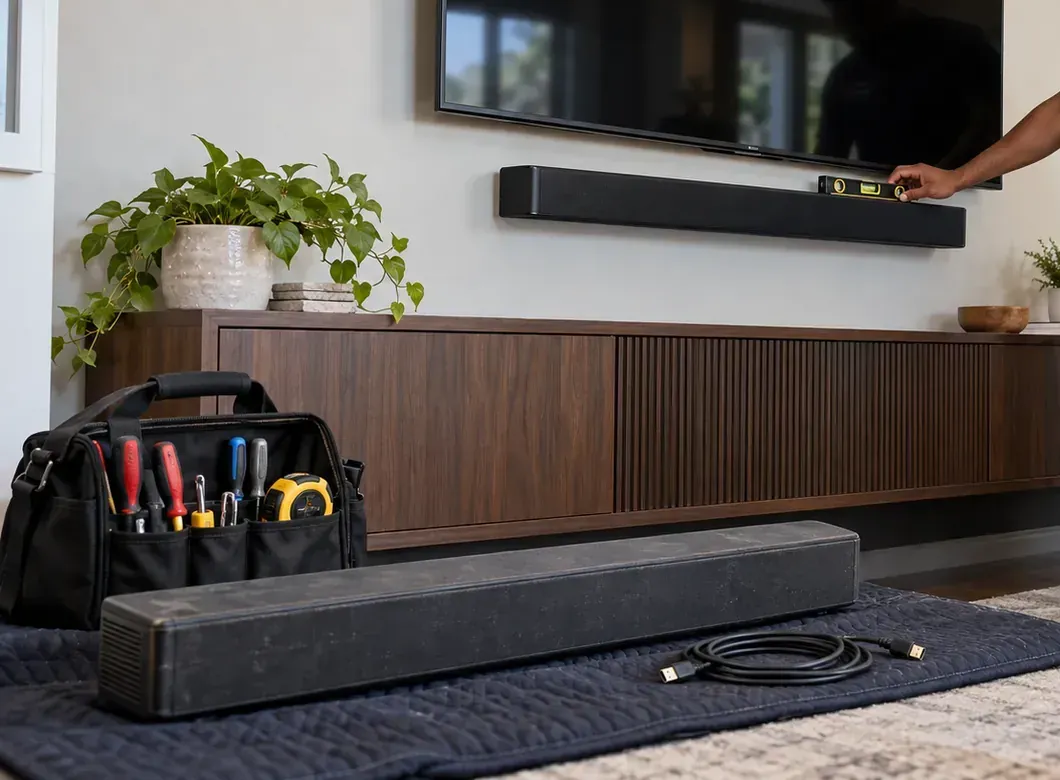
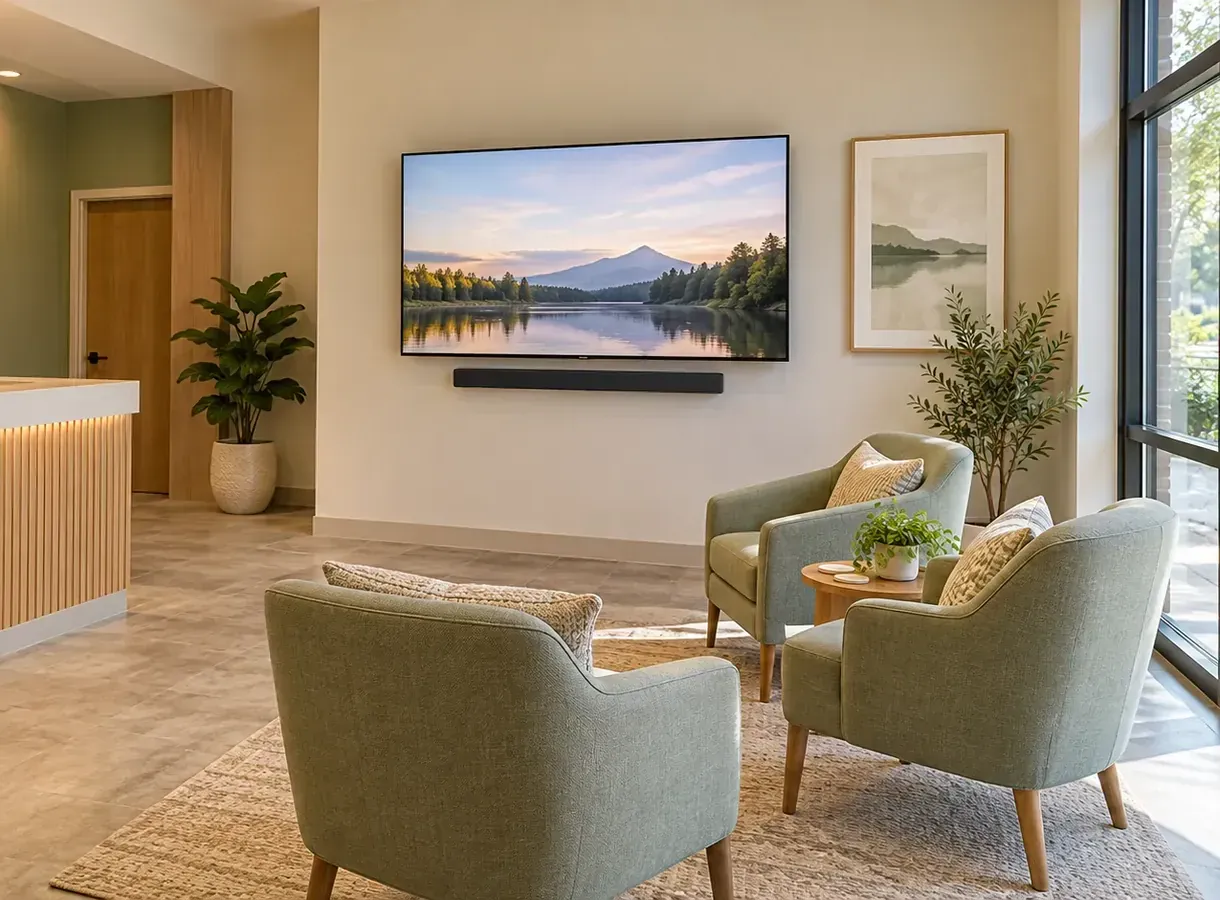
The last level check before the room is handed back. In a Tottenville village house the wall may be plumb at the bracket and out of true a foot away, so the bar is levelled to the picture, not to the ceiling line.
Tottenville Soundbar Quote
Tell us the house and the wall — we call back with a written price the same working day
✅
Request Sent!
We'll call you back the same business day.
25+
Years Experience
✓
Same-Day Estimates
100%
Licensed & Insured
4.7★
201 Google Reviews
Old village house or 1990s colonial, the first question is the same: what is behind the paint? Call (347) 934-8335 or send the short form with the year the house was built, if you know it, and a photo of the TV wall. The written price comes only from the lines published on this page.
No toll, mileage or “end of the line” surcharge for a 10307 address
$129 to hang the bar under a wall-mounted screen, $79 to set it on the console, plaster +$45
NYS low-voltage licence #12000287431, insured, booked seven days a week
Tottenville is the last stop on everything: the Staten Island Railway, Hylan Boulevard, Amboy Road and New York State itself. The neighborhood occupies the south-western tip of the island, with the Arthur Kill on its western and northern side, Raritan Bay and the open water of the New York Bight to the south, and Perth Amboy, New Jersey, close enough across the Kill to read the waterfront. Wikipedia's entry calls it the southernmost neighborhood in both New York City and New York State, and the westernmost in the city. The Staten Island Railway reached it on June 2, 1860, and the run from Tottenville station to St. George is still fourteen miles and about forty-two minutes. That distance from everything else is why the neighborhood looks and feels the way it does, and it is why the houses here split so cleanly into two groups.
The first group is the old village. Captain Christopher Billop called his land Bentley Manor after his ship; the name Tottenville arrived in 1869. Through the nineteenth century the place lived on oysters, shipbuilding and, later, the Atlantic Terra Cotta works, and the people who made money from those trades built houses that still stand along Amboy Road, Bentley Street, Hopping Avenue and Satterlee Street. Forgotten New York's walks through the neighborhood list a Greek Revival house at 76 Bentley from around 1850, a house at 88 Bentley built around 1890 for a shipbuilder, a Gothic Revival cottage at 92 Hopping from 1886, a Colonial Revival house at 65 Hopping from 1903, and an Italianate house on Satterlee built for the shipbuilder James Rutan. The Rutan-Journeay House at 7647 Amboy Road dates to 1848, and the Second Empire house at 7484 Amboy Road, built as the Bethel church parsonage, was landmarked in 2005 after a fight over its demolition. Behind the clapboard of houses like these sit plaster walls on wood lath, framing cut to sizes nobody has used since, and wall cavities that may hold anything from horsehair to old wiring.
The second group is much younger. Wikipedia notes that in the 1990s the area south-east of Hylan Boulevard, previously almost empty, saw intense levels of new home construction. The census numbers make the split vivid. Of Tottenville's 5,412 housing units, 20.4 percent were built in 1939 or earlier, then almost nothing for forty years — only about one unit in eight from 1940 through 1979 — and then 17.2 percent in the 1980s, 22.9 percent in the 1990s and 15.2 percent in the 2000s. The median year built is 1989. A 2006 profile in The Cooperator quoted a local broker describing old fourteen-foot-wide bungalows being replaced by “Florida Style” center-hall colonials, with stucco and brick the favourite exteriors, and a Tottenville real-estate guide describes the newer stock as side-hall and center-hall colonials that can be one- or two-family homes. Those houses have drywall on studs, builder-run coaxial cable, gas fireplaces in framed bump-outs and family rooms open to the kitchen — a completely different set of problems from the village.
Then there is the shore. Tottenville Beach was largely undeveloped until the 1990s and is now an all-residential strip bordered by Conference House Park. When Hurricane Sandy came ashore in October 2012, the Staten Island Advance reported from Yetman Avenue, where a gigantic wave tore through the end of the street near Billop Avenue and left cement foundations filled with muddy water where houses had stood. “This whole block has to be leveled,” one resident of twenty years told the paper. The Coral Bay Cafe at the beach was destroyed. Twelve years later, in September 2024, the state announced the completion of Living Breakwaters: eight partly submerged breakwaters, 2,400 linear feet in all, built for $111 million and designed to cut waves reaching the shore's buildings and roads to under three feet, with sand added to the beach from Manhattan Street to Loretto Street. The houses behind it are a mixture of survivors, repaired homes and new builds raised above the flood line, and each of them asks a soundbar installer the same question: what goes on the floor, and what never should.
Almost everyone here owns the wall they want to drill. The census estimate puts owner occupancy at 82.9 percent of occupied homes, and nearly a quarter of all housing units are in two-unit buildings, so the most common “permission” question in Tottenville is not a landlord's but a family's: who lives on which floor, whose cable account feeds which TV, and whether a subwoofer upstairs is fair to the people downstairs. Condo communities such as Surfside Village and the Captain's Quarters, which the 2006 Cooperator piece named as the neighborhood's two main condo developments, add an association's rules on exterior walls and common elements. We ask about all of that when you book, because it changes the plan more than the brand of soundbar does.
Tottenville at a glance, for anyone planning a TV wall
16,089 residents in the Tottenville–Charleston tabulation area at the 2020 census, down 4.6% from 2010, across 2.505 square miles (Wikipedia, citing NYC Department of City Planning data).
20.4% built before 1940, 55.3% built 1980–2009: two building booms with a forty-year gap between them; median year built 1989 (ACS 2019–2023 estimates via Point2).
82.9% owner-occupied, 24.4% of units in two-unit buildings: mostly owners deciding for themselves, often with family on another floor (ACS via Point2).
14 miles, 42 minutes by Staten Island Railway from Tottenville station to St. George; the new Arthur Kill station, opened January 21, 2017, replaced the Atlantic and Nassau stops (Wikipedia; DNAinfo).
2,400 feet of breakwaters, $111 million: Living Breakwaters, completed September 2024, with beach sand added from Manhattan Street to Loretto Street (Office of the Governor).
Seven Preservation League awards on Tottenville buildings, among them 88 and 115 Bentley Street, 24 Brighton Street, 7639 and 7647 Amboy Road and the Carnegie library at 7430 Amboy Road (Wikipedia).
Put together, those numbers describe a neighborhood where the age of the house predicts the job better than its size. A 1993 colonial off Page Avenue and an 1886 cottage on Hopping Avenue might be a five-minute walk apart and have nothing in common behind the TV. That is why this page is organised by wall era rather than by room, and why the first thing we ask on the phone is roughly when the house was built.
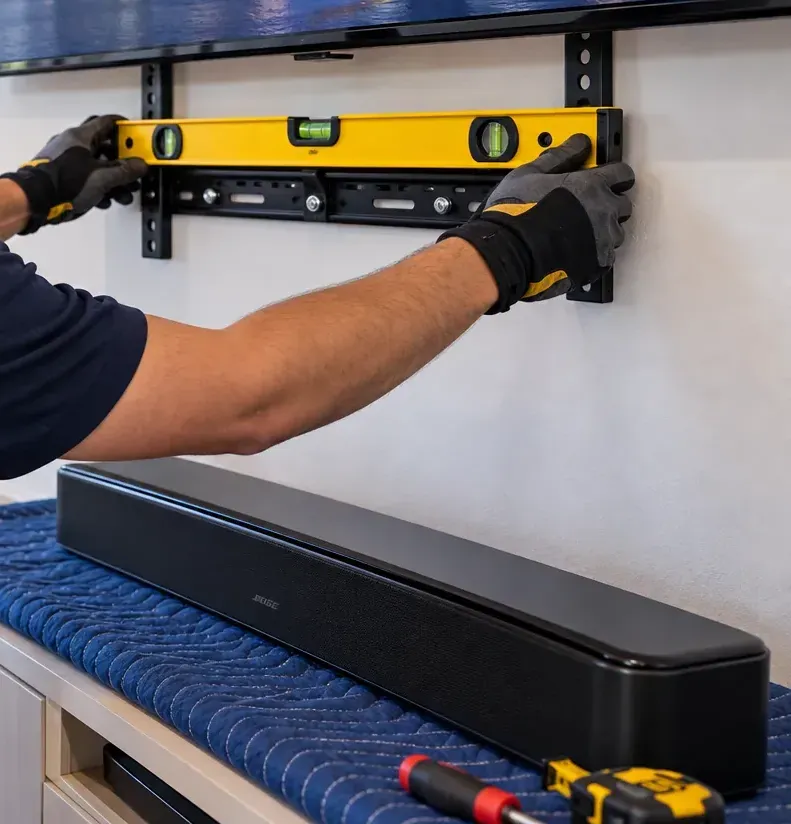
Wall plate levelled first, bar second. The blanket under the soundbar keeps the grille and the top of the cabinet free of drill dust while the fixings go in.
Two Tottenvilles
Plaster Village or 1990s Colonial: Reading a Tottenville TV Wall
Before anything is drilled, we sort a Tottenville TV wall into one of three eras. The table below is the short version of what each era usually hides, and what it changes about the visit. Your house may straddle two of them — a village house with a 1990s addition is common — in which case we treat each wall on its own merits.
Tottenville TV walls by era
Era and where you find it
What the TV wall usually is
What it changes for the soundbar
Village houses, about 1840–1939: Amboy Road west of Page Avenue, Main Street, Bentley, Hopping, Satterlee, Brighton, Johnson and Wood
Plaster on wood lath over irregular studs; sometimes several layers of wallpaper under a skim coat; balloon framing in some houses
Studs located by test-drilling, not by scanner alone; plaster add (+$45); slow drilling to protect keys; TV-attached bracket offered where the plaster is fragile
Bungalows and cottages, early-to-mid twentieth century, scattered through the village and near the water
Thin plaster or early wallboard on small framing, low ceilings, a single outlet per room
Compact bars; power and cable planned around one outlet; console placement often the better choice
Builder colonials, 1980s–2000s: south-east of Hylan Boulevard, off Page Avenue, Arthur Kill Road and the streets toward the beach
Half-inch drywall on 16-inch studs; gas fireplaces in framed bump-outs; builder coax and phone jacks; open family rooms
Standard $129 mount; in-wall kit ($169) usually possible; care around fireplace vents and chases; subwoofer placement in big open rooms
Two-family houses, all eras, about a quarter of the housing stock
Same walls as above, but with another household above or below
Bass and late-night settings planned with both floors in mind; separate networks and accounts
Shore rebuilds and raised houses, 2013 onward: Yetman, Billop, Manhattan, Loretto and the beach blocks
New drywall on new framing a storey or more above grade; enclosed ground floors for parking and storage
Everything with a plug kept on the living floor; cable routes planned to avoid the flood-vented ground level
Condos and townhouses: Surfside Village, the Captain's Quarters and smaller developments
Drywall, sometimes on metal studs; shared walls
Association rules on common walls; metal-stud add (+$30) where it applies; certificate of insurance free
The point of the table is not to scare anyone. Most Tottenville soundbar jobs are an hour or two of careful work. But the village houses are where a hurried installer cracks a ceiling or puts a toggle into nothing, and the newer houses are where a confident one drills into a fireplace chase or a vent run. Knowing the era before arrival is how we bring the right anchors and the right bit, and how the price you're quoted is the price you pay.
How the two halves of Tottenville differ on the day
Same job, two kinds of house
On the day
Village house north of Hylan
Colonial south-east of Hylan
Finding framing
Small test holes behind where the bracket will sit, because scanners misread lath
Scanner plus a check of the fireplace bump-out and any chase
Drilling
Slow, sharp bit, low hammer, tape over the mark to keep the plaster key intact
Standard; dust caught at the hole
Hiding the cables
Usually a paintable cord cover ($59) or a cabinet run; in-wall only where the cavity is open and clean
In-wall kit ($169) behind the TV in most stud bays
Subwoofer
Small rooms and wood floors: placed away from corners and china cabinets, level set low
Large open rooms: placed for the seats, often near the sofa rather than the TV
Typical add-ons
Plaster (+$45), backer board ($85) where framing is irregular
Cable run to a cabinet ($99), Sonos setup ($125)
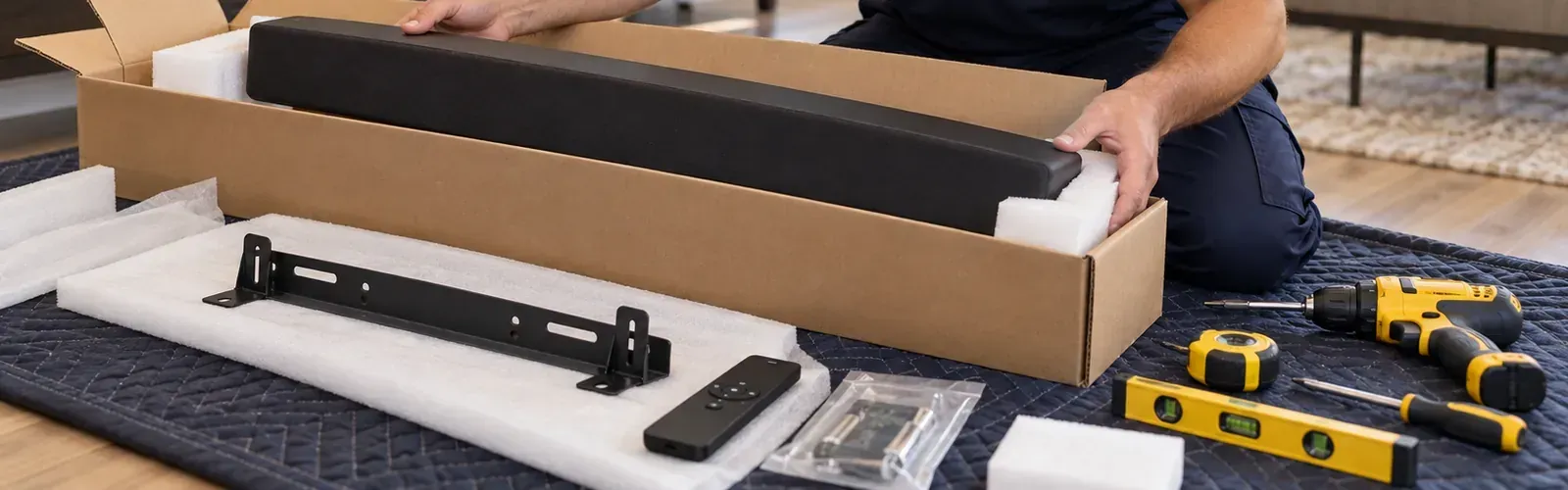
Everything out of the box and on the blanket before the first hole: bracket, remote, the bag of screws that came with the bar, and the tools that will replace those screws if the wall calls for it.
What We Install
Soundbar Installation Services in Tottenville
Pick the pieces your room needs; each one has its own published line in the price tables lower down. However the job is put together, nobody leaves until the bar sits true beneath the screen, the cables are either inside the wall or neatly dressed along it, one remote controls the volume, and you have heard a film scene from your own chair.
Bar Under the Screen on Old Plaster
The village-house job. We find the studs behind the lath by test-drilling where the bracket will cover the holes, drill slowly so the plaster keys stay intact, and fix into wood rather than into plaster alone. $129 plus the $45 plaster line.
Bar Under the Screen on Drywall
The colonial-era job: half-inch drywall on studs, a scanner, two screws into framing and a level. $129 with the bracket from the soundbar box, or $213.99 with the Sanus bracket we supply.
TV-Attached Brackets
Where a plaster wall is cracked, delicate or simply not yours to drill twice, the bar hangs from the TV's own mount on a TV-attached bracket and moves with the screen. The Sanus bracket is $84.99.
Fireplace-Wall Bars
Gas fireplaces in framed bump-outs are common in the 1990s houses. We locate the vent and the chase before drilling and fix only to framing the fireplace manufacturer allows.
In-Wall Wiring
A code-compliant in-wall power and cable kit ($169) where the stud bay is clear; a paintable cord cover ($59) where the wall is plaster that shouldn't be opened or the cavity is blocked.
Console Placement
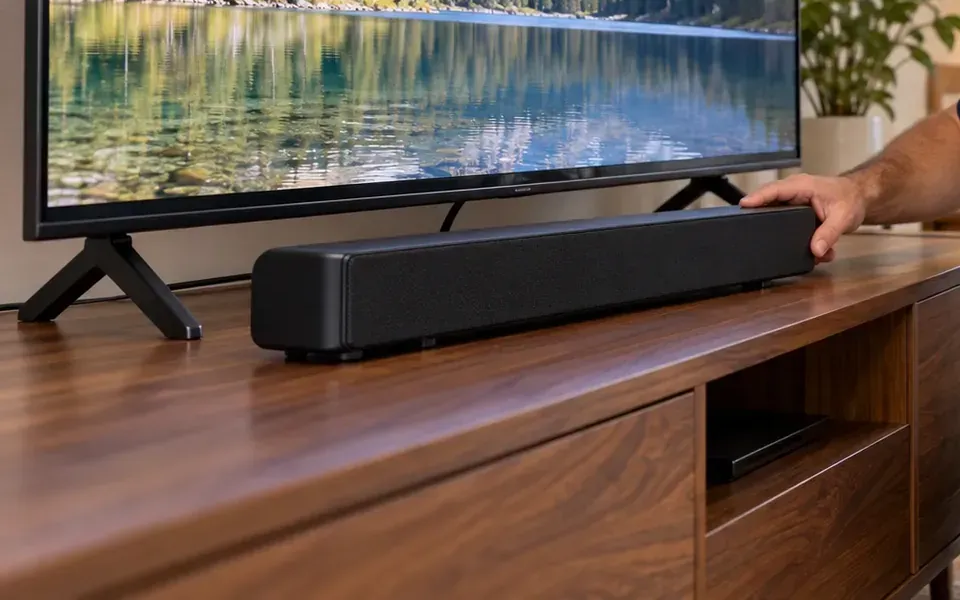
Nothing drilled: the bar stands on the cabinet in front of a TV on its feet, wired by HDMI and answering the TV remote. $79. Good for a cottage with one outlet, or for a house whose walls are about to be opened anyway.
Bar, Subwoofer and Rears
Rear speakers on stands or brackets, the subwoofer placed for the seats and for the floor below, and room calibration run from the sofa. Sonos setup is $125; a full home theater hookup $350.
Two-Family Setups
One system per household, each on its own network and account, with bass and night settings agreed so the floor between stays a floor and not a drum.
Shore-House Placement
In raised and rebuilt houses near the beach, every powered part on the living floor, one reachable surge-protected strip on a shelf, and nothing plugged in on the flood-vented level below.
Two things we don't do: add or move electrical outlets (that is a licensed electrician's job, and we're happy to work the same day one does) and patch or paint. If the TV wall needs an outlet behind the screen for an in-wall kit, we tell you before the visit so the electrician can come first.
Repair Capture
Tottenville Soundbar Silent Since the Last Outage or Update?
Silence after a nor'easter knocked the power out, a sub that blinks and won't reconnect, a TV remote that has stopped turning the bar up, or speech that lands a beat after the lips move: none of these needs a new installation. They are service calls, booked into the first free two-hour window, and the usual settings or connection fault is put right within one to two hours of the technician walking in. On Staten Island a setup-only visit is $225 for the first hour, then 30-minute blocks. Call (347) 934-8335 and say it's a soundbar fault; our visit and rescheduling policies explain the windows.
Building Specialists
Soundbar Installation for Tottenville's Architecture
The building stock in Tottenville is unusually mixed for a neighborhood of its size. A real-estate guide to the area describes “a mix of older turn of the century homes and new home construction,” listing “older cottages, Dutch colonial's, Second Empire Victorian” on one side and side-hall and center-hall colonials, “one or two family homes,” on the other. These are the house types we plan for, and what each usually means for the soundbar.
Greek Revival and Italianate Village Houses
The mid-nineteenth-century houses on Bentley, Satterlee and Amboy Road. Thick plaster on lath, tall windows that eat wall space, and framing that may be hand-sawn and irregular. We test-drill for studs and often use backer board ($85) to spread the load.
Gothic Revival and Picturesque Cottages
Smaller, steeper-roofed houses such as the 1886 cottage on Hopping Avenue. Rooms are compact, so a compact bar sized to the TV usually sounds better than a long flagship that overhangs the screen.
Second Empire and Late-Victorian Houses
Mansard roofs, high-ceilinged parlors, decorative trim. The TV usually goes on a parlor wall between openings; we plan the bar around casings and picture rails without cutting original trim.
Colonial Revival and Early Twentieth-Century Frame Houses
Houses like 65 Hopping Avenue from 1903. Plaster again, sometimes skim-coated in the 1950s or later over wallpaper. Plaster add (+$45) applies.
Bungalows and Small Cottages
The narrow single-storey houses that the 2006 Cooperator profile said were being replaced by colonials. Those that remain have small rooms and few outlets; a console bar is often the sensible option.
1980s Side-Hall Colonials
Many built as two-family homes. Drywall on studs, family room at the back, cable entering on one side of the house. The standard $129 mount, with a $99 cable run if the box lives elsewhere.
1990s Center-Hall Colonials
The “Florida style” houses with stucco and brick exteriors. Gas fireplaces in bump-outs, open family rooms, sometimes a two-storey entry. In-wall kits are usually straightforward.
Post-Sandy Rebuilds
New framing a storey or more above grade, with enclosed ground floors for parking and storage. Walls are easy; placement of power and the subwoofer is the real decision.
Condos and Townhouses
Surfside Village, the Captain's Quarters and smaller groups. Drywall, sometimes on metal studs (+$30), shared walls, and an association whose rules we read with you.
How we fix the bracket to each Tottenville surface
Surface
How it is fixed
Price effect
Plaster on wood lath
Studs found by small test holes under the bracket's footprint; pilot holes drilled slowly with tape over the mark; screws into framing, never into plaster alone
+$45 plaster
Plaster skim-coated over old wallpaper
As above, plus a sharp cut through the skim so the paper beneath doesn't tear and lift around the hole
+$45 plaster
Irregular or widely spaced village framing
A painted plywood backer board fixed to two studs, the bracket fixed to the board
$85 backer board
Drywall on wood studs
Scanner, two or more screws into studs
$0
Drywall over a gas-fireplace bump-out
Fixings only to framing outside the clearances in the fireplace manual; vent route located first; TV-attached bracket offered where the framing is wrong
$0, or the $84.99 Sanus bracket
Brick or stone (chimney breasts, accent walls)
Sleeve or wedge anchors with a hammer drill, dust contained
+$65 brick or stone
Concrete or block (foundation walls, some ground floors)
Masonry anchors; cord cover for the cable
+$75 block or concrete
Metal studs (some condos and commercial fit-outs)
Toggles rated for the load, set beside a stud where possible
+$30 metal studs
Tile or marble (kitchens, basement bars)
Diamond bit, slow, through the grout line where the layout allows
+$95 tile or marble
A note on landmarked houses. A few Tottenville buildings are individual New York City landmarks, among them the Bedell house at 7484 Amboy Road and the Rutan-Journeay house at 7647 Amboy Road. The Landmarks Preservation Commission says interior work generally does not need its review unless the work needs a Department of Buildings permit, affects the exterior, or is in a designated interior landmark. A soundbar bracket inside the living room is none of those. A speaker or cable on the outside of a landmarked house is another matter, and we would ask the Commission before doing it.
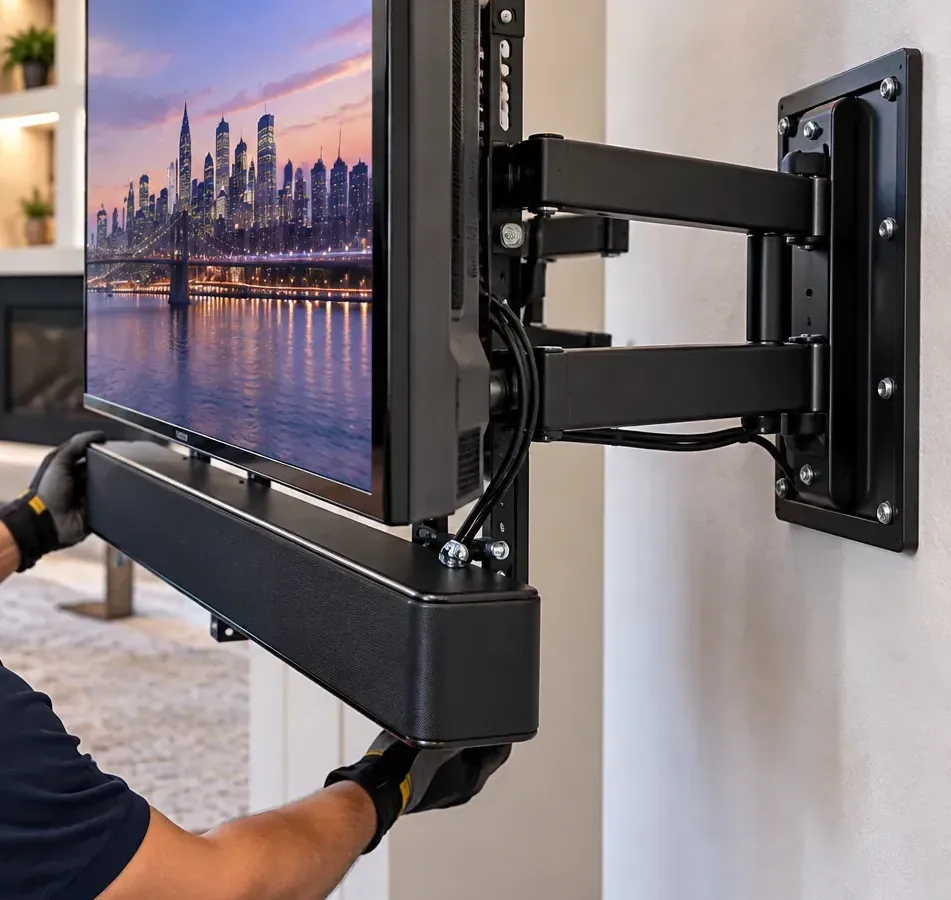
A TV-attached bracket carries the bar on the TV's own arm, so it swings with the picture and adds no new holes to an old plaster wall.
Commercial Soundbar Installation
Business Soundbar Installation in Tottenville
Tottenville's business life sits in two places. Wikipedia's history of the neighborhood describes Main Street as the commercial corridor until the 2000s, when a second core grew along Page Avenue and west of Amboy Road. Soundbars in Tottenville businesses go under TVs in waiting rooms, behind counters and in dining rooms, and the jobs follow the same price lines as a home, with the certificate of insurance free.
Main Street
The old downtown: small storefronts in older buildings, the post office at 228 Main Street, the 123rd Precinct at 116 Main Street and the Masonic Hall. Older shop walls are often plaster or brick; we check before quoting.
Amboy Road
The long spine of the neighborhood, lined with houses, churches and businesses. The Tottenville Shopping Center at 7001 Amboy Road, a 45,000-square-foot centre that was renovated and given a new 20,000-square-foot building from 2013, sits toward the eastern edge of the neighborhood.
Page Avenue
The newer commercial core, with plazas, banks and offices near the Amboy Road intersection. Newer construction usually means drywall on metal or wood studs and a drop ceiling for cable.
Arthur Kill Road
From the Arthur Kill station, opened in 2017 with a 150-space lot between Lion Street and Barnard Avenue, the road links the station, the shore streets and the shopping along Page Avenue. Waiting-room and break-room bars are the usual jobs along it.
Ellis Street and the Waterfront
Restaurants overlooking the Arthur Kill, such as Angelina's on Ellis Street. Dining rooms with big windows need bars set for speech, not for volume.
Hylan Boulevard's End
Hylan Boulevard, built in pieces in the 1920s, ends at Satterlee Street by Conference House Park and divides the old village from the newer blocks.
Rules a Tottenville business soundbar should respect
Protruding objects: the 2010 ADA Standards (section 307.2) limit wall-mounted objects whose leading edge is between 27 and 80 inches above the floor to 4 inches of projection into a circulation path. A soundbar under a waiting-room TV usually sits inside that zone, so we place it where people don't walk or keep it shallow.
Music and TV in a business: federal copyright law (17 U.S.C. §110(5)(B)) lets many small shops and restaurants play broadcast radio and TV without a separate licence, within size, speaker-count and screen-size limits. Streaming playlists are a different matter. The question below sets out the limits.
Noise: the city noise code limits sound from commercial establishments into neighbouring homes. A bar under a TV rarely gets near those limits, but we set a maximum volume where a business shares a wall or floor with an apartment.
Paperwork: plaza managers and landlords often want a certificate of insurance naming them. We provide it free, usually the same day.
Landmarks: the George Cunningham Store at 173 Main Street is the subject of a Landmarks Preservation Commission designation report; exterior speakers or cable on any landmarked building need the Commission's view first. Interior bars don't.
A waiting area of the kind found in the offices along Amboy Road and Page Avenue: one screen, one bar under it, volume set for the chairs rather than the counter.
Your Questions Answered
Soundbar Installation in Tottenville: Questions Answered
These are the questions Tottenville owners ask that are particular to the houses and blocks here: the plaster village, the newer colonials, the rebuilt shore, and the businesses on the old and new commercial streets. Shorter questions about booking and prices are in the FAQ further down. The Staten Island soundbar installation page covers hi-ranch block walls, stone-veneer fireplaces and townhouse party walls across the borough, so we don't repeat them here.
The old village: houses from before 1940
Our 1890s house may still have knob-and-tube wiring inside the walls — can a soundbar cable share the cavity, and is the old outlet fit for the bar and subwoofer?
Possibly, but not before somebody qualified has looked at it. Knob-and-tube is the two-wire system of porcelain knobs and tubes that the home inspectors' association InterNACHI says was in common use from about 1880 to the 1940s, which is exactly the age of a good share of the houses north of Hylan Boulevard. It was designed to shed heat into open air. InterNACHI warns that insulation packed around it causes heat to build up and creates a fire hazard, that it has no ground wire, and that many insurers refuse to cover houses that still have it unless an electrician certifies the system.
That matters to a soundbar job in two ways. First, the cable route. If we open the stud bay behind the TV to fish an HDMI and power kit and find live knob-and-tube conductors running through it, we stop. Low-voltage cable should never be pulled against or tied to them, and the in-wall power kit we use is designed to connect to a modern receptacle, not to splice into century-old wiring. In that case the wiring goes in a paintable cord cover ($59) on the surface or down to a cabinet, and the cavity is left alone. Second, the outlet. A soundbar and an active subwoofer draw little power, but both expect a grounded three-prong outlet. Plugging them into a cheater adapter on an ungrounded two-prong outlet defeats the protection the plug was designed for.
So the honest order is: if you know or suspect the house still has knob-and-tube, have a licensed electrician evaluate it and, ideally, add a grounded outlet behind the TV first. We can work the same day the electrician finishes. If the wiring has already been replaced — many village houses were rewired decades ago — tell us when, and we will carry on as normal. Either way we look into the cavity with a light before anything goes into it.
The wall cavities and attic of our old house hold a loose, pebbly, grey-brown insulation — what happens if a soundbar cable has to pass through it?
Then the cable does not go through it. Loose, granular insulation that looks like small grey-brown or gold pebbles is very often vermiculite, and the U.S. Environmental Protection Agency says that homeowners should assume vermiculite insulation may be contaminated with asbestos. The EPA's advice is to leave it undisturbed, because disturbing it can release fibres into the air, and that any removal should be done by a trained, accredited asbestos abatement contractor.
In practice that rules out fishing a cable down from the attic, or up from the floor below, through a cavity that contains it, and it rules out opening a wall to install an in-wall kit if the vermiculite has settled into the bay. We check before we cut. If you have seen this material in the attic, tell us when you book and we will plan the job as a surface or cabinet route from the start: a paintable cord cover ($59) dressed into the corner of the chimney breast or the window casing, or a $99 cable run along the baseboard to a cabinet where the cable box can live.
None of this stops the soundbar going on the wall. The bracket's pilot holes go into studs behind plaster, not into the open bay, and we drill only where the bracket sits. If you later have the insulation professionally removed, the in-wall option becomes available and moving the cable inside is a short return visit.
Our plaster was skim-coated years ago over several layers of old wallpaper — will a bracket hold, and will drilling make the surface bubble?
The bracket will hold, because it never relies on the plaster. Whatever is layered on the surface, the screws pass through it and into a stud or into a backer board fixed to studs. The plaster and paper are only a finish that the bracket rests against. What does need care is the finish itself. Wallpaper under a skim coat is a weak layer: when a drill bit grabs it, it can tear the paper behind the skim and lift a coin-sized blister around the hole, sometimes larger.
We prevent that by scoring the skim coat with a sharp blade at each mark, drilling with a new, sharp bit at low speed with no hammer action, and backing out often to clear the dust. Tape over the mark helps hold the surface together while the bit breaks through. If the plaster under the paper turns out to be loose from the lath — you can sometimes hear it as a hollow sound when tapping — we move the bracket a stud over, or we use the TV-attached bracket option so the bar hangs from the TV mount and the plaster is left alone.
If a small blister does appear, it stays behind the bar and the bracket, which cover a larger area than the holes. We tell you before we start whether your wall looks like a candidate, and the plaster line on the price list (+$45) covers the extra time.
1980s and 1990s colonials south-east of Hylan
Our family-room TV goes above a direct-vent gas fireplace in a framed bump-out — could a drill hit the vent or the firebox?
It could, which is why we find both before choosing where the bracket goes. A direct-vent gas fireplace sits inside a framed box, usually with a vent pipe running up and out through the wall or roof, and the manufacturer's manual sets clearances between that pipe and anything combustible. One widely sold model's manual, for example, gives 2 to 3 inches of clearance around horizontal vent runs and states that a TV bracket must be fixed to framing, never to the fireplace itself. Builders in the 1990s framed these bump-outs in many different ways, and the vent may run straight up behind the spot where a TV would naturally go.
So we ask for the fireplace's make and model, or a photo of the label inside the lower grille, and we look for the vent termination outside the house to work out the pipe's route. On the day we scan the bump-out, check for a firestop at the top, and fix the TV mount and the soundbar bracket only into framing outside the manufacturer's clearances. If the framing in the safe zone isn't strong enough, a backer board spreads the load across it, or the soundbar hangs from the TV mount instead of from the wall.
Two related points. Heat rising from a working fireplace is hard on electronics above it; most bars tolerate it, but we keep the bar to the side of any hot air outlet and recommend checking the TV maker's guidance on mounting above a heat source. And a TV over the fireplace adds $130 to the TV mounting job, separate from the soundbar's own $129.
Our kitchen TV folds down from under the wall cabinets — is there any way to add a soundbar to it?
Usually yes, with a small bar and a careful look at clearances. Under-cabinet fold-down TVs were a popular kitchen option in houses of the 1990s and 2000s, and their built-in speakers are small and point down at the counter, which is why people struggle to hear them over a range hood or a running tap. The fix is a compact soundbar, often under 24 inches long, mounted either to the underside of the cabinet beside the hinge or on the wall just below the cabinet line, where the folded TV will clear it in both positions.
Before we drill, we fold the TV through its full arc with a tape measure in hand. Many fold-down mounts swing the screen forward and down by several inches, and a bar in the wrong place stops the screen closing or catches a corner. We also check the cabinet bottom: some are only a quarter-inch panel and can't carry a screw, so the bar's bracket goes to the face frame or to blocking above it. Power usually comes from the TV's own outlet in the cabinet, and audio goes over HDMI if the TV has ARC, or over optical if it is old enough not to.
Keep the bar away from the steam of the kettle and the heat over the range; grease is the enemy of speaker grilles. The job is priced like any wall mount: $129, plus the tile line (+$95) only if we have to drill through a tiled backsplash.
The house came with a home-theater-in-a-box and a subwoofer the last owners left behind — can that subwoofer work with our new soundbar?
Sometimes, but less often than people hope. Most modern soundbars pair only with their own wireless subwoofer, made for that bar, and have no input for a third-party one. A smaller number of bars, and almost every A/V receiver, have a wired subwoofer output, a single RCA jack marked SUB or LFE. If your bar has that output and the old subwoofer is a powered one with its own amplifier and line-level input, a single cable connects them and the bar's bass settings can be set to hand the low notes to it.
The catch is what the old system actually is. Many home-theater-in-a-box subwoofers are passive: they contain the speaker but not the amplifier, and they were driven by the system's main box through speaker wire. A passive subwoofer cannot be connected to a soundbar at all without an extra amplifier, which defeats the point. We identify which kind you have from the back panel — a power cord and a line input mean powered, two spring clips and no power cord mean passive — before you spend anything.
If the old sub won't work, the bar's matching sub is the cleaner answer, and we'll set it up and place it for the room. The abandoned speaker wire in the walls can be cut back and capped neatly behind a blank plate. Setting up a soundbar with an extra subwoofer is covered by the soundbar lines; a receiver-based system is the $129 receiver line.
Shore blocks and storm season
If a soundbar and subwoofer in our basement or ground-floor den are ruined in a flood, will our flood insurance pay for them?
Probably not, and it is worth knowing before you decide where they go. Under the National Flood Insurance Program, FEMA describes coverage in a basement as limited. CNBC's 2024 explainer of the rules lists televisions, computers and couches among the personal property a standard policy doesn't cover in a basement, while items such as furnaces, water heaters, electrical outlets and circuit-breaker boxes are covered as part of the building. FEMA defines a basement as any area with a floor below ground level on all sides, which can include sunken rooms and the lower level of some split houses.
Raised houses near the beach have a parallel rule. Coverage in the enclosed area below the lowest elevated floor — the ground-level garage or storage space of a rebuilt house on Yetman Avenue or Loretto Street — is also limited under the program. Check your own declarations page with your agent, because private policies differ, but the safe working assumption is that electronics stored or used below the living floor are not insured against flood.
That is one more reason we plan Tottenville shore jobs with everything that has a plug on the living floor. If the family room really is downstairs, we mount the bar on the wall rather than leaving it on a low console, put the subwoofer on a riser or choose a wall-mounted alternative, and put the power strip on a shelf so it can be unplugged quickly when a storm warning goes out. That costs nothing extra beyond the usual lines, and it may be the only protection those parts have.
After every storm warning we wonder about surges — is a plug-in surge strip enough for the soundbar and TV, or should we ask for whole-house protection?
Both have a place, and they protect against different things. A plug-in surge-protective strip behind the TV catches surges that arrive on the power wiring inside the house; a good one also protects the coaxial cable line from the cable company, which is a common route for a surge into a TV and soundbar. We put one on every installation, mounted where it can be reached and switched off, and we connect the soundbar, subwoofer, TV and cable box to it.
A whole-house surge protector is installed by an electrician at the electrical panel. Since its 2020 edition the National Electrical Code, in section 230.67, has required a Type 1 or Type 2 surge-protective device on all services supplying dwelling units, including when the service equipment is replaced. Many older Tottenville houses predate that rule, and so do panels replaced before it took effect locally. Whether your panel has one, and whether New York City's own electrical code requires it for your situation, is a question for a licensed electrician, not for us.
What we can say is that the two work as layers. The panel device takes the big hit from outside; the strip deals with what gets through and with surges generated inside the house by motors and compressors. Neither helps if the equipment is sitting in water, so in a flood-prone house we still keep the strip off the floor. And when a storm is forecast and you're leaving, unplugging the strip is the cheapest protection of all.
Shops and restaurants on Main Street, Amboy Road and Page Avenue
Do we need a music licence to play the TV through a soundbar in our Tottenville shop or restaurant?
Often not for ordinary broadcast TV and radio, provided the business stays within the limits in federal copyright law. Section 110(5)(B) of the Copyright Act exempts many establishments from needing a licence to play a licensed radio or TV broadcast, or a cable or satellite transmission, for customers. A shop or office qualifies if it has less than 2,000 gross square feet; a restaurant or bar if it has less than 3,750. Larger businesses qualify only within equipment limits: no more than six loudspeakers in all and no more than four in any one room or adjoining outdoor space, and for TVs no more than four screens, no more than one in any room, and no screen larger than 55 inches diagonally.
There are conditions in every case: no charge to see or hear the transmission, and no further transmission beyond the premises. And the exemption is about broadcasts. It doesn't cover streaming music services aimed at households, playlists from a personal account, or recorded music, all of which normally need a business music service or performing-rights licences.
This is information, not legal advice, and we don't decide whether your business qualifies. What we do is set the system up so it is easy to stay inside the lines you have chosen: one soundbar per screen counts as one loudspeaker source per room in most layouts, a bar under a 55-inch screen keeps you within the screen limit, and streaming apps can be removed from the bar so staff don't switch to a personal playlist by accident. For larger dining rooms that need many speakers, our commercial AV team on Staten Island designs to your licensing choice.
We run a small fitness studio off Page Avenue — is a soundbar loud enough for a class, or do we need real speakers?
For a class that follows a video on the screen, with a handful of people in a room up to the size of a two-car garage, a good soundbar with its subwoofer can do the job. Soundbars are designed to project speech and music forward to a seating area, and a fitness room is essentially a living room without the sofa. The bar sits under the TV at the front, the instructor's video carries the music and cues, and a subwoofer set back from the walls gives the beat some weight without booming.
Where a soundbar falls short is in larger rooms, loud spin or HIIT classes with a microphone, and spaces with hard floors and mirrored walls, which reflect sound and make speech harder to follow. A bar has no microphone input, so an instructor who talks over the music needs a small mixer and speakers that can handle both. In those rooms we hand the design to our AV team for wall or ceiling speakers.
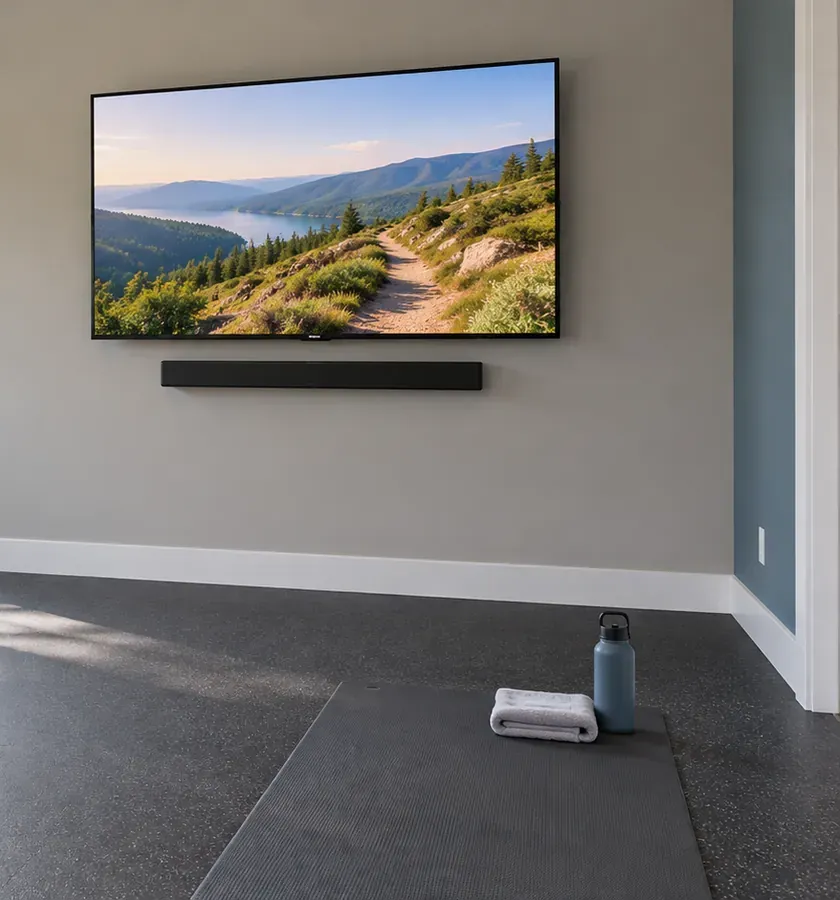
If a soundbar is the right fit, mount it on the front wall below the screen, check for metal studs (+$30) if the space was fitted out recently, and ask us to set a volume ceiling so the class next door, or the apartment above, isn't part of the workout. Rubber flooring helps a little with bass travelling downward; isolating the subwoofer on a pad helps more.
Everyday listening in the house
The adverts and some channels still blast much louder than the show — can the soundbar even that out?
Partly, and it helps to know where the rule ends and the soundbar's job begins. Since December 13, 2012, the Federal Communications Commission's rules under the CALM Act have required TV stations, cable operators and satellite and other pay-TV providers to keep commercials at the same average volume as the programs around them. The FCC accepts complaints about loud commercials through its online consumer form. The rule speaks of average loudness, so an advert can still feel more insistent while meeting it, and the FCC's guidance doesn't say the rule reaches streaming apps.
Most soundbars have a feature that smooths the rest. It goes by different names — auto volume, volume leveller, night mode or dynamic range control — and it narrows the gap between quiet and loud passages. Some TVs have their own version too. Using both at once can make dialogue sound flat and pumping, so we choose one, usually the bar's, and set it so dialogue stays clear.
We also check that the TV is sending the bar the right signal. If the TV's audio output is set to a fixed level with its own processing on, or to a format the bar doesn't handle well, jumps between channels and apps get worse. Setting the TV to pass audio through to the bar and letting the bar do the levelling usually makes the biggest difference. We show you where the setting lives so you can turn it off for a film.
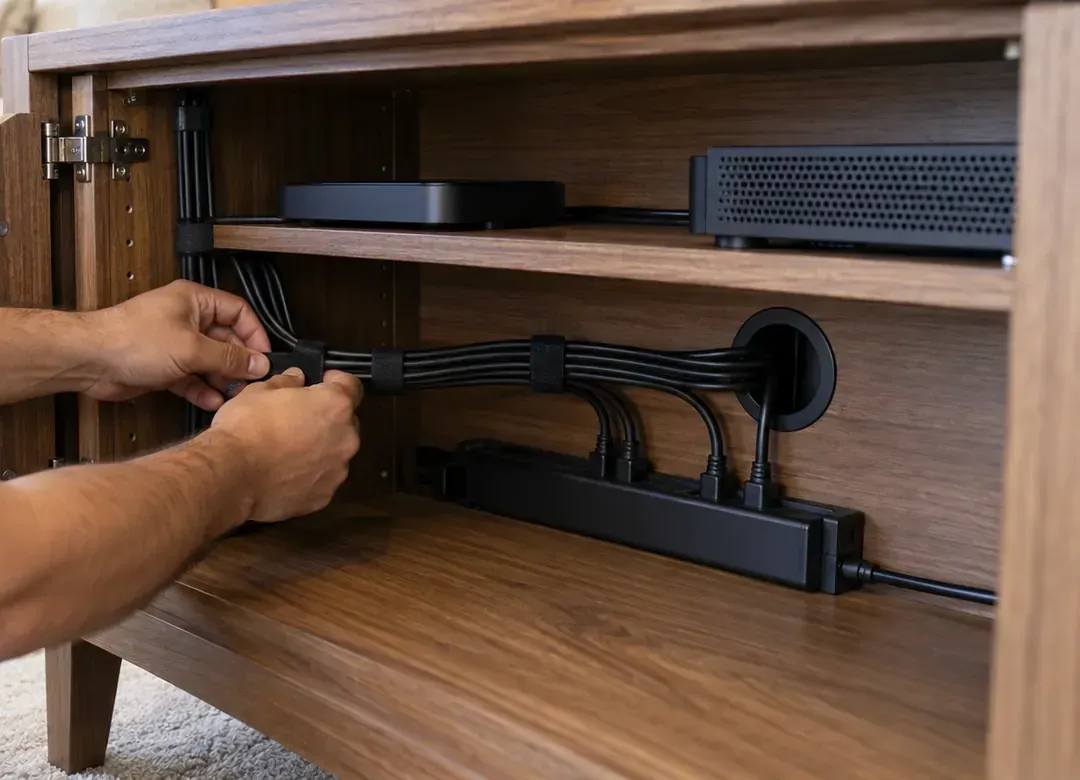
Cables strapped and passed through the cabinet grommet to one surge-protected strip. On a shore block, the strip goes on the shelf, never on the floor.
Equipment
Types of Soundbars and Mounts We Install
Bring a bar from any brand; we supply what goes around it — brackets, raceways, wall kits, surge strips. Here is what ends up in Tottenville rooms most often, matched to the houses it suits.
Compact Bars for Cottages and Bedrooms
Bars under about 30 inches for the small rooms of village cottages, upstairs bedrooms and kitchens. Sized to the TV so the bar doesn't overhang the screen.
Mid-Size HDMI Bars for Parlors
Three-channel bars with a dedicated centre for dialogue, the most useful upgrade for a plaster-walled parlor where speech echoes off hard surfaces.
Atmos Bars for Colonial Family Rooms
Bars with up-firing drivers need a flat ceiling above the seats to bounce sound from, so they suit a family room with an ordinary flat ceiling. Vaulted or sloped ceilings scatter the effect.
Bar, Subwoofer and Rear Kits
For open family rooms and finished basements. Rears on stands where walls are glass or doors, the sub placed for the seats and for the floor below.
Wall Brackets and Backer Boards
The bracket from the box, or the Sanus bracket at $84.99; a painted plywood backer board ($85) when old framing is too irregular to land two screws.
TV-Attached Brackets
Hang the bar from the TV mount so no new holes go into delicate plaster or a fireplace bump-out, and the bar follows a full-motion arm.
In-Wall Kits and Cord Covers
In-wall power and cable kits ($169) for clear drywall bays; paintable raceways ($59) for plaster, brick and cavities we shouldn't open.
Surge Strips and Network Lines
A reachable surge-protected strip on every job; wired network to the bar where Wi-Fi is weak on the far side of a big colonial.
Universal Remotes and Streamers
One handset for the TV, bar and cable box ($99) when the TV's own control over HDMI can't manage all three; streaming devices set up at $49 each.
DIY, a booked handyman or a licensed installer: how each copes with a Tottenville wall
Question
Do it yourself
App-booked handyman or retailer service
Licensed low-voltage installer (AESS)
Plaster on lath in a village house
Stud finder misreads; risk of cracking
Often priced as drywall
Test-drilled, slow bit, plaster line quoted up front
Gas fireplace bump-out
Vent route unknown
Varies by technician
Vent and chase located; fixings outside the manual's clearances
Knob-and-tube or vermiculite in the cavity
Often not recognised
Rarely checked
Cavity inspected; surface route used where the cavity is unsafe
Two-family bass and settings
Trial and error
Not usually discussed
Sub placement, night mode and separate networks planned
Shore house below the flood line
Equipment wherever it fits
Not usually discussed
Everything with a plug on the living floor, strip on a shelf
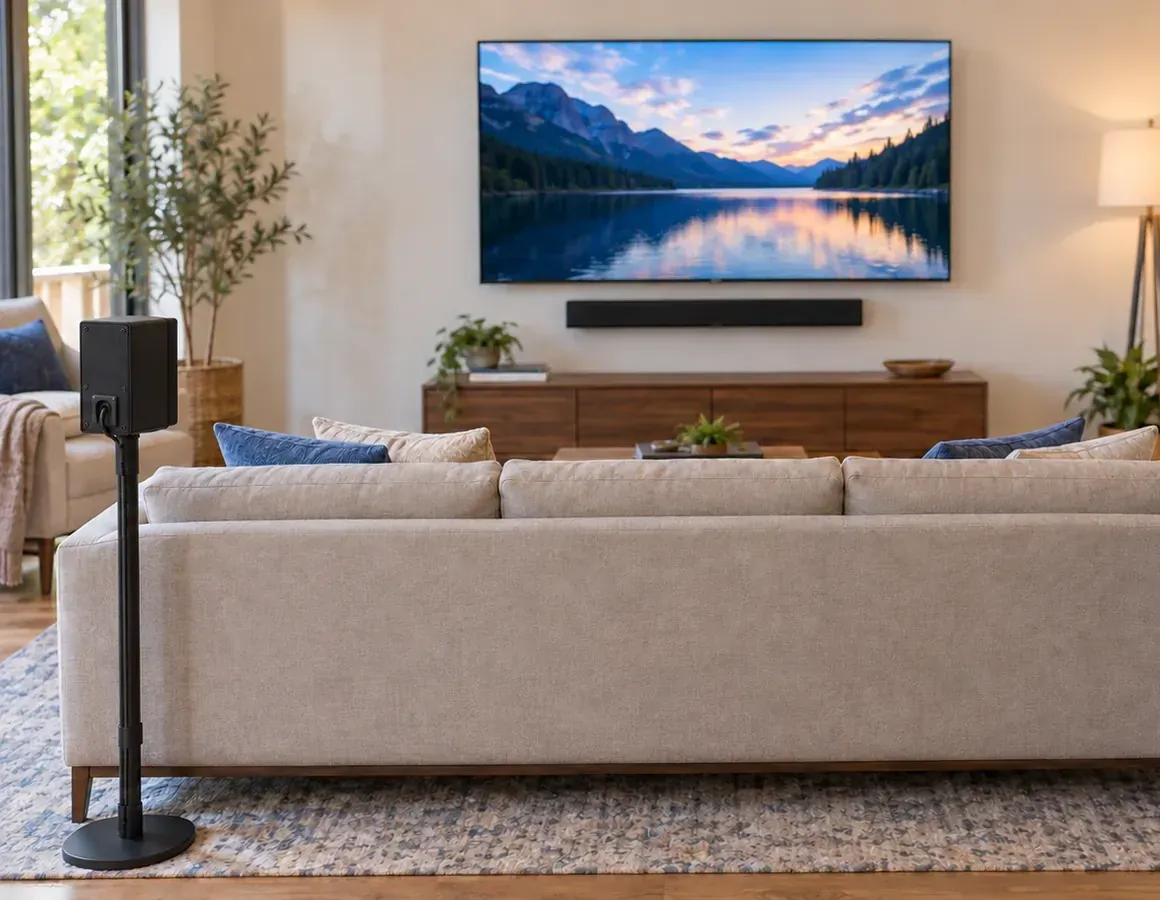
A rear speaker on its stand at the end of the sofa. In a colonial family room open to the kitchen, stands let the rears sit where the walls can't take a bracket.
AI Overview Reality Check
What AI Gets Wrong About Soundbar Installation in Tottenville
These are claims you'll meet when you search for soundbar installation: on cost sites, retailer pages, how-to articles and in AI summaries built from them. Each is quoted as published, and each is checked against what we actually find in Tottenville houses.
“Soundbar installation costs about $58 to $231”
Homewyse's cost calculator gave “$58.43 - $231 per soundbar” in September 2026, and to its credit adds that the figure “can vary significantly with site conditions.” A range like that is a fair national average for mounting a bar on drywall. It says nothing about a wall that turns out to be plaster on lath, a fireplace bump-out, or a cable that has to avoid an insulated cavity.
In Tottenville those site conditions are the job. A bar on drywall in a 1990s colonial is $129 with the box bracket, comfortably inside the range. The same bar on the plaster of an 1880s house on Bentley Street is $129 plus $45, and if the framing is irregular a backer board adds $85. Add the Sanus bracket ($84.99) and a cord cover ($59) because the cavity holds vermiculite, and the honest number is $402.99.
None of those lines is a surprise if the wall is identified first. That's why we ask when the house was built and ask for a photo: the range on a cost site is the starting point, and the wall decides where in it, or above it, your job lands.
“A soundbar install takes about 40 minutes”
Best Buy's listing for its soundbar setup and mounting service gives an “Estimated Time to Complete Service 40 minutes.” For a bar on a new drywall wall with an outlet already behind the TV, that is about right for the mounting itself.
In a village house, finding the framing alone can take longer than that. Test holes behind the bracket position, a slow bit through plaster, a backer board if the studs are not where the bracket needs them, and a careful look into the cavity before any cable goes in all add time. A bar with a subwoofer and rears in a big colonial family room adds placement and calibration. Most Tottenville soundbar visits run one to two hours.
The reason this matters is booking. If you plan your evening around a 40-minute visit and the wall is plaster, you'll be frustrated. We give you a realistic window when we quote and book a two-hour arrival window that fits it.
“A soundbar bracket costs $30 to $100”
Angi's TV cost guide puts a soundbar bracket at $30 to $100. That's a fair price range for the bracket as a product, and many bars come with one in the box.
The bracket is rarely the issue. What decides whether a bracket holds in a Tottenville wall is what it is fixed to and with what: a bracket that came with the bar may have screws and plugs meant for drywall, which will not grip a stud behind an inch of plaster. A shallow box bracket may not clear a skim-coated, uneven surface. And a bracket on the wall at all may be the wrong answer over a fireplace bump-out, where a TV-attached bracket keeps the drill away from the vent.
We use the box bracket when it suits the wall, supply the Sanus bracket at $84.99 when it doesn't, and replace the supplied screws with fixings sized for the framing. The bracket's price is the smallest number on the invoice.
“Use a stud finder to locate the studs”
Almost every how-to says it, and on drywall it works. Zircon, which makes stud finders, publishes its own guidance on lath-and-plaster walls, explaining that the irregular surface and the lath strips themselves can produce false readings.
A scanner over plaster and lath sees the lath, the plaster keys, nails and sometimes old wiring, and it can report a “stud” every few inches. In a nineteenth-century Tottenville house the studs may not be on 16-inch centres at all; hand-framed walls vary.
So we confirm with small test holes drilled where the bracket will cover them, or with a thin probe through the plaster. It takes a few minutes and means the screws go into wood, not into a gap between lath strips, which is how brackets pull out of old walls months later.
“Professional surround sound installation costs $500 to $3,500”
A home-theatre blog puts professional surround installation at “between $500 and $3,500.” That range covers full speaker systems with in-wall wiring, receivers and calibration, so it frightens people who only want a bar with rears.
A soundbar with a subwoofer and rear speakers is a much smaller job. In a Tottenville colonial family room on drywall, a wall-mounted bar ($129), the Sanus bracket ($84.99) and Sonos setup with the sub and rears ($125) come to $338.99. A full home theater hookup, with the bar or a receiver, sub, rears and sources tuned together, is a published $350 line.
Where the bigger range becomes real is when the bar is no longer enough: a finished basement that wants in-ceiling speakers, or an open first floor that needs sound in the kitchen too. Then our AV team quotes the job in writing, and it is a different project from a soundbar.
“Just connect the soundbar to the TV over Bluetooth”
It's the easiest connection and many guides offer it first. But Samsung's own support pages on audio out of sync tell users to correct it with the “Sound Control or Audio Sync” settings, which is a reminder that Bluetooth adds delay.
Bluetooth also usually gives up the useful features: the TV remote controlling the bar over HDMI, the bar switching on with the TV, and surround formats. In a big family room the connection can also drop when someone walks between the TV and the bar, or when a microwave runs in the open kitchen next door.
We connect over HDMI to the TV's eARC or ARC port wherever the TV has one, with optical as the fallback for older sets, and keep Bluetooth for phones. Lip-sync is then checked with a test clip before we leave.
“Flood insurance will replace anything a flood ruins”
It's a common assumption after Sandy, and it's wrong for the places a soundbar often lives. FEMA's own summary of NFIP coverage says coverage is limited in basements and in areas below the lowest elevated floor, and CNBC's 2024 explainer lists televisions among the items a standard policy doesn't cover in a basement.
For the shore blocks of Tottenville, that's not a theoretical point. Sandy's surge reached the houses on Yetman Avenue and the beach streets in 2012, and the new breakwaters reduce waves rather than guaranteeing a dry ground floor.
The installer's part in that is placement. We plan systems so nothing with a plug sits on a basement floor or on the enclosed level of a raised house, so the strip can be switched off in a hurry, and so a family room downstairs has its bar on the wall and its subwoofer off the floor.
One Visit for an Old Wall or a New One
Plaster and lath, a fireplace bump-out or a raised shore house: one photo and the soundbar's model number get you the fixing method and the total in writing, ahead of the van leaving for the end of the line.
Behind the Breakwaters: A System That Rides Out Storm Season
On the beach blocks of Tottenville a soundbar plan starts with the floor, not the wall. The Staten Island Advance's 2012 report from Yetman Avenue described a wave tearing through the end of the street near Billop Avenue and foundations left full of muddy water. The state's announcement of Living Breakwaters in 2024 recalled that Sandy's waves knocked Tottenville homes off their foundations. The breakwaters now cut the waves reaching the shore to under three feet, and many of the houses behind them have been rebuilt, raised or repaired. What has not changed is that water, when it comes, comes from below.
We plan shore-house systems around a few rules. Every powered part — bar, subwoofer, cable box, streamer and surge strip — lives on the main living floor. The strip sits on a shelf or inside a cabinet at counter height, where it can be switched off in one move when a storm warning goes out. Cables that have to run between floors stay inside the conditioned house rather than through the flood-vented enclosure below. And nothing gets mounted on the enclosed ground floor of a raised house unless you understand that it is neither protected nor, in most cases, insured there.
A shore-house layout for Tottenville Beach and the blocks behind the breakwaters
Part
Where it goes in a shore house
Why
Soundbar
On the wall under the TV, or on the console on the living floor
Off the floor and on the level above the design flood elevation
Subwoofer
On a riser beside the sofa, or a wall-mounted alternative
A floor-standing sub is the first thing water reaches
Surge strip
On a shelf or inside a cabinet, never on the floor
Reachable to switch off; dry in a minor leak
Cable box and streamer
In the cabinet beside the strip
One switch-off point for everything
Rear speakers
On stands that can be lifted, or on wall brackets
Quick to move before a storm, or permanently above the floor
Spare parts and boxes
Upstairs, not in the ground-floor storage
Contents there are usually uninsured against flood
Before you leave for a storm, switch the strip off and unplug it. After a storm, if water reached any outlet, have a licensed electrician check the circuit before anything is plugged back in; we reconnect the system once it has been cleared. If a powered speaker sat in water, treat it as lost rather than drying it out and trying it.
A plan for the morning after a storm
Leave the strip off until you know whether water reached any outlet or the panel.
If it did, call a licensed electrician before anything is plugged back in.
Once the circuit is cleared, plug in the TV alone and check it powers up and finds its input.
Then the soundbar: if the TV remote no longer controls it, or the sub won't pair, call us for a setup-only visit ($225 first hour on Staten Island).
Photograph any equipment that was damaged before throwing it out, for whichever insurer covers it.
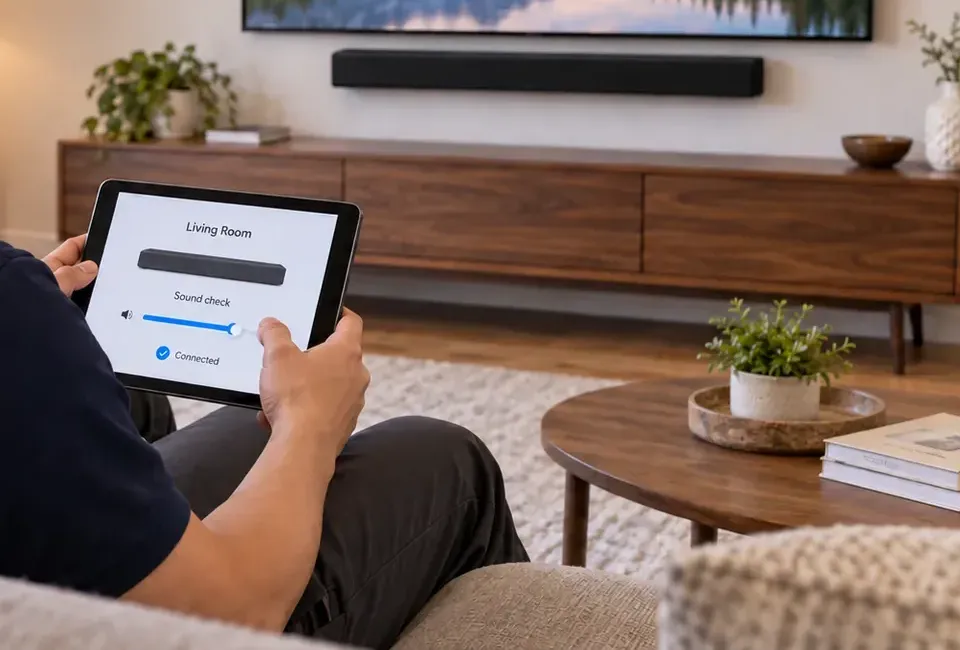
Sound check run from the sofa on the bar's app. Room calibration is done from where people actually sit, which in a long Tottenville through-room can be twenty feet from the wall.
Get In Touch
Request a Free Quote
Bentley Street parlor, Page Avenue family room or a rebuilt house by the beach: describe the house, the wall and the soundbar, and a written figure comes back before the working day ends. Prefer to talk? Call (347) 934-8335.
✅
We Got Your Request!
A technician or the office will phone you back today. In a hurry? Ring (347) 934-8335.
How It Works
Our Installation Process
Seven steps, whether it's a compact bar in an upstairs cottage bedroom or a bar, subwoofer and rears across an open colonial family room.
1. Tell us the house and send a photo
Give us the bar and TV models, roughly when the house was built and a photo of the TV wall. Mention a gas fireplace, a two-family layout, a raised shore house, or anything odd you've seen in the attic or walls.
2. Get a written price
The figure you receive is the sum of the lines on this page — mount, bracket, any wall add-on, cable concealment, setup — and nothing for tolls or distance, though Tottenville is as far as the island goes.
3. Choose a two-hour window
Arrival windows are two hours long and start between 8 AM and 8 PM on any day of the week. If a slot frees up today we offer it; give a day's warning and a booking can be moved free.
4. Find the framing and check the cavity
On arrival we scan, test-drill behind the bracket position on plaster, look into the cavity before any cable goes in, locate fireplace vents, and mark the height with you at your usual seat.
5. Fix the bracket and route the wiring
Screws into studs, backer board or masonry; in-wall kit in clear drywall bays; cord cover or cabinet run where the cavity should stay closed.
6. Connect, place and protect
The bar goes on the TV's eARC or ARC input with HDMI control switched on; the sub and rears are set where the seats and the downstairs neighbours want them; all the plugs share one surge strip kept up off the floor.
7. Tune and hand over
Room calibration from the sofa, dialogue and night modes, volume levelling, a lip-sync test clip, and the remote checked for power and volume before we vacuum and leave.
No drilling at all: the bar on the console, low enough to clear the bottom of the picture and the TV's remote sensor.
Coverage Area
Soundbar Installation Near Tottenville's Landmarks
We work on every street in Tottenville, from the old village along Amboy Road and Main Street to the newer blocks south-east of Hylan Boulevard and the beach streets behind the breakwaters. These six places mark out the neighborhood; the houses near each tend to share an age and a type of wall.
Conference House Park
265 acres at the south-western tip of the city, run by NYC Parks. The stone Conference House was built in 1680 and hosted the failed peace conference of September 11, 1776; the park also holds the Biddle, Ward and Rutan-Beckett houses and the “South Pole” marker for the southernmost point of New York State. Satterlee Street and the beach blocks border it.
Tottenville Library
The New York Public Library branch at 7430 Amboy Road, a one-storey Carnegie library designed by Carrère and Hastings, opened in 1904 and now a city landmark. The streets around it are the heart of the plaster-walled village.
Bethel Church and the Bedell House
Bethel United Methodist Church, first built in 1840 and rebuilt on the same site in 1886 after a fire, and the Second Empire parsonage at 7484 Amboy Road, landmarked in 2005 and restored in 2017.
Tottenville and Arthur Kill Stations
The southern terminus of the Staten Island Railway, the southernmost station in the state, and the Arthur Kill station that opened on January 21, 2017 with a 150-space lot. The run to St. George is fourteen miles and about forty-two minutes.
Living Breakwaters and Tottenville Beach
Eight partly submerged breakwaters, 2,400 feet in all, completed in 2024 for $111 million, with sand replenished from Manhattan Street to Loretto Street. The rebuilt shore houses sit behind them.
Main Street
The old commercial corridor, with the post office at 228 Main Street, the 123rd Precinct at 116 Main Street, the Masonic Hall, and the George Cunningham Store at 173 Main Street, subject of a Landmarks Preservation Commission designation report.
We also serve the neighborhoods around Tottenville: Richmond Valley and Charleston to the north, Pleasant Plains and Prince's Bay to the east, and the rest of the South Shore. Each is covered by the Staten Island soundbar installation page and the same price list.
A spare room turned exercise room. Bars like this one go up in the bonus rooms of 1990s colonials as often as in living rooms.
Pricing
Soundbar Installation Cost in Tottenville
A 10307 address pays the Staten Island rates. The soundbar figures themselves don't change from one borough to another — only the TV-mounting base and the hourly setup rate do. Choose the rows that describe your room, add them, and that sum is the bill. Should the wall prove to be different from the one booked, the new figure is shown to you and agreed before a bit touches it.
Soundbar price lines for Tottenville, Staten Island
Item
Price
Typical Tottenville use
Soundbar placed on a console or stand
$79
TVs on their feet, cottages with one outlet, houses about to be renovated
Soundbar wall-mounted under the TV
$129
Parlors, colonial family rooms, bedrooms, waiting rooms
Sanus soundbar bracket
$84.99
Missing box bracket, or a TV-attached bracket for fragile plaster
In-wall concealment kit
$169
Clear drywall stud bays in 1980s–2000s houses and rebuilds
Paintable cord cover
$59
Plaster walls, cavities with old wiring or vermiculite, brick
Cable run to a cabinet or other spot
$99
Up to 25 ft — box across the family room or in a corner cabinet
Sonos setup
$125
Sonos bar, sub and rears paired and grouped
A/V receiver
$129
Receiver-based basement and family-room systems
Universal remote
$99
TV, bar, cable box and streamer on one handset
Streaming device or games console
$49 each
Connected and set on the right input
LED bias light
$75
Behind the TV in a dark den or basement
Full home theater hookup
$350
Bar or receiver, sub, rears and sources tuned together
Remove old bracket
$45
Hardware the previous owner left on the wall
Take down old TV / haul it away
$85 / $79
Replacing the set that came with the house
Wall and access add-ons
Wall and access add-ons
Condition
Add
Where you meet it in Tottenville
Drywall over wood studs
$0
Most houses built from the 1980s on, and post-Sandy rebuilds
Metal studs
+$30
Some condos, offices and shop fit-outs on Page Avenue
Plaster
+$45
Village houses built before about 1940
Brick or stone
+$65
Chimney breasts and masonry accent walls
Concrete or cinder block
+$75
Foundation walls and some ground floors
Tile or marble
+$95
Kitchen backsplashes and basement bars
Plywood backer board
$85
Irregular or widely spaced framing in old houses
High mount (above about 8 ft)
$75
Two-storey entries and tall parlor walls
Box removal
$25
We take the packaging with us
Certificate of insurance
Free
Condo associations, plaza managers, landlords
When the TV goes up too
On Staten Island a TV mount starts at $209.99 for a 32-to-55-inch screen on a fixed or tilt bracket over wood-stud drywall; 56–65 inches adds $30, 66–75 adds $60 and 76–85 adds $100. A full-motion mount adds $40. Mounting over a fireplace adds $130, and a pull-down fireplace mount adds $160. A TV placed on its stand with no wall mount is $137.99. If the soundbar is already up and only needs setup or troubleshooting, a setup-only visit is $225 for the first hour, then 30-minute blocks. Every TV line is on the Staten Island TV mounting price list.
Part of every job: locating studs or solid masonry, a level bar, the HDMI or optical hookup, cables dressed out of sight, TV-remote control of the bar where the TV allows it, and the dust vacuumed up afterwards.
Not included: new or moved outlets (a licensed electrician's job), work on old wiring, insulation removal, patching and painting, moving heavy furniture, and picture calibration.
Return trips: when the technician arrives to find no soundbar, no bracket or nobody to open the door, a second visit costs $150. Rescheduling at least a day ahead is free.
Old finishes: century-old plaster, tile and stone can chip under the most careful bit. If yours looks like one of them, you'll hear it before we start, and you decide.
Shop Our Systems
Soundbar Installation Packages & Pricing
The three combinations below cover most Tottenville calls. The sums are shown in full so you can check them, and anything else from the tables is simply added.
Starter — Bar on the Console
$79 — the bar on the media unit, connected to the TV, its volume on the TV remote and the leads tucked away. The sensible choice for a cottage with one outlet, a TV on its feet, or a house about to be renovated.
Standard — Village Plaster Wall
$258.99 — soundbar wall-mounted ($129) + plaster add ($45) + Sanus soundbar bracket ($84.99) = $258.99. The bar on the plaster of a pre-1940 house, fixed into studs. With the bar's own bracket, $174.
Premium — Colonial Family Room, Hidden and Tuned
$732.99 — soundbar wall-mounted ($129) + Sanus bracket ($84.99) + in-wall concealment kit ($169) + full home theater hookup ($350) = $732.99. Bar, subwoofer, rears and sources set up together on a drywall wall with nothing showing.
Bring Your Own Equipment — Labour Only
Supplying the bracket yourself, whether from the box or a separate purchase, leaves just the $129 labour line and whatever wall add-on applies. Your bracket has to be rated for the bar's weight, and its warranty stays with its maker. When it doesn't suit the wall — plastic plugs meant for drywall going into century-old plaster is the usual case — you hear that before any drilling, with the $84.99 Sanus bracket as the alternative.
A worked example with a TV. A 65-inch TV over the gas fireplace in a 1990s family room ($209.99 + $30 + $130 = $369.99), with the soundbar wall-mounted under it ($129) on a Sanus bracket ($84.99), comes to $583.98 before any optional extras.
A worked example for a shore house. In a raised house near the beach, a soundbar wall-mounted on new drywall ($129), the Sanus bracket ($84.99) and a cable run to a cabinet at counter height ($99) come to $312.99, with the surge strip on the shelf and nothing on the floor.
Get the Tottenville Total in Writing
Send three things — a wall photo, the house's rough age and the bar's model — and the reply is a sum of rows from the tables above, nothing for the drive.
Street by Street in Tottenville: What We Expect Before We Arrive
We plan every Tottenville job from the street address before we arrive. These are the patterns we expect in different parts of the neighborhood. They are starting points, not rules: we confirm everything on the day.
Street by street: what we expect in Tottenville
Streets
What we expect
What we bring
Amboy Road west of Page Avenue, Main Street, Johnson Avenue, Brighton Street
Village houses of the mid-nineteenth to early twentieth century; plaster on lath; some landmarked or award-winning buildings
Sharp masonry and wood bits, tape, backer board, cord cover, the plaster line on the quote
Greek Revival, Italianate and Gothic Revival houses and cottages; small rooms; tall windows
Compact-bar options, TV-attached brackets, a light to look into cavities
Blocks south-east of Hylan Boulevard toward the beach
1980s–2000s colonials, many two-family; drywall on studs; gas fireplaces
In-wall kits, scanner, fireplace-manual check, Sonos and multi-room setup
Yetman Avenue, Billop Avenue, Manhattan Street, Loretto Street and the beach blocks
Repaired, rebuilt and raised houses behind the breakwaters
Shelf-mounted surge strips, sub risers, cable runs kept above the enclosure
Page Avenue and the Amboy Road plazas
Newer commercial fit-outs; drywall on metal studs; drop ceilings
Metal-stud toggles, certificate of insurance, volume-limit setup
Arthur Kill Road and the streets near the stations
A mix of older houses and newer infill
Both kits: we check the era at the door
New construction keeps changing the picture. In 2016 New York YIMBY reported plans for three three-storey, two-family houses at 334–342 Manhattan Street, each with a ground-floor unit and a second unit over the upper two floors, replacing a single house. In July 2026 a new-building permit was filed for a two-unit building at 7493 Amboy Road, where the existing house dates to 1901. Each of those changes swaps a plaster wall for drywall and one household for two, which is exactly the shift this page is written around.
Complete Services
Every Soundbar Installation Service in Tottenville
Once the TV wall is open for discussion, other jobs tend to come up. These Staten Island services are the ones most often added to a Tottenville soundbar booking.
Arrival windows, rescheduling, return trips and what's included.
FAQ
Tottenville Soundbar Installation FAQ
Our TV is tilted down toward the sofa. Should the soundbar tilt to match?
+
Usually not. A soundbar is designed to fire straight out at ear height, and most brackets hold it upright. If the TV sits high enough to need a strong tilt, we mount the bar lower and level, or hang it from the TV on a TV-attached bracket so it follows the screen's angle. The bar's room calibration then corrects what the angle changes.
Can we reserve a window weeks ahead so the TV room is ready before a graduation party or a holiday?
+
Yes. Book as far ahead as you like and we hold the two-hour window. If the date can't move, book early so the window you want is still free. Moving the appointment with a day's notice costs nothing, and we confirm the day before.
Do you use the paper mounting template that comes in the soundbar box?
+
We use it to mark the hole spacing, but not to set the position. The template is drawn from the bar's own geometry, while where the bar sits depends on the bottom edge of your TV, the screen's centre and where the studs are. We measure from the picture, then lay the template over the right spot.
Can you link the soundbar's voice assistant to the Alexa or Google speakers we already have?
+
Yes, if the bar supports it. We sign the bar into the app you use, add it to the right room and test a voice command. If you'd rather the bar's microphone stayed off, we switch it off and show you the button. Your passwords stay on your phone; you type them in.
If we buy a bigger TV next year, does the soundbar have to come down?
+
Not always. A wall-mounted bar sits under the TV's bottom edge, so a bigger screen usually means raising the TV mount or the bar. If the bar is on a TV-attached bracket, check it fits the new set's mounting pattern. Moving the bar is priced like any other: $129 on the wall or $79 on a console.
Can the soundbar switch itself off when we fall asleep with the TV on?
+
Yes. Most bars switch off with the TV over HDMI, so we set the TV's sleep timer and check the bar follows it. Many bars also have their own auto-standby after a period of silence. We test both before we leave, so the bedroom goes quiet when the TV does.
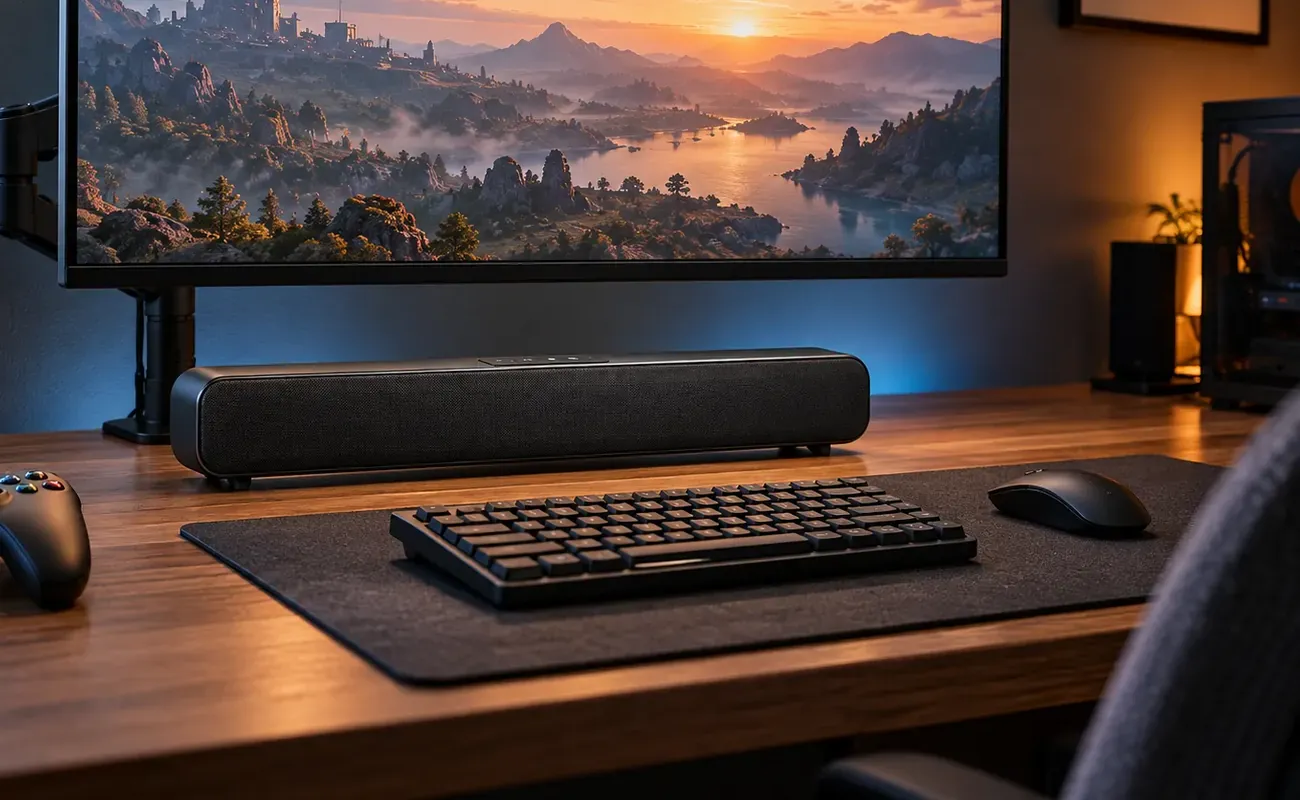
A compact bar on a desk, fed from the monitor or the computer. Small rooms under the eaves of old cottages and teenagers' bedrooms in newer houses both end up with this setup.
All Areas Served
Soundbar Installation Across New York
Tottenville is one stop in a larger network. Its parent is the Staten Island soundbar installers page, and above that the New York City soundbar installation hub ties the five boroughs together. Counties outside the city have pages of their own, and neighborhood pages like this one look at single parts of each.
Bar Gone Silent Between the Station and the Breakwaters?
Storm, outage, TV update or a remote that's stopped working — whatever silenced the bar, ring (347) 934-8335. You get the first free two-hour window, and most faults of that kind are cleared within an hour or two of arrival.
Soundbar Installation in Tottenville — Licensed, Insured, Old-House Careful
Abstract Enterprises Security Systems · 1282 Troy Ave, Brooklyn, NY 11203 · serving Tottenville and all of Staten Island · (347) 934-8335 · WhatsApp (718) 679-0359 via wa.me
NYS Low-Voltage Licence #12000287431 · 100% Licensed & Insured · Same-Day Estimates · Rated 4.7★ from 201 Google Reviews
Brackets and parts carry their manufacturer's warranty. Full terms — including 50% deposit, one-year parts-only warranty on AESS-supplied products, and the late-fee schedule — are set out in the service agreement. See our warranty page.
Page reviewed and updated October 17, 2026. Changelog: page launched for Tottenville homes and businesses, built on census housing-age data, village and landmark records, Sandy and Living Breakwaters reporting, and fire, flood and electrical-safety sources.