Systems We Did Not Install Welcome ยท Footage Saved Before Anything Is Reset ยท Price in Writing First ยท Brooklyn Rate
Security camera repair in Beverley Square begins with our $150 Brooklyn service call, which pays for the on-site diagnosis and is credited to the repair if you go ahead; on our published Brooklyn list most single-fault repairs come to $150 to $700, and replacing a recorder or rewiring part of a house comes to $700 to $1,500. We work on any brand and any installer's system, from four cameras under the porch roof of a Marlborough Road Victorian to the lobby and mail-area cameras of an apartment building on the district's edge. Requests are booked within 2 hours, visits come in two-hour arrival windows, and you are told what failed and what it costs before a single part is swapped. The sections below explain how the wood-frame houses, the deep porches, the street trees and the power cuts on Beverley Road shape camera faults here, and what each repair involves.
Reviewed and updated November 11, 2026, against the NYC City Planning Commission report N 260209 HKK on the Beverley Square West Historic District (January 21, 2026); the Landmarks Preservation Commission's 2025 designation announcement for Beverley Square West and Ditmas Park West; chapter 11 of the LPC Permit Guidebook on health and safety equipment; the Historic Districts Council's Six to Celebrate entries on East 19th Street and Westminster Road; News 12 Brooklyn reporting on the June 20, 2025 manhole fire on Beverley Road, the July 13, 2026 manhole fire near 650 Ocean Avenue, the February 2026 snowstorm outages and Ring's 2024 change to police video requests; Bklyner and Patch coverage of 70th Precinct Community Council meetings in 2012 and 2013 and of missing packages near Cortelyou and Stratford Roads in 2018; the NYPD's 70th Precinct page; Brick Underground on tenants and camera footage; HomeAdvisor's Brooklyn camera cost page; and Swann's guide to video loss on DVR systems. ยท Abstract Enterprises Security Systems, NYS license #12000287431 ยท crews dispatched from our Troy Avenue office in Brooklyn

Owner-operated since 2002 ยท Thousands of jobs completed ยท Booked within 2 hours
The fastest Beverley Square camera repairs start with a phone held up to the recorder, not a technician on a ladder. What the screen shows tells us which link in the system broke. A single black tile, with the rest of the grid normal, usually means that one camera, its plug or its stretch of cable. A row of black tiles that all belong to the cameras on one side of the house usually means they share a power box, a splitter or a switch, and the shared part is what failed. A full screen of black with the recorder's lights still glowing usually means the recorder, its drive or simply the cable to the monitor. A screen that shows every camera but a message about the hard drive means the cameras are fine and nothing has been saved for some time. So the three things we ask for are a photo of that screen, a photo of the sticker on the top or back of the recorder with its brand and model, and a sentence about where the recorder lives, which in houses like these is often the cellar, a closet under the stairs, a third-floor attic room or the back office of a shop. Send them to (347) 934-8335 or on WhatsApp with your street, and we will tell you what kind of fault it looks like and what that kind of repair usually costs on our Brooklyn list.
Beverley Square is a pocket of free-standing wood houses in the middle of Flatbush, and the way those houses were built explains most of the camera calls we take from it. The City Planning Commission's January 2026 report on the Beverley Square West Historic District describes 118 free-standing houses on Marlborough, Rugby and Argyle Roads between Beverley Road and Cortelyou Road, 114 of them built by 1906, on lots about fifty feet wide, most with full-width front porches, complicated rooflines and angled bays. The Landmarks Preservation Commission designated that district on November 25, 2025, dating its houses from 1894 to 1910. A few blocks east, across the open railroad cut, the Historic Districts Council credits the developer T. B. Ackerson with the first houses of Beverley Square East on East 19th Street between Beverley and Cortelyou Roads, built from 1898 to 1901 and fitted out, for their time, with steam heat and electricity. None of those houses was planned with a camera in mind. Every camera on them today was fitted onto porch ceilings, eaves, bay windows and wood siding by an owner, an electrician or an installer in the last twenty years, and that is where the repair work begins.
A free-standing house on a fifty-foot lot has four exposed sides, a deep porch at the front and, very often, a yard and a driveway down one side. Owners here tend to want a camera on each of those, which means long cable runs from the corners of the house to a recorder in the cellar or up in the attic, and more places for water, squirrels, sun and renovation crews to damage a cable along the way. The porches matter in their own right. A camera tucked under a porch roof is sheltered from rain, but it is also looking from deep shade out at a bright street, and it sits close to porch posts, railings and ceiling boards that throw its own infrared light straight back at the lens after dark. The trees matter too. The Landmarks Commission describes the district's three streets as tree-lined, and a camera that saw the whole front walk in March can be looking at a wall of leaves by June. Many of the repair calls we get from houses like these are not about a broken camera at all, but about a camera that has slowly stopped seeing what it was meant to see.
The reason owners care is the same reason they put the cameras up. In June 2012 the 70th Precinct Community Council heard about a run of daytime break-ins on and around these blocks: Bklyner reported a home invasion on Westminster Road between Beverley and Cortelyou Roads in the early afternoon, a mid-morning burglary on DeKoven near Rugby, four burglaries on that one Westminster block, three of them in a single month and all during the day, and three attempts nearby including one on Argyle Road. The precinct's captain at the time, Ebony Washington, told the meeting, "Every burglary we respond to, we try to look for surveillance." A Cortelyou Road resident told Patch the same week that six homes had been broken into in a short span, all in daylight. In February 2013 the precinct added that recent burglaries had come through windows reached from fire escapes or through unlocked side and rear windows. Those reports are more than a decade old, and we cite them for one lesson only: in a neighborhood of free-standing houses, the side and back of the house are where a camera earns its place, and those are exactly the cameras owners look at least often and notice last when they stop working.

Power is the other thing that shapes repairs here, and the neighborhood has had a recent lesson in it. On June 20, 2025, News 12 Brooklyn reported that the FDNY was called just before 5 a.m. to a manhole fire on Beverley Road and that at least 1,700 Con Edison customers lost power at one point, ahead of a possible heat wave; one resident, Eden Gabay, said, "Tomorrow onwards, that's going to be really rough." On July 13, 2026, another manhole fire near 650 Ocean Avenue left about 343 customers in the dark late into the evening. And after the snowstorm in February 2026, Con Edison explained that melted snow mixed with road salt can seep into underground electrical equipment, which is how a winter storm turns into a power cut days later. Every one of those events lands on camera systems the same way. The recorder loses power while it is writing to its drive. The cameras go dark all at once. When power returns, some come back and some do not, and a recorder may restart with a drive error, a clock reset to the factory date, or a message offering to "initialize" the drive, which would erase every recording on it. That is why any outage on your block is worth treating as a reason to look closely at the recorder, even when the screen seems normal.
The households have changed as well. The district is zoned R3X, which the City Planning report notes allows single- or two-family detached houses, and many of the big Victorians on these streets now hold two households, sometimes with a finished attic or cellar room as well. A single camera system bought by one owner now often serves two families, a tenant, and an adult child who manages the phone app from somewhere else. That is fine until a camera fails and three people need to agree on who calls, who pays and who has the password. At the edges of the district, along Ocean Avenue, Coney Island Avenue and near Cortelyou and Stratford Roads, there are larger apartment buildings whose lobby and mail-area cameras belong to a landlord or a board. In November 2018 Bklyner reported residents of one building near Cortelyou and Stratford Roads saying more than 100 packages had gone missing over six months, and that a camera was installed in the mail area after residents pressed management. A camera like that only answers the question it was installed to answer if it is recording, aimed at the right spot and keeping the right time, and checking those three things is the core of a repair visit.
The people who call us from Beverley Square usually use their cameras for more than security. They watch for deliveries on the porch, check that a parent upstairs is all right, see who rang while they were at work and keep an eye on the car in the driveway. That is why a repair here is rarely just about one dead camera; it is about getting back the whole picture of the house the owner had come to rely on. Many owners pair a camera repair with a check of the doorbell or porch intercom on the same visit, since the wiring for both often runs through the same cellar, and some add a look at the house alarm.
Where this page applies. It covers the Beverley Square blocks between Beverley Road and Cortelyou Road, on both sides of the B and Q train cut: Marlborough, Rugby and Argyle Roads on the west side and East 19th Street and its neighbors on the east, with the shops along Cortelyou Road and Beverley Road. Nearby Ditmas Park, Fiske Terrace, Prospect Park South and Midwood are served at the same Brooklyn rate, and the rest of the borough is covered on our Brooklyn security camera repair page. The name of the neighborhood does not change the price; the part that failed does.
Urgent calls from Beverley Square tend to come in three kinds. The first follows something that happened: a package gone from the porch, a car window broken in the driveway, a door found open at the back of the house, and an owner who opens the app to find that the camera aimed at that spot shows nothing for the hour that matters. The second follows a power cut, like the Beverley Road outage in June 2025: the lights come back, the recorder starts up, and the owner finds two cameras missing, a beeping recorder, a clock stuck on a date years ago or a prompt to format the drive. The third builds slowly: alerts that fire every night for no reason, a picture that goes white after dark, a camera that shows only leaves, or a side camera nobody has looked at since the winter.
If you need footage from something that just happened, the most helpful thing you can do before we get there is leave the recorder alone. Do not unplug it, restart it, reset it, or accept any prompt on the screen to initialize or format the drive. Those steps can wipe out the very hour you are after. Call (347) 934-8335, give us the date and the time window, and we book the visit with exporting that clip as the first job. If the clip exists, we copy it to a USB drive in the recorder's own format and in an ordinary video format, with the recorder's timestamp and a note of any difference between the recorder's clock and the real time, so it can be handed to the 70th Precinct, an insurer or a lawyer. If the clip does not exist because the drive stopped saving weeks ago, you hear that from us straight away, and then we make sure the next failure cannot happen without you being told.
For everything else the path is the same. The $150 service call is booked within 2 hours of your request, the visit comes in a two-hour arrival window, and you get the cause and a written price before any part changes. Most single faults, a plug re-terminated, a power supply replaced, a camera swapped, a mount refastened, a recorder brought back from a bad restart, are finished on the first visit when the part is on the truck. When the part has to be ordered, for example a camera that has to match an older recorder, we tell you before you pay for it and book the repair once it arrives.
Each repair below is priced from the same published Brooklyn camera repair list. The service call pays for finding the fault and writing the price; the repair itself is priced by the part that failed, not by how many hours the diagnosis took or how tall the porch is.
A camera that has died, filled with water or been cracked, replaced with a matching model on the same cable and mount, aimed the way it was and added back to the recorder. On our Brooklyn list one camera replaced on an otherwise working system runs $250 to $600, camera included.
Recorders that came back from a power cut with a drive error, a reset clock or a prompt to format, and drives that quietly stopped saving. Drive swaps run $200 to $450 by capacity, and a DVR that will not work averages $300 to $700 with drive and labor.
Central power supplies that sag when every camera's infrared turns on at dusk, adapters plugged into switched or failing outlets, and switch ports that stopped powering a network camera. Power supply repair typically runs $150 to $400.
Corroded BNC and RJ45 ends at the far corners of the house, runs chewed in the cellar or cut during a porch or attic renovation, and splices left outdoors by a previous installer. A re-termination or PoE port change runs $150 to $350.
Infrared that bounces off a porch post, railing or ceiling board, washes out on a white column, or has failed on one camera. Night vision camera repair on our Brooklyn list typically runs $250 to $650, depending on whether the camera itself has to be replaced.
Cameras that have sagged, twisted or pulled loose from old shingles, clapboard or porch trim, refastened into solid framing, re-aimed and sealed so water does not follow the screws into the wall.
Cameras that lost their view to a summer canopy, a new shrub, a spider web across the lens or a rebuilt porch, re-aimed, re-zoned or moved a short distance so they see the walk, the driveway and the side windows again.
Recorders that dropped off the app after a new router, accounts tied to a former owner or tenant, forgotten passwords, and alerts for a camera going dark or a drive failing. Configuration work with no parts is often covered within the $150 service call.
Clips saved to USB with the original timestamp before any setting is touched, plus clean-and-check visits for lenses, covers, connectors and drive health. A clean and check for a blurry picture starts at $80; annual maintenance starts at $250 for a residence.

Six kinds of property cover almost every Beverley Square camera call. What separates them for a repair is where the recorder ended up, what the cameras are fastened to, how far the cables travel, and who besides the caller has a say in the work. Those four things decide how long the diagnosis takes and which fix is likely.
The typical house on Marlborough, Rugby and Argyle Roads: free-standing, wood-framed, with a full-width porch, bays and a complicated roof. Cameras sit under the porch roof, at the eaves and on the corners, with a recorder in the cellar or attic.
The earliest Beverley Square houses, begun in 1898 by T. B. Ackerson. Similar in scale, outside the landmark district, often with cameras added room by room as owners modernized the house.
A Victorian or Colonial Revival house whose top floor or cellar has been finished. The recorder is often tucked into that space, where heat, damp and a renovation crew are its main enemies.
A house now holding two households under the R3X zoning. One camera system often covers both, with the recorder in one apartment and the app login on a third person's phone.
The larger buildings along Ocean Avenue, Coney Island Avenue and near Cortelyou and Stratford Roads, with lobby, mail-area, laundry and hall cameras answering to a landlord, managing agent or board.
Storefronts near the B and Q stations, usually with apartments above: cameras inside the window and over the door, and a recorder in a back room or under the counter.
The City Planning report describes the district's houses as late Queen Anne, early Colonial Revival and Shingle style, nearly all with full-width front porches, angled bays and complex rooflines. For a camera system that means three kinds of mounting spot. The first is the porch ceiling, which shelters the camera from rain but puts it in deep shade looking out at a bright street, and close to posts and railings that reflect its infrared at night. The second is the eave or the corner of the roof, which gives a wide view down the side of the house but is the most exposed place on the building to wind-driven rain and summer sun. The third is a bay or a corner board on the side wall, which covers the driveway or the side windows the 70th Precinct warned about, but is usually the camera behind the most foliage. The cables from all of them have to travel down or across the house to the recorder. In older installs we often find them run along the porch ceiling, tucked behind a gutter, or stapled down a corner board and fed into the cellar through a window frame, which keeps them out of sight but leaves several feet of each run in the weather.
The repair pattern follows from that. The far cameras, at the back corners and on any rear garage, fail first, because they have the longest runs and the most exposed connectors. A camera at the back corner that flickers in wet weather and then goes dark is, more often than not, a plug at the camera end that has let water in, and we test it there before blaming the cable. A camera under the porch roof that looks fine by day and turns into a white haze at night is usually lighting up its own surroundings, which is a matter of aim and settings rather than a broken camera. And a camera on the side of the house that "still works" but shows nothing useful is often a view that the trees have taken over since it was installed.
The Historic Districts Council's account of Beverley Square East has Ackerson developing the first properties along East 19th Street from 1898, with wood interior moldings, silk wallpaper, steam heat and electricity, and singles out numbers 217, 223 and 247 as especially elaborate examples; number 257 served as his model home in sales brochures and turned up nearly a century later in Spike Lee's 1992 film "Malcolm X." For camera work, two things about these houses matter. They have had more than a century of rewiring and renovation, so the paths cables can take through the walls are often already crowded with old electrical, heating and phone lines, and an installer may have chosen the outside of the house because the inside was full. And because we found no landmark designation for Beverley Square East, an owner here has more freedom than a neighbor across the tracks in what a replacement camera looks like and where it goes, though we still treat original trim and porch detail as something to work around rather than through.

Many big Flatbush houses have a finished third floor under the roof or a cellar that has become a family room, an office or a guest space. Camera recorders end up in those rooms because that is where an installer found a shelf, an outlet and a short path to the router. Each location has its own trouble. An attic room under a slate or asphalt roof can run far hotter in July than the floors below, and a recorder and its hard drive are designed for ordinary room temperatures; an attic recorder that falls into restart loops or starts reporting drive errors in a heat wave is a common call from these houses. A cellar can be damp, and a recorder on the floor or on a low shelf there is the one that suffers if water ever comes in. Both rooms are also the ones that get renovated, and a recorder unplugged by a contractor for an afternoon, or a cable cut while a ceiling is opened, can leave a system dark for weeks before anyone looks. Part of a repair in these houses is often finding the recorder a better shelf, with airflow, off the floor, on a battery backup, and somewhere a crew will not need to move it.
The R3X zoning allows two-family detached houses, and a good number of the district's houses now hold two households, usually one on the lower floors and one above, sometimes with a separate entrance at the side. The camera system almost always predates the split. The recorder sits in whichever part of the house the original buyer chose, frequently the cellar, which may now be reached only through the downstairs apartment, and the phone app is on the phone of whoever set it up, who may be the owner, a former owner, or a grown son or daughter who now lives in another borough. When a camera fails, we usually need three people: the owner, who authorizes and pays; whoever lives where the recorder is, who has to let us reach it; and whoever holds the password. We sort that out by text before the visit rather than on the doorstep. If no one has the recorder password, access can usually be recovered on site with the owner present, by a method that depends on the brand; some of those methods reset settings, which we explain before doing anything.
Around the edges of the houses, along Ocean Avenue, toward Coney Island Avenue and near Cortelyou and Stratford Roads, the blocks hold larger apartment buildings. Their cameras face a lobby, a vestibule, a mail area, a laundry room, a courtyard and sometimes the halls, and they are usually wired back to a recorder in a superintendent's office or a basement room. They are also usually a mix: a lobby camera from one installer, a mail-area camera added after a complaint, a laundry camera from a third. The 2018 Bklyner report on more than 100 missing packages in one building near Cortelyou and Stratford, and the camera that went into its mail area afterwards, is a good example of how such systems grow. In these buildings a repair often starts with mapping which cable feeds which camera, then labeling, then fixing the actual fault. We take instructions only from the owner, the managing agent or the board, and footage is released only on their say, a point we come back to in the questions below.
The shops near the Cortelyou Road and Beverley Road stations are mostly ground floors in buildings with apartments above. Their cameras look through the front glass, over the entrance, at the register and at a rear or side door, and the recorder usually lives in a back room, a basement or under the counter, where it collects dust and heat. Shop systems have their own common faults: a camera behind the window that is blinded by its own infrared at night, a recorder that stopped saving months ago because nobody checks it, and a system left behind by a previous tenant with a password no one knows. We go through those in the commercial section below.
These notes set out how our technicians work through a camera system on a free-standing Flatbush house. They describe our standard practice on houses like these, not a story about any particular address.
Read the recorder before reading the house. The first stop is the recorder, wherever it is: which channels show a picture, which show "no video" or a frozen frame, what the drive status says, how far back the recordings actually go, and what the clock reads. A clock showing a date from years ago tells us the recorder lost power and its clock battery, which is common after the kind of outage Beverley Road had in 2025, and it means any clip already saved needs a note about the time difference.
Walk the outside with the screen in hand. With the live view on a phone, the technician walks the porch, both sides of the house, the yard and any garage, looking at each camera from the ground and on the screen at the same time. This is where trees, webs, drifted mounts, a camera knocked by a ladder or a new shrub show up, and it often explains a "bad camera" that is simply looking at the wrong thing.

Test the shared parts before the single ones. If the dead cameras share a power box, a splitter or a switch, that part is tested first. Swann's own troubleshooting guide for its DVR systems puts it simply: "Ensure that you have only used *ONE* splitter per power supply." Several splitters chained off one supply is a common finding on older self-installed systems, and it produces exactly the pattern owners describe, cameras that work by day and drop out at night.
Come back after dark when the fault is a night fault. A camera that fails only at night has to be checked at night. On autumn and winter visits that can be done on the same trip; in summer we may arrange the final check for the evening so the infrared, the porch reflections and the power supply can be seen under the load they fail under.
Price before parts, labels before leaving. Once the fault is found, the owner gets the cause and a written price. Nothing is swapped on a hunch. Before the technician leaves, every cable that was traced is labeled at the ends we could reach, so the next visit starts with a map instead of a mystery.
Every camera system, whatever the brand, is a chain: power, then cable, then the recorder or switch, then the camera. Free-standing wood houses under big trees, on a block that has had its share of power cuts, put stress on each link in a particular way. The symptom on the screen is often identical, a black tile or a frozen frame, which is why owners so often buy a new camera to replace one that was never the problem. Here is what usually goes wrong with each link on these blocks, and what putting it right involves.
When power fails without warning, a recorder is almost always in the middle of writing video to its hard drive. Most survive it. Some come back with a damaged section of the drive, a file index the recorder cannot read, or a drive it no longer recognizes, and the screen then shows an error, a beep, or a prompt to "initialize" or "format" the drive. Accepting that prompt makes the drive usable again by erasing it, so whatever was on it is gone. Other recorders come back fine but with the clock reset to a factory date, because the small battery that keeps time through an outage has died. And some recorders restart before the cameras do, or before the network switch does, and never pick a camera back up until someone tells them to.
The repair depends on which of those happened. If the drive is healthy and only the index is confused, the recorder can often be brought back without losing recordings. If the drive has failed, we replace it; a drive swap on our Brooklyn list runs $200 to $450 depending on capacity, and a DVR that will not work at all averages $300 to $700 with drive and labor. If the clock is the trouble, we set it, set it to take the time automatically from the internet where the recorder is online, and check the time zone and daylight saving settings, then tell you about the clock battery. And for houses on a block that has lost power more than once, we recommend a small battery backup for the recorder and, on network systems, the switch, so that the next manhole fire or storm costs you a blink rather than a drive. We size it to the equipment you actually have.
A row house in Brooklyn has two exposed walls. A Beverley Square house has four, plus a roof edge with gutters, plus, often, a garage or shed at the back of the lot. That gives weather many more places to get at a camera system. Wind-driven rain reaches the plugs on corner cameras that a porch would shelter. Summer sun on a south or west wall bakes the jacket of a cheap cable until it cracks, and water then follows the crack along to the connector. A gutter that overflows in a downpour can pour straight onto a camera or its junction box mounted just under it. The camera at the end of the longest run, typically the back corner or the garage, is the one that feels all of this first.
Our order of testing follows the weather. We start at the most exposed connector, at the camera end, because that is where water does its damage and where the fix is quickest: cut back, re-terminate, seal, and put the connection into a proper weatherproof box if it was left hanging. Only if the cable itself tests bad do we talk about replacing it, and then we look at whether the old path is the right one or whether it should come down a more sheltered corner of the house. A re-termination or PoE port change runs $150 to $350 on our Brooklyn list; replacing one run depends on its length and route and is priced in writing on the visit.

Masonry holds a screw for decades. Old wood siding, shingles and porch trim do not always. A camera fastened into a shingle or a thin trim board, rather than the solid framing behind it, will slowly sag, twist in the wind or pull away, and the first sign is usually a view that has tilted toward the ground or the sky. The Landmarks Commission's guidebook, which applies to the houses in Beverley Square West, says equipment must be attached at mortar joints, plain masonry, wood or metalwork, never through cast iron or onto decorative surfaces; on a wood house that points to plain boards and framing, not carved brackets or ornamental trim. When we refasten a camera we find solid backing, use the existing holes where they are sound, seal any we abandon, and make sure water cannot run down the screws into the wall.
The porch itself changes too. Owners repaint, replace railings, rebuild steps and hang plants and string lights, and each of those can block a camera, reflect its infrared or change what it is aimed at. Trees grow every year. A camera that was correct when installed may be wrong now without anything being broken. That kind of repair is mostly adjustment: re-aiming, re-zooming, moving the camera a foot or two along the same board, changing the infrared or exposure settings, and redrawing motion zones so the camera stops reacting to leaves. When no part is needed, it is often done within the service call.
Sometimes the camera really is the problem. Infrared lights burn out, leaving a camera that works by day and is blind at night. The filter that switches a camera between day and night modes can stick, leaving a pink or purple daytime picture or a gray, flat one. Water that got in through a cracked housing or a badly sealed cable entry leaves spots and fog behind the lens. Older analog cameras simply wear out. A single camera replaced on a working system runs $250 to $600 on our Brooklyn list with the camera included, and where only a dome or front cover is cracked or scratched, the cover alone can often be replaced for a $30 to $80 part plus labor.
Recorders age as well, mostly in their software. An older recorder may stop working with the current version of its phone app, may not support newer cameras, or may simply have a drive at the end of its life. Before we recommend replacing one, we check whether your existing cameras will work with its replacement, because in a wood-frame house with cables already threaded through porch ceilings, attic floors and cellar joists, the cable is the most valuable part of the system and the part worth keeping. A hybrid recorder that runs older coax cameras alongside newer network cameras costs $700 to $1,200 installed on our Brooklyn list, and a full DVR or NVR replacement with a drive and setup runs $700 to $1,500.
Beverley Square's businesses cluster near its two subway stations and along the streets that bound it. Each spot gives a camera system a slightly different job and a slightly different way to fail. The cards below describe the conditions; the sections after them cover what a business owner here usually needs from a repair and the rules that touch the work.
Ground-floor stores and restaurants with apartments above, a short walk from the B and Q. Cameras look through glass at the sidewalk and at the register, and recorders sit in back rooms that run warm.
The street that lost power in the June 2025 manhole fire. Businesses here are the ones most likely to have a recorder that restarted badly, a clock reset to a factory date, or a camera that never came back after the power did.
A wide avenue carrying heavy car traffic along the neighborhood's western side. Cameras covering doors and curbs fight headlights at night, and plate-level views need careful exposure settings rather than more infrared.
Large residential buildings with lobby, mail, laundry and courtyard cameras on one recorder, often added in stages, where the July 2026 manhole fire near 650 Ocean Avenue was a reminder of what an outage does to a recorder.

Store and office owners seldom call to report a broken camera in the abstract. They call because something happened, a shortfall at the register, a delivery missing from the side door, a cracked window in the morning, and they need to know whether the system saw it. On a business call we check recording and the recorder clock before anything else, save any clip that is needed, and only then go after the fault. A recorder that has been saving with the wrong time is a real problem for a police report, and setting it right, then making sure it keeps time on its own, takes minutes.
The second thing a business needs is a camera that identifies a person at the door, not just one that shows the room. A wide view of the whole shop floor can record every hour of every day and still never show a face clearly at the entrance. When a visit shows that a camera is working but aimed or zoomed wrong for the job it is meant to do, we say so and offer to re-aim it, which costs far less than adding cameras. The third need, after an outage on Beverley Road or Ocean Avenue, is simply confidence that everything came back, which is why we check every channel in playback, not just live, before we leave.
Many shops on these blocks are leased, and when a business changes hands, the cameras and the recorder usually stay on the walls while the people who knew the password leave. We can generally bring that equipment back into service. Depending on the brand, regaining control may mean a reset that clears the old settings and accounts, which is usually what a new tenant wants anyway. Before we reset or reconfigure anything, we confirm with you, and where needed with the landlord, who owns the equipment, and we set up new accounts in your name.
Kitchen cameras live a hard life. Grease and steam leave a film on the lens or dome that turns a sharp picture into a soft glow, and heat near the line shortens the life of a camera mounted too close to it. A clean and check for a blurry picture starts at $80 on our Brooklyn list. If a camera keeps fogging up after cleaning, moving it a few feet away from the hood or out of the steam path is usually the real repair, and we price that move in writing on the visit.
State licensing. The New York Department of State licenses businesses that install, service or maintain security and fire alarm systems, and state rules bring closed-circuit television used to detect or monitor intrusion, theft or movement under that licensing. Owners who install equipment on their own property, or have their own employees do it, are exempt; a company you hire should hold the license. Ours is NYS license #12000287431.
Notice to employees. New York Labor Law section 203-c requires employers to post notice of video monitoring and to get written acknowledgment, and it limits cameras in restrooms and changing areas. If a repair moves or adds a camera that watches staff, it is a good time to check that your notice is current and that no camera looks where it should not. We are not lawyers and this is not legal advice; ask your own adviser how the rule applies to your business.
Working with the NYPD. In 2024 the Mayor's Office announced a pilot under which businesses can register their cameras with the NYPD, telling police where cameras are in case of an incident, and can choose to share live feeds, at no cost. For registration to mean anything the recorder has to be online, current and keeping the right time. We can bring a system to that standard; the decision to register is yours.
Landmarks and storefronts. The Beverley Square West Historic District covers the houses on Marlborough, Rugby and Argyle Roads. If your business occupies one of those houses, the LPC guidebook's limits on exterior cameras apply to new or changed equipment on the outside, though ordinary repair does not need a permit. A storefront outside the district boundary is not affected by those rules.

These are the situations Beverley Square owners, tenants and shopkeepers describe when they call about their cameras. Each is answered once here and not repeated in the FAQ further down.
No, the tree is. The streets here are lined with mature trees, and a camera aimed along the front of the house in winter can be looking into a canopy by May. The fix is usually moving the camera lower or a few feet along the same board, narrowing its zoom under the branches, and redrawing motion zones so swaying leaves stop triggering recordings. When no part is needed, that adjustment is often covered by the service call; a new position that needs a longer cable is priced in writing first.
Almost always a spider web or insects. A camera's infrared lights draw insects after dark, spiders follow them, and a web a few inches from the lens catches the light and moves in every breeze, which the camera reads as motion. Under a porch roof, out of the rain, webs build up quickly. Cleaning the housing helps for a while; the lasting fix is moving the infrared source, turning the camera's built-in infrared down where porch lighting is enough, and setting the motion zones to ignore the area right in front of the lens.
The camera, or its power adapter, is almost certainly plugged into an outlet or fixture controlled by the light switch. It is a common shortcut on older installs, since a porch light is the easiest power to reach. The repair is to give the camera its own unswitched power, either from the central camera power supply or, on network cameras, from the switch through its data cable, so that no one can switch the camera off by habit. We price that on the visit once we see where power can come from.
Usually the mount, not the camera. A camera screwed into a shingle or thin trim, instead of the framing behind it, works loose as the wood shrinks and swells each season, and the weight of the camera does the rest. We refasten it into solid backing, reuse the old holes only if they are sound, seal any we leave, and re-aim it. If water has followed the screws into the siding, we tell you before we close it up.
Not if you might need anything that was recorded before the outage. Initializing or formatting a drive makes it usable again by erasing it. The prompt often appears because the recorder lost power mid-write and cannot read the drive's index, and in some of those cases the drive can be checked and brought back with recordings intact. Leave the prompt on the screen, or switch the recorder off from its own menu, and call us; if the drive really has failed, a replacement runs $200 to $450 on our Brooklyn list.
Partly, but cold weather is the main reason. Rechargeable batteries deliver less in freezing temperatures, and a camera in a busy yard that wakes for every squirrel drains faster still. Older batteries lose capacity on top of that. Tightening motion zones, reducing clip length and keeping the camera out of the wind helps; where a camera needs charging every few days, a wired camera on the corner of the house is usually the lasting repair, and we price that option alongside the cheaper fixes.
Yes, and it is one of the most useful things a visit can include. With the live view in hand we walk the sides and back of the house and mark which windows, doors, fire escapes and gates each camera really covers, day and night, and which it misses because of trees, angles or distance. Often a re-aim or a different zoom closes the gap without new equipment. You get a short written note of what is and is not covered, and any change that needs parts is priced separately.
The recorder is probably saving a lower-quality stream than the one you watch live. Many recorders keep a main stream and a smaller sub-stream, and an installer trying to stretch drive space may have set recording to the small one, or set the frame rate and bit rate low. Changing the recording settings is usually free within the service call, though it uses the drive faster, so we check how many days of video you will keep afterwards and tell you whether a larger drive is worth it.
No; the two do different jobs and work well together. Reports of the precinct's community council meetings describe free surveys aimed at how a burglar would get in, such as locks, lighting, windows and entry points. They do not test whether your recorder is saving video, whether its clock is right or whether the camera at the back corner still sees anything after dark. A repair visit covers that side. Many owners find the survey's advice tells them which camera views matter most.
We found no designation for it. When the Landmarks Commission acted in November 2025, the two new Flatbush districts were Beverley Square West, covering Marlborough, Rugby and Argyle Roads between Beverley and Cortelyou Roads, and Ditmas Park West. For a specific lot, check the Commission's own map before planning new exterior work. Either way, an ordinary repair to an existing camera does not need a Landmarks permit.
Plan for them before the crew arrives. Before work starts we can label every camera cable, note where each runs through the attic floor, porch ceiling and cellar, and move the recorder somewhere the work will not reach. During the job, cameras on the porch are often taken down and stored rather than left on a structure being rebuilt. Afterwards we refit and re-aim them, test every run and confirm recording, priced in writing up front.
Decide whether it stays, then hand it over cleanly. If it is part of the sale, remove your own phone accounts and shared users, change the recorder's admin password to one you give the buyer, save any footage you want to keep, and leave a short sheet with the brand, the camera list and where the recorder is. If you are taking it, the cameras come down and the holes in the siding are sealed. We can do either on one visit and leave you a written summary for the buyer.
Not through the old in-app request. News 12 reported in January 2024 that Ring ended its "Request for Assistance" tool, adding that "Law enforcement agencies can still access videos using a search warrant." A wired system recording to a recorder in your house holds the footage locally, so any request for it comes to you, and when you need to hand a clip over we can export it cleanly with the original timestamp and a note of the recorder's clock.
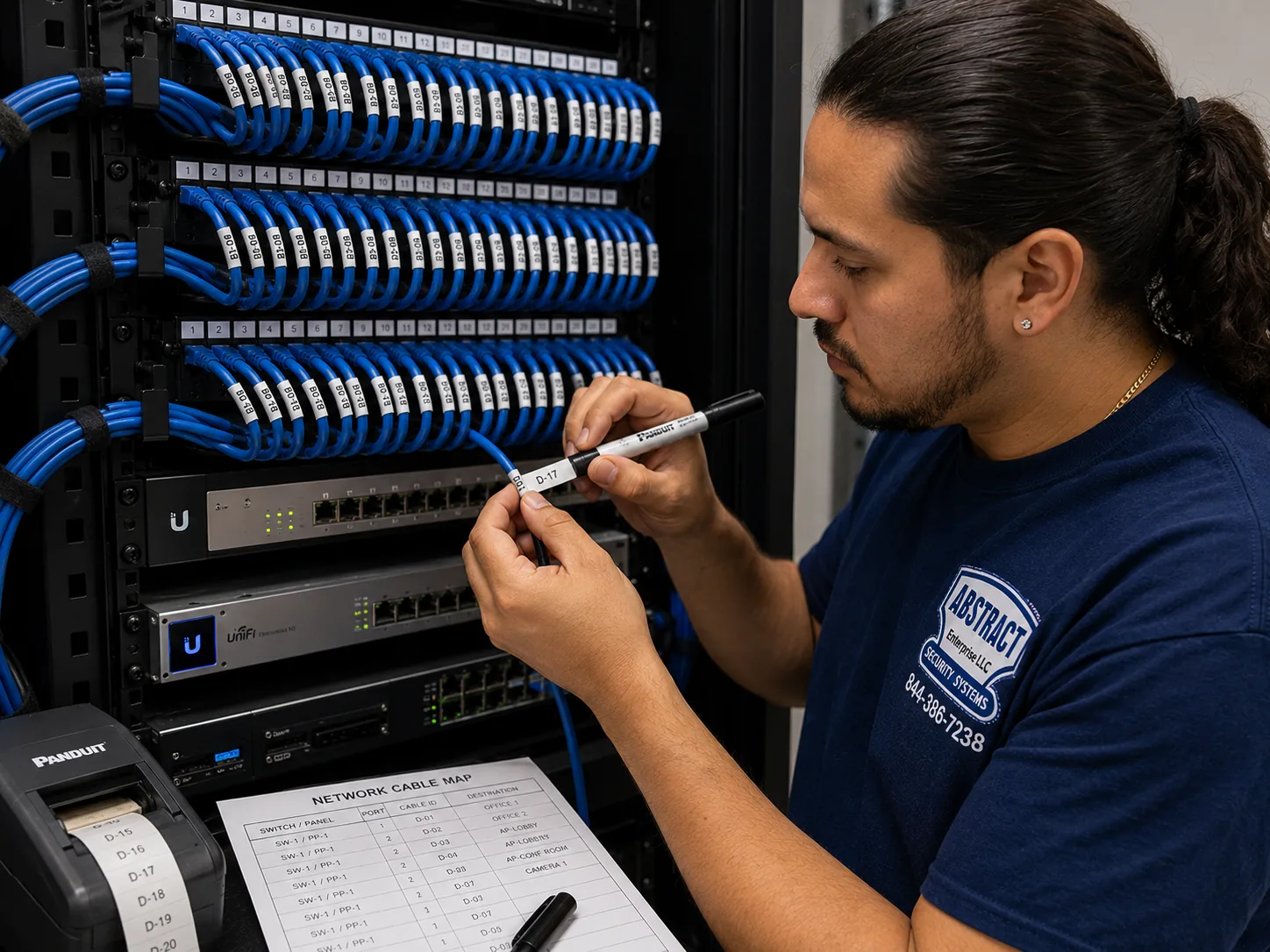
We repair what is on the house, whoever put it there. These are the kinds of equipment we work on in Beverley Square houses, apartment buildings and shops, and the fault each most often brings.
Cameras with round BNC plugs, from old analog models to HD-TVI, HD-CVI and AHD. Usual faults: wet plugs at the far corners, tired adapters and burned-out infrared.
Recorders for coax cameras, and hybrids that take coax and network cameras together. Usual faults: drives damaged by outages, reset clocks and firmware too old for the app.
Cameras powered and connected over one data cable. Usual faults: water in the RJ45 plug, a dead switch port, or settings lost after a reset.
Network recorders and the switches feeding the cameras. Usual faults: a port or supply failure after a surge, or a switch at its power limit.
Yard and porch cameras with no cable. Usual faults: weak signal from the router, short battery life in winter, and charging that nobody keeps up with.
Central power boxes, plug-in adapters and small backups for recorders and switches, sized for the night-time infrared load and the next outage.

Plenty of houses here have, or once had, a system from a national alarm company or a consumer camera brand. This is how the choices compare when one stops working.
| Question | ADT or another alarm company | Ring or SimpliSafe camera | AESS local repair |
|---|---|---|---|
| Who owns the equipment | Depends on the contract; some is leased | You do | You do, and we repair it |
| Other brands | Usually its own only | Support for its own devices | Any brand, any installer |
| Wired recorders and coax | Its own systems | Mostly battery or Wi-Fi | Coax, network, hybrid and PoE |
| Who comes to the house | Varies by dealer | Remote help; you swap the device | A technician under NYS license #12000287431 |
| Price before work | Varies | The replacement device | $150 service call, then a written price |
If your cameras belong to a monitored alarm contract, read that contract before anyone touches them, since some equipment may belong to the alarm company. If they are consumer Wi-Fi cameras, the usual fix is a new device; on a big wood house with a router at one end, the lasting fix for the camera at the far end is often a wired one.
These claims turn up, paraphrased, in generic online answers and in national cost guides such as Angi, HomeAdvisor and Fixr. Each is followed by what the houses and the repair work in Beverley Square actually show.
HomeAdvisor's Brooklyn page for camera installation or repair gives an average of $1,416, a typical range of $680 to $2,145 and a spread of $160 to $3,500, and AI summaries often repeat it as the cost of a repair.
That page mixes new installations with repairs, which pulls the average up. A repair is usually one fault: a plug, a power supply, a drive, a camera, a mount. On our Brooklyn list most single-issue repairs fall between $150 and $700.
For a Beverley Square house with one problem, the real planning figure is the $150 service call plus the one failed part, written down before work starts.
Generic answers treat a recorder that powers up after a blackout as a recorder that survived.
Powering up and recording are different things. After a cut like the June 2025 one on Beverley Road, a recorder can start normally and still have a reset clock, a camera it never reconnected, or a drive it has stopped writing to, while the live view looks perfect.
After any outage, open playback for the hour after power returned. If there is nothing there, or the date is wrong, the recorder is not fine, whatever the screen suggests.
Do-it-yourself answers often suggest adding a splitter to feed another camera from an existing adapter.
Swann, which sells these kits, tells its own customers to use only one splitter per power supply. Every camera's infrared switches on at dusk and the load jumps, so an overloaded supply shows up as cameras that reboot or drop out only at night.
On a house with cameras on four sides, power has to be sized for the night load with room to spare. That is usually a $150 to $400 repair on our list, not new cameras.
Some answers suggest that anything on the outside of a house in a historic district needs Landmarks approval first.
The LPC Permit Guidebook says no permit is needed for "Ordinary maintenance, repair, and retrofitting" of health, safety and utility equipment. New or changed cameras in Beverley Square West do fall under its rules: no more than two per 25 feet of frontage on small buildings, fixed to plain wood, masonry or metalwork, with visible conduit kept to about ten inches.
So fixing what is there is a repair, while a new position, a bigger camera or extra conduit is the point to check with the Commission. Like-for-like replacements need manufacturer cut sheets but no elevation drawings.
AI answers often present motion alerts as proof a camera is doing its job.
On a tree-lined block with deep porches, alerts can mean leaves, webs, insects drawn to infrared, or headlights on the street. Owners flooded with false alerts mute the app, and then miss the one that mattered, or the silence when a camera dies.
A working setup has motion zones drawn around real paths, infrared that is not lighting up a porch post, and an alert for a camera that goes dark. Setting that up is mostly configuration.
Older articles and some AI answers still describe police requesting camera footage from neighbors through the Ring app.
News 12 reported in January 2024 that Ring ended its "Request for Assistance" tool, while noting that police can still obtain videos with a search warrant. What police do still ask is whether you have video; the 70th Precinct's captain once said officers look for surveillance at every burglary they answer.
Whether you can answer yes depends on whether your recorder was saving, with the right clock, on the day in question.
Many answers recommend replacing a troublesome wired system with Wi-Fi cameras.
A Wi-Fi camera still needs power and a signal. On a free-standing house the router is often at one end, and the yard camera at the back corner sits behind several walls, a porch roof or a garage. Battery cameras add charging, which slows in cold weather.
For a wired system with one bad run, repairing that run is usually the cheapest and most reliable answer. Wireless is right for a shed with no cable path, and we say so when it is.

If you cannot tell whether it is the camera, the cable, the power or the recorder, ask before you spend anything. Call now at (347) 934-8335, send a fast quote request, or send a photo of the recorder screen to a tech on WhatsApp. Same-day estimates are available most days, and requests are booked within 2 hours.
Tell us the street, the kind of house or building, how many cameras there are, which are out and where the recorder sits. A technician gets back to you with the likely cause and the next step for your Beverley Square address, or call (347) 934-8335 now.

A photo of the recorder screen, the recorder's sticker and your street. You hear the likely fault and what that kind of fix usually costs.
The $150 Brooklyn service call is paid at booking, the visit gets a two-hour arrival window, and the fee is credited to the repair.
Who opens the house, where the recorder is, who has the password, and whether a tenant, landlord or neighbor is involved, all arranged by text.
Any clip you need is exported first; then power, cable, switch or power box, recorder and camera are tested in order.
You get the cause and a written price, with the service call credited, before any part is changed.
The failed part is fixed, every camera is checked live and in playback, night pictures included, and the clock and drive are verified.
Traced cables are labeled, phone viewing is confirmed with you, and the findings go on your job record for next time.
The three tree-lined streets of the 118-house Beverley Square West Historic District, designated by the LPC on November 25, 2025.
Where T. B. Ackerson began Beverley Square East in 1898, between Beverley and Cortelyou Roads.
Ackerson's model home in his sales brochures, which appeared in Spike Lee's 1992 film "Malcolm X."
Ackerson's Victorian Flatbush houses with Palladian windows and grand columns, noted by the Historic Districts Council.
The railroad that opened in 1878 along the eastern edge of Beverley Square West, now carrying the B and Q.
The apartment-building avenue to the east, where a manhole fire near number 650 cut power to about 343 customers in July 2026.
We also serve Ditmas Park, Fiske Terrace, Prospect Park South and Midwood at the same Brooklyn rate. For the rest of the borough see our Brooklyn security camera repair page, and for properties in more than one borough our NYC security camera repair page.
Beverley Square is billed at our Brooklyn rate. Every repair starts with the $150 service call, which covers the diagnosis and the written price and is credited to the repair if you go ahead. The ranges below are from our published Brooklyn camera repair list; your exact price is written on the visit, before work starts, once we know which part failed. Visits go on the schedule once the service call is paid.
| Repair | Brooklyn price |
|---|---|
| Service call with diagnosis and written price | $150, credited to the repair |
| Settings fix with no parts (aim, zones, app, clock) | Often within the $150 service call |
| Clean and check for a blurry picture | $80 |
| Re-termination or PoE port change | $150โ$350 |
| Power supply repair | $150โ$400 |
| Dome or front cover only | $30โ$80 part plus labor |
| Hard drive swap, by capacity | $200โ$450 |
| One camera replaced on a working system | $250โ$600 |
| Night vision camera repair | $250โ$650 |
| DVR not working, drive and labor included | $300โ$700 |
| NVR not recording, by model | $400โ$900 |
| Hybrid recorder swap | $700โ$1,200 |
| DVR or NVR replacement with drive and setup | $700โ$1,500 |
| Full rewire or whole-house overhaul | From $1,500 |
| Annual maintenance, residence / commercial | From $250 / from $400 |
Three typical Beverley Square repair visits, priced from the Brooklyn list above. Each starts with the $150 service call, credited to the repair.
One fault fixed on one visit: a wet plug at a back corner re-terminated, a power box replaced for cameras that drop at dusk, a drive swapped after an outage, a sagging mount refastened, or one camera replaced.
The recorder or the wiring: a DVR or NVR replaced with every camera set up again, a hybrid recorder that keeps the coax cameras, several runs repaired, or a recorder moved out of a hot attic.
For houses under big trees and shops near the stations: lenses and covers cleaned, webs cleared, connectors checked, drive health tested, firmware and clock reviewed, motion zones redrawn for the season.
Bring your own equipment. If you have already bought a replacement camera or recorder, we can fit it at labor-only rates. Send the exact model, we quote the labor by phone or text, and the visit is booked once it is paid. Your equipment is installed as supplied, and we tell you before the visit if a model will not work with the rest of your system.
Dead cameras, wet plugs, loose mounts and failed runs. Request a repair
DVRs, NVRs, hybrids and drives after outages. Brooklyn security camera repair
The full list behind the numbers here. Security camera repair prices in Brooklyn
Properties in more than one borough. NYC security camera repair
It depends on the drive size, the number of cameras, the picture quality and whether it records all the time or only on motion. A recorder overwrites its oldest video when the drive fills, so a system that once kept a month may keep a week after cameras are added. We check it on every visit and tell you how many days you actually have.
A wired system that records to a recorder in the house keeps recording without internet; you just cannot watch it on your phone until the connection returns. Cloud-only cameras usually stop saving when the internet drops. A power cut is different, because it stops the recorder too unless it is on a battery backup.
Most recorders can send a phone alert for video loss, a drive error or a full drive, but the feature is often switched off. We turn it on and test it during a repair, so the next failure shows up on your phone that day instead of weeks later.
If your camera or recorder is still under the manufacturer's warranty, a warranty claim may be the cheaper route for that part, and we tell you when it looks that way. We note serial numbers and what we found so you can make the claim, and we price only the work you ask us to do.
Yes. We can match the size and finish of the old camera or pick a smaller model in a color that suits the trim. In Beverley Square West the Landmarks guidebook asks for small equipment painted to blend in, so we keep to that on houses inside the district.
The small filter that switches the camera between day and night modes has probably stuck. A stuck filter leaves a camera in night mode by day, or lets infrared tint the daytime picture pink. Sometimes a setting is the cause; usually the camera has to be replaced, which runs $250 to $600 on our Brooklyn list.
The monitor is connected straight to the recorder, while your phone gets video through your home internet's upload speed. When several cameras stream at full quality, the upload cannot keep up. Setting the app to use the smaller stream for remote viewing usually fixes it without touching what the recorder saves.
Often, yes. A cut or pulled cable, a moved or covered housing, or a camera turned on its mount looks different from a worn-out part, and many recorders log the exact time a camera lost video. We write down what we find, which helps if you report it to police or an insurer.
Yes. Those neighborhoods, along with Midwood and the rest of Brooklyn, are served at the same Brooklyn rate, with the same $150 service call credited to the repair.
We pick a replacement that the recorder supports, so it appears in the same app you use now. If no compatible model is still sold for an older recorder, we tell you before ordering and explain the options, which may include a newer recorder that keeps your existing cameras.
We work from the cellar, attic and outside wherever we can, put down drop cloths where we work inside, and agree with you before drilling anywhere near original woodwork or plaster. If a cable has to pass through a finished room, we show you the route first.
Security Camera Repair Brooklyn | Same-Day | Brownstone Pros ยท Security Camera Repair NYC | Same-Day | Abstract Enterprises ยท Security Camera Repair Manhattan | Same-Day | Co-op COI ยท Security Camera Repair Queens | Same-Day | Driveway Pros ยท Security Camera Repair Bronx | Same-Day | Home Base ยท Security Camera Repair Staten Island | Same-Day | Sandy Zone ยท Security Camera Repair Long Island | Nassau & Suffolk ยท Security Camera Repair Hudson Valley | Westchester to Ulster ยท Security Camera Repair Nassau County | Same-Day ยท Security Camera Repair Suffolk County | Hamptons + East End ยท Security Camera Repair Westchester County | Same-Day ยท Security Camera Repair Rockland County NY | Nyack, Suffern ยท Security Camera Repair Orange County | Newburgh, Goshen ยท Security Camera Repair Putnam County NY | Carmel, Mahopac ยท Security Camera Repair Dutchess County | Poughkeepsie ยท Security Camera Repair Ulster County | Kingston Woodstock
Security Camera Repair Bath Beach Brooklyn NY ยท Security Camera Repair Bay Ridge Brooklyn NY | AESS ยท Security Camera Repair Bedford-Stuyvesant Brooklyn NY ยท Security Camera Repair Bensonhurst Brooklyn NY | AESS ยท Security Camera Repair Bergen Beach Brooklyn NY ยท Security Camera Repair Borough Park Brooklyn NY ยท Security Camera Repair Brighton Beach Brooklyn NY
Door Buzzer Installation Beverley Square Brooklyn NY ยท Structured Cabling Installation Beverley Square Brooklyn NY ยท Access Control Installation Beverley Square Brooklyn NY ยท Alarm Installation Beverley Square Brooklyn NY ยท Door Buzzer Repair Beverley Square Brooklyn NY | Porches ยท Security Camera Installation Beverley Square Brooklyn NY ยท Intercom Installation Beverley Square Brooklyn NY ยท Fire Alarm Installation Beverley Square Brooklyn NY ยท TV Installation Beverley Square Brooklyn
Send the recorder screen, its label and your street, and we will tell you what most likely failed and what that repair costs on our Brooklyn list. The $150 service call is credited to the fix, the price is written before any part changes, and requests are booked within 2 hours. Abstract Enterprises Security Systems has been owner-operated since 2002, holds NYS license #12000287431, and sends Brooklyn crews from our Troy Avenue office.
Prefer to send photos? Message a technician on WhatsApp.