Any Brand, Any Installer · Footage Saved Before Anything Is Touched · Written Price First · Brooklyn Rate
Security camera repair in Borough Park starts with a $150 Brooklyn service call that covers finding the fault on site and is credited to the repair if you go ahead; most single faults on our Brooklyn list cost $150 to $700, and a new recorder or a partial rewire runs $700 to $1,500. We fix systems other companies put in, from four cameras on a brick two-family off 15th Avenue to a sixteen-channel recorder in the back of a 13th Avenue store. Requests are booked within 2 hours, visits come in two-hour arrival windows, and you get the cause and a written price before any part is changed. This page covers why Borough Park systems fail where they do, what enlarged houses, walk-ups, shuls and avenue stores change about the repair, how a system is kept recording through Shabbos and Yom Tov when nobody is watching it, and what each kind of fix costs.
Reviewed and updated November 11, 2026, against Boro Park Shomrim's reports on its community camera network (the January 2026 18th Avenue Park arrests, the November 2024 burglary tracking and the May 2026 package recovery); Boro Park 24's coverage of the Shomrim camera registry (2023), the 66th Precinct's 2021 package-theft meeting and the Con Edison outages of June 25, 2025 and January 19, 2026; News 12 Brooklyn on the June 2025 voltage reductions and on 2026 break-ins in Borough Park and nearby Gravesend; the Brooklyn Eagle on the 2012 Leiby Kletzky Security Initiative cameras and the 2016 house enlargements; CBS New York and Yeshiva World News on the 2014 rear-window burglaries and the 2023 Friday-night burglary arrest; Wikipedia's articles on Borough Park, Thirteenth Avenue and the BMT West End Line; Security Sales & Integration on FCC order 22-84; Lawrence Goldstein's guidance on surveillance footage in New York housing court; HomeAdvisor's Brooklyn camera cost page; and CCTV Camera World's recorder troubleshooting guide. · Abstract Enterprises Security Systems, NYS license #12000287431 · crews dispatched from our Troy Avenue office in Brooklyn

Owner-operated since 2002 · Thousands of jobs completed · Booked within 2 hours
Security camera repair in Borough Park usually comes down to one of four parts: the power feeding the cameras, the cable reaching them, the recorder and its hard drive, or the camera itself. The fastest way for us to tell which is a photo of the recorder's screen with all the camera tiles showing. One black tile points at that camera, its cable or its own power. A row of cameras on the same side of the house going dark together points at a shared power box or a switch. A screen that shows live pictures but no recordings when you search last Friday night points at the drive. Add a photo of the label on the top or back of the recorder, which gives the brand, the model and the number of channels, and a line about where it sits: a basement under a two-family, a closet on an upper floor that was added in a renovation, a shelf in a store's back office on 13th Avenue, or the office of a shul. Send those with your cross streets to (347) 934-8335 or on WhatsApp, and we will tell you what most likely failed and what that kind of repair usually costs on our Brooklyn list.
Few neighborhoods in New York lean on private cameras the way Borough Park does. The cameras over the doors of its brick houses and the gates of its avenue stores are not only for the people who own them. Boro Park Shomrim, the volunteer patrol, keeps a registry of private cameras and asks residents to sign theirs up with the camera's location, so volunteers can reach the owner quickly when something happens nearby. "Many crimes occur in front of homes or businesses," a Shomrim representative told Boro Park 24 in 2023, explaining why the group wants those owners on its list. That network has a track record. In January 2026, after swastika graffiti appeared at 18th Avenue Park on several days in a row, Shomrim reported that footage from nearby homes and businesses was used to follow the suspects, and that the NYPD, working with the patrol, made arrests. "Without this cooperation, solving these repeated incidents would have been much harder," the group wrote.
A network built from private cameras is only as good as the cameras in it that are actually working. Shomrim's account of a November 2024 burglary shows how much depends on a chain of them. Volunteers traced the suspects through cameras across the neighborhood to a getaway car parked more than a mile away, then kept watching for the car to pass another lens. "After five hours of detailed analysis, the car was finally spotted, and its identifying details were recorded," the group wrote, and the 66th and 61st Precincts found the car in East Flatbush. In May 2026 the patrol followed a woman who took a package worth thousands of dollars from a doorstep across several neighborhood cameras, identified her, and the items came back. Every one of those trails runs through someone's camera on someone's house. When one of them is dark, has a frozen frame, or has a clock that is hours wrong, the trail has a hole in it, and the person who owns that camera usually has no idea.
That is the heart of camera repair in Borough Park. Systems here do not fail loudly. A recorder keeps its lights on and the app still opens long after the hard drive stopped writing. A camera over a side alley can show the same still picture for weeks. And Borough Park has a pattern that makes a quiet failure easier to miss than almost anywhere else: from Friday afternoon to Saturday night, and for two or three days at a time over Yom Tov, many households and nearly every store on 13th Avenue leave the system completely alone. Wikipedia's entry on Thirteenth Avenue notes that its stores and businesses are shuttered on the Sabbath and Jewish holidays, chain stores included. Burglars know the rhythm too. When Shomrim and 66th Precinct officers detained a man at 16th Avenue and 51st Street in February 2023 after tracking him for more than a year, Yeshiva World News reported that he targeted homes on Friday nights, knowing that many residents let their guard down on Shabbos and that many go away. A system that is going to fail has to be caught before candle-lighting, not discovered after Havdalah.

The buildings make the repair harder than the camera count suggests. Borough Park is one of the most heavily rebuilt neighborhoods in the borough. A special zoning district adopted in 1992 allowed more lot coverage and smaller setbacks and yards, and by 1998 the New York Times reported the neighborhood had seen the most private construction permits in Brooklyn since 1990. In 2016 the Brooklyn Eagle described DOB filings to turn a two-story, two-family house at 1311 44th Street into a five-story, four-family building of 5,633 square feet, and wrote of a "constant demand for additional housing." For a camera system, an enlargement like that changes everything at once. Cameras that sat under the old roofline end up halfway down a new wall, cables that ran up the back of the house are cut or sealed behind new brick, the recorder moves to a closet on whatever floor had an outlet free, and the person who set up the original system is long gone. A good share of our Borough Park calls are not broken equipment at all, but systems that a renovation left half-connected.
Power is the other thing the block hands every system. On the morning of June 25, 2025, News 12 Brooklyn listed Borough Park among the hardest-hit neighborhoods when about 2,200 Con Edison customers across Brooklyn had power problems, and Con Ed confirmed it had lowered voltage on purpose to protect equipment while it made repairs. Residents described flickering lights and dim rooms rather than a clean outage. "The AC in the bedroom is working but the rest of the house— the lights are very dim," one Borough Park resident, Mordecai Hirschhorn, told the station. A few months later, in the snow and ice of January 19, 2026, Boro Park 24 listed outages from Con Ed's map near 46th Street and 9th Avenue, on 12th Avenue near 43rd Street, near 3715 15th Avenue and near 505 McDonald Avenue. A clean outage is easy on a recorder. Low, wandering voltage is not: recorders reboot over and over, camera power boxes sag, and network switches drop the cameras they feed. When a system comes back from a day like that with some cameras missing, the power side is where we start.
The 66th Precinct, whose station house is at 5822 16th Avenue, covers the neighborhood. Its officers told residents at a 2021 "Build the Block" meeting at United Talmudical Academy on Clara Street that package theft was the top concern on residents' minds, and that police can use video evidence and building records to investigate even months later, but only when the crime is reported. The same rule applies to the recorder in your basement: it can only help an investigation weeks from now if it is recording tonight, and many households pair a camera repair with a look at the front door buzzer or intercom on the same visit, since the wiring for both often comes down through the same basement.
Where this page applies. It covers Borough Park from Fort Hamilton Parkway and the Sunset Park side across to McDonald Avenue, and from the Kensington and Green-Wood edge down toward 60th Street and Bensonhurst, along 11th through 18th Avenues and New Utrecht Avenue, mostly in ZIP code 11219 with parts of 11204, 11218 and 11230. Neighbors such as Bensonhurst, Kensington, Dyker Heights and Sunset Park are served at the same Brooklyn rate, and the whole borough is covered on our Brooklyn security camera repair page. The neighborhood name on a listing never changes the price; the fault does.
Urgent Borough Park camera calls tend to arrive on Sunday and Monday mornings, and they come in three kinds. The first is the owner who opened the app after Shabbos or Yom Tov because something happened, a package gone from the stoop, a car opened on the block, a door that was found ajar, and found that the camera that should have seen it is blank or the recording for those hours is missing. The second is a recorder that beeps, shows a disk error, or restarts every few minutes, which in our experience is most often a failing hard drive or a recorder power adapter that has been weakened by a day of low voltage. The third is the renovation call: the scaffolding is down, the new floor is finished, and three of the cameras that used to be on the house either show nothing or are sitting in a box in the basement with their cables cut.
If something has happened and you need footage, the most important thing to do before we get there is nothing at all. Do not unplug the recorder, do not reset it, and do not let a relative or a neighbor "try a few things," because a reset or a drive format can erase the exact hour you need. Call (347) 934-8335, tell us the date and the time window, and we book the visit with saving that clip as the first job. If the footage exists, we export it to a USB drive in the recorder's own format and in an ordinary video format, keeping the recorder's timestamp, so it can go to Shomrim, to the 66th Precinct or to an insurer. Only after that do we start working out what failed. If the recording does not exist because the drive stopped writing, we tell you so immediately, and then we set the system up so that it cannot stop silently again.
For everything else, the path is a $150 service call booked within 2 hours of your request, a two-hour arrival window, and a written price for the fix before any part changes. We try to put Borough Park visits early in the week and early in the day, and on a Friday we book only morning windows, so the work is finished and the system is checked well before Shabbos. Most single faults, a connector re-made, a power box replaced, a camera body swapped, a drive changed, are finished on the first visit when the part is on the truck. When a part has to be ordered, such as a camera that has to match an older recorder, we tell you before you pay for it, and the repair is booked once it arrives.
Each repair below is priced from the same Brooklyn camera repair list. The service call pays for finding the fault; the fix is priced by what failed, not by how long the ladder stays up.
A camera that took on water, cracked, or simply aged out, swapped for a matching one on the same cable and bracket, aimed the way the old one was and added back to the recorder. A single camera replacement on a working system runs $250 to $600 on our Brooklyn list, camera included.
Drives that stopped writing, recorders that beep, restart or forget their settings, and boxes too old to work with today's phone apps. Drive swaps run $200 to $450 by capacity, and a DVR that will not work averages $300 to $700 with the drive and labor.
Central camera power boxes weakened by low-voltage days, wall adapters that browned out, and switch ports that stopped feeding a network camera. Power supply repair typically runs $150 to $400.
Runs cut, buried or left hanging when a house was enlarged, cameras taken down for scaffolding and never put back, and recorders moved to a new floor. Connector and port work runs $150 to $350; larger re-runs are priced on the visit.
Infrared that bounces off a sukkah wall or a storefront window, cameras that stay in black and white by day, and pictures washed out by a porch light. Night vision camera repair runs $250 to $650 depending on whether the camera itself must change.
Recorders that dropped off the app after a router change, logins changed by one family member and never shared, and accounts tied to an installer who closed. Configuration fixes with no parts are often covered inside the $150 service call.
Clips copied from the recorder to USB with the original timestamp, in the recorder's own format and a common video format, before any setting is changed and before anyone tries a reset.
A failing analog recorder replaced with one that runs the old coax cameras and new network cameras side by side, so a family can replace cameras one at a time. A hybrid recorder swap runs $700 to $1,200 installed.
Lenses and covers cleaned, connectors checked, the drive's health tested, recording confirmed on every channel and health alerts set before a long holiday. A clean and check starts at $80; annual maintenance starts at $250 for a home and $400 for a business.

Six kinds of building cover almost every Borough Park camera call. They differ in three things that decide how a repair goes: where the recorder ended up, how the cable gets from the recorder to each camera, and who besides the caller has to say yes to the work.
Attached or semi-attached, with cameras over the stoop, the side alley and the rear yard, and one recorder for the whole house in a basement or a hall closet.
A house built up and out under the special zoning rules, where the original camera runs were cut, extended or sealed behind new brick.
Four to a dozen apartments over one front door, with hallway and entrance cameras wired to a recorder the owner or super keeps locked away.
A shop on 13th, 16th or 18th Avenue with its own system downstairs, often sharing walls, risers and sometimes power with the apartments overhead.
Large rooms, high ceilings, many doors and a system run by volunteers or an office manager, often donated or added to by different people over the years.
A building of the last two decades with network cameras, a switch and a recorder in a meter room or cellar, usually installed by the original contractor.
The typical Borough Park house we are called to has four to eight cameras: one or two at the front door and stoop, one along the side alley or driveway, and one or two covering the rear yard, the back door and the windows above it. The cables usually come down the outside of the brick, often stapled along a mortar joint, and enter the basement through a window frame or a drilled hole near the meter. That entry point is where we find more trouble than anywhere else on the house, because it is where water runs down the wall, where the cable gets bent every time someone opens the basement window, and where a rodent looking for a way in will chew. When one camera on the back of the house goes dark, we check the run at that entry point before we touch the camera itself.
The rear-yard camera deserves special attention in this neighborhood. When CBS New York and Yeshiva World News reported in 2014 that eight Borough Park homes had been burglarized in under two months, the entry each time was through a rear window, and the police time windows for some of the burglaries ran as long as a month because families were away. A rear camera that has been showing a frozen frame, or has been knocked to point at the fence, will not show that. On a repair visit we look at every camera's live view and its playback from the last few days, not just whether the tile is lit, because a camera can be lit and still recording nothing useful.
When a house is built up a floor or two, or pushed back into the yard, the camera system is rarely part of anyone's plan. The general contractor needs the facade clear, so someone takes the cameras down, coils the cables and hangs them in a bag, and the cameras either sit in the basement or go back up somewhere close to where they were, on cables that no longer reach. We regularly find cameras reconnected with indoor-rated splices that fail at the first heavy rain, coax runs extended with the wrong connectors, and network cables crimped in the field without any test. The camera looks fine on the day the scaffolding comes down and fails a few weeks later.
Repairing this kind of system starts with a trace, not a guess. We identify every run at the recorder end, follow each one to its camera with a tone generator where the path is hidden, and test it end to end. Runs that pass get labeled and kept. Runs that were cut and spliced outdoors get re-made with proper weatherproof connectors or replaced. And where the new walls make the old cable path impossible, we tell you the options: a new run through the new construction while it is still accessible, a network camera on a single cable if the old system used two, or a hybrid recorder that lets the old coax cameras and a new network camera live on the same box.
Borough Park's walk-ups, from four-family buildings to taller apartment houses on the avenues, usually have a camera at the street door, one in the vestibule or mailbox area, one or more in the hallways and stairwell, and sometimes one on the roof door or the back courtyard. The recorder is kept in a locked closet, the cellar or the owner's own apartment. Because residents notice when the lobby screen goes dark, these systems tend to get reported faster than private houses, but they also see more casual damage: a camera knocked by a stroller or a delivery, a cable pulled loose in the stairwell during a move, or a hallway camera covered by someone who did not want it there.
The repair itself is usually straightforward. What slows it down is access. We need the owner or the managing agent to confirm the visit, someone to open the recorder closet, and, for a camera on a roof door, roof access. If the building has a super, the super can let us in, but the owner approves the written price. That way nobody is surprised by the bill, and the residents get their cameras back without three weeks of messages.
A store on 13th, 16th or 18th Avenue usually has its cameras on the register, the entrance, the stockroom and the gate, with the recorder on a shelf in the back office. These systems work hard: they record every hour the store is open and every hour it is closed, and on Thirteenth Avenue, where stores are shuttered from before Shabbos to after it, the closed hours include long stretches when nobody looks at the screen. The faults we see most in stores are drives worn out by constant recording, power adapters that live behind a hot recorder, and cameras over display cases that were installed facing directly into the case lights.
The apartments above add their own complications. The store and the apartments often share a cellar, so the recorder can sit near the building's water heater or boiler, which is a hot, damp place for electronics. Cable to an upper camera may run through an apartment's riser. And when the store changes hands, which happens on any busy avenue, the new owner inherits a system with a password that belonged to the old one. A repair in a store with homes above therefore usually means confirming with both the store owner and the building owner who controls what.
Borough Park has more than 300 religious institutions, according to the Brooklyn Jewish historical guide to the neighborhood, from small shtieblach on the ground floor of a house to large buildings with study halls, offices, classrooms and halls. Their camera systems tend to have been built in pieces: a few cameras donated by a member, more added after an incident, a recorder replaced when the first one died, and an app login known to one gabbai or office manager who may have moved on. The rooms are big, the ceilings are high, and the doors are many, so a single system can have twenty or more cameras covering entrances, the street, the coat rooms and the yard.
The two things that matter most for these repairs are scheduling and records. We book around davening and school hours, never on Shabbos or Yom Tov, and plan high-ceiling work for times the room is empty. And because the people who run the system change, we leave behind what the institution needs to keep it running: a list of every camera and where it records, the recorder location, and confirmation of who holds the administrator password, handed to whoever the institution names.
Buildings put up in the last twenty years usually arrived with a network camera system: cameras powered over their data cable, a PoE switch, and a network video recorder in the meter room or cellar, sometimes behind the building's own internet equipment. The hardware is generally sound. What fails is the setup around it. We find recorders that were never set to overwrite old video and simply stopped when the drive filled, cameras still on their factory passwords, clocks never synced, and phone access that worked only for the developer's sales office.
When a technician arrives at a Borough Park house on a Sunday or Monday after a camera went dark, the work starts with the recorder, not the ladder. The first thing we do is open playback and look at the timeline for the days just past, because the recorder's own record of when each camera stopped is the best clue we have. A camera that stopped at a precise minute and never came back usually lost power or cable. A camera that flickered on and off for hours before dying points at a weakening power supply or a connector letting in water. Every camera stopping together at the same time points at the recorder, its drive, or the power to the whole system, and if that time lines up with a Con Edison problem on the block, we know where to look.
Next comes the drive. We read the recorder's disk status and its recording log. If the drive shows errors, or if the log shows recording stopped days or weeks ago while the live view kept running, the drive is the fault, and replacing it is usually a quick job. We check that the recorder is set to overwrite the oldest video when the drive fills, because a surprising number of systems here were set up to stop instead. And we check the clock against the correct time, because a recorder that has lost power on a low-voltage day may come back hours or even years off, and footage with a wrong time is much harder for Shomrim or a detective to line up with anyone else's.
Only then do we go to the cameras that are out, starting at the recorder end of each cable and working outward: is power reaching the camera, is the signal coming back, is the connector at each end sound. On the brick houses here, that usually means a look at the basement entry, where the cables come through the wall, before the ladder goes up. Most of the time the fault is found within that first half hour or so, and you have a written price for the fix before the technician touches a part. Before we leave, we set the recorder to send a health alert to the owner's phone if a camera drops or the drive fails, so the next problem is known on Thursday, not discovered on Sunday.
Every camera system is a chain: power in, cable out, a recorder that saves what comes back, and cameras at the far end. A fault anywhere in the chain looks the same on the screen, a black tile or a gap in playback, which is why testing in order matters more than replacing whatever looks oldest.
Power faults are the most common cause of several cameras failing together, and Borough Park's grid gives them plenty of chances. A day like June 25, 2025, when Con Edison cut voltage across parts of southwest Brooklyn and residents described dim, flickering lights, is hard on electronics in a way a clean outage is not. A recorder may restart dozens of times. A central camera power box can lose one of its channels. A network switch's adapter can fail quietly. CCTV Camera World's recorder troubleshooting guide puts it simply: "Sometimes the power supply is simply damaged as a result of a thunderstorm, outage, or surge." We test each supply under load, because a weak one can read normal with nothing attached and then sag as soon as the cameras' infrared turns on at dusk.
The other power fault is human. In a busy household, a recorder plugged into a convenient outlet gets unplugged to make room for a hot plate, a kettle or a timer before Shabbos or Yom Tov, and plugged back in later, or not. Recorders on extension cords running through doorways get kicked loose. Where we find this, the repair includes putting the recorder and its switch on their own protected outlet, ideally on a small battery backup, and labeling the plug so nobody mistakes it for a spare.
Power supply repair on our Brooklyn list typically runs $150 to $400, depending on whether it is a single camera adapter, a multi-channel power box or a PoE switch that has to change.
Cable faults are usually at the ends rather than in the middle. On a brick house, the weak points are the connector at the camera, where rain gets in if the seal was never made, and the spot where the cable enters the house. Construction adds a third: the place where somebody cut the run to get a camera out of the way of scaffolding and joined it back with tape. Our own Brooklyn repair records show that most calls that look like a damaged cable turn out to be a bad connector at the camera end, which is good news, because re-making a connector is a small job.
The recorder is where quiet failures live. A hard drive in a recorder that writes every second of every day wears out over years, and when it starts to fail the recorder may keep showing live pictures while saving little or nothing. Some recorders warn with a beep or an on-screen message, which in a basement nobody hears. Others give no warning at all. A drive swap on our list runs $200 to $450 depending on capacity, and when the recorder itself has failed, a DVR repair averages $300 to $700 with the drive and labor, while a full recorder replacement with drive and setup runs $700 to $1,500.
Two settings matter as much as the hardware. The first is overwrite: a recorder should replace its oldest video when the drive is full, and one that is set to stop instead will simply stop, sometimes for months. The second is time. A recorder that keeps the right time, ideally synced automatically, produces footage that lines up with every other camera on the block, which is exactly how Shomrim followed a burglar's trail across cameras to a car more than a mile away in 2024. We check and fix both on every recorder we touch.
The camera itself is the failure we see least often, but it is the one owners suspect first. Outdoor cameras do fail: a seal gives way and the lens fogs from the inside, the infrared lights that let it see at night burn out, or a camera on a low porch takes a knock. A fogged camera is almost always a replacement, because a broken seal lets moisture back in on the next humid day. A cracked dome or front cover can often be replaced on its own, at $30 to $80 for the part plus labor.
Some camera problems are really about where the camera points. A camera behind a store window, aimed at a sukkah wall or at a white wall a few feet away, will throw its own infrared back into the lens at night and show a white haze. A camera facing a display case or an east-facing street at sunrise may wash out completely. Moving the camera a few inches, changing its angle, or switching it to a model with light-based color night vision often fixes what looked like a dead camera. A single camera replacement on a working system runs $250 to $600 with the camera included, and night vision repairs run $250 to $650.

Borough Park's commercial life runs along a handful of corridors, each with a different mix of businesses and a different pattern of hours. What a store, office or institution needs from a camera repair depends on which one it sits on.
About a mile of shops, co-named Raoul Wallenberg Way in 2012, with silver Judaica, electronics, wig stores, books and kosher food, nearly all shuttered on Shabbos and Yom Tov.
Shops and offices along the avenue that also holds the 66th Precinct station house at 5822 16th Avenue.
A shopping avenue on the neighborhood's southern side, with storefronts close to 18th Avenue Park.
Stores and garages under the elevated West End line, with D train stations at 50th Street and 55th Street.
The western edge, with the D and N station and the blocks where a March 2026 break-in near 39th Street was reported.
The eastern edge along the F line, with mixed commercial and industrial frontage.
For a store on Thirteenth Avenue, the camera system has two jobs that pull in different directions. During business hours it watches customers, staff and the register, and owners want a clear picture of hands and faces at the counter. When the store is closed, often from Friday afternoon to Saturday night and for longer stretches over Yom Tov, it is the only thing watching the gate, the door and the stockroom, and the owner may not look at it until the store reopens. A repair here has to make sure both jobs work: daytime pictures sharp enough to be useful, night and closed-hours recording that runs without anyone checking, and a drive large enough to keep the video until someone has a reason to look.
The Wikipedia history of Thirteenth Avenue notes that in 2009 there were fourteen banks between 45th and 55th Streets, which says something about how much cash and valuable stock has moved along this mile. Jewelry, silver and electronics shops in particular should think about how long their recorder keeps video, because a theft discovered at inventory may have happened weeks earlier. We set retention to the store's actual need and size the drive to match, and we check that the recorder itself is somewhere a thief cannot simply carry it out the back door with the evidence.


New York State requires a license to install or service security systems, and the Department of State issues it; Abstract Enterprises Security Systems works under NYS license #12000287431. The state also exempts owners who install equipment on their own property themselves, which is why so many Borough Park stores have systems put in by a relative or a former employee, and why those systems often arrive at our door with no documentation. Employers should know that New York Labor Law section 203-c requires notice to employees of electronic monitoring in the workplace, including posting it, and a repair that adds or moves a camera in a staff area is a good moment to check that notice is up.
Many stores here run Hikvision or Dahua equipment. In November 2022 the Federal Communications Commission adopted rules, in order FCC-22-84, barring new authorizations for equipment from companies on its Covered List, Hikvision and Dahua among them. Security Sales & Integration reported at the time that "the FCC's Order does not affect products that are already authorized," so a store's existing system is not illegal to keep or to repair. What changes is the supply of new matching parts, which is why we sometimes recommend a compatible camera from another brand, or a hybrid recorder, when a Hikvision or Dahua part fails. Stores that want to share their cameras with the community can register them with Shomrim's camera network, and the 66th Precinct can use video evidence from a reported crime even months later, provided the system was recording.
These are the questions Borough Park owners, families, store owners and institutions bring to us, grouped by the situation they come from. Each answer is the one we would give on the phone.
Yes. Most recorders made in the last several years can send a notification to a phone when a camera loses video, when the drive reports an error, or when recording stops. On a repair visit we turn those alerts on and send them to whoever in the family checks the app most, so a failure on Tuesday or Wednesday is known before Friday. For households that want an extra step, a quick look at the playback timeline on Thursday or Friday morning, which we can show you how to do in a minute, confirms that every camera recorded the night before.
Usually. Sukkahs go up on balconies, porches and even sidewalks across Borough Park, and a camera mounted at the height of a sukkah wall will see canvas for a week. Two common fixes are raising the camera above the top of the sukkah, so it looks down over it, or adding a second camera that covers the yard from another side for the holiday. The washout comes from the camera's infrared or the sukkah light bouncing off the wall close to the lens, and an angle change or a camera that can switch to color night vision usually solves it. If the camera does need to come down for the week, we can mount it on a bracket designed to be removed and replaced in the same position.
Often a repair, but it depends on the recorder and the cable. If the recorder is in good shape and the cameras still work, we trace each cut run, extend or replace it with proper outdoor connections, and remount the cameras where they actually make sense on the new facade, which is often higher than before. If the recorder is old, the runs were cut in several places, and the cameras are near the end of their life, a partial replacement with a hybrid recorder can cost less over time. We price both options on the visit so you can choose.
If the cameras are on the walls being worked on, yes, and it is worth having them taken down properly rather than by the crew. We remove the cameras, label each cable at both ends, seal the cable ends against water, and store or bag the cameras so they can go back on the same runs. If the work will change the walls, we can also leave spare cable at the new camera positions while the framing is open. Done this way, putting the system back after the scaffolding comes down is a short visit instead of a full repair.
It can. Low, unstable voltage makes recorders and power supplies work harder, and repeated restarts are hard on a hard drive. Damage does not always show at once; we often find a power adapter or a drive that started failing a few weeks after a day like that. If your system has been unreliable since, we test the recorder's adapter, the camera power box and the drive's health on the visit. A small battery backup between the wall and the recorder smooths out exactly that kind of dip.
If the camera was not sending video to the recorder, there is nothing on the drive to recover for that camera, and we will tell you so honestly. It is still worth checking the other cameras on the house for the same hours, because a camera at the stoop may have caught part of the street even if the side camera was out. Then we fix the dark camera and turn on the alerts, so the next time Shomrim or the 66th Precinct asks, the footage is there.
Sometimes it is the copy. Many recorders record each camera twice, a full-quality stream and a small low-quality stream for phones, and a clip saved from the phone app often comes from the small one. Exporting from the recorder itself, using the main stream, can produce a much sharper clip. If the main recording is also blurry, the cause is usually a dirty or fogged lens, a camera focused at the wrong distance, or a camera too far from the door to show a face, and each of those has a fix we can price on the visit.
That depends on the drive size, the number of cameras, their resolution and whether they record all the time or only on motion. A store recording many high-resolution cameras around the clock may fill a small drive in a week or two. On a repair visit we calculate how many days your recorder is actually keeping, then adjust: a larger drive, a second drive, motion-based recording for cameras that watch an empty stockroom at night, or lower settings on cameras that do not need full detail. For a store that keeps valuable stock, we aim for enough days to cover the gap between inventory counts.
Almost never. A camera pointed straight into bright case lighting is overwhelmed, the same way your eyes are when you look at a lamp. The fix is usually moving the camera so it looks across the case rather than into it, adjusting its exposure and backlight settings, or replacing it with a camera designed for strong mixed light. We look at it live with the case lights on before deciding anything needs replacing.
Usually not. Every phone watching live video pulls a stream out through your home internet connection, and the upload speed on a typical home plan is far lower than the download speed. With many viewers at once, the recorder or the connection runs out of room and pictures freeze. We can set the recorder to send phones a lighter stream, limit how many full-quality views run at once, and give each family member their own login so access is easy to manage without anyone sharing the main password.
Yes. A small monitor can be connected to the recorder or to a simple viewing device, set to show the front door camera all the time or to switch to it when the camera sees motion. If the house already has a monitor that went dark, that is often a cable or a setting on the recorder's display output, which is a small repair. We set it up so she does not have to press anything to see who is there.
Sometimes. The recorder's electronics may be ruined while the hard drive inside survives, especially if it was not powered when it got wet. Do not try to switch it on again. We remove the drive and try to read it in a working recorder of the same type. If the drive itself is damaged, recovery becomes a job for a specialist data recovery lab, and we will tell you that before you spend anything. Either way, the system gets a new home off the floor once it is repaired.
Borough Park systems range from a single doorbell camera to dozens of cameras in a school, and from coax systems more than a decade old to current network systems. These are the categories we repair, with where each shows up most in the neighborhood.
The cameras on many older two- and three-families and stores, on round coax cable with a separate power lead. Connector and power faults are the usual repairs.
Recorders for coax cameras, and hybrids that run coax and network cameras together, which let a family replace cameras one at a time after an enlargement.
Cameras on a single data cable that also carries their power, common in newer infill buildings, larger shuls and schools, and stores that upgraded recently.
The recorders and switches behind network cameras, and the first place we look when several cameras drop out after a low-voltage day.
Domes in hallways and over store counters, turrets over stoops, and bullets down side alleys and rear yards, each with its own weak points for water and glare.
Moving cameras on larger buildings and institutions. PTZ repair runs $450 to $1,200 on our Brooklyn list because of the parts involved.
Multi-channel camera power supplies, individual adapters and small battery backups that keep recording through a flicker or a short outage.
Screens in a store office, a building lobby or a grandparent's room, and the display output on the recorder that feeds them.
The connection to every phone in the family, separate logins for each user, and health alerts that report a dead camera or drive before Shabbos.

Some Borough Park households have a system from a national alarm company or a consumer camera brand alongside, or instead of, a wired system. This is how the choices compare when something stops working.
| Question | ADT or a similar alarm company | Ring or SimpliSafe camera | AESS local repair |
|---|---|---|---|
| Who owns the equipment | Depends on the contract; some may be leased | You own the device | You own it, and we fix it |
| Other brands on the same house | Usually only its own | Support covers its own devices | Any brand, any installer |
| Wired recorders and coax | Its own systems | Mostly Wi-Fi or battery devices | Coax, network, hybrid and PoE |
| Technician at the house | Varies by dealer | Remote support; you replace the device | Yes, under NYS license #12000287431 |
| Recording through a long Yom Tov | Depends on the plan | Depends on Wi-Fi, battery and subscription | Local drive, health alerts and battery backup set up on the visit |
| Price before work | Varies | The price of a new device | $150 service call, then a written repair price |
If your cameras are part of a monitored alarm contract, read the contract before anyone else works on them, because some equipment may belong to the alarm company. If they are consumer Wi-Fi cameras, the usual fix for a dead one is a new device, and in a brick Borough Park house with thick walls the lasting fix is often a wired camera where the Wi-Fi signal does not reach reliably. We will tell you which you have.
These are claims that show up, paraphrased, in generic online answers and in national cost guides such as Angi, HomeAdvisor and Fixr, each followed by what Borough Park's houses, stores and repair work actually show.
HomeAdvisor's Brooklyn page for surveillance cameras gives an average of $1,416 and a typical range of $680 to $2,145, and AI answers often repeat those figures as the cost of a repair. The trouble is that the page covers installation and repair together.
On our published Brooklyn list, most single-fault repairs fall between $150 and $700. A connector re-make or a PoE port swap is $150 to $350, a hard drive swap is $200 to $450, and a single camera replacement on a working system is $250 to $600. Prices over $700 are for recorder replacements, partial rewires and the larger jobs that follow an enlargement.
So the right number for a Borough Park owner is not an average at all. It is the price of the part that failed, which is why we find the fault on a $150 service call first and write the repair price down before anything is replaced.
This is the most expensive misunderstanding we meet. Live view and recording are separate. A recorder can show every camera perfectly on the screen and the phone while its hard drive has stopped saving, because the drive failed, because it filled and was set to stop rather than overwrite, or because a camera's recording schedule was switched off.
In Borough Park this matters more than most places, because so many systems run untouched from Friday afternoon to Saturday night and longer over Yom Tov. A homeowner who glances at a live picture on Thursday has no way of knowing the drive stopped writing two weeks earlier.
The only real check is playback: search for last night, on every camera, and see video. On every repair we confirm recording in playback, set the recorder to overwrite, and turn on alerts for drive and recording errors, so a silent failure becomes a message on someone's phone.
AI summaries of the FCC's 2022 action often turn it into a ban on owning or using these brands. The order, FCC-22-84, stopped new equipment authorizations for companies on the Covered List, Hikvision and Dahua among them, and trade press at the time reported that "the FCC's Order does not affect products that are already authorized."
For a Borough Park store or family with a working Hikvision or Dahua system, that means there is no rule forcing it off the wall, and we repair these systems regularly. What does change is how easy it is to find new matching parts over time.
When a part fails, we look first at whether a compatible camera from another brand will work with the existing recorder, and whether a hybrid recorder lets old and new cameras share one box. Replacement of the whole system is one option among several, not a legal requirement.
When footage is too blurry to show a face, the common advice is to buy a sharper camera. Sometimes that is right. More often, the camera already records enough detail and something else is in the way.
The clip may have been saved from the phone's low-quality stream instead of exported from the recorder. The lens cover may be dirty or fogged. The camera may be aimed at the street from too far away to show a face at the door, or pointed into a sukkah light, a display case or the sunrise. In each of those cases a more expensive camera produces the same unhelpful picture.
We check how the footage was exported, clean the lens, and look at the camera's position and settings before suggesting a new camera. For a stoop or a store door, moving the camera closer and lower often does more than doubling the resolution.
Online answers often say that if you have a clip, you have evidence. New York attorneys who handle housing court are more careful. Lawrence Goldstein, writing on surveillance footage, advises that the contractor "should periodically check the camera and DVR to confirm that both are operating properly," and describes a case, 1427 LLC v Schiller, where a court discounted footage partly because "the camera and the DVR were not located in secure locations" and because of unexplained gaps in the recording.
The same weaknesses show up in ordinary Borough Park systems: recorders on an open shelf in a hallway, clocks that are hours off after a low-voltage day, and recordings that stop and start because the power supply is failing.
A repair can address all three: a recorder in a secure, ventilated spot, a clock synced automatically, and a power supply and drive that keep recording continuously. If footage might ever be needed for a dispute or a police report, that is worth more than any new camera.
Surge strips are useful, and AI answers often stop there. But a surge strip only clips sudden spikes. It does nothing for the problem Borough Park actually had on June 25, 2025, when Con Edison deliberately lowered voltage and residents saw dim, flickering lights for hours, or for the short outages that come with snow and ice, like those listed near 15th Avenue and McDonald Avenue on January 19, 2026.
Low and unstable voltage makes recorders restart over and over, which risks corrupting the drive and leaves gaps in the recording. A short outage simply stops everything. Neither is helped by a surge strip.
A small battery backup, sized for the recorder and the switch or camera power box, rides through both. We size and fit one as part of a repair when the recorder's history shows power trouble.
Resetting a recorder to its factory settings is one of the first steps many online guides suggest. In practice it can make a bad situation worse. A full reset may erase the recording schedule, the camera connections, the passwords and, on some models, the video index,.
If something has just happened and you need footage, a reset or a drive format is the one thing that can destroy the clip you were looking for.
A proper repair tests the chain in order, power, cable, recorder and camera, and fixes the part that failed. Reset is a tool for specific cases, such as a recovered password on a recorder you own, not a first move.
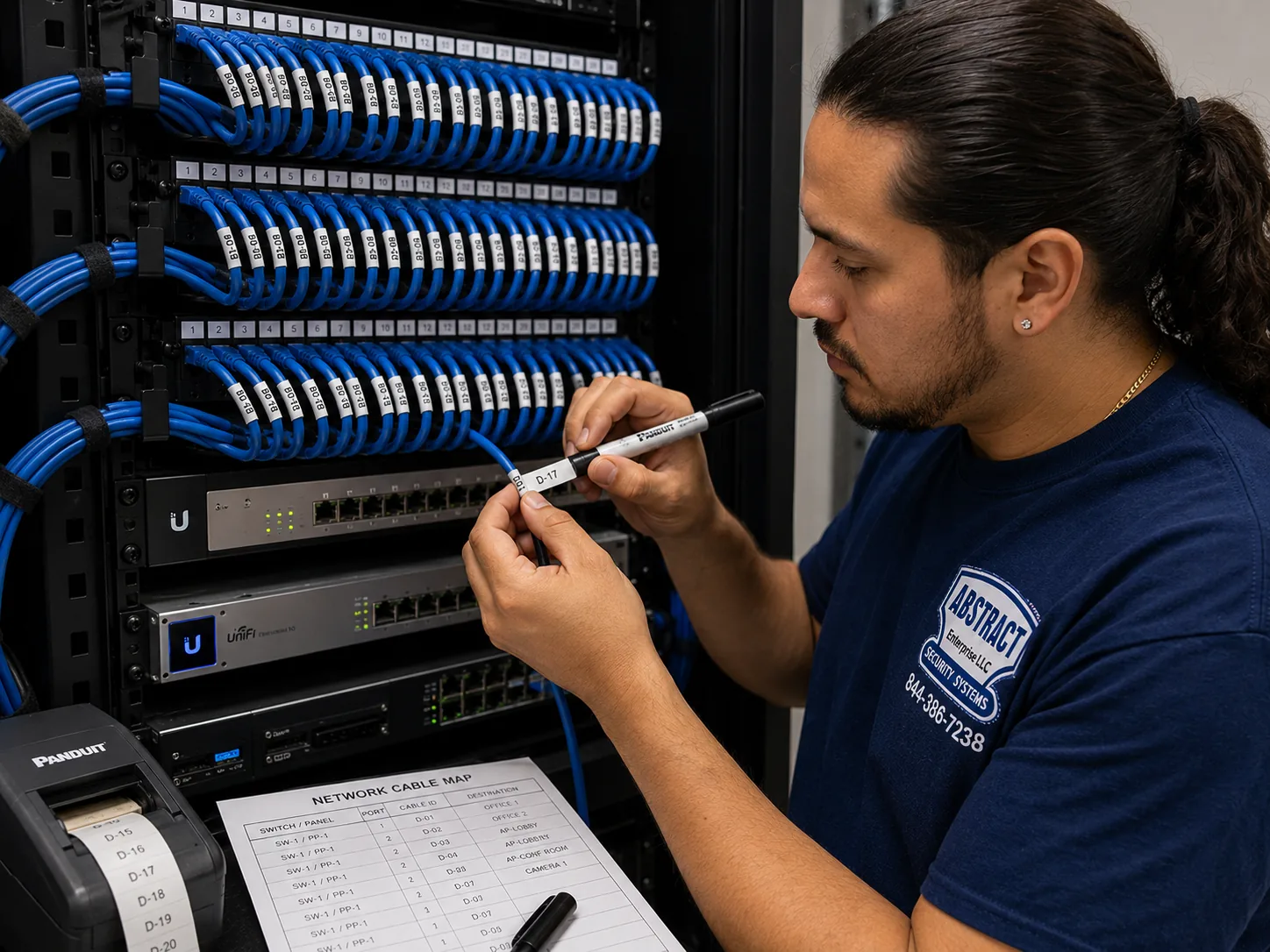
Not sure whether it is the camera, the cable, the power or the recorder? Ask before you spend money on parts. Call now at (347) 934-8335, send a fast quote request, or show the recorder screen to a technician on WhatsApp. Same-day estimates are available on most days, and requests are booked within 2 hours.
Tell us the cross streets, the kind of building, how many cameras there are, which ones are out, when you last saw them working and where the recorder sits. A technician will get back to you with the likely cause and the next step for the Borough Park address, or call (347) 934-8335 now.

A photo of the camera grid, the recorder's label and your cross streets. You hear the likely cause and what that kind of fix usually costs.
The $150 Brooklyn service call is paid at booking and the visit goes on the schedule in a two-hour window, with Friday visits kept to the morning.
Who opens the door, where the recorder is, the login, and any roof, tenant, neighbor or contractor access, all agreed before the visit.
Any clip you, Shomrim or the precinct needs is exported with its original timestamp before a single setting changes.
Power, cable, switch or power box, recorder, drive and camera are tested in that order until the failed part is found.
You get the cause and a written price before any part is replaced, with the service call applied against it.
The fault is fixed, every camera is checked live and in playback, the clock and drive are verified, health alerts are set and the traced cables are labeled.
At 5822 16th Avenue, the precinct that covers Borough Park and works with Shomrim on cases built from private camera footage.
Where repeated swastika graffiti in January 2026 led to arrests after footage from nearby homes and businesses was shared.
The hospital at 4802 10th Avenue, founded in 1911 as the New Utrecht Dispensary, on the neighborhood's western side.
The Bobov Hasidic dynasty's center in Borough Park, among the neighborhood's best-known institutions.
At 123 Clara Street, the site of the 66th Precinct's 2021 "Build the Block" meeting on package theft.
Where the West End D and the Sea Beach N stop at the western edge of the neighborhood.

We also serve the neighborhoods around Borough Park, including Kensington, Sunset Park, Dyker Heights and Bensonhurst, at the same Brooklyn rate. Further along the same side of the borough, see our Bay Ridge and Bath Beach pages, and for the whole borough our Brooklyn security camera repair page.
Borough Park is billed at our Brooklyn rate. Every repair begins with the $150 service call, which covers the on-site diagnosis and the written repair price and is credited to the repair if you go ahead. The ranges below come from our published Brooklyn camera repair list; your exact price is written down on the visit, before work starts, once we know which part failed. Jobs go on the schedule once the service call is paid.
| Repair | Brooklyn price |
|---|---|
| Service call, on-site diagnosis and written repair price | $150, credited to the repair |
| Settings fix with no parts (alerts, overwrite, clock, app) | Often within the $150 service call |
| Clean and check for a blurry picture | $80 |
| Connector re-make or PoE port swap | $150–$350 |
| Power supply repair | $150–$400 |
| Dome or front cover replacement | $30–$80 part plus labor |
| Hard drive swap, by capacity | $200–$450 |
| Single camera replacement on a working system, camera included | $250–$600 |
| Night vision camera repair | $250–$650 |
| DVR not working, including drive and labor | $300–$700 |
| NVR not recording, by model | $400–$900 |
| PTZ camera repair | $450–$1,200 |
| Hybrid recorder swap, channels reconfigured | $700–$1,200 |
| DVR or NVR replacement with drive and setup | $700–$1,500 |
| Full rewire or whole-house system overhaul | From $1,500 |
| Annual maintenance, home / business | From $250 / from $400 |
Work that follows a renovation, such as tracing cut runs or re-pulling cable through new construction, is priced on the visit once we have seen the path, because no two enlargements leave the same mess. Removing and labeling cameras ahead of scaffolding is priced as its own item before the visit.
Full terms — including 50% deposit, one-year parts-only warranty on AESS-supplied products, and the late-fee schedule — are set out in the service agreement.
Three common Borough Park repair visits, priced from the Brooklyn list above. Each starts with the $150 service call, credited to the repair.
One fault fixed on one visit: a connector re-made at a basement entry, a power box replaced after a low-voltage day, a drive swapped in a store recorder, a camera re-aimed away from case glare, or family logins sorted out on a recorder only one person could open.
The recorder or the wiring: a DVR or NVR replaced with a new drive and every camera set up again, a hybrid recorder so an enlarged house can keep its coax cameras, or several runs reconnected after the scaffolding came down.
A visit before the long holidays: lenses and covers cleaned, connectors checked, drive health tested, recording confirmed on every channel, clock synced and alerts tested, from $250 for a home and $400 for a store or institution.
Bring your own equipment. If you already bought a replacement camera or recorder, we can fit it at labor-only rates. Send us the exact model and we quote the labor by phone or text, and the visit is booked once it is paid. Equipment you supply is installed as supplied: we cannot vouch for parts we did not provide, and we tell you before the visit if a model you bought will not work with the rest of your system.

Dead cameras, failed connectors and runs cut during construction. Request a repair
DVRs, NVRs, hybrids and hard drives across the borough. Brooklyn security camera repair
The full list behind every price on this page. Security camera repair prices in Brooklyn
Owners with properties in more than one borough. NYC security camera repair
Yes. Friday visits in Borough Park are booked in morning arrival windows only, and if a repair turns out to need more time or a part we do not have, we make the system safe, tell you what is left, and finish it after Shabbos rather than run late.
The service call covers the visit and the diagnosis, so it is charged either way. If the cameras are recording and only phone viewing is down because of the internet or the router, we tell you exactly what the internet provider needs to fix, and often reconnect the recorder to the network within the same visit.
We can repair the camera and the recorder side, but the cable that travels with the elevator car belongs to the elevator system, and work on it has to be coordinated with the building's elevator maintenance company. We diagnose which side has failed first, so you know whether the elevator company needs to be called.
Parts we supply are covered under the warranty terms in our service agreement, and you can reach us on the same number to report it. Tell us which camera or part has stopped and when, and we look at it under those terms. Equipment you supplied yourself is covered by its own manufacturer.
Whoever owns the camera and the recorder can book a repair of their own equipment. If the camera is mounted on a neighbor's wall, or the repair means moving it or running cable across another owner's property, we need that owner's agreement before the visit, so it is worth sorting out among the households first.
Usually not. A repair to a camera, a cable or a power supply does not touch the app. A new recorder or a password change does mean each phone has to log in again, and we set up the main phone with you and give you simple steps for the others before we leave.
No. Street cameras installed under community or city programs belong to the organizations that run them, and repairs go through them. We repair cameras that belong to you, your building or your business, and we can make sure your own camera covers your door, yard and stoop, which a corner camera is not aimed at.
Often the small filter inside the camera that switches between day and night mode is stuck, or the camera's light sensor is being fooled by shade or a nearby light. Sometimes a setting is forcing night mode. We check the settings first; if the filter itself has failed, the camera is usually replaced.
On coax cameras, moving bars or hum lines are usually electrical interference, from a cable running alongside a power line, a poor ground or a failing power supply. It is usually fixed with a new supply, an isolator on the cable or a short re-route, not new cameras.
The camera's infrared lights draw insects, and the insects draw spiders. Cleaning the camera, moving it slightly away from the porch light, adjusting the motion zone and sensitivity, or switching to a camera that uses visible light at night all help. A regular clean on a maintenance visit keeps it under control.
No. A faint red glow is normal on many cameras; it is the infrared lights that let the camera see in the dark. It becomes a problem only if some of the lights are out, the glow is missing when it should be on, or the night picture is dark on one side.
Whoever installed it probably powered it from the light fixture's circuit, so the switch cuts the camera too. The fix is to give the camera its own constant power, usually from the recorder or a camera power box, so it stays on no matter which switches are flipped.
Security Camera Repair Brooklyn | Same-Day | Brownstone Pros · Security Camera Repair NYC | Same-Day | Abstract Enterprises · Security Camera Repair Manhattan | Same-Day | Co-op COI · Security Camera Repair Queens | Same-Day | Driveway Pros · Security Camera Repair Bronx | Same-Day | Home Base · Security Camera Repair Staten Island | Same-Day | Sandy Zone · Security Camera Repair Long Island | Nassau & Suffolk · Security Camera Repair Hudson Valley | Westchester to Ulster · Security Camera Repair Nassau County | Same-Day · Security Camera Repair Suffolk County | Hamptons + East End · Security Camera Repair Westchester County | Same-Day · Security Camera Repair Rockland County NY | Nyack, Suffern · Security Camera Repair Orange County | Newburgh, Goshen · Security Camera Repair Putnam County NY | Carmel, Mahopac · Security Camera Repair Dutchess County | Poughkeepsie · Security Camera Repair Ulster County | Kingston Woodstock
Security Camera Repair Bath Beach Brooklyn NY · Security Camera Repair Bay Ridge Brooklyn NY | AESS · Security Camera Repair Bedford-Stuyvesant Brooklyn NY · Security Camera Repair Bensonhurst Brooklyn NY | AESS · Security Camera Repair Brighton Beach Brooklyn NY
Intercom Installation Borough Park Brooklyn NY · Structured Cabling Installation Borough Park Brooklyn NY · TV Installation Borough Park Brooklyn · Access Control Installation Borough Park Brooklyn NY · Security Camera Installation Borough Park Brooklyn NY · Fire Alarm Installation Borough Park Brooklyn NY · Alarm System Installation Borough Park Brooklyn NY · Door Buzzer Repair Borough Park, Brooklyn NY | Walk-Ups
Send the recorder screen, its label and your cross streets, and we will tell you what most likely failed and what that kind of repair costs on our Brooklyn list. The $150 service call is credited to the fix, the price is written down before any part changes, and requests are booked within 2 hours. Abstract Enterprises Security Systems has been owner-operated since 2002, holds NYS license #12000287431, and dispatches Brooklyn crews from our Troy Avenue office.
Prefer to send photos? Message a technician on WhatsApp.