Boardwalk camera gone hazy with salt, a shop camera shaking under the B/Q el, or a co-op recorder that stopped saving after the last storm? Brighton Beach camera repair line, booked within 2 hours: (347) 934-8335
Ocean-Facing Apartment Houses · Co-ops and Condos · Bungalows on the Lanes · Brighton Beach Avenue Storefronts Under the El
Security Camera Repair in Brighton Beach
Any Brand, Any Installer · Salt-Air Repairs Done to Last · Cause and Written Price First · Brooklyn Rate
Security camera repair in Brighton Beach begins with our $150 Brooklyn service call, which pays for the on-site diagnosis and is credited to the repair if you go ahead. On our published Brooklyn list most single faults cost $150 to $700, and replacing a recorder or rebuilding several salt-damaged outdoor cameras costs $700 to $1,500. We fix systems other companies installed, from two cameras on a winterized bungalow off Brighton Beach Avenue to a forty-camera co-op system wired back to a basement office near the boardwalk. Requests are booked within 2 hours, visits come in two-hour arrival windows, and you hear the cause and get a written price before any part is replaced. Below: why cameras within sight of the ocean fail the way they do, how the el, the basements and the buildings change the repair, and what each fix costs.
Every price on this page comes from our published Brooklyn camera repair list, and the repair price is written down before work starts
Rated 4.7★ across 201 Google Reviews
Reviewed and updated November 11, 2026, against the NYPD 60th Precinct CompStat report for the week of November 2 to November 8, 2026; News 12 Brooklyn and Fox 5 New York reporting on the August 2026 attack on a 90-year-old woman outside the Brighton Beach subway exit, recorded on surveillance video; Brooklyn Eagle reporting on a senior pushed outside 221 Brighton Beach Avenue; News 12's 2011 report on fur coat thefts from Brighton Beach stores; City Limits and DNAinfo coverage of flooded Brighton Beach basements after Hurricane Sandy in 2012; Commercial Observer on the post-Sandy design of the Oceana condominium; First Street's flood risk profile of Brighton Beach; Forgotten New York on the Brighton lanes and bungalow colonies; ACTi's anti-corrosion design notes for cameras in salt air; Schneider Electric's guidance on battery backup placement and temperature; Backblaze's hard drive temperature study; Security Sales on the FCC's 2022 equipment order; and the New York Department of State on alarm and CCTV installer licensing. · Abstract Enterprises Security Systems, NYS license #12000287431 · crews dispatched from our Troy Avenue office in Brooklyn
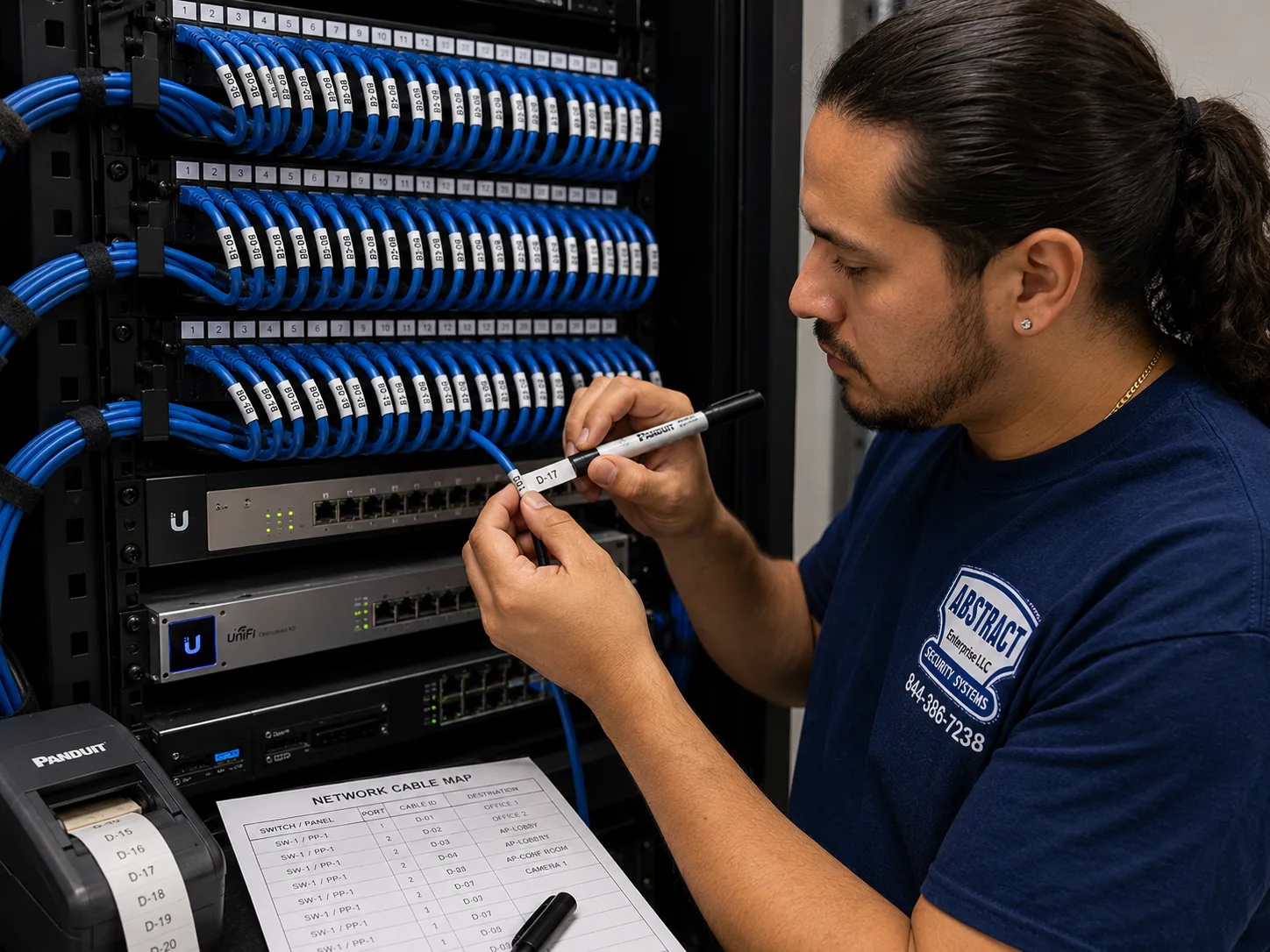
A photo from the AESS job library, not taken in Brighton Beach: a technician printing a label for each cable at a patch panel, with the printed port map beside it. In a Brighton Beach apartment house the camera cables usually meet in a basement office or a closet off the lobby, often after two or three installers have each added a few. A label at that end, naming the camera each cable feeds, is what lets the next repair start in minutes instead of an hour of guessing.
Brighton Beach Camera Repair Request
Apartment, co-op, condo, bungalow or store: tell us the block and what the screen shows, and a technician calls back with the next step
✅
Request Sent!
Thank you. A technician will contact you about the Brighton Beach address shortly.
25+
Years Experience
✓
Same-Day Estimates
100%
Licensed & Insured
4.7★
201 Google Reviews
Owner-operated since 2002 · Thousands of jobs completed · Booked within 2 hours
Before a technician drives to Brighton Beach, two questions sort out most camera repair calls: is the fault at the ocean end of the system, or at the recorder end? Cameras on the beach side of a building, on a balcony rail, on a roof parapet or over a boardwalk-facing door live in wet, salty air every day of the year. Those fail from the outside in: a rusted bracket, a hazy front window, a connector that turned green inside its boot, a cable gland that let water reach the board. Cameras on the street side and inside lobbies, package rooms and stores usually fail from the inside out, because the trouble is at the recorder, the hard drive, the power box or the network switch, which in this neighborhood very often sits in a basement or a ground-floor closet. A photo of the recorder screen showing which tiles are dark, a close-up of any camera that looks rusty or cloudy, and the cross streets usually tell us which half to start on. Send them to (347) 934-8335 or on WhatsApp, and we will tell you the most likely fault and what that kind of repair costs on our Brooklyn list.
Looking at your photos costs nothing. The $150 service call is paid when you book and is credited to the repair if you go ahead.
All work is done under New York State license #12000287431. A certificate of insurance for a co-op board, condo management office or landlord can be arranged before the visit.
We repair any brand and any installer's work, and we say plainly when a salt-eaten camera is cheaper to replace than to clean up.
The Neighborhood
Why Brighton Beach Properties Need Security Camera Repair
Brighton Beach asks more of a camera than almost anywhere else in Brooklyn, and it asks it all at once. The neighborhood is a narrow strip between the Belt Parkway and the Atlantic Ocean, from Ocean Parkway on the west to Corbin Place on the east, with the beach and the Riegelmann Boardwalk along its whole southern edge. A camera on the south face of an apartment house here is never far from salt spray. A camera on Brighton Beach Avenue hangs beside or under the steel structure of the elevated B and Q trains, with the vibration, the shadow and the grime that come with it. And the equipment that runs those cameras, the recorders, power boxes and switches, has a habit of ending up in basements that took seawater in 2012. Most systems in the neighborhood are not old so much as worn: they were installed well enough, but on the assumption that they would sit in ordinary city air. That assumption is what a repair here has to correct.
The reason people care whether their cameras work is easy to see in the news. On the morning of August 31, 2026, around 9:45, a man ran out of the Brighton Beach subway station exit and threw a trash-filled object at a 90-year-old woman on the sidewalk. News 12 Brooklyn reported that "surveillance video obtained by News 12 shows the moments a man randomly attacked an elderly woman in Brighton Beach," and Fox 5 New York carried the same footage. The woman was taken to the hospital in stable condition. In another case reported by the Brooklyn Eagle, a senior was pushed from behind in front of 221 Brighton Beach Avenue around 10:25 on a Friday morning, and the suspect fled west toward Ocean Parkway; police released surveillance images of him. Neither report says whose camera recorded the scene. What both show is that in Brighton Beach the private cameras on storefronts and buildings are often the only record of what happened on the sidewalk, and they only help if they were recording that morning.
The precinct numbers explain why owners are checking. The NYPD's 60th Precinct, which covers Brighton Beach together with Coney Island and Sea Gate, reported 122 burglaries for 2026 through November 8, against 94 at the same point in 2025, a rise of 29.8 percent, and 12 burglaries in the latest 28 days against 6 a year earlier. Robberies were up 8.8 percent to 148, retail theft up 6.7 percent to 222, and petit larceny up 5.2 percent to 907. Grand larceny was down 4.7 percent and car theft was flat at 90. Over the long run the area is far safer than it was: the precinct logged 1,078 burglaries in 1990 and 119 in all of 2025. But a rising burglary count in a neighborhood full of ground-floor shops, lobbies and cellars is exactly when a camera that quietly stopped recording last spring becomes a problem.
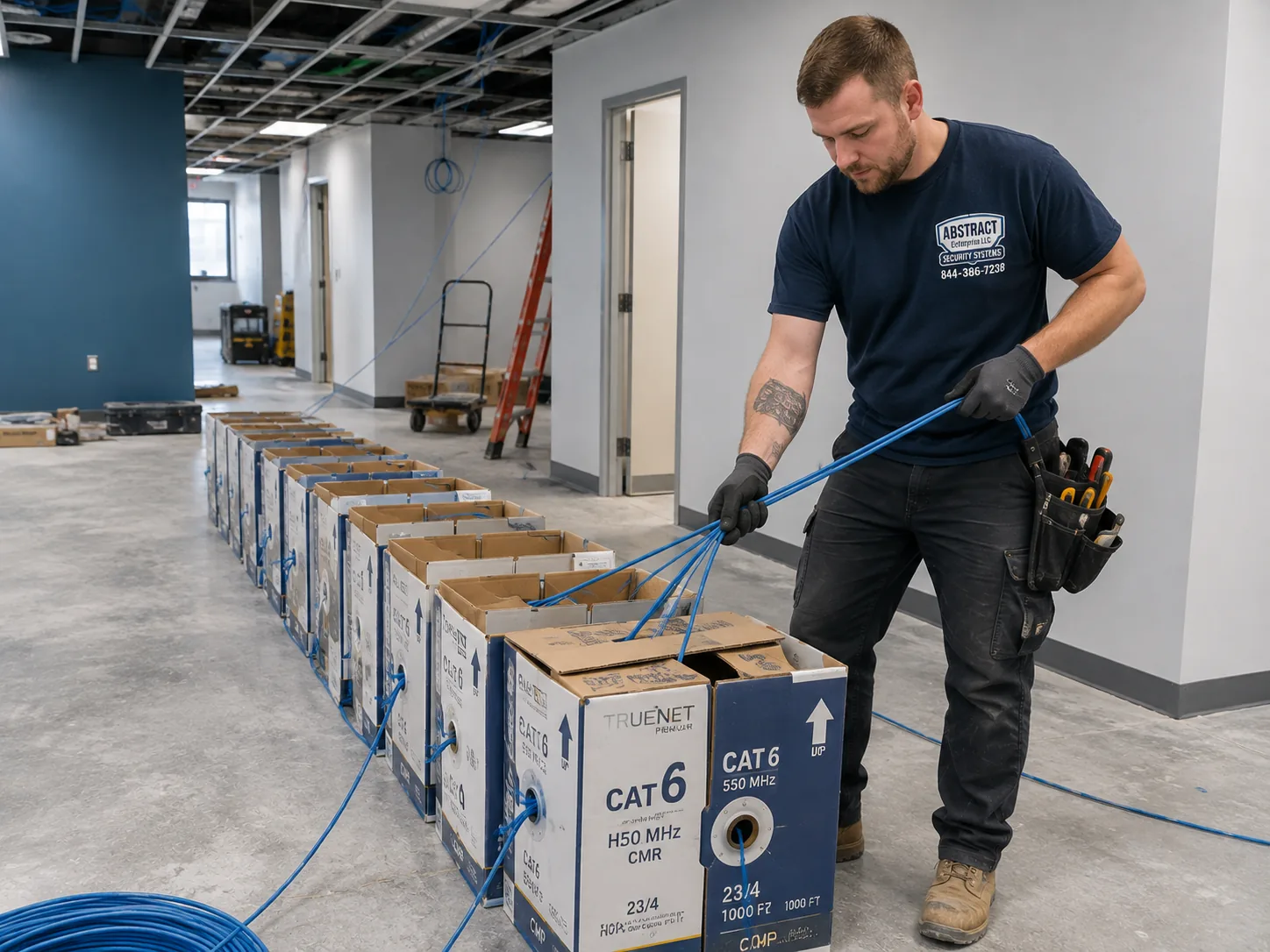
A photo from the AESS job library, not taken in Brighton Beach: boxes of cable staged together before a multi-drop pull in a building that stays in use. Most Brighton Beach repairs need no new cable. When they do, it is usually a run that sat in a flooded basement, a run on the ocean face of a building whose jacket has cracked in the sun and salt, or cable cut during a storefront renovation under the el, and having the right amount on hand keeps the work to a single visit.
Water is the other half of the story. When Hurricane Sandy hit in October 2012, DNAinfo reported basements flooded across Brighton Beach and stores on Brighton Beach Avenue reopening in the dark, and City Limits described sand piled in breezeways and carports, generators pumping out basements on nearly every block, a high-rise whose elevator was out because salt-soaked mechanical equipment in the basement needed repair, and a garage where Ocean Parkway meets the boardwalk with water over five feet deep. Fourteen years later the risk has not gone away. First Street's flood model puts 1,756 properties in Brighton Beach, 99 percent of the neighborhood, at risk of flooding over the next 30 years, and counts 756 of 1,774 properties inside FEMA's Special Flood Hazard Area. For a camera system, that means the recorder and its power should not be the lowest thing in the building, and many still are.
The buildings add their own layer. Forgotten New York describes the lanes and walks between Brighton 1st and Brighton 2nd Streets, between Oceanview and Neptune Avenues, and in the wedge along the old right-of-way near Brighton 10th Street, lined with bungalow-colony houses winterized for year-round living. Ocean Parkway and Brightwater Court carry 1920s and 1930s elevator apartment buildings, many with art deco lobbies. Postwar towers stand toward the north end, and along the water the Oceana condominium, built by Muss Development, grew to 16 buildings and 927 units. Each of those puts the camera recorder in a different place and runs the cable a different way, and each answers to a different person: a homeowner, a co-op board, a condo management office or a store tenant. Getting the right person on the phone is often the first step of the repair.
Finally, the people. Brighton Beach is known as Little Odessa, home to a large Russian-speaking community, many of them older residents who came from the former Soviet Union from the 1970s onward. In practice, a camera repair here often involves a building or a parent who relies on the system, and a son, daughter or super who handles the phone app. We book with whoever controls the recorder, confirm by text, and keep the written cause and price short and plain enough to be forwarded to whoever pays.
Six Brighton Beach facts that shape a camera repair
Burglary is up this year. The 60th Precinct counted 122 burglaries through November 8, 2026, against 94 a year earlier, and 12 in the latest 28 days against 6. A camera that is recording, with the right clock, is what makes a report useful.
Almost every building is in the flood picture. First Street rates 99 percent of Brighton Beach properties at flood risk over 30 years. Recorders, power boxes and battery backups belong above the flood line, not on a basement shelf.
Salt reaches the cameras. ACTi, which builds cameras for coastal sites, says sodium chloride accelerates "oxidation, pitting, and galvanic corrosion," and lists seal failure, optical haze and loosened mounts among the results. Every ocean-side camera we touch gets checked for all three.
The el shapes the commercial strip. Brighton Beach Avenue runs under the elevated B and Q, so storefront cameras live with vibration, shadow and the dust that falls from the structure.
Building types vary block by block. Lane bungalows, prewar elevator buildings, postwar towers and a 16-building condo complex all sit within a few minutes' walk, and each one hides its recorder somewhere different.
Storefront video is often the street's only record. The August 2026 attack outside the subway exit and the push outside 221 Brighton Beach Avenue were both made public through surveillance images.
Where this page applies. It covers Brighton Beach in Brooklyn's ZIP code 11235, from Ocean Parkway to Corbin Place and from the Belt Parkway down to the boardwalk, including Brighton Beach Avenue, Brightwater Court, Neptune and Oceanview Avenues, the numbered Brighton streets and the lanes between them. Coney Island, Manhattan Beach, Sheepshead Bay and Sea Gate are served at the same Brooklyn rate, and the whole borough is covered on our Brooklyn security camera repair page. The price follows the fault, not the neighborhood name.
Same-Day Repair in Brighton Beach
Need Repair in Brighton Beach? A Rusted Camera by the Boardwalk, a Recorder Down After a Storm, or a Picture That Shakes With Every Train
Urgent camera calls from Brighton Beach tend to come in three kinds. The first follows an incident: something happened in the lobby, outside the store or on the walk to the beach, and the person who opens the app finds the one camera that should have seen it is dark, frozen or so cloudy that nobody can be recognized. The second follows weather: a nor'easter, a coastal flood warning or a summer storm that blinked the power, after which some cameras returned and others did not, or the recorder started beeping about its drive. The third follows a season: a camera that looked fine in June starts showing a milky picture in September, because a summer of salt spray and sun has crusted its front window and started on its seals.
If you need footage from an incident, please leave the recorder alone until we arrive. Do not unplug it, do not reset it, and do not let a well-meaning neighbor format the drive to "get it working," because any of those can erase the hour you need. Call (347) 934-8335, give us the date and time window, and we book the visit with saving that clip as the first job. We export it to a USB drive in the recorder's own format and in a common video format, with the recorder's timestamp noted, so it can go to the 60th Precinct or to an insurer. Only then do we begin finding what failed. If the footage was never recorded because the drive had stopped writing, we tell you that right away, and then we make sure it cannot fail silently again.
For everything else, the path is the same: the $150 service call, booked within 2 hours of your request, a two-hour arrival window, and a written price before any part changes. Most single faults, such as a corroded connector cut back and redone, a power supply replaced or a camera body swapped, are finished on the first visit when the part is on the truck. When a camera has to be ordered to match an older recorder, or when a corrosion-resistant model is the right replacement for a spot facing the water, we tell you that before you pay for the part, and the repair is booked once it arrives.
What We Install
Security Camera Repair Services in Brighton Beach
Every repair below is priced from our Brooklyn camera repair list. The service call pays for finding the fault; the repair is priced by what failed and what it takes to make it last near the water.
Salt-damaged outdoor cameras
Cameras on balconies, parapets, beach-side doors and boardwalk-facing walls with hazy windows, rusted housings or water inside. An outdoor camera body replacement with the weatherproofing rebuilt runs $250 to $600 on our Brooklyn list.
Connector and cable repair
Green, corroded BNC and RJ45 ends cut back and redone with sealed fittings, cracked runs on ocean-facing brick replaced, and cables cut during a storefront fit-out spliced or re-pulled. A reterminate or PoE port swap runs $150 to $350.
Recorders and hard drives
Recorders that beep, reboot or stopped writing, often in basements that take on damp or water. A drive swap runs $200 to $450 by capacity; a DVR that will not work averages $300 to $700, and an NVR that is not recording $400 to $900.
Power boxes, PoE and battery backup
Central power supplies that sag at night, PoE switch ports that died after an outage, and battery backups that no longer hold. Power supply repair typically runs $150 to $400.
Storefront cameras under the el
Cameras on Brighton Beach Avenue that shake when trains pass, fire motion alerts all day or fill up with dust from the structure. Many fixes are settings and mounting, covered within the $150 call when no part is needed.
Night pictures near the water
Infrared that bounces off sea mist, wet balcony rails or salt film on the window, and cameras that go grey or white after dark. Night vision camera repair on our Brooklyn list typically runs $250 to $650.
Phone viewing and accounts
Apps that lost the recorder after an internet change, accounts tied to a former super, board member or store owner, and family members who need their own logins. Configuration with no parts is often covered by the service call.
Footage export
Clips saved to USB with the original timestamp, in the recorder's own format and a common video format, before anyone changes a setting, for the precinct, an insurer or a board.
Coastal rebuilds and maintenance
Several ocean-side cameras rebuilt at once with sealed connections and stainless hardware, or a yearly clean and check timed for the end of beach season. A clean and check for a blurry picture starts at $80; annual maintenance starts at $250 for a residence and $400 for a commercial system.
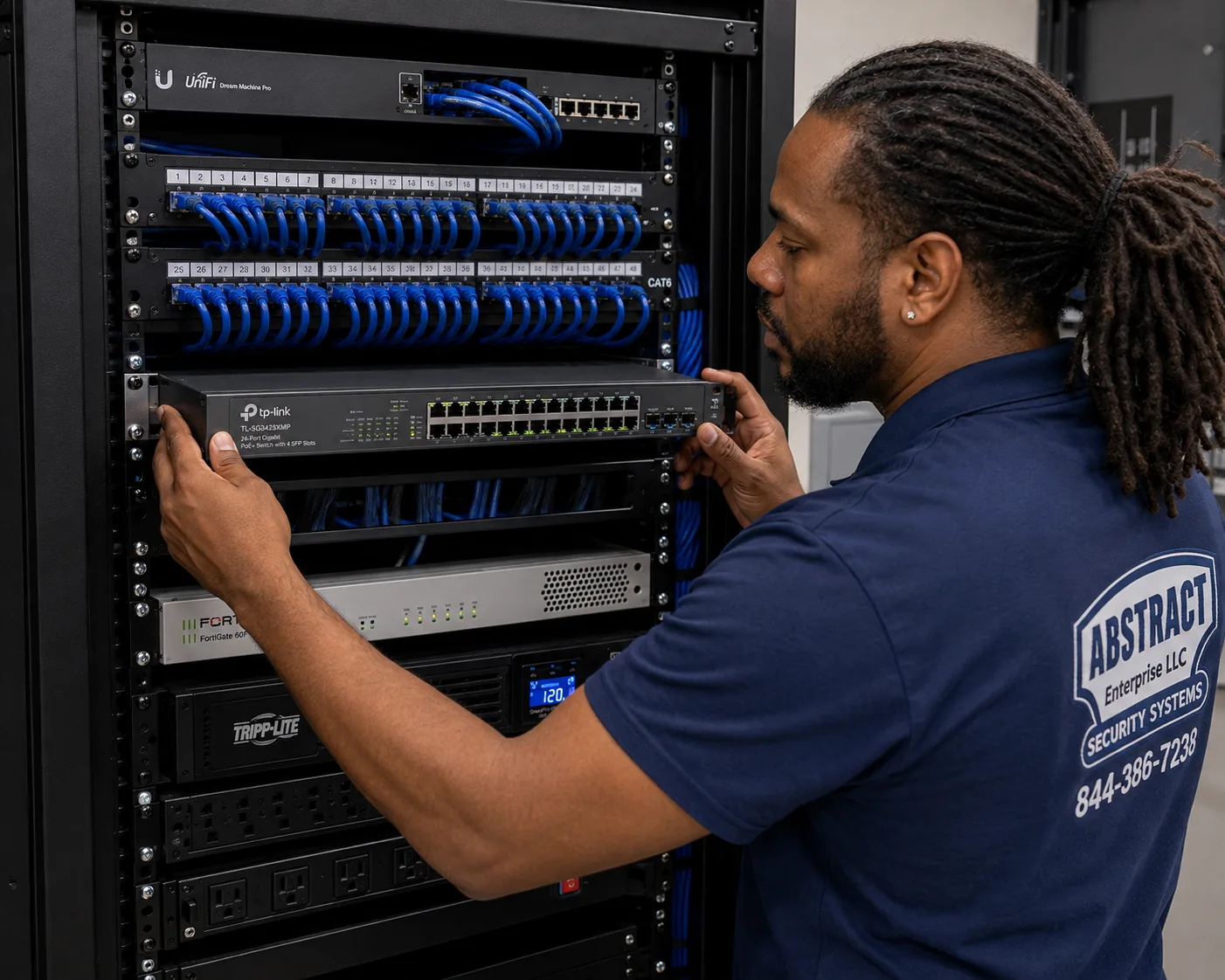
A photo from the AESS job library, not taken in Brighton Beach: a technician mounting a managed PoE switch below the patch panels of a commercial rack. In a Brighton Beach condo or apartment house with network cameras, this switch powers every camera through its data cable. When the cameras on one face of the building all drop together after an outage, the switch, a single port on it or its power is tested before anyone climbs to the roof.
Building Specialists
Security Camera Repair for Brighton Beach's Architecture
Seven kinds of building make up nearly every camera call in Brighton Beach. They differ in three ways that matter for a repair: how close the cameras sit to the ocean, how low the recorder sits in the building, and who has to say yes before anything changes.
The prewar elevator apartment house
Six-story buildings from the 1920s and 1930s on Ocean Parkway, Brightwater Court and the numbered streets, with lobby, elevator and courtyard cameras wired back to a basement or a super's office.
The postwar tower
Taller buildings toward the north of the neighborhood, with long riser runs, garage and parking-lot cameras, and a security desk that watches a monitor wall.
The condo complex by the water
Multi-building condominiums such as the Oceana, where cameras spread over several buildings, a garage, walkways and retail, all brought together at a management or security office.
The beach-block building
Any building with a face toward the boardwalk. Cameras on that side take spray, sand and wind, and they fail first.
The bungalow on a lane
Small, often frame houses on the walks and courts between the main streets, close to their neighbors, with two to four cameras and a recorder in a closet or a crawl space.
The mixed-use building on the avenue
A store at street level under or beside the el, apartments above, cameras inside the shop and over the gate, and a recorder in a back room or cellar.
The one- to three-family house
Brick and frame houses on the side streets, with a single recorder for every household in the building and cameras on the stoop, the side and the yard.
The prewar elevator apartment house: a basement head end and a lobby that never closes
The 1920s and 1930s elevator buildings along Ocean Parkway and Brightwater Court were built long before anyone thought of cameras, so every camera system in them is an addition, and usually several additions. A lobby camera came first, then cameras in the mailroom and the courtyard, then the elevator, then the laundry room, often from different installers. Their cables find their way down to the basement, where the recorder sits on a shelf near the boiler room or in a locked office the super uses. That basement location is the single biggest risk in these buildings. City Limits' account of Sandy described exactly this kind of building: a ground floor flooded, the lobby carpet and drywall soaked, and the elevator out because its mechanical equipment in the basement had been soaked in salt water. A recorder on the same level does not survive that, and even without a flood, a damp basement shortens the life of the recorder, the drive and the battery backup.
Repairs in these buildings usually start with an inventory: which cable is which, which cameras feed which recorder, and which camera was quietly unplugged years ago when a hallway was painted. We trace and label as we go, fix the fault you called about, and then give the board or the managing agent a short written note on what we found, including whether the recorder should move up out of the basement. Moving it is a separate, written price, and in many prewar buildings it is less work than people expect, because the cables already rise through a common shaft near the lobby.
The postwar tower: long risers, a monitor wall and a parking lot
Taller postwar buildings toward the north of Brighton Beach have more cameras on longer cable runs, and they often have a lobby desk with a monitor wall that staff actually watch. When that wall goes blank, the cause is frequently not the cameras or the recorder but the link between the recorder and the monitors, a failed output, a loose video cable or a monitor that lost its input setting. Further out, cameras in parking lots and garages hang on light poles or on the garage ceiling, fed by cable that runs underground or through conduit that may have filled with water. On these buildings we test the far cameras at the camera end, because a long run can look fine at the recorder and still starve the camera at the other end.
The condo complex by the water: several buildings, one security office
The Oceana is the best-known example. Commercial Observer described it in 2014 as 16 buildings and 927 units, with about 24,000 square feet of commercial space including ground-floor retail and second-floor medical offices, and with one of its later buildings designed after Sandy so that its electrical switchgear sat on a raised platform and its elevator controls on the roof. That is the right instinct for a camera system too. In a complex like this, cameras in different buildings, garages and walkways are usually tied back to a central office by network cable, fiber or a wireless bridge, and a failure in one building can be the link between buildings, not a camera at all. These systems are run by a management office, and we work through that office and its rules: certificates of insurance, approved hours and escorts where they apply.
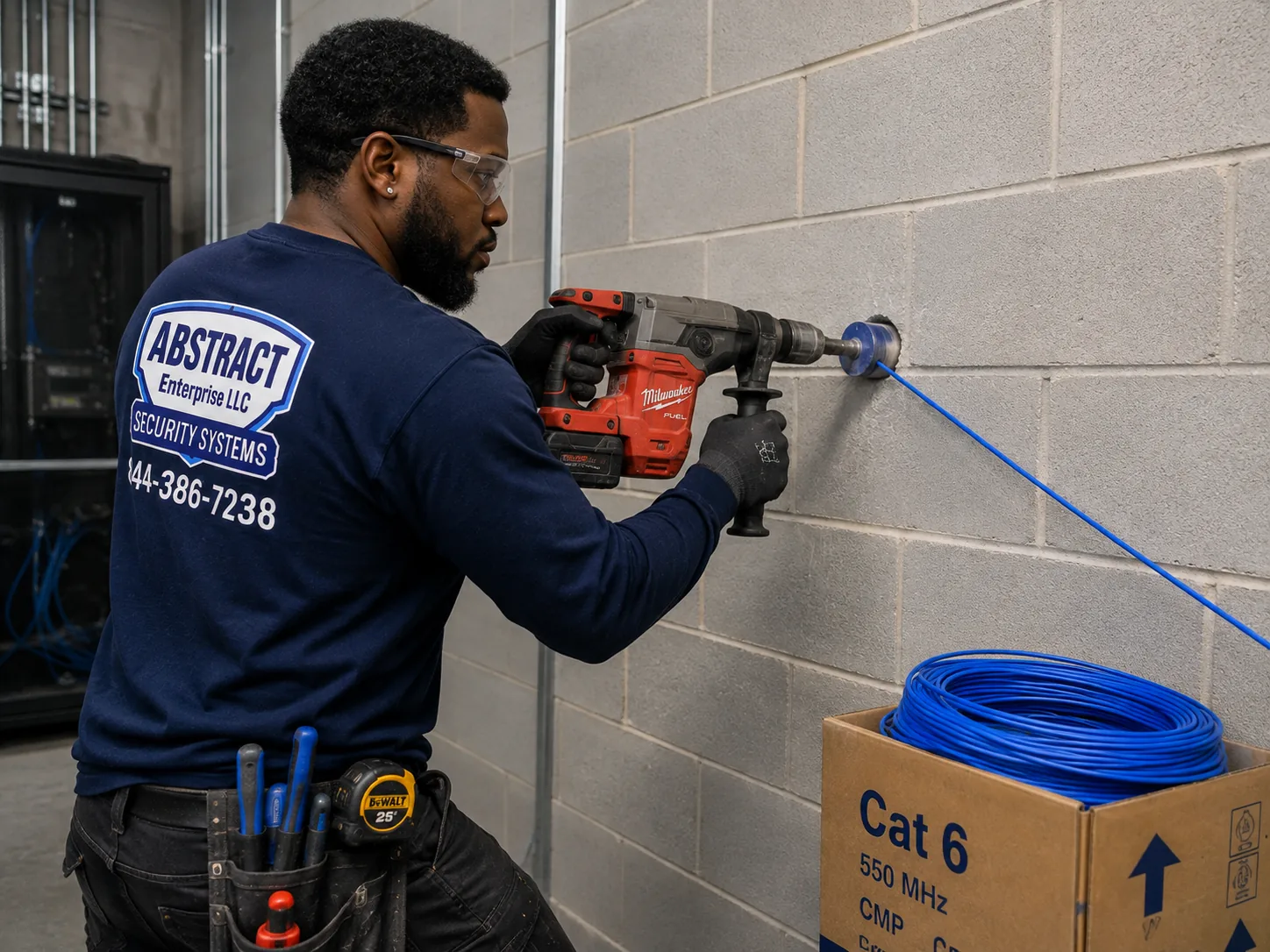
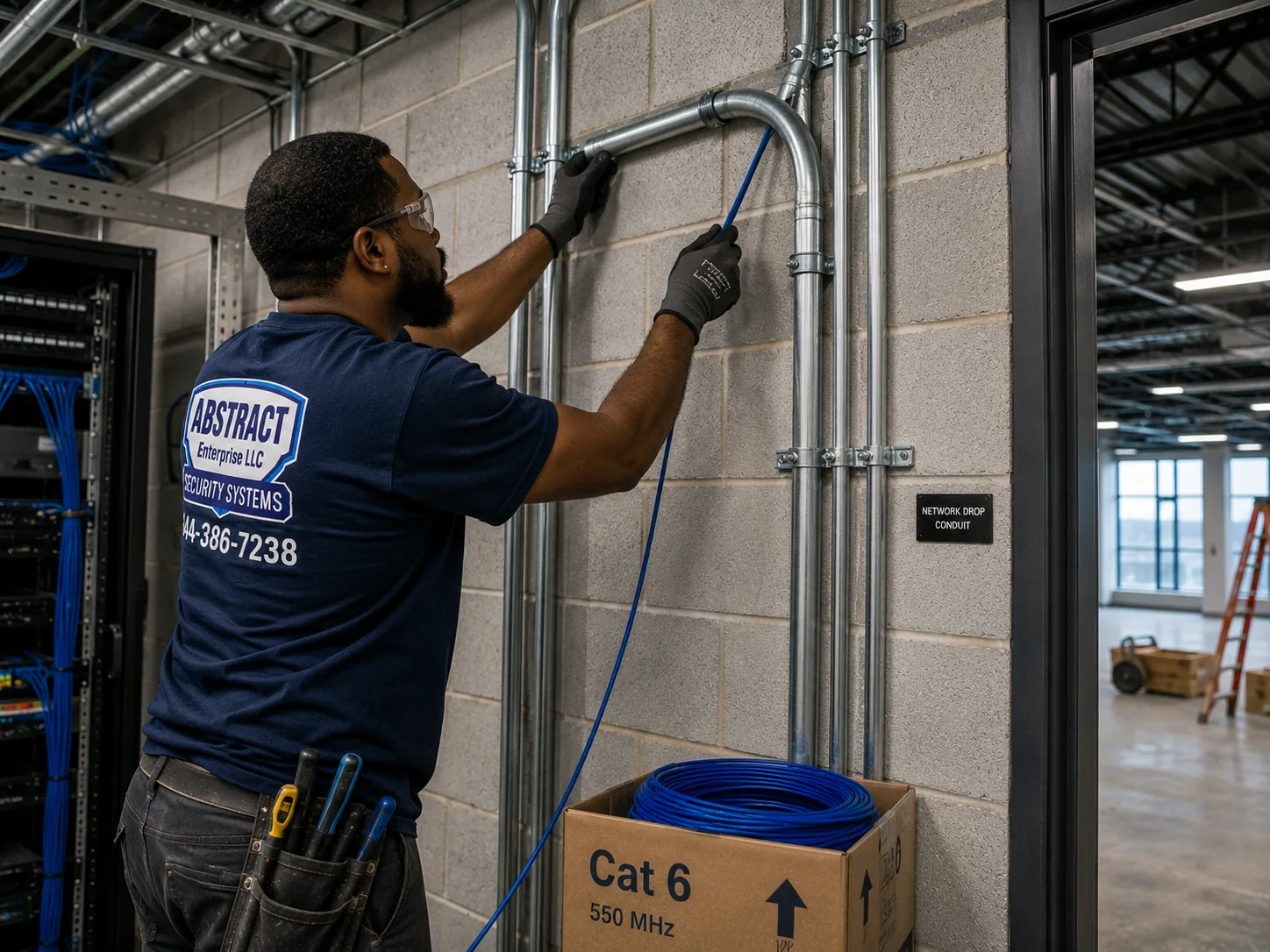
A photo from the AESS job library, not taken in Brighton Beach: a technician core drilling a concrete block wall to carry cable through to a network room. In Brighton Beach this is the step that lets a recorder leave a basement that floods. A clean drilled pass-through from the cellar to a closet or office on the lobby floor lets the existing camera cables follow the recorder upstairs instead of being cut and spliced.
The beach-block building: the side that faces the ocean fails first
On any building with a face toward the boardwalk, the cameras on that side live in a different climate from the ones on the street side. ACTi, which designs cameras for coastal and marine sites, lists what salt air does without protection: "coating delamination, rusting, galvanic attack," along with seal failure, optical haze and mounts that work loose. We see all of them. A housing that bubbles and flakes, a bracket bleeding rust down the brick, a front window clouded from the outside, a camera that fogs on cool mornings because its seal has gone, and a camera that slowly droops on its mount until it is filming the sidewalk. Wind-driven sand adds to it, scouring the front glass. On these cameras the repair is not just a swap. The replacement goes up with stainless hardware, sealed connections and the cable entry facing down, so the next one lasts.
The bungalow on a lane: close quarters and short runs
The small houses on the Brighton lanes, described by Forgotten New York as former bungalow-colony homes winterized for year-round use, have short cable runs and simple systems, usually two to four cameras on a small recorder. Their problems come from closeness. A camera on the front of a lane house often looks straight at the neighbor's door a few feet away, cables run along shared walls or fences where the neighbor's own work can cut them, and the recorder lives in whatever closet had a free outlet. Many of these houses were never wired for cameras at all and have Wi-Fi cameras running on extension cords. We repair what is there and, where a cord or a router is the real weak point, tell you so before you spend money on new cameras.
The mixed-use building on the avenue: the shop below, the el beside it
Brighton Beach Avenue's storefronts sit under or beside the elevated B and Q, with apartments above. The camera system belongs to the shop, though it was often left by the previous tenant, and the recorder is under the counter, in a back room or in a cellar reached through a sidewalk hatch. DNAinfo's Sandy reporting mentioned a bookstore on the avenue that lost its basement stock, and a recorder kept in the same cellar shares the same risk. The cameras over the gate and the door have to deal with the steel structure overhead, which shades the sidewalk by day and shakes with every train. We cover these businesses in detail in the commercial section below.
The one- to three-family house: one recorder for every household
On the side streets toward Neptune Avenue and the Belt Parkway, brick and frame houses hold one, two or three households, usually sharing one camera system. The cameras watch the stoop, the side passage and the yard, and the recorder sits wherever the person who bought the system lived. These houses are a little farther from the beach, so salt is less of a factor and the ordinary failures, a tired power supply, a drive near the end of its life, a phone app that lost its connection after a new router, are more common. We fix those at the same Brooklyn rate and make sure the household that relies on the cameras knows how to tell if they stop.
Field Notes
Field Notes: Checking a Camera System That Lives Within Sight of the Ocean
These notes set out how our technicians approach a camera system in a coastal building like the ones in Brighton Beach. They describe standard practice, not a story about any one address.
Look at the recorder, then walk to the water side. The technician starts at the screen, noting which channels show video, which are dark or frozen, the drive status and the recorder's clock. Then the first cameras checked in person are the ones facing the beach, because on a coastal building that is where most outdoor faults begin.
Open the connector, not just the camera. On an ocean-side camera, the plug or BNC fitting at the camera end is opened and inspected. Green or white powder inside the boot means salt has reached the copper, and the cure is to cut back to clean wire and terminate it again with a sealed fitting, not to push the old plug back in.
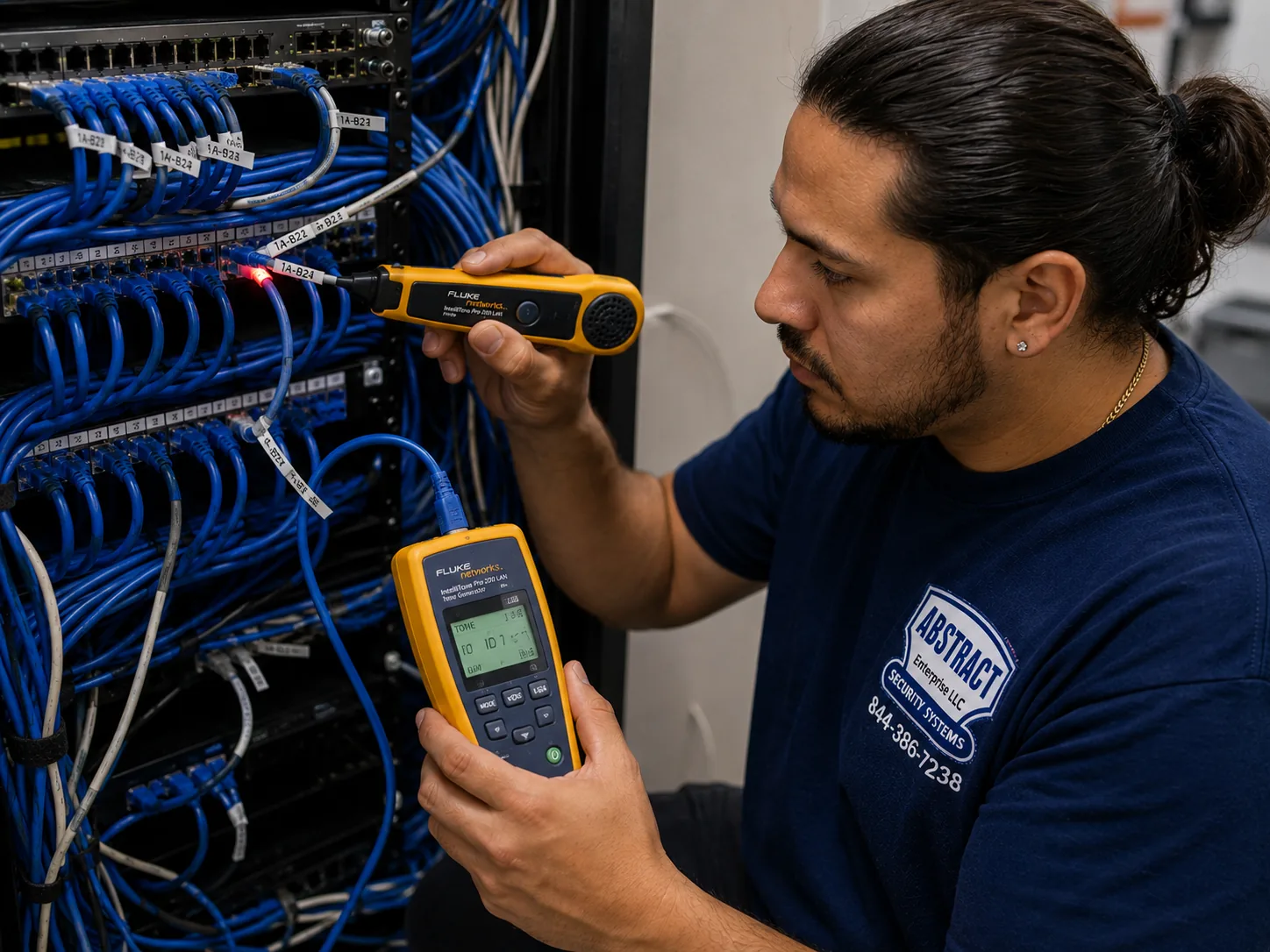
A photo from the AESS job library, not taken in Brighton Beach: a technician using a tone generator and probe to find which unlabeled cable at a patch panel belongs to which run. In a Brighton Beach co-op where cameras were added by several companies over the decades, this is how we find the cable for the dead courtyard or elevator camera without pulling anything out of the wall.
Check how low the head end sits. The technician notes whether the recorder, power box, switch and battery backup are on the floor, on a low shelf or close to a drain, and whether there are water marks on the walls. That goes into the written notes even if you only called about one camera.
Measure before replacing. Voltage at the camera, PoE power at the port and a continuity or analyzer test on the cable usually settle what failed in minutes. Nothing is unplugged or reset until any footage you asked for has been saved.
Price before parts, and seal before leaving. You hear the cause and get a written price before anything is replaced. When the repair is done, every outdoor connection we touched is sealed, every cable we traced is labeled, and the notes go on your job record for the next visit.
Fault by Fault
Salt, Water, Vibration or Age: How Brighton Beach Camera Systems Break and What Each Repair Involves
Four forces account for most of the camera failures we find in Brighton Beach, and each one leaves its own marks. Knowing which one you are dealing with is what keeps the repair to the part that actually failed.
Salt: the slow failure on the ocean side
Salt does its damage gradually, and that is why it fools people. The picture softens a little each month as a film builds on the front window. The infrared at night starts to glow back into the lens. Then one wet week the camera begins to flicker, because salt has worked into the connector and the contact is no longer clean. Finally it goes dark, and the owner assumes the camera died of old age. In fact the camera body may be fine. On many of these calls the fix is cleaning and resealing the window, cutting the connector back to clean copper and terminating it again with a sealed fitting, and replacing rusted screws and brackets with stainless ones. Where water has already reached the circuit board, shown by fogging inside the window, spots in the picture or a camera that reboots in damp weather, the camera itself has to be replaced, which runs $250 to $600 on our Brooklyn list including the camera and the weatherproofing.
When several cameras on the same face of a building have gone the same way, it is usually cheaper to do them together than one at a time. The parent Brooklyn list includes coastal multi-camera salt-air rebuilds under major system repairs, at $700 to $1,500, and that is where a beach-side wall of four or five cameras normally lands.
Water: floods, leaks and the recorder in the cellar
Water reaches Brighton Beach camera systems from below as often as from above. A coastal flood, a backed-up drain or a burst pipe puts a few inches of water on a basement floor, and the power strip, the battery backup and the recorder sitting on that floor go with it. Even a recorder on a shelf can be ruined by a damp basement over several years, as the boards inside corrode. If your recorder has been wet, do not switch it back on to see if it works; tell us, and we will try to recover the drive in another unit first, because powering a wet recorder can destroy what is left on it. The repair is usually a new recorder, at $700 to $1,500 with the drive and setup on our Brooklyn list, and the real fix is moving it up a floor.
Power: outages, surges and the battery backup that gave up
Every coastal storm that blinks the lights is hard on a camera system. A recorder that loses power while writing to its drive can corrupt the file system, a PoE switch can come back with a dead port, and a cheap power box can fail outright when power returns with a spike. A battery backup is the usual protection, but it is a part with a life of its own. Schneider Electric's guidance on its UPS units says that "for approximately every 10°C (18°F) above the ambient temperature of 25°C (77°F), the life of the battery will be reduced by 50 percent," and that the unit should not sit "near open windows or areas that contain high amounts of moisture." A backup in a hot back room or a damp cellar can be dead long before anyone notices, so the cameras that should have ridden through a short outage went down at the first flicker. We test the battery under load, replace it or the unit if needed, and put it somewhere cool and dry. Power supply repair typically runs $150 to $400 on our Brooklyn list.
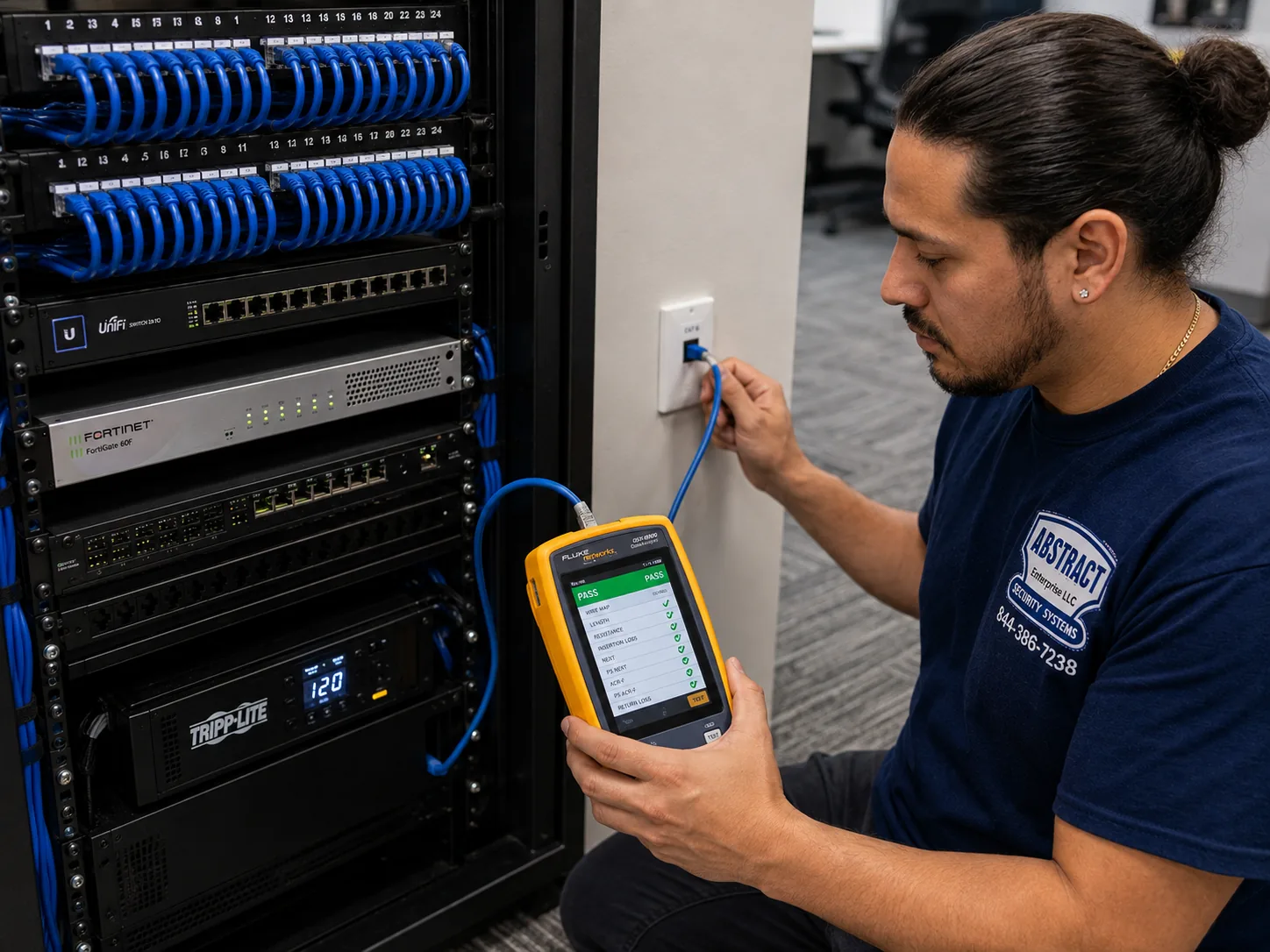
A photo from the AESS job library, not taken in Brighton Beach: a technician certifying a data drop with a cable analyzer that reads PASS. On a Brighton Beach repair the same kind of test shows in a minute whether a network camera's cable survived a wet basement or a salty facade, so you only pay to replace a run that has actually failed, and not one that only needed a new connector at the end.
Vibration and grime: cameras under and beside the el
Along Brighton Beach Avenue, cameras on storefronts and on the lower floors of buildings sit beside or beneath the elevated structure of the B and Q. Every passing train sends a tremor through the steel and into nearby facades and signs. A camera on a long arm or a loose bracket shakes visibly in the picture, and that shaking is read by the recorder as motion, so the owner gets alerts all day and the motion-only recording fills with trains. Over months the vibration also works screws loose and can unseat a connector. Dust and grime from the structure settle on the camera window faster than on a quiet side street. The fixes are mostly mechanical and inexpensive: a shorter, stiffer mount, locking hardware, the motion zone redrawn to ignore the edge of the frame where the structure moves, and a cleaning schedule. A clean and check for a blurry picture starts at $80 on our Brooklyn list, and motion detection that needs only new settings is usually handled within the $150 service call.
Age and the recorder: drives, firmware and equipment rules
Not every fault here is coastal. Hard drives wear out, recorder clocks drift, and older recorders stop talking to current phone apps after firmware or service changes. Heat speeds some of that up: Backblaze, which publishes failure data on the drives in its data centers, found that for one drive model the yearly failure rate was 34.6 percent among warmer drives against 15.6 percent among cooler ones, though for most models temperature mattered far less. A recorder baking in a closed back room behind a summer storefront is giving itself bad odds. A drive swap runs $200 to $450 on our Brooklyn list depending on capacity, and a hybrid recorder that runs older coax cameras alongside new network cameras runs $700 to $1,200 installed. Many Brighton Beach systems are Hikvision or Dahua. The FCC's 2022 rules stopped new authorizations for covered equipment from those makers, but, as Dahua told Security Sales, the order "does not affect products that are already authorized," so an existing system can be repaired, and we will tell you which replacement parts make sense for it.
Commercial Security Camera Repair
Business Security Camera Repair in Brighton Beach
Brighton Beach's businesses are packed into a few strips, and each gives a camera system a different job and a different way to fail. The 60th Precinct's figures for 2026 so far, 222 retail thefts and 148 robberies through November 8, both higher than a year earlier, are why owners on these strips care whether the camera over the register is really recording.
Brighton Beach Avenue under the el
The main street, with groceries, pharmacies, clothing, jewelry and services under the elevated B and Q. Cameras fight shadow by day, vibration from the trains and grime from the structure.
Coney Island Avenue's southern end
Shops and offices running down toward the boardwalk, many in older buildings with recorders in back rooms and cellars.
Oceana retail and medical space
Ground-floor stores and second-floor medical offices at Brighton Beach and Coney Island Avenues, usually inside a condominium's camera rules and its management office's schedule.
Boardwalk restaurants and cafes
Businesses facing the beach, with outdoor seating, terraces and cameras that take sand, spray and summer crowds, and long quiet months in winter.
Neptune Avenue and the northern edge
Shops, auto businesses and services toward the Belt Parkway, where parking lots and yards add pole and fence cameras with underground cable.
Professional offices in apartment buildings
Doctors, dentists and other practices on the ground floors of residential buildings, whose cameras may share a recorder or a riser with the building's own system.
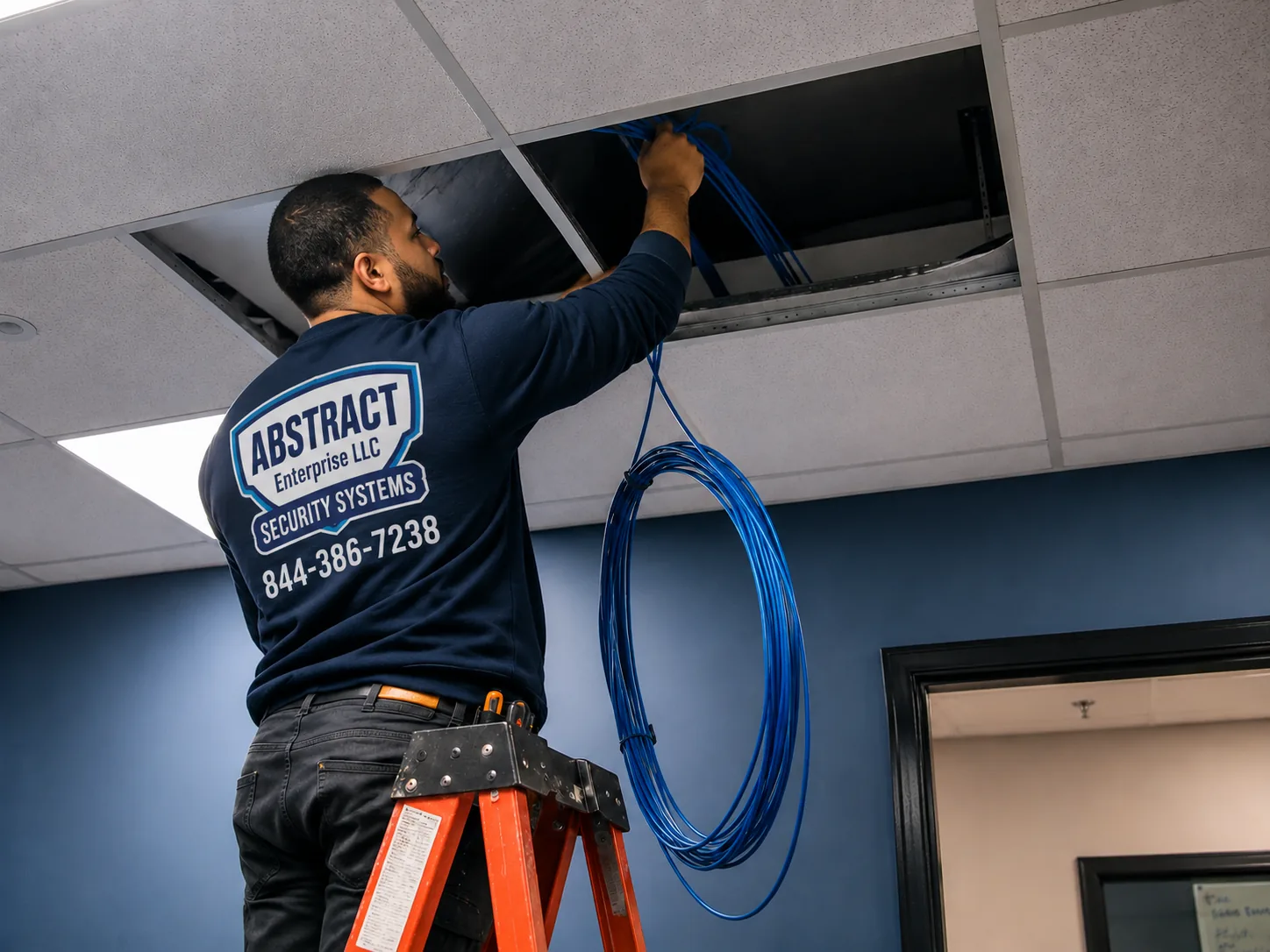
A photo from the AESS job library, not taken in Brighton Beach: a technician feeding cable through the ceiling of a commercial space that stays open during the work. Most shops on Brighton Beach Avenue cannot close for a camera repair, so we plan any ceiling or ladder work for slow hours and keep it to one section of the store at a time.
What a Brighton Beach shop owner needs from a repair
Store owners rarely call to say a camera is broken in principle. They call because a coat, a phone or a bottle went out the door, a delivery went missing, or someone was hurt on the sidewalk outside, and they need to know whether the system caught it. As far back as 2011, News 12 reported that "two shoplifters recently made off with a pair of expensive fur coats" from Brighton Beach stores, and that surveillance video showed a woman stealing. That kind of clip only exists when the recording, the clock and the aim were all right on the day. So on a commercial call we check recording and time first, save any clip you need, then find and fix the fault.
The second thing a store needs is a picture that identifies a person at the door, not just a view of the whole floor. Under the el, the door is often in deep shadow at midday and lit by headlights and shop signs at night, and a camera set for the bright sales floor turns the entrance into a silhouette. Re-aiming, changing the exposure settings or moving that one camera to the doorway usually fixes it without a new system.
Cellars, hatches and the recorder below the sidewalk
Plenty of avenue stores keep their stock, and their recorder, in a cellar reached through a sidewalk hatch or a back stair. In a flood zone, and after the basement losses on Brighton Beach Avenue in 2012, that is the worst place for the one box that holds all the footage. Moving the recorder up to the shop floor, into a locked cabinet or a ventilated spot behind the counter, is usually a short extension of the existing cables. We price it as its own item on the visit.
Restaurants on the boardwalk: sand, spray and a long off-season
A restaurant facing the beach puts cameras in the hardest conditions in the neighborhood. In summer they face crowds, sand blown off the beach and sun; in winter they face storms and months when the terrace is empty and nobody looks at the screen. Pan-tilt-zoom cameras on these fronts suffer most, because sand gets into moving parts. PTZ repair in Brooklyn typically runs $450 to $1,200 because of the parts involved. For fixed cameras, a yearly clean and check before the season opens, with the seals and connectors redone, costs far less than replacing a camera in July.
Rules that touch a commercial camera repair
State licensing. The New York Department of State licenses companies that install, service or maintain security and fire alarm systems, and state rules apply that to closed-circuit television used to detect intrusion, theft or movement. Owners working on their own property are exempt, but a company you hire to repair a store's cameras should hold the license. Ours is NYS license #12000287431.
Cameras that watch staff. New York has rules on workplace monitoring, including notice to employees, and limits on recording in places such as restrooms and changing areas. If a repair moves a camera toward a staff area, it is a good time to check that your notice is current and that no camera looks where it should not. We are not lawyers and this is not legal advice; ask your own adviser how the rules apply to you.
Shared buildings and condominiums. In a condominium or a mixed-use building, the camera on the shared entrance may belong to the building rather than the store. We confirm who owns each camera and recorder before we change anything, and we follow the building's rules on hours, insurance certificates and access.
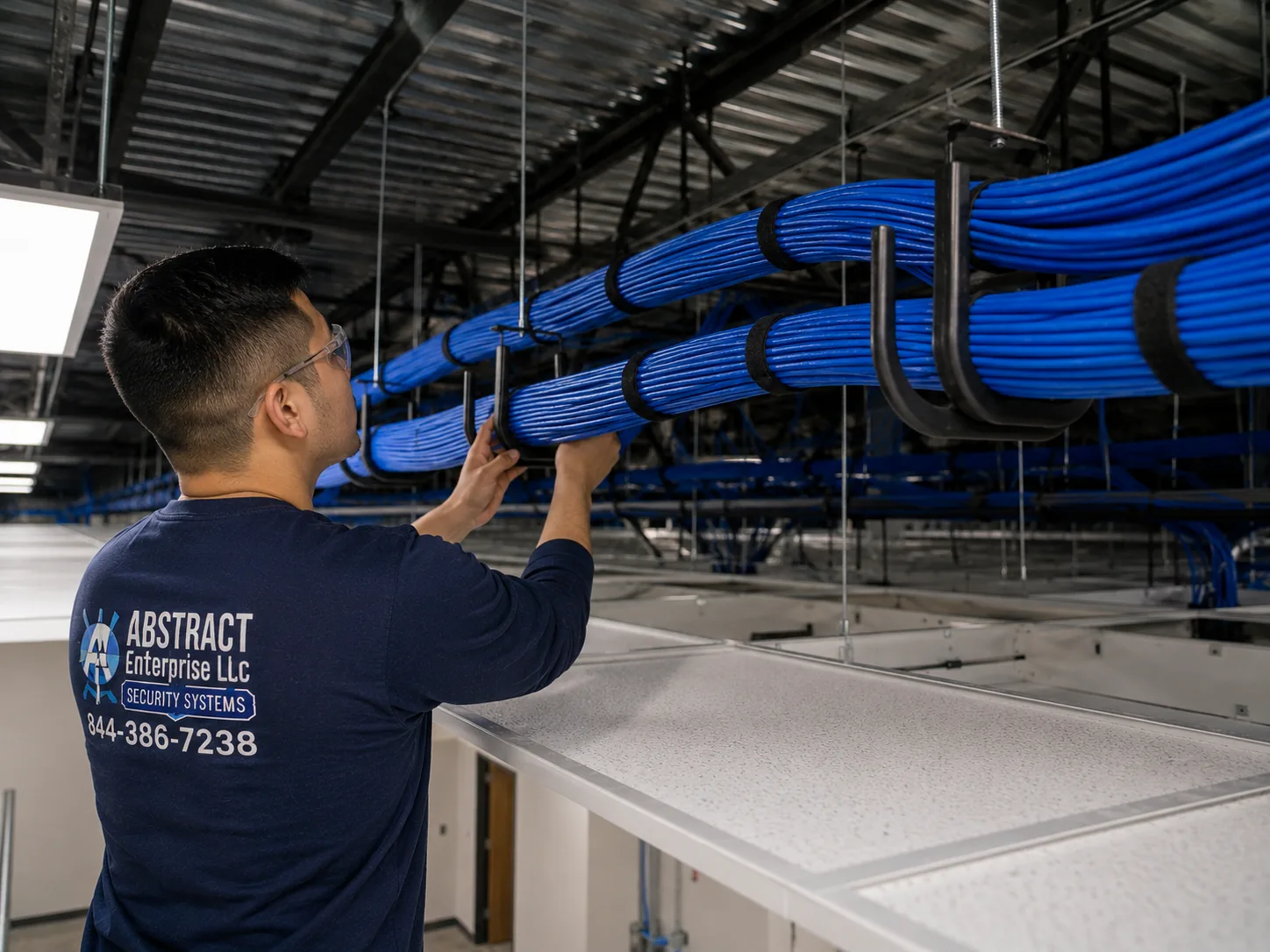
A photo from the AESS job library, not taken in Brighton Beach: J-hooks holding dressed bundles of cable across a commercial ceiling. In a Brighton Beach store or apartment basement, cable lying loose on a drop ceiling or across pipes is the cable that gets cut in the next renovation or soaked in the next leak, so a re-run camera cable is supported properly and kept off the floor.
Your Questions Answered
Security Camera Repair in Brighton Beach: Questions Answered
These are the situations that Brighton Beach owners, boards, supers and shopkeepers describe when they call about cameras near the ocean, under the el and in buildings that have flooded before. Each is answered in full here and not repeated in the FAQ further down.
Salt, sand and the ocean side of the building
The camera facing the boardwalk has rust running down the wall from its bracket, and the picture has turned milky. Is that the lens, the housing or the whole camera?
Usually it is two separate problems that happen to show up together. The rust is the bracket and its screws, which are often plain steel and corrode within a few seasons in salt air. The milky picture is usually a film of salt and grime on the outside of the camera's window, which a proper cleaning removes. The thing to check is the inside: if the haze is behind the glass, or the picture fogs on cool mornings and clears by noon, the seal has failed and moisture is inside, and that camera will not last. In the first case the repair is a cleaning, new stainless hardware and a resealed cable entry. In the second it is a camera replacement, $250 to $600 on our Brooklyn list with the weatherproofing rebuilt.
Our roof cameras on a building near the beach have screws so corroded they will not turn. Can a camera still be serviced if its mount has seized?
Yes. Seized fasteners are common on parapets and roof bulkheads facing the ocean, and we come prepared to cut or drill them out without damaging the masonry. Where the old anchor holes are too far gone, the mount moves a short distance to sound brick or concrete and the old holes are sealed. Everything goes back with stainless screws and anchors, and the connection is sealed so the camera can be opened next time without a fight. Roof access needs the building's permission before the visit, and in winter we book roof work for calmer days, since wind off the water makes ladder and parapet work unsafe.
Floods, basements and storm season
Our co-op's recorder is still on a shelf in the basement that flooded in Sandy. Where should it go when it is repaired?
Up. The best spot is the lowest floor that has never taken water, usually a closet off the lobby, the super's office on the ground floor if it is raised, or a locked cabinet in a dry room on the second floor. It needs power, ventilation and a network connection for phone viewing, and the battery backup should go with it. The existing camera cables can usually be extended up through the same shaft they rise in now. We give the board a written price for the move as its own line, separate from the repair you called about, so it can be approved on its own.
Our battery backup beeped all through the last outage and the cameras still went down in a few minutes. Is the backup broken or just too small?
It can be either, and the age of the battery is the first clue. Backup batteries wear out in a few years, faster in heat, and Schneider Electric's guidance is that every 10°C above 25°C cuts battery life roughly in half. A unit that has been in a warm back room or a basement for years may show green lights and still hold almost no charge. If the battery is healthy, the unit may be too small for the recorder plus a PoE switch feeding a dozen cameras. We test it under the real load, then replace the battery, replace the unit, or split the load so the recorder at least stays up and records through short outages.
Under the el on Brighton Beach Avenue
The camera outside our shop shakes every time a train passes, and the motion alerts go off all day. Can that be fixed without moving the store's whole system?
Yes, and usually cheaply. Shaking comes from the mount: a long arm, a loose bracket or a camera fixed to a sign that vibrates with the structure. A shorter, stiffer bracket on solid masonry, with locking screws, takes out most of the movement. The alerts come from the motion settings. The recorder sees the shaking edge of the frame, or the train itself, as movement, so we redraw the motion zone to cover the doorway and sidewalk and leave out the structure, and where the recorder supports it, switch to person or vehicle detection. If no part is needed, that is usually covered within the $150 service call.
Grime from the elevated structure coats our door camera within weeks. How often does a camera under the el need cleaning?
More often than a camera on a quiet street. Under the tracks, dust, rust flakes and dirt from the structure fall straight onto cameras and the tops of signs, and pigeons that roost on the steel add their own mess. In our experience a camera directly under the structure needs a wipe every few months to keep a sharp picture, and a professional clean and check at least once a year, with the seals and connectors looked at while we are up there. A small hood over the camera, where the model allows it, keeps falling grime off the window and stretches the gap between cleanings.
Seasons, crowds and empty apartments
In summer our recorder only keeps about a week of video, but in winter it keeps a month. Why does the beach season shorten the recording?
Because the recorder is probably set to record on motion, and in summer there is far more motion. Crowds on the walk to the boardwalk, umbrellas, flags and late-evening foot traffic all trigger recording, the drive fills faster, and the recorder overwrites the oldest days sooner. If a week is not enough, there are three fixes: tighter motion zones so the camera ignores the crowd beyond your door, a lower bit rate on cameras that do not need full detail, or a larger drive. A drive swap runs $200 to $450 on our Brooklyn list by capacity. We can set it up so you keep the same number of days in July as in January.
We spend the winter away and the apartment sits empty for months. How will we know if a camera or the recorder stops while we are gone?
Set the recorder to tell you. Most current recorders can send a phone notification or an email when a camera loses video, when the drive reports an error or stops recording, and when the recorder restarts after a power cut. We turn those on, test them with you before you leave, and add a second person, such as a neighbor or a relative in Brooklyn, so someone nearby gets the alert too. A short check of the app once a week, opening playback for the previous night, is the simplest habit of all. If an alert arrives while you are away, a photo of the screen sent to us is usually enough to know what failed.
Elevators, garages and multi-building complexes
The camera inside our building's elevator has been dark for months. Who repairs it, the camera company or the elevator company?
Usually both, in turn. The camera in the car connects to the recorder through cable that travels with the car, either a spare pair in the elevator's traveling cable or a separate line installed for the camera. If the fault is the camera or its connection on top of the car, we can fix it, but work in the hoistway and on the car has to be coordinated with your elevator maintenance company, who controls access and safety there. We test everything outside the hoistway first, so that if the traveling cable itself has failed you know before the elevator mechanic is booked, and we arrange the visit with them through your managing agent.
At the bottom of our garage ramp, the camera only shows glare from headlights at night. Can it be set to show the drivers?
Often it can. Headlights pointed straight into a camera at night drive its exposure up and wipe out everything around them. Changing the camera's angle so cars are seen from the side rather than head-on, turning on its backlight or wide dynamic range settings, shortening the exposure, and adding a little steady light at the ramp all help. Some older cameras simply cannot handle it, and then the answer is one replacement camera made for that job, not a new system. We test the options at night where we can, since that is when the problem appears.
Our complex has cameras in several buildings tied back to one office, and everything from one building disappeared at once. Is that the cameras?
Almost never. When every camera in one building drops together, the link between that building and the office is the first suspect: a fiber or network cable between buildings, a switch in that building's closet that lost power or failed, or a wireless bridge on a roof that was knocked out of line by wind or corroded by salt. We start at that building's switch, check its power and its uplink, and work back to the office. Fixing a link or a switch costs far less than touching every camera, and it is often finished on one visit.
Equipment
Types of Security Cameras and Recorders We Repair
We repair whatever is on the wall, whoever put it there. These are the kinds of equipment we work on in Brighton Beach buildings and stores, and how the coastal setting usually wears each one down.
Analog and HD-over-coax cameras
Cameras with round BNC connectors, from older analog to HD-TVI, HD-CVI and AHD. Near the ocean their twist-on connectors corrode first, followed by the power adapter at the camera.
Network (IP) cameras
Cameras powered and connected through one data cable. Common faults here: salt at the RJ45 plug, a dead PoE port after an outage, and a camera reset by a power surge.
DVRs, NVRs and hybrid recorders
The box that holds the footage. Common faults: drives worn by heat or damp, corrosion inside recorders kept in basements, lost clock settings and firmware that no longer suits the app.
PoE switches and network links
Switches in closets and basements, and the links between buildings in larger complexes, including wireless bridges on roofs exposed to wind and salt.
Dome, turret and bullet housings
Hazy windows, flaking paint, rusted brackets and cracked seals on beach-facing walls, and housings shaken loose under the el.
PTZ cameras
Pan-tilt-zoom cameras on larger buildings, lots and boardwalk-facing businesses, where sand and salt reach the moving parts. PTZ repair in Brooklyn typically runs $450 to $1,200.
Elevator and garage cameras
Cameras in cars, at ramps and on parking-lot poles, with traveling cable, underground runs and conduit that can fill with water.
Power supplies and battery backups
Central power boxes, plug-in adapters and UPS units, tested under load and moved out of damp, hot or low spots.
Monitors, desk walls and phone apps
Screens at the lobby desk or behind the counter, and app access for owners, boards, supers and family, set up again after an internet or phone change.
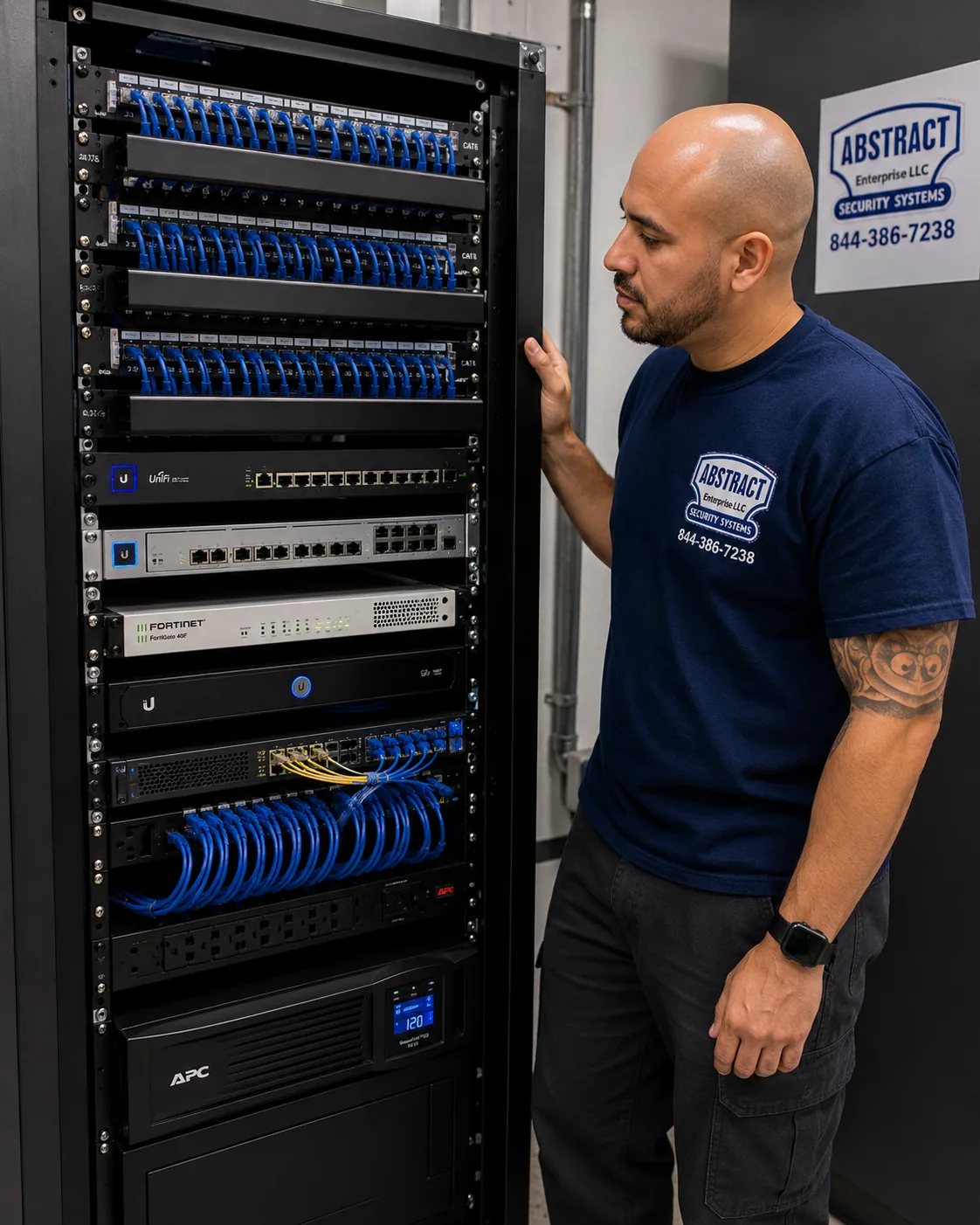
A photo from the AESS job library, not taken in Brighton Beach: a finished rack with patch panels, switching, a firewall and a battery backup, all dressed and labeled. A Brighton Beach co-op or condo office rarely needs a rack this size, but the same pieces, a switch, a recorder and a battery backup, belong together on a dry upper floor rather than on a basement shelf below the flood line.
National brands versus a local licensed repair
Many Brighton Beach households and shops have, or once had, cameras from a national alarm company or a consumer brand. Here is how the choices compare when one of those systems stops working.
Question
ADT or similar alarm company
Ring or SimpliSafe camera
AESS local repair
Who owns the equipment
Depends on the contract; some is leased
You own it
You own it, and we repair it
Other brands on the same building
Usually only its own
Support covers its own devices
Any brand, any installer
Wired cameras, recorders and risers
Its own systems
Mostly battery or Wi-Fi devices
Coax, network, hybrid and PoE
Salt-air remounting and resealing
Varies by dealer
Replace the device
Stainless hardware and sealed connections on site
Licensed technician on site
Varies by dealer
Remote support
Yes, NYS license #12000287431
Price before work
Varies
Replacement device price
$150 service call, then a written repair price
If your cameras came with a monitored alarm contract, check it before anyone else works on them, since some equipment may belong to the alarm company. If they are consumer Wi-Fi cameras on a balcony or beach-side wall, the honest answer is often that a battery device in salt air will keep failing, and a wired camera with proper hardware is the lasting fix. We will tell you which you have and what it costs to put right.
AI Overview Reality Check
What AI Gets Wrong About Security Camera Repair in Brighton Beach
These claims come up in AI-generated answers and in national cost guides such as Angi, HomeAdvisor and Fixr. Each is paraphrased, then set against what the work shows in an oceanfront neighborhood under an elevated line.
"Camera repair in Brooklyn runs about $1,400 on average"
HomeAdvisor's Brooklyn page for surveillance camera installation or repair gives an average of $1,416, a typical range of $680 to $2,145 and a low-to-high spread of $160 to $3,500, and AI summaries often lift that average as if it were the price of a repair.
That figure mixes new installations with repairs, which pulls it up. A Brighton Beach repair is usually one fault: a corroded connector, a dead drive, a failed power box, one camera on a salty wall. On our Brooklyn list most single faults cost $150 to $700, and only a recorder replacement, a partial rewire or a multi-camera coastal rebuild reaches $700 to $1,500.
The planning number for a Brighton Beach owner with one problem is the $150 service call plus the cost of the one failed part, written down before the work. Comparing that with an average built partly from other people's new systems only makes a small repair look frightening.
"An IP66 or IP67 rating means a camera can handle the beach"
AI answers often treat the ingress protection rating on an outdoor camera as the only number that matters by the ocean, as if a camera sealed against dust and water jets is ready for salt air.
An IP rating describes how well the housing keeps out dust and water. It says nothing about corrosion. ACTi, which makes cameras for coastal and marine sites, describes salt as "aggressive to metals" and lists rusting, galvanic attack and coating failure among the results, none of which an IP test measures. The aluminum housing, the screws, the bracket and the connector are what give out first in Brighton Beach, often on cameras with excellent IP ratings.
What makes a camera last on a beach-side wall is the whole installation: corrosion-resistant hardware, sealed connections, a cable entry facing down, a sheltered position where one exists, and cleaning. We look at all of those, not just the label on the box.
"If a camera shows no picture, the camera has died"
Many generic answers jump straight to buying a new camera when a tile on the screen goes black.
In our experience the camera is often not the failed part at all. Near the ocean the most common cause of a dark camera is the connector at the camera end, corroded by salt until it no longer makes contact. After storms it is often a power box, a PoE port or a battery backup. In larger buildings it can be the switch in a closet or the link to another building. A new camera on a corroded connector stays dark.
The cheaper route is to test the chain in order, power, cable and connector, switch, recorder, then camera, and replace only what failed. That is how every visit we make is run, and it is why many Brighton Beach repairs end without a new camera.
"Cloud storage means you don't need to worry about the recorder"
Some answers say footage is safe in the cloud, so where the recorder sits and whether it floods hardly matters.
Most wired systems in Brighton Beach apartment houses and stores have no cloud service at all. As one apartment-security guide puts it, footage "is typically stored on premises, on a server or recorder inside the building." If that recorder sits in a basement that floods, or in a cellar under a store, the footage and the means of recording go together.
If you do pay for cloud backup, it is a good second copy. But the useful questions are still where the recorder is, how high it sits, and when you last played back something it recorded. A drive check and a look at the recorder's location are part of every visit we make.
A photo from the AESS job library, not taken in Brighton Beach: a technician running cable into EMT conduit beside a telecom room in an industrial building. In Brighton Beach, conduit or a sealed raceway is how a replacement camera cable is protected where the old one failed, across a damp basement wall, up a beach-facing facade or through a garage, so the same run does not fail the same way twice.
"Endless motion alerts just mean the sensitivity is set too high"
The usual AI fix for a camera that sends alerts all day is to turn the motion sensitivity down.
On Brighton Beach Avenue that often makes things worse. The alerts come from the camera itself moving, shaken by trains on the el, or from the structure, the trains and their shadows in the frame. Turning sensitivity down far enough to ignore all that can also make the camera ignore a person walking through the door. Near the beach, flags, umbrellas, sea mist and crowds do the same.
The real fix is to stop the camera shaking with a stiffer mount, then draw the motion zone around what matters, the door, the register, the gate, and use person or vehicle detection where the recorder has it. Done that way, the alerts that remain are ones worth reading.
"A battery backup keeps cameras running through any outage"
Answers about storm preparation often say to put the recorder on a UPS and leave it there, as if the backup will carry the system for hours.
A small UPS is meant to carry a recorder through a short flicker and let it shut down cleanly in a long outage. It rarely runs a recorder, a PoE switch and a dozen cameras for long. Its battery also ages, and faster in heat: Schneider Electric's guidance is that every 10°C over 25°C roughly halves the battery's life, and that the unit should be kept away from moisture. A five-year-old backup in a warm back room may give almost nothing.
Plan for what a backup can actually do, test it under load once a year, and put it in a cool, dry place above the flood line. For outages that last days, as Brighton Beach saw in 2012, no camera system keeps running without building power or a generator, and it is better to know that in advance.
"Swapping a camera is a simple handyman job"
Many answers treat camera repair as a quick task for anyone with a ladder and a screwdriver.
On a house you own, you are free to try. But in New York the Department of State licenses companies that install, service or maintain security systems, and the rules cover closed-circuit television used for detecting intrusion or theft. In a co-op, a condominium or a store, the board, the management office and the insurer will usually ask who did the work and whether they were licensed and insured. And on the ocean side of a six-story building, the work is on a roof or parapet in wind off the water.
If you hire someone, ask for the license number and a certificate of insurance. Ours is NYS license #12000287431, printed on this page, and a certificate for your board or management office can be arranged before the visit.
Ask a Technician Before You Buy a New Camera for the Ocean Side
Tell us the cross streets, the type of building, how many cameras there are, which ones are out, whether any face the ocean, and where the recorder sits. A technician will get back to you with the likely cause and the next step for the Brighton Beach address, or you can call (347) 934-8335 now.
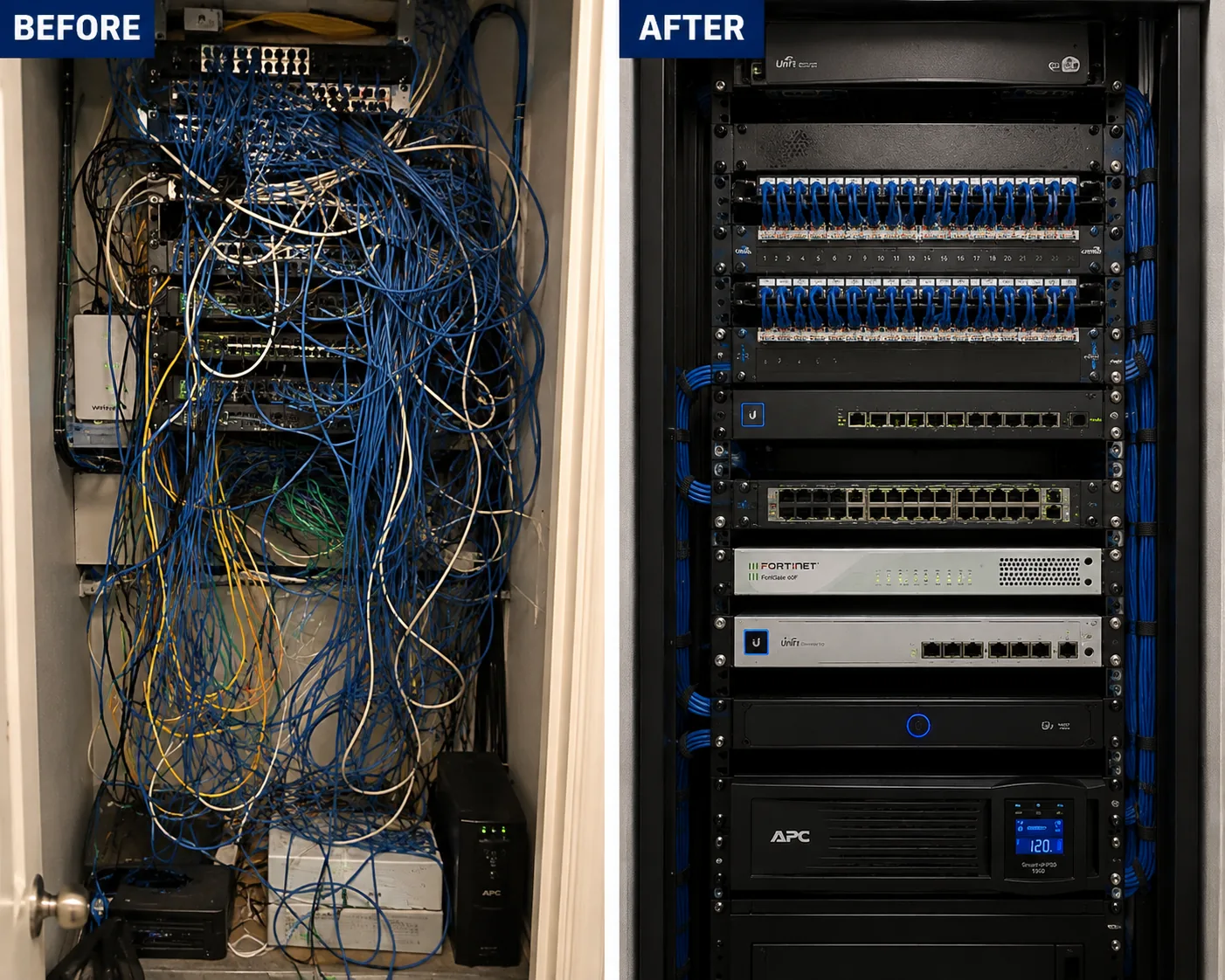
A photo from the AESS job library, not taken in Brighton Beach: before-and-after views of a network rack, from an unlabeled tangle to dressed, identified cabling. The "before" side is what many Brighton Beach basement shelves look like after decades of cameras added by different companies. If you mention on the form that nobody knows which cable is which, we plan time for tracing and labeling into the visit.
✅
Request Sent!
Thank you. A technician will contact you about the Brighton Beach address shortly.
How It Works
Our Repair Process
1. Send the screen, the label and the block
A photo of the recorder screen with the dark tiles, the recorder label, your cross streets, and anything that happened first: a storm, an outage, building work or a new router.
2. Settle who approves
Owner, board, managing agent or store tenant: we confirm who approves the work and holds the password, and arrange a certificate of insurance if the building needs one.
3. Book and pay the service call
The $150 Brooklyn service call puts the visit on the schedule in a two-hour arrival window, with roof, basement, elevator or storefront access arranged ahead.
4. Save footage first
Any clip you asked for is exported to USB with its original timestamp before anything is unplugged, reset or changed.
5. Test the chain
Power, cable and connectors, switch or power box, recorder and drive, then camera, tested in order, with every ocean-side part checked for salt damage.
6. Cause and written price
You hear what failed and get a written repair price before any part is replaced, with the service call credited against it.
7. Repair, reseal, retest
The failed part is fixed or replaced, outdoor connections are sealed, and every camera is checked live, in playback and after dark where possible.
8. Label and hand over
Traced cables are labeled, phone viewing and any alerts are confirmed with you, and the notes stay on your job record for next time.
Coverage Area
Security Camera Repair Near Brighton Beach's Landmarks
Riegelmann Boardwalk
The boardwalk along the neighborhood's southern edge, where every building facing it puts its cameras in salt spray and wind.
Brighton Beach station
The B and Q stop on the elevated Brighton Line above Brighton Beach Avenue, near the exit where the August 2026 attack was recorded.
Brighton Beach Avenue
The commercial core under the el, with shops whose cameras deal with vibration, shadow and grime from the structure.
Brightwater Court
A street of 1920s and 1930s apartment buildings, many with art deco lobbies, close to the boardwalk.
The Oceana
Muss Development's condominium by the water, 16 buildings and 927 units in 2014, with retail and medical space at Brighton Beach and Coney Island Avenues.
The Brighton lanes
The walks and courts between the main streets, lined with winterized bungalows that Forgotten New York documented in 2014.
Brighton Beach is billed at our Brooklyn rate. Every repair starts with the $150 service call, which pays for the on-site diagnosis and the written repair price and is credited to the repair if you go ahead. The ranges below come from our published Brooklyn security camera repair prices; your exact price is written down on the visit, once we know what failed. Visits go on the schedule once the service call is paid.
Repair
Brooklyn price
Service call, on-site diagnosis and written repair price
$150, credited to the repair
Motion, alert, app or clock settings with no parts
Usually within the $150 service call
Clean and check for a blurry picture
$80
Connector reterminate or PoE port swap
$150–$350
Power supply repair
$150–$400
Dome or front cover replacement
$30–$80 part plus labor
Indoor camera repair
$200–$450
Hard drive swap, by capacity
$200–$450
Outdoor camera body replacement with weatherproofing rebuilt
$250–$600
Night vision camera repair
$250–$650
DVR not working, including drive and labor
$300–$700
NVR not recording, by model
$400–$900
Vandalized camera, per camera plus cable repair
$400–$900
PTZ camera repair
$450–$1,200
Hybrid recorder swap, channels reconfigured
$700–$1,200
Coastal multi-camera salt-air rebuild, or DVR/NVR replacement with drive
Three things move a Brighton Beach repair within those ranges. The first is exposure: a camera on the ocean face that needs its connector, hardware and seals redone takes longer than the same camera on the street side. The second is access: a roof parapet, an elevator car or a cellar under a store takes coordination with the building, the elevator company or the shop's opening hours. The third is the head end: a recorder that has to come out of a flood-prone basement turns a camera repair into a move, which we price separately and only with your approval. If the price changes on site, you hear the new number before the work goes on. Bundling the camera repair with intercom, alarm or cabling work on the same visit saves $200 to $400 in labor on our Brooklyn list.
Full terms — including 50% deposit, one-year parts-only warranty on AESS-supplied products, and the late-fee schedule — are set out in the service agreement.
Shop Our Systems
Security Camera Repair Packages & Pricing
Three ways Brighton Beach repairs usually come together, priced from the Brooklyn list above. Each starts with the $150 service call, credited to the repair, and your written price follows what the diagnosis finds.
Single-issue repair: $150–$700
One fault, one visit: a salt-corroded connector redone with a sealed fitting, a power box replaced after a storm, a drive swapped, a hazy beach-side camera replaced with the weatherproofing rebuilt, or a shaking storefront camera under the el remounted and its motion zones redrawn.
Major system repair: $700–$1,500
The recorder, the wiring or the ocean wall: a DVR or NVR replaced with a new drive and every camera set up again, a hybrid recorder so older coax cameras can stay, several beach-facing cameras rebuilt together, or the recorder moved out of a basement that floods.
Annual maintenance: $250–$800
Timed for the end of beach season: windows cleaned, salt checked, connectors and seals redone where needed, stainless hardware swapped in, drive health and battery backup tested, firmware reviewed and alerts confirmed, from $250 for a residence and $400 for a commercial system.
Bring your own equipment. If you have already bought a replacement camera or recorder, we can fit it at labor-only rates. Tell us the exact model and we quote the labor by phone or text, and the visit is booked once it is paid. Your own equipment is installed as supplied: we cannot vouch for parts we did not supply, and if a model you bought is a poor fit for a spot facing the ocean, or will not work with your recorder, we tell you before the visit.
Complete Services
Every Security Camera Repair Service in Brighton Beach
Camera, connector and cable repair
Salt-damaged cameras, corroded connectors and failed runs. Request a repair
Do you cover every block of Brighton Beach, including the buildings right on the boardwalk?
+
Yes. We cover all of Brighton Beach in ZIP code 11235, from Ocean Parkway to Corbin Place and from the Belt Parkway to the boardwalk, including the lanes and the beach-block buildings, at our Brooklyn rate. Neighboring Coney Island, Manhattan Beach and Sheepshead Bay are covered the same way.
Can you work on outdoor cameras in rain or strong wind off the ocean?
+
Work at the recorder and inside the building goes ahead in any weather. Ladder, roof and parapet work on the ocean side is done only when it is safe, so in heavy rain or strong wind we finish the indoor diagnosis, give you the written price and book the outdoor part for the next calm day.
What does sealing a camera connection actually involve near the ocean?
+
The corroded end is cut back to clean copper, a new connector is fitted, and the joint is protected with a weatherproof boot or a sealed junction box, often with a moisture-blocking compound inside. The cable entry is turned to face down so water runs off instead of in. It adds little time and is what keeps the repair from failing again next season.
Can you send our co-op board or managing agent a certificate of insurance before the visit?
+
Yes. Send us the exact wording the building needs for the certificate holder and any additional insureds, and we arrange the certificate before the visit, so the super can let the technician in on the day without a delay at the door.
Who approves a repair on a condo's shared cameras, the management office or each unit owner?
+
For cameras in lobbies, garages, walkways and other common areas, the condominium's board or its management office approves the work, not individual owners. A camera on a single owner's balcony or door is normally that owner's own equipment, unless the building's rules say otherwise. We confirm ownership before we change anything.
Will the phone app I use now still work the same way after the repair?
+
In most cases yes. If the recorder stays, the app and its login stay too, and we confirm live view and playback on your phone before we leave. If the recorder has to be replaced, the app may change, and then we set it up on your phone and on the phones of anyone else you name, and show you how to use it.
How can I check for myself, once a month, that the cameras are still recording?
+
Open the app or the recorder, go to playback, and pick a time from the previous night for each camera. If every camera shows recorded video with the right date and time, the system is working. If one shows nothing, or the clock is off, send us a photo of the screen. It takes five minutes and catches a failing drive long before you need a clip.
When is the best time of year to have cameras near the beach serviced?
+
The end of summer, in September or October. That clears the salt, sand and sun damage from the season, and it gets connectors, seals and battery backups ready before the winter storms. Businesses that rely on summer trade often add a short check in late spring, before the beach crowds arrive.
Can you repair the cameras on the light poles in our building's parking lot?
+
Yes. Pole cameras usually fail at the connection at the top of the pole or in the cable that runs underground, often through conduit that has taken in water. We test from both ends to find which, repair or replace the camera, and where the underground run has failed, give you a written price for a new path before any digging or re-pulling is done.
Can anything keep gulls and pigeons from perching on our cameras?
+
Yes. A small hood or sun shield over the camera, bird spikes on the bracket or the ledge above it, and moving the camera off a favorite perch such as a sign or the edge of the el structure all help. Droppings on the window are one of the most common causes of a ruined picture on storefronts and beach-facing walls.
Does salt air harm cameras inside a lobby or a store as well?
+
Less than outdoors, but it can. Cameras near doors that open toward the beach, in vestibules and in unheated garages and breezeways see salty, damp air every time the door opens. They tend to show corrosion at the connector or the bracket years before cameras deeper inside. We check those first on any building close to the water.
Can cameras be remounted on a frame bungalow without damaging the siding?
+
Yes. On siding we use a mounting block or junction box made for the purpose, so the camera sits flat and the screws go into solid framing rather than just the siding. Old holes are sealed so water cannot get behind the siding, which matters on small houses close to the beach that take wind-driven rain.
Ready to Get Every Brighton Beach Camera Recording Again?
Send a photo of the recorder screen, a close-up of any camera that looks rusted or cloudy, and your cross streets, and we will tell you what most likely failed and what that kind of repair costs on our Brooklyn list. The $150 service call is credited to the repair, the price is written down before any part changes, and requests are booked within 2 hours. Abstract Enterprises Security Systems has been owner-operated since 2002, holds NYS license #12000287431, is rated 4.7★ across 201 Google Reviews, and dispatches Brooklyn crews from our Troy Avenue office.