Brighton Beach sits between the Belt Parkway and the Riegelmann Boardwalk, and in October 2012 the ocean came up its streets into basements, lobbies, garages and shop cellars. An alarm here has to be designed around that night and around the elevated B and Q trains that rumble over Brighton Beach Avenue all day and into the night.We put the panel, its battery, the cellular communicator and the siren where seawater cannot reach them, add water sensors where it arrives first, choose detectors that ignore the trains, and set up arming that an older, largely Russian-speaking household, or an apartment left empty for the winter, can actually live with.
Licensed and insured in New York State; written Brooklyn price, usually the same day
4.7★ average across 201 Google reviews
Reviewed and updated October 21, 2026, against Wikipedia’s Brighton Beach and Riegelmann Boardwalk articles, City Limits (November 8, 2012) and DNAinfo (October 31, 2012) reporting on Sandy in Brighton Beach, Hester Street’s Brighton Beach resiliency report, First Street’s flood data, Commercial Observer on the Oceana, Forgotten New York on the Brighton lanes, NYC Administrative Code §24-238 and the New York Department of State’s alarm installer licensing page · Anwar Timothy, NYS license #12000287431 · crews leave from our Troy Avenue office in Brooklyn.
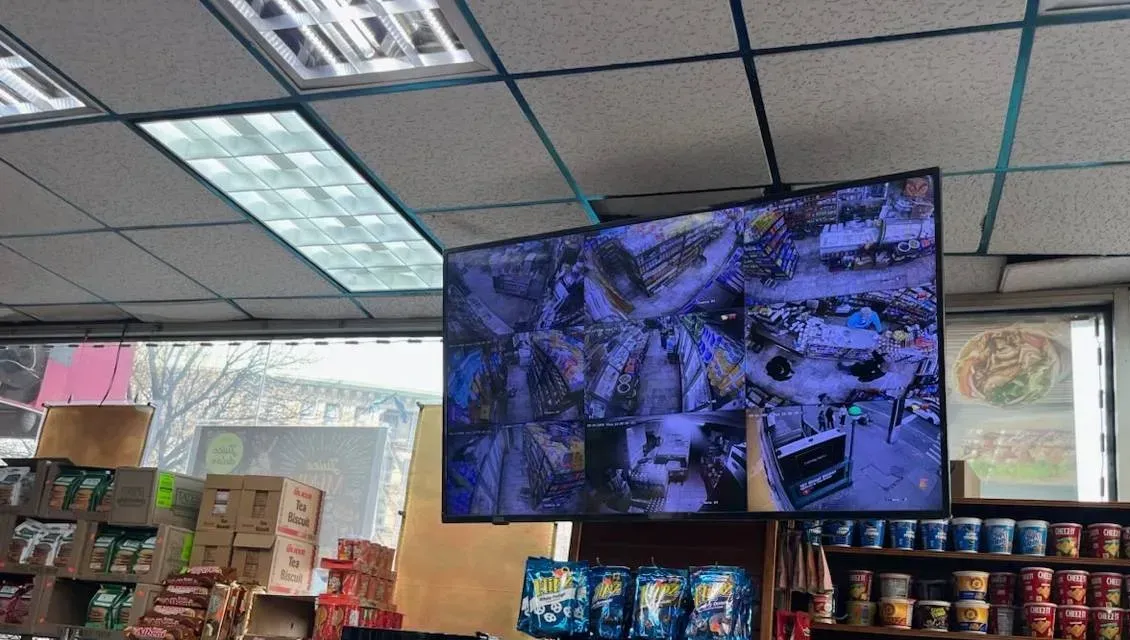
Photo from the AESS job library, not taken in Brighton Beach: a small food store’s camera views on a monitor over its shelves. Stores on Brighton Beach Avenue keep stock this dense; the alarm side of a job like this is the contacts, motion and glass-break detectors that guard it once the gate is down.
Brighton Beach Alarm Request
Apartment, co-op, bungalow, shop or whole building: tell us where the old panel sits
✅
Request Sent!
A technician will call you back today. If a parent will be using the system, tell us a good time to reach them too.
25+
Years Experience
✓
Same-Day Estimates
100%
Licensed & Insured
$0
Monthly Fees Required
Five facts let us size a Brighton Beach alarm over the phone. Which floor the property is on, and whether anything below it (a cellar, a stockroom, a garage level, a boiler room) took water in 2012. Where the existing panel or phone jack lives today. How many doors and street-level windows open to the outside, including a back door to a yard or a sidewalk hatch. Who will arm and disarm it, and in which language they are comfortable reading a screen. And whether the place will stand empty for long stretches, such as a winter away. A photo of the basement or the area under the stairs, where installers have always hidden alarm boxes, usually tells us more than a floor plan.
Looking at photos and answering by text costs nothing; billable time begins at the property
New York State license #12000287431; insured for work in occupied apartments, co-op basements and shops
The Neighborhood
Why Brighton Beach Properties Need Alarm Installation Built Around the Water
Brighton Beach has always been shaped by the water in front of it. William A. Engeman built a seaside resort here in 1868, and a group of businessmen led by Henry C. Murphy gave it the name Brighton Beach in 1878, after the English resort town. In December 1887 a tide washed right across the area, and by April 1888 the sea had eaten so far into the beach that the railway that owned the Brighton Beach Hotel lifted the whole building onto flat cars and pulled it 495 feet inland, according to Wikipedia’s history of the neighborhood. The resort era ended once the Brighton Line was rebuilt as a subway in 1920; the hotel closed in 1924, and the land filled with apartment houses, bungalows and the shops along Brighton Beach Avenue that the neighborhood is known for today.
The housing that replaced the resort is what we install alarms in now. Wikipedia describes the prewar six-story elevator apartment houses lining Brightwater Court; Hester Street’s 2016 resiliency report counts close to 85 percent of the neighborhood’s housing as built between 1939 and 1969, with tower-in-the-park high-rises, prewar mid-rises, one- to three-family homes, brick mixed-use buildings on the avenues and the old bungalow colonies alongside each other. Forgotten New York’s survey of the area found those bungalows still sitting on narrow named lanes such as Brighton 1st Walk and Brighton 3rd Court, winterized long ago for year-round living. At the eastern end of the boardwalk, the Oceana condominium complex added a newer, wealthier layer in the 2000s. About 71 percent of homes are rented, so many of the people who call us are tenants who need landlord or board approval as much as they need sensors.
Then came October 29, 2012. Hester Street’s report says up to fifteen feet of sea and sewer water severely damaged the neighborhood and that most residents went nearly a month without electricity, heat or hot water, with basement flooding knocking out heating systems. City Limits walked the streets ten days after the storm and found generators running on nearly every block to pump out basements, sand piled in apartment breezeways and carports, a high-rise whose elevator was still out of service because salt-soaked machinery in the basement needed repair, and a garage where Ocean Parkway meets the boardwalk in which the water had risen above five feet. DNAinfo reported Brighton Beach Avenue shops reopening in the dark two days after the storm, a bookstore that had lost its holiday stock in the basement, and men bailing cellars with buckets.
That night is the single most useful fact for anyone designing an alarm here, because basements are exactly where alarm installers have put control panels, transformers, backup batteries and telephone connections for decades. A panel in a flooded cellar does not just stop working; it stops working at the moment the building is dark, the street is empty and the doors and windows that it watches are most likely to be forced or left open. The flood data has not become more reassuring since. First Street’s current model counts 1,756 properties in Brighton Beach, 99 percent of the total, as having some risk of flooding over the next thirty years, and Hester Street recommended that mechanical rooms in new buildings be placed above the flood zone. When the Oceana’s 50 Oceana Drive East building went up in 2014, its developer told Commercial Observer that the electrical switchgear had been moved from the basement to an elevated platform and the elevator controls to the roof. The same logic applies, on a much smaller scale, to an alarm panel.
The second fact is the elevated train. The B and Q run on a steel structure above Brighton Beach Avenue, stopping at Brighton Beach and, for the Q, at Ocean Parkway, and the avenue beneath is the neighborhood’s main street: food shops, bookstores and restaurants, many with apartments above and stockrooms below. Trains passing a few yards from a storefront shake windows and gates in a way that a shop on a quiet side street never experiences. Alarm detectors that listen for breaking glass or feel for vibration have to be chosen and adjusted with that in mind, or a store ends up with a system that cries wolf until its owner stops arming it.
The third fact is the people. Wikipedia, citing the State Comptroller, gives the combined Brighton Beach and Coney Island area a median age of 47.9 in 2009, against 34.2 for Brooklyn, with seniors more than a quarter of residents; Hester Street counted 30.3 percent of Brighton Beach residents as 60 or older, roughly 70 percent foreign-born and 60 percent speaking English less than very well. Little Odessa is still known for its Russian-speaking population, with Ukrainian, Belarusian, Georgian and Central Asian families alongside. And an apartment left empty for weeks, during a winter away or a long hospital stay, needs watching in a different way from one that is lived in every day. An alarm that only a grandson who lives in New Jersey can operate is not an alarm; it is a source of false dispatches and of a keypad nobody touches. So the work on this page starts from three questions rather than from a product list: where would the water go, what does the train do to this storefront, and who will be standing at the keypad.
Brighton Beach facts we checked before writing this page
Boundaries and services. Wikipedia places Brighton Beach between Coney Island at Ocean Parkway, Manhattan Beach at Corbin Place, Sheepshead Bay at the Belt Parkway and the Atlantic Ocean. It is in Brooklyn Community District 13, ZIP code 11235, patrolled by the 60th Precinct at 2950 West 8th Street, with FDNY Engine 246 and Ladder 169 at 2732 East 11th Street.
Burglary in the precinct. Wikipedia’s summary of the 60th Precinct’s figures gives 159 burglaries and 527 grand larcenies in 2022, after crime across all categories fell 77.5 percent between 1990 and 2022. The precinct also covers Coney Island and other neighborhoods, so these are not Brighton Beach-only numbers.
Who lives here. 35,547 residents in the 2010 census. Hester Street’s 2016 report: 30.3 percent aged 60 or over, about 70 percent foreign-born, 60 percent speaking English less than very well, and about 71 percent of homes rented.
Housing age. Close to 85 percent of the housing stock was built between 1939 and 1969 (Hester Street). Prewar six-story elevator apartment houses line Brightwater Court (Wikipedia); 1920s and 1930s apartment and art deco buildings stand along Ocean Parkway and Brightwater Court (CityNeighborhoods.NYC).
Flood exposure. First Street’s model counts 1,756 properties, 99 percent of the neighborhood, with some flood risk over the next 30 years. Sandy brought up to 15 feet of sea and sewer water, by Hester Street’s account.
Transit. Brighton Beach station (B, Q) and Ocean Parkway station (Q) are both on the elevated Brighton Line structure over Brighton Beach Avenue; the line opened as a subway in August 1920. Buses B1, B4, B36 and B68 serve the area (Wikipedia).
Figures from Hester Street’s 2016 Brighton Beach report and First Street’s flood model, as listed under Sources. Approximate values are drawn at the stated figure.Dates from Wikipedia, CityNeighborhoods.NYC, Commercial Observer, City Limits, Hester Street and First Street, as listed under Sources. Blue marks the water.
Alarm Beeping or Dead After a Brighton Beach Outage? Same-Day Repair
A panel that has been beeping since the power blinked, a siren that will not stop, a keypad showing a trouble code nobody can read, a shop alarm that went off three times last night as the trains passed: ring (347) 934-8335 and tell us whether the panel is above or below street level. Many of these are a dead backup battery, a failed phone line the panel still expects, or a sensor that has corroded at the beach-side door, and they are usually found and fixed in one visit. If the building is flooded, we will not send anyone into standing water near live power; we will help you silence the system by phone and book the first visit after the water is out. Service visits on systems we did not install follow the Brooklyn rate of $195 an hour with a three-hour minimum.
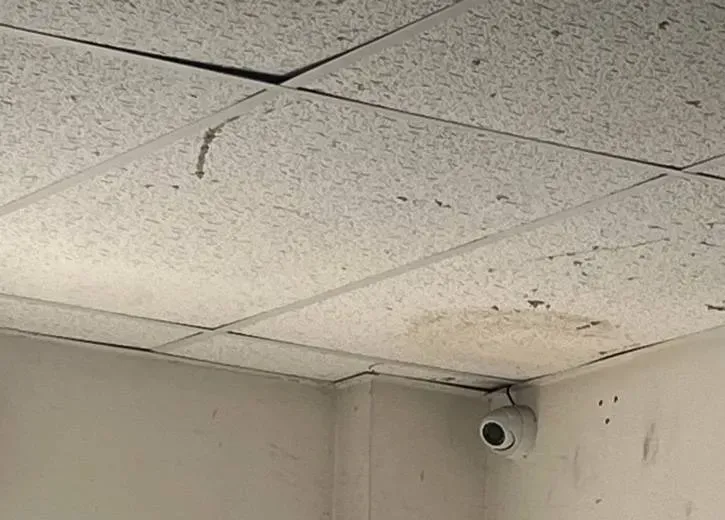
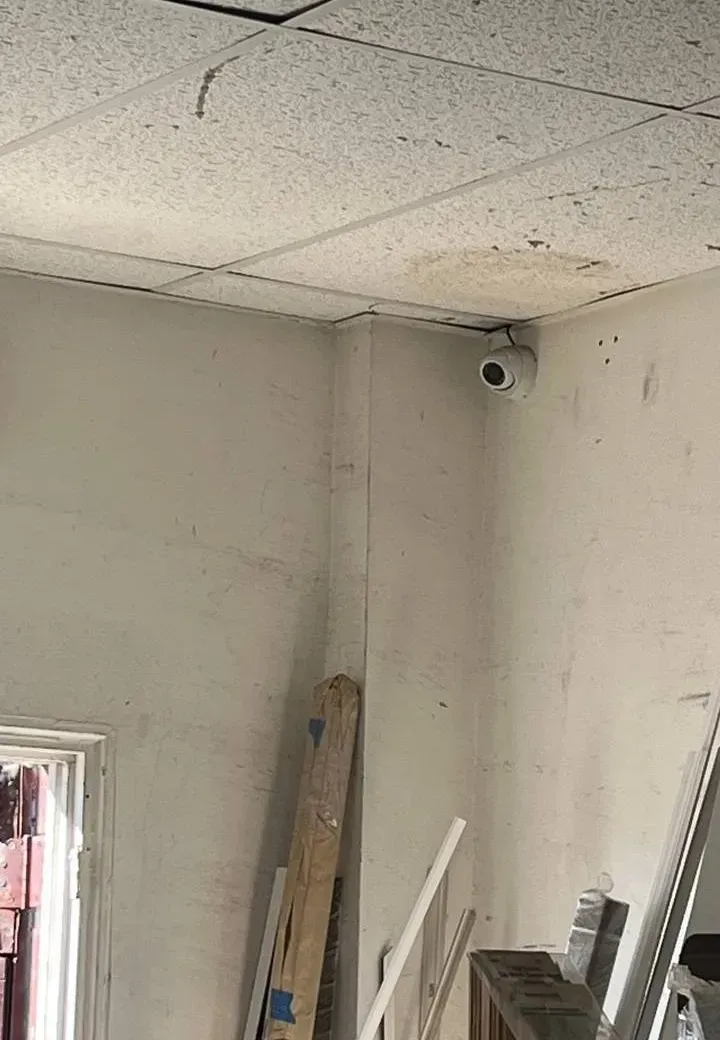
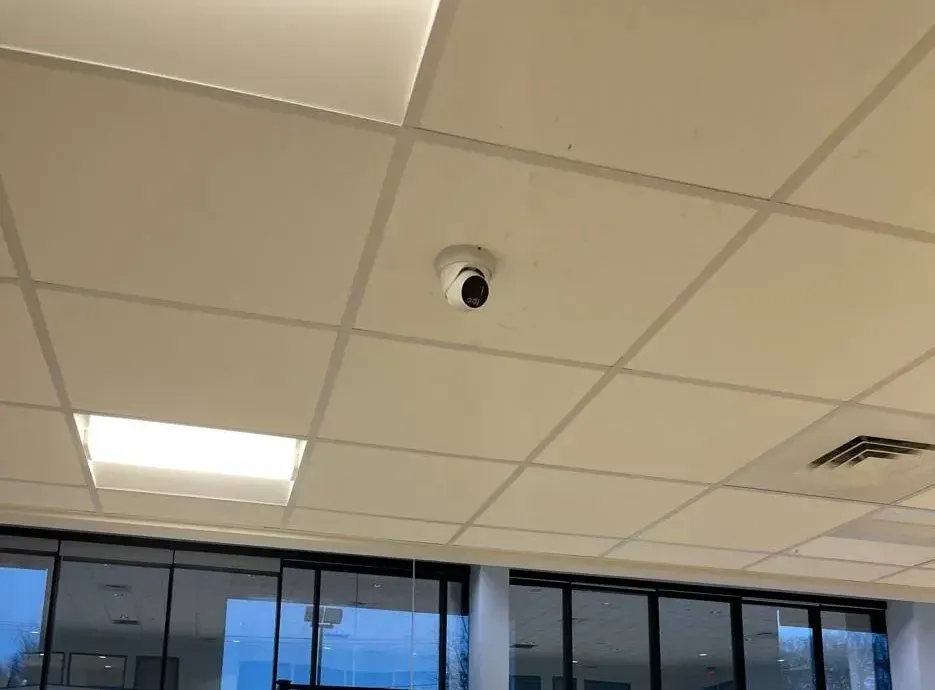
Photo from the AESS job library, not taken in Brighton Beach: a camera in a room whose ceiling tiles show an old leak. Stains like these are the first thing we look for on a survey, because they show where water has already found its way in.
What We Install
Alarm Installation Services in Brighton Beach
The cards below follow the order in which Brighton Beach owners, boards and tenants usually ask for things. Almost every job begins the same way, with a walk from the lowest floor up, marking where the water reached in 2012 and where the oldest equipment lives now.
🌊
Panels moved above the flood line
Relocating a control panel, transformer and backup battery from a basement or under-stair closet to a dry, reachable spot on a higher floor, with the old wiring extended or replaced by wireless sensors.
💧
Water and flood sensors
Leak and flood detectors on basement floors, beside boilers, water heaters and sump pits, in storefront cellars and under kitchen sinks of apartments left empty for the season.
🏬
Shop alarms under the el
Door contacts, glass-break and motion detectors chosen and set for a storefront that shakes every time a B or Q train passes, with an arming routine that fits the shutter going down.
🏢
Co-op and condo common areas
Basement, boiler-room, roof-door and storage-room protection for buildings that do not want to wire every apartment, reporting to the super, the managing agent or a monitoring center.
🏠
Apartments and bungalows
Wireless systems for rentals and co-op units that leave no marks, and hybrid systems for the winterized bungalows on the Brighton lanes and the one- to three-family houses north of the avenue.
🗣️
Keypads and apps people can read
Panels and apps configured in the language the household reads best where the equipment offers it, large-button keypads, and printed arming cards for older residents.
📡
Cellular and backup communication
Cellular communicators that keep reporting when the building’s phone line or internet goes down, and batteries sized for long outages rather than for a showroom test.
🔧
Takeovers and repairs
Diagnosis of systems left by previous owners, landlords and companies that disappeared, including panels whose installer codes nobody knows.
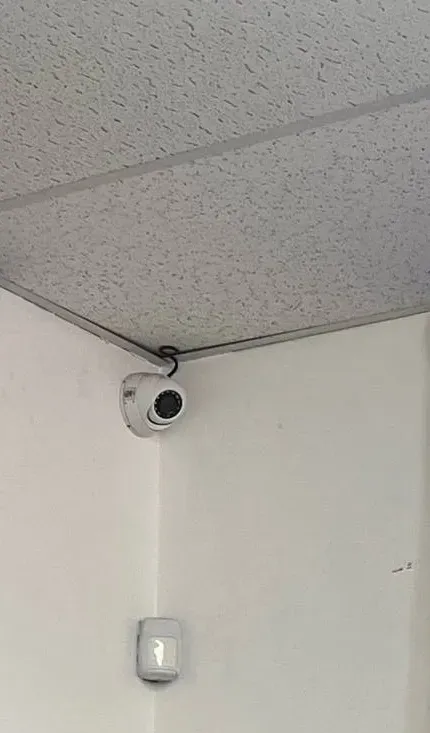
Photo from the AESS job library, not taken in Brighton Beach: a corner motion sensor below a camera. A corner mount like this, aimed into the room and away from windows and heaters, is how we place motion detectors in shops under the el.
Above the Waterline, Under the El
Above the Waterline, Under the El: Seven Rules for a Brighton Beach Alarm
Most alarm advice assumes that the basement is the safest, most out-of-the-way place in a building. In Brighton Beach it is the most exposed. Most alarm advice also assumes that a shop window only shakes when someone hits it, and that the person arming a system reads the English on its screen without effort. None of those assumptions holds on the blocks between the Belt Parkway and the boardwalk, so the design here runs on a short set of rules we apply in roughly the order below, from the lowest floor up.
None of it requires exotic equipment. Every device mentioned on this page is a standard part from the major panel makers. What changes is where each part goes, how it is set, and who it talks to when something happens.
Find the waterline before choosing a spot for the panel
The first thing we ask in any Brighton Beach basement is where the water stopped in 2012. Supers and long-time owners almost always know: a tide mark on the boiler-room wall, a line on the elevator pit door, a shelf where the paint changes color. If nobody remembers, we work from the building’s position. A cellar south of Brighton Beach Avenue, toward the boardwalk, is treated as if it will take water again; one further north toward Neptune Avenue is still treated with suspicion, because the reports from the storm described flooding across the neighborhood rather than only on the beach blocks.
Once the line is marked, nothing that the system needs in order to call for help goes below it. That means the control board, its transformer, the backup battery, the cellular communicator and any network equipment the panel relies on. In an apartment the decision is easy: a closet on the living floor. In a co-op or rental building it is often the difference between the old panel in the boiler room and a small locked enclosure on the first residential floor, the lobby office or the superintendent’s apartment, with a short cable run back down for the basement sensors.
It is the same reasoning that led the Oceana’s developer to raise the switchgear in 50 Oceana Drive East to a platform above the flood plane and move the elevator controls to the roof. An alarm panel costs far less than switchgear, which is exactly why it so often ends up wherever the first installer found an outlet.
Sensors stay low; the brains go up
Moving the panel does not mean giving up protection below the line. The opposite: the cellar door, the sidewalk hatch, the stockroom and the boiler room are exactly the places a burglar or a leak will start. What changes is that those sensors become the cheap, replaceable part of the system. A wireless door contact on a cellar door costs little to replace if salt water reaches it; a panel that has been under water must be replaced entirely, and until it is, nothing in the building is protected.
Where a building already has wired sensors in the basement, we can usually keep them and bring their cables up to a small wireless or wired expander mounted high on the basement wall, near the ceiling, which then talks to the relocated panel. In buildings where cable cannot climb easily, wireless sensors report directly upstairs. Signal through old masonry and steel can be stubborn, and we test every basement sensor from its final position before anything is screwed to a wall.
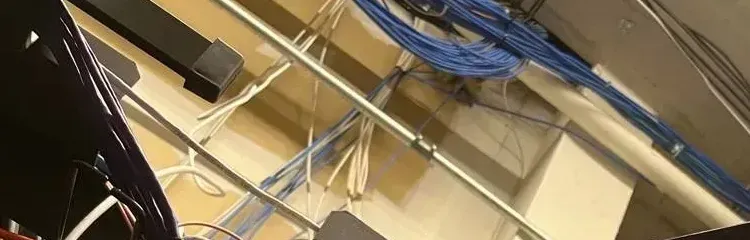
How we lay out an alarm in a building near the water. The waterline is marked on the survey from the building’s own 2012 history or its position.Photo from the AESS job library, not taken in Brighton Beach: cable runs along the beams of an unfinished ceiling. When a panel moves up from a basement, cable from the basement sensors is routed high like this, never along a floor that can flood.
Water sensors: where the sea and the pipes arrive first
A burglar alarm in Brighton Beach that does not also watch for water is missing half the job. The most useful flood sensors are the plainest ones: a small puck or a probe cable on the floor, wired or wireless, that reports the moment its contacts get wet. We put the first ones at the lowest point of the basement or cellar floor, beside the boiler and water heater, at the bottom of the stairs or hatch where water from the street comes in, next to any sump pit or ejector pump, and under the main water valve. In storefronts they go at the foot of the cellar stairs and wherever stock sits on the floor.
Upstairs, an apartment that will stand empty for a few weeks gets one under the kitchen sink, one behind the washing machine if there is one, and one under the water heater in a house. These catch the far more common problem, a burst pipe or a failed hose, as well as the rare night when the ocean comes up the street. A temperature sensor can be added in the same spot to warn of a heating failure in winter, which in a building whose boiler sits below the waterline is not a theoretical risk.
The sensors only help if the alert reaches someone who can do something. In a co-op that usually means the super first and the managing agent second, with the monitoring center calling both. In a private house it is the owner’s phone and a neighbor or relative nearby. We do not send water alerts to the police or fire department, and we set them apart from intrusion alarms so nobody confuses a wet floor with a break-in.
Photo from the AESS job library, not taken in Brighton Beach: small devices mounted high on a wall above a lowered ceiling. High, out-of-reach mounting is the habit we bring to every Brighton Beach basement and cellar: whatever can live near the ceiling, does.An example routing for a co-op building; a private home replaces the super and managing agent with the owner and a nearby relative.
Power and the message out
Sandy cut power to most of Brighton Beach for close to a month, by Hester Street’s count. No ordinary alarm battery will carry a system for that long, and it would be dishonest to say otherwise. A standard battery is sized to ride out hours of outage, not weeks. What we can do is make sure the panel survives the first and most dangerous day of an outage, when buildings are dark, streets are empty and people are leaving: a fresh battery of the right size, a panel that is not in the water, a cellular communicator instead of a landline or the building’s internet connection, and power-loss and low-battery messages sent to the owner so nobody discovers days later that the system died quietly.
For buildings that have invested in generators or backup power since the storm, we connect the panel to the backed-up circuit, which turns a day of protection into as long as the generator runs. For a shop, we suggest the owner pull the stock up from the cellar when a storm is forecast, because no sensor saves wet inventory.
No battery figure is given because it depends on the panel and the devices on it; the quote states the battery we fit and why.
Salt air and the beach-side doors
On the blocks nearest the boardwalk, exterior devices live in spray, sand and wind. Outdoor sirens, door contacts on beach-side and yard doors, and exterior motion detectors corrode faster than the same devices a mile inland. We use outdoor-rated housings, stainless or coated fasteners, sealed cable entries that face downward, and contacts recessed into the frame rather than surface-mounted where the door allows it. Where an outdoor siren is not needed, we leave it out and put a louder siren inside.
We also come back. A beach-block system gets a check of its exterior devices on the first service visit after a winter, because salt damage shows up first as a contact that reports open for no reason or a siren cover that will not seal.
Photo from the AESS job library, not taken in Brighton Beach: an exterior device tucked under an eave. On beach blocks, exterior sirens and contacts get sheltered spots, sealed cable entries facing down and coated fasteners against salt air.
Under the el: storefront detectors that ignore the trains
Much of Brighton Beach Avenue runs under the elevated Brighton Line. Passing trains shake plate glass, metal gates and the walls they are attached to. A shock sensor stuck to a window, or a glass-break detector set to its most sensitive level, will hear that as an attack. The result is a store whose alarm goes off at night, a neighbor upstairs who complains, and an owner who eventually stops arming it.
So on the avenue we lean on the detectors trains cannot fool. Contacts on every door, including the back door and the cellar hatch, catch the most common ways in. Motion detectors inside, aimed away from the window and away from the heating vents, catch anyone who gets past the glass. Glass-break detectors are still useful but are placed on the far wall, set in steps and tested with a train going past before we leave; we keep a log of any alerts in the first weeks and adjust. A camera covering the floor, if the shop has one, lets the owner see what set off a motion detector before deciding whether to send anyone.
The rolling gate itself can carry a contact so the system knows it has been raised. That turns a gate forced at 4 a.m. into an alarm before anyone has reached the glass.
A qualitative guide from how we set up storefronts, not a measurement. Every storefront is tested with trains passing before handover.An example layout, not a particular store. Real layouts follow the shop, the cellar and the result of testing with trains passing.
Arming that the household can actually do
The last rule is about people. In a building where many residents are older, foreign-born and more comfortable reading Russian or Ukrainian than English, the keypad is where most systems fail. We ask who will arm the system before we choose it. Some panels and apps can display Russian, Ukrainian and other languages; one app we checked, Ajax Security System, lists Russian, Ukrainian, Georgian and Kazakh among 35 interface languages in its App Store listing. Where the equipment we recommend offers the household’s language, we set it, and we confirm on the specification sheet before quoting rather than promising it in advance.
Where the screen stays in English, we design around it: a keypad with large physical buttons by the door, a key fob with one button to arm and one to disarm, a short entry delay set long enough for someone who walks slowly from the door, and a printed card beside the keypad with the steps and the monitoring center’s number. Family members who live elsewhere can be added to the app so they receive the same alerts and can disarm remotely when a parent forgets.
Each mode can sit on its own key-fob or keypad button, so nobody has to remember which sensors to bypass.
Building Specialists
Alarm Installation for Brighton Beach’s Architecture
Brighton Beach packs very different buildings into a few hundred acres. Each brings its own answer to where the panel can go and what the alarm has to watch. These are the types we see most, described from public sources and from how we approach each one; none of the buildings named is our customer.
Prewar elevator apartment houses
The six-story semi-fireproof buildings along Brightwater Court and nearby streets, described by Wikipedia, usually have a basement boiler room, a lobby with a mail area and a roof bulkhead. The super’s office or a first-floor closet is the natural home for a relocated panel; roof and basement doors get contacts, and basement floors get water sensors.
1920s and 1930s buildings on Ocean Parkway
Apartment and art deco buildings along Ocean Parkway, on the neighborhood’s western edge, often have decorative lobbies where boards do not want surface cable. Wireless devices and short, painted raceway are the norm there, and panels go into existing closets.
Postwar towers
Taller buildings such as Brighton Towers, from the tower-in-the-park era Hester Street describes, have larger basements, garages and compactor rooms. Common-area alarms there cover service doors, storage rooms, the garage and the roof, and report to the building staff and a monitoring center.
The Oceana and newer condos
Newer buildings near the eastern end of the boardwalk were built with the flood in mind. Unit owners usually want wireless apartment systems that respect condo rules, and the building’s own systems already sit higher; our job is to match that, not undo it.
Bungalows on the Brighton lanes
The winterized bungalows on lanes such as Brighton 1st Walk, Brighton 3rd Court and the Brighton 10th wedge are small frame houses close to the ground, often with crawl spaces. They get a full perimeter, a motion detector or two, water sensors low, and a panel on the main floor.
Brick mixed-use buildings on the avenues
Shops below, apartments above, a cellar under both. These need two separate alarm areas, one for the store and one for the homes, so a shop owner arming at closing does not affect the tenants, and the cellar belongs to whoever uses it.
One- to three-family houses
North of the avenue toward the Belt Parkway, Hester Street counts one- to three-family homes among the housing types. Owners usually want a hybrid system: wired contacts where walls are open or old wiring exists, wireless elsewhere, and basement water sensors.
How we mount and run cable in each type
Construction
Our approach
Masonry and plaster
Older walls take wireless sensors with adhesive or small anchors; where cable is needed we run it in closets, behind baseboards or in painted raceway rather than chasing plaster.
Steel and concrete towers
Concrete floors limit wireless range, so we test signal from every sensor position and add a repeater on the stair or hallway rather than guessing.
Frame bungalows
Light frame walls are easy to fish but often damp underneath; cable stays off crawl-space floors and sensors near the ground are sealed.
Storefront glass and gates
Contacts on doors and gates, motion inside, glass-break on the far wall, all tested with a train passing before handover.
Basements below the waterline
Only sensors and, at most, a small expander mounted near the ceiling; nothing that the system needs in order to call out.
Our usual starting points; every building gets its own walk-through and waterline before anything is fixed.Photo from the AESS job library, not taken in Brighton Beach: a worn storeroom with stock leaning against the wall. Cellar stockrooms under Brighton Beach Avenue shops get door contacts, a damp-rated motion detector and water sensors where stock sits on the floor.
Commercial Alarm Systems
Business Alarm Installation in Brighton Beach
Brighton Beach Avenue is the reason most visitors know the neighborhood: a long strip of food shops, bookstores, restaurants and other small businesses under the elevated tracks, with Cyrillic signs beside English ones. Its businesses share three conditions that shape an alarm. Many keep stock in a cellar, and DNAinfo’s reporting shows cellars on the avenue taking water in 2012. Long stretches of it sit directly under the train structure. And many have apartments above, so a siren that runs too long is a problem for neighbors as much as for the owner.
The other commercial pockets have their own variations, listed below. In each case we describe the setting from public sources; we are not naming customers.
Brighton Beach Avenue under the el
The main strip, running east from Ocean Parkway with the tracks overhead. DNAinfo reported shops here reopening in the dark after Sandy and a bookstore losing basement stock. Typical job: door and gate contacts, interior motion, glass-break set for the trains, cellar water sensors, panel upstairs or behind the counter.
Coney Island Avenue
Runs south to the boardwalk past the Brighton Station post office at 3157 Coney Island Avenue and shops under the tracks near the avenue. Corner stores with two street faces need contacts on both entrances and motion that covers both aisles.
Oceana retail and medical space
Commercial Observer described ground-floor retail and second-floor medical space at 50 Oceana Drive East, at Brighton Beach and Coney Island Avenues. Medical offices often need separate areas for records rooms and medication storage.
Restaurants and banquet halls
Large dining rooms and halls, such as the Primorski banquet hall City Limits saw pumping out its basement after the storm, have big glass fronts, kitchens with back doors and basements full of equipment. Motion and door contacts are zoned so staff can work in the kitchen while the dining room stays armed.
Neptune Avenue and the northern edge
Toward the Belt Parkway, a mix of apartment buildings, garages and small businesses. Garages and parking levels near the water get water sensors at the lowest point and contacts on pedestrian doors.
Beach-block and boardwalk-facing businesses
Seasonal businesses near the boardwalk sit closed for months at a time. They benefit most from cellular reporting, water and temperature sensors, and a monthly automatic test signal so the owner knows the system is still alive in February.
Rules that shape a Brighton Beach alarm
Fifteen-minute siren limit. New York City’s Noise Code, Administrative Code §24-238, says the owner of a building may not operate an audible burglar alarm unless it is capable of shutting itself off, and does so, within fifteen minutes of activation. We program every siren we install in the city to stop well within that limit. In a shop with apartments above, that is the difference between an alarm and a feud.
Licensed installers. New York State licenses security and fire alarm installers through the Department of State. Its licensing page lists 81 hours of qualifying education, an examination and fingerprinting for applicants, and a separate statement and fingerprint process for employees. Ask any company quoting your job for its license number; ours is #12000287431.
Fire alarms are separate. A burglar alarm with smoke detectors on it is not a building fire alarm system. Commercial occupancies and larger residential buildings may need fire alarm work that follows the Building Code and FDNY requirements; that is a different job, handled through our fire alarm installation service.
Board and landlord approval. In co-ops, condos and rentals, anything that touches common areas, building wiring or the outside of the building usually needs written approval first. We provide a description of the work, the device list and a certificate of insurance for the board or managing agent.
Only the fifteen-minute limit comes from law; the other times are our usual settings and vary by monitoring provider.A general guide to the approvals we usually see; your lease, proprietary lease or condo rules decide.
Photo from the AESS job library, not taken in Brighton Beach: a back corridor ending at a steel door. Back and service doors like this one, often leading to a yard or the cellar, are where we put the first contacts in a shop or a building.
Your Questions Answered
Alarm Installation in Brighton Beach: Questions Answered
These are the questions Brighton Beach owners, boards, shopkeepers and their adult children bring to us, grouped by the problem behind them. The answers are short on purpose; a visit fills in the details for a particular building.
Water, salt and power
Our co-op’s alarm panel and its backup battery sit in the basement beside the boiler, which took seawater in 2012. Where should a new Brighton Beach panel go?
Above the highest water the building has seen, somewhere a staff member can reach without a ladder. In most co-ops that is a locked closet or small enclosure on the first residential floor, the lobby office or the super’s apartment. The basement keeps its sensors, which are cheap to replace, and their wiring is brought up to the new location or swapped for wireless devices. The old panel stays in place only until the new one is tested, then it is removed so nobody mistakes a dead box for a working one. If the board has a resiliency plan or an engineer’s flood elevation for the building, we use that line rather than our own estimate.
Which spots in a Brighton Beach building should get a water or flood sensor first, and who should the alert reach at 3 a.m.?
Start with the lowest point of the basement floor, the base of the boiler and water heater, the foot of the stairs or hatch where street water enters, and beside any sump or ejector pump. Those four usually give the earliest warning of both a surge and a burst pipe. The alert goes first to the person who can open the basement, usually the super, then to the managing agent or a board member, with the monitoring center calling down the list if nobody acknowledges. We keep water alerts separate from burglary alerts so nobody sends police to a wet floor.
Power on our block was out for days after Sandy. How many hours will an alarm run on its own battery?
Hours, not days, with a standard battery, and how many depends on the panel, the number of wired devices drawing power and the battery size. We size the battery to the actual load rather than leaving the one that shipped in the box, and we have the panel send a message when mains power fails and again when the battery runs low, so the owner knows exactly when protection ends. Buildings with a generator can have the panel on a backed-up circuit. Nobody should be told an alarm will cover a month-long outage like 2012’s; it will not.
Will sea air off the boardwalk corrode an outdoor siren or a contact on a beach-side door?
Faster than inland, yes. On the blocks nearest the boardwalk we use outdoor-rated housings, coated or stainless screws, cable entries facing down and sealed, and recessed contacts where the door allows. Where an outdoor siren adds little, we leave it out and put a louder one inside. Exterior devices on beach blocks get looked at on the first service visit after winter, because the first sign of salt damage is usually a contact that reports open for no reason.
Shops under the elevated B/Q
Every train on the Brighton Line shakes our shop window on Brighton Beach Avenue. Will a glass-break or shock sensor keep going off?
A shock sensor stuck to that glass probably will, so we rarely use them on the avenue. Glass-break detectors listen for the particular sound of breaking glass rather than vibration, and placed on the wall opposite the window, set one step below maximum and tested while trains pass, they usually stay quiet. We back them up with door and gate contacts and interior motion detectors aimed away from the glass, so the system does not depend on one sensor type. During the first weeks we watch the alert history and adjust anything that reacts to the trains.
Our stockroom is in the cellar below the store, down a sidewalk hatch. Can the alarm cover the cellar without false alarms from the pumps and the damp?
Yes. The hatch and the inside cellar door get contacts, which do not care about humidity. Motion detectors in a cellar are aimed away from pumps, compressors and heaters, and we choose models rated for damp, cool spaces. Water sensors go at the foot of the stairs and wherever stock sits on the floor. The panel itself stays upstairs, behind the counter or in the office, so a wet cellar cannot take the whole system down. If the cellar is shared with the building, it can be its own alarm area that the shop and the super both control.
Our rolling gate is down every night. Does a shop under the el still need sensors on the glass behind it?
Usually the gate is the better place to start. A contact on the gate tells the system the moment it is lifted or forced, before anyone reaches the glass, and it is not fooled by trains. Behind it, an interior motion detector catches someone who cuts through the gate or comes in another way, such as the cellar or a back door. Glass-break detection is then optional rather than essential. Many shop owners find a gate contact plus motion gives fewer false alarms than any amount of fine-tuning on the window.
If our store’s alarm sounds at 2 a.m. under the apartments upstairs, how long may the siren keep going?
No more than fifteen minutes in New York City. Administrative Code §24-238 requires a building’s audible burglar alarm to be able to shut itself off, and to do so, within fifteen minutes of activation. We program shorter cut-offs than that and send the alert to the owner and the monitoring center at the same moment the siren starts, so the siren’s job is to scare, not to summon. If the old system’s siren runs until someone silences it, it needs reprogramming or replacing.
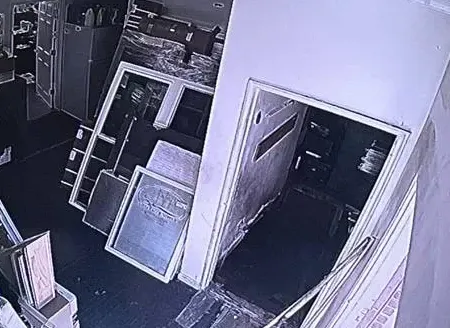
Recorded camera view from the AESS job library, not taken in Brighton Beach: a storeroom at night with an inner door left open. A contact on a door like this would report it open when the alarm is armed, instead of leaving it to be found in the morning.
Homes, languages and empty months
My parents read Russian more easily than English. Can the keypad prompts and the phone app be set up in Russian or Ukrainian?
Sometimes, depending on the equipment. Some current panels and apps include Russian and Ukrainian among their interface languages; the Ajax Security System app, for example, lists both among 35 languages in its App Store listing. Many other keypads display English only. We check the specification sheet for the equipment we propose and tell you in the quote which language the keypad and the app will show. Where it stays in English, we use large-button keypads, one-button key fobs and a printed card with simple steps beside the door.
We go away for the winter and the apartment sits empty for months. What should an alarm watch while nobody is home in Brighton Beach?
Doors and accessible windows, of course, and a motion detector in the main room. But in an empty apartment near the ocean the most valuable sensors are water sensors under the kitchen sink, behind the washing machine and by the water heater, and a temperature sensor that warns if the heat fails. Alerts should go to you and to someone who can be at the door within the hour, such as a relative or the super. A monthly automatic test signal confirms the system is still connected while you are away.
My mother lives alone in a Brightwater Court building and keeps forgetting to disarm. How do we stop false alarms without taking the alarm away?
Make disarming easier than forgetting. A key fob on her key ring that disarms with one button as she reaches the door solves most of it. A longer entry delay helps someone who walks slowly from the elevator. The keypad can chime when the door opens so she is reminded before the siren starts. Family members on the app can disarm remotely when she calls. And if she is home all day, the system can arm only the door and windows at night, leaving the interior motion detectors off, so moving around the apartment never sets it off.
Is a ground-floor apartment near the boardwalk worth alarming differently from one on the sixth floor?
Yes. A ground-floor or garden unit near the beach gets contacts on every window that opens, not only the door, because windows at street level are the usual way in; a Brooklyn Paper police item described a daytime burglary in which the thief climbed through a home’s window on Brighton 14th Street. It also gets water sensors, because it is the first apartment to take water. A unit high in an elevator building mostly needs the apartment door, a motion detector and anything reachable from a fire escape or terrace.
We own a winterized bungalow on one of the Brighton lanes. Does a small frame house need wired or wireless sensors?
Usually wireless, with one wired exception. The bungalows on lanes such as Brighton 3rd Court are small, light-framed and low to the ground, so wireless contacts and motion detectors cover them without opening walls, and the panel goes on the main floor. If there is a crawl space or a basement that floods, water sensors go there, mounted to stay above standing water as long as possible. A hardwired siren and a hardwired power supply for the panel are worth the small amount of cable, because they do not depend on batteries.
An example layout for an apartment that will stand empty for weeks; an apartment lived in every day usually needs fewer water sensors and no temperature sensor.
Buildings and boards
Can a Brighton Beach co-op board alarm the basement, boiler room and roof doors without wiring every apartment?
Yes, and many boards start there. A common-area system covers the doors and spaces the building owns: basement entrances, the boiler room, storage and bike rooms, the roof bulkhead and any garage. It reports to the super, the managing agent and a monitoring center. Apartments are left to each shareholder, who can add their own system if they want one. The two never need to share a panel, which keeps privacy simple and keeps a shareholder’s false alarm from becoming the board’s problem.
A board can start with the basement and roof and add rooms later; nothing here requires entering an apartment.
Equipment
Types of Alarm Equipment We Install in Brighton Beach
These are the categories we install most in Brighton Beach. Brand and model are chosen per job and named in the written quote; what matters here is where each one earns its place in this neighborhood.
Control panels and keypads
Hybrid panels that take both wired and wireless devices, mounted above the flood line. Keypads with large physical buttons by the door, touchscreens where the household prefers them, and a language setting checked against the spec sheet.
Cellular communicators
The path out when the landline is gone, the building’s internet is down or the cable has been cut. On the beach blocks we treat cellular as the primary path, not the backup.
Door and window contacts
Magnetic contacts on every door, the gate, the cellar hatch and street-level windows. Recessed where frames allow, sealed on exterior doors near the water.
Motion detectors
Pet-tolerant models in homes, ceiling or corner units in shops aimed away from glass and heaters, damp-rated units in cellars.
Glass-break detectors
Acoustic detectors on the wall opposite storefront glass, set and tested with trains passing. Optional where a gate contact and motion already cover the shop.
Water and temperature sensors
Floor pucks and probe cables at low points, beside boilers, water heaters, sumps and sinks; temperature sensors in apartments and houses left empty in winter.
Sirens
Indoor sirens as standard, outdoor sirens only where they add something, every one programmed to stop within the city’s fifteen-minute limit.
Key fobs and panic buttons
One-button arm and disarm for older residents, and personal panic buttons that call the monitoring center, kept separate from medical alert services.
Our defaults by location; the walk-through can change any of them.Photo from the AESS job library, not taken in Brighton Beach: a ceiling device facing a long glass wall. Glass-break detectors for storefronts go on the ceiling or the far wall facing the glass, like this, rather than on the glass where passing trains shake it.
AI Overview Reality Check
What AI Gets Wrong About Alarm Installation in Brighton Beach
Google’s AI Overview could not be loaded for Brighton Beach searches from our build environment, so nothing below is quoted from it. These are generalizations that keep appearing in quick online answers and on cost pages such as Angi, HomeAdvisor and Fixr, set against what we find in Brighton Beach buildings.
“Put the alarm panel somewhere out of the way, like the basement or a utility closet.”
That advice is everywhere, and in most of Brooklyn it does little harm. In Brighton Beach it is the most damaging thing a homeowner or super can follow, because the basement is where the water went in 2012.
City Limits described a high-rise whose elevator stayed out of service because salt-soaked machinery in the basement needed repair. Alarm panels, transformers and batteries in the same basements met the same fate, and buildings were left unprotected through the dark weeks that followed.
The panel belongs above the flood line. Sensors can stay below it, because they are the cheap part; the box that calls for help cannot.
“Wireless alarms are a weekend DIY project.”
For a small apartment on a high floor, a self-installed wireless kit can be fine. The trouble in Brighton Beach is the buildings: concrete floors and old masonry that block signals, basements below the waterline, shop windows that shake with every train.
Kits are usually set up with default sensitivity and default placements, and the first weeks of false alarms are what lead people to give up on them.
If you already own a kit, we can install it properly for a labor-only price, test every sensor from where it will live, and tell you honestly whether it suits the property.
“You need a city alarm permit before you can turn on a monitored system.”
Many towns in Westchester, Rockland and elsewhere in the state do require alarm registration, and their codes are easy to find. When we searched New York City’s Administrative Code for this page, we did not find a citywide burglar-alarm registration requirement.
What we did find, and what affects every Brighton Beach installation, is the Noise Code: a building’s audible burglar alarm must be capable of shutting off, and must shut off, within fifteen minutes. That rule shapes how we program sirens.
Co-op boards, condo associations and landlords may have their own approval rules, and those are the approvals that usually matter here. We are not giving legal advice; if your situation is unusual, check with the building’s counsel.
“A loud siren is the whole point of an alarm.”
A siren deters, but it does not bring help, and in a building with apartments over a shop or neighbors on every side, a siren that runs and runs brings complaints instead.
City law caps a building alarm’s audible run at fifteen minutes. The part that actually brings a response is the message: to the owner’s phone, to a family member, to a monitoring center that can verify and dispatch.
We treat the siren as the first five minutes of a response, and the communicator as everything after that.
“Monitoring means a three- or five-year contract.”
National companies often bundle equipment with long monitoring agreements, and the cancellation terms are where the cost hides.
Our Brooklyn list puts monitoring through our partners from $19.99 a month with no long-term contract, and monitoring is not required at all: a system can report to your own phone instead.
For an older parent living alone, professional monitoring is usually worth it; for a shop owner who watches a phone all night anyway, self-monitoring may be enough.
“Glass-break and vibration sensors work the same in every store.”
Under the elevated Brighton Line they do not. Trains shake glass and gates, and vibration sensors in particular cannot tell a train from a crowbar.
Placement, sensitivity and sensor type all change on the avenue. We rely more on gate and door contacts and on interior motion, and use glass-break detectors on the far wall where they hear glass rather than steel.
Every storefront system is tested with trains passing before we leave, and the alert history is reviewed in the first weeks.
“Flood sensors are for houses with sump pumps.”
In much of the country that is close to true. In Brighton Beach, where First Street counts 99 percent of properties as having some flood risk over the next thirty years, water sensors are a basic part of the system.
They also catch the everyday problem, a burst pipe or a failed water heater, in apartments and shops that sit empty overnight or for a whole winter.
They cost little next to the stock, the boiler and the alarm panel they help protect, and they report through the same app and the same monitoring center.
A one-screen summary of the seven sections above.
Basement Took Water Before? Send Us a Photo of Where the Panel Sits
One photo of the existing panel or phone box, and one of the basement floor or cellar stairs, usually tell us whether the system needs to move and what it should watch. We call back the same working day.
A co-op on Brightwater Court with a panel in the boiler room, a shop on Brighton Beach Avenue with a cellar stockroom, a bungalow on one of the Brighton lanes, a parent’s apartment near the boardwalk: describe it in a few lines and we will reply with a plan and a Brooklyn price.
✅
We Got Your Request!
Received. A technician will phone you today. Alarm sounding or water in the building now? Call (347) 934-8335.
How It Works
Our Installation Process
Six steps, the same for a one-bedroom apartment or a whole building. What is particular to Brighton Beach is step two, where we mark the waterline before deciding where anything goes, and step five, where arming is set up for the people who will actually use it.
1. Photos and history
You send photos of the existing panel, the basement or cellar, and the doors, and tell us what happened to the property in 2012 if you know.
2. Walk-through and waterline
A technician walks from the lowest floor up, marks where water reached or could reach, and maps every door, window, hatch and gate.
3. Written plan and Brooklyn price
A device-by-device plan naming the panel location above the line, each sensor, the communicator and who gets each alert, priced from the Brooklyn list.
4. Installation
Panel and battery mounted high, sensors placed and signal-tested from their final positions, sirens fitted and programmed within the fifteen-minute limit.
5. Users, languages and alerts
User codes and key fobs for each person, the language setting where the equipment offers it, alert routing to family, staff or a monitoring center, and a full test.
6. Handover and follow-up
A printed arming card by the keypad, app setup on each phone, and a check-back after the first weeks to tune any sensor that reacted to trains, damp or pets.
The same six steps appear in this page’s HowTo data.
Before a storm: a five-minute alarm check
When a coastal storm is forecast, open the app and confirm the panel shows mains power and a healthy battery, walk to the lowest water sensor and check it is not buried under boxes, move cellar stock off the floor, and make sure at least two people on the alert list are staying in the city. If the panel is still in the basement, call us before the season, not during the storm.
Print it and tape it inside the closet door where the panel lives.
Coverage Area
Alarm Installation Near Brighton Beach’s Landmarks
Callers give directions by these places, so we list them: “two blocks from the boardwalk,” “behind the library,” “across from the Oceana.” None of them is our customer; the descriptions come from the sources at the end of this page.
Riegelmann Boardwalk
2.7 miles from West 37th Street to Brighton 15th Street, officially opened May 15, 1923, and a scenic landmark since 2018; the Brighton Beach section east of Coney Island Avenue was rebuilt in concrete and plastic by May 2016 (Wikipedia).
Brighton Beach station
B and Q trains on the elevated Brighton Line over Brighton Beach Avenue; the Q also stops at Ocean Parkway. The line opened as a subway in August 1920 (Wikipedia).
The Oceana
A 16-building, 927-unit condominium development; its 50 Oceana Drive East building at Brighton Beach and Coney Island Avenues was built with switchgear raised above the flood plane (Commercial Observer, 2014).
Brighton Beach Library
Brooklyn Public Library branch at 16 Brighton First Road, near Brighton Beach Avenue, with a large Russian-language collection; opened in 1949 and moved to this site in 1964 (Wikipedia).
Brighton Beach Playground
On the boardwalk at Brighton 2nd Street and Brightwater Court, built in 1950 and renovated in the late 1990s (Wikipedia).
Babi Yar Triangle
A traffic island at Brighton 14th Street, Corbin Place and Ocean View Avenue, dedicated in 1981 to the victims of the Babi Yar massacre (Wikipedia).
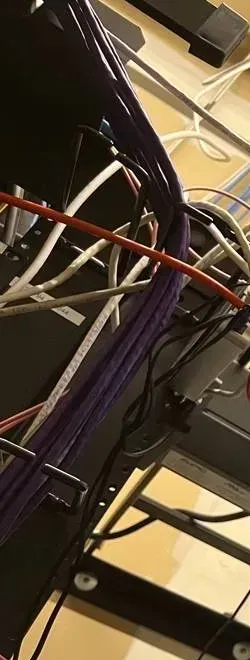
A schematic drawn from the boundaries in Wikipedia, CityNeighborhoods.NYC and Forgotten New York; positions are approximate.Photo from the AESS job library, not taken in Brighton Beach: network cabling down an equipment rack. If an alarm reports over a building’s network, that rack and its power need to sit above the flood line too, which is one reason we prefer cellular reporting here.
Pricing
Alarm Installation Cost in Brighton Beach
Brighton Beach pays the Brooklyn base list, the same as the rest of the borough, with no surcharge for beach blocks, basements or storefronts under the el. Where a job needs a panel moved up from a basement, the extra cable or wireless devices are itemized on the quote so you can see what the move costs.
A one- or two-bedroom apartment in an elevator building
Wireless system with 4–6 sensors, motion detector, panel and keypad, monitoring activation
$600 – $1,200
Rentals and co-op units where nothing may be drilled into common walls
Complete home: 10–15 door/window sensors, 3–4 motion, 2 glass-break, smoke and CO, indoor and outdoor sirens, app
from $2,500
Bungalows, houses north of the avenue, large condos
Hardwired full-property system
$2,000 – $6,000
Houses with open walls or existing wiring worth reusing
Hybrid wired and wireless system for a multi-floor house
$2,500 – $6,000
One- to three-family houses with a basement
Commercial system for a small business
$1,500 – $3,000
A shop under the el with a cellar stockroom
Camera integration added to an alarm
$1,000 – $2,500
Storefronts and building common areas
Old panel replaced: new panel, cellular communicator, keypad, reprogramming
$800 – $1,500
A dead or flood-damaged panel, moved above the line
Landlord per-unit setup: door sensors, motion detector, monitoring
$400 – $800 per unit
Small rental buildings
Installing equipment you already own
$200 – $400
A kit bought online that needs proper placement
Professional monitoring through our partners
from $19.99/month, no long-term contract
Older residents living alone; empty apartments
Service visits
$195/hr, 3-hour minimum ($585)
Systems from other installers, reprogramming, adjustments
What moves a Brighton Beach price up or down
Moving the panel. A panel that must come up from a basement adds cable or wireless expanders; a panel already on a living floor adds nothing.
Water and temperature sensors. Added per device and itemized on the quote; most Brighton Beach jobs include at least two.
Building rules. Co-op and condo work in common areas may need approvals, insurance certificates and scheduled access, which take time rather than parts.
Storefront complexity. Gate contacts, cellar coverage and separate areas for a shop and the apartments above add devices and programming.
Payment terms. Jobs under $500 are paid in full up front; larger jobs take a 50% deposit. New York City sales tax of 8.875% applies.
Ranges from the AESS Brooklyn alarm list; Brighton Beach pays the Brooklyn base rate. Monitoring, sales tax and per-device water sensors are separate.
For a rough figure before anyone visits, try the alarm calculator; the written quote after the walk-through is the one that counts.
Get a Written Brooklyn Price for Your Brighton Beach Property
Tell us what floor you are on, where the old panel lives and whether anything below you took water. The price comes back in writing, usually the same day.
Panel and battery on the living floor, door and window contacts, a motion detector, a large-button keypad or key fobs, cellular reporting, and app alerts for the family. Water sensors under the sink and water heater are added per device.
Shop Under the El — $1,500 to $3,000
Door, gate and cellar-hatch contacts, interior motion aimed away from the glass, glass-break tested with trains passing, cellar water sensors, a panel behind the counter and sirens programmed under the fifteen-minute limit.
Whole House or Building — from $2,500
Full perimeter, interior motion, glass-break, smoke and CO, water and temperature sensors in the basement, and a panel relocated above the flood line. Common-area systems for co-ops are priced on the same basis.
Bought your own kit? Labor-only installation
If you already own a kit bought online, or a board has standardized on one brand, we can install it for $200 to $400 depending on the number of devices. Before agreeing we check that it reports by cellular rather than only over Wi-Fi, that the base station or hub can sit above the flood line, and that its siren can be limited to fifteen minutes. If it cannot do those things in Brighton Beach, we say so before we start.
The usual combination in a Brighton Beach building is an alarm panel moved above the waterline, water sensors in the basement, contacts on the basement and roof doors, and a camera on the cellar stairs. Booked together, the cable for all of it goes in during one visit.
Field Notes
Field Notes: Mark the Waterline Before Choosing a Spot for the Panel
This describes how we survey properties near the water in general, not any particular customer. We start at the lowest point of the building and ask the person showing us around one question: how high did it come? In buildings that went through 2012 there is almost always someone who knows, and almost always a mark, whether a tide line on block, a rusted band on a boiler jacket or a line of newer paint. We photograph it, measure it from the floor, and add a margin.
Then we look for every piece of equipment below that line that the alarm needs to work: the panel, its transformer, the battery, a phone or internet connection, a power strip on the floor. Each one either moves up or is replaced by something that does not need to be down there. Only after that do we walk the doors and windows. The order matters, because once a panel is mounted, people stop thinking about where it is.
The second habit is to stand in the shop when a train passes. Before choosing a glass-break detector or setting a motion detector’s sensitivity on Brighton Beach Avenue, we wait for a B or Q to go by and watch what moves: the window, the gate, a sign, a hanging lamp in front of the detector. Whatever moved is something the system must learn to ignore.
The third is to ask who will arm it, and to hand them the keypad during the visit. If they hesitate at the screen, the design changes there and then: a fob, a bigger keypad, a different language setting, a printed card. That five-minute rehearsal prevents more false alarms than any sensor setting.
Steps one and two happen before anyone looks at a door. That order is the difference between a system that survives the next storm and one that does not.
FAQ
Brighton Beach Alarm Installation FAQ
What does a basic apartment alarm cost in Brighton Beach at Brooklyn prices?
+
Brighton Beach is priced on the Brooklyn base list. A basic residential system with a panel, four to six door and window sensors, one motion detector, a keypad, a cellular communicator, monitoring setup and the app starts at $600. A wireless system of that size runs $600 to $1,200 all in. Water sensors, extra contacts for street-level windows and moving an old panel up from a basement are added per item and shown on the written quote. Monitoring through our partners starts at $19.99 a month with no long-term contract.
Do I need a city permit before a monitored alarm goes into my Brighton Beach home?
+
In our research for this page we did not find a New York City rule requiring homeowners to register a burglar alarm, unlike many towns in Westchester and Rockland. The city rule that does apply is the Noise Code limit: a building alarm’s siren must shut off within fifteen minutes. Your co-op board, condo association or landlord may require approval before work in common areas or on the building’s wiring, and that approval is usually what matters. This is not legal advice.
Who is allowed to install an alarm in a Brighton Beach shop or apartment under New York State law?
+
New York State licenses security and fire alarm installers through the Department of State, and its licensing page lists qualifying education, an examination and fingerprinting for licensees and their employees. Ask any company quoting the job for its license number and a certificate of insurance. Abstract Enterprises Security Systems works under New York State license #12000287431 and sends insurance certificates to boards and managing agents on request.
Can you take over an alarm another company left behind in a Brighton Beach building?
+
Usually. Many panels can be reset and reprogrammed if the installer code is known or the panel allows a default reset; some are locked and must be replaced. We test the existing sensors, keep those that still work, and replace the panel if it is damaged, obsolete or sitting below the flood line. Replacing a dead panel with a new one, a cellular communicator and a keypad, and reprogramming the system, runs $800 to $1,500 on the Brooklyn list.
Can you leave written arming steps that a Russian-speaking parent can follow?
+
We leave a printed card beside every keypad with the arming and disarming steps in short, numbered lines and the monitoring center’s number, and families often translate it or add their own notes. Where the panel or app offers Russian or Ukrainian, we switch it on during setup. We also show the person who will use the system how to arm and disarm it during the visit and adjust the setup if anything is confusing.
Can the alarm alert me and my son in another state instead of a monitoring center?
+
Yes. Any number of family members can be added to the app and receive the same alerts, see whether the system is armed, and disarm it remotely. That is self-monitoring and has no monthly charge. The drawback is that nobody calls the police or the super for you if everyone on the list is asleep or on a plane, which is why many families with a parent living alone in Brighton Beach add professional monitoring as well.
Does an alarm lower insurance premiums for a Brighton Beach condo or store?
+
It can. Many insurers offer a discount for a professionally installed, monitored alarm, and some commercial policies require one. The amount depends entirely on the carrier and the policy, so ask yours what it needs to see. We provide a certificate of installation listing the system and the monitoring arrangement, and water sensors are worth mentioning too, because the claims they help prevent are the ones this neighborhood knows best.
How long does installing an alarm take in a typical Brighton Beach apartment?
+
A wireless apartment system is usually a single visit, including programming, app setup and a walk-through with the people who will use it. Hardwired work, panels moved up from a basement and common-area systems in co-op buildings take longer, mostly because of cable routes and building access hours. The written plan states the expected number of visits before you agree to anything.
Will the alarm still report if the Brighton Beach building’s internet goes down during a storm?
+
Yes, if it reports by cellular, which is how we set up systems here. A panel that depends only on the building’s internet or a landline goes silent when those fail, and storms are exactly when they fail. A cellular communicator keeps sending alarms, power-failure messages and low-battery warnings for as long as the panel has power, as long as the cellular network in the area is working.
Can a Brighton Beach Avenue shop share one alarm with the apartment upstairs that the owner lives in?
+
One panel can run both, split into separate areas: the shop arms at closing while the apartment stays disarmed, and each has its own users and codes. The cellar can belong to either area or be a third one. That saves a second panel and communicator. If the apartment is rented to someone else, we recommend separate systems instead, so the shop owner never controls or sees a tenant’s alarm.
All Areas Served
Alarm Installation Across Brooklyn, New York City, Long Island and the Hudson Valley
Brighton Beach sits under our Brooklyn alarm installation page, which covers the borough as a whole; for every borough, Long Island and the Hudson Valley, each with its own price multiplier, start at the New York City alarm hub. Each rebuilt neighborhood page comes from separate research into its own streets and buildings, so they read differently by design.
Beyond alarms, Abstract Enterprises Security Systems handles cameras, intercoms, access control and cabling across the city. Before any contractor works on your alarm, ask for a license and an insurance certificate; ours are on the about page.
Sources
Where the Brighton Beach Facts Come From
The history, dates, figures, rules and news on this page were checked against the sources below in October 2026. What is not sourced is ours: the prices, which come from the AESS Brooklyn list, and every description of how we install alarms, which is AESS practice rather than local fact. None of the buildings, businesses or places named is our customer.
Wikipedia, “Brighton Beach, Brooklyn” — boundaries, Community District 13, ZIP 11235, 60th Precinct and its 2022 figures, FDNY Engine 246/Ladder 169, the 1868–1924 resort history and the 1888 hotel move, the 1920 subway, Brightwater Court’s prewar elevator buildings, Soviet immigration, the Oceana, the 2010 population and age and language figures, the library, playground, Babi Yar Triangle, stations and buses.
Wikipedia, “Riegelmann Boardwalk” — length, extent, 1923 opening, 2018 scenic landmark designation, Sandy damage and the 2014–2016 concrete and plastic rebuild of the Brighton Beach section.
Commercial Observer, May 20, 2014 — the Oceana’s 16 buildings and 927 units, 50 Oceana Drive East, switchgear raised and elevator controls moved to the roof, retail and medical space.
CityNeighborhoods.NYC, “Brighton Beach” — 1920s and 1930s apartment and art deco buildings on Ocean Parkway and Brightwater Court, postwar towers, the Brighton Beach Baths, the elevated train over the avenue.
Where sources describe different areas, we say so. The 60th Precinct figures cover more than Brighton Beach. The age figures from Wikipedia combine Brighton Beach and Coney Island, while Hester Street’s are for Brighton Beach alone. The Brooklyn Paper burglary item gives a date without a year, so we use it only as an example of how ground-floor windows are entered. Sandy reporting is from 2012; we use it to show where water goes, not as current conditions.
Not everything could be checked. Our build environment had no access to Google’s People Also Ask, related searches or AI Overview, to Answer the Public, to Bing or DuckDuckGo suggestions, or to Yelp reviews, so none of those is quoted. Reddit threads could be seen only as search excerpts, in which residents described the area south of the Belt Parkway being under water during the storm; no Reddit thread about alarms in Brighton Beach was found.
Panel Beeping After a Power Cut, or a Shop Alarm Sounding Under the El? Call the Brighton Beach Line
Most alarm problems after a storm or an outage are a battery, a lost connection or a single corroded sensor. Ring (347) 934-8335, say whether the panel is above or below street level, and whether there is water in the building now. When we cannot get there before you need to leave, we walk you through silencing and partially arming the system by phone so the rest of the property stays protected overnight.
Brighton Beach Alarm Systems From a Licensed, Insured Brooklyn Team
The Brighton Beach line is (347) 934-8335 for calls and texts, and photos of panels, basements and doors are easiest to send by WhatsApp. Technicians leave from our Brooklyn office at 1282 Troy Avenue, and every quote is written device by device before any work starts.
Customers have rated us 4.7★ across 201 Google reviews. Work is done under New York State license #12000287431, and if a co-op board, a condo association, a managing agent or a commercial landlord needs a certificate of insurance naming the building, we send it before the first visit.
Full terms — including 50% deposit, the 30-day warranty and optional paid extended warranty, and the late-fee schedule — are set out in the service agreement. See our warranty page for what it covers.
Revision log, October 21, 2026: this page was rebuilt from scratch around how alarms have to work in Brighton Beach, centered on keeping panels, batteries and communicators above the 2012 flood line, adding water sensors where the sea and the pipes arrive first, storefront detectors that ignore the elevated trains, and arming set up for older and Russian-speaking households, replacing an earlier template page.