What are you looking for?
About Us Contact Us Careers Get a Free Quote (800) 486-0943
Pick a service
✅ Got Your Own System?
🎬 Home TheatreQuote 🎶 AV SoundQuote 🔑 Access ControlQuote
Now pick your area
Pick your area
Long Island
Hudson Valley
Services available
Pricing & Tools
Pick a service for pricing
🚪 Intercom Pricing 🔔 Buzzer Repair Pricing
Calculators
📹 Camera System Calculator 🚨 Alarm Calculator ⚡ Cabling Quote Builder ✅ Got Your Own System?
Select your area
Cameras still dark since the February outage, a recorder in a rowhouse cellar that stopped saving, or a Smith Street shop camera that shows only glare? Boerum Hill camera repair line, booked within 2 hours: (347) 934-8335
Home › Security Camera Repair Brooklyn › Boerum Hill
1840s Rowhouses · Owner-Plus-Rental Brownstones · Small Walk-Ups and Condos · Smith Street, Atlantic Avenue and Hoyt Street Storefronts

Security Camera
Repair in
Boerum Hill

Any Brand, Any Installer · Footage Saved Before Anything Is Reset · Written Price Before Parts · Brooklyn Rate

Security camera repair in Boerum Hill begins with a $150 Brooklyn service call that pays for the on-site diagnosis and is credited to the repair if you go ahead; on our published Brooklyn list most single faults are fixed for $150 to $700, and a new recorder, a partial rewire or a multi-camera rebuild runs $700 to $1,500. We work on systems other people installed, from two cameras on a State Street rowhouse to a sixteen-channel recorder in the cellar under an Atlantic Avenue shop. Requests are booked within 2 hours, every visit gets a two-hour arrival window, and you get the cause in plain words and a written price before any part is swapped. Below: why so many Boerum Hill systems came back wrong after the winter outage, how landmark facades and nineteenth-century rowhouses change a repair, and what each kind of fix costs.

Reviewed and updated November 11, 2026, against ABC7 New York and News 12 Brooklyn reporting on the multi-day Con Edison outage that hit Boerum Hill and Park Slope in late January and early February 2026; Council Member Shahana Hanif's February 1, 2026 letter to Con Edison; the NYC Landmarks Preservation Commission Permit Guidebook chapter on health, safety and utility equipment; CityLand and 6sqft on the 1973 Boerum Hill Historic District and its 2018 extension; Brooklyn Paper on the September break-ins at Blank Street Coffee and Piccola Cucina Casa and an 84th Precinct parcel theft on Bond Street; News 12 Brooklyn on the December 2023 theft at 166 Smith Street; DNAinfo on the 2016 Mile End Delicatessen burglary on Hoyt Street; the April 2025 City Council public housing hearing on NYCHA camera repairs; Brick Underground on landlords and broken lobby cameras; Security Sales & Integration on the FCC's 2022 equipment order; HomeAdvisor's Brooklyn camera cost page; and a Brownstoner forum thread on replacing a failed outdoor camera. · Abstract Enterprises Security Systems, NYS license #12000287431 · crews dispatched from our Troy Avenue office in Brooklyn

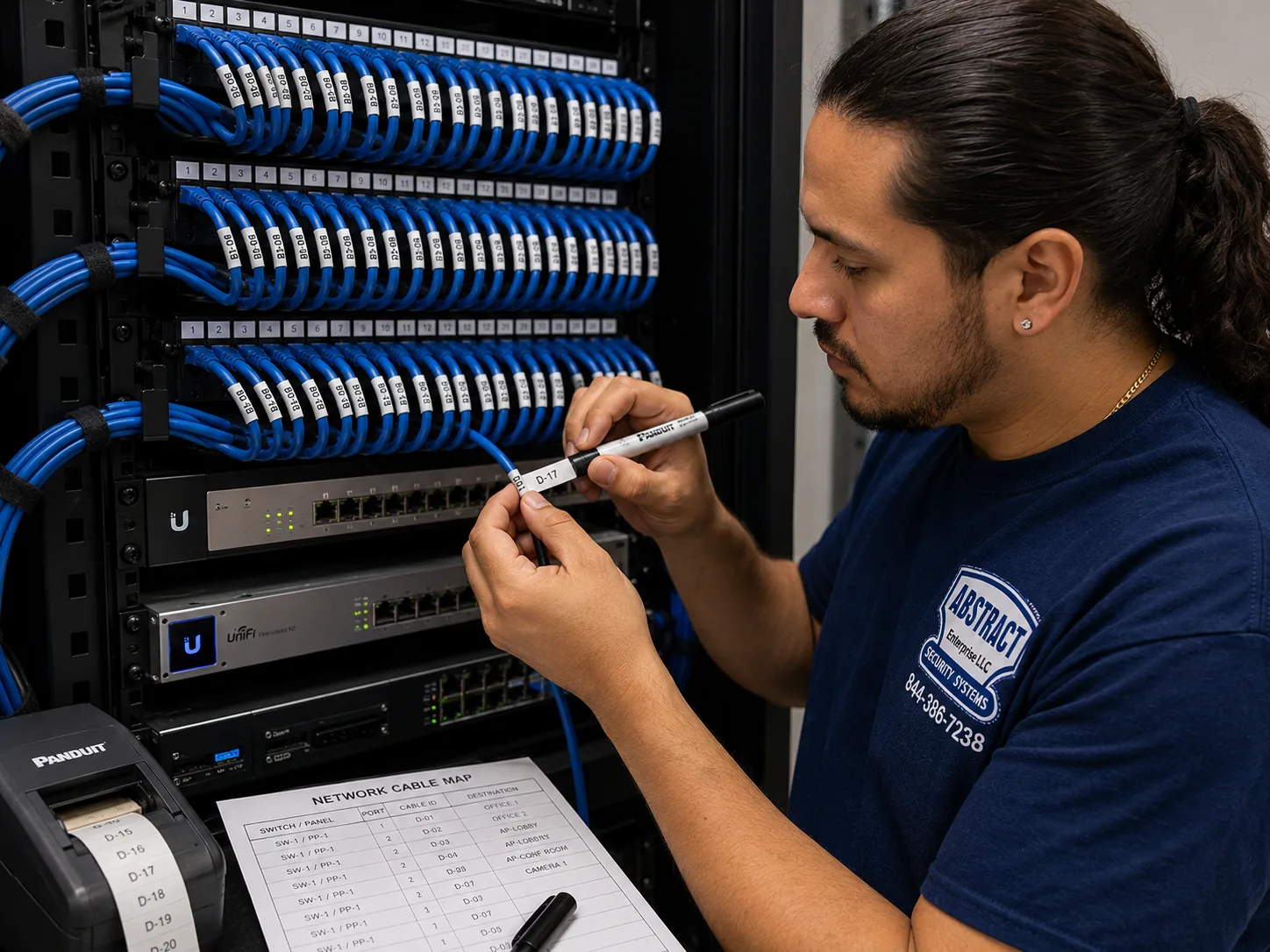
Boerum Hill, Brooklyn security camera repair: technician printing cable labels at a patch panel beside a printed port map
A photo from the AESS job library, not taken in Boerum Hill: a technician printing a label for each cable at a patch panel, with a printed port map taped up beside it. In the cellars of Boerum Hill rowhouses the camera cables usually arrive at the recorder with no markings at all, often after two or three owners and a renovation, so the last thing we do on a repair is mark every run we traced with the camera it feeds.
Boerum Hill Camera Repair Request
Rowhouse, rental floors, walk-up, condo or shop: give us the block and what the screen shows, and a technician calls you back with the next step

✅
Request Sent!
Thank you. A technician will be in touch about the Boerum Hill address shortly.
25+
Years Experience
✓
Same-Day Estimates
100%
Licensed & Insured
4.7★
201 Google Reviews

Owner-operated since 2002 · Thousands of jobs completed · Booked within 2 hours

Two photos and one date answer more Boerum Hill camera questions than a long phone call. The first photo is the recorder's screen with the full camera grid showing, so we can see which tiles are black, which are frozen and which say "no video." The second is the sticker on the top or back of the recorder, because the brand, the model and the channel count tell us whether it records coax cameras, network cameras or both, and whether parts for it are still easy to get. The date is when the trouble started. This winter that date has mattered more than usual: a large share of the calls from these blocks trace back to the days in late January and early February 2026 when Con Edison customers across Boerum Hill and Park Slope sat without power, and a system that went down hard and came back on a flickering supply behaves very differently from one with a single dead camera. Send the two photos and the date to (347) 934-8335 or on WhatsApp, add your cross streets, and we will tell you which part of the chain most likely failed and what that kind of repair costs on our Brooklyn list.

  • We look at your photos for free. The $150 service call is paid when you book and credited toward the repair if you go ahead.
  • Every repair is done under New York State license #12000287431, held by Abstract Enterprises.
  • A system someone else put in is not a problem. We repair any brand and any installer's work, and we say so plainly when a part is not worth the money to fix.
The Neighborhood

Why Boerum Hill Properties Need Security Camera Repair

Boerum Hill is a small neighborhood with a lot of cameras, and most of them were put up by someone other than the person who owns them now. The housing is mostly three-story rowhouses built between about 1840 and 1870, many of them divided over the decades into an owner's duplex with one or two rental floors, with small apartment buildings and storefronts along Atlantic Avenue, Smith Street and the avenues to the east. Houses here change hands, get gut-renovated, and get re-rented, and each of those events tends to leave the camera system a little worse documented than before. The recorder ends up in a cellar closet or a vault under the stoop, the app sits on the phone of a former owner or a contractor, and nobody notices that the drive stopped writing until the morning after something happens on the block. That quiet failure is the most common reason anyone here calls us.

The winter of 2026 made the problem visible. Starting late on a Friday at the end of January, lights across Boerum Hill and Park Slope began to flicker, and by the weekend many households had lost power entirely. ABC7 New York reported that nearly 2,000 Con Edison customers were affected, that Con Edison blamed melting snow and salt for damaging underground electrical equipment and setting off a chain of other failures, and that manholes were buried under about five feet of ice. Residents told the station that four restoration deadlines came and went. News 12 Brooklyn reported 1,632 customers still without power on the Monday night, and business owners in the two neighborhoods said they had gone four days without power or heat. Council Member Shahana Hanif, who wrote to Con Edison about the outage, put the frustration simply: "Families are unable to make arrangements because the estimated time of restoration keeps moving."

For a camera system, the outage was not one event but several. First came the flickering, the kind of brownouts that make a recorder reboot over and over and that are hard on a hard drive in the middle of writing. Then the hard stop, often with no battery backup and no clean shutdown. Then days of cold in unheated cellars and under-stoop vaults, and finally the return of power, sometimes in stages, to a recorder that may have lost its clock, its network settings or its drive. A wine shop owner told News 12 that his lights began flickering on the Friday and the power went down on the Sunday evening, and that he rented a generator to keep going. Many of the systems we have been asked to look at since then came back with some cameras showing and others not, a recorder stamping the wrong date, a phone app that could no longer find the house, or a playback calendar with nothing in it from the week of the outage onward. Each of those has a different cause, and the fix for one does nothing for another.

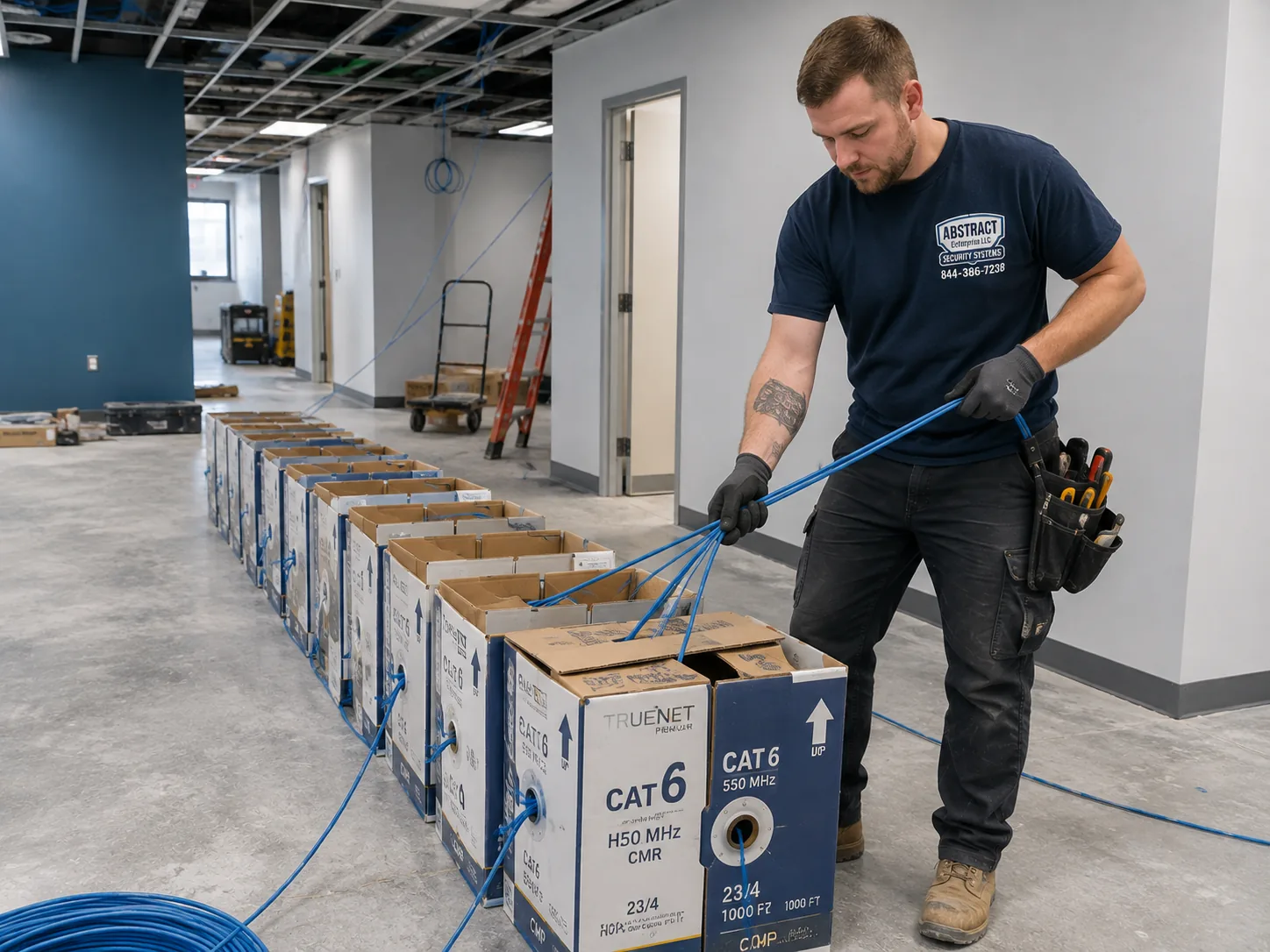
Boerum Hill, Brooklyn camera cable replacement: boxes of cable staged together for a multi-drop pull on a working premises
A photo from the AESS job library, not taken in Boerum Hill: several boxes of cable staged together before a multi-drop pull on a premises that stayed in use. Most Boerum Hill camera repairs need no new cable. When one does, it is usually a run that a renovation cut inside a rowhouse wall or that has cracked where it crosses an open rear yard, and having the right cable on hand before the visit is what keeps the job to a single trip.

The second reason Boerum Hill systems need attention is that people here use their footage. Police and business owners on these blocks reach for camera video routinely, and the reports show how often the answer depends on whose system was working. When thieves smashed the front glass doors of Blank Street Coffee on Bergen Street and Piccola Cucina Casa on the same block one September night, taking $100 from one register and $1,000 from the other, Brooklyn Paper reported that "Authorities are reviewing nearby security footage in an effort to identify the suspects." When about $3,500 in packages, including a Ring doorbell camera, was taken from behind a front gate on Bond Street, the paper reported that "Cops said they are checking nearby cameras to identify the perp." In the same 84th Precinct roundup, a phone theft on Fulton Street in Downtown Brooklyn ended with the line "there was no surveillance footage available to identify the perp." The difference between those sentences is a recorder that was saving, a camera that was aimed at the door, and a clock that was right.

Footage has been part of Boerum Hill's crime stories for years. In December 2016 DNAinfo reported that a thief pried open a ground-level window at the Mile End Delicatessen at 97 Hoyt Street at about 4:15 in the morning and left with roughly $2,100 in tablets and other electronics, including the iPad that ran the restaurant's delivery orders; "Surveillance video shows the thief crawling into the restaurant through a ground-level window," the report said. In December 2023 News 12 Brooklyn reported that four people took nearly $17,000 of merchandise from a business at 166 Smith Street and drove off in a gray Chevy Malibu. A neighborhood where a ground-level window, a glass door and a front gate are the usual ways in is a neighborhood where a camera that sees the door clearly at night is worth keeping in working order.

The third reason is the buildings themselves, and the rules that cover their fronts. The Boerum Hill Historic District was designated in 1973 with about 250 buildings, and the Landmarks Preservation Commission extended it in June 2018 with about 288 more, covering Greek Revival and Italianate rowhouses from the 1850s to the 1870s and Second Empire and neo-Grec buildings from the 1880s. On a landmarked front, the commission's permit guidebook says "Security cameras must be well spaced to avoid a cluttered, haphazard appearance," limits small residential and commercial buildings to "no more than two security cameras" for "every 25 feet of street frontage," and wants conduit "concealed by going through plain masonry or wall cladding behind the installation." The same guidebook exempts "Ordinary maintenance, repair, and retrofitting of health, safety, and utility equipment" from needing a permit. In practice that means repairing what is already there is usually the simplest path on a landmarked house, and it is one reason we work hard to fix a camera in place rather than move it.

Boerum Hill also shares its blocks with the Gowanus Houses public housing campus, with Wyckoff Gardens a short walk away, and the city's own experience with keeping cameras alive is a useful warning for any building owner. At an April 2025 City Council hearing on public housing, Council Member Chris Banks cited a Department of Investigation finding that "70% of the CCTV cameras at senior buildings were inoperable or inaccessible." A NYCHA official told the committee that when a camera is found down, "We go out within twenty four to seventy two hours to repair the camera as quickly as we can." A private owner on Wyckoff Street or Bergen Street does not have a maintenance department watching a dashboard. If nobody checks, nobody knows.

Six Boerum Hill facts that shape a camera repair before the van leaves

  • The winter outage left a mark. Nearly 2,000 Con Edison customers in Boerum Hill and Park Slope lost power for several days in late January and early February 2026, after flickering that began on a Friday night. Recorders that rode through brownouts and a hard stop are the first thing we check for drive and clock damage.
  • Most houses are nineteenth-century rowhouses. Three-story brick and brownstone houses from about 1840 to 1870 mean cables run through rubble-filled party walls, plaster and cellars, and every run that can be kept saves real money.
  • Much of the neighborhood is landmarked. The 1973 district and the 2018 extension together cover more than 500 buildings, and the commission's guidebook limits small buildings to two cameras for every 25 feet of frontage and wants conduit hidden.
  • Storefronts lean on footage. Break-ins at Blank Street Coffee and Piccola Cucina Casa came through smashed glass doors, and police went straight to nearby security footage, so a shop camera has to see a face at the door at night.
  • Packages are a front-gate problem. The Bond Street theft of about $3,500 in parcels happened behind a front gate, which is exactly the area a stoop camera is meant to cover and exactly where a drifted angle or a dead infrared light leaves a gap.
  • Nobody is watching the dashboard. Even the city's housing authority has struggled to keep cameras running, with 70 percent of cameras at its senior buildings found inoperable or inaccessible in one investigation. A private system needs its own health check.

A rowhouse camera here is also a delivery log and the way a top-floor household sees who is at the stoop, which is why many Boerum Hill owners pair a camera repair with a look at the door buzzer on the same visit: the bell wire and the camera cables usually meet in the same cellar.

Where this page applies. It covers Boerum Hill from Schermerhorn Street down to Warren and Wyckoff Streets, and from Smith Street east to Fourth Avenue, in the ZIP codes 11201 and 11217, inside Brooklyn Community District 2 and the 84th Precinct. Cobble Hill, Carroll Gardens, Gowanus, Park Slope and Downtown Brooklyn are all served at the same Brooklyn rate, and the whole borough is covered on our Brooklyn security camera repair page. Which side of a neighborhood line your house sits on does not change the price; the part that failed does.

Urgent Repair in Boerum Hill

Need Repair in Boerum Hill? Cameras That Never Came Back After the Outage, a Recorder That Quit Saving, or a Door Camera That Shows Only Glare

Urgent calls from Boerum Hill tend to arrive in one of three shapes. The first is the morning after: a shop window was broken on Smith Street, a parcel vanished from behind a gate on Bond or Pacific Street, or a car on Dean Street was opened, and the owner pulls up playback to find the camera that should have seen it is black, frozen, or simply has no recording for that night. The second is the recorder itself complaining: a steady beep from the cellar, a hard drive error on the screen, a box that restarts every few minutes, or a phone app that says the device is offline when everyone in the house knows it is plugged in. The third is a picture gone strange: a pink daytime image, rolling bars whenever the boiler fires, or a front camera that is useless after dark.

If you need a clip, the most important thing is to leave the recorder alone until it is saved. Do not unplug it to "reset" it, do not run the setup wizard if it appears, do not format a drive the screen says is unhealthy, and do not let a well-meaning relative try a few things. Every one of those steps can make the hour you need harder to recover or gone for good. Call (347) 934-8335, tell us the date and the time window, and the visit is booked with saving that footage as job number one. If it exists, we export it to a USB drive in the recorder's own format and in a common video format, with the recorder's timestamp noted against real time, so it can go to the 84th Precinct or an insurer. Only then do we start finding the fault. If the drive stopped writing before the incident, we tell you immediately rather than letting you hope, and then we make sure the next failure cannot happen silently.

What We Install

Security Camera Repair Services in Boerum Hill

Each repair below is priced from the same Brooklyn camera repair list. The service call pays for finding the fault and writing the price; the repair itself is priced by what failed, not by how many hours it took to find it.

Post-outage system recovery

Recorders that came back after the winter outage with a wrong clock, lost network settings, a damaged drive or only some cameras showing. We check the drive's health, rebuild what was lost and confirm every channel is recording again.

Hard drive and recorder repair

Drives that stopped writing, recorders that beep or reboot, and DVRs or NVRs too old to work with current apps. A drive swap runs $200 to $450 by capacity; a DVR that will not work averages $300 to $700 with the drive and labor.

Power supply and PoE repair

Central power boxes that sag at dusk, wall adapters that died in a cold cellar, and switch ports that stopped powering a network camera. Power supply repair typically runs $150 to $400 on our Brooklyn list.

Connector, cable and conduit repair

Corroded BNC and RJ45 ends re-terminated, runs cut during a renovation spliced or replaced, and exposed cable on a facade moved into concealed paths where the building allows. A reterminate or PoE port swap runs $150 to $350.

Camera body replacement

A dead, fogged or cracked camera swapped for a compatible one on the same cable and mounting points, re-aimed to the old view and added back to the recorder. A single camera replacement on a working system runs $250 to $600 with the camera.

Night and color picture fixes

Infrared that bounces off a stoop rail or a glass door, a day picture that turned pink, and a camera that sees shapes but not faces after dark. Night vision camera repair typically runs $250 to $650 depending on whether the camera itself changes.

Phone viewing, alerts and passwords

Apps that lost the recorder after a router change, motion alerts that stopped arriving, and accounts still tied to a former owner, tenant or contractor. Settings fixes with no parts are often covered within the $150 service call.

Footage export for police and insurers

Clips saved to USB with the original timestamp in both the recorder's own format and a common video format, before any setting is touched or any part replaced.

Hybrid upgrades and annual checks

A hybrid recorder that runs old coax cameras and new network cameras together, $700 to $1,200 installed, so a rowhouse can upgrade one camera at a time; and annual clean-and-check visits from $250 for a residence.

Boerum Hill, Brooklyn network camera repair: technician mounting a managed PoE switch below patch panels in a commercial network rack
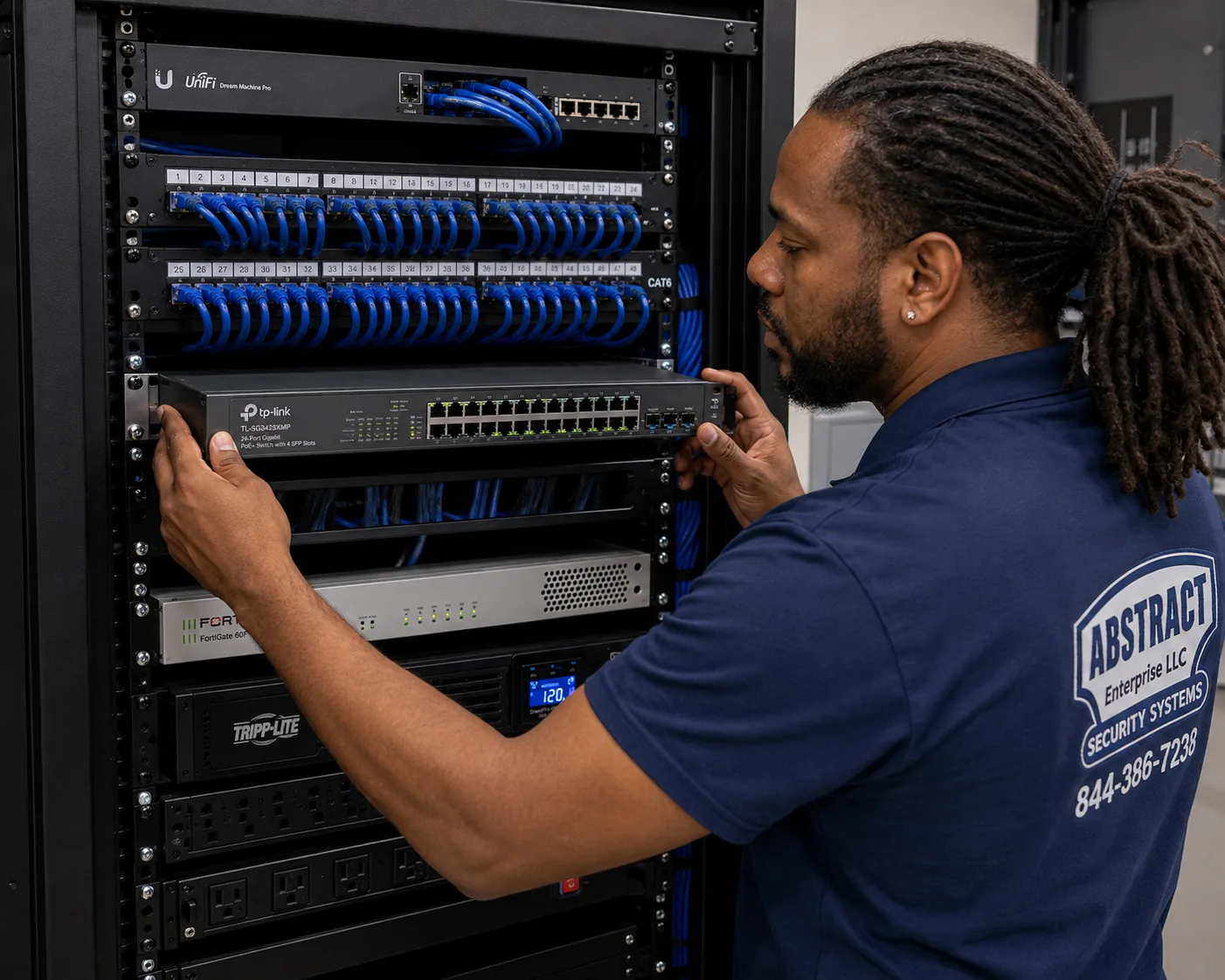
A photo from the AESS job library, not taken in Boerum Hill: a technician fitting a managed PoE switch under the patch panels in a commercial rack. In a Boerum Hill shop or small apartment building with network cameras, this switch powers every camera through its data cable, so when a group of cameras dies together after a power event we test the switch and its ports before anyone carries a ladder up a stoop.
Building Specialists

Security Camera Repair for Boerum Hill's Architecture

Six kinds of property account for nearly every camera call we get from Boerum Hill. They differ in three ways that decide how a repair goes: where the recorder ended up, how the cables travel through the building, and who other than the caller has a say in the work.

The single-family rowhouse

A three- or four-story house from the 1840s to the 1870s kept as one home, with a camera at the stoop, one at the garden-level door and one or two over the rear yard, wired back to a recorder in the cellar.

The owner's duplex with rental floors

An owner on the lower floors and one or two rental apartments above, sharing one street door and one system that the owner pays for but the tenants live with every day.

The small walk-up building

The neo-Grec apartment buildings and older multiple dwellings with a shared vestibule, a hallway or two and a mailbox area, and a recorder in a cellar room the super can reach.

The storefront with apartments above

Shops and restaurants on Smith Street, Atlantic Avenue and Hoyt Street with cameras over the register, the door and the back exit, and a recorder under the counter or in the basement.

The converted condo

A rowhouse or small building split into a handful of condo units, where the cameras belong to everyone and the recorder password often belongs to whoever set it up.

The newer building on the edges

Elevator buildings and recent conversions near Fourth Avenue, Third Avenue and Schermerhorn Street, with network cameras, a PoE switch and a recorder in a telecom or trash-room closet.

The single-family rowhouse: three doors, a rear yard and a recorder below the parlor floor

A Boerum Hill rowhouse kept as one home usually has more entrances than people expect. There is the parlor-floor door at the top of the stoop, the garden-level door under it, often an areaway gate in front of that, and a rear door to a long, narrow yard that backs onto the yards of the next street. Each tends to get a camera, and each camera's cable has to find its way to a recorder that, nine times out of ten, sits in the cellar. In houses wired years ago the front cameras were often fed down the face of the house to a hole at the areaway, or through the stoop itself; the rear cameras usually come in through a window frame or a drilled hole at the back of the cellar. Because these houses were built well before anyone thought about low-voltage wiring, there are no chases, and every path was improvised. That is why we start any rowhouse repair at the recorder end, work out which cable is which, and test before we touch a camera.

The common rowhouse faults are a power adapter dying on a damp cellar floor, a corroded connector at a rear camera, a stoop camera that has drifted to show the sky, and a drive that started throwing errors after the February outage. All are repairable without disturbing the front of the house. The Brownstoner forum has a thread from an owner whose outdoor camera failed after fifteen years; they had already checked the power supply and the recorder connection, found the camera itself was the problem, and noted it was "22 feet up in the air." On a Boerum Hill rowhouse that is a familiar height, and we bring ladders sized for it.

The owner's duplex with rental floors: one system, several households, and a login on the wrong phone

Many Boerum Hill houses were split over the last century into an owner's duplex with one or two rental units above, and camera systems in them reflect that history. The owner bought the system and holds the password, or thinks they do. A tenant on the top floor uses the stoop camera to see who is ringing. A previous tenant, or a contractor from the last renovation, may still have the app on their phone. When something breaks, we need to know three things before the visit: who owns the equipment and will approve the price, who can let us in to the recorder, and who actually has the admin login. We settle that by text in advance, so nobody is standing on the stoop at the start of the arrival window trying to reach a former tenant.

Boerum Hill, Brooklyn camera cable routing: technician core drilling a block wall to carry cable through to a network room
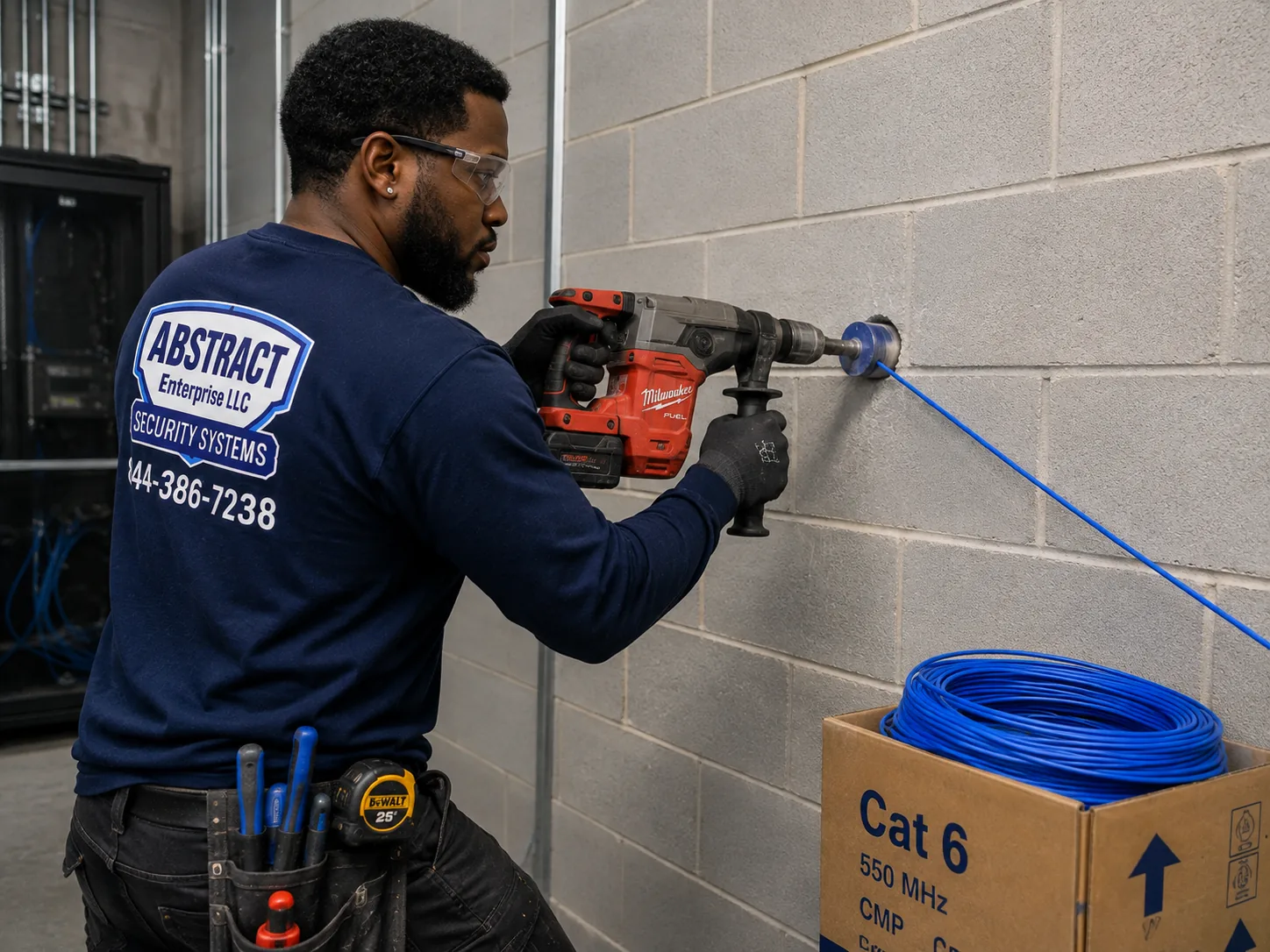
A photo from the AESS job library, not taken in Boerum Hill: a technician core drilling a concrete block wall so cable can pass through to a network room. In Boerum Hill the same kind of clean pass-through is used inside a building, never on a landmarked front, for example when a recorder has to move from a damp under-stoop vault into a dry cellar room and the existing camera cables need a tidy path to follow it.

The small walk-up: a vestibule, a mailbox wall and a recorder the super guards

The neo-Grec apartment buildings and older multiple dwellings in the neighborhood usually have their cameras on the street door, in the vestibule, at the mailboxes and in a hallway or two, wired to a recorder in a cellar room. These systems are often the oldest we see, sometimes analog cameras feeding a DVR that has been replaced once already, with a monitor in the super's room that may or may not still be connected. Packages are the main complaint. A vestibule camera that has drifted to show the floor, or a mailbox camera washed out by its own infrared bouncing off a tiled wall, records every theft and identifies nobody. The fix is often an adjustment and a settings change rather than new equipment, and we start by confirming the cameras are recording at all.

The storefront with apartments above: glass doors, late nights and a recorder under the counter

The shops and restaurants on Smith Street, Atlantic Avenue and the side streets near the Hoyt–Schermerhorn station usually occupy the ground floor of a building with apartments above, and their cameras have a harder job than any rowhouse camera. The front door is usually glass, which is how the September break-ins on Bergen Street began. The recorder is often under the counter, in a back office or in a basement reached by a steep stair, collecting heat and dust. Restaurants add grease and steam. And many systems were installed by a previous tenant. We cover these businesses corridor by corridor in the commercial section below.

Field Notes

Field Notes: Reading a Boerum Hill System That Has Been Through a Power Failure

These notes describe how our technicians work through a camera system that went down in an outage like the one Boerum Hill had this winter. They set out our standard order of work, not the story of any particular house.

Check the clock before the cameras. The first screen the technician opens is the recorder's time and date. A recorder that lost power for days with a flat clock battery often comes back years in the past, and anything it recorded since then carries a wrong stamp. We note the difference against real time before correcting it, so any clip already saved can still be lined up with what happened.

Read the drive's own report. Brownouts and hard stops are hardest on a drive that was writing at the moment the power dipped. The recorder's storage page and, where available, the drive's health readout tell us whether it is healthy, logging errors, or no longer recognized. A drive that "works" but shows errors after an outage is a drive we plan to replace, not one we wait on.

Look at the playback calendar. Gaps in the calendar after the outage say whether the recorder resumed recording on its own when the power returned. Some recorders come back to a setup screen and wait for someone to press a button, and nothing is saved until they do.

Boerum Hill, Brooklyn camera cable tracing: technician tracing an unidentified cable run at a patch panel with a tone generator and probe
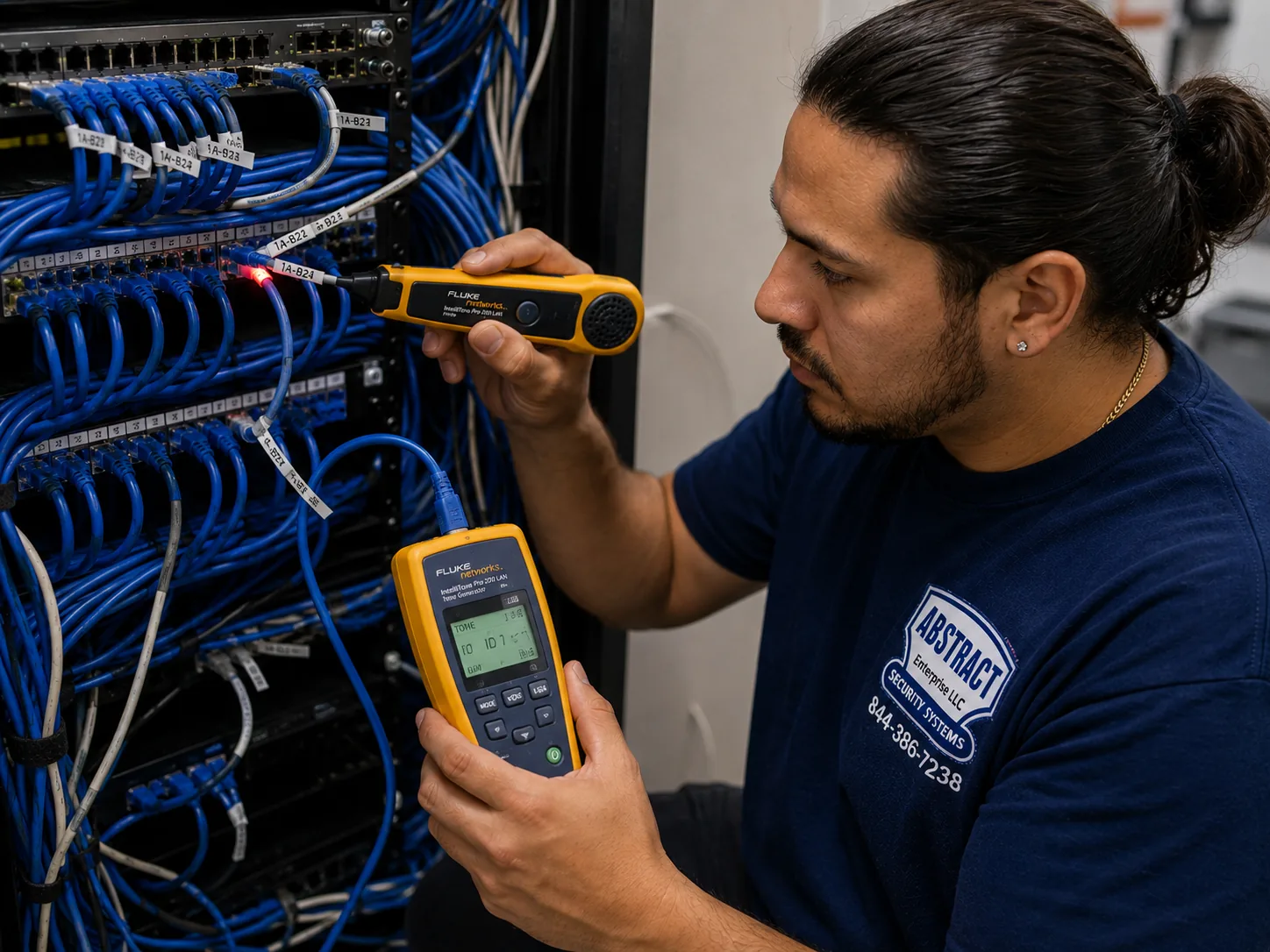
A photo from the AESS job library, not taken in Boerum Hill: a technician using a tone generator and probe to find which unlabeled cable at a patch panel belongs to which run. In a Boerum Hill cellar where three owners and two renovations have each added cameras, this is how we find the cable for the dead camera without opening a wall or pulling anything out of the ceiling.

Measure before replacing. Voltage at the camera, PoE power at the port and a cable test settle most questions in minutes. No part is swapped to "see if it helps," because that is how a power supply problem turns into a bill for new cameras.

Leave it ready for the next outage. Before leaving we confirm the recorder resumes recording on its own after a restart, and where the owner agrees we put the recorder and any switch on a battery backup so the next flicker does not become a drive failure.

Fault by Fault

Power, Recorder, Cable or Camera: How Boerum Hill Systems Fail, Especially After an Outage

Every wired camera system is a chain of four links: the power that feeds it, the cable that carries the picture, the recorder or switch that collects it, and the camera at the end. When any link breaks, the screen tends to show the same black tile, which is why owners so often buy a new camera for a fault that was never in the camera. A multi-day outage stresses all four at once. Here is how each fails in Boerum Hill's houses and shops, and what the repair involves.

Power: brownouts, hard stops and the restart nobody watched

Older coax systems, the ones with round BNC plugs on the back of the recorder, usually power their cameras from a central box with a row of small fuses or from a separate plug-in adapter for each camera. Network systems power cameras over the data cable from a PoE switch or from ports on the back of the recorder. In normal times a central box that is ageing can carry the cameras by day and then sag at dusk, when every camera switches on its infrared lights at once; the result is cameras that reboot or drop out only at night. In an outage the risk is different. The flickering that began on the Friday night in January, before power failed entirely, is the kind of repeated dip that can blow a fuse in a power box, damage an adapter, or leave a PoE switch in a state where some ports stop delivering power. When power returned, a camera on a blown fuse simply stayed dark.

Power repairs are usually quick and cost far less than cameras: a new supply sized with headroom for the night load, a fuse and an output checked one by one, or a port or switch replaced. On our Brooklyn list power supply repair typically runs $150 to $400, and a reterminate or PoE port swap $150 to $350. The other half of a power repair is preventing the next one. A small battery backup on the recorder, and on the PoE switch for a network system, rides through brief flickers and lets the equipment shut down cleanly in a long outage instead of crashing mid-write. It will not keep a system running for four days, and nobody should promise that it will, but it protects the drive, which is the most fragile part of the chain.

Boerum Hill, Brooklyn recorder power protection: finished network rack with patch panels, switching, firewall and battery backup, dressed and identified
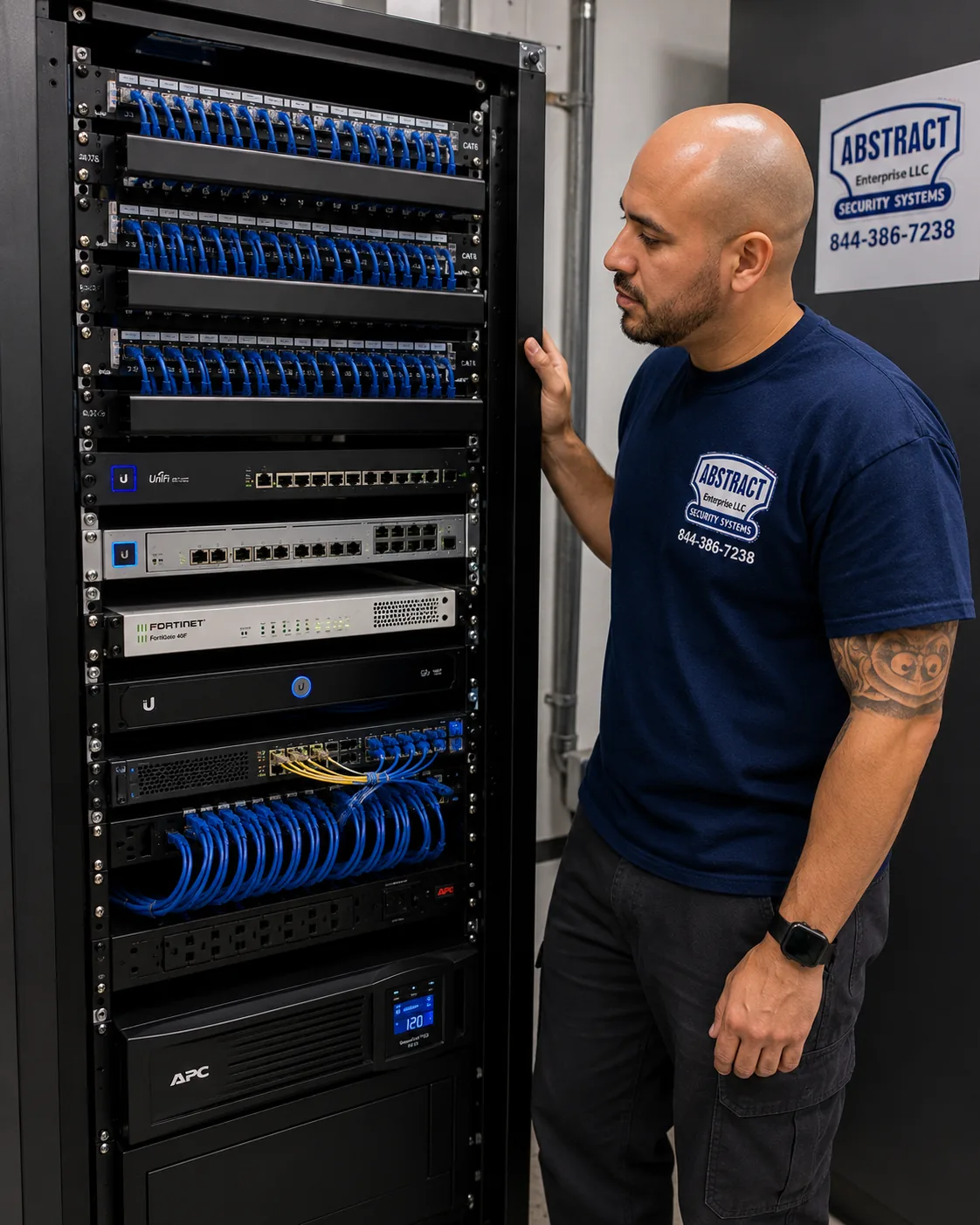
A photo from the AESS job library, not taken in Boerum Hill: a finished rack with patch panels, switching, a firewall and a battery backup at the bottom, every cable dressed and identified. Most Boerum Hill rowhouses need only a fraction of this, but the battery backup is the part that matters after this winter: on a recorder or PoE switch it bridges the flickers that come before an outage and gives the drive a clean shutdown when the power goes for good.

Recorder: the drive, the clock and settings that did not survive

The recorder is where outages do their quietest damage. A hard drive that was writing when the power dipped can develop bad sectors and keep recording in fits and starts, leaving gaps an owner finds only when they need a particular night. A recorder whose clock battery has gone flat comes back with a date in the past and stamps every new clip with it. Some recorders return to their setup wizard after a hard stop and sit there, not recording, until someone completes it. Others keep recording locally but lose the network settings that let the phone app find them, especially if the household's internet router also lost power and came back with different settings.

The repairs range from a settings rebuild and a clock set to keep time from the internet, which often fits inside the service call, to a drive swap at $200 to $450 depending on capacity, to a replacement recorder. A DVR that will not work averages $300 to $700 on our Brooklyn list including the drive and labor, an NVR that is not recording averages $400 to $900 depending on the model, and a full DVR or NVR replacement with a drive and setup runs $700 to $1,500. Before we replace a recorder we confirm the existing cameras will work with the new one, because in a rowhouse the cable inside the walls is the most expensive thing to replace, and a hybrid recorder can often keep every old coax camera running beside new network cameras.

Cable: renovations, rear yards and the connector that turned green

Boerum Hill's cable faults follow its renovations. A house that has been gut-renovated since its cameras went in may have had a run cut behind new plaster, stapled through by a trim carpenter, or buried in a ceiling without a junction anyone can reach. In rear yards, cable that crosses open brick or follows a fence takes years of sun and rain, and water finds its way along a cracked jacket to the connector. In cellars, rodents chew what they can reach. Still, the most common cable fault is not the cable at all but the connector at the end of it: a twist-on BNC plug that corroded at a rear camera, or a network plug that let water in. We test the connector first and the run second.

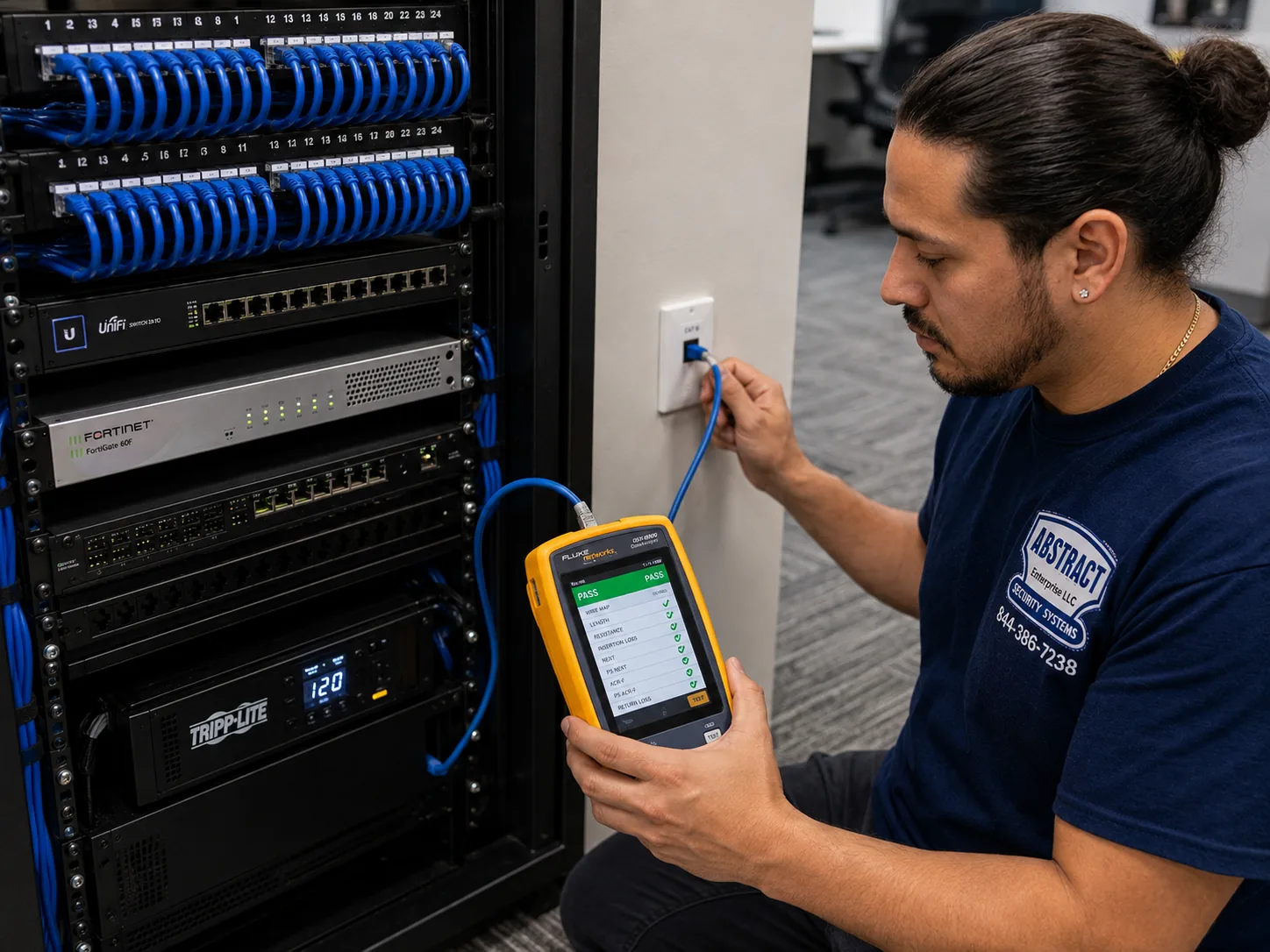
Boerum Hill, Brooklyn camera cable testing: technician certifying a data drop with a cable analyzer showing a PASS result
A photo from the AESS job library, not taken in Boerum Hill: a technician certifying a data drop with a cable analyzer that reads PASS. On a Boerum Hill repair the same test tells us within a minute whether a network camera's cable through the party wall is sound and the fault is at the camera, or whether the run really did fail, so nobody pays to open plaster for a cable that was fine all along.

Camera: water, cold, impact and age

Cameras themselves are the failed part less often than people assume, but they do fail. Water gets in through a cracked housing or an unsealed cable entry, and the picture fogs or spots on humid days. A week of hard cold can stick the small mechanical filter that switches a camera between day and night modes, leaving a pink or purple daytime picture or a night picture with no infrared. Infrared lights burn out with age. A dome cover gets scratched or cracked. Replacing a single camera on a working system runs $250 to $600 on our Brooklyn list with the camera, and if only the dome or front cover is damaged we can often replace just the cover for a $30 to $80 part plus labor.

Commercial Security Camera Repair

Business Security Camera Repair in Boerum Hill

Boerum Hill's businesses sit on a handful of streets, and each gives a camera a slightly different job. The Atlantic Avenue Business Improvement District, approved by the City Planning Commission in 2011, runs from Fourth Avenue to the Brooklyn-Queens Expressway and takes in more than 400 businesses across Boerum Hill and Cobble Hill. Smith Street carries the restaurants, and the side streets hold cafés, studios and shops in the ground floors of rowhouses.

Smith Street

Restaurants and shops with apartments above, including the block where News 12 reported nearly $17,000 of merchandise taken from a business at 166 Smith Street in December 2023. Cameras cover glass fronts, registers and back doors.

Atlantic Avenue

The design-district stretch of shops, galleries and restaurants, often in long rooms with a recorder in a basement reached from the shop floor. Historic storefronts between Hoyt and Nevins Streets fall inside the 2018 landmark extension.

Bergen Street

Cafés and small businesses in rowhouse ground floors. Brooklyn Paper reported that thieves smashed the front glass doors of Blank Street Coffee and a neighbor on the same block on one September night.

Hoyt Street near the station

Restaurants and shops near the Hoyt–Schermerhorn station, where DNAinfo reported a 2016 break-in through a ground-level window at the Mile End Delicatessen at 97 Hoyt Street, caught on surveillance video.

Third and Fourth Avenues

The wider avenues on the eastern edge, with newer mixed-use buildings and ground-floor businesses whose cameras cover curb cuts and side doors as well as the front. Traffic lights on Third Avenue were among those out in the winter outage.

Schermerhorn and State Streets

The northern edge toward Downtown Brooklyn, where the borough jail is rising at 275 Atlantic Avenue and the landmarked State Street Houses stand between Smith and Hoyt, and where any exterior camera follows the commission's rules.

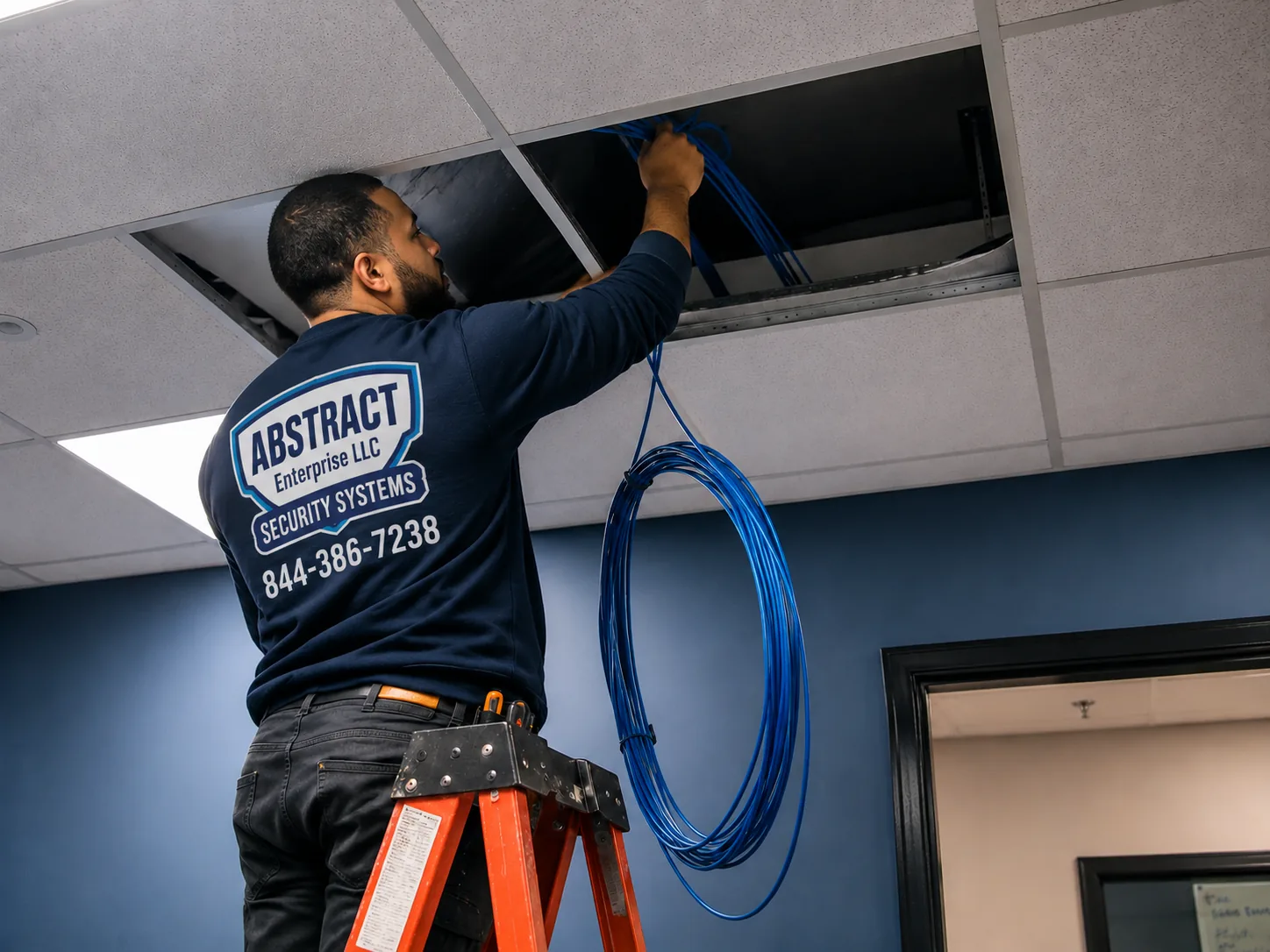
Boerum Hill, Brooklyn storefront camera repair: technician feeding cable through a ceiling in an occupied commercial space
A photo from the AESS job library, not taken in Boerum Hill: a technician feeding cable through the ceiling of a commercial space that stays open while the work goes on. Shops on Smith Street and Atlantic Avenue rarely want to close for a camera repair, so where a replacement run is needed we route it through the ceiling at a quiet hour and keep the sales floor working.

The morning after: what a Boerum Hill shop owner needs first

A store owner almost never calls to report a broken camera in the abstract. They call because the glass door was smashed, the register was short, or a delivery disappeared, and they need to know whether the system caught it before the detective arrives. So on a commercial call the order is fixed: confirm the recorder was recording that night, note its clock against real time, export the clip, and only then start on the fault. When the Bergen Street break-ins were reported, police were already "reviewing nearby security footage." A shop whose own camera recorded the door clearly saves everyone a day of canvassing.

During the outage, the bodega owner Jose Biaz told ABC7: "There's no power, I can't work, no lotto machine working, no EBT, no credit card, nothing is working." Cameras were on that list too, and a shop that ran on a generator during the outage should have its recorder and power supplies checked afterward.

Rules that touch a commercial camera repair

State licensing. The New York Department of State licenses companies that install, service or maintain security and fire alarm systems, and state rules extend that license to closed-circuit television used to detect or monitor intrusion, break-in, theft or movement. An owner working on their own property is exempt; a company you pay to fix your shop's cameras is not. Ours is NYS license #12000287431.

Cameras that watch employees. New York Labor Law Section 203-c requires employers to give notice of electronic monitoring and obtain written acknowledgment, and it restricts recording in places such as restrooms and changing areas. If a repair adds a camera or re-aims one over a staff area, check that your notices are current. This is general information, not legal advice; ask your own adviser how the rules apply to your business.

Landmarks on the storefront. Inside the historic district, the Landmarks Preservation Commission's guidebook applies to exterior cameras on shopfronts as it does on houses: well spaced, attached "at mortar joints, plain masonry, wood, or metalwork," never "through cast iron or on any decorative surfaces," and painted to blend where possible. Repairing a camera in place is ordinary maintenance; moving one to a new spot on the front is where the commission's criteria come in, and its staff can be reached at 347-934-8335.

Sharing with the NYPD. In 2024 the Mayor's Office announced a pilot aimed at retail theft that lets businesses register their cameras with the NYPD and, if they choose, share live feeds, at no cost to the business. A shop that wants to take part needs a recorder that is current, online and keeping correct time. We can bring a system to that standard; whether to register is your decision and your application.

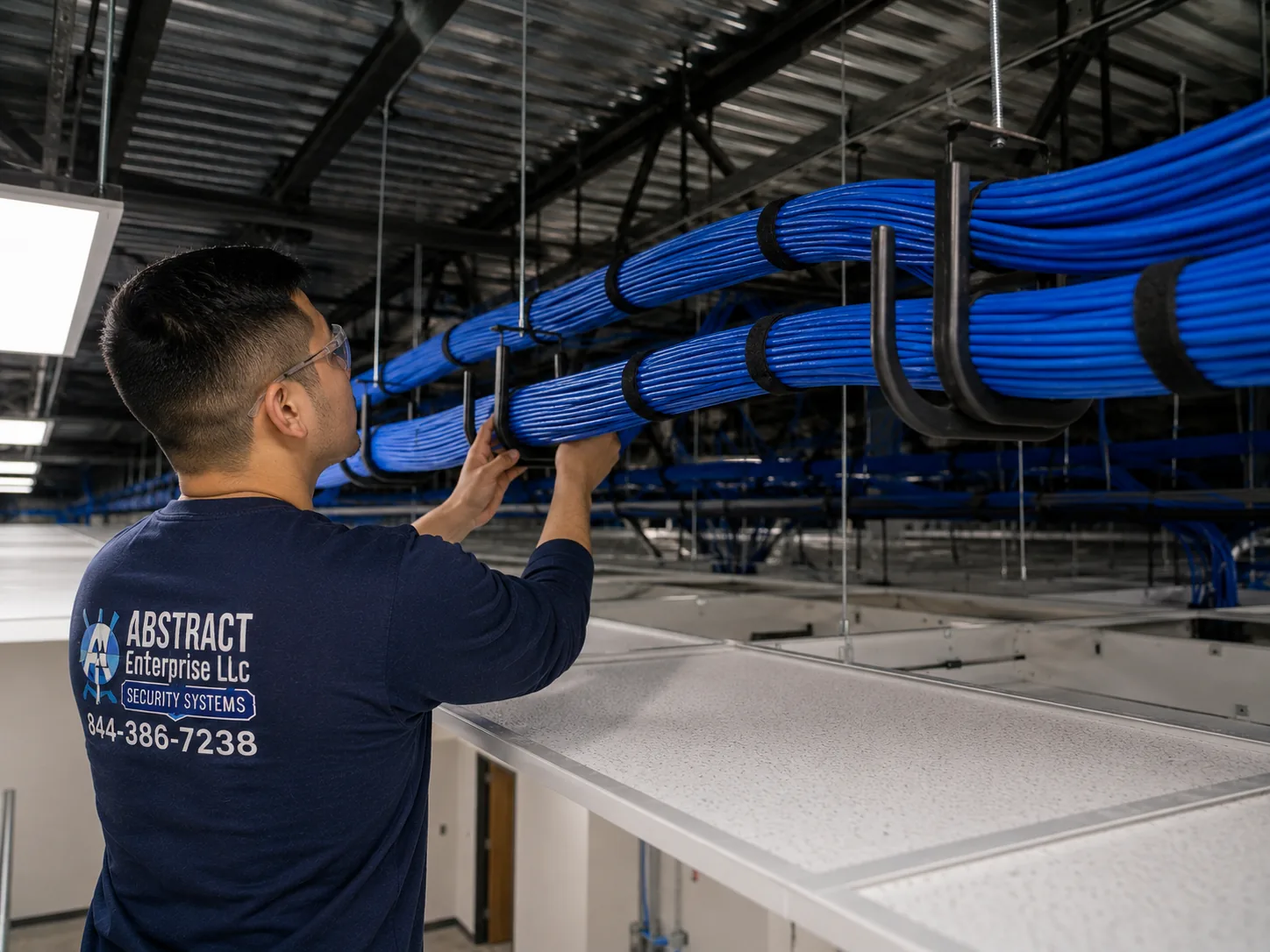
Boerum Hill, Brooklyn commercial camera cabling: J-hooks carrying dressed cable bundles across a commercial ceiling
A photo from the AESS job library, not taken in Boerum Hill: J-hooks holding dressed cable bundles across a commercial ceiling. In the basement of an Atlantic Avenue shop, camera cables lying loose on ductwork or pipes get snagged by deliveries and contractors; lifting the repaired run onto supports like these is a small step that keeps the next renovation from cutting it.
Your Questions Answered

Security Camera Repair in Boerum Hill: Questions Answered

These are the situations Boerum Hill owners, tenants, condo boards and shopkeepers describe when they call about cameras: a generator during the outage, a recorder that forgot everything, a cable stuck to a landmarked front, a face that will not resolve on a recording of a smashed door. Each is answered once here and not repeated in the FAQ further down the page.

After the February outage

We kept our Smith Street shop open on a rented generator during the outage. Could the generator have damaged the recorder or the cameras?

It can, though it often does not. Small portable generators can produce power that wanders in voltage and frequency as the load changes, and a recorder, a PoE switch or a camera power box plugged straight into one can be stressed by it, particularly when a refrigerator compressor or a heater kicks on from the same unit. The things to look for afterward are a power supply that runs hot or hums, cameras that reboot or flicker on and off, a recorder that restarts on its own, and drive errors that were not there before. We test the supplies under load, read the recorder's logs and check the drive's health; if a supply was damaged, power supply repair typically runs $150 to $400 on our Brooklyn list. For the next long outage, a battery backup between the generator and the recorder smooths what the generator delivers and is cheap insurance for the drive.

When the power came back, our recorder started up on its setup screen as if it were brand new. Are our settings gone for good?

The settings on the box may be, but the system usually is not. When a recorder comes back to its first-run wizard after a hard power loss, the configuration it held, which cameras sit on which channels, the recording schedule, the motion zones, the user accounts and the network details, may have been reset, while the video already on the drive is often still there. The first step is to stop anyone clicking through the wizard with default answers, because some recorders offer to initialize the drive along the way. We then rebuild the configuration channel by channel, reconnect the cameras, restore remote viewing, and check whether older recordings are still readable. Before we leave, we save a copy of the finished configuration where the recorder allows it, so a future failure takes minutes to recover rather than an afternoon.

Since the cold snap, our front camera's daytime picture has a pink or purple tint. What failed?

Almost always the small filter inside the camera that switches between day and night modes. By day it slides in front of the sensor to block infrared light; at night it slides out so the camera can see by its infrared lights. If it sticks in the night position, the daytime picture picks up infrared and turns pink, purple or washed-out. Cold, moisture and age are the usual causes, and a camera that has been switching twice a day for years is a likely candidate. Sometimes a restart or a mode change from the recorder frees it, which we try first. If the filter stays stuck, the fix is replacing the camera, which runs $250 to $600 on our Brooklyn list with the new camera, and on a landmarked front we fit the replacement to the existing mounting points so the facade is not touched.

Landmark fronts and old walls

The cable to our stoop camera runs down the front of our Bergen Street house in a plastic raceway. When you fix the camera, can the cable be hidden?

Often, yes, and on a landmarked house it is worth trying. The Landmarks Preservation Commission's guidebook wants conduit "concealed by going through plain masonry or wall cladding behind the installation," so a cable that crosses the face of a rowhouse is exactly what the commission would rather not see. The usual approach is to bring the cable through the wall directly behind the camera, into the parlor-floor vestibule or the space above the door, and down inside the house to the cellar, then remove the old raceway and patch its fixing holes. Whether that works depends on what is behind the camera: a vestibule ceiling with access is easy, a finished plaster wall with a mantel below is harder. We look at both sides on the service call and give you a written price for the concealed route as its own item. Where the change affects the facade beyond ordinary repair, we will tell you to check with the commission first.

Lines roll slowly across our old cameras' picture whenever the boiler fires in the cellar. Is that the cameras, the wiring or the boiler?

Usually the wiring and the power, not the cameras. Slow-moving horizontal bars on an analog picture are a classic sign of electrical interference, often a ground loop, where the camera and the recorder see slightly different electrical ground and a small current flows along the cable's shield. A boiler's motor and igniter starting nearby, or a camera cable running alongside the boiler's power feed, can make it visible. In Boerum Hill cellars, where camera cables, boiler wiring and old electrical runs often share the same joists, it is a common pattern. The fix may be re-routing the camera cable away from the power wiring, isolating the ground at one end with a small inline device, or replacing a cheap power supply that is passing noise through. We prove which it is with the boiler running before changing anything.

Our recorder sits in the vault under the front stoop, and the drive has failed twice in three years. Is the location the problem?

Quite possibly. The vault under a Boerum Hill stoop is cool in summer, cold in winter and often damp, with condensation on the stone and little air movement. Hard drives in recorders are designed for ordinary indoor conditions, and a drive that sits in damp cold, or that heats and cools sharply through the year, tends to wear out sooner. Two drives in three years is a pattern worth acting on. We check the drive and the recorder's logs, and if the location is the cause, the lasting fix is moving the recorder into a dry, heated room, such as a cellar room on the house side of the foundation wall or a closet on the garden floor, and extending the camera cables to reach it. We price the move as its own item; a replacement drive runs $200 to $450 on our Brooklyn list by capacity.

Tenants, boards and who holds the password

Packages keep disappearing from the vestibule of our walk-up, and the camera there has been dead since last year. What should we send the landlord?

Put it in writing and keep it specific. Brick Underground, answering a tenant in exactly this position, quoted the attorney Jeffrey Reich: "A landlord that is on notice of criminal activity at a property may be obligated to take reasonable safety precautions," and "Fixing the security camera would certainly be a reasonable action for the landlord to take in this instance." The same article noted that no city law requires rental buildings to have working cameras, so the case rests on notice. A short letter or email listing each missing package with its date, saying the vestibule camera has not worked since a given month, and asking for it to be repaired, does that. Keep a copy. You are welcome to send us the building's address and the landlord's or managing agent's contact; we can arrange the visit with them, since the owner has to approve and pay for work on the building's system.

Six of us own the condo units in a converted rowhouse, and nobody is formally in charge of the camera recorder in the cellar. Who should hold the admin password?

The board, or one person the board names in writing, and nobody else. Small condos often inherit a single admin login from the developer's installer, shared informally among owners or lost entirely. That causes two problems: nobody can approve changes with authority, and anyone who ever had the password can delete footage or change settings. The cleaner setup is one admin account held by the board's designee, with a second sealed copy kept with the board's records, and separate viewing accounts for each owner that can watch and play back but not change settings or delete. We can set that up during a repair visit, recover access if the old password is lost and the brand allows it, and leave a short written record of the system for the board's files.

Storefronts and footage that has to be useful

Our restaurant's glass door was smashed overnight. The camera recorded it, but the face is a blur of blocks. Is that a repair or a new camera?

Often it is neither; it is a settings problem. Many recorders save video at a reduced quality to fit more days on the drive, and at night, when the picture is grainy, heavy compression turns a moving face into blocks. Others record the camera's low-resolution second stream instead of the main one. Distance matters too: a camera that covers the whole dining room may give the door only a few dozen pixels of width. On the visit we check which stream is being recorded, the resolution, the bit rate and the frame rate, and how far the camera is from the door. Raising the recording quality on the door camera is usually free within the service call, and it costs drive space, which we balance against how many days you keep. If the camera physically cannot resolve a face at that distance, re-aiming it tighter on the door, or a dedicated door camera, is the answer, priced in writing before anything is bought.

Our Atlantic Avenue shop's recorder only keeps about five days of video. How do we get more without replacing everything?

There are three levers, and most systems can use at least two. The first is the drive: a larger surveillance drive in the same recorder is the most direct way to add days, and a drive swap runs $200 to $450 on our Brooklyn list depending on capacity, as long as the recorder supports the size. The second is how the recording is set up: recording all cameras around the clock at maximum quality fills a drive fast, while recording at full quality on motion and lower quality the rest of the time can stretch the same drive much further. The third is matching quality to purpose, high on the door and the register, lower on a stockroom. Five days is short for a business, because a theft or a dispute is often noticed a week or more later. We check the recorder's drive limit and give you the days each option would realistically give before you choose.

Selling up and the system you leave behind

We are selling our Boerum Hill rowhouse. What should we do with the camera system before the closing?

Decide early whether the system stays with the house, then either hand it over cleanly or take your accounts out of it. If it stays, the buyer will want the admin password, a list of cameras and where their cables run, the recorder's model, and an idea of how old the drive is. Remove your own phones and any cloud accounts in your name, export any footage you want to keep, and delete personal recordings if you would rather not leave them. If you take some equipment with you, agree in writing which pieces stay. A short visit before closing can confirm every camera is recording, set a temporary admin password for the buyer and label the cables in the cellar.
Equipment

Types of Security Cameras and Recorders We Repair

We repair what is on the wall, whoever put it there. These are the kinds of equipment we work on in Boerum Hill rowhouses, walk-ups, condos and shops, with what usually goes wrong with each.

Analog and HD-over-coax cameras

Cameras on round BNC plugs, from old analog to HD-TVI, HD-CVI and AHD. Typical faults: corroded connectors at rear-yard cameras, dead adapters in damp cellars, rolling interference near boilers and burned-out infrared.

DVRs and hybrid recorders

Recorders for coax cameras and hybrids that take coax and network cameras together. Typical faults: drives damaged by power loss, a flat clock battery, settings reset after an outage and firmware too old for the app.

Network (IP) cameras

Cameras powered and connected through one data cable. Typical faults: water at the plug, a PoE port that stopped feeding power, an address conflict after a new router, or a camera reset to defaults.

NVRs and PoE switches

Network recorders and the switches that power cameras. Typical faults: ports disabled after a power event, a switch at its power limit, or a drive that stopped recording without warning.

Dome, turret and bullet cameras

Cracked or scratched dome covers, fogged housings, stuck day-night filters and stoop cameras pushed out of aim by years of doors slamming below.

PTZ and long-range cameras

Pan-tilt-zoom cameras on larger commercial buildings and lots near the avenues. PTZ repair in Brooklyn typically runs $450 to $1,200 because of the moving parts and their cost.

Power supplies and battery backups

Central power boxes, plug-in adapters and battery backups for recorders and switches, sized for the night load and for the flickers that come before an outage.

Monitors and viewing screens

The screen in a kitchen, a super's room or behind a counter, and the cable to it. A black monitor sometimes means a failed cable or input, not a dead recorder.

Phone apps and cloud viewing

Remote viewing, shared accounts for family, tenants or staff, and push alerts, set up again after a router change, a new phone or a password reset.

National brands versus a local licensed repair

Plenty of Boerum Hill households have, or once had, a system from a national alarm company or a consumer camera brand. When one of those stops working, this is how the options compare.

QuestionADT or similar alarm companyRing or SimpliSafe cameraAESS local repair
Who owns the equipmentDepends on the contract; some may be leasedYou doYou do, and we repair it
Works on other brandsUsually its own equipmentSupport covers its own devicesAny brand, any installer
Wired cameras and recordersIts own systemsMostly battery or Wi-Fi devicesCoax, network, hybrid and PoE
After an outageService visit through the companyDevice restarts on its own or is replacedDrive, clock, settings and power checked on site
Licensed technician on siteVaries by dealerRemote support; you swap the deviceYes, NYS license #12000287431
Price before workVariesThe price of a new device$150 service call, then a written repair price

If your cameras are part of a monitored alarm contract, read that contract before anyone else works on them, since some equipment may belong to the alarm company. If they are consumer Wi-Fi cameras, the usual repair is a replacement device.

AI Overview Reality Check

What AI Gets Wrong About Security Camera Repair in Boerum Hill

The claims below turn up, paraphrased, in generic online answers and in national cost guides such as Angi, HomeAdvisor and Fixr. Each is followed by what Boerum Hill's houses, shops and this winter's outage actually show.

"Expect to pay about $1,400 to repair a security camera system in Brooklyn"

One of the first numbers a search turns up is HomeAdvisor's Brooklyn figure: an average of $1,416, a typical range of $680 to $2,145, and a low-to-high spread of $160 to $3,500. AI summaries tend to repeat it as the price of a repair.

That page blends installation and repair, so new systems pull its average up. A repair is usually one fault, a power supply, a connector, a drive or a single camera, and on our Brooklyn list most single-issue repairs come in between $150 and $700. Only a new recorder, a partial rewire or a rebuild of several cameras reaches the $700 to $1,500 band.

For a Boerum Hill rowhouse with one problem, the useful planning figure is the $150 service call plus the cost of the one part that failed. You get that number in writing on the visit, before anything is replaced, so your job is never measured against an average that includes other people's installations.

"After a power outage, the cameras will come back on their own"

Many generic answers treat an outage as a pause: the power returns, the recorder boots, and everything carries on as before.

That is true for many systems after a short blink, and it is often not true after the kind of outage Boerum Hill had, with flickering on the Friday, a hard loss over the weekend and days before power returned. Brownouts can blow fuses in a camera power box, a hard stop can damage a drive mid-write, a flat clock battery can send the recorder back years, and some recorders come back to a setup screen and record nothing until someone finishes it.

The only way to know is to look: check the clock, the drive's health, the playback calendar and every channel. If you have not opened playback since the outage, do it now, and if the calendar is blank from that week onward, call before you need a clip.

"Just unplug the recorder and plug it back in"

The most common first step in online troubleshooting is a restart, and plenty of AI answers end there.

A restart can clear a frozen camera. It can also do harm the answers leave out. If something just happened and you need footage, power-cycling a recorder with a failing drive can make the recording harder to recover, and on a recorder that lost its settings, the restart may drop you into a setup wizard that offers to initialize the drive. When the cause is a power box that sags every evening, a restart fixes nothing, and the cameras will drop again at the next dusk.

On a repair visit, the footage you need is saved first and the cause is found before anything is restarted or reset. If you are not sure whether you need a clip, say so when you book and we will treat it as if you do.

"Replace the old camera with a new one in a better spot"

Generic advice often suggests that a failing camera is a chance to move it wherever it would see best, and to add a couple more while you are at it.

On a Boerum Hill house inside the historic district, that advice runs into the Landmarks Preservation Commission. Its guidebook limits small buildings to two cameras for every 25 feet of street frontage, wants them "well spaced to avoid a cluttered, haphazard appearance," and bars attachment "through cast iron or on any decorative surfaces." The same guidebook treats ordinary maintenance and repair of existing equipment as needing no permit.

So the cheapest and simplest repair on a landmarked front is usually a compatible camera on the existing mounting points, with the cable on its existing path. If a camera truly needs to move, we tell you before work starts, and the commission's staff can be reached at 347-934-8335 for the rules that apply to your building.

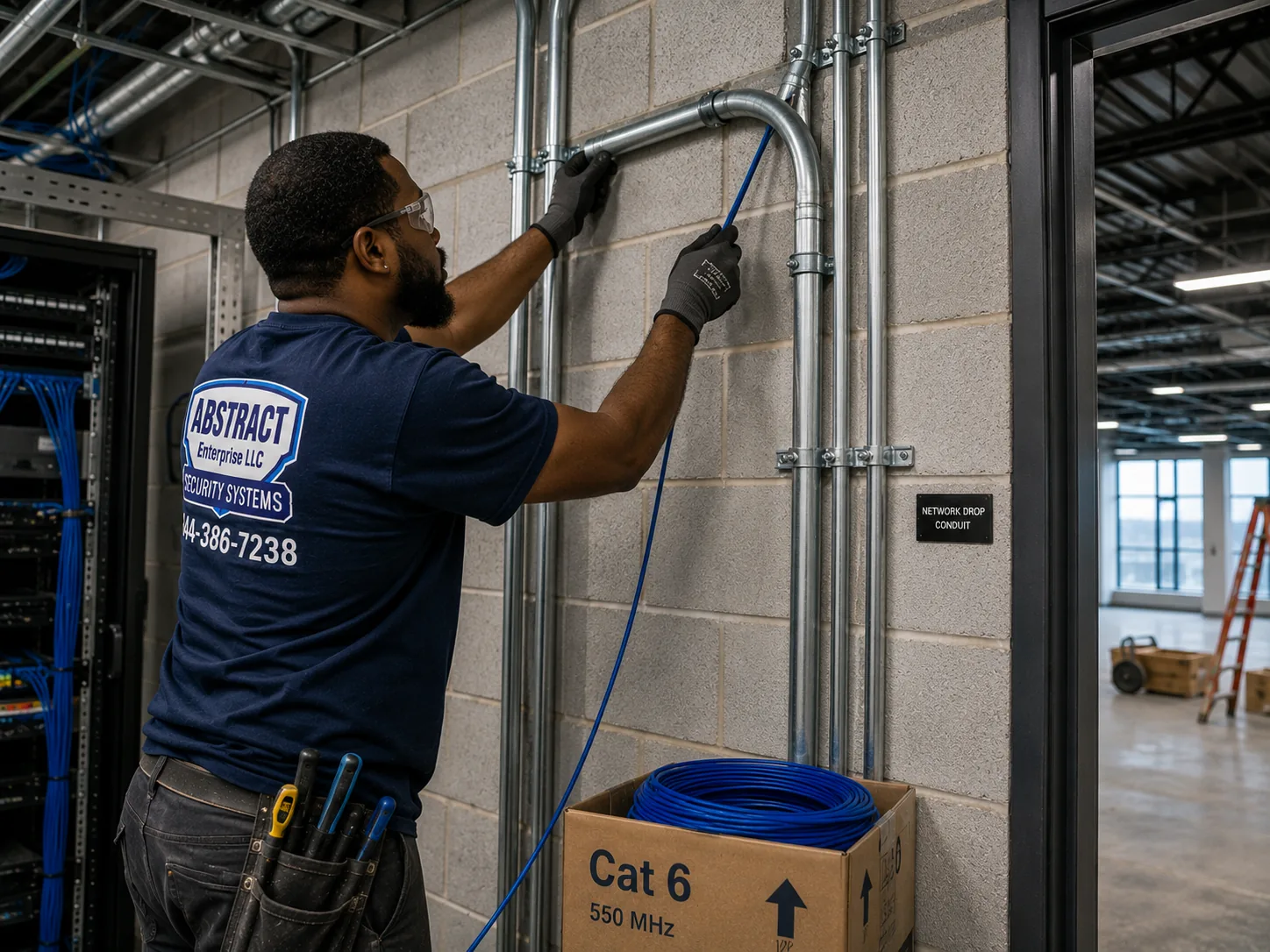
Boerum Hill, Brooklyn camera cable protection: technician running cable into EMT conduit beside a telecom room in an industrial building
A photo from the AESS job library, not taken in Boerum Hill: a technician running cable into EMT conduit beside a telecom room in an industrial building. In Boerum Hill, metal conduit like this belongs inside, in a cellar or a shop basement where cable needs protection from deliveries and rodents; on a landmarked front, the commission wants conduit hidden behind the masonry rather than run across it.

"Wi-Fi cameras do away with wiring problems"

A common suggestion is that switching a troublesome wired system to wireless cameras ends cable faults for good.

A Wi-Fi camera still needs power, which means an outlet or a battery, and it still needs to reach the router. In a rowhouse, the router is usually on the parlor or garden floor, the rear-yard camera is outside a brick back wall, and the front camera is on the far side of a stone or brick facade. Battery cameras add charging, and every wireless camera stops recording when the router does, which is exactly what happened to many homes in the February outage.

For a wired system with one bad cable, repairing that run is usually the cheapest and most reliable fix. Wireless makes sense in a few spots, a garden shed at the back of a long yard with no cable path for instance, and we say so when it does.

"Hikvision and Dahua cameras are banned, so the whole system has to go"

After the FCC's 2022 order, AI answers sometimes say that owners of these brands must replace their systems or that the equipment can no longer be serviced.

Security Sales & Integration reported that the FCC adopted rules "prohibiting communications equipment deemed to pose an unacceptable risk to national security" from new authorization, naming Hikvision and Dahua, and that Dahua's position was that "the FCC's Order does not affect products that are already authorized." The FCC also sought comment on what to do about existing authorizations, so the question is not entirely settled.

What it means for a repair is practical: getting exact replacement models of some equipment can be harder, and when a part has to change we may use a compatible camera or recorder from another maker. A working system does not have to come off the wall because of its badge, and we will tell you plainly what your options are.

"Police and city cameras cover the street, so a private system adds little"

Some generic answers suggest that in a busy part of the city, public cameras make a private system redundant.

The reporting from Boerum Hill points the other way. When the glass doors on Bergen Street were smashed, police went to "nearby security footage." When parcels vanished on Bond Street, they were "checking nearby cameras." Both lines describe private cameras on private buildings, the ones that see a particular door, gate or stoop. A camera at an intersection sees the intersection.

The Fulton Street case in the same roundup, where "there was no surveillance footage available," shows the other outcome. A private camera that is recording, aimed at the door and keeping the right time is often the only one that matters to a case on your block.

Ask a Technician Before You Buy a Replacement

If you cannot tell whether it is the camera, the cable, the power or the recorder, ask before you spend anything. Call now at (347) 934-8335, send a fast quote request, or send the recorder screen to a tech on WhatsApp. Same-day estimates are available on most days, and requests are booked within 2 hours.

Get In Touch

Request a Free Quote

Tell us the cross streets, the kind of building, how many cameras you have, which ones are out, where the recorder sits and whether the trouble started with the winter outage. A technician will come back to you with the likely cause and the next step for the Boerum Hill address, or call (347) 934-8335 now.

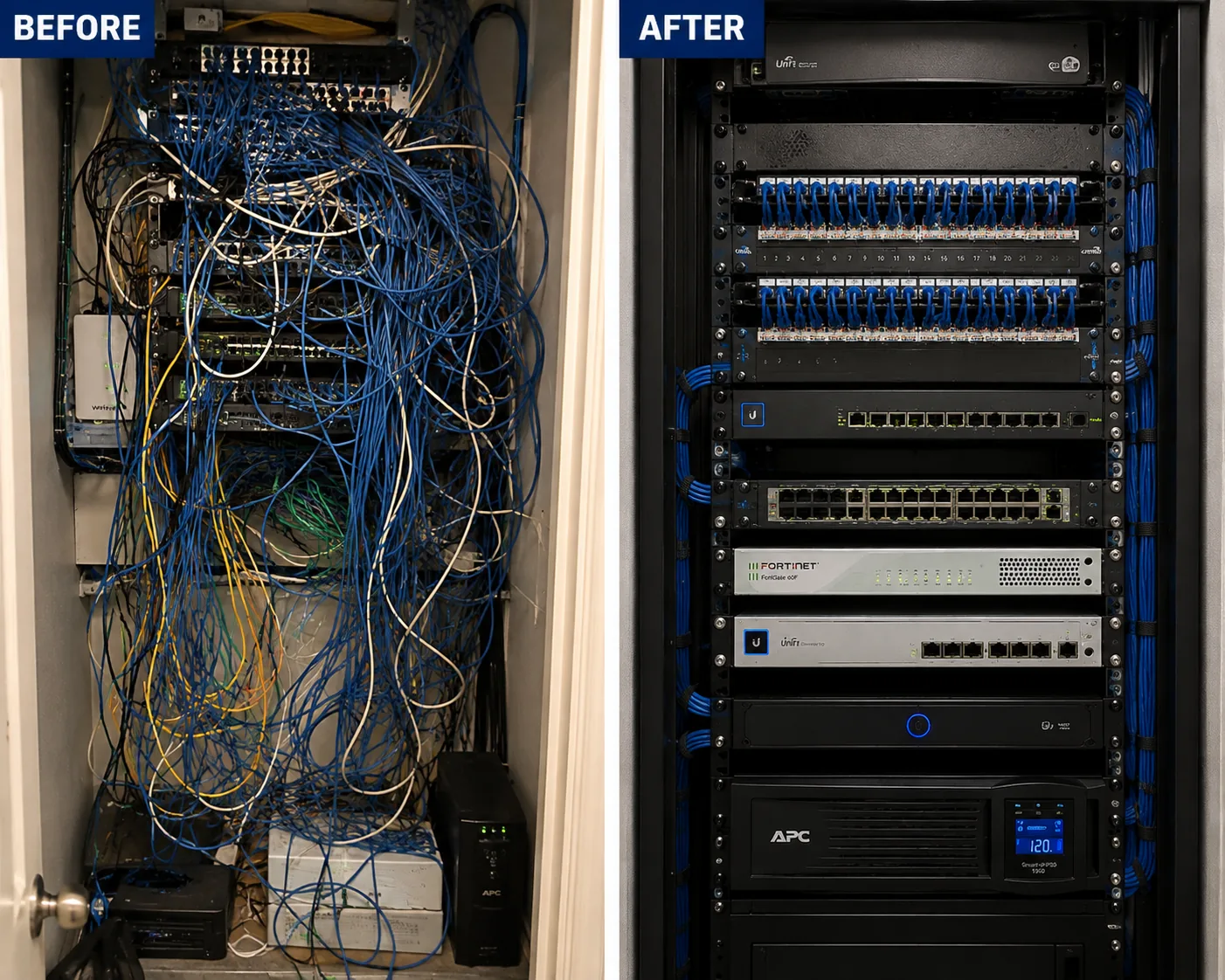
Boerum Hill, Brooklyn camera system cleanup: before-and-after views of a network rack, an unlabelled tangle rebuilt into a dressed and identified rack
A photo from the AESS job library, not taken in Boerum Hill: before-and-after views of a network rack, from an unlabeled tangle to dressed and identified cabling. The "before" is close to what we find on many Boerum Hill cellar shelves, where each owner and each renovation added something. If you note on the form that nobody knows which cable is which, we plan extra time to trace and label everything.

✅
Request Sent!
Thank you. A technician will be in touch about the Boerum Hill address shortly.
How It Works

Our Repair Process

1. Send the screen and the label

A photo of the camera grid, a photo of the recorder sticker, your cross streets and the date the trouble began. You hear the likely cause and what that kind of repair usually costs.

2. Book the visit

The $150 Brooklyn service call is paid at booking, the visit goes on the schedule in a two-hour arrival window, and the fee is credited to the repair.

3. Settle access by text

Who opens the door, where the recorder is, who holds the password or app login, and any tenant, condo board or roof access, agreed before the day.

4. Save footage, then test the chain

Any clip you need is exported first. Then power, cable, switch or power box, recorder and camera are tested in order until the failed part is found.

5. Write the price down

You get the cause and a written repair price, with the service call applied, before any part is changed.

6. Repair and retest

The failed part is fixed or replaced, every camera is checked live and in playback, and the recorder's clock and drive are confirmed.

7. Label and hand over

Every traced cable is labeled, phone viewing is confirmed with you, and you get written notes of what was found and fixed.

Coverage Area

Security Camera Repair Near Boerum Hill's Landmarks

State Street Houses

Twenty-three rowhouses at 291–299 and 290–324 State Street between Smith and Hoyt, built 1847 to 1874 and landmarked in 1973.

Boerum Hill Historic District

The 1973 core on Dean and Bergen Streets between Smith and Hoyt, more than doubled by the 2018 extension along Pacific, Wyckoff, Bergen and Atlantic.

Atlantic Avenue

The business improvement district from Fourth Avenue to the Brooklyn-Queens Expressway, more than 400 businesses across Boerum Hill and Cobble Hill.

Hoyt–Schermerhorn station

The A, C and G stop on the border with Downtown Brooklyn, opened in 1936, with Hoyt Street's restaurants a short walk south.

Pacific Branch library

The Brooklyn Public Library's Carnegie branch at 25 Fourth Avenue, opened in 1905, at the neighborhood's eastern edge.

Gowanus Houses

The public housing campus completed in 1949 between Douglass and Wyckoff Streets and Bond and Hoyt Streets, with 16 buildings and 1,139 apartments.

We also serve the neighborhoods around Boerum Hill, including Cobble Hill, Carroll Gardens, Gowanus, Park Slope, Fort Greene and Downtown Brooklyn, at the same Brooklyn rate. For the rest of the borough see our Brooklyn security camera repair page, and for buildings across the river our Manhattan security camera repair page.

Pricing

Security Camera Repair Cost in Boerum Hill

Boerum Hill is billed at our Brooklyn rate, the same as the rest of the borough. Every repair starts with the $150 service call, which covers the on-site diagnosis and the written repair price and is credited to the repair if you go ahead. The ranges below come from our published Brooklyn camera repair list. Your own price is written down on the visit, before any work starts, once we know which part failed, and jobs go on the schedule once the service call is paid.

RepairBrooklyn price
Service call: on-site diagnosis and written repair price$150, credited to the repair
Settings work with no parts (clock, alerts, app, motion zones, recording quality)Often within the $150 service call
Clean and check for a blurry or greasy picture$80
Connector reterminate or PoE port swap$150–$350
Power supply repair$150–$400
Dome or front cover replacement$30–$80 part plus labor
Hard drive swap, by capacity$200–$450
Single camera replacement on a working system, camera included$250–$600
Night vision camera repair$250–$650
DVR not working, including drive and labor$300–$700
NVR not recording, by model$400–$900
PTZ camera repair$450–$1,200
Hybrid recorder swap with channels reconfigured$700–$1,200
DVR or NVR replacement with drive and setup$700–$1,500
Full rewire or whole-house system overhaulFrom $1,500
Annual maintenance, residence / commercialFrom $250 / from $400

Two Boerum Hill items are priced separately and written down before they start, because the cost depends on the building: moving a recorder out of a damp under-stoop vault or a cold cellar corner into a dry room, and bringing a facade cable inside the wall behind a camera on a landmarked front. Neither is ever added after the fact.

Full terms — including 50% deposit, one-year parts-only warranty on AESS-supplied products, and the late-fee schedule — are set out in the service agreement.
Shop Our Systems

Security Camera Repair Packages & Pricing

Three typical Boerum Hill repair visits, priced from the Brooklyn list above. Each begins with the $150 service call, credited to the repair.

Single-issue repair: $150–$700

The most common Brooklyn range. One fault fixed on one visit: a blown power box output replaced after the outage, a corroded rear-yard connector re-terminated, a drive swapped in a cellar recorder, a stuck day-night camera replaced on its existing mount, or access recovered on an inherited shop recorder.

Major system repair: $700–$1,500

The recorder or the wiring. A DVR or NVR replaced with a new drive and every camera configured again, a hybrid recorder so a rowhouse can keep its coax cameras, several damaged runs repaired after a renovation, or a recorder rehoused from a stoop vault into the house.

Annual maintenance: $250–$800

For rowhouses and Smith Street and Atlantic Avenue shops: lenses and covers cleaned, connectors inspected, drive health tested, firmware reviewed, clock and alerts checked and motion zones reset, from $250 for a residence and $400 for a commercial system.

Bring your own equipment. If you have already bought a replacement camera or recorder, we can fit it at labor-only rates. Send us the exact model and we quote the labor by phone or text; the visit is booked once it is paid. Equipment you supply is installed as supplied, and if the model will not work with your system, we tell you before the visit.

Complete Services

Every Security Camera Repair Service in Boerum Hill

Camera, cable and outage repair

Dead cameras, blown power outputs, corroded connectors and failed runs. Request a repair

Recorder and drive repair

DVRs, NVRs, hybrids and drives across the borough. Security camera repair in Brooklyn

Brooklyn repair prices

The full list behind every figure on this page. Brooklyn camera repair price list

Citywide repair

Owners with buildings in more than one borough. AESS camera repair across NYC

FAQ

Boerum Hill Security Camera Repair FAQ

How can I tell whether my Boerum Hill system is analog or network before I call?
+

Look at the back of the recorder. Round twist-on BNC plugs mean coax cameras on a DVR; square network plugs like an internet cable, one per camera or running to a separate switch, mean network cameras on an NVR. A mix of both usually means a hybrid. A photo of the back panel settles it.

Can you repair cameras that are still under another company's warranty?
+

We can, but check that warranty first, because work by someone else may end it. If the installer still exists and the warranty covers the fault, that is usually the cheaper route. If the installer has closed, the warranty has lapsed, or they will not come, we repair it and price it in writing before starting.

Should the default password on our recorder be changed during the repair?
+

Yes. A recorder still on its factory password, or on one shared by a former owner or contractor, can be logged into by anyone who knows it. We set a strong admin password held by the person who pays for the system and give other users their own logins with limited rights.

Can our cameras save to the cloud as well as to the recorder?
+

Some can, depending on the brand and model, usually through the manufacturer's own subscription service. Most wired systems in Boerum Hill rowhouses and shops record only to the local drive. We can tell you what your equipment supports; local recording still matters most, because the cloud stops when the internet does.

Can a family member or a caregiver see our cameras on their own phone?
+

Yes. Most recorders allow extra user accounts with limited rights, for example live view of the stoop and hallway but no playback, no settings and no deleting. We set those up on a visit and you can remove any of them later without affecting your own login.

Can you turn off the microphone on our cameras?
+

Yes, on cameras and recorders that record sound, audio can usually be switched off per camera. Many owners prefer that, especially on cameras near a street or a shared entrance. Whether audio recording is appropriate in your situation is a legal question, so ask your own adviser if you are unsure.

Can the recorder warn us when a camera goes dark or the drive starts failing?
+

Many recorders can send a phone alert or an email for video loss, a drive error or a full drive, separately from motion alerts. Where yours supports it, we switch those on and test them, so the next failure reaches you the day it happens instead of the day you need a clip.

Can repaired cameras show on a smart display or TV in our house?
+

Often, depending on the recorder and the display. Some brands work with smart displays through their own apps, and most recorders can drive a monitor or TV through a video cable. We tell you what your system supports and can set it up during the repair.

If I want to think it over, how long is the written repair price good for?
+

The written price reflects the fault we found and the part prices on the day of the visit. If you decide later, tell us and we confirm the price is still current before booking; if the fault has changed or a part price has moved, we tell you the new figure before any work.

Do the cameras keep recording while you work on the system?
+

Most of them, most of the time. The camera or cable being repaired is off while we work on it, and a recorder replacement or drive swap means a short gap in recording. We tell you before each gap and keep it as brief as possible, and we save any footage you need before it starts.

Do we get a written record of the system after the repair?
+

Yes. You get notes of what we tested, what we found and what we fixed, with the cameras listed by channel and the cables we traced labeled in the cellar. Credentials stay with you, and we suggest you keep them somewhere safe away from the recorder itself.

More Security Camera Repair near Boerum Hill

Security Camera Repair Brooklyn | Same-Day | Brownstone Pros · Security Camera Repair NYC | Same-Day | Abstract Enterprises · Security Camera Repair Manhattan | Same-Day | Co-op COI · Security Camera Repair Queens | Same-Day | Driveway Pros · Security Camera Repair Bronx | Same-Day | Home Base · Security Camera Repair Staten Island | Same-Day | Sandy Zone · Security Camera Repair Long Island | Nassau & Suffolk · Security Camera Repair Hudson Valley | Westchester to Ulster · Security Camera Repair Nassau County | Same-Day · Security Camera Repair Suffolk County | Hamptons + East End · Security Camera Repair Westchester County | Same-Day · Security Camera Repair Rockland County NY | Nyack, Suffern · Security Camera Repair Orange County | Newburgh, Goshen · Security Camera Repair Putnam County NY | Carmel, Mahopac · Security Camera Repair Dutchess County | Poughkeepsie · Security Camera Repair Ulster County | Kingston Woodstock

Security Camera Repair Bath Beach Brooklyn NY · Security Camera Repair Bay Ridge Brooklyn NY | AESS · Security Camera Repair Bedford-Stuyvesant Brooklyn NY · Security Camera Repair Bensonhurst Brooklyn NY | AESS · Security Camera Repair Bergen Beach Brooklyn NY · Security Camera Repair Beverley Square Brooklyn NY · Security Camera Repair Borough Park Brooklyn NY · Security Camera Repair Brighton Beach Brooklyn NY

Other services in Boerum Hill

Structured Cabling Installation Boerum Hill Brooklyn NY · Door Buzzer Repair Boerum Hill Brooklyn NY · Door Buzzer Installation Boerum Hill Brooklyn NY · Security Camera Installation Boerum Hill Brooklyn NY · Fire Alarm Installation Boerum Hill Brooklyn NY · Intercom Installation Boerum Hill Brooklyn NY | Rowhouses · TV Installation Boerum Hill Brooklyn · Access Control Installation Boerum Hill Brooklyn NY · Alarm Installation Boerum Hill Brooklyn NY

Ready to Get Every Boerum Hill Camera Recording Again?

Send the recorder screen, the sticker on the recorder and your cross streets, and tell us whether the trouble started with the winter outage. We will tell you what most likely failed and what that kind of repair costs on our Brooklyn list. The $150 service call is credited to the repair, the price is written down before any part changes, and requests are booked within 2 hours. Abstract Enterprises Security Systems has been owner-operated since 2002, holds NYS license #12000287431, and sends Brooklyn crews from our Troy Avenue office.

Would you rather send photos? Message a technician on WhatsApp.