Two-family rowhouse with a bell nobody upstairs can hear, a walk-up on Nevins or Pacific with an intercom that keeps failing, or a new three-unit building with no buzzer at all? Boerum Hill door buzzer installation line: (347) 934-8335
Two- and Three-Family Rowhouses · Stoop and Garden Entrances · State, Bergen, Dean and Pacific Street Landmark Blocks · Atlantic Avenue and Smith Street Buildings With Apartments Upstairs
Door Buzzer Installation in Boerum Hill
Two Doors per House · One Panel per Opening · Audio, Video or Phone Answering · Brooklyn List Prices
Door buzzer installation in Boerum Hill is mostly small-building work: a two-family or three-family rowhouse from the 1840s to the 1870s with a door at the top of the stoop, a second door under it, and apartments stacked three or four floors above a cellar. City land-use records for the Boerum Hill Historic District and its 2018 extension count 576 lots holding 1,478 apartments, and 533 of those lots have four apartments or fewer. That is why most jobs here are not about big lobby panels. They are about which of the two front doors gets released, how a cable climbs a narrow stair hall that has been renovated more than once, what the Landmarks Preservation Commission allows on the front, and whether each household answers on a handset, a screen or a phone. This page covers each of those decisions, what HPD and 311 records show about entry systems in Community Board 2, the rules that apply to app-based entry, and where each kind of job sits on our published Brooklyn price list.
Every price on this page comes from our published Brooklyn door buzzer list, and your total is fixed in writing before any equipment is ordered
Rated 4.7★ across 201 Google Reviews
Reviewed and updated November 11, 2026, against NYC HPD housing maintenance code violation records for Brooklyn Community Board 2 (queried November 11, 2026); NYC 311 bell, buzzer and intercom complaints for the same board; NYC PLUTO land-use records for the Boerum Hill Historic District and its extension; the Landmarks Preservation Commission's Permit Guidebook chapter on health and safety equipment; CityLand and 6sqft on the 2018 district extension; New York's Multiple Dwelling Law §50-a and Housing Maintenance Code §27-2005; HPD's page on the Tenant Data Privacy Law (Local Law 63 of 2021); the NYC Building Code's rules for electrically locked egress doors; the 2010 ADA Standards; Allegion on fail-safe and fail-secure hardware; Aiphone's GT series documentation; DNAinfo's January 17, 2013 report on 84th Precinct burglaries; Brooklyn Paper on a Bond Street parcel theft; Habitat magazine's February 2024 article on intercom obligations; Brownstoner forum threads on rowhouse doorbells, intercoms and vestibule security; Reddit threads from New York renters and owners; and the HomeAdvisor and Swiftlane cost guides. · Abstract Enterprises Security Systems, NYS license #12000287431 · crews dispatched from our Troy Avenue office in Brooklyn
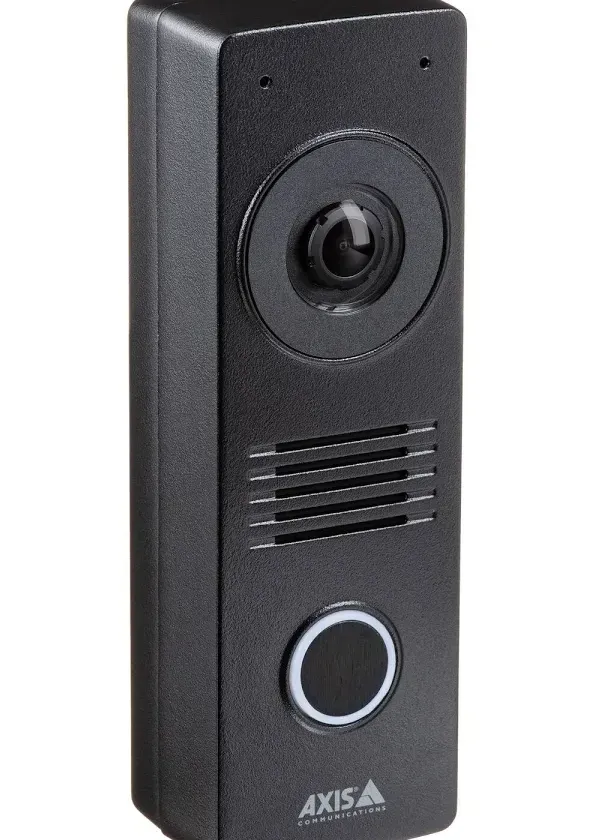
A photo from the AESS job library, not taken in Boerum Hill: a black rectangular video door station with a camera, a speaker grille and a single round call button lit from behind. A one-button station of this size is what most Boerum Hill rowhouse owners ask about first, because it fits on the narrow wooden reveal beside a parlor-floor door without reaching the brownstone trim. A two- or three-family house gets the same kind of station with one button per apartment.
Boerum Hill Buzzer Request
Rowhouse, walk-up, condo or a building with a shop downstairs: give us the block and the number of apartments, and a technician calls back with the range
✅
Request Sent!
Thank you. A technician will call you about the Boerum Hill address, usually within two hours during working hours.
25+
Years Experience
✓
Same-Day Estimates
100%
Licensed & Insured
4.7★
201 Google Reviews
Owner-operated since 2002 · Thousands of jobs completed · Booked within 2 hours
Quick answer: door buzzer installation in Boerum Hill costs $400 to $900 for an audio system in a small house and $700 to $1,800 for video in a rowhouse or small building on our Brooklyn list, while a multi-unit building starts around $2,500 and can pass $10,000 for a large video or cloud system. That installed price includes the door station, an answering station or app account for each apartment, the electric release on the door you choose, a low-voltage power supply, the cable and the labor, and it is agreed in writing before anything is bought. Because more than nine in ten lots in the Boerum Hill historic districts hold four apartments or fewer, most jobs here land in the first two ranges. The door, the cable route through the stair hall, the number of screens and the landmark rules decide where inside a range your house falls. Send photos of both entrance doors to (347) 934-8335 or on WhatsApp and we reply with the range that fits, usually within two hours of your message during working hours.
Quoting a new system from your photos or a walkthrough costs nothing. If an existing system is dead and has to be diagnosed first, that visit is the $250 service call booked online, and the full $250 is credited to the work.
The work is carried out under New York State license #12000287431. We install low-voltage entry equipment; if the power supply needs a new 120-volt outlet or circuit, a licensed electrician does that part, and you know before the price is set.
In a rented building, the owner or managing agent signs off on the plan. Tenants are welcome to send us photos and details, and we price the job for whoever is responsible for the door.
The Neighborhood
Why Boerum Hill Properties Need Door Buzzer Installation
Boerum Hill's houses were built for one family and a front door that someone walked down to open. Between Schermerhorn Street and Warren and Wyckoff Streets, and from Smith Street east to Fourth Avenue, the blocks are lined with three-story rowhouses put up between roughly 1840 and 1870, with later brownstone, Second Empire and neo-Grec rows and a scattering of small apartment houses. The neighborhood was known as North Gowanus until the name Boerum Hill was coined in 1964. In the early twentieth century many of these houses became boarding houses and later apartments, and that is how the buzzer story here usually begins: a house divided into two, three or four homes long after it was built, with a bell or intercom added by whoever did the division, routed wherever was easiest at the time.
The city's PLUTO land-use file shows how small those buildings still are. Inside the original Boerum Hill Historic District and the 2018 extension, PLUTO counts 576 lots. Of those, 260 are two-family houses, 114 are three-family houses, 109 are one-family houses and 50 have four apartments. Only 23 lots inside the two districts hold eight or more apartments. Put another way, the typical Boerum Hill entry system calls two or three apartments, and most of the effort on an installation goes into the door, the release and the cable path, not into a large panel. That is a different picture from the Fort Greene and Clinton Hill side of the same community board, where Clinton, Greene and Washington Avenues carry the board's highest intercom violation counts, and it changes what a good system looks like here.
It also changes what the law requires. New York's Multiple Dwelling Law §50-a makes an intercom with remote release mandatory at the self-locking main door of buildings with eight or more apartments erected or converted after January 1, 1968, and older buildings of that size must install one when tenants in a majority of apartments ask for it in writing. Almost no Boerum Hill rowhouse meets that eight-apartment line, and as one renter wrote on Reddit about a four-unit Brooklyn building, that means the landlord "isn't required to put in a buzzer system or a self-locking front door." Owners here install buzzers anyway, for reasons that are practical rather than legal: an owner on the parlor floor with a tenant on the top floor, a household whose kitchen is two floors below the front door, couriers who will not wait, and a street door that gets propped open when nobody can release it from upstairs.
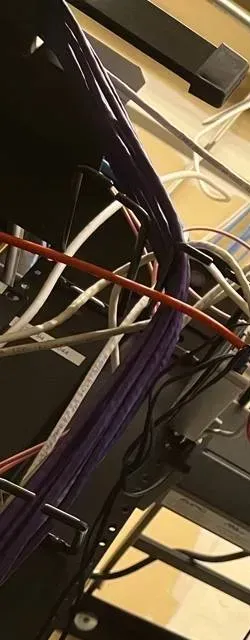
A photo from the AESS job library, not taken in Boerum Hill: bundles of purple, white and red cable dropping down beside a black equipment rack. A Boerum Hill two-family never needs a rack like this, but the small walk-ups on Nevins Street and the buildings over Atlantic Avenue shops often end up with a cellar cabinet where the entry system, cameras and internet meet, and keeping every bundle labeled is what lets the next technician find the buzzer pair quickly.
That propping problem is not a theory in the 84th Precinct. In January 2013, DNAinfo reported that 48 of the 141 burglaries in the precinct the year before had happened when residents' doors were unlocked. The precinct's commanding officer at the time, Capt. Maximo Tolentino, told a community council meeting: "Even if you're home, you can't assume it's OK to leave your front door open." Howard Kolins, then president of the Boerum Hill Association, put it as a warning to his neighbors not to encourage "a crime of opportunity." A buzzer does not stop every burglary, but it removes the main reason a rowhouse door ends up unlocked in the afternoon: somebody upstairs is expecting a delivery, a guest or a dog walker and does not want to walk down three flights to open it.
Deliveries are their own pressure. Brooklyn Paper reported a parcel thief who opened the front gate of a Bond Street townhouse and took about $3,500 worth of packages, including a Ring doorbell. Boerum Hill rowhouses have a small areaway and a gate at the sidewalk, a stoop up to the parlor door and often a second door under the stoop, which gives couriers three places to leave a box and thieves three places to look. A good installation decides where packages go before it decides which screen to buy: a release that lets couriers into the vestibule during the day, a camera that shows the stoop and the gate, or simply a household that can answer from a phone while it is out.
City records show that entry systems here fail too, even if less often than in some neighborhoods. When we queried HPD's housing maintenance code violations on November 11, 2026, Brooklyn Community Board 2, which takes in Boerum Hill along with Downtown Brooklyn, Brooklyn Heights, Fort Greene, Clinton Hill and DUMBO, had 192 intercom violations written since the start of 2020. On the streets that run through Boerum Hill, from Pacific, Dean and Bergen to State, Wyckoff, Nevins, Hoyt, Bond, Smith, Atlantic and Third Avenue, we counted 38. One Nevins Street walk-up was cited six times between August 2023 and October 2026, and one Wyckoff Street building three times in under two years. Tenants are calling 311 more as well: bell, buzzer and intercom complaints from the board rose from 30 in 2020 to 81 in 2024, and 2026 had already reached 107 by November 11, the most of any year on record.
Six Boerum Hill facts that decide a buzzer job before any equipment is chosen
Two-family houses are the norm. 260 of the 576 lots in the two historic districts are two-family houses, the largest single group in PLUTO's count. The usual system calls two apartments from one street door, often with the owner in one of them.
Few buildings cross the legal line. Only 23 lots in the districts have eight or more apartments, so the Multiple Dwelling Law's intercom requirement rarely applies. The decision is the owner's, which means the design should fit how the house is actually used.
Two entrances are common. Rowhouses here typically have a parlor-floor door at the top of the stoop and a garden-level door beneath it, and each can be the right one to release depending on who lives where.
Most fronts are landmarked. The original district was designated on November 20, 1973, and the extension, covering 288 buildings in three sections, on June 26, 2018. On those blocks the LPC sets where a panel can go and how it is attached.
Complaints are rising. 311 bell, buzzer and intercom complaints in Community Board 2 climbed from 30 in 2020 to 107 in 2026 by November 11, and Pacific Street led Boerum Hill's streets with 19 since 2020.
Shops sit under apartments. PLUTO lists 51 lots in the districts as residences with a store or office, mostly on Atlantic Avenue and Smith Street, where the apartment door and the shop door share a frontage.
Where this page applies. It covers Boerum Hill from Schermerhorn Street south to Warren and Wyckoff Streets and from Smith Street east to Fourth Avenue, including the State Street Houses, the Dean, Bergen and Pacific Street rows, the Atlantic Avenue frontage and the blocks around the Hoyt–Schermerhorn station. City figures quoted here use Community Board 2 or the two Boerum Hill historic districts, and we say which. For other parts of the borough, see our Brooklyn door buzzer installation page; for every borough, our NYC door buzzer installation page. Boerum Hill is billed at the same Brooklyn rate as every other Brooklyn neighborhood, with no travel premium.
Repair or Replace in Boerum Hill
Need Repair in Boerum Hill? A Bell That Went Silent, a Release That Hums, or a Door That Won't Stay Shut
Plenty of calls that begin as "we need a new buzzer" turn out to need one part. Before we price a new system for a Boerum Hill house, we ask what actually stopped working and when. If one apartment lost its handset after a kitchen was redone, that is usually a cut pair of wires in one wall, not a dead system. If the release hums but the door stays locked, the strike may have been knocked out of line by a door that has dropped on its hinges. If the whole house went quiet at once, the old transformer in the cellar is the first suspect. Each of those is a repair. A new system makes more sense when the handsets are a discontinued model, the panel has been patched more than once, or the wiring has been cut and spliced so often that nobody can say which pair goes where.
Two situations should be treated as urgent. One is a street door that cannot be locked, because a stuck-open strike or a broken latch leaves every apartment exposed. The other is a walk-up with an open HPD violation, where the clock is already running for the owner. In either case, call (347) 934-8335 and say so. A diagnosis is the $250 service call booked online, and the $250 is credited toward the repair or toward a new system if that turns out to be the better choice. You get both options priced, our recommendation and the reason for it. If a part has to be ordered, we make sure the door locks and opens with a key before we leave, so the building is never left open while you wait.
What We Install
Door Buzzer Installation Services in Boerum Hill
Every service below is priced from our Brooklyn door buzzer list. The number of apartments sets the size of the system, the door sets the release hardware, and the age and renovation history of the house set how long the cable work takes.
A first buzzer for a rowhouse
A door station, a release on the stoop or vestibule door and an answering point on each floor of a one-, two- or three-family house that has only ever had a mechanical bell or nothing at all.
A bell lost to renovation
A new system for a house whose old bell or intercom was removed or cut during a gut renovation, routed through the new walls in cooperation with the renovation crew where possible.
Video at the stoop
A camera door station with indoor monitors or video calls to phones, so whoever is upstairs sees the stoop, the gate and the courier before releasing anything.
Phone and app answering
Systems that ring phones or an app for owners who live elsewhere, tenants who are rarely home, and houses where opening finished plaster on every floor would cost more than the system.
Releases for two-door entrances
Electric strikes fitted to the parlor door, the vestibule door or the garden door under the stoop, chosen with the household around which door should open and which should stay on a key.
Landmark-fit door stations
Panels sized and finished to sit within or beside the door opening on Boerum Hill Historic District fronts, attached only at mortar joints, plain masonry, wood or metalwork the LPC allows.
Building Specialists
Door Buzzer Installation for Boerum Hill's Architecture
Six kinds of building account for nearly every Boerum Hill buzzer job. What separates them is not style or age so much as three practical questions: how many households the system has to call, which door it has to release, and which way a cable can travel from the stoop to the top floor without opening a finished room.
The rowhouse kept as one home
One household across three or four floors, with the kitchen often on the garden level and bedrooms two flights up. PLUTO counts 109 one-family lots in the districts. The job is reach, not apartments.
The two-family house
The single largest group, 260 lots in the districts. Usually an owner's duplex and a rental floor, or a garden-and-parlor duplex with a separate apartment above, sharing one stoop door.
The three-family house
114 lots in the districts. One apartment per floor above the garden or parlor, a long narrow stair and a three-button panel. Most multi-unit jobs here look like this.
The four-family and small walk-up
Four to fourteen apartments in a wider house or a purpose-built walk-up, often off the avenues on Nevins, Bond or Pacific Street, with a lobby door and an inner door.
The shop with apartments above
Atlantic Avenue and Smith Street buildings with a store or restaurant at street level and a narrow residential door beside it. PLUTO lists 51 such mixed-use lots in the districts.
The condo and the conversion
Small condominiums carved from rowhouses and newer buildings near Fourth Avenue and Schermerhorn Street, where a board or a developer, not one owner, decides on the entry system.
The rowhouse kept as one home: the bell rings where nobody is
A single-family Boerum Hill rowhouse has the fewest components and the hardest geography. The parlor door at the top of the stoop opens into a hall that nobody sits in. The kitchen is often on the garden floor below, the living room on the parlor floor, and the bedrooms and a home office two flights up. A mechanical bell or a simple chime in the hall is easy to miss from any of those rooms. The common answer is a single-button video door station at the parlor door, an indoor monitor on the floor where the household spends its days, and calls forwarded to phones so the top floor and anyone out of the house can answer too. If the household wants one device and nothing on the walls, a phone-only system is a reasonable choice for a house where everyone carries a smartphone.
The release decision is personal. Some owners never want the street door opened from upstairs, because they would rather see the visitor and walk down. Others want the vestibule door released for deliveries while the inner door stays on a key, so a courier can step out of the rain without entering the house. A few want the garden door under the stoop on a release because that is the door the family uses every day. We ask how the house is lived in before we fit anything. A video station with no strike at all is a perfectly good system for a family that only wants to see who is there, and it costs less than one with a release.
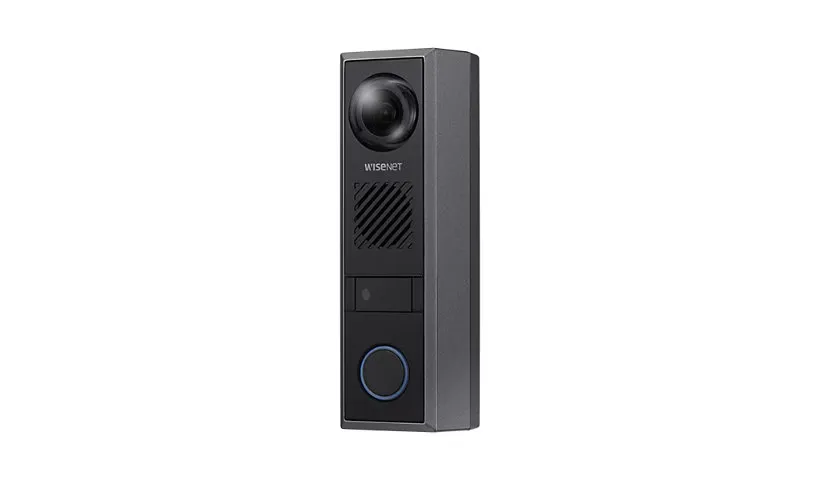
A photo from the AESS job library, not taken in Boerum Hill: a slim, dark grey wired doorbell with a camera lens, speaker slots and a round push button. On a Boerum Hill rowhouse kept as one home, a doorbell this narrow can sit on the wooden door frame inside the vestibule, out of the weather and clear of the stone, and because it is wired it does not depend on a battery that a cold stoop drains every winter.
The two-family house: one stoop, two households and a landlord who lives downstairs
The two-family house is Boerum Hill's typical building, and its entry system usually serves two very different users. An owner who lives in the lower duplex wants to see who is at the door and often wants a release on the vestibule door. The tenant upstairs wants to let in a food delivery without coming down two flights. A two-button panel at the stoop door, a station in each apartment and a release on the door both households use is the starting design. Where the garden floor has its own entrance under the stoop, the owner's button can ring there and at the parlor level, while the tenant's button rings only upstairs, so neither household is woken by the other's visitors.
Cable is where two-family jobs vary. The old bell wire in many of these houses ran up the stair hall, but the stair hall is exactly what renovations change: walls are opened, plaster replaced with drywall, a stair enclosed or a closet added. A route that worked in 1960 may now be behind a finished wall with recessed lights in it. The better routes are often less obvious: a closet that stacks from floor to floor, a chase beside the chimney breast, the back of the stair stringer, or a neatly run line up the rear wall from the cellar. When the owner lives in the house, these decisions can be made on the walkthrough in a few minutes, because the owner can say which walls are off-limits and which closets can lose a corner.
The three-family house: a three-button panel and a long climb
Three-family houses, 114 lots in the districts by PLUTO's count, are what most people mean when they ask for a "building buzzer" in Boerum Hill. The door station is a small panel with three buttons, or a short directory on a video station. Each apartment gets a handset, a monitor or app answering, and the release goes on the street door, the vestibule door or both. None of the equipment is complicated. The time goes into getting a cable to the third floor in a house whose party walls are solid brick and whose stair hall is barely wider than the stair. Before we price a three-family, we want to know whether any old cable reaches every floor, whether a closet or shaft stacks the full height of the house, and where in the cellar a 120-volt outlet is available for the power supply.
With those three answers, most three-family installations take a day. Where nothing stacks and the old wire is unusable, there are two honest options. One is a wired system with a cable run on the rear wall or through a single riser we create, which is the most dependable choice for the long term. The other is a phone or app system that needs cable only between the door and the power supply, which saves opening walls on every floor but depends on the building's internet and on each tenant's phone. We price both, side by side, so the owner can see the trade in dollars and in reliability rather than in sales language.
The four-family and small walk-up: planned like a building, not a house
Boerum Hill has a modest number of larger houses: 50 four-family lots in the districts, a few dozen with five to fourteen apartments, and walk-ups just outside the district lines on Nevins, Bond and Pacific Street. These need a system designed for the unit count: a directory panel with a button or code for each apartment, a riser cable that serves every floor, a power supply sized for the number of stations and, often, a second door to deal with. They are also the buildings where HPD's records cluster. The Nevins Street walk-up cited six times since 2023 had violations written against the system "from building front to return buzzer" in a fourth-floor foyer and against the panel in second-floor kitchens, which is exactly what happens when a system that was never designed for the building is patched apartment by apartment.
For these buildings we plan the whole entrance, not just the panel. That means deciding which door is released, whether the inner door has a closer that actually pulls it shut, whether the lobby has light for a camera after dark, where the power supply can sit away from the boiler and the water meter, and whether the building has any rear yard or cellar door that should be on the same system. If the building has eight or more apartments and was built or converted after 1968, the Multiple Dwelling Law already requires the intercom, and HPD will treat any failure as a violation, so we document the installation thoroughly enough that the owner can show an inspector what was installed and tested.
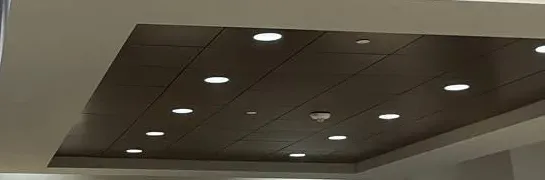
A photo from the AESS job library, not taken in Boerum Hill: a dark recessed ceiling panel with round downlights and a small round device, framed by a lighter ceiling. In a Boerum Hill walk-up lobby, lighting like this decides whether a video door station shows a visitor's face at night, so we look at the light over the door during the walkthrough rather than after the panel is mounted.
The shop with apartments above: two doors a few feet apart
Atlantic Avenue is covered by a business improvement district that runs from Fourth Avenue to the BQE and counts more than 400 businesses, and Smith Street is Boerum Hill's restaurant row. In both, the typical building has a store or restaurant on the ground floor and two to four apartments above, entered through a narrow door beside the shopfront. The entry system serves only the apartments, but it lives next to a business that changes its signage, awnings, gates, ceiling and lighting far more often than any apartment changes anything. A bracket drilled for a new sign or a hole cut for a ceiling fixture in the shop can cut the buzzer cable for every apartment upstairs in one move, and the tenants find out when their delivery cannot get in.
When we install in a mixed-use building, we keep the residential cable out of the shop's ceiling wherever the building allows it, label it clearly where it must cross, and put the power supply in the residential cellar or a locked residential closet rather than in the shop's basement. We also make sure the shop's own deliveries have a separate way in, so couriers stop pressing apartment buttons for the restaurant. If the owner wants the shop's rear door on a release or the frontage on a camera, those are priced as separate lines on the same quote, and doing them on the same visit is cheaper than coming back.
The condo and the conversion: a board, a developer and a system someone else chose
Boerum Hill's newer housing comes in two forms: small condominiums created inside old rowhouses, and new buildings near Fourth Avenue and on the northern edge along Schermerhorn Street, where a nineteenth-century church at the corner of Third Avenue sold in 2026 with apartments planned on the site. In both, the owner of the entry system is a board or a developer, not a single person, and the system was usually chosen before any resident moved in. One Reddit poster described a 13-unit, five-story New York condo with an existing analogue intercom looking to move to video, and another a five-unit building still under construction whose owner was picking a system before completion. Those are the two moments when entry decisions are made: when a board decides to upgrade, and when a builder decides what to leave behind.
For a board, we start from what is there: the panel, the stations, the wire and who holds the admin login. We test every apartment, document what we find and either take over the existing system or price a replacement with the reasons written down, so the board can put a real comparison in front of the owners. For a developer, the best time to settle the entry system is before walls close, when a riser can be run for a few dollars of cable instead of a day of fishing. If a building is in a historic district or the extension, its front also falls under the LPC, and the panel position should be on the drawings, not chosen on the day the door is hung.
Field Notes
Field Notes: The Five Things a Technician Looks at on a Boerum Hill Stoop
These notes describe the routine our technicians follow on rowhouses like Boerum Hill's. They are standard practice, not a story about any one address.
Both doors, opened and released. The technician starts at the sidewalk, not the cellar. The parlor door at the top of the stoop is opened and let go, then the vestibule door behind it, then the garden door under the stoop if there is one. Each should swing closed on its own and latch without a push. A nineteenth-century wooden door that has swollen, dropped on its hinges or been painted twenty times usually needs its closer adjusted, a hinge tightened or the keeper moved before any electric release will work every time. If a door does not latch, we say so before anything else, because a buzzer on a door that rests against its frame without catching protects nobody.
The frame and the lock. An electric strike replaces the part of the frame that the latch catches in, so the technician measures the frame depth, notes the lock and its latch type and checks whether the frame is original wood, a later metal frame or set beside glass. Old frames are often soft where decades of screws have gone in and out, and that decides whether the strike can be fitted directly or needs the frame built up first.
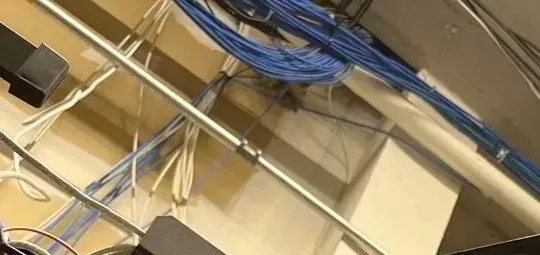
A photo from the AESS job library, not taken in Boerum Hill: bundles of blue low-voltage cable laid over a ceiling beam and a metal pipe in an open ceiling. A Boerum Hill rowhouse cellar looks much like this once the ceiling is open, with joists, old gas and water lines and generations of abandoned wire, and the technician traces which cable actually rises into the house before deciding whether any of it can carry a new system.
Where the old system ends. In the cellar, the technician looks for the old bell transformer or intercom power supply, usually near the electrical panel, and follows the cable from the door. Bell wire in these houses is often cloth-covered or brittle and spliced in several places. If any of it is going to be reused, every pair is tested from end to end; nothing is reused on the assumption that it works.
The route. From the cellar to the top floor, the technician looks for a path that avoids finished rooms: a stacked closet, a chase beside a chimney breast, the space behind the stair stringer, a dumbwaiter shaft, or the rear wall. The route decides the labor more than any piece of equipment does, and it is the part of the job that varies most between two houses on the same block.
The front. If the house is in the historic district or the extension, the technician notes where a station could sit within or beside the door opening without touching carved stone, cast iron or decorative woodwork, and photographs it, so any LPC permit application shows exactly what is proposed.
Stoop, Vestibule and Garden Door
Three Doors and One Decision: Which Boerum Hill Entrance Should the Buzzer Open?
A Boerum Hill rowhouse rarely has just one front door. There is the outer door at the top of the stoop, often a pair of doors on older houses; the inner vestibule door a few feet behind it; and, on many houses, a garden-level door tucked under the stoop behind the areaway gate. A buzzer can release any of them, or more than one, and the choice changes how safe the house feels, where packages end up and how much the job costs. It is the most important decision on a Boerum Hill installation, and the one most often made by default.
Releasing the outer door. If the outer door is released, a visitor or courier steps into the vestibule and the inner door stays locked. That keeps deliveries out of the rain and off the stoop, and it means a mistaken release lets someone into a small locked space rather than into the house. A Brownstoner forum member renovating a townhouse described wanting exactly that: a buzzer on the front doors so deliveries could be let into the vestibule without anyone going downstairs. The catch is that the vestibule then needs to be a place where packages are safe, which usually means a camera covering it and a solid inner door.
Releasing the inner door. Some households keep the outer doors open in the daytime, as rowhouses here were used for generations, and release only the inner door. Others release both. On the same Brownstoner thread, a member who installed fire alarms advised against "tying a remote release to the inner door," and another described being trapped and robbed in her own vestibule between the two doors, and urged that the interior lock not be "too difficult or time consuming to unlock." Those two comments pull in different directions, and both are right. A vestibule should never become a trap for a resident coming home, and it should never become an open door for a stranger. That is why we discuss the arrangement with the household rather than defaulting to one.
The garden door. On many two-family houses, the garden-level door is the owner's everyday entrance and the parlor door belongs to the tenant upstairs, or the reverse. In that case each door gets its own button, ringing only its own household, and each can have its own release. The LPC's Permit Guidebook allows one intercom per door opening, so a house with two entrances can have a station at each, as long as each sits within or beside its opening.
The hardware itself. Most releases here are electric strikes, a powered keeper in the frame that lets the latch pass when someone presses release. The lock is unchanged, so residents still use a key outside and turn the knob inside. Fail-secure strikes stay locked if the power fails, which suits street doors; as Allegion's guidance notes, you can always leave through a door with an electric strike by turning the lever, whether the strike is fail-safe or fail-secure. Where the latch is worn or the door is a heavy pair that will not line up, a motorized lock or a release built into a new lockset may be better than forcing a strike into an old frame. Magnetic locks are always fail-safe and need sensor and push-to-exit releases under the building code, so we rarely recommend one for a rowhouse street door.
Pairs of doors. On a pair of doors, one leaf is held by bolts at the top and bottom and the other carries the lock. The release goes where the active leaf latches. If the fixed leaf has been left unbolted for years, or the pair no longer meets squarely, the release will bind, and that has to be corrected first, on a landmarked front without changing how the doors look from the sidewalk.
Renovations
Boerum Hill Renovations and the Buzzer: Why the Bell Disappears and How to Keep the New One
If one event explains more Boerum Hill buzzer calls than any other, it is a renovation. Rowhouses here are bought, gutted and rebuilt all the time, and the old bell wire is one of the first things to go: it runs through exactly the plaster, stair walls and ceilings that a renovation removes. A Brownstoner forum member put it plainly when asking for help with a three-family brownstone: a former contractor and crew had "knocked out the previous bell that was working," and the house now needed a new bell and intercom. The same thing happens in reverse in apartment buildings. Habitat magazine described a co-op shareholder who lost intercom service after a downstairs neighbor's renovation, and the lawyers it interviewed agreed the building had to restore it, with one saying the co-op "has a legal obligation to repair or replace the intercom."
The cheapest time to install a buzzer system in a rowhouse is while the walls are open. A riser from the cellar to the top floor costs a few hours and a spool of cable when the stud bays are exposed, and a day or more of careful fishing once the new plaster is up and painted. If you are planning a renovation in Boerum Hill, the useful thing to do is call us when the electrician is roughing in, not when the painter is finishing. We can run the cable for the door station, the power supply and each floor's station, label it and leave it coiled for the finish stage, then come back to mount and test once the walls and doors are done.
Renovations also move doors. A new front door, a rebuilt vestibule or a garden entrance moved to the other side of the stoop changes where the release goes and what hardware fits. If the door is being replaced, we would rather see the new door's specification before it is ordered, so the frame can be prepared for a strike and a cable can be left in the frame. On a landmarked front, the door replacement itself may need LPC approval, and the panel position can be shown on the same application.
Finally, renovations are where systems get damaged after they are installed. A plumber opening a wall to move a bathroom, an electrician adding recessed lights or a carpenter rebuilding a closet can cut the buzzer cable without knowing it is there. Every system we install comes with a written wiring map showing where the cable runs, floor by floor, and we label the cable at each end and at the cellar. Hand that map to the next contractor before work starts, and the buzzer is far more likely to survive the next renovation than the last one did.
Phones, Apps and the Rules
Answering the Stoop From a Phone in Boerum Hill: What App Entry Changes for Owners and Tenants
A growing share of Boerum Hill owners ask for a system that rings phones instead of, or as well as, a station on the wall. The reasons are good ones. An owner who lives in Manhattan or upstate can see and answer the door of a rental house. A household that is out all day can let in a dog walker or a delivery. And in a renovated rowhouse, a system that needs cable only at the door and the power supply can spare every finished room from a new wall opening. But a phone system is still the building's entry system, and in a building with tenants the city expects it to behave like one.
The first expectation is that it keeps working. The Housing Maintenance Code makes the owner keep what is installed in good repair, and HPD writes intercom violations under §27-2005 whatever the technology. An app system that loses its internet connection, depends on a lapsed subscription or has an admin login that left with the last managing agent is, to an inspector, a broken intercom. When we install one, we plan for those failures in advance: the account is in the owner's name, the login is written down where the owner keeps building documents, the panel can fall back to a cellular line where the building's internet is unreliable, and any tenant who needs it gets a wired station as a backup.
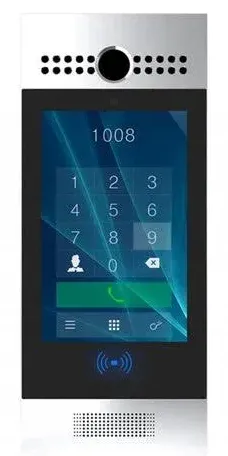
A photo from the AESS job library, not taken in Boerum Hill: a touchscreen entry panel showing a dial pad with a four-digit apartment code entered, a camera above it and a card-reader symbol below. A panel like this calls each apartment by a code rather than a name, which suits a Boerum Hill walk-up or small condo where residents change and nobody wants a surname on the street door.
The second is privacy. New York City's Tenant Data Privacy Law, Local Law 63 of 2021, applies to owners of multiple dwellings that use keyless entry such as apps, fobs, cards or biometrics. In HPD's summary, the owner needs a tenant's express consent, in writing or through the app, before collecting the data the system uses; the data is limited to a short list such as name, unit, contact preference, lease information and entry times; authentication data has to be destroyed within 90 days unless it is anonymized; the data cannot be sold; and an owner cannot require a tenant to use a smart access system to get into their own apartment. Owners must give tenants a written policy. A three-family rowhouse where the owner lives on the garden floor and rents two apartments is a multiple dwelling for these purposes, so the rules apply to more Boerum Hill houses than people expect.
None of that makes a phone system a bad fit here. It means it has to be set up with the rules in mind. When we install one in a building with tenants, we configure it to collect the minimum, keep a mechanical key working on every door, and give the owner the system's data and retention settings in writing so the policy can be written from facts. The policy itself is the owner's responsibility, and for a larger building it is worth a lawyer's review. For small houses the choice is usually practical rather than legal: if every resident carries a smartphone and the owner lives elsewhere, phone answering works well; if one tenant uses only a landline or simply does not want an app, a wired station in that apartment solves it, and most systems can run both side by side.
Commercial Door Buzzer Installation
Business Door Buzzer Installation in Boerum Hill
Commercial buzzer work in Boerum Hill is concentrated on a handful of streets and is mostly about three kinds of door: the apartment entrance beside a shop, the upstairs office or studio that has to stay locked, and the back or side door where a restaurant or store takes deliveries. These are the corridors where that work sits.
Atlantic Avenue
The neighborhood's northern commercial spine, long known for antiques and design shops, inside a business improvement district of more than 400 businesses. Many buildings have apartments above the shops, and Atlantic Avenue logged 11 buzzer complaints to 311 in Community Board 2 since 2020.
Smith Street
Boerum Hill's restaurant row on its western edge, with dining rooms and bars at street level and two or three apartments above, where kitchens take deliveries through side and cellar doors.
Fourth Avenue
The wide eastern edge, home to the Pacific Branch of the Brooklyn Public Library at 25 Fourth Avenue, with mixed-use buildings whose residential doors face heavy traffic and foot traffic.
Third Avenue
A north–south street of older mixed-use and residential buildings between the rowhouse blocks, where small offices and workshops share frontages with apartment entrances.
Schermerhorn Street
The northern boundary, facing Downtown Brooklyn, where an 1890s church at Third Avenue sold in 2026 with apartments planned and newer buildings bring lobby doors and larger directories.
Hoyt Street by the station
The blocks around the Hoyt–Schermerhorn Streets station on the A, C and G lines, where offices, studios and walk-ups see constant visitors from the subway entrances.
Boerum Hill's businesses have reason to think about their doors. Brooklyn Paper reported two businesses on the same block, Blank Street Coffee and Piccola Cucina Casa, having their front glass doors smashed overnight, with cash taken from both. In March 2026, Hoodline reported that the 84th Precinct had warned shopkeepers in Downtown Brooklyn and Brooklyn Heights, the precinct's neighbors to Boerum Hill, about a rise in break-ins and urged lighting, cameras, locks and alarms, and offered free security surveys. A buzzer does not stop a brick through a window, and we would not claim it does. What it does is control the doors that are supposed to stay locked during business hours: the apartment door beside the shop, the office up a flight, the stockroom door at the back.
For a business, the buzzer usually does one of three jobs. It holds an upstairs office, studio, clinic or salon door locked so staff see who is there before letting them in. It separates the business entrance from the residential entrance in the same building, so customers and couriers stop ringing apartments. Or it lets a delivery driver into a back or cellar entrance during set hours without a staff member running down to open it. Each job starts with who answers the door and how often, and each is priced from the same Brooklyn list as residential work.
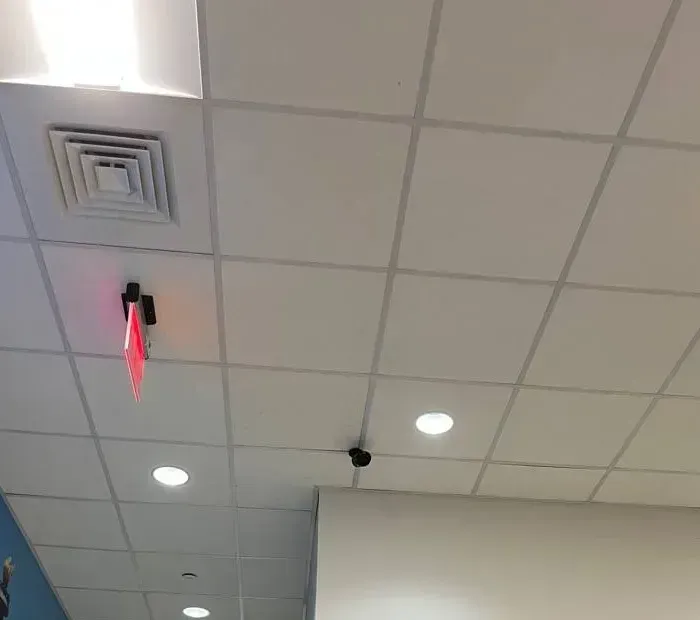
A photo from the AESS job library, not taken in Boerum Hill: a drop ceiling with a lit red exit sign, an air diffuser, round recessed lights and a small black camera. Upstairs offices and studios over Atlantic Avenue and Smith Street shops often look like this inside, and the exit sign is the reminder that any locked door on the way out must still let people leave freely, which shapes the release hardware we fit.
Business doors also take more abuse than house doors. A salon or office may buzz someone in every few minutes for ten hours a day, and a restaurant's side door is kicked open with a hand truck. That calls for a heavier-duty strike, a closer adjusted to pull the door shut every time, a door station built to be pressed thousands of times a month and, where the staff need to see the door from more than one spot, a video station with monitors at the front desk and in a back office rather than calls to personal phones. If the owner wants a camera on the entrance or the rear door as well, it goes in on the same visit, and doing both together usually saves $200 to $400 in labor.
Compliance points that apply to Boerum Hill entry installations
Multiple Dwelling Law §50-a. Class A multiple dwellings with eight or more apartments, erected or converted after January 1, 1968, must have a self-locking main door and an intercommunication system with voice contact and remote release. Older buildings of that size must install them if tenants in a majority of apartments request or consent in writing, with work begun within 90 days and completed within six months.
Housing Maintenance Code §27-2005. Owners keep what is installed in good repair. Every intercom violation we found on Boerum Hill's streets since 2020 was written under this section as an order to properly repair or replace the broken or defective system.
Tenant Data Privacy Law (Local Law 63 of 2021). Keyless entry in Class A multiple dwellings needs consent, a written policy, limited data, destruction of authentication data within 90 days unless anonymized, no sale of data, and no requirement to use smart access to enter one's own apartment.
Landmarks Preservation Commission. In the Boerum Hill Historic District and the 2018 extension, LPC staff can approve an intercom or doorbell within or beside the door opening, or on a fence or wall in front of the entrance, one intercom per opening, attached at mortar joints, plain masonry, wood or metalwork and never through cast iron or decorative elements, with conduit concealed.
Electrically locked egress doors. The NYC Building Code requires sensor release on the egress side, release on loss of power, a manual push-to-exit device mounted 40 to 48 inches above the floor within five feet of the door that keeps it unlocked for at least 30 seconds, and release when a fire alarm or sprinkler system activates. Fire-rated doors take fail-secure strikes.
Accessible reach. Under the 2010 ADA Standards, operable parts such as call buttons sit within a high forward reach of 48 inches and a low reach of 15 inches. Business entrances in particular should have the station within that range wherever the front allows it.
Electrical work. Our work is low-voltage entry equipment under NYS license #12000287431. Where a system needs a new 120-volt circuit or outlet, a licensed electrician provides it under the Department of Buildings' electrical rules, and we say so before the price is fixed.
Your Questions Answered
Door Buzzer Installation in Boerum Hill: Questions Answered
These are the questions Boerum Hill owners, renters, boards and shopkeepers bring to us, and that come up in neighborhood forums, when a new entry system is on the table. They cover new buildings that came without one, renovations that took one away, the space between two front doors, packages, alarms, repeat violations and buying a house. Each is answered in full here and is not repeated in the FAQ further down.
New buildings and lost bells
I'm about to rent in a brand-new three-unit building in Brooklyn that has no buzzer and one shared mailbox. Is that allowed?
Usually, yes. A renter asked almost exactly this on Reddit about a newly built three-unit Brooklyn building with a first-time landlord. The Multiple Dwelling Law's intercom requirement applies to buildings with eight or more apartments, so a three-unit building can legally be built and rented without one. Mail is a separate question between the landlord and the Postal Service, so ask about it directly. What matters for you is practical. Without a buzzer, every visitor and courier either calls your phone or waits at the door, and the street door is more likely to be propped. Before signing, it is fair to ask the landlord whether an entry system is planned and to put the answer in writing. For an owner, a three-apartment audio system on our Brooklyn list sits in the $400 to $900 range and video in the $700 to $1,800 range, and in a new building with open walls it is at the easier end of the job.
Our renovation contractor cut the old bell wire. Who pays to put the buzzer back?
That depends on who did the work and what was agreed. In a house you own, it is a question between you and your contractor: if the renovation scope said existing low-voltage systems would be protected or reinstated, the contractor should cover it; if the contract is silent, it is usually a negotiation. In a co-op or condo, Habitat magazine's February 2024 article on a shareholder who lost the intercom after a downstairs renovation is a useful guide. The lawyers it spoke with agreed the co-op had to restore service, and one noted the downstairs neighbor might be responsible under the alteration agreement and could in turn have a claim against their contractor. For tenants, the owner has to keep the installed system in repair under the Housing Maintenance Code regardless of who broke it. Whoever pays, the practical step is the same: get a written diagnosis and price first, so the conversation is about a real number. We can give you both a repair and a replacement figure from one $250 diagnostic visit, which is credited to the work.
Doors, vestibules and alarms
A neighbor was cornered in her vestibule between two locked doors. How should our doors be set up so that can't happen?
A Brownstoner forum member described exactly that: being trapped and robbed between the outer and inner doors of her own house, and afterwards wanting an inner lock that was not slow or fiddly to open. The arrangement that protects residents best is one where the outer door is the one released from upstairs, the inner door opens quickly with a key or a code for someone coming home, and the vestibule is visible from inside, usually through a video station or a small camera. That way a resident who senses trouble on the stoop can get through the inner door fast, and a visitor let in by mistake is still held in a locked space. We avoid setups where the inner door needs two separate locks or a slow keypad to open from outside, and we never fit a release that would trap anyone inside the vestibule: both doors must always open freely from the inside.
Can the panel or a reader at our street door also turn off our house alarm when we come in?
Often it can, and it is worth planning for if you have an alarm or are adding one. On a Brownstoner thread about rowhouse security, a fire-alarm installer suggested a card reader at the outer door that would release both doors and disarm the alarm in one step. Many entry and alarm systems can be linked that way, using a code or credential that the alarm accepts as a disarm signal. The details depend on the alarm panel: some accept a signal from the door controller, some need an add-on module, and older panels may not support it at all. We check the make and model of your alarm on the walkthrough and tell you whether linking is possible and what it adds to the price. Visitors pressing the call button never disarm anything; only a resident's code or credential does.
The latch on our old stoop door is worn. Would a motorized lock be better than an electric strike?
Sometimes. An electric strike only works as well as the latch it releases, a point the same Brownstoner thread made when it noted that typical strikes "rely on the door handle latch." On a nineteenth-century door with a worn latch, a sagging leaf or a pair of doors that no longer meet squarely, the strike will bind or let the door pull open. The first fix is the door itself: hinges tightened, the leaf rehung, the keeper moved. If the lock is past saving, a replacement lockset with a motorized latch or bolt can be released by the buzzer and still opened with a key, and it avoids cutting a deep pocket into an old frame. It costs more than a strike, and on a landmarked front it has to keep the door's appearance. We tell you on the walkthrough which one your door can take.
Packages and visitors
Our landlord's answer to stolen packages was another lock on the front door. Would video at the door have done more?
For packages, usually yes. A Reddit poster described a New York landlord adding extra locks after package thefts while tenants asked for a video intercom so residents could see who was at the door. More locks make the door harder for couriers too, so boxes end up on the stoop, which is where thieves look. On Bond Street, Brooklyn Paper reported a thief who opened a townhouse's front gate and took about $3,500 in parcels. What helps is giving couriers a safe place inside: a release on the outer door so a tenant can let a driver into the vestibule from a phone, a camera covering the vestibule and stoop, and a household that can answer while out. A video station also cuts down on tenants buzzing in voices they do not know. It will not stop every theft, but it moves the package from the sidewalk to behind a locked door.
Our Smith Street restaurant takes produce deliveries at the side door before we open. Can a buzzer let the driver in without someone running upstairs?
Yes. The usual setup is a door station at the delivery door that calls a monitor in the kitchen or office, or a phone, with a release on that door so whoever is working can see the driver and let them in. If deliveries come at a regular time, some controllers can also hold the door unlocked for a short window, though for a door into a kitchen most owners prefer a person to see each driver. The door has to keep letting staff out freely at all times, so the release is chosen with exit rules in mind, and the station is mounted where a driver with a hand truck can reach it. If the building has apartments upstairs, the restaurant's system is kept completely separate from the tenants', so drivers never ring an apartment by mistake.
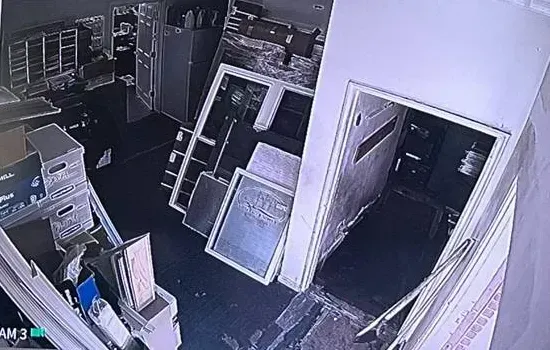
A photo from the AESS job library, not taken in Boerum Hill: a black-and-white night camera view of a cluttered room with an open doorway into a dark back room. This is how infrared video looks with no light at all; it shows shapes and movement well but not faces at any distance, which is why a Boerum Hill stoop or restaurant side door needs a light over it if a video door station is meant to identify who is there.
Can one smart video doorbell on our stoop work for both households in a two-family?
Not well. A consumer video doorbell has one button and one account, so a visitor for the tenant rings the owner too, and both households have to share one app login or one set of notifications. It also cannot release the door for both apartments without extra hardware. For a two-family, a two-button video station, with a separate monitor or app account for each household and a release both can trigger, does the job properly, and on our Brooklyn list a video system for a small building is in the $700 to $1,800 range. If you already own a smart doorbell you like, it can stay at the garden door for the owner's household while the shared station goes at the parlor door, which is a common split on Boerum Hill two-families.
Records, buyers and walk-ups
The same walk-up keeps getting HPD intercom violations year after year. Why would a repaired system keep failing?
Because it is usually being repaired one apartment at a time. HPD's records for one Nevins Street walk-up show six intercom violations between August 2023 and October 2026, written against different apartments: a foyer on the fourth floor, kitchens on the second. When each complaint is fixed by replacing that apartment's handset or splicing that apartment's wire, the next weak point fails a few months later. The repeat pattern usually means an aging power supply, a riser with failing joints in the cellar, or a mix of handset models that were never designed to work together. The way out is to test the whole system once: every pair from the panel to each apartment, the power supply under load, and the release. Sometimes that points to a riser and a power supply; sometimes it points to a new system. Either way the owner gets a plan that ends the cycle instead of another visit.
What should a buyer check on a Boerum Hill rowhouse's buzzer before closing?
Five things, most of which a buyer can do in ten minutes at the showing. Press each button and listen in each apartment for the call. Talk both ways and listen for hum or crackle. Press release from every apartment and watch the strike actually let the latch pass. Close each entrance door and check that it latches by itself. And ask the seller for any login, model number or installer's name, because an app system with no admin login is a system you will have to replace. If the building has eight or more apartments, also look up the address in HPD's violation records for open intercom violations, since those pass to the new owner. If anything fails, a $250 diagnostic visit, credited toward the work, gives you a written repair or replacement figure to bring to the negotiation.
Our small Boerum Hill condo board wants to replace a dated audio intercom. Who decides, and what should the board get in writing?
The board decides, within whatever the condominium's bylaws say about common elements and spending, and in many small condos a larger expense needs a vote of the owners. The entry system is almost always a common element, so it is the association's to maintain and replace. What the board should get in writing is not just a price. It should be a description of what each apartment will have, whether existing cable is reused and how it was tested, who will hold the admin account and the login, whether there is any recurring fee and who pays it, what happens if the building's internet is down, and what the warranty covers. With that in hand, owners who were not on the walkthrough can compare a wired system with a cloud system on real terms. We provide that document with every quote for a building with more than one owner.
Equipment
Types of Door Buzzer Systems We Install
By default we quote a reliable non-branded system, and we install named brands when an owner asks for one; the intercom brands we work with include Aiphone, ButterflyMX, 2N, Akuvox, Comelit and DoorBird. These are the categories that suit Boerum Hill houses and buildings, with the situations each fits best.
Audio buzzer systems
A button panel at the stoop and a talk-and-release handset in each apartment. The lowest-cost choice for a two- or three-family house, with no internet and no subscription involved.
Two-wire multi-tenant systems
Retrofit systems such as Aiphone's GT series, which can run over existing wire in good condition and scale from a handful of apartments to thousands of tenant stations, in audio or video.
Video door stations and monitors
A camera station at the parlor or garden door and a screen in each apartment, the usual upgrade for owners who want to see the stoop and the areaway gate before releasing.
Phone, app and cloud systems
Stations that ring phones over the building's internet or a cellular line, with a directory the owner edits remotely. Good for off-site owners and renovated houses where new cable is costly.
Keypad and code panels
Door stations that combine visitor calls with resident codes or cards, for walk-ups and condos that want one device per opening on a landmarked front.
Releases, closers and power
Fail-secure strikes, motorized locksets for worn doors, closers set to latch every time, and power supplies with battery backup sized to the number of stations.
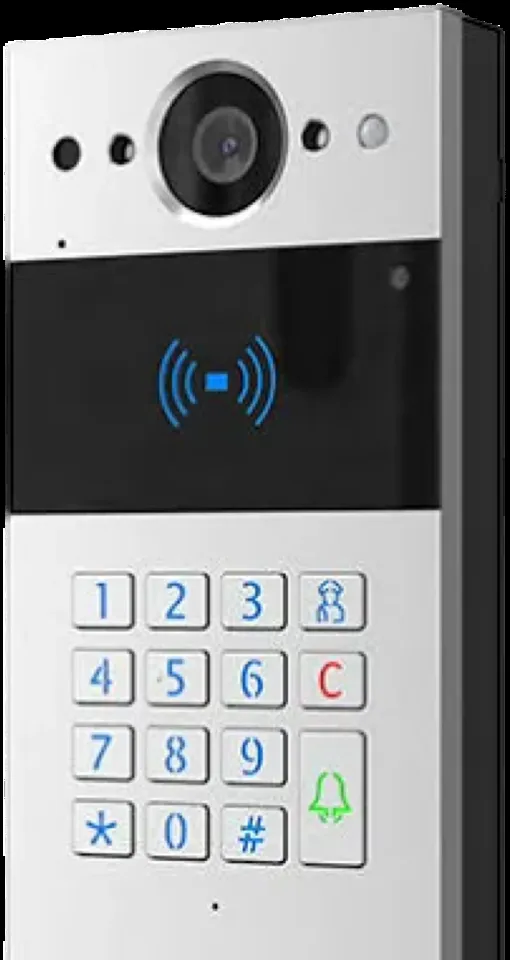
A photo from the AESS job library, not taken in Boerum Hill: a silver and black keypad door station with a camera lens at the top, a blue card-reader symbol, a numeric keypad and a green bell key. A combined station like this is a good fit for a Boerum Hill walk-up or small condo, because visitor calls and resident entry share one device, and the LPC allows only one intercom per door opening on a designated front.
Handsets, screens or phones for a Boerum Hill two- or three-family
The table compares the three main ways of answering for the building most common here, a two- or three-family rowhouse with one shared stoop door. None is right for every house; it depends on who lives there, whether the owner is on site and how finished the walls are.
Question
Audio handsets
Video monitors
Phone or app
New cable to every floor
Yes, or tested old wire
Yes, or tested old wire
Only door to power supply
Works with the internet down
Yes
Yes, inside the house
Only with a cellular fallback
See the stoop
No
Yes
Yes, on most systems
Answer from outside the house
No
With a phone add-on
Yes
Recurring fees
None
None
Often a subscription
Brooklyn list range, small house
$400–$900
$700–$1,800
Quoted at the walkthrough
AI Overview Reality Check
What AI Gets Wrong About Door Buzzer Installation in Boerum Hill
The claims below are typical of generic online answers, national cost guides such as HomeAdvisor and Angi, and intercom vendors' blogs, paraphrased. After each one is what Boerum Hill's houses, records and rules actually show.
"Expect to pay about $2,500 for an intercom"
HomeAdvisor gives a national average of $2,500, inside a range of $1,500 to $15,000, with hard-wired systems at $1,000 to $15,000.
National averages lean toward bigger buildings. In the Boerum Hill historic districts, 260 lots are two-family houses and 114 are three-family, and an audio system for a house that size is $400 to $900 on our Brooklyn list, with video at $700 to $1,800.
We price the house in front of us from photos and a walkthrough, not from a national figure, and the price is fixed in writing.
"Wireless is the easy do-it-yourself route"
Cost guides describe wireless intercoms as the DIY option, at $150 to $1,500.
In a brick rowhouse, a radio link between the stoop and the third floor has to pass party walls, chimney masonry and plaster on lath, and it is the kind of link that works on the day it is installed and drops out later. In a two- or three-family, the owner is also the one responsible for keeping the system working for tenants.
Where cable is hard, we point owners to phone-based systems that need cable only at the door, and we test any true wireless link on site before recommending it.
"Video entry costs thousands per door plus monthly fees"
Vendor guides such as Swiftlane's quote $1,000 to $5,000 or more per entry door for IP and video systems, with software at $5 to $15 per unit per month or $30 to $100 per door per month.
Those numbers describe apartment complexes. A Boerum Hill two-family has one stoop door and two households, and a wired video system for it has no subscription at all.
We show the wired option and the cloud option side by side, with any recurring fee written out, before an owner chooses.
"Just reuse the wiring that's already there"
Upgrade guides, including Aiphone's, say existing wire in good condition can be reused, and the GT series is designed to use it.
The words "in good condition" carry the weight. In houses from the 1840s to the 1870s that have been divided and renovated, the old bell wire is often cloth-covered, spliced many times or cut during a gut renovation, as one Brownstoner member found when a contractor knocked out a working bell.
We test every pair from end to end and reuse only what passes; the rest is replaced, and the quote says which is which.
"Small buildings are required to have an intercom"
Answers about New York often treat a working buzzer as a legal requirement for every apartment building.
The Multiple Dwelling Law requirement applies to buildings with eight or more apartments, built or converted after 1968, or older ones where a majority of tenants ask in writing. In the Boerum Hill districts only 23 lots reach eight apartments. What does apply to every building is the Housing Maintenance Code duty to keep an installed system in repair.
We tell owners plainly which rule applies to their building, and for small houses we design around how the doors are used, not around a requirement that does not exist.
"App entry is a simple switch for the landlord"
Product pages present phone entry as an upgrade an owner can turn on for the whole building.
In New York City multiple dwellings, which include three-family rowhouses, the Tenant Data Privacy Law requires consent and a written policy, limits the data collected, and bars requiring a smart system to enter a tenant's own apartment. HPD also writes violations when phone-based intercoms stop working.
We set app systems to collect the minimum, keep mechanical keys working on every door, and give owners the settings in writing.
"Put the panel wherever it's handiest"
Installation guides suggest mounting the panel at the most convenient spot near the door.
On designated Boerum Hill fronts, the LPC allows one intercom per door opening, within or beside the opening or on a fence or wall in front, attached at mortar joints, plain masonry, wood or metalwork and never through cast iron or decorative elements, with conduit concealed.
We choose a position that meets those rules and the accessible reach range, and photograph it for the permit, before anything is drilled.
Not Sure Which Door to Release? Ask a Technician First
Tell us the cross streets, the kind of building, the number of apartments and which doors open onto the street. A technician will call back with the range for the Boerum Hill address, or you can call (347) 934-8335 now.
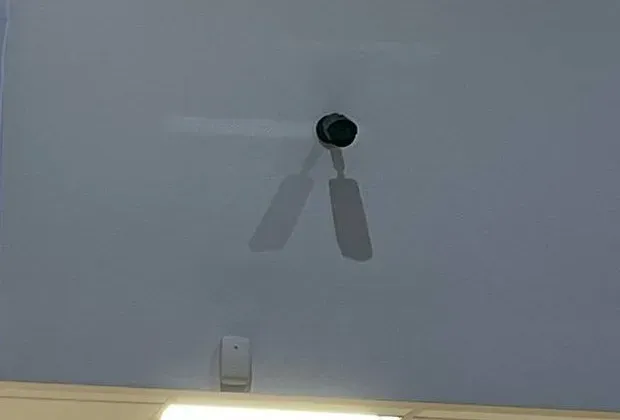
A photo from the AESS job library, not taken in Boerum Hill: a small black camera mounted high on a pale wall, casting two shadows, with a small white wall device below it. Many Boerum Hill owners add a camera like this inside the vestibule when the buzzer goes in, so the space between the two doors is visible from upstairs; if you want one, mention it on the form and we price both together.
✅
Request Sent!
Thank you. A technician will call you about the Boerum Hill address, usually within two hours during working hours.
How It Works
Our Installation Process
1. Photos and first call
Send the stoop door, the vestibule door, any garden door, the old bell plate and the cellar, with the number of apartments. You get the matching range on the Brooklyn list.
2. Walkthrough
A technician checks every entrance door and latch, each apartment, the cable route from cellar to top floor and any LPC limits on the front.
3. Written plan and price
System type, panel position, release door, cable route, power location and price, approved by you before anything is ordered.
4. Doors first
Closers, hinges and keepers are corrected so each door closes and latches by itself before any release is fitted.
5. Release, cable and panel
The release goes into the chosen frame, cable follows the agreed route and the station is mounted within the door opening.
6. Apartment stations
Handsets, monitors or app accounts are installed and labeled for each household.
7. Power and testing
Power supply and battery backup connected; every apartment tested for call, talk, video and release.
8. Hand-over
Wiring map, admin logins, directory and a tenant guide go to the owner, and each household is shown how to answer and release.
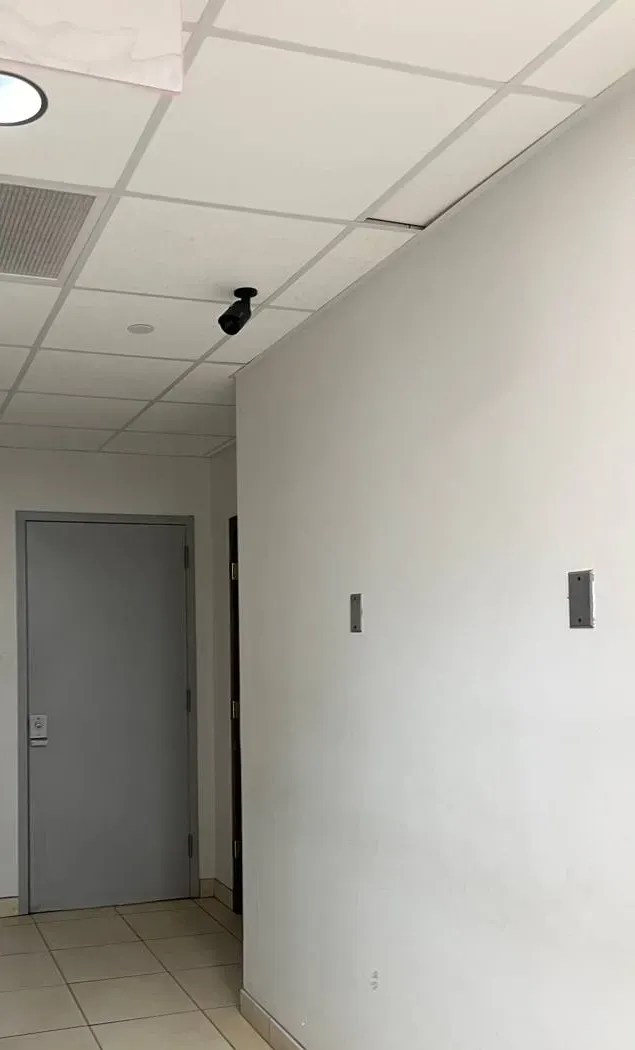
A photo from the AESS job library, not taken in Boerum Hill: a tiled corridor with white walls and small wall plates, ending at a grey steel door with a lever handle under a drop ceiling with a small camera. Rear and cellar doors in Boerum Hill walk-ups and Atlantic Avenue buildings are often steel doors like this one, and step four applies to them as much as to a wooden stoop door: if the door does not close and latch by itself, that is fixed before a release is wired to it.
Coverage Area
Door Buzzer Installation Near Boerum Hill's Landmarks
Boerum Hill Historic District
Designated November 20, 1973; with the 2018 extension, PLUTO counts 576 lots and 1,478 apartments, where front panels follow LPC rules.
State Street Houses
Twenty-three rowhouses on State Street between Smith and Hoyt, built 1847 to 1874 and landmarked in 1973, typical of the small houses most buzzer jobs here involve.
Pacific Branch Library
The 1905 Carnegie branch at 25 Fourth Avenue, the oldest in Brooklyn, on the neighborhood's eastern edge.
Hoyt–Schermerhorn Streets Station
The A, C and G station opened in 1936 on the border with Downtown Brooklyn, surrounded by walk-ups and offices with busy front doors.
Atlantic Avenue
The commercial spine inside a business improvement district of more than 400 businesses, with apartments above many of its shops.
Smith Street
Boerum Hill's restaurant row on its western edge, where dining rooms sit under small apartments and kitchens take deliveries at side doors.
We also serve Cobble Hill, Carroll Gardens, Gowanus, Park Slope, Downtown Brooklyn, Fort Greene and Prospect Heights at the same Brooklyn rate; our door buzzer installation in Brooklyn page covers the whole borough. Entry doors and intercoms at the Gowanus Houses, the public housing development of 16 buildings and 1,139 apartments at the neighborhood's southern edge, are managed by NYCHA, so residents there should report problems to NYCHA directly.
Pricing
Door Buzzer Installation Cost in Boerum Hill
Boerum Hill is billed at our standard Brooklyn rate, with no travel premium. The ranges below are installed prices covering equipment, release hardware, power supply, cable and labor. Where your house falls inside a range depends on the doors, the cable route, the number of apartments and the choice of audio, video or phone answering. Your figure is set in writing after the walkthrough and only changes if you change the scope.
Item
Brooklyn price
Audio buzzer system, small building (most two- and three-family rowhouses)
$400–$900 installed
Video buzzer system, rowhouse or small building
$700–$1,800 installed
Multi-unit building system, by door and apartment count
From about $2,500; large video or cloud systems $10,000+
Diagnostic service call, booked online
$250, credited toward the work
Estimate for a new system from photos or a walkthrough
Free
Entrance or vestibule camera installed with the buzzer
Priced per camera; combining usually saves $200–$400 in labor
New 120-volt circuit or outlet, if needed
By a licensed electrician, quoted separately
Three things most often push a Boerum Hill job toward the top of its range. The first is a door that has to be fixed before it can take a release: a pair of doors that no longer meets, a frame softened by old screws, a latch worn past use. The second is a cable route with no stacked closet or chase, usually in a house that has been fully renovated, which means more time fishing cable behind new plaster or running it neatly on the rear wall. The third is video in every apartment rather than audio. Things that keep a job low in its range are old cable that tests sound, a straightforward wooden frame, a renovation that is still at the open-wall stage, and a mix of audio handsets with phone answering only for the households that want it.
Full terms — including 50% deposit, one-year parts-only warranty on AESS-supplied products, and the late-fee schedule — are set out in the service agreement.
Shop Our Systems
Door Buzzer Installation Packages & Pricing
Three typical Boerum Hill jobs, each priced inside the matching range on our Brooklyn list. Your exact figure comes from the walkthrough.
Two-family audio: $400–$900
A two-button station at the stoop door, a fail-secure strike on the door both households use, a backed-up power supply in the cellar and a talk-and-release handset in each apartment.
Rowhouse video: $700–$1,800
A video station within the parlor door opening, monitors on the floors each household uses, phone answering for anyone out, and a release on the door the owner chooses.
Walk-up or condo: from about $2,500
A directory or code station for the building, a riser to every floor, audio or video stations by apartment, heavy-duty release hardware and an admin account in the owner's or board's name.
Bring your own equipment. If you have already bought a door station or handsets, we can install them as long as they suit the house and the door. Labor for customer-supplied equipment is quoted flat at the walkthrough, and release hardware and cable are priced from the same list. Equipment you supply carries its manufacturer's warranty rather than ours, so we check the model with you before you book.
Complete Services
Every Door Buzzer Service in Boerum Hill
New systems
First buzzers, post-renovation replacements and video upgrades. Request a quote
Do you need to get into every apartment during the installation?
+
Yes. Each apartment's station has to be mounted, connected and tested for call, talk and release, so the technician needs a few minutes inside every unit on installation day. If one apartment cannot be reached, that unit cannot be finished, so owners should arrange access with tenants in advance.
Do you remove the old transformer and the dead bell wire, or leave them in place?
+
The old transformer and any exposed dead wire in the cellar are disconnected and removed so nobody mistakes them for the new system later. Dead wire sealed inside finished walls is cut back and left, because pulling it out would mean opening plaster for no benefit.
Can the door station's finish match the black ironwork or brass on our stoop?
+
Usually. Door stations come in black, silver, bronze and brushed finishes, and some makers offer surface boxes or hoods in matching colors. On a landmarked front the LPC also expects a finish compatible with the building, so we show you the finish options at the walkthrough.
Is adjusting the street door's closer part of a buzzer installation?
+
Yes. A release only works if the door closes and latches by itself, so setting the closer, tightening hinges and moving the keeper are part of the job. If the closer is broken or missing, a replacement is listed on the quote as its own line.
If one apartment's handset gets damaged, do the other apartments keep working?
+
On a properly wired system, yes. Each station is wired and labeled so a damaged handset can be disconnected and replaced without taking down the rest of the house, and the wiring map shows exactly which pair serves which apartment.
Do tenants have to buy anything for the new system?
+
No. The door station, the apartment stations and the release are part of the owner's installation. Tenants who choose phone answering only need the free app on their own phone, and anyone who prefers not to use an app gets a wired station instead.
If we sell the house, how is an app-based entry system handed to the new owner?
+
The admin account should be transferred, not shared. Before closing, the seller hands over the login or transfers ownership in the vendor's portal, and the buyer changes the password and resets resident access. We can do the transfer on a short visit if the seller has lost the details.
Can the release be switched off at night so nobody can be buzzed in after a set hour?
+
On many systems, yes. A controller or app schedule can disable remote release during hours you choose while calls still ring through, so a resident can still talk to a late visitor and walk down to open the door with a key.
Can we see the actual door station before it is mounted on our front?
+
Yes. We send the model's photos and dimensions with the quote, and on request we hold the station against the door frame at the walkthrough so you can judge the size and position before anything is drilled.
Can a cleaner or dog walker get a temporary code instead of a key?
+
On keypad and app systems, yes. The owner can create a code or app pass that works only on certain days or hours and delete it when it is no longer needed. Audio and video systems without a keypad do not offer codes, so we mention this when you choose the system.
Is there a minimum size of job you take in Boerum Hill?
+
No. We install single-button stations for one-family rowhouses as well as systems for walk-ups and condos. Small jobs are priced from the same Brooklyn list, starting in the audio range for a small house.
Can the door station show our house number so couriers find the right stoop at night?
+
Many stations have a backlit label or number field, and some video panels can display the address on screen. On a landmarked front we keep any lit lettering small and inside the door opening, and a separate house number near the door may need its own LPC check.
Ready to Hear the Door From Every Floor of Your Boerum Hill House?
Send a photo of each entrance door, the old bell plate and the cellar with your cross streets and the number of apartments, and we will tell you which door should carry the release and where the job sits on the Brooklyn list. Call or text (347) 934-8335, message us on WhatsApp, or use the request form. Licensed under NYS license #12000287431, rated 4.7★ across 201 Google Reviews, owner-operated since 2002.