Doorbell nobody hears upstairs, a two-family where the tenant's visitors ring the owner, or a video doorbell that drops offline at the front of a long house? Bergen Beach door buzzer installation line: (347) 934-8335
Detached and Semi-Detached Houses · Two-Family Homes With a Rental Entrance · Side Doors Off the Driveway · Georgetowne Condos · Shops on Ralph Avenue and Avenue N
Door Buzzer Installation in Bergen Beach
Wired Video Doorbells · Two-Button Stations for Two Households · Chimes on Every Floor · Brooklyn Rate
Door buzzer installation in Bergen Beach is mostly a house job, not an apartment-building job. The blocks between Avenue N, Ralph Avenue and the water are lined with detached and semi-detached one- and two-family homes, many with a driveway, a side door that visitors actually use, a finished basement and, in the two-families, a tenant who needs a bell of their own. So the work here usually means a wired video doorbell that sees who is on the step and rings every floor, a two-button station that sends each household's visitors to the right people, or a door release so the person upstairs can let a guest in without walking down. This page explains how we plan each of those for Bergen Beach houses, what the old doorbell wiring in them can and cannot carry, how the flood risk around the three basins changes where equipment goes, and what each kind of job costs on our Brooklyn door buzzer list.
Prices come from our published Brooklyn door buzzer list, and the total is agreed in writing before any equipment is ordered
Rated 4.7★ across 201 Google Reviews
Reviewed and updated November 11, 2026, against Brooklyn Community Board 18's page on Bergen Beach and Georgetowne; New York's Multiple Dwelling Law §4 definitions of private and multiple dwellings and §50-a on intercoms; Bergen Beach property listings on Brownstoner, Homes.com, Redfin and Nest Seekers, including 7119 Bergen Court, 1242 East 68th Street and the Mill Harbor condominium at 1561 Royce Street; News 12 Brooklyn's 2018 and 2021 reports on flooding in Bergen Beach; Homes.com's Bergen Beach neighborhood guide; Ring's and Lorex's published power requirements for wired video doorbells; Brownstoner and BiggerPockets forum threads on doorbells for multi-family houses and electric strikes; Habitat magazine on video doorbells and house rules; ButterflyMX's articles on intercom repair costs and cold-weather failures; Allegion's guide to fail-safe and fail-secure hardware; the 2010 ADA Standards; and the HomeAdvisor and HomeServe cost guides. · Abstract Enterprises Security Systems, NYS license #12000287431 · crews dispatched from our Troy Avenue office in Brooklyn
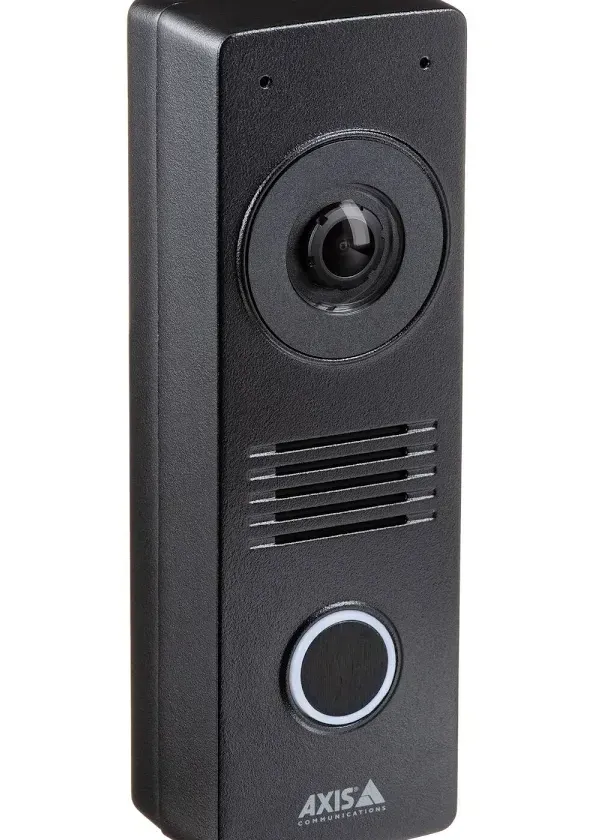
A photo from the AESS job library, not taken in Bergen Beach: a black rectangular video door station with a camera at the top, a speaker grille and one round lit call button. A single-button station like this is the usual choice for a Bergen Beach house kept as one home, where the only question is who answers and from where. A two-family house with one shared door gets a station with a button for each household instead.
Bergen Beach Doorbell & Buzzer Request
One-family, two-family, condo or shop: tell us the street, how many households and which doors visitors use, and a technician calls back with the range
✅
Request Sent!
Thank you. A technician will call you about the Bergen Beach address, usually within two hours during working hours.
25+
Years Experience
✓
Same-Day Estimates
100%
Licensed & Insured
4.7★
201 Google Reviews
Owner-operated since 2002 · Thousands of jobs completed · Booked within 2 hours
Quick answer: door buzzer installation in Bergen Beach is priced on our Brooklyn list, where an audio doorbell or buzzer for a one- or two-family house runs $400 to $900 installed and a video system runs $700 to $1,800 installed. That price includes the door station or video doorbell, the chimes, monitors or phone setup for each household, any release on the door, the low-voltage power, the cable and the labor, and it is fixed in writing before we order anything. Most Bergen Beach houses sit in those two ranges because they have one or two households and one or two doors that visitors use. The rare larger building, such as a condo entrance serving many units, starts around $2,500. Send photos of the doors and the old doorbell to (347) 934-8335 or on WhatsApp, and we answer with the range that fits, usually within two hours of your message during working hours.
Looking at your photos and quoting a new doorbell or buzzer costs nothing. If something already installed has failed and needs a diagnosis, that visit is the $250 service call booked online, and the $250 goes toward the work.
All work is done under New York State license #12000287431. We install low-voltage doorbell and entry equipment only; if your house needs a new 120-volt outlet or a hardwired transformer replaced on the electrical side, a licensed electrician does that part, and we tell you before the job is priced.
In a two-family house the owner approves the plan. A tenant is welcome to send us the details, and we price it for the owner to decide.
The Neighborhood
Why Bergen Beach Properties Need Door Buzzer Installation
Bergen Beach is one of the few corners of Brooklyn where an entry system means a doorbell on a house rather than a panel in a lobby. Brooklyn Community Board 18 describes Bergen Beach and Georgetowne as predominantly residential and zoned mainly for one- and two-family homes, and the interior streets, Avenue T, Bergen Avenue, Royce Street and the numbered East 60s and 70s, are lined with low-rise brick and stucco houses built after the Second World War, most with a driveway and a patch of lawn. A house like that has no shared lobby, no superintendent and no riser of intercom cable. It has a front door, usually a side door off the driveway, sometimes a separate door for a basement or a rental apartment, and a family spread over two or three floors who all need to know when someone is there. That is the job a door buzzer installation does here.
The two-family house is where the work gets more interesting. Bergen Beach listings show the pattern over and over: a brick two-family on East 68th Street with an owner's triplex and a separate one-bedroom rental that has its own private entrance; a detached stucco two-family with a rental studio; a corner two-family on Avenue N with the owner's four-bedroom over a one-bedroom tenant apartment, over a finished basement with its own entrance. In each of those houses there are two households and at least two doors, and a single doorbell bought for a one-family house sends every visitor, every courier and every food delivery to the wrong people half the time. The fix is not complicated, but it has to be planned: one button per household, each ringing only its own floor, each household able to see and talk to its own visitor, and a release only on the doors that need one.
Most of these houses are also much newer than the brownstones and walk-ups people picture when they think of Brooklyn buzzers. Marshy ground held back building, and apart from a small cluster of houses along Avenue U the land waited for fuller landfilling in the 1960s, and large-scale building followed from then into the 1980s and 1990s, with some lots on the Georgetowne side empty until the 2000s. A two-family on Bergen Court that sold through Brownstoner, for example, was custom built in 2003 on an R3-1 lot. There are older houses, including a detached house from 1930 and a detached Cape from 1955 in recent sales, and 6710 Avenue T is listed as dating from 1899, but the typical Bergen Beach doorbell was installed by a builder in the 1960s to 1990s as a plain button, a transformer and a chime in the hall. That kind of wiring is much easier to reuse than the cloth-covered bell wire in a pre-war rowhouse, though it still has to be tested, because it was sized for a chime, not for a camera.
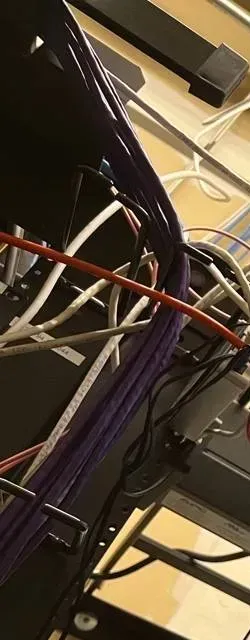
A photo from the AESS job library, not taken in Bergen Beach: bundles of purple, white and red cable dropping down beside a black equipment rack. No Bergen Beach house needs a rack like this, but the idea scales down: the doorbell power supply, the router and any camera recorder in a house near the basins should sit together on a shelf well above the basement floor, labeled, so floodwater and the next technician both find them where they expect.
Water is the other thing that sets Bergen Beach apart. The neighborhood is surrounded on three sides by Paerdegat Basin, Mill Basin and East Mill Basin, with Jamaica Bay beyond, and the Homes.com neighborhood guide says most residences are at extreme risk of flooding and that more than 200 properties were affected during Hurricane Sandy. Flooding is not only a hurricane story here, either: News 12 Brooklyn reported rain flooding in Bergen Beach in December 2018, and in April 2021 ran a story headlined "Bergen Beach neighbors fed up with ongoing flooding woes." For a doorbell or buzzer, that matters in two places. The old transformer and chime are often in the basement, near the electrical panel, which is the worst place to keep electronics in a house that has taken water before. And the door station itself lives outside, facing salt wind off the bay, freeze-thaw cycles and driving rain, which ButterflyMX notes is why outdoor components usually show problems first.
Getting around shapes the job too. Bergen Beach has no subway; residents rely on buses, cars and the Belt Parkway, and the nearest Q and B station at Kings Highway is about three miles away. That is why so many houses here have driveways and garages and why the door visitors really use is so often the side door beside the driveway rather than the front door on the street. It is also why deliveries matter: when most of the household drives to work, the doorbell is the one thing at home that can answer a courier, and an owner at work wants to see and talk to that courier from a phone. The same driveways are where cars sit overnight, and a Nextdoor post from the neighborhood reported a car stolen in September 2025, so many owners ask whether the doorbell can also watch the driveway. Usually it cannot do both well, and we explain why further down.
Six Bergen Beach facts that decide a doorbell or buzzer plan before any equipment is chosen
Houses, not lobbies. Community Board 18 describes Bergen Beach and Georgetowne as zoned predominantly for one- and two-family homes. Most jobs here have one or two households and one or two doors, which keeps the equipment simple and puts the thinking into who answers, from where, and which door.
Two households, two doors. Bergen Beach listings regularly describe a rental unit with its own private entrance, a basement with a separate entrance, or an owner's unit over a tenant's. Each household needs its own button that rings only its own space.
The side door is the front door. Post-war houses on driveways mean visitors often walk up the drive to a side entrance. The doorbell belongs where people actually knock, not where the architect put the front steps.
Newer wiring, but sized for a chime. Much of the housing went up from the 1960s through the 1990s, and one listed two-family dates from 2003. Builder doorbell wiring is often reusable after testing, but its transformer may be too weak for a video doorbell.
Flood risk is real. More than 200 properties were affected during Sandy, according to Homes.com, and News 12 has reported repeated street flooding since. Power supplies, chimes and recorders go high, not on the basement floor.
Not a multiple dwelling. Under New York's Multiple Dwelling Law, a building occupied by no more than two families is a private dwelling, so the intercom requirements written for apartment buildings do not reach most Bergen Beach houses. A buzzer here is the owner's choice, made for convenience and safety, not to satisfy an inspector.
Where this page applies. It covers Bergen Beach and the Georgetowne section, roughly from Ralph Avenue and Veterans Avenue east to Paerdegat Basin, and from Avenue N down to Mill Basin and East Mill Basin, in Community District 18 and ZIP code 11234. Sources draw the edges a little differently, and we treat the whole stretch the same way. For the rest of the borough, see our Brooklyn door buzzer installation page, and for the whole city our NYC door buzzer installation page. Bergen Beach is billed at the same Brooklyn rate as every other Brooklyn neighborhood.
Repair or Replace in Bergen Beach
Need Repair in Bergen Beach: Silent Bells, Dead Doorbell Cameras and Doors That Will Not Release
A lot of calls from Bergen Beach start as "we need a new doorbell" and turn out to be something smaller. A chime that went quiet after a storm is often a corroded connection at the button or a transformer that failed in a damp basement. A video doorbell that keeps going offline is often a weak Wi-Fi signal at the front of a long house, or a transformer that cannot supply what the camera asks for, not a faulty doorbell. A release that buzzes but does not open the door is usually a door that no longer closes squarely, so the latch is pressing on the strike. We sort out which of these it is before anyone talks about replacing equipment, because the honest answer is sometimes a part and an hour, not a new system.
If something that was working has stopped, call (347) 934-8335 or book the $250 service call online. The technician finds the fault, tells you what it will take to fix it and what a replacement would cost instead, and the $250 is credited toward whichever you choose. If water got into the transformer, the chime or the button after a flood, we replace what was damaged and move the power supply up and out of the water's way, so the same storm does not take it out again. If the door itself is the problem, we say so and adjust it before touching the electronics.
What We Install
Door Buzzer Installation Services in Bergen Beach
Every service below is priced from the same Brooklyn door buzzer list. In a Bergen Beach house, the number of households sets how many buttons and answering points the system needs, the doors set where the stations go and whether anything gets released, and the wiring already in the walls sets how long the job takes.
Wired video doorbells
A camera doorbell at the door visitors use, powered from the house's doorbell circuit or a dedicated low-voltage supply, ringing a chime indoors and every phone in the household, so nobody depends on a battery that runs down in a cold January.
Two-household doorbells and buzzers
A two-button station, or two separate doorbells, for a two-family house, with each button ringing only its own household's chime, monitor or phones, so the tenant's guests stop ringing the owner and the owner's guests stop ringing the tenant.
Door releases for houses
An electric strike fitted to the door frame so someone upstairs, in the back of the house or on a phone can let a visitor in, matched to the existing lock so keys keep working exactly as before.
Side, rear and basement doors
A doorbell or station at the driveway door, the backyard door or a separate basement entrance, wired so it is clear indoors which door is ringing and, in a two-family, whose visitor it is.
Indoor monitors and extra chimes
A screen in the kitchen or a second-floor hall, and chimes on the floors where the family actually spends its time, so a ring at the side door is heard in a finished basement or an upstairs bedroom.
Replacing old buttons, chimes and buzzers
Builder-era buttons, hall chimes and transformers taken out and replaced, with the old wire tested and reused where it passes and the power moved out of the basement where flooding has reached it before.
Building Specialists
Door Buzzer Installation for Bergen Beach's Architecture
Six kinds of property make up nearly every doorbell and buzzer job we see in Bergen Beach. What separates them is not the equipment, which overlaps a great deal, but three practical things: how many households have to be told apart at the door, which doors visitors really use, and what the outside wall is made of where the station has to be fixed.
The detached one-family house
One household, often two or three floors and a finished basement, a front door and a side door off the driveway. The job is usually a wired video doorbell at the door people use, chimes on more than one floor and phones for anyone out.
The semi-detached house
A shared wall on one side, a driveway or path on the other, and a front door close to the neighbor's. The camera's angle and what it records past the property line need more thought than on a detached lot.
The two-family with one shared door
An owner's unit and a rental behind a single entrance or a shared vestibule. Two buttons at the door, each ringing only its own household, and a release that suits both floors.
The two-family with its own rental entrance
A rental apartment or basement unit with a private door, common in Bergen Beach listings. Two separate doorbells, kept apart in wiring, chimes and app accounts, so neither household hears or sees the other's visitors.
The condo or townhouse in a complex
Gated communities in the Georgetowne section, such as Mill Harbor, with association rules and a shared entry already in place. The work is usually a doorbell or station at an owner's own door, with the association's approval.
The shop, office or church
Businesses on Ralph Avenue and Avenues N and T, and institutions such as the Church of St. Bernard, where a door may need to stay locked and buzz people in during the day.
The detached one-family house: the doorbell has to reach the people, not just the hall
In a detached Bergen Beach house, the old chime usually hangs in the front hall or the kitchen, put there by the builder when the whole family spent the day on the main floor. Today the same house often has a finished basement used as a den or an office, bedrooms upstairs, a deck out back and people in and out by car. A chime in the hall does not reach a basement with the television on, and it does not reach anyone at work. The plan for a one-family house therefore starts with a short walk through it: where people are during the day, where they are at night, and where the doorbell is not heard now. That tells us whether a second chime, a plug-in chime on another floor, an indoor monitor or simply phones is the answer, and usually it is a combination.
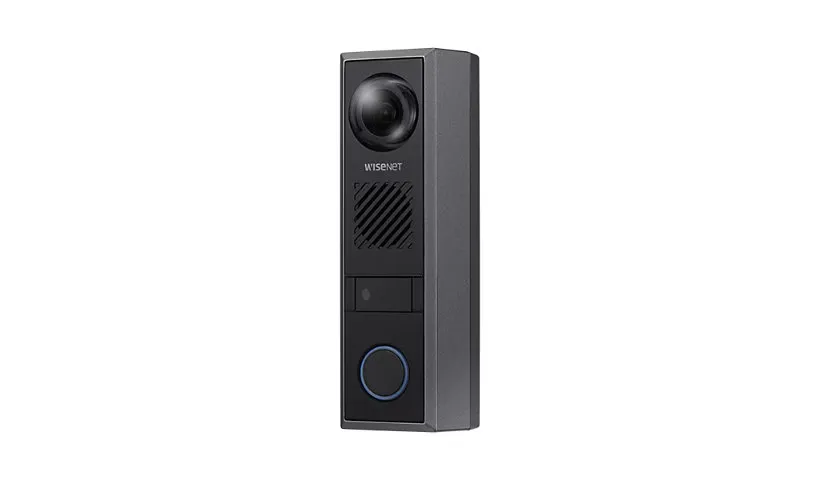
A photo from the AESS job library, not taken in Bergen Beach: a slim dark grey wired doorbell with a camera lens, speaker slots and a round push button. A doorbell this narrow fits the trim beside a typical Bergen Beach side door, where there is rarely room for anything wider between the frame and the storm door hinge, and being wired it keeps working through the cold months when battery doorbells on exposed doors need charging most often.
The semi-detached house: a shared wall and a neighbor's door a few feet away
Semi-detached houses are common here; one Bergen Beach listing describes a semi-detached brick two-family on a 26-by-100-foot lot. On a house like that, the two front doors can be close together, sometimes sharing a stoop or a front walk, and the doorbell camera's field of view easily takes in the neighbor's door, their path and part of their driveway. That is a reason to choose the mounting angle carefully, to use a wedge or corner mount that turns the camera toward your own walk, and to set up privacy zones in the app so the camera does not record the other half of the building. Habitat magazine reported one New York building manager saying that as video doorbells spread, "we entered it into the house rules," and while a semi-detached house has no house rules, it does have a neighbor who will notice a camera pointed at their door.
The two-family with one shared door: two buttons, two households, one entrance
Some Bergen Beach two-families share a single street door that opens into a small hall, with the owner's apartment on one floor and the tenant's on another. These houses need what a small apartment building needs, scaled down: a door station with two buttons, an answering point in each apartment, and a release on the shared door so each household can let in its own guests. The difference from a walk-up is that the owner usually lives in the house, knows the tenant, and can decide everything in one visit. We can do it with audio handsets, video monitors, phone answering or a mix, and the price stays in the house ranges on our list because there are only two apartments to wire.
The common mistake in these houses is a single consumer video doorbell bought for the whole house. It rings everyone's phone, the owner sees the tenant's visitors and the tenant sees the owner's, and whoever is closest ends up answering the door for both. That is fine between relatives and awkward between landlord and tenant. A two-button station, or two doorbells side by side on the same door, solves it at the source. Where the households really are family, such as grown children upstairs and parents below, one shared doorbell with each person's phone added may be exactly right, and it costs less. We ask who lives in the house before recommending either.
The two-family with its own rental entrance: keep the two systems apart
The layout Bergen Beach listings describe most often is a two-family where the rental has its own way in: a one-bedroom on East 68th Street with its own private entrance, a basement apartment with a separate door, a rental studio in a detached stucco house. In those houses there is no shared door to release, and the right answer is usually two independent doorbells, one at each entrance, each with its own chime and its own app account. Keeping them separate protects both households' privacy, means the tenant does not need the owner's login and the owner does not need the tenant's, and lets either one be replaced or upgraded later without touching the other.
Separate does not have to mean twice the work. Both doorbells can often take power from the same low-voltage supply in the owner's part of the house, with separate cables to each door and separate chimes. If the tenant's entrance is at the side or back and the old doorbell wiring only ever reached the front, a new cable runs along the outside of the foundation or through the basement ceiling to reach it. And if the owner wants to keep a view of the whole property, that is a camera job, separate from the tenant's doorbell, so the tenant's visitors are not recorded on the owner's account. We price the camera on the same visit if it is wanted.
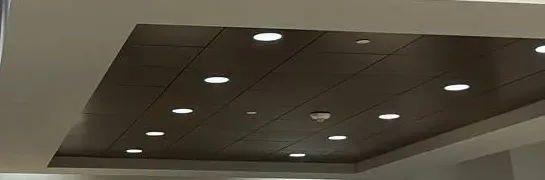
A photo from the AESS job library, not taken in Bergen Beach: a dark recessed ceiling panel with round downlights and a small round device, framed by a lighter ceiling. Many Bergen Beach houses have a covered entry or porch ceiling over the front or side door, and lights like these are what let a doorbell camera show a face after dark instead of a glare or a silhouette, so we look at the entry lighting during the walkthrough.
The condo or townhouse in a complex: the association comes first
The Georgetowne section has several gated condominium communities. Mill Harbor, at 1561 Royce Street, was built in 2005 with 208 units over four stories, is listed as a gated community, and has an intercom connected to a front desk. Other Bergen Beach condo listings sit on East 72nd and East 73rd Streets and on Cove Lane. In buildings and complexes like these, the main entry, the gate and the lobby intercom belong to the association, which maintains and replaces them through its own contractors. An individual owner's door is a different matter, and owners regularly want a doorbell camera or a better bell at their own unit door or townhouse entrance.
Before we install anything at a unit in a complex, the owner checks with the association or managing agent. Many associations have rules about what may be fixed to doors and exterior walls, about drilling through common elements and about cameras that look into common hallways or other owners' doors. We are happy to send the association a short description of the equipment, the mounting and the camera's view for approval, and to provide a certificate of insurance if the managing agent asks for one. If the association itself wants to replace or upgrade the complex's entry system, that is a larger job priced from the multi-unit part of our list after a walkthrough.
Field Notes
Field Notes: What We Look at on a Bergen Beach House Before Quoting a Doorbell
These notes describe our standard routine on post-war houses like those in Bergen Beach. They are how we work, not a story about one particular address.
Find the door people actually use. The technician asks, and then looks: which door has the worn mat, the package shelf, the path from the driveway. The answer is the side door more often than owners expect, and it decides where the best station goes.
Open the storm door. Many detached houses have a glass or aluminum storm door in front of the main door. A doorbell mounted behind it cannot be reached by a visitor and its camera looks through glass, so the station almost always goes on the trim outside the storm door, and we check there is room for it beside the storm door's hinge or latch.
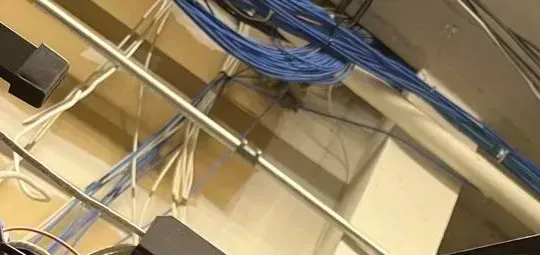
A photo from the AESS job library, not taken in Bergen Beach: bundles of blue low-voltage cable laid over a ceiling beam and a metal pipe in an open ceiling. An unfinished Bergen Beach basement ceiling looks much like this, and it is usually the easiest path from the transformer to the side door or to a separate rental entrance, provided the cable stays up in the joists and out of reach of floodwater.
Read the transformer. The old doorbell transformer, usually in the basement near the electrical panel or on a junction box, has its voltage and VA rating printed on it. A wired video doorbell needs a supply that meets the maker's requirement, and many builder-era transformers fall short. We note the rating and test the voltage at the button before deciding anything.
Test the old wire. Builder doorbell wire in a 1960s to 1990s house is usually intact, but it may be thin, spliced at the chime or nicked where it passes the door frame. If it is going to carry a video doorbell, it is tested end to end, not assumed.
Check the Wi-Fi at the door. A detached house can be long, and the router often sits at the back or in the basement. The technician checks the signal at each door with a phone before recommending a Wi-Fi doorbell, because a weak signal at the door is the most common reason a video doorbell keeps dropping offline.
Look at the wall and the water line. Brick, stucco, vinyl siding and wood trim each take a different fixing and a different seal. And in a house that has flooded, we ask how high the water came, so the power supply, chime and any recorder go above it.
Power and Wiring
Old Doorbell Wiring, New Video Doorbells: What a Bergen Beach House Can Carry
The single most common technical question on a Bergen Beach doorbell job is whether the house's existing doorbell circuit can run a modern video doorbell. A traditional doorbell circuit is simple: a small transformer steps the house's 120 volts down to a low voltage, a pair of thin wires runs to the button outside and to the chime inside, and pressing the button completes the circuit so the chime sounds. That circuit was designed to deliver a brief pulse to a chime. A video doorbell needs steady power around the clock for its camera, its radio and its speaker, and it needs more of it.
What the makers ask for. The doorbell makers publish their requirements, and they are specific. Ring lists its Video Doorbell Wired as needing a hardwired transformer of 10 to 24 volts AC, 50/60 Hz, rated 8VA to 40VA, while its Wired Doorbell Plus, Pro and 2K Plus need 16 to 24 volts AC, rated 10VA to 40VA. Lorex says its wired video doorbells "require a constant power supply with a voltage between 16V-24V AC," that a 10-volt transformer is too weak, and lists 16V 30VA and 24V 40VA transformers as compatible. Ring also warns that "Using incompatible power sources can damage your device and cause electric shock." Many transformers installed with builder doorbells are rated well below those numbers, which is why a video doorbell on old power often reboots, drops its connection or fails in the cold.
Who changes the transformer. The low-voltage side of a doorbell, the button, the chime and the thin wires between them, is a Class 2 signaling circuit, and that is our work. The transformer itself is fed from the house's 120-volt wiring, and building codes treat that connection as standard electrical work. Where a new hardwired transformer is needed, a licensed electrician makes the 120-volt connection; we tell you that before the job is priced, and we can coordinate it so it happens on the same day. In many Bergen Beach houses we avoid the question altogether by powering the doorbell from a dedicated low-voltage supply that plugs into an existing outlet, placed high on a basement wall or in a utility closet, with new low-voltage cable to the door.
What happens to the old chime. Some video doorbells work with the existing mechanical chime and some do not. Ring states, for example, that its Wired Doorbell 4K Pro and 2K Plus are not compatible with existing chimes unless the 4K Pro is powered by PoE, and points owners to a plug-in chime instead. Other models need a small adapter fitted inside the chime box. We check the chime in the house against the doorbell before ordering, and where the old chime cannot be kept we fit a plug-in chime on each floor that needs one. One Brownstoner forum member, whose old doorbell wiring was too far gone, did exactly that with plug-in chimes that sync with the camera and said the setup "Works great."
When a network cable is better. Some doorbells and most door stations built for two households can run on a single network cable that carries both power and data, known as PoE. On a long Bergen Beach house where Wi-Fi is weak at the front, or on a two-family where two stations share a power supply, a network cable to the door is often more reliable than a radio link and a transformer, and it is the same cable we use for cameras. It does mean pulling a new cable rather than reusing the bell wire, which is a little more labor, but it removes the two most common failure points at once: weak power and weak Wi-Fi.
Releasing the door. If the household wants to let visitors in remotely, the door needs an electric strike in the frame, powered separately from the doorbell. For a house street door, we fit a fail-secure strike, which stays locked if power is lost. Allegion, a major lock maker, explains that fail-secure products are locked when power is removed and that with an electric strike "you can exit by turning the lever" whichever kind it is, so nobody is ever trapped inside. Magnetic locks, by contrast, are only available fail-safe and release when power is lost, and building codes attach strict exit conditions to them, so we do not recommend them for a house door in a neighborhood where storms take out power.
Water, Wind and Walls
Stucco, Siding and the Basins: Mounting a Doorbell That Survives Bergen Beach Weather
A doorbell or door station is the one piece of an entry system that lives outdoors all year, and in Bergen Beach it lives in a harder spot than most of Brooklyn. Houses near Paerdegat Basin, Mill Basin and East Mill Basin face open water and wind on more than one side, and the area's flooding record means some doors see standing water at the bottom step during heavy rain. ButterflyMX's guide to cold-weather intercom failures puts it plainly: "Outdoor components usually show problems first because they face wind, snow, rain, ice, and repeated freeze-thaw cycles," and "Moisture can enter exterior panels, cable paths, and lock hardware, then condense or freeze during temperature swings." Our job is to keep that water out of the station, the cable and the wall.
Stucco. Many Bergen Beach houses are finished in stucco, and stucco cracks if it is drilled carelessly. We use the right masonry bit at low speed, drill only through the stucco into the substrate behind it, and set fixings that grip the substrate, not the stucco skin. Every hole is sealed with an exterior-grade sealant, and the cable entry is sealed around the cable so rain running down the wall cannot follow it inside. A BiggerPockets member weighing doorbells for his three-unit house said he was worried about damaging his siding if a product did not work out; on stucco, careful drilling and sealing are what prevent that.
Brick. On brick houses we fix into the brick face rather than the mortar where the station needs to be firm, and into the mortar where we want the fixing to be easy to repair later. A doorbell is small enough that either works, but a door station with a keypad gets pressed hard and needs to be solid. Cable enters through a drilled hole sloped slightly downward toward the outside, so water drains out rather than in.
Vinyl siding and wood trim. On sided houses, the station goes on a mounting block or the door trim rather than straight onto the siding, so the siding can still expand and contract and the station sits flat. Fixings go into the framing behind, not just the siding. The same applies to the narrow trim beside a side door, where there is often only just room for a slim doorbell.
Above the water. Inside, the power supply, any chime that needs mains power and any recorder go on a shelf or wall bracket high in the basement or on the first floor. Where a house has taken water before, we ask the owner how high it reached and set everything comfortably above that line. Cable runs in the basement ceiling joists, not along the floor.
Commercial Door Buzzer Installation
Business Door Buzzer Installation in Bergen Beach
Bergen Beach has far less commercial property than most of Brooklyn, and what it has is gathered in a few places along its edges. That makes business buzzer work here specific: a handful of shopping and service corridors, a large parish, and the condominium associations that run shared entrances in the Georgetowne section.
Georgetowne Shopping Center
The center at 2181 Ralph Avenue covers about 147,000 square feet on nearly nine acres, with some 30 retailers and 575 parking spaces. Back-of-house and staff doors behind stores and restaurants are where a buzzer and camera earn their keep.
Ralph Avenue
The western edge of the neighborhood, with Food Way Georgetowne at 2149 Ralph Avenue and the shopping center beside it, where delivery doors and offices need controlled entry during long trading hours.
Avenue N
The northern edge, with neighborhood businesses such as Mill Basin Bagel Cafe at 6319 Avenue N and a run of Italian-influenced shops, where a small office or upstairs space may share a building with a storefront.
Avenue T
An interior avenue with a few local businesses among the houses, where a shop door and a family's door can sit on the same lot and must ring different people.
Church of St. Bernard
The parish on East 68th Street near Avenue U, established in 1961, where offices, halls and side doors may need visitor calls during the week and scheduled opening for services.
Condominium associations
Gated Georgetowne complexes such as Mill Harbor, with a front-desk intercom and shared gates, where the association, not the unit owner, decides on the main entry and its upgrades.
For a business, the question is rarely whether to have a doorbell. It is how to keep a door locked without making customers, patients or delivery drivers feel shut out. In practice that means one of three set-ups. The first is a staff or delivery door at the back of a store or restaurant that stays locked, with a video station so the person inside can see who is there before opening, and a release so they do not have to walk to the door with their hands full. The second is an upstairs office, a small clinic or a professional suite above a shop, where the street door is locked and visitors buzz up. The third is an institution, such as a church office, a parish hall or a community room, that opens on a schedule and otherwise answers visitors from a desk or a phone.
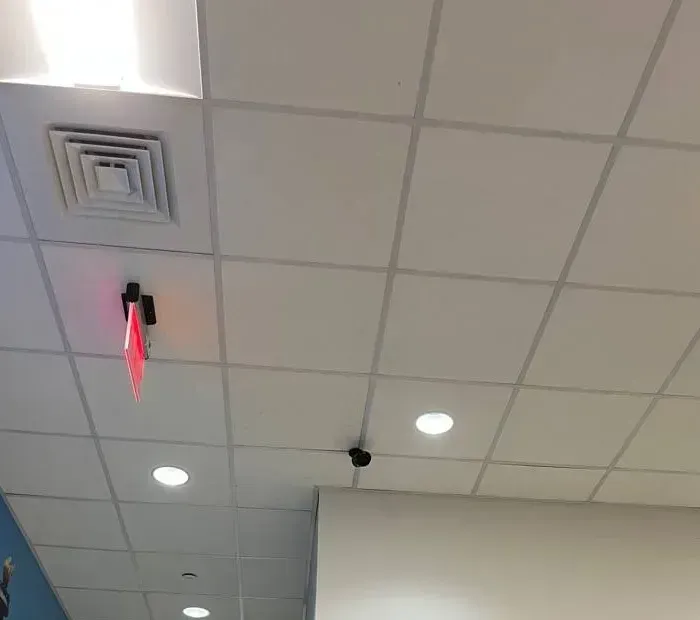
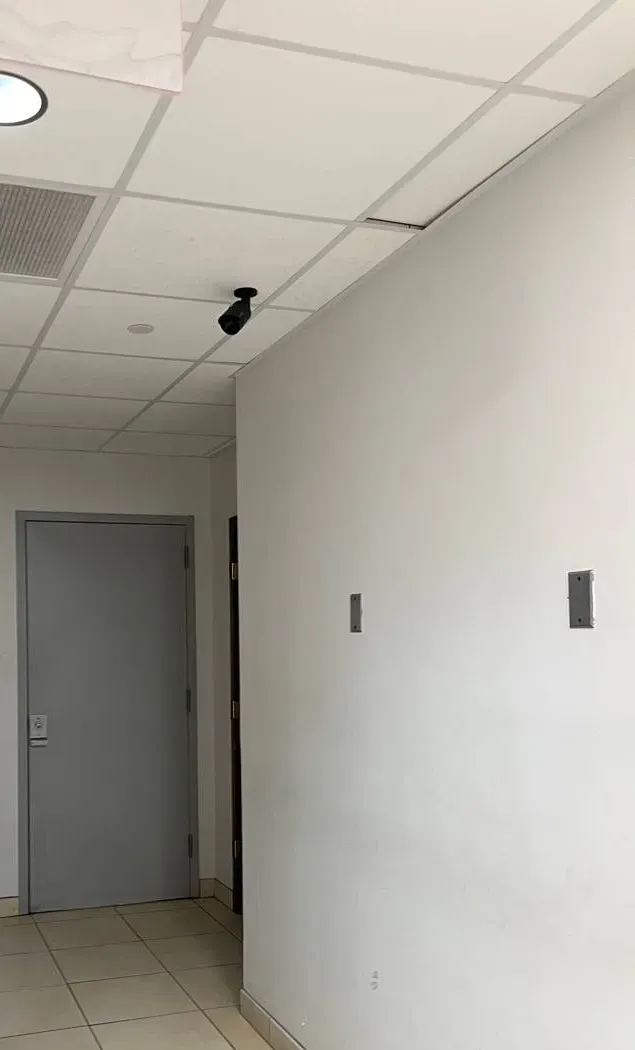
A photo from the AESS job library, not taken in Bergen Beach: a drop ceiling with a lit red exit sign, an air diffuser, round recessed lights and a small black camera. The back corridors behind stores along Ralph Avenue often look like this, and the exit sign is the reminder that any staff door we put on a buzzer must still let people out freely in an emergency.
Business doors are used much harder than house doors. A rear door behind a busy restaurant or supermarket can be buzzed open dozens of times a day, slammed by carts and hand trucks, and left unattended for long stretches. For those doors we choose a heavier-duty strike, a door closer adjusted to pull the door shut and latch every single time, and a vandal-resistant station that can take being knocked. Where staff in more than one room need to answer, an indoor monitor at each answering point is usually better than phones, because nobody should have to use a personal phone to open a work door. A camera on the same door is a common addition, installed on the same visit through the same cable path, and putting the two together is where most customers save $200 to $400 in labor.
Compliance points that apply to Bergen Beach entry installations
Multiple Dwelling Law §4. A private dwelling is "any building or structure designed and occupied exclusively for residence purposes by not more than two families"; a multiple dwelling is occupied by three or more families living independently. Most Bergen Beach houses are private dwellings, so apartment-building entry mandates do not apply to them.
Multiple Dwelling Law §50-a. For multiple dwellings with eight or more apartments built or converted after January 1, 1968, the main door must be self-locking with an intercom allowing voice contact and remote release; older ones must add it when tenants of a majority of apartments ask in writing. This applies to the larger condo and apartment buildings, not to houses.
Egress and electrified locks. Electrically locked exit doors in commercial and public spaces need a way out that does not depend on the lock: sensor release on the inside, a push-to-exit button, release on loss of power and, where there is a fire alarm or sprinklers, release when it activates. We fit fail-secure strikes that leave the inside handle working, and we never bypass an existing exit release.
Accessible reach. For businesses and community spaces, call buttons and keypads go within the 2010 ADA Standards reach range, 48 inches maximum for a high forward reach and 15 inches minimum for a low reach.
Electrical work. Our work is low-voltage entry equipment. A new 120-volt circuit, outlet or hardwired transformer is done by a licensed electrician, and we flag it before pricing.
Association rules. In condominiums and gated complexes, the association's rules on exterior fixtures, drilling through common elements and cameras facing common areas apply, and we install only with its approval.
Landmarks. We found no designated historic district in Bergen Beach, so Landmarks Preservation Commission approval is not normally part of a doorbell job here, unlike brownstone neighborhoods such as Bedford-Stuyvesant.
Your Questions Answered
Door Buzzer Installation in Bergen Beach: Questions Answered
These are the questions Bergen Beach homeowners, landlords of two-family houses and condo owners ask when they want a better doorbell or a first buzzer: what to do with the old intercom and wiring, which door gets the bell, how to split a two-family, what the outside of the house will take, and how cameras at the door affect neighbors. Each one is answered in full here and not repeated in the FAQ further down.
Old doorbells, old wiring and new cameras
Can a battery video doorbell be fixed over our old intercom panel, or does the panel have to come out first?
Usually the old panel should come out or be made safe first. A Brownstoner forum member with two apartments sharing an old buzzer asked exactly this, because she mostly wanted "to see who is at the door, not 24-7 video surveillance." Sticking a battery doorbell over a dead panel leaves two sets of buttons for visitors to puzzle over, hides any water getting into the old box, and leaves you charging a battery every few weeks in winter. If the old intercom still works for the household and you only want to see the visitor, a small wired camera or video doorbell beside it can do that. If the old system is dead, the cleaner job is to remove it, cap or reuse its wiring, and put one station in its place that rings, shows and, if wanted, releases. We look at the panel and its wiring before recommending either, and on our Brooklyn list a single video doorbell or station sits in the $700 to $1,800 video range with the exact figure set at the walkthrough.
Our house still has its original doorbell transformer and chime. Can a wired video doorbell run on them?
Sometimes, and the transformer's label decides it. Wired video doorbells need steady power at a set voltage and rating: Ring lists 10 to 24 volts AC at 8 to 40VA for its basic wired model and 16 to 24 volts AC at 10 to 40VA for its Plus, Pro and 2K Plus models, and Lorex says a 10-volt transformer is too weak for its wired doorbells. Many builder doorbell transformers from the 1960s to the 1990s are rated at the bottom of those ranges or below them. If yours meets the doorbell's requirement and the wire tests sound, we reuse both and keep the job simple. If it falls short, there are two clean answers: a licensed electrician replaces the transformer on the 120-volt side, or we power the doorbell from a dedicated low-voltage supply that plugs into an existing outlet. The chime is checked the same way, because some video doorbells drive an existing chime and some need a plug-in chime instead.
Is it worth running a network cable to the front door instead of reusing the old bell wire?
On many Bergen Beach houses, yes. A network cable can carry both power and data to a PoE doorbell or door station, which removes the two things that make video doorbells unreliable at the front of a long detached house: a transformer that cannot supply enough power, and a Wi-Fi signal that barely reaches the door. Ring's Wired Doorbell 4K Pro, for instance, can be powered by PoE. The trade-off is labor, because a new cable has to be pulled from the basement or a utility closet to the door rather than reusing what is in the wall. We usually suggest it when the Wi-Fi test at the door is weak, when two stations share one power supply in a two-family, or when the owner plans to add cameras later, because the same cable path serves both.
Which door, and what the camera sees
Our front door sits behind a glass storm door. Where should the doorbell camera go?
Almost always on the trim outside the storm door, not on the main door frame behind it. Behind the storm door, a visitor has to open the storm door to reach the button, and the camera looks through glass that reflects light at night and fogs in cold weather. Outside it, the doorbell is where the visitor stands and sees the whole step. The catch on many detached houses is space: the strip of trim between the storm door's frame and the edge of the house can be narrow, which is why slim doorbells exist and why we sometimes fit a small mounting block. If the storm door's hinge side leaves no room at all, the latch side or the wall beside the door often does. We measure it on the walkthrough so the doorbell you buy actually fits.
Most visitors come up the driveway to our side door, not the front. Which door should get the doorbell?
The one visitors use. On a house with a driveway along the side, couriers, neighbors and the family's friends naturally walk to the side door, and a video doorbell on a front door nobody uses records an empty step. If both doors get visitors, both get a button, and we set the chimes or the app to say which door is ringing, so nobody walks to the wrong end of the house. A common and economical split is the video doorbell at the side door, where most visitors arrive, and a simple wired button at the front for holiday guests and anyone who does not know the house. That keeps the job toward the lower end of the range while putting the camera where it does the most good.
Can one doorbell camera keep an eye on the driveway as well as the door?
Not well, and it is worth knowing before you buy one hoping it will. A doorbell camera is aimed and focused for a face a few feet away at the door; a driveway needs a wider view, a longer reach and good night vision across the whole length of the car. Pointed at the drive, a doorbell sees the edge of a bumper and misses the visitor; pointed at the visitor, it sees little of the drive. Car theft does come up in the neighborhood, with a car reported stolen on Nextdoor in September 2025, and if the driveway matters, the right answer is a dedicated camera on the house wall covering it, installed on the same visit through the same cable path as the doorbell. Doing both together is where most customers save $200 to $400 in labor.
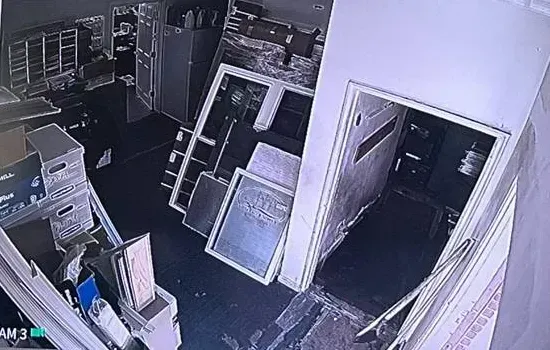
A photo from the AESS job library, not taken in Bergen Beach: a black-and-white night camera view of a cluttered room with an open doorway into a dark back room. Infrared night video looks like this, showing shapes and movement clearly but not much detail at a distance, which is why a doorbell aimed at a dark Bergen Beach driveway shows little of a car, and why driveways get their own camera.
Two households in one house
In a two-family, is it better to give each household its own video doorbell or share one two-button station?
It depends on whether the two households share a door. Where the rental has its own entrance, which many Bergen Beach two-families do, two separate doorbells, each with its own chime and app account, are simplest and keep both households' visitors private. Where both households come in through one door, a single station with two buttons looks tidier than two doorbells side by side, gives one camera view to both and can release the shared door for either household. Two consumer doorbells on one door can work, but visitors often press the wrong one and the two cameras record each other's guests. A BiggerPockets member with a three-unit house found consumer doorbells "not commercial or durable enough" for that job, and a two-button station built for multiple households is the usual answer. Both options stay within our house price ranges.
Is a Bergen Beach two-family house required by law to have an intercom?
No. New York's Multiple Dwelling Law defines a private dwelling as a building occupied exclusively for residence by not more than two families, and reserves the term multiple dwelling for buildings with three or more families living independently. The intercom requirement in §50-a is written for multiple dwellings with eight or more apartments built or converted after 1968, and for older multiple dwellings whose tenants ask in writing. A one- or two-family house in Bergen Beach falls outside both. That does not make a doorbell unimportant, and the owner is still responsible for what is installed and for the house's doors and locks working safely. It does mean the choice of system is entirely yours, made for convenience and safety rather than to satisfy an inspector, and a three-family such as the one listed at 1166 Bergen Avenue is the point where the Multiple Dwelling Law starts to apply.
Our tenant moved out. How do we take them off the doorbell app and the door release?
Remove their user from the doorbell's account, change any door code they had, and check who else has access while you are there. On most app-based doorbells and stations, the account owner can see a list of shared users and remove them in a minute; the tenant's phone stops ringing and stops showing video at once. If the tenant had a keypad code for the door, delete it and set a new one for the next tenant. If they had their own account on a separate doorbell at their entrance, ask them to hand it over or reset it, so the next tenant starts fresh. This is the main reason we set up the accounts in the owner's name at installation and leave a note of how to add and remove users, so a change of tenant never needs a service call.
Should the owner and the tenant share one doorbell account?
Generally not, unless the two households are family. A shared account means both households see every visitor, every delivery and every recording from the door, and either one can change settings for both. Where the tenant has a separate entrance, give each door its own doorbell and its own account; where both households share a door with a two-button station, most systems let each button call only its own household's phones while the owner holds the administrator login. The owner keeps control of the system and its settings, the tenant gets privacy about who visits, and neither has to ask the other to answer the door. If the owner wants a view of the whole property for security, that is better done with a separate camera than by sharing the tenant's doorbell.
The outside of the house and the people next door
Will drilling for a doorbell or door station crack our stucco or damage the siding?
Not if it is drilled and sealed properly. Stucco cracks when it is hammer-drilled hard or when a fixing grips only the outer skin, so we drill at low speed with the right bit, fix into the substrate behind it and seal every hole and the cable entry with exterior-grade sealant. On vinyl siding the station goes on a mounting block or the door trim so the siding can still move, and fixings go into the framing. On brick, the cable hole slopes slightly outward so water drains out. The holes are small, and if a doorbell is ever removed they can be filled and touched up. The BiggerPockets owner who worried about damaging his siding with a doorbell that might not work out had the right instinct: choose a station that suits the door before drilling, so you only drill once.
Can the doorbell camera be kept from recording the neighbor's yard or the street?
Yes, mostly. The angle is the first tool: a wedge or corner mount turns the camera toward your own step and walk and away from a semi-detached neighbor's door. The second is the app: most video doorbells let you draw privacy zones that black out part of the picture, and motion zones so movement on the street or next door does not trigger recordings or alerts. Neither makes a camera blind to everything beyond your property, because a doorbell has to see the person standing at your door, and that view will usually include some of the sidewalk. Habitat magazine has reported New York buildings writing video doorbells into their house rules as they spread. In a semi-detached house, a word with the neighbor and a camera clearly aimed at your own door goes a long way.
We live in a gated condo with a front-desk intercom. Do we need the association's approval to add a doorbell at our own door?
In most complexes, yes. In a community like Mill Harbor, built in 2005 with 208 units and an intercom to the front desk, the entry gate, lobby and front-desk system belong to the association, and the exterior of your door may be a common element even if the door itself is yours. Association rules often cover what can be fixed to doors and walls, whether wiring can pass through common walls, and whether cameras may look into shared hallways or other owners' doors. Ask the managing agent before you buy anything. We can send them a short description of the doorbell, how it is mounted and what the camera sees, and provide a certificate of insurance if the association requires one. Once approved, a unit doorbell is a small job priced from the house ranges on our list.
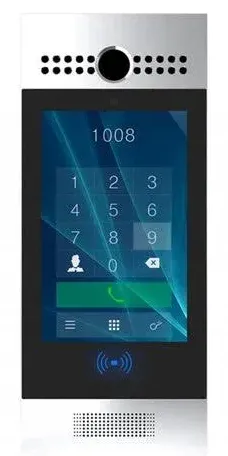
A photo from the AESS job library, not taken in Bergen Beach: a touchscreen entry panel showing a dial pad with a four-digit apartment code entered, a camera above and a card-reader symbol below. Panels like this belong at the shared gate or lobby of a Georgetowne condo complex, where residents are called by code, and they are the association's to choose; an owner's own unit door gets a much smaller doorbell.
Can the doorbell connect to our house alarm?
Often it can, though what "connect" means varies. Some alarm systems can show a doorbell's video in the same app, sound a chime through the alarm keypad when the doorbell is pressed, or record a doorbell event in the alarm's history. Others simply sit side by side in separate apps. Many Bergen Beach houses already have an alarm; a two-family on Bergen Court listed one among its features. Tell us the alarm's make and model when you send photos, and we will tell you whether the doorbell you want works with it and what it would add. If you are replacing both at once, we can plan them together so the doorbell, the alarm and any cameras share one app and one set of cable paths.
Equipment
Types of Door Buzzer Systems We Install
By default we quote a reliable non-branded system, and we install named brands when an owner asks for one. For Bergen Beach houses, these are the kinds of equipment that come up most, from a single wired doorbell to a small code panel for a condo entrance.
Wired video doorbells
A slim camera doorbell on the door trim, powered from a doorbell transformer that meets its rating or a dedicated low-voltage supply, ringing a chime and the household's phones. The most common job in Bergen Beach.
PoE doorbells and door stations
Doorbells and stations that take power and data over one network cable, for long houses with weak Wi-Fi at the front, two-family houses sharing a power supply, or owners planning cameras on the same cable paths.
Two-button video stations
One station with a camera and a button for each household, for two-family houses with a shared door, each button calling only its own household's monitor or phones and releasing the shared door.
Audio doorbells and buzzers
A button or small panel at the door and a talk-and-release handset or chime inside. The lowest-cost choice where nobody needs video, and it runs with no internet connection at all.
Indoor monitors and chimes
Wall-mounted screens in a kitchen or upstairs hall, and wired or plug-in chimes on extra floors, so a finished basement, a bedroom floor or a back room hears the door.
Strikes, keypads and power
Fail-secure electric strikes for remote release, keypads for codes, door closers adjusted to latch, and low-voltage power supplies set high, out of the way of a flooded basement.
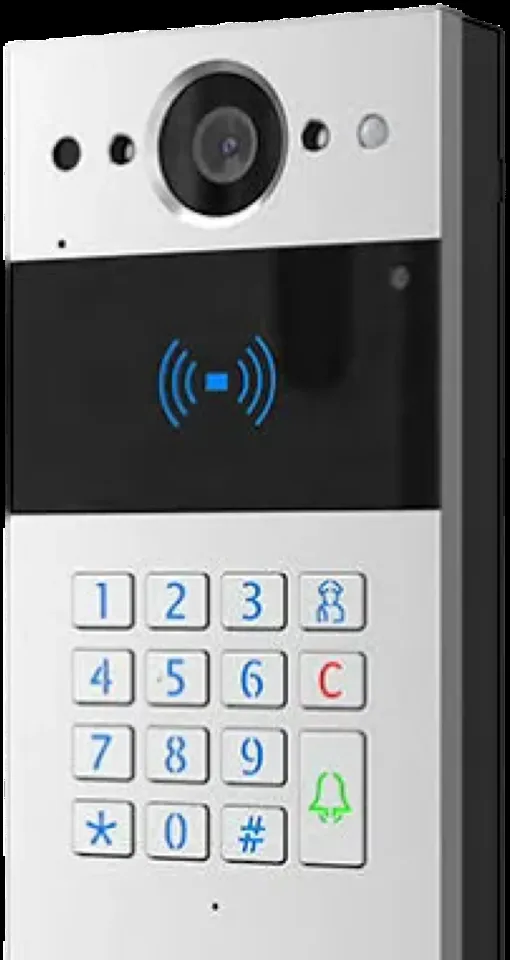
A photo from the AESS job library, not taken in Bergen Beach: a silver and black keypad door station with a camera lens at the top, a blue card-reader symbol, a numeric keypad and a green bell key. A station like this suits a Bergen Beach shop's staff door or a condo side gate, where visitors ring and regular users key a code, and it is more than a one-family house needs.
Battery doorbell, wired doorbell or a two-button station for a Bergen Beach house
The table compares the three choices owners weigh most often here. None is right for every house; it depends on how many households there are, which doors visitors use and how good the Wi-Fi is at the door.
What matters
Battery video doorbell
Wired video doorbell
Two-button video station
Power
Recharged every few weeks or months
Doorbell transformer, low-voltage supply or PoE
Low-voltage supply or PoE
Households it serves
One
One per doorbell
Two, kept apart
Rings an indoor chime
Only with a plug-in chime
Existing or plug-in chime, by model
Monitor or chime per household
Can release the door
No
Only with a separate strike and relay
Yes, with a strike
Needs Wi-Fi at the door
Yes
Yes, unless PoE
No, for in-house calls on wired models
Brooklyn list range, installed
Installed with the house ranges below
$700–$1,800 video range
$700–$1,800 video range
AI Overview Reality Check
What AI Gets Wrong About Door Buzzer Installation in Bergen Beach
These are claims that turn up in generic online answers, national cost guides such as HomeAdvisor, Angi and HomeServe, and product blogs, paraphrased, each followed by what Bergen Beach houses actually show and how we handle it.
"Installing an intercom costs about $2,500"
HomeAdvisor gives a national average of $2,500 for an intercom, within a range of $1,500 to $15,000, and HomeServe says most homeowners spend between $2,085 and $2,478 for a home intercom with about ten hours of wired installation labor.
Those figures describe whole-house intercoms with stations in many rooms or systems for larger buildings. What most Bergen Beach owners want is a doorbell or buzzer for one or two households at one or two doors, which is a much smaller job: $400 to $900 for audio and $700 to $1,800 for video on our Brooklyn list.
We price the house in front of us, from photos and a walkthrough, rather than a national average built from jobs that look nothing like a Bergen Beach two-family.
"Any video doorbell works on your existing doorbell wiring"
Product pages and setup guides often present a wired video doorbell as a straight swap for the old button.
The makers' own requirements say otherwise. Ring asks for 16 to 24 volts AC at 10 to 40VA on several wired models, and Lorex says a 10-volt transformer is too weak for its wired doorbells. Many builder transformers from the decades when most Bergen Beach houses went up fall short.
We read the transformer and test the voltage at the button before ordering, and where the old power is too weak we use a dedicated low-voltage supply or have an electrician replace the transformer.
"A battery doorbell is just as good and needs no wiring"
Cost guides and retail listings recommend wireless and battery doorbells as the simple, cheap option.
On an exposed Bergen Beach door, a battery has to be charged more often in cold weather, the camera usually cannot drive the existing chime without an add-on, and on a long house the Wi-Fi at the front may be too weak to stream video reliably. One Brooklyn owner on Brownstoner ended up wiring a camera doorbell and adding plug-in chimes because battery and wireless options were not enough.
We test the Wi-Fi at the door first, and we recommend battery doorbells only where wiring truly cannot reach and the owner is happy to recharge.
"One smart doorbell covers the whole house"
Smart doorbell marketing assumes one household behind one door.
Many Bergen Beach houses are two-families, often with a rental that has its own private entrance. One doorbell for both households sends everyone's visitors to everyone's phones, and one doorbell on the front door misses visitors at a side or basement entrance.
We plan one button per household and one per door that visitors use, with chimes and app accounts kept separate where the households want privacy.
"Your building must have an intercom by law"
Online answers about New York entry systems often say buildings are legally required to have a working intercom.
That rule, Multiple Dwelling Law §50-a, is written for multiple dwellings, buildings with three or more families, and its automatic requirement covers buildings of eight or more apartments built or converted after 1968. The law defines a house with not more than two families as a private dwelling, which describes most of Bergen Beach.
We tell owners plainly that a doorbell or buzzer in a one- or two-family house is their choice, and we design it for how the household lives rather than for an inspection that does not apply.
"Put the doorbell's power supply next to the electrical panel"
Installation guides commonly show the doorbell transformer mounted on or beside the main electrical panel in the basement.
In Bergen Beach, the basement is the part of the house most at risk. Homes.com says most residences are at extreme risk of flooding and more than 200 properties were affected during Sandy, and News 12 has reported street flooding in the neighborhood in 2018 and 2021.
We place low-voltage supplies, chimes and recorders high on a wall or on an upper floor, above the level any past flood reached, and run cable in the ceiling joists rather than along the floor.
"Mount the doorbell next to the door and you are done"
Do-it-yourself instructions usually end at screwing the doorbell beside the door frame.
On Bergen Beach houses the outside wall is stucco, brick, siding or narrow trim beside a storm door, and each needs a different fixing and seal. ButterflyMX notes that moisture can enter exterior panels and cable paths and then condense or freeze during temperature swings, and houses near the basins see more wind-driven rain than most of Brooklyn.
We drill to suit the wall, seal every hole and cable entry with exterior-grade sealant, slope cable holes to drain outward and set the doorbell where it clears the storm door and sees the visitor's face.
Tell us the street, whether the house is one-family or two-family, which doors visitors use and what is there now. A technician will call back with the range for the Bergen Beach address, or you can call (347) 934-8335 right now.
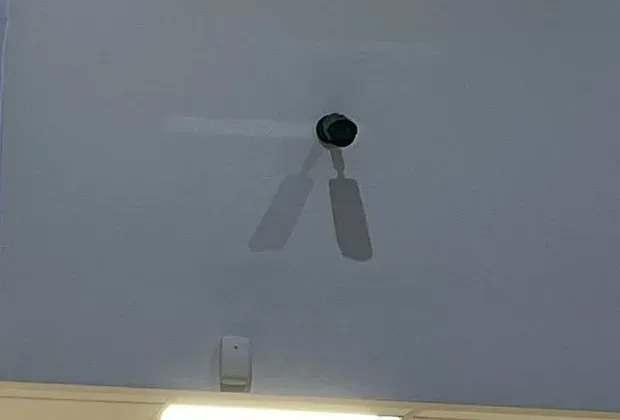
A photo from the AESS job library, not taken in Bergen Beach: a small black camera mounted high on a pale wall, casting two shadows, with a small white wall device below it. Bergen Beach owners who want the driveway or the back door watched as well as the front step often add a camera like this on the same visit as the doorbell; if you want one, say so on the form and we price both together.
✅
Request Sent!
Thank you. A technician will call you about the Bergen Beach address, usually within two hours during working hours.
How It Works
Our Installation Process
1. Photos and a first call
Send every door visitors use, the old button and chime, and the transformer if you can find it, with the number of households. You get a range on the Brooklyn list.
2. Walk the house
A technician checks which door gets visitors, the storm door, the wall surface, Wi-Fi at the door, the old wire and transformer, and where each household needs to hear the bell.
3. Written plan and price
Station, chimes, monitors or app accounts, any release, power source and cable route, with the price agreed in writing before equipment is ordered.
4. Prepare the door and wall
The mounting spot is set, a wedge or corner mount fitted if the camera needs an angle, and any release fitted to a door that closes and latches by itself.
5. Cable, power and stations
Old bell wire is tested and reused only if it passes; otherwise new cable runs. Chimes, monitors and app accounts are set up for each household.
6. Seal and test
Every hole and cable entry is sealed, and every button is tested for chime, call, video, talk and release, including from a phone away from the house.
7. Hand-over
Logins in the owner's name, a note of where the power and cable run, and a short guide for the second household in a two-family.
A photo from the AESS job library, not taken in Bergen Beach: a tiled corridor with white walls and small wall plates, ending at a grey steel door with a lever handle under a drop ceiling with a small camera. Service corridors in Georgetowne condo buildings and the back halls of Ralph Avenue stores look much like this, and step four applies to their steel doors just as to a house door: if it does not close and latch on its own, it is adjusted before any release is wired to it.
Coverage Area
Door Buzzer Installation Near Bergen Beach's Landmarks
Paerdegat Basin Ecology Park
The nature park on the basin that forms the neighborhood's northeastern edge, near the Georgetowne blocks of condos and two-family houses.
Marine Park
The large park and nature areas just west of the neighborhood, a key point of interest for Bergen Beach households.
East Mill Basin
The waterway along the southern edge, where some large family homes have private docks and doors face open water and wind.
Georgetowne Shopping Center
The 147,000-square-foot center at 2181 Ralph Avenue, with some 30 retailers and the neighborhood's busiest service doors.
Church of St. Bernard
The parish on East 68th Street near Avenue U, established in 1961, with offices and halls that open to visitors during the week.
Jamaica Bay Riding Academy
The riding stable beside the Belt Parkway at the neighborhood's edge, part of the suburban feel that sets Bergen Beach apart from the rest of Brooklyn.
We also serve Mill Basin, Marine Park, Canarsie and Flatlands, all at the same Brooklyn rate; see our Brooklyn door buzzer installation page for the whole borough. Crews come from our Troy Avenue office in Brooklyn, and jobs are booked in advance on weekdays, early in the day, with a two-hour arrival window.
Pricing
Door Buzzer Installation Cost in Bergen Beach
Bergen Beach is billed at our Brooklyn rate with no travel premium. The ranges below are installed prices that cover the station or doorbell, chimes or monitors, any release hardware, the low-voltage power, cable and labor. Where a house lands inside a range depends on the number of doors and households, whether the old wire and transformer can be reused, the wall the station goes on, and whether every household wants video. The figure for your house is set in writing after the walkthrough and does not change unless you change the scope.
Item
Brooklyn price
Audio doorbell or buzzer, one- or two-family house
$400–$900 installed
Video doorbell or video station, one- or two-family house
$700–$1,800 installed
Multi-unit entry, such as a condo gate or lobby
From about $2,500; large video or cloud systems $10,000+
Diagnostic service call, booked online
$250, applied toward the work
Estimate for a new doorbell or buzzer from photos or a walkthrough
Free
Driveway or entrance camera installed with the doorbell
Priced per camera; most customers save $200–$400 in labor by combining
New 120-volt outlet or hardwired transformer, if needed
By a licensed electrician, quoted separately
Three things most often push a Bergen Beach job toward the top of its range. The first is a second or third door: a side door off the driveway and a separate rental or basement entrance each add a station, cable and a chime. The second is power that cannot be reused, either a transformer below the doorbell's rating or old wire that fails testing, which means a dedicated supply and new cable. The third is a long cable run on a detached house, from a utility room at the back to a door at the front, especially where the run has to go around a finished basement ceiling. Things that keep a job toward the bottom are a transformer and wire that test sound, one door that all visitors use, and audio or a simple button at the doors that do not need video.
For comparison, ButterflyMX quotes an NYC integrator's estimates of $100 to $300 for intercom diagnostics, $500 to $1,500 for component replacement and $1,000 to $3,000 for limited wiring repairs, describing them as directional commercial figures. A Brownstoner member reported a quote of about $3,000 for a video system in a two-apartment Brooklyn house. A typical Bergen Beach doorbell or two-household station is a smaller job than either of those, and we price it as one.
Full terms — including 50% deposit, one-year parts-only warranty on AESS-supplied products, and the late-fee schedule — are set out in the service agreement.
Shop Our Systems
Door Buzzer Installation Packages & Pricing
Three typical Bergen Beach jobs, each priced inside the matching range on our Brooklyn list. The exact figure comes from the walkthrough.
One-family audio doorbell: $400–$900
A wired button at each door visitors use, a chime on each floor that needs one, the old transformer reused if it tests sound, and an optional release on the side door so someone inside can let a guest in.
House video doorbell: $700–$1,800
A wired or PoE video doorbell at the main visitor door, chimes or an indoor monitor, every household phone set up, and a dedicated low-voltage supply placed above the flood line where the old power falls short.
Two-family station: $700–$1,800
A two-button video station at a shared door, or two separate doorbells where the rental has its own entrance, each household with its own chime or monitor and app account, and a release on the shared door.
Bring your own equipment. Many Bergen Beach owners have already bought a video doorbell. We can install it as long as it suits the door and the house's power, and we check the model's power and chime requirements with you before booking. Labor for customer-supplied equipment is quoted flat at the walkthrough, with any cable, power supply or release hardware priced from the same list. Customer-supplied equipment carries the manufacturer's warranty rather than ours. Condo and gated-complex entrances serving many units are priced separately, from about $2,500, after a walkthrough of every entrance.
Complete Services
Every Door Buzzer Service in Bergen Beach
Doorbells and stations
Wired and PoE video doorbells, two-button stations and audio buzzers. Request a quote
What is the difference between a doorbell, a buzzer and an intercom?
+
A doorbell only rings. An intercom adds two-way talk, and often video, between the door and the people inside. A buzzer is the release that unlocks the door when someone inside presses a button. Many Bergen Beach houses want all three in one system, but plenty only need a good video doorbell.
Can the doorbell button be moved to the other side of the door?
+
Yes. Moving it is common when a storm door hinge blocks the old spot or when a new door changes the trim. The old wire is extended or a new cable is run to the new position, and the old hole is filled and sealed.
Can a video doorbell ring a chime in the basement as well as upstairs?
+
Yes. Most video doorbells can ring more than one chime, either wired chimes on the old circuit or plug-in chimes that pair with the doorbell, so a finished basement and a bedroom floor both hear the door. We place them where the household actually spends its time.
Our router is at the back of a detached house. Will a Wi-Fi doorbell at the front stay connected?
+
Not always. We test the signal at the door before recommending a Wi-Fi doorbell. If it is weak, the fix is a mesh point or access point near the front of the house, or a PoE doorbell on a network cable that does not depend on Wi-Fi at all.
Can we see the visitor on a screen in the house instead of only on our phones?
+
Yes. An indoor monitor on a kitchen or hall wall shows the visitor and lets you talk and release the door without picking up a phone, which suits older relatives and children. Many systems ring the monitor and the household's phones at the same time.
Can I talk to a delivery driver through the doorbell while I am at work?
+
Yes, with a video doorbell or station that calls phones. You see the driver, talk to them through the doorbell's speaker and can tell them where to leave a package. That is one of the main reasons Bergen Beach households, who often commute by car, choose video over a plain bell.
Do you install buzzers for shops on Avenue N or Ralph Avenue?
+
Yes. Staff and delivery doors, upstairs offices and church or community doors are priced on the same Brooklyn list. Business doors usually get a heavier-duty strike, a closer adjusted to latch every time and a station built to be pressed all day.
Our door faces the afternoon sun. Will the doorbell picture be washed out?
+
It can be, if the camera looks straight into bright sky or a glass storm door. Mounting it lower or angled away from the sky, choosing a model with good backlight handling and keeping it outside the storm door glass usually fix it. We check the light at the door on the walkthrough.
Can a dog walker or cleaner get in with a code instead of a key?
+
Yes, with a keypad or a station that accepts codes, paired with an electric strike on the door. Each person gets their own code, which can be limited to certain hours and deleted when they stop coming, so no keys go missing.
Does a new doorbell need a hole through the door itself?
+
No. Doorbells and stations mount on the frame, trim or wall beside the door, and the cable passes through that wall. Only a release that lives in the door, rather than the frame, needs work on the door, and most house releases go in the frame instead.
Why do some video doorbells come with a wedge or corner mount?
+
To turn the camera. A wedge tilts it up or down for steps, and a corner mount turns it toward the path or driveway the visitor walks up. On semi-detached houses it also turns the view away from the neighbor's door, which helps everyone's privacy.
Ready to See Who Is at Your Bergen Beach Door Before You Open It
Send a photo of each door visitors use, the old button and chime, and the transformer if you can find it, with your street and whether the house is one- or two-family, and we will tell you what your door and wiring can take and where the job sits on the Brooklyn list. Call or text (347) 934-8335, message us on WhatsApp, or use the request form. Licensed under NYS license #12000287431, rated 4.7★ across 201 Google Reviews, owner-operated since 2002.